WO2025057617A1 - センサ装置、トルクセンサ装置、磁気センサモジュール - Google Patents
センサ装置、トルクセンサ装置、磁気センサモジュール Download PDFInfo
- Publication number
- WO2025057617A1 WO2025057617A1 PCT/JP2024/028132 JP2024028132W WO2025057617A1 WO 2025057617 A1 WO2025057617 A1 WO 2025057617A1 JP 2024028132 W JP2024028132 W JP 2024028132W WO 2025057617 A1 WO2025057617 A1 WO 2025057617A1
- Authority
- WO
- WIPO (PCT)
- Prior art keywords
- magnetic flux
- flange
- sensor
- housing
- magnetic
- Prior art date
- Legal status (The legal status is an assumption and is not a legal conclusion. Google has not performed a legal analysis and makes no representation as to the accuracy of the status listed.)
- Pending
Links
Images





Classifications
-
- G—PHYSICS
- G01—MEASURING; TESTING
- G01L—MEASURING FORCE, STRESS, TORQUE, WORK, MECHANICAL POWER, MECHANICAL EFFICIENCY, OR FLUID PRESSURE
- G01L3/00—Measuring torque, work, mechanical power, or mechanical efficiency, in general
- G01L3/02—Rotary-transmission dynamometers
- G01L3/04—Rotary-transmission dynamometers wherein the torque-transmitting element comprises a torsionally-flexible shaft
- G01L3/10—Rotary-transmission dynamometers wherein the torque-transmitting element comprises a torsionally-flexible shaft involving electric or magnetic means for indicating
Definitions
- This disclosure relates to a sensor device, a torque sensor device, and a magnetic sensor module that are mounted on a vehicle.
- the magnetic sensor module described in Patent Document 1 is configured to join a flange provided on the outer periphery of the board holding member to a magnetic flux collector holding member, the outer periphery of the flange also increases in size as the board holding member increases in size. This makes it difficult to mount the magnetic sensor module in the mounting space within the housing of the electric power steering system.
- the present disclosure aims to provide a sensor device, a torque sensor device, and a magnetic sensor module that have a detachable external connector and can be made compact in size.
- a sensor device mounted on a vehicle includes: A sensor body that detects changes in physical quantities; a sensor housing that accommodates at least a portion of the sensor body; a connector housing provided with a detection element that outputs a signal corresponding to a change in a physical quantity, the detection element being inserted into the sensor housing at a portion of the connector housing; a flange extending outward from the connector housing and having a joint surface facing the sensor housing that is joined to the sensor housing; The joint surface is inclined with respect to an imaginary plane perpendicular to the direction in which the portion of the connector housing on which the detection element is provided is inserted into the sensor housing.
- the sensor device can be adapted by simply changing the length of the wiring provided to the external connector. Therefore, there is no need to change the specifications of the sensor device depending on the vehicle model, which reduces design and manufacturing costs.
- the sensor device has a flange joint surface that is inclined with respect to an imaginary plane perpendicular to the direction in which the portion of the connector housing where the detection element is provided is inserted into the sensor housing.
- This makes it possible to reduce the size of the sensor device while ensuring the area of the joint surface that can ensure the joint strength between the flange and the connector housing and the area of the opening of the connector housing into which the external connector is inserted. Therefore, the sensor device can be installed in a narrow installation space inside the housing of the vehicle-side system.
- the joint surface of the flange is inclined to a greater extent than the inclination due to manufacturing tolerances when the flange is constructed parallel to an imaginary plane.
- the torque sensor device has the same effect as the sensor device described above.
- a magnetic sensor module for detecting a magnetic flux flowing through a yoke, comprising: a first magnetic flux induction member and a second magnetic flux induction member for inducing magnetic flux flowing through the yoke; a sensor housing that houses the first magnetic flux induction member and the second magnetic flux induction member; a magnetic detection element that outputs a signal corresponding to a magnetic flux density passing through a portion where the first magnetic flux induction member and the second magnetic flux induction member are adjacent to each other; a connector housing provided with a magnetic detection element, the portion of the connector housing including the magnetic detection element being inserted into the sensor housing; a flange extending outward from the connector housing and having a joint surface facing the sensor housing that is joined to the sensor housing; The joint surface is inclined with respect to an imaginary plane perpendicular to the direction in which the portion of the connector housing on which the magnetic detection element is provided is inserted into the sensor housing.
- the magnetic sensor module has the same effect as the sensor device described above.
- FIG. 1 is a schematic diagram of an electric power steering system equipped with a torque sensor device according to a first embodiment.
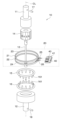
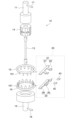
- FIG. 2 is an exploded perspective view of the torque sensor device according to the first embodiment.
- FIG. 2 is a perspective view of a multi-pole magnet and a yoke provided in the torque sensor device.
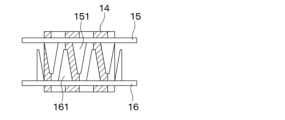
- 4 is a side view showing a relative rotation state between the multi-pole magnet and the yoke.
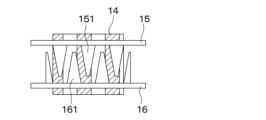
- FIG. 4 is a side view showing a relative rotation state between the multi-pole magnet and the yoke.
- FIG. 4 is a side view showing a relative rotation state between the multi-pole magnet and the yoke.
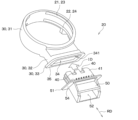
- FIG. 2 is an exploded perspective view of a magnetic sensor module used in the torque sensor device according to the first embodiment.
- FIG. 2 is a side view of the magnetic sensor module used in the torque sensor device according to the first embodiment.
- 11 is an explanatory diagram for explaining a state in which a flange and a sensor housing are laser-welded to each other.
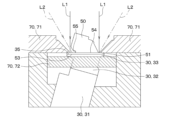
- FIG. 10 is an explanatory diagram for explaining a state in which the flange and the sensor housing are laser-welded together in a cross section taken along line XX in FIG. 9 .
- 2 is a side view showing a state in which the magnetic sensor module is mounted in a mounting space within a housing of the electric power steering system.
- FIG. 1 is a side view showing a state in which a magnetic sensor module of a first comparative example is mounted in a mounting space within a housing of an electric power steering system.
- FIG. 11 is an exploded perspective view of a torque sensor device according to a second embodiment.
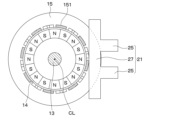
- FIG. 11 is a cross-sectional view of a multi-pole magnet, a yoke, and a magnetic flux guide member included in a torque sensor device according to a second embodiment.
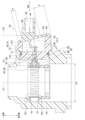
- FIG. 11 is a cross-sectional view of a torque sensor device according to a second embodiment.
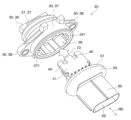
- FIG. 11 is an exploded perspective view of a magnetic sensor module used in the torque sensor device according to the second embodiment.
- FIG. 11 is a cross-sectional view of a magnetic sensor module used in a torque sensor device according to a third embodiment.
- FIG. 11 is a schematic diagram of a magnetic sensor module of a second comparative example.
- FIG. 13 is a schematic diagram of a magnetic sensor module according to a third embodiment.
- the sensor device according to the first embodiment is a torque sensor device 10 that detects a torque acting on a shaft about an axis.
- the torque sensor device 10 is applied to an electric power steering system 1 mounted on a vehicle.
- the electric power steering system 1 may be of a column assist type or a rack assist type.
- a steering shaft 3 is connected to a steering wheel 2.
- a torque sensor device 10 is provided on the steering shaft 3 to detect the torque around the axis acting on the steering shaft 3, i.e., the steering torque.
- a steering gear mechanism 4 is provided at the tip of the steering shaft 3. The steering gear mechanism 4 is connected to a pair of wheels 6 via a link mechanism 5.
- the torque sensor device 10 is provided between the input shaft 11 and output shaft 12 that constitute the steering shaft 3, and detects steering torque and outputs it to the ECU 7.
- the ECU 7 controls the driving force of the electric motor 8 according to the steering torque.
- the driving force of the electric motor 8 is transmitted to the output shaft 12 of the steering shaft 3 or the steering gear mechanism 4. In this way, the electric power steering system 1 assists the steering force to change the direction of the wheels 6.
- the torque sensor device 10 includes a torsion bar 13, a multi-pole magnet 14, yokes 15 and 16, and a magnetic sensor module 20.
- the magnetic sensor module 20 includes a first magnetic flux induction member 21, a second magnetic flux induction member 22, a sensor housing 30, a magnetic detection element 40, a connector housing 50, and a flange 51.
- the radial direction of an imaginary circle drawn on a plane perpendicular to the central axis CL of the steering shaft 3 and centered on the central axis CL is referred to as the "radial direction”
- the circumferential direction of the imaginary circle is referred to as the "circumferential direction”
- the direction in which the central axis CL extends is referred to as the "axial direction”.
- the torsion bar 13 coaxially connects the input shaft 11 and the output shaft 12 on the central axis CL.
- the torsion bar 13 is a rod-shaped elastic member, and the amount of torsional displacement changes according to the steering torque acting between the input shaft 11 and the output shaft 12. In other words, the torsion bar 13 converts the steering torque into the amount of torsional displacement.
- the central axis CL of the torsion bar 13 and the central axis CL of the steering shaft 3 coincide with each other.
- the multi-pole magnet 14 is a permanent magnet with alternating north and south poles arranged in the circumferential direction, and is fixed to the input shaft 11.
- the multi-pole magnet 14 may also be fixed to one end of the torsion bar 13.
- the multi-pole magnet 14 has, for example, eight north poles and eight south poles, arranged at intervals of 22.5°.
- the first yoke 15 and the second yoke 16 (hereinafter referred to as the "pair of yokes 15, 16") are formed in an annular shape from a soft magnetic material, held by a holding member (not shown) on the radial outside of the multi-pole magnet 14, and fixed to the output shaft 12.
- the pair of yokes 15, 16 may be fixed to the other end side of the torsion bar 13. As shown in FIG. 3, the pair of yokes 15, 16 face each other in the axial direction with a gap between them.
- Each of the pair of yokes 15, 16 has claws 151, 161, the same number as the N poles or S poles of the multi-pole magnet 14, spaced equally apart in the circumferential direction.
- the claws 151 of the first yoke 15 and the claws 161 of the second yoke 16 are alternately arranged with a circumferential shift. In this way, the pair of yokes 15, 16 form a magnetic circuit in the magnetic field generated by the multi-pole magnet 14.
- FIGs 3 and 4 show a state in which no torsional torque is acting on the torsion bar 13. Note that for the sake of explanation, in Figures 4 to 6, the north pole of the multi-pole magnet 14 is hatched, although not in cross section, and the south pole is not hatched. In the state shown in Figures 3 and 4, the circumferential center positions of the claws 151, 161 of the pair of yokes 15, 16 and the boundary between the north pole and south pole of the multi-pole magnet 14 overlap radially. At this time, no magnetic flux flows between the first yoke 15 and the second yoke 16.
- Figures 5 and 6 show a state in which the torsional torque acting on the torsion bar 13 gradually increases. Therefore, the amount of torsional displacement of the torsion bar 13 gradually increases from the state of Figure 4 to the state of Figure 6 via the state of Figure 5. Accordingly, the area where the N pole of the multi-pole magnet 14 and the claw 151 of the first yoke 15 overlap in the radial direction gradually increases, and the area where the S pole of the multi-pole magnet 14 and the claw 161 of the second yoke 16 overlap in the radial direction gradually increases. Therefore, the influence of the N pole of the multi-pole magnet 14 on the first yoke 15 gradually increases, and the influence of the S pole of the multi-pole magnet 14 on the second yoke 16 also gradually increases. Therefore, the magnetic flux density flowing between the first yoke 15 and the second yoke 16 gradually increases.
- the first magnetic flux induction member 21 and the second magnetic flux induction member 22 are formed of a soft magnetic material.
- the first magnetic flux induction member 21 is provided radially outside and in the axial direction of the first yoke 15, and the second magnetic flux induction member 22 is provided radially outside and in the axial direction of the second yoke 16.
- the pair of magnetic flux induction members 21, 22 each have a magnetic flux collecting portion 23, 24 formed in an annular or arc shape radially outside the pair of yokes 15, 16, and an extension portion 25, 26 extending radially outward from the magnetic flux collecting portion 23, 24.
- the magnetic flux collecting portion 23, 24 surrounds most of the radial outside of the pair of yokes 15, 16.
- the first extension portion 25 and the second extension portion 26 are the portions where the first magnetic flux induction member 21 and the second magnetic flux induction member 22 are adjacent to each other. Therefore, the distance between the first extension 25 and the second extension 26 is smaller than the distance between the first magnetic flux collector 23 and the second magnetic flux collector 24. Therefore, the magnetic flux induced from the pair of yokes 15, 16 to the magnetic flux collectors 23, 24 of the pair of magnetic flux guiders 21, 22 flows through the gap between the first extension 25 and the second extension 26.
- the pair of magnetic flux induction members 21, 22 are housed in a sensor housing 30.
- the sensor housing 30 has a cylindrical sensor housing main body 31, a sensor housing extension 32 extending from the sensor housing main body 31 toward the connector housing 50, and a sensor housing side flange 33 extending outward from the sensor housing extension 32.
- the central axis CL of the inner peripheral surface of the sensor housing main body 31 shown in FIG. 8 (hereinafter referred to as the "central axis CL of the sensor housing 30") coincides with the central axis CL of the torsion bar 13.
- the magnetic flux collectors 23, 24 of the pair of magnetic flux induction members 21, 22 are fixed to the radially inner portion of the sensor housing main body 31.
- the extensions 25, 26 of the pair of magnetic flux induction members 21, 22 are fixed to the inside of the sensor housing extension 32.
- the magnetic detection element 40 mounted on the board 41 together with a part of the connector housing 50 is inserted into the opening 34 of the sensor housing extension 32.
- the direction in which the magnetic detection element 40 mounted on the board 41 together with a part of the connector housing 50 is inserted into the opening 34 of the sensor housing extension 32 is referred to as the "element insertion direction ID”.
- a guide 341 is provided to guide the board 41 during insertion. The guide 341 extends parallel to the direction in which the magnetic detection element 40 and the board 41 are inserted into the connector housing 50 (i.e., the element insertion direction ID).
- the element insertion direction ID can be confirmed as the in-plane direction of the board 41, the extension direction of the guide 341, or the extension direction of the axis of the square-tube sensor housing extension 32.
- the element insertion direction ID can be confirmed as the direction in which the magnetic detection element 40 is inserted between the first extension portion 25 and the second extension portion 26.
- the sensor housing side flange 33 is provided on the entire outer periphery of the opening 34 of the sensor housing extension portion 32.
- the flange 51 is joined to the surface 35 of the sensor housing side flange 33 on the flange 51 side.
- the magnetic detection element 40 is mounted on the substrate 41 and inserted into the opening 34 of the sensor housing extension 32, and is disposed between the first extension 25 and the second extension 26.
- the magnetic detection element 40 is configured as an IC package in which, for example, a Hall element or a magnetic resistance element is resin-molded.
- the magnetic detection element 40 outputs an electrical signal according to the magnetic flux density passing through the gap between the first extension 25 and the second extension 26, which are adjacent portions of the pair of magnetic flux induction members 21, 22. Note that multiple magnetic detection elements 40 are mounted on the substrate 41 to ensure redundancy or detection accuracy of torque detection.
- the connector housing 50 and the flange 51 are integrally formed by resin injection molding.
- the connector housing 50 is provided with a substrate 41 on which the magnetic detection element 40 is mounted, and a terminal 42 electrically connected to the magnetic detection element 40.
- the connector housing 50 is provided with a cylindrical connector opening 52 to which the external connector 60 can be attached and detached.
- the external connector 60 inserted into the connector opening 52 and the wiring 61 extending from the external connector 60 are shown by two-dot chain lines.
- the direction in which the external connector 60 is attached and detached to the connector opening 52 is referred to as the "external connector attachment/detachment direction RD".
- the external connector attachment/detachment direction RD is shown by a double-headed arrow.
- the element insertion direction ID and the external connector attachment/detachment direction RD are parallel. In this embodiment, the element insertion direction ID and the external connector attachment/detachment direction RD are perpendicular to the central axis CL of the sensor housing 30.
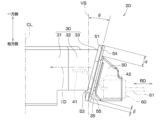
- FIG. 8 is a side view of the magnetic sensor module 20 as viewed from a direction perpendicular to the direction in which the central axis CL of the sensor housing 30 extends, and perpendicular to the element insertion direction ID and the external connector attachment/detachment direction RD.
- the direction in which the central axis CL of the sensor housing 30 extends is referred to as the "axial direction of the sensor housing 30”
- the upper side of FIG. 8 is referred to as “one axial side of the sensor housing 30”
- the lower side of FIG. 8 is referred to as "the other axial side of the sensor housing 30".
- the flange 51 extends outward from the connector housing 50.
- the flange 51 extends outward from the entire circumference of the surface of the connector housing 50 that faces a direction intersecting the element insertion direction ID and the external connector attachment/detachment direction RD.
- the flange 51 is formed in a plate shape and is inclined with respect to a virtual plane VS perpendicular to the element insertion direction ID. It can also be said that the flange 51 is inclined with respect to a virtual plane VS perpendicular to the substrate 41. It can also be said that the flange 51 is inclined with respect to a virtual plane VS parallel to the central axis CL of the torsion bar 13 or the sensor housing 30.
- the flange 51 is inclined with respect to a virtual plane VS perpendicular to the external connector attachment/detachment direction RD. It can also be said that the flange 51 is inclined with respect to a virtual plane VS perpendicular to the axis of the square cylindrical sensor housing extension portion 32.
- the surface of the flange 51 facing the sensor housing 30 is called a joint surface 53.
- the joint surface 53 of the flange 51 is a surface that is joined to the sensor housing side flange 33.
- the surface of the flange 51 facing the opposite side to the joint surface 53 is called a non-joining surface 54.
- the joint surface 53 and the non-joining surface 54 of the flange 51 are formed parallel to each other. Both the joint surface 53 and the non-joining surface 54 of the flange 51 are inclined with respect to the imaginary plane VS.
- the inclination angle ⁇ of the joint surface 53 of the flange 51 with respect to the virtual plane VS is, for example, in the range of 5° to 45°, preferably in the range of 10° to 40°, and more preferably in the range of 20° to 30°.
- the inclination angle ⁇ of the joint surface 53 of the flange 51 is not limited to the above angle range.
- the inclination angle ⁇ is appropriately set within a range that allows the magnetic sensor module 20 to be mounted in the housing of the electric power steering system 1, ensures the joint strength between the flange 51 and the connector housing 50, and ensures the area of the connector opening 52.
- the joint surface 53 of the flange 51 is inclined from one axial side of the sensor housing 30 toward the other axial side of the sensor housing 30, so as to approach the central axis CL of the sensor housing 30.
- the surface 35 of the sensor housing side flange 33 on the flange 51 side is also inclined from one axial side of the sensor housing 30 toward the other axial side of the sensor housing 30, so as to approach the central axis CL of the sensor housing 30.
- the surface 35 of the sensor housing side flange 33 on the flange 51 side and the joint surface 53 of the flange 51 are joined by laser welding.
- the sensor housing flange 33 and flange 51 are joined by laser welding, so the following configuration is used.
- the entire circumference of the flange 51 extends outward to surround the outside of the connector housing 50.
- the arrow ⁇ indicates the range in which the portion of the flange 51 on one axial side of the sensor housing 30 extends outward from the connector housing 50 when viewed from a direction perpendicular to the joint surface 53 of the flange 51.
- the arrow ⁇ indicates the range in which the portion of the flange 51 on the other axial side of the sensor housing 30 extends outward from the connector housing 50 when viewed from a direction perpendicular to the joint surface 53 of the flange 51.
- the portion of the flange 51 on the front side of the paper in FIG. 8 also extends outward from the connector housing 50, and the portion of the flange 51 on the back side of the paper in FIG. 8 also extends outward from the connector housing 50. This is shown in FIG. 7.
- the range in which the flange 51 extends outward from the connector housing 50 is large enough for an upper jig 71 of a laser welding device 70, which will be described later, to apply pressure to the flange 51. This makes it possible to prevent foaming from occurring on the welding surface between the flange 51 and the sensor housing side flange 33 when performing laser welding.
- the range of the flange 51 extending outward from the connector housing 50 when viewed from a direction perpendicular to the joint surface 53 of the flange 51 is set to a size that allows the flange 51 to be irradiated with laser light when the upper jig 71 of the laser welding device 70 presses the flange 51.
- the sensor housing side flange 33 is formed from a resin that is more absorptive of laser light than the resin that forms the flange 51.
- the flange 51 is formed from a resin that is more transmissive to laser light than the resin that forms the sensor housing side flange 33.
- the flange 51 has a plate thickness that allows the laser light to pass through. This allows the sensor housing side flange 33 and the flange 51 to be laser welded together.
- a recess 55 is provided on one side of the sensor housing 30 in the axial direction at the portion of the connector housing 50 that connects to the flange 51. This makes it possible to irradiate the flange 51 with laser light from an oblique direction onto the flange 53 to perform laser welding, even if the flange 51 extends only a small area outside the connector housing 50 when viewed perpendicularly to the flange 51's joint surface 53.
- the laser welding between the flange 51 and the sensor housing flange 33 is performed with the substrate 41, the magnetic detection element 40 mounted on the substrate 41, and part of the connector housing 50 inserted inside the sensor housing extension 32.
- the sensor housing flange 33 is placed on the lower jig 72 of the laser welding device 70.
- the upper jig 71 of the laser welding device 70 is placed on the flange 51.
- the upper jig 71 and the lower jig 72 apply pressure to the flange 51 and the sensor housing flange 33 all around.
- laser light is irradiated from a direction perpendicular to the joint surface 53 of the flange 51.
- the laser light travels around the outside of the connector housing 50 and is irradiated to the entire circumference of the flange 51.
- the laser light passes through the flange 51 and is absorbed by the sensor housing side flange 33. This causes the boundary surface between the flange 51 and the sensor housing side flange 33 to be laser welded.
- dashed line L2 in FIG. 10 the laser light may be irradiated from an oblique direction to the joint surface 53 of the flange 51.
- the irradiation of the laser light is stopped, the upper jig 71 is removed from the flange 51, and the magnetic sensor module 20 is removed from the laser welding device 70. This completes the laser welding between the flange 51 and the sensor housing side flange 33.
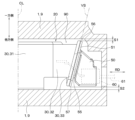
- the magnetic sensor module 20 is used as a part of the torque sensor device 10, and is mounted in a mounting space 90 in a housing 9 of the electric power steering system 1 as shown in FIG. 11 , the magnetic sensor module 20 of this embodiment can ensure a clearance between an outer edge 56 of the flange 51 on one axial side of the sensor housing 30 and the inner wall of the housing 9 of the electric power steering system 1. In addition, as shown in S2 of Fig. 11 , the magnetic sensor module 20 of this embodiment can also ensure a clearance between an outer edge 57 of the flange 51 on the other axial side of the sensor housing 30 and the inner wall of the housing 9 of the electric power steering system 1.
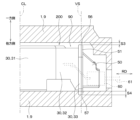
- the flange 51 is formed parallel to the virtual plane VS.
- the area of the joint surface 53 of the flange 51 and the area of the connector opening 52 are the same as those of the magnetic sensor module 20 of the first embodiment.
- the clearance between the outer edge 56 of the flange 51 on one axial side of the sensor housing 30 and the inner wall of the housing 9 of the electric power steering system 1 can be secured.
- the magnetic sensor module 200 of the first comparative example in the magnetic sensor module 200 of the first comparative example, the outer edge 57 of the flange 51 on the other axial side of the sensor housing 30 interferes with the housing 9 of the electric power steering system 1. Therefore, the magnetic sensor module 200 of the first comparative example cannot be mounted or is difficult to mount in the mounting space 90 in the housing 9 of the electric power steering system 1.
- the magnetic sensor module 20, torque sensor device 10, and sensor device of the first embodiment have the following effects.
- the magnetic sensor module 20 of the first embodiment includes a pair of magnetic flux induction members 21, 22, a sensor housing 30, a magnetic detection element 40, a connector housing 50, and a flange 51.
- the flange 51 has a joint surface 53 facing the sensor housing 30 that is joined to the sensor housing 30.
- the joint surface 53 of the flange 51 is inclined with respect to a virtual plane VS perpendicular to the element insertion direction ID.
- the magnetic sensor module 20 can be made smaller in size while ensuring the area of the joint surface 53 that can ensure the joint strength between the flange 51 and the connector housing 50, and the area of the connector opening 52 into which the external connector 60 is inserted. Therefore, this magnetic sensor module 20 can be mounted in a narrow mounting space 90 inside the housing 9 of a vehicle-side system such as the electric power steering system 1.
- the magnetic sensor module 20 of the first embodiment can be adapted by simply changing the length of the wiring 61 provided in the external connector 60. Therefore, there is no need to change the specifications of the magnetic sensor module 20 depending on the vehicle model, and design and manufacturing costs can be reduced.
- the torque sensor device 10 of the first embodiment includes the torsion bar 13, the multi-pole magnet 14, the pair of yokes 15 and 16, and the magnetic sensor module 20 described in (1) above. This allows the torque sensor device 10 to have a smaller magnetic sensor module 20, and the torque sensor device 10 can be mounted in a narrow mounting space 90 inside a housing 9 of a vehicle-side system such as the electric power steering system 1. Furthermore, since the torque sensor device 10 has a detachable external connector 60, it is not necessary to change the specifications according to the type of vehicle to which the torque sensor device 10 is mounted, and design and manufacturing costs can be reduced.
- the sensor device of the first embodiment includes a sensor body that detects a change in a physical quantity, a sensor housing 30 that houses at least a portion of the sensor body, a connector housing 50, and a flange 51.
- the flange 51 has a joint surface 53 that faces the sensor housing 30 and is joined to the sensor housing 30.
- the joint surface 53 of the flange 51 is inclined with respect to a virtual plane VS that is perpendicular to the element insertion direction ID.
- the sensor device detects various physical quantities.
- the sensor body of the sensor device is composed of a pair of magnetic flux guide members 21 and 22.
- the sensor body of the sensor device is composed of the torsion bar 13, the multi-pole magnet 14, the pair of yokes 15, 16, and the pair of magnetic flux guide members 21, 22.
- the sensor housing 30 accommodates the pair of magnetic flux guide members 21, 22. Therefore, the sensor device can achieve the same effects as the magnetic sensor module described in (1) above and the torque sensor device described in (2) above.
- the entire periphery of the flange 51 extends so as to surround the outside of the connector housing 50 .
- the joining surface 53 can be irradiated with laser light from a direction perpendicular to the joining surface 53, thereby enabling laser welding between the flange 51 and the sensor housing 30.
- the laser light may be irradiated with the joining surface 53 from an oblique direction.
- the joint surface 53 of the flange 51 and the sensor housing 30 are joined together along the entire outer periphery of the connector housing 50 by laser welding. This makes it possible to prevent water and the like from entering the inside of the sensor device through the joint between the flange 51 and the sensor housing 30 . Furthermore, in this embodiment, since the wiring is not fixed to the components constituting the magnetic sensor module 20 as in Patent Document 1, the wiring does not get in the way when performing laser welding, and laser welding can be performed easily.
- the joint surface 53 and the anti-joint surface 54 of the flange 51 are formed parallel to each other. This allows the plate thickness of the flange 51 to be constant, and prevents variation in the joining strength of the laser welding over the entire circumference of the flange 51 .
- the surface 35 of the sensor housing side flange 33 on the flange 51 side of the sensor housing 30 is inclined in the same direction as the flange 51 with respect to the imaginary plane VS perpendicular to the element insertion direction ID, and is joined to the flange 51.
- the sensor housing side flange 33 can be placed on the lower jig 72 of the laser welding device 70, and pressure can be applied to the entire circumference of the flange 51 and the sensor housing side flange 33. Therefore, when performing laser welding, foaming can be prevented from occurring on the welding surface between the flange 51 and the sensor housing side flange 33.
- the flange 51 is made of a resin that has a higher laser light transmittance than the resin that forms the sensor housing flange 33, and has a thickness that allows the laser light to pass through. This allows the flange 51 and the sensor housing 30 to be reliably laser welded together.
- the joint surface 53 of the flange 51 is inclined from one side to the other side in the direction in which the central axis CL of the sensor housing 30 extends so as to approach the central axis CL of the sensor housing 30.
- a recess 55 that is recessed to one side in the direction in which the central axis CL of the sensor housing 30 extends is provided at the portion of the connector housing 50 on the other side in the direction in which the central axis CL of the sensor housing 30 extends, at the portion connected to the flange 51.
- the flange 51 and the connector housing 50 can be laser welded together.
- the magnetic flux collectors 23 and 24 of the pair of magnetic flux guide members 21 and 22 are provided in an annular or arc-shaped configuration on the radially outer side of the pair of yokes 15 and 16 . This increases the area over which the pair of yokes 15, 16 and the pair of magnetic flux guide members 21, 22 face each other in the radial direction, thereby increasing the magnetic flux density induced from the pair of yokes 15, 16 to the pair of magnetic flux guide members 21, 22, and thereby increasing the signal-to-noise ratio and improving the torque detection accuracy.
- Second Embodiment The second embodiment will be described.
- a part of the configuration of the magnetic sensor module 20 in the first embodiment is changed, and the rest is the same as in the first embodiment, so only the parts that are different from the first embodiment will be described.
- the torque sensor device 10 as a sensor device of the second embodiment also includes a torsion bar 13, a multi-pole magnet 14, a pair of yokes 15, 16, and a magnetic sensor module 20, as in the first embodiment.
- the pair of magnetic flux induction members 21, 22 of the magnetic sensor module 20 are provided in a rod shape on a part of the radial outer side of the pair of yokes 15, 16.
- the pair of magnetic flux induction members 21, 22 have rectangular band-shaped magnetic collectors 27, 28 arranged on a part of the radial outer side of the pair of yokes 15, 16, and extensions 25, 26 extending radially outward from the magnetic collectors 27, 28.
- the shape of the pair of magnetic flux induction members 21, 22 is not limited to that shown in FIGS. 13 and 14, and the magnetic collectors 27, 28 may be, for example, arc-shaped, wavy, elliptical, or polygonal, or may have a shape having a protrusion (not shown) for fixing to the sensor housing 30.
- the sensor housing 30 has a magnetic flux induction member mounting portion 36, a cylindrical portion 37, and a housing mounting portion 38 that protrudes outward from the cylindrical portion 37.
- the central axis CL2 of the cylindrical portion 37 of the sensor housing 30 is perpendicular to the central axis CL of the yokes 15, 16.
- the direction in which the central axis CL of the yokes 15, 16 extends is referred to as the "axial direction of the yokes 15, 16".
- the central axis CL of the yokes 15, 16, the central axis CL of the torsion bar 13, and the central axis CL of the steering shaft 3 coincide with each other.
- the magnetic detection element 40 mounted on the board 41 together with a part of the connector housing 50 is inserted into the opening 39 of the tube portion 37 of the sensor housing 30.
- the direction in which the magnetic detection element 40 mounted on the board 41 together with a part of the connector housing 50 is inserted into the opening 39 of the tube portion 37 of the sensor housing 30 is referred to as the "element insertion direction ID”.
- a guide 341 is provided on the inside of the tube portion 37 of the sensor housing 30 to guide the board 41 during insertion. The guide 341 extends parallel to the direction in which the magnetic detection element 40 and the board 41 are inserted into the connector housing 50 (i.e., the element insertion direction ID).
- the element insertion direction ID can be confirmed as the in-plane direction of the board 41, the extension direction of the guide 341, or the extension direction of the axis of the tube portion 37 of the sensor housing 30.
- the element insertion direction ID can be confirmed as the direction in which the magnetic detection element 40 is inserted between the first extension portion 25 and the second extension portion 26 .
- the magnetic detection element 40 is disposed between the first extension portion 25 and the second extension portion 26.
- the joining surface 53 of the flange 51 is joined to a surface 371 of the tube portion 37 of the sensor housing 30 on the flange 51 side.
- the connector housing 50 and the flange 51 are integrally formed by resin injection molding.
- the connector housing 50 is provided with a substrate 41 on which the magnetic detection element 40 is mounted, and a terminal 42 electrically connected to the magnetic detection element 40.
- the connector housing 50 is provided with a cylindrical connector opening 52 to which an external connector 60 can be attached and detached.
- the external connector attachment and detachment direction RD, the element insertion direction ID, and the direction in which the central axis CL2 of the cylindrical portion 37 of the sensor housing 30 extends are aligned.
- the flange 51 extends outward from the connector housing 50.
- the flange 51 extends outward from the entire circumference of the surface of the connector housing 50 that faces a direction intersecting the element insertion direction ID and the external connector attachment/detachment direction RD.
- the flange 51 is formed in a plate shape and is inclined with respect to an imaginary plane VS perpendicular to the element insertion direction ID. It can also be said that the flange 51 is inclined with respect to an imaginary plane VS perpendicular to the substrate 41. It can also be said that the flange 51 is inclined with respect to an imaginary plane VS parallel to the central axis CL of the torsion bar 13.
- the flange 51 is inclined with respect to an imaginary plane VS perpendicular to the external connector attachment/detachment direction RD. It can also be said that the flange 51 is inclined with respect to an imaginary plane VS perpendicular to the axis of the tube portion 37 of the sensor housing 30.
- the surface of the flange 51 facing the sensor housing 30, i.e., the joint surface 53, is joined to the tubular portion 37 of the sensor housing 30.
- the surface of the flange 51 facing the opposite side to the joint surface 53 is called the anti-joining surface 54.
- the joint surface 53 and the anti-joining surface 54 of the flange 51 are formed parallel to each other. Both the joint surface 53 and the anti-joining surface 54 of the flange 51 are inclined with respect to the imaginary plane VS.
- the surface 371 of the tube portion 37 of the sensor housing 30 facing the flange 51 and the joining surface 53 of the flange 51 are joined by laser welding.
- the sensor housing 30 and the flange 51 are joined by laser welding, and are configured as follows.
- the entire circumference of the flange 51 extends outward to surround the outside of the connector housing 50.
- the arrow ⁇ indicates the range in which the portion of the flange 51 on one axial side of the yokes 15 and 16 extends outward from the connector housing 50 when viewed from a direction perpendicular to the joint surface 53 of the flange 51.
- the arrow ⁇ indicates the range in which the portion of the flange 51 on the other axial side of the yokes 15 and 16 extends outward from the connector housing 50 when viewed from a direction perpendicular to the joint surface 53 of the flange 51.
- the portion of the flange 51 on the front side of the paper in FIG. 15 also extends outward from the connector housing 50, and the portion of the flange 51 on the back side of the paper 15 also extends outward from the connector housing 50. This is shown in FIG. 16.
- the tubular portion 37 of the sensor housing 30 is formed from a resin that is more absorptive of laser light than the resin that forms the flange 51.
- the flange 51 is formed from a resin that is more transmissive to laser light than the resin that forms the tubular portion 37 of the sensor housing 30.
- the flange 51 has a plate thickness that allows the laser light to pass through. This allows the tubular portion 37 of the sensor housing 30 and the flange 51 to be laser welded together.
- the connector housing 50 may also be provided with the recess 55 described in the first embodiment.
- the magnetic sensor module 20 is used as part of the torque sensor device 10 and is mounted in the mounting space 90 within the housing 9 of the electric power steering system 1.
- the magnetic sensor module 20, torque sensor device 10, and sensor device of the second embodiment described above also achieve the same effects as those described in the first embodiment.
- the pair of magnetic flux guide members 21 and 22 are provided in a rod shape on a part of the radially outer side of the pair of yokes 15 and 16 .
- the inner diameter D1 of the portion 91 of the system side housing that houses the pair of yokes 15, 16 can be made smaller than that of the first embodiment.
- the sensor device of the third embodiment is also a torque sensor device 10 applied to the electric power steering system 1 shown in FIG. 1 and the like, similar to the first embodiment.
- the torque sensor device 10 includes a magnetic sensor module 20 similar to that of the first embodiment.
- the magnetic sensor module 20 includes a first magnetic flux induction member 21, a second magnetic flux induction member 22, a sensor housing 30, a magnetic detection element 40, a connector housing 50, and a flange 51.
- the first magnetic flux induction member 21 and the second magnetic flux induction member 22 are referred to as a "pair of magnetic flux induction members 21, 22".
- the pair of magnetic flux induction members 21, 22 includes magnetic flux collecting portions 23, 24 and extension portions 25, 26.
- the pair of magnetic flux guide members 21, 22 are housed in a sensor housing 30. Specifically, the pair of magnetic flux guide members 21, 22 are fixed to the sensor housing 30 by resin molding or the like. A portion of the sensor housing 30 is formed into a cylindrical shape. Specifically, the sensor housing has a cylindrical sensor housing main body 31, a sensor housing extension 32 extending from the sensor housing main body 31 toward the connector housing 50, and a sensor housing side flange 33 extending outward from the sensor housing extension 32.
- the magnetic flux collectors 23, 24 of the pair of magnetic flux guide members 21, 22 are fixed to radially inner portions of the sensor housing main body 31, and the extensions 25, 26 extend from the magnetic flux collectors 23, 24 to the inside of the sensor housing extension 32.
- the central axis CL of the inner circumferential surface of the sensor housing main body 31 is referred to as the "central axis CL of the sensor housing 30."
- the central axis CL of the sensor housing 30, the central axis CL of the torsion bar 13 described in the first embodiment, and the central axis CL of the steering shaft 3 coincide with each other.
- the radial direction of an imaginary circle drawn around the central axis CL on a plane perpendicular to the central axis CL of the sensor housing 30 is referred to as the "radial direction”
- the circumferential direction of the imaginary circle is referred to as the "circumferential direction”
- the direction in which the central axis CL extends is referred to as the "axial direction.”
- the upper side of FIG. 17 is referred to as the "one axial side”
- the lower side of FIG. 17 is referred to as the “other axial side.”
- the magnetic detection element 40 mounted on the substrate 41 together with a part of the connector housing 50 is inserted into the opening 34 of the sensor housing extension 32.
- the magnetic detection element 40 is mounted on the substrate 41 and disposed between the first extension 25 and the second extension 26 in a state where the magnetic detection element 40 is mounted on the substrate 41 and inserted into the opening 34 of the sensor housing extension 32.
- the direction in which the magnetic detection element 40 mounted on the substrate 41 is inserted into the opening 34 of the sensor housing extension 32 is called the "element insertion direction ID".
- the element insertion direction ID can be confirmed as the in-plane direction of the substrate 41 or the direction in which the axis of the sensor housing extension 32 extends.
- the element insertion direction ID can be confirmed as the direction in which the magnetic detection element 40 is inserted between the first extension 25 and the second extension 26 of the pair of magnetic flux induction members 21, 22.
- a flange 51 on the connector housing 50 side is joined to the sensor housing side flange 33.
- the sensor housing side flange 33 and the flange 51 are joined by, for example, laser welding.
- the connector housing 50 and the flange 51 are integrally formed by resin injection molding.
- the connector housing 50 is provided with a substrate 41 on which the magnetic detection element 40 is mounted, and a terminal 42 electrically connected to the magnetic detection element 40 via wiring on the substrate 41.
- the connector housing 50 is provided with a cylindrical connector opening 52 to which an external connector (not shown) can be attached and detached. One end of the terminal 42 is connected to the magnetic detection element 40, and the other end is exposed to the connector opening 52.
- the attachment/detachment direction RD of the external connector and the element insertion direction ID are parallel. Also, in this embodiment, the external connector attachment/detachment direction RD and the element insertion direction ID intersect (specifically, perpendicular) with the central axis CL of the sensor housing 30.
- the flange 51 extends outward from the connector housing 50. Specifically, the flange 51 extends outward from the entire periphery of a surface of the outer wall surface of the connector housing 50 that faces a direction intersecting the element insertion direction ID and the external connector attachment/detachment direction RD.
- the flange 51 is formed in a plate shape and is inclined with respect to a virtual plane VS perpendicular to the element insertion direction ID.
- the surface of the flange 51 facing the sensor housing 30 is a joint surface 53 that is joined to the sensor housing side flange 33.
- a non-joining surface 54 of the flange 51 facing the opposite side to the joint surface 53 is formed parallel to the joint surface 53 of the flange 51.
- Both the joint surface 53 and the non-joining surface 54 of the flange 51 are inclined with respect to the virtual plane VS.
- the inclination angle ⁇ of the joint surface 53 of the flange 51 with respect to the virtual plane VS is as described in the first embodiment.
- the connector housing 50 is disposed at a position shifted axially to the other side with respect to the flange 51.
- the axial center position C1 of the connector opening 52 is shifted axially to the other side with respect to the axial center position C2 of the flange 51.
- the deviation ⁇ C between the two center positions C1, C2 is greater than the manufacturing tolerance when the two center positions C1, C2 are hypothetically aligned.
- it is preferable that the deviation ⁇ C between the two center positions C1, C2 is greater than 10% of the distance D3 along the central axis CL of the sensor housing 30 at the flange 51.
- the fact that the connector housing 50 is provided at a position shifted to the other axial side with respect to the flange 51 can also be stated as follows.
- A be the distance along the central axis CL of the sensor housing 30 between an outer wall 58 on one axial side of the connector housing 50 and an outer edge 56 on one axial side of the flange 51.
- B be the distance along the central axis CL of the sensor housing 30 between an outer wall 59 on the other axial side of the connector housing 50 and an outer edge 57 on the other axial side of the flange 51.
- A>B holds.
- the difference between the two distances A and B is larger than the manufacturing tolerance when the two distances A and B are assumed to be the same.
- it is preferable that the distance B is smaller than 10% of the distance A. Note that B may be 0.
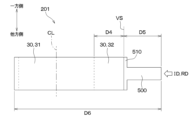
- the flange 510 extending outward from the connector housing 500 is formed parallel to an imaginary plane VS perpendicular to the element insertion direction ID and the external connector attachment/detachment direction RD.
- the radial size of the sensor housing extension portion 32 is defined as D4.
- the radial size of the flange 510 and the connector housing 500 is defined as D5.
- the radial size of the entire magnetic sensor module 201 is defined as D6.
- the flange 51 extending outward from the connector housing 50 is inclined with respect to the imaginary plane VS. Furthermore, the connector housing 50 is provided at a position shifted to the other axial side with respect to the flange 51. Note that in FIG. 19, the position where the connector housing 500 of the magnetic sensor module 201 of the second comparative example is superimposed on the magnetic sensor module 20 of this embodiment is indicated by a dashed dotted line. In this embodiment, the radial size D7 of the entire magnetic sensor module 20 can be reduced by a difference D8 compared to the radial size D6 of the entire magnetic sensor module 201 of the second comparative example.
- the axial center position C1 of the connector opening 52 is shifted to the other axial side from the axial center position C2 of the flange 51. This allows the radial size D7 of the entire magnetic sensor module 20 to be made smaller than that shown in the second comparative example.
- the distance A between the outer wall 58 on one axial side of the connector housing 50 and the outer edge 56 on one axial side of the flange 51 is greater than the distance B between the outer wall 59 on the other axial side of the connector housing 50 and the outer edge 57 on the other axial side of the flange 51.
- the torque sensor device 10 has been described as being applied to the electric power steering system 1, but this is not limited thereto.
- the torque sensor device 10 may be applied to various vehicle systems.
- the input shaft 11 constituting the steering shaft 3 corresponds to the first shaft
- the output shaft 12 corresponds to the second shaft
- the output shaft 12 may correspond to the first shaft
- the input shaft 11 may correspond to the second shaft.
- the multi-pole magnet 14 is fixed to the other end of the output shaft 12 or the torsion bar 13
- the pair of yokes 15, 16 are fixed to one end of the input shaft 11 or the torsion bar 13.
- the configuration in which the joining surface 53 of the flange 51 and the sensor housing side flange 33 of the sensor housing 30 are laser welded together is described, but this is not limited to the configuration.
- the joining method between the joining surface 53 of the flange 51 and the sensor housing side flange 33 of the sensor housing 30 can be various joining methods, such as joining with an adhesive, welding with heat, ultrasound or vibration, or joining with screws or rivets.
- the entire circumference of the flange 51 extends outside the connector housing 50 when viewed from a direction perpendicular to the joint surface 53 of the flange 51, but this is not limited to the configuration.
- a configuration in which a portion of the flange 51 extends outside the connector housing 50 when viewed from a direction perpendicular to the joint surface 53 of the flange 51 may also be used.
- the joint surface 53 of the flange 51 and the sensor housing 30 are joined by laser welding around the entire circumference on the outside of the connector housing 50, but this is not limited to the above.
- the joint surface 53 of the flange 51 and the sensor housing 30 may be joined by laser welding only partially on the outside of the connector housing 50.
- the joint surface 53 of the flange 51 is described as being inclined from one axial side of the sensor housing 30 toward the other axial side of the sensor housing 30 so as to approach the central axis CL of the sensor housing 30, but this is not limited thereto.
- the direction in which the joint surface 53 of the flange 51 is inclined can be set arbitrarily depending on, for example, the shape of the mounting space 90 for the magnetic sensor module 20 within the housing 9 of the vehicle system.
- the present disclosure is not limited to the above-described embodiments, and can be modified as appropriate.
- the above-described embodiments and parts thereof are not unrelated to each other, and can be combined as appropriate, except when the combination is clearly impossible.
- the elements constituting the embodiments are not necessarily essential, except when they are specifically stated to be essential or when they are clearly considered to be essential in principle.
- the numbers, values, amounts, ranges, etc. of the components of the embodiments are mentioned, they are not limited to the specific numbers, except when they are specifically stated to be essential or when they are clearly limited to a specific number in principle.
- the shapes, positional relationships, etc. of the components are mentioned, they are not limited to the shapes, positional relationships, etc., except when they are specifically stated to be essential or when they are clearly limited to a specific shape, positional relationship, etc. in principle.
- the sensor housing has a cylindrical sensor housing main body (31) and a sensor housing side flange (33) to which the flange is joined,
- the sensor device according to any one of the first to fourth aspects, wherein a surface (35) of the sensor housing flange on the flange side is inclined with respect to the imaginary plane in the same direction as the flange.
- the flange (51) is formed of a resin having a higher laser light transmittance than the resin forming the sensor housing, and has a plate thickness that allows the laser light to pass through.
- the sensor housing has a sensor housing main body (31) formed in a cylindrical shape, The joint surface is inclined from one side to the other side in a direction in which a central axis (CL) of the sensor housing main body extends so as to approach the central axis,
- a recess (55) that is recessed on one side in the direction in which the central axis extends is provided at the portion of the connector housing on the other side in the direction in which the central axis extends, at the point where the flange is connected.
- a torque sensor device for detecting an axial torque acting on a shaft (3), a torsion bar (13) that coaxially connects a first shaft (11) and a second shaft (12) that constitute the shaft and converts a torque acting between the first shaft and the second shaft into a torsional displacement amount;
- a multi-pole magnet (14) fixed to one end side of the first shaft or the torsion bar, in which N poles and S poles are alternately provided in the circumferential direction;
- a yoke (15, 16) fixed to the other end side of the second shaft or the torsion bar outside the multi-pole magnet and forming a magnetic circuit within the magnetic field of the multi-pole magnet; a first magnetic flux induction member (21) and a second magnetic flux induction member (22) provided on the outside of the yoke and guiding a magnetic flux flowing through the yoke;
- a magnetic detection element (40) that outputs
- the torsion bar is twisted and elastically deformed in response to a torque acting around an axis between the first shaft and the second shaft
- the yoke has a first yoke (15) and a second yoke (16), and the amount of magnetic flux flowing between the first yoke and the second yoke changes as a result of a change in the relative position of the multi-pole magnet in the rotational direction in response to a torsional displacement amount of the torsion bar;
- the first magnetic flux induction member has a first magnetic flux collecting portion (23) that collects the magnetic field of the first yoke
- the second magnetic flux induction member has a second magnetic flux collecting portion (24) that collects the magnetic field of the second yoke
- the magnetic detection element converts the magnetic flux collected by the first magnetic flux induction member and the second magnetic flux induction member into an electric signal and outputs the electric signal.
- the first magnetic flux induction member has a first magnetic flux collecting portion (23) provided in an annular or arcuate shape on the radially outer side of the yoke
- the torque sensor device according to the eighth or ninth aspect, wherein the second magnetic flux induction member has a second magnetic flux collecting portion (24) provided in an annular or arc-shaped manner on the radially outer side of the yoke.
- the first magnetic flux induction member has a first magnetic flux collecting portion (27) provided in a rod shape on a part of the radial outer side of the yoke
- the torque sensor device according to the eighth or ninth aspect wherein the second magnetic flux induction member has a second magnetic flux collecting portion (28) provided in a rod shape on a part of a radially outer side of the yoke.
- a magnetic sensor module for detecting a magnetic flux flowing through a yoke (15, 16), a first magnetic flux induction member (21) and a second magnetic flux induction member (22) for inducing magnetic flux flowing through the yoke; a sensor housing (30) that houses the first magnetic flux induction member and the second magnetic flux induction member; a magnetic detection element (40) that outputs a signal according to a magnetic flux density passing through a portion (25, 26) where the first magnetic flux induction member and the second magnetic flux induction member are adjacent to each other; a connector housing (50) in which the magnetic detection element is provided, the portion in which the magnetic detection element is provided being inserted into the inside of the sensor housing; a flange (51) extending outward from the connector housing and having a joint surface (53) facing the sensor housing that is joined to the sensor housing; A magnetic sensor module, wherein the joint surface is inclined with respect to a virtual plane (VS) perpendicular to a direction (ID) in which a portion of the
- the first magnetic flux induction member has a first magnetic flux collecting portion (23) provided in an annular or arcuate shape on the radially outer side of the yoke
- the magnetic sensor module according to a thirteenth aspect, wherein the second magnetic flux induction member has a second magnetic flux collecting portion (24) provided in an annular or arc-shaped manner radially outside the yoke.
- the first magnetic flux induction member has a first magnetic flux collecting portion (27) provided in a rod shape on a part of the radial outer side of the yoke
- the magnetic sensor module according to a thirteenth aspect, wherein the second magnetic flux induction member has a second magnetic flux collecting portion (28) provided in a rod shape on a part of the radially outer side of the yoke.
- a torque sensor device according to any one of the thirteenth to fifteenth aspects, which is mountable in a mounting space (90) within a housing (9) of an electric power steering system (1).
- the sensor housing has a sensor housing main body (31) formed in a cylindrical shape, The joint surface is inclined from one side to the other side in a direction in which a central axis (CL) of the sensor housing main body extends so as to approach the central axis,
- the connector housing has a connector opening (52) to which an external connector (60) is attached and detached,
- a sensor device as described in any one of the first to seventh aspects, wherein a center position (C1) in the direction in which the central axis extends at the connector opening is shifted to the other side in the direction in which the central axis extends with respect to a center position (C2) in the direction in which the central axis extends at the flange.
- the sensor housing has a sensor housing main body (31) formed in a cylindrical shape, The joint surface is inclined from one side to the other side in a direction in which a central axis (CL) of the sensor housing main body extends so as to approach the central axis, A is a distance along the extension direction of the central axis between an outer wall (58) of the connector housing on one side in the direction in which the central axis extends and an outer edge (56) of the flange on one side in the direction in which the central axis extends; If the distance between the outer wall (59) of the connector housing on the other side in the direction in which the central axis extends and the outer edge (57) of the flange on the other side in the direction in which the central axis extends is B,
- the sensor device according to any one of the first to seventh or seventeenth aspects, wherein a relationship of A>B is satisfied.
- the eighth and thirteenth viewpoints may be appropriately combined with the contents described in the second through seventh viewpoints, the seventeenth viewpoint, and the eighteenth viewpoint.
Landscapes
- Physics & Mathematics (AREA)
- General Physics & Mathematics (AREA)
- Power Steering Mechanism (AREA)
Priority Applications (2)
| Application Number | Priority Date | Filing Date | Title |
|---|---|---|---|
| CN202480055464.4A CN121752878A (zh) | 2023-09-13 | 2024-08-06 | 传感器装置、扭矩传感器装置、磁传感器模块 |
| JP2025545538A JP7835355B2 (ja) | 2023-09-13 | 2024-08-06 | センサ装置、トルクセンサ装置、磁気センサモジュール |
Applications Claiming Priority (2)
| Application Number | Priority Date | Filing Date | Title |
|---|---|---|---|
| JP2023148627 | 2023-09-13 | ||
| JP2023-148627 | 2023-09-13 |
Publications (1)
| Publication Number | Publication Date |
|---|---|
| WO2025057617A1 true WO2025057617A1 (ja) | 2025-03-20 |
Family
ID=95022073
Family Applications (1)
| Application Number | Title | Priority Date | Filing Date |
|---|---|---|---|
| PCT/JP2024/028132 Pending WO2025057617A1 (ja) | 2023-09-13 | 2024-08-06 | センサ装置、トルクセンサ装置、磁気センサモジュール |
Country Status (3)
| Country | Link |
|---|---|
| JP (1) | JP7835355B2 (https=) |
| CN (1) | CN121752878A (https=) |
| WO (1) | WO2025057617A1 (https=) |
Citations (5)
| Publication number | Priority date | Publication date | Assignee | Title |
|---|---|---|---|---|
| JP2012195164A (ja) * | 2011-03-16 | 2012-10-11 | Jtekt Corp | 電子制御ユニット |
| KR20160143187A (ko) * | 2015-06-04 | 2016-12-14 | 주식회사 태우티앤에이 | 압력 전송장치 |
| WO2016203600A1 (ja) * | 2015-06-18 | 2016-12-22 | 三菱電機株式会社 | 防水型電子制御装置 |
| JP2020023128A (ja) * | 2018-08-08 | 2020-02-13 | Kyb株式会社 | 電子機器、電子機器の製造方法およびケーシング |
| JP2021047088A (ja) * | 2019-09-18 | 2021-03-25 | 株式会社デンソー | 回転検出装置 |
Family Cites Families (4)
| Publication number | Priority date | Publication date | Assignee | Title |
|---|---|---|---|---|
| GB2272058B (en) | 1992-10-30 | 1997-01-29 | Schlumberger Ind Ltd | Thermocouple probe |
| JP2004045232A (ja) * | 2002-07-12 | 2004-02-12 | Fujitsu Ten Ltd | 筐体構造および筐体の取付構造 |
| JP6054838B2 (ja) * | 2013-10-18 | 2016-12-27 | 日立オートモティブシステムズ株式会社 | 電子制御装置 |
| FR3047560B1 (fr) | 2016-02-10 | 2018-03-16 | Jtekt Europe | Procede de fabrication d’un capteur de couple comprenant une etape d’encapsulation du circuit electronique du capteur. |
-
2024
- 2024-08-06 CN CN202480055464.4A patent/CN121752878A/zh active Pending
- 2024-08-06 WO PCT/JP2024/028132 patent/WO2025057617A1/ja active Pending
- 2024-08-06 JP JP2025545538A patent/JP7835355B2/ja active Active
Patent Citations (5)
| Publication number | Priority date | Publication date | Assignee | Title |
|---|---|---|---|---|
| JP2012195164A (ja) * | 2011-03-16 | 2012-10-11 | Jtekt Corp | 電子制御ユニット |
| KR20160143187A (ko) * | 2015-06-04 | 2016-12-14 | 주식회사 태우티앤에이 | 압력 전송장치 |
| WO2016203600A1 (ja) * | 2015-06-18 | 2016-12-22 | 三菱電機株式会社 | 防水型電子制御装置 |
| JP2020023128A (ja) * | 2018-08-08 | 2020-02-13 | Kyb株式会社 | 電子機器、電子機器の製造方法およびケーシング |
| JP2021047088A (ja) * | 2019-09-18 | 2021-03-25 | 株式会社デンソー | 回転検出装置 |
Also Published As
| Publication number | Publication date |
|---|---|
| JPWO2025057617A1 (https=) | 2025-03-20 |
| CN121752878A (zh) | 2026-03-27 |
| JP7835355B2 (ja) | 2026-03-25 |
Similar Documents
| Publication | Publication Date | Title |
|---|---|---|
| JP6295483B2 (ja) | パワーステアリング装置およびパワーステアリング装置の組み立て方法 | |
| CN101213431B (zh) | 用于检测角度差的传感器装置 | |
| KR101429825B1 (ko) | 토크 센서 장치 | |
| JP5382465B2 (ja) | 電動パワーステアリング装置 | |
| JP5864466B2 (ja) | 回転検出装置およびパワーステアリング装置 | |
| EP3470808B1 (en) | Torque sensor | |
| JP2017533408A (ja) | トルクセンサー装置 | |
| US11300464B2 (en) | Sensor device | |
| JP2017533407A (ja) | トルクセンサー装置 | |
| US12607528B2 (en) | Torque detection device | |
| JP6691071B2 (ja) | トルクセンサ | |
| WO2025057617A1 (ja) | センサ装置、トルクセンサ装置、磁気センサモジュール | |
| US20240142326A1 (en) | Torque detection device | |
| US12607529B2 (en) | Torque detection system | |
| KR20150034984A (ko) | 스테이터 조립체 및 이를 포함하는 토크 센서 | |
| JP7544105B2 (ja) | トルク検出システム | |
| JP2022051092A (ja) | トルクセンサ | |
| JP7322811B2 (ja) | 磁気センサ、トルク検出装置、ステアリング装置 | |
| CN117836597A (zh) | 扭矩检测系统 | |
| JP7111120B2 (ja) | トルク検出装置用ヨーク部材、トルク検出装置、ステアリング装置 | |
| JP2025036808A (ja) | 回転検出装置およびパワーステアリング装置 | |
| WO2025186868A1 (ja) | 操舵装置 | |
| CN119365755A (zh) | 传感器装置 | |
| WO2021107124A1 (ja) | トルク検出装置用ヨーク部材、トルク検出装置、ステアリング装置 |
Legal Events
| Date | Code | Title | Description |
|---|---|---|---|
| 121 | Ep: the epo has been informed by wipo that ep was designated in this application |
Ref document number: 24865123 Country of ref document: EP Kind code of ref document: A1 |
|
| ENP | Entry into the national phase |
Ref document number: 2025545538 Country of ref document: JP Kind code of ref document: A |
|
| WWE | Wipo information: entry into national phase |
Ref document number: 2025545538 Country of ref document: JP |