WO2025057408A1 - 多軸アクチュエータ - Google Patents
多軸アクチュエータ Download PDFInfo
- Publication number
- WO2025057408A1 WO2025057408A1 PCT/JP2023/033739 JP2023033739W WO2025057408A1 WO 2025057408 A1 WO2025057408 A1 WO 2025057408A1 JP 2023033739 W JP2023033739 W JP 2023033739W WO 2025057408 A1 WO2025057408 A1 WO 2025057408A1
- Authority
- WO
- WIPO (PCT)
- Prior art keywords
- coil
- axis actuator
- coil group
- circuit board
- printed circuit
- Prior art date
- Legal status (The legal status is an assumption and is not a legal conclusion. Google has not performed a legal analysis and makes no representation as to the accuracy of the status listed.)
- Pending
Links
Images









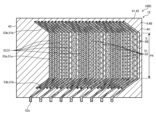


Classifications
-
- H—ELECTRICITY
- H02—GENERATION; CONVERSION OR DISTRIBUTION OF ELECTRIC POWER
- H02K—DYNAMO-ELECTRIC MACHINES
- H02K41/00—Propulsion systems in which a rigid body is moved along a path due to dynamo-electric interaction between the body and a magnetic field travelling along the path
- H02K41/02—Linear motors; Sectional motors
- H02K41/03—Synchronous motors; Motors moving step by step; Reluctance motors
Definitions
- This disclosure relates to a multi-axis actuator equipped with a coil for a multi-axis actuator.
- Multi-axis actuators that move a moving element in multiple directions have been used in semiconductor manufacturing equipment, small robots, and the like.
- Multi-axis actuators are equipped with multi-axis actuator coils that generate magnetic fields for moving the moving element in multiple directions.
- Patent Document 1 discloses a multi-axis actuator coil that includes a linear coil group having Z-axis coils arranged in the axial direction, and a rotary coil group having ⁇ -axis coils arranged on the outer periphery of the linear coil group.
- Patent Document 1 when two different coil groups are arranged side by side in the radial direction, mutual interference occurs in which the magnetic flux generated when current is passed through one of the two coil groups interferes with the other coil group. This causes the problem of unintended induced currents and malfunctions of the multi-axis actuator. The above-mentioned problem becomes particularly pronounced when the magnetic flux generated from the rotary coil group interferes with the linear coil group.
- the present disclosure has been made in consideration of the above, and aims to obtain a multi-axis actuator that can prevent magnetic flux generated from a rotating coil group from interfering with a linear coil group.
- the multi-axis actuator includes a cylindrical multi-axis actuator coil and a shaft arranged on the inner circumference of the multi-axis actuator coil.
- the multi-axis actuator coil includes a linear coil group that generates a magnetic field that moves the shaft in the axial direction, and a rotary coil group that is arranged on the inner or outer circumference of the linear coil group and generates a magnetic field that moves the shaft in the circumferential direction.
- the linear coil group has a plurality of linear coils arranged side by side in the axial direction. Each linear coil extends in the circumferential direction.
- Each linear coil has two coil ends located at one end and the other end in the circumferential direction. The first circumferential angle formed by the two coil ends of each linear coil is equal to the electrical angle period of the rotary coil group or is an integer multiple of the electrical angle period of the rotary coil group.
- the multi-axis actuator disclosed herein has the advantage of being able to prevent the magnetic flux generated by the rotating coil group from interfering with the linear coil group.
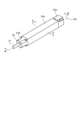
- FIG. 1 is a perspective view showing a multi-axis actuator according to a first embodiment
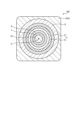
- FIG. 2 is a cross-sectional view taken along line II-II shown in FIG. 3 is a cross-sectional view taken along line III-III shown in FIG. 1
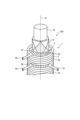
- FIG. 1 is a partially cutaway perspective view of a multi-axis actuator according to a first embodiment
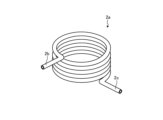
- FIG. 1 is a perspective view showing a linear motion coil according to a first embodiment
- FIG. 1 is a diagram of a linear motion coil according to a first embodiment, viewed along an axial direction.
- FIG. 1 is a front view showing a rotating coil according to a first embodiment
- FIG. 1 is a partially cutaway perspective view of a magnet according to a first embodiment.
- FIG. 11 is a side view showing a schematic diagram of a multi-axis actuator according to a second embodiment
- FIG. 13 is a side view showing a schematic diagram of a multi-axis actuator according to a third embodiment
- FIG. 13 is a perspective view showing a coil for a multi-axis actuator according to a fourth embodiment
- FIG. 13 is a diagram showing a coil for a multi-axis actuator according to a fourth embodiment, viewed along the axial direction.
- FIG. 11 is a side view showing a schematic diagram of a multi-axis actuator according to a second embodiment
- FIG. 13 is a side view showing a schematic diagram of a multi-axis actuator according to a third embodiment
- FIG. 13 is a perspective view showing a coil for a multi-axis actuator according to a fourth embodiment
- FIG. 13 is a diagram showing a coil for a multi-axis actuator according to a fourth embodiment, viewed along the axial direction.
- FIG. 11 is a side view showing
- FIG. 13 is a side view showing a state before a coil for a multi-axis actuator according to a fourth embodiment is wound around a first printed circuit board, showing a surface of the first printed circuit board;
- FIG. 13 is a side view showing a state before winding of a first printed circuit board of a multi-axis actuator coil according to a fourth embodiment, in which the rear surface of the first printed circuit board is seen through from the front surface;
- FIG. 13 is a side view showing a state before a coil for a multi-axis actuator according to a fourth embodiment is wound around a second printed circuit board, showing a surface of the second printed circuit board;
- FIG. 13 is a side view showing a state before winding of a second printed circuit board of a multi-axis actuator coil according to a fourth embodiment, in which the rear surface of the second printed circuit board is seen through from the front surface;
- FIG. 13 is a perspective view showing a coil for a multi-axis actuator according to a modified example of the fourth embodiment;
- FIG. 13 is a diagram showing a coil for a multi-axis actuator according to a modification of the fourth embodiment, viewed in the axial direction.
- FIG. 13 is a side view showing a state before a coil for a multi-axis actuator according to a fifth embodiment is wound around a first printed circuit board, showing a surface of the first printed circuit board;
- FIG. 13 is a side view showing a state before winding of a first printed circuit board of a multi-axis actuator coil according to a fifth embodiment, in which the rear surface of the first printed circuit board is seen through from the front surface;
- FIG. 13 is a side view showing a state before winding the second printed circuit board of the multi-axis actuator coil according to the fifth embodiment, and shows the surface of the second printed circuit board;
- FIG. 13 is a side view showing a state before winding of a second printed circuit board of a multi-axis actuator coil according to a fifth embodiment, in which the rear surface of the second printed circuit board is seen through from the front surface;
- FIG. 13 is a perspective view showing a coil for a multi-axis actuator according to a fifth embodiment;
- FIG. 13 is a side view showing a state before a coil for a multi-axis actuator according to a sixth embodiment is wound around a first printed circuit board, showing a surface of the first printed circuit board;
- FIG. 13 is a side view showing a state before winding of a first printed circuit board of a multi-axis actuator coil according to a sixth embodiment, in which the rear surface of the first printed circuit board is seen through from the front surface;
- FIG. 23 is a side view showing a state before a coil for a multi-axis actuator according to a sixth embodiment is wound around a second printed circuit board, showing a surface of the second printed circuit board;
- FIG. 13 is a side view showing a state before winding of a second printed circuit board of a multi-axis actuator coil according to a sixth embodiment, in which the rear surface of the second printed circuit board is seen through from the front surface;
- FIG. 23 is a side view showing a state before a coil for a multi-axis actuator according to a seventh embodiment is wound around a second printed circuit board, showing a surface of the second printed circuit board;
- FIG. 13 is a side view showing a state before winding a first printed circuit board of a multi-axis actuator coil according to a seventh embodiment, showing a surface of the first printed circuit board;
- FIG. 13 is a diagram showing a coil for a multi-axis actuator according to a seventh embodiment, viewed along the axial direction.
- FIG. 13 is a perspective view showing a multi-axis actuator according to an eighth embodiment.
- 33 is a cross-sectional view taken along line XXXIII-XXXIII shown in FIG. 33 is a cross-sectional view taken along line XXXIV-XXXIV shown in FIG.
- a multi-axis actuator 100 will be described with reference to Fig. 1 to Fig. 3.
- Fig. 1 is a perspective view showing the multi-axis actuator 100 according to the first embodiment.
- Fig. 2 is a cross-sectional view taken along line II-II shown in Fig. 1.
- Fig. 3 is a cross-sectional view taken along line III-III shown in Fig. 1.
- the multi-axis actuator 100 includes a housing 6, a rotor core 7, a magnet 8, a multi-axis actuator coil 1, a stator core 9, and a shaft 10.
- the rotor core 7 and the stator core 9 are both formed in a cylindrical shape having a central axis C.
- the direction parallel to the central axis C is referred to as the axial direction
- the direction perpendicular to the central axis C is referred to as the radial direction
- the direction of rotation about the central axis C is referred to as the circumferential direction.
- the multi-axis actuator 100 is an inner rotor type multi-axis actuator in which the rotor core 7 is disposed on the inner periphery of the stator core 9.
- the housing 6 is a member that houses the rotor core 7, magnets 8, multi-axis actuator coil 1, stator core 9, and shaft 10.
- the housing 6 is shaped like a cylinder with a rounded square outer surface and a circular inner surface. As shown in FIG. 3, the housing 6 has a cylindrical frame 6a with both axial ends open, and two brackets 6b arranged at the openings at both axial ends of the frame 6a. An insertion hole 6c into which the shaft 10 is inserted is formed in each of the two brackets 6b.
- a bearing 11 is arranged on the inner surface of the insertion hole 6c of each bracket 6b.
- the bearing 11 is a member that supports the shaft 10 so that it can rotate and move linearly.
- the shaft 10 is supported by the two bearings 11 so that it can rotate and move linearly.
- the bracket 6b on the right side of the paper in FIG. 3 has a through hole 6d formed therein for allowing the shaft 10 to protrude outside the housing 6.
- the stator core 9 is disposed on the inner circumference of the frame 6a.
- the stator core 9 is fitted into the inner circumference of the frame 6a.
- Magnetic paths are formed in multiple directions in the stator core 9. For this reason, it is preferable to use, for example, a powder magnetic core or a bulk material as the material for the stator core 9.
- the multi-axis actuator coil 1 is disposed on the inner circumference of the stator core 9.
- the multi-axis actuator coil 1 is formed in a cylindrical shape.
- the multi-axis actuator coil 1 is disposed coaxially with the central axis C of the rotor core 7 and the stator core 9.
- the multi-axis actuator coil 1 includes a linear coil group 2 and a rotating coil group 3 disposed on the inner circumference of the linear coil group 2.
- the linear coil group 2 generates a magnetic field for moving the shaft 10 in the axial direction.
- a magnetic field is generated by passing a current through the linear coil group 2, and this magnetic field generates a thrust for moving the shaft 10 in the axial direction, so that the shaft 10 can be moved in the axial direction.
- the rotating coil group 3 generates a magnetic field for rotating the shaft 10 in the circumferential direction.
- a magnetic field is generated by passing a current through the rotating coil group 3, and this magnetic field generates a torque for rotating the shaft 10 in the circumferential direction, so that the shaft 10 can be rotated in the circumferential direction. Details of the multi-axis actuator coil 1 will be described later.
- the magnet 8 is provided on the inner circumference of the multi-axis actuator coil 1.
- the magnet 8 is arranged with a gap between it and the multi-axis actuator coil 1.
- the magnet 8 faces the multi-axis actuator coil 1 in the radial direction.
- the rotor core 7 is disposed on the inner circumference of the magnet 8.
- the magnet 8 is attached to the outer circumference of the rotor core 7.
- the shaft 10 is disposed on the inner circumference of the rotor core 7. As shown in FIG. 3, the shaft 10 extends along the central axis C. The shaft 10 is disposed coaxially with the central axis C. One axial end of the shaft 10 protrudes to the outside of the housing 6 through the insertion hole 6c and the through hole 6d of one bracket 6b on the right side of the paper in FIG. 3. The other axial end of the shaft 10 protrudes to the outside of the housing 6 through the insertion hole 6c of the other bracket 6b on the left side of the paper in FIG. 3.
- the shaft 10 can move in multiple directions. In this embodiment, the shaft 10 can move in the circumferential direction and the axial direction.
- the multi-axis actuator 100 is a moving magnet type multi-axis actuator.
- the rotor core 7, the magnet 8, and the shaft 10 form a mover, and the multi-axis actuator coil 1, the stator core 9, and the frame 6a form a stator.
- the rotor core 7 and the magnet 8 move in the circumferential direction and the axial direction together with the shaft 10.
- the first position detector 12 and the second position detector 13 are arranged inside one of the brackets 6b on the right side of the paper in FIG. 3.
- the first position detector 12 is a device for detecting the circumferential angle of the shaft 10.
- the first position detector 12 has a first scale 12a having multiple magnetic poles or engraved lines, and a first sensor 12b that detects the rotation angle of the shaft 10 from the first scale 12a.
- the first scale 12a is attached to the shaft 10.
- the first sensor 12b is attached to one of the brackets 6b.
- the second position detector 13 is a device for detecting the axial position of the shaft 10.
- the second position detector 13 has a second scale 13a having multiple magnetic poles or engraved lines, and a second sensor 13b that detects the axial position of the shaft 10 from the second scale 13a.
- the second scale 13a is attached to the shaft 10.
- the second sensor 13b is attached to one of the brackets 6b.
- Fig. 4 is a perspective view of the multi-axis actuator 100 according to the first embodiment, with a part cut away.
- Fig. 5 is a perspective view of the linear coil 2a according to the first embodiment.
- Fig. 6 is a view of the linear coil 2a according to the first embodiment, as viewed in the axial direction.
- Fig. 7 is a front view of the rotary coil 3a according to the first embodiment.
- Fig. 8 is a perspective view of the magnet 8 according to the first embodiment, with a part cut away.
- Fig. 9 is a view of the magnet 8 according to the first embodiment, as viewed in the axial direction.
- Fig. 4 illustrates only the coil 1 for the multi-axis actuator, the magnet 8, and the shaft 10 of the multi-axis actuator 100.
- Fig. 5 illustrates only one linear coil 2a.
- the multi-axis actuator coil 1 includes a linear coil group 2 that generates a magnetic field that moves a mover in the axial direction, and a rotary coil group 3 that is disposed inside the linear coil group 2 and generates a magnetic field that moves the mover in the circumferential direction.
- the linear coil group 2 has a plurality of linear coils 2a arranged in the axial direction.
- two linear coils 2a are shown, but in reality, three or more linear coils 2a are arranged in the axial direction.
- Each linear coil 2a extends in the circumferential direction.
- Each linear coil 2a is a single magnet wire wound in a spiral shape that moves in the axial direction while extending in the circumferential direction.
- each linear coil 2a has a single-layer cylindrical shape that does not overlap in the radial direction, but may have a cylindrical shape that overlaps in two or more layers in the radial direction.
- Each direct-acting coil 2a has two coil ends 2b, 2c located at one end and the other end in the circumferential direction. As shown in FIG. 5, the coil ends 2b, 2c of the direct-acting coil 2a are located at one end and the other end in the longitudinal direction of the magnet wire. The two coil ends 2b, 2c protrude radially outward. One of the two coil ends 2b, 2c is the winding start end. The other of the two coil ends 2b, 2c is the winding end end. One of the two coil ends 2b, 2c is a terminal to which a power supply line of a power supply unit (not shown) is connected. The other of the two coil ends 2b, 2c is a connection part that is electrically connected to the direct-acting coil 2a of each phase. The connection part may be, for example, a neutral point or a delta connection.
- the first angle ⁇ 1 in the circumferential direction formed by the two coil ends 2b and 2c in each linear coil 2a is equal to the electrical angle period of the rotating coil group 3 shown in FIG. 4 or is an integer multiple of the electrical angle period of the rotating coil group 3.
- the first angle ⁇ 1 is the circumferential angle formed by the two coil ends 2b and 2c with the axial center 2d of the linear coil 2a as the base point.
- the first angle ⁇ 1 may be 0 degrees, but is preferably greater than 0 degrees. In this embodiment, a case where the first angle ⁇ 1 exceeds 0 degrees is illustrated.
- the coil ends 2b of different direct-acting coils 2a may be aligned in the circumferential direction, or may be shifted in the circumferential direction.
- the coil ends 2c of different direct-acting coils 2a may be aligned in the circumferential direction, or may be shifted in the circumferential direction.
- the coil ends 2b of one direct-acting coil 2a adjacent in the axial direction and the coil ends 2c of the other direct-acting coil 2a adjacent in the axial direction may be shifted or aligned in the circumferential direction.
- the winding angle of the direct-acting coil 2a is A
- the number of turns of the direct-acting coil 2a is T
- the first angle is ⁇ 1
- the winding angle A is expressed by the following formula (1)
- A 360 degrees ⁇ T+ ⁇ 1...(1)
- the rotating coil group 3 is a single magnet wire wound in a spiral shape that moves in the circumferential direction while extending alternately in the axial direction and radial direction.
- the rotating coil group 3 has a plurality of rotating coils 3a, which are hexagonal loops as shown in FIG. 7.
- the plurality of rotating coils 3a are formed continuously in the circumferential direction.
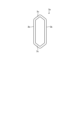
- Each rotating coil 3a includes a long side portion 3b that extends linearly in the axial direction and a short side portion 3c that extends in the radial direction.
- the long side portions 3b and the short side portions 3c are arranged alternately.
- the long side portion 3b is a portion that contributes to the generation of torque that rotates the mover.
- the short side portion 3c is a portion that does not contribute much to the generation of torque that rotates the mover.
- the short side portion 3c plays the role of connecting two adjacent long side portions 3b.
- the shape of the short side portion 3c is a pointed shape that is convex toward the outer periphery of the loop.
- the magnet 8 and the shaft 10 are arranged on the inner circumference of the rotating coil 3a.
- the magnet 8 is arranged along the outer circumference of the shaft 10.
- the shape of the magnet 8 when viewed along the radial direction is a rhombus in this embodiment, but it may be a square or the like.
- the magnets 8 are arranged without gaps so that one diagonal of the rhombus coincides with the axial direction and the other diagonal of the rhombus coincides with the circumferential direction.
- the magnets 8 include a first magnet 8a that is an N pole and a second magnet 8b that is an S pole. In FIG. 8, only the first magnet 8a is hatched to distinguish the first magnet 8a from the second magnet 8b.
- the first magnet 8a and the second magnet 8b are arranged with their sides in contact with each other.
- a row of the first magnets 8a arranged in the axial direction and a row of the second magnets 8b arranged in the axial direction are arranged alternately in the circumferential direction.
- Circumferentially arranged rows of first magnets 8a and circumferentially arranged rows of second magnets 8b are alternately arranged in the axial direction.
- the orientation of the first magnets 8a is from the inside to the outside in the radial direction.
- the orientation of the second magnets 8b is from the outside to the inside in the radial direction.
- the first magnet 8a has a first center 8c.
- the first center 8c is the center of the first magnet 8a when viewed radially. If the shape of the first magnet 8a is rhombus, the first center 8c is the point where two diagonal lines intersect.
- the second magnet 8b has a second center 8d.
- the second center 8d is the center of the second magnet 8b when viewed radially. If the shape of the second magnet 8b is rhombus, the second center 8d is the point where two diagonal lines intersect.
- the first center 8c and the second center 8d are offset in the axial and circumferential directions.
- the distance along the axial direction between the first center 8c of the first magnet 8a and the second center 8d of the second magnet 8b is defined as the interpole distance P5.
- the circumferential angle between the first center 8c and the second center 8d of the adjacent first magnet 8a and second magnet 8b is defined as the second angle ⁇ 2.
- the second angle ⁇ 2 is the circumferential angle between the first center 8c of the first magnet 8a and the second center 8d of the adjacent second magnet 8b, with the axial center 8e of the magnets 8 arranged in a cylindrical shape as the base point.
- the first angle ⁇ 1 shown in FIG. 6 is the same as 2n times the second angle ⁇ 2 shown in FIG. 9. n is 0 or a natural number.
- the same angle means not only the completely same angle, but also an angle that is not strictly the same angle but is shifted by 2 to 3 times the wire diameter of the magnet wire in consideration of the bending performance of the magnet wire.
- the illustrated arrangement of magnets 8 is an example, and may be modified as appropriate as long as the arrangement of magnets 8 has interpole distance P5 and second angle ⁇ 2.
- the coil 1 for the multi-axis actuator includes a linear coil group 2 that generates a magnetic field that moves the mover in the axial direction, and a rotating coil group 3 that is disposed on the inner circumference of the linear coil group 2 and generates a magnetic field that moves the mover in the circumferential direction.
- the first angle ⁇ 1 in the circumferential direction formed by the two coil ends 2b and 2c in each linear coil 2a is equal to the electrical angle period of the rotating coil group 3 or is an integer multiple of the electrical angle period of the rotating coil group 3.
- the magnetic flux that links with the linear coil group 2 i.e., the linear interference magnetic flux
- the linear interference magnetic flux is balanced in each phase of the rotating coil group 3. Therefore, the sum of the linear interference magnetic flux generated from each phase of the rotating coil group 3 is theoretically 0, and the linear interference magnetic flux generated from the rotating coil group 3 can be suppressed from interfering with the linear coil group 2. This suppresses the generation of unintended induced currents, thereby suppressing malfunction of the multi-axis actuator 100.
- the first angle ⁇ 1 exceeds 0 degrees.
- the circumferential positions of the two coil ends 2b, 2c of the same linear coil 2a are shifted. This makes it easier to perform the wiring work of connecting a power supply line to one of the two coil ends 2b, 2c and the wiring work of connecting the other of the two coil ends 2b, 2c to a neutral point or delta connection.
- the winding angle of the direct-acting coil 2a shown in Figures 4 and 6 is A
- the number of turns of the direct-acting coil 2a is T
- the first angle is ⁇ 1
- the winding angle A is expressed by the above formula (1)
- the coil end 2b of one adjacent direct-acting coil 2a and the coil end 2c of the other adjacent direct-acting coil 2a are offset in the circumferential position.
- the coil end 2b of one adjacent direct-acting coil 2a and the coil end 2c of the other adjacent direct-acting coil 2a do not interfere with each other. Therefore, the direct-acting coils 2a can be stacked in the axial direction while minimizing the gap between the adjacent direct-acting coils 2a, and the wiring work to the coil ends 2b and 2c can be easily performed.
- the linear coil group 2 and the rotating coil group 3 are illustrated as three-phase coils, but the present invention is not limited to this.
- the linear coil group 2 and the rotating coil group 3 may be multi-phase coils having four or more phases.
- the multi-axis actuator 100 is provided with a magnet 8, but it is not necessary to provide the magnet 8.
- the multi-axis actuator 100 may be configured to correspond to a Synchronous Reluctance Motor (SynRM) that rotates only by the reluctance torque of the iron core.
- Synchronous Reluctance Motor Synchronous Reluctance Motor
- the multi-axis actuator 100 includes a stator core 9, but it does not have to include a stator core 9.
- the multi-axis actuator 100 may have a configuration equivalent to a coreless structure that does not have an iron core near the coil.
- the multi-axis actuator 100 includes a frame 6a, but the frame 6a need not be included.
- the multi-axis actuator 100 may have a structure equivalent to a frameless structure in which the stator core 9 also serves as the frame.
- the first magnet 8a shown in FIG. 8 is the north pole and the second magnet 8b is the south pole, but the first magnet 8a may be the south pole and the second magnet 8b may be the north pole.
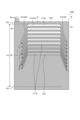
- FIG. 10 is a side view showing a multi-axis actuator 100A according to a second embodiment.
- This embodiment differs from the first embodiment in that the number of linear coils 2a facing the rotary coil group 3 in the radial direction is the same for each phase, and the number of linear coils 2a for each phase is an even number, and that the axial length P1 of the linear coil group 2 in the multi-axis actuator coil 1A is shorter than the axial length P2 of the long side portion 3b of the rotary coil group 3.
- the same reference numerals are used for parts that overlap with those in the first embodiment, and the description thereof will be omitted.
- the axial length P1 of the direct-acting coil group 2 is shorter than the axial length P2 of the long side portion 3b of the rotating coil group 3.
- the axial length P1 of the direct-acting coil group 2 is the length along the axial direction from one end to the other end of the direct-acting coil group 2.
- the axial length P2 of the long side portion 3b of the rotating coil group 3 is the length along the axial direction from one end to the other end of the long side portion 3b of the rotating coil group 3.
- the number of direct-acting coils 2a that face the rotating coil group 3 in the radial direction is the same for each phase, and the number of direct-acting coils 2a for each phase is an even number.
- Figure 12 shows, as an example, a case where the direct-acting coil group 2 is a three-phase coil and the number of direct-acting coils 2a for each phase is two.
- the same effect as in the first embodiment can be achieved.
- the number of direct-acting coils 2a facing the rotating coil group 3 in the radial direction is the same for each phase, and the number of direct-acting coils 2a for each phase is an even number.
- the axial length P1 of the direct-acting coil group 2 is shorter than the axial length P2 of the long side portion 3b of the rotating coil group 3.
- the sum of the rotation side interference magnetic flux generated from each phase of the direct-acting coil group 2 is theoretically 0, and the rotation side interference magnetic flux generated from the direct-acting coil group 2 can be suppressed from interfering with the rotating coil group 3.
- both the magnetic flux generated from the rotating coil group 3 interfering with the direct-acting coil group 2 and the magnetic flux generated from the direct-acting coil group 2 interfering with the rotating coil group 3 can be suppressed. This further reduces the occurrence of unintended induced currents and further reduces malfunction of the multi-axis actuator 100A.
- FIG. 11 is a side view showing a multi-axis actuator 100B according to the third embodiment.
- This embodiment differs from the first embodiment in that the axial length P2 of the long side portion 3b of the rotating coil group 3 is equal to 2m times the interpole distance P5, and that the axial length P1 of the linear motion coil group 2 in the multi-axis actuator coil 1B is longer than the axial length P2 of the long side portion 3b of the rotating coil group 3.
- the same reference numerals are used for parts that overlap with the first and second embodiments, and the description thereof will be omitted.
- the axial length P1 of the linear coil group 2 is longer than the axial length P2 of the long side portion 3b of the rotating coil group 3.
- the axial length P2 of the long side portion 3b is the same as 2m times the inter-pole distance P5 shown in FIG. 8, where m is a natural number.
- the term "same length" refers not only to completely identical lengths, but also to lengths that are not strictly identical but are two to three times the wire diameter of the magnet wire, taking into account the bending performance of the magnet wire.
- the same effect as in the first embodiment can be achieved.
- the axial length P2 of the long side portion 3b is the same as 2m times the interpole distance P5.
- the axial length P1 of the linear coil group 2 is longer than the axial length P2 of the long side portion 3b.
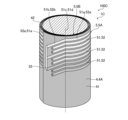
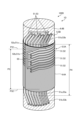
- Fig. 12 is a perspective view showing a multi-axis actuator coil 1C according to the fourth embodiment.
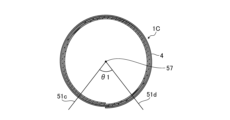
- Fig. 13 is a view of the multi-axis actuator coil 1C according to the fourth embodiment when viewed along the axial direction.
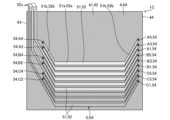
- Fig. 14 is a side view showing a state before the first printed circuit board 4A of the multi-axis actuator coil 1C according to the fourth embodiment is wound, and is a view showing a surface 41 of the first printed circuit board 4A.
- Fig. 12 is a perspective view showing a multi-axis actuator coil 1C according to the fourth embodiment.
- Fig. 13 is a view of the multi-axis actuator coil 1C according to the fourth embodiment when viewed along the axial direction.
- Fig. 14 is a side view showing a state before the first printed circuit board 4A of the multi-axis actuator coil 1C according to the fourth embodiment is wound, and is a view showing a surface 41 of the first printed circuit board 4A.
- Fig. 12 is a perspective view showing
- FIG. 15 is a side view showing a state before the first printed circuit board 4A of the multi-axis actuator coil 1C according to the fourth embodiment is wound, and is a view showing a back surface 42 of the first printed circuit board 4A seen through from the surface 41.
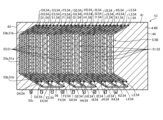
- Fig. 16 is a side view showing a state before the second printed circuit board 4B of the multi-axis actuator coil 1C according to the fourth embodiment is wound, and is a view showing a surface 41 of the second printed circuit board 4B.
- 17 is a side view showing the state of the multi-axis actuator coil 1C according to the fourth embodiment before winding the second printed circuit board 4B, as seen through the rear surface 42 of the second printed circuit board 4B from the front surface 41.
- This embodiment differs from the first embodiment in that the multi-axis actuator coil 1C is a coil board.
- parts that overlap with the first embodiment are given the same reference numerals and descriptions thereof will be omitted.
- the multi-axis actuator coil 1C includes a flexible printed circuit board 4 wound in the circumferential direction, and a linear coil group 5A and a rotating coil group 5B printed on the printed circuit board 4.
- the rotating coil group 5B is not clearly shown in FIG. 12, but is arranged on the inner circumference of the linear coil group 5A.
- FIG. 12 omits the illustration of the magnet 8 and shaft 10 arranged on the inner circumference of the multi-axis actuator coil 1C.
- the printed circuit board 4 is wound around one axis 57 shown in FIG. 13.
- the axis 57 is an imaginary axis that extends parallel to the central axis C shown in FIG. 2.
- the winding direction of the printed circuit board 4 coincides with the circumferential direction, which is the direction of rotation around the central axis C.
- the printed circuit board 4 is a flexible board that can be freely deformed.
- the printed circuit board 4 is divided in the circumferential direction.
- the printed circuit board 4 is divided into two pieces.
- one printed circuit board 4 shown in FIG. 14 and FIG. 15 is referred to as the first printed circuit board 4A
- the other printed circuit board 4 shown in FIG. 16 and FIG. 17 is referred to as the second printed circuit board 4B.
- the first printed circuit board 4A is illustrated in a gray area.
- the second printed circuit board 4B is illustrated with oblique hatching.
- the printed circuit board 4 has a front surface 41 and a back surface 42 facing opposite to the front surface 41. It is preferable that the printed circuit board 4 is formed in two or more layers in the radial direction. As shown in Figures 14 to 17, the printed circuit board 4 has one end 43 and the other end 44 in the circumferential direction. Note that although the back surface 42 is not visible in Figures 15 and 17, the reference numerals for the front surface 41 and back surface 42 are shown together for the sake of convenience.
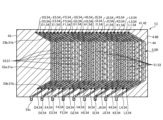
- the areas shown with dot hatching in Figures 14 and 15 are the linear coil group 5A.
- the areas shown with grid hatching in Figures 16 and 17 are the rotating coil group 5B.
- the linear coil group 5A and the rotating coil group 5B may be referred to as coil group 5 without distinction.
- the linear coil group 5A and the rotating coil group 5B are shown in Figures 18 and onwards, they will be distinguished from each other in the same way as in Figures 14 to 17.
- each coil group 5 has a plurality of coil patterns 51.
- Each coil pattern 51 includes a plurality of long side portions 51a extending linearly and a plurality of short side portions 51b connecting two adjacent long side portions 51a.
- the coil pattern 51 is a conductor formed by etching the copper foil layer of the printed circuit board 4.
- the coil pattern 51 of the linear coil group 5A and the rotating coil group 5B are to be distinguished from each other, the coil pattern 51 of the linear coil group 5A is referred to as a first coil pattern 52, and the coil pattern 51 of the rotating coil group 5B is referred to as a second coil pattern 53.
- the coil groups 5 are illustrated as three-phase coils.
- the coil patterns 51 of each phase are distinguished by changing the density of hatching.
- the number of first coil patterns 52 is six in this embodiment.
- the number of first coil patterns 52 is three on each of the front surface 41 and the back surface 42 of the first printed circuit board 4A in this embodiment.
- the three first coil patterns 52 on the front surface 41 are arranged in the axial direction.
- the three first coil patterns 52 on the back surface 42 are arranged in the axial direction.
- the multiple first coil patterns 52 are multiple direct-acting coils arranged in the axial direction.
- the number of coils of the direct-acting coil is the number of axial areas in which the first coil patterns 52 of the same phase exist, counted without distinguishing between the front surface 41 and the back surface 42 of the first printed circuit board 4A.
- the division of the axial areas in which the first coil patterns 52 of the same phase exist is performed based on the first long side portion 52a described below, and parts other than the first long side portion 52a are not taken into consideration. Therefore, when viewed from the front surface 41 to the back surface 42 of the first printed circuit board 4A, if the axial area in which the first long side 52a of the first coil pattern 52 of the same phase exists on the front surface 41 is the same as the axial area in which the first long side 52a of the first coil pattern 52 of the same phase exists on the back surface 42, they are counted as one linear coil.
- the axial area in which the first long side 52a of the first coil pattern 52 of the same phase exists on the front surface 41 is different from the axial area in which the first long side 52a of the first coil pattern 52 of the same phase exists on the back surface 42, they are counted as different linear coils.
- FIG. 14 and FIG. 15 there are three axial areas on the front surface 41 where the first long side 52a of the first coil pattern 52 of the same phase exists, and three axial areas on the back surface 42 where the first long side 52a of the first coil pattern 52 of the same phase exists, and the axial positions of the six axial areas are different from each other.
- Each of the first coil patterns 52 has approximately the same shape.
- Each of the first coil patterns 52 is printed on the first printed circuit board 4A in a distributed winding in which loops of the same shape are wound with the center shifted at a constant interval in the axial direction.
- Two ends A1...A5, B1...B5, C1...C5 at the same position on the front surface 41 and back surface 42 of the first printed circuit board 4A are electrically connected via a through hole 54.
- the first coil patterns 52 are alternately arranged on the front surface 41 and the back surface 42 of the first printed circuit board 4A. After the first coil pattern 52 on the front surface 41 of the first printed circuit board 4A extends half a turn on the front surface 41, the first coil pattern 52 on the back surface 42 extends half a turn on the back surface 42 of the first printed circuit board 4A via the through hole 54.
- the number of turns of each of the six first coil patterns 52 is the product of the number of turns of each of the first coil patterns 52 before winding the first printed circuit board 4A and the number of layers of the first printed circuit board 4A stacked in the radial direction. The number of turns of each of the six first coil patterns 52 may be determined arbitrarily.
- the front surface 41 of the first printed circuit board 4A is provided with a connection portion 55 that electrically connects the other end of the first coil pattern 52 of each phase.
- the connection portion 55 extends in the axial direction.
- the first coil pattern 52 includes a plurality of first long side portions 52a and a plurality of first short side portions 52b extending in the circumferential direction.
- the first long side portions 52a and the first short side portions 52b are arranged alternately.
- the first long side portions 52a are portions that contribute to the generation of thrust that moves the movable element in the axial direction.
- the first short side portions 52b are portions that do not contribute much to the generation of thrust that moves the movable element in the axial direction.
- the first short side portions 52b play a role in connecting the two first long side portions 52a on the front and back.
- the first short side portions 52b shown in FIG. 14 extend while inclining so as to be positioned on one side in the axial direction as they move away from the first long side portion 52a.
- the first short side portions 52b shown in FIG. 15 extend while inclining so as to be positioned on the other side in the axial direction as they move away from the first long side portion 52a.
- a terminal 52c is provided at one end of the first coil pattern 52 on the back surface 42 to which a power line of a power supply unit (not shown) is connected.
- Each first coil pattern 52 is supplied with power from a power supply unit (not shown) via the terminal 52c.
- the terminal 52c protrudes outward in the axial direction from one axial end face of the first printed circuit board 4A.
- the outward in the axial direction means the direction from the axial center of the first printed circuit board 4A toward the axial end face.
- each first coil pattern 52 has two coil ends 51c, 51d located at one end and the other end in the circumferential direction.
- the coil ends 51c, 51d of the first coil pattern are located at one end and the other end in the length direction of the first long side portion 52a of the first coil pattern 52.
- the first circumferential angle ⁇ 1 formed by the two coil ends 51c, 51d is equal to the electrical angle period of the rotating coil group 5B or is an integer multiple of the electrical angle period of the rotating coil group 5B.
- the first angle ⁇ 1 is the circumferential angle formed by the two coil ends 51c, 51d with the axis 57, which is the center around which the printed circuit board 4 is wound, as the base point.
- the first angle ⁇ 1 exceeds 0 degrees.
- a case in which the first angle ⁇ 1 exceeds 0 degrees is illustrated.
- the first angle ⁇ 1 is equal to 2n times the second angle ⁇ 2 shown in FIG. 9.
- the positions of the coil ends 51c in the circumferential direction may be the same as shown in the figure, or the positions of the coil ends 51c in the circumferential direction may be shifted.
- the positions of the coil ends 51d in the circumferential direction may be the same as shown in the figure, or the positions of the coil ends 51d in the circumferential direction may be shifted as shown in the figure.
- the positions of the coil ends 51c of one first coil pattern 52 adjacent in the axial direction and the coil ends 51d of the other first coil pattern 52 adjacent thereto in the circumferential direction may be shifted as shown in the figure, or may be the same.
- the winding angle of the first coil pattern 52 is A
- the number of turns of the first coil pattern 52 is T
- the first angle is ⁇ 1
- the winding angle A is expressed by the following formula (2), it is preferable that the winding angles A of each first coil pattern 52 are the same angle.
- A 360 degrees ⁇ T+ ⁇ 1...(2)
- the number of second coil patterns 53 is 18 in this embodiment.
- the number of second coil patterns 53 is nine on each of the front surface 41 and the back surface 42 of the second printed circuit board 4B in this embodiment.
- the nine second coil patterns 53 on the front surface 41 are arranged in a circumferential direction.
- the nine second coil patterns 53 on the back surface 42 are arranged in a circumferential direction.
- the multiple second coil patterns 53 are multiple rotating coils arranged in a circumferential direction.
- the number of coils of the rotating coil is the number of circumferential areas in which the same-phase second coil patterns 53 exist, counted without distinction between the front surface 41 and the back surface 42 of the second printed circuit board 4B.
- the division of the circumferential areas in which the same-phase second coil patterns 53 exist is performed based on the second long side portion 53a described below, and parts other than the second long side portion 53a are not taken into consideration. Therefore, when viewed in a direction from the front surface 41 to the back surface 42 of the second printed circuit board 4B, if the circumferential position of the circumferential area in which the second long side 53a of the second coil pattern 53 of the same phase exists on the front surface 41 is the same as the circumferential area in which the second long side 53a of the second coil pattern 53 of the same phase exists on the back surface 42, they are counted as one rotating coil.
- each second coil pattern 53 has approximately the same shape.
- Each second coil pattern 53 is printed on the second printed circuit board 4B in a distributed winding in which loops of the same shape are wound with their centers shifted at regular intervals in the circumferential direction.
- Two ends D1...D5, E1...E5, F1...F5 at the same positions on the front surface 41 and the back surface 42 of the second printed circuit board 4B are electrically connected via a through hole 54.
- two ends G1...G5, H1...H5, I1...I5 at the same position on the front surface 41 and back surface 42 of the second printed circuit board 4B are electrically connected via a through hole 54.
- two ends J1...J5, K1...K5, L1...L5 at the same position on the front surface 41 and back surface 42 of the second printed circuit board 4B are electrically connected via a through hole 54.
- the second coil patterns 53 are alternately arranged on the front surface 41 and the back surface 42 of the second printed circuit board 4B. After the second coil pattern 53 on the front surface 41 of the second printed circuit board 4B extends half a turn on the front surface 41, the second coil pattern 53 on the back surface 42 extends half a turn on the back surface 42 through the through hole 54 across the back surface 42 of the second printed circuit board 4B.
- the number of turns of each of the 18 second coil patterns 53 is the product of the number of turns of each of the second coil patterns 53 before winding the second printed circuit board 4B and the number of layers of the second printed circuit board 4B stacked in the radial direction. The number of turns of each of the 18 second coil patterns 53 may be determined arbitrarily.
- connection portion 56 that electrically connects the other end of the second coil pattern 53 of each phase.
- the connection portion 56 extends in the circumferential direction.
- the connections 55 and 56 may be, for example, neutral points or delta connections.
- the second coil pattern 53 includes a plurality of second long side portions 53a and a plurality of second short side portions 53b extending in the axial direction.
- the second long side portions 53a and the second short side portions 53b are arranged alternately.
- the second long side portions 53a are portions that contribute to the generation of torque that rotates the movable member.
- the second short side portions 53b are portions that do not contribute much to the generation of torque that rotates the movable member.
- the second short side portions 53b serve to connect the two second long side portions 53a on the front and back.
- the second short side portions 53b shown in FIG. 16 extend while inclining so as to be positioned on one side of the circumferential direction as they move away from the second long side portion 53a.
- a terminal 53c is provided to which a power line of a power supply unit (not shown) is connected.
- Each second coil pattern 53 is supplied with power from a power supply unit (not shown) via the terminal 53c.
- the terminal 53c protrudes outward in the axial direction beyond the other axial end face of the second printed circuit board 4B.
- the first long sides 52a of each of the first coil patterns 52 shown in Figures 14 and 15 extend parallel to each other.
- the second long sides 53a of each of the second coil patterns 53 shown in Figures 16 and 17 extend parallel to each other.
- the first long sides 52a of each of the first coil patterns 52 shown in Figures 14 and 15 and the second long sides 53a of each of the second coil patterns 53 shown in Figures 16 and 17 extend in directions that intersect with each other. In this embodiment, the first long sides 52a and the second long sides 53a extend in directions that are perpendicular to each other.
- each printed circuit board 4 is wound clockwise so that the surface 41 on which the coil group 5 is formed is located on the outer circumference and the back surface 42 is located on the inner circumference.
- Each printed circuit board 4 may be wound so that the surface 41 on which the coil group 5 is formed is located on the inner circumference and the back surface 42 is located on the outer circumference.
- Each printed circuit board 4 is wound along the cylindrical surface of a jig (not shown).
- the first printed circuit board 4A and the second printed circuit board 4B are wound continuously so that the other circumferential end 44 of the first printed circuit board 4A shown in FIGS. 14 and 15 is continuous with one circumferential end 43 of the second printed circuit board 4B shown in FIGS. 16 and 17. This forms the cylindrical multi-axis actuator coil 1C shown in FIG. 12.
- the outer circumferential surface of the multi-axis actuator coil 1C becomes the surface 41 of the first printed circuit board 4A.
- the first printed circuit board 4A and the second printed circuit board 4B shown in Figures 14 to 17 may or may not be connected by a fixing means such as adhesive or tape.
- the first printed circuit board 4A after winding the second printed circuit board 4B located on the inner circumference, the first printed circuit board 4A can be wound so as to be continuous with one circumferential end 43 of the second printed circuit board 4B.
- the second printed circuit board 4B located on the inner circumference can be used as a guide to wind the second first printed circuit board 4A, so that the coil 1C for the multi-axis actuator can be easily formed.
- the linear coil group 5A is arranged on the outer periphery of the rotating coil group 5B. That is, the linear coil group 5A and the rotating coil group 5B are arranged at the same position in the circumferential direction. In other words, the linear coil group 5A and the rotating coil group 5B are arranged side by side in the radial direction. Between the linear coil group 5A and the rotating coil group 5B arranged side by side in the radial direction, for example, an insulating layer (not shown) is sandwiched around the entire circumference. This makes it possible to prevent a short circuit between the linear coil group 5A and the rotating coil group 5B.
- the sum of the linear motion side interference magnetic flux generated from each phase of the rotating coil group 5B is theoretically zero, and the linear motion side interference magnetic flux generated from the rotating coil group 5B can be prevented from interfering with the linear motion coil group 5A.
- the coil 1C for the multi-axis actuator includes a printed circuit board 4 that is flexible and wound around one axis 57, and a plurality of linear coil groups 5A and rotating coil groups 5B printed on the printed circuit board 4.
- This configuration allows the printed circuit board 4 to be easily deformed, and the printed circuit board 4 can be easily deformed, including the printed linear coil groups 5A and rotating coil groups 5B. That is, in this embodiment, the linear coil groups 5A and rotating coil groups 5B can be easily and accurately arranged in a radial direction.
- the winding collapse and the windings are less likely to be entangled, and the enlargement of the coil 1C for the multi-axis actuator can be suppressed, and the enlargement of the coil space can be suppressed. Therefore, the coil 1C for the multi-axis actuator can be formed with good space efficiency.
- the enlargement of the multi-axis actuator 100C and the decrease in the output density of the multi-axis actuator 100C can be suppressed.
- the printed circuit board 4 is wound in a cylindrical shape, but the printed circuit board 4 may also be wound so that the cross-sectional shape perpendicular to the axis 57 of the printed circuit board 4 is a polygonal cylinder.
- the amount of winding of the first printed circuit board 4A and the second printed circuit board 4B shown in Figures 14 to 17 may be changed as appropriate.
- each printed circuit board 4 may be wound more than one turn. In this way, it is possible to accommodate the multi-axis actuator 100C, which requires a larger number of turns of the coil pattern 51.
- the number of coil patterns 51 in each of the linear coil group 5A and the rotating coil group 5B is not limited to the illustrated example, and may be changed as appropriate. Also, although Figs. 14 to 17 illustrate a case in which each of the linear coil group 5A and the rotating coil group 5B is a three-phase coil, this is not limiting. Each of the linear coil group 5A and the rotating coil group 5B may be a coil with four or more phases. Also, in this embodiment, overlap winding is illustrated as an example of distributed winding of each coil pattern 51, but this is not limiting. The distributed winding of each coil pattern 51 may be, for example, wave winding.
- FIG. 18 is a perspective view showing a coil 1C for a multi-axis actuator according to a modified example of the fourth embodiment.
- FIG. 19 is a view of the coil 1C for a multi-axis actuator according to a modified example of the fourth embodiment, viewed along the axial direction.
- the circumferential positions of the two coil ends 51c, 51d may be the same. With this configuration, the first angle ⁇ 1 becomes 0 degrees.
- a multi-axis actuator 100D according to the fifth embodiment will be described with reference to Figs. 20 to 24.
- Fig. 20 is a side view showing a state before the first printed circuit board 4A of the multi-axis actuator coil 1D according to the fifth embodiment is wound, and shows a front surface 41 of the first printed circuit board 4A.
- Fig. 21 is a side view showing a state before the first printed circuit board 4A of the multi-axis actuator coil 1D according to the fifth embodiment is wound, and shows a back surface 42 of the first printed circuit board 4A seen through from the front surface 41.
- Fig. 20 is a side view showing a state before the first printed circuit board 4A of the multi-axis actuator coil 1D according to the fifth embodiment is wound, and shows a back surface 42 of the first printed circuit board 4A seen through from the front surface 41.
- Fig. 22 is a side view showing a state before the second printed circuit board 4B of the multi-axis actuator coil 1D according to the fifth embodiment is wound, and shows a front surface 41 of the second printed circuit board 4B.
- Fig. 23 is a side view showing a state before the second printed circuit board 4B of the multi-axis actuator coil 1D according to the fifth embodiment is wound, and shows a back surface 42 of the second printed circuit board 4B seen through from the front surface 41.
- Fig. 24 is a perspective view showing the multi-axis actuator coil 1D according to the fifth embodiment.
- This embodiment differs from the fourth embodiment in that the number of direct-acting coils facing the rotating coil group 5B in the radial direction is the same for each phase, the number of direct-acting coils for each phase is an even number, and the axial length P3 of the direct-acting coil group 5A in the multi-axis actuator coil 1D is shorter than the axial length P4 of the second long side portion 53a of the rotating coil group 5B.
- the same reference numerals are used for parts that overlap with those in the fourth embodiment, and a description thereof will be omitted.
- the back surface 42 is not visible, but the reference numerals of the front surface 41 and the back surface 42 are shown together for the sake of convenience of description.
- the axial length P3 of the linear coil group 5A is the length along the axial direction from one end P31 to the other end P32 of the linear coil group 5A.
- the axial length P3 of the linear coil group 5A is the length along the axial direction from the first long side portion 52a located at one end in the axial direction to the first long side portion 52a located at the other end in the axial direction.
- the axial length P4 of the second long side portion 53a is the length along the axial direction from one end to the other end of the second long side portion 53a of the rotating coil group 5B.
- the number of coils in the direct-acting coil is six.
- the number of direct-acting coils facing the rotating coil group 5B in the radial direction is the same for each phase, and the number of direct-acting coils in each phase is an even number.
- Figure 24 shows, as an example, a case in which the direct-acting coil group 5A is a three-phase coil and the number of direct-acting coils in each phase is two.
- the same effect as in the fourth embodiment can be achieved.
- the number of direct-acting coils facing the rotating coil group 5B in the radial direction is the same for each phase, and the number of direct-acting coils for each phase is an even number.
- the axial length P3 of the direct-acting coil group 5A is shorter than the axial length P4 of the second long side portion 53a of the rotating coil group 5B.
- the magnetic flux that links with the rotating coil group 5B i.e., the rotation side interference magnetic flux
- the rotation side interference magnetic flux is balanced in each phase of the direct-acting coil group 5A. Therefore, the sum of the rotation side interference magnetic flux generated from each phase of the direct-acting coil group 5A is theoretically 0, and the rotation side interference magnetic flux generated from the direct-acting coil group 5A can be suppressed from interfering with the rotating coil group 5B.
- a multi-axis actuator 100E according to the sixth embodiment will be described with reference to Figs. 25 to 28.
- Fig. 25 is a side view showing a state before the first printed circuit board 4A of the multi-axis actuator coil 1E according to the sixth embodiment is wound, and shows a front surface 41 of the first printed circuit board 4A.
- Fig. 26 is a side view showing a state before the first printed circuit board 4A of the multi-axis actuator coil 1E according to the sixth embodiment is wound, and shows a back surface 42 of the first printed circuit board 4A seen through from the front surface 41.
- Fig. 25 is a side view showing a state before the first printed circuit board 4A of the multi-axis actuator coil 1E according to the sixth embodiment is wound, and shows a back surface 42 of the first printed circuit board 4A seen through from the front surface 41.
- Fig. 25 is a side view showing a state before the first printed circuit board 4A of the multi-axis actuator coil 1E according to the sixth embodiment is wound,
- FIG. 27 is a side view showing a state before the second printed circuit board 4B of the multi-axis actuator coil 1E according to the sixth embodiment is wound, and shows a front surface 41 of the second printed circuit board 4B.
- Fig. 28 is a side view showing a state before the second printed circuit board 4B of the multi-axis actuator coil 1E according to the sixth embodiment is wound, and shows a back surface 42 of the second printed circuit board 4B seen through from the front surface 41.
- the axial length P4 of the second long side portion 53a of the rotating coil group 5B is the same as 2m times the interpole distance P5, and the axial length P3 of the linear coil group 5A in the multi-axis actuator coil 1E is longer than the axial length P4 of the second long side portion 53a of the rotating coil group 5B.
- the same reference numerals are used for the parts that overlap with the fourth and fifth embodiments, and the description thereof is omitted.
- the back surface 42 is not visible, but the reference numerals of the front surface 41 and the back surface 42 are shown together for the sake of convenience of description.
- the axial length P3 of the linear coil group 5A shown in Figures 25 and 26 is longer than the axial length P4 of the second long side portion 53a of the rotary coil group 5B shown in Figures 27 and 28.
- the axial length P4 of the second long side portion 53a is the same as 2m times the inter-pole distance P5 shown in Figure 8. m is a natural number.
- the same effect as in the fourth embodiment can be achieved.
- the axial length P4 of the second long side portion 53a of the rotating coil group 5B shown in FIG. 27 and FIG. 28 is the same as 2m times the interpole distance P5 shown in FIG. 8.
- the axial length P3 of the direct-acting coil group 5A is longer than the axial length P4 of the second long side portion 53a of the rotating coil group 5B.
- the sum of the rotation side interference magnetic flux generated from each phase of the direct-acting coil group 5A is theoretically 0, and the rotation side interference magnetic flux generated from the direct-acting coil group 5A can be suppressed from interfering with the rotating coil group 5B.
- a multi-axis actuator 100F according to the seventh embodiment will be described with reference to Figs. 29 to 31.
- Fig. 29 is a side view showing a state before the second printed circuit board 4B of the multi-axis actuator coil 1F according to the seventh embodiment is wound, and shows a surface 41 of the second printed circuit board 4B.
- Fig. 30 is a side view showing a state before the first printed circuit board 4A of the multi-axis actuator coil 1F according to the seventh embodiment is wound, and shows a surface 41 of the first printed circuit board 4A.
- Fig. 31 is a view of the multi-axis actuator coil 1F according to the seventh embodiment as seen along the axial direction. This embodiment differs from the fourth embodiment in that the coil pattern 51 is wound in a concentrated manner.
- the same reference numerals are used for the parts that overlap with those in the fourth embodiment, and the description thereof will be omitted.
- the number of first coil patterns 52 in this embodiment is three.
- the three first coil patterns 52 are arranged side by side in the axial direction.
- Each first coil pattern 52 is printed on the first printed circuit board 4A in a concentrated winding in which loops of the same shape but different sizes are wound around the same center.
- the shape of the first coil pattern 52 is a snake pattern in which the size of the rectangular loops decreases from the outer periphery toward the inner periphery.
- the first coil pattern 52 includes a plurality of first long side portions 52a extending in the circumferential direction and a plurality of first short side portions 52b extending in the axial direction.
- the first long side portions 52a and the first short side portions 52b are arranged alternately.
- the first short side portions 52b serve to connect two adjacent first long side portions 52a.
- a terminal 52d is provided on the inside of the loop, opposite the terminal 52c.
- the terminals 52d of each first coil pattern 52 are connected to each other by a pattern or jumper wire (not shown).
- the number of second coil patterns 53 is six in this embodiment.
- the six second coil patterns 53 are arranged in a line in the circumferential direction.
- Each second coil pattern 53 has the same shape.
- Each second coil pattern 53 is printed on the second printed circuit board 4B in a concentrated winding in which loops of the same shape but different sizes are wound around the same center.
- the shape of the second coil patterns 53 is a lightning bolt shape that becomes smaller from the outer periphery toward the inner periphery.
- the second coil pattern 53 includes a plurality of second long side portions 53a extending in the axial direction and a plurality of second short side portions 53b extending in the circumferential direction.
- the second long side portions 53a and the second short side portions 53b are arranged alternately.
- the second short side portions 53b serve to connect two adjacent second long side portions 53a.
- a terminal 53d is provided on the inside of the loop, opposite the terminal 53c.
- the terminals 53d of each second coil pattern 53 are connected to each other by a pattern or jumper wire (not shown).
- each printed circuit board 4 is wound clockwise so that the surface 41 on which the coil group 5 is formed is located on the inner circumference and the back surface 42 is located on the outer circumference.
- Each printed circuit board 4 may be wound so that the surface 41 on which the coil group 5 is formed is located on the outer circumference and the back surface 42 is located on the inner circumference.
- Each printed circuit board 4 is wound along the cylindrical surface of a jig (not shown).
- the first printed circuit board 4A and the second printed circuit board 4B are wound continuously so that one end 43 in the circumferential direction of the first printed circuit board 4A is continuous with the other end 44 in the circumferential direction of the second printed circuit board 4B.
- the outer circumferential surface of the multi-axis actuator coil 1F becomes the back surface 42 of the first printed circuit board 4A and the back surface 42 of the second printed circuit board 4B.
- the linear coil group 5A is arranged on the outer periphery of a portion of the rotating coil group 5B. That is, the linear coil group 5A and a portion of the rotating coil group 5B are arranged at the same position in the circumferential direction. In other words, the linear coil group 5A and a portion of the rotating coil group 5B are arranged side by side in the radial direction.
- the second printed circuit board 4B is sandwiched and arranged around the entire circumference between the linear coil group 5A and a portion of the rotating coil group 5B arranged side by side in the radial direction. This makes it possible to prevent a short circuit between the linear coil group 5A and the rotating coil group 5B.
- the circumferential length per revolution of the printed circuit board 4 becomes longer as it approaches the outer periphery of the printed circuit board 4. Therefore, when the arrangement direction of the coil patterns 51 coincides with the circumferential direction as in the rotating coil group 5B shown in FIG. 29 and the circumferential width of each coil pattern 51 is equal, the more times the printed circuit board 4 is wound around the cylinder, the more phase shift occurs in which the coil patterns 51 of the same phase are shifted in the circumferential direction. Furthermore, the occurrence of the phase shift changes the electrical phase for each revolution, which creates the problem that the electromagnetic characteristics of the multi-axis actuator are easily degraded.
- the rotating coil group 5B arranged on the inner periphery of the wound printed circuit board 4 has the arrangement direction of the coil pattern 51 aligned with the circumferential direction, and the long side portion 51a extends in a direction perpendicular to the circumferential direction.
- the rotating coil group 5B in which deterioration of the electromagnetic characteristics of the multi-axis actuator 100F due to phase shift is likely to be noticeable, is arranged on the inner periphery of the printed circuit board 4, where the occurrence of phase shift is suppressed.
- deterioration of the electromagnetic characteristics of the multi-axis actuator 100F can be suppressed compared to when the rotating coil group 5B is arranged on the outer periphery of the wound printed circuit board 4.
- one of the coil patterns 51 of the linear coil group 5A and the rotating coil group 5B may be printed on the printed circuit board 4 using concentrated winding, and the other of the coil patterns 51 of the linear coil group 5A and the rotating coil group 5B may be printed on the printed circuit board 4 using distributed winding.
- Fig. 32 is a perspective view showing a multi-axis actuator 100G according to the eighth embodiment.
- Fig. 33 is a cross-sectional view taken along line XXXIII-XXXIII shown in Fig. 32.
- Fig. 34 is a cross-sectional view taken along line XXXIV-XXXIV shown in Fig. 32.
- This embodiment differs from the first embodiment in that it is a moving coil type multi-axis actuator 100G in which a multi-axis actuator coil 1G is disposed on the outer periphery of the rotor core 7.
- the same reference numerals are used for parts that overlap with the first embodiment, and description thereof will be omitted.
- the stator core 9 is disposed on the inner circumference of the frame 6a.
- the magnets 8 are provided on the inner circumference of the stator core 9.
- the magnets 8 face the multi-axis actuator coil 1G in the radial direction.
- the multi-axis actuator coil 1G is arranged on the inner circumference of the magnet 8.
- the multi-axis actuator coil 1G is arranged with a gap between it and the magnet 8.
- the multi-axis actuator coil 1G includes a linear coil group 2 and a rotary coil group 3 arranged on the outer circumference of the linear coil group 2.
- the rotor core 7 is arranged on the inner circumference of the multi-axis actuator coil 1G.
- the multi-axis actuator coil 1G is arranged on the outer circumference of the rotor core 7.
- the shaft 10 is disposed on the inner circumference of the rotor core 7.
- the rotor core 7, the multi-axis actuator coil 1G, and the shaft 10 form a mover.
- the magnet 8, the stator core 9, and the frame 6a form a stator.
- the rotor core 7 and the multi-axis actuator coil 1G move circumferentially and axially together with the shaft 10.
- the mover can be moved in multiple directions while achieving the same effect as in the first embodiment described above. Furthermore, if the multi-axis actuator coil 1G is a multi-axis actuator coil with a small number of turns, the mover is lighter and the responsiveness of the multi-axis actuator 100G is improved. Furthermore, when the multi-axis actuator coil 1G is directly molded into a cylinder, it is possible to mold the printed circuit board 4 while winding it directly around the rotor core 7, eliminating the need to prepare a separate cylindrical jig for molding.
Landscapes
- Engineering & Computer Science (AREA)
- Physics & Mathematics (AREA)
- Chemical & Material Sciences (AREA)
- Combustion & Propulsion (AREA)
- Electromagnetism (AREA)
- Power Engineering (AREA)
- Linear Motors (AREA)
Priority Applications (3)
| Application Number | Priority Date | Filing Date | Title |
|---|---|---|---|
| JP2024550624A JP7570587B1 (ja) | 2023-09-15 | 2023-09-15 | 多軸アクチュエータ |
| CN202380102127.1A CN121844475A (zh) | 2023-09-15 | 2023-09-15 | 多轴致动器 |
| PCT/JP2023/033739 WO2025057408A1 (ja) | 2023-09-15 | 2023-09-15 | 多軸アクチュエータ |
Applications Claiming Priority (1)
| Application Number | Priority Date | Filing Date | Title |
|---|---|---|---|
| PCT/JP2023/033739 WO2025057408A1 (ja) | 2023-09-15 | 2023-09-15 | 多軸アクチュエータ |
Publications (1)
| Publication Number | Publication Date |
|---|---|
| WO2025057408A1 true WO2025057408A1 (ja) | 2025-03-20 |
Family
ID=93151031
Family Applications (1)
| Application Number | Title | Priority Date | Filing Date |
|---|---|---|---|
| PCT/JP2023/033739 Pending WO2025057408A1 (ja) | 2023-09-15 | 2023-09-15 | 多軸アクチュエータ |
Country Status (3)
| Country | Link |
|---|---|
| JP (1) | JP7570587B1 (https=) |
| CN (1) | CN121844475A (https=) |
| WO (1) | WO2025057408A1 (https=) |
Citations (3)
| Publication number | Priority date | Publication date | Assignee | Title |
|---|---|---|---|---|
| JP2008253009A (ja) * | 2007-03-29 | 2008-10-16 | Kawasaki Precision Machinery Ltd | 制振用直動形電動アクチュエータ |
| JP2011239661A (ja) * | 2010-04-14 | 2011-11-24 | Yaskawa Electric Corp | 直動回転アクチュエータ |
| WO2023095285A1 (ja) * | 2021-11-26 | 2023-06-01 | 三菱電機株式会社 | 直動回転モータ |
-
2023
- 2023-09-15 CN CN202380102127.1A patent/CN121844475A/zh active Pending
- 2023-09-15 JP JP2024550624A patent/JP7570587B1/ja active Active
- 2023-09-15 WO PCT/JP2023/033739 patent/WO2025057408A1/ja active Pending
Patent Citations (3)
| Publication number | Priority date | Publication date | Assignee | Title |
|---|---|---|---|---|
| JP2008253009A (ja) * | 2007-03-29 | 2008-10-16 | Kawasaki Precision Machinery Ltd | 制振用直動形電動アクチュエータ |
| JP2011239661A (ja) * | 2010-04-14 | 2011-11-24 | Yaskawa Electric Corp | 直動回転アクチュエータ |
| WO2023095285A1 (ja) * | 2021-11-26 | 2023-06-01 | 三菱電機株式会社 | 直動回転モータ |
Also Published As
| Publication number | Publication date |
|---|---|
| JP7570587B1 (ja) | 2024-10-21 |
| JPWO2025057408A1 (https=) | 2025-03-20 |
| CN121844475A (zh) | 2026-04-10 |
Similar Documents
| Publication | Publication Date | Title |
|---|---|---|
| JP4353950B2 (ja) | 回転電機 | |
| JP2018166353A (ja) | 電動モータ | |
| CN101436809A (zh) | 直流电机 | |
| CN102823115A (zh) | 用于旋转电机的定子和旋转电机 | |
| WO2021149473A1 (ja) | 磁気ギアード回転電機 | |
| JP7339831B2 (ja) | ステータ | |
| JP2010011697A (ja) | 電動モータ | |
| JP7570587B1 (ja) | 多軸アクチュエータ | |
| WO2001099261A1 (fr) | Moteur lineaire | |
| JP3763453B2 (ja) | 回転電機 | |
| JP7570586B1 (ja) | 多軸アクチュエータ用コイルおよび多軸アクチュエータ | |
| JP5487733B2 (ja) | スイッチング素子一体型回転電機 | |
| JP7782472B2 (ja) | コイル体、電機子及び回転電機 | |
| JP7732351B2 (ja) | コイル体、電機子及び回転電機 | |
| US20260121474A1 (en) | Coil body, armature, and rotating electric machine | |
| JP2020171095A (ja) | ステータ | |
| US20260039164A1 (en) | Coil body, armature and rotary electric machine | |
| US20240186843A1 (en) | Motor | |
| JP5583192B2 (ja) | 回転電機の固定子 | |
| JP7276205B2 (ja) | スロットレスモータ | |
| WO2021246235A1 (ja) | 電動機 | |
| WO2023163136A1 (ja) | コイル体、電機子及び回転電機 | |
| JPWO2025057408A5 (https=) | ||
| JP4387348B2 (ja) | 回転電機 | |
| WO2017158667A1 (ja) | 回転電機 |
Legal Events
| Date | Code | Title | Description |
|---|---|---|---|
| ENP | Entry into the national phase |
Ref document number: 2024550624 Country of ref document: JP Kind code of ref document: A |
|
| WWE | Wipo information: entry into national phase |
Ref document number: 2024550624 Country of ref document: JP |
|
| 121 | Ep: the epo has been informed by wipo that ep was designated in this application |
Ref document number: 23952297 Country of ref document: EP Kind code of ref document: A1 |