WO2025047653A1 - 薄膜圧電デバイス - Google Patents
薄膜圧電デバイス Download PDFInfo
- Publication number
- WO2025047653A1 WO2025047653A1 PCT/JP2024/030191 JP2024030191W WO2025047653A1 WO 2025047653 A1 WO2025047653 A1 WO 2025047653A1 JP 2024030191 W JP2024030191 W JP 2024030191W WO 2025047653 A1 WO2025047653 A1 WO 2025047653A1
- Authority
- WO
- WIPO (PCT)
- Prior art keywords
- film
- piezoelectric
- thin
- electrode layer
- substrate
- Prior art date
- Legal status (The legal status is an assumption and is not a legal conclusion. Google has not performed a legal analysis and makes no representation as to the accuracy of the status listed.)
- Pending
Links
Images




Classifications
-
- H—ELECTRICITY
- H10—SEMICONDUCTOR DEVICES; ELECTRIC SOLID-STATE DEVICES NOT OTHERWISE PROVIDED FOR
- H10N—ELECTRIC SOLID-STATE DEVICES NOT OTHERWISE PROVIDED FOR
- H10N30/00—Piezoelectric or electrostrictive devices
- H10N30/20—Piezoelectric or electrostrictive devices with electrical input and mechanical output, e.g. functioning as actuators or vibrators
- H10N30/204—Piezoelectric or electrostrictive devices with electrical input and mechanical output, e.g. functioning as actuators or vibrators using bending displacement, e.g. unimorph, bimorph or multimorph cantilever or membrane benders
- H10N30/2047—Membrane type
-
- H—ELECTRICITY
- H03—ELECTRONIC CIRCUITRY
- H03H—IMPEDANCE NETWORKS, e.g. RESONANT CIRCUITS; RESONATORS
- H03H3/00—Apparatus or processes specially adapted for the manufacture of impedance networks, resonating circuits, resonators
- H03H3/007—Apparatus or processes specially adapted for the manufacture of impedance networks, resonating circuits, resonators for the manufacture of electromechanical resonators or networks
- H03H3/02—Apparatus or processes specially adapted for the manufacture of impedance networks, resonating circuits, resonators for the manufacture of electromechanical resonators or networks for the manufacture of piezoelectric or electrostrictive resonators or networks
-
- H—ELECTRICITY
- H03—ELECTRONIC CIRCUITRY
- H03H—IMPEDANCE NETWORKS, e.g. RESONANT CIRCUITS; RESONATORS
- H03H9/00—Networks comprising electromechanical or electro-acoustic elements; Electromechanical resonators
- H03H9/02—Details
- H03H9/02007—Details of bulk acoustic wave devices
- H03H9/02015—Characteristics of piezoelectric layers, e.g. cutting angles
-
- H—ELECTRICITY
- H03—ELECTRONIC CIRCUITRY
- H03H—IMPEDANCE NETWORKS, e.g. RESONANT CIRCUITS; RESONATORS
- H03H9/00—Networks comprising electromechanical or electro-acoustic elements; Electromechanical resonators
- H03H9/15—Constructional features of resonators consisting of piezoelectric or electrostrictive material
- H03H9/17—Constructional features of resonators consisting of piezoelectric or electrostrictive material having a single resonator
- H03H9/171—Constructional features of resonators consisting of piezoelectric or electrostrictive material having a single resonator implemented with thin-film techniques, i.e. of the film bulk acoustic resonator [FBAR] type
- H03H9/172—Means for mounting on a substrate, i.e. means constituting the material interface confining the waves to a volume
- H03H9/174—Membranes
-
- H—ELECTRICITY
- H03—ELECTRONIC CIRCUITRY
- H03H—IMPEDANCE NETWORKS, e.g. RESONANT CIRCUITS; RESONATORS
- H03H9/00—Networks comprising electromechanical or electro-acoustic elements; Electromechanical resonators
- H03H9/46—Filters
- H03H9/54—Filters comprising resonators of piezoelectric or electrostrictive material
- H03H9/56—Monolithic crystal filters
- H03H9/564—Monolithic crystal filters implemented with thin-film techniques
-
- H—ELECTRICITY
- H10—SEMICONDUCTOR DEVICES; ELECTRIC SOLID-STATE DEVICES NOT OTHERWISE PROVIDED FOR
- H10N—ELECTRIC SOLID-STATE DEVICES NOT OTHERWISE PROVIDED FOR
- H10N30/00—Piezoelectric or electrostrictive devices
- H10N30/20—Piezoelectric or electrostrictive devices with electrical input and mechanical output, e.g. functioning as actuators or vibrators
- H10N30/204—Piezoelectric or electrostrictive devices with electrical input and mechanical output, e.g. functioning as actuators or vibrators using bending displacement, e.g. unimorph, bimorph or multimorph cantilever or membrane benders
- H10N30/2041—Beam type
-
- H—ELECTRICITY
- H10—SEMICONDUCTOR DEVICES; ELECTRIC SOLID-STATE DEVICES NOT OTHERWISE PROVIDED FOR
- H10N—ELECTRIC SOLID-STATE DEVICES NOT OTHERWISE PROVIDED FOR
- H10N30/00—Piezoelectric or electrostrictive devices
- H10N30/20—Piezoelectric or electrostrictive devices with electrical input and mechanical output, e.g. functioning as actuators or vibrators
- H10N30/204—Piezoelectric or electrostrictive devices with electrical input and mechanical output, e.g. functioning as actuators or vibrators using bending displacement, e.g. unimorph, bimorph or multimorph cantilever or membrane benders
- H10N30/2041—Beam type
- H10N30/2042—Cantilevers, i.e. having one fixed end
-
- H—ELECTRICITY
- H10—SEMICONDUCTOR DEVICES; ELECTRIC SOLID-STATE DEVICES NOT OTHERWISE PROVIDED FOR
- H10N—ELECTRIC SOLID-STATE DEVICES NOT OTHERWISE PROVIDED FOR
- H10N30/00—Piezoelectric or electrostrictive devices
- H10N30/704—Piezoelectric or electrostrictive devices based on piezoelectric or electrostrictive films or coatings
- H10N30/706—Piezoelectric or electrostrictive devices based on piezoelectric or electrostrictive films or coatings characterised by the underlying bases, e.g. substrates
- H10N30/708—Intermediate layers, e.g. barrier, adhesion or growth control buffer layers
-
- H—ELECTRICITY
- H10—SEMICONDUCTOR DEVICES; ELECTRIC SOLID-STATE DEVICES NOT OTHERWISE PROVIDED FOR
- H10N—ELECTRIC SOLID-STATE DEVICES NOT OTHERWISE PROVIDED FOR
- H10N30/00—Piezoelectric or electrostrictive devices
- H10N30/80—Constructional details
- H10N30/85—Piezoelectric or electrostrictive active materials
- H10N30/853—Ceramic compositions
- H10N30/8536—Alkaline earth metal based oxides, e.g. barium titanates
-
- H—ELECTRICITY
- H10—SEMICONDUCTOR DEVICES; ELECTRIC SOLID-STATE DEVICES NOT OTHERWISE PROVIDED FOR
- H10N—ELECTRIC SOLID-STATE DEVICES NOT OTHERWISE PROVIDED FOR
- H10N30/00—Piezoelectric or electrostrictive devices
- H10N30/80—Constructional details
- H10N30/85—Piezoelectric or electrostrictive active materials
- H10N30/853—Ceramic compositions
- H10N30/8542—Alkali metal based oxides, e.g. lithium, sodium or potassium niobates
-
- H—ELECTRICITY
- H10—SEMICONDUCTOR DEVICES; ELECTRIC SOLID-STATE DEVICES NOT OTHERWISE PROVIDED FOR
- H10N—ELECTRIC SOLID-STATE DEVICES NOT OTHERWISE PROVIDED FOR
- H10N30/00—Piezoelectric or electrostrictive devices
- H10N30/80—Constructional details
- H10N30/85—Piezoelectric or electrostrictive active materials
- H10N30/853—Ceramic compositions
- H10N30/8548—Lead-based oxides
- H10N30/8554—Lead-zirconium titanate [PZT] based
-
- H—ELECTRICITY
- H03—ELECTRONIC CIRCUITRY
- H03H—IMPEDANCE NETWORKS, e.g. RESONANT CIRCUITS; RESONATORS
- H03H3/00—Apparatus or processes specially adapted for the manufacture of impedance networks, resonating circuits, resonators
- H03H3/007—Apparatus or processes specially adapted for the manufacture of impedance networks, resonating circuits, resonators for the manufacture of electromechanical resonators or networks
- H03H3/02—Apparatus or processes specially adapted for the manufacture of impedance networks, resonating circuits, resonators for the manufacture of electromechanical resonators or networks for the manufacture of piezoelectric or electrostrictive resonators or networks
- H03H2003/023—Apparatus or processes specially adapted for the manufacture of impedance networks, resonating circuits, resonators for the manufacture of electromechanical resonators or networks for the manufacture of piezoelectric or electrostrictive resonators or networks the resonators or networks being of the membrane type
-
- H—ELECTRICITY
- H10—SEMICONDUCTOR DEVICES; ELECTRIC SOLID-STATE DEVICES NOT OTHERWISE PROVIDED FOR
- H10N—ELECTRIC SOLID-STATE DEVICES NOT OTHERWISE PROVIDED FOR
- H10N30/00—Piezoelectric or electrostrictive devices
- H10N30/01—Manufacture or treatment
- H10N30/07—Forming of piezoelectric or electrostrictive parts or bodies on an electrical element or another base
- H10N30/074—Forming of piezoelectric or electrostrictive parts or bodies on an electrical element or another base by depositing piezoelectric or electrostrictive layers, e.g. aerosol or screen printing
- H10N30/076—Forming of piezoelectric or electrostrictive parts or bodies on an electrical element or another base by depositing piezoelectric or electrostrictive layers, e.g. aerosol or screen printing by vapour phase deposition
-
- H—ELECTRICITY
- H10—SEMICONDUCTOR DEVICES; ELECTRIC SOLID-STATE DEVICES NOT OTHERWISE PROVIDED FOR
- H10N—ELECTRIC SOLID-STATE DEVICES NOT OTHERWISE PROVIDED FOR
- H10N30/00—Piezoelectric or electrostrictive devices
- H10N30/01—Manufacture or treatment
- H10N30/07—Forming of piezoelectric or electrostrictive parts or bodies on an electrical element or another base
- H10N30/074—Forming of piezoelectric or electrostrictive parts or bodies on an electrical element or another base by depositing piezoelectric or electrostrictive layers, e.g. aerosol or screen printing
- H10N30/077—Forming of piezoelectric or electrostrictive parts or bodies on an electrical element or another base by depositing piezoelectric or electrostrictive layers, e.g. aerosol or screen printing by liquid phase deposition
- H10N30/078—Forming of piezoelectric or electrostrictive parts or bodies on an electrical element or another base by depositing piezoelectric or electrostrictive layers, e.g. aerosol or screen printing by liquid phase deposition by sol-gel deposition
-
- H—ELECTRICITY
- H10—SEMICONDUCTOR DEVICES; ELECTRIC SOLID-STATE DEVICES NOT OTHERWISE PROVIDED FOR
- H10N—ELECTRIC SOLID-STATE DEVICES NOT OTHERWISE PROVIDED FOR
- H10N30/00—Piezoelectric or electrostrictive devices
- H10N30/01—Manufacture or treatment
- H10N30/07—Forming of piezoelectric or electrostrictive parts or bodies on an electrical element or another base
- H10N30/074—Forming of piezoelectric or electrostrictive parts or bodies on an electrical element or another base by depositing piezoelectric or electrostrictive layers, e.g. aerosol or screen printing
- H10N30/079—Forming of piezoelectric or electrostrictive parts or bodies on an electrical element or another base by depositing piezoelectric or electrostrictive layers, e.g. aerosol or screen printing using intermediate layers, e.g. for growth control
Definitions
- the present invention relates to a thin-film piezoelectric device.
- 5G fifth-generation mobile communications system
- 5G has features such as high speed and large capacity, multiple simultaneous connections, and ultra-low latency, making it possible to realize an IoT society in which a variety of things are connected to the Internet.
- various sensors and actuators will be widely used as information input/output devices, and there is a demand for miniaturization and high performance of the thin-film piezoelectric devices used in them.
- Thin-film piezoelectric devices are piezoelectric elements integrated on a semiconductor substrate using MEMS (Micro Electro Mechanical Systems) technology, allowing for miniaturization and high integration of elements.
- Piezoelectric elements are elements that utilize the piezoelectric effect of piezoelectric materials, that is, the phenomenon of direct conversion between electrical and mechanical signals.
- the piezoelectric effect includes the positive piezoelectric effect, which converts mechanical signals into electrical signals, and the inverse piezoelectric effect, which converts electrical signals into mechanical signals.
- thin-film piezoelectric devices can be used as sensors.
- thin-film piezoelectric devices can be used as actuators.
- Perovskite compounds such as lead zirconate titanate (Pb(Zr,Ti) O3 ; PZT) are widely used.
- Perovskite compounds have a composition represented by the general formula ABO3 , in which the A-site ions and B-site ions, which are cations, are displaced, causing dielectric polarization. The magnitude and direction of the dielectric polarization change when mechanical pressure is applied, resulting in the piezoelectric effect.
- Patent Document 1 discloses a thin-film piezoelectric element having a metal thin film, which is an epitaxial film, on a Si substrate, a PZT thin film on the metal thin film, and an atomic ratio Ti/(Ti+Zr) in the PZT thin film in the range of 0.65 to 0.90 (claim 1 of Patent Document 1).
- Patent Document 1 also describes that the thin-film piezoelectric element can be used in thin-film vibrators, thin-film VCOs, thin-film filters, liquid ejectors, etc. used in mobile communication devices, and that it can realize high-performance piezoelectric devices such as FBARs with an exceptionally wide bandwidth ([0001] and [0068] of Patent Document 1).
- Patent Document 2 discloses a method for manufacturing a single crystal wafer, which includes the steps of preparing a polygonal substrate of a single crystal material, stacking and bonding a plurality of polygonal substrates to form a polygonal columnar laminated block, processing the polygonal columnar laminated block into an arc-shaped cylinder to form a first orientation flat, and forming a second orientation flat on the arc-shaped surface of the laminated block (claim 1 of Patent Document 2).
- Patent Document 2 also describes that the single crystal wafer is a piezoelectric substrate ([0018] of Patent Document 2).
- Non-Patent Document 1 discloses that a lead zirconate titanate (PZT) thin film is synthesized on a silicon substrate using a sol-gel method, that the lateral piezoelectric constant (d 31 ) of the synthesized PZT thin film is measured by a wafer bending method, and that the measured piezoelectric constant (d 31 ) is 25 to 60 pC/N (p. 133, Abstract; p. 136, 6. Preliminary results, and Fig. 4 of Non-Patent Document 1).
- PZT lead zirconate titanate
- piezoelectric devices have been proposed for a long time, there is still room for improvement in conventional thin-film piezoelectric devices.
- piezoelectric devices are required to have a large amount of displacement when a voltage is applied.
- the piezoelectric material is polycrystalline and does not grow along the crystal orientation of the substrate.
- the amount of displacement does not change according to the crystal orientation of the piezoelectric material, and there are limitations to improving the amount of displacement. Because the amount of displacement does not change according to the crystal orientation, general thin-film piezoelectric devices have been manufactured so that the elements are aligned parallel or perpendicular to the orientation flat or notch of the substrate.
- Patent Document 2 discloses a piezoelectric substrate made of a single crystal wafer, the material actually disclosed is quartz ([0021] of Patent Document 2). Although quartz has excellent long-term stability, it is inferior to perovskite compounds in terms of charge output. Furthermore, Patent Document 2 does not involve the integration of piezoelectric materials on a semiconductor substrate, and this document is not intended to be directed to thin-film piezoelectric devices.
- the inventors conducted extensive research to resolve these conventional problems. As a result, they discovered that in thin-film piezoelectric devices, the piezoelectric properties of single-crystallized piezoelectric films are highly dependent on the plane orientation, and that the piezoelectric properties can be improved by strictly controlling the plane orientation of the piezoelectric film. Specifically, they discovered that the amount of displacement can be increased by controlling the angle ⁇ between the in-plane direction in which the displacement of the movable part is at its maximum and the ⁇ 100> orientation of the piezoelectric film.
- the present invention includes the following aspects (1) to (12).
- the expression "-" includes both ends of the expression.
- X to Y is synonymous with "X or more and Y or less.”
- a thin-film piezoelectric device comprising a substrate and a movable part supported by the substrate, the movable portion includes at least a buffer film including zirconium oxide (ZrO 2 ) provided on the substrate, a first electrode layer provided on the buffer film, a piezoelectric film provided on the first electrode layer, and a second electrode layer provided on the piezoelectric film;
- the piezoelectric film is a (001) or (100) oriented film made of a single crystal of lead zirconate titanate (Pb(Zr,Ti) O3 ; PZT), barium titanate ( BaTiO3 ; BT), or potassium sodium niobate ((K,Na) NbO3 ; KNN),
- the piezoelectric film in the movable portion expands and contracts in an in-plane direction in association with the d31 mode based on the piezoelectric effect, thereby displacing the movable portion,
- a thin-film piezoelectric device according to any one of (1) to (3) above, in which one or both of the first electrode layer and the second electrode layer contain at least one selected from the group consisting of platinum (Pt), molybdenum (Mo), ruthenium (Ru), aluminum (Al) and copper (Cu).
- platinum Pt
- Mo molybdenum
- Ru ruthenium
- Al aluminum
- Cu copper
- the thin-film piezoelectric device according to any one of (1) to (4) above, further comprising a first metal oxide film made of strontium ruthenate (SrRuO 3 ; SRO) between the first electrode layer and the piezoelectric film.
- a first metal oxide film made of strontium ruthenate (SrRuO 3 ; SRO) between the first electrode layer and the piezoelectric film.
- a thin-film piezoelectric device according to any one of (1) to (6) above, wherein the substrate is a Si substrate or an SOI substrate.
- a thin-film piezoelectric device according to any one of (1) to (8) above, in which the buffer film and the first electrode layer are made of single crystal.
- a thin-film piezoelectric device according to any one of (1) to (11) above, used as a sensor or actuator.
- the present invention provides a thin-film piezoelectric device with excellent piezoelectric properties and a large amount of displacement.
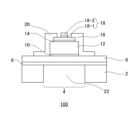
- 1 shows an example of a schematic cross-sectional view of a thin-film piezoelectric device.
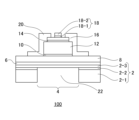
- 1 shows another example of a schematic cross-sectional view of a thin-film piezoelectric device.
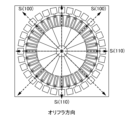
- 1 shows a top view of a thin film piezoelectric device.
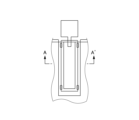
- 1 shows a top view of a thin film piezoelectric device.
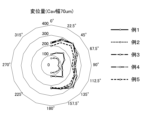
- the relationship between the angle ⁇ and the amount of displacement is shown (width of the cavity portion: 70 ⁇ m).
- the relationship between the angle ⁇ and the amount of displacement is shown (width of the cavity portion: 200 ⁇ m).
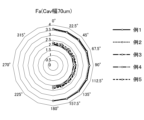
- the relationship between the angle ⁇ and the resonance frequency Fa is shown (width of the cavity portion is 70 ⁇ m).
- the relationship between the angle ⁇ and the resonance frequency Fa is shown (width of the cavity portion: 200 ⁇ m).
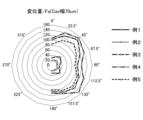
- the relationship between the angle ⁇ and the displacement/resonant frequency Fa is shown (width of the cavity portion: 70 ⁇ m).
- the relationship between the angle ⁇ and the displacement/resonant frequency Fa is shown (width of the cavity portion: 200 ⁇ m).
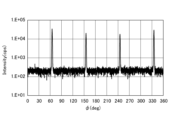
- 1 shows an X-ray diffraction pattern ( ⁇ scan) of a piezoelectric (PZT) film.
- 1 shows an X-ray diffraction pattern ( ⁇ scan) of a piezoelectric (PZT) film.
- present embodiment A specific embodiment of the present invention (hereinafter referred to as the "present embodiment") will be described. Note that the present invention is not limited to the following embodiment, and various modifications are possible without departing from the gist of the present invention.
- the thin-film piezoelectric device (hereinafter, sometimes simply referred to as "device") of this embodiment includes a substrate and a movable part supported by the substrate.
- the movable part includes at least a buffer film containing zirconium oxide (ZrO 2 ) provided on the substrate, a first electrode layer provided on the buffer film, a piezoelectric film provided on the first electrode layer, and a second electrode layer provided on the piezoelectric film.
- ZrO 2 zirconium oxide
- the piezoelectric film is a (001) or (100) oriented film made of a single crystal of lead zirconate titanate (Pb(Zr,Ti)O 3 ; PZT), barium titanate (BaTiO 3 ; BT), or potassium sodium niobate ((K,Na)NbO 3 ; KNN).
- the piezoelectric film in the movable part expands and contracts in the in-plane direction in association with the d 31 mode based on the piezoelectric effect, thereby displacing the movable part.
- the angle ⁇ between the in-plane direction in which the displacement of the movable portion is maximum and the ⁇ 100> orientation of the single crystal piezoelectric film is within ⁇ 11.5°.
- FIG. 1 shows an example of a schematic cross-sectional view of a device equipped with a Si substrate.
- the thin-film piezoelectric device (100) includes a Si substrate (2) and a movable part (4) supported by the Si substrate (2). At least a portion of the Si substrate (2) is removed to form a hollow part (22).
- the movable part (4) is provided on the hollow part (22), and includes a buffer film (6) provided on the Si substrate (2), a first electrode layer (8) provided on the buffer film (6), a first metal oxide film (10) provided on the first electrode layer (8), a piezoelectric film (12) provided on the first metal oxide film (10), a second metal oxide film (14) provided on the piezoelectric film (12), a second electrode layer (16) provided on the second metal oxide film (14), and an extraction electrode (18) provided so as to be conductive with the second electrode layer (16).
- the first electrode layer (8) and the second electrode layer (16) are each made of a Pt film.
- the first metal oxide film (10) and the second metal oxide film (14) are each made of an SRO film.
- the piezoelectric film (12) is made of a PZT film.
- the extraction electrode (18) is made of a laminate of a Ti layer (18-1) and an Au layer (18-2).
- a protective film (20) is provided so as to cover the first electrode layer (8), the first metal oxide film (10), the piezoelectric film (12), the second metal oxide film (14), and the second electrode layer (16).
- FIG. 2 shows an example of a schematic cross-sectional view of a device equipped with an SOI substrate.
- an SOI substrate (2) is used instead of a Si substrate.
- the SOI substrate (2) is composed of a Si substrate portion (2-1), a surface Si layer (2-3), and an insulating film (2-2) such as a SiO 2 film provided therebetween.
- the thin-film piezoelectric device (100) is equipped with an SOI substrate (2) and a movable portion (4) supported by the SOI substrate (2). At least a part of the SOI substrate is removed to form a hollow portion (22).
- the movable portion (4) is provided on the hollow portion (22), and includes a buffer film (6), a first electrode layer (8), a first metal oxide film (10), a piezoelectric film (12), a second metal oxide film (14), a second electrode layer (16), an extraction electrode (18), and a protective film (20).
- the substrate functions as a base for the thin-film piezoelectric device and also serves to support the movable part.
- the material of the substrate is not particularly limited. Any known substrate used in thin-film piezoelectric devices can be used. For example, a silicon (Si) substrate, an SOI (Silicon on Insulator) substrate, a substrate made of a semiconductor crystal other than Si, a substrate made of various oxide single crystals such as sapphire or garnet, a glass substrate with a polysilicon film formed on the surface, etc. can be used.
- the SOI substrate is a substrate having a structure in which an insulating film ( SiO2 film, etc.) is inserted between a Si substrate portion and a surface Si layer.
- the size of the substrate is not limited, and a 4-inch substrate, a 6-inch substrate, a 8-inch substrate, etc. can be used.
- the substrate is preferably a Si substrate or an SOI substrate, and particularly preferably a Si (100) substrate or an SOI (100) substrate.
- the (100) substrate refers to a substrate in which the (100) plane based on the crystal lattice faces the main surface.
- the buffer film, the first electrode layer, and the piezoelectric film can be epitaxially grown on the substrate while ensuring sufficient lattice matching, and as a result, a single-crystallized buffer film, a first electrode layer, and a piezoelectric film can be obtained.
- the substrate of the thin-film piezoelectric device of this embodiment is not limited to a Si (100) substrate or an SOI (100) substrate. It may be another substrate such as a (110) substrate or a (111) substrate.
- the substrate may or may not be included in the movable part.
- the buffer film (6) forms the bottom layer of the movable part (4). That is, the movable part (4) does not include the Si substrate (2).
- the surface Si layer (2-3) of the SOI substrate (2) forms the bottom layer of the movable part (4). That is, the movable part (4) includes a part of the SOI substrate (2).
- the nanopyramid structure itself deforms to correct the crystal lattice misalignment between the substrate and the film. Therefore, it is possible to obtain a single crystal film with little residual stress.
- the buffer film may contain only ZrO2 , or may contain rare earth elements or alkaline earth elements.
- ZrO2 may contain oxygen defects.
- it may contain transition metal elements such as aluminum (Al), scandium (Sc), manganese (Mn), iron (Fe), cobalt (Co), and/or nickel (Ni).
- the thickness of the buffer film is preferably 10 nm to 1500 nm, more preferably 20 nm to 1200 nm, and even more preferably 30 nm to 1000 nm.
- the buffer film is preferably an epitaxial film formed on a substrate, and even more preferably an epitaxial film with a (100) orientation.
- the first electrode layer and the second electrode layer constitute a pair of electrodes sandwiching the piezoelectric film.
- a potential difference based on the surface charge of the piezoelectric film generated by the positive piezoelectric effect can be detected through the electrode layer.
- a potential difference can be applied to the piezoelectric film through the electrode layer, thereby generating a strain due to the reverse piezoelectric effect.
- the material of the first electrode layer is not limited as long as it is conductive. For example, it includes at least one selected from the group consisting of platinum (Pt), molybdenum (Mo), ruthenium (Ru), aluminum (Al) and copper (Cu).
- the thickness of the first electrode layer is preferably 10 nm to 500 nm, more preferably 30 nm to 300 nm, and even more preferably 50 nm to 200 nm.
- the first electrode layer is preferably an epitaxial film formed on a buffer film, and even more preferably an epitaxial film with a (100) orientation.
- the thin-film piezoelectric device of this embodiment may include a first metal oxide film between the first electrode layer and the piezoelectric film.
- the first metal oxide film is preferably made of strontium ruthenate (SrRuO 3 ; SRO).
- SRO is conductive. Therefore, the SRO film (first metal oxide film) can be used as a part of the electrode layer (first electrode layer).
- SRO also has the same perovskite crystal structure as PZT, BT, or KNN constituting the piezoelectric film, and has an approximate lattice constant. Therefore, by providing an SRO film between the first electrode layer and the piezoelectric film, it is possible to further improve the crystallinity of the piezoelectric film formed thereon.
- a piezoelectric film having a small film thickness of submicron size is prone to crystal defects.
- the first metal oxide film By providing the first metal oxide film, a piezoelectric film having few crystal defects can be formed even if the film thickness is submicron size.
- the first metal oxide film is not an essential component. If the thickness of the piezoelectric film is sufficiently large, a piezoelectric film having few crystal defects can be obtained even without the first metal oxide film.
- the thickness of the first metal oxide film is preferably 1 nm or more and 100 nm or less, more preferably 3 nm or more and 80 nm or less, and even more preferably 5 nm or more and 60 nm or less.
- the first metal oxide film is preferably an epitaxial film formed on the first electrode layer, and even more preferably an epitaxial film with a (100) orientation.
- the piezoelectric film is the main component that produces the piezoelectric effect, and converts electrical energy into mechanical energy.
- pressure force
- a surface charge is generated above and below the film due to the positive piezoelectric effect, which creates a potential difference (voltage).
- a potential difference voltage
- the piezoelectric film is displaced due to the inverse piezoelectric effect. This allows the piezoelectric film to be used as an actuator.
- the piezoelectric film of this embodiment is characterized by being composed of a single crystal. That is, the piezoelectric film has continuous crystals on both the cross section and the top surface, and has a crystal structure in which dice overlap without rotating, in other words, a cube-on-cube structure. Therefore, its microstructure differs from that of conventional piezoelectric films. That is, conventional piezoelectric films were polycrystalline films made of multiple crystal grains randomly oriented in the thickness direction and surface direction, or piezoelectric films in which the crystals were continuous in the thickness direction but randomly oriented in the surface direction. Although epitaxial films oriented in the thickness direction and surface direction have also been proposed, the crystals were not continuous and were composed of polycrystalline crystals.
- the piezoelectric film of this embodiment which is made of a single crystal, can have a perfectly aligned polarization direction throughout the film. This allows for improved electrical and mechanical properties. Specifically, the piezoelectric constant can be improved. In addition, since the dielectric constant is lower than that of a polycrystalline film, it has the effect of reducing power consumption and has the advantage of enabling highly accurate output when used as a sensor. Furthermore, by making it single crystal, the bonding strength between atoms is improved, improving the temperature characteristics and reliability of the piezoelectric film.
- Whether or not a piezoelectric film is single crystal can be confirmed by performing an in-plane ⁇ scan measurement using the X-ray diffraction method. In other words, if a four-fold symmetric peak is confirmed in the in-plane ⁇ scan, it can be determined that the piezoelectric film is single crystal.
- PZT has a rhombohedral crystal structure when it is Zr-rich, and a tetragonal crystal structure when it is Ti-rich.
- the intermediate composition region the morphotropic phase boundary (MPB) composition is reached, where the rhombohedral and tetragonal crystal structures coexist, and the piezoelectric properties are significantly improved.
- MPB morphotropic phase boundary
- x is preferably 0.2 to 0.8, more preferably 0.3 to 0.7, and even more preferably 0.4 to 0.6.
- the piezoelectric film of this embodiment is a (001) or (100) oriented film.
- a piezoelectric film having a body-centered cubic crystal structure is likely to be oriented in (001) or (100) by epitaxial growth.
- a PZT film having a tetragonal crystal structure is likely to be oriented in (001) by epitaxial growth.
- the polarization direction parallel to the [001] direction and the electric field direction parallel to the thickness direction of the piezoelectric film are parallel to each other, improving the piezoelectric characteristics.
- a PZT film having a tetragonal crystal structure can obtain a large piezoelectric constant when an electric field along the [001] direction is applied.
- whether the piezoelectric film is a (001) or (100) oriented film can be determined by ⁇ -2 ⁇ scanning the piezoelectric film using X-ray diffraction. That is, when the piezoelectric film is scanned in ⁇ -2 ⁇ , if the ratio (peak intensity ratio) of the diffraction peak intensity from the target plane (the (001) plane and the (100) plane) to the diffraction peak intensity from other planes is 10% or less, it can be determined to be a (001) or (100) oriented film. A smaller peak intensity ratio is preferable, and 5% or less is more preferable.
- the thickness of the piezoelectric film is preferably 0.1 ⁇ m or more and 10 ⁇ m or less. If the piezoelectric film is too thin, the effect of the piezoelectric film cannot be fully utilized, and the amount of displacement obtained may be small. On the other hand, if the piezoelectric film is too thick, it may be difficult to obtain a piezoelectric film that is sufficiently single crystallized.
- the thickness is more preferably 0.3 ⁇ m or more and 6 ⁇ m or less, and even more preferably 0.5 ⁇ m or more and 4 ⁇ m or less.
- the thin-film piezoelectric device of this embodiment may include a second metal oxide film between the piezoelectric film and the second electrode layer.
- the second metal oxide film is made of strontium ruthenate (SrRuO 3 ; SRO). SrO is conductive. Therefore, the SRO film (second metal oxide film) can be used as a part of the electrode layer (second electrode layer).
- the thickness of the second metal oxide film is preferably 1 nm to 60 nm, more preferably 3 nm to 30 nm, and even more preferably 5 nm to 20 nm.
- the second metal oxide film is preferably an epitaxial film formed on the piezoelectric film, and even more preferably an epitaxial film with a (100) orientation.
- the second electrode layer and the first electrode layer constitute a pair of electrodes sandwiching the piezoelectric film.
- the material of the second electrode layer is not limited as long as it has electrical conductivity.
- the second electrode layer may include at least one selected from the group consisting of platinum (Pt), molybdenum (Mo), ruthenium (Ru), aluminum (Al), and copper (Cu).
- the thickness of the second electrode layer is preferably 1 nm to 200 nm, more preferably 3 nm to 150 nm, and even more preferably 10 nm to 120 nm.
- the second electrode layer is preferably an epitaxial film formed on the piezoelectric film, and even more preferably a (100) oriented epitaxial film.
- the movable part is supported by a substrate and includes at least a buffer film, a first electrode layer, a piezoelectric film, and a second electrode layer, and may further include a metal oxide film (a first metal oxide film, a second metal oxide film) between the first electrode layer and the piezoelectric film and/or on the second electrode layer.
- a metal oxide film a first metal oxide film, a second metal oxide film
- electrodes are provided on the top and bottom of the piezoelectric film so as to sandwich the piezoelectric film.
- a potential difference is applied to the electrode layers (first electrode layer and second electrode layer)
- an electric field is generated in the vertical direction of the piezoelectric film, and a displacement occurs in a direction perpendicular to this electric field, that is, in a direction parallel to the film surface, due to the inverse piezoelectric effect of the d 31 mode.
- a stress parallel to the film surface is applied to the movable part, a surface charge is generated in the electrode layer due to the positive piezoelectric effect.
- the displacement of the piezoelectric film in the film surface direction and the displacement of the movable part due to this displacement can be utilized.
- the movable part is composed of a laminate of the piezoelectric film and other components (buffer film, etc.). Even if the piezoelectric film expands and contracts in-plane (displaces), the other components do not expand and contract. Therefore, the movable part warps in response to the displacement of the piezoelectric film. And, the greater the displacement of the piezoelectric film, the greater the warping of the movable part.
- the angle ⁇ between the in-plane direction in which the displacement of the movable part is maximum and the ⁇ 100> orientation of the piezoelectric film is within ⁇ 11.5°.
- the in-plane direction in which the displacement of the movable part is maximum is the direction in which the amount of expansion and contraction (amount of warping) is maximum in a plane parallel to the film surface of the piezoelectric film.
- the ⁇ 100> orientation includes all orientations equivalent to the [100] direction.
- the angle ⁇ is preferably within ⁇ 11.0°, and more preferably within ⁇ 10.5°.
- a hollow portion (22) is provided directly below the movable portion (4).
- the movable portion (4) has a diaphragm structure.
- the movable portion is less constrained by the substrate, so the amount of warping of the movable portion increases.
- the movable part has an outer shape with two opposing parallel sides when viewed from above, and it is preferable that the direction perpendicular to these two sides coincides with the in-plane direction in which the displacement of the movable part is maximum.
- the outer shape of the movable part is rectangular, approximately rectangular, or trapezoidal. In this way, by giving the movable part an outer shape with two opposing parallel sides, it is possible to set the direction perpendicular to these two sides as the maximum expansion and contraction direction.
- the width (short side) direction dimension is preferably 30 ⁇ m to 500 ⁇ m, and more preferably 50 ⁇ m to 300 ⁇ m.
- the length (long side) direction dimension is preferably 100 ⁇ m to 1000 ⁇ m, and more preferably 250 ⁇ m to 600 ⁇ m.
- the direction perpendicular to the width direction coincides with the in-plane direction in which the displacement of the movable part is maximum.
- the buffer film and the first electrode layer are made of single crystals. It is also preferable that the crystal orientations of the buffer film, the first electrode layer, and the piezoelectric film are aligned. By making the buffer film and the first electrode layer out of single crystals and aligning their crystal orientations, it is possible to improve the crystallinity of the piezoelectric film formed on the first electrode layer.
- the thin-film piezoelectric device of this embodiment preferably has a double-supported beam structure or a cantilever beam structure, and a movable part is provided on the beam part of the double-supported beam structure or the cantilever beam structure.
- a movable part is provided on the beam part of the double-supported beam structure or the cantilever beam structure.
- a cantilever beam structure is also called a cantilever structure.
- both ends of the movable part are fixed. Therefore, the movable part bends in response to the warping, and its central part displaces up and down.
- a double-supported beam structure can also be called a diaphragm structure.
- a suitable manufacturing method includes a step of preparing a substrate (substrate preparation step), a step of forming a buffer film containing zirconium oxide (ZrO 2 ) on the substrate (buffer film formation step), a step of forming a first electrode layer on the buffer film (first electrode layer formation step), a step of forming a piezoelectric film on the first electrode layer (piezoelectric film formation step), and a step of forming a second electrode layer on the piezoelectric film (second electrode layer formation step).
- a substrate is prepared.
- the details of the substrate are as described above. That is, as the substrate, a silicon (Si) substrate, an SOI (Silicon on Insulator) substrate, a substrate made of a semiconductor crystal other than Si, a substrate made of various oxide single crystals such as sapphire or garnet, a glass substrate with a polysilicon film formed on the surface, and the like can be used.
- the size of the substrate is not limited, and a 4-inch substrate, a 6-inch substrate, or an 8-inch substrate can be used.
- the orientation of the substrate is also not limited. For example, a Si(100) substrate, a Si(110) substrate, or a Si(111) substrate can be used.
- a buffer film containing zirconium oxide (ZrO 2 ) is formed on a substrate.
- the film may be formed by a method such as an electron beam deposition method or a sputtering method.
- the substrate is placed in a vacuum chamber of a deposition device.
- the zirconium oxide (ZrO 2 ) film may be formed while heating the substrate in a state in which oxygen (O 2 ) gas is flowing under a high vacuum atmosphere with a constant pressure in the vacuum chamber.
- a buffer film made of an epitaxial film with a (100) orientation can be reliably obtained.
- a patterning process for partially removing the buffer film after film formation may be performed using a photolithography technique.
- the first electrode layer is formed on the buffer film.
- the first electrode layer includes at least one selected from the group consisting of platinum (Pt), molybdenum (Mo), ruthenium (Ru), aluminum (Al) and copper (Cu).
- the first electrode layer may be formed by a method such as sputtering. In the case of sputtering, for example, the epitaxially grown first electrode layer may be formed on the buffer film as a part of the lower electrode by sputtering while heating the substrate.
- a patterning process may be performed by using a photolithography technique to partially remove the first electrode layer after the film formation.
- a first metal oxide film may be formed between the first electrode layer and the piezoelectric film.
- the first metal oxide film may be formed by a method such as sputtering.
- sputtering for example, while heating the substrate, the first metal oxide film epitaxially grown by sputtering may be formed on the first electrode layer as a part of the lower electrode by sputtering.
- a patterning process may be performed by using a photolithography technique to partially remove the first metal oxide film after the film formation.
- a piezoelectric film is formed on the first electrode layer.
- the piezoelectric film is a (001) or (100) oriented film made of single crystals of PZT, BT, or KNN.
- the piezoelectric film is formed by a method such as a sputtering method or a sol-gel method.
- a piezoelectric film containing epitaxially grown lead zirconate titanate (Pb(Zr 1-x Ti x )O 3 (0 ⁇ x ⁇ 1):PZT) may be formed on the first electrode layer by a known sputtering method.
- a piezoelectric film containing epitaxially grown lead zirconate titanate (Pb(Zr 1-x Ti x )O 3 (0 ⁇ x ⁇ 1):PZT) may be formed on the first electrode layer by a known sol-gel method.
- the film forming method is not limited.
- a patterning process may be performed using photolithography technology to partially remove the piezoelectric film after deposition.
- a second metal oxide film may be formed between the piezoelectric film and the second electrode layer.
- the second metal oxide film may be formed by a method such as sputtering.
- sputtering for example, an epitaxially grown second metal oxide film may be formed on the piezoelectric film by sputtering as a part of the lower electrode.
- a patterning process may be performed using a photolithography technique to partially remove the second metal oxide film after the film formation.
- the second electrode layer is formed on the piezoelectric film or the second metal oxide film.
- the second electrode layer includes at least one selected from the group consisting of platinum (Pt), molybdenum (Mo), ruthenium (Ru), aluminum (Al) and copper (Cu).
- the second electrode layer may be formed by a method such as sputtering.
- the second electrode layer including epitaxially grown Pt may be formed on the piezoelectric film or the second metal oxide film by sputtering as a part of the lower electrode.
- a patterning process may be performed using a photolithography technique to partially remove the second electrode layer after the film formation.
- a take-out electrode may be formed on the second electrode layer.
- the take-out electrode may be formed by a method such as sputtering.
- a patterning process may be performed using a photolithography technique to partially remove the take-out electrode layer after the film formation.
- a protective film may be formed on the second electrode layer or the extraction electrode.
- the protective film may be made of, but is not limited to, tetraethyl orthosilicate (TEOS).
- TEOS tetraethyl orthosilicate
- the protective film may be formed by a method such as sputtering.
- a patterning process may be performed using a photolithography technique to partially remove the protective film after the film formation.
- a process may be performed in which at least a portion of the substrate in the movable portion is removed to form a hollow portion directly below the movable portion.
- the hollow portion is preferably formed after forming a buffer film, a first electrode layer, a piezoelectric layer, and a second electrode layer on the substrate.
- the hollow portion can be formed by combining photolithography and etching techniques. Specifically, a mask having an opening is provided in close contact with the back surface of the substrate. Then, the substrate is etched away from the mask opening using an alkaline etching solution. For example, a Si substrate or an SOI substrate is anisotropically etched with an alkaline etching solution to form a quadrangular pyramidal hollow portion. When a Si substrate is used, the buffer film ( ZrO2 film) on the Si substrate functions as an etching stop layer. Therefore, a thin-film piezoelectric device that does not have a substrate directly below the movable portion can be fabricated.
- Example 1 Fabrication of thin film piezoelectric device [Example 1]
- a buffer film ( ZrO2 film), a first electrode layer (Pt film), a first metal oxide film (SRO film), a piezoelectric film (PZT film), a second metal oxide film (SRO film), a second electrode layer (Pt film), and an extraction electrode (Ti layer, Au layer) were formed in this order on an SOI substrate, and then the back surface of the SOI substrate was etched away to form a cavity portion (hollow portion).
- a thin-film piezoelectric device having a movable portion as shown in FIG. 2 was fabricated.
- This SOI substrate had a three-layer structure consisting of a Si substrate, an insulating film ( SiO2 film), and a surface Si layer.
- a zirconium oxide (ZrO 2 ) film was formed as a buffer film on the surface Si layer of the prepared SOI substrate by electron beam deposition.
- the formed buffer film had a (100) oriented cubic crystal structure and a thickness of 60 nm.
- the film was formed under the following conditions.
- a Pt film as a first electrode layer was formed on the buffer film ( ZrO2 film) by sputtering.
- the formed Pt film (first electrode layer) had a (100)-oriented cubic crystal structure and a thickness of 150 nm.
- the film was formed under the following conditions.
- the first metal oxide film thus formed had a (100)-oriented cubic crystal structure and a thickness of 40 nm.
- the film was formed under the following conditions.
- a PZT film was formed as a piezoelectric film on the first metal oxide film.
- the formed piezoelectric film had a (001) orientation, a thickness of 2 ⁇ m, and a composition of Pb(Zr 0.52 Ti 0.48 )O 3 .
- An SRO film was formed on the formed piezoelectric film as a second metal oxide film, and a Pt film was further formed on top of that as a second electrode layer.
- the SRO film and Pt film were formed by sputtering.
- the thickness of the formed SRO film (second metal oxide film) was 10 nm, and the thickness of the formed Pt film (second electrode layer) was 100 nm.
- the second electrode layer (Pt film), the second metal oxide film (SRO film), and the piezoelectric film (PZT film) were partially etched away using photolithography. Furthermore, a tetraethoxysilane (TEOS) film was formed as a protective film by plasma CVD, and the TEOS film was partially etched away using photolithography.
- TEOS tetraethoxysilane
- a 10 nm thick Ti layer and a 300 nm thick Au layer were formed by DC sputtering, and then partially etched away using photolithography to form an extraction electrode.
- anisotropic etching was performed from the back surface of the substrate (SOI substrate) to form a cavity (hollow portion). Specifically, a part of the Si substrate and the insulating film ( SiO2 film) were removed from the back surface of the substrate to form an opening on the back surface of the substrate. This produced a movable portion having a rectangular cavity (hollow portion). The planar dimensions of the movable portion were 70 ⁇ m wide x 275 ⁇ m long.
- the device When fabricating the thin-film piezoelectric device of Example 1, the device was designed so that the angle ⁇ between the width direction (short side direction) of the movable part and the ⁇ 100> orientation of the piezoelectric film was a specified angle. Specifically, the movable part was designed so that the angle ⁇ was 0°, 22.5°, 45.0°, 67.5°, 90.0°, 112.5°, 135.0°, 157.5°, or 180.0°, and devices corresponding to each angle ⁇ were fabricated.
- Figures 3 and 4 Top views (photographs) of the obtained thin-film piezoelectric device are shown in Figures 3 and 4.
- Figure 3 shows all the devices fabricated according to the angle ⁇
- Figure 4 shows one device.
- the movable part can be seen in the center of Figure 4, and the line segment A-A' that crosses the movable part is the width direction (short side direction) of the movable part.
- Example 2 The piezoelectric film (PZT film) was formed by sputtering. Except for that, the sample was fabricated in the same manner as in Example 1. The piezoelectric film was formed under the following conditions.
- Example 3 Instead of an SOI substrate, a Si (100) substrate was used. The thickness of the buffer film ( ZrO2 film) was set to 1.0 ⁇ m. Other than that, a sample was fabricated in the same manner as in Example 1. As a result, a thin-film piezoelectric device having a movable part as shown in FIG. 1 was fabricated.
- Example 4 The thickness of the buffer film ( ZrO2 film) was changed to 0.8 ⁇ m. Otherwise, the sample was prepared in the same manner as in Example 3.
- Example 5 The thickness of the buffer film ( ZrO2 film) was changed to 1.2 ⁇ m. Otherwise, the sample was prepared in the same manner as in Example 3.
- Example 6 When forming the cavity, the planar dimensions of the movable part were changed to 200 ⁇ m ⁇ 500 ⁇ m.
- the movable part was designed so that the angle ⁇ between the width direction of the movable part and the ⁇ 100> orientation of the piezoelectric film was 0°, 11.25°, 22.5°, 33.75°, 45°, 56.25°, 67.5°, 78.75°, or 90°. Otherwise, devices corresponding to each angle ⁇ were fabricated in the same manner as in Example 1.
- Example 7 A piezoelectric film (PZT film) was formed by sputtering. Specifically, the piezoelectric film was formed under the same conditions as in Example 2. Other than that, a sample was fabricated in the same manner as in Example 6.
- Example 9 The thickness of the buffer film ( ZrO2 film) was changed to 0.8 ⁇ m. Otherwise, a sample was prepared in the same manner as in Example 8.
- Example 10 The thickness of the buffer film ( ZrO2 film) was changed to 1.2 ⁇ m. Otherwise, a sample was prepared in the same manner as in Example 8.
- the crystallinity of the piezoelectric film was evaluated. That is, before the second metal oxide film was formed, the device was taken out, and the piezoelectric film was evaluated using a fully automated multipurpose horizontal X-ray diffraction device (Rigaku Corporation, Smart Lab). Specifically, a 360° scan measurement in the ⁇ direction was performed on the 2 ⁇ - ⁇ crystal peak of PZT (004).
- ⁇ Resonant frequency> The resonance frequency of the thin-film piezoelectric device was measured using a spectrum impedance analyzer (Agilent Technologies, 4395A). Specifically, a probe connected to the spectrum impedance analyzer was brought into contact with the upper electrode (second electrode layer) and the lower electrode (first electrode layer) of the thin-film piezoelectric device so as to obtain electrical continuity. Then, a voltage of 15 V was applied to measure the frequency at which the impedance (Z) and out-of-phase ( ⁇ ) changed.
- ⁇ Displacement amount> The displacement amount in the movable part of the thin-film piezoelectric device was evaluated. Specifically, a probe connected to an oscilloscope (TDS3014C, Tktronix) was brought into contact with the upper electrode (second electrode layer) and the lower electrode (first electrode layer) of the thin-film piezoelectric device so as to obtain electrical continuity. Then, a measurement signal was applied to the upper electrode and the lower electrode using a multifunction generator (WF1973, NF Corporation). At this time, the measurement signal was applied under the conditions of a sine wave, 1 kHz, Vpp 20 V, and Offset 10 V. Then, the displacement amount of the movable part of the thin-film piezoelectric device was measured using a laser Doppler vibrometer (VFX-Compact, Polytec), and the obtained output value was captured into the oscilloscope.
- VFX-Compact laser Doppler vibrometer
- FIG. 11A shows the X-ray diffraction intensity on the vertical axis in antilogarithmic scale
- Figure 11B shows it in logarithmic scale.
- the displacement of the movable parts of the thin-film piezoelectric devices of Examples 1 to 10 are shown in Tables 2 and 3 and Figures 5 and 6.
- the angle ⁇ shown in the tables and figures is the angle (unit: °) between the long side direction of the device movable part and the substrate orientation flat direction [110].
- ⁇ is the angle between the in-plane direction in which the displacement of the movable part is maximum and the ⁇ 100> direction of the piezoelectric film.
- the piezoelectric film is (100) oriented.
- the amount of displacement increases as the angle ⁇ increases, and in the region where ⁇ is between 45 and 90°, the amount of displacement decreases as the angle ⁇ increases. In other words, the amount of displacement is maximum when the angle ⁇ is near 45° (angle ⁇ is 0°).
- the resonant frequency Fa of the piezoelectric film is shown in Tables 4 and 5 and Figures 7 and 8.
- the displacement/resonant frequency Fa is shown in Tables 6 and 7 and Figures 9 and 10.
- the resonant frequency Fa showed a trend opposite to the amount of displacement. That is, in the region where ⁇ is 0 to 45°, the larger the angle ⁇ , the smaller Fa became, and in the region where ⁇ is 45 to 90°, the larger the angle ⁇ , the larger Fa became. In other words, Fa was smallest when the angle ⁇ was close to 45° (angle ⁇ was 0°).
Landscapes
- Engineering & Computer Science (AREA)
- Chemical & Material Sciences (AREA)
- Physics & Mathematics (AREA)
- Acoustics & Sound (AREA)
- Ceramic Engineering (AREA)
- Manufacturing & Machinery (AREA)
- Crystallography & Structural Chemistry (AREA)
- Materials Engineering (AREA)
- General Electrical Machinery Utilizing Piezoelectricity, Electrostriction Or Magnetostriction (AREA)
Priority Applications (3)
| Application Number | Priority Date | Filing Date | Title |
|---|---|---|---|
| JP2024563284A JP7713272B1 (ja) | 2023-08-25 | 2024-08-26 | 薄膜圧電デバイス |
| CN202480006259.9A CN120435940A (zh) | 2023-08-25 | 2024-08-26 | 薄膜压电器件 |
| EP24859686.8A EP4626210A1 (en) | 2023-08-25 | 2024-08-26 | Thin film piezoelectric device |
Applications Claiming Priority (2)
| Application Number | Priority Date | Filing Date | Title |
|---|---|---|---|
| JP2023-137419 | 2023-08-25 | ||
| JP2023137419 | 2023-08-25 |
Publications (1)
| Publication Number | Publication Date |
|---|---|
| WO2025047653A1 true WO2025047653A1 (ja) | 2025-03-06 |
Family
ID=94819097
Family Applications (1)
| Application Number | Title | Priority Date | Filing Date |
|---|---|---|---|
| PCT/JP2024/030191 Pending WO2025047653A1 (ja) | 2023-08-25 | 2024-08-26 | 薄膜圧電デバイス |
Country Status (4)
| Country | Link |
|---|---|
| EP (1) | EP4626210A1 (https=) |
| JP (1) | JP7713272B1 (https=) |
| CN (1) | CN120435940A (https=) |
| WO (1) | WO2025047653A1 (https=) |
Citations (6)
| Publication number | Priority date | Publication date | Assignee | Title |
|---|---|---|---|---|
| JP2000332569A (ja) | 1999-05-20 | 2000-11-30 | Tdk Corp | 薄膜圧電素子 |
| JP2008024532A (ja) * | 2006-07-18 | 2008-02-07 | Canon Inc | 圧電体、圧電体素子、圧電体素子を用いた液体吐出ヘッド及び液体吐出装置 |
| JP2013115534A (ja) | 2011-11-28 | 2013-06-10 | Seiko Epson Corp | 単結晶ウェハーの製造方法、単結晶ウェハー、振動素子、及び圧電デバイス |
| WO2013164955A1 (ja) * | 2012-05-01 | 2013-11-07 | コニカミノルタ株式会社 | 圧電素子 |
| JP2019216181A (ja) * | 2018-06-13 | 2019-12-19 | アドバンストマテリアルテクノロジーズ株式会社 | 膜構造体及びその製造方法 |
| JP2021064735A (ja) * | 2019-10-16 | 2021-04-22 | Tdk株式会社 | 電子デバイス用素子 |
-
2024
- 2024-08-26 CN CN202480006259.9A patent/CN120435940A/zh active Pending
- 2024-08-26 WO PCT/JP2024/030191 patent/WO2025047653A1/ja active Pending
- 2024-08-26 JP JP2024563284A patent/JP7713272B1/ja active Active
- 2024-08-26 EP EP24859686.8A patent/EP4626210A1/en active Pending
Patent Citations (6)
| Publication number | Priority date | Publication date | Assignee | Title |
|---|---|---|---|---|
| JP2000332569A (ja) | 1999-05-20 | 2000-11-30 | Tdk Corp | 薄膜圧電素子 |
| JP2008024532A (ja) * | 2006-07-18 | 2008-02-07 | Canon Inc | 圧電体、圧電体素子、圧電体素子を用いた液体吐出ヘッド及び液体吐出装置 |
| JP2013115534A (ja) | 2011-11-28 | 2013-06-10 | Seiko Epson Corp | 単結晶ウェハーの製造方法、単結晶ウェハー、振動素子、及び圧電デバイス |
| WO2013164955A1 (ja) * | 2012-05-01 | 2013-11-07 | コニカミノルタ株式会社 | 圧電素子 |
| JP2019216181A (ja) * | 2018-06-13 | 2019-12-19 | アドバンストマテリアルテクノロジーズ株式会社 | 膜構造体及びその製造方法 |
| JP2021064735A (ja) * | 2019-10-16 | 2021-04-22 | Tdk株式会社 | 電子デバイス用素子 |
Non-Patent Citations (2)
| Title |
|---|
| J.F. SHEPARD JR. ET AL.: "The wafer flexure technique for the determination of the transverse piezoelectric coefficient (d ) of PZT thin films", SENSORS AND ACTUATORS, vol. A71, 1998, pages 133 - 138, XP004140085, DOI: 10.1016/S0924-4247(98)00161-7 |
| See also references of EP4626210A1 |
Also Published As
| Publication number | Publication date |
|---|---|
| CN120435940A (zh) | 2025-08-05 |
| JPWO2025047653A1 (https=) | 2025-03-06 |
| JP7713272B1 (ja) | 2025-07-25 |
| EP4626210A1 (en) | 2025-10-01 |
Similar Documents
| Publication | Publication Date | Title |
|---|---|---|
| CN113574690B (zh) | 膜结构体、压电体膜及超导体膜 | |
| Muralt | Recent progress in materials issues for piezoelectric MEMS | |
| JP5024399B2 (ja) | 圧電薄膜素子、圧電薄膜デバイス及び圧電薄膜素子の製造方法 | |
| CN101490316B (zh) | 压电物质、压电元件及使用压电元件的液体排出头和液体排出设备 | |
| JP6004640B2 (ja) | 圧電素子、液体吐出ヘッド、超音波モータ、塵埃除去装置、およびデバイス | |
| Niu et al. | Integration-friendly, chemically stoichiometric BiFeO3 films with a piezoelectric performance challenging that of PZT | |
| US20080308762A1 (en) | Piezoelectric laminate, surface acoustic wave device, thin-film piezoelectric resonator, and piezoelectric actuator | |
| US20130106242A1 (en) | Piezoelectric film element and piezoelectric film device | |
| WO2022168800A1 (ja) | 積層構造体及びその製造方法 | |
| JP6313188B2 (ja) | 圧電素子の製造方法、圧電素子 | |
| JP2017017157A (ja) | 積層構造体、圧電素子および圧電素子の製造方法 | |
| JP7851661B2 (ja) | 積層構造体 | |
| JP5398131B2 (ja) | 圧電体素子、圧電体の製造方法及び液体噴射ヘッド | |
| JP6426061B2 (ja) | 積層薄膜構造体の製造方法、積層薄膜構造体及びそれを備えた圧電素子 | |
| JP7713272B1 (ja) | 薄膜圧電デバイス | |
| JP7679976B2 (ja) | 圧電薄膜及びその作製方法 | |
| Polcawich et al. | Additive processes for piezoelectric materials: Piezoelectric MEMS | |
| JP2013225546A (ja) | 圧電素子およびその製造方法 | |
| Jakob et al. | Comparison of different piezoelectric materials for GHz acoustic microscopy transducers | |
| US20230309409A1 (en) | Piezoelectric element and mems mirror | |
| Fuentes-Fernandez et al. | Fabrication of relaxer-based piezoelectric energy harvesters using a sacrificial poly-Si seeding layer | |
| JP6677076B2 (ja) | 積層膜、電子デバイス基板、電子デバイス及び積層膜の製造方法 | |
| JP6499810B2 (ja) | 圧電体膜及びそれを備えた圧電素子 | |
| TWI914558B (zh) | 複合基板、壓電元件及複合基板之製造方法 | |
| Fukushi et al. | Investigation of optimal composition ratio of Sm-doped Pb (Mg1/3, Nb2/3) O3-PbTiO3 monocrystalline thin film with large piezoelectric performance |
Legal Events
| Date | Code | Title | Description |
|---|---|---|---|
| ENP | Entry into the national phase |
Ref document number: 2024563284 Country of ref document: JP Kind code of ref document: A |
|
| WWE | Wipo information: entry into national phase |
Ref document number: 2024563284 Country of ref document: JP |
|
| 121 | Ep: the epo has been informed by wipo that ep was designated in this application |
Ref document number: 24859686 Country of ref document: EP Kind code of ref document: A1 |
|
| WWE | Wipo information: entry into national phase |
Ref document number: 2024859686 Country of ref document: EP |
|
| WWE | Wipo information: entry into national phase |
Ref document number: 202480006259.9 Country of ref document: CN |
|
| ENP | Entry into the national phase |
Ref document number: 2024859686 Country of ref document: EP Effective date: 20250626 |
|
| WWP | Wipo information: published in national office |
Ref document number: 202480006259.9 Country of ref document: CN |
|
| WWP | Wipo information: published in national office |
Ref document number: 2024859686 Country of ref document: EP |