WO2025041275A1 - 情報処理装置および方法 - Google Patents
情報処理装置および方法 Download PDFInfo
- Publication number
- WO2025041275A1 WO2025041275A1 PCT/JP2023/030189 JP2023030189W WO2025041275A1 WO 2025041275 A1 WO2025041275 A1 WO 2025041275A1 JP 2023030189 W JP2023030189 W JP 2023030189W WO 2025041275 A1 WO2025041275 A1 WO 2025041275A1
- Authority
- WO
- WIPO (PCT)
- Prior art keywords
- behavior
- information
- message
- action
- members
- Prior art date
- Legal status (The legal status is an assumption and is not a legal conclusion. Google has not performed a legal analysis and makes no representation as to the accuracy of the status listed.)
- Ceased
Links
Images





Classifications
-
- G—PHYSICS
- G06—COMPUTING OR CALCULATING; COUNTING
- G06Q—INFORMATION AND COMMUNICATION TECHNOLOGY [ICT] SPECIALLY ADAPTED FOR ADMINISTRATIVE, COMMERCIAL, FINANCIAL, MANAGERIAL OR SUPERVISORY PURPOSES; SYSTEMS OR METHODS SPECIALLY ADAPTED FOR ADMINISTRATIVE, COMMERCIAL, FINANCIAL, MANAGERIAL OR SUPERVISORY PURPOSES, NOT OTHERWISE PROVIDED FOR
- G06Q10/00—Administration; Management
- G06Q10/06—Resources, workflows, human or project management; Enterprise or organisation planning; Enterprise or organisation modelling
- G06Q10/063—Operations research, analysis or management
- G06Q10/0639—Performance analysis of employees; Performance analysis of enterprise or organisation operations
Definitions
- An embodiment of the present invention relates to an information processing device and method.
- a company's operations are made up of elements such as employees, facilities, and business processes. Operations are designed to suit the industry, business sector, and business model, and are improved daily. In particular, employees are an organic function that is important in operations, and they flexibly support uncertain and complex operations through an organizational structure.
- a “team” refers to a group of two or more people who work together or cooperate to achieve a shared goal or obtain value while dividing up roles, and the people who belong to an organization are called “members.”
- An organization functions as a collection of multiple teams, and it is important to properly understand the formation status of these teams in accordance with the business situation, and to design and improve their operation.
- Non-Patent Document 1 reports the results of a quantitative analysis of the strength of connections between employees based on the hypothesis that "employees with strong relationships respond quickly after a comment" using communication logs obtained from a business chat application.
- Non-patent literature 2 reports on the results of an analysis of the relationship between productivity and the structural characteristics of the directed graph of the communication log (history) of a task management application for software development, based on which the shape of the connections between statements is expressed as a directed graph.
- the method disclosed in the above-mentioned non-patent document 1 estimates the strength of the connection between two people based on the speed of response, but it cannot extract contribution value information about the action relationship regarding the actions of members.
- Patent Document 2 creates a graph structure of the spread and convergence of comments based on information about quotes and mentions regarding the content of comments made in group chats and information about the context between comments. Since it does not handle member information, it is not possible to extract contribution value information about the action relationships regarding the actions of members.
- known methods cannot extract action relationships related to the actions of members, i.e., behavioral information that causes action relationships between members, from communication logs.
- This invention was made in light of the above circumstances, and its purpose is to provide an information processing device and method that can appropriately analyze the interaction relationships regarding the actions of members.
- An information processing device includes an acquisition unit that acquires behavioral information that identifies the type of behavior performed by each of a plurality of personnel and the personnel involved in the behavior, based on information in which the action relationships related to the behavior performed by each of the plurality of personnel are structured.
- An information processing method is a method performed by an information processing device, and includes acquiring, by an acquisition unit of the information processing device, behavioral information that identifies the type of behavior performed by each of a plurality of personnel and the personnel involved in the behavior, based on information in which the action relationships related to the behavior performed by each of the plurality of personnel are structured.
- the present invention makes it possible to properly analyze the interaction between members' actions.
- FIG. 1 is a diagram showing an application example of a behavior information extraction system according to an embodiment of the present invention.
- FIG. 2 is a diagram showing an example of input information to the behavior information extraction system.
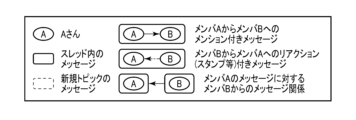
- FIG. 3 is a diagram for explaining an example of action relationships regarding actions between members.
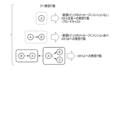
- FIG. 4 is a diagram showing an example of the action relationships regarding sending actions between members.
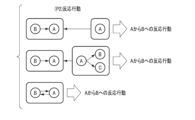
- FIG. 5 is a diagram showing an example of action relationships regarding reaction behaviors between members.
- FIG. 6 is a diagram showing an example of action relationships regarding participation actions between members.
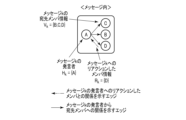
- FIG. 7 is a diagram showing an example of various types of information in a message.
- FIG. 8 is a diagram showing an example of various types of information between messages.
- FIG. 9 is a flowchart showing an example of a processing procedure related to extraction of calling behavior data between members.
- FIG. 9 is a flowchart showing an example of a processing procedure related to extraction of calling behavior data between members.
- FIG. 10 is a flowchart showing an example of a processing procedure related to extraction of reaction behavior data between members.
- FIG. 11 is a flowchart illustrating an example of a processing procedure related to extraction of engagement behavior data between members.
- FIG. 12 is a diagram illustrating an example of contribution value information based on a result of extraction by the behavior information extraction unit.
- FIG. 13 is a diagram showing an example of action relationships related to actions visualized as a directed graph network.
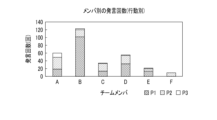
- FIG. 14 is a diagram showing an example of a result of tallying up various behavioral patterns performed by each member.
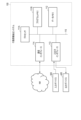
- Figure 15 is a block diagram showing an example of the hardware configuration of a behavioral information extraction system according to one embodiment of the present invention.
- information is extracted from the communication log that indicates the action relationships regarding three types of outreach actions between members: outgoing actions, response actions, and participation actions.
- FIG. 1 is a diagram showing an application example of a behavior information extraction system according to an embodiment of the present invention.
- a behavioral information extraction system (behavioral information extraction device) 100 according to one embodiment of the present invention has an outgoing behavior acquisition unit 10, a reaction behavior acquisition unit 20, an engagement behavior acquisition unit 30, a behavioral information DB (database) 40, and a contribution value determination unit 50.
- the behavioral information extraction system 100 inputs structured information on (1) the destinations of members between and within messages, (2) reactions to messages, and (3) relationships between messages. This information is structured information on the action relationships regarding the actions performed by each of multiple members.
- Fig. 2 is a diagram showing an example of input information to the behavior information extraction system
- Fig. 3 is a diagram for explaining an example of action relationships regarding the behaviors of members.
- the input information by the behavioral information extraction system 100 includes (1) a message of a new topic, which is the first message, and (2) messages of each thread, which are messages below the message of the new topic.
- This input information includes (1) a message with a mention from one member to another member, (2) a reaction from one member to another member, e.g., a message with a stamp-like mark, and (3) the relationship of messages from other members to messages sent by one member.
- the above-mentioned messages with mentions and reactions are structured information about the relationships within messages between members, and the above-mentioned message relationships are structured information about the parent-child relationships between messages.
- the outgoing behavior acquisition unit 10 acquires outgoing behavior data indicating the interaction relationship between members regarding outgoing behavior, which is a type of outreach behavior between members, from the input information, i.e., the structured information, and stores (adds) this acquired data in the behavior information DB 40.
- the reaction behavior acquisition unit 20 acquires reaction behavior data indicating the action relationship regarding the reaction behavior between each member, which is a type of encouraging behavior between each member, from the above input information, and stores this acquired data in the behavior information DB 40.
- the participation behavior acquisition unit 30 acquires participation behavior data indicating action relationships regarding participation behaviors between members, which is a type of encouraging behavior between members, from the input information, and stores this acquired data in the behavior information DB 40.
- the behavior information extraction system 100 outputs the acquired and stored data.
- the acquired data is behavior information that identifies the type of behavior performed by each of the multiple members and the personnel involved in the behavior.
- Fig. 4 is a diagram showing an example of an action relationship regarding a sending action between members.
- Fig. 5 is a diagram showing an example of an action relationship regarding a reaction action between members.
- Fig. 6 is a diagram showing an example of an action relationship regarding a participation action between members.
- the action relationships regarding outgoing messages include (1) an outgoing message from member A to all other members, known as a broadcast, when the message in the new topic does not mention any other specific members, (2) an outgoing message from member A to member B when the message in the new topic includes a mention of any other specific members, and (3) an outgoing message from member A to member A.
- the action relationships regarding the reaction behavior include three action relationships regarding reaction behavior from member A to member A.
- the action relationships regarding the engagement actions include (1) an engagement action from member A to member B and (2) an engagement action from member A to member C with respect to the above broadcast.
- ⁇ j ⁇ Mykj 0 ⁇ ), and (8) a set Wu of messages in thread u ⁇ S.
- the above parent-child relationship is the relationship when the parent message is message j and the child message is message k.
- FIG. 7 is a diagram showing an example of various types of information in a message.
- the sender of message k is "member A”
- the destination members of message k are “member B,””memberC,” and “member D”
- the member who reacted to message k is "member D.”
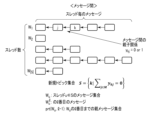
- FIG. 8 is a diagram showing an example of various types of information between messages. 8 shows multiple threads, each of which is a set of messages starting from a message in a new topic, as well as messages j and k in the first thread that have a parent-child relationship.
- the set of parent messages from 1 to l of message set W u in the u-th thread can be expressed as prt(W u , l-1).
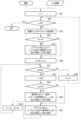
- FIG. 9 is a flowchart showing an example of a processing procedure related to extraction of calling behavior data between members.
- the outgoing behavior acquisition unit 10 uses the above-mentioned structured information as input information and assigns 1 to the variable u of the thread to be processed (S11). If the process has not yet ended up to the final thread (No in S12), the outgoing behavior acquisition unit 10 acquires a message k of a new topic (S13).
- the outgoing message action acquisition unit 10 determines that an action relationship exists between the sender H k and all other members regarding the outgoing message action, and stores information indicating the action relationship regarding this outgoing message action in the action information DB 40 (S15).
- the outgoing behavior acquisition unit 10 determines that an action relationship related to an outgoing behavior from the message sender H k to the destination member V k exists, and stores information indicating this action relationship in the behavior information DB 40 (S16).
- the extraction in S15 and S16 corresponds to the above explanation of (1) of the extraction process of outgoing behavior data.
- the outgoing message behavior acquisition unit 10 adds element k to element Q and assigns 2 to variable 1 (S17).
- the outgoing message behavior acquisition unit 10 updates the variable u by incrementing it by 1 (S19), and returns to S12.
- the sending behavior acquisition unit 10 adds the element of the l-th message in the message set W u of the u-th thread to element k (S20).
- This extraction in S22 corresponds to the above explanation of (2) of the outgoing behavior data extraction process.
- the outgoing message behavior acquisition unit 10 updates the variable l by incrementing it by 1, adds element k to element Q (S23), and returns to S18.
- the series of processing by the outgoing call behavior acquisition unit 10 ends.
- FIG. 10 is a flowchart showing an example of a processing procedure related to extraction of reaction behavior data between members.
- the reaction behavior acquisition unit 20 receives the above-mentioned structured information as input information and assigns 1 to the variable u of the thread to be processed (S31). If the processing up to the final thread has not yet ended (No in S32), the reaction behavior acquisition unit 20 acquires a message k of a topic u (S33).
- the reaction behavior acquisition unit 20 determines that an action relationship regarding reaction behavior from the member R k ( ⁇ i
- the extraction in S35 corresponds to the above explanation of (2) of the extraction process of reaction behavior data.
- the reaction behavior acquisition unit 20 After S35, or if the answer is "Yes” in S34, the reaction behavior acquisition unit 20 adds element k to element Q, and assigns 2 to variable 1 (S36). When the condition "l>
- the extraction in S43 corresponds to the above explanation of (1) of the reaction behavior data extraction process.
- the reaction behavior acquisition unit 20 determines, as in S35, that an action relationship has occurred regarding reaction behavior from the member R k ( ⁇ i
- reaction behavior acquisition unit 20 updates the variable l by incrementing it by 1, adds element k to element Q (S45), and returns to S37.
- the series of processing by the reaction behavior acquisition unit 20 ends.
- FIG. 11 is a flowchart illustrating an example of a processing procedure related to extraction of engagement behavior data between members.
- the involvement behavior acquisition unit 30 uses the above-mentioned structured information as input information and assigns 1 to the variable u of the thread to be processed (S51). If the processing up to the final thread has not yet ended (No in S52), the involvement behavior acquisition unit 30 acquires a message k of the new topic (S53).
- the participation behavior acquisition unit 30 determines that an action relationship related to the participation behavior exists from the sender H l of message l, a child of message k, to the sender H k of message k, and stores information indicating this action relationship related to the participation behavior in the behavior information DB 40 (S56).
- This extraction in S56 corresponds to the above explanation of (2) of the extraction process of the participation behavior data.
- the involvement behavior acquisition section 30 After S56, or if the answer is "No" in S54 or S55, the involvement behavior acquisition section 30 adds element k to element Q, and assigns 2 to variable 1 (S57). When the condition "l >
- the involvement behavior acquisition section 30 updates the variable l by incrementing it by 1, adds element k to element Q (S64), and returns to S58.
- the series of processing by the involvement behavior acquisition unit 30 ends.
- FIG. 12 is a diagram illustrating an example of contribution value information based on a result of extraction by the behavior information extraction unit.
- the contribution value determination unit 50 of the behavioral information extraction system 100 calculates the count values of the occurrences of various behaviors indicated by the various information stored in the behavioral information DB 40 as described above, in this case the outgoing behavior P1, the reaction behavior P2, and the participation behavior P3 between each member, and generates the information substituted into a matrix of influence between members as shown in Figure 12 as a matrix of contribution values of each of the multiple members involved in the execution of the various behaviors described above, and outputs this.
- the generated results can be used by the user to evaluate and analyze the behavioral patterns among the members.
- the rows of the matrix are assigned to the members who make the appeal, and the columns of the matrix are assigned to the members who are appealed to.
- the situation showing "who is influencing what behavior on whom" among members of a team can be objectively analyzed using information showing the interaction between three types of initiation behaviors, namely outgoing behavior, response behavior, and engagement behavior, from the communication log between members.
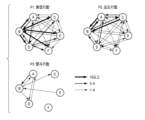
- FIG. 13 is a diagram showing an example of action relationships related to actions visualized as a directed graph network.
- the behavioral information extraction system 100 may generate and output information that visualizes the action relationships and the strength of the relationships between members in each behavioral pattern as a directed graph network, as shown in Fig. 13, as an analysis by visualizing a network expression. By generating such information, the user can grasp the interrelationships between members in a team according to their behavioral patterns.
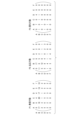
- FIG. 14 is a diagram showing an example of a result of tallying up various behavioral patterns performed by each member.
- the behavioral information extraction system 100 may generate and output information that tally up the number of utterances by each member in various behavioral patterns executed by each member, as shown in Fig. 14, and visualize the tally up results as a bar graph. By generating such information, the behavioral tendencies of each member in a team can be visualized, making it easier for the user to understand.
- FIG. 15 is a block diagram showing an example of a hardware configuration of a behavioral information extraction system 100 according to an embodiment of the present invention.
- the behavior information extraction system 100 is configured, for example, by a server computer or a personal computer, and has a hardware processor 111A such as a CPU.
- a program memory 111B, a data memory 112, an input/output interface 113, and a communication interface 114 are connected to the hardware processor 111A via a bus 115.
- the communication interface 114 includes, for example, one or more wireless communication interface units, and enables the transmission and reception of information to and from a communication network NW.
- a wireless interface for example, an interface that adopts a low-power wireless data communication standard such as a wireless LAN (Local Area Network) is used.
- An input device 300 and an output device 400 that are attached to the behavioral information extraction system 100 and are used by a user or the like are connected to the input/output interface 113 .
- the input/output interface 113 takes in operation data input by a user or the like through an input device 300 such as a keyboard, a touch panel, a touchpad, a mouse, etc., and outputs output data to an output device 400 including a display device using liquid crystal or organic EL (Electro Luminescence), etc., for display.
- the input device 300 and the output device 400 may be devices built into the behavioral information extraction system 100, or may be input devices and output devices of other information terminals that can communicate with the behavioral information extraction system 100 via the network NW.
- the program memory 111B is a non-transient tangible storage medium that combines a non-volatile memory such as a HDD (Hard Disk Drive) or SSD (Solid State Drive) that can be written to and read from at any time, with a non-volatile memory such as a ROM (Read Only Memory), and stores the programs necessary to execute various control processes, etc. according to one embodiment.
- a non-volatile memory such as a HDD (Hard Disk Drive) or SSD (Solid State Drive) that can be written to and read from at any time
- a non-volatile memory such as a ROM (Read Only Memory)
- ROM Read Only Memory
- the data memory 112 is a tangible storage medium that combines, for example, the above-mentioned non-volatile memory with a volatile memory such as RAM (Random Access Memory), and is used to store various data acquired and created during various processing steps.
- RAM Random Access Memory
- the behavioral information extraction system 100 can be configured as a data processing system or information processing device having a processing function unit implemented by software.
- the storage system used as a work memory or the like by the behavioral information extraction system 100 can be configured by using the data memory 112 shown in Fig. 15.
- these configured storage areas are not essential components in the behavioral information extraction system 100, and may be areas provided in a storage system such as an external storage medium such as a Universal Serial Bus (USB) memory, or a database server located in the cloud.
- USB Universal Serial Bus
- the above processing function unit can be realized by having the above hardware processor 111A read and execute a program stored in the program memory 111B. Note that this processing function unit may also be realized in a variety of other forms, including integrated circuits such as an application specific integrated circuit (ASIC (Application Specific Integrated Circuit)) or an FPGA (Field-Programmable Gate Array).
- ASIC Application Specific Integrated Circuit
- FPGA Field-Programmable Gate Array
- the techniques described in each embodiment can be stored as a program (software means) that can be executed by a computer on a recording medium such as a magnetic disk (Floppy disk, hard disk, etc.), optical disc (CD-ROM, DVD, MO, etc.), semiconductor memory (Read Only Memory (ROM), Random Access Memory (RAM), Flash memory, etc.), and can be distributed by transmission via a communication medium.
- the programs stored on the medium also include a setting program that configures within the computer the software means (including not only execution programs but also tables and data structures) that the computer executes.
- the computer that realizes this device reads the program recorded on the recording medium, and in some cases constructs the software means using the setting program, and the operation of the software means is controlled to execute the above-mentioned processing.
- the term "recording medium” is not limited to those for distribution, but also includes storage media such as magnetic disks and semiconductor memories installed inside a computer or in a device connected via a network.
- the present invention is not limited to the above-described embodiments, and can be modified in various ways during implementation without departing from the gist of the invention.
- the embodiments may also be implemented in appropriate combination, in which case the combined effects can be obtained.
- the above-described embodiments include various inventions, and various inventions can be extracted by combinations selected from the multiple constituent elements disclosed. For example, if the problem can be solved and an effect can be obtained even if some constituent elements are deleted from all the constituent elements shown in the embodiments, the configuration from which these constituent elements are deleted can be extracted as an invention.
- Behavioral information extraction system 10 Outgoing behavior acquisition unit 20: Reaction behavior acquisition unit 30: Participation behavior acquisition unit 40: Behavioral information DB (database) 50...Contribution value determination unit
Landscapes
- Business, Economics & Management (AREA)
- Human Resources & Organizations (AREA)
- Engineering & Computer Science (AREA)
- Strategic Management (AREA)
- Development Economics (AREA)
- Economics (AREA)
- Entrepreneurship & Innovation (AREA)
- Educational Administration (AREA)
- Operations Research (AREA)
- Marketing (AREA)
- Game Theory and Decision Science (AREA)
- Quality & Reliability (AREA)
- Tourism & Hospitality (AREA)
- Physics & Mathematics (AREA)
- General Business, Economics & Management (AREA)
- General Physics & Mathematics (AREA)
- Theoretical Computer Science (AREA)
- Management, Administration, Business Operations System, And Electronic Commerce (AREA)
Abstract
一実施形態に係る情報処理装置は、複数の人員の各々が実行した行動に関する作用関係が構造化された情報に基づいて、前記複数の人員の各々が実行した行動の種別および当該行動に関わった人員を特定する行動情報を取得する取得部を有する。
Description
本発明の実施形態は、情報処理装置および方法に関する。
企業のオペレーションは、従業員、設備、および業務プロセスなどの要素によって構成される。オペレーションは、業種、業界、およびビジネス形態などに沿った運用が設計され、日々改善されている。中でも、従業員の要素は有機的な機能であるとして、オペレーションの中では重要であり、不確実で複雑なオペレーションを組織的な体制で柔軟に支えている。
組織のパフォーマンスはオペレーションの安定性に大きく影響する。組織がとり得る形態は、この業務に求められる堅牢性、創造性、または緊急性等により異なるが、どの場合でも、従業員間で役割を持ち、協働することがポイントである。
以降では、「2人以上の人間が役割を分担しながら共有する目標達成や価値獲得のために協働または連携する集団」を「チーム」と呼び、組織に所属する人間を「メンバ」と呼ぶ。組織は複数のチームの集合体として機能しており、このチームの形成状況を業務の状況に合わせて適切に把握し、運用を設計および改善していくことが重要である。
労働人口の減少から、昨今では1名のメンバが複数のチームに所属して各チームの業務に関わることも増えてきている。対象の業務の状況または与えられた役割に応じて、メンバの態度または行動は変化すると考えられることから、業務実態の情報を基に、より客観的にチームの形成状況を分析可能な技術が必要である。
チームに所属するメンバ間の行動に関する相互の作用関係を客観的に分析する手法の関連研究として、近年はコミュニケーションログ(履歴)を用いて、メンバ同士のつながり、またはコミュニケーションの傾向と生産性の関係を分析する手法が提案されている(非特許文献1、2参照)。
非特許文献1では、ビジネスチャットアプリケーションから取得したコミュニケーションログから「関係性の強い社員同士は、発言後のレスポンスが早い」という仮説の元、社員間のつながりの強さを定量分析した結果について報告されている。
非特許文献2では、ソフトウエア開発用のタスク管理アプリのコミュニケーションログに基づいて、発言と発言の接続の形状を有向グラフで表現し、コミュニケーションログ(履歴)の有向グラフの構造的特徴から生産性の関係性を分析した結果について報告される。
野中賢也, et al. "ビジネスチャットアプリ上のコミュニケーションデータに基づくネットワーク構築手法(A Method for Network Construction Based on Communication Data on Business Chat Application)."人工知能学会論文誌37.2 (2022): E-L63_1.
斉藤裕樹, and 谷森一貴. "チャットコミュニケーションの構造的特徴分析に基づく集団活動の生産性評価(Evaluation on Productivity of Group Activity Based on Structural Analysis of Chat Communications)." 情報処理学会論文誌63.2 (2022): 694-703.
上記の非特許文献1に開示された手法は、レスポンスの速さに基づいて2者間のつながりの強さを推測する手法であり、メンバ間の行動に関する作用関係についての寄与値情報を抽出することはできない。
上記の特許文献2に開示された手法は、グループチャット内での発言内容に関する引用・メンションの情報および発言間の前後関係の情報に基づいて、発言の広がりおよび収束をグラフ構造化したものであり、メンバの情報を扱っていないため、メンバ間の行動に関する作用関係についての寄与値情報を抽出することはできない。
このように、既知の手法では、コミュニケーションログから、メンバ間の行動に関する作用関係、すなわちメンバ間で作用関係を引き起こす行動情報を抽出することはできない。
この発明は、上記事情に着目してなされたもので、その目的とするところは、メンバ間の行動に関する作用関係を適切に分析することができるようにした情報処理装置および方法を提供することにある。
本発明の一態様に係る情報処理装置は、複数の人員の各々が実行した行動に関する作用関係が構造化された情報に基づいて、前記複数の人員の各々が実行した行動の種別および当該行動に関わった人員を特定する行動情報を取得する取得部を備える。
本発明の一態様に係る情報処理方法は、情報処理装置により行なわれる方法であって、前記情報処理装置の取得部により、複数の人員の各々が実行した行動に関する作用関係が構造化された情報に基づいて、前記複数の人員の各々が実行した行動の種別および当該行動に関わった人員を特定する行動情報を取得することを備える。
本発明によれば、メンバ間の行動に関する作用関係を適切に分析することができる。
以下、図面を参照しながら、この発明に係わる一実施形態を説明する。
本発明の一実施形態では、コミュニケーションログから、メンバ間の3種類の働き掛け行動としての発信行動、反応行動、および関与行動に関する作用関係を示す係る情報を抽出する。
本発明の一実施形態では、コミュニケーションログから、メンバ間の3種類の働き掛け行動としての発信行動、反応行動、および関与行動に関する作用関係を示す係る情報を抽出する。
図1は、本発明の一実施形態に係る行動情報抽出システムの適用例を示す図である。
図1に示されるように、本発明の一実施形態に係る行動情報抽出システム(行動情報抽出装置)100は、発信行動取得部10、反応行動取得部20、関与行動取得部30、行動情報DB(データベース)40、および寄与値決定部50を有する。
図1に示されるように、本発明の一実施形態に係る行動情報抽出システム(行動情報抽出装置)100は、発信行動取得部10、反応行動取得部20、関与行動取得部30、行動情報DB(データベース)40、および寄与値決定部50を有する。
行動情報抽出システム100は、(1)メッセージ間およびメッセージ内のメンバの宛先、(2)メッセージへのリアクション、ならびに(3)メッセージ間の関係、が構造化された情報を入力する。この情報は、複数のメンバの各々が実行した行動に関する作用関係が構造化された情報である。
図2は、行動情報抽出システムによる入力情報の一例を示す図である。図3は、メンバ間の行動に関する作用関係の一例を説明する図である。
図2および図3に示されるように、行動情報抽出システム100による入力情報は、(1)最初のメッセージである新規トピックのメッセージ、および(2)新規トピックのメッセージからみて下層のメッセージとしての、各スレッドのメッセージ、を含む。
この入力情報は、(1)あるメンバから別のメンバへのメンション付きメッセージ、(2)あるメンバから別のメンバへのリアクション、例えばスタンプ状のマーク付きメッセージ、および(3)あるメンバから送信されたメッセージに対する、他のメンバからのメッセージの関係、を含む。
図2および図3に示されるように、行動情報抽出システム100による入力情報は、(1)最初のメッセージである新規トピックのメッセージ、および(2)新規トピックのメッセージからみて下層のメッセージとしての、各スレッドのメッセージ、を含む。
この入力情報は、(1)あるメンバから別のメンバへのメンション付きメッセージ、(2)あるメンバから別のメンバへのリアクション、例えばスタンプ状のマーク付きメッセージ、および(3)あるメンバから送信されたメッセージに対する、他のメンバからのメッセージの関係、を含む。
上記メンション付きメッセージ、およびリアクションは、メンバ間のメッセージ内の関係性が構造化された情報であり、上記メッセージの関係は、メッセージ間の親子関係が構造化された情報である。
発信行動取得部10は、上記入力情報、すなわち上記構造化された情報から、各メンバ間の働き掛け行動の1種である、各メンバ間の発信行動に関する作用関係を示す発信行動データを取得し、この取得したデータを行動情報DB40に格納(追加)する。
反応行動取得部20は、上記入力情報から、各メンバ間の働き掛け行動の1種である、各メンバ間の反応行動に関する作用関係を示す反応行動データを取得し、この取得したデータを行動情報DB40に格納する。
関与行動取得部30は、上記入力情報から、各メンバ間の働き掛け行動の1種である、各メンバ間の関与行動に関する作用関係を示す関与行動データを取得し、この取得したデータを行動情報DB40に格納する。
行動情報抽出システム100は、これら取得および格納されたデータを出力する。この取得されたデータは、複数のメンバの各々が実行した行動の種別および当該行動に関わった人員を特定する行動情報である。
行動情報抽出システム100は、これら取得および格納されたデータを出力する。この取得されたデータは、複数のメンバの各々が実行した行動の種別および当該行動に関わった人員を特定する行動情報である。
次に、上記構造化された情報から抽出される、発信行動、反応行動、および関与行動に関する作用関係の例について説明する。
図4は、メンバ間の発信行動に関する作用関係の一例を示す図である。図5は、メンバ間の反応行動に関する作用関係の一例を示す図である。図6は、メンバ間の関与行動に関する作用関係の一例を示す図である。
図4に示された例では、発信行動に関する作用関係は、(1)新規トピックのメッセージに、他の特定のメンバへのメンションがないときの、メンバAから他のメンバへの全員への発信行動、いわゆるブロードキャスト、(2)新規トピックのメッセージに、他の特定のメンバへのメンションが含まれるときの、メンバAからメンバBへの発信行動、および(3)メンバAからメンバAへの発信行動、に関する作用関係が挙げられる。
図4は、メンバ間の発信行動に関する作用関係の一例を示す図である。図5は、メンバ間の反応行動に関する作用関係の一例を示す図である。図6は、メンバ間の関与行動に関する作用関係の一例を示す図である。
図4に示された例では、発信行動に関する作用関係は、(1)新規トピックのメッセージに、他の特定のメンバへのメンションがないときの、メンバAから他のメンバへの全員への発信行動、いわゆるブロードキャスト、(2)新規トピックのメッセージに、他の特定のメンバへのメンションが含まれるときの、メンバAからメンバBへの発信行動、および(3)メンバAからメンバAへの発信行動、に関する作用関係が挙げられる。
図5に示された例では、反応行動に関する作用関係は、メンバAからメンバAへの3通りの反応行動に関する作用関係が挙げられる。
図6に示された例では、関与行動に関する作用関係は、(1)メンバAからメンバBへの関与行動および(2)上記ブロードキャストに対する、メンバAからメンバCへの関与行動、に関する作用関係が挙げられる。
図6に示された例では、関与行動に関する作用関係は、(1)メンバAからメンバBへの関与行動および(2)上記ブロードキャストに対する、メンバAからメンバCへの関与行動、に関する作用関係が挙げられる。
次に、上記構造化された情報で示される、行動情報抽出システム100へ入力される情報の例を説明する。本実施形態では、これらの情報に基づいて各種行動に関する作用関係、いわゆる各種行動パターンが取得される。
行動情報抽出システム100へ入力される情報は、(1)メンバi∈メンバの集合N、(2)メンバからのメッセージk∈メッセージの集合M、(3)複数のメッセージ間の親子関係ykj、(4)メッセージkの宛先メンバVkの情報、(5)メッセージの発言者Hkの情報、(6)メッセージkにリアクションしたメンバRkの情報、(7)新規トピック集合S(={k│Σj∈Mykj=0})、および(8)スレッドu∈Sのメッセージ集合Wuが挙げられる。
上記親子関係は、親のメッセージをメッセージjとして子のメッセージをメッセージkとしたときの関係である。ここでは、はメッセージjとメッセージkが親子関係を有しないときは「ykj=0」と表記し、メッセージjとメッセージkが親子関係を有するときは「ykj=1」と表記する。
上記親子関係は、親のメッセージをメッセージjとして子のメッセージをメッセージkとしたときの関係である。ここでは、はメッセージjとメッセージkが親子関係を有しないときは「ykj=0」と表記し、メッセージjとメッセージkが親子関係を有するときは「ykj=1」と表記する。
図7は、メッセージ内の各種情報の一例を示す図である。
図7に示された例では、メッセージkの発言者は「メンバA」であり、このメッセージkの宛先メンバは「メンバB」、「メンバC」および「メンバD」であり、メッセージkへのリアクションをしたメンバは「メンバD」である。
図7に示された例では、メッセージkの発言者は「メンバA」であり、このメッセージkの宛先メンバは「メンバB」、「メンバC」および「メンバD」であり、メッセージkへのリアクションをしたメンバは「メンバD」である。
図8は、メッセージ間の各種情報の一例を示す図である。
図8に示された例では、新規トピックのメッセージを起点とする、メッセージの集合を1つのスレッドとしたときの複数のスレッド、スレッド毎のメッセージ、および1番目のスレッド内の、親子関係を有するメッセージjとメッセージkが示される。u番目のスレッドのメッセージ集合Wuの1番目からl番目までの親メッセージの集合は、prt(Wu,l-1)と表記できる。
図8に示された例では、新規トピックのメッセージを起点とする、メッセージの集合を1つのスレッドとしたときの複数のスレッド、スレッド毎のメッセージ、および1番目のスレッド内の、親子関係を有するメッセージjとメッセージkが示される。u番目のスレッドのメッセージ集合Wuの1番目からl番目までの親メッセージの集合は、prt(Wu,l-1)と表記できる。
次に、発信行動データの抽出処理について、以下の(1)および(2)に区分して説明する。
(1) 新規トピックのメッセージからの発信行動データの抽出
働き掛け元が、新規トピックのメッセージkの発言者Hkであるときで、このメッセージkの宛先メンバVkが存在しないときは、働き掛け元のメンバ(=Hk)から、働き掛け先のメンバである、集合Nに属する他の全てのメンバ({i|i∈N})への発信行動に関する作用関係が生じていることが抽出される。
(1) 新規トピックのメッセージからの発信行動データの抽出
働き掛け元が、新規トピックのメッセージkの発言者Hkであるときで、このメッセージkの宛先メンバVkが存在しないときは、働き掛け元のメンバ(=Hk)から、働き掛け先のメンバである、集合Nに属する他の全てのメンバ({i|i∈N})への発信行動に関する作用関係が生じていることが抽出される。
また、上記メッセージkの宛先メンバVkが存在するときは、働き掛け元のメンバ(=Hk)から働き掛け先の宛先メンバVk({i|i∈Vk})への発信行動に関する作用関係が生じていることが抽出される。
(2) スレッド内のメッセージ間からの発信行動データの抽出
ここでは、スレッドuのメッセージ集合Wuに対して、新規トピック側のメッセージから順に、このメッセージの発言者Hkの情報と宛先メンバVkの情報が取得される。
各スレッドにおいて、メッセージkの一つ前までの親メッセージ(prt(Wu,k-1))で発言したメンバをQ(={Ht|t∈prt(Wu,k-1)})とする。
このメンバQに含まれないメンバへのメンションがあれば、働き掛け元のメンバ(=Hk)から働き掛け先のメンバ(=Vk-Q)への発信行動に関する作用関係が生じていることが抽出される。
ここでは、スレッドuのメッセージ集合Wuに対して、新規トピック側のメッセージから順に、このメッセージの発言者Hkの情報と宛先メンバVkの情報が取得される。
各スレッドにおいて、メッセージkの一つ前までの親メッセージ(prt(Wu,k-1))で発言したメンバをQ(={Ht|t∈prt(Wu,k-1)})とする。
このメンバQに含まれないメンバへのメンションがあれば、働き掛け元のメンバ(=Hk)から働き掛け先のメンバ(=Vk-Q)への発信行動に関する作用関係が生じていることが抽出される。
次に、反応行動データの抽出処理について、以下の(1)および(2)に区分して説明する。
(1) スレッド内のメッセージ間からの反応行動データの抽出
ここでは、発信行動データの抽出処理の(1)の説明と同様に、スレッドuのメッセージ集合Wuに対して、新規トピック側のメッセージから順に、このメッセージの発言者Hkの情報と宛先メンバVkの情報が取得される。
(1) スレッド内のメッセージ間からの反応行動データの抽出
ここでは、発信行動データの抽出処理の(1)の説明と同様に、スレッドuのメッセージ集合Wuに対して、新規トピック側のメッセージから順に、このメッセージの発言者Hkの情報と宛先メンバVkの情報が取得される。
発信行動データの抽出処理の(1)の説明と同様に、各スレッドにおいて、メッセージkの一つ前までの親メッセージ(prt(Wu,k-1))で発言したメンバをQ(={Ht|t∈prt(Wu,k-1)})とする。
上記取得した発言者が、上記メンバQに含まれる発言者であれば、働き掛け元のメンバ(=Hk)から、このメンバが発言したメッセージの一つ前に発言された親メッセージ(一つ前のメッセージと称することもある)の発言者である働き掛け先(=H(k,-1))への反応行動に関する作用関係が生じていることが抽出される。
(2) メッセージ内からの反応行動データの抽出
ここでは、発言者からのメッセージk内にリアクションしたメンバRkがいれば、このリアクションした働き掛け元のメンバRk({i|i∈Rk})から、働き掛け先のメンバである発言者Hkへの反応行動に関する作用関係が生じていることが抽出される。
ここでは、発言者からのメッセージk内にリアクションしたメンバRkがいれば、このリアクションした働き掛け元のメンバRk({i|i∈Rk})から、働き掛け先のメンバである発言者Hkへの反応行動に関する作用関係が生じていることが抽出される。
次に、関与行動データの抽出処理について、以下の(1)および(2)に区分して説明する。
(1) スレッド内のメッセージ間からの関与行動データの抽出
ここでは、発信行動データの抽出処理の(1)の説明と同様に、スレッドuのメッセージ集合Wuに対して、新規トピック側のメッセージから順に、このメッセージの発言者Hkの情報と宛先メンバVkの情報が取得される。
(1) スレッド内のメッセージ間からの関与行動データの抽出
ここでは、発信行動データの抽出処理の(1)の説明と同様に、スレッドuのメッセージ集合Wuに対して、新規トピック側のメッセージから順に、このメッセージの発言者Hkの情報と宛先メンバVkの情報が取得される。
発信行動データの抽出処理の(1)の説明と同様に、各スレッドにおいて、メッセージkの一つ前までの親メッセージ(prt(Wu,k-1))で発言したメンバをQ(={Ht|t∈prt(Wu,k-1)})とする。
上記取得した発言者が、上記メンバQに含まれる発言者でなければ、働き掛け元のメンバ(=Hk)から、働き掛け先のメンバ(=H(k,-1))への関与行動に関する作用関係が生じていることが抽出される。
(2) ブロードキャストへの反応としての関与行動データの抽出
ここでは、上記スレッドuのメッセージ集合Wuに対する新規トピックのメッセージをkとし、このメッセージの子のメッセージである2番目のメッセージをメッセージl(エル)とする。
ここでは、上記スレッドuのメッセージ集合Wuに対する新規トピックのメッセージをkとし、このメッセージの子のメッセージである2番目のメッセージをメッセージl(エル)とする。
メッセージkの宛先メンバVkが存在するときは、働き掛け元である、メッセージl(エル)の発言者Hlによる、働き掛け先である、メッセージkの発言者Hkへの関与行動に関する作用関係が生じていることが抽出される。
図9は、メンバ間の発信行動データの抽出に係る処理手順の一例を示すフローチャートである。
発信行動取得部10は、上記構造化された情報を入力情報とし、処理対象のスレッドの変数uに1を代入する(S11)。
最終のスレッドまでの処理の終了前であるとき(S12のNo)、発信行動取得部10は、新規トピックのメッセージkを取得する(S13)。
発信行動取得部10は、上記構造化された情報を入力情報とし、処理対象のスレッドの変数uに1を代入する(S11)。
最終のスレッドまでの処理の終了前であるとき(S12のNo)、発信行動取得部10は、新規トピックのメッセージkを取得する(S13)。
このメッセージkの宛先メンバVkが存在しないとき(S14のYes)、発信行動取得部10は、発言者Hkから他の全てのメンバの発信行動に関する作用関係が生じていると判定し、この発信行動に関する作用関係を示す情報を行動情報DB40に格納する(S15)。
一方、メッセージkの宛先メンバVkが存在するとき(S14のNo)、発信行動取得部10は、発言者Hkから宛先メンバVkへの発信行動に関する作用関係が生じていると判定し、この作用関係を示す情報を行動情報DB40に格納する(S16)。S15およびS16での抽出は、発信行動データの抽出処理の上記(1)の説明に対応する。
S15またはS16の後、発信行動取得部10は、要素Qに要素kを追加し、変数lに2を代入する(S17)。
「l>|Wu|」の条件を満たさないときは(S18のNo)、発信行動取得部10は、変数uを1増加させて更新し(S19)、S12に戻る。
「l>|Wu|」の条件を満たすときは(S18のYes)、発信行動取得部10は、要素kにu番目のスレッドのメッセージ集合Wuのl番目のメッセージの要素を追加する(S20)。
「l>|Wu|」の条件を満たさないときは(S18のNo)、発信行動取得部10は、変数uを1増加させて更新し(S19)、S12に戻る。
「l>|Wu|」の条件を満たすときは(S18のYes)、発信行動取得部10は、要素kにu番目のスレッドのメッセージ集合Wuのl番目のメッセージの要素を追加する(S20)。
メンバQに含まれない宛先メンバへVkのメンションがあれば(S21のNo)、発信行動取得部10は、働き掛け元のメンバ(=Hk)から働き掛け先のメンバ(=Vk-Q)への発信行動に関する作用関係が生じていることを抽出し、この作用関係を示す情報を行動情報DB40に格納する(S22)。このS22での抽出は、発信行動データの抽出処理の上記(2)の説明に対応する。
S22の後、またはS21で「Yes」のときは、発信行動取得部10は、変数lを1増加させて更新し、要素Qに要素kを追加して(S23)、S18に戻る。
最終のスレッドまでの処理が終了したときは(S12のYes)、発信行動取得部10による一連の処理が終了する。
最終のスレッドまでの処理が終了したときは(S12のYes)、発信行動取得部10による一連の処理が終了する。
図10は、メンバ間の反応行動データの抽出に係る処理手順の一例を示すフローチャートである。
反応行動取得部20は、上記構造化された情報を入力情報とし、処理対象のスレッドの変数uに1を代入する(S31)。
最終のスレッドまでの処理の終了前であるとき(S32のNo)、反応行動取得部20は、トピックuのメッセージkを取得する(S33)。
このメッセージkにリアクションをしたメンバRkが存在するとき(S14のNo)、反応行動取得部20は、このリアクションをしたメンバRk({i|i∈Rk})から発言者Hkへの反応行動に関する作用関係が生じていると判定し、この作用関係を示す情報を行動情報DB40に格納する(S35)。S35での抽出は、反応行動データの抽出処理の上記(2)の説明に対応する。
反応行動取得部20は、上記構造化された情報を入力情報とし、処理対象のスレッドの変数uに1を代入する(S31)。
最終のスレッドまでの処理の終了前であるとき(S32のNo)、反応行動取得部20は、トピックuのメッセージkを取得する(S33)。
このメッセージkにリアクションをしたメンバRkが存在するとき(S14のNo)、反応行動取得部20は、このリアクションをしたメンバRk({i|i∈Rk})から発言者Hkへの反応行動に関する作用関係が生じていると判定し、この作用関係を示す情報を行動情報DB40に格納する(S35)。S35での抽出は、反応行動データの抽出処理の上記(2)の説明に対応する。
S35の後、またはS34で「Yes」のときは、反応行動取得部20は、要素Qに要素kを追加し、変数lに2を代入する(S36)。
「l>|Wu|」の条件を満たさないときは(S37のNo)、反応行動取得部20は、変数uを1増加させて更新し(S38)、S32に戻る。
「l>|Wu|」の条件を満たすときは(S37のYes)、反応行動取得部20は、要素kにスレッドのメッセージ集合Wuのl番目のメッセージの要素を追加する(S41)。
「l>|Wu|」の条件を満たさないときは(S37のNo)、反応行動取得部20は、変数uを1増加させて更新し(S38)、S32に戻る。
「l>|Wu|」の条件を満たすときは(S37のYes)、反応行動取得部20は、要素kにスレッドのメッセージ集合Wuのl番目のメッセージの要素を追加する(S41)。
発言者Hkが、メンバQに含まれる発言者であれば(S42のYes)、反応行動取得部20は、発言者Hkから一つ前のメッセージの発言者(=H(k,-1))への反応行動に関する作用関係が生じていることを抽出し、この作用関係を示す情報を行動情報DB40に格納する(S43)。S43での抽出は、反応行動データの抽出処理の上記(1)の説明に対応する。
S43の後、またはS42で「No」のときは、反応行動取得部20は、S35と同じく、リアクションをしたメンバRk({i|i∈Rk})から発言者Hkへの反応行動に関する作用関係が生じていると判定し、この作用関係を示す情報を行動情報DB40に格納する(S44)。
S44の後、反応行動取得部20は、変数lを1増加させて更新し、要素Qに要素kを追加して(S45)、S37に戻る。
最終のスレッドまでの処理が終了したときは(S32のYes)、反応行動取得部20による一連の処理が終了する。
最終のスレッドまでの処理が終了したときは(S32のYes)、反応行動取得部20による一連の処理が終了する。
図11は、メンバ間の関与行動データの抽出に係る処理手順の一例を示すフローチャートである。
関与行動取得部30は、上記構造化された情報を入力情報とし、処理対象のスレッドの変数uに1を代入する(S51)。
最終のスレッドまでの処理の終了前であるとき(S52のNo)、関与行動取得部30は、新規トピックのメッセージkを取得する(S53)。
関与行動取得部30は、上記構造化された情報を入力情報とし、処理対象のスレッドの変数uに1を代入する(S51)。
最終のスレッドまでの処理の終了前であるとき(S52のNo)、関与行動取得部30は、新規トピックのメッセージkを取得する(S53)。
このメッセージkの宛先メンバVkが存在するときで(S54のYes)、メッセージのkの子であるメッセージlがあるときは(S55のYes)、関与行動取得部30は、メッセージkの子のメッセージlの発言者Hlからメッセージkの発言者Hkへの関与行動に関する作用関係が生じていると判定し、この関与行動に関する作用関係を示す情報を行動情報DB40に格納する(S56)。このS56での抽出は、関与行動データの抽出処理の上記(2)の説明に対応する。
S56の後、またはS54もしくはS55で「No」のときは、関与行動取得部30は、要素Qに要素kを追加し、変数lに2を代入する(S57)。
「l>|Wu|」の条件を満たさないときは(S58のNo)、関与行動取得部30は、変数uを1増加させて更新し(S59)、S52に戻る。
「l>|Wu|」の条件を満たすときは(S58のYes)、関与行動取得部30は、要素kにスレッドのメッセージ集合Wuのl番目のメッセージの要素を追加する(S61)。
「l>|Wu|」の条件を満たさないときは(S58のNo)、関与行動取得部30は、変数uを1増加させて更新し(S59)、S52に戻る。
「l>|Wu|」の条件を満たすときは(S58のYes)、関与行動取得部30は、要素kにスレッドのメッセージ集合Wuのl番目のメッセージの要素を追加する(S61)。
発言者HkがメンバQに含まれる発言者でなければ(S62のNo)、関与行動取得部30は、働き掛け元のメンバ(=Hk)から働き掛け先のメンバ(=H(k,-1))への関与行動に関する作用関係が生じていることを抽出し、この作用関係を示す情報を行動情報DB40に格納する(S63)。このS63での抽出は、関与行動データの抽出処理の上記(1)の説明に対応する。
S63の後、またはS62で「Yes」のときは、関与行動取得部30は、変数lを1増加させて更新し、要素Qに要素kを追加して(S64)、S58に戻る。
最終のスレッドまでの処理が終了したときは(S52のYes)、関与行動取得部30による一連の処理が終了する。
最終のスレッドまでの処理が終了したときは(S52のYes)、関与行動取得部30による一連の処理が終了する。
図12は、行動情報抽出部による抽出結果に基づく寄与値情報の一例を示す図である。
行動情報抽出システム100の寄与値決定部50は、上記のようにされて行動情報DB40に格納された各種情報で示される各種行動、ここではメンバ間それぞれの発信行動P1、反応行動P2および関与行動P3の発生回数のカウント値を求め、図12に示されるような、働き掛けのメンバ間毎の行列に代入した情報を、上記各種行動の実行に係る、複数のメンバの各々の寄与値の行列として生成して、これを出力する。
行動情報抽出システム100の寄与値決定部50は、上記のようにされて行動情報DB40に格納された各種情報で示される各種行動、ここではメンバ間それぞれの発信行動P1、反応行動P2および関与行動P3の発生回数のカウント値を求め、図12に示されるような、働き掛けのメンバ間毎の行列に代入した情報を、上記各種行動の実行に係る、複数のメンバの各々の寄与値の行列として生成して、これを出力する。
この生成された結果は、ユーザによる、メンバ間の行動パターンの評価および分析に用いることができる。図12に示された例では、行列の行は、働き掛けるメンバに割り当てられ、上記の行列の列は、働き掛けられるメンバに割り当てられる。
本発明の一実施形態では、メンバ間のコミュニケーションログから、3種類の働き掛け行動としての発信行動、反応行動、および関与行動に関する作用関係を示す係る情報を用いて、チームに所属するメンバ間の「誰が誰に、どのような行動を及ぼしているか」を示す状況を客観的に分析できる。
図13は、行動に関する作用関係を有向グラフのネットワークとして可視化した例を示す図である。
行動情報抽出システム100は、例えば、ネットワーク表現の可視化による分析として、図13に示されるような、各行動パターンにおけるメンバ間の作用の関係および関係の強さを有向グラフのネットワークとして可視化した情報を生成して、これを出力してもよい。このような情報を生成することで、チームにおける行動パターン別のメンバ間の相互関係をユーザが把握できるようになる。
行動情報抽出システム100は、例えば、ネットワーク表現の可視化による分析として、図13に示されるような、各行動パターンにおけるメンバ間の作用の関係および関係の強さを有向グラフのネットワークとして可視化した情報を生成して、これを出力してもよい。このような情報を生成することで、チームにおける行動パターン別のメンバ間の相互関係をユーザが把握できるようになる。
図14は、メンバ別に実行している各種行動パターンの集計結果の一例を示す図である。
また、行動情報抽出システム100は、例えば、図14に示されるような、メンバ別に実行される各種行動パターンにおける、メンバ別の発言回数を集計して、この集計結果を棒グラフとして可視化した情報を生成して、これを出力してもよい。このような情報を生成することで、チームにおける各メンバの行動傾向を可視化してユーザが把握し易くすることができる。
また、行動情報抽出システム100は、例えば、図14に示されるような、メンバ別に実行される各種行動パターンにおける、メンバ別の発言回数を集計して、この集計結果を棒グラフとして可視化した情報を生成して、これを出力してもよい。このような情報を生成することで、チームにおける各メンバの行動傾向を可視化してユーザが把握し易くすることができる。
図15は、本発明の一実施形態に係る行動情報抽出システム100のハードウエア構成の一例を示すブロック図である。
図15に示された例では、上記の実施形態に係る行動情報抽出システム100は、例えばサーバコンピュータ(server computer)またはパーソナルコンピュータ(personal computer)により構成され、CPU等のハードウエアプロセッサ(hardware processor)111Aを有する。そして、このハードウエアプロセッサ111Aに対し、プログラムメモリ(program memory)111B、データメモリ(data memory)112、入出力インタフェース113及び通信インタフェース114が、バス(bus)115を介して接続される。
図15に示された例では、上記の実施形態に係る行動情報抽出システム100は、例えばサーバコンピュータ(server computer)またはパーソナルコンピュータ(personal computer)により構成され、CPU等のハードウエアプロセッサ(hardware processor)111Aを有する。そして、このハードウエアプロセッサ111Aに対し、プログラムメモリ(program memory)111B、データメモリ(data memory)112、入出力インタフェース113及び通信インタフェース114が、バス(bus)115を介して接続される。
通信インタフェース114は、例えば1つ以上の無線の通信インタフェースユニット(interface unit)を含んでおり、通信ネットワーク(network)NWとの間で情報の送受信を可能にする。無線インタフェースとしては、例えば無線LAN(Local Area Network)などの小電力無線データ通信規格が採用されたインタフェースが使用される。
入出力インタフェース113には、行動情報抽出システム100に付設される、利用者などにより用いられる入力デバイス(device)300および出力デバイス400が接続される。
入出力インタフェース113は、キーボード(keyboard)、タッチパネル(touch panel)、タッチパッド(touchpad)、マウス(mouse)等の入力デバイス300を通じて利用者などにより入力された操作データを取り込むとともに、出力データを液晶または有機EL(Electro Luminescence)等が用いられた表示デバイスを含む出力デバイス400へ出力して表示させる処理を行なう。なお、入力デバイス300および出力デバイス400には、行動情報抽出システム100に内蔵されたデバイスが使用されてもよく、また、ネットワークNWを介して行動情報抽出システム100と通信可能である他の情報端末の入力デバイスおよび出力デバイスが使用されてもよい。
入出力インタフェース113は、キーボード(keyboard)、タッチパネル(touch panel)、タッチパッド(touchpad)、マウス(mouse)等の入力デバイス300を通じて利用者などにより入力された操作データを取り込むとともに、出力データを液晶または有機EL(Electro Luminescence)等が用いられた表示デバイスを含む出力デバイス400へ出力して表示させる処理を行なう。なお、入力デバイス300および出力デバイス400には、行動情報抽出システム100に内蔵されたデバイスが使用されてもよく、また、ネットワークNWを介して行動情報抽出システム100と通信可能である他の情報端末の入力デバイスおよび出力デバイスが使用されてもよい。
プログラムメモリ111Bは、非一時的な有形の記憶媒体として、例えば、HDD(Hard Disk Drive)またはSSD(Solid State Drive)等の随時書込みおよび読出しが可能な不揮発性メモリ(non-volatile memory)と、ROM(Read Only Memory)等の不揮発性メモリとが組み合わせて使用されたもので、一実施形態に係る各種制御処理等を実行する為に必要なプログラムが格納されている。
データメモリ112は、有形の記憶媒体として、例えば、上記の不揮発性メモリと、RAM(Random Access Memory)等の揮発性メモリ(volatile memory)とが組み合わせて使用されたもので、各種処理が行なわれる過程で取得および作成された各種データが記憶される為に用いられる。
本発明の一実施形態に係る行動情報抽出システム100は、ソフトウエア(software)による処理機能部を有するデータ処理システムまたは情報処理装置として構成され得る。
行動情報抽出システム100によるワークメモリなどとして用いられる記憶システムは、図15に示されたデータメモリ112が用いられることで構成され得る。ただし、これらの構成される記憶領域は行動情報抽出システム100内に必須の構成ではなく、例えば、USB(Universal Serial Bus)メモリなどの外付け記憶媒体、又はクラウド(cloud)に配置されたデータベースサーバ(database server)等の記憶システムに設けられた領域であってもよい。
行動情報抽出システム100によるワークメモリなどとして用いられる記憶システムは、図15に示されたデータメモリ112が用いられることで構成され得る。ただし、これらの構成される記憶領域は行動情報抽出システム100内に必須の構成ではなく、例えば、USB(Universal Serial Bus)メモリなどの外付け記憶媒体、又はクラウド(cloud)に配置されたデータベースサーバ(database server)等の記憶システムに設けられた領域であってもよい。
上記の処理機能部は、プログラムメモリ111Bに格納されたプログラムを上記ハードウエアプロセッサ111Aにより読み出させて実行させることにより実現され得る。なお、この処理機能部は、特定用途向け集積回路(ASIC(Application Specific Integrated Circuit))またはFPGA(Field-Programmable Gate Array)などの集積回路を含む、他の多様な形式によって実現されてもよい。
また、各実施形態に記載された手法は、計算機(コンピュータ)に実行させることができるプログラム(ソフトウエア手段)として、例えば磁気ディスク(フロッピー(登録商標)ディスク(Floppy disk)、ハードディスク(hard disk)等)、光ディスク(optical disc)(CD-ROM、DVD、MO等)、半導体メモリ(ROM(Read Only Memory)、RAM(Random Access Memory)、フラッシュメモリ(Flash memory)等)等の記録媒体に格納し、また通信媒体により伝送して頒布され得る。なお、媒体側に格納されるプログラムには、計算機に実行させるソフトウエア手段(実行プログラムのみならずテーブル(table)、データ構造も含む)を計算機内に構成させる設定プログラムをも含む。本装置を実現する計算機は、記録媒体に記録されたプログラムを読み込み、また場合により設定プログラムによりソフトウエア手段を構築し、このソフトウエア手段によって動作が制御されることにより上述した処理を実行する。なお、本明細書でいう記録媒体は、頒布用に限らず、計算機内部あるいはネットワークを介して接続される機器に設けられた磁気ディスク、半導体メモリ等の記憶媒体を含むものである。
なお、本発明は、上記実施形態に限定されるものではなく、実施段階ではその要旨を逸脱しない範囲で種々に変形することが可能である。また、各実施形態は適宜組み合わせて実施してもよく、その場合組み合わせた効果が得られる。更に、上記実施形態には種々の発明が含まれており、開示される複数の構成要件から選択された組み合わせにより種々の発明が抽出され得る。例えば、実施形態に示される全構成要件からいくつかの構成要件が削除されても、課題が解決でき、効果が得られる場合には、この構成要件が削除された構成が発明として抽出され得る。
100…行動情報抽出システム
10…発信行動取得部
20…反応行動取得部
30…関与行動取得部
40…行動情報DB(データベース)
50…寄与値決定部
10…発信行動取得部
20…反応行動取得部
30…関与行動取得部
40…行動情報DB(データベース)
50…寄与値決定部
Claims (4)
- 複数の人員の各々が実行した行動に関する作用関係が構造化された情報に基づいて、前記複数の人員の各々が実行した行動の種別および当該行動に関わった人員を特定する行動情報を取得する取得部、
を備える情報処理装置。 - 前記取得部により取得した行動情報で示される行動の実行に係る、前記複数の人員の各々の寄与値を決定する寄与値決定部をさらに備える、
請求項1に記載の情報処理装置。 - 前記取得部は、
前記構造化された情報に基づいて、前記複数の人員のうち第1の人員から第2の人員への発信行動、前記複数の人員のうち第1の人員から第2の人員への反応行動、および前記複数の人員のうち第1の人員から第2の人員への関与行動のうち少なくとも1つを特定する情報を前記行動情報として取得する、
請求項1に記載の情報処理装置。 - 情報処理装置により行なわれる方法であって、
前記情報処理装置の取得部により、複数の人員の各々が実行した行動に関する作用関係が構造化された情報に基づいて、前記複数の人員の各々が実行した行動の種別および当該行動に関わった人員を特定する行動情報を取得すること、
を備える情報処理方法。
Priority Applications (1)
| Application Number | Priority Date | Filing Date | Title |
|---|---|---|---|
| PCT/JP2023/030189 WO2025041275A1 (ja) | 2023-08-22 | 2023-08-22 | 情報処理装置および方法 |
Applications Claiming Priority (1)
| Application Number | Priority Date | Filing Date | Title |
|---|---|---|---|
| PCT/JP2023/030189 WO2025041275A1 (ja) | 2023-08-22 | 2023-08-22 | 情報処理装置および方法 |
Publications (1)
| Publication Number | Publication Date |
|---|---|
| WO2025041275A1 true WO2025041275A1 (ja) | 2025-02-27 |
Family
ID=94731520
Family Applications (1)
| Application Number | Title | Priority Date | Filing Date |
|---|---|---|---|
| PCT/JP2023/030189 Ceased WO2025041275A1 (ja) | 2023-08-22 | 2023-08-22 | 情報処理装置および方法 |
Country Status (1)
| Country | Link |
|---|---|
| WO (1) | WO2025041275A1 (ja) |
Citations (4)
| Publication number | Priority date | Publication date | Assignee | Title |
|---|---|---|---|---|
| JP2012510667A (ja) * | 2008-12-01 | 2012-05-10 | トプシー ラブズ インコーポレイテッド | 計算された評判又は影響度スコアに基づくランキング及び選択エンティティ |
| JP2014527651A (ja) * | 2011-07-07 | 2014-10-16 | インターナショナル・ビジネス・マシーンズ・コーポレーションInternational Business Machines Corporation | 対人的対話からのテキストコンテンツを用いて、対人関係影響情報を判定するためのシステム及び方法 |
| JP2015164008A (ja) * | 2014-02-28 | 2015-09-10 | 株式会社日立製作所 | 解析装置及び解析方法 |
| JP2016048540A (ja) * | 2014-08-25 | 2016-04-07 | 富士通株式会社 | 生成方法、装置、及びプログラム |
-
2023
- 2023-08-22 WO PCT/JP2023/030189 patent/WO2025041275A1/ja not_active Ceased
Patent Citations (4)
| Publication number | Priority date | Publication date | Assignee | Title |
|---|---|---|---|---|
| JP2012510667A (ja) * | 2008-12-01 | 2012-05-10 | トプシー ラブズ インコーポレイテッド | 計算された評判又は影響度スコアに基づくランキング及び選択エンティティ |
| JP2014527651A (ja) * | 2011-07-07 | 2014-10-16 | インターナショナル・ビジネス・マシーンズ・コーポレーションInternational Business Machines Corporation | 対人的対話からのテキストコンテンツを用いて、対人関係影響情報を判定するためのシステム及び方法 |
| JP2015164008A (ja) * | 2014-02-28 | 2015-09-10 | 株式会社日立製作所 | 解析装置及び解析方法 |
| JP2016048540A (ja) * | 2014-08-25 | 2016-04-07 | 富士通株式会社 | 生成方法、装置、及びプログラム |
Similar Documents
| Publication | Publication Date | Title |
|---|---|---|
| US11695721B2 (en) | Method, apparatus, and computer program product for categorizing multiple group-based communication messages | |
| US11663247B2 (en) | System, method and architecture for a document as a node on a social graph | |
| US10748194B2 (en) | Collaboration group recommendations derived from request-action correlations | |
| US10541828B2 (en) | Message management | |
| JP2009282574A (ja) | 情報処理装置、情報処理方法、およびプログラム | |
| JP2020057067A (ja) | チャット分析装置、チャット分析方法、及びプログラム | |
| WO2020005769A1 (en) | Visualization of user intent in virtual agent interaction | |
| DE112013000449T5 (de) | Identitätsprüfung für mindestens einen Teilnehmer an einer textgestützten Kommunikation | |
| Krishna et al. | Transnational entrepreneurship and Indian high-tech start-up survival: An empirical investigation. | |
| US20250371498A1 (en) | Multi-agent collaboration | |
| Panpanich et al. | Analysis of handover of work in call center using social network process mining technique | |
| US10992488B2 (en) | System and method for an enhanced focus group platform for a plurality of user devices in an online communication environment | |
| Wodarz et al. | On the laws of virus spread through cell populations | |
| López et al. | What makes hyper-local online discussion forums sustainable? | |
| Saito | Identifying and understanding stakeholders using process mining: Case study on discovering business processes that involve organizational entities | |
| Dorn et al. | Analyzing design tradeoffs in large-scale socio-technical systems through simulation of dynamic collaboration patterns | |
| CN117093407B (zh) | 基于改进s-学习器的流程异常级联根因分析方法与系统 | |
| Sundaramurthy | An anthropological study of security operations centers to improve operational efficiency | |
| WO2025041277A1 (ja) | 情報処理装置および方法 | |
| KR102723561B1 (ko) | 비지니스 매너 교육을 위한 직장생활 관련 교구 및 이를 활용한 교육 서비스 제공 방법, 장치 및 시스템 | |
| JP7553005B2 (ja) | メンションタイプ別使用者行為条件に基づくグループメンション管理装置及び方法 | |
| US20230289703A1 (en) | System and method for operating an effective gamification application pursuit | |
| JP2024104518A (ja) | 会議管理プログラム、情報処理装置、製造方法、情報処理方法 | |
| JP7334227B2 (ja) | 情報処理装置、情報処理方法、及び情報処理プログラム | |
| Foote et al. | Communication networks do not explain the growth or survival of early-stage peer production projects |
Legal Events
| Date | Code | Title | Description |
|---|---|---|---|
| 121 | Ep: the epo has been informed by wipo that ep was designated in this application |
Ref document number: 23949736 Country of ref document: EP Kind code of ref document: A1 |
|
| NENP | Non-entry into the national phase |
Ref country code: DE |