WO2025041272A1 - 可変アッテネータ、ステップアッテネータ、および試験装置 - Google Patents
可変アッテネータ、ステップアッテネータ、および試験装置 Download PDFInfo
- Publication number
- WO2025041272A1 WO2025041272A1 PCT/JP2023/030182 JP2023030182W WO2025041272A1 WO 2025041272 A1 WO2025041272 A1 WO 2025041272A1 JP 2023030182 W JP2023030182 W JP 2023030182W WO 2025041272 A1 WO2025041272 A1 WO 2025041272A1
- Authority
- WO
- WIPO (PCT)
- Prior art keywords
- variable attenuator
- switch
- attenuator
- variable
- output
- Prior art date
- Legal status (The legal status is an assumption and is not a legal conclusion. Google has not performed a legal analysis and makes no representation as to the accuracy of the status listed.)
- Ceased
Links
Images




Classifications
-
- G—PHYSICS
- G01—MEASURING; TESTING
- G01R—MEASURING ELECTRIC VARIABLES; MEASURING MAGNETIC VARIABLES
- G01R1/00—Details of instruments or arrangements of the types included in groups G01R5/00 - G01R13/00 and G01R31/00
- G01R1/30—Structural combination of electric measuring instruments with basic electronic circuits, e.g. with amplifier
-
- G—PHYSICS
- G01—MEASURING; TESTING
- G01R—MEASURING ELECTRIC VARIABLES; MEASURING MAGNETIC VARIABLES
- G01R1/00—Details of instruments or arrangements of the types included in groups G01R5/00 - G01R13/00 and G01R31/00
- G01R1/20—Modifications of basic electric elements for use in electric measuring instruments; Structural combinations of such elements with such instruments
- G01R1/203—Resistors used for electric measuring, e.g. decade resistors standards, resistors for comparators, series resistors, shunts
-
- G—PHYSICS
- G01—MEASURING; TESTING
- G01R—MEASURING ELECTRIC VARIABLES; MEASURING MAGNETIC VARIABLES
- G01R1/00—Details of instruments or arrangements of the types included in groups G01R5/00 - G01R13/00 and G01R31/00
- G01R1/20—Modifications of basic electric elements for use in electric measuring instruments; Structural combinations of such elements with such instruments
- G01R1/24—Transmission-line, e.g. waveguide, measuring sections, e.g. slotted section
-
- H—ELECTRICITY
- H03—ELECTRONIC CIRCUITRY
- H03H—IMPEDANCE NETWORKS, e.g. RESONANT CIRCUITS; RESONATORS
- H03H11/00—Networks using active elements
- H03H11/02—Multiple-port networks
- H03H11/24—Frequency-independent attenuators
Definitions
- the present invention relates to a variable attenuator, a step attenuator, and a test device.
- Patent Document 1 states that "In the microwave circuit 1A, the line width step portion 32A is formed on one side of the transmission line 25A, i.e., biased in the width direction (Y direction), at the center of the transmission line 25A in the length direction (X direction)" (paragraph 44).
- Patent Document 2 states that "The high-frequency device further includes terminals P1 and P2 for inputting and outputting high-frequency signals on the pattern conductor 1, and a ground terminal GND on the pattern conductor 5.
- the pattern conductors 1, 4, and 5 and the via conductors 2 and 3 connect the terminals P1 and P2 and the ground terminal GND to form a signal line for transmitting a high-frequency signal. ...
- Patent Document 3 states that "Many semiconductor RF switches today stack multiple low BVds transistors in series to improve the breakdown performance of the entire switch" (paragraph 6).
- Patent Document 1 JP 2014-241482
- Patent Document 2 WO 2014/030469
- Patent Document 3 JP 2010-527179 A
- variable attenuator comprising a transmission line having an open stub connected between an input and an output of the variable attenuator, a first switch connected between the input and a reference potential, and a second switch connected between the output and the reference potential.
- the variable attenuator may include a first resistor connected in series with a first switch between the input and a reference potential, and a second resistor connected in series with a second switch between the output and the reference potential.
- the first resistor may be connected to the end of the first switch on the reference potential side, and the second resistor may be connected to the end of the second switch on the reference potential side.
- the open stub may be connected to a central position on the transmission line between the input and output of the variable attenuator.
- the open stub may have a length less than the length of the transmission line between the input and output of the variable attenuator.
- a step attenuator in a second aspect of the present invention, includes a plurality of cascaded variable attenuators of the first aspect.
- a test apparatus in a third aspect of the present invention, includes a test signal generating circuit that generates a test signal for testing a device under test, a comparison circuit that compares a response signal output by the device under test in response to the test signal with an expected value, and a variable attenuator of the first aspect that attenuates the test signal or the response signal.
- the test device may include a gain amplifier connected between the test signal generating circuit and the variable attenuator to amplify the test signal.
- Any of the above test devices may include a mixer connected between the comparator circuit and the variable attenuator to convert the frequency of the response signal.
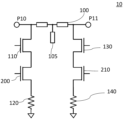
- FIG. 1 shows a configuration of a variable attenuator 10 according to the present embodiment.
- 1 shows the configuration of a modified example of the variable attenuator 10 according to the present embodiment.
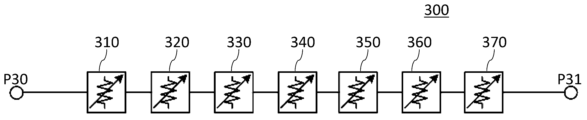
- 2 shows the configuration of a step attenuator according to the present embodiment.
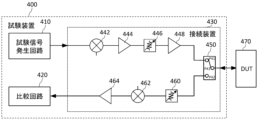
- 1 shows the configuration of a test apparatus 400 according to the present embodiment.
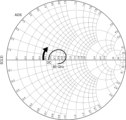
- FIG. 1 is an explanatory diagram for explaining output results of a Smith chart at each position of the variable attenuator 10 of the present embodiment.
- 4 shows the output result of the variable attenuator 10 on a Smith chart.
- 4 shows the output result of the variable attenuator 10 on a Smith chart.
- 4 shows the output result of the variable attenuator 10 on a Smith chart.
- 4 shows the output result of the variable attenuator 10 on a Smith chart.
- 4 shows the output result of the variable attenuator 10 on a Smith chart.
- FIG. 4 shows the output result of the variable attenuator 10 on a Smith chart.
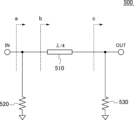
- 10A and 10B are explanatory diagrams for explaining each position of a variable attenuator 500 of a reference example.
- 4 shows the output result of the variable attenuator 500 on a Smith chart.
- 4 shows the output result of the variable attenuator 500 on a Smith chart.
- 4 shows the output result of the variable attenuator 500 on a Smith chart.
- the relationship between the impedance and length of an open stub as viewed from the connection position of the transmission line is shown.
- 1 shows the results of a simulation of the state error of a variable attenuator with an attenuation of 8 dB.
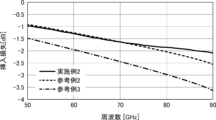
- 1 shows simulation results of the insertion loss of the step attenuators in Example 2, Reference Example 2, and Reference Example 3.
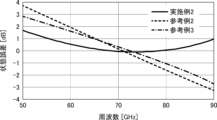
- 13 shows simulation results of state errors of the step attenuators in the second embodiment, the second reference example, and the third reference example.
- FIG. 1 shows the configuration of a variable attenuator 10 according to this embodiment.
- the variable attenuator 10 has an input terminal P10 and an output terminal P11.
- the variable attenuator 10 attenuates, for example, a high-frequency signal input to the input terminal P10 and outputs the attenuated signal from the output terminal P11.
- the variable attenuator 10 can change the amount of signal attenuation by changing the internal resistance value.
- the variable attenuator 10 includes a transmission line 100, a first switch 110, a first resistor 120, a second switch 130, and a second resistor 140.
- the transmission line 100 is connected between an input terminal P10 and an output terminal P11.
- the transmission line 100 outputs a signal input to the input terminal P10 from the output terminal P11.
- the transmission line 100 can attenuate a high-frequency signal such as an RF signal by transmitting the high-frequency signal.
- the transmission line 100 has a straight line connecting the input terminal P10 and the output terminal P11.
- the length (electrical length) l series of the straight line may be in the range of ⁇ /8 ⁇ l series ⁇ /4, where ⁇ is the wavelength of the signal to be transmitted.
- the transmission line 100 has an open stub 105 connected between the input terminal P10 and the output terminal P11 of the variable attenuator 10.
- the open stub 105 branches off from the straight line of the transmission line 100 between the input terminal P10 and the output terminal P11, and has an open end.
- the open stub 105 may be connected to any position of the straight line between the input terminal P10 and the output terminal P11 of the transmission line 100, for example, to a center position between the input terminal P10 and the output terminal P11 of the variable attenuator 10 in the transmission line 100.
- the open stub 105 is provided for impedance conversion of the variable attenuator 10.
- the open stub 105 may have a length (electrical length) l stub that is less than the length l series of the straight line of the transmission line 100 between the input terminal P10 and the output terminal P11 of the variable attenuator 10.
- the open stub 105 may have a length l stub from the connection position (branch position) in the range of ⁇ /4>l stub (particularly ⁇ /8 ⁇ l stub ) where the impedance of the open stub 105 seen from the connection position shows capacitive properties, and may have a length l series >l stub where l series is greater than l stub , for a wavelength ⁇ of a signal to be transmitted.
- the first switch 110 is connected between the input terminal P10 and the reference potential.
- the first switch 110 switches whether or not the input terminal P10 and the reference potential are connected.
- the first switch 110 may be a shunt switch such as a HEMT (high electron mobility transistor).
- the first resistor 120 is connected in series with the first switch 110 between the input terminal P10 and the reference potential.
- the first resistor 120 may be connected to the end of the first switch 110 on the reference potential side.
- the reference potential may be a fixed potential such as ground potential (0V), and so on.
- the second switch 130 is connected between the output terminal P11 and the reference potential.
- the second switch 130 switches between connecting or not connecting the output terminal P11 and the reference potential.
- the second switch 130 may be a shunt switch such as a HEMT.
- the second resistor 140 is connected in series with the second switch 130 between the output terminal P11 and the reference potential.
- the second resistor 140 may be connected to the end of the second switch 130 on the reference potential side.
- the first switch 110 and the second switch 130 are connected to a control circuit or the like that controls switching.
- the variable attenuator 10 can increase the amount of attenuation by turning on at least one of the first switch 110 and the second switch 130 using the control circuit.
- the variable attenuator 10 shown in FIG. 2 has the same configuration and function as the variable attenuator 10 shown in FIG. 1, but further includes a third switch 200 and a fourth switch 210.
- the third switch 200 is connected to the end of the first switch 110 on the reference potential side.
- the third switch 200 may be turned on at the same timing as the first switch 110 is turned on.
- the fourth switch 210 is connected to the end of the second switch 130 on the reference potential side.
- the fourth switch 210 may be turned on at the same timing as the second switch 130 is turned on.
- the first switch 110, the second switch 130, the third switch 200, and the fourth switch 210 may each be a HEMT.
- the modified variable attenuator 10 has shunt switches stacked in multiple stages, which can further reduce the off capacitance and further improve the withstand voltage.
- variable attenuator 10 is not limited to two switches connected as shown in FIG. 2, but may have three or more switches connected.
- FIG. 3 shows the configuration of the step attenuator according to this embodiment.
- the step attenuator 300 includes multiple variable attenuators 310-370 connected in cascade.
- the step attenuator 300 includes seven variable attenuators 310-370.
- Each of the variable attenuators 310-370 may have the same configuration as the variable attenuator 10 according to this embodiment shown in FIG. 1 or FIG. 2.
- the input terminal P10 of the first-stage variable attenuator 310 is connected to the input terminal P30 of the step attenuator 300, and the output terminal P11 is connected to the input terminal P10 of the second-stage variable attenuator 320.
- One of the input terminal P10 and the output terminal P11 of the second- to sixth-stage variable attenuators 320 to 360 is connected to the other of the input terminal P10 and the output terminal P11 of the adjacent variable attenuators 320 to 360.
- the output terminal P11 of the seventh-stage variable attenuator 370 is connected to the output terminal P31 of the step attenuator 300.
- the step attenuator 300 may include variable attenuators 310-370 all of the same configuration, or may include one or more variable attenuators 310-370 with different attenuation amounts.
- FIG. 4 shows the configuration of a test apparatus 400 according to this embodiment.
- the test apparatus 400 may be ATE (Automated Test Equipment) that tests a DUT 470 (Device Under Test).
- the test apparatus 400 may determine that the DUT 470 is a good product if a response signal output by the DUT 470 in response to a test signal supplied to the DUT 470 during testing matches an expected value for the response signal.
- the test apparatus 400 may determine that the DUT 470 is a defective product if a response signal output by the DUT 470 in response to any of the test signals supplied to the DUT 470 during testing does not match the corresponding expected value.
- the test device 400 includes a test signal generating circuit 410, a comparison circuit 420, and a connection device 430.
- the test signal generating circuit 410 generates a test signal for testing the DUT 470.
- the comparison circuit 420 compares the response signal output by the DUT 470 in response to the test signal with an expected value.
- the connection device 430 is connected to the test signal generating circuit 410 and the comparison circuit 420.
- the connection device 430 functions as a switch device that switches the input/output paths of signals such as analog radio frequency signals (RF signals).
- RF signals radio frequency signals
- the connection device 430 may be an RF test front end that switches between a transmission system circuit that outputs a transmission signal and a reception system circuit that inputs a reception signal.
- the connection device 430 supplies the test signal from the test signal generating circuit 410 to the DUT 470, and supplies the response signal output by the DUT 470 to the comparison circuit 420.
- the connection device 430 has a first mixer 442, a gain amplifier 444, a first variable attenuator 446, a first power amplifier 448, a connection section 450, a second variable attenuator 460, a second mixer 462, and a second power amplifier 464.
- the first mixer 442 is connected to the test signal generating circuit 410.
- the first mixer 442 converts the frequency of the test signal from an intermediate frequency (IF) to a high frequency (RF) by mixing the test signal generated by the test signal generating circuit 410 with a carrier wave.
- the gain amplifier 444 is connected between the test signal generating circuit 410 and the first variable attenuator 446, and is connected to the first mixer 442.
- the gain amplifier 444 amplifies and transmits the test signal frequency-converted by the first mixer 442.
- the first variable attenuator 446 is connected to the gain amplifier 444, and attenuates and transmits the test signal amplified by the gain amplifier 444.
- the first variable attenuator 446 may have a configuration similar to that of the variable attenuator 10 shown in FIG. 1 or FIG. 2, or may have a configuration similar to that of the step attenuator 300 shown in FIG. 3.
- the first power amplifier 448 is connected to the first variable attenuator 446 and amplifies and transmits the test signal attenuated by the first variable attenuator 446.
- the connection unit 450 is connected to the first power amplifier 448.
- the connection unit 450 is a switch that switches whether or not to connect between the terminal P41 or the terminal P42 and the terminal P43.
- the terminal P41 is connected to the test signal generating circuit 410
- the terminal P42 is connected to the comparison circuit 420
- the terminal P43 is connected to the DUT 470.
- the second variable attenuator 460 is connected to the terminal P42, and attenuates and transmits the response signal received from the DUT 470.
- the second variable attenuator 460 may have a configuration similar to that of the variable attenuator 10 shown in FIG. 1 or FIG. 2, or may have a configuration similar to that of the step attenuator 300 shown in FIG. 3.
- the second mixer 462 is connected between the comparison circuit 420 and the second variable attenuator 460.
- the second mixer 462 converts the frequency of the response signal from RF to IF by mixing the response signal received from the DUT 470 with a carrier wave.
- the second power amplifier 464 is connected between the second mixer 462 and the comparison circuit 420, and amplifies and transmits the response signal frequency-converted by the second mixer 462.
- FIG. 5 is an explanatory diagram for explaining the output results of the Smith chart at each position of the variable attenuator 10 of this embodiment.
- FIG. 5 shows the variable attenuator 10 of this embodiment shown in FIG. 1 in a state where the first switch 110 and the second switch 130 are turned on.
- an open stub 105 is connected to the center of the transmission line 100 between the input terminal P10 and the output terminal P11 of the variable attenuator 10.
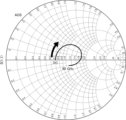
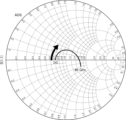
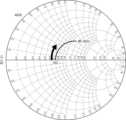
- the output results of the Smith chart at multiple positions of the variable attenuator 10 are shown in FIG. 6 to FIG. 10, respectively.
- FIG. 6 shows the output result of the Smith chart at position a of the variable attenuator 10 shown in FIG. 5.
- FIG. 7 shows the output result of the Smith chart at position b of the variable attenuator 10 shown in FIG. 5.
- FIG. 8 shows the output result of the Smith chart at position c of the variable attenuator 10 shown in FIG. 5.
- FIG. 9 shows the output result of the Smith chart at position d of the variable attenuator 10 shown in FIG. 5.
- FIG. 10 shows the output result of the Smith chart at position e of the variable attenuator 10 shown in FIG. 5.
- the Smith charts in FIG. 6 to FIG. 10 show the impedance distribution in the frequency range of 0 GHz (DC) to 90 GHz of the signal transmitted to the variable attenuator 10 with thick lines.
- the open stub 105 behaves as a shunt capacitor, so that the open stub 105 and the ⁇ /8 transmission line 100 arranged between the positions b and c can be combined to compensate for the reactance component at high frequencies (around 90 GHz in this case).
- the distribution near high frequencies in FIGS. 6 to 8 approaches the horizontal axis representing the resistance component.
- the open stub 105 moves the impedance of the circuit counterclockwise on the Smith chart, and the variable attenuator 10 of this embodiment can shorten the electrical length l series of the transmission line 100 between the input terminal P10 and the output terminal P11 to less than ⁇ /4, and then perform impedance conversion to the target impedance. Therefore, the electrical length of the transmission line 100 between the input terminal P10 and the output terminal P11 can be shortened, and the chip size can be reduced.
- the variable attenuator 500 of the reference example includes a transmission line 510, a fifth resistor 520, and a sixth resistor 530.
- the transmission line 510 has the same configuration as the transmission line 100 (particularly the straight line of the transmission line 100) between the input terminal P10 and the output terminal P11 of the variable attenuator 10 of FIG. 5, but does not have an open stub.
- the fifth resistor 520 is connected between the input terminal IN and the reference potential, and has the same configuration as the first resistor 120 of the variable attenuator 10 of FIG. 5.
- the sixth resistor 530 is connected between the output terminal OUT and the reference potential, and has the same configuration as the second resistor 140 of the variable attenuator 10 of FIG. 5.
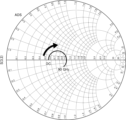
- the output results of the Smith chart at multiple positions of the variable attenuator 500 of the reference example are shown in FIG. 12 to FIG. 14, respectively.
- FIG. 12 shows the output result of the Smith chart at position a of the variable attenuator 500 shown in FIG. 11.
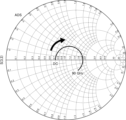
- FIG. 13 shows the output result of the Smith chart at position b of the variable attenuator 500 shown in FIG. 11.
- FIG. 14 shows the output result of the Smith chart at position c of the variable attenuator 500 shown in FIG. 11.
- the Smith charts in FIG. 12 to FIG. 14 show the impedance distribution in the frequency range of the transmitted signal from 0 GHz (DC) to 90 GHz with thick lines.
- the impedance near high frequencies is distributed away from the horizontal axis on the Smith chart shown in FIG. 12 due to the transmission line 510. Therefore, the impedance near high frequencies cannot be brought close enough to the horizontal axis by the transmission line 510 alone, and impedance conversion to the target impedance is not possible.
- Fig. 15 shows the relationship between the impedance and the length I stub of the open stub 105 as viewed from the connection position of the transmission line 100.
- the horizontal axis shows the length I stub of the open stub 105 from the connection position of the transmission line 100 between the input terminal P10 and the output terminal P11 in Fig. 1
- the vertical axis shows the impedance of the open stub 105 as viewed from the connection position of the transmission line 100.
- the open stub 105 in the range of the length of the open stub 105 being 0 ⁇ I stub ⁇ ⁇ /4 (particularly, ⁇ /8 ⁇ l stub ), the open stub 105 exhibits capacitive properties and operates as a shunt capacitor. Therefore, the electrical length of the open stub 105 in the variable attenuator 10 of this embodiment is preferably in the range of 0 ⁇ I stub ⁇ ⁇ /4, particularly ⁇ /8 ⁇ l stub .
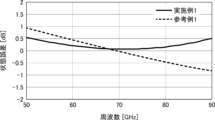
- FIG. 16 shows the results of simulating the state error of a variable attenuator 10 with an attenuation of 8 dB.
- the horizontal axis indicates the frequency of the transmitted signal, and the vertical axis indicates the state error (variation from the nominal value of the attenuation amount).
- Example 1 shows the results of simulating the state error of the variable attenuator 10 of the present embodiment in FIG. 2, and Reference Example 1 shows the results of simulating the state error of a variable attenuator that has the same configuration as the variable attenuator 10 of the present embodiment in FIG. 2 but does not have an open stub.
- the maximum state error in Example 1 is 0.5 dB, and the maximum state error in Reference Example 1 is 0.9 dB. It can be seen that by using the variable attenuator 10 of this embodiment, the state error is improved by 0.4 dB compared to Reference Example 1.
- a variable attenuator with an attenuation of 8 dB has a larger attenuation amount, so in Reference Example 1, it is necessary to widen the gate width of the shunt HEMT used as a switch from the viewpoint of allowable current and distortion characteristics.
- widening the gate width of the shunt HEMT increases the capacitance of the circuit, and impedance conversion (impedance matching) cannot be performed well for large capacitance, and the state error of the variable attenuator increases.
- the state error of the variable attenuator with an attenuation amount of 4 dB was a maximum of 0.4 dB
- the state error of the variable attenuator with an attenuation amount of 8 dB was a maximum of 0.9 dB.
- variable attenuator 10 of this embodiment impedance conversion is performed using the open stub 105, making it possible to reduce the state error even with a large attenuation amount.
- FIG. 17 shows the results of a simulation of the insertion loss during thru (attenuation of 0 dB) of the step attenuators in Example 2, Reference Example 2, and Reference Example 3.
- the horizontal axis indicates the frequency of the signal to be transmitted, and the vertical axis indicates the insertion loss (dB).
- the step attenuator 300 of Example 2 is configured by cascading five variable attenuators 10 of the present embodiment shown in FIG. 2.
- the step attenuator 300 of Example 2 has an operating frequency of 50-90 GHz, includes one variable attenuator 10 with an attenuation of 4 dB, and three variable attenuators 10 with an attenuation of 8 dB, for a total attenuation of 28 dB.
- Each of the five variable attenuators 10 has an electrical length of ⁇ /4 between the input terminal P10 and the output terminal P11, and the first switch 110 and the second switch 130 are HEMTs.
- Reference Example 2 uses a step attenuator with the same configuration as step attenuator 300 of Example 2, except that each variable attenuator of the step attenuator of Reference Example 2 does not have an open stub.
- the step attenuator of Reference Example 3 is configured by cascading seven variable attenuators 10 of this embodiment shown in FIG. 2, except that each variable attenuator of the step attenuator of Reference Example 2 does not have an open stub.
- the step attenuator of Reference Example 3 has an operating frequency of 50-90 GHz, and includes seven variable attenuators with an attenuation of 4 dB, for a total attenuation of 28 dB.
- Each switch in the variable attenuators of Reference Examples 2 and 3 is a HEMT.
- each variable attenuator in Reference Example 3 the gate width of the shunt HEMT used in each variable attenuator is smaller, so the capacitive effect of the switches is smaller, but the number of cascaded variable attenuators required to achieve the desired attenuation of 28 dB is greater than in Reference Example 2. If the insertion loss of each variable attenuator in Reference Example 3 during thru (attenuation of 0 dB) is just over 0.5 dB, cascading seven stages will result in the insertion loss of the entire step attenuator being just over 3.5 dB. In Example 2, the insertion loss during thru (attenuation of 0 dB) is significantly improved by 1.4 dB compared to Reference Example 3, which has a larger number of cascaded connections.
- FIG. 18 shows the results of simulating the state error of the step attenuator in Example 2, Reference Example 2, and Reference Example 3.
- the horizontal axis indicates the frequency of the transmitted signal, and the vertical axis indicates the state error (dB).
- Example 2, Reference Example 2, and Reference Example 3 in FIG. 18 are step attenuators with the same configuration as the simulation in FIG. 17.
- Example 2 a variable attenuator with an attenuation of 8 dB is used, so the state error is larger than in Reference Example 3, and the state error shown in Figure 16 is further increased by the cascade connection. In Example 2, the state error is improved compared to Reference Examples 2 and 3.
- the length of the transmission line between the input terminal and output terminal of the variable attenuator is 300 um for the variable attenuator with an attenuation of 4 dB in Reference Example 2 and 320 um for the variable attenuator with an attenuation of 8 dB in Example 2, whereas it is 255 um for the variable attenuator 10 with an attenuation of 4 dB and 270 um for the variable attenuator 10 with an attenuation of 8 dB in Example 2. Therefore, by using the step attenuator in Example 2, the chip size is approximately 15% smaller than the step attenuator in Reference Example 2. Note that the open stub 105 in Example 2 is sufficiently shorter in length than the shunt HEMT and resistor, and does not contribute to an increase in chip size.
- variable attenuator 10 of this embodiment allows impedance adjustment using the transmission line 100 with the open stub 105, so insertion loss during thru (attenuation amount 0 dB) can be reduced, and state errors can also be reduced. Furthermore, the variable attenuator 10 of this embodiment allows a design that shortens the transmission line 100 between the input terminal P10 and the output terminal P11, reducing the chip size and contributing to high-density implementation of the RF test front end.
Landscapes
- Physics & Mathematics (AREA)
- General Physics & Mathematics (AREA)
- Non-Reversible Transmitting Devices (AREA)
- Attenuators (AREA)
- Transmitters (AREA)
Abstract
可変アッテネータであって、可変アッテネータの入力および出力の間に接続されたオープンスタブを有する伝送線路と、入力および基準電位の間に接続された第1スイッチと、出力および基準電位の間に接続された第2スイッチと、を備える可変アッテネータを提供する。
Description
本発明は、可変アッテネータ、ステップアッテネータ、および試験装置に関する。
特許文献1には、「マイクロ波回路1Aでは、線路幅ステップ部32Aが、伝送線路25Aの長さ方向(X方向)の中央部において、線路幅ステップ部32Aが伝送線路25Aの片側に、つまり幅方向(Y方向)に偏って形成される」と記載されている(段落44)。特許文献2には、「高周波デバイスはさらに、高周波信号の入出力のための端子P1,P2をパターン導体1に備え、接地端子GNDをパターン導体5に備える。パターン導体1,4,5及びビア導体2,3は、端子P1,P2及び接地端子GNDを接続して高周波信号を伝送する信号線を形成する。・・・信号線の一部が高周波信号に対して抵抗R1,R2を有することにより、高周波デバイスはアッテネータとして機能する」と記載されている(段落27,30)。特許文献3には、「多くの半導体RFスイッチは、今日、スイッチ全体のブレイクダウン性能を改善するよう直列に多数の低BVdsトランジスタをスタックする」と記載されている(段落6)。
[先行技術文献]
[特許文献]
特許文献1 特開2014-241482号公報
特許文献2 国際公開第2014/030469号公報
特許文献3 特表2010-527179号公報
[先行技術文献]
[特許文献]
特許文献1 特開2014-241482号公報
特許文献2 国際公開第2014/030469号公報
特許文献3 特表2010-527179号公報
本発明の第1の態様においては、可変アッテネータであって、可変アッテネータの入力および出力の間に接続されたオープンスタブを有する伝送線路と、入力および基準電位の間に接続された第1スイッチと、出力および基準電位の間に接続された第2スイッチと、を備える可変アッテネータを提供する。
上記可変アッテネータは、入力および基準電位の間に第1スイッチと直列に接続された第1抵抗と、出力および基準電位の間に第2スイッチと直列に接続された第2抵抗と、を備えてよい。
上記可変アッテネータにおいて、第1抵抗は、第1スイッチの基準電位側の端部に接続され、第2抵抗は、第2スイッチの基準電位側の端部に接続されてよい。
上記のいずれかの可変アッテネータにおいて、オープンスタブは、伝送線路における可変アッテネータの入力と出力の間の中心位置に接続されてよい。
上記のいずれかの可変アッテネータにおいて、オープンスタブは、可変アッテネータの入力および出力の間の伝送線路の長さ未満の長さを有してよい。
本発明の第2の態様においては、縦続接続された複数の第1の態様の可変アッテネータを備えるステップアッテネータを提供する。
本発明の第3の態様においては、被試験デバイスを試験するための試験信号を発生する試験信号発生回路と、試験信号に応じて被試験デバイスが出力する応答信号を期待値と比較する比較回路と、試験信号または応答信号を減衰する第1の態様の可変アッテネータとを備える試験装置を提供する。
上記試験装置は、試験信号発生回路および可変アッテネータの間に接続され、試験信号を増幅するゲインアンプを備えてよい。
上記のいずれかの試験装置は、比較回路および可変アッテネータの間に接続され、応答信号の周波数を変換するミキサを備えてよい。
なお、上記の発明の概要は、本発明の必要な特徴の全てを列挙したものではない。また、これらの特徴群のサブコンビネーションもまた、発明となりうる。
以下、発明の実施の形態を通じて本発明を説明するが、以下の実施形態は請求の範囲にかかる発明を限定するものではない。また、実施形態の中で説明されている特徴の組み合わせの全てが発明の解決手段に必須であるとは限らない。
図1は、本実施形態に係る可変アッテネータ10の構成を示す。可変アッテネータ10は、入力端子P10と、出力端子P11とを備える。可変アッテネータ10は、例えば、入力端子P10に入力された高周波の信号を減衰して、減衰した信号を出力端子P11から出力する。可変アッテネータ10は、内部の抵抗値を変えて、信号のアッテネーション量を変更可能である。
可変アッテネータ10は、伝送線路100と、第1スイッチ110と、第1抵抗120と、第2スイッチ130と、第2抵抗140とを備える。伝送線路100は、入力端子P10および出力端子P11の間に接続される。伝送線路100は、入力端子P10に入力された信号を出力端子P11から出力する。伝送線路100は、RF信号等の高周波信号を伝送することで、減衰させることができる。伝送線路100は、入力端子P10および出力端子P11の間を接続する直線状の線路を有する。直線状の線路の長さ(電気長)lseriesは、伝送する信号の波長λに対して、λ/8<lseries<λ/4の範囲であってよい。
伝送線路100は、可変アッテネータ10の入力端子P10および出力端子P11の間に接続されたオープンスタブ105を有する。オープンスタブ105は、入力端子P10および出力端子P11の間の伝送線路100の直線状の線路から分岐し、端部が開放されている。オープンスタブ105は、伝送線路100の入力端子P10と出力端子P11の間の直線状の線路のいずれかの位置に接続されてよく、例えば、伝送線路100における可変アッテネータ10の入力端子P10と出力端子P11の間の中心位置に接続されてよい。オープンスタブ105は、可変アッテネータ10のインピーダンス変換のために設けられる。オープンスタブ105は、可変アッテネータ10の入力端子P10および出力端子P11の間の伝送線路100の直線状の線路の長さlseries未満の長さ(電気長)lstubを有してよい。例えば、オープンスタブ105は、伝送する信号の波長λに対して、接続位置(分岐位置)からの長さlstubが、接続位置からみたオープンスタブ105のインピーダンスが容量性を示すλ/4>lstub(特にはλ/8≧lstub)の範囲で、かつlseries>lstubの範囲であってよい。
第1スイッチ110は、入力端子P10および基準電位の間に接続される。第1スイッチ110は、入力端子P10および基準電位の間を接続するか否かを切り替える。第1スイッチ110は、HEMT(高電子移動度トランジスタ)等のシャントスイッチであってよい。第1抵抗120は、入力端子P10および基準電位の間に第1スイッチ110と直列に接続される。第1抵抗120は、第1スイッチ110の基準電位側の端部に接続されてよい。ここで、基準電位は、接地電位(0V)等の固定電位であってよく、以下同様である。
第2スイッチ130は、出力端子P11および基準電位の間に接続される。第2スイッチ130は、出力端子P11および基準電位の間を接続するか否かを切り替える。第2スイッチ130は、HEMT等のシャントスイッチであってよい。第2抵抗140は、出力端子P11および基準電位の間に第2スイッチ130と直列に接続される。第2抵抗140は、第2スイッチ130の基準電位側の端部に接続されてよい。
第1スイッチ110および第2スイッチ130は、スイッチングを制御する制御回路等に接続される。可変アッテネータ10は、制御回路により第1スイッチ110および第2スイッチ130の少なくとも1つをオンすることで、アッテネーション量を増加させることができる。
図2は、本実施形態に係る可変アッテネータ10の変形例の構成を示す。図2に示す可変アッテネータ10は、図1の可変アッテネータ10と同様の構成および機能を有し、ただし、第3スイッチ200および第4スイッチ210をさらに備える。第3スイッチ200は、第1スイッチ110の基準電位側の端部に接続される。第3スイッチ200は、第1スイッチ110がオンされると、同じタイミングでオンされてよい。第4スイッチ210は、第2スイッチ130の基準電位側の端部に接続される。第4スイッチ210は、第2スイッチ130がオンされると、同じタイミングでオンされてよい。図2において、第1スイッチ110、第2スイッチ130、第3スイッチ200、および第4スイッチ210は、それぞれHEMTであってよい。変形例の可変アッテネータ10は、複数段にスタックしたシャントスイッチを有することで、オフキャパシタンスをより低減でき、耐圧をより向上できる。
なお、可変アッテネータ10は、図2のように2個のスイッチが接続したものに限定されず、3個以上のスイッチを接続したものであってもよい。
図3は、本実施形態に係るステップアッテネータの構成を示す。ステップアッテネータ300は、縦続接続された複数の可変アッテネータ310~370を備える。図3の実施形態においてステップアッテネータ300は、7個の可変アッテネータ310~370を備える。可変アッテネータ310~370は、それぞれ、図1または図2に示す本実施形態の可変アッテネータ10と同じ構成であってよい。
1段目の可変アッテネータ310は、入力端子P10がステップアッテネータ300の入力端子P30に接続され、出力端子P11が2段目の可変アッテネータ320の入力端子P10に接続される。2~6段目の可変アッテネータ320~360は、入力端子P10及び出力端子P11の一方が、隣接する可変アッテネータ320~360の入力端子P10及び出力端子P11の他方に接続される。7段目の可変アッテネータ370の出力端子P11は、ステップアッテネータ300の出力端子P31に接続される。
ステップアッテネータ300は、全て同じ構成の可変アッテネータ310~370を備えてよく、また、異なるアッテネーション量を有する1または複数の可変アッテネータ310~370を備えてよい。
図4は、本実施形態に係る試験装置400の構成を示す。試験装置400は、DUT470(Device Under Test:被試験デバイス)の試験を行うATE(Automated Test Equipment)であってよい。試験装置400は、試験中にDUT470に供給する試験信号に対してDUT470が出力する応答信号が、応答信号に対する期待値と一致する場合には、DUT470が良品であると判定してよい。試験装置400は、試験中にDUT470に供給するいずれかの試験信号に対してDUT470が出力する応答信号が、対応する期待値と一致しない場合には、DUT470が不良品であると判定してよい。
試験装置400は、試験信号発生回路410と、比較回路420と、接続装置430とを備える。試験信号発生回路410は、DUT470を試験するための試験信号を発生する。比較回路420は、試験信号に応じてDUT470が出力する応答信号を期待値と比較する。
接続装置430は、試験信号発生回路410および比較回路420に接続される。接続装置430は、例えばアナログの高周波信号(RF信号)等の信号の入出力経路を切り替えるスイッチ装置として機能する。接続装置430は、一例として、送信信号を出力する送信系回路および受信信号を入力する受信系回路を切り替えるRFテストフロントエンドであってよい。接続装置430は、試験信号発生回路410からの試験信号をDUT470に供給し、DUT470が出力する応答信号を比較回路420に供給する。
接続装置430は、第1ミキサ442と、ゲインアンプ444と、第1可変アッテネータ446と、第1パワーアンプ448と、接続部450と、第2可変アッテネータ460と、第2ミキサ462と、第2パワーアンプ464とを有する。
第1ミキサ442は、試験信号発生回路410に接続される。第1ミキサ442は、試験信号発生回路410により生成された試験信号をキャリア波と混合することにより、試験信号の周波数を中間周波数(IF)から高周波数(RF)に変換する。ゲインアンプ444は、試験信号発生回路410および第1可変アッテネータ446の間に接続され、第1ミキサ442に接続される。ゲインアンプ444は、第1ミキサ442により周波数変換された試験信号を増幅して伝送する。第1可変アッテネータ446は、ゲインアンプ444に接続され、ゲインアンプ444により増幅された試験信号を減衰して伝送する。第1可変アッテネータ446は、図1または図2に示す可変アッテネータ10と同様の構成であってよく、また、図3に示すステップアッテネータ300と同様の構成であってもよい。第1パワーアンプ448は、第1可変アッテネータ446に接続され、第1可変アッテネータ446により減衰された試験信号を増幅して伝送する。
接続部450は、第1パワーアンプ448に接続される。接続部450は、端子P41または端子P42と端子P43との間を接続するか否かを切り替えるスイッチである。端子P41は、試験信号発生回路410に接続され、端子P42は、比較回路420に接続され、端子P43は、DUT470に接続される。
第2可変アッテネータ460は、端子P42に接続され、DUT470から受信した応答信号を減衰して伝送する。第2可変アッテネータ460は、図1または図2に示す可変アッテネータ10と同様の構成であってよく、また、図3に示すステップアッテネータ300と同様の構成であってもよい。第2ミキサ462は、比較回路420および第2可変アッテネータ460の間に接続される。第2ミキサ462は、DUT470から受信した応答信号をキャリア波と混合することにより、応答信号の周波数をRFからIFに変換する。第2パワーアンプ464は、第2ミキサ462および比較回路420の間に接続され、第2ミキサ462により周波数変換された応答信号を増幅して伝送する。
図5は、本実施形態の可変アッテネータ10の各位置におけるスミスチャートの出力結果を説明するための説明図である。図5は、図1に示す本実施形態の可変アッテネータ10について、第1スイッチ110および第2スイッチ130をオンにした状態を示す。図5において、可変アッテネータ10の入力端子P10および出力端子P11の間の伝送線路100の中心にオープンスタブ105を接続した。可変アッテネータ10の複数の位置におけるスミスチャートの出力結果を、それぞれ図6から図10に示す。
図6は、図5に示す可変アッテネータ10の位置aにおけるスミスチャートの出力結果を示す。図7は、図5に示す可変アッテネータ10の位置bにおけるスミスチャートの出力結果を示す。図8は、図5に示す可変アッテネータ10の位置cにおけるスミスチャートの出力結果を示す。図9は、図5に示す可変アッテネータ10の位置dにおけるスミスチャートの出力結果を示す。図10は、図5に示す可変アッテネータ10の位置eにおけるスミスチャートの出力結果を示す。図6から図10におけるスミスチャートは、可変アッテネータ10に伝送する信号の周波数0GHz(DC)から90GHzの範囲のインピーダンスの分布を太線で示す。
可変アッテネータ10においてオープンスタブ105はシャントキャパシタとしてふるまうため、オープンスタブ105と、位置bおよび位置cの間に配置されているλ/8の伝送線路100を組み合わすことで高い周波数(ここでは90GHz付近)におけるリアクタンス成分を補償することができる。スミスチャート上では、図6~図8において高周波付近の分布が、抵抗成分を表す水平軸に近づいている。図7および図8に示すように、オープンスタブ105が回路のインピーダンスをスミスチャート上で反時計回りに移動させることを利用し、本実施形態の可変アッテネータ10は、入力端子P10および出力端子P11の間の伝送線路100の電気長lseriesをλ/4未満に短縮したうえで、狙いのインピーダンスへインピーダンス変換することができる。従って、入力端子P10および出力端子P11の間の伝送線路100の電気長を短縮し、チップサイズを縮小することができる。
図11は、参考例の可変アッテネータ500の各位置におけるスミスチャートの出力結果を説明するための説明図である。参考例の可変アッテネータ500は、伝送線路510と、第5抵抗520と、第6抵抗530とを備える。伝送線路510は、図5の可変アッテネータ10の入力端子P10および出力端子P11の間の伝送線路100(特に伝送線路100の直線状の線路)と同じ構成であり、ただし、オープンスタブを有さない。第5抵抗520は、入力端子INおよび基準電位の間に接続され、図5の可変アッテネータ10の第1抵抗120と同じ構成である。第6抵抗530は、出力端子OUTおよび基準電位の間に接続され、図5の可変アッテネータ10の第2抵抗140と同じ構成である。参考例の可変アッテネータ500の複数の位置におけるスミスチャートの出力結果を、それぞれ図12から図14に示す。
図12は、図11に示す可変アッテネータ500の位置aにおけるスミスチャートの出力結果を示す。図13は、図11に示す可変アッテネータ500の位置bにおけるスミスチャートの出力結果を示す。図14は、図11に示す可変アッテネータ500の位置cにおけるスミスチャートの出力結果を示す。図12から図14におけるスミスチャートは、伝送する信号の周波数0GHz(DC)から90GHzの範囲のインピーダンスの分布を太線で示す。
位置bから位置cの間に、伝送線路510によって、図12に示すスミスチャート上では、高周波付近のインピーダンスが水平軸から離れて分布している。従って、伝送線路510のみでは、高周波付近のインピーダンスを水平軸に十分に近づけることができず、狙いのインピーダンスへインピーダンス変換することができない。
図15は、伝送線路100の接続位置からみたオープンスタブ105のインピーダンスと長さIstabの関係を示す。図15において、横軸は、図1の入力端子P10および出力端子P11の間の伝送線路100の接続位置からのオープンスタブ105の長さIstabを示し、縦軸は、伝送線路100の接続位置からみたオープンスタブ105のインピーダンスを示す。図15に示すように、オープンスタブ105の長さが0<Istab<λ/4(特にはλ/8≧lstub)である範囲において、オープンスタブ105は、容量性を示し、シャントキャパシタとして動作する。従って、本実施形態の可変アッテネータ10におけるオープンスタブ105の電気長は、0<Istab<λ/4、特にはλ/8≧lstubの範囲が好ましい。
図16は、アッテネーション量8dBの可変アッテネータ10の状態誤差のシミュレーション結果を示す。図16は、横軸が伝送する信号の周波数を示し、縦軸が状態誤差(アッテネーション量の公称値に対するばらつき)を示す。図16において、実施例1として、図2の本実施形態の可変アッテネータ10の状態誤差のシミュレーション結果を示し、参考例1として、図2の本実施形態の可変アッテネータ10と同じ構成を有し、ただし、オープンスタブを有さない可変アッテネータの状態誤差のシミュレーション結果を示す。
実施例1における状態誤差は最大で0.5dBであり、参考例1における状態誤差は最大で0.9dBである。本実施形態の可変アッテネータ10を用いることで、状態誤差が参考例1より0.4dB改善することがわかる。
アッテネーション量4dBの可変アッテネータに比べて、アッテネーション量8dBの可変アッテネータはアッテネーション量が多い分、許容電流やひずみ特性の観点から、参考例1では、スイッチとして用いるシャントHEMTのゲート幅を広げる必要がある。ただし、シャントHEMTのゲート幅を広げると回路の容量性が増加してしまい、大きな容量性に対してうまくインピーダンス変換(インピーダンスマッチング)ができず、可変アッテネータの状態誤差が増加してしまう。例えば、オープンスタブを有さない可変アッテネータについて、アッテネーション量4dBの構成とアッテネーション量8dBの構成の状態誤差をシミュレーションすると、アッテネーション量4dBの可変アッテネータ(ゲート幅25umで設計)の状態誤差が最大0.4dBに対して、アッテネーション量8dBの可変アッテネータ(ゲート幅50umで設計)の状態誤差は最大0.9dBであった。このように、可変アッテネータのアッテネーション量と状態誤差との間にはトレードオフが存在するが、本実施形態の可変アッテネータ10では、オープンスタブ105を用いてインピーダンス変換を行い、大きなアッテネーション量でも状態誤差を小さくできる。
図17は、実施例2、参考例2、および参考例3におけるステップアッテネータのThru時(アッテネーション量0dB時)の挿入損失のシミュレーション結果を示す。図17において、横軸は伝送する信号の周波数を示し、縦軸は挿入損失(dB)を示す。実施例2のステップアッテネータ300は、図2に示す本実施形態の可変アッテネータ10を5個縦続接続して構成される。実施例2のステップアッテネータ300は、動作周波数50-90GHzで、アッテネーション量4dBの可変アッテネータ10を1個、アッテネーション量8dBの可変アッテネータ10を3個備え、総アッテネーション量が28dBである。5個の可変アッテネータ10は、それぞれ、入力端子P10および出力端子P11の間の電気長がλ/4であり、第1スイッチ110および第2スイッチ130は、HEMTである。
参考例2は、実施例2のステップアッテネータ300と同様の構成のステップアッテネータを用い、ただし、参考例2のステップアッテネータの各可変アッテネータはオープンスタブを有さない。参考例3のステップアッテネータは、図2に示す本実施形態の可変アッテネータ10を7個縦続接続して構成され、ただし、参考例2のステップアッテネータの各可変アッテネータはオープンスタブを有さない。参考例3のステップアッテネータは、動作周波数50-90GHzで、アッテネーション量4dBの可変アッテネータを7個備え、総アッテネーション量が28dBである。参考例2および3の可変アッテネータにおける各スイッチは、HEMTである。
参考例3では、各可変アッテネータで使用するシャントHEMTのゲート幅が小さくなるため、スイッチによる容量性の影響は小さくなるが、所望のアッテネーション量28dBを実現するために可変アッテネータの縦続接続数が参考例2より多くなってしまう。参考例3における各可変アッテネータのThru時(アッテネーション量0dB時)の挿入損失が0.5dB強の場合、7段縦続接続することでステップアッテネータ全体の挿入損失は3.5dB強となってしまう。実施例2は、Thru時(アッテネーション量0dB時)の挿入損失は、縦続接続数が多い参考例3に対して1.4dBと大きく改善する。
図18は、実施例2、参考例2、および参考例3におけるステップアッテネータの状態誤差のシミュレーション結果を示す。図18において、横軸は伝送する信号の周波数を示し、縦軸は状態誤差(dB)を示す。図18における実施例2、参考例2、および参考例3は、図17におけるシミュレーションと同じ構成のステップアッテネータである。
参考例2では、アッテネーション量8dBの可変アッテネータを用いているため、参考例3よりも状態誤差が大きくなり、図16に示すような状態誤差が縦続接続によってさらに大きくなっている。実施例2では、状態誤差は参考例2および3と比較して改善している。
また、可変アッテネータの入力端子および出力端子の間の伝送線路の長さは、参考例2において、アッテネーション量4dBの可変アッテネータで300um、アッテネーション量8dBの可変アッテネータで320umに対して、実施例2において、アッテネーション量4dBの可変アッテネータ10で255um、アッテネーション量8dBの可変アッテネータ10で270umであった。よって、実施例2におけるステップアッテネータを用いることにより、チップサイズは、参考例2のステップアッテネータより約15%小さくなる。なお、実施例2におけるオープンスタブ105は、シャントHEMTや抵抗体より長さが十分短いため、チップサイズの増加に寄与しない。
以上のような本実施形態の可変アッテネータ10であれば、オープンスタブ105を有する伝送線路100によりインピーダンス調整ができるため、Thru時(アッテネーション量0dB時)の挿入損失を低減でき、さらには状態誤差も低減できる。また、本実施形態の可変アッテネータ10であれば、入力端子P10及び出力端子P11の間の伝送線路100を短縮した設計が可能になり、チップサイズが縮小され、RFテストフロントエンドの高密度実装に寄与する。
以上、本発明を実施の形態を用いて説明したが、本発明の技術的範囲は上記実施の形態に記載の範囲には限定されない。上記実施の形態に、多様な変更または改良を加えることが可能であることが当業者に明らかである。その様な変更または改良を加えた形態も本発明の技術的範囲に含まれ得ることが、請求の範囲の記載から明らかである。
請求の範囲、明細書、および図面中において示した装置、システム、プログラム、および方法における動作、手順、ステップ、および段階等の各処理の実行順序は、特段「より前に」、「先立って」等と明示しておらず、また、前の処理の出力を後の処理で用いるのでない限り、任意の順序で実現しうることに留意すべきである。請求の範囲、明細書、および図面中の動作フローに関して、便宜上「まず、」、「次に、」等を用いて説明したとしても、この順で実施することが必須であることを意味するものではない。
10 可変アッテネータ
100 伝送線路
105 オープンスタブ
110 第1スイッチ
120 第1抵抗
130 第2スイッチ
140 第2抵抗
200 第3スイッチ
210 第4スイッチ
300 ステップアッテネータ
310 可変アッテネータ
320 可変アッテネータ
330 可変アッテネータ
340 可変アッテネータ
350 可変アッテネータ
360 可変アッテネータ
370 可変アッテネータ
400 試験装置
410 試験信号発生回路
420 比較回路
430 接続装置
442 第1ミキサ
444 ゲインアンプ
446 第1可変アッテネータ
448 第1パワーアンプ
450 接続部
460 第2可変アッテネータ
462 第2ミキサ
464 第2パワーアンプ
470 DUT
500 可変アッテネータ
510 伝送線路
520 第5抵抗
530 第6抵抗
100 伝送線路
105 オープンスタブ
110 第1スイッチ
120 第1抵抗
130 第2スイッチ
140 第2抵抗
200 第3スイッチ
210 第4スイッチ
300 ステップアッテネータ
310 可変アッテネータ
320 可変アッテネータ
330 可変アッテネータ
340 可変アッテネータ
350 可変アッテネータ
360 可変アッテネータ
370 可変アッテネータ
400 試験装置
410 試験信号発生回路
420 比較回路
430 接続装置
442 第1ミキサ
444 ゲインアンプ
446 第1可変アッテネータ
448 第1パワーアンプ
450 接続部
460 第2可変アッテネータ
462 第2ミキサ
464 第2パワーアンプ
470 DUT
500 可変アッテネータ
510 伝送線路
520 第5抵抗
530 第6抵抗
Claims (9)
- 可変アッテネータであって、
前記可変アッテネータの入力および出力の間に接続されたオープンスタブを有する伝送線路と、
前記入力および基準電位の間に接続された第1スイッチと、
前記出力および基準電位の間に接続された第2スイッチと、を備える
可変アッテネータ。 - 前記入力および前記基準電位の間に前記第1スイッチと直列に接続された第1抵抗と、
前記出力および前記基準電位の間に前記第2スイッチと直列に接続された第2抵抗と、を備える
請求項1に記載の可変アッテネータ。 - 前記第1抵抗は、前記第1スイッチの前記基準電位側の端部に接続され、
前記第2抵抗は、前記第2スイッチの前記基準電位側の端部に接続される
請求項2に記載の可変アッテネータ。 - 前記オープンスタブは、前記伝送線路における前記可変アッテネータの入力と出力の間の中心位置に接続される
請求項1に記載の可変アッテネータ。 - 前記オープンスタブは、前記可変アッテネータの入力および出力の間の前記伝送線路の長さ未満の長さを有する
請求項1に記載の可変アッテネータ。 - 縦続接続された複数の請求項1に記載の可変アッテネータを備える
ステップアッテネータ。 - 被試験デバイスを試験するための試験信号を発生する試験信号発生回路と、
前記試験信号に応じて前記被試験デバイスが出力する応答信号を期待値と比較する比較回路と、
前記試験信号または前記応答信号を減衰する請求項1に記載の可変アッテネータとを備える
試験装置。 - 前記試験信号発生回路および前記可変アッテネータの間に接続され、前記試験信号を増幅するゲインアンプを備える
請求項7に記載の試験装置。 - 前記比較回路および前記可変アッテネータの間に接続され、前記応答信号の周波数を変換するミキサを備える
請求項7に記載の試験装置。
Priority Applications (4)
| Application Number | Priority Date | Filing Date | Title |
|---|---|---|---|
| PCT/JP2023/030182 WO2025041272A1 (ja) | 2023-08-22 | 2023-08-22 | 可変アッテネータ、ステップアッテネータ、および試験装置 |
| CN202380101359.5A CN121693858A (zh) | 2023-08-22 | 2023-08-22 | 可变衰减器、步进衰减器及试验装置 |
| TW113119661A TWI933014B (zh) | 2023-08-22 | 2024-05-28 | 可變衰減器、步進衰減器及試驗裝置 |
| US19/533,313 US20260169033A1 (en) | 2023-08-22 | 2026-02-09 | Variable attenuator, step attenuator, and test apparatus |
Applications Claiming Priority (1)
| Application Number | Priority Date | Filing Date | Title |
|---|---|---|---|
| PCT/JP2023/030182 WO2025041272A1 (ja) | 2023-08-22 | 2023-08-22 | 可変アッテネータ、ステップアッテネータ、および試験装置 |
Related Child Applications (1)
| Application Number | Title | Priority Date | Filing Date |
|---|---|---|---|
| US19/533,313 Continuation US20260169033A1 (en) | 2023-08-22 | 2026-02-09 | Variable attenuator, step attenuator, and test apparatus |
Publications (1)
| Publication Number | Publication Date |
|---|---|
| WO2025041272A1 true WO2025041272A1 (ja) | 2025-02-27 |
Family
ID=94731982
Family Applications (1)
| Application Number | Title | Priority Date | Filing Date |
|---|---|---|---|
| PCT/JP2023/030182 Ceased WO2025041272A1 (ja) | 2023-08-22 | 2023-08-22 | 可変アッテネータ、ステップアッテネータ、および試験装置 |
Country Status (3)
| Country | Link |
|---|---|
| US (1) | US20260169033A1 (ja) |
| CN (1) | CN121693858A (ja) |
| WO (1) | WO2025041272A1 (ja) |
Citations (5)
| Publication number | Priority date | Publication date | Assignee | Title |
|---|---|---|---|---|
| JP2011234110A (ja) * | 2010-04-27 | 2011-11-17 | Mitsubishi Electric Corp | 高周波回路 |
| JP2012015613A (ja) * | 2010-06-29 | 2012-01-19 | Advantest Corp | ステップ減衰装置およびそれを用いた試験装置および信号発生器 |
| US20120208484A1 (en) * | 2009-08-18 | 2012-08-16 | Kyle David Holzer | Optimized automated test equipment multi-path receiver concept |
| JP2014002051A (ja) * | 2012-06-19 | 2014-01-09 | Advantest Corp | 試験装置 |
| US20180234080A1 (en) * | 2017-02-15 | 2018-08-16 | Psemi Corporation | Self-matching phase shifter/attenuator |
-
2023
- 2023-08-22 WO PCT/JP2023/030182 patent/WO2025041272A1/ja not_active Ceased
- 2023-08-22 CN CN202380101359.5A patent/CN121693858A/zh active Pending
-
2026
- 2026-02-09 US US19/533,313 patent/US20260169033A1/en active Pending
Patent Citations (5)
| Publication number | Priority date | Publication date | Assignee | Title |
|---|---|---|---|---|
| US20120208484A1 (en) * | 2009-08-18 | 2012-08-16 | Kyle David Holzer | Optimized automated test equipment multi-path receiver concept |
| JP2011234110A (ja) * | 2010-04-27 | 2011-11-17 | Mitsubishi Electric Corp | 高周波回路 |
| JP2012015613A (ja) * | 2010-06-29 | 2012-01-19 | Advantest Corp | ステップ減衰装置およびそれを用いた試験装置および信号発生器 |
| JP2014002051A (ja) * | 2012-06-19 | 2014-01-09 | Advantest Corp | 試験装置 |
| US20180234080A1 (en) * | 2017-02-15 | 2018-08-16 | Psemi Corporation | Self-matching phase shifter/attenuator |
Also Published As
| Publication number | Publication date |
|---|---|
| CN121693858A (zh) | 2026-03-17 |
| US20260169033A1 (en) | 2026-06-18 |
| TW202510401A (zh) | 2025-03-01 |
Similar Documents
| Publication | Publication Date | Title |
|---|---|---|
| CN107210713B (zh) | 多尔蒂放大器 | |
| US6737933B2 (en) | Circuit topology for attenuator and switch circuits | |
| US7508267B1 (en) | GaN based digital controlled broadband MMIC power amplifier | |
| JP2019134404A (ja) | 負荷変調アンプ | |
| CN104393389A (zh) | 一种具有幅度和相位补偿功能的宽带移相功分器 | |
| EP3096453A1 (en) | 0/90 degree coupler with complex termination | |
| Goncalves et al. | Switch-based variable length stubs network for PA load sensitivity reduction | |
| Akbarpour et al. | Analytical design methodology for generic Doherty amplifier architectures using three-port input/output networks | |
| CN112350671B (zh) | 提供可调节信号延迟持续时间的电子电路和方法 | |
| CN118232884A (zh) | 基于mmic的延时线结构、延时芯片及相控阵雷达系统 | |
| Liu et al. | A 60 GHz 8-way combined power amplifier in 0.18 μm SiGe BiCMOS | |
| CN120825195B (zh) | 一种射频电路和电子设备 | |
| EP3297157B1 (en) | Design methods for multi-path amplifiers and multi-path amplifier | |
| TW202510401A (zh) | 可變衰減器、步進衰減器及試驗裝置 | |
| US20060244548A1 (en) | Attenuator system | |
| CN112468130A (zh) | 变压器式单刀双掷开关及射频集成电路 | |
| Li et al. | High-linearity RF canceller with precision control for L-band full-duplex transceivers | |
| Zaid et al. | 16 Watt S-band GaN based power amplifier using replicating stages | |
| CN114337710B (zh) | 一种用于射频信号接收的增益切换电路和射频接收器 | |
| KR102755329B1 (ko) | 트랜스포머 기반 증폭기, 이의 동작 방법, 및 이를 포함하는 장치들 | |
| Tekin et al. | Compact wide-band gysel power divider | |
| CN114123995A (zh) | 一种新型的并发双波段射频功率放大器 | |
| Sah et al. | Prototype for an optimized drive signal control system for a 2.5 GHz Doherty power amplifier | |
| Kim et al. | X-Band CMOS Variable Gain Amplifier Using Mixed Structure of Variable Attenuation and Gain Stages with Impedance Buffer to Suppress Phase Variations for 6G Applications | |
| US12483196B2 (en) | Multiple-mode RF power amplifiers |
Legal Events
| Date | Code | Title | Description |
|---|---|---|---|
| 121 | Ep: the epo has been informed by wipo that ep was designated in this application |
Ref document number: 23949733 Country of ref document: EP Kind code of ref document: A1 |
|
| NENP | Non-entry into the national phase |
Ref country code: DE |