WO2025037415A1 - 香味吸引物品用のフィルタ部及び香味吸引物品 - Google Patents
香味吸引物品用のフィルタ部及び香味吸引物品 Download PDFInfo
- Publication number
- WO2025037415A1 WO2025037415A1 PCT/JP2023/029661 JP2023029661W WO2025037415A1 WO 2025037415 A1 WO2025037415 A1 WO 2025037415A1 JP 2023029661 W JP2023029661 W JP 2023029661W WO 2025037415 A1 WO2025037415 A1 WO 2025037415A1
- Authority
- WO
- WIPO (PCT)
- Prior art keywords
- filter
- paper
- filler
- section
- inhalation article
- Prior art date
- Legal status (The legal status is an assumption and is not a legal conclusion. Google has not performed a legal analysis and makes no representation as to the accuracy of the status listed.)
- Pending
Links
Images






Classifications
-
- A—HUMAN NECESSITIES
- A24—TOBACCO; CIGARS; CIGARETTES; SIMULATED SMOKING DEVICES; SMOKERS' REQUISITES
- A24D—CIGARS; CIGARETTES; TOBACCO SMOKE FILTERS; MOUTHPIECES OF CIGARS OR CIGARETTES; MANUFACTURE OF TOBACCO SMOKE FILTERS OR MOUTHPIECES
- A24D3/00—Tobacco smoke filters, e.g. filter tips or filtering inserts; Filters specially adapted for simulated smoking devices; Mouthpieces of cigars or cigarettes
- A24D3/04—Tobacco smoke filters characterised by their shape or structure
Definitions
- This disclosure relates to a filter unit for a flavor inhalation article and a flavor inhalation article.
- Patent document 1 discloses a cigarette comprising a tobacco rod and a filter element connected to the tobacco rod, the filter element having an end at a proximal end of the tobacco rod and an end at a distal end from the tobacco rod, the filter element comprising a first portion of filter material at the proximal end of the tobacco rod and a second longitudinally extending portion of filter material at a distal end from the tobacco rod and arranged in an end-to-end configuration on the first portion of filter material, the first portion of filter material comprising one or more tubes inserted into and extending through the first portion of filter material.
- a paper filter may be used in consideration of the environment.
- the aerosol filtering ability of a paper filter is generally higher than that of a filter using fibers such as cellulose acetate. Therefore, when a paper filter is used, the smoking flavor due to the aerosol is reduced more than in a filter using fibers such as cellulose acetate.
- a paper filter is softer than a filter using fibers such as cellulose acetate, and there are cases where it is required to add hardness.
- fillers are sometimes placed in the flow passages inside the paper filter. This filler can be visible from the end of the filter, giving the appearance of holes.
- An object of the present disclosure is to inhibit the formation of holes in the ends of a filter.
- a first feature of the present disclosure which has been completed with this objective in mind, is a filter section for a flavor inhalation article, comprising a paper filter formed from a sheet member, and a filler that is disposed within the paper filter and changes the flow path within the paper filter, with the sheet member between the downstream end of the filter section and the filler being processed.
- the filler is a hollow body having at least one opening, and the opening may be disposed on a downstream end side of the filter section.
- the paper filter may be made of paper or nonwoven fabric and may be a filter that has been subjected to a crimping treatment.
- a fourth feature is that the processing applied to the sheet member may be at least one selected from the group consisting of crimping, half-cutting, scoring, and perforating the sheet member.
- the filter portion may have an end portion on a downstream side and be disposed at a position that is a predetermined distance or more from an end portion of the packing.
- a sixth feature may be that the paper filter is a filter in which the sheet member is gathered.
- a seventh feature may be that the paper filter is a filter in which the sheet member is filled so as to form a gap across a longitudinal direction of the filter portion.
- An eighth feature is a flavor inhalation article including a filter portion for the flavor inhalation article and a substrate portion including an aerosol source.
- a ninth feature is that the flavor inhalation article may be a non-combustion heating type flavor inhalation article.
- a tenth feature may be that the flavor inhalation article is a combustion type flavor inhalation article.
- the first feature when a paper filter is used in the filter portion of a flavor inhalation article and a filling is placed inside the paper filter, it is possible to provide a filter portion of a flavor inhalation article in which the formation of holes at the end of the filter portion is suppressed and the filling is not visible.
- the second feature it is possible to provide a filter portion of a flavor inhalation article that can reduce the filtration performance of a paper filter that has too high aerosol filtration performance, compared to when the filling is not hollow, and does not affect the flavor and aroma of the smoked food.
- the third feature it is possible to provide a filter portion of a flavor inhalation article having a high aerosol filtering ability.
- a filter portion of a flavor inhalation article can be provided in which the sheet member at a position corresponding to the downstream end of the filling is processed to be soft, thereby suppressing the formation of holes at the filter end.
- a filter portion of a flavor inhalation article can be provided in which the uniformity of the packing density of the sheet member is increased, thereby reducing the variation between rods in the level of filtering aerosol.
- a filter portion of a flavor inhalation article in which the sheet member is appropriately filled to provide a suitable smoking flavor.
- a flavor inhalation article when a paper filter is used in the filter portion of the flavor inhalation article and a filling is placed inside the paper filter, a flavor inhalation article can be provided in which the formation of holes at the filter end is suppressed.
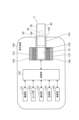
- 1 is a diagram showing a vertical cross section of a non-combustion heating type flavor inhalation article according to a first embodiment.
- 1 is a schematic diagram showing a configuration example of a suction device according to a first embodiment;
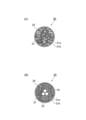
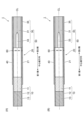
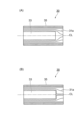
- 1A and 1B are diagrams showing a cross section of a filter part of a non-combustion heating type flavor inhalation article according to a first embodiment, in which (A) is a diagram showing an example of a cross section of part II in FIG. 1, and (B) is a diagram showing an example of a cross section of part II-II in FIG. 1.
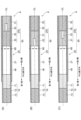
- FIGS. 1A and 1B are diagrams showing cross sections of another filter part of the non-combustion heating type flavor inhalation article according to the first embodiment, in which (A) is a cross section of part II in FIG. 1, and (B) is a diagram showing another example of a cross section of part II-II in FIG. 1.
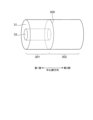
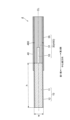
- 1 is a schematic diagram showing a filter portion of a non-combustion heating type flavor inhalation article according to a first embodiment.
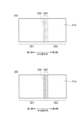
- FIG. 1A and 1B are schematic diagrams showing a sheet member before being filled into a filter portion according to a first embodiment, in which (A) shows an example of a processed sheet member, and (B) shows another example of a processed sheet member.
- 1A and 1B are schematic diagrams showing examples of processing of a sheet member before it is filled into a filter portion according to the first embodiment, in which (A) shows an example of a processed sheet member, and (B) shows an example of a different processed sheet member.
- 1A and 1B are diagrams showing longitudinal sections of a non-combustion heating type flavor inhalation article relating to another aspect of the first embodiment, in which (A) is a diagram showing a longitudinal section of a flavor inhalation article in which a filling material having a pointed second side is arranged, and (B) is a diagram showing a longitudinal section of a flavor inhalation article in which a filling material having a width that decreases from the first side to the second side is arranged.
- FIGS. 1A and 1B are diagrams showing longitudinal sections of a non-combustion heating type flavor inhalation article according to another aspect of the first embodiment, in which (A) shows a state in which a filling whose size in the center line direction is smaller than the filter is positioned within the filter, and (B) shows a state in which multiple fillings are positioned within the filter.
- FIGS. 11A and 11B are diagrams showing longitudinal sections of a non-combustion heating type flavor inhalation article according to a second embodiment, in which (A) shows a state in which a separate filter is located upstream of the filter and a filling is located upstream of the filter, (B) shows a state in which the filling is located upstream of the filter and the separate filter is located downstream of the filter, and (C) shows a state in which the filling is located downstream of the filter and the separate filter is located downstream of the filter.
- FIGS. 11A and 11B are diagrams showing longitudinal sections of a non-combustion heating type flavor inhalation article according to a third embodiment, in which (A) shows a state in which the filling is located on the first side of the aerosol modifier which is the second filling, and (B) shows a state in which the filling is located on the second side of the aerosol modifier which is the second filling.
- FIG. 13 is a diagram showing a vertical cross section of a combustion heating type flavor inhalation article according to a fourth embodiment.
- 13A and 13B are diagrams showing longitudinal sections of a combustion heating type flavor inhalation article according to another aspect of the fourth embodiment, in which (A) shows a state in which a filling is positioned in the center between the first and second sides of the filter, and (B) shows a state in which multiple fillings are arranged in the filter.
- 13A and 13B are diagrams showing longitudinal sections of a combustion heating type flavor inhalation article according to a fifth embodiment, in which (A) shows a state in which a filling is arranged on a first side within the filter, and (B) shows a state in which a filling is arranged closer to the second side within the filter.
- FIGS. 13A and 13B are diagrams showing longitudinal sections of a combustion heating type flavor inhalation article according to another aspect of the fifth embodiment, in which (A) shows a state in which the filling is located on a first side within the filter, and (B) shows a state in which the filling is located on a second side within the filter.
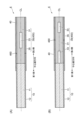
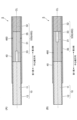
- 1A and 1B are explanatory diagrams showing schematic diagrams of vertical cross sections of a filter portion according to a first embodiment, in which (A) shows the state of a filter portion using an unprocessed sheet member, and (B) shows the state of a filter portion using a processed sheet member.
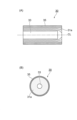
- FIGS. 1A and 1B are schematic diagrams of a filter section according to a first embodiment, in which (A) shows a longitudinal cross-sectional view of the filter section, and (B) shows a schematic diagram of the filter section shown in (A) as viewed from the downstream end side.
- Fig. 1 is a diagram showing a vertical cross section of a non-combustion heating type flavor inhalation article 1 according to the first embodiment.
- Fig. 2 is a schematic diagram showing a configuration example of an inhalation device 100 according to the first embodiment.
- the non-combustion heating type flavor inhalation article 1 (hereinafter, sometimes referred to as "flavor inhalation article 1") according to the first embodiment includes a substrate section 10, a cooling section 20, and a filter section 30.
- the mouthpiece segment 50 may be held by the user during inhalation, and includes the cooling section 20 and the filter section 30 in the example of FIG. 1.
- the substrate section 10 is formed in a cylindrical shape.
- the flavor inhalation article 1 further includes a tip paper 40 that integrates the substrate section 10, the cooling section 20, and the filter section 30 by winding them in a state in which they are arranged in this order in the center line direction.
- a tip paper 40 that integrates the substrate section 10, the cooling section 20, and the filter section 30 by winding them in a state in which they are arranged in this order in the center line direction.
- one end side in the center line direction (left side in FIG. 1) may be referred to as the first side
- the other end side in the center line direction (right side in FIG. 1) may be referred to as the second side.
- the first side is the end side inserted into the suction device 100, and is the upstream side in the flow of aerosol during inhalation.
- the second side is the opposite side to the first side, and is the end side that the user holds in the mouth for inhalation, and is the downstream side in the flow of aerosol during inhalation.
- a cross section along the center line direction is referred to as a "longitudinal cross section", and a cross section cut along a plane perpendicular to the center line direction is defined as a "transverse cross section”.
- the flavor suction article 1 is used in a non-combustion heating type suction device 100.
- the suction device 100 includes a power supply unit 111 that accumulates power and supplies power to each component of the suction device 100, a sensor unit 112 that detects various information related to the suction device 100, and a notification unit 113 that notifies a user of the information.
- the suction device 100 also includes a storage unit 114 that stores various information for the operation of the suction device 100, a communication unit 115 for transmitting and receiving information between the suction device 100 and other devices, and a control unit 116 that controls the overall operation of the suction device 100.
- the suction device 100 also includes a heating unit 121 that heats the flavor suction article 1, a holding unit 140 that holds the flavor suction article 1, an opening 142 that communicates the internal space 141 with the outside, and a heat insulating unit 144 that prevents heat transfer from the heating unit 121 to other components of the suction device 100.
- the flavor inhalation article 1 is held in the holding portion 140, and the user inhales.
- the heating unit 121 heats the base material 10 of the flavor inhalation article 1.
- the heating unit 121 is made of any material such as metal or polyimide.
- the heating unit 121 is configured in a film shape and arranged to cover the outer periphery of the holding unit 140.
- the aerosol source 11 included in the flavor inhalation article 1 is heated from the outer periphery of the flavor inhalation article 1.
- the heating unit 121 generates heat when power is supplied from the power supply unit 111.
- power may be supplied when the sensor unit 112 detects that a predetermined user input has been made.
- the user can inhale. Thereafter, when the sensor unit 112 detects that a predetermined user input has been made, power supply may be stopped. As an example of another usage form, power may be supplied and aerosol may be generated during a period in which the sensor unit 112 detects that the user has inhaled from the downstream filter unit 30.
- the insulating section 144 is arranged so as to cover at least the outer periphery of the heating section 121.
- the insulating section 144 is made of a vacuum insulating material, an aerogel insulating material, or the like.
- a vacuum insulating material is an insulating material in which, for example, glass wool and silica (silicon powder) are wrapped in a resin film and placed in a high vacuum state, thereby reducing the thermal conduction of gas to as close to zero as possible.
- the flavor inhalation article 1 is a non-combustion heating type flavor inhalation article.
- the cross section of the flavor inhalation article 1 is substantially circular, and the circumference thereof may be appropriately changed according to the size of the product, but is usually 16 mm to 27 mm, and preferably 21 mm to 23 mm. If the cross section is not circular, the circumference is assumed to be a circle having the same area as the cross section, and the circumference of the circle is applied.
- the size of the flavor inhalation article 1 in the center line direction can be appropriately changed according to the size of the product, but is usually 40 mm or more and 100 mm or less, and preferably 50 mm or more and 70 mm or less.
- Fig. 3 is a diagram showing an example of the configuration of the filter section 30 according to the first embodiment, where (A) is a diagram showing an example of a cross section of II in Fig. 1, and (B) is a diagram showing an example of a cross section of II-II in Fig. 1.
- Fig. 4 is a diagram showing another example of the configuration of the filter section 30 according to the first embodiment, where (A) is a diagram showing another example of a cross section of II in Fig. 1, and (B) is a diagram showing another example of a cross section of II-II in Fig. 1.
- Fig. 3 is a diagram showing an example of the configuration of the filter section 30 according to the first embodiment, where (A) is a diagram showing an example of a cross section of II in Fig. 1, and (B) is a diagram showing another example of a cross section of II-II in Fig. 1.
- Fig. 3 is a diagram showing an example of the configuration of the filter section 30 according to the first embodiment, where
- the filter unit 30 is formed in a columnar shape whose size in the center line direction is greater than the width of the cross section, and is therefore disposed such that the longitudinal direction of the filter unit 30 coincides with the center line direction.
- the filter unit 30 has a filter 31 through which the aerosol passes, a filler 33 that changes the flow path in the filter 31, and a wrapping paper 35 that is between the filter 31 and tipping paper 40 and is wrapped around the outer circumferential surface of the filter 31 (see FIG. 1).
- the filter unit 30 is connected (coupled) to the cooling unit 20 by winding up the cooling unit 20 and the filter unit 30 together using the tipping paper 40 (see FIG. 1).
- the wrapping paper 35 may not be provided.
- the form of the wrapping paper 35 is not particularly limited, and may include one or more rows of seams containing adhesive.
- the adhesive may include a hot melt adhesive, and the hot melt adhesive may further include polyvinyl alcohol.
- the filter portion 30 is composed of two or more members, it is preferable that the wrapping paper is wound around each of these two or more members, and then wrapped with another wrapping paper.
- the material of the wrapper 35 is not particularly limited, and any known material can be used, which may contain a filler such as calcium carbonate.
- the thickness of the wrapper 35 is not particularly limited, and is usually from 20 ⁇ m to 140 ⁇ m, preferably from 30 ⁇ m to 130 ⁇ m, and more preferably from 30 ⁇ m to 120 ⁇ m.
- the basis weight of the roll 35 is not particularly limited, and is usually from 20 gsm to 100 gsm, preferably from 22 gsm to 95 gsm, and more preferably from 23 gsm to 90 gsm.
- the air permeability of the wrapper 35 is not particularly limited, but is usually from 0 Coresta units to 30,000 Coresta units, and preferably from more than 0 Coresta units to 10,000 Coresta units. Additionally, the wrapper 35 may be either coated or uncoated, but is preferably coated with a desired material from the standpoint of imparting functions other than strength and structural rigidity.
- the cross section of the filter 31 of the filter unit 30 is substantially circular, and the circumference can be appropriately changed according to the size of the product, but can be 22 mm or more and 25 mm or less. If the cross section is not circular, the circumference is assumed to be a circle having the same area as the cross section, and the circumference of that circle is applied.
- the size of the filter portion 30 in the center line direction can be appropriately changed according to the size of the product, but is usually 5.0 mm or more and 30.0 mm or less, preferably 10.0 mm or more and 27.5 mm or less, and more preferably 15.0 mm or more and 25.0 mm or less.
- the airflow resistance per 10 mm of size in the center line direction of the filter portion 30 is not particularly limited, but is usually 0 mmH2O to 100 mmH2O , preferably 10 mmH2O to 80 mmH2O, and more preferably 10 mmH2O to 50 mmH2O .
- the airflow resistance is measured according to the ISO standard method (ISO6565) using, for example, a filter airflow resistance measuring device manufactured by Cerulean Co., Ltd.
- the airflow resistance of the filter unit 30 refers to the air pressure difference between the first side and the second side when air is allowed to flow at a predetermined air flow rate (17.5 cc/min) from the first side to the second side in a state in which air does not pass through the sides of the filter unit 30.
- the unit is generally expressed in mmH2O.
- the filter 31 is a paper filter that is filled with the sheet member 31a so as to form voids 31b along the longitudinal direction through which the aerosol can pass.
- the filter 31 is a paper filter that is filled with the sheet member 31a so as to ensure a passage path for the aerosol extending in the center line direction.
- the packing density of the sheet member 31a constituting the filter 31 is not particularly limited, but is usually 90 mg/cm 3 or more and 720 g/cm 3 or less.
- the packing density of the sheet member 31a differs depending on the presence or absence of the filler 33.
- FIG. 5 shows a schematic diagram of a region 301 in which the filler 33 is arranged on the cross section of the filter 31, a region 302 in which the filler 33 is not arranged on the cross section of the filter 31, and a boundary 300 between the region 301 and the region 302 in the filter part 30.
- the cross-sectional view of the filter part 30 in the region 301 is shown in FIG. 3(B), and the cross-sectional view of the filter part 30 in the region 302 is shown in FIG. 3(A).
- FIG. 3(B) The cross-sectional view of the filter part 30 in the region 301 is shown in FIG. 3(B), and the cross-sectional view of the filter part 30 in the region 302 is shown in FIG. 3(A).
- the packing density of the sheet member 31a in the region in which the filler 33 is not arranged is preferably 90 mg/cm 3 or more and 360 g/cm 3 or less, and more preferably 150 mg/cm 3 or more and 240 g/cm 3 or less.
- the packing density of the sheet member 31a in the region where the filler 33 is arranged is preferably 105 mg/cm3 or more and 720 g/ cm3 or less, and more preferably 170 mg/ cm3 or more and 480 g/ cm3 or less.
- the material of the sheet member 31a constituting the filter 31 is not particularly limited as long as it can realize the general function of the filter 31, but is preferably paper or nonwoven fabric such as pulp paper whose main component is pulp, and more preferably paper. Other materials such as polymer sheets and metal sheets may be used as the material of the sheet member 31a constituting the filter 31.
- the general functions of the filter 31 include, for example, adjusting the amount of air mixed in when inhaling aerosols, reducing flavors, and reducing nicotine and tar, but it is not necessary for the filter 31 to have all of these functions.
- the filter 31 is formed of a sheet member 31a that is folded, wrinkled, gathered, or the like, and is filled so as to ensure a passage path for the aerosol extending in the center line direction.
- the filter 31 is a paper filter in which the sheet member 31a is filled so as to form a gap 31b along the longitudinal direction of the filter part 30, and the sheet member 31a is gathered.
- "gathered" means that the sheet member 31a is filled in a state where it is folded back multiple times horizontally to the center line direction of the filter 31.
- the sheet member 31a constituting the filter 31 may be one sheet or two or more sheets.
- the sheet member 31a may not be folded or pleated, as long as a passageway for the aerosol extending in the center line direction is secured.
- the filter 31 may be a paper filter filled with rectangular sheet members 31a as shown in Figures 4(A) and (B).
- the sheet member 31a may be crimped as a whole to efficiently form voids 31b in the sheet member 31a.
- the crimping process is a process for forming wrinkles in a sheet.
- the sheet member 31a to be treated is passed between a pair of rollers having a plurality of convex portions on the surface, and wrinkles extending perpendicular to the conveying direction of the sheet member 31a are formed on both the front and back surfaces of the sheet member 31a, thereby performing the crimping process.
- the wrinkles formed in the sheet member 31a by the crimping process are small, e.g., 0.5 mm or less in depth, and therefore the wrinkles formed by the crimping process are omitted in the drawings in this disclosure.
- the filler 33 is disposed in the paper filter (filter 31). The filler 33 is disposed to adjust the flavor and taste, and although the placement of the filler 33 may restrict the flow path in the paper filter, it at least changes the flow path.
- Fig. 6 is a schematic diagram showing the sheet member 31a according to the first embodiment and other embodiments before it is filled into the filter unit 30, where (A) shows an example of the sheet member 31a that has been processed, and (B) shows another example of the sheet member 31a that has been processed.
- Fig. 7 is a schematic diagram showing the sheet member 31a according to the first embodiment and other embodiments before it is filled into the filter unit 30, where (A) shows an example of the sheet member 31a that has been processed, and (B) shows an example of the other sheet member 31a that has been processed.
- processing is performed at a position between the downstream end side (second side) of the filter section 30 and the filler 33.
- the processed portion of the sheet member 31a becomes softer than the unprocessed portion, so that the sheet member 31a is woven along the filler 33 to cover the filler 33, thereby suppressing the formation of holes visible from the outside.
- a "hole” refers to a recess that has a bottom
- a "hole” refers to a hole that is hollow and allows the other side to be seen.
- processing is not limited to any particular process that prevents the filler 33 from being seen from the second side of the filter section 30, and examples of such processes include crimping, half-cutting, pressing, and perforation of the sheet member 31a.
- the entire sheet member 31a is crimped, and in addition to this overall crimping process, the "crinkling” process is a process that further strengthens the crimp strength, such as by deepening the wrinkles. Therefore, when the "crinkling" process in the “processing” is performed, the sheet member 31a is composed of two regions with different crimp strengths.
- the "half-cut” process is a process that cuts the sheet member 31a halfway through its thickness.
- the “pressing line” is also called the “pressing line,” and is a linear recessed portion created in the sheet member 31a by applying pressure to the sheet member 31a with a linear pressing member.
- the “perforation” process is a process that makes holes in the sheet member 31a.
- the processing in this embodiment may be performed on the entire area of the sheet member 31a between the downstream end side (second side) of the filter part 30 and the filler 33, but it is preferable to perform the processing only on a specific elongated area perpendicular to the center line direction of the sheet member 31a, as shown in the area 305 in FIG. 6(A) or (B).
- the processed area 305 becomes softer than the unprocessed area of the sheet member 31a and can be woven, so that it can wrap around the filler 33 and make the filler 33 invisible from the downstream end side (second side) of the filter part 30.
- FIG. 16 shows a schematic diagram of a vertical section of the filter part 30. In FIG.
- FIG. 16(A) which shows a vertical section of the filter part 30 where the sheet member 31a is not processed
- the area where the sheet member 31a is not present on the second side (downstream side) of the filler 33 is formed in a funnel-like shape, and holes are likely to be formed in the filter part 30.
- FIG. 16(B) where processing has been performed, the sheet member 31a is bent along the downstream end side (second side) of the filler 33 to cover the filler 33, thereby suppressing the formation of holes at the downstream end (second side) of the filter section 30.
- 6A is near the boundary 300 (the boundary between the region 301 where the filler 33 is disposed and the region 302 where the filler 33 is not disposed) corresponding to the second side end of the filler 33, specifically, a range of 0.5 to 2 times the diameter of the filler 33 downstream from the boundary 300, for example, a range of 1 mm to 10 mm.
- 6B is a range determined in consideration of the possibility of "positional deviation" occurring when the filler 33 is placed during the manufacture of the filter part 30, and is a range of distance from the upstream side (first side) to a certain extent (for example, 0.3 to 0.7 times the diameter of the filler 33) of the second side end of the filler 33 to the downstream side of the aforementioned boundary 300.
- Specific methods of processing the region 305 in FIG. 6A or B include, in the case of crimping, deepening the groove of the roller for crimping (for example, 1.0 mm or more) or narrowing the width of the roller groove (for example, 0.8 mm or less) over the entire range of the oblique lines to provide a high crimp strength.
- the length direction of the wrinkles formed by crimping is perpendicular to the center line direction of the sheet member 31a in FIG. 6A or B so that it is easier to fold along the filling 33.
- multiple lines are formed by half-cutting or pressing over the entire region 305 in FIG. 6A or B (for example, arranging multiple lines in parallel, creating multiple lines in random directions, etc.).
- the lines formed by the half cut and the pressure line are preferably in a direction perpendicular to the center line direction of the sheet member 31a as shown in FIG. 7(A).
- multiple perforations having a diameter of 0.1 mm to 1.5 mm may be arranged in an appropriate arrangement or at random positions throughout the region 305 in FIG. 6(A) or (B).
- the perforations may be of the same size or of different sizes.
- the perforations are preferably arranged in a direction perpendicular to the center line direction of the sheet member 31a as shown in FIG. 7(B). At least one type of processing such as crimping, half cut, pressure line, and opening is performed, but multiple types of processing may be performed.
- the downstream (second) end of the filter section 30 is located at a position that is a predetermined distance or more from the downstream (second) end of the filler 33.
- This positional relationship makes it possible to suppress the formation of holes in the downstream end of the filter section 30, compared to a case in which the downstream end of the filter section 30 is located at a position that is not a predetermined distance from the end of the filler 33.
- the above-mentioned predetermined distance is preferably 1/2 ⁇ A ⁇ 3.
- A is the diameter of the outer circumferential circle of the flat surface that the filler 33 has on the downstream side.
- the shape of the flat surface is not a circle, a circle with the same area as the flat surface is assumed, and the diameter of the outer circumferential circle of the circle is set as the diameter of the outer circumferential circle.
- the filler 33 is a hollow member, the downstream end of the filler 33 does not have a flat surface and becomes a gap 31b. In that case, the diameter of the outer circumferential circle is calculated using a virtual plane formed by the downstream end of the filler.
- 1/2 ⁇ A ⁇ 3 corresponds to the height of an equilateral triangle when the triangle is created with one side being the diameter of the outer circumferential circle. The reason why 1/2 ⁇ A ⁇ 3 is preferable will be explained with reference to FIGS. FIG.
- FIG. 16 is an explanatory diagram showing a schematic diagram of a vertical cross section of the filter section 30 according to the first embodiment, in which (A) shows the filter section 30 using an unprocessed sheet member 31a, and (B) shows the filter section 30 using a processed sheet member 31a.
- 17A and 17B are schematic diagrams of another filter section 30 according to the first embodiment, in which (A) shows a longitudinal cross-sectional view of the filter section 30 and (B) shows a schematic diagram of the filter section 30 shown in FIG. 17A as viewed from the downstream end side (second side).
- the filter unit 30 is manufactured by connecting four filter units 30.
- a sheet member 31a having a size corresponding to four filters 31 is placed on a flat sheet of paper for the wrapping paper 35 having a length corresponding to four filter units 30 while crimping the sheet member 31a.
- a filler 33 is placed on the crimped sheet member 31a, and the wrapping paper 35 and the sheet member 31a are rolled up to manufacture four continuous filter units 30, and then the four filter units 30 are obtained by cutting the sheet member 31a into quarters in the length direction.
- the filter 31 has a high packing density where the filler 33 is disposed and a low packing density where it is not disposed, but as shown in Fig. 16(A) , the downstream side of the filler 33 has a funnel-like shape where the sheet member 31a is not present.
- the distance from the filler 33 to a position where the sheet member 31a is not present is close to the height (1/2 x A x ⁇ 3) of an equilateral triangle whose base is the diameter of the outer circumferential circle on the plane of the downstream end of the filler 33, so that the predetermined distance is preferably 1/2 x A x ⁇ 3, as described above. Furthermore, when the sheet member 31a is processed, as shown in FIG. 16(B), the sheet member 31a covers the filler 33 more than in FIG. 16(A), and the formation of holes in the filter portion 30 can be further suppressed.
- filter section 30 if the downstream end of filter section 30 is positioned closer to filler 33 than 1/2 ⁇ A ⁇ 3, for example, in the case of filter section 30 shown in FIG. 17(A), a hole that is not covered by the paper filter (filter 31) is formed at the downstream end of filter section 30, as shown in FIG. 17(B), so that filler 33 is visible from the outside, and further, if filler 33 is hollow, the inside of filler 33 is also visible from the outside, which is undesirable.
- the shape of the filler 33 will be described.
- the filler 33 is preferably elongated in order to be placed inside the paper filter. Shapes such as those shown in Figs. 8(A) and (B) described later are also possible, but from the viewpoint of folding the sheet member 31a along the end of the filler 33 at the position where the processing has been performed and making the filler 33 invisible from the downstream end side of the filter section 30, it is preferable that at least the portion disposed at the downstream end of the filter section 30 is flat. Both ends may be flat, as with the filler 33 in Fig. 1.
- the filler 33 may be either hollow or solid.
- the filler 33 is hollow.
- the filler 33 has at least one opening, and the opening is disposed on the downstream end side (second side) of the filter section 30.
- the filler 33 is solid from the viewpoint of adjusting the hardness of the filter section 30.
- the shape of its outer periphery can be appropriately changed according to the shape of the filter section 30, and is, for example, a circle, an ellipse, a polygon, or a polygon with rounded corners.
- the ratio of the area of the filler 33 to the area of the filter portion 30 is not particularly limited, but may be 15% or more and 50% or less, and preferably 20% or more and 40% or less.
- the ratio of the total area of the plurality of fillers 33 to the area of the filter portion 30 in one cross section is within the above range.
- the circumference can be changed as appropriate according to the size of the product, but is usually 6 mm or more and 15 mm or less, and more preferably 9 mm or more and 11 mm or less.
- the ratio of the circumference of the filler 33 to the circumference of the filter 31 is usually 0.20 or more and less than 0.70, and more preferably 0.35 or more and 0.50 or less.
- the circumference is assumed to be a circle having the same area as the cross section, and the circumference of that circle is applied.
- the filler 33 is disposed in a paper filter, an elongated shape is preferable, and the cross-sectional shape may be changed appropriately according to the shape of the product, for example, a circle, an ellipse, a polygon, or a polygon with rounded corners.
- a hollow or solid cylindrical shape is preferable from the viewpoint of the appearance of the filler 33, and a hollow body is particularly preferable.
- the filler 33 is a tube formed by winding a sheet member 31a containing the same material as the sheet member 31a constituting the filter 31 so that the cross section of a cylinder or the like is hollow.
- the filler 33 is a paper tube formed by winding paper.
- the material constituting the filler 33 can be substantially the same as that of the filter 31.
- the filler 33 is a paper tube formed by bonding a plurality of sheet members 31a including at least paper together and winding them in a spiral shape, that is, a so-called spiral paper tube.
- the method for manufacturing a spiral paper tube makes it possible to easily form a paper tube having a circular cross section.
- the strength of the filler 33 can be improved while suppressing the ratio of the area of the filler 33 to the area of the filter section 30.
- the sheet member 31a including a fragrance component, a flavor component, tobacco powder, etc. with paper, a new flavor and taste can be imparted to the aerosol.
- the filler 33 may be a paper tube formed by winding paper multiple times into a cylindrical shape, a so-called straight paper tube.
- the filler 33 may be a paper tube formed by stacking a plurality of sheet members 31a including at least paper. By stacking a plurality of sheet members 31a, the strength of the filler 33 can be maintained even when the basis weight of each of the sheet members 31a is small.
- the filler 33 is not limited to a paper tube formed by winding paper, but may be formed from a tube of synthetic resin or the like that already has a hollow cross section.
- the thickness of the filler 33 is not particularly limited, and for example, when multiple sheets are stacked, the total thickness may be 50 ⁇ m to 500 ⁇ m, or 100 ⁇ m to 250 ⁇ m. By setting the thickness in this range, deformation due to pressure from the paper filter packed around it can be suppressed.
- the filler 33 is a hollow member with a hollow cross section, but is not limited to this configuration as long as the filtration rate is lower than that of the filter 31.
- the filler 33 may be formed from a solid member with a solid cross section, such as cellulose acetate fiber, which has a lower filtration rate than paper.
- Fig. 8 is a diagram showing another example of the longitudinal section of the flavor inhalation article 1 according to the first embodiment, which is an example in which the base material 10 has a tip member 13 that prevents the aerosol source 11 from falling off from the end face on the first side of the base material 10.
- FIG. 8(A) is a diagram showing a longitudinal section of the flavor inhalation article 1 in which a filler 33 having a sharp tip on the second side is arranged
- (B) is a diagram showing a longitudinal section of the flavor inhalation article 1 in which a filler 33 having a width that decreases from the first side to the second side is arranged.
- the shape of the end of the filler 33 in the center line direction may be such that the end face on the first side of the filler 33 is flat and the end face on the second side of the filler 33 is sharp, as shown in Fig. 8(A).
- the width of the filler 33 may be relatively smaller in the second side region than in the first side region.
- FIG. 9 shows another embodiment of the filter section 30.
- FIG. 9 is a diagram showing another example of the vertical section of the flavor inhalation article 1 according to the first embodiment, and is an example in which the substrate portion 10 has a tip member 13 for preventing the aerosol source 11 from falling off from the end face on the first side of the substrate portion 10, as in FIG. 8.
- FIG. 9(A) is a diagram showing a state in which a filler 33 whose size in the center line direction is smaller than the filter 31 is located in the filter 31
- FIG. 9(B) is a diagram showing a state in which a plurality of fillers 33 are located in the filter 31.
- the position between the downstream end of the filter portion 30 and the filler 33 is determined by using the filler 33 located at the downstream end of the filter portion 30 among the fillers 33.
- the filter 31 may include a crushable additive release container (e.g., a capsule) including a crushable shell such as gelatin as the filling 33.
- a crushable additive release container e.g., a capsule
- the form of the additive release container such as a capsule is not particularly limited, and any known form may be adopted.
- a capsule when it is broken by a user before, during, or after use, it releases a liquid or substance (usually a flavoring agent) contained in the capsule, which is then carried by an aerosol during the use of the stick and diffused into the surrounding environment after use.
- the form of the capsule is not particularly limited, and may be, for example, a fragile capsule, and its shape is preferably a sphere.
- the additive contained in the capsule may contain any additive, and in particular, it is preferable to contain a flavoring agent, a taste component, or a fragrance.
- a flavoring agent may be added as an additive.
- the form of the additive is not particularly limited, and is usually a liquid or solid.
- the fragile capsule and its manufacturing method may be well known.
- the flavoring agent may be, for example, menthol, spearmint, peppermint, fenugreek, clove, medium chain triglycerides (MCT), or the like, either alone or in combination.
- the filter 31 may further contain other components, such as inorganic fine powders (kaolin, talc, diatomaceous earth, quartz, calcium carbonate, barium sulfate, titanium oxide, alumina, etc.), heat stabilizers (salts of alkali or alkaline earth metals, etc.), colorants, whiteness improvers, oils, retention improvers, sizing agents, biodegradation or photodegradation promoters (anatase-type titanium oxide, etc.), natural polymers or their derivatives (cellulose powder, etc.).
- inorganic fine powders kaolin, talc, diatomaceous earth, quartz, calcium carbonate, barium sulfate, titanium oxide, alumina, etc.
- heat stabilizers salts of alkali or alkaline earth metals, etc.
- colorants such as whiteness improvers, oils, retention improvers, sizing agents, biodegradation or photodegradation promoters (anatase-type titanium oxide, etc
- inorganic adsorbents such as activated carbon, sepiolite, palygorskite, zeolite, activated carbon fiber, activated alumina, sepiolite-mixed paper, silica gel, activated clay, vermiculite, diatomaceous earth, pulp, various fibers, and polymeric porous bodies such as ion exchange resins can be used.
- the other components can be used alone or in combination of two or more.
- the flavor inhalation article 1 further includes the tipping paper 40 that integrates the base material part 10, the cooling part 20, and the filter part 30 by winding them in a state in which they are arranged in this order in the center line direction.
- the base material part 10 will be described.
- the substrate 10 has an aerosol source 11 that generates steam that generates an aerosol when heated, and a cigarette paper 12 that covers the outer circumference of the aerosol source 11.
- the substrate 10 in FIG. 1 is an example of a substrate including an aerosol source.
- the substrate 10 is formed into a cylindrical shape by wrapping the aerosol source 11 around the cigarette paper 12.
- the aerosol source 11 may be derived from tobacco, such as a processed product in which tobacco shreds or tobacco raw materials are molded into a granular, sheet, or powder form.
- the aerosol source 11 may also include a non-tobacco-derived product made from a plant other than tobacco (e.g., mint, herbs, etc.).
- the aerosol source 11 may include a flavoring component such as menthol.
- the aerosol source 11 may include a drug for the patient to inhale.
- the aerosol source 11 is not limited to a solid, and may be a liquid such as, for example, polyhydric alcohols such as glycerin and propylene glycol, and water. At least a portion of the substrate 10 is accommodated in an internal space 141 of the holding part 140 in a state in which the flavor inhalation article 1 is held by the holding part 140 shown in FIG.
- the substrate 10, which is formed by wrapping the aerosol source 11 in wrapping paper 12, preferably has a cylindrical shape that satisfies the aspect ratio defined in formula 1 of 1 or more.
- w is the width of the cross section of the substrate 10
- h is the size of the substrate 10 in the center line direction, and it is preferable that h ⁇ w.
- the shape of the cross section is not limited and may be polygonal, rounded polygonal, circular, elliptical, etc.
- the width w is the diameter when the cross section is circular, the major axis when the cross section is elliptical, and the diameter of the circumscribed circle or the major axis of the circumscribed ellipse when the cross section is polygonal or rounded polygonal.
- the width of the aerosol source 11 constituting the substrate 10 is preferably 4 mm or more and 9 mm or less.
- the size h of the base material 10 in the center line direction can be changed as appropriate according to the size of the product, but is usually 8 mm or more, and preferably 10 mm or more.
- the size h of the base material 10 in the center line direction is usually 70 mm or less, and preferably 30 mm or less.
- the ratio of the size h of the substrate 10 to the size of the flavor inhalation article 1 is not particularly limited, but from the viewpoint of the balance between the delivery amount and the aerosol temperature, it is usually 10% or more, preferably 20% or more, more preferably 25% or more, and even more preferably 30% or more.
- the ratio of the size h of the substrate 10 to the size of the flavor inhalation article 1 is usually 80% or less, preferably 70% or less, more preferably 60% or less, even more preferably 50% or less, particularly preferably 45% or less, and most preferably 40% or less.
- the amount of the aerosol source 11 contained in the base material 10 is not particularly limited, but may be 200 mg or more and 800 mg or less, and preferably 250 mg or more and 600 mg or less. This range is particularly suitable for a base material 10 having a circumference of 22 mm and a size in the center line direction of 20 mm.
- the aerosol source 11 including tobacco shreds will be described.
- the material of the tobacco shreds contained in the aerosol source 11 is not particularly limited, and known materials such as lamina and ribs can be used.
- the aerosol source 11 may be a shredded product obtained by crushing dried tobacco leaves to have an average particle size of 20 ⁇ m to 200 ⁇ m to obtain tobacco shreds, homogenizing the shredded product, and processing it into a sheet (hereinafter, also simply referred to as a "homogenized sheet").
- the aerosol source 11 may be filled with a homogenized sheet having a size approximately equal to the size of the center line direction of the substrate 10, which is shredded approximately horizontally to the center line direction of the substrate 10, to form a so-called strand type.
- the width of the tobacco shreds is preferably 0.5 mm or more and 2.0 mm or less when filling the aerosol source 11 .
- Various types of tobacco can be used for the tobacco leaves used to make the shredded tobacco and homogenized sheets. Examples include flue-cured tobacco, burley, orient, native tobacco, other Nicotiana tabacum varieties, Nicotiana rustica varieties, and mixtures of these. Mixtures can be used by blending varieties appropriately to achieve the desired flavor. Details of tobacco varieties are disclosed in "Encyclopedia of Tobacco, Tobacco Research Center, March 31, 2009." There are several conventional methods for manufacturing homogenized sheets, that is, methods for grinding tobacco leaves and processing them into homogenized sheets. The first method is to produce a paper-making sheet using a papermaking process.
- the second method is to mix a suitable solvent such as water with ground tobacco leaves to homogenize them, and then cast the homogenized mixture thinly on a metal plate or metal plate belt and dry it to produce a cast sheet.
- the third method is to mix a suitable solvent such as water with ground tobacco leaves to homogenize them, and extrude the mixture into a sheet to produce a rolled sheet. Details of the types of homogenizing sheets are disclosed in the "Encyclopedia of Tobacco, Tobacco Research Center, March 31, 2009."
- the moisture content of the aerosol source 11 can be 10% by mass or more and 15% by mass or less, and is preferably 11% by mass or more and 13% by mass or less, based on the total amount of the aerosol source 11. Such a moisture content suppresses the occurrence of stains on the roll and improves the suitability of the base material 10 for rolling during its manufacture.
- the aerosol source 11 is not particularly limited and may contain various natural extracts and/or their components depending on the application.
- the extracts and/or their components include glycerin, propylene glycol, triacetin, 1,3-butanediol, and mixtures thereof.
- the content of the extract and/or its constituent components in aerosol source 11 is not particularly limited, and from the viewpoint of generating a sufficient aerosol and imparting a good flavor, is usually 5% by mass or more, and preferably 10% by mass or more, based on the total amount of aerosol source 11.
- the content of the extract and/or its constituent components in aerosol source 11 is usually 50% by mass or less, and preferably 15% by mass or more and 25% by mass or less.
- the aerosol source 11 may contain a flavoring.
- the type of flavoring is not particularly limited, and from the viewpoint of imparting a good flavor, menthol is particularly preferred. Moreover, these flavorings may be used alone or in combination of two or more kinds.
- the filling density of the aerosol source 11 is not particularly limited, but is usually 250 mg/ cm3 or more, preferably 300 mg/cm3 or more, from the viewpoint of ensuring the performance of the flavor inhalation article 1 and imparting a good flavor.
- the filling density of the aerosol source 11 is usually 400 mg/ cm3 or less, preferably 350 mg/ cm3 or less.
- the aerosol source 11 may be made of a tobacco sheet.
- the number of sheets of the tobacco sheet may be one, or two or more.
- a tobacco sheet having one side of the same size as the center line direction of the filling is folded back multiple times horizontally to the center line direction of the filling (so-called gathered sheet) is included.
- a tobacco sheet having one side of the same size as the center line direction of the filling is rolled up in a direction perpendicular to the center line direction of the filling is included.
- the aerosol source 11 is composed of two or more tobacco sheets, for example, multiple tobacco sheets, one side of which has a size approximately equal to the size of the center line direction of the filled material, are packed in a wound state in a direction perpendicular to the center line direction of the filled material so that they are arranged concentrically.
- Concentrically arranged means that the centers of all the tobacco sheets are arranged at approximately the same position.
- the number of tobacco sheets is not particularly limited, but examples include embodiments in which the number is 2, 3, 4, 5, 6, or 7.
- the two or more tobacco sheets may all have the same composition or physical properties, or some or all of the tobacco sheets may have different compositions or physical properties.
- the thicknesses of the tobacco sheets may be the same or different. There are no limitations on the thickness of each tobacco sheet, but in terms of the balance between heat transfer efficiency and strength, the thickness is preferably 150 ⁇ m or more and 1000 ⁇ m or less, and more preferably 200 ⁇ m or more and 600 ⁇ m or less.
- the aerosol source 11 can be manufactured by preparing a plurality of tobacco sheets of different widths, stacking them so that the width decreases from the first side to the second side to prepare a laminate, and passing the laminate through a winding tube to roll and mold it.
- a plurality of tobacco sheets extend in the center line direction and are arranged concentrically around the center line CL.
- the laminate is preferably prepared so that a non-contact portion is formed between adjacent tobacco sheets after rolling. If there are non-contact portions (gaps) between multiple tobacco sheets where the tobacco sheets are not in contact, a flavor flow path can be secured to improve the delivery efficiency of the flavor components.
- heat from the heater can be transferred to the outer tobacco sheet via the contact portion of the multiple tobacco sheets, ensuring high heat transfer efficiency.
- methods that can be used to prepare a laminate include, for example, using an embossed tobacco sheet, laminating adjacent tobacco sheets without bonding their entire surfaces together, bonding adjacent tobacco sheets together by bonding only a portion of the sheets together, or lightly bonding adjacent tobacco sheets together by bonding their entire surfaces or a portion of the sheets together so that they can be peeled off after rolling and molding.
- the wrapping paper 12 may be disposed on the end face of the first side of the laminate.
- a polyol such as glycerin, propylene glycol, or 1,3-butanediol
- the amount of polyol added to the tobacco sheet is preferably 5% by mass or more and 50% by mass or less, and more preferably 15% by mass or more and 25% by mass or less, based on the dry mass of the tobacco sheet.
- the tobacco sheet can be appropriately produced by a known method such as papermaking, slurry, rolling, etc. The above-mentioned homogenized sheet can also be used. In the case of papermaking, tobacco can be produced by a method including the following steps: 1) Dried tobacco leaves are roughly crushed and extracted with water to separate the water extract and residue. 2) The water extract is dried under reduced pressure and concentrated.
- the tobacco leaf can be produced by a method including the following steps: 1) Mixing water, pulp, and a binder with crushed tobacco leaves. 2) Spreading (casting) the mixture thinly and drying it. In this case, a step of removing some of the components such as nitrosamines by irradiating the slurry of the water, pulp, binder, and crushed tobacco leaves with ultraviolet light or X-rays may be added.
- a nonwoven tobacco sheet may be used that is manufactured by a method that includes the following steps: 1) mixing powdered tobacco leaves with a binder; 2) sandwiching the mixture between nonwoven fabrics; and 3) forming the laminate into a certain shape by heat welding to obtain a nonwoven tobacco sheet.
- the type of tobacco leaf material used in each of the above-mentioned methods can be the same as that described for the aerosol source 11 containing tobacco shreds.
- the composition of the tobacco sheet is not particularly limited, but for example, the content of the tobacco raw material (tobacco leaves) is preferably 50% by mass or more and 95% by mass or less with respect to the total mass of the tobacco sheet.
- the tobacco sheet may also contain a binder, and examples of such binders include guar gum, xanthan gum, carboxymethylcellulose, and sodium salt of carboxymethylcellulose.
- binders include guar gum, xanthan gum, carboxymethylcellulose, and sodium salt of carboxymethylcellulose.
- the amount of the binder is preferably 1% by mass or more and 10% by mass or less with respect to the total mass of the tobacco sheet.
- the tobacco sheet may further contain other additives. Examples of additives include fillers such as pulp.
- the configuration of the cigarette paper 12 used in the base material 10 is not particularly limited and may be a common embodiment, for example one containing pulp as the main component.
- the pulp may be made from wood pulp such as softwood pulp or hardwood pulp, or may be made by mixing with non-wood pulp generally used in cigarette papers 12 for tobacco products, such as flax pulp, hemp pulp, sisal pulp, or esparto.
- non-wood pulp generally used in cigarette papers 12 for tobacco products, such as flax pulp, hemp pulp, sisal pulp, or esparto.
- type of pulp chemical pulp produced by the kraft cooking method, acidic/neutral/alkaline sulfite cooking method, soda salt cooking method, etc., ground pulp, chemi-ground pulp, thermomechanical pulp, etc. can be used.
- the pulp is used in the papermaking process using a Fourdrinier papermaking machine, a cylinder papermaking machine, a combined cylinder and short-circuit papermaking machine, etc., to adjust and homogenize the texture of the wrapping paper 12.
- a wet strength agent can be added to impart water resistance to the wrapping paper 12, or a sizing agent can be added to adjust the printing condition of the wrapping paper 12.
- papermaking internal additives such as aluminum sulfate, various anionic, cationic, nonionic, or amphoteric retention improvers, drainage improvers, and paper strength enhancers, as well as papermaking additives such as dyes, pH adjusters, defoamers, pitch control agents, and slime control agents can be added.
- the basis weight of the base paper of the cigarette paper 12 is, for example, usually 20 gsm or more, preferably 25 gsm or more, whereas the basis weight is usually 65 gsm or less, preferably 50 gsm or less, more preferably 45 gsm or less.
- the thickness of the cigarette paper 12 is not particularly limited, and is usually 10 ⁇ m or more, preferably 20 ⁇ m or more, and more preferably 30 ⁇ m or more, from the viewpoints of rigidity, breathability, and ease of adjustment during papermaking.
- the thickness of the cigarette paper 12 is usually 100 ⁇ m or less, preferably 75 ⁇ m or less, and more preferably 50 ⁇ m or less.
- the shape of the wrapping paper 12 for producing the base material 10 may be, for example, a square or a rectangle.
- the length of one side can be about 12 mm to 70 mm
- the length of the other side can be 15 mm to 28 mm
- the preferred length of the other side can be 22 mm to 24 mm
- the more preferred length can be about 23 mm.
- wrapping the aerosol source 11 in the wrapping paper 12 in a cylindrical shape for example, an end of the wrapping paper 12 and an end of the wrapping paper 12 on the opposite side are overlapped by about 2 mm in the circumferential direction and glued to form a cylindrical paper tube shape in which the aerosol source 11 is filled.
- the size of the rectangular wrapping paper 12 can be determined depending on the size of the base material 10.
- a filler may be contained in the cigarette paper 12.
- the content of the filler relative to the total mass of the cigarette paper 12 can be 10% by mass or more and 60% by mass or less, and preferably 15% by mass or more and 45% by mass or less.
- the filler content is preferably 15% by mass or more and 45% by mass or less.
- the filler when the basis weight is 25 gsm or more and 35 gsm or less, the filler is preferably 15% by weight or more and 45% by weight or less, and when the basis weight is 35 gsm or more and 45 gsm or less, the filler is preferably 25% by weight or more and 45% by weight or less.
- the filler calcium carbonate, titanium dioxide, kaolin, etc. can be used, but it is preferable to use calcium carbonate from the viewpoint of enhancing flavor and whiteness.
- a water resistance improver may be added to improve water resistance.
- the water resistance improver includes a wet strength agent (WS agent) and a sizing agent.
- wet strength agent include urea formaldehyde resin, melamine formaldehyde resin, polyamide epichlorohydrin (PAE), etc.
- PAE polyamide epichlorohydrin
- sizing agent include rosin soap, alkyl ketene dimer (AKD), alkenyl succinic anhydride (ASA), highly saponified polyvinyl alcohol with a saponification degree of 90% or more, etc.
- a paper strength enhancer may be added, for example, polyacrylamide, cationic starch, oxidized starch, CMC, polyamide epichlorohydrin resin, polyvinyl alcohol, etc.
- oxidized starch improves the air permeability (JP 2017-218699 A).
- a coating agent may be added to at least one of the two surfaces of the wrapping paper 12, the front and back.
- a coating agent that can form a film on the surface of the paper and reduce liquid permeability is preferred.
- examples include alginic acid and its salts (e.g., sodium salts), polysaccharides such as pectin, cellulose derivatives such as ethyl cellulose, methyl cellulose, carboxymethyl cellulose, and nitrocellulose, starch and its derivatives (e.g., ether derivatives such as carboxymethyl starch, hydroxyalkyl starch, and cationic starch, and ester derivatives such as starch acetate, starch phosphate, and starch octenyl succinate).
- alginic acid and its salts e.g., sodium salts
- polysaccharides such as pectin
- cellulose derivatives such as ethyl cellulose, methyl cellulose, carboxymethyl cellulose, and nitrocellulose
- the cooling unit 20 is disposed adjacent to the base material 10 and the filter unit 30, and is a member formed so that the cross section of a cylinder or the like is hollow (hollow) by wrapping the sheet 21 around it.
- the cooling unit 20 cools the steam generated by heating the base material 10 to generate an aerosol.
- the cooling section 20 is a paper tube formed by winding a sheet 21 made of paper.
- the cooling section 20 is a so-called spiral paper tube, which is a paper tube formed by bonding a plurality of sheets 21 including at least paper to each other and winding them in a spiral shape.
- the spiral paper tube manufacturing method makes it possible to easily form a paper tube having a circular cross section.
- the cooling unit 20 may be a so-called straight paper tube, which is a paper tube formed by winding paper multiple times into a cylindrical shape. In the manufacturing method of a straight paper tube, the amount of glue used to attach the paper can be reduced compared to the manufacturing method of a spiral paper tube.
- the cooling section 20 may be a paper tube formed by stacking a plurality of sheets 21 including at least paper.
- the cross section of the cooling section 20 is substantially circular, and the circumference may be appropriately changed according to the size of the product, but is preferably approximately the same as the circumference of the filter 31 described below. If the cross section is not circular, the circumference is assumed to be a circle having the same area as the cross section, and the circumference of that circle is applied.
- the size of the cooling section 20 in the center line direction can be changed appropriately according to the size of the product, but is usually 5 mm or more, preferably 10 mm or more, and more preferably 15 mm or more.
- the size of the cooling section 20 in the center line direction is usually 35 mm or less, preferably 30 mm or less, and more preferably 25 mm or less.
- the thickness of the sheet 21 is not particularly limited and may be, for example, 50 ⁇ m to 500 ⁇ m, or 100 ⁇ m to 250 ⁇ m.
- the material of the sheet 21 is not particularly limited and may be, for example, a material mainly composed of pulp, or a material mainly composed of any of polyethylene, polypropylene, polyvinyl chloride, polyethylene terephthalate, polylactic acid, cellulose acetate, and aluminum foil, or any combination of these.
- the cooling section 20 is formed by rolling the sheet 21, but this is an example of a cylindrical member formed into a cylindrical shape, and is not limited to this configuration as long as the cross section is hollow.
- the cooling section 20 may be formed, for example, from a tube of synthetic resin or the like that already has a hollow cross section.
- the cooling section 20 is provided with through-holes 60 (also referred to as "ventilation filters (Vf)" in this technical field) in the circumferential direction and concentrically.
- the through-holes 60 are holes that penetrate the sheet 21. Examples of the hole shape include polygonal, rounded polygonal, circular, and elliptical.
- the through-holes 60 are present in an area where air can flow in from outside the flavor inhalation article 1, in other words, in an area that protrudes from the opening 142 when the flavor inhalation article 1 is held in the holding section 140 of the inhalation device 100.
- the presence of the through-holes 60 allows the concentration of the inhaled flavor components and aerosol to be adjusted.
- the presence of a plurality of through-holes 60 allows air to flow from the outside into the cooling section 20 during inhalation, and the temperature of the steam and air flowing in from the substrate section 10 can be lowered.
- the through-holes 60 in the cooling section 20 within a region of 4 mm or more in the direction toward the cooling section 20 from the boundary between the cooling section 20 and the filter section 30, not only can the cooling capacity be improved, but also the retention of the product (product) generated by heating in the cooling section 20 can be suppressed, thereby improving the delivery amount of the product.
- the base material 10 is heated, the vapor generated using the aerosol as a condensation nucleus is liquefied by contacting air from the outside and decreasing in temperature, thereby promoting the generation of the aerosol.
- the number of through hole groups may be one or may be two or more.
- the number of through hole groups may be one or may be two or more.
- the tipping paper 40 is preferably provided with an air hole at a position directly above the through hole 60 provided in the cooling section 20.
- the tipping paper 40 may be prepared and wound with an air hole that overlaps with the through hole 60, but from the viewpoint of ease of production, it is preferable to produce a flavor inhalation article 1 that does not have a through hole 60, and then open a hole that penetrates the cooling section 20 and the tipping paper 40 at the same time.
- the region where the through holes 60 exist is not particularly limited as long as it is a region of 4 mm or more from the boundary between the cooling section 20 and the filter section 30 toward the cooling section 20, but from the viewpoint of further improving the delivery efficiency of the product, it is preferable that it is a region of 4.5 mm or more, more preferably a region of 5 mm or more, and even more preferably a region of 5.5 mm or more. Also, from the viewpoint of ensuring the cooling function, the region where the through holes 60 exist is preferably a region of 15 mm or less from the boundary between the cooling section 20 and the filter section 30, more preferably a region of 10 mm or less, and even more preferably a region of 7 mm or less.
- the region in which the through holes 60 exist is preferably a region of 5 mm or more from the boundary between the cooling section 20 and the substrate section 10 toward the cooling section 20, more preferably a region of 10 mm or more, and even more preferably a region of 13 mm or more.
- the region in which the through holes 60 exist is preferably a region of 16 mm or less from the boundary between the cooling section 20 and the substrate section 10, more preferably a region of 15.5 mm or less, even more preferably a region of 15 mm or less, and particularly preferably a region of 14.5 mm or less.
- the through holes 60 are provided so that the air inflow rate from the through holes 60 is 10% by volume or more and 90% by volume or less when inhaled at 17.5 ml/sec by an automatic smoking machine.
- This "air inflow rate” is the volumetric rate of air inflowing from the through holes 60 when the rate of air inhaled from the mouth end is 100% by volume.
- the air inflow rate is preferably 50% by volume or more and 80% by volume or less, and more preferably 55% by volume or more and 75% by volume or less.
- These air inflow rates can be achieved, for example, by selecting the number of through holes 60 per through hole group from the range of 5 to 50, selecting the diameter of the through holes 60 from the range of 0.1 mm to 0.5 mm, and combining these selections.
- the air inflow ratio can be measured by a method conforming to ISO9512 using a winding quality measuring device (SODIMAX D74/SODIM manufactured by SAS).
- the tipping paper 40 is wrapped around the outer peripheral surfaces of the base material portion 10 , the cooling portion 20 , and the filter portion 30 .
- the shape of the tipping paper 40 is not particularly limited and can be, for example, square or rectangular.
- the basis weight of the tipping paper 40 is not particularly limited, but is usually 32 gsm or more and 60 gsm or less, preferably 33 gsm or more and 55 gsm or less, and more preferably 34 gsm or more and 53 gsm or less.
- the air permeability of the tipping paper 40 is not particularly limited, but is usually 0 Coresta units or more and 30,000 Coresta units or less, and preferably exceeds 0 Coresta units and is 10,000 Coresta units or less.
- air permeability is a value measured in accordance with ISO2965:2009, and is expressed as the flow rate ( cm3 ) of gas passing through an area of 1 cm2 per minute when the differential pressure between both sides of the paper is 1 kPa.
- 1 Coresta unit (1 Coresta unit, 1 C.U.) is cm3 /(min ⁇ cm2 ) under 1 kPa.
- the configuration of the tipping paper 40 is not particularly limited and may be a general embodiment, for example, one in which pulp is the main component.
- the pulp may be made from wood pulp such as softwood pulp or hardwood pulp, or may be made by mixing non-wood pulp generally used in cigarette papers for tobacco products, such as flax pulp, hemp pulp, sisal pulp, or esparto. These pulps may be used alone or in combination in any ratio.
- the type of pulp that can be used includes chemical pulp produced by the kraft cooking method, acidic/neutral/alkaline sulfite cooking method, soda salt cooking method, etc., ground pulp, chemi-ground pulp, thermomechanical pulp, etc.
- the tip paper 40 may be produced by the above-mentioned production method or may be a commercially available product.
- the tip paper 40 may contain fillers, for example, metal carbonates such as calcium carbonate and magnesium carbonate, metal oxides such as titanium oxide, titanium dioxide and aluminum oxide, metal sulfates such as barium sulfate and calcium sulfate, metal sulfides such as zinc sulfide, quartz, kaolin, talc, diatomaceous earth, gypsum, etc., and it is particularly preferable that the tip paper 40 contains calcium carbonate from the viewpoint of improving whiteness and opacity and increasing the heating rate.
- these fillers may be used alone or in combination of two or more types.
- the tip paper 40 may contain various auxiliary agents, for example, a water resistance improver to improve water resistance.
- Water resistance improvers include wet strength agents (WS agents) and sizing agents.
- wet strength agents include urea formaldehyde resin, melamine formaldehyde resin, polyamide epichlorohydrin (PAE), etc.
- sizing agents include rosin soap, alkyl ketene dimer (AKD), alkenyl succinic anhydride (ASA), and highly saponified polyvinyl alcohol with a saponification degree of 90% or more.
- a coating agent may be added to at least one of the two surfaces, the front surface and the back surface, of the tipping paper 40.
- the coating agent There are no particular limitations on the coating agent, but a coating agent that can form a film on the surface and reduce liquid permeability is preferred.
- a part of the outer surface of the tipping paper 40 may be covered with a lip release material.
- the lip release material means a material configured to assist in easily releasing the contact between the lips and the tipping paper 40 without substantial adhesion when the user holds the filter portion 30 of the flavor inhalation article 1 in the mouth.
- the lip release material may include, for example, ethyl cellulose, methyl cellulose, nitrocellulose, etc.
- the outer surface of the tipping paper 40 may be coated with the lip release material by applying an ethyl cellulose-based or methyl cellulose-based ink to the outer surface of the tipping paper 40.
- [Another embodiment of non-combustion heating type flavor inhalation article] 10 shows a second embodiment of the non-combustion heating type flavor inhalation article.
- another filter 32 is located upstream of the filter 31, and a filler 33 is located upstream of the filter 31, in (B), another filter 32 is located downstream of the filter 31, and a filler 33 is located upstream of the filter 31, and in (C), another filter 32 is located downstream of the filter 31, and a filler 33 is located downstream of the filter 31.
- 10 shows an example of a flavor inhalation article 2 having a tip member 13 for preventing the aerosol source 11 from falling off from the end surface on the first side of the base material 10, and further having a separate filter 32 as a filter unit 230.
- the flavor inhalation article 2 differs from the embodiment of FIG. 9 in that the filter unit 230 corresponds to the filter unit 30.
- the filter section 230 has a filter 31 which is a paper filter, a separate filter 32 which is an independent filter separate from the filter 31, a filler 33, and a wrapping paper 35 which is between the filter 31 and tipping paper 40 and which is wrapped around the outer peripheral surface of the filter 31.
- the filter section 230 is connected (coupled) to the cooling section 20 by winding the cooling section 20 and the filter section 230 together using the tipping paper 40.
- the filter 31 and the separate filter 32 are each wound with a separate wrapping paper 35, and then wound together with yet another wrapping paper 35.
- the cross section of the separate filter 32 of the filter unit 230 is substantially circular, and the circumference can be changed appropriately according to the size of the product, but can be 22 mm or more and 27 mm or less. If the cross section is not circular, the circumference is assumed to be a circle having the same area as the cross section, and the circumference of that circle is applied.
- the airflow resistance and the size in the center line direction of the filter unit 230 are the same as the airflow resistance and the size in the center line direction of the filter unit 30.
- the shapes and dimensions of the filter 31 and the separate filter 32 can be appropriately adjusted so that the shape and dimensions of the filter unit 230 are within the above ranges.
- the separate filter 32 is not particularly limited as long as it contains a filter material and has a general function of a filter.
- the general function of a filter includes, for example, adjusting the amount of air mixed when inhaling an aerosol, reducing flavor, reducing nicotine and tar, and the like, but it is not necessary for the filter to have all of these functions.
- the non-combustion heating type flavor inhalation article 1 which tends to generate fewer components and has a lower filling rate of the aerosol source 11 compared to cigarette products, one of the important functions is to prevent the aerosol source 11 from falling off while suppressing the filtering function.
- the separate filter 32 may have a lower filtering rate and a higher hardness than the filter 31.
- the filter material constituting the separate filter 32 is, for example, a filler material such as cellulose acetate fiber, nonwoven fabric, or pulp paper molded into a cylindrical shape. Alternatively, a paper filter filled with sheet-shaped pulp paper may be used.
- inorganic adsorbents such as activated carbon, sepiolite, palygorskite, zeolite, activated carbon fiber, activated alumina, sepiolite mixed paper, silica gel, activated clay, vermiculite, and diatomaceous earth, pulp, various fibers, and polymeric porous bodies such as ion exchange resins may be used.
- a crushable additive release container e.g., capsule
- a crushable outer shell such as gelatin
- the packing density of the filter 31 is not particularly limited, but is usually 90 mg/cm 3 or more and 360 mg/cm 3 or less, and preferably 150 mg/cm 3 or more and 240 mg/cm 3 or less.
- FIG. 11 shows a longitudinal section of the flavor inhalation article 3 according to the third embodiment.
- Fig. 11(A) shows a state in which the filler 33 is located on the first side of the aerosol modifier 34 which is the second filler
- Fig. 11(B) shows a state in which the filler 33 is located on the second side of the aerosol modifier 34 which is the second filler
- the second side (downstream side) end side of the filter section 330 is located at a position that is a predetermined distance or more from the end of the filler 33.
- the flavor inhalation article 3 according to the third embodiment is different from the flavor inhalation article 1 according to the first embodiment in that the filter portion 330 corresponds to the filter portion 30. The differences from the first embodiment will be described below.
- the filter section 330 has a filter 31 which is a paper filter, a filler 33 which restricts the flow path of the filter 31, an aerosol modifier 34 which modifies the aerosol, and a winding paper 35 which is present between the filter 31 and the tipping paper 40 and which is wound around the outer circumferential surface of the filter 31.
- the filter section 330 is connected (coupled) to the cooling section 20 by winding up the cooling section 20 and the filter section 330 together using the tipping paper 40.
- the winding paper 35 may not be provided.
- the aerosol modifier 34 is disposed inside the filter portion 330 . Although there are no particular limitations on the position of the aerosol modifier 34 in the vertical cross section of the filter section 330, it is preferable that the aerosol modifier 34 is arranged in a straight line in the center line direction with the filler 33. In other words, it is preferable that the aerosol modifier 34 is arranged in a straight line in the longitudinal direction of the filler 33 and the filter section 330. Specifically, the aerosol modifier 34 is preferably disposed at a position corresponding to the filler 33, such as a position on the second side (downstream side) through which the aerosol that has passed through the filler 33 passes (see FIG.
- the aerosol modifier 34 can be disposed at a position corresponding to the filler 33, the delivery efficiency of the modified aerosol can be improved. Also, as shown in FIG. 11(B), by disposing the aerosol modifier 34 on the first side (upstream side) of the filler 33 and in a straight line with the filler 33 in the center line direction, the modified aerosol can be passed through the filler 33 when inhaled.
- the aerosol modifier 34 is, for example, a destructible capsule that releases its contents, including a flavor component, when an external force is applied.
- the aerosol modifying agent 34 is preferably embedded in a position where the contents do not leak out from the first end face and the second end face of the filter 31. In other words, the aerosol modifying agent 34 is preferably disposed in a position where the diffusion of the contents is contained within the filter portion 330.
- the aerosol modifier 34 includes a content containing at least one of a taste component and a flavor component, and a capsule body that holds the content. When the aerosol modifier 34 is crushed by a user, the capsule body is broken and the content therein is released.
- To crush means, for example, to pressurize the aerosol modifier 34, which is a breakable capsule, by pressing the wrapping paper 35 and the tipping paper 40 with the thumb and index finger.
- the aerosol modifier 34 corresponds to the second filler.
- the position between the downstream end of the filter section 30 and the fillers 33, etc. is determined using the fillers 33, etc. at the downstream end of the filter section 30 and the downstream end of the filter section 30, among the fillers 33, etc. Therefore, when the aerosol modifier 34 is located closer to the downstream end of the filter section 30 than the fillers 33, the position is determined using the position of the aerosol modifier 34.
- the filter unit 230, 330 for the flavor inhalation article includes a paper filter formed of a sheet member 31a and a filler 33 that is disposed in the paper filter and changes the flow path in the paper filter, and the sheet member 31a between the downstream end of the filter unit 230, 330 and the filler 33 is processed.
- the filter unit 30 for the flavor inhalation article in which no holes are formed in the end of the filter 31.
- the non-combustion heating type flavor inhalation articles 1, 2, and 3 include a substrate 10 including at least an aerosol source 11.
- the filter section 30 includes a filter 31 which is a paper filter filled with a sheet member 31a, and a filler 33 having a filtration rate lower than that of the filter 31 together with the filter 31.
- the flavor inhalation article 1 does not need to include the cooling section 20 from the viewpoint of compacting the size in the center line direction. With these configurations, a flavor inhalation article without forming a hole at the end of the filter section 30 can be provided.
- ⁇ Combustion-type flavor inhalation article> 12 and 13 are diagrams showing a vertical cross section of a flavor inhalation article 4 according to the fourth embodiment.
- the flavor inhalation article 4 according to the fourth embodiment has a different mode of use from the flavor inhalation article 1 according to the first embodiment.
- the flavor inhalation article 4 according to the fourth embodiment is different from the flavor inhalation article 1 according to the first embodiment in a mouthpiece portion 450 corresponding to the mouthpiece segment 50 and a communication hole 460 corresponding to the through hole 60.
- the points that differ from the first embodiment will be described below.
- the same reference numerals are used for the same parts in the first embodiment and the fourth embodiment, and detailed descriptions thereof will be omitted.
- the flavor inhalation article 4 is a combustion-type flavor inhalation article. It is used by burning an end face of a first side, which is opposite to a second side, which is an end side that a user holds in his mouth for inhalation.
- the aerosol source 11 included in the base unit 10 generates steam from which an aerosol is generated by heating associated with combustion.
- the cross section of the flavor inhalation article 4 is substantially circular, and the circumference thereof may be appropriately changed according to the size of the product, but is usually 16 mm to 27 mm, and preferably 22 mm to 25 mm. When the cross section is not circular, the circumference is assumed to be a circle having the same area as the cross section, and the circumference of the circle is applied.
- the size of the flavor inhalation article 4 in the center line direction can be appropriately changed according to the size of the product, but is usually 60 mm or more and 120 mm or less, and preferably 80 mm or more and 100 mm or less.
- the mouthpiece portion 450 is composed of a filter portion 30 .
- the size of the mouthpiece portion 450 in the center line direction can be changed appropriately according to the size of the product, but is usually 20 mm or more and 40 mm or less, and preferably 25 mm or more and 30 mm or less.
- the mouthpiece portion 450 is provided with a plurality of communication holes 460 arranged circumferentially and concentrically.
- the communication holes 460 are holes that allow air flowing in from an air hole provided in the tipping paper 40 to communicate with the gap 31b in the filter 31. By adjusting the amount of air flowing in from the communication holes 460, the concentration of the aerosol inhaled by the user can be adjusted.
- the filter section 30 of the mouthpiece section 450 is configured such that the filter 31 is wrapped with the wrapping paper 35 and the tipping paper 40
- the tipping paper 40 may be wrapped so that the communication hole 460 and the air hole provided in the tipping paper 40 overlap, but from the viewpoint of ease of production, it is preferable to produce a flavor inhalation article 4 that does not have a communication hole 460, and then open a hole that penetrates the mouthpiece section 450 and the tipping paper 40 at the same time.
- the region in which the communication hole 460 exists is a region of the filter 31 in which the packing density of the sheet member 31a constituting the filter 31 is relatively low, in other words, a region of the filter 31 in which no filler 33 is arranged.
- the filler 33 smaller than the size in the center line direction of the filter 31 is located on the first side (substrate part 10 side) in the filter 31, and the communication hole 460 is provided in a region of the filter 31 where the filler 33 is not arranged.
- the communication hole 460 is provided in a downstream region with respect to the filler 33.
- the filler 33 smaller than the size in the center line direction of the filter 31 is located at the center between the first side (substrate part 10 side) and the second side in the filter 31, and the communication hole 460 is provided on the first side of the filter 31, and in FIG. 13(B), a plurality of fillers 33 are arranged in the filter 31, and specifically, the filler 33 smaller than the size in the center line direction of the filter 31 is located on the first side (substrate part 10 side) and the second side in the filter 31, and the communication hole 460 is provided between the plurality of fillers 33.
- the communication hole 460 is not limited to the above-mentioned configuration as long as it is provided in a region of the filter 31 where the filler 33 is not disposed.
- FIG. 14 and 15 are diagrams showing vertical cross sections of the flavor inhalation article 5 according to the fifth embodiment.
- Fig. 14(A) shows a state in which the filler 33 is located on a first side in the filter 31
- Fig. 14(B) shows a state in which the filler 33 is located on a second side in the filter 31.
- the flavor inhalation article 5 according to the fifth embodiment is different from the flavor inhalation article 4 according to the fourth embodiment in that it has a filter section 530 corresponding to the filter section 30.
- the differences from the fourth embodiment will be described below.
- the same reference numerals are used for the same components between the flavor inhalation article 4 and the flavor inhalation article 5, and detailed descriptions thereof will be omitted.
- the filter section 530 has a filter 31 which is a paper filter, a separate filter 32 which is an independent filter separate from the filter 31, a filler 33 having a filtration rate lower than that of the filter 31, and a winding paper 35 which is present between the filter 31 and the tipping paper 40 and is wound around the outer circumferential surface of the filter 31.
- the filter section 530 is connected (coupled) to the base material section 10 by winding the base material section 10 and the filter section 230 together using the tipping paper 40. It is preferable that the filter 31 and the separate filter 32 are each wound with a separate winding paper 35, and then wound together with another winding paper 35.
- the configuration of the separate filter 32 of the filter section 530 can be, for example, the same as the separate filter 32 included in the filter section 230 according to the second embodiment.
- the shapes and dimensions of the filter 31 and the separate filter 32 can be appropriately adjusted so that the shape and dimensions of the filter section 530 fall within the above-mentioned ranges.
- the filter section 530 has a separate filter 32 connected to the second side of the base section 10, and a filter 31 located on the second side of the separate filter 32.
- the separate filter 32 is located on the upstream side, and the filter 31 is located on the downstream side.
- a filler 33 smaller than the size of the filter 31 in the center line direction may be disposed on the first side (upstream side) of the filter 31, and a communication hole 460 may be provided in the downstream region of the filler 33.
- a filler 33 smaller than the size of the filter 31 in the center line direction may be disposed on the second side (downstream side) of the filter 31, and a communication hole 460 may be provided in the upstream region of the filler 33.
- FIG. 15 is a diagram showing a longitudinal section of another flavor inhalation article 5 according to the fifth embodiment, in which (A) shows a state in which the filler 33 is located on a first side within the filter 31, and (B) shows a state in which the filler 33 is located on a second side within the filter 31.
- the filter section 530 has a filter 31 connected to the second side of the base member 10 and another filter 32 located on the second side of the filter 31.
- the filter 31 is located on the upstream side, and the other filter 32 is located on the downstream side.
- a filler 33 smaller than the size of the filter 31 in the center line direction may be disposed on the first side (upstream side) of the filter 31, and a communication hole 460 may be provided in a downstream region with respect to the filler 33.
- a filler 33 smaller than the size of the filter 31 in the center line direction may be disposed on the second side (downstream side) of the filter 31, and a communication hole 460 may be provided in an upstream region with respect to the filler 33.
- the combustion type flavor inhalation articles 4 and 5 described above comprise a base member 10 including at least an aerosol source 11, a filter member 30, 530 through which the aerosol passes, and a tipping paper 40 wound around the outer circumferential surfaces of the base member 10 and the filter member 30, 530.
- a base member 10 including at least an aerosol source 11, a filter member 30, 530 through which the aerosol passes, and a tipping paper 40 wound around the outer circumferential surfaces of the base member 10 and the filter member 30, 530.
- the filter member 30, 530 for the flavor inhalation article comprises a paper filter formed from a sheet member 31a and a filler 33 that is disposed within the paper filter and changes the flow path within the paper filter, and the sheet member 31a between the downstream end of the filter member 30, 530 and the filler 33 is processed, and this configuration makes it possible to provide a filter member for a flavor inhalation article that does not form a hole in the filter end.
- a filter section for a flavor inhalation article comprising: a paper filter formed from a sheet member; and a filler disposed within the paper filter to change a flow path within the paper filter, wherein the sheet member between a downstream end of the filter section and the filler is processed.
- the filter section for a flavor inhalation article described in (1) wherein the filling is a hollow body having at least one opening, and the opening is disposed on the downstream end side of the filter section.
- a flavor inhalation article comprising a filter portion for a flavor inhalation article according to any one of (1) to (7) and a substrate portion including an aerosol source.
- the flavor inhalation article according to (8) which is a non-combustion heating type flavor inhalation article.
Landscapes
- Cigarettes, Filters, And Manufacturing Of Filters (AREA)
Priority Applications (4)
| Application Number | Priority Date | Filing Date | Title |
|---|---|---|---|
| PCT/JP2023/029661 WO2025037415A1 (ja) | 2023-08-17 | 2023-08-17 | 香味吸引物品用のフィルタ部及び香味吸引物品 |
| CN202380101020.5A CN121666179A (zh) | 2023-08-17 | 2023-08-17 | 用于风味吸入制品的过滤器部件、以及风味吸入制品 |
| KR1020267004166A KR20260035271A (ko) | 2023-08-17 | 2023-08-17 | 향미 흡인 물품용 필터부 및 향미 흡인 물품 |
| JP2025540583A JPWO2025037415A1 (https=) | 2023-08-17 | 2023-08-17 |
Applications Claiming Priority (1)
| Application Number | Priority Date | Filing Date | Title |
|---|---|---|---|
| PCT/JP2023/029661 WO2025037415A1 (ja) | 2023-08-17 | 2023-08-17 | 香味吸引物品用のフィルタ部及び香味吸引物品 |
Publications (1)
| Publication Number | Publication Date |
|---|---|
| WO2025037415A1 true WO2025037415A1 (ja) | 2025-02-20 |
Family
ID=94632855
Family Applications (1)
| Application Number | Title | Priority Date | Filing Date |
|---|---|---|---|
| PCT/JP2023/029661 Pending WO2025037415A1 (ja) | 2023-08-17 | 2023-08-17 | 香味吸引物品用のフィルタ部及び香味吸引物品 |
Country Status (4)
| Country | Link |
|---|---|
| JP (1) | JPWO2025037415A1 (https=) |
| KR (1) | KR20260035271A (https=) |
| CN (1) | CN121666179A (https=) |
| WO (1) | WO2025037415A1 (https=) |
Citations (9)
| Publication number | Priority date | Publication date | Assignee | Title |
|---|---|---|---|---|
| JPS592678A (ja) * | 1982-06-24 | 1984-01-09 | ブラウン・アンド・ウイリアムソン・タバコ・コ−ポレ−シヨン | シガレツトフイルタ |
| JPH01108968A (ja) * | 1987-09-17 | 1989-04-26 | Rothmans Internatl Tabacco Uk Ltd | 巻きタバコ用フィルターロッド |
| JPH11127835A (ja) * | 1997-10-30 | 1999-05-18 | Minoru Tsuchiya | たばこのフイルター |
| JP2004510422A (ja) | 2000-10-05 | 2004-04-08 | バスケヴィッチ ニコラス | タバコおよびタバコ製品中のニトロソアミン削減 |
| JP2014509872A (ja) | 2011-04-08 | 2014-04-24 | アール・ジエイ・レイノルズ・タバコ・カンパニー | フィルタ内に管状要素を含むフィルタ付シガレット |
| WO2014104078A1 (ja) | 2012-12-28 | 2014-07-03 | 日本たばこ産業株式会社 | 非燃焼吸引型たばこ製品用香味源及び非燃焼吸引型たばこ製品 |
| JP2017218699A (ja) | 2016-06-09 | 2017-12-14 | 日本製紙パピリア株式会社 | 喫煙物品用巻紙 |
| WO2021176527A1 (ja) * | 2020-03-02 | 2021-09-10 | 日本たばこ産業株式会社 | フィルタ、喫煙物品、及び、香味吸引物品 |
| WO2022195273A1 (en) * | 2021-03-15 | 2022-09-22 | Nicoventures Trading Limited | A component for an article for use in an aerosol provision system |
-
2023
- 2023-08-17 KR KR1020267004166A patent/KR20260035271A/ko active Pending
- 2023-08-17 WO PCT/JP2023/029661 patent/WO2025037415A1/ja active Pending
- 2023-08-17 CN CN202380101020.5A patent/CN121666179A/zh active Pending
- 2023-08-17 JP JP2025540583A patent/JPWO2025037415A1/ja active Pending
Patent Citations (9)
| Publication number | Priority date | Publication date | Assignee | Title |
|---|---|---|---|---|
| JPS592678A (ja) * | 1982-06-24 | 1984-01-09 | ブラウン・アンド・ウイリアムソン・タバコ・コ−ポレ−シヨン | シガレツトフイルタ |
| JPH01108968A (ja) * | 1987-09-17 | 1989-04-26 | Rothmans Internatl Tabacco Uk Ltd | 巻きタバコ用フィルターロッド |
| JPH11127835A (ja) * | 1997-10-30 | 1999-05-18 | Minoru Tsuchiya | たばこのフイルター |
| JP2004510422A (ja) | 2000-10-05 | 2004-04-08 | バスケヴィッチ ニコラス | タバコおよびタバコ製品中のニトロソアミン削減 |
| JP2014509872A (ja) | 2011-04-08 | 2014-04-24 | アール・ジエイ・レイノルズ・タバコ・カンパニー | フィルタ内に管状要素を含むフィルタ付シガレット |
| WO2014104078A1 (ja) | 2012-12-28 | 2014-07-03 | 日本たばこ産業株式会社 | 非燃焼吸引型たばこ製品用香味源及び非燃焼吸引型たばこ製品 |
| JP2017218699A (ja) | 2016-06-09 | 2017-12-14 | 日本製紙パピリア株式会社 | 喫煙物品用巻紙 |
| WO2021176527A1 (ja) * | 2020-03-02 | 2021-09-10 | 日本たばこ産業株式会社 | フィルタ、喫煙物品、及び、香味吸引物品 |
| WO2022195273A1 (en) * | 2021-03-15 | 2022-09-22 | Nicoventures Trading Limited | A component for an article for use in an aerosol provision system |
Non-Patent Citations (1)
| Title |
|---|
| "Encyclopedia of Tobacco, Tobacco Academic Studies Center", 31 March 2009 |
Also Published As
| Publication number | Publication date |
|---|---|
| KR20260035271A (ko) | 2026-03-12 |
| CN121666179A (zh) | 2026-03-13 |
| JPWO2025037415A1 (https=) | 2025-02-20 |
Similar Documents
| Publication | Publication Date | Title |
|---|---|---|
| JP7661484B2 (ja) | 非燃焼加熱式たばこ及び電気加熱式たばこ製品 | |
| JP7789085B2 (ja) | 非燃焼加熱型スティック | |
| WO2022230865A1 (ja) | 非燃焼加熱型香味吸引器用たばこシート、非燃焼加熱型香味吸引器、及び非燃焼加熱型香味吸引システム | |
| WO2024142168A1 (ja) | 香味吸引物品用のフィルタ部および香味吸引物品 | |
| WO2025037415A1 (ja) | 香味吸引物品用のフィルタ部及び香味吸引物品 | |
| WO2025037414A1 (ja) | 香味吸引物品用のフィルタ部及び香味吸引物品 | |
| WO2024142167A1 (ja) | 香味吸引物品用のフィルタ部および香味吸引物品 | |
| JP7719208B2 (ja) | 非燃焼加熱型スティック、吸引システム | |
| WO2024142464A1 (ja) | 香味吸引物品用のフィルタ部及び香味吸引物品 | |
| KR20260056214A (ko) | 향미 흡입 물품을 위한 필터 부분, 및 향미 흡입 물품 | |
| WO2025186899A1 (ja) | 香味吸引物品 | |
| WO2024142166A1 (ja) | 香味吸引物品 | |
| WO2025186900A1 (ja) | 香味吸引物品 | |
| JP2025135177A (ja) | 香味吸引物品 | |
| JP7756722B2 (ja) | 非燃焼加熱型スティック | |
| WO2025037416A1 (ja) | 香味吸引物品 | |
| KR20260041137A (ko) | 향미 생성 물품 | |
| WO2025052625A1 (ja) | 香味発生物品 | |
| WO2025052617A1 (ja) | 香味発生物品 | |
| JP2025135077A (ja) | 香味発生物品 | |
| WO2025126308A1 (ja) | 香味発生物品 | |
| WO2023112154A1 (ja) | 非燃焼加熱型スティック | |
| WO2025052618A1 (ja) | 香味発生物品及び喫煙システム | |
| WO2025243507A1 (ja) | 香味発生物品および香味発生システム | |
| WO2025126307A1 (ja) | 香味発生システム |
Legal Events
| Date | Code | Title | Description |
|---|---|---|---|
| 121 | Ep: the epo has been informed by wipo that ep was designated in this application |
Ref document number: 23949183 Country of ref document: EP Kind code of ref document: A1 |
|
| ENP | Entry into the national phase |
Ref document number: 2025540583 Country of ref document: JP Kind code of ref document: A |
|
| WWE | Wipo information: entry into national phase |
Ref document number: 2025540583 Country of ref document: JP |
|
| ENP | Entry into the national phase |
Ref document number: 1020267004166 Country of ref document: KR Free format text: ST27 STATUS EVENT CODE: A-0-1-A10-A15-NAP-PA0105 (AS PROVIDED BY THE NATIONAL OFFICE) |
|
| WWE | Wipo information: entry into national phase |
Ref document number: 1020267004166 Country of ref document: KR |
|
| WWP | Wipo information: published in national office |
Ref document number: 1020267004166 Country of ref document: KR |
|
| WWE | Wipo information: entry into national phase |
Ref document number: 2023949183 Country of ref document: EP |
|
| NENP | Non-entry into the national phase |
Ref country code: DE |