WO2025018380A1 - 麦芽穀皮加工品及びその製造方法 - Google Patents
麦芽穀皮加工品及びその製造方法 Download PDFInfo
- Publication number
- WO2025018380A1 WO2025018380A1 PCT/JP2024/025756 JP2024025756W WO2025018380A1 WO 2025018380 A1 WO2025018380 A1 WO 2025018380A1 JP 2024025756 W JP2024025756 W JP 2024025756W WO 2025018380 A1 WO2025018380 A1 WO 2025018380A1
- Authority
- WO
- WIPO (PCT)
- Prior art keywords
- malt
- processed product
- husk
- malt husk
- raw material
- Prior art date
- Legal status (The legal status is an assumption and is not a legal conclusion. Google has not performed a legal analysis and makes no representation as to the accuracy of the status listed.)
- Ceased
Links
Images
Classifications
-
- A—HUMAN NECESSITIES
- A23—FOODS OR FOODSTUFFS; TREATMENT THEREOF, NOT COVERED BY OTHER CLASSES
- A23L—FOODS, FOODSTUFFS OR NON-ALCOHOLIC BEVERAGES, NOT OTHERWISE PROVIDED FOR; PREPARATION OR TREATMENT THEREOF
- A23L2/00—Non-alcoholic beverages; Dry compositions or concentrates therefor; Preparation or treatment thereof
- A23L2/38—Other non-alcoholic beverages
-
- A—HUMAN NECESSITIES
- A23—FOODS OR FOODSTUFFS; TREATMENT THEREOF, NOT COVERED BY OTHER CLASSES
- A23L—FOODS, FOODSTUFFS OR NON-ALCOHOLIC BEVERAGES, NOT OTHERWISE PROVIDED FOR; PREPARATION OR TREATMENT THEREOF
- A23L2/00—Non-alcoholic beverages; Dry compositions or concentrates therefor; Preparation or treatment thereof
- A23L2/52—Adding ingredients
- A23L2/56—Flavouring or bittering agents
-
- A—HUMAN NECESSITIES
- A23—FOODS OR FOODSTUFFS; TREATMENT THEREOF, NOT COVERED BY OTHER CLASSES
- A23L—FOODS, FOODSTUFFS OR NON-ALCOHOLIC BEVERAGES, NOT OTHERWISE PROVIDED FOR; PREPARATION OR TREATMENT THEREOF
- A23L7/00—Cereal-derived products; Malt products; Preparation or treatment thereof
- A23L7/10—Cereal-derived products
-
- C—CHEMISTRY; METALLURGY
- C12—BIOCHEMISTRY; BEER; SPIRITS; WINE; VINEGAR; MICROBIOLOGY; ENZYMOLOGY; MUTATION OR GENETIC ENGINEERING
- C12C—BEER; PREPARATION OF BEER BY FERMENTATION; PREPARATION OF MALT FOR MAKING BEER; PREPARATION OF HOPS FOR MAKING BEER
- C12C1/00—Preparation of malt
- C12C1/16—After-treatment of malt, e.g. malt cleaning, detachment of the germ
-
- C—CHEMISTRY; METALLURGY
- C12—BIOCHEMISTRY; BEER; SPIRITS; WINE; VINEGAR; MICROBIOLOGY; ENZYMOLOGY; MUTATION OR GENETIC ENGINEERING
- C12C—BEER; PREPARATION OF BEER BY FERMENTATION; PREPARATION OF MALT FOR MAKING BEER; PREPARATION OF HOPS FOR MAKING BEER
- C12C5/00—Other raw materials for the preparation of beer
- C12C5/02—Additives for beer
-
- C—CHEMISTRY; METALLURGY
- C12—BIOCHEMISTRY; BEER; SPIRITS; WINE; VINEGAR; MICROBIOLOGY; ENZYMOLOGY; MUTATION OR GENETIC ENGINEERING
- C12C—BEER; PREPARATION OF BEER BY FERMENTATION; PREPARATION OF MALT FOR MAKING BEER; PREPARATION OF HOPS FOR MAKING BEER
- C12C7/00—Preparation of wort
-
- C—CHEMISTRY; METALLURGY
- C12—BIOCHEMISTRY; BEER; SPIRITS; WINE; VINEGAR; MICROBIOLOGY; ENZYMOLOGY; MUTATION OR GENETIC ENGINEERING
- C12G—WINE; PREPARATION THEREOF; ALCOHOLIC BEVERAGES; PREPARATION OF ALCOHOLIC BEVERAGES NOT PROVIDED FOR IN SUBCLASSES C12C OR C12H
- C12G3/00—Preparation of other alcoholic beverages
- C12G3/04—Preparation of other alcoholic beverages by mixing, e.g. for preparation of liqueurs
- C12G3/06—Preparation of other alcoholic beverages by mixing, e.g. for preparation of liqueurs with flavouring ingredients
Definitions
- the present invention relates to a malt husk processed product and a method for producing the same.
- the present invention also relates to a method for producing food and beverage products.
- the present invention further relates to beer-flavored beverages, etc.
- Methods for achieving new flavors in food and beverages include (1) selecting new ingredients, (2) using additives, and (3) processing existing ingredients with new processing methods.
- the characteristics of the food and beverage must be considered when deciding which of these methods to use.
- the ingredients and additives that can be used in the production of beer and other alcoholic beverages are restricted by the Liquor Tax Act, so there are limitations to the development of new ingredients. For this reason, there has been a demand for the development of technology that can impart new flavors to the ingredients themselves.
- Patent Document 1 discloses a method for manufacturing malt husk processed products in which malt husks are treated with a fluid at 160 to 220°C under a low oxygen concentration.
- Patent Document 1 describes that by using a malt husk processed product obtained by treating malt husks with the above-mentioned fluid as a raw material, it is possible to impart richness and other properties to a fermented malt beverage.
- the malt husk processed product of Patent Document 1 leaves room for improvement so that it can more effectively impart richness of flavor and a stimulating sensation (e.g., a refreshing stimulating sensation) to foods and beverages.
- Patent Document 1 does not describe treating a fraction containing malt husks separated by milling malt to a specific range of milling accuracy with high-temperature, high-pressure gas.
- the present invention aims to provide a malt husk processed product that is highly effective in imparting richness of flavor and a stimulating sensation to food and beverages, and a method for producing the same.
- the present invention also aims to provide food and beverages that use the malt husk processed product as a raw material.
- a malt husk-containing raw material which includes a fraction containing malt husks separated by milling malt to a milling accuracy of 70-99%
- a gas containing water vapor at a temperature of 120°C to 250°C and a pressure of 0.2 to 4.0 MPa
- a stimulating sensation e.g., a refreshing stimulating sensation
- the present invention relates to a method for producing a malt husk processed product, a method for producing a food or drink, a beer-taste beverage, a malt husk processed product, etc.
- a method for producing a malt husk processed product comprising a step of treating a malt husk-containing raw material with a gas containing water vapor at a temperature of 120 to 250°C and a pressure of 0.2 to 4.0 MPa, wherein the malt husk-containing raw material is a malt husk-containing raw material containing a fraction separated by polishing malt to a husk precision of 70 to 99%.
- [10] A method for producing a food or drink, using a malt husk processed product obtained by the production method according to any one of [1] to [9] above as a raw material.
- [12] A food or beverage produced by the production method described in [10] or [11] above.
- [13] A beer-flavored beverage produced by the production method described in [10] or [11] above.
- [14] A method for enhancing the richness of flavor and the stimulating sensation of a beer-taste beverage, using as a raw material a malt husk processed product obtained by the production method described in any one of [1] to [9] above.
- [15] Use of a malt husk processed product obtained by the manufacturing method described in any one of [1] to [9] above for enhancing the richness of flavor and the stimulating sensation of a beer-flavored beverage.
- the present invention it is possible to provide a malt husk processed product that is highly effective in imparting richness of flavor and a stimulating sensation to food and beverages, and a method for producing the same. Furthermore, according to the present invention, it is possible to provide food and beverages that use the above-mentioned malt husk processed product as a raw material.
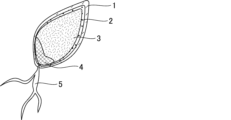
- FIG. 1 is a schematic diagram showing a cross-section of the tissue of dry germinated barley.
- the method for producing a malt husk processed product of the present invention includes a step of treating a malt husk-containing raw material with a steam-containing gas having a temperature of 120° C. to 250° C. and a pressure of 0.2 to 4.0 MPa.
- the malt husk-containing raw material is a malt husk-containing raw material that includes a fraction containing malt husk separated by polishing malt to a husk precision of 70 to 99%.
- the treatment with a gas containing water vapor is also referred to as a high-temperature, high-pressure treatment.
- the method for producing a malt husk processed product of the present invention may include a step other than the step of treating with a gas containing water vapor (also referred to as a high-temperature, high-pressure treatment step).
- a gas containing water vapor also referred to as a high-temperature, high-pressure treatment step.
- a fraction containing malt husks separated by polishing malt to a husk degree of 70 to 99% is also referred to as a husk-containing fraction.
- the husk-containing fraction can be prepared by milling malt to a milling degree of 70 to 99%.
- malt examples include malt of barley, wheat, and other malts, and preferably barley malt.
- the malt husk-containing raw material preferably contains a fraction containing malt husks separated by milling barley malt to a milling degree of 70 to 99%.
- malt refers to whole grain malt unless otherwise specified.
- Malt can be produced by a commonly used method.
- dried germinated barley can be obtained by soaking barley in water to germinate, and then drying.
- the dried germinated barley obtained in this way consists of malt (whole grain malt) and malt rootlets.
- Malt can be obtained by removing the malt rootlets from the dried germinated barley.
- FIG 1 is a schematic diagram showing the cross-section of the tissue of dried germinated barley.
- dried germinated barley is composed of the husk 1, the endodermis layer 2, the endosperm 3, the young shoot 4, and the malt rootlet 5. It is known that the content of starch, protein components, enzymes, and other components varies depending on each of these tissue parts.
- the husk is the outermost layer (husk) of the malt.
- the endodermis layer is also called the aleurone layer.
- Milling refers to polishing the surface layer of malt to separate malt husks and the like from the endosperm. Milling can be carried out using a milling machine. By milling malt, it is possible to separate it into an endosperm fraction, which is the kernel, and a fraction containing the malt husks, which is the surrounding part.
- the fraction containing malt husks is also called bran or malt bran.
- the fraction containing malt husks separated from the endosperm is used as the malt husk-containing raw material.
- Pounding precision refers to the degree to which bran, including husks, is removed from the malt. If 1% by weight of the malt's weight is removed of bran, including husks, the pounding precision is 99%. Pounding precision is also called the milling yield.
- the malt husk-containing raw material includes a fraction containing malt husks, which is obtained by milling malt to a milling degree of 70 to 99% and separating it from the endosperm portion.
- the milling degree is preferably 75% or more, more preferably 78% or more, even more preferably 80% or more, particularly preferably 83% by weight or more, and preferably 97% or less, more preferably 95% or less, and even more preferably 93% or less.
- the milling degree is preferably 75 to 99%, more preferably 75 to 97%, even more preferably 75 to 95%, even more preferably 78 to 95%, particularly preferably 80 to 95%, particularly preferably 80 to 93%, and most preferably 83 to 93% by weight.
- the fraction containing malt husks which is obtained by milling malt to a milling degree within the above range, for the high-temperature, high-pressure treatment.
- the husk-containing fraction can be preferably used as the malt husk-containing raw material.
- the husk-containing fraction may also be mixed with malt husk or endothelium separated from the endosperm in any ratio and used as the malt husk-containing raw material.
- the malt husk-containing raw material is preferably made of a raw material derived from malt.
- the malt is preferably barley malt.
- the content of the husk-containing fraction in the malt husk-containing raw material is not particularly limited, but is preferably 90 to 100% by weight, more preferably 95 to 100% by weight.
- the malt husk-containing raw material is a fraction containing malt husk (husk-containing fraction) obtained by polishing malt to a husk degree of 70 to 99% and separating it from the endosperm portion.
- the husk-containing fraction contains, in addition to malt husks, a portion of the endothelial layer and a portion of the endosperm.
- the malt husk-containing raw material preferably has a malt husk content of 20% by weight or more, and preferably 99.9% by weight or less.
- the malt husk content in the malt husk-containing raw material is preferably 20 to 99% by weight, more preferably 23 to 99% by weight, even more preferably 25 to 99% by weight, even more preferably 25 to 75% by weight, and particularly preferably 25 to 72% by weight.
- the malt husk content can be determined by separating the malt husks contained in the malt husk-containing raw material from the other fractions and measuring the weight of the malt husks.
- a gas containing water vapor is used.
- the gas containing water vapor include the vapor of a liquid containing water, and for example, water vapor and the vapor of an alcohol aqueous solution are preferred.
- the gas containing water vapor is more preferably water vapor, and even more preferably saturated water vapor.
- the high-temperature, high-pressure treatment is preferably carried out under a low oxygen concentration, for example, under an oxygen concentration of 0 to 1 ⁇ g/mL.
- the gas containing water vapor preferably has a low oxygen concentration, for example, an oxygen concentration of 0 to 1 ⁇ g/mL.
- the oxygen concentration of the gas can be reduced using known means.
- the above-mentioned low-oxygen state can be achieved by using the steam of a degassed water-containing liquid (preferably water) as the water vapor-containing gas used in the high-temperature, high-pressure treatment.
- a gas to which a substance capable of removing oxygen has been added in advance can also be used.
- the above-mentioned low-oxygen state can also be achieved by replacing the treatment atmosphere with a gas having an oxygen concentration of about 0 to 1 ⁇ g/mL before the above treatment.
- the gas having an oxygen concentration of about 0 to 1 ⁇ g/mL is not particularly limited, but is preferably an inert gas such as nitrogen, carbon dioxide, or a deoxygenated gas.
- the deoxygenated gas include a gas obtained by boiling a deaerated liquid.
- the oxygen concentration during the high-temperature, high-pressure treatment can be measured by a known method, for example, by a normal dissolved oxygen meter (DO meter).
- the gas used in the high-temperature, high-pressure treatment is a gas containing water vapor with a temperature of 120 to 250°C and a pressure of 0.2 to 4.0 MPa.
- the temperature and pressure of the gas containing water vapor are within the above ranges, components that impart richness of flavor and a stimulating sensation (for example, a refreshing stimulating sensation) to the malt husk-containing raw material can be efficiently produced.
- a reaction such as the Maillard reaction occurs efficiently.
- the reaction can be easily controlled, and a processed product with little burnt odor associated with high-temperature, high-pressure treatment can be obtained.
- the temperature of the gas is preferably 140° C. or higher, more preferably 150° C.
- the temperature of the gas containing water vapor is preferably 140 to 240° C., more preferably 150 to 230° C., even more preferably 160 to 220° C., even more preferably 170 to 210° C., particularly preferably 180 to 205° C., and most preferably 190 to 205° C.
- the pressure of the gas containing water vapor is preferably set in the range of 0.2 to 4.0 MPa depending on the temperature.
- the gas pressure means the gauge pressure.
- the temperature and pressure are preferably 140 to 240°C and 0.25 to 3.3 MPa, more preferably 150 to 230°C and 0.49 to 3.00 MPa, even more preferably 160 to 220°C and 0.64 to 2.48 MPa, still more preferably 170 to 210°C and 0.82 to 2.03 MPa, particularly preferably 180 to 205°C and 1.05 to 1.83 MPa, and most preferably 190 to 205°C and 1.32 to 1.83 MPa.
- the high-temperature, high-pressure treatment can be carried out by contacting the malt husk-containing raw material with the above-mentioned gas containing water vapor.
- the time for the treatment with the gas containing water vapor can be appropriately set depending on the temperature and pressure of the gas.
- the treatment time is preferably 10 seconds or more, preferably 30 seconds or more, more preferably 1 minute or more, and preferably 120 minutes or less, more preferably 10 minutes or less, and even more preferably 5 minutes or less.
- the treatment time is preferably 10 seconds to 120 minutes, more preferably 30 seconds to 120 minutes, even more preferably 30 seconds to 10 minutes, particularly preferably 30 seconds to 5 minutes, and most preferably 1 to 5 minutes.
- the treatment time is the time from when the temperature in the container or device containing the malt husk-containing raw material reaches the temperature of the gas used for treatment.
- the device used for the high-temperature, high-pressure treatment is not particularly limited, and any device can be used as long as it has a structure that can withstand the above temperatures and pressures.
- the device can be a device that combines a pressure-resistant reaction vessel with a heating device. In such a device, a liquid or gas is heated by the heating device and sent to the reaction vessel as a high-temperature, high-pressure gas. Any heating device can be used as long as it can heat.
- the device can also be a simple heat-resistant, pressure-resistant pipe.
- the material of the reaction vessel or pipe may be heat-resistant and pressure-resistant, but it is preferable that it is not a material that dissolves metal components, generates toxic substances, or produces unpleasant odors.
- the material is preferably, but is not limited to, stainless steel.
- an extruder can be used as an apparatus for efficiently carrying out the present invention. This makes the operation after the above-mentioned processing very easy. In addition, since continuous processing is possible, the use of an extruder is also suitable for supplying a large amount of processed products.
- An extruder is a processing method often used in the production of puffed foods, etc., and an example of an extruder is an apparatus in which raw materials are mixed and heated and pressurized by a multi-axis screw such as a twin-axis screw or a single-axis screw arranged in an extrusion tube, and extruded from a die under high temperature and high pressure conditions.
- a twin-axis type is more preferable because it can perform high-temperature and high-pressure processing stably.
- continuous processing is possible, and if the processing atmosphere is suddenly released from high pressure to low pressure after processing, moisture will evaporate, and by appropriately selecting the shape of the die, a processed product molded into a desired shape can be obtained.
- the processed product is expanded, and when the processed product is dissolved in a liquid such as water, the processed product is easily dissolved in the liquid. Any apparatus other than these apparatuses can be used as long as it can realize the above conditions of the present invention.
- the method for producing a malt husk processed product of the present invention may include a step other than the high-temperature, high-pressure treatment step.
- a drying step may be performed after the high-temperature, high-pressure treatment.
- the method for producing a malt husk processed product of the present invention preferably includes a drying step. If the product is left as is after the high-temperature, high-pressure treatment, the starch may gelatinize and become hard when cooled. For this reason, for example, labor may be required when crushing the malt husk processed product. By performing the drying step, the subsequent crushing and dissolution of the malt husk processed product becomes easier.
- the method for drying the malt husk processed product is not particularly limited, and for example, a method such as vacuum drying may be adopted.
- the method for producing a malt husk processed product of the present invention may include, for example, a step of preparing malt (malting step) and a step of polishing the malt to prepare a malt husk-containing raw material.
- a malt husk processed product can be obtained by treating the above-mentioned malt husk-containing raw material at high temperature and high pressure.
- the malt husk processed product obtained by the manufacturing method of the present invention is also one aspect of the present invention.
- the malt husk processed product of the present invention obtained by the manufacturing method of the present invention is highly effective in imparting depth of flavor and a stimulating sensation to food and beverages.
- the malt husk processed product obtained by the manufacturing method of the present invention is used, for example, in the manufacture of a beer-taste beverage, it can impart a beer-like stimulating sensation to the resulting beer-taste beverage in addition to a depth of flavor.
- the malt husk processed product obtained by the manufacturing method of the present invention can be preferably used as a raw material for a beer-taste beverage. Depth of flavor refers to fullness, depth of flavor, etc.
- the malt husk-containing raw material used in the present invention includes malt husk, endodermis and endosperm.
- the main components of malt husk are lignin, cellulose and hemicellulose.
- the endodermis contains a lot of protein and amino acids.
- the main components of endosperm are starch and protein.
- the malt husk processed product obtained by the production method of the present invention usually contains at least one compound selected from the group consisting of furaneol, 2-methoxy-4-vinylphenol (4-vinylguaiacol) and 2-methylpyrazine.
- the malt husk processed product preferably contains furaneol, 2-methoxy-4-vinylphenol and 2-methylpyrazine.
- Furaneol is a component with a sweet aroma reminiscent of cotton candy.
- Furaneol is known to be produced by the Maillard reaction.
- 2-Methoxy-4-vinylphenol is a component with a smoky aroma.
- 2-Methylpyrazine is a component with a nutty, fragrant aroma.
- the malt husk processed product obtained by the production method of the present invention usually contains vanillin. Vanillin is a component with a sweet, fragrant aroma, and is known to be produced by heating wheat or wheat.
- the malt husk processed product obtained by the above-mentioned high-temperature, high-pressure treatment preferably contains a larger amount of at least one compound selected from the group consisting of furaneol, 2-methoxy-4-vinylphenol, and 2-methylpyrazine than before the treatment.
- the components such as sweet aromas increase, the flavor derived therefrom can be imparted to the malt husk processed product.
- the malt husk processed product as a raw material, it is possible to impart a rich flavor and a stimulating sensation to foods and beverages.
- Another advantage of the present invention is that it makes effective use of a fraction containing malt husks that is separated as bran from the endosperm by polishing malt.
- the malt husk processed product of the present invention is preferably a malt husk processed product containing 10g or more of furaneol per 1kg of solid content.
- the malt husk processed product preferably contains 20g or more of furaneol per 1kg of solid content, preferably 40g or more, preferably 50g or more, more preferably 70g or more, more preferably 100g or more, even more preferably 150g or more, even more preferably 190g or more, particularly preferably 200g or more, particularly preferably 205g or more, and most preferably 220g or more.
- the content of furaneol per 1kg of solid content of the malt husk processed product may be 500g or less, preferably 400g or less, and more preferably 300g or less.
- the content of furaneol per kg of solid content in the malt husk processed product is preferably 10 to 500 g, preferably 20 to 500 g, preferably 40 to 500 g, preferably 50 to 500 g, more preferably 70 to 500 g, more preferably 100 to 500 g, even more preferably 150 to 500 g, even more preferably 190 to 400 g, particularly preferably 200 to 300 g, particularly preferably 205 to 300 g, and most preferably 220 to 300 g.
- the method for producing a malt husk processed product of the present invention is preferable as a method for producing a malt husk processed product containing the above-mentioned amount of furaneol.
- the weight ratio of furaneol to vanillin is preferably 100 or more, more preferably 200 or more, even more preferably 500 or more, particularly preferably 800 or more, most preferably 1000 or more, and preferably 5000 or less, more preferably 3000 or less, and even more preferably 2000 or less.
- the weight ratio of furaneol to vanillin in the malt husk processed product is preferably 100 to 5000, more preferably 200 to 5000, even more preferably 500 to 5000, even more preferably 800 to 3000, and particularly preferably 1000 to 2000.
- the malt husk processed product has a more fragrant flavor, and when the malt husk processed product is used in, for example, a beer-flavored beverage, the flavor is further enhanced, which is preferable.
- the malt husk processed product of the present invention is preferably a malt husk processed product containing 0.07 g or more of 2-methoxy-4-vinylphenol per kg of solid content.
- the malt husk processed product preferably contains 0.08 g or more, more preferably 0.09 g or more, particularly preferably 0.1 g or more, and preferably 0.5 g or less, more preferably 0.3 g or less, and even more preferably 0.2 g or less of 2-methoxy-4-vinylphenol per kg of solid content.
- the content of 2-methoxy-4-vinylphenol in the malt husk processed product per kg of solid content is preferably 0.07 to 0.5 g, more preferably 0.08 to 0.5 g, more preferably 0.09 to 0.3 g, and particularly preferably 0.1 to 0.2 g.
- the method for producing a malt husk processed product of the present invention is preferable as a method for producing a malt husk processed product containing the above-mentioned amount of 2-methoxy-4-vinylphenol.
- the weight ratio of 2-methoxy-4-vinylphenol to vanillin (2-methoxy-4-vinylphenol/vanillin) is preferably 0.3 or more, more preferably 0.4 or more, even more preferably 0.5 or more, particularly preferably 0.6 or more, and preferably 3 or less, more preferably 2 or less, and even more preferably 1 or less.
- the weight ratio of 2-methoxy-4-vinylphenol to vanillin in the malt husk processed product (2-methoxy-4-vinylphenol/vanillin) is preferably 0.3 to 3, more preferably 0.4 to 3, even more preferably 0.5 to 2, and even more preferably 0.6 to 1. If the weight ratio of 2-methoxy-4-vinylphenol to vanillin is in the above range, it is preferable because the stimulating sensation is increased when the malt husk processed product is used in, for example, a beer-flavored beverage.
- the malt husk processed product of the present invention is preferably a malt husk processed product containing 0.001 g or more of 2-methylpyrazine per kg of solid content.
- the malt husk processed product preferably contains 0.002 g or more, more preferably 0.0023 g or more, even more preferably 0.003 g or more, and preferably 0.01 g or less of 2-methylpyrazine per kg of solid content.
- the content of 2-methylpyrazine in the malt husk processed product per kg of solid content is preferably 0.001 to 0.01 g, more preferably 0.002 to 0.01 g, even more preferably 0.0023 g to 0.01 g, and particularly preferably 0.003 to 0.01 g.
- the method for producing a malt husk processed product of the present invention is preferable as a method for producing a malt husk processed product containing the above-mentioned amount of 2-methylpyrazine.
- the weight ratio of 2-methylpyrazine to vanillin (2-methylpyrazine/vanillin) is preferably 0.003 or more, more preferably 0.005 or more, even more preferably 0.007 or more, particularly preferably 0.01 or more, and preferably 0.1 or less, more preferably 0.05 or less, and even more preferably 0.04 or less.
- the weight ratio of 2-methylpyrazine to vanillin in the malt husk processed product (2-methylpyrazine/vanillin) is preferably 0.003 to 0.1, more preferably 0.005 to 0.1, even more preferably 0.007 to 0.05, particularly preferably 0.01 to 0.05, and most preferably 0.01 to 0.04.
- the weight ratio of 2-methylpyrazine to vanillin in the above range is preferable because it provides a balance between moderate sweetness and spiciness.
- the malt husk processed product of the present invention preferably contains furaneol, 2-methoxy-4-vinylphenol, and 2-methylpyrazine in the amounts described above.
- the contents of furaneol, 2-methoxy-4-vinylphenol, 2-methylpyrazine, and vanillin in the malt husk processed product can be measured by the method described in the Examples.
- the solid content of the malt husk processed product can be calculated by subtracting the moisture content from the weight of the malt husk processed product.
- the moisture content can be measured according to 4.2 Moisture Content of the BCOJ Analysis Method (2004 Edition) (published by the Brewing Society of Japan, edited by the International Technical Committee (Analysis Committee) of the Brewers Association of Japan).
- the malt husk processed product of the present invention can be used in a variety of applications.
- the malt husk processed product of the present invention can be contained in food and beverages.
- food and beverages can be manufactured using the malt husk processed product of the present invention as a raw material.
- the resulting food and beverages can be imparted with the richness of flavor and stimulating sensation derived from the processed product.
- the present invention also includes a method for producing a food or drink using the malt husk processed product obtained by the above-mentioned production method of the present invention as a raw material.
- the food or drink using the above-mentioned malt husk processed product as a raw material can be produced, for example, by adding the malt husk processed product of the present invention to the raw material of the food or drink, and using such raw material according to a normal production method for the food or drink.
- the malt husk processed product of the present invention may be added during the production process of the food or drink, or the malt husk processed product of the present invention may be added to the final product.
- the amount of the malt husk processed product of the present invention added is not particularly limited, and may be more than 0% by weight in the raw material, but is preferably 0.001% by weight or more, more preferably 0.001 to 50% by weight, even more preferably 0.01 to 50% by weight, even more preferably 0.05 to 50% by weight, and particularly preferably 1 to 50% by weight.
- the amount of the malt husk processed product of the present invention added is preferably 0.001% by weight or more, more preferably 0.001 to 50% by weight, even more preferably 0.01 to 50% by weight, even more preferably 0.05 to 50% by weight, and particularly preferably 1 to 50% by weight, based on 100% by weight of the ingredients other than water.
- the amount added can be appropriately selected depending on the food, beverage, etc.
- a beverage is preferred, and a beer-taste beverage is more preferred.
- the method for producing the food or drink is preferably a method for producing a beer-taste beverage.
- the present invention also encompasses a beer-taste beverage produced using the malt husk processed product of the present invention as a raw material.
- beer-taste beverage refers to a carbonated beverage that has a beer-like flavor.
- the term “beer-taste beverage” in this specification includes all beer-flavored carbonated beverages.
- the beer-taste beverage may be either a beer-taste alcoholic beverage or a non-alcoholic beer-taste beverage, but is preferably a beer-taste alcoholic beverage. Therefore, "beer-taste beverages” include not only beer, which is a malt fermented beverage obtained by fermenting malt, hops, and water using yeast, but also happoshu and the like.
- a beer-taste alcoholic beverage refers to a beer-taste beverage with an alcohol content of 1 v/v% or more.
- the alcohol content of a beer-taste alcoholic beverage is preferably 1 to 10 v/v%, and more preferably 2 to 9 v/v%.
- a non-alcoholic beer-taste beverage refers to a beer-taste beverage with an alcohol content of less than 1 v/v%.
- the term "alcohol content" refers to the content of ethanol, and does not include aliphatic alcohols.
- the alcohol content can be measured by a known method, for example, by a vibration type density meter. Specifically, a sample is prepared by removing carbon dioxide gas from a beverage by filtration or ultrasonic waves, and the sample is distilled over a direct flame.
- the density of the obtained distillate is measured at 15°C, and the alcohol content can be calculated by conversion using "Table 2: Conversion Table of Alcohol Content, Density (15°C) and Specific Gravity (15/15°C)" which is an appendix to the National Tax Agency Specified Analysis Method (National Tax Agency Instruction No. 6 of 2007, revised June 22, 2007).
- Table 2 Conversion Table of Alcohol Content, Density (15°C) and Specific Gravity (15/15°C)
- the alcohol content is a low concentration of less than 1 v/v%
- a commercially available alcohol measurement device or gas chromatography may be used.
- the beer-taste alcoholic beverage preferably has a malt ratio of 50 to 100% by weight. In another aspect of the present invention, the beer-taste alcoholic beverage may have a malt ratio of less than 50% by weight, for example, 20 to 40% by weight.
- malt ratio refers to the weight ratio of malt to ingredients other than water and hops, such as malt, rice, corn, sorghum, potato, starch, non-malted barley, and sugars.
- components that may be added in small amounts such as acidulants, sweeteners, bittering agents, seasonings, and flavorings, are not included in the calculation of the above ratio.
- the malt ratio refers to a value calculated in accordance with the Liquor Tax Act and the Interpretation Notice of Liquor Administration-Related Laws and Regulations, etc., which came into effect on April 1, 2018.
- the present invention also encompasses a method for enhancing the depth of flavor and spiciness of a beer-taste beverage, using the malt husk processed product of the present invention as a raw material.
- the malt husk processed product obtained by the above production method can be preferably used to enhance the depth of flavor of a beer-taste beverage.
- the malt husk processed product of the present invention as a raw material, it is possible to impart a beer-like spiciness to a beer-taste beverage, and this spiciness can be enhanced.
- the amount used is preferably 0.01 to 5.0% by weight, and more preferably 0.05 to 1.0% by weight, in terms of the usage rate of the grain raw material.
- the depth of flavor of the beer-taste beverage can be effectively increased.
- the stimulating sensation that is characteristic of beer can be effectively enhanced.
- beer-flavored beverage of the present invention uses the malt husk processed product of the present invention as an ingredient, it is superior in richness of flavor and refreshing stimuli to beer-flavored beverages that do not use the malt husk processed product as an ingredient.
- the malt husk processed product of the present invention can also be preferably used in the production of food and beverage products other than beer-tasting beverages.
- beverages other than beer-tasting beverages include alcoholic beverages such as whiskey, liqueurs, and spirits; and soft drinks such as tea beverages, coffee beverages, and malt beverages.
- An alcoholic beverage refers to a beverage that contains 1 v/v% or more alcohol.
- a non-alcoholic beverage refers to a beverage with an alcohol content of less than 1 v/v%.
- Food and beverage products produced using the malt husk processed product of the present invention are imparted with a rich flavor and a stimulating sensation by the components derived from the processed product.
- the time when the malt husk processed product of the present invention is added to food and beverage raw materials is not particularly limited.
- the addition when producing a beer-flavored alcoholic beverage, the addition is preferably made during mashing (saccharification process) or before brewing.
- the addition is preferably made during mashing (saccharification process) before distillation or before brewing.
- the addition is preferably made when producing sugar liquid before fermentation.
- the addition is preferably made when producing sugar liquid before fermentation, before distillation, during alcohol soaking, or during final product blending.
- the addition is preferably made during alcohol soaking or during final product blending.
- the malt husk processed product of the present invention can be added to the raw materials of the soft drink, and the soft drink can be produced using such raw materials according to a normal production method for the soft drink.
- the malt husk processed product of the present invention may also be added during the soft drink production process, or the malt husk processed product of the present invention may be added to the final product.
- a numerical range expressed by a lower limit and an upper limit includes the lower limit and the upper limit.
- a range expressed by "1 to 2" means 1 to 2, including 1 and 2.
- the upper and lower limits may be in any combination.
- a malt husk-containing raw material was prepared by the following method. Barley was soaked in water to germinate and then dried to produce dried germinated barley, from which malt rootlets were separated using a root remover (Meiji Machinery Co., Ltd.). The malt from which the malt rootlets had been removed was polished in the following manner. 500 kg of malt was milled using a milling machine (manufactured by Satake Corporation, RMDB40A) to a milling accuracy of 95% (yield of 95%) and separated into a refined fraction (endosperm fraction) and a fraction containing husks (bran). The fraction containing husks was collected and used as malt husk-containing raw material (1). The obtained fraction containing husks (malt husk-containing raw material (1)) was 25 kg.
- Preparation Example 2 A fraction containing husk was obtained in the same manner as in Preparation Example 1, except that the milling was performed to a milling degree of 90% (yield of 90%). The obtained fraction containing husk was designated as malt husk-containing raw material (2). The obtained fraction containing husk (malt husk-containing raw material (2)) weighed 50 kg.
- Preparation Example 3 A fraction containing husk was obtained in the same manner as in Preparation Example 1, except that the milling was performed to a milling degree of 85% (yield of 85%). The obtained fraction containing husk was designated as malt husk-containing raw material (3). The obtained fraction containing husk (malt husk-containing raw material (3)) weighed 75 kg.
- Preparation Example 4 A fraction containing husk was obtained in the same manner as in Preparation Example 1, except that the milling accuracy was 80% (yield 80%). The obtained fraction containing husk was designated as malt husk-containing raw material (4). The obtained fraction containing husk (malt husk-containing raw material (4)) weighed 100 kg.
- Preparation Example 5 A fraction containing husk was obtained in the same manner as in Preparation Example 1, except that the milling degree was 75% (yield 75%). The obtained fraction containing husk was designated as malt husk-containing raw material (5). The obtained fraction containing husk (malt husk-containing raw material (5)) weighed 125 kg.
- the operating conditions of the milling machine were: rotation speed 340 rpm, current value 32 A, screen mesh size 10 mesh for a milling accuracy of 95-90%, and rotation speed 320 rpm, current value 30 A, screen mesh size 11 mesh for a milling accuracy of 85% or less.
- the malt husk-containing raw materials (1) to (5) obtained in Preparation Examples 1 to 5 are bran containing malt husk and a part of the endothelial layer of malt and a part of the endosperm.
- the content of malt husk in the malt husk-containing raw materials was measured by the following method.
- the malt husk-containing raw material (1) was collected by a dust collector and sieved with a sifter with a mesh size of 710 ⁇ m to separate into a fraction containing endosperm and endothelium, which is bran of 710 ⁇ m or less, and bran of more than 710 ⁇ m.
- the bran of more than 710 ⁇ m was further winnowed with a multi-aspirator to separate into a high specific gravity fraction (shoot fraction) and a low specific gravity fraction (husk fraction).
- the weight of the separated husk fraction was measured.
- the malt husk content in the malt husk-containing raw material (1) was 99% by weight.
- the malt husk content in the malt husk-containing raw materials (2) to (5) was determined by the same method.
- the malt husk content of the malt husk-containing raw material (2) was 50% by weight.
- the malt husk content of the malt husk-containing raw material (3) was 33% by weight.
- the malt husk-containing raw material (4) had a malt husk content of 25% by weight.
- the weight ratio of each fraction of the malt husk-containing raw material (4) was 13:2:5 (fraction including endosperm and endothelium layer: acroblast fraction: husk fraction).
- Example 1 The malt husk-containing raw material (1) obtained in Preparation Example 1 was treated with a gas containing water vapor at high temperature and high pressure.
- a high-temperature wet heat treatment tester HTS-25/140-8039, manufactured by Hisaka Works, Ltd.
- a high-pressure steam boiler FH-100, manufactured by Miura Co., Ltd.
- 0.1 kg of the malt husk-containing raw material (1) was placed in a 12-liter basket made of SUS316 alloy and sealed in a heat-resistant, pressure-resistant container (30 L) made of SUS316 alloy.
- the air in the container was replaced by sending in high-temperature, high-pressure saturated steam (200°C, 1.55 MPa) generated using water (oxygen concentration 0.3 ⁇ g/mL) deoxidized by a deoxidizer (DOR-1000P, manufactured by Miura Co., Ltd.) for about 1 second to create a low-oxygen concentration condition.
- the temperature in the container reached 200°C by sending in the steam for 1 second.
- the high-temperature, high-pressure state was maintained for 60 seconds at 200°C and 1.55 MPa.
- the mixture was degassed, the reaction vessel was evacuated and held for 30 minutes, and then vacuum-dried to obtain a malt husk processed product (1).
- Example 2 In Example 1, a malt husk-containing raw material (2) was used instead of the malt husk-containing raw material (1). Otherwise, the malt husk-containing raw material (2) was treated with high-temperature, high-pressure saturated steam in the same manner as in Example 1 to obtain a malt husk processed product (2).
- Example 1 malt husk-containing raw material (3), (4) or (5) was used instead of malt husk-containing raw material (1). Otherwise, the malt husk-containing raw material (3), (4) or (5) was treated with high-temperature, high-pressure saturated steam in the same manner as in Example 1 to obtain malt husk processed products (3) to (5).
- Example 1 ⁇ Comparative Example 1>
- the malt husks obtained in Comparative Preparation Example 1 were used instead of the malt husk-containing raw material (1). Otherwise, the malt husks were treated with high-temperature, high-pressure saturated steam in the same manner as in Example 1 to obtain a malt husk processed product (1').
- the obtained malt husk processed product was used as a sample and subjected to moisture measurement and component analysis by the following methods.
- ⁇ Moisture measurement> The moisture content was measured according to 4.2 Moisture Content of BCOJ Analysis Method (2004 edition) (published by the Brewing Society of Japan, edited by the International Technical Committee of the Brewers Association of Japan (Analysis Committee)). In this method, the moisture content is determined by drying the sample and measuring the weight loss. The method is described below. A tightly fitting weighing dish was used. A forced draft dryer was used. Approximately 5 g of the sample (malt husk processed product) was weighed out on a dry weighing dish whose weight had been measured in advance, and the dish was quickly covered with the lid.
- the sample was weighed to the nearest 0.001 g.
- the dryer was preheated to 103-104°C.
- the lid of the weighing dish was removed, and the weighing dish was placed in the dryer.
- the lid was removed in the dryer, and the sample was dried at 103-104°C for 3 hours.
- the weighing dish was removed and allowed to cool in a desiccator. When the dish returned to room temperature, it was quickly weighed together with the dish to the nearest 0.001 g.
- the solid content was calculated by subtracting the water content from the weight of the sample.
- the moisture content of each malt husk processed product was quantified by the above-mentioned method, and the weight (solid content) of the dried malt husk processed product was calculated by subtracting the moisture content from the weight of the malt husk processed product. From the solid content and the component analysis values, the weight (g/kg) of each component extracted per kg of the weight of the dried malt husk processed product (1 kg of solid content) was calculated, and this was used as the content of each component per kg of solid content of the malt husk processed product. Table 1 shows the content (g/kg) of each component per kg of solids in the malt husk processed product.
- the weight ratio of furaneol to vanillin (furaneol/vanillin), the weight ratio of 2-methoxy-4-vinylphenol to vanillin (2-methoxy-4-vinylphenol/vanillin), and the weight ratio of 2-methylpyrazine to vanillin (2-methylpyrazine/vanillin) were calculated from the content of each component.
- Table 2 shows the weight ratios of each component to vanillin.
- the malt husk processed product obtained in the Example had a significantly higher content of furaneol, 2-methoxy-4-vinylphenol, and 2-methylpyrazine than the malt husk processed product (1') obtained in Comparative Example 1.
- Furaneol is a component that exhibits a sweet aroma. Malt was milled to a milling degree of 70 to 99%, and the fraction containing malt husk was separated and subjected to high-temperature and high-pressure treatment, thereby producing a processed product containing large amounts of furaneol, 2-methoxy-4-vinylphenol, and 2-methylpyrazine.
- the flavor intensity of the commercially available beer used in the base beverage was given a score of 2.
- the spiciness of the commercially available beer used in the base beverage was given a score of 2.
- the "spiciness” was evaluated based on a refreshing spiciness that is characteristic of a well-balanced beer. ⁇ Flavor evaluation criteria for "depth of flavor” and "stimulating sensation”> “1”: Very weak. “2”: Weak. “3”: Medium. “4”: Strong. “5”: Very strong.
- the results of the sensory evaluation are shown in Table 3.
- the sample using the malt husk processed product obtained in the example was perceived to have a richer taste and a more pungent sensation than the sample using the malt husk processed product (1') obtained in Comparative Example 1.
- Example 6 Production of beer using malt husk processed product An example of beer production using the malt husk processed product of the present invention as a raw material is shown below. According to the method described in Preparation Example 1, malt was milled with a milling machine to a milling accuracy of 95% (Preparation Example 1), and a fraction containing husk (husk fraction) was collected. The obtained fraction containing husk was designated as malt husk-containing raw material (6-1).
- malt was milled with a milling machine to a milling accuracy of 90% (Preparation Example 2), 85% (Preparation Example 3), 80% (Preparation Example 4), or 75% (Preparation Example 5), and a fraction containing husk was collected.
- the obtained fraction containing husk was designated as malt husk-containing raw material (6-2) to (6-5).
- a fraction containing husk was obtained in the same manner as Preparation Example 1, except that the milling accuracy was 70% (yield 70%).
- the fraction containing this husk (bran obtained by milling at a milling degree of 70%) was designated as malt husk-containing raw material (6-6).
- Malt husk-containing raw material (6-2) is a fraction containing husk obtained by milling malt to a milling precision of 90%.
- Malt husk-containing raw material (6-3) is a fraction containing husk obtained by milling malt to a milling precision of 85%.
- Malt husk-containing raw material (6-4) is a fraction containing husk obtained by milling malt to a milling precision of 80%.
- Malt husk-containing raw material (6-5) is a fraction containing husk obtained by milling malt to a milling precision of 75%.
- the obtained malt husk-containing raw material (6-1) was treated at high temperature and high pressure with saturated steam (200°C, 1.55 MPa) in the same manner as in Example 1 to obtain a malt husk processed product (6-1). Except for using the malt husk-containing raw materials (6-2) to (6-6) instead of the malt husk-containing raw material (6-1), the same manner as above was used to treat the malt husk-containing raw materials (6-2) to (6-6) at high temperature and high pressure with saturated steam at 200°C and 1.55 MPa to obtain malt husk processed products (6-2) to (6-6).
- the obtained malt husk processed products (6-1) to (6-6) were used in an amount of 0.1% by weight of the grain-based raw material to obtain beer products (1) to (6).
- 24.975 kg of malt was mixed with 25 g of the malt husk-containing raw material (6-1), and saccharified with 150 L of water at 65° C. for about 1 hour. After filtering the saccharified liquid, about 100 g of hops was added and boiled at 100° C. for about 1 hour. After cooling to 12° C., about 300 g of beer brewing yeast was added and fermented at 12° C. for 2 weeks to obtain beer product (1).
- Beer was produced in the same manner as above, except that malt husk processed products (6-2) to (6-6) were used instead of malt husk processed product (6-1), to obtain beer products (2) to (6).
- ⁇ Comparative Example 2> Malt husks were obtained in the same manner as in Comparative Preparation Example 1. Except for using this malt husks instead of the malt husk-containing raw material, a malt husk processed product (2') was obtained by high-temperature, high-pressure treatment with saturated steam at 200°C and 1.4 MPa in the same manner as in Example 6. A comparative beer product was obtained in the same manner as in Example 6 using this malt husk processed product (2') in an amount of 0.1% by weight of the grain-based raw material.
Landscapes
- Chemical & Material Sciences (AREA)
- Engineering & Computer Science (AREA)
- Organic Chemistry (AREA)
- Life Sciences & Earth Sciences (AREA)
- Health & Medical Sciences (AREA)
- Food Science & Technology (AREA)
- Biochemistry (AREA)
- General Health & Medical Sciences (AREA)
- Genetics & Genomics (AREA)
- General Engineering & Computer Science (AREA)
- Wood Science & Technology (AREA)
- Zoology (AREA)
- Bioinformatics & Cheminformatics (AREA)
- Nutrition Science (AREA)
- Polymers & Plastics (AREA)
- Alcoholic Beverages (AREA)
- Non-Alcoholic Beverages (AREA)
Priority Applications (1)
| Application Number | Priority Date | Filing Date | Title |
|---|---|---|---|
| JP2025534091A JPWO2025018380A1 (cg-RX-API-DMAC7.html) | 2023-07-20 | 2024-07-18 |
Applications Claiming Priority (2)
| Application Number | Priority Date | Filing Date | Title |
|---|---|---|---|
| JP2023118489 | 2023-07-20 | ||
| JP2023-118489 | 2023-07-20 |
Publications (1)
| Publication Number | Publication Date |
|---|---|
| WO2025018380A1 true WO2025018380A1 (ja) | 2025-01-23 |
Family
ID=94282319
Family Applications (1)
| Application Number | Title | Priority Date | Filing Date |
|---|---|---|---|
| PCT/JP2024/025756 Ceased WO2025018380A1 (ja) | 2023-07-20 | 2024-07-18 | 麦芽穀皮加工品及びその製造方法 |
Country Status (3)
| Country | Link |
|---|---|
| JP (1) | JPWO2025018380A1 (cg-RX-API-DMAC7.html) |
| TW (1) | TW202517164A (cg-RX-API-DMAC7.html) |
| WO (1) | WO2025018380A1 (cg-RX-API-DMAC7.html) |
Citations (2)
| Publication number | Priority date | Publication date | Assignee | Title |
|---|---|---|---|---|
| WO2006070774A1 (ja) * | 2004-12-28 | 2006-07-06 | Suntory Limited | 麦類加工品の製造方法 |
| JP2013172752A (ja) * | 2003-05-30 | 2013-09-05 | Suntory Holdings Ltd | 組織別に分画した麦芽を用いた麦芽使用飲料の製造法 |
-
2024
- 2024-07-18 JP JP2025534091A patent/JPWO2025018380A1/ja active Pending
- 2024-07-18 WO PCT/JP2024/025756 patent/WO2025018380A1/ja not_active Ceased
- 2024-07-19 TW TW113127087A patent/TW202517164A/zh unknown
Patent Citations (2)
| Publication number | Priority date | Publication date | Assignee | Title |
|---|---|---|---|---|
| JP2013172752A (ja) * | 2003-05-30 | 2013-09-05 | Suntory Holdings Ltd | 組織別に分画した麦芽を用いた麦芽使用飲料の製造法 |
| WO2006070774A1 (ja) * | 2004-12-28 | 2006-07-06 | Suntory Limited | 麦類加工品の製造方法 |
Also Published As
| Publication number | Publication date |
|---|---|
| JPWO2025018380A1 (cg-RX-API-DMAC7.html) | 2025-01-23 |
| TW202517164A (zh) | 2025-05-01 |
Similar Documents
| Publication | Publication Date | Title |
|---|---|---|
| JP7784896B2 (ja) | ビールテイスト発酵麦芽飲料 | |
| JP6663729B2 (ja) | ビールテイスト飲料及びその製造方法 | |
| WO2011158395A1 (ja) | 発酵麦芽飲料の製造方法 | |
| JP2009028007A (ja) | 麦芽アルコール飲料の製造方法 | |
| JP5014123B2 (ja) | 発泡アルコール飲料の製造方法及びその方法を用いて製造された発泡アルコール飲料 | |
| JP2018174869A (ja) | 発酵アルコール飲料及びその製造方法 | |
| AU2006225767A1 (en) | Fermented beverage using fractionated corn | |
| JP2019097414A (ja) | ビールテイスト発酵アルコール飲料およびその製造方法 | |
| JP2017221111A (ja) | 蒸留酒類、甲類焼酎、清酒、果汁含有アルコール飲料、並びに、蒸留酒類又は清酒の製造方法 | |
| JP6534254B2 (ja) | ビール様発泡性飲料の製造方法 | |
| WO2026053683A1 (ja) | ノンアルコールビール様飲料およびノンアルコールビール様飲料の製造方法 | |
| JP7322270B1 (ja) | ビールテイスト飲料 | |
| CN101102678B (zh) | 麦类加工品的制造方法 | |
| AU2006225772B2 (en) | Method of producing processed corn product | |
| JP7249772B2 (ja) | 麦芽香気を制御したビール風味発酵麦芽飲料 | |
| JP7803672B2 (ja) | ビール様発酵麦芽飲料 | |
| JP4503002B2 (ja) | 梅スピリッツの製造方法 | |
| JP4565138B2 (ja) | 酒類及びその製造方法 | |
| TW202517164A (zh) | 麥芽穀皮加工品及其製造方法 | |
| WO2018207250A1 (ja) | 糖化液、糖化液の製造方法、飲食品、ウイスキー用蒸留液及びウイスキー | |
| JP2023180387A (ja) | 麦汁のビール酵母発酵液、及びその製造方法 | |
| JP2021045164A (ja) | 糖化液、糖化液の製造方法、飲食品、ウイスキー用蒸留液及びウイスキー | |
| JP7741268B1 (ja) | 低アルコールビール様飲料および低アルコールビール様飲料の製造方法 | |
| JP7303364B1 (ja) | ビールテイスト飲料 | |
| JP7557178B1 (ja) | 低アルコールビール様飲料および低アルコールビール様飲料の製造方法 |
Legal Events
| Date | Code | Title | Description |
|---|---|---|---|
| 121 | Ep: the epo has been informed by wipo that ep was designated in this application |
Ref document number: 24843169 Country of ref document: EP Kind code of ref document: A1 |
|
| ENP | Entry into the national phase |
Ref document number: 2025534091 Country of ref document: JP Kind code of ref document: A |
|
| WWE | Wipo information: entry into national phase |
Ref document number: 2025534091 Country of ref document: JP |
|
| NENP | Non-entry into the national phase |
Ref country code: DE |
|
| 122 | Ep: pct application non-entry in european phase |
Ref document number: 24843169 Country of ref document: EP Kind code of ref document: A1 |