WO2025013232A1 - モールド電動機、および室外機 - Google Patents
モールド電動機、および室外機 Download PDFInfo
- Publication number
- WO2025013232A1 WO2025013232A1 PCT/JP2023/025672 JP2023025672W WO2025013232A1 WO 2025013232 A1 WO2025013232 A1 WO 2025013232A1 JP 2023025672 W JP2023025672 W JP 2023025672W WO 2025013232 A1 WO2025013232 A1 WO 2025013232A1
- Authority
- WO
- WIPO (PCT)
- Prior art keywords
- lead wires
- motor frame
- tube
- opposing end
- motor
- Prior art date
- Legal status (The legal status is an assumption and is not a legal conclusion. Google has not performed a legal analysis and makes no representation as to the accuracy of the status listed.)
- Pending
Links
Images



Classifications
-
- H—ELECTRICITY
- H02—GENERATION; CONVERSION OR DISTRIBUTION OF ELECTRIC POWER
- H02K—DYNAMO-ELECTRIC MACHINES
- H02K5/00—Casings; Enclosures; Supports
- H02K5/04—Casings or enclosures characterised by the shape, form or construction thereof
- H02K5/10—Casings or enclosures characterised by the shape, form or construction thereof with arrangements for protection from ingress, e.g. water or fingers
-
- H—ELECTRICITY
- H02—GENERATION; CONVERSION OR DISTRIBUTION OF ELECTRIC POWER
- H02K—DYNAMO-ELECTRIC MACHINES
- H02K5/00—Casings; Enclosures; Supports
- H02K5/04—Casings or enclosures characterised by the shape, form or construction thereof
- H02K5/22—Auxiliary parts of casings not covered by groups H02K5/06-H02K5/20, e.g. shaped to form connection boxes or terminal boxes
Definitions
- This disclosure relates to molded electric motors and outdoor units.
- the outdoor unit of the refrigeration cycle device has a fan motor and a fan connected to the fan motor.
- a molded motor with a stator molded with molded resin is sometimes used as the fan motor inside the outdoor unit.
- the molded motor is provided with a lead wire holding member (bushing) that holds the lead wires extending from a motor frame made of molded resin (for example, Patent Document 1).
- the lead wire holding member is provided with through holes that hold the lead wires.
- the openings of the through holes in the lead wire holding member can be a path for moisture to penetrate into the motor, so it is preferable to seal the openings of the through holes with a sealant.
- the multiple lead wires extending from the openings are arranged side by side with gaps between them, it is difficult for the sealant to get between the lead wires, and it is not possible to improve the reliability of the waterproofing without performing complicated work.
- one of the objectives of this disclosure is to provide a molded motor with improved waterproof reliability, and an outdoor unit equipped with such a molded motor.
- One embodiment of the molded motor according to the present disclosure includes a rotor that rotates around a central axis, a stator that faces the rotor in the radial direction and has a coil, a circuit board to which the coil is connected, a motor frame formed by covering at least a portion of the stator and the circuit board with molded resin, a number of lead wires connected to the circuit board, a lead wire holding member that draws the number of lead wires to the outside of the motor frame, and a tube that bundles and covers the number of lead wires located outside the motor frame, the lead wire holding member has a number of through holes that hold each of the number of lead wires, an embedded portion that is embedded in the motor frame, and a protruding portion that protrudes from the outer surface of the motor frame and has a number of openings for the number of through holes, the tube has an opposing end that is disposed with a gap between it and the number of openings, the opposing end is provided with a cut portion that extends in the length direction
- One embodiment of the molded motor according to the present disclosure includes a rotor that rotates around a central axis, a stator that faces the rotor in the radial direction and has a coil, a circuit board to which the coil is connected, a motor frame formed by covering at least a portion of the stator and the circuit board with molded resin, a number of lead wires connected to the circuit board, a lead wire holding member that draws the number of lead wires to the outside of the motor frame, and a tube that bundles and covers the number of lead wires located outside the motor frame, the lead wire holding member has a number of through holes that hold each of the number of lead wires, an embedded portion that is embedded in the motor frame, and a protruding portion that protrudes from the outer surface of the motor frame and has a number of openings for the number of through holes and a frame-shaped portion that surrounds the number of openings, the tube has an opposing end that is disposed with a gap between it and the number of openings, and a
- One aspect of the outdoor unit according to the present disclosure is an outdoor unit for a refrigeration cycle device, and includes a compressor, a heat exchanger, and a blower that generates an air flow that passes through the heat exchanger, the blower having the molded motor described above and a rotor that is rotated by the molded motor.
- the present disclosure provides a molded motor with improved waterproof reliability, and an outdoor unit equipped with such a molded motor.
- FIG. 1 is a schematic diagram showing a schematic configuration of a refrigeration cycle device according to a first embodiment.
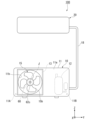
- FIG. 2 is a schematic diagram of an outdoor unit according to the first embodiment.
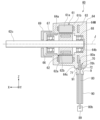
- 1 is a cross-sectional view of a molded electric motor according to a first embodiment.
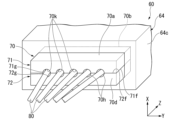
- FIG. 2 is a perspective view of a lead wire holding member provided in the molded electric motor of the first embodiment.
- FIG. 2 is a front view of a tube provided in the molded motor of the first embodiment.
- FIG. 11 is a front view of a modified tube provided in the molded motor of the first embodiment.
- FIG. 11 is a perspective view of a lead wire holding member provided in a molded electric motor according to a second embodiment.
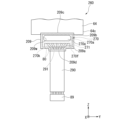
- FIG. 11 is a front view of a tube provided in the molded motor of the second embodiment.
- the drawings also show the X-axis, Y-axis, and Z-axis as appropriate.
- the X-axis shows the front-rear direction of the outdoor unit in the following embodiment.
- the Y-axis shows the width direction of the outdoor unit, which is perpendicular to the front-rear direction.
- the Z-axis shows the vertical direction.
- the front-rear direction, width direction, and vertical direction are perpendicular to each other.
- the width direction is the left-right direction of the outdoor unit.
- the left-right direction is the left-right direction when the outdoor unit in the following embodiment is viewed from the front (+X side).
- the side of the left-right direction toward which the Y-axis arrow points (+Y side) is the right side
- the side of the left-right direction opposite to the side of the Y-axis arrow (-Y side) is the left side.
- the side in the vertical direction toward which the Z-axis arrow points (+Z side) is the upper side
- the opposite side in the vertical direction to the side toward which the Z-axis arrow points (-Z side) is the lower side.
- the surface facing forward of each part may be simply referred to as the front surface
- the surface facing backward may be referred to as the rear surface.
- Fig. 1 is a schematic diagram showing a schematic configuration of a refrigeration cycle apparatus 100 in the first embodiment.
- the refrigeration cycle apparatus 100 is an air conditioner.
- the refrigeration cycle apparatus 100 includes an outdoor unit 10, an indoor unit 20, and a circulation path section 18.
- the outdoor unit 10 is disposed outdoors.
- the indoor unit 20 is disposed indoors.
- the outdoor unit 10 and the indoor unit 20 are connected to each other by the circulation path section 18 through which a refrigerant 19 circulates.
- the refrigeration cycle device 100 can adjust the temperature of the air in the room by exchanging heat between the refrigerant 19 flowing in the circulation path section 18 and the air in the room in which the indoor unit 20 is located.
- the refrigerant 19 include fluorine-based refrigerants or hydrocarbon-based refrigerants with low global warming potential (GWP).
- GWP global warming potential
- Examples of the refrigerant 19 include a single refrigerant selected from R1234yf, R1234ze, R32, and R290, or a mixture of two or more of these, or a mixture of any of these with another refrigerant.
- Examples of the refrigerant 19 include a mixed refrigerant containing R1132(E), or a mixed refrigerant containing R1123.
- refrigerant 19 examples include mixed refrigerants of R516A, R445A, R444A, R454C, R444B, R454A, R455A, R457A, R459B, R452B, R454B, R447B, R447A, R446A, and R459A.
- the outdoor unit 10 has a housing 11, a compressor 12, a heat exchanger 13, a flow control valve 14, a blower 15, a four-way valve 16, and a control unit 17.
- the housing 11 houses the compressor 12, the heat exchanger 13, the flow control valve 14, the blower 15, the four-way valve 16, and the control unit 17.
- the compressor 12, heat exchanger 13, flow rate control valve 14, and four-way valve 16 are provided in a portion of the circulation path 18 that is located inside the housing 11.
- the compressor 12, heat exchanger 13, flow rate control valve 14, and four-way valve 16 are connected by a portion of the circulation path 18 that is located inside the housing 11.
- the four-way valve 16 is provided in a portion of the circulation path section 18 that is connected to the discharge side of the compressor 12.
- the four-way valve 16 can reverse the direction of the refrigerant 19 flowing through the circulation path section 18 by switching a portion of the path of the circulation path section 18.
- the path connected by the four-way valve 16 is the path shown by the solid line on the four-way valve 16 in FIG. 1
- the refrigerant 19 flows through the circulation path section 18 in the direction shown by the solid arrow in FIG. 1.
- the path connected by the four-way valve 16 is the path shown by the dashed line on the four-way valve 16 in FIG. 1, the refrigerant 19 flows through the circulation path section 18 in the direction shown by the dashed arrow in FIG. 1.
- the indoor unit 20 has a housing 21, a heat exchanger 22, a blower 23, and a control device 24.
- the heat exchanger 22, the blower 23, and the control device 24 are housed inside the housing 21.
- the indoor unit 20 is capable of cooling operation to cool the air in the room in which the indoor unit 20 is located, and heating operation to warm the air in the room in which the indoor unit 20 is located.
- the refrigerant 19 flowing in the circulation path 18 flows in the direction shown by the solid arrow in Figure 1.
- the refrigerant 19 flowing in the circulation path 18 circulates through the compressor 12, the heat exchanger 13 of the outdoor unit 10, the flow control valve 14, and the heat exchanger 22 of the indoor unit 20, in that order, before returning to the compressor 12.
- the heat exchanger 13 in the outdoor unit 10 functions as a condenser
- the heat exchanger 22 in the indoor unit 20 functions as an evaporator.
- the refrigerant 19 flowing in the circulation path portion 18 flows in the direction shown by the dashed line in Figure 1.
- the refrigerant 19 flowing in the circulation path portion 18 circulates through the compressor 12, the heat exchanger 22 of the indoor unit 20, the flow control valve 14, and the heat exchanger 13 of the outdoor unit 10, in that order, before returning to the compressor 12.
- the heat exchanger 13 in the outdoor unit 10 functions as an evaporator
- the heat exchanger 22 in the indoor unit 20 functions as a condenser.
- Fig. 2 is a schematic diagram of the outdoor unit 10.
- the housing 11 of the outdoor unit 10 is in the shape of a substantially rectangular parallelepiped box.
- the housing 11 has a front panel 11a that covers the internal space of the housing 11 from the front.
- the front panel 11a is provided with a front opening 11b.
- the front opening 11b penetrates the front panel 11a in the front-rear direction (X-axis direction) and opens to the front.
- the front opening 11b is covered by a grill (not shown).
- the housing 11 is provided inside with a fan chamber 11A that houses the heat exchanger 13 and the blower 15, and a machine chamber 11B that houses the compressor 12.
- the fan chamber 11A and the machine chamber 11B are separated by a partition member (not shown).
- the blower 15 is located in front of the heat exchanger 13 (+X side).
- the circulation path section 18 is connected to the heat exchanger 13.
- a refrigerant flows inside the heat exchanger 13.
- the heat exchanger 13 is cooled by the blower 15.
- the blower 15 has a molded motor 60 with a rotating shaft 62c, and a rotor 15b fixed to the rotating shaft 62c.
- the rotor 15b is rotated around the central axis J by the molded motor 60.
- the rotor 15b is disposed facing the front opening 11b inside the housing 11.
- the rotor 15b is also disposed in front of the heat exchanger 13. By rotating the rotor 15b, the blower 15 blows air out of the front opening 11b to the front of the housing 11 and passes the air through the heat exchanger 13.
- FIG. 3 is a cross-sectional view of a molded electric motor 60 according to the present embodiment.
- the molded motor 60 in this embodiment is an inner rotor type motor.
- the molded motor 60 may be an outer rotor type motor.
- the molded motor 60 of this embodiment includes a rotor 62, a stator 61, a circuit board 63, a motor frame 64, a pair of bearings 67, 68, a bearing holder 66, a cover 69, a lead wire holding member 70, a number of lead wires 80, and a tube 90.
- the rotor 62 rotates around the central axis J.
- the direction parallel to the central axis J may be referred to as the "axial direction”, and the radial direction relative to the central axis J may be referred to simply as the "radial direction”.
- the radial direction away from the central axis J may be referred to as the "radial outer direction”
- the radial direction approaching the central axis J may be referred to as the "radial inner direction”.
- the axial direction coincides with the front-to-rear direction (X-axis direction).
- the rotor 62 has a rotating shaft 62c, a rotor core 62a, and multiple magnets 62b.
- the rotating shaft 62c extends in the axial direction around the central axis J.
- the rotating shaft 62c is supported by a pair of bearings 67, 68.
- the rotor core 62a is fixed to the outer circumferential surface of the rotating shaft 62c.
- the multiple magnets 62b are assembled to the rotor core 62a.
- the stator 61 faces the rotor 62 in the radial direction.
- the stator 61 is annular about the central axis J, and surrounds the rotor 62 from the radial outside.
- the stator 61 has a stator core 61a and a coil 61b.
- the stator core 61a has a circular core back and a number of teeth that protrude radially inward from the core back.
- the coil 61b is formed by winding coil wire around the teeth.
- the circuit board 63 is located behind the stator 61 (-X).
- the circuit board 63 is disposed perpendicular to the central axis J.
- the ends of the coil wire that constitutes the coil 61b are connected to the circuit board 63.
- the coil 61b is wired to the circuit board 63.
- the circuit board 63 controls the rotation of the rotor 62 by controlling the voltage applied to the coil 61b.
- the motor frame 64 forms the outer shell of the molded motor 60.
- the motor frame 64 is formed by covering at least a portion of the stator 61 and the circuit board 63 with molded resin 64M.
- the motor frame 64 is provided with a concave portion 64a extending in the front-rear direction centered on the central axis J.
- the concave portion 64a opens forward.
- the rotor 62 is disposed inside the concave portion 64a.
- a bearing holding portion 64b is formed at the bottom of the concave portion 64a.
- the bearing holding portion 64b has a cylindrical surface facing radially inward, and holds the bearing 68 from the radial outside on the cylindrical surface.
- a bearing holder 66 is fixed to the opening of the concave portion 64a.
- the bearing holder 66 holds a bearing 67.
- a cover 69 that covers the bearing holder 66 is disposed in front of the bearing holder 66.
- the motor frame 64 has a convex portion 64c on its outer peripheral surface facing radially outward.
- the protrusion 64c protrudes radially outward.
- a portion of the lead wire holding member 70 is embedded inside the protrusion 64c.
- the multiple lead wires 80 transmit power and control signals to be supplied to the circuit board 63.
- the multiple lead wires 80 have a first end 80a and a second end 80b, and the first end 80a is connected to the circuit board 63.
- a connector portion 89 is provided at the second end 80b. The connector portion 89 is connected to the control unit 17 of the outdoor unit 10 (see Figure 1).
- the multiple lead wires 80 connect the circuit board 63 of the molded motor 60 and the control unit 17 of the outdoor unit 10.
- the multiple lead wires 80 are pulled out from the inside of the motor frame 64 to the outside.
- the multiple lead wires 80 are embedded in the motor frame 64 at the first end 80a and exposed from the motor frame 64 at the second end 80b.
- the multiple lead wires 80 are bundled outside the motor frame 64 and covered with a tube 90.
- the lead wire holding member 70 pulls out the multiple lead wires 80 to the outside of the motor frame 64.
- the lead wire holding member 70 holds the multiple lead wires 80.
- the lead wire holding member 70 is also held by the motor frame 64.
- FIG 4 is an oblique view of a lead wire holding member 70 provided in a molded electric motor 60 of this embodiment.
- the lead wire holding member 70 has a block-shaped first member 71 and a second member 72.
- the first member 71 and the second member 72 are stacked in the front-to-rear direction.
- the first member 71 is located forward (+X) of the second member 72.
- the first member 71 has a first opposing surface 71f facing backward (-X).
- the first opposing surface 71f is provided with a plurality of first grooves 71g extending in the vertical direction (Z-axis direction).
- the second member 72 has a second opposing surface 72f facing forward (+X).
- the second opposing surface 72f is provided with a plurality of second grooves 72g extending in the vertical direction (Z-axis direction).
- the first opposing surface 71f and the second opposing surface 72f face each other and are in contact with each other.
- the first groove 71g and the second groove 72g face each other and overlap to form a through hole 70h. That is, the lead wire holding member 70 has a plurality of through holes 70h.
- the through holes 70h penetrate the lead wire holding member 70 in the vertical direction (Z-axis direction).
- the through holes 70h are circular when viewed in the vertical direction.
- a lead wire 80 is passed through each of the through holes 70h. That is, the plurality of through holes 70h hold each of the plurality of lead wires 80.
- the first member 71 and the second member 72 also sandwich the plurality of lead wires 80 from the front-rear direction (X-axis direction).
- a portion of the lead wire holding member 70 is embedded in the protruding portion 64c of the motor frame 64, and another portion protrudes from the outer surface of the motor frame 64 and is exposed from the motor frame 64. That is, the lead wire holding member 70 has an embedded portion 70b that is embedded in the motor frame 64, and a protruding portion 70a that protrudes from the outer surface of the motor frame 64.
- the protruding portion 70a has a protruding surface 70d that faces downward (-Z).
- the protruding surface 70d is provided with openings 70k of multiple through holes 70h.
- the multiple openings 70k are aligned in a straight line in the left-right direction (Y-axis direction).
- the multiple lead wires 80 extend from each opening 70k.
- the first member 71 and second member 72 of the lead wire holding member 70 are held in a mold that molds the motor frame 64 with the lead wire 80 sandwiched between them.
- the protruding portion 70a is sandwiched between the mold that opens and closes in the front-to-rear direction (X-axis direction), and the embedded portion 70b is placed within the cavity of the mold. This allows the protruding portion 70a to protrude from the outer surface of the motor frame 64, and the embedded portion 70b to be embedded inside the motor frame 64.
- FIG. 5 is a front view of a tube 90 provided in the molded motor 60 of this embodiment.
- the tube 90 has flexibility.
- the tube 90 bundles and covers the multiple lead wires 80 located outside the motor frame 64.
- the tube 90 has an opposing end 91 that faces the protruding surface 70d of the lead wire holding member 70. In other words, the opposing end 91 is disposed with a gap between it and the multiple openings 70k.
- a sealant 9 is provided in the area between the opposing end 91 of the tube 90 and the protruding portion 64c of the motor frame 64.
- the sealant 9 is applied to the target area in an uncured state and then cured.
- an acrylic modified silicone resin as the sealant 9.
- Acrylic modified silicone resin has excellent heat resistance and cold resistance. Therefore, by using an acrylic modified silicone resin as the sealant 9, the sealing properties of the sealant 9 can be maintained even when used outdoors regardless of the season. Furthermore, since the acrylic modified silicone resin cures at room temperature, heating for curing is not required, and the manufacturing process of the molded motor 60 can be simplified.
- the sealing material 9 has a first sealing portion 9a, a second sealing portion 9b, a third sealing portion 9c, and a fourth sealing portion 9d.
- the first sealing portion 9a, the second sealing portion 9b, the third sealing portion 9c, and the fourth sealing portion 9d are connected to each other.
- the first sealing portion 9a covers the multiple lead wires 80.
- the first sealing portion 9a seals the gap between the opening 70k and the lead wires 80.
- the second sealing portion 9b covers the surface of the protruding portion 70a.
- the second sealing portion 9b seals the gap at the boundary between the first member 71 and the second member 72.
- the third sealing portion 9c covers the boundary between the protruding portion 70a and the motor frame 64.
- the third sealing portion 9c seals the gap at the boundary between the motor frame 64 and the lead wire holding member 70.
- the fourth sealing portion 9d covers the tip edge of the opposing end 91 of the tube 90.
- the sealing material 9 blocks the path of water intrusion into the motor frame 64 at the first sealing portion 9a, the second sealing portion 9b, and the third sealing portion 9c, and protects the circuit board 63 arranged inside the motor frame 64.
- the sealant 9 seals the gap between the lead wires 80 and the tubes 90 in the first seal portion 9a and the fourth seal portion 9d. Since the lead wires 80 extending from the opening 70k are aligned in the left-right direction with a gap between them, the sealant 9 may not be fully wrapped around between the lead wires 80, and an uncoated portion may remain between the lead wires 80. If this uncoated portion reaches the lower (-Z side) end of the sealant 9, it may become a path for water to penetrate into the motor frame 64. According to this embodiment, the sealant 9 covers the entirety of the multiple lead wires 80 between the opposing end 91 and the protruding portion.
- the opposing end 91 is provided with one notch 91c extending in the length direction of the tube 90.
- the multiple lead wires 80 are bundled tightly inside the tube 90. Meanwhile, the multiple lead wires 80 are held by the lead wire holding member 70 with gaps between them in the left-right direction. Therefore, the multiple lead wires 80 extend so as to spread in the left-right direction between the opposing end 91 and the opening 70k.
- the notch 91c is provided in the opposing end 91, so that the opening of the opposing end 91 can be widened.
- the opposing end 91 by bringing the opposing end 91 closer to the protruding portion 70a, at least a portion of the gap between the lead wires 80 can be covered with the tube 90. Therefore, when applying uncured sealant 9 to multiple lead wires 80 with the depth direction of the paper in FIG. 5 being the direction of gravity, it is possible to prevent the uncured sealant 9 from flowing down to the opposite side through the gap between the lead wires 80, simplifying the application process of the sealant 9 and reducing the amount of sealant 9 used.
- FIG. 5 illustrates a case in which the sealing material 9 covers the outer circumference of the tube 90 over the entire circumference of an area equivalent to the depth of the cut portion 91c of the tube 90.
- the sealing material 9 may cover only the tip edge of the opposing end portion 91 and the cut portion 91c.
- the molded motor 60 of this embodiment includes a rotor 62, a stator 61, a circuit board 63, a motor frame 64, a plurality of lead wires 80, a lead wire holding member 70, and a tube 90.
- the rotor 62 rotates around a central axis J.
- the stator 61 faces the rotor 62 in the radial direction and has a coil 61b.
- the coil 61b is connected to the circuit board 63.
- the motor frame 64 is formed by covering at least a portion of the stator 61 and the circuit board 63 with a molded resin 64M.
- the plurality of lead wires 80 are connected to the circuit board 63.
- the lead wire holding member 70 draws the plurality of lead wires 80 to the outside of the motor frame 64.
- the tube 90 bundles and covers the plurality of lead wires 80 located outside the motor frame 64.
- the lead wire holding member 70 has a plurality of through holes 70h for holding the plurality of lead wires 80, an embedded portion 70b embedded in the motor frame 64, and a protruding portion 70a protruding from the outer surface of the motor frame 64.
- a plurality of openings 70k for the plurality of through holes 70h are provided in the protruding portion 70a.
- the tube 90 has an opposing end portion 91 disposed with gaps between it and the plurality of openings 70k.
- the opposing end portion 91 is provided with a notch portion 91c extending in the length direction of the tube 90. As shown in Fig. 5, a seal material 9 is provided to cover the plurality of lead wires 80 across the opposing end portion 91 and the protruding portion 70a.
- the sealing material 9 covers the lead wires 80 between the facing end 91 and the protruding portion 70a, thereby sealing the gap between the lead wires 80 and the tube 90. This makes it possible to prevent the uncoated portion of the sealing material 9 that may be formed between the lead wires 80 from becoming a path for moisture to penetrate into the motor frame 64.
- the facing end 91 is provided with a cut portion 91c extending in the length direction of the tube 90. The lead wires 80 extend between the facing end 91 and the opening 70k while widening the gap in the direction away from each other as they move toward the opening 70k side.
- the opening of the facing end 91 can be widened to fit the lead wires 80. This makes it possible to bring the tip of the facing end 91 closer to the opening 70k than when the cut portion 91c is not provided, and the amount of sealing material 9 used between the facing end 91 and the protruding portion 70a can be reduced. Furthermore, by bringing the opposing end 91 closer to the protruding portion 70a, at least a portion of the gap between the lead wires 80 can be covered with the tube 90. This makes it possible to prevent uncured sealant 9 from flowing out of the gap between the lead wires 80 during the application process, simplifying the application process of the sealant 9.
- the sealing material 9 of this embodiment covers the multiple lead wires 80 and the protruding portion 70a across the opposing end 91 and the motor frame 64. According to this embodiment, the sealing material 9 can prevent moisture from entering through the boundary between the motor frame 64 and the protruding portion 70a. Furthermore, when the lead wire holding member 70 is composed of multiple members (first member 71 and second member 72) and the boundary appears on the surface of the protruding portion 70a, it can prevent moisture from entering through the boundary.
- the outdoor unit 10 of this embodiment is the outdoor unit 10 of the refrigeration cycle device 100, and includes a compressor 12, a heat exchanger 13, and a blower 15 that generates an air flow that passes through the heat exchanger 13.
- the blower 15 has the above-mentioned molded motor 60 and a rotor 15b that is rotated by the molded motor 60.
- Modification 6 is a front view of a modified tube 190 that can be used in the molded motor 60 of the first embodiment.
- the main difference between the modified tube 190 and the first embodiment is that a plurality of cutouts 191c are provided. Note that the same components as those in the above-described embodiment are denoted by the same reference numerals in the drawing and will not be described.
- the opposing end 191 of the tube 190 is provided with a plurality of notches 191c extending in the longitudinal direction of the tube 190.
- the multiple notches 191c are arranged at approximately equal intervals on the opposing end 191.
- each cut 191c can be reduced compared to when only one cut is provided. This allows for a reduction in the amount of sealant 109 used to cover the cuts 191c and be placed around the outer periphery of the tube 190.
- Second Embodiment 7 is a perspective view of a lead wire holding member 270 provided in a molded motor 260 according to the second embodiment. Note that the same reference numerals are used in the drawings to designate the same components as those in the above-described embodiment and the modified examples thereof, and the description thereof will be omitted.
- the lead wire holding member 270 has a block-shaped first member 271 and a second member 272.
- the first member 271 has a plurality of first grooves 271g
- the second member 272 has a plurality of second grooves 272g.
- the first member 271 and the second member 272 face each other and contact each other.
- the first grooves 271g and the second grooves 272g face each other and overlap to form a through hole 270h.
- the lead wire holding member 270 has a plurality of through holes 270h.
- the plurality of through holes 270h hold each of the plurality of lead wires 80.
- the first member 271 and the second member 272 sandwich the plurality of lead wires 80 from the front-rear direction (X-axis direction).
- the lead wire holding member 270 has an embedded portion 270b embedded in the motor frame 64 and a protruding portion 270a protruding from the outer surface of the motor frame 64.
- the protruding portion 270a has a growing surface 270d facing downward (-Z) and a frame-shaped portion 270f surrounding the growing surface 270d.
- the growing surface 270d is rectangular when viewed from below.
- the frame-shaped portion 270f protrudes downward from the growing surface 270d.
- the frame-shaped portion 270f is provided along the outer edge. Therefore, the frame-shaped portion 270f is rectangular when viewed from below.
- the growing surface 270d has openings 270k for a plurality of through holes 270h.
- the multiple openings 270k are aligned in a straight line in the left-right direction (Y-axis direction).
- the multiple lead wires 80 extend from each opening 270k.
- FIG. 8 is a front view of a tube 290 provided in a molded motor 260 of this embodiment.
- the tube 290 bundles and covers the multiple lead wires 80 located outside the motor frame 64.
- the tube 290 has an opposing end 291 that faces the protruding surface 270d of the lead wire holding member 270. In other words, the opposing end 291 is disposed with gaps between it and the multiple openings 270k.
- a sealant 209 is provided in the area between the opposing end 291 of the tube 290 and the protruding portion 64c of the motor frame 64.
- the sealant 209 is applied to the target area in an uncured state.
- the sealing material 209 has a first sealing portion 209a, a second sealing portion 209b, a third sealing portion 209c, and a fourth sealing portion 209d.
- the first sealing portion 209a, the second sealing portion 209b, the third sealing portion 209c, and the fourth sealing portion 209d are connected to each other.
- the first sealing portion 209a covers the multiple lead wires 80.
- the first sealing portion 209a closes the gap between the opening 270k and the lead wires 80.
- the second sealing portion 209b covers at least a portion of the surface of the protruding portion 270a.
- the second sealing portion 209b closes the gap at the boundary between the first member 271 and the second member 272.
- the third sealing portion 209c covers the boundary between the protruding portion 270a and the motor frame 64.
- the third sealing portion 209c closes the gap at the boundary between the motor frame 64 and the lead wire holding member 270.
- the fourth seal portion 209d covers the tip edge of the opposing end portion 291 of the tube 290.
- the fourth seal portion 209d together with the first seal portion 209a, seals the gap between the lead wire 80 and the tube 290.
- the sealant 209 blocks the path of water infiltration into the motor frame 64 at the first seal portion 209a, the second seal portion 209b, and the third seal portion 209c, and protects the circuit board 63 disposed inside the motor frame 64.
- This embodiment can provide a molded motor 260 with improved waterproof reliability.
- the sealant 209 blocks the gap between the lead wire 80 and the tube 290 at the first seal portion 209a and the fourth seal portion 209d. This prevents uncoated portions of the sealant 209 that may be formed between multiple lead wires 80 from becoming a path of water infiltration.
- the lead wire holding member 270 has a frame-shaped portion 270f that surrounds the multiple lead wires 80 and protrudes toward the opposing end 291 of the tube 290.
- the provision of the frame-shaped portion 270f reduces the distance between the opposing end 291 and the lead wire holding member 270. This reduces the amount of sealant 209 (first seal portion 209a) used that is disposed between the tip of the opposing end 291 and the lead wire holding member 270.
- first seal portion 209a first seal portion 209a
- a window 209w is provided in the second seal portion 209b.
- the window 209w is formed by leaving a portion of the surface of the lead wire holding member 270 facing forward (+X) uncoated.
- the lead wire holding member 270 is exposed from the seal material 209 at the portion where the window 209w is provided. That is, the protruding portion 270a is provided with an exposed portion 270e that is exposed from the seal material 209.
- the seal material 209 does not cover the lead wire holding member 270 at the exposed portion 270e, the amount of seal material 209 used can be reduced. This allows the molded motor 260 to be made lighter and less expensive.
- the exposed portion 270e is provided on a surface of the first member 271 facing forward (+X). That is, the exposed portion 270e is located in a portion different from the boundary between the first member 271 and the second member 272. This makes it possible to prevent moisture from penetrating into the boundary between the first member 271 and the second member 272 via the exposed portion 270e.
- FIG. 8 illustrates the exposed portion 270e provided in front (+X) of the lead wire holding member 270, the exposed portion 270e may also be provided behind (-X) the lead wire holding member 270.
- the molded motor 260 of this embodiment includes a rotor 62, a stator 61, a circuit board 63, a motor frame 64, a plurality of lead wires 80, a lead wire holding member 270, and a tube 290, as in the above-described embodiment (FIG. 3).
- the rotor 62 rotates around a central axis J.
- the stator 61 faces the rotor 62 in the radial direction and has a coil 61b.
- the coil 61b is connected to the circuit board 63.
- the motor frame 64 is formed by covering at least a portion of the stator 61 and the circuit board 63 with a molded resin 64M.
- the plurality of lead wires 80 are connected to the circuit board 63.
- the lead wire holding member 270 draws the plurality of lead wires 80 to the outside of the motor frame 64.
- the tube 290 bundles and covers the plurality of lead wires 80 located outside the motor frame 64.
- the lead wire holding member 270 has a plurality of through holes 270h for holding the plurality of lead wires 80, an embedded portion 270b embedded in the motor frame 64, and a protruding portion 270a protruding from the outer surface of the motor frame 64.
- the protruding portion 270a is provided with a plurality of openings 270k for the plurality of through holes 270h and a frame-shaped portion 270f surrounding the plurality of openings 270k.
- the tube 290 has an opposing end portion 291 disposed with a gap between the plurality of openings 270k. As shown in Fig. 8, a seal material 209 is provided to cover the plurality of lead wires 80 across the opposing end portion 291 and the frame-shaped portion 270f.
- the sealant 209 covers the multiple lead wires 80 between the opposing end 291 and the protruding portion 270a, thereby sealing the gap between the lead wires 80 and the tube 290. This makes it possible to prevent the uncoated portion of the sealant 209 that may be formed between the multiple lead wires 80 from becoming a path for moisture to penetrate into the motor frame 64. Also, according to the above-mentioned configuration, the protruding portion 270a is provided with a frame-shaped portion 270f that surrounds the multiple openings 270k.
- the lead wire holding member 270 has a first member 271 and a second member 272 that sandwich the multiple lead wires 80, as shown in FIG. 7.
- the sealant 209 has a first seal portion 209a that covers the multiple lead wires 80, a second seal portion 209b that covers at least a part of the surface of the protruding portion 270a, a third seal portion 209c that covers the boundary between the protruding portion 270a and the motor frame 64, and a fourth seal portion 209d that covers the tip edge of the opposing end portion 291.
- the protruding portion 270a is provided with an exposed portion 270e that is exposed from the second seal portion 209b.
- the exposed portion 270e is located in a portion different from the boundary between the first member 271 and the second member 272.
- the sealing material 209 can block the path of water infiltration into the motor frame 64 at the first sealing portion 209a, the second sealing portion 209b, and the third sealing portion 209c, and protect the circuit board 63 arranged inside the motor frame 64.
- the second sealing portion 209b does not cover the exposed portion 270e of the lead wire holding member 270, the amount of sealing material 209 used can be reduced.
- the exposed portion 270e is located in a part different from the boundary between the first member 271 and the second member 272, it is possible to prevent water from infiltrating into the boundary between the first member 271 and the second member 272 via the exposed portion 270e.
- the sealant 9 covers the entire protrusion 70a of the lead wire holding member 70
- the sealant 109 is provided with a window 209w that exposes the exposed portion 270e of the protrusion 270a.
- the sealant may form an exposed portion in the protrusion 70a in the first embodiment, and may further cover the entire protrusion 270a in the second embodiment.
- the refrigeration cycle device in which the outdoor unit of the present disclosure is equipped may be any device that utilizes a refrigeration cycle in which a refrigerant circulates, and is not limited to an air conditioner.
- the refrigeration cycle device may also be a heat pump water heater, etc.
Landscapes
- Engineering & Computer Science (AREA)
- Power Engineering (AREA)
- Motor Or Generator Frames (AREA)
Priority Applications (2)
| Application Number | Priority Date | Filing Date | Title |
|---|---|---|---|
| JP2025532315A JPWO2025013232A1 (https=) | 2023-07-12 | 2023-07-12 | |
| PCT/JP2023/025672 WO2025013232A1 (ja) | 2023-07-12 | 2023-07-12 | モールド電動機、および室外機 |
Applications Claiming Priority (1)
| Application Number | Priority Date | Filing Date | Title |
|---|---|---|---|
| PCT/JP2023/025672 WO2025013232A1 (ja) | 2023-07-12 | 2023-07-12 | モールド電動機、および室外機 |
Publications (1)
| Publication Number | Publication Date |
|---|---|
| WO2025013232A1 true WO2025013232A1 (ja) | 2025-01-16 |
Family
ID=94215307
Family Applications (1)
| Application Number | Title | Priority Date | Filing Date |
|---|---|---|---|
| PCT/JP2023/025672 Pending WO2025013232A1 (ja) | 2023-07-12 | 2023-07-12 | モールド電動機、および室外機 |
Country Status (2)
| Country | Link |
|---|---|
| JP (1) | JPWO2025013232A1 (https=) |
| WO (1) | WO2025013232A1 (https=) |
Citations (7)
| Publication number | Priority date | Publication date | Assignee | Title |
|---|---|---|---|---|
| JPH0648363U (ja) * | 1992-11-30 | 1994-06-28 | 三菱マテリアル株式会社 | 小型モータ |
| JP2002017067A (ja) * | 2000-03-17 | 2002-01-18 | Denso Corp | 車両用交流発電機 |
| JP2006180674A (ja) * | 2004-12-24 | 2006-07-06 | Fujitsu General Ltd | 電動機 |
| JP2014039421A (ja) * | 2012-08-20 | 2014-02-27 | Mitsubishi Electric Corp | モールド電動機及び空気調和機 |
| WO2017085827A1 (ja) * | 2015-11-19 | 2017-05-26 | 三菱電機株式会社 | 固定子、電動機、及び空気調和機 |
| JP2021093780A (ja) * | 2019-12-06 | 2021-06-17 | 株式会社豊田自動織機 | 回転電機 |
| WO2021171471A1 (ja) * | 2020-02-27 | 2021-09-02 | 三菱電機株式会社 | 室外機および空気調和装置 |
-
2023
- 2023-07-12 JP JP2025532315A patent/JPWO2025013232A1/ja active Pending
- 2023-07-12 WO PCT/JP2023/025672 patent/WO2025013232A1/ja active Pending
Patent Citations (7)
| Publication number | Priority date | Publication date | Assignee | Title |
|---|---|---|---|---|
| JPH0648363U (ja) * | 1992-11-30 | 1994-06-28 | 三菱マテリアル株式会社 | 小型モータ |
| JP2002017067A (ja) * | 2000-03-17 | 2002-01-18 | Denso Corp | 車両用交流発電機 |
| JP2006180674A (ja) * | 2004-12-24 | 2006-07-06 | Fujitsu General Ltd | 電動機 |
| JP2014039421A (ja) * | 2012-08-20 | 2014-02-27 | Mitsubishi Electric Corp | モールド電動機及び空気調和機 |
| WO2017085827A1 (ja) * | 2015-11-19 | 2017-05-26 | 三菱電機株式会社 | 固定子、電動機、及び空気調和機 |
| JP2021093780A (ja) * | 2019-12-06 | 2021-06-17 | 株式会社豊田自動織機 | 回転電機 |
| WO2021171471A1 (ja) * | 2020-02-27 | 2021-09-02 | 三菱電機株式会社 | 室外機および空気調和装置 |
Also Published As
| Publication number | Publication date |
|---|---|
| JPWO2025013232A1 (https=) | 2025-01-16 |
Similar Documents
| Publication | Publication Date | Title |
|---|---|---|
| US12498149B2 (en) | Motor, compressor and air conditioner | |
| JP3122463B2 (ja) | 電気機械に通気する方法及び装置 | |
| JP7057826B2 (ja) | 密閉型電動機冷却システム | |
| US20080036314A1 (en) | Totally-Enclosed Fan-Cooled Motor | |
| CN104079119A (zh) | 电机组件及包含所述电机组件的家用电器 | |
| KR101792915B1 (ko) | 고정자 코일 직접 냉각방식형 모터 | |
| JP2023086910A (ja) | 回転電機及び回転電機の冷却構造 | |
| WO2025013232A1 (ja) | モールド電動機、および室外機 | |
| JP2019126188A (ja) | 放熱部材および電動機組立体 | |
| JP7706645B2 (ja) | 電動機、送風機および空気調和装置 | |
| JP7276358B2 (ja) | 回転電機及び回転電機の冷却構造 | |
| KR20230045877A (ko) | 외전형 모터 | |
| JP6993602B1 (ja) | モータ、送風機、および、空気調和装置 | |
| JPH0823661A (ja) | 全閉外扇形電動機の冷却構造 | |
| JPH09168246A (ja) | 永久磁石同期機の冷却装置 | |
| CN116336574B (zh) | 空调室外机及空调 | |
| US11605992B2 (en) | Motor, motor assembly, and air conditioner | |
| TW202244398A (zh) | 馬達、送風裝置及冷凍裝置 | |
| JP7406137B1 (ja) | モータ、送風装置、及び冷凍サイクル装置 | |
| US20070290560A1 (en) | Motor and Electric Apparatus Using the Same Motor | |
| JP2024130963A (ja) | アキシャルギャップ型電動発電機、送風装置、空気調和装置、及び冷凍装置 | |
| JP7791473B1 (ja) | ボンド磁石の製造方法、ロータ、モータ、送風機、および、冷凍装置 | |
| RU36586U1 (ru) | Вращающаяся электрическая машина с замкнутым газовым охлаждением | |
| CN119253915A (zh) | 电机 | |
| TW202245386A (zh) | 馬達、送風裝置、壓縮裝置及冷凍裝置 |
Legal Events
| Date | Code | Title | Description |
|---|---|---|---|
| 121 | Ep: the epo has been informed by wipo that ep was designated in this application |
Ref document number: 23945109 Country of ref document: EP Kind code of ref document: A1 |
|
| ENP | Entry into the national phase |
Ref document number: 2025532315 Country of ref document: JP Kind code of ref document: A |
|
| WWE | Wipo information: entry into national phase |
Ref document number: 2025532315 Country of ref document: JP |
|
| NENP | Non-entry into the national phase |
Ref country code: DE |