WO2025009427A1 - 推定装置、推定方法及びプログラム - Google Patents
推定装置、推定方法及びプログラム Download PDFInfo
- Publication number
- WO2025009427A1 WO2025009427A1 PCT/JP2024/022779 JP2024022779W WO2025009427A1 WO 2025009427 A1 WO2025009427 A1 WO 2025009427A1 JP 2024022779 W JP2024022779 W JP 2024022779W WO 2025009427 A1 WO2025009427 A1 WO 2025009427A1
- Authority
- WO
- WIPO (PCT)
- Prior art keywords
- transfer function
- elements
- complex transfer
- unit
- living body
- Prior art date
- Legal status (The legal status is an assumption and is not a legal conclusion. Google has not performed a legal analysis and makes no representation as to the accuracy of the status listed.)
- Ceased
Links
Images









Classifications
-
- G—PHYSICS
- G01—MEASURING; TESTING
- G01S—RADIO DIRECTION-FINDING; RADIO NAVIGATION; DETERMINING DISTANCE OR VELOCITY BY USE OF RADIO WAVES; LOCATING OR PRESENCE-DETECTING BY USE OF THE REFLECTION OR RERADIATION OF RADIO WAVES; ANALOGOUS ARRANGEMENTS USING OTHER WAVES
- G01S13/00—Systems using the reflection or reradiation of radio waves, e.g. radar systems; Analogous systems using reflection or reradiation of waves whose nature or wavelength is irrelevant or unspecified
- G01S13/02—Systems using reflection of radio waves, e.g. primary radar systems; Analogous systems
- G01S13/06—Systems determining position data of a target
- G01S13/46—Indirect determination of position data
-
- G—PHYSICS
- G01—MEASURING; TESTING
- G01S—RADIO DIRECTION-FINDING; RADIO NAVIGATION; DETERMINING DISTANCE OR VELOCITY BY USE OF RADIO WAVES; LOCATING OR PRESENCE-DETECTING BY USE OF THE REFLECTION OR RERADIATION OF RADIO WAVES; ANALOGOUS ARRANGEMENTS USING OTHER WAVES
- G01S7/00—Details of systems according to groups G01S13/00, G01S15/00, G01S17/00
- G01S7/02—Details of systems according to groups G01S13/00, G01S15/00, G01S17/00 of systems according to group G01S13/00
Definitions
- This disclosure relates to an estimation device and estimation method for estimating the distance or position of a living body using a wireless signal.
- Patent Documents 1 to 4 disclose technology that uses differential calculations to analyze components that include Doppler shifts to estimate the location and state of a person to be detected.
- Patent Documents 4 and 5 disclose Doppler sensors that use OFDM (Orthogonal Frequency Division Multiplexing) signals.
- OFDM Orthogonal Frequency Division Multiplexing
- an estimation device includes a transmission signal generation unit that generates a multicarrier signal modulated by S subcarrier signals (S is a natural number equal to or greater than 2), a transmission antenna unit having M transmission antenna elements (M is a natural number equal to or greater than 1), a transmission unit that processes the multicarrier signal and outputs it to the transmission antenna unit, thereby transmitting the multicarrier signal to the transmission antenna unit, and a reception antenna unit having N reception antenna elements (N is a natural number equal to or greater than 1), and observing received signals received by each of the N reception antenna elements, the received signals including reflected signals resulting from the multicarrier signals transmitted from each of the M transmission antenna elements being reflected or scattered by a living body, for a first period corresponding to a cycle derived from the activity of the living body, and using the plurality of received signals observed in the first period, performing an estimation process for each of the M transmission antenna elements and the N reception antenna elements.
- S is a natural number equal to or greater than 2
- M is a natural number equal to
- a receiver calculates a complex transfer function representing the propagation characteristics between the transmitting antenna element and the receiving antenna element in each of the N ⁇ M combinations, for each of the S subcarriers to which the S subcarrier signals correspond, and a matrix calculation unit calculates a second complex transfer function matrix by performing a predetermined process on each of the N ⁇ M ⁇ S elements in a first complex transfer function matrix including the complex transfer functions obtained for each of the S subcarriers and each of the N ⁇ M combinations as elements of an N ⁇ M ⁇ S three-dimensional array, the predetermined process being a process of calculating an amplitude average of a plurality of first elements including a processing target element and dividing the processing target element by the amplitude average, and the plurality of first elements are included in the S ⁇ M elements obtained for one receiving antenna element corresponding to the processing target element.
- An estimation method is an estimation method by an estimation device equipped with a transmitting antenna section having M (M is a natural number equal to or greater than 1) transmitting antenna elements and a receiving antenna section having N (N is a natural number equal to or greater than 1) receiving antenna elements, which generates a multicarrier signal in which S (S is a natural number equal to or greater than 2) subcarrier signals are modulated, processes the multicarrier signal and outputs it to the transmitting antenna section, thereby transmitting the multicarrier signal to the transmitting antenna section, observes received signals received by each of the N receiving antenna elements, which include reflected signals in which the multicarrier signals transmitted from each of the M transmitting antenna elements are reflected or scattered by a living body, for a first period corresponding to a cycle derived from the activity of the living body, and calculates a signal from each of the M transmitting antenna elements using the plurality of received signals observed in the first period.
- M is a natural number equal to or greater than 1
- N is a natural number equal to or greater than 1
- a complex transfer function representing the propagation characteristics between the transmitting antenna element and the receiving antenna element in the combination is calculated for each of the S subcarriers to which the S subcarrier signals correspond, and a second complex transfer function matrix is calculated by performing a predetermined process on each of the N ⁇ M ⁇ S elements in a first complex transfer function matrix including the complex transfer functions obtained for each of the S subcarriers and each of the N ⁇ M combinations as each element of an N ⁇ M ⁇ S three-dimensional array, the predetermined process being a process of calculating an amplitude average of a plurality of first elements including the element to be processed, and dividing the element to be processed by the amplitude average, and the plurality of first elements are included in the S ⁇ M elements obtained for one receiving antenna element corresponding to the element to be processed.
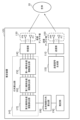
- FIG. 1 is a block diagram showing an example of a configuration of an estimation device according to a first embodiment.
- FIG. 2 is a diagram for explaining the relationship between a transmission signal, a channel, and a reception signal.
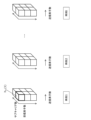
- FIG. 3 is a diagram for explaining propagation characteristics at each timing in MIMO.
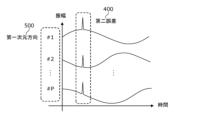
- FIG. 4 is a schematic diagram showing the first error.
- FIG. 5 is a diagram illustrating an example of the first error.
- FIG. 6 is a schematic diagram showing the second error.
- FIG. 7 is a diagram illustrating an example of the second error.
- FIG. 8 is a schematic diagram showing the third error.
- FIG. 9 is a schematic diagram showing the relationship between the third error and the channel.
- FIG. 10 is a schematic diagram showing the relationship between frequency and the gradient of the phase difference.
- FIG. 10 is a schematic diagram showing the relationship between frequency and the gradient of the phase difference.
- FIG. 11 is a schematic diagram showing the phase of a time domain biological component transfer function matrix.
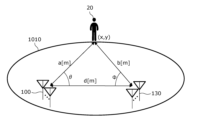
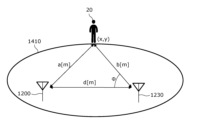
- FIG. 12 is a schematic diagram showing the positional relationship between a living body, a transmitting antenna section, and a receiving antenna section in a MIMO system, and the position of the living body.
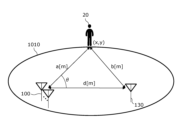
- FIG. 13 is a schematic diagram showing the positional relationship between a living body, a plurality of transmitting antenna units and a receiving antenna unit in MISO, and the position of the living body.
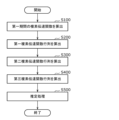
- FIG. 14 is a flowchart showing the estimation process of the estimation device in the first embodiment.
- FIG. 15 is a block diagram showing an example of a configuration of an estimation device according to the second embodiment.
- FIG. 16 is a diagram for explaining the propagation characteristics at each timing of SIMO.
- FIG. 17 is a schematic diagram showing the positional relationship between a living body, a transmitting antenna section, and a receiving antenna section in SIMO, and the position of the living body.
- FIG. 18 is a schematic diagram showing the positional relationship between a living body, a transmitting antenna section, and a receiving antenna section in a SISO, and the position of the living body.
- FIG. 19 is a flowchart showing the estimation process of the estimation device in the second embodiment.
- FIG. 20 is a diagram showing the conditions of an experiment using the estimation method according to the first embodiment.
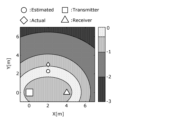
- FIG. 21 is a diagram showing an example of an estimation result using the estimation method according to the first embodiment.
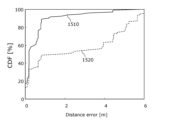
- FIG. 22 is a diagram showing an example of statistics of estimation errors using the estimation method according to the first embodiment.
- Patent Documents 1 and 2 disclose a method of transmitting a radio signal to a predetermined area, receiving the radio signal reflected by the detection target with multiple antennas, and estimating a complex transfer function between the transmitting and receiving antennas.
- the complex transfer function is a function composed of complex numbers that express the relationship between input and output, and expresses the propagation characteristics between the transmitting and receiving antennas. The number of elements of this complex transfer function is equal to the product of the number of transmitting antennas and the number of receiving antennas.
- Patent Document 3 discloses a method of estimating the posture of a living body using the RCS (Radar Cross Section) calculated from the received power, in a configuration similar to Patent Document 2.
- the RCS is an index that expresses the area of an object that reflects the transmitted wave, and the RCS of a living body varies depending on the posture of the living body.
- Patent Document 1 further discloses a processing device that can determine the position or state of a person to be detected by analyzing components including Doppler shift using Fourier transform. More specifically, the processing device records the time changes of the elements of a complex transfer function and performs a Fourier transform on the time waveform.
- a living body such as a person exerts a slight Doppler effect on the reflected wave reflected by the living body due to biological activities such as breathing and heartbeat. Therefore, the components including Doppler shift obtained from the reflected wave include the influence of the living body. On the other hand, the components without Doppler shift obtained from the reflected wave are not influenced by the living body.
- the components without Doppler shift correspond to the reflected wave from a fixed object or the direct wave between the transmitting and receiving antennas.
- the position or state of the person to be detected can be obtained by using the components included in a specified frequency range in the Fourier transformed waveform.
- Patent Document 2 discloses a method for extracting components that contain slight Doppler shifts that include the influence of living organisms by recording the changes over time of the elements of a complex transfer function and analyzing the difference information. In other words, this method makes it possible to know the position and state of the person to be detected using the difference information.
- Patent Document 3 discloses an OFDM Doppler radar that transmits pulses using OFDM signals and detects the Doppler shift caused by a target moving object.
- Patent Document 4 also discloses a high-speed processing method for OFDM Doppler radar that does not require a Fourier transform.
- Patent documents 4 and 5 disclose techniques for improving the estimation accuracy of the complex transfer function between transmitting and receiving antennas by transmitting OFDM signals.
- Patent document 5 discloses that the received noise components can be reduced by averaging the complex transfer function for each subcarrier.
- Patent Documents 1, 2, and 3 transmit unmodulated waves, making it difficult to use commercially available devices and requiring dedicated hardware.
- currently popular communication devices cannot be used, and users must install additional dedicated hardware in addition to their existing communication equipment.
- Non-Patent Document 1 makes it possible to estimate the ToF (Time Of Flight) between the transmitting antenna and the receiving antenna, or the distance that can be calculated from the ToF, by transmitting and receiving signals at multiple frequencies using a measuring device such as a network analyzer. This utilizes the property that when two signals of different frequencies are transmitted with the same phase, the phase received by the receiving antenna changes depending on the frequency difference of the signals and the distance they propagate between the antennas, just like a distance measuring sensor using an FMCW (Frequency Modulated Continuous Wave) radar.
- the technology in Non-Patent Document 1 further improves resolution by performing ToF estimation using the MUSIC (Multiple SIgnal Classification) method.
- MUSIC Multiple SIgnal Classification
- the transmitter and receiver must operate on the same reference frequency or be highly synchronized, making it difficult to apply this technology to household devices such as wireless LANs.
- the distance between antennas can be estimated, and it is difficult to estimate the distance between a device and, for example, a living body that does not have special equipment.
- the inventors have therefore come up with an estimation device etc. that can estimate the position etc. of a living body with higher accuracy.
- the estimation device includes a transmission signal generation unit that generates a multicarrier signal in which S subcarrier signals (S is a natural number of 2 or more) are modulated, a transmission antenna unit having M transmission antenna elements (M is a natural number of 1 or more), a transmission unit that processes the multicarrier signal and outputs it to the transmission antenna unit, thereby transmitting the multicarrier signal to the transmission antenna unit, and a reception antenna unit having N reception antenna elements (N is a natural number of 1 or more), and observes reception signals received by each of the N reception antenna elements, which reception signals include reflected signals in which the multicarrier signals transmitted from each of the M transmission antenna elements are reflected or scattered by a living body, for a first period corresponding to a cycle derived from the activity of the living body, and performs an estimation process for each of the M transmission antenna elements and the N reception antenna elements using the plurality of reception signals observed in the first period.
- the receiver calculates a complex transfer function representing the propagation characteristics between the transmitting antenna element and the receiving antenna element in each of the N ⁇ M combinations, for each of the S subcarriers to which the S subcarrier signals correspond, and a matrix calculation unit calculates a second complex transfer function matrix by performing a predetermined process on each of the N ⁇ M ⁇ S elements in a first complex transfer function matrix including the complex transfer functions obtained for each of the S subcarriers and for each of the N ⁇ M combinations as elements of an N ⁇ M ⁇ S three-dimensional array, the predetermined process being a process of calculating an amplitude average of a plurality of first elements including a processing target element and dividing the processing target element by the amplitude average, and the plurality of first elements are included in the S ⁇ M elements obtained for one receiving antenna element corresponding to the processing target element.
- a predetermined process is performed for each of the N ⁇ M ⁇ S elements in the first complex transfer function matrix, in which the amplitude average of a plurality of first elements that are included in the S ⁇ M elements obtained for one receiving antenna element corresponding to the element to be processed and that include the element to be processed is calculated and the element to be processed is divided by the amplitude average, so that the first error that is imparted to the received signal by each receiving antenna element can be reduced. Therefore, the position of a living body, etc. can be estimated with high accuracy.
- a bio-radar that measures the distance and position of a living body by utilizing existing communication devices and using a multi-carrier signal such as OFDM as the transmission signal.
- a multi-carrier signal such as OFDM
- receivers of multi-carrier signals such as OFDM are already widespread in mobile phones, television broadcast receivers, wireless LAN devices, etc., and it is possible to realize a bio-radar that measures the distance and position of a living body at lower cost than when using unmodulated signals.
- the estimation device is the estimation device according to the first aspect, and the first elements are M elements obtained for one receiving antenna element corresponding to the element to be processed and one subcarrier corresponding to the element to be processed.
- the first error can be reduced by using the amplitude average of M elements obtained for one receiving antenna element corresponding to the element to be processed and one subcarrier corresponding to the element to be processed.
- the estimation device is the estimation device according to the first aspect, and the first elements are S elements obtained for one receiving antenna element corresponding to the element to be processed and one transmitting antenna element corresponding to the element to be processed.
- the first error can be reduced by using the amplitude average of S elements obtained for one receiving antenna element corresponding to the element to be processed and one transmitting antenna element corresponding to the element to be processed.
- the estimation device is the estimation device according to the first aspect, and the first elements are the S ⁇ M elements.
- the first error can be reduced by using the amplitude average of S ⁇ M elements.
- the estimation device is an estimation device according to any one of the first to third aspects, and the matrix calculation unit further calculates an offset value with respect to a reference phase calculated from the positional relationship between the transmitting antenna unit and the receiving antenna unit, and calculates a third complex transfer function matrix by correcting the second complex transfer function matrix based on the offset value.
- the estimation device is the estimation device according to the fifth aspect, in which the matrix calculation unit converts the second complex transfer function matrix into a frequency response matrix or a frequency response vector, extracts a frequency response matrix or a frequency response vector corresponding to a direct wave between the transmitting antenna unit and the receiving antenna unit, calculates an ideal complex transfer function corresponding to the direct wave, calculates a correction value for correcting a phase error in S second elements of the second complex transfer function matrix for each of the N ⁇ M combinations as the offset value based on the ideal complex transfer function and the frequency response matrix or the frequency response vector, and calculates the third complex transfer function matrix in which the phase error has been corrected based on the correction value.
- phase errors in the subcarrier direction can be eliminated, and the distance from the estimation device to the living body can be measured with greater accuracy.
- the estimation device is the estimation device according to the fifth aspect, in which the matrix calculation unit calculates an average value by averaging all elements or multiple third elements of the second complex transfer function matrix in the real part direction and the imaginary part direction, respectively, to calculate an ideal complex transfer function corresponding to a direct wave between the transmitting antenna unit and the receiving antenna unit, calculates a correction value as the offset value for correcting the phase error in the S second elements of the second complex transfer function matrix for each of the N x M combinations based on the ideal complex transfer function and the average value, and calculates the third complex transfer function matrix in which the phase error has been corrected based on the correction value.
- phase errors in the subcarrier direction can be eliminated, and the distance from the estimation device to the living body can be measured with greater accuracy.
- the estimation device is an estimation device according to any one of the fifth to seventh aspects, and the matrix calculation unit further calculates a fourth complex transfer function matrix by applying a time-direction MMSE (Minimum Mean Square Error) filter in which a direct wave between the transmitting antenna unit and the receiving antenna unit is set as a reference signal to the second complex transfer function matrix or the third complex transfer function matrix.
- MMSE Minimum Mean Square Error
- phase errors in the subcarrier direction can be eliminated, and the distance from the estimation device to the living body can be measured with greater accuracy.
- the estimation device is the estimation device according to the first aspect, and the first complex transfer function matrix has N ⁇ M ⁇ S corrected elements obtained by dividing all elements of the N ⁇ M ⁇ S complex transfer functions by direct wave components that do not pass through the living body, the direct wave components being extracted using one or more elements of N ⁇ M ⁇ S complex transfer functions that are a set of the complex transfer functions obtained for each of the S subcarriers and each of the N ⁇ M combinations.
- the first error which is a component that corresponds to at least one of the following: (1) clock fluctuation between a transmitter consisting of a transmission signal generation unit and a transmission unit that transmits from a transmission antenna unit, and a receiver consisting of a reception unit that receives by a reception antenna unit, and (2) timing fluctuation of the digital-to-analog conversion of the transmission signal or the analog-to-digital conversion of the reception signal.
- This makes it possible to estimate the position of a living body with higher accuracy.
- the estimation device is an estimation device according to any one of the fifth to eighth aspects, in which M and N are 2 or more, and the estimation device further includes an estimation unit that uses the third complex transfer function matrix calculated by the matrix calculation unit to estimate the position of the living body from a first angle, which is the direction of the living body as seen from the M transmitting antenna elements, and a second angle, which is the direction of the living body as seen from the N receiving antenna elements.
- the position of the living body relative to the estimation device can be estimated with greater accuracy.
- the estimation device is an estimation device according to any one of the fifth to eighth aspects, in which at least one of M and N is 2 or more, and the estimation device further includes an estimation unit that estimates a third distance, which is the sum of a first distance between the transmitting antenna unit and the living body and a second distance between the receiving antenna unit and the living body, using the third complex transfer function matrix calculated by the matrix calculation unit, and estimates a first angle or a second angle, which is the direction of the living body as seen from two or more antenna elements of the transmitting antenna unit or the receiving antenna unit, and estimates the position of the living body from the third distance and the first angle or the second angle.
- a third distance which is the sum of a first distance between the transmitting antenna unit and the living body and a second distance between the receiving antenna unit and the living body, using the third complex transfer function matrix calculated by the matrix calculation unit, and estimates a first angle or a second angle, which is the direction of the living body as seen from two or more antenna elements of the transmitting antenna unit or the receiving antenna unit, and estimates the
- the position of the living body relative to the estimation device can be estimated with greater accuracy.
- the estimation device is an estimation device according to any one of the fifth to eighth aspects, in which M and N are 1, and the estimation device includes an estimation unit that estimates a third distance, which is the sum of a first distance between the transmitting antenna unit and the living body and a second distance between the receiving antenna unit and the living body, using the third complex transfer function matrix calculated by the pre-matrix calculation unit.
- the estimation device is the estimation device according to the eleventh aspect, in which the estimation unit estimates the first distance, the second distance, the first angle, and the second angle using any one of the MUSIC (Multiple SIgnal Classification) method, the beamformer method, and the Capon method.
- MUSIC Multiple SIgnal Classification
- An estimation method is an estimation method by an estimation device including a transmitting antenna section having M (M is a natural number equal to or greater than 1) transmitting antenna elements and a receiving antenna section having N (N is a natural number equal to or greater than 1) receiving antenna elements, and includes generating a multicarrier signal in which S (S is a natural number equal to or greater than 2) subcarrier signals are modulated, processing the multicarrier signal and outputting it to the transmitting antenna section, thereby transmitting the multicarrier signal to the transmitting antenna section, observing received signals received by each of the N receiving antenna elements, the received signals including reflected signals in which the multicarrier signals transmitted from each of the M transmitting antenna elements are reflected or scattered by a living body, for a first period corresponding to a cycle derived from the activity of the living body, and calculating a frequency band of each of the M transmitting antenna elements using the plurality of received signals observed in the first period.
- M is a natural number equal to or greater than 1
- N is a natural number equal to or greater
- a complex transfer function representing the propagation characteristics between the transmitting antenna element and the receiving antenna element in the combination is calculated for each of the S subcarriers to which the S subcarrier signals correspond, and a second complex transfer function matrix is calculated by performing a predetermined process on each of the N ⁇ M ⁇ S elements in a first complex transfer function matrix including the complex transfer functions obtained for each of the S subcarriers and each of the N ⁇ M combinations as each element of an N ⁇ M ⁇ S three-dimensional array, the predetermined process being a process of calculating an amplitude average of a plurality of first elements including the element to be processed, and dividing the element to be processed by the amplitude average, and the plurality of first elements are included in the S ⁇ M elements obtained for one receiving antenna element corresponding to the element to be processed.
- a predetermined process is performed for each of the N ⁇ M ⁇ S elements in the first complex transfer function matrix, in which the amplitude average of a plurality of first elements that are included in the S ⁇ M elements obtained for one receiving antenna element corresponding to the element to be processed and that include the element to be processed is calculated and the element to be processed is divided by the amplitude average, so that the first error that is imparted to the received signal by each receiving antenna element can be reduced. Therefore, the position of a living body, etc. can be estimated with high accuracy.
- a bio-radar that measures the distance and position of a living body by utilizing existing communication devices and using a multi-carrier signal such as OFDM as the transmission signal.
- a multi-carrier signal such as OFDM
- receivers of multi-carrier signals such as OFDM are already widespread in mobile phones, television broadcast receivers, wireless LAN devices, etc., and it is possible to realize a bio-radar that measures the distance and position of a living body at lower cost than when using unmodulated signals.
- the program according to the fifteenth aspect of the present disclosure is a program for causing a computer to execute the estimation method according to the fourteenth aspect.
- a bio-radar that measures the distance and position of a living body by utilizing existing communication devices and using a multi-carrier signal such as OFDM as the transmission signal.
- a multi-carrier signal such as OFDM
- receivers of multi-carrier signals such as OFDM are already widespread in mobile phones, television broadcast receivers, wireless LAN devices, etc., and it is possible to realize a bio-radar that measures the distance and position of a living body at lower cost than when using unmodulated signals.
- a method for detecting a living body will be described for a MIMO (Multiple Input Multiple Output) system in which both the transmitting antenna unit and the receiving antenna unit have multiple antenna elements.
- the method can also be similarly applied to a MISO (Multiple Input Single Output) system in which there are multiple transmitting antenna elements and a single receiving antenna element.
- MISO Multiple Input Single Output
- FIG. 1 is a block diagram showing an example of a configuration of an estimation device according to a first embodiment. As shown in FIG. 1
- the estimation device 101 shown in FIG. 1 includes a transmitting antenna unit 100, a transmitting unit 110, a transmitting signal generating unit 120, a receiving antenna unit 130, a receiving unit 140, a matrix calculation unit 145, a biological correlation matrix calculation unit 180, and an estimation unit 190.
- the matrix calculation unit 145 includes a first complex transfer function calculation unit 150, a second complex transfer function calculation unit 160, and a third complex transfer function calculation unit 170.
- the estimation device 101 estimates the position of the biological body 20.
- the estimation device 101 may estimate the position of the biological body 20 in the target space, may estimate the posture of the biological body 20, may determine whether the biological body 20 exists in the target space, may identify the biological body 20 based on information (complex transfer function matrix) registered in advance for each individual biological body 20, and may estimate the movement of the biological body 20.
- the transmitting antenna unit 100 has M transmitting antenna elements.
- M is a natural number equal to or greater than 1.
- M is a natural number equal to or greater than 2.
- the transmitting antenna elements transmit a multicarrier signal (transmission wave) generated by the transmitting unit 110 described later.
- the transmission signal generating unit 120 generates a multicarrier signal in which a plurality of subcarrier signals are modulated. Specifically, the transmission signal generating unit 120 generates a plurality of subcarrier signals corresponding to a plurality of subcarriers in different frequency bands, and generates a multicarrier signal by multiplexing the generated plurality of subcarrier signals. In this embodiment, the transmission signal generating unit 120 generates an OFDM signal consisting of S subcarriers, which has a high frequency band utilization efficiency, as a multicarrier signal.
- the transmission signal generating unit 120 is not limited to generating an OFDM signal in which each subcarrier is orthogonal, as long as the multicarrier signal is obtained by multicarrier modulation, and may generate other multicarrier signals such as a simple FDM (Frequency Division Multiplexing) signal.
- FDM Frequency Division Multiplexing
- the signal generated by the transmission signal generating unit 120 may be shared with a signal used for communication.
- the transmission signal used for sensing the living body 20 may be used exclusively for sensing the living body 20, or may be used for both sensing the living body 20 and information communication.
- the transmitting unit 110 applies appropriate processing to the signal generated by the transmission signal generating unit 120 to generate a transmission wave. Examples of the processing performed here include up-conversion, which converts a signal from an intermediate frequency (IF) frequency band to a radio frequency (RF) frequency band, and amplification, which amplifies a signal to an appropriate transmission level.
- the transmitting unit 110 outputs the processed multicarrier signal to the transmitting antenna unit 100, causing the transmitting antenna unit 100 to transmit the multicarrier signal. As a result, the multicarrier signal is transmitted from M transmitting antenna elements provided in the transmitting antenna unit 100.
- the receiving antenna unit 130 has N receiving antenna elements.
- N is a natural number equal to or greater than 1.
- N is a natural number equal to or greater than 2 in the case of MIMO, and N is 1 in the case of MISO.
- the N receiving antenna elements receive signals (received signals 320, described later) transmitted from the M transmitting antenna elements and reflected by the living body 20.
- the receiving unit 140 observes the received signals 320 received by the N receiving antenna elements, including reflected signals of the multicarrier signals transmitted from the M transmitting antenna elements reflected or scattered by the living organism 20, for a first period corresponding to a period derived from the activity of the living organism 20.
- the period derived from the activity of the living organism is a period derived from the living organism (biological variation period) that is a half or more period of any one of the periods of respiration, heartbeat, and body movement of the living organism 20.
- the receiving unit 140 converts the high-frequency signals received by the N receiving antenna elements into low-frequency signals that can be processed.
- the receiving unit 140 also has N amplifiers for amplifying the signals received by the N receiving antenna elements for each of the N receiving antenna elements. In other words, the N amplifiers correspond to the N receiving antenna elements, respectively.
- the receiving unit 140 then demodulates the OFDM signal into S subcarrier signals (IQ symbols).
- the receiver 140 further calculates multiple complex transfer functions representing the propagation characteristics between the transmitting antenna element and the receiving antenna element for each subcarrier from the multiple IQ symbols observed during the first period.
- the receiving unit 140 may constantly monitor the received signal 320 received by the receiving antenna unit 130 and continuously or periodically output S low-frequency signals (IQ symbols).
- the receiving unit 140 uses the multiple received signals 320 observed during the first period to calculate multiple complex transfer functions representing the propagation characteristics between the transmitting antenna elements and the receiving antenna elements in each of the N x M combinations of M transmitting antenna elements and N receiving antenna elements, for each of the multiple subcarriers to which the multiple subcarrier signals correspond. Note that the N x M combinations are all possible combinations when M transmitting antenna elements and N receiving antenna elements are combined one-to-one.
- the receiver 140 uses S subcarrier signals to calculate N x M x S sets of complex transfer functions that represent the propagation characteristics between each transmitting antenna element and each receiving antenna element for each of the S subcarrier signals. In this way, the receiver 140 may generate a complex transfer function matrix having N x M x S elements. Note that the calculated complex transfer function matrix also includes reflected waves that do not pass through the living body 20, such as direct waves and reflected waves from fixed objects.
- the receiving unit 140 may constantly calculate the complex transfer function matrix using each of the multiple subcarrier signals that are output continuously or periodically. With this configuration, if the estimation device 101 is configured to share the hardware of a communication device, the complex transfer function matrix that is constantly calculated for use in the processing of the communication device can also be used by the estimation device 101.
- Figure 2 is a diagram to explain the relationship between the transmitted signal, the channel, and the received signal.
- the transmission signal X transmitted from the transmitting antenna unit 100 propagates through the target space 30 and is received by the receiving antenna unit 130, and is acquired as a received signal Y.
- the received signal Y received by the receiving antenna unit 130 is a signal that has changed as the transmission signal X propagates through the target space 30. For this reason, the received signal Y can be considered to be equal to a signal obtained by multiplying the propagation characteristic H of the target space 30 and the transmission signal X.
- the propagation characteristic H is expressed by the N x M x S complex transfer function set described above.
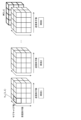
- Figure 3 is a diagram explaining the propagation characteristics at each timing of MIMO.
- the propagation characteristic H has a complex transfer function for each combination of three types of parameters: for each receiving antenna element, for each transmitting antenna element, and for each subcarrier.
- a different complex transfer function is calculated for each of the different receiving antenna elements
- a different complex transfer function is calculated for each of the different transmitting antenna elements
- a different complex transfer function is calculated for each of the different subcarriers.
- the propagation characteristic H can be expressed as a combination of 3x4x2 blocks.
- One block represents one complex transfer function calculated for one specific receiving antenna element, one specific transmitting antenna element, and one specific subcarrier.
- the propagation characteristic H can be expressed three-dimensionally because it is expressed as a combination of three types of parameters, receiving antenna elements, transmitting antenna elements, and subcarriers.
- this propagation characteristic H expressed three-dimensionally is calculated for each of multiple timings.
- the propagation characteristic H is expressed as a complex transfer function matrix that includes the complex transfer functions obtained for each of the S subcarriers and each of the NxM combinations as each element of an NxMxS three-dimensional array.
- the subcarrier and transmitting antenna element may be fixed, and multiple complex transfer functions of different receiving antenna elements may be expressed as multiple complex transfer functions that differ in the receiving antenna element direction.
- the subcarrier and receiving antenna element may be fixed, and multiple complex transfer functions of different transmitting antenna elements may be expressed as multiple complex transfer functions that differ in the transmitting antenna element direction.
- the receiving antenna element and transmitting antenna element may be fixed, and multiple complex transfer functions of different subcarriers may be expressed as multiple complex transfer functions that differ in the subcarrier direction.
- the directions of each dimension may be expressed as the receiving antenna element direction, the transmitting antenna element direction, and the subcarrier direction using names related to the three types of parameters.
- the receiving unit 140 calculates the propagation characteristic H(t, s) between M transmitting antenna elements and N receiving antenna elements for the sth subcarrier during the observation time t from the S subcarrier signals transmitted from the receiving unit 140, as expressed by a complex transfer function matrix as shown in Equation 1.
- the first complex transfer function calculation unit 150 calculates a first complex transfer function matrix from the complex transfer function matrix in which a first error 210 corresponding to at least one of the clock fluctuation between the transmitting unit 110 and the receiving unit 140, and the timing fluctuation of the digital-to-analog conversion of the transmitting signal 310 or the analog-to-digital conversion of the receiving signal 320 is suppressed.
- the receiving signal 320 includes a first error 210 that is random in time with respect to a direct wave + biological component 330 that includes a direct wave 200 and a biological component.
- the first complex transfer function calculation unit 150 calculates N ⁇ M ⁇ S corrected elements by dividing all elements of the N ⁇ M ⁇ S complex transfer functions by direct wave components extracted using one or more elements of the N ⁇ M ⁇ S complex transfer functions, which are a set of the complex transfer functions obtained for each of the S subcarriers and each of the N ⁇ M combinations, and which do not pass through the living body 20. In this way, the first complex transfer function calculation unit 150 generates a first complex transfer function matrix having N ⁇ M ⁇ S corrected elements.
- the first complex transfer function calculation unit 150 obtains an eigenvector by performing eigenvalue decomposition on the correlation matrix of the complex transfer function at a certain observation time or the entire observation time, and calculates the first complex transfer function from the first eigenvector.
- the correlation matrix R R (s) in the transmission direction and the correlation matrix R T (s) in the transmission direction are calculated from the propagation characteristic H(t,s) in the s-th subcarrier as shown in Equation 2 and Equation 3, respectively.
- t0 represents the instantaneous observation time
- the first complex transfer function calculation unit 150 performs eigenvalue decomposition on the transmission correlation matrix and the reception correlation matrix to calculate a transmission first eigenvector v 1 (s) and a reception first eigenvector u 1 (s).
- the elements of the first complex transfer function are calculated by Equation 4.
- the first complex transfer function calculation unit 150 calculates this for different elements in all subcarrier directions, transmitting antenna element directions, and receiving antenna element directions, and calculates a first complex transfer function matrix including the calculated multiple elements.
- Equation 1 may use a matrix in the transmitting antenna element direction and the subcarrier direction.
- the first error may be suppressed by dividing each element by the average value of adjacent subcarriers.
- the direct wave component may be a channel component of a direct wave calculated by multiplying a complex transfer function by an eigenvector that is a pair of eigenvalues and eigenvectors that are maximum among pairs of eigenvalues and eigenvectors calculated by eigenvalue decomposition of N ⁇ M ⁇ S complex transfer functions.
- the direct wave component may be any one of the N ⁇ M ⁇ S complex transfer functions, or may be an average of the N ⁇ M ⁇ S complex transfer functions.
- the direct wave component may be a channel component of a direct wave calculated by multiplying a complex transfer function by a left singular vector and a right singular vector that are calculated by singular value decomposition of N ⁇ M ⁇ S complex transfer functions.
- the second complex transfer function calculation unit 160 performs a predetermined process to suppress the second error 400, which is an error within the receiver, using the amplitude average of multiple first elements arranged in the first dimension direction 500 from the first complex transfer function calculation unit 150.
- the second complex transfer function calculation unit 160 calculates a second complex transfer function matrix in which the second error 400 is suppressed based on the amplitude average of multiple first elements in the transmitting antenna element direction as the first dimension direction 500.
- the elements of the second complex transfer function matrix in which the sth subcarrier is transmitted from the mth transmitting antenna and received by the nth receiving antenna are expressed by Equation 5.
- the signal after amplification by the receiving unit 140 contains a second error due to the amplification process as an error within the receiver.
- the second error appears at the same timing and with the same amplitude regardless of the transmitting antenna element or subcarrier. For this reason, by calculating the amplitude average of multiple first elements derived from the received signal received by the same receiving antenna element, it is possible to extract the noise component common to these multiple first elements. Then, by dividing each of the multiple first elements by the extracted noise component, it is possible to calculate an element from which the noise component has been removed.
- the second complex transfer function calculation unit 160 calculates this for different elements in all subcarrier directions, transmitting antenna element directions, and receiving antenna element directions, and calculates a second complex transfer function matrix including the calculated multiple elements.
- the second complex transfer function calculation unit 160 calculates the second complex transfer function matrix by performing a predetermined process on each of the N ⁇ M ⁇ S elements in the first complex transfer function matrix, which contains the complex transfer functions obtained for each of the S subcarriers and each of the N ⁇ M combinations as elements of an N ⁇ M ⁇ S three-dimensional array.
- the predetermined process is a process of calculating the amplitude average of multiple first elements including the element to be processed, and dividing the element to be processed by the amplitude average.
- the multiple first elements are included in the S ⁇ M elements obtained for one receiving antenna element corresponding to the element to be processed.
- the amplitude average of multiple first elements arranged in the transmitting antenna element direction of the first complex transfer function matrix is used to calculate the second complex transfer function matrix, but the amplitude average of multiple first elements in the subcarrier direction or both may be used.
- the multiple first elements for calculating the amplitude average may be M elements obtained for one receiving antenna element corresponding to the element to be processed and one subcarrier corresponding to the element to be processed.
- the multiple first elements for calculating the amplitude average may be S elements obtained for one receiving antenna element corresponding to the element to be processed and one transmitting antenna element corresponding to the element to be processed.
- the multiple first elements for calculating the amplitude average may be S x M elements obtained for one receiving antenna element corresponding to the element to be processed.
- the second complex transfer function matrix is calculated using the amplitude average of the multiple first elements, but it may be calculated using the phase average of the multiple first elements or the average value of both.
- the second complex transfer function matrix may have multiple elements obtained by dividing each element of the first complex transfer function matrix by the phase average of the multiple first elements or the average value of both.
- all of the multiple first elements are used for the amplitude average in the transmitting antenna element direction or subcarrier direction of the first complex transfer function, but it is also possible to use the average value of multiple first elements aligned in the transmitting antenna direction based on the element to be processed, or multiple first elements aligned in the subcarrier direction based on the element to be processed, or a portion of multiple first elements aligned in a plane in the transmitting antenna direction and subcarrier direction based on the element to be processed (i.e., any number (two or more)).
- the second complex transfer function matrix is calculated based on the first complex transfer function matrix after the first complex transfer function matrix is calculated, but the order of calculation may be reversed.
- the first complex transfer function matrix may be calculated based on the second complex transfer function matrix after the second complex transfer function matrix is calculated.
- FIG. 8 is a diagram illustrating an example of the third error
- FIG. 9 is a diagram illustrating the relationship between the third error and the channel.
- the third complex transfer function calculation unit 170 receives the channel 630 obtained by measurement or the calculated second complex transfer function, and calibrates (corrects) the third error 610, which is the phase error in the frequency direction.
- the phase error in the frequency direction is the phase error between multiple signals having different frequencies. The phase error that requires calibration will be explained using FIG. 9.
- the antenna distance When signals with different frequencies propagate through space and are received, the amount of phase rotation of the transmission signal 310 relative to the reception signal 320 varies depending on the frequency and the distance between the transmission antenna unit 100 and the reception antenna unit 130 (hereinafter referred to as the antenna distance). It can be seen that the three transmission waves 750-A, 750-B, and 750-C in FIG. 9 are signals with different frequencies transmitted from the transmission antenna unit 100 with the same phase, and that the phases become different as the propagation distance increases (760-B, 760-C). For this reason, the antenna distance can be calculated backwards by transmitting and receiving signals of known frequencies and measuring the phase difference.
- the phase difference actually measured includes not only the influence of spatial propagation between the transmission antenna unit 100 and the reception antenna unit 130, but also an error (hereinafter referred to as the third error 610) due to the influence of the phase characteristics of the internal circuits and antennas of the transmitter and receiver. For this reason, in order to correctly measure the antenna distance, it is necessary to remove the third error 610 from the observed signal.
- the third error 610 can be obtained by calculating the difference between the channel h obtained by measurement and an ideal channel h ideal , which is a spatial channel that can be calculated from the second complex transfer function and the distance between the transmitting antenna element and the receiving antenna element. This is not limited to the estimation of the distance between the antennas, but also applies to the case of estimating the distance between the estimation device 101 and the living body 20.
- the third complex transfer function calculation unit 170 corrects the third error 610, which is a phase error in the subcarrier direction.
- the direct wave component in the second complex transfer function received from the second complex transfer function calculation unit 160 is extracted.
- Methods for determining biological components from complex transfer functions recorded in time series include the Fourier transform disclosed in Patent Document 1 and a method using difference information disclosed in Patent Document 2.
- the third complex transfer function calculation unit 170 performs a Fourier transform on the second complex transfer function for the observation time (slow time) and extracts only specific frequency components to calculate a complex transfer function corresponding to the direct wave 200.
- the third complex transfer function calculation unit 170 extracts an arbitrary frequency component, for example a frequency component of 0 Hz, from the frequency response complex transfer function calculated by performing a Fourier transform on the second complex transfer function for the observation time, and calculates a time response complex transfer function corresponding to the direct wave 200 by performing an inverse Fourier transform on the frequency response complex transfer function corresponding to the direct wave 200.
- the third complex transfer function calculation unit 170 calculates H ideal , which is an ideal channel 600 between the antenna elements, based on the antenna distance 620 between the transmitting antenna element and the receiving antenna element input in advance.
- the input antenna distance d is, for example, a value obtained by a user actually measuring the distance between the transmitting antenna element and the receiving antenna element.
- H ideal is a complex matrix having elements of the number S of subcarriers
- H ideal (s) which is the ideal channel 600 of the sth subcarrier, is calculated by Equation 6.
- H ideal is an ideal complex transfer function between the transmitting antenna element and the receiving antenna element obtained based on the inter-antenna distance 620 between the transmitting antenna element and the receiving antenna element.
- the third complex transfer function calculation unit 170 calculates a correction value for correcting a third error 610, which is a phase error in the subcarrier direction, based on H ideal , which is the ideal channel 600, and the time response complex transfer function H 0 corresponding to the direct wave 200.
- the third complex transfer function calculation unit 170 calculates the correction value H cal by calculating the difference between H ideal , which is the ideal channel 600, and the time response complex transfer function H 0 corresponding to the direct wave 200.
- the correction value h cal_nm of the third error 610 between the m-th transmitting antenna element and the n-th receiving antenna element in the s-th subcarrier is calculated by Equation 7.
- the third complex transfer function calculation unit 170 calculates a third complex transfer function matrix based on the correction value H cal .
- the third complex transfer function between the m-th transmitting antenna element and the n-th receiving antenna element in the s-th subcarrier is calculated by Equation 8.
- the third complex transfer function calculation unit 170 calculates this for different elements in all subcarrier directions, transmitting antenna element directions, and receiving antenna element directions, and calculates a third complex transfer function matrix including the calculated multiple elements.
- the third complex transfer function calculation unit 170 calculates an offset value (correction value) for a reference phase calculated from the positional relationship between the transmitting antenna unit 100 and the receiving antenna unit 130, and calculates a third complex transfer function matrix by correcting the second complex transfer function matrix based on the offset value. Specifically, the third complex transfer function calculation unit 170 converts the second complex transfer function matrix into a frequency response matrix or a frequency response vector, and extracts a frequency response matrix or a frequency response vector corresponding to a direct wave between the transmitting antenna unit 100 and the receiving antenna unit 130.
- the third complex transfer function calculation unit 170 calculates an ideal complex transfer function corresponding to the direct wave, and calculates a correction value for correcting the phase error in the S second elements for each of the N ⁇ M combinations of the second complex transfer function matrix as an offset value based on the ideal complex transfer function and the frequency response matrix or the frequency response vector.
- the third complex transfer function calculation unit 170 calculates a third complex transfer function matrix in which the phase error has been corrected based on the correction value.
- the time response complex transfer function H 0 corresponding to the direct wave 200 is calculated by performing a Fourier transform.
- the time response complex transfer function H 0 may be calculated using a high-speed processing method that does not require a Fourier transform, as described in Patent Document 2.
- the time response complex transfer function H 0 corresponding to the direct wave 200 is calculated by performing a Fourier transform, but the element h 0 — nm (s) of the time response complex transfer function may be calculated by rearranging any range of real and imaginary components, for example, real and imaginary components in order from largest to smallest in the element h′′ nm (t, s) of the second complex transfer function matrix, extracting 10% to 90% values of the rearranged multiple components, averaging them in the time direction, and dividing the elements of the second complex transfer function matrix by the calculated average value.
- the third complex transfer function calculation unit 170 calculates an average value by averaging all elements or multiple third elements of the second complex transfer function matrix in the real part direction and the imaginary part direction, respectively.
- the third complex transfer function calculation unit 170 calculates an ideal complex transfer function corresponding to a direct wave between the transmitting antenna unit 100 and the receiving antenna unit 130, and calculates, as the offset value, a correction value for correcting phase errors in S second elements for each of the N ⁇ M combinations in the second complex transfer function matrix based on the ideal complex transfer function and the calculated average value.
- the third complex transfer function calculation unit 170 calculates a third complex transfer function matrix in which the phase errors have been corrected based on the correction value.
- the third complex transfer function calculation unit 170 may further use an MMSE filter that emphasizes the direct wave component as a reference signal by an adaptive array based on the minimum mean square error (MMSE) in the time direction of the calculated third complex transfer function.
- the third complex transfer function calculation unit 170 may calculate the fourth complex transfer function matrix by applying a time-direction MMSE filter in which the direct wave between the transmitting antenna unit 100 and the receiving antenna unit 130 is set as a reference signal to the second complex transfer function matrix or the third complex transfer function matrix.
- a method for calculating the correction value from the measurement results of the complex transfer function has been described, but if the correction value does not change over time, a value measured using a measuring device such as a network analyzer in a factory and stored in memory may be used as the correction value.
- Biometric correlation matrix calculation unit 180 The biological correlation matrix calculation unit 180 sequentially records the multiple complex transfer function matrices calculated by the third complex transfer function calculation unit 170 for each of the multiple subcarriers and each of the N ⁇ M combinations in a time series in the order in which the multiple received signals 320 were observed. Then, the biological correlation matrix calculation unit 180 extracts components related to the biological body 20 from the third complex transfer function matrix or the fourth complex transfer function matrix that is observed during the first period sequentially recorded in time series for each of the multiple subcarriers and each of the N ⁇ M combinations and suppresses the first error 210, the second error 400, and the third error 610, thereby calculating the biological component transfer function matrix represented by an N ⁇ M dimensional matrix for each of the multiple subcarriers.
- the biological component transfer function matrix here is obtained by extracting the reflected or scattered waves (biological components) that pass through the living body 20 and are included in the received signal 320.
- Methods for determining the biological components from the third complex transfer function recorded in time series include the Fourier transform disclosed in Patent Document 1 and the method using difference information disclosed in Patent Document 2.
- the third complex transfer function matrix is Fourier transformed for the observation time (slow time) to extract only specific frequency components, making it possible to calculate a biological component transfer function matrix for each of a number of frequency components that may include the influence of biological activity, for example, those included in the frequency range from 0.1 Hz to 3 Hz.
- the relationship between frequency and phase of the biocomponent transfer function matrix is shown in FIG. 10.
- the solid line 800 shows how the phase of each component of the biocomponent transfer function matrix varies with the subcarrier frequency when the biocomponent 20 is located at a certain position.
- the path length of the radio waves reflected by the biocomponent 20 becomes shorter, and the slope of the graph becomes gentler, as shown by the dashed line 810.
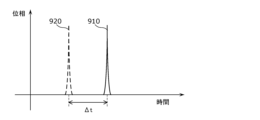
- this biocomponent transfer function matrix is further inverse Fourier transformed in the subcarrier direction to obtain a time domain biocomponent transfer function matrix, and the time from when the signal containing the biocomponent is transmitted from the transmitting antenna to when it is received by the receiver can be obtained.
- Figure 11 shows the relationship between time (column direction of the matrix) and phase of the time domain biological component transfer function matrix.
- the phase changes of the solid line 800 and dashed line 810 in Figure 10 appear as peaks shown by the solid line 910 and dashed line 920, respectively.
- the time resolution ⁇ t found here is expressed by Equation 9 using the subcarrier bandwidth B.
- the time resolution is equivalent to 0.5 ⁇ s, which translates to a distance resolution of about 15 m, which is not practical.
- the resolution is improved by using the MUSIC method.
- the biocorrelation matrix calculation section 180 calculates the biocorrelation matrix Rf of the biocomponent transfer function vector obtained by vectorizing the biocomponent transfer function matrix according to the following formula 10.
- the estimation unit 190 performs distance measurement and angle measurement by the MUSIC method using the biological correlation matrix Rf calculated by the biological correlation matrix calculation unit 180. That is, the estimation unit 190 performs eigenvalue decomposition on the biological correlation matrix Rf to obtain a vector Us corresponding to a signal and an eigenvector Un corresponding to noise.
- the eigenvector corresponding to a signal is a vector from the first eigenvector up to the number of detection objects, and for example, if there is one object, there is only the first eigenvector.
- the eigenvector corresponding to a signal is, for example, k eigenvectors from the first eigenvector to the kth eigenvector if there are k objects (k is a natural number of 2 or more).
- the eigenvector corresponding to noise refers to an eigenvector other than the eigenvector corresponding to a signal.
- a MUSIC spectrum P MUSIC (x, y) is calculated according to the following equation.
- a(x,y) represents the steering vector, which is calculated as shown in Equation 12.
- d nm (x, y) represents the sum of the distance between the coordinate (x, y) and the nth transmitting antenna element and the distance between the coordinate (x, y) and the mth receiving antenna element
- ⁇ (s) represents the wavelength of the sth subcarrier
- the estimation unit 190 performs averaging in the biological activity frequency direction in Equation 10, but may also perform averaging in the subcarrier frequency direction.
- the estimation unit 190 may estimate the first angle ⁇ from the receiving antenna to the living body by applying the steering vector calculated using an arbitrary subcarrier frequency according to Equation 12 to the MUSIC method of Equation 11.
- the estimation unit 190 estimates the position of the living body 20, but the estimation unit 101 may estimate the distance between the living body 20.
- the maximum value of P MUSIC (x, y) becomes an ellipse 1010 with the transmitting antenna element and the receiving antenna element as focal points, as shown in FIG. 12.
- the sum (third distance) of the distance a (first distance) between the transmitting antenna element and the living body 20 and the distance b (second distance) between the receiving antenna element and the living body 20 from an arbitrary point (x, y) on the ellipse 1010 where the transmitting and receiving antennas become the maximum is calculated by Equation 13.
- a(l) represents the steering vector, which is calculated as shown in Equation 14.
- the maximum value l of the MUSIC spectrum P MUSIC (l) obtained in this manner corresponds to the sum (third distance) of the distance a (first distance) between the transmitting antenna unit 100 and the living body 20 in Figure 12 and the distance b (second distance) between the receiving antenna unit 130 and the living body 20.
- FIG. 12 is a schematic diagram showing the positional relationship between a living body, a transmitting antenna section, and a receiving antenna section in MIMO, and the position of the living body.
- the transmitting antenna section 100 has multiple transmitting antenna elements
- the receiving antenna section 130 has multiple receiving antenna elements.
- FIG. 12 is an example of MIMO.
- the estimation unit 190 estimates a third distance, which is the sum of the first distance between the transmitting antenna unit 100 and the living body 20 and the second distance between the receiving antenna unit 130 and the living body 20, using the living body correlation matrix calculated for each of the multiple subcarriers.
- the estimation unit 190 estimates the location of the living body using Equation 13, but the sum of the estimated distance a (first distance) between the transmitting antenna unit 100 and the living body 20 and the distance b (second distance) between the receiving antenna unit 130 and the living body 20 may be set as a third distance L, and the location of the living body 20 may be estimated using the first angle ⁇ as shown in Equation 16.
- the coordinates (x, y) of the living body 20 are calculated using the first distance a and the first angle ⁇ by the following formula:
- the estimation unit 190 may estimate the position of the living body 20 from the second angle ⁇ as shown in Equation 32, using the sum of the estimated distance a (first distance) between the transmitting antenna unit 100 and the living body 20 and the distance b (second distance) between the receiving antenna unit 130 and the living body 20 as the third distance L.
- the estimation unit 190 may select one antenna from multiple transmitting antenna elements as shown in FIG. 13, and calculate the sum (third distance) of the distance a (first distance) between the transmitting antenna unit 100 and the living body 20 and the distance b (second distance) between the receiving antenna unit 130 and the living body 20 as shown in Equation 13.
- FIG. 13 is a schematic diagram showing the positional relationship between a living body, a transmitting antenna section, and a receiving antenna section in MISO, and the position of the living body.
- the transmitting antenna section 100 has multiple transmitting antenna elements
- the receiving antenna section 130 has one receiving antenna element.
- FIG. 13 is an example of MISO.
- the maximum value l of the MUSIC spectrum P MUSIC (l) obtained in this manner corresponds to the sum (third distance) of the distance a (first distance) between the transmitting antenna unit 100 and the living body 20 in Fig. 13 and the distance b (second distance) between the receiving antenna unit 130 and the living body 20.
- the estimation unit 190 estimates the third distance, which is the sum of the first distance between the transmitting antenna unit 100 and the living body 20 and the second distance between the receiving antenna unit 130 and the living body 20, using the living body correlation matrix calculated for each of the multiple subcarriers.
- the estimation unit 190 estimates the position of the living body 20 using Equation 13, but the position of the living body 20 may be estimated from the first angle ⁇ as shown in Equation 16, where L is a third distance that is the sum of the estimated distance a (first distance) between the transmitting antenna unit 100 and the living body 20 and the distance b (second distance) between the receiving antenna unit 130 and the living body 20.
- FIG. 14 is a flowchart showing the estimation process of the estimation device in embodiment 1.
- the estimation device 101 calculates the complex transfer function for the first period (S100).
- the estimation device 101 calculates a first complex transfer function matrix that suppresses a first error 210 corresponding to at least one of the clock fluctuation between the transmitting unit 110 and the receiving unit 140, and the timing fluctuation of the digital-to-analog conversion of the transmitting signal 310 or the analog-to-digital conversion of the receiving signal 320 (S200).
- the estimation device 101 calculates a second complex transfer function matrix that suppresses the second error 400, which is the internal receiving error (S300).
- the estimation device 101 calculates a third complex transfer function matrix that suppresses the third error 610, which is the phase error in the subcarrier direction (S400).
- the estimation device 101 performs an estimation process of the direction, distance and/or position of the living body 20 (S500).
- the estimation device 101 is a device for estimating a reception internal error, and includes a transmission signal generation unit 120, a transmission antenna unit 100, a transmission unit 110, a reception antenna unit 130, a reception unit 140, and a matrix calculation unit 145.
- the transmission signal generation unit 120 generates a multicarrier signal in which S subcarrier signals (S is a natural number of 2 or more) are modulated.
- the transmission antenna unit 100 has M transmission antenna elements (M is a natural number of 1 or more).
- the transmission unit 110 processes the multicarrier signal and outputs it to the transmission antenna unit 100, thereby causing the transmission antenna unit 100 to transmit the multicarrier signal.
- the reception antenna unit 130 has N reception antenna elements (N is a natural number of 1 or more).
- the receiving unit 140 observes, for a first period corresponding to a period originating from the activity of the living body 20, received signals received by each of the N receiving antenna elements, including reflected signals of multicarrier signals transmitted from each of the M transmitting antenna elements reflected or scattered by the living body 20.
- the receiving unit 140 uses the multiple received signals observed in the first period to calculate, for each of N ⁇ M combinations of each of the M transmitting antenna elements and each of the N receiving antenna elements, a plurality of complex transfer functions representing the propagation characteristics between the transmitting antenna elements and the receiving antenna elements in the combination for each of the S subcarriers to which the S subcarrier signals respectively correspond.
- the matrix calculation unit 145 calculates a second complex transfer function matrix by performing a predetermined process on each of the N ⁇ M ⁇ S elements in a first complex transfer function matrix including the complex transfer functions obtained for each of the S subcarriers and each of the N ⁇ M combinations as elements of an N ⁇ M ⁇ S three-dimensional array.
- the predetermined process is a process of calculating an amplitude average of a plurality of first elements including a processing target element, and dividing the processing target element by the amplitude average.
- the plurality of first elements are included in the S ⁇ M elements obtained for one receiving antenna element corresponding to the processing target element.
- a predetermined process is performed for each of the N ⁇ M ⁇ S elements in the first complex transfer function matrix, in which the amplitude average of a plurality of first elements that are included in the S ⁇ M elements obtained for one receiving antenna element corresponding to the element to be processed and that include the element to be processed is calculated and the element to be processed is divided by the amplitude average, thereby reducing the first error that is imparted to the received signal by each receiving antenna element. Therefore, the position of the living body 20 can be estimated with high accuracy.
- the multiple first elements are M elements obtained for one receiving antenna element corresponding to the element to be processed and one subcarrier corresponding to the element to be processed.
- the first error can be reduced by using the amplitude average of M elements obtained for one receiving antenna element corresponding to the element to be processed and one subcarrier corresponding to the element to be processed.
- the multiple first elements are S elements obtained for one receiving antenna element corresponding to the element to be processed and one transmitting antenna element corresponding to the element to be processed.
- the first error can be reduced by using the amplitude average of S elements obtained for one receiving antenna element corresponding to the element to be processed and one transmitting antenna element corresponding to the element to be processed.
- the multiple first elements are S ⁇ M elements.
- the first error can be reduced by using the amplitude average of S ⁇ M elements.
- the matrix calculation unit 145 further calculates an offset value with respect to a reference phase calculated from the positional relationship between the transmitting antenna unit 100 and the receiving antenna unit 130, and calculates a third complex transfer function matrix by correcting the second complex transfer function matrix based on the offset value.
- the matrix calculation unit 145 converts the second complex transfer function matrix into a frequency response matrix or a frequency response vector, and extracts a frequency response matrix or a frequency response vector corresponding to a direct wave between the transmitting antenna unit 100 and the receiving antenna unit 130.
- the matrix calculation unit 145 calculates an ideal complex transfer function corresponding to the direct wave, and calculates, as an offset value, a correction value for correcting the phase error in the S second elements for each of the N ⁇ M combinations of the second complex transfer function matrix, based on the ideal complex transfer function and the frequency response matrix or the frequency response vector.
- the matrix calculation unit 145 calculates a third complex transfer function matrix in which the phase error has been corrected based on the correction value.
- phase errors in the subcarrier direction can be eliminated, and the distance from the estimation device 101 to the living body 20 can be measured with higher accuracy.
- the matrix calculation unit 145 calculates an average value by averaging all elements or multiple third elements of the second complex transfer function matrix in the real part direction and the imaginary part direction, respectively.
- the matrix calculation unit 145 calculates an ideal complex transfer function corresponding to a direct wave between the transmitting antenna unit 100 and the receiving antenna unit 130, and calculates, as an offset value, a correction value for correcting the phase error in the S second elements for each of the N ⁇ M combinations of the second complex transfer function matrix based on the ideal complex transfer function and the average value.
- the matrix calculation unit 145 calculates a third complex transfer function matrix in which the phase error has been corrected based on the correction value.
- phase errors in the subcarrier direction can be eliminated, and the distance from the estimation device 101 to the living body 20 can be measured with higher accuracy.
- the matrix calculation unit 145 further calculates a fourth complex transfer function matrix by applying a time-direction MMSE (Minimum Mean Square Error) filter in which the direct wave between the transmitting antenna unit 100 and the receiving antenna unit 130 is set as a reference signal to the second complex transfer function matrix or the third complex transfer function matrix.
- MMSE Minimum Mean Square Error
- phase errors in the subcarrier direction can be eliminated, and the distance from the estimation device 101 to the living body 20 can be measured with higher accuracy.
- the first complex transfer function matrix has N ⁇ M ⁇ S corrected elements obtained by dividing all elements of the N ⁇ M ⁇ S complex transfer functions by direct wave components that do not pass through the living body 20, the direct wave components being extracted using one or more elements of N ⁇ M ⁇ S complex transfer functions, which are a set of complex transfer functions obtained for each of the S subcarriers and each of the N ⁇ M combinations.
- M and N are 2 or more.
- the estimation device 101 further includes an estimation unit 190.
- the estimation unit 190 uses the third complex transfer function matrix calculated by the matrix calculation unit 145 to estimate the position of the living body 20 from a first angle, which is the direction of the living body 20 as seen from the M transmitting antenna units 100, and a second angle, which is the direction of the living body 20 as seen from the N receiving antenna units 130.
- the position of the living body 20 can be estimated with higher accuracy relative to the estimation device 101.
- the estimation device 101 further includes an estimation unit 190.
- the estimation unit 190 uses the third complex transfer function matrix calculated by the matrix calculation unit 145 to estimate a third distance that is the sum of a first distance between the transmitting antenna unit 100 and the living body 20 and a second distance between the receiving antenna unit 130 and the living body 20, estimates a first angle that is the direction of the living body 20 as seen from the transmitting antenna unit 100, and estimates the position of the living body 20 from the third distance and the first angle.
- the position of the living body 20 can be estimated with higher accuracy relative to the estimation device 101.
- the estimation unit 190 estimates the first distance, the second distance, the first angle, and the second angle using any one of the MUSIC (Multiple SIgnal Classification) method, the beamformer method, and the Capon method.
- MUSIC Multiple SIgnal Classification
- the distance to the living body 20 can be estimated with greater accuracy using the estimation device 101 as a reference.
- the estimation device 101 having a MIMO or MISO configuration can be used to estimate the position (coordinates) of the living body 20, the distance between the transmitting antenna unit 100 and the receiving antenna unit 130 and the living body 20, and the direction (angle) in which the living body 20 is located relative to the transmitting antenna unit 100 and the receiving antenna unit 130.
- the present disclosure makes it possible to realize an estimation device, estimation method, and program that can estimate the distance and position of a living body in a short time and with high accuracy by using wireless signals.
- FIG. 15 is a block diagram showing an example of the configuration of an estimation device 1201 according to the second embodiment.
- the estimation device 1201 shown in FIG. 15 includes a transmitting antenna unit 1200, a transmitting unit 1210, a transmitting signal generating unit 1220, a receiving antenna unit 1230, a receiving unit 1240, a matrix calculation unit 1245, a biological correlation matrix calculation unit 1280, and an estimation unit 1290.
- the matrix calculation unit 1245 includes a first complex transfer function calculation unit 1250, a second complex transfer function calculation unit 1260, and a third complex transfer function calculation unit 1270.
- the estimation device 1201 estimates the position of the living body 20.
- the transmitting antenna section 1200 has one transmitting antenna element. As described above, the transmitting antenna element transmits a multicarrier signal (transmitting wave) generated by a transmitting section 1210, which will be described later.
- the transmission signal generating unit 1220 generates a multicarrier signal in which a plurality of subcarrier signals are modulated. Specifically, the transmission signal generating unit 1220 generates a plurality of subcarrier signals corresponding to a plurality of subcarriers in different frequency bands, and generates a multicarrier signal by multiplexing the generated plurality of subcarrier signals. In this embodiment, the transmission signal generating unit 1220 generates an OFDM signal consisting of S subcarriers, which has a high frequency band utilization efficiency, as a multicarrier signal.
- the transmission signal generating unit 1220 is not limited to generating an OFDM signal in which each subcarrier is orthogonal, as long as the multicarrier signal is obtained by multicarrier modulation, and may generate other multicarrier signals such as a simple FDM (Frequency Division Multiplexing) signal.
- FDM Frequency Division Multiplexing
- the signal generated by the transmission signal generating unit 1220 may be shared with a signal used for communication.
- the transmission signal used for sensing the living body 20 may be used exclusively for sensing the living body 20, or may be used for both sensing the living body 20 and information communication.
- the transmitting unit 1210 applies appropriate processing to the signal generated by the transmission signal generating unit 1220 to generate a transmission wave. Examples of the processing performed here include up-conversion, which converts a signal from an IF (Intermediate Frequency) frequency band to an RF (Radio Frequency) frequency band, and amplification, which amplifies a signal to an appropriate transmission level.
- the transmitting unit 1210 outputs the processed multicarrier signal to the transmitting antenna unit 1200, causing the transmitting antenna unit 1200 to transmit the multicarrier signal. As a result, the multicarrier signal is transmitted from one transmitting antenna element provided in the transmitting antenna unit 1200.
- the receiving antenna unit 1230 has N receiving antenna elements.
- N is a natural number equal to or greater than 1.
- N is a natural number equal to or greater than 2 in the case of SIMO, and N is 1 in the case of SISO.
- the N receiving antenna elements receive a signal (received signal 320) transmitted from one transmitting antenna element and reflected by the living body 20.
- the receiving unit 1240 observes the received signal 320, which is received by N receiving antenna elements and includes a reflected signal resulting from reflection or scattering of a multicarrier signal transmitted from one transmitting antenna element by the living organism 20, for a first period corresponding to a period derived from the activity of the living organism 20.
- the period derived from the activity of the living organism is a period derived from the living organism (biological fluctuation period) that is a time period equal to or longer than half a period of any one of the periods of respiration, heartbeat, and body movement of the living organism 20.
- the receiver 1240 converts the high-frequency signals received by the N receiving antenna elements into low-frequency signals that can be processed.
- the receiver 1240 also amplifies the signals received by the N receiving antenna elements.
- the receiver 1240 then demodulates the OFDM signal into S subcarrier signals (IQ symbols).
- the receiver 1240 further calculates multiple complex transfer functions representing the propagation characteristics between the transmitting antenna element and the receiving antenna element for each subcarrier from the multiple IQ symbols observed during the first period.
- the receiver 1240 may constantly monitor the received signal 320 received by the receiving antenna 1230 and continuously or periodically output S low-frequency signals (IQ symbols).
- the receiver 1240 uses the multiple received signals 320 observed during the first period to calculate multiple complex transfer functions representing the propagation characteristics between the transmitting antenna element and the receiving antenna element in each of the N combinations of one transmitting antenna element and N receiving antenna elements, for each of the multiple subcarriers to which the multiple subcarrier signals respectively correspond.
- the receiver 1240 calculates S ⁇ N sets of complex transfer functions representing the propagation characteristics between each transmitting antenna element and each receiving antenna element for the estimation device 1201. As a result, the receiver 1240 may generate a complex transfer function matrix having S ⁇ N elements. Note that the calculated complex transfer function matrix also includes reflected waves that do not pass through the living body 20, such as direct waves and reflected waves from fixed objects.
- the receiving unit 1240 may constantly calculate the complex transfer function matrix using each of the multiple subcarrier signals that are output continuously or periodically. With this configuration, if the estimation device 1201 is configured to share the hardware of a communication device, the complex transfer function matrix that is constantly calculated for use in the processing of the communication device can also be used by the estimation device 1201.
- Figure 16 is a diagram to explain the propagation characteristics at each timing of SIMO.
- the propagation characteristic H has a complex transfer function for two types of parameters, one for each receiving antenna element and one for each subcarrier. In other words, a different complex transfer function is calculated for each of the different receiving antenna elements and each of the different subcarriers.
- the propagation characteristic h(t) can be expressed as a combination of 3 x 1 x 2 blocks.
- One block represents one complex transfer function calculated for one specific receiving antenna element, one transmitting antenna element, and one specific subcarrier.
- the propagation characteristic H is expressed two-dimensionally because it is represented by two types of parameters, one for each receiving antenna element and one for each subcarrier.
- this propagation characteristic h(t) is calculated for each of multiple timings.
- the receiving unit 1240 calculates the propagation characteristic H(t) between the transmitting antenna element and N receiving antenna elements for the sth subcarrier during the observation time t from the S IQ symbols transmitted from the receiving unit 1240, as expressed by Equation 17.
- the first complex transfer function calculation unit 1250 calculates a first complex transfer function matrix from the complex transfer function matrix in which a first error 210 corresponding to at least one of the clock fluctuation between the transmitting unit 1210 and the receiving unit 1240, and the timing fluctuation of the digital-to-analog conversion of the transmitting signal 310 or the analog-to-digital conversion of the receiving signal 320 is suppressed.
- the first complex transfer function calculation unit 1250 obtains an eigenvector by performing eigenvalue decomposition on the correlation matrix of the complex transfer function at a certain observation time or the entire observation time, and calculates a first complex transfer function matrix from the first eigenvector.
- the correlation matrix R R in the transmission direction and the correlation matrix R T in the transmission direction are calculated from the propagation characteristic H(t) as shown in Equation 18 and Equation 19, respectively.
- t0 represents the instantaneous observation time
- the first complex transfer function calculation unit 1250 performs eigenvalue decomposition on the transmission correlation matrix and the reception correlation matrix to calculate the transmission first eigenvector v 1 and the reception first eigenvector u 1.
- the elements of the first complex transfer function received by the nth reception antenna when the sth subcarrier is transmitted from the transmission antenna are calculated by Equation 20.
- the first complex transfer function calculation unit 1250 calculates this for different elements in all subcarrier directions, transmitting antenna element directions, and receiving antenna element directions, and calculates a first complex transfer function matrix including the calculated multiple elements.
- the first error may be suppressed by dividing by the average value of adjacent subcarriers.
- the second complex transfer function calculation unit 1260 performs a predetermined process for suppressing the second error 400, which is an error in the receiver, using the amplitude average of a plurality of first elements arranged in the first dimension direction 500 from the first complex transfer function calculation unit 1250.
- the second complex transfer function calculation unit 1260 calculates a second complex transfer function matrix in which the second error 400, which is an error in the receiver, is suppressed based on the amplitude average of a plurality of first elements in the subcarrier direction as the first dimension direction 500.
- the elements of the second complex transfer function matrix in which the s-th subcarrier is transmitted from the transmitting antenna and received by the n-th receiving antenna are expressed by Equation 21.
- the second complex transfer function calculation unit 1260 calculates this for different elements in all subcarrier directions and receiving antenna element directions, and calculates a second complex transfer function matrix including the calculated multiple elements.
- all of the multiple first elements are used to calculate the amplitude average in the subcarrier direction of the first complex transfer function, but it is also possible to use the average value of multiple first elements aligned in the transmit antenna direction based on the element to be processed, or multiple first elements aligned in the subcarrier direction based on the element to be processed, or a portion of multiple first elements aligned in a plane in the transmit antenna direction and subcarrier direction based on the element to be processed (i.e., any number (two or more)).
- the second complex transfer function matrix is calculated using the amplitude average of the multiple first elements, but it may be calculated using the phase average of the multiple first elements or the average value of both.
- the second complex transfer function matrix may have multiple elements obtained by dividing each element of the first complex transfer function matrix by the phase average of the multiple first elements or the average value of both.
- the second complex transfer function matrix is calculated based on the first complex transfer function matrix after the first complex transfer function matrix is calculated, but the order of calculation may be reversed.
- the first complex transfer function matrix may be calculated based on the second complex transfer function matrix after the second complex transfer function matrix is calculated.
- the third complex transfer function calculation section 1270 receives the channel 630 obtained by measurement or the calculated second complex transfer function matrix, and calibrates (corrects) the third error 610 which is a phase error in the frequency direction.
- the third complex transfer function calculation unit 1270 corrects the third error 610, which is a phase error in the subcarrier direction.
- the direct wave component in the second complex transfer function received from the second complex transfer function calculation unit 1260 is extracted.
- Methods for determining biological components from complex transfer functions recorded in time series include the Fourier transform disclosed in Patent Document 1 and a method using difference information disclosed in Patent Document 2.
- the third complex transfer function calculation unit 1270 performs a Fourier transform on the second complex transfer function matrix for the observation time (slow time) to extract only specific frequency components, thereby calculating a complex transfer function corresponding to the direct wave.
- the third complex transfer function calculation unit 1270 extracts an arbitrary frequency component, for example a frequency component of 0 Hz, from the frequency response complex transfer function calculated by performing a Fourier transform on the second complex transfer function matrix for the observation time, and calculates a time response complex transfer function corresponding to the direct wave by performing an inverse Fourier transform on the frequency response complex transfer function corresponding to the direct wave.
- the third complex transfer function calculation unit 1270 calculates an ideal channel 600 H ideal between the antenna elements based on the antenna distance 620 between the transmitting antenna element and the receiving antenna element input in advance.
- the input antenna distance d is, for example, a value obtained by a user actually measuring the distance between the transmitting antenna element and the receiving antenna element.
- H ideal is a complex matrix having elements of the number S of subcarriers, and the ideal channel 600 H ideal is calculated by (Equation 22).
- H ideal is an ideal complex transfer function between the transmitting antenna element and the receiving antenna element obtained based on the inter-antenna distance 620 between the transmitting antenna element and the receiving antenna element.
- the third complex transfer function calculation unit 1270 calculates a correction value for correcting a third error 610, which is a phase error in the subcarrier direction, based on H ideal , which is the ideal channel 600, and the time response complex transfer function H 0 corresponding to the direct wave 200.
- the third complex transfer function calculation unit 1270 calculates the correction value H cal by calculating the difference between H ideal , which is the ideal channel 600, and the time response complex transfer function H 0 corresponding to the direct wave 200.
- the correction value h cal_ns of the third error 610 between the transmitting antenna element and the nth receiving antenna element in the sth subcarrier is calculated by Equation 23.
- the third complex transfer function calculation unit 1270 calculates a third complex transfer function matrix based on the correction value H cal .
- the third complex transfer function between the transmitting antenna element and the nth receiving antenna element in the sth subcarrier is calculated by Equation 20.
- the third complex transfer function calculation unit 1270 calculates this for different elements in all subcarrier directions and receiving antenna element directions, and calculates a third complex transfer function matrix including the calculated multiple elements.
- the time response complex transfer function H 0 corresponding to the direct wave 200 is calculated by performing a Fourier transform.
- the time response complex transfer function H 0 may be calculated using a high-speed processing method that does not require a Fourier transform, as described in Patent Document 2.
- the time response complex transfer function H 0 corresponding to the direct wave 200 is calculated by performing a Fourier transform.
- the element h 0_ns of the time response complex transfer function may be calculated by rearranging any range of real and imaginary components, for example, real and imaginary components in the element h′′ ns (t) of the second complex transfer function matrix in order from largest to smallest (or smallest), extracting 10% to 90% values of the rearranged multiple components, averaging them in the time direction, and dividing the elements of the second complex transfer function matrix by the calculated average value.
- the third complex transfer function calculation unit 1270 may use an MMSE filter that emphasizes the direct wave component as a reference signal using an adaptive array based on the minimum mean square error (MMSE) for the time direction of the calculated third complex transfer function.
- the third complex transfer function calculation unit 170 may calculate the fourth complex transfer function matrix by applying a time direction MMSE filter in which the direct wave between the transmitting antenna unit 100 and the receiving antenna unit 130 is set as a reference signal to the second complex transfer function matrix or the third complex transfer function matrix.
- a method for calculating the correction value from the measurement results of the complex transfer function has been described, but if the correction value does not change over time, a value measured using a measuring device such as a network analyzer in a factory and stored in memory may be used as the correction value.
- Biometric correlation matrix calculation unit 1280 The biological correlation matrix calculation unit 1280 sequentially records the multiple complex transfer function matrices calculated by the third complex transfer function calculation unit 1270 for each of the S ⁇ N combinations in a time series in the order in which the multiple received signals 320 were observed. Then, the biological correlation matrix calculation unit 1280 calculates a biological component transfer function matrix expressed by an S ⁇ N dimensional matrix by extracting components related to the biological body 20 from the third complex transfer function matrix or the fourth complex transfer function matrix that is observed during the first period and sequentially recorded in time series and suppresses the first error 210, the second error 400, and the third error 610 for each of the S ⁇ N combinations.
- the biological component transfer function matrix here is obtained by extracting the reflected or scattered waves (biological components) that pass through the living body 20 and are included in the received signal 320.
- Methods for determining the biological components from the third complex transfer function recorded in time series include the Fourier transform disclosed in Patent Document 1 and the method using difference information disclosed in Patent Document 2.
- the third complex transfer function matrix is Fourier transformed for the observation time (slow time) to extract only specific frequency components, making it possible to calculate a biological component transfer function matrix for each of a number of frequency components that may include the influence of biological activity, for example, those included in the frequency range from 0.1 Hz to 3 Hz.
- the time resolution ⁇ t is expressed by Equation 25 using the subcarrier bandwidth B.
- the time resolution is equivalent to 0.5 ⁇ s, which translates to a distance resolution of about 15 m, which is not practical.
- the biocorrelation matrix calculation section 180 calculates the biocorrelation matrix Rf of the biocomponent transfer function vector obtained by vectorizing the biocomponent transfer function matrix according to the following equation 26.
- Estimatiation unit 1290 The estimation unit 1290 performs distance measurement and angle measurement by the MUSIC method using the biometric correlation matrix Rf calculated by the biometric correlation matrix calculation unit 1280.
- the estimation unit 1290 performs eigenvalue decomposition on the biological correlation matrix Rf to obtain a vector U S corresponding to the signal and an eigenvector U N corresponding to the noise.
- the eigenvector corresponding to the signal is a vector from the first eigenvector up to the number of detection objects, and for example, if there is one object, it is only the first eigenvector.
- the eigenvector corresponding to the signal is, for example, if there are k objects (k is a natural number of 2 or more), k eigenvectors from the first eigenvector to the k-th eigenvector.
- the eigenvector corresponding to the noise refers to an eigenvector other than the eigenvector corresponding to the signal.
- a MUSIC spectrum P MUSIC (x, y) is calculated according to the following equation.
- a(x,y) represents the steering vector, which is calculated as shown in Equation 28.
- dn (x,y) denotes the sum of the distance between the coordinate (x,y) and the transmitting antenna element and the distance between the coordinate (x,y) and the m-th receiving antenna element
- ⁇ (s) denotes the wavelength of the s-th subcarrier
- the estimation unit 1290 performs averaging in the biological activity frequency direction in Equation 26, but may also perform averaging in the subcarrier frequency direction and estimate the second angle ⁇ to the biological body as seen from the receiving antenna by applying the steering vector calculated using an arbitrary subcarrier frequency according to Equation 28 to the MUSIC method in Equation 27.
- Equation 30 a(l) represents the steering vector, calculated as shown in Equation 30.
- the maximum value l of the MUSIC spectrum P MUSIC (l) obtained in this manner corresponds to the sum (third distance) of the distance a (first distance) between the transmitting antenna unit 1200 and the living body 20 in Figure 17 and the distance b (second distance) between the receiving antenna unit 1230 and the living body 20.
- FIG. 17 is a schematic diagram showing the positional relationship between a living body, a transmitting antenna section, and a receiving antenna section in SIMO, and the position of the living body.
- the transmitting antenna section 1200 has one transmitting antenna element
- the receiving antenna section 1230 has multiple receiving antenna elements.
- FIG. 17 is an example of SIMO.
- the estimation unit 1290 uses the biological correlation matrix calculated for each of the multiple subcarriers to estimate a third distance, which is the sum of the first distance and the second distance between the transmitting antenna unit 1200 and the biological body 20. This allows the estimation unit 1290 to estimate that the biological body 20 is located on an ellipse 1310 whose foci are the transmitting antenna element and the receiving antenna element.
- the estimation unit 1290 estimates the location of the living body using Equation 29, but the sum of the estimated distance a (first distance) between the transmitting antenna unit 1200 and the living body 20 and the distance b (second distance) between the receiving antenna unit 1230 and the living body 20 may be set as a third distance L, and the location of the living body may be estimated from the second angle ⁇ as shown in Equation 32.
- the coordinates (x, y) of the living body 20 are calculated using the second distance b and the second angle ⁇ according to the following formula.
- the estimation unit 1290 may calculate the sum (third distance) of the distance a (first distance) between the transmitting antenna element and the living body 20 and the distance b (second distance) between the receiving antenna element and the living body 20 as in Equation 25.
- FIG. 18 is a schematic diagram showing the positional relationship between a living body, a transmitting antenna section, and a receiving antenna section in a SISO, and the position of the living body.
- the transmitting antenna section 1200 has one transmitting antenna element
- the receiving antenna section 1230 has one receiving antenna element.
- FIG. 18 is an example of a SISO.
- the maximum value l of the MUSIC spectrum P MUSIC (l) thus obtained corresponds to the sum (third distance) of the distance a (first distance) between the transmitting antenna unit 1200 and the living body 20 in FIG. 18 and the distance b (second distance) between the receiving antenna unit 1230 and the living body 20.
- the living body correlation matrix calculated for each of the multiple subcarriers is used to estimate the third distance, which is the sum of the first distance between the transmitting antenna unit 1200 and the living body 20 and the second distance between the receiving antenna unit 1230 and the living body 20.
- the estimation unit 1290 can estimate that the living body 20 is located on an ellipse 1410 with the transmitting antenna element and the receiving antenna element as its focus.
- the estimation unit 1290 may estimate the position of the living body 20 from the intersection of the ellipse by estimating multiple third distances using three or more sets of the transmitting antenna unit 1200 and the receiving antenna unit 1230.
- FIG. 19 is a flowchart showing the estimation process of the estimation device in embodiment 2.
- the estimation device 1201 calculates a complex transfer function for the first period (S101).
- the estimation device 1201 calculates a first complex transfer function matrix that suppresses a first error 210 corresponding to at least one of the clock fluctuation between the transmitting unit 1210 and the receiving unit 1240, and the timing fluctuation of the digital-to-analog conversion of the transmitting signal 310 or the analog-to-digital conversion of the receiving signal 320 (S201).
- the estimation device 1201 calculates a second complex transfer function matrix that suppresses the second error 400, which is a receiving internal error (S301).
- the estimation device 1201 calculates a third complex transfer function matrix that suppresses the third error 610, which is the phase error in the subcarrier direction (S401).
- the estimation device 1201 performs an estimation process of the direction, distance and/or position of the living body 20 (S501).
- the estimation device 1201 further includes an estimation unit 1290.
- the estimation unit 1290 estimates a third distance, which is the sum of a first distance between the transmitting antenna unit 1200 and the living body 20 and a second distance between the receiving antenna unit 1230 and the living body 20, by using the third complex transfer function matrix calculated by the matrix calculation unit 1245, estimates a second angle, which is the direction of the living body 20 as seen from the receiving antenna unit 1230, and estimates the position of the living body 20 from the third distance and the second angle.
- the position of the living body 20 can be estimated with greater accuracy relative to the estimation device 1201.
- the estimation unit 1290 estimates a third distance, which is the sum of the first distance between the transmitting antenna unit 1200 and the living body 20 and the second distance between the receiving antenna unit 1230 and the living body 20, using the third complex transfer function matrix calculated by the matrix calculation unit 145.
- the distance to the living body 20 can be estimated with greater accuracy based on the estimation device 1201.
- the present disclosure makes it possible to realize an estimation device, estimation method, and program that can estimate the distance and position of a living body in a short time and with high accuracy by using wireless signals.
- FIG. 20 is a diagram showing the conditions of an experiment using the estimation method according to the present embodiment.
- Both the transmitting array antenna (Transmitter) and the receiving array antenna (Receiver) shown in Figure 20 have a 4x4 MIMO (Multiple Input Multiple Output) configuration using a four-element patch array antenna.
- the array element spacing of the transmitting and receiving antennas was set to 0.5 wavelengths, the distance between the transmitting and receiving antennas was set to 4.0 m, and the antenna height h was set to 1.0 m, which is the chest height of a human (living body) standing upright.
- the transmitter transmitted a 1-channel OFDM (Orthogonal Frequency Division Multiplexing) signal from the 2.4 GHz band of Wi-Fi (registered trademark), and the channel measurement time was set to 25.6 seconds. During channel measurement, there were no other people present except for the subject, who faced forward toward the wall on the antenna side, and one person stood at one of the 17 circular points to perform the measurement.
- OFDM Orthogonal Frequency Division Multiplexing
- FIG. 21 shows the experimental results using the estimation method according to embodiment 1.
- the circles indicate the estimated points, and the squares indicate the positions where the subject actually stood. Also shown is the MUSIC spectrum P (see Equation 13) for each position in space, indicating that the subject is estimated to be present at positions with a color close to white.
- FIG. 22 shows another experimental result using the estimation method according to the first embodiment.
- FIG. 22 shows the cumulative distribution function (CDF) of the ranging error.
- CDF cumulative distribution function
- the horizontal axis shows the distance measurement error (unit: m)
- the vertical axis shows the CDF for the distance measurement error.
- the estimation method according to embodiment 1 is able to estimate the 75% value of the ranging error with an accuracy of 4.25 m compared to the conventional method using full MIMO CSI. This demonstrates that this embodiment can estimate the living body position with higher accuracy.
- the estimation of the distance to the living body 20 or the position of the living body 20 based on the estimation device 101, 1201 has been described as an example, but the estimation target is not limited to the living body 20.
- the estimation can be applied to various moving objects (machines, etc.) that exert a Doppler effect on the reflected wave due to their activity.
- the present disclosure can be realized not only as a positioning sensor having such characteristic components, but also as an estimation method in which the characteristic components included in the positioning sensor are steps. It can also be realized as a computer program that causes a computer to execute each of the characteristic steps included in such a method. And it goes without saying that such a computer program can be distributed on a non-transitory computer-readable recording medium such as a CD-ROM or via a communication network such as the Internet.
- the present disclosure can be used in positioning sensors and distance estimation methods that use wireless signals to estimate the distance to a living body or the position of the living body, and can be used in particular in distance measurement sensors and direction estimation methods mounted on measuring devices that measure the distance to a living body or the position of the living body, including between a living body and a machine, home appliances that perform control according to the distance to a living body or the position, and monitoring devices that detect the intrusion of a living body.
Landscapes
- Engineering & Computer Science (AREA)
- Radar, Positioning & Navigation (AREA)
- Remote Sensing (AREA)
- Computer Networks & Wireless Communication (AREA)
- Physics & Mathematics (AREA)
- General Physics & Mathematics (AREA)
- Radar Systems Or Details Thereof (AREA)
Priority Applications (1)
| Application Number | Priority Date | Filing Date | Title |
|---|---|---|---|
| JP2025531498A JP7843454B2 (ja) | 2023-07-04 | 2024-06-24 | 推定装置、推定方法及びプログラム |
Applications Claiming Priority (2)
| Application Number | Priority Date | Filing Date | Title |
|---|---|---|---|
| JP2023110170 | 2023-07-04 | ||
| JP2023-110170 | 2023-07-04 |
Publications (1)
| Publication Number | Publication Date |
|---|---|
| WO2025009427A1 true WO2025009427A1 (ja) | 2025-01-09 |
Family
ID=94171859
Family Applications (1)
| Application Number | Title | Priority Date | Filing Date |
|---|---|---|---|
| PCT/JP2024/022779 Ceased WO2025009427A1 (ja) | 2023-07-04 | 2024-06-24 | 推定装置、推定方法及びプログラム |
Country Status (2)
| Country | Link |
|---|---|
| JP (1) | JP7843454B2 (https=) |
| WO (1) | WO2025009427A1 (https=) |
Citations (5)
| Publication number | Priority date | Publication date | Assignee | Title |
|---|---|---|---|---|
| US20110237939A1 (en) * | 2010-03-26 | 2011-09-29 | Raviv Melamed | Apparatus and method for doppler-assisted mimo radar microwave imaging |
| JP2016516328A (ja) * | 2013-03-06 | 2016-06-02 | クゥアルコム・インコーポレイテッドQualcomm Incorporated | チャネル変動メトリックを決定するためのシステムおよび方法 |
| JP2020008548A (ja) * | 2018-07-03 | 2020-01-16 | パナソニックIpマネジメント株式会社 | 推定装置および推定方法 |
| JP2020109389A (ja) * | 2018-12-28 | 2020-07-16 | パナソニックIpマネジメント株式会社 | 推定方法、推定装置およびプログラム |
| JP2022507777A (ja) * | 2018-11-20 | 2022-01-18 | ケーエムビー テレマティックス,インコーポレイテッド | スパースアンテナアレイから形成された仮想開口部を用いる潜在的に移動する座標系からの物体検知 |
-
2024
- 2024-06-24 WO PCT/JP2024/022779 patent/WO2025009427A1/ja not_active Ceased
- 2024-06-24 JP JP2025531498A patent/JP7843454B2/ja active Active
Patent Citations (5)
| Publication number | Priority date | Publication date | Assignee | Title |
|---|---|---|---|---|
| US20110237939A1 (en) * | 2010-03-26 | 2011-09-29 | Raviv Melamed | Apparatus and method for doppler-assisted mimo radar microwave imaging |
| JP2016516328A (ja) * | 2013-03-06 | 2016-06-02 | クゥアルコム・インコーポレイテッドQualcomm Incorporated | チャネル変動メトリックを決定するためのシステムおよび方法 |
| JP2020008548A (ja) * | 2018-07-03 | 2020-01-16 | パナソニックIpマネジメント株式会社 | 推定装置および推定方法 |
| JP2022507777A (ja) * | 2018-11-20 | 2022-01-18 | ケーエムビー テレマティックス,インコーポレイテッド | スパースアンテナアレイから形成された仮想開口部を用いる潜在的に移動する座標系からの物体検知 |
| JP2020109389A (ja) * | 2018-12-28 | 2020-07-16 | パナソニックIpマネジメント株式会社 | 推定方法、推定装置およびプログラム |
Also Published As
| Publication number | Publication date |
|---|---|
| JP7843454B2 (ja) | 2026-04-10 |
| JPWO2025009427A1 (https=) | 2025-01-09 |
Similar Documents
| Publication | Publication Date | Title |
|---|---|---|
| CN107064923B (zh) | 定位传感器以及方向推定方法 | |
| JP6832534B2 (ja) | 推定装置および推定方法 | |
| US9759806B2 (en) | Radar apparatus | |
| JP7349661B2 (ja) | 推定方法、推定装置およびプログラム | |
| US10928496B2 (en) | Sensor and method for estimating position of living body | |
| JP6893328B2 (ja) | センサおよび位置推定方法 | |
| JP2014228291A (ja) | 無線検出装置及び無線検出方法 | |
| CN111381229B (zh) | 推测方法、推测装置以及记录介质 | |
| JP7653624B2 (ja) | 推定装置、推定方法及びプログラム | |
| CN118915044B (zh) | 一种非视距静止人员定位方法及系统 | |
| WO2025009427A1 (ja) | 推定装置、推定方法及びプログラム | |
| JP5579569B2 (ja) | 伝搬パラメータ推定装置、伝搬パラメータ推定方法 | |
| JP7801675B2 (ja) | 推定装置、推定方法及びプログラム | |
| JP7281784B2 (ja) | 推定方法および推定装置 | |
| US20240130637A1 (en) | Monitoring vital signs of multiple persons via single phased-mimo radar | |
| JP7769942B2 (ja) | 推定装置、推定方法及びプログラム | |
| JP7796342B2 (ja) | 推定装置、推定方法、及び、プログラム | |
| JP7561342B2 (ja) | 推定方法、および、推定装置 | |
| JP2026052011A (ja) | 推定装置、推定システム、推定方法及びプログラム | |
| WO2026004758A1 (ja) | 推定装置、推定方法及びプログラム | |
| Shen et al. | A novel receive beamforming approach of ultrasound signals based on distributed compressed sensing | |
| Valls et al. | Vital Signs Estimation Using a 26 GHz Multi-Beam Communication Testbed | |
| CN120446866A (zh) | 基于Root-MUSIC谱估计的短基线合成孔径无源定位方法及系统 |
Legal Events
| Date | Code | Title | Description |
|---|---|---|---|
| 121 | Ep: the epo has been informed by wipo that ep was designated in this application |
Ref document number: 24835940 Country of ref document: EP Kind code of ref document: A1 |
|
| WWE | Wipo information: entry into national phase |
Ref document number: 2025531498 Country of ref document: JP |
|
| NENP | Non-entry into the national phase |
Ref country code: DE |