WO2025009339A1 - 冷凍装置 - Google Patents
冷凍装置 Download PDFInfo
- Publication number
- WO2025009339A1 WO2025009339A1 PCT/JP2024/021170 JP2024021170W WO2025009339A1 WO 2025009339 A1 WO2025009339 A1 WO 2025009339A1 JP 2024021170 W JP2024021170 W JP 2024021170W WO 2025009339 A1 WO2025009339 A1 WO 2025009339A1
- Authority
- WO
- WIPO (PCT)
- Prior art keywords
- heat exchanger
- refrigerant
- heat
- refrigeration device
- flow direction
- Prior art date
- Legal status (The legal status is an assumption and is not a legal conclusion. Google has not performed a legal analysis and makes no representation as to the accuracy of the status listed.)
- Ceased
Links
Images




Classifications
-
- F—MECHANICAL ENGINEERING; LIGHTING; HEATING; WEAPONS; BLASTING
- F25—REFRIGERATION OR COOLING; COMBINED HEATING AND REFRIGERATION SYSTEMS; HEAT PUMP SYSTEMS; MANUFACTURE OR STORAGE OF ICE; LIQUEFACTION SOLIDIFICATION OF GASES
- F25B—REFRIGERATION MACHINES, PLANTS OR SYSTEMS; COMBINED HEATING AND REFRIGERATION SYSTEMS; HEAT PUMP SYSTEMS
- F25B7/00—Compression machines, plants or systems, with cascade operation, i.e. with two or more circuits, the heat from the condenser of one circuit being absorbed by the evaporator of the next circuit
-
- F—MECHANICAL ENGINEERING; LIGHTING; HEATING; WEAPONS; BLASTING
- F25—REFRIGERATION OR COOLING; COMBINED HEATING AND REFRIGERATION SYSTEMS; HEAT PUMP SYSTEMS; MANUFACTURE OR STORAGE OF ICE; LIQUEFACTION SOLIDIFICATION OF GASES
- F25B—REFRIGERATION MACHINES, PLANTS OR SYSTEMS; COMBINED HEATING AND REFRIGERATION SYSTEMS; HEAT PUMP SYSTEMS
- F25B13/00—Compression machines, plants or systems, with reversible cycle
-
- F—MECHANICAL ENGINEERING; LIGHTING; HEATING; WEAPONS; BLASTING
- F28—HEAT EXCHANGE IN GENERAL
- F28D—HEAT-EXCHANGE APPARATUS, NOT PROVIDED FOR IN ANOTHER SUBCLASS, IN WHICH THE HEAT-EXCHANGE MEDIA DO NOT COME INTO DIRECT CONTACT
- F28D1/00—Heat-exchange apparatus having stationary conduit assemblies for one heat-exchange medium only, the media being in contact with different sides of the conduit wall, in which the other heat-exchange medium is a large body of fluid, e.g. domestic or motor car radiators
- F28D1/02—Heat-exchange apparatus having stationary conduit assemblies for one heat-exchange medium only, the media being in contact with different sides of the conduit wall, in which the other heat-exchange medium is a large body of fluid, e.g. domestic or motor car radiators with heat-exchange conduits immersed in the body of fluid
- F28D1/04—Heat-exchange apparatus having stationary conduit assemblies for one heat-exchange medium only, the media being in contact with different sides of the conduit wall, in which the other heat-exchange medium is a large body of fluid, e.g. domestic or motor car radiators with heat-exchange conduits immersed in the body of fluid with tubular conduits
- F28D1/0408—Multi-circuit heat exchangers, e.g. integrating different heat exchange sections in the same unit or heat exchangers for more than two fluids
- F28D1/0426—Multi-circuit heat exchangers, e.g. integrating different heat exchange sections in the same unit or heat exchangers for more than two fluids with units having particular arrangement relative to the large body of fluid, e.g. with interleaved units or with adjacent heat exchange units in common air flow or with units extending at an angle to each other or with units arranged around a central element
- F28D1/0435—Combination of units extending one behind the other
-
- F—MECHANICAL ENGINEERING; LIGHTING; HEATING; WEAPONS; BLASTING
- F28—HEAT EXCHANGE IN GENERAL
- F28D—HEAT-EXCHANGE APPARATUS, NOT PROVIDED FOR IN ANOTHER SUBCLASS, IN WHICH THE HEAT-EXCHANGE MEDIA DO NOT COME INTO DIRECT CONTACT
- F28D1/00—Heat-exchange apparatus having stationary conduit assemblies for one heat-exchange medium only, the media being in contact with different sides of the conduit wall, in which the other heat-exchange medium is a large body of fluid, e.g. domestic or motor car radiators
- F28D1/02—Heat-exchange apparatus having stationary conduit assemblies for one heat-exchange medium only, the media being in contact with different sides of the conduit wall, in which the other heat-exchange medium is a large body of fluid, e.g. domestic or motor car radiators with heat-exchange conduits immersed in the body of fluid
- F28D1/04—Heat-exchange apparatus having stationary conduit assemblies for one heat-exchange medium only, the media being in contact with different sides of the conduit wall, in which the other heat-exchange medium is a large body of fluid, e.g. domestic or motor car radiators with heat-exchange conduits immersed in the body of fluid with tubular conduits
- F28D1/047—Heat-exchange apparatus having stationary conduit assemblies for one heat-exchange medium only, the media being in contact with different sides of the conduit wall, in which the other heat-exchange medium is a large body of fluid, e.g. domestic or motor car radiators with heat-exchange conduits immersed in the body of fluid with tubular conduits the conduits being bent, e.g. in a serpentine or zig-zag
- F28D1/0477—Heat-exchange apparatus having stationary conduit assemblies for one heat-exchange medium only, the media being in contact with different sides of the conduit wall, in which the other heat-exchange medium is a large body of fluid, e.g. domestic or motor car radiators with heat-exchange conduits immersed in the body of fluid with tubular conduits the conduits being bent, e.g. in a serpentine or zig-zag the conduits being bent in a serpentine or zig-zag
-
- F—MECHANICAL ENGINEERING; LIGHTING; HEATING; WEAPONS; BLASTING
- F28—HEAT EXCHANGE IN GENERAL
- F28F—DETAILS OF HEAT-EXCHANGE AND HEAT-TRANSFER APPARATUS, OF GENERAL APPLICATION
- F28F1/00—Tubular elements; Assemblies of tubular elements
- F28F1/10—Tubular elements and assemblies thereof with means for increasing heat-transfer area, e.g. with fins, with projections, with recesses
- F28F1/12—Tubular elements and assemblies thereof with means for increasing heat-transfer area, e.g. with fins, with projections, with recesses the means being only outside the tubular element
- F28F1/24—Tubular elements and assemblies thereof with means for increasing heat-transfer area, e.g. with fins, with projections, with recesses the means being only outside the tubular element and extending transversely
- F28F1/32—Tubular elements and assemblies thereof with means for increasing heat-transfer area, e.g. with fins, with projections, with recesses the means being only outside the tubular element and extending transversely the means having portions engaging further tubular elements
- F28F1/325—Fins with openings
-
- F—MECHANICAL ENGINEERING; LIGHTING; HEATING; WEAPONS; BLASTING
- F24—HEATING; RANGES; VENTILATING
- F24F—AIR-CONDITIONING; AIR-HUMIDIFICATION; VENTILATION; USE OF AIR CURRENTS FOR SCREENING
- F24F1/00—Room units for air-conditioning, e.g. separate or self-contained units or units receiving primary air from a central station
- F24F1/06—Separate outdoor units, e.g. outdoor unit to be linked to a separate room comprising a compressor and a heat exchanger
- F24F1/14—Heat exchangers specially adapted for separate outdoor units
- F24F1/16—Arrangement or mounting thereof
-
- F—MECHANICAL ENGINEERING; LIGHTING; HEATING; WEAPONS; BLASTING
- F25—REFRIGERATION OR COOLING; COMBINED HEATING AND REFRIGERATION SYSTEMS; HEAT PUMP SYSTEMS; MANUFACTURE OR STORAGE OF ICE; LIQUEFACTION SOLIDIFICATION OF GASES
- F25B—REFRIGERATION MACHINES, PLANTS OR SYSTEMS; COMBINED HEATING AND REFRIGERATION SYSTEMS; HEAT PUMP SYSTEMS
- F25B2313/00—Compression machines, plants or systems with reversible cycle not otherwise provided for
- F25B2313/025—Compression machines, plants or systems with reversible cycle not otherwise provided for using multiple outdoor units
- F25B2313/0254—Compression machines, plants or systems with reversible cycle not otherwise provided for using multiple outdoor units in series arrangements
-
- F—MECHANICAL ENGINEERING; LIGHTING; HEATING; WEAPONS; BLASTING
- F25—REFRIGERATION OR COOLING; COMBINED HEATING AND REFRIGERATION SYSTEMS; HEAT PUMP SYSTEMS; MANUFACTURE OR STORAGE OF ICE; LIQUEFACTION SOLIDIFICATION OF GASES
- F25B—REFRIGERATION MACHINES, PLANTS OR SYSTEMS; COMBINED HEATING AND REFRIGERATION SYSTEMS; HEAT PUMP SYSTEMS
- F25B39/00—Evaporators; Condensers
- F25B39/04—Condensers
-
- F—MECHANICAL ENGINEERING; LIGHTING; HEATING; WEAPONS; BLASTING
- F28—HEAT EXCHANGE IN GENERAL
- F28D—HEAT-EXCHANGE APPARATUS, NOT PROVIDED FOR IN ANOTHER SUBCLASS, IN WHICH THE HEAT-EXCHANGE MEDIA DO NOT COME INTO DIRECT CONTACT
- F28D21/00—Heat-exchange apparatus not covered by any of the groups F28D1/00 - F28D20/00
- F28D2021/0019—Other heat exchangers for particular applications; Heat exchange systems not otherwise provided for
- F28D2021/0068—Other heat exchangers for particular applications; Heat exchange systems not otherwise provided for for refrigerant cycles
Definitions
- This disclosure relates to a refrigeration device.
- a refrigeration system includes a unit including a first refrigerant circuit that is responsible for the main cooling capacity, a second refrigerant circuit that supplements the cooling capacity of the first refrigerant circuit, and a heat exchanger that exchanges heat between the first refrigerant in the first refrigerant circuit and the second refrigerant in the second refrigerant circuit (see Patent Document 1).
- the first refrigerant and the second refrigerant are different types of refrigerant.
- the refrigeration device may be configured such that the first air heat exchanger of the first refrigerant circuit and the second air heat exchanger of the second refrigerant circuit are arranged side by side on the upwind and downwind sides of the flow direction of the air to be heat exchanged in the unit.
- the second air heat exchanger is arranged on the upwind side of the first air heat exchanger
- the second air heat exchanger is arranged on the outermost side of the unit.
- the second air heat exchanger is susceptible to damage because external forces, etc., are likely to act on it during transportation.
- the present disclosure aims to reduce the risk of damage to a second air heat exchanger in a refrigeration device having a unit including a first and second air heat exchanger.
- the refrigeration device disclosed herein includes a first refrigerant circuit including a first compressor, a first heat exchanger, a first expansion valve, and a utilization side heat exchanger, and using a first refrigerant; a second refrigerant circuit including a second compressor, a second heat exchanger, and a second expansion valve, and using a second refrigerant; a third heat exchanger that exchanges heat between the first refrigerant and the second refrigerant; and a fan, in which the heat transfer tubes constituting the first heat exchanger are circular tubes, the heat transfer tubes constituting the second heat exchanger are flat multi-hole tubes, and the second heat exchanger is disposed on the leeward side of the first heat exchanger in the flow direction of the air generated by the fan.
- the refrigeration device disclosed herein includes a first heat exchanger using circular tubes as heat transfer tubes, and a second heat exchanger using flat multi-hole tubes as heat transfer tubes.
- Flat multi-hole tubes are weaker against external forces than circular tubes.
- the first heat exchanger is disposed on the windward side of the second heat exchanger in the air flow direction, so that the first heat exchanger is disposed outside the second heat exchanger.
- the first heat exchanger using circular tubes as heat transfer tubes is disposed on the windward side of the air flow direction of the second heat exchanger using flat multi-hole tubes as heat transfer tubes, so that the risk of the second heat exchanger being damaged when an external force acts on a unit including the first heat exchanger and the second heat exchanger can be reduced.
- the second heat exchanger is configured with a heat exchanger including a plurality of the flat multi-hole tubes and serpentine fins arranged between adjacent flat multi-hole tubes.
- the flat multi-hole tube and the fins are flush with each other, so the flat multi-hole tube is not protected by the fins. Therefore, in the heat exchanger of the above configuration, the flat multi-hole tube is easily subjected to direct external forces and is easily damaged.
- the refrigeration device of the present disclosure employs a heat exchanger of the above configuration as the second heat exchanger, it is possible to reduce the risk of the flat multi-hole tube being damaged.
- the refrigeration device of the present disclosure is able to reduce the amount of second refrigerant used.
- the fan is disposed on the downwind side of the second heat exchanger in the air flow direction, and the second heat exchanger is fixed to a support member that supports the fan.
- the fan is positioned on the downwind side of the second heat exchanger in the air flow direction. Therefore, the refrigeration device disclosed herein can fix the second heat exchanger using a support member for fixing the fan.
- the first heat exchanger has a first region that overlaps with the second heat exchanger when viewed from the air flow direction, and a second region that does not overlap with the second heat exchanger when viewed from the air flow direction.
- a refrigeration device having a first heat exchanger and a second heat exchanger
- the two heat exchangers can be easily supported by using a common support member.
- the external dimensions of each heat exchanger are different and the external positions when viewed from the air flow direction are offset, it is difficult to support the two heat exchangers using a common support member.
- the first heat exchanger has a first region that overlaps with the second heat exchanger and a second region that does not overlap with the second heat exchanger when viewed from the air flow direction
- the second heat exchanger can be fixed using a support member for fixing the fan.
- the first heat exchanger and the second heat exchanger are preferably configured such that the area of a fourth region defined by the outer shape of the second heat exchanger is smaller than the area of a third region defined by the outer shape of the first heat exchanger, and the fourth region is included in the third region.
- the two heat exchangers can be easily supported by using a common support member.
- the larger heat exchanger can be easily supported by using the frame of the housing that houses the heat exchanger, but it is difficult to support the smaller heat exchanger by using the frame of the housing.
- the second heat exchanger can be fixed using a support member for fixing the fan.
- FIG. 1 is an explanatory diagram of a refrigerant circuit of a refrigeration device according to an embodiment of the present disclosure.
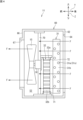
- FIG. 2 is a cross-sectional explanatory diagram of a heat source side unit in a refrigeration apparatus as viewed from above.
- FIG. 2 is a cross-sectional explanatory side view of a heat source unit in the refrigeration apparatus.
- 13 is a cross-sectional explanatory side view showing another embodiment of a supporting state of the second heat exchanger.
- FIG. FIG. 2 is a schematic diagram showing a first heat exchanger in the refrigeration device.
- FIG. 4 is a schematic diagram showing a second heat exchanger in the refrigeration device. 4 is a partial cross-sectional schematic view showing heat transfer tubes and fins that configure a second heat exchanger.
- FIG. 2 is an explanatory diagram of a positional relationship between a first heat exchanger and a second heat exchanger according to the first embodiment when viewed from an air flow direction.
- 13 is an explanatory diagram of a positional relationship when a first heat exchanger and a second heat exchanger according to a second embodiment are viewed from an air flow direction.
- FIG. 1 is an explanatory diagram of a refrigerant circuit of a refrigeration device according to an embodiment of the present disclosure.
- the refrigeration device 10 of the present disclosure includes a heat source unit 11, a user unit 12, a refrigerant pipe 13 connecting the heat source unit 11 and the user unit 12, and a fan 15.
- the refrigeration device 10 illustrated in this embodiment is an air conditioner that conditions a target space using the user unit 12.
- the refrigeration device 10 is a separate type air conditioner separated into a heat source unit (outdoor unit) 11 and a user unit (indoor unit) 12.
- the refrigeration device 10 illustrated in this embodiment is an air conditioner, but the refrigeration device of the present disclosure may be, for example, a refrigeration case or the like, and is not limited to an air conditioner.
- the refrigerant pipe 13 includes a gate valve 18 at a portion where the refrigerant pipe 13 enters and exits the housing of the heat source unit 11.
- the heat source side unit 11 includes a first compressor 21, a second compressor 22, a first heat exchanger 31, a second heat exchanger 32, a third heat exchanger 33, a first expansion valve 41, a second expansion valve 42, a four-way switching valve 50, a first accumulator 51, and a second accumulator 52.
- the user side unit 12 includes a user side heat exchanger 34.
- the refrigeration system 10 includes a first refrigerant circuit RC1 including a first compressor 21, a first heat exchanger 31, a first expansion valve 41, a user-side heat exchanger 34, and a refrigerant pipe 13 connecting these, and a second refrigerant circuit RC2 including a second compressor 22, a second heat exchanger 32, a second expansion valve 42, and a refrigerant pipe 14 connecting these.
- the first refrigerant circuit RC1 uses a first refrigerant R1 as a refrigerant and performs a refrigeration cycle operation.
- the second refrigerant circuit RC2 uses a second refrigerant R2 different from the first refrigerant R1 as a refrigerant and performs a refrigeration cycle operation.
- the first compressor 21 and the second compressor 22 suck in low-pressure gas refrigerant and discharge high-pressure gas refrigerant.
- the first compressor 21 and the second compressor 22 are equipped with a motor (not shown) whose operating speed can be adjusted by inverter control.
- the first compressor 21 and the second compressor 22 are variable capacity type (variable capacity type) whose capacity (capacity) can be changed by inverter control of the motor.
- the first compressor 21 and the second compressor 22 may be a fixed capacity type.
- the four-way switching valve 50 reverses the flow of the first refrigerant R1 in the refrigerant piping 13 of the first refrigerant circuit RC1, and can switch whether the first refrigerant R1 discharged from the first compressor 21 is supplied to the first heat exchanger 31 or the user-side heat exchanger 34.
- the refrigeration device 10 can switch between cooling operation and heating operation by switching the flow direction of the first refrigerant R1 with the four-way switching valve 50. Note that the refrigeration device 10 of this embodiment does not require a four-way switching valve, and may be used exclusively for cooling.
- the first expansion valve 41 is configured as an electric valve capable of adjusting the flow rate of the first refrigerant R1.
- the refrigeration device 10 adjusts the cooling capacity exerted by the first refrigerant circuit RC1 by adjusting the opening of the first expansion valve 41 with a control device (not shown).
- the refrigeration device 10 fully opens the first expansion valve 41 with a control device (not shown).
- the second expansion valve 42 is configured as an electric valve capable of adjusting the flow rate of the second refrigerant R2.
- the refrigeration device 10 adjusts the cooling capacity exerted by the second refrigerant circuit RC2 by adjusting the opening degree of the second expansion valve 42 using a control device (not shown).
- the refrigeration system 10 exchanges heat between the first refrigerant R1 and the second refrigerant R2 in the third heat exchanger 33, thereby supplementing the cooling capacity of the first refrigerant circuit RC1 with the cooling capacity of the second refrigerant circuit RC2.
- the refrigeration system 10 adjusts the amount of heat exchange between the first refrigerant R1 and the second refrigerant R2 by adjusting the opening of the second expansion valve 42 using a control device (not shown).
- Heat source unit 2 is a cross-sectional explanatory diagram of a heat source unit in a refrigeration device in a plan view.
- FIG. 3 is a cross-sectional explanatory diagram of a heat source unit in a refrigeration device in a side view.
- the descriptions of up, down, front, rear, left, and right follow the arrows shown in FIG. 2 and FIG. 3. Specifically, for example, in FIG. 2 and FIG.
- the direction indicated by the arrow X (first direction) is the left-right direction
- the direction indicated by the arrow Y (second direction) is the front-rear direction
- the direction indicated by the arrow Z (third direction) is the up-down direction.
- the left-right direction is also referred to as the first direction X
- the front-rear direction is also referred to as the second direction Y
- the up-down direction is also referred to as the third direction Z.
- these descriptions are merely examples, and for example, the direction X may be read as the front-rear direction and the direction Y as the left-right direction.
- the heat source unit 11 includes a housing 60.
- the housing 60 is formed in a rectangular parallelepiped shape and is rectangular in plan view.
- the interior of the housing 60 is divided into a machine chamber S1 and a heat exchange chamber S2 by a partition wall 61.
- Air intakes 64 and 65 are formed in two adjacent side walls 62 and 63 of the housing 60 arranged on the heat exchange chamber S2 side.
- An air outlet 67 is formed in the other side wall 66 adjacent to the one side wall 63 in which the air intake 65 is formed.
- the machine room S1 houses the first compressor 21, the second compressor 22, the third heat exchanger 33, the first accumulator 51, and the second accumulator 52. In addition to these, the machine room S1 also houses a four-way switching valve 50 (not shown), a first expansion valve 41 (not shown), a second expansion valve 42 (not shown), an oil separator, etc.
- a control board (not shown) is arranged in the machine room S1, and this control board controls each device that constitutes the refrigeration device 10.
- the heat exchange chamber S2 houses the first heat exchanger 31, the second heat exchanger 32, the fan 15, and the fan motor 16.
- the fan 15 is connected to a rotating shaft of the fan motor 16 and is driven to rotate by the fan motor 16.
- the first heat exchanger 31 has a heat transfer tube (heat transfer tube 31a described later) through which the first refrigerant R1 circulating in the first refrigerant circuit RC1 flows.
- the first heat exchanger 31 is connected to the first compressor 21 in the machine room S1 via refrigerant piping 13 (see FIG. 1).
- the second heat exchanger 32 has a heat transfer tube (heat transfer tube 32a described later) through which the second refrigerant R2 circulating in the second refrigerant circuit RC2 flows.
- the second heat exchanger 32 is connected to the second compressor 22 in the machine room S1 via refrigerant piping 14 (see FIG. 1).
- the fan 15 is disposed in such a position that the positive pressure side faces the side wall 66 on which the air outlet 67 is formed, and the negative pressure side faces the side wall 62 on which the air inlet 64 is formed.
- the fan motor 16 When the fan motor 16 is operated, the fan 15 rotates, and air is taken into the heat exchange chamber S2 from the air inlets 64 and 65.
- the air taken into the heat exchange chamber S2 passes through the first heat exchanger 31 and is heat exchanged with the first refrigerant R1, and then passes through the second heat exchanger 32 and is heat exchanged with the second refrigerant R2, and is then exhausted from the air outlet 67.
- the fan 15 generates an air flow that passes through the first heat exchanger 31 and the second heat exchanger 32.
- the refrigerant passing through the insides of the first heat exchanger 31 and the second heat exchanger 32 is heat exchanged with the air passing through the first heat exchanger 31 and the second heat exchanger 32.
- the direction of the air flow generated by the fan 15 is indicated by an arrow F.
- the air flow direction is referred to as air flow direction F.
- the first heat exchanger 31 shown in this embodiment is formed in an L-shape in a plan view.
- the first heat exchanger 31 is bent near a corner 68 between two side walls 62, 63 in which air intakes 64, 65 are formed, and is disposed along the two side walls 62, 63.
- the shape of the first heat exchanger 31 provided in the refrigeration device 10 of the present disclosure is not limited to this, and may be, for example, rectangular in a plan view.
- the second heat exchanger 32 shown in this embodiment is formed in a rectangular shape in a plan view.
- the second heat exchanger 32 is disposed along the portion that follows the side wall 62 of the first heat exchanger 31, on the downwind side of the first heat exchanger 31 in the air flow direction F.
- the shape of the second heat exchanger 32 provided in the refrigeration device 10 of the present disclosure is not limited to this.
- FIG. 5 is a schematic diagram showing a first heat exchanger in a refrigeration device.
- the first heat exchanger 31 constituting the refrigeration device 10 of the present disclosure is a so-called cross-fin type fin-and-tube heat exchanger.
- the first heat exchanger 31 has a heat transfer tube 31a, a plurality of fins 31b, and a pair of tube plates 31c, 31d.
- the first heat exchanger 31 exchanges heat between the first refrigerant R1 in the first refrigerant circuit RC1 and the air passing through the first heat exchanger 31.
- the heat transfer tube 31a is a circular tube made of metal.
- the metal constituting the heat transfer tube 31a may be copper, copper alloy, stainless steel, aluminum, aluminum alloy, etc.
- the heat transfer tube 31a is also referred to as the circular tube 31a.
- the multiple fins 31b are thin metal plates formed into a rectangular shape in a side view, and are arranged parallel to each other at a predetermined interval in the width direction (first direction X).
- the metal constituting the fins 31b may be aluminum, aluminum alloy, etc.
- the circular tube (heat transfer tube) 31a includes multiple straight tube sections 31x formed in a straight line and multiple curved tube sections 31y formed in a U-shape.
- the straight tube sections 31x penetrate the fins 31b in the direction in which the multiple fins 31b are arranged (first direction X).
- the curved tube sections 31y are disposed at the ends of the first heat exchanger 31 in the width direction (first direction X) and connect two adjacent straight tube sections 31x to each other.
- the tube sheets 31c, 31d are metal plates formed into a rectangular shape in a side view, and are arranged in pairs on both sides of the width direction (first direction X) of the first heat exchanger 31.
- the tube sheets 31c, 31d are connected to both ends of each straight tube section 31x in the circular tube 31a, and support the circular tube 31a.
- the tube sheets 31c, 31d are arranged parallel to the fins 31b, as shown in FIG. 5.
- Fig. 6 is a schematic diagram showing a second heat exchanger in a refrigeration device.
- Fig. 7 is a partial cross-sectional schematic diagram showing a heat transfer tube and a fin constituting the second heat exchanger.
- the second heat exchanger 32 constituting the refrigeration device 10 of the present disclosure is a microchannel type heat exchanger. As shown in Figs. 6 and 7, the second heat exchanger 32 has a plurality of heat transfer tubes 32a, fins 32b, and a pair of headers 32c, 32d.
- the heat transfer tubes 32a, the fins 32b, and the headers 32c, 32d are formed of aluminum or an aluminum alloy.
- the second heat exchanger 32 exchanges heat between the second refrigerant R2 in the second refrigerant circuit RC2 and the air passing through the second heat exchanger 32.
- the heat transfer tube 32a is composed of a multi-hole tube having multiple refrigerant flow paths 35 inside.
- the cross section of the heat transfer tube 32a has a flat shape having a short side direction and a long side direction.
- the long side direction of the heat transfer tube 32a is the direction in which the multiple refrigerant flow paths 35 are lined up.
- the multiple refrigerant flow paths 35 are formed in a line along the air flow direction F.
- the multiple refrigerant flow paths 35 are formed in a line in the second direction Y and extend in the first direction X.
- the heat transfer tube 32a is also referred to as a flat multi-hole tube 32a.
- a plurality of heat transfer tubes 32a are arranged in the third direction Z.
- the headers 32c and 32d are arranged with their longitudinal direction facing the third direction Z.
- One end of the heat transfer tube 32a is connected to the header 32c, and the other end of the heat transfer tube 32a is connected to the header 32d.
- the fins 32b are arranged in a serpentine manner between the heat transfer tubes 32a, 32a adjacent to each other above and below. Note that the position of the second heat exchanger 32 in the refrigeration device 10 of this embodiment is not limited to this, and may be used in a position in which the third direction Z faces the left-right direction, for example.
- the end faces of the flat multi-hole tube 32a in the third direction Z are flat surfaces along the first direction X and the second direction Y.
- Both end faces of the flat multi-hole tube 32a in the first direction X are curved surfaces whose cross sections are curved in a semicircular shape.
- the fins 32b In the second direction Y, the fins 32b have approximately the same length as the flat multi-hole tubes 32a. Therefore, the flat multi-hole tubes 32a and the fins 32b are flush with each other on both end faces of the second heat exchanger 32 in the second direction Y.
- heat transfer tubes made of flat multi-hole tubes are more susceptible to damage when subjected to external forces than heat transfer tubes made of circular tubes (circular tubes 31a). For this reason, when an external force acts on the flat multi-hole tubes 32a, there is a higher risk of serious damage than when an external force acts on the circular tubes 31a. Therefore, the second heat exchanger 32, which is made up of flat multi-hole tubes 32a, has a higher protection priority than the first heat exchanger 31, which is made up of circular tubes 31a, and is preferably placed in a location where it is less susceptible to external forces.
- the second heat exchanger 32 in this embodiment is a so-called parallel flow type heat exchanger among microchannel type heat exchangers.
- the heat transfer tubes constituting the second heat exchanger 32 are flat multi-hole tubes 32a, and the fins 32b are serpentine fins arranged between adjacent flat multi-hole tubes.
- the fins 32b are so-called corrugated fins.
- the parallel flow type heat exchanger has a smaller internal volume (amount of liquid held inside) than the cross-fin type heat exchanger. Therefore, by adopting a parallel flow type heat exchanger as the second heat exchanger 32, the refrigeration device 10 can reduce the amount of second refrigerant R2 used compared to when a cross-fin type heat exchanger is adopted.
- the third heat exchanger 33 constituting the refrigeration device 10 of the present disclosure is a plate-type heat exchanger. As shown in FIG. 1, the third heat exchanger 33 has a first flow path 33a and a second flow path 33b formed between stacked plates.
- the first flow path 33a is connected to the first refrigerant circuit RC1, and the first refrigerant R1 flows through the first flow path 33a.
- the second flow path 33b is connected to the second refrigerant circuit RC2, and the second refrigerant R2 flows through the second flow path 33b.
- the third heat exchanger 33 exchanges heat between the first refrigerant R1 flowing through the first flow path 33a and the second refrigerant R2 flowing through the second flow path 33b.
- the refrigeration device 10 exchanges heat between the first refrigerant R1 and the second refrigerant R2 using the third heat exchanger 33, and supplements the cooling capacity of the first refrigerant circuit RC1 with the cooling capacity of the second refrigerant circuit RC2.
- the refrigeration device 10 of the present disclosure preferably uses natural refrigerants as the first refrigerant R1 and the second refrigerant R2.
- Natural refrigerants are refrigerants that use substances that are originally present in nature, and include, for example, ammonia (NH3), carbon dioxide (CO2), water (H2O), and hydrocarbons (HC).
- the refrigeration device 10 of the present embodiment uses carbon dioxide (CO2: R744) as the first refrigerant R1 and propane (C3H8: R290) as the second refrigerant R2.
- the global warming potential (GWP) of carbon dioxide (CO2) is "1"
- the global warming potential (GWP) of propane (C3H8) is "3".
- first refrigerant R1 used in the refrigeration device of the present disclosure is not limited to carbon dioxide (CO2)
- second refrigerant R2 used in the refrigeration device of the present disclosure is not limited to propane (C3H8).
- the first refrigerant R1 and the second refrigerant R2 used in the refrigeration device of the present disclosure may be R32, R1234yf, R474a, R600a (isobutane), R454B, R454C, or the like.
- the second heat exchanger 32 is disposed on the downwind side of the first heat exchanger 31 in the flow direction F of the air generated by the fan 15 .
- the first heat exchanger 31 is disposed outside the second heat exchanger 32.
- the heat source side unit 11 configured in this manner, when an external force acts on the heat source side unit 11 during transportation, etc., the external force acts mainly on the first heat exchanger 31 located further outward, rather than on the second heat exchanger 32. Therefore, in the case where an external force acts on the heat source side unit 11 including the first heat exchanger 31 and the second heat exchanger 32, the refrigeration device 10 is less likely to have the external force act directly on the second heat exchanger 32, thereby reducing the risk of the second heat exchanger 32 being damaged.
- the first heat exchanger 31 may have a first area A1 that overlaps with the second heat exchanger 32 when viewed from the air flow direction F, and a second area A2 that does not overlap with the second heat exchanger 32 when viewed from the air flow direction F.
- the area showing the first heat exchanger 31 is the area between a pair of tube plates 31c, 31d (see FIG. 5)
- the area showing the second heat exchanger 32 is the area between a pair of headers 32c, 32d (see FIG. 6).
- the second heat exchanger 32 can be supported using a support member 70 (see Figures 2 and 3) for supporting the fan 15. Specifically, as shown in Figure 3, the second heat exchanger 32 is supported at its lower part by a first stay 71 provided at the lower part of the support member 70. Note that, as shown in Figure 4, the second heat exchanger 32 may be further supported at its upper part by a second stay 72 provided midway up and down on the support member 70.
- the second heat exchanger 32 can be supported by the support member 70 without providing a separate support member for supporting the second heat exchanger 32.
- FIG. 8B is an explanatory diagram of the arrangement of the first and second heat exchangers according to the second embodiment when viewed from the air flow direction.
- the first heat exchanger 31 and the second heat exchanger 32 may be configured such that, when viewed from the air flow direction F, the area Sa4 of the fourth area A4 defined by the outline of the second heat exchanger 32 is smaller than the area Sa3 of the third area A3 defined by the outline of the first heat exchanger 31 (Sa3>Sa4), and the fourth area A4 is included in the third area A3.
- the first heat exchanger 31, which has the larger external dimensions can be easily supported by using the housing 60 that houses the first heat exchanger 31.
- the second heat exchanger 32 is disposed on the downwind side of the first heat exchanger 31 in the air flow direction F, so that the second heat exchanger 32 can be supported using the support member 70 (see Figures 2 and 3) for supporting the fan 15. Therefore, in the refrigeration device 10 of this embodiment, even if the external dimensions of the second heat exchanger 32 are smaller than the external dimensions of the first heat exchanger 31 when viewed from the air flow direction F and the second heat exchanger 32 is configured to fit inside the external dimensions of the first heat exchanger 31, the second heat exchanger 32 can be supported by the support member 70 without providing a separate support member for supporting the second heat exchanger 32.
- the refrigeration device 10 of the above embodiment includes a first refrigerant circuit RC1 including a first compressor 21, a first heat exchanger 31, a first expansion valve 41, and a utilization side heat exchanger 34 and using a first refrigerant R1, a second refrigerant circuit RC2 including a second compressor 22, a second heat exchanger 32, and a second expansion valve 42 and using a second refrigerant R2, a third heat exchanger 33 exchanging heat between the first refrigerant R1 and the second refrigerant R2, and a fan 15.
- a first refrigerant circuit RC1 including a first compressor 21, a first heat exchanger 31, a first expansion valve 41, and a utilization side heat exchanger 34 and using a first refrigerant R1
- a second refrigerant circuit RC2 including a second compressor 22, a second heat exchanger 32, and a second expansion valve 42 and using a second refrigerant R2, a third heat exchanger 33 exchanging heat between the first refrigerant R1 and
- the heat transfer tube constituting the first heat exchanger 31 is a circular tube 31a
- the heat transfer tube constituting the second heat exchanger 32 is a flat multi-hole tube 32a.
- the second heat exchanger 32 is disposed on the leeward side of the first heat exchanger 31 in the flow direction F of the air generated by the fan 15.
- the refrigeration system 10 of the above embodiment includes a first heat exchanger 31 that uses a circular tube 31a as a heat transfer tube, and a second heat exchanger 32 that uses a flat multi-hole tube 32a as a heat transfer tube.
- the flat multi-hole tube 32a is weaker against external forces than the circular tube 31a.
- the first heat exchanger 31 is positioned on the upwind side of the second heat exchanger 32 in the air flow direction F, so that in the heat source side unit 11, the first heat exchanger 31 is positioned outside the second heat exchanger 32.
- the first heat exchanger 31 using circular tubes 31a is positioned on the upwind side in the air flow direction F of the second heat exchanger 32 using flat multi-hole tubes 32a.
- the second heat exchanger 32 is configured as a heat exchanger (so-called parallel flow type heat exchanger) including a plurality of flat multi-hole tubes 32a and serpentine fins 32b arranged between adjacent flat multi-hole tubes 32a, 32a.
- the flat multi-hole tube 32a and the fins 32b are flush with each other, so the flat multi-hole tube 32a is not protected by the fins 32b. Therefore, in the second heat exchanger 32 of the above configuration, external forces are likely to be applied directly to the flat multi-hole tube 32a, which makes the flat multi-hole tube 32a prone to damage.
- the second heat exchanger 32 when the second heat exchanger 32 is configured as a parallel-flow type heat exchanger, the risk of the flat multi-hole tube 32a being damaged can be reduced.
- the second heat exchanger 32 is configured as a parallel-flow type heat exchanger, so that the amount of second refrigerant R2 used can be reduced.
- the fan 15 is disposed on the downwind side of the second heat exchanger 32 in the air flow direction F, and the second heat exchanger 32 is fixed to a support member 70 that supports the fan 15.
- the refrigeration device 10 of the above embodiment can fix the second heat exchanger 32 using the support member 70 for fixing the fan 15.
- the first heat exchanger 31 has a first area A1 that overlaps with the second heat exchanger 32 when viewed from the air flow direction F, and a second area A2 that does not overlap with the second heat exchanger 32 (see FIG. 8A).
- the second heat exchanger 32 can be fixed by using the support member 70 for fixing the fan 15.
- the area Sa4 of the fourth area A4 defined by the outline of the second heat exchanger 32 is smaller than the area Sa3 of the third area A3 defined by the outline of the first heat exchanger 31, and the fourth area A4 is included in the third area A3 (see FIG. 8B).
- the two heat exchangers 31 and 32 can be easily supported by using a common support member.
- the external dimensions of the heat exchangers 31 and 32 are different, as in the case shown in FIG. 8B, the larger first heat exchanger 31 can be easily supported by using the housing 60 that houses the first heat exchanger 31, but it is difficult to support the smaller second heat exchanger 32 by using the housing 60.
- the second heat exchanger 32 can be fixed by using the support member 70 for fixing the fan 15.
- Refrigeration device 15 Fan 21: First compressor 22: Second compressor 31: First heat exchanger 31a: Circular tube 32: Second heat exchanger 32a: Flat multi-hole tube 32b: Fin 33: Third heat exchanger 34: User side heat exchanger 41: First expansion valve 42: Second expansion valve 70: Support member R1: First refrigerant R2: Second refrigerant RC1: First refrigerant circuit RC2: Second refrigerant circuit F: Air flow direction
Landscapes
- Engineering & Computer Science (AREA)
- Physics & Mathematics (AREA)
- Thermal Sciences (AREA)
- Mechanical Engineering (AREA)
- General Engineering & Computer Science (AREA)
- Geometry (AREA)
- Other Air-Conditioning Systems (AREA)
- Heat-Exchange Devices With Radiators And Conduit Assemblies (AREA)
- Air Filters, Heat-Exchange Apparatuses, And Housings Of Air-Conditioning Units (AREA)
- Chemical & Material Sciences (AREA)
- Combustion & Propulsion (AREA)
Priority Applications (3)
| Application Number | Priority Date | Filing Date | Title |
|---|---|---|---|
| EP24789705.1A EP4513109A4 (en) | 2023-07-03 | 2024-06-11 | COOLING DEVICE |
| CN202480043342.3A CN121420166A (zh) | 2023-07-03 | 2024-06-11 | 冷冻装置 |
| US19/430,272 US20260118017A1 (en) | 2023-07-03 | 2025-12-23 | Refrigeration apparatus |
Applications Claiming Priority (2)
| Application Number | Priority Date | Filing Date | Title |
|---|---|---|---|
| JP2023-109478 | 2023-07-03 | ||
| JP2023109478 | 2023-07-03 |
Related Child Applications (1)
| Application Number | Title | Priority Date | Filing Date |
|---|---|---|---|
| US19/430,272 Continuation US20260118017A1 (en) | 2023-07-03 | 2025-12-23 | Refrigeration apparatus |
Publications (1)
| Publication Number | Publication Date |
|---|---|
| WO2025009339A1 true WO2025009339A1 (ja) | 2025-01-09 |
Family
ID=93258938
Family Applications (2)
| Application Number | Title | Priority Date | Filing Date |
|---|---|---|---|
| PCT/JP2024/021170 Ceased WO2025009339A1 (ja) | 2023-07-03 | 2024-06-11 | 冷凍装置 |
| PCT/JP2024/024126 Ceased WO2025009569A1 (ja) | 2023-07-03 | 2024-07-03 | 熱源ユニット及び冷凍装置 |
Family Applications After (1)
| Application Number | Title | Priority Date | Filing Date |
|---|---|---|---|
| PCT/JP2024/024126 Ceased WO2025009569A1 (ja) | 2023-07-03 | 2024-07-03 | 熱源ユニット及び冷凍装置 |
Country Status (5)
| Country | Link |
|---|---|
| US (2) | US20260118017A1 (https=) |
| EP (2) | EP4513109A4 (https=) |
| JP (2) | JP7656242B2 (https=) |
| CN (2) | CN121420166A (https=) |
| WO (2) | WO2025009339A1 (https=) |
Citations (6)
| Publication number | Priority date | Publication date | Assignee | Title |
|---|---|---|---|---|
| JP2008261517A (ja) * | 2007-04-10 | 2008-10-30 | Mitsubishi Electric Corp | フィンチューブ型熱交換器及びそれを用いた空気調和機 |
| JP2012017915A (ja) * | 2010-07-08 | 2012-01-26 | Panasonic Corp | ヒートポンプ式熱源装置 |
| WO2014181399A1 (ja) * | 2013-05-08 | 2014-11-13 | 三菱電機株式会社 | 二元冷凍装置 |
| US20150338145A1 (en) * | 2014-05-22 | 2015-11-26 | Lg Electronics Inc. | Heat pump |
| WO2019077744A1 (ja) * | 2017-10-20 | 2019-04-25 | 三菱電機株式会社 | 空気調和機 |
| WO2022013976A1 (ja) * | 2020-07-15 | 2022-01-20 | 三菱電機株式会社 | 冷凍装置の室外機およびそれを備える冷凍装置 |
Family Cites Families (14)
| Publication number | Priority date | Publication date | Assignee | Title |
|---|---|---|---|---|
| JP3540530B2 (ja) * | 1996-12-13 | 2004-07-07 | 東芝キヤリア株式会社 | 空気調和装置 |
| JP2000205601A (ja) * | 1999-01-08 | 2000-07-28 | Hitachi Ltd | 空気調和機用室外ユニット |
| JP3831704B2 (ja) * | 2002-12-25 | 2006-10-11 | 三洋電機株式会社 | 室外ユニット |
| JP2004218925A (ja) * | 2003-01-15 | 2004-08-05 | Fujitsu General Ltd | 空気調和機 |
| WO2006099378A1 (en) * | 2005-03-14 | 2006-09-21 | York International Corporation | Hvac system with powered subcooler |
| JP2009281659A (ja) * | 2008-05-22 | 2009-12-03 | Panasonic Corp | 冷凍サイクル装置 |
| JP2013100964A (ja) * | 2011-11-09 | 2013-05-23 | Sumitomo Light Metal Ind Ltd | 空気調和機用サーペンタイン熱交換器 |
| JP2015004451A (ja) * | 2013-06-19 | 2015-01-08 | パナソニック株式会社 | フィンチューブ熱交換器 |
| WO2015059832A1 (ja) * | 2013-10-25 | 2015-04-30 | 三菱電機株式会社 | 熱交換器及びその熱交換器を用いた冷凍サイクル装置 |
| JP5987889B2 (ja) * | 2014-11-14 | 2016-09-07 | ダイキン工業株式会社 | 熱交換器 |
| JP7394722B2 (ja) * | 2020-07-28 | 2023-12-08 | 三菱電機株式会社 | 除湿装置 |
| EP4317846A4 (en) | 2021-03-31 | 2025-04-02 | Daikin Industries, Ltd. | REFRIGERATING CYCLE DEVICE |
| WO2024095338A1 (ja) * | 2022-10-31 | 2024-05-10 | 三菱電機株式会社 | 二元冷凍サイクル装置 |
| JP7518418B2 (ja) * | 2022-12-12 | 2024-07-18 | ダイキン工業株式会社 | 空調ユニット |
-
2024
- 2024-06-05 JP JP2024091202A patent/JP7656242B2/ja active Active
- 2024-06-11 WO PCT/JP2024/021170 patent/WO2025009339A1/ja not_active Ceased
- 2024-06-11 EP EP24789705.1A patent/EP4513109A4/en active Pending
- 2024-06-11 CN CN202480043342.3A patent/CN121420166A/zh active Pending
- 2024-07-03 CN CN202480043449.8A patent/CN121399419A/zh active Pending
- 2024-07-03 JP JP2024540811A patent/JP7727250B2/ja active Active
- 2024-07-03 EP EP24786340.0A patent/EP4513108A4/en active Pending
- 2024-07-03 WO PCT/JP2024/024126 patent/WO2025009569A1/ja not_active Ceased
-
2025
- 2025-12-23 US US19/430,272 patent/US20260118017A1/en active Pending
- 2025-12-23 US US19/430,318 patent/US20260118040A1/en active Pending
Patent Citations (6)
| Publication number | Priority date | Publication date | Assignee | Title |
|---|---|---|---|---|
| JP2008261517A (ja) * | 2007-04-10 | 2008-10-30 | Mitsubishi Electric Corp | フィンチューブ型熱交換器及びそれを用いた空気調和機 |
| JP2012017915A (ja) * | 2010-07-08 | 2012-01-26 | Panasonic Corp | ヒートポンプ式熱源装置 |
| WO2014181399A1 (ja) * | 2013-05-08 | 2014-11-13 | 三菱電機株式会社 | 二元冷凍装置 |
| US20150338145A1 (en) * | 2014-05-22 | 2015-11-26 | Lg Electronics Inc. | Heat pump |
| WO2019077744A1 (ja) * | 2017-10-20 | 2019-04-25 | 三菱電機株式会社 | 空気調和機 |
| WO2022013976A1 (ja) * | 2020-07-15 | 2022-01-20 | 三菱電機株式会社 | 冷凍装置の室外機およびそれを備える冷凍装置 |
Also Published As
| Publication number | Publication date |
|---|---|
| CN121420166A (zh) | 2026-01-27 |
| CN121399419A (zh) | 2026-01-23 |
| EP4513109A4 (en) | 2025-05-28 |
| WO2025009569A1 (ja) | 2025-01-09 |
| JP7727250B2 (ja) | 2025-08-21 |
| JP2025009892A (ja) | 2025-01-20 |
| US20260118040A1 (en) | 2026-04-30 |
| EP4513109A1 (en) | 2025-02-26 |
| EP4513108A4 (en) | 2025-05-21 |
| JP7656242B2 (ja) | 2025-04-03 |
| US20260118017A1 (en) | 2026-04-30 |
| EP4513108A1 (en) | 2025-02-26 |
| JPWO2025009569A1 (https=) | 2025-01-09 |
Similar Documents
| Publication | Publication Date | Title |
|---|---|---|
| JP5581671B2 (ja) | 空調室外機 | |
| WO2006051673A1 (ja) | 空気調和機の室内機 | |
| JP7656242B2 (ja) | 冷凍装置 | |
| JP5681572B2 (ja) | 車両用空調装置 | |
| JP7602156B1 (ja) | 冷凍装置 | |
| CN207779203U (zh) | 制冷循环装置 | |
| CN116724209B (zh) | 热交换器 | |
| JP7174291B1 (ja) | 熱交換器および空気調和装置 | |
| JP4857776B2 (ja) | 熱交換器 | |
| JP2006336909A (ja) | 凝縮器及びこれを用いた空気調和機用室内ユニット | |
| JP2006162176A (ja) | 熱交換器および車両用空気調和装置 | |
| JP5476789B2 (ja) | 熱交換器 | |
| JP4605725B2 (ja) | 増設凝縮装置及びこれを用いた増設凝縮システム付冷凍サイクル装置 | |
| JP7614521B2 (ja) | 二元冷凍サイクル装置 | |
| EP3903058B1 (en) | Fin using in a heat exchanger, heat exchanger having the fins, and refrigeration cycle device having the heat exchanger | |
| WO2026079008A1 (ja) | 空気調和装置 | |
| JP5849697B2 (ja) | 室外ユニット | |
| JP2016161209A (ja) | 熱交換器 | |
| JP2025059317A (ja) | 熱交換器ユニット、空調室内機、および冷凍サイクル装置 | |
| WO2025069811A1 (ja) | 熱交換器ユニット、空調室内機、および冷凍サイクル装置 | |
| JP2025051219A (ja) | 熱交換器、冷凍サイクル装置および空調室内機 | |
| JP2005016933A (ja) | 空気調和装置の室内機 | |
| WO2020136797A1 (ja) | 室外機、及び、冷凍サイクル装置 | |
| JP2012002489A (ja) | 増設凝縮装置及びこれを用いた増設凝縮システム付冷凍サイクル装置 | |
| JP2015175539A (ja) | 熱交換器 |
Legal Events
| Date | Code | Title | Description |
|---|---|---|---|
| ENP | Entry into the national phase |
Ref document number: 2024789705 Country of ref document: EP Effective date: 20241021 |
|
| NENP | Non-entry into the national phase |
Ref country code: DE |