WO2025005147A1 - ヌクレオチドモノマー、及び核酸オリゴマーの製造方法 - Google Patents
ヌクレオチドモノマー、及び核酸オリゴマーの製造方法 Download PDFInfo
- Publication number
- WO2025005147A1 WO2025005147A1 PCT/JP2024/023211 JP2024023211W WO2025005147A1 WO 2025005147 A1 WO2025005147 A1 WO 2025005147A1 JP 2024023211 W JP2024023211 W JP 2024023211W WO 2025005147 A1 WO2025005147 A1 WO 2025005147A1
- Authority
- WO
- WIPO (PCT)
- Prior art keywords
- group
- nucleic acid
- general formula
- acid oligomer
- represented
- Prior art date
- Legal status (The legal status is an assumption and is not a legal conclusion. Google has not performed a legal analysis and makes no representation as to the accuracy of the status listed.)
- Ceased
Links
Images


Classifications
-
- Y—GENERAL TAGGING OF NEW TECHNOLOGICAL DEVELOPMENTS; GENERAL TAGGING OF CROSS-SECTIONAL TECHNOLOGIES SPANNING OVER SEVERAL SECTIONS OF THE IPC; TECHNICAL SUBJECTS COVERED BY FORMER USPC CROSS-REFERENCE ART COLLECTIONS [XRACs] AND DIGESTS
- Y02—TECHNOLOGIES OR APPLICATIONS FOR MITIGATION OR ADAPTATION AGAINST CLIMATE CHANGE
- Y02P—CLIMATE CHANGE MITIGATION TECHNOLOGIES IN THE PRODUCTION OR PROCESSING OF GOODS
- Y02P20/00—Technologies relating to chemical industry
- Y02P20/50—Improvements relating to the production of bulk chemicals
- Y02P20/55—Design of synthesis routes, e.g. reducing the use of auxiliary or protecting groups
Definitions
- the present invention relates to a method for producing a nucleotide monomer and a nucleic acid oligomer.
- Antisense molecules which have a base sequence complementary to that of a target nucleic acid, can form a complementary double strand with the target nucleic acid and inhibit protein production from the target nucleic acid.
- antisense molecules act directly on the disease-related gene, and are therefore attracting attention as an effective medicine for gene therapy.
- antisense molecules are primarily required to have cell membrane permeability, nuclease resistance, chemical stability within the body (e.g., in an environment of pH 7.4), and the ability to form stable double strands only with specific base sequences.
- nucleic acid oligomers obtained using boranophosphate compounds hereinafter referred to as "boranophosphate-type nucleic acid oligomers" are known as antisense molecules.
- a known method for chemically synthesizing nucleic acids is to use a monomer in which an acyl-based protecting group has been introduced into the amino group of the nucleic acid base portion, and obtain an oligomer by subjecting it to appropriate chemical modification via a phosphite triester intermediate as shown in the formula on the left below.
- this phosphite triester intermediate can be borated by reacting it with a boranoating agent to obtain a boranophosphate-type nucleic acid oligomer as shown in the formula on the right below.
- DMTr represents a 4,4'-dimethoxytrityl group
- a circle represents a solid phase support
- B PRO and B PRO* represent nucleic acid bases represented by the following formula.
- Ph represents a phenyl group.
- the acyl-based protecting groups that protect the amino groups of adenine, cytosine, and guanine are reduced by the boranolyzing agent and cannot be deprotected, so the above-mentioned method can only be used when the nucleic acid base is thymine or uracil.
- Non-Patent Documents 1 and 2 use a nucleotide monomer represented by the following formula on the left and a nucleotide monomer represented by the following formula on the right, respectively.
- a monomer having a cyclic structure as shown below, side reactions with the amino group are suppressed even under mild acidic conditions, and it is possible to obtain an oligomer even if the base moiety is unprotected.
- DMTr and Ph are as described above, and B NH2 represents a nucleic acid base selected from the group consisting of adenine, guanine, cytosine, 5-methylcytosine, thymine, and uracil, and the amino groups in the adenine, guanine, cytosine, and 5-methylcytosine are not substituted.
- nucleotide monomers have extremely small steric hindrance around the phosphorus atom, making them too highly reactive to hydrolysis and quickly hydrolyzing under condensation conditions, which tends to reduce the effective concentration of the nucleotide monomer.
- the objective of the present invention is to provide a novel nucleotide monomer that has a nucleic acid base with an unsubstituted amino group and that gives a nucleic acid oligomer in high yield, and a method for producing a nucleic acid oligomer in high yield.
- R 1 represents a hydrogen atom, a hydroxyl group, an alkoxy group, an alkenyloxy group, an acyloxy group, a trihydrocarbylsilyloxy group, an alkoxyalkoxy group, a haloalkoxyalkoxy group, or a halogenyl group
- R 2 represents a hydrogen atom; or R 1 and R 2 are bonded to each other to form a 5-membered or greater ring which may or may not have a substituent and which may or may not have a heteroatom
- R 3 represents a hydrogen atom or a protecting group for a hydroxyl group
- R 4 represents an aryl group which may or may not have a substituent
- R 5 represents a hydrogen atom, a halogenyl group, or an alkyl group which may or may not have a substituent
- R 6 represents a hydrogen atom, a halogenyl group, or
- ⁇ 2> The nucleotide monomer according to ⁇ 1>, wherein the alkyl group represented by R 6 is branched.
- ⁇ 3> The nucleotide monomer according to ⁇ 1> or ⁇ 2>, wherein the alkyl group represented by R 6 has 6 to 14 carbon atoms.
- R 1 represents a hydrogen atom, a hydroxyl group, an alkoxy group, an alkenyloxy group, an acyloxy group, a trihydrocarbylsilyloxy group, an alkoxyalkoxy group, a haloalkoxyalkoxy group, or a halogenyl group
- R 2 represents a hydrogen atom
- R 1 and R 2 are bonded to each other to form a divalent group represented by the following general formula (2):
- R 7 and R 8 each independently represent a hydrogen atom or an alkyl group having 1 to 10 carbon atoms, or are bonded to each other to form a ring; * and ** represent a bond, the bond represented by * being bonded to the carbon atom to which R 1 is directly bonded in general formula (1), and the bond represented by ** being bonded to the carbon atom to which R 2 is directly bonded in general formula (1)
- ⁇ 5> A nucleotide monomer according to any one of ⁇ 1> to ⁇ 4>, in which the stereochemistry of the phosphorus atom in the nucleotide monomer is controlled.
- R 1 represents a hydrogen atom, a hydroxyl group, an alkoxy group, an alkenyloxy group, an acyloxy group, a trihydrocarbylsilyloxy group, an alkoxyalkoxy group, a haloalkoxyalkoxy group, or a halogenyl group
- R 2 represents a hydrogen atom; or R 1 and R 2 are bonded to each other to form a 5-membered or greater ring which may or may not have a substituent and which may or may not have a heteroatom
- R 3a represents a protecting group for a hydroxyl group
- R 4 represents an aryl group which may or may not have a substituent
- R 5 represents a hydrogen atom, a halogenyl group, or an alkyl group which may or may not have a substituent
- R 6 represents an alkyl group having 3 or more carbon atoms which may or may not have a substituent and which may or may not have a heteroatom in the
- R 1 , R 2 , R 3a , R 4 to R 6 , and B NH2 are as defined above.
- R 1 , R 2 , R 3a , R 4 to R 6 , and B NH2 are as defined above.
- R 1 , R 2 , and R 4 to R 6 are as defined above.
- R 9 represents a protecting group for a hydroxyl group
- R 10 represents a protecting group for an amino group
- Bs represents a nucleic acid base selected from the group consisting of adenine, guanine, cytosine, 5-methylcytosine, thymine, and uracil, and the amino groups in the adenine, guanine, cytosine, and 5-methylcytosine are substituted with protecting groups for the amino groups
- R9 and R10 represent a hydrogen atom
- Bs represents BNH2 .
- R 1 represents a hydrogen atom, a hydroxyl group, an alkoxy group, an alkenyloxy group, an acyloxy group, a trihydrocarbylsilyloxy group, an alkoxyalkoxy group, a haloalkoxyalkoxy group, or a halogenyl group
- R 2 represents a hydrogen atom, or R 1 and R 2 are bonded to each other to form a divalent group represented by the following general formula (2):
- R 7 and R 8 each independently represent a hydrogen atom or an alkyl group having 1 to 10 carbon atoms, or are bonded to each other to form a ring; * and ** represent a bond, the bond represented by * being bonded to the carbon atom to which R 1 is directly bonded in general formula (1a), and the bond represented by ** being bonded to the carbon atom to which R 2 is directly bonded in general formula (1a).
- ⁇ 10> The method according to any one of ⁇ 6> to ⁇ 9>, in which the stereochemistry of the phosphorus atom in the nucleotide monomer and the nucleotide unit is controlled.
- the present invention provides a novel nucleotide monomer that has a nucleic acid base with an unsubstituted amino group and that gives a nucleic acid oligomer in high yield, and a method for producing a nucleic acid oligomer in high yield.
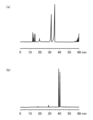
- 1(a) and 1(b) are diagrams showing reverse-phase HPLC charts performed in Comparative Synthesis Example 1 and Synthesis Example 1, entry 3, respectively.
- 2(a) to 2(c) are diagrams showing reverse-phase HPLC charts performed in Synthesis Example 2, Entries 2 and 6 and Comparative Synthesis Example 2, respectively.
- 3(a) and 3(b) are diagrams showing reversed-phase HPLC charts performed in Comparative Synthesis Example 3 and Synthesis Example 3, respectively.
- 4(a) and 4(b) are diagrams showing reversed-phase HPLC charts performed in Comparative Synthesis Example 4 and Synthesis Example 4, respectively.
- 5(a) to 5(c) are diagrams showing reverse-phase HPLC charts performed in Comparative Synthesis Examples 5 and 6, and Synthesis Example 5, respectively.
- the term "process” includes not only an independent process, but also a process that cannot be clearly distinguished from other processes, as long as the intended purpose of the process is achieved.
- ⁇ indicates a range that includes the numerical values written before and after it as the minimum and maximum values, respectively.
- the amount of each component in the composition means the total amount of the multiple substances present in the composition, unless otherwise specified.
- the nucleotide monomer according to this embodiment is represented by the above general formula (1).
- R 4 represents an aryl group with or without a substituent
- R 6 represents an alkyl group with 3 or more carbon atoms with or without a substituent and with or without a heteroatom in the molecular chain, or R 6 is bonded to R 5 to form a ring with 5 or more members that has a branched chain, has or has no substituents other than the branched chain, and has or has no heteroatoms.
- the nucleotide monomer represented by the general formula (1) has a nucleic acid base with an unsubstituted amino group, but has low polarity, so that purification by silica gel column chromatography is easy and can be obtained with high purity, and thus a nucleic acid oligomer can be obtained with a high yield. Furthermore, the nucleotide monomer is provided with an appropriate steric hindrance around the phosphorus atom, which suppresses hydrolysis, and the effective concentration can be kept high during the condensation reaction, thereby improving the condensation efficiency.
- the alkoxy group represented by R 1 is preferably an alkoxy group having 1 to 12 carbon atoms, more preferably an alkoxy group having 1 to 6 carbon atoms, and examples thereof include a methoxy group, an ethoxy group, an n-propoxy group, an i-propoxy group, an n-butoxy group, a sec-butoxy group, a tert-butoxy group, and an n-pentyloxy group.
- Examples of the alkenyloxy group represented by R 1 include a vinyloxy group, an allyloxy group, a 1-propenyloxy group, an isopropenyloxy group, a 2-methyl-1-propenyloxy group, a 2-methylallyloxy group, and a 2-butenyloxy group.
- Examples of the acyloxy group represented by R 1 include alkyl-carbonyloxy groups having 1 to 6 carbon atoms (eg, methylcarbonyloxy group, ethylcarbonyloxy group, etc.) and aryl-carbonyloxy groups having 6 to 10 carbon atoms (eg, benzoyloxy group).
- Examples of the trihydrocarbylsilyloxy group represented by R 1 include trialkylsilyloxy groups such as trimethylsilyloxy group, triethylsilyloxy group, triisopropylsilyloxy group, and t-butyldimethylsilyloxy group, and alkyldiarylsilyloxy groups such as t-butyldiphenylsilyloxy group.
- Examples of the alkoxyalkoxy group represented by R 1 include a methoxymethoxy group, a methoxyethoxy group, an ethoxymethoxy group, an ethoxyethoxy group, and a (2-cyanoethoxy)methoxy group.
- haloalkoxyalkoxy group represented by R 1 examples include a (2-fluoro)ethoxymethoxy group, a (2,2-difluoro)ethoxymethoxy group, a (2-chloro)methoxyethoxy group, and a (2,2-dichloro)ethoxymethoxy group.
- halogenyl group represented by R 1 examples include a fluoro group, a chloro group, and a bromo group, with a fluoro group being preferred.
- R 1 is preferably a hydrogen atom, a hydroxyl group, an alkoxy group, a trialkylsilyloxy group, an alkoxyalkoxy group, a haloalkoxyalkoxy group, and a halogenyl group from the viewpoint of double-strand formation ability.
- R 1 and R 2 may be bonded to each other to form a ring of 5 or more members, which may or may not have a substituent and may or may not have a heteroatom.
- alkyl group include a methyl group, an ethyl group, etc.
- examples of the substituent include a halogenyl group such as a fluoro group, a chloro group, or a bromo group, an amino group, an imino group, etc.
- heteroatom include an oxygen atom, a nitrogen atom, a sulfur atom, etc.
- the number of members of the ring is preferably 5 to 10 members, more preferably 5 to 8 members, and even more preferably 5 to 7 members.
- R 1 and R 2 are bonded to each other to form a divalent group represented by the following general formula (2).
- R 7 and R 8 each independently represent a hydrogen atom or an alkyl group having 1 to 10 carbon atoms, or are bonded to each other to form a ring, and * and ** represent a bond, where the bond represented by * is bonded to the carbon atom to which R 1 is directly bonded in general formula (1), and the bond represented by ** is bonded to the carbon atom to which R 2 is directly bonded in general formula (1).
- Examples of the alkyl group represented by R7 or R8 include linear or branched alkyl groups having 1 to 10 carbon atoms, and specific examples thereof include a methyl group, an ethyl group, an n-propyl group, an i-propyl group, an n-butyl group, a t-butyl group, an n-hexyl group, and an n-octyl group.
- specific examples of the ring include a cyclopropane ring, a cyclobutane ring, and a cyclohexane ring.
- R1 and R2 are bonded to each other to form a ring having 5 or more members which may or may not have a substituent and may or may not have a heteroatom
- specific examples of the ring include rings represented by the following formulas. (In the formula, BNH2 is as defined above.)
- Examples of the hydroxyl-protecting group represented by R3 include an acetyl group, a phenylacetyl group, a phenoxyacetyl group, a chloroacetyl group, a pivaloyl group, a benzyl group, a 4-methoxybenzyl group, a benzoyl group, a 4-methoxybenzoyl group, a triphenylmethyl group, a 4,4'-dimethoxytrityl (DMTr) group, a 4-methoxytrityl (MMTr) group, a 9-phenylxanthenyl group, a t-butoxycarbonyl group, a trimethylsilyl group, a t-butyldimethylsilyl group, a t-butyldiphenylsilyl group, a cyanomethoxymethyl group, a 2-(cyanoethoxy)ethyl group, a cyanoethoxymethyl group
- R 4 represents an aryl group having or without a substituent, and in terms of ease of synthesis, reactivity, ease of deprotection of the phosphoric acid moiety during oligomer formation, and high stereoselectivity during condensation when stereochemistry is controlled, it is preferable to represent an aryl group having 6 to 20 carbon atoms having or without a substituent, more preferably an aryl group having 6 to 14 carbon atoms having or without a substituent, and even more preferably an aryl group having 6 to 10 carbon atoms having or without a substituent.
- the substituent include an alkyl group having or without a substituent, a hydroxyl group, an amino group, an alkoxy group, a halogenyl group, and the like.
- Examples of the alkyl group include a methyl group, an ethyl group, and the like.
- substituent include a hydroxyl group, an amino group, an alkoxy group, an imino group, a halogenyl group, and the like.
- alkoxy group include a methoxy group, an ethoxy group, and the like.
- halogenyl group include a fluoro group, a chloro group, and a bromo group.
- Examples of R4 include a phenyl group and a naphthyl group, and from the standpoint of ease of synthesis, reactivity, etc., a phenyl group is preferred.
- halogenyl group represented by R 5 examples include a fluoro group, a chloro group, and a bromo group, with a fluoro group being preferred.
- the alkyl group represented by R5 which may or may not have a substituent, is preferably an alkyl group having 1 to 12 carbon atoms, which may or may not have a substituent, and more preferably an alkyl group having 1 to 6 carbon atoms, which may or may not have a substituent.
- substituent include a hydroxyl group, an amino group, an alkoxy group, an imino group, and a halogenyl group.
- Examples of the alkoxy group include a methoxy group and an ethoxy group.
- the halogenyl group include a fluoro group, a chloro group, and a bromo group.
- Examples of the alkyl group represented by R5 which may or may not have a substituent, include a methyl group, an ethyl group, an n-propyl group, an i-propyl group, an n-butyl group, a sec-butyl group, a tert-butyl group, and an n-pentyl group.
- R5 is preferably a hydrogen atom.
- R 6 represents an alkyl group having 3 or more carbon atoms, with or without a substituent, and with or without a heteroatom in the molecular chain.
- the alkyl group represented by R 6 preferably has 3 to 20 carbon atoms, more preferably has 6 to 14 carbon atoms, and even more preferably has 8 to 12 carbon atoms, in terms of the yield and purity of the monomer, and the ease of improving the yield of the resulting nucleic acid oligomer.
- the substituent include a hydroxyl group, an amino group, an alkoxy group, an imino group, and a halogenyl group.
- Examples of the alkoxy group include a methoxy group and an ethoxy group.
- halogenyl group examples include a fluoro group, a chloro group, and a bromo group.
- heteroatom examples include an oxygen atom, a nitrogen atom, and a sulfur atom.
- the alkyl group represented by R 6 is preferably branched in terms of the yield and purity of the monomer, and the ease of improving the yield of the resulting nucleic acid oligomer.
- R6 examples include an i-propyl group, a sec-butyl group, a tert-butyl group, a neopentyl group, an i-pentyl group, a sec-pentyl group, a 3-pentyl group, a tert-pentyl group, an i-hexyl group, a 2-ethylhexyl group, a 1-methylheptyl group, a 3-methyloctyl group, and a tetrahydrogeranyl group (i.e., a 3,7-dimethyloctyl group), with a tetrahydrogeranyl group being preferred.
- a tetrahydrogeranyl group i.e., a 3,7-dimethyloctyl group
- R 5 and R 6 may be bonded to each other to form a ring of 5 or more members having a branched chain, having or not having a substituent other than the branched chain, and having or not having a heteroatom.
- the number of members of the ring is preferably 5 to 10 members, more preferably 5 to 8 members, and even more preferably 5 to 7 members.
- the substituent include an alkyl group, a hydroxyl group, an amino group, an alkoxy group, an imino group, a halogenyl group, and the like, which may or may not have a substituent.
- the alkyl group include a methyl group, an ethyl group, and the like.
- examples of the substituent include a hydroxyl group, an amino group, an alkoxy group, an imino group, a halogenyl group, and the like.
- examples of the alkoxy group include a methoxy group, an ethoxy group, and the like.
- examples of the halogenyl group include a fluoro group, a chloro group, a bromo group, and the like.
- examples of the heteroatom include an oxygen atom, a nitrogen atom, a sulfur atom, and the like.
- Examples of the branched chain include an alkyl group, which may or may not have a substituent, and which may or may not have a heteroatom in the molecular chain.
- the alkyl group preferably has 1 to 15 carbon atoms, more preferably has 2 to 10 carbon atoms, and even more preferably has 3 to 8 carbon atoms.
- the substituent in the branched chain include a hydroxyl group, an amino group, an alkoxy group, an imino group, and a halogenyl group.
- the alkoxy group include a methoxy group and an ethoxy group.
- Examples of the halogenyl group include a fluoro group, a chloro group, and a bromo group.
- Examples of the heteroatom in the branched chain include an oxygen atom, a nitrogen atom, and a sulfur atom.
- Examples of the alkyl group include a methyl group, an ethyl group, an n-propyl group, an i-propyl group, an n-butyl group, a sec-butyl group, a tert-butyl group, and an n-pentyl group.
- the stereochemistry of the phosphorus atom is controlled in the nucleotide monomer.
- the nucleotide monomer in which the stereochemistry of the phosphorus atom is controlled include the Sp form represented by the formula on the left below and the Rp form represented by the formula on the right below.
- R 1 to R 6 and B NH2 are as defined above.
- the nucleotide monomer of this embodiment can be produced, for example, in a manner similar to that shown in the Examples.
- the method for producing a nucleic acid oligomer according to the present embodiment includes a chain elongation step in which a combination of the condensation step, the boranoylation step or the oxidation step, and the deprotection step is carried out once or repeated two or more times, and the nucleic acid oligomer production step.
- This production method allows the production of a nucleic acid oligomer in high yield.
- a hydroxyl group bonded to the 5' carbon atom of a ribose structure in a nucleoside structure supported on a solid support or in a nucleoside structure of a nucleic acid oligomer is condensed with a phosphorous moiety of a nucleotide monomer represented by the above general formula (1a).
- the hydroxyl-protecting group represented by R3a is the same as the hydroxyl-protecting group represented by R3 .
- an acidic activator can be used.
- the acidic activator include 1-phenylimidazolium triflate, N-cyanomethylpyrrolidium triflate, and N-cyanomethyldimethylammonium triflate.
- the acidic activator may be used alone or in combination of two or more.
- the condensation reaction in the condensation step can be carried out, for example, under ice cooling (0°C) or higher and room temperature (25°C) or lower, preferably in the range of 20°C or higher and 25°C or lower, for example, for 1 minute to several hours or less, preferably 2 minutes to 1 hour or less.
- the reaction solvent include inert solvents. Examples of the inert solvent include acetonitrile and isobutyronitrile. The reaction solvent may be used alone or in combination of two or more.
- a boronization agent can be used.
- the boronization agent include borane compounds such as borane/tetrahydrofuran complex and dimethylsulfide borane.
- the boronization agent may be used alone or in combination of two or more.
- the boronization reaction in the boronization step can be carried out, for example, under ice cooling (0°C) or higher and room temperature (25°C) or lower, preferably in the range of 20°C or higher and 25°C or lower, for example, for 30 seconds or longer and several hours or shorter, preferably 1 minute or longer and 1 hour or shorter.
- the reaction solvent include inert solvents. Examples of the inert solvent include acetonitrile, tetrahydrofuran, toluene, etc. The reaction solvent may be used alone or in combination of two or more.
- an oxidizing agent can be used.
- the oxidizing agent include peroxides such as t-butyl hydroperoxide, m-chloroperbenzoic acid, (2R,8aS)-(+)-(camphorylsulfonyl)oxaziridine, and (1S)-(+)-(8,8-dichlorocamphorylsulfonyl)oxaziridine.
- the oxidizing agent may be used alone or in combination of two or more.
- the oxidation reaction in the oxidation step may be carried out, for example, under ice cooling (0°C) or higher and room temperature (25°C) or lower, preferably in the range of 20°C or higher and 25°C or lower, for example, for 1 minute to several hours or less, preferably 2 minutes to 1 hour or less.
- the reaction solvent include inert solvents.
- the inert solvent include acetonitrile, toluene, and decane.
- the reaction solvent may be used alone or in combination of two or more.
- a deprotecting agent can be used.
- the deprotecting agent include carboxylic acid and halogenated alkyl carboxylic acid.
- the carboxylic acid include acetic acid.
- the halogenated alkyl carboxylic acid include trifluoroacetic acid, trichloroacetic acid, and dichloroacetic acid.
- the deprotecting agent may be used alone or in combination of two or more.
- the protecting group R 3a of the hydroxyl group bonded to the carbon atom at the 5' position is a trityl-based protecting group such as a triphenylmethyl group, a 4,4'-dimethoxytrityl (DMTr) group, or a 4-methoxytrityl (MMTr) group
- the precursor nucleic acid oligomer further has a borano group
- the cation trapping agent include triethylsilane.
- the cation trapping agent may be used alone or in combination of two or more.
- a combination of the condensation step, the boranolation step or the oxidation step, and the deprotection step is performed once or repeatedly performed two or more times. This results in the formation of a precursor nucleic acid oligomer having dimers or more. Specifically, by performing the above combination once, a precursor nucleic acid oligomer having dimers can be obtained, and by performing the above combination n times (n is an integer of 2 or more), a precursor nucleic acid oligomer having (n+1)mers can be obtained.
- the phosphate protecting group represented by the general formula (7) can be removed using a phosphate protecting group removal agent.
- the phosphate protecting group removal agent include bases such as diazabicycloundecene, 1,8-(dimethylamino)naphthalene, and aqueous ammonia.
- the phosphate protecting group removal agent may be used alone or in combination of two or more.
- the phosphate protecting group removal reaction may be carried out, for example, under ice cooling (0°C) or higher and room temperature (25°C) or lower, preferably 20°C or higher and 25°C or lower, for example, for 15 minutes to 24 hours or lower, preferably 30 minutes to 20 hours or lower.
- the reaction solvent include inert solvents. Examples of the inert solvent include acetonitrile and ethanol. The reaction solvent may be used alone or in combination of two or more.
- examples of the hydroxyl-protecting group represented by R 9 include an acetyl group, a phenylacetyl group, a phenoxyacetyl group, a 4-tert-butylphenoxyacetyl group, a 4-isopropylphenoxyacetyl group, a chloroacetyl group, a trifluoroacetyl group, a propionyl group, a butyryl group, an isobutyryl group, a pivaloyl group, a benzyl group, a 4-methoxybenzyl group, a benzoyl group, a 4-methoxybenzoyl group, a triphenylmethyl group, a 4,4'-dimethoxytrityl (DMTr) group, a 4-methoxytrityl (MMTr) group, a 9-phenylxanthenyl group, a 9-fluor
- examples of the protective group for the amino group represented by R 10 and the protective group for the amino group in Bs representing adenine, guanine, cytosine, or 5-methylcytosine include an acetyl group, a phenylacetyl group, a phenoxyacetyl group, a 4-tert-butylphenoxyacetyl group, a 4-isopropylphenoxyacetyl group, a chloroacetyl group, a trifluoroacetyl group, a propionyl group, a butyryl group, an isobutyryl group, a pivaloyl group, a benzyl group, a 4-methoxybenzyl group, a benzoyl group, a 4-methylphenylacetyl ...
- methoxybenzoyl group triphenylmethyl group, 4,4'-dimethoxytrityl (DMTr) group, 4-methoxytrityl (MMTr) group, 9-phenylxanthenyl group, 9-fluorenylmethyloxycarbonyl group, t-butoxycarbonyl group, trimethylsilyl group, t-butyldimethylsilyl group, t-butyldiphenylsilyl group, cyanomethoxymethyl group, 2-(cyanoethoxy)ethyl group, cyanoethoxymethyl group, (dimethylamino)methyl group, and the like.
- DMTr 4,4'-dimethoxytrityl
- MMTr 4-methoxytrityl
- 9-phenylxanthenyl group 9-fluorenylmethyloxycarbonyl group
- t-butoxycarbonyl group trimethylsilyl group
- Capping of the 5'-hydroxyl group and amino group with a protecting group and removal of the protecting group can be carried out by known methods.
- Examples of the counter cation represented by X + include ammonium ion, cations derived from organic amine compounds, and metal cations.
- the counter cations may be used alone or in combination of two or more.
- Examples of the cation derived from an organic amine compound include, from the viewpoint of solubility in an organic solvent and volatility of the counter cation, cations derived from tertiary alkylamine compounds and cations derived from quaternary ammonium compounds.
- Examples of the cation derived from a tertiary alkylamine compound include the cation HNEt 3 + (Et represents an ethyl group) derived from triethylamine and a cation derived from 1,8-diazabicyclo[5.4.0]undecene.
- Examples of the cation derived from a quaternary ammonium compound include tetrabutylammonium ion.
- Examples of the metal cation include Na + , Li + , and K + .
- At least the condensation step through the nucleic acid oligomer production step are preferably carried out by a reaction using a solid phase support (solid phase method).
- a monomer containing a base at the 3' end of the nucleic acid oligomer can be bound to the solid phase support, for example, via an oxygen atom bound to the 3' carbon atom of the ribose structure.
- a linker may be present between the monomer and the solid phase support, if necessary.
- the type of the solid phase carrier is not particularly limited, and examples thereof include pore glass, oxalyl-pore glass, TentaGel support-amino polyethylene glycol derivatized support, highly cross-linked aminomethyl polystyrene, Pros-polystyrene/divinylbenzene copolymer, etc.
- the amino group on the solid phase carrier can be used to link the solid phase carrier to the monomer. Examples of the amino group on the solid phase carrier include 3-aminopropyl group, long chain alkylamino group (LCAA), etc.
- a linker may be present between the solid phase carrier and the monomer. Examples of the linker include succinyl group, sarkosyl group, succinylsarkosyl group, oxalyl group, etc.
- the nucleic acid oligomer obtained as described above can be appropriately excised from the solid phase carrier.
- the nucleic acid oligomer can be excised from the solid phase carrier by, for example, treating the solid phase carrier to which the nucleic acid oligomer is bound with ammonia water.
- Examples of the ammonia water used in excising the nucleic acid oligomer from the solid phase carrier include 25% ammonia water by mass or a mixed solution of 25% ammonia water and ethanol (3:1, v/v).
- the nucleic acid oligomer can be excised from the solid phase carrier by, for example, simultaneously with the removal of the protecting group for the 5'-hydroxyl group or the removal of the phosphate protecting group described above.
- the resulting nucleic acid oligomer can be purified by known purification methods such as reverse phase high performance liquid chromatography (reverse phase HPLC), ion exchange HPLC, column chromatography, and recrystallization.
- reverse phase HPLC reverse phase high performance liquid chromatography
- ion exchange HPLC ion exchange HPLC
- column chromatography e.g., chromatography, chromatography, and recrystallization.
- the stereochemistry of the phosphorus atom of the nucleotide monomer when the stereochemistry of the phosphorus atom of the nucleotide monomer is controlled, the stereochemistry of the phosphorus atom is controlled in the nucleotide unit.
- the nucleic acid oligomer can be stereoselectively synthesized, and it is easy to effectively improve, for example, the efficacy and safety as an antisense molecule.
- the stereochemical purity is preferably 90% or more, and more preferably 95% or more.
- nucleic acid oligomer obtained by the method for producing a nucleic acid oligomer according to this embodiment contains at least one selected from the group consisting of nucleotide units represented by the above general formula (7) and nucleotide units represented by the above general formula (8).
- the nucleotide units represented by the above general formula (7) may be used alone or in combination of two or more.
- the nucleotide units represented by the above general formula (8) may be used alone or in combination of two or more.
- Nucleic acid oligomers containing nucleotide units represented by general formula (7) tend to have excellent affinity with target RNA and RNase H induction activity, and are particularly resistant to degradative enzymes, and are unlikely to be highly toxic.
- Nucleic acid oligomers containing nucleotide units represented by general formula (8) tend to have excellent affinity with target RNA and RNase H induction activity, and are unlikely to be highly toxic, but are likely to be less resistant to degradative enzymes.
- nucleic acid oligomer contains nucleotide units represented by general formula (7) and nucleotide units represented by general formula (8), it is expected that the above nucleic acid oligomers will maintain high affinity with target RNA, RNase H induction activity, and resistance to degradative enzymes, while keeping toxicity low.
- the length (base length) of the nucleic acid oligomer is not particularly limited as long as the nucleic acid oligomer has two or more bases, and a desired length can be appropriately selected depending on the type, length, etc. of the target nucleic acid.
- the length of the nucleic acid oligomer is not particularly limited, and from the viewpoint of application to antisense medicines, it is preferably 8 to 50 bases, more preferably 10 to 30 bases, and even more preferably 10 to 21 bases.
- the base sequence of the nucleic acid oligomer is set based on the base sequence of the target nucleic acid. From the viewpoint of double-strand formation ability, the base sequence of the nucleic acid oligomer is appropriately selected so as to be a base sequence complementary to the base sequence of the target nucleic acid, but in some cases, the base sequence may contain one or more different bases. Furthermore, in the nucleic acid oligomer, the ratio of the nucleotide unit represented by general formula (7) and the nucleotide unit represented by general formula (8) is appropriately selected so as to maintain high affinity with the target RNA, RNase H inducing activity, resistance to degradative enzymes, and blood retention.
- the nucleic acid oligomer according to this embodiment may be a nucleic acid oligomer having nucleotide units other than the nucleotide units represented by general formula (7) and the nucleotide units represented by general formula (8).
- the total ratio of the nucleotide units represented by general formula (7) and the nucleotide units represented by general formula (8) is not particularly limited, and from the viewpoint of double-strand formation ability, it is preferably 40 to 100 mol %, more preferably 50 to 100 mol %, even more preferably 60 to 100 mol %, and particularly preferably 70 to 100 mol %, relative to the total nucleotide units in the nucleic acid oligomer.
- the 5' end may be a hydroxyl group or a protecting group for a hydroxyl group
- the 3' end may be a hydroxyl group or a protecting group for a hydroxyl group.
- Specific examples of the protecting group for a hydroxyl group are as described above.
- the amino alcohol derivative 1 (11.33 g, 83 mmol) shown on the left side of the above scheme was dried azeotropically with pyridine (10 mL x 3 times) and toluene (10 mL x 3 times) under an argon atmosphere and dissolved in tetrahydrofuran (500 mL).
- the resulting tetrahydrofuran solution was stirred while adding triethylamine (TEA, 17.5 mL, 124.5 mmol) and chlorotrimethylsilane (TMSC1, 15.7 mL, 124.5 mmol), and stirred for 2 hours.
- methanol 5.5 mL was added to stop the reaction, and the solvent was distilled off under reduced pressure.
- Aminoalcohol derivative 2 (32.4 g, 70.0 mmol) was dissolved in dimethylformamide (350 mL) under an argon atmosphere.
- 18-crown-6 (35.0 g, 140 mmol), potassium carbonate (37.0 g, 280 mmol), and 4-mercaptobenzoic acid (19.0 g, 140 mmol) were added in sequence, and the mixture was heated to 40°C and stirred for 12 hours. After that, about half of the solvent was distilled off under reduced pressure.
- Aminoalcohol derivatives 3i, 3t, or 3r (3i: 0.67 g, 3.8 mmol; 3t: 13.9 g, 50 mmol; 3r: 1.4 g, 5.0 mmol) were dried azeotropically with toluene (5 mL x 3 times) under an argon atmosphere, and toluene (3i: 3.7 mL; 3t: 40.0 mL; 3r: 3.3 mL) and N-methylmorpholine (3i: 0.9 mL, 7.9 mmol; 3t: 11.5 mL, 105 mmol; 3r: 1.15 mL, 10.5 mmol) were added.
- the mixed solution was added to a solution of phosphorus trichloride (3i: 0.3 mL, 3.9 mmol; 3t: 11.5 mL, 105 mmol; 3r: 0.5 mL, 5.3 mmol) in toluene (3i: 2.5 mL; 3t: 40 mL; 3r: 3.0 mL) at 0°C over 10 min.
- phosphorus trichloride 3i: 0.3 mL, 3.9 mmol; 3t: 11.5 mL, 105 mmol; 3r: 0.5 mL, 5.3 mmol
- toluene 3i: 2.5 mL; 3t: 40 mL; 3r: 3.0 mL
- B NH2 is Ad NH2 , Cy NH2 , Gu NH2 , or Th
- Ad NH2 represents adenine with an unsubstituted amino group
- Cy NH2 represents cytosine with an unsubstituted amino group
- Gu NH2 represents guanine with an unsubstituted amino group
- Th represents thymine
- Oxazaphospholidine monomers 6a, 6c, 6g, 6t, 6l, 6r, and 6i were synthesized with reference to a known method (J. Am. Chem. Soc., 2008, 130, 47, pp.16031-16037).
- Nucleoside derivatives 5a, 5c, 5g, 5t, or 5l (A: 2.2 g, 4.0 mmol; C: 3.2 g, 6.0 mmol; G: 2.6 g, 4.5 mmol; T: 1.4 g, 2.5 mmol; LNAT: 1.7 g, 3.0 mmol) shown on the left side of the above scheme were azeotropically dried with pyridine, toluene, and THF, 1 mL each, three times under an argon atmosphere, and THF (A: 10 mL; C: 15 mL; G: 10.3 mL; T: 10 mL; LNAT: 7.5 mL) and triethylamine (A: 3.9 mL, 28 mmol; C: 5.8 mL, 42 mmol; G: 4.4 mL, 31.5 mmol; T: 3.9 mL, 28 mmol; LNAT: 2.9 mL, 21 mmol) were added.
- the obtained THF solution was stirred at a predetermined temperature (A, C, T, LNAT: -78°C; G: -40°C), while 0.6M compound 4t/tetrahydrofuran solution (A: 3.4g, 10mmol; C: 5.1g, 15mmol; G: 3.8g, 11.3mmol; T: 2.1g, 6.25mmol; LNAT: 2.6g, 7.7mmol) was added over 5 minutes. Then, only the thymidine derivative was heated to room temperature, and the other derivatives were stirred for 2 hours while maintaining the predetermined temperature. After dilution with 280mL of chloroform, it was washed with a saturated aqueous sodium bicarbonate solution (50mL x 3 times).
- the aqueous layer was back-extracted with chloroform (50mL x 3 times).
- the organic layer was collected and the moisture was removed with sodium sulfate, and the solvent of the organic layer was distilled off under reduced pressure, and the obtained residue was azeotropically dried with toluene (1mL x 3 times) under an argon atmosphere. It was separated and purified by amino silica gel column chromatography. Only for 6 g of oxazaphospholidine monomer, a portion of the residue was then separated and purified by reverse phase HPLC. The specific procedure for separation and purification is as follows.
- the target compound (oxazaphosphoridine monomer 6a, 6c, 6g, 6t, or 6l) was obtained by distilling off the solvent from the isolated and purified product under reduced pressure. Yield: A: 0.82 g, 0.95 mmol, 34%; C: 0.80 g, 0.96 mmol, 39%; G: 0.61 g, 0.70 mmol, 30%; T: 1.02 g, 1.20 mmol, 55%; LNAT: 0.82 g, 0.93 mmol, 31%
- Nucleoside derivative 5c (1.1 g, 2.0 mmol) shown on the left side of the above scheme was azeotropically dried with pyridine, toluene, and THF 1 mL x 3 times under an argon atmosphere, and THF (5.0 mL) and triethylamine (1.9 mL, 14.0 mmol) were added. While stirring the obtained THF solution at -78°C, 0.6 M compound 4r/tetrahydrofuran solution (1.7 g, 5.0 mmol) was added over 5 minutes. Then, the mixture was stirred for 2 hours while maintaining the temperature at -78°C.
- the target compound (oxazaphosphoridine monomer 6r) was obtained by distilling off the solvent from the isolated and purified product under reduced pressure. Yield 6r: 0.86 g, 1.02 mmol, 51%
- Nucleoside derivative 5c (0.8 g, 1.5 mmol) shown on the left side of the above scheme was azeotropically dried with pyridine, toluene, and THF 1 mL x 3 times under an argon atmosphere, and THF (3.8 mL) and triethylamine (1.5 mL, 10.5 mmol) were added. While stirring the obtained THF solution at -78°C, 0.6 M compound 4i/tetrahydrofuran solution (0.9 g, 3.8 mmol) was added over 5 minutes. Then, the mixture was stirred for 2 hours while maintaining the temperature at -78°C.
- the target compound (oxazaphosphoridine monomer 6i) was obtained by distilling off the solvent from the isolated and purified product under reduced pressure. Yield 6i: 0.30 g, 0.41 mmol, 27%
- [N-Thg,Ph]-type oxazaphosphoridine monomers 6a, 6c, 6g, or 6t (A: 25.8 mg (60 equivalents, 30 ⁇ mol); C: 25.0 mg (60 equivalents, 30 ⁇ mol); G: 26.3 mg (60 equivalents, 30 ⁇ mol); T: 25.5 mg (60 equivalents, 30 ⁇ mol)) were added.
- the solid support was then washed with dried dichloromethane (1 mL x 3 times) and acetonitrile (1 mL x 3 times), and dried for 5 minutes.
- the free 5'-hydroxyl group was acetylated for 1 minute by adding 10 mg of 4-dimethylaminopyridine, 450 ⁇ L of 2,6-lutidine, and 50 ⁇ L of acetic anhydride.
- the solid support was washed with dried dichloromethane (1 mL x 3 times) and acetonitrile (1 mL x 3 times), and dried for 5 minutes.
- the free 5'-hydroxyl group was acetylated by sequentially adding 300 ⁇ L of a 36% N-methylimidazole/tetrahydrofuran solution and 250 ⁇ L of a 22% acetic anhydride/tetrahydrofuran solution that had been prepared in advance, and stirring for 30 seconds.
- the solid support was then washed with dried acetonitrile, and dried.
- the protecting group at the phosphoric acid site was removed by reacting with a 4% diazabicycloundecene/acetonitrile solution for one and a half hours.
- the product was then cut out from the solid support by reacting with a 25% aqueous ammonia solution for 17 hours, and a mixture containing the target product was obtained.
- the mixture was analyzed by HPLC. The results are shown in Table 1.
- Figures 1(a) and 1(b) show the results of reversed-phase HPLC analysis in Comparative Synthesis Example 1 and Entry 3 of Synthesis Example 1, respectively.
- a large amount of unreacted thymidine was observed in the area with a short elution time, and a large amount of by-products was observed in the area with a long elution time.
- Entry 3 of Synthesis Example 1 the amount of unreacted substances and by-products was significantly smaller.
- the ratio (%) of the target product to all products was 19% higher in Entry 3 of Synthesis Example 1.
- the solid support was dried for 5 min, and then oxazaphospholidine monomer 6a, 6c, 6g, 6t, 6l, or 6i (A: 25.8 mg (60 equivalents, 30 ⁇ mol); C(Thg): 25.0 mg (60 equivalents, 30 ⁇ mol); G: 26.3 mg (60 equivalents, 30 ⁇ mol); T: 25.5 mg (60 equivalents, 30 ⁇ mol); LNAT: 26.3 mg (60 equivalents, 30 ⁇ mol); C(iPr): 22.1 mg (60 equivalents, 30 ⁇ mol)) was added.
- the solid phase carrier was then washed with dried dichloromethane (1 mL x 3 times) and acetonitrile (1 mL x 3 times), and then reacted with 25% aqueous ammonia/ethanol (3:1, v/v, 5 mL) solution at room temperature for 3 hours to remove the protecting group of the phosphoric acid moiety and to cut it out from the solid phase carrier.
- the reaction solution was filtered and washed with acetonitrile.
- the solvent was distilled off under reduced pressure, and the crude product was analyzed by reverse phase HPLC in the same manner as described above. The results are shown in Table 2.
- Figures 2(a) to 2(c) show the results of reversed-phase HPLC analysis of entries 2 and 6 of Synthesis Example 2 and Comparative Synthesis Example 2.
- Comparative Synthesis Example 2 unreacted thymidine was observed, whereas in entries 2 and 6 of Synthesis Example 2, unreacted thymidine was not observed compared to Comparative Synthesis Example 2, and the HPLC yield of the target product was 2% higher in each case.
- a dimer was synthesized, but since the number of condensations increases when synthesizing oligomers, it is preferable to use a monomer with high condensation efficiency. It was confirmed that a monomer having a branched alkyl group with 3 or more carbon atoms is more suitable for synthesizing nucleic acid oligomers.
- the free 5'-hydroxyl group was acetylated by sequentially adding 300 ⁇ L of a 36% N-methylimidazole/tetrahydrofuran solution and 250 ⁇ L of a 22% acetic anhydride/tetrahydrofuran solution, which had been prepared in advance, and stirring for 30 seconds.
- the solid support was then washed with dried acetonitrile, and dried.
- the protecting group at the phosphoric acid site was removed by reacting with a 4% diazabicycloundecene/acetonitrile solution for one and a half hours.
- the solid support was then washed with dried acetonitrile, dried, and then reacted with a 25% ammonia aqueous solution for one hour to cut out the product from the solid support, and a mixture containing the target product was obtained.
- the mixture was analyzed by HPLC. The results are shown in Table 3.
- the solid support was washed with dried acetonitrile and dichloromethane. After drying the solid support, boronization was performed under an argon atmosphere with a 0.05 M borane/tetrahydrofuran complex tetrahydrofuran solution for 2 minutes. The solid support was washed with dichloromethane. The dimethoxytrityl group was deprotected with a 3% dichloroacetic acid/dichloromethane-triethylsilane (1:1, v/v) solution. The solid support was then washed with dried dichloromethane and acetonitrile, and dried.
- the free 5'-hydroxyl group was acetylated by adding 10 mg of 4-dimethylaminopyridine, 450 ⁇ L of 2,6-lutidine, and 50 ⁇ L of acetic anhydride and stirring for 60 seconds.
- the solid support was then washed with dried acetonitrile, and dried.
- the protecting group at the phosphoric acid site was removed by reacting with a 10% diazabicycloundecene/acetonitrile solution for 1 hour.
- the solid support was then washed with dried acetonitrile, dried, and then reacted with 25% aqueous ammonia-ethanol (3:1, v/v) for 17 hours to cut out the target product from the solid support, and the mixture containing the target product was obtained.
- the mixture was analyzed by HPLC. The results are shown in Table 3.
- the stereochemical purity was calculated from the area ratio of the Sp- CPB T to the Rp- CPB T in the HPLC results.
- the HPLC yield was calculated from the area ratio (Rp) -CPB T/(T+(Rp) -CPB T) in the HPLC results.
- FIGS 3(a) and 3(b) show the results of reversed-phase HPLC analysis in Comparative Synthesis Example 3 and Synthesis Example 3, respectively.
- Synthesis Example 3 had a higher yield and stereochemical purity of the target product. From these results, it is believed that epimerization is prominent under condensation reaction conditions in the [N-Me,Ph]-type, whereas stereochemical purity is maintained in the [N-Thg,Ph]-type due to sufficient steric hindrance around the nitrogen atom. Therefore, it was confirmed that the [N-Thg,Ph]-type is more suitable for synthesis with controlled stereochemistry.
- the solid phase carrier was washed with dried dichloromethane and acetonitrile, and dried. 10 mg of 4-dimethylaminopyridine, 450 ⁇ L of 2,6-lutidine, and 50 ⁇ L of acetic anhydride were added to the free 5'-hydroxyl group, and acetylation was performed for 60 seconds.
- the solid phase carrier was washed with dried dichloromethane and acetonitrile, and dried. A previously prepared 4% diazabicycloundecene/acetonitrile solution was added, and the protecting group of the phosphoric acid site was removed for 17 hours.
- the solid phase carrier was then washed with dried acetonitrile and dried. The solid phase carrier was reacted with 25% aqueous ammonia for 1 hour, and cut out from the solid phase alone, to obtain a mixture containing the target product. The mixture was analyzed by HPLC. The results are shown in Table 4.
- the solid phase carrier was washed with dried dichloromethane and acetonitrile, and dried. 10 mg of 4-dimethylaminopyridine, 450 ⁇ L of 2,6-lutidine, and 50 ⁇ L of acetic anhydride were added to the free 5'-hydroxyl group, and acetylation was performed for 60 seconds.
- the solid phase carrier was washed with dried dichloromethane and acetonitrile, and dried.
- a previously prepared 10% diazabicycloundecene/acetonitrile solution was added and the protecting group of the phosphoric acid site was removed for 1 hour.
- the solid phase carrier was then washed with dried acetonitrile and dried.
- the product was cut out from the solid phase carrier by reaction with 25% aqueous ammonia-ethanol (3:1, v/v) for 17 hours, and a mixture containing the target product was obtained. The mixture was analyzed by HPLC. The results are shown in Table 4.
- the HPLC yield was calculated from the area ratio T PB T PB T/(T+T PB T+T PB T PB T) in the HPLC results.
- Figures 4(a) and 4(b) show the results of reversed-phase HPLC analysis in Comparative Synthesis Example 4 and Synthesis Example 4, respectively.
- Comparative Synthesis Example 4 a large amount of dimers was observed, whereas in Synthesis Example 4, the proportion of dimers was smaller than in Comparative Synthesis Example 4, and the HPLC yield of the target product was 15% higher.
- a trimer was synthesized, but in oligomer synthesis, the number of condensations increases, so it is preferable to use a monomer with high condensation efficiency, and it was confirmed that the [N-Thg,Ph]-type is more suitable for synthesizing nucleic acid oligomers.
- the solid phase carrier was then washed with dried dichloromethane and acetonitrile, and dried.
- the solid phase carrier was reacted with 25% aqueous ammonia at room temperature for 1 hour to perform cleavage from the solid phase carrier and deprotection of the phosphoric acid moiety, thereby obtaining a mixture containing the target product T PO T PO T.
- the mixture was analyzed by HPLC. The results are shown in Table 5.
- the solid phase carrier was then washed with dried dichloromethane and acetonitrile, and dried. It was then reacted with 25% aqueous ammonia-ethanol (3:1, v/v) at room temperature for 3 hours to effect cleavage from the solid phase carrier and deprotection of the phosphoric acid moiety, yielding a mixture containing the target compound A PO G PO C PO T. The mixture was analyzed by HPLC. The results are shown in Table 5.
- the percentages in Table 5 indicate the progress rate of phosphodiester deprotection, and were calculated from the area ratio in the HPLC analysis results: phosphodiester derivative (completely deprotected after the deprotection reaction) / (phosphodiester derivative (incompletely deprotected before the deprotection reaction) + phosphodiester derivative (completely deprotected after the deprotection reaction)).
- Figures 5(a) to 5(c) show the results of reversed-phase HPLC analysis in Comparative Synthesis Examples 5 and 6 and Synthesis Example 5.
- Comparative Synthesis Example 5 only 4% of the deprotection proceeded after 1 hour of ammonia treatment, suggesting that the deprotection reaction was extremely slow.
- Comparative Synthesis Example 6 in order to achieve a 100% rate of deprotection of the phosphodiester, it was necessary to increase the reaction temperature to 55°C and extend the reaction time to 12 hours.
- Synthesis Example 5 deprotection was completed in 3 hours at room temperature, and the reaction proceeded rapidly under mild conditions.
- Example 1 Synthesis of PB Nucleic Acid Oligomer (Tetramer) and PB/PO Chimeric Nucleic Acid Oligomer (Tetramer) 5'-O-Dimethoxytritylthymidine (0.5 ⁇ mol) supported on a solid phase carrier via a succinyl linker was detritylated by adding a 3% dichloroacetic acid/dichloromethane solution (5 times x 12 s, 1 mL/time), and the solid phase carrier was washed with acetonitrile and dichloromethane that had been dried using molecular sieves, and then vacuum-dried. Next, a chain elongation reaction of the oligomer was carried out by repeating a combination of the following steps (i), (ii), and (iii) three times.
- step (iii) The solid phase carrier after step (ii) was reacted with 3% dichloroacetic acid/dichloromethane-triethylsilane (1:1, v/v) solution (1 mL) for 12 seconds. After repeating the same operation five times, the solid phase carrier was washed three times with dichloromethane (1 mL) and three times with acetonitrile (1 mL), and then vacuum dried.
- the washed solid phase carrier was treated with 25% aqueous ammonia-ethanol (3:1, v/v) at room temperature for 3 hours and at 50°C for 17 hours to deprotect the nucleic acid base moiety, cleave the coordinate bond between the nitrogen atom of the nucleic acid base moiety and borane, and cut out the nucleic acid oligomer from the solid phase carrier.
- the solid phase carrier was filtered, the filtrate was collected, and the solvent was removed under reduced pressure.
- Reverse-phase HPLC was performed using a linear gradient of 0-60% acetonitrile in 0.1 M TEAA buffer (pH 7) for 60 minutes at 30° C. and a flow rate of 0.5 mL/min. In this manner, PB nucleic acid oligomer C PB A PB G PB T and PB/PO chimeric nucleic acid oligomer C PB A PO G PB T were obtained.
- Example 2 Synthesis of PB/PO chimeric nucleic acid oligomer (12-mer) An oligomer was synthesized under the same conditions as in [Example 1], except that the combination of steps (i), (ii), and (iii) was repeated 11 times.
- PB/PO chimeric nucleic acid oligomer (12-mer) was separated and purified by reversed-phase HPLC. Reverse-phase HPLC and separation and purification were carried out at 60° C. for 20 minutes at a flow rate of 0.5 mL/min using a 0.1 M hexafluoroisopropanol-0.008 M triethylamine buffer solution of 5-40% methanol as the mobile phase.
- the PB/PO chimeric nucleic acid oligomer C PB A PO G PB T PO C PB A PO G PB T PO C PB A PO G PB T (SEQ ID NO: 1) was obtained. Yield: 3% HRMS (ESI-TOF): Calcd for [M-4H] 4- , 907.2133; found, 907.2129
- Example 3 Synthesis of PO nucleic acid oligomer (12-mer) An oligomer was synthesized under the same conditions as in [Example 1], except that the combination of steps (i), (ii), and (iii) was repeated 11 times, and step (IV) was not performed.
- the obtained PO nucleic acid oligomer (12-mer) was separated and purified by reversed-phase HPLC. Reverse-phase HPLC and separation and purification were carried out at 50° C. for 10 minutes at a flow rate of 0.5 mL/min using a 0.4 M hexafluoroisopropanol-0.016 M triethylamine buffer solution of 5-25% methanol as the mobile phase. In this way, the PO nucleic acid oligomer C PO A PO G PO T PO C PO A PO G PO T PO C PO A PO G PO T (SEQ ID NO: 2) was obtained. Yield: 14% HRMS (ESI-TOF): Calcd for [M-4H] 4- , 910.1530; found, 910.1565
Landscapes
- Saccharide Compounds (AREA)
Abstract
アミノ基が置換されていない核酸塩基を有し、かつ、高い収率で核酸オリゴマーを与える新規なヌクレオチドモノマー、及び収率の高い核酸オリゴマーの製造方法を提供する。 本発明に係るヌクレオチドモノマーは一般式(1)で表される。式中、R1は水素原子等、R2は水素原子を表し、又は、R1及びR2は互いに結合して所定の5員以上の環を形成し、R3は水素原子又は水酸基の保護基、R4は置換基を有し又は有しないアリール基、R5は水素原子等、R6は置換基を有し又は有せず、かつ、分子鎖中にヘテロ原子を有し又は有しない炭素原子数3以上のアルキル基を表し、又は、R5及びR6は互いに結合して、分岐鎖を有する所定の5員以上の環を形成し、BNH2はアデニンA、グアニンG、シトシンC、5-メチルシトシンmC、チミン、又はウラシルである核酸塩基を表し、A、G、C、及びmC中のアミノ基は置換されていない。
Description
本発明は、ヌクレオチドモノマー、及び核酸オリゴマーの製造方法に関する。
標的核酸と相補的な塩基配列を有するアンチセンス分子は、標的核酸と相補的な二重鎖を形成し、標的核酸からのタンパク質生成を阻害することができる。標的核酸として疾病関連遺伝子を選択した場合には、アンチセンス分子は、疾病関連遺伝子に直接働きかけるため、遺伝子治療に有効な医薬として注目されている。
アンチセンス分子(核酸オリゴマー)は、標的となるタンパク質の生成を効率よく阻害する観点から主として、細胞膜透過性、ヌクレアーゼ耐性、体内(例えば、pH7.4の環境下)での化学的安定性、及び特定の塩基配列とのみ安定な二重鎖を形成する性質を有することが求められる。アンチセンス分子としては、例えば、ボラノホスフェート化合物を用いて得られる核酸オリゴマー(以下、「ボラノホスフェート型核酸オリゴマー」と称する)が知られている。
核酸の化学合成法としては、核酸塩基部のアミノ基にアシル系の保護基を導入したモノマーを用い、下記左式で表されるようなホスファイトトリエステル中間体を経由して、適切な化学修飾を施すことよってオリゴマーを得る方法が公知である。原理的には、このホスファイトトリエステル中間体とボラノ化剤とを反応させることによりボラノ化して、下記右式で表されるようなボラノホスフェート型核酸オリゴマーを得ることができる。

(上記左式及び上記右式において、DMTrは、4,4’-ジメトキシトリチル基を表し、丸印は、固相担体を表し、BPRO及びBPRO*は、下記式で表される核酸塩基を表す。)
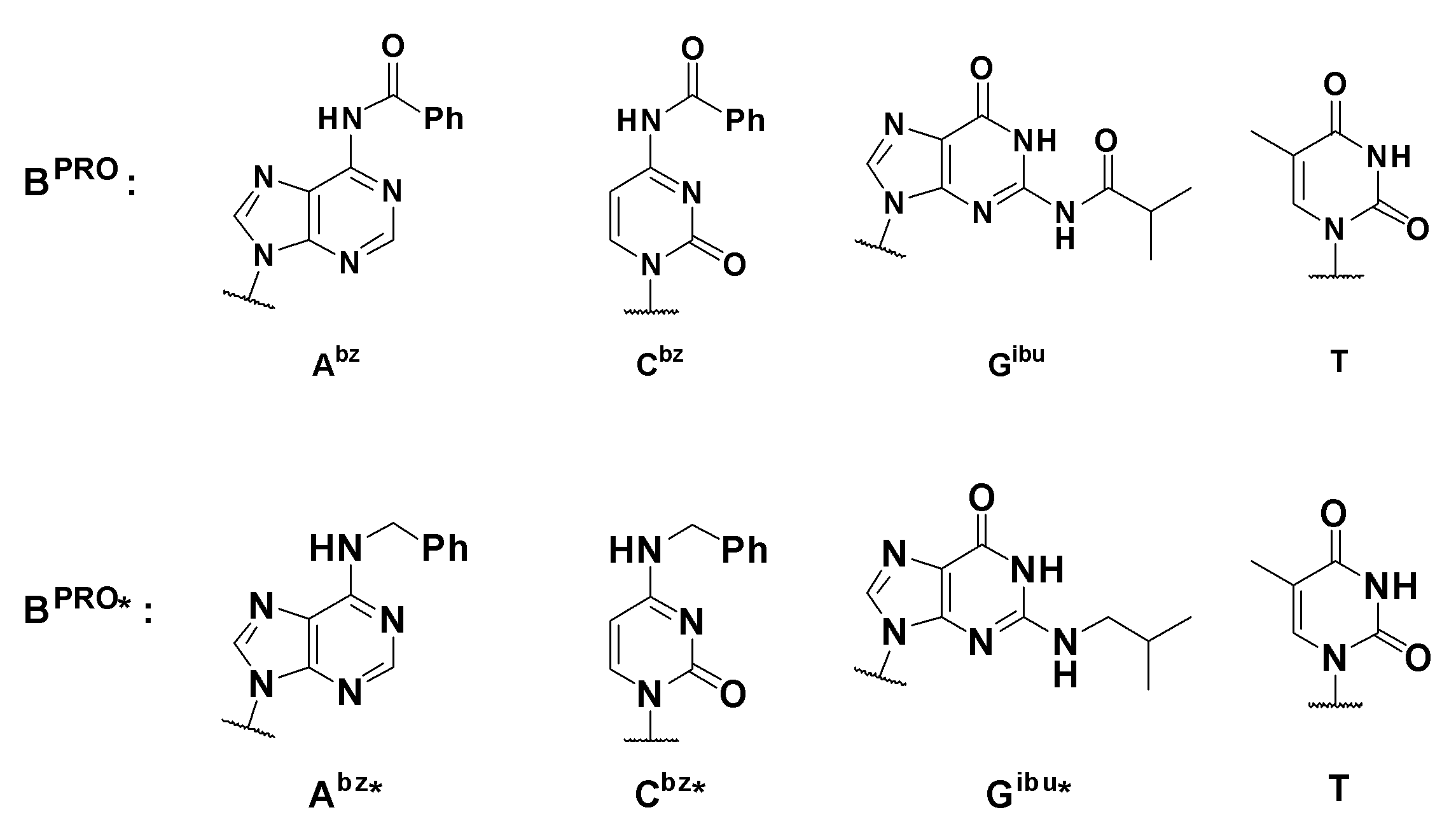
(上記式において、Phは、フェニル基を表す。)
しかし、上記ボラノ化の過程で、アデニン、シトシン、及びグアニンのアミノ基を保護するアシル系の保護基がボラノ化剤により還元されて脱保護することができなくなるため、上記方法は、核酸塩基がチミン又はウラシルである場合にしか用いることができない。
そこで、アミノ基が保護されていない核酸塩基を有するヌクレオチドモノマーを用いて、ボラノホスフェート型核酸オリゴマーを包含する核酸オリゴマーを得る方法が公知である(非特許文献1及び2)。ヌクレオチドモノマーとして、非特許文献1及び2では、それぞれ、下記左式で表されるヌクレオチドモノマー及び下記右式で表されるヌクレオチドモノマーが用いられる。下記のような環状構造を有するモノマーを用いることで、穏和な酸性条件下でもアミノ基との副反応が抑制され、塩基部が無保護でもオリゴマーを得ることが可能となる。

(上記式において、DMTr及びPhは、前述の通りであり、BNH2は、アデニン、グアニン、シトシン、5-メチルシトシン、チミン、及びウラシルからなる群より選ばれる核酸塩基を表し、該アデニン、該グアニン、該シトシン、及び該5-メチルシトシン中のアミノ基は、置換されていない。)
Nucl. Nucl. Nucleic Acids, 2010, Vol.29, pp.144-154
Bioorg. Med. Chem. Lett., 2006, Vol.16, pp.3111-3114
しかし、本発明者らの検討によれば、非特許文献1又は2に開示されているような従来のヌクレオチドモノマーを用いた場合、得られる核酸オリゴマーの鎖長に限界がある。この原因は、以下の通りである。上記ヌクレオチドモノマーは、アミノ基が無保護であることで、極性が高いため、シリカゲルカラムクロマトグラフィーによる精製時に、シリカゲルとの親和性が極端に高く、よって、精製が困難となりやすい。このことで、ヌクレオチドモノマーの純度が低下しやすいため、核酸オリゴマーの合成効率が低下し、結果として、核酸オリゴマーの鎖長が長くなりにくい。更に、上記ヌクレオチドモノマーは、リン原子周辺の立体障害が極端に小さいために、加水分解に対する反応性が高すぎ、縮合条件下、速やかに加水分解してしまうことで、上記ヌクレオチドモノマーの実効濃度が低下しやすいことも原因として挙げられる。
本発明は、アミノ基が置換されていない核酸塩基を有し、かつ、高い収率で核酸オリゴマーを与える新規なヌクレオチドモノマー、及び収率の高い核酸オリゴマーの製造方法を提供することを課題とする。
上記課題を解決するための具体的な手段には、以下の実施態様が含まれる。
<1> 下記一般式(1)で表されるヌクレオチドモノマー。
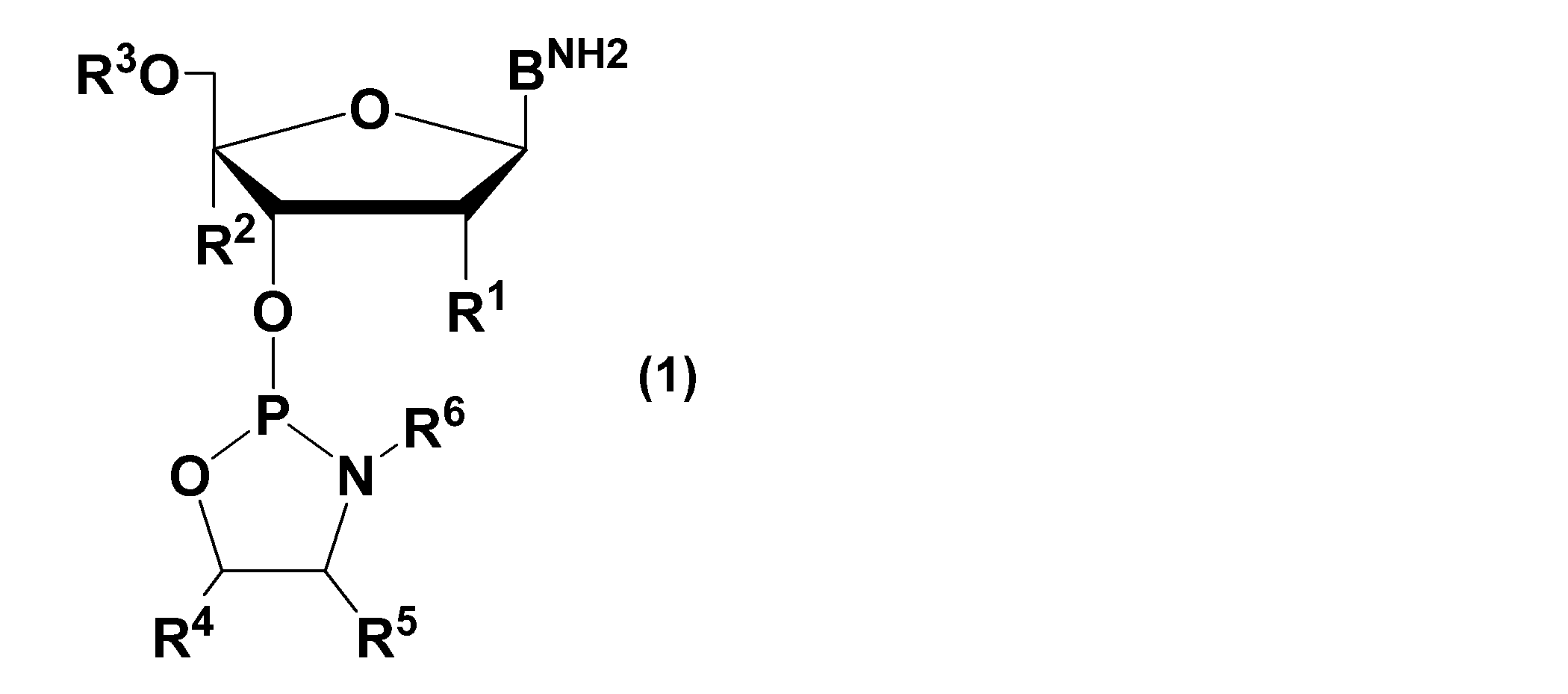
(一般式(1)中、R1は、水素原子、水酸基、アルコキシ基、アルケニルオキシ基、アシルオキシ基、トリヒドロカルビルシリルオキシ基、アルコキシアルコキシ基、ハロアルコキシアルコキシ基、又はハロゲニル基を表し、R2は、水素原子を表し、又は、R1及びR2は、互いに結合して、置換基を有し又は有せず、かつ、ヘテロ原子を有し又は有しない5員以上の環を形成し、R3は、水素原子又は水酸基の保護基を表し、R4は、置換基を有し又は有しないアリール基を表し、R5は、水素原子、ハロゲニル基、又は置換基を有し若しくは有しないアルキル基を表し、R6は、置換基を有し又は有せず、かつ、分子鎖中にヘテロ原子を有し又は有しない炭素原子数3以上のアルキル基を表し、又は、R5及びR6は、互いに結合して、分岐鎖を有し、かつ、前記分岐鎖以外に置換基を有し又は有せず、かつ、ヘテロ原子を有し又は有しない5員以上の環を形成し、BNH2は、アデニン、グアニン、シトシン、5-メチルシトシン、チミン、及びウラシルからなる群より選ばれる核酸塩基を表し、該アデニン、該グアニン、該シトシン、及び該5-メチルシトシン中のアミノ基は、置換されていない。)
<1> 下記一般式(1)で表されるヌクレオチドモノマー。
<2> 前記R6が表すアルキル基は、分岐状である<1>に記載のヌクレオチドモノマー。
<3> 前記R6が表すアルキル基は、炭素原子数が6以上14以下である<1>又は<2>に記載のヌクレオチドモノマー。
<4> R1は、水素原子、水酸基、アルコキシ基、アルケニルオキシ基、アシルオキシ基、トリヒドロカルビルシリルオキシ基、アルコキシアルコキシ基、ハロアルコキシアルコキシ基、又はハロゲニル基を表し、R2は、水素原子を表し、又は、R1及びR2は、互いに結合して、下記一般式(2)で表される二価の基を形成する<1>~<3>のいずれかに記載のヌクレオチドモノマー。

(一般式(2)中、R7及びR8は、それぞれ独立して、水素原子又は炭素原子数1~10のアルキル基を表し、又は、互いに結合して環を形成し、*及び**は、結合手を表し、*で表される結合手は、一般式(1)において、R1が直結する炭素原子に結合し、**で表される結合手は、一般式(1)において、R2が直結する炭素原子に結合する。)
<5> 前記ヌクレオチドモノマーにおいてリン原子の立体化学は制御されている<1>~<4>のいずれかに記載のヌクレオチドモノマー。
<6> 下記一般式(1a)で表されるヌクレオチドモノマーを縮合させて、下記一般式(3a)で表されるヌクレオチド単位を含む第一の前駆体核酸オリゴマーを得る縮合工程と、
前記第一の前駆体核酸オリゴマーをボラノ化剤によりボラノ化して、下記一般式(4a)で表されるヌクレオチド単位を含む第二の前駆体核酸オリゴマーを得るボラノ化工程、又は
前記第一の前駆体核酸オリゴマーを酸化剤により酸化して、下記一般式(5a)で表されるヌクレオチド単位を含む第三の前駆体核酸オリゴマーを得る酸化工程と、
前記第二の前駆体核酸オリゴマー又は前記第三の前駆体核酸オリゴマーから、R3aで表される保護基を脱離させて、下記一般式(4b)で表されるヌクレオチド単位を含む第四の前駆体核酸オリゴマー、又は下記一般式(5b)で表されるヌクレオチド単位を含む第五の前駆体核酸オリゴマーを得る脱保護工程と、
の組み合わせを1回実行し又は2回以上繰り返し実行する鎖長伸長工程、並びに
前記第四の前駆体核酸オリゴマー又は前記第五の前駆体核酸オリゴマーにおいて、5’-水酸基及びアミノ基に対し保護基によるキャッピングを行って又は行わないで、下記一般式(4c)で表されるヌクレオチド単位を含む第六の前駆体核酸オリゴマー又は下記一般式(5c)で表されるヌクレオチド単位を含む第七の前駆体核酸オリゴマーから、下記一般式(6)で表されるリン酸保護基を脱離させて、更に、前記キャッピングを行った場合には前記保護基を脱離させて、下記一般式(7)で表されるヌクレオチド単位及び下記一般式(8)で表されるヌクレオチド単位からなる群より選ばれる少なくとも1種を含む核酸オリゴマーを得る核酸オリゴマー生成工程
を含む核酸オリゴマーの製造方法。

(一般式(1a)中、R1は、水素原子、水酸基、アルコキシ基、アルケニルオキシ基、アシルオキシ基、トリヒドロカルビルシリルオキシ基、アルコキシアルコキシ基、ハロアルコキシアルコキシ基、又はハロゲニル基を表し、R2は、水素原子を表し、又は、R1及びR2は、互いに結合して、置換基を有し又は有せず、かつ、ヘテロ原子を有し又は有しない5員以上の環を形成し、R3aは、水酸基の保護基を表し、R4は、置換基を有し又は有しないアリール基を表し、R5は、水素原子、ハロゲニル基、又は置換基を有し若しくは有しないアルキル基を表し、R6は、置換基を有し又は有せず、かつ、分子鎖中にヘテロ原子を有し又は有しない炭素原子数3以上のアルキル基を表し、又は、R5及びR6は、互いに結合して、分岐鎖を有し、かつ、前記分岐鎖以外に置換基を有し又は有せず、かつ、ヘテロ原子を有し又は有しない5員以上の環を形成し、BNH2は、アデニン、グアニン、シトシン、5-メチルシトシン、チミン、及びウラシルからなる群より選ばれる核酸塩基を表し、該アデニン、該グアニン、該シトシン、及び該5-メチルシトシン中のアミノ基は、置換されていない。)
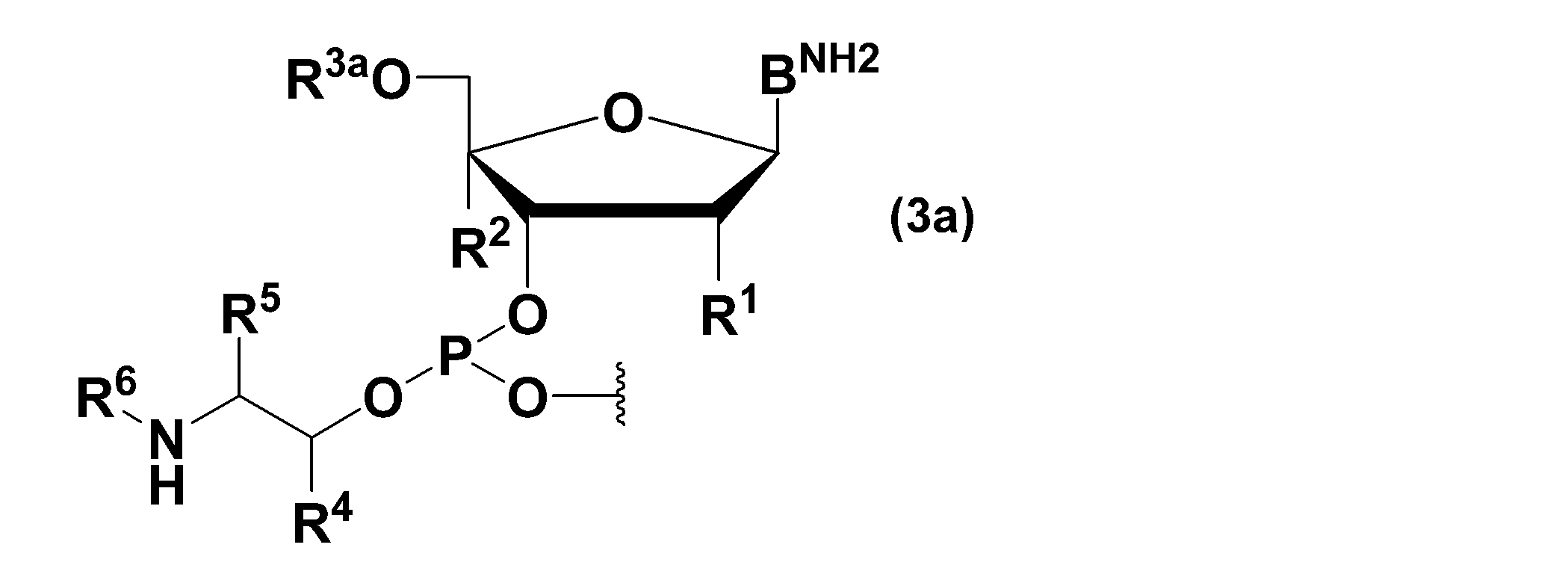
(一般式(3a)中、R1、R2、R3a、R4~R6、及びBNH2は、前記の通りである。)

(一般式(4a)、(5a)、(4b)、及び(5b)中、R1、R2、R3a、R4~R6、及びBNH2は、前記の通りである。)
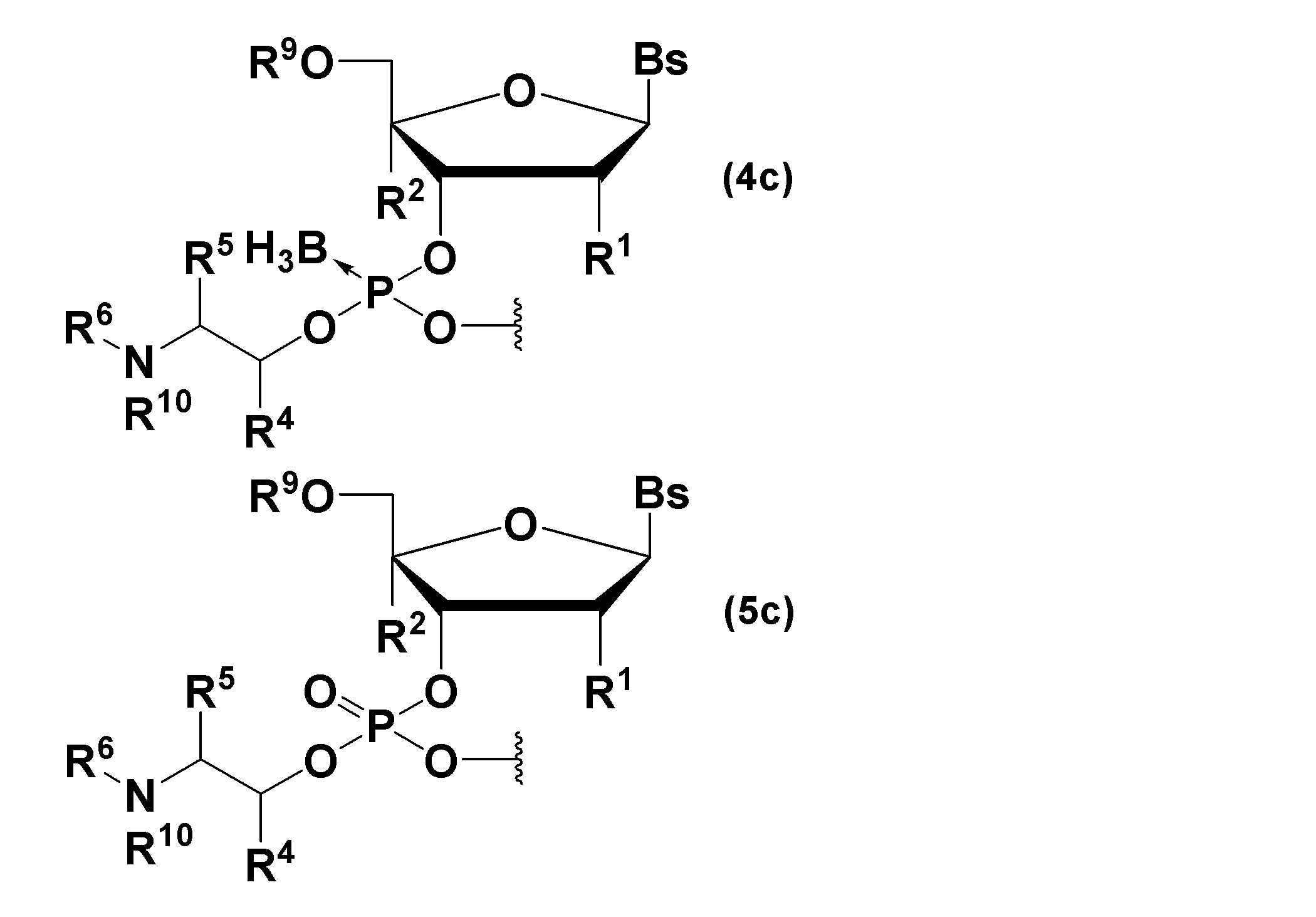
(一般式(4c)及び(5c)中、R1、R2、及びR4~R6は、前記の通りであり、
前記キャッピングを行った場合、R9は、水酸基の保護基を表し、R10は、アミノ基の保護基を表し、Bsは、アデニン、グアニン、シトシン、5-メチルシトシン、チミン、及びウラシルからなる群より選ばれる核酸塩基を表し、該アデニン、該グアニン、該シトシン、及び該5-メチルシトシン中のアミノ基は、アミノ基の保護基で置換されており、
前記キャッピングを行わなかった場合、R9及びR10は、水素原子を表し、Bsは、BNH2を表す。)
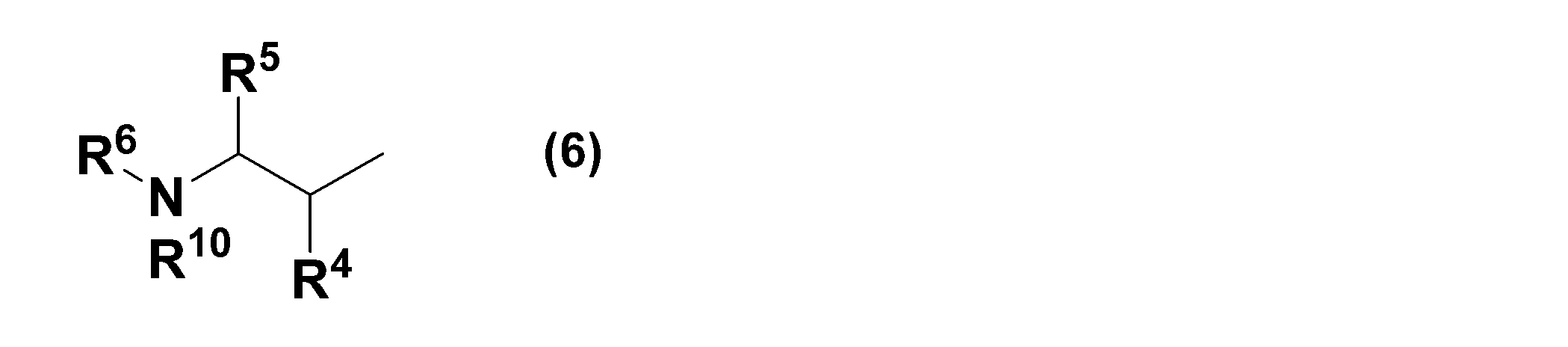
(一般式(6)中、R4~R6及びR10は、前記の通りである。)

(一般式(7)及び(8)中、R1、R2、及びBNH2は、前記の通りであり、X+は、カウンターカチオンを表す。)
前記第一の前駆体核酸オリゴマーをボラノ化剤によりボラノ化して、下記一般式(4a)で表されるヌクレオチド単位を含む第二の前駆体核酸オリゴマーを得るボラノ化工程、又は
前記第一の前駆体核酸オリゴマーを酸化剤により酸化して、下記一般式(5a)で表されるヌクレオチド単位を含む第三の前駆体核酸オリゴマーを得る酸化工程と、
前記第二の前駆体核酸オリゴマー又は前記第三の前駆体核酸オリゴマーから、R3aで表される保護基を脱離させて、下記一般式(4b)で表されるヌクレオチド単位を含む第四の前駆体核酸オリゴマー、又は下記一般式(5b)で表されるヌクレオチド単位を含む第五の前駆体核酸オリゴマーを得る脱保護工程と、
の組み合わせを1回実行し又は2回以上繰り返し実行する鎖長伸長工程、並びに
前記第四の前駆体核酸オリゴマー又は前記第五の前駆体核酸オリゴマーにおいて、5’-水酸基及びアミノ基に対し保護基によるキャッピングを行って又は行わないで、下記一般式(4c)で表されるヌクレオチド単位を含む第六の前駆体核酸オリゴマー又は下記一般式(5c)で表されるヌクレオチド単位を含む第七の前駆体核酸オリゴマーから、下記一般式(6)で表されるリン酸保護基を脱離させて、更に、前記キャッピングを行った場合には前記保護基を脱離させて、下記一般式(7)で表されるヌクレオチド単位及び下記一般式(8)で表されるヌクレオチド単位からなる群より選ばれる少なくとも1種を含む核酸オリゴマーを得る核酸オリゴマー生成工程
を含む核酸オリゴマーの製造方法。
前記キャッピングを行った場合、R9は、水酸基の保護基を表し、R10は、アミノ基の保護基を表し、Bsは、アデニン、グアニン、シトシン、5-メチルシトシン、チミン、及びウラシルからなる群より選ばれる核酸塩基を表し、該アデニン、該グアニン、該シトシン、及び該5-メチルシトシン中のアミノ基は、アミノ基の保護基で置換されており、
前記キャッピングを行わなかった場合、R9及びR10は、水素原子を表し、Bsは、BNH2を表す。)
<7> 前記R6が表すアルキル基は、分岐状である<6>に記載の製造方法。
<8> 前記R6が表すアルキル基は、炭素原子数が6以上14以下である<6>又は<7>に記載の製造方法。
<9> R1は、水素原子、水酸基、アルコキシ基、アルケニルオキシ基、アシルオキシ基、トリヒドロカルビルシリルオキシ基、アルコキシアルコキシ基、ハロアルコキシアルコキシ基、又はハロゲニル基を表し、R2は、水素原子を表し、又は、R1及びR2は、互いに結合して、下記一般式(2)で表される二価の基を形成する<6>~<8>のいずれかに記載の製造方法。

(一般式(2)中、R7及びR8は、それぞれ独立して、水素原子又は炭素原子数1~10のアルキル基を表し、又は、互いに結合して環を形成し、*及び**は、結合手を表し、*で表される結合手は、一般式(1a)において、R1が直結する炭素原子に結合し、**で表される結合手は、一般式(1a)において、R2が直結する炭素原子に結合する。)
<10> 前記ヌクレオチドモノマー及び前記ヌクレオチド単位においてリン原子の立体化学は制御されている<6>~<9>のいずれかに記載の製造方法。
本発明によれば、アミノ基が置換されていない核酸塩基を有し、かつ、高い収率で核酸オリゴマーを与える新規なヌクレオチドモノマー、及び収率の高い核酸オリゴマーの製造方法を提供することができる。
以下、本発明の実施形態について説明する。なお、本発明は以下の実施形態に限定されない。本明細書において「工程」との語は、独立した工程だけではなく、他の工程と明確に区別できない場合であってもその工程の所期の目的が達成されれば、本用語に含まれる。また、本明細書において「~」は、その前後に記載される数値をそれぞれ最小値及び最大値として含む範囲を示すものとする。更に、本明細書において組成物中の各成分の量は、組成物中に各成分に該当する物質が複数存在する場合、特に断らない限り、組成物中に存在する当該複数の物質の合計量を意味する。
<ヌクレオチドモノマー>
本実施形態に係るヌクレオチドモノマーは、上記一般式(1)で表される。一般式(1)で表されるヌクレオチドモノマーにおいて、R4は、置換基を有し又は有しないアリール基を表し、R6は、置換基を有し又は有せず、かつ、分子鎖中にヘテロ原子を有し又は有しない炭素原子数3以上のアルキル基を表し、又は、R6は、R5と結合して、分岐鎖を有し、かつ、前記分岐鎖以外に置換基を有し又は有せず、かつ、ヘテロ原子を有し又は有しない5員以上の環を形成する。これにより、一般式(1)で表されるヌクレオチドモノマーは、アミノ基が置換されていない核酸塩基を有しつつも、極性が低くなるために、シリカゲルカラムクロマトグラフィーによる精製が容易となり、高い純度で得ることができ、よって、高い収率で核酸オリゴマーを与えることができる。更に、上記ヌクレオチドモノマーは、リン原子周辺に適切な立体障害が付与されることで、加水分解が抑制され、縮合反応時に実効濃度を高く保つことができ、縮合効率を向上させることが可能である。
本実施形態に係るヌクレオチドモノマーは、上記一般式(1)で表される。一般式(1)で表されるヌクレオチドモノマーにおいて、R4は、置換基を有し又は有しないアリール基を表し、R6は、置換基を有し又は有せず、かつ、分子鎖中にヘテロ原子を有し又は有しない炭素原子数3以上のアルキル基を表し、又は、R6は、R5と結合して、分岐鎖を有し、かつ、前記分岐鎖以外に置換基を有し又は有せず、かつ、ヘテロ原子を有し又は有しない5員以上の環を形成する。これにより、一般式(1)で表されるヌクレオチドモノマーは、アミノ基が置換されていない核酸塩基を有しつつも、極性が低くなるために、シリカゲルカラムクロマトグラフィーによる精製が容易となり、高い純度で得ることができ、よって、高い収率で核酸オリゴマーを与えることができる。更に、上記ヌクレオチドモノマーは、リン原子周辺に適切な立体障害が付与されることで、加水分解が抑制され、縮合反応時に実効濃度を高く保つことができ、縮合効率を向上させることが可能である。
R1が表すアルコキシ基としては、炭素原子数1~12のアルコキシ基が好ましく、炭素原子数1~6のアルコキシ基がより好ましく、例えば、メトキシ基、エトキシ基、n-プロポキシ基、i-プロポキシ基、n-ブトキシ基、sec-ブトキシ基、tert-ブトキシ基、n-ペンチルオキシ基等を挙げることができる。
R1が表すアルケニルオキシ基としては、例えば、ビニルオキシ基、アリルオキシ基、1-プロペニルオキシ基、イソプロペニルオキシ基、2-メチル-1-プロペニルオキシ基、2-メチルアリルオキシ基、2-ブテニルオキシ基等を挙げることができる。
R1が表すアシルオキシ基としては、例えば、炭素原子数1から6のアルキル-カルボニルオキシ基(例えば、メチルカルボニルオキシ基、エチルカルボニルオキシ基等)、炭素原子数6から10のアリール-カルボニルオキシ(例えば、ベンゾイルオキシ基)等が挙げられる。
R1が表すトリヒドロカルビルシリルオキシ基としては、例えば、トリメチルシリルオキシ基、トリエチルシリルオキシ基、トリイソプロピルシリルオキシ基、t-ブチルジメチルシリルオキシ基等のトリアルキルシリルオキシ基、t-ブチルジフェニルシリルオキシ基等のアルキルジアリールシリルオキシ基等を挙げることができる。
R1が表すアルコキシアルコキシ基としては、例えば、メトキシメトキシ基、メトキシエトキシ基、エトキシメトキシ基、エトキシエトキシ基、(2-シアノエトキシ)メトキシ基等を挙げることができる。
R1が表すハロアルコキシアルコキシ基としては、例えば、(2-フルオロ)エトキシメトキシ基、(2,2-ジフルオロ)エトキシメトキシ基、(2-クロロ)メトキシエトキシ基、(2,2-ジクロロ)エトキシメトキシ基等を挙げることができる。
R1が表すハロゲニル基としては、例えば、フルオロ基、クロロ基、ブロモ基等を挙げることができ、フルオロ基が好ましい。
R1としては、二重鎖形成能の点から、上記の中でも、水素原子、水酸基、アルコキシ基、トリアルキルシリルオキシ基、アルコキシアルコキシ基、ハロアルコキシアルコキシ基、及びハロゲニル基が好ましい。
R1及びR2は、互いに結合して、置換基を有し又は有せず、かつ、ヘテロ原子を有し又は有しない5員以上の環を形成してもよい。前記置換基としては、例えば、前記環を形成している原子に結合した置換基が挙げられ、具体的には、置換基を有し又は有しないアルキル基、オキソ基(=O)等が挙げられる。前記アルキル基としては、例えば、メチル基、エチル基等が挙げられる。該アルキル基が置換基を有する場合、当該置換基としては、例えば、フルオロ基、クロロ基、ブロモ基等のハロゲニル基、アミノ基、イミノ基等が挙げられる。ヘテロ原子としては、例えば、酸素原子、窒素原子、硫黄原子等が挙げられる。前記環の員数は、好ましくは5~10員、より好ましくは5~8員、更により好ましくは5~7員である。
二重鎖形成能の点から、R1及びR2は、互いに結合して、下記一般式(2)で表される二価の基を形成することが好ましい。

一般式(2)中、R7及びR8は、それぞれ独立して、水素原子又は炭素原子数1~10のアルキル基を表し、又は、互いに結合して環を形成し、*及び**は、結合手を表し、*で表される結合手は、一般式(1)において、R1が直結する炭素原子に結合し、**で表される結合手は、一般式(1)において、R2が直結する炭素原子に結合する。
R7又はR8が表すアルキル基としては、例えば、直鎖状又は分岐鎖状の炭素原子数1~10のアルキル基を挙げることができ、具体的には、例えば、メチル基、エチル基、n-プロピル基、i-プロピル基、n-ブチル基、t-ブチル基、n-ヘキシル基、及びn-オクチル基等が挙げられる。R7及びR8が互いに結合して環を形成する場合、当該環として、具体的には、例えば、シクロプロパン環、シクロブタン環、シクロヘキサン環等が挙げられる。
R1及びR2は、互いに結合して、置換基を有し又は有せず、かつ、ヘテロ原子を有し又は有しない5員以上の環を形成した場合、該環の具体例としては、下記式で示す環が挙げられる。
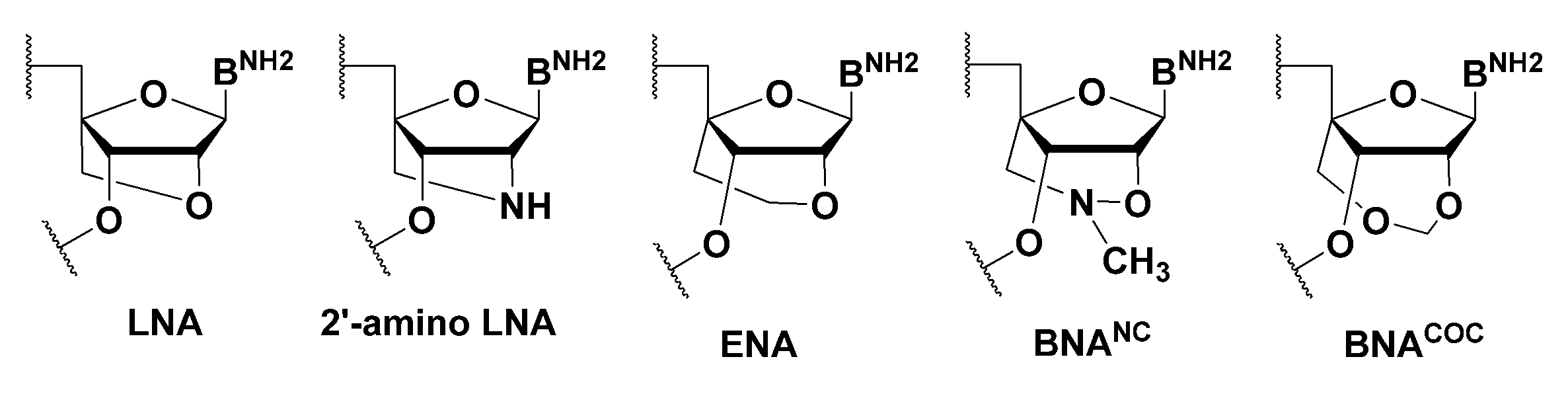
(式中、BNH2は、前記の通りである。)
R3が表す水酸基の保護基としては、例えば、アセチル基、フェニルアセチル基、フェノキシアセチル基、クロロアセチル基、ピバロイル基、ベンジル基、4-メトキシベンジル基、ベンゾイル基、4-メトキシベンゾイル基、トリフェニルメチル基、4,4’-ジメトキシトリチル(DMTr)基、4-メトキシトリチル(MMTr)基、9-フェニルキサンテニル基、t-ブトキシカルボニル基、トリメチルシリル基、t-ブチルジメチルシリル基、t-ブチルジフェニルシリル基、シアノメトキシメチル基、2-(シアノエトキシ)エチル基、シアノエトキシメチル基等を挙げることができる。中でも、酸性条件下で容易に除去可能であり、固相合成における鎖長伸長に適している点で、4,4’-ジメトキシトリチル基が好ましい。
R4は、置換基を有し又は有しないアリール基を表し、合成の容易さ、反応性、オリゴマー生成時のリン酸部位の脱保護の容易さ、立体化学を制御する場合は縮合時の立体選択性の高さ等の点で、置換基を有し又は有しない炭素原子数6~20のアリール基を表すことが好ましく、置換基を有し又は有しない炭素原子数6~14のアリール基を表すことがより好ましく、置換基を有し又は有しない炭素原子数6~10のアリール基を表すことが更により好ましい。前記置換基としては、例えば、置換基を有し又は有しないアルキル基、水酸基、アミノ基、アルコキシ基、ハロゲニル基等が挙げられる。前記アルキル基としては、例えば、メチル基、エチル基等が挙げられる。該アルキル基が置換基を有する場合、当該置換基としては、例えば、水酸基、アミノ基、アルコキシ基、イミノ基、ハロゲニル基等が挙げられる。前記アルコキシ基としては、例えば、メトキシ基、エトキシ基等が挙げられる。前記ハロゲニル基としては、例えば、フルオロ基、クロロ基、ブロモ基等が挙げられる。R4としては、例えば、フェニル基、ナフチル基等が挙げられ、合成の容易さ、反応性等の点で、フェニル基が好ましい。
R5が表すハロゲニル基としては、例えば、フルオロ基、クロロ基、ブロモ基等を挙げることができ、フルオロ基が好ましい。
R5が表す置換基を有し若しくは有しないアルキル基としては、置換基を有し若しくは有しない炭素原子数1~12のアルキル基が好ましく、置換基を有し若しくは有しない炭素原子数1~6のアルキル基がより好ましい。前記置換基としては、例えば、水酸基、アミノ基、アルコキシ基、イミノ基、ハロゲニル基等が挙げられる。前記アルコキシ基としては、例えば、メトキシ基、エトキシ基等が挙げられる。前記ハロゲニル基としては、例えば、フルオロ基、クロロ基、ブロモ基等が挙げられる。R5が表す置換基を有し若しくは有しないアルキル基としては、例えば、メチル基、エチル基、n-プロピル基、i-プロピル基、n-ブチル基、sec-ブチル基、tert-ブチル基、n-ペンチル基等が挙げられる。
R5としては、合成の容易さ等の点から、水素原子が好ましい。
R6は、置換基を有し又は有せず、かつ、分子鎖中にヘテロ原子を有し又は有しない炭素原子数3以上のアルキル基を表す。R6が表すアルキル基は、モノマーの収率及び純度、得られる核酸オリゴマーの収率の向上しやすさ等の点で、炭素原子数が3以上20以下であることが好ましく、炭素原子数が6以上14以下であることがより好ましく、炭素原子数が8以上12以下であることが更により好ましい。前記置換基としては、例えば、水酸基、アミノ基、アルコキシ基、イミノ基、ハロゲニル基等が挙げられる。前記アルコキシ基としては、例えば、メトキシ基、エトキシ基等が挙げられる。前記ハロゲニル基としては、例えば、フルオロ基、クロロ基、ブロモ基等が挙げられる。ヘテロ原子としては、例えば、酸素原子、窒素原子、硫黄原子等が挙げられる。R6が表すアルキル基は、モノマーの収率及び純度、得られる核酸オリゴマーの収率の向上しやすさ等の点で、分岐状であることが好ましい。R6としては、例えば、i-プロピル基、sec-ブチル基、tert-ブチル基、ネオペンチル基、i-ペンチル基、sec-ペンチル基、3-ペンチル基、tert-ペンチル基、i-ヘキシル基、2-エチルヘキシル基、1-メチルヘプチル基、3-メチルオクチル基、テトラヒドロゲラニル基(即ち、3,7-ジメチルオクチル基)等が挙げられ、テトラヒドロゲラニル基が好ましい。
R5及びR6は、互いに結合して、分岐鎖を有し、かつ、前記分岐鎖以外に置換基を有し又は有せず、かつ、ヘテロ原子を有し又は有しない5員以上の環を形成してもよい。前記環の員数は、好ましくは5~10員、より好ましくは5~8員、更により好ましくは5~7員である。前記置換基としては、例えば、置換基を有し又は有しないアルキル基、水酸基、アミノ基、アルコキシ基、イミノ基、ハロゲニル基等が挙げられる。前記アルキル基としては、例えば、メチル基、エチル基等が挙げられる。該アルキル基が置換基を有する場合、当該置換基としては、例えば、水酸基、アミノ基、アルコキシ基、イミノ基、ハロゲニル基等が挙げられる。前記アルコキシ基としては、例えば、メトキシ基、エトキシ基等が挙げられる。前記ハロゲニル基としては、例えば、フルオロ基、クロロ基、ブロモ基等が挙げられる。ヘテロ原子としては、例えば、酸素原子、窒素原子、硫黄原子等が挙げられる。前記分岐鎖としては、例えば、置換基を有し又は有せず、かつ、分子鎖中にヘテロ原子を有し又は有しないアルキル基が挙げられる。該アルキル基は、得られる核酸オリゴマーの収率、得られる核酸オリゴマー中のヌクレオチド単位におけるリン原子の立体化学の制御のしやすさ等の点で、炭素原子数が1以上15以下であることが好ましく、炭素原子数が2以上10以下であることがより好ましく、炭素原子数が3以上8以下であることが更により好ましい。前記分岐鎖中の置換基としては、例えば、水酸基、アミノ基、アルコキシ基、イミノ基、ハロゲニル基等が挙げられる。前記アルコキシ基としては、例えば、メトキシ基、エトキシ基等が挙げられる。前記ハロゲニル基としては、例えば、フルオロ基、クロロ基、ブロモ基等が挙げられる。前記分岐鎖中のヘテロ原子としては、例えば、酸素原子、窒素原子、硫黄原子等が挙げられる。前記アルキル基としては、メチル基、エチル基、n-プロピル基、i-プロピル基、n-ブチル基、sec-ブチル基、tert-ブチル基、n-ペンチル基等が挙げられる。
得られる核酸オリゴマー中のヌクレオチド単位におけるリン原子の立体化学の制御のしやすさ等の点で、前記ヌクレオチドモノマーにおいてリン原子の立体化学は制御されていることが好ましい。リン原子の立体化学が制御されている前記ヌクレオチドモノマーとしては、例えば、下記左式で表されるSp体、下記右式で表されるRp体が挙げられる。下記左式及び下記右式において、R1~R6、及びBNH2は、前記の通りである。
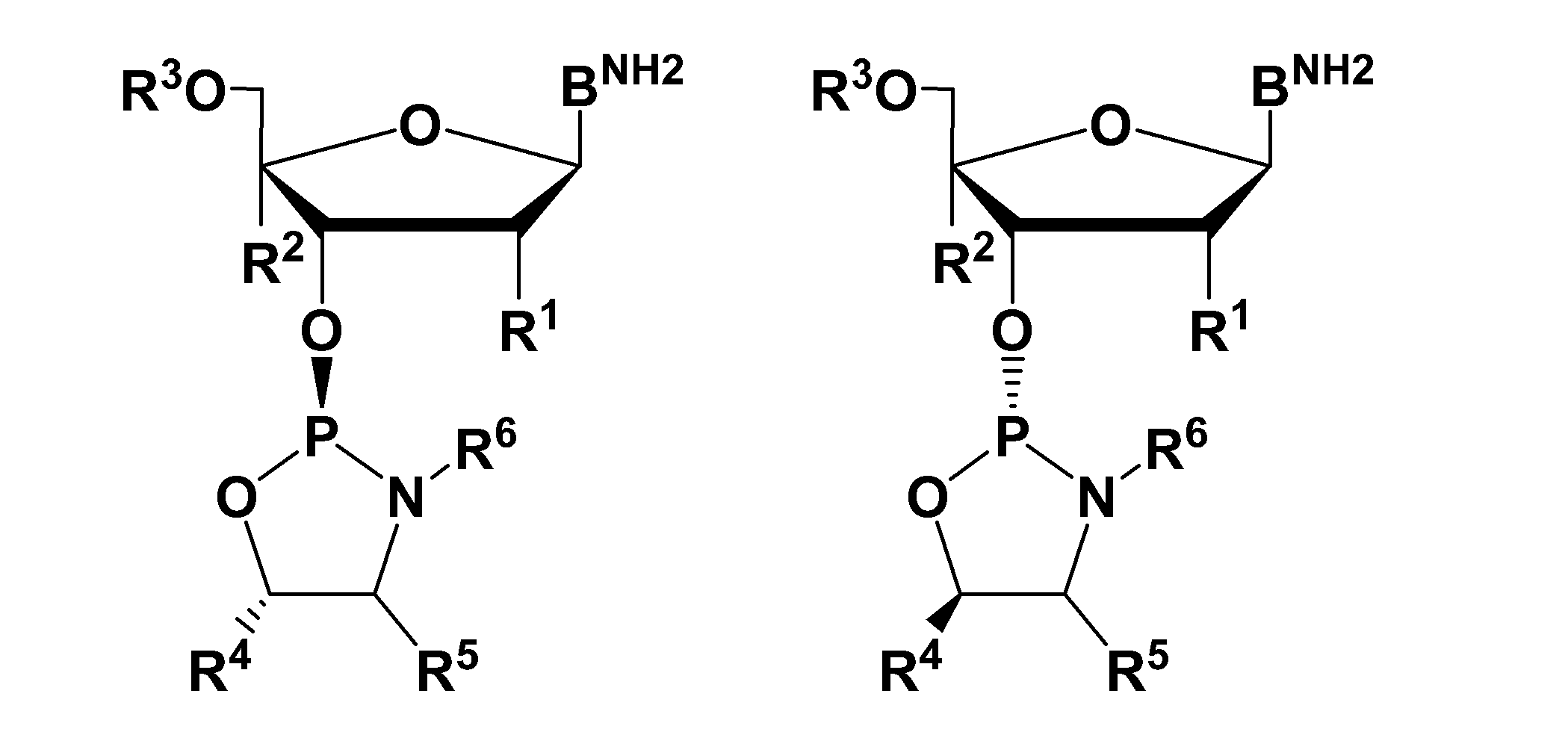
本実施形態に係るヌクレオチドモノマーは、例えば、実施例に示す方法と同様にして製造することができる。
<核酸オリゴマーの製造方法>
本実施形態に係る核酸オリゴマーの製造方法は、上記縮合工程と、上記ボラノ化工程又は上記酸化工程と、上記脱保護工程と、の組み合わせを1回実行し又は2回以上繰り返し実行する鎖長伸長工程、並びに上記核酸オリゴマー生成工程を含む。この製造方法により、高い収率で核酸オリゴマーを得ることができる。
本実施形態に係る核酸オリゴマーの製造方法は、上記縮合工程と、上記ボラノ化工程又は上記酸化工程と、上記脱保護工程と、の組み合わせを1回実行し又は2回以上繰り返し実行する鎖長伸長工程、並びに上記核酸オリゴマー生成工程を含む。この製造方法により、高い収率で核酸オリゴマーを得ることができる。
前記縮合工程では、固相担体に担持されたヌクレオシド構造中や核酸オリゴマーのヌクレオシド構造中のリボース構造の5’位の炭素原子に結合する水酸基と上記一般式(1a)で表されるヌクレオチドモノマーの亜リン酸部とが縮合する。R3aが表す水酸基の保護基は、R3が表す水酸基の保護基と同様である。
前記縮合工程では、酸性活性化剤を用いることができる。酸性活性化剤としては、例えば、1-フェニルイミダゾリウムトリフラート、N-シアノメチルピロリジウムトリフラート、N-シアノメチルジメチルアンモニウムトリフラート等が挙げられる。酸性活性化剤は、1種単独で用いても2種以上を組み合わせて用いてもよい。前記縮合工程における縮合反応は、例えば、氷冷下(0℃)以上室温(25℃)以下、好ましくは20℃以上25℃以下の範囲で、例えば、1分以上数時間以下、好ましくは2分以上1時間以下の範囲で行うことができる。反応溶媒としては、例えば、不活性溶媒等を挙げることができる。不活性溶媒としては、例えば、アセトニトリル、イソブチロニトリル等を挙げることができる。反応溶媒は、1種単独で用いても2種以上を組み合わせて用いてもよい。
前記ボラノ化工程では、ボラノ化剤を用いることができる。ボラノ化剤としては、例えば、ボラン/テトラヒドロフラン錯体、ジメチルスルフィドボラン等のボラン化合物等が挙げられる。ボラノ化剤は、1種単独で用いても2種以上を組み合わせて用いてもよい。前記ボラノ化工程におけるボラノ化反応は、例えば、氷冷下(0℃)以上室温(25℃)以下、好ましくは20℃以上25℃以下の範囲で、例えば、30秒以上数時間以下、好ましくは1分以上1時間以下の範囲で行うことができる。反応溶媒としては、例えば、不活性溶媒等を挙げることができる。不活性溶媒としては、例えば、アセトニトリル、テトラヒドロフラン、トルエン等を挙げることができる。反応溶媒は、1種単独で用いても2種以上を組み合わせて用いてもよい。
前記酸化工程では、酸化剤を用いることができる。酸化剤としては、例えば、t-ブチルヒドロペルオキシド、m-クロロ過安息香酸、(2R,8aS)-(+)-(カンファリルスルホニル)オキサジリジン、(1S)-(+)-(8,8-ジクロロカンファリルスルホニル)オキサジリジン等の過酸化物等が挙げられる。酸化剤は、1種単独で用いても2種以上を組み合わせて用いてもよい。前記酸化工程における酸化反応は、例えば、氷冷下(0℃)以上室温(25℃)以下、好ましくは20℃以上25℃以下の範囲で、例えば、1分以上数時間以下、好ましくは2分以上1時間以下の範囲で行うことができる。反応溶媒としては、例えば、不活性溶媒等を挙げることができる。不活性溶媒としては、例えば、アセトニトリル、トルエン、デカン等を挙げることができる。反応溶媒は、1種単独で用いても2種以上を組み合わせて用いてもよい。
前記脱保護工程では、脱保護剤を用いることができる。脱保護剤としては、例えば、カルボン酸、ハロゲン化アルキルカルボン酸等を挙げることができる。カルボン酸としては、酢酸等を挙げることができる。ハロゲン化アルキルカルボン酸としては、例えば、トリフルオロ酢酸、トリクロロ酢酸、ジクロロ酢酸等を挙げることができる。脱保護剤は、1種単独で用いても2種以上を組み合わせて用いてもよい。脱保護される前駆体核酸オリゴマーにおいて、5’位の炭素原子に結合する水酸基が有する保護基R3aがトリフェニルメチル基、4,4’-ジメトキシトリチル(DMTr)基、4-メトキシトリチル(MMTr)基等のトリチル系の保護基であり、更に、該前駆体核酸オリゴマーがボラノ基を有する場合、脱保護工程において生じるトリチルカチオンとボラノ基との副反応を避けるために、カチオン捕捉剤を添加することが望ましい。カチオン捕捉剤としては、例えば、トリエチルシランが挙げられる。カチオン捕捉剤は、1種単独で用いても2種以上を組み合わせて用いてもよい。
鎖長伸長工程では、上記縮合工程と、上記ボラノ化工程又は上記酸化工程と、上記脱保護工程と、の組み合わせを1回実行し又は2回以上繰り返し実行する。これにより、2量体以上の前駆体核酸オリゴマーが形成される。具体的には、上記組み合わせを1回実行することにより、2量体の前駆体核酸オリゴマーを得ることができ、上記組み合わせをn回(nは2以上の整数)繰り返し実行することにより、(n+1)量体の前駆体核酸オリゴマーを得ることができる。
核酸オリゴマー生成工程では、リン酸保護基脱離剤を用いて、一般式(7)で表されるリン酸保護基を脱離させることができる。リン酸保護基脱離剤としては、例えば、ジアザビシクロウンデセン、1,8-(ジメチルアミノ)ナフタレン、アンモニア水等の塩基等が挙げられる。リン酸保護基脱離剤は、1種単独で用いても2種以上を組み合わせて用いてもよい。リン酸保護基脱離反応は、例えば、氷冷下(0℃)以上室温(25℃)以下、好ましくは20℃以上25℃以下の範囲で、例えば、15分以上24時間以下、好ましくは30分以上20時間以下の範囲で行うことができる。反応溶媒としては、例えば、不活性溶媒等を挙げることができる。不活性溶媒としては、例えば、アセトニトリル、エタノール等を挙げることができる。反応溶媒は、1種単独で用いても2種以上を組み合わせて用いてもよい。
5’-水酸基に対し保護基によるキャッピングを行う場合、R9が表す水酸基の保護基としては、例えば、アセチル基、フェニルアセチル基、フェノキシアセチル基、4-tert-ブチルフェノキシアセチル基、4-イソプロピルフェノキシアセチル基、クロロアセチル基、トリフルオロアセチル基、プロピオニル基、ブチリル基、イソブチリル基、ピバロイル基、ベンジル基、4-メトキシベンジル基、ベンゾイル基、4-メトキシベンゾイル基、トリフェニルメチル基、4,4’-ジメトキシトリチル(DMTr)基、4-メトキシトリチル(MMTr)基、9-フェニルキサンテニル基、9-フルオレニルメチルオキシカルボニル基、t-ブトキシカルボニル基、トリメチルシリル基、t-ブチルジメチルシリル基、t-ブチルジフェニルシリル基、シアノメトキシメチル基、2-(シアノエトキシ)エチル基、シアノエトキシメチル基、(ジメチルアミノ)メチル基等が挙げられる。
アミノ基に対し保護基によるキャッピングを行う場合、R10が表すアミノ基の保護基、及び、アデニン、グアニン、シトシン、又は5-メチルシトシンを表すBs中のアミノ基の保護基としては、例えば、アセチル基、フェニルアセチル基、フェノキシアセチル基、4-tert-ブチルフェノキシアセチル基、4-イソプロピルフェノキシアセチル基、クロロアセチル基、トリフルオロアセチル基、プロピオニル基、ブチリル基、イソブチリル基、ピバロイル基、ベンジル基、4-メトキシベンジル基、ベンゾイル基、4-メトキシベンゾイル基、トリフェニルメチル基、4,4’-ジメトキシトリチル(DMTr)基、4-メトキシトリチル(MMTr)基、9-フェニルキサンテニル基、9-フルオレニルメチルオキシカルボニル基、t-ブトキシカルボニル基、トリメチルシリル基、t-ブチルジメチルシリル基、t-ブチルジフェニルシリル基、シアノメトキシメチル基、2-(シアノエトキシ)エチル基、シアノエトキシメチル基、(ジメチルアミノ)メチル基等が挙げられる。
5’-水酸基及びアミノ基に対する保護基によるキャッピング及び前記保護基の脱離は、公知の方法で行うことができる。
X+が表すカウンターカチオンとしては、例えば、アンモニウムイオン、有機アミン化合物由来のカチオン、又は金属カチオン等を挙げることができる。カウンターカチオンは、1種単独で用いても2種以上を組み合わせて用いてもよい。有機アミン化合物由来のカチオンとしては、有機溶媒への溶解度、及びカウンターカチオンの揮発性の観点から、例えば、三級アルキルアミン化合物由来のカチオン、又は第四級アンモニウム化合物由来のカチオンを挙げることができる。三級アルキルアミン化合物由来のカチオンとしては、例えば、トリエチルアミン由来のカチオンHNEt3
+(Etはエチル基を表す。)、及び1,8-ジアザビシクロ[5.4.0]ウンデセン由来のカチオンを挙げることができる。第四級アンモニウム化合物由来のカチオンとしては、例えば、テトラブチルアンモニウムイオンを挙げることができる。金属カチオンとしては、Na+、Li+、K+等が挙げられる。
本実施形態に係る核酸オリゴマーの製造方法では、少なくとも前記縮合工程から前記核酸オリゴマー生成工程までを、固相担体を用いた反応により行うことが好ましい(固相法)。固相反応により核酸オリゴマーを製造する場合、核酸オリゴマーの3’末端の塩基を含むモノマーは、例えば、リボース構造の3’位の炭素原子に結合する酸素原子を介して、固相担体と結合することができる。この場合、モノマーと固相担体との間には、必要に応じてリンカーが存在してもよい。
前記固相担体の種類は特に限定されず、例えば、定孔ガラス、オキサリル化-定孔ガラス、TentaGel支持体-アミノポリエチレングリコール誘導体化支持体、高架橋アミノメチルポリスチレン、Pros-ポリスチレン/ジビニルベンゼンの共重合体等を挙げることができる。前記固相担体とモノマーとの連結には、固相担体上のアミノ基を利用することができる。前記固相担体上のアミノ基としては、3-アミノプロピル基、長鎖アルキルアミノ基(LCAA)等を挙げることができる。前記固相担体とモノマーとの間には、リンカーが存在してもよい。前記リンカーとしては、スクニシル基、サルコシル基、スクシニルサルコシル基、オキサリル基等を挙げることができる。
上述の通りにして得られた核酸オリゴマーは、適宜、固相担体から切り出すことができる。固相担体からの核酸オリゴマーの切り出しは、例えば、前記核酸オリゴマーが結合した固相担体をアンモニア水で処理することで行うことができる。固相担体からの核酸オリゴマーの切り出しで用いられるアンモニア水としては、例えば、25質量%アンモニア水又は25質量%アンモニア水-エタノール混合溶液(3:1、v/v)が挙げられる。固相担体からの核酸オリゴマーの切り出しは、例えば、前述した5’-水酸基に対する保護基の脱離又は前述したリン酸保護基の脱離と同時に行ってもよい。
得られた核酸オリゴマーは、例えば、逆相高速液体クロマトグラフィー(逆相HPLC)、イオン交換HPLC、カラムクロマトグラフィー、再結晶等の公知の精製方法により精製することができる。
本実施形態に係る核酸オリゴマーの製造方法では、前記ヌクレオチドモノマーのリン原子の立体化学が制御されていた場合、前記ヌクレオチド単位においてリン原子の立体化学は制御される。これにより、本実施形態に係る核酸オリゴマーの製造方法では、核酸オリゴマーを立体選択的に合成することができ、例えば、アンチセンス分子としての有効性、安全性等を効果的に向上させることが容易である。立体化学純度は、90%以上であることが好ましく、95%以上であることがより好ましい。
・核酸オリゴマー
本実施形態に係る核酸オリゴマーの製造方法で得られた核酸オリゴマーは、上記一般式(7)で表されるヌクレオチド単位及び上記一般式(8)で表されるヌクレオチド単位からなる群より選ばれる少なくとも1種を含む。上記一般式(7)で表されるヌクレオチド単位は、1種単独で用いても2種以上を組み合わせて用いてもよい。上記一般式(8)で表されるヌクレオチド単位は、1種単独で用いても2種以上を組み合わせて用いてもよい。
本実施形態に係る核酸オリゴマーの製造方法で得られた核酸オリゴマーは、上記一般式(7)で表されるヌクレオチド単位及び上記一般式(8)で表されるヌクレオチド単位からなる群より選ばれる少なくとも1種を含む。上記一般式(7)で表されるヌクレオチド単位は、1種単独で用いても2種以上を組み合わせて用いてもよい。上記一般式(8)で表されるヌクレオチド単位は、1種単独で用いても2種以上を組み合わせて用いてもよい。
一般式(7)で表されるヌクレオチド単位を含む核酸オリゴマーは、標的RNAとの親和性及びRNase H誘導活性に優れ、分解酵素耐性に特に優れる傾向にあり、毒性は高くなりにくい。一般式(8)で表されるヌクレオチド単位を含む核酸オリゴマーは、標的RNAとの親和性及びRNase H誘導活性に特に優れる傾向にあり、毒性は高くなりにくいものの、分解酵素耐性は低くなりやすい。上記核酸オリゴマーは、一般式(7)で表されるヌクレオチド単位及び一般式(8)で表されるヌクレオチド単位を含むと、標的RNAとの親和性、RNase H誘導活性、及び分解酵素耐性を高く維持しつつ、毒性が低く抑えられていることが期待される。
上記核酸オリゴマーの長さ(塩基長)としては、当該核酸オリゴマーが2つ以上の塩基を有する限り特に制限はなく、標的核酸の種類、長さ等に応じて所望の長さを適宜選択できる。当該核酸オリゴマーの長さは、特に限定されず、アンチセンス医薬への応用の観点から、8~50塩基であることが好ましく、10~30塩基であることがより好ましく、10~21塩基であることが更により好ましい。
核酸オリゴマーの塩基配列は、標的核酸の塩基配列に基づいて設定される。二重鎖形成能の観点から、核酸オリゴマーの塩基配列は、標的核酸の塩基配列に対して相補的な塩基配列となるように適宜選択されるが、場合によって、異なる塩基を1つ以上含む塩基配列であってもよい。また、核酸オリゴマーにおいて、一般式(7)で表されるヌクレオチド単位及び一般式(8)で表されるヌクレオチド単位の割合は、標的RNAとの親和性、RNase H誘導活性、分解酵素耐性、及び血中滞留性が高く維持されるよう、適宜選択される。
本実施形態に係る核酸オリゴマーは、一般式(7)で表されるヌクレオチド単位及び一般式(8)で表されるヌクレオチド単位以外のヌクレオチド単位を有する核酸オリゴマーであってもよい。当該核酸オリゴマーにおいて、一般式(7)で表されるヌクレオチド単位及び一般式(8)で表されるヌクレオチド単位の合計の割合は、特に限定されず、二重鎖形成能の観点から、核酸オリゴマー中の全ヌクレオチド単位に対し、40~100モル%であることが好ましく、50~100モル%であることがより好ましく、60~100モル%であることが更により好ましく、70~100モル%であることが特に好ましい。
本実施形態に係る核酸オリゴマーにおいて、5’末端は、水酸基又は水酸基の保護基であってよく、3’末端は、水酸基又は水酸基の保護基であってよい。水酸基の保護基の具体例は、前述の通りである。
以下、実施例によって本発明をより具体的に説明するが、本発明はこれら実施例によって制限されるものではない。
各種分析器は以下に示した機種を用いた。
1H-核磁気共鳴スペクトル(1H-NMR):JEOL JNM-ECZ400S(400MHz)
31P-核磁気共鳴スペクトル(31P-NMR):JEOL JNM-ECZ400S(162MHz)
なお、1H-NMRにはテトラメチルシラン(TMS)を内部標準として用い、31P-NMRには85%H3PO4を外部標準として用いた。
各種分析器は以下に示した機種を用いた。
1H-核磁気共鳴スペクトル(1H-NMR):JEOL JNM-ECZ400S(400MHz)
31P-核磁気共鳴スペクトル(31P-NMR):JEOL JNM-ECZ400S(162MHz)
なお、1H-NMRにはテトラメチルシラン(TMS)を内部標準として用い、31P-NMRには85%H3PO4を外部標準として用いた。
HRMS(ESI-TOF):Sciex X500R QTOF
カラムクロマトグラフィーに充填するシリカゲルには、KANTO CHEMICALのSilica Gel 60NとFUJI SILYSIA CHEMICAL LTD.のCHROMATOREX NH-DM1020とを用いた。
逆相HPLCに使用したカラム(精製):Japan Analytical Industry JAIGEL-ODS, AP-SP-120-15
逆相HPLCに使用したカラム(分析):waters μ-BOUNDASPHERE,C18 5μm,100Å,3.9mm×159mm
カラムクロマトグラフィーに充填するシリカゲルには、KANTO CHEMICALのSilica Gel 60NとFUJI SILYSIA CHEMICAL LTD.のCHROMATOREX NH-DM1020とを用いた。
逆相HPLCに使用したカラム(精製):Japan Analytical Industry JAIGEL-ODS, AP-SP-120-15
逆相HPLCに使用したカラム(分析):waters μ-BOUNDASPHERE,C18 5μm,100Å,3.9mm×159mm
なお、特に断りのない限り、「%」は質量基準である。実施例中、DMTrは4,4’-ジメトキシトリチルを示し、その他の略号は上記説明中のものと同義である。
<アミノアルコールの合成>
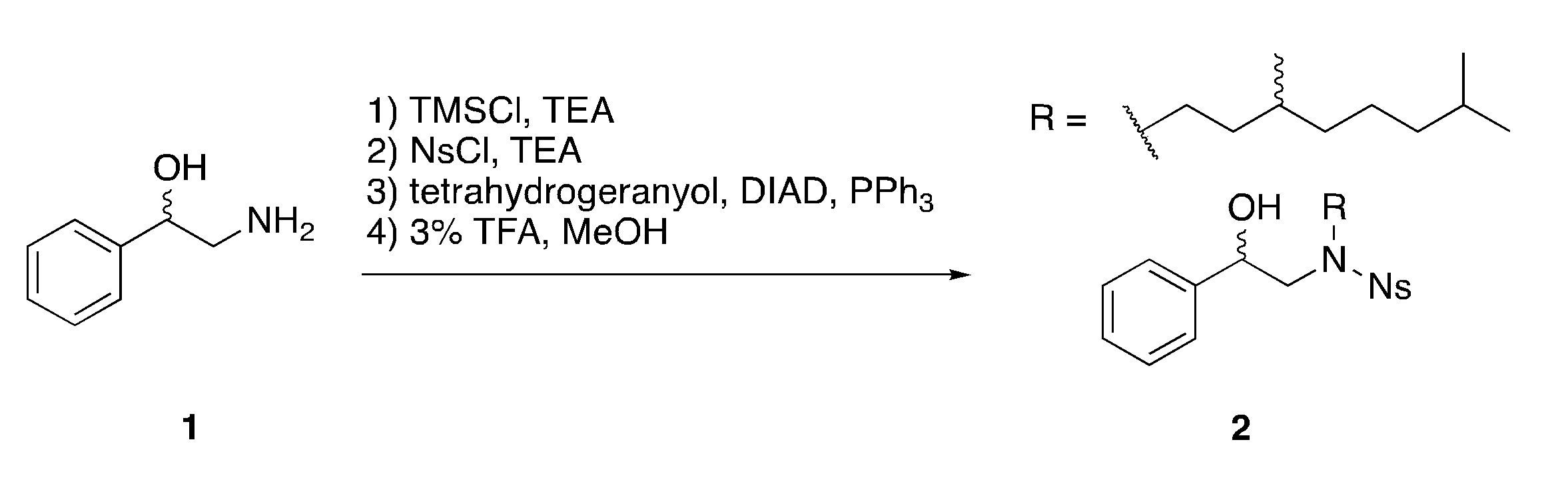
上記スキーム左端に記載のアミノアルコール誘導体1(11.33g,83mmol)をアルゴン雰囲気下でピリジン(10mL×3回),トルエン(10mL×3回)で共沸乾燥し、テトラヒドロフラン(500mL)に溶解した。得られたテトラヒドロフラン溶液を攪拌しつつ,トリエチルアミン(TEA,17.5mL,124.5mmol),クロロトリメチルシラン(TMSCl,15.7mL,124.5mmol)を加え,2時間攪拌した。その後,メタノール(5.5mL)を加え、反応を停止し、溶媒を減圧留去した。得られた無色結晶の混合物をジクロロメタン(160mL)に溶解し、その溶液を0℃に冷却した後、トリエチルアミン(TEA,29.0mL,166mmol)を加え、2-ニトロベンゼンスルホニルクロリド(NsCl,19.31g,87.15mmol)を10回に分けて加え、3時間攪拌した。メタノール(5mL)を加えて反応を停止し、ジクロロメタン(150mL)を加え、飽和重曹水(300mL×3回)で洗浄した。水層をジクロロメタン(100mL×2回)で逆抽出した。集めた有機層を無水硫酸ナトリウムで乾燥、ろ過し、溶媒を減圧留去し、無色結晶の混合物を得た。
得られた混合物をTHF(260mL)に溶解させ、テトラヒドロゲラニオール(22.3mL,116mmol),トリフェニルホスフィン(44.0g,166mmol)加え、0℃に冷却した。ここにアゾジカルボン酸ジイソプロピル/テトラヒドロフラン溶液(DIAD,33.0mL,166mmol/150mL)を加え、室温まで昇温して24時間攪拌した。メタノール(7mL)を加え、反応を停止し、溶媒を減圧留去した。得られた混合物にヘキサン-酢酸エチル(6:1,v/v)を350mL加え0℃まで冷却し、析出してきた結晶をろ別し得られた溶液を減圧留去した。この操作を3回繰り返し、得られた混合物に酢酸エチル(500mL)を加え、飽和食塩水(200mL×3回)で洗浄した。水層を酢酸エチル(200mL×2回)で逆抽出した。集めた有機層を無水硫酸ナトリウムで乾燥、ろ過し、溶媒を減圧留去し、淡黄色のオイル状の混合物を得た。
得られた混合物にメタノール(41.5mL)と3%トリフルオロ酢酸/ジクロロメタン溶液(360mL)を順次加え、終夜攪拌した。その後、有機層を飽和重曹水(200mL×3回)で洗浄し、水層をジクロロメタン(200mL×3回)で逆抽出した。集めた有機層を無水硫酸ナトリウムで乾燥、ろ過し、溶媒を減圧留去した。得られた残渣をシリカゲルカラムクロマトグラフィー(展開溶媒 クロロホルム-ヘキサン(1:1,v/v)→クロロホルム)で分離精製することで目的化合物2を得た(淡黄色のオイル状)。収量:32.4g,70mmol,収率:84%。
1H-NMR(400MHz,CDCl3)δ8.05-8.02(m,1H),7.72-7.60(m,3H),7.36-7.26(m,5H),4.90(dt,J=8.5,3.5Hz,1H),3.56-3.29(m,4H),2.76(dd,J=8.7,3.2Hz,1H),1.60-1.03(m,10H),0.90-0.81(m,9H)
HRMS(ESI-TOF):Calcd for [M+1H]1+,463.2262;found,463.2262
HRMS(ESI-TOF):Calcd for [M+1H]1+,463.2262;found,463.2262
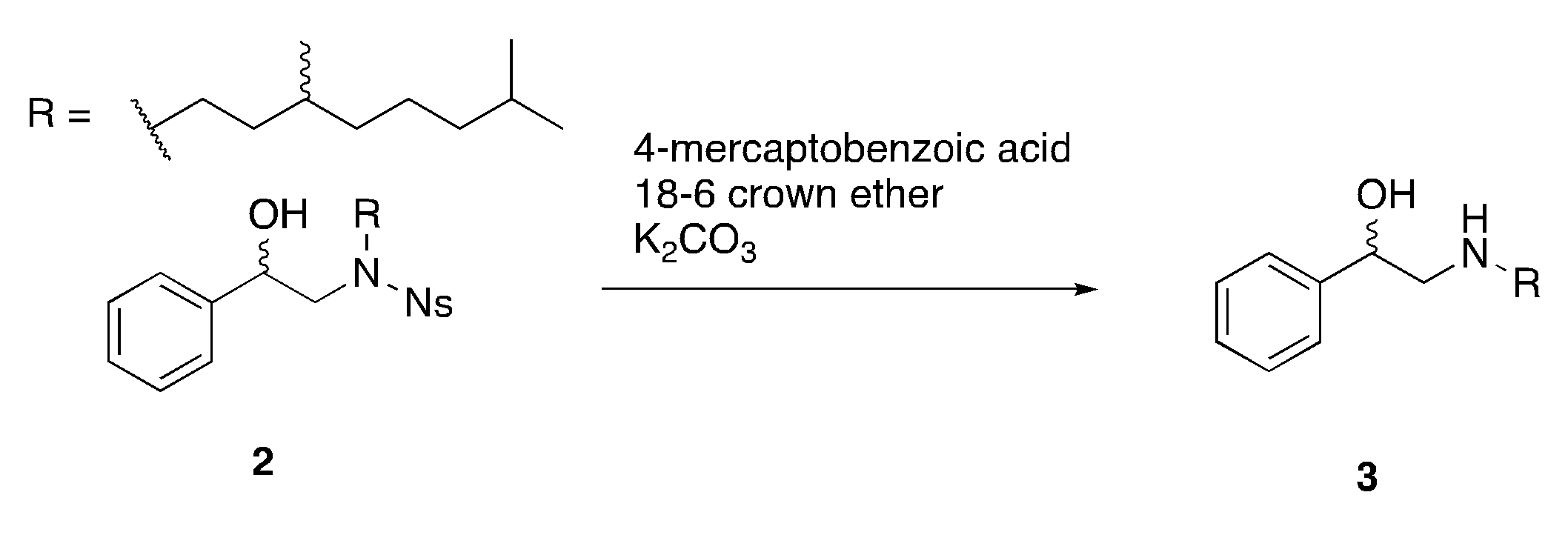
アミノアルコール誘導体2(32.4g,70.0mmol)をアルゴン雰囲気下でジメチルホルムアミド(350mL)に溶解した。ここに18-クラウン-6(35.0g,140mmol),炭酸カリウム(37.0g,280mmol),4-メルカプト安息香酸(19.0g,140mmol)を順次加え、40℃に昇温して12時間攪拌した。その後、溶媒を半分ほど減圧留去した。酢酸エチル-ヘキサン(1:4,v/v,300mL)で希釈後、水酸化ナトリウム水溶液(300mL×5回)で洗浄し、酢酸エチル-ヘキサン(1:4,v/v,300mL×1回)で逆抽出した。集めた有機層を無水硫酸ナトリウムで乾燥、ろ過し、溶媒を減圧留去した。得られた残渣をシリカゲルカラムクロマトグラフィー(展開溶媒,クロロホルム-メタノール(100:0-97:3,v/v))で分離精製することで目的物化合物3を得た(淡黄色のオイル状)。収量:12.99g,46.8mmol,収率:67%。
1H-NMR(400MHz,CDCl3)δ7.39-7.25(m,5H),4.75(dd,J=9.1,3.7Hz,1H),2.93(dt,J=11.9,3.2Hz,1H),2.78-2.60(m,3H),2.08-2.58(br,2H),1.58-1.07(m,10H),0.87(q,J=3.2Hz,9H)
HRMS(ESI-TOF):Calcd for [M+1H]+,278.2479;found,278.2474
HRMS(ESI-TOF):Calcd for [M+1H]+,278.2479;found,278.2474
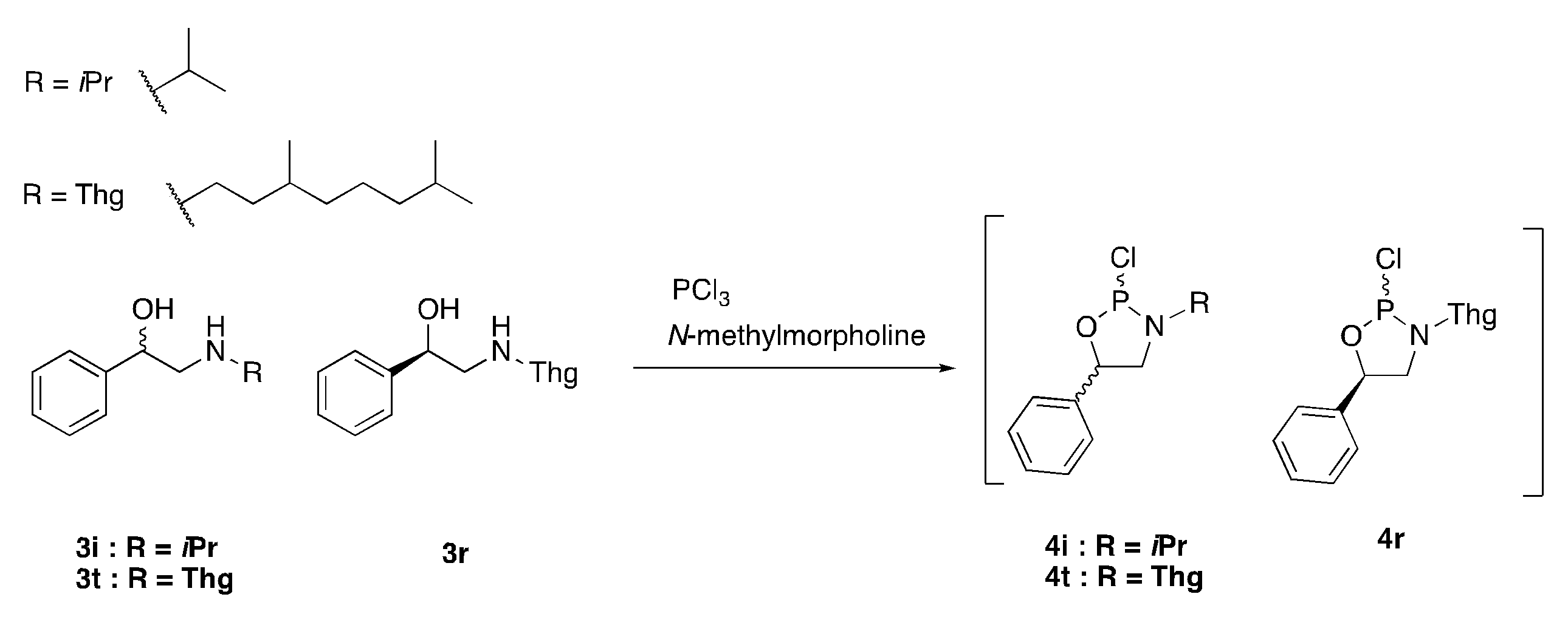
アミノアルコール誘導体3i、3t、又は3r(3i:0.67g,3.8mmol;3t:13.9g,50mmol;3r:1.4g,5.0mmol)をアルゴン雰囲気下、トルエン(5mL×3回)で共沸乾燥し、トルエン(3i:3.7mL;3t:40.0mL;3r:3.3mL)、N-メチルモルホリン(3i:0.9mL,7.9mmol;3t:11.5mL,105mmol;3r:1.15mL,10.5mmol)を加えた。混合溶液を三塩化リン(3i:0.3mL,3.9mmol;3t:11.5mL,105mmol;3r:0.5mL,5.3mmol)のトルエン(3i:2.5mL;3t:40mL;3r:3.0mL)溶液に対し、0℃で10分かけて加えた。反応混合物を室温で2時間撹拌後、生じた塩をアルゴン雰囲気下、-78℃でろ別し、溶媒を減圧留去して目的化合物4i、4t、及び4rを得た(4i:淡黄色のオイル状,1.18g;4t:淡黄色のオイル状,18.2g;4r:淡黄色のオイル状,2.0g)。これ以上の精製は行わず、次の反応に用いた。
<モノマーの合成>

上記式中、BNH2は、AdNH2、CyNH2、GuNH2、又はThであり、AdNH2は、アミノ基が置換されていないアデニンを表し、CyNH2は、アミノ基が置換されていないシトシンを表し、GuNH2は、アミノ基が置換されていないグアニンを表し、Thは、チミンを表す。
(オキサザホスホリジンモノマーの合成)
オキサザホスホリジンモノマー6a、6c、6g、6t、6l、6r、及び6iは既知の方法を参考に合成した(J. Am. Chem. Soc., 2008, 130, 47, pp.16031-16037)。
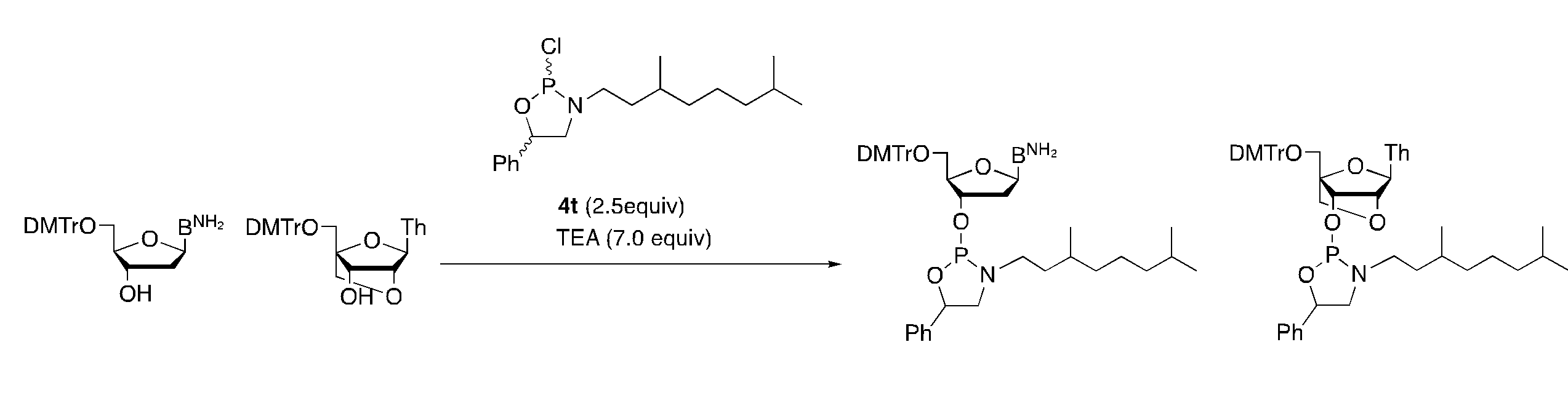
オキサザホスホリジンモノマー6a、6c、6g、6t、6l、6r、及び6iは既知の方法を参考に合成した(J. Am. Chem. Soc., 2008, 130, 47, pp.16031-16037)。
上記スキーム左端に記載のヌクレオシド誘導体5a、5c、5g、5t、又は5l(A:2.2g,4.0mmol;C:3.2g,6.0mmol;G:2.6g,4.5mmol;T:1.4g,2.5mmol;LNAT:1.7g,3.0mmol)をアルゴン雰囲気下で、ピリジン、トルエン,THFで1mL×3回ずつ共沸乾燥しTHF(A:10mL;C:15mL;G:10.3mL;T:10mL;LNAT:7.5 mL)とトリエチルアミン(A:3.9mL,28mmol;C:5.8mL,42mmol;G:4.4mL,31.5mmol;T:3.9mL,28mmol;LNAT:2.9mL,21mmol)を加えた。得られたTHF溶液を所定温度(A,C,T,LNAT:-78℃;G:-40℃)にて攪拌しつつ,0.6Mの化合物4t/テトラヒドロフラン溶液(A:3.4g,10mmol;C:5.1g,15mmol;G:3.8g,11.3mmol;T:2.1g,6.25mmol;LNAT:2.6g,7.7mmol)を5分かけて加えた。その後、チミジン誘導体のみ室温まで昇温し、それ以外の誘導体は前記所定温度を保って2時間攪拌した。クロロホルム280mLで希釈した後、飽和重曹水溶液で洗浄した(50mL×3回)。水層をクロロホルムにより逆抽出した(50mL×3回)。有機層を集めて硫酸ナトリウムにより水分を除去した後に、有機層の溶媒を減圧留去して、得られた残渣をアルゴン雰囲気下で、トルエンで1mL×3回共沸乾燥した。アミノシリカゲルカラムクロマトグラフィーで分離精製した。オキサザホスホリジンモノマー6gについてのみ、その後、一部の残渣を逆相HPLCにより分離精製した。分離精製の具体的な手順は、以下の通りである。
A:得られた残渣の70%をアミノシリカゲルカラムクロマトグラフィー[NH-シリカゲル,トルエン-酢酸エチル(100:0-80:20,v/v),トリエチルアミン0.5%]で分離精製した。
C:得られた残渣の51%をアミノシリカゲルカラムクロマトグラフィー[NH-シリカゲル,トルエン→酢酸エチル-tBuOH(99:1,v/v),トリエチルアミン0.5%]で分離精製した。
G:得られた残渣の全量をアミノシリカゲルカラムクロマトグラフィー[NH-シリカゲル,クロロホルム→クロロホルム-tBuOH(93:7,v/v),トリエチルアミン0.5%]で分離精製し,溶媒を減圧留去して得られた粗精製物の51%を逆相HPLC(移動相:アセトニトリル-クロロホルム(85:15,v/v))で分離精製した。
T:得られた残渣の全量をアミノシリカゲルカラムクロマトグラフィー[NH-シリカゲル,トルエン→トルエン-酢酸エチル(80:20,v/v),トリエチルアミン0.5%]で分離精製した。
LNAT:得られた残渣の95%をアミノシリカゲルカラムクロマトグラフィー[NH-シリカゲル,トルエン-酢酸エチル(100:0-80:20,v/v),トリエチルアミン0.5%]で分離生成した。
C:得られた残渣の51%をアミノシリカゲルカラムクロマトグラフィー[NH-シリカゲル,トルエン→酢酸エチル-tBuOH(99:1,v/v),トリエチルアミン0.5%]で分離精製した。
G:得られた残渣の全量をアミノシリカゲルカラムクロマトグラフィー[NH-シリカゲル,クロロホルム→クロロホルム-tBuOH(93:7,v/v),トリエチルアミン0.5%]で分離精製し,溶媒を減圧留去して得られた粗精製物の51%を逆相HPLC(移動相:アセトニトリル-クロロホルム(85:15,v/v))で分離精製した。
T:得られた残渣の全量をアミノシリカゲルカラムクロマトグラフィー[NH-シリカゲル,トルエン→トルエン-酢酸エチル(80:20,v/v),トリエチルアミン0.5%]で分離精製した。
LNAT:得られた残渣の95%をアミノシリカゲルカラムクロマトグラフィー[NH-シリカゲル,トルエン-酢酸エチル(100:0-80:20,v/v),トリエチルアミン0.5%]で分離生成した。
分離精製物から溶媒を減圧留去することで目的化合物(オキサザホスホリジンモノマー6a、6c、6g、6t、又は6l)を得た。収量 A:0.82g,0.95mmol,34%;C:0.80g,0.96mmol,39%;G:0.61g,0.70mmol,30%;T:1.02g,1.20mmol,55%;LNAT:0.82g,0.93mmol,31%
オキサザホスホリジンモノマー6a
1H-NMR(400MHz,CDCl3)δ8.31(d,J=2.3Hz,1H),7.99(s,1H),7.41-7.16(m,14H),6.80-6.74(m,4H),6.48-6.44(m,1H),5.67(br,2H),5.59-5.54(m,1H),5.01(qd,J=5.8,2.9Hz,1H),4.23(t,J=3.4Hz,1H),3.77-3.74(m,6H),3.58-3.34(m,3H),3.09-2.97(m,2H),2.95-2.85(m,2H),2.61-2.54(m,1H),1.62-1.04(m,10H),0.88-0.82(m,9H)
31P-NMR(162MHz,CDCl3)δ142.7,142.1,142.0,141.5.
1H-NMR(400MHz,CDCl3)δ8.31(d,J=2.3Hz,1H),7.99(s,1H),7.41-7.16(m,14H),6.80-6.74(m,4H),6.48-6.44(m,1H),5.67(br,2H),5.59-5.54(m,1H),5.01(qd,J=5.8,2.9Hz,1H),4.23(t,J=3.4Hz,1H),3.77-3.74(m,6H),3.58-3.34(m,3H),3.09-2.97(m,2H),2.95-2.85(m,2H),2.61-2.54(m,1H),1.62-1.04(m,10H),0.88-0.82(m,9H)
31P-NMR(162MHz,CDCl3)δ142.7,142.1,142.0,141.5.
オキサザホスホリジンモノマー6c
1H-NMR(400MHz,CDCl3)δ7.92(td,J=4.8,2.4Hz,1H),7.43-7.17(m,14H),6.84-6.77(m,4H),6.33-6.28(m,1H),5.51(qd,J=7.3,2.4Hz,1H),5.42-5.34(m,1H),4.90-4.81(m,1H),3.77-3.71(m,6H),3.50-3.36(m,3H),3.09-2.84(m,3H),2.60-2.53(m,1H),2.33-2.21(m,1H),1.58-1.02(m,10H),0.88-0.80(m,9H)
31P-NMR(162MHz,CDCl3)δ142.6,144.0,142.1,141.6.
1H-NMR(400MHz,CDCl3)δ7.92(td,J=4.8,2.4Hz,1H),7.43-7.17(m,14H),6.84-6.77(m,4H),6.33-6.28(m,1H),5.51(qd,J=7.3,2.4Hz,1H),5.42-5.34(m,1H),4.90-4.81(m,1H),3.77-3.71(m,6H),3.50-3.36(m,3H),3.09-2.84(m,3H),2.60-2.53(m,1H),2.33-2.21(m,1H),1.58-1.02(m,10H),0.88-0.80(m,9H)
31P-NMR(162MHz,CDCl3)δ142.6,144.0,142.1,141.6.
オキサザホスホリジンモノマー6g
1H-NMR(400MHz,CDCl3)δ7.64(s,1H),7.43-7.15(m,14H),6.78(dd,J=11.4,8.7Hz,4H),6.27-6.20(m,3H),5.55(t,J=7.1Hz,1H),4.97(d,J=2.7Hz,1H),4.20(d,J=2.7Hz,1H),3.74-3.71(m,6H),3.55-3.31(m,3H),3.13-2.98(m,2H),2.96-2.86(m,1H),2.79(td,J=13.6,7.9Hz,1H),2.50-2.46(m,1H),1.68-1.05(m,10H),0.88-0.81(m,9H)
31P-NMR(162MHz,CDCl3)δ142.8,142.3,142.2,141.9.
1H-NMR(400MHz,CDCl3)δ7.64(s,1H),7.43-7.15(m,14H),6.78(dd,J=11.4,8.7Hz,4H),6.27-6.20(m,3H),5.55(t,J=7.1Hz,1H),4.97(d,J=2.7Hz,1H),4.20(d,J=2.7Hz,1H),3.74-3.71(m,6H),3.55-3.31(m,3H),3.13-2.98(m,2H),2.96-2.86(m,1H),2.79(td,J=13.6,7.9Hz,1H),2.50-2.46(m,1H),1.68-1.05(m,10H),0.88-0.81(m,9H)
31P-NMR(162MHz,CDCl3)δ142.8,142.3,142.2,141.9.
オキサザホスホリジンモノマー6t
1H-NMR(400MHz,CDCl3)δ8.48(br,1H),7.62(d,J=1.4Hz,1H),7.42-7.19(m,14H),6.85-6.79(m,4H),6.42(dd,J=7.5,6.2Hz,1H),5.51-5.45(m,1H),4.92-4.86(m,1H),4.09(t,J=2.5Hz,1H),3.76(dt,J=8.2,3.4Hz,6H),3.53-3.33(m,3H),3.07-2.95(m,2H),2.92-2.83(m,1H),2.47-2.29(m,2H),1.60-1.01(m,13H),0.88-0.80(m,9H)
31P-NMR(162MHz,CDCl3)δ143.9,143.4,142.5,142.1.
1H-NMR(400MHz,CDCl3)δ8.48(br,1H),7.62(d,J=1.4Hz,1H),7.42-7.19(m,14H),6.85-6.79(m,4H),6.42(dd,J=7.5,6.2Hz,1H),5.51-5.45(m,1H),4.92-4.86(m,1H),4.09(t,J=2.5Hz,1H),3.76(dt,J=8.2,3.4Hz,6H),3.53-3.33(m,3H),3.07-2.95(m,2H),2.92-2.83(m,1H),2.47-2.29(m,2H),1.60-1.01(m,13H),0.88-0.80(m,9H)
31P-NMR(162MHz,CDCl3)δ143.9,143.4,142.5,142.1.
オキサザホスホリジンモノマー6l
1H-NMR(400MHz,CDCl3)δ8.99(s,1H),7.73(d,J=1.4Hz,1H),7.48-7.45(m,2H),7.37-7.18(m,12H),6.86-6.81(m,2H),6.78-6.73(m,2H),5.66(d,J=9.6Hz,1H),5.47(dt,J=56.3,7.3Hz,1H),4.61-4.58(m,1H),4.53-4.47(m,1H),3.87-3.70(m,8H),3.61-3.49(m,1H),3.44-3.34(m,1H),3.12-2.79(m,3H),1.57-1.02(m,13H),0.88-0.73(m,9H)
31P-NMR(162MHz,CDCl3)δ145.3,144.9,142.3,141.7.
1H-NMR(400MHz,CDCl3)δ8.99(s,1H),7.73(d,J=1.4Hz,1H),7.48-7.45(m,2H),7.37-7.18(m,12H),6.86-6.81(m,2H),6.78-6.73(m,2H),5.66(d,J=9.6Hz,1H),5.47(dt,J=56.3,7.3Hz,1H),4.61-4.58(m,1H),4.53-4.47(m,1H),3.87-3.70(m,8H),3.61-3.49(m,1H),3.44-3.34(m,1H),3.12-2.79(m,3H),1.57-1.02(m,13H),0.88-0.73(m,9H)
31P-NMR(162MHz,CDCl3)δ145.3,144.9,142.3,141.7.
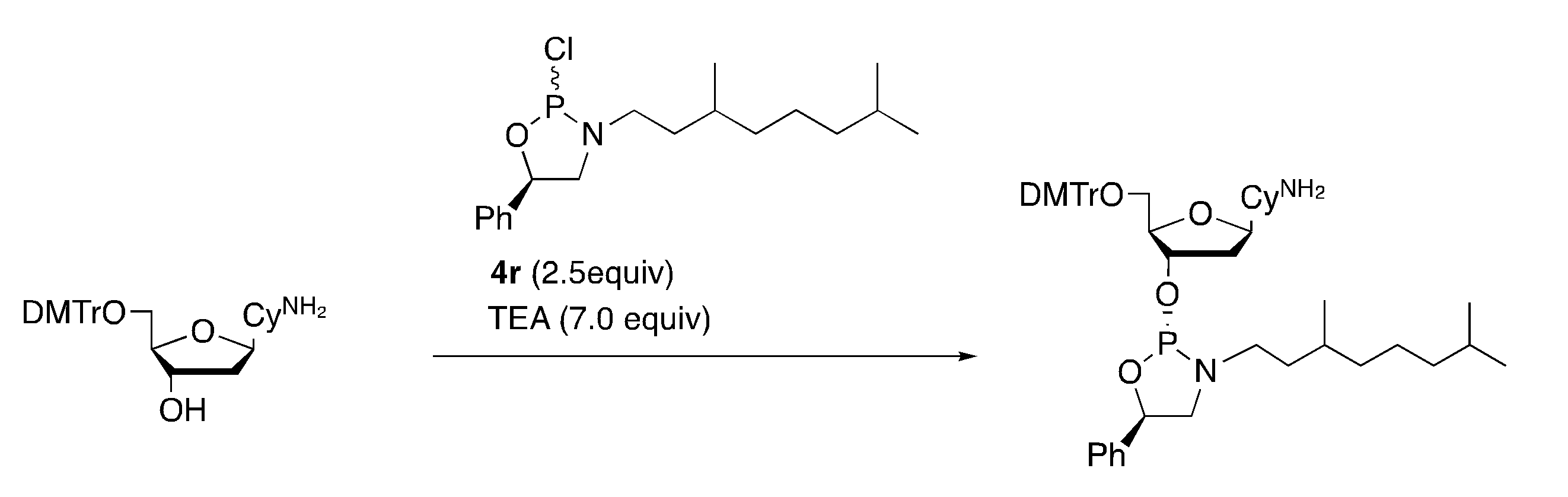
上記スキーム左端に記載のヌクレオシド誘導体5c(1.1g,2.0mmol)をアルゴン雰囲気下で、ピリジン、トルエン,THFで1mL×3回ずつ共沸乾燥しTHF(5.0mL)とトリエチルアミン(1.9mL,14.0mmol)を加えた。得られたTHF溶液を-78℃にて攪拌しつつ,0.6Mの化合物4r/テトラヒドロフラン溶液(1.7g,5.0mmol)を5分かけて加えた。その後、-78℃を保って2時間攪拌した。クロロホルム280mLで希釈した後、飽和重曹水溶液で洗浄した(50mL×3回)。水層をクロロホルムにより逆抽出した(50mL×3回)。有機層を集めて硫酸ナトリウムにより水分を除去した後に、有機層の溶媒を減圧留去して、得られた残渣をアルゴン雰囲気下で、トルエンで1mL×3回共沸乾燥した。アミノシリカゲルカラムクロマトグラフィーで分離精製した。分離精製の具体的な手順は、以下の通りである。
得られたすべての残渣をアミノシリカゲルカラムクロマトグラフィー[NH-シリカゲル,トルエン→酢酸エチル-tBuOH(99:1,v/v),トリエチルアミン0.5%]で分離精製した。
分離精製物から溶媒を減圧留去することで目的化合物(オキサザホスホリジンモノマー6r)を得た。収量 6r:0.86g,1.02mmol,51%
オキサザホスホリジンモノマー6r
1H-NMR(400MHz,CDCl3)δ7.96(1H),7.42-7.17(14H),6.82-6.73(4H),6.25-6.32(1H),5.56-5.48(1H),5.35(1H),4.91-4.84(1H),4.07-3.98(1H),3.75-3.70(6H),3.46-3.39(3H),3.09-2.81(3H),2.58(1H),2.40-2.28(1H),1.60-1.07(10H),0.89-0.84(9H)
31P-NMR(162MHz,CDCl3)δ144.7,144.2
1H-NMR(400MHz,CDCl3)δ7.96(1H),7.42-7.17(14H),6.82-6.73(4H),6.25-6.32(1H),5.56-5.48(1H),5.35(1H),4.91-4.84(1H),4.07-3.98(1H),3.75-3.70(6H),3.46-3.39(3H),3.09-2.81(3H),2.58(1H),2.40-2.28(1H),1.60-1.07(10H),0.89-0.84(9H)
31P-NMR(162MHz,CDCl3)δ144.7,144.2

上記スキーム左端に記載のヌクレオシド誘導体5c(0.8g,1.5mmol)をアルゴン雰囲気下で、ピリジン、トルエン,THFで1mL×3回ずつ共沸乾燥しTHF(3.8mL)とトリエチルアミン(1.5mL,10.5mmol)を加えた。得られたTHF溶液を-78℃にて攪拌しつつ,0.6Mの化合物4i/テトラヒドロフラン溶液(0.9g,3.8mmol)を5分かけて加えた。その後、-78℃を保って2時間攪拌した。クロロホルム280mLで希釈した後、飽和重曹水溶液で洗浄した(50mL×3回)。水層をクロロホルムにより逆抽出した(50mL×3回)。有機層を集めて硫酸ナトリウムにより水分を除去した後に、有機層の溶媒を減圧留去して、得られた残渣をアルゴン雰囲気下で、トルエンで1mL×3回共沸乾燥した。アミノシリカゲルカラムクロマトグラフィーで分離精製した。分離精製の具体的な手順は、以下の通りである。
得られたすべての残渣をアミノシリカゲルカラムクロマトグラフィー[NH-シリカゲル,クロロホルム→クロロホルム-tBuOH(89:11,v/v),トリエチルアミン0.5%]で分離精製した。
分離精製物から溶媒を減圧留去することで目的化合物(オキサザホスホリジンモノマー6i)を得た。収量 6i:0.30g,0.41mmol,27%
オキサザホスホリジンモノマー6i
1H-NMR(400MHz,CDCl3)δ7.98-8.07(1H),7.14-7.45(14H),6.72-6.85(4H),6.23-6.32(1H),5.42-5.53(1H),5.25-5.35(1H),4.80-4.97(1H),3.99-4.11(1H),3.69-3.79(6H),3.26-3.56(4H),2.79-2.90(1H),2.52-2.68(1H),2.22-2.38(1H),1.17-1.24(3H),1.09-1.16(3H)
31P-NMR(162MHz,CDCl3)δ144.1,141.8
1H-NMR(400MHz,CDCl3)δ7.98-8.07(1H),7.14-7.45(14H),6.72-6.85(4H),6.23-6.32(1H),5.42-5.53(1H),5.25-5.35(1H),4.80-4.97(1H),3.99-4.11(1H),3.69-3.79(6H),3.26-3.56(4H),2.79-2.90(1H),2.52-2.68(1H),2.22-2.38(1H),1.17-1.24(3H),1.09-1.16(3H)
31P-NMR(162MHz,CDCl3)δ144.1,141.8
<固相法による核酸オリゴマーの合成>
以下、インターヌクレオチド結合のうち、ボラノホスフェート結合を下付きのPBにより、リン酸ジエステル結合を下付きのPOにより表現する。
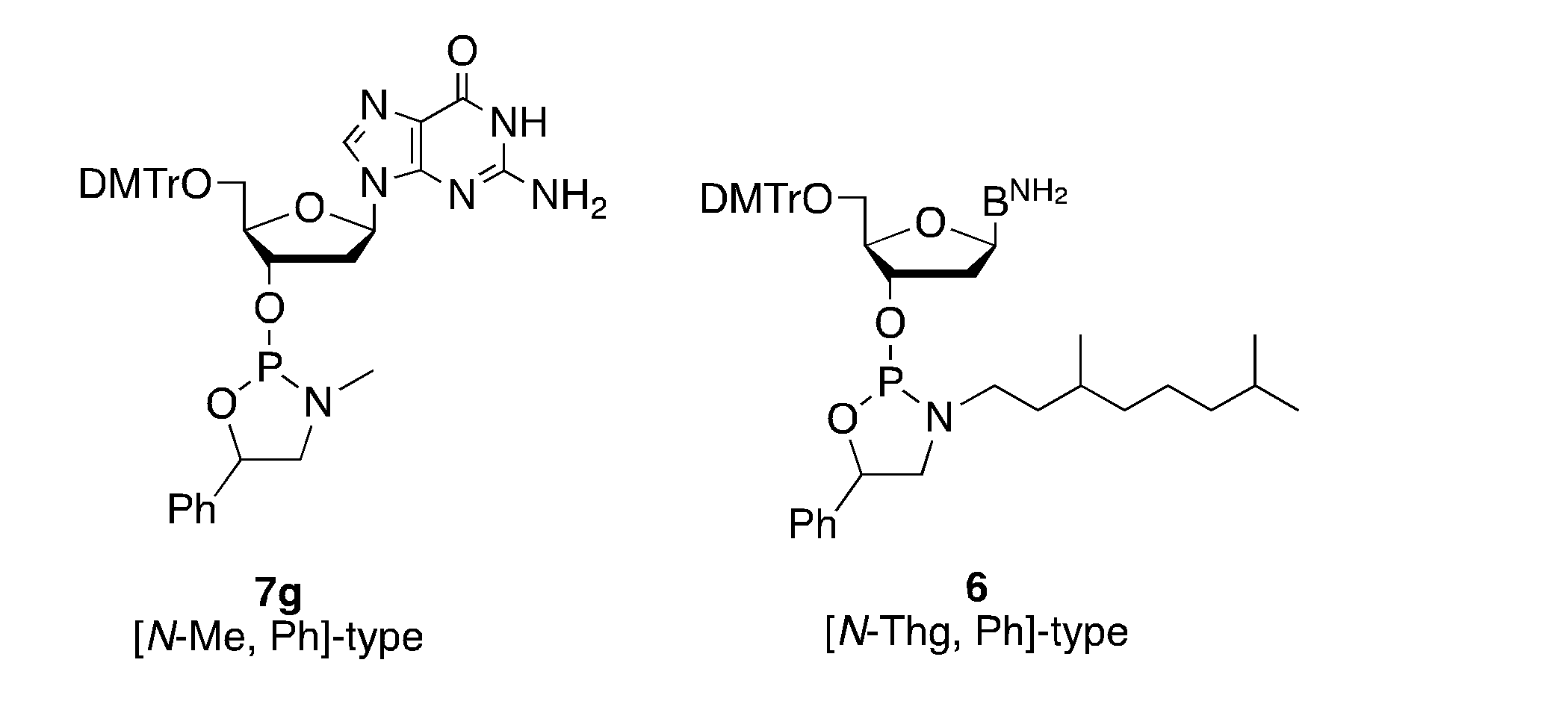
以下、インターヌクレオチド結合のうち、ボラノホスフェート結合を下付きのPBにより、リン酸ジエステル結合を下付きのPOにより表現する。
(dNPBTの固相合成)
[合成例1]
スクシニルリンカーを介して固相担体に担持された5’-O-ジメトキシトリチルチミジン(0.5μmol)に対して3%ジクロロ酢酸/ジクロロメタン溶液(5回×12s,1mL/回)を加えて、脱トリチル化した後に、モレキュラーシーブスによって乾燥させたアセトニトリルとジクロロメタンで固相担体の洗浄を行った。固相担体を5分間乾燥させたのちに[N-Thg,Ph]-typeのオキサザホスホリジンモノマー6a、6c、6g、又は6t(A:25.8mg(60当量、30μmol);C:25.0mg(60当量、30μmol);G:26.3mg(60当量、30μmol);T:25.5mg(60当量、30μmol))を加えた。固相担体を5分間乾燥させたのちに、アルゴン雰囲気下で、酸性活性化剤として1-フェニルイミダゾリウムトリフラート(1.0M)を含むアセトニトリル-イソブチロニトリル(7:3,v/v,150μL)溶液を反応溶媒として加え、10分間ボルテックスミキサーで撹拌することで縮合を行った。オキサザホスホリジンモノマーの縮合後、固相担体を、乾燥させたアセトニトリル(1mL×3回)とジクロロメタン(1mL×3回)とで洗浄した。固相担体を5分間乾燥させたのちに、アルゴン雰囲気下でモレキュラーシーブスによって乾燥させたテトラヒドロフランを950μL,1.0Mボラン/テトラヒドロフラン錯体溶液を50μL加え、2分間ボルテックスミキサーで撹拌することでボラノ化を行った。固相担体を、テトラヒドロフラン(1mL×3回)とジクロロメタン(1mL×3回)とで洗浄した。3%ジクロロ酢酸/ジクロロメタン-トリエチルシラン(1:1,v/v)溶液によりジメトキシトリチル基の脱保護を行った(5回×12s、1mL/回)。その後、固相担体を、乾燥させたジクロロメタン(1mL×3回)とアセトニトリル(1mL×3回)とで洗浄し、5分間乾燥させた。遊離となった5’-水酸基に対して4-ジメチルアミノピリジンを10mg、2,6-ルチジンを450μL、無水酢酸を50μL加えて1分間アセチル化を行った。固相担体を、乾燥させたジクロロメタン(1mL×3回)とアセトニトリル(1mL×3回)とで洗浄し、5分間乾燥させた。予め調製しておいた10%ジアザビシクロウンデセン/アセトニトリル溶液を加えて60分間リン酸部位の保護基の除去を行い、ボラノホスホジエステル結合へと変換させた。固相担体を、乾燥させたアセトニトリル(1mL×3回)で洗浄したのちに25%アンモニア水/エタノール(3:1,v/v,5mL)溶液で後述する条件のもと反応を行い、核酸塩基部のアセチル基の脱保護、核酸塩基部の窒素原子とボランとの配位結合の切断と固相担体からの切り出しを行った(dCPBT、dGPBT、及びTPBT:室温条件,17時間;dAPBT:室温条件,3時間、50℃,17時間)。反応後、反応溶液をろ過し、アセトニトリルを用いて洗浄を行った。溶媒を減圧留去し、粗生成物を逆相HPLCにて分析した。逆相HPLCは、0.1M TEAA緩衝液(pH7)中で、0~20%アセトニトリルの直線濃度勾配を使用して、60分間、30℃にて、流速0.5mL/minで行った。結果を表1に示す。
[合成例1]
スクシニルリンカーを介して固相担体に担持された5’-O-ジメトキシトリチルチミジン(0.5μmol)に対して3%ジクロロ酢酸/ジクロロメタン溶液(5回×12s,1mL/回)を加えて、脱トリチル化した後に、モレキュラーシーブスによって乾燥させたアセトニトリルとジクロロメタンで固相担体の洗浄を行った。固相担体を5分間乾燥させたのちに[N-Thg,Ph]-typeのオキサザホスホリジンモノマー6a、6c、6g、又は6t(A:25.8mg(60当量、30μmol);C:25.0mg(60当量、30μmol);G:26.3mg(60当量、30μmol);T:25.5mg(60当量、30μmol))を加えた。固相担体を5分間乾燥させたのちに、アルゴン雰囲気下で、酸性活性化剤として1-フェニルイミダゾリウムトリフラート(1.0M)を含むアセトニトリル-イソブチロニトリル(7:3,v/v,150μL)溶液を反応溶媒として加え、10分間ボルテックスミキサーで撹拌することで縮合を行った。オキサザホスホリジンモノマーの縮合後、固相担体を、乾燥させたアセトニトリル(1mL×3回)とジクロロメタン(1mL×3回)とで洗浄した。固相担体を5分間乾燥させたのちに、アルゴン雰囲気下でモレキュラーシーブスによって乾燥させたテトラヒドロフランを950μL,1.0Mボラン/テトラヒドロフラン錯体溶液を50μL加え、2分間ボルテックスミキサーで撹拌することでボラノ化を行った。固相担体を、テトラヒドロフラン(1mL×3回)とジクロロメタン(1mL×3回)とで洗浄した。3%ジクロロ酢酸/ジクロロメタン-トリエチルシラン(1:1,v/v)溶液によりジメトキシトリチル基の脱保護を行った(5回×12s、1mL/回)。その後、固相担体を、乾燥させたジクロロメタン(1mL×3回)とアセトニトリル(1mL×3回)とで洗浄し、5分間乾燥させた。遊離となった5’-水酸基に対して4-ジメチルアミノピリジンを10mg、2,6-ルチジンを450μL、無水酢酸を50μL加えて1分間アセチル化を行った。固相担体を、乾燥させたジクロロメタン(1mL×3回)とアセトニトリル(1mL×3回)とで洗浄し、5分間乾燥させた。予め調製しておいた10%ジアザビシクロウンデセン/アセトニトリル溶液を加えて60分間リン酸部位の保護基の除去を行い、ボラノホスホジエステル結合へと変換させた。固相担体を、乾燥させたアセトニトリル(1mL×3回)で洗浄したのちに25%アンモニア水/エタノール(3:1,v/v,5mL)溶液で後述する条件のもと反応を行い、核酸塩基部のアセチル基の脱保護、核酸塩基部の窒素原子とボランとの配位結合の切断と固相担体からの切り出しを行った(dCPBT、dGPBT、及びTPBT:室温条件,17時間;dAPBT:室温条件,3時間、50℃,17時間)。反応後、反応溶液をろ過し、アセトニトリルを用いて洗浄を行った。溶媒を減圧留去し、粗生成物を逆相HPLCにて分析した。逆相HPLCは、0.1M TEAA緩衝液(pH7)中で、0~20%アセトニトリルの直線濃度勾配を使用して、60分間、30℃にて、流速0.5mL/minで行った。結果を表1に示す。
[比較合成例1]
スクシニルリンカーを介して固相担体に担持された5’-ヒドロキシチミジン(0.5μmol)に対して[N-Me,Ph]-typeのオキサザホスホリジンモノマー7g(30.0mg、80当量、40μmol)を加えた。固相担体を乾燥させたのちに、アルゴン雰囲気下で、酸性活性化剤としてN-シアノメチルピロリジウムトリフラート(1.0M)を含むアセトニトリル溶液(200μL)を反応溶媒として加え、3分間撹拌することで縮合を行った。オキサザホスホリジンモノマーの縮合後、固相担体を、乾燥させたアセトニトリルとジクロロメタンとで洗浄した。固相担体を乾燥させたのちに、アルゴン雰囲気下でジクロロメタンを200μL,ジメチルスルフィドボランを20μL加え、5分間撹拌することでボラノ化を行った。固相担体をジクロロメタンで洗浄した。3%ジクロロ酢酸/ジクロロメタン-トリエチルシラン(1:1,v/v)溶液によりジメトキシトリチル基の脱保護を行った。その後、固相担体を、乾燥させたジクロロメタンとアセトニトリルとで洗浄し、乾燥させた。遊離となった5’-水酸基に対して予め調製しておいた36%N-メチルイミダゾール/テトラヒドロフラン溶液300μLと22%無水酢酸/テトラヒドロフラン溶液250μLを順次加え、30秒間攪拌することでアセチル化を行なった。その後、固相担体を乾燥させたアセトニトリルで洗浄し、乾燥させた。4%ジアザビシクロウンデセン/アセトニトリル溶液で1時間半反応させることでリン酸部位の保護基の除去を行なった。25%アンモニア水溶液で17時間反応させ固相担体からの切り出しを行い、目的物を含む混合物を得た。混合物はHPLCにより分析を行なった。結果を表1に示す。
スクシニルリンカーを介して固相担体に担持された5’-ヒドロキシチミジン(0.5μmol)に対して[N-Me,Ph]-typeのオキサザホスホリジンモノマー7g(30.0mg、80当量、40μmol)を加えた。固相担体を乾燥させたのちに、アルゴン雰囲気下で、酸性活性化剤としてN-シアノメチルピロリジウムトリフラート(1.0M)を含むアセトニトリル溶液(200μL)を反応溶媒として加え、3分間撹拌することで縮合を行った。オキサザホスホリジンモノマーの縮合後、固相担体を、乾燥させたアセトニトリルとジクロロメタンとで洗浄した。固相担体を乾燥させたのちに、アルゴン雰囲気下でジクロロメタンを200μL,ジメチルスルフィドボランを20μL加え、5分間撹拌することでボラノ化を行った。固相担体をジクロロメタンで洗浄した。3%ジクロロ酢酸/ジクロロメタン-トリエチルシラン(1:1,v/v)溶液によりジメトキシトリチル基の脱保護を行った。その後、固相担体を、乾燥させたジクロロメタンとアセトニトリルとで洗浄し、乾燥させた。遊離となった5’-水酸基に対して予め調製しておいた36%N-メチルイミダゾール/テトラヒドロフラン溶液300μLと22%無水酢酸/テトラヒドロフラン溶液250μLを順次加え、30秒間攪拌することでアセチル化を行なった。その後、固相担体を乾燥させたアセトニトリルで洗浄し、乾燥させた。4%ジアザビシクロウンデセン/アセトニトリル溶液で1時間半反応させることでリン酸部位の保護基の除去を行なった。25%アンモニア水溶液で17時間反応させ固相担体からの切り出しを行い、目的物を含む混合物を得た。混合物はHPLCにより分析を行なった。結果を表1に示す。

表1中の百分率は、HPLCの分析結果における面積比:目的物/観測される全ての生成物より算出した。
図1(a)及び図1(b)に、それぞれ、比較合成例1及び合成例1エントリー3における逆相HPLC分析の結果を示す。比較合成例では、溶出時間の短い部分に未反応のチミジンが多く観測され、溶出時間の長い部分には、副生成物が多く観測された。一方、合成例1エントリー3では、未反応体や副生成物が顕著に少なかった。全ての生成物に対する目的物の割合(%)は合成例1エントリー3の方が19%高い。これらの結果から、[N-Me,Ph]-typeのオキサザホスホリジンモノマーでは、モノマーの加水分解や酸化が進行しやすく、副反応が起きやすいが、[N-Thg,Ph]-typeでは、窒素原子周辺の立体障害が十分であるために、モノマーが安定であり、上記のような副反応が進行しづらいことによって、望みの縮合反応が効率的に進行したと考えられる。以上より、核酸オリゴマーを合成するためには、[N-Thg,Ph]-typeの方が適していることが確認された。
(HPLCの溶出条件)
合成例1:0-20%CH3CN in 0.1 M TEAA buffer for 60min
比較合成例1:0-8%CH3CN in 0.1M TEAA buffer for 20min, 8%CH3CN in 0.1M TEAA buffer for 40min
合成例1:0-20%CH3CN in 0.1 M TEAA buffer for 60min
比較合成例1:0-8%CH3CN in 0.1M TEAA buffer for 20min, 8%CH3CN in 0.1M TEAA buffer for 40min
(dNPOTの固相合成)

[合成例2]
スクシニルリンカーを介して固相担体に担持された5’-O-ジメトキシトリチル-チミジン(0.5μmol)に対して3%ジクロロ酢酸/ジクロロメタン溶液(5回×12s,1mL/回)を加えて、脱トリチル化した後に、モレキュラーシーブスによって乾燥させたアセトニトリルとジクロロメタンで固相担体の洗浄を行った。固相担体を5分間乾燥させたのちにオキサザホスホリジンモノマー6a、6c、6g、6t、6l、又は6i(A:25.8mg(60当量、30μmol);C(Thg):25.0mg(60当量、30μmol);G:26.3mg(60当量、30μmol);T:25.5mg(60当量、30μmol);LNAT:26.3mg(60当量、30μmol);C(iPr):22.1mg(60当量、30μmol))を加えた。固相担体を5分間乾燥させたのちに、アルゴン雰囲気下で、酸性活性化剤として1-フェニルイミダゾリウムトリフラート(1.0M)を含むアセトニトリル-イソブチロニトリル(7:3,v/v,150μL)溶液を反応溶媒として加え、10分間ボルテックスミキサーで撹拌することで縮合を行った。オキサザホスホリジンモノマーの縮合後、固相担体を、乾燥させたアセトニトリル(1mL×3回)とジクロロメタン(1mL×3回)とで洗浄した。固相担体を5分間乾燥させたのちに、予め調整しモレキュラーシーブスによって乾燥しておいた1.0M t-ブチルヒドロペルオキシド/トルエン溶液をアルゴン雰囲気下で500μL加え、5分間ボルテックスで撹拌することで酸化を行った。固相担体を、ジクロロメタン(1mL×6回)で洗浄した。3%ジクロロ酢酸/ジクロロメタン溶液によりジメトキシトリチル基の脱保護を行った(5回×12s、1mL/回)。その後、固相担体を、乾燥させたジクロロメタン(1mL×3回)とアセトニトリル(1mL×3回)とで洗浄したのちに25%アンモニア水/エタノール(3:1,v/v,5mL)溶液を室温条件で3時間反応させ、リン酸部の保護基の除去と固相担体からの切り出しを行った反応後、反応溶液をろ過し、アセトニトリルを用いて洗浄を行った。溶媒を減圧留去し、粗生成物を逆相HPLCにて前述と同様に分析した。結果を表2に示す。
スクシニルリンカーを介して固相担体に担持された5’-O-ジメトキシトリチル-チミジン(0.5μmol)に対して3%ジクロロ酢酸/ジクロロメタン溶液(5回×12s,1mL/回)を加えて、脱トリチル化した後に、モレキュラーシーブスによって乾燥させたアセトニトリルとジクロロメタンで固相担体の洗浄を行った。固相担体を5分間乾燥させたのちにオキサザホスホリジンモノマー6a、6c、6g、6t、6l、又は6i(A:25.8mg(60当量、30μmol);C(Thg):25.0mg(60当量、30μmol);G:26.3mg(60当量、30μmol);T:25.5mg(60当量、30μmol);LNAT:26.3mg(60当量、30μmol);C(iPr):22.1mg(60当量、30μmol))を加えた。固相担体を5分間乾燥させたのちに、アルゴン雰囲気下で、酸性活性化剤として1-フェニルイミダゾリウムトリフラート(1.0M)を含むアセトニトリル-イソブチロニトリル(7:3,v/v,150μL)溶液を反応溶媒として加え、10分間ボルテックスミキサーで撹拌することで縮合を行った。オキサザホスホリジンモノマーの縮合後、固相担体を、乾燥させたアセトニトリル(1mL×3回)とジクロロメタン(1mL×3回)とで洗浄した。固相担体を5分間乾燥させたのちに、予め調整しモレキュラーシーブスによって乾燥しておいた1.0M t-ブチルヒドロペルオキシド/トルエン溶液をアルゴン雰囲気下で500μL加え、5分間ボルテックスで撹拌することで酸化を行った。固相担体を、ジクロロメタン(1mL×6回)で洗浄した。3%ジクロロ酢酸/ジクロロメタン溶液によりジメトキシトリチル基の脱保護を行った(5回×12s、1mL/回)。その後、固相担体を、乾燥させたジクロロメタン(1mL×3回)とアセトニトリル(1mL×3回)とで洗浄したのちに25%アンモニア水/エタノール(3:1,v/v,5mL)溶液を室温条件で3時間反応させ、リン酸部の保護基の除去と固相担体からの切り出しを行った反応後、反応溶液をろ過し、アセトニトリルを用いて洗浄を行った。溶媒を減圧留去し、粗生成物を逆相HPLCにて前述と同様に分析した。結果を表2に示す。
[比較合成例2]
モノマーとして、[N-Thg,Ph]-typeのオキサザホスホリジンモノマー6の代わりに[N-Me,Ph]-typeのオキサザホスホリジンモノマー7cを用いる以外は、[合成例2]と同様の条件で2量体を合成し、分析を行った。結果を表2に示す。
モノマーとして、[N-Thg,Ph]-typeのオキサザホスホリジンモノマー6の代わりに[N-Me,Ph]-typeのオキサザホスホリジンモノマー7cを用いる以外は、[合成例2]と同様の条件で2量体を合成し、分析を行った。結果を表2に示す。
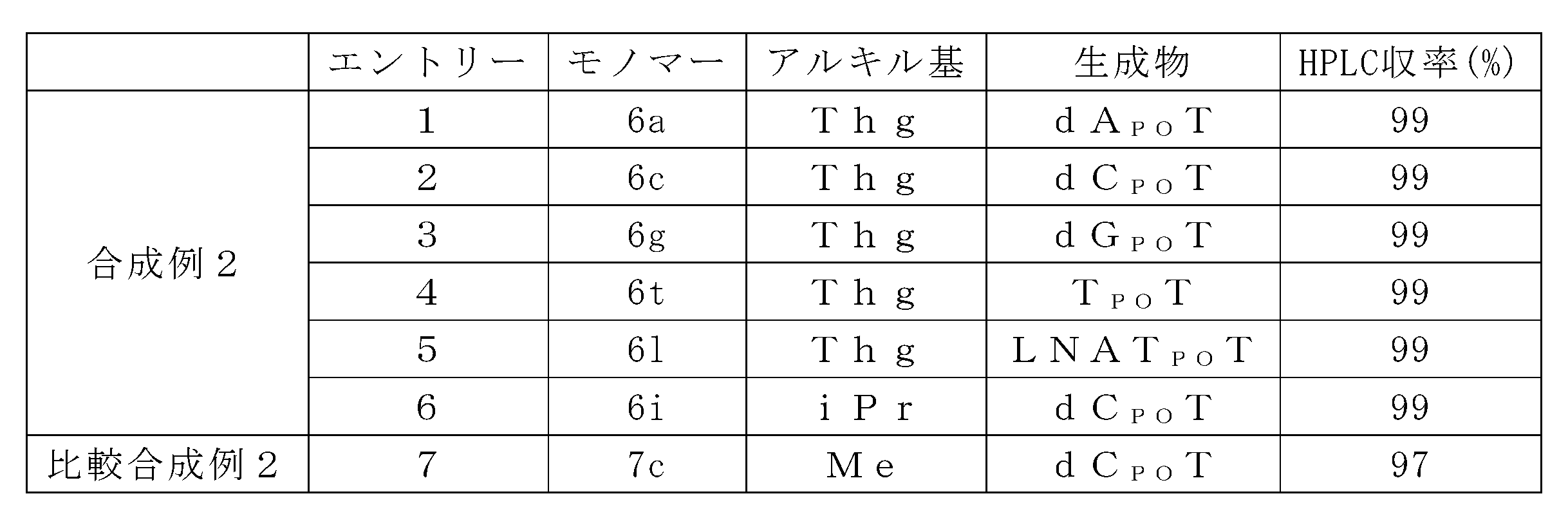
表2中、HPLC収率は、逆相HPLCの結果におけるピーク面積比dNPOT/(T+dNPOT)より算出した。
図2(a)~図2(c)に、合成例2エントリー2及び6並びに比較合成例2における逆相HPLC分析の結果を示す。比較合成例2では、未反応のチミジンが観測されているのに対して、合成例2エントリー2及び6では、比較合成例2と比較して未反応のチミジンが観測されておらず、それぞれ目的物のHPLC収率は2%高かった。上記合成例2では、2量体を合成したが、オリゴマー合成時では、縮合回数が増えるため、縮合効率の高いモノマーを用いる方が望ましい。核酸オリゴマーを合成するためには、炭素原子数3以上で分岐状であるアルキル基を有している方が適していることが確認された。
(HPLCの溶出条件)
0-20%CH3CN in 0.1M TEAA buffer for 60min
0-20%CH3CN in 0.1M TEAA buffer for 60min
((Rp)-CPBTの固相合成)
リン原子の立体化学が制御されたモノマーを用いて、リン原子の立体化学が制御された(Rp)-CPBTの固相合成を行なった。下記[N-Me,Ph]-typeのオキサザホスホリジンモノマーは、非特許文献2に合成例が記載されている公知の化合物である。
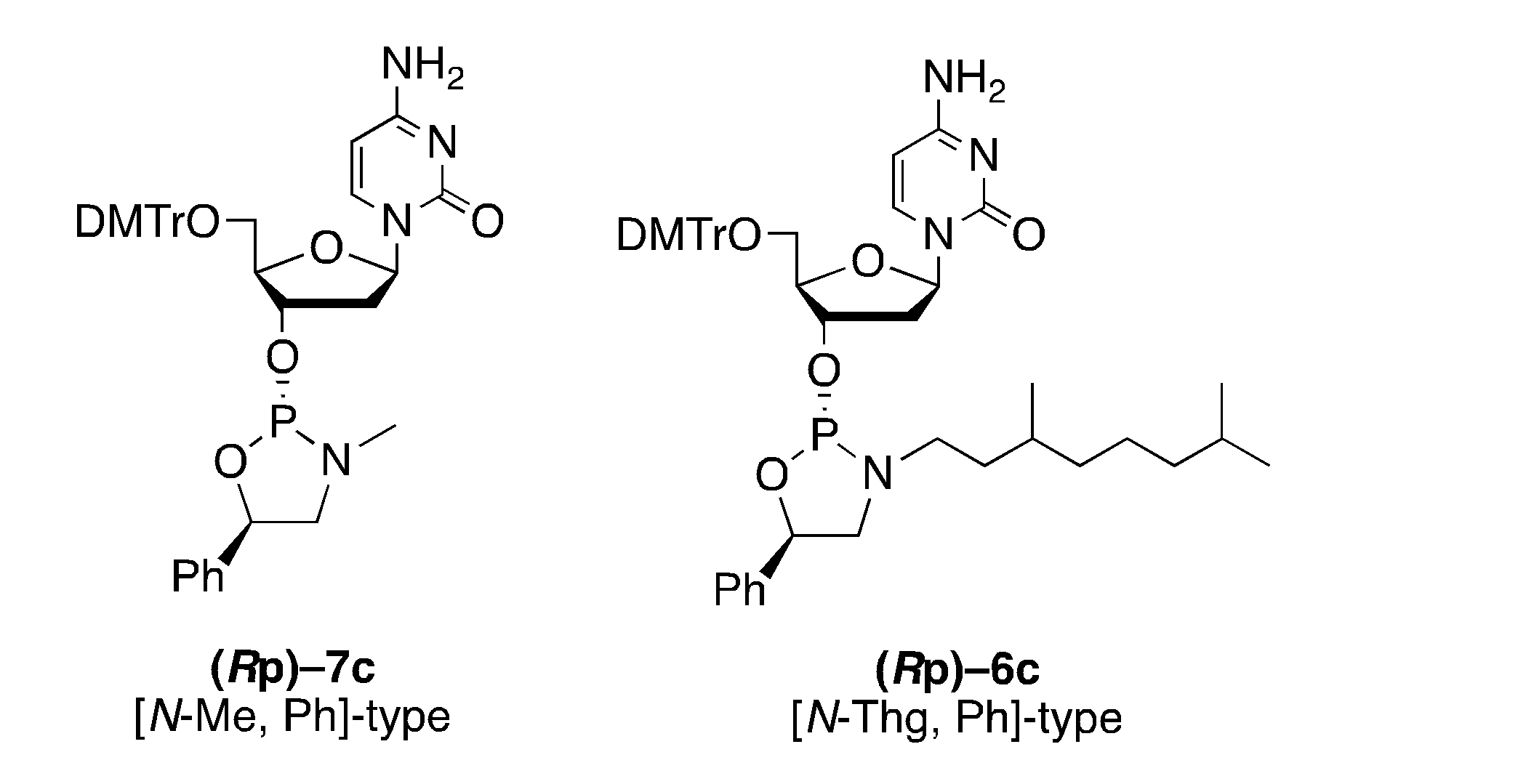
リン原子の立体化学が制御されたモノマーを用いて、リン原子の立体化学が制御された(Rp)-CPBTの固相合成を行なった。下記[N-Me,Ph]-typeのオキサザホスホリジンモノマーは、非特許文献2に合成例が記載されている公知の化合物である。
[比較合成例3]
スクシニルリンカーを介して固相担体に担持された5’-ヒドロキシチミジン(0.5μmol)に対して、立体制御した[N-Me,Ph]-typeのオキサザホスホリジンモノマー(Rp)-7c(30.0mg、80当量、40μmol)を加えた。固相担体を乾燥させたのちに、アルゴン雰囲気下で、酸性活性化剤としてN-シアノメチルピロリジウムトリフラート(1.0M)を含むアセトニトリル溶液(200μL)を反応溶媒として加え、3分間撹拌することで縮合を行った。オキサザホスホリジンモノマーの縮合後、固相担体を乾燥させたアセトニトリルとジクロロメタンとで洗浄した。固相担体を乾燥させたのちに、アルゴン雰囲気下でジクロロメタンを200μL,ジメチルスルフィドボランを20μL加え、5分間撹拌することでボラノ化を行った。固相担体を、ジクロロメタンで洗浄した。3%ジクロロ酢酸/ジクロロメタン-トリエチルシラン(1:1,v/v)溶液によりジメトキシトリチル基の脱保護を行った。その後、固相担体を、乾燥させたジクロロメタンとアセトニトリルとで洗浄し、乾燥させた。遊離となった5’-水酸基に対して予め調整しておいた36%N-メチルイミダゾール/テトラヒドロフラン溶液300μLと22%無水酢酸/テトラヒドロフラン溶液250μLを順次加え、30秒間攪拌することでアセチル化を行なった。その後、固相担体を乾燥させたアセトニトリルで洗浄し、乾燥させた。4%ジアザビシクロウンデセン/アセトニトリル溶液で1時間半反応させることでリン酸部位の保護基の除去を行なった。その後、固相担体を、乾燥させたアセトニトリルで洗浄し、乾燥させたのち25%アンモニア水溶液で1時間反応させ固相担体からの切り出しを行い、目的物を含む混合物を得た。混合物はHPLCにより分析を行なった。結果を表3に示す。
スクシニルリンカーを介して固相担体に担持された5’-ヒドロキシチミジン(0.5μmol)に対して、立体制御した[N-Me,Ph]-typeのオキサザホスホリジンモノマー(Rp)-7c(30.0mg、80当量、40μmol)を加えた。固相担体を乾燥させたのちに、アルゴン雰囲気下で、酸性活性化剤としてN-シアノメチルピロリジウムトリフラート(1.0M)を含むアセトニトリル溶液(200μL)を反応溶媒として加え、3分間撹拌することで縮合を行った。オキサザホスホリジンモノマーの縮合後、固相担体を乾燥させたアセトニトリルとジクロロメタンとで洗浄した。固相担体を乾燥させたのちに、アルゴン雰囲気下でジクロロメタンを200μL,ジメチルスルフィドボランを20μL加え、5分間撹拌することでボラノ化を行った。固相担体を、ジクロロメタンで洗浄した。3%ジクロロ酢酸/ジクロロメタン-トリエチルシラン(1:1,v/v)溶液によりジメトキシトリチル基の脱保護を行った。その後、固相担体を、乾燥させたジクロロメタンとアセトニトリルとで洗浄し、乾燥させた。遊離となった5’-水酸基に対して予め調整しておいた36%N-メチルイミダゾール/テトラヒドロフラン溶液300μLと22%無水酢酸/テトラヒドロフラン溶液250μLを順次加え、30秒間攪拌することでアセチル化を行なった。その後、固相担体を乾燥させたアセトニトリルで洗浄し、乾燥させた。4%ジアザビシクロウンデセン/アセトニトリル溶液で1時間半反応させることでリン酸部位の保護基の除去を行なった。その後、固相担体を、乾燥させたアセトニトリルで洗浄し、乾燥させたのち25%アンモニア水溶液で1時間反応させ固相担体からの切り出しを行い、目的物を含む混合物を得た。混合物はHPLCにより分析を行なった。結果を表3に示す。
[合成例3]
スクシニルリンカーを介して固相担体に担持された5’-ヒドロキシチミジン(0.5μmol)に対して、立体制御した[N-Thg,Ph]-typeのオキサザホスホリジンモノマー(Rp)-6c(18.8mg,45当量、23μmol)を加えた。固相担体を乾燥させたのちに、アルゴン雰囲気下で、酸性活性化剤としてN-シアノメチルピロリジウムトリフラート(1.0M)を含むアセトニトリル-イソブチロニトリル(7:3,v/v,160μL)溶液を反応溶媒として加え、5分間撹拌することで縮合を行った。オキサザホスホリジンモノマーの縮合後、固相担体を、乾燥させたアセトニトリルとジクロロメタンとで洗浄した。固相担体を乾燥させたのちに、アルゴン雰囲気下で0.05Mボラン/テトラヒドロフラン錯体テトラヒドロフラン溶液で2分間の条件でボラノ化を行なった。固相担体を、ジクロロメタンで洗浄した。3%ジクロロ酢酸/ジクロロメタン-トリエチルシラン(1:1,v/v)溶液によりジメトキシトリチル基の脱保護を行った。その後、固相担体を乾燥させたジクロロメタンとアセトニトリルとで洗浄し、乾燥させた。遊離となった5’-水酸基に対して4-ジメチルアミノピリジン10mg、2,6-ルチジン450μL、無水酢酸50μLを加えて60秒間攪拌することでアセチル化を行った。その後、固相担体を、乾燥させたアセトニトリルで洗浄し、乾燥させた。10%ジアザビシクロウンデセン/アセトニトリル溶液で1時間反応させることでリン酸部位の保護基の除去を行なった。その後、固相担体を、乾燥させたアセトニトリルで洗浄し、乾燥させたのち25%アンモニア水-エタノール(3:1、v/v)17時間反応させ固相担体からの切り出しを行い、目的物を含む混合物を得た。混合物はHPLCにより分析を行なった。結果を表3に示す。
スクシニルリンカーを介して固相担体に担持された5’-ヒドロキシチミジン(0.5μmol)に対して、立体制御した[N-Thg,Ph]-typeのオキサザホスホリジンモノマー(Rp)-6c(18.8mg,45当量、23μmol)を加えた。固相担体を乾燥させたのちに、アルゴン雰囲気下で、酸性活性化剤としてN-シアノメチルピロリジウムトリフラート(1.0M)を含むアセトニトリル-イソブチロニトリル(7:3,v/v,160μL)溶液を反応溶媒として加え、5分間撹拌することで縮合を行った。オキサザホスホリジンモノマーの縮合後、固相担体を、乾燥させたアセトニトリルとジクロロメタンとで洗浄した。固相担体を乾燥させたのちに、アルゴン雰囲気下で0.05Mボラン/テトラヒドロフラン錯体テトラヒドロフラン溶液で2分間の条件でボラノ化を行なった。固相担体を、ジクロロメタンで洗浄した。3%ジクロロ酢酸/ジクロロメタン-トリエチルシラン(1:1,v/v)溶液によりジメトキシトリチル基の脱保護を行った。その後、固相担体を乾燥させたジクロロメタンとアセトニトリルとで洗浄し、乾燥させた。遊離となった5’-水酸基に対して4-ジメチルアミノピリジン10mg、2,6-ルチジン450μL、無水酢酸50μLを加えて60秒間攪拌することでアセチル化を行った。その後、固相担体を、乾燥させたアセトニトリルで洗浄し、乾燥させた。10%ジアザビシクロウンデセン/アセトニトリル溶液で1時間反応させることでリン酸部位の保護基の除去を行なった。その後、固相担体を、乾燥させたアセトニトリルで洗浄し、乾燥させたのち25%アンモニア水-エタノール(3:1、v/v)17時間反応させ固相担体からの切り出しを行い、目的物を含む混合物を得た。混合物はHPLCにより分析を行なった。結果を表3に示す。

表3中、立体化学純度は、HPLCの結果において、Sp体CPBTとRp体CPBTとの面積比より算出した。HPLC収率は、HPLCの結果における面積比(Rp)-CPBT/(T+(Rp)-CPBT)より算出した。
図3(a)及び図3(b)に、それぞれ、比較合成例3及び合成例3における逆相HPLC分析の結果を示す。比較合成例3と比較して、合成例3の方が目的物の収率及び立体化学純度が高い結果となった。これらの結果から、[N-Me,Ph]-typeでは、縮合反応条件におけるエピメリ化が顕著であるのに対し、[N-Thg,Ph]-typeでは、窒素原子の周辺の立体障害が十分であるために、立体化学純度が維持されると考えられる。よって、立体化学を制御した合成を行うためには、[N-Thg,Ph]-typeの方が適していることが確認された。
(HPLCの溶出条件)
比較合成例3:0-15%CH3CN in 0.1M TEAA buffer for 45min
合成例3:5-25%CH3CN in 0.1M TEAA buffer for 20min
比較合成例3:0-15%CH3CN in 0.1M TEAA buffer for 45min
合成例3:5-25%CH3CN in 0.1M TEAA buffer for 20min
(TPBTPBTの固相合成)
オキサザホスホリジン環の窒素原子にテトラヒドロゲラニル基を有するチミジンモノマーを用いて、TPBTPBTの固相合成を行なった。

オキサザホスホリジン環の窒素原子にテトラヒドロゲラニル基を有するチミジンモノマーを用いて、TPBTPBTの固相合成を行なった。
[比較合成例4]
スクシニルリンカーを介して固相担体に担持された5’-ヒドロキシチミジン(0.5 μmol)に対して、以下の(i)工程、(ii)工程、及び(iii)工程の組み合わせを2回繰り返すことで鎖長伸長反応を行った。
スクシニルリンカーを介して固相担体に担持された5’-ヒドロキシチミジン(0.5 μmol)に対して、以下の(i)工程、(ii)工程、及び(iii)工程の組み合わせを2回繰り返すことで鎖長伸長反応を行った。
(i)工程:固相担体に[N-Me,Ph]-typeのオキサザホスホリジンモノマー7t(30.0mg、80当量、40μmol)を加えた。固相担体を乾燥させたのちに、アルゴン雰囲気下で、酸性活性化剤としてN-シアノメチルピロリジウムトリフラート(1.0M)を含むアセトニトリル溶液(200μL)を反応溶媒として加え、3分間撹拌することで縮合を行った。オキサザホスホリジンモノマーの縮合後、固相担体を、乾燥させたアセトニトリルとジクロロメタンとで洗浄した。
(ii)工程:固相担体を乾燥させたのちに、アルゴン雰囲気下でジクロロメタンを200μL,ジメチルスルフィドボランを20μL加え、5分間撹拌することでボラノ化を行った。固相担体をジクロロメタンとメタノールで洗浄した。
(iii)工程:前記(ii)工程後の固相担体について、3%ジクロロ酢酸/ジクロロメタン-トリエチルシラン(1:1,v/v)溶液によりジメトキシトリチル基の脱保護を行った。
その後、固相担体を、乾燥させたジクロロメタンとアセトニトリルとで洗浄し、乾燥させた。遊離となった5’-水酸基に対して4-ジメチルアミノピリジン10mg、2,6-ルチジン450μL、無水酢酸50μLを加えて60秒間アセチル化を行った。固相担体を、乾燥させたジクロロメタンとアセトニトリルとで洗浄し、乾燥させた。予め調製しておいた4%ジアザビシクロウンデセン/アセトニトリル溶液を加えて17時間リン酸部位の保護基の除去を行った。その後、固相担体を、乾燥させたアセトニトリルで洗浄し乾燥させた。25%アンモニア水溶液で1時間反応させ固相単体からの切り出しを行い、目的物を含む混合物を得た。混合物はHPLCにより分析を行なった。結果を表4に示す。
[合成例4]
スクシニルリンカーを介して固相担体に担持された5’-ヒドロキシチミジン(0.5μmol)に対して、以下の(i)工程、(ii)工程、及び(iii)工程の組み合わせを2回繰り返すことで鎖長伸長反応を行った。
スクシニルリンカーを介して固相担体に担持された5’-ヒドロキシチミジン(0.5μmol)に対して、以下の(i)工程、(ii)工程、及び(iii)工程の組み合わせを2回繰り返すことで鎖長伸長反応を行った。
(i)工程:固相担体に[N-Thg,Ph]-typeのオキサザホスホリジンモノマー6t(25.5mg,60当量、30μmol)を加えた。固相担体を乾燥させたのちに、アルゴン雰囲気下で、酸性活性化剤としてN-フェニルイミダゾリウムトリフラート(1.0M)を含むアセトニトリル-イソブチロニトリル(7:3,v/v,200μL)を反応溶媒として加え、10分間撹拌することで縮合を行った。オキサザホスホリジンモノマーの縮合後、固相担体を、乾燥させたアセトニトリルとジクロロメタンとで洗浄した。
(ii)工程:固相担体を乾燥させたのちに、アルゴン雰囲気下で1Mジメチルスルフィドボラン/トルエン溶液で15分間ボラノ化を行った。固相担体をジクロロメタンとエタノールで洗浄した。
(iii)工程:前記(ii)工程後の固相担体について、3%ジクロロ酢酸/ジクロロメタン-トリエチルシラン(1:1,v/v)溶液によりジメトキシトリチル基の脱保護を行った。
その後、固相担体を、乾燥させたジクロロメタンとアセトニトリルとで洗浄し、乾燥させた。遊離となった5’-水酸基に対して4-ジメチルアミノピリジン10mg、2,6-ルチジン450μL、無水酢酸50μLを加えて60秒間アセチル化を行った。固相担体を、乾燥させたジクロロメタンとアセトニトリルとで洗浄し、乾燥させた。予め調製しておいた10%ジアザビシクロウンデセン/アセトニトリル溶液を加えて1時間リン酸部位の保護基の除去を行った。その後、固相担体を、乾燥させたアセトニトリルで洗浄し乾燥させた。25%アンモニア水-エタノール(3:1、v/v)で17時間反応させ固相担体からの切り出しを行い、目的物含む混合物を得た。混合物はHPLCにより分析を行なった。結果を表4に示す。

表4中、HPLC収率は、HPLCの結果における面積比TPBTPBT/(T+TPBT+TPBTPBT)より算出した。
図4(a)及び図4(b)に、それぞれ、比較合成例4及び合成例4における逆相HPLC分析の結果を示す。比較合成例4では、2量体が多く観測されているのに対して、合成例4では、比較合成例4と比較して、2量体の割合が少なく、目的物のHPLC収率は15%高かった。上記合成例では、3量体を合成したが、オリゴマー合成時では、縮合回数が増えるため、縮合効率の高いモノマーを用いる方が望ましく、核酸オリゴマーを合成するためには、[N-Thg,Ph]-typeの方が適していることが確認された。
(HPLCの溶出条件)
比較合成例4:0-25%CH3CN in 0.1M TEAA buffer for 70min
合成例4:0-30%CH3CN in 0.1M TEAA buffer for 60min
比較合成例4:0-25%CH3CN in 0.1M TEAA buffer for 70min
合成例4:0-30%CH3CN in 0.1M TEAA buffer for 60min
(ホスホトリエステル3量体又は4量体中間体における、リン酸部位の保護基の除去条件の比較検討)
オキサザホスホリジン環にPh基を有するモノマーを用いて、酸化体の3量体又は4量体の固相合成を行なった。下記[N-Me,H]-typeのオキサザホスホリジンモノマーは、非特許文献1に合成例が記載されている公知の化合物である。
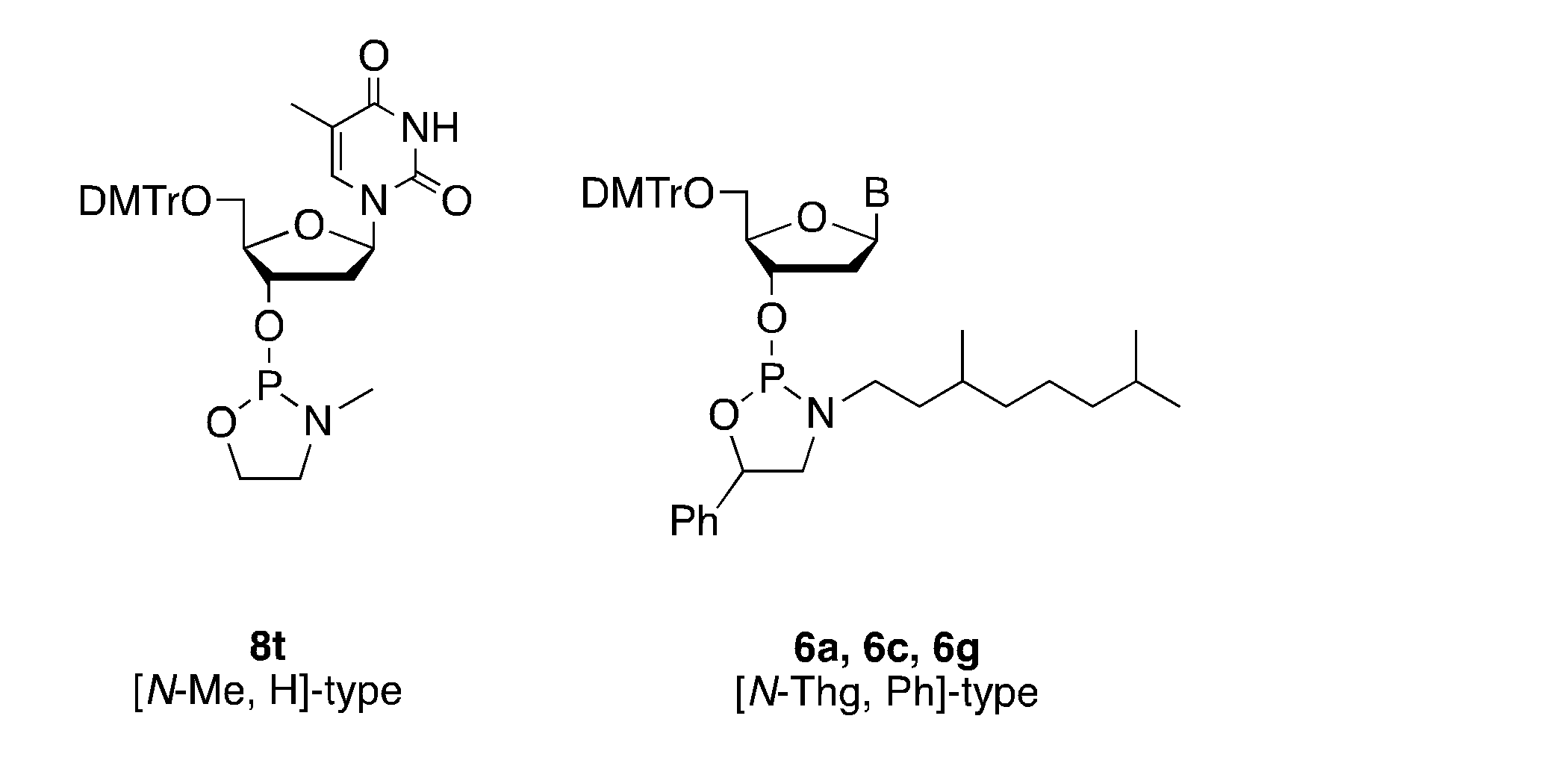
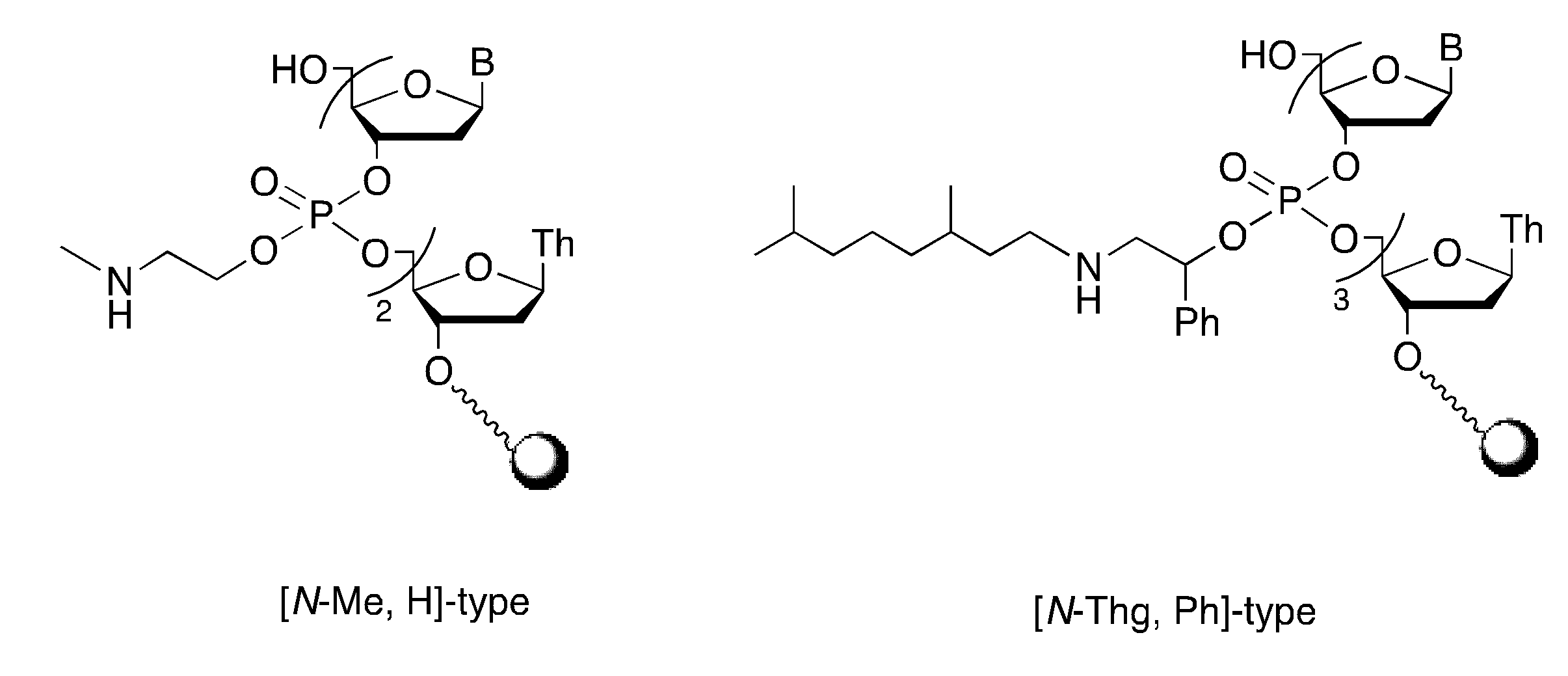
オキサザホスホリジン環にPh基を有するモノマーを用いて、酸化体の3量体又は4量体の固相合成を行なった。下記[N-Me,H]-typeのオキサザホスホリジンモノマーは、非特許文献1に合成例が記載されている公知の化合物である。
[比較合成例5]
スクシニルリンカーを介して固相担体に担持された5’-ヒドロキシチミジン(0.5μmol)に対して、以下の(i)工程、(ii)工程、及び(iii)工程の組み合わせを2回繰り返すことで鎖長伸長反応を行った。
スクシニルリンカーを介して固相担体に担持された5’-ヒドロキシチミジン(0.5μmol)に対して、以下の(i)工程、(ii)工程、及び(iii)工程の組み合わせを2回繰り返すことで鎖長伸長反応を行った。
(i)工程:固相担体に[N-Me,H]-typeのオキサザホスホリジンモノマー8t(13.0mg、40当量、20μmol)を加えた。固相担体を乾燥させたのちに、アルゴン雰囲気下で、酸性活性化剤として1H-テトラゾール(0.45M)を含むアセトニトリル溶液(200μL)を反応溶媒として加え、3分間撹拌することで縮合を行った。オキサザホスホリジンモノマーの縮合後、固相担体を、乾燥させたアセトニトリルとジクロロメタンとで洗浄した。
(ii)工程:固相担体を乾燥させたのちに、アルゴン雰囲気下で1M t-ブチルヒドロペルオキシドを200μL加え、3分間撹拌することで酸化を行った。固相担体をジクロロメタンで洗浄した。
(iii)工程:前記(ii)工程後の固相担体について、3%ジクロロ酢酸/ジクロロメタン溶液によりジメトキシトリチル基の脱保護を行った。
その後、固相担体を、乾燥させたジクロロメタンとアセトニトリルとで洗浄し、乾燥させた。室温下、25%アンモニア水溶液で1時間反応させ固相担体からの切り出しとリン酸部位の脱保護を行い、目的物TPOTPOTを含む混合物を得た。混合物はHPLCにより分析を行なった。結果を表5に示す。
[比較合成例6]
アンモニア処理を、室温下で1時間行う代わりに55℃で17時間行なった以外は、[比較合成例4]と同様の操作で目的物TPOTPOTを得た。混合物はHPLCにより分析を行なった。結果を表5に示す。
アンモニア処理を、室温下で1時間行う代わりに55℃で17時間行なった以外は、[比較合成例4]と同様の操作で目的物TPOTPOTを得た。混合物はHPLCにより分析を行なった。結果を表5に示す。
[合成例5]
スクシニルリンカーを介して固相担体に担持された5’-ヒドロキシチミジン(0.5μmol)に対して、以下の(i)工程、(ii)工程、及び(iii)工程の組み合わせを3回繰り返すことで鎖長伸長反応を行った。
スクシニルリンカーを介して固相担体に担持された5’-ヒドロキシチミジン(0.5μmol)に対して、以下の(i)工程、(ii)工程、及び(iii)工程の組み合わせを3回繰り返すことで鎖長伸長反応を行った。
(i)工程:固相担体に[N-Thg,Ph]-typeのオキサザホスホリジンモノマー6a、6c、又は6g(60当量、30μmol)を加えた。固相担体を乾燥させたのちに、アルゴン雰囲気下で、酸性活性化剤としてN-フェニルイミダゾリウムトリフラート(1.0M)を含むアセトニトリル-イソブチロニトリル(7:3,v/v,200μL)溶液を反応溶媒として加え、10分間撹拌することで縮合を行った。オキサザホスホリジンモノマーの縮合後、固相担体を、乾燥させたアセトニトリルとジクロロメタンとで洗浄した。
(ii)工程:固相担体を乾燥させたのちに、アルゴン雰囲気下で1M t-ブチルヒドロペルオキシドを200μL加え、5分間撹拌することで酸化を行った。固相担体をジクロロメタンで洗浄した。
(iii)工程:前記(ii)工程後の固相担体について、3%ジクロロ酢酸/ジクロロメタン溶液によりジメトキシトリチル基の脱保護を行った。
その後、固相担体を、乾燥させたジクロロメタンとアセトニトリルとで洗浄し、乾燥させた。室温下、25%アンモニア水-エタノール(3:1、v/v)で3時間反応させ固相担体からの切り出しとリン酸部位の脱保護を行い、目的物APOGPOCPOTを含む混合物を得た。混合物はHPLCにより分析を行なった。結果を表5に示す。
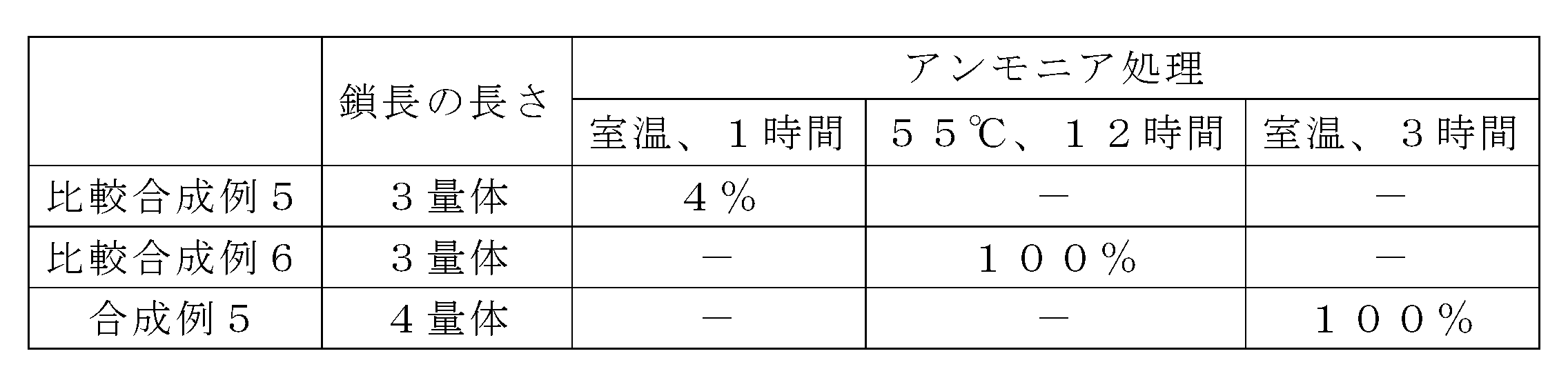
表5の中の百分率は、ホスホジエステルの脱保護の進行率を示しており、HPLCの分析結果における面積比:ホスホジエステル誘導体(脱保護反応後の脱保護完了体)/(ホスホジエステル誘導体(脱保護反応前の脱保護未完了体)+ホスホジエステル誘導体(脱保護反応後の脱保護完了体))より算出した。
図5(a)~図5(c)に、比較合成例5及び6並びに合成例5における逆相HPLC分析の結果を示す。比較合成例5では、1時間のアンモニア処理により4%しか脱保護が進行せず、脱保護反応が極めて遅いことが示唆された。比較合成例6に示す通り、ホスホジエステルの脱保護の進行率を100%にするには、反応温度を55℃まで高くし、反応時間を12時間まで長くする必要があった。一方、合成例5では、室温条件下、3時間で脱保護が完了しており、温和な条件下で迅速に反応が進行していた。上記合成例では、3量体又は4量体を合成したが、オリゴマー合成時では、リン酸部位の保護基の数が増えるため、リン酸部位の保護基は簡便に脱保護できる方が望ましく、核酸オリゴマーを合成するためには、合成例5で用いた[N-Thg,Ph]-typeのモノマーの方が適していることが確認された。
(HPLCの溶出条件)
比較合成例5及び6並びに合成例5:0-20%CH3CN in 0.1M TEAA buffer for 60min
比較合成例5及び6並びに合成例5:0-20%CH3CN in 0.1M TEAA buffer for 60min
[実施例1]PB核酸オリゴマー(4量体)及びPB/POキメラ型核酸オリゴマー(4量体)の合成
スクシニルリンカーを介して固相担体に担持された5’-O-ジメトキシトリチルチミジン(0.5μmol)に対して3%ジクロロ酢酸/ジクロロメタン溶液(5回×12s,1mL/回)を加えて、脱トリチル化した後に、モレキュラーシーブスによって乾燥させたアセトニトリルとジクロロメタンで固相担体の洗浄を行い、固相担体の真空乾燥を行った。次に、以下の(i)工程、(ii)工程、及び(iii)工程の組み合わせを3回繰り返すことでオリゴマーの鎖長伸長反応を行った。
スクシニルリンカーを介して固相担体に担持された5’-O-ジメトキシトリチルチミジン(0.5μmol)に対して3%ジクロロ酢酸/ジクロロメタン溶液(5回×12s,1mL/回)を加えて、脱トリチル化した後に、モレキュラーシーブスによって乾燥させたアセトニトリルとジクロロメタンで固相担体の洗浄を行い、固相担体の真空乾燥を行った。次に、以下の(i)工程、(ii)工程、及び(iii)工程の組み合わせを3回繰り返すことでオリゴマーの鎖長伸長反応を行った。
(i)工程:配列に応じて選択されたオキサザホスホリジンモノマー(60当量、30μmol)を加えた固相担体を5分間乾燥させたのちに、アルゴン雰囲気下で、酸性活性化剤として1-フェニルイミダゾリウムトリフラート(1.0M)を含むアセトニトリル-イソブチロニトリル(7:3,v/v,150μL)溶液を反応溶媒として加え、10分間ボルテックスミキサーで撹拌することで縮合を行った。縮合後、固相担体を、乾燥させたアセトニトリル(1mL×3回)とジクロロメタン(1mL×3回)とで洗浄した。
(ii)工程:リン酸部位修飾に応じて選択された0.05Mボラン/テトラヒドロフラン錯体テトラヒドロフラン溶液又は1.0M t-ブチルテトラヒドロペルオキシド/トルエン溶液を2分間又は5分間アルゴン雰囲気下で反応させた。その後、反応溶液を除去し、反応後の固相担体を、行った反応に応じて、以下の通りに洗浄した。ボラノ化した場合は、固相担体を、乾燥させたテトラヒドロフラン(1mL×3回)と乾燥させたエタノール(1mL×3回)とジクロロメタン(1mL×3回)とで洗浄した。酸化した場合は、固相担体を、ジクロロメタン(1 mL×6回)で洗浄した。
(iii)工程:前記(ii)工程後の固相担体を、3%ジクロロ酢酸/ジクロロメタン―トリエチルシラン(1:1、v/v)溶液(1mL)と12秒間反応させた。同様の操作を5回繰り返した後、ジクロロメタン(1mL)で3回、アセトニトリル(1mL)で3回洗浄を行い、固相担体を真空乾燥させた。
(IV)工程:その後、固相担体を、乾燥させたジクロロメタン(1mL×3回)とアセトニトリル(1mL×3回)とで洗浄し、5分間乾燥させた。遊離となった5’-水酸基に対して4-ジメチルアミノピリジン10mg、2,6-ルチジン450μL、無水酢酸50μLを加えて1分間アセチル化を行った。固相担体を、乾燥させたジクロロメタン(1mL×3回)とアセトニトリル(1mL×3回)とで洗浄し、5分間乾燥させた。予め調整しておいた10%ジアザビシクロウンデセン/アセトニトリル溶液を加えて60分間リン酸部位の保護基の除去を行い、ボラノホスホジエステル結合又はホスホジエステル結合へと変換させた。その後、アセトニトリル(1mL×3回)で洗浄した。
洗浄後の固相担体に対して、25%アンモニア水-エタノール(3:1、v/v)を室温条件で3時間、50℃で17時間、核酸塩基部の脱保護、核酸塩基部の窒素原子とボランとの配位結合の切断、及び固相担体からの核酸オリゴマーの切り出しを行った。固相担体をろ別し、ろ液を回収した後、溶媒の減圧留去を行った。
溶媒の減圧留去後、粗生成物を逆相HPLCにて分析した。逆相HPLCは、0.1M TEAA緩衝液(pH7)中で、0~60%アセトニトリルの直線濃度勾配を使用して、60分間、30℃にて、流速0.5mL/minで行った。このようにして、PB核酸オリゴマーCPBAPBGPBTとPB/POキメラ型核酸オリゴマーCPBAPOGPBTを得た。
・PB核酸オリゴマーCPBAPBGPBTについて
収率:28%
HRMS(ESI-TOF):Calcd for [M-2H]2-,582.6729;found,582.6742
・PB /POキメラ型核酸CPBAPOGPBTについて
収率:33%
HRMS(ESI-TOF):Calcd for [M-2H]2-,583.6540;found,583.6559
収率:28%
HRMS(ESI-TOF):Calcd for [M-2H]2-,582.6729;found,582.6742
・PB /POキメラ型核酸CPBAPOGPBTについて
収率:33%
HRMS(ESI-TOF):Calcd for [M-2H]2-,583.6540;found,583.6559
[実施例2]PB/POキメラ型核酸オリゴマー(12量体)の合成
(i)工程、(ii)工程、及び(iii)工程の組み合わせを11回繰り返す以外は[実施例1]と同様の条件でオリゴマーを合成した。
(i)工程、(ii)工程、及び(iii)工程の組み合わせを11回繰り返す以外は[実施例1]と同様の条件でオリゴマーを合成した。
得られたPB/POキメラ型核酸オリゴマー(12量体)を逆相HPLCにて分離精製した。逆相HPLC及び分離精製は、60℃で、5~40%メタノールの0.1Mヘキサフルオロイソプロパノール-0.008Mトリエチルアミン緩衝溶液を移動相として用いて流速0.5mL/分で20分間行った。このようにして、PB/POキメラ型核酸オリゴマーCPBAPOGPBTPOCPBAPOGPBTPOCPBAPOGPBT(配列番号1)を得た。
収率:3%
HRMS(ESI-TOF):Calcd for [M-4H]4-,907.2133;found,907.2129
収率:3%
HRMS(ESI-TOF):Calcd for [M-4H]4-,907.2133;found,907.2129
[実施例3]PO核酸オリゴマー(12量体)の合成
(i)工程、(ii)工程、及び(iii)工程の組み合わせを11回繰り返し、(IV)工程を行わない以外は[実施例1]と同様の条件でオリゴマーを合成した。
(i)工程、(ii)工程、及び(iii)工程の組み合わせを11回繰り返し、(IV)工程を行わない以外は[実施例1]と同様の条件でオリゴマーを合成した。
得られたPO核酸オリゴマー(12量体)を逆相HPLCにて分離精製した。逆相HPLC及び分離精製は、50℃で、5~25%メタノールの0.4Mヘキサフルオロイソプロパノール-0.016Mトリエチルアミン緩衝溶液を移動相として用いて流速0.5mL/分で10分間行った。このようにして、PO核酸オリゴマーCPOAPOGPOTPOCPOAPOGPOTPOCPOAPOGPOT(配列番号2)を得た。
収率:14%
HRMS(ESI-TOF):Calcd for [M-4H]4-,910.1530;found,910.1565
収率:14%
HRMS(ESI-TOF):Calcd for [M-4H]4-,910.1530;found,910.1565
Claims (10)
- 下記一般式(1)で表されるヌクレオチドモノマー。
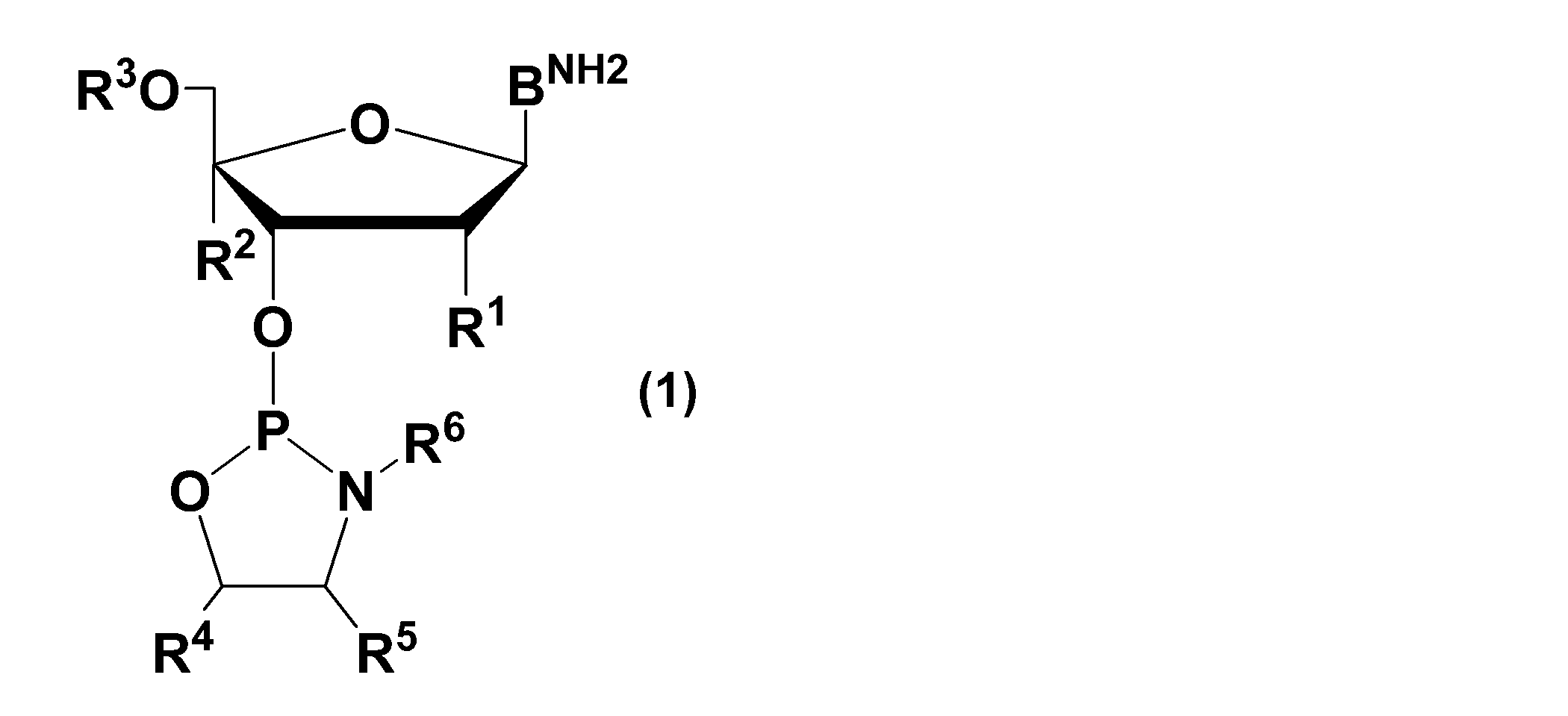
- 前記R6が表すアルキル基は、分岐状である請求項1に記載のヌクレオチドモノマー。
- 前記R6が表すアルキル基は、炭素原子数が6以上14以下である請求項1に記載のヌクレオチドモノマー。
- R1は、水素原子、水酸基、アルコキシ基、アルケニルオキシ基、アシルオキシ基、トリヒドロカルビルシリルオキシ基、アルコキシアルコキシ基、ハロアルコキシアルコキシ基、又はハロゲニル基を表し、R2は、水素原子を表し、又は、R1及びR2は、互いに結合して、下記一般式(2)で表される二価の基を形成する請求項1に記載のヌクレオチドモノマー。

- 前記ヌクレオチドモノマーにおいてリン原子の立体化学は制御されている請求項1~4のいずれかに記載のヌクレオチドモノマー。
- 下記一般式(1a)で表されるヌクレオチドモノマーを縮合させて、下記一般式(3a)で表されるヌクレオチド単位を含む第一の前駆体核酸オリゴマーを得る縮合工程と、
前記第一の前駆体核酸オリゴマーをボラノ化剤によりボラノ化して、下記一般式(4a)で表されるヌクレオチド単位を含む第二の前駆体核酸オリゴマーを得るボラノ化工程、又は
前記第一の前駆体核酸オリゴマーを酸化剤により酸化して、下記一般式(5a)で表されるヌクレオチド単位を含む第三の前駆体核酸オリゴマーを得る酸化工程と、
前記第二の前駆体核酸オリゴマー又は前記第三の前駆体核酸オリゴマーから、R3aで表される保護基を脱離させて、下記一般式(4b)で表されるヌクレオチド単位を含む第四の前駆体核酸オリゴマー、又は下記一般式(5b)で表されるヌクレオチド単位を含む第五の前駆体核酸オリゴマーを得る脱保護工程と、
の組み合わせを1回実行し又は2回以上繰り返し実行する鎖長伸長工程、並びに
前記第四の前駆体核酸オリゴマー又は前記第五の前駆体核酸オリゴマーにおいて、5’-水酸基及びアミノ基に対し保護基によるキャッピングを行って又は行わないで、下記一般式(4c)で表されるヌクレオチド単位を含む第六の前駆体核酸オリゴマー又は下記一般式(5c)で表されるヌクレオチド単位を含む第七の前駆体核酸オリゴマーから、下記一般式(6)で表されるリン酸保護基を脱離させて、更に、前記キャッピングを行った場合には前記保護基を脱離させて、下記一般式(7)で表されるヌクレオチド単位及び下記一般式(8)で表されるヌクレオチド単位からなる群より選ばれる少なくとも1種を含む核酸オリゴマーを得る核酸オリゴマー生成工程
を含む核酸オリゴマーの製造方法。
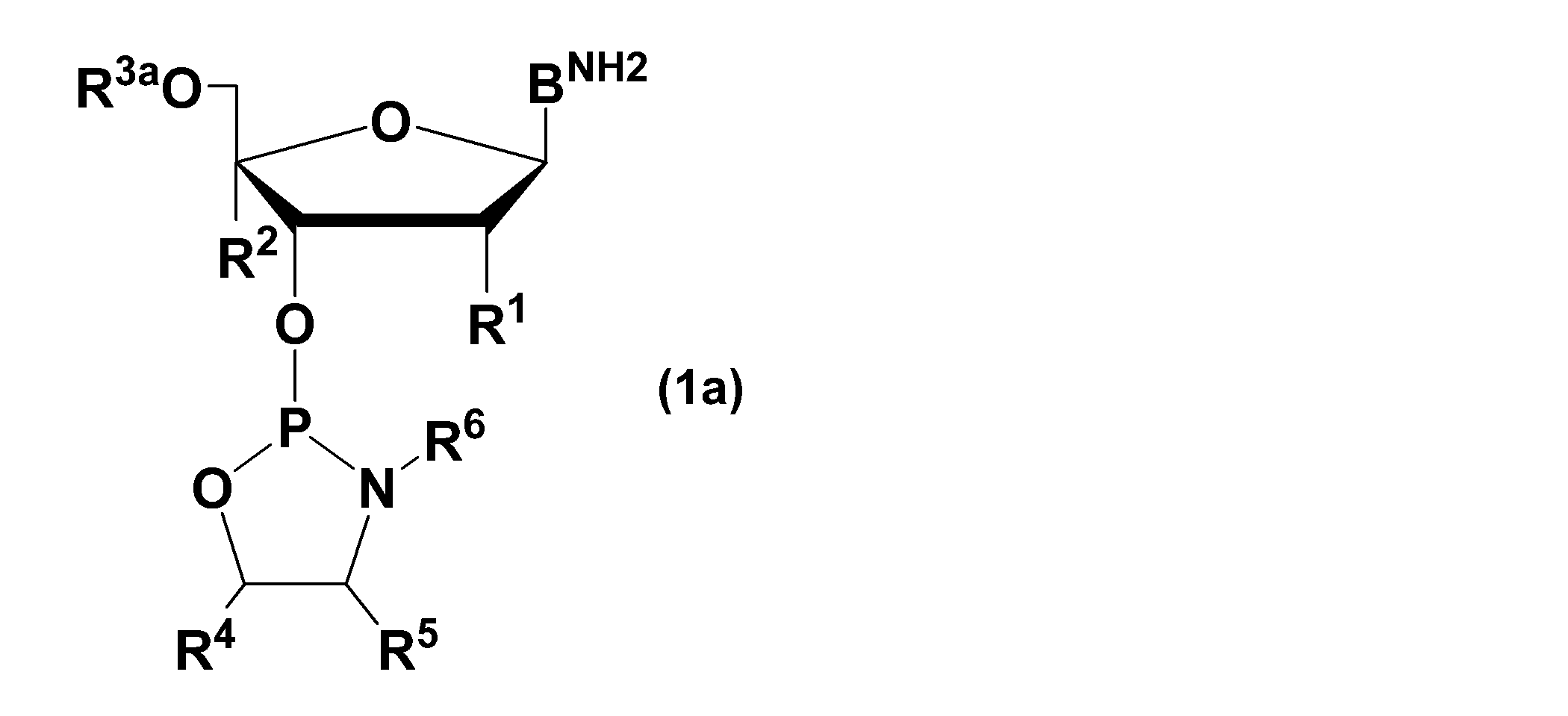
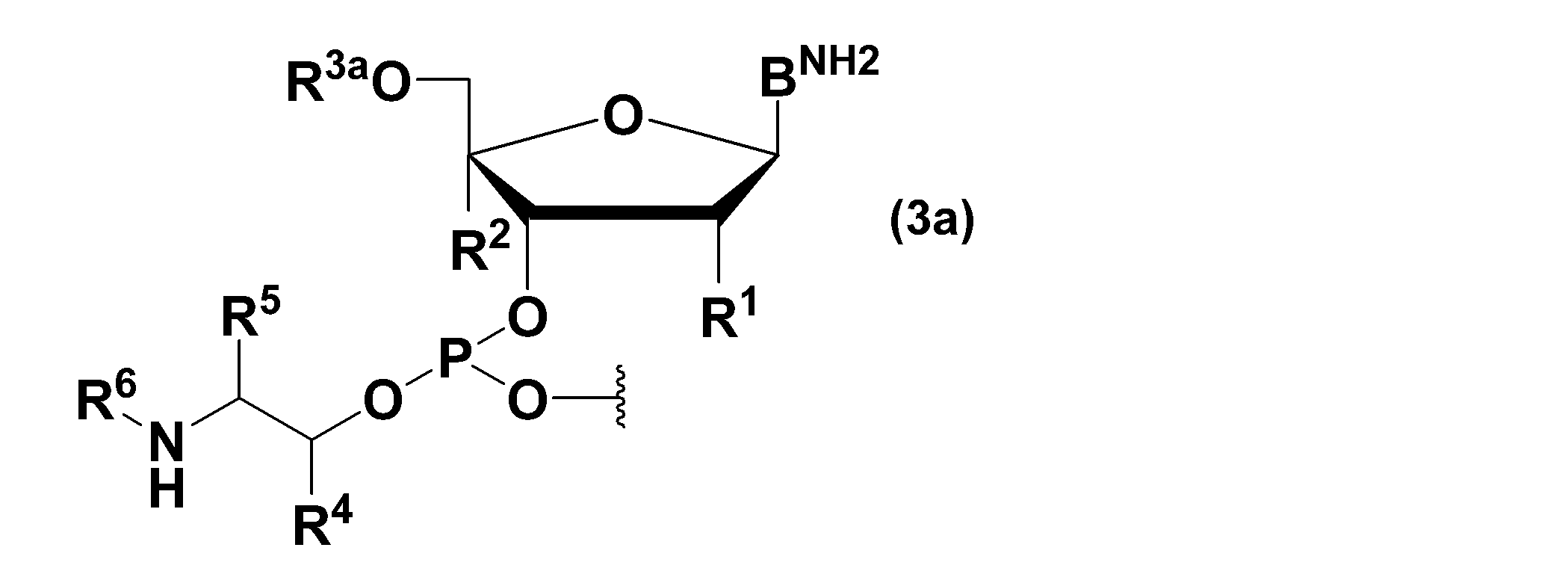
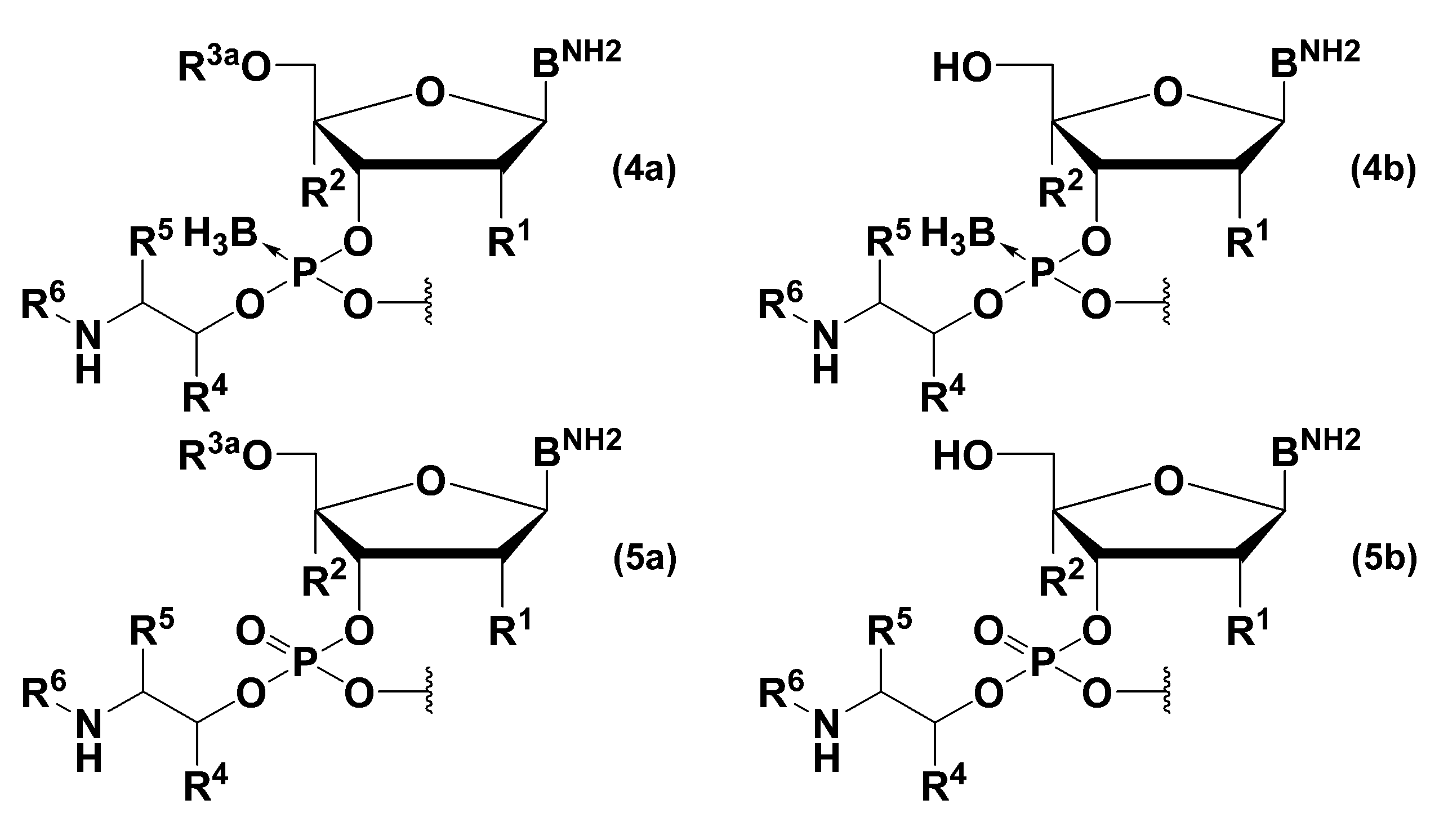

前記キャッピングを行った場合、R9は、水酸基の保護基を表し、R10は、アミノ基の保護基を表し、Bsは、アデニン、グアニン、シトシン、5-メチルシトシン、チミン、及びウラシルからなる群より選ばれる核酸塩基を表し、該アデニン、該グアニン、該シトシン、及び該5-メチルシトシン中のアミノ基は、アミノ基の保護基で置換されており、
前記キャッピングを行わなかった場合、R9及びR10は、水素原子を表し、Bsは、BNH2を表す。)


- 前記R6が表すアルキル基は、分岐状である請求項6に記載の製造方法。
- 前記R6が表すアルキル基は、炭素原子数が6以上14以下である請求項6に記載の製造方法。
- R1は、水素原子、水酸基、アルコキシ基、アルケニルオキシ基、アシルオキシ基、トリヒドロカルビルシリルオキシ基、アルコキシアルコキシ基、ハロアルコキシアルコキシ基、又はハロゲニル基を表し、R2は、水素原子を表し、又は、R1及びR2は、互いに結合して、下記一般式(2)で表される二価の基を形成する請求項6に記載の製造方法。

- 前記ヌクレオチドモノマー及び前記ヌクレオチド単位においてリン原子の立体化学は制御されている請求項6~9のいずれかに記載の製造方法。
Priority Applications (1)
| Application Number | Priority Date | Filing Date | Title |
|---|---|---|---|
| JP2025530174A JPWO2025005147A1 (ja) | 2023-06-27 | 2024-06-26 |
Applications Claiming Priority (2)
| Application Number | Priority Date | Filing Date | Title |
|---|---|---|---|
| JP2023105223 | 2023-06-27 | ||
| JP2023-105223 | 2023-06-27 |
Publications (1)
| Publication Number | Publication Date |
|---|---|
| WO2025005147A1 true WO2025005147A1 (ja) | 2025-01-02 |
Family
ID=93938668
Family Applications (1)
| Application Number | Title | Priority Date | Filing Date |
|---|---|---|---|
| PCT/JP2024/023211 Ceased WO2025005147A1 (ja) | 2023-06-27 | 2024-06-26 | ヌクレオチドモノマー、及び核酸オリゴマーの製造方法 |
Country Status (2)
| Country | Link |
|---|---|
| JP (1) | JPWO2025005147A1 (ja) |
| WO (1) | WO2025005147A1 (ja) |
Citations (3)
| Publication number | Priority date | Publication date | Assignee | Title |
|---|---|---|---|---|
| US6160109A (en) * | 1995-10-20 | 2000-12-12 | Isis Pharmaceuticals, Inc. | Preparation of phosphorothioate and boranophosphate oligomers |
| WO2005092909A1 (ja) * | 2004-03-25 | 2005-10-06 | Toudai Tlo, Ltd. | 立体規則性の高いリボヌクレオチド類縁体及びデオキシリボヌクレオチド類縁体の製造法 |
| JP2020525442A (ja) * | 2017-06-21 | 2020-08-27 | ウェイブ ライフ サイエンシズ リミテッドWave Life Sciences Ltd. | 合成のための化合物、組成物、及び方法 |
-
2024
- 2024-06-26 JP JP2025530174A patent/JPWO2025005147A1/ja active Pending
- 2024-06-26 WO PCT/JP2024/023211 patent/WO2025005147A1/ja not_active Ceased
Patent Citations (3)
| Publication number | Priority date | Publication date | Assignee | Title |
|---|---|---|---|---|
| US6160109A (en) * | 1995-10-20 | 2000-12-12 | Isis Pharmaceuticals, Inc. | Preparation of phosphorothioate and boranophosphate oligomers |
| WO2005092909A1 (ja) * | 2004-03-25 | 2005-10-06 | Toudai Tlo, Ltd. | 立体規則性の高いリボヌクレオチド類縁体及びデオキシリボヌクレオチド類縁体の製造法 |
| JP2020525442A (ja) * | 2017-06-21 | 2020-08-27 | ウェイブ ライフ サイエンシズ リミテッドWave Life Sciences Ltd. | 合成のための化合物、組成物、及び方法 |
Non-Patent Citations (1)
| Title |
|---|
| WADA, T. MAIZURU, Y. SHIMIZU, M. OKA, N. SAIGO, K.: "Stereoselective synthesis of dinucleoside boranophosphates by an oxazaphospholidine method", BIOORGANIC & MEDICINAL CHEMISTRY LETTERS, ELSEVIER, AMSTERDAM NL, vol. 16, no. 12, 15 June 2006 (2006-06-15), Amsterdam NL , pages 3111 - 3114, XP005422587, ISSN: 0960-894X, DOI: 10.1016/j.bmcl.2006.03.076 * |
Also Published As
| Publication number | Publication date |
|---|---|
| JPWO2025005147A1 (ja) | 2025-01-02 |
Similar Documents
| Publication | Publication Date | Title |
|---|---|---|
| JP5847700B2 (ja) | リボヌクレオシドホスホロチオエートの製造方法 | |
| US10730904B2 (en) | Method for liquid-phase synthesis of nucleic acid | |
| JP6608413B2 (ja) | 不斉補助基 | |
| JP4865544B2 (ja) | 立体規則性の高いリボヌクレオチド類縁体及びデオキシリボヌクレオチド類縁体の製造法 | |
| US5959099A (en) | Protecting group for synthesizing oligonucleotide analogs | |
| IL318896A (en) | Targeted nucleic acid conjugate preparations | |
| KR20210032478A (ko) | 알콕시 페닐 유도체, 뉴클레오시드 보호체 및 뉴클레오티드 보호체, 올리고뉴클레오티드 제조 방법, 및 치환기 제거 방법 | |
| ES2224373T3 (es) | Procedimiento de sintesis de analogos de nucleotidos p-quirales modificados. | |
| FI111265B (fi) | Menetelmä lääkeaineina käyttökelpoisten modifioitujen oligodeoksiribonukleotidien valmistamiseksi ja niiden välituotteita | |
| US6414135B1 (en) | C3′-methylene hydrogen phosphonate monomers and related compounds | |
| US6639061B1 (en) | C3′-methylene hydrogen phosphonate oligomers and related compounds | |
| WO2025005147A1 (ja) | ヌクレオチドモノマー、及び核酸オリゴマーの製造方法 | |
| JP7075681B2 (ja) | 立体制御オリゴヌクレオチド合成用光学活性セグメントおよびその製造方法、ならびにそれを用いた立体制御オリゴヌクレオチドの合成方法 | |
| JP7371829B2 (ja) | 重合性化合物、化合物、及び、ボラノホスフェートオリゴマーの製造方法 | |
| JP7776154B2 (ja) | ホスホロチオエート及びボラノホスフェートを含むキメラ型核酸オリゴマー、及びその製造方法 | |
| WO2026009986A1 (ja) | 化合物の製造方法及び化合物 | |
| HK1242331A1 (en) | Asymmetric auxiliary group | |
| HK1242331B (zh) | 不对称辅助基团 |
Legal Events
| Date | Code | Title | Description |
|---|---|---|---|
| 121 | Ep: the epo has been informed by wipo that ep was designated in this application |
Ref document number: 24832006 Country of ref document: EP Kind code of ref document: A1 |
|
| DPE1 | Request for preliminary examination filed after expiration of 19th month from priority date (pct application filed from 20040101) | ||
| ENP | Entry into the national phase |
Ref document number: 2025530174 Country of ref document: JP Kind code of ref document: A |
|
| WWE | Wipo information: entry into national phase |
Ref document number: 2025530174 Country of ref document: JP |
|
| NENP | Non-entry into the national phase |
Ref country code: DE |