WO2025005121A1 - タイヤ用ゴム組成物及びタイヤ - Google Patents
タイヤ用ゴム組成物及びタイヤ Download PDFInfo
- Publication number
- WO2025005121A1 WO2025005121A1 PCT/JP2024/023138 JP2024023138W WO2025005121A1 WO 2025005121 A1 WO2025005121 A1 WO 2025005121A1 JP 2024023138 W JP2024023138 W JP 2024023138W WO 2025005121 A1 WO2025005121 A1 WO 2025005121A1
- Authority
- WO
- WIPO (PCT)
- Prior art keywords
- conjugated diene
- rubber
- group
- specific
- mass
- Prior art date
- Legal status (The legal status is an assumption and is not a legal conclusion. Google has not performed a legal analysis and makes no representation as to the accuracy of the status listed.)
- Ceased
Links
Images
Classifications
-
- Y—GENERAL TAGGING OF NEW TECHNOLOGICAL DEVELOPMENTS; GENERAL TAGGING OF CROSS-SECTIONAL TECHNOLOGIES SPANNING OVER SEVERAL SECTIONS OF THE IPC; TECHNICAL SUBJECTS COVERED BY FORMER USPC CROSS-REFERENCE ART COLLECTIONS [XRACs] AND DIGESTS
- Y02—TECHNOLOGIES OR APPLICATIONS FOR MITIGATION OR ADAPTATION AGAINST CLIMATE CHANGE
- Y02T—CLIMATE CHANGE MITIGATION TECHNOLOGIES RELATED TO TRANSPORTATION
- Y02T10/00—Road transport of goods or passengers
- Y02T10/80—Technologies aiming to reduce greenhouse gasses emissions common to all road transportation technologies
- Y02T10/86—Optimisation of rolling resistance, e.g. weight reduction
Definitions
- the present invention relates to a rubber composition for tires and a tire.
- Patent Document 1 Rubber compositions for tires that contain silica in order to improve performance have been known (for example, Patent Document 1).
- the present invention aims to provide a rubber composition for tires that exhibits excellent mixing processability and extrusion processability, and that exhibits excellent wet performance, snow performance, and abrasion resistance when made into a tire, as well as a tire manufactured using the rubber composition for tires.
- the inventors have found that the above-mentioned problems can be solved by using a specific modified conjugated diene rubber as the rubber component and a specific silane coupling agent, and have arrived at the present invention. That is, the present inventors have found that the above problems can be solved by the following configuration.
- a rubber composition comprising a rubber component (A) containing a modified conjugated diene rubber (A1), silica (B), and a silane coupling agent (C),
- the modified conjugated diene rubber (A1) satisfies the following formulas (1) to (3) and has a modifying group containing a nitrogen atom, a silicon atom, and an oxygen atom adjacent thereto,
- the proportion of the modified conjugated diene rubber (A1) in the rubber component (A) is 25% by mass or more
- IVw 10% ⁇ 3.1 ⁇ 10 -6 ⁇ Mw 10% -2.77 (1)
- St+Vn ⁇ 50 (2) 4.7 ⁇ IVw 10%
- Mw 10% and IVw 10% in the formulas (1) and (3) are as follows.
- the modified conjugated diene rubber is subjected to gel permeation chromatography measurement using a differential refractive index detector and a viscosity detector as detectors.
- the weight average intrinsic viscosity obtained using the high molecular weight side portion of the peak of the chromatogram obtained by the viscosity detector, which is 10% of the total peak area, is defined as IVw 10% .
- the unit of weight average intrinsic viscosity is dL/g.
- St represents the proportion (mass%) of repeating units derived from styrene to the entire modified conjugated diene rubber
- Vn represents the proportion (mass%) of repeating units of 1,2-vinyl structure derived from conjugated diene to the entire modified conjugated diene rubber.
- A a (B) b (C) c (D) d (R 1 ) e SiO (4-2a-b-c-de)/2
- C2 In formula (C2), A represents a divalent organic group containing a sulfide group.
- B represents a monovalent hydrocarbon group having 5 to 10 carbon atoms.
- C represents a hydrolyzable group.
- D represents an organic group containing a mercapto group.
- thermoplastic resin (D) is at least two selected from the group consisting of terpene resins, C5/C9 resins, C9 resins, DCPD resins, DCPD/C9 resins, hydrogenated C5/C9 resins, hydrogenated C9 resins, hydrogenated DCPD resins, and hydrogenated DCPD/C9 resins, each in an amount of 20 parts by mass or less.
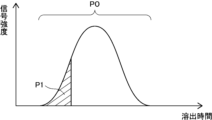
- 1 is an example of a GPC chromatogram. 1 is a partial cross-sectional schematic view showing an example of an embodiment of a tire of the present invention.
- the composition of the present invention has the above-mentioned structure and is therefore believed to be able to solve the above-mentioned problems. Although the reason for this is not clear, it is speculated to be as follows.
- the composition of the present invention contains, as a rubber component, a conjugated diene rubber (hereinafter also referred to as a "specific conjugated diene rubber”) that satisfies the formulas (1) to (3) described below and has a modifying group (hereinafter also referred to as a "specific modifying group”) that contains a nitrogen atom, a silicon atom, and an oxygen atom adjacent thereto.
- Formula (1) specifies the relationship between the weight average intrinsic viscosity on the high molecular weight side and the weight average molecular weight on the high molecular weight side, and the inventors have found that rubber that satisfies formula (1) has excellent mixing processability.
- the specific modifying group of the specific conjugated diene rubber interacts with silica.
- the specific silane coupling agent contained in the composition of the present invention interacts with silica together with the specific modifying group, and further interacts with the skeleton of the specific conjugated diene rubber and other rubber components. Therefore, in the composition of the present invention, the dispersibility of silica is extremely high, which is believed to lead to excellent effects (extrusion processability, wet performance, snow performance, abrasion resistance).
- composition of the present invention contains a rubber component containing a specific conjugated diene rubber.
- the composition of the present invention may contain a rubber component other than the specific conjugated diene rubber.
- conjugated diene examples include butadiene (particularly 1,3-butadiene), isoprene, chloroprene, etc.
- the diene is preferably butadiene (particularly 1,3-butadiene) or isoprene, and more preferably butadiene (particularly 1,3-butadiene), because the effects of the present invention are more excellent.
- Specific examples of the skeleton include natural rubber (NR), butadiene rubber (BR), aromatic vinyl-conjugated diene copolymer rubber, isoprene rubber (IR), acrylonitrile-butadiene copolymer rubber (NBR), butyl rubber (IIR), halogenated butyl rubber (Br-IIR, Cl-IIR), chloroprene rubber (CR), etc.
- the aromatic vinyl-conjugated diene copolymer rubber include styrene-butadiene rubber (SBR), styrene-isoprene copolymer rubber, etc.
- the conjugated diene rubber is preferably SBR because the effects of the present invention are more excellent.
- the alkoxysilyl group is a group represented by -Si(OR1) n (R2) 3-n (wherein R1 is an alkyl group, R2 is a hydrogen atom or an alkyl group, and n is an integer of 1 to 3).
- the specific modifying group preferably contains a nitrogen atom as an amino group (primary to tertiary amino group) because this provides better effects of the present invention.
- the specific modifying group is preferably a group derived from a specific modifying agent described below, because the effects of the present invention are more excellent.
- the modified conjugated diene rubber is subjected to gel permeation chromatography (GPC) measurement using a differential refractive index detector and a viscosity detector as detectors.
- GPC gel permeation chromatography
- Toluene containing 5 mmol/L triethylamine is used as the eluent.
- Three columns packed with polystyrene gel (product names "TSKgel G4000HXL”, “TSKgel G5000HXL”, and “TSKgel G6000HXL” manufactured by Tosoh Corporation) are connected together and used.
- the measurement sample is dissolved in toluene to a concentration of 1 mg/mL to prepare the measurement solution, and 100 ⁇ L of the measurement solution is injected into the GPC measurement device and measured under conditions of an oven temperature of 40°C and a toluene flow rate of 1 mL/min.
- the weight average molecular weight is determined using the portion on the high molecular weight side (the side with the shorter elution time) that accounts for 10% of the total peak area.
- the weight average molecular weight obtained is designated as Mw 10% .
- the weight-average intrinsic viscosity is calculated using the portion on the high molecular weight side (shorter elution time) which occupies 10% of the total area of the peaks.
- the weight-average intrinsic viscosity thus obtained is designated as IVw10% .
- the weight average intrinsic viscosity is defined as ( ⁇ ( ⁇ i ⁇ Mi ⁇ Ni))/( ⁇ (Mi ⁇ Ni)), where Ni is the number of molecules and ⁇ i is the intrinsic viscosity at molecular weight Mi.
- GPC chromatogram horizontal axis: elution time, vertical axis: signal intensity
- P1 a portion on the high molecular weight side (shorter elution time) that has an area of 10% of the area of P0, which is the entire peak.
- Mw 10% is preferably from 100,000 to 10,000,000, and more preferably from 1,000,000 to 5,000,000, because the effects of the present invention are more excellent.
- St represents the ratio (mass%) of repeating units derived from styrene to the entire specific conjugated diene rubber (hereinafter also referred to as the "styrene amount")
- Vn represents the ratio (mass%) of repeating units of 1,2-vinyl structure derived from conjugated diene (e.g., butadiene) to the entire specific conjugated diene rubber (hereinafter also referred to as the "vinyl amount").
- St+Vn is preferably 10 to 45, and more preferably 25 to 45, because this provides a better effect of the present invention.
- St is preferably 5 to 40, more preferably 10 to 35, and even more preferably 15 to 30, because this provides a better effect of the present invention.
- Vn is preferably 5 to 30, and more preferably 10 to 20, because this provides a better effect of the present invention.
- the IVw 10% is preferably 8 or less, and more preferably 6 or less, because the effects of the present invention are more excellent.
- the weight average molecular weight (Mw) of the specific conjugated diene rubber is preferably from 100,000 to 2,000,000, and more preferably from 200,000 to 1,300,000, because the effects of the present invention are more excellent.
- the method for measuring the weight average molecular weight (Mw) of the specific conjugated diene rubber is the same as that for the above-mentioned Mw 10% , except that the entire peak is used.
- the glass transition temperature (Tg) of the specific conjugated diene rubber is not particularly limited, but is preferably from -100°C to -30°C, and more preferably from -80°C to -45°C, for reasons of better effects of the present invention.
- the glass transition temperature can be adjusted, for example, by the amount of styrene or vinyl.
- the glass transition temperature (Tg) is measured using a differential scanning calorimeter (DSC) at a temperature rise rate of 10° C./min and calculated by the midpoint method.
- the specific conjugated diene rubber preferably has a star structure having three or more branches, more preferably has a star structure having three or more branches with a specific modifying group as a branch point, and further preferably is a conjugated diene rubber represented by the following formula (A), because the effects of the present invention are more excellent.
- X represents an n-valent group (specific modifying group) containing a nitrogen atom, a silicon atom, and an oxygen atom adjacent thereto
- P represents a conjugated diene polymer chain
- n represents an integer of 3 or more.
- X represents an n-valent group (specific modifying group) containing a nitrogen atom, a silicon atom and an oxygen atom adjacent thereto.
- X preferably contains a silicon atom and an oxygen atom adjacent thereto as an alkoxysilyl group, because this provides a better effect of the present invention.
- X preferably contains a nitrogen atom as an amino group because the effect of the present invention is more excellent.
- P represents a conjugated diene polymer chain.
- a plurality of P's may be the same or different.
- the definition, specific examples and preferred embodiments of the conjugated diene polymer chain are the same as those of the skeleton of the specific conjugated diene rubber described above.
- n represents an integer of 3 or more. There is no particular upper limit to n, but it is preferably 30 or less because the effects of the present invention are superior.
- the specific conjugated diene rubber has a star structure with three or more branches
- at least one branched chain (conjugated diene polymer chain) of the star structure preferably has a portion derived from a specific branching agent described later, and the portion preferably has a further main chain branched structure, for reasons of better effects of the present invention.
- the main chain branched structure refers to a structure in which a branched chain (conjugated diene polymer chain) forms a branch point at a portion derived from a vinyl monomer containing an alkoxysilyl group or a halosilyl group, and a polymer chain (e.g., another conjugated diene polymer chain) extends from the branch point.
- the proportion of the specific conjugated diene rubber in the rubber component is 25% by mass or more.
- the above ratio is preferably 30% by mass or more, more preferably 40% by mass or more, and even more preferably 50% by mass or more, because the effects of the present invention are more excellent.
- the upper limit of the above proportion is not particularly limited, and is 100% by mass.
- the method for producing the specific conjugated diene rubber is not particularly limited, but because the effects of the present invention are superior, a method including the following steps (1) and (2) (hereinafter also referred to as the "production method of the present invention") is preferred.
- a polymerization step in which a monomer containing a conjugated diene is polymerized by anionic polymerization to obtain a conjugated diene-based polymer; (2) a modification step in which the conjugated diene-based polymer obtained in the polymerization step is reacted with a compound containing a nitrogen atom and an alkoxysilyl group (hereinafter also referred to as a "specific modifier") to obtain a conjugated diene-based rubber having a specific modifying group.
- a specific modifier an alkoxysilyl group
- the polymerization step is a step of obtaining a conjugated diene-based polymer by polymerizing a monomer containing a conjugated diene by anionic polymerization.
- the anionic polymerization is not particularly limited, but anionic polymerization using an organolithium compound as an initiator is preferred because the effects of the present invention are more excellent.
- the organolithium compound is not particularly limited, but specific examples include mono-organolithium compounds such as n-butyllithium (n-BuLi), sec-butyllithium, tert-butyllithium, n-propyllithium, iso-propyllithium, and benzyllithium; and polyfunctional organolithium compounds such as 1,4-dilithiobutane, 1,5-dilithiopentane, 1,6-dilithiohexane, 1,10-dilithiodecane, 1,1-dilithiodiphenylene, dilithiopolybutadiene, dilithiopolyisoprene, 1,4-dilithiobenzene, 1,2-dilithio-1,2-diphenylethane, 1,4-dilithio-2-ethylcyclohexane, 1,3,5-trilithiobenzene, and 1,3,5-trilithio-2,4,6-tri
- mono-organolithium compounds such as n-butyllithium, sec-butyllithium, and tert-butyllithium are preferred because they provide better effects for the present invention, with n-butyllithium being more preferred.
- the amount of the organolithium compound used is not particularly limited, but it is preferably 0.001 to 10 mol% relative to the monomer, because this provides a better effect of the present invention.
- conjugated diene-containing monomer used in the polymerization step are the same as those of the conjugated diene and other monomers in the skeleton of the specific conjugated diene-based rubber described above.
- the monomer preferably contains a vinyl monomer containing an alkoxysilyl group or a halosilyl group (hereinafter also referred to as a "specific branching agent") because this provides a superior effect of the present invention.
- the specific branching agent is preferably an aromatic vinyl (particularly styrene) containing an alkoxysilyl group or a halosilyl group, more preferably an aromatic vinyl containing an alkoxysilyl group, and even more preferably an aromatic vinyl containing a trialkoxysilyl group, for reasons that the effects of the present invention are more excellent.
- aromatic vinyls containing an alkoxysilyl group examples include 1-(trimethoxysilyl)-4-vinylbenzene, 1,1-bis(4-trimethoxysilylphenyl)ethylene, and the like.
- aromatic vinyls containing a halosilyl group examples include trichloro(4-vinylphenyl)silane and 1,1-bis(4-trichlorosilylphenyl)ethylene.
- polar compound examples include ethers such as tetrahydrofuran, diethyl ether, dioxane, dimethoxybenzene, and 2,2-bis(2-oxolanyl)propane; tertiary amine compounds such as tetramethylethylenediamine, dipiperidinoethane, trimethylamine, triethylamine, pyridine, and quinuclidine; alkali metal alkoxide compounds such as potassium tert-amylate and sodium tert-butylate; and phosphine compounds such as triphenylphosphine. These polar compounds may be used alone or in combination of two or more.
- ethers such as tetrahydrofuran, diethyl ether, dioxane, dimethoxybenzene, and 2,2-bis(2-oxolanyl)propane
- tertiary amine compounds such as tetramethylethylenediamine, dipiperidinoethan
- the amount of the polar compound used is preferably 0.01 moles or more and 100 moles or less per mole of the initiator, because the effects of the present invention are more excellent.
- the modification step is a step of obtaining a conjugated diene rubber having a specific modifying group by reacting the conjugated diene polymer obtained in the polymerization step with a modifier (specific modifier) containing a nitrogen atom, a silicon atom and an oxygen atom adjacent thereto.
- the active terminal of the conjugated diene polymer obtained in the polymerization step is bonded to the silicon atom of the specific modifier.
- the specific modifier contains an alkoxysilyl group
- the active terminal is bonded to the silicon atom of the alkoxysilyl group, and the alkoxy group is eliminated.
- the conjugated diene polymer obtained in the polymerization step has a portion derived from a specific branching agent, in addition to the above-mentioned active terminal, the alkoxysilyl group or halosilyl group of the above-mentioned portion is also considered to react with the specific modifying agent (e.g., alkoxysilyl group).
- the alkoxysilyl group or halosilyl group of the above-mentioned portion is also considered to react with the active terminal of another conjugated diene polymer.
- the conjugated diene polymer having a portion derived from a specific branching agent has a main chain branched structure (another conjugated diene polymer chain) in the above-mentioned portion.
- the specific modifier is a compound containing a nitrogen atom, a silicon atom and an oxygen atom adjacent thereto.
- the specific modifier preferably contains a silicon atom and an oxygen atom adjacent thereto as an alkoxysilyl group (particularly a trialkoxysilyl group) or a group containing a silazane structure (particularly a cyclic silazane structure) in which an alkoxy group is bonded to a silicon atom of the silazane structure.
- the silazane structure refers to a structure in which a silicon atom and a nitrogen atom are directly bonded (a structure having a Si-N bond).
- the specific modifying agent preferably contains a nitrogen atom as a group containing an amino group (primary to tertiary amino group) or a silazane structure (particularly a cyclic silazane structure) because the effects of the present invention are more excellent.
- the specific modifying agent preferably has two or more (preferably three or more) sites capable of reacting with an active terminal such as an alkoxysilyl group. When the specific modifying agent has a plurality of such sites, the specific modifying agent functions as a coupling agent that connects conjugated diene polymers together.
- Specific examples of the specific modifying agent include tertiary amines having an alkoxysilyl group, such as tris(3-trimethoxysilylpropyl)amine and tetrakis(3-trimethoxysilylpropyl)-1,3-propanediamine; cyclic silazanes having an alkoxysilyl group, such as 2,2-dimethoxy-1-(3-trimethoxysilylpropyl)-1-aza-2-silacyclopentane; tertiary amines having a group containing an alkoxysilyl group-containing cyclic silazane structure, such as tris[3-(2,2-dimethoxy-1-aza-2-silacyclopentane)propyl]amine and tetrakis[3-(2,2-dimethoxy-1-aza-2-silacyclopentane)propyl]-1,3-propanediamine; bis(3-trimethoxysilyl group,
- the amount of the specific modifier used is preferably 0.01 to 1% by mass, and more preferably 0.02 to 0.2% by mass, based on the conjugated diene, because this provides a better effect of the present invention.
- the manufacturing method of the present invention may include steps (other steps) other than the steps described above.
- Other steps include a polymerization terminating step in which a polymerization terminator (e.g., methanol) is added, and a solvent removal step in which the solvent is removed by steam stripping.
- a polymerization terminator e.g., methanol
- the rubber component may contain a rubber component (rubber component) other than the specific conjugated diene rubber.
- rubber component rubber component
- examples of such other rubber components include natural rubber (NR), butadiene rubber (BR), aromatic vinyl-conjugated diene copolymer rubber, isoprene rubber (IR), acrylonitrile-butadiene copolymer rubber (NBR), butyl rubber (IIR), halogenated butyl rubber (Br-IIR, Cl-IIR), chloroprene rubber (CR), etc.
- the aromatic vinyl-conjugated diene copolymer rubber include styrene butadiene rubber (SBR), styrene isoprene copolymer rubber, etc.
- the rubber component preferably contains BR because the effects of the present invention are more excellent.
- the proportion of BR in the rubber component is preferably 10 to 50 mass%, and more preferably 20 to 40 mass%, because the effects of the present invention are more excellent.
- the preferred embodiment of the weight average molecular weight (Mw) of the rubber component is the same as that of the specific conjugated diene rubber described above.
- silica The composition of the present invention contains silica.
- the silica is not particularly limited, and any conventionally known silica can be used. Examples of silica include wet silica, dry silica, fumed silica, diatomaceous earth, etc. Silica derived from biomass such as rice husk may also be used. The above silica may be used alone or in combination of two or more kinds.
- CTAB cetyltrimethylammonium bromide
- CTAB adsorption specific surface area of silica
- CTAB cetyltrimethylammonium bromide
- the content of silica is preferably 50 to 150 parts by mass, and more preferably 80 to 140 parts by mass, per 100 parts by mass of the rubber component, because the effects of the present invention are more excellent.
- composition of the present invention contains 3-octanoylthio-1-propyltriethoxysilane or a polysiloxane represented by the average composition formula (C2) described later (hereinafter, also collectively referred to as the "specific silane coupling agent").
- 3-Octanoylthio-1-propyltriethoxysilane is a compound represented by the following structural formula.
- the polysiloxane represented by the average composition formula (C2) (hereinafter, also referred to as the "specific polysiloxane") will be described below.
- the specific polysiloxane is a polysiloxane represented by the average composition formula (C2) below.
- Formula (C2) represents the average composition of the polysiloxane, i.e., the type of groups directly bonded to the Si atoms of the polysiloxane and the average number of each group.
- Si represents a Si atom of the polysiloxane.
- O in formula (C2) represents an O atom of the polysiloxane. Note that the O atom is a divalent group and is always bonded to two Si atoms (Si atoms of the polysiloxane). (4-2a-b-c-d-e)/2 in formula (C2) represents the average number of O atoms of the polysiloxane bonded to the Si atoms of the polysiloxane.
- A, B, C, D, and R1 each represent a group bonded to a Si atom of the polysiloxane.
- A is a divalent group and always bonds to two Si atoms (Si atoms of the polysiloxane).
- a, b, c, d, and e each represent the average number of A, B, C, D, and R1 bonded to a Si atom of the polysiloxane.
- the content of the specific silane coupling agent is preferably 1 to 20 mass%, more preferably 5 to 15 mass%, relative to the content of the above-mentioned silica, because the effects of the present invention are more excellent.
- composition of the present invention may contain components (optional components) other than the above-mentioned components, as necessary.
- components include various additives commonly used in rubber compositions, such as fillers other than silica (preferably carbon black), silane coupling agents other than the specific silane coupling agent, thermally expandable microcapsules, zinc oxide (zinc white), stearic acid, antioxidants, wax, processing aids, liquid polymers, thermoplastic resins, thermosetting resins, vulcanizing agents (e.g., sulfur), vulcanization accelerators (accelerators), and vulcanization activators.
- fillers other than silica preferably carbon black
- silane coupling agents other than the specific silane coupling agent
- thermally expandable microcapsules such as zinc oxide (zinc white), stearic acid, antioxidants, wax, processing aids, liquid polymers, thermoplastic resins, thermosetting resins, vulcanizing agents (e.g., sulfur), vulcanization accelerators (accelerators), and vulcan
- the composition of the present invention preferably contains a thermoplastic resin because the effects of the present invention are more excellent.
- the composition of the present invention preferably contains two or more thermoplastic resins because the effects of the present invention are more excellent.
- thermoplastic resin examples include coumarone resins (e.g., coumarone resin, coumarone-indene resin, coumarone-indene-styrene resin), phenol resins (e.g., phenol resin, phenol-acetylene resin, phenol-formaldehyde resin), xylene resins (e.g., xylene resin, xylene-acetylene resin, xylene-formaldehyde resin), rosin resins (e.g., rosin, rosin ester, hydrogenated rosin derivative), terpene resins (e.g., terpene resin, modified rosin ...
- coumarone resins e.g., coumarone resin, coumarone-indene resin, coumarone-indene-styrene resin
- phenol resins e.g., phenol resin, phenol-acetylene resin, phenol-formaldeh
- the thermoplastic resin preferably contains at least one type selected from the group consisting of terpene resins, C5/C9 resins, C9 resins, DCPD resins, DCPD/C9 resins, hydrogenated C5/C9 resins, hydrogenated C9 resins, hydrogenated DCPD resins, and hydrogenated DCPD/C9 resins, more preferably contains at least two types selected from the above group, and even more preferably contains at least two types selected from the above group in an amount of 20 parts by mass or less each, for reasons that the effects of the present invention are more excellent.
- the content of the thermoplastic resin is preferably 20 to 50 parts by mass, and more preferably 25 to 35 parts by mass, per 100 parts by mass of the rubber component, because the effects of the present invention are more excellent.
- the composition of the present invention preferably contains carbon black because the effects of the present invention are more excellent.
- the carbon black may be used alone or in combination of two or more kinds.
- the carbon black is not particularly limited, and various grades such as SAF-HS, SAF, ISAF-HS, ISAF, ISAF-LS, IISAF-HS, HAF-HS, HAF, HAF-LS, FEF, GPF, and SRF can be used.
- the nitrogen adsorption specific surface area (N 2 SA) of the carbon black is not particularly limited, but in order to obtain a superior effect of the present invention, it is preferably 50 to 200 m 2 /g, and more preferably 70 to 150 m 2 /g.
- the nitrogen adsorption specific surface area (N 2 SA) is the amount of nitrogen adsorbed on the surface of carbon black measured according to JIS K6217-2:2001 "Part 2: Determination of specific surface area - Nitrogen adsorption method - Single point method".
- the content of carbon black is not particularly limited. However, in order to obtain better effects of the present invention, the content of carbon black is preferably 1 to 100 parts by mass, and more preferably 2 to 30 parts by mass, per 100 parts by mass of the rubber component described above.
- composition of the present invention contains sulfur or a vulcanization accelerator
- a high temperature preferably 100 to 160°C
- cool the mixture preferably 100 to 160°C
- the composition of the present invention can be vulcanized or crosslinked under conventionally known vulcanization or crosslinking conditions.
- the tire of the present invention is a tire manufactured using the above-mentioned composition of the present invention.
- the tire of the present invention is preferably a pneumatic tire, and can be filled with air, an inert gas such as nitrogen, or other gases.
- FIG. 2 shows a schematic partial cross-sectional view of a tire that represents one example of an embodiment of a tire of the present invention.
- the tire of the present invention is not limited to the embodiment shown in FIG. 2.
- reference numeral 1 denotes a bead portion
- reference numeral 2 denotes a sidewall portion
- reference numeral 3 denotes a tire tread portion.
- a carcass layer 4 having fiber cords embedded therein is installed, and the ends of this carcass layer 4 are folded back and wrapped around the bead cores 5 and bead fillers 6 from the inside to the outside of the tire.
- a belt layer 7 is disposed on the outer side of the carcass layer 4 around one circumference of the tire.
- a rim cushion 8 is disposed in the bead portion 1 at a portion that comes into contact with the rim.
- At least one of the components 2, 3, 5, 6 and 8 (preferably the component 3) is made of the composition of the present invention.
- the tire of the present invention can be manufactured, for example, according to a conventionally known method.
- the gas to be filled into the tire can be normal air or air with an adjusted oxygen partial pressure, or an inert gas such as nitrogen, argon, or helium.
- ⁇ Polymerization step> In a stirrer-equipped autoclave, cyclohexane 1000 g/h (hour), tetramethylethylenediamine 0.023 g/h, 1,3-butadiene 176.4 g/h, 1-butene 0.406 g/h, and styrene 23.6 g/h were charged under a nitrogen atmosphere, and n-butyllithium was continuously added at 1.43 mmol/h to initiate polymerization at 70° C. When the polymerization was sufficiently stabilized, 1-(trimethoxysilyl)-4-vinylbenzene (branching agent) was added at 0.02 g/h and reacted with stirring.
- the branching agent corresponds to the specific branching agent described above.
- conjugated diene rubber 1.14 parts by mass of Irganox 1520L (manufactured by BASF) was added as an anti-aging agent per 100 parts by mass of conjugated diene rubber, after which the solvent was removed by steam stripping and the mixture was vacuum dried at 60°C for 24 hours to obtain a solid conjugated diene rubber.
- the resulting conjugated diene rubber is also referred to as conjugated diene rubber 1.
- the conjugated diene rubber 1 is a reaction product of a conjugated diene polymer, which is a copolymer of butadiene, styrene, and a branching agent, with a modifier, and is a modified conjugated diene rubber having a modifying group (specific modifying group) derived from the modifier, which includes a nitrogen atom, a silicon atom, and an oxygen atom adjacent thereto.
- a conjugated diene polymer which is a copolymer of butadiene, styrene, and a branching agent, with a modifier
- a modified conjugated diene rubber having a modifying group (specific modifying group) derived from the modifier which includes a nitrogen atom, a silicon atom, and an oxygen atom adjacent thereto.
- conjugated diene rubber 2 A solid conjugated diene rubber was obtained in the same manner as for the conjugated diene rubber 1, except that the amount of each component was changed as shown in Table 1. The obtained conjugated diene rubber is also referred to as conjugated diene rubber 2.
- the conjugated diene rubber 2 is a reaction product of a conjugated diene polymer, which is a copolymer of butadiene, styrene, and a branching agent, with a modifier, and is a modified conjugated diene rubber having a modifying group (specific modifying group) containing a nitrogen atom, a silicon atom, and an oxygen atom adjacent thereto, which is derived from the modifier.
- a conjugated diene polymer which is a copolymer of butadiene, styrene, and a branching agent, with a modifier
- a modified conjugated diene rubber having a modifying group (specific modifying group) containing a nitrogen atom, a silicon atom, and an oxygen atom adjacent thereto, which is derived from the modifier.
- the conjugated diene rubber 2 has a star structure with three or more branches, with the modifying group as a branching point, and the branched chain bonded to the modifying group has a portion derived from a branching agent, and the portion derived from the branching agent has a further main chain branched structure (conjugated diene polymer chain).
- R 1 is a hydrocarbyl group having 1 to 20 carbon atoms
- R 2 is a hydrocarbyloxy group having 1 to 20 carbon atoms
- R 3 is an alkanediyl group having 1 to 20 carbon atoms
- R 4 is an m-valent hydrocarbyl group having 1 to 20 carbon atoms, or an m-valent group having 1 to 20 carbon atoms that has at least one atom selected from the group consisting of nitrogen atoms, oxygen atoms, and sulfur atoms and does not have active hydrogen.
- n is an integer of 1 to 3
- m is an integer of 2 to 10. In the formula, multiple R 1 , R 2 , R 3 , A 2 , and n may be the same or different.
- the conjugated diene rubber 4 is a reaction product between a conjugated diene polymer, which is a copolymer of butadiene and styrene, and a modifier, and is a modified conjugated diene rubber having a modifying group (specific modifying group) that contains a nitrogen atom, a silicon atom, and an oxygen atom adjacent to the nitrogen atom, which is derived from the modifier.
- a conjugated diene polymer which is a copolymer of butadiene and styrene
- a modifier is a modified conjugated diene rubber having a modifying group (specific modifying group) that contains a nitrogen atom, a silicon atom, and an oxygen atom adjacent to the nitrogen atom, which is derived from the modifier.
- conjugated diene rubber 5 A solid conjugated diene rubber was obtained in the same manner as for the conjugated diene rubber 1, except that the amount of each component was changed as shown in Table 1. The obtained conjugated diene rubber is also referred to as conjugated diene rubber 5.
- the conjugated diene rubber 5 is a reaction product of a conjugated diene polymer, which is a copolymer of butadiene, styrene and a branching agent, with a modifier, and is a modified conjugated diene rubber having a modifying group (specific modifying group) containing a nitrogen atom, a silicon atom and an oxygen atom adjacent thereto, which is derived from the modifier.
- a conjugated diene polymer which is a copolymer of butadiene, styrene and a branching agent, with a modifier
- a modified conjugated diene rubber having a modifying group (specific modifying group) containing a nitrogen atom, a silicon atom and an oxygen atom adjacent thereto, which is derived from the modifier.
- the conjugated diene rubber 5 has a star structure with three or more branches, with the modifying group as a branching point, and the branched chain bonded to the modifying group has a portion derived from a branching agent, and the portion derived from the branching agent has a further main chain branched structure (conjugated diene polymer chain).
- the maximum temperature during the polymerization reaction was 60°C. After the continuous addition was completed, the polymerization reaction was continued for another 20 minutes, and after it was confirmed that the polymerization conversion rate was in the range of 95% to 100%, 0.08 mmol of 1,6-bis(trichlorosilyl)hexane was added in the form of a cyclohexane solution with a concentration of 20% by mass, and the reaction was allowed to proceed for 10 minutes. Further, 0.027 mmol of polyorganosiloxane A represented by the following formula (9) was added in the form of a xylene solution with a concentration of 20% by mass, and allowed to react for 30 minutes.
- conjugated diene rubber is also referred to as conjugated diene rubber 6.
- X 1 , X 4 , R 1 to R 3 and R to R 8 are methyl groups.
- m is 80 and k is 120.
- X 2 is a group represented by the following formula (10) (wherein * represents a bonding position).
- conjugated diene rubber 4 satisfies formula (1) but does not satisfy formula (2), and therefore does not fall under the above-mentioned specific conjugated diene rubber.
- conjugated diene rubber 5 satisfies formulas (1) and (2), but does not satisfy formula (3), and therefore does not fall under the above-mentioned specific conjugated diene rubber.
- test tires were prepared with a tire size of 245/40R19 and subjected to a wet braking test. Specifically, four test tires were mounted on a passenger car with an engine displacement of 2300cc, and the braking distance from an initial speed of 100km/h was measured on an asphalt road surface sprayed with water. The reciprocal of the braking distance was then indexed with the standard example being set at 100. The results are shown in Tables 3 and 4. A higher index value indicates better wet performance. In practice, an index value of 100 or more is preferable.
- test tires were manufactured with a tire size of 245/40R19, and subjected to a braking test on snow. Specifically, four test tires were mounted on a passenger car with an engine displacement of 2300cc, and the braking distance from an initial speed of 40km/h on a packed snow road surface was measured. The reciprocal of the braking distance was then indexed, with the standard example being set at 100. The results are shown in Tables 3 and 4. A higher index value indicates better snow performance. For practical purposes, an index value of 100 or more is preferable.
- Conjugated diene rubbers 1 to 2 Conjugated diene rubbers 1 to 2 synthesized as described above
- Conjugated diene rubber 3 NS612 manufactured by Zeon Co., Ltd. (solution polymerization SBR, Tg: -60°C)
- Conjugated diene rubbers 4 to 6 Conjugated diene rubbers 4 to 6 synthesized as described above
- BR Nipol BR1220 manufactured by Nippon Zeon Co., Ltd. (butadiene rubber, Tg: -106 ° C.)
- CB Seast 3 manufactured by Tokai Carbon Co., Ltd.
- Comparative silane coupling agent Si69 manufactured by Evonik (not a specific silane coupling agent)
- Silane coupling agent 1 3-octanoylthio-1-propyltriethoxysilane (compound below) (corresponding to a specific silane coupling agent)
- Silane coupling agent 2 Polysiloxane synthesized as described above (corresponding to a specific silane coupling agent)
- Stearic acid Beads Stearic Acid YR (manufactured by NOF Corporation)
- ⁇ Zinc oxide Three types of zinc oxide (manufactured by Seido Chemical Industry Co., Ltd.)
- Example 1 As can be seen from Tables 3 and 4, all of Examples 1 to 7, which contain a rubber component containing a specific amount of a specific conjugated diene rubber, silica, and a specific silane coupling agent, exhibited excellent wet performance, snow performance, abrasion resistance, mix processability, and extrusion processability. Comparing Example 1 and Example 2 (comparison between embodiments in which only the type of specific silane coupling agent is different), Example 1 in which the specific silane coupling agent is 3-octanoylthio-1-propyltriethoxysilane exhibited better mixing processability and extrusion processability.
Landscapes
- Compositions Of Macromolecular Compounds (AREA)
Priority Applications (1)
| Application Number | Priority Date | Filing Date | Title |
|---|---|---|---|
| JP2024552084A JP7698236B2 (ja) | 2023-06-26 | 2024-06-26 | タイヤ用ゴム組成物及びタイヤ |
Applications Claiming Priority (2)
| Application Number | Priority Date | Filing Date | Title |
|---|---|---|---|
| JP2023104371 | 2023-06-26 | ||
| JP2023-104371 | 2023-06-26 |
Publications (1)
| Publication Number | Publication Date |
|---|---|
| WO2025005121A1 true WO2025005121A1 (ja) | 2025-01-02 |
Family
ID=93939277
Family Applications (1)
| Application Number | Title | Priority Date | Filing Date |
|---|---|---|---|
| PCT/JP2024/023138 Ceased WO2025005121A1 (ja) | 2023-06-26 | 2024-06-26 | タイヤ用ゴム組成物及びタイヤ |
Country Status (2)
| Country | Link |
|---|---|
| JP (1) | JP7698236B2 (https=) |
| WO (1) | WO2025005121A1 (https=) |
Citations (3)
| Publication number | Priority date | Publication date | Assignee | Title |
|---|---|---|---|---|
| WO2014129665A1 (ja) * | 2013-02-25 | 2014-08-28 | 横浜ゴム株式会社 | タイヤトレッド用ゴム組成物および空気入りタイヤ |
| WO2019221184A1 (ja) * | 2018-05-16 | 2019-11-21 | 横浜ゴム株式会社 | タイヤトレッド用ゴム組成物及び空気入りタイヤ |
| WO2021205932A1 (ja) * | 2020-04-07 | 2021-10-14 | Zsエラストマー株式会社 | 共役ジエン系重合体、共役ジエン系重合体組成物、ゴム架橋物、およびタイヤ |
-
2024
- 2024-06-26 WO PCT/JP2024/023138 patent/WO2025005121A1/ja not_active Ceased
- 2024-06-26 JP JP2024552084A patent/JP7698236B2/ja active Active
Patent Citations (3)
| Publication number | Priority date | Publication date | Assignee | Title |
|---|---|---|---|---|
| WO2014129665A1 (ja) * | 2013-02-25 | 2014-08-28 | 横浜ゴム株式会社 | タイヤトレッド用ゴム組成物および空気入りタイヤ |
| WO2019221184A1 (ja) * | 2018-05-16 | 2019-11-21 | 横浜ゴム株式会社 | タイヤトレッド用ゴム組成物及び空気入りタイヤ |
| WO2021205932A1 (ja) * | 2020-04-07 | 2021-10-14 | Zsエラストマー株式会社 | 共役ジエン系重合体、共役ジエン系重合体組成物、ゴム架橋物、およびタイヤ |
Also Published As
| Publication number | Publication date |
|---|---|
| JP7698236B2 (ja) | 2025-06-25 |
| JPWO2025005121A1 (https=) | 2025-01-02 |
Similar Documents
| Publication | Publication Date | Title |
|---|---|---|
| CN105073873B (zh) | 轮胎胎面用橡胶组合物及充气轮胎 | |
| JP5240409B2 (ja) | タイヤトレッド用ゴム組成物 | |
| JP7602107B2 (ja) | タイヤ用ゴム組成物及びタイヤ | |
| CN115667397B (zh) | 轮胎用橡胶组合物及轮胎 | |
| CN115698172B (zh) | 轮胎用橡胶组合物及轮胎 | |
| JP2012117022A (ja) | タイヤトレッド用ゴム組成物 | |
| JP7802783B2 (ja) | タイヤ用ゴム組成物、トレッドゴム及びタイヤ | |
| JP6593410B2 (ja) | タイヤ用ゴム組成物及び空気入りタイヤ | |
| JP2018145233A (ja) | タイヤ用ゴム組成物及び空気入りタイヤ | |
| WO2019070016A1 (ja) | タイヤ用ゴム組成物及び空気入りタイヤ | |
| JP7698236B2 (ja) | タイヤ用ゴム組成物及びタイヤ | |
| JP7623625B1 (ja) | タイヤ用ゴム組成物及びタイヤ | |
| JP7626967B1 (ja) | タイヤ用ゴム組成物及びタイヤ | |
| JP7773107B2 (ja) | タイヤ用ゴム組成物及びタイヤ | |
| JP7796735B2 (ja) | タイヤ用ゴム組成物、トレッドゴム及びタイヤ | |
| JP7623624B1 (ja) | タイヤ用ゴム組成物及びタイヤ | |
| JP7343775B2 (ja) | ゴム組成物及びタイヤ | |
| JP7636968B2 (ja) | タイヤ用ゴム組成物、タイヤトレッド及びタイヤ | |
| WO2025005129A1 (ja) | タイヤ用ゴム組成物及びタイヤ | |
| JP6651787B2 (ja) | タイヤ用ゴム組成物 | |
| CN117396550A (zh) | 轮胎用橡胶组合物、胎面橡胶和轮胎 | |
| JP2025004570A (ja) | タイヤ用ゴム組成物及びタイヤ | |
| JP2025136800A (ja) | 重荷重タイヤ用ゴム組成物、及び、重荷重タイヤ | |
| JP2026009701A (ja) | タイヤ用ゴム組成物、及び、タイヤ | |
| JP2026009700A (ja) | タイヤ用ゴム組成物、及び、タイヤ |
Legal Events
| Date | Code | Title | Description |
|---|---|---|---|
| WWE | Wipo information: entry into national phase |
Ref document number: 2024552084 Country of ref document: JP |
|
| 121 | Ep: the epo has been informed by wipo that ep was designated in this application |
Ref document number: 24831980 Country of ref document: EP Kind code of ref document: A1 |
|
| NENP | Non-entry into the national phase |
Ref country code: DE |