WO2025005008A1 - 素子、表示装置、電子部品、半導体装置、及び感光性組成物 - Google Patents
素子、表示装置、電子部品、半導体装置、及び感光性組成物 Download PDFInfo
- Publication number
- WO2025005008A1 WO2025005008A1 PCT/JP2024/022585 JP2024022585W WO2025005008A1 WO 2025005008 A1 WO2025005008 A1 WO 2025005008A1 JP 2024022585 W JP2024022585 W JP 2024022585W WO 2025005008 A1 WO2025005008 A1 WO 2025005008A1
- Authority
- WO
- WIPO (PCT)
- Prior art keywords
- layer
- group
- light
- resin
- insulating resin
- Prior art date
- Legal status (The legal status is an assumption and is not a legal conclusion. Google has not performed a legal analysis and makes no representation as to the accuracy of the status listed.)
- Ceased
Links
Images
Classifications
-
- G—PHYSICS
- G03—PHOTOGRAPHY; CINEMATOGRAPHY; ANALOGOUS TECHNIQUES USING WAVES OTHER THAN OPTICAL WAVES; ELECTROGRAPHY; HOLOGRAPHY
- G03F—PHOTOMECHANICAL PRODUCTION OF TEXTURED OR PATTERNED SURFACES, e.g. FOR PRINTING, FOR PROCESSING OF SEMICONDUCTOR DEVICES; MATERIALS THEREFOR; ORIGINALS THEREFOR; APPARATUS SPECIALLY ADAPTED THEREFOR
- G03F7/00—Photomechanical, e.g. photolithographic, production of textured or patterned surfaces, e.g. printing surfaces; Materials therefor, e.g. comprising photoresists; Apparatus specially adapted therefor
- G03F7/004—Photosensitive materials
-
- G—PHYSICS
- G03—PHOTOGRAPHY; CINEMATOGRAPHY; ANALOGOUS TECHNIQUES USING WAVES OTHER THAN OPTICAL WAVES; ELECTROGRAPHY; HOLOGRAPHY
- G03F—PHOTOMECHANICAL PRODUCTION OF TEXTURED OR PATTERNED SURFACES, e.g. FOR PRINTING, FOR PROCESSING OF SEMICONDUCTOR DEVICES; MATERIALS THEREFOR; ORIGINALS THEREFOR; APPARATUS SPECIALLY ADAPTED THEREFOR
- G03F7/00—Photomechanical, e.g. photolithographic, production of textured or patterned surfaces, e.g. printing surfaces; Materials therefor, e.g. comprising photoresists; Apparatus specially adapted therefor
- G03F7/004—Photosensitive materials
- G03F7/022—Quinonediazides
- G03F7/023—Macromolecular quinonediazides; Macromolecular additives, e.g. binders
-
- G—PHYSICS
- G03—PHOTOGRAPHY; CINEMATOGRAPHY; ANALOGOUS TECHNIQUES USING WAVES OTHER THAN OPTICAL WAVES; ELECTROGRAPHY; HOLOGRAPHY
- G03F—PHOTOMECHANICAL PRODUCTION OF TEXTURED OR PATTERNED SURFACES, e.g. FOR PRINTING, FOR PROCESSING OF SEMICONDUCTOR DEVICES; MATERIALS THEREFOR; ORIGINALS THEREFOR; APPARATUS SPECIALLY ADAPTED THEREFOR
- G03F7/00—Photomechanical, e.g. photolithographic, production of textured or patterned surfaces, e.g. printing surfaces; Materials therefor, e.g. comprising photoresists; Apparatus specially adapted therefor
- G03F7/004—Photosensitive materials
- G03F7/027—Non-macromolecular photopolymerisable compounds having carbon-to-carbon double bonds, e.g. ethylenic compounds
- G03F7/032—Non-macromolecular photopolymerisable compounds having carbon-to-carbon double bonds, e.g. ethylenic compounds with binders
- G03F7/037—Non-macromolecular photopolymerisable compounds having carbon-to-carbon double bonds, e.g. ethylenic compounds with binders the binders being polyamides or polyimides
-
- G—PHYSICS
- G09—EDUCATION; CRYPTOGRAPHY; DISPLAY; ADVERTISING; SEALS
- G09F—DISPLAYING; ADVERTISING; SIGNS; LABELS OR NAME-PLATES; SEALS
- G09F9/00—Indicating arrangements for variable information in which the information is built-up on a support by selection or combination of individual elements
- G09F9/30—Indicating arrangements for variable information in which the information is built-up on a support by selection or combination of individual elements in which the desired character or characters are formed by combining individual elements
-
- H—ELECTRICITY
- H10—SEMICONDUCTOR DEVICES; ELECTRIC SOLID-STATE DEVICES NOT OTHERWISE PROVIDED FOR
- H10K—ORGANIC ELECTRIC SOLID-STATE DEVICES
- H10K50/00—Organic light-emitting devices
- H10K50/80—Constructional details
- H10K50/805—Electrodes
-
- H—ELECTRICITY
- H10—SEMICONDUCTOR DEVICES; ELECTRIC SOLID-STATE DEVICES NOT OTHERWISE PROVIDED FOR
- H10K—ORGANIC ELECTRIC SOLID-STATE DEVICES
- H10K50/00—Organic light-emitting devices
- H10K50/80—Constructional details
- H10K50/84—Passivation; Containers; Encapsulations
-
- H—ELECTRICITY
- H10—SEMICONDUCTOR DEVICES; ELECTRIC SOLID-STATE DEVICES NOT OTHERWISE PROVIDED FOR
- H10K—ORGANIC ELECTRIC SOLID-STATE DEVICES
- H10K50/00—Organic light-emitting devices
- H10K50/80—Constructional details
- H10K50/86—Arrangements for improving contrast, e.g. preventing reflection of ambient light
-
- H—ELECTRICITY
- H10—SEMICONDUCTOR DEVICES; ELECTRIC SOLID-STATE DEVICES NOT OTHERWISE PROVIDED FOR
- H10K—ORGANIC ELECTRIC SOLID-STATE DEVICES
- H10K59/00—Integrated devices, or assemblies of multiple devices, comprising at least one organic light-emitting element covered by group H10K50/00
- H10K59/10—OLED displays
- H10K59/12—Active-matrix OLED [AMOLED] displays
- H10K59/122—Pixel-defining structures or layers, e.g. banks
-
- H—ELECTRICITY
- H10—SEMICONDUCTOR DEVICES; ELECTRIC SOLID-STATE DEVICES NOT OTHERWISE PROVIDED FOR
- H10K—ORGANIC ELECTRIC SOLID-STATE DEVICES
- H10K59/00—Integrated devices, or assemblies of multiple devices, comprising at least one organic light-emitting element covered by group H10K50/00
- H10K59/10—OLED displays
- H10K59/12—Active-matrix OLED [AMOLED] displays
- H10K59/123—Connection of the pixel electrodes to the thin film transistors [TFT]
-
- H—ELECTRICITY
- H10—SEMICONDUCTOR DEVICES; ELECTRIC SOLID-STATE DEVICES NOT OTHERWISE PROVIDED FOR
- H10K—ORGANIC ELECTRIC SOLID-STATE DEVICES
- H10K59/00—Integrated devices, or assemblies of multiple devices, comprising at least one organic light-emitting element covered by group H10K50/00
- H10K59/10—OLED displays
- H10K59/12—Active-matrix OLED [AMOLED] displays
- H10K59/124—Insulating layers formed between TFT elements and OLED elements
-
- H—ELECTRICITY
- H10—SEMICONDUCTOR DEVICES; ELECTRIC SOLID-STATE DEVICES NOT OTHERWISE PROVIDED FOR
- H10K—ORGANIC ELECTRIC SOLID-STATE DEVICES
- H10K85/00—Organic materials used in the body or electrodes of devices covered by this subclass
- H10K85/10—Organic polymers or oligomers
-
- H—ELECTRICITY
- H10—SEMICONDUCTOR DEVICES; ELECTRIC SOLID-STATE DEVICES NOT OTHERWISE PROVIDED FOR
- H10K—ORGANIC ELECTRIC SOLID-STATE DEVICES
- H10K2102/00—Constructional details relating to the organic devices covered by this subclass
- H10K2102/20—Metallic electrodes, e.g. using a stack of layers
Definitions
- OLED organic electroluminescence
- TFT thin film transistor
- the materials used for the above-mentioned interlayer insulating layers, pixel dividing layers, etc. are also required to suppress development residues when forming positive or negative patterns using photolithography.
- Known display devices include, for example, a display device having a pixel dividing layer containing polyimide (see, for example, Patent Document 1) and an organic EL display in which the total content of metal elements and/or halogen elements in the cured film is within a specific range (see, for example, Patent Document 2).
- Patent Document 1 and Patent Document 2 still have problems with the light-emitting characteristics associated with low-voltage driving, the reliability of the light-emitting elements, and migration resistance.
- the present invention aims to provide a display device that has excellent light-emitting characteristics that allow low-voltage operation to obtain a desired current density, and has highly reliable light-emitting elements.
- Another aim of the present invention is to provide an electronic component or semiconductor device that has excellent migration resistance.
- the element of the present invention or the photosensitive composition of the present invention has the following configurations [1] to [22].
- a device having a substrate, a conductive inorganic layer, and an insulating resin layer in this order, the insulating resin layer has a plurality of openings,
- the detection intensity of fluorine ions (F ⁇ ) measured by time-of-flight secondary ion mass spectrometry at a position at a depth of 5 nm from the surface of the conductive inorganic layer on the insulating resin layer side in the opening is (F ML ) counts, an element satisfying formula (FA-1): ( FML ) ⁇ 500 (FA-1).
- a display device comprising the element according to [1],
- the liquid crystal display further includes a second electrode and a light-emitting layer, the conductive inorganic layer being a first electrode, and the insulating resin layer being a pixel dividing layer.
- the display device further comprises a first electrode, a second electrode, a pixel dividing layer, and a light-emitting layer, the insulating resin layer being a TFT planarizing layer, and the conductive inorganic layer being a metal wiring layer.
- the first electrode is a non-transparent electrode having a multi-layer structure
- the first electrode has a transparent conductive oxide film layer and a non-transparent conductive metal layer
- a liquid crystal display device having a second electrode and a light-emitting layer, the conductive inorganic layer being a first electrode, and the insulating resin layer being a pixel dividing layer,
- the detection intensity of indium oxide ions (InO 2 ⁇ ) measured by time-of-flight secondary ion mass spectrometry at a position at a depth of 5 nm from the surface of the transparent conductive oxide film layer on the side of the opening that contacts the light emitting layer is defined as (InO ML ) counts.
- the pixel division layer has a stepped shape having a thick portion and a thin portion, the thick film portion and the thin film portion contain the same (XA) resin; or The display device according to any one of [2] to [5], wherein the thick film portion and the thin film portion contain the same (XD) colorant, and the optical density at the wavelength of visible light per 1 ⁇ m of film thickness of the thick film portion and the thin film portion is both 0.5 or more and 3.0 or less.
- the pixel division layer has a stepped shape having a thick portion and a thin portion, the thin film portion contains a colorant (XD), and the optical density of the thin film portion at a wavelength of visible light per 1 ⁇ m of film thickness is 0.5 or more and 3.0 or less,
- the display device according to any one of [2] to [5], wherein the thick film portion satisfies at least one of the following conditions (SP1) to (SP3): (SP1) The thick film portion does not contain an (XD) colorant. (SP2) The thick film portion contains an (XD) colorant, and the optical density of the thick film portion at the wavelength of visible light per 1 ⁇ m of film thickness is 0.0 or more and 0.3 or less.
- the thick film portion contains an (XC1x) compound: one or more compounds selected from the group consisting of a carboxylic acid having an indene structure, a carboxylic acid ester having an indene structure, a sulfonic acid having an indene structure, and a sulfonic acid aryl ester having an indene structure.
- an (XC1x) compound one or more compounds selected from the group consisting of a carboxylic acid having an indene structure, a carboxylic acid ester having an indene structure, a sulfonic acid having an indene structure, and a sulfonic acid aryl ester having an indene structure.
- the insulating resin layer contains (XA1x) resin: a resin having one or more structures selected from the group consisting of an imide structure, an amide structure, an oxazole structure, and a siloxane structure in the structural unit of the resin, and/or (XA1y) resin: a resin having a phenolic hydroxyl group in the structural unit of the resin.
- (XA1x) resin a resin having one or more structures selected from the group consisting of an imide structure, an amide structure, an oxazole structure, and a siloxane structure in the structural unit of the resin
- (XA1y) resin a resin having a phenolic hydroxyl group in the structural unit of the resin.
- the insulating resin layer contains the (XA1x) resin
- the (XA1x) resin contains one or more resins selected from the group consisting of polyimide, polyimide precursor, polybenzoxazole, polybenzoxazole precursor, polyamideimide, polyamideimide precursor, and copolymers thereof.
- the (XA1x) resin has an amine residue having a phenolic hydroxyl group and an amine residue not having a phenolic hydroxyl group,
- (XS1x) The amine residue has a C1 axis of symmetry as the molecular symmetry, and (XS2x) the amine residue does not have a C2 axis of symmetry and has at least one of an asymmetric center, an asymmetric axis, an asymmetric plane, and a helical axis.
- the insulating resin layer contains a nitrogen-containing compound (XH)
- the nitrogen-containing compound (XH) contains one or more compounds selected from the group consisting of a cyclic amide compound, an amide compound, a cyclic urea compound, a urea compound, an oxazolidone compound, and an isoxazolidone compound
- the element satisfies the following condition (X4):
- the total content of cyclic amide compounds, amide compounds, cyclic urea compounds, urea compounds, oxazolidone compounds, and isoxazolidone compounds in the insulating resin layer is 0.010 mass % or more and 5.0 mass % or less.
- the insulating resin layer is formed by adding one or more compounds selected from the group consisting of (XC1x) compounds: carboxylic acids having an indene structure, carboxylic acid esters having an indene structure, sulfonic acids having an indene structure, and sulfonic acid aryl esters having an indene structure, and/or (XC2x) Compound: The element according to any one of [1] and [8] to [14], or the display according to any one of [2] to [14], containing a compound having a fluorene structure, a carbazole structure, an indole structure, or a diphenyl sulfide structure, and having an imino group bonded to these structures and/or a carbonyl group bonded to these structures.
- (XC1x) compounds carboxylic acids having an indene structure, carboxylic acid esters having an indene structure, sulfonic acids having an indene structure, and sulfonic acid ary
- the insulating resin layer contains an organic black pigment and/or an inorganic black pigment, and the organic black pigment contains one or more types selected from the group consisting of a benzofuranone-based black pigment, a perylene-based black pigment, and an azo-based black pigment;
- the insulating resin layer is a compound having a quinone structure and/or a quinoid structure, which is a compound having an aromatic structure to which at least three phenolic hydroxyl groups are bonded, or
- a semiconductor device comprising the element according to any one of [1] and [8] to [17],
- the semiconductor device further includes a semiconductor chip and a sealing material for covering the semiconductor chip, the conductive inorganic layer being a rewiring layer, and the insulating resin layer being an interlayer insulating layer of the rewiring layer, In a plan view, the area of the redistribution layer is larger than the area of the semiconductor chip.
- a display device comprising the element according to any one of [1] and [8] to [17],
- the display device further includes a light-emitting element, the conductive inorganic layer being a metal wiring layer, and the insulating resin layer being a partition layer and/or a planarization layer, the light-emitting element and the metal wiring are electrically connected, the light-emitting element is a semiconductor chip, the partition layer is formed between adjacent light-emitting elements, and the planarization layer is formed so as to cover at least a part of the light-emitting element.
- the insulating resin layer is an interlayer insulating layer of the rewiring layer, and the insulating resin layer is an interlayer insulating layer of the rewiring layer.
- the light emitting element and the metal wiring are electrically connected, the light emitting element being a semiconductor chip,
- the display device wherein an area of the redistribution layer is larger than an area of the light emitting element in a plan view.
- the detection intensity of fluorine ions (F ⁇ ) is (F ML ) counts
- the detection intensity of chlorine ions (Cl ⁇ ) is (Cl ML ) counts
- the detection intensity of bromine ions (Br ⁇ ) is (Br ML ) counts
- a photosensitive composition comprising (A) a binder resin and (C) a photosensitizer, and further comprising (B) a radical polymerizable compound and/or (F) a crosslinking agent, the binder resin (A) contains a weakly acidic group-containing resin (A1), the weakly acidic group-containing resin (A1) has a weakly acidic group (WA): one or more groups selected from the group consisting of a phenolic hydroxyl group, a hydroxyimide group, a hydroxyamide group, a silanol group, and a mercapto group;
- the following condition (1a) is satisfied:
- a photosensitive composition further containing water and satisfying the following condition (3): (1a)
- the content of elemental fluorine in the total solid content of the photosensitive composition is 1,000 ppm by mass or less.
- the content of water in the photosensitive composition is 0.010% by mass or more and 3.0% by mass or less.
- the element of the present invention has excellent light-emitting properties that allow low-voltage operation to obtain the desired current density, and can provide a display device with excellent reliability of the light-emitting element.
- the photosensitive composition of the present invention can suppress residues after development, and can provide a cured product that can be used in a display device with similarly excellent light-emitting properties and excellent reliability of the light-emitting element.
- FIG. 1A and 1B are schematic cross-sectional and plan views illustrating an example of a display device 100A in which a pixel division layer has a stepped shape having a thick portion and a thin portion.
- 1 is a schematic cross-sectional view showing an example of a display device 30A having an interlayer insulating layer, a partition layer, and a planarizing layer.
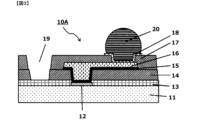
- 2 is a schematic cross-sectional view showing an example of a pad portion of a semiconductor device 10A having bumps.
- FIG. 1 is a plan view showing a manufacturing process of steps 1 to 4 for a substrate of an organic EL display used in an evaluation of light-emitting characteristics.
- the element, display device, electronic component, and semiconductor device of the present invention When describing the element of the present invention, this description is common to the elements of the first and second aspects of the present invention. On the other hand, when describing an element of a specific aspect, it will be described as the element of the first aspect of the present invention. The same applies to the descriptions of the display devices of the first, second, and third aspects.
- the present invention is not limited to the following embodiments, and various modifications are naturally possible within the scope of the invention as long as the object of the invention can be achieved and the gist of the invention is not deviated from.
- the plane in the planar view of the element of the present invention refers to a plane parallel to the substrate described later.
- the planar view refers to the planar view of the light extraction side of the xy-axis plane as seen from the z-axis direction, when the plane parallel to the substrate is the xy-axis plane and the direction perpendicular to the xy-axis plane is the z-axis direction.
- the planar view refers to the planar view of the xy-axis plane as seen from any of the z-axis directions, when the plane parallel to the substrate is the xy-axis plane and the direction perpendicular to the xy-axis plane is the z-axis direction.
- the xy plane refers to a plane parallel to any pixel unit described later, a plane parallel to any semiconductor chip described later, or a plane parallel to any light-emitting element described later.
- overlapping refers to directly or indirectly overlapping with respect to the z-axis direction.
- the detection intensities of fluorine ions, chlorine ions, bromine ions, sulfur ions, indium oxide ions, carbon ions, and cyanide ions can be calculated as the average value of three measurements of time-of-flight secondary ion mass spectrometry. It is also preferable that the average value of the detection intensity of each ion measured at depths of 5 nm and 6 nm from the surface of the conductive inorganic layer or the surface of the insulating resin layer (average value of the detection intensity at depths of 5 nm and 6 nm) satisfies the above relationship.
- the average value of the detection intensity of each ion measured at depths of 4 nm, 5 nm, and 6 nm from the surface of the conductive inorganic layer or the surface of the insulating resin layer (average value of the detection intensity at depths of 4 nm, 5 nm, and 6 nm) satisfies the above relationship.
- the amine residue refers to a structure obtained by removing a nitrogen atom and a substituent on a nitrogen atom from a structure derived from an amine in the resin or a structure derived from an amine derivative.
- the amine residue corresponds to a structure obtained by removing a nitrogen atom and a substituent on a nitrogen atom from an amine molecule or an amine derivative molecule that is a raw material for the resin.
- the amine residue has a divalent or higher structure, that is, a structure obtained by removing at least two nitrogen atoms and a substituent on a nitrogen atom from a structure derived from an amine in a structural unit of the resin or a structure derived from an amine derivative. It is also preferable that the amine residue has a trivalent or higher structure. Examples of such amine residues include a structure obtained by removing a nitrogen atom and a substituent on a nitrogen atom from a diamine molecule, a triamine molecule, a diamine derivative molecule, or a triamine derivative molecule that is a raw material for the resin.
- the carboxylic acid residue refers to a structure obtained by removing a carbonyl group and a substituent on the carbonyl carbon atom from a structure derived from a carboxylic acid or a carboxylic acid derivative in the resin.
- the carboxylic acid residue corresponds to a structure obtained by removing a carbonyl group and a substituent on the carbonyl carbon atom from a carboxylic acid molecule or a carboxylic acid derivative molecule that is a raw material for the resin.
- the carboxylic acid residue preferably has a divalent or higher structure, that is, a structure obtained by removing at least two carbonyl groups and a substituent on the carbonyl carbon atom from a structure derived from a carboxylic acid or a carboxylic acid derivative in a structural unit of the resin.
- the carboxylic acid residue preferably has a trivalent or higher structure, and also preferably has a tetravalent or higher structure.
- Examples of such carboxylic acid residues include structures obtained by removing a carbonyl group and a substituent on the carbonyl carbon atom from a dicarboxylic acid molecule, a tricarboxylic acid molecule, a tetracarboxylic acid molecule, a dicarboxylic acid derivative molecule, a tricarboxylic acid derivative molecule, or a tetracarboxylic acid derivative molecule that is a raw material for the resin.
- the element of the present invention has a substrate, a conductive inorganic layer, and an insulating resin layer in this order.
- the insulating resin layer has a plurality of openings. It is preferable that the surface of the conductive inorganic layer is exposed in the plurality of openings of the insulating resin layer. In a plan view, it is preferable that the insulating resin layer portion has a plurality of openings, and it is preferable that the conductive inorganic layer portion is exposed in the plurality of openings.
- the device of the present invention has a substrate.
- the substrate preferably has silicon dioxide or aluminum trioxide, and a glass substrate, a quartz substrate, a crystal substrate, or a sapphire substrate is more preferable.
- the substrate preferably has silicon, silicon dioxide, trisilicon tetranitride, silicon carbide, gallium nitride, gallium arsenide, indium phosphide, indium tin oxide, indium zinc oxide, indium gallium zinc oxide, diamond, aluminum trioxide, aluminum zinc oxide, or zinc oxide, and more preferably a silicon substrate, a silicon carbide substrate, a gallium nitride substrate, an indium phosphide substrate, an indium tin oxide substrate, an indium gallium zinc oxide substrate, or a diamond substrate.
- the substrate is preferably a semiconductive substrate, and more preferably a semiconductor substrate. Semiconductive means that the volume resistivity is 1.0 ⁇ 10 ⁇ 4 to 1.0 ⁇ 10 8 ⁇ cm.
- the substrate is preferably a flexible substrate from the viewpoints of improving flexibility, bendability, and improving the freedom of shape of the display device (such as curved or bent shapes).
- the flexible substrate is preferably a polyimide substrate, a polyethylene terephthalate substrate, a cycloolefin polymer substrate, a polycarbonate substrate, or a cellulose triacetate substrate, and from the viewpoint of improving bendability, a polyimide substrate is more preferable.
- the element of the present invention has a conductive inorganic layer.
- Conductivity means that the volume resistivity is 1.0 ⁇ 10 ⁇ 8 to 1.0 ⁇ 10 ⁇ 4 ⁇ cm.
- the conductive inorganic layer preferably contains a metal element as a main component element, and more preferably contains Ag, Cu, Au, Ti, Al, Ni, Mo, or Cr as a main component element.
- the main component element in the conductive inorganic layer refers to the element that is contained most abundantly on a mass basis among the constituent elements of the conductive inorganic layer.
- the conductive inorganic layer preferably further contains an element selected from In, Sn, Zn, Al, Ga, Pd, Cu, Bi, Nd, Ni, Mn, Na, K, Mg, Ca, C, and Si as an element other than the main component element.
- the conductive inorganic layer is preferably an electrode or wiring.
- the electrode is preferably an anode, a cathode, or an electrode that exhibits conductivity due to an external stimulus.
- the external stimulus may be, for example, capacitance, light, heat, or pressure.
- the wiring is preferably wiring for electrically connecting members to each other or between a member and an external circuit.
- the element of the present invention has an insulating resin layer.
- Insulation means that the volume resistivity is 1.0 ⁇ 10 8 to 1.0 ⁇ 10 18 ⁇ cm.
- the insulating resin layer preferably contains carbon as a main component element.
- the main component element in the insulating resin layer refers to the element that is contained most abundantly on a mass basis among the constituent elements of the insulating resin layer.
- the insulating resin layer preferably further contains an element selected from hydrogen, oxygen, nitrogen, phosphorus, sulfur, fluorine, chlorine, and bromine as an element different from the main component element.
- the insulating resin layer is preferably an insulating layer, a planarizing layer, an interlayer insulating layer, a partition layer, a protective layer, or an overcoat layer.
- the insulating resin layer is preferably a layer for insulating members from each other or a member from an external circuit.
- the element according to the first aspect of the present invention satisfies formula (FA-1) when the detection intensity of fluorine ions (F ⁇ ) measured by time-of-flight secondary ion mass spectrometry at a position 5 nm deep from the surface of the conductive inorganic layer on the insulating resin layer side in the opening of the insulating resin layer is (F ML ) counts. It is preferable that the element according to the first aspect of the present invention further satisfies formula (FA-1a). ( FML ) ⁇ 500 (FA-1) 2 ⁇ (F ML ) ⁇ 500 (FA-1a).
- Equations (FA-1) and (FA-1a) each indicate that the detection intensity of fluorine ions on the surface of the conductive inorganic layer is within a specific range.
- the element according to the first aspect of the present invention preferably satisfies at least one of formulas (ClA -1 ), (BrA-1), and (SA-1), and more preferably satisfies at least one of formulas (ClA-1a), (BrA-1a), and (SA - 1a), where the detection intensity of chloride ions (Cl - ) is (Cl ML ) counts, the detection intensity of bromine ions (Br - ) is (Br ML ) counts, and the detection intensity of sulfur ions (S - ) is (S ML ) counts, as measured by time-of-flight secondary ion mass spectrometry at a position 5 nm deep from the surface of the conductive inorganic layer on the insulating resin layer side in an opening in the insulating resin layer.
- the element of the first aspect of the present invention to satisfy formula (SA-1), further preferably satisfies formula (SA-1) and formula (ClA-1) and/or formula (BrA-1), and particularly preferably satisfies formulas (SA-1), (ClA-1), and (BrA-1).
- Equations (ClA-1), (ClA-1a), (BrA-1), (BrA-1a), (SA-1), and (SA-1a) each indicate that the detection intensity of chloride ions, bromine ions, or sulfur ions on the surface of the conductive inorganic layer is within a specific range.
- ( FML ) is preferably 0 or more, more preferably 2 or more, even more preferably 4 or more, even more preferably 6 or more, particularly preferably 8 or more, and most preferably 10 or more.
- ( FML ) is preferably 500 or less, more preferably 300 or less, even more preferably 200 or less, even more preferably 150 or less, and particularly preferably 120 or less.
- ( FML ) is preferably 100 or less, more preferably 80 or less, even more preferably 60 or less, even more preferably 40 or less, particularly preferably 30 or less, and most preferably 25 or less.
- (Cl ML ) is preferably 0 or more, more preferably 2 or more, even more preferably 4 or more, even more preferably 6 or more, particularly preferably 8 or more, and most preferably 10 or more.
- (Cl ML ) is preferably 200 or less, more preferably 170 or less, even more preferably 150 or less, even more preferably 120 or less, and particularly preferably 100 or less.
- (Cl ML ) is preferably 80 or less, more preferably 60 or less, even more preferably 40 or less, even more preferably 30 or less, and particularly preferably 25 or less.
- the element according to the first aspect of the present invention has excellent light-emitting properties that allow low-voltage operation to obtain a desired current density, and can provide a display device with excellent reliability of the light-emitting element.
- the detection intensity of fluorine ions on the surface of the conductive inorganic layer on the insulating resin layer side is equal to or less than a specific value, which indicates that the ratio of the surface of the conductive inorganic layer that is surface-modified by fluorine elements is within a specific range.
- the conductive inorganic layer is an electrode in a display device
- the adjustment of the work function difference provides excellent light-emitting properties that allow low-voltage operation, and in addition, the effect of high light-emitting brightness when driven at the same voltage is achieved.
- the conductivity of the surface-modified metal wiring is controlled, making it possible to drive at a low voltage, and the effect of high light-emitting brightness is considered to be achieved.
- the conductive inorganic layer is an electrode of a display device
- the polarization structure and charge balance on the electrode are controlled. This suppresses ion migration and electromigration caused by metal impurities and ion impurities that adversely affect the light-emitting characteristics, and is presumed to have an effect of high reliability of the light-emitting element.
- the effect of excellent migration resistance is achieved by suppressing ion migration and electromigration caused by metal impurities and ion impurities that adversely affect the electrical characteristics.
- the effect of high reliability in the display device, electronic component, or semiconductor device is achieved by suppressing migration and aggregation of the metal in the electrode or the metal in the metal wiring.
- the element according to the second aspect of the present invention when the detection intensity of fluorine ions (F ⁇ ) is (F ML ) counts, the detection intensity of chlorine ions (Cl ⁇ ) is (Cl ML ) counts, the detection intensity of bromine ions (Br ⁇ ) is (Br ML ) counts, and the sum of (F ML ), (Cl ML ), and (Br ML ) is (X ML ) counts, which are measured by time-of-flight secondary ion mass spectrometry at a position 5 nm deep from the surface of the conductive inorganic layer on the insulating resin layer side in an opening in the insulating resin layer , the element satisfies formula ( XA -1): Furthermore, when the detection intensity of fluorine ions (F ⁇ ) in the insulating resin layer portion measured by time-of-flight secondary ion mass spectrometry at a position 5 nm deep from the surface of the insulating
- the element according to the second aspect of the present invention further satisfies formula (XA-1a) and formula (XB-1a).
- ( XML ) ⁇ 500 (XA-1) ( XRN ) ⁇ 500 (XB-1) 2 ⁇ (X ML ) ⁇ 500 (XA-1a) 2 ⁇ (X RN ) ⁇ 500 (XB-1a).
- Equations (XA-1) and (XA-1a) are formulas indicating that the sum of the detection intensities of fluorine ions, chloride ions, and bromine ions on the surface of the conductive inorganic layer is within a specific range.
- Equations (XB-1) and (XB-1a) are formulas indicating that the sum of the detection intensities of fluorine ions, chloride ions, and bromine ions on the surface of the insulating resin layer is within a specific range.
- the element according to the second aspect of the present invention satisfies formula (SA-1), where the detection intensity of sulfur ions (S ⁇ ) measured by time-of-flight secondary ion mass spectrometry at a position 5 nm deep from the surface of the conductive inorganic layer on the insulating resin layer side in an opening in the insulating resin layer is (S ML ) counts: Furthermore, when the detection intensity of sulfur ions (S ⁇ ) measured by time-of-flight secondary ion mass spectrometry at a position 5 nm deep from the surface of the insulating resin layer in the insulating resin layer portion is (S RN ) counts, it is preferable that formula (SB-1) is satisfied.
- SA-1 the detection intensity of sulfur ions (S ⁇ ) measured by time-of-flight secondary ion mass spectrometry at a position 5 nm deep from the surface of the insulating resin layer in the insulating resin layer portion is (S RN ) counts.
- the element according to the second aspect of the present invention further satisfies formula (SA-1a) and formula (SB-1a).
- SA-1a formula (SA-1)
- SRN sarcoma
- SB-1a formula (SB-1a)
- Equations (SB-1) and (SB-1a) each indicate that the detection intensity of sulfur ions on the surface of the insulating resin layer is within a specific range.
- (X ML ) is preferably 0 or more, more preferably 2 or more, even more preferably 4 or more, even more preferably 6 or more, particularly preferably 8 or more, and most preferably 10 or more.
- (X ML ) is preferably 500 or less, more preferably 300 or less, even more preferably 200 or less, even more preferably 150 or less, and particularly preferably 120 or less.
- (X ML ) is preferably 100 or less, more preferably 80 or less, even more preferably 60 or less, even more preferably 40 or less, particularly preferably 30 or less, and most preferably 25 or less.
- (X RN ) is preferably 0 or more, more preferably 2 or more, even more preferably 4 or more, even more preferably 6 or more, particularly preferably 8 or more, and most preferably 10 or more.
- (X RN ) is preferably 500 or less, more preferably 300 or less, even more preferably 200 or less, even more preferably 150 or less, and particularly preferably 120 or less.
- (X RN ) is preferably 100 or less, more preferably 80 or less, even more preferably 60 or less, even more preferably 40 or less, particularly preferably 30 or less, and most preferably 25 or less.
- (F RN ) is preferably 0 or more, more preferably 2 or more, even more preferably 4 or more, even more preferably 6 or more, particularly preferably 8 or more, and most preferably 10 or more.
- (F RN ) is preferably 500 or less, more preferably 300 or less, even more preferably 200 or less, even more preferably 150 or less, and particularly preferably 120 or less.
- (F RN ) is preferably 100 or less, more preferably 80 or less, even more preferably 60 or less, even more preferably 40 or less, particularly preferably 30 or less, and most preferably 25 or less.
- ( ClRN ) is preferably 0 or more, more preferably 2 or more, even more preferably 4 or more, even more preferably 6 or more, particularly preferably 8 or more, and most preferably 10 or more.
- ( ClRN ) is preferably 200 or less, more preferably 170 or less, even more preferably 150 or less, even more preferably 120 or less, and particularly preferably 100 or less.
- ( ClRN ) is preferably 80 or less, more preferably 60 or less, even more preferably 40 or less, even more preferably 30 or less, and particularly preferably 25 or less.
- the element according to the second aspect of the present invention has excellent light-emitting properties that allow low-voltage driving to obtain a desired current density, and can provide a display device with excellent reliability of the light-emitting element.
- the sum of the detection intensities of fluorine ions, chlorine ions, and bromine ions on the surface of the conductive inorganic layer on the insulating resin layer side is equal to or less than a specific value, which indicates that the ratio of the surface of the conductive inorganic layer modified by these elements is within a specific range.
- the effect of the present invention is achieved by the configuration of the detection intensities of chlorine ions and bromine ions.
- the polarization structure and charge balance on the electrode are controlled. Therefore, similar to the element according to the first aspect, it is believed that the polarization structure and charge balance on the metal wiring or rewiring of a display device, electronic component, or semiconductor device are controlled. As a result, it is believed that the effect of the above invention is achieved.
- the sum of the detection intensities of fluorine ions, chlorine ions, and bromine ions on the surface of the insulating resin layer being equal to or less than a specific value indicates that the abundance ratio of these elements on the surface of the insulating resin layer is within a specific range.
- the effect of the present invention is achieved by the configuration of the detection intensities of chlorine ions and bromine ions.
- the surface of the conductive inorganic layer is modified by these elements when these elements on the surface of the insulating resin layer transition to the surface of the conductive inorganic layer on the insulating resin layer side at the opening of the insulating resin layer.
- the conductivity of the surface-modified electrode or metal wiring is controlled, and it is considered that the effect of excellent light-emitting characteristics and high light-emitting brightness that can be driven at a low voltage is achieved.
- the polarization structure and charge balance in the insulating resin layer of, for example, a display device, electronic component, or semiconductor device can be controlled by intentionally adjusting the detection intensity of these ions on the insulating resin layer.
- the suppression of ion migration and electromigration caused by metal impurities and ion impurities that adversely affect the light-emitting properties or electrical insulation properties will contribute to high reliability or excellent migration resistance of the light-emitting element.
- the suppression of migration and aggregation of metals in electrodes or metal wiring will contribute to high reliability in display devices, electronic components, or semiconductor devices.
- the surface of the conductive inorganic layer on the insulating resin layer side of the element of the present invention can be determined by depth measurement in time-of-flight secondary ion mass spectrometry.
- an etching ion species accelerated by applying a bias is collided with the opening of the insulating resin layer from the insulating resin layer side, and while etching in the depth direction from the conductive inorganic layer side to the substrate side, a primary ion species accelerated by applying a bias is collided from the insulating resin layer side.
- the secondary ions emitted at this time are measured, and a depth profile in the depth direction from the conductive inorganic layer side to the substrate side is measured.
- the point where the detection intensity of at least one ion among the elements contained in the outermost layer on the insulating resin layer side of the conductive inorganic layer becomes 100 or more is defined as the surface of the conductive inorganic layer.
- the depth profile in the depth direction from the conductive inorganic layer side to the substrate side is measured from the surface of the conductive inorganic layer to the opposite surface on the substrate side, and the thickness of the conductive inorganic layer is measured, and the sputter rate of the conductive inorganic layer is calculated from these values, so that the position at a depth of 5 nm from the surface of the conductive inorganic layer in the depth profile can be determined.
- the surface of the insulating resin layer can also be determined by depth measurement in time-of-flight secondary ion mass spectrometry.
- the depth profile the point at which the detection intensity of at least one ion among the elements contained in the outermost layer of the insulating resin layer is 100 or more is defined as the surface of the insulating resin layer.
- the depth profile in the depth direction from the insulating resin layer side toward the substrate side is measured from the surface of the insulating resin layer to the opposite surface on the substrate side, and the thickness of the insulating resin layer is measured. From these values, the sputter rate of the insulating resin layer is calculated, and the position at a depth of 5 nm from the surface of the insulating resin layer in the depth profile can be determined.
- the surface of the transparent conductive oxide film layer containing indium as the main element on the side in contact with the light-emitting layer in the display device of the present invention described later can also be determined by depth measurement in time-of-flight secondary ion mass spectrometry.
- the depth profile the point where the detection intensity of indium oxide ions is 100 or more is defined as the surface of the transparent conductive oxide film layer containing indium as the main element.
- the depth profile in the depth direction from the light-emitting layer side toward the substrate side is measured from the surface of the transparent conductive oxide film layer to the opposite surface on the substrate side, and the thickness of the transparent conductive oxide film layer is measured. From these values, the sputtering rate of the transparent conductive oxide film layer is calculated, and the position at a depth of 5 nm from the surface of the transparent conductive oxide film layer containing indium as the main element in the depth profile can be determined.
- the point where the detection intensity of at least one ion among the elements contained in the layer located directly below the first electrode or the layer located directly below the transparent conductive oxide film layer is 100 or more is defined as the surface opposite the substrate side of the first electrode or the surface opposite the substrate side of the transparent conductive oxide film layer.
- the thickness of the first electrode and the transparent conductive oxide layer can be measured using a TEM or SEM.
- the thickness of the first electrode and the transparent conductive oxide layer can also be determined by the following method.
- the first electrode or the transparent conductive oxide layer is subjected to elemental composition analysis, and a metal film or oxide film having the same elemental composition as the elemental composition is formed to a desired thickness.
- the depth profile of the obtained metal film or oxide film is measured from the surface of the metal film or oxide film to the opposite surface of the substrate by depth measurement using time-of-flight secondary ion mass spectrometry, and the sputter rate of the metal film or oxide film is calculated from the thickness of the metal film or oxide film.
- Methods for elemental composition analysis include, for example, Rutherford backscattering spectrometry and other analytical methods.
- the display device of the present invention comprises the element of the present invention.
- the display device of the first aspect of the present invention is a display device comprising the element of the first aspect of the present invention, further comprising a second electrode and a light-emitting layer, the conductive inorganic layer being the first electrode, and the insulating resin layer being a pixel division layer, or further comprising a first electrode, a second electrode, a pixel division layer, and a light-emitting layer, the insulating resin layer being a TFT flattening layer, and the conductive inorganic layer being a metal wiring layer.
- the display device of the second aspect of the present invention is a display device comprising the element of the second aspect of the present invention, further comprising a second electrode and a light-emitting layer, the conductive inorganic layer being the first electrode, and the insulating resin layer being a pixel division layer, or further comprising a first electrode, a second electrode, a pixel division layer, and a light-emitting layer, the insulating resin layer being a TFT flattening layer, and the conductive inorganic layer being a metal wiring layer.
- the display device is preferably a flexible display device, and more preferably has a curved display portion, a display portion including an outwardly bent surface, or a display portion including an inwardly bent surface.
- the display device is preferably an organic electroluminescence display, a quantum dot display, a micro light-emitting diode (hereinafter, "LED”) display, a mini LED display, or a liquid crystal display.
- LED micro light-emitting diode
- the display device of the present invention preferably has a first electrode, a second electrode, a pixel division layer, and a light-emitting layer on the same substrate.
- the display device of the present invention preferably has a first electrode, a second electrode, a pixel division layer, a light-emitting layer, a sealing layer, a color filter layer, and a black matrix layer on the same substrate, and more preferably has a first electrode, a second electrode, a pixel division layer, a light-emitting layer, a TFT flattening layer, a metal wiring layer, a sealing layer, a color filter layer, and a black matrix layer on the same substrate.
- the display device of the present invention is preferably formed by stacking the first electrode, the light-emitting layer, the second electrode, the sealing layer, and the color filter layer in this order, and it is preferable that the metal wiring layer, the TFT flattening layer, the first electrode, the light-emitting layer, the second electrode, the sealing layer, and the color filter layer are stacked in this order.
- the display device of the present invention can suppress light emission defects caused by, for example, deterioration in the positional accuracy between the pixel portion and the color filter layer portion and exposure alignment errors, thereby achieving significant effects in suppressing declines in panel yields and improving the reliability of light-emitting elements.
- the pixel division layer preferably has a plurality of openings.
- the display device of the present invention preferably has a plurality of pixel portions.
- the pixel portion is preferably a portion on the first electrode portion in the opening of the pixel division layer portion and where the light-emitting layer is formed.
- the TFT planarization layer also has a plurality of openings. It is preferable that the surface of the metal wiring layer is exposed in the plurality of openings of the TFT planarization layer.
- the display device of the present invention preferably comprises an element of the present invention, and further comprises a second electrode and a light-emitting layer, the conductive inorganic layer in the element being a first electrode, and the insulating resin layer in the element being a pixel dividing layer. It is also preferable that the display device of the present invention comprises an element of the present invention, and further comprises a first electrode, a second electrode, a pixel dividing layer, and a light-emitting layer, the insulating resin layer in the element being a TFT planarizing layer, and the conductive inorganic layer in the element being a metal wiring layer.
- the display device of the present invention preferably has a first electrode and a second electrode.
- the electrodes are required to have excellent electrical characteristics.
- the electrode is used as an anode, it is required to have a composite characteristic such as being able to efficiently inject holes, and when the electrode is used as a cathode, it is required to have a composite characteristic such as being able to efficiently inject electrons.
- the first electrode is an anode and the second electrode is a cathode.
- the first and second electrodes By using a combination of transparent and non-transparent electrodes as the first and second electrodes, light emitted from the light-emitting layer, which will be described later, can be extracted to one side.
- a display device with a bottom emission type configuration has a transparent electrode as the first electrode and a non-transparent electrode as the second electrode.
- a display device with a top emission type configuration has a non-transparent electrode as the first electrode and a transparent electrode as the second electrode.
- a transparent electrode refers to an electrode with a light transmittance of 30% or more at a wavelength of 550 nm
- a non-transparent electrode refers to an electrode with a light transmittance of less than 30% at a wavelength of 550 nm. It is preferable to adjust the transmittance at a wavelength of 550 nm by adjusting the film thickness of the electrode.
- the first electrode a non-transparent electrode with a multi-layer structure.
- the first electrode can be made a non-transparent electrode with a multi-layer structure, and the substrate side of the first electrode can be configured to have an underlayer that improves adhesion and corrosion resistance, and a reflection adjustment layer that adjusts reflectance.
- the transparent or non-transparent in the transparent conductive oxide film layer, non-transparent conductive layer, non-transparent conductive metal layer, transparent conductive layer, and transparent conductive metal layer described below means that the transmittance at a wavelength of 550 nm is 30% or more or less than 30%, as described above.
- the electrode when the electrode has a multilayer structure, the transmittance at a wavelength of 550 nm is 30% or more overall, and the transmittance at any one of the layers constituting the multilayer structure is less than 30%, it is called non-transparent.
- the electrode having the multilayer structure when the multilayer structure has at least one non-transparent conductive layer or non-transparent conductive metal layer, the electrode having the multilayer structure is a non-transparent electrode.
- the transmittance of the first electrode and the second electrode can be obtained by separating the first electrode or the second electrode from the display device and measuring the first electrode or the second electrode with a single beam using an ultraviolet-visible spectrophotometer. If it is difficult to separate the first electrode or the second electrode from the display device, the transmittance of the first electrode and the second electrode can be obtained by the following method. First, the first electrode or the second electrode and at least one layer including the layer to which the first electrode or the second electrode is in contact are separated from the display device to obtain a measurement sample A. The measurement sample A is measured with a single beam using an ultraviolet-visible spectrophotometer to obtain an ultraviolet-visible absorption spectrum A.
- the first electrode or the second electrode is separated or dissolved from the measurement sample A to obtain a measurement sample B.
- the measurement sample B is measured with a single beam using an ultraviolet-visible spectrophotometer to obtain an ultraviolet-visible absorption spectrum B.
- the transmittance of the first electrode or the second electrode is calculated from the difference between the obtained ultraviolet-visible absorption spectrum A and the ultraviolet-visible absorption spectrum B.
- the first electrode or the second electrode can be separated or dissolved by a physical method, an optical method, or a chemical method, such as a method of separating them by applying an external force, a method of separating them by irradiating them with a laser or an ion beam, or a method of dissolving them using a chemical solution.
- the display device of the present invention preferably has a plurality of first electrode portions in a planar view.
- the above-mentioned first electrode viewed in a planar view corresponds to the first electrode portion.
- the display device of the present invention preferably has a second electrode portion in a planar view.
- the above-mentioned second electrode viewed in a planar view corresponds to the second electrode portion. It is more preferable that the display device of the present invention has a plurality of second electrode portions.
- the first electrode may have a single-layer structure or a multi-layer structure.
- the first electrode may be a transparent electrode or a non-transparent electrode.
- the first electrode When the first electrode has a single-layer structure, it is preferable that the first electrode is a transparent electrode.
- the first electrode has a multi-layer structure, it is preferable that the outermost layer on the light-emitting layer side of the first electrode has a transparent conductive oxide film layer, and it is more preferable that the transparent conductive oxide film layer has a transparent conductive oxide film layer containing In, Sn, Zn, Al, or Ga as a main element, and it is even more preferable that the transparent conductive oxide film layer has a transparent conductive oxide film layer containing indium as a main element.
- the main element in the transparent conductive oxide film layer refers to an element other than oxygen that is contained most abundantly by mass in the constituent elements of the transparent conductive oxide film layer.
- the transparent conductive oxide film layer is preferably indium tin oxide (hereinafter, ITO) or indium zinc oxide (IZO), and ITO is more preferable.
- the transparent conductive oxide film layer is preferably an amorphous transparent conductive oxide film layer.
- a polycrystalline transparent conductive oxide film layer is preferable.
- the first electrode is preferably ITO or IZO, more preferably ITO, from the viewpoint of achieving low-voltage driving of the light-emitting characteristics and improving the light-emitting brightness.
- the first electrode is a transparent electrode, it is preferable to adjust the film thickness of the first electrode to adjust the transmittance at a wavelength of 550 nm.
- the first electrode When the first electrode is a multi-layered non-transparent electrode, the first electrode has a non-transparent conductive layer.
- the non-transparent conductive layer is preferably a non-transparent conductive metal layer containing a metal element.
- the non-transparent conductive metal layer preferably contains Ag, Cu, Au, Ti, Al, Ni, Mo, or Cr as a main element, more preferably contains Ag, Cu, Au, Ti, or Al as a main element, and even more preferably contains silver or copper as a main element, from the viewpoints of low-voltage driving of light-emitting characteristics, improvement of light-emitting brightness, improvement of reliability of the light-emitting device, and improvement of corrosion resistance.
- the main element in the non-transparent conductive metal layer refers to the element that is contained most abundantly by mass among the constituent elements of the non-transparent conductive metal layer. It is preferable that the non-transparent conductive metal layer is present in at least one layer other than the outermost layer on the light-emitting layer side of the first electrode.
- the second electrode When the second electrode has a single-layer structure, it is preferable that the second electrode is a transparent electrode.
- the second electrode has a multi-layer structure, it is preferable that the outermost layer on the light-emitting layer side of the second electrode has a transparent conductive metal layer, and it is more preferable that the second electrode has a transparent conductive metal layer containing Li, Mg, Ag, Cu, Au, Ti, or Al as a main element, and it is even more preferable that the second electrode has a transparent conductive metal layer containing magnesium or silver as a main element.
- the main element in the transparent conductive metal layer refers to the element that is contained most abundantly by mass among the constituent elements of the transparent conductive metal layer. From the viewpoint of improving the luminance of light emission, the transparent conductive metal layer is preferably LiAg or MgAg, and more preferably MgAg.
- the display device of the present invention has a first electrode that is a non-transparent electrode having a multi-layer structure, and at least one of the layers other than the outermost layer on the light-emitting layer side of the first electrode has a non-transparent conductive metal layer containing silver or copper as a main element.
- the display device of the present invention preferably has a first electrode that has a transparent conductive oxide film layer and a non-transparent conductive metal layer, and a transparent conductive oxide film layer containing indium as a main element on the outermost layer of the first electrode on the light-emitting layer side, from the viewpoints of achieving low-voltage driving of light-emitting characteristics, improving light-emitting brightness, and improving the reliability of the light-emitting element.
- the transparent conductive oxide film layer containing indium as a main element is preferably amorphous or polycrystalline, and preferably amorphous.
- the occurrence of defects and protrusions on the surface of the first electrode is suppressed, so it is presumed that the effect of improving the reliability of the light-emitting element is significant.
- the surface modification of the amorphous transparent conductive oxide film layer is easy to proceed, it is presumed that the effect of low-voltage driving of the light-emitting characteristics and improvement of the light-emitting brightness by adjusting the work function difference is significant.
- the above configuration is particularly suitable for a display device with a top-emission configuration.
- the following (I-D1) or (II-D1) preferably satisfies the above formula (FA-1), and more preferably satisfies the above formula (FA-1a).
- the following (I-D1) or (II-D1) satisfies at least one of the above formulas (ClA-1), (BrA-1), and (SA-1), and it is more preferable that the following (I-D1) satisfies at least one of the above formulas (ClA-1a), (BrA-1a), and (SA-1a).
- the following (I-D1) or (II-D1) satisfies the above formula (SA-1), it is even more preferable that it satisfies the above formula (SA-1) and also satisfies the above formula (ClA-1) and/or the above formula (BrA-1), and it is particularly preferable that it satisfies the above formula (SA-1), the above formula (ClA-1), and the above formula (BrA-1).
- the above (I-D1) satisfies the above formulas in the display device according to the first aspect
- the following (I-D2) satisfies the above formulas (XA-1) and (XB-1), and more preferably satisfies the above formulas (XA-1a) and (XB-1a).
- the display device when the above (II-D1) satisfies the above formulas in the display device according to the first aspect, it is preferable that the following (II-D2) satisfies the above formulas (XA-1) and (XB-1), and it is more preferable that the following formula (XA-1a) and (XB-1a) are satisfied.
- (I-D2) The sum of the detection intensity of fluorine ions, the detection intensity of chloride ions, and the detection intensity of bromine ions, as well as the detection intensity of sulfur ions, measured by time-of-flight secondary ion mass spectrometry at a position 5 nm deep from the surface of the pixel division layer in the pixel division layer section.
- a display device from the viewpoints of achieving low-voltage driving of light-emitting characteristics, improving the reliability of the light-emitting element, and improving migration resistance, has a second electrode and a light-emitting layer, a conductive inorganic layer is a first electrode, an insulating resin layer is a pixel dividing layer, and a transparent conductive oxide film layer containing indium as a main element is provided on the outermost layer of the first electrode on the light-emitting layer side.
- the display device has a transparent conductive oxide film layer of 5 nm or more in thickness, containing indium as a main element, on the outermost layer on the light-emitting layer side of the first electrode in the pixel section.
- Formula (InA-1) is a formula indicating that the detection intensity of indium oxide ions on the surface of the transparent conductive oxide film layer is within a specific range. In the pixel section, the greater the detection intensity of indium oxide ions on the surface of the transparent conductive oxide film on the side in contact with the light-emitting layer, the greater the proportion of the surface of the transparent conductive oxide film layer containing indium as a main element that is exposed.
- the display device satisfies the above formula (FA-2) and formula (InA-1) from the viewpoints of achieving low-voltage operation of the light-emitting characteristics, improving the reliability of the light-emitting element, and improving migration resistance, and further preferably satisfies at least one of formulas (ClA-2), (BrA-2), and (SA-2), and more preferably satisfies at least one of formulas (ClA-2a), (BrA-2a), and (SA-2a).
- the display device that is the first aspect of the present invention to satisfy formula (SA-2), further preferably satisfies formula (SA-2) and formula (ClA-2) and/or formula (BrA-2), and particularly preferably satisfies formulas (SA-2), (ClA-2), and (BrA-2).
- (InO ML ) is more preferably 1,500 or more, and even more preferably 2,000 or more.
- (InO ML ) is preferably 30,000 or less, more preferably 20,000 or less, even more preferably 15,000 or less, and particularly preferably 10,000 or less.
- (InO ML ) is preferably 7,500 or less, more preferably 6,000 or less, even more preferably 5,000 or less, even more preferably 4,000 or less, and particularly preferably 3,500 or less.
- ( FML )/( InOML ) is preferably 0 or more, more preferably 0.0001 or more, even more preferably 0.0003 or more, even more preferably 0.0005 or more, and particularly preferably 0.0010 or more.Furthermore, ( FML )/( InOML ) is preferably 0.0020 or more, more preferably 0.0040 or more, even more preferably 0.0060 or more, even more preferably 0.0080 or more, and particularly preferably 0.0100 or more.
- ( FML )/( InOML ) is preferably 0.5000 or less, more preferably 0.3000 or less, even more preferably 0.2000 or less, even more preferably 0.1500 or less, and particularly preferably 0.1200 or less.
- (F ML )/(InO ML ) is preferably 0.1000 or less, more preferably 0.0800 or less, even more preferably 0.0600 or less, even more preferably 0.0400 or less, particularly preferably 0.0300 or less, and most preferably 0.0250 or less.
- (Cl ML )/(InO ML ) is preferably 0 or more, more preferably 0.0001 or more, even more preferably 0.0003 or more, even more preferably 0.0005 or more, and particularly preferably 0.0010 or more. Furthermore, (Cl ML )/(InO ML ) is preferably 0.0020 or more, more preferably 0.0040 or more, even more preferably 0.0060 or more, even more preferably 0.0080 or more, and particularly preferably 0.0100 or more.
- (Cl ML )/(InO ML ) is preferably 0.2000 or less, more preferably 0.1700 or less, even more preferably 0.1500 or less, and particularly preferably 0.1200 or less. Furthermore, (Cl ML )/(InO ML ) is preferably 0.1000 or less, more preferably 0.0800 or less, even more preferably 0.0600 or less, even more preferably 0.0400 or less, particularly preferably 0.0300 or less, and most preferably 0.0250 or less.
- a display device is, from the viewpoints of achieving low-voltage driving of light-emitting characteristics, improving the reliability of the light-emitting element, and improving migration resistance, a second electrode and a light-emitting layer, a conductive inorganic layer is a first electrode, and an insulating resin layer is a pixel dividing layer,
- the detection intensity of indium oxide ions (InO 2 ⁇ ) measured by time-of-flight secondary ion mass spectrometry at a position 5 nm deep from the surface of the transparent conductive oxide film layer on the side in contact with the light-emitting layer in the opening of the pixel dividing layer is defined as (InO ML ) counts.
- formula (XA-2) and formula (InA-1) are satisfied, and it is more preferable that formula (XA-2a) and formula (InA-1) are satisfied.
- the display device has a transparent conductive oxide film layer of 5 nm or more in thickness, containing indium as a main element, on the outermost layer of the first electrode on the light-emitting layer side in the pixel section.
- Formula (InA-1) is a formula indicating that the detection intensity of indium oxide ions on the surface of the transparent conductive oxide film layer is within a specific range. In the pixel section, the greater the detection intensity of indium oxide ions on the surface of the transparent conductive oxide film on the side in contact with the light-emitting layer, the greater the proportion of the surface of the transparent conductive oxide film layer containing indium as a main element that is exposed.
- the display device preferably satisfies the above formula (XA-2) and formula (InA-1), and further satisfies formula (SA-2), and more preferably satisfies formula (SA-2a).
- (X ML )/(InO ML ) is preferably 0 or more, more preferably 0.0001 or more, even more preferably 0.0003 or more, even more preferably 0.0005 or more, and particularly preferably 0.0010 or more. Furthermore, (X ML )/(InO ML ) is preferably 0.0020 or more, more preferably 0.0040 or more, even more preferably 0.0060 or more, even more preferably 0.0080 or more, and particularly preferably 0.0100 or more. On the other hand, (X ML )/(InO ML ) is preferably 0.5000 or less, more preferably 0.3000 or less, even more preferably 0.2000 or less, even more preferably 0.1500 or less, and particularly preferably 0.1200 or less.
- (X ML )/(InO ML ) is preferably 0.1000 or less, more preferably 0.0800 or less, even more preferably 0.0600 or less, even more preferably 0.0400 or less, particularly preferably 0.0300 or less, and most preferably 0.0250 or less.
- the preferred ranges of (InO ML ), (F ML )/(InO ML ), (Cl ML )/(InO ML ), (Br ML )/(InO ML ), and (S ML )/(InO ML ) in the display device that is the second aspect of the present invention are the same as the above-mentioned preferred ranges in the display device that is the first aspect of the present invention.
- the element of the present invention further satisfies formula (CA-1) and/or formula (CNA-1), where the detection intensity of carbon ions (C ⁇ ) is (C ML ) counts and the detection intensity of cyanide ions (CN ⁇ ) is (CN ML ) counts, as measured by time-of-flight secondary ion mass spectrometry at a position 5 nm deep from the surface of the conductive inorganic layer on the insulating resin layer side in an opening in the insulating resin layer. 20 ⁇ ( CML ) ⁇ 4,000 (CA-1) 20 ⁇ (CN ML ) ⁇ 4,000 (CNA-1).
- ( CML ) is preferably 50 or more, more preferably 75 or more, and even more preferably 100 or more.
- ( CML ) is preferably 3,000 or less, more preferably 2,000 or less, and even more preferably 1,000 or less.
- the preferred range of ( CNML ) is the same as the preferred range of ( CML ) above.
- Equations (CA-1) and (CNA-1) are equations that indicate that the detection intensity of carbon ions or cyanide ions on the surface of the conductive inorganic layer is within a specific range.
- the greater the detection intensity of carbon ions on the surface of the conductive inorganic layer on the insulating resin layer side the greater the proportion of carbon atoms present on the surface of the conductive inorganic layer.
- the greater the detection intensity of cyanide ions the greater the proportion of carbon atoms bonded to nitrogen atoms on the surface of the conductive inorganic layer.
- the display device of the present invention has a second electrode and a light-emitting layer, a conductive inorganic layer is a first electrode, an insulating resin layer is a pixel dividing layer, and a transparent conductive oxide film layer containing indium as a main element is provided on the outermost layer of the first electrode on the light-emitting layer side.
- ( CML )/( InOML ) is preferably 0.003 or more, more preferably 0.005 or more, even more preferably 0.010 or more, and particularly preferably 0.020 or more.Furthermore, ( CML )/( InOML ) is preferably 0.050 or more, more preferably 0.075 or more, and even more preferably 0.100 or more.On the other hand, ( CML )/( InOML ) is preferably 3.0 or less, more preferably 2.0 or less, and even more preferably 1.0 or less.
- the preferred range of (CN ML )/(InO ML ) is the same as the preferred range of ( CML )/(InO ML ) described above.
- the preferred range of (InO ML ) is as described above.
- the display device of the present invention preferably has a pixel division layer.
- the pixel division layer is a layer that divides adjacent pixel parts and defines the area of each pixel part.
- the pixel division layer is preferably a layer that divides an area on the first electrode.
- the pixel division layer is preferably formed so as to overlap a part on the first electrode. With such a configuration, the first electrode and the second electrode in any pixel can be insulated, and the first electrodes between a plurality of adjacent pixels can be insulated from each other.
- the pixel division layer is preferably made of a cured product obtained by curing a photosensitive composition.
- the pixel division layer is preferably black.
- the pixel division layer can be made black by coloring a component such as a resin in the photosensitive composition.
- the display device of the present invention preferably has a pixel division layer having a plurality of openings in plan view.
- the pixel division layer described above in plan view corresponds to the pixel division layer.
- the shape of the pixel portion described below is preferably a shape similar or analogous to the shape of the opening of the pixel division layer, and more preferably the same as the shape of the opening of the pixel division layer.
- the shape of the pixel portion in plan view is preferably a closed polygon, a shape in which at least some of the sides and/or vertices of a closed polygon are replaced with arcs, or a closed shape formed by arcs.
- closed polygons examples include triangles, equilateral triangles, quadrangles, squares, rhombuses, rectangles, pentagons, regular pentagons, right-angled pentagons, hexagons, regular hexagons, right-angled hexagons, heptagons, and octagons.
- closed shapes formed by arcs include circles, perfect circles, and ellipses.
- the display device of the present invention preferably has a step shape having a thick film portion and a thin film portion.
- the pixel division layer have a thick film portion and a thin film portion, the portion that comes into contact with the deposition mask when forming the light-emitting layer is only the thick film portion of the pixel division layer, and the contact area between the pixel division layer and the deposition mask can be reduced. Therefore, damage to the pixel division layer can be suppressed, and the effect of suppressing a decrease in the yield of the panel and improving the reliability of the light-emitting element is remarkable.
- the display device of the present invention preferably has a thin film portion containing an (XD) colorant, and an optical density at the wavelength of visible light per 1 ⁇ m of film thickness of the thin film portion is 0.5 or more and 3.0 or less.
- the display device of the present invention has a pixel division layer having a step shape with a thick film portion and a thin film portion, and that the thick film portion and the thin film portion contain the same (XA) resin.
- the display device of the present invention has a pixel division layer having a step shape with a thick film portion and a thin film portion, that the thick film portion and the thin film portion contain the same (XD) colorant, and that the optical density at the wavelength of visible light per 1 ⁇ m of film thickness of the thick film portion and the thin film portion is both 0.5 or more and 3.0 or less.
- the same (XA) resin refers to a resin whose structural units that constitute the resin have the same structure. In other words, resins whose structural units, such as amine residues and carboxylic acid residues, have the same structure are considered to be the same (XA) resin.
- the pixel division layer is a cured product obtained by curing a single photosensitive composition, and the thick and thin film portions of the pixel division layer are formed by a method of processing the step shape collectively using a halftone photomask.
- the thick and thin film portions have the same degree of crosslinking, and the gradient of the degree of crosslinking in the film is uniform. Therefore, it is considered that the occurrence of fine cracks and the occurrence of fine coarse and dense structures in the film caused by the difference in thermal expansion coefficient between the thick and thin film portions is suppressed, and the polarization structure and charge balance in the film are controlled.
- the effect of improving the reliability or migration resistance of the light-emitting element is remarkable by suppressing the occurrence of ion migration and electromigration caused by metal impurities and ion impurities that adversely affect the light-emitting characteristics or electrical insulation.
- the occurrence of residues after thermal curing caused by outgassing from the pixel division layer is suppressed by suppressing the occurrence of fine cracks and the occurrence of fine coarse and dense structures in the film.
- FIG. 1 shows a schematic cross-sectional view and a plan view of an example of a display device 100A in which a pixel division layer has a stepped shape having a thick film portion and a thin film portion.
- the cross-sectional view in FIG. 1 is a view of a cross section cut along a cross-sectional axis 100x in the plan view.
- Metal wiring 102 and a TFT element layer 103 are formed on a substrate 101, and an interlayer insulating layer 104 and a TFT planarizing layer/TFT protection layer 105 are formed thereon in this order.
- a pixel division layer 106 and a first electrode 107 having a stepped shape are formed on the TFT planarizing layer/TFT protection layer 105 such that the pixel division layer 106 divides the first electrode 107 and the pixel division layer 106 overlaps a part of the first electrode 107.
- the pixel division layer 106 has a thick film portion 116.
- a light-emitting layer 108, a second electrode 109, a sealing layer 110, a touch panel wiring/touch panel electrode 111, a color filter layer 112, a black matrix layer 113, an overcoat layer 114, and a substrate 115 are formed in this order.
- a color filter layer portion 112a, an opening 117a in the pixel division layer portion, and an opening 118a in the black matrix layer portion are formed in the portion corresponding to the pixel portion in a plan view.
- the thick and/or thin portions of the pixel division layer are preferably black.
- the optical density at the wavelength of visible light per 1 ⁇ m of film thickness of the thick and thin portions is preferably 0.5 or more, more preferably 0.7 or more, even more preferably 1.0 or more, even more preferably 1.2 or more, and particularly preferably 1.5 or more.
- the optical density is preferably 3.0 or less, more preferably 2.5 or less, and even more preferably 2.0 or less.
- the optical density is preferably the optical density of a cured product obtained by heating and curing the composition.
- the pixel division layer has a stepped shape having a thick film portion and a thin film portion, It is preferable that the thin film portion contains an (XD) colorant, and that the optical density at the wavelength of visible light per 1 ⁇ m of film thickness of the thin film portion is 0.5 or more and 3.0 or less, and that the thick film portion satisfies at least one of the following conditions (SP1) to (SP3).
- SP1 The thick film portion does not contain an (XD) colorant.
- the thick film portion contains an (XD) colorant, and the optical density of the thick film portion at the wavelength of visible light per 1 ⁇ m of film thickness is 0.0 or more and 0.3 or less.
- the thick film portion contains an (XC1x) compound: one or more compounds selected from the group consisting of a carboxylic acid having an indene structure, a carboxylic acid ester having an indene structure, a sulfonic acid having an indene structure, and a sulfonic acid aryl ester having an indene structure.
- the thick and thin portions of the pixel division layer are cured products obtained by curing at least two photosensitive compositions having different compositions. It is also preferable that the thick and thin portions of the pixel division layer are formed by a two-layer film formation method.
- the thick portion contains less (XD) colorant than the thin portion, and/or the thick portion contains more (XA) resin than the thin portion.
- the thick portion is a cured product obtained by curing a positive photosensitive composition.
- the opening of the pixel division layer comes into contact with the alkaline developer twice, so that the surface modification action on the surface of the first electrode is promoted by suppressing residue on the surface of the first electrode, and it is presumed that the effect of lowering the voltage of the light-emitting characteristics and improving the light-emitting brightness is remarkable.
- the thick portion is formed of a positive photosensitive composition
- the opening of the pixel division layer is exposed to light to promote alkaline dissolution, so the effect of the above invention is remarkable.
- the thin film portion is formed by full-tone exposure rather than half-tone exposure, the degree of crosslinking in the film can be maintained high whether a negative or positive type is used.
- the insulating resin layer preferably contains a (XA) resin.
- the (XA) resin in the insulating resin layer is preferably a (A) binder resin described later, and a resin having a structure derived from the (A) binder resin is also preferable.
- the (XA) resin preferably has a (WA) weak acid group: one or more groups selected from the group consisting of a phenolic hydroxyl group, a hydroxyimide group, a hydroxyamide group, a silanol group, and a mercapto group, and more preferably has a (WA) weak acid group in the structural unit of the resin.
- the (WA) weak acid group is preferably a phenolic hydroxyl group or a silanol group, and more preferably a phenolic hydroxyl group.
- the (XA) resin having a (WA) weak acid group may also be referred to as a (XA1) weak acid group-containing resin.
- the insulating resin layer contains (XA1x) resin: a resin having one or more structures selected from the group consisting of imide structures, amide structures, oxazole structures, and siloxane structures (hereinafter, "imide structures, etc.") in the structural unit of the resin, and/or (XA1y) resin: a resin having a phenolic hydroxyl group in the structural unit of the resin.
- (XA1x) resin a resin having one or more structures selected from the group consisting of imide structures, amide structures, oxazole structures, and siloxane structures (hereinafter, "imide structures, etc.") in the structural unit of the resin
- (XA1y) resin a resin having a phenolic hydroxyl group in the structural unit of the resin.
- the (XA1x) resin has the above-mentioned (WA) weak acid group.
- the (XA1) weak acid group-containing resin contains (XA1x) resin and/or (XA1y) resin.
- the structural units having an imide structure or the like and the structural units having a phenolic hydroxyl group are both structural units that constitute the resin, and are repeating units having a repeating number of 2 or more.
- the repeating number of these units is preferably 2 or more, more preferably 5 or more, and even more preferably 10 or more.
- the repeating number is preferably 1,000 or less.
- the repeating number of these units is preferably 2 or more, more preferably 5 or more, and even more preferably 10 or more.
- the repeating number is preferably 1,000 or less.
- the insulating resin layer of the element of the present invention contains (XA1x) resin.
- the (XA1x) resin preferably contains one or more resins selected from the group consisting of polyimide, polyimide precursor, polybenzoxazole, polybenzoxazole precursor, polyamideimide, polyamideimide precursor, polyamide, polysiloxane, maleimide resin, maleimide-styrene resin, maleimide-triazine resin, maleimide-oxazine resin, and copolymers thereof, and more preferably contains one or more resins selected from the group consisting of polyimide, polyimide precursor, polybenzoxazole, polybenzoxazole precursor, polyamideimide, polyamideimide precursor, and copolymers thereof (hereinafter, "polyimide-based resin").
- the (XA1x) resin contains two or more resins selected from the group consisting of polyimide-based resins, and it is particularly preferable that it contains a polyimide precursor and a polybenzoxazole precursor. From the viewpoint of the above-mentioned effects of the invention, it is more preferable that the (XA1) weakly acidic group-containing resin contains (XA1x) resin.
- a polyimide-based resin has the above (WA) weakly acidic group, it is sometimes called a polyimide-based resin with weakly acidic groups.
- the polyimide precursor may be, for example, polyamic acid, polyamic acid ester, polyamic acid amide, or polyisoimide.
- the polyimide may be, for example, a resin obtained by dehydrating and ring-closing a polyimide precursor.
- the polybenzoxazole precursor may be, for example, polyhydroxyamide.
- the polybenzoxazole may be, for example, a resin obtained by dehydrating and ring-closing a polybenzoxazole precursor.
- the polyamideimide precursor may be, for example, a resin obtained by reacting a tricarboxylic acid anhydride or the like with a diamine or the like.
- the polyamideimide may be, for example, a resin obtained by dehydrating and ring-closing a polyamideimide precursor.
- the polyamide may be, for example, a resin obtained by reacting a dicarboxylic acid chloride or the like with a diamine or the like.
- the polyimide resin and the polyimide resin having a weak acid group may be further copolymerized with polyamide.
- the (XA1x) resin may be either a single resin or a copolymer thereof.
- these resins promote the surface modification action on the surface of the conductive inorganic layer at the openings in the insulating resin layer. Therefore, it is presumed that the effects of lowering the voltage required for light-emitting characteristics and improving the luminance of light-emitting elements will be significant. In addition, these resins have superior heat resistance and low outgassing properties compared to general resins, so there will be a significant effect in improving the reliability and migration resistance of the light-emitting elements.
- the polyimide resin having a weak acidic group preferably has an amine residue having a phenolic hydroxyl group.
- the amine residue having a phenolic hydroxyl group more preferably has at least two cyclic structures having a phenolic hydroxyl group.
- the polyimide resin having a weak acidic group also preferably has an amine residue having two or more kinds of phenolic hydroxyl groups.
- the cyclic structure is preferably an aromatic structure or a condensed polycyclic structure, and more preferably an aromatic structure having 6 to 15 carbon atoms or a condensed polycyclic structure having 6 to 20 carbon atoms.
- the aromatic structure is preferably a biphenyl structure or a benzene structure.
- the condensed polycyclic structure is preferably a fluorene structure, an anthracene structure, or a naphthalene structure.
- the phenolic hydroxyl group in the amine residue having a phenolic hydroxyl group may react with a structure and/or group in the resin to form a benzoxazole ring. That is, in a resin having a benzoxazole ring in the structural unit of the resin, the benzoxazole ring may have an amine residue having a phenolic hydroxyl group.
- the (XA1x) resin preferably has an amine residue having a phenolic hydroxyl group.
- the (XA1x) resin preferably has an amine residue having a phenolic hydroxyl group. It is also preferable that the (XA1x) resin has an amine residue having two or more types of phenolic hydroxyl groups.
- the amine residue having a phenolic hydroxyl group preferably has an amine residue that satisfies the following condition (XS1x) (hereinafter, "specific amine residue having a phenolic hydroxyl group").
- the specific amine residue having a phenolic hydroxyl group is more preferably an amine residue that further satisfies the following condition (XS1y), and even more preferably an amine residue that further satisfies the following condition (XS1z).
- (XS1x) The molecular symmetry of the amine residue has a C1 axis of symmetry and does not have a C2 axis of symmetry;
- (XS1y) The molecular symmetry of the amine residue has a C1 axis of symmetry and does not have a C2 axis of symmetry or a C3 axis of symmetry;
- (XS1z) The molecular symmetry of the amine residue has a C1 axis of symmetry and does not have any axis of symmetry other than the C1 axis of symmetry.
- the amine residue in the amine residue having a phenolic hydroxyl group is as described above.
- the molecular symmetry of the amine residue in the above conditions (XS1x) to (XS1z) refers to the molecular symmetry of the amine residue when the amine residue contained in the (XA) resin in the insulating resin layer is considered as a molecule. Examples of molecular symmetry include an axis of symmetry, a plane of symmetry, a center of symmetry, and an axis of rotation.
- the above conditions (XS1x) to (XS1z) are intended to take into consideration the axis of symmetry among these molecular symmetries.
- the term "having a C x axis of symmetry" as molecular symmetry under the above conditions (XS1x) to (XS1z) means that in the three-dimensional structure of the target molecule, when rotated by (360/x)° around an arbitrary axis, the three-dimensional structure before and after the rotation is the same.
- x represents an integer of 1 or more. That is, the term “having a C 1 axis of symmetry” as molecular symmetry means that the three-dimensional structure is the same before and after a 360° rotation around an arbitrary axis.
- the term "having a C 2 axis of symmetry" as molecular symmetry means that the three-dimensional structure is the same before and after a 180° rotation around an arbitrary axis.
- the term “having a C 3 axis of symmetry” as molecular symmetry means that the three-dimensional structure is the same before and after a 120° rotation around an arbitrary axis.
- the term "not having a symmetry axis other than the C1 symmetry axis" as molecular symmetry means that the molecule does not have a Cx symmetry axis (1 ⁇ x ⁇ 360), such as a C2 symmetry axis (an axis on which the three-dimensional structure is the same before and after a 180° rotation) or a C3 symmetry axis (an axis on which the three- dimensional structure is the same before and after a 120° rotation).
- the above condition (XS1x) is not satisfied, if at least one has a C2 symmetry axis or a C3 symmetry axis, the above condition (XS1y) is not satisfied, and if at least one has a Cx symmetry axis (1 ⁇ x ⁇ 360), the above condition (XS1z) is not satisfied.
- the amine residue having a phenolic hydroxyl group has an amine residue that includes at least one of an asymmetric center, an asymmetric axis, an asymmetric plane, and a helical axis.
- the amine residue having a phenolic hydroxyl group has an asymmetric structure that does not have a C2 symmetry axis, so that the symmetry of the (XA) resin in the insulating resin layer is reduced. Therefore, it is considered that the orientation and stacking of the (XA) resin in the insulating resin layer is suppressed.
- the amine residue having a phenolic hydroxyl group preferably has an amine residue represented by formula (31) from the viewpoints of achieving low-voltage driving of the light-emitting characteristics, improving the reliability of the light-emitting device, and improving migration resistance.
- R 31 and R 32 each independently represent a carboxy group, a mercapto group, or a sulfonic acid group.
- R 39 represents a hydrocarbon group, a hydrocarbon group containing an ether bond, or a hydrocarbon group containing a carbonyl group.
- R 61 and R 62 each independently represent an alkyl group having 1 to 10 carbon atoms, a cycloalkyl group having 4 to 10 carbon atoms, an aryl group having 6 to 15 carbon atoms, an alkenyl group having 2 to 10 carbon atoms, an alkoxy group having 1 to 10 carbon atoms, an alkenyloxy group having 2 to 10 carbon atoms, or an acyl group having 1 to 10 carbon atoms.
- X 11 and X 12 each independently represent a direct bond, a hydrocarbon group, a hydrocarbon group containing an ether bond, or a hydrocarbon group containing a carbonylamide group.
- Y 11 represents a sulfonyl group, an alkylene group, a condensed polycyclic structure, a hydrocarbon group containing an ether bond, a direct bond, an ether bond, a sulfide bond, a carbonyl group, a carboxylate bond, an amide bond, a urea bond, a urethane bond, a carbonate bond, a cycloalkylene group, an arylene group, a condensed polycyclic heterocyclic structure, a hydrocarbon group containing a carbonyloxy group, or a hydrocarbon group containing a carbonylamide group.
- a and b each independently represent an integer of 1 to 4.
- g and h each independently represent an integer of 0 to 3.
- o and p each independently represent an integer of 0 to 3.
- w represents an integer of 0 to 6. Note that 1 ⁇ a+g+o ⁇ 4 and 1 ⁇ b+h+p ⁇ 4.
- * 1 and * 2 each independently represent a bonding point in the resin.
- the hydrocarbon group in the hydrocarbon group, the hydrocarbon group containing an ether bond, and the hydrocarbon group containing a carbonyl group in R 39 is preferably an alkyl group having 1 to 10 carbon atoms, a cycloalkyl group having 4 to 10 carbon atoms, an aryl group having 6 to 15 carbon atoms, or an arylalkyl group having 10 to 20 carbon atoms, more preferably an alkyl group having 1 to 8 carbon atoms, and even more preferably an alkyl group having 1 to 6 carbon atoms.
- the corresponding R 61 is preferably an alkyl group having 1 to 6 carbon atoms, more preferably a methyl group, an ethyl group, a propyl group, an isopropyl group, a butyl group, an isobutyl group, or an s-butyl group.
- the corresponding R 62 is preferably an alkyl group having 1 to 6 carbon atoms, more preferably a methyl group, an ethyl group, a propyl group, an isopropyl group, a butyl group, an isobutyl group, or an s-butyl group.
- o and p is 1. It is also preferable that o and p are 0, and it is more preferable that o and p are 1. It is also preferred that o represents an integer of 1 to 3 and p is 0, and more preferred that o is 1. It is also preferred that o is 0 and p represents an integer of 1 to 3, and more preferred that p is 1.
- the chemical structure of R 39 satisfies the above condition (XS1x). From the viewpoint of satisfying the above condition (XS1x), it is also preferable to satisfy at least one of the following conditions: (a) the chemical structures of R 31 and R 32 are not the same; (b) the substitution positions of R 31 and R 32 bonded to the aromatic ring in formula (31) are different (asymmetric substitution positions); and (c) g and h each independently represent an integer of 0 to 3 that is different from each other.
- the hydrocarbon group in X 11 and X 12 , the hydrocarbon group containing an ether bond, and the hydrocarbon group containing a carbonylamide group are preferably an alkylene group having 1 to 10 carbon atoms, a cycloalkylene group having 4 to 10 carbon atoms, an arylene group having 6 to 15 carbon atoms, or an arylalkylene group having 10 to 20 carbon atoms.
- the hydrocarbon group in the hydrocarbon group containing a carbonylamide group in X 11 and X 12 is more preferably an arylene group having 6 to 15 carbon atoms, and further preferably an arylene group having 6 to 10 carbon atoms.
- the arylene group having 6 to 15 carbon atoms is bonded to the carbonyl group in the carbonylamide group. It is also preferable that the nitrogen atom of the carbonylamide group is bonded to the aromatic ring in formula (31), and the arylene group having 6 to 15 carbon atoms bonded to the carbonyl group in the carbonylamide group is bonded to * 1 or * 2 in formula (31).
- the hydrocarbon group in the hydrocarbon group containing an ether bond is preferably an alkylene group having 1 to 10 carbon atoms, a cycloalkylene group having 4 to 10 carbon atoms, or an arylene group having 6 to 15 carbon atoms.
- the hydrocarbon group containing a carbonyloxy group and the hydrocarbon group containing a carbonylamide group preferably have 1 to 15 carbon atoms, and the hydrocarbon group is preferably an aliphatic structure, an alicyclic structure, an aromatic structure, a condensed polycyclic structure, or a condensed polycyclic heterocyclic structure.
- the above-mentioned substituents and structures may have a heteroatom, and may be either unsubstituted or substituted.
- the phenolic hydroxyl group in the amine residue represented by formula (31) may react with a structure and/or group in the resin to form a benzoxazole ring.
- the benzoxazole ring may have an amine residue represented by formula (31).
- the compared structures have different at least one of the number of carbon atoms, the number of hydrogen atoms, the number of heteroatoms, the molecular weight, the molecular volume, and the aspect ratio.
- the compared structures have a relationship of structural isomerism or geometric isomerism. It is also preferable that the compared structures have at least one of an asymmetric center, an asymmetric axis, an asymmetric plane, and a helical axis. The same applies to the following description of the structures in the amine residue having a phenolic hydroxyl group.
- Y 11 is preferably a group represented by formula (32), formula (33), or formula (34) from the viewpoints of low-voltage driving of light-emitting characteristics, improved reliability of the light-emitting device, and improved migration resistance.
- R 39 in formula (31) is a group corresponding to R 34 bonded to an atom of a ring member in formula (32), a group corresponding to R 35 bonded to an atom of a ring member in formula (33), or a group bonded to R 36 or R 37 in formula (34).
- R 34 and R 35 each independently represent a hydrocarbon group, a hydrocarbon group containing an ether bond, or a hydrocarbon group containing a carbonyl group.
- R 36 and R 37 each independently represent a hydrogen atom, a hydrocarbon group, a hydrocarbon group containing an ether bond, or a hydrocarbon group containing a carbonyl group.
- R 39 represents a hydrocarbon group, a hydrocarbon group containing an ether bond, or a hydrocarbon group containing a carbonyl group.
- a and b each independently represent an integer of 1 or 2.
- c represents an integer of 1 to ((4 ⁇ a)+2).
- d represents an integer of 1 to ((4 ⁇ a)+4).
- w represents an integer of 0 to 6.
- * 1 to * 6 each independently represent a bonding point with the aromatic ring in the resin of formula (31).
- Formula (32) satisfies the following condition (XY1)
- formula (33) satisfies the following condition (XY2)
- formula (34) satisfies the following condition (XY3).
- formula (32) If the group represented by formula (32) has at least one of an asymmetric center, an asymmetric axis, an asymmetric plane, and a helical axis, then formula (32) satisfies the above condition (XY1). If the group represented by formula (33) has at least one of an asymmetric center, an asymmetric axis, an asymmetric plane, and a helical axis, then formula (33) satisfies the above condition (XY2). If the group represented by formula (34) has at least one of an asymmetric center, an asymmetric axis, an asymmetric plane, and a helical axis, then formula (34) satisfies the above condition (XY3).
- the chemical structure of the group represented by the target formula (32), formula (33), or formula (34) is to take into account all possible conformations of the target group. That is, if at least one of the possible conformations of the target group represented by the target formula (32) has the same chemical structure on the left and right sides separated by a dashed line passing through ⁇ and ⁇ on the paper, it is deemed not to satisfy the above condition (XY1).
- R 36 and R 37 are each preferably independently a hydrocarbon group, a hydrocarbon group containing an ether bond, or a hydrocarbon group containing a carbonyl group.
- the hydrocarbon group in the hydrocarbon group, the hydrocarbon group containing an ether bond, and the hydrocarbon group containing a carbonyl group in R 34 , R 35 , R 36 , R 37 , and R 39 is preferably an alkyl group having 1 to 10 carbon atoms, a cycloalkyl group having 4 to 10 carbon atoms, an aryl group having 6 to 15 carbon atoms, or an arylalkyl group having 10 to 20 carbon atoms, more preferably an alkyl group having 1 to 8 carbon atoms, and even more preferably an alkyl group having 1 to 6 carbon atoms.
- the amine residue having a phenolic hydroxyl group has an asymmetric structure without a C2 symmetry axis or a three-dimensionally asymmetric structure, so that the symmetry of the (XA) resin in the insulating resin layer is reduced. Therefore, it is considered that the orientation and stacking of the (XA) resin in the insulating resin layer is suppressed. For the same reason as above, it is estimated that the effects of low-voltage driving of the light-emitting characteristics, improvement of the reliability of the light-emitting element, and improvement of migration resistance are remarkable.
- the amine residue having a phenolic hydroxyl group satisfies the above condition (XS1x) and has an amine residue represented by formula (31), and further that in formula (31), Y11 is a group represented by formula (32), formula (33), or formula (34).
- Y 11 is preferably a group represented by any one of formulas (55) to (68) in view of the above-mentioned effects of the invention.
- the amine residue having a phenolic hydroxyl group in which Y 11 is a group represented by any one of formulas (55) to (68) is preferably an amine residue represented by any one of formulas (70) to (99).
- the (XA1x) resin has an amine residue that does not have a phenolic hydroxyl group. It is also preferred that the (XA1x) resin has two or more types of amine residues that do not have a phenolic hydroxyl group.
- the insulating resin layer contains a (XA1x) resin and the (XA1x) resin contains one or more types selected from the group consisting of polyimide-based resins
- the (XA1x) resin has an amine residue having a phenolic hydroxyl group and an amine residue not having a phenolic hydroxyl group.
- the amine residue that does not have a phenolic hydroxyl group has an amine residue that satisfies at least one of the following conditions (XS1x) and (XS2x) (hereinafter, "specific amine residue that does not have a phenolic hydroxyl group").
- the (XA1x) resin has an amine residue having a phenolic hydroxyl group that satisfies the following condition (XS1x), and/or an amine residue not having a phenolic hydroxyl group that satisfies at least one of the following conditions (XS1x) and (XS2x) (hereinafter referred to as a "specific amine residue not having a phenolic hydroxyl group").
- (XS1x) the molecular symmetry of the amine residue has a C1 axis of symmetry and does not have a C2 axis of symmetry; (XS1y) the molecular symmetry of the amine residue has a C1 axis of symmetry and does not have a C2 axis of symmetry or a C3 axis of symmetry; (XS1z) the molecular symmetry of the amine residue has a C1 axis of symmetry and does not have an axis of symmetry other than the C1 axis of symmetry; (XS2x) the amine residue has at least one of an asymmetric center, an asymmetric axis, an asymmetric plane, and a helix axis; (XS2y) the amine residue has at least one of an asymmetric center and an asymmetric axis; (XS2z) the amine residue has an asymmetric axis.
- the amine residue that does not have a phenolic hydroxyl group and satisfies the above condition (XS1x) is more preferably an amine residue that satisfies the above condition (XS1y), and even more preferably an amine residue that satisfies the above condition (XS1z). Furthermore, the amine residue that does not have a phenolic hydroxyl group and satisfies the above condition (XS2x) is more preferably an amine residue that satisfies the above condition (XS2y), and even more preferably an amine residue that satisfies the above condition (XS2z).
- the amine residue in the amine residue having no phenolic hydroxyl group is as described above.
- the examples and preferred descriptions of the above conditions (XS1x) to (XS1z) for the amine residue having a phenolic hydroxyl group are the same as those described above.
- the examples and preferred descriptions of the amine residue in the above conditions (XS1x) to (XS1z) and (XS2x) to (XS2z) for the amine residue having no phenolic hydroxyl group are as described above for the amine residue having a phenolic hydroxyl group.
- the above condition (XS1x) is not satisfied, if at least one has a C2 symmetry axis or a C3 symmetry axis, the above condition (XS1y) is not satisfied, and if at least one has a Cx symmetry axis (1 ⁇ x ⁇ 360), the above condition (XS1z) is not satisfied.
- the asymmetric center, asymmetric axis, asymmetric plane, and helical axis under the above conditions (XS2x) to (XS2z) refer to the asymmetric center, asymmetric axis, asymmetric plane, and helical axis in the molecule when the amine residue in the (XA) resin in the insulating resin layer is taken as a molecule.
- the asymmetric center may be, for example, an asymmetric atom.
- the asymmetric atom is preferably an asymmetric carbon atom, an asymmetric silicon atom, an asymmetric germanium atom, an asymmetric nitrogen atom, an asymmetric phosphorus atom, or an asymmetric arsenic atom.
- the asymmetric axis may be, for example, an axis connecting two rings in two ring structures, an axis connecting two ring structures passing through a central atom in two ring structures connected by sharing one central atom, or an axis linearly connecting three atoms connected by two double bonds.
- the structure having an asymmetric axis is preferably a biphenyl structure, a binaphthyl structure, a spiro structure, or an allene structure.
- the asymmetric plane may be, for example, a plane in which at least two rings face each other in a ring structure formed by connecting at least two rings with a single bond, or a plane in which at least two rings face each other in a metal coordination ring structure including at least two rings coordinated to a metal atom.
- the structure having an asymmetric plane is preferably a cyclophane structure or a metallocene structure, and more preferably a paracyclophane structure or a ferrocene structure.
- An example of the helical axis is an axis of a helical structure in which at least two aromatic rings are condensed in succession.
- the structure having a helical axis is preferably a polyhelicene structure.
- the asymmetric center, asymmetric axis, asymmetric plane, and helical axis may be meso compounds when the amine residue in the (XA) resin in the insulating resin layer is taken as a molecule.
- the amine residue in the above conditions (XS2x) to (XS2z) preferably has chirality, and more preferably has central chirality, axial chirality, planar chirality, or helicity.
- the amine residue having no phenolic hydroxyl group By making the amine residue having no phenolic hydroxyl group into the above-mentioned configuration, the amine residue having no phenolic hydroxyl group has an asymmetric structure or a three-dimensionally asymmetric structure without a C2 symmetry axis, so that the symmetry of the (XA) resin in the insulating resin layer is reduced. Therefore, it is considered that the orientation and stacking of the (XA) resin in the insulating resin layer is suppressed. As a result, it is presumed that the effects of low-voltage driving of the light-emitting characteristics, improvement of the reliability of the light-emitting element, and improvement of migration resistance are remarkable for the same reasons as those of the amine residue having a phenolic hydroxyl group.
- the amine residue that does not have a phenolic hydroxyl group preferably has an amine residue represented by formula (36) from the viewpoints of achieving low-voltage driving of the light-emitting characteristics, improving the reliability of the light-emitting device, and improving migration resistance.
- R 81 and R 82 each independently represent a carboxy group, a mercapto group, or a sulfonic acid group.
- R 89 represents a hydrocarbon group, a hydrocarbon group containing an ether bond, or a hydrocarbon group containing a carbonyl group.
- R 91 and R 92 each independently represent an alkyl group having 1 to 10 carbon atoms, a cycloalkyl group having 4 to 10 carbon atoms, an aryl group having 6 to 15 carbon atoms, an alkenyl group having 2 to 10 carbon atoms, an alkoxy group having 1 to 10 carbon atoms, an alkenyloxy group having 2 to 10 carbon atoms, or an acyl group having 1 to 10 carbon atoms.
- X 31 and X 32 each independently represent a direct bond, a hydrocarbon group, a hydrocarbon group containing an ether bond, or a hydrocarbon group containing a carbonylamide group.
- X 33 and X 34 each independently represent a direct bond, a hydrocarbon group, a hydrocarbon group containing an ether bond, a hydrocarbon group containing a carbonyloxy group, or a hydrocarbon group containing a carbonylamide group.
- Y 31 represents a sulfonyl group, an alkylene group, a condensed polycyclic structure, a hydrocarbon group containing an ether bond, a direct bond, an ether bond, a sulfide bond, a carbonyl group, a carboxylate bond, an amide bond, a urea bond, a urethane bond, a carbonate bond, a cycloalkylene group, an arylene group, a condensed polycyclic heterocyclic structure, a hydrocarbon group containing a carbonyloxy group, or a hydrocarbon group containing a carbonylamide group.
- g and h each independently represent an integer of 0 to 4.
- o and p each independently represent an integer of 0 to 4.
- x and y each independently represent 0 or 1.
- w represents an integer of 0 to 6.
- * 1 and * 2 each independently represent a bonding point in the resin.
- the hydrocarbon group in the hydrocarbon group, the hydrocarbon group containing an ether bond, and the hydrocarbon group containing a carbonyl group in R 89 is preferably an alkyl group having 1 to 10 carbon atoms, a cycloalkyl group having 4 to 10 carbon atoms, an aryl group having 6 to 15 carbon atoms, or an arylalkyl group having 10 to 20 carbon atoms, more preferably an alkyl group having 1 to 8 carbon atoms, and even more preferably an alkyl group having 1 to 6 carbon atoms.
- the corresponding R 91 is preferably an alkyl group having 1 to 6 carbon atoms, more preferably a methyl group, an ethyl group, a propyl group, an isopropyl group, a butyl group, an isobutyl group, or an s-butyl group.
- the corresponding R 92 is preferably an alkyl group having 1 to 6 carbon atoms, more preferably a methyl group, an ethyl group, a propyl group, an isopropyl group, a butyl group, an isobutyl group, or an s-butyl group.
- o and p is 1. It is also preferable that o and p are 0, and it is more preferable that o and p are 1. It is also preferred that o represents an integer of 1 to 3 and p is 0, and more preferred that o is 1. It is also preferred that o is 0 and p represents an integer of 1 to 3, and more preferred that p is 1.
- the chemical structure of R 89 satisfies the above condition (XS1x). From the viewpoint of satisfying the above condition (XS1x), it is also preferable to satisfy at least one of the following conditions: (a) the chemical structures of R 81 and R 82 are not the same; (b) the substitution positions of R 81 and R 82 bonded to the aromatic ring in formula (36) are different (asymmetric substitution positions); and (c) g and h each independently represent an integer of 0 to 4 that is different from each other.
- the hydrocarbon group in the hydrocarbon group containing an ether bond and the hydrocarbon group containing a carbonylamide group in X 31 and X 32 is preferably an alkylene group having 1 to 10 carbon atoms, a cycloalkylene group having 4 to 10 carbon atoms, an arylene group having 6 to 15 carbon atoms, or an arylalkylene group having 10 to 20 carbon atoms.
- the hydrocarbon group in the hydrocarbon group containing an ether bond, the hydrocarbon group containing a carbonyloxy group, and the hydrocarbon group containing a carbonylamide group in X 33 and X 34 is preferably an alkylene group having 1 to 10 carbon atoms, a cycloalkylene group having 4 to 10 carbon atoms, an arylene group having 6 to 15 carbon atoms, or an arylalkylene group having 10 to 20 carbon atoms.
- the hydrocarbon group in the hydrocarbon group containing an ether bond is preferably an alkylene group having 1 to 10 carbon atoms, a cycloalkylene group having 4 to 10 carbon atoms, or an arylene group having 6 to 15 carbon atoms.
- the number of carbon atoms of the hydrocarbon group containing a carbonyloxy group and the hydrocarbon group containing a carbonylamide group is preferably 1 to 15, and the hydrocarbon group is preferably an aliphatic structure, an alicyclic structure, an aromatic structure, a condensed polycyclic structure, or a condensed polycyclic heterocyclic structure.
- the above-mentioned substituents and structures may have a hetero atom, and may be either unsubstituted or substituted.
- the chemical structure of Y31 satisfies the above condition (XS1x).
- the chemical structure of Y 31 satisfies the condition (XS2x), more preferably satisfies the condition (XS2y), and even more preferably satisfies the condition (XS2z).
- Y 31 includes a structure having an asymmetric axis.
- the structure having an asymmetric axis is preferably a biphenyl structure, a binaphthyl structure, a spiro structure, or an allene structure.
- the compared structures have different at least one of the number of carbon atoms, the number of hydrogen atoms, the number of heteroatoms, the molecular weight, the molecular volume, and the aspect ratio.
- the compared structures have a relationship of structural isomerism or geometric isomerism. It is also preferable that the compared structures have at least one of an asymmetric center, an asymmetric axis, an asymmetric plane, and a helical axis. The same applies to the following description of the structures in the amine residues that do not have a phenolic hydroxyl group.
- Y 31 is preferably a group represented by the formula (37) or the formula (38) from the viewpoint of the above-mentioned effects of the invention.
- R 89 in the formula (36) is a group corresponding to R 84 to R 87 bonded to the ring member atoms in the formula (37), or a group corresponding to R 94 to R 96 bonded to the ring member atoms in the formula (38).
- R 84 to R 87 and R 94 to R 96 each independently represent a hydrocarbon group, a hydrocarbon group containing an ether bond, or a hydrocarbon group containing a carbonyl group.
- a, b, and c each independently represent an integer of 1 or 2.
- e and f each independently represent an integer of 0 to 3.
- g represents an integer of 0 to ((2 ⁇ a)+2).
- h represents an integer of 0 to ((2 ⁇ b)+2).
- i represents an integer of 0 to 3.
- j represents an integer of 0 to 4.
- k represents an integer of 0 to ((2 ⁇ c)+3).
- * 1 to * 4 each independently represent a bonding point with X 33 or X 34 in formula (36).
- the hydrocarbon group, the hydrocarbon group containing an ether bond, and the hydrocarbon group containing a carbonyl group in R 84 , R 85 , R 86 , R 87 , R 94 , R 95 , and R 96 are preferably an alkyl group having 1 to 10 carbon atoms, a cycloalkyl group having 4 to 10 carbon atoms, an aryl group having 6 to 15 carbon atoms, or an arylalkyl group having 10 to 20 carbon atoms, more preferably an alkyl group having 1 to 8 carbon atoms, and even more preferably an alkyl group having 1 to 6 carbon atoms.
- the amine residue having no phenolic hydroxyl group has an asymmetric structure without a C2 symmetry axis or a three-dimensionally asymmetric structure, so that the symmetry of the (XA) resin in the insulating resin layer is reduced. Therefore, it is considered that the orientation and stacking of the (XA) resin in the insulating resin layer is suppressed. For the same reason as above, it is estimated that the effects of low-voltage driving of the light-emitting characteristics, improvement of the reliability of the light-emitting element, and improvement of migration resistance are remarkable.
- the amine residue having no phenolic hydroxyl group satisfies at least one of the above conditions (XS1x) and (XS2x) and has an amine residue represented by formula (36), and further, in formula (36), Y31 is a group represented by formula (37) or formula (38).
- the amine residue that does not have a phenolic hydroxyl group has an amine residue that satisfies the above condition (XS1x), and further has an amine residue that satisfies the above condition (XS2x). Also, from the viewpoint of the effects of the invention described above, it is preferable that the amine residue that does not have a phenolic hydroxyl group has an amine residue that satisfies at least one of the above conditions (XS1x) and (XS2x), and further has an amine residue that does not satisfy either of the above conditions (XS1x) and (XS2x).
- the amine residue having no phenolic hydroxyl group has an asymmetric structure having no C2 symmetry axis or a three-dimensionally asymmetric structure, and in addition has a structure different from the structure, the symmetry of the (XA) resin in the insulating resin layer is reduced as a whole. Therefore, the orientation and stacking of the (XA) resin in the insulating resin layer is suppressed, and it is presumed that the effect of the above-mentioned invention becomes remarkable for the same reason as above.
- the (XA) resin in the insulating resin layer may further have an amine residue different from the amine residue having a phenolic hydroxyl group and the amine residue not having a phenolic hydroxyl group.
- amine residues include alicyclic amine residues and aliphatic amine residues.
- resins with an imide ring closure rate of 50 mol% or more are classified as polyimides. On the other hand, resins with an imide ring closure rate of less than 50 mol% are classified as polyimide precursors.
- resins with a benzoxazole ring closure rate of 50 mol% or more are classified as polybenzoxazole.
- resins with a benzoxazole ring closure rate of less than 50 mol% are classified as polybenzoxazole precursors.
- resins with an imide ring closure rate of 50 mol% or more are classified as polyamideimide.
- resins with an imide ring closure rate of less than 50 mol% are classified as polyamideimide precursors.
- resins that fall into two or more types selected from the group consisting of (1) polyimide or its precursor, (2) polybenzoxazole or its precursor, and (3) polyamideimide or its precursor are classified into both resins. In other words, resins that fall into both polyimide precursors and polybenzoxazole precursors are classified into both polyimide precursors and polybenzoxazole precursors.
- the element of the present invention also preferably contains an insulating resin layer (XA1y) resin: a resin having a phenolic hydroxyl group in the structural unit of the resin.
- the element of the present invention also preferably contains an (XA1y) resin, the (XA1) weakly acidic group-containing resin.
- the (XA1y) resin preferably contains one or more resins selected from the group consisting of phenolic resins, polyhydroxystyrene, phenolic group-containing epoxy resins, and phenolic group-containing acrylic resins.
- the (XA1y) resin may be either a single resin or a copolymer thereof.
- the (XA) resin preferably contains a (XA2) resin that does not have a weak acidic group (hereinafter, "(XA2) resin").
- the (XA2) resin preferably contains a carboxy group, a carboxylic anhydride group, or a sulfonic acid group, and more preferably contains one or more resins selected from the group consisting of polycyclic side chain-containing resins, acid-modified epoxy resins, and acrylic resins.
- the (XA2) resin may be either a single resin or a copolymer thereof.
- the (XA2) resin preferably contains a radical polymerizable group, and more preferably contains a radical polymerizable group in the structural unit of the resin.
- the radical polymerizable group preferably contains an ethylenically unsaturated double bond group, and more preferably is a photoreactive group, an alkenyl group having 2 to 5 carbon atoms, or an alkynyl group having 2 to 5 carbon atoms.
- a cardo resin having a condensed polycyclic structure, a condensed polycyclic alicyclic structure, or a condensed polycyclic heterocyclic structure is preferred.
- an epoxy (meth)acrylate resin having a condensed polycyclic structure, a condensed polycyclic alicyclic structure, a condensed polycyclic heterocyclic structure, or an aromatic structure is preferred.
- the acrylic resin preferably has a unit having a condensed polycyclic structure, a condensed polycyclic heterocyclic structure, an aromatic structure, or an epoxy group.
- the (XA2) resin preferably contains one or more resins selected from the group consisting of imide structures, amide structures, oxazole structures, and siloxane structures (hereinafter, "imide structures, etc.") in the structural units of the resin.
- the (XA2) resin preferably contains one or more resins selected from the group consisting of polyimide, polyimide precursor, polybenzoxazole, polybenzoxazole precursor, polyamideimide, polyamideimide precursor, polyamide, polysiloxane, maleimide resin, maleimide-styrene resin, maleimide-triazine resin, maleimide-oxazine resin, and copolymers thereof, and more preferably contains one or more resins selected from the group consisting of polyimide, polyimide precursor, polybenzoxazole, polybenzoxazole precursor, polyamideimide, polyamideimide precursor, and copolymers thereof (hereinafter, "polyimide-based resins without weak acidic groups").
- the polyimide-based resin without weak acidic groups may further be a copolymer with polyamide.
- the (XA2) resin may be either a single resin or a copolymer thereof.
- Polyimide resins that have weakly acidic groups and polyimide resins that do not have weakly acidic groups are sometimes collectively referred to as polyimide resins.
- the (XA1x) resin, (XA1y) resin, and (XA2) resin each have a structure or group that constitutes a different resin, they will be classified into one of the classification methods shown in Table 1-1 below. If a resin can fall into two or more of the (XA1x) resin, (XA1y) resin, and (XA2) resin, the classification method will determine which resin it falls into.
- the element of the present invention preferably contains an insulating resin layer containing an (XD) colorant.
- the (XD) colorant refers to a compound that absorbs any light within the wavelength range (380 to 780 nm) of visible light to cause coloring.
- the (XD) colorant is preferably a pigment or a dye.
- the (XD) colorant preferably contains a black agent or a mixture of two or more colors of colorants.
- the black agent preferably contains an organic black pigment and/or an inorganic black pigment.
- the black color in the (XD) colorant is as described in paragraphs [0284] to [0285] of WO 2019/087985.
- the (XD) colorant in the insulating resin layer is preferably a (D) colorant described later, and a compound having a structure derived from the (D) colorant is also preferable.
- the element of the present invention preferably has an insulating resin layer containing an organic black pigment and/or an inorganic black pigment, the organic black pigment containing one or more types selected from the group consisting of benzofuranone-based black pigments, perylene-based black pigments, and azo-based black pigments, the inorganic black pigment containing one or more types selected from the group consisting of nitrides containing a metal element, carbides containing a metal element, and oxynitrides containing a metal element, and the metal element being one or more types selected from the group consisting of zirconium, vanadium, niobium, hafnium, and tantalum.
- the benzofuranone-based black pigment preferably contains a compound having at least two benzofuran-2(3H)-one structures which may share a benzene ring or at least two benzofuran-3(2H)-one structures which may share a benzene ring, a geometric isomer thereof, a salt thereof, or a salt of a geometric isomer thereof.
- the perylene-based black pigment preferably contains a compound having a 3,4,9,10-perylenetetracarboxylic acid bisbenzimidazole structure, a geometric isomer thereof, a salt thereof, or a salt of a geometric isomer thereof.
- the azo-based black pigment preferably contains a compound having an azomethine structure and a carbazole structure, or a salt thereof.
- these pigments promote the surface modification action on the surface of the conductive inorganic layer at the openings of the insulating resin layer. Therefore, it is estimated that the effects of lowering the voltage required for light-emitting characteristics and improving the luminance of light are significant.
- these pigments have superior light-shielding and insulating properties per unit mass compared to general pigments, so there is a significant effect in improving the reliability of the light-emitting element and improving its migration resistance.
- the pigment in the insulating resin layer has a coating layer.
- the coating layer refers to a layer that covers the pigment surface, and examples of such layers include a layer formed by surface treatment with a silane coupling agent or coating treatment with a resin. It is preferable that the coating layer has one or more types selected from the group consisting of a silica coating layer, a metal oxide coating layer, and a metal hydroxide coating layer.
- the insulating resin layer contains (XG) inorganic particles.
- (XG) inorganic particles refer to particles containing an element selected from the group consisting of metal elements, semimetal elements, and semiconductor elements as a main component element.
- the main component element in the inorganic particles refers to the element that is contained most abundantly by mass among the constituent elements of the inorganic particles.
- the heat resistance of the insulating resin layer is improved due to the robust structure of the (XG) inorganic particles in the insulating resin layer, and outgassing is suppressed, so that the effect of improving the reliability and migration resistance of the light-emitting element is remarkable.
- (XG) inorganic particles preferably contain Si, Al, Ti, V, Zn, Zr, Nb, Sn, Li, Cr, Mn, Fe, Co, Ni, Cu, Sr, Ag, Ba, La, Ce, Ta, W, or Re as the main component element, and more preferably contain silicon as the main component element.
- the main component element in the inorganic particles is determined based on the mass of any one of the above elements alone.
- (XG) inorganic particles are preferably silica particles, alumina particles, titania particles, vanadium oxide particles, chromium oxide particles, iron oxide particles, cobalt oxide particles, copper oxide particles, zinc oxide particles, zirconium oxide particles, niobium oxide particles, tin oxide particles, or cerium oxide particles, and more preferably silica particles.
- the element of the present invention preferably contains an insulating resin layer containing a compound having a structure derived from a thermal colorant and/or a compound having a structure derived from an oxidative colorant.
- the structure derived from a thermal colorant and the structure derived from an oxidative colorant refer to the structure of the thermal colorant and the oxidative colorant after they have been structurally changed by heating or the structure of the oxidative colorant after they have been decomposed by heating, respectively.
- a quinone structure and/or a quinoid structure are more preferred.
- the structure derived from a thermal colorant and the structure derived from an oxidative colorant may contain the structure of a thermal colorant or the structure of an oxidative colorant described below.
- the insulating resin layer of the element of the present invention preferably contains a compound having a quinone structure and/or a quinoid structure derived from a compound having an aromatic structure to which at least three phenolic hydroxyl groups are bonded.
- the insulating resin layer of the element of the present invention also preferably contains a compound having a crosslinked structure (hereinafter, "specific crosslinked structure") between a compound having an aromatic structure to which at least three phenolic hydroxyl groups are bonded and a compound having a structure represented by formula (11).
- the number of specific crosslinked structures in the compound having the specific crosslinked structure is preferably 2 or more, more preferably 3 or more, even more preferably 4 or more, and particularly preferably 6 or more.
- the number of specific crosslinked structures it may be 20 or less.
- R 11 represents a hydrogen atom or an alkyl group having 1 to 10 carbon atoms.
- * 1 and * 2 each independently represent a bonding point, but the carbonyl group is not adjacent to the nitrogen atom.
- a represents 1 or 2.
- both of * 1 and * 2 are bonding points to an aromatic structure, an aromatic heterocyclic structure, a condensed polycyclic structure, or a condensed polycyclic heterocyclic structure.
- the aromatic structure is preferably a benzene structure, a biphenyl structure, or a terphenyl structure
- the aromatic heterocyclic structure is preferably a triazine structure, an isocyanuric acid structure, a pyrrole structure, an imidazole structure, or a triazole structure
- the condensed polycyclic structure is preferably a fluorene structure or a naphthalene structure
- the condensed polycyclic heterocyclic structure is preferably a carbazole structure, an indole structure, a benzimidazole structure, or a benzotriazole structure.
- the aromatic heterocyclic is preferably a carbazole structure, an indole structure, a benzimidazole structure, or a benzotriazole structure.
- the compound having an aromatic structure to which at least three phenolic hydroxyl groups are bonded is preferably 1,2,4-trihydroxybenzene or pyrogallol.
- the compound having the structure represented by formula (11) has at least one crosslinkable group on a nitrogen atom, and the crosslinkable group is preferably an alkoxymethyl group and/or a methylol group.
- the alkoxymethyl group a methoxymethyl group, an ethoxymethyl group, or a butoxymethyl group is preferred, and a methoxymethyl group is more preferred.
- the compound having the specific crosslinked structure described above is preferably a compound having one or more structures selected from the group consisting of a structure represented by formula (12), a structure represented by formula (13), a quinone structure represented by formula (12) or formula (13), and a quinoid structure represented by formula (12) or formula (13).
- * 3 , * 4 , * 5 , and * 6 each independently represent a bonding point, but the nitrogen atom is not adjacent to a carbonyl group.
- c represents 1 or 2.
- d represents 0 or 1.
- c+d 2.
- e represents 1 or 2.
- f represents 0 or 1.
- these compounds promote the surface modification action on the surface of the conductive inorganic layer at the openings of the insulating resin layer. Therefore, it is presumed that the effects of lowering the voltage required for light-emitting characteristics and improving the luminance of light emitted will be significant. Furthermore, these compounds not only contribute to improving the light-shielding properties, but also have a structure equivalent to the residue after a cross-linked structure is formed in the film by a thermal reaction. Therefore, by improving the degree of cross-linking in the film, they also contribute to improving heat resistance and suppressing outgassing, and therefore have a significant effect of improving the reliability of the light-emitting element and improving migration resistance.
- the element of the present invention preferably contains an insulating resin layer that contains one or more compounds selected from the group consisting of a carboxylic acid having an indene structure, a carboxylic acid ester having an indene structure, a sulfonic acid having an indene structure, and an aryl sulfonate ester having an indene structure, and/or a compound having a fluorene structure, a carbazole structure, an indole structure, or a diphenyl sulfide structure, and a structure in which an imino group is bonded to these structures and/or a structure in which a carbonyl group is bonded to these structures.
- the (XC1x) compound in the insulating resin layer is more preferably a compound having a 1H-indene-3-carboxylic acid ester-7-sulfonic acid aryl ester structure and/or a compound having a 1H-indene-1-sulfonic acid aryl ester-3-carboxylic acid ester structure.
- the (XC1x) compound in the insulating resin layer is preferably a compound having a 1,2-naphthoquinone diazide-5-sulfonic acid ester structure and/or a compound having a 1,2-naphthoquinone diazide-4-sulfonic acid ester structure in the naphthoquinone diazide compound (C1) described later, and also preferably a compound having a structure derived from these compounds.
- the (XC2x) compound in the insulating resin layer is preferably a compound having an oxime ester structure and/or a compound having an oxime ester carbonyl structure in the photopolymerization initiator (C2) described later, and also preferably a compound having a structure derived from these compounds.
- these compounds promote the surface modification action on the surface of the conductive inorganic layer at the openings of the insulating resin layer. Therefore, it is presumed that the effects of lowering the voltage required for light-emitting characteristics and improving the luminance of light-emitting material will be significant. Furthermore, these compounds have a structure equivalent to the residue remaining after a cross-linked structure is formed in the film by radical polymerization and/or thermal reaction. Therefore, the improved degree of cross-linking in the film contributes to improving heat resistance and suppressing outgassing, and the effects of improving the reliability of the light-emitting device and improving migration resistance will be significant.
- the insulating resin layer contains a nitrogen-containing compound (XH).
- the nitrogen-containing compound (XH) contains one or more selected from the group consisting of cyclic amide compounds, amide compounds, cyclic urea compounds, urea compounds, oxazolidone compounds, and isoxazolidone compounds (hereinafter, "specific nitrogen-containing compounds”), and preferably satisfies the following condition (X4).
- the insulating resin layer contains one or more selected from the group consisting of polyimide-based resins
- the insulating resin layer contains a nitrogen-containing compound (XH) from the viewpoint of the above-mentioned effects of the invention, and more preferably satisfies the following condition (X4).
- X4 The total content of cyclic amide compounds, amide compounds, cyclic urea compounds, urea compounds, oxazolidone compounds, and isoxazolidone compounds in the insulating resin layer is 0.010 mass % or more and 5.0 mass % or less.
- the specific nitrogen-containing compound contains one or more compounds selected from the group consisting of a cyclic amide compound represented by formula (20), an amide compound represented by formula (21), a cyclic urea compound represented by formula (22), a urea compound represented by formula (23), an oxazolidone compound represented by formula (24), and an isoxazolidone compound represented by formula (25).
- R 46 to R 56 each independently represent a hydrogen atom, an alkyl group having 1 to 6 carbon atoms, a cycloalkyl group having 4 to 10 carbon atoms, an aryl group having 6 to 15 carbon atoms, an alkenyl group having 2 to 6 carbon atoms, or a hydroxyalkyl group having 1 to 6 carbon atoms.
- R 130 represents a hydrogen atom, an alkyl group having 1 to 6 carbon atoms, an alkoxy group having 1 to 6 carbon atoms, a hydroxyalkyl group having 1 to 6 carbon atoms, a hydroxyalkoxy group having 1 to 6 carbon atoms, a hydroxy group, an amino group, a monoalkylamino group having 1 to 6 carbon atoms, or a dialkylamino group having 2 to 12 carbon atoms.
- R 131 to R 142 each independently represent an alkyl group having 1 to 6 carbon atoms.
- ⁇ , ⁇ , and ⁇ each independently represent an integer of 0 to 6.
- a, b, c, e, f, g, h, i, j, k, l, and m each independently represent an integer of 0 to 2.
- a is 0.
- b is 0.
- ⁇ is 0, c is 0.
- the above-mentioned substituents and structures may have heteroatoms, and may be either unsubstituted or substituted.
- nitrogen-containing compounds include N-methyl-2-pyrrolidone, N-ethyl-2-pyrrolidone, N-butyl-2-pyrrolidone, N-cyclohexyl-2-pyrrolidone, N-vinyl-2-pyrrolidone, N,N-dimethylformamide, N,N-diethylformamide, N,N-dimethylacetamide, N,N-dimethylpropionamide, N,N-dimethylisobutyramide, and N,N-dimethyl-3-methoxypropionamide.
- N,N-dimethyl-3-butoxypropionamide 1,3-dimethyl-2-imidazolidinone, 1,3-diethyl-2-imidazolidinone, N,N'-dimethylpropyleneurea, 1,1,3,3-tetramethylurea, 1,1,3,3-tetraethylurea, N-methyl-2-oxazolidone, N-ethyl-2-oxazolidone, N-methyl-3-isoxazolidone, or N-ethyl-3-isoxazolidone is preferred.
- the total content of the specific nitrogen-containing compounds in the insulating resin layer is preferably 0.030 mass% or more, more preferably 0.050 mass% or more, even more preferably 0.070 mass% or more, and particularly preferably 0.10 mass% or more.
- the total content of the specific nitrogen-containing compounds is preferably 4.0 mass% or less, more preferably 3.5 mass% or less, and even more preferably 3.0 mass% or less.
- the total content of the specific nitrogen-containing compounds is preferably 2.5 mass% or less, more preferably 2.0 mass% or less, even more preferably 1.5 mass% or less, even more preferably 1.0 mass% or less, particularly preferably 0.70 mass% or less, and most preferably 0.50 mass% or less.
- these compounds promote the surface modification action on the surface of the conductive inorganic layer at the openings in the insulating resin layer. Therefore, it is presumed that the effects of lowering the voltage required for light-emitting characteristics and improving the luminance of light-emitting material will be significant.
- these compounds function as a catalyst that promotes a cross-linking reaction in the film due to a thermal reaction. Therefore, the increased degree of cross-linking in the film contributes to improved heat resistance and suppression of outgassing, resulting in significant improvements in the reliability of the light-emitting device and migration resistance.
- the display device of the present invention preferably has a light-emitting layer.
- the light-emitting layer may be either an organic layer or an inorganic layer, and may have both an organic layer and an inorganic layer.
- the light-emitting layer is preferably a laminated structure formed on the first electrode and between the first electrode and the second electrode. By adopting such a configuration, a pixel portion can be formed.
- the light-emitting layer preferably has an organic EL layer.
- the organic EL layer preferably further has one or more selected from the group consisting of a hole injection layer, a hole transport layer, an electron transport layer, and an electron injection layer. It is also preferable that the organic EL display has such a configuration.
- the light-emitting layer has an inorganic semiconductor layer, and more preferably has a micro LED or a mini LED. It is also preferable that the micro LED display or the mini LED display has such a configuration.
- the display device of the present invention preferably has a light-emitting layer portion in a plan view.
- the light-emitting layer described above in a plan view corresponds to the light-emitting layer portion.
- the pixel portion is a portion on the first electrode portion in the opening of the pixel division layer portion and where the light-emitting layer portion is formed.
- the display device of the present invention preferably has a sealing layer.
- the sealing layer is a layer that seals the laminated structure having the light-emitting layer to isolate it from the outside world and suppress the intrusion of moisture, gas, etc.
- the sealing layer is preferably a cured product obtained by curing a composition, or an inorganic layer containing a metal element or silicon.
- the sealing layer preferably transmits visible light wavelengths.
- the display device of the present invention preferably has a color filter layer from the viewpoint of improving the luminance of light emission and suppressing the reflection of external light.
- the color filter layer is a layer that is located on the light extraction side away from the pixel division layer and the pixel portion and adjusts the emission spectrum and reflected light.
- the color filter layer is preferably colored in the wavelength of visible light by coloring a component such as a resin in the photosensitive composition.
- colored means red, orange, yellow, green, blue, or purple.
- the display device of the present invention preferably has a black matrix layer.
- the black matrix layer is a layer that is located on the light extraction side away from the pixel division layer and pixel portion and adjusts the light emitting region.
- the black matrix layer is preferably black.
- the black matrix layer can be made black by coloring a component such as a resin in the photosensitive composition.
- the display device of the present invention preferably has a wavelength conversion layer.
- the wavelength conversion layer is a layer located on the light extraction side away from the pixel division layer and the pixel portion, and adjusts the emission spectrum of the display device by wavelength conversion of the light emitted from the light emitting layer.
- the wavelength conversion layer preferably contains quantum dots, a fluorescent compound, or a phosphorescent compound, and more preferably has quantum dots. It is also preferable that the wavelength conversion layer is formed from a composition containing quantum dots, a fluorescent compound, or a phosphorescent compound.
- the composition may be either a photosensitive composition or a non-photosensitive composition.
- the light emitting layer is preferably an organic EL layer that emits blue light or white light, or an inorganic semiconductor layer that emits blue light or white light.
- the wavelength conversion layer includes quantum dots, it is also preferable that the quantum dot display has such a configuration.
- the wavelength conversion layer includes a fluorescent compound or a phosphorescent compound, it is also preferable that the organic EL display, the micro LED display, or the mini LED display has such a configuration.
- the display device of the present invention further has a wavelength conversion layer and/or a color filter layer, and it is preferable that the wavelength conversion layer contains quantum dots, a fluorescent compound, or a phosphorescent compound.
- the display device of the present invention preferably further has a TFT element layer.
- the TFT element layer more preferably has a semiconductor layer, a source electrode, a drain electrode, a gate electrode, and a gate insulating layer.
- the display device of the present invention has a TFT element layer, it is preferable that the display device further has an interlayer insulating layer that insulates the conductive layer above the TFT element layer and an interlayer insulating layer that insulates the conductive layers above the TFT element layer.
- the semiconductor layer examples include a silicon semiconductor layer such as polycrystalline silicon (p-Si), an oxide semiconductor layer such as indium gallium zinc oxide (IGZO), or LTPO (Low Temperature Polycrystalline Oxide) that uses polycrystalline silicon and an oxide semiconductor in combination.
- a silicon semiconductor layer such as polycrystalline silicon (p-Si)
- an oxide semiconductor layer such as indium gallium zinc oxide (IGZO)
- LTPO Low Temperature Polycrystalline Oxide
- the display device of the present invention preferably further has a TFT planarization layer and/or a TFT protective layer.
- the TFT planarization layer and the TFT protective layer are preferably at least two layers.
- the insulating resin layer is preferably a TFT planarization layer
- the conductive inorganic layer is preferably a metal wiring layer.
- the conductive inorganic layer is preferably a metal wiring layer below the TFT planarization layer.
- the TFT planarization layer or the TFT protective layer is a layer that planarizes or protects the surface of a laminated structure including a TFT element.
- the TFT planarization layer and the TFT protective layer are preferably black.
- the TFT planarization layer and the TFT protective layer can be made black by coloring a component such as a resin in the photosensitive composition.
- the pixel portion is preferably formed so as to overlap the TFT planarization layer and/or the TFT protective layer from the viewpoint of suppressing reflection of external light and improving luminance.
- the display device of the present invention preferably further has an interlayer insulating layer from the viewpoint of improving the integration density by multi-layering of wiring, electrodes, etc. and improving the resolution of the display device.
- the interlayer insulating layer is preferably at least two layers.
- the interlayer insulating layer is a layer that insulates conductive layers such as wiring and electrodes in a laminated structure.
- an interlayer insulating layer that insulates a conductive layer below the TFT planarizing layer is preferable.
- the interlayer insulating layer is preferably black.
- the interlayer insulating layer can be made black by coloring a component such as a resin in the photosensitive composition.
- examples of a method for forming a conductive inorganic layer, a first electrode, or a metal wiring layer in which the detection intensity of fluorine ions, chlorine ions, bromine ions, or sulfur ions is within a specific range include the following methods (I) to (V).
- the formation method two or more methods selected from the group consisting of the following methods (I) to (V) may be used.
- elemental fluorine, elemental chlorine, elemental bromine, and elemental sulfur may be collectively referred to as elemental fluorine, etc.
- a compound having a fluorine atom or a fluoride ion in its structure, a component containing elemental fluorine, and a component containing fluoride ions may be collectively referred to as a compound containing a fluorine atom, etc.
- a method in which a photosensitive composition containing a compound containing a fluorine atom or the like in an amount not greater than a specific value is used to form a pattern of the composition on a conductive inorganic layer or the like, thereby exposing the surface of the conductive inorganic layer or the like hereinafter referred to as "method (I)").
- method (II) A method in which a coating film of a non-photosensitive composition containing a fluorine atom-containing compound or the like in an amount not greater than a specific value is formed on a conductive inorganic layer or the like, and then the coating film obtained is patterned to expose the surface of the conductive inorganic layer or the like (hereinafter referred to as "method (II)").
- method (III) A method of contacting a solution containing a compound containing a fluorine atom or the like with the surface of a conductive inorganic layer or the like (hereinafter referred to as “method (III)")
- IV) A method of gasifying a compound or the like containing fluorine atoms or the like or a solution containing the same and contacting the gas with the surface of a conductive inorganic layer or the like (hereinafter, referred to as “method (IV)")
- V) A method of ionizing a compound or the like containing fluorine atoms or the like, or a solution or gas containing the same, and contacting the resultant with the surface of a conductive inorganic layer or the like (hereinafter referred to as "method (V)”).
- method (I) when forming an insulating resin layer using a photosensitive composition, the surface of a conductive inorganic layer or the like is modified with elemental fluorine or the like when forming a pattern of the photosensitive composition.
- a pattern formation method a method of forming a pattern by a photolithography method is preferable.
- method (II) when forming an insulating resin layer using a non-photosensitive composition, the surface of a conductive inorganic layer or the like is modified with fluorine element or the like when forming a coating film of the non-photosensitive composition.
- a pattern processing method for the obtained coating film a method of pattern processing by a wet etching method or a dry etching method is preferable.
- a pattern processing method a method of using a photoresist and pattern processing the coating film by opening all at once during development of the photoresist is also preferable.
- Methods (III), (IV), and (V) are methods for modifying the surface of a conductive inorganic layer or the like using a solution, gas, and ions, respectively.
- Method (III) is preferably a method using an acidic solution containing fluoride ions, and is also preferably a method using hydrofluoric acid, buffered hydrofluoric acid, or hydrofluoric nitric acid.
- Method (IV) is preferably a method using chemical vapor deposition or vacuum deposition.
- Method (IV) is also preferably a method of irradiating active actinic rays under the above-mentioned gas atmosphere.
- Method (V) is preferably a method using plasma chemical vapor deposition, sputtering, or ion implantation.
- Method (V) is also preferably a method using reactive gas etching, plasma etching, or reactive ion etching.
- the above forming method also preferably includes a cleaning step of the conductive inorganic layer, the first electrode, or the metal wiring layer prior to the steps of the above methods (I) to (V).
- the cleaning step is preferably performed by wet etching, dry etching, ashing, or a method of irradiating activated actinic rays in a gas atmosphere.
- the above compounds not containing fluorine atoms or solutions or gases containing them are used.
- the solution used may be an acidic solution or an alkaline solution.
- the gas used may be a gas containing oxygen, ozone, nitrogen, or argon.
- the dry etching method may be a reactive gas etching method, a plasma etching method, or a reactive ion etching method.
- a display device includes the element of the present invention.
- the display device preferably further includes a light-emitting element, the conductive inorganic layer being a metal wiring layer, and the insulating resin layer being a partition layer and/or a planarization layer.
- the light-emitting element and the metal wiring layer are electrically connected, the light-emitting element is a semiconductor chip, the partition layer is formed between adjacent light-emitting elements, and the planarization layer is formed so as to cover at least a part of the light-emitting element.
- the display device preferably further comprises a light-emitting element and a metal wiring layer, the conductive inorganic layer being a redistribution layer, and the insulating resin layer being an interlayer insulating layer of the redistribution layer. Furthermore, in the display device according to the fourth aspect of the present invention, the light-emitting element and the metal wiring layer and/or the light-emitting element and the redistribution layer are electrically connected, and the light-emitting element is preferably a semiconductor chip. From the viewpoint of improving integration density and suppressing transmission loss between wiring, the display device according to the fourth aspect of the present invention preferably has an area of the redistribution layer larger than the area of the light-emitting element in a planar view.
- the display device may be, for example, a micro LED display or a mini LED display.
- the display device 30A has a plurality of light-emitting elements 31 and a plurality of partition layers 40 on an opposing substrate 34, a planarizing layer 41 is provided on the light-emitting elements 31, and an interlayer insulating layer 32 is provided on the planarizing layer 41.
- the light-emitting elements 31 are preferably semiconductor chips. On the light-emitting elements 31 may refer not only to the surface of the light-emitting elements 31, but also to the support substrate or the upper side of the light-emitting elements 31. In the embodiment shown in FIG.
- the partition layer 40 is provided between adjacent light-emitting elements 31, the planarizing layer 41 is formed to cover the light-emitting elements 31, and a configuration in which a plurality of interlayer insulating layers 32 are stacked on the planarizing layer 41 is illustrated, but the interlayer insulating layer 32 may be a single layer.
- the light emitting element 31 has a pair of electrode terminals 35 on the surface opposite to the surface in contact with the counter substrate 34, and each electrode terminal 35 is electrically connected to the metal wiring 33 extending in the planarization layer 41 and the interlayer insulating layer 32. If the plurality of metal wirings 33 are covered by the planarization layer 41 or the interlayer insulating layer 32, these layers function as insulating films, so that the configuration maintains electrical insulation.
- the metal wiring is configured to maintain electrical insulation when the part of the metal wiring that requires electrical insulation is covered by a cured product obtained by curing a composition containing a resin. Furthermore, the light emitting element 31 is electrically connected to the driving element 37 provided on the light emitting element driving substrate 36 provided at a position opposite to the counter substrate 34 through the metal wiring 33 and the metal wiring 33c, so that the light emission of the light emitting element 31 can be controlled. Furthermore, the light emitting element driving substrate 36 is electrically connected to the metal wiring 33 through the solder bump 39. Furthermore, in order to prevent the diffusion of metal such as the metal wiring 33, a barrier metal 38 is provided. The metal wiring 33c may penetrate the light-emitting element driving substrate 36 and be electrically connected to the driving element 37.
- the side of the light-emitting element 31 in the display device 30A that contacts the opposing substrate 34 is the light extraction side.
- the display device 30A is preferably manufactured in a chip-first (RDL-last) structure in which the light-emitting element 31, which is a semiconductor chip, is placed on a support substrate or the like, and then the metal wiring 33 and the interlayer insulating layer 32 are formed. Thereafter, the light-emitting element driving substrate 36 is preferably bonded, and then the support substrate and the like are peeled off, and then the opposing substrate 34 is attached.
- RTL-last chip-first
- the display device 30A is manufactured in an RDL-first (chip-last) structure in which metal wiring 33 and an interlayer insulating layer 32 are formed on a light-emitting element driving substrate 36, and then the light-emitting element 31, which is a semiconductor chip, is arranged. After that, it is preferable that the opposing substrate 34 is bonded.
- the light-emitting element 31 is preferably a PN junction diode in which a P-type semiconductor and an N-type semiconductor are joined.
- the light-emitting element 31 preferably has a side length of 5 to 700 ⁇ m, more preferably 5 to 100 ⁇ m.
- the interlayer insulating layer 32, the partition layer 40, and the planarizing layer 41 are preferably a cured product of a patterned photosensitive composition. A configuration in which the thickness of the planarizing layer 41 is greater than the thickness of the partition layer 40 is also preferred.
- a configuration in which the planarizing layer 41 covers a part of the surface of the partition layer 40 opposite to the surface that contacts the opposing substrate 34 is also preferred, and a configuration in which the planarizing layer 41 covers the entire surface of the partition layer 40 opposite to the surface that contacts the opposing substrate 34 is more preferred.
- one or more types selected from the group consisting of the interlayer insulating layer 32, the partition layer 40, and the planarizing layer 41 are a cured product of the photosensitive composition of the present invention described later. From the viewpoint of improving mechanical properties, it is more preferred that the interlayer insulating layer 32 contains the above-mentioned polyimide-based resin.
- the partition layer 40 By including the polyimide-based resin, warping of the wafer or substrate is suppressed, and the effect of improving the accuracy of the exposure process and the wafer or substrate transport process and suppressing a decrease in yield is remarkable.
- the partition layer 40 preferably includes the above-mentioned (XD) colorant.
- the partition layer 40 preferably includes the above-mentioned (XG) inorganic particles.
- the electronic component of the present invention includes the element of the present invention.
- the conductive inorganic layer is preferably a metal wiring layer
- the insulating resin layer is preferably an insulating layer for metal wiring, a protective layer for metal wiring, or an interlayer insulating layer for metal wiring.
- the electronic component include a semiconductor device, an antenna, a metal-clad laminate, a wiring board, a semiconductor package, an active component including a semiconductor device, or a passive component.
- the hollow structure of the present invention comprises the element of the present invention.
- the electronic component of the present invention preferably has a hollow structure.
- the hollow structure of the present invention also has a hollow structure support material and a hollow structure roof material.
- the insulating resin layer is preferably a hollow structure support material or a hollow structure roof material
- the conductive inorganic layer is preferably a metal electrode or a metal wiring layer.
- the hollow structure support material and the hollow structure roof material preferably contain the above-mentioned polyimide-based resin.
- Examples of electronic components having hollow structures include MEMS (Micro Electro Mechanical Systems).
- the semiconductor device of the present invention comprises the element of the present invention.
- the semiconductor device of the present invention further comprises a semiconductor chip and a sealing material covering the semiconductor chip, and the conductive inorganic layer is preferably a rewiring layer, and the insulating resin layer is preferably an interlayer insulating layer of the rewiring layer.
- the area of the rewiring layer is preferably larger than the area of the semiconductor chip in a planar view.
- the sealing material covering the semiconductor chip is preferably in direct contact with the interlayer insulating layer of the rewiring layer.
- the sealing material covering the semiconductor chip preferably contains an epoxy resin, and more preferably contains a hardened epoxy resin.
- the semiconductor device include semiconductor devices having a fan-out wafer-level package structure, a fan-out panel-level package structure, or an antenna-in-package structure. These package structures in the semiconductor device of the present invention may be either a single-die or a multi-die structure, and from the viewpoint of improving integration density and suppressing transmission loss between wiring, a multi-die structure is preferable.
- the structure including the multi-die preferably has a chiplet structure, and more preferably includes one or more types of die selected from the group consisting of logic, memory, analog IC (analog integrated circuit), RF circuit (radio frequency circuit), and power semiconductor, and further preferably includes two or more types of die.
- FIG. 3 A schematic cross-sectional view showing an example of a pad portion of a semiconductor device 10A having bumps is shown in FIG. 3.
- a passivation layer 13 is formed on an Al pad 12 for input/output, and a via hole is formed in the passivation layer 13.
- an insulating layer 14 which is a cured product of a patterned photosensitive composition, is formed.
- a metal layer 15 of Cr or Ti or the like is formed so as to be connected to the Al pad 12, and metal wiring 16 of Al or Cu or the like is formed by electrolytic plating or the like.
- the metal layer 15 is etched around the solder bump 20 to insulate each pad from the other.
- a barrier metal layer 18 and a solder bump 20 are formed on the insulated pad.
- the photosensitive composition that forms the insulating layer 17 can be patterned in a thick film when forming a scribe line 19. It is also preferable that the insulating layer 14 and/or the insulating layer 17 is a cured product of the photosensitive composition of the present invention described later.
- the insulating layer 14 and/or the insulating layer 17 contains the above-mentioned polyimide-based resin, it has excellent mechanical properties when heated at low temperatures, so that warping of the wafer is suppressed, and the effect of improving the accuracy of processes such as exposure and wafer transportation is remarkable.
- the stress of the sealing resin during semiconductor mounting can be alleviated, so damage to the low-k layer is suppressed, and the effect of improving the reliability of the semiconductor device is remarkable.
- the antenna of the present invention includes the element of the present invention.
- the conductive inorganic layer is preferably a metal wiring or a ground wiring
- the insulating resin layer is preferably an insulating layer for the metal wiring, a protective layer for the metal wiring, or an interlayer insulating layer between the metal wiring and the ground wiring.
- the antenna include a microstrip line antenna and a strip line antenna.
- the metal-clad laminate of the present invention comprises the element of the present invention.
- the conductive inorganic layer is metal wiring
- the insulating resin layer is an insulating layer for metal wiring, a protective layer for metal wiring, or a solder resist layer for metal wiring.
- An example of the metal-clad laminate is a printed circuit board.
- the photosensitive composition of the present invention has the following composition:
- a photosensitive composition comprising (A) a binder resin and (C) a photosensitizer, and further comprising (B) a radical polymerizable compound and/or (F) a crosslinking agent, the binder resin (A) contains a weakly acidic group-containing resin (A1), the weakly acidic group-containing resin (A1) has a weakly acidic group (WA): one or more groups selected from the group consisting of a phenolic hydroxyl group, a hydroxyimide group, a hydroxyamide group, a silanol group, and a mercapto group;
- the following condition (1a) is satisfied:
- a photosensitive composition further comprising water and satisfying the following condition (3): (1a)
- the content of elemental fluorine in the total solid content of the photosensitive composition is 1,000 ppm by mass or less.
- the content of water in the photosensitive composition is 0.010% by mass or more and 3.0% by mass or less.
- the photosensitive composition of the present invention can suppress residues after development, has excellent light-emitting properties that allow low-voltage driving to obtain a desired current density, and can obtain a cured product that is equipped in a display device with excellent reliability of the light-emitting element.
- the content of fluorine elements, fluoride ions, or anions containing fluorine elements derived from these components is below a specific value, and it is presumed that protons in the photosensitive composition are locally activated due to interactions such as hydrogen bonds between each component in the photosensitive composition. Therefore, it is considered that the effect of suppressing residues after development is effective due to the dissolution promotion action in the developer.
- the surface of the substrate is modified by these components, it is presumed that the effect of suppressing residues after development is effective by preventing adhesion of residues at the openings, and the effect of low-voltage driving of light-emitting properties and improvement of luminance is remarkable.
- the total solid content of a composition refers to the total mass of all components in the composition excluding the solvent.
- the solid content concentration can be calculated by heating 1 g of the composition at 150°C for 30 minutes to evaporate and dry it, measuring the mass remaining after heating, and calculating the solid content concentration from the mass before and after heating.
- the photosensitive composition of the present invention contains (A) a binder resin.
- (A) is preferably a resin that is cured by forming a crosslinked structure by reaction.
- the reaction is not particularly limited, and may be by heating or by irradiation with energy rays, and a crosslinked structure may be formed by (F) a crosslinking agent described later.
- (A) is preferably heat-resistant such that at least a part of the binder resin or the cured product remains in the cured product obtained by curing the composition.
- (A) is preferably a thermosetting resin.
- the (A) binder resin is preferably a resin that can form a positive or negative pattern by imparting positive or negative photosensitivity to the composition by the (C) photosensitizer described below.
- the (A) binder resin is more preferably an alkali-soluble resin having an acidic group in the structural unit of the resin, or an organic solvent-soluble resin having an organic solvent-soluble structure. From the viewpoint of improving sensitivity during exposure, the (A) binder resin preferably has a radical polymerizable group, and more preferably has a radical polymerizable group in the structural unit of the resin.
- radical polymerizable group a group having an ethylenically unsaturated double bond group is preferable, and a photoreactive group, an alkenyl group having 2 to 5 carbon atoms, or an alkynyl group having 2 to 5 carbon atoms is more preferable.
- the binder resin (A) contains a weakly acidic group-containing resin (A1), and the weakly acidic group-containing resin (A1) has a weakly acidic group (WA): one or more groups selected from the group consisting of a phenolic hydroxyl group, a hydroxyimide group, a hydroxyamide group, a silanol group, and a mercapto group.
- WA weakly acidic group
- the weakly acidic group-containing resin (A1) preferably contains a resin (A1x): a resin having one or more structures selected from the group consisting of an imide structure, an amide structure, an oxazole structure, and a siloxane structure (hereinafter, "imide structure, etc.") in the structural unit of the resin, and/or a resin (A1y): a resin having a phenolic hydroxyl group in the structural unit of the resin.
- a resin (A1x) a resin having one or more structures selected from the group consisting of an imide structure, an amide structure, an oxazole structure, and a siloxane structure (hereinafter, "imide structure, etc.") in the structural unit of the resin
- a resin (A1y): a resin having a phenolic hydroxyl group in the structural unit of the resin a resin having a phenolic hydroxyl group in the structural unit of the resin.
- the (A1) weakly acidic group-containing resin preferably contains an (A1x) resin from the viewpoints of achieving low-voltage operation of the light-emitting characteristics, improving the reliability of the light-emitting device, and improving migration resistance.
- the (A1x) resin preferably contains one or more resins selected from the group consisting of polyimide, polyimide precursor, polybenzoxazole, polybenzoxazole precursor, polyamideimide, polyamideimide precursor, polyamide, polysiloxane, maleimide resin, maleimide-styrene resin, maleimide-triazine resin, maleimide-oxazine resin, and copolymers thereof, and more preferably contains one or more resins selected from the group consisting of polyimide, polyimide precursor, polybenzoxazole, polybenzoxazole precursor, polyamideimide, polyamideimide precursor, and copolymers thereof (hereinafter, "polyimide-based resin having a weakly acidic group").
- the (A1) weakly acidic group-containing resin also preferably contains an (A1y) resin from the viewpoints of suppressing residues after development, improving the reliability of the light-emitting device, and improving migration resistance.
- the (A1y) resin preferably contains one or more resins selected from the group consisting of phenolic resins, polyhydroxystyrene, phenolic group-containing epoxy resins, and phenolic group-containing acrylic resins.
- the (A1y) resin may be either a single resin or a copolymer thereof.
- the (A) binder resin preferably contains (A2) a resin that does not have a weak acidic group (hereinafter, "(A2) resin").
- the (A2) resin preferably contains a carboxy group, a carboxylic anhydride group, or a sulfonic acid group, and more preferably contains one or more resins selected from the group consisting of cardo resins, epoxy (meth)acrylate resins, and acrylic resins.
- the (A2) resin may be either a single resin or a copolymer thereof.
- the (A2) resin preferably contains a radically polymerizable group, and more preferably contains a radically polymerizable group in the structural unit of the resin. Examples and preferred descriptions regarding the radically polymerizable group are as described above for the (A) binder resin.
- the (A2) resin contains one or more resins selected from the group consisting of imide structures, amide structures, oxazole structures, and siloxane structures (hereinafter, "imide structures, etc.") in the structural units of the resin.
- the (A2) resin preferably contains one or more resins selected from the group consisting of polyimide, polyimide precursor, polybenzoxazole, polybenzoxazole precursor, polyamideimide, polyamideimide precursor, polyamide, polysiloxane, maleimide resin, maleimide-styrene resin, maleimide-triazine resin, maleimide-oxazine resin, and copolymers thereof, and more preferably contains one or more resins selected from the group consisting of polyimide, polyimide precursor, polybenzoxazole, polybenzoxazole precursor, polyamideimide, polyamideimide precursor, and copolymers thereof (hereinafter, "polyimide-based resins without weak acidic groups").
- the polyimide-based resin without weak acidic groups may further be a copolymer with polyamide.
- the (A2) resin may be either a single resin or a copolymer thereof.
- Polyimide resins that have weakly acidic groups and polyimide resins that do not have weakly acidic groups are sometimes collectively referred to as polyimide resins.
- the photosensitive composition of the present invention further contains (B) a radical polymerizable compound (hereinafter, "(B) compound") and/or (F) a crosslinking agent.
- the (B) radical polymerizable compound refers to a compound having a radical polymerizable group. Examples and preferred descriptions regarding the radical polymerizable group are as described in the above (A) binder resin.
- a (meth)acryloyl group is preferable from the viewpoint of improving sensitivity during exposure.
- the number of radical polymerizable groups possessed by the (B) compound is preferably 2 or more, more preferably 3 or more, and even more preferably 4 or more, from the viewpoint of improving sensitivity during exposure.
- the number of radical polymerizable groups is preferably 12 or less, more preferably 10 or less, even more preferably 8 or less, and particularly preferably 6 or less, from the viewpoint of suppressing residues after development.
- the photosensitive composition of the present invention contains a photosensitizer (C).
- the photosensitizer (C) refers to a compound that undergoes bond cleavage, reaction, or structural change upon exposure to generate another compound, thereby imparting positive or negative photosensitivity to the composition.
- the photosensitizer (C) preferably contains at least one selected from the group consisting of a naphthoquinone diazide compound (C1) (hereinafter, “compound (C1)”), a photopolymerization initiator (C2) (hereinafter, “compound (C2)”), a photoacid generator (C3) (hereinafter, “compound (C3)”), and a photobase generator (C4) (hereinafter, “compound (C4)”).
- the compound (C1) refers to a compound that undergoes structural change upon exposure to generate indene carboxylic acid and/or sulfoindene carboxylic acid.
- the compound (C2) refers to a compound that undergoes bond cleavage and/or reaction upon exposure to generate radicals.
- the compound (C3) refers to a compound that undergoes bond cleavage and/or reaction upon exposure to generate an acid.
- the (C4) compound refers to a compound that undergoes bond cleavage and/or reaction upon exposure to light to generate a base. Note that the (C1) compound is not included in the (C3) compound.
- the (C1) compound preferably contains a compound having a 1,2-naphthoquinone diazide-5-sulfonic acid ester structure (hereinafter, "5-ester structure”) and/or a compound having a 1,2-naphthoquinone diazide-4-sulfonic acid ester structure (hereinafter, "4-ester structure”), and more preferably contains a compound having a 5-ester structure and a compound containing a 4-ester structure.
- the (C1) compound preferably has a 5-ester structure of a phenolic hydroxyl group or a 4-ester structure of a phenolic hydroxyl group.
- the (C2) compound preferably contains a compound having an oxime ester structure (hereinafter, " ⁇ -oxime structure”) and/or a compound having an oxime ester carbonyl structure (hereinafter, " ⁇ -oxime structure").
- ⁇ -oxime structure a compound having an oxime ester structure
- ⁇ -oxime structure a compound having an oxime ester carbonyl structure
- Crosslinking agent refers to a compound having a crosslinking group, a cationic polymerizable group, or an anionic polymerizable group that can react with a resin or the like.
- Crosslinking agent preferably has one or more groups selected from the group consisting of alkoxyalkyl groups, hydroxyalkyl groups, epoxy groups, oxetanyl groups, and blocked isocyanate groups (hereinafter, "specific crosslinking groups") from the viewpoint of improving the reliability and migration resistance of the light-emitting element.
- the alkoxyalkyl group an alkoxymethyl group or an alkoxyethyl group is preferable, and a methoxymethyl group or a methoxyethyl group is more preferable.
- the hydroxyalkyl group a methylol group or an ethylol group is preferable.
- the number of specific crosslinking groups possessed by (F) Crosslinking agent is preferably 2 or more, more preferably 3 or more, even more preferably 4 or more, and particularly preferably 6 or more.
- the number of specific crosslinking groups is preferably 12 or less, more preferably 10 or less, and even more preferably 8 or less.
- the photosensitive composition of the present invention further contains a (D) colorant.
- the (D) colorant refers to a compound that imparts color by absorbing any light within the wavelength range of visible light (380 to 780 nm).
- the (D) colorant is preferably a pigment or a dye.
- the (D) colorant preferably contains a black agent or a mixture of colorants of two or more colors.
- the black agent preferably contains an organic black pigment and/or an inorganic black pigment.
- the photosensitive composition of the present invention further contains a thermal colorant and/or an oxidative colorant.
- a thermal colorant is a compound that is colored by absorbing any light within the wavelength range of visible light (380 to 780 nm) after heating in an inert atmosphere.
- An oxidative colorant is a compound that is colored by absorbing any light within the wavelength range of visible light (380 to 780 nm) after heating in an oxygen-containing gas atmosphere.
- the thermal colorant and the oxidative colorant are preferably compounds having a structure that changes or decomposes after heating.
- the thermal colorant and the oxidative colorant preferably contain a compound having an aromatic structure to which at least two phenolic hydroxyl groups are bonded, and more preferably contain a compound having an aromatic structure to which at least three phenolic hydroxyl groups are bonded.
- the photosensitive composition of the present invention further contains a dispersant (E).
- the dispersant (E) refers to a compound having a structure that interacts with the pigment surface and a structure that inhibits the approach of pigments to each other.
- the dispersant (E) preferably has a basic group, an acidic group, or a salt structure thereof, and more preferably has a basic group or a salt structure thereof.
- the photosensitive composition of the present invention preferably further contains (G) inorganic particles from the viewpoint of improving the reliability and migration resistance of the light-emitting device.
- G) inorganic particles refer to particles containing an element selected from the group consisting of metal elements, semi-metal elements, and semiconductor elements as a main component element.
- the main component element in inorganic particles refers to the element that is contained most abundantly by mass among the constituent elements of the inorganic particles.
- (G) inorganic particles preferably have hydroxyl groups and/or silanol groups on the particle surface.
- (G) inorganic particles preferably contain silica particles from the viewpoint of suppressing external light reflection.
- the photosensitive composition of the present invention preferably satisfies the following condition (1a) described below. From the viewpoint of the effects of the present invention described above, the photosensitive composition of the present invention more preferably satisfies the following condition (2a) described below.
- the photosensitive composition of the present invention preferably has a binder resin (A), a photosensitizer (C), a radical polymerizable compound (B), or a crosslinking agent (F) that has a fluorine atom or a fluoride ion in its structure, or further contains a component containing a fluorine element and/or a component containing a fluoride ion, and satisfies the following condition (1a).
- the photosensitive composition of the present invention more preferably further satisfies the following condition (2a).
- (1a) The content of elemental fluorine in the total solid content of the photosensitive composition is 1,000 ppm by mass or less.
- the content of fluoride ions in the total solid content of the photosensitive composition is 1,000 ppm by mass or less.
- the component containing elemental fluorine is preferably a phenol compound, an alkyl fluoride compound, a cycloalkyl fluoride compound, or an aryl fluoride compound having a substituent containing an alkyl fluoride group.
- the component containing fluoride ions is preferably a component containing an ammonium ion, a primary ammonium ion, a secondary ammonium ion, a tertiary ammonium ion, or a quaternary ammonium ion as a cationic species.
- the quaternary ammonium ion preferably has a linear or branched hydrocarbon group.
- the hydrocarbon group is preferably an alkyl group having 1 to 15 carbon atoms, a cycloalkyl group having 4 to 10 carbon atoms, an aryl group having 6 to 15 carbon atoms, an alkenyl group having 2 to 6 carbon atoms, or a hydroxyalkyl group having 1 to 6 carbon atoms, more preferably an alkyl group having 1 to 10 carbon atoms, and even more preferably an alkyl group having 1 to 6 carbon atoms.
- the content of elemental fluorine in the total solid content of the photosensitive composition is preferably 0 ppm by mass or more, more preferably 0.010 ppm by mass or more, even more preferably 0.030 ppm by mass or more, even more preferably 0.050 ppm by mass or more, particularly preferably 0.070 ppm by mass or more, and most preferably 0.10 ppm by mass or more, from the viewpoint of suppressing residues after development, achieving low-voltage driving of light-emitting characteristics, improving the reliability of the light-emitting element, and improving migration resistance.
- the content of elemental fluorine is preferably 1,000 ppm by mass or less, more preferably 500 ppm by mass or less, even more preferably 300 ppm by mass or less, and particularly preferably 100 ppm by mass or less, from the viewpoint of the effects of the invention described above.
- the content of fluorine element is preferably 50 ppm by mass or less, more preferably 30 ppm by mass or less, even more preferably 10 ppm by mass or less, even more preferably 5 ppm by mass or less, particularly preferably 3 ppm by mass or less, and most preferably 1 ppm by mass or less.
- the preferred ranges of the fluoride ion content in the total solid content of the photosensitive composition are the same as the preferred ranges of the fluorine element content in the total solid content of the photosensitive composition described above.
- the content of elemental fluorine in the total solid content of the photosensitive composition may be 0 ppm by mass.
- the content of fluoride ions in the total solid content of the photosensitive composition may also be 0 ppm by mass.
- the photosensitive composition of the present invention preferably has a fluorine atom or a fluoride ion in its structure in the (A) binder resin, (C) photosensitizer, (B) compound, or (F) crosslinking agent, or the photosensitive composition further contains a component containing elemental fluorine and/or a component containing fluoride ions.
- the storage stability of the photosensitive composition is poor, for example, the generation of foreign matter after storage at room temperature may become an issue. If foreign matter is generated during storage of the photosensitive composition, the foreign matter will remain in the insulating resin layer or in the pattern opening when forming the insulating resin layer in the element of the present invention. Such foreign matter can, for example, cause a decrease in the reliability of the light-emitting element in the display device of the present invention and a decrease in the migration resistance of the electronic component of the present invention.
- the content of fluorine element in the total solid content of the photosensitive composition of the present invention to a specific range, the generation of foreign matter during storage is suppressed, and the effect of improving storage stability is significantly achieved.
- the photosensitive composition of the present invention preferably satisfies at least one of the following conditions (1b), (1c), and (1d) described below. From the viewpoint of the effects of the present invention described above, the photosensitive composition of the present invention more preferably satisfies at least one of the following conditions (2b), (2c), and (2d) described below.
- the photosensitive composition of the present invention is characterized in that (A) the binder resin, (C) the photosensitizer, (B) the radically polymerizable compound, or (F) the crosslinking agent has a chlorine atom, a bromine atom, a sulfur atom, a chloride ion, a bromide ion, or the following sulfur-based anion in its structure, or the photosensitive composition further contains a component containing a chlorine element, a bromine element, or a sulfur element and/or a component containing a chloride ion, a bromide ion, or the following sulfur-based anion, In addition, it is preferable that at least one of the following conditions (1b), (1c), and (1d) be satisfied.
- Sulfur-based anion one or more ions selected from the group consisting of sulfide ion, hydrogen sulfide ion, sulfate ion, and hydrogen sulfate ion;
- the content of chlorine element in the total solid content of the photosensitive composition is 0.010 ppm by mass or more and 1,000 ppm by mass or less;
- the content of bromine element in the total solid content of the photosensitive composition is 0.010 ppm by mass or more and 1,000 ppm by mass or less;
- the content of sulfur element in the total solid content of the photosensitive composition is 0.010 ppm by mass or more and 1,000 ppm by mass or less.
- the photosensitive composition of the present invention further satisfies at least one of the following conditions (2b), (2c), and (2d).
- (2b) The content of chloride ions in the total solid content of the photosensitive composition is 0.010 ppm by mass or more and 1,000 ppm by mass or less.
- (2c) The content of bromide ions in the total solid content of the photosensitive composition is 0.010 ppm by mass or more and 1,000 ppm by mass or less.
- the content of the above sulfur-based anions in the total solid content of the photosensitive composition is 0.010 ppm by mass or more and 1,000 ppm by mass or less.
- phenol compounds having a substituent containing an alkyl chloride group preferred are phenol compounds having a substituent containing an alkyl chloride group, alkyl chloride compounds, cycloalkyl chloride compounds, aryl chloride compounds, phenol compounds having a substituent containing an alkyl bromide group, alkyl bromide compounds, cycloalkyl bromide compounds, or aryl bromide compounds.
- components containing sulfur preferred are thiol compounds, sulfide compounds, disulfide compounds, sulfoxide compounds, sulfone compounds, sultone compounds, or thiophene compounds. Examples and preferred descriptions of cationic species in components containing chloride ions, bromide ions, and sulfur-based anions are as described above for components containing fluoride ions.
- the content of chlorine element in the total solid content of the photosensitive composition is preferably 0.010 ppm by mass or more, more preferably 0.030 ppm by mass or more, even more preferably 0.050 ppm by mass or more, even more preferably 0.070 ppm by mass or more, and particularly preferably 0.10 ppm by mass or more.
- the content of chlorine element is preferably 1,000 ppm by mass or less, more preferably 500 ppm by mass or less, even more preferably 300 ppm by mass or less, and particularly preferably 100 ppm by mass or less.
- the content of chlorine element is preferably 50 ppm by mass or less, more preferably 30 ppm by mass or less, even more preferably 10 ppm by mass or less, even more preferably 5 ppm by mass or less, particularly preferably 3 ppm by mass or less, and most preferably 1 ppm by mass or less.
- the preferred ranges of the bromine element content, sulfur element content, chloride ion content, bromide ion content, and sulfur-based anion content in the total solid content of the photosensitive composition are the same as the preferred ranges of the chlorine element content in the total solid content of the photosensitive composition described above.
- One or more selected from the group consisting of the chlorine content, the bromine content, and the sulfur content in the total solid content of the photosensitive composition may be 0 ppm by mass.
- One or more selected from the group consisting of the chloride ion content, the bromide ion content, and the sulfur-based anion content in the total solid content of the photosensitive composition may also be 0 ppm by mass.
- the photosensitive composition of the present invention preferably has a chlorine atom, a bromine atom, a sulfur atom, a chloride ion, a bromide ion, or the following sulfur-based anion in the structure of (A) binder resin, (C) photosensitizer, (B) compound, or (F) crosslinking agent.
- the photosensitive composition of the present invention preferably further contains a component containing chlorine, bromine, or sulfur and/or a component containing chloride ion, bromide ion, or the following sulfur-based anion.
- the photosensitive composition of the present invention further contains water and satisfies the following condition (3).
- the content of water in the photosensitive composition is 0.010% by mass or more and 3.0% by mass or less.
- the water content in the photosensitive composition is preferably 0.010% by mass or more, more preferably 0.030% by mass or more, even more preferably 0.050% by mass or more, even more preferably 0.070% by mass or more, and particularly preferably 0.10% by mass or more, from the viewpoint of suppressing residues after development, achieving low-voltage operation of light-emitting characteristics, improving the reliability of the light-emitting device, and improving migration resistance.
- the water content is preferably 3.0% by mass or less, more preferably 2.5% by mass or less, even more preferably 2.2% by mass or less, and particularly preferably 2.0% by mass or less.
- the water content is preferably 1.7% by mass or less, more preferably 1.5% by mass or less, even more preferably 1.2% by mass or less, even more preferably 1.0% by mass or less, particularly preferably 0.70% by mass or less, and most preferably 0.50% by mass or less.
- the storage stability of the photosensitive composition is poor, this can lead to a decrease in the reliability of the light-emitting device and a decrease in migration resistance.
- the water content in the photosensitive composition of the present invention is set to a specific range, the generation of foreign matter during storage is suppressed, and the effect of improving storage stability is remarkable.
- the photosensitive composition of the present invention preferably further contains a dissolution promoter, a sensitizer, a chain transfer agent, a polymerization inhibitor, a silane coupling agent, an ink repellent, or a surfactant.
- Known additives may be used as these additives.
- the photosensitive composition of the present invention preferably further contains a solvent.
- the solvent is preferably a compound having an acetate bond, a propionate bond, or a butyrate bond from the viewpoint of improving the dispersion stability of the pigment.
- the cured product of the present invention is obtained by curing the photosensitive composition of the present invention.
- Curing refers to a state in which a crosslinked structure is formed by a reaction and the fluidity of the film is lost.
- the curing reaction is not particularly limited, and may be by heating or by irradiation with energy rays, but is preferably by heating.
- a state in which a crosslinked structure is formed in the components constituting the photosensitive composition by heating and the fluidity of the film is lost is called thermal curing.
- Preferred heating conditions include heating at 150 to 500° C. for 5 to 300 minutes.
- the cured product of the present invention is preferably black.
- the optical density of the cured product of the present invention at the wavelength of visible light per 1 ⁇ m of film thickness is preferably 0.5 or more, more preferably 0.7 or more, even more preferably 1.0 or more, even more preferably 1.2 or more, and particularly preferably 1.5 or more, from the viewpoint of suppressing external light reflection and improving the reliability of the light-emitting device.
- the optical density is preferably 3.0 or less, more preferably 2.5 or less, and even more preferably 2.0 or less. Note that the optical density referred to here is preferably the optical density of the cured product obtained by heating and curing the composition.
- the element of the present invention preferably comprises the cured product of the present invention.
- the article of the present invention preferably comprises the cured product of the present invention. Examples of articles include display devices, electronic parts, electronic devices, mobile objects, buildings, and windows.
- the display device of the present invention preferably comprises the cured product of the present invention.
- the method for producing a cured product of the present invention includes (1) a step of forming a coating film of the photosensitive composition of the present invention on a substrate, (2) a step of irradiating the coating film of the photosensitive composition with active actinic rays through a photomask to expose the coating film, (3) a step of developing the exposed coating film using a developer to form a pattern of the photosensitive composition, and (4) a step of heating the pattern of the photosensitive composition to obtain a cured pattern of the photosensitive composition.
- each method described in paragraphs [0453] to [0481] of International Publication No. 2019/087985 may be applied.
- the step of forming a coating film is preferably performed by applying and then pre-baking to form a film.
- Hydroxy-containing diamines (HA-1) and (HA-2) of the following structure used in Synthesis Examples 9 and 23 were synthesized by a known method based on the synthesis method described in Synthesis Example 1 in paragraphs [0374] to [0376] of WO 2016/056451.
- the resins obtained in Synthesis Examples 9 and 23 using hydroxy-containing diamines (HA-1) and (HA-2) of the following structure are polyimide precursors with an imide ring closure rate of less than 50% and are also polybenzoxazole precursors with a benzoxazole ring closure rate of less than 50%.
- the amine residues derived from any of the diamines (DA70), (DA71), (DA75) to (DA80), (DA82), (DA84), (DA86), (DA90), (DA92), and (DA94) correspond to amine residues having a phenolic hydroxyl group and satisfy the above conditions (XS1x), (XS1y), and (XS1z).
- the amine residues derived from any of the diamines (DA70), (DA71), (DA79), (DA86), and (DA94) have an asymmetric carbon atom that is an asymmetric center.
- the amine residues derived from any of the diamines (DA70), (DA71), (DA86), and (DA90) also satisfy the above condition (XY1).
- the amine residue derived from any of the diamines (DA75) to (DA80), (DA82), (DA84), (DA92), and (DA94) also satisfies the above condition (XY3).
- the resins obtained in Synthesis Examples 42 to 45 using the diamines (DA86), (DA90), (DA92), and (DA94) are polyimide precursors with an imide ring closure rate of less than 50%, and are also polybenzoxazole precursors with a benzoxazole ring closure rate of less than 50%.
- the resin obtained in Synthesis Example 31 using the diamine (DA94) is a polyimide with an imide ring closure rate of 50% or more, and is also a polybenzoxazole precursor with a benzoxazole ring closure rate of less than 50%.
- the amine residue derived from any of the diamines (DA100) to (DA104) corresponds to an amine residue that does not have a phenolic hydroxyl group.
- the amine residue derived from the diamine (DA100) has a spiro structure that is an asymmetric axis, and therefore satisfies the above conditions (XS2x), (XS2y), and (XS2z).
- the amine residue derived from the diamine (DA101) satisfies the above conditions (XS1x), (XS1y), and (XS1z).
- the amine residue derived from the diamine (DA101) has an asymmetric carbon atom that is an asymmetric center, and therefore also satisfies the above conditions (XS2x) and (XS2y).
- the amine residue derived from any of the diamines (DA102) to (DA104) satisfies the above conditions (XS1x), (XS1y), and (XS1z).
- esterification agent DFA was reacted with the amide acid structure in the resin, converting the structure to an amide acid ester structure with a methyl group.
- Preparation Examples Bk-1 to Bk-5 Preparation of pigment dispersions (Bk-1) to (Bk-5) Based on the method described in paragraphs [0138] to [0140] of International Publication No. 2022/196261 and Preparation Example 1, the colorant described in Table 2-5 and ADP, which is a polyalkyleneamine-polyoxyalkylene ether dispersant, were used as a dispersant, and a wet media dispersion process was performed in a circulation system so that the average primary particle diameter of the pigment was the value described in Table 2-5.
- ADP which is a polyalkyleneamine-polyoxyalkylene ether dispersant
- pigment dispersions (Bk-1) to (Bk-5) with a solid content concentration of 15% by mass and colorant/dispersant 100/35 (mass ratio).
- the average primary particle diameter of the pigment in the obtained pigment dispersion is shown in Table 2-5.
- Table 2-5 also shows the average primary particle size of the pigment in the cured film (hereinafter referred to as "cured film") prepared by the method described in the Examples below, the crystallite size of the pigment in the pigment dispersion, and the crystallite size of the pigment in the cured film.
- Synthesis Example 30 Synthesis of silica particle (SP-1) dispersion Based on the method described in paragraphs [0132] to [0134] and Synthesis Example 3 of International Publication No. 2022/196261, MEK-ST-40 was used as the silica particle dispersion, KBM-503 was used as the surface modifier, and MOP was used as the polymerization inhibitor to obtain a dispersion of silica particles (SP-1).
- the inorganic particles, silica particles (SP-1), have a functional group on the particle surface as a methacryloyl group, a distribution range of primary particle diameters of 10 to 16 nm, an average primary particle diameter of 12 nm, an aspect ratio range of 1.0 to 1.1, an average aspect ratio of 1.1, and a sodium element content of 100 ppm by mass.
- Tempax glass substrate manufactured by AGC Technoglass Co., Ltd. was used without pretreatment.
- the other substrates were used after being heated at 130°C for 2 minutes using a hot plate (HP-1SA; manufactured by AS ONE Co., Ltd.) for dehydration baking treatment.
- the film thickness was measured using a surface roughness/contour shape measuring instrument (SURFCOM1400D; manufactured by Tokyo Seimitsu Co., Ltd.) at a measurement magnification of 10,000 times, a measurement length of 1.0 mm, and a measurement speed of 0.30 mm/s.
- SURFCOM1400D surface roughness/contour shape measuring instrument
- GPC gel permeation chromatography
- a resin film with a thickness of 4 to 5 ⁇ m was prepared in the same manner as above.
- the prepared silicon wafer with the resin film was divided into two, and one was heated at 320° C. for 30 minutes using a buzzer hot plate (HPD-3000BZN; manufactured by AS ONE Corporation) to completely close the benzoxazole ring (resin film after heating).
- the other was used as is without heat treatment (resin film before heating).
- FT-720 infrared spectrophotometer
- the resin, composition, or cured film was burned and decomposed in the combustion tube of the analysis device, the generated gas was absorbed in the absorption liquid, and a part of the absorption liquid was analyzed by ion chromatography. The absence of the content of the element indicates that the element was not detected.
- the content of the element in the total solid content of the composition was calculated from the obtained measured value and the following formula.
- the water content in the composition was measured by volumetric titration based on “JIS K0113 (2005)” using a Karl Fischer moisture meter (MKS-520; manufactured by Kyoto Electronics Manufacturing Co., Ltd.) and a Karl Fischer reagent as a titration reagent.
- A+ No residue A: The area where residue is present is 3% or less B+: The area where residue is present is more than 3% and less than 6% B: The area where residue is present is more than 6% and less than 10% C+: The area where residue is present is more than 10% and less than 15% C: The area where residue is present is more than 15% and less than 20% D: The area where residue is present is more than 20% and less than 50% E: The area where residue is present is more than 50% and less than 100%.
- Light-shielding property optical density value (hereinafter, "OD value")
- OD value optical density value
- a cured film of the composition was prepared on a Tempax glass substrate (manufactured by AGC Technoglass Co., Ltd.) by the method described in Example 1 below.
- the incident light intensity (I 0 ) and transmitted light intensity (I) were measured at three points on the surface of the prepared cured film using a transmission densitometer (X-Rite 361T(V); manufactured by X-Rite Co., Ltd.).
- X-Rite 361T(V) transmission densitometer
- the OD value per 1 ⁇ m of film thickness was calculated by the following formula, and the average value of the OD values at the three points on the surface was calculated.
- OD value log 10 (I 0 /I).
- Ion detection intensity at a depth of 5 nm from the surface of the conductive inorganic layer and the insulating resin layer In an organic EL display prepared by the method described in Example 1 below, the ion detection intensity was measured by time-of-flight secondary ion mass spectrometry.
- a bias was applied to the pixel portion to accelerate etching ion species, and the pixel portion was collided with a bias applied primary ion species, and the pixel portion was collided with a bias applied primary ion species, and the pixel portion was etched in the depth direction from the light-emitting layer side to the substrate side.
- the secondary ions emitted at that time were measured, and a depth profile in the depth direction from the light-emitting layer side to the substrate side was measured.
- the point where the detection intensity of the ion species of the elements constituting the first electrode (conductive inorganic layer) was 100 or more was determined as the surface of the first electrode.
- the point where the detection intensity of indium oxide ions (InO 2 ⁇ ) was 100 or more was determined as the surface of the first electrode.
- the position 5 nm deep from the surface of the first electrode was determined by measuring the depth profile in the depth direction from the light-emitting layer side toward the substrate side from the surface of the first electrode to the opposite surface on the substrate side, starting from the surface of the first electrode on the side in contact with the organic layer including the light-emitting layer determined as described above, and measuring the thickness of the first electrode and calculating the sputtering rate of the first electrode from these values.
- the pixel division layer (insulating resin layer) was subjected to an etching ion species accelerated by applying a bias and collided with the pixel division layer from the second electrode side. While etching in the depth direction from the pixel division layer side toward the substrate side, the primary ion species accelerated by applying a bias was collided with the second electrode side. The secondary ions emitted at that time were measured, and the depth profile in the depth direction from the pixel division layer side toward the substrate side was measured. In the depth profile, the point where the detection intensity of the ion species of the elements constituting the pixel division layer was 100 or more was determined as the surface of the pixel division layer.
- the position at a depth of 5 nm from the surface of the pixel division layer was determined by measuring the depth profile in the depth direction from the pixel division layer side toward the substrate side, starting from the surface of the pixel division layer on the second electrode side, from the surface of the pixel division layer to the opposite surface on the substrate side, and measuring the thickness of the pixel division layer, and calculating the sputter rate of the pixel division layer from these values.
- time-of-flight secondary ion mass spectrometry The measurement conditions for time-of-flight secondary ion mass spectrometry were as follows: The detection intensity of each ion was calculated as the average value of three measurements of time-of-flight secondary ion mass spectrometry.
- ⁇ Measurement conditions> Apparatus: Time-of-flight secondary ion mass spectrometer (TOF.SIMS5; manufactured by ION-TOF) Etching ion species: Cs + Etching ion acceleration energy: 0.25 keV Etching ion current: 7 nA Etching area: 150 ⁇ m Measurement area: 30 ⁇ m Number of pixels: 128 x 128 pixels Primary ion species: Bi + Primary ion energy: 25 keV Primary ion current amount: 0.6 pA (cycle time: 50 ⁇ s) Secondary ion polarity: Negative Mass resolution: High Charge compensation: E-gun.
- A+: Driving voltage is 3.2V or less
- the organic EL display prepared by the method described in Example 1 below was driven by direct current at 10 mA/ cm2 to emit light, and the presence of light emission defects such as non-light-emitting areas and uneven brightness was observed.
- the light-emitting element was heated to 80°C with the light extraction side facing up, and was irradiated with light of wavelength 365 nm and illuminance 0.6 mW/ cm2 for 500 hours. After 500 hours, the organic EL display was driven by direct current at 10 mA/ cm2 to emit light, and the presence of changes in the light-emitting characteristics was observed.
- the light-emitting area after the durability test was measured when the light-emitting area before the durability test was set to 100%.
- the evaluation was performed as follows, and A+, A, B+, B, C+, and C, which are light-emitting area areas of 80% or more, were considered to be passed.
- A+ Light-emitting area is 100%
- a cured film of the composition was prepared with a thickness of about 1.5 ⁇ m on a migration evaluation substrate (WALTS-TEG ME0102JY; manufactured by Waltz Corporation) in the same manner as the preparation method of the cured film described in Example 1 below.
- WALTS-TEG ME0102JY a migration evaluation substrate
- a conductor was soldered to the measurement terminal with a line of 15 ⁇ m and a space of 10 ⁇ m to prepare an evaluation element.
- the prepared evaluation element was evaluated for insulation reliability under high temperature and high humidity using an insulation deterioration characteristic evaluation system (ETAC SIR13; manufactured by Kusumoto Chemicals Co., Ltd.).
- the evaluation element was placed in a high temperature and high humidity chamber with the test conditions set to a temperature of 85° C. and a humidity of 85% RH, a voltage of 5.0 V was applied, and the change in resistance value over time was measured at 5-minute intervals. When the resistance value reached 1.0 ⁇ 10 6 ⁇ or less, it was judged to be insulation failure, and the test time at that point was measured as an index of migration resistance.
- the evaluation was made as follows, and A+, A, B+, B, C+, and C, which are test times of 200 hours or more, were determined to be pass.
- Test time is 1,000 hours or more A: Test time is 800 hours or more and less than 1,000 hours B+: Test time is 600 hours or more and less than 800 hours B: Test time is 400 hours or more and less than 600 hours C+: Test time is 300 hours or more and less than 400 hours C: Test time is 200 hours or more and less than 300 hours D: Test time is 50 hours or more and less than 200 hours E: Test time is less than 50 hours or cannot be measured.
- compositions 1 to 103 were prepared according to the compositions shown in Tables 3-1 to 3-10.
- Tables 3-1 to 3-10 the values in parentheses indicate the mass parts of the solid content of each component.
- a preparation not containing a pigment dispersion was first prepared, and then the pigment dispersion and the preparation were mixed to prepare the composition.
- the obtained composition solution was used after filtering with a 0.45 ⁇ m ⁇ filter.
- Example 1 First, a method for preparing a cured film of the composition will be described. After the composition 1 prepared on an ITO/Ag substrate was applied using a spin coater (MS-A100; manufactured by Mikasa Co., Ltd.), it was prebaked for 120 seconds at 120°C using a buzzer hot plate (HPD-3000BZN; manufactured by AS ONE Co., Ltd.) to prepare a prebaked film having a thickness of about 1.8 ⁇ m.
- a spin coater MS-A100; manufactured by Mikasa Co., Ltd.
- HPD-3000BZN buzzer hot plate
- the prepared prebaked film was patterned and exposed to the i-line (wavelength 365 nm), h-line (wavelength 405 nm), and g-line (wavelength 436 nm) of an ultra-high pressure mercury lamp using a double-sided alignment single-sided exposure device (mask aligner PEM-6M; manufactured by Union Optical Co., Ltd.) through a grayscale mask for sensitivity measurement (MDRM MODEL 4000-5-FS; manufactured by Opto-Line International Co., Ltd.).
- mask aligner PEM-6M manufactured by Union Optical Co., Ltd.
- MDRM MODEL 4000-5-FS manufactured by Opto-Line International Co., Ltd.
- a small photolithography developing device (AD-1200; manufactured by Takizawa Sangyo Co., Ltd.) was used to develop the film with a 2.38% by mass TMAH aqueous solution, and the film was rinsed with water for 30 seconds to prepare a developed film.
- the development time was 60 seconds, 90 seconds, or 120 seconds. If a pattern could not be formed after development with a 2.38% by mass TMAH aqueous solution, a film exposed in the same manner as above was prepared, and after exposure, the film was developed with cyclopentanone and rinsed with water for 30 seconds to prepare a developed film.
- the development time was similarly 60 seconds, 90 seconds, or 120 seconds.
- the developed patterns of all the films were observed, and the optimum exposure amount (value of an i-line illuminometer) that can form a space pattern corresponding to an opening with a dimensional width of 20 ⁇ m in a 20 ⁇ m line and space pattern was determined. From these results, the optimum development time and the optimum exposure amount at that development time were determined. After exposure at the optimum exposure dose and development for the optimum development time, the pattern was thermally cured at 200°C for 60 minutes using a high-temperature inert gas oven (INH-9CD-S; manufactured by Koyo Thermo Systems Co., Ltd.) to produce a cured film with a film thickness of approximately 1.2 ⁇ m.
- a high-temperature inert gas oven IH-9CD-S; manufactured by Koyo Thermo Systems Co., Ltd.
- the thermal curing conditions were as follows: in a nitrogen atmosphere with an oxygen concentration of 20 mass ppm or less, the temperature was raised to 200°C at a heating rate of 3.5°C/min, heat treatment was performed at 200°C for 60 minutes, and then cooling to 50°C.
- the cured film was analyzed by methods such as proton nuclear magnetic resonance spectroscopy, infrared spectroscopy, pyrolysis gas chromatography mass spectrometry, reactive pyrolysis gas chromatography mass spectrometry, liquid chromatography mass spectrometry, and time-of-flight secondary ion mass spectrometry, and the structure of the resin structural unit and the compound contained in the cured film were analyzed. It was confirmed that the cured film of composition 1 contains the resin and compound in composition 1, and the resin and compound having the structure derived from each of them, as shown below.
- (XA1x) resin polyimide; polyimide precursor; polybenzoxazole; polybenzoxazole precursor (XA1y) resin: phenolic resin (XC1x) compound: carboxylic acid containing an indene structure; carboxylic acid ester containing an indene structure; sulfonic acid containing an indene structure; sulfonic acid aryl ester containing an indene structure.
- FIG. 4 shows a schematic diagram of the substrate used.
- amorphous ITO was sputtered to a thickness of 10 nm as a transparent conductive oxide film layer on the upper layer of the APC layer, and then patterned by etching to form a first electrode portion 48, which is a reflective electrode.
- a first electrode portion 48 which is a reflective electrode.
- an auxiliary electrode portion 49 for extracting the second electrode was also formed at the same time (FIG. 4 (1)).
- the obtained electrode-attached substrate was ultrasonically cleaned for 10 minutes using "Semicoclean" (registered trademark) 56 (manufactured by Furuuchi Chemical Co., Ltd.), and then washed with ultrapure water.
- composition 1 was applied and prebaked on this substrate in the same manner as above, and the substrate was exposed to patterning through a photomask having a predetermined pattern, developed and rinsed, and then heated and thermally cured.
- the processing conditions were the optimal exposure dose and optimal development time measured in advance.
- the thermal curing conditions were also the same as above.
- a pixel division layer 50 was formed in a limited manner in the substrate effective area, in which rectangular openings with a width of 70 ⁇ m and a length of 70 ⁇ m were arranged at a pitch of 175 ⁇ m in the width direction and a pitch of 175 ⁇ m in the length direction, and each opening had a shape that exposed the first electrode ((2) in FIG. 4).
- the openings of this pixel division layer 50 will ultimately become the light-emitting pixels of the organic EL display.
- the substrate effective area was 16 mm square, and the pixel division layer 50 was formed to a thickness of about 1.5 ⁇ m.
- composition 1 was applied and prebaked in the same manner as above on the substrate on which the pixel division layer 50 was formed, and the substrate was exposed to patterning through a photomask having a predetermined pattern, developed and rinsed, and then heated and thermally cured.
- the processing conditions were the optimum exposure dose and optimum development time measured in advance.
- the heat curing conditions were the same as those described above. In this manner, rectangular thick film portions with a width of 35 ⁇ m and a length of 35 ⁇ m were formed at multiple locations not adjacent to the openings on the pixel division layer portion 50.
- the thickness of the thick film portions was approximately 1.5 ⁇ m.
- an organic EL display was produced using the substrate on which the first electrode portion 48, the auxiliary electrode portion 49, and the pixel division layer portion 50 were formed.
- an organic EL layer portion 51 including a light-emitting layer was formed by a vacuum deposition method ((3) in FIG. 4). The degree of vacuum during deposition was 1 ⁇ 10 ⁇ 3 Pa or less, and the substrate was rotated relative to the deposition source during deposition.
- compound (HT-1) was deposited to a thickness of 10 nm as a hole injection layer
- compound (HT-2) was deposited to a thickness of 50 nm as a hole transport layer.
- compound (GH-1) was deposited as a host material and compound (GD-1) was deposited as a dopant material in a thickness of 40 nm so that the doping concentration was 10% by volume in the light-emitting layer.
- compound (ET-1) and compound (LiQ) were deposited as electron transport materials in a volume ratio of 1:1 to a thickness of 40 nm.
- the compounds used in the organic EL layer were the same compounds as those described in paragraphs [0599] to [0600] of International Publication No. 2017/057281.
- the film thickness referred to here is the value displayed on a quartz crystal oscillator film thickness monitor.
- Examples 2 to 64 and Comparative Examples 1 to 6> Using each composition shown in Tables 3-1 to 3-10, the same operation and evaluation as in Example 1 were performed. The evaluation results are summarized in Tables 3-1 to 3-10.
- a prebaked film was prepared in the same manner as in Example 1, spray-developed with a 2.38 mass% TMAH aqueous solution or cyclopentanone, and the time at which the prebaked film (unexposed area) completely dissolved (Breaking Point; hereinafter, "BP") was measured, and the development time was set to 1.3 times the measured BP.
- Comparative Examples 1 to 4 the content of elemental fluorine in the total solid content of the composition does not satisfy the inventive features of the composition of the present invention.
- Comparative Examples 5 and 6 the content of elemental fluorine in the (A1x) resin structure is high, and the content of elemental fluorine in the total solid content of the composition exceeds the preferred range. As a result, Comparative Examples 1 to 6 are inferior in various properties.
- Example 98 Preparation of an organic EL display An organic EL display was produced by the method described in Example 1, except that the thin film portion of the pixel dividing layer was produced using composition 47 instead of composition 1, and the thick film portion of the pixel dividing layer was formed using composition 51.
- Table 3-11 The results of evaluating various properties in the same manner as in Example 1 are summarized in Table 3-11. The structural units of the resins and the structures of the compounds contained in the thin film portion and the thick film portion were analyzed by the same method.
- the thin film portion and the thick film portion contained the resins and compounds in composition 47 or composition 51, and the resins and compounds having structures derived from them, respectively, as shown below.
- Example 99 Fabrication of an organic EL display (processing thick and thin parts at the same time)
- An organic EL display was produced by the method described in Example 1, except that a cured film of composition 43 was formed as the pixel division layer 50 by a method of processing a step shape all at once using a halftone photomask having a predetermined pattern.
- the pixel division layer 50 was formed to have a thick film portion with a film thickness of about 3.0 ⁇ m and a thin film portion with a film thickness of about 1.5 ⁇ m.
- Table 3-11 The results of evaluating various properties in the same manner as in Example 1 are summarized in Table 3-11. In the same manner, the structural units of the resins and the structures of the compounds contained in the thin film portion and the thick film portion were analyzed.
- the thin film portion and the thick film portion each contained the resin and compound in composition 43, and the resin and compound having the structure derived from each of them, as follows. That is, the thin film portion and the thick film portion obtained by curing composition 43 contain the same compound. In addition, the OD value per 1 ⁇ m of film thickness, which is an index of the light-shielding property of the thin film portion and the thick film portion, was both 0.9.
- (XA1x) resin polyimide; polyimide precursor; polybenzoxazole; polybenzoxazole precursor (XA1y) resin: phenolic resin (XC1x) compound: carboxylic acid containing an indene structure; carboxylic acid ester containing an indene structure; sulfonic acid containing an indene structure; sulfonic acid aryl ester containing an indene structure (XD) colorant: C.I. Acid Red 52; C.I. Basic Blue 7; C.I. Solvent Red 18 Other compounds: 1,2,4-trihydroxybenzene; a compound having a specific crosslinked structure represented by formula (12) (a structure represented by formula (12) and a quinone structure represented by formula (12)).
- Example 6 the results of measuring the ion detection intensity on the surface of the pixel division layer and the ion detection intensity on the surface of the first electrode for Example 1, Example 6, Examples 10 to 12, Example 65, and Example 66 are summarized in Table 3-9.
- Solder bump 30A Display device having interlayer insulating layer, partition layer, and planarization layer 31 Light emitting element 32 Interlayer insulating layer 33, 33c Metal wiring 34 Opposing substrate 35 Electrode terminal 36 Light emitting element driving substrate 37 Driving element 38 Barrier metal 39 Solder bump 40 Partition layer 41 Planarization layer 47 Alkaline-free glass substrate 48 First electrode portion 49 Auxiliary electrode portion 50 Pixel division layer portion 51 Organic EL layer portion including light emitting layer 52 Second electrode portion 100A Display device 101 Substrate 102 Metal wiring 103 TFT element layer 104 Interlayer insulating layer 105 TFT planarizing layer/TFT protective layer 106 Pixel division layer 106a having a stepped shape Thin film portion 107 in pixel division layer portion First electrode 108 Light-emitting layer 109 Second electrode 110 Sealing layer 111 Touch panel wiring/touch panel electrode 112 Color
Landscapes
- Physics & Mathematics (AREA)
- Engineering & Computer Science (AREA)
- General Physics & Mathematics (AREA)
- Microelectronics & Electronic Packaging (AREA)
- Optics & Photonics (AREA)
- Spectroscopy & Molecular Physics (AREA)
- Chemical & Material Sciences (AREA)
- Materials Engineering (AREA)
- Theoretical Computer Science (AREA)
- Electroluminescent Light Sources (AREA)
Priority Applications (3)
| Application Number | Priority Date | Filing Date | Title |
|---|---|---|---|
| JP2024539946A JPWO2025005008A1 (https=) | 2023-06-27 | 2024-06-21 | |
| CN202480035187.0A CN121312302A (zh) | 2023-06-27 | 2024-06-21 | 元件、显示装置、电子零件、半导体装置、感光性组合物 |
| KR1020257041459A KR20260030059A (ko) | 2023-06-27 | 2024-06-21 | 소자, 표시 장치, 전자 부품, 반도체 장치 및 감광성 조성물 |
Applications Claiming Priority (2)
| Application Number | Priority Date | Filing Date | Title |
|---|---|---|---|
| JP2023-104745 | 2023-06-27 | ||
| JP2023104745 | 2023-06-27 |
Publications (1)
| Publication Number | Publication Date |
|---|---|
| WO2025005008A1 true WO2025005008A1 (ja) | 2025-01-02 |
Family
ID=93938578
Family Applications (1)
| Application Number | Title | Priority Date | Filing Date |
|---|---|---|---|
| PCT/JP2024/022585 Ceased WO2025005008A1 (ja) | 2023-06-27 | 2024-06-21 | 素子、表示装置、電子部品、半導体装置、及び感光性組成物 |
Country Status (5)
| Country | Link |
|---|---|
| JP (1) | JPWO2025005008A1 (https=) |
| KR (1) | KR20260030059A (https=) |
| CN (1) | CN121312302A (https=) |
| TW (1) | TW202519091A (https=) |
| WO (1) | WO2025005008A1 (https=) |
Citations (4)
| Publication number | Priority date | Publication date | Assignee | Title |
|---|---|---|---|---|
| WO2012111595A1 (ja) * | 2011-02-14 | 2012-08-23 | 住友化学株式会社 | 有機エレクトロルミネッセンス装置とその製造方法 |
| WO2018123853A1 (ja) * | 2016-12-26 | 2018-07-05 | 東レ株式会社 | 有機el表示装置 |
| WO2023190218A1 (ja) * | 2022-03-30 | 2023-10-05 | 東レ株式会社 | 表示装置及び感光性組成物 |
| KR20230140316A (ko) * | 2022-03-29 | 2023-10-06 | 엘지디스플레이 주식회사 | 표시 장치 |
-
2024
- 2024-06-21 WO PCT/JP2024/022585 patent/WO2025005008A1/ja not_active Ceased
- 2024-06-21 JP JP2024539946A patent/JPWO2025005008A1/ja active Pending
- 2024-06-21 KR KR1020257041459A patent/KR20260030059A/ko active Pending
- 2024-06-21 CN CN202480035187.0A patent/CN121312302A/zh active Pending
- 2024-06-25 TW TW113123582A patent/TW202519091A/zh unknown
Patent Citations (4)
| Publication number | Priority date | Publication date | Assignee | Title |
|---|---|---|---|---|
| WO2012111595A1 (ja) * | 2011-02-14 | 2012-08-23 | 住友化学株式会社 | 有機エレクトロルミネッセンス装置とその製造方法 |
| WO2018123853A1 (ja) * | 2016-12-26 | 2018-07-05 | 東レ株式会社 | 有機el表示装置 |
| KR20230140316A (ko) * | 2022-03-29 | 2023-10-06 | 엘지디스플레이 주식회사 | 표시 장치 |
| WO2023190218A1 (ja) * | 2022-03-30 | 2023-10-05 | 東レ株式会社 | 表示装置及び感光性組成物 |
Also Published As
| Publication number | Publication date |
|---|---|
| TW202519091A (zh) | 2025-05-01 |
| KR20260030059A (ko) | 2026-03-05 |
| JPWO2025005008A1 (https=) | 2025-01-02 |
| CN121312302A (zh) | 2026-01-09 |
Similar Documents
| Publication | Publication Date | Title |
|---|---|---|
| CN112750846B (zh) | 一种oled显示面板及oled显示装置 | |
| JP7681249B2 (ja) | 感光性組成物、硬化物、表示装置、及び硬化物の製造方法 | |
| WO2025005008A1 (ja) | 素子、表示装置、電子部品、半導体装置、及び感光性組成物 | |
| WO2024190310A1 (ja) | 感光性組成物、硬化物、表示装置、及び硬化物の製造方法 | |
| WO2024190311A1 (ja) | 感光性組成物、硬化物、表示装置、及び硬化物の製造方法 | |
| KR102928583B1 (ko) | 유기 el 표시 장치 | |
| KR20240170910A (ko) | 표시 장치 및 감광성 조성물 | |
| WO2025005009A1 (ja) | 樹脂、感光性組成物、硬化物、表示装置、電子部品、及び硬化物の製造方法 | |
| WO2024070725A1 (ja) | 感光性組成物、硬化物、電子部品、及び硬化物の製造方法 | |
| CN117999515A (zh) | 感光性组合物、固化物、显示装置、电子部件及固化物的制造方法 | |
| WO2024161862A1 (ja) | 感光性組成物、硬化物、表示装置、及び硬化物の製造方法 | |
| JP2024164370A (ja) | 感光性組成物、硬化物、表示装置、及び硬化物の製造方法 | |
| CN116982407A (zh) | 有机el显示装置及其制造方法 | |
| TWI706223B (zh) | 用於顯示裝置之正型感光性樹脂組成物及包含其之顯示裝置 | |
| WO2022025173A1 (ja) | 有機el表示装置およびその製造方法 | |
| JP2024116076A (ja) | 感光性組成物、硬化物、電子部品、及び硬化物の製造方法 | |
| WO2025070233A1 (ja) | 感光性組成物、硬化物、電子部品、及び硬化物の製造方法 | |
| CN118923228A (zh) | 显示装置及感光性组合物 | |
| WO2025005010A1 (ja) | 硬化膜、及び有機el表示装置 | |
| WO2023190317A1 (ja) | 表示装置 |
Legal Events
| Date | Code | Title | Description |
|---|---|---|---|
| WWE | Wipo information: entry into national phase |
Ref document number: 2024539946 Country of ref document: JP |
|
| 121 | Ep: the epo has been informed by wipo that ep was designated in this application |
Ref document number: 24831869 Country of ref document: EP Kind code of ref document: A1 |
|
| NENP | Non-entry into the national phase |
Ref country code: DE |