WO2025004549A1 - 黄色アゾ系顔料含有着色組成物、および、その製造方法 - Google Patents
黄色アゾ系顔料含有着色組成物、および、その製造方法 Download PDFInfo
- Publication number
- WO2025004549A1 WO2025004549A1 PCT/JP2024/017279 JP2024017279W WO2025004549A1 WO 2025004549 A1 WO2025004549 A1 WO 2025004549A1 JP 2024017279 W JP2024017279 W JP 2024017279W WO 2025004549 A1 WO2025004549 A1 WO 2025004549A1
- Authority
- WO
- WIPO (PCT)
- Prior art keywords
- group
- structural unit
- mass
- block
- meth
- Prior art date
- Legal status (The legal status is an assumption and is not a legal conclusion. Google has not performed a legal analysis and makes no representation as to the accuracy of the status listed.)
- Ceased
Links
Classifications
-
- C—CHEMISTRY; METALLURGY
- C09—DYES; PAINTS; POLISHES; NATURAL RESINS; ADHESIVES; COMPOSITIONS NOT OTHERWISE PROVIDED FOR; APPLICATIONS OF MATERIALS NOT OTHERWISE PROVIDED FOR
- C09D—COATING COMPOSITIONS, e.g. PAINTS, VARNISHES OR LACQUERS; FILLING PASTES; CHEMICAL PAINT OR INK REMOVERS; INKS; CORRECTING FLUIDS; WOODSTAINS; PASTES OR SOLIDS FOR COLOURING OR PRINTING; USE OF MATERIALS THEREFOR
- C09D11/00—Inks
- C09D11/30—Inkjet printing inks
- C09D11/32—Inkjet printing inks characterised by colouring agents
- C09D11/324—Inkjet printing inks characterised by colouring agents containing carbon black
- C09D11/326—Inkjet printing inks characterised by colouring agents containing carbon black characterised by the pigment dispersant
-
- C—CHEMISTRY; METALLURGY
- C08—ORGANIC MACROMOLECULAR COMPOUNDS; THEIR PREPARATION OR CHEMICAL WORKING-UP; COMPOSITIONS BASED THEREON
- C08F—MACROMOLECULAR COMPOUNDS OBTAINED BY REACTIONS ONLY INVOLVING CARBON-TO-CARBON UNSATURATED BONDS
- C08F290/00—Macromolecular compounds obtained by polymerising monomers on to polymers modified by introduction of aliphatic unsaturated end or side groups
- C08F290/02—Macromolecular compounds obtained by polymerising monomers on to polymers modified by introduction of aliphatic unsaturated end or side groups on to polymers modified by introduction of unsaturated end groups
- C08F290/06—Polymers provided for in subclass C08G
-
- C—CHEMISTRY; METALLURGY
- C08—ORGANIC MACROMOLECULAR COMPOUNDS; THEIR PREPARATION OR CHEMICAL WORKING-UP; COMPOSITIONS BASED THEREON
- C08F—MACROMOLECULAR COMPOUNDS OBTAINED BY REACTIONS ONLY INVOLVING CARBON-TO-CARBON UNSATURATED BONDS
- C08F293/00—Macromolecular compounds obtained by polymerisation on to a macromolecule having groups capable of inducing the formation of new polymer chains bound exclusively at one or both ends of the starting macromolecule
-
- C—CHEMISTRY; METALLURGY
- C08—ORGANIC MACROMOLECULAR COMPOUNDS; THEIR PREPARATION OR CHEMICAL WORKING-UP; COMPOSITIONS BASED THEREON
- C08K—Use of inorganic or non-macromolecular organic substances as compounding ingredients
- C08K5/00—Use of organic ingredients
- C08K5/16—Nitrogen-containing compounds
- C08K5/34—Heterocyclic compounds having nitrogen in the ring
- C08K5/3442—Heterocyclic compounds having nitrogen in the ring having two nitrogen atoms in the ring
- C08K5/3462—Six-membered rings
-
- C—CHEMISTRY; METALLURGY
- C08—ORGANIC MACROMOLECULAR COMPOUNDS; THEIR PREPARATION OR CHEMICAL WORKING-UP; COMPOSITIONS BASED THEREON
- C08L—COMPOSITIONS OF MACROMOLECULAR COMPOUNDS
- C08L53/00—Compositions of block copolymers containing at least one sequence of a polymer obtained by reactions only involving carbon-to-carbon unsaturated bonds; Compositions of derivatives of such polymers
-
- C—CHEMISTRY; METALLURGY
- C09—DYES; PAINTS; POLISHES; NATURAL RESINS; ADHESIVES; COMPOSITIONS NOT OTHERWISE PROVIDED FOR; APPLICATIONS OF MATERIALS NOT OTHERWISE PROVIDED FOR
- C09B—ORGANIC DYES OR CLOSELY-RELATED COMPOUNDS FOR PRODUCING DYES, e.g. PIGMENTS; MORDANTS; LAKES
- C09B67/00—Influencing the physical, e.g. the dyeing or printing properties of dyestuffs without chemical reactions, e.g. by treating with solvents grinding or grinding assistants, coating of pigments or dyes; Process features in the making of dyestuff preparations; Dyestuff preparations of a special physical nature, e.g. tablets, films
- C09B67/006—Preparation of organic pigments
- C09B67/0066—Aqueous dispersions of pigments containing only dispersing agents
-
- C—CHEMISTRY; METALLURGY
- C09—DYES; PAINTS; POLISHES; NATURAL RESINS; ADHESIVES; COMPOSITIONS NOT OTHERWISE PROVIDED FOR; APPLICATIONS OF MATERIALS NOT OTHERWISE PROVIDED FOR
- C09B—ORGANIC DYES OR CLOSELY-RELATED COMPOUNDS FOR PRODUCING DYES, e.g. PIGMENTS; MORDANTS; LAKES
- C09B67/00—Influencing the physical, e.g. the dyeing or printing properties of dyestuffs without chemical reactions, e.g. by treating with solvents grinding or grinding assistants, coating of pigments or dyes; Process features in the making of dyestuff preparations; Dyestuff preparations of a special physical nature, e.g. tablets, films
- C09B67/0071—Process features in the making of dyestuff preparations; Dehydrating agents; Dispersing agents; Dustfree compositions
- C09B67/0084—Dispersions of dyes
- C09B67/0085—Non common dispersing agents
- C09B67/009—Non common dispersing agents polymeric dispersing agent
-
- C—CHEMISTRY; METALLURGY
- C09—DYES; PAINTS; POLISHES; NATURAL RESINS; ADHESIVES; COMPOSITIONS NOT OTHERWISE PROVIDED FOR; APPLICATIONS OF MATERIALS NOT OTHERWISE PROVIDED FOR
- C09D—COATING COMPOSITIONS, e.g. PAINTS, VARNISHES OR LACQUERS; FILLING PASTES; CHEMICAL PAINT OR INK REMOVERS; INKS; CORRECTING FLUIDS; WOODSTAINS; PASTES OR SOLIDS FOR COLOURING OR PRINTING; USE OF MATERIALS THEREFOR
- C09D11/00—Inks
- C09D11/02—Printing inks
- C09D11/10—Printing inks based on artificial resins
- C09D11/106—Printing inks based on artificial resins containing macromolecular compounds obtained by reactions only involving carbon-to-carbon unsaturated bonds
- C09D11/107—Printing inks based on artificial resins containing macromolecular compounds obtained by reactions only involving carbon-to-carbon unsaturated bonds from unsaturated acids or derivatives thereof
-
- C—CHEMISTRY; METALLURGY
- C09—DYES; PAINTS; POLISHES; NATURAL RESINS; ADHESIVES; COMPOSITIONS NOT OTHERWISE PROVIDED FOR; APPLICATIONS OF MATERIALS NOT OTHERWISE PROVIDED FOR
- C09K—MATERIALS FOR MISCELLANEOUS APPLICATIONS, NOT PROVIDED FOR ELSEWHERE
- C09K23/00—Use of substances as emulsifying, wetting, dispersing, or foam-producing agents
- C09K23/52—Natural or synthetic resins or their salts
Definitions
- the present invention relates to a coloring composition containing a yellow azo pigment and a method for producing the same.
- Inkjet printers use a method of recording by generating ink droplets from fine nozzles, ejecting them onto a recording material such as paper, film, or cloth, and then depositing the ink onto the recording material.
- This method is simple and inexpensive to use, and is therefore used in a variety of printing fields, including photography, various types of printing, and special printing such as color filters.
- Ink (coloring composition) used in inkjet printers is composed of a colorant, a dispersion medium, and additives such as surfactants that are blended as necessary.
- colorants There are two types of colorants known: water-soluble dyes and colorants that are substantially insoluble in water, such as pigments, disperse dyes, and oil-soluble dyes.
- images recorded using water-soluble dyes as colorants have excellent image quality, such as clarity, while images recorded using water-insoluble colorants (especially pigments) have excellent fastness against light, ozone, water, etc. Due to the advantages of excellent fastness in various areas, the use of inkjet inks containing water-insoluble colorants is spreading.
- water-based inks are required from environmental and safety perspectives. However, when using water-insoluble colorants in inkjet inks, it is necessary to disperse the colorants uniformly in the ink after finely granulating them. For this reason, the selection of a dispersant is important for uniform dispersion.
- Ink is usually used in four basic colors: yellow, magenta, cyan, and black.
- yellow inkjet water-based inks generally use yellow azo pigments such as Pigment Yellow 74 because of their high clarity and coloring power.
- Water-based inks using yellow azo pigments have been proposed that have improved dispersion stability, heat resistance, weather resistance, etc.
- Patent Document 1 discloses an aqueous pigment dispersion for inkjet recording that contains a yellow azo pigment (A), an aromatic group-containing polymer (B), and an alkali metal hydroxide (C), in which the aromatic group-containing polymer (B) is formed by crosslinking an aromatic group-containing water-insoluble polymer (a) having an acid value of 200 mgKOH/g or more and 320 mgKOH/g or less with a water-insoluble polyfunctional epoxy compound (b), and the acid value, neutralization degree, and crosslinking degree of the water-insoluble polymer (a) satisfy the values of [(100-neutralization degree-crosslinking degree)/100] x (acid value of water-insoluble polymer (a)) of -30 mgKOH/g or more and 130 mgKOH/g or less (see Patent Document 1 (Claim 1, paragraph 0011)).
- the dispersant used in the aqueous pigment dispersion liquid described in Patent Document 1 does not have sufficient dispersion stability.
- the present invention has been made in consideration of the above circumstances, and an object of the present invention is to provide an aqueous coloring composition that uses a yellow azo pigment as a colorant and has excellent dispersion stability.
- the coloring composition of the present invention which has been able to solve the above problems, is a coloring composition containing a yellow azo pigment, a dispersant, and an aqueous dispersion medium, wherein the dispersant is a neutralized product of a block copolymer having an A block containing a structural unit (a-1) having a group represented by formula (1) and a structural unit (a-2) having an acidic group, and a B block containing a structural unit (b-1) having a nitrogen-containing heterocyclic group and a structural unit (b-2) having an aliphatic hydrocarbon group, the content of the structural unit (b-1) of the block copolymer being 51% by mass to 99% by mass in 100% by mass of the B block, the acid value of the block copolymer being 50 mgKOH/g or more, and the dispersant is characterized in that more than 50 mol % of the acidic groups of the structural unit (a-2) of the block copolymer are neutralized.
- the dispersant is
- m1 represents an integer of 2 to 30.
- R 11 represents a hydrogen atom or an alkyl group having 1 to 3 carbon atoms.
- R 12 represents an alkylene group having 1 to 3 carbon atoms. Note that multiple R 12 's may be the same or different. * represents a bond.
- the reason why the dispersibility of the yellow azo pigment is improved by using a neutralized product of a block copolymer having a specific structure as a dispersant in the coloring composition of the present invention is believed to be as follows.
- the neutralized product of the block copolymer contained in the coloring composition of the present invention as a dispersant has a structural unit (a-1) having a group represented by formula (1) and a structural unit (a-2) having an acidic group in the A block, and more than 50 mol% of the acidic groups in the structural unit (a-2) are neutralized, thereby increasing the affinity with the aqueous dispersion medium, and the structural unit (b-1) having a nitrogen-containing heterocyclic group and the structural unit (b-2) having an aliphatic hydrocarbon group contained in the B block are adsorbed to the yellow azo pigment. Therefore, the coloring composition of the present invention has high dispersibility of the yellow azo pigment.
- a water-based coloring composition using a yellow azo pigment as a coloring material and having excellent dispersion stability can be obtained.
- (meth)acrylic means “at least one of acrylic and methacrylic”.
- (meth)acrylate means “at least one of acrylate and methacrylate”.
- (meth)acryloyl means “at least one of acryloyl and methacryloyl”.
- (meth)acrylic monomer means “monomer having a (meth)acryloyl group in the molecule", including “(meth)acrylate”.
- (Vinyl monomer means monomer having a radically polymerizable carbon-carbon double bond in the molecule, including "(meth)acrylic monomer” and “(meth)acrylate”.
- (Meth)acrylate is an ester compound in which the hydrogen atom of the carboxyl group of (meth)acrylic acid is substituted with an organic group.
- structural unit derived from (meth)acrylate means “structural unit in which the radically polymerizable carbon-carbon double bond of (meth)acrylate is polymerized to form a carbon-carbon single bond.”
- structural unit derived from (meth)acrylic monomer means “structural unit in which the radically polymerizable carbon-carbon double bond of (meth)acrylic monomer is polymerized to form a carbon-carbon single bond.”
- structural unit derived from vinyl monomer means a structural unit in which the radically polymerizable carbon-carbon double bond of vinyl monomer is polymerized to form a carbon-carbon single bond.
- a block can be rephrased as “A segment”
- B block can be rephrased as “B segment”.
- Block copolymer The block copolymer used as the dispersant for the coloring composition of the present invention will be described.
- the content of each structural unit in the block copolymer, the acid value, the weight average molecular weight, and the molecular weight distribution are values when all the acidic groups in the block copolymer are in an unneutralized state.
- the block copolymer has an A block containing a structural unit (a-1) having a group represented by formula (1) and a structural unit (a-2) having an acidic group, and a B block containing a structural unit (b-1) having a nitrogen-containing heterocyclic group and a structural unit (b-2) having an aliphatic hydrocarbon group.
- the A block contains a structural unit (a-1) having a group represented by formula (1) and a structural unit (a-2) having an acidic group.
- the A block contains a structural unit (a-1) having a group represented by formula (1).
- the structural unit (a-1) improves the affinity with the aqueous dispersion medium that is the dispersion medium of the A block.
- the structural unit (a-1) may be used alone or in combination of two or more types.
- R 11 represents a hydrogen atom or an alkyl group having 1 to 3 carbon atoms
- R 12 represents an alkylene group having 1 to 3 carbon atoms
- m1 represents an integer of 2 to 30.
- multiple R 12 may be the same or different. * represents a bond.
- the alkyl group having 1 to 3 carbon atoms represented by R 11 may be either linear or branched, but is preferably linear. Specific examples of the alkyl group having 1 to 3 carbon atoms represented by R 11 include a methyl group, an ethyl group, an n-propyl group, and an isopropyl group.
- the alkylene group having 1 to 3 carbon atoms represented by R 12 may be either linear or branched, but is preferably linear. Specific examples of the alkylene group having 1 to 3 carbon atoms represented by R 12 include a methylene group, an ethylene group, a trimethylene group, and a propane-1,2-diyl group. R 12 is preferably an ethylene group or a trimethylene group.
- the m1 is 2 or more, preferably 5 or more, and 30 or less, preferably 20 or less, and more preferably 15 or less.
- the group represented by formula (1) is introduced into a side chain portion.
- the group represented by formula (1) may be directly bonded to a carbon atom constituting the main chain, or may be bonded via another atom.
- the group represented by formula (1) is preferably bonded to a carbon atom constituting the main chain via an ester bond (-CO-O-) or an amide bond (-CO-NH-).
- the bonding direction of the amide group or ester group is not particularly limited.
- the monomer that forms the structural unit (a-1) may be a compound having one carbon-carbon double bond and one group represented by the formula (1) in the molecule.
- the structural unit (a-1) is preferably a structural unit represented by formula (2).
- R 21 represents a hydrogen atom or an alkyl group having 1 to 3 carbon atoms.
- R 22 represents an alkylene group having 1 to 3 carbon atoms.
- R 23 represents a hydrogen atom or a methyl group.
- m2 represents an integer of 2 to 30. Note that a plurality of R 22 's may be the same or different.
- the alkyl group having 1 to 3 carbon atoms represented by R 21 may be either linear or branched, but is preferably linear. Specific examples of the alkyl group having 1 to 3 carbon atoms represented by R 21 include a methyl group, an ethyl group, an n-propyl group, and an isopropyl group.
- the alkylene group having 1 to 3 carbon atoms represented by R 22 may be either linear or branched, but is preferably linear. Specific examples of the alkylene group having 1 to 3 carbon atoms represented by R 22 include a methylene group, an ethylene group, a trimethylene group, and a propane-1,2-diyl group. R 22 is preferably an ethylene group or a trimethylene group.
- the m2 is 2 or more, preferably 5 or more, and 30 or less, preferably 20 or less, and more preferably 15 or less.
- the above R 23 is preferably a hydrogen atom.
- Examples of the monomer constituting the structural unit represented by formula (2) include (meth)acrylates having a polyalkylene glycol structure.
- the polyalkylene glycol portion may be, for example, a mixture of ethylene oxide and propylene oxide.
- the content of the structural unit (a-1) is preferably 10% by mass or more, more preferably 15% by mass or more, even more preferably 20% by mass or more, and is preferably 70% by mass or less, more preferably 60% by mass or less, even more preferably 50% by mass or less, in 100% by mass of the A block. If the content of the structural unit (a-1) is within the above range, the affinity with the aqueous dispersion medium will be further increased.
- the A block contains a structural unit (a-2) having an acidic group.
- the A block contains a predetermined amount of the structural unit (a-2), the affinity with the aqueous dispersion medium, which is the dispersion medium, becomes better.
- the structural unit (a-2) may be used alone or in combination of two or more types.
- Examples of the acidic group contained in the structural unit (a-2) having an acidic group include a carboxy group (-COOH), a sulfonic acid group (-SO 3 H), a phosphoric acid group (-OPO 3 H 2 ), a phosphonic acid group (-PO 3 H 2 ), and a phosphinic acid group (-PO 2 H 2 ), with a carboxy group or a sulfonic acid group being preferred, and a carboxy group being more preferred.
- the structural unit (a-2) having an acidic group is preferably a structural unit represented by formula (3).
- R 31 represents a single bond or a divalent organic group.
- R 32 represents a hydrogen atom or a methyl group.
- Y 3 represents an acidic group.
- examples of the divalent organic group represented by R 31 include an alkylene group, an arylene group, an amide group (-CONH-R 311 - group), an ester group (-COO-R 312 - group), etc., and preferably a -CONH-R 311 - group or a -COO-R 312 - group.
- a preferred bonding mode for the amide group is C-CO-NH-R 311 -Y 3
- a preferred bonding mode for the ester group is C-CO-O-R 312 -Y 3 .
- the R 311 is preferably an alkylene group (-R 3111 - group) or an ester group (-R 3112 -O-CO-R 3113 - group), more preferably an alkylene group.
- the bonding direction of the ester group is not particularly limited, but the bonding mode of the ester group is preferably -R 3112 -O-CO-R 3113 -Y 3 .
- the above R 3111 is preferably an alkylene group, more preferably a linear alkylene group or a branched alkylene group, and further preferably a linear alkylene group having 1 to 10 carbon atoms or a branched alkylene group having 3 to 10 carbon atoms.
- R 3112 is preferably an alkylene group, more preferably a linear alkylene group or a branched alkylene group, still more preferably a linear alkylene group having 1 to 10 carbon atoms or a branched alkylene group having 3 to 10 carbon atoms, and still more preferably a linear alkylene group having 1 to 4 carbon atoms.
- the R 3113 is preferably a linear alkylene group, a branched alkylene group, a cyclic alkylene group or an arylene group, more preferably a linear alkylene group having 1 to 10 carbon atoms, a branched alkylene group having 3 to 10 carbon atoms, a cyclic alkylene group having 6 to 10 carbon atoms or an arylene group having 6 to 10 carbon atoms, and even more preferably a linear alkylene group having 1 to 4 carbon atoms.
- Specific examples include a methylene group, an ethylene group, a trimethylene group, a tetramethylene group, a pentamethylene group, a hexamethylene group, a heptamethylene group, and the like.
- the R 312 is preferably an alkylene group (-R 3121 - group) or an ester group (-R 3122 -O-CO-R 3123 - group), more preferably an alkylene group.
- the bonding direction of the ester group is not particularly limited, but the bonding mode of the ester group is preferably -R 3122 -O-CO-R 3123 -Y 3 .
- the above R 3121 is preferably an alkylene group, more preferably a linear alkylene group or a branched alkylene group, and further preferably a linear alkylene group having 1 to 10 carbon atoms or a branched alkylene group having 3 to 10 carbon atoms.
- R 3122 is preferably an alkylene group, more preferably a linear alkylene group or a branched alkylene group, still more preferably a linear alkylene group having 1 to 10 carbon atoms or a branched alkylene group having 3 to 10 carbon atoms, and still more preferably a linear alkylene group having 1 to 4 carbon atoms.
- the R 3123 is preferably an alkylene group or an arylene group, more preferably a linear alkylene group, a branched alkylene group, a cyclic alkylene group or an arylene group, still more preferably a linear alkylene group having 1 to 10 carbon atoms, a branched alkylene group having 3 to 10 carbon atoms, a cyclic alkylene group having 6 to 10 carbon atoms or an arylene group having 6 to 10 carbon atoms, and still more preferably a linear alkylene group having 1 to 4 carbon atoms.
- Specific examples include a methylene group, an ethylene group, a trimethylene group, a tetramethylene group, a pentamethylene group, a hexamethylene group, a
- Examples of the acidic group represented by Y 3 in formula (3) include a carboxy group, a sulfonic acid group, a phosphoric acid group, a phosphonic acid group, and a phosphinic acid group. Of these, a carboxy group or a sulfonic acid group is preferred, and a carboxy group is more preferred.
- Examples of the structural unit (a-2) having an acidic group include a structural unit in which, in formula (3), R 31 is a single bond, R 32 is a hydrogen atom or a methyl group, and Y 3 is an acidic group; a structural unit in which R 31 is an amide group (-CONH-R 3111 - group), R 3111 is an alkylene group, R 32 is a hydrogen atom or a methyl group, and Y 3 is an acidic group; a structural unit in which R 31 is an ester group (-COO-R 3121 - group), R 3121 is an alkylene group, R 32 is a hydrogen atom or a methyl group, and Y 3 is an acidic group; and a structural unit in which R 31 is an ester group ( -COO -R 312 - group), R 3122 is an alkylene group, R 3123 is an alkylene group or arylene group, R At least one selected from the group consisting of structural units in which 32 is a hydrogen atom
- the structural unit (a-2) is more preferably a structural unit represented by formula (31) and/or a structural unit represented by formula (32).
- R 32 represents a hydrogen atom or a methyl group.
- Y 3 represents an acidic group.
- the acidic group represented by Y3 in formula (31) includes a carboxy group, a sulfonic acid group, a phosphoric acid group, a phosphonic acid group, and a phosphinic acid group, and is preferably a carboxy group or a sulfonic acid group, and more preferably a carboxy group.
- R32 in formula (31) is preferably a hydrogen atom.
- R 32 represents a hydrogen atom or a methyl group
- R 33 represents an alkylene group
- Y 3 represents an acidic group
- the alkylene group represented by R 33 in formula (32) is preferably a linear alkylene group or a branched alkylene group, and more preferably a linear alkylene group having 1 to 10 carbon atoms or a branched alkylene group having 3 to 10 carbon atoms.
- Specific examples include a methylene group, an ethylene group, a trimethylene group, a tetramethylene group, a pentamethylene group, a hexamethylene group, a heptamethylene group, and a tert-butylene group.
- the acidic group represented by Y3 in formula (32) includes a carboxy group, a sulfonic acid group, a phosphoric acid group, a phosphonic acid group, and a phosphinic acid group, and is preferably a carboxy group or a sulfonic acid group, and more preferably a carboxy group.
- R32 in formula (32) is preferably a hydrogen atom.
- the monomer that forms the structural unit (a-2) is preferably at least one selected from the group consisting of (meth)acrylic acid, vinyl sulfonic acid, 1-propene-2-sulfonic acid, vinyl phosphate, isopropenyl phosphate, vinyl phosphonic acid, isopropenyl phosphonic acid, vinyl phosphinic acid, (1-methylethenyl)phosphinic acid, 2-((meth)acryloyloxy)ethyl hydrogen succinate, 2-carboxyethyl (meth)acrylate, 2-((meth)acryloyloxy)ethanesulfonic acid, (meth)acrylamido t-butylsulfonic acid, and 2-(phosphonooxy)ethyl (meth)acrylate, and more preferably (meth)acrylic acid or (meth)acrylamido t-butylsulfonic acid.
- the content of the structural unit (a-2) is preferably 9% by mass or more, more preferably 11% by mass or more, even more preferably 13% by mass or more, and is preferably 38% by mass or less, more preferably 36% by mass or less, even more preferably 34% by mass or less, based on 100% by mass of the A block. If the content of the structural unit (a-2) is within the above range, the viscosity stability of the coloring composition will be even better.
- the total content of the structural units (a-1) and (a-2) in 100% by mass of the A block is preferably 19% by mass or more, more preferably 26% by mass or more, and even more preferably 33% by mass or more. If the total content of the structural units (a-1) and (a-2) is within the above range, the affinity with the aqueous dispersion medium will be further increased.
- the mass ratio (a-1/a-2) of the structural unit (a-1) to the structural unit (a-2) in the A block is preferably 0.25 or more, more preferably 0.30 or more, even more preferably 0.35 or more, and is preferably 7.8 or less, more preferably 6.7 or less, even more preferably 5.6 or less. If the mass ratio (a-1/a-2) is within the above range, the viscosity stability of the coloring composition will be even better.
- the A block may be composed of only the structural unit (a-1) and the structural unit (a-2), or may contain other structural units.
- the A block may contain structural units other than the structural units (a-1) and (a-2) to the extent that the effects of the present invention are not impaired.
- the other structural units include structural units derived from (meth)acrylic monomers and structural units derived from vinyl monomers other than (meth)acrylic monomers.
- the other structural units may be used alone or in combination of two or more.
- the (meth)acrylic monomer may be one or more vinyl monomers selected from the group consisting of (meth)acrylates having a chain alkyl group, (meth)acrylates having a cyclic alkyl group, (meth)acrylates having an aromatic group, (meth)acrylates having a hydroxy group, (meth)acrylates having an alkoxy group, (meth)acrylates having a cyclic ether group, and (meth)acrylates having a lactone-modified hydroxy group.
- Examples of the (meth)acrylate having a chain alkyl group include (meth)acrylate having a straight-chain alkyl group and (meth)acrylate having a branched-chain alkyl group.
- the (meth)acrylate having a linear alkyl group a (meth)acrylate having a linear alkyl group with 1 to 20 carbon atoms is preferred, a (meth)acrylate having a linear alkyl group with 1 to 10 carbon atoms is more preferred, and a (meth)acrylate having a linear alkyl group with 1 to 5 carbon atoms is even more preferred.
- Examples of the (meth)acrylate having a linear alkyl group include methyl (meth)acrylate, ethyl (meth)acrylate, n-propyl (meth)acrylate, n-butyl (meth)acrylate, n-pentyl (meth)acrylate, n-hexyl (meth)acrylate, n-octyl (meth)acrylate, n-nonyl (meth)acrylate, n-decyl (meth)acrylate, n-lauryl (meth)acrylate, and n-stearyl (meth)acrylate.
- the (meth)acrylate having a branched alkyl group a (meth)acrylate having a branched alkyl group with a carbon number of 3 to 20 is preferred, and a (meth)acrylate having a branched alkyl group with a carbon number of 3 to 10 is preferred.
- Examples of the (meth)acrylate having a branched alkyl group include isopropyl (meth)acrylate, isobutyl (meth)acrylate, sec-butyl (meth)acrylate, tert-butyl (meth)acrylate, isooctyl (meth)acrylate, 2-ethylhexyl (meth)acrylate, isononyl (meth)acrylate, isodecyl (meth)acrylate, etc.
- the (meth)acrylate having a cyclic alkyl group is preferably a (meth)acrylate having a cyclic alkyl group with 6 to 12 carbon atoms.
- the cyclic alkyl group include a cyclic alkyl group having a monocyclic structure (e.g., a cycloalkyl group) and a cyclic alkyl group having a bridged ring structure (e.g., an adamantyl group, a norbornyl group, an isobornyl group).
- (meth)acrylates having a cyclic alkyl group with a monocyclic structure include cyclohexyl (meth)acrylate, methylcyclohexyl (meth)acrylate, and cyclododecyl (meth)acrylate.
- Specific examples of (meth)acrylates having a cyclic alkyl group with a bridged ring structure include isobornyl (meth)acrylate, dicyclopentenyloxyethyl (meth)acrylate, dicyclopentanyloxyethyl (meth)acrylate, 2-methyl-2-adamantyl (meth)acrylate, and 2-ethyl-2-adamantyl (meth)acrylate.
- the (meth)acrylate having an aromatic group is preferably a (meth)acrylate having an aromatic group with 6 to 12 carbon atoms, and more preferably a (meth)acrylate having an aromatic group with 6 to 9 carbon atoms.
- the aromatic group include aryl groups, and may also have a chain portion such as an alkylaryl group, an aralkyl group, or an aryloxyalkyl group.
- Specific examples of (meth)acrylates having an aromatic group include benzyl (meth)acrylate, phenyl (meth)acrylate, and phenoxyethyl (meth)acrylate.
- the (meth)acrylate having a hydroxy group is preferably a hydroxyalkyl (meth)acrylate.
- the number of carbon atoms in the hydroxyalkyl group of the hydroxyalkyl (meth)acrylate is preferably 1 to 10, more preferably 1 to 5.
- the hydroxyalkyl group may be linear or branched, and preferably has one hydroxy group.
- (meth)acrylate having a hydroxy group examples include 2-hydroxyethyl (meth)acrylate, 3-hydroxypropyl (meth)acrylate, 2-hydroxypropyl (meth)acrylate, 4-hydroxybutyl (meth)acrylate, 6-hydroxyhexyl (meth)acrylate, 8-hydroxyoctyl (meth)acrylate, 10-hydroxydecyl (meth)acrylate, and 12-hydroxylauryl (meth)acrylate.
- (meth)acrylates having a hydroxyalkyl group with 1 to 5 carbon atoms are more preferable.
- Examples of the (meth)acrylate having an alkoxy group include methoxyethyl (meth)acrylate, ethoxyethyl (meth)acrylate, etc.
- Examples of the (meth)acrylate having a cyclic ether group include glycidyl (meth)acrylate, tetrahydrofurfuryl (meth)acrylate, tetrahydrofuranyl methoxyethyl (meth)acrylate, tetrahydrofuranyl methoxypropyl (meth)acrylate, tetrahydrofuranyl methoxyisopropyl (meth)acrylate, (3-ethyloxetan-3-yl)methyl (meth)acrylate, (2-methyl-2-ethyl-1,3-dioxolan-4-yl)methyl (meth)acrylate, cyclic trimethylolpropane formal (meth)acrylate, 2-[(2-tetrahydropyranyl)oxy]ethyl (meth)acrylate, (1,3-dioxolan-4-yl)methyl (meth)acrylate, etc.
- the (meth)acrylate having a lactone-modified hydroxy group includes a (meth)acrylate having a hydroxy group to which a lactone has been added, and preferably a (meth)acrylate having a caprolactone added.
- the amount of lactone added is preferably 1 mol to 10 mol, and more preferably 1 mol to 5 mol.
- the (meth)acrylate having a lactone-modified hydroxy group is preferably a 1 mol adduct of 2-hydroxyethyl (meth)acrylate with caprolactone, a 2 mol adduct of 2-hydroxyethyl (meth)acrylate with caprolactone, a 3 mol adduct of 2-hydroxyethyl (meth)acrylate with caprolactone, a 4 mol adduct of 2-hydroxyethyl (meth)acrylate with caprolactone, a 5 mol adduct of 2-hydroxyethyl (meth)acrylate with caprolactone, a 10 mol adduct of 2-hydroxyethyl (meth)acrylate with caprolactone, etc.
- vinyl monomers that can form structural units derived from vinyl monomers other than the (meth)acrylic monomers include ⁇ -olefins, vinyl monomers containing heterocycles, vinyl amides, vinyl carboxylates, dienes, etc. These vinyl monomers may have a hydroxyl group or an epoxy group.
- Examples of the ⁇ -olefin include 1-hexene, 1-octene, and 1-decene.
- Examples of vinyl monomers containing a heterocycle include 2-vinylthiophene.
- Examples of the vinyl amide include N-vinylformamide and N-vinylacetamide.
- Examples of the vinyl carboxylate include vinyl acetate, vinyl pivalate, and vinyl benzoate.
- Examples of dienes include butadiene, isoprene, 4-methyl-1,4-hexadiene, and 7-methyl-1,6-octadiene.
- the A block preferably does not substantially contain the structural unit (b-1) having a nitrogen-containing heterocyclic group, which will be described later.
- the content of the structural unit (b-1) having a nitrogen-containing heterocyclic group is preferably 3% by mass or less, more preferably 1% by mass or less, and even more preferably 0.1% by mass or less, based on 100% by mass of the A block.
- the various structural units contained in the A block may be contained in the A block in any form, such as random copolymerization or block copolymerization, and from the viewpoint of uniformity, it is preferable that they are contained in the A block in the form of random copolymerization.
- the A block may be formed by a copolymer of a structural unit consisting of an a1 block and a structural unit consisting of an a2 block.
- the B block contains a structural unit (b-1) having a nitrogen-containing heterocyclic group and a structural unit (b-2) having an aliphatic hydrocarbon group.
- the B block contains a structural unit (b-1) having a nitrogen-containing heterocyclic group.
- the B block has high affinity with the yellow azo pigment, which is a coloring material.
- the structural unit (b-1) may be of only one type, or may have two or more types.
- Nitrogen-containing heterocyclic groups include aromatic heterocyclic groups such as 4-pyridyl, 1-imidazole, 2-pyridyl, and 9-carbazole groups; and non-aromatic heterocyclic groups such as 1-piperidyl, 1-pyrrolidyl, 4-morpholino, and lactam groups, with lactam groups being preferred.
- the lactam group refers to a group obtained by removing a hydrogen atom or an alkyl group bonded to a nitrogen atom of a lactam compound.
- the lactam group may be substituted with a carboxy group, a sulfonic acid group, or an ester or salt thereof; an amino group; a hydroxy group; an alkyl group, etc.
- the lactam compounds include caprolactam; N-alkylcaprolactams such as N-ethylcaprolactam, N-isopropylcaprolactam, N-isobutylcaprolactam, N-normalpropylcaprolactam, N-normalbutylcaprolactam, and N-cyclohexylcaprolactam; pyrrolidones such as 2-pyrrolidone, N-methyl-2-pyrrolidone (NMP), N-ethyl-2-pyrrolidone, N-isopropyl-2-pyrrolidone, N-isobutyl-2-pyrrolidone, N-normalpropyl-2-pyrrolidone, N-normalbutyl-2-pyrrolidone, and N-cyclohexyl-2-pyrrolidone; and piperidones such as 2-piperidone, N-methyl-2-piperidone, N-ethyl-2-piperidone, and N-isopropyl
- the structural unit (b-1) is preferably a structural unit represented by the following formula (4):
- R 41 , R 42 , R 43 and R 44 are the same or different and each represents a hydrogen atom or an alkyl group having 1 to 10 carbon atoms which may have a substituent.
- m4 represents an integer of 0 to 4.
- n4 represents an integer of 1 to 3.
- the number of carbon atoms in the alkyl group in R 41 to R 44 is preferably 1 to 6, and more preferably 1 to 4.
- As the alkyl group a methyl group or an ethyl group is preferable, and a methyl group is more preferable.
- the substituent in R 41 to R 44 is not particularly limited, and examples thereof include a carboxy group, a sulfonic acid group, and esters or salts thereof; an amino group; and a hydroxy group.
- the above R 41 is preferably a hydrogen atom or a methyl group, and more preferably a hydrogen atom.
- the above R 42 to R 44 are preferably hydrogen atoms.
- the above m4 is preferably an integer of 0 to 2, more preferably an integer of 0 to 1, and further preferably 0.
- the n4 is preferably 1 or 2, and more preferably 1.
- vinyl monomers that form the structural unit represented by formula (4) include vinyl monomers having a 5-membered ring lactam group, such as N-vinylpyrrolidone, N-vinyl-5-methylpyrrolidone, N-vinyl-5-ethylpyrrolidone, N-vinyl-5-propylpyrrolidone, N-vinyl-5-butylpyrrolidone, and 1-(2-propenyl)-2-pyrrolidone; vinyl monomers having a 6-membered ring lactam group, such as N-vinylpiperidone; and vinyl monomers having a 7-membered ring lactam group, such as N-vinylcaprolactam.
- One or more types of vinyl monomers that form the structural unit represented by formula (4) can be used. Among these, vinyl monomers having a 5-membered ring lactam group are preferred, and N-vinylpyrrolidone is more preferred.
- the content of the structural unit (b-1) in 100% by mass of the B block is preferably 51% by mass or more, more preferably 60% by mass or more, even more preferably 70% by mass or more, and is preferably 99% by mass or less, more preferably 95% by mass or less, even more preferably 90% by mass or less. If the content of the structural unit (b-1) is within the above range, adsorption to the yellow azo pigment is good.
- the B block contains a structural unit (b-2) having an aliphatic hydrocarbon group.
- a structural unit (b-2) having an aliphatic hydrocarbon group By containing the structural unit (b-2) having an aliphatic hydrocarbon group, adsorption to the yellow azo pigment is improved.
- the structural unit (b-2) may be of only one type, or may have two or more types.
- the aliphatic hydrocarbon group is introduced into the side chain portion, and the position is preferably at a position two atoms or more away from the main chain.
- the hydrocarbon group being at a position two atoms or more away from the main chain refers to a state in which the position of the carbon atom on the main chain of the polymer to which the side chain is bonded is taken as 0 (zero), and the hydrocarbon group is bonded to a position on the side chain that is the second atom or later from that position.
- the atom on the side chain may be an atom other than carbon or a substituent.
- the aliphatic hydrocarbon group may be a straight-chain alkyl group, a branched-chain alkyl group, an alkyl group with a monocyclic structure, an alkyl group with a polycyclic structure, etc., and is preferably a straight-chain alkyl group or an alkyl group with a monocyclic structure.
- the carbon number of the linear alkyl group is preferably 1 to 20, more preferably 1 to 10, and further preferably 1 to 5.
- Examples of the linear alkyl group include a methyl group, an ethyl group, an n-propyl group, an n-butyl group, an n-hexyl group, an n-octyl group, an n-nonyl group, an n-decyl group, and an n-lauryl group.
- the carbon number of the branched alkyl group is preferably 3 to 20, more preferably 3 to 10, and further preferably 3 to 5.
- Examples of the branched alkyl group include an isopropyl group, an isobutyl group, a sec-butyl group, a tert-butyl group, a 2-ethylhexyl group, a neopentyl group, and an isooctyl group.
- the number of carbon atoms in the alkyl group having a monocyclic structure is preferably 4 to 18, more preferably 6 to 12, and even more preferably 6 to 10.
- Examples of the alkyl group having a monocyclic structure include a cyclohexyl group, a methylcyclohexyl group, a cyclododecyl group, a 3,3,5-trimethylcyclohexyl group, and a 4-tert-butylcyclohexyl group.
- the number of carbon atoms in the alkyl group having a polycyclic structure is preferably 5 to 20, more preferably 7 to 18, and even more preferably 9 to 15.
- alkyl group having a polycyclic structure examples include a bornyl group, an isobornyl group, a 1-adamantyl group, a 2-adamantyl group, a 2-methyl-2-adamantyl group, a 2-ethyl-2-adamantyl group, a norbornyl group, a dicyclopentanyl group, and a dicyclopentenyl group.
- the structural unit (b-2) is preferably a structural unit represented by formula (5).
- R 51 represents an aliphatic hydrocarbon group.
- Z 5 represents O or NH.
- R 52 represents a hydrogen atom or a methyl group.
- Examples of the aliphatic hydrocarbon group represented by R 51 include a linear alkyl group, a branched alkyl group, an alkyl group having a monocyclic structure, and an alkyl group having a polycyclic structure, and a linear alkyl group or an alkyl group having a monocyclic structure is preferred.
- the linear alkyl group represented by R 51 preferably has 1 to 20 carbon atoms, more preferably 1 to 10 carbon atoms, and even more preferably 1 to 5 carbon atoms.
- the branched alkyl group represented by R 51 preferably has 3 to 20 carbon atoms, more preferably 3 to 10 carbon atoms, and even more preferably 3 to 5 carbon atoms.
- the alkyl group having a monocyclic structure represented by R 51 preferably has 4 to 18 carbon atoms, more preferably 6 to 12 carbon atoms, and even more preferably 6 to 10 carbon atoms.
- the alkyl group having a polycyclic structure represented by R 51 preferably has 5 to 20 carbon atoms, more preferably 7 to 18 carbon atoms, and even more preferably 9 to 15 carbon atoms.
- Z5 is preferably O.
- R 52 is preferably a hydrogen atom.
- Vinyl monomers forming the structural unit represented by formula (5) include (meth)acrylates having a linear alkyl group, (meth)acrylates having a branched alkyl group, (meth)acrylates having an alkyl group with a monocyclic structure, (meth)acrylates having an alkyl group with a polycyclic structure, (meth)acrylamides having a linear alkyl group, (meth)acrylamides having a branched alkyl group, (meth)acrylamides having an alkyl group with a monocyclic structure, (meth)acrylamides having an alkyl group with a polycyclic structure, etc.
- one or more (meth)acrylates selected from the group consisting of (meth)acrylates having a linear alkyl group and (meth)acrylates having an alkyl group with a monocyclic structure are preferred.
- Examples of the (meth)acrylate having a linear alkyl group include methyl (meth)acrylate, ethyl (meth)acrylate, n-propyl (meth)acrylate, n-butyl (meth)acrylate, n-pentyl (meth)acrylate, n-hexyl (meth)acrylate, n-octyl (meth)acrylate, n-nonyl (meth)acrylate, n-decyl (meth)acrylate, n-lauryl (meth)acrylate, and n-stearyl (meth)acrylate.
- Examples of the (meth)acrylate having a branched alkyl group include isopropyl (meth)acrylate, isobutyl (meth)acrylate, sec-butyl (meth)acrylate, tert-butyl (meth)acrylate, isooctyl (meth)acrylate, 2-ethylhexyl (meth)acrylate, isononyl (meth)acrylate, and isodecyl (meth)acrylate.
- Examples of (meth)acrylates having an alkyl group with a monocyclic structure include cyclohexyl (meth)acrylate, methylcyclohexyl (meth)acrylate, cyclododecyl (meth)acrylate, 3,3,5-(trimethyl)cyclohexyl (meth)acrylate, and 4-(tert-butyl)cyclohexyl (meth)acrylate.
- Examples of (meth)acrylates having an alkyl group with a polycyclic structure include bornyl (meth)acrylate, isobornyl (meth)acrylate, 1-adamantyl (meth)acrylate, 2-adamantyl (meth)acrylate, 2-methyl-2-adamantyl (meth)acrylate, 2-ethyl-2-adamantyl (meth)acrylate, norbornyl (meth)acrylate, dicyclopentanyl (meth)acrylate, dicyclopentenyl (meth)acrylate, dicyclopentanyloxyethyl (meth)acrylate, dicyclopentenyloxyethyl (meth)acrylate, etc.
- the content of the structural unit (b-2) in 100% by mass of the B block is preferably 1% by mass or more, more preferably 5% by mass or more, even more preferably 10% by mass or more, and is preferably 49% by mass or less, more preferably 40% by mass or less, even more preferably 30% by mass or less. If the content of the structural unit (b-2) is within the above range, the dispersibility of the yellow azo pigment can be further improved.
- the total content of the structural units (b-1) and (b-2) in 100% by mass of the B block is preferably 56% by mass or more, more preferably 60% by mass or more, even more preferably 65% by mass or more, and particularly preferably 90% by mass or more. If the total content of the structural units (b-1) and (b-2) is within the above range, the dispersibility of the yellow azo pigment can be further improved.
- the mass ratio (b-1/b-2) of the structural unit (b-1) to the structural unit (b-2) in the B block is preferably 1.04 or more, more preferably 1.1 or more, and even more preferably 1.2 or more, and is preferably 99 or less, more preferably 19 or less, and even more preferably 9 or less. If the mass ratio (b-1/b-2) is within the above range, the dispersibility of the yellow azo pigment can be further improved.
- the B block may contain structural units other than the structural units (b-1) and (b-2) to the extent that the effects of the present invention are not impaired.
- Specific examples of vinyl monomers capable of forming other structural units in the B block include the same monomers as those exemplified as specific examples of monomers capable of forming structural units in the A block and monomers capable of forming other structural units.
- the content of structural unit (a-1) in the B block is preferably 5% by mass or less, more preferably 3% by mass or less, and even more preferably 1% by mass or less, and it is particularly preferred that the B block does not contain structural unit (a-1).
- the content of structural unit (a-2) in the B block is preferably 5% by mass or less, more preferably 3% by mass or less, and even more preferably 1% by mass or less, and it is particularly preferred that the B block does not contain structural unit (a-2).
- the various structural units contained in the B block may be contained in the B block in any form, such as random copolymerization or block copolymerization, and from the viewpoint of uniformity, it is preferable that they are contained in the B block in the form of random copolymerization.
- the B block may be formed by a copolymer of a structural unit consisting of a b1 block and a structural unit consisting of a b2 block.
- the structure of the block copolymer is preferably a linear block copolymer.
- the linear block copolymer may have any structure (sequence), but from the viewpoint of the physical properties of the linear block copolymer or the physical properties of the composition, when the A block is expressed as A and the B block is expressed as B, it is preferable that the block has at least one structure selected from the group consisting of (A-B) m type, (A-B) m -A type and (B-A) m -B type (m is an integer of 1 or more, for example, an integer of 1 to 3).
- an A-B type diblock copolymer By forming an A-B type diblock copolymer, the structural unit (a-1) and the structural unit (a-2) are localized in the A block, and the structural unit (b-1) is localized in the B block, and it is considered that the block can efficiently act favorably with the yellow azo pigment (colorant) and the aqueous dispersion medium.
- the block copolymer may have other blocks other than the A block and the B block.
- the content of the A block, in 100% by mass of the entire block copolymer is preferably 50% by mass or more, more preferably 60% by mass or more, and even more preferably 70% by mass or more, and is preferably 99% by mass or less, more preferably 95% by mass or less, and even more preferably 90% by mass or less.
- the content of the B block is preferably 1% by mass or more, more preferably 5% by mass or more, and even more preferably 10% by mass or more, and is preferably 50% by mass or less, more preferably 40% by mass or less, and even more preferably 30% by mass or less, based on 100% by mass of the entire block copolymer.
- the mass ratio of the A block to the B block in the block copolymer is preferably 50/50 or more, more preferably 60/40 or more, even more preferably 70/30 or more, and is preferably 99/1 or less, more preferably 95/5 or less, even more preferably 90/10 or less. If the mass ratio of the A block to the B block is within the above range, the dispersing performance as a dispersant is further improved.
- the content of the structural unit (a-1) is preferably 5% by mass or more, more preferably 8% by mass or more, and even more preferably 10% by mass or more, and is preferably 63% by mass or less, more preferably 54% by mass or less, and even more preferably 45% by mass or less, based on 100% by mass of the entire block copolymer.
- the content of the structural unit (a-2) is preferably 5% by mass or more, more preferably 7% by mass or more, and even more preferably 10% by mass or more, based on 100% by mass of the entire block copolymer, and is preferably 34% by mass or less, more preferably 31% by mass or less, and even more preferably 28% by mass or less.
- the content of the structural unit (b-1) is preferably 5% by mass or more, more preferably 7% by mass or more, and even more preferably 10% by mass or more, based on 100% by mass of the entire block copolymer, and is preferably 49.5% by mass or less, more preferably 45% by mass or less, and even more preferably 40% by mass or less.
- the content of the structural unit (b-2) is preferably 0.1% by mass or more, more preferably 1% by mass or more, and even more preferably 3% by mass or more, based on 100% by mass of the entire block copolymer, and is preferably 24.5% by mass or less, more preferably 20% by mass or less, and even more preferably 15% by mass or less.
- the acid value (acid value before neutralization) of the block copolymer is preferably 50 mgKOH/g or more, more preferably 60 mgKOH/g or more, even more preferably 70 mgKOH/g or more, and is preferably 200 mgKOH/g or less, more preferably 180 mgKOH/g or less, even more preferably 160 mgKOH/g or less. If the acid value of the block copolymer is within the above range, the viscosity stability of the coloring composition will be good.
- the molecular weight of the block copolymer is measured by gel permeation chromatography (hereinafter referred to as "GPC").
- the weight average molecular weight (Mw) of the block copolymer is preferably 5,000 or more, more preferably 8,000 or more, even more preferably 10,000 or more, and is preferably 40,000 or less, more preferably 30,000 or less, even more preferably 20,000 or less. If the Mw is within the above range, the dispersion performance when used as a dispersant will be better.
- the molecular weight distribution of the block copolymer is preferably 2.5 or less, more preferably 2.0 or less, and even more preferably 1.8 or less.
- the molecular weight distribution is calculated by (weight average molecular weight (Mw) of the block copolymer) / (number average molecular weight (Mn) of the block copolymer).
- Mw weight average molecular weight
- Mn number average molecular weight
- the molecular weight distribution width is the narrowest. In other words, the lower limit of the molecular weight distribution is 1.0.
- the molecular weight distribution of the block copolymer exceeds 2.5, it will include both low and high molecular weight ones.
- Examples of methods for producing a block copolymer include a method in which an A block is first produced by a polymerization reaction of a vinyl monomer, and then a monomer for a B block is polymerized onto the A block; a method in which a B block is first produced, and then a monomer for an A block is polymerized onto the B block; and a method in which the A block and the B block are produced separately, and then the A block and the B block are coupled together.
- the polymerization method is not particularly limited, living polymerization is preferred, that is, the block copolymer is preferably one polymerized by living polymerization.
- living polymerization is substantially free of side reactions such as termination reaction and chain transfer reaction, and the vinyl monomer reacts without deactivating the reaction point (polymerization growth end) to grow the polymer chain. Therefore, it is easy to produce a copolymer with a narrow molecular weight distribution and uniform composition.
- Living polymerization includes living radical polymerization, living anionic polymerization, living cationic polymerization, and the like.
- living radical polymerization is preferred from the viewpoint of the simplicity of polymerization.
- living radical polymerization is preferred in that it is easy to precisely control the molecular weight distribution and produce a polymer with a uniform composition while maintaining the simplicity and versatility of conventional radical polymerization.
- Living radical polymerization includes a method using a compound capable of generating nitroxide radicals (nitroxide method; NMP method) depending on the method of stabilizing the polymer growth end; a method using a metal complex such as copper or ruthenium to polymerize a halogenated compound as a polymerization initiator compound in a living manner from the polymerization initiator compound (ATRP method); a method using a dithiocarboxylic acid ester or a xanthate compound (RAFT method); a method using an organic tellurium compound (TERP method); a method using an organic iodine compound (ITP method); a method using an iodine compound as a polymerization initiator compound and an organic compound such as a phosphorus compound, a nitrogen compound, an oxygen compound, or a hydrocarbon as a catalyst (reversible transfer catalyst polymerization; RTCP method, reversible catalyst-mediated polymerization; RCMP method).
- the TERP method is
- the TERP method is a method of polymerizing a radically polymerizable compound (vinyl monomer) using an organic tellurium compound as a chain transfer agent, and is a method described, for example, in WO 2004/14848, WO 2004/14962, WO 2004/072126, WO 2004/096870, and WO 2020/116144.
- Specific polymerization methods of the TERP method include the following (a) to (d).
- R a represents an alkyl group having 1 to 8 carbon atoms, an aryl group, or an aromatic heterocyclic group.
- R b and R c each independently represent a hydrogen atom or an alkyl group having 1 to 8 carbon atoms.
- R d represents an alkyl group having 1 to 8 carbon atoms, an aryl group, a substituted aryl group, an aromatic heterocyclic group, an alkoxy group, an acyl group, an amido group, an oxycarbonyl group, a cyano group, an allyl group, or a propargyl group.
- R a represents an alkyl group having 1 to 8 carbon atoms, an aryl group, or an aromatic heterocyclic group.
- organotellurium compound represented by formula (T1) examples include ethyl 2-methyl-2-n-butyltellanyl propionate, ethyl 2-n-butyltellanyl propionate, (2-hydroxyethyl) 2-methyl-methyltellanyl propionate, and the organotellurium compounds described in WO 2004/14848, WO 2004/14962, WO 2004/072126, WO 2004/096870, and WO 2020/116144.
- organic ditelluride compounds represented by formula (T2) include dimethyl ditelluride and dibutyl ditelluride.
- the azo polymerization initiator can be any azo polymerization initiator used in normal radical polymerization without any particular restrictions, such as 2,2'-azobis(isobutyronitrile) (AIBN), 2,2'-azobis(2,4-dimethylvaleronitrile) (ADVN), 1,1'-azobis(1-cyclohexanecarbonitrile) (ACHN), dimethyl-2,2'-azobisisobutyrate (MAIB), 4,4'-azobis(4-cyanovaleric acid) (ACVA), 2,2'-azobis(4-methoxy-2,4-dimethylvaleronitrile) (V-70), 2,2'-azobis(N-butyl-2-methylpropionamide) (VAm-110), etc.
- AIBN 2,2'-azobis(isobutyronitrile)
- ADVN 2,2'-azobis
- a vinyl monomer and an organic tellurium compound of formula (T1) are mixed in a vessel purged with an inert gas, and for the purpose of promoting the reaction and controlling the molecular weight and molecular weight distribution depending on the type of vinyl monomer, an azo polymerization initiator and/or an organic ditelluride compound of formula (T2) are further mixed.
- the inert gas include nitrogen, argon, and helium. Argon and nitrogen are preferable.
- the amounts of the vinyl monomer used in (a), (b), (c), and (d) above may be appropriately adjusted depending on the physical properties of the desired copolymer.
- the polymerization reaction can be carried out without a solvent, but it may be carried out by stirring the mixture using an aprotic or protic solvent commonly used in radical polymerization.
- aprotic solvents that can be used include anisole, benzene, toluene, propylene glycol monomethyl ether acetate, ethyl acetate, and tetrahydrofuran (THF).
- protic solvents include water, methanol, and 1-methoxy-2-propanol.
- the solvent may be used alone or in combination of two or more.
- the amount of the solvent used may be adjusted appropriately, and is preferably 0.01 ml to 50 ml per 1 g of vinyl monomer.
- a surfactant and/or a dispersant may also be used in the polymerization reaction.
- the reaction temperature and reaction time may be adjusted appropriately depending on the molecular weight or molecular weight distribution of the resulting copolymer, but the mixture is usually stirred at 0°C to 150°C for 1 minute to 100 hours.
- the pressure is usually normal pressure, but it may be increased or reduced.
- the polymerization reaction may be carried out by irradiation with light. After the polymerization reaction is completed, the desired copolymer can be isolated from the resulting reaction mixture by conventional separation and purification procedures to remove the solvent and residual vinyl monomers.
- the growing end of the copolymer obtained by the polymerization reaction is in the form of -TeR a (wherein R a is the same as above) derived from the tellurium compound, and is deactivated by operation in air after the polymerization reaction is completed, but tellurium atoms may remain. Since a copolymer with tellurium atoms remaining at the end is colored or has poor thermal stability, it is preferable to remove the tellurium atoms.
- Methods for removing tellurium atoms include a radical reduction method; a method of adsorption with activated carbon or the like; a method of adsorbing metal with an ion exchange resin or the like, and these methods can also be used in combination.
- the other end (the end opposite to the growing end) of the copolymer obtained by the polymerization reaction is in the form of -CR b R c R d (wherein R b , R c and R d are the same as R b , R c and R d in formula (T1)). Therefore, the copolymer obtained by the TERP method does not have a substituent containing a sulfur atom at the end.
- the coloring composition of the present invention contains a yellow azo pigment, a dispersant, and an aqueous dispersion medium.
- the coloring composition of the present invention has high dispersibility of coloring materials, and therefore can be used for ink-jet inks, printing inks, inks for writing instruments, paints, and the like.
- the yellow azo pigment is a general term for yellow pigments having at least one azo structure or azomethine structure in the molecule.
- the azo structure is a structure in which two nitrogen atoms are linked by a double bond.
- the azomethine structure is a structure in which a hydrocarbon group is linked to a nitrogen atom.
- the yellow azo pigment has an azo structure or azomethine structure in the molecule, and has high affinity with the structural unit (b-1) having a nitrogen-containing heterocyclic group of the dispersant. Therefore, the coloring composition has excellent dispersion stability of the yellow azo pigment.
- the yellow azo pigment may be used alone or in combination of two or more kinds.
- yellow azo pigment examples include azo lake pigments and insoluble azo pigments.
- Examples of the azo lake pigment include C.I. Pigment Yellow 133, 168, and 169.
- C.I. is an abbreviation for Color Index.
- insoluble azo pigments examples include azomethine metal complex pigments, arylide acetoacetate pigments, pyrazolone pigments, etc.
- the azomethine metal complex pigment examples include metal complex pigments containing divalent or trivalent metal ions selected from the group consisting of Cu, Fe, Co, Ni, and Zn, and having an azomethine compound as a ligand, such as C.I. Pigment Yellow 117, 129, 150, and 153.
- the metal ions include Cu2 + , Fe2 + , Fe3 + , Co2 + , Co3 + , Ni2 + , and Zn2 + .
- the azomethine metal complex pigment is preferably at least one selected from the group consisting of C.I. Pigment Yellow 117, C.I. Pigment Yellow 129, C.I. Pigment Yellow 150, and C.I. Pigment Yellow 153.
- the azomethine metal complex pigment is preferably a metal complex pigment having a cyclic azomethine compound represented by formula (10) or a tautomer thereof as a ligand.
- a tautomer is a compound having a structure that can be formed by the movement of one hydrogen atom in the molecule.
- X represents a monovalent aromatic hydrocarbon group having 6 to 20 carbon atoms or a group having a 5- to 6-membered nitrogen-containing heterocycle.
- R 91 and R 92 each independently represent a hydrogen atom, a monovalent hydrocarbon group having 1 to 5 carbon atoms, or a sulfonic acid group (—SO 3 H).
- Examples of the monovalent aromatic hydrocarbon group having 6 to 20 carbon atoms represented by X include a phenyl group, a naphthyl group, a benzyl group, and a phenoxyethyl group.
- Examples of the group having a 5- or 6-membered nitrogen-containing heterocycle represented by X include a pyrrolidyl group, a pyrrolyl group, a piperidyl group, a pyridyl group, an imidazole group, a pyrazole group, an oxazole group, a morpholino group, a pyrimidyl group, and a pyrazyl group.
- Examples of the monovalent hydrocarbon group having 1 to 5 carbon atoms represented by R 91 and R 92 include a methyl group, an ethyl group, a propyl group, a butyl group, and a pentyl group.
- the azomethine metal complex pigment is preferably a metal complex pigment having a structure represented by formula (11) or a tautomer thereof.
- M represents a divalent or trivalent metal ion of Fe, Co, Ni, or Zn.
- R 91 to R 94 each independently represent a hydrogen atom, a monovalent hydrocarbon group having 1 to 5 carbon atoms, or a sulfonic acid group (—SO 3 H).
- Examples of the monovalent hydrocarbon group having 1 to 5 carbon atoms represented by R 91 to R 94 include a methyl group, an ethyl group, a propyl group, a butyl group, and a pentyl group. More preferably, M is a divalent or trivalent metal ion selected from the group consisting of Fe 2+ , Fe 3+ 2/3 , Co 2+ , Co 3+ 2/3 , Ni 2+ and Zn 2+ .
- the acetoacetate arylide pigment has a structure (formula 13) derived from acetoacetate arylide in the molecule.
- the acetoacetate arylide pigment also includes condensed azo pigments synthesized by condensing acetoacetate arylide pigments.
- A represents a phenyl group which may have a substituent, or a benzimidazolone ring. * represents a bond.
- the acetoacetate arylide pigments include Hansa pigments such as C.I. Pigment Yellow 1, 2, 3, 5, 6, 49, 63, 65, 73, 74, 75, 87, 90, 97, 98, 106, 111, 114, 116, 121, 124, 126, 127, 130, 136, 152, 165, 167, 174, and 176, monoazo pigments such as benzimidazolone pigments such as C.I. Pigment Yellow 120, 151, 154, 156, 175, 181, and 194, dicyclobenzidine pigments such as C.I. Pigment Yellow 12, 13, 14, 17, 55, and 83, and C.
- Hansa pigments such as C.I. Pigment Yellow 1, 2, 3, 5, 6, 49, 63, 65, 73, 74, 75, 87, 90, 97, 98, 106, 111, 114, 116, 121, 124, 126, 127, 130, 136, 152, 165,
- Suitable pigments include benzimidazolone pigments such as C.I. Pigment Yellow 180, disazo pigments such as C.I. Pigment Yellow 81, 113, 170, 171, 172, 188, and 214, and condensed azo pigments such as C.I. Pigment Yellow 93, 94, 95, 128, 155, and 166.
- the pyrazolone pigment uses pyrazolones as a synthetic raw material and has a structure (formula (14)) derived from pyrazolones in the molecule.
- Examples of the pyrazolone pigment include C.I. Pigment Yellow 10 and 60.
- R represents a methyl group or an ethoxycarbonyl group. * represents a bond.
- the yellow azo pigment is preferably an insoluble azo pigment. If the yellow azo pigment is an insoluble azo pigment that is insoluble in water, the effects of the present invention are more pronounced.
- the insoluble azo pigments at least one selected from the group consisting of azomethine metal complex pigments and acetoacetate arylide pigments is more preferred.
- These yellow azo pigments have a specific structure, which increases their affinity with the block copolymer and further increases their dispersion stability.
- azomethine metal complex pigments are particularly preferred because they are yellow pigments with high weather resistance.
- the content of the yellow azo pigment in the coloring composition may be adjusted as appropriate depending on the application, and is preferably 2% by mass or more, more preferably 5% by mass or more, even more preferably 10% by mass or more, and is preferably 80% by mass or less, more preferably 60% by mass or less, and even more preferably 40% by mass or less, based on the total amount of solids in the coloring composition. If the content of the yellow azo pigment is within the above range, when the coloring composition is used as an ink, a sufficient coloring density can be imparted to the recording medium.
- the solids are components other than the dispersion medium described below.
- the colored composition of the present invention may contain a yellow colorant other than the yellow azo pigment as long as the effect of the present invention is not impaired.
- yellow colorants include yellow disperse dyes such as C.I. Disperse Yellow 9, 23, 33, 42, 49, 54, 58, 60, 64, 66, 71, 76, 79, 83, 86, 90, 93, 99, 114, 116, 119, 122, 126, 149, 160, 163, 165, 180, 183, 186, 198, 200, 211, 224, 226, 227, 231, and 237.
- yellow disperse dyes such as C.I. Disperse Yellow 9, 23, 33, 42, 49, 54, 58, 60, 64, 66, 71, 76, 79, 83, 86, 90, 93, 99, 114, 116, 119, 122, 126, 149, 160, 163, 165, 180, 183, 186, 198, 200, 211,
- the content of the other yellow coloring material is preferably 1 part by mass to 50 parts by mass per 100 parts by mass of the yellow azo pigment.
- the yellow azo pigment and other yellow colorants may contain a dye derivative (synergist) as a dispersing aid. This further improves the dispersibility of the colorant.
- the dye derivative is a compound in which an organic dye residue is bonded to an acidic group such as a sulfonic acid group, a carboxyl group, or a phosphoric acid group; a neutral group such as a phenyl group or a phthalimidoalkyl group; or the like.
- the organic dye residue is a substituent having an organic dye structure (dye skeleton), and is preferably a dye skeleton that is the same or similar to the organic colorant constituting the coloring composition, or a dye skeleton that is the same or similar to the compound that is the raw material for the organic colorant.
- the dye skeleton include azomethine dye derivatives, isoindolinone dye derivatives, isoindoline dye derivatives, benzimidazolone dye derivatives, azo dye skeletons, anthraquinone dye skeletons, and the like.
- the amount of dye derivative used is 0.5 to 5 parts by mass per 100 parts by mass of the colorant.
- the colored composition contains the neutralized product of the block copolymer as a dispersant.
- a colored composition having excellent dispersion stability can be obtained.
- the neutralized block copolymer used as the dispersant has more than 50 mol % of the 100 mol % acidic groups in the structural unit (a-2) neutralized.
- the affinity with the aqueous dispersion medium is increased.
- the proportion of neutralized acidic groups out of 100 mol % of the acidic groups in the structural unit (a-2) is more than 50 mol %, preferably 55 mol % or more.
- the neutralized product of the block copolymer may be a fully neutralized product in which all of the acidic groups in the structural unit (a-2) are neutralized, or a partially neutralized product in which some of the acidic groups in the structural unit (a-2) are neutralized.
- the proportion of neutralized acidic groups out of 100 mol % of the acidic groups in the structural unit (a-2) is preferably 95 mol % or less, more preferably 80 mol % or less.
- the component that neutralizes the acidic group contained in the structural unit (a-2) includes at least one selected from the group consisting of alkali metals, organic amines, and ammonia, and is preferably at least one selected from the group consisting of alkali metals and organic amines.
- the alkali metal includes lithium, sodium, potassium, and the like.
- organic amine examples include alkanolamines such as monoethanolamine, diethanolamine, triethanolamine, N-methyldiethanolamine, monopropanolamine, dipropanolamine, tripropanolamine, N-methylethanolamine, and 2-(dimethylamino)ethanol; and alkylamines such as monomethylamine, dimethylamine, trimethylamine, monoethylamine, diethylamine, and triethylamine.
- the content of the dispersant in the coloring composition is preferably 5 to 200 parts by mass, more preferably 15 to 100 parts by mass, and even more preferably 30 to 80 parts by mass, per 100 parts by mass of the yellow azo pigment.
- the coloring composition contains an aqueous dispersion medium as a dispersion medium.
- the aqueous dispersion medium may be water or an aqueous organic solvent (an organic solvent miscible with water). Examples of water include pure water and ion-exchanged water (deionized water).
- aqueous organic solvent examples include alcohols such as methanol, ethanol, n-propyl alcohol, isopropyl alcohol, n-butyl alcohol, sec-butyl alcohol, tert-butyl alcohol, 1-methoxy-2-propanol, and 1-butoxy-2-propanol; polyhydric alcohols such as ethylene glycol, propylene glycol, butylene glycol, triethylene glycol, diethylene glycol, polyethylene glycol, polypropylene glycol, and glycerin; ethers such as tetrahydrofuran, dioxane, ethylene glycol methyl ether, ethylene glycol ethyl ether, diethylene glycol methyl ether, diethylene glycol ethyl ether, triethylene glycol, monomethyl ether, and monoethyl ether; ketones such as acetone, methyl ethyl ketone, and isobutyl ketone; and amides such as dimethylformal
- the content of the aqueous dispersion medium in the coloring composition is not particularly limited and can be appropriately adjusted.
- the upper limit of the content of the aqueous dispersion medium in the coloring composition is usually 99% by mass.
- the lower limit of the content of the aqueous dispersion medium in the coloring composition is usually 60% by mass, preferably 80% by mass, in consideration of the viscosity suitable for application of the coloring composition.
- the content of the aqueous organic solvent in the coloring composition is preferably 10% by mass or less, more preferably less than 3% by mass, even more preferably less than 1% by mass, and particularly preferably 0% by mass.
- other compounding agents can be added in addition to the above-mentioned coloring agent, dispersant, and aqueous dispersion medium, so long as the effect of the present invention is not impaired.
- other compounding agents include surfactants, defoamers, antifungal agents, preservatives, rust inhibitors, chelating agents, water-soluble ultraviolet absorbers, water-soluble polymer compounds (excluding the above-mentioned dispersants), water-dispersible resins (excluding the above-mentioned dispersants), and antioxidants.
- surfactant examples include anionic surfactants, nonionic surfactants, cationic surfactants, amphoteric surfactants, silicone-based surfactants, and fluorine-based surfactants.
- anionic surfactants include alkyl sulfocarboxylates, ⁇ -olefin sulfonates, polyoxyethylene alkyl ether acetates, polyoxyethylene alkyl ether sulfates, polyoxyethylene dinonyl phenyl ether sulfates, polyoxyethylene lauryl ether sulfates, N-acyl amino acids or salts thereof, N-acyl methyl taurines, alkyl sulfates polyoxyalkyl ether sulfates, alkyl sulfates polyoxyethylene alkyl ether phosphates, rosin acid soaps, castor oil sulfates, lauryl alcohol sulfates, lauryl alcohol sulfates, lauryl alcohol sulfates
- Nonionic surfactants include ether-based surfactants such as polyoxyethylene nonylphenyl ether, polyoxyethylene octylphenyl ether, polyoxyethylene dodecylphenyl ether, polyoxyethylene oleyl ether, polyoxyethylene lauryl ether, polyoxyethylene alkyl ether, polyoxyethylene acetylene glycol ether, and polyoxyethylene distyrenated phenyl ether; ester-based surfactants such as polyoxyethylene oleate, polyoxyethylene distearate, sorbitan laurate, sorbitan monostearate, sorbitan monooleate, sorbitan sesquioleate, polyoxyethylene monooleate, and polyoxyethylene stearate; and acetylene glycol (alcohol)-based surfactants such as 2,4,7,9-tetramethyl-5-decyne-4,7-diol, 3,6-dimethyl-4-octyne-3,
- the cationic surfactants include 2-vinylpyridine derivatives and poly(4-vinylpyridine) derivatives.
- amphoteric surfactants include lauryl dimethylaminoacetate betaine, 2-alkyl-N-carboxymethyl-N-hydroxyethyl imidazolinium betaine, coconut oil fatty acid amidopropyl dimethylaminoacetate betaine, polyoctyl polyaminoethyl glycine, and imidazoline derivatives.
- silicone surfactant examples include polyether-modified siloxane and polyether-modified polydimethylsiloxane.
- fluorine-based surfactants include perfluoroalkyl sulfonic acid compounds, perfluoroalkyl carboxylic acid compounds, perfluoroalkyl phosphate compounds, perfluoroalkyl ethylene oxide adducts, and polyoxyalkylene ether polymer compounds having perfluoroalkyl ether groups on the side chains.
- defoamers examples include silicone-based defoamers, silica mineral oil-based defoamers, olefin-based defoamers, and acetylene-based defoamers.
- fungicides include sodium dehydroacetate, sodium benzoate, sodium pyridinethione-1-oxide, p-hydroxybenzoic acid ethyl ester, 1,2-benzisothiazolin-3-one and its salts.
- Preservatives include compounds such as organic sulfur, organic nitrogen sulfur, organic halogen, haloarylsulfone, iodopropargyl, haloalkylthio, nitrile, pyridine, 8-oxyquinoline, benzothiazole, isothiazolinone, dithiol, pyridine oxide, nitropropane, organic tin, phenol, quaternary ammonium salt, triazine, thiazine, anilide, adamantane, dithiocarbamate, brominated indanone, benzyl bromoacetate, and inorganic salt.
- An example of an organic halogen compound is sodium pentachlorophenol.
- a pyridine oxide compound is sodium 2-pyridinethiol-1-oxide.
- isothiazoline compounds include 1,2-benzisothiazolin-3-one, 2-n-octyl-4-isothiazolin-3-one, 5-chloro-2-methyl-4-isothiazolin-3-one, 5-chloro-2-methyl-4-isothiazolin-3-one magnesium chloride, 5-chloro-2-methyl-4-isothiazolin-3-one calcium chloride, and 2-methyl-4-isothiazolin-3-one calcium chloride.
- rust inhibitors include acid sulfite, sodium thiosulfate, ammonium thioglycolate, diisopropylammonium nitrite, pentaerythritol tetranitrate, and dicyclohexylammonium nitrite.
- Chelating agents include disodium ethylenediaminetetraacetate, sodium nitrilotriacetate, sodium hydroxyethylethylenediaminetriacetate, sodium diethylenetriaminepentaacetate, sodium uracildiacetate, etc.
- Water-soluble UV absorbers include sulfonated benzophenone compounds, benzotriazole compounds, salicylic acid compounds, cinnamic acid compounds, and triazine compounds.
- Water-soluble polymer compounds are not particularly limited as long as they are polymers that dissolve in water, but anionic and nonionic polymers are preferred from the viewpoint of dispersion stability.
- anionic polymers include cellulose derivatives such as carboxymethyl cellulose, acrylic acid derivatives such as polyacrylic acid, and polystyrene derivatives such as polystyrene sulfonate.
- nonionic polymers include polyethylene glycol, polyvinyl alcohol, polyvinylpyrrolidone, gelatin, etc.
- Water-dispersible resins (excluding the dispersants) have the function of fixing the coloring material in the coloring composition to the recording material by forming a film at room temperature.
- resins used for the water-dispersible resins include urethane resins, polyester resins, acrylic resins, vinyl acetate resins, vinyl chloride resins, acrylic styrene resins, acrylic silicone resins, and styrene butadiene resins.
- organic and metal complex-based anti-fading agents can be used.
- organic anti-fading agents include hydroquinones, alkoxyphenols, dialkoxyphenols, phenols, anilines, amines, indanes, chromans, alkoxyanilines, heterocycles, etc.
- the content of inorganic impurities such as chlorides (e.g., sodium chloride) and sulfates (e.g., sodium sulfate) of metal cations in the coloring composition is low.
- Inorganic impurities are often mixed in the bulk powder of the coloring material, and it is also preferable to purify the bulk powder as necessary.
- the content of inorganic impurities is approximately 1% or less of the total mass of the coloring material, and the lower limit may be below the detection limit of the analytical instrument, i.e., 0%.
- Methods for removing inorganic impurities from the coloring material include, for example, a method of stirring a dried product or wet cake of the dye in an appropriate water-soluble solvent (e.g., an alcohol having 1 to 4 carbon atoms such as methanol) and, if necessary, a mixed solvent of a water-soluble organic solvent and water, filtering and separating the precipitate, and drying it; a method of exchanging and adsorbing inorganic impurities with an ion exchange resin, or the like, may be used to perform desalting treatment.
- an appropriate water-soluble solvent e.g., an alcohol having 1 to 4 carbon atoms such as methanol
- the pH of the coloring composition of the present invention is usually pH 7 to 11, preferably pH 8 to 10, for the purpose of improving storage stability and compatibility with inkjet printer components.
- the surface tension of the coloring composition is usually 10 mN/m to 50 mN/m, preferably 20 mN/m to 40 mN/m.
- the viscosity of the coloring composition (25°C) is usually 2 mPa ⁇ s to 30 mPa ⁇ s, preferably 3 mPa ⁇ s to 20 mPa ⁇ s.
- Examples of the method for producing a coloring composition containing the yellow azo pigment, a dispersant, and an aqueous dispersion medium include a production method having a step of preparing a neutralized product of the block copolymer, and a step of mixing the neutralized product of the block copolymer, the yellow azo pigment, and the aqueous dispersion medium (Aspect 1); and a production method having a step of mixing the yellow azo pigment, the block copolymer, a neutralizing agent, and the aqueous dispersion medium (Aspect 2).
- Methods for preparing the neutralized block copolymer include a method in which a monomer having a neutralized acidic group is used when polymerizing the block copolymer (Method 1); and a method in which the block copolymer is mixed with a neutralizing agent (Method 2).
- the monomer used in the above method 1 is not particularly limited as long as it is a monomer capable of forming a structural unit having a neutralized acidic group.
- examples of components that neutralize the acidic group include alkali metals, organic amines, ammonia, etc.
- Examples of monomers capable of forming structural units having the neutralized acidic group include compounds in which the acidic group of the monomer forming the structural unit (a-2) described above has been neutralized with an alkali metal, an organic amine, or ammonia.
- the neutralizing agent used in the method 2 of the production method aspect 1 or the production method aspect 2 can be a compound capable of neutralizing the acidic group of the structural unit (a-2) of the block copolymer.
- the amount of the neutralizing agent is adjusted so that the degree of neutralization of the acidic group of the structural unit (a-2) of the block copolymer is more than 50 mol %.
- Examples of the neutralizing agent include compounds containing alkali metals, organic amines, and ammonia.
- Examples of the compound containing an alkali metal include alkali metal hydroxides such as lithium hydroxide, sodium hydroxide, and potassium hydroxide; alkali metal carbonates such as lithium carbonate, sodium carbonate, sodium hydrogencarbonate, and potassium carbonate; and alkali metal salts of organic acids such as sodium silicate and potassium acetate.
- organic amine examples include alkanolamines such as monoethanolamine, diethanolamine, triethanolamine, N-methyldiethanolamine, monopropanolamine, dipropanolamine, tripropanolamine, N-methylethanolamine, and 2-(dimethylamino)ethanol; and alkylamines such as monomethylamine, dimethylamine, trimethylamine, monoethylamine, diethylamine, and triethylamine.
- the method for mixing the yellow azo pigment, the block copolymer, the neutralizing agent, and the aqueous dispersion medium is not particularly limited, and for example, a mixer/disperser such as a paint shaker, a bead mill, a ball mill, a dissolver, or a kneader can be used.
- the yellow azo pigment, the block copolymer, the neutralizing agent, and the aqueous dispersion medium may be mixed together or may be mixed separately.
- the block copolymer, the neutralizing agent, and the aqueous dispersion medium may be mixed, and then the mixture may be mixed with the yellow azo pigment.
- the block copolymer, a portion of the neutralizing agent, and the aqueous dispersion medium may be mixed, and then the mixture may be mixed with the remaining neutralizing agent and the yellow azo pigment.
- the coloring composition may contain a dispersant, a colorant, an aqueous dispersion medium, and, if necessary, other compounding ingredients. It is preferable to filter the coloring composition after mixing.
- the number-average particle diameter of the colorant in the coloring composition is usually 200 nm or less, preferably 50 nm to 200 nm, more preferably 70 nm to 170 nm, and even more preferably 80 nm to 130 nm, from the viewpoint of storage stability and ejection properties of the coloring composition. If the average particle diameter of the colorant is 200 nm or less, the dispersion becomes more stable. Furthermore, if the average particle diameter of the colorant is 50 nm or more, the stability of the colorant becomes better, and the storage stability of the ink is further improved.
- the coloring composition can be used in various fields. For example, it can be used in writing, printing, information recording, textile printing, etc., and is particularly suitable for use in inkjet recording methods in printing, information recording, and textile printing.
- the colored body of the present invention means a substance colored by the coloring composition.
- the material of the colored body is not particularly limited as long as it is a substance that can be colored by the coloring composition.
- Examples of the colored body include a colored body (recorded material) colored by the inkjet recording method described below.
- the inkjet recording method of the present invention is a method for performing recording by ejecting droplets of the coloring composition (hereinafter, sometimes referred to as “inkjet ink” or “ink”) in response to a recording signal and depositing the droplets on a recording material.
- the coloring composition hereinafter, sometimes referred to as "inkjet ink” or “ink”
- nozzles and the like used during recording, and they can be appropriately selected depending on the purpose.
- the method used in the recording method may be any of the known methods, such as a charge control method that uses electrostatic attraction to eject ink; a drop-on-demand method (pressure pulse method) that uses the vibration pressure of a piezoelectric element; an acoustic inkjet method in which an electric signal is converted into an acoustic beam and irradiated onto the ink, and the resulting radiation pressure is used to eject the ink; and a thermal inkjet, or bubble jet (registered trademark) method, in which the ink is heated to form bubbles and the resulting pressure is used. Also included are methods that eject a large number of inks with a small coloring material content, known as photo ink, in a small volume; and methods that use multiple inks of substantially the same hue but different dye concentrations in combination to improve image quality.
- the recording material is not particularly limited, but examples include information recording sheets such as paper and film; nonwoven fabrics made of fibers such as cotton, viscose rayon, polynosic, cupra, polyester, nylon, wool, and silk; cloth (woven fabric, knitted fabric) made of threads (twisted yarn, non-twisted yarn) made of the above-mentioned fibers; leather; and substrates for color filters. Of these, information recording sheets are preferred.
- Information recording sheets include those in which an ink-receiving layer is provided on a substrate such as paper, synthetic paper, or film.
- the ink-receiving layer is provided, for example, by impregnating or coating the substrate with a cationic polymer, or by coating the substrate surface with inorganic fine particles such as porous silica, alumina sol, or special ceramics together with a hydrophilic polymer such as polyvinyl alcohol or polyvinylpyrrolidone.
- Sheets provided with such an ink-receiving layer are usually called inkjet paper, inkjet film, glossy paper, glossy film, etc. These sheets have a high surface gloss and excellent water resistance, making them suitable for recording photographic images.
- Examples of information transmission sheets that do not have an ink-receiving layer include various types of paper, such as coated paper and art paper, used for applications such as gravure printing and offset printing; cast coated paper, used for label printing, etc.
- the surface modification treatment is preferably a known surface modification treatment selected from corona discharge treatment, plasma treatment, and frame treatment.
- the inkjet printer of the present invention is an inkjet printer loaded with a container that contains the coloring composition.
- the inkjet printer includes a recording head that ejects ink (coloring composition) to record an image, and a container for containing the ink, and the container is provided with a supply unit that supplies ink to the recording head.
- the inkjet printer also includes a control device, and a recording operation is performed by transmitting a recording signal from the control device to the recording head.
- an inkjet printer loaded with a container that contains the coloring composition is used.
- the container that contains the coloring composition is loaded at a predetermined position of the inkjet printer.
- the coloring composition can be used as a yellow ink, and can also be combined with a black ink, a cyan ink, and a magenta ink to form an ink set with four types of ink for full-color recording.
- the ink set is an ink set in which at least one of the four types of ink is the ink composition.
- the ink set may further contain inks of other colors, such as green, blue (or violet), red (or orange), etc., as necessary, in order to express richer colors, etc.
- Each color of ink is poured into its own container, and each container is loaded into a predetermined position of the inkjet printer to perform inkjet recording.
- the coloring composition of the present invention can produce high-quality prints with excellent image stability, high print density, and high fastness such as water resistance, light resistance, and abrasion resistance, not only when used on inkjet paper but also when used on ordinary paper. Furthermore, even when the type of paper is changed, it can produce prints with high color stability and little change in hue.
- the present invention will be described in more detail with reference to specific examples.
- the present invention is not limited to the following examples, and can be modified as appropriate within the scope of the present invention.
- the polymerization rate, weight average molecular weight (Mw) of the copolymer, molecular weight distribution (Mw/Mn), acid value, and viscosity and particle size of the colored composition were evaluated according to the following methods.
- VP N-vinyl-2-pyrrolidone
- BA n-butyl acrylate
- BzA benzyl acrylate
- M3EGA Methoxytriethyleneglycol acrylate
- AA Acrylic acid
- ATBSNa Sodium acrylamido tert-butylsulfonate
- MA Methyl acrylate
- BTEE Ethyl 2-methyl-2-n-butyltellanyl-propionate
- AIBN 2,2'-azobis(isobutyronitrile)
- DIW Ultrapure water
- MeOH Methanol
- MP 1-Methoxy-2-propanol
- KOH Potassium hydroxide
- DMAE Dimethylaminomethanol
- the molecular weight was determined by gel permeation chromatography (GPC) using a high performance liquid chromatograph (Tosoh, model: HLC8320).
- GPC gel permeation chromatography
- HLC8320 high performance liquid chromatograph
- a column of SHODEX KF-603 ( ⁇ 6.0 mm ⁇ 150 mm) (SHODEX) was used, and the mobile phase was lithium bromide (30 mmol/L)-acetic acid (30 mmol/L)-N-methylpyrrolidone.
- the detector was a differential refractive index detector.
- the measurement conditions were a column temperature of 40° C., a sample concentration of 100 mg/mL, a sample injection amount of 10 ⁇ L, and a flow rate of 0.2 mL/min.
- a calibration curve was created using polystyrene (molecular weights 705,000, 37,900, 19,920, 10,200, 4,910, 2,630, 1,150) as a standard substance, and Mw and Mn were measured. From these measured values, the molecular weight distribution (Mw/Mn) was calculated.
- the acid value represents the mass of KOH required to neutralize the acidic components per 1 g of solid content.
- the measurement sample was dissolved in tetrahydrofuran, and several drops of 1.0 w/v % phenolphthalein ethanol (90) solution were added to the obtained solution as an indicator, and neutralization titration was performed with KOH (0.1 mol/L)-2-propanol solution. The point where a slight reddish color remained was set as the titration end point, and the acid value was calculated by the following formula.
- A 56.11 ⁇ Vs ⁇ 0.1 ⁇ f/w
- w Measurement sample mass (g) (solid content equivalent)
- viscosity Using an E-type viscometer (product name: RE-80L, manufactured by Toki Sangyo Co., Ltd.), the viscosity (mPa s) was measured using a cone rotor (0.8° ⁇ R24) at 25° C. and a rotor rotation speed of 12 rpm. The viscosity of the colored composition was measured immediately after preparation and after storage at 40° C. for 1 week. In addition, for coloring composition No. 3 (after 1 week storage at 40 ° C) and 20 (immediately after preparation), the rotor rotation speed was changed to 6 rpm, for coloring composition No.
- particle size The particle size was measured at 25°C using a concentrated particle size analyzer (product name: FPAR-1000, manufactured by Otsuka Electronics). The sample was diluted with DIW as necessary. The measurement was performed on the colored composition immediately after preparation and on the colored composition stored at 40°C for one week after preparation.
- the polymerization rate was 95.5%.
- Copolymer No. 1 had an Mw of 7038, an Mw/Mn of 1.37, and an acid value of 93 mgKOH/g.
- Copolymers No. 2 to 12 were prepared in the same manner as in the preparation of Copolymer No. 1.
- Table 1 shows the monomers, organotellurium compounds, azo-based polymerization initiators, solvents, reaction conditions, and polymerization The rate was shown.
- the composition, Mw, Mw/Mn, and acid value of each copolymer are shown in Tables 2 and 3.
- the content of each structural unit in the copolymer is calculated based on the charge ratio of the monomers used in the polymerization reaction. and calculated from the polymerization rate.
- Neutralized copolymers No. 13 and 14 were prepared in the same manner as in the preparation of copolymer No. 1.
- Table 1 shows the monomers, organotellurium compounds, azo-based polymerization initiators, solvents, reaction conditions, and polymerization rates used. The monomers were mixed so that the acid value of the copolymer before neutralization was 80 mgKOH/g.
- Table 3 shows the composition, Mw, and Mw/Mn of each copolymer.
- each structural unit in the copolymer is a value calculated from the charge ratio of the monomers used in the polymerization reaction and the polymerization rate, and was calculated by converting the structural unit derived from sodium acrylamido tert-butylsulfonate into a structural unit derived from acrylamido tert-butylsulfonic acid. Note that the Mw and Mw/Mn of neutralized copolymer Nos. 13 and 14 in Table 3 are measured values of the neutralized copolymer.
- Colored compositions were prepared using the copolymers Nos. 1 to 4, 8 to 10 and neutralized copolymers Nos. 5 to 7 and 11 to 14 obtained above as dispersants. Specifically, yellow azo pigments PY-150 (Pigment Yellow 150, average particle size 119 nm, manufactured by LANXESS, Bayscript Yellow 4GF), PY-155 (Pigment Yellow 155, manufactured by HEUBACH, INK JET YELLOW 4GC, average particle size 90 nm), or PY-180 (Pigment Yellow 180, manufactured by HEUBACH, INK JET YELLOW HG01, average particle size 72 nm), copolymer or neutralized product of copolymer, neutralizing agent, and deionized water were mixed to obtain the formulations shown in Tables 5 and 6, and 0.3 mm zirconia beads were added, and the mixture was milled using a bead mill (product name: DISPERMAT CA, VMA-
- Coloring Compositions No. 1 to 11 contain a yellow azo pigment, a dispersant, and water, the dispersant being a neutralized product of a block copolymer having an A block containing a structural unit (a-1) having a group represented by formula (1) and a structural unit (a-2) having an acidic group, and a B block containing a structural unit (b-1) having a nitrogen-containing heterocyclic group and a structural unit (b-2) having an aliphatic hydrocarbon group, the content of the structural unit (b-1) in the block copolymer being 51% by mass to 99% by mass in 100% by mass of the B block, the acid value of the block copolymer being 50 mgKOH/g or more, and the dispersant being such that more than 50 mol % of the acidic groups in the structural unit (a-2) of the block copolymer have been neutralized.
- These colored compositions No. 1 to 11 had high dispersibility of the yellow azo pigment and also had excellent dispersion stability.
- Colored compositions No. 12, 17 to 19 are neutralized copolymers used as dispersants in which 50 mol % or less of the acidic groups in the structural unit (a-2) are neutralized.
- Colored compositions No. 13 and 14 are the cases where copolymers No. 6 and 7 used as dispersants do not have the structural unit (a-1) having a group represented by formula (1) in the A block.
- Colored compositions Nos. 15, 16, 21, and 23 to 25 are the cases where copolymers Nos. 8, 9, 11, and 14 used as dispersants do not have a structural unit (b-2) having an aliphatic hydrocarbon group in the B block.
- Colored composition No. 20 is a case where the acid value before neutralization of copolymer No. 10 used as a dispersant is less than 50 mgKOH/g. Colored composition No.
- Coloring compositions No. 1, 9, and 10 differ only in the type of coloring material.
- the particle size of the pigment in Coloring Composition No. 1 is the same before and after dispersion. This shows that the dispersant used in the present invention acts particularly favorably on azomethine metal complex pigments.
- the present invention includes the following aspects:
- a coloring composition comprising a yellow azo metal complex pigment, a dispersant, and an aqueous dispersion medium, the dispersant is a neutralized product of a block copolymer having an A block containing a structural unit (a-1) having a group represented by formula (1) and a structural unit (a-2) having an acidic group, and a B block containing a structural unit (b-1) having a nitrogen-containing heterocyclic group and a structural unit (b-2) having an aliphatic hydrocarbon group, the content of the structural unit (b-1) in the block copolymer is 51% by mass to 99% by mass in 100% by mass of the B block,
- the acid value of the block copolymer is 50 mgKOH/g or more;
- the dispersant is a colored composition characterized in that more than 50 mol % of the acidic groups of the structural unit (a-2) of the block copolymer are neutralized.
- R 11 represents a hydrogen atom or an alkyl group having 1 to 3 carbon atoms.
- R 12 represents an alkylene group having 1 to 3 carbon atoms.
- m1 represents an integer of 2 to 30. Note that multiple R 12 's may be the same or different. * represents a bond.
- R 21 represents a hydrogen atom or an alkyl group having 1 to 3 carbon atoms.
- R 22 represents an alkylene group having 1 to 3 carbon atoms.
- R 23 represents a hydrogen atom or a methyl group.
- m2 represents an integer of 2 to 30. Note that a plurality of R 22 's may be the same or different.
- R 31 represents a single bond or a divalent organic group.
- R 32 represents a hydrogen atom or a methyl group.
- Y 3 represents an acidic group.
- R 41 , R 42 , R 43 and R 44 are the same or different and each represents a hydrogen atom or an alkyl group having 1 to 10 carbon atoms which may have a substituent.
- m4 represents an integer of 0 to 4.
- n4 represents an integer of 1 to 3.
- R 51 represents an aliphatic hydrocarbon group.
- Z 5 represents O or NH.
- R 52 represents a hydrogen atom or a methyl group.
- Aspect 14 Aspect 14. The colorant composition according to any one of aspects 1 to 13, which is for use in an inkjet ink.
- the method includes a step of mixing a yellow azo pigment, a block copolymer, a neutralizing agent, and an aqueous dispersion medium, the block copolymer comprises an A block containing a structural unit (a-1) having a group represented by formula (1) and a structural unit (a-2) having an acidic group, and a B block containing a structural unit (b-1) having a nitrogen-containing heterocyclic group and a structural unit (b-2) having an aliphatic hydrocarbon group, the content of the structural unit (b-1) being 51% by mass to 99% by mass in 100% by mass of the B block, and the acid value of the block copolymer being 50 mgKOH/g or more, A method for producing a colored composition, characterized in that the amount of the neutralizing agent is adjusted so that the degree of neutralization of the acidic group in the structural unit (a-2) of the block copolymer is more than 50 mol %.
- R 11 represents a hydrogen atom or an alkyl group having 1 to 3 carbon atoms.
- R 12 represents an alkylene group having 1 to 3 carbon atoms.
- m1 represents an integer of 2 to 30. Note that multiple R 12 's may be the same or different. * represents a bond.
Landscapes
- Chemical & Material Sciences (AREA)
- Organic Chemistry (AREA)
- Chemical Kinetics & Catalysis (AREA)
- Health & Medical Sciences (AREA)
- Medicinal Chemistry (AREA)
- Polymers & Plastics (AREA)
- Engineering & Computer Science (AREA)
- Materials Engineering (AREA)
- Dispersion Chemistry (AREA)
- Life Sciences & Earth Sciences (AREA)
- Wood Science & Technology (AREA)
- Inks, Pencil-Leads, Or Crayons (AREA)
Abstract
Description
本発明は上記事情に鑑みてなされたものであり、着色材として黄色アゾ系顔料を用いた水系の着色組成物であって、分散安定性に優れた着色組成物を提供することを目的とする。
*-(R12O)m1-R11 (1)
[式(1)において、m1は2~30の整数を示す。R11は水素原子または炭素数が1~3のアルキル基を表す。R12は炭素数が1~3のアルキレン基を表す。なお、複数存在するR12は、それぞれ同一であっても異なっていてもよい。*は結合手を表す。]
本明細書において、「(メタ)アクリル」は「アクリルおよびメタクリルの少なくとも一方」を意味する。「(メタ)アクリレート」は「アクリレートおよびメタクリレートの少なくとも一方」を意味する。「(メタ)アクリロイル」は「アクリロイルおよびメタクリロイルの少なくとも一方」を意味する。「(メタ)アクリルモノマー」とは「分子中に(メタ)アクリロイル基を有するモノマー」を意味し、「(メタ)アクリレート」も包含する。「ビニルモノマー」とは分子中にラジカル重合可能な炭素-炭素二重結合を有するモノマーのことを意味し、「(メタ)アクリルモノマー」、「(メタ)アクリレート」も包含する。(メタ)アクリレートとは、(メタ)アクリル酸が有するカルボキシ基の水素原子が、有機基に置換されたエステル化合物である。
本発明の着色組成物の分散剤に使用されるブロック共重合体について説明する。なお、本明細書において、ブロック共重合体中の各構造単位の含有率、酸価、重量平均分子量および分子量分布は、ブロック共重合体が有する酸性基が全て未中和の状態における値である。
[式(1)において、R11は水素原子または炭素数が1~3のアルキル基を表す。R12は炭素数が1~3のアルキレン基を表す。m1は2~30の整数を示す。なお、複数存在するR12は、それぞれ同一であっても異なっていてもよい。*は結合手を表す。]
前記R12で示される炭素数が1~3のアルキレン基は、直鎖状、分岐鎖状のいずれでもよいが、直鎖状が好ましい。前記R12で示される炭素数が1~3のアルキレン基の具体例としては、メチレン基、エチレン基、トリメチレン基、プロパン-1,2-ジイル基等が挙げられる。R12は、エチレン基またはトリメチレン基が好ましい。
前記m1は、2以上、好ましくは5以上であり、30以下、好ましくは20以下、さらに好ましくは15以下である。
前記構造単位(a-1)を形成するモノマーとしては、分子中に、1つの炭素-炭素二重結合と、前記式(1)で表される基を1つ有する化合物が挙げられる。

前記R22で示される炭素数が1~3のアルキレン基は、直鎖状、分岐鎖状のいずれでもよいが、直鎖状が好ましい。前記R22で示される炭素数が1~3のアルキレン基の具体例としては、メチレン基、エチレン基、トリメチレン基、プロパン-1,2-ジイル基等が挙げられる。前記R22は、エチレン基またはトリメチレン基が好ましい。
前記m2は、2以上、好ましくは5以上であり、30以下、好ましくは20以下、さらに好ましくは15以下である。
前記R23は水素原子が好ましい。

前記R3111は、好ましくはアルキレン基、より好ましくは直鎖状アルキレン基または分岐鎖状アルキレン基、さらに好ましくは炭素数1~10の直鎖状アルキレン基または炭素数3~10の分岐鎖状アルキレン基である。具体例としては、メチレン基、エチレン基、トリメチレン基、テトラメチレン基、ペンタメチレン基、ヘキサメチレン基、ヘプタメチレン基、tert-ブチレン基等が挙げられる。
前記R3112は、好ましくはアルキレン基、より好ましくは直鎖状アルキレン基または分岐鎖状アルキレン基、さらに好ましくは炭素数1~10の直鎖状アルキレン基または炭素数3~10の分岐鎖状アルキレン基であり、さらに好ましくは炭素数1~4の直鎖状アルキレン基である。具体例としては、メチレン基、エチレン基、トリメチレン基、テトラメチレン基、ペンタメチレン基、ヘキサメチレン基、ヘプタメチレン基等が挙げられる。
前記R3113は、好ましくは直鎖状アルキレン基、分岐鎖状アルキレン基、環状アルキレン基またはアリーレン基であり、より好ましくは炭素数1~10の直鎖状アルキレン基、炭素数3~10の分岐鎖状アルキレン基、炭素数6~10の環状アルキレン基または炭素数6~10のアリーレン基であり、さらに好ましくは炭素数1~4の直鎖状アルキレン基である。具体例としては、メチレン基、エチレン基、トリメチレン基、テトラメチレン基、ペンタメチレン基、ヘキサメチレン基、ヘプタメチレン基等が挙げられる。
前記R3121は、好ましくはアルキレン基、より好ましくは直鎖状アルキレン基または分岐鎖状アルキレン基、さらに好ましくは炭素数1~10の直鎖状アルキレン基または炭素数3~10の分岐鎖状アルキレン基である。具体例としては、メチレン基、エチレン基、トリメチレン基、テトラメチレン基、ペンタメチレン基、ヘキサメチレン基、ヘプタメチレン基、tert-ブチレン基等が挙げられる。
前記R3122は、好ましくはアルキレン基、より好ましくは直鎖状アルキレン基または分岐鎖状アルキレン基、さらに好ましくは炭素数1~10の直鎖状アルキレン基または炭素数3~10の分岐鎖状アルキレン基であり、さらに好ましくは炭素数1~4の直鎖状アルキレン基である。具体例としては、メチレン基、エチレン基、トリメチレン基、テトラメチレン基、ペンタメチレン基、ヘキサメチレン基、ヘプタメチレン基等が挙げられる。
前記R3123は、好ましくはアルキレン基またはアリーレン基、より好ましくは直鎖状アルキレン基、分岐鎖状アルキレン基、環状アルキレン基またはアリーレン基、さらに好ましくは炭素数1~10の直鎖状アルキレン基、炭素数3~10の分岐鎖状アルキレン基、炭素数6~10の環状アルキレン基または炭素数6~10のアリーレン基であり、さらに好ましくは炭素数1~4の直鎖状アルキレン基である。具体例としては、メチレン基、エチレン基、トリメチレン基、テトラメチレン基、ペンタメチレン基、ヘキサメチレン基、ヘプタメチレン基等が挙げられる。


式(32)におけるY3で表される酸性基としては、カルボキシ基、スルホン酸基、リン酸基、ホスホン酸基、ホスフィン酸基が挙げられ、カルボキシ基またはスルホン酸基が好ましく、カルボキシ基がより好ましい。 式(32)におけるR32は、水素原子が好ましい。
前記Aブロックは、本発明の効果を損なわない程度に、前記構造単位(a-1)および構造単位(a-2)以外の他の構造単位を含有してもよい。
前記他の構造単位としては、(メタ)アクリルモノマーに由来する構造単位、(メタ)アクリルモノマー以外のビニルモノマーに由来する構造単位が挙げられる。他の構造単位は、1種を単独で使用してもよいし、2種以上を併用してもよい。
ヘテロ環を含有するビニルモノマーとしては、2-ビニルチオフェン等が挙げられる。
ビニルアミドとしては、N-ビニルホルムアミド、N-ビニルアセトアミド等が挙げられる。
カルボン酸ビニルとしては、酢酸ビニル、ピバル酸ビニル、安息香酸ビニル等が挙げられる。
ジエン類としては、ブタジエン、イソプレン、4-メチル-1,4-ヘキサジエン、7-メチル-1,6-オクタジエン等が挙げられる。
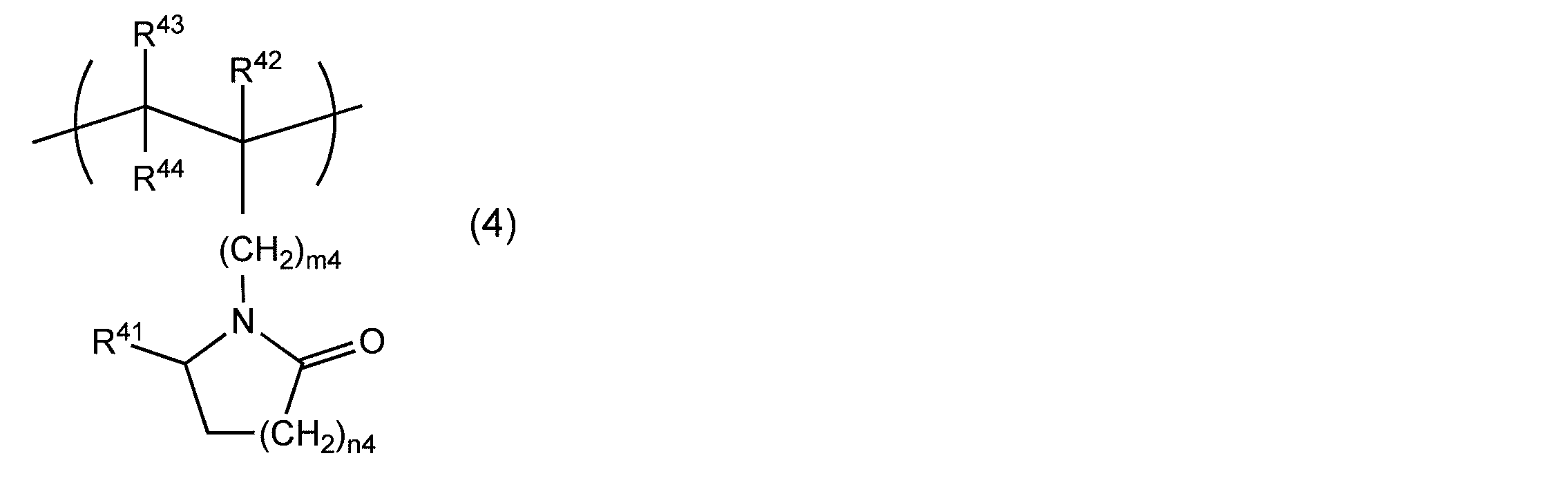
前記R42~R44としては水素原子であることが好ましい。
前記m4としては、0~2の整数であることが好ましく、より好ましくは0~1の整数であり、さらに好ましくは0である。
前記n4としては、1または2であることが好ましく、より好ましくは1である。
前記分岐鎖状アルキル基の炭素数としては、炭素数3~20が好ましく、炭素数3~10がより好ましく、炭素数3~5がさらに好ましい。分岐鎖状アルキル基としては、イソプロピル基、イソブチル基、sec-ブチル基、tert-ブチル基、2-エチルヘキシル基、ネオペンチル基、イソオクチル基等が挙げられる。
前記多環構造のアルキル基の炭素数としては、5~20が好ましく、7~18がより好ましく、9~15がさらに好ましい。多環構造のアルキル基としては、ボルニル基、イソボルニル基、1-アダマンチル基、2-アダマンチル基、2-メチル-2-アダマンチル基、2-エチル-2-アダマンチル基、ノルボルニル基、ジシクロペンタニル基、ジシクロペンテニル基等が挙げられる。

前記R51で表される前記直鎖状アルキル基の炭素数としては、1~20が好ましく、1~10がより好ましく、1~5がさらに好ましい。
前記R51で表される分岐鎖状アルキル基の炭素数としては、3~20が好ましく、3~10がより好ましく、3~5がさらに好ましい。
前記R51で表される単環構造のアルキル基の炭素数としては、4~18が好ましく、6~12がより好ましく、6~10がさらに好ましい。
前記R51で表される多環構造のアルキル基の炭素数としては、5~20が好ましく、7~18がより好ましく、9~15がさらに好ましい。
Z5は、Oが好ましい。
R52は、水素原子が好ましい。
前記Bブロックは、本発明の効果を損なわない程度に、前記構造単位(b-1)および構造単位(b-2)以外の他の構造単位を含有してもよい。Bブロックの他の構造単位を形成し得るビニルモノマーの具体例としては、Aブロックの構造単位を形成し得るモノマー、他の構造単位を形成し得るモノマーの具体例として例示したものと同一のものを挙げることができる。
ブロック共重合体の構造は、線状ブロック共重合体であることが好ましい。また、線状ブロック共重合体は、いずれの構造(配列)であっても良いが、線状ブロック共重合体の物性、または組成物の物性の観点から、AブロックをA、BブロックをBと表現したとき、(A-B)m型、(A-B)m-A型および(B-A)m-B型(mは1以上の整数、例えば1~3の整数)よりなる群から選択される少なくとも1種の構造を持つ共重合体であることが好ましい。これらの中でも、加工時の取扱い性、組成物の物性の観点から、A-B型ジブロック共重合体であることが好ましい。A-B型ジブロック共重合体を構成することで、Aブロックに構造単位(a-1)および構造単位(a-2)と、Bブロックに構造単位(b-1)とが局在化し、効率的に黄色アゾ系顔料(着色材)と、水性分散媒体と好適に作用することができると考えられる。前記ブロック共重合体は、AブロックおよびBブロック以外の他のブロックを有していてもよい。
Bブロックの含有率は、ブロック共重合体全体100質量%中において、1質量%以上が好ましく、より好ましくは5質量%以上、さらに好ましくは10質量%以上であり、50質量%以下が好ましく、より好ましくは40質量%以下、さらに好ましくは30質量%以下である。AブロックおよびBブロックの含有率を前記範囲内に調整することで、分散剤としての分散性能がより一層向上する。
ブロック共重合体の製造方法としては、ビニルモノマーの重合反応によって、Aブロックを先に製造し、AブロックにBブロックのモノマーを重合する方法;Bブロックを先に製造し、BブロックにAブロックのモノマーを重合する方法;AブロックとBブロックとを別々に製造した後、AブロックとBブロックとをカップリングする方法等が挙げられる。
リビング重合は、連鎖重合における開始反応、成長反応、停止反応、連鎖移動反応の4つの素反応のなかで、停止反応および連鎖移動反応のような副反応が実質的に伴わず、反応点(重合成長末端)が失活することなくビニルモノマーが反応しポリマー鎖が成長する。そのため、分子量分布が狭く、均一な組成の共重合体の製造が容易である。リビング重合には、リビングラジカル重合、リビングアニオン重合、リビングカチオン重合等がある。これらの中でも、重合の簡便性の観点から、リビングラジカル重合が好ましい。また、リビングラジカル重合は、従来のラジカル重合の簡便性と汎用性を保ちながら、分子量分布の精密制御、均一な組成のポリマーの製造が容易である点で好ましい。
(a)ビニルモノマーを、式(T1)で表される有機テルル化合物を用いて重合する方法。
(b)ビニルモノマーを、式(T1)で表される有機テルル化合物とアゾ系重合開始剤との混合物を用いて重合する方法。
(c)ビニルモノマーを、式(T1)で表される有機テルル化合物と式(T2)で表される有機ジテルリド化合物との混合物を用いて重合する方法。
(d)ビニルモノマーを、式(T1)で表される有機テルル化合物とアゾ系重合開始剤と式(T2)で表される有機ジテルリド化合物との混合物を用いて重合する方法。
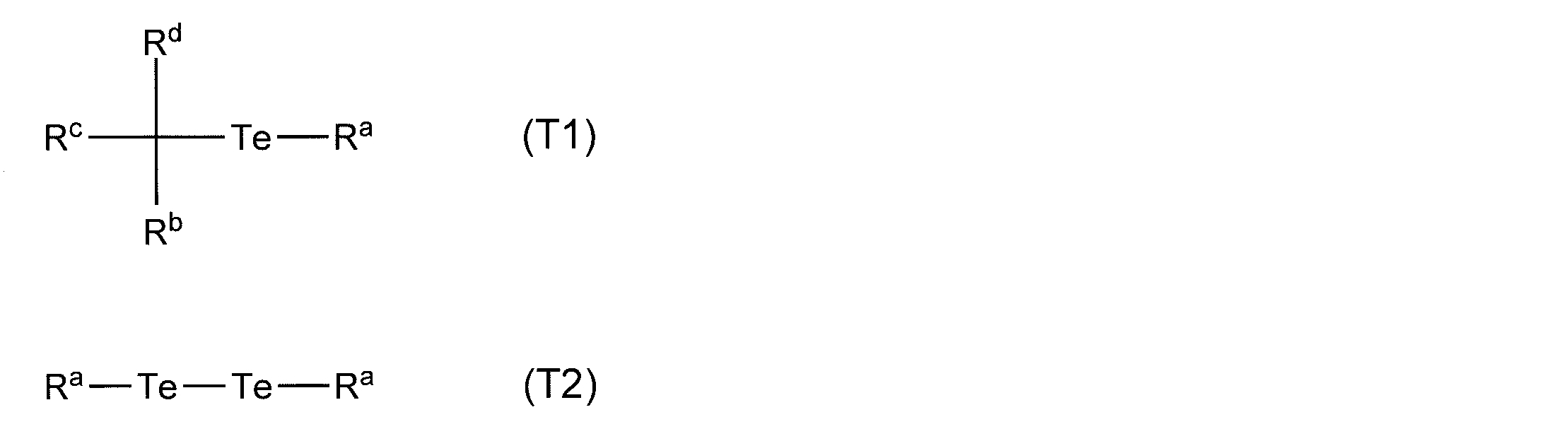
式(T2)において、Raは、炭素数1~8のアルキル基、アリール基または芳香族ヘテロ環基を示す。]
本発明の着色組成物は、黄色アゾ系顔料、分散剤、および、水性分散媒体を含有する。
本発明の着色組成物は、着色材の分散性能が高いことから、インクジェット用インク、印刷用インク、筆記用具用インク、塗料等に使用できる。
前記黄色アゾ系顔料とは、分子中にアゾ構造またはアゾメチン構造を少なくとも1つ有する黄色系の顔料の総称である。前記アゾ構造とは、2つの窒素原子が二重結合で結ばれた構造である。前記アゾメチン構造とは、窒素原子に炭化水素基が結合した構造である。前記黄色アゾ系顔料は、分子中にアゾ構造またはアゾメチン構造を有しており、前記分散剤が有する含窒素ヘテロ環基を有する構造単位(b-1)との親和性が高い。そのため、前記着色組成物は、黄色アゾ系顔料の分散安定性が優れたものとなる。前記黄色アゾ系顔料は、1種を単独で使用してもよいし、2種以上を併用してもよい。

前記Xで表される5~6員環の含窒素ヘテロ環を有する基としては、ピロリジル基、ピロリル基、ピペリジル基、ピリジル基、イミダゾール基、ピラゾール基、オキサゾール基、モルホリノ基、ピリミジル基、ピラジル基等が挙げられる。
前記R91およびR92で表される炭素数1~5の1価の炭化水素基としては、メチル基、エチル基、プロピル基、ブチル基、ペンチル基等が挙げられる。

前記Mは、Fe2+、Fe3+ 2/3、Co2+、Co3+ 2/3、Ni2+およびZn2+よりなる群から選ばれる二価または三価の金属イオンがより好ましい。



また、前記不溶性アゾ系顔料の中でも、アゾメチン金属錯体顔料およびアセト酢酸アリリド系顔料より群から選択される少なくとも1種がより好ましい。これらの黄色アゾ系顔料は、特定の構造を有することで、前記ブロック共重合体との親和性がより高くなり、分散安定性が一層高くなる。また、これらの中でもアゾメチン金属錯体顔料は、耐候性の高い黄色系顔料であることから特に好ましい。
その他黄色着色材としては、C.I.Disperse Yellow 9、23、33、42、49、54、58、60、64、66、71、76、79、83、86、90、93、99、114、116、119、122、126、149、160、163、165、180、183、186、198、200、211、224、226、227、231、237等の黄色分散染料等が挙げられる。
前記着色組成物は、分散剤として、前述したブロック共重合体の中和物を含有する。分散剤として前記ブロック共重合体の中和物を用いることで、分散安定性に優れた着色組成物が得られる。
前記アルカリ金属としては、リチウム、ナトリウム、カリウム等が挙げられる。
前記有機アミンとしては、モノエタノールアミン、ジエタノールアミン、トリエタノールアミン、N-メチルジエタノールアミン、モノプロパノールアミン、ジプロパノールアミン、トリプロパノールアミン、N-メチルエタノールアミン、2-(ジメチルアミノ)エタノール等のアルカノールアミン;モノメチルアミン、ジメチルアミン、トリメチルアミン、モノエチルアミン、ジエチルアミン、トリエチルアミン等のアルキルアミン等が挙げられる。
前記着色組成物は、分散媒体として水性分散媒体を含有する。
前記水性分散媒体としては、水または水性有機溶媒(水と混和可能な有機溶媒)が挙げられる。水としては、純水、イオン交換水(脱イオン水)等が挙げられる。水性有機溶媒としては、メタノール、エタノール、n-プロピルアルコール、イソプロピルアルコール、n-ブチルアルコール、sec-ブチルアルコール、tert-ブチルアルコール、1-メトキシ-2-プロパノール、1-ブトキシ-2-プロパノール等のアルコール類;エチレングリコール、プロピレングリコール、ブチレングリコール、トリエチレングリコール、ジエチレングリコール、ポリエチレングリコール、ポリプロピレングリコール、グリセリン等の多価アルコール類;テトラヒドロフラン、ジオキサン、エチレングリコールメチルエーテル、エチレングリコールエチルエーテル、ジエチレングリコールメチルエーテル、ジエチレングリコールエチルエーテル、トリエチレングリコール、モノメチルエーテル、モノエチルエーテル等のエーテル類;アセトン、メチルエチルケトン、イソブチルケトン等のケトン類;ジメチルホルムアルデヒド、ジメチルアセトアミド等のアミド類等が挙げられる。水性分散媒体は、単独で使用してもよいし、2種以上を併用してもよい。
また、着色組成物中の水性有機溶媒の含有量は、10質量%以下であることが好ましく、より好ましくは3質量%未満、さらに好ましくは1質量%未満、特に好ましくは0質量%である。
本発明の着色組成物には、本発明の効果を損なわない範囲であれば、上述の着色材、分散剤、および水性分散媒体以外に、他の配合剤を配合することができる。他の配合剤としては、界面活性剤、消泡剤、防カビ剤、防腐剤、防錆剤、キレート剤、水溶性紫外線吸収剤、水溶性高分子化合物(前記分散剤を除く。)、水分散性樹脂(前記分散剤を除く。)、酸化防止剤等が挙げられる。
アニオン界面活性剤としては、アルキルスルホカルボン酸塩、α-オレフィンスルホン酸塩、ポリオキシエチレンアルキルエーテル酢酸塩、ポリオキシエチレンアルキルエーテル硫酸塩、ポリオキシエチレンジノニルフェニルエーテル硫酸塩、ポリオキシエチレンラウリルエーテル硫酸塩、N-アシルアミノ酸またはその塩、N-アシルメチルタウリン塩、アルキル硫酸塩ポリオキシアルキルエーテル硫酸塩、アルキル硫酸塩ポリオキシエチレンアルキルエーテルリン酸塩、ロジン酸石鹸、ヒマシ油硫酸エステル塩、ラウリルアルコール硫酸エステル塩、アルキルフェノール型リン酸エステル、アルキル型リン酸エステル、アルキルアリールスルホン酸塩、ジエチルスルホコハク酸塩、ジエチルヘキシルスルホコハク酸塩、ジオクチルスルホコハク酸塩等が挙げられる。これらの中では、ポリオキシエチレンジノニルフェニルエーテル硫酸塩、ポリオキシエチレンラウリルエーテル硫酸塩、ジオクチルスルホコハク酸塩が好ましい。
両性界面活性剤としては、ラウリルジメチルアミノ酢酸ベタイン、2-アルキル-N-カルボキシメチル-N-ヒドロキシエチルイミダゾリニウムベタイン、ヤシ油脂肪酸アミドプロピルジメチルアミノ酢酸ベタイン、ポリオクチルポリアミノエチルグリシン、イミダゾリン誘導体等が挙げられる。
フッ素系界面活性剤としては、パーフルオロアルキルスルホン酸化合物、パーフルオロアルキルカルボン酸系化合物、パーフルオロアルキルリン酸エステル化合物、パーフルオロアルキルエチレンオキサイド付加物、パーフルオロアルキルエーテル基を側鎖に有するポリオキシアルキレンエーテルポリマー化合物等が挙げられる。
前記黄色アゾ系顔料、分散剤、および、水性分散媒体を含有する着色組成物の製造方法としては、前記ブロック共重合体の中和物を調製する工程、および、前記ブロック共重合体の中和物、前記黄色アゾ系顔料、および、前記水性分散媒体を混合する工程を有する製造方法(態様1);前記黄色アゾ系顔料、前記ブロック共重合体、中和剤、および、前記水性分散媒体を混合する工程を有する製造方法(態様2)が挙げられる。
前記製造方法の態様1の方法2または製造方法の態様2で使用する前記中和剤は、前記ブロック共重合体の構造単位(a-2)が有する酸性基を中和できる化合物が使用できる。前記中和剤の配合量は、前記ブロック共重合体の構造単位(a-2)が有する酸性基の中和度が50モル%超となるように調整される。
前記アルカリ金属を含有する化合物としては、水酸化リチウム、水酸化ナトリウム、水酸化カリウム等のアルカリ金属の水酸化物;炭酸リチウム、炭酸ナトリウム、炭酸水素ナトリウム、炭酸カリウム等のアルカリ金属の炭酸塩;ケイ酸ナトリウム、酢酸カリウム等の有機酸のアルカリ金属塩等が挙げられる。
前記有機アミンとしては、モノエタノールアミン、ジエタノールアミン、トリエタノールアミン、N-メチルジエタノールアミン、モノプロパノールアミン、ジプロパノールアミン、トリプロパノールアミン、N-メチルエタノールアミン、2-(ジメチルアミノ)エタノール等のアルカノールアミン;モノメチルアミン、ジメチルアミン、トリメチルアミン、モノエチルアミン、ジエチルアミン、トリエチルアミン等のアルキルアミン等が挙げられる。
なお、黄色アゾ系顔料、ブロック共重合体、中和剤、および、水性分散媒体は、一括で混合してもよいし、別々に混合してもよい。例えば、ブロック共重合体、中和剤および水性分散媒体を混合した後、この混合物と黄色アゾ系顔料を混合してもよい。また、ブロック共重合体と一部の中和剤および水性分散媒体を混合した後、この混合物と残りの中和剤および黄色アゾ系顔料を混合してもよい。
本発明の着色体は、前記着色組成物により着色された物質を意味する。前記着色体の材質は、前記着色組成物により着色される物質であれば特に制限されない。前記着色体としては、後述するインクジェット記録方法により着色された着色体(被記録材)が挙げられる。
本発明のインクジェット記録方法は、前記着色組成物(以下「インクジェットインク」または「インク」と称する場合がある。)の液滴を記録信号に応じて吐出させて、被記録材に付着させることにより記録を行う方法である。記録の際に使用するインクノズル等については特に制限はなく、目的に応じて適宜選択することができる。
本発明のインクジェットプリンタは、前記着色組成物を収容する容器が装填されたインクジェットプリンタである。インクジェットプリンタは、インク(着色組成物)を吐出して画像を記録する記録ヘッドと、インクを収容するための容器とを備え、前記容器には、前記記録ヘッドにインクを供給する供給部が備えらえている。また、インクジェットプリンタは、制御装置を備えており、この制御装置から前記記録ヘッドに記録信号を送信することで、記録動作が行われる。前記インクジェット記録方法で被記録材に記録を行うときは、例えば、前記着色組成物を収容する容器が装填されたインクジェットプリンタを使用する。前記着色組成物を収容する容器は、インクジェットプリンタの所定の位置に装填される。
VP:N-ビニル-2-ピロリドン
CHA:アクリル酸シクロヘキシル
BA:アクリル酸n-ブチル
BzA:アクリル酸ベンジル
M11EGA:ポリエチレングリコール(重合度=11)メチルエーテルアクリレート(Green社製、KOMERATE-A040TT)
M3EGA:メトキシトリエチレングリコールアクリレート
AA:アクリル酸
ATBSNa:アクリルアミドtert-ブチルスルホン酸ナトリウム
MA:アクリル酸メチル
BTEE:エチル=2-メチル-2-n-ブチルテラニル-プロピオネート
AIBN:2,2’-アゾビス(イソブチロニトリル)
DIW:超純水
MeOH:メタノール
MP:1-メトキシ-2-プロパノール
KOH:水酸化カリウム
DMAE:ジメチルアミノメタノール
(重合率)
核磁気共鳴(NMR)測定装置(ブルカー・バイオスピン社製、型式:AVANCE500(周波数500MHz))を用いて、1H-NMRを測定(溶媒:CDCl3、内部標準:TMS)した。得られたNMRスペクトルについて、モノマー由来のピークとポリマー由来のピークの積分比を求め、モノマーの重合率を算出した。
高速液体クロマトグラフ(東ソー製、型式:HLC8320)を用いて、ゲル浸透クロマトグラフィー(GPC)により求めた。カラムはSHODEX KF-603(Φ6.0mm×150mm)(SHODEX社製)を1本、移動相に臭化リチウム(30mmol/L)-酢酸(30mmol/L)-N-メチルピロリドン、検出器に示差屈折率検出器を使用した。測定条件は、カラム温度を40℃、試料濃度を100mg/mL、試料注入量を10μL、流速を0.2mL/minとした。標準物質としてポリスチレン(分子量705,000、37,900、19,920、10,200、4,910、2,630、1,150)を使用して検量線(校正曲線)を作成し、Mw、Mnを測定した。これらの測定値から分子量分布(Mw/Mn)を算出した。
酸価は、固形分1gあたりの酸性成分を中和するのに要するKOHの質量を表したものである。測定試料をテトラヒドロフランに溶解し、得られた溶液に1.0w/v%フェノールフタレインエタノール(90)溶液を指示薬として数滴加え、KOH(0.1mol/L)-2-プロパノール溶液で中和滴定した。少し赤みが残るところを滴定終点として、次式により酸価を算出した。
A=56.11×Vs×0.1×f/w
A:酸価(mgKOH/g)
Vs:滴定に要したKOH(0.1mol/L)-2-プロパノール溶液の使用量(mL)
f:KOH(0.1mol/L)-2-プロパノール溶液の力価
w:測定サンプル質量(g)(固形分換算)
E型粘度計(商品名:RE-80L、東機産業社製)を用い、コーンローター(0.8°×R24)を使用して、25℃下、ローター回転数12rpmで粘度(mPa・s)を測定した。着色組成物は、調製直後および40℃1週間保管後、粘度を測定した。
なお、着色組成物No.3(40℃1週間保管後)および20(調製直後)についてはローター回転数を6rpmに変更し、着色組成物No.3(調製直後)、6(調製直後、40℃1週間保管後)および13(調製直後)についてはローター回転数を3rpmに変更し、着色組成物14(調製直後)についてはローター回転数を1.5rpmに変更し、着色組成物No.12(40℃1週間保管後)についてはローター回転数を0.6rpmに変更し、着色組成物No.21(調製直後)についてはローター回転数を0.3rpmに変更した。
濃厚系粒径アナライザー(商品名:FPAR-1000、大塚電子製)を用い、25℃下で粒径を測定した。サンプルは必要に応じ、DIWで希釈を行った。測定は、調製した直後の着色組成物、および、調整後40℃で1週間保管した着色組成物について行った。
(共重合体No.1)
アルゴンガス導入管、撹拌機を備えたフラスコにVP 3.9g、CHA 0.6g、AIBN 0.01g、DIW 4.5gを仕込み、窒素置換後、BTEE 0.45gを加え、55℃で7時間反応させBブロックを重合した。重合率は95.5%であった。
共重合体No.1の製造法と同様にして、共重合体No.2~12を作製した。表1に、使用したモノマー、有機テルル化合物、アゾ系重合開始剤、溶媒、反応条件、重合率を示した。
また、表2、3に各共重合体の組成、Mw、Mw/Mn、酸価を示した。なお、共重合体中の各構造単位の含有率は、重合反応に用いたモノマーの仕込み比率および重合率から算出した。
(共重合体の中和物No.13、14)
共重合体No.1の製造法と同様にして、共重合体の中和物No.13、14を作製した。表1に、使用したモノマー、有機テルル化合物、アゾ系重合開始剤、溶媒、反応条件、重合率を示した。なお、共重合体の中和前の酸価が80mgKOH/gになるようにモノマーを配合した。
また、表3に各共重合体の組成、Mw、Mw/Mnを示した。共重合体中の各構造単位の含有率は、重合反応に用いたモノマーの仕込み比率および重合率から算出した値であり、アクリルアミドtert-ブチルスルホン酸ナトリウムに由来する構造単位を、アクリルアミドtert-ブチルスルホン酸に由来する構造単位に換算して算出した。なお、表3中の共重合体の中和物No.13、14のMwおよびMw/Mnは、共重合体の中和物の測定値である。
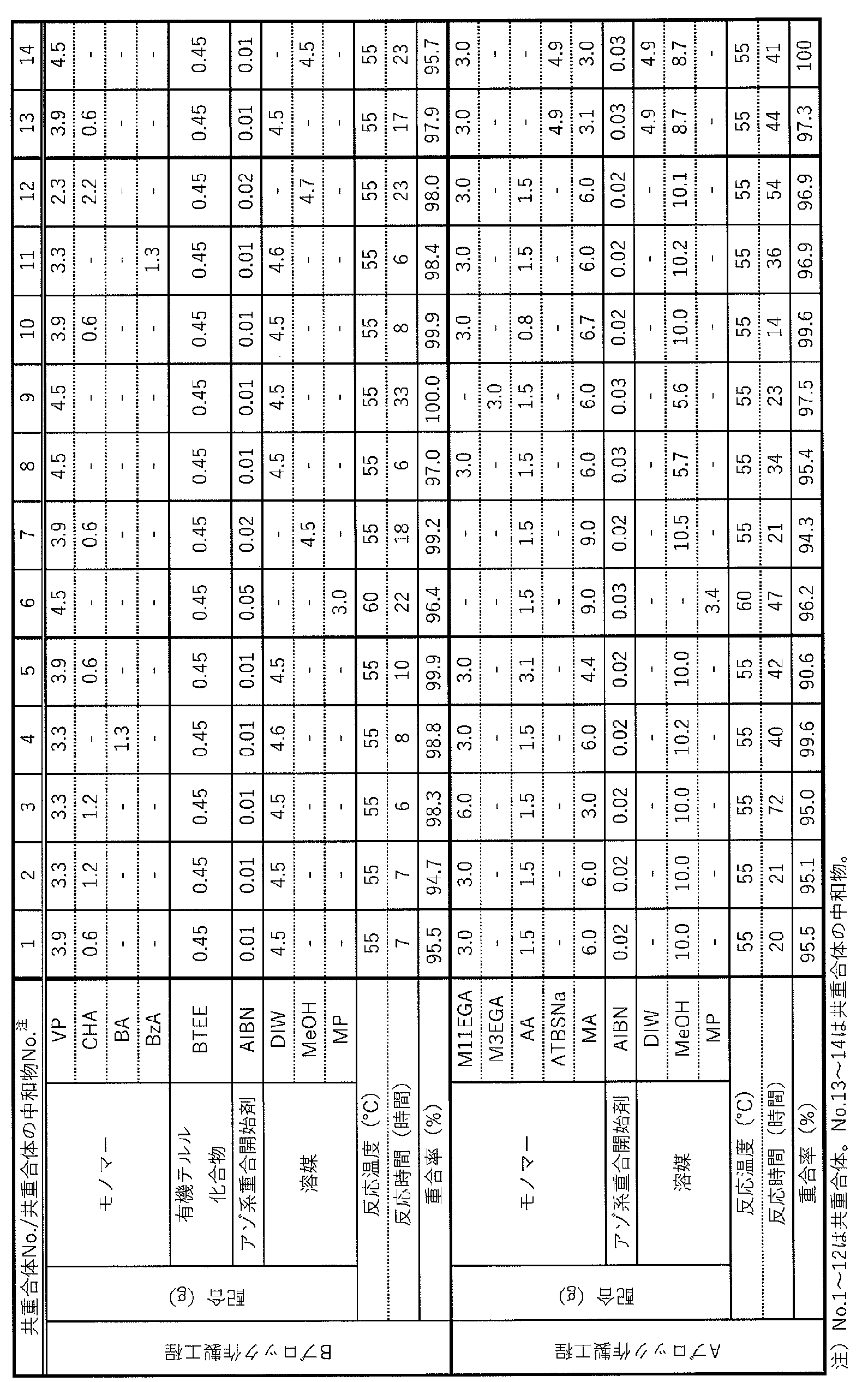

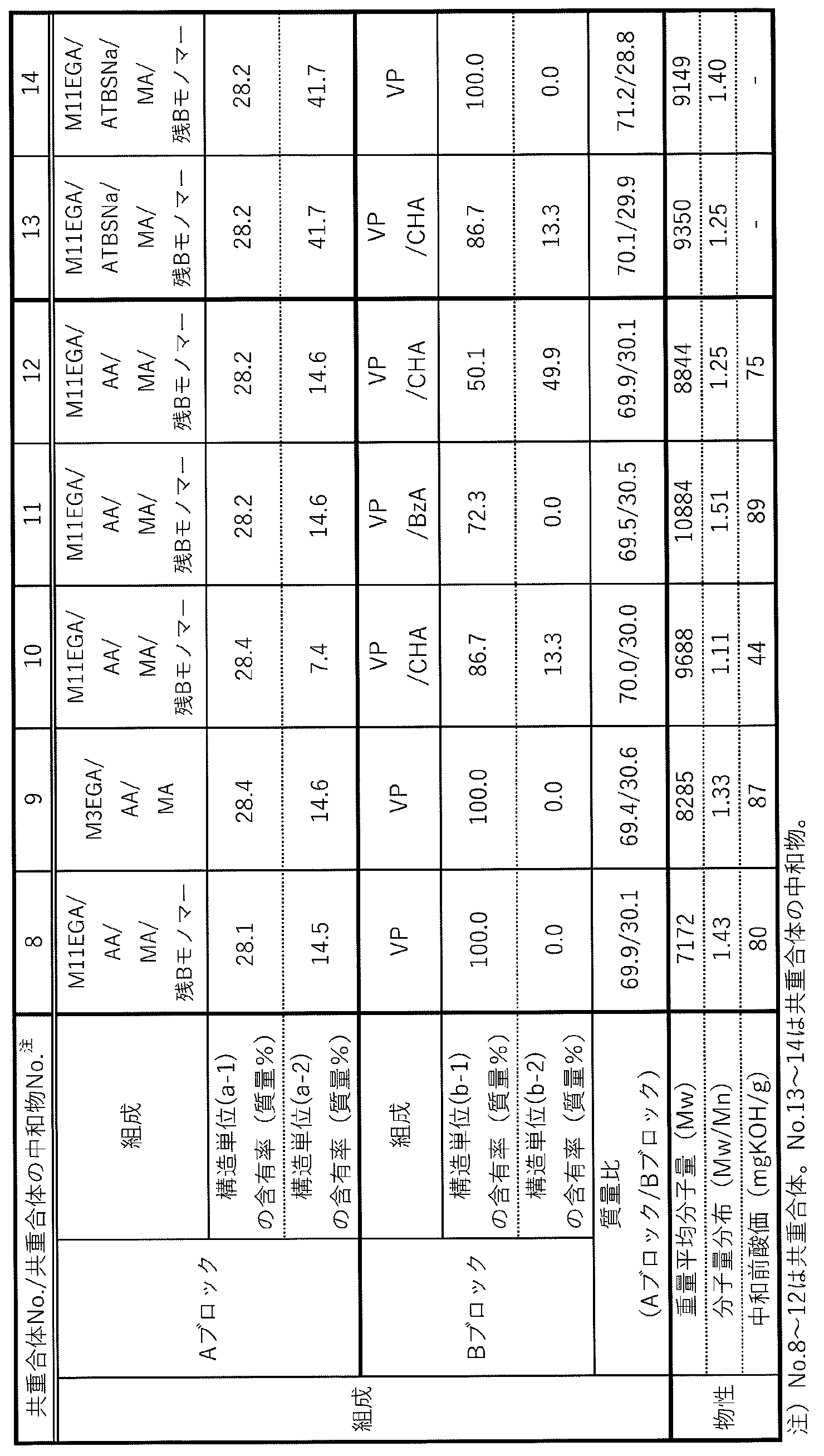
(共重合体の中和物No.5)
撹拌機を備えたフラスコに、共重合体No.5 14.6g、KOH 0.5g、DIW 28.3gの混合液を加え、室温(25℃)で攪拌した。中和して得られた共重合体No.5は、酸価が127mgKOH/gであった。
共重合体の中和物No.5と同様にして、共重合体No.6、7、11、12について酸性基の一部を中和して、共重合体の中和物No.6、7、11、12を作製した。表4に、使用した共重合体、溶媒、中和剤を示した。また、表4に酸価を示した。

分散剤として、上記で得た共重合体No.1~4、8~10および共重合体の中和物No.5~7、11~14を用いて着色組成物を調製した。具体的には、表5、6に示した配合となるように黄色アゾ系顔料であるPY-150(Pigment Yellow 150、平均粒子径119nm、ランクセス製、Bayscript Yellow 4GF)、PY-155(Pigment Yellow 155、HEUBACH製、INK JET YELLOW 4GC、平均粒子径90nm)またはPY-180(Pigment Yellow 180、HEUBACH製、INK JET YELLOW HG01、平均粒子径72nm)、共重合体または共重合体の中和物、中和剤、脱イオン水を混合し、0.3mmジルコニアビーズを加え、ビーズミル(商品名:DISPERMAT CA、VMA-GETZMANN GmbH社製)にて5時間撹拌し十分に分散させた。撹拌終了後、ビーズをろ別して、着色組成物No.1~25を調製した。得られた分散組成物について、粘度測定、粒径測定を行い、結果を表5、6に示した。
なお、表6中、「gel」は着色組成物がゲル化して粘度を測定できなかったことを示し、「分散不可」は黄色アゾ系顔料を十分に分散できなかったことを示し、「>2000」はローター回転数を変更しても粘度が2,000mPa・sを超えたことを示す。


これらの着色組成物No.1~11は、黄色アゾ系体顔料の分散性が高く、かつ、分散安定性も優れていた。
着色組成物No.15、16、21、23~25は、分散剤に使用される共重合体No.8,9、11、14が、Bブロックに脂肪族炭化水素基を有する構造単位(b-2)を有さない場合である。
着色組成物No.20は、分散剤に使用される共重合体No.10の中和前の酸価が50mgKOH/g未満の場合である。
着色組成物No.22は、分散剤に使用される共重合体No.12が、Bブロック中の含窒素ヘテロ環基を有する構造単位(b-1)の含有率が51質量%未満の場合である。
これらの着色組成物No.12~16、18~21は、分散安定性が劣っていた。また、着色組成物No.17、22~25は、PY-150、PY-155またはPY-180を分散できなかった。
着色組成物No.1、9、10は着色材の種類が異なるのみである。前記着色組成物において分散前後での顔料の粒子径の差を比較すると、着色組成物No.1は分散前後で顔料の粒子径が同等である。このことから本発明で用いる分散剤はアゾメチン系金属錯体顔料に特に好適に作用することが分かる。
黄色アゾ系金属錯体顔料、分散剤、および、水性分散媒体を含有する着色組成物であって、
前記分散剤が、式(1)で表される基を有する構造単位(a-1)および酸性基を有する構造単位(a-2)を含有するAブロックと、含窒素ヘテロ環基を有する構造単位(b-1)および脂肪族炭化水素基を有する構造単位(b-2)を含有するBブロックとを有するブロック共重合体の中和物であり、
前記ブロック共重合体の構造単位(b-1)の含有率が、前記Bブロック100質量%中において51質量%~99質量%であり、
前記ブロック共重合体の酸価が、50mgKOH/g以上であり、
前記分散剤は、ブロック共重合体の構造単位(a-2)が有する酸性基の50モル%超が中和されている、ことを特徴とする着色組成物。
*-(R12O)m1-R11 (1)
[式(1)において、R11は水素原子または炭素数が1~3のアルキル基を表す。R12は炭素数が1~3のアルキレン基を表す。m1は2~30の整数を示す。なお、複数存在するR12は、それぞれ同一であっても異なっていてもよい。*は結合手を表す。]
前記分散剤は、前記ブロック共重合体の構造単位(a-2)が有する酸性基が、アルカリ金属、有機アミンおよびアンモニアよりなる群から選択される少なくとも1種により中和されている、態様1に記載の着色組成物。
前記構造単位(a-1)の含有率が、前記Aブロック100質量%中において10質量%~70質量%である、態様1または2に記載の着色組成物。
前記ブロック共重合体中のAブロックとBブロックとの質量比(Aブロック/Bブロック)が、50/50~99/1である、態様1~3のいずれか一項に記載の着色組成物。
前記構造単位(a-1)が、式(2)で表される構造単位である、態様1~4のいずれか一項に記載の着色組成物。
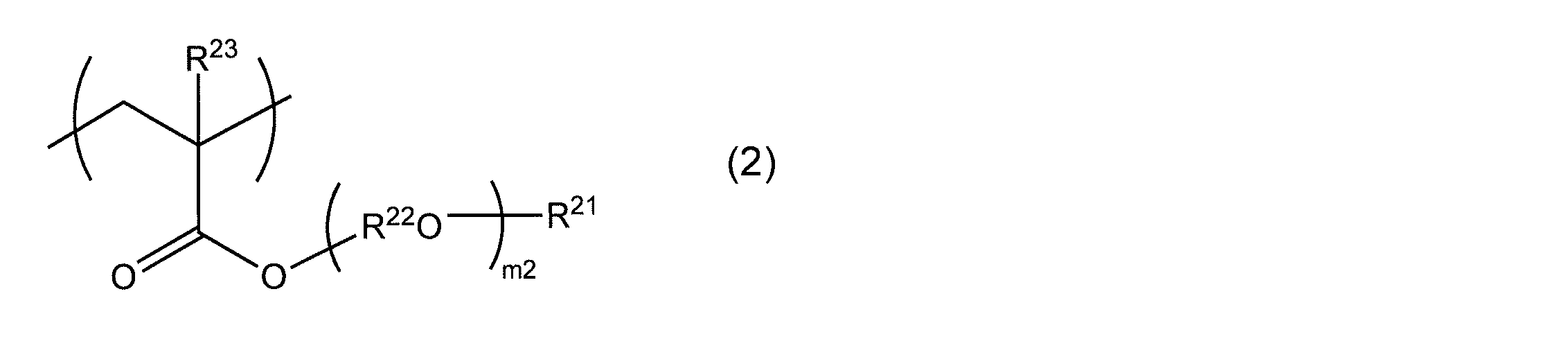
前記構造単位(a-2)が、式(3)で表される構造単位である、態様1~5のいずれか一項に記載の着色組成物。

前記構造単位(b-1)が、式(4)で表される構造単位である、態様1~6のいずれか一項に記載の着色組成物。

前記構造単位(b-2)が、式(5)で表される構造単位である、態様1~7のいずれか一項に記載の着色組成物。
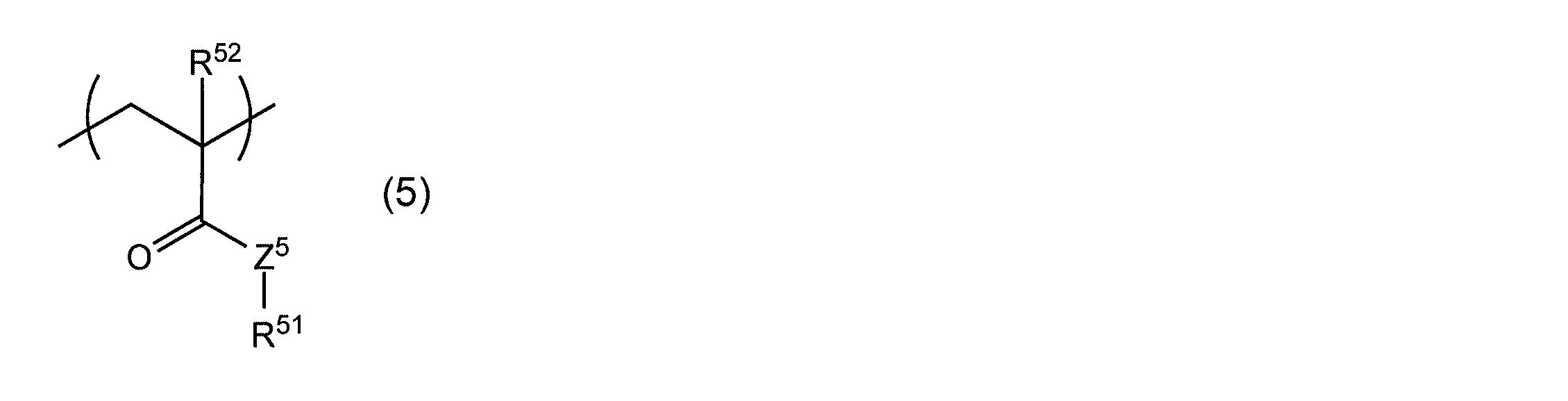
前記ブロック共重合体の重量平均分子量(Mw)が、5,000~40,000である、態様1~8のいずれか一項に記載の着色組成物。
前記黄色アゾ系顔料が、アゾメチン金属錯体顔料およびアセト酢酸アリリド系顔料より群から選択される少なくとも1種である、態様1~10のいずれか一項に記載の着色組成物。
前記黄色アゾ系顔料が、C.I.Pigment Yellow 117、C.I.Pigment Yellow 129、C.I.Pigment Yellow 150、C.I.Pigment Yellow 153、C.I.Pigment Yellow 155およびC.I.Pigment Yellow 180よりなる群から選択される少なくとも1種である、態様1~11のいずれか一項に記載の着色組成物。
前記着色組成物中の水性有機溶媒の含有量が10質量%以下である、態様1~12のいずれか一項に記載の着色組成物。
インクジェットインク用である、態様1~13のいずれか一項に記載の着色組成物。
黄色アゾ系顔料、ブロック共重合体、中和剤、および、水性分散媒体を混合する工程を有し、
前記ブロック共重合体が、式(1)で表される基を有する構造単位(a-1)および酸性基を有する構造単位(a-2)を含有するAブロックと、含窒素ヘテロ環基を有する構造単位(b-1)および脂肪族炭化水素基を有する構造単位(b-2)を含有するBブロックを含有し、前記構造単位(b-1)の含有率が前記Bブロック100質量%中において51質量%~99質量%であり、前記ブロック共重合体の酸価が50mgKOH/g以上であり、
前記中和剤の配合量が、前記ブロック共重合体の構造単位(a-2)が有する酸性基の中和度が50モル%超となるように調整されることを特徴とする、着色組成物の製造方法。
*-(R12O)m1-R11 (1)
[式(1)において、R11は水素原子または炭素数が1~3のアルキル基を表す。R12は炭素数が1~3のアルキレン基を表す。m1は2~30の整数を示す。なお、複数存在するR12は、それぞれ同一であっても異なっていてもよい。*は結合手を表す。]
Claims (15)
- 黄色アゾ系顔料、分散剤、および、水性分散媒体を含有する着色組成物であって、
前記分散剤が、式(1)で表される基を有する構造単位(a-1)および酸性基を有する構造単位(a-2)を含有するAブロックと、含窒素ヘテロ環基を有する構造単位(b-1)および脂肪族炭化水素基を有する構造単位(b-2)を含有するBブロックとを有するブロック共重合体の中和物であり、
前記ブロック共重合体の構造単位(b-1)の含有率が、前記Bブロック100質量%中において51質量%~99質量%であり、
前記ブロック共重合体の酸価が、50mgKOH/g以上であり、
前記分散剤は、ブロック共重合体の構造単位(a-2)が有する酸性基の50モル%超が中和されている、ことを特徴とする着色組成物。
*-(R12O)m1-R11 (1)
[式(1)において、R11は水素原子または炭素数が1~3のアルキル基を表す。R12は炭素数が1~3のアルキレン基を表す。m1は2~30の整数を示す。なお、複数存在するR12は、それぞれ同一であっても異なっていてもよい。*は結合手を表す。] - 前記分散剤は、前記ブロック共重合体の構造単位(a-2)が有する酸性基が、アルカリ金属、有機アミンおよびアンモニアよりなる群から選択される少なくとも1種により中和されている、請求項1に記載の着色組成物。
- 前記構造単位(a-1)の含有率が、前記Aブロック100質量%中において10質量%~70質量%である、請求項1または2に記載の着色組成物。
- 前記ブロック共重合体中のAブロックとBブロックとの質量比(Aブロック/Bブロック)が、50/50~99/1である、請求項1または2に記載の着色組成物。
- 前記構造単位(a-1)が、式(2)で表される構造単位である、請求項1または2に記載の着色組成物。

- 前記構造単位(a-2)が、式(3)で表される構造単位である、請求項1または2に記載の着色組成物。

- 前記構造単位(b-1)が、式(4)で表される構造単位である、請求項1または2に記載の着色組成物。
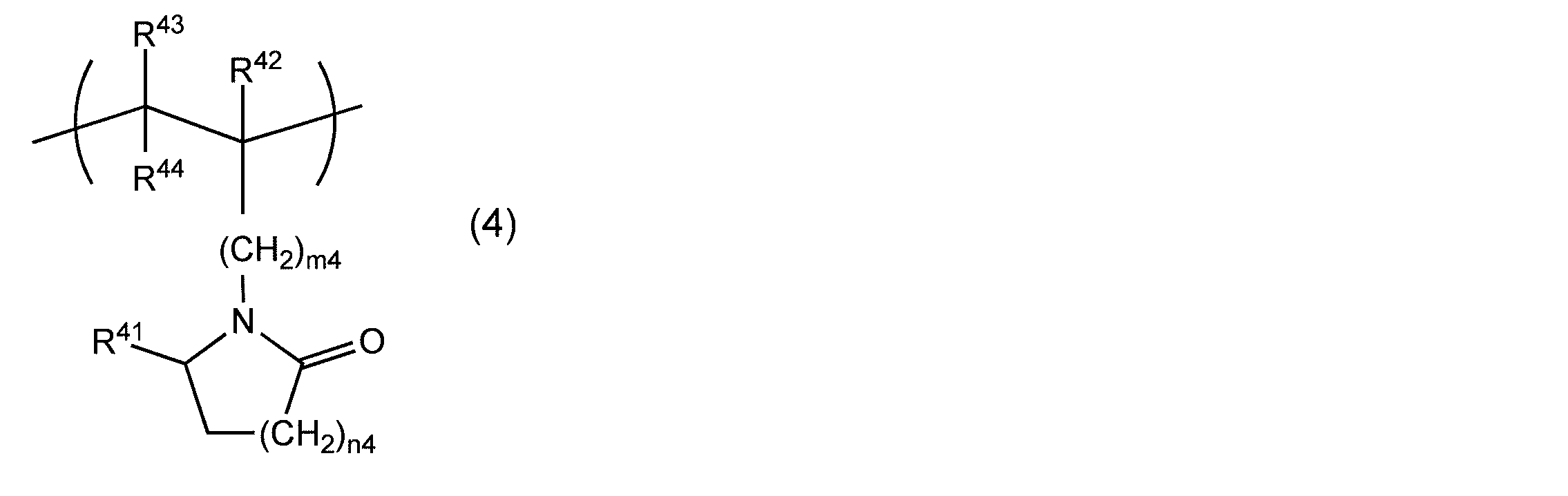
- 前記構造単位(b-2)が、式(5)で表される構造単位である、請求項1または2に記載の着色組成物。

- 前記ブロック共重合体の重量平均分子量(Mw)が、5,000~40,000である、請求項1または2に記載の着色組成物。
- 前記ブロック共重合体が、リビング重合により得られたものであり、その分子量分布(Mw/Mn)が2.5以下である、請求項1または2に記載の着色組成物。
- 前記黄色アゾ系顔料が、アゾメチン金属錯体顔料およびアセト酢酸アリリド系顔料より群から選択される少なくとも1種である、請求項1または2に記載の着色組成物。
- 前記黄色アゾ系顔料が、C.I.Pigment Yellow 117、C.I.Pigment Yellow 129、C.I.Pigment Yellow 150、C.I.Pigment Yellow 153、C.I.Pigment Yellow 155およびC.I.Pigment Yellow 180よりなる群から選択される少なくとも1種である、請求項1または2に記載の着色組成物。
- 前記着色組成物中の水性有機溶媒の含有量が10質量%以下である、請求項1または2に記載の着色組成物。
- インクジェットインク用である、請求項1または2に記載の着色組成物。
- 黄色アゾ系顔料、ブロック共重合体、中和剤、および、水性分散媒体を混合する工程を有し、
前記ブロック共重合体が、式(1)で表される基を有する構造単位(a-1)および酸性基を有する構造単位(a-2)を含有するAブロックと、含窒素ヘテロ環基を有する構造単位(b-1)および脂肪族炭化水素基を有する構造単位(b-2)を含有するBブロックとを有し、前記構造単位(b-1)の含有率が前記Bブロック100質量%中において51質量%~99質量%であり、前記ブロック共重合体の酸価が50mgKOH/g以上であり、
前記中和剤の配合量が、前記ブロック共重合体の構造単位(a-2)が有する酸性基の中和度が50モル%超となるように調整されることを特徴とする、着色組成物の製造方法。
*-(R12O)m1-R11 (1)
[式(1)において、R11は水素原子または炭素数が1~3のアルキル基を表す。R12は炭素数が1~3のアルキレン基を表す。m1は2~30の整数を示す。なお、複数存在するR12は、それぞれ同一であっても異なっていてもよい。*は結合手を表す。]
Priority Applications (3)
| Application Number | Priority Date | Filing Date | Title |
|---|---|---|---|
| EP24831422.1A EP4722292A1 (en) | 2023-06-30 | 2024-05-09 | Yellow-azo-pigment-containing coloring composition and method for producing same |
| CN202480031373.7A CN121175372A (zh) | 2023-06-30 | 2024-05-09 | 含有黄色偶氮系颜料的着色组合物及其制备方法 |
| JP2025529487A JPWO2025004549A1 (ja) | 2023-06-30 | 2024-05-09 |
Applications Claiming Priority (2)
| Application Number | Priority Date | Filing Date | Title |
|---|---|---|---|
| JP2023108115 | 2023-06-30 | ||
| JP2023-108115 | 2023-06-30 |
Publications (1)
| Publication Number | Publication Date |
|---|---|
| WO2025004549A1 true WO2025004549A1 (ja) | 2025-01-02 |
Family
ID=93938094
Family Applications (1)
| Application Number | Title | Priority Date | Filing Date |
|---|---|---|---|
| PCT/JP2024/017279 Ceased WO2025004549A1 (ja) | 2023-06-30 | 2024-05-09 | 黄色アゾ系顔料含有着色組成物、および、その製造方法 |
Country Status (4)
| Country | Link |
|---|---|
| EP (1) | EP4722292A1 (ja) |
| JP (1) | JPWO2025004549A1 (ja) |
| CN (1) | CN121175372A (ja) |
| WO (1) | WO2025004549A1 (ja) |
Citations (13)
| Publication number | Priority date | Publication date | Assignee | Title |
|---|---|---|---|---|
| WO2004014962A1 (ja) | 2002-08-08 | 2004-02-19 | Otsuka Chemical Co., Ltd. | リビングラジカルポリマーの製造方法及びポリマー |
| WO2004014848A1 (ja) | 2002-08-06 | 2004-02-19 | Otsuka Chemical Co., Ltd. | 有機テルル化合物、その製造方法、リビングラジカル重合開始剤、それを用いるポリマーの製造方法及びポリマー |
| WO2004072126A1 (ja) | 2003-02-17 | 2004-08-26 | Otsuka Chemical Co., Ltd. | リビングラジカルポリマーの製造方法及びポリマー |
| WO2004096870A1 (ja) | 2003-04-25 | 2004-11-11 | Otsuka Chemical Co., Ltd. | リビングラジカルポリマーの製造方法及びポリマー |
| JP2005177756A (ja) * | 2003-12-23 | 2005-07-07 | Samsung Electronics Co Ltd | 水系分散剤およびこれを含むインク組成物 |
| JP2010006981A (ja) * | 2008-06-27 | 2010-01-14 | Mitsubishi Chemicals Corp | 印刷用水性顔料分散液、インク組成物及びインクジェット記録方法 |
| JP2011241259A (ja) * | 2010-05-14 | 2011-12-01 | Dainichiseika Color & Chem Mfg Co Ltd | A−bブロックコポリマー、その製造方法及び顔料分散体 |
| JP2016126154A (ja) * | 2014-12-26 | 2016-07-11 | 花王株式会社 | カラーフィルター用顔料分散体 |
| WO2017135011A1 (ja) * | 2016-02-03 | 2017-08-10 | 大塚化学株式会社 | Aba型ブロック共重合体、分散剤及び顔料分散組成物 |
| JP2018109095A (ja) | 2016-12-28 | 2018-07-12 | 花王株式会社 | インクジェット記録用水性顔料分散液 |
| JP2019218547A (ja) * | 2017-11-29 | 2019-12-26 | 大塚化学株式会社 | ブロック共重合体、分散剤、着色組成物およびカラーフィルタ |
| WO2020116144A1 (ja) | 2018-12-05 | 2020-06-11 | 大塚化学株式会社 | 有機テルル化合物の製造方法およびビニル重合体の製造方法 |
| JP2021004308A (ja) * | 2019-06-26 | 2021-01-14 | 大塚化学株式会社 | ブロック共重合体、分散剤、着色組成物、および、カラーフィルタ |
-
2024
- 2024-05-09 CN CN202480031373.7A patent/CN121175372A/zh active Pending
- 2024-05-09 JP JP2025529487A patent/JPWO2025004549A1/ja active Pending
- 2024-05-09 EP EP24831422.1A patent/EP4722292A1/en active Pending
- 2024-05-09 WO PCT/JP2024/017279 patent/WO2025004549A1/ja not_active Ceased
Patent Citations (13)
| Publication number | Priority date | Publication date | Assignee | Title |
|---|---|---|---|---|
| WO2004014848A1 (ja) | 2002-08-06 | 2004-02-19 | Otsuka Chemical Co., Ltd. | 有機テルル化合物、その製造方法、リビングラジカル重合開始剤、それを用いるポリマーの製造方法及びポリマー |
| WO2004014962A1 (ja) | 2002-08-08 | 2004-02-19 | Otsuka Chemical Co., Ltd. | リビングラジカルポリマーの製造方法及びポリマー |
| WO2004072126A1 (ja) | 2003-02-17 | 2004-08-26 | Otsuka Chemical Co., Ltd. | リビングラジカルポリマーの製造方法及びポリマー |
| WO2004096870A1 (ja) | 2003-04-25 | 2004-11-11 | Otsuka Chemical Co., Ltd. | リビングラジカルポリマーの製造方法及びポリマー |
| JP2005177756A (ja) * | 2003-12-23 | 2005-07-07 | Samsung Electronics Co Ltd | 水系分散剤およびこれを含むインク組成物 |
| JP2010006981A (ja) * | 2008-06-27 | 2010-01-14 | Mitsubishi Chemicals Corp | 印刷用水性顔料分散液、インク組成物及びインクジェット記録方法 |
| JP2011241259A (ja) * | 2010-05-14 | 2011-12-01 | Dainichiseika Color & Chem Mfg Co Ltd | A−bブロックコポリマー、その製造方法及び顔料分散体 |
| JP2016126154A (ja) * | 2014-12-26 | 2016-07-11 | 花王株式会社 | カラーフィルター用顔料分散体 |
| WO2017135011A1 (ja) * | 2016-02-03 | 2017-08-10 | 大塚化学株式会社 | Aba型ブロック共重合体、分散剤及び顔料分散組成物 |
| JP2018109095A (ja) | 2016-12-28 | 2018-07-12 | 花王株式会社 | インクジェット記録用水性顔料分散液 |
| JP2019218547A (ja) * | 2017-11-29 | 2019-12-26 | 大塚化学株式会社 | ブロック共重合体、分散剤、着色組成物およびカラーフィルタ |
| WO2020116144A1 (ja) | 2018-12-05 | 2020-06-11 | 大塚化学株式会社 | 有機テルル化合物の製造方法およびビニル重合体の製造方法 |
| JP2021004308A (ja) * | 2019-06-26 | 2021-01-14 | 大塚化学株式会社 | ブロック共重合体、分散剤、着色組成物、および、カラーフィルタ |
Also Published As
| Publication number | Publication date |
|---|---|
| CN121175372A (zh) | 2025-12-19 |
| EP4722292A1 (en) | 2026-04-08 |
| JPWO2025004549A1 (ja) | 2025-01-02 |
Similar Documents
| Publication | Publication Date | Title |
|---|---|---|
| EP2423276B1 (en) | Aqueous ink composition, inkjet recording method, and inkjet printed article | |
| KR102042291B1 (ko) | 잉크젯용 수계 착색 분산액, 잉크 조성물, 잉크젯 기록 방법 및 착색체 | |
| CN101104759B (zh) | 非水系颜料油墨 | |
| EP2484730B1 (en) | Ink composition and image forming method | |
| JP2009084494A (ja) | 水系着色剤分散物、水系着色剤分散物の製造方法、及びインクジェット記録用水系インク | |
| JP6588891B2 (ja) | インク組成物、インクジェット記録方法及び着色体 | |
| JP7764381B2 (ja) | インクジェット用着色分散液の製造方法 | |
| WO2013114929A1 (ja) | 水性インク組成物及び画像形成方法 | |
| JP2001521977A (ja) | 優れた耐スミア堅牢性を有する印刷インク組成物 | |
| JP7518659B2 (ja) | ブロック共重合体を含有する重合生成物および重合生成物の製造方法 | |
| JP5762172B2 (ja) | インク組成物、画像形成方法及び印画物 | |
| JP6752173B2 (ja) | インク組成物 | |
| WO2025004549A1 (ja) | 黄色アゾ系顔料含有着色組成物、および、その製造方法 | |
| JP7672922B2 (ja) | イソインドリン系顔料含有水性着色組成物、および、着色体 | |
| JP7540427B2 (ja) | 着色剤分散体、インキ、インキセット、および印刷物 | |
| US12071554B2 (en) | Ink | |
| JP2024149397A (ja) | 水系分散剤および分散組成物 | |
| JP2006152241A (ja) | インクジェット記録用水系インク | |
| JP2024144189A (ja) | 水系分散剤および分散組成物 | |
| CN116490367B (zh) | 油墨 | |
| JP5587231B2 (ja) | インク組成物及び画像形成方法。 | |
| JP2015193744A (ja) | インク組成物の粘度低下の抑制方法 | |
| JP5714473B2 (ja) | インク組成物、画像形成方法及び印画物 | |
| JP2009084493A (ja) | 水系着色剤分散物、水系着色剤分散物の製造方法、及びインクジェット記録用水系インク | |
| WO2024247968A1 (ja) | 分散剤、分散体、インキ、インキセット、および印刷物 |
Legal Events
| Date | Code | Title | Description |
|---|---|---|---|
| 121 | Ep: the epo has been informed by wipo that ep was designated in this application |
Ref document number: 24831422 Country of ref document: EP Kind code of ref document: A1 |
|
| ENP | Entry into the national phase |
Ref document number: 2025529487 Country of ref document: JP Kind code of ref document: A |
|
| WWE | Wipo information: entry into national phase |
Ref document number: 2025529487 Country of ref document: JP |
|
| WWE | Wipo information: entry into national phase |
Ref document number: 2024831422 Country of ref document: EP |
|
| ENP | Entry into the national phase |
Ref document number: 2024831422 Country of ref document: EP Effective date: 20251230 |
|
| ENP | Entry into the national phase |
Ref document number: 2024831422 Country of ref document: EP Effective date: 20251230 |
|
| NENP | Non-entry into the national phase |
Ref country code: DE |
|
| ENP | Entry into the national phase |
Ref document number: 2024831422 Country of ref document: EP Effective date: 20251230 |
|
| ENP | Entry into the national phase |
Ref document number: 2024831422 Country of ref document: EP Effective date: 20251230 |
|
| WWP | Wipo information: published in national office |
Ref document number: 2024831422 Country of ref document: EP |