WO2025004215A1 - 導線束分離装置及び導線束分離方法 - Google Patents
導線束分離装置及び導線束分離方法 Download PDFInfo
- Publication number
- WO2025004215A1 WO2025004215A1 PCT/JP2023/023949 JP2023023949W WO2025004215A1 WO 2025004215 A1 WO2025004215 A1 WO 2025004215A1 JP 2023023949 W JP2023023949 W JP 2023023949W WO 2025004215 A1 WO2025004215 A1 WO 2025004215A1
- Authority
- WO
- WIPO (PCT)
- Prior art keywords
- press
- slot
- stator
- wire bundle
- actuator
- Prior art date
- Legal status (The legal status is an assumption and is not a legal conclusion. Google has not performed a legal analysis and makes no representation as to the accuracy of the status listed.)
- Ceased
Links
Images




Classifications
-
- H—ELECTRICITY
- H02—GENERATION; CONVERSION OR DISTRIBUTION OF ELECTRIC POWER
- H02K—DYNAMO-ELECTRIC MACHINES
- H02K15/00—Processes or apparatus specially adapted for manufacturing, assembling, maintaining or repairing of dynamo-electric machines
- H02K15/50—Disassembling, repairing or modifying dynamo-electric machines
-
- B—PERFORMING OPERATIONS; TRANSPORTING
- B23—MACHINE TOOLS; METAL-WORKING NOT OTHERWISE PROVIDED FOR
- B23P—METAL-WORKING NOT OTHERWISE PROVIDED FOR; COMBINED OPERATIONS; UNIVERSAL MACHINE TOOLS
- B23P19/00—Machines for simply fitting together or separating metal parts or objects, or metal and non-metal parts, whether or not involving some deformation; Tools or devices therefor so far as not provided for in other classes
- B23P19/04—Machines for simply fitting together or separating metal parts or objects, or metal and non-metal parts, whether or not involving some deformation; Tools or devices therefor so far as not provided for in other classes for assembling or disassembling parts
-
- H—ELECTRICITY
- H02—GENERATION; CONVERSION OR DISTRIBUTION OF ELECTRIC POWER
- H02K—DYNAMO-ELECTRIC MACHINES
- H02K15/00—Processes or apparatus specially adapted for manufacturing, assembling, maintaining or repairing of dynamo-electric machines
- H02K15/02—Processes or apparatus specially adapted for manufacturing, assembling, maintaining or repairing of dynamo-electric machines of stator or rotor bodies
-
- Y—GENERAL TAGGING OF NEW TECHNOLOGICAL DEVELOPMENTS; GENERAL TAGGING OF CROSS-SECTIONAL TECHNOLOGIES SPANNING OVER SEVERAL SECTIONS OF THE IPC; TECHNICAL SUBJECTS COVERED BY FORMER USPC CROSS-REFERENCE ART COLLECTIONS [XRACs] AND DIGESTS
- Y02—TECHNOLOGIES OR APPLICATIONS FOR MITIGATION OR ADAPTATION AGAINST CLIMATE CHANGE
- Y02W—CLIMATE CHANGE MITIGATION TECHNOLOGIES RELATED TO WASTEWATER TREATMENT OR WASTE MANAGEMENT
- Y02W30/00—Technologies for solid waste management
- Y02W30/50—Reuse, recycling or recovery technologies
- Y02W30/82—Recycling of waste of electrical or electronic equipment [WEEE]
Definitions
- the present invention relates to a stator core having a central hole and slots around the central hole, and a wire bundle separation device and wire bundle separation method for separating the wire bundle from a stator having wire bundles bonded in the slots.
- xEVs Cars that run on electricity can be broadly categorized into four types, but these are collectively referred to as xEVs.
- Hybrid cars were the first to be sold commercially, but 20 years have passed since their release, and establishing recycling technology for xEVs is becoming a major challenge.
- the challenge which differs greatly from the dismantling and recycling of conventional automobiles, is the dismantling and recycling of batteries and xEV motors.
- the black motor is a device that compresses refrigerant gas to high pressure, and the motor and compressor are sealed together in a welded iron container called a shell.
- the only inputs and outputs from this shell are the gas intake port, discharge port, and electrical leads, and it is completely sealed to prevent gas leaks. For this reason, it is not easy to dismantle it.
- the other method is to melt or mechanically cut the shell of the black motor, remove the contents, and then disassemble it into smaller pieces.
- the dismantling process for the black motor is outlined below.
- First process Cutting the shell of the black motor. For rotary type black motors, two locations are cut, one at the top and one at the bottom, while for reciprocating type black motors, one location is cut along the circumference. There are several cutting methods, such as melting with gas or plasma, cutting by cutting, or cutting by the bite of a rotary blade using plastic deformation.
- Second step Separating the motor part from the compressor. Remove the stator with the wires wound around it.
- Third step Cutting the conductor. Cut one of the conductors at both ends of the stator along the stator surface.
- Fourth step Pulling out the conductor. Fix the stator and grab the conductor coming out from the other end of the cut conductor and pull it out.
- FIGS 1(a)-(f) show various stators 1 for xEV motors (reference numbers for each component of stator 1 are only given in Figure 1(a)).
- Stator core 2 is made up of several hundred stacked silicon steel sheets with a thickness of about 0.1 mm, with round or square conductor wires wound according to a set rule between multiple slots 2b, and upper conductor wires 4U and lower conductor wires 4L exposed on the upper and lower stator surfaces 3U and 3L of stator core 2.
- both the top and bottom are fixed to the circumference with string or the like, while in the case of square conductors, since they do not have the flexibility of round conductors, the top and bottom conductors are joined together by welding or other methods.
- Square conductors are the mainstream for xEV motors because they can handle a higher current density.
- the stator of the black motor can be carried by hand, but the stator 1 of the xEV motor weighs a maximum of 20 kg or more, and although it may be feasible in an experimental sense, it is commercially impossible to move, lift, turn over, and perform other tasks by hand on a continuous basis.
- xEV motors are mainly used in passenger cars, but xEV motors for transport trucks, etc., which are expected to become more widespread in the future, are expected to become even larger and heavier.
- Experiment 1 Pull-out method After cutting the winding (upper conductor 4U or lower conductor 4L) extending outward from either the upper or lower stator surface 3U, 3L of the stator core 2 along the stator surface 3U or 3L, a 60-degree circumference of the conductor protruding from the other stator surface 3U or 3L was gripped with a powerful hydraulic gripping mechanism, and several points on the stator surfaces 3U, 3L in the vicinity were pressed down to receive the reaction force when pulling out. When the gripping mechanism was lifted with a maximum thrust of 2000 kg, it was confirmed that the conductor was lifted slightly out of the stator 1. This proves that the gripping force and thrust are sufficient to move the conductor inside the stator 1.
- Experiment 2 Method for press-extrusion of conductors in slots 2b
- the upper conductors 4U and the lower conductors 4L at both ends of the stator 1 were cut along the stator faces 3U and 3L to make the slots 2b look neat.
- a bundle of conductors 4M (not shown in FIG. 1 / see FIG. 2) adhered with resin or the like was left in the slots 2b.
- the stator 1 that has been processed in this way will be referred to as the processed stator 1A.
- a hole larger than the slot 2b was drilled in the reference face, the processed stator 1A was placed on the reference face with the slots 2b and the hole aligned, and a press rod was hydraulically pressed in from above the slots 2b.
- the silicon steel plate was not deformed because the periphery of the slots 2b was supported in contact with the reference face, and it was possible to press out the plate by applying an appropriate force to the press rod.
- Experiment 1 was performed in a 60-degree range of the processed stator 1A (8 to 12 slots 2b), but as in experiment 2, if it was performed for each slot 2b, it was possible to push out the conductor bundle 4M with a much smaller force.
- the height 5 of the slot 2b is considerably longer than the cross-sectional dimension of the slot 2b. Therefore, when a long and thin press bar is inserted into the slot 2b with a large force, the part inserted into the slot 2b is guided by the inner wall of the slot 2b and does not bend. However, when the press bar starts to be inserted into the slot 2b, most of the press bar is exposed from the slot 2b, so there is a problem that the press bar buckles due to pressure. In experiment 2, a method was used in which multiple short bars were inserted in sequence, so buckling did not occur, but it is difficult to adopt a similar method in commercial equipment.
- Task 4 When the outer diameter of the stator 1 is chucked, the chuck mechanism (chuck housing, etc.) completely shields the top and bottom surfaces of the stator, and the conductor bundle 4M in the slot 2b cannot be pressed out due to interference with the chuck mechanism.
- the slot 2b In order to maximize the magnetic efficiency, the slot 2b is close to the inner diameter of the stator 1 as shown in Figure 1. Therefore, even when the central hole 2a is chucked from the inside, if the chuck mechanism becomes even slightly larger outside the central hole 2a, the pressed out conductor bundle 4M will interfere.
- Task 5 When the press rod is pressed into the specified slot 2b while the inner or outer diameter of the stator 1 is chucked, the press force is applied to the entire chuck mechanism. If the chuck force is weak, the stator 1 may shift or tilt. On the other hand, if the chuck force is too strong, the silicon steel plate may be deformed.
- Task 6 In order to press and push out the conductor bundle 4M in the slot 2b without deforming the silicon steel plate, a support that firmly supports the stator core around the slot is required. In order to separate the conductor bundle 4M from multiple slots, the stator needs to be rotated each time the conductor bundle 4M of each slot is separated, but it is not preferable for the stator to come into contact with the support during rotation.
- a chuck housing having an outer shape that can pass through the central hole; A plurality of chuck jaws that are slidable in a radial direction at different angular positions of the chuck housing; a rotary actuator that intermittently rotates the chuck housing; A chuck unit having The chuck unit, an origin height at which the upper end of the chuck housing is positioned below the table; a first operating height at which the chuck jaws can engage with the central hole of the stator placed on the table; and a second operational height above the first operational height; a linear actuator for moving the device up and down between the three height positions; 2.
- the wire bundle separation device of claim 1 further comprising: ⁇ Aspect 4>
- the chuck unit includes: a tapered shaft that is movable up and down within a central shaft hole of the chuck housing; a cam follower that drives the chuck jaws radially outward by sliding on the tapered shaft that moves up and down; a fluid pressure actuator that drives the tapered shaft up and down within the shaft hole; 4.
- the wire bundle separation device of claim 4 wherein the other end of the drive fluid line is connected to a swivel joint.
- the press unit further includes a guide member having a guide hole formed on the axis line for guiding the press bar,
- the press bar has a tip portion and a base portion having a cross-sectional shape with a larger moment of area than the tip portion, 2.
- a wire bundle separation method for separating a wire bundle from a stator having the wire bundle comprising: The wire bundle separation device includes: Stay and A press rod that is driven up and down by a press actuator on the upper part of the stay; A support for the lower part of the stay; A press unit having a press unit The support has a hollow portion located on the axis of the press rod and through which the conductor bundle can pass, a press actuator for driving the press bar to insert into the slot, thereby pushing out the wire bundle from the slot, said press actuator being driven to insert the press bar into the slot, and said wire bundle separating method comprising the steps of: aligning the slot with the axis; supporting the lower surface of the stator core with the support; and driving the press actuator to insert the press bar into the slot, thereby pushing out the wire bundle from the slot.
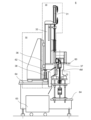
- FIG. 1 is a side cross-sectional view of a wire bundle isolation device 6 according to one embodiment of the present invention.
- FIG. 1 shows a chuck unit 10, in which (a) is a plan view of a main portion, and (b) is a side cross-sectional view.
- 1A is a plan view of a main portion of the press unit 30 and the advance/retract unit 50.
- FIG. 4A and 4B are side and plan views of the press bar 34 and the guide member 35, and cross-sectional views of the press bar 34 and the guide member 35 at positions C, D, E, and F.
- the stator 1 has a stator core 2 in which a central hole 2a and slots 2b are formed around the central hole 2a, and a winding 4 wound around the slot 2b and bonded and fixed with resin or the like.
- the parts exposed from the top and bottom surfaces 3U and 3L of the stator core 2 are called the upper winding 4U and the lower winding 4L, respectively.
- the stator 1 is cut or otherwise processed to remove the upper winding 4U and lower winding 4L from the stator core 2, resulting in a processed stator 1A.
- Wire bundles 4M, bonded and fixed with resin or the like, are left in the slots 2b of the processed stator 1A.
- the processed stator 1A is the object to be processed by the wire bundle separation device 6.
- the wire bundle 4M is the portion of the winding 4 from which the upper winding 4U and lower winding 4D have been cut and removed.
- the wire bundle 4M usually has roughly the same cross-sectional shape as the slots 2b.
- the purpose of the wire bundle separation device 6 is to push out the wire bundle 4M from the slots 2b of the processed stator 1A and separate it.
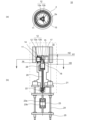
- Figures 2 and 3 show a wire bundle separation device 6 according to one embodiment of the present invention.
- Figure 2 is a side view
- Figure 3 is a plan view.
- the wire bundle separation device 6 has a device body 64, a table 60, a press unit 30, and a chuck unit 10.
- the wire bundle separation device 6 may further have an advance/retract unit 50 for driving the press unit 30 forward and backward, a fluid pressure unit (fluid pressure source) 70 for driving various actuators, a control panel 80 ( Figure 3), etc.
- a fluid pressure unit fluid pressure source
- the press unit 30 has a stay 33, a press actuator 31 fixed to the upper part of the stay 33, a press rod 34 connected to the drive shaft of the press actuator 31 via a cylinder rod joint 41 and a press rod joint 42, and a support 37 in which a cavity (or recess) 37a protruding from the lower end of the stay 33 is formed.
- the press rod 34 is driven up and down along the axis (drive shaft) L by the press actuator 31.
- the stay 33 and the support 37 are preferably made into an integral member.
- the cavity 37a is located on the axis L of the press rod 34 and has a shape/size that allows the conductor bundle 4M to pass through.
- the cavity 37a is preferably a shape/size that allows any of the conductor bundles 4M in the slots 2b of multiple shapes/sizes to pass through.
- a linear cavity 37a is shown, but the cavity 37a may be curved or bent along the way.
- the advance/retract unit 50 can have a linear guide 39 fixed to the device body 64, a base 51 that allows the linear guide 39 to slide back and forth, and a vertical linear guide 36 attached to the base 51, and the stay 33 of the press unit 30 can slide up and down on the linear guide 36.
- the press unit 30 may have a linear position sensor 32 to detect the position of the stay 33 on the linear guide 36.
- the advance/retract unit 50 may have an actuator for sliding the base 51 and a sensor for detecting the position of the press unit 30.
- the wire bundle separating device 6 may further include a balance spring 38 inserted between the linear guide 39 and the stay 33. That is, the stay 33 is guided vertically by the linear guide 36 and is biased upward by the balance spring 38. Thus, the press unit 30 in an unloaded state is stopped at a height position (balance position) where the weight of the press unit 30 and the biasing force of the balance spring 38 are balanced, and can be moved vertically from the balance position with a small external load.
- the dimensions and strength of the balance spring 38, etc. are set so that the upper surface 37b of the support 37 is positioned below the table 60 (reference point Hr) when the press unit 30 is in the balance position.
- an opening 61 is formed in the table 60.
- the opening 61 may have a shape/size that allows the chuck housing 15 (FIG. 4) or, further, the support 37 (or the support 37 and the stay 33) to pass through.
- the opening 61 may have a circular portion 61a through which the chuck housing 15 passes and an additional portion 61b through which the support 37 (or the support 37 and the stay 33) passes.
- the table 60 has rollers 65, 66, and the processed stator 1A can be moved on the table 60 with a small force as shown by the arrow in FIG. 3.
- FIG. 4 shows the chuck unit 10.
- the chuck unit 10 has a chuck housing 15 having an outer shape that can pass through the central hole 2a of the processed stator 1A, chuck jaws 11 that can slide in grooves extending radially at different angular positions of the chuck housing 15, and a rotary actuator 21 that intermittently rotates the chuck housing 15.
- the chuck unit 10 can grip the processed stator 1A by engaging the central hole 2a by sliding the chuck jaws 11 radially outward.
- FIG. 4 shows an example of a three-way chuck having three chuck jaws 11 arranged at 120 degree intervals, but the angular interval and the number of chuck jaws 11 can be changed. Since the inner diameter of the central hole 2a may differ depending on the type of stator 1, it is preferable to make the chuck jaws 11 or the tips of the chuck jaws 11 interchangeable depending on the inner diameter of the central hole 2a.
- the wire bundle separation device 6 may further include a linear actuator 23 for driving the chuck unit 10 up and down. - an origin height H0 at which the upper end of the chuck housing 15 is located below the table 60; a first operating height H1 at which the chuck jaws can engage with the central hole 2a of the treated stator 1A placed on the table 60; and a second operating height H2 above the first operating point, It is possible to move the height H0 to H2.
- Hr indicates the height position (reference point Hr) of the surface of the table 60.
- the origin height H0 is a position slightly below the reference point Hr.
- the linear actuator 23 be a dual cylinder in which two linear cylinders 23a, 23b are connected in tandem.
- the chuck unit 10 may further include a tapered shaft 17 that can move up and down within an axial hole formed in the center of the chuck housing 15, a cam follower 12 that drives the chuck jaws 11 radially outward by sliding on the tapered shaft 17, and a fluid pressure actuator 28 that drives the tapered shaft 17.
- the fluid pressure may be, for example, hydraulic or pneumatic, with pneumatic being particularly preferred.
- the chuck unit 10 may further include a return spring 14 that biases each chuck jaw 11 radially inward.
- the cam follower 12 preferably has a roller 12a that slides and rotates on a tapered shaft 17, and a rotating shaft 12b that supports the roller 12a and is supported at both ends by the chuck jaws 11.
- the tapered shaft 17 preferably has an inclined plane 18 at a position corresponding to the roller 12a of each chuck jaw 11. By sliding the roller 12a on the inclined plane 18, sliding stability is improved.
- the rotary actuator 21 has a hollow rotating shaft through which a driving fluid line 20 may be passed.
- One end of the driving fluid line 20 may be connected to a fluid pressure actuator 28, and the other end may be connected to a swivel joint 22.
- the swivel joint 22 may be connected to a fluid pressure unit 70 ( Figure 3).
- the press unit 30 may further include a guide member 35 at an intermediate height position of the stay 33.
- the guide member 35 may be fixed to the stay 33.
- Figure 6 shows a side view and a plan view of a preferred embodiment of the press bar 34 and guide member 35, as well as cross-sectional views of the press bar 34 and guide member 35 at positions C, D, E, and F.
- the press bar 34 preferably has a tip portion 34a and a base portion 34b with a cross-sectional shape that has a larger moment of area than the tip portion 34a.
- the tip portion 34a of the press bar 34 has a shape (e.g., a flat shape) that allows it to be inserted into the slot 2b
- the base portion 34b has a shape (e.g., a cross shape) that has a larger moment of area than the tip portion 34a.
- the guide member 35 preferably has a guide hole 35a for guiding the press rod 34.
- the guide hole 35a is preferably located on the axis L of the press rod 34.
- the guide hole 35a preferably has a cross-sectional shape that allows both the tip end 34a and the base end 34b of the press rod 34 to pass through.
- the tip 34a is guided by the guide hole 35a, and the base end 34b has a large second moment of area, so buckling of the press rod 34 can be prevented.
- the length of the tip 34a should be roughly the same as the height 5 of the stator core 2 or slightly longer.
- the length of the guide member 35 should be roughly the same as the height 5 of the stator core 2.
- the tip portion 34a should be shaped and sized so that it can be inserted into any of the slots 2b of the various types of processed stators 1A.
- the tip portion 34a should be shaped and sized so that it can be inserted into any of the slots 2b of the various types of processed stators 1A.
- the wire bundle separation device 6 may have a control device (not shown) that is composed of a computer, storage medium, etc., for computer-controlled operation.
- the following describes a wire bundle separation method according to one embodiment of the present invention (method of operation of the wire bundle separation device 6).
- Advance preparation step 1 The chuck unit 10 is supported at the origin height H0 by the rotary actuator 21 so that the upper end of the chuck housing 15 is positioned below the table 60.
- Step 2 The strength of the balance spring 38 is adjusted so that the upper surface 37 b of the support 37 is positioned slightly lower than the table 60 .
- Step 3 The press unit 30 is moved backward on the linear guide 39 to the position furthest from the chuck unit 10 .
- Step 4 A press rod 34 and a guide member 35 corresponding to the type of processed stator 1A to be worked on are attached to the tip of the press actuator 31 via a cylinder rod joint 41 and a press rod joint 42.
- Step 5 The pressing start position of the press bar 34 and the driving distance of the press actuator 31 according to the height 5 of the stator 1 may be stored in advance in a storage medium or the like.
- the treated stator 1A can be freely moved on the table 60 without interfering with the chuck housing 15, the support 37, the press rod 34, and other members (see the arrow in FIG. 3).
- Step 6 The treated stator 1A is slid on the table 60 and placed at the position of the opening 61a.
- Step 7 The chuck unit 10 is raised to the first operating height H1 by driving the linear actuator 23. This causes the chuck jaws 11 to rise to a height at which they can chuck the central hole 2a.
- Step 8 The tapered shaft 17 is raised by driving the fluid pressure actuator 28. As a result, the chuck jaws 11 move radially outward and come into contact with the inside of the central hole 2a of the treated stator 1A, and the treated stator 1A is chucked.
- Step 9 The chuck unit 10 is raised to the second operating height H2 by driving the linear actuator 23.
- Step 10 The press unit 30 is advanced along the linear guide 39 to a prescribed position according to the type of the treated stator 1A. Fine adjustment may be performed manually. If the rotational position of the treated stator 1A is misaligned, the rotary actuator 21 is rotated so that the slot 2b is positioned on the axis L. The rotation may be performed manually, and the alignment may be judged visually.
- Step 11 for extruding and separating the conductor bundle 4M The press actuator 31 is driven to lower the press rod 34 in accordance with the following steps 11-1 and 11-2.
- Step 11-2 When the upper surface 37b of the support 37 comes into contact with the lower surface of the stator core 2, the press unit 30 stops rising and, instead, the press bar 34 starts to fall from the contact position. Since the lower surface of the stator core 2 is supported by the upper surface 37b of the support 37 and cannot move downward, the press bar 34 enters the slot 2b and pushes the conductor bundle 4M from the slot 2b into the cavity 37a. Since the periphery of the slot 2b is supported by the upper surface 37b of the support 37, deformation of the silicon steel plate and the resulting deformation of the shape of the slot 2b can be prevented.
- Step 12 When the extrusion of the conductor bundle 4M is completed, the press actuator 31 is driven to raise the press rod 34 to the initial position. The completion of the extrusion can be determined by measuring the height position of the press rod 34 by the linear position sensor 32 and comparing it with the driving distance of the press actuator 31 that is stored in advance for each type of processed stator 1A.
- Step 13 After confirming that the press rod 34 has risen to the initial position, the rotary actuator 21 is driven to rotate the chuck unit 10 (processed stator 1A) to a position where the next slot 2b coincides with the axis L of the press rod 34. As described in step 9, the processed stator 1A can rotate freely.
- Step 14 Thereafter, steps 11 to 13 are repeated to separate the conductor bundles 4M in all slots 2b.
- Step 15 Opening and carrying out the processed stator 1A :
- the linear actuator 23 lowers the chuck unit 10 to the first operating height H1, and then the fluid pressure actuator 28 lowers the tapered shaft 17 to release the chuck of the processed stator 1A by the chuck unit 10, and then the linear actuator 23 lowers the chuck unit 10 to the origin height H0.
- the press unit 30 may be retreated on the linear guide 39 to the retracted position.
- the treated stator 1A is slid on the table 60 by using the rolling of the rollers 65, 66 and is carried out of the apparatus.
- steps 6 to 16 can be automatically operated by controlling actuators 21, 23, 28, 31, etc., using a control device or the like. In particular, it is preferable to automatically operate steps 11 to 15.
- the wire bundle 4M is pushed out of the slot 2b by inserting the press rod 34 into the slot 2b while the underside of the stator core 2 (around the slot 2b) is supported by a support 37 having a hollow portion 37a through which the wire bundle 4M on the axis L of the press rod 34 can pass.
- the stay 33 is guided by the linear guide 36 so that it can move up and down
- the stay 33 is supported by the balance spring 38 so that the support 37 is positioned below the table 60, so that the processed stator 1A can be moved on the table 60 without interfering with the support 37, and the support 37 can support the stator core 2 when pushing out and separating the conductor bundle 4M. Because the underside of the stator core 2 is supported by the support 37, it is possible to push out and separate the conductor bundle 4M with almost no external force acting on the stator core 2 or the chuck jaws 11.
- the chuck housing 15 can pass through the central hole 2a, and the chuck claws 11 engage with the central hole 2a from the inside to chuck the processed stator 1A, and the linear actuator 23 can move the chuck housing 15 up and down between the origin height H0, the first operating height H1, and the second operating height H2. This prevents the chuck housing 15 from blocking the slot 2b, and allows the processed stator 1A to be moved on the table 60 without interfering with the chuck housing 15, and also allows the processed stator 1A to be rotated without coming into contact with the table 60.
- the chuck jaws 11 are driven radially outward by sliding the cam follower 12 on a tapered shaft that moves up and down using the fluid pressure actuator 28 in the central shaft hole of the chuck housing, which prevents excessive gripping force from being applied to the processed stator 1A when chucking the processed stator 1A, preventing deformation of the silicon steel plate or slot 2b due to excessive gripping force and the resulting difficulty in extruding and separating the conductor bundle 4M.
- the fluid pressure actuator 28 be of the pneumatic type and be operated at a pre-adjusted pressure.
- a hollow rotating shaft is provided in the rotary actuator 21, a drive fluid line 20 is passed through the hollow rotating shaft, and both ends of the drive fluid line 20 are connected to the fluid pressure actuator 28 and the swivel joint 22, making it possible to supply working fluid to the fluid pressure actuator 28, which moves up and down and rotates.
- a guide member 35 having a guide hole 35a is provided on the axis L, and the base end 34b of the press rod 34 has a larger moment of area than the tip end 34a.
- the guide hole 35a has a cross-sectional shape that allows both the tip end 34a and the base end 34b to pass through, making it possible to prevent buckling of the press rod 34 when the conductor bundle 4M is pushed out.
- the wire bundle separation device 6 and the dimensions, shape, arrangement, number, materials, etc. of those elements described in the above embodiment are merely examples, and other configurations are possible.
- the table 60 and linear guide 39, etc. can be omitted, and since there is no need to move the chuck unit 10 from the second operating height H2, the linear actuator 23 can also be omitted.
- the chuck unit 10 can be omitted.
- Stator 1A Processed stator 2: Stator core 2a: Central hole 2b: Slots 3U, 3L: Stator surface 4: Winding 4U: Upper winding 4L: Lower winding 4M: Wire bundle 5: Slot height 6: Wire bundle separation device 10: Chuck unit 11: Chuck jaws 12: Cam follower 12a: Roller 12b: Rotating shaft 14: Return spring 15: Chuck housing 17: Tapered shaft 18: Inclined plane 20: Driving fluid pipe 21: Rotary actuator 22: Swivel joint 23: Linear actuator 24: Guide rod 25: Linear bush 28: Fluid pressure actuator 30: Press unit 31: Press Actuator for press 32...Linear position sensor 33...Stay 34...Press rod 34a...Tip portion 34b...Base end portion 35...Guide member 35a...Guide hole 36...Linear guide 37...Support 37a...Cavity portion 37b...Surface 38...Balance spring 39...Linear guide 41...Cylinder rod joint 42...Press rod joint 50...Advance and retreat unit 60
Landscapes
- Engineering & Computer Science (AREA)
- Manufacturing & Machinery (AREA)
- Power Engineering (AREA)
- Mechanical Engineering (AREA)
- Manufacture Of Motors, Generators (AREA)
Priority Applications (7)
| Application Number | Priority Date | Filing Date | Title |
|---|---|---|---|
| CN202380018288.2A CN119585992A (zh) | 2023-06-28 | 2023-06-28 | 导线束分离装置和导线束分离方法 |
| KR1020247024492A KR20250003468A (ko) | 2023-06-28 | 2023-06-28 | 도선 다발 분리 장치 및 도선 다발 분리 방법 |
| PCT/JP2023/023949 WO2025004215A1 (ja) | 2023-06-28 | 2023-06-28 | 導線束分離装置及び導線束分離方法 |
| CA3245289A CA3245289A1 (en) | 2023-06-28 | 2023-06-28 | CONDUCTOR BEAM SEPARATION DEVICE AND CONDUCTOR BEAM SEPARATION METHOD |
| EP23915180.6A EP4738667A1 (en) | 2023-06-28 | 2023-06-28 | Conductor bundle separation device and conductor bundle separation method |
| JP2024507072A JP7479657B1 (ja) | 2023-06-28 | 2023-06-28 | 導線束分離装置及び導線束分離方法 |
| TW113118753A TWI908086B (zh) | 2023-06-28 | 2024-05-21 | 導線束分離裝置及導線束分離方法 |
Applications Claiming Priority (1)
| Application Number | Priority Date | Filing Date | Title |
|---|---|---|---|
| PCT/JP2023/023949 WO2025004215A1 (ja) | 2023-06-28 | 2023-06-28 | 導線束分離装置及び導線束分離方法 |
Publications (1)
| Publication Number | Publication Date |
|---|---|
| WO2025004215A1 true WO2025004215A1 (ja) | 2025-01-02 |
Family
ID=90926110
Family Applications (1)
| Application Number | Title | Priority Date | Filing Date |
|---|---|---|---|
| PCT/JP2023/023949 Ceased WO2025004215A1 (ja) | 2023-06-28 | 2023-06-28 | 導線束分離装置及び導線束分離方法 |
Country Status (7)
| Country | Link |
|---|---|
| EP (1) | EP4738667A1 (https=) |
| JP (1) | JP7479657B1 (https=) |
| KR (1) | KR20250003468A (https=) |
| CN (1) | CN119585992A (https=) |
| CA (1) | CA3245289A1 (https=) |
| TW (1) | TWI908086B (https=) |
| WO (1) | WO2025004215A1 (https=) |
Citations (5)
| Publication number | Priority date | Publication date | Assignee | Title |
|---|---|---|---|---|
| JPH03155355A (ja) * | 1989-11-08 | 1991-07-03 | Techno Porisu Hakodate Gijutsu Shinko Kyokai | ステータ部の分離方法及び同装置 |
| JP2008167627A (ja) * | 2007-01-04 | 2008-07-17 | Jep:Kk | 導線の分離方法及び導線の分離装置 |
| JP2011062030A (ja) | 2009-09-13 | 2011-03-24 | Eishin Giken:Kk | 巻線体の巻線の切断装置 |
| JP2012055037A (ja) * | 2010-08-31 | 2012-03-15 | Kimura:Kk | コイル回収装置 |
| JP2022157824A (ja) * | 2021-03-31 | 2022-10-14 | 日本電産株式会社 | 固定子コアの位置決め装置 |
Family Cites Families (2)
| Publication number | Priority date | Publication date | Assignee | Title |
|---|---|---|---|---|
| JP2002157824A (ja) * | 2000-11-17 | 2002-05-31 | Toshiba Corp | データ記録装置及びデータ記録方法 |
| JP7155453B2 (ja) * | 2020-03-03 | 2022-10-18 | Jx金属株式会社 | 線状物の除去方法、線状物の除去装置及び電子・電気機器部品屑の処理方法 |
-
2023
- 2023-06-28 CA CA3245289A patent/CA3245289A1/en active Pending
- 2023-06-28 KR KR1020247024492A patent/KR20250003468A/ko active Pending
- 2023-06-28 WO PCT/JP2023/023949 patent/WO2025004215A1/ja not_active Ceased
- 2023-06-28 CN CN202380018288.2A patent/CN119585992A/zh active Pending
- 2023-06-28 EP EP23915180.6A patent/EP4738667A1/en active Pending
- 2023-06-28 JP JP2024507072A patent/JP7479657B1/ja active Active
-
2024
- 2024-05-21 TW TW113118753A patent/TWI908086B/zh active
Patent Citations (5)
| Publication number | Priority date | Publication date | Assignee | Title |
|---|---|---|---|---|
| JPH03155355A (ja) * | 1989-11-08 | 1991-07-03 | Techno Porisu Hakodate Gijutsu Shinko Kyokai | ステータ部の分離方法及び同装置 |
| JP2008167627A (ja) * | 2007-01-04 | 2008-07-17 | Jep:Kk | 導線の分離方法及び導線の分離装置 |
| JP2011062030A (ja) | 2009-09-13 | 2011-03-24 | Eishin Giken:Kk | 巻線体の巻線の切断装置 |
| JP2012055037A (ja) * | 2010-08-31 | 2012-03-15 | Kimura:Kk | コイル回収装置 |
| JP2022157824A (ja) * | 2021-03-31 | 2022-10-14 | 日本電産株式会社 | 固定子コアの位置決め装置 |
Also Published As
| Publication number | Publication date |
|---|---|
| EP4738667A1 (en) | 2026-05-06 |
| KR20250003468A (ko) | 2025-01-07 |
| CN119585992A (zh) | 2025-03-07 |
| TWI908086B (zh) | 2025-12-11 |
| TW202510468A (zh) | 2025-03-01 |
| CA3245289A1 (en) | 2025-01-24 |
| JP7479657B1 (ja) | 2024-05-09 |
| JPWO2025004215A1 (https=) | 2025-01-02 |
Similar Documents
| Publication | Publication Date | Title |
|---|---|---|
| CN107425146B (zh) | 一种电芯套钢壳系统及其电芯套钢壳自动化组装设备 | |
| CN112186988B (zh) | 新能源汽车驱动电机定子高速生产流水线 | |
| KR102948487B1 (ko) | 구동모터 회전자의 마그넷 조립 시스템 및 방법 | |
| CN107398695A (zh) | 一种电芯套钢壳自动化组装设备 | |
| JP7479657B1 (ja) | 導線束分離装置及び導線束分離方法 | |
| CN111682722B (zh) | 定子的扭斜槽装置 | |
| CN113664511A (zh) | 一种骨架铁芯拼装、检测一体机 | |
| CN209692553U (zh) | 绕线装置 | |
| CN109756082B (zh) | 合拢转换装置及合拢转换方法 | |
| CN118232638B (zh) | 一种电机转子自动装配一体机 | |
| CN109742914A (zh) | 自动组装系统及自动组装方法 | |
| JP4006252B2 (ja) | モーターステータの解体装置 | |
| CN116511800B (zh) | 一种智能加工均压环装夹设备及其制造方法 | |
| CN117228393B (zh) | 一种自动剥离贴膜机 | |
| CN218447545U (zh) | 一种高效的方形导线绕线机构 | |
| CN209692552U (zh) | 自动组装系统 | |
| CN109888996A (zh) | 绕线装置、绕线模具及绕线方法 | |
| CN212543599U (zh) | 一种理线装置 | |
| CN209692549U (zh) | 合拢转换装置 | |
| JPH07222411A (ja) | ステータコア用のパレット着脱装置 | |
| CN120190271B (zh) | 一种快充连接件生产用冲孔装置 | |
| US5598626A (en) | Method for salvaging core laminations | |
| CN106425140A (zh) | 一种多功能电磁吸盘装置 | |
| CN221177504U (zh) | 一种分割式定子组件绕线设备 | |
| KR102825075B1 (ko) | 모터 고정자 코일 절단 장치 |
Legal Events
| Date | Code | Title | Description |
|---|---|---|---|
| WWE | Wipo information: entry into national phase |
Ref document number: 2024507072 Country of ref document: JP |
|
| WWE | Wipo information: entry into national phase |
Ref document number: 202417052418 Country of ref document: IN |
|
| WWE | Wipo information: entry into national phase |
Ref document number: 202380018288.2 Country of ref document: CN |
|
| 121 | Ep: the epo has been informed by wipo that ep was designated in this application |
Ref document number: 23915180 Country of ref document: EP Kind code of ref document: A1 |
|
| WWP | Wipo information: published in national office |
Ref document number: 202380018288.2 Country of ref document: CN |
|
| WWE | Wipo information: entry into national phase |
Ref document number: 2023915180 Country of ref document: EP |
|
| NENP | Non-entry into the national phase |
Ref country code: DE |
|
| ENP | Entry into the national phase |
Ref document number: 2023915180 Country of ref document: EP Effective date: 20260128 |
|
| ENP | Entry into the national phase |
Ref document number: 2023915180 Country of ref document: EP Effective date: 20260128 |