WO2024262198A1 - 蛍光x線分析装置 - Google Patents
蛍光x線分析装置 Download PDFInfo
- Publication number
- WO2024262198A1 WO2024262198A1 PCT/JP2024/017901 JP2024017901W WO2024262198A1 WO 2024262198 A1 WO2024262198 A1 WO 2024262198A1 JP 2024017901 W JP2024017901 W JP 2024017901W WO 2024262198 A1 WO2024262198 A1 WO 2024262198A1
- Authority
- WO
- WIPO (PCT)
- Prior art keywords
- liquid sample
- path
- rays
- fluorescent
- detector
- Prior art date
- Legal status (The legal status is an assumption and is not a legal conclusion. Google has not performed a legal analysis and makes no representation as to the accuracy of the status listed.)
- Ceased
Links
Images



Classifications
-
- G—PHYSICS
- G01—MEASURING; TESTING
- G01N—INVESTIGATING OR ANALYSING MATERIALS BY DETERMINING THEIR CHEMICAL OR PHYSICAL PROPERTIES
- G01N23/00—Investigating or analysing materials by the use of wave or particle radiation, e.g. X-rays or neutrons, not covered by groups G01N3/00 – G01N17/00, G01N21/00 or G01N22/00
- G01N23/22—Investigating or analysing materials by the use of wave or particle radiation, e.g. X-rays or neutrons, not covered by groups G01N3/00 – G01N17/00, G01N21/00 or G01N22/00 by measuring secondary emission from the material
- G01N23/2204—Specimen supports therefor; Sample conveying means therefore
-
- G—PHYSICS
- G01—MEASURING; TESTING
- G01N—INVESTIGATING OR ANALYSING MATERIALS BY DETERMINING THEIR CHEMICAL OR PHYSICAL PROPERTIES
- G01N23/00—Investigating or analysing materials by the use of wave or particle radiation, e.g. X-rays or neutrons, not covered by groups G01N3/00 – G01N17/00, G01N21/00 or G01N22/00
- G01N23/22—Investigating or analysing materials by the use of wave or particle radiation, e.g. X-rays or neutrons, not covered by groups G01N3/00 – G01N17/00, G01N21/00 or G01N22/00 by measuring secondary emission from the material
- G01N23/223—Investigating or analysing materials by the use of wave or particle radiation, e.g. X-rays or neutrons, not covered by groups G01N3/00 – G01N17/00, G01N21/00 or G01N22/00 by measuring secondary emission from the material by irradiating the sample with X-rays or gamma-rays and by measuring X-ray fluorescence
Definitions
- This disclosure relates to an X-ray fluorescence analyzer, and more specifically to improving the efficiency of light element analysis of liquid samples.
- a sample is analyzed by irradiating the sample with a primary X-ray source emitted from an X-ray source and analyzing the fluorescent X-rays generated from the sample.
- EDX energy dispersive X-ray fluorescence spectrometry
- Patent Document 1 JP 10-197460 A discloses a technique in which X-rays are irradiated and detected through a thin film in a flow cell through which the liquid sample flows.
- the fluorescent X-rays of light elements tend to be absorbed by the film during light element analysis, resulting in insufficient intensity and reduced sensitivity.
- the present disclosure has been made to solve this problem, and its purpose is to provide an X-ray fluorescence analysis device for liquid samples.
- a first aspect of the present invention is an X-ray fluorescence analysis apparatus comprising a first path, an adjustment mechanism, an X-ray tube, a detector, and a control device.
- the first path has a first portion through which the liquid sample flows exposed.
- the adjustment mechanism adjusts the flow rate of the liquid sample flowing through the first path.
- the X-ray tube irradiates the liquid sample with primary X-rays in the first portion.
- the detector detects fluorescent X-rays generated from the liquid sample by the primary X-rays.
- the control device analyzes the fluorescent X-rays detected by the detector.
- the detector is positioned at a position where the fluorescent X-rays generated from the liquid sample directly enter.
- the adjustment mechanism adjusts the flow rate of the liquid sample so that the position of the surface of the liquid sample in the first portion is kept constant.
- This disclosure provides an X-ray fluorescence analyzer that can easily and sensitively analyze light elements in liquid samples.
- FIG. 1 is a schematic diagram showing a configuration of an analysis device according to a first embodiment.
- FIG. 2 is a diagram for explaining the positional relationship between the X-ray tube, the detector, and the liquid sample in FIG. 1 .
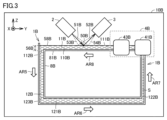
- FIG. 11 is a schematic diagram showing the configuration of a measurement device according to a second embodiment.
- 4 is a diagram for explaining the positional relationship between the X-ray tube, the detector, and the liquid sample in FIG. 3.
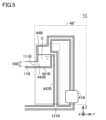
- 7A to 7C are diagrams for explaining another example of the adjustment mechanism of FIG. 3 .
- FIG. 1 is a schematic diagram showing the configuration of an analysis device 1000 according to the first embodiment.
- the analysis device 1000 corresponds to an example of an “X-ray fluorescence analysis device.”
- the analysis device 1000 according to the first embodiment includes a measurement device 10A and a control device 9.
- the measurement device 10A includes a circulation path 1A, an X-ray tube 2, and a detector 3.
- the circulation path 1A is a path for circulating a liquid sample S.
- the liquid sample S is driven by a pump 41A (described later) and circulated in the directions indicated by arrows AR1 to AR4.
- the direction in which the liquid sample S flows in the first path 11A (see arrow AR1) described later is the negative Z-axis direction
- the direction in which the liquid sample S flows in the buffer path 121A (see arrow AR2) described later is the positive Y-axis direction
- the direction perpendicular to the Y-axis and Z-axis is the X-axis direction.
- the measuring device 10A is used in a state where it is installed so that the negative Z-axis direction roughly coincides with the direction of gravity.
- the X-ray tube 2 includes a filament that emits thermoelectrons and a target that converts the thermoelectrons into a predetermined primary X-ray and emits it.
- the primary X-rays emitted from the X-ray tube 2 are irradiated onto the liquid sample S flowing through the circulation path 1A (see arrow 51A).
- the secondary X-rays (fluorescent X-rays) generated from the liquid sample S are directly incident on the detector 3 (see arrow 52A), and the energy and amount of the fluorescent X-rays are measured by the detector 3. More specifically, the amount of X-rays is generally expressed as the number of X-ray photons per unit time.
- the amount of X-rays is also called the intensity of X-rays.
- the energy of X-rays is generally expressed as the wavelength of X-rays.
- the detection result of the detector 3 is typically expressed as a fluorescent X-ray spectrum that shows the relationship between the energy and amount of the detected fluorescent X-rays.
- the measuring device 10A may include a primary X-ray filter (not shown) that attenuates background components of the primary X-rays emitted from the X-ray tube 2 to improve the S/N ratio of the required characteristic X-rays.
- a primary X-ray filter (not shown) that attenuates background components of the primary X-rays emitted from the X-ray tube 2 to improve the S/N ratio of the required characteristic X-rays.
- the primary X-rays that are emitted from the X-ray tube 2 and then transmitted through the primary X-ray filter are irradiated onto the liquid sample S.
- the measuring device 10A may also include a collimator (not shown) that determines the size of the primary X-ray beam.
- a collimator (not shown) that determines the size of the primary X-ray beam.
- the primary X-ray After being emitted from the X-ray tube 2, the primary X-ray passes through a through hole formed in the center of the collimator and is irradiated onto the liquid sample S.
- the control device 9 controls the measuring device 10A and analyzes the fluorescent X-rays detected by the detector 3.
- the control device 9 includes a processor 90, a memory 91, an input device 92, and an output device 93.
- the control device 9 can be, for example, a personal computer.
- the processor 90 includes, for example, a CPU (Central Processing Unit).
- a CPU Central Processing Unit
- Memory 91 is realized, for example, by a storage device such as a ROM (Read Only Memory), a RAM (Random Access Memory), or a HDD (Hard Disk Drive).
- a storage device such as a ROM (Read Only Memory), a RAM (Random Access Memory), or a HDD (Hard Disk Drive).
- the input device 92 includes, for example, at least one of a keyboard, a mouse, a touch panel, a button, and a knob.
- the output device 93 includes, for example, a display or a speaker.
- the control device 9 acquires the fluorescent X-ray spectrum detected by the detector 3.
- the control device 9 performs quantitative analysis of each element based on the fluorescent X-ray spectrum.
- a fluorescent X-ray peak appears at an energy position specific to each element. By examining the peak position and peak intensity of the fluorescent X-ray spectrum, the energy and amount of the fluorescent X-ray can be determined, and the type and amount of elements contained in the liquid sample S can be identified.
- the control device 9 controls the X-ray tube 2, the detector 3, and the adjustment mechanism 4A described below. This allows the X-ray tube 2 and the detector 3 to perform X-ray fluorescence analysis of the liquid sample S flowing through the first path 11A while the adjustment mechanism 4A keeps the state of the liquid sample S flowing through the first path 11A constant.
- the circulation path 1A includes a first path 11A, a second path 12A, and an adjustment mechanism 4A.
- the first path 11A is formed at a position where the liquid sample S flows according to gravity.
- the second path 12A is a path for returning the liquid sample S flowing out from the first path 11A back to the first path.
- the first path 11A and the second path 12A form the circulation path 1A.
- the opening of the second path 12A which is an inlet for the liquid sample S into the first path 11A and an outlet for the liquid sample S flowing out of the second path 12A, is defined as a first opening 111A.
- the second opening 112A is an inlet for the liquid sample S into the second path 12A and an outlet for the liquid sample S flowing out of the first path 11A.
- Each of the first opening 111A and the second opening 112A is a joint between the first path 11A and the second path 12A.
- the first path 11A is formed along the direction of gravity (along the negative Z-axis direction).
- the second opening 112A is configured to be located directly below the first opening 111A.
- the first path 11A has a first portion 110A through which the liquid sample S flows and is exposed to the space of the measurement device 10A.
- the first portion 110A is between the first opening 111A and the second opening 112A.
- the liquid sample S discharged from the first opening 111A falls through the first path 11A along the negative direction of the Z axis, and then returns to the second path 12A from the second opening 112A.
- the liquid sample S that has returned to the second path 12A is then pumped up by the pump 41A and flows again into the first path 11A from the first opening 111A.
- the primary X-rays can be irradiated to the liquid sample S without being attenuated by a thin film or the like, and the fluorescent X-rays can be allowed to reach the detector 3 without being attenuated by a thin film or the like.
- irradiating/incidentating X-rays means that X-rays are irradiated/incident without passing through an object constituting the measuring device 10A.
- this object does not include a primary X-ray filter for removing primary X-rays with wavelengths of energy unnecessary for analysis.
- this object does not include holes in a member such as a collimator that narrows the irradiation diameter of the primary X-rays by passing them through holes.
- the expression "directly" irradiating/incidentating X-rays includes both cases where X-rays are irradiated/incident through a filter member and cases where X-rays are irradiated/incident by passing through holes in a collimator, etc.
- FIG. 1 is a diagram for explaining the positional relationship between the X-ray tube 2, the detector 3, and the liquid sample S as viewed from the Z-axis direction.
- the adjustment mechanism 4A is a mechanism for defining the first path 11A through which the liquid sample S flows, and for keeping the state of the liquid sample constant in the first path 11A. More specifically, the adjustment mechanism 4A adjusts the flow rate of the liquid sample S flowing through the first path 11A so that the position of the surface 58A of the liquid sample S in the first portion 110A is kept constant.
- the position of the surface 58A is the position of the boundary between the liquid sample S and the space surrounding the liquid sample S.
- the adjustment mechanism 4A includes a pump 41A and an outlet mechanism 42A that forms a first opening 111A that is an outlet for the liquid sample S from the second path 12A.
- the pump 41A By driving the pump 41A, the liquid sample S that flows in from the second opening 112A is returned to the first opening 111A, which is located in the positive direction of the Z axis from the second opening 112A.
- the pump 41A also adjusts the position of the surface 58A of the liquid sample S by adjusting the flow rate of the liquid sample S in the first path 11A.
- the outlet mechanism 42A is a mechanism surrounding the first opening 111A.
- the outlet mechanism 42A adjusts the position of the surface 58A of the liquid sample S by adjusting the flow rate of the liquid sample S in the first path 11A.
- the pump 41A and/or the outlet mechanism 42A are adjusted to keep the position of the surface 58A of the liquid sample S falling through the first path 11A constant. Therefore, the adjustment mechanism 4A can adjust the position of the surface 58A of the liquid sample S falling through the first path 11A to a constant position.
- the discharge volume/discharge pressure of the pump 41A and the opening diameter/opening area of the outlet mechanism 42A are set so that the focal point 50A between the X-ray tube 2 and the detector 3 is located on the surface 58A.
- the intersection (focal point 50A) of the arrow 51A which is the center line of the irradiation range 53A of the primary X-ray beam emitted from the X-ray tube 2, and the arrow 52A, which is the center line of the detection area 54A of the detector 3, is set so as to be on the surface 58A.
- the primary X-rays can be irradiated onto the surface 58A, and fluorescent X-rays generated from the surface 58A can be detected. Therefore, fluorescent X-rays generated from light elements in the liquid sample S can also be detected with sufficient intensity without being attenuated within the liquid sample S. Therefore, the light elements in the liquid sample S can be analyzed with good sensitivity.
- the positions of the X-ray tube 2 and detector 3 may be set to focus a predetermined distance inward from the surface 58A of the liquid sample S, as long as the fluorescent X-rays from the light elements can be detected with sufficient intensity.
- the configuration of the first path 11A is not limited to the example shown in FIG. 1, and it is sufficient that the surface 58A of the first portion 110A is exposed on the side where the primary X-rays are irradiated and the fluorescent X-rays are detected (the side of the focal point 50A in FIG. 2).
- the entire periphery of the first path 11A is exposed according to the entire length, but a part of the first path 11A in the Z-axis direction may be covered with a pipe, a thin film, or the like.
- a part of the side of the first portion 110A where the primary X-rays are not irradiated may be covered with a pipe, a thin film, or the like.
- a pipe, a thin film, or the like it is preferable that the entire periphery of the first portion 110A is exposed in terms of reducing the possibility of impurity rays being generated from the pipe or thin film.
- the first path 11A may be formed so that the liquid sample flows obliquely with respect to the direction of gravity, so long as the height of the surface 58A at the position where the focal point 50A is formed is adjusted to be constant.
- a gutter-shaped member may be provided that is installed obliquely with respect to the direction of gravity, and the liquid sample S may flow through the gutter-shaped member.
- the configuration of the second path 12A is not limited to the example in FIG. 1, and it is sufficient if the liquid sample S can be circulated in the first path 11A.
- the second path 12A is covered by the pipe 8A, but a portion of the second path 12A may be exposed to the surrounding atmosphere as long as the liquid sample S does not leak from that portion.
- the specific configuration of the adjustment mechanism 4A is not particularly limited as long as it is capable of maintaining a constant position of the surface 58A of the liquid sample S flowing through the first path 11A.
- the pump 41A may be a pump with a fixed rotation speed or a pump with a variable rotation speed.
- the portion of the outlet mechanism 42A through which the liquid sample S passes may be a member that includes a fixed hole, or may be a variable valve whose opening degree is variable.
- the amount of liquid sample S contained in the circulation path 1A may be different for each measurement. Even if the amount of liquid sample S changes for each measurement, the position of the surface 58A in the first portion 110A can be kept at a predetermined position including the focal point 50A by adjusting the state of the adjustment mechanism 4A.
- a portion of the second path 12A includes a path that serves as a buffer for the liquid sample S flowing into the first path 11A.
- the buffer path 121A is between the second opening 112A and the junction 122A, which is the junction between the second path 12A and the pump 41A.
- the buffer path 121A can temporarily store excess liquid sample S in order to maintain the flow rate of the liquid sample S in the first path 11A at a predetermined value.
- a tank that branches off from the second path 12A and can temporarily store excess liquid sample S may be provided.
- the measuring device 10A may include a sensor (not shown) that detects the position of the surface 58A, or a sensor (not shown) that detects the flow rate of the liquid sample S in the first path 11A.
- feedback control or feedback to the user may be performed based on the detection signal of the sensor.
- the adjustment mechanism 4A e.g., the rotation speed of the pump 41A
- the space between the liquid sample S and the detector 3 is a helium atmosphere rather than an air atmosphere.
- EDX Conventionally, two types of EDX have been commonly used: a bottom-illumination type in which a sample is placed above an optical system such as an X-ray tube and a detector, and X-ray fluorescence analysis is performed from below the sample, and a top-illumination type in which a sample is placed below the optical system, and X-ray fluorescence analysis is performed from above the sample.
- the liquid sample When measuring liquid samples with bottom-illuminated EDX, for example, the liquid sample is placed in a container with a film on the bottom, the liquid sample is irradiated with primary X-rays through the film, and the fluorescent X-rays that pass through the film are detected.
- the fluorescent X-rays of the light elements are absorbed by the film, making it impossible to obtain fluorescent X-rays of sufficient intensity, resulting in a problem of reduced sensitivity.
- the distance between the X-ray tube and detector and the surface (liquid level) of the liquid sample stored in the container it is necessary to appropriately set the distance between the X-ray tube and detector and the surface (liquid level) of the liquid sample stored in the container. For example, if the focal points of the X-ray tube and detector are at least a certain distance above the liquid level and are not inside the liquid sample, the liquid sample will not be irradiated with primary X-rays from the X-ray tube, and naturally the primary X-rays will not generate fluorescent X-rays from the sample.
- a mechanism (such as a mechanism for performing laser measurement) is required to measure the distance between the X-ray tube and detector and the surface of the liquid sample stored in the container.
- a mechanism is required to adjust the distance between the X-ray tube and detector and the surface of the liquid sample stored in the container. This can be a factor that makes the X-ray fluorescence analysis device complicated.
- Patent Document 1 JP 2005-024300 A (Patent Document 2), and JP 2005-172719 A (Patent Document 3) disclose a technology in which a flow cell is provided through which a liquid sample flows, primary X-rays are irradiated through a thin film of the flow cell, and fluorescent X-rays are detected.
- Patent Document 2 JP 2005-024300 A
- Patent Document 3 JP 2005-172719 A
- the fluorescent X-ray analysis device includes a path for flowing the liquid sample, and controls the position of the surface of the liquid sample flowing in the path to be kept constant. Primary X-rays are then irradiated onto the liquid surface that is kept constant, and fluorescent X-rays from the liquid surface are detected. This allows light element analysis of liquid samples to be performed easily and with high sensitivity without the fluorescent X-rays generated from the light elements being absorbed by the film, without prior preparation such as soaking the liquid sample in filter paper, or without providing a mechanism for moving the X-ray tube and detector or the liquid sample up, down, left, and right.
- the X-ray fluorescence analysis apparatus by circulating the liquid sample in a circulation path, it is possible to repeatedly flow the liquid sample through the first path in which the X-ray fluorescence analysis is performed. Therefore, compared to the case where the analysis is performed while the sample is flowing through a non-circulation path, fluorescent X-rays of sufficient intensity can be detected even with a small amount of sample. Furthermore, by circulating the liquid sample, the possibility of precipitation occurring in the liquid sample during measurement and affecting the analysis can be reduced.
- FIG. 1 Schematic configuration of the measuring device 3 is a schematic diagram showing the configuration of a measurement device 10B according to embodiment 2.
- a circulation path 1B is provided instead of the circulation path 1A of the measurement device 10A.
- fluorescent X-ray analysis is performed on a liquid sample S flowing in a horizontal direction (see arrow AR8) in a first path 11B that is a part of the circulation path 1B.
- the measuring device 10B includes a circulation path 1B, an X-ray tube 2, and a detector 3.
- the circulation path 1B is a path for circulating the liquid sample S.
- the liquid sample S is circulated in the directions indicated by the arrows AR5 to AR8 by a pump 41B, which will be described later.
- the circulation path 1B includes a first path 11B, a second path 12B, and an adjustment mechanism 4B.
- the first path 11B is a path along which the liquid sample S flows in the horizontal direction.
- the second path 12B is a path for returning the liquid sample S that has flowed out of the first path back to the first path.
- the first path 11B and the second path 12B are connected by a first opening 111B and a second opening 112B to form the circulation path 1B.
- the first path 11B has a first portion 110B through which the liquid sample S flows and is exposed to the space of the measurement device 10B.
- the liquid sample S flows through a gutter-shaped member 81B that is open at the top, as shown in FIG. 4.
- the gutter-shaped member 81B is, for example, a member obtained by cutting a pipe with a rectangular or circular cross section in half in the extension direction.
- the surface 58B of the liquid sample S in the positive Z-axis direction is exposed to the atmosphere inside the measurement device 10B.
- the first portion 110B corresponds to between the first opening 111B and the second opening 112B.
- the liquid sample S discharged from the first opening 111B flows horizontally through the first path 11B (see arrow AR8), and then returns to the second path 12B from the second opening 112B.
- the liquid sample S that has returned to the second path 12B is then pumped up by the pump 41B and flows again into the first path 11B from the first opening 111B.
- the adjustment mechanism 4B is a mechanism for defining the first path 11B through which the liquid sample S flows and for keeping the state of the liquid sample constant in the first path 11B. More specifically, the adjustment mechanism 4B adjusts the flow rate of the liquid sample S flowing through the first path 11B so that the position of a surface 58B, which is the liquid level of the liquid sample S in the first portion 110B, is kept constant. The position of the surface 58B is the position of the boundary between the liquid sample S and the space surrounding the liquid sample S.
- the adjustment mechanism 4B includes a pump 41B and a valve 43B.
- the pump 41B By driving the pump 41B, the liquid sample S that has flowed into a low position in the second path 12B (for example, the position of the buffer path 121B described later) is pumped up to the height of the first path 11B, which is located in the positive direction of the Z axis from that position.
- the valve 43B supplies a predetermined flow rate of the liquid sample S to the first path 11B by passing the liquid sample S at a flow rate that corresponds to the degree to which the valve 43B is open.
- the pump 41B and the valve 43B are adjusted to keep the height 56B of the surface 58B constant. Therefore, the adjustment mechanism 4B can adjust the height 56B of the surface 58B of the liquid sample S flowing through the first path 11B to a constant value.
- Pump 41B and valve 43B are adjusted so that focal point 50B between X-ray tube 2 and detector 3 is located on surface 58B. More specifically, they are adjusted so that the intersection (focal point 50B) of arrow 51B, which is the center line of irradiation range 53B of the primary X-ray beam emitted from X-ray tube 2, and arrow 52B, which is the center line of detection area 54B of detector 3, is on surface 58B.
- primary X-rays can be irradiated onto surface 58B, and fluorescent X-rays generated from surface 58B can be detected. Therefore, fluorescent X-rays generated from light elements in liquid sample S can also be detected with sufficient intensity without being attenuated within liquid sample S. Therefore, light elements in liquid sample S can be analyzed with good sensitivity.
- the specific configuration of the adjustment mechanism 4B is not particularly limited as long as it can keep the position of the surface 58B of the liquid sample S flowing through the first path 11B constant.
- an orifice configured to pass a predetermined amount of liquid may be used instead of the valve 43B.
- the adjustment mechanism 4B' shown in FIG. 5 includes an outlet mechanism 44B that forms an outlet of the second path instead of the valve 43B of the adjustment mechanism 4B of FIG. 4.
- the outlet mechanism 44B includes a tank 441B and a return pipe 442B. In the adjustment mechanism 4B' shown in FIG. 5, the liquid sample S pumped up by the pump 41B is stored in the tank 441B.
- the liquid sample S stored in the tank 441B flows into the first path 11B from a tank opening 443B provided in the tank 441B.
- the liquid sample S overflows and flows out from the return pipe 442B joined to the tank 441B.
- the height of the liquid sample S in the tank 441B can be maintained at a predetermined value.
- the flow rate of the liquid sample S flowing through the first path 11B can be controlled.
- a static mechanism such as the outlet mechanism 44B has the advantage of being less prone to breakage than a dynamic mechanism such as a variable valve.
- a dynamic structure such as a variable valve has the advantage of being able to respond when it becomes necessary to change the height of the liquid sample S for some reason.
- a predetermined amount of liquid sample S is contained in the first path 11B.
- the amount of liquid sample S contained in the first path 11B is not predetermined and may vary for each measurement. Even if the amount of liquid sample S changes for each measurement, the height 56B of the surface 58B in the first path 11B can be maintained at a predetermined position including the focal point 50B by the adjustment mechanism 4B.
- a portion of the second path 12B includes a path that serves as a buffer for the liquid sample S flowing into the first path 11B.
- the portion between dashed lines 123B and 122B which is the portion of the second path 12B that is located at the lowest position in the Z-axis direction, is the buffer path 121B.
- the buffer path 121B can temporarily store excess liquid sample S in order to maintain the flow rate of the liquid sample S in the first path 11B at a predetermined value.
- a tank that branches off from the second path 12B and can temporarily store excess liquid sample S may be provided.
- the second path 12B may also be provided horizontally. More specifically, the entire circulation path 1B may be provided on a horizontal plane. In this case, for example, the flow rate of the first path 11B may be adjusted to a constant value by the pump 41B and the valve 43B by storing excess liquid sample S in the buffer path 121B or a tank replacing the buffer path 121B.
- a fluorescent X-ray analysis device includes an adjustment mechanism, an X-ray tube, a detector, and a control device.
- the first path has a first portion through which the liquid sample flows exposed.
- the adjustment mechanism adjusts the flow rate of the liquid sample flowing through the first path.
- the X-ray tube irradiates the liquid sample with primary X-rays in the first portion.
- the detector detects fluorescent X-rays generated from the liquid sample by the primary X-rays.
- the control device analyzes the fluorescent X-rays detected by the detector.
- the detector is positioned at a position where the fluorescent X-rays generated from the liquid sample directly enter.
- the adjustment mechanism adjusts the flow rate of the liquid sample so that the position of the surface of the liquid sample in the first portion is kept constant.
- the X-ray fluorescence analyzer described in paragraph 1 provides an X-ray fluorescence analyzer that performs light element analysis of liquid samples easily and with high sensitivity.
- the X-ray fluorescence analysis device described in 1 further includes a second path that, together with the first path, forms a circulation path for the liquid sample.
- the X-ray fluorescence analysis device described in paragraph 2 makes it possible to repeatedly flow a liquid sample through the first path in which X-ray fluorescence analysis is performed. Therefore, even with a small amount of sample, fluorescent X-rays of sufficient intensity can be detected. In addition, circulating the liquid sample reduces the possibility of precipitation occurring in the liquid sample during measurement, which could affect the analysis.
- the first path is formed at a position where the liquid sample flows according to gravity.
- the X-ray fluorescence analysis device described in paragraph 3 can irradiate the surface of the liquid sample falling through the first path with primary X-rays and directly detect fluorescent X-rays.
- the adjustment mechanism of the X-ray fluorescence analyzer described in 3 or 4 includes an outlet mechanism or pump that forms an outlet for the liquid sample from the second path to the first path.
- the position of the surface in the first portion can be kept at a predetermined position including the focus by adjusting the state of the outlet mechanism or pump.
- the X-ray fluorescence analysis device described in paragraph 6 can irradiate the surface of the liquid sample flowing horizontally through the first path with primary X-rays and directly detect fluorescent X-rays.
- the adjustment mechanism includes at least one of an outlet mechanism that forms the outlet of the second path, a pump, and a valve.
- the position of the surface in the first portion can be maintained at a predetermined position including the focus by adjusting the state of at least one of the outlet mechanism, the pump, and the valve.
Landscapes
- Physics & Mathematics (AREA)
- Health & Medical Sciences (AREA)
- Life Sciences & Earth Sciences (AREA)
- Chemical & Material Sciences (AREA)
- Analytical Chemistry (AREA)
- Biochemistry (AREA)
- General Health & Medical Sciences (AREA)
- General Physics & Mathematics (AREA)
- Immunology (AREA)
- Pathology (AREA)
- Analysing Materials By The Use Of Radiation (AREA)
Priority Applications (1)
| Application Number | Priority Date | Filing Date | Title |
|---|---|---|---|
| JP2025527574A JPWO2024262198A1 (https=) | 2023-06-22 | 2024-05-15 |
Applications Claiming Priority (2)
| Application Number | Priority Date | Filing Date | Title |
|---|---|---|---|
| JP2023-102169 | 2023-06-22 | ||
| JP2023102169 | 2023-06-22 |
Publications (1)
| Publication Number | Publication Date |
|---|---|
| WO2024262198A1 true WO2024262198A1 (ja) | 2024-12-26 |
Family
ID=93935116
Family Applications (1)
| Application Number | Title | Priority Date | Filing Date |
|---|---|---|---|
| PCT/JP2024/017901 Ceased WO2024262198A1 (ja) | 2023-06-22 | 2024-05-15 | 蛍光x線分析装置 |
Country Status (2)
| Country | Link |
|---|---|
| JP (1) | JPWO2024262198A1 (https=) |
| WO (1) | WO2024262198A1 (https=) |
Citations (3)
| Publication number | Priority date | Publication date | Assignee | Title |
|---|---|---|---|---|
| JPS6236083Y2 (https=) * | 1981-06-29 | 1987-09-14 | ||
| JP2012122890A (ja) * | 2010-12-09 | 2012-06-28 | Ohbayashi Corp | 溶液分析装置 |
| JP2017083346A (ja) * | 2015-10-29 | 2017-05-18 | 株式会社堀場製作所 | 液体試料分析装置 |
-
2024
- 2024-05-15 JP JP2025527574A patent/JPWO2024262198A1/ja active Pending
- 2024-05-15 WO PCT/JP2024/017901 patent/WO2024262198A1/ja not_active Ceased
Patent Citations (3)
| Publication number | Priority date | Publication date | Assignee | Title |
|---|---|---|---|---|
| JPS6236083Y2 (https=) * | 1981-06-29 | 1987-09-14 | ||
| JP2012122890A (ja) * | 2010-12-09 | 2012-06-28 | Ohbayashi Corp | 溶液分析装置 |
| JP2017083346A (ja) * | 2015-10-29 | 2017-05-18 | 株式会社堀場製作所 | 液体試料分析装置 |
Also Published As
| Publication number | Publication date |
|---|---|
| JPWO2024262198A1 (https=) | 2024-12-26 |
Similar Documents
| Publication | Publication Date | Title |
|---|---|---|
| CN110376231B (zh) | 具有对光束发散度的混合控制的x射线分析装置及方法 | |
| US7508907B2 (en) | X-ray analysis apparatus | |
| JP2008203245A (ja) | X線分析装置及びx線分析方法 | |
| JP5870497B2 (ja) | 測定装置及び測定方法 | |
| JP2000199750A (ja) | 蛍光x線分析装置 | |
| WO2021112080A1 (ja) | 蛍光x線分析装置 | |
| JP2021012054A (ja) | 蛍光x線分析装置及びその校正方法 | |
| WO2024262198A1 (ja) | 蛍光x線分析装置 | |
| US20030090656A1 (en) | Particle diameter distribution measurement apparatus and method of calibration | |
| JP2002189004A (ja) | X線分析装置 | |
| JP7206162B2 (ja) | 分光分析装置及び分光分析方法 | |
| JP2002214167A (ja) | 蛍光x線分析装置 | |
| EP3540418B1 (en) | Radiation detection device and computer program | |
| US5914997A (en) | X-ray spectrometer with an analyzer crystal having a partly variable and a partly constant radius of curvature | |
| US12163893B2 (en) | Sample ingredient analysis apparatus and sample ingredient analysis method using the same | |
| US6647090B2 (en) | X-ray fluorescence spectrometer | |
| CN117664933B (zh) | 激光光谱检测装置、方法、电子设备及存储介质 | |
| JP4349146B2 (ja) | X線分析装置 | |
| JP6910154B2 (ja) | 粒子径分布測定装置及び粒子径分布測定方法 | |
| US11499927B2 (en) | Analysis method and X-ray fluorescence analyzer | |
| CN120129831A (zh) | 荧光x射线分析方法、分析程序以及荧光x射线分析装置 | |
| JP4417100B2 (ja) | X線分析方法、x線分析装置及びコンピュータプログラム | |
| JPH05119000A (ja) | 蛍光x線分析装置 | |
| JP2007017350A (ja) | X線分析装置 | |
| JP2023031589A (ja) | 光熱変換分析装置、及び初期劣化分析方法 |
Legal Events
| Date | Code | Title | Description |
|---|---|---|---|
| 121 | Ep: the epo has been informed by wipo that ep was designated in this application |
Ref document number: 24825607 Country of ref document: EP Kind code of ref document: A1 |
|
| ENP | Entry into the national phase |
Ref document number: 2025527574 Country of ref document: JP Kind code of ref document: A |
|
| WWE | Wipo information: entry into national phase |
Ref document number: 2025527574 Country of ref document: JP |
|
| NENP | Non-entry into the national phase |
Ref country code: DE |