WO2024261904A1 - 冷蔵庫 - Google Patents
冷蔵庫 Download PDFInfo
- Publication number
- WO2024261904A1 WO2024261904A1 PCT/JP2023/022932 JP2023022932W WO2024261904A1 WO 2024261904 A1 WO2024261904 A1 WO 2024261904A1 JP 2023022932 W JP2023022932 W JP 2023022932W WO 2024261904 A1 WO2024261904 A1 WO 2024261904A1
- Authority
- WO
- WIPO (PCT)
- Prior art keywords
- panel
- plate
- door
- flange
- connection
- Prior art date
- Legal status (The legal status is an assumption and is not a legal conclusion. Google has not performed a legal analysis and makes no representation as to the accuracy of the status listed.)
- Ceased
Links
Images






Classifications
-
- F—MECHANICAL ENGINEERING; LIGHTING; HEATING; WEAPONS; BLASTING
- F25—REFRIGERATION OR COOLING; COMBINED HEATING AND REFRIGERATION SYSTEMS; HEAT PUMP SYSTEMS; MANUFACTURE OR STORAGE OF ICE; LIQUEFACTION SOLIDIFICATION OF GASES
- F25D—REFRIGERATORS; COLD ROOMS; ICE-BOXES; COOLING OR FREEZING APPARATUS NOT OTHERWISE PROVIDED FOR
- F25D23/00—General constructional features
- F25D23/02—Doors; Covers
Definitions
- This disclosure relates to refrigerators, and in particular to refrigerators with handles on the doors.
- a storage compartment is formed inside the box, and the storage compartment is opened and closed by a door corresponding to the storage compartment.
- the refrigerator described in Patent Document 1 has a door that forms a handle on the side by a front outer panel and a rear outer panel.
- the front outer panel that constitutes most of the front surface of the door is provided with a handle protrusion for opening and closing the door, and the rear outer panel formed on the back surface of the handle protrusion is provided with an insertion recess for inserting a hand and a rear protrusion.
- the front and rear outer panels are connected by a retainer, and the handle is formed on the side of the door.
- the upper cap provided on the door clamps the upper end of the front outer panel from the front and rear, which makes the upper cap thicker from top to bottom and causes the front surface of the upper cap to protrude forward beyond the front outer panel, affecting the design of the refrigerator.
- This disclosure has been made to solve the problems described above, and aims to provide a refrigerator that can improve the design of doors with handles on the sides.
- the refrigerator comprises a box body having an opening at its front and a storage space therein, and a door having a handle on a first side which is one of the sides in the left-right direction and attached to the box body on a second side which is the side opposite to the first side for opening and closing the opening, the door having a front outer panel, a rear outer panel provided on the rear side of the front outer panel, a connecting part which connects the front outer panel and the rear outer panel in the front-to-rear direction and constitutes at least a part of the first side of the door, and an upper cap which is provided on the front outer panel, rear outer panel and connecting part and constitutes the upper surface of the door, the front outer panel comprising a front panel which constitutes at least a part of the front surface of the door, a front fold portion which is folded back from the end of the front panel on the first side side towards the second side side at the rear of the front panel, and a top cap which is provided at the upper end of the front fold portion and connects the front
- the upper cap has an upper wall, an outer peripheral wall that extends downward from the outer periphery of the upper wall, a groove-shaped first flange accommodating portion provided on the outer peripheral wall in which the first flange is accommodated, and a groove-shaped second flange accommodating portion provided on the outer peripheral wall in which the second flange is accommodated.
- the handle portion is formed by the front fold portion, a part of the connecting part, and the rear fold portion, and has a shape that is concave toward the second side surface side.
- the refrigerator door of the present disclosure has a front outer panel and a rear outer panel connected by connecting parts on a first side, which is one of the sides in the left-right direction.
- a handle portion is formed in a concave shape on the first side of the door by the front outer panel, rear outer panel and connecting parts.
- the front outer panel and rear outer panel each have a flange, and are connected to the upper cap by fitting the respective flanges into flange receiving parts provided on the upper cap. As a result, a handle portion is provided on the side of the door without affecting the design, improving the design of the door.
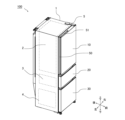
- FIG. 1 is a perspective view showing the appearance of a refrigerator according to a first embodiment of the present invention
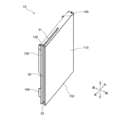
- 1 is a perspective view showing the appearance of a door of a refrigerator according to a first embodiment of the present invention
- FIG. 2 is an exploded perspective view of the door of the refrigerator according to the first embodiment.
- FIG. 4 is an enlarged view of area A in FIG. 3 .
- FIG. 4 is an enlarged front perspective view of area A in FIG. 3 .
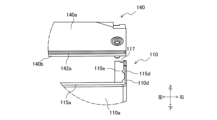
- FIG. 4 is an enlarged front perspective view of region B of FIG. 3 .
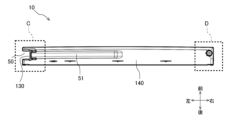
- 2 is a bottom view of the upper cap of the refrigerator according to embodiment 1.
- FIG. FIG. 8 is an enlarged view of region C in FIG. 7 .
- FIG. 8 is an enlarged view of region D in FIG. 7 .
- FIG. 2 is a top view of the refrigerator door according to the first embodiment.
- 11 is a cross-sectional view taken along line EE in FIG. 10.
- 12 is a cross-sectional view taken along line FF in FIG. 11.
- FIG. 2 is a front view of the door of the refrigerator according to the first embodiment.
- 14 is a cross-sectional view taken along line GG in FIG. 13.
- FIG. 15 is an enlarged view of region J in FIG. 14 .
- 14 is a cross-sectional view taken along line HH in FIG. 13.
- 14 is a cross-sectional view taken along line II in FIG. 13.
- FIG. 11 is an exploded front oblique view of the upper part of one side of a door of a refrigerator according to embodiment 2.
- FIG. FIG. 14 is a cross-sectional view of the refrigerator door according to the second embodiment taken along line GG in FIG. 13, showing an enlarged view of the handle portion.
- the up-down direction of refrigerator 100 may be referred to as the height direction.
- the left-right direction of refrigerator 100 may be referred to as the width direction.
- the front-rear direction of refrigerator 100 may be referred to as the depth direction.
- FIG. 1 is a perspective view showing the exterior of a refrigerator 100 according to the first embodiment.
- the refrigerator 100 includes a box body 1 having an opening on the front and having a refrigerator compartment 2, a vegetable compartment 3, and a freezer compartment 4 as storage spaces inside, and a door 10 attached to the box body 1 for opening and closing the opening.
- the refrigerator compartment 2 is opened and closed by the door 10.
- the door 10 has a handle 50 on the left side surface in the left-right direction and a second handle 51 on the top surface.
- the door 10 is hinged, and the top and bottom of the right side are fixed to the box body 1 by a hinge 5, and rotates around the hinge 5 to open and close the refrigerator compartment 2.
- the door 20 for opening and closing the vegetable compartment 3 and the door 30 for opening and closing the freezer compartment 4 are both drawer-type doors.
- the vegetable compartment 3 and the freezer compartment 4 can be opened and closed by moving the drawer-type doors 20 and 30 back and forth.
- the box 1 has a refrigerator compartment 2, a vegetable compartment 3, and a freezer compartment 4 as storage spaces.
- the refrigerator 100 may have only one refrigerator compartment 2 that is opened and closed by a door 10.
- the storage space may also have two or more refrigerator compartments 2, and the multiple refrigerator compartments 2 may be opened and closed by multiple hinged doors 10.
- the door 10 has a handle 50 on the left side and a hinge 5 on the right side.
- the door 10 can have a symmetrical configuration.
- the handle 50 may be provided on the right side of the door, and the hinge 5 may be provided on the left side.
- the door 10 comprises a front outer panel 110, a rear outer panel 120, a connecting part 130, an upper cap 140, a lower cap 150, and an inner panel 160.
- the front outer panel 110 constitutes the front surface of the door 10.
- the rear outer panel 120 and the inner panel 160 are provided on the rear side of the front outer panel 110 and constitute the rear surface of the door 10.
- the connecting part 130 is provided between the front outer panel 110 and the rear outer panel 120 in the front-rear direction, and connects the front outer panel 110 and the rear outer panel 120 in the front-rear direction.
- the connecting part 130 is made of resin and constitutes at least a part of the left side surface of the door 10.
- a handle portion 50 is formed by the front outer panel 110, the connecting part 130, and the rear outer panel 120.
- the handle 50 has a recessed shape that extends in the vertical direction and is recessed toward the right side. Details of the handle 50 will be described later.
- the upper cap 140 is a member provided on the front outer panel 110, the rear outer panel 120, and the connecting part 130, and covers the upper ends of these.
- a second handle portion 51 is formed on the upper cap 140.
- the second handle portion 51 has a downward concave shape with a portion of the upper surface of the upper cap 140 recessed downward, and extends in the left-right direction.
- the lower cap 150 is provided below the front outer panel 110, the rear outer panel 120, and the connecting part 130.
- a third handle portion 52 is formed on the lower cap 150.
- the third handle portion 52 has an upward concave shape with a portion of the bottom surface of the lower cap 150 recessed upward, and extends in the left-right direction.
- the concave portion of the handle portion 50, the concave portion of the second handle portion 51, and the concave portion of the third handle portion 52 are continuous and form a series of handles.
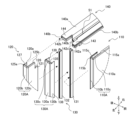
- FIG. 3 is an exploded perspective view of the door 10 of the refrigerator 100 according to the first embodiment. Note that the inner panel 160 is not shown in FIG. 3.
- the door 10 is vertically symmetrical, and the upper cap 140 and the lower cap 150 are also vertically symmetrical. For this reason, in the following explanation, the configuration of the upper cap 140 and the second handle portion 51 will be explained, and an explanation of the lower cap 150 and the third handle portion 52 corresponding to the second handle portion 51 will be omitted.
- the front outer panel 110 has a front panel 110a, a second front panel 110b, a third front panel 110c, a fourth front panel 110d, a fifth front panel 110e, and a first flange 115.
- the front panel 110a constitutes at least a part of the front surface of the door 10.
- the second front panel 110b extends from the left end of the front panel 110a toward the rear surface and forms a part of the left side surface of the door 10.
- the third front panel 110c extends from the rear end of the second front panel 110b toward the right side surface.
- the fourth front panel 110d extends from the right end of the front panel 110a toward the rear surface and forms the right side surface of the door 10.
- the fifth front panel 110e extends from the rear end of the fourth front panel 110d toward the left side surface.
- the second front panel 110b and the third front panel 110c form the front fold 110A.
- the front fold 110A is folded back from the left end of the front panel 110a to the right side behind the front panel 110a.
- the front fold 110A forms part of the handle 50.
- a first flange 115 is provided at the upper end of the front outer panel 110. At the upper end of the front fold-back portion 110A, the first flange 115 extends toward the area surrounded by the front fold-back portion 110A and the front panel 110a. Details of the first flange 115 will be described later.
- the rear outer panel 120 has a rear panel 120a, a second rear panel 120b, a third rear panel 120c, and a second flange 125.
- the rear panel 120a is a panel that extends parallel to the front panel 110a, and in this embodiment, constitutes at least a part of the rear of the door 10.
- the second rear panel 120b extends from the left end of the rear panel 120a toward the front, forming a part of the left side surface of the door 10.
- the third rear panel 120c extends from the front end of the second rear panel 120b toward the right side surface.
- the second rear panel 120b and the third rear panel 120c constitute the rear fold portion 120A.
- the rear fold portion 120A has a shape that is folded back from the left end of the rear panel 120a toward the right side surface in front of the rear panel 120a.
- the back fold 120A forms part of the handle 50.
- a second flange 125 is provided at the upper end of the rear outer panel 120.
- the second flange 125 extends toward the area surrounded by the rear fold 120A and the rear panel 120a. Details of the second flange 125 will be described later.
- connection part 130 has a connection plate 130a, a second connection plate 130b, a third connection plate 130c, a first fixing part 131, and a second fixing part 132.
- the connection plate 130a extends in the front-rear and up-down directions and forms part of the handle part 50.
- the second connection plate 130b extends from the front end of the connection plate 130a toward the right side surface.
- the third connection plate 130c extends from the rear end of the connection plate 130a toward the right side surface.
- the first fixing part 131 is provided on the second connecting plate 130b, and the second fixing part 132 is provided on the third connecting plate 130c. Details of the first fixing part 131 and the second fixing part 132 will be described later.
- the upper cap 140 has an upper wall 140a and an outer peripheral wall 140b.
- the upper wall 140a forms the upper surface of the door 10.
- the second handle 51 is provided on a part of the upper wall 140a and is formed by a portion that is recessed downward and extends in the left-right direction.
- the outer peripheral wall 140b extends downward from the outer periphery of the upper wall 140a.
- the left end of the upper cap 140 is bifurcated and has a concave shape that is recessed to the right in a plan view.
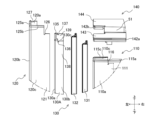
- Figure 4 is an enlarged view of area A in Figure 3.
- Figure 5 is an enlarged front perspective view of area A in Figure 3.
- Figure 6 is an enlarged front perspective view of area B in Figure 3.
- the first flange 115 of the front outer panel 110 has a first flange portion 115a provided at the upper end of the front panel 110a and extending toward the rear surface, a second flange portion 115b provided at the upper end of the second front panel 110b and extending toward the right side surface, and a third flange portion 115c provided at the upper end of the third front panel 110c and extending toward the front surface.
- the first flange 115 further has a fourth flange portion 115d provided at the upper end of the fourth front panel 110d and extending toward the left side surface.
- the first flange portion 115a, the second flange portion 115b, the third flange portion 115c, and the fourth flange portion 115d are connected to surround the area surrounded by the front plate 110a, the second front plate 110b, the third front plate 110c, the fourth front plate 110d, and the fifth front plate 110e.
- the first flange portion 115a is provided at the upper end of the front plate 110a from the left end to the right end as shown in Figures 4 to 6.
- the second flange portion 115b is provided at the upper end of the second front plate 110b from the front end to the rear end as shown in Figures 4 and 5.
- the third flange portion 115c extends from the left end to the right end at the upper end of the third front panel 110c, but is not provided at the upper end of the right end portion 111.
- a notch 116 which will be described later, is provided at the upper end of the third front panel 110c, and the third flange portion 115c is provided at the upper end of the third front panel 110c, between the left end and the notch 116.
- the fourth flange portion 115d is provided at the upper end of the fourth front plate 110d, from the front end to the rear end.
- the upper end of the fifth front plate 110e has a notch 117, which will be described later, but does not have the first flange 115.
- the second flange 125 of the rear outer panel 120 has a first flange portion 125a provided at the upper end of the second rear panel 120b and extending toward the right side, and a second flange portion 125b provided at the upper end of the third rear panel 120c and extending toward the rear.
- the first flange portion 125a is provided across the front end to the rear end of the second rear panel 120b.
- the second flange portion 125b extends from the left end to the right end at the upper end of the third rear panel 120c, but is not provided at the upper end of the right end 121.
- a notch 126 described later is provided at the upper end of the third rear panel 120c, and the second flange portion 125b is provided between the left end and the notch 126 at the upper end of the third rear panel 120c.
- the first flange portion 125a and the second flange portion 125b are connected to surround the area surrounded by the rear plate 120a, the second rear plate 120b, and the third rear plate 120c.
- the first fixing portion 131 of the connecting part 130 is formed by folding back the right end portion of the second connecting plate 130b towards the left side surface, and fixes the front outer panel 110 to the connecting part 130.
- the first fixing portion 131 overlaps a portion of the outer peripheral surface on the front side of the second connecting plate 130b.
- the second fixing portion 132 of the connecting part 130 is formed by folding back the right end portion of the third connecting plate 130c towards the left side surface, and fixes the rear outer panel 120 to the connecting part 130.
- the second fixing portion 132 overlaps a portion of the outer peripheral surface on the rear side of the third connecting plate 130c.
- the connecting part 130 is formed integrally with the first fixing portion 131 and the second fixing portion 132.
- the upper end surfaces of the connection plate 130a, the second connection plate 130b, the third connection plate 10c, the first fixing portion 131, and the second fixing portion 132 are collectively referred to as the upper end surface 133 of the connection part 130.
- the outer peripheral wall 140b of the upper cap 140 is provided with a horizontally extending groove-shaped flange accommodating portion 142.
- the left end of the upper cap 140 is bifurcated, and has a first protrusion 143 located on the front side and a second protrusion 144 located on the rear side.
- the flange accommodating portion 142 has a groove-shaped first flange accommodating portion 142a provided on the outer peripheral wall 140b of the first protrusion 143, and a groove-shaped second flange accommodating portion 142b provided on the outer peripheral wall 140b of the second protrusion 144.
- the first flange accommodating portion 142a provided on the outer peripheral wall 140b of the first protrusion 143 extends to the right end.
- the second flange accommodating portion 142b may be provided on the left and front sides of the outer peripheral wall 140b of the second protruding portion 144.
- the second flange accommodating portion 142b does not have to be provided on the back side of the outer peripheral wall 140b.
- the front skin panel 110 and the rear skin panel 120 are connected to the connecting part 130.
- the end 111 of the third front panel 110c is clamped between the first fixing part 131 of the connecting part 130 and the second connecting plate 130b.
- the end 121 of the third rear panel 120c is clamped between the second fixing part 132 of the connecting part 130 and the third connecting plate 130c.
- the front skin panel 110 and the rear skin panel 120 are connected by the connecting part 130.
- the first flange 115 of the front outer panel 110 is accommodated in the first flange accommodating portion 142a of the upper cap 140.
- the first flange portion 115a of the front outer panel 110 is inserted into the first flange accommodating portion 142a provided on the outer peripheral wall 140b on the front side of the upper cap 140.
- the second flange portion 115b and the third flange portion 115c of the front outer panel 110 are inserted into the first flange accommodating portion 142a provided on the first protruding portion 143 of the upper cap 140.
- the fourth flange portion 115d of the front outer panel 110 is inserted into the first flange accommodating portion 142a provided on the right outer peripheral wall 140b.
- the second flange 125 of the rear panel 120 is accommodated in the second flange accommodating portion 142b of the upper cap 140.
- the first flange portion 125a and the second flange portion 125b of the rear panel 120 are inserted into the second flange accommodating portion 142b provided on the left and front side surfaces of the second protruding portion 144 of the upper cap 140.
- the upper cap 140 is connected on top of the front skin 110, the connecting part 130, and the rear skin 120, which are all connected together.
- the first flange 115 of the front skin 110 is accommodated in the first flange accommodating portion 142a of the upper cap 140, and the second flange 125 of the rear skin 120 is accommodated in the second flange accommodating portion 142b.
- the upper end surface 133 of the connecting part 130 is connected so as to be continuous with the lower surface of the concave upper wall 140a that constitutes the second handle portion 51 of the upper cap 140.
- each cutout is located in a place that cannot be seen from the outside of the assembled door 10 and cannot be touched by the user.
- Notch 116 is provided at the upper end of the third front plate 110c, and notch 117 is provided at the upper end of the fifth front plate 110e, and has a shape recessed from top to bottom. Notch 116 is located below the second handle portion 51 of the upper cap 140 in the vertical direction. Notch 117 is located on the right side of the fifth front plate 110e.
- Notch 126 is provided at the upper end of the third rear panel 120c, and notch 127 is provided at the upper end of the rear panel 120a, and has a concave shape from top to bottom. Notch 126 is located below the second handle portion 51 of the upper cap 140. Notch 127 is located on the left side of the rear panel 120a.
- the left-right length of notch 117 and notch 127 is longer than the left-right length of the other notches, but the left-right length and height of each notch are not particularly limited.
- Each notch only needs to be provided in a downwardly recessed shape at the upper end of the front skin panel 110 and the rear skin panel 120.
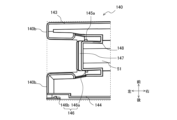
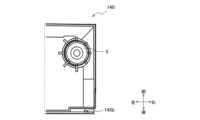
- Fig. 7 is a bottom view of the upper cap 140 of the refrigerator 100 according to the first embodiment.
- Fig. 8 is an enlarged view of area C in Fig. 7.
- the back of the page is the upper side and the front of the page is the lower side.
- Fig. 9 is an enlarged view of area D in Fig. 7.
- Fig. 10 is a top view of the door 10 of the refrigerator 100 according to the first embodiment.
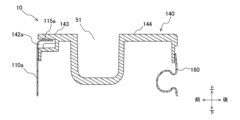
- Fig. 11 is a cross-sectional view taken along line E-E in Fig. 10.
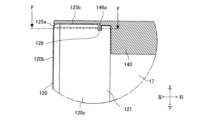
- Fig. 12 is a cross-sectional view taken along line F-F in Fig. 11.
- a first claw portion 145a is provided on the lower surface of the first protrusion 143 of the upper cap 140, and a second claw portion 146a and a second claw portion 146b are provided on the lower surface of the second protrusion 144.
- a first claw portion 145b is provided on the lower surface of the right rear end of the upper cap 140. The first claw portions 145a, 145b and the second claw portions 146a, 146b protrude downward.
- the second claw portion 146a engages with the notch 126 of the third rear panel 120c. As shown in Figure 11, the second claw portion 146a and the notch 126 are convex downward, and the second claw portion 146a fits into the notch 126. The second claw portion 146a also protrudes toward the rear surface as shown in Figure 12. This allows the second claw portion 146a to engage with the notch 126.
- the first claw portion 145a has a shape similar to that of the second claw portion 146a and protrudes toward the front.
- the first claw portion 145a engages with the notch 116 of the third front plate 110c.
- the first claw portion 145b engages with the notch 117 of the fifth front plate 110e (see FIG. 6), and the second claw portion 146b engages with the notch 127 of the rear plate 120a (see FIG. 5).
- the claw portion that engages with the notch provided in the front outer panel 110 is referred to as the first claw portion 145
- the claw portion that engages with the notch provided in the rear outer panel 120 is referred to as the second claw portion 146.
- the left-right length, the height of the convex shape, and the length in the front-rear direction of the first claw portion 145 and the second claw portion 146 are not particularly limited as long as each claw portion engages with the corresponding notch.
- first claw portion 145a and the first claw portion 145b when there is no need to particularly distinguish between the first claw portion 145a and the first claw portion 145b, they will be referred to as the first claw portion 145, and when there is no particular need to particularly distinguish between the second claw portion 146a and the second claw portion 146b, they will be referred to as the second claw portion 146.
- the claw portions and the notches may be provided as necessary, and there is no particular limit to the number thereof.
- the front outer panel 110 and the rear outer panel 120 tend to spread outward due to springback.
- the first claw portion 145a is engaged with the notch 116, which prevents the third front panel 110c and the upper cap 140 from shifting in the left-right direction.
- the first claw portion 145b is engaged with the notch 117, which prevents the fifth front panel 110e and the upper cap 140 from shifting in the left-right direction.
- the second claw portion 146a is engaged with the notch 126, which prevents the third rear panel 120c and the upper cap 140 from shifting in the left-right direction.
- the second claw portion 146b is engaged with the notch 127, which prevents the rear panel 120a and the upper cap 140 from shifting in the left-right direction. In this way, the upper cap 140, the front outer panel 110, and the rear outer panel 120 are fixed in place so that they do not shift in the left-right direction.
- a cover portion 147 is provided on the lower end surface 148 of the second handle portion 51 of the upper cap 140.
- the cover portion 147 is provided on the lower end surface of the left end portion of the second handle portion 51, and is in surface contact with the upper end surface of the connecting plate 130a of the connecting part 130.
- the area surrounded by the upper cap 140, the front outer panel 110, and the rear outer panel 120 is filled with foam insulation material 17, which will be described later.
- the connecting part 130 is a resin part formed by extrusion molding, the upper and lower ends of the connecting part 130 formed by cutting may be sharp, and end surface processing may be required. Even in such a case, by covering the end from the outside with the cover portion 147, it is possible to prevent the user's fingers from coming into contact with the end of the connecting part 130 when using the door 10.
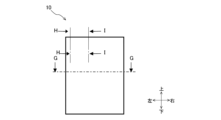
- Fig. 13 is a front view of the door 10 of the refrigerator 100 relating to the first embodiment.
- Fig. 13 is a view for easily understanding which positions on the door 10 are shown in cross sections in Figs. 14 to 17.
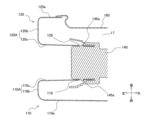
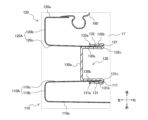
- Fig. 14 is a cross-sectional view taken at line G-G in Fig. 13.
- Fig. 15 is an enlarged view of region J in Fig. 14.
- Fig. 16 is a cross-sectional view taken at line H-H in Fig. 13.
- Fig. 17 is a cross-sectional view taken at line I-I in Fig. 13.
- the inside of the door 10 is filled with foam insulation material 17.
- the foam insulation material 17 is, for example, urethane.
- the second connection plate 130b, the third connection plate 130c, the first fixing part 131, and the second fixing part 132 of the connection part 130 are embedded in the foam insulation material 17.
- a part of the third front panel 110c of the front outer panel 110 that is sandwiched between the first fixing part 131 and the second connection plate 130b of the connection part 130, and a part of the third back panel 120c of the back outer panel 120 that is sandwiched between the second fixing part 132 and the third connection plate 130c of the connection part 130 are also embedded in the foam insulation material 17.
- the tip of the first fixing portion 131 of the connection part 130 is provided with a clamping piece 131a that contacts the outer peripheral surface of the front side of the second connecting plate 130b.
- the first fixing portion 131 is also provided with a pressing portion 131b that protrudes toward the second connecting plate 130b between the clamping piece 131a and the folded portion 131c.
- a gap is formed between the pressing portion 131b and the second connecting plate 130b.
- the right end 111 of the third front panel 110c is inserted and clamped between the outer circumferential surface of the second connecting plate 130b and the clamping piece 131a, and between the outer circumferential surface of the second connecting plate 130b and the retaining portion 131b.
- the end 111 is pressed against the outer circumferential surface of the second connecting plate 130b by the clamping piece 131a and clamped, so it is difficult to shift in the left-right and front-rear directions.
- the retaining portion 131b prevents the end 111 from wobbling back and forth in the gap between the retaining portion 131b and the second connecting plate 130b.
- the tip of the second fixing portion 132 of the connection part 130 is provided with a clamping piece 132a that contacts the outer peripheral surface on the rear side of the third connecting plate 130c.
- the second fixing portion 132 is also provided with a pressing portion 132b that protrudes toward the third connecting plate 130c between the clamping piece 132a and the folded portion 132c.
- a gap is formed between the pressing portion 132b and the third connecting plate 130c.
- the right end 121 of the third rear panel 120c is inserted and clamped between the outer circumferential surface of the third connecting plate 130c and the clamping piece 132a, and between the outer circumferential surface of the third connecting plate 130c and the retaining portion 132b.
- the end 121 is pressed against the outer circumferential surface of the third connecting plate 130c by the clamping piece 132a and is clamped, so it is difficult to shift in the left-right and front-rear directions.
- the retaining portion 132b prevents the end 121 from wobbling back and forth in the gap between the retaining portion 132b and the third connecting plate 130c.
- the left-right lengths of the second connecting plate 130b and the third connecting plate 130c are shorter than the front-rear length of the connecting plate 130a, but longer than the left-right lengths of the first fixing part 131 and the second fixing part 132. Therefore, using the second connecting plate 130b as a guide, the end 111 of the third front plate 110c can be inserted between the clamping piece 131a of the first fixing part 131 and the third front plate 110c. Also, using the third connecting plate 130c as a guide, the end 121 of the third back plate 120c can be inserted between the clamping piece 132a of the second fixing part 132 and the third back plate 120c.
- Figure 16 is a cross-sectional view taken along line H-H in Figure 13.
- Figure 17 is a cross-sectional view taken along line I-I in Figure 12.
- the first flange portion 115a of the front panel 110a is accommodated in the first flange accommodating portion 142a of the upper cap 140, so that no irregularities are formed on the front surface of the door 10.
- the front panel 110 and the rear panel 120 are connected by the connecting parts 130, and then the upper cap 140 and the lower cap 150 are attached.
- a vacuum insulation material may be provided inside the door 10 before the foam insulation material 17 is injected.
- the vacuum insulation material does not have to be provided depending on the temperature difference between the set temperature of the storage space and the outside air temperature.
- the foam insulation material 17 may be injected after the front panel 110, the rear panel 120, the connecting parts 130, the upper cap 140, and the lower cap 150 are connected.
- the inner panel 160 may be attached to the front panel 110, the rear panel 120, the upper cap 140, and the lower cap 150 after the foam insulation material 17 is injected.
- the refrigerator 100 according to the first embodiment includes a box 1 having an opening on the front and a storage space inside, and a door 10 having a handle 50 on a first side surface, which is one of the left and right sides, and attached to the box 1 on a second side surface, which is the side surface opposite the first side surface, for opening and closing the opening.
- the door 10 includes a front outer panel 110, a rear outer panel 120 provided on the rear side of the front outer panel 110, a connecting part 130 that connects the front outer panel 110 and the rear outer panel 120 in the front-rear direction and forms at least a part of the first side surface of the door 10, and an upper cap 140 provided on the front outer panel 110, the rear outer panel 120, and the connecting part 130 and forms the upper surface of the door 10.
- the front outer panel 110 has a front panel 110a constituting at least a part of the front surface of the door 10, a front fold-back portion 110A folded back from an end of the first side surface side of the front panel 110a toward a second side surface side behind the front panel 110a, and a first flange 115 provided at the upper end of the front fold-back portion 110A and extending toward an area surrounded by the front fold-back portion 110A and the front panel 110a.
- the upper cap 140 has an upper wall 140a, an outer peripheral wall 140b extending downward from the outer periphery of the upper wall 140a, a groove-shaped first flange accommodating portion 142a provided on the outer peripheral wall 140b to accommodate the first flange 115, and a groove-shaped second flange accommodating portion 142b provided on the outer peripheral wall 140b to accommodate the second flange 125.
- the handle portion 50 is formed by the front folded portion 110A, a part of the connecting part 130, and the rear folded portion 120A, and has a shape recessed toward the second side surface.
- a concave handle portion 50 is formed on the first side of the door 10 of the refrigerator 100 by the front outer panel 110, the rear outer panel 120, and the connecting part 130. This allows the user to place their hand on the first side of the door 10 to open the door 10. This improves the convenience of the refrigerator 100.
- the front outer panel 110 is connected to the upper cap 140 by receiving the first flange 115 in the first flange receiving portion 142a
- the rear outer panel 120 is connected to the upper cap 140 by receiving the second flange 125 in the second flange receiving portion 142b. Since the first flange 115 is inserted into the outer peripheral wall 140b of the upper cap 140, the vertical dimension of the upper cap 140 exposed to the outside can be made smaller than in a configuration in which the upper cap 140 covers the upper end of the front outer panel 110. Therefore, the upper cap 140 becomes less noticeable in the appearance of the door 10, and the upper cap 140 is less likely to affect the design. Furthermore, since each flange is received in each flange receiving portion, the connection between the front outer panel 110 and the upper cap 140, and the connection between the rear outer panel 120 and the upper cap 140 are strengthened.
- the front outer panel 110 having the front fold portion 110A and the rear outer panel 120 having the rear fold portion 120A are connected by a connecting part 130, which is a separate member from these.
- a connecting part 130 which is a separate member from these.
- the front fold portion 110A having the flange portion and the rear fold portion 120A are connected by the connecting part 130, so that the handle portion 50 can be configured without bending the flange in the direction in which it will tear. Therefore, it is possible to connect the front outer panel 110 and the upper cap 140 by a flange that suppresses the possibility of leakage of the foam insulation material 17, and the design of the door 10 having the handle portion 50 on the side can be improved.
- the door 10 of the refrigerator 100 has a connecting part 130 having a first fixing part 131 fixed to the front outer panel 110, a second fixing part 132 fixed to the rear outer panel 120, and a connecting plate 130a provided between the first fixing part 131 and the second fixing part 132, extending in the front-rear and up-down directions of the door 10 and constituting a part of the handle part 50. Therefore, the front outer panel 110 and the rear outer panel 120 are firmly fixed to the connecting part 130 by the first fixing part 131 and the second fixing part 132.
- the first fixing portion 131 of the connection part 130 is provided on the second connection plate 130b of the connection part 130, and sandwiches the third front plate 110c between the second connection plate 130b. Therefore, the third front plate 110c can be firmly sandwiched between the second connection plate 130b and the first fixing portion 131.
- the second fixing portion 132 of the connection part 130 is provided on the third connection plate 130c of the connection part 130, and sandwiches the third back plate 120c between the third connection plate 130c. Therefore, the third back plate 120c can be firmly sandwiched between the second connection plate 130b and the first fixing portion 131.
- the first fixing portion 131 of the connecting part 130 is formed by folding back from the end portion on the second side surface of the second connecting plate 130b to the first side surface.
- the second fixing portion 132 of the connecting part 130 is formed by folding back from the end portion on the second side surface of the third connecting plate 130c to the first side surface. Therefore, since there is no need to manufacture and connect the connecting part 130, the first fixing portion 131, and the second fixing portion 132 as separate parts, the manufacturing process of the refrigerator 100 can be simplified.
- the connecting part 130 is made of resin, and the upper end surface 133 of the connecting part 130 is in surface contact with the lower end surface 148 of the upper cap 140. Therefore, the connecting part 130 and the upper cap 140 are connected flush with each other, which prevents the design of the door 10 from being affected.
- connection part 130 is made of resin, there is a low risk that the end of the connection part 130 will injure the user. Therefore, there is no need to cover the end of the connection part 130 with a cover to prevent the user from being injured, and the manufacturing process of the refrigerator 100 can be simplified.
- the upper end surface 133 of the connection part 130 and the lower end surface 148 of the upper cap 140 can be directly connected by surface contact. Since no unevenness occurs in the area where the connection part 130 and the upper cap 140 contact each other, it is possible to suppress any impact on the design of the door 10.
- connection part 130 is made of resin, it is easy to correct any dimensional variations in the connection part 130. Therefore, it is easy to manage the dimensions of the door 10.
- the upper cap 140 has a first claw portion 145 that protrudes downward and a second claw portion 146 that protrudes downward.
- the front outer panel 110 has concave cutouts 116, 117 in which the first claw portions 145a, 145b engage at the portion where the first flange 115 is not provided at the upper end.
- the rear outer panel 120 has concave cutouts 126, 127 in which the second claw portions 146a, 146b engage at the portion where the second flange 125 is not provided at the upper end.
- the first claw portion 145a of the upper cap 140 and the front outer panel 110 is engaged with the notch 116, and the first claw portion 145b is engaged with the notch 117.
- the second flange 125 is accommodated in the second flange accommodating portion 142b
- the second claw portion 146a of the upper cap 140 and the rear outer panel 120 is engaged with the notch 126
- the second claw portion 146b is engaged with the notch 127. This prevents the rear outer panel 120 from moving in the fore-aft and lateral directions.
- the possibility that the front outer panel 110 and the rear outer panel 120 will come off the upper cap 140 is reduced, improving the manufacturing efficiency of the refrigerator 100.
- the door 10 of the same quality in which the front outer panel 110 and the rear outer panel 120 are firmly connected to the upper cap 140 can be assembled stably, the quality variation of the refrigerator 100 can be reduced.
- the notch 116 in the third front panel 110c, the notch 117 in the fifth front panel 110e, the notch 127 in the rear panel 120a, and the notch 126 in the third rear panel 120c are all located in places that the user cannot touch, so as to avoid the risk of injuring the user. This improves the safety of the refrigerator 100.
- the first fixing portion 131 and the second fixing portion 132 of the connection part 130 are embedded in the foam insulation material 17 filled between the front outer panel 110 and the rear outer panel 120.
- the connection part between the front outer panel 110 and the connection part 130 is the second connection plate 130b of the connection part 130, the first fixing portion 131, and the end portion 111 of the third front panel 110c that is sandwiched between the second connection plate 130b and the first fixing portion 131.
- connection portion between the rear outer panel 120 and the connection part 130 is the third connection plate 130c of the connection part 130, the second fixing part 132, and the end part 121 of the third rear panel 120c that is sandwiched between the third connection plate 130c and the second fixing part 132.
- the upper wall 140a of the upper cap 140 is provided with a second handle 51 that is recessed downward and extends in the left-right direction.
- the second handle 51 is connected to the handle 50 on the first side surface side. The user can open and close the door 10 by placing their hand on the second handle 51 provided on the top surface of the door 10, improving the convenience of the refrigerator 100.
- the door 10 of the refrigerator 100 includes a hinge 5 provided on the second side.
- the hinge 5 supports the door 10 so that it can rotate. With this configuration, the user can open and close the door 10 using the handle 50.
- the door 10 may also be provided with a lower cap 150 having a vertically symmetrical configuration with the upper cap 140.
- the lower cap 150 has a third handle 52, so the user can place his or her hand on the third handle 52 provided on the bottom surface of the door 10 to open or close the door 10.
- the handle 50, the second handle 51, and the third handle 52 are connected in a series of recesses, so that continuous handles are provided on the top, bottom, and one side surface. This makes it easier for the user to open and close the door 10.
- the user can open and close the door 10 from anywhere on the top, bottom, or one side surface of the door 10 without visually checking the handle 50, the second handle 51, and the third handle 52. This improves the convenience of the refrigerator 100.
- Embodiment 2 differs from the first embodiment in the configurations of the front skin 110, the rear skin 120, the connection part 130, and the upper cap 140.
- the connection part 130 according to this embodiment is made of steel plate, and the first fixing part 131 and the second fixing part 132 are provided as separate bodies. Accordingly, the configurations of the front skin 110, the rear skin 120, and the upper cap 140 differ from those of the first embodiment.
- Fig. 18 is an exploded perspective view of the upper part of one side of the door 10 of a refrigerator 100 according to embodiment 2.
- Fig. 19 is an exploded front perspective view of the upper part of one side of the door 10 of a refrigerator 100 according to embodiment 2.
- Fig. 20 is a cross-sectional view of the door 10 of a refrigerator 100 according to embodiment 2 taken along line G-G in Fig. 13, and is an enlarged view of the handle portion 50.
- connection part 130 includes a main body 130A having a connection plate 130a, a second connection plate 130b, and a third connection plate 130c.
- the first fixing part 131 is provided on the right outer peripheral surface of the second connection plate 130b as a separate body from the main body 130A.
- the second fixing part 132 is provided on the right outer peripheral surface of the third connection plate 130c as a separate body from the main body 130A.
- a third flange 135 is provided at the upper end of the connecting plate 130a, extending toward the right side surface.
- a groove-shaped third flange accommodating portion 142c is provided on the outer peripheral wall 140b of the upper cap 140 to accommodate the third flange 135.
- the third flange accommodating portion 142c is provided on the outer peripheral wall 140b that extends downward from the outer peripheral portion on the left side of the second handle portion 51.
- a notch 136 is provided at the upper end of the second connecting plate 130b, and a notch 137 is provided at the upper end of the third connecting plate 130c.
- the notches 136 and 137 are recessed from top to bottom.
- the right end of the second connecting plate 130b is referred to as end 138.
- the right end of the third connecting plate 130c is referred to as end 139.
- the first fixing part 131 and the second fixing part 132 are the same parts with the same configuration.
- the first fixing part 131 and the second fixing part 132 have bases 171, 181 extending in the front-rear direction, first clamping pieces 172, 182 extending leftward from the front ends of the bases 171, 181, and second clamping pieces 173, 183 extending diagonally from the rear ends of the bases 171, 181 toward the left ends of the first clamping pieces 172, 182.
- the first clamping pieces 172, 182 and the second clamping pieces 173, 183 are structured to come into contact with each other and clamp an object therebetween.
- the bases 171, 181 are provided with holding parts 176, 186 extending leftward.
- the holding portions 176, 186 protrude into the space surrounded by the first clamping pieces 172, 182, the second clamping pieces 173, 183, and the bases 171, 181, and have a structure that allows an object to be held between the holding portions 176, 186 and the first clamping pieces 172, 182.
- a gap is formed between the holding portions 176, 186 and the first clamping pieces 172, 182.
- the first clamping piece 172, the second clamping piece 173, and the pressing portion 176 constitute the clamping portion 174.
- the clamping portion 174 of the first fixing portion 131 clamps the second connecting plate 130b of the overlapping connecting part 130 and the third front plate 110c of the front outer plate 110.
- the second clamping piece 173 presses the end portion 138 of the second connecting plate 130b
- the first clamping piece 172 presses the end portion 111 of the third front plate 110c, thereby clamping the second connecting plate 130b and the third front plate 110c.
- the second connecting plate 130b and the third front plate 110c are sandwiched between the first clamping piece 172 and the second clamping piece 173, they are less likely to shift in the left-right direction and the front-rear direction.
- the end 138 of the second connecting plate 130b and the end 111 of the third front plate 110c are inserted into the gap between the pressing portion 176 and the first clamping piece 172. Because they are sandwiched between the pressing portion 176 and the first clamping piece 172, the second connecting plate 130b and the third front plate 110c are prevented from wobbling back and forth.
- the first clamping piece 182, the second clamping piece 183, and the pressing portion 186 constitute the clamping portion 184.
- the clamping portion 184 of the second fixing portion 132 clamps the third connecting plate 130c of the overlapping connecting part 130 and the third back plate 120c of the back outer plate 120.
- the second clamping piece 183 presses the end portion 121 of the third back plate 120c
- the first clamping piece 182 presses the end portion 139 of the third connecting plate 130c, thereby clamping the third connecting plate 130c and the third back plate 120c.
- the third connecting plate 130c is sandwiched between the first clamping piece 182 and the second clamping piece 183, the third connecting plate 130c and the third back plate 120c are less likely to shift in the left-right direction and the front-back direction.
- the end 139 of the third connection plate 130c and the end 121 of the third back plate 120c are inserted into the gap between the pressing portion 186 and the first clamping piece 182. Because they are sandwiched between the pressing portion 186 and the first clamping piece 182, the third connection plate 130c and the third back plate 120c are prevented from wobbling back and forth.
- the notch 116 and the upper end of the end 111 of the third front panel 110c of the front skin panel 110 are located below the third flange portion 115c. Furthermore, the notch 126 and the upper end of the end 121 of the third rear panel 120c of the rear skin panel 120 are located below the second flange portion 125b.
- the notch 116 of the third front panel 110c overlaps with the notch 136 of the second connecting plate 130b, and the notch 137 of the third connecting plate 130c overlaps with the notch 126 of the third rear panel 120c.
- the notch 116 of the third front plate 110c, the notch 136 of the second connecting plate 130b, the notch 137 of the third connecting plate 130c, and the notch 126 of the third rear plate 120c are aligned in a straight line in the front-to-rear direction.
- the first claw portion 145a of the upper cap 140 is engaged with the notch 116 of the third front plate 110c and the notch 136 of the second connecting plate 130b.
- the second claw portion 146a of the upper cap 140 is engaged with the notch 137 of the third connecting plate 130c and the notch 126 of the third back plate 120c.
- the first claw portion 145a and the second claw portion 146a are not particularly limited in terms of their location or shape as long as they can be engaged with the corresponding notches.
- the door 10 of the refrigerator 100 according to the second embodiment includes a main body 130A in which the connecting part 130 has a connecting plate 130a, a second connecting plate 130b extending from the front end of the connecting plate 130a toward the second side, and a third connecting plate 130c extending from the rear end of the connecting plate 130a toward the second side.
- the first fixing part 131 and the second fixing part 132 are provided separately from the main body 130A.
- the first fixing part 131 has a clamping part 174 that clamps the second connecting plate 130b of the overlapping connecting part 130 and the third front panel 110c of the front outer panel 110.
- the second fixing portion 132 has a clamping portion 184 that clamps the third connecting plate 130c of the overlapping connecting part 130 and the third back plate 120c of the back outer plate 120.
- the connecting part 130 which is composed of the main body 130A, the first fixing part 131, and the second fixing part 132, is configured to connect the front outer panel 110 and the rear outer panel 120.
- the configuration of the first flange 115 of the front outer panel 110 and the first flange accommodating part 142a of the upper cap 140 is the same as that of the first embodiment, the upper cap 140 becomes less noticeable in the appearance of the door 10, and the upper cap 140 is less likely to affect the design.
- the first flange 115 of the front outer panel 110 and the second flange 125 of the rear outer panel 120 are provided at the upper ends of the front fold portion 110A and the rear fold portion 120A, respectively.
- the front fold portion 110A and the rear fold portion 120A are connected by a connecting part 130, so that the handhold portion 50 can be configured without the need to bend the flange in a direction that would cause it to tear. Therefore, the same effect as in the first embodiment can be obtained.
- the clamping portion 174 of the first fixed portion 131 and the clamping portion 184 of the second fixed portion 132 each have a pair of clamping pieces that clamp an object at their tips, and a base 171, 181 that connects the pair of clamping pieces.
- the base 171, 181 is provided with a pressing portion 176, 186 that protrudes toward the space formed between the pair of clamping pieces and the base 171, 181 and comes into contact with the object.
- the pair of clamping pieces of the clamping portion 174 are the first clamping piece 172 and the second clamping piece 173, and the pair of clamping pieces of the clamping portion 184 are the first clamping piece 182 and the second clamping piece 183.
- the above-described configuration of the first fixing portion 131 and the second fixing portion 132 allows the front outer panel 110 and the rear outer panel 120 to be firmly fixed to the connecting part 130. As a result, the front outer panel 110 and the rear outer panel 120 are less likely to shift in the front-to-back and left-to-right directions, and are prevented from wobbling back and forth. This improves the quality of the refrigerator 100.
- the connecting part 130 is made of a steel plate.
- the connecting part 130 has a third flange 135 extending horizontally toward the second side surface at the upper end of the connecting plate 130a.
- the outer peripheral wall 140b of the upper cap 140 is provided with a groove-shaped third flange accommodating portion 142c in which the third flange 135 of the connecting part 130 is accommodated.
- the connecting part 130 is made of steel plate, improving the design of the door 10. Also, since the third flange 135 at the upper end of the connecting plate 130a is accommodated in the third flange accommodating portion 142c of the upper cap 140, when the user places their hand on the handle portion 50, they will not touch the end face of the connecting plate 130a made of steel plate. This improves the safety of the refrigerator 100. Furthermore, since the third flange 135 is accommodated in the third flange accommodating portion 142c, the connecting part 130 and the upper cap 140 are connected flush with each other, which can prevent any impact on the design of the door 10.
Landscapes
- Engineering & Computer Science (AREA)
- Chemical & Material Sciences (AREA)
- Combustion & Propulsion (AREA)
- Physics & Mathematics (AREA)
- Mechanical Engineering (AREA)
- Thermal Sciences (AREA)
- General Engineering & Computer Science (AREA)
- Refrigerator Housings (AREA)
Priority Applications (3)
| Application Number | Priority Date | Filing Date | Title |
|---|---|---|---|
| JP2025527297A JPWO2024261904A1 (https=) | 2023-06-21 | 2023-06-21 | |
| PCT/JP2023/022932 WO2024261904A1 (ja) | 2023-06-21 | 2023-06-21 | 冷蔵庫 |
| TW113122139A TWI891406B (zh) | 2023-06-21 | 2024-06-14 | 冰箱 |
Applications Claiming Priority (1)
| Application Number | Priority Date | Filing Date | Title |
|---|---|---|---|
| PCT/JP2023/022932 WO2024261904A1 (ja) | 2023-06-21 | 2023-06-21 | 冷蔵庫 |
Publications (1)
| Publication Number | Publication Date |
|---|---|
| WO2024261904A1 true WO2024261904A1 (ja) | 2024-12-26 |
Family
ID=93934973
Family Applications (1)
| Application Number | Title | Priority Date | Filing Date |
|---|---|---|---|
| PCT/JP2023/022932 Ceased WO2024261904A1 (ja) | 2023-06-21 | 2023-06-21 | 冷蔵庫 |
Country Status (3)
| Country | Link |
|---|---|
| JP (1) | JPWO2024261904A1 (https=) |
| TW (1) | TWI891406B (https=) |
| WO (1) | WO2024261904A1 (https=) |
Citations (5)
| Publication number | Priority date | Publication date | Assignee | Title |
|---|---|---|---|---|
| JPH04313674A (ja) * | 1991-04-11 | 1992-11-05 | Mitsubishi Electric Corp | 冷蔵庫の扉並びにその製造方法 |
| US20120326587A1 (en) * | 2011-06-21 | 2012-12-27 | Samsung Electronics Co., Ltd | Refrigerator |
| CN102869936A (zh) * | 2010-04-30 | 2013-01-09 | Bsh博世和西门子家用电器有限公司 | 具有带把手壳的门扇的制冷器具 |
| JP5178208B2 (ja) * | 2008-01-15 | 2013-04-10 | 三菱電機株式会社 | 冷蔵庫 |
| CN203083249U (zh) * | 2012-12-27 | 2013-07-24 | 合肥美的荣事达电冰箱有限公司 | 用于对开门冰箱的门体组件和具有其的对开门冰箱 |
Family Cites Families (2)
| Publication number | Priority date | Publication date | Assignee | Title |
|---|---|---|---|---|
| CN205619673U (zh) * | 2016-04-28 | 2016-10-05 | 宁波韩电电器有限公司 | 一种加强冰箱门 |
| CN110118053B (zh) * | 2018-02-07 | 2023-02-28 | 博西华电器(江苏)有限公司 | 一种用于家用电器的门及家用电器 |
-
2023
- 2023-06-21 JP JP2025527297A patent/JPWO2024261904A1/ja active Pending
- 2023-06-21 WO PCT/JP2023/022932 patent/WO2024261904A1/ja not_active Ceased
-
2024
- 2024-06-14 TW TW113122139A patent/TWI891406B/zh active
Patent Citations (5)
| Publication number | Priority date | Publication date | Assignee | Title |
|---|---|---|---|---|
| JPH04313674A (ja) * | 1991-04-11 | 1992-11-05 | Mitsubishi Electric Corp | 冷蔵庫の扉並びにその製造方法 |
| JP5178208B2 (ja) * | 2008-01-15 | 2013-04-10 | 三菱電機株式会社 | 冷蔵庫 |
| CN102869936A (zh) * | 2010-04-30 | 2013-01-09 | Bsh博世和西门子家用电器有限公司 | 具有带把手壳的门扇的制冷器具 |
| US20120326587A1 (en) * | 2011-06-21 | 2012-12-27 | Samsung Electronics Co., Ltd | Refrigerator |
| CN203083249U (zh) * | 2012-12-27 | 2013-07-24 | 合肥美的荣事达电冰箱有限公司 | 用于对开门冰箱的门体组件和具有其的对开门冰箱 |
Also Published As
| Publication number | Publication date |
|---|---|
| JPWO2024261904A1 (https=) | 2024-12-26 |
| TWI891406B (zh) | 2025-07-21 |
| TW202505150A (zh) | 2025-02-01 |
Similar Documents
| Publication | Publication Date | Title |
|---|---|---|
| JP6466293B2 (ja) | 車両のリッド装置 | |
| EP3027984B1 (en) | Refrigerator door and refrigerator | |
| CN105333680B (zh) | 冰箱 | |
| EP4513116A2 (en) | Refrigerator | |
| JP5659674B2 (ja) | 内装トリム | |
| KR20150056088A (ko) | 차량용 개폐체 구조 | |
| CN105258438B (zh) | 具有把手槽的冰箱 | |
| US10151524B2 (en) | Refrigerator having a door | |
| JP2019002258A (ja) | 車両用ドアのアウトハンドル装置 | |
| WO2024261904A1 (ja) | 冷蔵庫 | |
| US11285889B2 (en) | Harness guide | |
| TWI570374B (zh) | Refrigerator door and refrigerator | |
| EP4004324B1 (en) | Home appliance | |
| JP6685430B2 (ja) | 冷蔵庫の扉及びこの扉を備えた冷蔵庫 | |
| JP2018167833A (ja) | 車両のリッド装置 | |
| KR20180022236A (ko) | 냉장고 | |
| JP7668653B2 (ja) | 冷蔵庫の扉および冷蔵庫 | |
| JP3546150B2 (ja) | コネクタ | |
| JP2001223071A (ja) | 電子レンジのドア | |
| CN106403470A (zh) | 具有门的冰箱 | |
| CN116481223A (zh) | 一种制冷器具 | |
| JPWO2024261904A5 (https=) | ||
| CN105627674B (zh) | 冰箱 | |
| CN116209616A (zh) | 车辆的盖装置 | |
| KR20160023451A (ko) | 냉장고 |
Legal Events
| Date | Code | Title | Description |
|---|---|---|---|
| 121 | Ep: the epo has been informed by wipo that ep was designated in this application |
Ref document number: 23942341 Country of ref document: EP Kind code of ref document: A1 |
|
| WWE | Wipo information: entry into national phase |
Ref document number: 2025527297 Country of ref document: JP |
|
| WWE | Wipo information: entry into national phase |
Ref document number: 825818 Country of ref document: NZ |
|
| WWE | Wipo information: entry into national phase |
Ref document number: 2501008046 Country of ref document: TH |
|
| NENP | Non-entry into the national phase |
Ref country code: DE |
|
| WWE | Wipo information: entry into national phase |
Ref document number: 11202508004T Country of ref document: SG |
|
| WWP | Wipo information: published in national office |
Ref document number: 11202508004T Country of ref document: SG |