WO2024258147A1 - 은시호 추출물 또는 이로부터 분리된 화합물을 유효성분으로 함유하는 골격근 위축 또는 근감소증의 예방용 및 개선용 또는 치료용 조성물 - Google Patents
은시호 추출물 또는 이로부터 분리된 화합물을 유효성분으로 함유하는 골격근 위축 또는 근감소증의 예방용 및 개선용 또는 치료용 조성물 Download PDFInfo
- Publication number
- WO2024258147A1 WO2024258147A1 PCT/KR2024/007964 KR2024007964W WO2024258147A1 WO 2024258147 A1 WO2024258147 A1 WO 2024258147A1 KR 2024007964 W KR2024007964 W KR 2024007964W WO 2024258147 A1 WO2024258147 A1 WO 2024258147A1
- Authority
- WO
- WIPO (PCT)
- Prior art keywords
- muscle atrophy
- preventing
- skeletal muscle
- extract
- eunshiho
- Prior art date
- Legal status (The legal status is an assumption and is not a legal conclusion. Google has not performed a legal analysis and makes no representation as to the accuracy of the status listed.)
- Ceased
Links
Images






Classifications
-
- A—HUMAN NECESSITIES
- A23—FOODS OR FOODSTUFFS; TREATMENT THEREOF, NOT COVERED BY OTHER CLASSES
- A23K—FODDER
- A23K20/00—Accessory food factors for animal feeding-stuffs
- A23K20/10—Organic substances
- A23K20/116—Heterocyclic compounds
- A23K20/137—Heterocyclic compounds containing two hetero atoms, of which at least one is nitrogen
-
- A—HUMAN NECESSITIES
- A23—FOODS OR FOODSTUFFS; TREATMENT THEREOF, NOT COVERED BY OTHER CLASSES
- A23L—FOODS, FOODSTUFFS OR NON-ALCOHOLIC BEVERAGES, NOT OTHERWISE PROVIDED FOR; PREPARATION OR TREATMENT THEREOF
- A23L33/00—Modifying nutritive qualities of foods; Dietetic products; Preparation or treatment thereof
- A23L33/10—Modifying nutritive qualities of foods; Dietetic products; Preparation or treatment thereof using additives
-
- A—HUMAN NECESSITIES
- A61—MEDICAL OR VETERINARY SCIENCE; HYGIENE
- A61K—PREPARATIONS FOR MEDICAL, DENTAL OR TOILETRY PURPOSES
- A61K31/00—Medicinal preparations containing organic active ingredients
- A61K31/33—Heterocyclic compounds
- A61K31/335—Heterocyclic compounds having oxygen as the only ring hetero atom, e.g. fungichromin
- A61K31/365—Lactones
- A61K31/366—Lactones having six-membered rings, e.g. delta-lactones
-
- A—HUMAN NECESSITIES
- A61—MEDICAL OR VETERINARY SCIENCE; HYGIENE
- A61K—PREPARATIONS FOR MEDICAL, DENTAL OR TOILETRY PURPOSES
- A61K31/00—Medicinal preparations containing organic active ingredients
- A61K31/33—Heterocyclic compounds
- A61K31/395—Heterocyclic compounds having nitrogen as a ring hetero atom, e.g. guanethidine or rifamycins
- A61K31/41—Heterocyclic compounds having nitrogen as a ring hetero atom, e.g. guanethidine or rifamycins having five-membered rings with two or more ring hetero atoms, at least one of which being nitrogen, e.g. tetrazole
-
- A—HUMAN NECESSITIES
- A61—MEDICAL OR VETERINARY SCIENCE; HYGIENE
- A61K—PREPARATIONS FOR MEDICAL, DENTAL OR TOILETRY PURPOSES
- A61K31/00—Medicinal preparations containing organic active ingredients
- A61K31/33—Heterocyclic compounds
- A61K31/395—Heterocyclic compounds having nitrogen as a ring hetero atom, e.g. guanethidine or rifamycins
- A61K31/435—Heterocyclic compounds having nitrogen as a ring hetero atom, e.g. guanethidine or rifamycins having six-membered rings with one nitrogen as the only ring hetero atom
- A61K31/4353—Heterocyclic compounds having nitrogen as a ring hetero atom, e.g. guanethidine or rifamycins having six-membered rings with one nitrogen as the only ring hetero atom ortho- or peri-condensed with heterocyclic ring systems
- A61K31/437—Heterocyclic compounds having nitrogen as a ring hetero atom, e.g. guanethidine or rifamycins having six-membered rings with one nitrogen as the only ring hetero atom ortho- or peri-condensed with heterocyclic ring systems the heterocyclic ring system containing a five-membered ring having nitrogen as a ring hetero atom, e.g. indolizine, beta-carboline
-
- A—HUMAN NECESSITIES
- A61—MEDICAL OR VETERINARY SCIENCE; HYGIENE
- A61K—PREPARATIONS FOR MEDICAL, DENTAL OR TOILETRY PURPOSES
- A61K31/00—Medicinal preparations containing organic active ingredients
- A61K31/70—Carbohydrates; Sugars; Derivatives thereof
- A61K31/7042—Compounds having saccharide radicals and heterocyclic rings
- A61K31/7052—Compounds having saccharide radicals and heterocyclic rings having nitrogen as a ring hetero atom, e.g. nucleosides, nucleotides
- A61K31/706—Compounds having saccharide radicals and heterocyclic rings having nitrogen as a ring hetero atom, e.g. nucleosides, nucleotides containing six-membered rings with nitrogen as a ring hetero atom
-
- A—HUMAN NECESSITIES
- A61—MEDICAL OR VETERINARY SCIENCE; HYGIENE
- A61K—PREPARATIONS FOR MEDICAL, DENTAL OR TOILETRY PURPOSES
- A61K36/00—Medicinal preparations of undetermined constitution containing material from algae, lichens, fungi or plants, or derivatives thereof, e.g. traditional herbal medicines
- A61K36/18—Magnoliophyta (angiosperms)
- A61K36/185—Magnoliopsida (dicotyledons)
- A61K36/36—Caryophyllaceae (Pink family), e.g. babysbreath or soapwort
-
- A—HUMAN NECESSITIES
- A61—MEDICAL OR VETERINARY SCIENCE; HYGIENE
- A61P—SPECIFIC THERAPEUTIC ACTIVITY OF CHEMICAL COMPOUNDS OR MEDICINAL PREPARATIONS
- A61P21/00—Drugs for disorders of the muscular or neuromuscular system
Definitions
- the present invention relates to a composition for preventing and treating skeletal muscle atrophy or sarcopenia, and more specifically, to a pharmaceutical composition, food composition or feed composition for preventing, improving or treating skeletal muscle atrophy or sarcopenia, containing an extract of Stellaria dichotoma L. var. lanceolata Bunge or a compound isolated therefrom as an effective ingredient.
- Skeletal muscle is the tissue with the largest mass in the human body, with about 600 of them, accounting for 40-50% of body weight. They play an important role in body functions such as movement, breathing, maintaining posture, maintaining body temperature, and energy metabolism.
- the mass of this skeletal muscle is regulated by the balance between protein synthesis and decomposition within the muscle. If decomposition increases more than synthesis, skeletal muscle loss occurs, and it decreases by about 8% every 10 years from the age of 40, and by the age of 70, the rate of decrease increases to 15% over 10 years.
- Muscle atrophy is caused by various factors such as aging of the body, long-term muscle disuse, lack of exercise, hormonal deficiency, and various diseases (cachexia, sepsis, starvation, cancer, diabetes, chronic inflammation, degenerative diseases, etc.).
- various diseases cachexia, sepsis, starvation, cancer, diabetes, chronic inflammation, degenerative diseases, etc.
- the muscle strength for physical activity is weakened and further leads to musculoskeletal degeneration, which rapidly lowers the quality of life due to decreased exercise ability, decreased physical function, increased risk of falls and fractures, decreased ability to perform daily life, and increased risk of death.
- the decrease in skeletal muscle and musculoskeletal degeneration increase the risk of various diseases such as fractures, joint damage, metabolic syndrome, obesity, dyslipidemia, and cardiovascular disease. Therefore, in order to live a healthy and happy life, it is very important to reduce the occurrence of muscle atrophy and skeletal muscle loss caused by various factors and increase regeneration.
- Myoblasts secrete various growth factors for proliferation and induce differentiation into myotubes through the expression of myogenic proteins such as MyoD, Myogenin, and MHC (Myosin Heavy Chain).
- myogenic proteins such as MyoD, Myogenin, and MHC (Myosin Heavy Chain).
- the anabolic activity of skeletal muscle is regulated by mTOR (Mammalian target of rapamycin) signaling. When mTOR is phosphorylated (activated), it induces the phosphorylation of p70S6K (Ribosomal p70 S6 kinase), which ultimately increases the synthesis of myogenic proteins.
- Stellaria dichotoma L. var. lanceolata Bunge is the dried root of Stellaria dichotoma L. var. lanceolata Bunge of the Caryophyllaceae family, which is cultivated in China, Europe, Russia, and Mongolia. It is nearly cylindrical and branched, 15-40 cm long, and 10-25 mm in diameter. The outer surface is light yellow or yellowish white, and has twisted longitudinal wrinkles and traces of lateral roots. It is concavely hollowed out in the shape of a hole, and when cut vertically near this area, a powdery substance comes out and brown gaps can be seen. At the upper end, you can see traces of a stem that was densely attached in a wart-like shape.
- the texture is hard but fragile and easy to cut. There are gaps on the cut surface, the skin is very thin, and the xylem has a radial pattern of yellow and white alternating.
- Other names include Baekgeunja, Sasam-a, Udungun, Eunhasiho, Eunho, and Tosam. The roots are dug up in spring or fall, washed in water, and the roots and stems are trimmed and dried in the sun before being used as medicine.
- Eunshiho The main compounds of Eunshiho are ⁇ -carboline alkaloids, cyclic peptide alkaloids, and various compounds such as flavonoids, neolignans, sterols, and terpenoids have been reported.
- Eunshiho has the effects of reducing fever and clearing heat, so it is mainly used as an antipyretic in oriental medicine, and it is also used as a herbal medicine to treat wasting diseases and infant malnutrition syndrome.
- recent studies have reported that it has the effects of anti-allergy, vasorelaxation, anti-inflammation, and improving atopic dermatitis.
- the problem to be solved by the present invention is to provide a composition for preventing, improving or treating skeletal muscle atrophy or sarcopenia using an extract, fraction or compound isolated therefrom of Eunshiho.
- the present invention provides a pharmaceutical composition for preventing and treating or improving skeletal muscle atrophy or sarcopenia, containing an extract of Eunshiho as an effective ingredient.
- the silver ginseng extract is extracted with one or more solvents selected from the group consisting of water (H2O), lower alcohols having C1 to C4, n-hexane, ethyl acetate, acetone, butyl acetate, 1,3-butylene glycol, methylene chloride, and mixed solvents thereof.
- solvents selected from the group consisting of water (H2O), lower alcohols having C1 to C4, n-hexane, ethyl acetate, acetone, butyl acetate, 1,3-butylene glycol, methylene chloride, and mixed solvents thereof.
- the pharmaceutical composition is a fraction fractionated from the extract of Eunshiho.
- the Dichotomine B, Glucodichotomyne B, Shaftoside, and Isoshaftoside are extracted from Eunshiho.
- the muscle atrophy is at least one selected from the group consisting of sarcopenia, disuse atrophy, muscle atrophy due to the absence of mechanical stimulation, denervational atrophy, cachexia, drug induced atrophy, malnutritional atrophy, and muscular dystrophy.
- the present invention also provides a feed composition for preventing or improving skeletal muscle atrophy or sarcopenia, comprising an extract of Eunshiho as an effective ingredient.
- the present invention also provides a food composition for preventing or improving skeletal muscle atrophy, comprising as an effective ingredient at least one selected from the group consisting of Dichotomine B, Glucodichotomine B, Shaftoside, and Isoshaftoside, wherein Dichotomine B, Glucodichotomine B, Shaftoside, and Isoshaftoside are extracted from Eunshiho.
- the present invention also provides a feed composition for preventing or improving skeletal muscle atrophy, comprising as an effective ingredient at least one selected from the group consisting of Dichotomine B, Glucodichotomine B, Shaftoside, and Isoshaftoside, wherein Dichotomine B, Glucodichotomine B, Shaftoside, and Isoshaftoside are extracted from Eunshiho.
- composition for preventing, improving or treating muscular dystrophy or sarcopenia containing the extract or fraction of the present invention or Dichotomine B, Glucodichotomycin B, Shaftoside or Isoshaftoside isolated therefrom as an effective ingredient, increases the thickness of muscle fibers and, since it is derived from a natural product and has almost no side effects and high safety, can be usefully utilized for preventing, improving or treating muscular dystrophy or sarcopenia.
- Figure 1 shows the preparation method of the extract and fraction of Eunshiho
- Figure 2 shows the HPLC chromatography results of the extract and fraction
- Figure 3 shows the photograph of the extract and fraction treated on C2C12 myotube cells
- Figure 4 shows the thickness of the extract and fraction treated on C2C12 myotube cells.
- Figure 5 is a schematic diagram illustrating the process of separating and purifying compounds 1 to 5 from the n-butanol fraction of Eunshiho.
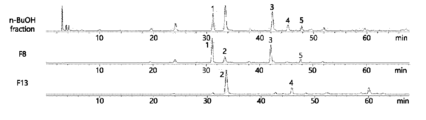
- Figure 6 is an HPLC chromatogram of (A) butanol fraction and purified compounds (1-5) in the extract of Eunshiloh
- Figure 7 is the structure of purified compounds 1-5
- Figure 8 is a photograph of the n-BuOH fraction and compounds 1-5 treated to myotubes
- Figure 9 shows the degree of cell death and cell thickness after treating C2C12 myotubes with 30 ⁇ g/mL of n-BuOH fraction and 30 ⁇ M of compounds 1-5.
- Figure 10 shows cell viability in 30 ⁇ M treatment with dichotomine B (2)
- Figure 11 shows MHC staining photographs after 10 ⁇ M and 30 ⁇ M treatment with dichotomine B following dexamethasone treatment
- Figure 12 shows cell thickness
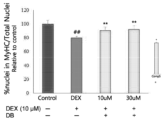
- Figure 13 shows nuclei infusion index.
- Figure 14 shows western blot images of MHC (Myosin heavy chain), Atrogin-1, and MuRF-1 after treatment with 10 ⁇ M and 30 ⁇ M dichotomine B following dexamethasone treatment, and Figure 15 shows the level of their expression.
- MHC Myosin heavy chain
- Atrogin-1 Atrogin-1
- MuRF-1 MuRF-1 after treatment with 10 ⁇ M and 30 ⁇ M dichotomine B following dexamethasone treatment
- Figure 15 shows the level of their expression.
- Figure 16 shows the evaluation of the efficacy of dichotomine B at 1 ⁇ M and 10 ⁇ M in the Starvation model of C2C12 myotube cells.
- Cell viability by dichotomine B treatment of 1 nM - 10 ⁇ M shows the effect of dichotomine B on cell viability in the Starvation model
- Figure 18 shows MHC staining photographs
- Figure 19 shows the thickness of myotube cells
- Figure 20 shows the relative degree of MHC staining.
- Figure 21 shows the results of western blotting of MHC, FoxO3a, Atrogin-1 and MuRF-1 by treatment with 1 ⁇ M and 10 ⁇ M of dichotomine B in the starvation model of C2C12 myotube cells.
- Western blot by treatment with 1 ⁇ M and 10 ⁇ M of dichotomine B Figure 22 shows the level of MHC expression
- Figure 23 shows the level of FoxO3a expression
- Figure 24 shows the level of Atrogin-1 expression
- Figure 25 shows the level of MuRF-1 expression.
- Figure 26 shows the change in body weight due to administration of 10 mg/kg of dichotomine B to mice starved for 48 hours
- Figure 27 shows the change in grip strength
- Figure 28 shows the change in skeletal muscle weight due to administration of 10 mg/kg of dichotomine B to mice starved for 48 hours.
- the photographs of TA, EDL, GA, and SOL are shown, and Figure 29 shows the weight.
- the present invention is to solve the above-described problem, and as a result of extensive research to search for a natural product-derived component capable of alleviating skeletal muscle loss, it was confirmed that a decrease in the diameter of C2C12 cells caused by dexamethasone can be effectively prevented by treatment with an extract of Eunshiho.
- Glucodichotomyne B was separated and purified through various chromatography and HPLC fractionation from the n-butanol fraction, which is an active fraction, and the structures of the five compounds were identified as Glucodichotomyne B, Dichotomine B, Shaftoside, Dichotomine A, and Isoshaftoside using NMR and MASS, respectively.
- Glucodichotomyne B, Dichotomine B, Shaftoside, and Isoshaftoside effectively prevented the decrease in diameter of C2C12 myotube cells caused by dexamethasone.
- Glucodichotomyne B ( 1 ), Dichotomine B, Shaftoside, and Isoshaftosid are as shown in FIG. 7.
- the present invention has identified the structure of Dichotomine B, an active ingredient of a silver ginseng extract, which was separated and purified, and has been confirmed to effectively prevent a decrease in cell diameter using a starvation model in C2C12 myotube cells, and also to improve the area of MHC staining sites.
- the present invention has been completed by confirming that intraperitoneal administration of 10 mg/kg Dichotomine B improves the decrease in calf muscle weight and grip strength induced by 48 hours of starvation in 7-week-old C57BL/6 mice.
- the present invention provides a method for preventing, improving, and/or treating muscle atrophy, comprising an extract or fraction of Stellaria dichotoma Linne var. lanceolata Bunge, or dichotomycin B, Glucodichotomycin B, Shaftoside, or Isoshaftoside isolated therefrom as an effective ingredient.
- the Eunshiho extract of the present invention can be extracted using a conventional solvent under conditions of conventional temperature and pressure according to a conventional method known in the art for extracting extracts from natural materials.
- the Eunshiho extract in the present invention can be extracted using at least one solvent selected from the group consisting of water, alcohol having 1 to 4 carbon atoms, n-hexane, ethyl acetate, acetone, butyl acetate, 1,3-butylene glycol, methylene chloride, and mixed solvents thereof, and preferably can be extracted using a mixed solvent of water and alcohol having 1 to 4 carbon atoms, and in this case, water and alcohol may be mixed in a volume ratio of 1:5 to 1:1, but more preferably, 75% ethanol or 100% ethanol (ethanol) can be used for the extraction.
- the extraction efficiency of the effective substance having the muscle atrophy improvement effect of Eunshiho can vary depending on the mixing ratio.
- the method of extracting the extract from the silver ginseng can be extracted through various methods such as hot water extraction, cold extraction, reflux extraction, and ultrasonic extraction, but is not limited thereto, and the reflux extraction method can be preferably used.
- the above-mentioned manufactured extract can be filtered or concentrated or dried to remove the solvent. Filtration, concentration and drying can all be performed, and the filtration, concentration or drying processes can be performed multiple times. For example, filtration can be performed using filter paper or a vacuum filter, concentration can be performed using a vacuum concentrator, and drying can be performed using a spray drying method or a freeze drying method, but is not limited thereto.
- the extract extracted with the above solvent may be further fractionated with a solvent selected from the group consisting of butanol, n -hexane, methylene chloride, acetone, ethyl acetate, ethyl ether, chloroform, water, and mixtures thereof, but is not limited thereto.
- a solvent selected from the group consisting of butanol, n -hexane, methylene chloride, acetone, ethyl acetate, ethyl ether, chloroform, water, and mixtures thereof, but is not limited thereto.
- an edible acid when extracting the silver ginseng extract, an edible acid may be added to the solvent for extraction, and preferably, at least one acid selected from the group consisting of acetic acid, citric acid, malic acid, succinic acid, fumaric acid, tartaric acid, amino acid, and lactic acid may be added to the solvent, but preferably, acetic acid may be added, and in this case, the acetic acid added to the solvent may be added in an amount of 0.1 to 1 wt%, and preferably 0.5 wt%.
- the present invention provides a method for preparing a silver ginseng extract for preventing, improving or treating muscular atrophy, comprising the steps of (a) preparing a powder by crushing dried silver ginseng; and (b) preparing an extract by mixing the crushed silver ginseng powder with at least one solvent selected from the group consisting of water (H2O), lower alcohols having C1 to C4, and mixtures thereof.
- a solvent selected from the group consisting of water (H2O), lower alcohols having C1 to C4, and mixtures thereof.
- the extraction method for manufacturing the extract may be a reflux extraction method, and may additionally include a step of concentrating the extracted extract under reduced pressure and then freeze-drying it.
- the term 'muscle atrophy' refers to a state in which muscle mass is gradually reduced due to a decrease in the number of muscle cells and fibers and a decrease in the cross-sectional area of the muscle due to a bias toward muscle breakdown rather than muscle synthesis, and refers to muscle weakening and degeneration.
- Muscle atrophy is promoted by inactivity, disease, oxidative stress, and chronic inflammation, and refers to a decrease in muscle function and motor ability.
- muscle atrophy is accompanied by physiological, histochemical, and biochemical changes due to a decrease in muscle protein, and may cause intrinsic functional disorders of skeletal muscle.
- the extract of Eunshiho of the present invention can be used for the purpose of maintaining and preserving intrinsic functions of skeletal muscle caused by said muscle atrophy through the activity enhancement and protective function of muscle fibers.
- the sarcopenia or muscular atrophy may be characterized by at least one selected from the group consisting of sarcopenia, muscular dystrophy, dystonia, disuse atrophy, muscular atrophy due to the absence of mechanical stimulation, denervational atrophy, cachexia, drug-induced atrophy, malnutritional atrophy, and muscular dystrophy, but is not necessarily limited thereto.
- the above-mentioned dissoluble muscle atrophy includes a decrease in muscle thickness due to restrictions on activities caused by aging or disease, prolonged bed rest, cast or plaster fixation, etc. In addition, it is accompanied by various clinical diseases such as peripheral nerve damage, cancer, sepsis, long-term bed rest, and the aging process.
- the above-mentioned composition can be used for the purpose of helping prevent skeletal muscle atrophy and improving symptoms that may be caused by these causes.
- the above-mentioned muscle atrophy due to the absence of mechanical stimulation and denervation-induced muscle atrophy cause muscle atrophy by increasing the quantitative decrease of mitochondria, dysfunction, increased production of reactive oxygen species (ROS) by mitochondria, and apoptosis of muscle cells due to oxidative damage.
- the above-mentioned composition can be used for the purpose of helping prevent skeletal muscle atrophy and improving symptoms that may be caused by these causes.
- Cortisol is a hormone secreted from the adrenal cortex in the body due to acute stress, which provides energy to combat stress, but can also cause muscle atrophy in the body depending on its mechanism.
- the composition described above can be used to help prevent and improve symptoms of skeletal muscle atrophy that may be caused by such causes.
- Synthetic adrenal cortex hormones can cause steroid myopathy and muscle damage as adverse reactions.
- the composition described above can be used to help prevent and improve symptoms of skeletal muscle atrophy that may be caused by such causes.
- prevention means any act of inhibiting or delaying the onset of muscle atrophy or muscle loss by administering a pharmaceutical composition according to the present invention.
- treatment means any action by which symptoms of muscular atrophy are improved or beneficially changed by administration of the pharmaceutical composition according to the present invention.
- the term "pharmaceutical composition” means a composition manufactured for the purpose of preventing or treating a disease, and may be formulated and used in various forms according to conventional methods. For example, it may be formulated in oral dosage forms such as powders, granules, tablets, capsules, suspensions, emulsions, and syrups, and may be formulated and used in the form of external preparations, suppositories, and sterile injection solutions.
- the ingredient is included in an amount necessary or sufficient to realize a desired biological effect.
- the determination of the amount included as an effective ingredient can be determined by considering the amount for treating the target disease and not causing other toxicity, and may vary depending on various factors such as the disease or condition being treated, the form of the composition to be administered, the size of the subject, or the severity of the disease or condition.
- a person of ordinary skill in the art to which the present invention pertains can empirically determine the effective amount of an individual composition without undue experimentation.
- composition of the present invention may, depending on each formulation, additionally contain one or more pharmaceutically acceptable carriers in addition to the above-described effective ingredients.
- the pharmaceutically acceptable carrier may be saline solution, sterile water, Ringer's solution, buffered saline, dextrose solution, maltodextrin solution, glycerol, ethanol, and mixtures of one or more of these components, and may further contain other conventional additives such as antioxidants, buffers, and bacteriostatic agents, if necessary.
- composition of the present invention can be administered orally or parenterally in a pharmaceutically effective amount depending on the intended method, and the term "pharmaceutically effective amount" of the present invention means an amount sufficient to treat a disease at a reasonable benefit/risk ratio applicable to medical treatment and not causing side effects, and the effective dosage level can be determined according to factors including the patient's health condition, severity, activity of the drug, sensitivity to the drug, administration method, administration time, administration route and excretion rate, treatment period, drugs used in combination or simultaneously, and other factors well known in the medical field.
- the term "subject" may be a mammal such as a rat, a livestock, a mouse, a human, etc., and preferably may be a human.
- the pharmaceutical composition of the present invention may be formulated in various forms for administration to a subject, and a representative form of a parenteral administration form is an injectable form, preferably an isotonic aqueous solution or suspension.
- the injectable form may be prepared using a suitable dispersing agent or wetting agent and a suspending agent according to techniques known in the art. For example, each component may be dissolved in saline or a buffer solution to be formulated for injection.
- oral administration dosage forms include, for example, ingestible tablets, buccal tablets, troches, capsules, elixirs, suspensions, syrups, and wafers, which may contain, in addition to the active ingredient, diluents (for example, lactose, dextrose, sucrose, mannitol, sorbitol, cellulose, and/or glycine) and lubricants (for example, silica, talc, stearic acid and its magnesium or calcium salts, and/or polyethylene glycol).
- diluents for example, lactose, dextrose, sucrose, mannitol, sorbitol, cellulose, and/or glycine
- lubricants for example, silica, talc, stearic acid and its magnesium or calcium salts, and/or polyethylene glycol.
- the pharmaceutical composition of the present invention may additionally contain auxiliary agents such as binders, lubricants, disintegrants, colorants, preservatives, sweeteners, flavoring agents, stabilizers, diluents, antiseptics, wetting agents, emulsifying agents, salts or buffers for regulating osmotic pressure, and other therapeutically useful substances, and may be formulated according to conventional methods.
- auxiliary agents such as binders, lubricants, disintegrants, colorants, preservatives, sweeteners, flavoring agents, stabilizers, diluents, antiseptics, wetting agents, emulsifying agents, salts or buffers for regulating osmotic pressure, and other therapeutically useful substances, and may be formulated according to conventional methods.
- the term "health functional food composition” means a food prepared by adding the extract of Eunshiho to food materials such as beverages, teas, spices, gums, and confectionery, or by manufacturing it in the form of encapsulation, powder, suspension, etc., and which has a specific health effect when consumed; however, unlike general drugs, it has the advantage of not having side effects that may occur with long-term use of drugs since it uses food as a raw material.
- the health functional food composition may be any one selected from meat, grains, caffeinated beverages, general beverages, chocolate, bread, snacks, confectionery, pizza, jelly, noodles, gum, ice cream, alcoholic beverages, alcohol, vitamin complexes, and other health supplements.
- Example 3 In vitro In order to confirm the effect of extract or fraction of Eunshiho on prevention, improvement, or treatment of skeletal muscle atrophy
- C2C12 mouse myoblasts used in this experiment were purchased from ATCC ( American Type Culture Collection ) and cultured in Dulbecco's modified Eagle's medium (DMEM) containing 10% fetal bovine serum (FBS), 100 U/mL penicillin, and 100 ⁇ g/mL streptomycin as a growth medium under 5% CO2 , 37°C conditions.
- DMEM Dulbecco's modified Eagle's medium
- FBS fetal bovine serum
- streptomycin 100 fetal bovine serum
- C2C12 myoblasts were seeded in 12-well plates and cultured to divide until the cell density reached 85–90%. Thereafter, differentiation was inducible using differentiation medium (DMEM containing 2% horse serum, 100 U/mL penicillin, and 100 ⁇ g/mL streptomycin), and the medium was replaced every two days, and differentiation was performed for a total of 6 days.
- differentiation medium DMEM containing 2% horse serum, 100 U/mL penicillin, and
- Dexamethasone induces muscle atrophy by inhibiting muscle synthesis and causing protein degradation.
- C2C12 cells that were differentiated were treated with dexamethasone to induce muscle atrophy, and the C2C12 cells that were induced to experience muscle atrophy were treated with the extract and/or fraction of Eunshiho.
- the specific experimental conditions are as follows.
- control group was treated with differentiation medium for 24 hours to differentiated C2C12 myotube cells.
- the negative control was prepared by adding dexamethasone to the differentiation medium to C2C12 myotube cells that had completed differentiation at a final concentration of 10 ⁇ M, and then treating the cells for 24 hours.
- dexamethasone and silver ginseng extract treatment group was prepared under the same conditions as the negative control group of (2) above, with an additional composition of 30 ⁇ g/mL of silver ginseng extract, and then treated for 24 hours.
- the thickness of C2C12 myotubes decreased by dexamethasone treatment and that the treatment with the Eunshiho extract showed an improving effect (see Table 1 and Fig. 4). More specifically, (1) compared to the control group, which is the basic differentiation medium administration group, the thickness of C2C12 myotubes decreased by 21.1% in the dexamethasone 10M administration group (p ⁇ 0.01). (2) Compared to the negative control group where dexamethasone was administered to the basic differentiation medium, the thickness of C2C12 myotubes increased by 21.2% in the Eunshiho extract 30 ⁇ g/mL administration group (p ⁇ 0.01). Therefore, it was confirmed that the Eunshiho extract of the present invention significantly recovered the thickness damage of C2C12 myotubes in the dexamethasone-induced muscle atrophy model.
- the thickness of C2C12 myotubes decreased by 21.1% in the group administered 10 ⁇ M dexamethasone (p ⁇ 0.01).
- the thickness of C2C12 myotubes increased by 17.8% in the group administered 30 ⁇ g/mL of the butanol fraction of the Eunssiho extract (p ⁇ 0.001).
- the thickness of C2C12 myotubes increased by 30.9% in the group administered 30 ⁇ g/mL of the water fraction of the Eunssiho extract (p ⁇ 0.001). Therefore, it was confirmed that the butanol and water fractions of the extract of the present invention significantly restored the thickness damage of C2C12 myotube cells in a dexamethasone-induced muscle atrophy model.
- the n -BuOH layer showing strong physiological activity was subjected to open column chromatography using Diaion HP-20 macroporus resin. MeOH was used as the mobile phase, and the ratio of MeOH was increased from 0% to 100% by 5% and 1 L was passed three times. Afterwards, 1 L of acetone was passed three times to wash the column. The solvent was removed using a vacuum rotary evaporator and a freeze dryer. Among the 14 fractions separated primarily through open column chromatography, fractions 8 and 13 were separated into a single component using preparative HPLC.
- Fraction 8 was eluted with compounds ( 1-5 ) using a Cosmosil C18 column (20x150 mm) under gradient elution conditions with 5-20% ACN for 50 minutes, and fraction 14 was separated with compounds ( 2 and 4 ) using an INNO C18 column ( 20x250 mm) under isocratic elution conditions with 18% ACN (see Figure 5).
- Example 5 In vitro Structural analysis of compounds purified from silver nitrate
- the isolated compounds were structurally identified as Glucodichotomyne B (compound 1), Dichotomine B (compound 2), Shaftoside (compound 3), Dichotomine A (compound 4), and Isoshaftoside (compound 5) by spectroscopic methods such as NMR and MASS (see Figures 6 and 7).
- UV (MeOH) emax 236 nm, 269 nm
- UV (MeOH) emax 236 nm, 269 nm
- UV (MeOH) emax 270 nm, 330 nm
- UV (MeOH) emax 237 nm, 269 nm
- UV (MeOH) emax 270 nm, 330 nm
- Example 6 Confirmation of the effect of compounds 1 to 5 isolated and purified from Eunshiho on prevention, improvement, or treatment of skeletal muscle atrophy
- the thickness of cells was measured in the same manner as in Example 3-3 above, and the average and standard error were calculated to organize the data (see Table 3, Figures 8 and 9). Each experiment was performed three times.
- Example 7 Confirmation of the improvement or therapeutic effect of compound 2 (dichotomyne B) isolated and purified from Eunshiho on skeletal muscle loss
- the cell medium of each experimental group was removed, washed twice with phosphate-buffered saline (PBS), fixed with 4% paraformaldehyde for 15 minutes, and washed three times with PBS. After treating with 0.1% TritonX-100 for 10 minutes, the cells were washed twice with PBS, and blocked with 3% horse serum solution for 2 hours.
- Mouse anti-MHC was diluted 1:100 in 3% BSA, incubated overnight at 4°C, and washed three times with 0.1% PBST.
- multinucleated myotubes were randomly selected and the formation index of multinucleated myotubes was calculated.
- the relative number of multinucleated-MHC-positive myotubes in each cell was calculated by applying the total number of cells (see Table 4 and Fig. 13).
- Control group Dex (10 ⁇ M) treatment group - Dichotomine B ( 2 ) 10 ⁇ M Dichotomine B ( 2 ) 30 ⁇ M C2C12 myotube diameter (% of control) 100.0 80.0 a 90.3 b 92.3 b
- the thickness of the cells was measured using the same method as in Example 3-3 above, and the average and standard error were calculated, and the data were organized in Table 4. Each experiment was performed three times.
- Control group Dex (10 ⁇ M) treatment group - Dichotomine B ( 2 ) 10 ⁇ M Dichotomine B ( 2 ) 30 ⁇ M C2C12 myotube diameter (% of control) 100.0 80.0 a 97.9 b 100.6 b
- C2C12 cells were seeded in a 6-well plate at 1 x 10⁵/well, and dexamethasone and samples were treated according to each experimental group to the differentiated C2C12 myotube cells.
- the prepared cells were lysed using a cell lysis solution containing LIPA lysis buffer, protease inhibitors, and phosphatase inhibitors. 200 ⁇ l of the cell lysis solution was treated per well, and the cells were lysed using a cell scraper, centrifuged at 13,000 rpm for 20 minutes, and the supernatant was obtained. The concentration was measured using the BCA protein quantitation method, and then the same amount of protein was separated using 8% SDS-PAGE.
- the proteins separated by SDS-PAGE were transferred to a nitrocellulose membrane, and after blocking with 3% BSA buffer, various types of primary antibodies (MyHC, FoxO3a, MuRF1 GAPDH, etc.) were treated, and washing, secondary antibody treatment, and washing were performed sequentially. Finally, the expression was induced by ECL (enhanced chemiluminescence), images were acquired using ChemiDoc, and the expression levels of each protein were quantified using the Image J program.
- ECL enhanced chemiluminescence
- Example 8 Confirmation of the prevention, improvement, or treatment effect of skeletal muscle atrophy in a starvation model of Dichotomine B isolated and purified from Eunshiho
- C2C12 myotube cells When differentiated C2C12 myotube cells are cultured in a serum free/low glucose medium, muscle synthesis is inhibited and protein degradation is induced, thereby inducing muscle atrophy.
- C2C12 cells, which were induced to differentiate were cultured in a serum free/low glucose medium to induce muscle atrophy, and Dichotomine B was treated to the C2C12 cells in which muscle atrophy was induced.
- the specific experimental conditions are as follows.
- control group was treated with differentiation medium for 48 hours to differentiated C2C12 myotube cells.
- differentiated C2C12 myotube cells were cultured in serum free/low glucose medium for 48 hours.
- the thickness and staining area of cells were measured using the same method as in Example 3-3 above, and the average and standard error were calculated, and the data were organized in Table 6. Each experiment was performed three times.
- the amount of protein expression was confirmed by performing western blotting in the same manner as in Example 7-5 above.
- mice were C57BL/6 6-week-old mouse models (male) provided by Coretech (Pyeongtaek, Gyeonggi-do, Korea) and were quarantined, acclimatized, and raised for one week at the Hanyang University ERICA Laboratory Animal Center (Animal Facility Registration No. 445) before experiments.
- the lighting period during rearing was set to 12 h (07:00–19:00), and food and water were provided ad libitum.
- the following experiments were conducted in accordance with the policies and regulations of the Institutional Animal Care and Use Committee of Hanyang University.
- the experiments were conducted after obtaining the experimental animals and acclimatization for 7 days.
- Solid feed for experimental animals (Woojung Bio, Hwaseong, Gyeonggi-do, Korea) was provided, and the experimental animals were treated within a certain time (10:00-12:00 AM).
- Body weight changes were measured a total of 3 times.
- the animals in the fasting group were housed in individual cages during the fasting period. Samples were administered twice in total, once at the start of fasting and once 24 hours later.
- the experimental results below are expressed as the mean and standard deviation, and the significance of each group was confirmed using the Anova t-test of the Statview program.
- grip strength was assessed using a grip strength meter.
- TA tibialis anterior
- EDL extensor digitorum longus
- GA gastrocnemius
- SOL soleus
- the present invention was achieved by synthesizing dicotomin B, which has the following chemical formula, as a new component capable of alleviating skeletal muscle loss among the compounds described above.
- UV (MeOH) emax 236 nm, 269 nm
- the pharmaceutical composition according to the present invention can be used for the treatment and prevention of skeletal muscle atrophy or sarcopenia, and therefore has industrial applicability.
Landscapes
- Health & Medical Sciences (AREA)
- Life Sciences & Earth Sciences (AREA)
- Chemical & Material Sciences (AREA)
- Medicinal Chemistry (AREA)
- General Health & Medical Sciences (AREA)
- Veterinary Medicine (AREA)
- Public Health (AREA)
- Pharmacology & Pharmacy (AREA)
- Animal Behavior & Ethology (AREA)
- Epidemiology (AREA)
- Natural Medicines & Medicinal Plants (AREA)
- Engineering & Computer Science (AREA)
- Polymers & Plastics (AREA)
- Mycology (AREA)
- Food Science & Technology (AREA)
- General Chemical & Material Sciences (AREA)
- Medical Informatics (AREA)
- Nuclear Medicine, Radiotherapy & Molecular Imaging (AREA)
- Molecular Biology (AREA)
- Chemical Kinetics & Catalysis (AREA)
- Physical Education & Sports Medicine (AREA)
- Alternative & Traditional Medicine (AREA)
- Biotechnology (AREA)
- Botany (AREA)
- Organic Chemistry (AREA)
- Microbiology (AREA)
- Orthopedic Medicine & Surgery (AREA)
- Nutrition Science (AREA)
- Neurology (AREA)
- Bioinformatics & Cheminformatics (AREA)
- Animal Husbandry (AREA)
- Zoology (AREA)
- Medicines Containing Plant Substances (AREA)
Abstract
은시호 추출물을 유효성분으로 포함하는 골격근 위축 또는 근감소증의 예방 및 치료용 또는 개선용 약학적 조성물이 제공되며, 본 발명의 은시호 추출물, 분획물 또는 이로부터 분리된 디코토민 B (Dichotomine B), 글루코디코토민 B(Glucodichotomine B), 샤프토사이드(Shaftoside), 또는 이소샤프토사이드 (Isoshaftoside)를 유효성분으로 함유하는 근위축증 또는 근감소증 예방, 개선 또는 치료용 조성물은 근섬유의 굵기를 증가시키고, 천연물 유래로 부작용이 거의 없고 안전성이 높으므로, 근위축증 또는 근감소증의 예방, 개선 또는 치료에 있어 유용하게 활용될 수 있다.
Description
본 발명은 골격근 위축 또는 근감소증 예방 및 치료용 조성물에 관한 것으로, 보다 상세하게는 은시호(Stellaria dichotoma L. var. lanceolataBunge) 추출물 또는 이로부터 분리된 화합물을 유효성분으로 하는 골격근 위축 또는 근감소증 예방, 개선 또는 치료용 약학 조성물, 식품 조성물 또는 사료용 조성물에 관한 것이다
골격근은 인체 내에서 가장 큰 질량을 가지는 조직으로, 약 600여개가 존재하며 체중의 40-50%를 차지한다. 이들은 인체 내에서 운동, 호흡, 자세 유지, 체온 유지, 에너지 대사 등 신체 기능에 있어 중요한 역할을 수행하고 있다. 이러한 골격근의 질량은 근육 내 단백질 합성과 분해의 균형에 의해 조절이 되는데, 분해가 합성보다 증가하게 되면 골격근의 소실로 이어지며 40대부터 매 10년간 약 8%씩 감소하다가 70대가 되면 10년간 감소율은 15%로 증가하게 된다.
근위축증(Muscle atrophy)은 신체의 노화, 오랜 기간 근육의 미사용, 운동 부족, 호르몬 부족, 다양한 질환(악액질, 패혈증, 기아, 암, 당뇨, 만성 염증, 퇴행성 질환 등) 등 여러 요인에 의해 발생한다. 이러한 근위축이 발생하게 되면 기본적으로 신체활동을 위한 근력이 약화되고 나아가서는 근골격계 퇴화로 이어져 운동능력 저하, 신체기능 감소, 낙상과 골절 위험 증가, 일상생활 수행능력 저하, 사망 위험 증가 등으로 삶의 질이 급격히 떨어지게 된다. 뿐만 아니라 골격근의 감소 및 근골격계 퇴화는 골절, 관절 손상, 대사증후군, 비만, 이상지질혈증 및 심혈관 질환 등 다양한 질병의 발생 위험을 증가시킨다. 따라서, 건강하고 행복한 삶을 살아가기 위해서는 여러 요인에 의한 근위축의 발생 및 골격근의 손실을 줄이고 재생을 증가시키는 것이 매우 중요하다.
근위축은 PI3K/Akt/mTOR 기전의 저해 및 이들의 하위 인자인 4E-BP1, p70S6K 등의 활성 억제를 통한 근섬유의 합성 저해와 유비퀴틴-프로테아좀 경로의 활성화에 의한 단백질 분해 증가가 중요한 원인이다. MAFbx (Muscle atrophy F-box)/atrogin-1 및 MuRF1 (Muscle RING finger-1)는 대표적인 단백질 분해 인자인데, 이러한 인자들의 발현 증가는 근육 단백질 분해에 직접적인 영향을 미친다.
손상된 골격근의 재생(Muscle regeneration)을 위해서는 근원세포(Myoblast)의 증식 (Proliferarion)과 분화, 그리고 근관세포 (Myotube)의 성장(Hypertrophic growth)이 필수적이다. 근원세포는 증식을 위해 다양한 성장인자들을 분비하며, MyoD, Myogenin, MHC (Myosin Heavy Chain)와 같은 근원성 단백질들의 발현을 통해 근관세포로의 분화를 유도한다. 골격근의 동화작용은 mTOR (Mammalian target of rapamycin) 신호전달에 의해 조절된다. mTOR가 인산화 (활성화)가 되면 p70S6K (Ribosomal p70 S6 kinase)의 인산화를 유도하고, 이는 최종적으로 근원성 단백질들의 합성을 증가시킨다.
다양한 천연물 (황련, 인삼, 검정콩, 흑삼)과 그들의 성분 물질들을 이용한 근위축 억제 및 골격근세포의 분화 및 비대 유도에 관한 효능에 관한 연구 결과가 보고된 바 있다. 이러한 결과들은 천연물 유래 물질들이 근위축을 억제하고 골격근세포의 분화 및 비대 유도에 효과적으로 작용할 수 있고, 건강기능식품으로서의 개발 가능성이 높다는 것을 보여준다.
은시호(Stellaria dichotoma L. var. lanceolata Bunge)는 중국, 유럽, 러시아, 몽골 지역에서 재배되는 석죽과의 은시호(Stellaria dichotoma L. var. lanceolata Bunge)의 뿌리를 말린 것으로 원기둥모양에 가깝고 가지가 있으며, 길이 15-40 cm, 지름 10-25 mm이다. 바깥면은 연한 노란색 또는 황백색이고 꼬여있는 세로주름 및 곁뿌리 자국이 있으며 구멍모양으로 오목하게 패여 있으며 이 부근을 세로로 자르면 가루 모양의 물질이 나오고 또한 갈색의 틈을 볼 수 있다. 위쪽 끝에는 촘촘하게 사마귀 모양으로 돌기된 줄기가 붙었던 자국을 볼 수 있다. 질은 단단하지만 부서지기 쉬우며 자르기 쉽다. 자른 면에는 틈새가 있고 피부는 매우 엷으며 목부에서는 노란색과 흰색이 엇갈리는 방사상 무늬를 볼 수 있다. 다른 이름으로는 백근자, 사삼아, 우두근, 은하시호, 은호 및 토삼 등이 있다. 이들은 봄이나 가을에 뿌리를 캐어 물에 씻은 후 뿌리와 줄기를 다듬어 햇볕에 말린 후 약용한다.
은시호의 주요 화합물은 베타-카르볼린 알칼로이드(β-Carboline alkaloid), 환원상 펩타이드 계열의 알칼로이드(Cyclic peptide alkaloid)이며 플라보이드(Flavonoid), 네오리그난(Neolignan), 스테롤(Sterol), 테르페노이드(Terpenoid) 등의 여러 화합물이 보고 되었다. 은시호는 제감열, 청허열의 효능이 있어 한방에서 주로 해열제로 사용되며 소모성 질환, 영아 영양실조 증후군을 치료하는 한약으로도 사용된다. 또한, 최근 연구에 따르면 항알레르기, 혈관이완, 항염증, 아토피 피부염 개선 등의 효능을 가진다고 보고 되어 있다.
하지만 아직까지 은시호 추출물의 골격근(Skeletal muscle)에 대한 근위축(Atrophy) 예방 및 개선 효과에 대해 알려진 바 없다. 이에, 본 발명자들은 근위축을 막아줄 수 있는 천연물 유래 성분에 관하여 예의 연구한 결과, 은시호 추출물을 포함하는 조성물의 근위축 예방 효과가 우수한 것을 확인하고 본 발명을 완성하였다.
따라서, 본 발명이 해결하고자 하는 과제는 은시호 추출물, 분획물 또는 이로부터 분리된 화합물을 이용하여 골격근 위축 또는 근감소증의 예방용 및 개선용 또는 치료용 조성물을 제공하는 것이다.
상기 과제를 해결하기 위하여, 본 발명은 은시호 추출물을 유효성분으로 포함하는 골격근 위축 또는 근감소증의 예방 및 치료용 또는 개선용 약학적 조성물을 제공한다.
본 발명의 일 실시예에서, 상기 은시호 추출물은 물(H2O), C1내지 C4의 저급알코올, n-헥산, 에틸아세테이트, 아세톤, 부틸아세테이트, 1,3-부틸렌 글리콜, 메틸렌클로라이드, 및 이들의 혼합용매로 이루어진 군으로부터 선택된 하나 이상의 용매로 추출된 것이다.
본 발명의 일 실시예에서, 상기 약학적 조성물은, 상기 은시호 추출물로부터 분획된 분획물이다.
본 발명은 또한 디코토민 B (Dichotomine B), 글루코디코토민 B(Glucodichotomine B), 샤프토사이드(Shaftoside),이소사프토사이드(Isoshaftoside) 및 이의 약학적으로 허용되는 염으로 이루어진 군에서 선택되는 하나 이상을 유효성분으로 함유하는 골격근 위축 예방 또는 치료용 약학 조성물을 제공한다.
본 발명의 일 실시예에서, 상기 디코토민 B (Dichotomine B), 글루코디코토민 B(Glucodichotomine B), 샤프토사이드(Shaftoside), 이소사프토사이드(Isoshaftoside)는 은시호로부터 추출된 것이다.
본 발명의 일 실시예에서, 상기 근위축은 근감소증(Sarcopenia), 불용성 근위축(Disuse atrophy), 기계적 자극 부재에 의한 근위축, 신경 지배 상실성 근위축(Denervational atrophy), 악액질(Cachexia), 약물유인성 근 위축(Drug induced atrophy), 영양결핍성 근위축(Malnutritional atrophy), 및 근이영양증(Muscular dystrophy)으로 이루어진 군으로부터 선택되는 하나 이상의 근위축이다.
본 발명은 또한 은시호 추출물을 유효성분으로 포함하는 골격근 위축 또는 근감소증의 예방 또는 개선용 식품 조성물을 제공한다.
본 발명은 또한 은시호 추출물을 유효성분으로 포함하는 골격근 위축 또는 근감소증의 예방 또는 개선용 사료용 조성물을 제공한다.
본 발명은 또한 디코토민 B (Dichotomine B), 글루코디코토민 B(Glucodichotomine B), 샤프토사이드(Shaftoside) 및 이소사프토사이드(Isoshaftoside)로부터 구성된 군으로부터 선택된 어느 하나 이상을 유효성분으로 함유하는 골격근 위축 예방 또는 개선용 식품 조성물을 제공하며, 상기 디코토민 B (Dichotomine B), 글루코디코토민 B(Glucodichotomine B), 샤프토사이드(Shaftoside), 이소사프토사이드(Isoshaftoside)는 은시호로부터 추출된 것이다.
본 발명은 또한 디코토민 B (Dichotomine B), 글루코디코토민 B(Glucodichotomine B), 샤프토사이드(Shaftoside) 및 이소사프토사이드(Isoshaftoside)로부터 구성된 군으로부터 선택된 어느 하나 이상을 유효성분으로 함유하는 골격근 위축 예방 또는 개선용 사료 조성물을 제공하며, 상기 디코토민 B (Dichotomine B), 글루코디코토민 B(Glucodichotomine B), 샤프토사이드(Shaftoside), 이소사프토사이드(Isoshaftoside)는 은시호로부터 추출된 것이다.
본 발명의 은시호 추출물, 분획물 또는 이로부터 분리된 디코토민 B (Dichotomine B), 글루코디코토민 B(Glucodichotomine B), 샤프토사이드(Shaftoside), 또는 이소샤프토사이드 (Isoshaftoside)를 유효성분으로 함유하는 근위축증 또는 근감소증 예방, 개선 또는 치료용 조성물은 근섬유의 굵기를 증가시키고, 천연물 유래로 부작용이 거의 없고 안전성이 높으므로, 근위축증 또는 근감소증의 예방, 개선 또는 치료에 있어 유용하게 활용될 수 있다.
도 1은 은시호의 (추출물 및 분획물의 제조방법과 도 2는 추출물 및 분획의 HPLC 크로마토그래피 결과와 도 3은 추출물 및 분획물의 C2C12 근관세포에 처치한 사진과 도 4는 추출물 및 분획물의 C2C12 근관세포처치 후 두께를 나타낸 것이다.
도 5는 은시호 n-부탄올 분획물에서 화합물 1 - 5를 분리정제하는 과정을 도식화 한 것이다.
도 6은 은시호 추출물 중의 (A)부탄올 분획물과 분리 정제한 화합물(1 - 5)의 HPLC 크로마토그램, 도 7은) 분리 정제한 화합물 1 - 5의 구조, 도 8은 n-BuOH 분획물과 화합물 1-5 의 근관세포에 처치한 사진, 도 9는 n-BuOH 분획물 30 μg/mL과 화합물 1 - 5를 30 μM을 C2C12 근관세포처치 후 세포 사멸 정도와 세포의 두께를 나타낸 것이다.
도 10은 Dichotomine B (2)의 30 μM 처치에서의 세포 생존율, 도 11은 덱사메타손 처치 후 dichotomine B 를 10 μM과 30 μM 처리한 후 MHC 염색 사진, 도 12는 세포의 두께, 도 13은 nuclei infusion index를 나타낸 것이다.
도 14는 덱사메타손 처치 후 dichotomine B 를 10 μM과 30 μM 처리한 후 MHC (Myosin heavy chain), Atrogin-1, MuRF-1의 western blot 사진, 도 15는 이의 발현 정도이다.
도 16은 C2C12 근관세포의 Starvation model에서의 dichotomine B 를 1 μM과 10 μM의 처리에 의한 효능을 평가한 것으로, dichotomine B 1 nM - 10 μM 처리에 의한 세포 생존율, 도 17은 Starvation model에서 dichotomine B의 세포 생존률에 미치는 영향, 도 18은 MHC 염색 사진, 도 19는 근관세포의 두께 및 도 20은 상대적 MHC 염색 정도이다.
도 21은 C2C12 근관세포의 Starvation model에서의 dichotomine B를 1 μM과 10 μM의 처리에 의한 MHC, FoxO3a, Atrogin-1 과 MuRF-1의 western blot한 결과로, Dichotomine B 1 μM과 10 μM 처리에 의한 Western blot, 도 22는 MHC 발현 정도 도 23은 FoxO3a 발현 정도, 도 24는 Atrogin-1 발현 정도, 도 25는 MuRF-1의 발현 정도이다.
도 26은 48시간 starvation 한 마우스에서 dichotomine B를 10 mg/kg 투여에 의한 몸무게의 변화, 도 27은 악력 (Grip Strength)의 변화이다.
도 28은 48시간 starvation 한 마우스의 dichotomine B를 10 mg/kg 투여에 의한 골격근의 무게 변화를 나타낸 것으로, TA, EDL, GA, SOL의 사진, 도 29는 무게이다.
이하, 첨부한 도면을 참고로 하여 본 발명의 바람직한 실시예에 대하여 상세히 설명하면 다음과 같다.
본 발명을 상세하게 설명하기 전에, 본 명세서에서 사용된 용어나 단어는 통상적이거나 사전적인 의미로 무조건 한정하여 해석되어서는 아니 되며, 본 발명의 발명자가 자신의 발명을 가장 최선의 방법으로 설명하기 위해서 각종 용어의 개념을 적절하게 정의하여 사용할 수 있다.
더 나아가 이들 용어나 단어는 본 발명의 기술적 사상에 부합하는 의미와 개념으로 해석되어야 함을 알아야 한다.
즉, 본 명세서에서 사용된 용어는 본 발명의 바람직한 실시예를 설명하기 위해서 사용되는 것일 뿐이고, 본 발명의 내용을 구체적으로 한정하려는 의도로 사용된 것이 아니다.
이들 용어는 본 발명의 여러 가지 가능성을 고려하여 정의된 용어임을 알아야 한다.
또한, 본 명세서에 있어서, 단수의 표현은 문맥상 명확하게 다른 의미로 지시하지 않는 이상, 복수의 표현을 포함할 수 있다.
본 명세서의 전체에 걸쳐서 어떤 구성 요소가 다른 구성 요소를 "포함"한다고 기재하는 경우에는, 특별히 반대되는 의미의 기재가 없는 한 임의의 다른 구성 요소를 제외하는 것이 아니라 임의의 다른 구성 요소를 더 포함할 수도 있다는 것을 의미할 수 있다.
본 발명은 상술한 과제를 해결하기 위한 것으로, 골격근 감소를 완화할 수 있는 천연물 유래 성분을 탐색하기 위해 예의 연구한 결과, 은시호 추출물 처리에 의해 덱사메타손(Dexamethasone)에 의한 C2C12 세포의 지름 (diameter) 감소를 효과적으로 예방할 수 있음을 확인하였다.
또한 은시호 추출물에서 용매-용매 분획으로 분획물을 제조하였으며, 이 또한 골격근 감소를 개선하는 효능을 확인하였다.
본 발명의 일 실시예에서는 활성분획물인 n-부탄올 분획에서 각종 크로마토그래피와 HPLC 분취를 통하여 5개의 화합물을 분리 정제하여 NMR, MASS를 이용하여 5개의 화합물을 각각 글루코디코토민 B(Glucodichotomine B), 디코토민 B(Dichotomine B), 샤프토사이드(Shaftoside), 디코토민 A(Dichotomine A) 및 이소샤프토사이드(Isoshaftoside)로 구조를 동정하였다. 이중에서 글루코디코토민 B(Glucodichotomine B) 디코토민 B(Dichotomine B), 샤프토사이드(Shaftoside), 및 이소샤프토사이드(Isoshaftoside)는 덱사메타손(Dexamethasone)에 의한 C2C12 근관세포의 지름 감소를 효과적으로 예방하였다.
본 발명의 일 실시예에서 상기 글루코디코토민 B(Glucodichotomine B, 1) 디코토민 B(Dichotomine B), 샤프토사이드(Shaftoside), 및 이소샤프토사이드(Isoshaftosid)은 도 7에 도시된 바와 같다.
특히 본 발명은 은시호 추출물의 활성 성분으로 분리 정제하여 구조를 동정한, 디코토민 B(Dichotomine B)가 C2C12 근관세포에서 금식(Starvation) 모델을 사용하여 세포의 지름 감소를 효과적으로 예방하였으며, MHC 염색 부위의 면적 또한 개선 되는 것을 확인하였다. 또한 디코토민 B (Dichotomine B) 10 mg/kg 복강 투여가 7주령 C57BL/6 마우스에서 48시간 금식(Starvation)에 의한 장딴지의 근육 무게와 악력 감소를 개선함을 확인하여 본 발명을 완성하였다.
이에, 본 발명은 은시호(Stellaria dichotoma Linne var. lanceolata Bunge) 추출물, 분획물, 또는 이로부터 분리된 디코토민 B (Dichotomine B), 글루코디코토민 B(Glucodichotomine B), 샤프토사이드(Shaftoside), 또는 이소샤프토사이드(Isoshaftoside)를 유효성분으로 함유하는 근 위축(Muscle atrophy)을 예방, 개선, 및/또는 치료 용도에 제공하고자 한다.
본 발명의 은시호 추출물은 천연물로부터 추출물을 추출하는 당업계에 공지된 통상적인 방법에 따라, 즉, 통상적인 온도, 압력의 조건 하에서 통상적인 용매를 사용하여 추출할 수 있다. 예컨대, 본 발명에서 은시호 추출물은 물, 탄소수 1 내지 4의 알코올, n-헥산, 에틸아세테이트, 아세톤, 부틸아세테이트, 1,3-부틸렌 글리콜, 메틸렌클로라이드, 및 이들의 혼합 용매로 이루어진 군으로부터 선택된 1종 이상의 용매를 사용하여 추출할 수 있고, 바람직하게는 물과 탄소수 1 내지 4의 알코올의 혼합용매를 사용하여 추출할 수 있고, 이 경우 물과 알코올은 1:5 내지 1:1의 부피비로 혼합된 것일 수 있으나, 더욱 바람직하게는 75% 주정 또는 100% 주정(에탄올)을 사용하여 추출할 수 있다. 배합비에 따라 은시호의 근위축 개선효과가 있는 유효물질 추출효율이 달라질 수 있다.
또한, 은시호로부터 추출물을 추출하는 방법은 열수 추출, 냉침 추출, 환류 추출, 초음파 추출 등의 다양한 방법을 통하여 추출할 수 있지만, 이것으로 제한되는 것은 아니며, 바람직하게는 환류 추출방법을 이용할 수 있다.
상기 제조된 추출물은 이후 여과하거나 농축 또는 건조과정을 수행하여 용매를 제거할 수 있으며, 여과, 농축 및 건조를 모두 수행할 수 있고, 여과, 농축 또는 건조 과정은 수회 수행될 수 있다. 예컨대, 여과는 여과지를 이용하거나 감압여과기를 이용할 수 있으며, 농축은 감압 농축기, 건조는 분무 건조법, 동결건조법 등을 수행할 수 있으나, 이것으로 제한되는 것은 아니다.
또한, 상기 용매로 추출한 추출물은 이후 부탄올, n-헥산, 메틸렌클로라이드, 아세톤, 에틸아세테이트, 에틸에테르, 클로로포름, 물, 및 이들의 혼합물로 이루어진 군으로부터 선택된 용매로 분획과정을 추가로 실시할 수도 있으나, 이에 제한되지 아니한다.
또한, 본 발명에 있어서, 은시호 추출물의 추출 시 식음이 가능한 용도의 산(acid)를 용매에 첨가하여 추출할 수 있으며, 바람직하게는 초산(Acetic acid), 구연산(Citric acid), 사과산(Malic acid), 호박산(Succinic acid), 푸마르산(Fumaric acid), 주석산(Tartaric acid), 아미노산(Amino acid), 및 젖산(Lactic acid) 으로 이루어지는 군으로부터 선택되는 1종 이상의 산을 용매에 첨가할 수 있으나, 바람직하게는 초산이 첨가될 수 있고, 이 경우 용매에 첨가되는 초산은 0.1 내지 1 중량%, 바람직하게는 0.5 중량% 첨가될 수 있다.
이에, 본 발명은 (a) 건조된 은시호를 분쇄하여 분말을 제조하는 단계; 및 상기 분쇄된 은시호 분말을 물(H2O), C1내지 C4의 저급알코올, 및 이들의 혼합으로 이루어진 군으로부터 선택되는 하나 이상의 용매와 혼합하여 추출물을 제조하는 단계를 포함하는 근위축 예방, 개선 또는 치료를 위한 은시호 추출물의 제조방법을 제공한다.
상기 제조방법에서 추출물 제조를 위한 추출방법은 환류추출법일 수 있고, 상기 추출된 추출물을 감압농축한 후 동결건조하는 단계를 추가로 포함할 수 있다.
본 발명에서, 용어 '근위축'은 근육 합성보다 근육 분해에 치우쳐 근육세포, 섬유의 수가 감소하고 근육의 단면적이 감소하여 점진적으로 근육량이 저하된 상태를 말하며, 근육의 약화 및 퇴행을 일컫는다. 근위축은 비활동, 질병, 산화적스트레스, 만성 염증에 의해 촉진되며 근육의 기능과 운동 능력을 감소시키는 것을 말한다. 일반적으로 근위축은 근육 단백질의 감소에 의한 생리학적, 조직화학적 및 생화학적 변화를 동반하며 골격근의 고유 기능 장애를 초래할 수 있는데, 본 발명의 은시호 추출물이 근섬유의 활성 상승 및 보호 기능을 통해 상기 근위축으로부터 야기되는 골격근 고유 기능을 유지, 보존하는 목적으로 사용될 수 있다.
본 발명에 있어서, 상기 근감소증 또는 근위축증은 근감소증(Sarcopenia), 근육퇴행위축증, 긴장감퇴증, 불용성 근위축증(Disuse atrophy), 기계적 자극 부재에 의한 근위축증, 신경지배 상실성 근위축증(Denervational atrophy), 악액질(Cachexia), 약물유인성 근 위축증(Drug induced atrophy), 영양결핍성 근위축증(Malnutritional atrophy), 및 근이영양증(Muscular dystrophy)으로 구성된 군으로부터 선택된 적어도 하나인 것을 특징으로 할 수 있으나, 반드시 이에 제한되지 않는다.
상기 불용성 근위축은 노화·질병 등에 의한 활동 제약, 오랜 침상생활, 부목(cast) 또는 석고고정(Gips) 시행 등에 의해 근육의 두께가 감소하는 것을 포함한다. 또한, 말초신경 손상, 암, 패혈증 등의 다양한 임상 질환뿐만 아니라 장기간의 침상안정, 및 노화과정 등이 동반된다. 상기 조성물은 이러한 원인이 야기할 수 있는 골격근 위축의 예방 및 증상개선을 돕는 용도로 사용할 수 있다. 상기 기계적 자극 부재에 의한 근위축과 신경 지배 상실성 근위축은 미토콘드리아의 양적 감소, 기능 이상, 미토콘드리아의 활성산소(Reactive oxygen species: ROS) 생성 증가, 산화적 손상에 의한 근육세포의 세포자살(apoptosis)을 증가시켜 근위축을 유발한다. 상기 조성물은 이러한 원인이 야기할 수 있는 골격근 위축의 예방 및 증상 개선을 돕는 용도로 사용할 수 있다.
암, 결핵, 혈우병 등의 말기에서 볼 수 있는 고도의 전신쇠약 증세인 악액질(Cachexia)의 증상 중 하나로 급격한 수척이 있는데, 상기 조성물은 이러한 원인이 야기할 수 있는 골격근 위축의 예방 및 증상개선을 돕는 용도로 사용할 수 있다. 상기 근이영양증은 유전자 돌연변이에 의해 횡문근 형질막 구성성분인 디스트로핀-당단백질 복합체 형성부재로 발생하는 근육 위축과 근력 약화를 주 증상으로 야기되는 질환으로, 상기 조성물은 이러한 원인이 야기할 수 있는 골격근 위축의 예방 및 증상개선을 돕는 용도로 사용할 수 있다.
코티솔(Cortisol)은 급성 스트레스에 의해 체내의 부신피질에서 분비되는 호르몬으로 스트레스에 대항하는 에너지를 공급해주는 역할을 하지만, 이의 기전에 따라 신체의 근육 위축을 야기하기도 한다. 상기 조성물은 이러한 원인이 야기할 수 있는 골격근 위축의 예방 및 증상개선을 돕는 용도로 사용할 수 있다. 합성 부신피질호르몬제는 그 이상반응으로써 스테로이드성 근병증, 근육실질의 손상 등이 야기할 수 있다. 상기 조성물은 이러한 원인이 야기할 수 있는 골격근 위축의 예방 및 증상개선을 돕는 용도로 사용할 수 있다.
본 발명에서 사용되는 용어, "예방"이란 본 발명에 따른 약학 조성물의 투여에 의해 근위축 또는 근손실을 억제시키거나 발병을 지연시키는 모든 행위를 의미한다.
본 발명에서 사용되는 용어, "치료"란 본 발명에 따른 약학 조성물의 투여에 의해 근위축에 대한 증세가 호전되거나 이롭게 변경되는 모든 행위를 의미한다.
본 발명에서 사용되는 용어, "완화" 또는 "개선"이란 본 발명에 따른 조성물의 투여에 의해 근위축 또는 근손실과 관련된 파라미터, 예를 들면 증상의 정도를 감소시키는 모든 행위를 의미한다.
본 발명에서 용어, "약학 조성물"은 질병의 예방 또는 치료를 목적으로 제조된 것을 의미하며, 각각 통상의 방법에 따라 다양한 형태로 제형화하여 사용될 수 있다. 예컨대, 산제, 과립제, 정제, 캡슐제, 현탁액, 에멀젼, 시럽 등의 경구형 제형으로 제형화할 수 있고, 외용제, 좌제 및 멸균 주사용액의 형태로 제형화하여 사용될 수 있다.
본 발명에서, "유효성분으로 포함"은 원하는 생물학적 효과를 실현하는데 필요하거나 또는 충분한 양으로 해당 성분이 포함되는 것을 의미한다. 실제 적용에 있어서 유효 성분으로 포함되는 양의 결정은 대상 질병을 치료하기 위한 양으로서, 다른 독성을 야기하지 않는 사항을 고려해서 결정될 수 있으며, 예를 들어 치료되는 질병 또는 병태, 투여되는 조성물의 형태, 피험체의 크기, 또는 질병 또는 병태의 심각도 등과 같은 다양한 인자에 따라서 변화될 수 있다. 본 발명이 속하는 분야에서 통상의 기술을 지닌 기술자라면 과도한 실험을 동반하지 않고 개별적 조성물의 유효량을 경험적으로 결정할 수 있다.
또한, 본 발명의 조성물은, 각각의 제형에 따라 상기 기재한 유효성분 이외에 추가로 약학적으로 허용가능한 담체를 1종 이상 포함할 수 있다. 상기 약학적으로 허용 가능한 담체는 식염수, 멸균수, 링거액, 완충 식염수, 덱스트로오스 용액, 말토덱스트린 용액, 글리세롤, 에탄올 및 이들 성분 중 하나 이상의 혼합물일 수 있으며, 필요에 따라 항산화제, 완충액, 정균제 등 다른 통상의 첨가제를 더 포함할 수도 있다. 또한, 희석제, 분산제, 계면활성제, 결합제 및 윤활제를 부가적으로 첨가하여 수용액, 현탁액, 유탁액 등과 같은 주사용 제형, 환약, 캡슐, 과립 또는 정제로 제제화할 수도 있다. 더 나아가, 당분야의 적정한 방법으로, 또는 Remington's Pharmaceutical Science (Mack Publishing Company, Easton PA)에 개시되어 있는 방법을 이용하여 각 질환에 따라 또는 성분에 따라 바람직하게 제제화할 수도 있다.
본 발명의 조성물은 목적하는 방법에 따라 약학적으로 유효한 양으로 경구 투여하거나 비경구 투여할 수 있으며, 본 발명의 용어 "약학적으로 유효한 양"은 의학적 치료에 적용 가능한 합리적인 수혜/위험 비율로 질환을 치료하기에 충분하며 부작용을 일으키 지 않을 정도의 양을 의미하며, 유효용량 수준은 환자의 건강상태, 중증도, 약물의 활성, 약물에 대한 민감도, 투여 방법, 투여 시간, 투여 경로 및 배출 비율, 치료기간, 배합 또는 동시 사용되는 약물을 포함한 요소 및 기타 의학 분야에 잘 알려진 요소에 따라 결정될 수 있다.
본 발명에서 용어, "개체"는 쥐, 가축, 생쥐, 인간 등 포유류일 수 있으며, 바람직하게는 인간일 수 있다. 본 발명의 약학 조성물은 개체에 투여를 위한 다양한 형태로 제형화 될 수 있으며, 비경구 투여용 제형의 대표적인 것은 주사용 제형으로 등장성 수용액 또는 현탁액이 바람직하다. 주사용 제형은 적합한 분산제 또는 습윤제 및 현탁화제를 사용하여 당업계에 공지된 기술에 따라 제조할 수 있다. 예를 들면, 각 성분을 식염수 또는 완충액에 용해시켜 주사용으로 제형화 될 수 있다. 또한, 경구 투여용 제형으로는 예를들면 섭취형 정제, 협측 정제, 트로키, 캡슐, 엘릭시르, 서스펜션, 시럽 및 웨이퍼 등이 있는데, 이들 제형은 유효성분 이외에 희석제 (예: 락토즈, 덱스트로즈, 수크로즈, 만니톨, 솔비톨, 셀룰로즈 및/또는 글리신)와 활탁제(예: 실리카, 탈크, 스테아르산 및 그의 마그네슘 또는 칼슘염 및/또는 폴리에틸렌 글리콜)를 포함할 수 있다. 상기 정제는 마그네슘 알루미늄 실리케이트, 전분페이스트, 젤라틴, 트라가칸스, 메틸셀룰로즈, 나트륨 카복시메틸셀룰로즈 및/또는 폴리비닐피롤리딘과 같은 결합제를 포함할 수 있으며, 경우에 따라 전분, 한천, 알긴산 또는 그의 나트륨 염과 같은 붕해제, 흡수제, 착색제, 향미제 및/또는 감미제를 추가로 포함할 수 있다. 상기 제형은 통상적인 혼합, 과립화 또는 코팅 방법에 의해 제조될 수 있다.
또한, 본 발명의 약학 조성물은 결합제, 활택제, 붕해제, 착색제, 보존제, 감미제, 향미제, 안정화제, 희석제, 방부제, 수화제, 유화 촉진제, 삼투압 조절을 위한 염 또는 완충제와 같은 보조제와 기타 치료적으로 유용한 물질을 추가로 포함할 수 있으며, 통상적인 방법에 따라 제제화 될 수 있다.
본 발명에 따른 약학 조성물은 경구, 경피, 피하, 정맥 또는 근육을 포함한 여러 경로를 통해 투여될 수 있으며, 활성 성분의 투여량은 투여 경로, 환자의 연령, 성별, 체중 및 환자의 중증도 등의 여러 인자에 따라 적절히 선택될 수 있다. 또한, 본 발명의 조성물은 목적하는 효과를 상승시킬 수 있는 공지의 화합물과도 병행하여 투여할 수 있다.
본 발명에 따른 약학 조성물의 투여 경로로는 경구적으로 또는 정맥 내, 피하, 비강 내 또는 복강 내 등과 같은 비경구적으로 사람과 동물에게 투여될 수 있다. 경구 투여는 설하 적용도 포함한다. 비경구적 투여는 피하주사, 근육 내 주사 및 정맥 주사와 같은 주사법 및 점적법을 포함한다. 아울러, 본 발명은 은시호 추출물을 유효성분으로 포함하는 근감소증 또는 근위축증 예방 또는 개선용 건강기능식품으로 이용될 수 있다.
본 발명에서 용어, "건강기능식품 조성물"은 상기 은시호 추출물을 음료, 차류, 향신료, 껌, 과자류 등의 식품소재에 첨가하거나, 캡슐화, 분말화, 현탁액 등으로 제조한 식품으로, 이를 섭취할 경우 건강상 특정한 효과를 가져오는 것을 의미하나, 일반 약품과는 달리 식품을 원료로 하여 약품의 장기 복용 시 발생할 수 있는 부작용 등이 없는 장점이 있다. 상기 건강기능식품 조성물은 육류, 곡류, 카페인 음료, 일반음료, 초콜렛, 빵류, 스넥류, 과자류, 피자, 젤리, 면류, 껌류, 아이스크림류, 알코올성 음료, 술, 비타민 복합제 및 그 밖의 건강보조식품류 중 선택되는 어느 하나일 수 있다.
본 발명은 다양한 변환을 가할 수 있고 여러 가지 실시예를 가질 수 있는 바, 이하 특정 실시예들을 통하여 더욱 상세하게 설명하고자 한다. 그러나, 이는 본 발명을 특정한 실시 형태에 대해 한정하려는 것이 아니며, 본 발명의 사상 및 기술 범위에 포함되는 모든 변환, 균등물 내지 대체물을 포함하는 것으로 이해되어야 한다. 본 발명을 설명함에 있어서 관련된 공지 기술에 대한 구체적인 설명이 본 발명의 요지를 흐릴 수 있다고 판단되는 경우 그 상세한 설명을 생략한다.
실시예 1. 은시호 추출물의 제조
건조된 은시호를 구매하여 분쇄기를 통해 평균 입경 기준으로 0.30 내지 0.50 mm로 분쇄하고, 분쇄한 은시호 3 kg을 5 L의 EtOH로 75℃에서 3 시간 동안 3 회 추출하였다. 추출물을 Rotary vaccum evaporator를 통해 농축한 후 Heto Power Dry LL3000을 이용하여 동결 건조하여 366.3 g의 추출물을 수득하였다.
은시호 추출물의 HPLC 분석은 Capcell pak C18 UG120 (5 μm, 4.6 x 250 mm, Shiseido, Japan) 컬럼을 사용하였다. 이동상으로 A: acetonitrile, B: water를 사용하였으며, 각 용매는 0.1% 포름산을 포함하였다. Chromatogram은 유속 1 mL/min의 기울기 용리 조건 0-5 min, 5-5% A; 5-45 min, 5-30% A; 45-85 min, 30-95% A; 85-90 min, 95-100% A로 분석하여 265 nm의 검출파장에서 얻었으며, 그 결과를 도 1 내지 4에 나타내었다.
실시예 2. 은시호 분획물의 제조
은시호 추출물의 극성에 따른 분리를 위해 유기용매 n-hexane (n-HX), ethyl acetate (EA), n-butanol (n-BuOH)과 물을 이용한 순차적 극성 용매 분획을 수행하였다. 은시호 에탄올 추출물 366.3 g을 물 1 L에 현탁액으로 만들어 n-HX-EA-n-BuOH의 순으로 각 3회 반복 분획 후 농축하여 분획물을 얻었다. 은시호 에탄올 추출물 366.3 g의 용매 분획 결과 2.6181 g (n-HX), 3.9553 g (EA), 6.4428 g (n-BuOH), 103.52 g (water)의 분획물을 얻었으며, 그 결과를 도 5에 나타내었다.
실시예 3.
In vitro
에서 은시호 추출물 또는 분획물의 골격근 위축 예방, 개선, 또는 치료 효과 확인
3-1. C2C12 세포의 배양 및 분화 유도
본 실험에서 사용한 C2C12 마우스 근원세포는 ATCC ( American Type Culture Collection)에서 구매하여 사용하였고, 10% 우태아혈청 (FBS), 100 U/mL 페니실린, 100 μg/mL 스트렙토마이신 이 포함된 DMEM (Dulbecco's modified Eagle's medium)을 성장 배지로 사용하여 5% CO2, 37℃ 조건 하에서 배양하였다. C2C12 근원세포를 12-웰 플레이트에 분주하고 배양하여 세포밀도가 85~90%에 도달할 때까지 분열시킨다. 이후, 분화 유도를 위해 분화배지(2% 말 혈청, 100 U/mL 페니실린, 100 μg/mL 스트렙토마이신이 포함된 DMEM)를 사용하여 이틀마다 새 배지로 교체하였고, 총 6일동안 분화시켰다.
3-2. 덱사메타손으로 근위축 유도 및 은시호 추출물 및 분획물 처리
덱사메타손(dexamethasone)은 근육의 합성 저해 및 단백질 분해를 야기하여 근육의 위축을 유도한다. 상기 실시예 3-1에서 분화를 유도한 C2C12 세포에 덱사메타손을 처리하여 근위축을 유도하였으며, 근위축이 유도된 C2C12 세포에 은시호 추출물 및/또는 분획물을 처리하였다. 구체적인 실험 조건은 다음과 같다.
(1) 대조군(control)은 분화가 완료된 C2C12 근관세포에 분화배지를 24시간동안 처리하였다.
(2) 음성 대조군(negative control)은 분화가 완료된 C2C12 근관세포에 분화배지에 덱사메타손이 최종적으로 10 μM의 조성을 갖도록 제조 후, 24시간동안 처리하였다.
(3) 덱사메타손 및 은시호 추출물 처리군은 상기 (2)의 음성 대조군과 같은 조건에서 추가적으로 은시호 추출물 30 μg/mL의 조성을 갖도록 제조 후, 24시간동안 처리하였다.
(4) 덱사메타손 및 은시호 추출물의 헥산 (n-Hexane) 분획물 처리군은 상기 (2)의 음성 대조군과 같은 조건에서 추가적으로 은시호 추출물의 헥산 분획물 30 μg/mL의 조성을 갖도록 제조 후, 24시간동안 처리하였다.
(5) 덱사메타손 및 은시호 추출물의 에틸아세테이트 (Ethyl acetate) 분획물 처리군은 상기 (2)의 음성 대조군과 같은 조건에서 추가적으로 은시호 추출물의 에틸아세테이트 분획물 30 μg/mL의 조성을 갖도록 제조 후, 24시간동안 처리하였다.
(6) 덱사메타손 및 은시호 추출물의 부탄올 (n-BuOH) 분획물 처리군은 상기 (2)의 음성 대조군과 같은 조건에서 추가적으로 은시호 추출물의 부탄올 분획물 30 μg/mL의 조성을 갖도록 제조 후, 24시간동안 처리하였다.
(7) 덱사메타손 및 은시호 추출물의 물 (Water) 분획물 처리군은 상기 (2)의 음성 대조군과 같은 조건에서 추가적으로 은시호 추출물의 물 분획물 30 μg/mL의 조성을 갖도록 제조 후, 24시간동안 처리하였다.
3-3. C2C12 myotube diameter의 측정
상기 실시예 3-2에서 24시간 동안 시료를 처리한 각 대조군과 실험군들을 Automated cell imaging system인 JuLi쪠 Stage를 사용하여 촬영하고, Cell processing program인 Image J를 이용하여 촬영을 진행한 각 세포들의 굵기를 세포군당 50개씩 측정하여 평균과 표준오차를 구해 데이터 정리하였다(하기 표 1 참조). 각 실험은 3회 반복하여 수행하였다.
| 대조군 | Dex 처리군 | DEX + 은시호 추출물 | |
| C2C12 myotube diameter(% of control) | 100 | 79.9a | 96.8b |
(Dex: 덱사메타손 (10 μM), 은시호 추출물 (30 μg/mL), a,대조군 대비 유의미 (p< 0.01); b,Dex 처리군(음성 대조군) 대비 유의미 (p<0.01))
상기 실험결과로부터, 덱사메타손 처리에 의해 C2C12 근관세포의 굵기가 감소하며, 은시호 추출물 처리에 의한 개선 효과가 나타난다는 것을 확인하였다 (표 1 및 도 4 참조).보다 구체적으로, (1) 기본 분화배지 투여군인 대조군에 비하여 덱사메타손 10 μM 투여군에서 C2C12 근관세포의 굵기가 21.1% 감소하였다(p<0.01). (2) 기본 분화배지에 덱사메타손을 투여한 음성 대조군에 비하여 추가적으로 은시호 추출물 30 μg/mL 투여군에서 C2C12 근관세포의 굵기가 21.2% 증가하였다(p<0.01). 따라서, 본 발명의 은시호 추출물은 덱사메타손으로 유도된 근위축 모델에서 유의미하게 C2C12 근관세포의 굵기 손상을 회복 시키는 것을 확인하였다.
| 대조군 | Dex (10 μM) 처리군 | |||||
| n-HX 분획물 | EA 분획물 | n-BuOH 분획물 | water 분획물 | |||
| C2C12 myotube diameter (% of control) |
100 | 79.9a | 73.7 | 66.7 | 94.1c | 104.6c |
(Dex : 덱사메타손 (10 μM), n-HX 분획물: 은시호 추출물의 헥산 분획물 (30 μg/mL), EA 분획물: 은시호 추출물의 에틸아세테이트 분획물 (30 μg/mL), n-BuOH 분획물: 은시호 추출물의 부탄올 분획물 (30 μg/mL), water 분획물: 은시호 추출물의 물 분획물 (30 μg/mL)) a,대조군 대비 유의미 (p< 0.01); c,Dex 처리군(음성 대조군) 대비 유의미 (p<0.001)) 상기 실험 결과, 덱사메타손 처리에 의해 C2C12 근관세포의 굵기가 감소하는 나, 본 발명에 따른 은시호 추출물뿐만 아니라 그 분획물로 처리한 경우 유의미한 개선 효과가 나타난다는 것을 확인하였다(표 2 및 도 4 참조).
보다 구체적으로, (1) 기본 분화배지 투여군인 대조군에 비하여 덱사메타손 10 μM 투여군에서 C2C12 근관세포의 굵기가 21.1% 감소하였다(p<0.01). (2) 기본 분화배지에 덱사메타손을 투여한 음성 대조군에 비하여 추가적으로 은시호 추출물의 부탄올 분획물 30 μg/mL 투여군에서 C2C12 근관세포의 굵기가 17.8% 증가하였다(p<0.001). (3) 기본 분화배지에 덱사메타손을 투여한 음성 대조군에 비하여 추가적으로 은시호 추출물의 물 분획물 30 μg/mL 투여군에서 C2C12 근관세포의 굵기가 30.9% 증가하였다(p<0.001). 따라서, 본 발명의 은시호 추출물의 부탄올 및 물 분획물은 덱사메타손으로 유도된 근위축 모델에서 유의미하게 C2C12 근관세포의 굵기 손상을 회복 시키는 것을 확인하였다.
실시예 4. 은시호
n
-부탄올 분획물에서의 화합물 1 - 5의 분리 정제 및 구조 동정
은시호 분획물 중 강한 생리활성을 보인 n-BuOH 층을 Diaion HP-20 macroporus resin을 사용하여 open column chromatography를 수행하였다. 이동상으로 MeOH을 사용하였으며 MeOH의 비율을 0%부터 100%까지 5%씩 증가시키며 1 L씩 3 회에 걸쳐 흘려주었다. 이후 1 L의 Acetone을 3 차례 흘려주어 column을 washing하였다. 용매는 감압회전농축기와 동결건조기를 사용하여 제거하였다. Open column chromatography를 통해 1차적으로 분리한 14개의 분획물 중 8번과 13번 fraction을 preparative HPLC 사용하여 단일성분으로 분리하였다. β-카볼린(β-Carboline) 알칼로이드(Alkaloid)가 검출되는 파장인 265 nm에서 분리를 진행하였으며 이동상으로 0.1%의 TFA가 함유된 ACN과 Water를 사용하였다. Fraction 8번은 Cosmosil C18 칼럼(20x150 mm)을 사용하여 기울기 용리 조건으로 ACN을 5-20%까지 50분 동안 흘려주어 화합물 (1 - 5)을 용출시켰으며, fraction 14번은 INNO C18 칼럼(20x250 mm)을 사용하여 등용매 용리 조건으로 18%의 ACN을 흘려주어 화합물(2와 4)를 분리하였다(도 5 참조).
실시예 5.
In vitro
에서 은시호에서 분리 정제한 화합물의 구조 분석
분리 제한 화합물은 NMR, MASS 등 분광학적 방법에 의해서 글루코디코토민 B(Glucodichotomine B, 화합물 1), 디코토민 B (Dichotomine B, 화합물 2), 샤프토사이드(Shaftoside, 화합물 3), 디코토민 A(Dichotomine A, 화합물 4) 및 이소샤프토사이드(Isoshaftoside, 화합물 5)로 구조를 동정하였다 (도 6 및 7 참조).
글루코디코토민 B(Glucodichotomine B)
1H NMR (400 MHz, DMSO-d6): δ ppm 4.05 (2H, d, J= 7.9 Hz, H-15), 4.52 (1H, d, J=7.6 Hz, G-1'), 5.42 (1H, m, H-14), 7.42 (1H, t, H-6), 7.62 (1H, t, H-7), 7.71 (1H, d, J=7.4 Hz, H-8), 8.40 (1H, d, J=7.4 Hz, H-5), 8.87 (1H, s, H-4), 11.79 (1H, s, NH-9).
13C NMR (100 MHz, DMSO-d6): δ ppm 61.71 (G-6'), 64.95 (C-15), 70.63 (G-4'), 74.32 (G-2'), 76.88 (G-5'), 77.24 (C-14), 77.59 (G-3'), 102.00 (G-1'), 112.95 (C-8), 116.96 (C-4), 120.59 (C-6), 121.10 (C-12), 122.43 (C-5), 129.06 (C-11), 129.36 (C-7), 135.74 (C-10), 136.74 (C-3), 141.45 (C-13), 143.21 (C-1), 167.79 (C-16)
MS (ESI, positive) m/z = 435.2 [M+H]+, (ESI, negative) m/z = 433.2 [M-H]-
UV (MeOH) emax = 236 nm, 269 nm
디코토민 B(Dichotomine B)
1H NMR (400 MHz, DMSO-d6): δ ppm 3.85 (2H, d, J=7.9 Hz, H-15), 5.19 (1H, m, H-14), 7.31 (1H, t, H-6), 7.60 (1H, t, H-7), 7.75 (1H, d, J=7.5 Hz, H-8), 8.39 (1H, d, J=7.5 Hz, H-5), 8.85 (1H, s, H-4), 11.83 (1H, s, NH-9).
13C NMR (100 MHz, DMSO-d6): δ ppm 66.85 (C-15), 73.90 (C-14), 113.19 (C-8), 116.63 (C-4), 120.62 (C-6), 121.15 (C-12), 122.46 (C-5), 129.13 (C-11), 129.13 (C-7) 135.31 (C-10), 135.51 (C-3), 141.66 (C-13), 145.69 (C-1), 166.82 (C-16).
MS (ESI, positive) m/z = 273.2 [M+H]+, MS (ESI, negative) m/z = 271.2 [M-H]-
UV (MeOH) emax = 236 nm, 269 nm
샤프토사이드(Schaftoside)
1H NMR (400 MHz, DMSO-d6): δ ppm 4.53 (1H, d, J=8.7 Hz, G-1'), 4.96 (1H, d, J=9.3 Hz, A-1'), 6.81 (1H, s, H-3), 6.95 (2H, d, J=8.0 Hz, H-3', 5'), 7.98 (2H, d, J=8.0 Hz, H-2', 6'), 13.80 (1H, s, OH-5)
13C NMR (100 MHz, DMSO-d6): δ ppm 61.32 (G-2), 66.92 (G-6), 70.31 (A-2), 70.49 (A-4), 70.79 (A-5, G-4), 74.22 (A-3), 74.77 (G-1), 75.42 (A-1), 79.88 (G-3, G-5), 108.08 (C-3), 108.54 (C-10), 104.20 (C-8), 109.83 (C-6), 116.47 (C-3', 5'), 121.80 (C-1'), 129.24 (C-2',6'), 153.89 (C-9), 161.70 (C-4'), 164.11 (C-5, C-7), 182.88 (C-4).
MS (ESI, positive) m/z = 565.3 [M+H]+, MS (ESI, negative) m/z = 563.3 [M-H]-
UV (MeOH) emax = 270 nm, 330 nm
디코토민 A(Dichotomine A)
1H NMR (400 MHz, DMSO-d6): δ ppm 1.58 (3H, d, J=7.2 Hz, H-15), 5.23 (1H, m, H-14), 7.26 (1H, t, H-6), 7.60 (1H, t, H-7), 7.74 (1H, d, J=7.0 Hz, H-8), 8.37 (1H, d, J=7.0 Hz, H-5), 8.81 (1H, s, H-4), 11.83 (1H, s, NH-9)
13C NMR (100 MHz, DMSO-d6): δ ppm 25.04 (C-15), 64.80 (C-14), 113.14 (C-8), 116.27 (C-4), 120.52 (C-6), 121.29 (C-12), 122.34 (C-5), 128.63 (C-7), 128.70 (C-11), 129.37 (C-10), 129.61 (C-3), 137.91 (C-13), 141.56 (C-1), 169.20 (C-16).
MS (ESI, positive) m/z = 257.2 [M+H]+, MS (ESI, negative) m/z = 255.2 [M-H]-
UV (MeOH) emax = 237 nm, 269 nm
이소샤프토사이드(Isoschaftoside)
1H NMR (400 MHz, DMSO-d6): δ ppm 4.72 (1H, d, J=8.5 Hz, G-1'), 4.78 (1H, d, J=9.1 Hz, A-1'), 6.83 (1H, s, H-3), 6.95 (2H, d, J=7.9 Hz, H-3', 5'), 7.95 (2H, d, J=7.9 Hz, H-2', 6'), 13.69 (1H, s, OH-5)
13C NMR (100 MHz, DMSO-d6): δ ppm 61.25 (G-6), 68.88 (G-2), 70.96 (A-2), 71.07 (A-4), 74.77 (A-3, G-1), 74.99 (A-1), 79.17 (G-3), 79.48 (G-5), 108.23 (C-3), 104.13 (C-10), 104.95 (C-8), 109.67 (C-6), 116.40 (C-3', 5'), 121.93 (C-1'), 129.11 (C-2', 6'), 156.28 (C-9), 160.84 (C-4), 161.71 (C-5, C-7), 163.51 (C-2), 182.76 (C-4).
MS (ESI, positive) m/z = 565.3 [M+H]+, MS (ESI, negative) m/z = 563.3 [M-H]-
UV (MeOH) emax = 270 nm, 330 nm
실시예 6. 은시호에서 분리정제한 화합물 1 - 5의 골격근 위축 예방, 개선, 또는 치료 효과 확인
6-1. C2C12 세포의 배양 및 분화 유도
상기의 실시예 3-1과 동일한 실험 방법을 사용하였다.
6-2. 덱사메타손으로 근위축 유도 및 은시호에서 분리 정제한 화합물 1 - 5의 처리
상기의 실시예 3-2와 유사하게 실험을 진행하였다. 다만 추출물과 분획물 처리군과 유사하게 화합물 1 - 5를 각각 30 μM을 처리하였다.
6-3. C2C12 myotube diameter의 측정
상기 실시예 3-3과 동일한 방법으로 세포의 굵기를 측정하여 평균과 표준오차를 구해 데이터 정리하였다(표 3, 도 8 및 9 참조). 각 실험은 3회 반복하여 수행하였다.
| 대조군 | Dex (10 μM)처리군 | |||||||
| - | n-BuOH 분획물 (30 μg/mL) | Glucodichotomine B (1) 30 μM |
Dichotomine B (2) 30 μM |
Shaftoside (3) 30 μM |
Dichotominee A (4) 30 μM |
Isoshaftoside (5) 30 μM |
||
| C2C12 myotube diameter (% of control) |
100.0 | 81.3a | 100.7b | 102.0b | 98.2b | 92.7c | 87.9 | 95.7c |
(Dex : 덱사메타손 (10 μM), a,대조군 대비 유의미 (p< 0.01); b,Dex 처리군(음성 대조군) 대비 유의미 (p<0.01), c,Dex 처리군(음성 대조군) 대비 유의미 (p<0.05))상기 실험 결과, 덱사메타손 처리에 의해 C2C12 근관세포의 굵기가 감소하며, 은시호에서 분리 정제하여 구조를 동정한 화합물 1 - 5에 의하여 개선 효과가 나타난다는 것을 확인하였다(표 3 및 도 8 및 9).
실시예 7. 은시호에서 분리 정제한 화합물 2 (디코토민 B, dichotomine B)의 골격근 감소 개선, 또는 치료 효과 확인
7-1. C2C12 세포의 배양 및 분화 유도
상기의 실시예 3-1과 동일한 실험 방법을 사용하였다.
7-2. 덱사메타손으로 근위축 유도 및 은시호에서 분리 정제한 디코토민 B 의 처리
상기의 실시예 3-2와 유사하게 실험을 진행하였다. 다만 디코토민 B를 10 μM과 30 μM을처리하였다.
7
-3. C2C12 myotube의 MHC 면역 형광 염색
반응이 끝난 각각의 실험군의 세포 배지를 제거하고, 인산완충 생리식염수 (PBS) 로 2회 세척하고 4% paraformaldehyde로 15 분간 고정한 후, PBS로 3회 세척하였다. 0.1% TritonX-100에 10 분간 처리 후, PBS로 2회 세척한 후 3% horse serum 용액으로 2시간동안 블로킹 하였다. 마우스 항-MHC를 3% BSA에 1:100으로 희석하여 4℃에서 overnight 시키고 0.1% PBST로 3번 세척하였다. 이후 goat-anti-mouse IgG-FITC 2차 항체(Thermo Fisher Scientific)를 3% BSA에 1:500으로 희석하여 37℃에 서 1시간 동안 반응시키고 0.1% PBST로 3번 세척하였다. 1 μg/ml Hoechst33342 용액을 처리하여 10분 동안 상온에서 반응시킨 후 JuLiTM 을 이용하여 세포 촬영 및 이미지를 획득하였다. MyHC 면역 형광 결과는 녹색으로 시각화 하고 Hoechst33342로 표지된 세포 핵은 청색으로 시각화 하였다. 수치 분석은 Image J 프로그램을 이용하여 수행하고 그 결과를 도 11에 도시하였다.
7
-4. 다핵성 근관세포 형성 지수 (Fusion index) 분석
상기의 7-3의 결과에서 다핵성 근관세포를 무작위로 선택하여 다핵성 근관세포의 형성지수를 산출하였다. 다핵성(multinucleated)인 근관세포수를 분석한 후, 총 세포수 (total cells)를 적용하여 각 세포에서의 상대적 multinucleated-MHC양성 근관세포수(MHC-positive myotubes)를 산출 하였다(표 4 및 도 13 참조).
| 대조군 | Dex (10 μM)처리군 | |||
| - | Dichotomine B (2) 10 μM |
Dichotomine B (2) 30 μM |
||
| C2C12 myotube diameter (% of control) |
100.0 | 80.0a | 90.3b | 92.3b |
(Dex : 덱사메타손 (10 μM), a,대조군 대비 유의미 (p< 0.01); b,Dex 처리군(음성 대조군) 대비 유의미 (p<0.01))상기 실험 결과, 덱사메타손 처리에 의해 C2C12 근관세포의 다핵성 근관세포 형성지수가 감소하며, 은시호에서 분리 정제하여 구조를 동정한 Dichotomine B (화합물 2)에 의하여 개선 효과가 나타난다는 것을 확인하였다(표 4 및 도 12 및 13 참조).
7-4. C2C12 myotube diameter의 측정
상기 실시예 3-3과 동일한 방법으로 세포의 굵기를 측정하여 평균과 표준오차를 구해 데이터를 표 4에 정리하였다. 각 실험은 3회 반복하여 수행하였다.
| 대조군 | Dex (10 μM)처리군 | |||
| - | Dichotomine B (2) 10 μM |
Dichotomine B (2) 30 μM |
||
| C2C12 myotube diameter (% of control) |
100.0 | 80.0a | 97.9b | 100.6b |
(Dex : 덱사메타손 (10 μM), a,대조군 대비 유의미 (p< 0.01); b,Dex 처리군(음성 대조군) 대비 유의미 (p<0.01)) 상기 실험 결과, 덱사메타손 처리에 의해 C2C12 근관세포의 두께가 감소하며, 은시호에서 분리 정제하여 구조를 동정한 Dichotomine B (화합물 2)에 의하여 개선 효과가 나타난다는 것을 확인하였다(표 5 참조).
7-5. Western Blotting
C2C12 세포를 6 well plate에 1x10⁵/well이 되도록 분주하고, 분화가 끝난 C2C12 근관세포에 각 실험군에 따라 덱사메타손과 시료를 처리하였다. 준비된 세포를 LIPA lysis buffer, protease inhibitors, phosphatase inhibitor를 함유하는 세포 용해 액을 제조하여 lysis 한 후 각 well당 세포 용해액 200 μl를 처리하고 cell scraper를 이용하여 세포를 용해 한 뒤, 13,000 rpm에서 20분동안 원심분리하여 상층액을 획득하였다. BCA 단백질 정량법을 이용하여 농도를 측정한 후 이후, 동량의 단백질을 8% SDS-PAGE를 이용하여 분리하였다. SDS-PAGE로 분리된 단백질들을 nitrocellulose membrane으로 전이 시키고, 3% BSA buffer로 blocking을 진행 한 후에 여러 종류의 1차 항체 (MyHC, FoxO3a, MuRF1 GAPDH 등)를 처리하고, 세척, 2차 항체 처리, 세척 과정을 순차적으로 진행 하였다. 마지막으로 ECL (enhanced chemiluminescence)을 처리하여 발현 시킨 뒤, ChemiDoc을 이용하여 이미지를 획득하였으며, Image J 프로그램을 이용하여 각 단백질들의 발현 양을 수치화 하였다.
상기 실험 결과, 덱사메타손 처리에 의해 C2C12 근관세포에서 Atrogin-1과 MuRF-1은 유의미하게 증가하였으며, MHC는 감소하는 것을 확인하였으며, Dichotomine B (화합물 2) 처리에 의하여 감소된 MHC가 농도 의존적으로 증가하였으며, 증가된 Atrogin-1과 MuRF-1은 감소하는 것을 확인하였다(도 14 내지 15 참조).
실시예 8. 은시호에서 분리 정제한 디코토민 B(Dichotomine B)의 starvation model에서의 골격근 위축 예방, 개선, 또는 치료 효과 확인
8-1. C2C12 세포의 배양 및 분화 유도
상기의 실시예 3-1과 동일한 실험 방법을 사용하였다.
*
8-2. In vitro starvation Model에서의 디코토민 B(Dichotomine B) 처리
Serum free/Low glucose 배지에서 분화된 C2C12 근관세포를 배양하면 근육의 합성 저해 및 단백질 분해를 야기하여 근육의 위축을 유도한다. 상기 실시예 8-1에서 분화를 유도한 C2C12 세포를 Serum free/Low glucose 배지에서 배양하여 근위축을 유도하였으며, 근위축이 유도된 C2C12 세포에 디코토민 B (Dichotomine B)를 처리하였다. 구체적인 실험 조건은 다음과 같다.
(1) 대조군(control)은 분화가 완료된 C2C12 근관세포에 분화배지를 48시간동안 처리하였다.
(2) 음성 대조군(negative control)은 분화가 완료된 C2C12 근관세포를 Serum free/Low glucose 배지에서 48시간동안 배양하였다.
(3) 디코토민 B 처리군은 상기 (2)의 음성 대조군과 같은 조건에서 추가적으로 디코토민 B (Dichotomine B)를 1 μM 또는 10 μM의 농도로, 48시간동안 처리하였다.
8-3. C2C12 myotube의 MyHC 면역 형광 염색
상기 실시예 7-3과 동일한 방법으로 수행하였다.
8-4. C2C12 myotube diameter의 측정 및 MHC 염색 면적 비교
상기 실시예 3-3과 동일한 방법으로 세포의 굵기와 염색 면적을 측정하여 평균과 표준오차를 구해 데이터를 표 6에 정리하였다. 각 실험은 3회 반복하여 수행하였다.
| 대조군 | Starvation (Serum free/Low glucose 배지) | |||
| - | Dichotomine B (2) 1 μM |
Dichotomine B (2) 10 μM |
||
| C2C12 myotube diameter (% of control) |
100.0 ± 9.2 | 80.9 ± 8.2a | 98.6 + 9.3b | 100.4 ± 10.8b |
| MHC positive area (% of control) |
100 ± 8.1 | 87.1 ± 5.4a | 93.6 + 7.8b | 97.1 ± 8.4b |
(Dex : 덱사메타손 (10 μM), a,대조군 대비 유의미 (p< 0.01); b,Dex 처리군(음성 대조군) 대비 유의미 (p<0.01))상기의 실험에서 dichotomine B는 유의미하게 myotube의 두께와 MHC로 면역형광을 통한 면적을 증가 시킴을 확인 하였다 (표 6 및 도 16 내지 20 참조). 8-5. 근위축 관련 단백질의 발현량 확인
상기 실시예 7-5와 동일한 방법으로 western blotting을 실시하여 단백질 발현 양을 확인 하였다.
상기의 실험 결과 C2C12 근관세포의 starvation model에서 MHC는 감소하고, FOXO3a와 Atrogin-1, MuRF-1은 유의미하게 증가 하였으며, 이는 Dichotome B 처리에 의하여 효과적으로 개선하는 것을 확인 하였다(도 21 내지 25 참조).
실시예 9. In vivo 에서 Dicotomine B의 근위축 예방 및 개선 효과 확인
9-1. 실험 동물
실험동물은 코아텍 (경기도 평택, 한국)으로부터 C57BL/6 mouse 6주령 모델 (수컷)을 분양 받아 한양대학교 에리카 실험동물센터 (동물시설등록증: 제445호)에서 일주일간 검역과 순화·사육을 거친 후 실험하였다. 사육시 조명시 간은 12시간 (07:00∼19:00) 으로 설정하였고, 식이와 급수는 자유섭취 시켰다. 이하 실험은 한양대학교 동물실험위원회 (Institutional Animal Care and Use Committee)의 방침 및 법규에 따라 진행하였다.
9-2. 근 손실 모델 유도 및 시료 투여
실험동물 입수 및 7일간 순화 기간을 거치고 실험을 수행하였다. 사료는 실험동물용 고형사료 (우정바이오, 경기도 화성, 한국) 를 제공하고, 실험동물은 일정 시간 (오전 10:00-12:00) 내에 처치하였다. 체중 변화는 총 3회 측정하였다. 절식 그룹의 개체는 절식 기간 동안 개별 케이지에 사육하였다. 시료 투여는 절식 시작과 동시에 1회, 24시간 이후 1회 투여하여 총 2회 시료 투여하였다. 이하 실험 결과는 평균치와 표준편차로 나타내었으며, 각 군의 유의성 검정은 Statview program의 Anova t-test를 이용하여 확인하였다.
9-3. 체중 변화 확인
절식하지 않은 군에서는 정상적인 체중 변화를 보였으나, 48시간 절식으로 인해 F군에서는 유의 수준으로 체중이 감소하였다 (표 7).
| Group | Body weight (g) | |
| 시료 투여 시작 | 시료 투여 종료 | |
| Feed | 21.167 ± 0.339 | 21.950 ± 0.404 |
| Feed+ Dichotomine B | 21.080 ± 0.370 | 21.400 ± 0.339 |
| Starvation | 21.800 ± 0.666 | 18.028 ± 1.254*** |
| Starvation+Dichotomine B | 22.214 ± 0.701 | 17.743 ± 0.885*** |
(***p<0.001 vs. Feed)상기의 실험 결과 48 시간 동안의 절식에 의하여 실험에 사용된 마우스의 체중이 감소함을 확인하였으며 디코토민 B의 투여는 체중에 영향을 미치지 않았다 (표 7 및 도 26 참조)).
9-4. Grip strength 변화 확인
절식 종료 후 Grip strength meter를 이용하여 악력(Grip strength)을 평가하였다.
| Group | Grip Strength (kgf) |
| Feed | 192.100 ± 6.973 |
| Feed+ Dichotomine B | 190.400 ± 11.747 |
| Starvation | 154.393 ± 12.630*** |
| Starvation+Dichotomine B | 187.114 ± 10.724### |
(***p<0.001 vs. Feed, ###p<0.001 vs. Starvation)상기의 실험 결과 48 시간 동안의 절식에 의하여 악력이 유의미하게 감소하였으며, 디코토민 B의 투여에 의하여 절식 그룹에 비하여 유의미하게 증가함을 확인 하였다(표 8 및 도 27 참조).
9-5. 근육조직의 무게 확인
근 손실을 확인하기 위해, 부검 후 전경골근(Tibialis anterior, TA), 장지신근 (Extensor digitorum longus, EDL), 장딴지근(Gastrocnemius: GA), 가자미근(Soleus, SOL)의 무게를 측정하고, 이를 표 9에 정리하였다.
수 있었다.
| Group | 전경골근 (g) | 장지신근 (g) | 장딴지근 (g ) | 가자미근(g) |
| Feed | 0.061 ± 0.005 | 0.015 ± 0.003 | 0.180 ± 0.015 | 0.013 ± 0.003 |
| Feed+ Dichotomine B | 0.058 ± 0.006 | 0.012 ± 0.002 | 0.169 ± 0.014 | 0.010 ± 0.001 |
| Starvation | 0.054 ± 0.002** | 0.012 ± 0.003* | 0.162 ± 0.017** | 0.009 ± 0.003* |
| Starvation+Dichotomine B | .058 ± 0.005# | 0.014 ± 0.004 | 0.165 ± 0015 | 0.013 ± 0.005# |
(*p<0.05 vs. Feed, **p<0.01 vs. Feed, #p<0.05 vs. Starvation) 상기 결과를 참조하면, 절식으로 인해 줄어든 전경골근의 무게는 디코토민B 10mg/kg 투여로 증가하였으며 (p<0.05), 가자미근에서도 동일한 결과 (p<0.05) 를 확인하였다. 상기 결과는, 디코토민B가 절식으로 인한 근육의 손실을 개선시키는 것을 확인할 수 있었다(표 9, 도 28 및 29 참조)
본 발명은 상술한 화합물 중 골격근 감소를 완화할 수 있는 새로운 성분으로 하기 화학식을 갖는 디코토민 B를 합성하여 본 발명에 이르렀다.
실시예 10. 디코토민 B 제조
디코토민 B를 공지된 홈페이지를 통하여 구매하였다(https:/www.medchemexpress.com)
실시예 2 화합물의 구조 동정
1H NMR (400 MHz, DMSO-d6): δ ppm 3.85 (2H, d, J=7.9 Hz, H-15), 5.19 (1H, m, H-14), 7.31 (1H, t, H-6), 7.60 (1H, t, H-7), 7.75 (1H, d, J=7.5 Hz, H-8), 8.39 (1H, d, J=7.5 Hz, H-5), 8.85 (1H, s, H-4), 11.83 (1H, s, NH-9).
13C NMR (100 MHz, DMSO-d6): δ ppm 66.85 (C-15), 73.90 (C-14), 113.19 (C-8), 116.63 (C-4), 120.62 (C-6), 121.15 (C-12), 122.46 (C-5), 129.13 (C-11), 129.13 (C-7) 135.31 (C-10), 135.51 (C-3), 141.66 (C-13), 145.69 (C-1), 166.82 (C-16).
MS (ESI, positive) m/z = 273.2 [M+H]+, MS (ESI, negative) m/z = 271.2 [M-H]-
UV (MeOH) emax = 236 nm, 269 nm
디코토민 B의 골격근 위축 또는 근감소증의 치료 및 예방는 상술한 바와 같다.
본 발명에 따른 약학적 조성물은 골격근 위축 또는 근감소증의 치료 및 예방에 사용될 수 있으므로, 산업상 이용가능성이 있다.
Claims (13)
- 은시호 추출물을 유효성분으로 포함하는 골격근 위축 또는 근감소증의 예방 및 치료용 또는 개선용 약학적 조성물.
- 제1항에 있어서,상기 은시호 추출물은 물(H2O), C1내지 C4의 저급알코올, n-헥산, 에틸아세테이트, 아세톤, 부틸아세테이트, 1,3-부틸렌 글리콜, 메틸렌클로라이드, 및 이들의 혼합용매로 이루어진 군으로부터 선택된 하나 이상의 용매로 추출된 것을 특징으로 하는 골격근 위축 또는 근감소증의 예방 및 치료용 또는 개선용 약학적 조성물.
- 제 2항에 있어서,상기 약학적 조성물은, 상기 은시호 추출물로부터 분획된 분획물인 것을 특징으로 하는 골격근 위축 또는 근감소증의 예방 및 치료용 또는 개선용 약학적 조성물.
- 디코토민 B (Dichotomine B), 글루코디코토민 B(Glucodichotomine B), 샤프토사이드(Shaftoside), 이소사프토사이드(Isoshaftoside) 및 이의 약학적으로 허용되는 염으로 이루어진 군에서 선택되는 하나 이상을 유효성분으로 함유하는 골격근 위축 예방 또는 치료용 약학 조성물.
- 제 4항에 있어서,상기 디코토민 B (Dichotomine B), 글루코디코토민 B(Glucodichotomine B), 샤프토사이드(Shaftoside), 이소사프토사이드(Isoshaftoside)는 은시호로부터 추출된 것을 특징으로 하는, 골격근 위축 예방 또는 치료용 약학 조성물.
- 제 1항에 있어서,상기 근위축은 근감소증(Sarcopenia), 불용성 근위축(Disuse atrophy), 기계적 자극 부재에 의한 근위축, 신경 지배 상실성 근위축(Denervational atrophy), 악액질(Cachexia), 약물유인성 근 위축(Drug induced atrophy), 영양결핍성 근위축(Malnutritional atrophy), 및 근이영양증(Muscular dystrophy)으로 이루어진 군으로부터 선택되는 하나 이상의 근위축인 것을 특징으로 하는, 약학적 조성물.
- 은시호 추출물을 유효성분으로 포함하는 골격근 위축 또는 근감소증의 예방 또는 개선용 식품 조성물.
- 은시호 추출물을 유효성분으로 포함하는 골격근 위축 또는 근감소증의 예방 또는 개선용 사료용 조성물.
- 디코토민 B (Dichotomine B), 글루코디코토민 B(Glucodichotomine B), 샤프토사이드(Shaftoside) 및 이소사프토사이드(Isoshaftoside)로부터 구성된 군으로부터 선택된 어느 하나 이상을 유효성분으로 함유하는 골격근 위축 예방 또는 개선용 식품 조성물.
- 제 9항에 있어서,상기 디코토민 B (Dichotomine B), 글루코디코토민 B(Glucodichotomine B), 샤프토사이드(Shaftoside), 이소사프토사이드(Isoshaftoside)는 은시호로부터 추출된 것을 특징으로 하는, 골격근 위축 예방 또는 개선용 식품 조성물.
- 디코토민 B (Dichotomine B), 글루코디코토민 B(Glucodichotomine B), 샤프토사이드(Shaftoside) 및 이소사프토사이드(Isoshaftoside)로부터 구성된 군으로부터 선택된 어느 하나 이상을 유효성분으로 함유하는 골격근 위축 예방 또는 개선용 사료 조성물.
- 제 10항에 있어서,상기 디코토민 B (Dichotomine B), 글루코디코토민 B(Glucodichotomine B), 샤프토사이드(Shaftoside), 이소사프토사이드(Isoshaftoside)는 은시호로부터 추출된 것을 특징으로 하는, 골격근 위축 예방 또는 개선용 식품 조성물.
- 제 11항에 있어서,상기 디코토민 B (Dichotomine B)는 화학적으로 합성된 것을 트징으로 하는, 골격근 위축 예방 또는 개선용 식품 조성물.
Applications Claiming Priority (4)
| Application Number | Priority Date | Filing Date | Title |
|---|---|---|---|
| KR10-2023-0075248 | 2023-06-13 | ||
| KR1020230075248A KR102943129B1 (ko) | 2023-06-13 | 2023-06-13 | 은시호 추출물 또는 이로부터 분리된 화합물을 유효성분으로 함유하는 골격근 위축 또는 근감소증의 예방용 및 개선용 또는 치료용 조성물 |
| KR1020230089732A KR20250009742A (ko) | 2023-07-11 | 2023-07-11 | 디코토민 B (Dichotomine B)를 유효성분으로 하는 골격근 위축 또는 근감소증 예방, 개선 또는 치료용 약학 조성물, 식품 조성물 또는 사료용 조성물 |
| KR10-2023-0089732 | 2023-07-11 |
Publications (1)
| Publication Number | Publication Date |
|---|---|
| WO2024258147A1 true WO2024258147A1 (ko) | 2024-12-19 |
Family
ID=93852401
Family Applications (1)
| Application Number | Title | Priority Date | Filing Date |
|---|---|---|---|
| PCT/KR2024/007964 Ceased WO2024258147A1 (ko) | 2023-06-13 | 2024-06-11 | 은시호 추출물 또는 이로부터 분리된 화합물을 유효성분으로 함유하는 골격근 위축 또는 근감소증의 예방용 및 개선용 또는 치료용 조성물 |
Country Status (1)
| Country | Link |
|---|---|
| WO (1) | WO2024258147A1 (ko) |
Citations (4)
| Publication number | Priority date | Publication date | Assignee | Title |
|---|---|---|---|---|
| KR20080079528A (ko) * | 2007-02-27 | 2008-09-01 | 건국대학교 산학협력단 | 은시호 가수분해 효소 추출물을 함유하는 항산화 조성물 |
| KR20150115505A (ko) * | 2014-04-04 | 2015-10-14 | (주)내츄럴엔도텍 | 은시호 추출물을 유효성분으로 포함하는 골다공증의 예방, 개선 또는 치료용 조성물 |
| KR20200133629A (ko) * | 2019-05-20 | 2020-11-30 | 한국과학기술연구원 | 디코토민류 또는 베타-시토스테롤-3-o-글리코시드를 포함하는 피부염의 예방, 개선 또는 치료용 조성물 |
| WO2022052017A1 (en) * | 2020-09-11 | 2022-03-17 | Liu Hsuan Miao | Pharmaceutical compositions and uses thereof in treating muscle atrophy |
-
2024
- 2024-06-11 WO PCT/KR2024/007964 patent/WO2024258147A1/ko not_active Ceased
Patent Citations (4)
| Publication number | Priority date | Publication date | Assignee | Title |
|---|---|---|---|---|
| KR20080079528A (ko) * | 2007-02-27 | 2008-09-01 | 건국대학교 산학협력단 | 은시호 가수분해 효소 추출물을 함유하는 항산화 조성물 |
| KR20150115505A (ko) * | 2014-04-04 | 2015-10-14 | (주)내츄럴엔도텍 | 은시호 추출물을 유효성분으로 포함하는 골다공증의 예방, 개선 또는 치료용 조성물 |
| KR20200133629A (ko) * | 2019-05-20 | 2020-11-30 | 한국과학기술연구원 | 디코토민류 또는 베타-시토스테롤-3-o-글리코시드를 포함하는 피부염의 예방, 개선 또는 치료용 조성물 |
| WO2022052017A1 (en) * | 2020-09-11 | 2022-03-17 | Liu Hsuan Miao | Pharmaceutical compositions and uses thereof in treating muscle atrophy |
Non-Patent Citations (1)
| Title |
|---|
| BAE SU-JIN, CHOI JAE-WON, PARK BYUNG-JOON, LEE JINA, JO EUN-KYEONG, LEE YOUNG-HA, KIM SUNG-BAE, YUK JAE-MIN: "Protective effects of a traditional herbal extract from Stellaria dichotoma var. lanceolata against Mycobacterium abscessus infections", PLOS ONE, vol. 13, no. 11, US , pages e0207696 - e0207696-19, XP093247937, ISSN: 1932-6203, DOI: 10.1371/journal.pone.0207696 * |
Similar Documents
| Publication | Publication Date | Title |
|---|---|---|
| WO2012148247A2 (ko) | 올레아놀린산 아세테이트를 유효성분으로 포함하는 tlr 및 il-6 매개성 질환예방 또는 치료용 약학적 조성물 | |
| WO2019098699A1 (ko) | 다이터펜계 화합물을 포함하는 신경퇴행성 질환 예방 또는 치료용 조성물 | |
| WO2014200261A1 (ko) | 혼합 생약 추출물을 유효성분으로 포함하는 항암용 조성물 | |
| WO2016032249A1 (ko) | 모새나무 추출물 또는 이의 분획물을 유효성분으로 포함하는 신경염증 또는 퇴행성 뇌신경 질환의 예방 또는 치료용 약학적 조성물 | |
| WO2012067316A1 (ko) | 테로카판계 화합물 또는 이의 약학적으로 허용가능한 염을 유효성분으로 함유하는 대사성 질환 또는 이들의 합병증의 예방 또는 치료용, 또는 항산화용 조성물 | |
| WO2023003193A1 (ko) | 페오니플로린을 포함하는 악액질 및 근손실 예방 또는 치료용 조성물 | |
| WO2013151192A1 (ko) | 등골나물속 추출물을 유효성분으로 하는 비만 및 골대사질환 예방 및 치료용 조성물 | |
| WO2010041837A2 (en) | A use of the liquiritigenin abundant extract or liquiritigenin derived therefrom for increasing bile flow, choleretic effect, and for preventing and treating cholestatic liver diseases | |
| WO2018221922A1 (ko) | 황련 추출물을 함유하는 근육관련 질환의 예방 및 치료용 조성물 및 이의 용도 | |
| WO2016032250A1 (ko) | 채송화 추출물 또는 이의 분획물을 유효성분으로 포함하는 신경염증 또는 퇴행성 뇌신경 질환의 예방 또는 치료용 약학적 조성물 | |
| WO2013111924A1 (ko) | 넓패 유래 신규 화합물 및 이의 용도 | |
| WO2022139529A1 (en) | Composition for preventing, improving or treating gastritis or peptic ulcer comprising extract of cinnamomum cassia, fraction of said extract, isolate of said fraction or compounds isolated therefrom | |
| WO2021141439A1 (ko) | 커피 실버스킨 추출물, 이의 분획물 또는 이로부터 분리된 화합물을 포함하는 근육질환의 예방 또는 치료용 조성물 | |
| WO2022092461A1 (ko) | 비만 또는 당뇨의 예방 또는 치료용 약학적 조성물 및 이의 제조 방법 | |
| WO2022092523A1 (ko) | 중대가리풀 유래의 추출물을 포함하는 항염, 자가면역 질환 및 비알코올성 지방간 질환 예방 및 치료용 조성물 | |
| KR102760378B1 (ko) | 조개나물 추출물을 포함하는 골격근 위축 또는 근육감소증의 예방 또는 치료용 조성물 | |
| WO2019198982A1 (ko) | 구꼬아민 a 및 구꼬아민 b를 유효성분으로 함유하는 골격근 위축 예방 또는 개선용 조성물 | |
| KR102943129B1 (ko) | 은시호 추출물 또는 이로부터 분리된 화합물을 유효성분으로 함유하는 골격근 위축 또는 근감소증의 예방용 및 개선용 또는 치료용 조성물 | |
| WO2015105373A1 (ko) | 화살나무 추출물 또는 이의 분획물을 포함하는 천식의 예방 또는 치료용 조성물 | |
| WO2025234809A1 (ko) | 딱총나무 속 식물 추출물 또는 이로부터 분리한 화합물을 유효성분으로 포함하는 노화 및 노화 관련 질환의 예방 또는 치료용 조성물 | |
| WO2024253228A1 (ko) | 악액질 및 근손실의 예방 또는 치료용 조성물 | |
| WO2014014177A1 (ko) | 황칠나무 추출물 또는 상기 추출물 유래의 화합물을 유효성분으로 포함하는 전립선 비대증의 예방 및 치료용 조성물 | |
| WO2025048487A1 (ko) | 홍삼박 유래 당지질단백질 복합체인 진토닌을 포함하는 면역 증강용 조성물 | |
| WO2020080641A1 (ko) | 지노스테마 론기페스 vk1 추출물 또는 이로부터 분리한 화합물을 유효성분으로 포함하는 ampk 관련 질환 예방 또는 치료용 조성물 | |
| WO2021182894A1 (ko) | 엘리오카퍼스 페티오라투스를 포함하는 심혈관 대사 질환의 예방 또는 치료용 조성물 |
Legal Events
| Date | Code | Title | Description |
|---|---|---|---|
| 121 | Ep: the epo has been informed by wipo that ep was designated in this application |
Ref document number: 24823665 Country of ref document: EP Kind code of ref document: A1 |
|
| NENP | Non-entry into the national phase |
Ref country code: DE |