WO2024257875A1 - タンパク質含有組成物の改質剤 - Google Patents
タンパク質含有組成物の改質剤 Download PDFInfo
- Publication number
- WO2024257875A1 WO2024257875A1 PCT/JP2024/021775 JP2024021775W WO2024257875A1 WO 2024257875 A1 WO2024257875 A1 WO 2024257875A1 JP 2024021775 W JP2024021775 W JP 2024021775W WO 2024257875 A1 WO2024257875 A1 WO 2024257875A1
- Authority
- WO
- WIPO (PCT)
- Prior art keywords
- protein
- containing composition
- amount
- chryseobacterium
- less
- Prior art date
- Legal status (The legal status is an assumption and is not a legal conclusion. Google has not performed a legal analysis and makes no representation as to the accuracy of the status listed.)
- Ceased
Links
Classifications
-
- A—HUMAN NECESSITIES
- A23—FOODS OR FOODSTUFFS; TREATMENT THEREOF, NOT COVERED BY OTHER CLASSES
- A23J—PROTEIN COMPOSITIONS FOR FOODSTUFFS; WORKING-UP PROTEINS FOR FOODSTUFFS; PHOSPHATIDE COMPOSITIONS FOR FOODSTUFFS
- A23J3/00—Working-up of proteins for foodstuffs
- A23J3/14—Vegetable proteins
-
- A—HUMAN NECESSITIES
- A23—FOODS OR FOODSTUFFS; TREATMENT THEREOF, NOT COVERED BY OTHER CLASSES
- A23J—PROTEIN COMPOSITIONS FOR FOODSTUFFS; WORKING-UP PROTEINS FOR FOODSTUFFS; PHOSPHATIDE COMPOSITIONS FOR FOODSTUFFS
- A23J3/00—Working-up of proteins for foodstuffs
- A23J3/30—Working-up of proteins for foodstuffs by hydrolysis
- A23J3/32—Working-up of proteins for foodstuffs by hydrolysis using chemical agents
- A23J3/34—Working-up of proteins for foodstuffs by hydrolysis using chemical agents using enzymes
- A23J3/346—Working-up of proteins for foodstuffs by hydrolysis using chemical agents using enzymes of vegetable proteins
-
- C—CHEMISTRY; METALLURGY
- C12—BIOCHEMISTRY; BEER; SPIRITS; WINE; VINEGAR; MICROBIOLOGY; ENZYMOLOGY; MUTATION OR GENETIC ENGINEERING
- C12N—MICROORGANISMS OR ENZYMES; COMPOSITIONS THEREOF; PROPAGATING, PRESERVING, OR MAINTAINING MICROORGANISMS; MUTATION OR GENETIC ENGINEERING; CULTURE MEDIA
- C12N9/00—Enzymes; Proenzymes; Compositions thereof; Processes for preparing, activating, inhibiting, separating or purifying enzymes
- C12N9/14—Hydrolases (3)
- C12N9/48—Hydrolases (3) acting on peptide bonds (3.4)
- C12N9/50—Proteinases, e.g. Endopeptidases (3.4.21-3.4.25)
- C12N9/52—Proteinases, e.g. Endopeptidases (3.4.21-3.4.25) derived from bacteria or Archaea
-
- C—CHEMISTRY; METALLURGY
- C12—BIOCHEMISTRY; BEER; SPIRITS; WINE; VINEGAR; MICROBIOLOGY; ENZYMOLOGY; MUTATION OR GENETIC ENGINEERING
- C12N—MICROORGANISMS OR ENZYMES; COMPOSITIONS THEREOF; PROPAGATING, PRESERVING, OR MAINTAINING MICROORGANISMS; MUTATION OR GENETIC ENGINEERING; CULTURE MEDIA
- C12N9/00—Enzymes; Proenzymes; Compositions thereof; Processes for preparing, activating, inhibiting, separating or purifying enzymes
- C12N9/14—Hydrolases (3)
- C12N9/78—Hydrolases (3) acting on carbon to nitrogen bonds other than peptide bonds (3.5)
- C12N9/80—Hydrolases (3) acting on carbon to nitrogen bonds other than peptide bonds (3.5) acting on amide bonds in linear amides (3.5.1)
-
- C—CHEMISTRY; METALLURGY
- C12—BIOCHEMISTRY; BEER; SPIRITS; WINE; VINEGAR; MICROBIOLOGY; ENZYMOLOGY; MUTATION OR GENETIC ENGINEERING
- C12P—FERMENTATION OR ENZYME-USING PROCESSES TO SYNTHESISE A DESIRED CHEMICAL COMPOUND OR COMPOSITION OR TO SEPARATE OPTICAL ISOMERS FROM A RACEMIC MIXTURE
- C12P1/00—Preparation of compounds or compositions, not provided for in groups C12P3/00 - C12P39/00, by using microorganisms or enzymes
- C12P1/04—Preparation of compounds or compositions, not provided for in groups C12P3/00 - C12P39/00, by using microorganisms or enzymes by using bacteria
-
- C—CHEMISTRY; METALLURGY
- C12—BIOCHEMISTRY; BEER; SPIRITS; WINE; VINEGAR; MICROBIOLOGY; ENZYMOLOGY; MUTATION OR GENETIC ENGINEERING
- C12P—FERMENTATION OR ENZYME-USING PROCESSES TO SYNTHESISE A DESIRED CHEMICAL COMPOUND OR COMPOSITION OR TO SEPARATE OPTICAL ISOMERS FROM A RACEMIC MIXTURE
- C12P13/00—Preparation of nitrogen-containing organic compounds
- C12P13/04—Alpha- or beta- amino acids
-
- C—CHEMISTRY; METALLURGY
- C12—BIOCHEMISTRY; BEER; SPIRITS; WINE; VINEGAR; MICROBIOLOGY; ENZYMOLOGY; MUTATION OR GENETIC ENGINEERING
- C12Y—ENZYMES
- C12Y305/00—Hydrolases acting on carbon-nitrogen bonds, other than peptide bonds (3.5)
- C12Y305/01—Hydrolases acting on carbon-nitrogen bonds, other than peptide bonds (3.5) in linear amides (3.5.1)
- C12Y305/01044—Protein-glutamine glutaminase (3.5.1.44)
-
- A—HUMAN NECESSITIES
- A23—FOODS OR FOODSTUFFS; TREATMENT THEREOF, NOT COVERED BY OTHER CLASSES
- A23L—FOODS, FOODSTUFFS OR NON-ALCOHOLIC BEVERAGES, NOT OTHERWISE PROVIDED FOR; PREPARATION OR TREATMENT THEREOF
- A23L33/00—Modifying nutritive qualities of foods; Dietetic products; Preparation or treatment thereof
- A23L33/10—Modifying nutritive qualities of foods; Dietetic products; Preparation or treatment thereof using additives
- A23L33/17—Amino acids, peptides or proteins
- A23L33/175—Amino acids
Definitions
- the present invention relates to a processing technique for modifying a protein-containing composition.
- Protein is one of the important nutrients that makes up the body.
- the efficiency of protein intake is synonymous with the efficiency of digestion into amino acids. In other words, efficient digestion is essential to effectively take in protein into the body.
- Non-Patent Document 1 Plant proteins are less digestible than animal proteins (Non-Patent Document 1), and the gap between food intake and nutrient absorption is also an issue.
- modifications include not only improving the digestibility of vegetable protein materials, but also improving the properties of protein materials, including animal protein materials, such as foaming ability, foam stability, and emulsifying properties.
- the present invention aims to provide a technique for producing a modified protein-containing composition.
- vegetable proteins are less digestible than animal proteins, and therefore a first object of the present invention is to provide a technique for producing a vegetable protein-containing composition with an improved amount of free essential amino acids.
- a second object of the present invention is to provide a technique for producing a protein-containing composition with improved foaming properties, foam stability, or emulsifying properties.
- treating a vegetable protein material with protein deamidase and a protease derived from the genus Chryseobacterium improves the amount of free essential amino acids in the resulting vegetable protein-containing food or drink, and that treating a protein material with protein deamidase and a protease derived from the genus Chryseobacterium improves the foaming properties, foam stability, or emulsifying properties of the resulting protein material.
- the present invention was completed based on this knowledge and through further research.
- the present invention provides the following aspects of the invention:
- a modifier for a protein-containing composition comprising protein deamidase and a protease derived from the genus Chryseobacterium, wherein the modification of the protein-containing composition is to improve the amount of free essential amino acids of a plant protein-containing composition, the foaming property of the protein-containing composition, the foam stability of the protein-containing composition, and/or the emulsifiability of the protein-containing composition.
- a combination of protein deamidase and a protease derived from the genus Chryseobacterium for modifying a protein-containing composition, wherein the modification of the protein-containing composition is to improve the amount of essential amino acid release from a plant protein-containing composition, the foaming property of the protein-containing composition, the foam stability of the protein-containing composition, and/or the emulsifying property of the protein-containing composition.
- Item 1 An agent for enhancing the release amount of essential amino acids from a vegetable protein-containing composition, comprising protein deamidase and a protease derived from the genus Chryseobacterium.
- the agent for enhancing an essential amino acid release amount in a vegetable protein-containing composition according to Item 1 wherein the protein deamidase is protein glutaminase.
- Item 3 The agent for enhancing the release amount of essential amino acids in a vegetable protein-containing composition according to Items 1 and 2, wherein the vegetable protein is a protein of a plant selected from the group consisting of pulses, cereals, and nuts and seeds.
- Item 4. A modifier for a protein-containing composition, comprising protein deamidase and a protease derived from the genus Chryseobacterium, wherein the modification is an improvement in foaming property, foam stability, and/or emulsifying property.
- (B) A method for modifying a protein-containing composition, comprising the step of allowing a protein deamidase and a protease derived from the genus Chryseobacterium to act on the protein-containing composition, wherein the modification of the protein-containing composition is to improve the amount of free essential amino acids of a plant protein-containing composition, the foaming property of the protein-containing composition, the foam stability of the protein-containing composition, and/or the emulsifiability of the protein-containing composition.
- the modification of the protein-containing composition is to improve the amount of free essential amino acids of a plant protein-containing composition, the foaming property of the protein-containing composition, the foam stability of the protein-containing composition, and/or the emulsifiability of the protein-containing composition.
- a method for increasing the amount of free essential amino acids in a vegetable protein-containing composition comprising the step of allowing a protein deamidase and a protease derived from the genus Chryseobacterium to act on the vegetable protein-containing composition.
- Item 6 A method for modifying a protein-containing composition, comprising a step of allowing a protein deamidase and a protease derived from the genus Chryseobacterium to act on the protein-containing composition, wherein the modification is to improve foaming property, foam stability, and/or emulsifying property.
- a method for producing a processed protein-containing composition comprising a step of reacting a protein-containing composition with protein deamidase and a protease derived from the genus Chryseobacterium, wherein the processed protein-containing composition is either a processed vegetable protein-containing composition having an improved amount of essential amino acid release, or a processed protein-containing composition having improved foaming property, foam stability, and/or emulsifying property.
- the processed protein-containing composition is either a processed vegetable protein-containing composition having an improved amount of essential amino acid release, or a processed protein-containing composition having improved foaming property, foam stability, and/or emulsifying property.
- Item 7 A method for producing a processed vegetable protein-containing composition having an improved amount of free essential amino acids, comprising the step of allowing a protein deamidase and a protease derived from the genus Chryseobacterium to act on a vegetable protein-containing composition.
- a method for producing a processed protein-containing composition having improved foaming properties, foam stability, and/or emulsifying properties comprising a step of allowing a protein deamidase and a protease derived from the genus Chryseobacterium to act on the protein-containing composition.
- a processed protein-containing composition obtained by a method comprising the step of allowing a protein deamidase and a protease derived from the genus Chryseobacterium to act on a protein-containing composition.
- Item 9 A processed vegetable protein-containing composition having an improved amount of released essential amino acids, obtained by a method comprising the step of allowing a protein deamidase and a protease derived from the genus Chryseobacterium to act on a vegetable protein-containing composition.
- a processed protein-containing composition having improved foaming properties, foam stability, and/or emulsifying properties obtained by a method comprising a step of allowing a protein deamidase and a protease derived from the genus Chryseobacterium to act on a protein-containing composition.
- the present invention provides a technique for producing a vegetable protein-containing composition with an improved amount of free essential amino acids, or a protein-containing composition with improved foaming properties, foam stability, or emulsifying properties.
- Modifier for protein-containing composition the agent for improving the amount of free essential amino acids in a vegetable protein-containing composition (hereinafter also referred to as the "first modifier") is characterized by containing protein deamidase and a protease derived from the genus Chryseobacterium.
- the modifier used for improving the foaming property, foam stability, and/or emulsifying property of the protein-containing composition (hereinafter also referred to as the "second modifier”) is also characterized by containing protein deamidase and a protease derived from the genus Chryseobacterium.
- the first modifier and the second modifier are collectively referred to as the "modifiers”.
- the agent for improving the free amount of essential amino acids in a vegetable protein-containing composition which is the first modifier of the present invention, is used for improving the free amount of essential amino acids contained in a vegetable protein-containing composition.
- the first modifier of the present invention is specifically used for increasing the amount of essential amino acids more than the amount of non-essential amino acids among the released amino acids.
- the improvement in the amount of released essential amino acids can be confirmed by the fact that the ratio of the amount of essential amino acids to the total amount of free amino acids is increased compared to when a combination of protein deamidase and a protease other than that derived from the genus Chryseobacterium is not used (i.e., when a vegetable protein-containing composition is treated under the same conditions except that a combination of protein deamidase and a protease other than that derived from the genus Chryseobacterium is not used), particularly when protein deamidase and a protease other than that derived from the genus Chryseobacterium are used (i.e., when a vegetable protein-containing composition is treated under the same conditions except that a combination of protein deamidase and a protease other than that derived from the genus Chr
- the second modifier of the present invention is used to improve the foaming properties, foam stability, and/or emulsifying properties of a protein-containing composition.
- Improved foaming properties can be confirmed by an increase in the total volume, including the foam, of the protein-containing composition foamed by homogenization compared to when the combination of protein deamidase and a protease other than that derived from the genus Chryseobacterium is not used (i.e., when the protein-containing composition is treated under the same conditions except that the combination of protein deamidase and a protease other than that derived from the genus Chryseobacterium is not used); improved foam stability can be confirmed by a suppressed degree of decrease over time in the total volume of the foamed protein-containing composition compared to the above case; improved emulsifying properties can be confirmed by an increase in the turbidity of the emulsion composition prepared using the protein-containing composition and an oily base compared to the above case.
- Protein deamidase is an active ingredient in the modifying agent of the present invention together with the protease derived from the genus Chryseobacterium. That is, protein deamidase is an active ingredient that contributes to the improvement of the essential amino acid release amount in the agent for improving the essential amino acid release amount of a vegetable protein-containing composition according to the first modifying agent of the present invention, and is an active ingredient that contributes to the improvement of foaming property, foam stability, and/or emulsifying property in the second modifying agent of the present invention.
- protein deamidating enzyme there are no particular limitations on the type or origin of the protein deamidating enzyme, so long as it is an enzyme that degrades amide group-containing side chains of proteins without cleaving peptide bonds or cross-linking proteins.
- protein deamidating enzymes include protein deamidating enzymes derived from the genus Chryseobacterium, Flavobacterium, Empedobacter, Sphingobacterium, Aureobacterium, or Myroides, as disclosed in JP 2000-50887 A, JP 2001-218590 A, and WO 2006/075772. These protein deamidating enzymes may be used alone or in combination.
- protein deamidating enzymes examples include protein glutaminase and protein asparaginase, and in a broader sense also include protein arginine deiminase.
- protein glutaminase is preferred from the viewpoint of further increasing the amount of essential amino acid release, foaming properties, foam stability, and/or emulsifying properties.
- protein deamidating enzymes from the viewpoint of further increasing the amount of essential amino acid release, foaming properties, foam stability, and/or emulsifying properties, more preferred are protein deamidating enzymes derived from the genus Chryseobacterium, even more preferred are protein glutaminases derived from the genus Chryseobacterium, and even more preferred are protein glutaminases derived from the species Chryseobacterium proteolyticum.
- Protein deamidase can be prepared from the culture medium of the microorganism from which the protein deamidase is derived. Specific preparation methods include a method of recovering protein deamidase from the culture medium or cells of the microorganism. For example, when a protein deamidase-secreting microorganism is used, the cells can be recovered from the culture medium in advance by filtration, centrifugation, or the like as necessary, and the enzyme can be separated and/or purified. When a protein deamidase-nonsecreting microorganism is used, the cells can be recovered from the culture medium in advance by pressure treatment, ultrasonic treatment, or the like to expose the enzyme, and the enzyme can be separated and/or purified.
- a known protein separation and/or purification method can be used without any particular limitation, and examples of the method include centrifugation, UF concentration, salting out, various chromatography methods using ion exchange resins, etc.
- the separated and/or purified enzyme can be powdered by a drying method such as freeze-drying or vacuum drying, and can also be powdered using an appropriate excipient and/or drying aid in the drying method.
- the separated and/or purified enzyme can also be liquefied by adding appropriate additives and sterilizing by filtration. Commercially available protein deamidating enzymes can also be used.
- Chryseobacterium-derived protease is an active ingredient in the modifying agent of the present invention together with protein deamidase. That is, Chryseobacterium-derived protease is an active ingredient that contributes to the improvement of the essential amino acid release amount in the essential amino acid release amount enhancer for a vegetable protein-containing composition according to the first modifying agent of the present invention, and is an active ingredient that contributes to the improvement of foaming property, foam stability, and/or emulsifying property in the second modifying agent of the present invention.
- the protease derived from the genus Chryseobacterium is not particularly limited as long as it is an enzyme derived from the genus Chryseobacterium that hydrolyzes peptide bonds in proteins.
- proteases derived from the genus Chryseobacterium include Chryseobacterium nematophagum, Chryseobacterium cucumeris, Chryseobacterium lactis, Chryseobacterium rhizoplane, and Chryseobacterium nematophagum.
- the proteases include those derived from Seobacterium joostei, Chryseobacterium shigense, Chryseobacterium proteolyticum, Chryseobacterium gleum, and Chryseobacterium soil. These Chryseobacterium proteases may be used alone or in combination.
- proteases derived from Chryseobacterium proteolyticum species are preferred from the viewpoint of further enhancing the effect of improving the amount of essential amino acid release, foaming properties, foam stability, and/or emulsifying properties.
- the protease derived from the genus Chryseobacterium can be prepared by known methods. For example, it can be easily prepared by culturing bacteria of the genus Chryseobacterium and isolating the protease using known means, or by using genetic recombination technology.
- the modifier of the present invention may be an enzyme composition containing protein deamidase and a protease derived from the genus Chryseobacterium, and may or may not contain additives and/or bases acceptable for the formulation of enzyme preparations as components other than the enzyme.
- additives and bases include excipients, buffers, antioxidants, UV protection agents, preservatives, antiseptics, pH adjusters, dispersants, emulsifiers, solubilizers, carriers, solvents (water, etc.), and the like.
- additives and bases may be used alone or in combination of two or more. The content of these additives and bases may be appropriately set depending on the types of the components and/or the formulation form, etc.
- properties of the modifier for the protein-containing composition of the present invention are not particularly limited, and examples thereof include dry preparations in the form of powder, fine particles, or granules, and liquid preparations.
- Method for modifying a protein-containing composition As described above, the combination of protein deamidase and Chryseobacterium protease contributes to improving the amount of essential amino acid release from a vegetable protein-containing composition, and also contributes to improving the foaming property, foam stability, and/or emulsifying property of the protein-containing composition.
- the present invention further provides a method for improving the amount of essential amino acid release from a vegetable protein-containing composition, comprising the step of acting protein deamidase and Chryseobacterium protease on the vegetable protein-containing composition (hereinafter also referred to as the "first modification method"), and a method for modifying a protein-containing composition, comprising the step of acting protein deamidase and Chryseobacterium protease on the protein-containing composition, in which the modification is to improve the foaming property, foam stability, and/or emulsifying property (hereinafter also referred to as the "second modification method").
- the first modification method and the second modification method are collectively referred to as the "modification method”.
- the "improvement of the amount of free essential amino acids,” “protein deamidase,” and “protease derived from the genus Chryseobacterium” are as described in detail above in “1.
- Modifiers for protein-containing compositions In addition, in the second modification method of the present invention, the "improvement of foaming properties, foam stability, and/or emulsifying properties,” “protein deamidase,” and “protease derived from the genus Chryseobacterium” are as described in detail above in “1. Modifiers for protein-containing compositions.”
- Step of acting protein deamidase and Chryseobacterium genus-derived protease on a protein-containing composition in the first modification method, in the step of acting protein deamidase and Chryseobacterium genus-derived protease on a vegetable protein-containing composition, a vegetable protein mixture containing the vegetable protein-containing composition, protein deamidase and Chryseobacterium genus-derived protease is appropriately prepared, and a treatment is performed to advance the enzyme reaction.
- the second modification method in the step of acting protein deamidase and Chryseobacterium genus-derived protease on a protein-containing composition, a protein mixture containing the protein-containing composition, protein deamidase and Chryseobacterium genus-derived protease is appropriately prepared, and a treatment is performed to advance the enzyme reaction.
- the protein includes vegetable protein and animal protein.
- the vegetable protein-containing composition is an example of an enzyme treatment target in the first modification method and an application target of the first modifying agent.
- the vegetable protein-containing composition is an example of an enzyme treatment target in the second modification method and an application target of the second modifying agent.
- the vegetable protein-containing composition is not particularly limited, as long as it contains vegetable protein and is in a form that can be ingested by the living body.
- the vegetable protein-containing composition used in the present invention is a composition for consumption or drinking, containing vegetable protein and water.
- the vegetable protein-containing composition includes fluidity such as liquid, slurry, and paste (hereinafter, these fluidity-containing vegetable protein-containing compositions are collectively referred to as "liquid, etc.”), and solid.
- the vegetable protein-containing composition may be fluid or solid.
- the vegetable protein-containing composition is fluid.
- vegetable protein-containing compositions prepared from unstructured protein materials include (i) liquids obtained by dispersing a dry powder of a vegetable protein material (specifically, at least one of a plant organ of a plant from which the vegetable protein is derived and a material obtained by removing at least a portion of components other than protein from the plant organ to increase the protein content; the same applies below) in water; and (ii) liquids obtained by crushing and dispersing a vegetable protein material in water and, if necessary, removing insoluble matter derived from the skins of the plant material, etc., by any means such as centrifugation, filtration, a filter bag, or a sieve.
- a liquid obtained by removing components other than vegetable protein from the liquid (i) or (ii) above to increase the protein content (iv) a liquid obtained by mixing a dried powder prepared from any of the liquids (i) to (iii) above with water; and, preferably when cereals are used as the vegetable protein material, (v) a liquid obtained by further treating any of the liquids (i) to (iv) above with amylase, and (vi) a structured vegetable protein material swollen with water is an example of a material prepared from a structured protein material.
- the textured vegetable protein material used in the preparation of the specific example of (vi) above is a food material generally known as a meat substitute (imitation meat).
- a typical example of a textured vegetable protein material is a material that is made by extruding a raw material mixture containing vegetable protein and water with an extruder or the like, and then drying or freezing it to create a meat-like texture.
- the "meat” that the textured vegetable protein material mimics refers to the muscle of an animal that is consumed, and the term “meat” is used to include not only the muscle of mammals and birds, but also the flesh of seafood.
- a preferred example of a liquid vegetable protein-containing composition is so-called vegetable milk substitute (also called vegetable milk).
- the "content of plant protein material" in a plant protein-containing composition refers to the proportion of the dry weight of the components constituting the plant organ contained in the plant protein-containing composition in the case of a plant protein-containing composition prepared using a non-structured plant protein material, and refers to the proportion of the dry weight of the structured plant protein material in the case of a plant protein-containing composition prepared using a structured plant protein material.
- the plant protein-containing composition is a liquid etc. composed only of components derived from a plant organ and water, as in the specific examples (i) to (v) above, the “content of plant protein material” refers to the proportion of the dry weight of the liquid etc.
- the plant protein-containing composition is a liquid etc.
- the “content of plant protein material” refers to the proportion of the dry weight of the liquid etc. excluding the added component. Furthermore, when the vegetable protein-containing composition is a swollen product composed only of a textured vegetable protein material and water, as in the specific example of (vi) above, the “content of vegetable protein material” refers to the percentage of the dry weight of the composition. When the vegetable protein-containing composition is a swollen product containing the specific example of (vi) above and an added ingredient, the “content of vegetable protein material” refers to the percentage of the dry weight of the swollen product excluding the added ingredient.
- the vegetable protein content contained in the vegetable protein material is not particularly limited, but may be, for example, 5% by weight or more, 10% by weight or more, 13% by weight or more, 15% by weight or more, 20% by weight or more, 25% by weight or more, or 30% by weight or more. From the viewpoint of further enhancing the effect of improving the amount of free essential amino acids, the content is preferably 35% by weight or more, more preferably 40% by weight or more, and even more preferably 45% by weight or more.
- the upper limit of the content range is not particularly limited, but may be, for example, 90% by weight or less, preferably 85% by weight or less, 80% by weight or less, more preferably 70% by weight or less, even more preferably 60% by weight or less, and even more preferably 55% by weight or less.
- Specific ranges of the vegetable protein content in the vegetable protein material include, for example, 5 to 90% by weight, preferably 10 to 85% by weight; when the vegetable protein is derived from pulses, for example, 5 to 90% by weight, preferably 30 to 85% by weight, more preferably 40 to 85% by weight, 45 to 85% by weight, or 50 to 80% by weight; when the vegetable protein is derived from cereals, for example, 5 to 90% by weight, preferably 10 to 85% by weight, 10 to 60% by weight, 10 to 40% by weight, 10 to 20% by weight, or 13 to 20% by weight.
- the content of the vegetable protein material in the vegetable protein-containing composition is not particularly limited, but may be, for example, 0.05 to 80% by weight.
- the content may be, for example, 0.05 to 80% by weight, 0.1 to 60% by weight, or 1 to 40% by weight, preferably 2 to 30% by weight, or 3 to 20% by weight, and more preferably 5 to 15% by weight, or 8 to 12% by weight.
- Vegetable Proteins There are no particular limitations on the vegetable proteins, so long as they are derived from plants. Examples of such proteins include: soybeans, peas, lentils, chickpeas, black beans, broad beans, mung beans, lupine beans, kidney beans, and other cereals; wheat, barley, oats, sorghum, rice, rye, buckwheat, barnyard millet, millet, teff, quinoa, corn, potatoes, and other cereals; almonds, coconuts, peanuts, cashew nuts, hazelnuts, pecan nuts, macadamia nuts, pistachios, walnuts, Brazil nuts, pili nuts, chestnuts, sesame seeds, pine nuts, hemp seeds (industrial hemp), chia seeds, chia seeds, amaranth, canary seeds, linseeds, and other nuts and seeds; and natural proteins contained in algae.
- the vegetable protein of the present invention may be any protein derived from a plant, and may be, in addition to the above-mentioned natural proteins, proteins obtained by chemically partially hydrolyzing the above-mentioned natural proteins with acid, alkali, etc., proteins obtained by enzymatically partially hydrolyzing the above-mentioned natural proteins with proteases, etc., proteins chemically modified with various reagents, or proteins obtained by artificial peptide synthesis.
- the above-mentioned vegetable proteins may be used alone or in combination of two or more.
- preferred are cereal or grass proteins more preferred are soybean, pea, lentil, chickpea, black bean, broad bean, mung bean, lupin bean, kidney bean, and oat proteins, and even more preferred are soybean and pea proteins.
- preferred are cereal proteins more preferred are oat proteins.
- the content of the vegetable protein in the vegetable protein-containing composition is not particularly limited, but may be, for example, 0.01 to 50% by weight.
- the content of the vegetable protein in the vegetable protein-containing composition may be, for example, 0.01 to 50% by weight
- the content of the vegetable protein in the vegetable protein-containing composition may be, for example, 0.01 to 50% by weight
- the content may be, for example, 0.01 to 50% by weight, 0.1 to 40% by weight, or 0.5 to 30% by weight, preferably 1 to 25% by weight, or 2 to 20% by weight, more preferably 2.5 to 15% by weight, or 3 to 10% by weight.
- the content of the vegetable protein in the vegetable protein-containing composition may be, for example, 0.01 to 50% by weight, preferably 0.1 to 40% by weight, more preferably 0.5 to 30% by weight, even more preferably 1 to 25% by weight, 1 to 20% by weight, 1 to 15% by weight, 1 to 10% by weight, or 1 to 5% by weight.
- the vegetable protein-containing composition may or may not contain any other components in addition to the vegetable protein.
- Other components include components contained in the plant from which the vegetable protein is derived (carbohydrates, lipids, etc.) and added components (other food ingredients, food additives, etc.).
- Food additives include thickeners, binders, seasonings, pH adjusters, buffers, colorants, flavors, etc.
- the animal protein-containing composition is an example of an object to be treated with the enzyme in the second modification method, and is an example of an object to which the second modifying agent is applied. There are no particular limitations on the animal protein-containing composition, as long as it is in a form that can be ingested by the living body.
- the animal protein-containing composition used in the present invention contains animal protein and has fluidity such as liquid, slurry, and paste.
- animal protein-containing compositions include animal milk, liquids obtained by dispersing dried animal milk in water, and liquids obtained by dispersing crudely refined or purified protein from animal milk in water.
- the "content of animal protein material" in the animal protein-containing composition refers to the proportion of the dry weight of the animal protein-containing composition (excluding the weight of added ingredients).
- the content of the animal protein material in the animal protein-containing composition is not particularly limited, but may be, for example, 0.05 to 40% by weight, preferably 0.1 to 30% by weight, or 1 to 10% by weight, preferably 2 to 7% by weight.
- animal Protein There are no particular limitations on the animal protein, so long as it is derived from an animal, but milk protein is preferred, whey and casein are more preferred, and whey is even more preferred.
- the content of animal protein in the animal protein-containing composition is not particularly limited, but may be, for example, 0.03 to 30% by weight, preferably 0.08 to 20% by weight, or 0.8 to 8% by weight, preferably 1 to 6% by weight.
- the animal protein-containing composition may or may not contain any other components in addition to the animal protein.
- Other components include components contained in the material from which the animal protein is derived (carbohydrates, lipids, etc.) and added components (other food ingredients, food additives, etc.).
- Food additives include thickeners, binders, seasonings, pH adjusters, buffers, colorants, flavors, etc.
- the amount of protein deamidase used is not particularly limited, but in the first modification method, the amount used per 1 g of vegetable protein material contained in the vegetable protein-containing composition is, for example, 0.01 U or more, or 0.1 U or more, and from the viewpoint of further enhancing the effect of improving the amount of free essential amino acids, preferably 1 U or more, or 5 U or more, more preferably 7.5 U or more, even more preferably 10 U or more, and even more preferably 13 U or more.
- the upper limit of the above-mentioned range of the amount of protein deamidase used per 1 g of vegetable protein material is not particularly limited, but for example, 400 U or less, 300 U or less, 200 U or less, 150 U or less, 100 U or less, or 75 U or less, preferably 60 U or less, or 50 U or less, more preferably 40 U or less, or 30 U or less, and even more preferably 25 U or less, 20 U or less, or 17 U or less.
- the amount of protein deamidase used per 1 g of vegetable protein material contained in the protein-containing composition may be, for example, 0.01 U or more, or 0.1 U or more, and from the viewpoint of further enhancing the effects of improving foamability, foam stability, and/or emulsifiability, preferably 1 U or more.
- the upper limit of the range of the amount of protein deamidase used per 1 g of vegetable protein material is not particularly limited, and may be, for example, 100 U or less, 50 U or less, or 20 U or less, preferably 10 U or less, more preferably 5 U or less, and even more preferably 3 U or less.
- the amount of protein deamidase used per 1 g of the animal protein material contained in the protein-containing composition may be, for example, 0.1 U or more, or 1 U or more, and from the viewpoint of further enhancing the effects of improving foamability, foam stability, and/or emulsifiability, preferably 3 U or more, more preferably 5 U or more, and even more preferably 7 U or more or 8 U or more.
- the upper limit of the range of the amount of protein deamidase used per 1 g of the animal protein material is not particularly limited, and may be, for example, 400 U or less, 200 U or less, 100 U or less, 50 U or less, or 30 U or less, preferably 20 U or less, more preferably 15 U or less, and even more preferably 12 U or less.
- the amount of protein deamidase used per 1 g of vegetable protein is, for example, 0.01 U or more, or 0.1 U or more, and from the viewpoint of further enhancing the effect of improving the amount of free essential amino acids, preferably 1 U or more, or 5 U or more, more preferably 7.5 U or more, or 10 U or more, even more preferably 13 U or more, or 16 U or more, and even more preferably 18 U or more, 20 U or more, or 22 U or more.
- the upper limit of the above range of the amount of protein deamidase used per 1 g of vegetable protein is not particularly limited, and examples thereof include 500 U or less, 400 U or less, 300 U or less, 200 U or less, 150 U or less, 100 U or less, or 80 U or less, preferably 70 U or less, or 60 U or less, more preferably 50 U or less, or 45 U or less, and even more preferably 40 U or less, 35 U or less, or 32 U or less.
- specific ranges of the amount of protein deamidating enzyme used per gram of vegetable protein include, for example, 0.01 to 500 U, 0.01 to 400 U, or 0.1 to 300 U, preferably 1 to 200 U, 5 to 150 U, or 5 to 100 U, more preferably 7.5 to 80 U, or 10 to 70 U, even more preferably 13 to 60 U, 16 to 50 U, 18 to 45 U, or 20 to 45 U, and even more preferably 22 to 40 U, 22 to 35 U, or 22 to 32 U.
- the amount of protein deamidase used per 1 g of vegetable protein is, for example, 0.01 U or more, or 0.1 U or more, and from the viewpoint of further enhancing the effect of improving foamability, foam stability, and/or emulsifiability, preferably 1 U or more or 3 U or more, more preferably 5 U or more or 7 U or more, and even more preferably 9 U or more.
- the upper limit of the above-mentioned range of the amount of protein deamidase used per 1 g of vegetable protein is not particularly limited, and examples thereof include 100 U or less, 50 U or less, or 20 U or less, and preferably 15 U or less.
- the specific range of the amount of protein deamidase used per 1 g of vegetable protein is, for example, 0.01 to 100 U, or 0.1 to 50 U, 1 to 20 U, 3 to 20 U, more preferably 5 to 15 U, or 7 to 15 U, and even more preferably 9 to 15 U.
- the amount of protein deamidase used per 1 g of animal protein is, for example, 0.01 U or more, or 0.1 U or more, and from the viewpoint of further enhancing the effect of improving foamability, foam stability, and/or emulsifiability, preferably 1 U or more or 3 U or more, more preferably 5 U or more or 7 U or more, and even more preferably 9 U or more.
- the upper limit of the range of the amount of protein deamidase used per 1 g of animal protein is not particularly limited, and examples thereof include 100 U or less, 50 U or less, or 20 U or less, and preferably 15 U or less.
- the specific range of the amount of protein deamidase used per 1 g of animal protein is, for example, 0.01 to 100 U, or 0.1 to 50 U, 1 to 20 U, 3 to 20 U, more preferably 5 to 15 U, or 7 to 15 U, and even more preferably 9 to 15 U.
- the amount of enzyme that liberates 1 ⁇ mol of ammonia per minute using benzyloxycarbonyl-L-glutaminylglycine (Z-Gln-Gly) as a substrate is defined as 1 unit (1 U).
- the amount of Chryseobacterium-derived protease used is not particularly limited, but in the first modification method, the amount used per 1 g of the vegetable protein material contained in the vegetable protein-containing composition is, for example, 0.05 U or more, and from the viewpoint of further enhancing the effect of improving the amount of free essential amino acids, the amount is preferably 0.1 U or more, or 1 U or more, more preferably 5 U or more, or 7.5 U or more, even more preferably 10 U or more, or 12 U or more, and even more preferably 15 U or more, or 18 U or more.
- the upper limit of the above-mentioned range of the amount of Chryseobacterium-derived protease used per 1 g of vegetable protein material is not particularly limited, but may be, for example, 400 U or less, 300 U or less, 200 U or less, 150 U or less, 100 U or less, or 90 U or less, preferably 80 U or less, 70 U or less, or 60 U or less, more preferably 50 U or less, or 40 U or less, and even more preferably 30 U or less, 25 U or less, or 22 U or less.
- the amount of Chryseobacterium-derived protease used per 1 g of vegetable protein material contained in the protein-containing composition is, for example, 0.1 U or more or 1 U or more, and from the viewpoint of further enhancing the effect of improving foamability, foam stability, and/or emulsification, preferably 2 U or more or 2.5 U or more, more preferably 5 U or more, 5.5 U or more, 6 U or more, 7 U or more, or 8 U or more, and even more preferably 10 U or more or 12 U or more.
- the upper limit of the above-mentioned range of the amount of Chryseobacterium-derived protease used per 1 g of vegetable protein material is not particularly limited, and examples thereof include 400 U or less, 200 U or less, 100 U or less, 50 U or less, 30 U or less, or 20 U or less.
- the amount of Chryseobacterium-derived protease used per 1 g of animal protein material contained in the protein-containing composition is, for example, 0.005 U or more, and from the viewpoint of further enhancing the effect of improving foamability, foam stability, and/or emulsification, preferably 0.05 U or more, 0.5 U or more, or 1 U or more, more preferably 5 U or more or 10 U or more, even more preferably 15 U or more or 20 U or more, even more preferably 35 U or more, 40 U or more, or 50 U or more, and even more preferably 70 U or more, 80 U or more, or 85 U or more.
- the upper limit of the above-mentioned range of the amount of Chryseobacterium-derived protease used per 1 g of animal protein material is not particularly limited, but examples include 400 U or less, 200 U or less, or 100 U or less.
- the amount of Chryseobacterium-derived protease used per 1 g of plant protein can be, for example, 0.05 U or more, and from the viewpoint of further enhancing the effect of improving the amount of free essential amino acids, the amount can be preferably 0.1 U or more, or 1 U or more, more preferably 5 U or more, or 7.5 U or more, even more preferably 10 U or more, 12.5 U or more, 15 U or more, or 20 U or more, and even more preferably 22 U or more, or 24 U or more.
- the upper limit of the range of the amount of Chryseobacterium-derived protease used per gram of plant protein is not particularly limited, but may be, for example, 1000 U or less, 500 U or less, 400 U or less, 300 U or less, 200 U or less, 150 U or less, 100 U or less, or 90 U or less, preferably 80 U or less, 70 U or less, or 60 U or less, more preferably 55 U or less, or 50 U or less, and even more preferably 45 U or less, or 40 U or less.
- specific ranges of the amount of Chryseobacterium-derived protease used per 1 g of vegetable protein include, for example, 0.05 to 1000 U, 0.05 to 500 U, or 0.05 to 400 U, preferably 0.1 to 300 U, 0.1 to 200 U, or 1 to 150 U, more preferably 5 to 100 U, or 7.5 to 90 U, even more preferably 10 to 80 U, 12.5 to 70 U, 15 to 60 U, or 20 to 55 U, and even more preferably 22 to 50 U, 22 to 45 U, or 24 to 40 U.
- the amount of Chryseobacterium-derived protease used per 1 g of vegetable protein contained in the protein-containing composition is, for example, 1 U or more or 10 U or more, and from the viewpoint of further enhancing the effects of improving foamability, foam stability, and/or emulsification, preferably 15 U or more or 20 U or more, more preferably 40 U or more, 50 U or more, 60 U or more, 70 U or more, and even more preferably 80 U or more, 90 U or more, or 100 U or more.
- the upper limit of the above-mentioned range of the amount of Chryseobacterium-derived protease used per 1 g of vegetable protein is not particularly limited, but examples thereof include 400 U or less, 300 U or less, 200 U or less, or 150 U or less.
- specific ranges of the amount of Chryseobacterium-derived protease used per gram of plant protein include, for example, 1 to 400 U, 10 to 400 U, preferably 15 to 400 U or 20 to 400 U, more preferably 40 to 400 U, 50 to 400 U, 60 to 400 U, 70 to 400 U, and even more preferably 80 to 400 U, 90 to 400 U, 90 to 300 U, 90 to 200 U, or 90 to 150 U.
- the amount of Chryseobacterium protease used may be, for example, 0.1 U or more or 1 U or more per gram of animal protein contained in the protein-containing composition; from the viewpoint of further enhancing the effect of improving foamability, foam stability, and/or emulsifying properties, the amount is preferably 7 U or more, 10 U or more, or 13 U or more, more preferably 17 U or more or 20 U or more; from the viewpoint of further enhancing the effect of improving foamability and/or emulsifying properties, the amount is even more preferably 30 U or more, 40 U or more, or 50 U or more; and from the viewpoint of further enhancing the effect of improving emulsifying properties, the amount is even more preferably 60 U or more, 80 U or more, 90 U or more, or 100 U or more.
- the upper limit of the above-mentioned range of the amount of Chryseobacterium-derived protease used per gram of animal protein is not particularly limited, but may be, for example, 400 U or less, 300 U or less, 200 U or less, or 150 U or less, and from the viewpoint of improving foam stability, preferably 100 U or less, 60 U or less, or 50 U or less, and more preferably 30 U or less.
- specific ranges of the amount of Chryseobacterium-derived protease used per 1 g of animal protein include, for example, 0.1 to 400 U, or 1 to 400 U, preferably 7 to 400 U, 10 to 400 U, 10 to 200 U, 10 to 150 U, 13 to 100 U, 17 to 60 U, 20 to 50 U, 20 to 30 U, 13 to 400 U, 17 to 400 U, 20 to 400 U, 30 to 400 U, 40 to 400 U, 50 to 400 U, 60 to 400 U, 80 to 400 U, 90 to 400 U, 90 to 300 U, 90 to 200 U, or 90 to 150 U.
- the ratio of protein deamidase to Chryseobacterium protease is determined based on the above-mentioned amounts of each enzyme used, but from the viewpoint of further enhancing the effect of improving the amount of released essential amino acids, the following ratio is preferable.
- the amount of protease derived from the genus Chryseobacterium used per 1 U of protein deamidase is preferably 0.005 U or more, more preferably 0.05 U or more or 0.1 U or more, even more preferably 0.25 U or more, 0.5 U or more, or 0.7 U or more, and even more preferably 0.8 U or more, 1 U or more, 1.1 U or more, or 1.2 U or more.
- the upper limit of the above-mentioned range of the amount of protease derived from the genus Chryseobacterium used per 1 U of protein deamidase is, for example, 20 U or less, and from the viewpoint of further enhancing the effect of improving the amount of essential amino acids released, the amount is preferably 15 U or less or 10 U or less, more preferably 8 U or less or 6 U or less, even more preferably 5 U or less or 4 U or less, and even more preferably 3 U or less, 2 U or less, or 1.5 U or less.
- the specific range of the amount of protease derived from the genus Chryseobacterium used per 1 U of protein deamidating enzyme is preferably 0.005 to 20 U, more preferably 0.05 to 15 U or 0.1 to 10 U, even more preferably 0.25 to 8 U, 0.5 to 6 U, or 0.7 to 5 U, and even more preferably 0.8 to 4 U, 1 to 3 U, 1.1 to 2 U, or 1.2 to 1.5 U.
- the amount of Chryseobacterium-derived protease used per 1 U of protein deamidating enzyme is preferably 0.005 U or more or 0.01 U or more, and from the viewpoint of further enhancing the effect of improving foamability, foam stability, and/or emulsifying properties, the amount is more preferably 0.05 U or more, 0.1 U or more, or 0.3 U or more, even more preferably 0.8 U or more, 1 U or more, or 1.3 U or more, and even more preferably 1.8 U or more or 2 U or more, and from the viewpoint of further enhancing the effect of improving foamability and/or emulsifying properties, the amount is even more preferably 2.5 U or more, 4 U or more, or 5 U or more, and from the viewpoint of further enhancing the effect of improving emulsifying properties, the amount is particularly preferably 6 U or more, 8 U or more, or 10 U or more.
- the upper limit of the above-mentioned range of usage amount per 1 U of protein deamidating enzyme derived from the genus Chryseobacterium may be, for example, 50 U or less, 30 U or less, 20 U or less, or 15 U or less, and from the viewpoint of further enhancing foam stability, preferably 10 U or less, more preferably 6 U or less, or 5 U or less, and even more preferably 3 U or less.
- the specific range of the amount of protease derived from the genus Chryseobacterium used per 1 U of protein deamidating enzyme is preferably 0.005 to 50 U, 0.01 to 50 U, more preferably 0.05 to 50 U, 0.1 to 50 U, 0.3 to 50 U, 0.8 to 50 U, 1 to 50 U, 1.3 to 50 U, 1.3 to 30 U, 1.3 to 20 U, 1.3 to 15 U, 1.3 to 10 U, 1.3 to 7 U, 1.3 to 5 U, 1.3 to 3 U, 1.8 to 50 U, 2 to 50 U, 2.5 to 50 U, 4 to 50 U, 5 to 50 U, 6 to 50 U, 8 to 50 U, 8 to 50 U, 8 to 30 U, 8 to 20 U, 8 to 15 U, or 8 to 10 U.
- Protease activity is measured by the Folin method using casein as a substrate.
- protease activity is measured by carrying out an enzyme reaction using casein as a substrate at a pH that is set according to the optimal pH of the protease being measured in a standard manner, and the amount of enzyme that causes an increase in the Folin test solution color substance equivalent to 1 ⁇ g of tyrosine per minute is defined as 1 unit (1 U).
- reaction operation and treatment conditions There is no particular limitation on the method for preparing the vegetable protein mixture in the first modification method and the protein mixture in the second modification method.
- the treatment conditions (temperature, time, pH, etc.) of these mixtures are not particularly limited as long as the effects of the present invention can be obtained.
- the treatment temperature of the vegetable protein mixture in the first modification method and the protein mixture in the second modification method may be, for example, 4 to 80°C, preferably 8 to 70°C.
- the lower limit of the temperature range may be 15°C, 30°C, or 45°C
- the upper limit of the temperature range may be 65°C, 60°C, or 55°C.
- the treatment time in the first modification method is not particularly limited, but may be, for example, 0.1 to 72 hours, preferably 12 to 36 hours.
- the treatment time in the second modification method is also not particularly limited, but may be, for example, 0.1 to 12 hours, preferably 0.5 to 6 hours, more preferably 1 to 3 hours.
- the treatment pH (25°C) of the vegetable protein mixture may be, for example, 2 to 9, preferably 3 to 8, more preferably 5 to 7.6, even more preferably 6 to 7.4, and even more preferably 6.5 to 7.2.
- processing conditions are appropriately selected depending on the optimum temperature and optimum pH of the enzyme used, and/or the degree of the desired effect of the present invention (improvement of the amount of essential amino acid release, foaming properties, foam stability, and/or emulsifiability).
- the optimal processing conditions can be determined through preliminary experiments.
- the modification method of the present invention may or may not include other steps other than the step of acting with the above-mentioned protein deamidase and Chryseobacterium protease.
- Examples of the other steps include a step of preparing a vegetable protein-containing composition used in the first modification method or a protein-containing composition (vegetable protein-containing composition or animal protein-containing composition) used in the second modification method, an enzyme inactivation step, a cooling step, a filtration step, etc. These other steps may be performed individually or in combination of two or more steps.
- the step of preparing a vegetable or animal protein-containing composition can be carried out by any method for preparing a vegetable or animal protein-containing composition.
- a plant-based milk substitute plant-based milk
- it can be prepared by any method for preparing a plant-based milk substitute depending on the type of plant from which the plant protein is derived.
- any food additive such as a seasoning, pH adjuster, buffer, colorant, fragrance, etc. may be further blended, and/or any treatment other than the treatment with protein deamidating enzyme and Chryseobacterium genus-derived protease (for example, fermentation treatment such as lactic acid fermentation) may or may not be performed.
- the present invention also provides a method for producing a processed vegetable protein-containing composition having an improved amount of free essential amino acids, which comprises the step of allowing a vegetable protein-containing composition to react with protein deamidase and a protease derived from the genus Chryseobacterium (hereinafter also referred to as "first production method"), and a method for producing a processed protein-containing composition having improved foaming properties, foam stability, and/or emulsifying properties, which comprises the step of allowing a protein deamidase and a protease derived from the genus Chryseobacterium to react with a protein-containing composition (hereinafter also referred to as "second production method").
- first production method and the second production method are collectively referred to as "production methods”.
- the "improvement of the amount of free essential amino acids", “protein deamidase”, and “protease derived from the genus Chryseobacterium” are as described in detail in "1.
- Modifier for protein-containing composition” above, and the “step of acting protein deamidase and protease derived from the genus Chryseobacterium on the vegetable protein-containing composition” is as described in detail in "2.
- Method for modifying protein-containing composition above.
- the "improvement of foaming properties”, “improvement of foam stability”, “improvement of emulsifying properties”, “protein deamidase”, and “protease derived from the genus Chryseobacterium” are as described in detail in "1.
- Modifier for protein-containing composition” above, and the “step of acting protein deamidase and protease derived from the genus Chryseobacterium on the protein-containing composition” is as described in detail in "2. Method for modifying protein-containing composition” above.
- the manufacturing method of the present invention may or may not include other steps in addition to the step of acting on protein deamidase and Chryseobacterium protease.
- any cooking step may be performed to prepare the processed vegetable protein-containing composition to be produced in the final form of a food or drink.
- the cooking step for example, when a structured vegetable protein-containing composition is used in the first production method, the composition after being treated with protein deamidase and Chryseobacterium protease can be molded into a shape suitable for the desired form and cooked as necessary to obtain a processed vegetable protein-containing composition (food).
- the cooking method can be appropriately determined by a person skilled in the art depending on the type of food. Specifically, cooking methods include boiling, baking (roasting, toasting, baking, grilling, broiling), steaming, frying, etc. These cooking methods may be used alone or in combination.
- the present invention also provides a processed vegetable protein-containing composition with an improved amount of essential amino acid release, obtained by a method including a step of acting on a vegetable protein-containing composition with protein deamidase and a protease derived from the genus Chryseobacterium (hereinafter, "first processed protein-containing composition"), and a processed protein-containing composition with improved foaming properties, foam stability, and/or emulsifying properties, obtained by a method including a step of acting on a protein-containing composition with protein deamidase and a protease derived from the genus Chryseobacterium (hereinafter, "second processed protein-containing composition”).
- first processed protein-containing composition and the second processed protein-containing composition are also collectively referred to as "processed protein-containing compositions”.
- the first processed protein-containing composition of the present invention is a composition that has been processed with protein deamidase and Chryseobacterium-derived protease to improve the amount of essential amino acid release.
- the second processed protein-containing composition of the present invention is a composition that has been processed with protein deamidase and Chryseobacterium-derived protease to improve foaming properties, foam stability, and/or emulsifying properties.
- the "improvement of the amount of free essential amino acids", “protein deamidase”, and “Chryseobacterium-derived protease” are as described in detail in "1.
- Modifier for protein-containing composition above, and the “method including the step of acting protein deamidase and Chryseobacterium-derived protease on a vegetable protein-containing composition” is as described in detail in "2.
- Method for modifying protein-containing composition and "3. Method for producing processed protein-containing composition”.
- the "improvement of foaming properties”, “improvement of foam stability”, “improvement of emulsifying properties”, “protein deamidase”, and “Chryseobacterium-derived protease” are as described in detail in "1.
- Modifier for protein-containing composition” above, and the “step of acting protein deamidase and Chryseobacterium-derived protease on a protein-containing composition” is as described in detail in "2. Method for modifying protein-containing composition” and "3. Method for producing processed protein-containing composition".
- the specific form of the processed protein-containing composition of the present invention can be selected from any food or drink form.
- the form can conform to meat, poultry, and/or fish paste processed foods.
- the first processed protein-containing composition of the present invention includes meat-like processed foods (meaning foods that imitate meat, poultry, and/or fish paste processed foods). More preferably, the first processed protein-containing composition of the present invention includes meat and/or poultry-like processed foods (meaning foods that imitate meat and/or poultry processed foods).
- meat and/or poultry processed foods may be foods that are cooked by shaping and heating meat ingredients using meat and/or poultry, and specific examples thereof include hamburger steaks, meatballs, patties, meatloaf, minced meat cutlets, dim sum, etc.
- specific forms of the first processed protein-containing composition of the present invention include vegetable milk substitutes, yogurt substitutes, cheese substitutes, ice cream substitutes, etc., and preferably vegetable milk substitutes and yogurt substitutes.
- the second processed protein-containing composition of the present invention include plant-based milk substitutes, cream substitutes, ice cream substitutes, and animal-based dairy products (animal milk, cream, ice cream), etc.
- Protein-Containing Compositions The protein materials shown in Table 1 were used.
- Protein deamidation enzyme protein glutaminase derived from Chryseobacterium proteolyticum (manufactured by Amano Enzyme Inc.) was used. Hereinafter, this protein deamidase will also be referred to as "PG.”
- the protein deamidase activity was measured by the following method. 0.1 mL of the sample solution containing protein deamidase was added to 1 mL of 0.2 M phosphate buffer (pH 6.5) containing 30 mM Z-Gln-Gly, and the mixture was left at 37° C. for 10 minutes, after which 1 mL of 0.4 M TCA solution was added to stop the reaction. As a blank, 1 mL of 0.4 M TCA solution was added to 1 mL of 0.2 M phosphate buffer (pH 6.5) containing 30 mM Z-Gln-Gly, and 0.1 mL of the sample solution containing protein deamidase was further added, followed by leaving the mixture at 37° C. for 10 minutes.
- the amount of ammonia produced in the reaction solution was measured using an Ammonia Test Wako (FUJIFILM Wako Pure Chemical Corporation).
- the ammonia concentration in the reaction solution was calculated from a calibration curve showing the relationship between ammonia concentration and absorbance (630 nm) created using an ammonia standard solution (ammonium chloride).
- the activity of protein deamidating enzyme was calculated from the following formula, with 1 unit (1U) being the amount of enzyme that produces 1 ⁇ mol of ammonia per minute.
- the reaction solution volume is 2.1
- the enzyme solution volume is 0.1
- Df is the dilution ratio of the enzyme solution.
- 17.03 is the molecular weight of ammonia.
- protease derived from Chryseobacterium genus As the protease derived from the genus Chryseobacterium, a protease derived from Chryseobacterium proteolyticum was used. The protease activity was measured by the following method. 5 mL of 0.6% (w/v) casein solution (0.05 mol/L sodium hydrogen phosphate, pH 8.0) was heated at 37°C for 10 minutes, and then 1 mL of a sample solution containing protease was added and immediately shaken.
- casein solution 0.05 mol/L sodium hydrogen phosphate, pH 8.0
- tyrosine standard stock solution 0.2mol/L hydrochloric acid 1mL, 2mL, 3mL and 4mL were measured, and 0.2mol/L hydrochloric acid test solution was added to each to make 100mL. 2mL of each solution was measured, 5mL of 0.55mol/L sodium carbonate test solution and 1mL of Folin test solution (1 ⁇ 3) were added, and the mixture was immediately shaken and left at 37°C for 30 minutes. For these solutions, 2mL of 0.2mol/L hydrochloric acid test solution was measured and the solution obtained by the same operation as above was used as a control, and the absorbances A1, A2, A3 and A4 at a wavelength of 660nm were measured.
- the absorbances A1, A2, A3 and A4 were plotted on the vertical axis and the amount of tyrosine ( ⁇ g) in 2mL of each solution was plotted on the horizontal axis, and a calibration curve was created to determine the amount of tyrosine ( ⁇ g) relative to the absorbance difference of 1.
- the amount of enzyme that causes an increase in the color substance of Folin's test solution equivalent to 1 ⁇ g of tyrosine per minute was defined as 1 unit (1 U).
- proteases a protease derived from Bacillus licheniformis and a protease derived from Bacillus amyloliquefaciens were used. Protease was measured by the method described in the section "B-2. Protease derived from the genus Chryseobacterium.”
- [C-2] Second protein-containing composition The vegetable protein material shown in [A. Protein-containing composition] above was suspended in deionized water (final concentration 10% by weight), boiled until completely gelatinized, and then 10 U/g-starch ⁇ -amylase was added and incubated at 60°C for 30 minutes to prepare a liquid vegetable protein-containing composition (pH about 7). A predetermined amount of enzyme shown in Table 3 was added to the vegetable protein-containing composition and incubated at 50°C for 2 hours. Then, the mixture was treated at 100°C for 5 minutes to perform an enzyme inactivation step. After the enzyme inactivation step, the mixture was cooled to room temperature to obtain a processed vegetable protein-containing composition (processed oat milk). In addition, the animal protein material shown in [A.
- Protein-containing composition] above was suspended in deionized water (final concentration 5 wt%) to prepare a liquid animal protein-containing composition (pH about 7).
- a predetermined amount of enzyme shown in Table 4 was added to the animal protein-containing composition and incubated at 50°C for 2 hours. Then, the mixture was treated at 100°C for 5 minutes to perform an enzyme inactivation process. After the enzyme inactivation process, the mixture was cooled to room temperature to obtain a processed animal protein-containing composition.
- essential amino acids essential AA: histidine, threonine, valine, methionine, tryptophan, phenylalanine, isoleucine, leucine, lysine
- non-essential amino acids non-essential AA: tyrosine, cysteine, aspartic acid, asparagine, serine, glutamic acid, glutamine, proline, glycine, alanine, arginine
- F. Foam Stability As in the test of [E. Foaming property] above, 50 mL of the processed protein-containing liquid composition obtained in [C-2] above was homogenized at 18,000 rpm for 30 minutes, and immediately transferred to a 100 mL graduated cylinder, and the total volume of the composition including the foam, VF0, was measured. After standing for 30 minutes, the total volume of the composition, VF30, was measured, and the "foam stability" was calculated using the following formula.
- a processed vegetable protein-containing composition was prepared by the method of "(C-1) First protein-containing composition" in the above [C. Production of processed protein-containing composition] using the vegetable protein material (soybean protein material or pea protein material) shown in Table 1 in the above [A. Protein-containing composition].
- the amount of PG added per 1 g of soybean protein was 30 U
- the amount of protease added was 39 U
- the amount of PG added per 1 g of pea protein was 18.8 U
- the amount of protease added was 24.4 U.
- the processed vegetable protein-containing composition was subjected to the above-mentioned [D. Amino acid analysis] test, and the ratio (%) of essential amino acids to the total amount of free amino acids was calculated. The results are shown in Table 2.
- a processed protein-containing composition was prepared by the method of "[C-2] Second protein-containing composition" in [C. Production of processed protein-containing composition] above, using a vegetable protein material (oat protein material) or an animal protein material (whey protein material) shown in Table 1 of [A. Protein-containing composition] above.
- the processed protein-containing composition was subjected to the above-mentioned tests for [E. Foamability], [F. Foam stability], and [G. Emulsifying ability]. The results are shown in Tables 3 and 4.
Landscapes
- Chemical & Material Sciences (AREA)
- Life Sciences & Earth Sciences (AREA)
- Organic Chemistry (AREA)
- Engineering & Computer Science (AREA)
- Health & Medical Sciences (AREA)
- Wood Science & Technology (AREA)
- Zoology (AREA)
- Bioinformatics & Cheminformatics (AREA)
- Genetics & Genomics (AREA)
- Biochemistry (AREA)
- General Health & Medical Sciences (AREA)
- General Engineering & Computer Science (AREA)
- Microbiology (AREA)
- Biotechnology (AREA)
- General Chemical & Material Sciences (AREA)
- Chemical Kinetics & Catalysis (AREA)
- Medicinal Chemistry (AREA)
- Molecular Biology (AREA)
- Biomedical Technology (AREA)
- Nutrition Science (AREA)
- Food Science & Technology (AREA)
- Polymers & Plastics (AREA)
- Mycology (AREA)
- Preparation Of Compounds By Using Micro-Organisms (AREA)
- Enzymes And Modification Thereof (AREA)
Abstract
Description
タンパク質脱アミド酵素及びクリセオバクテリウム属由来のプロテアーゼの組み合わせの、タンパク質含有組成物の改質のための使用であって、前記タンパク質含有組成物の改質が、植物性タンパク質含有組成物の必須アミノ酸遊離量、タンパク質含有組成物の起泡性、タンパク質含有組成物の泡沫安定性、及び/又はタンパク質含有組成物の乳化性の向上である、使用。
タンパク質脱アミド酵素及びクリセオバクテリウム属由来のプロテアーゼの組み合わせの、タンパク質含有組成物の改質剤としての応用であって、前記タンパク質含有組成物の改質が、植物性タンパク質含有組成物の必須アミノ酸遊離量、タンパク質含有組成物の起泡性、タンパク質含有組成物の泡沫安定性、及び/又はタンパク質含有組成物の乳化性の向上である、応用。
項1. タンパク質脱アミド酵素及びクリセオバクテリウム属由来のプロテアーゼを含む、植物性タンパク質含有組成物の必須アミノ酸遊離量向上剤。
項2. 前記タンパク質脱アミド酵素がプロテイングルタミナーゼである、項1に記載の植物性タンパク質含有組成物の必須アミノ酸遊離量向上剤。
項3. 前記植物性タンパク質が、菽穀類、禾穀類、及び種実類からなる群より選択される植物のタンパク質である、項1及び項2に記載の植物性タンパク質含有組成物の必須アミノ酸遊離量向上剤。
項4.タンパク質脱アミド酵素及びクリセオバクテリウム属由来のプロテアーゼを含む、タンパク質含有組成物の改質剤であって、前記改質が、起泡性、泡沫安定性、及び/又は乳化性の向上である、改質剤。
項5. 植物性タンパク質含有組成物にタンパク質脱アミド酵素及びクリセオバクテリウム属由来のプロテアーゼを作用させる工程を含む、植物性タンパク質含有組成物の必須アミノ酸遊離量向上方法。
項6. タンパク質含有組成物にタンパク質脱アミド酵素及びクリセオバクテリウム属由来のプロテアーゼを作用させる工程を含む、タンパク質含有組成物の改質方法であって、前記改質が、起泡性、泡沫安定性、及び/又は乳化性の向上である、改質方法。
項7. 植物性タンパク質含有組成物にタンパク質脱アミド酵素及びクリセオバクテリウム属由来のプロテアーゼを作用させる工程を含む、必須アミノ酸遊離量が向上した加工植物性タンパク質含有組成物の製造方法。
項8. タンパク質含有組成物にタンパク質脱アミド酵素及びクリセオバクテリウム属由来のプロテアーゼを作用させる工程を含む、起泡性、泡沫安定性、及び/又は乳化性が向上した加工タンパク質含有組成物の製造方法。
項9. 植物性タンパク質含有組成物にタンパク質脱アミド酵素及びクリセオバクテリウム属由来のプロテアーゼを作用させる工程を含む方法によって得られる、必須アミノ酸遊離量が向上した加工植物性タンパク質含有組成物。
項10. タンパク質含有組成物にタンパク質脱アミド酵素及びクリセオバクテリウム属由来のプロテアーゼを作用させる工程を含む方法によって得られる、起泡性、泡沫安定性、及び/又は乳化性が向上した加工タンパク質含有組成物。
本発明のタンパク質含有組成物の改質剤のうち、植物性タンパク質含有組成物の必須アミノ酸遊離量向上剤(以下において、「第一の改質剤」とも記載する。)は、タンパク質脱アミド酵素及びクリセオバクテリウム属由来プロテアーゼを含むことを特徴とする。また、本発明のタンパク質含有組成物の改質剤のうち、タンパク質含有組成物の起泡性、泡沫安定性、及び/又は乳化性の向上のために用いられる改質剤(以下において、「第二の改質剤」とも記載する。)も、タンパク質脱アミド酵素及びクリセオバクテリウム属由来プロテアーゼを含むことを特徴とする。以下において、第一の改質剤及び第二の改質剤をまとめて「改質剤」とも記載する。
本発明の第一の改質剤に係る植物性タンパク質含有組成物の必須アミノ酸遊離量向上剤は、植物性タンパク質含有組成物に含まれる必須アミノ酸遊離量を向上させる用途で用いられる。
タンパク質脱アミド酵素は、クリセオバクテリウム属由来プロテアーゼと共に、本発明の改質剤における有効成分である。つまり、タンパク質脱アミド酵素は、本発明の第一の改質剤に係る植物性タンパク質含有組成物の必須アミノ酸遊離量向上剤における、必須アミノ酸遊離量の向上に寄与する有効成分であり、本発明の第二の改質剤における、起泡性、泡沫安定性、及び/又は乳化性の向上に寄与する有効成分である。
クリセオバクテリウム属由来プロテアーゼは、タンパク質脱アミド酵素と共に、本発明の改質剤における有効成分である。つまり、クリセオバクテリウム属由来プロテアーゼは、本発明の第一の改質剤に係る植物性タンパク質含有組成物の必須アミノ酸遊離量向上剤における、必須アミノ酸遊離量の向上に寄与する有効成分であり、本発明の第二の改質剤における、起泡性、泡沫安定性、及び/又は乳化性の向上に寄与する有効成分である。
本発明の改質剤は、タンパク質脱アミド酵素及びクリセオバクテリウム属由来プロテアーゼを含む酵素組成物であればよいが、当該酵素以外の他の成分として、酵素剤の製剤上許容される添加剤及び/又は基剤を含んでいてもよいし、含んでいなくてもよい。このような添加剤及び基剤としては、賦形剤、緩衝剤、酸化防止剤、紫外線防止剤、保存剤、防腐剤、pH調整剤、分散剤、乳化剤、溶解補助剤、担体、溶媒(水等)等が挙げられる。これらの添加剤及び基剤は、1種を単独で用いてもよいし、2種以上を組み合わせて用いてもよい。また、これらの添加剤及び基剤の含有量については、それら成分の種類及び/又は製剤形態等に応じて適宜設定すればよい。
本発明のタンパク質含有組成物の改質剤の性状については特に制限されないが、例えば、粉末状、細粒状、顆粒状の乾燥製剤、及び液状製剤が挙げられる。
上述のとおり、タンパク質脱アミド酵素及びクリセオバクテリウム属由来プロテアーゼの組み合わせは、植物性タンパク質含有組成物の必須アミノ酸遊離量の向上に寄与し、また、タンパク質含有組成物の起泡性、泡沫安定性、及び/又は乳化性の向上に寄与する。従って、本発明は、さらに、植物性タンパク質含有組成物にタンパク質脱アミド酵素及びクリセオバクテリウム属由来プロテアーゼを作用させる工程を含む、植物性タンパク質含有組成物の必須アミノ酸遊離量向上方法(以下において、「第一の改質方法」とも記載する。)、及びタンパク質含有組成物にタンパク質脱アミド酵素及びクリセオバクテリウム属由来プロテアーゼを作用させる工程を含む、タンパク質含有組成物の改質方法であって、前記改質が、起泡性、泡沫安定性、及び/又は乳化性の向上である、改質方法(以下において、「第二の改質方法」とも記載する。)も提供する。以下において、第一の改質方法及び第二の改質方法をまとめて「改質方法」とも記載する。
第一の改質方法で、植物性タンパク質含有組成物にタンパク質脱アミド酵素及びクリセオバクテリウム属由来プロテアーゼを作用させる工程においては、適宜、植物性タンパク質含有組成物とタンパク質脱アミド酵素及びクリセオバクテリウム属由来プロテアーゼとを含む植物性タンパク質混合物を調製し、酵素反応を進行させる処理を行う。第二の改質方法で、タンパク質含有組成物にタンパク質脱アミド酵素及びクリセオバクテリウム属由来プロテアーゼを作用させる工程においては、適宜、タンパク質含有組成物とタンパク質脱アミド酵素及びクリセオバクテリウム属由来プロテアーゼとを含むタンパク質混合物を調製し、酵素反応を進行させる処理を行う。第二の改質方法において、タンパク質には、植物性タンパク質と動物性タンパク質とが包含される。
植物性タンパク質含有組成物は、第一の改質方法における酵素処理対象であり、第一の改質剤の適用対象である。また、植物性タンパク質含有組成物は、第二の改質方法における酵素処理対象の例であり、第二の改質剤の適用対象の例である。植物性タンパク質含有組成物は、植物性タンパク質を含み、生体が摂取できる形態のものであることを限度として特に制限はない。
植物性タンパク質は、その由来が植物であることを限度として特に制限はないが、例えば、大豆、えんどう、レンズ豆、ひよこ豆、黒豆、空豆、緑豆、ルピン豆、インゲン豆等の菽穀類;小麦、大麦、オート、ソルガム、米、ライムギ、そば、ひえ、あわ、テフ、キヌア、トウモロコシ、ポテトなどの禾穀類;アーモンド、ココナッツ、ピーナッツ、カシューナッツ、ヘーゼルナッツ、ペカンナッツ、マカダミアナッツ、ピスタチオ、クルミ、ブラジルナッツ、ピリナッツ、栗、ゴマ、松の実、ヘンプシード(産業用ヘンプ)、チア種子、キア、アマランサス、カナリーシ―ド、アマニなどの種実類;藻類に含まれる天然タンパク質が挙げられる。また、本発明における植物性タンパク質は、植物を由来とするタンパク質であればよいため、上記の天然タンパク質の他、上記の天然タンパク質の、酸、アルカリ等による化学的部分分解タンパク質、プロテアーゼ等による酵素的部分分解タンパク質、各種試薬による化学修飾タンパク質であってもよいし、人工的にペプチド合成して得られるタンパク質であってもよい。
植物性タンパク質含有組成物には、植物性タンパク質以外に、他の成分として、任意の成分を含んでいてもよいし、含んでいなくてもよい。他の成分としては、植物性タンパク質の由来植物に含まれていた成分(糖質、脂質等)、及び添加成分(他の食材、及び食品添加物等)が挙げられる。食品添加物としては、増粘剤、結着剤、調味料、pH調整剤、緩衝剤、着色料、香料等が挙げられる。
動物性タンパク質含有組成物は、第二の改質方法における酵素処理対象の例であり、第二の改質剤の適用対象の例である。動物性タンパク質含有組成物は、生体が摂取できる形態のものであることを限度として特に制限はない。
動物性タンパク質は、その由来が動物であることを限度として特に制限はないが、好ましくは乳タンパク質、より好ましくは、ホエイ、カゼインが挙げられ、さらに好ましくはホエイが挙げられる。
動物性タンパク質含有組成物には、動物性タンパク質以外に、他の成分として、任意の成分を含んでいてもよいし、含んでいなくてもよい。他の成分としては、動物性タンパク質の由来素材に含まれていた成分(糖質、脂質等)、添加成分(他の食材、及び食品添加物等)が挙げられる。食品添加物としては、増粘剤、結着剤、調味料、pH調整剤、緩衝剤、着色料、香料等が挙げられる。
タンパク質脱アミド酵素の使用量としては特に限定されないが、第一の改質方法において、植物性タンパク質含有組成物に含まれる植物性タンパク質材料1g当たりの使用量として、例えば0.01U以上、又は0.1U以上が挙げられ、必須アミノ酸遊離量の向上効果をより一層高める観点から、好ましくは1U以上、又は5U以上、より好ましくは7.5U以上、さらに好ましくは10U以上、一層好ましくは13U以上が挙げられる。タンパク質脱アミド酵素の植物性タンパク質材料1g当たりの上記使用量範囲の上限としては特に限定されないが、例えば400U以下、300U以下、200U以下、150U以下、100U以下、又は75U以下、好ましくは60U以下、又は50U以下、より好ましくは40U以下、又は30U以下、さらに好ましくは25U以下、20U以下、又は17U以下が挙げられる。
第二の改質方法において、タンパク質脱アミド酵素の使用量は、タンパク質含有組成物に含まれる動物性タンパク質材料1g当たりの使用量として、例えば0.1U以上、又は1U以上が挙げられ、起泡性、泡沫安定性、及び/又は乳化性の向上効果をより一層高める観点から、好ましくは3U以上、より好ましくは5U以上、さらに好ましくは7U以上又は8U以上が挙げられる。タンパク質脱アミド酵素の動物性タンパク質材料1g当たりの上記使用量範囲の上限としては特に限定されないが、例えば400U以下、200U以下、100U以下、50U以下、又は30U以下、好ましくは20U以下、より好ましくは15U以下、さらに好ましくは12U以下が挙げられる。
第二の改質方法において、タンパク質脱アミド酵素の動物性タンパク質1g当たりの使用量として、例えば0.01U以上、又は0.1U以上が挙げられ、起泡性、泡沫安定性、及び/又は乳化性の向上効果をより一層高める観点から、好ましくは1U以上又は3U以上、より好ましくは5U以上又は7U以上、さらに好ましくは9U以上が挙げられる。タンパク質脱アミド酵素の動物性タンパク質1g当たりの上記使用量範囲の上限としては特に限定されないが、例えば100U以下、50U以下、又は20U以下、好ましくは15U以下が挙げられる。第二の改質方法において、タンパク質脱アミド酵素の動物性タンパク質1g当たりの使用量の具体的な範囲としては、例えば0.01~100U、又は0.1~50U、1~20U、3~20U、より好ましくは5~15U、又は7~15U、さらに好ましくは9~15Uが挙げられる。
クリセオバクテリウム属由来プロテアーゼの使用量としては特に限定されないが、第一の改質方法において、植物性タンパク質含有組成物に含まれる植物性タンパク質材料1g当たりの使用量として、例えば0.05U以上が挙げられ、必須アミノ酸遊離量の向上効果をより一層高める観点から、好ましくは0.1U以上、又は1U以上、より好ましくは5U以上、又は7.5U以上、さらに好ましくは10U以上、又は12U以上、一層好ましくは15U以上、又は18U以上が挙げられる。クリセオバクテリウム属由来プロテアーゼの植物性タンパク質材料1g当たりの上記使用量範囲の上限としては特に限定されないが、例えば400U以下、300U以下、200U以下、150U以下、100U以下、又は90U以下、好ましくは80U以下、70U以下、又は60U以下、より好ましくは50U以下、又は40U以下、さらに好ましくは30U以下、25U以下、又は22U以下が挙げられる。
第二の改質方法において、クリセオバクテリウム属由来プロテアーゼの使用量は、タンパク質含有組成物に含まれる動物性タンパク質材料1g当たりの使用量として、例えば0.005U以上が挙げられ、起泡性、泡沫安定性、及び/又は乳化性の向上効果をより一層高める観点から、好ましくは0.05U以上、0.5U以上、又は1U以上、より好ましくは5U以上又は10U以上、さらに好ましくは15U以上、又は20U以上、一層好ましくは35U以上、40U以上、又は50U以上、より一層好ましくは70U以上、80U以上、又は85U以上が挙げられる。クリセオバクテリウム属由来プロテアーゼの動物性タンパク質材料1g当たりの上記使用量範囲の上限としては特に限定されないが、例えば400U以下、200U以下、又は100U以下が挙げられる。
第二の改質方法において、クリセオバクテリウム属由来プロテアーゼの使用量は、タンパク質含有組成物に含まれる動物性タンパク質1g当たりの使用量として、例えば0.1U以上又は1U以上が挙げられ、起泡性、泡沫安定性、及び/又は乳化性の向上効果をより一層高める観点から、好ましくは7U以上、10U以上、又は13U以上、より好ましくは17U以上、20U以上が挙げられ、起泡性及び/又は乳化性の向上効果をより一層高める観点から、さらに好ましくは30U以上、40U以上、50U以上が挙げられ、乳化性の向上効果をより一層高める観点から、一層好ましくは60U以上、80U以上、90U以上又は100U以上が挙げられる。クリセオバクテリウム属由来プロテアーゼの動物性タンパク質1g当たりの上記使用量範囲の上限としては特に限定されないが、例えば400U以下、300U以下、200U以下、又は150U以下が挙げられ、泡沫安定性を向上させる観点から、好ましくは100U以下、60U以下、又は50U以下、さらに好ましくは30U以下が挙げられる。第二の改質方法において、クリセオバクテリウム属由来プロテアーゼの動物性タンパク質1g当たりの使用量の具体的な範囲としては、例えば、0.1~400U、又は1~400U、好ましくは7~400U、10~400U、10~200U、10~150U、13~100U、17~60U、20~50U、20~30U、13~400U、17~400U、20~400U、30~400U、40~400U、50~400U、60~400U、80~400U、90~400U、90~300U、90~200U、又は90~150Uが挙げられる。
第一の改質方法における植物性タンパク質混合物、及び第二の改質方法におけるタンパク質混合物を調製する方法としては特に限定されない。また、これら混合物の処理条件(温度、時間、pH等)については、本発明の効果が得られる限り特に限定されるものではない。タンパク質脱アミド酵素及びクリセオバクテリウム属由来プロテアーゼを作用させる順番としては特に限定されず、各酵素を任意の順番で順次作用させてもよいし、両酵素を同時に作用させてもよいが、好ましくは両酵素を同時に作用させることができる。
本発明の改質方法は、上記のタンパク質脱アミド酵素及びクリセオバクテリウム属由来プロテアーゼを作用させる工程以外の他の工程を含んでもよいし、含んでいなくてもよい。他の工程としては、第一の改質方法に用いられる植物性タンパク質含有組成物又は第二の改質方法に用いられるタンパク質含有組成物(植物性タンパク質含有組成物又は動物性タンパク質含有組成物)を調製する工程、酵素の失活工程、冷却工程、ろ過工程等が挙げられる。これら他の工程は、1つの工程を単独で行ってもよいし、2つ以上の工程を組み合わせて行ってもよい。
本発明は、植物性タンパク質含有組成物にタンパク質脱アミド酵素及びクリセオバクテリウム属由来プロテアーゼを作用させる工程を含む、必須アミノ酸遊離量が向上した加工植物性タンパク質含有組成物の製造方法(以下において、「第一の製造方法」とも記載する。)、及びタンパク質含有組成物にタンパク質脱アミド酵素及びクリセオバクテリウム属由来のプロテアーゼを作用させる工程を含む、起泡性、泡沫安定性、及び/又は乳化性が向上した加工タンパク質含有組成物の製造方法(以下において、「第二の製造方法」とも記載する。)も提供する。以下において、第一の製造方法及び第二の製造方法をまとめて「製造方法」とも記載する。
本発明は、植物性タンパク質含有組成物にタンパク質脱アミド酵素及びクリセオバクテリウム属由来プロテアーゼを作用させる工程を含む方法によって得られる、必須アミノ酸遊離量が向上した加工植物性タンパク質含有組成物(以下において、「第一の加工タンパク質含有組成物」)、及びタンパク質含有組成物にタンパク質脱アミド酵素及びクリセオバクテリウム属由来のプロテアーゼを作用させる工程を含む方法によって得られる、起泡性、泡沫安定性、及び/又は乳化性が向上した加工タンパク質含有組成物(以下において、「第二の加工タンパク質含有組成物」)も提供する。以下において、第一の加工タンパク質含有組成物及び第二の加工タンパク質含有組成物をまとめて「加工タンパク質含有組成物」とも記載する。
表1に示すタンパク質材料を用いた。

タンパク質脱アミド酵素として、Chryseobacterium proteolyticum由来プロテイングルタミナーゼ(天野エンザイム社製)を用いた。以下において、このタンパク質脱アミド酵素を「PG」とも記載する。
30mM Z-Gln-Glyを含む0.2Mリン酸バッファー(pH6.5)1mLにタンパク質脱アミド酵素を含む試料溶液0.1mLを添加して、37℃で10分間放置した後、0.4M TCA溶液を1mL加えて反応を停止した。ブランクとして、30mM Z-Gln-Glyを含む0.2Mリン酸バッファー(pH6.5)1mLに0.4M TCA溶液を1mL加え、さらにタンパク質脱アミド酵素を含む試料溶液0.1mLを添加して、37℃で10分間放置した。

クリセオバクテリウム属由来プロテアーゼとして、Chryseobacterium proteolyticum由来プロテアーゼを用いた。
プロテアーゼ活性値は、以下の方法で測定した。
0.6%(w/v)カゼイン溶液(0.05mol/Lリン酸水素ナトリウム、pH8.0)5mLを、37℃で10分間加温した後、プロテアーゼを含む試料溶液1mLを加え、直ちに振り混ぜた。この液を37℃で10分間放置した後、トリクロロ酢酸試液(1.8%(w/v)トリクロロ酢酸、1.8%(w/v)酢酸ナトリウム及び0.33mol/L酢酸を含む)5mLを加えて振り混ぜ、再び37℃で30分間放置し、ろ過した。初めのろ液3mLを除き、次のろ液2mLを量り、0.55mol/L炭酸ナトリウム試液5mL及びフォリン試液(1→3)1mLを加え、よく振り混ぜ、37℃で30分間放置した。この液(酵素反応液)につき、水を対照とし、波長660nmにおける吸光度ATを測定した。
1分間にチロシン1μgに相当するフォリン試液呈色物質の増加をもたらす酵素量を1単位(1U)とした。
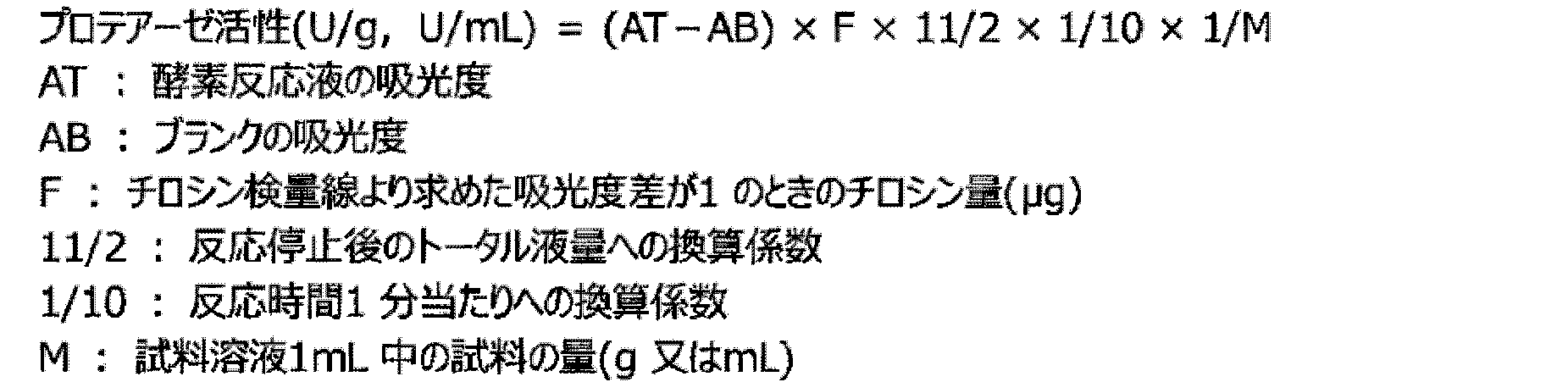
プロテアーゼとして、Bacillus licheniformis由来プロテアーゼ、及びBacillus amyloliquefaciens由来プロテアーゼを用いた。
プロテアーゼは、[B-2.クリセオバクテリウム属由来プロテアーゼ]の欄に記載の方法で測定した。
[C-1]第一のタンパク質含有組成物
上記[A.タンパク質含有組成物]に示した植物性タンパク質材料を水と混合し、植物性タンパク質材料を10重量%含む液状の植物性タンパク質含有組成物(pHは約7)を調製した。植物性タンパク質含有組成物に表2に示す所定量の酵素を加え、50℃にて24時間インキュベートした。沸騰水浴中で10分間処理し、酵素の失活工程を行った。酵素の失活工程後、室温になるまで冷却し、加工植物性タンパク質含有組成物を得た。
上記[A.タンパク質含有組成物]に示した植物性タンパク質材料を脱イオン水中に懸濁し(終濃度10重量%)、完全に糊化するまで煮沸し、その後、10U/g-starchのα-アミラーゼを添加し、60℃で30分間インキュベートし、液状の植物性タンパク質含有組成物(pHは約7)を調製した。植物性タンパク質含有組成物に表3に示す所定量の酵素を加え、50℃にて2時間インキュベートした。その後、100℃で5分間処理し、酵素の失活工程を行った。酵素の失活工程後、室温になるまで冷却し、加工植物性タンパク質含有組成物(加工オーツミルク)を得た。
また、上記[A.タンパク質含有組成物]に示した動物性タンパク質材料を脱イオン水中に懸濁し(終濃度5重量%)、液状の動物性タンパク質含有組成物(pHは約7)を調製した。動物性タンパク質含有組成物に表4に示す所定量の酵素を加え、50℃にて2時間インキュベートした。その後、100℃で5分間処理し、酵素の失活工程を行った。酵素の失活工程後、室温になるまで冷却し、加工動物性タンパク質含有組成物を得た。
上記[C-1]で得られた加工植物性タンパク質含有組成物を遠心(15,000×g、10分間)し、遠心上澄を得た。得られた遠心上澄を0.45μmのフィルターを用いてろ過し、アミノ酸分析用試料を得た。アミノ酸分析用試料について、アミノ酸分析装置(Agilent 1260 Infinity II LCシステムを用いたアミノ酸分析)を用い、当該装置のプロトコルに従って遊離アミノ酸量を分析した。具体的には、まず、遊離した、必須アミノ酸(必須AA:ヒスチジン、トレオニン、バリン、メチオニン、トリプトファン、フェニルアラニン、イソロイシン、ロイシン、リジン)と非必須アミノ酸(非必須AA:チロシン、システイン、アスパラギン酸、アスパラギン、セリン、グルタミン酸、グルタミン、プロリン、グリシン、アラニン、アルギニン)とを測定した。アミノ酸分析用試料における遊離アミノ酸量の総量に占める必須アミノ酸の比率(%)を算出した。
上記[C-2]で得られた50mLの加工タンパク質含有液状組成物を18,000rpmで30分間ホモジナイズ処理し、すぐに、100mLメスシリンダーに移した。泡沫を含めた組成物の総体積VF0を計量し、下記計算式を用いて「起泡性」を算出した。

上記[E.起泡性]の試験と同様に、上記[C-2]で得られた50mLの加工タンパク質含有液状組成物を18,000rpmで30分間ホモジナイズ処理し、すぐに、100mLメスシリンダーに移し、泡沫を含めた組成物の総体積の体積VF0を計量した。30分放置後の当該組成物の総体積の体積VF30を計量し、下記計算式を用いて「泡沫安定性」を算出した。

上記[C-2]で得られた30mLの加工タンパク質含有液状組成物と10mLのキャノーラ油とを混合し、10,000rpmで2分間ホモジナイズ処理することで、乳化組成物を調製した。調製直後の乳化組成物50μLをとり、5mLの0.1重量%SDS溶液に添加した。吸光度500nmにてその濁度(A0)を測定し、下記計算式を用いて「乳化性」を算出した。

上記[A.タンパク質含有組成物]の表1に示す植物性タンパク質材料(大豆タンパク質材料又はえんどうタンパク質材料)を用い、上記[C.加工タンパク質含有組成物の製造]の「[C-1]第一のタンパク質含有組成物」の方法で加工植物性タンパク質含有組成物を調製した。なお、大豆タンパク質1g当たりのPG添加量は30U、プロテアーゼの添加量は39Uであり、えんどうタンパク質1g当たりのPG添加量は18.8U、プロテアーゼの添加量は24.4Uであった。
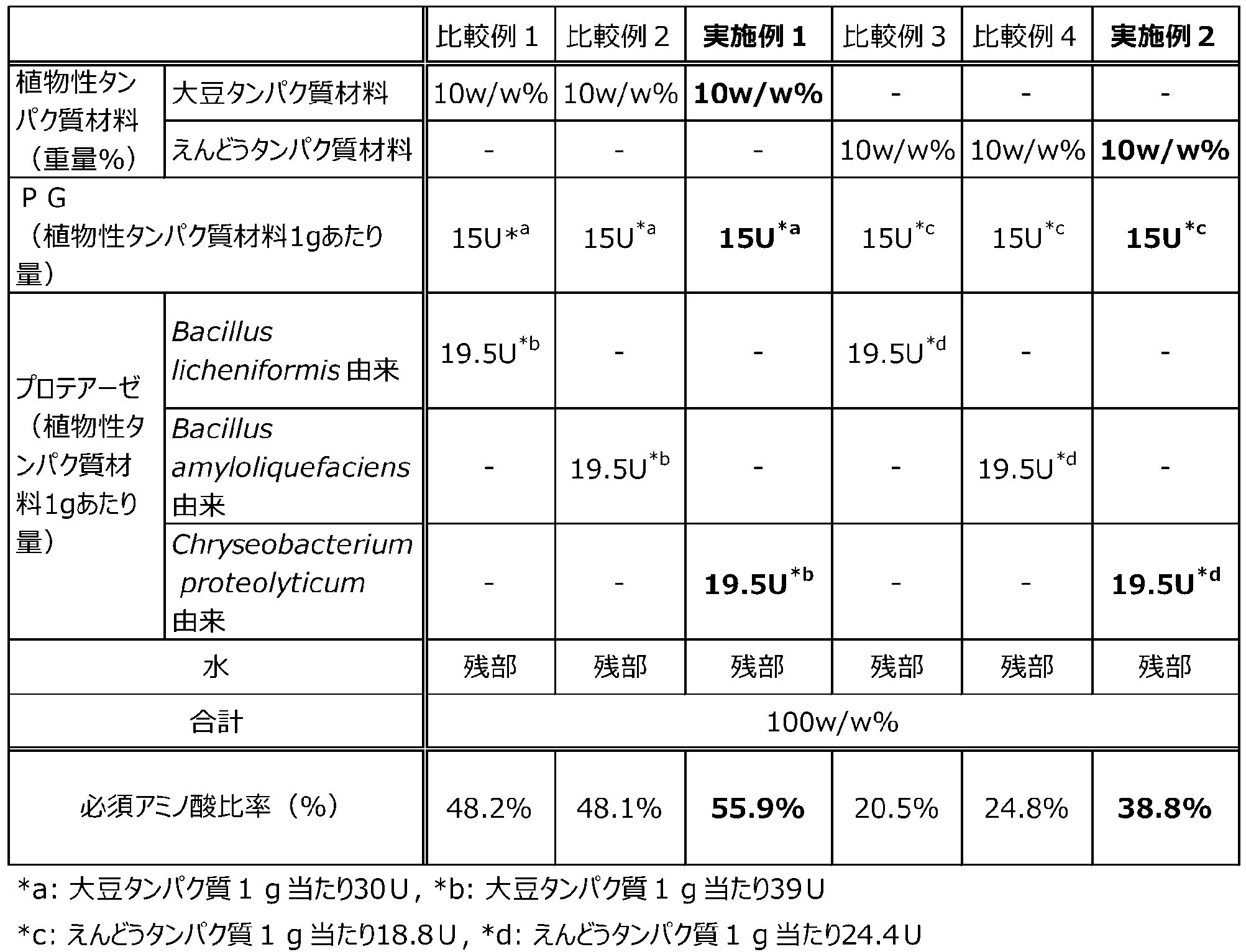
上記[A.タンパク質含有組成物]の表1に示す植物性タンパク質材料(オートタンパク質材料)又は動物性タンパク質材料(乳清タンパク質材料)を用い、上記[C.加工タンパク質含有組成物の製造]の「[C-2]第二のタンパク質含有組成物」の方法で加工タンパク質含有組成物を調製した。
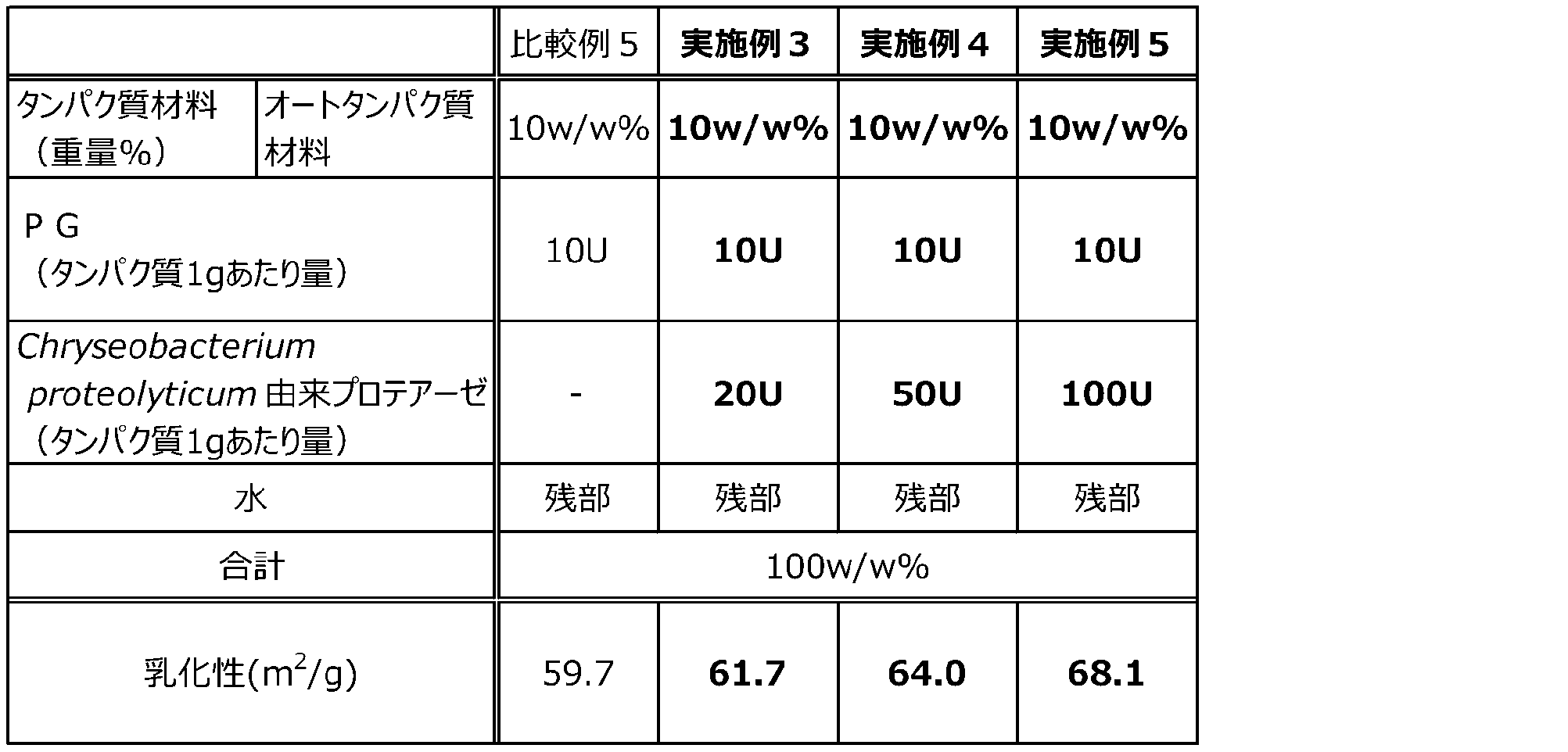
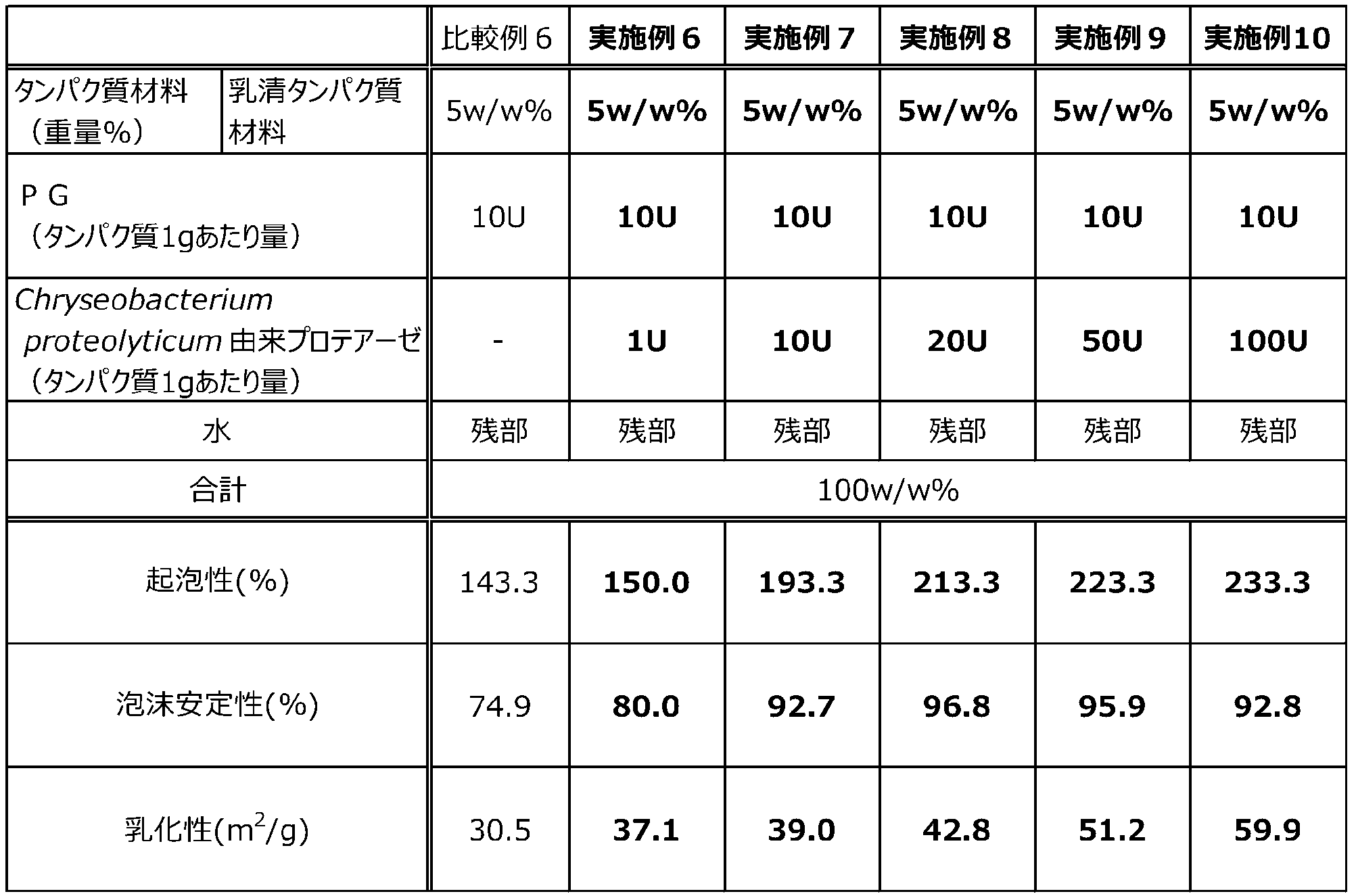
Claims (10)
- タンパク質脱アミド酵素及びクリセオバクテリウム属由来のプロテアーゼを含む、植物性タンパク質含有組成物の必須アミノ酸遊離量向上剤。
- 前記タンパク質脱アミド酵素がプロテイングルタミナーゼである、請求項1に記載の植物性タンパク質含有組成物の必須アミノ酸遊離量向上剤。
- 前記植物性タンパク質が、菽穀類、禾穀類、及び種実類からなる群より選択される植物のタンパク質である、請求項1に記載の植物性タンパク質含有組成物の必須アミノ酸遊離量向上剤。
- タンパク質脱アミド酵素及びクリセオバクテリウム属由来のプロテアーゼを含む、タンパク質含有組成物の改質剤であって、前記改質が、起泡性、泡沫安定性、及び/又は乳化性の向上である、改質剤。
- 植物性タンパク質含有組成物にタンパク質脱アミド酵素及びクリセオバクテリウム属由来のプロテアーゼを作用させる工程を含む、植物性タンパク質含有組成物の必須アミノ酸遊離量向上方法。
- タンパク質含有組成物にタンパク質脱アミド酵素及びクリセオバクテリウム属由来のプロテアーゼを作用させる工程を含む、タンパク質含有組成物の改質方法であって、前記改質が、起泡性、泡沫安定性、及び/又は乳化性の向上である、改質方法。
- 植物性タンパク質含有組成物にタンパク質脱アミド酵素及びクリセオバクテリウム属由来のプロテアーゼを作用させる工程を含む、必須アミノ酸遊離量が向上した加工植物性タンパク質含有組成物の製造方法。
- タンパク質含有組成物にタンパク質脱アミド酵素及びクリセオバクテリウム属由来のプロテアーゼを作用させる工程を含む、起泡性、泡沫安定性、及び/又は乳化性が向上した加工タンパク質含有組成物の製造方法。
- 植物性タンパク質含有組成物にタンパク質脱アミド酵素及びクリセオバクテリウム属由来のプロテアーゼを作用させる工程を含む方法によって得られる、必須アミノ酸遊離量が向上した加工植物性タンパク質含有組成物。
- タンパク質含有組成物にタンパク質脱アミド酵素及びクリセオバクテリウム属由来のプロテアーゼを作用させる工程を含む方法によって得られる、起泡性、泡沫安定性、及び/又は乳化性が向上した加工タンパク質含有組成物。
Priority Applications (4)
| Application Number | Priority Date | Filing Date | Title |
|---|---|---|---|
| JP2025528033A JPWO2024257875A1 (ja) | 2023-06-14 | 2024-06-14 | |
| CN202480039169.XA CN121693574A (zh) | 2023-06-14 | 2024-06-14 | 含有蛋白质的组合物的改性剂 |
| EP24823488.2A EP4729622A1 (en) | 2023-06-14 | 2024-06-14 | Modifier for protein-containing composition |
| AU2024302790A AU2024302790A1 (en) | 2023-06-14 | 2024-06-14 | Modifier for protein-containing composition |
Applications Claiming Priority (2)
| Application Number | Priority Date | Filing Date | Title |
|---|---|---|---|
| JP2023098145 | 2023-06-14 | ||
| JP2023-098145 | 2023-06-14 |
Publications (1)
| Publication Number | Publication Date |
|---|---|
| WO2024257875A1 true WO2024257875A1 (ja) | 2024-12-19 |
Family
ID=93852214
Family Applications (1)
| Application Number | Title | Priority Date | Filing Date |
|---|---|---|---|
| PCT/JP2024/021775 Ceased WO2024257875A1 (ja) | 2023-06-14 | 2024-06-14 | タンパク質含有組成物の改質剤 |
Country Status (5)
| Country | Link |
|---|---|
| EP (1) | EP4729622A1 (ja) |
| JP (1) | JPWO2024257875A1 (ja) |
| CN (1) | CN121693574A (ja) |
| AU (1) | AU2024302790A1 (ja) |
| WO (1) | WO2024257875A1 (ja) |
Citations (4)
| Publication number | Priority date | Publication date | Assignee | Title |
|---|---|---|---|---|
| JP2000050887A (ja) | 1998-06-04 | 2000-02-22 | Amano Pharmaceut Co Ltd | 新規蛋白質脱アミド酵素、それをコ―ドする遺伝子、その製造法並びにその用途 |
| JP2001218590A (ja) | 1999-12-03 | 2001-08-14 | Amano Enzyme Inc | 新規蛋白質脱アミド酵素、それを生産する微生物、それをコードする遺伝子、その製造法及び用途 |
| WO2006075772A1 (ja) | 2005-01-13 | 2006-07-20 | Ajinomoto Co., Inc. | 乳製品及びその製造方法 |
| WO2022102723A1 (ja) * | 2020-11-11 | 2022-05-19 | 天野エンザイム株式会社 | 加工植物性タンパク質含有液状組成物の製造方法 |
-
2024
- 2024-06-14 JP JP2025528033A patent/JPWO2024257875A1/ja active Pending
- 2024-06-14 AU AU2024302790A patent/AU2024302790A1/en active Pending
- 2024-06-14 WO PCT/JP2024/021775 patent/WO2024257875A1/ja not_active Ceased
- 2024-06-14 CN CN202480039169.XA patent/CN121693574A/zh active Pending
- 2024-06-14 EP EP24823488.2A patent/EP4729622A1/en active Pending
Patent Citations (4)
| Publication number | Priority date | Publication date | Assignee | Title |
|---|---|---|---|---|
| JP2000050887A (ja) | 1998-06-04 | 2000-02-22 | Amano Pharmaceut Co Ltd | 新規蛋白質脱アミド酵素、それをコ―ドする遺伝子、その製造法並びにその用途 |
| JP2001218590A (ja) | 1999-12-03 | 2001-08-14 | Amano Enzyme Inc | 新規蛋白質脱アミド酵素、それを生産する微生物、それをコードする遺伝子、その製造法及び用途 |
| WO2006075772A1 (ja) | 2005-01-13 | 2006-07-20 | Ajinomoto Co., Inc. | 乳製品及びその製造方法 |
| WO2022102723A1 (ja) * | 2020-11-11 | 2022-05-19 | 天野エンザイム株式会社 | 加工植物性タンパク質含有液状組成物の製造方法 |
Non-Patent Citations (1)
| Title |
|---|
| JAPANESE SOCIETY OF FOOD AND NUTRITION, vol. 20, no. 4, pages 259 - 266 |
Also Published As
| Publication number | Publication date |
|---|---|
| CN121693574A (zh) | 2026-03-17 |
| AU2024302790A1 (en) | 2026-01-08 |
| EP4729622A1 (en) | 2026-04-22 |
| JPWO2024257875A1 (ja) | 2024-12-19 |
Similar Documents
| Publication | Publication Date | Title |
|---|---|---|
| Neklyudov et al. | Properties and uses of protein hydrolysates | |
| JP5613689B2 (ja) | 植物性タンパク質およびマルトデキストリンを含有する造粒粉末、それを生成するための方法、およびその使用 | |
| US8309159B2 (en) | Process for obtaining legume protein fractions of moderate molecular weight, legume protein fractions and use thereof | |
| EP3906786B1 (en) | Method of making small particle sized protein compositions | |
| CN1159978C (zh) | 功能性蛋白质浓缩物和分离物 | |
| Amiza et al. | Physicochemical properties of silver catfish (Pangasius sp.) frame hydrolysate. | |
| EP2309874A1 (en) | Method for preparing a protein hydrolysate | |
| JP2022513613A (ja) | 可溶性マメ科植物タンパク質 | |
| WO2024101326A1 (ja) | 組織化植物性タンパク質の製造方法 | |
| WO2023219172A1 (ja) | 加工植物性タンパク質含有組成物の製造方法 | |
| Zhao et al. | Limited hydrolysis of soybean protein concentrate and isolate with two proteases and the impact on emulsifying activity index of hydrolysates, imag | |
| Subroto et al. | Modification of soy protein for the production of bioactive peptides and their utilization | |
| Hoang | Evaluation of pea protein and modified pea protein as egg replacers | |
| KR101295633B1 (ko) | 분지쇄 아미노산 고함유 쌀 단백질 가수분해물의 제조방법 | |
| WO2025140303A1 (en) | Enzymatic treatment of a material comprising corn protein | |
| WO2023145832A1 (ja) | 卵白タンパク質の熱凝固ゲルの物性改変剤 | |
| BRPI0116968B1 (pt) | Processo para a preparação de um hidrolisado de alto teor de proteína | |
| AU2024302790A1 (en) | Modifier for protein-containing composition | |
| JP2025540070A (ja) | タンパク質デアミダーゼを含む食肉類似物製品を製造するための方法 | |
| CN118251129A (zh) | 含有组织化植物性蛋白质的食品的制造方法 | |
| KR101393267B1 (ko) | 단백질분해효소를 이용한 홍게 껍질 단백질의 분해 방법 | |
| WO2024143546A1 (ja) | 植物性タンパク質含有乾燥組成物の保液性向上方法、水懸濁時の起泡性向上方法、及び水懸濁時の乳化性向上方法 | |
| WO2023085315A1 (ja) | 植物性タンパク質含有組成物の消化性向上剤 | |
| Blazek | Chemical and biochemical factors that influence the gelation of soybean protein and the yield of tofu | |
| CN118215408A (zh) | 含有植物性蛋白质的组合物的消化性提高剂 |
Legal Events
| Date | Code | Title | Description |
|---|---|---|---|
| 121 | Ep: the epo has been informed by wipo that ep was designated in this application |
Ref document number: 24823488 Country of ref document: EP Kind code of ref document: A1 |
|
| ENP | Entry into the national phase |
Ref document number: 2025528033 Country of ref document: JP Kind code of ref document: A |
|
| WWE | Wipo information: entry into national phase |
Ref document number: 2501008387 Country of ref document: TH Ref document number: 2025528033 Country of ref document: JP |
|
| WWE | Wipo information: entry into national phase |
Ref document number: AU2024302790 Country of ref document: AU |
|
| WWE | Wipo information: entry into national phase |
Ref document number: 202517125377 Country of ref document: IN |
|
| WWP | Wipo information: published in national office |
Ref document number: 202517125377 Country of ref document: IN |
|
| ENP | Entry into the national phase |
Ref document number: 2024302790 Country of ref document: AU Date of ref document: 20240614 Kind code of ref document: A |
|
| WWE | Wipo information: entry into national phase |
Ref document number: 2024823488 Country of ref document: EP |
|
| NENP | Non-entry into the national phase |
Ref country code: DE |
|
| ENP | Entry into the national phase |
Ref document number: 2024823488 Country of ref document: EP Effective date: 20260114 |
|
| ENP | Entry into the national phase |
Ref document number: 2024823488 Country of ref document: EP Effective date: 20260114 |
|
| WWP | Wipo information: published in national office |
Ref document number: 2024823488 Country of ref document: EP |