WO2024257789A1 - 細胞用構造体、細胞用構造体の製造方法、及び細胞培養方法 - Google Patents
細胞用構造体、細胞用構造体の製造方法、及び細胞培養方法 Download PDFInfo
- Publication number
- WO2024257789A1 WO2024257789A1 PCT/JP2024/021306 JP2024021306W WO2024257789A1 WO 2024257789 A1 WO2024257789 A1 WO 2024257789A1 JP 2024021306 W JP2024021306 W JP 2024021306W WO 2024257789 A1 WO2024257789 A1 WO 2024257789A1
- Authority
- WO
- WIPO (PCT)
- Prior art keywords
- cell
- substrate
- cell structure
- group
- cells
- Prior art date
- Legal status (The legal status is an assumption and is not a legal conclusion. Google has not performed a legal analysis and makes no representation as to the accuracy of the status listed.)
- Ceased
Links
Classifications
-
- C—CHEMISTRY; METALLURGY
- C08—ORGANIC MACROMOLECULAR COMPOUNDS; THEIR PREPARATION OR CHEMICAL WORKING-UP; COMPOSITIONS BASED THEREON
- C08F—MACROMOLECULAR COMPOUNDS OBTAINED BY REACTIONS ONLY INVOLVING CARBON-TO-CARBON UNSATURATED BONDS
- C08F20/00—Homopolymers and copolymers of compounds having one or more unsaturated aliphatic radicals, each having only one carbon-to-carbon double bond, and only one being terminated by only one carboxyl radical or a salt, anhydride, ester, amide, imide or nitrile thereof
- C08F20/02—Monocarboxylic acids having less than ten carbon atoms, Derivatives thereof
- C08F20/10—Esters
- C08F20/34—Esters containing nitrogen, e.g. N,N-dimethylaminoethyl (meth)acrylate
-
- C—CHEMISTRY; METALLURGY
- C12—BIOCHEMISTRY; BEER; SPIRITS; WINE; VINEGAR; MICROBIOLOGY; ENZYMOLOGY; MUTATION OR GENETIC ENGINEERING
- C12M—APPARATUS FOR ENZYMOLOGY OR MICROBIOLOGY; APPARATUS FOR CULTURING MICROORGANISMS FOR PRODUCING BIOMASS, FOR GROWING CELLS OR FOR OBTAINING FERMENTATION OR METABOLIC PRODUCTS, i.e. BIOREACTORS OR FERMENTERS
- C12M1/00—Apparatus for enzymology or microbiology
-
- C—CHEMISTRY; METALLURGY
- C12—BIOCHEMISTRY; BEER; SPIRITS; WINE; VINEGAR; MICROBIOLOGY; ENZYMOLOGY; MUTATION OR GENETIC ENGINEERING
- C12M—APPARATUS FOR ENZYMOLOGY OR MICROBIOLOGY; APPARATUS FOR CULTURING MICROORGANISMS FOR PRODUCING BIOMASS, FOR GROWING CELLS OR FOR OBTAINING FERMENTATION OR METABOLIC PRODUCTS, i.e. BIOREACTORS OR FERMENTERS
- C12M3/00—Tissue, human, animal or plant cell, or virus culture apparatus
-
- C—CHEMISTRY; METALLURGY
- C12—BIOCHEMISTRY; BEER; SPIRITS; WINE; VINEGAR; MICROBIOLOGY; ENZYMOLOGY; MUTATION OR GENETIC ENGINEERING
- C12N—MICROORGANISMS OR ENZYMES; COMPOSITIONS THEREOF; PROPAGATING, PRESERVING, OR MAINTAINING MICROORGANISMS; MUTATION OR GENETIC ENGINEERING; CULTURE MEDIA
- C12N1/00—Microorganisms; Compositions thereof; Processes of propagating, maintaining or preserving microorganisms or compositions thereof; Processes of preparing or isolating a composition containing a microorganism; Culture media therefor
-
- C—CHEMISTRY; METALLURGY
- C12—BIOCHEMISTRY; BEER; SPIRITS; WINE; VINEGAR; MICROBIOLOGY; ENZYMOLOGY; MUTATION OR GENETIC ENGINEERING
- C12N—MICROORGANISMS OR ENZYMES; COMPOSITIONS THEREOF; PROPAGATING, PRESERVING, OR MAINTAINING MICROORGANISMS; MUTATION OR GENETIC ENGINEERING; CULTURE MEDIA
- C12N5/00—Undifferentiated human, animal or plant cells, e.g. cell lines; Tissues; Cultivation or maintenance thereof; Culture media therefor
- C12N5/06—Animal cells or tissues; Human cells or tissues
Definitions
- the present invention relates to a cell structure, a method for producing a cell structure, and a cell culture method.
- Patent Literature 1 discloses a method for producing a polymer used as a base membrane for cell culture and a cell culture vessel.
- Patent Literature 2 discloses a method for producing a cell structure. In the process of producing (culturing) homogenous cell aggregates, these cell culture base membranes require the use of serum derived from living organisms to ensure uniform adhesion of cells to the base membrane, which poses problems such as quality variations due to individual differences in proliferation ability, and safety risks such as the occurrence of allergies and viral contamination when using serum derived from animals other than humans.
- the applicant has proposed a base film for cell culture that can produce homogeneous, high-quality cell aggregates without using serum derived from living organisms in the mass production of cell aggregates, a base film forming agent for forming the same, and a substrate for cell aggregate production (Patent Document 3).
- Stably retaining cells themselves or cell structures at a specified distance is useful from the perspective of utilizing the cells themselves and producing cell structures of uniform size.
- the present invention aims to provide a cell structure capable of stably retaining cells themselves or cell structures at a specified interval, a method for manufacturing the cell structure, and a cell culture method using the cell structure.
- the present invention includes the following aspects.
- a substrate a plurality of spaced apart spots on a surface of the substrate;
- a cell structure comprising: A cell structure, wherein each of the plurality of spots has a cell adhesive substance.
- a method for producing a cell structure having a substrate and a plurality of spots arranged at intervals on a surface of the substrate comprising: A method for producing a cell structure, comprising the step of applying droplets containing a cell adhesive substance to the substrate, thereby disposing the cell adhesive substance in the areas that will become the spots. [9] The method for producing a cell structure described in [8], in which the application of droplets containing the cell adhesive substance to the substrate is carried out by an inkjet method.
- the surface of the substrate has a coating film having cell adhesion inhibitory ability, and the plurality of spots are arranged on the coating film;
- the method for producing a cell structure described in [8] or [9] further comprises a step of applying a coating agent containing a polymer capable of inhibiting cell adhesion onto the substrate to form the coating film.
- a method for producing a cell structure having a substrate and a plurality of spots arranged at intervals on a surface of the substrate comprising: applying droplets of a cell culture base film forming agent containing a polymer and a solvent to the substrate to form a cell culture base film in the area to be the spot; applying droplets containing a cell adhesive substance to the cell culture base membrane to dispose the cell adhesive substance on the cell culture base membrane;
- the method for producing a cell structure includes the steps of: [12] The method for producing a cell structure described in [11], in which the application of droplets of the cell culture base film forming agent to the substrate is carried out by an inkjet method.
- the surface of the substrate has a coating film having cell adhesion inhibitory ability, and the plurality of spots are arranged on the coating film;
- a cell culture method comprising a step of seeding cells into the cell structure according to any one of [1] to [7].
- the cell culture method according to [17] which produces a cell structure.
- the present invention provides a cell structure capable of stably retaining cells themselves or cell structures at a predetermined interval, a method for manufacturing the cell structure, and a cell culture method using the cell structure.
- FIG. 1A is a perspective view of an example of a cell structure.
- FIG. 1B is a top view of an example of a cell structure.
- FIG. 2A is a perspective view of another example of a cell structure.
- FIG. 2B is a top view of another example of a cell structure.
- FIG. 3A is a perspective view of another example of a cell structure.
- FIG. 3B is a top view of another example of a cell structure.
- FIG. 4A shows the observation results after 26 hours of culture in the test of Example 1.
- FIG. 4B shows the observation results after 72 hours of culture in the test of Example 1.
- FIG. 4C shows the observation results (overall photograph) after 72 hours of culture in the test of Example 1.
- FIG. 5A shows the observation results after 26 hours of culture in the test of Comparative Example 1.
- FIG. 5B shows the observation results after 72 hours of culture in the test of Comparative Example 1.
- FIG. 5C shows the observation results (overall photograph) after 72 hours of culture in the test of Comparative Example 1.
- FIG. 6 shows the observation results of Test Example 2.
- FIG. 7A shows the observation results after 3 days of culture in the test of Example 2.
- FIG. 7B shows the observation results after 6 days of culture in the test of Example 2.
- FIG. 7C shows the observation results (overall photograph) after 6 days of culture in the test of Example 2.
- FIG. 8A shows the observation results after 3 days of culture in the test of Example 3.
- FIG. 8B shows the observation results after 6 days of culture in the test of Example 3.
- FIG. 8C shows the observation results (overall photograph) after 6 days of culture in the test of Example 3.
- FIG. 8A shows the observation results after 3 days of culture in the test of Example 3.
- FIG. 8B shows the observation results after 6 days of culture in the test of Example 3.
- FIG. 8C shows the observation results (overall photograph
- FIG. 9A shows the observation results after 3 days of culture in the test of Comparative Example 2.
- FIG. 9B shows the observation results after 6 days of culture in the test of Comparative Example 2.
- FIG. 9C shows the observation results (overall photograph) after 6 days of culture in the test of Comparative Example 2.
- FIG. 10A shows the observation results (overall photograph) after 3 days of culture in the test of Example 4.
- FIG. 10B shows the observation results (overall photograph) after 7 days of culture in the test of Example 4.
- FIG. 11A shows the observation results (overall photograph) after 3 days of culture in the test of Example 5.
- FIG. 11B shows the observation results (overall photograph) after 7 days of culture in the test of Example 5.
- FIG. 11C shows the observation results (overall photograph) after complete medium replacement in the test of Example 5.
- FIG. 12A shows the observation results (overall photograph) after 3 days of culture in the test of Comparative Example 3.
- FIG. 12B shows the observation results (overall photograph) after 7 days of culture in the test of Comparative Example 3.
- FIG. 12C shows the observation results (overall photograph) after complete medium replacement in the test of Comparative Example 3.
- FIG. 13A shows the results of observation after 7 days of culture in which half of the medium was exchanged in the test of Example 6.
- FIG. 13B shows the results of observation after 7 days of culture, in which the entire medium was replaced in the test of Example 6.
- FIG. 14A shows the results of observation after 7 days of culture in which half of the medium was exchanged in the test of Comparative Example 4.
- FIG. 14B shows the results of observation after 7 days of culture in which the entire medium was replaced in the test of Comparative Example 4.
- the cell structure of the present invention comprises a substrate and a plurality of spots.
- the plurality of spots are spaced apart on the surface of the substrate.
- the spots in one embodiment, have a cell adhesive substance.
- the spot has a cell culture base membrane and a cell adhesive substance disposed on the cell culture base membrane.
- the "surface of the substrate” refers to the surface that comes into contact with contents such as cell culture medium.
- multiple cell culture base membranes are arranged at intervals on a substrate.
- a cell structure e.g., a spheroid
- the produced cell structures are less likely to detach from the cell culture base membrane compared to when there is no cell adhesive substance on the cell culture base membrane. Therefore, it is possible to prevent unevenness in the size of the cell structures due to the fusion of detached cell structures and a decrease in the number of cell structures due to fusion.
- the cell structure is preferably a cell culture vessel.
- the number of the spots arranged at intervals on the surface of the substrate is not particularly limited, and is preferably, for example, 50 to 5,000 spots per cm2 , and more preferably 100 to 2,000 spots per cm2.
- the distance between adjacent spots is not particularly limited, but is preferably 100 ⁇ m to 6,000 ⁇ m, more preferably 150 ⁇ m to 4,000 ⁇ m, and particularly preferably 150 ⁇ m to 3,000 ⁇ m.
- the distance refers to the length between the centers of the two spots.
- the size of the spot surface is not particularly limited, and for example, the circle equivalent diameter is preferably 25 ⁇ m to 5,000 ⁇ m, and more preferably 50 ⁇ m to 3,000 ⁇ m.
- the equivalent circle diameter is the diameter of a perfect circle that corresponds to the area of the target surface. If the surface of the spot is a perfect circle, the equivalent circle diameter refers to the diameter of the perfect circle, and if the surface of the spot is other than a perfect circle, the equivalent circle diameter refers to the diameter of a perfect circle that has the same area as the area of the target surface.
- the area percentage of the substrate occupied by the spots is not particularly limited, but is preferably 30% or more, 40% or more, 50% or more, and is preferably 99% or less.
- the spot preferably has a cell culture base membrane.
- the cell adhesive substance is disposed on the cell culture base membrane.
- the area occupied by the cell culture base membrane is the spot. Therefore, the surface of the cell culture base membrane corresponds to the spot.
- the surface size of the cell adhesive material placed on the cell culture base membrane is not particularly limited as long as it is less than the surface size of the cell culture base membrane, but is preferably 1/80 to 1/3, and more preferably 1/50 to 1/4, of the area of the cell culture base membrane.
- the cell adhesive substance is present, for example, at one location per spot, but may be present at multiple locations per spot.
- Cell adhesive substances promote cell adhesion, spreading, proliferation and differentiation.
- known substances such as biological substances such as extracellular matrix (ECM) proteins, glycoproteins, peptides, and synthetic compounds (low molecular weight, high molecular weight) can be used, but compounds not of biological origin, such as synthetic compounds (low molecular weight, high molecular weight), are preferred.
- a low molecular weight is, for example, a compound having a weight average molecular weight of 2,000 or less
- a high molecular weight is, for example, a compound having a weight average molecular weight of 2,000 or more, with an upper limit of, for example, 1,000,000.
- extracellular matrix (ECM) proteins include collagen (e.g., Merck's type I collagen (product numbers C9791, C7661, C1809, C2249, C2124), type II collagen (product number C9301), type IV collagen (product numbers C0543, C5533), elastin (e.g., Merck's product numbers E1625, E6527), fibronectin (e.g., Merck's product numbers F1141, F0635, F2518, F0895, F4759), , F2006), laminin (e.g., Merck product numbers L6724, L2020, L4544), laminin fragments (e.g., Matrixome: 892011), vitronectin (e.g., VTN-N (Gibco), Vitronectin, Human, Recombinant, Animal Free (PeproTech), Merck product numbers V0132, V9881, V8379, 08-126, SRP3186).
- collagen e.g., Mer
- the cell adhesive substance is preferably a glycoprotein. Specifically, it is preferably selected from vitronectin, integrin, cadherin, fibronectin, laminin, tenascin, osteopontin, and bone sialoprotein. It is also preferably a protein having an RGD sequence as an amino acid sequence.
- peptides examples include ECM peptides (MAPTrix (registered trademark) from Kollodis Bio Sciences) and RGD peptides (180-01531 from Fujifilm Wako Pure Chemical Industries, Ltd.).
- ECM peptides MAPTrix (registered trademark) from Kollodis Bio Sciences
- RGD peptides 180-01531 from Fujifilm Wako Pure Chemical Industries, Ltd.
- Examples of synthetic compounds include polylysine (e.g. Merck products: P4707, P4832, P7280, P9155, P6407, P6282, P7405, P5899) and polyornithine (e.g. Merck product number P4975).
- Examples of synthetic compounds include adhesamine (e.g. Nagase & Co.: AD-00000-0201) and synthetic cyclic RGD peptide (e.g. IRIS BIOTECH: LS-3920.0010).
- the cell culture substrata contain a polymer, which is a material different from the cell adhesive material and is typically a synthetic polymer.
- the cell culture base membrane may further contain a cell adhesive substance.
- the thickness of the cell culture base film is not particularly limited, but is, for example, in the range of 1 to 1000 nm, and preferably in the range of 5 to 500 nm.
- the polymer is not particularly limited as long as it is a polymer that can be used for a base membrane for cell culture. From the viewpoint of suitably obtaining the effects of the present invention, however, a polymer (A) containing a repeating unit represented by the following formula (Ia) is preferred.
- U a1 and U a2 each independently represent a hydrogen atom or a linear or branched alkyl group having 1 to 5 carbon atoms; R a1 represents a hydrogen atom or a linear or branched alkyl group having 1 to 5 carbon atoms; R a2 represents a linear or branched alkylene group having 1 to 5 carbon atoms.
- the polymer (A) preferably further contains a repeating unit represented by the following formula (IIa).
- R b represents a hydrogen atom or a linear or branched alkyl group having 1 to 5 carbon atoms.
- examples of "straight-chain or branched alkyl groups having 1 to 5 carbon atoms” include methyl, ethyl, n-propyl, isopropyl, n-butyl, isobutyl, s-butyl, t-butyl, n-pentyl, 1-methylbutyl, 2-methylbutyl, 3-methylbutyl, 1,1-dimethylpropyl, 1,2-dimethylpropyl, 2,2-dimethylpropyl, and 1-ethylpropyl.
- R a1 and R b are each independently selected from a hydrogen atom and a methyl group.
- Each of U a1 and U a2 is preferably independently selected from a hydrogen atom, a methyl group, an ethyl group, a n-propyl group, an isopropyl group, and a n-butyl group, more preferably a methyl group or an ethyl group, and most preferably a methyl group.
- examples of a "linear or branched alkylene group having 1 to 5 carbon atoms" include a methylene group, an ethylene group, a propylene group, a trimethylene group, a tetramethylene group, a 1-methylpropylene group, a 2-methylpropylene group, a dimethylethylene group, an ethylethylene group, a pentamethylene group, a 1-methyl-tetramethylene group, a 2-methyl-tetramethylene group, a 1,1-dimethyl-trimethylene group, a 1,2-dimethyl-trimethylene group, a 2,2-dimethyl-trimethylene group, a 1-ethyl-trimethylene group, etc.
- R a2 is preferably selected from an ethylene group and a propylene group.
- Examples of the monomer (cationic monomer) that gives the polymer (A) the repeating unit represented by formula (Ia) include 2-N,N-dimethylaminoethyl methacrylate, N,N-dimethylaminomethyl methacrylate, etc., and 2-N,N-dimethylaminoethyl methacrylate (2-(dimethylamino)ethyl methacrylate) is preferred.
- Examples of the monomer (anionic monomer) that gives the polymer (A) the repeating unit represented by formula (IIa) include acrylic acid and methacrylic acid, with methacrylic acid being preferred.
- the molar ratio of the repeating unit (Ia) represented by formula (Ia) to the repeating unit (IIa) represented by formula (IIa) in the polymer (A) [(Ia)/(IIa)] is, for example, 100/0 to 50/50, preferably 98/2 to 50/50, more preferably 98/2 to 60/40, and particularly preferably 98/2 to 70/30.
- the molar ratio [(Ia)/(IIa)] is 1 or more, a decrease in cell adhesive strength due to the anionic nature of the polymer can be suppressed.
- the polymer (A) may have other repeating units.
- the total of the repeating units represented by formula (Ia) and the repeating units represented by formula (IIa) relative to all repeating units is, for example, 50 mol % or more, preferably 75 mol % or more, more preferably 80 mol % or more, and even more preferably 90 mol % or more.
- the polymer (A) further contains a crosslinked structure.
- the crosslinked structure can be obtained by using a monomer having two or more carbon-carbon unsaturated bonds in synthesizing the polymer (A).
- the monomer having two or more carbon-carbon unsaturated bonds is a monomer having two or more carbon-carbon double bonds, such as a polyfunctional acrylate compound, a polyfunctional acrylamide compound, a polyfunctional polyester, or an isoprene compound.
- R c and R d each independently represent a hydrogen atom or a linear or branched alkyl group having 1 to 5 carbon atoms
- R e represents a linear or branched alkylene group having 1 to 5 carbon atoms
- n represents a number from 1 to 50.
- R c and R d are each independently selected from a hydrogen atom and a methyl group.
- R e is preferably selected from a methylene group, an ethylene group, and a propylene group, and more preferably an ethylene group.
- n is a number from 1 to 50, n is preferably a number from 1 to 30, and more preferably a number from 1 to 10.
- the molar ratio of the structures represented by formulae (IIIa) to (Va) to the entire polymer (A) is preferably 0 mol % to 50 mol %, and more preferably 2 mol % to 25 mol %.
- the molar ratio of the structures represented by formulae (IIIa) to (Va) is 50% or less of the entire polymer (A)
- gelation of the solid content during production due to high molecular weight caused by excessive crosslinking can be suppressed, and production can be facilitated.
- the synthesis method of polymer (A) is not particularly limited, and examples thereof include known radical polymerization methods. In addition, the method described in WO2020/040247 may be used.
- the number average molecular weight (Mn) of the polymer is, for example, 20,000 to 1,000,000, and preferably 50,000 to 800,000.
- the number average molecular weight (Mw) of the polymer is, for example, 50,000 to 2,000,000, and preferably 10,000 to 1,200,000.
- the ratio (Mw/Mn) of the weight average molecular weight (Mw) to the number average molecular weight (Mn) of the polymer is, for example, 1.01 to 10.00, preferably 1.2 to 8.0, more preferably 1.4 to 6.0, even more preferably 1.5 to 5.0, and particularly preferably 1.6 to 4.5.
- the number average molecular weight (Mn) and the weight average molecular weight (Mw) can be determined, for example, by gel filtration chromatography.
- the material, shape, size and structure of the substrate are not particularly limited.
- the surface of the substrate may be flat or uneven, but is preferably flat.
- the substrate material may be, for example, glass, metal, a metal-containing compound or a metalloid-containing compound, activated carbon, or a resin.
- Metals include typical metals (aluminum group elements: Al, Ga, In; iron group elements: Fe, Co, Ni; chromium group elements: Cr, Mo, W, U; manganese group elements: Mn, Re; and precious metals: Cu, Ag, Au, etc.).
- Metal-containing compounds or metalloid-containing compounds may be, for example, ceramics, which are sintered bodies made by heat treatment at high temperatures and whose basic component is a metal oxide, semiconductors such as silicon, inorganic solid materials such as molded bodies of inorganic compounds such as metal oxides or metalloid oxides (silicon oxide, alumina, etc.), metal carbides or metalloid carbides, metal nitrides or metalloid nitrides (silicon nitride, etc.), and metal borides or metalloid borides, aluminum, nickel titanium, and stainless steel (SUS304, SUS316, SUS316L, etc.).
- the resin may be either a natural resin or its derivative, or a synthetic resin.
- natural resins or their derivatives include cellulose, cellulose triacetate (CTA), nitrocellulose (NC), and cellulose immobilized with dextran sulfate.
- synthetic resins that are preferably used include polyacrylonitrile (PAN), polyimide (PI), polyester polymer alloy (PEPA), polystyrene (PS), polysulfone (PSF), polyethylene terephthalate (PET), polymethyl methacrylate (PMMA), polyvinyl alcohol (PVA), polyurethane (PU), ethylene vinyl alcohol (EVAL), polyethylene (PE), polyester, polypropylene (PP), polyvinylidene fluoride (PVDF), polyethersulfone (PES), polycarbonate (PC), cycloolefin polymer (COP), polyvinyl chloride (PVC), polytetrafluoroethylene (PTFE), ultra-high molecular weight polyethylene (UHPE), polyd
- the substrate may be in the form of a plate or a film, and the thickness of the substrate is not particularly limited.
- the substrate may be, for example, a film having a thickness of 1 mm or less.
- the substrate may also be a substrate used in a so-called cell culture vessel.
- dish or dishes such as Petri dishes, tissue culture dishes, and multi-dishes that are generally used for cell culture
- flasks such as cell culture flasks, spinner flasks, and multi-tier flasks
- bags such as plastic bags, Teflon (registered trademark) bags, and culture bags
- plates such as microplates, microwell plates, multi-plates, and multi-well plates
- chamber slides, tubes, trays, and bottles such as roller bottles.
- the surface of the substrate may have a coating film having a cell adhesion suppressing ability, in which case the spots are arranged on the coating film.
- the coating film can be obtained, for example, by applying a coating agent containing a polymer capable of inhibiting cell adhesion onto a substrate.
- the shape of the coating film on the surface of the substrate is not particularly limited, so long as the spots are arranged thereon; one film may uniformly cover the entire surface of the substrate, one film may be formed within the plane of the surface of the substrate, or multiple films may be scattered on the surface of the substrate.
- having the ability to inhibit cell adhesion means that, when compared to no coating film or no low cell adhesion treatment when measured using a fluorescence microscope using the method described in the examples of WO 2016/093293, the relative absorbance (WST O.D. 450 nm) (%) ((Absorbance of Example (WST O.D. 450 nm))/(Absorbance of Comparative Example (WST O.D. 450 nm))) is 50% or less, preferably 30% or less, and more preferably 20% or less.
- coating film that has the ability to inhibit cell adhesion
- coating films include the following coating films:
- the coating film of the first embodiment includes a copolymer.
- the copolymer of the first embodiment contains a repeating unit containing an organic group represented by the following formula (a) and a repeating unit containing an organic group represented by the following formula (b).
- the copolymer is, for example, the copolymer described in WO2014/196652. The contents of WO2014/196652 are incorporated herein by reference to the same extent as if fully set forth herein.
- U a1 , U a2 , U b1 , U b2 and U b3 each independently represent a hydrogen atom or a linear or branched alkyl group having 1 to 5 carbon atoms
- An ⁇ represents an anion selected from the group consisting of a halide ion, an inorganic acid ion, a hydroxide ion and an isothiocyanate ion.
- the copolymer is not particularly limited as long as it contains a repeating unit containing an organic group represented by the above formula (a) and a repeating unit containing an organic group represented by the above formula (b).
- the copolymer is preferably one obtained by radical polymerization of a monomer containing an organic group represented by the above formula (a) and a monomer containing an organic group represented by the above formula (b), but one obtained by polycondensation or polyaddition reaction can also be used.
- copolymers examples include vinyl polymerization polymers reacted with olefins, polyamides, polyesters, polycarbonates, polyurethanes, etc., and among these, vinyl polymerization polymers reacted with olefins or (meth)acrylic polymers polymerized with (meth)acrylate compounds are particularly preferable.
- a (meth)acrylate compound means both an acrylate compound and a methacrylate compound.
- (meth)acrylic acid means acrylic acid and methacrylic acid.
- the monomers containing the organic groups represented by the above formulas (a) and (b) are monomers represented by the following formulas (A) and (B), respectively.
- T a , T b , U a1 , U a2 , U b1 , U b2 and U b3 each independently represent a hydrogen atom or a linear or branched alkyl group having 1 to 5 carbon atoms
- Q a and Q b each independently represent a single bond, an ester bond or an amide bond
- R a and R b each independently represent a linear or branched alkylene group having 1 to 10 carbon atoms which may be substituted with a halogen atom
- An - represents an anion selected from the group consisting of a halide ion, an inorganic acid ion, a hydroxide ion and an isothiocyanate ion
- m represents an integer of 0 to 6.
- the repeating units derived from the monomers represented by formulae (A) and (B) are represented by the following formulae (a1) and (b1), respectively.
- T a , T b , U a1 , U a2 , U b1 , U b2 and U b3 , Q a and Q b , R a and R b , An - and m are as defined above.
- a linear or branched alkylene group having 1 to 10 carbon atoms which may be substituted with a halogen atom means a linear or branched alkylene group having 1 to 10 carbon atoms, or a linear or branched alkylene group having 1 to 10 carbon atoms which is substituted with one or more halogen atoms.
- the "straight-chain or branched alkylene group having 1 to 10 carbon atoms” refers to a divalent organic group in which one hydrogen atom has been further removed from the above-mentioned alkyl group, and examples thereof include a methylene group, an ethylene group, a propylene group, a trimethylene group, a tetramethylene group, a 1-methylpropylene group, a 2-methylpropylene group, a dimethylethylene group, an ethylethylene group, a pentamethylene group, a 1-methyl-tetramethylene group, a 2-methyl-tetramethylene group, a 1,1-dimethyl-trimethylene group, a 1,2-dimethyl-trimethylene group, a 2,2-dimethyl-trimethylene group, a 1-ethyl-trimethylene group, a hexamethylene group, an octamethylene group, and a decamethylene group.
- Linear or branched alkylene groups having 1 to 10 carbon atoms substituted with one or more halogen atoms refers to such alkylene groups in which one or more arbitrary hydrogen atoms have been replaced with halogen atoms, and in particular, ethylene or propylene groups in which some or all of the hydrogen atoms have been replaced with halogen atoms are preferred.
- the "halogen atom” includes a fluorine atom, a chlorine atom, a bromine atom, and an iodine atom.
- the term “halide ion” refers to an anion of a halogen atom, and examples of such an anion include a fluoride ion, a chloride ion, a bromide ion, and an iodide ion, with a chloride ion being preferred.
- the term "inorganic acid ion" means a carbonate ion, a sulfate ion, a phosphate ion, a hydrogen phosphate ion, a dihydrogen phosphate ion, a nitrate ion, a perchlorate ion, or a borate ion.
- Preferred as the An ⁇ are a halide ion, a sulfate ion, a phosphate ion, a hydroxide ion and an isothiocyanate ion, and particularly preferred is a halide ion.
- T a and T b are preferably each independently a hydrogen atom, a methyl group, or an ethyl group, and more preferably each independently a hydrogen atom or a methyl group.
- U a1 , U a2 , U b1 , U b2 and U b3 are preferably each independently a hydrogen atom, a methyl group or an ethyl group.
- U a1 and U a2 are more preferably a hydrogen atom.
- U b1 , U b2 (and U b3 ) are more preferably a methyl group or an ethyl group, and particularly preferably a methyl group.
- R a and R b are preferably each independently a linear or branched alkylene group having 1 to 3 carbon atoms which may be substituted with a halogen atom, more preferably each independently an ethylene group or a propylene group, or an ethylene group or a propylene group substituted with one chlorine atom, and particularly preferably an ethylene group or a propylene group.
- m preferably represents an integer of 0 to 3, more preferably an integer of 1 or 2, and particularly preferably 1.
- (meth)acrylate compounds having two functional groups such as those represented by general formula (C) or (D) described below, may be used in combination during synthesis.
- formula (B) examples include dimethylaminoethyl (meth)acrylate, diethylaminoethyl (meth)acrylate, dimethylaminopropyl (meth)acrylate, 2-(t-butylamino)ethyl (meth)acrylate, methacryloylcholine chloride, etc., among which dimethylaminoethyl (meth)acrylate, methacryloylcholine chloride, or 2-(t-butylamino)ethyl (meth)acrylate are preferably used.
- dimethylaminoethyl acrylate 2-(dimethylamino)ethyl acrylate
- dimethylaminoethyl methacrylate 2-(dimethylamino)ethyl methacrylate
- methacryloylcholine chloride 2-(t-butylamino)ethyl methacrylate
- 2-(t-butylamino)ethyl methacrylate 2-(t-butylamino)ethyl methacrylate
- the proportion of the repeating units containing an organic group represented by formula (a) (or the repeating units represented by formula (a1)) in the copolymer is 20 mol% to 80 mol%, preferably 30 mol% to 70 mol%, and more preferably 40 mol% to 60 mol%.
- the copolymer may contain two or more kinds of repeating units containing an organic group represented by formula (a) (or the repeating units represented by formula (a1)).
- the proportion of the repeating unit containing an organic group represented by formula (b) (or the repeating unit represented by formula (b1)) in the above copolymer may be the entire remainder after subtracting the proportion of the above formula (a) (or formula (a1)) from the total copolymer, or it may be the remainder after subtracting the total proportion of the above formula (a) (or formula (a1)) and the third component described below.
- the copolymer may contain two or more kinds of repeating units containing an organic group represented by formula (b) (or repeating units represented by formula (b1)).
- the copolymer may be copolymerized with any third component.
- a (meth)acrylate compound having two or more functional groups may be copolymerized as the third component, and a part of the polymer may be partially three-dimensionally crosslinked.
- Examples of such a third component include bifunctional monomers represented by the following formula (C) or (D).
- Tc , Td , and Ud each independently represent a hydrogen atom or a linear or branched alkyl group having 1 to 5 carbon atoms, and Rc and Rd each independently represent a linear or branched alkylene group having 1 to 10 carbon atoms which may be substituted with a halogen atom.
- the copolymer preferably contains a crosslinked structure derived from such a bifunctional monomer.
- Tc and Td are preferably each independently a hydrogen atom, a methyl group, or an ethyl group, and more preferably each independently a hydrogen atom or a methyl group.
- Ud is preferably a hydrogen atom, a methyl group or an ethyl group, and more preferably a hydrogen atom.
- Rc and Rd are preferably each independently a linear or branched alkylene group having 1 to 3 carbon atoms which may be substituted with a halogen atom, more preferably each independently an ethylene group or a propylene group, or an ethylene group or a propylene group substituted with one chlorine atom, and particularly preferably an ethylene group or a propylene group.
- the bifunctional monomer represented by formula (C) is ethylene glycol di(meth)acrylate, triethylene glycol di(meth)acrylate, propylene glycol di(meth)acrylate, etc.
- the bifunctional monomer represented by formula (D) is bis(methacryloyloxymethyl) phosphate, bis[2-(methacryloyloxy)ethyl] phosphate, bis[2-(methacryloyloxy)propyl] phosphate, etc.
- the optional third component may be a trifunctional monomer.
- An example of such a trifunctional monomer as the third component is phosphinylidintris(oxy-2,1-ethanediyl) triacrylate.
- ethylene glycol di(meth)acrylate represented by the following formula (C-1) and bis[2-(methacryloyloxy)ethyl]phosphate represented by the following formula (D-1) are particularly preferred.
- the copolymer may contain one or more of these third components.
- the bifunctional monomer represented by formula (D) is preferred, and the bifunctional monomer represented by formula (D-1) is particularly preferred.
- the ratio of the third component (for example, a crosslinked structure derived from a bifunctional monomer represented by the above formula (C) or (D)) in the copolymer is 0 mol % to 50 mol %.
- the method for producing the copolymer is not particularly limited, but may be, for example, the method for producing the copolymer described in WO2014/196652.
- the coating film may be a coating film obtained from a coating film-forming composition described in WO2021/167037.
- the contents of WO2021/167037 are incorporated herein by reference to the same extent as if fully set forth herein.
- the coating film-forming composition described in WO2021/167037 will be described. In this specification, it is referred to as a coating film-forming composition of the second aspect.
- the composition for forming a coating film according to the second embodiment has the following formula (1): (Wherein, R 1 represents a hydrogen atom or a methyl group, R 2 represents an alkylene group having 1 to 6 carbon atoms, and n represents an integer of 1 to 30.
- R5 each independently represents a hydrogen atom or a linear or branched alkyl group having 1 to 6 carbon atoms
- R6 represents a linear or branched alkylene group having 1 to 10 carbon atoms which may be substituted with a halogen atom
- m represents an integer of 1 to 30.
- the present invention includes a monomer mixture containing a compound represented by formula (3), wherein the ratio of the compound represented by formula (3) to the total mass of the monomer mixture is 2 to 40 mass %, and a solvent.
- R 1 represents a hydrogen atom or a methyl group
- R 2 represents an alkylene group having 1 to 6 carbon atoms, preferably a linear or branched alkylene group having 1 to 6 carbon atoms, more preferably a linear or branched alkylene group having 2 to 5 carbon atoms, particularly preferably an ethylene group or a propylene group
- n represents an integer of 1 to 30, preferably an integer of 1 to 20, more preferably an integer of 2 to 10, particularly preferably an integer of 3 to 6.
- R3 represents a hydrogen atom or a methyl group
- R4 represents a monovalent organic group having cationic properties, and is typically a monovalent group having a primary amine, secondary amine, tertiary amine or quaternary ammonium structure.
- Examples of the monovalent group having a primary amine, secondary amine, tertiary amine or quaternary ammonium structure respectively mean groups represented by the formula: -R 4a -NH 2 , -R 4a -NHR, -R 4a -NRR', -R 4a -N + RR'R'' [wherein R 4a is an alkylene group having 1 to 6 carbon atoms which may be interrupted by an ester bond, an amide bond, an ether bond or a phosphodiester bond, and R, R' and R'' are each independently a linear or branched alkyl group having 1 to 6 carbon atoms, an aryl group having 6 to 10 carbon atoms or an aralkyl group having 7 to 16 carbon atoms].
- the monovalent group having a primary amine, secondary amine or tertiary amine structure in the second aspect may be quaternized or salified, and similarly the monovalent group having a quaternary ammonium structure
- compound of formula (2) above examples include dimethylaminoethyl (meth)acrylate, diethylaminoethyl (meth)acrylate, dimethylaminopropyl (meth)acrylate, 2-(t-butylamino)ethyl (meth)acrylate, (meth)acryloylcholine chloride, 2-(meth)acryloyloxyethyl phosphorylcholine (MPC), etc.
- the compound of formula (3) which is a monomer component of the copolymer according to the second aspect, is a bifunctional monomer having crosslinkability.
- R 5 each independently represents a hydrogen atom or a linear or branched alkyl group having 1 to 6 carbon atoms, preferably a hydrogen atom or a methyl group
- R 6 represents a linear or branched alkylene group having 1 to 10 carbon atoms which may be substituted with a halogen atom, preferably a linear or branched alkylene group having 1 to 6 carbon atoms which may be substituted with a halogen atom, more preferably a linear or branched alkylene group having 1 to 6 carbon atoms which may be substituted with a chlorine atom, particularly preferably an ethylene group, a propylene group, or a trimethylene group
- m represents an integer of 1 to 30, preferably an integer of 1 to 20, more preferably an integer of 1 to 10, even more preferably an integer of 1 to 6, and particularly
- Specific examples of the compound of formula (3) above include poly(ethylene glycol) di(meth)acrylate, poly(trimethylene glycol) di(meth)acrylate, poly(propylene glycol) di(meth)acrylate, etc.
- poly(ethylene glycol) dimethacrylate poly(trimethylene glycol) dimethacrylate, and poly(propylene glycol) dimethacrylate are represented by the following formulas (3-1) to (3-3), respectively.
- the copolymer according to the second embodiment is obtained by polymerizing a monomer mixture containing the compounds of the above formulae (1), (2) and (3) as monomer components.
- a monomer mixture may contain an ethylenically unsaturated monomer, or a polysaccharide or a derivative thereof as an optional fourth component, as long as the ability to inhibit adhesion of biological materials is not impaired.
- ethylenically unsaturated monomers include one or more ethylenically unsaturated monomers selected from the group consisting of (meth)acrylic acid and its esters, vinyl acetate, vinylpyrrolidone, ethylene, vinyl alcohol and hydrophilic functional derivatives thereof.
- polysaccharides or derivatives thereof include cellulose-based polymers such as hydroxyalkylcellulose (e.g., hydroxyethylcellulose or hydroxypropylcellulose), starch, dextran and curdlan.
- cellulose-based polymers such as hydroxyalkylcellulose (e.g., hydroxyethylcellulose or hydroxypropylcellulose), starch, dextran and curdlan.
- the copolymer according to the second embodiment is preferably obtained by polymerizing a monomer mixture containing only the compounds of the above formulae (1), (2) and (3) as monomer components.
- the copolymer according to the second aspect is obtained by polymerizing a monomer mixture containing the compounds of the above formulae (1), (2), and (3) as monomer components, and characterized in that the ratio of the compound of formula (3) to the total mass of the monomer components contained in the monomer mixture is 2 to 40 mass%.
- the compound of formula (3) which is a bifunctional monomer
- the coating film forming composition of the second aspect which contains the copolymer obtained from the monomer mixture, has excellent adhesion suppression ability for biological materials.
- the monomer mixture may contain two or more compounds of formula (3).
- the ratio of the compound of formula (1) to the total mass of the monomer components is 10 to 95 mass%, preferably 10 to 80 mass%, and more preferably 45 to 75 mass%.
- the monomer mixture may contain two or more types of compounds of formula (1).
- the ratio of the compound of formula (2) to the total mass of the monomer components is 3 to 90 mass%, preferably 10 to 70 mass%, and more preferably 15 to 35 mass%.
- the monomer mixture may contain two or more types of compounds of formula (2).
- the copolymer according to the second aspect can be synthesized by a method such as radical polymerization, anionic polymerization, or cationic polymerization, which is a general method for synthesizing (meth)acrylic polymers.
- the form of the copolymer can be various methods such as solution polymerization, suspension polymerization, emulsion polymerization, and bulk polymerization.
- the copolymer can be prepared by a manufacturing method including a step of reacting (polymerizing) a monomer mixture containing the compounds of the above formulas (1), (2), and (3) in a solvent at a total concentration of the monomer components of 0.01 to 20% by mass.
- the solvent in the polymerization reaction may be water, a phosphate buffer solution, an alcohol such as ethanol, or a mixed solvent of these, but preferably contains water or ethanol. It is more preferable that the solvent contains 10% by mass or more and 100% by mass or less of water or ethanol. It is more preferable that the solvent contains 50% by mass or more and 100% by mass or less of water or ethanol. It is more preferable that the solvent contains 80% by mass or more and 100% by mass or less of water or ethanol. It is more preferable that the solvent contains 90% by mass or more and 100% by mass or less of water or ethanol. The total of water and ethanol is preferably 100% by mass.
- polymerization initiator In order to efficiently advance the polymerization reaction, it is desirable to use a polymerization initiator.
- the polymerization initiator include a "thermal radical polymerization initiator” or a "photoradical polymerization initiator.”
- thermal radical polymerization initiator examples include 2,2'-azobis(isobutyronitrile), 2,2'-azobis(2-methylbutyronitrile), 2,2'-azobis(2,4-dimethylvaleronitrile) (FUJIFILM Wako Pure Chemical Industries, Ltd.
- photoradical polymerization initiators include acetophenone, chloroacetophenone, hydroxyacetophenone, 2-aminoacetophenone, dialkylaminoacetophenone, 2,2-diethoxyacetophenone, 2,2-dimethoxy-2'-phenylacetophenone (BASF product name: Irgacure 651), 2-hydroxy-2-methyl-1-phenylpropanone (BASF product name: Irgacure 1173), 1-[4-(2-hydroxyethoxy)-phenyl]-2-hydroxymethylpropanone (BASF product name: Irgacure 2959), 2-hydroxy-1- ⁇ 4-[4-(2-hydroxy-2-methylpropionyl)benzyl]phenyl ⁇ -2 acetophenones such as 2-methyl-1-propan-1-one (BASF product name: Irgacure 127), 2-methyl-1-[4-(methylthio)phenyl]-2-morpholinopropan-1-one (BASF product name: Irg
- the amount of polymerization initiator added is 0.05% to 10% by mass based on the total mass of the monomer components used in the polymerization.
- the reaction conditions are as follows: the reaction vessel is heated to 50-200°C in an oil bath or the like, and stirred for 1-48 hours, more preferably at 80-150°C for 5-30 hours, to allow the polymerization reaction to proceed and produce the copolymer of the second embodiment.
- the reaction atmosphere is preferably a nitrogen atmosphere.
- the reaction procedure can be such that all reactants are placed in a reaction solvent at room temperature and then heated to the above temperature to polymerize, or the entire mixture of reactants or a portion of it can be added dropwise in small amounts to a pre-heated solvent.
- the weight average molecular weight of the copolymer related to the second embodiment may be several thousand to several million, preferably 5,000 to 5,000,000, more preferably 10,000 to 2,000,000.
- the copolymer may be any of a random copolymer, a block copolymer, and a graft copolymer, and is preferably a random copolymer.
- the copolymer produced in this manner is considered to be a three-dimensional polymer since it contains a bifunctional monomer, and is in a dissolved or dispersed state in a solution containing water or alcohol.
- the coating film-forming composition according to the second embodiment may be prepared by isolating and purifying the copolymer thus obtained, and then diluting the copolymer with a desired solvent to a predetermined concentration. Furthermore, the coating film-forming composition according to the second embodiment may be prepared from a reaction solution (i.e., a copolymer-containing varnish) obtained after the polymerization reaction.
- a reaction solution i.e., a copolymer-containing varnish
- the solvent contained in the coating film forming composition of the second embodiment includes water, phosphate buffered saline (PBS), and alcohol.
- the concentration of solids in the coating film forming composition according to the second embodiment is preferably 0.01 to 50% by mass in order to form a uniform coating film.
- the concentration of the copolymer in the coating film forming composition is preferably 0.01 to 5% by mass, more preferably 0.01 to 4% by mass, and particularly preferably 0.01 to 3% by mass. If the concentration of the copolymer is 0.01% by mass or less, the concentration of the copolymer in the resulting coating film forming composition is too low to form a coating film with a sufficient thickness, and if it is 5% by mass or more, the storage stability of the coating film forming composition is deteriorated, and precipitation or gelation of the dissolved material may occur.
- the composition for forming the coating film of the second embodiment can also contain other substances as necessary within a range that does not impair the performance of the resulting coating film.
- other substances include preservatives, surfactants, primers that improve adhesion to the substrate, antifungal agents, and sugars.
- the method for obtaining the coating film according to the second embodiment may further include a step of adjusting the pH of the composition for forming a coating film in advance.
- the pH adjustment may be performed, for example, by adding a pH adjuster to a composition containing the copolymer and a solvent, and adjusting the pH of the composition to 2 to 13.5, preferably 2 to 8.5, more preferably 3 to 8, or preferably 8.5 to 13.5, more preferably 10 to 13.5.
- the type and amount of the pH adjuster that can be used are appropriately selected depending on the concentration of the copolymer, the ratio of anions to cations, and the like.
- pH adjusters include organic amines such as ammonia, diethanolamine, pyridine, N-methyl-D-glucamine, and tris(hydroxymethyl)aminomethane; alkali metal hydroxides such as potassium hydroxide and sodium hydroxide; alkali metal halides such as potassium chloride and sodium chloride; inorganic acids or alkali metal salts thereof such as sulfuric acid, phosphoric acid, hydrochloric acid, and carbonic acid; quaternary ammonium cations such as choline, or mixtures thereof (e.g., buffer solutions such as phosphate buffered saline).
- organic amines such as ammonia, diethanolamine, pyridine, N-methyl-D-glucamine, and tris(hydroxymethyl)aminomethane
- alkali metal hydroxides such as potassium hydroxide and sodium hydroxide
- alkali metal halides such as potassium chloride and sodium chloride
- inorganic acids or alkali metal salts thereof such as sulfuric
- ammonia, diethanolamine, sodium hydroxide, choline, N-methyl-D-glucamine, and tris(hydroxymethyl)aminomethane are preferred, and ammonia, diethanolamine, sodium hydroxide, and choline are particularly preferred.
- the coating film may be a coating film obtained from a composition for forming a coating film described in WO2022/259998.
- the contents of WO2022/259998 are incorporated herein by reference to the same extent as if expressly set forth in their entirety.
- the composition for forming a coating film described in WO2022/259998 will be described. In this specification, it is referred to as a composition for forming a coating film of the third embodiment.
- the coating film-forming composition of the third embodiment is used to inhibit adhesion of biological materials.
- the coating film-forming composition of the third aspect contains at least a copolymer, and further contains other components such as a solvent, if necessary.
- the coating film-forming composition of the third aspect can form a coating film that is difficult to dissolve in phosphate buffered saline, but the use of the coating film-forming composition of the third aspect is not particularly limited as long as it is used to inhibit adhesion of biological materials, and is not limited to the formation of a coating film that comes into contact with phosphate buffered saline.
- the copolymer according to the third embodiment is water-insoluble.
- water-soluble means that it can dissolve at least 1.0 g in 100 g of water at 25° C.
- Water-insoluble means that it does not fall under the category of “water soluble”, that is, the solubility in 100 g of water at 25° C. is less than 1.0 g.
- the copolymer according to the third embodiment has a repeating unit (A) represented by the following formula (A) and a repeating unit (B) represented by the following formula (B).
- the molar ratio (A:B) of the repeating unit (A) to the repeating unit (B) in the copolymer related to the third embodiment is from 89:11 to 50:50.
- R 1 to R 3 each independently represent a hydrogen atom or an alkyl group having 1 to 5 carbon atoms
- X 1 and X 2 each independently represent a single bond, an ester bond, an ether bond, an amide bond, or an alkylene group having 1 to 5 carbon atoms which may be interrupted by an oxygen atom.
- the copolymer related to the third embodiment may have two or more kinds of repeating units (A).
- the copolymer related to the third embodiment may have two or more kinds of repeating units (B).
- the copolymer related to the third embodiment preferably has one kind of repeating unit (A) and one kind of repeating unit (B).
- alkyl group having 1 to 5 carbon atoms examples include a methyl group, an ethyl group, an n-propyl group, an isopropyl group, an n-butyl group, an isobutyl group, an s-butyl group, a t-butyl group, an n-pentyl group, a 1-methylbutyl group, a 2-methylbutyl group, a 3-methylbutyl group, a 1,1-dimethylpropyl group, a 1,2-dimethylpropyl group, a 2,2-dimethylpropyl group, and a 1-ethylpropyl group. It is preferable that R 1 to R 3 each independently represent a hydrogen atom, a methyl group, or an ethyl group.
- ether bond refers to -O-
- the alkylene group having 1 to 5 carbon atoms may be interrupted by an oxygen atom.
- Examples of the alkylene group having 1 to 5 carbon atoms include a methylene group, an ethylene group, a propylene group, a trimethylene group, a tetramethylene group, a 1-methylpropylene group, a 2-methylpropylene group, a dimethylethylene group, an ethylethylene group, a pentamethylene group, a 1-methyl-tetramethylene group, a 2-methyl-tetramethylene group, a 1,1-dimethyl-trimethylene group, a 1,2-dimethyl-trimethylene group, a 2,2-dimethyl-trimethylene group, and a 1-ethyl-trimethylene group.
- X1 and X2 are preferably a methylene group, an ethylene group, or a propylene group.
- the phrase "optionally interrupted by an oxygen atom” means that one or more carbon-carbon bonds in the alkylene group having 1 to 5 carbon atoms are bonded via an ether bond.
- the copolymer according to the third embodiment is preferably a copolymer in which R 1 and R 2 are hydrogen atoms, R 3 is a methyl group, and X 1 and X 2 are single bonds.
- the molar ratio (A:B) of the repeating unit (A) to the repeating unit (B) is from 89:11 to 50:50.
- the molar ratio (A:B) of the repeating unit (A) to the repeating unit (B) can be expressed as (100-m):m.
- the range of m is 11 to 50.
- the lower limit of m may be 12, 13, 14, 15, 16, 17, 18, 19, 20, 21, 22, 23, 24, 25, 26, 27, 28, 29, or 30.
- the upper limit of m may be 49, 48, 47, 46, 45, 44, 43, 42, 41, 40, 38, 37, 36, or 35.
- the range of m is, for example, 12 to 49, 12 to 48, 15 to 48, 20 to 49, 20 to 45, 22 to 49, or 22 to 45.
- the total mole percentage of repeating units (A) and repeating units (B) among all repeating units in the copolymer according to the third embodiment is not particularly limited, but is preferably 90 mole% or more, more preferably 95 mole% or more, even more preferably 99.5 mole% or more, and particularly preferably 100%.
- the molar ratio of the repeating unit (A) to the repeating unit (B) in the copolymer is set to a specific range in order to obtain a coating film that is difficult to dissolve in phosphate buffered saline. Therefore, in the third embodiment, a coating film that is difficult to dissolve in phosphate buffered saline is obtained without crosslinking the copolymer. Therefore, the copolymer does not need to have a photosensitive group for crosslinking the copolymer. That is, it is preferable that the copolymer does not have a photosensitive group.
- An example of the photosensitive group is an azide group.
- the copolymer does not need to have a photosensitive group for crosslinking the copolymer. Therefore, when forming a coating film, it is not necessary to perform light irradiation for crosslinking the copolymer. Therefore, the process for forming the coating film can be simplified.
- the viscosity average degree of polymerization of the copolymer related to the third aspect (hereinafter, may be simply referred to as "degree of polymerization”) is not particularly limited, but from the viewpoint of favorably obtaining the effects of the third aspect, it is preferably 200 to 3,000, more preferably 200 to 2,500, and particularly preferably 200 to 2,000.
- the viscosity average degree of polymerization is measured in a completely saponified state of the copolymer.
- P represents the viscosity average degree of polymerization.
- the viscosity average degree of polymerization can be determined in accordance with JIS K6726.
- the method for producing the copolymer related to the third aspect is not particularly limited, but for example, a method can be mentioned in which a compound represented by the following formula (C) is polymerized to produce a homopolymer, and the obtained homopolymer is partially hydrolyzed by a known saponification reaction to obtain the copolymer.
- a compound represented by the following formula (C) is polymerized to produce a homopolymer, and the obtained homopolymer is partially hydrolyzed by a known saponification reaction to obtain the copolymer.
- R 1 , R 3 , and X 1 are defined as above.
- the copolymer according to the third embodiment may be a random copolymer or a block copolymer.
- a commercially available product may be used as the copolymer according to the third embodiment.
- a specific example of the commercially available copolymer is polyvinyl acetate (manufactured by Nippon Acetic Acid & Poval, trade name JMR-10L (registered trademark)).
- the content of the copolymer in the film-forming component in the coating film-forming composition of the third embodiment is not particularly limited, but is preferably 80% by mass or more, more preferably 90% by mass or more, and particularly preferably 95% by mass or more.
- the film-forming component refers to all the components of the composition excluding the solvent component.
- the content of the copolymer in the coating film-forming composition of the third embodiment is not particularly limited, but from the viewpoint of easily forming a coating film of the desired thickness, it is preferably 0.1 to 10 mass%, more preferably 0.3 to 8 mass%, and particularly preferably 0.5 to 5 mass%.
- the content of the copolymer in the coating film-forming composition may be 0.02 to 2 mass%, or 0.05 to 1 mass%.
- Examples of the solvent in the third aspect include water, phosphate buffered saline (PBS), alcohol, and water-soluble organic solvents (excluding alcohol).
- PBS phosphate buffered saline
- alcohol excluding alcohol
- the alcohol includes alcohols having 2 to 6 carbon atoms.
- alcohols include ethanol, propanol, isopropanol, 1-butanol, 2-butanol, isobutanol, t-butanol, 1-pentanol, 2-pentanol, 3-pentanol, 1-heptanol, 2-heptanol, 2,2-dimethyl-1-propanol (neopentyl alcohol), 2-methyl-1-propanol, 2-methyl-1-butanol, 2-methyl-2-butanol (t-amyl alcohol), 3-methyl-1-butanol, 3-methyl-3-pentanol, cyclopentanol, 1-heptanol,
- the cyclohexanol include cyclohexanol, 2-hexanol, 3-hexanol, 2,3-dimethyl-2-butanol, 3,3-dimethyl-1-butanol, 3,3-dimethyl-2-but
- the water-soluble organic solvent refers to an organic solvent that can be mixed with water and alcohol in any ratio and does not separate after mixing.
- the water-soluble organic solvent include ethylene glycol monomethyl ether, ethylene glycol monoethyl ether, methyl cellosolve acetate, ethyl cellosolve acetate, diethylene glycol monomethyl ether, diethylene glycol monoethyl ether, propylene glycol, propylene glycol monomethyl ether, propylene glycol monoethyl ether, propylene glycol monomethyl ether, and propylene glycol propyl ether acetate. These can be used alone or in combination of two or more.
- the solvent is preferably selected from water, alcohol, a water-soluble organic solvent, and a combination of two or more thereof, and more preferably selected from water, ethanol, a water-soluble organic solvent, and a combination of two or more thereof.
- the mass ratio of water:alcohol is, for example, 1:99 to 70:30, or 1:99 to 50:50.
- the mass ratio of water:alcohol:water-soluble organic solvent (A:B:C) is, for example, 5 to 30:65 to 92:1 to 30 (provided that A+B+C is 100).
- the mixing ratio (mass ratio) of alcohol:water-soluble organic solvent is, for example, 30:70 to 97:3.
- the content of the solvent in the coating film-forming composition of the third embodiment is not particularly limited, but from the viewpoint of easily forming a coating film of the desired thickness, it is preferably 90% by mass or more, more preferably 92% by mass or more, and particularly preferably 95% by mass or more.
- the coating film-forming composition of the third embodiment may contain other components as necessary.
- other components include pH adjusters, preservatives, surfactants, antifungal agents, and sugars.
- the cell structure 100 shown in FIGS. 1A and 1B has a main body 1 and a cell adhesive substance 2 which is a spot.
- the main body 1 has an outer peripheral wall 1A, an inner bottom surface 1B, and an opening 1C.
- the opening 1C is an opening formed by the outer peripheral wall 1A, and the inner bottom surface 1B exists below the opening 1C.
- a plurality of cell adhesive substances 2 are arranged at intervals on the inner bottom surface 1B.
- the cell structure 100 shown in FIGS. 2A and 2B has a main body 1, a cell adhesive substance 2, and a cell culture base membrane 3 which is a spot.
- the main body 1 has an outer peripheral wall 1A, an inner bottom surface 1B, and an opening 1C.
- the opening 1C is an opening formed by the outer peripheral wall 1A, and the inner bottom surface 1B exists below the opening 1C.
- a plurality of cell culture base membranes 3 are arranged at intervals on the inner bottom surface 1B.
- a cell adhesive substance 2 is disposed on a cell culture base membrane 3 .
- the cell structure 100 shown in FIGS. 3A and 3B has a main body 1, a cell adhesive substance 2, a cell culture base film 3 which is a spot, and a coating film 4.
- the main body 1 has an outer peripheral wall 1A, an inner bottom surface 1B, and an opening 1C.
- the opening 1C is an opening formed by the outer peripheral wall 1A, and the inner bottom surface 1B exists below the opening 1C.
- the surface of the inner bottom surface 1B has a coating film 4 having the ability to inhibit cell adhesion.
- a plurality of cell culture base films 3 are arranged on the coating film 4 at intervals.
- a cell adhesive substance 2 is disposed on a cell culture base membrane 3 .
- the method for producing a cell structure of the present invention is a method for producing a cell structure having a substrate and a plurality of spots arranged at intervals on the surface of the substrate.
- Step (A1) A step of applying droplets containing a cell adhesive substance to a substrate to place the cell adhesive substance in areas to be spots.
- Step (A2) A step of applying droplets of a cell culture base film forming agent to a substrate to form a cell culture base film in the area to be a spot.
- Step (B2) A step of applying droplets containing a cell adhesive substance to the cell culture base film to arrange the cell adhesive substance on the cell culture base film.
- the surface of the substrate may have a coating film capable of inhibiting cell adhesion, and a plurality of spots may be arranged on the coating film.
- the method for producing a cell structure may further include the following step (C).
- the method for producing a cell structure of the present invention is, for example, a method for producing a cell structure of the present invention.
- Step (A1) is a step of applying droplets containing a cell adhesive substance to a substrate to place the cell adhesive substance in areas that will become spots.
- cell adhesive substances examples include the cell adhesive substances mentioned in the description of the cell structure of the present invention.
- the droplets containing the cell adhesive substance are formed, for example, from a liquid containing the cell adhesive substance.
- the liquid containing the cell adhesive substance contains, for example, the cell adhesive substance and a solvent.
- the solvent include the solvents mentioned in the description of the cell culture base film forming agent described below.
- the method for applying the droplets containing the cell adhesive substance is not particularly limited, but may be an inkjet method, a screen printing method, a slit coating method, a roll-to-roll method, or the like, but is preferably performed using a printing technique such as an inkjet method or screen printing.
- Step (A2) is a step of applying droplets of a cell culture base film forming agent to a substrate to form a cell culture base film in areas that will become spots.
- the substrate may be any of the substrates mentioned in the description of the cell structure of the present invention.
- the cell culture base film forming agent (hereinafter sometimes referred to as "base film forming agent”) contains a polymer and a solvent, and may further contain other components.
- the polymer include the polymers mentioned in the description of the cell structure of the present invention.
- the solvent is not particularly limited, but is preferably an aqueous solution containing water.
- the aqueous solution may be water, a salt-containing aqueous solution such as physiological saline or a phosphate buffer solution, or a mixed solvent of water or a salt-containing aqueous solution with an alcohol.
- suitable solvents include cyclohexanol, 2-hexanol, 3-hexanol, 2,3-dimethyl-2-butanol, 3,3-dimethyl-1-butanol, 3,3-dimethyl-2-butanol, 2-ethyl-1-butanol, 2-methyl-1-pentanol, 2-methyl-2-pentanol, 2-methyl-3-pentanol, 3-methyl-1-pentanol, 3-methyl-2-pentanol, 3-methyl-3-pentanol, 4-methyl-1-pentanol, 4-methyl-2-pentanol, 4-methyl-3-pentanol, and cyclohexanol. These solvents may be used alone or in combination.
- the water content in the aqueous solution is, for example, 50% by mass to 100% by mass, 80% by mass to 100% by mass, or 90% by mass to 100% by mass.
- the undercoat film forming agent may also contain other substances as necessary within the range that does not impair the performance of the obtained undercoat film. Examples of other substances include pH adjusters, crosslinking agents, preservatives, surfactants, primers that improve adhesion to containers or substrates, antifungal agents, and sugars.
- the method for applying droplets of the undercoat film forming agent to the substrate is not particularly limited, and may be an inkjet method, a screen printing method, a slit coating method, a roll-to-roll method, or the like.
- the method is performed by a printing technique such as an inkjet method or screen printing.
- a method of immersing a substrate with a portion that is not to be a spot protected in the above-mentioned primer film forming agent a method of adding a primer film forming agent to a substrate (container) with a portion that is not to be a spot protected and leaving it to stand for a predetermined time, etc. are used.
- the primer film forming agent is added to a container with a portion that is not to be a spot protected and left to stand for a predetermined time.
- the addition can be performed, for example, by adding the primer film forming agent in an amount of 0.5 to 1 times the total volume of the container using a syringe or the like.
- the leaving is performed by appropriately selecting the time and temperature depending on the material of the container or substrate and the type of primer film forming agent for cell culture, and is performed, for example, for 1 minute to 24 hours, preferably 5 minutes to 3 hours, at 10 to 80°C.
- step (B2) may be performed directly without a drying step, or after washing with water or the medium of the sample to be subjected to cell culture (e.g., water, buffer solution, culture medium, etc.).
- water or the medium of the sample to be subjected to cell culture e.g., water, buffer solution, culture medium, etc.
- Step (B2) is a step of providing droplets containing a cell adhesive substance onto the cell culture base membrane, thereby disposing the cell adhesive substance on the cell culture base membrane.
- cell adhesive substances examples include the cell adhesive substances mentioned in the description of the cell structure of the present invention.
- the droplets containing the cell adhesive substance are formed, for example, from a liquid containing the cell adhesive substance.
- the liquid containing the cell adhesive substance contains, for example, the cell adhesive substance and a solvent.
- the solvent include the solvents mentioned in the description of the cell culture base film forming agent.
- the method for applying the droplets containing the cell adhesive substance is not particularly limited, but may be an inkjet method, a screen printing method, a slit coating method, a roll-to-roll method, or the like, but is preferably performed using a printing technique such as an inkjet method or screen printing.
- Step (C) is a step of applying a coating agent containing a polymer capable of inhibiting cell adhesion onto a substrate to form a coating film.
- the coating agent is not particularly limited as long as it contains a polymer capable of inhibiting cell adhesion, and for example, contains a polymer capable of inhibiting cell adhesion and a solvent.
- the coating film and coating agent include the coating films and coating agents mentioned in the description of the cell structure of the present invention.
- the method for applying the coating agent onto the substrate is not particularly limited, and may be an inkjet method, a screen printing method, a slit coating method, a roll-to-roll method, or the like.
- the coating agent is applied by a printing technique such as an inkjet method or screen printing.
- the cell culture method (cell production method) of the present invention comprises the step of seeding cells into the cell structure of the present invention.
- An example of the step of seeding cells is adding a medium in which cells are dispersed to the cell structure of the present invention.
- the cell structure is preferably a cell culture vessel.
- each of the plurality of spots preferably has a cell culture base membrane containing a polymer and a cell adhesive substance disposed on the cell culture base membrane.
- the cell concentration in the medium in which the cells are dispersed is not particularly limited.
- a cell is the most basic unit constituting an animal or a plant, and has cytoplasm and various organelles inside the cell membrane as its elements.
- the nucleus containing DNA may or may not be contained inside the cell.
- the animal-derived cells in the present invention include germ cells such as sperm and eggs, somatic cells constituting an organism, stem cells (pluripotent stem cells, etc.), progenitor cells, cancer cells isolated from an organism, cells (cell lines) isolated from an organism that have acquired immortalization ability and are stably maintained outside the body, cells isolated from an organism that have been artificially genetically modified, cells isolated from an organism that have been artificially replaced with a nucleus, etc.
- somatic cells that constitute a living body include, but are not limited to, fibroblasts, bone marrow cells, B lymphocytes, T lymphocytes, neutrophils, red blood cells, platelets, macrophages, monocytes, bone cells, bone marrow cells, pericytes, dendritic cells, keratinocytes, adipocytes, mesenchymal cells, epithelial cells, epidermal cells, endothelial cells, vascular endothelial cells, hepatic parenchymal cells, chondrocytes, cumulus cells, nervous system cells, glial cells, neurons, oligodendrocytes, microglia, astrocytes, cardiac cells, esophageal cells, muscle cells (e.g., smooth muscle cells or skeletal muscle cells), pancreatic beta cells, melanocytes, hematopoietic progenitor cells (e.g., CD34-positive cells derived from umbilical cord blood), and mononuclear cells
- the somatic cells include cells collected from any tissue, such as skin, kidney, spleen, adrenal gland, liver, lung, ovary, pancreas, uterus, stomach, colon, small intestine, large intestine, bladder, prostate, testis, thymus, muscle, connective tissue, bone, cartilage, vascular tissue, blood (including umbilical cord blood), bone marrow, heart, cardiac muscle, eye, brain, neural tissue, hair, etc. Furthermore, the somatic cells include cells induced to differentiate from stem cells or progenitor cells.
- Stem cells are cells that have both the ability to replicate themselves and the ability to differentiate into cells of multiple lineages, and examples of such cells include, but are not limited to, embryonic stem cells (ES cells), embryonic tumor cells, embryonic germ stem cells, induced pluripotent stem cells (iPS cells), neural stem cells, hematopoietic stem cells, mesenchymal stem cells, hepatic stem cells, pancreatic stem cells, muscle stem cells, germ stem cells, intestinal stem cells, cancer stem cells, hair follicle stem cells, etc.
- pluripotent stem cells include ES cells, embryonic germ stem cells, and iPS cells.
- a precursor cell is a cell that is at an intermediate stage in the differentiation of the stem cell into a specific somatic cell or germ cell.
- Cancer cells are cells that derive from somatic cells and have acquired the ability to proliferate indefinitely.
- a cell line is a type of cell that has acquired the ability to proliferate indefinitely through artificial manipulation outside of a living organism.
- fibroblasts, stem cells, and among stem cells, pluripotent stem cells are more preferable.
- the medium can be appropriately selected depending on the type of cells used, etc.
- a medium generally used for culturing mammalian cells can be used as the medium.
- Examples of media for mammalian cells include Dulbecco's Modified Eagle's Medium (DMEM), Ham's Nutrient Mixture F12, DMEM/F12 medium, McCoy's 5A medium, Eagle's Minimum Essential Medium (EMEM), alpha Modified Eagle's Minimum Essential Medium ( ⁇ MEM), and MEM medium (Minimum Essential Medium (MEM)).
- RPMI1640 medium Iscove's Modified Dulbecco's Medium (IMDM), MCDB131 medium, William's medium E, IPL41 medium, Fischer's medium, StemPro34 (Invitrogen), X-VIVO 10 (Cambrex), X-VIVO 15 (Cambrex), HPGM (Cambrex), StemSpan Examples of such medium include H3000 (manufactured by Stem Cell Technology Co., Ltd.), StemSpan SFEM (manufactured by Stem Cell Technology Co., Ltd.), Stemline II (manufactured by Sigma-Aldrich Co., Ltd.), QBSF-60 (manufactured by Quality Biological Co., Ltd.), StemPro hESCSFM (manufactured by Invitrogen Co., Ltd.), mTeSR1 or 2 medium (manufactured by Stem Cell Technology Co., Ltd.), Sf-900II (manufactured by Invitrogen Co
- Those skilled in the art may freely add sodium, potassium, calcium, magnesium, phosphorus, chlorine, various amino acids, various vitamins, antibiotics, serum, fatty acids, sugars, etc. to the above-mentioned medium according to the purpose.
- those skilled in the art may also add one or more combinations of other chemical components or biological components according to the purpose.
- Components that can be added to culture media for mammalian cells include fetal bovine serum, human serum, horse serum, insulin, transferrin, lactoferrin, cholesterol, ethanolamine, sodium selenite, monothioglycerol, 2-mercaptoethanol, bovine serum albumin, sodium pyruvate, polyethylene glycol, various vitamins, various amino acids, agar, agarose, collagen, methylcellulose, various cytokines, various hormones, various growth factors, various extracellular matrices, and various cell adhesion molecules.
- cytokines examples include interleukin-1 (IL-1), interleukin-2 (IL-2), interleukin-3 (IL-3), interleukin-4 (IL-4), interleukin-5 (IL-5), interleukin-6 (IL-6), interleukin-7 (IL-7), interleukin-8 (IL-8), interleukin-9 (IL-9), interleukin-10 (IL-10), interleukin-11 (IL-11), interleukin-12 (IL-12), interleukin-13 (IL-13), interleukin-14 (IL-14), and interleukin-15 (IL-15).
- IL-1 interleukin-1
- IL-2 interleukin-2
- IL-3 interleukin-3
- interleukin-4 IL-4
- interleukin-5 IL-5
- interleukin-6 interleukin-6
- IL-7 interleukin-7
- IL-8 interleukin-8
- interleukin-9 interleukin-9
- interleukin-10 interleukin-10
- IL-11
- interleukin-15 interleukin-18
- interleukin-21 interleukin-21
- IFN- ⁇ interferon- ⁇
- IFN- ⁇ interferon- ⁇
- IFN- ⁇ interferon- ⁇
- G-CSF granulocyte colony-stimulating factor
- M-CSF monocyte colony-stimulating factor
- GM-CSF granulocyte-macrophage colony-stimulating factor
- SCF stem cell factor
- FL leukemia cell inhibitory factor
- LIF leukemia cell inhibitory factor
- OM oncostatin M
- EPO erythropoietin
- TPO thrombopoietin
- Hormones that can be added to the medium include melatonin, serotonin, thyroxine, triiodothyronine, epinephrine, norepinephrine, dopamine, anti-Mullerian hormone, adiponectin, adrenocorticotropic hormone, angiotensinogen and angiotensin, antidiuretic hormone, atrial natriuretic peptide, calcitonin, cholecystokinin, corticotropin-releasing hormone, erythropoietin, follicle-stimulating hormone, gastrin, ghrelin, glucagon, gonadotropin-releasing hormone, growth hormone-releasing hormone, human chorionic gonadotropin, human placental lactogen, growth hormone, inhibin, insulin, insulin-like growth factor, leptin, luteinizing hormone, melanocyte-stimulating hormone, These include, but are not limited to, mon
- Growth factors that can be added to the medium include transforming growth factor- ⁇ (TGF- ⁇ ), transforming growth factor- ⁇ (TGF- ⁇ ), macrophage inflammatory protein-1 ⁇ (MIP-1 ⁇ ), epidermal growth factor (EGF), fibroblast growth factor-1, 2, 3, 4, 5, 6, 7, 8, or 9 (FGF-1, 2, 3, 4, 5, 6, 7, 8, 9), nerve growth factor (NGF), hepatocyte growth factor (HGF), leukemia inhibitory factor (LIF), protease inhibitor factor (PI), and erythrocyte growth factor (ERF).
- TGF- ⁇ transforming growth factor- ⁇
- TGF- ⁇ transforming growth factor- ⁇
- MIP-1 ⁇ macrophage inflammatory protein-1 ⁇
- EGF epidermal growth factor
- FGF-1 fibroblast growth factor-1, 2, 3, 4, 5, 6, 7, 8, 9
- NGF nerve growth factor
- HGF hepatocyte growth factor
- LIF leukemia inhibitory factor
- PI protease inhibitor factor
- ERP erythrocyte growth factor
- protease nexin I protease nexin II
- protease nexin II platelet-derived growth factor (PDGF), cholinergic differentiation factor (CDF), chemokine, Notch ligand (Delta1, etc.)
- Wnt protein angiopoietin-like protein 2, 3, 5, or 7 (Angpt2, 3, 5, 7), insulin-like growth factor (IGF), insulin-like growth factor binding protein (IGFBP), pleiotrophin, etc.
- cytokines and growth factors whose amino acid sequences have been artificially altered using recombinant gene technology.
- examples include the IL-6/soluble IL-6 receptor complex and Hyper IL-6 (a fusion protein of IL-6 and the soluble IL-6 receptor).
- Examples of various extracellular matrices and cell adhesion molecules include collagen I to XIX, fibronectin, laminin-1 to 12, nitrogen, tenascin, thrombospondin, von Willebrand factor, osteopontin, fibrinogen, various elastins, various proteoglycans, various cadherins, desmocollins, desmogleins, various integrins, E-selectin, P-selectin, L-selectin, the immunoglobulin superfamily, Matrigel, poly-D-lysine, poly-L-lysine, chitin, chitosan, Sepharose, hyaluronic acid, alginate gel, various hydrogels, and cleaved fragments of these.
- antibiotics examples include sulfa preparations, penicillin, phenethicillin, methicillin, oxacillin, cloxacillin, dicloxacillin, flucloxacillin, nafcillin, ampicillin, penicillin, amoxicillin, cyclacillin, carbenicillin, ticarcillin, piperacillin, azlocillin, mexocillin, mecillinam, anginocillin, cephalosporin and its derivatives, oxolinic acid, amifloxacin, temafloxacin, nalidixic acid, piromidic acid, ciprofloxacin, cinoxacin, norfloxacin, perfloxacin, rozaxacin, ofloxacin, and the like.
- serum and/or serum substitutes may be added to the medium.
- concentration of serum added to the medium may be appropriately set depending on the type of cells, culture conditions, culture purpose, etc., but in one embodiment, the concentration of serum (and/or serum substitute) in the medium can be 15% by weight or less, 10% by weight or less, 9% by weight or less, 8% by weight or less, 7% by weight or less, 6% by weight or less, 5% by weight or less, 4% by weight or less, 3% by weight or less, 2% by weight or less, 1% by weight or less, 0.9% by weight or less, 0.8% by weight or less, 0.7% by weight or less, 0.6% by weight or less, 0.5% by weight or less, 0.4% by weight or less, or 0.3% by weight or less.
- the serum concentration may be kept constant during the culture period, or may be increased or decreased as necessary when changing the medium, etc.
- the cell culture method of the present invention is a method for producing a cell structure.
- the method for producing a cell structure includes the following step (1), and may further include the following steps (2) to (4).
- the method for producing a cell structure may further include the following steps (5) and (6).
- Step (5) A step of suspending the cell structure in a medium.
- Step (6) A step of recovering the cell structure.
- a cell structure is a cell aggregate formed by self-assembly of cells into a three-dimensional aggregate.
- the cell structure is also called a cell aggregate, a spheroid, a cell cluster, etc.
- the shape of the cell structure is not particularly limited, and examples include a sphere and a ring shape.
- Step (1) is a step of adding a medium in which cells are dispersed to the cell structure of the present invention.
- Step (1) is a step of preparing for cell culture. For example, the following total number of cells are dispersed in a medium and added to the cell structure. The lower limit of the total number of cells is, for example, equal to or greater than the number (n) of spots present in the cell structure.
- the medium is adjusted depending on the type of cells to be cultured.
- the type of cells may be one, or two or more types of cells may be used.
- Step (2) is a step of culturing cells to form a cell structure.
- step (2) for example, cells are cultured in the cell structure for 12 hours or more to form a cell structure.
- a medium is added to the cell structure, the cells dispersed in the medium remain in the spots and are cultured in each spot. It is preferable that a certain number of cells remain in each spot, and it is preferable that one cell structure is formed in each spot.
- cell structures are formed in all spots, and therefore it is preferable that at least one cell is present in each spot.
- Step (3) is a step of replacing the medium.
- a certain amount of the medium in the cell structure is aspirated, and then the same amount of fresh medium is poured in.
- the medium exchange is preferably carried out at least once during cell culture.
- the certain amount may be, for example, 20% to 80% by mass or 20% to 50% by mass of the medium.
- the medium may be any of the above-mentioned media.
- Step (4) is a step of maturing the cell structure.
- steps (2) and (3) are repeated multiple times to mature the cell structure.
- “Maturation” refers to, for example, enlarging the cell structure to a desired size, forming an organoid structure, or inducing differentiation into a target tissue.
- the medium is replaced with a differentiation-inducing medium to induce differentiation.
- Step (5) is a step of suspending the cell structure in a medium.
- the medium is stirred to suspend the cell structures cultured in each spot in the medium.
- this is performed by stirring the medium.
- the stirring of the medium can be performed by (i) shaking the cell structure to stir the medium, (ii) aspirating and discharging the medium (pipetting operation) to stir the medium, (iii) installing a stirring blade to stir the medium, or (iv) inserting a stirrer into the cell structure to stir the medium. Two or more of these may be combined.
- Step (6) is a step of recovering the cell structure.
- step (6) for example, the medium in which the cell structures of the cell structure are suspended is sucked up with an aspirator, and the cell structures suspended in the medium are collected.
- GRGDS manufactured by Peptide Institute, Inc.
- ⁇ Preparation Example 9> 16.41 g of sterile water was added to 0.016 g of cell adhesive peptide PASAP2 (manufactured by Nanomed3D) and thoroughly stirred. 17.40 g of sterile water and 0.60 g of V-02 (manufactured by Nisshinbo Chemical Co., Ltd.) diluted to 5.0 mg/mL with sterile water were added to 6.0 g of the above solution and thoroughly stirred to prepare temporary film-forming agent 4.
- ⁇ Preparation Example 1> (Preparation of a substrate capable of inhibiting cell adhesion by inkjet printing) Using an inkjet device (Seiko Epson Corporation, inkjet device for R&D) and an inkjet head (Seiko Epson Corporation, Precision Core Head S800-A1), an appropriate amount of the composition 1 for forming a coating film prepared in Preparation Example 1 was applied to a polystyrene substrate having a size of 79 mm x 121 mm in a perfect circle having a diameter of 18 mm. The substrate was dried in an oven at 70°C for 24 hours to prepare a substrate 1 having cell adhesion inhibitory ability.
- ⁇ Preparation Example 2> (Preparation of a substrate capable of inhibiting cell adhesion using a film applicator) Using a film applicator 100-3 (manufactured by Allgood Co., Ltd.) and a bar (wet film thickness 10 ⁇ m, manufactured by Allgood Co., Ltd.), an appropriate amount of the composition 2 for forming a coating film prepared in Preparation Example 2 was applied to a polystyrene substrate having a size of 79 mm ⁇ 121 mm. The substrate was dried in an oven at 70°C for 24 hours to prepare a substrate 2 having the ability to inhibit cell adhesion.
- Example 1 Using an inkjet device (Seiko Epson Corporation, inkjet device for R&D) and an inkjet head (Seiko Epson Corporation, Precision Core Head S800-A1), an appropriate amount of base film forming agent 2 was applied to the culture surface of the substrate 1 having cell adhesion suppression ability prepared in Preparation Example 1, and a large number of spots with a diameter of 400 ⁇ m were formed.
- an inkjet device Seiko Epson Corporation, inkjet device for R&D
- an inkjet head Seiko Epson Corporation, Precision Core Head S800-A1
- an appropriate amount of temporary fixing film forming agent 2 was applied to the center of the 400 ⁇ m diameter spot prepared above, using an inkjet device (Microjet Corporation, model number: LaboJet-600) and an inkjet head (model number: IJHBS-300), and a large number of spots with a diameter of 100 to 150 ⁇ m were formed.
- the substrate was dried for 1 day in a thermostatic dryer at 70° C. to prepare a substrate for producing cell aggregates. Sterilization was performed by irradiating with gamma rays at 25 kGy.
- Example 2 Using an inkjet device (Microjet Co., Ltd., model number: LaboJet-600) and an inkjet head (model number: IJHBS-1000), an appropriate amount of the base film forming agent 1 was applied to the culture surface of a commercially available low cell adhesion plate PrimeSurface24F (Sumitomo Bakelite Co., Ltd.), forming a large number of spots with a diameter of 400 ⁇ m.
- PrimeSurface24F Suditomo Bakelite Co., Ltd.
- an appropriate amount of the temporary fixing film forming agent 2 was applied to the center of the 400 ⁇ m diameter spot created above using an inkjet device (Microjet Co., Ltd., model number: LaboJet-600) and an inkjet head (model number: IJHBS-300), forming a large number of spots with a diameter of 100 to 150 ⁇ m.
- the substrate was dried for one day in a thermostatic dryer at 70° C. to prepare a substrate for producing cell aggregates. Sterilization was performed by irradiating with gamma rays at 25 kGy.
- Example 3 Using an inkjet device (Microjet Co., Ltd., model number: LaboJet-600) and an inkjet head (model number: IJHBS-1000), an appropriate amount of the base film forming agent 1 was applied to the culture surface of a commercially available low cell adhesion plate PrimeSurface24F (Sumitomo Bakelite Co., Ltd.), forming a large number of spots with a diameter of 400 ⁇ m.
- PrimeSurface24F Suditomo Bakelite Co., Ltd.
- an appropriate amount of the temporary fixing film forming agent 1 was applied to the center of the 400 ⁇ m diameter spot created above, forming a large number of spots with a diameter of 100 to 150 ⁇ m, using an inkjet device (Microjet Co., Ltd., model number: LaboJet-600) and an inkjet head (model number: IJHBS-300).
- the plate was dried for one day in a thermostatic dryer at 70° C. to prepare a substrate for producing cell aggregates. Sterilization was performed by irradiating with gamma rays at 25 kGy.
- Example 4 Using an inkjet device (Seiko Epson Corporation, inkjet device for R&D) and an inkjet head (Seiko Epson Corporation, Precision Core Head S800-A1), an appropriate amount of base film forming agent 3 was applied to the culture surface of the substrate 2 having cell adhesion suppression ability prepared in Preparation Example 2, forming a large number of spots with a diameter of 400 ⁇ m. After drying at room temperature, an appropriate amount of temporary fixing film forming agent 3 was applied to the center of the 400 ⁇ m diameter spots prepared above, forming a large number of spots with a diameter of 100 to 150 ⁇ m. The substrate was dried for one day in a thermostatic dryer at 70° C. to prepare a substrate for producing cell aggregates. Sterilization was performed by irradiating with gamma rays at 25 kGy.
- Example 5 Using an inkjet device (Seiko Epson Corporation, inkjet device for R&D) and an inkjet head (Seiko Epson Corporation, Precision Core Head S800-A1), an appropriate amount of base film forming agent 3 was applied to the culture surface of the substrate 2 having the ability to inhibit cell adhesion prepared in Preparation Example 2, forming a large number of spots with a diameter of 400 ⁇ m. After drying at room temperature, an appropriate amount of temporary fixing film forming agent 4 was applied to the center of the 400 ⁇ m diameter spots prepared above, forming a large number of spots with a diameter of 100 to 150 ⁇ m. The substrate was dried for one day in a thermostatic dryer at 70° C. to prepare a substrate for producing cell aggregates. Sterilization was performed by irradiating with gamma rays at 25 kGy.
- Example 6 Using an inkjet device (Seiko Epson Corporation, inkjet device for R&D) and an inkjet head (Seiko Epson Corporation, Precision Core Head S800-A1), an appropriate amount of base film forming agent 4 was applied to the culture surface of the substrate 2 having cell adhesion suppression ability prepared in Preparation Example 2, forming a large number of spots with a diameter of 400 ⁇ m. After drying at room temperature, an appropriate amount of temporary fixing film forming agent 4 was applied to the center of the 400 ⁇ m diameter spots prepared above, forming a large number of spots with a diameter of 100 to 150 ⁇ m. The substrate was dried for one day in a thermostatic dryer at 70° C. to prepare a substrate for producing cell aggregates. Sterilization was performed by irradiating with gamma rays at 25 kGy.
- ⁇ Comparative Example 1> Using an inkjet device (Seiko Epson Corporation, inkjet device for R&D) and an inkjet head (Seiko Epson Corporation, Precision Core head S800-A1), an appropriate amount of base film forming agent 2 was applied to the culture surface of substrate 1 having cell adhesion inhibitory ability prepared in Preparation Example 1, forming a large number of spots with a diameter of 400 ⁇ m. The substrate was dried for one day in a thermostatic dryer at 70° C. to prepare a substrate for producing cell aggregates. Sterilization was performed by irradiating with gamma rays at 25 kGy.
- ⁇ Comparative Example 4> Using an inkjet device (Seiko Epson Corporation, inkjet device for R&D) and an inkjet head (Seiko Epson Corporation, Precision Core head S800-A1), an appropriate amount of base film forming agent 4 was applied to the culture surface of substrate 2 having cell adhesion inhibitory ability prepared in Preparation Example 2, forming a large number of spots with a diameter of 400 ⁇ m. The substrate was dried for one day in a thermostatic dryer at 70° C. to prepare a substrate for producing cell aggregates. Sterilization was performed by irradiating with gamma rays at 25 kGy.
- Example 1 Confirmation test of the ability to inhibit spheroid migration in serum-free medium using human adipose tissue-derived mesenchymal stem cells of Example 1 and Comparative Example 1> (Cell Preparation) Human adipose tissue-derived mesenchymal stem cells (ADSC: manufactured by Cellsource Co., Ltd.) were used for cell culture. A low serum medium, Mesenchymal Stem Cell Growth Medium GM2 (manufactured by Takara Bio Co., Ltd.), was used for cell culture. The cells were cultured for 2 days or more in a 10 cm diameter petri dish (10 mL of medium) at 37°C/ CO2 incubator with 5% carbon dioxide concentration.
- ADSC Human adipose tissue-derived mesenchymal stem cells
- a low serum medium Mesenchymal Stem Cell Growth Medium GM2 (manufactured by Takara Bio Co., Ltd.) was used for cell culture. The cells were cultured for 2 days or more in a 10 cm diameter petri dish (10
- the cells were subsequently washed with 3 mL of PBS solution (manufactured by Fujifilm Wako Pure Chemical Industries, Ltd.), and then 3 mL of trypsin-EDTA solution (manufactured by PromoCell Co., Ltd.) was added and the cells were left to stand at room temperature for 3 minutes to detach the cells. 7 mL of serum-free medium, Mesenchymal Stem Cell Growth Medium DXF medium, was added to recover the cells. This suspension was centrifuged (Tomy Seiko Co., Ltd., Model No. LC-230, 200 ⁇ g/3 min, room temperature), the supernatant was removed, and the above serum-free medium was added to prepare a cell suspension.
- PBS solution manufactured by Fujifilm Wako Pure Chemical Industries, Ltd.
- trypsin-EDTA solution manufactured by PromoCell Co., Ltd.
- Cell adhesion and cell aggregate formation confirmation test 0.5 mL of cell suspension was added to each cell aggregate production substrate prepared in Example 1 and Comparative Example 1 so that the cell suspension was 1.5 x 10⁵ cells/ cm2 . Then, the substrate was left to stand in a 37°C/ CO2 incubator with a 5% carbon dioxide concentration. After 26 hours and 74 hours, the state of the cells was observed and photographed using a stereo microscope SZX16 (manufactured by Olympus Corporation). In addition, a Cell3imager duos (manufactured by SCREEN Corporation) was used to photograph the entire surface of the well. The results are shown in Figures 4A to 4C and Figures 5A to 5C. FIG.
- FIG. 4A shows the observation results after 26 hours of culture in the test of Example 1.
- FIG. 4B shows the observation results after 72 hours of culture in the test of Example 1.
- FIG. 4C shows the observation results (overall photograph) after 72 hours of culture in the test of Example 1.
- FIG. 5A shows the observation results after 26 hours of culture in the test of Comparative Example 1.
- FIG. 5B shows the observation results after 72 hours of culture in the test of Comparative Example 1.
- FIG. 5C shows the observation results (overall photograph) after 72 hours of culture in the test of Comparative Example 1. After 26 hours, selective adhesion of cells to the base film portion on the substrate prepared in both Example 1 and Comparative Example 1 was confirmed.
- Example 1 the adhered cells peeled off from the petri dish and aggregated to form cell aggregates (spheroids) of uniform size.
- Example 1 the formed cell aggregates were regularly held on the spot portion.
- Comparative Example 1 the formed cell aggregates were detached from the spot portion.
- the temporary fixing film forming agent was applied to the base film in small amounts, and it is considered that the bottom surface of the formed cell aggregates was adhered and the cell aggregates were held on the substrate while maintaining the spherical shape of the cell aggregates.
- the cell aggregates were regularly arranged on the spots over the entire surface of the well in Example 1, while the cell aggregates were detached in Comparative Example 1. Furthermore, the detached cell aggregates were adhered to each other to form huge aggregates.
- the temporary fixing film forming agent to the base film, the state in which the aggregates are regularly arranged on the substrate after the formation of the cell aggregates can be maintained.
- Example 2 Observation when a temporary fixing film is applied onto a base film>
- a base film forming agent 2 was applied to the culture surface of a substrate 1 having the ability to inhibit cell adhesion, and then a temporary fixing film forming agent 2 was applied.
- the applied film was observed using a CCD camera.
- a film of the temporary fixing film forming agent 2 was formed in the center of the spot of the base film forming agent 2.
- the diameter of the spot of the temporary fixing film forming agent 2 was approximately 90 ⁇ m.
- Figure 6 a base film is formed in the area indicated by (1), and a temporary fixing film is formed in the area indicated by (2).
- ⁇ Test Example 3 Confirmation test of the ability to inhibit spheroid migration in serum medium using human adipose tissue-derived mesenchymal stem cells of Examples 2 and 3 and Comparative Example 2> (Cell Preparation) Human adipose tissue-derived mesenchymal stem cells (ADSC: manufactured by Cellsource Co., Ltd.) were used for cell culture. Low serum medium Mesenchymal Stem Cell Growth Medium GM2 (manufactured by Takara Bio Co., Ltd.) was used for cell culture. The cells were cultured for 2 days or more in a 10 cm diameter petri dish (10 mL of medium) at 37 ° C. / CO2 incubator with 5% carbon dioxide concentration.
- ADSC Human adipose tissue-derived mesenchymal stem cells
- GM2 manufactured by Takara Bio Co., Ltd.
- the cells were cultured for 2 days or more in a 10 cm diameter petri dish (10 mL of medium) at 37 ° C. / CO2 incubator with
- the cells were washed with 3 mL of PBS solution (manufactured by Fujifilm Wako Pure Chemical Industries, Ltd.), and then 3 mL of trypsin-EDTA solution (manufactured by PromoCell Co., Ltd.) was added and left at room temperature for 3 minutes to detach the cells. 7 mL of low serum medium Mesenchymal Stem Cell Growth Medium GM2 was added to recover the cells. This suspension was centrifuged (Tomy Seiko Co., Ltd., Model No. LC-230, 200 ⁇ g/3 min, room temperature), the supernatant was removed, and the above-mentioned low serum medium was added to prepare a cell suspension.
- PBS solution manufactured by Fujifilm Wako Pure Chemical Industries, Ltd.
- trypsin-EDTA solution manufactured by PromoCell Co., Ltd.
- FIG. 7A shows the observation results after 3 days of culture in the test of Example 2.
- FIG. 7B shows the observation results after 6 days of culture in the test of Example 2.
- FIG. 7C is an observation result (overall photograph) after 6 days of culture in the test of Example 2. Note that there is a marking ink mark in the upper right corner of the photograph, but this can be ignored.
- FIG. 8A shows the observation results after 3 days of culture in the test of Example 3.
- FIG. 8B shows the observation results after 6 days of culture in the test of Example 3.
- FIG. 8C shows the observation results (overall photograph) after 6 days of culture in the test of Example 3.
- FIG. 9A shows the observation results after 3 days of culture in the test of Comparative Example 2.
- FIG. 9B shows the observation results after 6 days of culture in the test of Comparative Example 2.
- FIG. 9C shows the observation results (overall photograph) after 6 days of culture in the test of Comparative Example 2.
- ⁇ Test Example 4 Confirmation test of the ability to inhibit spheroid migration in serum-free medium using human adipose tissue-derived mesenchymal stem cells of Examples 4 and 5 and Comparative Example 3> (Cell Preparation) A cell suspension was prepared in the same manner as in Test Example 1.
- FIG. 10A shows the observation results (overall photograph) after 3 days of culture in the test of Example 4.
- FIG. 10B shows the observation results (overall photograph) after 7 days of culture in the test of Example 4.
- FIG. 11A shows the observation results (overall photograph) after 3 days of culture in the test of Example 5.
- FIG. 11B shows the observation results (overall photograph) after 7 days of culture in the test of Example 5.
- FIG. 11C shows the observation results (overall photograph) after complete medium replacement in the test of Example 5.
- FIG. 12A shows the observation results (overall photograph) after 3 days of culture in the test of Comparative Example 3.
- FIG. 12B shows the observation results (overall photograph) after 7 days of culture in the test of Comparative Example 3.
- FIG. 12C shows the observation results (overall photograph) after complete medium replacement in the test of Comparative Example 3.
- Example 5 the entire amount of medium was aspirated for Example 5 and Comparative Example 3, and 1 mL of medium was added (total medium exchange).
- total medium exchange 1 mL of medium was added (total medium exchange).
- Example 5 cell aggregates were regularly arranged on the spots over the entire surface of the well despite the medium exchange, while in Comparative Example 3, almost all of the cell aggregates were detached.
- the temporary fixing film forming agent onto the base film, the state in which the cell aggregates are regularly arranged on the substrate after formation of the aggregates can be stably maintained.
- Example 5 Confirmation test of spheroid migration inhibition ability in serum medium using HepG2 cells of Example 6 and Comparative Example 4> (Cell Preparation)
- the cells used were a human hepatoma cell line (HepG2: manufactured by ATCC).
- D-MEM high glucose
- D-MEM + 10% FBS 10 v/v% fetal bovine serum
- the cells were statically cultured for 2 days or more in a 10 cm diameter petri dish (10 mL of medium) in a 37°C/ CO2 incubator with a carbon dioxide concentration of 5%.
- the cells were subsequently washed with 10 mL of PBS solution (manufactured by Fujifilm Wako Pure Chemical Industries, Ltd.), and then 1 mL of 0.25 w/v% trypsin-1 mmol/L EDTA.4Na solution (containing phenol red) (manufactured by Fujifilm Wako Pure Chemical Industries, Ltd.) was added, and the cells were left to stand for 3 minutes in a 37°C/ CO2 incubator with a 5% carbon dioxide concentration to detach the cells.
- Cell adhesion and cell aggregate formation confirmation test 1.0 mL of cell suspension was added to each cell aggregate production substrate prepared in Example 6 and Comparative Example 4 to give a cell density of 1.9 x 10⁵ cells/ cm2 . After that, the substrate was left in a 37°C/ CO2 incubator with a 5% carbon dioxide concentration. Half or full medium replacement was performed on the 2nd, 4th, and 7th days. After 7 days, a photograph of the entire well surface was taken using a Cell3imager duos (manufactured by SCREEN Co., Ltd.). The results are shown in Figures 13A to 13B and Figures 14A to 14B.
- FIG. 13A to 13B The results are shown in Figures 13A to 13B and Figures 14A to 14B.
- FIG. 13A shows the results of observation after 7 days of culture in which half of the medium was exchanged in the test of Example 6.
- FIG. 13B shows the results of observation after 7 days of culture, in which the entire medium was replaced in the test of Example 6.
- FIG. 14A shows the results of observation after 7 days of culture in which half of the medium was exchanged in the test of Comparative Example 4.
- FIG. 14B shows the results of observation after 7 days of culture in which the entire medium was replaced in the test of Comparative Example 4.
- Example 6 Under the condition of full-volume medium exchange, most of the formed cell aggregates in Example 6 were regularly held in the spot portion, while most of the formed cell aggregates in Comparative Example 4 were detached from the spot portion.
- Example 6 it is considered that the bottom surface of the formed cell aggregates was adhered and the cell aggregates were held on the substrate while maintaining the spherical cell aggregate shape by applying a temporary fixing film forming agent to the base film in minute amounts. Since the cell aggregates can be regularly arranged on the substrate even after 7 days of culture and full-volume medium exchange, it is considered that it can also be applied to assays in which cells are fixed, such as drug discovery screening.
- the present invention makes it possible to form uniform cell aggregates and position the aggregates at any position on the plate. This allows the plate to be used for forming cell aggregates in drug discovery screening and animal alternative testing. It can also be used in applications such as regenerative medicine, where uniform cell aggregates are formed, and then differentiated and matured while suppressing fusion between the cell aggregates, before being used for transplantation.
Landscapes
- Health & Medical Sciences (AREA)
- Engineering & Computer Science (AREA)
- Life Sciences & Earth Sciences (AREA)
- Chemical & Material Sciences (AREA)
- Organic Chemistry (AREA)
- Bioinformatics & Cheminformatics (AREA)
- Zoology (AREA)
- Wood Science & Technology (AREA)
- Biomedical Technology (AREA)
- Biotechnology (AREA)
- Genetics & Genomics (AREA)
- General Health & Medical Sciences (AREA)
- Biochemistry (AREA)
- General Engineering & Computer Science (AREA)
- Microbiology (AREA)
- Medicinal Chemistry (AREA)
- Sustainable Development (AREA)
- Virology (AREA)
- Cell Biology (AREA)
- Tropical Medicine & Parasitology (AREA)
- Chemical Kinetics & Catalysis (AREA)
- Polymers & Plastics (AREA)
- Apparatus Associated With Microorganisms And Enzymes (AREA)
Abstract
基板と、 前記基板の表面に間隔を置いて配された複数のスポットと、 を有する、細胞用構造体であって、 前記複数のスポットのそれぞれが、細胞接着性物質を有する、細胞用構造体。
Description
本発明は、細胞用構造体、細胞用構造体の製造方法、及び細胞培養方法に関する。
細胞培養を効率的に行うための下地膜を形成するための下地膜形成剤として、様々な材料が提案されている。
特許文献1には、細胞培養の下地膜として使用するポリマーの製造方法及び細胞培養容器が開示されている。特許文献2には、細胞構造体の製造方法が開示されている。
これらの細胞培養の下地膜は、均質な細胞凝集塊の製造(培養)工程においては、細胞の下地膜への均一な接着のために、生体由来の血清を用いる必要があり、個体差による増殖能力をはじめとする品質のばらつきの問題や、人以外の動物由来血清を用いる場合のアレルギー発生やウイルス混入など安全性のリスクが発生するなどの問題があった。
特許文献1には、細胞培養の下地膜として使用するポリマーの製造方法及び細胞培養容器が開示されている。特許文献2には、細胞構造体の製造方法が開示されている。
これらの細胞培養の下地膜は、均質な細胞凝集塊の製造(培養)工程においては、細胞の下地膜への均一な接着のために、生体由来の血清を用いる必要があり、個体差による増殖能力をはじめとする品質のばらつきの問題や、人以外の動物由来血清を用いる場合のアレルギー発生やウイルス混入など安全性のリスクが発生するなどの問題があった。
そこで、本出願人は、細胞凝集塊の量産製造において、生体由来の血清を用いなくても均質で高品質な細胞凝集塊を製造することができる細胞培養の下地膜、それを形成するための下地膜形成剤及び、細胞凝集塊製造用基板を提案している(特許文献3)。
細胞自体や細胞構造体などを所定の間隔を置いて安定的に留めておくことは、細胞自体の利用の観点や、均一な大きさの細胞構造体の製造の観点などから、有用である。
本発明は、細胞自体や細胞構造体などを、所定の間隔を置いて安定的に留めておくことが可能な細胞用構造体、及び当該細胞用構造体の製造方法、並びに、当該細胞用構造体を用いた細胞培養方法を提供することを目的とする。
本発明者らは、前述の課題を解決できることを見出し、本発明を完成させた。
すなわち、本発明は以下の態様を包含するものである。
[1] 基板と、
前記基板の表面に間隔を置いて配された複数のスポットと、
を有する、細胞用構造体であって、
前記複数のスポットのそれぞれが、細胞接着性物質を有する、細胞用構造体。
[2] 前記複数のスポットのそれぞれが、ポリマーを含有する細胞培養下地膜と、前記細胞培養下地膜上に配された前記細胞接着性物質とを有する、[1]に記載の細胞用構造体。
[3] 細胞培養容器である、[1]又は[2]に記載の細胞用構造体。
[4] 前記ポリマーが、下記式(Ia)で表される繰り返し単位を含むポリマー(A)である、[2]又は[3]に記載の細胞用構造体。
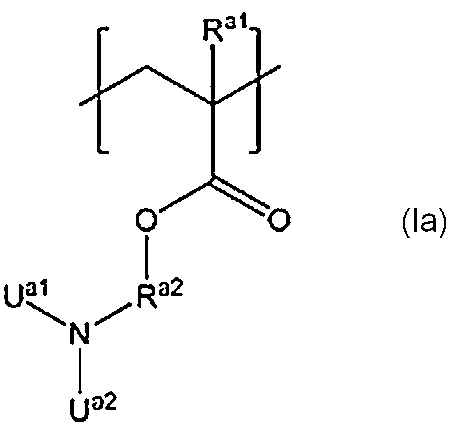
(式(Ia)中、
Ua1及びUa2は、それぞれ独立して、水素原子又は炭素原子数1~5の直鎖若しくは分岐アルキル基を表し、
Ra1は、水素原子又は炭素原子数1~5の直鎖若しくは分岐アルキル基を表し、
Ra2は、炭素原子数1~5の直鎖若しくは分岐アルキレン基を表す。)
[5] 前記ポリマー(A)が、架橋構造を含む、[2]から[4]のいずれかに記載の細胞用構造体。
[6] 前記ポリマー(A)が、下記式(IIIa)で表される構造、下記式(IVa)で表される構造、及び下記式(Va)で表される構造の少なくともいずれかを含む、[5]に記載の細胞用構造体。

(式中、Rc及びRdは、それぞれ独立して、水素原子又は炭素原子数1~5の直鎖若しくは分岐アルキル基を表し、
Reは、炭素原子数1~5の直鎖若しくは分岐アルキレン基を表し、nは1~50の数を表す。)
[7] 前記基板の表面が、細胞の付着抑制能を有するコーティング膜を有し、
前記スポットが、前記コーティング膜上に配されている、[1]から[6]のいずれかに記載の細胞用構造体。
[8] 基板と、前記基板の表面に間隔を置いて配された複数のスポットとを有する細胞用構造体の製造方法であって、
前記基板に、細胞接着性物質を含む液滴を付与して、前記スポットとなる領域に細胞接着性物質を配する工程を含む、細胞用構造体の製造方法。
[9] 前記細胞接着性物質を含む液滴の前記基板への付与が、インクジェット法により行われる、[8]に記載の細胞用構造体の製造方法。
[10] 製造される細胞用構造体において、前記基板の表面が細胞の付着抑制能を有するコーティング膜を有し、かつ前記複数のスポットが前記コーティング膜上に配されており、
前記細胞用構造体の製造方法が、更に、細胞の付着抑制能を有するポリマーを含有するコーティング剤を前記基板上に付与し、前記コーティング膜を形成する工程を含む、[8]又は[9]に記載の細胞用構造体の製造方法。
[11] 基板と、前記基板の表面に間隔を置いて配された複数のスポットとを有する細胞用構造体の製造方法であって、
前記基板に、ポリマーと溶媒とを含有する細胞培養下地膜形成剤の液滴を付与して、前記スポットとなる領域に細胞培養下地膜を形成する工程と、
前記細胞培養下地膜に、細胞接着性物質を含む液滴を付与して、前記細胞培養下地膜上に前記細胞接着性物質を配する工程と、
を含む、細胞用構造体の製造方法。
[12] 前記細胞培養下地膜形成剤の液滴の前記基板への付与が、インクジェット法により行われる、[11]に記載の細胞用構造体の製造方法。
[13] 前記細胞接着性物質を含む液滴の前記細胞培養下地膜への付与が、インクジェット法により行われる、[11]又は[12]に記載の細胞用構造体の製造方法。
[14] 前記ポリマーが、下記式(Ia)で表される繰り返し単位を含むポリマーである、[11]から[13]のいずれかに記載の細胞用構造体の製造方法。

(式(Ia)中、
Ua1及びUa2は、それぞれ独立して、水素原子又は炭素原子数1~5の直鎖若しくは分岐アルキル基を表し、
Ra1は、水素原子又は炭素原子数1~5の直鎖若しくは分岐アルキル基を表し、
Ra2は、炭素原子数1~5の直鎖若しくは分岐アルキレン基を表す。)
[15] 製造される細胞用構造体において、前記基板の表面が細胞の付着抑制能を有するコーティング膜を有し、かつ前記複数のスポットが前記コーティング膜上に配されており、
前記細胞用構造体の製造方法が、更に、細胞の付着抑制能を有するポリマーを含有するコーティング剤を前記基板上に付与し、前記コーティング膜を形成する工程を含む、[11]から[14]のいずれかに記載の細胞用構造体の製造方法。
[16] 製造される細胞用構造体が細胞培養容器である、[11]から[15]のいずれかに記載の細胞用構造体の製造方法。
[17] [1]から[7]のいずれかに記載の細胞用構造体に、細胞を播種する工程を含む、細胞培養方法。
[18] 細胞構造体を製造する、[17]に記載の細胞培養方法。
[1] 基板と、
前記基板の表面に間隔を置いて配された複数のスポットと、
を有する、細胞用構造体であって、
前記複数のスポットのそれぞれが、細胞接着性物質を有する、細胞用構造体。
[2] 前記複数のスポットのそれぞれが、ポリマーを含有する細胞培養下地膜と、前記細胞培養下地膜上に配された前記細胞接着性物質とを有する、[1]に記載の細胞用構造体。
[3] 細胞培養容器である、[1]又は[2]に記載の細胞用構造体。
[4] 前記ポリマーが、下記式(Ia)で表される繰り返し単位を含むポリマー(A)である、[2]又は[3]に記載の細胞用構造体。
Ua1及びUa2は、それぞれ独立して、水素原子又は炭素原子数1~5の直鎖若しくは分岐アルキル基を表し、
Ra1は、水素原子又は炭素原子数1~5の直鎖若しくは分岐アルキル基を表し、
Ra2は、炭素原子数1~5の直鎖若しくは分岐アルキレン基を表す。)
[5] 前記ポリマー(A)が、架橋構造を含む、[2]から[4]のいずれかに記載の細胞用構造体。
[6] 前記ポリマー(A)が、下記式(IIIa)で表される構造、下記式(IVa)で表される構造、及び下記式(Va)で表される構造の少なくともいずれかを含む、[5]に記載の細胞用構造体。
Reは、炭素原子数1~5の直鎖若しくは分岐アルキレン基を表し、nは1~50の数を表す。)
[7] 前記基板の表面が、細胞の付着抑制能を有するコーティング膜を有し、
前記スポットが、前記コーティング膜上に配されている、[1]から[6]のいずれかに記載の細胞用構造体。
[8] 基板と、前記基板の表面に間隔を置いて配された複数のスポットとを有する細胞用構造体の製造方法であって、
前記基板に、細胞接着性物質を含む液滴を付与して、前記スポットとなる領域に細胞接着性物質を配する工程を含む、細胞用構造体の製造方法。
[9] 前記細胞接着性物質を含む液滴の前記基板への付与が、インクジェット法により行われる、[8]に記載の細胞用構造体の製造方法。
[10] 製造される細胞用構造体において、前記基板の表面が細胞の付着抑制能を有するコーティング膜を有し、かつ前記複数のスポットが前記コーティング膜上に配されており、
前記細胞用構造体の製造方法が、更に、細胞の付着抑制能を有するポリマーを含有するコーティング剤を前記基板上に付与し、前記コーティング膜を形成する工程を含む、[8]又は[9]に記載の細胞用構造体の製造方法。
[11] 基板と、前記基板の表面に間隔を置いて配された複数のスポットとを有する細胞用構造体の製造方法であって、
前記基板に、ポリマーと溶媒とを含有する細胞培養下地膜形成剤の液滴を付与して、前記スポットとなる領域に細胞培養下地膜を形成する工程と、
前記細胞培養下地膜に、細胞接着性物質を含む液滴を付与して、前記細胞培養下地膜上に前記細胞接着性物質を配する工程と、
を含む、細胞用構造体の製造方法。
[12] 前記細胞培養下地膜形成剤の液滴の前記基板への付与が、インクジェット法により行われる、[11]に記載の細胞用構造体の製造方法。
[13] 前記細胞接着性物質を含む液滴の前記細胞培養下地膜への付与が、インクジェット法により行われる、[11]又は[12]に記載の細胞用構造体の製造方法。
[14] 前記ポリマーが、下記式(Ia)で表される繰り返し単位を含むポリマーである、[11]から[13]のいずれかに記載の細胞用構造体の製造方法。
Ua1及びUa2は、それぞれ独立して、水素原子又は炭素原子数1~5の直鎖若しくは分岐アルキル基を表し、
Ra1は、水素原子又は炭素原子数1~5の直鎖若しくは分岐アルキル基を表し、
Ra2は、炭素原子数1~5の直鎖若しくは分岐アルキレン基を表す。)
[15] 製造される細胞用構造体において、前記基板の表面が細胞の付着抑制能を有するコーティング膜を有し、かつ前記複数のスポットが前記コーティング膜上に配されており、
前記細胞用構造体の製造方法が、更に、細胞の付着抑制能を有するポリマーを含有するコーティング剤を前記基板上に付与し、前記コーティング膜を形成する工程を含む、[11]から[14]のいずれかに記載の細胞用構造体の製造方法。
[16] 製造される細胞用構造体が細胞培養容器である、[11]から[15]のいずれかに記載の細胞用構造体の製造方法。
[17] [1]から[7]のいずれかに記載の細胞用構造体に、細胞を播種する工程を含む、細胞培養方法。
[18] 細胞構造体を製造する、[17]に記載の細胞培養方法。
本発明によれば、細胞自体や細胞構造体などを、所定の間隔を置いて安定的に留めておくことが可能な細胞用構造体、及び当該細胞用構造体の製造方法、並びに、当該細胞用構造体を用いた細胞培養方法を提供することができる。
(細胞用構造体)
本発明の細胞用構造体は、基板と、複数のスポットとを有する。
複数のスポットは、基板の表面に間隔を置いて配されている。
スポットは、一態様では、細胞接着性物質を有する。
スポットは、他の一態様では、細胞培養下地膜と、細胞培養下地膜上に配された細胞接着性物質とを有する。
ここで「基板の表面」とは、細胞培養液などの内容物と接する面を指す。
本発明の細胞用構造体は、基板と、複数のスポットとを有する。
複数のスポットは、基板の表面に間隔を置いて配されている。
スポットは、一態様では、細胞接着性物質を有する。
スポットは、他の一態様では、細胞培養下地膜と、細胞培養下地膜上に配された細胞接着性物質とを有する。
ここで「基板の表面」とは、細胞培養液などの内容物と接する面を指す。
細胞用構造体の一態様では、基板上に複数の細胞接着性物質が間隔を置いて配されているため、細胞や細胞構造体を所定の間隔を置いて留めておくことができる。この態様では、細胞接着性物質上で細胞を接着させ、長期間接着培養することが出来る。また細胞の種類によっては接着した細胞が増殖し細胞構造体(例えば、半球状スフェロイド)を作製することができる。
また、細胞用構造体の他の一態様では、基板上に複数の細胞培養下地膜が間隔を置いて配されている。この態様では、細胞培養下地膜上で細胞構造体(例えば、スフェロイド)を作製することができる。そして、各スポットの細胞培養下地膜の形状、大きさを揃えることで、均一な大きさの細胞構造体を作製することができる。更に、細胞培養下地膜上に細胞接着性物質があることにより、細胞培養下地膜上に細胞接着性物質がない場合と比べて、作製された細胞構造体が細胞培養下地膜から脱離しにくい。そのため、脱離した細胞構造体同士の合一による細胞構造体の大きさの不均一化や、合一による細胞構造体の個数の減少を防ぐことができる。
細胞用構造体は、好ましくは、細胞培養容器である。
<スポット>
スポットは、細胞接着性物質を有する。
スポットは、細胞用構造体において、細胞が留まったり、培養(例えば、構造化)されたりする箇所である。
スポットは、細胞接着性物質を有する。
スポットは、細胞用構造体において、細胞が留まったり、培養(例えば、構造化)されたりする箇所である。
基板の表面に間隔を置いて配されている複数のスポットの数としては、特に制限されない。複数のスポットの数としては、例えば、1cm2当たり、50個~5,000個が好ましく、100個~2,000個がより好ましい。
隣接するスポットの間の距離としては、特に制限されず、100μm~6,000μmが好ましく、150μm~4,000μmがより好ましく、150μm~3,000μmが特に好ましい。ここで、距離とは、2つのスポットの中心間の長さを指す。
スポットの面の大きさとしては、特に制限されず、例えば、円相当直径は25μm~5,000μmが好ましく、50μm~3,000μmがより好ましい。
円相当直径とは、対象の面の面積に相当する真円の直径のことである。スポットの面が真円の場合には、円相当直径は、その真円の直径を指し、スポットの面が真円以外の場合には、円相当直径は、その面の面積と同じ面積を有する真円の直径を指す。
隣接するスポットの間の距離としては、特に制限されず、100μm~6,000μmが好ましく、150μm~4,000μmがより好ましく、150μm~3,000μmが特に好ましい。ここで、距離とは、2つのスポットの中心間の長さを指す。
スポットの面の大きさとしては、特に制限されず、例えば、円相当直径は25μm~5,000μmが好ましく、50μm~3,000μmがより好ましい。
円相当直径とは、対象の面の面積に相当する真円の直径のことである。スポットの面が真円の場合には、円相当直径は、その真円の直径を指し、スポットの面が真円以外の場合には、円相当直径は、その面の面積と同じ面積を有する真円の直径を指す。
基板上のスポットが占める面積割合としては、特に制限されないが、30%以上、40%以上、50%以上であることが好ましく、かつ99%以下であることが好ましい。
スポットは、好ましくは、細胞培養下地膜を有する。この場合、細胞接着性物質は、細胞培養下地膜上に配されている。そして、この場合、細胞培養下地膜が占める領域がスポットである。そのため、細胞培養下地膜の面が、スポットに相当する。
細胞培養下地膜上に配されている細胞接着性物質の面の大きさとしては、細胞培養下地膜の面の大きさ未満であれば、特に制限されないが、細胞培養下地膜の面積の1/80~1/3が好ましく、1/50~1/4がより好ましい。
細胞培養下地膜上に配されている細胞接着性物質の面の大きさとしては、細胞培養下地膜の面の大きさ未満であれば、特に制限されないが、細胞培養下地膜の面積の1/80~1/3が好ましく、1/50~1/4がより好ましい。
<<細胞接着性物質>>
細胞接着性物質は、例えば、1つのスポットあたり1箇所存在するが、1つのスポットあたり、複数個所に存在してもよい。
細胞接着性物質は、例えば、1つのスポットあたり1箇所存在するが、1つのスポットあたり、複数個所に存在してもよい。
細胞接着性物質は、細胞の接着、伸展、増殖及び分化を促進する。
細胞接着性物質としては、細胞外基質(ECM)タンパク質、糖タンパク質、ペプチドなどの生物由来物質や、合成化合物(低分子、高分子)等の公知の物質を使用することができるが、生物由来物質でない化合物、例えば合成化合物(低分子、高分子)であることが好ましい。低分子とは、例えば重量平均分子量が2,000以下の化合物であり、高分子とは、例えば重量平均分子量が2,000以上であり、上限は例えば1,000,000である。
細胞接着性物質としては、細胞外基質(ECM)タンパク質、糖タンパク質、ペプチドなどの生物由来物質や、合成化合物(低分子、高分子)等の公知の物質を使用することができるが、生物由来物質でない化合物、例えば合成化合物(低分子、高分子)であることが好ましい。低分子とは、例えば重量平均分子量が2,000以下の化合物であり、高分子とは、例えば重量平均分子量が2,000以上であり、上限は例えば1,000,000である。
細胞外基質(ECM)タンパク質の例としては、コラーゲン(例えばメルク社のI型コラーゲン(品番C9791、C7661、C1809、C2249、C2124)、II型コラーゲン(品番C9301)、IV型コラーゲン(品番C0543、C5533)、エラスチン(例えばメルク社品番:E1625、E6527)、フィブロネクチン(例えばメルク社品番F1141、F0635、F2518、F0895、F4759、F2006)、ラミニン(例えばメルク社品番:L6724、L2020、L4544)、ラミニン断片(例えばマトリクソーム社製:892011)、ビトロネクチン(例えばVTN-N(ギブコ社)、Vitronectin, Human, Recombinant, Animal Free(PeproTech社)、メルク社品番:V0132、V9881、V8379、08-126、SRP3186)が挙げられる。
細胞接着性物質が、糖タンパク質であることが好ましい。具体的にはビトロネクチン、インテグリン、カドヘリン、フィブロネクチン、ラミニン、テネイシン、オスチオポンチン及び骨シアロタンパク質から選ばれることが好ましい。また、アミノ酸配列としてRGD配列を持つタンパク質であることが好ましい。
ペプチドの例としては、ECMペプチド(Kollodis Bio Sciences社のMAPTrix(登録商標)、RGDペプチド(富士フイルム和光純薬社製:180-01531)が挙げられる。
合成化合物(高分子)の例としては、ポリリジン(例えばメルク社製品:P4707、P4832、P7280、P9155,P6407,P6282,P7405,P5899)、ポリオルニチン(例えばメルク社品番P4975)が挙げられる。合成化合物(低分子)の例としてはアドヘサミン(例えば長瀬産業社製:AD-00000-0201)、合成環状RGDペプチド(例えばIRIS BIOTECH社製:LS-3920.0010)が挙げられる。
<<細胞培養下地膜>>
細胞培養下地膜は、ポリマーを含有する。ポリマーは、細胞接着性物質とは異なる物質であり、典型的には合成ポリマーである。
細胞培養下地膜は、更に、細胞接着性物質を含有していてもよい。
細胞培養下地膜は、ポリマーを含有する。ポリマーは、細胞接着性物質とは異なる物質であり、典型的には合成ポリマーである。
細胞培養下地膜は、更に、細胞接着性物質を含有していてもよい。
細胞培養下地膜の厚みとしては、特に制限されないが、例えば、1~1000nmの範囲であり、好ましくは5~500nmの範囲である。
ポリマーとしては、細胞培養の下地膜に用いることができるポリマーであれば、特に制限されないが、本発明の効果を好適に得る観点から、下記式(Ia)で表される繰り返し単位を含むポリマー(A)が好ましい。

(式(Ia)中、
Ua1及びUa2は、それぞれ独立して、水素原子又は炭素原子数1~5の直鎖若しくは分岐アルキル基を表し、
Ra1は、水素原子又は炭素原子数1~5の直鎖若しくは分岐アルキル基を表し、
Ra2は、炭素原子数1~5の直鎖若しくは分岐アルキレン基を表す。)
Ua1及びUa2は、それぞれ独立して、水素原子又は炭素原子数1~5の直鎖若しくは分岐アルキル基を表し、
Ra1は、水素原子又は炭素原子数1~5の直鎖若しくは分岐アルキル基を表し、
Ra2は、炭素原子数1~5の直鎖若しくは分岐アルキレン基を表す。)
ポリマー(A)は、更に、下記式(IIa)で表される繰り返し単位を含むことが好ましい。

(式(IIb)中、Rbは、水素原子又は炭素原子数1~5の直鎖若しくは分岐アルキル基を表す。)
本明細書において、他に定義のない限り、「炭素原子数1~5の直鎖若しくは分岐アルキル基」としては、例えば、メチル基、エチル基、n-プロピル基、イソプロピル基、n-ブチル基、イソブチル基、s-ブチル基、t-ブチル基、n-ペンチル基、1-メチルブチル基、2-メチルブチル基、3-メチルブチル基、1,1-ジメチルプロピル基、1,2-ジメチルプロピル基、2,2-ジメチルプロピル基又は1-エチルプロピル基が挙げられる。
Ra1及びRbは、それぞれ独立して、水素原子及びメチル基から選ばれることが好ましい。
Ua1及びUa2は、それぞれ独立して、水素原子、メチル基、エチル基、n-プロピル基、イソプロピル基及びn-ブチル基から選ばれることが好ましいが、メチル基又はエチル基であることが好ましく、メチル基が最も好ましい。
本明細書において、他に定義のない限り、「炭素原子数1~5の直鎖若しくは分岐アルキレン基」としては、例えばメチレン基、エチレン基、プロピレン基、トリメチレン基、テトラメチレン基、1-メチルプロピレン基、2-メチルプロピレン基、ジメチルエチレン基、エチルエチレン基、ペンタメチレン基、1-メチル-テトラメチレン基、2-メチル-テトラメチレン基、1,1-ジメチル-トリメチレン基、1,2-ジメチル-トリメチレン基、2,2-ジメチル-トリメチレン基、1-エチル-トリメチレン基等が挙げられる。これらの中で、Ra2としてはエチレン基及びプロピレン基から選ばれることが好ましい。
ポリマー(A)に式(Ia)で表される繰り返し単位を与えるモノマー(カチオン性モノマー)としては、2-N,N-ジメチルアミノエチルメタクリレート、N,N-ジメチルアミノメチルメタクリレートなどが挙げられ、2-N,N-ジメチルアミノエチルメタクリレート(メタクリル酸2-(ジメチルアミノ)エチル)が好ましい。
ポリマー(A)に式(IIa)で表される繰り返し単位を与えるモノマー(アニオン性モノマー)としては、アクリル酸、メタクリル酸などが挙げられ、メタクリル酸が好ましい。
ポリマー(A)中の式(Ia)で表される繰り返し単位(Ia)と式(IIa)で表される繰り返し単位(IIa)とのモル比〔(Ia)/(IIa)〕は、例えば、100/0~50/50である。好ましくは98/2~50/50であり、より好ましくは98/2~60/40であり、特に好ましくは98/2~70/30である。
モル比〔(Ia)/(IIa)〕が1以上であると、ポリマーのアニオン性による細胞の接着力低下を抑制できる。
モル比〔(Ia)/(IIa)〕が1以上であると、ポリマーのアニオン性による細胞の接着力低下を抑制できる。
ポリマー(A)は、その他の繰り返し単位を有していてもよい。
ポリマー(A)において、全繰り返し単位に対する、式(Ia)で表される繰り返し単位と式(IIa)で表される繰り返し単位との合計は、例えば、50モル%以上、好ましくは75モル%以上、より好ましくは80モル%以上、さらに好ましくは90モル%以上である。
ポリマー(A)において、全繰り返し単位に対する、式(Ia)で表される繰り返し単位と式(IIa)で表される繰り返し単位との合計は、例えば、50モル%以上、好ましくは75モル%以上、より好ましくは80モル%以上、さらに好ましくは90モル%以上である。
ポリマー(A)は、本発明の効果を好適に得る観点から、更に、架橋構造を含むことが好ましい。
架橋構造は、ポリマー(A)を合成する際に、2つ以上の炭素-炭素不飽和結合を有するモノマーを用いることで得られる。2つ以上の炭素-炭素不飽和結合を有するモノマーとは、具体的には、2つ以上の炭素-炭素二重結合を有するモノマーであり、例えば多官能アクリレート化合物、多官能アクリルアミド化合物、多官能ポリエステル、又はイソプレン化合物などが挙げられる。
架橋構造は、ポリマー(A)を合成する際に、2つ以上の炭素-炭素不飽和結合を有するモノマーを用いることで得られる。2つ以上の炭素-炭素不飽和結合を有するモノマーとは、具体的には、2つ以上の炭素-炭素二重結合を有するモノマーであり、例えば多官能アクリレート化合物、多官能アクリルアミド化合物、多官能ポリエステル、又はイソプレン化合物などが挙げられる。
ポリマー(A)は、例えば、多官能アクリレート化合物、多官能アクリルアミド化合物、多官能ポリエステル、及びイソプレン化合物の少なくともいずれかに由来する構造を含む。
ポリマー(A)は、下記式(IIIa)で表される構造、下記式(IVa)で表される構造、及び下記式(Va)で表される構造の少なくともいずれかを含むことが好ましい。これらの中でも、式(IIIa)で表される構造が好ましい。
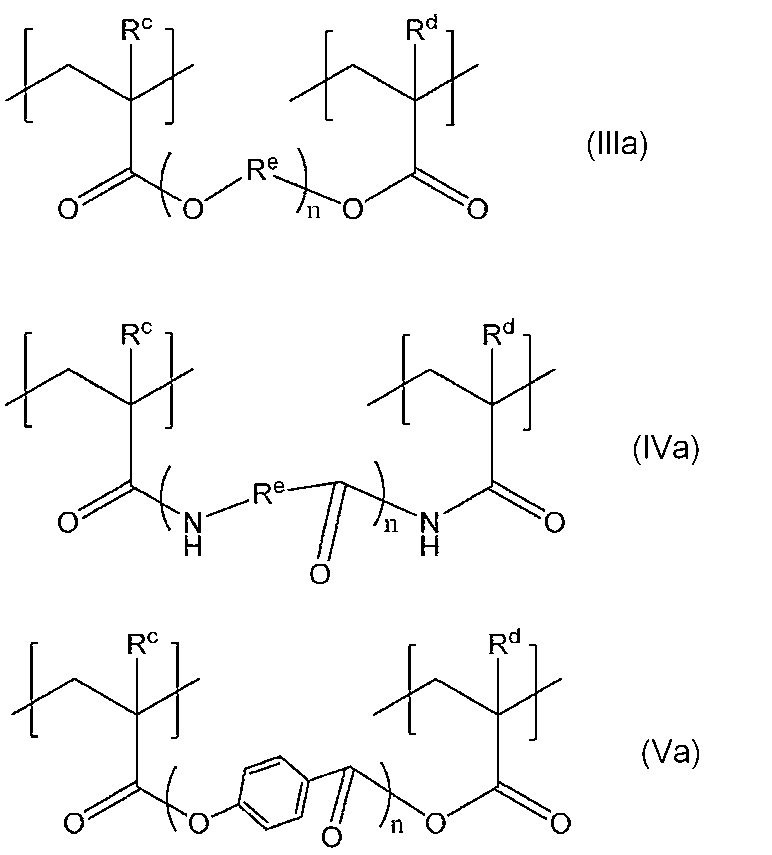
(式中、Rc及びRdは、それぞれ独立して、水素原子又は炭素原子数1~5の直鎖若しくは分岐アルキル基を表し、
Reは、炭素原子数1~5の直鎖若しくは分岐アルキレン基を表し、
nは1~50の数を表す。)
ポリマー(A)は、下記式(IIIa)で表される構造、下記式(IVa)で表される構造、及び下記式(Va)で表される構造の少なくともいずれかを含むことが好ましい。これらの中でも、式(IIIa)で表される構造が好ましい。
Reは、炭素原子数1~5の直鎖若しくは分岐アルキレン基を表し、
nは1~50の数を表す。)
Rc及びRdは、それぞれ独立して、水素原子及びメチル基から選ばれることが好ましい。
Reは、メチレン基、エチレン基及びプロピレン基から選ばれることが好ましく、エチレン基がより好ましい。
nは1~50の数であるが、nは1~30の数であることが好ましく、nは1~10の数であることがより好ましい。
Reは、メチレン基、エチレン基及びプロピレン基から選ばれることが好ましく、エチレン基がより好ましい。
nは1~50の数であるが、nは1~30の数であることが好ましく、nは1~10の数であることがより好ましい。
ポリマー(A)全体に対する式(IIIa)~(Va)で表される構造のモル比は、好ましくは0モル%~50モル%であり、さらに好ましくは2モル%~25モル%である。
式(IIIa)~(Va)で表される構造のモル比がポリマー(A)全体の50%以下であると、過度な架橋による高分子量化による製造中の固形分のゲル化を抑制でき、製造を容易にできる。
式(IIIa)~(Va)で表される構造のモル比がポリマー(A)全体の50%以下であると、過度な架橋による高分子量化による製造中の固形分のゲル化を抑制でき、製造を容易にできる。
ポリマー(A)の合成方法としては、特に制限されず、公知のラジカル重合法などが挙げられる。また、国際公開第2020/040247号パンフレットに記載の方法であってもよい。
ポリマーの数平均分子量(Mn)は、例えば、20,000~1,000,000であり、50,000~800,000が好ましい。
ポリマーの数平均分子量(Mw)は、例えば、50,000~2,000,000であり、10,000~1,200,000が好ましい。
ポリマーの重量平均分子量(Mw)と数平均分子量(Mn)との比(Mw/Mn)は、例えば、1.01~10.00であり、1.2~8.0が好ましく、1.4~6.0がより好ましく、1.5~5.0が更により好ましく、1.6~4.5が特に好ましい。
数平均分子量(Mn)と重量平均分子量(Mw)は、例えばGel Filtration Chromatographyにより求めることができる。
ポリマーの数平均分子量(Mw)は、例えば、50,000~2,000,000であり、10,000~1,200,000が好ましい。
ポリマーの重量平均分子量(Mw)と数平均分子量(Mn)との比(Mw/Mn)は、例えば、1.01~10.00であり、1.2~8.0が好ましく、1.4~6.0がより好ましく、1.5~5.0が更により好ましく、1.6~4.5が特に好ましい。
数平均分子量(Mn)と重量平均分子量(Mw)は、例えばGel Filtration Chromatographyにより求めることができる。
<基板>
基板の材質、形状、大きさ、構造としては、特に制限されない。
基板の表面の形状は、平面であっても凹凸があってもよいが、平面形状であることが好ましい。
基板の材質、形状、大きさ、構造としては、特に制限されない。
基板の表面の形状は、平面であっても凹凸があってもよいが、平面形状であることが好ましい。
基板の材質は、例えば、ガラス、金属、金属含有化合物若しくは半金属含有化合物、活性炭又は樹脂を挙げることができる。金属は、典型金属:(アルミニウム族元素:Al、Ga、In;鉄族元素:Fe、Co、Ni;クロム族元素:Cr、Mo、W、U;マンガン族元素:Mn、Re;貴金属:Cu、Ag、Au等が挙げられる。金属含有化合物若しくは半金属含有化合物は、例えば基本成分が金属酸化物で、高温での熱処理によって焼き固めた焼結体であるセラミックス、シリコンのような半導体、金属酸化物若しくは半金属酸化物(シリコン酸化物、アルミナ等)、金属炭化物若しくは半金属炭化物、金属窒化物若しくは半金属窒化物(シリコン窒化物等)、金属ホウ化物若しくは半金属ホウ化物等の無機化合物の成形体等の無機固体材料、アルミニウム、ニッケルチタン、ステンレス(SUS304、SUS316、SUS316L等)が挙げられる。
樹脂としては、天然樹脂若しくはその誘導体、又は合成樹脂いずれでもよく、天然樹脂若しくはその誘導体としては、セルロース、三酢酸セルロース(CTA)、ニトロセルロース(NC)、デキストラン硫酸を固定化したセルロース等、合成樹脂としてはポリアクリロニトリル(PAN)、ポリイミド(PI)、ポリエステル系ポリマーアロイ(PEPA)、ポリスチレン(PS)、ポリスルホン(PSF)、ポリエチレンテレフタレート(PET)、ポリメチルメタクリレート(PMMA)、ポリビニルアルコール(PVA)、ポリウレタン(PU)、エチレンビニルアルコール(EVAL)、ポリエチレン(PE)、ポリエステル、ポリプロピレン(PP)、ポリフッ化ビニリデン(PVDF)、ポリエーテルスルホン(PES)、ポリカーボネート(PC)、シクロオレフィンポリマー(COP)、ポリ塩化ビニル(PVC)、ポリテトラフルオロエチレン(PTFE)、超高分子量ポリエチレン(UHPE)、ポリジメチルシロキサン(PDMS)、アクリロニトリル-ブタジエン-スチレン樹脂(ABS)又はテフロン(登録商標)が好ましく用いられる。
基板は、板状であってもよいし、フィルム状であってもよい。基板の厚みとしては、特に制限されない。
基板は、例えば、厚みが1mm以下のフィルムであってもよい。
基板は、例えば、厚みが1mm以下のフィルムであってもよい。
また、基板は、いわゆる細胞培養器で使用される基板であってもよい。細胞の培養に一般的に用いられるペトリデッシュ、組織培養用ディッシュ、マルチディッシュなどのシャーレ又はディッシュ、細胞培養フラスコ、スピナーフラスコ、多段フラスコなどのフラスコ、プラスチックバッグ、テフロン(登録商標)バッグ、培養バッグなどのバッグ、マイクロプレート、マイクロウェルプレート、マルチプレート、マルチウェルプレートなどのプレート、チャンバースライド、チューブ、トレイ、ローラーボトルなどのボトル等が挙げられる。
<<コーティング膜>>
基板の表面は、細胞の付着抑制能を有するコーティング膜を有していてもよい。その場合、スポットは、コーティング膜上に配されている。
コーティング膜は、例えば、細胞の付着抑制能を有するポリマーを含有するコーティング剤を基板上に付与することにより得られる。
基板の表面におけるコーティング膜の形状としては、スポットがその上に配される限り、特に制限されず、1つの膜が基板の表面全面を一様に覆っていてもよいし、1つの膜が基板の表面の面内に形成されていてもよいし、複数の膜が基板の表面に点在していてもよい。
基板の表面は、細胞の付着抑制能を有するコーティング膜を有していてもよい。その場合、スポットは、コーティング膜上に配されている。
コーティング膜は、例えば、細胞の付着抑制能を有するポリマーを含有するコーティング剤を基板上に付与することにより得られる。
基板の表面におけるコーティング膜の形状としては、スポットがその上に配される限り、特に制限されず、1つの膜が基板の表面全面を一様に覆っていてもよいし、1つの膜が基板の表面の面内に形成されていてもよいし、複数の膜が基板の表面に点在していてもよい。
ここで、細胞の付着抑制能を有するとは、例えば国際公開第2016/093293号公報の実施例に記載した方法で行う蛍光顕微鏡によるコーティング膜無し、又は細胞低吸着処理無しと比較した場合の相対吸光度(WST O.D.450nm)(%)((実施例の吸光度(WST O.D.450nm))/(比較例の吸光度(WST O.D.450nm)))が50%以下、好ましくは30%以下、さらに好ましくは20%以下であることを意味する。
細胞の付着抑制能を有するコーティング膜としては、特に制限されないが、例えば、以下のコーティング膜が挙げられる。
<<<第1の態様のコーティング膜>>>
第1の態様のコーティング膜は、共重合体を含む。
第1の態様の共重合体は、下記式(a)で表される有機基を含む繰り返し単位と、下記式(b)で表される有機基を含む繰り返し単位とを含む。
当該共重合体は、例えば、WO2014/196652号パンフレットに記載の共重合体である。WO2014/196652号パンフレットの内容は、全てが明示されたと同程度に本明細書に組み込まれるものである。
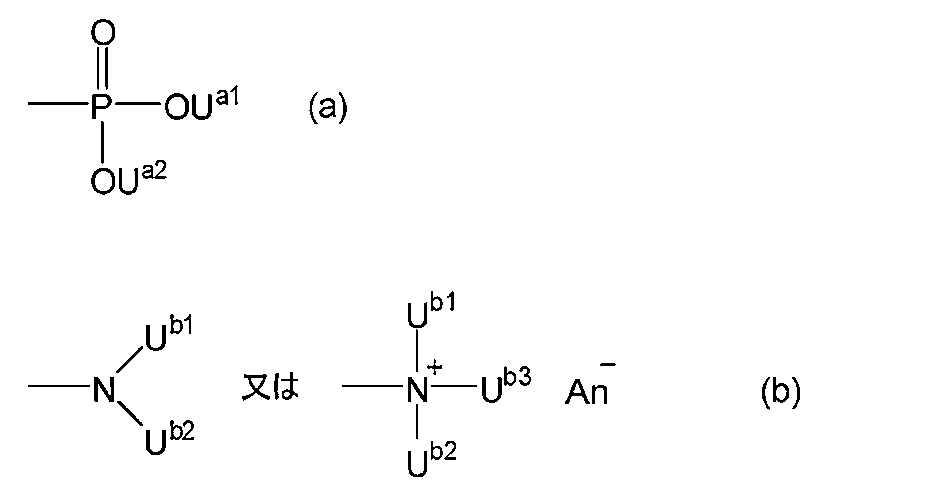
第1の態様のコーティング膜は、共重合体を含む。
第1の態様の共重合体は、下記式(a)で表される有機基を含む繰り返し単位と、下記式(b)で表される有機基を含む繰り返し単位とを含む。
当該共重合体は、例えば、WO2014/196652号パンフレットに記載の共重合体である。WO2014/196652号パンフレットの内容は、全てが明示されたと同程度に本明細書に組み込まれるものである。
(式中、Ua1、Ua2、Ub1、Ub2及びUb3は、それぞれ独立して、水素原子又は炭素原子数1乃至5の直鎖若しくは分岐アルキル基を表し、そしてAn-は、ハロゲン化物イオン、無機酸イオン、水酸化物イオン及びイソチオシアネートイオンからなる群から選ばれる陰イオンを表す。)
共重合体は、上記式(a)で表される有機基を含む繰り返し単位と、上記式(b)で表される有機基を含む繰り返し単位とを含む共重合体であれば、特に制限は無い。該共重合体は、上記式(a)で表される有機基を含むモノマーと、上記式(b)で表される有機基を含むモノマーとをラジカル重合して得られたものが望ましいが、重縮合、重付加反応させたものも使用できる。共重合体の例としては、オレフィンが反応したビニル重合ポリマー、ポリアミド、ポリエステル、ポリカーボネート、ポリウレタン等が挙げられるが、これらの中でも特にオレフィンが反応したビニル重合ポリマー又は(メタ)アクリレート化合物を重合させた(メタ)アクリルポリマーが望ましい。なお、本発明において、(メタ)アクリレート化合物とは、アクリレート化合物とメタクリレート化合物の両方を意味する。例えば(メタ)アクリル酸は、アクリル酸及びメタクリル酸を意味する。
好ましくは、上記式(a)及び(b)で表される有機基を含むモノマーは、それぞれ、下記式(A)及び(B)で表されるモノマーである。
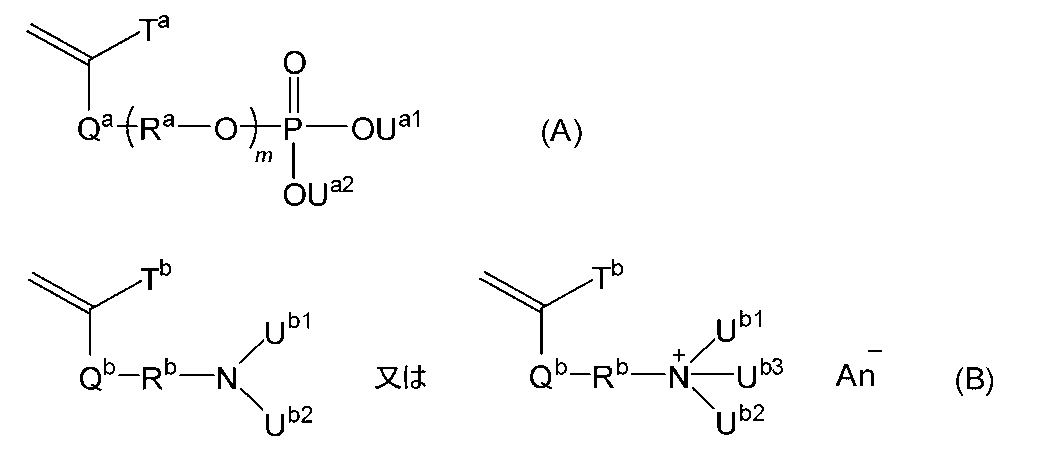
(式中、Ta、Tb、Ua1、Ua2、Ub1、Ub2及びUb3は、それぞれ独立して、水素原子又は炭素原子数1乃至5の直鎖若しくは分岐アルキル基を表し、Qa及びQbは、それぞれ独立して、単結合、エステル結合又はアミド結合を表し、Ra及びRbは、それぞれ独立して、ハロゲン原子で置換されていてもよい炭素原子数1乃至10の直鎖又は分岐アルキレン基を表し、An-は、ハロゲン化物イオン、無機酸イオン、水酸化物イオン及びイソチオシアネートイオンからなる群から選ばれる陰イオンを表し、そしてmは0乃至6の整数を表す。)
したがって、式(A)及び(B)で表されるモノマーから誘導される繰り返し単位は、それぞれ、下記式(a1)及び(b1)で表される。
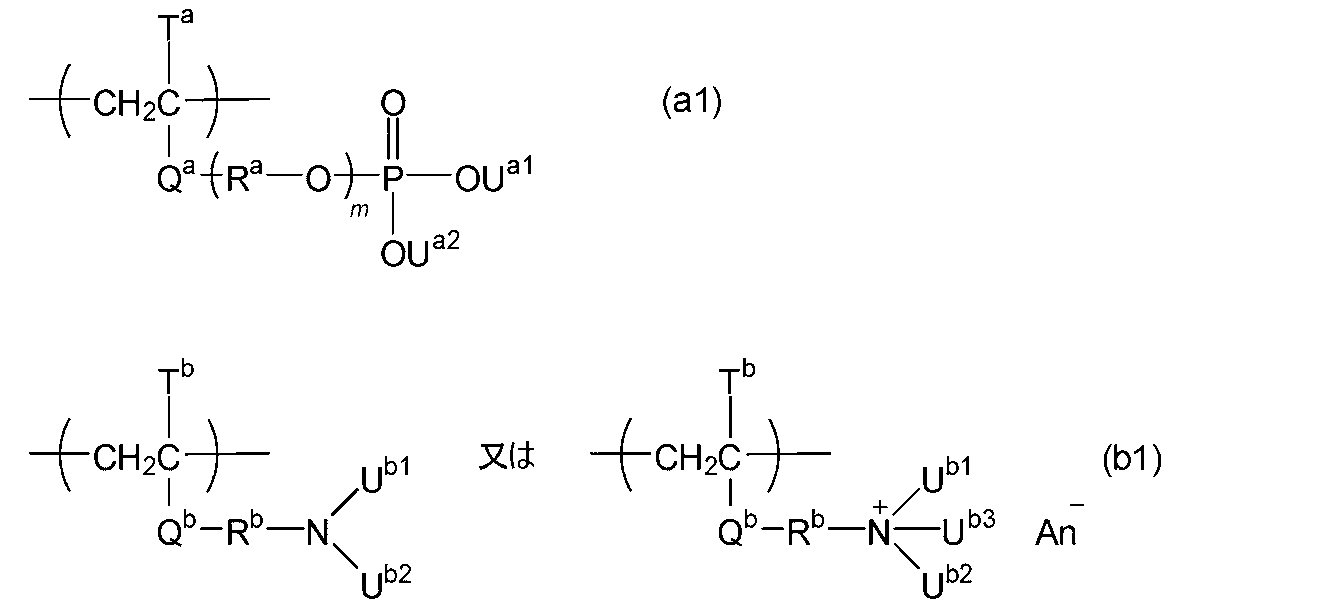
(式中、Ta、Tb、Ua1、Ua2、Ub1、Ub2及びUb3、Qa及びQb、Ra及びRb、An-並びにmは、上記と同義である。)
本発明において、「エステル結合」は、-C(=O)-O-若しくは-O-C(=O)-を意味し、「アミド結合」は、-NHC(=O)-若しくは-C(=O)NH-を意味する。
本発明において、「ハロゲン原子で置換されていてもよい炭素原子数1乃至10の直鎖又は分岐アルキレン基」は、炭素原子数1乃至10の直鎖又は分岐アルキレン基、あるいは1以上のハロゲン原子で置換された炭素原子数1乃至10の直鎖又は分岐アルキレン基を意味する。ここで、「炭素原子数1乃至10の直鎖又は分岐アルキレン基」は、上記アルキル基からさらに水素原子が1個とれた2価の有機基であり、例えば、メチレン基、エチレン基、プロピレン基、トリメチレン基、テトラメチレン基、1-メチルプロピレン基、2-メチルプロピレン基、ジメチルエチレン基、エチルエチレン基、ペンタメチレン基、1-メチル-テトラメチレン基、2-メチル-テトラメチレン基、1,1-ジメチル-トリメチレン基、1,2-ジメチル-トリメチレン基、2,2-ジメチル-トリメチレン基、1-エチル-トリメチレン基、ヘキサメチレン基、オクタメチレン基及びデカメチレン基等が挙げられる。これらの中で、エチレン基、プロピレン基、オクタメチレン基及びデカメチレン基が好ましく、炭素原子数1乃至5の直鎖又は分岐アルキレン基、例えば、エチレン基、プロピレン基、トリメチレン基、テトラメチレン基がより好ましく、特にエチレン基又はプロピレン基が好ましい。「1以上のハロゲン原子で置換された炭素原子数1乃至10の直鎖又は分岐アルキレン基」は、そのようなアルキレン基の1以上の任意の水素原子が、ハロゲン原子で置き換えられているものを意味し、特に、エチレン基又はプロピレン基の水素原子の一部又は全部がハロゲン原子で置き換えられているものが好ましい。
本発明において、「ハロゲン原子」は、フッ素原子、塩素原子、臭素原子又はヨウ素原子が挙げられる。
本発明において、「ハロゲン化物イオン」は、ハロゲン原子のアニオンを意味し、フッ化物イオン、塩化物イオン、臭化物イオン、ヨウ化物イオンが挙げられ、好ましくは、塩化物イオンである。
本発明において、「無機酸イオン」とは、炭酸イオン、硫酸イオン、リン酸イオン、リン酸水素イオン、リン酸二水素イオン、硝酸イオン、過塩素酸イオン又はホウ酸イオンを意味する。
上記An-として好ましいのは、ハロゲン化物イオン、硫酸イオン、リン酸イオン、水酸化物イオン及びイソチオシアネートイオンであり、特に好ましいのはハロゲン化物イオンである。
本発明において、「ハロゲン化物イオン」は、ハロゲン原子のアニオンを意味し、フッ化物イオン、塩化物イオン、臭化物イオン、ヨウ化物イオンが挙げられ、好ましくは、塩化物イオンである。
本発明において、「無機酸イオン」とは、炭酸イオン、硫酸イオン、リン酸イオン、リン酸水素イオン、リン酸二水素イオン、硝酸イオン、過塩素酸イオン又はホウ酸イオンを意味する。
上記An-として好ましいのは、ハロゲン化物イオン、硫酸イオン、リン酸イオン、水酸化物イオン及びイソチオシアネートイオンであり、特に好ましいのはハロゲン化物イオンである。
式(A)及び(B)において、Ta及びTbは、好ましくは、それぞれ独立して、水素原子、メチル基又はエチル基であり、より好ましくは、それぞれ独立して、水素原子又はメチル基である。
式(a)、式(b)、式(A)及び(B)において、Ua1、Ua2、Ub1、Ub2及びUb3は、好ましくは、それぞれ独立して、水素原子、メチル基又はエチル基である。式(a)及び式(A)において、Ua1及びUa2は、より好ましくは、水素原子である。式(b)及び(B)において、Ub1、Ub2(及びUb3)は、より好ましくは、メチル基又はエチル基であり、特に好ましくはメチル基である。
式(A)及び(B)において、Qa及びQbは、好ましくは、それぞれ独立して、エステル結合(-C(=O)-O-若しくは-O-C(=O)-)又はアミド結合(-NHC(=O)-若しくは-C(=O)NH-)であり、より好ましくは、それぞれ独立して、-C(=O)-O-又は-C(=O)NH-であり、特に好ましくは、-C(=O)-O-である。
式(A)及び(B)において、Ra及びRbは、好ましくは、それぞれ独立して、ハロゲン原子で置換されていてもよい炭素原子数1乃至3の直鎖又は分岐アルキレン基であり、より好ましくは、それぞれ独立して、エチレン基若しくはプロピレン基であるか、あるいは1つの塩素原子で置換されたエチレン基若しくはプロピレン基であり、特に好ましくは、エチレン基若しくはプロピレン基である。
式(A)及び(B)において、mは、好ましくは0乃至3の整数を表し、より好ましくは1又は2の整数を表し、特に好ましくは1である。
上記式(A)の具体例としては、ビニルホスホン酸、アシッドホスホオキシエチル(メタ)アクリレート、3-クロロ-2-アシッドホスホオキシプロピル(メタ)アクリレート、アシッドホスホオキシプロピル(メタ)アクリレート、アシッドホスホオキシメチル(メタ)アクリレート、アシッドホスホオキポリオキシエチレングリコールモノ(メタ)アクリレート、アシッドホスホオキシポリオキシプロピレングリコールモノ(メタ)アクリレート等が挙げられるが、この中でもビニルホスホン酸、アシッドホスホオキシエチルメタクリレート(=リン酸2-(メタクリロイルオキシ)エチル)が好ましく用いられる。
ビニルホスホン酸、アシッドホスホオキシエチルメタクリレート(=リン酸2-(メタクリロイルオキシ)エチル)及びアシッドホスホオキシポリオキシエチレングリコールモノメタクリレートの構造式は、それぞれ下記式(A-1)~式(A-3)で表される。
合成時において、これらの化合物の他に、後述する一般式(C)又は(D)で表されるような、2つの官能基を有する(メタ)アクリレート化合物を併用してもよい。
上記式(B)の具体例としては、ジメチルアミノエチル(メタ)アクリレート、ジエチルアミノエチル(メタ)アクリレート、ジメチルアミノプロピル(メタ)アクリレート、2-(t-ブチルアミノ)エチル(メタ)アクリレート、メタクロイルコリンクロリド等が挙げられるが、この中でもジメチルアミノエチル(メタ)アクリレート、メタクロイルコリンクロリド又は2-(t-ブチルアミノ)エチル(メタ)アクリレートが好ましく用いられる。
ジメチルアミノエチルアクリレート(=アクリル酸2-(ジメチルアミノ)エチル)、ジメチルアミノエチルメタクリレート(=メタクリル酸2-(ジメチルアミノ)エチル)、メタクロイルコリンクロリド及び2-(t-ブチルアミノ)エチルメタクリレート(=メタクリル酸2-(t-ブチルアミノ)エチルの構造式は、それぞれ下記式(B-1)~式(B-4)で表される。
上記共重合体中における式(a)で表される有機基を含む繰り返し単位(又は式(a1)で表される繰り返し単位)の割合は、20モル%乃至80モル%であり、好ましくは30モル%乃至70モル%であり、さらに好ましくは40モル%乃至60モル%である。なお、共重合体は、2種以上の式(a)で表される有機基を含む繰り返し単位(又は式(a1)で表される繰り返し単位)を含んでいてもよい。
上記共重合体中における式(b)で表される有機基を含む繰り返し単位(又は式(b1)で表される繰り返し単位)の割合は、全共重合体に対して上記式(a)(又は式(a1))の割合を差し引いた残部全てでもよいし、上記式(a)(又は式(a1))と下記に記述する第3成分との合計割合を差し引いた残部であってもよい。なお、共重合体は、2種以上の式(b)で表される有機基を含む繰り返し単位(又は式(b1)で表される繰り返し単位)を含んでいてもよい。
さらに共重合体は、任意の第3成分が共重合していてもよい。例えば、第3成分として2以上の官能基を有する(メタ)アクリレート化合物が共重合しており、ポリマーの一部が部分的に3次元架橋していてもよい。そのような第3成分として、例えば、下記式(C)又は(D)で表される2官能性モノマーが挙げられる。
(式中、Tc、Td及びUdは、それぞれ独立して、水素原子又は炭素原子数1乃至5の直鎖若しくは分岐アルキル基を表し、Rc及びRdは、それぞれ独立して、ハロゲン原子で置換されていてもよい炭素原子数1乃至10の直鎖又は分岐アルキレン基を表す。)
すなわち共重合体は、好ましくは、このような2官能性モノマーから誘導される架橋構造を含むものである。
すなわち共重合体は、好ましくは、このような2官能性モノマーから誘導される架橋構造を含むものである。
式(C)及び(D)において、Tc及びTdは、好ましくは、それぞれ独立して、水素原子、メチル基又はエチル基であり、より好ましくは、それぞれ独立して、水素原子又はメチル基である。
式(C)及び(D)において、Udは、好ましくは、水素原子、メチル基又はエチル基であり、より好ましくは、水素原子である。
式(C)及び(D)において、Rc及びRdは、好ましくは、それぞれ独立して、ハロゲン原子で置換されていてもよい炭素原子数1乃至3の直鎖又は分岐アルキレン基であり、より好ましくは、それぞれ独立して、エチレン基若しくはプロピレン基であるか、あるいは1つの塩素原子で置換されたエチレン基若しくはプロピレン基であり、特に好ましくは、エチレン基若しくはプロピレン基である。
式(C)で表される2官能性モノマーは、好ましくは、エチレングリコールジ(メタ)アクリレート、トリエチレングリコールジ(メタ)アクリレート、プロピレングリコールジ(メタ)アクリレート等が挙げられる。式(D)で表される2官能性モノマーは、好ましくは、リン酸ビス(メタクリロイルオキシメチル)、リン酸ビス[2-(メタクリロイルオキシ)エチル]、リン酸ビス[2-(メタクリロイルオキシ)プロピル]等が挙げられる。
任意の第3成分は、3官能性モノマーであってもよい。そのような第3成分としての3官能性モノマーとしては、例えば、トリアクリル酸ホスフィニリジントリス(オキシ-2,1-エタンジイル)が挙げられる。
これらの中でも、特に、下記式(C-1)で表されるエチレングリコールジ(メタ)アクリレート及び下記式(D-1)で表されるリン酸ビス[2-(メタクリロイルオキシ)エチル]が好ましい。
共重合体には、これらの第三成分の1種又は2種以上が含まれていてもよい。上記の中でも、式(D)で表される2官能性モノマーが好ましく、特に、式(D-1)で表される2官能性モノマーが好ましい。
上記共重合体中における第三成分(例えば、上記式(C)又は(D)で表される2官能性モノマーから誘導される架橋構造)の割合は、0モル%乃至50モル%である。
上記共重合体中における第三成分(例えば、上記式(C)又は(D)で表される2官能性モノマーから誘導される架橋構造)の割合は、0モル%乃至50モル%である。
共重合体の製造方法としては、特に制限されないが、例えば、WO2014/196652号パンフレットに記載の共重合体の製造方法が挙げられる。
<<<第2の態様のコーティング膜>>>
また、コーティング膜は、WO2021/167037号パンフレットに記載のコーティング膜形成用組成物から得られるコーティング膜であってもよい。WO2021/167037号パンフレットの内容は、全てが明示されたと同程度に本明細書に組み込まれるものである。
以下、WO2021/167037号パンフレットに記載のコーティング膜形成用組成物について説明する。本明細書では、第2の態様のコーティング膜形成用組成物と称する。
また、コーティング膜は、WO2021/167037号パンフレットに記載のコーティング膜形成用組成物から得られるコーティング膜であってもよい。WO2021/167037号パンフレットの内容は、全てが明示されたと同程度に本明細書に組み込まれるものである。
以下、WO2021/167037号パンフレットに記載のコーティング膜形成用組成物について説明する。本明細書では、第2の態様のコーティング膜形成用組成物と称する。
第2の態様のコーティング膜形成用組成物は、下記式(1):
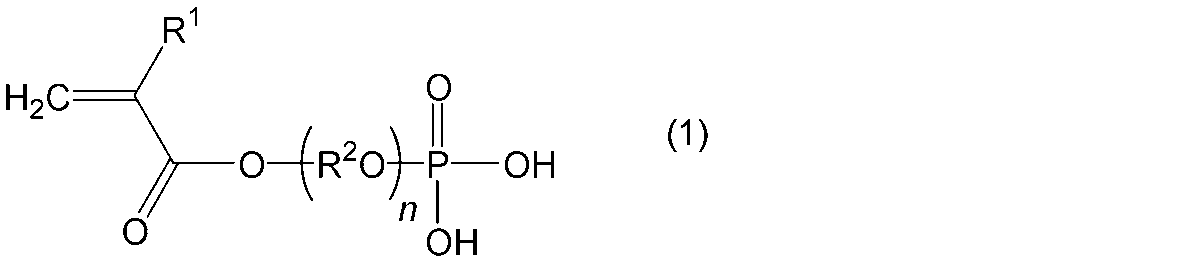
(式中、
R1は、水素原子またはメチル基を表し、R2は、炭素原子数1~6のアルキレン基を表し、nは、1~30の整数を表す)
で表される化合物、下記式(2):
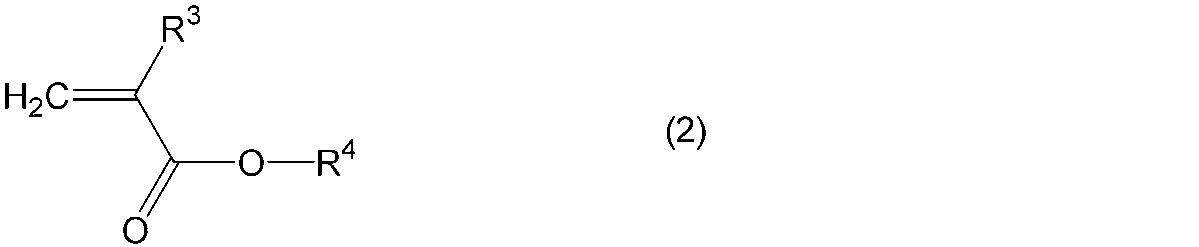
(式中、
R3は、水素原子またはメチル基を表し、R4は、カチオン性を有する1価の有機基を表す)
で表される化合物、および下記式(3):
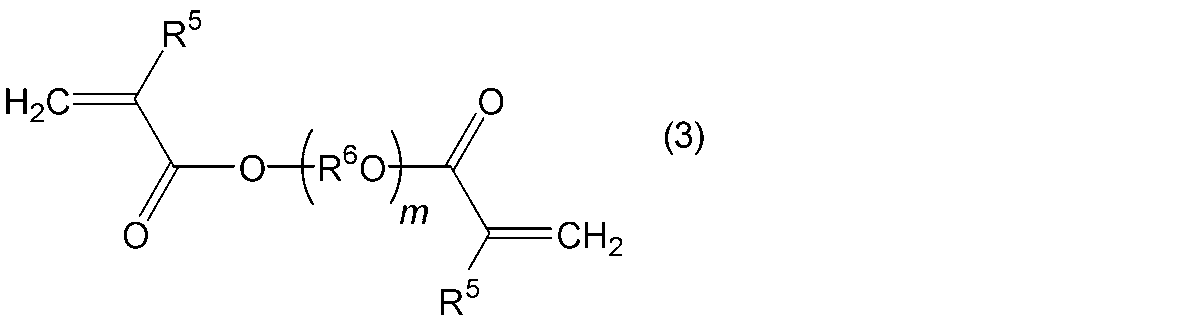
(式中、
R5は、それぞれ独立して、水素原子または炭素原子数1~6の直鎖もしくは分岐アルキル基を表し、R6は、ハロゲン原子で置換されていてもよい炭素原子数1~10の直鎖または分岐アルキレン基を表し、mは1~30の整数を表す)
で表される化合物を含むモノマー混合物であって、前記モノマー混合物の総質量に対する前記式(3)で表される化合物の割合が、2~40質量%であるモノマー混合物を重合させることにより得られる共重合体、並びに溶媒を含む。
R1は、水素原子またはメチル基を表し、R2は、炭素原子数1~6のアルキレン基を表し、nは、1~30の整数を表す)
で表される化合物、下記式(2):
R3は、水素原子またはメチル基を表し、R4は、カチオン性を有する1価の有機基を表す)
で表される化合物、および下記式(3):
R5は、それぞれ独立して、水素原子または炭素原子数1~6の直鎖もしくは分岐アルキル基を表し、R6は、ハロゲン原子で置換されていてもよい炭素原子数1~10の直鎖または分岐アルキレン基を表し、mは1~30の整数を表す)
で表される化合物を含むモノマー混合物であって、前記モノマー混合物の総質量に対する前記式(3)で表される化合物の割合が、2~40質量%であるモノマー混合物を重合させることにより得られる共重合体、並びに溶媒を含む。
第2の態様に係る共重合体のモノマー成分である式(1)の化合物において、R1は、水素原子またはメチル基を表し、R2は、炭素原子数1~6のアルキレン基を表し、好ましくは炭素原子数1~6の直鎖もしくは分岐アルキレン基を表し、より好ましくは炭素原子数2~5の直鎖もしくは分岐アルキレン基を表し、特に好ましくはエチレン基またはプロピレン基を表し、nは、1~30の整数を表し、好ましくは、1~20の整数を表し、より好ましくは2~10の整数を表し、特に好ましくは3~6の整数を表す。
上記式(1)の化合物の具体例としては、アシッドホスホオキシエチル(メタ)アクリレート、3-クロロ-2-アシッドホスホオキシプロピル(メタ)アクリレート、アシッドホスホオキシプロピル(メタ)アクリレート、アシッドホスホオキシメチル(メタ)アクリレート、アシッドホスホオキシポリオキシエチレングリコールモノ(メタ)アクリレートおよびアシッドホスホオキシポリオキシプロピレングリコールモノ(メタ)アクリレート等が挙げられるが、この中でもアシッドホスホオキシエチルメタクリレート(=リン酸2-(メタクリロイルオキシ)エチル)、アシッドホスホオキシポリオキシエチレングリコールモノメタアクリレートおよびアシッドホスホオキシポリオキシプロピレングリコールモノメタクリレートが好ましく用いられる。
アシッドホスホオキシエチルメタクリレート(=リン酸2-(メタクリロイルオキシ)エチル)、アシッドホスホオキシポリオキシエチレングリコールモノメタクリレートおよびアシッドホスホオキシポリオキシプロピレングリコールモノメタクリレートの構造式は、それぞれ下記式(1-1)~式(1-3)で表される。
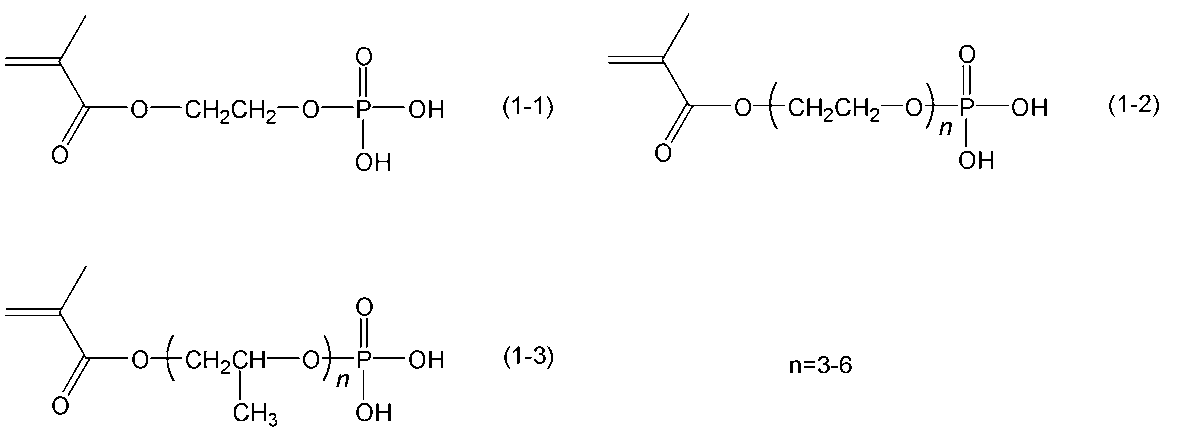
第2の態様に係る共重合体のモノマー成分である式(2)の化合物において、R3は、水素原子またはメチル基を表し、R4は、カチオン性を有する1価の有機基を表し、典型的には、1級アミン、2級アミン、3級アミンまたは4級アンモニウム構造を有する1価の基である。
1級アミン、2級アミン、3級アミンまたは4級アンモニウム構造を有する1価の基の例としては、それぞれ、式:-R4a-NH2、-R4a-NHR、-R4a-NRR’、-R4a-N+RR’R’’[ここで、R4aは、エステル結合、アミド結合、エーテル結合またはホスホジエステル結合で中断されていてもよい、炭素原子数1~6のアルキレン基であり、R、R’およびR’’は、互いに独立して、炭素原子数1~6の直鎖もしくは分岐アルキル基、炭素原子数6~10のアリール基または炭素原子数7~16のアラルキル基である]で表される基を意味する。第2の態様における1級アミン、2級アミンまたは3級アミン構造を有する1価の基は、4級化または塩化されていてもよく、同様に4級アンモニウム構造を有する1価の基は、塩化されていてもよい。
1級アミン、2級アミン、3級アミンまたは4級アンモニウム構造を有する1価の基の例としては、それぞれ、式:-R4a-NH2、-R4a-NHR、-R4a-NRR’、-R4a-N+RR’R’’[ここで、R4aは、エステル結合、アミド結合、エーテル結合またはホスホジエステル結合で中断されていてもよい、炭素原子数1~6のアルキレン基であり、R、R’およびR’’は、互いに独立して、炭素原子数1~6の直鎖もしくは分岐アルキル基、炭素原子数6~10のアリール基または炭素原子数7~16のアラルキル基である]で表される基を意味する。第2の態様における1級アミン、2級アミンまたは3級アミン構造を有する1価の基は、4級化または塩化されていてもよく、同様に4級アンモニウム構造を有する1価の基は、塩化されていてもよい。
上記式(2)の化合物の具体例としては、ジメチルアミノエチル(メタ)アクリレート、ジエチルアミノエチル(メタ)アクリレート、ジメチルアミノプロピル(メタ)アクリレート、2-(t-ブチルアミノ)エチル(メタ)アクリレート、(メタ)アクリロイルコリンクロリド、2-(メタ)アクリロイルオキシエチルホスホリルコリン(MPC)等が挙げられる。
2-(ジメチルアミノ)エチルメタクリレート、メタクロイルコリンクロリドおよび2-メタクリロイルオキシエチルホスホリルコリン(MPC)の構造式は、それぞれ下記式(2-1)~式(2-3)で表される。

第2の態様に係る共重合体のモノマー成分である式(3)の化合物は、架橋性を有する二官能性モノマーである。式(3)の化合物において、R5は、それぞれ独立して、水素原子または炭素原子数1~6の直鎖もしくは分岐アルキル基を表し、好ましくは、水素原子またはメチル基であり、R6は、ハロゲン原子で置換されていてもよい炭素原子数1~10の直鎖もしくは分岐アルキレン基を表し、好ましくは、ハロゲン原子で置換されていてもよい炭素原子数1~6の直鎖もしくは分岐アルキレン基を表し、より好ましくは、塩素原子で置換されていてもよい炭素原子数1~6の直鎖もしくは分岐アルキレン基を表し、特に好ましくは、エチレン基、プロピレン基またはトリメチレン基を表し、mは1~30の整数を表し、好ましくは1~20の整数を表し、より好ましくは1~10の整数を表し、さらに好ましくは1~6の整数を表し、特に好ましくは1~4の整数を表す。
上記式(3)の化合物の具体例としては、ポリ(エチレングリコール)ジ(メタ)アクリレート、ポリ(トリメチレングリコール)ジ(メタ)アクリレート、ポリ(プロピレングリコール)ジ(メタ)アクリレート等が挙げられる。
ポリ(エチレングリコール)ジメタクリレート、ポリ(トリメチレングリコール)ジメタクリレート、ポリ(プロピレングリコール)ジメタクリレートの構造式は、それぞれ下記式(3-1)~式(3-3)で表される。

第2の態様に係る共重合体は、モノマー成分である上記式(1)、(2)および(3)の化合物を含むモノマー混合物を重合することによって得られる。かかるモノマー混合物は、生体物質の付着抑制能等を損なわない範囲であれば、任意の第4成分として、エチレン性不飽和モノマー、または多糖類もしくはその誘導体を含んでいてもよい。エチレン性不飽和モノマーの例としては、(メタ)アクリル酸およびそのエステル;酢酸ビニル;ビニルピロリドン;エチレン;ビニルアルコール;並びにそれらの親水性の官能性誘導体からなる群より選択される1種または2種以上のエチレン性不飽和モノマーを挙げることができる。多糖類またはその誘導体の例としては、ヒドロキシアルキルセルロース(例えば、ヒドロキシエチルセルロースまたはヒドロキシプロピルセルロース)等のセルロース系高分子、デンプン、デキストラン、カードランを挙げることができる。第2の態様に係る共重合体は、好ましくは、モノマー成分として、上記式(1)、(2)および(3)の化合物のみを含むモノマー混合物を重合することによって得られる。
第2の態様に係る共重合体は、モノマー成分である上記式(1)、(2)および(3)の化合物を含むモノマー混合物であって、かつ前記モノマー混合物に含まれるモノマー成分の総質量に対する前記式(3)の化合物の割合が、2~40質量%であることを特徴とするモノマー混合物を重合することによって得られる。前記モノマー混合物に含まれるモノマー成分の総質量に対し、二官能性モノマーである式(3)の化合物を2~40質量%の範囲、好ましくは3~35質量%の範囲、より好ましくは5~30質量%の範囲で含むことにより、モノマー混合物より得られる共重合体を含む、第2の態様のコーティング膜形成用組成物は、優れた生体物質の付着抑制能が得られる。なお、モノマー混合物は、2種以上の式(3)の化合物を含んでいてもよい。
モノマー混合物において、モノマー成分の総質量に対する式(1)の化合物の割合は、10~95質量%であり、好ましくは10~80質量%であり、さらに好ましくは45~75質量%である。なお、モノマー混合物は、2種以上の式(1)の化合物を含んでいてもよい。
モノマー混合物において、モノマー成分の総質量に対する式(2)の化合物の割合は、3~90質量%であり、好ましくは10~70質量%であり、さらに好ましくは15~35質量%である。なお、モノマー混合物は、2種以上の式(2)の化合物を含んでいてもよい。
第2の態様に係る共重合体は、一般的な(メタ)アクリルポリマーの合成方法であるラジカル重合、アニオン重合、カチオン重合などの方法により合成することができる。その形態は溶液重合、懸濁重合、乳化重合、塊状重合など種々の方法が可能である。一の実施態様では、上記式(1)、(2)および(3)の化合物を含むモノマー混合物を、溶媒中で、モノマー成分の合計濃度0.01~20質量%にて反応(重合)させる工程を含む製造方法により調製することができる。
重合反応における溶媒としては、水、リン酸緩衝液またはエタノール等のアルコールまたはこれらを組み合わせた混合溶媒でもよいが、水またはエタノールを含むことが望ましい。さらには水またはエタノールを10質量%以上100質量%以下含むことが好ましい。さらには水またはエタノールを50質量%以上100質量%以下含むことが好ましい。さらには水またはエタノールを80質量%以上100質量%以下含むことが好ましい。さらには水またはエタノールを90質量%以上100質量%以下含むことが好ましい。好ましくは水とエタノールの合計が100質量%である。
重合反応を効率的に進めるためには、重合開始剤を使用することが望ましい。重合開始剤の例としては、「熱ラジカル重合開始剤」または「光ラジカル重合開始剤」が挙げられる。
「熱ラジカル重合開始剤」の例としては、2,2’-アゾビス(イソブチロニトリル)、2,2’-アゾビス(2-メチルブチロニトリル)、2,2’-アゾビス(2,4-ジメチルバレロニトリル)(富士フイルム和光純薬(株)製品名;V-65、10時間半減期温度;51℃)、4,4’-アゾビス(4-シアノ吉草酸)、2,2’-アゾビス(4-メトキシ-2,4-ジメチルバレロニトリル)、1,1’-アゾビス(シクロヘキサン-1-カルボニトリル)、1-[(1-シアノ-1-メチルエチル)アゾ]ホルムアミド、2,2’-アゾビス[2-(2-イミダゾリン-2-イル)プロパン]二塩酸塩(富士フイルム和光純薬(株);VA-044、10時間半減期温度;44℃)、2,2’-アゾビス[2-(2-イミダゾリン-2-イル)プロパン](富士フイルム和光純薬(株);VA-061、10時間半減期温度;61℃)、2,2’-アゾビス(2-メチルプロピオンアミジン)二塩酸塩、2,2’-アゾ(2-メチル-N-(2-ヒドロキシエチル)プロピオンアミド(富士フイルム和光純薬(株)製品名;VA-086、10時間半減期温度;86℃)、過酸化ベンゾイル(BPO)、2,2’-アゾビス(N-(2-カルボキシエチル)-2-メチルプロピオンアミジン)n-水和物(富士フイルム和光純薬(株)製品名;VA-057、10時間半減期温度;57℃)、4,4’-アゾビス(4-シアノペンタノイックアシド)(富士フイルム和光純薬(株)製品名;VA-501)、2,2’-アゾビス[2-(2-イミダゾリン-2-イル)プロパン]ジスルファートジヒドレート(富士フイルム和光純薬(株)製品名;VA-046B、10時間半減期温度;46℃)、2,2’-アゾビス(2-アミジノプロパン)ジヒドロクロリド(富士フイルム和光純薬(株)製品名;V-50、10時間半減期温度;56℃)、ペルオキソ二硫酸、t-ブチルヒドロペルオキシド、ジメチル1,1’-アゾビス(1-シクロヘキサンカルボキシレート)(富士フイルム和光純薬(株)製品名;VE-073)等が挙げられる。
「熱ラジカル重合開始剤」の例としては、2,2’-アゾビス(イソブチロニトリル)、2,2’-アゾビス(2-メチルブチロニトリル)、2,2’-アゾビス(2,4-ジメチルバレロニトリル)(富士フイルム和光純薬(株)製品名;V-65、10時間半減期温度;51℃)、4,4’-アゾビス(4-シアノ吉草酸)、2,2’-アゾビス(4-メトキシ-2,4-ジメチルバレロニトリル)、1,1’-アゾビス(シクロヘキサン-1-カルボニトリル)、1-[(1-シアノ-1-メチルエチル)アゾ]ホルムアミド、2,2’-アゾビス[2-(2-イミダゾリン-2-イル)プロパン]二塩酸塩(富士フイルム和光純薬(株);VA-044、10時間半減期温度;44℃)、2,2’-アゾビス[2-(2-イミダゾリン-2-イル)プロパン](富士フイルム和光純薬(株);VA-061、10時間半減期温度;61℃)、2,2’-アゾビス(2-メチルプロピオンアミジン)二塩酸塩、2,2’-アゾ(2-メチル-N-(2-ヒドロキシエチル)プロピオンアミド(富士フイルム和光純薬(株)製品名;VA-086、10時間半減期温度;86℃)、過酸化ベンゾイル(BPO)、2,2’-アゾビス(N-(2-カルボキシエチル)-2-メチルプロピオンアミジン)n-水和物(富士フイルム和光純薬(株)製品名;VA-057、10時間半減期温度;57℃)、4,4’-アゾビス(4-シアノペンタノイックアシド)(富士フイルム和光純薬(株)製品名;VA-501)、2,2’-アゾビス[2-(2-イミダゾリン-2-イル)プロパン]ジスルファートジヒドレート(富士フイルム和光純薬(株)製品名;VA-046B、10時間半減期温度;46℃)、2,2’-アゾビス(2-アミジノプロパン)ジヒドロクロリド(富士フイルム和光純薬(株)製品名;V-50、10時間半減期温度;56℃)、ペルオキソ二硫酸、t-ブチルヒドロペルオキシド、ジメチル1,1’-アゾビス(1-シクロヘキサンカルボキシレート)(富士フイルム和光純薬(株)製品名;VE-073)等が挙げられる。
「光ラジカル重合開始剤」の例としては、アセトフェノン、クロロアセトフェノン、ヒドロキシアセトフェノン、2-アミノアセトフェノン、ジアルキルアミノアセトフェノン、2,2-ジエトキシアセトフェノン、2,2-ジメトキシ-2’-フェニルアセトフェノン(BASF社製品名;Irgacure651)、2-ヒドロキシ-2-メチル-1-フェニルプロパノン(BASF社製品名;Irgacure1173)、1-[4-(2-ヒドロキシエトキシ)-フェニル]-2-ヒドロキシメチルプロパノン(BASF社製品名;Irgacure2959)、2-ヒドロキシ-1-{4-[4-(2一ヒドロキシ-2-メチルプロピオニル)ベンジル]フェニル}-2-メチル-1-プロパン-1-オン(BASF社製品名;Irgacure127)、2-メチル-1-[4-(メチルチオ)フェニル]-2-モルホリノプロパン-1-オン(BASF社製品名;Irgacure907)、2-ベンジル-2-(ジメチルアミノ)-4-モルホリノブチロフェノン(BASF社製品名;Irgacure369)等のアセトフェノン類;ベンゾイン、ベンゾインメチルエーテル、ベンゾインエチルエーテル、ベンゾインイソプロピルエーテル、ベンゾインイソブチルエーテル、1-ヒドロキシシクロへキシルフェニルケトン(BASF社製品名;Irgacure184)等のベンゾイン類;ベンゾフェノン、ベンゾイル安息香酸、ベンゾイル安息香酸メチル、メチル-o-ベンゾイルベンゾエート、4-フェニルベンゾフェノン、ヒドロキシベンゾフェノン、ヒドロキシプロピルベンゾフェノン、アクリルベンゾフェノン、4,4’-ビス(ジメチルアミノ)ベンゾフェノン、4,4’-ジクロロベンゾフェノンなどのベンゾフェノン類;チオキサントン、2-クロロチオキサントン、2-メチルチオキサントン、ジエチルチオキサントン、ジメチルチオキサントンなどのチオキサントン類;2,4,6-トリメチルベンゾイル-ジフェニルホスフィンオキシド(BASF社製品名;IrgacureTPO)、ビス(2,4,6-トリメチルベンゾイル)-フェニルホスフィンオキサイド(BASF社製品名;Irgacure819)等のアシルホスフィンオキサイド類;オキシフェニル酢酸、2-[2-オキソ-2-フェニルアセトキシエトキシ]エチルエステルとオキシフェニル酢酸、2-(2-ヒドロキシエトキシ)エチルエステルの混合物(BASF社製品名;Irgacure754)、ベンゾイルギ酸メチル(BASF社製品名;IrgacureMBF)、α-アシルオキシムエステル、ベンジル-(o-エトキシカルボニル)-α-モノオキシム、グリオキシエステル、2-エチルアンスラキノン、カンファーキノン、テトラメチルチウラムスルフィド、アゾビスイソブチロニトリル、ベンゾイルペルオキシド、ジアルキルペルオキシド、tert-ブチルペルオキシピバレート等が挙げられる。
水への溶解性、イオンバランスおよびモノマーとの相互作用を考慮した場合、2,2’-アゾ(2-メチル-N-(2-ヒドロキシエチル)プロピオンアミド、2,2’-アゾビス(N-(2-カルボキシエチル)-2-メチルプロピオンアミジン)n-水和物、4,4’-アゾビス(4-シアノペンタノイックアシッド)、2,2’-アゾビス[2-(2-イミダゾリン-2-イル)プロパン]ジヒドロクロリド、2,2’-アゾビス[2-(2-イミダゾリン-2-イル)プロパン]ジスルファートジヒドレート、2,2’-アゾビス[2-(2-イミダゾリン-2-イル)プロパン]、2,2’-アゾビス(2-アミジノプロパン)ジヒドロクロリドおよびペルオキソ二硫酸から選ばれることが好ましい。
有機溶媒への溶解性、イオンバランスおよびモノマーとの相互作用を考慮した場合、2,2’-アゾビス(2,4-ジメチルバレロニトリル)または2,2’-アゾビス(イソブチロニトリル)を用いることが望ましい。
有機溶媒への溶解性、イオンバランスおよびモノマーとの相互作用を考慮した場合、2,2’-アゾビス(2,4-ジメチルバレロニトリル)または2,2’-アゾビス(イソブチロニトリル)を用いることが望ましい。
重合開始剤の添加量は、重合に用いられるモノマー成分の合計質量に対し、0.05質量%~10質量%である。
反応条件は反応容器をオイルバス等で50~200℃に加熱し、1~48時間、より好ましくは80~150℃、5~30時間攪拌を行うことで、重合反応が進み第2の態様の共重合体が得られる。反応雰囲気は窒素雰囲気が好ましい。
反応手順としては、全反応物質を室温の反応溶媒に全て入れてから、上記温度に加熱して重合させてもよいし、あらかじめ加温した溶媒中に、反応物質の混合物全部または一部を少々ずつ滴下してもよい。
第2の態様に係る共重合体の重量平均分子量は数千から数百万程度であればよく、好ましくは5,000~5,000,000、より好ましくは、10,000~2,000,000である。また、ランダム共重合体、ブロック共重合体、グラフト共重合体のいずれでもよく、好ましくはランダム共重合体である。
また、このようにして製造される共重合体は、二官能性モノマーを含むことから、3次元ポリマーであると考えられ、水やアルコールを含有する溶液に溶解または分散した状態である。
また、このようにして製造される共重合体は、二官能性モノマーを含むことから、3次元ポリマーであると考えられ、水やアルコールを含有する溶液に溶解または分散した状態である。
第2の態様に係るコーティング膜形成用組成物は、このようにして得られた共重合体を、単離/精製した後、所望の溶媒にて所定の濃度に希釈することにより調製してもよい。
さらに第2の態様に係るコーティング膜形成用組成物は、重合反応後に得られる反応溶液(すなわち、共重合体含有ワニス)から調製してもよい。
さらに第2の態様に係るコーティング膜形成用組成物は、重合反応後に得られる反応溶液(すなわち、共重合体含有ワニス)から調製してもよい。
第2の態様のコーティング膜形成用組成物に含まれる溶媒としては、水、リン酸緩衝生理食塩水(PBS)、アルコールが挙げられる。アルコールとしては、炭素数2~6のアルコール、例えば、エタノール、プロパノール、イソプロパノール、1-ブタノール、2-ブタノール、イソブタノール、t-ブタノール、1-ペンタノール、2-ペンタノール、3-ペンタノール、1-ヘプタノール、2-ヘプタノール、2,2-ジメチル-1-プロパノール(=ネオペンチルアルコール)、2-メチル-1-プロパノール、2-メチル-1-ブタノール、2-メチル-2-ブタノール(=t-アミルアルコール)、3-メチル-1-ブタノール、3-メチル-3-ペンタノール、シクロペンタノール、1-ヘキサノール、2-ヘキサノール、3-ヘキサノール、2,3-ジメチル-2-ブタノール、3,3-ジメチル-1-ブタノール、3,3-ジメチル-2-ブタノール、2-エチル-1-ブタノール、2-メチル-1-ペンタノール、2-メチル-2-ペンタノール、2-メチル-3-ペンタノール、3-メチル-1-ペンタノール、3-メチル-2-ペンタノール、3-メチル-3-ペンタノール、4-メチル-1-ペンタノール、4-メチル-2-ペンタノール、4-メチル-3-ペンタノールおよびシクロヘキサノールが挙げられ、単独でまたはそれらの組み合わせの混合溶媒を用いてもよいが、共重合体の溶解の観点から、水、PBS、エタノールおよびプロパノールから選ばれるのが好ましい。
第2の態様に係るコーティング膜形成用組成物中の固形分の濃度としては、均一にコーティング膜を形成させるために、0.01~50質量%が望ましい。また、コーティング膜形成用組成物中の共重合体の濃度としては、好ましくは0.01~5質量%、より好ましくは0.01~4質量%、特に好ましくは0.01~3質量%である。共重合体の濃度が0.01質量%以下であると、得られるコーティング膜形成用組成物の共重合体の濃度が低すぎて十分な膜厚のコーティング膜が形成できず、5質量%以上であると、コーティング膜形成用組成物の保存安定性が悪くなり、溶解物の析出やゲル化が起こる可能性がある。
さらに第2の態様のコーティング膜形成用組成物は、上記共重合体と溶媒の他に、必要に応じて得られるコーティング膜の性能を損ねない範囲で他の物質を添加することもできる。他の物質としては、防腐剤、界面活性剤、基材との密着性を高めるプライマー、防カビ剤および糖類等が挙げられる。
第2の態様に係るコーティング膜形成用組成物中の共重合体のイオンバランスを調節するために、第2の態様のコーティング膜を得る際には、さらにコーティング膜形成用組成物中のpHを予め調整する工程を含んでいてもよい。pH調整は、例えば上記共重合体と溶媒を含む組成物にpH調整剤を添加し、該組成物のpHを2~13.5、好ましくは2~8.5、さらに好ましくは3~8とするか、あるいは好ましくは8.5~13.5、さらに好ましくは10~13.5とすることにより実施してもよい。使用しうるpH調整剤の種類およびその量は、上記共重合体の濃度や、そのアニオンとカチオンの存在比等に応じて適宜選択される。
pH調整剤の例としては、アンモニア、ジエタノールアミン、ピリジン、N-メチル-D-グルカミン、トリス(ヒドロキシメチル)アミノメタン等の有機アミン;水酸化カリウム、水酸化ナトリウム等のアルカリ金属水酸化物;塩化カリウム、塩化ナトリウム等のアルカリ金属ハロゲン化物;硫酸、リン酸、塩酸、炭酸等の無機酸またはそのアルカリ金属塩;コリン等の4級アンモニウムカチオン、あるいはこれらの混合物(例えば、リン酸緩衝生理食塩水等の緩衝液)を挙げることができる。これらの中でも、アンモニア、ジエタノールアミン、水酸化ナトリウム、コリン、N-メチル-D-グルカミン、トリス(ヒドロキシメチル)アミノメタンが好ましく、特にアンモニア、ジエタノールアミン、水酸化ナトリウムおよびコリンが好ましい。
pH調整剤の例としては、アンモニア、ジエタノールアミン、ピリジン、N-メチル-D-グルカミン、トリス(ヒドロキシメチル)アミノメタン等の有機アミン;水酸化カリウム、水酸化ナトリウム等のアルカリ金属水酸化物;塩化カリウム、塩化ナトリウム等のアルカリ金属ハロゲン化物;硫酸、リン酸、塩酸、炭酸等の無機酸またはそのアルカリ金属塩;コリン等の4級アンモニウムカチオン、あるいはこれらの混合物(例えば、リン酸緩衝生理食塩水等の緩衝液)を挙げることができる。これらの中でも、アンモニア、ジエタノールアミン、水酸化ナトリウム、コリン、N-メチル-D-グルカミン、トリス(ヒドロキシメチル)アミノメタンが好ましく、特にアンモニア、ジエタノールアミン、水酸化ナトリウムおよびコリンが好ましい。
<<<第3の態様のコーティング膜>>>
また、コーティング膜は、WO2022/259998号パンフレットに記載のコーティング膜形成用組成物から得られるコーティング膜であってもよいWO2022/259998号パンフレットの内容は、全てが明示されたと同程度に本明細書に組み込まれるものである。
以下、WO2022/259998号パンフレットに記載のコーティング膜形成用組成物について説明する。本明細書では、第3の態様のコーティング膜形成用組成物と称する。
また、コーティング膜は、WO2022/259998号パンフレットに記載のコーティング膜形成用組成物から得られるコーティング膜であってもよいWO2022/259998号パンフレットの内容は、全てが明示されたと同程度に本明細書に組み込まれるものである。
以下、WO2022/259998号パンフレットに記載のコーティング膜形成用組成物について説明する。本明細書では、第3の態様のコーティング膜形成用組成物と称する。
第3の態様のコーティング膜形成用組成物は、生体物質の付着抑制に用いられる。
第3の態様コーティング膜形成用組成物は、共重合体を少なくとも含有し、更に必要に応じて、溶媒などのその他の成分を含有する。
なお、第3の態様のコーティング膜形成用組成物は、リン酸緩衝生理食塩水に溶解しにくいコーティング膜を形成可能であるが、第3の態様のコーティング膜形成用組成物の用途は、生体物質の付着抑制に用いられる限り、特に制限されず、リン酸緩衝生理食塩水に接触するコーティング膜の形成に制限されるものではない。
第3の態様コーティング膜形成用組成物は、共重合体を少なくとも含有し、更に必要に応じて、溶媒などのその他の成分を含有する。
なお、第3の態様のコーティング膜形成用組成物は、リン酸緩衝生理食塩水に溶解しにくいコーティング膜を形成可能であるが、第3の態様のコーティング膜形成用組成物の用途は、生体物質の付着抑制に用いられる限り、特に制限されず、リン酸緩衝生理食塩水に接触するコーティング膜の形成に制限されるものではない。
第3の態様に係る共重合体は、非水溶性である。ここで、「水溶性」とは、25℃の水100gに対して1.0g以上溶解可能であることをいう。「非水溶性」とは、「水溶性」に該当しないこと、即ち、25℃の水100gに対する溶解性が1.0g未満であることをいう。
第3の態様に係る共重合体は、下記式(A)で表される繰り返し単位(A)、及び下記式(B)で表される繰り返し単位(B)を有する。
第3の態様に係る共重合体における繰り返し単位(A)と繰り返し単位(B)とのモル比率(A:B)は、89:11~50:50である。

(式中、R1~R3は、それぞれ独立して、水素原子又は炭素原子数1~5のアルキル基を表し、X1及びX2は、それぞれ独立して、単結合、エステル結合、エーテル結合、アミド結合又は酸素原子で中断されていてもよい炭素原子数1~5のアルキレン基を表す。)
第3の態様に係る共重合体は、下記式(A)で表される繰り返し単位(A)、及び下記式(B)で表される繰り返し単位(B)を有する。
第3の態様に係る共重合体における繰り返し単位(A)と繰り返し単位(B)とのモル比率(A:B)は、89:11~50:50である。
第3の態様に係る共重合体は、2種以上の繰り返し単位(A)を有していてもよい。
第3の態様に係る共重合体は、2種以上の繰り返し単位(B)を有していてもよい。
第3の態様に係る共重合体は、1種類の繰り返し単位(A)及び1種類の繰り返し単位(B)を有することが好ましい。
第3の態様に係る共重合体は、2種以上の繰り返し単位(B)を有していてもよい。
第3の態様に係る共重合体は、1種類の繰り返し単位(A)及び1種類の繰り返し単位(B)を有することが好ましい。
炭素原子数1~5のアルキル基としては、メチル基、エチル基、n-プロピル基、イソプロピル基、n-ブチル基、イソブチル基、s-ブチル基、t-ブチル基、n-ペンチル基、1-メチルブチル基、2-メチルブチル基、3-メチルブチル基、1,1-ジメチルプロピル基、1,2-ジメチルプロピル基、2,2-ジメチルプロピル基、1-エチルプロピル基などが挙げられる。
R1~R3は、それぞれ独立して、水素原子、メチル基、又はエチル基が好ましい。
R1~R3は、それぞれ独立して、水素原子、メチル基、又はエチル基が好ましい。
上記「エステル結合」は、-C(=O)-O-又は-O-C(=O)-を意味し、「エーテル結合」は、-O-を意味し、「アミド結合」は、-NHC(=O)-又は-C(=O)NH-を意味する。
炭素原子数1~5のアルキレン基は、酸素原子で中断されていてもよい。
炭素原子数1~5のアルキレン基としては、メチレン基、エチレン基、プロピレン基、トリメチレン基、テトラメチレン基、1-メチルプロピレン基、2-メチルプロピレン基、ジメチルエチレン基、エチルエチレン基、ペンタメチレン基、1-メチル-テトラメチレン基、2-メチル-テトラメチレン基、1,1-ジメチル-トリメチレン基、1,2-ジメチル-トリメチレン基、2,2-ジメチル-トリメチレン基、1-エチル-トリメチレン基が挙げられる。上記X1及びX2は、メチレン基、エチレン基、又はプロピレン基が好ましい。
「酸素原子で中断されていてもよい」とは、炭素原子数1~5のアルキレン基の1つ又は2以上の炭素-炭素結合間がエーテル結合を介して結合していることを言う。
炭素原子数1~5のアルキレン基としては、メチレン基、エチレン基、プロピレン基、トリメチレン基、テトラメチレン基、1-メチルプロピレン基、2-メチルプロピレン基、ジメチルエチレン基、エチルエチレン基、ペンタメチレン基、1-メチル-テトラメチレン基、2-メチル-テトラメチレン基、1,1-ジメチル-トリメチレン基、1,2-ジメチル-トリメチレン基、2,2-ジメチル-トリメチレン基、1-エチル-トリメチレン基が挙げられる。上記X1及びX2は、メチレン基、エチレン基、又はプロピレン基が好ましい。
「酸素原子で中断されていてもよい」とは、炭素原子数1~5のアルキレン基の1つ又は2以上の炭素-炭素結合間がエーテル結合を介して結合していることを言う。
第3の態様に係る共重合体は、R1及びR2が水素原子であり、R3がメチル基であり、X1及びX2が単結合である共重合体が好ましい。
繰り返し単位(A)と繰り返し単位(B)とのモル比率(A:B)は、89:11~50:50である。
第3の態様に係る共重合体における、繰り返し単位(A)と繰り返し単位(B)との合計のモル数を100とした場合、繰り返し単位(A)と繰り返し単位(B)とのモル比率(A:B)は、(100-m):mで表すことができる。その場合、mの範囲は、11~50である。そして、mの下限は、12、13、14、15、16、17、18、19、20、21、22、23、24、25、26、27、28、29、又は30であってよい。mの上限は、49、48、47、46、45、44、43、42、41、40、38、37、36、又は35であってよい。mの範囲としては、例えば、12~49、12~48、15~48、20~49、20~45、22~49、又は22~45である。
第3の態様に係る共重合体における、繰り返し単位(A)と繰り返し単位(B)との合計のモル数を100とした場合、繰り返し単位(A)と繰り返し単位(B)とのモル比率(A:B)は、(100-m):mで表すことができる。その場合、mの範囲は、11~50である。そして、mの下限は、12、13、14、15、16、17、18、19、20、21、22、23、24、25、26、27、28、29、又は30であってよい。mの上限は、49、48、47、46、45、44、43、42、41、40、38、37、36、又は35であってよい。mの範囲としては、例えば、12~49、12~48、15~48、20~49、20~45、22~49、又は22~45である。
第3の態様に係る共重合体における全繰り返し単位中の繰り返し単位(A)と繰り返し単位(B)の合計のモル%としては、特に制限されないが、90モル%以上が好ましく、95モル%以上がより好ましく、99.5モル%以上がより一層好ましく、100%が特に好ましい。
第3の態様においては、リン酸緩衝生理食塩水に溶解しにくいコーティング膜を得るために、共重合体における繰り返し単位(A)と繰り返し単位(B)とのモル比率を特定の範囲にしている。そのため、第3の態様においては共重合体を架橋させることなく、リン酸緩衝生理食塩水に溶解しにくいコーティング膜が得られる。よって、共重合体は、共重合体を架橋させるための感光基を有する必要がない。即ち、共重合体は感光基を有さないことが好ましい。感光基としては、例えば、アジド基が挙げられる。
第3の態様においては、共重合体は、共重合体を架橋させるための感光基を有する必要がない。そのため、コーティング膜を形成する際に、共重合体を架橋させるための光照射を行う必要がない。よって、コーティング膜を形成する際の工程を簡素にすることができる。
第3の態様においては、共重合体は、共重合体を架橋させるための感光基を有する必要がない。そのため、コーティング膜を形成する際に、共重合体を架橋させるための光照射を行う必要がない。よって、コーティング膜を形成する際の工程を簡素にすることができる。
第3の態様に係る共重合体の粘度平均重合度(以下、単に「重合度」ということがある)は、特に制限されないが、第3の態様の効果を好適に得る観点から、200~3,000が好ましく、200~2,500がより好ましく、200~2,000が特に好ましい。
粘度平均重合度は、共重合体を完全けん化した状態で測定される。
完全けん化して得られるポリビニルアルコールの「粘度平均重合度」は、イオン交換水を溶媒としたオストワルド粘度計により30℃で測定した際の極限粘度[η](g/dL)から、下記式により算出される値である。
log(P)=1.613×log([η]×104/8.29)
ここで、Pは粘度平均重合度を示す。
粘度平均重合度は、JIS K 6726に従って求めることができる。
粘度平均重合度は、共重合体を完全けん化した状態で測定される。
完全けん化して得られるポリビニルアルコールの「粘度平均重合度」は、イオン交換水を溶媒としたオストワルド粘度計により30℃で測定した際の極限粘度[η](g/dL)から、下記式により算出される値である。
log(P)=1.613×log([η]×104/8.29)
ここで、Pは粘度平均重合度を示す。
粘度平均重合度は、JIS K 6726に従って求めることができる。
第3の態様に係る共重合体を製造する方法としては、特に制限されないが、例えば、下記式(C)で表される化合物を重合してホモポリマーを製造し、得られたホモポリマーを公知のけん化反応により部分加水分解して、共重合体を得る方法が挙げられる。
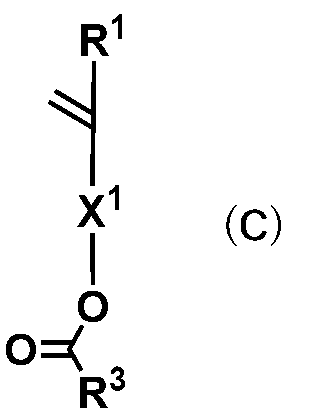
(式中、R1、R3、及びX1は上記と同義である。)
また、第3の態様に係る共重合体を製造する方法としては、例えば、下記式(C)で表される化合物と下記式(D)で表される化合物とを共重合して、共重合体を得る方法が挙げられる。

(式中、R1~R3、X1、及びX2は上記と同義である。)
第3の態様に係る共重合体は、ランダムコポリマーであってもよいし、ブロックコポリマーであってもよい。
第3の態様に係る共重合体としては、市販品を使用してもよい。共重合体の市販品としては、具体的にはポリ酢酸ビニル(日本酢ビ・ポバール製、商品名JMR-10L(登録商標))が挙げられる。
第3の態様に係る共重合体としては、市販品を使用してもよい。共重合体の市販品としては、具体的にはポリ酢酸ビニル(日本酢ビ・ポバール製、商品名JMR-10L(登録商標))が挙げられる。
第3の態様のコーティング膜形成用組成物中の膜形成成分における共重合体の含有量としては、特に制限されないが、80質量%以上が好ましく、90質量%以上がより好ましく、95質量%以上が特に好ましい。なお膜形成成分とは、組成物の全成分から溶媒成分を除いた成分を指す。
第3の態様のコーティング膜形成用組成物における共重合体の含有量としては、特に制限されないが、所望の厚みのコーティング膜を形成しやすい観点から、0.1~10質量%が好ましく、0.3~8質量%がより好ましく、0.5~5質量%が特に好ましい。また、コーティング膜形成用組成物における共重合体の含有量は、0.02~2質量%であってもよいし、0.05~1質量%であってよい。
第3の態様に係る溶媒としては、例えば、水、リン酸緩衝生理食塩水(PBS)、アルコール、水溶性有機溶媒(ただしアルコールを除く。)などが挙げられる。
アルコールとしては、炭素原子数2~6のアルコールが挙げられる。
アルコールとしては、例えば、エタノール、プロパノール、イソプロパノール、1-ブタノール、2-ブタノール、イソブタノール、t-ブタノール、1-ペンタノール、2-ペンタノール、3-ペンタノール、1-ヘプタノール、2-ヘプタノール、2,2-ジメチル-1-プロパノール(ネオペンチルアルコール)、2-メチル-1-プロパノール、2-メチル-1-ブタノール、2-メチル-2-ブタノール(t-アミルアルコール)、3-メチル-1-ブタノール、3-メチル-3-ペンタノール、シクロペンタノール、1-ヘキサノール、2-ヘキサノール、3-ヘキサノール、2,3-ジメチル-2-ブタノール、3,3-ジメチル-1-ブタノール、3,3-ジメチル-2-ブタノール、2-エチル-1-ブタノール、2-メチル-1-ペンタノール、2-メチル-2-ペンタノール、2-メチル-3-ペンタノール、3-メチル-1-ペンタノール、3-メチル-2-ペンタノール、3-メチル-3-ペンタノール、4-メチル-1-ペンタノール、4-メチル-2-ペンタノール、4-メチル-3-ペンタノール及びシクロヘキサノールが挙げられる。これらは1種を単独で又は2種以上を組み合わせて使用することができる。
アルコールとしては、例えば、エタノール、プロパノール、イソプロパノール、1-ブタノール、2-ブタノール、イソブタノール、t-ブタノール、1-ペンタノール、2-ペンタノール、3-ペンタノール、1-ヘプタノール、2-ヘプタノール、2,2-ジメチル-1-プロパノール(ネオペンチルアルコール)、2-メチル-1-プロパノール、2-メチル-1-ブタノール、2-メチル-2-ブタノール(t-アミルアルコール)、3-メチル-1-ブタノール、3-メチル-3-ペンタノール、シクロペンタノール、1-ヘキサノール、2-ヘキサノール、3-ヘキサノール、2,3-ジメチル-2-ブタノール、3,3-ジメチル-1-ブタノール、3,3-ジメチル-2-ブタノール、2-エチル-1-ブタノール、2-メチル-1-ペンタノール、2-メチル-2-ペンタノール、2-メチル-3-ペンタノール、3-メチル-1-ペンタノール、3-メチル-2-ペンタノール、3-メチル-3-ペンタノール、4-メチル-1-ペンタノール、4-メチル-2-ペンタノール、4-メチル-3-ペンタノール及びシクロヘキサノールが挙げられる。これらは1種を単独で又は2種以上を組み合わせて使用することができる。
水溶性有機溶媒とは、水及びアルコールと任意の割合で混ぜることが可能であり、混ぜた後に分離が起こらない有機溶媒を指す。
水溶性有機溶媒としては、例えば、エチレングリコールモノメチルエーテル、エチレングリコールモノエチルエーテル、メチルセロソルブアセテート、エチルセロソルブアセテート、ジエチレングリコールモノメチルエーテル、ジエチレングリコールモノエチルエーテル、プロピレングリコール、プロピレングリコールモノメチルエーテル、プロピレングリコールモノエチルエーテル、プロピレングリコールモノメチルエーテルアセテート、プロピレングリコールプロピルエーテルアセテートが挙げられる。これらは1種を単独で又は2種以上を組み合わせて使用することができる。
水溶性有機溶媒としては、例えば、エチレングリコールモノメチルエーテル、エチレングリコールモノエチルエーテル、メチルセロソルブアセテート、エチルセロソルブアセテート、ジエチレングリコールモノメチルエーテル、ジエチレングリコールモノエチルエーテル、プロピレングリコール、プロピレングリコールモノメチルエーテル、プロピレングリコールモノエチルエーテル、プロピレングリコールモノメチルエーテルアセテート、プロピレングリコールプロピルエーテルアセテートが挙げられる。これらは1種を単独で又は2種以上を組み合わせて使用することができる。
第3の態様のコーティング膜形成用組成物には、溶媒として、水、リン酸緩衝生理食塩水(PBS)、アルコール又は水溶性有機溶媒を単独で用いてもよい。
第3の態様のコーティング膜形成用組成物には、溶媒として、水、リン酸緩衝生理食塩水(PBS)、アルコール及び水溶性有機溶媒の2種以上を組み合わせて用いてもよい。
共重合体の溶解性の観点から、溶媒は、水、アルコール、水溶性有機溶媒及びそれらの2種以上の組合せから選ばれるのが好ましく、水、エタノール、水溶性有機溶媒及びそれらの2種以上の組み合わせから選ばれるのがより好ましい。
第3の態様のコーティング膜形成用組成物には、溶媒として、水、リン酸緩衝生理食塩水(PBS)、アルコール及び水溶性有機溶媒の2種以上を組み合わせて用いてもよい。
共重合体の溶解性の観点から、溶媒は、水、アルコール、水溶性有機溶媒及びそれらの2種以上の組合せから選ばれるのが好ましく、水、エタノール、水溶性有機溶媒及びそれらの2種以上の組み合わせから選ばれるのがより好ましい。
溶媒の組み合わせとしては、以下の組み合わせが好ましい。
・水及びアルコール
・水、アルコール及び水溶性有機溶媒
・アルコール及び水溶性有機溶媒
・水及びアルコール
・水、アルコール及び水溶性有機溶媒
・アルコール及び水溶性有機溶媒
溶媒の組み合わせとしては、以下の組み合わせがより好ましい。
・水及びエタノール
・水、エタノール及びプロピレングリコールモノメチルエーテル
・エタノール及びプロピレングリコールモノメチルエーテル
・水及びエタノール
・水、エタノール及びプロピレングリコールモノメチルエーテル
・エタノール及びプロピレングリコールモノメチルエーテル
第3の態様のコーティング膜形成用組成物における、水:アルコールの質量比は、例えば、1:99~70:30であり、1:99~50:50である。
第3の態様のコーティング膜形成用組成物における、水:アルコール:水溶性有機溶媒の質量比(A:B:C)は、例えば、5~30:65~92:1~30(ただし、A+B+Cは100)である。
第3の態様のコーティング膜形成用組成物における、アルコール:水溶性有機溶媒の混合比(質量比)は、例えば、30:70~97:3である。
第3の態様のコーティング膜形成用組成物における、水:アルコール:水溶性有機溶媒の質量比(A:B:C)は、例えば、5~30:65~92:1~30(ただし、A+B+Cは100)である。
第3の態様のコーティング膜形成用組成物における、アルコール:水溶性有機溶媒の混合比(質量比)は、例えば、30:70~97:3である。
第3の態様のコーティング膜形成用組成物における溶媒の含有量としては、特に制限されないが、所望の厚みのコーティング膜を形成しやすい観点から、90質量%以上が好ましく、92質量%以上がより好ましく、95質量%以上が特に好ましい。
第3の態様のコーティング膜形成用組成物は、必要に応じて、その他の成分を含有することもできる。
その他の成分としては、例えば、pH調整剤、防腐剤、界面活性剤、防カビ剤、糖類等が挙げられる。
その他の成分としては、例えば、pH調整剤、防腐剤、界面活性剤、防カビ剤、糖類等が挙げられる。
図を用いて本発明の細胞用構造体の一例を説明する。
図1A及び図1Bに示す細胞用構造体100は、本体1と、スポットである細胞接着性物質2とを有する。
本体1は、外周壁1Aと、内底面1Bと、開口1Cとを有する。開口1Cは、外周壁1Aによって形成された開口であり、開口1Cの下方に内底面1Bが存在している。
複数の細胞接着性物質2は、内底面1B上に、間隔を置いて配されている。
図1A及び図1Bに示す細胞用構造体100は、本体1と、スポットである細胞接着性物質2とを有する。
本体1は、外周壁1Aと、内底面1Bと、開口1Cとを有する。開口1Cは、外周壁1Aによって形成された開口であり、開口1Cの下方に内底面1Bが存在している。
複数の細胞接着性物質2は、内底面1B上に、間隔を置いて配されている。
図2A及び図2Bに示す細胞用構造体100は、本体1と、細胞接着性物質2と、スポットである細胞培養下地膜3を有する。
本体1は、外周壁1Aと、内底面1Bと、開口1Cとを有する。開口1Cは、外周壁1Aによって形成された開口であり、開口1Cの下方に内底面1Bが存在している。
複数の細胞培養下地膜3は、内底面1B上に、間隔を置いて配されている。
細胞培養下地膜3上に、細胞接着性物質2が配されている。
本体1は、外周壁1Aと、内底面1Bと、開口1Cとを有する。開口1Cは、外周壁1Aによって形成された開口であり、開口1Cの下方に内底面1Bが存在している。
複数の細胞培養下地膜3は、内底面1B上に、間隔を置いて配されている。
細胞培養下地膜3上に、細胞接着性物質2が配されている。
図3A及び図3Bに示す細胞用構造体100は、本体1と、細胞接着性物質2と、スポットである細胞培養下地膜3と、コーティング膜4とを有する。
本体1は、外周壁1Aと、内底面1Bと、開口1Cとを有する。開口1Cは、外周壁1Aによって形成された開口であり、開口1Cの下方に内底面1Bが存在している。
内底面1Bの表面は、細胞の付着抑制能を有するコーティング膜4を有する。
複数の細胞培養下地膜3は、コーティング膜4上に、間隔を置いて配されている。
細胞培養下地膜3上に、細胞接着性物質2が配されている。
本体1は、外周壁1Aと、内底面1Bと、開口1Cとを有する。開口1Cは、外周壁1Aによって形成された開口であり、開口1Cの下方に内底面1Bが存在している。
内底面1Bの表面は、細胞の付着抑制能を有するコーティング膜4を有する。
複数の細胞培養下地膜3は、コーティング膜4上に、間隔を置いて配されている。
細胞培養下地膜3上に、細胞接着性物質2が配されている。
(細胞用構造体の製造方法)
本発明の細胞用構造体の製造方法は、基板と、基板の表面に間隔を置いて配された複数のスポットとを有する細胞用構造体の製造方法である。
本発明の細胞用構造体の製造方法は、基板と、基板の表面に間隔を置いて配された複数のスポットとを有する細胞用構造体の製造方法である。
細胞用構造体の製造方法の一態様は、基板に、以下の工程(A1)を含む。
工程(A1):基板に、細胞接着性物質を含む液滴を付与して、スポットとなる領域に細胞接着性物質を配する工程
工程(A1):基板に、細胞接着性物質を含む液滴を付与して、スポットとなる領域に細胞接着性物質を配する工程
細胞用構造体の製造方法の他の一態様は、以下の工程(A2)及び(B2)を含む。
工程(A2):基板に、細胞培養下地膜形成剤の液滴を付与して、スポットとなる領域に細胞培養下地膜を形成する工程
工程(B2):細胞培養下地膜に、細胞接着性物質を含む液滴を付与して、細胞培養下地膜上に細胞接着性物質を配する工程
工程(A2):基板に、細胞培養下地膜形成剤の液滴を付与して、スポットとなる領域に細胞培養下地膜を形成する工程
工程(B2):細胞培養下地膜に、細胞接着性物質を含む液滴を付与して、細胞培養下地膜上に細胞接着性物質を配する工程
製造される細胞用構造体においては、基板の表面が細胞の付着抑制能を有するコーティング膜を有し、かつ複数のスポットがコーティング膜上に配されていてもよい。
その場合、細胞用構造体の製造方法は、更に、以下の工程(C)を含んでもよい。
工程(C):細胞の付着抑制能を有するポリマーを含有するコーティング剤を基板上に付与し、コーティング膜を形成する工程
その場合、細胞用構造体の製造方法は、更に、以下の工程(C)を含んでもよい。
工程(C):細胞の付着抑制能を有するポリマーを含有するコーティング剤を基板上に付与し、コーティング膜を形成する工程
本発明の細胞用構造体の製造方法は、例えば、本発明の細胞用構造体を製造する方法である。
<工程(A1)>
工程(A1)は、基板に、細胞接着性物質を含む液滴を付与して、スポットとなる領域に細胞接着性物質を配する工程である。
工程(A1)は、基板に、細胞接着性物質を含む液滴を付与して、スポットとなる領域に細胞接着性物質を配する工程である。
細胞接着性物質としては、例えば、本発明の細胞用構造体の説明において挙げた細胞接着性物質が挙げられる。
細胞接着性物質を含む液滴は、例えば、細胞接着性物質を含む液から形成される。
細胞接着性物質を含む液は、例えば、細胞接着性物質と溶媒とを含有する。溶媒としては、例えば、後述する細胞培養下地膜形成剤の説明において挙げた溶媒が挙げられる。
細胞接着性物質を含む液は、例えば、細胞接着性物質と溶媒とを含有する。溶媒としては、例えば、後述する細胞培養下地膜形成剤の説明において挙げた溶媒が挙げられる。
細胞接着性物質を含む液滴を付与する方法としては、特に制限されないが、インクジェット法、スクリーン印刷法、スリットコート法、ロール・トゥー・ロール法等を用いることが出来るが、好ましくはインクジェット法又はスクリーン印刷等の印刷技術で行われる。
<工程(A2)>
工程(A2)は、基板に、細胞培養下地膜形成剤の液滴を付与して、スポットとなる領域に細胞培養下地膜を形成する工程である。
工程(A2)は、基板に、細胞培養下地膜形成剤の液滴を付与して、スポットとなる領域に細胞培養下地膜を形成する工程である。
基板としては、本発明の細胞用構造体の説明において挙げた基板が挙げられる。
細胞培養下地膜形成剤(以下、「下地膜形成剤」と称することがある)は、ポリマーと溶媒とを含有し、更にその他の成分を含有していてもよい。ポリマーとしては、本発明の細胞用構造体の説明において挙げたポリマーが挙げられる。
溶媒としては、特に限定されないが、水を含む含水溶液であることが好ましい。
含水溶液とは、水、生理食塩水又はリン酸緩衝溶液などの塩含有水溶液、あるいは水又は塩含有水溶液とアルコールとを組み合わせた混合溶媒が挙げられる。アルコールとしては、炭素原子数2~6のアルコール、例えば、エタノール、プロパノール、イソプロパノール、1-ブタノール、2-ブタノール、イソブタノール、t-ブタノール、1-ペンタノール、2-ペンタノール、3-ペンタノール、1-ヘプタノール、2-ヘプタノール、2,2-ジメチル-1-プロパノール(=ネオペンチルアルコール)、2-メチル-1-プロパノール、2-メチル-1-ブタノール、2-メチル-2-ブタノール(=t-アミルアルコール)、3-メチル-1-ブタノール、3-メチル-3-ペンタノール、シクロペンタノール、1-ヘキサノール、2-ヘキサノール、3-ヘキサノール、2,3-ジメチル-2-ブタノール、3,3-ジメチル-1-ブタノール、3,3-ジメチル-2-ブタノール、2-エチル-1-ブタノール、2-メチル-1-ペンタノール、2-メチル-2-ペンタノール、2-メチル-3-ペンタノール、3-メチル-1-ペンタノール、3-メチル-2-ペンタノール、3-メチル-3-ペンタノール、4-メチル-1-ペンタノール、4-メチル-2-ペンタノール、4-メチル-3-ペンタノール及びシクロヘキサノールが挙げられ、単独で又はそれらの組み合わせの混合溶媒を用いてもよい。
含水溶液中の水の含有量は、例えば50質量%~100質量%、80質量%~100質量%、90質量%~100質量%である。
さらに下地膜形成剤は、上記ポリマー、細胞接着性物質及び溶媒の他に、必要に応じて得られる下地膜の性能を損ねない範囲で他の物質を添加することもできる。他の物質としては、pH調整剤、架橋剤、防腐剤、界面活性剤、容器又は基板との密着性を高めるプライマー、防カビ剤及び糖類等が挙げられる。
溶媒としては、特に限定されないが、水を含む含水溶液であることが好ましい。
含水溶液とは、水、生理食塩水又はリン酸緩衝溶液などの塩含有水溶液、あるいは水又は塩含有水溶液とアルコールとを組み合わせた混合溶媒が挙げられる。アルコールとしては、炭素原子数2~6のアルコール、例えば、エタノール、プロパノール、イソプロパノール、1-ブタノール、2-ブタノール、イソブタノール、t-ブタノール、1-ペンタノール、2-ペンタノール、3-ペンタノール、1-ヘプタノール、2-ヘプタノール、2,2-ジメチル-1-プロパノール(=ネオペンチルアルコール)、2-メチル-1-プロパノール、2-メチル-1-ブタノール、2-メチル-2-ブタノール(=t-アミルアルコール)、3-メチル-1-ブタノール、3-メチル-3-ペンタノール、シクロペンタノール、1-ヘキサノール、2-ヘキサノール、3-ヘキサノール、2,3-ジメチル-2-ブタノール、3,3-ジメチル-1-ブタノール、3,3-ジメチル-2-ブタノール、2-エチル-1-ブタノール、2-メチル-1-ペンタノール、2-メチル-2-ペンタノール、2-メチル-3-ペンタノール、3-メチル-1-ペンタノール、3-メチル-2-ペンタノール、3-メチル-3-ペンタノール、4-メチル-1-ペンタノール、4-メチル-2-ペンタノール、4-メチル-3-ペンタノール及びシクロヘキサノールが挙げられ、単独で又はそれらの組み合わせの混合溶媒を用いてもよい。
含水溶液中の水の含有量は、例えば50質量%~100質量%、80質量%~100質量%、90質量%~100質量%である。
さらに下地膜形成剤は、上記ポリマー、細胞接着性物質及び溶媒の他に、必要に応じて得られる下地膜の性能を損ねない範囲で他の物質を添加することもできる。他の物質としては、pH調整剤、架橋剤、防腐剤、界面活性剤、容器又は基板との密着性を高めるプライマー、防カビ剤及び糖類等が挙げられる。
基板に下地膜形成剤の液滴を付与する方法としては、特に制限されないが、インクジェット法、スクリーン印刷法、スリットコート法、ロール・トゥー・ロール法等を用いることが出来るが、好ましくはインクジェット法又はスクリーン印刷等の印刷技術で行われる。
別の塗布方法としては、例えば場合によりスポットとならない箇所を保護した基板を上記下地膜形成剤に浸漬する方法、場合によりスポットとならない箇所を保護した基板(容器)に下地膜形成剤を添加し、所定の時間静置する方法等が用いられるが、一態様として細胞用構造体が細胞培養容器の場合は、場合によりスポットとならない箇所を保護した容器に下地膜形成剤を添加し、所定の時間静置する方法によって行われる。添加は、例えば、容器の全容積の0.5~1倍量の下地膜形成剤を、シリンジ等を用いて添加することによって行うことができる。静置は、容器又は基板の材質や細胞培養の下地膜形成剤の種類に応じて、時間や温度を適宜選択して実施されるが、例えば、1分から24時間、好ましくは5分から3時間、10~80℃で実施される。
別の塗布方法としては、例えば場合によりスポットとならない箇所を保護した基板を上記下地膜形成剤に浸漬する方法、場合によりスポットとならない箇所を保護した基板(容器)に下地膜形成剤を添加し、所定の時間静置する方法等が用いられるが、一態様として細胞用構造体が細胞培養容器の場合は、場合によりスポットとならない箇所を保護した容器に下地膜形成剤を添加し、所定の時間静置する方法によって行われる。添加は、例えば、容器の全容積の0.5~1倍量の下地膜形成剤を、シリンジ等を用いて添加することによって行うことができる。静置は、容器又は基板の材質や細胞培養の下地膜形成剤の種類に応じて、時間や温度を適宜選択して実施されるが、例えば、1分から24時間、好ましくは5分から3時間、10~80℃で実施される。
また、かかる方法により基板の表面に細胞培養下地膜を形成した後は、乾燥工程を経ずにそのまま、あるいは水又は細胞培養に付される試料の媒質(例えば、水、緩衝液、培地等)を用いての洗浄後に、工程(B2)を行ってもよい。
<工程(B2)>
工程(B2)は、細胞培養下地膜に、細胞接着性物質を含む液滴を付与して、細胞培養下地膜上に細胞接着性物質を配する工程である。
工程(B2)は、細胞培養下地膜に、細胞接着性物質を含む液滴を付与して、細胞培養下地膜上に細胞接着性物質を配する工程である。
細胞接着性物質としては、例えば、本発明の細胞用構造体の説明において挙げた細胞接着性物質が挙げられる。
細胞接着性物質を含む液滴は、例えば、細胞接着性物質を含む液から形成される。
細胞接着性物質を含む液は、例えば、細胞接着性物質と溶媒とを含有する。溶媒としては、例えば、細胞培養下地膜形成剤の説明において挙げた溶媒が挙げられる。
細胞接着性物質を含む液は、例えば、細胞接着性物質と溶媒とを含有する。溶媒としては、例えば、細胞培養下地膜形成剤の説明において挙げた溶媒が挙げられる。
細胞接着性物質を含む液滴を付与する方法としては、特に制限されないが、インクジェット法、スクリーン印刷法、スリットコート法、ロール・トゥー・ロール法等を用いることが出来るが、好ましくはインクジェット法又はスクリーン印刷等の印刷技術で行われる。
<工程(C)>
工程(C)は、細胞の付着抑制能を有するポリマーを含有するコーティング剤を基板上に付与し、コーティング膜を形成する工程である。
コーティング剤としては、細胞の付着抑制能を有するポリマーを含有する限り特に制限されないが、例えば、細胞の付着抑制能を有するポリマーと、溶媒とを含有する。
コーティング膜及びコーティング剤としては、例えば、本発明の細胞用構造体の説明において挙げたコーティング膜及びコーティング剤が挙げられる。
コーティング剤を基板上に付与する方法としては、特に制限されないが、インクジェット法、スクリーン印刷法、スリットコート法、ロール・トゥー・ロール法等を用いることが出来るが、好ましくはインクジェット法又はスクリーン印刷等の印刷技術で行われる。
工程(C)は、細胞の付着抑制能を有するポリマーを含有するコーティング剤を基板上に付与し、コーティング膜を形成する工程である。
コーティング剤としては、細胞の付着抑制能を有するポリマーを含有する限り特に制限されないが、例えば、細胞の付着抑制能を有するポリマーと、溶媒とを含有する。
コーティング膜及びコーティング剤としては、例えば、本発明の細胞用構造体の説明において挙げたコーティング膜及びコーティング剤が挙げられる。
コーティング剤を基板上に付与する方法としては、特に制限されないが、インクジェット法、スクリーン印刷法、スリットコート法、ロール・トゥー・ロール法等を用いることが出来るが、好ましくはインクジェット法又はスクリーン印刷等の印刷技術で行われる。
(細胞培養方法)
本発明の細胞培養方法(細胞の製造方法)は、本発明の細胞用構造体に、細胞を播種する工程を含む。
細胞を播種する工程としては、例えば、細胞を分散させた培地を本発明の細胞用構造体へ添加することが挙げられる。
本発明の細胞培養方法(細胞の製造方法)は、本発明の細胞用構造体に、細胞を播種する工程を含む。
細胞を播種する工程としては、例えば、細胞を分散させた培地を本発明の細胞用構造体へ添加することが挙げられる。
細胞用構造体は、好ましくは、細胞培養容器である。
細胞用構造体においては、好ましくは、複数のスポットのそれぞれが、ポリマーを含有する細胞培養下地膜と、細胞培養下地膜上に配された細胞接着性物質とを有する。
細胞用構造体においては、好ましくは、複数のスポットのそれぞれが、ポリマーを含有する細胞培養下地膜と、細胞培養下地膜上に配された細胞接着性物質とを有する。
細胞を分散させた培地における細胞の濃度としては、特に制限されない。
細胞とは、動物又は植物を構成する最も基本的な単位であり、その要素として細胞膜の内部に細胞質と各種の細胞小器官をもつものである。この際、DNAを内包する核は、細胞内部に含まれても含まれなくてもよい。例えば、本発明における動物由来の細胞には、精子や卵子などの生殖細胞、生体を構成する体細胞、幹細胞(多能性幹細胞等)、前駆細胞、生体から分離された癌細胞、生体から分離され不死化能を獲得して体外で安定して維持される細胞(細胞株)、生体から分離され人為的に遺伝子改変が成された細胞、生体から分離され人為的に核が交換された細胞等が含まれる。
生体を構成する体細胞の例としては、以下に限定されるものではないが、線維芽細胞、骨髄細胞、Bリンパ球、Tリンパ球、好中球、赤血球、血小板、マクロファージ、単球、骨細胞、骨髄細胞、周皮細胞、樹状細胞、ケラチノサイト、脂肪細胞、間葉細胞、上皮細胞、表皮細胞、内皮細胞、血管内皮細胞、肝実質細胞、軟骨細胞、卵丘細胞、神経系細胞、グリア細胞、ニューロン、オリゴデンドロサイト、マイクログリア、星状膠細胞、心臓細胞、食道細胞、筋肉細胞(たとえば、平滑筋細胞又は骨格筋細胞)、膵臓ベータ細胞、メラニン細胞、造血前駆細胞(例えば、臍帯血由来のCD34陽性細胞)、及び単核細胞等が含まれる。当該体細胞は、例えば皮膚、腎臓、脾臓、副腎、肝臓、肺、卵巣、膵臓、子宮、胃、結腸、小腸、大腸、膀胱、前立腺、精巣、胸腺、筋肉、結合組織、骨、軟骨、血管組織、血液(臍帯血を含む)、骨髄、心臓、心筋、眼、脳、神経組織、毛髪などの任意の組織から採取される細胞が含まれる。さらに当該体細胞は、幹細胞又は前駆細胞から分化誘導された細胞が含まれる。
生体を構成する体細胞の例としては、以下に限定されるものではないが、線維芽細胞、骨髄細胞、Bリンパ球、Tリンパ球、好中球、赤血球、血小板、マクロファージ、単球、骨細胞、骨髄細胞、周皮細胞、樹状細胞、ケラチノサイト、脂肪細胞、間葉細胞、上皮細胞、表皮細胞、内皮細胞、血管内皮細胞、肝実質細胞、軟骨細胞、卵丘細胞、神経系細胞、グリア細胞、ニューロン、オリゴデンドロサイト、マイクログリア、星状膠細胞、心臓細胞、食道細胞、筋肉細胞(たとえば、平滑筋細胞又は骨格筋細胞)、膵臓ベータ細胞、メラニン細胞、造血前駆細胞(例えば、臍帯血由来のCD34陽性細胞)、及び単核細胞等が含まれる。当該体細胞は、例えば皮膚、腎臓、脾臓、副腎、肝臓、肺、卵巣、膵臓、子宮、胃、結腸、小腸、大腸、膀胱、前立腺、精巣、胸腺、筋肉、結合組織、骨、軟骨、血管組織、血液(臍帯血を含む)、骨髄、心臓、心筋、眼、脳、神経組織、毛髪などの任意の組織から採取される細胞が含まれる。さらに当該体細胞は、幹細胞又は前駆細胞から分化誘導された細胞が含まれる。
幹細胞とは、自分自身を複製する能力と他の複数系統の細胞に分化する能力を兼ね備えた細胞であり、その例としては、以下に限定されるものではないが、胚性幹細胞(ES細胞)、胚性腫瘍細胞、胚性生殖幹細胞、人工多能性幹細胞(iPS細胞)、神経幹細胞、造血幹細胞、間葉系幹細胞、肝幹細胞、膵幹細胞、筋幹細胞、生殖幹細胞、腸幹細胞、癌幹細胞、毛包幹細胞などが含まれる。多能性幹細胞としては、前記幹細胞のうち、ES細胞、胚性生殖幹細胞、iPS細胞が挙げられる。
前駆細胞とは、前記幹細胞から特定の体細胞や生殖細胞に分化する途中の段階にある細胞である。
癌細胞とは、体細胞から派生して無限の増殖能を獲得した細胞である。
細胞株とは、生体外での人為的な操作により無限の増殖能を獲得した細胞である。
これらの中でも、線維芽細胞、幹細胞、幹細胞の中でも多能性幹細胞がより好ましい。
前駆細胞とは、前記幹細胞から特定の体細胞や生殖細胞に分化する途中の段階にある細胞である。
癌細胞とは、体細胞から派生して無限の増殖能を獲得した細胞である。
細胞株とは、生体外での人為的な操作により無限の増殖能を獲得した細胞である。
これらの中でも、線維芽細胞、幹細胞、幹細胞の中でも多能性幹細胞がより好ましい。
培地としては、使用する細胞の種類等により適宜選択することが可能であり、例えば、哺乳類の細胞の培養を目的とする場合、哺乳類細胞の培養に一般的に使用される培地を、培地として使用することができる。
哺乳類細胞用の培地としては、例えば、ダルベッコ改変イーグル培地(Dulbecco’s Modified Eagle’s Medium;DMEM)、ハムF12培地(Ham’s Nutrient Mixture F12)、DMEM/F12培地、マッコイ5A培地(McCoy’s 5A medium)、イーグルMEM培地(Eagle’s Minimum Essential Medium;EMEM)、αMEM培地(alpha Modified Eagle’s Minimum Essential Medium;αMEM)、MEM培地(Minimum Essential Medium)、RPMI1640培地、イスコフ改変ダルベッコ培地(Iscove’s Modified Dulbecco’s Medium;IMDM)、MCDB131培地、ウィリアム培地E、IPL41培地、Fischer’s培地、StemPro34(インビトロジェン社製)、X-VIVO 10(ケンブレックス社製)、X-VIVO 15(ケンブレックス社製)、HPGM(ケンブレックス社製)、StemSpan H3000(ステムセルテクノロジー社製)、StemSpanSFEM(ステムセルテクノロジー社製)、StemlineII(シグマアルドリッチ社製)、QBSF-60(クオリティバイオロジカル社製)、StemProhESCSFM(インビトロジェン社製)、mTeSR1或いは2培地(ステムセルテクノロジー社製)、Sf-900II(インビトロジェン社製)、Opti-Pro(インビトロジェン社製)、HuMedia-KG2(倉敷紡績社製)などが挙げられる。
哺乳類細胞用の培地としては、例えば、ダルベッコ改変イーグル培地(Dulbecco’s Modified Eagle’s Medium;DMEM)、ハムF12培地(Ham’s Nutrient Mixture F12)、DMEM/F12培地、マッコイ5A培地(McCoy’s 5A medium)、イーグルMEM培地(Eagle’s Minimum Essential Medium;EMEM)、αMEM培地(alpha Modified Eagle’s Minimum Essential Medium;αMEM)、MEM培地(Minimum Essential Medium)、RPMI1640培地、イスコフ改変ダルベッコ培地(Iscove’s Modified Dulbecco’s Medium;IMDM)、MCDB131培地、ウィリアム培地E、IPL41培地、Fischer’s培地、StemPro34(インビトロジェン社製)、X-VIVO 10(ケンブレックス社製)、X-VIVO 15(ケンブレックス社製)、HPGM(ケンブレックス社製)、StemSpan H3000(ステムセルテクノロジー社製)、StemSpanSFEM(ステムセルテクノロジー社製)、StemlineII(シグマアルドリッチ社製)、QBSF-60(クオリティバイオロジカル社製)、StemProhESCSFM(インビトロジェン社製)、mTeSR1或いは2培地(ステムセルテクノロジー社製)、Sf-900II(インビトロジェン社製)、Opti-Pro(インビトロジェン社製)、HuMedia-KG2(倉敷紡績社製)などが挙げられる。
上記の培地には、ナトリウム、カリウム、カルシウム、マグネシウム、リン、塩素、各種アミノ酸、各種ビタミン、抗生物質、血清、脂肪酸、糖などを当業者は目的に応じて自由に添加してもよい。哺乳類細胞の培養の際には、当業者は目的に応じてその他の化学成分あるいは生体成分を一種類以上組み合わせて添加することもできる。
哺乳類細胞用の培地に添加され得る成分としては、ウシ胎児血清、ヒト血清、ウマ血清、インシュリン、トランスフェリン、ラクトフェリン、コレステロール、エタノールアミン、亜セレン酸ナトリウム、モノチオグリセロール、2-メルカプトエタノール、ウシ血清アルブミン、ピルビン酸ナトリウム、ポリエチレングリコール、各種ビタミン、各種アミノ酸、寒天、アガロース、コラーゲン、メチルセルロース、各種サイトカイン、各種ホルモン、各種増殖因子、各種細胞外マトリックスや各種細胞接着分子などが挙げられる。
培地に添加され得るサイトカインとしては、例えばインターロイキン-1(IL-1)、インターロイキン-2(IL-2)、インターロイキン-3(IL-3)、インターロイキン-4(IL-4)、インターロイキン-5(IL-5)、インターロイキン-6(IL-6)、インターロイキン-7(IL-7)、インターロイキン-8(IL-8)、インターロイキン-9(IL-9)、インターロイキン-10(IL-10)、インターロイキン-11(IL-11)、インターロイキン-12(IL-12)、インターロイキン-13(IL-13)、インターロイキン-14(IL-14)、インターロイキン-15(IL-15)、インターロイキン-18(IL-18)、インターロイキン-21(IL-21)、インターフェロン-α(IFN-α)、インターフェロン-β(IFN-β)、インターフェロン-γ(IFN-γ)、顆粒球コロニー刺激因子(G-CSF)、単球コロニー刺激因子(M-CSF)、顆粒球-マクロファージコロニー刺激因子(GM-CSF)、幹細胞因子(SCF)、flk2/flt3リガンド(FL)、白血病細胞阻害因子(LIF)、オンコスタチンM(OM)、エリスロポエチン(EPO)、トロンボポエチン(TPO)などが挙げられるが、これらに限られるわけではない。
培地に添加され得るホルモンとしては、メラトニン、セロトニン、チロキシン、トリヨードチロニン、エピネフリン、ノルエピネフリン、ドーパミン、抗ミュラー管ホルモン、アディポネクチン、副腎皮質刺激ホルモン、アンギオテンシノゲン及びアンギオテンシン、抗利尿ホルモン、心房ナトリウム利尿性ペプチド、カルシトニン、コレシストキニン、コルチコトロピン放出ホルモン、エリスロポエチン、卵胞刺激ホルモン、ガストリン、グレリン、グルカゴン、ゴナドトロピン放出ホルモン、成長ホルモン放出ホルモン、ヒト絨毛性ゴナドトロピン、ヒト胎盤性ラクトーゲン、成長ホルモン、インヒビン、インスリン、インスリン様成長因子、レプチン、黄体形成ホルモン、メラニン細胞刺激ホルモン、オキシトシン、副甲状腺ホルモン、プロラクチン、セクレチン、ソマトスタチン、トロンボポイエチン、甲状腺刺激ホルモン、チロトロピン放出ホルモン、コルチゾール、アルドステロン、テストステロン、デヒドロエピアンドロステロン、アンドロステンジオン、ジヒドロテストステロン、エストラジオール、エストロン、エストリオール、プロゲステロン、カルシトリオール、カルシジオール、プロスタグランジン、ロイコトリエン、プロスタサイクリン、トロンボキサン、プロラクチン放出ホルモン、リポトロピン、脳ナトリウム利尿ペプチド、神経ペプチドY、ヒスタミン、エンドセリン、膵臓ポリペプチド、レニン、及びエンケファリンが挙げられるが、これらに限られるわけではない。
培地に添加され得る増殖因子としては、トランスフォーミング成長因子-α(TGF-α)、トランスフォーミング成長因子-β(TGF-β)、マクロファージ炎症蛋白質-1α(MIP-1α)、上皮細胞増殖因子(EGF)、繊維芽細胞増殖因子-1、2、3、4、5、6、7、8、又は9(FGF-1、2、3、4、5、6、7、8、9)、神経細胞増殖因子(NGF)、肝細胞増殖因子(HGF)、白血病阻止因子(LIF)、プロテアーゼネキシンI、プロテアーゼネキシンII、血小板由来成長因子(PDGF)、コリン作動性分化因子(CDF)、ケモカイン、Notchリガンド(Delta1など)、Wnt蛋白質、アンジオポエチン様蛋白質2、3、5または7(Angpt2、3、5、7)、インスリン様成長因子(IGF)、インスリン様成長因子結合蛋白質(IGFBP)、プレイオトロフィン(Pleiotrophin)などが挙げられるが、これらに限られるわけではない。
また、遺伝子組換え技術によりこれらのサイトカインや増殖因子のアミノ酸配列を人為的に改変させたものも添加させることもできる。その例としては、IL-6/可溶性IL-6受容体複合体あるいはHyper IL-6(IL-6と可溶性IL-6受容体との融合タンパク質)などが挙げられる。
各種細胞外マトリックスや各種細胞接着分子の例としては、コラーゲンI乃至XIX、フィブロネクチン、ラミニン-1乃至12、ニトジェン、テネイシン、トロンボスポンジン、フォンビルブランド(von Willebrand)因子、オステオポンチン、フィブリノーゲン、各種エラスチン、各種プロテオグリカン、各種カドヘリン、デスモコリン、デスモグレイン、各種インテグリン、E-セレクチン、P-セレクチン、L-セレクチン、免疫グロブリンスーパーファミリー、マトリゲル、ポリ-D-リジン、ポリ-L-リジン、キチン、キトサン、セファロース、ヒアルロン酸、アルギン酸ゲル、各種ハイドロゲル、さらにこれらの切断断片などが挙げられる。
培地に添加され得る抗生物質の例としては、サルファ製剤、ペニシリン、フェネチシリン、メチシリン、オキサシリン、クロキサシリン、ジクロキサシリン、フルクロキサシリン、ナフシリン、アンピシリン、ペニシリン、アモキシシリン、シクラシリン、カルベニシリン、チカルシリン、ピペラシリン、アズロシリン、メクズロシリン、メシリナム、アンジノシリン、セファロスポリン及びその誘導体、オキソリン酸、アミフロキサシン、テマフロキサシン、ナリジクス酸、ピロミド酸、シプロフロキサン、シノキサシン、ノルフロキサシン、パーフロキサシン、ロザキサシン、オフロキサシン、エノキサシン、ピペミ
ド酸、スルバクタム、クラブリン酸、β-ブロモペニシラン酸、β-クロロペニシラン酸、6-アセチルメチレン-ペニシラン酸、セフォキサゾール、スルタンピシリン、アディノシリン及びスルバクタムのホルムアルデヒド・フードラートエステル、タゾバクタム、アズトレオナム、スルファゼチン、イソスルファゼチン、ノカルディシン、フェニルアセトアミドホスホン酸メチル、クロルテトラサイクリン、オキシテトラサイクリン、テトラサイクリン、デメクロサイクリン、ドキシサイクリン、メタサイクリン、並びにミノサイクリンが挙げられる。
ド酸、スルバクタム、クラブリン酸、β-ブロモペニシラン酸、β-クロロペニシラン酸、6-アセチルメチレン-ペニシラン酸、セフォキサゾール、スルタンピシリン、アディノシリン及びスルバクタムのホルムアルデヒド・フードラートエステル、タゾバクタム、アズトレオナム、スルファゼチン、イソスルファゼチン、ノカルディシン、フェニルアセトアミドホスホン酸メチル、クロルテトラサイクリン、オキシテトラサイクリン、テトラサイクリン、デメクロサイクリン、ドキシサイクリン、メタサイクリン、並びにミノサイクリンが挙げられる。
尚、上述した通り、培地には血清および/または血清代替物を添加してもよい。
培地に添加する血清の濃度は、細胞の種類、培養条件、培養目的等により適宜設定すればよいが、一態様としては、培地中の血清(及び/又は血清代替物)の濃度は、15重量%以下、10重量%以下、9重量%以下、8重量%以下、7重量%以下、6重量%以下、5重量%以下、4重量%以下、3重量%以下、2重量%以下、1重量%以下、0.9重量%以下、0.8重量%以下、0.7重量%以下、0.6重量%以下、0.5重量%以下、0.4重量%以下、または0.3重量%以下とすることができる。尚、血清の濃度は、培養期間中、一定の濃度としてもよく、必要に応じて、培地交換時等に濃度を増減させてもよい。
培地に添加する血清の濃度は、細胞の種類、培養条件、培養目的等により適宜設定すればよいが、一態様としては、培地中の血清(及び/又は血清代替物)の濃度は、15重量%以下、10重量%以下、9重量%以下、8重量%以下、7重量%以下、6重量%以下、5重量%以下、4重量%以下、3重量%以下、2重量%以下、1重量%以下、0.9重量%以下、0.8重量%以下、0.7重量%以下、0.6重量%以下、0.5重量%以下、0.4重量%以下、または0.3重量%以下とすることができる。尚、血清の濃度は、培養期間中、一定の濃度としてもよく、必要に応じて、培地交換時等に濃度を増減させてもよい。
本発明の細胞培養方法の一例は、細胞構造体の製造方法である。
細胞構造体の製造方法は、以下の工程(1)を含み、更に以下の工程(2)~(4)を含んでいてもよい。
工程(1):細胞を分散させた培地を本発明の細胞用構造体へ添加する工程
工程(2):細胞を培養して細胞構造体を形成する工程
工程(3):培地を交換する工程
工程(4):細胞構造体を成熟させる工程
細胞構造体の製造方法は、以下の工程(1)を含み、更に以下の工程(2)~(4)を含んでいてもよい。
工程(1):細胞を分散させた培地を本発明の細胞用構造体へ添加する工程
工程(2):細胞を培養して細胞構造体を形成する工程
工程(3):培地を交換する工程
工程(4):細胞構造体を成熟させる工程
細胞構造体の製造方法は、更に、以下の工程(5)及び(6)を含んでいてもよい。
工程(5):細胞構造体を培地の中に浮遊させる工程
工程(6):細胞構造体を回収する工程
工程(5):細胞構造体を培地の中に浮遊させる工程
工程(6):細胞構造体を回収する工程
細胞構造体は、細胞同士が自己集合し、三次元的に凝集化した細胞集合体である。
細胞構造体は、細胞凝集塊、スフェロイド、細胞塊などとも呼ばれる。
細胞構造体の形状は、特に限定されず、例えば、球状やリング状などが挙げられる。
細胞構造体は、細胞凝集塊、スフェロイド、細胞塊などとも呼ばれる。
細胞構造体の形状は、特に限定されず、例えば、球状やリング状などが挙げられる。
以下、各工程について説明する。
<工程(1)>
工程(1)は、細胞を分散させた培地を本発明の細胞用構造体へ添加する工程である。
工程(1)は、細胞を培養する準備を行う工程であり、例えば、培地に以下の総数の細胞を分散させ、細胞用構造体へ添加する。
総細胞数の下限は、例えば、細胞用構造体に存在するスポットの数(n)と同数以上とする。
培地は培養する細胞に応じて調整する。細胞の種類としては、1種類であっても良く、2種類以上の複数の細胞を使用しても良い。
<工程(1)>
工程(1)は、細胞を分散させた培地を本発明の細胞用構造体へ添加する工程である。
工程(1)は、細胞を培養する準備を行う工程であり、例えば、培地に以下の総数の細胞を分散させ、細胞用構造体へ添加する。
総細胞数の下限は、例えば、細胞用構造体に存在するスポットの数(n)と同数以上とする。
培地は培養する細胞に応じて調整する。細胞の種類としては、1種類であっても良く、2種類以上の複数の細胞を使用しても良い。
<工程(2)>
工程(2)は、細胞を培養して細胞構造体を形成する工程である。
工程(2)においては、例えば、細胞用構造体で12時間以上、細胞を培養し、細胞構造体を形成させる。
細胞用構造体へ培地を添加すると、培地に分散させた細胞は、スポットに留まり、各スポットで培養される。各スポットに細胞が一定個数留まることが好ましく、スポットに1個の細胞構造体が形成されることが好ましい。細胞構造体を高密度に培養するためには、全てのスポットに細胞構造体が形成されることが好ましいことから、最低1個の細胞が各スポットに存在することが好ましい。
工程(2)は、細胞を培養して細胞構造体を形成する工程である。
工程(2)においては、例えば、細胞用構造体で12時間以上、細胞を培養し、細胞構造体を形成させる。
細胞用構造体へ培地を添加すると、培地に分散させた細胞は、スポットに留まり、各スポットで培養される。各スポットに細胞が一定個数留まることが好ましく、スポットに1個の細胞構造体が形成されることが好ましい。細胞構造体を高密度に培養するためには、全てのスポットに細胞構造体が形成されることが好ましいことから、最低1個の細胞が各スポットに存在することが好ましい。
<工程(3)>
工程(3)は、培地を交換する工程である。
培地の交換では、細胞用構造体の培地を、一定量吸引した後、同量の新鮮な培地を注入する。培地の交換は、細胞培養中少なくとも1回以上実施されることが好ましい。
一定量としては、例えば、培地の20質量%~80質量%であってもよいし、20質量%~50質量%であってもよい。
培地としては、前述した培地が挙げられる。
工程(3)は、培地を交換する工程である。
培地の交換では、細胞用構造体の培地を、一定量吸引した後、同量の新鮮な培地を注入する。培地の交換は、細胞培養中少なくとも1回以上実施されることが好ましい。
一定量としては、例えば、培地の20質量%~80質量%であってもよいし、20質量%~50質量%であってもよい。
培地としては、前述した培地が挙げられる。
<工程(4)>
工程(4)は細胞構造体を成熟させる工程である。
工程(4)においては、工程(2)~(3)の工程を複数回行い、細胞構造体を成熟させる。「成熟」とは、例えば、所望の大きさまで細胞構造体を大きくさせること、オルガノイドの構造形成、又は分化誘導により目的組織へ誘導させることを意味する。
分化誘導させる場合は、スポットにおいて、細胞構造体を形成後、分化誘導培地に交換して分化させることが好ましい。
工程(4)は細胞構造体を成熟させる工程である。
工程(4)においては、工程(2)~(3)の工程を複数回行い、細胞構造体を成熟させる。「成熟」とは、例えば、所望の大きさまで細胞構造体を大きくさせること、オルガノイドの構造形成、又は分化誘導により目的組織へ誘導させることを意味する。
分化誘導させる場合は、スポットにおいて、細胞構造体を形成後、分化誘導培地に交換して分化させることが好ましい。
<工程(5)>
工程(5)は、細胞構造体を培地の中に浮遊させる工程である。
工程(5)においては、例えば、細胞構造体を所望の大きさに成長させた後、培地を撹拌して各スポットで培養した細胞構造体を培地中に浮遊させる。例えば、培地を撹拌することによって実施する。具体的には、培地の撹拌は、(i)細胞用構造体を振とうして培地を撹拌すること、(ii)培地を吸引及び排出(ピペッティング操作)して培地を撹拌すること、(iii)撹拌羽根を設置し培地を撹拌すること、(iv)細胞用構造体に撹拌子を入れて培地を撹拌することなどが挙げられる。これらは2つ以上を組み合わせてもよい。
工程(5)は、細胞構造体を培地の中に浮遊させる工程である。
工程(5)においては、例えば、細胞構造体を所望の大きさに成長させた後、培地を撹拌して各スポットで培養した細胞構造体を培地中に浮遊させる。例えば、培地を撹拌することによって実施する。具体的には、培地の撹拌は、(i)細胞用構造体を振とうして培地を撹拌すること、(ii)培地を吸引及び排出(ピペッティング操作)して培地を撹拌すること、(iii)撹拌羽根を設置し培地を撹拌すること、(iv)細胞用構造体に撹拌子を入れて培地を撹拌することなどが挙げられる。これらは2つ以上を組み合わせてもよい。
<工程(6)>
工程(6)は、細胞構造体を回収する工程である。
工程(6)においては、例えば、細胞用構造体の細胞構造体が浮遊した培地を吸引機にて吸い取り、培地に浮遊させた細胞構造体を回収する。
工程(6)は、細胞構造体を回収する工程である。
工程(6)においては、例えば、細胞用構造体の細胞構造体が浮遊した培地を吸引機にて吸い取り、培地に浮遊させた細胞構造体を回収する。
以下、合成例、実施例、試験例等に基づいて、本発明をさらに詳細に説明するが本発明はこれらに限定されない。
<分子量の測定方法>
下記合成例に示す重量平均分子量はGel Filtration Chromatography(以下、GFCと略称する)による結果である。
(測定条件)
・装置:HLC-8320GPC(東ソー(株)製)
・GFCカラム:TSKgel G 6000 + 3000 PWXL-CP
・流速:1.0mL/min
・溶離液:塩含有の水/有機混合溶媒
・カラム温度:40℃
・検出器:RI
・注入濃度:ポリマー固形分0.05質量%
・注入量:100μL
・検量線:三次近似曲線
・標準試料:ポリエチレンオキサイド(Agilent社製)×10種
下記合成例に示す重量平均分子量はGel Filtration Chromatography(以下、GFCと略称する)による結果である。
(測定条件)
・装置:HLC-8320GPC(東ソー(株)製)
・GFCカラム:TSKgel G 6000 + 3000 PWXL-CP
・流速:1.0mL/min
・溶離液:塩含有の水/有機混合溶媒
・カラム温度:40℃
・検出器:RI
・注入濃度:ポリマー固形分0.05質量%
・注入量:100μL
・検量線:三次近似曲線
・標準試料:ポリエチレンオキサイド(Agilent社製)×10種
<合成例1>
メタクリル酸2-(ジメチルアミノ)エチル(東京化成工業(株)製)24.00g、メタクリル酸(東京化成工業(株)製)1.46g、エチレングリコールジメタクリレート(東京化成工業(株)製)5.09g、ジメチル 1,1’-アゾビス(1-シクロヘキサンカルボキシレート)(VE-073、富士フイルム和光純薬(株)製)0.31g、及び2-プロパノール111.09gを混合し、リフラックス温度とした2-プロパノール166.62に対して滴下重合することでポリマーを合成した。反応生成物を貧溶媒であるヘキサンで再沈殿させ、析出物を濾過により回収し減圧乾燥させた。
GFCによるこのポリマーの重量平均分子量は228,000であった。
メタクリル酸2-(ジメチルアミノ)エチル(東京化成工業(株)製)24.00g、メタクリル酸(東京化成工業(株)製)1.46g、エチレングリコールジメタクリレート(東京化成工業(株)製)5.09g、ジメチル 1,1’-アゾビス(1-シクロヘキサンカルボキシレート)(VE-073、富士フイルム和光純薬(株)製)0.31g、及び2-プロパノール111.09gを混合し、リフラックス温度とした2-プロパノール166.62に対して滴下重合することでポリマーを合成した。反応生成物を貧溶媒であるヘキサンで再沈殿させ、析出物を濾過により回収し減圧乾燥させた。
GFCによるこのポリマーの重量平均分子量は228,000であった。
<調製例1>
ポリ酢酸ビニル(日本酢ビ・ポバール(株)製 JMR-150L(登録商標)(重合度1480、けん化度22.7%))をエタノール/1-メトキシ-2-プロパノール(7/3質量比)で3.0mg/gの濃度となるように溶解させ、細胞の付着抑制能を有するコーティング膜形成用組成物1を調製した。得られた組成物は透明かつ均一であった。
ポリ酢酸ビニル(日本酢ビ・ポバール(株)製 JMR-150L(登録商標)(重合度1480、けん化度22.7%))をエタノール/1-メトキシ-2-プロパノール(7/3質量比)で3.0mg/gの濃度となるように溶解させ、細胞の付着抑制能を有するコーティング膜形成用組成物1を調製した。得られた組成物は透明かつ均一であった。
<調製例2>
ポリ酢酸ビニル(日本酢ビ・ポバール(株)製 JMR-150L(登録商標)(重合度1480、けん化度22.7%))をエタノール/1-メトキシ-2-プロパノール(85/15質量比)で20mg/gの濃度となるように溶解させ、細胞の付着抑制能を有するコーティング膜形成用組成物2を調製した。得られた組成物は透明かつ均一であった。
ポリ酢酸ビニル(日本酢ビ・ポバール(株)製 JMR-150L(登録商標)(重合度1480、けん化度22.7%))をエタノール/1-メトキシ-2-プロパノール(85/15質量比)で20mg/gの濃度となるように溶解させ、細胞の付着抑制能を有するコーティング膜形成用組成物2を調製した。得られた組成物は透明かつ均一であった。
<調製例3>
上記合成例1で得られたポリマー0.05gに、滅菌水49.95gを加えて十分に攪拌した。得られた溶液4.30gに、滅菌水24.38gを加えて十分に攪拌し、下地膜形成剤1を調製した。
上記合成例1で得られたポリマー0.05gに、滅菌水49.95gを加えて十分に攪拌した。得られた溶液4.30gに、滅菌水24.38gを加えて十分に攪拌し、下地膜形成剤1を調製した。
<調製例4>
上記合成例1で得られたポリマー0.05gに、滅菌水49.95gを加えて十分に攪拌した。得られた溶液4.94gに、純水26.96g、及び滅菌水で1.0mg/mLに希釈したRecombinant Human Vitronectin(Peprotech社製)0.98gを加えて十分に攪拌し、下地膜形成剤2を調製した。
上記合成例1で得られたポリマー0.05gに、滅菌水49.95gを加えて十分に攪拌した。得られた溶液4.94gに、純水26.96g、及び滅菌水で1.0mg/mLに希釈したRecombinant Human Vitronectin(Peprotech社製)0.98gを加えて十分に攪拌し、下地膜形成剤2を調製した。
<調製例5>
上記合成例1で得られたポリマー0.05gに、滅菌水49.95gを加えて十分に攪拌した。得られた溶液7.50gに、純水41.97g、及び滅菌水で2.5mg/mLに希釈したGRGDS(ペプチド研究所社製)0.60gを加えて十分に攪拌し、下地膜形成剤3を調製した。
上記合成例1で得られたポリマー0.05gに、滅菌水49.95gを加えて十分に攪拌した。得られた溶液7.50gに、純水41.97g、及び滅菌水で2.5mg/mLに希釈したGRGDS(ペプチド研究所社製)0.60gを加えて十分に攪拌し、下地膜形成剤3を調製した。
<調製例6>
細胞接着性ペプチドPASAP1(Nanomed3D社製)0.016gに滅菌水32.82gを加えて十分に攪拌し、仮止め膜形成剤1を調製した。
細胞接着性ペプチドPASAP1(Nanomed3D社製)0.016gに滅菌水32.82gを加えて十分に攪拌し、仮止め膜形成剤1を調製した。
<調製例7>
0.5mg/mLビトロネクチンVTN-N(ギブコ社)を仮止め膜形成剤2として使用した。
0.5mg/mLビトロネクチンVTN-N(ギブコ社)を仮止め膜形成剤2として使用した。
<調製例8>
細胞接着性ペプチドPASAP1(Nanomed3D社製)0.016gに滅菌水16.41gを加えて十分に攪拌した。上記溶液6.0gに、滅菌水17.40g、及び滅菌水で5.0mg/mLに希釈したV-02(日清紡ケミカル社製)0.60gを加えて十分に攪拌し、仮止め膜形成剤3を調製した。
細胞接着性ペプチドPASAP1(Nanomed3D社製)0.016gに滅菌水16.41gを加えて十分に攪拌した。上記溶液6.0gに、滅菌水17.40g、及び滅菌水で5.0mg/mLに希釈したV-02(日清紡ケミカル社製)0.60gを加えて十分に攪拌し、仮止め膜形成剤3を調製した。
<調製例9>
細胞接着性ペプチドPASAP2(Nanomed3D社製)0.016gに滅菌水16.41gを加えて十分に攪拌した。上記溶液6.0gに、滅菌水17.40g、及び滅菌水で5.0mg/mLに希釈したV-02(日清紡ケミカル社製)0.60gを加えて十分に攪拌し、仮止め膜形成剤4を調製した。
細胞接着性ペプチドPASAP2(Nanomed3D社製)0.016gに滅菌水16.41gを加えて十分に攪拌した。上記溶液6.0gに、滅菌水17.40g、及び滅菌水で5.0mg/mLに希釈したV-02(日清紡ケミカル社製)0.60gを加えて十分に攪拌し、仮止め膜形成剤4を調製した。
<調製例10>
上記合成例1で得られたポリマー0.05gに、滅菌水49.95gを加えて十分に攪拌した。得られた溶液1.00gに、純水48.9gを加えて十分に攪拌し、下地膜形成剤4を調製した。
上記合成例1で得られたポリマー0.05gに、滅菌水49.95gを加えて十分に攪拌した。得られた溶液1.00gに、純水48.9gを加えて十分に攪拌し、下地膜形成剤4を調製した。
<作製例1>
(インクジェットによる、細胞の付着抑制能を有する基板の作製)
インクジェット装置(セイコーエプソン(株)製、R&D用インクジェット装置)、及びインクジェットヘッド(セイコーエプソン(株)製、Precision Core ヘッド S800-A1)を用いて、79mm×121mmのサイズを有するポリスチレン基板に、調製例1で調製したコーティング膜形成用組成物1を直径18mmの真円状に適量塗布した。70℃のオーブンで24時間乾燥し、細胞の付着抑制能を有する基板1を作製した。
(インクジェットによる、細胞の付着抑制能を有する基板の作製)
インクジェット装置(セイコーエプソン(株)製、R&D用インクジェット装置)、及びインクジェットヘッド(セイコーエプソン(株)製、Precision Core ヘッド S800-A1)を用いて、79mm×121mmのサイズを有するポリスチレン基板に、調製例1で調製したコーティング膜形成用組成物1を直径18mmの真円状に適量塗布した。70℃のオーブンで24時間乾燥し、細胞の付着抑制能を有する基板1を作製した。
<作製例2>
(フィルムアプリケーターによる、細胞の付着抑制能を有する基板の作製)
フィルムアプリケーター100-3(オールグッド(株)製)、およびバー(ウェット膜厚10μm、オールグッド(株)製)を用いて、79mm×121mmのサイズを有するポリスチレン基板に、調製例2で調製したコーティング膜形成用組成物2を適量塗布した。70℃のオーブンで24時間乾燥し、細胞の付着抑制能を有する基板2を作製した。
(フィルムアプリケーターによる、細胞の付着抑制能を有する基板の作製)
フィルムアプリケーター100-3(オールグッド(株)製)、およびバー(ウェット膜厚10μm、オールグッド(株)製)を用いて、79mm×121mmのサイズを有するポリスチレン基板に、調製例2で調製したコーティング膜形成用組成物2を適量塗布した。70℃のオーブンで24時間乾燥し、細胞の付着抑制能を有する基板2を作製した。
<実施例1>
インクジェット装置(セイコーエプソン(株)製、R&D用インクジェット装置)、及びインクジェットヘッド(セイコーエプソン(株)製、Precision Core ヘッド S800-A1)を用いて、作製例1で作製した細胞の付着抑制能を有する基板1の培養表面に、下地膜形成剤2を適量塗布し、直径400μmのスポットを多数形成した。室温乾燥後、インクジェット装置((株)マイクロジェット製、型番:LaboJet-600)、及びインクジェットヘッド(型番:IJHBS-300)を用いて、上記で作成した直径400μmのスポットの中心部に仮止め膜形成剤2を適量塗布し、直径100~150μmのスポットを多数形成した。70℃の恒温乾燥機で1日間乾燥させ、細胞凝集塊製造用基板を調製した。ガンマ線を25kGy照射することで滅菌を行った。
インクジェット装置(セイコーエプソン(株)製、R&D用インクジェット装置)、及びインクジェットヘッド(セイコーエプソン(株)製、Precision Core ヘッド S800-A1)を用いて、作製例1で作製した細胞の付着抑制能を有する基板1の培養表面に、下地膜形成剤2を適量塗布し、直径400μmのスポットを多数形成した。室温乾燥後、インクジェット装置((株)マイクロジェット製、型番:LaboJet-600)、及びインクジェットヘッド(型番:IJHBS-300)を用いて、上記で作成した直径400μmのスポットの中心部に仮止め膜形成剤2を適量塗布し、直径100~150μmのスポットを多数形成した。70℃の恒温乾燥機で1日間乾燥させ、細胞凝集塊製造用基板を調製した。ガンマ線を25kGy照射することで滅菌を行った。
<実施例2>
インクジェット装置((株)マイクロジェット製、型番:LaboJet-600)、及びインクジェットヘッド(型番:IJHBS-1000)を用いて、市販の細胞低接着プレートPrimeSurface24F(住友ベークライト社製)の培養表面に、下地膜形成剤1を適量塗布し、直径400μmのスポットを多数形成した。室温乾燥後、インクジェット装置((株)マイクロジェット製、型番:LaboJet-600)、及びインクジェットヘッド(型番:IJHBS-300)を用いて、上記で作成した直径400μmのスポットの中心部に仮止め膜形成剤2を適量塗布し、直径100~150μmのスポットを多数形成した。70℃の恒温乾燥機で1日間乾燥させ、細胞凝集塊製造用基板を調製した。ガンマ線を25kGy照射することで滅菌を行った。
インクジェット装置((株)マイクロジェット製、型番:LaboJet-600)、及びインクジェットヘッド(型番:IJHBS-1000)を用いて、市販の細胞低接着プレートPrimeSurface24F(住友ベークライト社製)の培養表面に、下地膜形成剤1を適量塗布し、直径400μmのスポットを多数形成した。室温乾燥後、インクジェット装置((株)マイクロジェット製、型番:LaboJet-600)、及びインクジェットヘッド(型番:IJHBS-300)を用いて、上記で作成した直径400μmのスポットの中心部に仮止め膜形成剤2を適量塗布し、直径100~150μmのスポットを多数形成した。70℃の恒温乾燥機で1日間乾燥させ、細胞凝集塊製造用基板を調製した。ガンマ線を25kGy照射することで滅菌を行った。
<実施例3>
インクジェット装置((株)マイクロジェット製、型番:LaboJet-600)、及びインクジェットヘッド(型番:IJHBS-1000)を用いて、市販の細胞低接着プレートPrimeSurface24F(住友ベークライト社製)の培養表面に、下地膜形成剤1を適量塗布し、直径400μmのスポットを多数形成した。室温乾燥後、インクジェット装置((株)マイクロジェット製、型番:LaboJet-600)、及びインクジェットヘッド(型番:IJHBS-300)を用いて、上記で作成した直径400μmのスポットの中心部に仮止め膜形成剤1を適量塗布し、直径100~150μmのスポットを多数形成した。70℃の恒温乾燥機で1日間乾燥させ、細胞凝集塊製造用基板を調製した。ガンマ線を25kGy照射することで滅菌を行った。
インクジェット装置((株)マイクロジェット製、型番:LaboJet-600)、及びインクジェットヘッド(型番:IJHBS-1000)を用いて、市販の細胞低接着プレートPrimeSurface24F(住友ベークライト社製)の培養表面に、下地膜形成剤1を適量塗布し、直径400μmのスポットを多数形成した。室温乾燥後、インクジェット装置((株)マイクロジェット製、型番:LaboJet-600)、及びインクジェットヘッド(型番:IJHBS-300)を用いて、上記で作成した直径400μmのスポットの中心部に仮止め膜形成剤1を適量塗布し、直径100~150μmのスポットを多数形成した。70℃の恒温乾燥機で1日間乾燥させ、細胞凝集塊製造用基板を調製した。ガンマ線を25kGy照射することで滅菌を行った。
<実施例4>
インクジェット装置(セイコーエプソン(株)製、R&D用インクジェット装置)、及びインクジェットヘッド(セイコーエプソン(株)製、Precision Core ヘッド S800-A1)を用いて、作製例2で作製した細胞の付着抑制能を有する基板2の培養表面に、下地膜形成剤3を適量塗布し、直径400μmのスポットを多数形成した。室温乾燥後、上記で作成した直径400μmのスポットの中心部に仮止め膜形成剤3を適量塗布し、直径100~150μmのスポットを多数形成した。70℃の恒温乾燥機で1日間乾燥させ、細胞凝集塊製造用基板を調製した。ガンマ線を25kGy照射することで滅菌を行った。
インクジェット装置(セイコーエプソン(株)製、R&D用インクジェット装置)、及びインクジェットヘッド(セイコーエプソン(株)製、Precision Core ヘッド S800-A1)を用いて、作製例2で作製した細胞の付着抑制能を有する基板2の培養表面に、下地膜形成剤3を適量塗布し、直径400μmのスポットを多数形成した。室温乾燥後、上記で作成した直径400μmのスポットの中心部に仮止め膜形成剤3を適量塗布し、直径100~150μmのスポットを多数形成した。70℃の恒温乾燥機で1日間乾燥させ、細胞凝集塊製造用基板を調製した。ガンマ線を25kGy照射することで滅菌を行った。
<実施例5>
インクジェット装置(セイコーエプソン(株)製、R&D用インクジェット装置)、及びインクジェットヘッド(セイコーエプソン(株)製、Precision Core ヘッド S800-A1)を用いて、作製例2で作製した細胞の付着抑制能を有する基板2の培養表面に、下地膜形成剤3を適量塗布し、直径400μmのスポットを多数形成した。室温乾燥後、上記で作成した直径400μmのスポットの中心部に仮止め膜形成剤4を適量塗布し、直径100~150μmのスポットを多数形成した。70℃の恒温乾燥機で1日間乾燥させ、細胞凝集塊製造用基板を調製した。ガンマ線を25kGy照射することで滅菌を行った。
インクジェット装置(セイコーエプソン(株)製、R&D用インクジェット装置)、及びインクジェットヘッド(セイコーエプソン(株)製、Precision Core ヘッド S800-A1)を用いて、作製例2で作製した細胞の付着抑制能を有する基板2の培養表面に、下地膜形成剤3を適量塗布し、直径400μmのスポットを多数形成した。室温乾燥後、上記で作成した直径400μmのスポットの中心部に仮止め膜形成剤4を適量塗布し、直径100~150μmのスポットを多数形成した。70℃の恒温乾燥機で1日間乾燥させ、細胞凝集塊製造用基板を調製した。ガンマ線を25kGy照射することで滅菌を行った。
<実施例6>
インクジェット装置(セイコーエプソン(株)製、R&D用インクジェット装置)、及びインクジェットヘッド(セイコーエプソン(株)製、Precision Core ヘッド S800-A1)を用いて、作製例2で作製した細胞の付着抑制能を有する基板2の培養表面に、下地膜形成剤4を適量塗布し、直径400μmのスポットを多数形成した。室温乾燥後、上記で作成した直径400μmのスポットの中心部に仮止め膜形成剤4を適量塗布し、直径100~150μmのスポットを多数形成した。70℃の恒温乾燥機で1日間乾燥させ、細胞凝集塊製造用基板を調製した。ガンマ線を25kGy照射することで滅菌を行った。
インクジェット装置(セイコーエプソン(株)製、R&D用インクジェット装置)、及びインクジェットヘッド(セイコーエプソン(株)製、Precision Core ヘッド S800-A1)を用いて、作製例2で作製した細胞の付着抑制能を有する基板2の培養表面に、下地膜形成剤4を適量塗布し、直径400μmのスポットを多数形成した。室温乾燥後、上記で作成した直径400μmのスポットの中心部に仮止め膜形成剤4を適量塗布し、直径100~150μmのスポットを多数形成した。70℃の恒温乾燥機で1日間乾燥させ、細胞凝集塊製造用基板を調製した。ガンマ線を25kGy照射することで滅菌を行った。
<比較例1>
インクジェット装置(セイコーエプソン(株)製、R&D用インクジェット装置)、及びインクジェットヘッド(セイコーエプソン(株)製、Precision Core ヘッド S800-A1)を用いて、作製例1で作製した細胞の付着抑制能を有する基板1の培養表面に、下地膜形成剤2を適量塗布し、直径400μmのスポットを多数形成した。70℃の恒温乾燥機で1日間乾燥させ、細胞凝集塊製造用基板を調製した。ガンマ線を25kGy照射することで滅菌を行った。
インクジェット装置(セイコーエプソン(株)製、R&D用インクジェット装置)、及びインクジェットヘッド(セイコーエプソン(株)製、Precision Core ヘッド S800-A1)を用いて、作製例1で作製した細胞の付着抑制能を有する基板1の培養表面に、下地膜形成剤2を適量塗布し、直径400μmのスポットを多数形成した。70℃の恒温乾燥機で1日間乾燥させ、細胞凝集塊製造用基板を調製した。ガンマ線を25kGy照射することで滅菌を行った。
<比較例2>
インクジェット装置((株)マイクロジェット製、型番:LaboJet-600)、及びインクジェットヘッド(型番:IJHBS-1000)を用いて、市販の細胞低接着プレートPrimeSurface24F(住友ベークライト社製)の培養表面に、下地膜形成剤1を適量塗布し、直径400μmのスポットを多数形成した。70℃の恒温乾燥機で1日間乾燥させ、細胞凝集塊製造用基板を調製した。
インクジェット装置((株)マイクロジェット製、型番:LaboJet-600)、及びインクジェットヘッド(型番:IJHBS-1000)を用いて、市販の細胞低接着プレートPrimeSurface24F(住友ベークライト社製)の培養表面に、下地膜形成剤1を適量塗布し、直径400μmのスポットを多数形成した。70℃の恒温乾燥機で1日間乾燥させ、細胞凝集塊製造用基板を調製した。
<比較例3>
インクジェット装置(セイコーエプソン(株)製、R&D用インクジェット装置)、及びインクジェットヘッド(セイコーエプソン(株)製、Precision Core ヘッド S800-A1)を用いて、作製例2で作製した細胞の付着抑制能を有する基板2の培養表面に、下地膜形成剤3を適量塗布し、直径400μmのスポットを多数形成した。70℃の恒温乾燥機で1日間乾燥させ、細胞凝集塊製造用基板を調製した。ガンマ線を25kGy照射することで滅菌を行った。
インクジェット装置(セイコーエプソン(株)製、R&D用インクジェット装置)、及びインクジェットヘッド(セイコーエプソン(株)製、Precision Core ヘッド S800-A1)を用いて、作製例2で作製した細胞の付着抑制能を有する基板2の培養表面に、下地膜形成剤3を適量塗布し、直径400μmのスポットを多数形成した。70℃の恒温乾燥機で1日間乾燥させ、細胞凝集塊製造用基板を調製した。ガンマ線を25kGy照射することで滅菌を行った。
<比較例4>
インクジェット装置(セイコーエプソン(株)製、R&D用インクジェット装置)、及びインクジェットヘッド(セイコーエプソン(株)製、Precision Core ヘッド S800-A1)を用いて、作製例2で作製した細胞の付着抑制能を有する基板2の培養表面に、下地膜形成剤4を適量塗布し、直径400μmのスポットを多数形成した。70℃の恒温乾燥機で1日間乾燥させ、細胞凝集塊製造用基板を調製した。ガンマ線を25kGy照射することで滅菌を行った。
インクジェット装置(セイコーエプソン(株)製、R&D用インクジェット装置)、及びインクジェットヘッド(セイコーエプソン(株)製、Precision Core ヘッド S800-A1)を用いて、作製例2で作製した細胞の付着抑制能を有する基板2の培養表面に、下地膜形成剤4を適量塗布し、直径400μmのスポットを多数形成した。70℃の恒温乾燥機で1日間乾燥させ、細胞凝集塊製造用基板を調製した。ガンマ線を25kGy照射することで滅菌を行った。
<試験例1:実施例1、比較例1のヒト脂肪組織由来間葉系幹細胞を用いた無血清培地でのスフェロイド移動抑制能の確認試験>
(細胞の調製)
細胞は、ヒト脂肪組織由来間葉系幹細胞(ADSC:セルソース(株)製)を用いた。細胞の培養には、低血清培地Mesenchymal Stem Cell Growth Medium GM2(タカラバイオ(株)製)を用いた。細胞は、37℃/CO2インキュベーター内にて5%二酸化炭素濃度を保った状態で、直径10cmのシャーレ(培地10mL)を用いて2日間以上静置培養した。引き続き、本細胞をPBS溶液(富士フイルム和光純薬(株)製)3mLで洗浄した後、トリプシン-EDTA溶液(PromoCell社製)3mLを添加して室温で3分間静置し細胞を剥離した。無血清培地のMesenchymal Stem Cell Growth Medium DXF培地を7mL添加して細胞を回収した。本懸濁液を遠心分離((株)トミー精工製、型番LC-230、200×g/3分、室温)後、上清を除き、上記の無血清培地を添加して細胞懸濁液を調製した。
(細胞の調製)
細胞は、ヒト脂肪組織由来間葉系幹細胞(ADSC:セルソース(株)製)を用いた。細胞の培養には、低血清培地Mesenchymal Stem Cell Growth Medium GM2(タカラバイオ(株)製)を用いた。細胞は、37℃/CO2インキュベーター内にて5%二酸化炭素濃度を保った状態で、直径10cmのシャーレ(培地10mL)を用いて2日間以上静置培養した。引き続き、本細胞をPBS溶液(富士フイルム和光純薬(株)製)3mLで洗浄した後、トリプシン-EDTA溶液(PromoCell社製)3mLを添加して室温で3分間静置し細胞を剥離した。無血清培地のMesenchymal Stem Cell Growth Medium DXF培地を7mL添加して細胞を回収した。本懸濁液を遠心分離((株)トミー精工製、型番LC-230、200×g/3分、室温)後、上清を除き、上記の無血清培地を添加して細胞懸濁液を調製した。
(細胞接着、細胞凝集塊形成確認試験)
実施例1、比較例1で作製した各細胞凝集塊製造用基板に対して、細胞懸濁液を1.5×10⁵cells/cm2となるように0.5mL加えた。その後、5%二酸化炭素濃度を保った状態で、37℃/CO2インキュベーター内にて静置した。26時間後、74時間後実体顕微鏡SZX16(オリンパス(株)製)を用いて細胞の様子を観察、撮影した。またCell3imager duos(SCREEN株式会社製)を用いてウェル全面の写真を撮影した。その結果を図4A~図4C及び図5A~図5Cに示す。
図4Aは、実施例1の試験における26時間培養後の観察結果である。
図4Bは、実施例1の試験における72時間培養後の観察結果である。
図4Cは、実施例1の試験における72時間培養後の観察結果(全体写真)である。
図5Aは、比較例1の試験における26時間培養後の観察結果である。
図5Bは、比較例1の試験における72時間培養後の観察結果である。
図5Cは、比較例1の試験における72時間培養後の観察結果(全体写真)である。
26時間後では実施例1、比較例1ともに作製した基板上の下地膜部分への選択的な細胞の接着が確認された。さらに72時間後の時点では接着した細胞がシャーレから剥がれて凝集し、均一サイズの細胞凝集塊(スフェロイド)を形成していることが確認された。実施例1では形成した細胞凝集塊がスポット部分に規則正しく保持されていた。一方で比較例1では形成した細胞凝集塊がスポット部分から脱離していた。実施例1では下地膜上に仮止め膜形成剤を微小塗布したことにより、形成した細胞凝集塊の底面が接着し、球状の細胞凝集塊形態を保ちながら基板上に保持されたと考えられる。またCell3imager duosで撮影した写真から、実施例1ではウェル全面でスポット上に細胞凝集塊が規則的に配列しており、一方で比較例1では細胞凝集塊が脱離していた。更に脱離した細胞凝集塊同士が接着し巨大な凝集塊を形成していた。以上より仮止め膜形成剤を下地膜上に塗布することで、細胞凝集塊形成後に凝集塊を基板上に規則正しく配置させた状態を保持できる。
実施例1、比較例1で作製した各細胞凝集塊製造用基板に対して、細胞懸濁液を1.5×10⁵cells/cm2となるように0.5mL加えた。その後、5%二酸化炭素濃度を保った状態で、37℃/CO2インキュベーター内にて静置した。26時間後、74時間後実体顕微鏡SZX16(オリンパス(株)製)を用いて細胞の様子を観察、撮影した。またCell3imager duos(SCREEN株式会社製)を用いてウェル全面の写真を撮影した。その結果を図4A~図4C及び図5A~図5Cに示す。
図4Aは、実施例1の試験における26時間培養後の観察結果である。
図4Bは、実施例1の試験における72時間培養後の観察結果である。
図4Cは、実施例1の試験における72時間培養後の観察結果(全体写真)である。
図5Aは、比較例1の試験における26時間培養後の観察結果である。
図5Bは、比較例1の試験における72時間培養後の観察結果である。
図5Cは、比較例1の試験における72時間培養後の観察結果(全体写真)である。
26時間後では実施例1、比較例1ともに作製した基板上の下地膜部分への選択的な細胞の接着が確認された。さらに72時間後の時点では接着した細胞がシャーレから剥がれて凝集し、均一サイズの細胞凝集塊(スフェロイド)を形成していることが確認された。実施例1では形成した細胞凝集塊がスポット部分に規則正しく保持されていた。一方で比較例1では形成した細胞凝集塊がスポット部分から脱離していた。実施例1では下地膜上に仮止め膜形成剤を微小塗布したことにより、形成した細胞凝集塊の底面が接着し、球状の細胞凝集塊形態を保ちながら基板上に保持されたと考えられる。またCell3imager duosで撮影した写真から、実施例1ではウェル全面でスポット上に細胞凝集塊が規則的に配列しており、一方で比較例1では細胞凝集塊が脱離していた。更に脱離した細胞凝集塊同士が接着し巨大な凝集塊を形成していた。以上より仮止め膜形成剤を下地膜上に塗布することで、細胞凝集塊形成後に凝集塊を基板上に規則正しく配置させた状態を保持できる。
<試験例2:下地膜上に仮止め膜を塗布した際の観察>
実施例1と同様の方法で、細胞の付着抑制能を有する基板1の培養表面に、下地膜形成剤2を塗布し、その後仮止め膜形成剤2を塗布した。CCDカメラを用いて塗布膜を観察した。その結果、下地膜形成剤2のスポット上の中央部に仮止め膜形成剤2が成膜されていた。また仮止め膜形成剤2のスポットの直径は約90μmだった。結果を図6に示す。図6において、(1)で示す領域に下地膜が形成されており、(2)で示す箇所に仮止め膜が形成されている。
実施例1と同様の方法で、細胞の付着抑制能を有する基板1の培養表面に、下地膜形成剤2を塗布し、その後仮止め膜形成剤2を塗布した。CCDカメラを用いて塗布膜を観察した。その結果、下地膜形成剤2のスポット上の中央部に仮止め膜形成剤2が成膜されていた。また仮止め膜形成剤2のスポットの直径は約90μmだった。結果を図6に示す。図6において、(1)で示す領域に下地膜が形成されており、(2)で示す箇所に仮止め膜が形成されている。
<試験例3:実施例2、3、比較例2のヒト脂肪組織由来間葉系幹細胞を用いた血清培地でのスフェロイド移動抑制能の確認試験>
(細胞の調製)
細胞は、ヒト脂肪組織由来間葉系幹細胞(ADSC:セルソース(株)製)を用いた。細胞の培養には、低血清培地Mesenchymal Stem Cell Growth Medium GM2(タカラバイオ(株)製)を用いた。細胞は、37℃/CO2インキュベーター内にて5%二酸化炭素濃度を保った状態で、直径10cmのシャーレ(培地10mL)を用いて2日間以上静置培養した。引き続き、本細胞をPBS溶液(富士フイルム和光純薬(株)製)3mLで洗浄した後、トリプシン-EDTA溶液(PromoCell社製)3mLを添加して室温で3分間静置し細胞を剥離した。低血清培地Mesenchymal Stem Cell Growth Medium GM2を7mL添加して細胞を回収した。本懸濁液を遠心分離((株)トミー精工製、型番LC-230、200×g/3分、室温)後、上清を除き、上記の低血清培地を添加して細胞懸濁液を調製した。
(細胞の調製)
細胞は、ヒト脂肪組織由来間葉系幹細胞(ADSC:セルソース(株)製)を用いた。細胞の培養には、低血清培地Mesenchymal Stem Cell Growth Medium GM2(タカラバイオ(株)製)を用いた。細胞は、37℃/CO2インキュベーター内にて5%二酸化炭素濃度を保った状態で、直径10cmのシャーレ(培地10mL)を用いて2日間以上静置培養した。引き続き、本細胞をPBS溶液(富士フイルム和光純薬(株)製)3mLで洗浄した後、トリプシン-EDTA溶液(PromoCell社製)3mLを添加して室温で3分間静置し細胞を剥離した。低血清培地Mesenchymal Stem Cell Growth Medium GM2を7mL添加して細胞を回収した。本懸濁液を遠心分離((株)トミー精工製、型番LC-230、200×g/3分、室温)後、上清を除き、上記の低血清培地を添加して細胞懸濁液を調製した。
(細胞接着、細胞凝集塊形成確認試験)
実施例2、3、比較例2で作製した各細胞凝集塊製造用基板に対して、細胞懸濁液を3.0×10⁵cells/cm2となるように0.5mL加えた。その後、5%二酸化炭素濃度を保った状態で、37℃/CO2インキュベーター内にて静置した。3日後、6日後に実体顕微鏡SZX16(オリンパス(株)製)を用いて細胞の様子を観察、撮影した。その結果を図7A~図7C、図8A~図8C、及び図9A~図9Cに示す。
図7Aは、実施例2の試験における3日培養後の観察結果である。
図7Bは、実施例2の試験における6日培養後の観察結果である。
図7Cは、実施例2の試験における6日培養後の観察結果(全体写真)である。なお、写真の右上にはマジックインキのインク跡があるが、これは無視してよい。
図8Aは、実施例3の試験における3日培養後の観察結果である。
図8Bは、実施例3の試験における6日培養後の観察結果である。
図8Cは、実施例3の試験における6日培養後の観察結果(全体写真)である。
図9Aは、比較例2の試験における3日培養後の観察結果である。
図9Bは、比較例2の試験における6日培養後の観察結果である。
図9Cは、比較例2の試験における6日培養後の観察結果(全体写真)である。
実施例2、3共に3日後、6日後ともに形成した細胞凝集塊がスポット部分に規則正しく保持されていた。一方で比較例2では3日後の時点で形成した細胞凝集塊がスポット部分から脱離しており、6日後には脱離したスフェロイドがさらに大きく移動していることが分かった。以上より下地膜上に仮止め膜形成剤を微小塗布したことで、6日間の長期培養後でも形成した細胞凝集塊が底面が接着し続け、球状の細胞凝集塊形態を保ちながら基板上に保持できることが示された。
実施例2、3、比較例2で作製した各細胞凝集塊製造用基板に対して、細胞懸濁液を3.0×10⁵cells/cm2となるように0.5mL加えた。その後、5%二酸化炭素濃度を保った状態で、37℃/CO2インキュベーター内にて静置した。3日後、6日後に実体顕微鏡SZX16(オリンパス(株)製)を用いて細胞の様子を観察、撮影した。その結果を図7A~図7C、図8A~図8C、及び図9A~図9Cに示す。
図7Aは、実施例2の試験における3日培養後の観察結果である。
図7Bは、実施例2の試験における6日培養後の観察結果である。
図7Cは、実施例2の試験における6日培養後の観察結果(全体写真)である。なお、写真の右上にはマジックインキのインク跡があるが、これは無視してよい。
図8Aは、実施例3の試験における3日培養後の観察結果である。
図8Bは、実施例3の試験における6日培養後の観察結果である。
図8Cは、実施例3の試験における6日培養後の観察結果(全体写真)である。
図9Aは、比較例2の試験における3日培養後の観察結果である。
図9Bは、比較例2の試験における6日培養後の観察結果である。
図9Cは、比較例2の試験における6日培養後の観察結果(全体写真)である。
実施例2、3共に3日後、6日後ともに形成した細胞凝集塊がスポット部分に規則正しく保持されていた。一方で比較例2では3日後の時点で形成した細胞凝集塊がスポット部分から脱離しており、6日後には脱離したスフェロイドがさらに大きく移動していることが分かった。以上より下地膜上に仮止め膜形成剤を微小塗布したことで、6日間の長期培養後でも形成した細胞凝集塊が底面が接着し続け、球状の細胞凝集塊形態を保ちながら基板上に保持できることが示された。
<試験例4:実施例4、5、比較例3のヒト脂肪組織由来間葉系幹細胞を用いた無血清培地でのスフェロイド移動抑制能の確認試験>
(細胞の調製)
試験例1と同様の方法で細胞懸濁液を調製した。
(細胞の調製)
試験例1と同様の方法で細胞懸濁液を調製した。
(細胞接着、細胞凝集塊形成確認試験)
実施例4、5、比較例3で作製した各細胞凝集塊製造用基板に対して、細胞懸濁液を1.5×10⁵cells/cm2となるように1.0mL加えた。その後、5%二酸化炭素濃度を保った状態で、37℃/CO2インキュベーター内にて静置した。なお2日ごとに半量培地交換を実施した。3日後、7日後にCell3imager duos(SCREEN株式会社製)を用いてウェル全面の写真を撮影した。その結果を図10A~図10B、図11A~図11C、及び図12A~図12Cに示す。
図10Aは、実施例4の試験における3日培養後の観察結果(全体写真)である。
図10Bは、実施例4の試験における7日培養後の観察結果(全体写真)である。
図11Aは、実施例5の試験における3日培養後の観察結果(全体写真)である。
図11Bは、実施例5の試験における7日培養後の観察結果(全体写真)である。
図11Cは、実施例5の試験における全量培地交換後の観察結果(全体写真)である。
図12Aは、比較例3の試験における3日培養後の観察結果(全体写真)である。
図12Bは、比較例3の試験における7日培養後の観察結果(全体写真)である。
図12Cは、比較例3の試験における全量培地交換後の観察結果(全体写真)である。
3日後ではCell3imager duosで撮影した写真から、実施例4、5、比較例3ともに作製した基板上の下地膜部分で、均一サイズの細胞凝集塊(スフェロイド)を形成していることが確認された。7日後では実施例4、5では形成した細胞凝集塊がスポット部分に規則正しく保持されていた。一方で比較例3では形成した細胞凝集塊がスポット部分から脱離していた。実施例4、5では下地膜上に仮止め膜形成剤を微小塗布したことにより、形成した細胞凝集塊の底面が接着し、球状の細胞凝集塊形態を保ちながら基板上に保持されたと考えられる。更に衝撃への耐性を確認するため実施例5、および比較例3について全量培地を吸引し、1mLずつ培地を添加した(全量培地交換)。その結果実施例5では培地交換を行ったのにもかかわらずウェル全面でスポット上に細胞凝集塊が規則的に配列しており、一方で比較例3ではほぼすべての細胞凝集塊が脱離していた。以上より仮止め膜形成剤を下地膜上に塗布することで、細胞凝集塊形成後に凝集塊を基板上に規則正しく配置させた状態を安定に保持できる。
実施例4、5、比較例3で作製した各細胞凝集塊製造用基板に対して、細胞懸濁液を1.5×10⁵cells/cm2となるように1.0mL加えた。その後、5%二酸化炭素濃度を保った状態で、37℃/CO2インキュベーター内にて静置した。なお2日ごとに半量培地交換を実施した。3日後、7日後にCell3imager duos(SCREEN株式会社製)を用いてウェル全面の写真を撮影した。その結果を図10A~図10B、図11A~図11C、及び図12A~図12Cに示す。
図10Aは、実施例4の試験における3日培養後の観察結果(全体写真)である。
図10Bは、実施例4の試験における7日培養後の観察結果(全体写真)である。
図11Aは、実施例5の試験における3日培養後の観察結果(全体写真)である。
図11Bは、実施例5の試験における7日培養後の観察結果(全体写真)である。
図11Cは、実施例5の試験における全量培地交換後の観察結果(全体写真)である。
図12Aは、比較例3の試験における3日培養後の観察結果(全体写真)である。
図12Bは、比較例3の試験における7日培養後の観察結果(全体写真)である。
図12Cは、比較例3の試験における全量培地交換後の観察結果(全体写真)である。
3日後ではCell3imager duosで撮影した写真から、実施例4、5、比較例3ともに作製した基板上の下地膜部分で、均一サイズの細胞凝集塊(スフェロイド)を形成していることが確認された。7日後では実施例4、5では形成した細胞凝集塊がスポット部分に規則正しく保持されていた。一方で比較例3では形成した細胞凝集塊がスポット部分から脱離していた。実施例4、5では下地膜上に仮止め膜形成剤を微小塗布したことにより、形成した細胞凝集塊の底面が接着し、球状の細胞凝集塊形態を保ちながら基板上に保持されたと考えられる。更に衝撃への耐性を確認するため実施例5、および比較例3について全量培地を吸引し、1mLずつ培地を添加した(全量培地交換)。その結果実施例5では培地交換を行ったのにもかかわらずウェル全面でスポット上に細胞凝集塊が規則的に配列しており、一方で比較例3ではほぼすべての細胞凝集塊が脱離していた。以上より仮止め膜形成剤を下地膜上に塗布することで、細胞凝集塊形成後に凝集塊を基板上に規則正しく配置させた状態を安定に保持できる。
<試験例5:実施例6、比較例4のHepG2細胞を用いた血清培地でのスフェロイド移動抑制能の確認試験>
(細胞の調製)
細胞は、ヒト肝がん細胞株(HepG2:ATCC製)を用いた。細胞の培養には、D-MEM(高グルコース)(L-グルタミン,フェノールレッド,ピルビン酸ナトリウム含有)(富士フイルム和光純薬(株)製)に10v/v%ウシ胎児血清を添加したもの(D-MEM+10%FBS)を用いた。細胞は、37℃/CO2インキュベーター内にて5%二酸化炭素濃度を保った状態で、直径10cmのシャーレ(培地10mL)を用いて2日間以上静置培養した。引き続き、本細胞をPBS溶液(富士フイルム和光純薬(株)製)10mLで洗浄した後、0.25w/v% トリプシン-1mmol/L EDTA・4Na溶液(フェノールレッド含有)(富士フイルム和光純薬(株)製)1mLを添加して37℃/CO2インキュベーター内にて5%二酸化炭素濃度を保った状態3分間静置し細胞を剥離した。上記のD-MEM+10%FBSを4mL添加して細胞を回収した。本懸濁液を遠心分離((株)トミー精工製、型番LC-200、200×g/3分、室温)後、上清を除き、上記のD-MEM+10%FBSを添加して懸濁した。懸濁液をFalcon(登録商標)40μmセルストレーナー(Corning社製)に通して不要な細胞凝集塊を取り除き、細胞懸濁液を調製した。
(細胞の調製)
細胞は、ヒト肝がん細胞株(HepG2:ATCC製)を用いた。細胞の培養には、D-MEM(高グルコース)(L-グルタミン,フェノールレッド,ピルビン酸ナトリウム含有)(富士フイルム和光純薬(株)製)に10v/v%ウシ胎児血清を添加したもの(D-MEM+10%FBS)を用いた。細胞は、37℃/CO2インキュベーター内にて5%二酸化炭素濃度を保った状態で、直径10cmのシャーレ(培地10mL)を用いて2日間以上静置培養した。引き続き、本細胞をPBS溶液(富士フイルム和光純薬(株)製)10mLで洗浄した後、0.25w/v% トリプシン-1mmol/L EDTA・4Na溶液(フェノールレッド含有)(富士フイルム和光純薬(株)製)1mLを添加して37℃/CO2インキュベーター内にて5%二酸化炭素濃度を保った状態3分間静置し細胞を剥離した。上記のD-MEM+10%FBSを4mL添加して細胞を回収した。本懸濁液を遠心分離((株)トミー精工製、型番LC-200、200×g/3分、室温)後、上清を除き、上記のD-MEM+10%FBSを添加して懸濁した。懸濁液をFalcon(登録商標)40μmセルストレーナー(Corning社製)に通して不要な細胞凝集塊を取り除き、細胞懸濁液を調製した。
(細胞接着、細胞凝集塊形成確認試験)
実施例6、比較例4で作製した各細胞凝集塊製造用基板に対して、細胞懸濁液を1.9×10⁵cells/cm2となるように1.0mL加えた。その後、5%二酸化炭素濃度を保った状態で、37℃/CO2インキュベーター内にて静置した。なお2、4、7日目に半量、あるいは全量培地交換を実施した。7日後にCell3imager duos(SCREEN株式会社製)を用いてウェル全面の写真を撮影した。その結果を図13A~図13B、及び図14A~図14Bに示す。
図13Aは、実施例6の試験における半量培地交換を行った7日培養後の観察結果である。
図13Bは、実施例6の試験における全量培地交換を行った7日培養後の観察結果である。
図14Aは、比較例4の試験における半量培地交換を行った7日培養後の観察結果である。
図14Bは、比較例4の試験における全量培地交換を行った7日培養後の観察結果である。
Cell3imager duosで撮影した写真から、実施例6、比較例4ともに半量培地交換の条件では作製した基板上の下地膜部分で、均一サイズの細胞凝集塊(スフェロイド)を形成し、形成した細胞凝集塊がスポット部分に規則正しく保持されていた。また全量培地交換の条件では実施例6では形成した細胞凝集塊の大部分がスポット部分に規則正しく保持されていた一方で、比較例4では形成した細胞凝集塊の大部分がスポット部分から脱離していた。実施例6では下地膜上に仮止め膜形成剤を微小塗布したことにより、形成した細胞凝集塊の底面が接着し、球状の細胞凝集塊形態を保ちながら基板上に保持されたと考えられる。7日間培養を行い全量培地交換を行っても細胞凝集塊を基板上に規則正しく配置できることから、創薬スクリーニング等の細胞を固定してのアッセイにも適用可能と考えられる。
実施例6、比較例4で作製した各細胞凝集塊製造用基板に対して、細胞懸濁液を1.9×10⁵cells/cm2となるように1.0mL加えた。その後、5%二酸化炭素濃度を保った状態で、37℃/CO2インキュベーター内にて静置した。なお2、4、7日目に半量、あるいは全量培地交換を実施した。7日後にCell3imager duos(SCREEN株式会社製)を用いてウェル全面の写真を撮影した。その結果を図13A~図13B、及び図14A~図14Bに示す。
図13Aは、実施例6の試験における半量培地交換を行った7日培養後の観察結果である。
図13Bは、実施例6の試験における全量培地交換を行った7日培養後の観察結果である。
図14Aは、比較例4の試験における半量培地交換を行った7日培養後の観察結果である。
図14Bは、比較例4の試験における全量培地交換を行った7日培養後の観察結果である。
Cell3imager duosで撮影した写真から、実施例6、比較例4ともに半量培地交換の条件では作製した基板上の下地膜部分で、均一サイズの細胞凝集塊(スフェロイド)を形成し、形成した細胞凝集塊がスポット部分に規則正しく保持されていた。また全量培地交換の条件では実施例6では形成した細胞凝集塊の大部分がスポット部分に規則正しく保持されていた一方で、比較例4では形成した細胞凝集塊の大部分がスポット部分から脱離していた。実施例6では下地膜上に仮止め膜形成剤を微小塗布したことにより、形成した細胞凝集塊の底面が接着し、球状の細胞凝集塊形態を保ちながら基板上に保持されたと考えられる。7日間培養を行い全量培地交換を行っても細胞凝集塊を基板上に規則正しく配置できることから、創薬スクリーニング等の細胞を固定してのアッセイにも適用可能と考えられる。
本発明により均一な細胞凝集塊を形成し、かつプレート上の任意の位置に凝集塊の配置が可能となる。これにより創薬スクリーニングや動物代替試験に用いる細胞凝集塊形成用プレートとして使用することができる。更に再生医療など均一な細胞凝集塊を形成し、その後細胞凝集塊同士の融合を抑制しながら分化・成熟培養をしたのちに移植に用いる等の用途展開も可能である。
1 本体
1A 外周壁
1B 内底面
1C 開口
2 細胞接着性物質
3 細胞培養下地膜
4 コーティング膜
100 細胞用構造体
1A 外周壁
1B 内底面
1C 開口
2 細胞接着性物質
3 細胞培養下地膜
4 コーティング膜
100 細胞用構造体
Claims (18)
- 基板と、
前記基板の表面に間隔を置いて配された複数のスポットと、
を有する、細胞用構造体であって、
前記複数のスポットのそれぞれが、細胞接着性物質を有する、細胞用構造体。 - 前記複数のスポットのそれぞれが、ポリマーを含有する細胞培養下地膜と、前記細胞培養下地膜上に配された前記細胞接着性物質とを有する、請求項1に記載の細胞用構造体。
- 細胞培養容器である、請求項2に記載の細胞用構造体。
- 前記ポリマーが、下記式(Ia)で表される繰り返し単位を含むポリマー(A)である、請求項2に記載の細胞用構造体。

Ua1及びUa2は、それぞれ独立して、水素原子又は炭素原子数1~5の直鎖若しくは分岐アルキル基を表し、
Ra1は、水素原子又は炭素原子数1~5の直鎖若しくは分岐アルキル基を表し、
Ra2は、炭素原子数1~5の直鎖若しくは分岐アルキレン基を表す。) - 前記ポリマー(A)が、架橋構造を含む、請求項4に記載の細胞用構造体。
- 前記ポリマー(A)が、下記式(IIIa)で表される構造、下記式(IVa)で表される構造、及び下記式(Va)で表される構造の少なくともいずれかを含む、請求項5に記載の細胞用構造体。
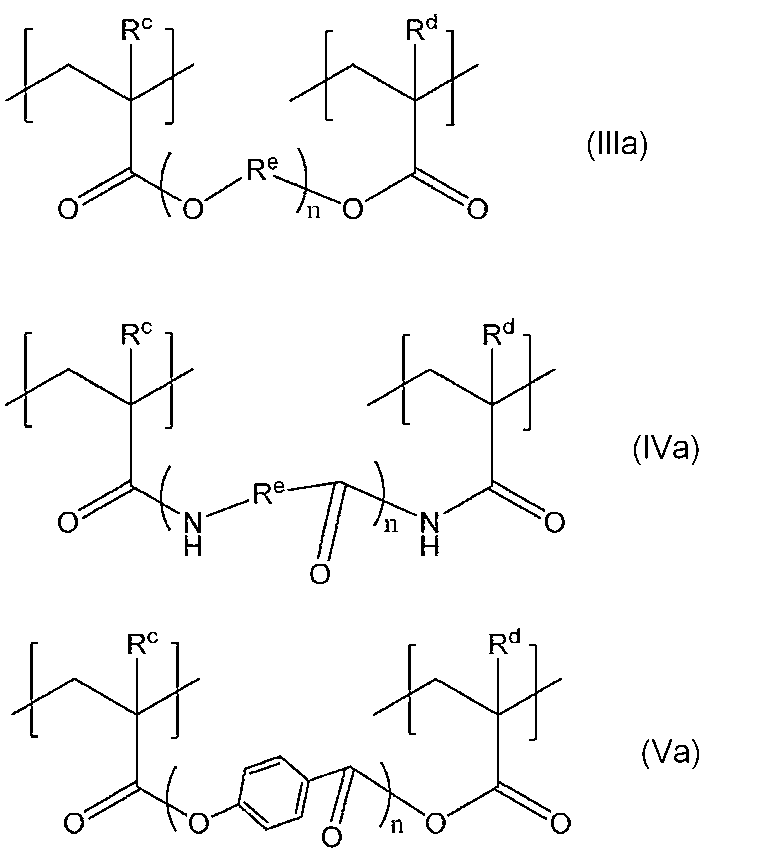
Reは、炭素原子数1~5の直鎖若しくは分岐アルキレン基を表し、nは1~50の数を表す。) - 前記基板の表面が、細胞の付着抑制能を有するコーティング膜を有し、
前記スポットが、前記コーティング膜上に配されている、請求項1に記載の細胞用構造体。 - 基板と、前記基板の表面に間隔を置いて配された複数のスポットとを有する細胞用構造体の製造方法であって、
前記基板に、細胞接着性物質を含む液滴を付与して、前記スポットとなる領域に細胞接着性物質を配する工程を含む、細胞用構造体の製造方法。 - 前記細胞接着性物質を含む液滴の前記基板への付与が、インクジェット法により行われる、請求項8に記載の細胞用構造体の製造方法。
- 製造される細胞用構造体において、前記基板の表面が細胞の付着抑制能を有するコーティング膜を有し、かつ前記複数のスポットが前記コーティング膜上に配されており、
前記細胞用構造体の製造方法が、更に、細胞の付着抑制能を有するポリマーを含有するコーティング剤を前記基板上に付与し、前記コーティング膜を形成する工程を含む、請求項8に記載の細胞用構造体の製造方法。 - 基板と、前記基板の表面に間隔を置いて配された複数のスポットとを有する細胞用構造体の製造方法であって、
前記基板に、ポリマーと溶媒とを含有する細胞培養下地膜形成剤の液滴を付与して、前記スポットとなる領域に細胞培養下地膜を形成する工程と、
前記細胞培養下地膜に、細胞接着性物質を含む液滴を付与して、前記細胞培養下地膜上に前記細胞接着性物質を配する工程と、
を含む、細胞用構造体の製造方法。 - 前記細胞培養下地膜形成剤の液滴の前記基板への付与が、インクジェット法により行われる、請求項11に記載の細胞用構造体の製造方法。
- 前記細胞接着性物質を含む液滴の前記細胞培養下地膜への付与が、インクジェット法により行われる、請求項11に記載の細胞用構造体の製造方法。
- 前記ポリマーが、下記式(Ia)で表される繰り返し単位を含むポリマーである、請求項11に記載の細胞用構造体の製造方法。

Ua1及びUa2は、それぞれ独立して、水素原子又は炭素原子数1~5の直鎖若しくは分岐アルキル基を表し、
Ra1は、水素原子又は炭素原子数1~5の直鎖若しくは分岐アルキル基を表し、
Ra2は、炭素原子数1~5の直鎖若しくは分岐アルキレン基を表す。) - 製造される細胞用構造体において、前記基板の表面が細胞の付着抑制能を有するコーティング膜を有し、かつ前記複数のスポットが前記コーティング膜上に配されており、
前記細胞用構造体の製造方法が、更に、細胞の付着抑制能を有するポリマーを含有するコーティング剤を前記基板上に付与し、前記コーティング膜を形成する工程を含む、請求項11に記載の細胞用構造体の製造方法。 - 製造される細胞用構造体が細胞培養容器である、請求項11に記載の細胞用構造体の製造方法。
- 請求項1から7のいずれかに記載の細胞用構造体に、細胞を播種する工程を含む、細胞培養方法。
- 細胞構造体を製造する、請求項17に記載の細胞培養方法。
Priority Applications (1)
| Application Number | Priority Date | Filing Date | Title |
|---|---|---|---|
| JP2025527961A JPWO2024257789A1 (ja) | 2023-06-12 | 2024-06-12 |
Applications Claiming Priority (2)
| Application Number | Priority Date | Filing Date | Title |
|---|---|---|---|
| JP2023-096192 | 2023-06-12 | ||
| JP2023096192 | 2023-06-12 |
Publications (1)
| Publication Number | Publication Date |
|---|---|
| WO2024257789A1 true WO2024257789A1 (ja) | 2024-12-19 |
Family
ID=93852134
Family Applications (1)
| Application Number | Title | Priority Date | Filing Date |
|---|---|---|---|
| PCT/JP2024/021306 Ceased WO2024257789A1 (ja) | 2023-06-12 | 2024-06-12 | 細胞用構造体、細胞用構造体の製造方法、及び細胞培養方法 |
Country Status (2)
| Country | Link |
|---|---|
| JP (1) | JPWO2024257789A1 (ja) |
| WO (1) | WO2024257789A1 (ja) |
Citations (6)
| Publication number | Priority date | Publication date | Assignee | Title |
|---|---|---|---|---|
| JP2010098958A (ja) * | 2008-10-21 | 2010-05-06 | Biomedical Technology Hybrid Ltd | 三次元細胞培養体チップ及びその使用方法 |
| WO2014112633A1 (ja) * | 2013-01-18 | 2014-07-24 | 東洋合成工業株式会社 | 細胞培養用基材及び細胞培養用基材の製造方法 |
| WO2020040247A1 (ja) * | 2018-08-24 | 2020-02-27 | 日産化学株式会社 | 細胞培養の下地膜として使用するポリマーの製造方法及び細胞培養容器 |
| WO2021167037A1 (ja) * | 2020-02-19 | 2021-08-26 | 日産化学株式会社 | 生体物質付着抑制剤 |
| WO2022259998A1 (ja) * | 2021-06-07 | 2022-12-15 | 日産化学株式会社 | コーティング膜形成用組成物、コーティング膜、及び細胞培養容器 |
| WO2023282253A1 (ja) * | 2021-07-05 | 2023-01-12 | 日産化学株式会社 | 無血清培地中での細胞培養用下地材料 |
-
2024
- 2024-06-12 JP JP2025527961A patent/JPWO2024257789A1/ja active Pending
- 2024-06-12 WO PCT/JP2024/021306 patent/WO2024257789A1/ja not_active Ceased
Patent Citations (6)
| Publication number | Priority date | Publication date | Assignee | Title |
|---|---|---|---|---|
| JP2010098958A (ja) * | 2008-10-21 | 2010-05-06 | Biomedical Technology Hybrid Ltd | 三次元細胞培養体チップ及びその使用方法 |
| WO2014112633A1 (ja) * | 2013-01-18 | 2014-07-24 | 東洋合成工業株式会社 | 細胞培養用基材及び細胞培養用基材の製造方法 |
| WO2020040247A1 (ja) * | 2018-08-24 | 2020-02-27 | 日産化学株式会社 | 細胞培養の下地膜として使用するポリマーの製造方法及び細胞培養容器 |
| WO2021167037A1 (ja) * | 2020-02-19 | 2021-08-26 | 日産化学株式会社 | 生体物質付着抑制剤 |
| WO2022259998A1 (ja) * | 2021-06-07 | 2022-12-15 | 日産化学株式会社 | コーティング膜形成用組成物、コーティング膜、及び細胞培養容器 |
| WO2023282253A1 (ja) * | 2021-07-05 | 2023-01-12 | 日産化学株式会社 | 無血清培地中での細胞培養用下地材料 |
Also Published As
| Publication number | Publication date |
|---|---|
| JPWO2024257789A1 (ja) | 2024-12-19 |
Similar Documents
| Publication | Publication Date | Title |
|---|---|---|
| TWI744586B (zh) | 幹細胞培養用支架材料及使用其之幹細胞培養方法 | |
| JP5916256B2 (ja) | 細胞培養のための合成組成物および被覆 | |
| US10131874B2 (en) | Cell culture support and associated method for cell growth and release | |
| US11499136B2 (en) | Cell culture substrate | |
| CN115926568A (zh) | 由细胞培养用支架材料形成的树脂膜、细胞培养用载体和细胞培养用容器 | |
| US20200369999A1 (en) | Cell culture container capable of long-term culture and method for manufacturing same | |
| JP2021091872A (ja) | 生体適合性樹脂、それを用いてなる細胞用培地添加剤、細胞培養用培地、細胞培養用コート剤およびその利用 | |
| Kato et al. | The design of polymer microcarrier surfaces for enhanced cell growth | |
| WO2019035436A1 (ja) | 多能性幹細胞の培養基材及び多能性幹細胞の製造方法 | |
| WO2023176949A1 (ja) | 細胞利用効率の高い細胞培養容器 | |
| JP2020130052A (ja) | 細胞培養装置 | |
| US20230093822A1 (en) | Cell culture container capable of controlling cell aggregation rate | |
| JP2025043327A (ja) | 細胞用構造体、細胞用構造体の製造方法、及び細胞培養方法 | |
| US20240336891A1 (en) | Base material for cell culture in serum-free medium | |
| WO2026105750A1 (ja) | 細胞用保持体、浮遊細胞の保持方法、及び浮遊細胞の回収方法 | |
| JP7271870B2 (ja) | 多能性幹細胞の培養基材及び多能性幹細胞の製造方法 | |
| WO2022259998A1 (ja) | コーティング膜形成用組成物、コーティング膜、及び細胞培養容器 | |
| TW202216987A (zh) | 軟骨組織之製造方法 | |
| JP7768513B2 (ja) | 細胞凝集塊の製造方法 | |
| JP7089710B1 (ja) | 無血清培地中での細胞培養用下地材料 | |
| JP6332646B2 (ja) | 活性エステル基を含有するシラン化合物とそれを用いた材料 | |
| JP7830882B2 (ja) | 軟骨細胞を含む組織の製造方法 | |
| WO2023027050A1 (ja) | 細胞構造体製造用容器、細胞構造体製造用容器の製造方法、細胞構造体の製造方法、及び細胞構造体製造用容器に用いられる基材 | |
| WO2023282273A1 (ja) | 細胞培養方法 | |
| JP2024179333A (ja) | 無血清培地中での細胞培養用下地材料 |
Legal Events
| Date | Code | Title | Description |
|---|---|---|---|
| 121 | Ep: the epo has been informed by wipo that ep was designated in this application |
Ref document number: 24823404 Country of ref document: EP Kind code of ref document: A1 |
|
| ENP | Entry into the national phase |
Ref document number: 2025527961 Country of ref document: JP Kind code of ref document: A |
|
| WWE | Wipo information: entry into national phase |
Ref document number: 2025527961 Country of ref document: JP |
|
| NENP | Non-entry into the national phase |
Ref country code: DE |