WO2024257141A1 - モータ、および車両 - Google Patents
モータ、および車両 Download PDFInfo
- Publication number
- WO2024257141A1 WO2024257141A1 PCT/JP2023/021657 JP2023021657W WO2024257141A1 WO 2024257141 A1 WO2024257141 A1 WO 2024257141A1 JP 2023021657 W JP2023021657 W JP 2023021657W WO 2024257141 A1 WO2024257141 A1 WO 2024257141A1
- Authority
- WO
- WIPO (PCT)
- Prior art keywords
- motor
- waterproof
- housing
- control unit
- connector
- Prior art date
- Legal status (The legal status is an assumption and is not a legal conclusion. Google has not performed a legal analysis and makes no representation as to the accuracy of the status listed.)
- Ceased
Links
Images



Classifications
-
- H—ELECTRICITY
- H02—GENERATION; CONVERSION OR DISTRIBUTION OF ELECTRIC POWER
- H02K—DYNAMO-ELECTRIC MACHINES
- H02K5/00—Casings; Enclosures; Supports
- H02K5/04—Casings or enclosures characterised by the shape, form or construction thereof
- H02K5/10—Casings or enclosures characterised by the shape, form or construction thereof with arrangements for protection from ingress, e.g. water or fingers
-
- H—ELECTRICITY
- H02—GENERATION; CONVERSION OR DISTRIBUTION OF ELECTRIC POWER
- H02K—DYNAMO-ELECTRIC MACHINES
- H02K11/00—Structural association of dynamo-electric machines with electric components or with devices for shielding, monitoring or protection
- H02K11/30—Structural association with control circuits or drive circuits
- H02K11/33—Drive circuits, e.g. power electronics
-
- H—ELECTRICITY
- H02—GENERATION; CONVERSION OR DISTRIBUTION OF ELECTRIC POWER
- H02K—DYNAMO-ELECTRIC MACHINES
- H02K5/00—Casings; Enclosures; Supports
- H02K5/04—Casings or enclosures characterised by the shape, form or construction thereof
- H02K5/22—Auxiliary parts of casings not covered by groups H02K5/06-H02K5/20, e.g. shaped to form connection boxes or terminal boxes
- H02K5/225—Terminal boxes or connection arrangements
-
- H—ELECTRICITY
- H02—GENERATION; CONVERSION OR DISTRIBUTION OF ELECTRIC POWER
- H02K—DYNAMO-ELECTRIC MACHINES
- H02K5/00—Casings; Enclosures; Supports
- H02K5/04—Casings or enclosures characterised by the shape, form or construction thereof
- H02K5/15—Mounting arrangements for bearing-shields or end plates
Definitions
- This disclosure relates to a motor and a vehicle.
- Patent Document 1 discloses a motor that has a configuration in which multiple parts (housing, connector, cover, etc.) are exposed to the outside. In this motor, waterproofing is ensured by placing a waterproof adhesive (waterproof part) in the gaps (boundaries) formed between the parts.
- Patent Document 1 Furthermore, for reasons such as bringing the connector closer to the center of the motor, the motor in Patent Document 1 was premised on a configuration in which the connector was fixed to the housing and became part of the housing (a so-called front-out connector configuration). This could potentially limit the layout of the product (e.g., vehicle) in which the motor was mounted.
- This disclosure has been made in consideration of these circumstances, and aims to provide a motor and vehicle that allows waterproof sections to be placed at low cost and with high quality at the boundaries between the components that make up the motor without compromising the freedom of layout of the product in which the motor is installed.
- the motor according to aspect 1 of the present disclosure comprises a motor body having a stator and a rotor that rotates around a rotation axis extending in the vertical direction, a frame that accommodates the motor body, a housing located above the motor body, a control board located above the housing and having a control unit that controls the motor body, a connector that is electrically connected to the control unit and fixed to the frame, a cover that covers the control unit, a first waterproof part that seals a first boundary that is the boundary between the frame and the cover and has waterproof properties, and a second waterproof part that seals a second boundary that is the boundary between the connector and the frame and has waterproof properties, each of the first boundary part and the second boundary part having a ring shape when viewed from the vertical direction.
- the motor according to aspect 7 of the present disclosure comprises a motor body having a stator and a rotor that rotates around a rotation axis extending in the vertical direction, a frame that accommodates the motor body, a housing located above the motor body, a control board located above the housing and having a control unit that controls the motor body, a connector that is electrically connected to the control unit and fixed to the housing, a cover that covers the control unit, a first waterproof part that seals a first boundary that is the boundary between the frame and the cover and has waterproof properties, and a third waterproof part that seals a third boundary that is the boundary between the connector and the cover and has waterproof properties, each of the first boundary part and the third boundary part having a ring shape when viewed from the vertical direction.
- the above aspects of the present disclosure make it possible to provide a motor and vehicle that are less likely to impair the layout of the product in which the motor is installed, and that allow waterproof sections to be placed at low cost and with high quality at the boundaries between the components that make up the motor.
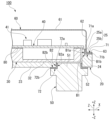
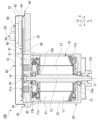
- FIG. 1 is a cross-sectional view showing a motor according to a first embodiment. 4 is an enlarged view showing the periphery of a first boundary portion and a second boundary portion according to the first embodiment;
- FIG. 11 is a cross-sectional view showing a motor according to a second embodiment. 13 is an enlarged view showing the periphery of a first boundary portion and a third boundary portion according to the second embodiment.
- FIG. FIG. 11 is a schematic diagram showing a vehicle according to a third embodiment.
- a motor 100 includes a motor body 10, a frame 20, a housing 30, a control board 40, a connector 50, and a cover 60.
- the motor body 10 has a rotation axis O extending in one direction.
- the direction in which the rotation axis O of the motor body 10 extends may be referred to as the axial direction Z or the vertical direction Z.
- the motor body 10 and the control board 40 are aligned in the vertical direction Z.
- the direction from the control board 40 toward the motor body 10 may be referred to as the downward or output side, and may be represented as the -Z direction.
- the direction from the motor body 10 toward the control board 40 may be referred to as the upward or anti-output side, and may be represented as the +Z direction.
- Viewing from the vertical direction Z may be referred to as a planar view.
- the direction that intersects with the rotation axis O may be referred to as the radial direction, and the direction that rotates around the rotation axis O may be referred to as the circumferential direction.
- one direction that intersects with the vertical direction Z (for example, perpendicular to it) may be referred to as the intersecting direction X.
- the motor body 10 has a stator 11, a rotor 12, and a shaft 13.
- the stator 11 has a cylindrical shape extending in the vertical direction Z.
- the stator 11 has a stator core on which a coil 11b is wound via an insulator 11a.
- the stator 11 is fixed to the frame 20. There are no particular limitations on the method for fixing the stator 11 to the frame 20, but methods such as shrink fitting or press fitting may be used.
- the rotor 12 is disposed radially inside the stator 11.
- the rotor 12 has a cylindrical shape extending in the vertical direction Z.
- the rotor 12 has, for example, a rotor core and a permanent magnet (detailed illustration is omitted).
- the shaft 13 is fixed to the radially inner side of the rotor 12.
- the shaft 13 extends along the rotation axis O.
- the shaft 13 has a first end (output end) 13a and a second end (anti-output end) 13b.
- the first end 13a is the lower end of the shaft 13
- the second end 13b is the upper end of the shaft 13.
- the first end 13a is held by a first bearing 15a provided on the frame 20 (bottom 21).
- first bearing 15a provided on the frame 20 (bottom 21).
- the first end 13a engages with a gear or the like for providing assistance to the device, for example via a boss.
- the second end 13b is held by a second bearing 15b provided on the housing 30 (closure portion 31).
- the shaft 13 is held by the bearings 15a and 15b, causing the shaft 13 and rotor 12 to rotate around the rotation axis O.
- a sensor magnet 14 is attached to the second end 13b to transmit magnetism to a rotation sensor 43, which will be described later.
- the frame 20 houses the motor body 10.
- the frame 20 according to this embodiment has a bottom 21, a tubular portion 22, and an extension 23.
- the bottom 21 is located below the stator 11 and the rotor 12, and holds the first bearing 15a described above.
- the tubular portion 22 extends upward from the outer peripheral edge of the bottom 21 in a plan view.
- the bottom 21 and the tubular portion 22 together have a bottomed cylindrical shape and form a first internal space S1.
- the motor body 10 is housed in the first internal space S1.
- the extension 23 extends from the upper end of the tubular portion 22 toward one side in the intersecting direction X (the right side in the drawing).
- the bottom 21, the tubular portion 22, and the extension 23 may be integrally formed.
- the holding portion 32 is located at the top of the housing 30. More specifically, in the illustrated example, the holding portion 32 extends from the upper end of the blocking portion 31 toward one side in the intersecting direction X (the right side in the drawing). The direction in which the blocking portion 31 extends from the holding portion 32 may be the same as the direction in which the extension portion 23 extends from the tube portion 22.
- the holding portion 32 and the blocking portion 31 hold the control board 40 by means of screws or the like (not shown).
- the control board 40 is located above the housing 30. Specifically, the control board 40 may be placed on the housing 30. The control board 40 is held in the housing 30 by, for example, screws (not shown).
- the control board 40 has a control unit 41 that controls the motor body 10.
- the control unit 41 may include, for example, control electronic components and power semiconductor components that form an inverter circuit.
- the control board 40 may also be equipped with an electrolytic capacitor 42 and a rotation sensor 43 for controlling the rotational position of the motor.
- the electrolytic capacitor 42 is mounted on the underside of the control board 40.
- a recess 31a that opens upward is formed in the portion of the housing 30 (blocking portion 31) that corresponds to the electrolytic capacitor 42.
- the electrolytic capacitor 42 is disposed within the recess 31a.
- the recess 31a functions as an escape portion to prevent interference between the housing 30 and the electrolytic capacitor 42.
- a heat dissipation section 80 for dissipating heat generated by the control board 40 to the housing 30 may be provided between the control board 40 and the housing 30.
- the heat dissipation section 80 may be, for example, heat dissipation grease.
- the connector 50 is electrically connected to the control board 40 (control unit 41) via, for example, a terminal or the like.
- the connector 50 may be for receiving power supply from the outside of the motor 100 (for example, a vehicle) or for receiving a signal from a torque sensor or the like.
- the connector 50 according to this embodiment is fixed to the frame 20. More specifically, the connector 50 is fixed to the frame 20 by a screw or the like (not shown) in a state where the connector 50 is fitted from below into a fitting hole 24 formed in the frame 20.
- the connector 50 is located below (output side) as viewed from the control board 40.
- the connector 50 is exposed on the lower side (output side) of the frame 20.
- the connector 50 has an insertion portion 51 and an outer peripheral protrusion 52.
- the insertion portion 51 is a portion of the connector 50 that is inserted into the fitting hole 24.
- the outer peripheral protrusion 52 is a protrusion protruding from the outer peripheral surface of the connector 50.
- the cover 60 covers the control unit 41. This prevents the control unit 41 from being exposed to the outside of the motor 100.
- the cover 60 according to this embodiment has a top 61, an outer periphery 62, and a flange 63.
- the top 61 is located above the control board 40 (control unit 41).
- the outer periphery 62 extends downward from the outer periphery of the top 61 in a plan view.
- the outer periphery 62 has a cylindrical shape.
- the top 61 and the outer periphery 62 together have a topped cylindrical shape and form a second internal space S2.
- the control board 40 (control unit 41) is disposed in the second internal space S2.
- the flange 63 extends radially outward from the lower end of the outer periphery 62.
- the top 61, the outer periphery 62, and the flange 63 may be formed integrally.
- the cover 60 is fixed to the frame 20 by, for example, a snap fit.
- the lower end of the cover 60 (the lower end of the outer periphery 62 and the flange 63) is disposed in a mating recess 25 formed in the frame 20.
- the mating recess 25 is located on the outer periphery of the frame 20 in a plan view. As shown in FIG. 2, the mating recess 25 has a first surface 25a facing radially outward and a second surface 25b facing upward.
- the frame 20, the connector 50, and the cover 60 are exposed to the outside of the motor 100.
- waterproof parts that have waterproof properties are provided between (at the boundaries of) these three components (frame 20, connector 50, and cover 60).
- the area (border) between the frame 20 and the cover 60 will be referred to as the first border B1
- the area (border) between the connector 50 and the frame 20 will be referred to as the second border B2 (see FIG. 2).
- the waterproof section provided at the first border B1 will be referred to as the first waterproof section 71
- the waterproof section provided at the second border B2 will be referred to as the second waterproof section 72.
- the first waterproof section 71 seals the first border B1.
- the second waterproof section 72 seals the second border B2.
- Each of the first boundary portion B1 and the second boundary portion B2 has an uninterrupted ring shape in a plan view.
- the waterproof portions 71 and 72 can be arranged at low cost and with high quality on the boundaries B1 and B2.
- the first waterproof portion 71 can be formed with high quality and low cost.
- the second waterproof portion 72 can be formed with high quality and low cost.
- the first boundary portion B1 includes a vertical region B1a and a horizontal region B1b.
- the vertical region B1a is located between the outer periphery 62 of the cover 60 and the first surface 25a of the fitting recess 25 in a direction intersecting (e.g., perpendicular to) the vertical direction Z.
- the horizontal region B1b is located between the flange portion 63 of the cover 60 and the second surface 25b of the fitting recess 25 in the vertical direction Z.
- the second boundary portion B2 includes a vertical region B2a and a horizontal region B2b.
- the vertical region B2a is located between the inner peripheral surface of the fitting hole 24 and the insertion portion 51 of the connector 50 in a direction intersecting (e.g., perpendicular to) the vertical direction Z.
- the horizontal region B2b is located between the lower surface of the extension portion 23 and the outer peripheral protrusion 52 of the connector 50 in the vertical direction Z.
- the first waterproof part 71 has a continuous annular shape in a plan view.
- the first waterproof part 71 may have a vertical wall part 71a extending in the vertical direction Z and a horizontal wall part 71b intersecting (e.g., perpendicular to) the vertical direction Z.
- the vertical wall part 71a is disposed in the vertical region B1a of the first boundary part B1.
- the horizontal wall part 71b is disposed in the horizontal region B1b of the first boundary part B1.
- the first waterproof part 71 may have only one of the vertical wall part 71a and the horizontal wall part 71b, or may have both the vertical wall part 71a and the horizontal wall part 71b.
- the second waterproof part 72 has an uninterrupted ring shape in a plan view.
- the second waterproof part 72 may have a vertical wall part 72a extending in the up-down direction Z and a horizontal wall part 72b intersecting (e.g., perpendicular to) the up-down direction Z.
- the vertical wall part 72a is disposed in the vertical region B2a of the second boundary part B2.
- the horizontal wall part 72b is disposed in the horizontal region B2b of the second boundary part B2.
- the second waterproof part 72 may have only one of the vertical wall part 72a and the horizontal wall part 72b, or may have both the vertical wall part 72a and the horizontal wall part 72b.
- the motor 100 includes a motor body 10 having a stator 11 and a rotor 12 that rotates around a rotation axis O extending in the vertical direction Z, a frame 20 that houses the motor body 10, a housing 30 located above the motor body 10, a control board 40 located above the housing 30 and having a control unit 41 that controls the motor body 10, a connector 50 that is electrically connected to the control unit 41 and fixed to the frame 20, a cover 60 that covers the control unit 41, a first waterproof part 71 that seals the first boundary part B1, which is the boundary part between the frame 20 and the cover 60, and has waterproof properties, and a second waterproof part 72 that seals the second boundary part B2, which is the boundary part between the connector 50 and the frame 20, and has waterproof properties, and each of the first boundary part B1 and the second boundary part B2 has a ring shape when viewed from the vertical direction Z.
- This configuration allows the boundaries B1, B2 to have a simple shape, and allows the waterproof sections 71, 72 to be arranged at the boundaries B1, B2 at low cost and with high quality. Furthermore, because the frame 20 is formed from a single member, the number of locations where the waterproof sections need to be arranged can be reduced. This makes it easier to arrange the waterproof sections and improves waterproofing compared to when the frame 20 is formed by joining two or more members.
- each of the first waterproof section 71 and the second waterproof section 72 has a vertical wall section 71a, 72a extending in the vertical direction Z, and a horizontal wall section 71b, 72b extending in a direction intersecting the vertical direction Z. This configuration can further improve the waterproofness of the waterproof sections 71, 72.
- Embodiment 2 Next, a motor according to embodiment 2 will be described, but the basic configuration is similar to that of the motor according to embodiment 1. For this reason, the same components are given the same reference numerals and the description thereof will be omitted, and only the differences will be described. In this embodiment, the configurations of the boundaries and waterproof portions located among the three components (frame 20, connector 50, and cover 60) are different from those in the first embodiment.
- the connector 50 according to this embodiment is located above (on the side opposite to the output side) the control board 40. Furthermore, an opening 64 is provided at the top 61 of the cover 60 to prevent interference with the connector 50. As a result, the connector 50 is exposed on the upper side (on the side opposite to the output side) of the cover 60.
- the connector 50 according to this embodiment has a protrusion 53 and a step 54 that protrudes from the base end of the protrusion 53 toward the outer periphery. Furthermore, the connector 50 according to this embodiment is fixed to the housing 30 rather than the frame 20.
- the housing 30 may have a fixing protrusion 33 for fixing the connector 50.
- the motor 100 instead of the second boundary B2 according to the first embodiment, there is a third boundary B3, which is the boundary between the connector 50 and the cover 60.
- a third waterproof part 73 that seals the third boundary B3 and has waterproofing properties is disposed at the third boundary B3.
- the motor 100 has a first boundary B1, and a first waterproof part 71 is disposed at the first boundary B1.
- the third boundary portion B3 includes a vertical region B3a and a horizontal region B3b.
- the vertical region B3a is located between the inner circumferential surface of the opening 64 and the protrusion 53 of the connector 50 in a direction intersecting (e.g., perpendicular to) the vertical direction Z.
- the horizontal region B3b is located between the lower surface of the apex 61 and the upper surface of the step portion 54 in the vertical direction Z.
- each of the first waterproof section 71 and the third waterproof section 73 has a vertical wall section 71a, 73a extending in the vertical direction Z, and a horizontal wall section 71b, 73b extending in a direction intersecting the vertical direction Z. This configuration can further improve the waterproofness of the waterproof sections 71, 73.
- the shape of the boundaries B1 to B3 as described above allows the connector 50 to be placed on either the upper side (non-output side) or the lower side (output side) of the control board 40. This makes it possible to prevent the layout of the product (e.g., a vehicle) in which the motor 100 is mounted from being impaired.
- the product e.g., a vehicle
- Embodiment 3 In this embodiment, a vehicle related to the motor described in the first and second embodiments will be described.
- the steering shaft 202 has an input shaft 202a connected to the steering wheel 201 and an output shaft 202b connected to a rack and pinion gear 203.
- the input shaft 202a and the output shaft 202b are connected to each other by a torsion bar (not shown).
- the torsion bar is disposed inside the torque detector 205 and passes through the torque detector 205 in the axial direction.
- the motor body 10 of the motor 100 generates torque according to the voltage applied from the control unit 41.
- the torque (output torque) generated by the motor 100 is transmitted to the rack (or tie rod 204) in the rack-pinion gear 203.
- the electric power steering device 200 is a so-called rack-assist type electric power steering device.
- the first end (output end) 13a of the shaft 13 described in the above embodiment may be engaged with the rack via a boss or the like.
- the motor 100 is disposed near the wheels 301.
- the output torque of the motor 100 functions as a steering assist force, reducing the steering torque that the driver must apply when steering.
- the torque detector 205 detects the steering torque applied to the steering wheel 201 by the driver. More specifically, when a steering torque is applied, a twist occurs in the torsion bar that is approximately proportional to the steering torque. The torque detector 205 detects the direction and angle of the twist of the torsion bar. The torque detector 205 outputs the detected steering torque to the control unit 41.
- the rotation sensor 43 detects the rotation speed of the rotating shaft (e.g., shaft 13). The rotation sensor 43 outputs the detected rotation speed to the control unit 41.
- the control unit 41 calculates the voltage to be applied to the motor 100 based on the steering torque output from the torque detector 205 and the rotation speed output from the rotation sensor 43. The control unit 41 controls the motor 100 based on this calculation result (applies a voltage to the motor body 10). In other words, the control unit 41 performs feedback control based on the information detected by the torque detector 205 and the rotation sensor 43.
- the GND pattern exposed from the control board 40 may be grounded to the holding portion 32 of the housing 30.
- the control board 40 becomes electrically stable, making it easier to reduce EMC (Electromagnetic Compatibility) noise of the MCU.
- the connector 50 may have a press-fit terminal that is connected (press-fitted) to the control board 40.
- the press-fit terminal may also be connected to an end of the control board 40.
- Motor 100 may also be used in a so-called column-assist type electric power steering device in which the output torque of motor 100 is transmitted to steering shaft 202.
- motor 100 may also be used in a so-called pinion-assist type electric power steering device in which the output torque of motor 100 is transmitted to a pinion in rack-pinion gear 203.
- motor 100 does not have to be a motor used in an electric power steering device.
Landscapes
- Engineering & Computer Science (AREA)
- Power Engineering (AREA)
- Microelectronics & Electronic Packaging (AREA)
- Motor Or Generator Frames (AREA)
Priority Applications (4)
| Application Number | Priority Date | Filing Date | Title |
|---|---|---|---|
| PCT/JP2023/021657 WO2024257141A1 (ja) | 2023-06-12 | 2023-06-12 | モータ、および車両 |
| JP2025526893A JPWO2024257141A1 (https=) | 2023-06-12 | 2023-06-12 | |
| EP23941453.5A EP4726974A1 (en) | 2023-06-12 | 2023-06-12 | Motor and vehicle |
| CN202380096608.6A CN121285928A (zh) | 2023-06-12 | 2023-06-12 | 电动机以及车辆 |
Applications Claiming Priority (1)
| Application Number | Priority Date | Filing Date | Title |
|---|---|---|---|
| PCT/JP2023/021657 WO2024257141A1 (ja) | 2023-06-12 | 2023-06-12 | モータ、および車両 |
Publications (1)
| Publication Number | Publication Date |
|---|---|
| WO2024257141A1 true WO2024257141A1 (ja) | 2024-12-19 |
Family
ID=93851665
Family Applications (1)
| Application Number | Title | Priority Date | Filing Date |
|---|---|---|---|
| PCT/JP2023/021657 Ceased WO2024257141A1 (ja) | 2023-06-12 | 2023-06-12 | モータ、および車両 |
Country Status (4)
| Country | Link |
|---|---|
| EP (1) | EP4726974A1 (https=) |
| JP (1) | JPWO2024257141A1 (https=) |
| CN (1) | CN121285928A (https=) |
| WO (1) | WO2024257141A1 (https=) |
Citations (10)
| Publication number | Priority date | Publication date | Assignee | Title |
|---|---|---|---|---|
| WO2015122069A1 (ja) * | 2014-02-14 | 2015-08-20 | 三菱電機株式会社 | 制御装置付き回転電機、電動パワーステアリング装置および制御装置付き回転電機の製造方法 |
| JP2015180156A (ja) * | 2014-03-19 | 2015-10-08 | 日立オートモティブシステムズ株式会社 | 電動モータの電子回路装置 |
| WO2017033917A1 (ja) * | 2015-08-27 | 2017-03-02 | 日本電産株式会社 | モータ |
| JP6271968B2 (ja) * | 2012-12-28 | 2018-01-31 | 株式会社ミツバ | 電動モータおよび電動ポンプ |
| JP2018207640A (ja) * | 2017-06-01 | 2018-12-27 | 日本精工株式会社 | 電動駆動装置、及び電動パワーステアリング装置 |
| WO2019064896A1 (ja) * | 2017-09-29 | 2019-04-04 | 日本電産株式会社 | モータ |
| JP2020093564A (ja) * | 2018-12-10 | 2020-06-18 | 日立オートモティブシステムズ株式会社 | 電動駆動装置及び電動パワーステアリング装置 |
| JP2020167894A (ja) | 2019-03-29 | 2020-10-08 | 日本電産株式会社 | モータ |
| JP2021058075A (ja) * | 2019-09-30 | 2021-04-08 | 日本電産株式会社 | モータ |
| JP2021129380A (ja) * | 2020-02-13 | 2021-09-02 | 日立Astemo株式会社 | 電動駆動装置 |
-
2023
- 2023-06-12 CN CN202380096608.6A patent/CN121285928A/zh active Pending
- 2023-06-12 WO PCT/JP2023/021657 patent/WO2024257141A1/ja not_active Ceased
- 2023-06-12 JP JP2025526893A patent/JPWO2024257141A1/ja active Pending
- 2023-06-12 EP EP23941453.5A patent/EP4726974A1/en active Pending
Patent Citations (10)
| Publication number | Priority date | Publication date | Assignee | Title |
|---|---|---|---|---|
| JP6271968B2 (ja) * | 2012-12-28 | 2018-01-31 | 株式会社ミツバ | 電動モータおよび電動ポンプ |
| WO2015122069A1 (ja) * | 2014-02-14 | 2015-08-20 | 三菱電機株式会社 | 制御装置付き回転電機、電動パワーステアリング装置および制御装置付き回転電機の製造方法 |
| JP2015180156A (ja) * | 2014-03-19 | 2015-10-08 | 日立オートモティブシステムズ株式会社 | 電動モータの電子回路装置 |
| WO2017033917A1 (ja) * | 2015-08-27 | 2017-03-02 | 日本電産株式会社 | モータ |
| JP2018207640A (ja) * | 2017-06-01 | 2018-12-27 | 日本精工株式会社 | 電動駆動装置、及び電動パワーステアリング装置 |
| WO2019064896A1 (ja) * | 2017-09-29 | 2019-04-04 | 日本電産株式会社 | モータ |
| JP2020093564A (ja) * | 2018-12-10 | 2020-06-18 | 日立オートモティブシステムズ株式会社 | 電動駆動装置及び電動パワーステアリング装置 |
| JP2020167894A (ja) | 2019-03-29 | 2020-10-08 | 日本電産株式会社 | モータ |
| JP2021058075A (ja) * | 2019-09-30 | 2021-04-08 | 日本電産株式会社 | モータ |
| JP2021129380A (ja) * | 2020-02-13 | 2021-09-02 | 日立Astemo株式会社 | 電動駆動装置 |
Non-Patent Citations (1)
| Title |
|---|
| See also references of EP4726974A1 |
Also Published As
| Publication number | Publication date |
|---|---|
| EP4726974A1 (en) | 2026-04-15 |
| CN121285928A (zh) | 2026-01-06 |
| JPWO2024257141A1 (https=) | 2024-12-19 |
Similar Documents
| Publication | Publication Date | Title |
|---|---|---|
| US8689926B2 (en) | Vehicle steering apparatus and manufacturing method of same | |
| CN101557140B (zh) | 电动动力转向用电动机装置及电动动力转向装置 | |
| US10424991B2 (en) | Drive device | |
| US8408353B2 (en) | Vehicle steering apparatus | |
| JP6639962B2 (ja) | 電動駆動装置及び電動パワーステアリング装置 | |
| JP3535827B2 (ja) | 電動パワーステアリング装置の電動モータ | |
| US20130099609A1 (en) | Brushless motor | |
| JP6879713B2 (ja) | 電動駆動装置及び電動パワーステアリング装置 | |
| JP5552081B2 (ja) | 電動パワーステアリング装置 | |
| US8342287B2 (en) | Vehicle steering apparatus | |
| US12562613B2 (en) | Electronic control device | |
| WO2021161947A1 (ja) | 駆動装置 | |
| WO2021033678A1 (ja) | 電動駆動装置及び電動駆動装置の組立方法 | |
| JP5785309B2 (ja) | 電動パワーステアリング装置 | |
| JP2001106097A (ja) | 電動式舵取装置 | |
| WO2024257141A1 (ja) | モータ、および車両 | |
| JP5397654B2 (ja) | 車両用操舵装置 | |
| JP5967425B2 (ja) | 電動パワーステアリング装置 | |
| JP7484646B2 (ja) | モータユニット及び電動パワーステアリング装置 | |
| KR20200105941A (ko) | 전자 제어 장치 및 전동 구동 장치 | |
| JP7638443B2 (ja) | 駆動装置 | |
| JP6059771B2 (ja) | 電動パワーステアリング装置 | |
| JP5299664B2 (ja) | 車両用操舵装置 | |
| WO2026042787A1 (ja) | 電子装置 | |
| KR20200108051A (ko) | 전동 구동 장치 및 전동 파워 스티어링 장치 |
Legal Events
| Date | Code | Title | Description |
|---|---|---|---|
| 121 | Ep: the epo has been informed by wipo that ep was designated in this application |
Ref document number: 23941453 Country of ref document: EP Kind code of ref document: A1 |
|
| WWE | Wipo information: entry into national phase |
Ref document number: 2025526893 Country of ref document: JP |
|
| ENP | Entry into the national phase |
Ref document number: 2023941453 Country of ref document: EP Effective date: 20260112 |
|
| WWE | Wipo information: entry into national phase |
Ref document number: 2023941453 Country of ref document: EP |
|
| NENP | Non-entry into the national phase |
Ref country code: DE |
|
| ENP | Entry into the national phase |
Ref document number: 2023941453 Country of ref document: EP Effective date: 20260112 |
|
| ENP | Entry into the national phase |
Ref document number: 2023941453 Country of ref document: EP Effective date: 20260112 |
|
| ENP | Entry into the national phase |
Ref document number: 2023941453 Country of ref document: EP Effective date: 20260112 |
|
| ENP | Entry into the national phase |
Ref document number: 2023941453 Country of ref document: EP Effective date: 20260112 |
|
| WWP | Wipo information: published in national office |
Ref document number: 2023941453 Country of ref document: EP |