WO2024252985A1 - 硬化性樹脂組成物、硬化膜、表示装置、及び固体撮像素子 - Google Patents
硬化性樹脂組成物、硬化膜、表示装置、及び固体撮像素子 Download PDFInfo
- Publication number
- WO2024252985A1 WO2024252985A1 PCT/JP2024/019539 JP2024019539W WO2024252985A1 WO 2024252985 A1 WO2024252985 A1 WO 2024252985A1 JP 2024019539 W JP2024019539 W JP 2024019539W WO 2024252985 A1 WO2024252985 A1 WO 2024252985A1
- Authority
- WO
- WIPO (PCT)
- Prior art keywords
- meth
- acrylate
- structural unit
- resin composition
- curable resin
- Prior art date
- Legal status (The legal status is an assumption and is not a legal conclusion. Google has not performed a legal analysis and makes no representation as to the accuracy of the status listed.)
- Ceased
Links
Classifications
-
- C—CHEMISTRY; METALLURGY
- C08—ORGANIC MACROMOLECULAR COMPOUNDS; THEIR PREPARATION OR CHEMICAL WORKING-UP; COMPOSITIONS BASED THEREON
- C08F—MACROMOLECULAR COMPOUNDS OBTAINED BY REACTIONS ONLY INVOLVING CARBON-TO-CARBON UNSATURATED BONDS
- C08F2/00—Processes of polymerisation
- C08F2/44—Polymerisation in the presence of compounding ingredients, e.g. plasticisers, dyestuffs, fillers
-
- C—CHEMISTRY; METALLURGY
- C08—ORGANIC MACROMOLECULAR COMPOUNDS; THEIR PREPARATION OR CHEMICAL WORKING-UP; COMPOSITIONS BASED THEREON
- C08F—MACROMOLECULAR COMPOUNDS OBTAINED BY REACTIONS ONLY INVOLVING CARBON-TO-CARBON UNSATURATED BONDS
- C08F26/00—Homopolymers and copolymers of compounds having one or more unsaturated aliphatic radicals, each having only one carbon-to-carbon double bond, and at least one being terminated by a single or double bond to nitrogen or by a heterocyclic ring containing nitrogen
- C08F26/06—Homopolymers and copolymers of compounds having one or more unsaturated aliphatic radicals, each having only one carbon-to-carbon double bond, and at least one being terminated by a single or double bond to nitrogen or by a heterocyclic ring containing nitrogen by a heterocyclic ring containing nitrogen
- C08F26/12—N-Vinyl-carbazole
-
- G—PHYSICS
- G03—PHOTOGRAPHY; CINEMATOGRAPHY; ANALOGOUS TECHNIQUES USING WAVES OTHER THAN OPTICAL WAVES; ELECTROGRAPHY; HOLOGRAPHY
- G03F—PHOTOMECHANICAL PRODUCTION OF TEXTURED OR PATTERNED SURFACES, e.g. FOR PRINTING, FOR PROCESSING OF SEMICONDUCTOR DEVICES; MATERIALS THEREFOR; ORIGINALS THEREFOR; APPARATUS SPECIALLY ADAPTED THEREFOR
- G03F7/00—Photomechanical, e.g. photolithographic, production of textured or patterned surfaces, e.g. printing surfaces; Materials therefor, e.g. comprising photoresists; Apparatus specially adapted therefor
- G03F7/004—Photosensitive materials
- G03F7/027—Non-macromolecular photopolymerisable compounds having carbon-to-carbon double bonds, e.g. ethylenic compounds
- G03F7/032—Non-macromolecular photopolymerisable compounds having carbon-to-carbon double bonds, e.g. ethylenic compounds with binders
- G03F7/033—Non-macromolecular photopolymerisable compounds having carbon-to-carbon double bonds, e.g. ethylenic compounds with binders the binders being polymers obtained by reactions only involving carbon-to-carbon unsaturated bonds, e.g. vinyl polymers
Definitions
- the present invention relates to a curable resin composition, a cured film, a display device, and a solid-state imaging device.
- the refractive index can be controlled, for example, by providing a light extraction layer in the organic EL display device.
- a composition containing a polymer that includes a structural unit derived from vinylcarbazole is known as a resin for increasing the refractive index and used in forming such a light extraction layer (see, for example, Patent Document 1).
- the cured product of the conventional composition is developed for a long time (e.g., 300 seconds), the resistance to the developer is insufficient, and the formed pattern may peel off.
- the main objective of the present invention is to provide a curable resin composition that can form a cured product that has sufficient resistance to the developer even when developed over a long period of time.
- the present invention provides a curable resin composition according to [1], a cured film according to [2], a display device according to [3], and a solid-state imaging device according to [4].
- the alkali-soluble resin (A) is a polymer containing a structural unit having a carbazole ring.
- a curable resin composition [2] A cured film comprising a cured product of the curable resin composition according to [1]. [3] A display device comprising the cured film according to [2]. [4] A solid-state imaging device comprising the cured film according to [2].
- the present invention provides a curable resin composition capable of forming a cured product having sufficient resistance to a developer even when developed for a long period of time.
- the present invention also provides a cured film containing the cured product of such a curable resin composition.
- the present invention further provides a display device and a solid-state imaging device using such a cured film.
- a numerical range indicated using “ ⁇ ” indicates a range that includes the numerical values before and after " ⁇ " as the minimum and maximum values, respectively.
- the upper or lower limit value described in one numerical range may be replaced with the upper or lower limit value of another numerical range described in stages.
- the upper or lower limit value of that numerical range may be replaced with a value shown in an example.
- (meth)acrylate means acrylate or the corresponding methacrylate.
- the materials exemplified below may be used alone or in combination of two or more types within the range that meets the conditions.
- the content of each component means the total amount of those multiple substances unless otherwise specified.
- the curable resin composition of the present embodiment contains an alkali-soluble resin (A), diamond particles (B), a polymerizable compound (C), and a polymerization initiator (D).
- the composition may further contain a solvent (E), a polymerization initiator aid (F), a leveling agent (G), an antioxidant (H), and the like.
- the alkali-soluble resin refers to a resin that contains an acidic group and is soluble in an alkaline developer.
- the acidic group include a carboxy group, a sulfo group, and a phenolic hydroxy group.
- the alkali-soluble resin (A) is a polymer containing a structural unit having a carbazole ring (hereinafter, sometimes referred to as “structural unit (Aa)”).
- the polymer may further contain a structural unit having a cyclic ether structure having 2 to 4 carbon atoms (hereinafter, sometimes referred to as “structural unit (Ab)").
- structural unit (Aa) and (Ab) the polymer may further contain a structural unit other than the structural units (Aa) and (Ab) (hereinafter, sometimes referred to as “structural unit (Ac)”).
- the alkali-soluble resin (A) preferably contains the structural unit (Ac1) described below as the structural unit (Ac).
- the structural unit (Aa) is a structural unit derived from an unsaturated compound having a carbazole ring which may have a substituent.
- the structural unit (Aa) can be obtained by polymerizing an unsaturated compound having a carbazole ring which may have a substituent as a monomer.
- the structural unit (Aa) can also be obtained by reacting another structural unit (Aa') with a compound (Aa'') having a carbazole ring which may have a substituent.
- the unsaturated compound that provides the structural unit (Aa) is preferably a compound represented by formula (III).
- R 1 represents a hydrogen atom, a methyl group, or a hydroxymethyl group.
- R 2 to R 9 each independently represent a hydrogen atom, a halogen atom, an alkyl group having 1 to 20 carbon atoms, or an aryl group having 6 to 20 carbon atoms, and the hydrogen atom contained in the alkyl group may be substituted with an alkoxy group or an aryl group.
- X represents a single bond, an alkanediyl group having one or more carbon atoms, or a group represented by formula (V).
- formula (V) l represents an integer of 0 or more.
- m represents an integer of 1 or more.
- the group represented by formula (V) may be linear or branched.
- Halogen atoms include, for example, fluorine atoms, chlorine atoms, bromine atoms, and iodine atoms.
- alkyl groups having 1 to 20 carbon atoms include linear alkyl groups such as methyl, ethyl, propyl, butyl, pentyl, hexyl, heptyl, octyl, nonyl, decyl, dodecyl, hexadecyl, and icosyl; branched alkyl groups such as isopropyl, isobutyl, sec-butyl, tert-butyl, isopentyl, neopentyl, and 2-ethylhexyl; and cyclic alkyl groups such as cyclopropyl, cyclopentyl, cyclohexyl, cycloheptyl, cyclooctyl, and tricyclodecyl. If the alkyl group has an alkoxy or aryl group, the number of carbon atoms in the alkoxy or aryl group is included.
- alkyl groups in which a hydrogen atom is replaced by an alkoxy group include methoxymethyl groups, ethoxymethyl groups, and methoxyethyl groups.
- alkyl groups in which hydrogen atoms are replaced by aryl groups include benzyl, (2-methylphenyl)methyl, (3-methylphenyl)methyl, (4-methylphenyl)methyl, (2,4-dimethylphenyl)methyl, (ethylphenyl)methyl, and naphthylmethyl groups.
- aryl groups having 6 to 20 carbon atoms include phenyl groups, naphthyl groups, anthracenyl groups, biphenyl groups, and triphenyl groups (o-terphenyl groups, m-terphenyl groups, and p-terphenyl groups).
- alkanediyl groups having one or more carbon atoms examples include methanediyl (methylene) groups, ethanediyl (ethylene) groups, propane-1,2-diyl groups, propane-1,3-diyl groups, butane-1,4-diyl groups, pentane-1,5-diyl groups, and hexane-1,6-diyl groups.
- Examples of the compound represented by formula (III) include 9-vinylcarbazole, 9-allylcarbazole, 9-(meth)acryloylcarbazole, 2-(9-carbazolyl)ethyl (meth)acrylate, 2-(9-carbazolyl)ethoxyethyl (meth)acrylate, 2-(9-carbazolyl)-2-methylethyl (meth)acrylate, and 2-(9-carbazolyl)-1-methylethyl (meth)acrylate.
- the compound represented by formula (III) is preferably 9-vinylcarbazole, 9-allylcarbazole, or 2-(9-carbazolyl)ethyl (meth)acrylate.
- the structural unit (Ab) is a structural unit derived from an unsaturated compound having a cyclic ether structure having 2 to 4 carbon atoms (for example, at least one selected from the group consisting of an oxirane ring, an oxetane ring, and a tetrahydrofuran ring).
- the structural unit (Ab) can be obtained by polymerization using an unsaturated compound having a cyclic ether structure having 2 to 4 carbon atoms as a monomer.
- the structural unit (Ab) can also be obtained by reacting another structural unit (Ab') with a compound (Ab'') having a carbazole ring which may have a substituent.
- Unsaturated compounds that give the structural unit (Ab) include, for example, a monomer having an oxiranyl group and an ethylenically unsaturated bond (hereinafter, sometimes referred to as “monomer (Ab1)”), a monomer having an oxetanyl group and an ethylenically unsaturated bond (hereinafter, sometimes referred to as “monomer (Ab2)”), and a monomer having a tetrahydrofuryl group and an ethylenically unsaturated bond (hereinafter, sometimes referred to as “monomer (Ab3)”).
- Monomer (Ab1) may be, for example, a monomer having a structure in which a linear or branched unsaturated aliphatic hydrocarbon has been epoxidized (hereinafter, may be referred to as "monomer (Ab1-1)"), or a monomer having a structure in which an unsaturated alicyclic hydrocarbon has been epoxidized (hereinafter, may be referred to as “monomer (Ab1-2)”).
- monomer (Ab1) is preferred in that it can further increase the reliability of the heat resistance, chemical resistance, etc. of the obtained cured film, and monomer (Ab1-2) is more preferred in that it provides excellent storage stability of the curable resin composition.
- Monomers (Ab1-1) include glycidyl (meth)acrylate, ⁇ -methyl glycidyl (meth)acrylate, ⁇ -ethyl glycidyl (meth)acrylate, glycidyl vinyl ether, o-vinylbenzyl glycidyl ether, m-vinylbenzyl glycidyl ether, p-vinylbenzyl glycidyl ether, ⁇ -methyl-o-vinylbenzyl glycidyl ether, ⁇ -methyl-m-vinylbenzyl glycidyl ether, ⁇ -methyl-p-vinylbenzyl glycidyl ether, 2,3-bis(glycidyl Examples include 2,4-bis(glycidyloxymethyl)styrene, 2,5-bis(glycidyloxymethyl)styrene, 2,6-bis(glycidyloxymethyl)sty
- Examples of the monomer (Ab1-2) include vinylcyclohexene monoxide, 1,2-epoxy-4-vinylcyclohexane (e.g., Celloxide 2000 (manufactured by Daicel Corporation)), 3,4-epoxycyclohexylmethyl (meth)acrylate (e.g., Cyclomer A400 (manufactured by Daicel Corporation)), 3,4-epoxycyclohexylmethyl (meth)acrylate (e.g., Cyclomer M100 (manufactured by Daicel Corporation)), compounds represented by formula (I), compounds represented by formula (II), etc.
- vinylcyclohexene monoxide e.g., 1,2-epoxy-4-vinylcyclohexane (e.g., Celloxide 2000 (manufactured by Daicel Corporation)
- 3,4-epoxycyclohexylmethyl (meth)acrylate e.g., Cyclomer A400 (manu
- R b1 and R b2 each represent a hydrogen atom or an alkyl group having 1 to 4 carbon atoms, and the hydrogen atom contained in the alkyl group may be substituted with a hydroxy group.
- X b1 and X b2 each represent a single bond, *-R b3 -, *-R b3 -O-, *-R b3 -S-, or *-R b3 -NH-.
- R b3 represents an alkanediyl group having 1 to 6 carbon atoms. * represents a bond to O.
- alkyl groups having 1 to 4 carbon atoms include methyl, ethyl, n-propyl, isopropyl, n-butyl, sec-butyl, and tert-butyl groups.
- alkyl groups in which hydrogen atoms are replaced with hydroxy groups include hydroxymethyl groups, 1-hydroxyethyl groups, 2-hydroxyethyl groups, 1-hydroxypropyl groups, 2-hydroxypropyl groups, 3-hydroxypropyl groups, 1-hydroxy-1-methylethyl groups, 2-hydroxy-1-methylethyl groups, 1-hydroxybutyl groups, 2-hydroxybutyl groups, 3-hydroxybutyl groups, and 4-hydroxybutyl groups.
- R b1 and R b2 are preferably a hydrogen atom, a methyl group, a hydroxymethyl group, a 1-hydroxyethyl group, or a 2-hydroxyethyl group, more preferably a hydrogen atom or a methyl group.
- Alkanediyl groups having 1 to 6 carbon atoms include methanediyl (methylene) groups, ethanediyl (ethylene) groups, propane-1,2-diyl groups, propane-1,3-diyl groups, butane-1,4-diyl groups, pentane-1,5-diyl groups, and hexane-1,6-diyl groups.
- X b1 and X b2 are preferably a single bond, a methylene group, an ethylene group, *-CH 2 -O-, or *-CH 2 CH 2 -O-, more preferably a single bond or *-CH 2 CH 2 -O-. * represents a bond to O.
- the compound represented by formula (I) includes compounds represented by formulas (I-1) to (I-15).
- the compound represented by formula (I) is preferably a compound represented by formula (I-1), formula (I-3), formula (I-5), formula (I-7), formula (I-9), or formula (I-11) to formula (I-15), more preferably a compound represented by formula (I-1), formula (I-7), formula (I-9), or formula (I-15).
- the compound represented by formula (II) includes compounds represented by formulas (II-1) to (II-15).
- the compound represented by formula (II) is preferably a compound represented by formula (II-1), formula (II-3), formula (II-5), formula (II-7), formula (II-9), or formula (II-11) to formula (II-15), more preferably a compound represented by formula (II-1), formula (II-7), formula (II-9), or formula (II-15).
- the compound represented by formula (I) and the compound represented by formula (II) may be used alone or in combination of two or more kinds. When used in combination, the content of these (compound represented by formula (I): compound represented by formula (II)) is preferably 5:95 to 95:5, more preferably 20:80 to 80:20, on a molar basis.
- An example of a commercially available mixture containing the compound represented by formula (I-1) and the compound represented by formula (II-1) in a molar ratio of 50:50 is E-DCPA (trade name, manufactured by Daicel Corporation).
- the monomer (Ab2) is preferably a monomer having an oxetanyl group and a (meth)acryloyloxy group.
- Examples of the monomer (Ab2) include 3-methyl-3-methacryloyloxymethyloxetane, 3-methyl-3-acryloyloxymethyloxetane, 3-ethyl-3-methacryloyloxymethyloxetane, 3-ethyl-3-acryloyloxymethyloxetane, 3-methyl-3-methacryloyloxyethyloxetane, 3-methyl-3-acryloyloxyethyloxetane, 3-ethyl-3-methacryloyloxyethyloxetane, 3-ethyl-3-acryloyloxyethyloxetane, and 3-ethyl-3-acryloyloxyethyloxetane.
- Monomer (Ab3) is preferably a monomer having a tetrahydrofuryl group and a (meth)acryloyloxy group.
- monomer (Ab3) include tetrahydrofurfuryl acrylate (e.g., Viscoat V#150, manufactured by Osaka Organic Chemical Industry Co., Ltd.) and tetrahydrofurfuryl methacrylate.
- the structural unit (Ab) is preferably a structural unit derived from monomer (Ab1-2), and more preferably a structural unit represented by formula (Ab-1) and/or formula (Ab-2), in terms of excellent storage stability of the curable resin composition and excellent chemical resistance, heat resistance, and mechanical strength of the resulting cured film.
- the structural unit represented by formula (Ab-1) is derived from a compound represented by formula (I)
- the structural unit represented by formula (Ab-2) is derived from a compound represented by formula (II).
- R b1 and R b2 represent a hydrogen atom or an alkyl group having 1 to 4 carbon atoms, and the hydrogen atom contained in the alkyl group may be substituted with a hydroxy group.
- X b1 and X b2 each represent a single bond, *-R b3 -, *-R b3 -O-, *-R b3 -S-, or *-R b3 -NH-.
- R b3 represents an alkanediyl group having 1 to 6 carbon atoms. * represents a bond to O.
- Structural unit (Ac) examples include a structural unit derived from a compound selected from the group consisting of unsaturated carboxylic acids and unsaturated carboxylic anhydrides (hereinafter, sometimes referred to as "structural unit (Ac1)").
- Examples of the compound selected from the group consisting of unsaturated carboxylic acids and unsaturated carboxylic anhydrides include, for example, Unsaturated monocarboxylic acids such as acrylic acid, methacrylic acid, crotonic acid, o-, m-, and p-vinylbenzoic acid; Unsaturated dicarboxylic acids such as maleic acid, fumaric acid, citraconic acid, mesaconic acid, itaconic acid, 3-vinylphthalic acid, 4-vinylphthalic acid, 3,4,5,6-tetrahydrophthalic acid, 1,2,3,6-tetrahydrophthalic acid, dimethyltetrahydrophthalic acid, and 1,4-cyclohexenedicarboxylic acid; Bicyclounsaturated compounds containing a carboxy group, such as methyl-5-norbornene-2,3-dicarboxylic acid, 5-carboxybicyclo[2.2.1]hept-2-ene, 5,6-dicarboxybic
- structural unit (Ac) other than the structural unit (Ac1) examples include: Methyl (meth)acrylate, sec-butyl (meth)acrylate, tert-butyl (meth)acrylate, 2-ethylhexyl (meth)acrylate, stearyl (meth)acrylate, cyclopentyl (meth)acrylate, cyclohexyl (meth)acrylate, 2-methylcyclohexyl (meth)acrylate, tricyclo[5.2.1.0 2,6 ]decan-8-yl (meth)acrylate (in the technical field, this may be commonly referred to as "dicyclopentanyl (meth)acrylate” or " tricyclodecyl (meth)acrylate”).
- (meth)acrylic acid esters such as decene-8-yl (meth)acrylate (sometimes referred to as the common name "dicyclopentenyl (meth)acrylate” in the technical field), dicyclopentanyloxyethyl (meth)acrylate, isobornyl (meth)acrylate, adamantyl (meth)acrylate, allyl (meth)acrylate, propargyl (meth)acrylate, phenyl (meth)acrylate, naphthyl (meth)acrylate, and benzyl (meth)acrylate; Hydroxy group-containing (meth)acrylic acid esters such as 2-hydroxyethyl (meth)acrylate and 2-hydroxypropyl (meth)acrylate; dicarboxylic acid diesters such as diethyl maleate, diethyl fumarate, and diethyl itaconate; Bicyclo unsaturated compounds such as bicyclo [2.2.1] hept-2-ene
- alkali-soluble resin (A) examples include the following resins [K1] to [K6].
- Resin [K1] a polymer composed of structural units (Ac1), (Aa), and (Ab);
- Resin [K2] a polymer composed of structural units (Ac1), (Aa), (Ab), and (Ac2);
- Resin [K3] a polymer composed of structural units (Aa) and structural units (Ac1);
- Resin [K4] a copolymer including a structural unit obtained by adding a monomer that gives the structural unit (Ab) to the structural unit (Ac1) and a structural unit (Aa), and further including a structural unit (Ac1) to which a monomer that gives the structural unit (Ab) is not added;
- Resin [K5] a copolymer including a structural unit obtained by adding a monomer that gives the structural unit (Ab) to the structural unit (Ac1), a structural unit (Aa), and a structural
- the alkali-soluble resin (A) is preferably resin [K1] or resin [K2].
- the content of the structural unit (Ac1) in the alkali-soluble resin (A) is preferably 1 to 50 mol %, more preferably 5 to 40 mol %, based on the total structural units constituting the alkali-soluble resin (A).
- each structural unit relative to all structural units constituting the resin [K1] is as follows: Structural unit (Aa): 5 to 95 mol%, Structural unit (Ab): 3 to 90 mol%, Structural unit (Ac1): 1 to 50 mol %, preferably Structural unit (Aa): 30 to 90 mol%, Structural unit (Ab): 5 to 65 mol%, The structural unit (Ac1): 5 to 40 mol % is more preferable.
- the storage stability of the curable resin composition and the chemical resistance, heat resistance, and mechanical strength of the resulting cured film tend to be excellent.
- Resin [K1] can be produced, for example, by referring to the method described in the literature "Experimental Methods for Polymer Synthesis” (written by Otsu Takayuki, published by Kagaku Dojin Co., Ltd., 1st edition, 1st printing, published March 1, 1972) and the references cited in said literature.
- Specific examples include a method in which a compound that gives the structural unit (Aa) and the structural unit (Ab), a polymerization initiator, a solvent, and the like are placed in a reaction vessel, and the atmosphere is deoxygenated, for example by replacing oxygen with nitrogen, and the mixture is heated and kept warm while stirring.
- the polymerization initiator, solvent, and the like are not particularly limited, and those that are commonly used in the relevant field can be used.
- Examples of polymerization initiators include azo compounds (2,2'-azobisisobutyronitrile, 2,2-azobis(2,4-dimethylvaleronitrile), etc.) and organic peroxides (benzoyl peroxide, etc.).
- the solvent is not particularly limited as long as it dissolves each monomer, and examples of the solvents that are used in curable resin compositions, which are described below, can be used.
- the resin solution obtained by the reaction may be used as is, or a concentrated or diluted solution may be used, or a solution precipitated as a solid (powder) by a method such as reprecipitation may be used.
- the solvent used in the curable resin composition as the solvent used in the polymerization, the solution after the reaction can be used as is in the production of the curable resin composition, and the production process of the curable resin composition can be simplified.
- each structural unit relative to all structural units constituting the resin [K2] is as follows: Structural unit (Aa): 5 to 90 mol%, Structural unit (Ab): 1 to 70 mol%, Structural unit (Ac1): 1 to 50 mol%, Structural unit (Ac2): 1 to 40 mol %, preferably Structural unit (Aa): 10 to 90 mol%, Structural unit (Ab): 3 to 50 mol%, Structural unit (Ac1): 5 to 35 mol%, Structural unit (Ac2): 1 to 30 mol %, more preferably Structural unit (Aa): 50 to 90 mol%, Structural unit (Ab): 3 to 50 mol%, Structural unit (Ac1): 5 to 35 mol%, Structural unit (Ac2): 1 to 30 mol % is more preferable.
- Resin [K2] can be produced by the same method as resin [K1].
- the weight average molecular weight (Mw) of the alkali-soluble resin (A) in terms of polystyrene is preferably 1,000 to 100,000, more preferably 3,000 to 70,000, even more preferably 5,000 to 50,000, and particularly preferably 7,000 to 30,000.
- Mw weight average molecular weight of the alkali-soluble resin
- the degree of dispersion of the alkali-soluble resin (A) is preferably 1.1 to 6.0, more preferably 1.2 to 4.0. If the degree of dispersion is within the above range, the resulting cured film tends to have excellent chemical resistance.
- the alkali-soluble resin (A) contains the structural unit (Ac1)
- its acid value is preferably 30 to 180 mg-KOH/g, more preferably 40 to 150 mg-KOH/g, and even more preferably 50 to 135 mg-KOH/g or less.
- the acid value is a value measured as the amount (mg) of potassium hydroxide required to neutralize 1 g of resin, and can be determined by titration with an aqueous potassium hydroxide solution.
- the acid value of the alkali-soluble resin (A) is within the above range, the resulting cured film tends to have excellent adhesion to the substrate.
- the content of the alkali-soluble resin (A) is preferably 30 to 99 mass%, more preferably 35 to 80 mass%, and even more preferably 40 to 60 mass%, based on the total amount of solids in the curable resin composition.
- the content of the alkali-soluble resin (A) is within the above range, the obtained cured film tends to have excellent heat resistance, adhesion to the substrate, and chemical resistance.
- the solid content of the curable resin composition means the total amount of components excluding the solvent from the curable resin composition.
- the total amount of solids in the curable resin composition and the content of each component relative to the total amount can be measured by known analytical means such as liquid chromatography and gas chromatography.
- the curable resin composition contains diamond particles (B).
- diamond particles (B) By containing diamond particles (B) in the curable resin composition, it is possible to form a cured product that has sufficient resistance to the developer even in long-term development. The reason why such an effect is exhibited is not necessarily clear, but the present inventors believe that it is because the hardness of diamond particles (B) is high, and it is also compatible with the above-mentioned alkali-soluble resin (A), and the resistance to the developer is high.
- the average particle size of the diamond particles (B) is preferably 1 nm or more, more preferably 10 nm or more, even more preferably 50 nm or more, and particularly preferably 80 nm or more, from the viewpoint of reaggregation properties, and is preferably 10,000 nm (10 ⁇ m) or less, more preferably 5,000 nm (5 ⁇ m) or less, even more preferably 1,000 nm (1 ⁇ m) or less, and particularly preferably 500 nm or less, from the viewpoint of sedimentation properties.
- the average particle size of diamond particles (B) refers to the particle size at 50% cumulative value in the particle size distribution determined by the laser diffraction/scattering method.
- the average particle size is the average particle size of all diamond particles (B) including primary particles and secondary particles.
- the content of diamond particles (B) is preferably 0.5 to 60 mass%, more preferably 1 to 50 mass%, even more preferably 3 to 40 mass%, particularly preferably 5 to 35 mass%, and most preferably 7 to 30 mass%, based on the total amount of solids in the curable resin composition.
- the content of diamond particles (B) is within the above range, the effects of the present invention tend to be more fully manifested.
- the polymerizable compound (C) is a compound that reacts by the action of heat or a polymerization initiator (D).
- Examples of the polymerizable compound (C) include a compound having an ethylenically unsaturated bond.
- C) is preferably a compound having a (meth)acryloyl group.
- Examples of compounds having one (meth)acryloyl group include compounds similar to the monomer that gives the structural unit (Ac2).
- Examples of compounds having two (meth)acryloyl groups include 1,3-butanediol di(meth)acrylate, 1,3-butanediol (meth)acrylate, 1,6-hexanediol di(meth)acrylate, ethylene glycol di(meth)acrylate, diethylene glycol di(meth)acrylate, neopentyl glycol di(meth)acrylate, triethylene glycol di(meth)acrylate, tetraethylene glycol di(meth)acrylate, polyethylene glycol diacrylate, bis(acryloyloxyethyl)ether of bisphenol A, ethylene oxide-modified bisphenol A di(meth)acrylate, propylene oxide-modified neopentyl glycol di(meth)acrylate, ethylene oxide-modified neopentyl glycol di(meth)acrylate, and 3-methylpentanediol di(meth)acrylate.
- Examples of compounds having three or more (meth)acryloyl groups include glycerin tri(meth)acrylate, trimethylolpropane tri(meth)acrylate, pentaerythritol poly(meth)acrylate (e.g., pentaerythritol tri(meth)acrylate, pentaerythritol tetra(meth)acrylate), dipentaerythritol poly(meth)acrylate (e.g., dipentaerythritol penta(meth)acrylate, dipentaerythritol hexa(meth)acrylate), tripentaerythritol poly(meth)acrylate (e.g., tripentaerythritol octa(meth)acrylate, tripentaerythritol hepta(meth)acrylate, acrylate), tetrapentaerythritol poly(meth)acrylate (e.
- the compound having a (meth)acryloyl group is preferably a (meth)acrylic compound having three or more (meth)acryloyl groups, more preferably ethylene oxide modified glycerin tri(meth)acrylate, dipentaerythritol penta(meth)acrylate, dipentaerythritol hexa(meth)acrylate, trimethylolpropane tri(meth)acrylate, ethylene glycol modified pentaerythritol tetra(meth)acrylate, or ethylene glycol modified dipentaerythritol hexa(meth)acrylate.
- the content of the polymerizable compound (C) is preferably 20 to 200 parts by mass, and more preferably 30 to 150 parts by mass, per 100 parts by mass of the alkali-soluble resin (A).
- the resulting cured film tends to have excellent chemical resistance and mechanical strength.
- the polymerization initiator (D) is not particularly limited as long as it is a compound that generates active radicals, acids, etc. by the action of light or heat and can initiate polymerization of the polymerizable compound (C), and known polymerization initiators can be used.
- the polymerization initiator (D) is preferably at least one selected from the group consisting of O-acyloxime compounds, alkylphenone compounds, triazine compounds, acylphosphine oxide compounds, and biimidazole compounds, and more preferably an O-acyloxime compound. The use of these polymerization initiators tends to provide high sensitivity and high transmittance in the visible light region.
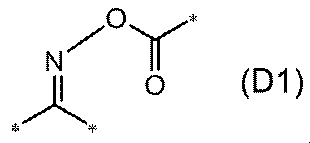
- O-acyloxime compounds are compounds having a partial structure represented by formula (D1). Hereinafter, * represents a bond.
- O-acyloxime compounds include N-benzoyloxy-1-(4-phenylsulfanylphenyl)butan-1-one-2-imine, N-benzoyloxy-1-(4-phenylsulfanylphenyl)octan-1-one-2-imine, N-benzoyloxy-1-(4-phenylsulfanylphenyl)-3-cyclopentylpropan-1-one-2-imine, N-acetoxy-1-[9-ethyl-6-(2-methylbenzoyl)-9H-carbazol-3-yl]ethane-1-imine, N-acetoxy-1-[9-ethyl-6-(2-methylbenzoyl)-9H-carbazol-3-yl]ethane-1-imine, Examples of the compound include c-1-[9-ethyl-6- ⁇ 2-methyl-4-(3,3-dimethyl-2,4-dioxacyclopentanylmethyloxy)benzo
- the alkylphenone compound is a compound having a partial structure represented by formula (D2-1) or a partial structure represented by formula (D2-2).
- the benzene ring may have a substituent.
- Examples of compounds having a partial structure represented by formula (D2-1) include 2-methyl-2-morpholino-1-(4-methylsulfanylphenyl)propan-1-one, 2-dimethylamino-1-(4-morpholinophenyl)-2-benzylbutan-1-one, and 2-(dimethylamino)-2-[(4-methylphenyl)methyl]-1-[4-(4-morpholinyl)phenyl]butan-1-one.
- Commercially available products such as Irgacure (registered trademark) 369, 907, and 379 (all manufactured by BASF Ltd.) may also be used.
- polymerization initiators having a chain transferable group as described in JP-A-2002-544205, may also be used.
- Examples of compounds having a partial structure represented by formula (D2-2) include 2-hydroxy-2-methyl-1-phenylpropan-1-one, 2-hydroxy-2-methyl-1-[4-(2-hydroxyethoxy)phenyl]propan-1-one, 1-hydroxycyclohexyl phenyl ketone, oligomers of 2-hydroxy-2-methyl-1-(4-isopropenylphenyl)propan-1-one, ⁇ , ⁇ -diethoxyacetophenone, and benzyl dimethyl ketal.
- the alkylphenone compound is preferably a compound having a structure represented by formula (D2-1).
- triazine compounds examples include 2,4-bis(trichloromethyl)-6-(4-methoxyphenyl)-1,3,5-triazine, 2,4-bis(trichloromethyl)-6-(4-methoxynaphthyl)-1,3,5-triazine, 2,4-bis(trichloromethyl)-6-piperonyl-1,3,5-triazine, 2,4-bis(trichloromethyl)-6-(4-methoxystyryl)-1,3,5-triazine, and 2,4-bis(trichloromethyl)-6-[ 2-(5-methylfuran-2-yl)ethenyl]-1,3,5-triazine, 2,4-bis(trichloromethyl)-6-[2-(furan-2-yl)ethenyl]-1,3,5-triazine, 2,4-bis(trichloromethyl)-6-[2-(furan-2-yl)ethenyl]-1,3,5
- acylphosphine oxide compounds examples include 2,4,6-trimethylbenzoyldiphenylphosphine oxide.
- Commercially available products such as Irgacure 819 (manufactured by BASF Japan Ltd.) may also be used.
- biimidazole compounds include 2,2'-bis(2-chlorophenyl)-4,4',5,5'-tetraphenylbiimidazole, 2,2'-bis(2,3-dichlorophenyl)-4,4',5,5'-tetraphenylbiimidazole (see, for example, JP-A-6-75372 and JP-A-6-75373), 2,2'-bis(2-chlorophenyl)-4,4',5,5'-tetra(alkoxyphenyl)biimidazole, 2,2'-bis(2-chlorophenyl)-4,4',5,5'-tetra(alkoxyphenyl)biimidazole, 2,2'-bis(2-chlorophenyl)-4,4',5,5'-tetra(dialkoxyphenyl)biimidazole, 2,2'-bis(2-chlorophenyl)-4,4',5,5'-tetra
- polymerization initiator (D) examples include benzoin compounds such as benzoin, benzoin methyl ether, benzoin ethyl ether, benzoin isopropyl ether, and benzoin isobutyl ether; benzophenone compounds such as benzophenone, o-benzoyl methyl benzoate, 4-phenylbenzophenone, 4-benzoyl-4'-methyldiphenyl sulfide, 3,3',4,4'-tetra(tert-butylperoxycarbonyl)benzophenone, and 2,4,6-trimethylbenzophenone; quinone compounds such as 9,10-phenanthrenequinone, 2-ethylanthraquinone, and camphorquinone; 10-butyl-2-chloroacridone, benzyl, methyl phenylglyoxylate, and titanocene compounds.
- benzoin compounds such as benzoin, benzoin methyl ether, benzoin
- an acid generator can also be used.
- acid generators include onium salts such as 4-hydroxyphenyl dimethylsulfonium p-toluenesulfonate, 4-hydroxyphenyl dimethylsulfonium hexafluoroantimonate, 4-acetoxyphenyl dimethylsulfonium p-toluenesulfonate, 4-acetoxyphenyl methyl benzylsulfonium hexafluoroantimonate, triphenylsulfonium p-toluenesulfonate, triphenylsulfonium hexafluoroantimonate, diphenyliodonium p-toluenesulfonate, and diphenyliodonium hexafluoroantimonate, as well as nitrobenzyl tosylate and benzoin tosylate.
- the content of the polymerization initiator (D) is preferably 0.1 to 30 parts by mass, more preferably 0.5 to 15 parts by mass, and even more preferably 1 to 8 parts by mass, per 100 parts by mass of the total content of the alkali-soluble resin (A) and the polymerizable compound (C).
- the content of the polymerization initiator (D) is within the above range, the visible light transmittance of the obtained pattern tends to be high.
- the solvent (E) is not particularly limited, and examples thereof include solvents commonly used in the relevant field. Examples thereof include ester solvents (solvents containing -COO- and not containing -O- in the molecule), ether solvents (solvents containing -O- and not containing -COO- in the molecule), ether ester solvents (solvents containing -COO- and -O- in the molecule), ketone solvents (solvents containing -CO- and not containing -COO- in the molecule), alcohol solvents (solvents containing OH in the molecule and not containing -O-, -CO- and -COO-), aromatic hydrocarbon solvents, amide solvents, and dimethyl sulfoxide.
- Ester solvents include methyl lactate, ethyl lactate, butyl lactate, methyl 2-hydroxyisobutanoate, ethyl acetate, n-butyl acetate, isobutyl acetate, pentyl formate, isopentyl acetate, butyl propionate, isopropyl butyrate, ethyl butyrate, butyl butyrate, methyl pyruvate, ethyl pyruvate, propyl pyruvate, methyl acetoacetate, ethyl acetoacetate, cyclohexanol acetate, and gamma-butyrolactone.
- Ether solvents include ethylene glycol monomethyl ether, ethylene glycol monoethyl ether, ethylene glycol monopropyl ether, ethylene glycol monobutyl ether, diethylene glycol monomethyl ether, diethylene glycol monoethyl ether, diethylene glycol monobutyl ether, propylene glycol monomethyl ether, propylene glycol monoethyl ether, propylene glycol monopropyl ether, propylene glycol monobutyl ether, 3-methoxy-1-butanol, 3-methoxy-3-methylbutanol, tetrahydrofuran, tetrahydropyran, 1,4-dioxane, diethylene glycol dimethyl ether, diethylene glycol diethyl ether, diethylene glycol methyl ethyl ether, diethylene glycol dipropyl ether, diethylene glycol dibutyl ether, anisole, phenetole, methylanisole, etc.
- Ether ester solvents include methyl methoxyacetate, ethyl methoxyacetate, butyl methoxyacetate, methyl ethoxyacetate, ethyl ethoxyacetate, methyl 3-methoxypropionate, ethyl 3-methoxypropionate, methyl 3-ethoxypropionate, ethyl 3-ethoxypropionate, methyl 2-methoxypropionate, ethyl 2-methoxypropionate, propyl 2-methoxypropionate, methyl 2-ethoxypropionate, ethyl 2-ethoxypropionate, methyl 2-methoxy-2-methyl ...ethyl 2-ethoxypropionate, methyl 2-ethoxypropionate, ethyl 2-ethoxypropionate, methyl 2-methoxy-2-methylpropionate, ethyl 2-ethoxypropionate, methyl 2-ethoxypropionate, methyl 2-methoxy-2-methylpropionate,
- Ketone solvents include 4-hydroxy-4-methyl-2-pentanone, acetone, 2-butanone, 2-heptanone, 3-heptanone, 4-heptanone, 4-methyl-2-pentanone, cyclopentanone, cyclohexanone, isophorone, etc.
- Alcohol solvents include methanol, ethanol, propanol, butanol, hexanol, cyclohexanol, ethylene glycol, propylene glycol, glycerin, etc.
- Aromatic hydrocarbon solvents include benzene, toluene, xylene, and mesitylene.
- Amide solvents include N,N-dimethylformamide, N,N-dimethylacetamide, and N-methylpyrrolidone.
- the solvent (F) is preferably a solvent having a boiling point of 100 to 200°C at 1 atmosphere (atm).
- a solvent is preferably propylene glycol monomethyl ether acetate, propylene glycol monomethyl ether, methyl 3-methoxypropionate, ethyl 3-ethoxypropionate, ethylene glycol ethyl methyl ether, cyclohexanone, methoxybutanol, or methoxybutyl acetate, and more preferably propylene glycol monomethyl ether acetate, propylene glycol monomethyl ether, ethylene glycol ethyl methyl ether, methoxybutanol, or methoxybutyl acetate.
- the content of the solvent (E) is preferably 50 to 95 mass %, more preferably 60 to 90 mass %, based on the total amount of the curable resin composition.
- the content of the solid content of the curable resin composition is preferably 5 to 50 mass %, more preferably 10 to 40 mass %, based on the total amount of the curable resin composition.
- the polymerization initiation aid (F) is a compound used together with the polymerization initiator (D) to promote the polymerization of the polymerizable compound (C) whose polymerization has been initiated by the polymerization initiator (D), or a sensitizer.
- polymerization initiator aids (F) examples include thiazoline compounds, amine compounds, alkoxyanthracene compounds, thioxanthone compounds, carboxylic acid compounds, etc.
- Thiazoline compounds include compounds represented by formulas (F1-1) to (F1-3) and compounds described in JP-A-2008-65319.
- Amine compounds include triethanolamine, methyldiethanolamine, triisopropanolamine, methyl 4-dimethylaminobenzoate, ethyl 4-dimethylaminobenzoate, isoamyl 4-dimethylaminobenzoate, 2-dimethylaminoethyl benzoate, 2-ethylhexyl 4-dimethylaminobenzoate, N,N-dimethyl-p-toluidine, 4,4'-bis(dimethylamino)benzophenone (commonly known as Michler's ketone), 4,4'-bis(diethylamino)benzophenone, 4,4'-bis(ethylmethylamino)benzophenone, etc., of which 4,4'-bis(diethylamino)benzophenone is preferred.
- EAB-F manufactured by Hodogaya Chemical Co., Ltd.
- Alkoxyanthracene compounds include 9,10-dimethoxyanthracene, 2-ethyl-9,10-dimethoxyanthracene, 9,10-diethoxyanthracene, 2-ethyl-9,10-diethoxyanthracene, 9,10-dibutoxyanthracene, 2-ethyl-9,10-dibutoxyanthracene, etc.
- Thioxanthone compounds include 2-isopropylthioxanthone, 4-isopropylthioxanthone, 2,4-diethylthioxanthone, 2,4-dichlorothioxanthone, 1-chloro-4-propoxythioxanthone, etc.
- Carboxylic acid compounds include phenylsulfanylacetic acid, methylphenylsulfanylacetic acid, ethylphenylsulfanylacetic acid, methylethylphenylsulfanylacetic acid, dimethylphenylsulfanylacetic acid, methoxyphenylsulfanylacetic acid, dimethoxyphenylsulfanylacetic acid, chlorophenylsulfanylacetic acid, dichlorophenylsulfanylacetic acid, N-phenylglycine, phenoxyacetic acid, naphthylthioacetic acid, N-naphthylglycine, naphthoxyacetic acid, etc.
- the content of the polymerization initiation aid (F) is preferably 0.1 to 30 parts by mass, and more preferably 0.2 to 10 parts by mass, per 100 parts by mass of the total content of the alkali-soluble resin (A) and the polymerizable compound (C).
- the amount of the polymerization initiation aid (F) is within the above range, there is a tendency for the pattern formation to have even higher sensitivity.
- Leveling Agent (G) examples include silicone surfactants, fluorine surfactants, silicone surfactants having fluorine atoms, etc. These may have a polymerizable group in the side chain.
- silicone surfactants include surfactants having a siloxane bond in the molecule.
- Specific examples include Toray Silicone DC3PA, SH7PA, DC11PA, SH21PA, SH28PA, SH29PA, SH30PA, and SH8400 (product names: manufactured by Toray Dow Corning Co., Ltd.), KP321, KP322, KP323, KP324, KP326, KP340, and KP341 (manufactured by Shin-Etsu Chemical Co., Ltd.), TSF400, TSF401, TSF410, TSF4300, TSF4440, TSF4445, TSF4446, TSF4452, and TSF4460 (manufactured by Momentive Performance Materials Japan, LLC).
- Fluorosurfactants include surfactants having a fluorocarbon chain in the molecule. Specific examples include Fluorad (registered trademark) FC430 and FC431 (manufactured by Sumitomo 3M Limited), Megafac (registered trademark) F142D, F171, F172, F173, F177, F183, F554, R30, and RS-718-K (manufactured by DIC Corporation), F-top (registered trademark) EF301, EF303, EF351, and EF352 (manufactured by Mitsubishi Materials Electronic Chemicals Co., Ltd.), Surflon (registered trademark) S381, S382, SC101, and SC105 (manufactured by Asahi Glass Co., Ltd.), and E5844 (manufactured by Daikin Fine Chemicals Research Institute, Ltd.).
- Fluorad registered trademark
- FC430 and FC431 manufactured by Sumitomo 3M Limited
- Megafac registered trademark
- F142D
- silicone surfactants containing fluorine atoms include surfactants that have siloxane bonds and fluorocarbon chains in the molecule. Specific examples include Megafac (registered trademark) R08, BL20, F475, F477, and F443 (manufactured by DIC Corporation).
- the content of the leveling agent (G) is preferably 0.001 to 0.07 mass%, more preferably 0.002 to 0.1 mass%, and even more preferably 0.005 to 0.2 mass%, based on the total amount of solids in the curable resin composition.
- antioxidant (H) examples include phenol-based antioxidants, sulfur-based antioxidants, phosphorus-based antioxidants, and amine-based antioxidants.
- the antioxidant (H) is preferably a phenol-based antioxidant, since it causes less coloring of the resulting cured film.
- Phenol-based antioxidants include, for example, 2-tert-butyl-6-(3-tert-butyl-2-hydroxy-5-methylbenzyl)-4-methylphenyl acrylate, 2-[1-(2-hydroxy-3,5-di-tert-pentylphenyl)ethyl]-4,6-di-tert-pentylphenyl acrylate, 3,9-bis[2- ⁇ 3-(3-tert-butyl-4-hydroxy-5-methylphenyl)propionyloxy ⁇ -1,1-dimethylethyl]-2,4,8,10-tetraoxaspiro[5.5]undecane, 2,2'-methylenebis(6-tert-butyl-4-methylphenol), 4,4'-butylidenebis(6-tert-butyl-3-methylphenol), 4,4'-thiobis(2-tert-butyl-5-methylphenol), 2, 2'-thiobis(6-tert-butyl-4-
- phenol-based antioxidant commercially available products may be used, such as Sumilizer (registered trademark) BHT, GM, GS, and GP (manufactured by Sumitomo Chemical Co., Ltd.), and Irganox (registered trademark) 1010, 1076, 1330, and 3114 (manufactured by BASF Ltd.).
- sulfur-based antioxidants examples include dilauryl 3,3'-thiodipropionate, dimyristyl 3,3'-thiodipropionate, distearyl 3,3'-thiodipropionate, and pentaerythrityl tetrakis (3-lauryl thiopropionate).
- Commercially available products may be used as sulfur-based antioxidants.
- Examples of commercially available sulfur-based antioxidants include Sumilizer (registered trademark) TPL-R and TP-D (manufactured by Sumitomo Chemical Co., Ltd.).
- phosphorus-based antioxidants examples include trioctyl phosphite, trilauryl phosphite, tridecyl phosphite, tris(nonylphenyl)phosphite, distearyl pentaerythritol diphosphite, and tetra(tridecyl)-1,1,3-tris(2-methyl-5-tert-butyl-4-hydroxyphenyl)butane diphosphite.
- Commercially available phosphorus-based antioxidants may be used.
- Examples of commercially available phosphorus-based antioxidants include Irgafos (registered trademark) 168, 12, and 38 (manufactured by BASF Ltd.), Adeka STAB 329K, and Adeka STAB PEP36 (manufactured by ADEKA Corporation).
- amine-based antioxidants examples include N,N'-di-sec-butyl-p-phenylenediamine, N,N'-di-isopropyl-p-phenylenediamine, N,N'-dicyclohexyl-p-phenylenediamine, N,N'-diphenyl-p-phenylenediamine, and N,N'-bis(2-naphthyl)-p-phenylenediamine.
- Commercially available products may be used as the amine-based antioxidant.
- examples of commercially available amine-based antioxidants include Sumilizer (registered trademark) BPA, BPA-M1, and 4ML (manufactured by Sumitomo Chemical Co., Ltd.).
- the content of the antioxidant (H) is preferably 0.1 to 5 parts by mass, and more preferably 0.5 to 3 parts by mass, per 100 parts by mass of the total content of the alkali-soluble resin (A) and the polymerizable compound (C).
- the content of the antioxidant (H) is within the above range, the obtained cured film tends to have excellent heat resistance and pencil hardness.
- the curable resin composition may contain additives known in the art, such as colorants, fillers, other polymer compounds, ultraviolet absorbers, chain transfer agents, and adhesion promoters, as necessary.
- Colorants include, for example, dyes and pigments.
- the dye is not particularly limited, and known dyes can be used.
- the dye include solvent dyes, acid dyes, direct dyes, and mordant dyes.
- the dye include compounds classified as having a hue other than pigments in the Color Index (published by The Society of Dyers and Colourists), and known dyes described in Dyeing Notes (Shikisensha Co., Ltd.).
- examples of dyes include azo dyes, cyanine dyes, triphenylmethane dyes, xanthene dyes, phthalocyanine dyes, anthraquinone dyes, naphthoquinone dyes, quinoneimine dyes, methine dyes, azomethine dyes, squarylium dyes, acridine dyes, styryl dyes, coumarin dyes, quinoline dyes, and nitro dyes.
- the dye is preferably an organic solvent-soluble dye.
- the pigment is not particularly limited and any known pigment can be used.
- pigments include those classified as pigments in the Color Index (published by the Society of Dyers and Colourists).
- pigments examples include: Yellow pigments such as C.I. Pigment Yellow 1, 3, 12, 13, 14, 15, 16, 17, 20, 24, 31, 53, 83, 86, 93, 94, 109, 110, 117, 125, 128, 137, 138, 139, 147, 148, 150, 153, 154, 166, 173, 194, 214; Orange pigments such as C.I. Pigment Orange 13, 31, 36, 38, 40, 42, 43, 51, 55, 59, 61, 64, 65, 71, 73; red pigments such as C.I.
- the pigment may be subjected to a rosin treatment; a surface treatment using a pigment derivative into which an acidic or basic group has been introduced; a grafting treatment to the pigment surface using a polymer compound; a micronization treatment using a sulfuric acid micronization method or the like; a washing treatment using an organic solvent, water, or the like to remove impurities; or a treatment to remove ionic impurities using an ion exchange method or the like.
- the pigment has a uniform particle size.
- pigment dispersants examples include cationic, anionic, nonionic, amphoteric, polyester, polyamine, and acrylic surfactants. These pigment dispersants may be used alone or in combination of two or more. Trade names of pigment dispersants include KP (manufactured by Shin-Etsu Chemical Co., Ltd.), FLOWRENE (manufactured by Kyoeisha Chemical Co., Ltd.), Solsperse (manufactured by Zeneca Corporation), EFKA (manufactured by CIBA), AJISPER (manufactured by Ajinomoto Fine-Techno Co., Ltd.), and Disperbyk (manufactured by BYK-Chemie).
- the amount used is preferably 1 to 100 parts by mass, and more preferably 5 to 50 parts by mass, per 100 parts by mass of the total amount of pigment.
- the amount of pigment dispersant used is within the above range, it tends to be easier to obtain a pigment dispersion in a uniformly dispersed state.
- the curable resin composition can be produced by mixing the alkali-soluble resin (A), diamond particles (B), polymerizable compound (C), and polymerization initiator (D), as well as the solvent (E), polymerization initiator aid (F), leveling agent (G), antioxidant (H), and other components, which are used as necessary, by a known method. After mixing the components, the curable resin composition is preferably filtered through a filter having a pore size of about 0.01 to 10 ⁇ m.
- Examples of methods for producing a cured film or a patterned cured film (patterned cured film) from the curable resin composition of this embodiment include a photolithography method, an inkjet method, and a printing method.
- the method for producing a patterned cured film is preferably a photolithography method.
- the photolithography method is a method in which the curable resin composition is applied to a substrate, dried to form a coating film, and the coating film is exposed to light through a photomask and developed.
- a cured film (a cured film containing a cured product of the curable resin composition) that is a cured product of the coating film can be formed by not using a photomask during exposure and/or not developing.
- the thickness of the cured film is not particularly limited and can be adjusted as appropriate depending on the purpose and application.
- the thickness of the cured film may be, for example, 0.1 to 30 ⁇ m, preferably 0.1 to 20 ⁇ m, and more preferably 0.5 to 6 ⁇ m.
- substrates include glass plates such as quartz glass, borosilicate glass, alumina silicate glass, and soda lime glass with a silica-coated surface; resin plates such as polycarbonate, polymethylmethacrylate, and polyethylene terephthalate; silicon substrates; and substrates having thin films of aluminum, silver, silver/copper/palladium alloys, etc. formed on the substrates. Other cured films, resin films, transistors, circuits, etc. may be formed on the substrates.
- each color pixel by photolithography can be carried out using known or customary equipment, conditions, etc.
- the formation of each color pixel by photolithography can be produced, for example, as follows.
- the curable resin composition is applied onto a substrate, and then the composition is dried by heating (pre-baking) and/or drying under reduced pressure to remove volatile components such as solvents, resulting in a smooth coating film.
- Application methods include spin coating, slit coating, and slit and spin coating.
- the temperature is preferably 30 to 120°C, more preferably 50 to 110°C.
- the heating time is preferably 10 seconds to 60 minutes, more preferably 30 seconds to 30 minutes.
- drying under reduced pressure it is preferably performed under a pressure of 50 to 150 Pa at a temperature range of 20 to 25°C.
- the thickness of the coating is not particularly limited and can be selected appropriately depending on the desired thickness of the cured film.
- the coating film is then exposed through a photomask to form the desired pattern of the cured film.
- the pattern of the photomask is not particularly limited, and any pattern appropriate for the intended application can be used.
- the light source used for exposure is preferably a light source that generates light with a wavelength of 250 to 450 nm.
- the light source used for exposure may be, for example, one that cuts out light less than 350 nm using a filter that cuts out this wavelength range, or one that selectively extracts light around 436 nm, 408 nm, and 365 nm using a bandpass filter that extracts these wavelength ranges.
- Specific examples of light sources used for exposure include mercury lamps, light-emitting diodes, metal halide lamps, and halogen lamps.
- an exposure device such as a mask aligner or stepper, as this allows for uniform irradiation of the entire exposure surface with parallel light and allows for accurate alignment of the photomask with the substrate on which the coating is formed.
- the exposed coating film is developed by contacting it with a developer to form a patterned cured film on the substrate.
- the unexposed parts of the cured film are dissolved in the developer and removed by development, leaving the exposed parts of the cured film.
- the developer include aqueous solutions (aqueous developers) containing alkaline compounds such as potassium hydroxide, sodium bicarbonate, sodium carbonate, and tetramethylammonium hydroxide.
- the concentration of the alkaline compound in these aqueous developers is preferably 0.01 to 10% by mass, more preferably 0.03 to 5% by mass.
- the developer may further contain a surfactant.
- Development methods include the paddle method, dipping method, spray method, etc.
- the substrate may be tilted at any angle. After development, it is preferable to wash the resulting patterned cured film with water.
- the post-baking temperature is preferably 150 to 250°C, more preferably 160 to 235°C.
- the post-baking time is preferably 1 to 120 minutes, more preferably 10 to 60 minutes.
- the display device of the present embodiment includes a cured film, a patterned cured film, etc.
- the solid-state imaging device of the present embodiment includes a cured film, a patterned cured film, etc.
- Display devices include liquid crystal display devices, electroluminescence display devices, plasma displays, etc.
- Solid-state imaging devices include CCD and CMOS sensors, etc.
- the mixture was kept at the same temperature for 3 hours and then cooled to room temperature to obtain a polymer (resin (A-1)) solution having a solid content of 33.7% by mass.
- the viscosity was measured with a B-type viscometer (23°C) and found to be 100 mPa ⁇ s.
- the weight average molecular weight (Mw) of the produced copolymer was 15,000 and the dispersity was 2.76.
- the weight average molecular weight (Mw) and number average molecular weight (Mn) of the obtained resin were measured by GPC under the following conditions.
- Apparatus HLC-8120GPC (manufactured by Tosoh Corporation) Column: TSK-GELG2000HXL Column temperature: 40°C Solvent: THF (tetrahydrofuran) Flow rate: 1.0mL/min Test liquid solid content concentration: 0.001 to 0.01% by mass Injection volume: 50 ⁇ L Detector: RI
- Calibration standard material TSK STANDARD POLYSTYRENE F-40, F-4, F-288, A-2500, A-500 (manufactured by Tosoh Corporation)
- the ratio of the weight average molecular weight and the number average molecular weight (Mw/Mn) calculated in terms of polystyrene obtained above was taken as the dispersity.
- Example 1 and Comparative Example 1 ⁇ Preparation of Curable Resin Composition>
- the alkali-soluble resin (A), diamond particles (B), polymerizable compound (C), polymerization initiator (D), solvent (E), and leveling agent (G) were mixed in the ratios shown in Table 1, and filtered using a 4.5 ⁇ m PS (polysulfone) filter to obtain the curable resin compositions of Example 1 and Comparative Example 1.
- the parts of each component represent parts by mass converted into solid content.
- Each curable resin composition was applied by spin coating onto a 2-inch glass substrate so that the film thickness after post-baking was 2.0 ⁇ m, and then pre-baked at 60° C. for 1 minute to obtain a coating film.
- the substrate on which the coating film was formed was irradiated with light at an exposure dose of 100 mJ/cm 2 (based on 365 nm) in an air atmosphere using an exposure machine (TME-150RSK, manufactured by Topcon Corporation, light source: ultra-high pressure mercury lamp).
- TEE-150RSK manufactured by Topcon Corporation, light source: ultra-high pressure mercury lamp.
- the light irradiation was performed after passing the emitted light from the ultra-high pressure mercury lamp through an optical filter (UV-31, manufactured by Asahi Technoglass Co., Ltd.).
- the coating film after light irradiation was developed by immersion in a 2.38% aqueous solution of tetramethylammonium hydroxide at 23° C. for 150 or 300 seconds, washed with water, and then post-baked on a hot plate at 85° C. for 10 minutes, thereby obtaining patterned cured films of Example 1 and Comparative Example 1.
- Example 1 As shown in Tables 2 and 3, the pattern cured film formed using the curable resin composition of Comparative Example 1 experienced pattern peeling during long-term development, whereas the pattern cured film formed using the curable resin composition of Example 1 did not experience pattern peeling even during long-term development.
- a comparison of Example 1 and Comparative Example 1 under immersion conditions of 150 seconds revealed that the pattern cured film formed using the curable resin composition of Example 1 showed less film thickness reduction than the pattern cured film formed using the curable resin composition of Comparative Example 1.
- a curable resin composition was obtained in the same manner as in Example 1, except that silica particles or zirconia particles were used instead of diamond particles (B).
- the obtained curable resin composition was used to prepare the above-mentioned patterned cured film and evaluate the pattern durability. It was confirmed that in all cases, the pattern peeled off after development under immersion conditions for 150 seconds.
- the curable resin composition of the present invention is capable of forming a cured product that has sufficient resistance to the developer even when developed over a long period of time.
Landscapes
- Chemical & Material Sciences (AREA)
- Physics & Mathematics (AREA)
- Chemical Kinetics & Catalysis (AREA)
- General Physics & Mathematics (AREA)
- Health & Medical Sciences (AREA)
- Medicinal Chemistry (AREA)
- Polymers & Plastics (AREA)
- Organic Chemistry (AREA)
- Spectroscopy & Molecular Physics (AREA)
- Addition Polymer Or Copolymer, Post-Treatments, Or Chemical Modifications (AREA)
- Materials For Photolithography (AREA)
- Polymerisation Methods In General (AREA)
Abstract
本発明は、長時間での現像においても、現像液に対して充分な耐性を有する硬化物を形成することが可能な硬化性樹脂組成物を提供することを課題とする。 本発明によれば、硬化性樹脂組成物が開示される。当該硬化性樹脂組成物は、アルカリ可溶性樹脂(A)、ダイヤモンド粒子(B)、重合性化合物(C)、及び重合開始剤(D)を含有する。アルカリ可溶性樹脂(A)は、カルバゾール環を有する構造単位を含む重合体である。
Description
本発明は、硬化性樹脂組成物、硬化膜、表示装置、及び固体撮像素子に関する。
有機EL用表示装置においては、屈折率の制御により、発光層からの光取り出し効率を上げる検討がなされている。屈折率の制御は、例えば、有機EL用表示装置に光取り出し層を設けることによって行われる。このような光取り出し層の形成に用いられる、屈折率を高めるための樹脂として、ビニルカルバゾールに由来する構造単位を含む重合体を含有する組成物が知られている(例えば、特許文献1参照)。
しかしながら、従来の組成物の硬化物は、長時間(例えば、300秒)での現像において、現像液に対する耐性が充分でなく、形成されたパターンが剥離してしまう場合がある。
そこで、本発明は、長時間での現像においても、現像液に対して充分な耐性を有する硬化物を形成することが可能な硬化性樹脂組成物を提供することを主な目的とする。
本発明は、[1]に記載の硬化性樹脂組成物、[2]に記載の硬化膜、[3]に記載の表示装置、及び[4]に記載の固体撮像素子を提供する。
[1]アルカリ可溶性樹脂(A)、ダイヤモンド粒子(B)、重合性化合物(C)、及び重合開始剤(D)を含有し、
前記アルカリ可溶性樹脂(A)が、カルバゾール環を有する構造単位を含む重合体である、
硬化性樹脂組成物。
[2][1]に記載の硬化性樹脂組成物の硬化物を含む、硬化膜。
[3][2]に記載の硬化膜を含む、表示装置。
[4][2]に記載の硬化膜を含む、固体撮像素子。
[1]アルカリ可溶性樹脂(A)、ダイヤモンド粒子(B)、重合性化合物(C)、及び重合開始剤(D)を含有し、
前記アルカリ可溶性樹脂(A)が、カルバゾール環を有する構造単位を含む重合体である、
硬化性樹脂組成物。
[2][1]に記載の硬化性樹脂組成物の硬化物を含む、硬化膜。
[3][2]に記載の硬化膜を含む、表示装置。
[4][2]に記載の硬化膜を含む、固体撮像素子。
本発明によれば、長時間での現像においても、現像液に対して充分な耐性を有する硬化物を形成することが可能な硬化性樹脂組成物が提供される。また、本発明によれば、このような硬化性樹脂組成物の硬化物を含む硬化膜が提供される。さらに本発明によれば、このような硬化膜を用いた表示装置及び固体撮像素子が提供される。
以下、本発明の実施形態について詳細に説明する。ただし、本発明は以下の実施形態に限定されるものではない。
本明細書において、「~」を用いて示された数値範囲は、「~」の前後に記載される数値をそれぞれ最小値及び最大値として含む範囲を示す。本明細書中に段階的に記載されている数値範囲において、一つの数値範囲で記載された上限値又は下限値は、他の段階的な記載の数値範囲の上限値又は下限値に置き換えてもよい。また、本明細書中に記載されている数値範囲において、その数値範囲の上限値又は下限値は、実施例に示されている値に置き換えてもよい。
本明細書において、(メタ)アクリレートは、アクリレート又はそれに対応するメタクリレートを意味する。(メタ)アクリロイル基、(メタ)アクリル酸エステル等の他の類似表現についても同様である。
本明細書中、以下で例示する材料は、特に断らない限り、条件に該当する範囲で、1種単独で用いてもよく、2種以上を組み合わせて用いてもよい。各成分の含有量は、各成分に該当する物質が複数存在する場合、特に断らない限り、当該複数の物質の合計量を意味する。
[硬化性樹脂組成物]
本実施形態の硬化性樹脂組成物は、アルカリ可溶性樹脂(A)、ダイヤモンド粒子(B)、重合性化合物(C)、及び重合開始剤(D)を含有する。本実施形態の硬化性樹脂組成物は、溶剤(E)、重合開始助剤(F)、レベリング剤(G)、酸化防止剤(H)等をさらに含有していてもよい。
本実施形態の硬化性樹脂組成物は、アルカリ可溶性樹脂(A)、ダイヤモンド粒子(B)、重合性化合物(C)、及び重合開始剤(D)を含有する。本実施形態の硬化性樹脂組成物は、溶剤(E)、重合開始助剤(F)、レベリング剤(G)、酸化防止剤(H)等をさらに含有していてもよい。
<アルカリ可溶性樹脂(A)>
アルカリ可溶性樹脂とは、酸性基を含み、アルカリ現像液に可溶な樹脂を意味する。ここで、酸性基としては、例えば、カルボキシ基、スルホ基、フェノール性ヒドロキシ基が挙げられる。
アルカリ可溶性樹脂とは、酸性基を含み、アルカリ現像液に可溶な樹脂を意味する。ここで、酸性基としては、例えば、カルボキシ基、スルホ基、フェノール性ヒドロキシ基が挙げられる。
アルカリ可溶性樹脂(A)は、カルバゾール環を有する構造単位(以下、「構造単位(Aa)」という場合がある。)を含む重合体である。重合体は、炭素数2~4の環状エーテル構造を有する構造単位(以下、「構造単位(Ab)」という場合がある。)をさらに含んでいてもよい。重合体は、構造単位(Aa)及び構造単位(Ab)に加えて、構造単位(Aa)及び構造単位(Ab)以外の構造単位(以下、「構造単位(Ac)」という場合がある。)をさらに含んでいてもよい。アルカリ可溶性樹脂(A)は、構造単位(Ac)として、後述の構造単位(Ac1)を含むことが好ましい。
・構造単位(Aa)
構造単位(Aa)は、置換基を有していてもよいカルバゾール環を有する不飽和化合物に由来する構造単位である。構造単位(Aa)は、置換基を有していてもよいカルバゾール環を有する不飽和化合物を単量体として用いて重合することによって得ることができる。また、構造単位(Aa)は、他の構造単位(Aa’)に、置換基を有していてもよいカルバゾール環を有する化合物(Aa’’)を反応させることによっても得ることができる。重合体が構造単位(Aa)を含むことにより、得られる硬化膜の屈折率を高めることができる。
構造単位(Aa)は、置換基を有していてもよいカルバゾール環を有する不飽和化合物に由来する構造単位である。構造単位(Aa)は、置換基を有していてもよいカルバゾール環を有する不飽和化合物を単量体として用いて重合することによって得ることができる。また、構造単位(Aa)は、他の構造単位(Aa’)に、置換基を有していてもよいカルバゾール環を有する化合物(Aa’’)を反応させることによっても得ることができる。重合体が構造単位(Aa)を含むことにより、得られる硬化膜の屈折率を高めることができる。
構造単位(Aa)を与える不飽和化合物は、好ましくは式(III)で表される化合物である。
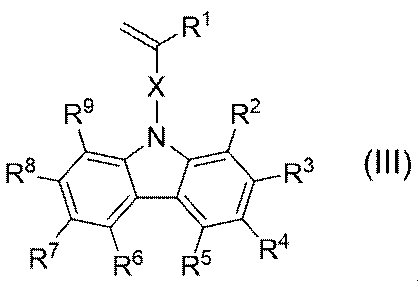
式(III)中、R1は、水素原子、メチル基、又はヒドロキシメチル基を表す。
R2~R9は、互いに独立に、水素原子、ハロゲン原子、炭素数1~20のアルキル基、又は炭素数6~20のアリール基を表し、該アルキル基に含まれる水素原子は、アルコキシ基又はアリール基で置換されていてもよい。
Xは、単結合、炭素数1以上のアルカンジイル基、又は式(V)で表される基を表す。
R2~R9は、互いに独立に、水素原子、ハロゲン原子、炭素数1~20のアルキル基、又は炭素数6~20のアリール基を表し、該アルキル基に含まれる水素原子は、アルコキシ基又はアリール基で置換されていてもよい。
Xは、単結合、炭素数1以上のアルカンジイル基、又は式(V)で表される基を表す。

式(V)中、lは、0以上の整数を表す。mは、1以上の整数を表す。式(V)で表される基は、直鎖状又は分枝鎖状であってよい。
ハロゲン原子としては、例えば、フッ素原子、塩素原子、臭素原子、ヨウ素原子が挙げられる。
炭素数1~20のアルキル基としては、例えば、メチル基、エチル基、プロピル基、ブチル基、ペンチル基、ヘキシル基、ヘプチル基、オクチル基、ノニル基、デシル基、ドデシル基、ヘキサデシル基、イコシル基等の直鎖状アルキル基;イソプロピル基、イソブチル基、sec-ブチル基、tert-ブチル基、イソペンチル基、ネオペンチル基、2-エチルヘキシル基等の分枝鎖状アルキル基;シクロプロピル基、シクロペンチル基、シクロヘキシル基、シクロヘプチル基、シクロオクチル基、トリシクロデシル基等の環状アルキル基が挙げられる。当該アルキル基の炭素数は、アルコキシ基又はアリール基を有する場合、アルコキシ基又はアリール基の炭素も含めた数である。
水素原子がアルコキシ基で置換されたアルキル基(アルコキシアルキル基)としては、例えば、メトキシメチル基、エトキシメチル基、メトキシエチル基が挙げられる。
水素原子がアリール基で置換されたアルキル基(アラルキル基)としては、例えば、ベンジル基、(2-メチルフェニル)メチル基、(3-メチルフェニル)メチル基、(4-メチルフェニル)メチル基、(2,4-ジメチルフェニル)メチル基、(エチルフェニル)メチル基、ナフチルメチル基が挙げられる。
炭素数6~20のアリール基としては、例えば、フェニル基、ナフチル基、アントラセニル基、ビフェニル基、トリフェニル基(o-テルフェニル基、m-テルフェニル基、p-テルフェニル基)が挙げられる。
炭素数1以上のアルカンジイル基としては、例えば、メタンジイル(メチレン)基、エタンジイル(エチレン)基、プロパン-1,2-ジイル基、プロパン-1,3-ジイル基、ブタン-1,4-ジイル基、ペンタン-1,5-ジイル基、ヘキサン-1,6-ジイル基が挙げられる。
式(III)で表される化合物としては、例えば、9-ビニルカルバゾール、9-アリルカルバゾール、9-(メタ)アクリロイルカルバゾール、2-(9-カルバゾリル)エチル(メタ)アクリレート、2-(9-カルバゾリル)エトキシエチル(メタ)アクリレート、2-(9-カルバゾリル)-2-メチルエチル(メタ)アクリレート、2-(9-カルバゾリル)-1-メチルエチル(メタ)アクリレートが挙げられる。これらの中でも、式(III)で表される化合物は、好ましくは、9-ビニルカルバゾール、9-アリルカルバゾール、又は2-(9-カルバゾリル)エチル(メタ)アクリレートである。
・構造単位(Ab)
構造単位(Ab)は、炭素数2~4の環状エーテル構造(例えば、オキシラン環、オキセタン環、及びテトラヒドロフラン環からなる群より選ばれる少なくとも1種)を有する不飽和化合物に由来する構造単位である。構造単位(Ab)は、炭素数2~4の環状エーテル構造を有する不飽和化合物を単量体として用いて重合することによって得ることができる。また、構造単位(Ab)は、他の構造単位(Ab’)に、置換基を有していてもよいカルバゾール環を有する化合物(Ab’’)を反応させることによっても得ることができる。
構造単位(Ab)は、炭素数2~4の環状エーテル構造(例えば、オキシラン環、オキセタン環、及びテトラヒドロフラン環からなる群より選ばれる少なくとも1種)を有する不飽和化合物に由来する構造単位である。構造単位(Ab)は、炭素数2~4の環状エーテル構造を有する不飽和化合物を単量体として用いて重合することによって得ることができる。また、構造単位(Ab)は、他の構造単位(Ab’)に、置換基を有していてもよいカルバゾール環を有する化合物(Ab’’)を反応させることによっても得ることができる。
構造単位(Ab)を与える不飽和化合物としては、例えば、オキシラニル基とエチレン性不飽和結合とを有する単量体(以下、「単量体(Ab1)」という場合がある。)、オキセタニル基とエチレン性不飽和結合とを有する単量体(以下、「単量体(Ab2)」という場合がある。)、テトラヒドロフリル基とエチレン性不飽和結合とを有する単量体(以下、「単量体(Ab3)」という場合がある。)
単量体(Ab1)は、例えば、直鎖状又は分枝鎖状の不飽和脂肪族炭化水素がエポキシ化された構造を有する単量体(以下、「単量体(Ab1-1)」という場合がある。)、不飽和脂環式炭化水素がエポキシ化された構造を有する単量体(以下、「単量体(Ab1-2)」という場合がある。)が挙げられる。構造単位(Ab)を与える単量体としては、得られる硬化膜の耐熱性、耐薬品性等の信頼性をより高くすることができる点で、好ましくは単量体(Ab1)、硬化性樹脂組成物の保存安定性に優れる点で、より好ましくは単量体(Ab1-2)である。
単量体(Ab1-1)としては、グリシジル(メタ)アクリレート、β-メチルグリシジル(メタ)アクリレート、β-エチルグリシジル(メタ)アクリレート、グリシジルビニルエーテル、o-ビニルベンジルグリシジルエーテル、m-ビニルベンジルグリシジルエーテル、p-ビニルベンジルグリシジルエーテル、α-メチル-o-ビニルベンジルグリシジルエーテル、α-メチル-m-ビニルベンジルグリシジルエーテル、α-メチル-p-ビニルベンジルグリシジルエーテル、2,3-ビス(グリシジルオキシメチル)スチレン、2,4-ビス(グリシジルオキシメチル)スチレン、2,5-ビス(グリシジルオキシメチル)スチレン、2,6-ビス(グリシジルオキシメチル)スチレン、2,3,4-トリス(グリシジルオキシメチル)スチレン、2,3,5-トリス(グリシジルオキシメチル)スチレン、2,3,6-トリス(グリシジルオキシメチル)スチレン、3,4,5-トリス(グリシジルオキシメチル)スチレン、2,4,6-トリス(グリシジルオキシメチル)スチレン等が挙げられる。
単量体(Ab1-2)としては、ビニルシクロヘキセンモノオキサイド、1,2-エポキシ-4-ビニルシクロヘキサン(例えば、セロキサイド2000((株)ダイセル製))、3,4-エポキシシクロヘキシルメチル(メタ)アクリレート(例えば、サイクロマーA400((株)ダイセル製))、3,4-エポキシシクロヘキシルメチル(メタ)アクリレート(例えば、サイクロマーM100((株)ダイセル製))、式(I)で表される化合物、式(II)で表される化合物等が挙げられる。
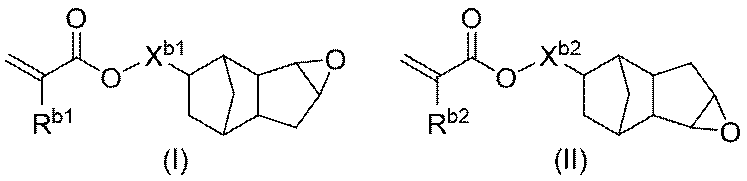
式(I)及び式(II)中、Rb1及びRb2は、水素原子又は炭素数1~4のアルキル基を表し、該アルキル基に含まれる水素原子は、ヒドロキシ基で置換されていてもよい。
Xb1及びXb2は、単結合、*-Rb3-、*-Rb3-O-、*-Rb3-S-、又は*-Rb3-NH-を表す。
Rb3は、炭素数1~6のアルカンジイル基を表す。
*は、Oとの結合手を表す。
Xb1及びXb2は、単結合、*-Rb3-、*-Rb3-O-、*-Rb3-S-、又は*-Rb3-NH-を表す。
Rb3は、炭素数1~6のアルカンジイル基を表す。
*は、Oとの結合手を表す。
炭素数1~4のアルキル基としては、メチル基、エチル基、n-プロピル基、イソプロピル基、n-ブチル基、sec-ブチル基、tert-ブチル基等が挙げられる。
水素原子がヒドロキシ基で置換されたアルキル基としては、ヒドロキシメチル基、1-ヒドロキシエチル基、2-ヒドロキシエチル基、1-ヒドロキシプロピル基、2-ヒドロキシプロピル基、3-ヒドロキシプロピル基、1-ヒドロキシ-1-メチルエチル基、2-ヒドロキシ-1-メチルエチル基、1-ヒドロキシブチル基、2-ヒドロキシブチル基、3-ヒドロキシブチル基、4-ヒドロキシブチル基等が挙げられる。
Rb1及びRb2は、好ましくは、水素原子、メチル基、ヒドロキシメチル基、1-ヒドロキシエチル基、又は2-ヒドロキシエチル基、より好ましくは水素原子又はメチル基である。
炭素数1~6のアルカンジイル基としては、メタンジイル(メチレン)基、エタンジイル(エチレン)基、プロパン-1,2-ジイル基、プロパン-1,3-ジイル基、ブタン-1,4-ジイル基、ペンタン-1,5-ジイル基、ヘキサン-1,6-ジイル基等が挙げられる。
Xb1及びXb2は、好ましくは、単結合、メチレン基、エチレン基、*-CH2-O-、又は*-CH2CH2-O-、より好ましくは、単結合又は*-CH2CH2-O-である。*はOとの結合手を表す。
式(I)で表される化合物としては、式(I-1)~式(I-15)で表される化合物等が挙げられる。式(I)で表される化合物は、好ましくは、式(I-1)、式(I-3)、式(I-5)、式(I-7)、式(I-9)、又は式(I-11)~式(I-15)で表される化合物、より好ましくは、式(I-1)、式(I-7)、式(I-9)、又は式(I-15)で表される化合物である。
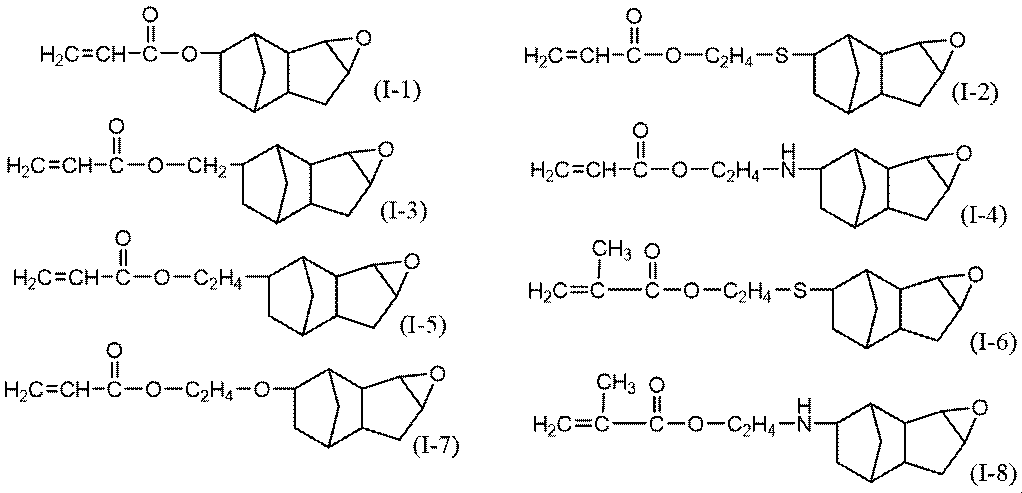

式(II)で表される化合物としては、式(II-1)~式(II-15)で表される化合物等が挙げられる。式(II)で表される化合物は、好ましくは、式(II-1)、式(II-3)、式(II-5)、式(II-7)、式(II-9)、又は式(II-11)~式(II-15)で表される化合物、より好ましくは、式(II-1)、式(II-7)、式(II-9)又は式(II-15)で表される化合物である。


式(I)で表される化合物及び式(II)で表される化合物は、それぞれ単独で用いても、2種以上を併用してもよい。これらを併用する場合、これらの含有量(式(I)で表される化合物:式(II)で表される化合物)はモル基準で、好ましくは5:95~95:5、より好ましくは20:80~80:20である。式(I-1)で表される化合物と式(II-1)で表される化合物とをモル基準で50:50で含む混合物の市販品としては、例えば、E-DCPA(商品名、(株)ダイセル製)が挙げられる。
単量体(Ab2)は、好ましくは、オキセタニル基と(メタ)アクリロイルオキシ基とを有する単量体である。単量体(Ab2)としては、3-メチル-3-メタクリルロイルオキシメチルオキセタン、3-メチル-3-アクリロイルオキシメチルオキセタン、3-エチル-3-メタクリロイルオキシメチルオキセタン、3-エチル-3-アクリロイルオキシメチルオキセタン、3-メチル-3-メタクリロイルオキシエチルオキセタン、3-メチル-3-アクリロイルオキシエチルオキセタン、3-エチル-3-メタクリロイルオキシエチルオキセタン、3-エチル-3-アクリロイルオキシエチルオキセタン等が挙げられる。
単量体(Ab3)は、好ましくは、テトラヒドロフリル基と(メタ)アクリロイルオキシ基とを有する単量体である。単量体(Ab3)としては、例えば、テトラヒドロフルフリルアクリレート(例えば、ビスコートV#150、大阪有機化学工業(株)製)、テトラヒドロフルフリルメタクリレートが挙げられる。
構造単位(Ab)としては、硬化性樹脂組成物の保存安定性、得られる硬化膜の耐薬品性、耐熱性、及び機械強度に優れる点で、好ましくは単量体(Ab1-2)に由来する構造単位、より好ましくは、式(Ab-1)及び/又は式(Ab-2)で表される構造単位である。式(Ab-1)で表される構造単位は式(I)で表される化合物に由来し、式(Ab-2)で表される構造単位は式(II)で表される化合物に由来する。
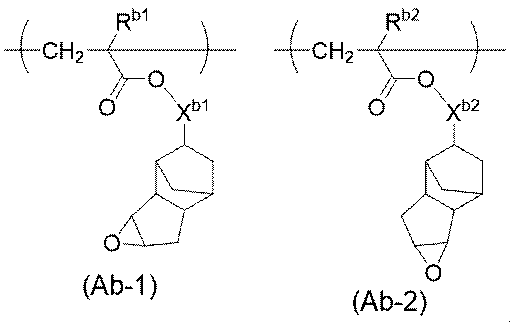
式(Ab-1)及び式(Ab-2)中、Rb1及びRb2は、水素原子又は炭素数1~4のアルキル基を表し、該アルキル基に含まれる水素原子は、ヒドロキシ基で置換されていてもよい。
Xb1及びXb2は、単結合、*-Rb3-、*-Rb3-O-、*-Rb3-S-、又は*-Rb3-NH-を表す。
Rb3は、炭素数1~6のアルカンジイル基を表す。
*は、Oとの結合手を表す。
Xb1及びXb2は、単結合、*-Rb3-、*-Rb3-O-、*-Rb3-S-、又は*-Rb3-NH-を表す。
Rb3は、炭素数1~6のアルカンジイル基を表す。
*は、Oとの結合手を表す。
・構造単位(Ac)
構造単位(Ac)としては、不飽和カルボン酸及び不飽和カルボン酸無水物からなる群より選ばれる化合物に由来する構造単位(以下、「構造単位(Ac1)」という場合がある。)が挙げられる。不飽和カルボン酸及び不飽和カルボン酸無水物からなる群より選ばれる化合物としては、例えば、
アクリル酸、メタクリル酸、クロトン酸、o-、m-、p-ビニル安息香酸等の不飽和モノカルボン酸;
マレイン酸、フマル酸、シトラコン酸、メサコン酸、イタコン酸、3-ビニルフタル酸、4-ビニルフタル酸、3,4,5,6-テトラヒドロフタル酸、1,2,3,6-テトラヒドロフタル酸、ジメチルテトラヒドロフタル酸、1,4-シクロヘキセンジカルボン酸等の不飽和ジカルボン酸;
メチル-5-ノルボルネン-2,3-ジカルボン酸、5-カルボキシビシクロ[2.2.1]ヘプト-2-エン、5,6-ジカルボキシビシクロ[2.2.1]ヘプト-2-エン、5-カルボキシ-5-メチルビシクロ[2.2.1]ヘプト-2-エン、5-カルボキシ-5-エチルビシクロ[2.2.1]ヘプト-2-エン、5-カルボキシ-6-メチルビシクロ[2.2.1]ヘプト-2-エン、5-カルボキシ-6-エチルビシクロ[2.2.1]ヘプト-2-エン等のカルボキシ基を含有するビシクロ不飽和化合物;
無水マレイン酸、シトラコン酸無水物、イタコン酸無水物、3-ビニルフタル酸無水物、4-ビニルフタル酸無水物、3,4,5,6-テトラヒドロフタル酸無水物、1,2,3,6-テトラヒドロフタル酸無水物、ジメチルテトラヒドロフタル酸無水物、5,6-ジカルボキシビシクロ[2.2.1]ヘプト-2-エン無水物等の不飽和ジカルボン酸無水物;こはく酸モノ[2-(メタ)アクリロイルオキシエチル]、フタル酸モノ[2-(メタ)アクリロイルオキシエチル]等の2価以上の多価カルボン酸の不飽和モノ[(メタ)アクリロイルオキシアルキル]エステル;
α-(ヒドロキシメチル)アクリル酸等の同一分子中にヒドロキシ基及びカルボキシ基を含有する不飽和アクリレートが挙げられる。
構造単位(Ac1)以外の構造単位(Ac)(以下、「構造単位(Ac2)」という場合がある。)としては、例えば、
メチル(メタ)アクリレート、sec-ブチル(メタ)アクリレート、tert-ブチル(メタ)アクリレート、2-エチルヘキシル(メタ)アクリレート、ステアリル(メタ)アクリレート、シクロペンチル(メタ)アクリレート、シクロヘキシル(メタ)アクリレート、2-メチルシクロヘキシル(メタ)アクリレート、トリシクロ[5.2.1.02,6]デカン-8-イル(メタ)アクリレート(当該技術分野では、慣用名として「ジシクロペンタニル(メタ)アクリレート」と呼ぶことがある。また、「トリシクロデシル(メタ)アクリレート」と呼ぶこともある。)、トリシクロ[5.2.1.02,6]デセン-8-イル(メタ)アクリレート(当該技術分野では、慣用名として「ジシクロペンテニル(メタ)アクリレート」と呼ぶことがある。)、ジシクロペンタニルオキシエチル(メタ)アクリレート、イソボルニル(メタ)アクリレート、アダマンチル(メタ)アクリレート、アリル(メタ)アクリレート、プロパルギル(メタ)アクリレート、フェニル(メタ)アクリレート、ナフチル(メタ)アクリレート、ベンジル(メタ)アクリレート等の(メタ)アクリル酸エステル;
2-ヒドロキシエチル(メタ)アクリレート、2-ヒドロキシプロピル(メタ)アクリレート等のヒドロキシ基含有(メタ)アクリル酸エステル;
マレイン酸ジエチル、フマル酸ジエチル、イタコン酸ジエチル等のジカルボン酸ジエステル;
ビシクロ[2.2.1]ヘプト-2-エン、5-メチルビシクロ[2.2.1]ヘプト-2-エン、5-エチルビシクロ[2.2.1]ヘプト-2-エン、5-ヒドロキシビシクロ[2.2.1]ヘプト-2-エン、5-ヒドロキシメチルビシクロ[2.2.1]ヘプト-2-エン、5-(2’-ヒドロキシエチル)ビシクロ[2.2.1]ヘプト-2-エン、5-メトキシビシクロ[2.2.1]ヘプト-2-エン、5-エトキシビシクロ[2.2.1]ヘプト-2-エン、5,6-ジヒドロキシビシクロ[2.2.1]ヘプト-2-エン等のビシクロ不飽和化合物;
N-フェニルマレイミド、N-シクロヘキシルマレイミド、N-ベンジルマレイミド、N-スクシンイミジル-3-マレイミドベンゾエート、N-スクシンイミジル-4-マレイミドブチレート等のジカルボニルイミド誘導体;
スチレン、α-メチルスチレン、o-ビニルトルエン、m-ビニルトルエン、p-ビニルトルエン、p-メトキシスチレン、(メタ)アクリロニトリル、塩化ビニル、塩化ビニリデン、(メタ)アクリルアミド、酢酸ビニル、1,3-ブタジエン、イソプレン及び2,3-ジメチル-1,3-ブタジエン等に由来する構造単位が挙げられる。
・各構造単位の含有量
アルカリ可溶性樹脂(A)は、例えば、以下の樹脂[K1]~[K6]が挙げられる。
樹脂[K1]:構造単位(Ac1)、構造単位(Aa)、及び構造単位(Ab)から構成される重合体;
樹脂[K2]:構造単位(Ac1)、構造単位(Aa)、構造単位(Ab)、及び構造単位(Ac2)から構成される重合体;
樹脂[K3]:構造単位(Aa)及び構造単位(Ac1)から構成される重合体;
樹脂[K4]:構造単位(Ac1)に、構造単位(Ab)を与える単量体を付加させた構造単位と、構造単位(Aa)とを含む共重合体であって、構造単位(Ab)を与える単量体が付加しない構造単位(Ac1)をさらに含む共重合体;
樹脂[K5]:構造単位(Ac1)に、構造単位(Ab)を与える単量体を付加させた構造単位と、構造単位(Aa)と、前記付加した構造単位(Ab)以外の構造単位(Ab)とを含む共重合体であって、構造単位(Ab)を与える単量体が付加しない構造単位(Ac1)をさらに含む共重合体;
樹脂[K6]:構造単位(Ab)に、構造単位(Ac1)を与える単量体を付加させ、カルボン酸無水物をさらに付加させた構造単位と、構造単位(Aa)と、構造単位(Ac2)とを含む共重合体。
アルカリ可溶性樹脂(A)は、好ましくは樹脂[K1]又は樹脂[K2]である。アルカリ可溶性樹脂(A)における構造単位(Ac1)の含有量は、アルカリ可溶性樹脂(A)を構成する全構造単位に対して、好ましくは1~50モル%、より好ましくは5~40モル%である。
樹脂[K1]において、各構造単位の含有量は、樹脂[K1]を構成する全構造単位に対して、
構造単位(Aa):5~95モル%、
構造単位(Ab):3~90モル%、
構造単位(Ac1):1~50モル%、であることが好ましく、
構造単位(Aa):30~90モル%、
構造単位(Ab):5~65モル%、
造単位(Ac1):5~40モル%、であることがより好ましい。
構造単位(Aa):5~95モル%、
構造単位(Ab):3~90モル%、
構造単位(Ac1):1~50モル%、であることが好ましく、
構造単位(Aa):30~90モル%、
構造単位(Ab):5~65モル%、
造単位(Ac1):5~40モル%、であることがより好ましい。
樹脂[K1]を構成する構造単位の含有量が上記の範囲内にあると、硬化性樹脂組成物の保存安定性、並びに、得られる硬化膜の耐薬品性、耐熱性、及び機械強度に優れる傾向がある。
樹脂[K1]は、例えば、文献「高分子合成の実験法」(大津隆行著、発行所:(株)化学同人、第1版第1刷、1972年3月1日発行)に記載された方法及び当該文献に記載された引用文献を参考にして製造することができる。
具体的には、構造単位(Aa)及び構造単位(Ab)を与える化合物、重合開始剤、溶剤等を反応容器中に入れて、例えば、窒素により酸素を置換することにより、脱酸素雰囲気とし、撹拌しながら加熱及び保温する方法が挙げられる。なお、重合開始剤、溶剤等は、特に限定されず、当該分野で通常使用されているものを使用することができる。重合開始剤としては、例えば、アゾ化合物(2,2’-アゾビスイソブチロニトリル、2,2-アゾビス(2,4-ジメチルバレロニトリル)等)、有機過酸化物(ベンゾイルペルオキシド等)が挙げられる。溶剤としては、各単量体を溶解するものであれば特に制限されず、硬化性樹脂組成物に用いられる後述の溶剤等が挙げられる。
硬化性樹脂組成物の調製において、反応により得られた樹脂溶液をそのまま使用してもよく、濃縮又は希釈した溶液を使用してもよく、さらには、再沈殿等の方法で固体(粉体)として析出したものを使用してもよい。特に、重合に用いられる溶剤として、硬化性樹脂組成物に用いられる溶剤を使用することにより、反応後の溶液を硬化性樹脂組成物の製造にそのまま使用することができるため、硬化性樹脂組成物の製造工程を簡略化することができる。
樹脂[K2]において、各構造単位の含有量は、樹脂[K2]を構成する全構造単位に対して、
構造単位(Aa):5~90モル%、
構造単位(Ab):1~70モル%、
構造単位(Ac1):1~50モル%、
構造単位(Ac2):1~40モル%、であることが好ましく、
構造単位(Aa):10~90モル%、
構造単位(Ab):3~50モル%、
構造単位(Ac1):5~35モル%、
構造単位(Ac2):1~30モル%、であることがより好ましく、
構造単位(Aa):50~90モル%、
構造単位(Ab):3~50モル%、
構造単位(Ac1):5~35モル%、
構造単位(Ac2):1~30モル%、であることがより好ましい。
構造単位(Aa):5~90モル%、
構造単位(Ab):1~70モル%、
構造単位(Ac1):1~50モル%、
構造単位(Ac2):1~40モル%、であることが好ましく、
構造単位(Aa):10~90モル%、
構造単位(Ab):3~50モル%、
構造単位(Ac1):5~35モル%、
構造単位(Ac2):1~30モル%、であることがより好ましく、
構造単位(Aa):50~90モル%、
構造単位(Ab):3~50モル%、
構造単位(Ac1):5~35モル%、
構造単位(Ac2):1~30モル%、であることがより好ましい。
樹脂[K2]の構造単位の含有量が上記の範囲内にあると、硬化性樹脂組成物の保存安定性、並びに、得られる硬化膜の耐薬品性、耐熱性、及び機械強度に優れる傾向がある。樹脂[K2]は、樹脂[K1]と同様の方法により製造することができる。
アルカリ可溶性樹脂(A)のポリスチレン換算の重量平均分子量(Mw)は、好ましくは1000~100000、より好ましくは3000~70000、さらに好ましくは5000~50000、特に好ましくは7000~30000である。アルカリ可溶性樹脂(A)の重量平均分子量(Mw)が上記の範囲内にあると、硬化性樹脂組成物の塗布性が良好となる傾向がある。
アルカリ可溶性樹脂(A)の分散度[重量平均分子量(Mw)/数平均分子量(Mn)]は、好ましくは1.1~6.0、より好ましくは1.2~4.0である。分散度が上記の範囲内にあると、得られる硬化膜は耐薬品性に優れる傾向がある。
アルカリ可溶性樹脂(A)が構造単位(Ac1)を含む場合、その酸価は、好ましくは30~180mg-KOH/g、より好ましくは40~150mg-KOH/g、さらに好ましくは50~135mg-KOH/g以下である。ここで、酸価は樹脂1gを中和するために必要な水酸化カリウムの量(mg)として測定される値であり、水酸化カリウム水溶液を用いて滴定することにより求めることができる。アルカリ可溶性樹脂(A)の酸価が上記の範囲内にあると、得られる硬化膜は基板との密着性に優れる傾向がある。
アルカリ可溶性樹脂(A)の含有量は、硬化性樹脂組成物の固形分の総量を基準として、好ましくは30~99質量%、より好ましくは35~80質量%、さらに好ましくは40~60質量%である。アルカリ可溶性樹脂(A)の含有量が上記の範囲内にあると、得られる硬化膜は、耐熱性に優れ、さらには基板との密着性及び耐薬品性に優れる傾向がある。なお、本明細書において、硬化性樹脂組成物の固形分とは、硬化性樹脂組成物から溶剤を除いた成分の合計量を意味する。硬化性樹脂組成物の固形分の総量及びこれに対する各成分の含有量は、例えば、液体クロマトグラフィー、ガスクロマトグラフィー等の公知の分析手段により測定することができる。
<ダイヤモンド粒子(B)>
硬化性樹脂組成物は、ダイヤモンド粒子(B)を含有する。硬化性樹脂組成物がダイヤモンド粒子(B)を含有することにより、長時間での現像においても、現像液に対して充分な耐性を有する硬化物を形成することが可能となる。このような効果が発現する理由は、必ずしも定かではないが、本発明者らは、ダイヤモンド粒子(B)の硬度が高く、上記のアルカリ可溶性樹脂(A)との相性もよく、現像液に対する耐性が高くなるためであると考えている。
硬化性樹脂組成物は、ダイヤモンド粒子(B)を含有する。硬化性樹脂組成物がダイヤモンド粒子(B)を含有することにより、長時間での現像においても、現像液に対して充分な耐性を有する硬化物を形成することが可能となる。このような効果が発現する理由は、必ずしも定かではないが、本発明者らは、ダイヤモンド粒子(B)の硬度が高く、上記のアルカリ可溶性樹脂(A)との相性もよく、現像液に対する耐性が高くなるためであると考えている。
ダイヤモンド粒子(B)の平均粒子径は、再凝集性の観点から、好ましくは1nm以上、より好ましくは10nm以上、さらに好ましく50nm以上、特に好ましくは80nm以上であり、沈降性の観点から、好ましくは10000nm(10μm)以下、より好ましくは5000nm(5μm)以下、さらに好ましく1000nm(1μm)以下、特に好ましくは500nm以下である。
本明細書において、ダイヤモンド粒子(B)の平均粒子径は、レーザー回折・散乱法によって求めた粒度分布における積算値50%での粒径を意味する。平均粒子径は、一次粒子及び二次粒子を含むダイヤモンド粒子(B)全体の平均粒子径である。
ダイヤモンド粒子(B)の含有量は、硬化性樹脂組成物の固形分の総量を基準として、好ましくは0.5~60質量%、より好ましくは1~50質量%、さらに好ましくは3~40質量%、特に好ましくは5~35質量%、最も好ましくは7~30質量%である。ダイヤモンド粒子(B)の含有量が、上記の範囲内にあると、本発明の効果がより充分に発現する傾向がある。
<重合性化合物(C)>
重合性化合物(C)は、熱又は重合開始剤(D)の作用により反応する化合物である。重合性化合物(C)としては、エチレン性不飽和結合を有する化合物が挙げられる。重合性化合物(C)は、好ましくは(メタ)アクリロイル基を有する化合物である。
重合性化合物(C)は、熱又は重合開始剤(D)の作用により反応する化合物である。重合性化合物(C)としては、エチレン性不飽和結合を有する化合物が挙げられる。重合性化合物(C)は、好ましくは(メタ)アクリロイル基を有する化合物である。
(メタ)アクリロイル基を1つ有する化合物としては、構造単位(Ac2)を与える単量体と同様の化合物が挙げられる。
(メタ)アクリロイル基を2つ有する化合物としては、例えば、1,3-ブタンジオールジ(メタ)アクリレート、1,3-ブタンジオール(メタ)アクリレート、1,6-ヘキサンジオールジ(メタ)アクリレート、エチレングリコールジ(メタ)アクリレート、ジエチレングリコールジ(メタ)アクリレート、ネオペンチルグリコールジ(メタ)アクリレート、トリエチレングリコールジ(メタ)アクリレート、テトラエチレングリコールジ(メタ)アクリレート、ポリエチレングリコールジアクリレート、ビスフェノールAのビス(アクリロイロキシエチル)エーテル、エチレンオキシド変性ビスフェノールAジ(メタ)アクリレート、プロピレンオキシド変性ネオペンチルグリコールジ(メタ)アクリレート、エチレンオキシド変性ネオペンチルグリコールジ(メタ)アクリレート、3-メチルペンタンジオールジ(メタ)アクリレートが挙げられる。
(メタ)アクリロイル基を3つ以上有する化合物としては、例えば、グリセリントリ(メタ)アクリレート、トリメチロールプロパントリ(メタ)アクリレート、ペンタエリスリトールポリ(メタ)アクリレート(例えば、ペンタエリスリトールトリ(メタ)アクリレート、ペンタエリスリトールテトラ(メタ)アクリレート)、ジペンタエリスリトールポリ(メタ)アクリレート(例えば、ジペンタエリスリトールペンタ(メタ)アクリレート、ジペンタエリスリトールヘキサ(メタ)アクリレート)、トリペンタエリスリトールポリ(メタ)アクリレート(例えば、トリペンタエリスリトールオクタ(メタ)アクリレート、トリペンタエリスリトールヘプタ(メタ)アクリレート)、テトラペンタエリスリトールポリ(メタ)アクリレート(例えば、テトラペンタエリスリトールデカ(メタ)アクリレート、テトラペンタエリスリトールノナ(メタ)アクリレート)、トリス(2-(メタ)アクリロイルオキシエチル)イソシアヌレート、エチレンオキサイド変性グリセリントリ(メタ)アクリレート、エチレンオキサイド変性トリメチロールプロパントリ(メタ)アクリレート、エチレンオキサイド変性ペンタエリスリトールポリ(メタ)アクリレート(例えば、エチレンオキサイド変性ペンタエリスリトールトリ(メタ)アクリレート、エチレンオキサイド変性ペンタエリスリトールテトラ(メタ)アクリレート)、エチレンオキサイド変性ジペンタエリスリトールポリ(メタ)アクリレート(例えば、エチレンオキサイド変性ジペンタエリスリトールペンタ(メタ)アクリレート、エチレンオキサイド変性ジペンタエリスリトールヘキサ(メタ)アクリレート)、プロピレンオキサイド変性グリセリントリ(メタ)アクリレート、プロピレンオキサイド変性トリメチロールプロパントリ(メタ)アクリレート、プロピレンオキサイド変性ペンタエリスリトールポリ(メタ)アクリレート(例えば、プロピレンオキサイド変性ペンタエリスリトールトリ(メタ)アクリレート、プロピレンオキサイド変性ペンタエリスリトールテトラ(メタ)アクリレート)、プロピレンオキサイド変性ジペンタエリスリトールポリ(メタ)アクリレート(例えば、プロピレンオキサイド変性ジペンタエリスリトールペンタ(メタ)アクリレート、プロピレンオキサイド変性ジペンタエリスリトールヘキサ(メタ)アクリレート)、カプロラクトン変性ペンタエリスリトールポリ(メタ)アクリレート(例えば、カプロラクトン変性ペンタエリスリトールトリ(メタ)アクリレート、カプロラクトン変性ペンタエリスリトールテトラ(メタ)アクリレート)、カプロラクトン変性ジペンタエリスリトールポリ(メタ)アクリレート(例えば、カプロラクトン変性ジペンタエリスリトールペンタ(メタ)アクリレート、カプロラクトン変性ジペンタエリスリトールヘキサ(メタ)アクリレート)が挙げられる。
(メタ)アクリロイル基を有する化合物は、好ましくは(メタ)アクリロイル基を3つ以上有する(メタ)アクリル化合物、より好ましくはエチレンオキサイド変性グリセリントリ(メタ)アクリレート、ジペンタエリスリトールペンタ(メタ)アクリレート、ジペンタエリスリトールヘキサ(メタ)アクリレート、トリメチロールプロパントリ(メタ)アクリレート、エチレングリコール変性ペンタエリスリトールテトラ(メタ)アクリレート、又はエチレングリコール変性ジペンタエリスリトールヘキサ(メタ)アクリレートである。
重合性化合物(C)の含有量は、アルカリ可溶性樹脂(A)100質量部に対して、好ましくは20~200質量部、より好ましくは30~150質量部である。重合性化合物(C)の含有量が上記の範囲内にあると、得られる硬化膜の耐薬品性及び機械強度に優れる傾向がある。
<重合開始剤(D)>
重合開始剤(D)は、光又は熱の作用により活性ラジカル、酸等を発生し、重合性化合物(C)の重合を開始し得る化合物であれば特に限定されることなく、公知の重合開始剤を用いることができる。重合開始剤(D)は、好ましくは、O-アシルオキシム化合物、アルキルフェノン化合物、トリアジン化合物、アシルホスフィンオキサイド化合物、及びビイミダゾール化合物からなる群から選ばれる少なくとも1種、より好ましくはO-アシルオキシム化合物である。これらの重合開始剤を用いると、高感度で、かつ可視光領域における透過率が高くなる傾向がある。
重合開始剤(D)は、光又は熱の作用により活性ラジカル、酸等を発生し、重合性化合物(C)の重合を開始し得る化合物であれば特に限定されることなく、公知の重合開始剤を用いることができる。重合開始剤(D)は、好ましくは、O-アシルオキシム化合物、アルキルフェノン化合物、トリアジン化合物、アシルホスフィンオキサイド化合物、及びビイミダゾール化合物からなる群から選ばれる少なくとも1種、より好ましくはO-アシルオキシム化合物である。これらの重合開始剤を用いると、高感度で、かつ可視光領域における透過率が高くなる傾向がある。
O-アシルオキシム化合物は、式(D1)で表される部分構造を有する化合物である。以下、*は結合手を表す。
O-アシルオキシム化合物としては、例えば、N-ベンゾイルオキシ-1-(4-フェニルスルファニルフェニル)ブタン-1-オン-2-イミン、N-ベンゾイルオキシ-1-(4-フェニルスルファニルフェニル)オクタン-1-オン-2-イミン、N-ベンゾイルオキシ-1-(4-フェニルスルファニルフェニル)-3-シクロペンチルプロパン-1-オン-2-イミン、N-アセトキシ-1-[9-エチル-6-(2-メチルベンゾイル)-9H-カルバゾール-3-イル]エタン-1-イミン、N-アセトキシ-1-[9-エチル-6-{2-メチル-4-(3,3-ジメチル-2,4-ジオキサシクロペンタニルメチルオキシ)ベンゾイル}-9H-カルバゾール-3-イル]エタン-1-イミン、N-アセトキシ-1-[9-エチル-6-(2-メチルベンゾイル)-9H-カルバゾール-3-イル]-3-シクロペンチルプロパン-1-イミン、N-ベンゾイルオキシ-1-[9-エチル-6-(2-メチルベンゾイル)-9H-カルバゾール-3-イル]-3-シクロペンチルプロパン-1-オン-2-イミンが挙げられる。イルガキュアOXE01、イルガキュアOXE02、イルガキュアOXE03(以上、BASF(株)製)、PBG-327(N-アセチルオキシ-1-(4-フェニルスルファニルフェニル)-3-シクロヘキシルプロパン-1-オン-2-イミン、常州強力電子新材料(株)製)、アデカアークルズN-1919、アデカアークルズNCI-831、アデカアークルズNCI-930、アデカオプトマーN-1919(以上、(株)ADEKA製)等の市販品を用いてもよい。
アルキルフェノン化合物は、式(D2-1)で表される部分構造又は式(D2-2)で表される部分構造を有する化合物である。これらの部分構造中、ベンゼン環は置換基を有していてもよい。

式(D2-1)で表される部分構造を有する化合物としては、例えば、2-メチル-2-モルホリノ-1-(4-メチルスルファニルフェニル)プロパン-1-オン、2-ジメチルアミノ-1-(4-モルホリノフェニル)-2-ベンジルブタン-1-オン、2-(ジメチルアミノ)-2-[(4-メチルフェニル)メチル]-1-[4-(4-モルホリニル)フェニル]ブタン-1-オンが挙げられる。イルガキュア(登録商標)369、907及び379(以上、BASF(株)製)等の市販品を用いてもよい。また、特表2002-544205号公報に記載されている、連鎖移動可能な基を有する重合開始剤を用いてもよい。
式(D2-2)で表される部分構造を有する化合物としては、例えば、2-ヒドロキシ-2-メチル-1-フェニルプロパン-1-オン、2-ヒドロキシ-2-メチル-1-[4-(2-ヒドロキシエトキシ)フェニル]プロパン-1-オン、1-ヒドロキシシクロヘキシルフェニルケトン、2-ヒドロキシ-2-メチル-1-(4-イソプロペニルフェニル)プロパン-1-オンのオリゴマー、α,α-ジエトキシアセトフェノン、ベンジルジメチルケタールが挙げられる。アルキルフェノン化合物は、感度の点で、好ましくは式(D2-1)で表される構造を有する化合物である。
トリアジン化合物としては、例えば、2,4-ビス(トリクロロメチル)-6-(4-メトキシフェニル)-1,3,5-トリアジン、2,4-ビス(トリクロロメチル)-6-(4-メトキシナフチル)-1,3,5-トリアジン、2,4-ビス(トリクロロメチル)-6-ピペロニル-1,3,5-トリアジン、2,4-ビス(トリクロロメチル)-6-(4-メトキシスチリル)-1,3,5-トリアジン、2,4-ビス(トリクロロメチル)-6-[2-(5-メチルフラン-2-イル)エテニル]-1,3,5-トリアジン、2,4-ビス(トリクロロメチル)-6-[2-(フラン-2-イル)エテニル]-1,3,5-トリアジン、2,4-ビス(トリクロロメチル)-6-[2-(4-ジエチルアミノ-2-メチルフェニル)エテニル]-1,3,5-トリアジン、2,4-ビス(トリクロロメチル)-6-[2-(3,4-ジメトキシフェニル)エテニル]-1,3,5-トリアジンが挙げられる。
アシルホスフィンオキサイド化合物としては、2,4,6-トリメチルベンゾイルジフェニルホスフィンオキサイド等が挙げられる。イルガキュア819(BASF・ジャパン(株)製)等の市販品を用いてもよい。
ビイミダゾール化合物としては、例えば、2,2’-ビス(2-クロロフェニル)-4,4’,5,5’-テトラフェニルビイミダゾール、2,2’-ビス(2,3-ジクロロフェニル)-4,4’,5,5’-テトラフェニルビイミダゾール(例えば、特開平6-75372号公報、特開平6-75373号公報等参照)、2,2’-ビス(2-クロロフェニル)-4,4’,5,5’-テトラ(アルコキシフェニル)ビイミダゾール、2,2’-ビス(2-クロロフェニル)-4,4’,5,5’-テトラ(ジアルコキシフェニル)ビイミダゾール、2,2’-ビス(2-クロロフェニル)-4,4’,5,5’-テトラ(トリアルコキシフェニル)ビイミダゾール(例えば、特公昭48-38403号公報、特開昭62-174204号公報等参照)、4,4’,5,5’-位のフェニル基がカルボアルコキシ基により置換されているビイミダゾール化合物(例えば、特開平7-10913号公報等参照)が挙げられる。
さらに重合開始剤(D)としては、ベンゾイン、ベンゾインメチルエーテル、ベンゾインエチルエーテル、ベンゾインイソプロピルエーテル、ベンゾインイソブチルエーテル等のベンゾイン化合物;ベンゾフェノン、o-ベンゾイル安息香酸メチル、4-フェニルベンゾフェノン、4-ベンゾイル-4’-メチルジフェニルサルファイド、3,3’,4,4’-テトラ(tert-ブチルパーオキシカルボニル)ベンゾフェノン、2,4,6-トリメチルベンゾフェノン等のベンゾフェノン化合物;9,10-フェナンスレンキノン、2-エチルアントラキノン、カンファーキノン等のキノン化合物;10-ブチル-2-クロロアクリドン、ベンジル、フェニルグリオキシル酸メチル、チタノセン化合物等が挙げられる。これらは、後述の重合開始助剤(F)(特に、アミン化合物)と組み合わせて用いることができる。
重合開始剤(D)として、酸発生剤も用いることができる。酸発生剤としては、例えば、4-ヒドロキシフェニルジメチルスルホニウムp-トルエンスルホナート、4-ヒドロキシフェニルジメチルスルホニウムヘキサフルオロアンチモネート、4-アセトキシフェニルジメチルスルホニウムp-トルエンスルホナート、4-アセトキシフェニル・メチル・ベンジルスルホニウムヘキサフルオロアンチモネート、トリフェニルスルホニウムp-トルエンスルホナート、トリフェニルスルホニウムヘキサフルオロアンチモネート、ジフェニルヨードニウムp-トルエンスルホナート、ジフェニルヨードニウムヘキサフルオロアンチモネート等のオニウム塩、ニトロベンジルトシレート、ベンゾイントシレートが挙げられる。
重合開始剤(D)の含有量は、アルカリ可溶性樹脂(A)及び重合性化合物(C)の合計含有量100質量部に対して、好ましくは0.1~30質量部、より好ましくは0.5~15質量部、さらに好ましくは1~8質量部である。重合開始剤(D)の含有量が上記の範囲内にあると、得られるパターンの可視光透過率が高い傾向がある。
<溶剤(E)>
溶剤(E)としては、特に限定されず、当該分野で通常使用される溶剤を挙げることができる。例えば、エステル溶剤(分子内に-COO-を含み、-O-を含まない溶剤)、エーテル溶剤(分子内に-O-を含み、-COO-を含まない溶剤)、エーテルエステル溶剤(分子内に-COO-と-O-とを含む溶剤)、ケトン溶剤(分子内に-CO-を含み、-COO-を含まない溶剤)、アルコール溶剤(分子内にOHを含み、-O-、-CO-及び-COO-を含まない溶剤)、芳香族炭化水素溶剤、アミド溶剤、ジメチルスルホキシドが挙げられる。
溶剤(E)としては、特に限定されず、当該分野で通常使用される溶剤を挙げることができる。例えば、エステル溶剤(分子内に-COO-を含み、-O-を含まない溶剤)、エーテル溶剤(分子内に-O-を含み、-COO-を含まない溶剤)、エーテルエステル溶剤(分子内に-COO-と-O-とを含む溶剤)、ケトン溶剤(分子内に-CO-を含み、-COO-を含まない溶剤)、アルコール溶剤(分子内にOHを含み、-O-、-CO-及び-COO-を含まない溶剤)、芳香族炭化水素溶剤、アミド溶剤、ジメチルスルホキシドが挙げられる。
エステル溶剤としては、乳酸メチル、乳酸エチル、乳酸ブチル、2-ヒドロキシイソブタン酸メチル、酢酸エチル、酢酸n-ブチル、酢酸イソブチル、ギ酸ペンチル、酢酸イソペンチル、プロピオン酸ブチル、酪酸イソプロピル、酪酸エチル、酪酸ブチル、ピルビン酸メチル、ピルビン酸エチル、ピルビン酸プロピル、アセト酢酸メチル、アセト酢酸エチル、シクロヘキサノールアセテート、γ-ブチロラクトン等が挙げられる。
エーテル溶剤としては、エチレングリコールモノメチルエーテル、エチレングリコールモノエチルエーテル、エチレングリコールモノプロピルエーテル、エチレングリコールモノブチルエーテル、ジエチレングリコールモノメチルエーテル、ジエチレングリコールモノエチルエーテル、ジエチレングリコールモノブチルエーテル、プロピレングリコールモノメチルエーテル、プロピレングリコールモノエチルエーテル、プロピレングリコールモノプロピルエーテル、プロピレングリコールモノブチルエーテル、3-メトキシ-1-ブタノール、3-メトキシ-3-メチルブタノール、テトラヒドロフラン、テトラヒドロピラン、1,4-ジオキサン、ジエチレングリコールジメチルエーテル、ジエチレングリコールジエチルエーテル、ジエチレングリコールメチルエチルエーテル、ジエチレングリコールジプロピルエーテル、ジエチレングリコールジブチルエーテル、アニソール、フェネトール、メチルアニソール等が挙げられる。
エーテルエステル溶剤としては、メトキシ酢酸メチル、メトキシ酢酸エチル、メトキシ酢酸ブチル、エトキシ酢酸メチル、エトキシ酢酸エチル、3-メトキシプロピオン酸メチル、3-メトキシプロピオン酸エチル、3-エトキシプロピオン酸メチル、3-エトキシプロピオン酸エチル、2-メトキシプロピオン酸メチル、2-メトキシプロピオン酸エチル、2-メトキシプロピオン酸プロピル、2-エトキシプロピオン酸メチル、2-エトキシプロピオン酸エチル、2-メトキシ-2-メチルプロピオン酸メチル、2-エトキシ-2-メチルプロピオン酸エチル、3-メトキシブチルアセテート、3-メチル-3-メトキシブチルアセテート、プロピレングリコールモノメチルエーテルアセテート、プロピレングリコールモノエチルエーテルアセテート、プロピレングリコールモノプロピルエーテルアセテート、エチレングリコールモノメチルエーテルアセテート、エチレングリコールモノエチルエーテルアセテート、ジエチレングリコールモノエチルエーテルアセテート、ジエチレングリコールモノブチルエーテルアセテート等が挙げられる。
ケトン溶剤としては、4-ヒドロキシ-4-メチル-2-ペンタノン、アセトン、2-ブタノン、2-ヘプタノン、3-ヘプタノン、4-ヘプタノン、4-メチル-2-ペンタノン、シクロペンタノン、シクロヘキサノン、イソホロン等が挙げられる。
アルコール溶剤としては、メタノール、エタノール、プロパノール、ブタノール、ヘキサノール、シクロヘキサノール、エチレングリコール、プロピレングリコール、グリセリン等が挙げられる。
芳香族炭化水素溶剤としては、ベンゼン、トルエン、キシレン及びメシチレンなどが挙げられる。アミド溶剤としては、N,N-ジメチルホルムアミド、N,N-ジメチルアセトアミド、N-メチルピロリドン等が挙げられる。
これらの中でも、溶剤(F)は、塗布性及び乾燥性の点から、好ましくは、1気圧(atm)における沸点が100~200℃である溶剤である。このような溶剤は、好ましくは、プロピレングリコールモノメチルエーテルアセテート、プロピレングリコールモノメチルエーテル、3-メトキシプロピオン酸メチル、3-エトキシプロピオン酸エチル、エチレングリコールエチルメチルエーテル、シクロヘキサノン、メトキシブタノール、又はメトキシブチルアセテート、より好ましくは、プロピレングリコールモノメチルエーテルアセテート、プロピレングリコールモノメチルエーテル、エチレングリコールエチルメチルエーテル、メトキシブタノール、又はメトキシブチルアセテートである。
溶剤(E)の含有量は、硬化性樹脂組成物の総量を基準として、好ましくは50~95質量%、より好ましくは60~90質量%である。言い換えると、硬化性樹脂組成物の固形分の含有量は、硬化性樹脂組成物の総量を基準として、好ましくは5~50質量%、より好ましくは10~40質量%である。
<重合開始助剤(F)>
重合開始助剤(F)は、重合開始剤(D)とともに、重合開始剤(D)によって重合が開始された重合性化合物(C)の重合を促進するために用いられる化合物、又は増感剤である。
重合開始助剤(F)は、重合開始剤(D)とともに、重合開始剤(D)によって重合が開始された重合性化合物(C)の重合を促進するために用いられる化合物、又は増感剤である。
重合開始助剤(F)としては、チアゾリン化合物、アミン化合物、アルコキシアントラセン化合物、チオキサントン化合物、カルボン酸化合物等が挙げられる。
チアゾリン化合物としては、式(F1-1)~式(F1-3)で表される化合物、特開2008-65319号公報記載の化合物等が挙げられる。
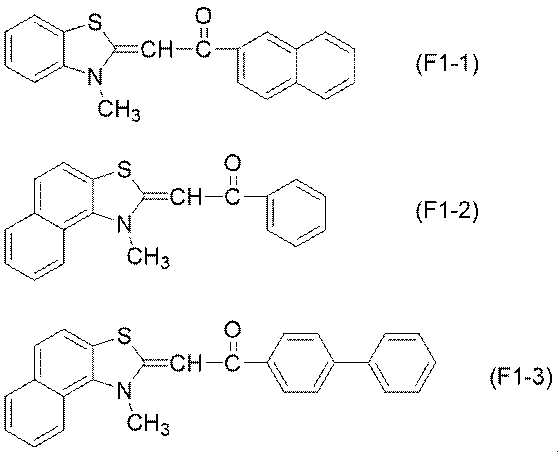
アミン化合物としては、トリエタノールアミン、メチルジエタノールアミン、トリイソプロパノールアミン、4-ジメチルアミノ安息香酸メチル、4-ジメチルアミノ安息香酸エチル、4-ジメチルアミノ安息香酸イソアミル、安息香酸2-ジメチルアミノエチル、4-ジメチルアミノ安息香酸2-エチルヘキシル、N,N-ジメチルパラトルイジン、4,4’-ビス(ジメチルアミノ)ベンゾフェノン(通称ミヒラーズケトン)、4,4’-ビス(ジエチルアミノ)ベンゾフェノン、4,4’-ビス(エチルメチルアミノ)ベンゾフェノン等が挙げられ、中でも4,4’-ビス(ジエチルアミノ)ベンゾフェノンが好ましい。EAB-F(保土谷化学工業(株)製)等の市販品を用いてもよい。
アルコキシアントラセン化合物としては、9,10-ジメトキシアントラセン、2-エチル-9,10-ジメトキシアントラセン、9,10-ジエトキシアントラセン、2-エチル-9,10-ジエトキシアントラセン、9,10-ジブトキシアントラセン、2-エチル-9,10-ジブトキシアントラセン等が挙げられる。
チオキサントン化合物としては、2-イソプロピルチオキサントン、4-イソプロピルチオキサントン、2,4-ジエチルチオキサントン、2,4-ジクロロチオキサントン、1-クロロ-4-プロポキシチオキサントン等が挙げられる。
カルボン酸化合物としては、フェニルスルファニル酢酸、メチルフェニルスルファニル酢酸、エチルフェニルスルファニル酢酸、メチルエチルフェニルスルファニル酢酸、ジメチルフェニルスルファニル酢酸、メトキシフェニルスルファニル酢酸、ジメトキシフェニルスルファニル酢酸、クロロフェニルスルファニル酢酸、ジクロロフェニルスルファニル酢酸、N-フェニルグリシン、フェノキシ酢酸、ナフチルチオ酢酸、N-ナフチルグリシン、ナフトキシ酢酸等が挙げられる。
重合開始助剤(F)の含有量は、アルカリ可溶性樹脂(A)及び重合性化合物(C)の合計含有量100質量部に対して、好ましくは0.1~30質量部、より好ましくは0.2~10質量部である。重合開始助剤(F)の量が上記の範囲内にあると、パターンの形成においてさらに高感度になる傾向がある。
<レベリング剤(G)>
レベリング剤(G)としては、シリコーン系界面活性剤、フッ素系界面活性剤、フッ素原子を有するシリコーン系界面活性剤等が挙げられる。これらは、側鎖に重合性基を有していてもよい。
レベリング剤(G)としては、シリコーン系界面活性剤、フッ素系界面活性剤、フッ素原子を有するシリコーン系界面活性剤等が挙げられる。これらは、側鎖に重合性基を有していてもよい。
シリコーン系界面活性剤としては、分子内にシロキサン結合を有する界面活性剤等が挙げられる。具体的には、トーレシリコーンDC3PA、同SH7PA、同DC11PA、同SH21PA、同SH28PA、同SH29PA、同SH30PA、同SH8400(商品名:東レ・ダウコーニング(株)製)、KP321、KP322、KP323、KP324、KP326、KP340、KP341(信越化学工業(株)製)、TSF400、TSF401、TSF410、TSF4300、TSF4440、TSF4445、TSF4446、TSF4452、TSF4460(モメンティブ・パフォーマンス・マテリアルズ・ジャパン合同会社製)等が挙げられる。
フッ素系界面活性剤としては、分子内にフルオロカーボン鎖を有する界面活性剤等が挙げられる。具体的には、フロラード(登録商標)FC430、同FC431(住友スリーエム(株)製)、メガファック(登録商標)F142D、同F171、同F172、同F173、同F177、同F183、同F554、同R30、同RS-718-K(DIC(株)製)、エフトップ(登録商標)EF301、同EF303、同EF351、同EF352(三菱マテリアル電子化成(株)製)、サーフロン(登録商標)S381、同S382、同SC101、同SC105(旭硝子(株)製)、E5844((株)ダイキンファインケミカル研究所製)等が挙げられる。
フッ素原子を有するシリコーン系界面活性剤としては、分子内にシロキサン結合及びフルオロカーボン鎖を有する界面活性剤等が挙げられる。具体的には、メガファック(登録商標)R08、同BL20、同F475、同F477、同F443(DIC(株)製)等が挙げられる。
レベリング剤(G)を含有量は、硬化性樹脂組成物の固形分の総量を基準として、好ましくは0.001~0.07質量%、より好ましくは0.002~0.1質量%、さらに好ましくは0.005~0.2質量%である。
<酸化防止剤(H)>
酸化防止剤(H)としては、フェノール系酸化防止剤、硫黄系酸化防止剤、リン系酸化防止剤、アミン系酸化防止剤が挙げられる。これらの中でも、酸化防止剤(H)は、得られる硬化膜の着色が少ないという点で、好ましくはフェノール系酸化防止剤である。
酸化防止剤(H)としては、フェノール系酸化防止剤、硫黄系酸化防止剤、リン系酸化防止剤、アミン系酸化防止剤が挙げられる。これらの中でも、酸化防止剤(H)は、得られる硬化膜の着色が少ないという点で、好ましくはフェノール系酸化防止剤である。
フェノール系酸化防止剤としては、例えば、2-tert-ブチル-6-(3-tert-ブチル-2-ヒドロキシ-5-メチルベンジル)-4-メチルフェニルアクリレート、2-[1-(2-ヒドロキシ-3,5-ジ-tert-ペンチルフェニル)エチル]-4,6-ジ-tert-ペンチルフェニルアクリレート、3,9-ビス[2-{3-(3-tert-ブチル-4-ヒドロキシ-5-メチルフェニル)プロピオニルオキシ}-1,1-ジメチルエチル]-2,4,8,10-テトラオキサスピロ[5.5]ウンデカン、2,2’-メチレンビス(6-tert-ブチル-4-メチルフェノール)、4,4’-ブチリデンビス(6-tert-ブチル-3-メチルフェノール)、4,4’-チオビス(2-tert-ブチル-5-メチルフェノール)、2,2’-チオビス(6-tert-ブチル-4-メチルフェノール)、1,3,5-トリス(3,5-ジ-tert-ブチル-4-ヒドロキシベンジル)-1,3,5-トリアジン-2,4,6(1H,3H,5H)-トリオン、3,3’,3’’,5,5’,5’’-ヘキサ-tert-ブチル-a,a’,a’’-(メシチレン-2,4,6-トリイル)トリ-p-クレゾール、ペンタエリスリトールテトラキス[3-(3,5-ジ-tert-ブチル-4-ヒドロキシフェニル)プロピオネート]、2,6-ジ-tert-ブチル-4-メチルフェノール及び6-[3-(3-tert-ブチル-4-ヒドロキシ-5-メチルフェニル)プロポキシ]-2,4,8,10-テトラ-tert-ブチルジベンズ[d,f][1,3,2]ジオキサホスフェピンが挙げられる。フェノール系酸化防止剤としては、市販品を使用してもよく、例えば、スミライザー(登録商標)BHT、GM、GS、GP(住友化学(株)製)、イルガノックス(登録商標)1010、1076、1330、3114(BASF(株)製)が挙げられる。
硫黄系酸化防止剤としては、例えば、3,3’-チオジプロピオン酸ジラウリル、3,3’-チオジプロピオン酸ジミリスチル、3,3’-チオジプロピオン酸ジステアリル、ペンタエリスリチルテトラキス(3-ラウリルチオプロピオネート)が挙げられる。硫黄系酸化防止剤としては、市販品を使用してもよい。市販されている硫黄系酸化防止剤としては、例えば、スミライザー(登録商標)TPL-R、TP-D(住友化学(株)製)が挙げられる。
リン系酸化防止剤としては、例えば、トリオクチルホスファイト、トリラウリルホスファイト、トリデシルホスファイト、トリス(ノニルフェニル)ホスファイト、ジステアリルペンタエリスリトールジホスファイト、テトラ(トリデシル)-1,1,3-トリス(2-メチル-5-tert-ブチル-4-ヒドロキシフェニル)ブタンジホスファイトが挙げられる。リン系酸化防止剤としては、市販品を使用してもよい。市販されているリン系酸化防止剤としては、例えば、イルガフォス(登録商標)168、12、38(BASF(株)製)、アデカスタブ329K、アデカスタブPEP36((株)ADEKA製)が挙げられる。
アミン系酸化防止剤としては、例えば、N,N’-ジ-sec-ブチル-p-フェニレンジアミン、N,N’-ジ-イソプロピル-p-フェニレンジアミン、N,N’-ジシクロヘキシル-p-フェニレンジアミン、N,N’-ジフェニル-p-フェニレンジアミン、N,N’-ビス(2-ナフチル)-p-フェニレンジアミンが挙げられる。アミン系酸化防止剤としては、市販品を使用してもよい。市販されているアミン系酸化防止剤としては、例えば、スミライザー(登録商標)BPA、BPA-M1、4ML(住友化学(株)製)が挙げられる。
酸化防止剤(H)の含有量は、アルカリ可溶性樹脂(A)及び重合性化合物(C)の合計含有量100質量部に対して、好ましくは0.1~5質量部、より好ましくは0.5~3質量部である。酸化防止剤(H)の含有量が上記の範囲内にあると、得られる硬化膜は耐熱性及び鉛筆硬度に優れる傾向がある。
<その他の成分>
硬化性樹脂組成物は、必要に応じて、着色剤、充填剤、その他の高分子化合物、紫外線吸収剤、連鎖移動剤、密着促進剤等、当該技術分野において公知の添加剤を含有していてもよい。
硬化性樹脂組成物は、必要に応じて、着色剤、充填剤、その他の高分子化合物、紫外線吸収剤、連鎖移動剤、密着促進剤等、当該技術分野において公知の添加剤を含有していてもよい。
着色剤としては、例えば、染料、顔料が挙げられる。
染料は、特に限定されず公知の染料を使用することができる。染料としては、例えば、溶剤染料、酸性染料、直接染料、媒染染料が挙げられる。染料としては、例えば、カラーインデックス(The Society of Dyers and Colourists出版)においてピグメント以外で色相を有するものに分類されている化合物、染色ノート((株)色染社)に記載されている公知の染料が挙げられる。また、化学構造による分類によれば、例えば、アゾ染料、シアニン染料、トリフェニルメタン染料、キサンテン染料、フタロシアニン染料、アントラキノン染料、ナフトキノン染料、キノンイミン染料、メチン染料、アゾメチン染料、スクアリリウム染料、アクリジン染料、スチリル染料、クマリン染料、キノリン染料、ニトロ染料等の染料を例示することができる。これらの中でも、染料は、好ましくは有機溶剤可溶性染料である。
顔料は、特に限定されず公知の顔料を使用することができる。顔料としては、例えば、カラーインデックス(The Society of Dyers and Colourists出版)でピグメントに分類されている顔料が挙げられる。
顔料としては、例えば、
C.I.ピグメントイエロー1、3、12、13、14、15、16、17、20、24、31、53、83、86、93、94、109、110、117、125、128、137、138、139、147、148、150、153、154、166、173、194、214等の黄色顔料;
C.I.ピグメントオレンジ13、31、36、38、40、42、43、51、55、59、61、64、65、71、73等のオレンジ色の顔料;
C.I.ピグメントレッド9、97、105、122、123、144、149、166、168、176、177、180、192、209、215、216、224、242、254、255、264、265等の赤色顔料;
C.I.ピグメントブルー15、15:3、15:4、15:6、60等の青色顔料; C.I.ピグメントバイオレット1、19、23、29、32、36、38等のバイオレット色顔料;
C.I.ピグメントグリーン7、36、58、59、62、63等の緑色顔料;
C.I.ピグメントブラウン23、25等のブラウン色顔料;
C.I.ピグメントブラック1、7等の黒色顔料;
が挙げられる。
顔料は、必要に応じて、ロジン処理;酸性基又は塩基性基が導入された顔料誘導体等を用いた表面処理;高分子化合物等による顔料表面へのグラフト処理;硫酸微粒化法等による微粒化処理;不純物を除去するための有機溶剤、水等による洗浄処理;イオン性不純物のイオン交換法等による除去処理などが施されていてもよい。
顔料は、粒径が均一であることが好ましい。顔料分散剤を含有させて分散処理を行うことで、顔料が溶液中で均一に分散した状態の顔料分散液を得ることができる。
顔料分散剤としては、例えば、カチオン系、アニオン系、ノニオン系、両性、ポリエステル系、ポリアミン系、アクリル系等の界面活性剤などが挙げられる。これらの顔料分散剤は、単独でも2種以上を組み合わせて用いてもよい。顔料分散剤としては、商品名でKP(信越化学工業(株)製)、フローレン(共栄社化学(株)製)、ソルスパース(ゼネカ(株)製)、EFKA(CIBA社製)、アジスパー(味の素ファインテクノ(株)製)、Disperbyk(ビックケミー社製)が挙げられる。
顔料分散剤を用いる場合、その使用量は、顔料の総量100質量部に対して、好ましくは1~100質量部、より好ましくは5~50質量部である。顔料分散剤の使用量が前記の範囲にあると、均一な分散状態の顔料分散液が得られ易い傾向がある。
[硬化性樹脂組成物の製造方法]
硬化性樹脂組成物は、アルカリ可溶性樹脂(A)、ダイヤモンド粒子(B)、重合性化合物(C)、及び重合開始剤(D)、並びに、必要に応じて用いられる、溶剤(E)、重合開始助剤(F)、レベリング剤(G)、酸化防止剤(H)、及びその他の成分を、公知の方法で混合することにより製造することができる。硬化性樹脂組成物は、各成分を混合した後に、孔径0.01~10μm程度のフィルタでろ過することが好ましい。
硬化性樹脂組成物は、アルカリ可溶性樹脂(A)、ダイヤモンド粒子(B)、重合性化合物(C)、及び重合開始剤(D)、並びに、必要に応じて用いられる、溶剤(E)、重合開始助剤(F)、レベリング剤(G)、酸化防止剤(H)、及びその他の成分を、公知の方法で混合することにより製造することができる。硬化性樹脂組成物は、各成分を混合した後に、孔径0.01~10μm程度のフィルタでろ過することが好ましい。
[硬化膜(パターン硬化膜)及びその製造方法]
本実施形態の硬化性樹脂組成物から硬化膜又はパターン化された硬化膜(パターン硬化膜)を製造する方法としては、フォトリソグラフ法、インクジェット法、印刷法等が挙げられる。これらの中でも、パターン硬化膜を製造する方法は、好ましくはフォトリソグラフ法である。フォトリソグラフ法は、硬化性樹脂組成物を基板に塗布し、乾燥させて塗膜を形成し、フォトマスクを介して該塗膜を露光して現像する方法である。フォトリソグラフ法において、露光の際にフォトマスクを用いないこと、及び/又は、現像しないことにより、塗膜の硬化物である硬化膜(硬化性樹脂組成物の硬化物を含む硬化膜)を形成することができる。
本実施形態の硬化性樹脂組成物から硬化膜又はパターン化された硬化膜(パターン硬化膜)を製造する方法としては、フォトリソグラフ法、インクジェット法、印刷法等が挙げられる。これらの中でも、パターン硬化膜を製造する方法は、好ましくはフォトリソグラフ法である。フォトリソグラフ法は、硬化性樹脂組成物を基板に塗布し、乾燥させて塗膜を形成し、フォトマスクを介して該塗膜を露光して現像する方法である。フォトリソグラフ法において、露光の際にフォトマスクを用いないこと、及び/又は、現像しないことにより、塗膜の硬化物である硬化膜(硬化性樹脂組成物の硬化物を含む硬化膜)を形成することができる。
硬化膜の膜厚は、特に限定されず、目的及び用途等に応じて適宜調整することができる。硬化膜の膜厚は、例えば、0.1~30μmであってよく、好ましくは0.1~20μm、より好ましくは0.5~6μmである。
基板としては、石英ガラス、ホウケイ酸ガラス、アルミナケイ酸塩ガラス、表面をシリカコートしたソーダライムガラス等のガラス板;ポリカーボネート、ポリメタクリル酸メチル、ポリエチレンテレフタレート等の樹脂板;シリコン基板;これら基板上にアルミニウム、銀、銀/銅/パラジウム合金等の薄膜を形成した基板などが挙げられる。これらの基板上には、別の硬化膜、樹脂膜、トランジスタ、回路等が形成されていてもよい。
フォトリソグラフ法による各色画素の形成は、公知又は慣用の装置、条件等で行うことができる。フォトリソグラフ法による各色画素の形成は、例えば、下記のようにして作製することができる。
まず、硬化性樹脂組成物を基板上に塗布し、加熱乾燥(プリベーク)及び/又は減圧乾燥することにより溶剤等の揮発成分を除去して乾燥させ、平滑な塗膜を得る。
塗布方法としては、スピンコート法、スリットコート法、スリット アンド スピンコート法等が挙げられる。加熱乾燥を行う場合の温度は、好ましくは30~120℃、より好ましくは50~110℃である。また、加熱時間は、好ましくは10秒~60分、より好ましくは30秒~30分である。減圧乾燥を行う場合は、50~150Paの圧力下、20~25℃の温度範囲で行うことが好ましい。
塗膜の膜厚は、特に限定されず、目的とする硬化膜の膜厚に応じて適宜選択することができる。
次に、塗膜は、目的のパターン硬化膜を形成するためのフォトマスクを介して露光される。フォトマスクによるパターンは、特に限定されず、目的とする用途に応じたパターンを用いることができる。
露光に用いられる光源は、250~450nmの波長の光を発生する光源であることが好ましい。露光に用いられる光源は、例えば、350nm未満の光を、この波長域をカットするフィルタを用いてカットするものであってもよく、436nm付近、408nm付近、365nm付近の光を、これらの波長域を取り出すバンドパスフィルタを用いて選択的に取り出すものであってもよい。露光に用いられる光源の具体例としては、水銀灯、発光ダイオード、メタルハライドランプ、ハロゲンランプ等が挙げられる。
露光においては、露光面全体に均一に平行光線を照射することができ、フォトマスクと塗膜が形成された基板との正確な位置合わせを行うことができるため、マスクアライナ、ステッパ等の露光装置を使用することが好ましい。
露光後の塗膜を現像液に接触させて現像することにより、基板上にパターン硬化膜が形成される。現像により、硬化膜の未露光部が現像液に溶解して除去され、硬化膜の露光部が残存する。現像液としては、例えば、水酸化カリウム、炭酸水素ナトリウム、炭酸ナトリウム、水酸化テトラメチルアンモニウム等のアルカリ性化合物を含む水溶液(水系現像液)が挙げられる。これらの水系現像液中のアルカリ性化合物の濃度は、好ましくは0.01~10質量%、より好ましくは0.03~5質量%である。現像液は、界面活性剤をさらに含んでいてもよい。
現像方法としては、パドル法、ディッピング法、スプレー法等が挙げられる。現像時においては、基板を任意の角度に傾けながら行ってもよい。また、現像後においては、得られたパターン硬化膜を水洗することが好ましい。
得られたパターン硬化膜においては、ポストベークを行うことが好ましい。ポストベーク温度は、好ましくは150~250℃、より好ましくは160~235℃である。ポストベーク時間は、好ましく1~120分、より好ましくは10~60分である。
[表示装置及び固体撮像素子]
本実施形態の表示装置は、硬化膜、パターン硬化膜等を含む。本実施形態の固体撮像素子は、硬化膜、パターン硬化膜等を含む。
本実施形態の表示装置は、硬化膜、パターン硬化膜等を含む。本実施形態の固体撮像素子は、硬化膜、パターン硬化膜等を含む。
表示装置としては、液晶表示装置、エレクトロルミネッセンス表示装置、プラズマディスプレイ等が挙げられる。固体撮像素子としては、CCD、CMOSセンサ等が挙げられる。
以下、実施例を挙げて本発明をより具体的に説明するが、本発明はもとより下記実施例によって制限を受けるものではなく、上記・下記の趣旨に適合し得る範囲で適当に変更を加えて実施することも勿論可能であり、それらはいずれも本発明の技術的範囲に包含される。なお、以下においては、特に断りのない限り、「部」は「質量部」を、「%」は「質量%」を意味する。また、以下の実施例において、「室温」は18~24℃を意味する。
(合成例1)
<樹脂(A-1)の合成>
還流冷却器、滴下ロート及び撹拌機を備えた1Lのフラスコ内に窒素を適量流し窒素雰囲気に置換し、プロピレングリコールモノメチルエーテルアセテート297部及びシクロペンタノン9部を入れ、撹拌しながら85℃まで加熱した。次いで、3,4-エポキシトリシクロ[5.2.1.02,6]デカン-8-イルアクリレート及び3,4-エポキシトリシクロ[5.2.1.02,6]デカン-9-イルアクリレートの混合物(含有比はモル比で1:1)28.5部、アクリル酸38.5部、9-ビニルカルバゾール233部、シクロペンタノン200部の混合溶液を5時間かけて滴下した。続いて、2,2-アゾビス(2,4-ジメチルバレロニトリル)4部をプロピレングリコールモノメチルエーテルアセテート190部に溶解した混合溶液を85℃で5時間かけて滴下した。滴下終了後、3時間同温度で保持した後、室温まで冷却して、固形分33.7質量%の重合体(樹脂(A-1))溶液を得た。B型粘度計(23℃)で粘度を測定したところ、粘度は100mPa・sであった。生成した共重合体の重量平均分子量(Mw)は15000であり、分散度は2.76であった。
得られた樹脂の重量平均分子量(Mw)及び数平均分子量(Mn)の測定は、GPC法を用いて、以下の条件で行った。
装置:HLC-8120GPC(東ソー(株)製)
カラム:TSK-GELG2000HXL
カラム温度:40℃
溶媒:THF(テトラヒドロフラン)
流速:1.0mL/min
被検液固形分濃度:0.001~0.01質量%
注入量:50μL
検出器:RI
較正用標準物質:TSK STANDARD POLYSTYRENE F-40、F-4、F-288、A-2500、A-500(東ソー(株)製)
上記で得られたポリスチレン換算の重量平均分子量及び数平均分子量の比(Mw/Mn)を分散度とした。
装置:HLC-8120GPC(東ソー(株)製)
カラム:TSK-GELG2000HXL
カラム温度:40℃
溶媒:THF(テトラヒドロフラン)
流速:1.0mL/min
被検液固形分濃度:0.001~0.01質量%
注入量:50μL
検出器:RI
較正用標準物質:TSK STANDARD POLYSTYRENE F-40、F-4、F-288、A-2500、A-500(東ソー(株)製)
上記で得られたポリスチレン換算の重量平均分子量及び数平均分子量の比(Mw/Mn)を分散度とした。
(実施例1及び比較例1)
<硬化性樹脂組成物の調製>
アルカリ可溶性樹脂(A)、ダイヤモンド粒子(B)、重合性化合物(C)、重合開始剤(D)、溶剤(E)、及びレベリング剤(G)を表1に示す割合で混合し、4.5μmのPS(ポリスルホン)フィルタを用いてろ過し、実施例1及び比較例1の硬化性樹脂組成物を得た。表1において、各成分の部数は、固形分換算の質量部を表す。
<硬化性樹脂組成物の調製>
アルカリ可溶性樹脂(A)、ダイヤモンド粒子(B)、重合性化合物(C)、重合開始剤(D)、溶剤(E)、及びレベリング剤(G)を表1に示す割合で混合し、4.5μmのPS(ポリスルホン)フィルタを用いてろ過し、実施例1及び比較例1の硬化性樹脂組成物を得た。表1において、各成分の部数は、固形分換算の質量部を表す。
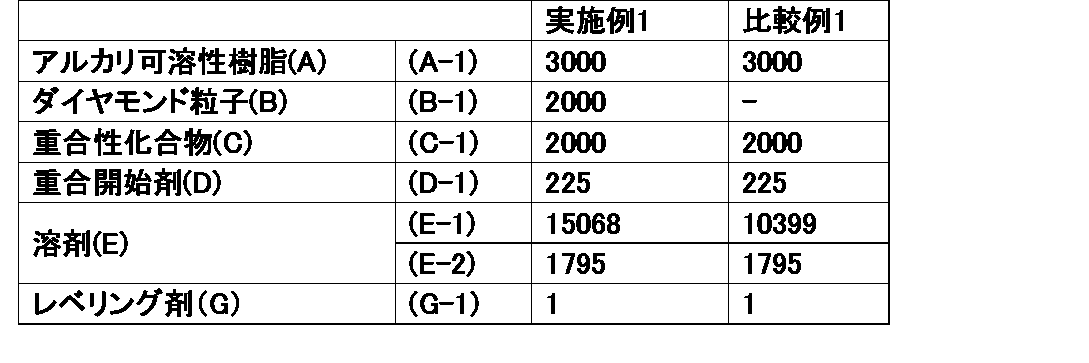
表1に示す各成分は、以下のとおりである。
アルカリ可溶性樹脂(A):(A-1)合成例1により得られた樹脂(A-1)
ダイヤモンド粒子(B):(B-1)ダイヤモンドパウダー(型番W0.5、目数20000目、平均粒子径200~300nm、株式会社ペパレス製作所製)
重合性化合物(C):(C-1)A-GLY-3E(エトキシ化(エチレンオキサイド変性)グリセリントリアクリレート、新中村化学工業(株)製)
重合開始剤(D):(D-1)アデカアークルズNCI-930(N-アセチルオキシ-1-(4-(4-(2-ヒドロキシエトキシ)フェニルスルファニル)フェニル)プロパン-1-オン-2-イミン)、(株)ADEKA製)
溶剤(E):(E-1)プロピレングリコールモノメチルエーテルアセテート
(E-2)シクロペンタノン
レベリング剤(G):(G-1)ポリエーテル変性シリコーンオイル(トーレシリコーンSH8400、東レダウコーニング(株)製)
<パターン硬化膜の作製>
2インチのガラス基板上に、各硬化性樹脂組成物をポストベーク後の膜厚が2.0μmになるようにスピンコート法で塗布した後、60℃で1分の条件でプリベークして塗膜を得た。冷却後、塗膜を形成した基板を露光機(TME-150RSK、トプコン(株)製、光源:超高圧水銀灯)を用いて、大気雰囲気下、100mJ/cm2の露光量(365nm基準)で光照射した。なお、光照射は、超高圧水銀灯からの放射光を、光学フィルタ(UV-31、旭テクノグラス(株)製)を通過させてから行った。フォトマスクとしては、ライン:スペース=100μm:100μmのフォトマスクを用いた。光照射後の塗膜を、水酸化テトラメチルアンモニウム2.38%水溶液で、23℃で150又は300秒間の浸漬条件で現像し、水洗後、ホットプレート上、85℃で10分の条件でポストベークを行うことにより、実施例1及び比較例1の各パターン硬化膜を得た。
2インチのガラス基板上に、各硬化性樹脂組成物をポストベーク後の膜厚が2.0μmになるようにスピンコート法で塗布した後、60℃で1分の条件でプリベークして塗膜を得た。冷却後、塗膜を形成した基板を露光機(TME-150RSK、トプコン(株)製、光源:超高圧水銀灯)を用いて、大気雰囲気下、100mJ/cm2の露光量(365nm基準)で光照射した。なお、光照射は、超高圧水銀灯からの放射光を、光学フィルタ(UV-31、旭テクノグラス(株)製)を通過させてから行った。フォトマスクとしては、ライン:スペース=100μm:100μmのフォトマスクを用いた。光照射後の塗膜を、水酸化テトラメチルアンモニウム2.38%水溶液で、23℃で150又は300秒間の浸漬条件で現像し、水洗後、ホットプレート上、85℃で10分の条件でポストベークを行うことにより、実施例1及び比較例1の各パターン硬化膜を得た。
<パターン耐久性の評価>
得られた各パターン硬化膜を、顕微鏡(倍率500倍、VF-7510、(株)キーエンス製)を用いて観察した。パターン硬化膜において、パターンの存在が観察された場合を「A」、パターンの存在が観察されなかった場合を「B」と評価した。結果を表2及び表3に示す。
得られた各パターン硬化膜を、顕微鏡(倍率500倍、VF-7510、(株)キーエンス製)を用いて観察した。パターン硬化膜において、パターンの存在が観察された場合を「A」、パターンの存在が観察されなかった場合を「B」と評価した。結果を表2及び表3に示す。
<膜厚の測定>
パターン耐久性の評価において、「A」評価であったパターン硬化膜について、パターンの膜厚を測定した。膜厚の測定には、接触式膜厚測定装置(DEKTAK6M、(株)アルバック製)を用いた。結果を表2及び表3に示す。
パターン耐久性の評価において、「A」評価であったパターン硬化膜について、パターンの膜厚を測定した。膜厚の測定には、接触式膜厚測定装置(DEKTAK6M、(株)アルバック製)を用いた。結果を表2及び表3に示す。


表2及び表3に示すとおり、比較例1の硬化性樹脂組成物を用いて形成されたパターン硬化膜は、長時間の現像においてパターンの剥離が発生したのに対して、実施例1の硬化性樹脂組成物を用いて形成されたパターン硬化膜は、長時間の現像においてもパターンの剥離が発生しなかった。また、浸漬条件150秒における実施例1と比較例1との対比から、実施例1の硬化性樹脂組成物を用いて形成されたパターン硬化膜は、比較例1の硬化性樹脂組成物を用いて形成されたパターン硬化膜に比べて、膜厚の減少が抑制されることが判明した。
また、ダイヤモンド粒子(B)の代わりに、シリカ粒子又はジルコニア粒子を用いた以外は実施例1と同様にして、硬化性樹脂組成物を得た。得られた硬化性樹脂組成物を用いて、上記のパターン硬化膜の作製及びパターン耐久性の評価を検討したところ、150秒間の浸漬条件での現像により、いずれもパターンの剥離が発生することを確認した。
これらの結果から、本発明の硬化性樹脂組成物が、長時間での現像においても、現像液に対して充分な耐性を有する硬化物を形成することが可能であることが確認された。
Claims (4)
- アルカリ可溶性樹脂(A)、ダイヤモンド粒子(B)、重合性化合物(C)、及び重合開始剤(D)を含有し、
前記アルカリ可溶性樹脂(A)が、カルバゾール環を有する構造単位を含む重合体である、
硬化性樹脂組成物。 - 請求項1に記載の硬化性樹脂組成物の硬化物を含む、硬化膜。
- 請求項2に記載の硬化膜を含む、表示装置。
- 請求項2に記載の硬化膜を含む、固体撮像素子。
Applications Claiming Priority (2)
| Application Number | Priority Date | Filing Date | Title |
|---|---|---|---|
| JP2023093177 | 2023-06-06 | ||
| JP2023-093177 | 2023-06-06 |
Publications (1)
| Publication Number | Publication Date |
|---|---|
| WO2024252985A1 true WO2024252985A1 (ja) | 2024-12-12 |
Family
ID=93795988
Family Applications (1)
| Application Number | Title | Priority Date | Filing Date |
|---|---|---|---|
| PCT/JP2024/019539 Ceased WO2024252985A1 (ja) | 2023-06-06 | 2024-05-28 | 硬化性樹脂組成物、硬化膜、表示装置、及び固体撮像素子 |
Country Status (3)
| Country | Link |
|---|---|
| JP (1) | JP2024175665A (ja) |
| TW (1) | TW202448977A (ja) |
| WO (1) | WO2024252985A1 (ja) |
Citations (6)
| Publication number | Priority date | Publication date | Assignee | Title |
|---|---|---|---|---|
| JP2005234019A (ja) * | 2004-02-17 | 2005-09-02 | Kri Inc | 感光性樹脂組成物及びパターン形成方法 |
| US20120304545A1 (en) * | 2010-02-12 | 2012-12-06 | Neoenbiz | Nano-diamond dispersion solution and method for preparing same |
| WO2018186382A1 (ja) * | 2017-04-07 | 2018-10-11 | 株式会社ダイセル | 表面修飾ナノダイヤモンド、表面修飾ナノダイヤモンド分散液、及び樹脂分散体 |
| WO2021145283A1 (ja) * | 2020-01-17 | 2021-07-22 | 住友化学株式会社 | 着色硬化性組成物 |
| JP2022022578A (ja) * | 2020-06-29 | 2022-02-07 | 東レ株式会社 | 樹脂組成物、硬化膜、硬化膜の製造方法、半導体装置および有機el表示装置 |
| WO2022210268A1 (ja) * | 2021-03-30 | 2022-10-06 | 住友化学株式会社 | 樹脂組成物、膜及び共重合体 |
-
2024
- 2024-05-28 WO PCT/JP2024/019539 patent/WO2024252985A1/ja not_active Ceased
- 2024-05-29 JP JP2024086910A patent/JP2024175665A/ja active Pending
- 2024-05-30 TW TW113120090A patent/TW202448977A/zh unknown
Patent Citations (6)
| Publication number | Priority date | Publication date | Assignee | Title |
|---|---|---|---|---|
| JP2005234019A (ja) * | 2004-02-17 | 2005-09-02 | Kri Inc | 感光性樹脂組成物及びパターン形成方法 |
| US20120304545A1 (en) * | 2010-02-12 | 2012-12-06 | Neoenbiz | Nano-diamond dispersion solution and method for preparing same |
| WO2018186382A1 (ja) * | 2017-04-07 | 2018-10-11 | 株式会社ダイセル | 表面修飾ナノダイヤモンド、表面修飾ナノダイヤモンド分散液、及び樹脂分散体 |
| WO2021145283A1 (ja) * | 2020-01-17 | 2021-07-22 | 住友化学株式会社 | 着色硬化性組成物 |
| JP2022022578A (ja) * | 2020-06-29 | 2022-02-07 | 東レ株式会社 | 樹脂組成物、硬化膜、硬化膜の製造方法、半導体装置および有機el表示装置 |
| WO2022210268A1 (ja) * | 2021-03-30 | 2022-10-06 | 住友化学株式会社 | 樹脂組成物、膜及び共重合体 |
Also Published As
| Publication number | Publication date |
|---|---|
| JP2024175665A (ja) | 2024-12-18 |
| TW202448977A (zh) | 2024-12-16 |
Similar Documents
| Publication | Publication Date | Title |
|---|---|---|
| JP6713517B2 (ja) | 赤色着色硬化性樹脂組成物 | |
| CN102914942B (zh) | 着色固化性树脂组合物 | |
| JP2012181505A (ja) | 着色感光性樹脂組成物 | |
| JP5919830B2 (ja) | 着色感光性樹脂組成物 | |
| JP6019597B2 (ja) | 着色感光性樹脂組成物 | |
| CN103365080A (zh) | 着色感光性树脂组合物 | |
| JP6091831B2 (ja) | 着色感光性樹脂組成物 | |
| WO2021145283A1 (ja) | 着色硬化性組成物 | |
| CN107272340A (zh) | 着色固化性树脂组合物 | |
| CN103048882A (zh) | 着色固化性树脂组合物 | |
| CN104298072A (zh) | 着色固化性树脂组合物 | |
| JP6019596B2 (ja) | 着色感光性樹脂組成物 | |
| TWI613518B (zh) | 著色感光性樹脂組成物 | |
| JP6135063B2 (ja) | 硬化性樹脂組成物 | |
| CN103309155A (zh) | 着色固化性树脂组合物 | |
| JP2022154724A (ja) | 赤色着色組成物 | |
| JP7020791B2 (ja) | カラーフィルタ及び表示装置 | |
| JP5978583B2 (ja) | 着色感光性樹脂組成物 | |
| CN108459467B (zh) | 红色着色组合物 | |
| JP6047885B2 (ja) | 着色感光性樹脂組成物 | |
| CN109212899B (zh) | 着色固化性树脂组合物、滤色器及显示装置 | |
| JP2022052723A (ja) | 着色硬化性樹脂組成物、カラーフィルタ、及び表示装置 | |
| WO2021039491A1 (ja) | 着色樹脂組成物 | |
| JP2024175665A (ja) | 硬化性樹脂組成物、硬化膜、表示装置、及び固体撮像素子 | |
| JP7594962B2 (ja) | 赤色着色組成物 |
Legal Events
| Date | Code | Title | Description |
|---|---|---|---|
| 121 | Ep: the epo has been informed by wipo that ep was designated in this application |
Ref document number: 24819216 Country of ref document: EP Kind code of ref document: A1 |
|
| NENP | Non-entry into the national phase |
Ref country code: DE |
|
| 122 | Ep: pct application non-entry in european phase |
Ref document number: 24819216 Country of ref document: EP Kind code of ref document: A1 |