WO2024252894A1 - 血液検査方法 - Google Patents
血液検査方法 Download PDFInfo
- Publication number
- WO2024252894A1 WO2024252894A1 PCT/JP2024/018266 JP2024018266W WO2024252894A1 WO 2024252894 A1 WO2024252894 A1 WO 2024252894A1 JP 2024018266 W JP2024018266 W JP 2024018266W WO 2024252894 A1 WO2024252894 A1 WO 2024252894A1
- Authority
- WO
- WIPO (PCT)
- Prior art keywords
- immunosuppressant
- blood
- analysis
- whole blood
- mass spectrometer
- Prior art date
- Legal status (The legal status is an assumption and is not a legal conclusion. Google has not performed a legal analysis and makes no representation as to the accuracy of the status listed.)
- Ceased
Links
Classifications
-
- G—PHYSICS
- G01—MEASURING; TESTING
- G01N—INVESTIGATING OR ANALYSING MATERIALS BY DETERMINING THEIR CHEMICAL OR PHYSICAL PROPERTIES
- G01N33/00—Investigating or analysing materials by specific methods not covered by groups G01N1/00 - G01N31/00
- G01N33/48—Biological material, e.g. blood, urine; Haemocytometers
- G01N33/50—Chemical analysis of biological material, e.g. blood, urine; Testing involving biospecific ligand binding methods; Immunological testing
- G01N33/94—Chemical analysis of biological material, e.g. blood, urine; Testing involving biospecific ligand binding methods; Immunological testing involving narcotics or drugs or pharmaceuticals, neurotransmitters or associated receptors
- G01N33/9493—Immunosupressants
-
- G—PHYSICS
- G01—MEASURING; TESTING
- G01N—INVESTIGATING OR ANALYSING MATERIALS BY DETERMINING THEIR CHEMICAL OR PHYSICAL PROPERTIES
- G01N30/00—Investigating or analysing materials by separation into components using adsorption, absorption or similar phenomena or using ion-exchange, e.g. chromatography or field flow fractionation
- G01N30/02—Column chromatography
- G01N30/04—Preparation or injection of sample to be analysed
- G01N30/06—Preparation
-
- G—PHYSICS
- G01—MEASURING; TESTING
- G01N—INVESTIGATING OR ANALYSING MATERIALS BY DETERMINING THEIR CHEMICAL OR PHYSICAL PROPERTIES
- G01N30/00—Investigating or analysing materials by separation into components using adsorption, absorption or similar phenomena or using ion-exchange, e.g. chromatography or field flow fractionation
- G01N30/02—Column chromatography
- G01N30/62—Detectors specially adapted therefor
- G01N30/72—Mass spectrometers
- G01N30/7233—Mass spectrometers interfaced to liquid or supercritical fluid chromatograph
-
- G—PHYSICS
- G01—MEASURING; TESTING
- G01N—INVESTIGATING OR ANALYSING MATERIALS BY DETERMINING THEIR CHEMICAL OR PHYSICAL PROPERTIES
- G01N30/00—Investigating or analysing materials by separation into components using adsorption, absorption or similar phenomena or using ion-exchange, e.g. chromatography or field flow fractionation
- G01N30/02—Column chromatography
- G01N30/88—Integrated analysis systems specially adapted therefor, not covered by a single one of the groups G01N30/04 - G01N30/86
-
- G—PHYSICS
- G01—MEASURING; TESTING
- G01N—INVESTIGATING OR ANALYSING MATERIALS BY DETERMINING THEIR CHEMICAL OR PHYSICAL PROPERTIES
- G01N30/00—Investigating or analysing materials by separation into components using adsorption, absorption or similar phenomena or using ion-exchange, e.g. chromatography or field flow fractionation
- G01N30/02—Column chromatography
- G01N2030/022—Column chromatography characterised by the kind of separation mechanism
- G01N2030/027—Liquid chromatography
-
- G—PHYSICS
- G01—MEASURING; TESTING
- G01N—INVESTIGATING OR ANALYSING MATERIALS BY DETERMINING THEIR CHEMICAL OR PHYSICAL PROPERTIES
- G01N30/00—Investigating or analysing materials by separation into components using adsorption, absorption or similar phenomena or using ion-exchange, e.g. chromatography or field flow fractionation
- G01N30/02—Column chromatography
- G01N30/88—Integrated analysis systems specially adapted therefor, not covered by a single one of the groups G01N30/04 - G01N30/86
- G01N2030/8809—Integrated analysis systems specially adapted therefor, not covered by a single one of the groups G01N30/04 - G01N30/86 analysis specially adapted for the sample
- G01N2030/8813—Integrated analysis systems specially adapted therefor, not covered by a single one of the groups G01N30/04 - G01N30/86 analysis specially adapted for the sample biological materials
- G01N2030/8822—Integrated analysis systems specially adapted therefor, not covered by a single one of the groups G01N30/04 - G01N30/86 analysis specially adapted for the sample biological materials involving blood
Definitions
- the present invention relates to a blood testing method.
- TDM drug blood concentrations
- immunological techniques such as fluorescence polarization immunoassay, enzyme immunoassay or radioimmunoassay, and atomic absorption spectrometry.
- Patent Document 1 discloses a method for monitoring drug concentrations in blood, which includes adding a deproteinized blood sample to a conditioned solid-phase extraction column, washing the solid-phase extraction column after the blood sample passes through the solid-phase extraction column, eluting the adsorbed substances from the solid-phase extraction column with an elution solution, and analyzing the resulting eluate by LC-MS/MS.
- the blood sample prepared to monitor blood drug concentrations may be whole blood or plasma, depending on the drug being monitored.
- whole blood is used as the blood sample.
- mycophenolic acid and its metabolites e.g., mycophenolic acid ⁇ -D-glucuronide
- plasma is used as the blood sample. Therefore, when there are two or more types of drugs to be monitored and whole blood and plasma need to be prepared separately, the amount of blood drawn increases, placing a heavy burden on the patient.
- the present invention was made in consideration of the above circumstances, and aims to provide a blood testing method that can quantify two or more types of immunosuppressants using the same blood sample.
- the first aspect of the present invention is a method for producing a cellular membrane comprising the steps of: A preparation step of preparing whole blood collected from a subject; a pretreatment step of pretreating the whole blood to prepare an analysis sample; a separation step of separating the analytical sample into components by liquid chromatography; and an analyzing step of analyzing the separated components by a mass spectrometer,
- the subject is a subject receiving a first immunosuppressant and a second immunosuppressant;
- the first immunosuppressant comprises at least one selected from the group consisting of tacrolimus, cyclosporine A, everolimus, and sirolimus;
- the second immunosuppressant comprises at least one selected from the group consisting of mycophenolic acid and metabolites thereof;
- the separated component comprises the first immunosuppressant and the second immunosuppressant;
- the first immunosuppressant is analyzed as the target component in a positive mode, and when analyzing the second immunosuppressant as the target component in
- this embodiment is not limited to this.
- the notation in the form "A to Z” means the upper and lower limits of a range (i.e., A or more and Z or less).
- a or more and Z or less the upper and lower limits of a range
- the first aspect of the present invention is a method for producing a cellular membrane comprising the steps of: A preparation step of preparing whole blood collected from a subject; a pretreatment step of pretreating the whole blood to prepare an analysis sample; a separation step of separating the analytical sample into components by liquid chromatography; and an analyzing step of analyzing the separated components by a mass spectrometer,
- the subject is a subject receiving a first immunosuppressant and a second immunosuppressant;
- the first immunosuppressant comprises at least one selected from the group consisting of tacrolimus, cyclosporine A, everolimus, and sirolimus;
- the second immunosuppressant comprises at least one selected from the group consisting of mycophenolic acid and metabolites thereof;
- the separated component comprises the first immunosuppressant and the second immunosuppressant;
- the first immunosuppressant is analyzed as the target component in a positive mode, and when analyzing the second
- ⁇ Preparation process> whole blood collected from a subject is prepared.
- the subject is a subject to which a first immunosuppressant and a second immunosuppressant have been administered.
- the term "subject" refers to a human being from whom the whole blood to be subjected to the blood test method of this embodiment is derived, and there are no particular limitations on age, sex, or race.
- the subject may be a healthy individual or a patient suffering from some disease.
- the subject is preferably a patient undergoing transplantation therapy of an organ or hematopoietic stem cells.
- whole blood refers to blood as collected from the subject, or a blood sample to which an anticoagulant has been added.
- the whole blood contains blood cell components, platelets, and plasma components.
- There are no particular limitations on the method for collecting whole blood and it may be collected from the subject by a known method.
- the first immunosuppressant includes at least one selected from the group consisting of tacrolimus (generic name: tacrolimus hydrate), cyclosporine A, everolimus, and sirolimus.
- the second immunosuppressant includes at least one selected from the group consisting of mycophenolic acid (MPA) and its metabolites (e.g., mycophenolic acid ⁇ -D-glucuronide (MPAG)).
- MPA mycophenolic acid
- MPAG mycophenolic acid ⁇ -D-glucuronide
- ⁇ Pretreatment process> the whole blood is pretreated to prepare a sample for analysis.
- the pretreatment method applied to the whole blood can be used without particular limitations as long as the analytical sample obtained by the pretreatment can be separated into its components by liquid chromatography, which will be described later.
- the "analytical sample” is a sample derived from the whole blood, and can also be understood as a sample that is subjected to the separation process, which will be described later.
- the pretreatment include a protein removal operation (sometimes referred to as a "deproteinization operation"), extraction by solid-phase extraction, etc.
- a predetermined amount of an internal standard substance may be added to the whole blood before the pretreatment is performed.
- an internal standard substance for example, a known internal standard substance may be used.
- ⁇ Separation step> the analytical sample is separated into components by a liquid chromatograph.
- a liquid chromatograph (LC) separates the components in the analytical sample and elutes them at different retention times by utilizing the difference in affinity of each component to the mobile phase and the stationary phase.
- the type of liquid chromatograph is not limited as long as it can separate the components to be analyzed with a desired accuracy so that the components can be separated and detected by a mass spectrometer.
- Examples of liquid chromatographs that can be used include nano LC, micro LC, high performance liquid chromatograph (HPLC), and ultra high performance liquid chromatograph (UHPLC).
- the mobile phase is not particularly limited, but examples include an aqueous solution of ammonium formate as mobile phase A, a liquid containing acetonitrile and isopropanol in a predetermined ratio such as a volume ratio of 1:1 as mobile phase B, and the mobile phases described in the examples below.
- the stationary phase is not particularly limited, but examples include silanes bonded to linear hydrocarbons such as C8 or C18 supported on a carrier such as silica gel, and the stationary phases described in the examples below.
- the separated components are analyzed by a mass spectrometer.
- the separated components include the first immunosuppressant and the second immunosuppressant.
- the first immunosuppressant when analyzing with a mass spectrometer, is analyzed as the target component in positive mode, and the second immunosuppressant is analyzed as the target component in negative mode.
- the ionization mode when the elution time of the target component is known in advance in separation by liquid chromatography, can be set to positive mode or negative mode based on the elution time.
- first immunosuppressant which are types of immunosuppressants
- second immunosuppressant which are another type of immunosuppressant
- plasma has been used as a blood sample. Therefore, when whole blood and plasma need to be prepared separately to monitor the first immunosuppressant and the second immunosuppressant, the amount of blood collected increases, which places a heavy burden on the patient.
- the detection concentration range of the first immunosuppressant and the detection concentration range of the second immunosuppressant are significantly different, which is also a reason for the increase in the amount of blood collected.
- the blood concentration of the second immunosuppressant is higher than that of the first immunosuppressant. Therefore, for example, if the sensitivity is optimized to detect the first immunosuppressant, saturation occurs when detecting the second immunosuppressant, making it difficult to simultaneously analyze both components.
- the inventors have found that it is possible to quantify two or more types of immunosuppressants (a first immunosuppressant and a second immunosuppressant) in the same blood sample by using whole blood as a blood sample and changing the ionization mode in mass spectrometry depending on the components to be analyzed.
- a method for reducing the sensitivity of mass spectrometry the use of negative mode or changing the gas flow rate or voltage has been conventionally used.
- the use of negative mode when analyzing the second immunosuppressant has not been used until now to enable simultaneous analysis of the first immunosuppressant and the second immunosuppressant from the same blood sample, i.e., to align the dynamic range.
- the method of ionization using a mass spectrometer is not particularly limited, and the electrospray (ESI) method, nano-electrospray ionization (nano-LSI) method, etc. can be used.
- the ionization method is preferably the ESI method.
- the mass spectrometer may be, for example, a Fourier transform mass spectrometer, a time-of-flight (Q-TOF) mass spectrometer, a triple quadrupole mass spectrometer, etc.
- the mass spectrometer is a triple quadrupole mass spectrometer.
- the separation step and the analysis step may be performed consecutively.
- the separation step and the analysis step may be performed consecutively by using a liquid chromatograph tandem mass spectrometer.
- the liquid chromatograph tandem mass spectrometer is typically a liquid chromatograph triple quadrupole mass spectrometer or a liquid chromatograph quadrupole/time-of-flight (Q-TOF) mass spectrometer.
- Q-TOF time-of-flight
- the analysis step further includes quantifying the separated components.
- the method for quantifying the separated components there is no particular limitation on the method for quantifying the separated components, and any known method can be used. Examples of such methods include the absolute calibration curve method and the internal standard method.
- the analysis step further includes quantifying the separated components based on a calibration curve prepared in advance.
- the "calibrator stock solution” is a liquid sample in which tacrolimus, cyclosporine A, everolimus, and sirolimus are dissolved in the concentrations shown in Table 1 in a matrix of whole blood.
- the whole blood calibration solutions L2 to L6 were prepared by carrying out the same procedure as above, except that 3 ⁇ l of the calibrator stock solutions L2 to L6 were added to the microtubes L2 to L6, respectively.
- Table 1 shows the concentrations of each component contained in the calibrator stock solutions L1 to L6.
- Ionization method ESI-Negative MRM mode (0-1.25 min MPA, MPAG) ESI-Positive MRM mode (1.25-3.00 min everolimus, sirolimus, tacrolimus, cyclosporine A) Nebulizer gas flow rate: 3 L/min Heating gas flow rate: 10 L/min Interface temperature: 200°C Drying gas flow rate: 10 L/min DL temperature: 150°C Heat block temperature: 200°C CID gas pressure: 230 kPa Probe position: +3 mm
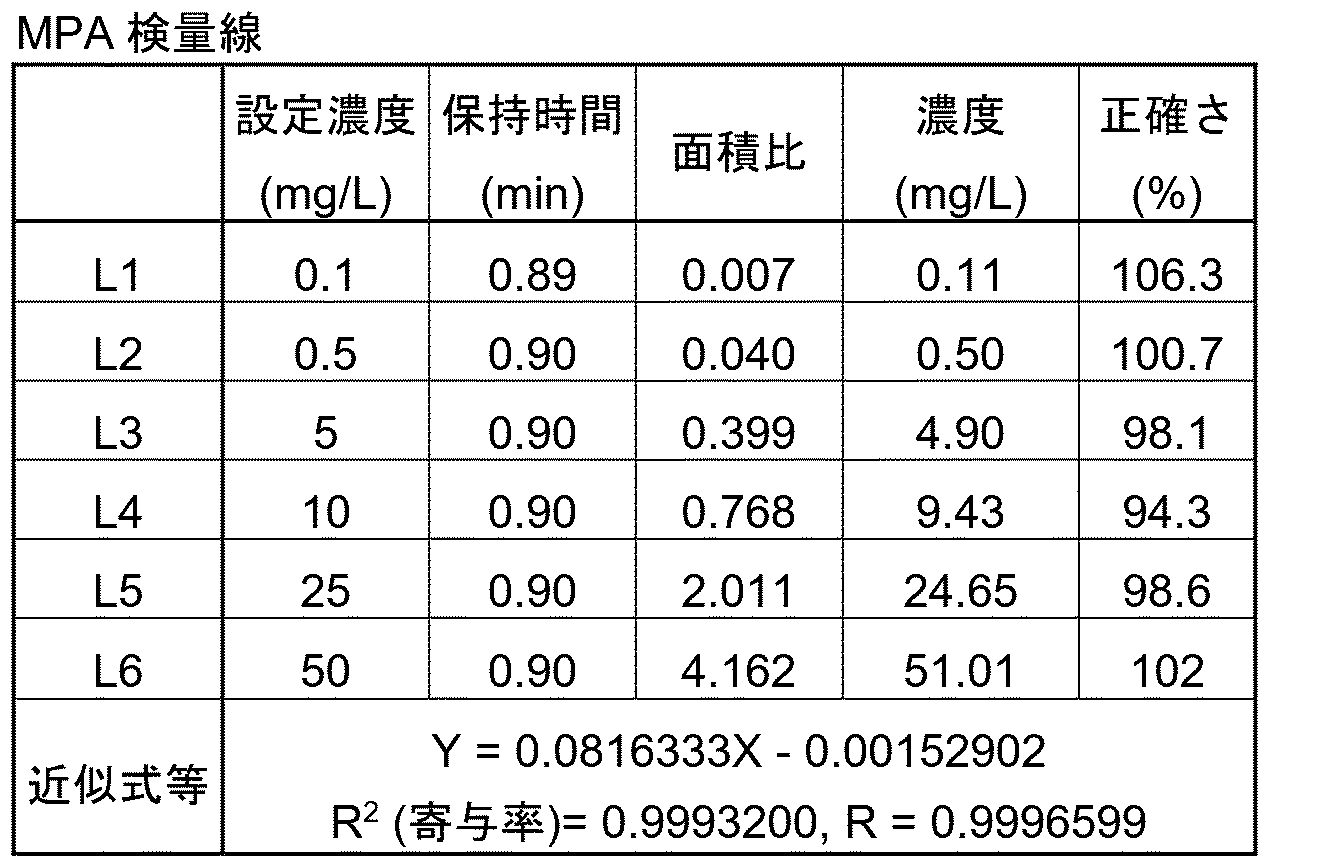
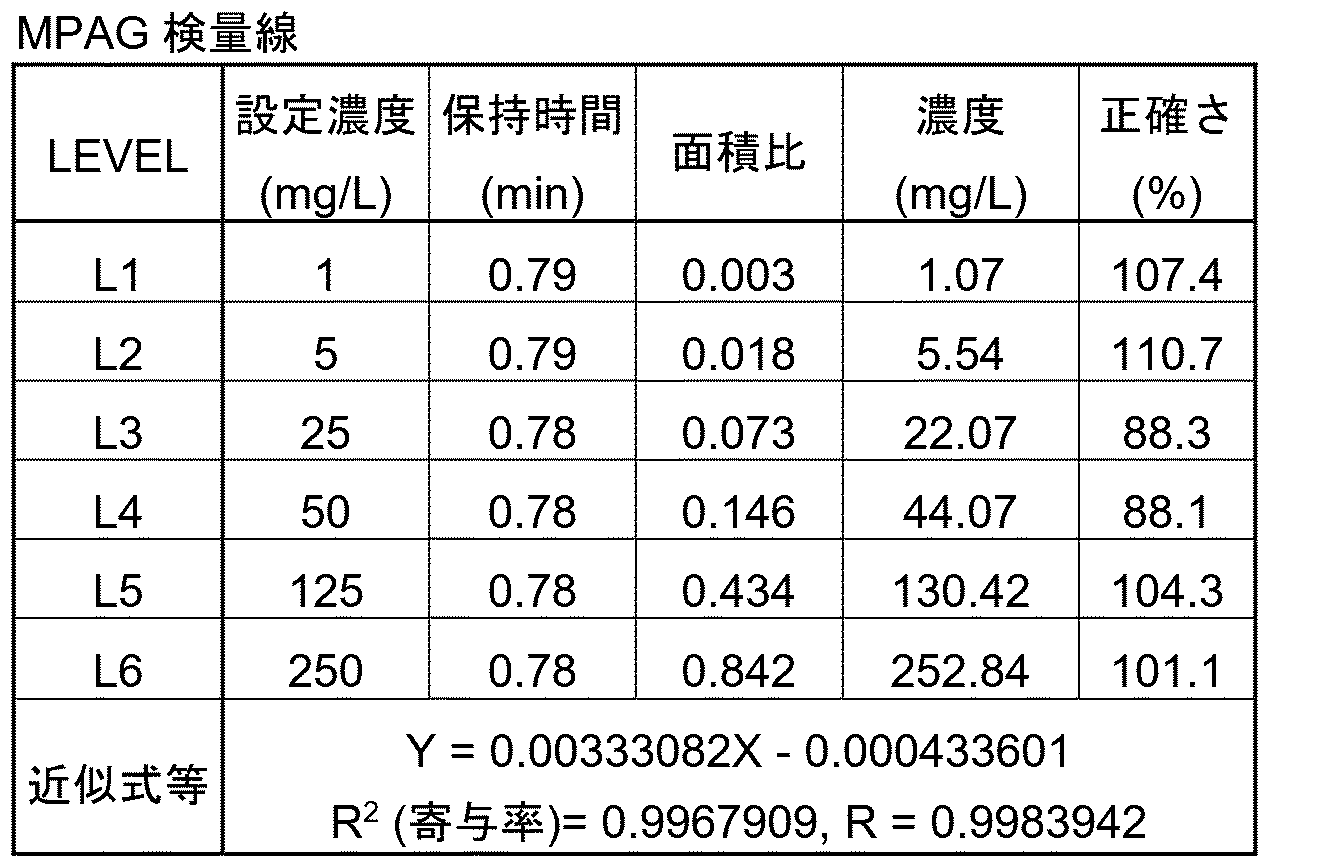
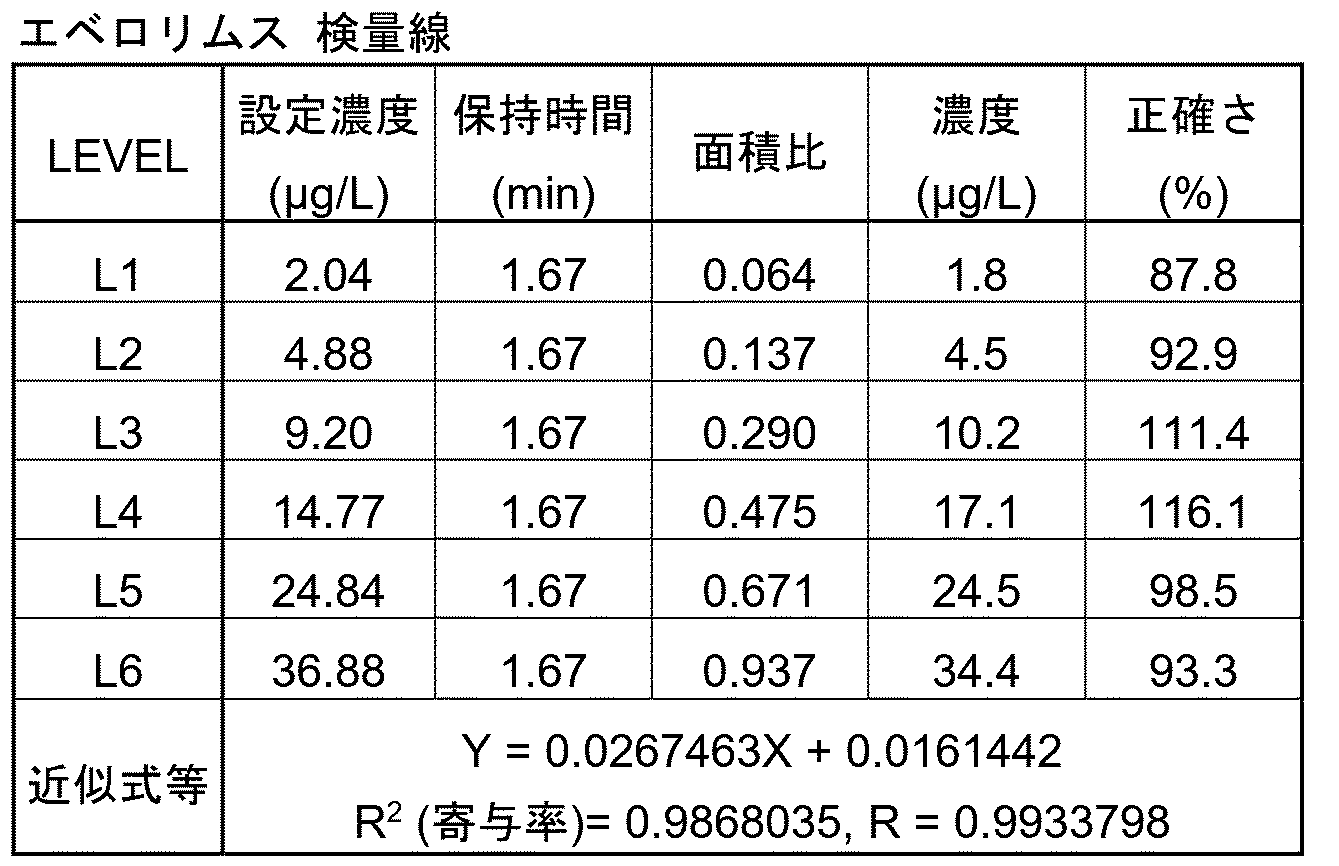
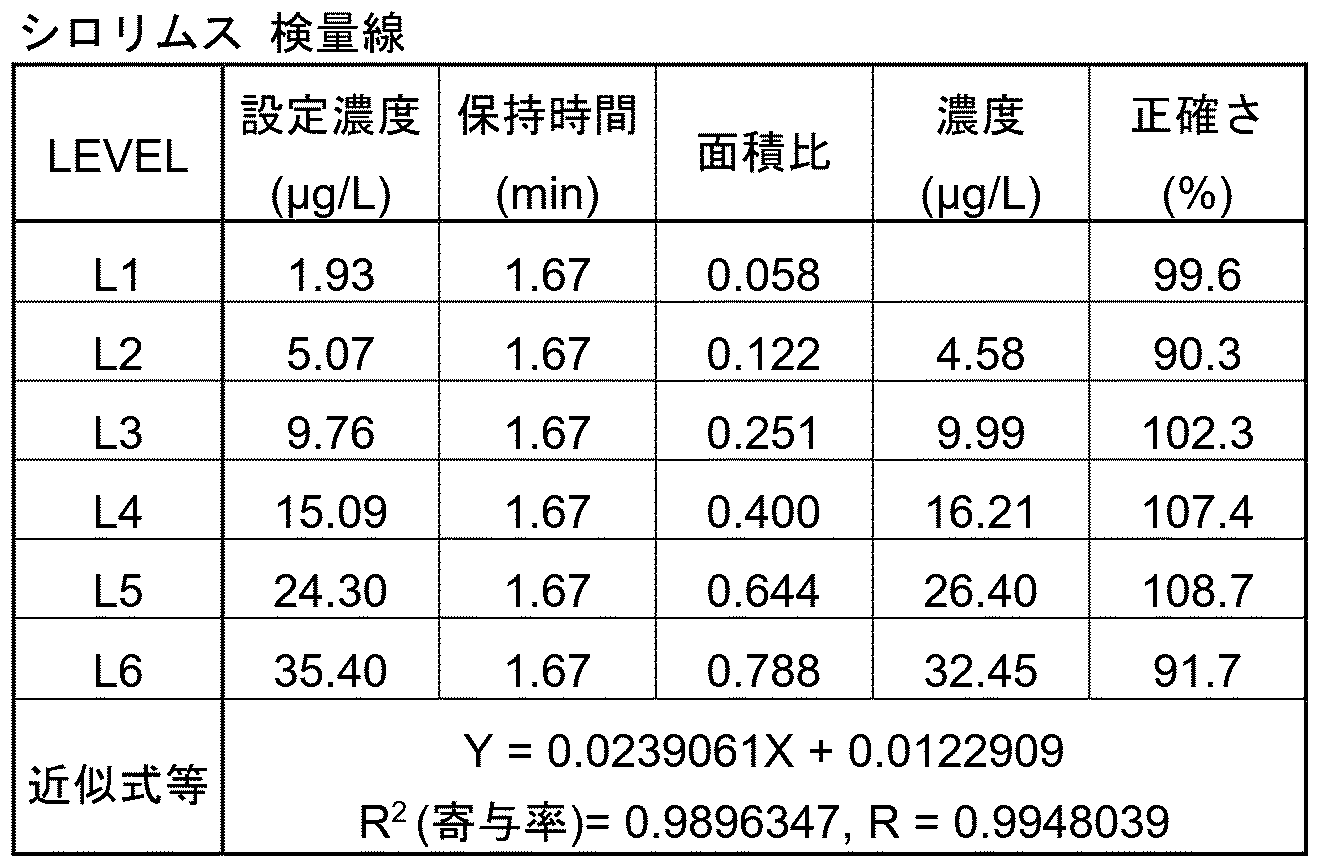
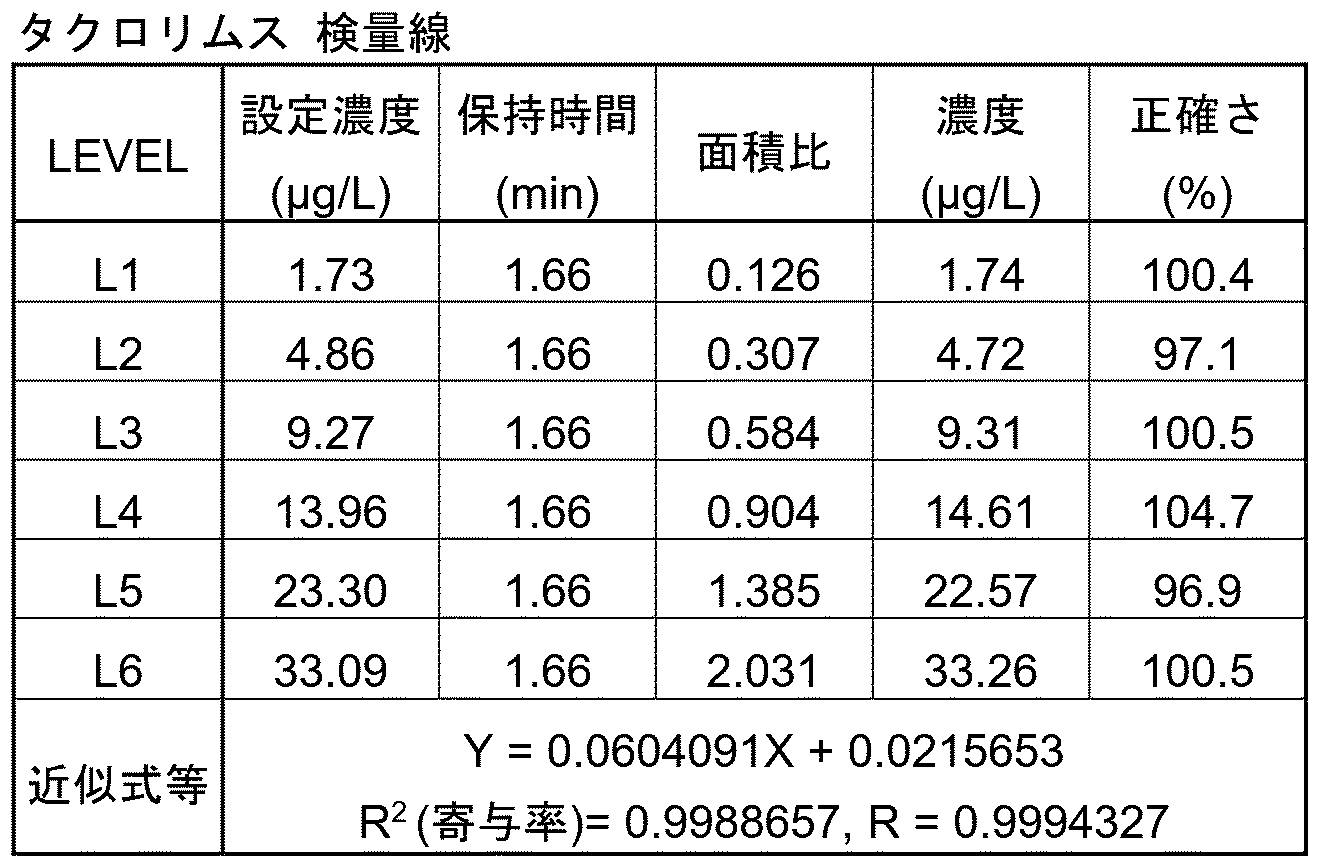
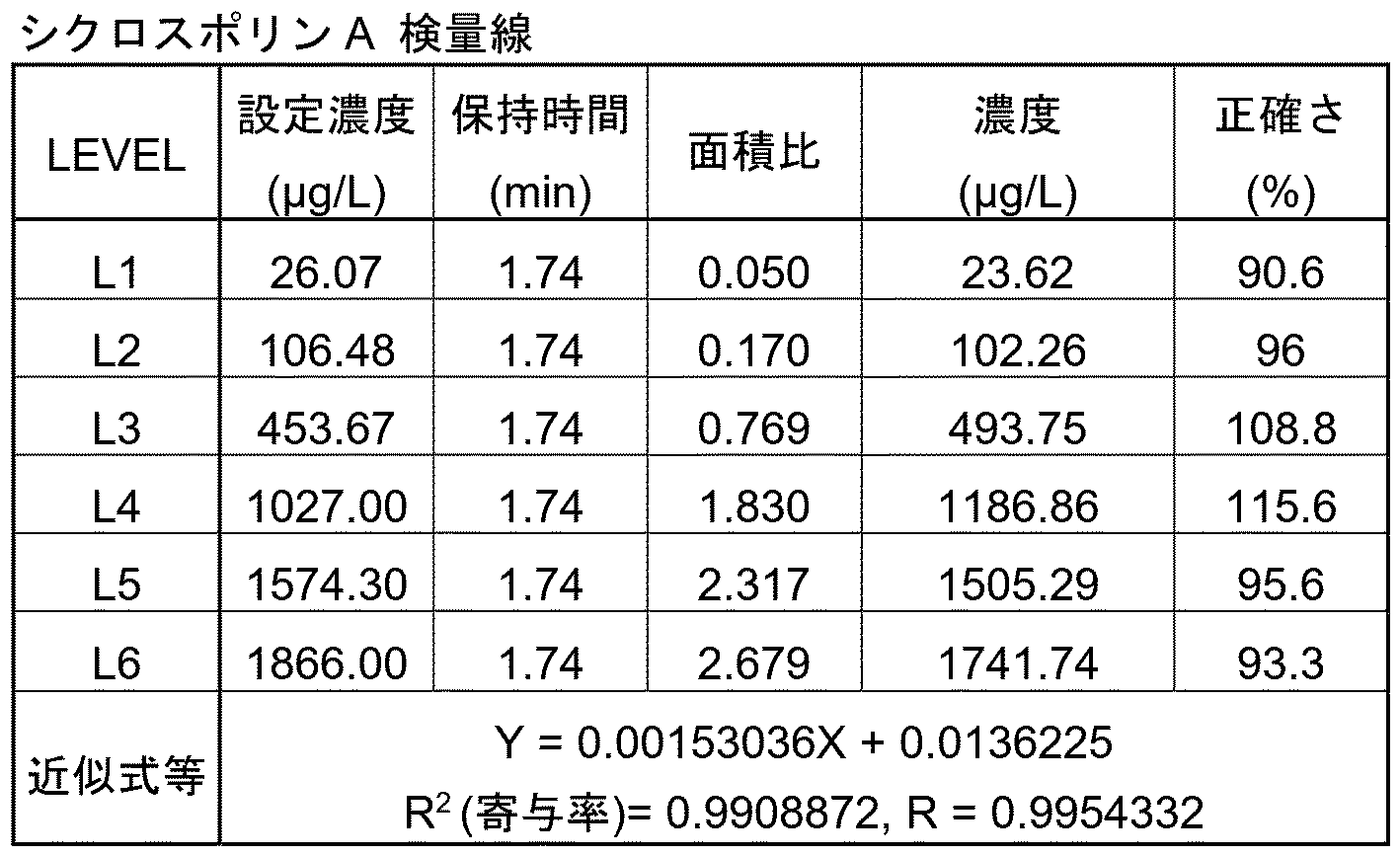
- Tables 3 to 8 show the calibration curves for each component created based on the analysis results.
- the "set concentration” is the concentration shown in the "Calibrator Stock Solution” column in Table 1, and “Concentration” indicates the concentration derived from the “Area Ratio” based on the obtained calibration curve.
- “Accuracy %” indicates the percentage of the concentration derived from the “Area Ratio” when the “Set Concentration” is used as the standard.
- Tables 3 to 8 show that by ionizing everolimus, sirolimus, tacrolimus, and cyclosporine A (four types corresponding to the first immunosuppressant) in positive mode, and ionizing MPA and MPAG (two types corresponding to the second immunosuppressant) in negative mode, it is possible to create calibration curves for each component from the same analytical sample (whole blood calibration solutions L1 to L6).
- DOSIMMUNE control Shimadzu Corporation, product name: "Immunosuppressant Analysis Kit DOSIMMUNE" (concentration: 4 types)
- MPA MPAG QC whole blood (concentration: 3 types)
- DOSIMMUNE control is a sample in which four types of the first immunosuppressant are dissolved in a whole blood matrix.
- MPA MPAG QC whole blood is a sample in which two types of the second immunosuppressant are dissolved in a whole blood matrix. Both blood samples mimic blood samples (whole blood) taken from subjects administered immunosuppressants.
- MPA MPAG QC whole blood (L1 to L3) was prepared as follows. First, a methanol solution of MPA (concentration 4000 mg/L) (5 ⁇ L) and a methanol solution of MPAG (concentration 2000 mg/L) (50 ⁇ L) were added to whole blood (445 ⁇ L) and vortexed for 1 minute to obtain MPA MPAG QC whole blood (L3). Next, the obtained MPA MPAG QC whole blood (L3) was diluted 2-fold with whole blood to obtain MPA MPAG QC whole blood (L2). Finally, the obtained MPA MPAG QC whole blood (L2) was diluted 10-fold with whole blood to obtain MPA MPAG QC whole blood (L1).
- MPA MPAG QC Concentration of each component in whole blood L1: MPA: 2mg/L, MPAG: 10mg/L L2: MPA: 20mg/L, MPAG: 100mg/L L3: MPA: 40mg/L, MPAG: 200mg/L
- DOSIMMUNE the internal standard sample included in the immunosuppressant analysis kit DOSIMMYCO
- the analytical conditions were the same as those used to create the above-mentioned calibration curve, except that the ionization method was changed to positive mode and the MRM conditions were as follows: (MRM conditions) MPA (ESI-Positive): 338.20>207.10(CE -24V) MPA IS (ESI-Positive): 342.10>211.30(CE -14 V) MPAG (ESI-Positive): 514.10>207.15(CE -37V) MPAG IS (ESI-Positive): 518.10>211.20(CE -35V)
- a blood testing method includes a preparation step of preparing whole blood collected from a subject, a pretreatment step of pretreating the whole blood to prepare an analytical sample, a separation step of separating the analytical sample into components using a liquid chromatograph, and an analysis step of analyzing the separated components using a mass spectrometer, wherein the subject is administered a first immunosuppressant and a second immunosuppressant, the first immunosuppressant includes at least one selected from the group consisting of tacrolimus, cyclosporine A, everolimus, and sirolimus, the second immunosuppressant includes at least one selected from the group consisting of mycophenolic acid and its metabolites, the separated components include the first immunosuppressant and the second immunosuppressant, and when analyzing with the mass spectrometer, the analysis is performed in positive mode when the first immunosuppressant is analyzed as the target component, and in negative mode when the second immunosuppressant is analyzed as the target component.
- the analysis step further includes quantifying the separated components based on a calibration curve prepared in advance. According to the blood test method described in 2, the blood concentration of the administered immunosuppressant can be quantified more accurately.
- the liquid chromatograph is a high-performance liquid chromatograph.
- the blood testing method described in 3 allows for more accurate quantification.
- the mass spectrometer is a triple quadrupole mass spectrometer.
- the blood testing method described in paragraph 4 makes it possible to simultaneously detect multiple components in whole blood.
Landscapes
- Health & Medical Sciences (AREA)
- Life Sciences & Earth Sciences (AREA)
- Immunology (AREA)
- Chemical & Material Sciences (AREA)
- Biochemistry (AREA)
- Physics & Mathematics (AREA)
- Pathology (AREA)
- General Physics & Mathematics (AREA)
- General Health & Medical Sciences (AREA)
- Engineering & Computer Science (AREA)
- Analytical Chemistry (AREA)
- Molecular Biology (AREA)
- Biomedical Technology (AREA)
- Hematology (AREA)
- Urology & Nephrology (AREA)
- Cell Biology (AREA)
- Medicinal Chemistry (AREA)
- Food Science & Technology (AREA)
- Bioinformatics & Cheminformatics (AREA)
- Microbiology (AREA)
- Pharmacology & Pharmacy (AREA)
- Biotechnology (AREA)
- Other Investigation Or Analysis Of Materials By Electrical Means (AREA)
- Investigating Or Analysing Biological Materials (AREA)
Abstract
Description
被験者から採取された全血を準備する準備工程と、
前記全血を前処理して分析用試料を準備する前処理工程と、
前記分析用試料を液体クロマトグラフで成分ごとに分離する分離工程と、
分離された前記成分を質量分析装置で分析する分析工程とを含む、血液検査方法であって、
前記被験者は、第1免疫抑制剤及び第2免疫抑制剤を投与されている被験者であり、
前記第1免疫抑制剤は、タクロリムス、シクロスポリンA、エベロリムス及びシロリムスからなる群より選ばれる少なくとも1種を含み、
前記第2免疫抑制剤は、ミコフェノール酸及びその代謝物からなる群より選ばれる少なくとも1種を含み、
分離された前記成分は、前記第1免疫抑制剤、及び前記第2免疫抑制剤を含み、
前記質量分析装置で分析する際、対象成分として前記第1免疫抑制剤を分析するときはポジティブモードで分析し、対象成分として前記第2免疫抑制剤を分析するときは、ネガティブモードで分析する、血液検査方法、に関する。
本発明の第1の態様は、
被験者から採取された全血を準備する準備工程と、
前記全血を前処理して分析用試料を準備する前処理工程と、
前記分析用試料を液体クロマトグラフで成分ごとに分離する分離工程と、
分離された前記成分を質量分析装置で分析する分析工程とを含む、血液検査方法であって、
前記被験者は、第1免疫抑制剤及び第2免疫抑制剤を投与されている被験者であり、
前記第1免疫抑制剤は、タクロリムス、シクロスポリンA、エベロリムス及びシロリムスからなる群より選ばれる少なくとも1種を含み、
前記第2免疫抑制剤は、ミコフェノール酸及びその代謝物からなる群より選ばれる少なくとも1種を含み、
分離された前記成分は、前記第1免疫抑制剤、及び前記第2免疫抑制剤を含み、
前記質量分析装置で分析する際、対象成分として前記第1免疫抑制剤を分析するときはポジティブモードで分析し、対象成分として前記第2免疫抑制剤を分析するときは、ネガティブモードで分析する、血液検査方法、に関する。
本工程は、被験者から採取された全血を準備する。上記被験者は、第1免疫抑制剤及び第2免疫抑制剤を投与されている被験者である。「被験者」とは、本実施形態における血液検査方法を行う全血の由来であるヒトを意味し、年齢、性別、人種は特に制限されない。上記被験者は、健常者であってもよいし、何らかの疾患を有している患者であってもよい。本実施形態の一側面において、上記被験者は、臓器又は造血幹細胞の移植治療を受けている患者であることが好ましい。
本工程は、前記全血を前処理して分析用試料を準備する。
本工程は、前記分析用試料を液体クロマトグラフで成分ごとに分離する。液体クロマトグラフ(LC)は、移動相と固定相とに対する分析試料中の各成分の親和性の違いを利用して、当該成分を分離し異なる保持時間で溶出させる。質量分析装置により分析対象の成分を分離して検出できるように、所望の精度で当該成分を分離することができれば液体クロマトグラフの種類は限定されない。液体クロマトグラフとしては、例えば、ナノLC、マイクロLC、高速液体クロマトグラフ(HPLC)および超高速液体クロマトグラフ(UHPLC)等を用いることができる。
本工程は、分離された前記成分を質量分析装置で分析する。分離された前記成分は、前記第1免疫抑制剤、及び前記第2免疫抑制剤を含む。
<全血キャリブレーション溶液の準備>
以下の手順で全血キャリブレーション溶液(L1~L6)を準備した。まず、MPAのメタノール溶液(濃度:0.01~5mg/L)及びMPAGのメタノール溶液(濃度:0.1~25mg/L)を、マイクロチューブにそれぞれ30μl加えた。その後、当該マイクロチューブ内にMPA及びMPAGのみが残るように、溶媒であるメタノールを蒸発させた。このようにして、MPA及びMPAGの量が異なる6本のマクロチューブ(L1~L6)を準備した。

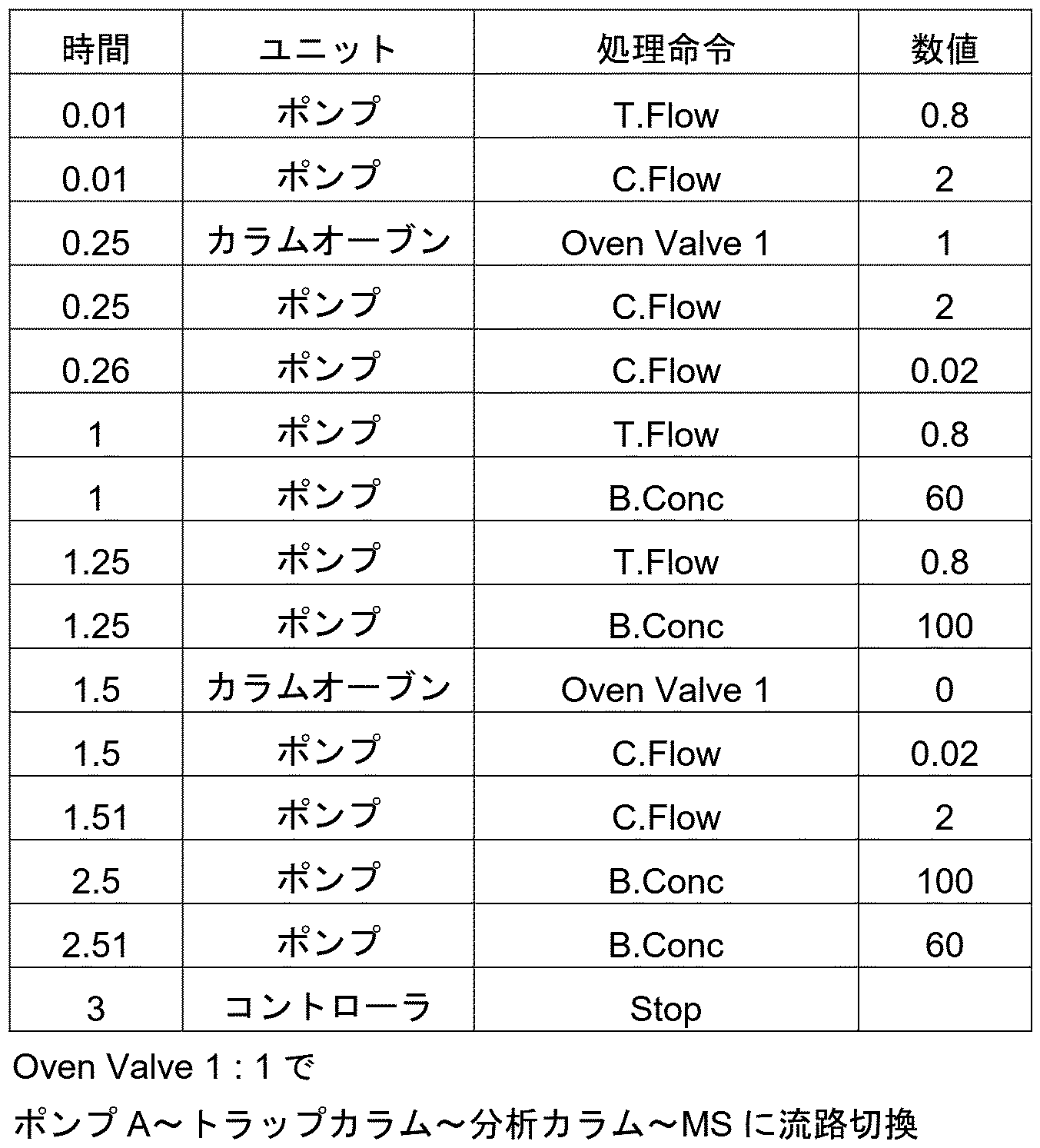
上記全血キャリブレーション溶液L1~L6をLC-MS/MSでグラジエント溶離により分析した。分析条件は以下のとおりである。
トラップ溶媒(ポンプC):DOSIMMUNE MOBILE PHASE A
移動相 A(ポンプA):DOSIMMUNE MOBILE PHASE A
移動相 B(ポンプB):DOSIMMUNE MOBILE PHASE B
初期移動相流量:0.2 mL/min
トラップカラム:DOSIMMUNE Trap Column(S/N ALIMTCL000000155)
分析カラム:DOSIMMUNE Analytical Column (S/N ALIMTCL000000155)
初期バルブ位置:0(ポンプC~トラップカラム~Drain)
タイムプログラム :表2参照(時間の単位は「分」)
カラム温度:65℃
注入量:20μL
イオン化法:ESI-Negative MRM mode(0-1.25min MPA,MPAG)
ESI-Positive MRM mode(1.25-3.00min エベロリムス,シロリムス,タクロリムス,シクロスポリンA)
ネブライザーガス流量:3L/min
ヒーティングガス流量 :10L/min
インターフェイス温度 :200℃
ドライイングガス流量 :10L/min
DL温度:150℃
ヒートブロック温度:200℃
CIDガス圧力:230kPa
プローブ位置:+3 mm
MPA (ESI-Negative) :319.2000>191.2500 (CE 30 V)
MPA IS (ESI-Negative):323.2000>191.2500 (CE 23 V)
MPAG (ESI-Negative):495.2000>191.3000 (CE 37 V)
MPAG IS (ESI-Negative):499.2000>191.2000 (CE 42 V)
エベロリムス (ESI-Positive):975.6000>908.5500 (CE -17 V)
エベロリムス IS (ESI-Positive):981.6000>914.7000 (CE -17 V)
シロリムス (ESI-Positive): 931.6000>864.6500 (CE -17 V)
シロリムス IS (ESI-Positive): 935.6000>864.5000 (CE -18 V)
タクロリムス (ESI-Positive):821.5000>768.5500 (CE -22 V)
タクロリムス IS (ESI-Positive):826.5000>773.6000 (CE -22 V)
シクロスポリンA (ESI-Positive):1220.0000>1202.9500 (CE -19 V)
シクロスポリンA IS (ESI-Positive):1232.0000>1215.0000 (CE -19 V)
<血液試料の準備>
血液試料として以下の試料を準備した(準備工程)。
DOSIMMUNE コントロール:株式会社島津製作所製、製品名 「免疫抑制剤分析キットDOSIMMUNE」(濃度:4種)
MPA MPAG QC全血:(濃度:3種)
DOSIMMUNE コントロールは、全血マトリックス中に上述の第1免疫抑制剤に対応する4種が溶解している試料である。MPA MPAG QC全血は、全血マトリックス中に上述の第2免疫抑制剤に対応する2種が溶解している試料である。両血液試料は、免疫抑制剤を投与された被験者から採取された血液試料(全血)を模している。
(MPA MPAG QC全血中の各成分の濃度)
L1: MPA:2mg/L、MPAG:10mg/L
L2: MPA:20mg/L、MPAG:100mg/L
L3: MPA:40mg/L、MPAG:200mg/L
準備した血液試料(3μl)それぞれをマイクロチューブに加えた。次に、上記マイクロチューブに対して、免疫抑制剤分析キットDOSIMMUNEに含まれる内部標準試料(3μl)と、免疫抑制剤分析キットDOSIMYCOに含まれる内部標準試料(3μl)と、抽出液(アセトニトリル:メタノール:水=40:40:20の混合液)(200μl)とを加えて、1分間、ボステックスで混合した。混合した後、当該マイクロチューブを遠心処理(15000rpm、7分間)して、上清と沈殿物とに分離した(前処理工程)。この上清を200μl回収して分析用試料とした。
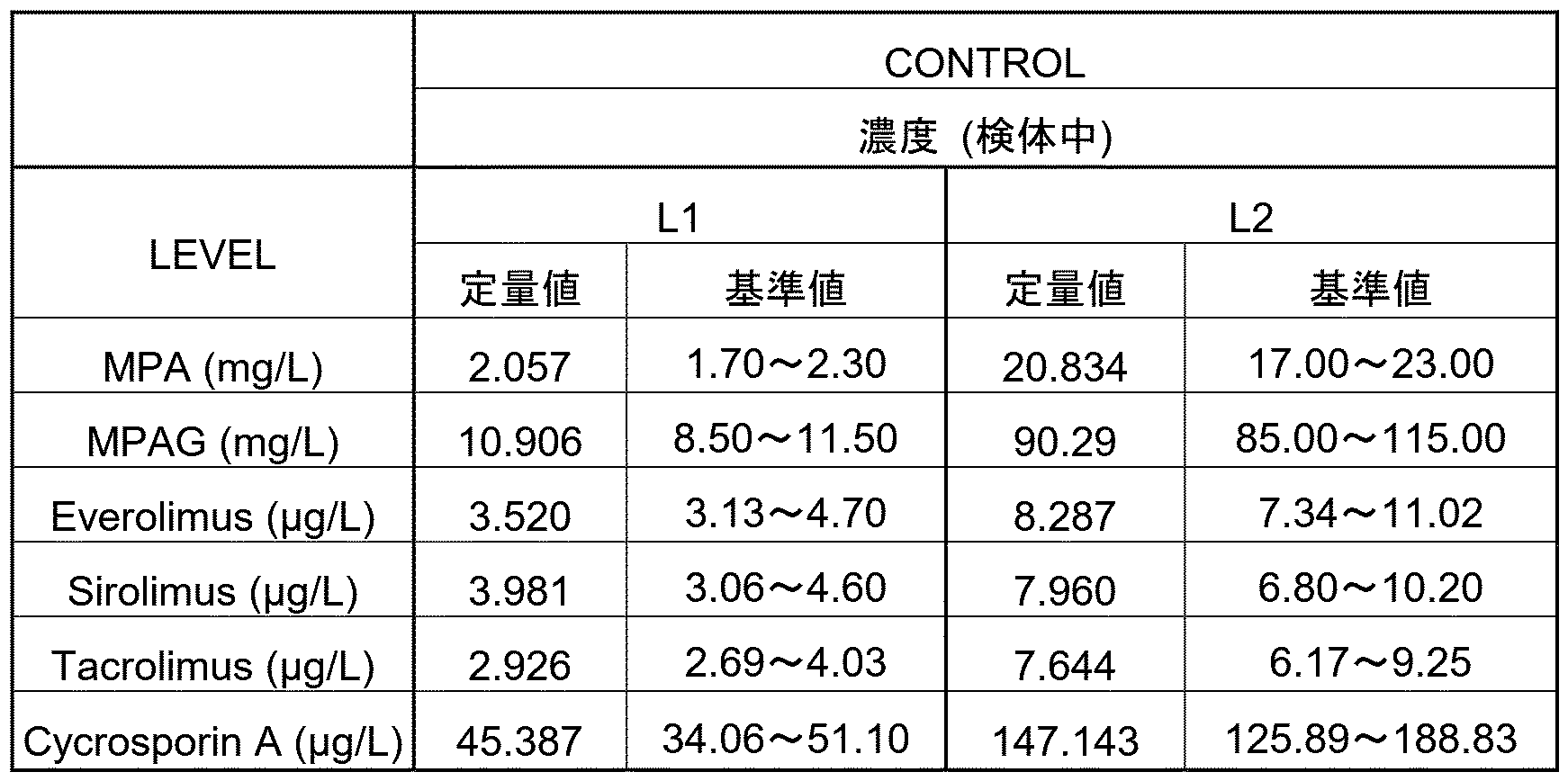
上記分析用試料をLC-MS/MSでグラジエント溶離により分析した。分析条件は検量線を作成したときと同一の条件を用いた。結果を表9-1及び9-2に示す。
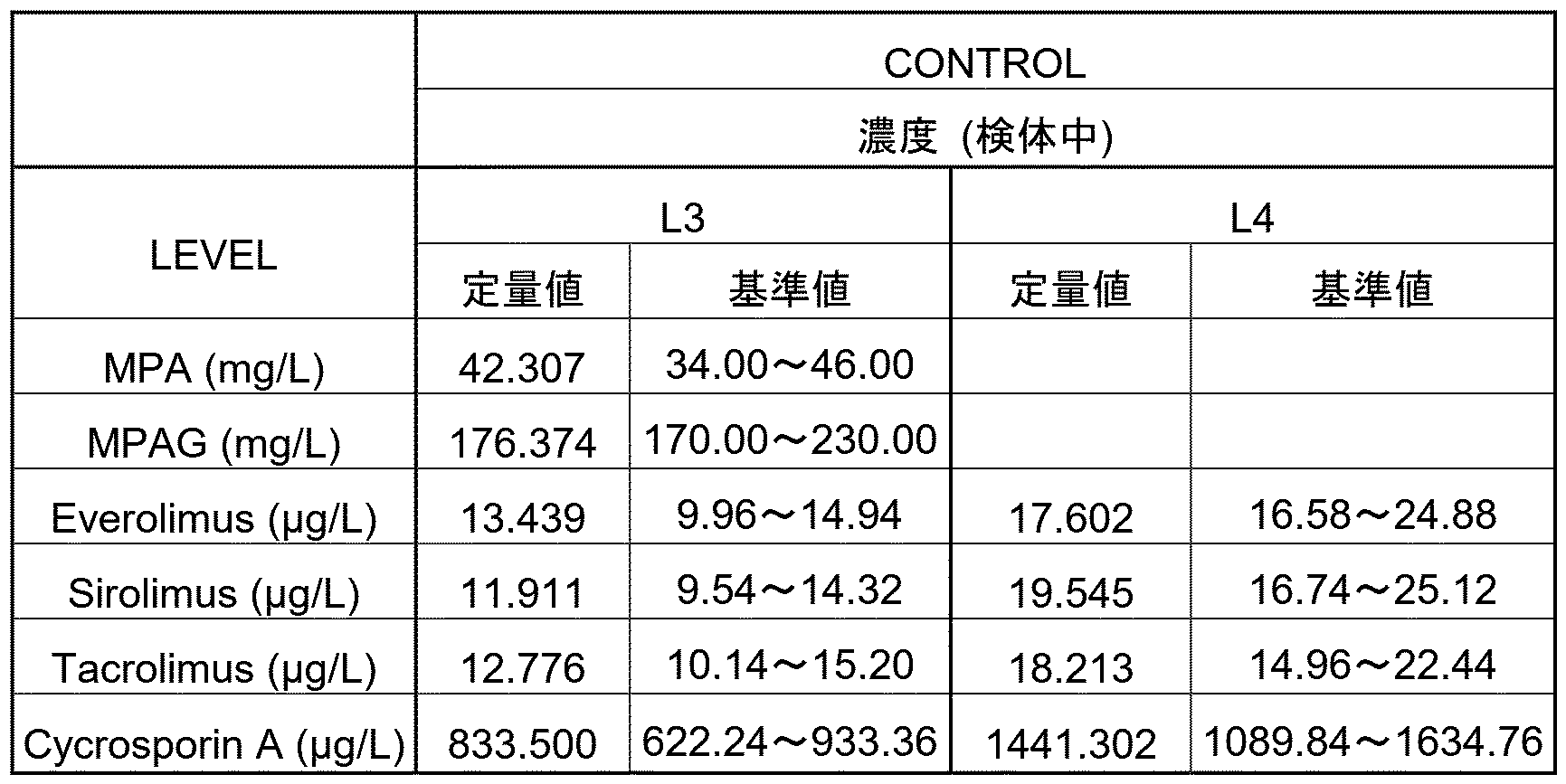
比較実験として第2免疫抑制剤(MPA、MPAG)をポジティブモードでイオン化したときの質量分析を行った。分析条件は、イオン化法をポジティブモードに変更したこと及びMRMの条件を以下の条件にしたこと以外は、上述の検量線を作成したときと同一の条件を用いた。
(MRMの条件)
MPA (ESI-Positive):338.20>207.10(CE -24V)
MPA IS (ESI-Positive):342.10>211.30(CE -14 V)
MPAG (ESI-Positive):514.10>207.15(CE -37 V)
MPAG IS (ESI-Positive):518.10>211.20(CE -35V)
MPA検量線(ポジティブモード)
近似式:Y=0.0786918X + 0.0169183
R2(寄与率)=0.8985811、R=0.9479352
MPAG検量線(ポジティブモード)
近似式:Y=0.00586797X + 0.000886828
R2(寄与率)=0.9924132、R=0.9961994
上述した複数の例示的な実施形態および実施例は、以下の態様の具体例であることが当業者により理解される。
Claims (4)
- 被験者から採取された全血を準備する準備工程と、
前記全血を前処理して分析用試料を準備する前処理工程と、
前記分析用試料を液体クロマトグラフで成分ごとに分離する分離工程と、
分離された前記成分を質量分析装置で分析する分析工程とを含む、血液検査方法であって、
前記被験者は、第1免疫抑制剤及び第2免疫抑制剤を投与されている被験者であり、
前記第1免疫抑制剤は、タクロリムス、シクロスポリンA、エベロリムス及びシロリムスからなる群より選ばれる少なくとも1種を含み、
前記第2免疫抑制剤は、ミコフェノール酸及びその代謝物からなる群より選ばれる少なくとも1種を含み、
分離された前記成分は、前記第1免疫抑制剤、及び前記第2免疫抑制剤を含み、
前記質量分析装置で分析する際、対象成分として前記第1免疫抑制剤を分析するときはポジティブモードで分析し、対象成分として前記第2免疫抑制剤を分析するときは、ネガティブモードで分析する、血液検査方法。 - 前記分析工程は、分離された前記成分を、予め準備した検量線に基づいて定量することを更に含む、請求項1に記載の血液検査方法。
- 前記液体クロマトグラフは、高速液体クロマトグラフである、請求項1又は請求項2に記載の血液検査方法。
- 前記質量分析装置は、トリプル四重極型質量分析装置である、請求項1又は請求項2に記載の血液検査方法。
Priority Applications (3)
| Application Number | Priority Date | Filing Date | Title |
|---|---|---|---|
| JP2025526032A JPWO2024252894A1 (ja) | 2023-06-05 | 2024-05-17 | |
| CN202480037165.8A CN121263692A (zh) | 2023-06-05 | 2024-05-17 | 血液检查方法 |
| EP24819127.2A EP4722719A1 (en) | 2023-06-05 | 2024-05-17 | Blood inspection method |
Applications Claiming Priority (2)
| Application Number | Priority Date | Filing Date | Title |
|---|---|---|---|
| JP2023-092194 | 2023-06-05 | ||
| JP2023092194 | 2023-06-05 |
Publications (1)
| Publication Number | Publication Date |
|---|---|
| WO2024252894A1 true WO2024252894A1 (ja) | 2024-12-12 |
Family
ID=93795360
Family Applications (1)
| Application Number | Title | Priority Date | Filing Date |
|---|---|---|---|
| PCT/JP2024/018266 Ceased WO2024252894A1 (ja) | 2023-06-05 | 2024-05-17 | 血液検査方法 |
Country Status (4)
| Country | Link |
|---|---|
| EP (1) | EP4722719A1 (ja) |
| JP (1) | JPWO2024252894A1 (ja) |
| CN (1) | CN121263692A (ja) |
| WO (1) | WO2024252894A1 (ja) |
Citations (5)
| Publication number | Priority date | Publication date | Assignee | Title |
|---|---|---|---|---|
| US20090298106A1 (en) * | 2008-05-30 | 2009-12-03 | Therapeutic Monitoring Services, L.L.C. | Methods for Monitoring Immunosuppressant Drug Levels, Renal Function, and Hepatic Function Using Small Volume Samples |
| CN110554123A (zh) * | 2019-09-11 | 2019-12-10 | 深圳华大临床检验中心 | 一种快速检测全血中免疫抑制剂的方法、试剂盒及其应用 |
| JP2021128005A (ja) | 2020-02-12 | 2021-09-02 | 株式会社島津製作所 | 血液の前処理方法および検査方法 |
| CN113933419A (zh) * | 2021-09-30 | 2022-01-14 | 上海中科新生命生物科技有限公司 | 一种测定人全血中5种免疫抑制剂类药物浓度的方法 |
| CN115236216A (zh) * | 2022-06-07 | 2022-10-25 | 合肥和合医疗科技有限公司 | 高效液相色谱串联质谱检测全血中免疫抑制剂的试剂盒,其制备方法和检测方法 |
-
2024
- 2024-05-17 CN CN202480037165.8A patent/CN121263692A/zh active Pending
- 2024-05-17 WO PCT/JP2024/018266 patent/WO2024252894A1/ja not_active Ceased
- 2024-05-17 JP JP2025526032A patent/JPWO2024252894A1/ja active Pending
- 2024-05-17 EP EP24819127.2A patent/EP4722719A1/en active Pending
Patent Citations (5)
| Publication number | Priority date | Publication date | Assignee | Title |
|---|---|---|---|---|
| US20090298106A1 (en) * | 2008-05-30 | 2009-12-03 | Therapeutic Monitoring Services, L.L.C. | Methods for Monitoring Immunosuppressant Drug Levels, Renal Function, and Hepatic Function Using Small Volume Samples |
| CN110554123A (zh) * | 2019-09-11 | 2019-12-10 | 深圳华大临床检验中心 | 一种快速检测全血中免疫抑制剂的方法、试剂盒及其应用 |
| JP2021128005A (ja) | 2020-02-12 | 2021-09-02 | 株式会社島津製作所 | 血液の前処理方法および検査方法 |
| CN113933419A (zh) * | 2021-09-30 | 2022-01-14 | 上海中科新生命生物科技有限公司 | 一种测定人全血中5种免疫抑制剂类药物浓度的方法 |
| CN115236216A (zh) * | 2022-06-07 | 2022-10-25 | 合肥和合医疗科技有限公司 | 高效液相色谱串联质谱检测全血中免疫抑制剂的试剂盒,其制备方法和检测方法 |
Non-Patent Citations (2)
| Title |
|---|
| 20 August 2019 (2019-08-20), DAISUKE KAWAKAMI, TAKANORI TSUKAMOTO, TOSHIKAZU MINOHATA: "Analysis of 4 immunosuppressant drugs on the same platform using a fully automated LC-MS/MS system and an Immunosuppressant analysis kit", XP009559316 * |
| 31 October 2021 (2021-10-31), KAWAKAMI, DAISUKE: "Development of an Analytical Method for Immunosuppressants and a Metabolite using a Fully Automated LC-MS/MS System and an Immunosuppressant Analysis Kit.", XP009559317 * |
Also Published As
| Publication number | Publication date |
|---|---|
| JPWO2024252894A1 (ja) | 2024-12-12 |
| CN121263692A (zh) | 2026-01-02 |
| EP4722719A1 (en) | 2026-04-08 |
Similar Documents
| Publication | Publication Date | Title |
|---|---|---|
| US11333639B2 (en) | LC-MS configuration for purification and detection of analytes having a broad range of hydrophobicities | |
| CN113533555B (zh) | 一种高效液相色谱串联质谱检测全血中免疫抑制剂的检测试剂盒及其检测方法 | |
| US20170328921A1 (en) | Methods for detecting hormones and other analytes | |
| US11619636B2 (en) | Mass spectrometry assay method for detection and quantitation of kidney function metabolites | |
| CN108291916B (zh) | 质谱法检测淀粉状蛋白β | |
| JP2026012672A (ja) | インスリン及びc-ペプチドの定量の方法 | |
| CN110554123A (zh) | 一种快速检测全血中免疫抑制剂的方法、试剂盒及其应用 | |
| US10809259B2 (en) | Protocol for preconcentration and quantification of microcystins using LC-MS | |
| WO2022193697A1 (zh) | 一种用于定量样品中目标分析物的天然同位素校准曲线法 | |
| WO2011121342A1 (en) | Measurement of 25-hydroxyvitamin d3 and c3-epi-25-hydroxyvitamin d3 | |
| US20200249227A1 (en) | Method for detecting and quantifying vitamins and thyroid analytes from a urine sample | |
| CN109900841B (zh) | 一种同时测定血浆中氨基糖苷类抗生素药物浓度的hplc-ms/ms方法 | |
| CN110243977B (zh) | 检测血清中四种孕激素的方法 | |
| CN119470753A (zh) | 通过质谱法检测和定量胍基乙酸、肌酸和肌酐 | |
| CN110907569A (zh) | 一种同时检测血液样品中4种蛋白结合尿毒症毒素的方法 | |
| TW202111322A (zh) | 新穎二維lc—ms/ms系統 | |
| CN112198233B (zh) | 用于糖尿病人群中视网膜病变诊断的联合标志物及试剂盒 | |
| CN121263692A (zh) | 血液检查方法 | |
| WO2023024727A1 (zh) | 含氧化氯吡格雷的血浆样品的处理方法及测定方法 | |
| Johnson-Davis et al. | Application of liquid chromatography combined with mass spectrometry or tandem mass spectrometry for therapeutic drug monitoring of immunosuppressants | |
| CN115469026A (zh) | 用于检测环孢素a肾毒性相关标志物的检测试剂、试剂盒及其用途 | |
| CN112630344A (zh) | 代谢标志物在脑梗死中的用途 | |
| CN104880525B (zh) | 用于刑侦目的的液质联用检测尿中唑吡坦中毒标记物苯基-4-羧酸唑吡坦的方法 | |
| WO2026052704A1 (en) | Extraction of macrocyclic analytes | |
| CN111337597A (zh) | 一种快速检测血浆中他达拉非浓度的方法 |
Legal Events
| Date | Code | Title | Description |
|---|---|---|---|
| 121 | Ep: the epo has been informed by wipo that ep was designated in this application |
Ref document number: 24819127 Country of ref document: EP Kind code of ref document: A1 |
|
| ENP | Entry into the national phase |
Ref document number: 2025526032 Country of ref document: JP Kind code of ref document: A |
|
| WWE | Wipo information: entry into national phase |
Ref document number: 2024819127 Country of ref document: EP |
|
| NENP | Non-entry into the national phase |
Ref country code: DE |
|
| ENP | Entry into the national phase |
Ref document number: 2024819127 Country of ref document: EP Effective date: 20260105 |
|
| ENP | Entry into the national phase |
Ref document number: 2024819127 Country of ref document: EP Effective date: 20260105 |
|
| ENP | Entry into the national phase |
Ref document number: 2024819127 Country of ref document: EP Effective date: 20260105 |
|
| ENP | Entry into the national phase |
Ref document number: 2024819127 Country of ref document: EP Effective date: 20260105 |
|
| ENP | Entry into the national phase |
Ref document number: 2024819127 Country of ref document: EP Effective date: 20260105 |
|
| WWP | Wipo information: published in national office |
Ref document number: 2024819127 Country of ref document: EP |