WO2024247819A1 - インダクタおよびインダクタの製造方法 - Google Patents
インダクタおよびインダクタの製造方法 Download PDFInfo
- Publication number
- WO2024247819A1 WO2024247819A1 PCT/JP2024/018672 JP2024018672W WO2024247819A1 WO 2024247819 A1 WO2024247819 A1 WO 2024247819A1 JP 2024018672 W JP2024018672 W JP 2024018672W WO 2024247819 A1 WO2024247819 A1 WO 2024247819A1
- Authority
- WO
- WIPO (PCT)
- Prior art keywords
- element body
- external terminal
- coil conductor
- metal magnetic
- magnetic particles
- Prior art date
- Legal status (The legal status is an assumption and is not a legal conclusion. Google has not performed a legal analysis and makes no representation as to the accuracy of the status listed.)
- Ceased
Links
Images







Classifications
-
- H—ELECTRICITY
- H01—ELECTRIC ELEMENTS
- H01F—MAGNETS; INDUCTANCES; TRANSFORMERS; SELECTION OF MATERIALS FOR THEIR MAGNETIC PROPERTIES
- H01F27/00—Details of transformers or inductances, in general
- H01F27/28—Coils; Windings; Conductive connections
- H01F27/29—Terminals; Tapping arrangements for signal inductances
- H01F27/292—Surface mounted devices
-
- H—ELECTRICITY
- H01—ELECTRIC ELEMENTS
- H01F—MAGNETS; INDUCTANCES; TRANSFORMERS; SELECTION OF MATERIALS FOR THEIR MAGNETIC PROPERTIES
- H01F17/00—Fixed inductances of the signal type
- H01F17/0006—Printed inductances
- H01F17/0013—Printed inductances with stacked layers
-
- H—ELECTRICITY
- H01—ELECTRIC ELEMENTS
- H01F—MAGNETS; INDUCTANCES; TRANSFORMERS; SELECTION OF MATERIALS FOR THEIR MAGNETIC PROPERTIES
- H01F17/00—Fixed inductances of the signal type
- H01F17/04—Fixed inductances of the signal type with magnetic core
-
- H—ELECTRICITY
- H01—ELECTRIC ELEMENTS
- H01F—MAGNETS; INDUCTANCES; TRANSFORMERS; SELECTION OF MATERIALS FOR THEIR MAGNETIC PROPERTIES
- H01F27/00—Details of transformers or inductances, in general
- H01F27/24—Magnetic cores
- H01F27/255—Magnetic cores made from particles
-
- H—ELECTRICITY
- H01—ELECTRIC ELEMENTS
- H01F—MAGNETS; INDUCTANCES; TRANSFORMERS; SELECTION OF MATERIALS FOR THEIR MAGNETIC PROPERTIES
- H01F27/00—Details of transformers or inductances, in general
- H01F27/28—Coils; Windings; Conductive connections
- H01F27/29—Terminals; Tapping arrangements for signal inductances
-
- H—ELECTRICITY
- H01—ELECTRIC ELEMENTS
- H01F—MAGNETS; INDUCTANCES; TRANSFORMERS; SELECTION OF MATERIALS FOR THEIR MAGNETIC PROPERTIES
- H01F41/00—Apparatus or processes specially adapted for manufacturing or assembling magnets, inductances or transformers; Apparatus or processes specially adapted for manufacturing materials characterised by their magnetic properties
- H01F41/02—Apparatus or processes specially adapted for manufacturing or assembling magnets, inductances or transformers; Apparatus or processes specially adapted for manufacturing materials characterised by their magnetic properties for manufacturing cores, coils, or magnets
-
- H—ELECTRICITY
- H01—ELECTRIC ELEMENTS
- H01F—MAGNETS; INDUCTANCES; TRANSFORMERS; SELECTION OF MATERIALS FOR THEIR MAGNETIC PROPERTIES
- H01F41/00—Apparatus or processes specially adapted for manufacturing or assembling magnets, inductances or transformers; Apparatus or processes specially adapted for manufacturing materials characterised by their magnetic properties
- H01F41/02—Apparatus or processes specially adapted for manufacturing or assembling magnets, inductances or transformers; Apparatus or processes specially adapted for manufacturing materials characterised by their magnetic properties for manufacturing cores, coils, or magnets
- H01F41/0206—Manufacturing of magnetic cores by mechanical means
-
- H—ELECTRICITY
- H01—ELECTRIC ELEMENTS
- H01F—MAGNETS; INDUCTANCES; TRANSFORMERS; SELECTION OF MATERIALS FOR THEIR MAGNETIC PROPERTIES
- H01F41/00—Apparatus or processes specially adapted for manufacturing or assembling magnets, inductances or transformers; Apparatus or processes specially adapted for manufacturing materials characterised by their magnetic properties
- H01F41/02—Apparatus or processes specially adapted for manufacturing or assembling magnets, inductances or transformers; Apparatus or processes specially adapted for manufacturing materials characterised by their magnetic properties for manufacturing cores, coils, or magnets
- H01F41/04—Apparatus or processes specially adapted for manufacturing or assembling magnets, inductances or transformers; Apparatus or processes specially adapted for manufacturing materials characterised by their magnetic properties for manufacturing cores, coils, or magnets for manufacturing coils
-
- H—ELECTRICITY
- H01—ELECTRIC ELEMENTS
- H01F—MAGNETS; INDUCTANCES; TRANSFORMERS; SELECTION OF MATERIALS FOR THEIR MAGNETIC PROPERTIES
- H01F41/00—Apparatus or processes specially adapted for manufacturing or assembling magnets, inductances or transformers; Apparatus or processes specially adapted for manufacturing materials characterised by their magnetic properties
- H01F41/02—Apparatus or processes specially adapted for manufacturing or assembling magnets, inductances or transformers; Apparatus or processes specially adapted for manufacturing materials characterised by their magnetic properties for manufacturing cores, coils, or magnets
- H01F41/04—Apparatus or processes specially adapted for manufacturing or assembling magnets, inductances or transformers; Apparatus or processes specially adapted for manufacturing materials characterised by their magnetic properties for manufacturing cores, coils, or magnets for manufacturing coils
- H01F41/041—Printed circuit coils
- H01F41/046—Printed circuit coils structurally combined with ferromagnetic material
-
- H—ELECTRICITY
- H01—ELECTRIC ELEMENTS
- H01F—MAGNETS; INDUCTANCES; TRANSFORMERS; SELECTION OF MATERIALS FOR THEIR MAGNETIC PROPERTIES
- H01F17/00—Fixed inductances of the signal type
- H01F17/04—Fixed inductances of the signal type with magnetic core
- H01F2017/048—Fixed inductances of the signal type with magnetic core with encapsulating core, e.g. made of resin and magnetic powder
Definitions
- This disclosure relates to an inductor and a method for manufacturing an inductor.
- Patent Document 1 discloses an inductor that includes a composite body made of a composite material of resin and metal magnetic powder, an internal electrode that is provided within the composite body and has an end face exposed from the outer surface of the composite body, and an external terminal that is electrically connected to the internal electrode. Also, Figure 1 of Patent Document 1 shows that in a planar perspective view, the planar area of the external terminal is larger than the planar area of the internal electrode. In other words, it can be seen that the external terminal is in contact with the composite body that contains metal magnetic powder.
- the external terminal of the inductor is electrically connected to the electrode of the mounting board on which the inductor is mounted.
- the mechanism by which plating is formed on the internal electrodes is different from the mechanism by which plating is formed on the composite body containing the metal magnetic powder.
- plating growth occurs due to the metal magnetic powder contained in the composite body, causing abnormal formation of the external terminals, which may reduce the yield of the inductor.
- the main objective of this disclosure is to provide an inductor and a method for manufacturing an inductor that reduces formation abnormalities in the external terminals.
- the inductor of the present disclosure is An element body having a coil conductor therein and containing metal magnetic particles and resin; an external terminal provided on a mounting surface of the element body and electrically connected to the coil conductor; the element body has a first main surface and a second main surface opposed to each other in a height direction, a first end surface and a second end surface perpendicular to the height direction and opposed to each other in a length direction, and a first side surface and a second side surface opposed to each other in a width direction perpendicular to the length direction and the height direction, the external terminal has a coil conductor connection region located on an exposed region where the coil conductor is exposed from the element body in a planar perspective seen from a mounting surface side of the element body, and an overlap region overlapping with the element body,
- the average length of contact between the metal magnetic particles and the external terminal is 10% or less of the length of the overlapping area of the external terminal on a cut surface cut in the height direction of the element body along the longitudinal direction of the element body at a
- the inductor of the present disclosure has An element body having a coil conductor therein and containing metal magnetic particles and resin; an external terminal provided on a mounting surface of the element body and electrically connected to the coil conductor; In a planar perspective seen from the mounting surface side of the element body, the external terminals are arranged inside an exposed region where the coil conductor is exposed from the element body.
- the method for manufacturing an inductor according to the present disclosure includes: an element forming step of forming an element having a coil conductor therein and containing metal magnetic particles and a resin; an exposing step of exposing an external terminal connection region of the coil conductor from the element body; a particle-shredding step of shredding the metal magnetic particles on the mounting surface of the element body; an external terminal forming step of forming an external terminal at a portion where the metal magnetic particles have been removed in the removing step and at a portion of the external terminal connection region of the coil conductor exposed in the exposing step; It is equipped with:
- the method for manufacturing an inductor according to the present disclosure further comprises the steps of: an element forming step of forming an element having a coil conductor therein and containing metal magnetic particles and a resin; an exposing step of exposing an external terminal connection region of the coil conductor from the element body; an external terminal forming step of forming an external terminal inside an exposed region where an external terminal connection region of the coil conductor is exposed from the element body; It is equipped with:
- an inductor and a method for manufacturing an inductor that reduce formation anomalies in the external terminals can be provided. More specifically, the inductor of the present disclosure has an average length of contact between the metal magnetic particles and the external terminals that is 10% or less of the length of the overlapping region of the external terminals on a cut surface cut in the height direction of the element body along the length of the element body from the mounting surface side of the element body at a position passing through the external terminals and the coil conductor connection region, and therefore plating growth caused by the metal magnetic particles can be reduced. Therefore, formation anomalies in the external terminals can be reduced.
- the external terminals are located inside the exposed area where the coil conductor is exposed from the element body, which prevents contact between the metal magnetic particles and the external terminals and reduces formation abnormalities in the external terminals.
- FIG. 1 is a perspective view of an inductor of the present disclosure.
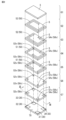
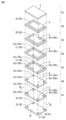
- FIG. 2 is an exploded perspective view of the inductor of the first embodiment.
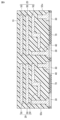
- FIG. 3 is a cross-sectional view taken along line III-III of FIG.
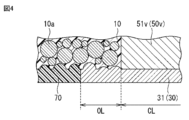
- FIG. 4 is an enlarged cross-sectional view of a main portion of FIG.
- FIG. 5 is an exploded perspective view of the inductor according to the second embodiment.
- 6 is a cross-sectional view taken along line VI-VI of FIG. 5.
- FIG. FIG. 7 is an enlarged cross-sectional view of a main portion of FIG.
- FIG. 8 is an enlarged cross-sectional view of a main portion of an inductor according to a modified example of the second embodiment.
- FIG. 9 is a cross-sectional view of an inductor according to another embodiment.
- FIG. 10 is a flow diagram showing a method for manufacturing an inductor according to the present disclosure.
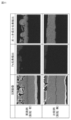
- FIG. 11 is an elemental analysis photograph illustrating the results of the elemental analysis.
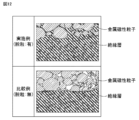
- FIG. 12 is a cross-sectional view illustrating the shedding state of metal magnetic particles.
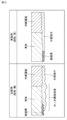
- FIG. 13 is a cross-sectional view for explaining the plating formation state.
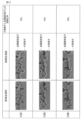
- FIG. 14 is a cross-sectional photograph illustrating the contact state between the metal magnetic particles and the external terminals.
- FIG. 15 is a perspective view of another embodiment of an inductor of the present disclosure.
- FIG. 16 is an exploded perspective view of another embodiment of an inductor of the present disclosure.
- 17 is a cross-sectional view taken along line XVII-XVII of FIG. 16.
- FIG. FIG. 18 is a perspective view of yet another embodiment of an inductor of the present disclosure.
- FIG. 19 is an exploded perspective view of yet another embodiment of an inductor of the present disclosure.
- inductor of the present disclosure is described below. Note that the present disclosure is not limited to the configurations below, and may be modified as appropriate without departing from the spirit of the present disclosure. In addition, a combination of multiple individual preferred configurations described below also constitutes the present disclosure.
- the inductor disclosed herein is used, for example, in a DC-DC converter.
- the inductor disclosed herein can also be used for purposes other than DC-DC converters.
- terms such as “provided,” “disposed,” “connected,” “contact,” “attached,” and their derived terms may refer to a form in which other elements such as intervening objects are present, rather than being limited to a direct form, unless otherwise expressly stated.
- Figure 1 is a perspective view of the inductor according to the present disclosure
- Figure 2 is an exploded perspective view of the inductor according to the first embodiment
- Figure 3 is a cross-sectional view taken along line III-III in Figure 2
- Figure 4 is an enlarged cross-sectional view of a main portion of Figure 3. Note that the shapes and arrangements of the inductor and each component are not limited to the examples shown in the figures.
- the inductor 1 of the present disclosure comprises an element body 10 containing metal magnetic particles 10a and resin and having a coil conductor 50 therein, and an insulating layer 70 provided on the mounting surface (first main surface 11) of the element body 10 in an area of the mounting surface of the element body 10 having the coil conductor 50 therein where no external terminal 30 is provided, and an external terminal 30 electrically connected to the insulating layer 70.
- the base body 10 includes a first coil 21 and a second coil 22 located above the first coil 21 in the height direction T.
- the coils included inside the base body 10 are not limited to the above-mentioned configuration, and may include one coil or two or more coils.
- the base body 10 may include four coils.
- the first coil 21 may be configured by stacking a plurality of stacking groups G4 and G5 (see FIG. 2) described later, so that the first coil conductor 51 is wound in a spiral shape through a via conductor (not shown).
- the second coil 22 may be configured by stacking a plurality of stacking groups G2 and G3 (see FIG. 2) described later, so that the second coil conductor 52 is wound in a spiral shape through a via conductor (not shown).
- Each component will be described in detail below.
- the element body 10 has, for example, a rectangular parallelepiped shape or a substantially rectangular parallelepiped shape having six sides.
- the corners and ridges of the element body 10 may be rounded.
- a corner is a portion where three sides of the element body 10 intersect, and a ridge is a portion where two sides of the element body 10 intersect.
- the length, width, and height directions of the inductor 1 and the element body 10 are shown as L, W, and T directions, respectively.
- the length direction L, width direction W, and height direction T are mutually orthogonal.
- the mounting surface of the inductor 1 is, for example, a surface (LW surface) parallel to the length direction L and width direction W.
- the base body 10 shown in FIG. 1 has a first main surface 11 and a second main surface 12 that face the height direction T, a first end surface 13 and a second end surface 14 that are perpendicular to the height direction T and face the length direction L, and a first side surface 15 and a second side surface 16 that face the width direction W that is perpendicular to the length direction L and the height direction T.
- the first main surface 11 of the base body 10 corresponds to the mounting surface (bottom surface) of the base body 10.
- the second main surface 12 may also be the mounting surface of the base body 10.
- the base body 10 includes a magnetic layer S and a coil conductor 50 (see FIG. 2).
- the base body 10 may have a laminated structure.
- the base body 10 may include multiple magnetic layers S and coil conductors 50 in the lamination direction (e.g., height direction T).
- the base body 10 is configured by laminating laminate groups G1 to G7, each of which includes at least one magnetic layer S and coil conductor 50 (or only magnetic layer S). The boundaries between each layer in the laminated structure of the base body 10 have disappeared.
- Each laminated group layer may be configured by laminating multiple layers of the same pattern.
- the stacking group G1 has a magnetic layer S and constitutes the second main surface 12 of the base body 10.
- the laminate group G2 is provided with a second coil conductor 52 that constitutes a part of the magnetic layer S and the second coil 22.
- the second coil conductor 52 of the laminate group G2 constitutes one turn of the second coil 22. More specifically, the second coil conductor 52 is arranged approximately along the outer periphery of the magnetic layer S. Furthermore, one end of the second coil conductor 52 is provided with a conductor layer (or via conductor) (not shown) for connecting to the second coil conductor 52 of the laminate group G3, and the other end of the second coil conductor 52 is provided with a fourth coil conductor connection portion (not shown) for electrically connecting to the fourth external terminal 34.
- the stacking group G3 is provided with a second coil conductor 52 that constitutes a part of the magnetic layer S and the second coil 22.
- the second coil conductor 52 of the stacking group G2 constitutes another winding of the second coil 22.
- One end of the second coil conductor 52 is connected to the second coil conductor 52 of the stacking group G2, and the other end of the second coil conductor 52 is provided with a third coil conductor connection portion (not shown) for electrically connecting to the third external terminal 33.
- a fourth coil conductor connection portion 54v is provided at a corner of the magnetic layer S that is away from the second coil conductor 52 in a plan view so as to electrically connect to a fourth coil conductor connection portion (not shown) of the stacking group G2.
- the stacking group G4 is provided with a first coil conductor 51 that constitutes a part of the magnetic layer S and the first coil 21.
- the first coil conductor 51 of the stacking group G4 constitutes one winding of the first coil 21.
- One end of the first coil conductor 51 is provided with a conductor layer (or via conductor) (not shown) for connecting to the first coil conductor 51 of the stacking group G5, and the other end of the first coil conductor 51 is provided with a second coil conductor connection part (not shown) for electrically connecting to the second external terminal 32.
- a fourth coil conductor connection part 54v is provided so as to electrically connect to the fourth coil conductor connection part of the stacking group G3, and a third coil conductor connection part 53v is provided so as to electrically connect to the third coil conductor connection part of the stacking group G3.
- the stacking group G5 is provided with a first coil conductor 51 that constitutes a part of the magnetic layer S and the first coil 21.
- the first coil conductor 51 of the stacking group G5 constitutes another winding of the first coil 21.
- One end of the first coil conductor 51 is connected to the first coil conductor 51 of the stacking group G4, and the other end of the first coil conductor 51 is provided with a first coil conductor connection part (not shown) for electrically connecting to the first external terminal 31.
- a fourth coil conductor connection part 54v is provided so as to electrically connect to the fourth coil conductor connection part 54v of the stacking group G4
- a third coil conductor connection part 53v is provided so as to electrically connect to the third coil conductor connection part 53v of the stacking group G4
- a second coil conductor connection part 52v is provided so as to electrically connect to the second coil conductor connection part 52v of the stacking group G4.
- the stacking group G6 has a first coil conductor connection portion 51v, a second coil conductor connection portion 52v, a third coil conductor connection portion 53v, and a fourth coil conductor connection portion 54v provided on the magnetic layer S and at the corners.
- the laminate group G7 has a first coil conductor connection portion 51v, a second coil conductor connection portion 52v, a third coil conductor connection portion 53v, and a fourth coil conductor connection portion 54v that are larger in plan area than the first to fourth coil conductor connection portions of the laminate group G6 in the magnetic layer S and corners.
- the design freedom of the inductor 1 is increased.
- the design freedom of the inductor 1 is increased.
- the inductor 1 including the first external terminal 31, the second external terminal 32, the third external terminal 33, and the fourth external terminal 34 on the bottom surface (first main surface 11) of the element body 10 it becomes easier to draw out the first coil 21 and the second coil 22 to the bottom surface side.
- the laminated structure including the laminated groups G1 to G7 may be formed by stacking the material constituting the magnetic layer S, the material constituting the coil conductor 50, and the material constituting the coil conductor connection portion 50v by sequentially printing (e.g., screen printing, etc.) from the second main surface 12 side or the first main surface 11 side of the element body 10.
- each of the laminated groups G1 to G7 may be repeatedly printed until the magnetic layer S, the coil conductor 50, and the coil conductor connection portion 50v reach the desired thickness.
- the magnetic layer S includes metal magnetic particles 10a (see FIG. 4) made of a magnetic material.
- the metal magnetic particles 10a may include Fe and/or Si. More specifically, they may be Fe particles or Fe alloy particles.
- the Fe alloy may be an Fe-Si alloy, an Fe-Si-Cr alloy, an Fe-Si-Al alloy, an Fe-Si-B-P-Cu-C alloy, an Fe-Si-B-Nb-Cu alloy, or the like.
- the metal magnetic particles 10a may also include impurities such as Cr, Mn, Cu, Ni, P, S, or Co that are not intended in the manufacturing process.
- the metal magnetic particles 10a may also be included in the magnetic paste, as will be described in detail in the description of the manufacturing method. Therefore, the metal magnetic particles may include elements (e.g., Cr, Al, Li, Zn) that are more easily oxidized than the Fe added when the magnetic paste is made.
- the surface of the metal magnetic particles 10a made of the above-mentioned metal magnetic material may be covered with an insulating film (not shown).
- an insulating film can be formed on the surface of the metal magnetic particles by a sol-gel method, a mechanochemical method, or the like.
- the material constituting the insulating film may be an oxide of P, Si, or the like.
- the insulating film may also be an oxide film formed by oxidizing the surface of the metal magnetic particles.
- the thickness of the insulating film is preferably 1 nm or more and 50 nm or less, more preferably 1 nm or more and 30 nm or less, and even more preferably 1 nm or more and 20 nm or less.
- the cross section obtained by polishing the inductor sample can be photographed with a scanning electron microscope (SEM), and the thickness of the insulating film covering the surface of the metal magnetic particles can be measured from the obtained SEM photograph.
- SEM scanning electron microscope
- the average particle size of the metal magnetic particles 10a in the magnetic layer S is preferably 1 ⁇ m or more and 30 ⁇ m or less, more preferably 1 ⁇ m or more and 20 ⁇ m or less, and even more preferably 1 ⁇ m or more and 10 ⁇ m or less.
- the average particle size of the metal magnetic particles 10a in the magnetic layer can be measured by the procedure described below.
- the inductor sample is cut to obtain a sample cross section. Specifically, the sample cross section is obtained by cutting through the center of the element so as to be perpendicular to the mounting surface and end surface of the element.
- the obtained cross section multiple (e.g., 5) areas (e.g., 130 ⁇ m x 100 ⁇ m) are photographed with an SEM, and the obtained SEM images are analyzed using image analysis software (e.g., image analysis software WinROOF2021 (manufactured by Mitani Shoji Co., Ltd.)) to determine the circle equivalent diameter of the metal magnetic particles.
- image analysis software e.g., image analysis software WinROOF2021 (manufactured by Mitani Shoji Co., Ltd.)
- the average value of the obtained circle equivalent diameters is the average particle size of the metal magnetic particles.
- the metal magnetic particles 10a contained in the element body 10 have an oxide film on their surfaces. This oxide film originates from the metal magnetic particles 10a and is formed by the heat treatment. In the element body 10, adjacent metal magnetic particles 10a are bonded to each other via the oxide film.
- the base body 10 may include a non-magnetic layer between the first coil 21 and the second coil 22.
- a non-magnetic layer between the first coil 21 and the second coil 22 By providing a non-magnetic layer between the first coil 21 and the second coil 22, the insulation between the first coil 21 and the second coil 22 can be improved, and a short circuit between the two can be prevented.
- the non-magnetic layer may contain a glass ceramic material and a non-magnetic ferrite material as the non-magnetic material.
- the non-magnetic layer may contain a non-magnetic ferrite material as the non-magnetic material.
- a non-magnetic ferrite material having a composition in which Fe is 40 mol% or more and 49.5 mol% or less in the entire non-magnetic layer when converted to Fe 2 O 3 , Cu is 6 mol% or more and 12 mol% or less in the entire non-magnetic layer when converted to CuO, and the remainder is ZnO can be used.
- the non-magnetic material may contain Mn 3 O 4 , Co 3 O 4 , SnO 2 , Bi 2 O 3 , SiO 2, etc. as additives as necessary, and may contain a small amount of unavoidable impurities.
- the non-magnetic layer preferably contains Zn-Cu ferrite.
- the thickness of the nonmagnetic layer can be measured using the procedure described below.
- the inductor sample is set vertically and the sample is hardened with resin so that the LT surface is exposed.
- the polishing is stopped at a depth of about 1/2 of the sample's width in the W direction using a polishing machine, exposing a cross section parallel to the LT surface.
- the polished surface is processed by ion milling (Ion Milling Machine IM4000, manufactured by Hitachi High-Tech Corporation) to remove any sagging of the internal conductor caused by polishing.
- the approximate center of the nonmagnetic layer in the polished sample is photographed with an SEM, and the thickness of the approximate center of the nonmagnetic layer is measured from the obtained SEM photograph, and this is defined as the thickness of the nonmagnetic layer.
- the base body 10 may include a non-magnetic portion between the first coil conductors 51 that constitute the first coil 21, or between the second coil conductors 52 that constitute the second coil 22.
- the non-magnetic portion is provided at least at one location between adjacent coil conductors of the first coil conductor 51 and the second coil conductor 52.
- the nonmagnetic layer and the nonmagnetic portion may have the same composition.
- the nonmagnetic layer and the nonmagnetic portion may be composed of Zn-Cu ferrite.
- a first coil 21 and a second coil 22 are provided inside the base body 10.
- the first coil 21 and the second coil 22 may be magnetically coupled.
- the coupling coefficient between the first coil 21 and the second coil 22 is 0.1 or more and 0.8 or less. Note that two coils including only the first coil 21 and the second coil 22 may be provided inside the base body 10, or three or more coils including the first coil 21 and the second coil 22 may be provided.
- the first coil 21 includes a plurality of first coil conductors 51 in the stacking direction (e.g., height direction T). Adjacent first coil conductors 51 are connected to each other through via conductors.
- the first coil 21 may have a number of turns of 1.75 by including first coil conductors 51 formed in two different stacking groups in the stacking direction. The number of turns is not limited to 1.75, and may be, for example, 2 or more, by stacking the first coil conductors 51 in the stacking direction.
- each of the first coil conductors 51 may be the same. Furthermore, the thickness of the first coil conductors 51 may be equal to the thickness of the second coil conductors 52 described below.
- the first coil conductor 51 may be a metal conductor such as Ag, Cu, and/or Pd, for example.
- the first coil conductor 51 may be formed, for example, by printing a conductive paste on the magnetic layer S described above.
- the second coil 22 includes a plurality of second coil conductors 52 in the stacking direction (e.g., height direction T). Adjacent second coil conductors 52 are connected to each other via via conductors.
- the second coil 22 may have a number of turns of 1.75 by including second coil conductors 52 formed in two different stacking groups in the stacking direction. The number of turns is not limited to 1.75 as shown in the example, and may be, for example, 2 or more by stacking the first coil conductors 51 in the stacking direction.
- the number of layers of the second coil conductor 52 may be the same as or different from the number of layers of the first coil conductor 51.
- each of the second coil conductors 52 may be the same. Furthermore, the thickness of the second coil conductors 52 may be equal to the thickness of the first coil conductors 51.
- the second coil conductor 52 may be made of a metal conductor such as Ag, Cu, and/or Pd.
- the material of the second coil conductor 52 may be the same as or a different material from that of the first coil conductor 51.
- the second coil conductor 52 may be formed, for example, by printing a conductive paste on the magnetic layer S described above.
- the coil conductor 50 includes a coil conductor connection portion 50v.
- the coil conductor connection portion 50v includes a first coil conductor connection portion 51v, a second coil conductor connection portion 52v, a third coil conductor connection portion 53v, and a fourth coil conductor connection portion 54v.
- the first coil conductor connection portion 51v, the second coil conductor connection portion 52v, the third coil conductor connection portion 53v, and the fourth coil conductor connection portion 54v are provided inside the element body 10.
- the first coil conductor connection portion 51v, the second coil conductor connection portion 52v, the third coil conductor connection portion 53v, and the fourth coil conductor connection portion 54v are exposed from the mounting surface (first main surface 11) of the element body 10.
- the coil conductor connection portion 50v may be made of a metal conductor such as Ag, Cu and/or Pd, for example.
- the material of the coil conductor connection portion 50v may be the same type of material as the first coil conductor 51 and/or the second coil conductor 52, or a different type of material.
- the coil conductor connection portion 50v may be formed, for example, by forming a through hole in the magnetic layer S described above and printing a conductive paste into the through hole.
- the first coil conductor connection portion 51v connects the end of the first coil 21 that is closest to the bottom surface (first main surface 11) of the base body 10 to the first external terminal 31.
- the first coil conductor connection portion 51v may extend along the stacking direction (e.g., the height direction T).
- the first coil conductor connection portion 51v may have a stacked structure.
- the second coil conductor connection portion 52v connects the other end of the first coil 21 to the second external terminal 32.
- the second coil conductor connection portion 52v may extend along the stacking direction (e.g., the height direction T).
- the second coil conductor connection portion 52v may have a stacked structure.
- the third coil conductor connection portion 53v connects the end of the second coil 22, which is the end of the second coil conductor 52 closest to the bottom surface (first main surface 11) of the body 10, to the third external terminal 33.
- the third coil conductor connection portion 53v may extend along the stacking direction (e.g., the height direction T).
- the third coil conductor connection portion 53v may have a stacked structure.
- the fourth coil conductor connection portion 54v connects the other end of the second coil 22 to the fourth external terminal 34.
- the fourth coil conductor connection portion 54v may extend along the stacking direction (e.g., the height direction T).
- the fourth coil conductor connection portion 54v may have a stacked structure.
- a suitable arrangement of the coil conductor connection parts 50v is that the second coil conductor connection part 52v and the third coil conductor connection part 53v, which are electrically connected to the output electrode of the inductor 1, are arranged along one side that constitutes the outer edge of the element body 10.
- the second coil conductor connection part 52v and the third coil conductor connection part 53v are not arranged along a diagonal line of the element body 10 when viewed in a plan view from the stacking direction.
- the external terminals 30 include a first external terminal 31, a second external terminal 32, a third external terminal 33, and a fourth external terminal 34.
- the first external terminal 31 and the second external terminal 32 are provided on the first main surface 11 of the element body 10 and are electrically connected to the first coil 21.
- the third external terminal 33 and the fourth external terminal 34 are provided on the first main surface 11 of the element body 10 and are electrically connected to the second coil 22.
- the first main surface 11 of the element body 10 can be used as a mounting surface.
- the first external terminal 31 acts as an input electrode for the first coil 21.
- the first external terminal 31 may be provided only on the first main surface 11 of the element body 10, but may also be provided across the first main surface 11 of the element body 10 and at least one of the first end surface 13 and the second side surface 16.
- the second external terminal 32 acts as an output electrode for the first coil 21.
- the second external terminal 32 may be provided only on the first main surface 11 of the element body 10, but may also be provided across the first main surface 11 of the element body 10 and at least one of the second end surface 14 and the second side surface 16.
- the third external terminal 33 acts as an output electrode for the second coil 22.
- the third external terminal 33 may be provided only on the first main surface 11 of the element body 10, but may also be provided across the first main surface 11 of the element body 10 and at least one of the second end surface 14 and the first side surface 15.
- the fourth external terminal 34 acts as an input electrode for the second coil 22.
- the fourth external terminal 34 may be provided only on the first main surface 11 of the element body 10, but may also be provided across the first main surface 11 of the element body 10 and at least one of the first end surface 13 and the first side surface 15.
- the external terminal 30 has a coil conductor connection region CL located on an exposed region (region where the coil conductor connection portion 50v is exposed) where the coil conductor 50 is exposed from the element body in a planar perspective seen from the mounting surface side of the element body 10, and an overlap region OL that overlaps with the element body 10.
- the planar area of the external terminal 30 is larger than the planar area of the coil conductor connection portion 50v in a planar perspective seen from the mounting surface side of the element body 10.
- the external terminal 30 may be made of various materials such as Cu and Ni.
- the external terminal 30 may be formed of a single layer or may have a laminated structure of two or more layers.
- the external terminal 30 may be formed by any method, but may be formed by plating (e.g., electroless plating) as an example.
- plating e.g., electroless plating
- the plating formation mechanism for the coil conductor connection portion 50v is different from the plating formation mechanism for the base body 10 containing the metal magnetic particles 10a.
- the average length of contact between the metal magnetic particles 10a and the external terminal 30 is 10% or less, preferably 8% or less, more preferably 4% or less, and even more preferably 0% of the length of the overlap region OL of the external terminal 30 on a cut surface cut in the height direction of the base body 10 along the length direction of the base body 10 at a position passing through the external terminal 30 from the mounting surface (first main surface 11) side of the base body 10 (see FIG. 4).
- the method for calculating the "average length of contact between the metal magnetic particles and the external terminals" described in this specification will be described in detail in the Examples below.
- the metal magnetic particles 10a are Fe
- the coil conductor connection portion 50v is Ag
- the external terminal 30 is Cu
- the ionization tendency of the metal magnetic particles (Fe) is greater than that of the coil conductor connection portion (Ag)
- the plating growth reaction will start preferentially on the metal magnetic particle side with the greater ionization tendency. Therefore, in a conventional "inductor in which the external terminal is in contact with an element body containing metal magnetic powder, and the plane area of the external terminal is greater than the plane area of the coil conductor connection portion in a planar perspective view seen from the mounting surface side of the element body 10", plating growth caused by the metal magnetic particles occurs, causing abnormal formation of the external terminal.
- the average length of contact between the metal magnetic particles 10a and the external terminals 30 is 10% or less of the length of the overlap region OL (see FIG. 4), so plating growth caused by the metal magnetic particles 10a can be reduced. Therefore, formation abnormalities of the external terminals 30 can be reduced.
- this may be achieved by shedding the metal magnetic particles 10a on the mounting surface (first main surface 11) of the base body 10. With this configuration, the metal magnetic particles 10a on the mounting surface of the base body 10 are removed, so that the proportion of metal magnetic particles 10a on the mounting surface can be further reduced, and contact between the metal magnetic particles 10a and the external terminals 30 can be further reduced.
- the shedding of the metal magnetic particles 10a is not limited to the mounting surface of the base body 10, and the metal magnetic particles 10a may be shedding from surfaces other than the mounting surface of the base body 10 (e.g., the second main surface 12, the first end surface 13, the second end surface 14, the first side surface 15 and/or the second side surface 16). With this configuration, unintended metal magnetic particles 10a around the base body 10 are removed, thereby reducing the formation of plating caused by the metal magnetic particles 10a.
- the surface roughness of the mounting surface (first main surface 11) of the base body 10 is greater than the surface roughness of the surface (second main surface 12) opposite the mounting surface of the base body 10.
- surface roughness can be measured by the following method.
- a cut surface is created by cutting parallel to the height direction T (see FIG. 1) of the element body 10 from the mounting surface side along an imaginary line that passes through the external terminal and coil conductor connection region on the mounting surface of the element body 10 and extends in the length direction L of the element body. Three cut surfaces are created along the width direction W (see FIG. 1) of the element body.
- the positional relationship of the metal magnetic particles in the SEM can be confirmed by confirming the composition (e.g., Fe) of the metal magnetic particles 10a contained in the base body 10 and the position of the composition (e.g., Cu) of the external terminals 30 using EDX.
- the SEM image is loaded into image analysis software "Win RooF" (Mitani Shoji Co., Ltd.), and the outer edge of the metal magnetic particle on the surface side of the body is identified in the SEM image based on the EDX composition image of the metal magnetic particle (e.g., Fe composition image).
- tangents are drawn to the outer edge of the metal magnetic particle that is located first toward the surface of the element body among the outer edges of the metal magnetic particles within the field of view of photography and the outer edge of the metal magnetic particle that is located second toward the surface of the element body, and the distance between the tangent and the outer edge of the metal magnetic particle that is first recessed toward the inside of the element body among the outer edges of the metal magnetic particles is measured.
- the first main surface 11 and the second main surface 12 of element body 10 it is possible to measure the surface roughness of first main surface 11 and the surface roughness (maximum unevenness) of second main surface 12.
- the external terminal 30 may be inserted into a recess where the metal magnetic particles 10a have fallen off on the mounting surface (first main surface 11) of the base body 10. With this configuration, the external terminal 30 penetrates into the recess where the metal magnetic particles 10a have fallen off, thereby exerting an anchor effect, thereby improving the adhesion between the base body 10 and the external terminal 30.
- the insulating layer 70 covers the mounting surface (first main surface 11) of the element body 10 excluding the external terminals 30. Specifically, it is a layer laminated on the first main surface 11 of the element body 10 (see FIGS. 1 to 4), and one example is a photoresist. In this way, by providing the insulating layer 70 in the inductor 1 of this embodiment, it is possible to prevent a short circuit between the inductor 1 and the mounting board on which the inductor 1 is mounted.
- the insulating layer 70 may fill recesses formed by shedding of the metal magnetic particles 10a on the mounting surface (first main surface 11) of the base body 10 (see FIG. 4). With this configuration, the insulating layer 70 fills the recesses formed by the shedding of the metal magnetic particles 10a, providing an anchor effect, thereby improving the adhesion between the base body 10 and the insulating layer 70.
- FIG. 5 is an exploded perspective view of the inductor according to the second embodiment
- Figure 6 is a cross-sectional view taken along the arrows VI-VI in Figure 5
- Figure 7 is an enlarged cross-sectional view of a main portion of Figure 6
- Figure 8 is an enlarged cross-sectional view of a main portion of an inductor according to a modified example of the second embodiment.
- the inductor according to the second embodiment differs from the inductor according to the first embodiment described above in terms of the configuration of the external terminals. The following description will focus on the differences from the inductor described in the above embodiments.
- the inductor 1 of this embodiment comprises an element body 10 having a coil conductor 50 therein and containing metal magnetic particles 10a, a coil conductor connection portion 50v electrically connected to the coil conductor 50 and exposed from the element body 10, and an external terminal 30 provided on the mounting surface (first main surface 11) of the element body 10 and electrically connected to the coil conductor connection portion 50v.
- the external terminal 30 is located inside an exposed region E where the coil conductor connection portion 50v is exposed from the element body 10 (see Figures 6 and 7).
- the planar area of the external terminal 30 in planar perspective seen from the mounting surface side of the element body 10 is smaller than the planar area of the coil conductor connection portion 50v.
- the inductor of the first embodiment and the inductor of the second embodiment share a common technical idea in that they both share the technical idea of "preventing plating growth caused by metal magnetic particles contained in the element body.”
- the external terminal 30 in a planar perspective view seen from the mounting surface side of the element body 10, the external terminal 30 is disposed inside the exposed area E where the coil conductor connection portion 50v is exposed from the element body 10, and since the element body 10 and the external terminal 30 are not in contact, even if the external terminal 30 is formed by plating, formation abnormalities of the external terminal 30 can be reduced.
- the depth of the recess where the metal magnetic particles 10a are shed may be greater than or equal to the maximum particle diameter of the metal magnetic particles 10a and less than or equal to twice the maximum particle diameter.
- the method for measuring the maximum particle diameter is the method described in the inductor of the first embodiment. Specifically, the sample is cut through the center of the element so as to be perpendicular to the mounting surface and end surface of the element, to obtain a cross section of the sample.
- the cross section obtained is photographed with an SEM at multiple locations (e.g., five locations) of regions (e.g., 130 ⁇ m x 100 ⁇ m), and the obtained SEM images are analyzed using image analysis software (e.g., image analysis software WinROOF2021 (manufactured by Mitani Shoji Co., Ltd.)) to obtain the circle equivalent diameter of the metal magnetic particles.
- image analysis software e.g., image analysis software WinROOF2021 (manufactured by Mitani Shoji Co., Ltd.)
- the maximum value of the obtained circle equivalent diameter is set as the maximum particle diameter of the metal magnetic particles.
- Fig. 10 is a flow diagram showing a method for manufacturing an inductor of the present disclosure.
- the method for manufacturing the inductor of the first embodiment may include an element body forming step, an exposing step, a grain shedding step, an external terminal forming step, and an insulating layer forming step. Each step will be described in detail below.
- the element body forming process includes a laminate forming process for forming a laminate that constitutes element body 10, and a firing process for firing the laminate.
- the magnetic layer S is prepared by printing and repainting a magnetic paste containing metal magnetic particles 10a having an average particle size of preferably 1 ⁇ m or more and 30 ⁇ m or less, more preferably 1 ⁇ m or more and 20 ⁇ m or less, and even more preferably 1 ⁇ m or more and 10 ⁇ m or less.
- a conductive paste that will become the coil conductor 50 is printed on the prepared magnetic layer S, a conductive paste that will become the conductor layer (or via conductor) that connects the coil conductors 50 together is printed, a conductive paste that will become the coil conductor connection portion 50v is printed, and the magnetic paste is printed on the parts other than the coil conductor, the conductor layer, and the coil conductor connection portion.
- This prepares the laminate groups G1 to G7 described in Figure 2.
- the prepared laminate groups G1 to G7 are then stacked and pressed to form a laminate.
- the formed laminate is degreased to remove the binder contained in the magnetic paste and the conductive paste, and then fired.
- the firing temperature is a temperature at which the laminate is baked and hardened, and may be, for example, about 700°C.
- the laminate is impregnated with a resin and hardened.
- the resin impregnated in the laminate is an epoxy resin, but one or more resins selected from the group consisting of phenol resin, polyester resin, polyimide resin, polyolefin resin, silicone resin, acrylic resin, polyvinyl butyral resin, cellulose resin, alkyd resin, etc. may also be used.
- an element body 10 is formed that includes a coil conductor 50 therein and contains metal magnetic particles 10a and resin.
- the exposing step is a step of exposing the coil conductor connection part 50v electrically connected to the coil conductor 50 from the element body 10. Specifically, the coil conductor connection part 50v is exposed from the element body 10 by grinding the first main surface 11 of the element body 10, and electrical connectivity with the external terminal 30 described later is ensured. That is, the coil conductor connection part 50v is exposed on the mounting surface side of the laminate by removing the resin impregnated in the laminate described above. Note that the grinding may also be performed on the second main surface 12, the first end surface 13, the second end surface 14, the first side surface 15, and/or the second side surface of the element body 10 in order to adjust the shape of the element body 10.
- the exposing step is not limited to a grinding method, and any method may be adopted as long as the coil conductor connection part 50v can be exposed from the element body 10.
- the coil conductor connection part 50v may be exposed from the element body 10 by chemically etching the element body 10.
- the shedding process is a process of shedding the metal magnetic particles 10a on the mounting surface (first main surface 11) of the element body 10.
- the element body 10 including the metal magnetic particles 10a is immersed in an acidic solution to remove the metal magnetic particles 10a from the mounting surface (first main surface 11) of the element body 10.
- An example of an acidic solution for removing the metal magnetic particles 10a is sulfuric acid.
- a thin resin film may be formed on the portion, or an oxide film may be formed by oxidation treatment.
- the insulating layer forming step is a step of forming an insulating layer 70 on the mounting surface (first main surface 11) of the element body 10 except at least the position where the coil conductor connection portion 50v is exposed from the element body 10.
- the insulating layer 70 may be a photosensitive resist resin containing silica as a filler.
- the resist resin is applied to the entire mounting surface of the element body 10 by screen printing or the like.
- the photosensitive resist resin applied to the entire mounting surface is pattern-exposed along the shape of the external terminal 30 described later, and then immersed in a developer to remove the insulating layer 70 at the location where the external terminal 30 is to be formed.
- the insulating layer 70 is formed so that the external terminal 30 has an overlapping area that overlaps with the element body 10 in a planar perspective view seen from the mounting surface side of the element body 10.
- a method of using a photosensitive resist resin has been described, but as an insulating layer forming method other than screen printing, a resist film may be attached to the mounting surface of the element body 10.
- the external terminal forming step is a step of forming external terminals at the locations where the metal magnetic particles have been shed and at the locations where the coil conductor connection parts are exposed from the element body.
- a Pd catalyst is applied to the area where the insulating layer 70 on the first main surface 11 has been removed, and an external terminal is formed by electroless plating.
- the plating is made of Cu plating on the coil conductor connection part.
- Ni- Examples of the material include, but are not limited to, Sn, Ni--Au, Ni--Cu, and Cu--Ni--Au.
- the metal magnetic particles are shed on the mounting surface of the element body, and external terminals are formed at the locations where the metal magnetic particles have been shed and where the coil conductor connection portion is exposed from the element body, thereby reducing plating growth caused by the metal magnetic particles. Therefore, abnormal formation of the external terminals can be reduced.
- the insulating layer formation step of the inductor manufacturing method of the second embodiment forms the insulating layer 70 so that, in a planar perspective seen from the mounting surface side of the element body 10, the external terminals 30 are located inside exposed regions E where the coil conductor connection portions 50v are exposed from the element body 10.
- the insulating layer 70 is formed so as to cover parts of the coil conductor connection portions 50v.
- the external terminals 30 are formed on the inside of the exposed regions E (see FIGS. 6 and 7 ) where the coil conductor connection portions 50 v are exposed from the element body 10. In other words, In this manner, the external terminal 30 is formed so as to be in contact only with the coil conductor connection portion 50v.
- the external terminal 30 is disposed inside the exposed area E where the coil conductor connection portion 50v is exposed from the element body 10, and the element body 10 and the external terminal 30 are not in contact with each other, so that even if the external terminal 30 is formed by plating, formation abnormalities of the external terminal 30 can be reduced.
- Example The inductor according to the first embodiment shown in FIG. 4 was subjected to the grain removal process shown in FIG. Comparative Example: An inductor in which the grain-threshing process shown in FIG. 10 was not carried out.
- composition analysis using EDX was performed using an EDX (manufacturer: JEOL Ltd., model number JSM-7900F), with the observation magnification set at 5000x as the observation condition for the composition analysis.
- composition analysis results are shown in Figure 11.
- Fe elements were detected at the positions where the metal magnetic particles were contained in the element body, and it was possible to confirm that the elements (e.g., Cu elements) that make up the plating components as the external terminals had penetrated into the recesses in the element body that had been shed.
- the boundary between the Fe elements as the metal magnetic particles and the elements (e.g., Cu elements) that make up the plating components as the external terminals was clearly separated, and it was possible to confirm that the external terminals had not penetrated into the element body.
- ⁇ Demonstration Test 2 SEM Observation 1> The inductors of the above-mentioned examples and comparative examples were subjected to SEM observation. The SEM observation was performed using an SEM (manufacturer: JEOL Ltd., model number: JSM-7900F) at two observation magnifications: 1500x and 5000x.
- FIG. 12 A schematic diagram of an SEM image is shown in Figure 12.
- the schematic diagram in Figure 12 shows the vicinity of the boundary position between the element body containing metal magnetic particles and the insulating layer.
- the insulating layer in the inductor of the example example had penetrated into the recesses where the metal magnetic particles had fallen off.
- the boundary between the insulating layer and the element body was clearly separated, and the insulating layer had not penetrated into the element body.
- ⁇ Demonstration Test 3 SEM Observation 2>
- the examples and the comparative examples were subjected to SEM observation to check for the presence or absence of abnormal growth of the plating. The observation was performed at a magnification of about 500 times.
- FIG. 13 A schematic diagram of an SEM image is shown in FIG. 13.
- the average length of contact between the metal magnetic particles and the external terminal exceeds 10% of the length of the overlap region, so the metal magnetic particles 10a exposed on the surface of the body have a large effect, and the plating formation mechanism for the body 10 containing the metal magnetic particles 10a is different from the plating formation mechanism for the coil conductor connection portion 50v, so abnormal plating growth occurs on the body side of the external terminal.
- abnormal plating growth means that the average thickness of the plating on the body is 20% or more thicker than the average thickness of the plating on the coil conductor connection region.
- the average length of contact between the metal magnetic particles and the external terminal is 10% or less of the length of the overlap region, so it was confirmed that abnormal plating growth does not occur as in the inductor of the comparative example.
- a cut surface is created by cutting the element body 10 from the mounting surface (first main surface 11) side parallel to the height direction T (see FIG. 1) of the element body 10 along an imaginary line that passes through the external terminal and coil conductor connection region on the mounting surface of the element body 10 and extends in the length direction L of the element body. Three cut surfaces are created along the width direction W (see FIG. 1) of the element body.
- the composition of the metal magnetic particles 10a constituting the base body 10 e.g., Fe
- the composition of the resin in the base body e.g., C
- the composition of the external terminals Cu
- the SEM image is loaded into image analysis software "Win RooF" (Mitani Shoji Co., Ltd.)
- the outer edge of the external terminal is identified in the SEM image by image processing based on the EDX composition image of the external terminal (e.g., Cu composition image) (see the SEM photograph after image processing in FIG. 14).
- the length of the outer edge of the external terminal on the metal magnetic particle side is calculated by image processing.
- the outer edge of the metal magnetic particle where there is no resin around the metal magnetic particle and the metal magnetic particle is in contact with the external terminal is identified by image processing.
- the ratio of the contact length between the metal magnetic particle and the external terminal to the length of the outer edge of the external terminal on the metal magnetic particle side was calculated, and the average was calculated for all of the external terminals to obtain the contact ratio shown in Figure 14.
- the inductor and inductor manufacturing method disclosed herein can reduce formation anomalies in the external terminals and improve the yield of inductors.
- a coil constructed by stacking coil conductors is disclosed, but the present invention is not limited to such a coil, and a coil constructed by winding a conductor wire may also be used. More specifically, an air-core coil may be wound in two spiral stages so that the lead-out portions at the start and end of the conductor wire are located on the outer periphery, and the winding axis may be embedded perpendicular to the mounting surface of the element body.
- the element body 10 and the external terminals 30 may be changed to those shown in Figures 15 to 17.
- the aspects of the element body 10 and the external terminals 30 are described in detail below.
- -Base- 15 has a third external terminal 33 electrically connected to one end of the second coil 22, and a fourth external terminal 34 electrically connected to the other end of the second coil 22, disposed on the second main surface 12.
- the third external terminal 33 and the fourth external terminal 34 are disposed along the long side (or short side) of the second main surface 12.
- the element body 10 shown in FIG. 15 has a first external terminal 31 electrically connected to one end of the first coil 21, and a second external terminal 32 electrically connected to the other end of the first coil 21, disposed on the first main surface 11.
- the first external terminal 31 and the second external terminal 32 are disposed along the long side (or short side) of the first main surface 11.
- the base body 10 shown in FIG. 15 may be constructed by stacking the stacking groups G1 to G9 shown in FIG. 16.
- the stacking groups G1 to G9 are described in detail below, but elements common to those in FIG. 2 above are given the same reference numerals and descriptions will be omitted as appropriate.
- the stacking group G1 constitutes the second main surface 12 of the element body 10.
- the third external terminal 33 and the fourth external terminal 34 are arranged along the long side (or short side) of the second main surface 12.
- the third coil conductor connection portion 53v and the fourth coil conductor connection portion 54v are arranged in correspondence with the arrangement of the third external terminal 33 and the fourth external terminal 34.
- the second coil conductor 52 is arranged so that the second coil 22 is formed by the stacking group G3 and the stacking group G4.
- a magnetic layer S is arranged to electrically insulate the first coil 21 and the second coil 22.
- the first coil conductor 51 is arranged so that the first coil 21 is formed by the stacking group G6 and the stacking group G7.
- the first coil conductor connection portion 51v and the second coil conductor connection portion 52v are arranged in correspondence with the arrangement of the first external terminal 31 and the second external terminal 32.
- the stacking group G9 constitutes the first main surface 11 of the base body 10.
- the first external terminal 31 and the fourth external terminal 34 are arranged along the long side (or short side) of the first main surface 11.
- the insulating layer 70 also covers the mounting surfaces (first main surface 11 and second main surface 12) of the element body 10, excluding the external terminals 30.
- the length of contact between the metal magnetic particles 10a and the external terminals 30 is 10% or less of the average length of the overlap region OL of the external terminals 30 on a cut surface cut in the height direction of the element body 10 along the length of the element body 10 from the mounting surface (first main surface 11 and/or second main surface 12) side of the element body 10 at a position passing through the external terminals 30 and the coil conductor connection region CL.
- the external terminals may be arranged inside the exposed area where the coil conductor is exposed from the element body.
- the element body 10 and the external terminals 30 may be changed to those shown in Figures 18 and 19.
- the aspects of the element body 10 and the external terminals 30 are described in detail below.
- -Base- 18 has a first external terminal 31 electrically connected to one end of the first coil 21, and a fourth external terminal 34 electrically connected to one end of the second coil 22, arranged on the second main surface 12.
- the first external terminal 31 and the fourth external terminal 34 are arranged on a diagonal line of the second main surface 12.
- the element body 10 shown in FIG. 18 has a second external terminal 32 electrically connected to the other end of the first coil 21, and a third external terminal 33 electrically connected to the other end of the second coil 22, disposed on the first main surface 11.
- the second external terminal 32 and the third external terminal 33 are disposed on a diagonal of the first main surface 11 (a diagonal different from the diagonal of the second main surface 12).
- the base body 10 shown in FIG. 18 may be constructed by stacking the stacking groups G1 to G9 shown in FIG. 19.
- the stacking groups G1 to G9 are described in detail below, but elements common to those in FIG. 2 or FIG. 16 above are given the same reference numerals and descriptions thereof will be omitted as appropriate.
- the stacking group G1 constitutes the second main surface 12 of the element body 10.
- the first external terminal 31 and the fourth external terminal 34 are arranged diagonally across the second main surface 12.
- the first coil conductor connection portion 51v and the fourth coil conductor connection portion 54v are arranged in correspondence with the arrangement of the first external terminal 31 and the fourth external terminal 34.
- the first coil conductor 51 is arranged so as to form the first coil 21. More specifically, the first coil conductor 51 is arranged along two sides of the magnetic layer S that constitutes a corner corresponding to the second external terminal 32 in a planar perspective in the stacking group G3, the first coil conductor 51 is arranged along three sides of the continuous magnetic layer S including a corner corresponding to the third external terminal 33 and a corner corresponding to the fourth external terminal 34 in a planar perspective in the stacking group G5, and the first coil conductor 51 is arranged along three sides of the continuous magnetic layer S including a corner corresponding to the first external terminal 31 and a corner corresponding to the second external terminal 32 in a planar perspective in the stacking group G7.
- the first coil conductors 51 are electrically connected to each other by via conductors V.
- the second coil conductor 52 is arranged so as to form the second coil 22. More specifically, the second coil conductor 52 is arranged along two sides of the magnetic layer S constituting a corner corresponding to the third external terminal 33 in a planar perspective in the stacking group G3, the second coil conductor 52 is arranged along three sides of the continuous magnetic layer S including the corner corresponding to the first external terminal 31 and the corner corresponding to the second external terminal 32 in a planar perspective in the stacking group G5, and the second coil conductor 52 is arranged along three sides of the continuous magnetic layer S including the corner corresponding to the third external terminal 33 and the corner corresponding to the fourth external terminal 34 in a planar perspective in the stacking group G7.
- the second coil conductors 52 are electrically connected to each other by the via conductors V.
- the arrangement of the first coil conductor 51 and the second coil conductor 52 may be in a point-symmetric relationship with the center of each stack group G3, G5, G7 as the axis.
- the second coil conductor connection portion 52v and the third coil conductor connection portion 53v are arranged in correspondence with the arrangement of the second external terminal 32 and the third external terminal 33.
- the stacking group G9 constitutes the first main surface 11 of the element body 10.
- the second external terminal 32 and the third external terminal 33 are arranged diagonally across the first main surface 11.
- the insulating layer 70 also covers the mounting surfaces (first main surface 11 and second main surface 12) of the element body 10, excluding the external terminals 30.
- the length of contact between the metal magnetic particles 10a and the external terminals 30 is 10% or less of the average length of the overlap region OL of the external terminals 30 on a cut surface cut in the height direction of the element body 10 along the length of the element body 10 from the mounting surface (first main surface 11 and/or second main surface 12) side of the element body 10 at a position passing through the external terminals 30 and the coil conductor connection region CL.
- the external terminals may be arranged inside the exposed area where the coil conductor is exposed from the element body.
- the inductor and the method for manufacturing the inductor of the present disclosure include the following aspects.
- ⁇ 1> An element body having a coil conductor therein and containing metal magnetic particles and a resin; an external terminal provided on a mounting surface of the element body and electrically connected to the coil conductor; the element body has a first main surface and a second main surface opposed to each other in a height direction, a first end surface and a second end surface perpendicular to the height direction and opposed to each other in a length direction, and a first side surface and a second side surface opposed to each other in a width direction perpendicular to the length direction and the height direction, the external terminal has a coil conductor connection region located on an exposed region where the coil conductor is exposed from the element body in a planar perspective seen from a mounting surface side of the element body, and an overlap region overlapping with the element body, An inductor, wherein the average length of contact between the metal magnetic particles and the external terminal is 10% or less of the length of the overlap region of the external terminal
- ⁇ 2> An element body having a coil conductor therein and containing metal magnetic particles and a resin; an external terminal provided on a mounting surface of the element body and electrically connected to the coil conductor; An inductor, wherein, in a planar perspective seen from the mounting surface side of the element body, the external terminal is disposed inside an exposed area where the coil conductor is exposed from the element body.
- ⁇ 3> The inductor according to ⁇ 1> or ⁇ 2>, wherein the metal magnetic particles are shed on the mounting surface of the element body.
- ⁇ 4> The inductor according to any one of ⁇ 1> to ⁇ 3>, wherein the metal magnetic particles are shed from a surface of the element body other than the mounting surface.
- ⁇ 5> An inductor described in any one of ⁇ 1>, ⁇ 3> or ⁇ 4>, which cites ⁇ 1> but does not cite ⁇ 2>, wherein the external terminal is inserted into a recess on the mounting surface of the element body where the metal magnetic particles have been shed.
- ⁇ 6> The inductor according to any one of ⁇ 1> to ⁇ 5>, wherein an insulating layer is provided on the mounting surface of the element body, covering the surface except for the surface in contact with the external terminal.
- ⁇ 7> The inductor according to ⁇ 6>, wherein the insulating layer fills recesses formed by the shed metal magnetic particles on the mounting surface of the element body.
- ⁇ 8> The inductor described in any one of ⁇ 1> to ⁇ 7>, wherein the depth of the recess formed by the shedding of the metal magnetic particles is equal to or greater than the maximum particle diameter of the metal magnetic particles and is equal to or less than twice the maximum particle diameter.
- the method for manufacturing an inductor includes the steps of: ⁇ 10> a body forming step of forming an element body having a coil conductor therein and containing metal magnetic particles and a resin; an exposing step of exposing an external terminal connection region of the coil conductor from the element body; an external terminal forming step of forming an external terminal inside an exposed region where an external terminal connection region of the coil conductor is exposed from the element body;
- the method for manufacturing an inductor includes the steps of: ⁇ 11
- the element body forming step includes: forming a laminate by stacking the coil conductor and the magnetic layer containing the metal magnetic particles; a firing step of firing the laminate;
- the method for manufacturing an inductor according to any one of ⁇ 9> to ⁇ 11> comprising: ⁇ 13>
- ⁇ 14> The method for manufacturing an inductor according to ⁇ 9> or ⁇ 11> or ⁇ 12> citing ⁇ 9>, wherein the degraining step is performed by etching with an acid solution.
- the external terminal forming step is performed by electroless plating.
- This disclosure can be used in inductors that reduce formation anomalies in external terminals.
Landscapes
- Engineering & Computer Science (AREA)
- Power Engineering (AREA)
- Manufacturing & Machinery (AREA)
- Microelectronics & Electronic Packaging (AREA)
- Coils Or Transformers For Communication (AREA)
Priority Applications (3)
| Application Number | Priority Date | Filing Date | Title |
|---|---|---|---|
| CN202480019906.XA CN120898259A (zh) | 2023-06-01 | 2024-05-21 | 电感器以及电感器的制造方法 |
| JP2025524001A JPWO2024247819A1 (https=) | 2023-06-01 | 2024-05-21 | |
| US19/307,758 US20250391601A1 (en) | 2023-06-01 | 2025-08-22 | Inductor and method of manufacturing inductor |
Applications Claiming Priority (2)
| Application Number | Priority Date | Filing Date | Title |
|---|---|---|---|
| JP2023090999 | 2023-06-01 | ||
| JP2023-090999 | 2023-06-01 |
Related Child Applications (1)
| Application Number | Title | Priority Date | Filing Date |
|---|---|---|---|
| US19/307,758 Continuation US20250391601A1 (en) | 2023-06-01 | 2025-08-22 | Inductor and method of manufacturing inductor |
Publications (1)
| Publication Number | Publication Date |
|---|---|
| WO2024247819A1 true WO2024247819A1 (ja) | 2024-12-05 |
Family
ID=93657543
Family Applications (1)
| Application Number | Title | Priority Date | Filing Date |
|---|---|---|---|
| PCT/JP2024/018672 Ceased WO2024247819A1 (ja) | 2023-06-01 | 2024-05-21 | インダクタおよびインダクタの製造方法 |
Country Status (4)
| Country | Link |
|---|---|
| US (1) | US20250391601A1 (https=) |
| JP (1) | JPWO2024247819A1 (https=) |
| CN (1) | CN120898259A (https=) |
| WO (1) | WO2024247819A1 (https=) |
Citations (2)
| Publication number | Priority date | Publication date | Assignee | Title |
|---|---|---|---|---|
| JP2022060771A (ja) * | 2020-10-05 | 2022-04-15 | 株式会社村田製作所 | インダクタ |
| JP2022145086A (ja) * | 2021-03-19 | 2022-10-03 | 太陽誘電株式会社 | コイル部品及び電子機器 |
-
2024
- 2024-05-21 WO PCT/JP2024/018672 patent/WO2024247819A1/ja not_active Ceased
- 2024-05-21 JP JP2025524001A patent/JPWO2024247819A1/ja active Pending
- 2024-05-21 CN CN202480019906.XA patent/CN120898259A/zh active Pending
-
2025
- 2025-08-22 US US19/307,758 patent/US20250391601A1/en active Pending
Patent Citations (2)
| Publication number | Priority date | Publication date | Assignee | Title |
|---|---|---|---|---|
| JP2022060771A (ja) * | 2020-10-05 | 2022-04-15 | 株式会社村田製作所 | インダクタ |
| JP2022145086A (ja) * | 2021-03-19 | 2022-10-03 | 太陽誘電株式会社 | コイル部品及び電子機器 |
Also Published As
| Publication number | Publication date |
|---|---|
| US20250391601A1 (en) | 2025-12-25 |
| JPWO2024247819A1 (https=) | 2024-12-05 |
| CN120898259A (zh) | 2025-11-04 |
Similar Documents
| Publication | Publication Date | Title |
|---|---|---|
| JP2018006411A (ja) | 積層コイル部品 | |
| JP7764830B2 (ja) | コイル部品 | |
| JP2022137227A (ja) | コイル部品 | |
| JP7074050B2 (ja) | コイル部品 | |
| CN113948271A (zh) | 电子部件 | |
| KR102555649B1 (ko) | 적층 코일 부품 | |
| WO2024247819A1 (ja) | インダクタおよびインダクタの製造方法 | |
| JP7852751B2 (ja) | 積層型コイルおよび積層型コイルアレイ | |
| US20250029771A1 (en) | Multilayer inductor and multilayer inductor array | |
| JP7852602B2 (ja) | 積層インダクタおよびその製造方法 | |
| WO2025052755A1 (ja) | 積層インダクタ | |
| CN114974801A (zh) | 层叠线圈部件 | |
| JP7835183B2 (ja) | 積層インダクタ | |
| WO2025052729A1 (ja) | 積層インダクタおよび積層インダクタアレイ | |
| WO2025074699A1 (ja) | インダクタおよびインダクタの製造方法 | |
| WO2026009653A1 (ja) | コイル素子およびその製造方法 | |
| WO2025163991A1 (ja) | コイル部品 | |
| US20250157720A1 (en) | Laminated inductor | |
| JP7715138B2 (ja) | 積層型コイルアレイ | |
| WO2025243584A1 (ja) | 積層インダクタ | |
| JP2025012933A (ja) | 積層インダクタおよび積層インダクタアレイ並びに積層インダクタの製造方法 | |
| WO2026014067A1 (ja) | 積層インダクタ | |
| CN120356753A (zh) | 层叠线圈部件 | |
| WO2025258125A1 (ja) | 積層インダクタ | |
| WO2025248875A1 (ja) | 積層インダクタ |
Legal Events
| Date | Code | Title | Description |
|---|---|---|---|
| 121 | Ep: the epo has been informed by wipo that ep was designated in this application |
Ref document number: 24815303 Country of ref document: EP Kind code of ref document: A1 |
|
| ENP | Entry into the national phase |
Ref document number: 2025524001 Country of ref document: JP Kind code of ref document: A |
|
| WWE | Wipo information: entry into national phase |
Ref document number: 2025524001 Country of ref document: JP |
|
| WWE | Wipo information: entry into national phase |
Ref document number: CN202480019906X Country of ref document: CN Ref document number: 202480019906.X Country of ref document: CN |
|
| WWP | Wipo information: published in national office |
Ref document number: 202480019906.X Country of ref document: CN |
|
| NENP | Non-entry into the national phase |
Ref country code: DE |