WO2024241982A1 - 氷核形成抑制または着氷抑制用の部材 - Google Patents
氷核形成抑制または着氷抑制用の部材 Download PDFInfo
- Publication number
- WO2024241982A1 WO2024241982A1 PCT/JP2024/017866 JP2024017866W WO2024241982A1 WO 2024241982 A1 WO2024241982 A1 WO 2024241982A1 JP 2024017866 W JP2024017866 W JP 2024017866W WO 2024241982 A1 WO2024241982 A1 WO 2024241982A1
- Authority
- WO
- WIPO (PCT)
- Prior art keywords
- polymer
- polymer chain
- water
- group
- chains
- Prior art date
- Legal status (The legal status is an assumption and is not a legal conclusion. Google has not performed a legal analysis and makes no representation as to the accuracy of the status listed.)
- Ceased
Links
Images
Classifications
-
- B—PERFORMING OPERATIONS; TRANSPORTING
- B32—LAYERED PRODUCTS
- B32B—LAYERED PRODUCTS, i.e. PRODUCTS BUILT-UP OF STRATA OF FLAT OR NON-FLAT, e.g. CELLULAR OR HONEYCOMB, FORM
- B32B27/00—Layered products comprising a layer of synthetic resin
-
- B—PERFORMING OPERATIONS; TRANSPORTING
- B32—LAYERED PRODUCTS
- B32B—LAYERED PRODUCTS, i.e. PRODUCTS BUILT-UP OF STRATA OF FLAT OR NON-FLAT, e.g. CELLULAR OR HONEYCOMB, FORM
- B32B9/00—Layered products comprising a layer of a particular substance not covered by groups B32B11/00 - B32B29/00
-
- C—CHEMISTRY; METALLURGY
- C08—ORGANIC MACROMOLECULAR COMPOUNDS; THEIR PREPARATION OR CHEMICAL WORKING-UP; COMPOSITIONS BASED THEREON
- C08F—MACROMOLECULAR COMPOUNDS OBTAINED BY REACTIONS ONLY INVOLVING CARBON-TO-CARBON UNSATURATED BONDS
- C08F292/00—Macromolecular compounds obtained by polymerising monomers on to inorganic materials
Definitions
- the present invention relates to a component for suppressing ice nucleation or ice accretion.
- frost is formed through the formation and growth of ice nuclei or ice adhesion on the surface of the cooling member.
- a method for suppressing the formation of frost a method for forming a resin film on the surface of a component, as described in Patent Document 1, is known.
- Patent Document 1 can control the shape of the water droplets that adhere to the surface of a component and slow down the growth of frost, but it cannot fully suppress ice nucleation or icing on the surface of the component, so further improvements are needed.
- the object of the present invention is therefore to provide a component that can suppress ice nucleation and icing.
- the present invention is as follows. [1] a layer including a brush-like polymer chain assembly including a plurality of polymer chains fixed to a substrate; the layer containing the polymer chain assembly holds a liquid substance, A member for suppressing ice nucleation or icing, wherein at least a portion of the liquid substance is water, and the proportion of nonfreezing water relative to the total mass of the water in the liquid substance is 15 mass % or more. [2] The member according to [1], wherein the polymer chain contains an antifreeze-forming unit composed of an antifreeze-forming monomer unit.
- the substrate is a carrier made of a material different from the polymer chain assembly, The member according to [1] or [2], wherein the surface occupancy of the polymer chains on the substrate surface is 0.08 to 0.65.
- the member has a bottle brush structure in which the plurality of polymer chains are bonded as side chains to a polymer chain that is the base material,
- the member of the present invention has the above-mentioned configuration, and therefore can suppress ice nucleation and icing.
- FIG. 1 is a schematic diagram illustrating a test method for ice accretion stress.
- present embodiment provides a detailed description of the embodiment of the present invention (hereinafter referred to as the "present embodiment").
- the present invention is not limited to the following description, and can be modified in various ways within the scope of the gist of the invention.
- the member of this embodiment is a member for suppressing ice nucleation or icing, which has a layer including brush-like polymer chain assemblies composed of a plurality of polymer chains fixed to a substrate, and the layer including the polymer chain assemblies holds a liquid substance, at least a part of the liquid substance is water, and the proportion of nonfreezing water relative to the total mass of the water in the liquid substance is 15 mass% or more.
- the member may be a member consisting of only the substrate and the layer containing the polymer chain assembly, or may further include other layers or materials.
- the layer containing the polymer chain assembly may be a layer consisting of only the polymer chain assembly and a liquid substance, or may further contain other substances.
- a layer containing brush-like polymer chain assemblies may be referred to as a "layer containing polymer chain assemblies".
- the member of this embodiment has an excellent ice formation suppression effect and ice nucleation suppression effect.
- the detailed reason why such an effect is obtained is unclear, but it is presumed to be due to the following. It is presumed that in the member of this embodiment, the liquid substance is held by the polymer chain assemblies to form a stable liquid layer in which irreversible liquid leakage is unlikely to occur in the layer containing the polymer chain assemblies. It is also presumed that the mobility of the liquid substance held by the polymer chain assemblies is appropriately controlled by the polymer chain assemblies, making it easy to create a supercooled state or an unfrozen state. It is presumed that the member of this embodiment has an interface with high mobility against ice, snow, frost, etc. due to the presence of such a stable liquid layer.
- the presence of such a stable liquid layer allows water to undergo thermal motion without solidifying even below the freezing point, so that the freezing temperature of water on the member surface can be further reduced.
- the inventors further investigated the inhibition of ice formation and surprisingly found that the proportion of non-freezing water that does not freeze even at temperatures below -90°C, which is much lower than the temperature at which ice formation occurs, is related to the inhibition of ice nucleation and the inhibition of ice formation. Since the member of this embodiment contains a large amount of non-freezing water in the liquid substance in the layer containing the polymer chain aggregates, water is unlikely to freeze on the member surface even at low temperatures, and ice, snow, frost, etc.
- the component of this embodiment can further lower the freezing temperature of water inside the component or on its surface, thereby lowering the temperature at which ice nuclei occur, and is presumably therefore capable of providing an extremely excellent effect of inhibiting ice nucleation.
- the polymer chain aggregate used in this embodiment is an aggregate of a plurality of polymer chains, which has a brush-like shape as a whole, and is completely different from an organic film formed by simply applying a polymer solution.
- the term "brush-like” may refer to a structure in which at least one end of a polymer chain is fixed to the surface of a substrate or to a layer on the substrate, and a plurality of polymer chains (e.g., two or more) extend in a direction away from the substrate. When both ends of the polymer chain are fixed to the substrate, the structure may be U-shaped.
- the layer containing the polymer chain aggregates retains a liquid substance can be confirmed by differential scanning calorimetry. If this cannot be confirmed by differential scanning calorimetry, it can be confirmed by an indentation hardness test.
- the proportion of non-freezing water in the layer containing the polymer chain aggregates can be measured by the method described in the Examples below.
- the liquid substance refers to a substance that is held in the layer containing the polymer chain assembly and is liquid at room temperature. It is preferable that at least a part of the liquid substance maintains a liquid state even at a temperature lower than the freezing point (preferably ⁇ 10° C. or lower, more preferably ⁇ 18° C. or lower, even more preferably ⁇ 20° C. or lower, and particularly preferably ⁇ 30° C. or lower). In addition, it is preferable that the liquid substance is water.
- the member of this embodiment preferably has a mass ratio of a substance confirmed to be in a liquid state at the above-mentioned temperature to 100 parts by mass of polymer chains contained in the layer containing the polymer chain assembly at ⁇ 18° C. of 50 parts by mass or more, more preferably 70 parts by mass or more, even more preferably 80 parts by mass or more, and particularly preferably 90 parts by mass or more.
- the above ratio can be adjusted by the combination of the polymer chains and the liquid substance.
- the above ratio can be measured by an atomic force microscope, an ellipsometry method, or the like.
- the member of the present embodiment preferably has a layer containing brush-like polymer chain assemblies composed of a plurality of polymer chains fixed to a substrate at ⁇ 18° C., and the layer containing the polymer chain assemblies preferably holds a liquid substance.
- the member of the present embodiment contains antifreeze water in the layer containing the polymer chain assembly.
- the nonfreezing water refers to water in the layer that is in a liquid state at ⁇ 90° C., and refers to water in the polymer (hydration water) that does not freeze even at ⁇ 90° C. due to a strong interaction with the polymer.
- the nonfreezing water can be measured, for example, by the method described in the Examples below.
- the thickness of the layer containing the polymer chain assembly is preferably 50 nm or more, more preferably 100 nm or more, even more preferably 350 nm or more, even more preferably 500 nm or more, and particularly preferably 1000 nm or more, because this makes it easier to obtain a better ice adhesion suppression effect and ice nucleation suppression effect.
- the thickness of the layer containing the polymer chain assembly can be measured by an ellipsometry method, etc.
- the film thickness may be a value measured at -18°C.
- the polymer chain assembly in this embodiment is composed of multiple polymer chains and has a brush-like shape as a whole.
- the term "polymer chain” refers to a molecule or a portion of a molecule having a structure in which multiple monomer units are linked in a chain.
- the multiple polymer chains constituting the polymer chain assembly may be the same or different from each other.
- the polymer chain may have a structure in which multiple identical or different monomer units are linked in a chain, and may be linear, have a side chain, or have a branched structure, and a cross-linked structure may be formed between the polymer chains or between the polymer chain and the substrate.
- the polymer chain may be a homopolymer obtained by polymerizing one type of monomer, or a copolymer obtained by polymerizing two or more types of monomers.
- Examples of the copolymer include random copolymers, block copolymers, gradient copolymers, and alternating copolymers.
- the monomers used to generate the polymer chains may be used alone or in combination of two or more kinds.
- the polymer chain includes a non-freezing water-forming unit.
- the polymer chain may be composed of only the non-freezing water-forming unit, or may be composed of the non-freezing water-forming unit and a unit other than the non-freezing water-forming unit (sometimes referred to as other units).
- the non-freezing water-forming unit refers to one monomer unit or a chain of multiple monomer units composed of only the non-freezing water-forming monomer unit having the non-freezing water-forming structural portion described below.
- the mass ratio of the nonfreezing water-forming units to 100 parts by mass of the polymer chains is preferably 40 to 100 parts by mass, more preferably 50 to 100 parts by mass, and even more preferably 80 to 100 parts by mass, from the viewpoint of retaining a large amount of nonfreezing water in the layer containing the polymer chain assembly.
- the ratio of the nonfreezing water-forming units in the polymer chains refers to the ratio of the nonfreezing water-forming monomer units in the polymer chains.
- the other units refer to a sequence of one or more monomer units consisting only of monomer units other than the nonfreezing water-forming monomer units.
- the non-freezing water forming structural portion refers to a structural portion in a monomer unit that has the property of forming and retaining non-freezing water in a polymer chain, and examples of such structural portions include functional groups capable of forming hydrogen bonds, structures derived from (poly)alkylene glycols and alkoxy(poly)alkylene glycols, etc.
- the structure derived from (poly)alkylene glycol refers to all alkylene oxide units and terminal hydroxyl groups
- the structure derived from alkoxy(poly)alkylene glycol refers to all alkylene oxide units and terminal alkoxy groups.
- the nonfreezing water-forming monomer unit may have one or more nonfreezing water-forming structural moieties.
- the functional group capable of forming a hydrogen bond includes a carboxy group, a group that can be converted into a salt of a carboxy group, a hydroxy group, a glycidyl group, a sulfonic acid group, a sulfonate salt, an amide group, a group containing quaternary ammonium, an imide group, a nitrile group, an alkoxy group, etc.
- the functional group capable of forming a hydrogen bond is preferably located at the end of the nonfreezing water-forming monomer.
- Monomers constituting the above-mentioned carboxyl group-containing nonfreezing water-forming monomer units include (meth)acrylic acid, maleic acid, fumaric acid, itaconic acid, crotonic acid, etc.
- Esters of the above-mentioned carboxyl group-containing monomers may also be used, such as monoalkyl esters of maleic acid and monoalkyl esters of fumaric acid.
- the alkyl group may be an alkyl group having 1 to 10 carbon atoms (preferably 2 to 5 carbon atoms).
- Examples of monomers constituting the nonfreezing water forming monomer units having a group that can be converted to a salt of the above carboxyl group include tert-butyl (meth)acrylate.
- Examples of monomers constituting the above-mentioned hydroxyl group-containing nonfreezing water-forming monomer units include 2-hydroxyethyl (meth)acrylate, 2-hydroxypropyl (meth)acrylate, and hydroxy-substituted alkyl (meth)acrylates (e.g., 2-hydroxyethyl (meth)acrylate, 2-hydroxypropyl (meth)acrylate, 2-hydroxypropyl (meth)acrylate, and 2,3-dihydroxypropyl (meth)acrylate).
- Examples of monomers constituting the above-mentioned glycidyl group-containing nonfreezing water-forming monomer units include glycidyl (meth)acrylate.
- Examples of monomers constituting the above-mentioned sulfonic acid group-containing nonfreezing water-forming monomer units include p-styrene chlorosulfonic acid, styrene sulfonic acid, etc.
- Examples of the monomers constituting the above-mentioned sulfonate-containing nonfreezing water-forming monomer units include salts of the monomers constituting the above-mentioned sulfonic acid group-containing nonfreezing water-forming monomer units, anionic monomers such as potassium 3-sulfopropyl methacrylate, etc.
- Examples of monomers constituting the above-mentioned amide group-containing nonfreezing water-forming monomer units include acrylamide, methacrylamide, N-methylacrylamide, N,N-dimethylacrylamide, N-methylmethacrylamide, etc.
- Examples of the monomer constituting the nonfreezing water-forming monomer unit having a group containing a quaternary ammonium include ionic liquid type monomers, cationic type monomers such as N-vinylpyrrolidone, N,N-dimethylaminoethyl (meth)acrylate, and methacryloyloxyethyl trimethylammonium chloride.
- the ionic liquid type monomer is not particularly limited, but examples thereof include compounds represented by the following formula (1). In formula (1), m represents an integer of 1 to 10, and n represents an integer of 1 to 5.
- R 1 represents a hydrogen atom or an alkyl group having 1 to 3 carbon atoms
- R 2 , R 3 and R 4 each independently represent an alkyl group having 1 to 5 carbon atoms.
- the carbon atom or hydrogen atom of the alkyl group in R 2 , R 3 and R 4 may be substituted with one or more heteroatoms selected from an oxygen atom, a sulfur atom and a fluorine atom, and two or more of R 2 , R 3 and R 4 may be linked to form a cyclic structure.
- Y represents a monovalent anion.
- Examples of the monovalent anion represented by Y include BF 4 - , PF 6 - , AsF 6 - , SbF 6 - , AlCl 4 - , NbF 6 - , HSO 4 - , ClO 4 - , CH 3 SO 3 - , CF 3 SO 3 - , CF 3 CO 2 - , (CF 3 SO 2 ) 2 N - , Cl - , Br - , and I - .
- BF 4 - , PF 6 - , (CF 3 SO 2 ) 2 N - , CF 3 SO 3 - , or CF 3 CO 2 - is preferable.
- the ionic liquid type monomer is preferably a compound represented by any one of the following formulas (2) to (9).
- formulas (2) to (9) m, n, R 1 , R 2 and Y are synonymous with m, n, R 1 , R 2 and Y in formula (1).
- Me represents a methyl group
- Et represents an ethyl group.
- Examples of monomers constituting the above-mentioned imide group-containing antifreeze-forming monomer units include maleimide, methylmaleimide, ethylmaleimide, propylmaleimide, butylmaleimide, hexylmaleimide, octylmaleimide, dodecylmaleimide, stearylmaleimide, phenylmaleimide, cyclohexylmaleimide, etc.
- Examples of monomers constituting the above-mentioned nitrile group-containing nonfreezing water-forming monomer units include acrylonitrile, methacrylonitrile, etc.
- Examples of monomers constituting the above-mentioned alkoxy group-containing nonfreezing water-forming monomer units include polyethoxyethyl (meth)acrylate, polyethoxypropyl (meth)acrylate, etc.
- Examples of monomers constituting the alkylene glycol-containing nonfreezing water-forming monomer units include nonionic monomers such as poly(alkylene glycol) mono(meth)acrylates (e.g., poly(ethylene glycol) monomethacrylate), alkoxypoly(alkylene glycol) (meth)acrylates (e.g., methoxypoly(ethylene glycol) methacrylate), phenoxypoly(alkylene glycol) (meth)acrylates (e.g., phenoxypoly(ethylene glycol) methacrylate), polyalkoxypoly(alkylene glycol) (meth)acrylates, 2-glucosyloxyethyl (meth)acrylate, and poly(ethylene glycol) monomethacrylate.
- nonionic monomers such as poly(alkylene glycol) mono(meth)acrylates (e.g., poly(ethylene glycol) monomethacrylate), alkoxypoly(alkylene glycol) (meth)acrylates (e.
- Examples of monomers constituting the above-mentioned betaine-containing non-freezing water-forming monomer units include (3-[(3-acrylamidopropyl)dimethylammonio]propane-1-sulfonic acid, etc.
- nonfreezing water-forming monomer unit from the viewpoint of being able to retain a larger amount of nonfreezing water in the layer containing the polymer chain aggregate, a monomer having an alkylene glycol is preferred, and a polyalkoxy poly(alkylene glycol)(meth)acrylate is more preferred.
- the monomer used for generating the polymer chain is preferably one that can bond the polymer chain obtained by polymerization to the substrate as a graft chain.
- a monomer can be a monomer having at least one addition polymerizable double bond, and is preferably a monofunctional monomer having one addition polymerizable double bond.
- the monofunctional monomer having one addition polymerizable double bond include (meth)acrylic acid monomers and styrene monomers.
- the monomer constituting the above-mentioned non-freezing water forming monomer unit is preferably a monofunctional monomer having a non-freezing water forming structure part and further having one addition polymerizable double bond.
- the monofunctional monomer having a non-freezing water forming structure part and further having one addition polymerizable double bond for example, the monomer exemplified as the above-mentioned non-freezing water forming structure part and also exemplified as the monofunctional monomer having one addition polymerizable double bond described below can be mentioned.
- (Meth)acrylic acid monomers include (meth)acrylic acid, methyl (meth)acrylate, ethyl (meth)acrylate, propyl (meth)acrylate, isopropyl (meth)acrylate, butyl (meth)acrylate, isobutyl (meth)acrylate, tert-butyl (meth)acrylate, pentyl (meth)acrylate, hexyl (meth)acrylate, cyclohexyl (meth)acrylate, heptyl (meth)acrylate, octyl (meth)acrylate, 2-ethylhexyl (meth)acrylate, and nonyl (meth)acrylate.
- Styrene monomers include styrene, vinyltoluene, ⁇ -methylstyrene, p-chlorostyrene, p-chloromethylstyrene, m-chloromethylstyrene, o-aminostyrene, p-styrene chlorosulfonic acid, styrenesulfonic acid and its salts, vinylphenylmethyldithiocarbamate, 2-(2-bromopropionyloxy)styrene, 2-(2-bromoisobutyryloxy)styrene, 1-(2- ((4-vinylphenyl)methoxy)-1-phenylethoxy)-2,2,6,6-tetramethylpiperidine, 1-(4-vinylphenyl)-3,5,7,9,11,13,15-heptaethylpentacyclo[9.5.1.13,9.15,15.17,13]octasilox
- monofunctional monomers having one addition-polymerizable double bond per molecule there are fluorine-containing vinyl monomers (perfluoroethylene, perfluoropropylene, vinylidene fluoride, etc.), silicon-containing vinyl monomers (vinyltrimethoxysilane, vinyltriethoxysilane, etc.), maleic anhydride, maleic acid, monoalkyl esters and dialkyl esters of maleic acid, fumaric acid, monoalkyl esters and dialkyl esters of fumaric acid, maleimide monomers (maleimide, methylmaleimide, ethylmaleimide, propylmaleimide, butylmaleimide, hexylmaleimide, octylmaleimide, dodecylmaleimide, stearylmaleimide, phenylmaleimide, cyclohexylmaleimide, etc.), nitrile group-containing Monomers (such as acrylonitrile and meth
- the polymer chain may be a polymer obtained by reacting polymers having reactive groups with each other.
- the reactive groups include hydroxyl groups and isocyanate groups.
- the polymer having reactive groups include polymers of polyethylene glycol and dimethylsiloxane, and specific examples thereof include Silaplane FM-0421 (reactive silicone) (manufactured by Shin-Etsu Chemical Co., Ltd.).
- methoxypoly(ethylene glycol) methacrylate or a mixture of dodecyl methacrylate and tridecyl methacrylate is preferred, and from the viewpoint of suppressing snow accumulation outdoors, a mixture of dodecyl methacrylate and tridecyl methacrylate is particularly preferred.
- the polymer chains are preferably hydrophilic polymer chains having affinity for a liquid substance to be held in the layer containing the polymer chain aggregates.
- the polymer chains constituting the polymer chain assembly are preferably hydrophilic polymer chains.
- the hydrophilic polymer chains may be synthesized using hydrophilic monomers, or may be synthesized by synthesizing a polymer using hydrophobic monomers and then introducing a hydrophilic group into the polymer.
- a polymer chain having high compatibility with water may be referred to as a "compatible polymer chain,” and a polymer chain having low compatibility with water may be referred to as a "non-compatible polymer chain.”
- a polymer chain having high compatibility with water refers to a polymer chain having a swelling degree of 1.5 or more (preferably 2.0 or more, more preferably 2.5 or more) measured and calculated by a film thickness measurement method using an atomic force microscope
- a polymer chain having low compatibility with water refers to a polymer chain having a swelling degree of less than 1.5 (preferably 1.3 or less, more preferably 1.1 or less, even more preferably 1.08 or less, particularly preferably 1.05 or less).
- the swelling degree is a value measured by the following method.
- the test piece for measuring the layer thickness is scratched with the tip of tweezers, and the height of the step (i.e., the thickness of the layer in a dry state) is estimated at the boundary between the part where the substrate base is exposed and the part where the layer is present, using the atomic force microscope colloidal probe method (contact mode).
- the same test piece is immersed overnight in a corresponding liquid substance (e.g., water), and then the height of the step (i.e., the thickness of the layer in a swollen state) is estimated at the same location in the liquid, using the atomic force microscope colloidal probe method (contact mode).
- the swelling degree is then calculated from the thickness of the layer in a swollen state/the thickness of the layer in a dry state.
- a hydrophilic monomer for producing the polymer chain that is, the polymer chain preferably contains a monomer unit derived from a hydrophilic monomer.
- the monomer constituting the nonfreezing water forming monomer unit is preferably a monomer having a nonfreezing water forming structural part and further having hydrophilicity.
- Examples of the monomer having a nonfreezing water forming structural part and further having hydrophilicity include the monomers exemplified as the monomer having the nonfreezing water forming structural part described above and also exemplified as the hydrophilic monomer described below.
- hydroxy-substituted alkyl (meth)acrylates e.g., 2-hydroxyethyl (meth)acrylate, 2-hydroxypropyl (meth)acrylate, 2-hydroxypropyl (meth)acrylate, 2,3-dihydroxypropyl (meth)acrylate, polyethoxyethyl (meth)acrylate, polyethoxypropyl (meth)acrylate, etc.
- poly(alkylene glycol) mono(meth)acrylates e.g., poly(ethylene glycol) monomethacrylate, etc.
- alkoxy poly(alkylene glycol) (meth)acrylates e.g., methoxy poly(ethylene glycol) methacrylate, etc.
- phenoxy poly(alkylene glycol) (meth)acrylates e.g., phenoxy poly(ethylene glycol) methacrylate, etc.
- hydrophilic monomers examples include (meth)acrylamide, N-alkyl (meth)acrylamide (for example, N-methylacrylamide, N,N-dimethylacrylamide, N-methylmethacrylamide, etc.), 2-glucosyloxyethyl (meth)acrylate, acrylic acid, methacrylic acid, fumaric acid, maleic acid, itaconic acid, crotonic acid, methacrylamide, N-vinylpyrrolidone, N,N-dimethylaminoethyl (meth)acrylate, and quaternary ammonium salts thereof.
- hydrophilic monomers examples include (meth)acrylamide, N-alkyl (meth)acrylamide (for example, N-methylacrylamide, N,N-dimethylacrylamide, N-methylmethacrylamide, etc.), 2-glucosyloxyethyl (meth)acrylate, acrylic acid, methacrylic acid, fumaric acid, maleic acid, itaconic acid, crotonic acid
- hydrophilic monomers having a group on the side chain that can be easily converted to a carboxy group or a salt of a carboxy group Hydrophilicity can be imparted by converting the group on the side chain of the generated polymer chain to a carboxy group or a salt of a carboxy group.
- An example of a monomer having a group on the side chain that can be easily converted to a carboxy group or a salt of a carboxy group is tert-butyl (meth)acrylate.
- the polymer chains are compatible polymer chains.
- the compatible polymer chain preferably contains a structural unit derived from at least one compatible monomer selected from the group consisting of a nonionic monomer such as poly(ethylene glycol) monomethacrylate, an anionic monomer such as 3-sulfopropyl potassium methacrylate, a cationic monomer such as methacryloyloxyethyl trimethylammonium chloride, and a betaine monomer such as 3-[(3-acrylamidopropyl)dimethylammonio]propane-1-sulfonic acid.
- a nonionic monomer such as poly(ethylene glycol) monomethacrylate
- an anionic monomer such as 3-sulfopropyl potassium methacrylate
- a cationic monomer such as methacryloyloxyethyl trimethylammonium chloride
- betaine monomer such as 3-[(3-acrylamidopropyl)dimethylammonio]propane
- the compatible monomer may be used alone or in combination of two or more types.
- the compatible polymer chain refers to a polymer chain in which the mass ratio of the structural unit derived from the compatible monomer relative to 100 parts by mass of the polymer chain is more than 50 parts by mass (preferably 70 parts by mass or more, more preferably 80 parts by mass or more, even more preferably 90 parts by mass or more, and particularly preferably 100 parts by mass).
- the mass ratio of the structural unit derived from the betaine monomer relative to 100 parts by mass of the polymer chain is preferably 70 parts by mass or more, more preferably 80 parts by mass or more, even more preferably 90 parts by mass or more, and particularly preferably 100 parts by mass.
- the compatible monomer refers to a monomer having a swelling degree of 1.1 or more when made into a homopolymer
- the incompatible monomer refers to a monomer having a swelling degree of less than 1.1 when made into a homopolymer.
- a part of the monomers constituting the compatible polymer chain may be an incompatible monomer.
- the mass ratio of the antifreeze-forming unit to 100 parts by mass of the polymer chain is preferably 80 to 100 parts by mass, from the viewpoint of being able to retain a large amount of antifreeze water in the layer containing the polymer chain assembly.
- a portion of the liquid substance may be a substance that is incompatible with water, as long as the effect of the present invention is not impaired.
- a crosslinked structure may be formed between the polymer chains or between the polymer chain and the substrate. This allows the elastic modulus of the polymer chain assembly to be controlled.
- the crosslinked structure formed between the polymer chains may be either a physical crosslinked structure or a chemical crosslinked structure.
- the crosslinked structure may be formed simultaneously with the polymerization reaction for generating the polymer chains, or may be formed after the polymer chains are generated.
- the formation of the crosslinked structure performed simultaneously with the polymerization reaction for generating the polymer chains can be performed by adding an appropriate amount of a bifunctional monomer such as a divinyl monomer such as ethylene glycol dimethacrylate to the polymerization reaction solution in addition to the monofunctional monomer for generating the polymer chains.
- the formation of the crosslinked structure between the generated polymer chains or between the polymer chain and the substrate can be performed by introducing a crosslinked group into the polymer chain using a monomer having a crosslinking group, and then reacting the crosslinked group with a reactive group of another polymer chain, or with a reactive group of the substrate.
- the crosslinked group include an azide group, a halogen group (preferably a bromo group), an alkoxysilyl group, an isocyanate group, a vinyl group, and a thiol group.
- the reactive groups remaining at the ends of the grafted chains can be used as crosslinking groups.
- the polymer chains constituting the polymer chain assembly are fixed to a substrate.
- the substrate may be a carrier made of a substance different from the polymer chain assembly, or may be a linear or branched polymer chain that is the same as or different from the polymer chain contained in the polymer chain assembly.
- the polymer chain serving as the substrate may be referred to as a "trunk polymer.”
- the substrate is a carrier, the polymer chain aggregate constitutes a “polymer brush.”
- the substrate may be a substrate having a large surface area (e.g., a surface area of 100 mm2 or more), such as a flat, spherical, or porous substrate.
- the trunk polymer as the main chain and the polymer chain (side chain) bonded to the main chain as a whole constitute a “bottle brush structure.”
- the member of this embodiment includes the bottle brush structure adhered to the above-mentioned carrier.
- the polymer chains constituting the polymer chain assembly are fixed to a carrier made of a different material from the polymer chain assembly, for example, when the polymer chain assembly constitutes a "polymer brush," only a part of the polymer chain (for example, one end or the center of the polymer chain) may be fixed to the substrate (carrier), or both ends of the polymer chain may be fixed to the substrate (carrier).
- the polymer chain When both ends of the polymer chain are fixed to the substrate (carrier), the polymer chain forms a loop structure, and such a polymer chain assembly constitutes a polymer brush with a loop structure.
- the brush-like polymer forming a loop structure may be a bottle brush.
- fixing refers to direct chemical bonding between a polymer chain and a compound constituting the substrate or an initiator group introduced on the substrate surface, or between a layer provided on the substrate surface and a polymer, etc. Among these, from the viewpoint of excellent ice nucleation suppression and icing suppression at low temperatures, it is preferable that direct chemical bonding between a polymer chain and a compound constituting the substrate or an initiator group introduced on the substrate surface.
- the term “substrate” refers to a material to which polymer chains are fixed.
- carrier refers to a material that can have a layer on its surface that includes a brush-like polymer chain assembly composed of a plurality of polymer chains.
- the substrate in the member having the above-mentioned polymer brush structure, the substrate may be a material to which polymer chains are fixed, and the carrier may also be a material to which polymer chains are fixed.
- the substrate may be a trunk polymer, and the carrier may be a material to which the trunk polymer is adhered.
- the thickness of the polymer brush layer is preferably 10 nm or more, more preferably 50 nm or more, even more preferably 100 nm or more, still more preferably 300 nm or more, even more preferably 500 nm or more, and particularly preferably 1000 nm or more.
- this layer thickness is preferably 1 nm or more, more preferably 5 nm or more, more preferably 10 nm or more, and even more preferably 100 nm or more. There is no particular upper limit, but it can be, for example, 1 ⁇ m or less, or it can be 10 ⁇ m or less.
- the formation of the polymer chain assembly by self-organization means that the individual polymer chains spontaneously form the polymer chain assembly.
- the thickness of the layer containing the polymer chain aggregate is preferably 2 nm or more, more preferably 50 nm or more, even more preferably 100 nm or more, even more preferably 300 nm or more, even more preferably 500 nm or more, and particularly preferably 1000 nm or more.
- a polymer brush polymer chain assembly can be obtained by a graft polymerization method in which a plurality of polymer chains are bonded to a substrate, that is, a carrier, as graft chains.
- This graft polymerization can be performed by a grafting-from method or a grafting-to method, and among these, it is preferable to use the grafting-from method.
- the grafting-from method is a method in which a polymerization initiator group is introduced to the substrate and a graft chain is allowed to grow from the polymerization initiator group
- the grafting-to method is a method in which a graft chain synthesized in advance is bonded to a reaction point introduced to the substrate.
- the polymer chain assembly can also be obtained by a method in which the hydrophobic portion of a polymer (block copolymer) having a hydrophobic block and a hydrophilic block is hydrophobically bonded to the surface of a hydrophobic substrate or a hydrophobized substrate.
- a polymer (block copolymer) having a hydrophobic block and a hydrophilic block is hydrophobically bonded to the surface of a hydrophobic substrate or a hydrophobized substrate.
- An example of the block copolymer is a copolymer having a polymethyl methacrylate (PMMA) structure as the hydrophobic block and a poly(sodium sulfonated glycidyl methacrylate) (PSGMA) structure as the hydrophilic block.
- PMMA polymethyl methacrylate
- PSGMA poly(sodium sulfonated glycidyl methacrylate)
- Another polymer structure may be interposed between the PMMA structure and
- the method for producing the polymer chain used in the graft polymerization method is not particularly limited, but it is preferable to use a radical polymerization method, more preferably to use a living radical polymerization method (LRP) method, and even more preferably to use an atom transfer radical polymerization method (ATRP) method.
- LRP living radical polymerization method
- ATRP atom transfer radical polymerization method
- the living radical polymerization method has the advantage that it is easy to control the molecular weight and molecular weight distribution of the polymer chain, and various types of copolymers (for example, random copolymers, block copolymers, composition gradient copolymers, etc.) can be produced as graft chains.
- the living radical polymerization method by using high pressure conditions and an ionic liquid solvent, it is possible to produce a concentrated polymer brush described below with its density and thickness precisely controlled.
- the method of graft polymerization when using the living radical polymerization method may be either the grafting-from method or the grafting-to method, but the grafting-from method is preferable.
- the graft polymerization method combining the living radical polymerization method and the grafting-from method refer to JP-A-11-263819 and the like.
- the atom transfer radical polymerization method reference can be made to J. Am. Chem.
- Polymer chains can also be produced by nitroxide mediated polymerization (NMP), reversible addition-fragmentation chain transfer (RAFT) polymerization, reversible transfer catalyzed polymerization (RTCP), reversible complexation mediated polymerization (RCMP), and the like.
- NMP nitroxide mediated polymerization
- RAFT reversible addition-fragmentation chain transfer
- RTCP reversible transfer catalyzed polymerization
- RCMP complexation mediated polymerization
- the catalyst used in the radical polymerization method may be any catalyst capable of controlling radical polymerization, and is preferably a transition metal complex.
- transition metal complexes include metal complexes having a central metal of Group 7, 8, 9, 10, or 11 of the periodic table, and among them, it is preferable to use copper complexes, ruthenium complexes, iron complexes, or nickel complexes, and it is more preferable to use copper complexes.
- the copper complex preferably includes a complex of a monovalent copper compound and an organic ligand, and more preferably includes both a complex of a monovalent copper compound and an organic ligand and a complex of a divalent copper compound and an organic ligand.
- the monovalent copper compound include cuprous chloride, cuprous bromide, and the like
- divalent copper compound include cupric chloride, cupric bromide, and the like.
- organic ligand examples include 2,2'-bipyridyl or a derivative thereof, 1,10-phenanthroline or a derivative thereof, polyamines (tetramethylethylenediamine, pentamethyldiethylenetriamine, hexamethyltris(2-aminoethyl)amine, etc.), polycyclic alkaloids such as L-(-)-sparteine, etc.
- a monovalent copper compound and a divalent copper compound are used, the ratio of non-frozen water in the layer containing the polymer chain aggregate can be further increased, and the molecular weight distribution index (Mw/Mn) can be well adjusted.
- the molar ratio of the monovalent copper compound to the divalent copper compound is preferably 10 times or more, more preferably 20 times or more, and even more preferably 30 times or more.
- a tristriphenylphosphine complex of divalent ruthenium chloride (RuCl 2 (PPh 3 ) 3 ) is also suitable as a catalyst.
- RuCl 2 (PPh 3 ) 3 divalent ruthenium chloride
- Bistriphenylphosphine complex of divalent iron (FeCl 2 (PPh 3 ) 2 ), bistriphenylphosphine complex of divalent nickel (NiCl 2 (PPh 3 ) 2 ), bistributylphosphine complex of divalent nickel (NiBr 2 (PBu 3 ) 2 ) and the like are also suitable as catalysts.
- the copper complex may be formed in advance and then used in radical polymerization, or the copper compound and the organic ligand may be mixed in a ratio at which the copper complex is formed and radical polymerization may be performed.
- the ratio of the copper compound and the organic ligand to be mixed in radical polymerization is preferably 2 times or more, more preferably 2.1 times or more, and most preferably 2.2 times or more, of the molar number of the organic ligand relative to the copper compound, since the organic ligand is sufficiently coordinated to the copper compound and the dissolution of the copper complex is good.
- the polymerization reaction is preferably carried out in a solvent.
- solvents include hydrocarbon solvents (benzene, toluene, etc.), ether solvents (diethyl ether, tetrahydrofuran, diphenyl ether, anisole, dimethoxybenzene, etc.), halogenated hydrocarbon solvents (methylene chloride, chloroform, chlorobenzene, etc.), ketone solvents (acetone, methyl ethyl ketone, methyl isobutyl ketone, etc.), alcohol solvents (methanol, ethanol, propanol, isopropanol, butyl alcohol, t-butyl alcohol, etc.), nitrile solvents (acetonitrile, propionitrile, benzonitrile, etc.), ester solvents (ethyl acetate, butyl acetate, etc.), and carbonate solvents (ethylene carbonate, propylene carbonate).
- hydrocarbon solvents benzen
- the solvent examples include amide solvents (N,N-dimethylformamide, N,N-dimethylacetamide, etc.), hydrochlorofluorocarbon solvents (1,1-dichloro-1-fluoroethane, dichloropentafluoropropane, etc.), hydrofluorocarbon solvents (hydrofluorocarbons having 2 to 5 carbon atoms, hydrofluorocarbons having 6 or more carbon atoms, etc.), perfluorocarbon solvents (perfluoropentane, perfluorohexane, etc.), alicyclic hydrofluorocarbon solvents (fluorocyclopentane, fluorocyclobutane, etc.), oxygen-containing fluorine-based solvents (fluoroethers, fluoropolyethers, fluoroketones, fluoroalcohols, etc.), and water. These solvents may be used alone or in combination of two or more.
- a polymerization initiator group that serves as the initiation point of a polymerization reaction is introduced into a substrate, and a polymer chain is graft-grown from the polymerization initiator group using the above-mentioned polymerization method.
- the polymerization initiator group include a halogenated alkyl group and a halogenated sulfonyl group.
- the polymerization initiator group is preferably physically or chemically bonded to the substrate surface, since the density of the graft chain (graft density) and the primary structure of the polymer chain obtained by graft polymerization (molecular weight, molecular weight distribution, monomer arrangement pattern) can be precisely controlled.
- Examples of a method for introducing (bonding) a polymerization initiator group to a substrate surface include a chemical adsorption method and a Langmuir-Blodgett (LB) method.
- a chlorosulfonyl group (polymerization initiating group) can be introduced onto the surface of a silicon wafer (substrate) by chemical bonding by reacting 2-(4-chlorosulfonylphenyl)ethyltrimethoxysilane or 2-(4-chlorosulfonylphenyl)ethyltrichlorosilane with the oxide layer on the silicon wafer surface.
- a film-forming material containing a polymerization initiator group is dissolved in an appropriate solvent (e.g., chloroform, benzene, etc.).
- an appropriate solvent e.g., chloroform, benzene, etc.
- a small amount of this solution is spread on a clean liquid surface, preferably on the surface of pure water, and the solvent is evaporated or diffused into an adjacent water phase to form a low-density film of film-forming molecules on the water surface.
- a partition plate is mechanically swept over the water surface to reduce the surface area of the water surface on which the film-forming molecules are spread, thereby compressing the film and increasing its density, thereby obtaining a dense monolayer on the water surface.
- the substrate on which the monolayer is deposited is immersed or pulled out in a direction across the monolayer on the water surface, thereby transferring the monolayer on the water surface onto the substrate, and the monolayer is deposited on the substrate.
- a surface treatment agent having at least one of a group that bonds to the substrate and a group that has affinity with the substrate, and at least one of a group that bonds to the polymerization initiator group and a group that has affinity with the polymerization initiator group.
- This surface treatment agent may be a low molecular weight compound or a high molecular weight compound.
- the surface treatment agent may be a compound represented by the following formula (10). In formula (10), n is an integer of 1 to 10, preferably an integer of 3 to 8. R 11 , R 12 and R 13 each independently represent a substituent.
- At least one of R 11 , R 12 and R 13 is preferably an alkoxyl group or a halogen atom, and it is particularly preferred that all of R 11 , R 12 and R 13 are methoxy groups or ethoxy groups.
- R 14 and R 15 each independently represent a substituent.
- R 14 and R 15 each independently represent an alkyl group having 1 to 3 carbon atoms or an aromatic functional group, and it is most preferred that both R 14 and R 15 are methyl groups.
- X 11 represents a halogen atom, and is preferably a bromine atom.
- silane coupling agent containing a polymerization initiator group (polymerization initiator group-containing silane coupling agent) as the surface treatment agent.
- polymerization initiator group-containing silane coupling agents include compounds represented by the above formula (10).
- polymerization initiator group-containing silane coupling agents include (2-bromo-2-methyl)propionyloxyhexyltrimethoxysilane (BHM) and (2-bromo-2-methyl)propionyloxypropyltrimethoxysilane (BPM).
- a silane coupling agent containing a polymerization initiator group when used as a surface treatment agent, it is preferable to use a silane coupling agent that does not contain a polymerization initiator group, such as a known alkyl silane coupling agent. This allows the graft density to be freely changed by adjusting the ratio of the silane coupling agent containing a polymerization initiator group to the silane coupling agent that does not contain a polymerization initiator group.
- the polymer chain can be grown with a surface occupancy rate exceeding 0.03 by performing graft polymerization by the grafting-from method after the surface treatment.
- a silane coupling agent containing a polymerization initiator group may be hydrolyzed in the presence of water to form a silanol, which may then be partially condensed to form an oligomer state, and then subjected to surface treatment.
- the oligomer may be adsorbed by hydrogen bonding to a substrate such as silica, and then dried to cause a dehydration condensation reaction, thereby introducing a polymerization initiator group into the substrate.
- the material constituting the substrate (carrier) to which the polymer chains are fixed is not particularly limited and can be appropriately selected from organic materials, inorganic materials, metal materials, and the like.
- the substrate is preferably a carrier made of a material different from the polymer chain assembly.
- the organic material is not particularly limited, and various resins and rubbers can be used without restrictions.
- the resin may be either a thermosetting resin or a thermoplastic resin.
- thermosetting resins include epoxy resins, phenolic resins, amino resins, unsaturated polyester resins, polyurethane resins, urea resins, melamine resins, thermosetting polyimide resins, and diallyl phthalate resins.
- thermoplastic resins include polyolefin-based resins such as polyethylene, polypropylene, polystyrene, and polycycloolefin; vinyl-based resins such as polystyrene, acrylic resins, polyvinyl chloride resins, and polyvinyl alcohol; fluorine-based resins such as polytetrafluoroethylene; polyester-based resins such as polyethylene terephthalate, polybutylene terephthalate, polytrimethylene terephthalate, and polyethylene naphthalate; and silicone resins such as polydimethylsiloxane.
- polyolefin-based resins such as polyethylene, polypropylene, polystyrene, and polycycloolefin
- vinyl-based resins such as polystyrene, acrylic resins, polyvinyl chloride resins, and polyvinyl alcohol
- fluorine-based resins such as polytetrafluoroethylene
- polyester-based resins such as polyethylene
- Examples of rubber include diene-based rubbers such as butadiene rubber, styrene butadiene rubber, chloroprene rubber, isoprene rubber, natural rubber, nitrile rubber, and butyl rubber; and rubbers other than diene-based rubbers such as ethylene propylene rubber, acrylic rubber, polyether rubber, polyurethane rubber, fluororubber, and silicone rubber.
- diene-based rubbers such as butadiene rubber, styrene butadiene rubber, chloroprene rubber, isoprene rubber, natural rubber, nitrile rubber, and butyl rubber
- rubbers other than diene-based rubbers such as ethylene propylene rubber, acrylic rubber, polyether rubber, polyurethane rubber, fluororubber, and silicone rubber.
- the substrate may be a polymer monolith.
- the polymer monolith refers to a polymeric porous body having a three-dimensional co-continuous structure formed by three-dimensionally interconnected continuous pores and a polymer skeleton.
- the polymer backbone of the polymer monolith is preferably a polymer of a polymerizable compound and a crosslinking agent.
- the polymerizable compound may be any compound capable of forming a polymer skeleton by polymerization with a crosslinking agent, such as epoxy compounds, (meth)acrylate compounds, and styrene compounds.
- a crosslinking agent such as epoxy compounds, (meth)acrylate compounds, and styrene compounds.
- epoxy compounds are preferred because they are highly flexible and can easily form a polymer monolith with a fine porous structure.
- epoxy compounds examples include bisphenol A type epoxy resins, brominated bisphenol A type epoxy resins, bisphenol F type epoxy resins, bisphenol AD type epoxy resins, stilbene type epoxy resins, biphenyl type epoxy resins, bisphenol A novolac type epoxy resins, cresol novolac type epoxy resins, diaminodiphenylmethane type epoxy resins, polyphenyl-based epoxy resins such as tetrakis(hydroxyphenyl)ethane-based epoxy resins, fluorene-containing epoxy resins, and 2,2,2-tri-(2,3-epoxypropyl)-isocyanate.
- epoxy resins containing heteroaromatic rings such as triglycidyl isocyanurate and triazine ring-containing epoxy resins
- aromatic epoxy compounds containing carbon atoms derived from aromatic rings such as N,N,N',N'-tetraglycidyl-m-xylylenediamine
- aliphatic glycidyl ether type epoxy resins, aliphatic glycidyl ester type epoxy resins, alicyclic glycidyl ether type epoxy resins, alicyclic glycidyl ester type epoxy resins, and aliphatic epoxy compounds not containing carbon atoms derived from aromatic rings such as 1,3-bis(N,N'-diglycidylaminomethyl)cyclohexane.
- bifunctional or higher epoxy compounds are preferred, and compounds having two or more glycidyl groups in the molecule are more preferred.
- a preferred example is 1,3-bis(N,N'-diglycidylaminomethyl)cyclohexane.
- crosslinking agent examples include amine compounds, acid anhydrides, phenol compounds, and hydrazide compounds.
- amine compound include aromatic amine compounds such as m-phenylenediamine, p-phenylenediamine, o-phenylenediamine, 4,4'-diaminodiphenylsulfone, 4,4'-methylene-bis(2-chloroaniline), benzyldimethylamine, and dimethylaminomethylbenzene; aromatic amine compounds having a heteroaromatic ring such as a triazine ring; ethylenediamine, diethylenetriamine, triethylenetetramine, tetraethylenepentamine, iminobispropylamine, bis(hexamethylene)triamine, 1,3,6-trisaminomethylhexane, polyamines, and the like.
- alicyclic amine compounds such as dimethylaminoethylpiperazine, 3,9-bis(3-aminopropyl)-2,4,8,10-tetraoxaspiro(5,5)undecane adduct, bis(4-aminocyclohexyl)methane, and modified products thereof; aliphatic polyamine hydrazide compounds such as 1,6-hexamethylenebis(N,N-dimethylsemicarbazide); and aliphatic polyamidoamines and polyaminoamides formed from polyamines and dimer acids.
- the acid anhydride include aromatic acid anhydrides such as phthalic anhydride, trimellitic anhydride, and pyromellitic anhydride.
- the phenol compound may, for example, be a novolac type phenol resin.
- the hydrazide compound include aromatic hydrazide compounds such as isophthalic acid dihydrazide; and aliphatic hydrazide compounds such as adipic acid dihydrazide, sebacic acid dihydrazide, and dodecanedioic acid dihydrazide.
- the crosslinking agent is preferably an amine compound, more preferably a bifunctional or higher functional amine compound having two or more amino groups in the molecule.
- the bifunctional or higher functional amine compound an alicyclic amine compound is preferable.
- a preferred example is bis(4-aminocyclohexyl)methane.
- the polymer backbone of the polymer monolith is preferably a polymer of a difunctional or higher epoxy compound and a difunctional or higher amine compound, and more preferably a polymer of a difunctional or higher aliphatic epoxy compound and a difunctional or higher alicyclic amine compound, in view of the ease of forming the polymer monolith.
- the mixing ratio of the polymerizable compound and the crosslinking agent may be determined taking into consideration the crosslinking density, etc. For example, if the polymerizable compound is a bifunctional or higher epoxy compound and the crosslinking agent is a bifunctional or higher amine compound, it is preferable to adjust the amine equivalent of the crosslinking agent to be in the range of 0.6 to 1.5 per equivalent of the epoxy group of the polymerizable compound.
- the polymer monolith can be formed, for example, from a polymer monolith-forming composition that contains a polymerizable compound, a crosslinking agent, and a pore-forming agent. More specifically, the polymer monolith-forming composition is applied to a substrate as a carrier to form a coating film, and the coating film is cured. As the polymerizable compound polymerizes, the polymer component increases, and spinodal decomposition occurs, resulting in the development of a cocontinuous structure. The pore-forming agent is then removed from the cured film to form a polymer monolith.
- a polymer monolith-forming composition that contains a polymerizable compound, a crosslinking agent, and a pore-forming agent. More specifically, the polymer monolith-forming composition is applied to a substrate as a carrier to form a coating film, and the coating film is cured. As the polymerizable compound polymerizes, the polymer component increases, and spinodal decomposition occurs, resulting in the development
- the surface on which the polymer monolith is to be formed may be treated with a known coupling agent such as a silane coupling agent or with plasma to improve affinity with the polymer monolith-forming composition.
- a known coupling agent such as a silane coupling agent or with plasma to improve affinity with the polymer monolith-forming composition.
- Inorganic materials include, but are not limited to, ceramics (e.g., alumina ceramics, bioceramics, composite ceramics such as zirconia-alumina composite ceramics, etc.), metals (e.g., iron, cast iron, steel, stainless steel, carbon steel, iron alloys such as high carbon chromium bearing steel (SUJ2), non-ferrous metals and non-ferrous alloys such as aluminum, zinc, copper, titanium, etc.), silicon such as polycrystalline silicon, silicon oxide, silicon nitride, various types of glass, quartz, and composite materials thereof.
- ceramics e.g., alumina ceramics, bioceramics, composite ceramics such as zirconia-alumina composite ceramics, etc.
- metals e.g., iron, cast iron, steel, stainless steel, carbon steel, iron alloys such as high carbon chromium bearing steel (SUJ2), non-ferrous metals and non-ferrous alloys such as aluminum, zinc, copper, titanium, etc.
- silicon
- the type of the substrate is not particularly limited.
- the material include tubes, sheets, fibers, strips, films, plates, foils, membranes, pellets, powders, particles, molded products (e.g., extrusion molded products, casting molded products, etc.), etc.
- the article itself to which the member of the present embodiment is applied may be used as the substrate.
- the polymer chain assembly of polymer brushes can also be produced by the following production method. That is, the polymer chain assembly can be produced by a production method including a step of mixing, in a solvent, an organic material constituting a substrate (hereinafter also referred to as substrate polymer) with a plurality of block copolymers, each of which comprises a polymer block A and a polymer block B having a lower affinity for the substrate polymer than the polymer block A and has the polymer block A at at least two locations, to prepare a mixed solution, and a step of removing the solvent from the mixed solution to cause phase separation.
- a polymer chain assembly of polymer brushes having a loop structure in which both ends of the polymer chains constituting the polymer chain assembly are fixed to a substrate as a carrier can be produced.
- the organic material constituting the base material, which is the base polymer, is not particularly limited, and examples include those mentioned above.
- the block copolymer is not particularly limited as long as it has polymer block A and polymer block B that has a lower affinity for the base polymer than polymer block A, and has polymer block A in at least two locations.
- polymer block B that is incompatible with the base polymer, and a combination in which polymer block B is incompatible with the base polymer and polymer block A is compatible with the base polymer is more preferable.
- the polymer block A being compatible with the base polymer means the following state: That is, when a polymer consisting of only the polymer block A is mixed with the base polymer by hot melt mixing, co-solution mixing, or the like, and the mixture is then solidified by cooling or evaporating and removing the solvent to obtain a sample, and the glass transition temperature (Tg) of the sample is measured.
- Tg glass transition temperature
- the polymer block B being incompatible with the base polymer means the following state: That is, when a polymer consisting of only the polymer block B is mixed with the base polymer by hot melt mixing, co-solution mixing, or the like, and the mixture is solidified by cooling or evaporating and removing the solvent, or the like, and the glass transition temperature (Tg) of the obtained sample is measured, it can be determined that the polymer block B is incompatible when no Tg other than the Tg of the polymer consisting of only the polymer block B and the Tg of the base polymer is observed.
- Tg glass transition temperature
- the difference between the SP value of the polymer block A and the SP value of the polymer block B is preferably 1.5 (MPa) 0.5 or more, more preferably 3 (MPa) 0.5 or more, and even more preferably 5 (MPa) 0.5 or more.
- the difference between the SP value of the polymer block A and the SP value of the base polymer is preferably 0.5 (MPa) 0.5 or less, more preferably 0.3 (MPa) 0.5 or less, and even more preferably 0.2 (MPa) 0.5 or less.
- the difference between the SP value of polymer block B and the SP value of the base polymer is preferably 1.5 (MPa) 0.5 or more, more preferably 3 (MPa) 0.5 or more, and even more preferably 5 (MPa) 0.5 or more.
- the SP values of polymer block A and polymer block B can be, for example, values disclosed in Polymer Handbook (4th edition, Wiley-Interscience).
- the polymer block A is not particularly limited as long as it satisfies the above-mentioned characteristics, and may be selected in relation to the base polymer used. Specific examples include those made of polymer segments that make up the resins or rubbers exemplified as the resins or rubbers that make up the base polymers described above.
- the molecular weight (weight average molecular weight (Mw)) of the polymer block A portion of the block copolymer is not particularly limited, but from the viewpoint of exhibiting sufficient interaction with the base polymer and thereby more appropriately supporting the loop structure formed by the polymer block B, thereby further enhancing durability, it is preferably 1,000 to 100,000, more preferably 1,000 to 50,000, even more preferably 1,000 to 20,000, even more preferably 2,000 to 20,000, and particularly preferably 2,000 to 6,000.
- polymer block B of the polymer chains described above, those that satisfy the above-mentioned properties with respect to the base polymer are preferably used.
- the solvent used is not particularly limited, and any solvent that can dissolve or disperse the base polymer and the block copolymer chains can be used.
- hydrocarbons include aliphatic hydrocarbons such as n-pentane, n-hexane, and n-heptane; alicyclic hydrocarbons such as cyclopentane, cyclohexane, methylcyclohexane, dimethylcyclohexane, trimethylcyclohexane, ethylcyclohexane, diethylcyclohexane, decahydronaphthalene, bicycloheptane, tricyclodecane, hexahydroindene, and cyclooctane; aromatic hydrocarbons such as benzene, toluene, xylene, and mesitylene; nitrogen-containing hydrocarbons such as nitromethane,
- the base polymer and the multiple block copolymer chains are mixed and dissolved or dispersed to obtain a mixed liquid.
- the resulting mixed liquid is then used to form a film by a casting method, spin coating method, or the like, and the solvent is then removed from the mixed liquid after film formation.
- the method for removing the solvent is not particularly limited and may be selected depending on the type of solvent used, but a method of heating at 50°C to 100°C is preferred, and a method of heating at 70°C to 80°C is even more preferred.
- the polymer chain assembly of polymer brushes can also be produced by the following production method. That is, the method includes a step of mixing a base polymer with a plurality of block copolymers, which include polymer block A and polymer block B having a lower affinity for the base polymer than polymer block A and which have polymer block A at at least two locations, under heating to prepare a molten mixture, and a step of cooling the molten mixture to cause phase separation.
- This production method can also produce a polymer chain assembly of polymer brushes with a loop structure in which both ends of the polymer chains that make up the polymer chain assembly are fixed to the substrate, which is a carrier.
- the heating temperature when preparing a molten mixture by mixing the base polymer and multiple block copolymers under heating is not particularly limited, and may be a temperature at which the base polymer or block copolymer melts, preferably a temperature at which both the base polymer and the block copolymer chains melt, and is preferably 40 to 300°C, more preferably 80 to 200°C.
- the resulting molten mixture is used to form a film by casting, spin coating, dip coating, or the like, and then cooled, causing phase separation during the cooling and solidifying process.
- some of the block copolymers that are dispersed in the base polymer go from a molten state to a solid state, and while polymer block A remains in a compatible state with the base polymer, polymer block B that constitutes the block copolymer undergoes phase separation from the base polymer, changing the state so that polymer block A is in the base polymer and polymer block B is exposed from the base polymer, thereby forming a loop structure.
- the method for cooling the molten mixture is not particularly limited, but examples include a method in which the molten mixture formed into a film is left to stand at room temperature, or a method in which the molten mixture is heated to a temperature lower than the melting temperature of each component that makes up the molten mixture and then left to stand.
- the number average molecular weight (Mn) of the polymer chains constituting the polymer chain assembly is preferably 500 to 10,000,000, and more preferably 100,000 to 10,000,000.
- the molecular weight distribution index (Mw/Mn) of the polymer chain assembly is preferably 1.0 to 2.0, more preferably 1.0 to 1.5, from the viewpoint of retaining a larger amount of antifreeze water in the layer containing the polymer chain assembly. If the molecular weight distribution index (Mw/Mn) is within the above range, it is expected that the polymer chains constituting the polymer chain assembly can maintain a high density state up to the outermost surface.
- the molecular weight distribution index (Mw/Mn) can be adjusted, for example, by the ratio of the monovalent copper compound and the divalent copper compound in the copper catalyst used in the radical polymerization to form the polymer chain assembly, the number of moles of the organic ligand relative to the copper compound, etc.
- the number average molecular weight (Mn) and molecular weight distribution index (Mw/Mn) of the polymer chain aggregate can be measured by cutting out polymer chains from a substrate by treatment with hydrofluoric acid, and subjecting the cut out polymer chains to a molecular weight analysis by size exclusion chromatography such as gel permeation chromatography.
- a method for measuring molecular weight using free polymers is specifically described.
- adding a free initiator to the polymerization solution makes it possible to obtain a free polymer with the same molecular weight and molecular weight distribution as the polymer chains that make up the polymer chain assembly.
- the number average molecular weight (Mn) and molecular weight distribution index (Mw/Mn) are determined by analyzing this free polymer using size exclusion chromatography.
- the analysis by size exclusion chromatography involves a calibration method using available homogeneous monodisperse standard samples with known molecular weights, and absolute molecular weight evaluation using a multi-angle light scattering detector.
- Mn number average molecular weight
- Mw weight average molecular weight
- standard samples include polystyrene standard samples, polymethyl methacrylate standard samples, and polyethylene glycol standard samples.
- the density of polymer chains on the surface of the substrate is preferably 0.01 chains/ nm2 or more, more preferably 0.05 chains/ nm2 or more, even more preferably 0.1 chains/ nm2 or more, and particularly preferably 0.2 chains/ nm2 or more.
- the upper limit is not particularly limited, but can be 1.0 chains/nm2 or less , or can be 0.9 chains/nm2 or less .
- the graft amount (W) per unit area can be determined by measuring the total thickness in a dry state, i.e., the thickness of the polymer chain assembly layer in a dry state, by an ellipsometry method, and calculating the graft amount (W) per unit area using the density of the bulk film.
- the number average molecular weight (Mn) of the polymer chain assembly can be measured by the method described above.
- the surface occupancy of the polymer chains on the substrate surface is preferably 0.01 or more, more preferably 0.05 or more, and even more preferably 0.10 or more.
- the surface occupancy means the ratio of the graft points (first structural unit) to the substrate surface, and is 1 in close packing.
- the density of the polymer chains can be calculated by the above-mentioned method.
- the cross-sectional area of the polymer can be determined using the repeating unit length in the stretched form of the polymer and the bulk density of the polymer. When the polymer is a copolymer, it can be determined as a number average value according to the ratio of the monomers that constitute the polymer.
- the surface occupancy rate of the polymer chains on the substrate surface is preferably 0.08 to 0.65, more preferably 0.10 to 0.40, and even more preferably 0.15 to 0.25 from the viewpoint of preventing snow from adhering outdoors.
- the substrate is a carrier made of a substance other than the polymer chain assembly, and that the surface occupancy of the polymer chains on the substrate surface is 0.08 to 0.65 (preferably 0.10 to 0.40, more preferably 0.15 to 0.40).
- the surface occupancy is in the above range, the brush density is in a moderate range, which improves the retention of liquid substances (especially for liquid substances that are not phase with water, the retention is greatly improved), and the suppression of ice nucleation due to the size exclusion effect can be further improved.
- the bottle brush structure refers to a branched polymer structure in which a plurality of side chains are branched from the main chain, forming a bottle brush-like shape as a whole.
- the main chain constitutes the base material
- the side chains constitute the polymer chain assembly
- the bottle brush structure may be bonded to a carrier to form a member having a bottle brush structure.
- the carrier include those mentioned above.
- both the bottle brush and the polymer brush may be fixed or bonded to the carrier.
- the polymer brush is preferably a dense polymer brush.
- the member of the present embodiment is preferably a member having a bottle brush structure in which the plurality of polymer chains are bonded as side chains to the base polymer chain.
- graft polymerization can be carried out using a grafting-to method in which a reactive side chain (graft chain) synthesized in advance is bonded to a trunk polymer that becomes a main chain, a grafting-from method in which a side chain (graft chain) is grown from a polymerization initiator group of a macroinitiator (trunk polymer into which a polymerization initiator group has been introduced), or a grafting-through method in which a macromonomer (a polymer having a polymerizable functional group at the end of a side chain constituent polymer) is polymerized.
- graft polymerization can be carried out using a grafting-to method in which a reactive side chain (graft chain) synthesized in advance is bonded to a trunk polymer that becomes a main chain, a grafting-from method in which a side chain (graft chain) is grown from a polymerization initiator group of a macroinitiator (trunk poly
- a preferred example of a member having a bottle brush structure can be a compound represented by formula (11).
- R 1 and R 2 each independently represent a hydrogen atom or a methyl group
- R 3 represents a substituent, preferably an alkyl group having 1 to 10 carbon atoms
- R 4 and R 5 represent an end group consisting of an atom or an atomic group, and examples thereof include a hydrogen atom, a halogen, and a functional group derived from a polymerization initiator.
- X represents O or NH
- Y represents a divalent organic group
- n represents an integer of 10 or more
- Polymer A represents a polymer chain.
- the repeating structure of the constitutional unit bounded by n corresponds to the main chain of the bottle brush structure
- Polymer A corresponds to the side chain of the bottle brush structure.
- the organic group represented by Y may be an alkylene group having 1 to 10 carbon atoms, an oxyalkylene group (RO) having 1 to 5 carbon atoms (R represents an alkylene group having 1 to 5 carbon atoms), a linked structure in which a plurality of such oxyalkylene groups are linked, or a divalent organic group consisting of a combination of at least two of these organic groups (alkylene groups having 1 to 10 carbon atoms, oxyalkylene groups having 1 to 5 carbon atoms, and linked structures of oxyalkylene groups).
- the alkylene group and the alkylene group of the oxyalkylene group may be linear or branched, and may have a cyclic structure.
- alkylene group examples include an ethylene group, a propylene group, a butylene group, and a cyclohexylene group.
- the alkylene group and the alkylene group of the oxyalkylene group may be substituted with a substituent.
- substituents include an alkyl group having 1 to 10 carbon atoms, an aryl group having 6 to 40 carbon atoms, and a heteroaryl group having 3 to 40 carbon atoms, and these substituents may be further substituted with a substituent.
- a preferred range, and specific examples, refer to the polymer chain described above. Polymer A is a structural unit of the main chain, and may be the same or different from each other.
- the external shape of the component can be considered as a cylinder with the surface including the tips as its side.
- the side chains (graft chains) can be folded freely.
- the surface occupancy rate ( ⁇ * ) of the side chains can be calculated by the following formula.
- DP n,graft is the number-average degree of polymerization of the graft chain
- x is the number of graft chains per unit length of the trunk polymer (units/nm)
- r is the radius of the backbone polymer (nm) (for example, 0.8 nm for PBIEM)
- a 2 is the cross-sectional area of the monomer (nm 2 ) (for example, 3.3 nm 2 for PEGMA)
- l is the total length of the repeating unit of the polymer chain (nm) (for example, 0.25 for polymethacrylate)
- 2 ⁇ (DP n,graft ⁇ l+r) is the circumference of the cross section of the bottle brush (nm)
- l/x is the distance between adjacent graft chains (nm).
- the above method can be referred to Biomacromolecules, 2021, 22, 2505-14.
- the surface occupancy rate of the side chains is a value between 0 and 1, and the larger the value, the greater the proportion of the ends of the side chains on the side surface of the polymer, and the more restricted the degree of freedom of the side chains.
- the surface occupancy rate of the side chains is a value that reflects the degree of freedom of the side chains, and the higher the surface occupancy rate of the side chains ( ⁇ * ), the more restricted the structural freedom of the side chains.
- the surface occupancy rate of the side chains of the member having a bottle-brush structure is preferably 0.01 or more, more preferably 0.05 or more, and even more preferably 0.10 or more.
- the surface occupancy rate of the side chains is preferably 0.08 to 0.65, more preferably 0.10 to 0.50, and even more preferably 0.20 to 0.40.
- the density of the side chains of the member having a bottle brush structure is preferably 0.01 chains/ nm2 or more, more preferably 0.05 chains/nm2 or more , even more preferably 0.1 chains/ nm2 or more, and particularly preferably 0.2 chains/nm2 or more .
- the upper limit is not particularly limited, but can be 1.0 chains/ nm2 or less, or can be 0.9 chains/nm2 or less .
- the number average molecular weight of the component having a bottle brush structure is preferably 1,000 to 10,000,000, more preferably 1,000 to 1,000,000, and even more preferably 5,000 to 500,000.
- the molecular weight distribution index (Mw/Mn) of the member having a bottle brush structure is preferably 1.0 to 2.0, and more preferably 1.0 to 1.5. If the molecular weight distribution index is within the above range, it is expected that a high density state can be maintained up to the outermost surface of the polymer chains that make up the polymer chain assembly.
- the member of this embodiment is a member having a bottle brush structure
- the member has a bottle brush structure in which the multiple polymer chains are bonded as side chains to the base polymer chain
- the member having the bottle brush structure preferably has a surface occupancy rate of the side chains of 0.08 to 0.50 (more preferably 0.10 to 0.50, and even more preferably 0.15 to 0.50).
- the layer containing the polymer chain assembly of the member of the present embodiment holds a liquid substance, and the liquid substance contains at least water.
- the liquid substance may be only water, or may further contain other liquid substances.
- the liquid substance other than water is preferably a hydrophilic liquid substance.
- the hydrophilic liquid substance include hydrophilic ionic liquids, low molecular weight alcohols such as methanol and ethanol, acetonitrile, acetone, and ethylene glycol.
- the liquid substance may contain an additive.
- Ionic liquids are also called ionic liquids or room temperature molten salts, and are salts with ionic conductivity and a low melting point. Many ionic liquids have a relatively low melting point, which is achieved by combining an organic onium ion as the cation with an organic or inorganic anion as the anion.
- the melting point of an ionic liquid is usually 100°C or lower, and preferably room temperature (25°C) or lower.
- the melting point of an ionic liquid can be measured using a differential scanning calorimeter (DSC) or the like.
- a compound represented by the following formula (20) can be used:
- the melting point of this ionic liquid is preferably 50° C. or lower, and more preferably 25° C. or lower.
- R 21 , R 22 , R 23 and R 24 each independently represent an alkyl group having 1 to 5 carbon atoms or an alkoxyalkyl group represented by R'-O-(CH 2 ) n -, where R' represents a methyl group or an ethyl group, and n is an integer of 1 to 4.
- R 21 , R 22 , R 23 and R 24 may be the same or different from each other.
- R 21 , R 22 , R 23 and R 24 may be bonded to each other to form a cyclic structure. However, at least one of R 21 , R 22 , R 23 and R 24 is an alkoxyalkyl group.
- X 21 represents a nitrogen atom or a phosphorus atom, and Y represents a monovalent anion.
- Examples of the alkyl group having 1 to 5 carbon atoms for R 21 , R 22 , R 23 and R 24 include a methyl group, an ethyl group, an n-propyl group, a 2-propyl group, an n-butyl group and an n-pentyl group.
- the alkoxyalkyl group represented by R'-O-(CH 2 ) n - is preferably a methoxymethyl group or an ethoxymethyl group, a 2-methoxyethyl group or a 2-ethoxyethyl group, a 3-methoxypropyl group or a 3-ethoxypropyl group, a 4-methoxybutyl group or a 4-ethoxybutyl group, etc.
- any two of R 21 , R 22 , R 23 and R 24 are bonded to each other to form a cyclic structure
- a nitrogen atom is adopted for X 21
- a quaternary ammonium salt having an aziridine ring, azetidine ring, pyrrolidine ring, piperidine ring or the like is preferable
- a phosphorus atom is adopted for X 21
- a quaternary phosphonium salt having a pentamethylenephosphine (phosphorinane) ring or the like is preferable.
- the quaternary ammonium salt one in which R' is a methyl group and has at least one 2-methoxyethyl group in which n is 2 as a substituent is preferable.
- the monovalent anion for Y include BF 4 - , PF 6 - , AsF 6 - , SbF 6 - , AlCl 4 - , NbF 6 - , HSO 4 - , ClO 4 - , CH 3 SO 3 - , CF 3 SO 3 - , CF 3 CO 2 - , (CF 3 SO 2 ) 2 N - , Cl - , Br - , and I - , and preferably BF 4 - , PF 6 - , (CF 3 SO 2 ) 2 N - , CF 3 SO 3 - , or CF 3 CO 2 - .
- a compound having a structure in which R 21 in formula (20) is a methyl group, R 23 and R 24 are ethyl groups, and R 24 is an alkoxyalkyl group represented by R'-O-(CH 2 ) n - is preferably used.
- an ionic liquid containing an imidazolium ion or an ionic liquid containing an aromatic cation can also be used.
- the method of retaining a liquid substance in the layer containing polymer chain assemblies is not particularly limited.
- a method of applying a liquid substance to the surface of the layer containing polymer chain assemblies and then leaving it to retain the liquid substance may be used, or a method of immersing a substrate on which a layer containing polymer chain assemblies has been formed in a liquid substance may be used.
- the polymer chain assemblies may take in moisture from the air and retain water as a liquid substance in the layer containing polymer chain assemblies.
- the mass ratio of water to 100 parts by mass of the liquid substance is preferably 80 parts by mass or more, more preferably 90 parts by mass or more, even more preferably 95 parts by mass or more, and particularly preferably 100 parts by mass.
- the water as the liquid substance includes nonfreezing water.
- the mass ratio of the nonfreezing water to the total mass of water in the liquid substance is 15 mass% or more as a lower limit, preferably 20 mass% or more, more preferably 25 mass% or more, and 50 mass% or less as an upper limit, preferably 40 mass% or less, more preferably 30 mass% or less.
- the mass ratio of the nonfreezing water to the total mass of water in the liquid substance can be adjusted by the monomer composition of the polymer chain, etc.
- the water in the layer containing the polymer chain aggregates includes bulk water and hydrated water (e.g., water in the polymer chains) contained in the layer, and the hydrated water includes free water and intermediate water that freeze at ⁇ 90° C., and nonfreezing water that does not freeze at ⁇ 90° C.
- the mass proportion of the nonfreezing water can be measured by the method described in the Examples below.
- the member of this embodiment has an icing stress at -18°C of 150 kPa or less, preferably 100 kPa or less, more preferably 80 kPa or less, more preferably 65 kPa or less, even more preferably 50 kPa or less, still more preferably 35 kPa or less, and particularly preferably 20 kPa or less.
- the icing stress at -18°C can be measured by the method described in the Examples below.
- the above-mentioned ice adhesion stress at ⁇ 18° C. can be adjusted by the type of polymer chain, the type of liquid substance, the surface occupancy of the polymer chain, and the like.
- the ice accretion stress of the member of this embodiment at -8°C is preferably 10 to 50 kPa, more preferably 10 to 30 kPa, and even more preferably 0 to 20 kPa.
- the above-mentioned ice adhesion stress at -8°C can be adjusted by the type of polymer chain, the type of liquid substance, the surface occupancy of the polymer chain, and the like.
- the difference between the icing stress of the member of this embodiment at -18°C and that at -8°C is preferably 100 kPa or less, more preferably 90 kPa or less, even more preferably 80 kPa or less, even more preferably 50 kPa or less, even more preferably 30 kPa or less, and particularly preferably 10 kPa or less.
- an excellent icing suppression effect can be obtained in a wide range of 0°C to -18°C, and in particular, when a compatible polymer chain is used as the polymer chain, a particularly excellent icing suppression effect can be obtained at 0°C to -20°C.
- the member of this embodiment preferably has a higher icing stress at -18°C than at -8°C.
- the difference between the icing stress at -18°C and the icing stress at -8°C refers to the absolute value of the difference.
- the contact angle of the component surface with water at 25°C is preferably 10° or more, more preferably 20° or more, even more preferably 45° or more, even more preferably 48° or more, and particularly preferably 48 to 80°. If the contact angle is within the above range, a better effect of suppressing water droplet adhesion, icing, and ice nucleation can be obtained.
- the value of the contact angle of the component surface with water is the value obtained by dropping 1 ⁇ L of water on the component surface at 23°C and measuring the contact angle of water on the component surface 1 second after the drop has landed.
- the ratio of the total molecular weight of the antifreeze-forming structural moieties contained in each antifreeze-forming monomer unit contained in the polymer chain to the number average molecular weight of the polymer chain in the layer containing the polymer chain assembly is preferably 0.75 or more, more preferably 0.80 or more, and even more preferably 0.80 to 0.95.
- the above ratio can be adjusted by the mass ratio of the antifreeze-forming monomer unit, etc. The above ratio can be measured by the method described in the Examples below.
- the shape of the member of the present embodiment is not particularly limited, and may be a tube, sheet, fiber, strip, film, plate, foil, membrane, pellet, powder, particle, or the like.
- the member of the present embodiment can be applied to various articles, such as window glass, vehicle glass, mirrors, piping, and containers.
- the member of this embodiment has an ice accretion stress that does not change significantly in the temperature range of 0°C to -20°C, and therefore can be suitably used in applications where ice accretion must be suppressed over a wide temperature range from 0°C to -20°C.
- the present invention may be a member capable of retaining a liquid substance containing at least water in a layer containing polymer chain assemblies, and capable of making the proportion of nonfreezing water 15% by mass or more relative to the total amount of water in the liquid substance.
- the member obtained by the above-mentioned method can be manufactured by drying and immersing in water. Since the permeated water is likely to strongly interact with the polymer in the layer containing the polymer chain assemblies, most of the permeated water becomes nonfreezing water that does not freeze even at -90°C.
- Example 1 The silicon wafer and DSC pan (made of aluminum) were ultrasonically cleaned in acetone for 30 minutes, in chloroform for 30 minutes, and in 2-propanol for 30 minutes, respectively, and then both sides of the silicon wafer and the DSC pan were irradiated with UV ozone for 30 minutes. Next, only the DSC pan was coated with silica.
- BPM (2-bromo-2-methyl)propionyloxypropyltrimethoxysilane
- aqueous ammonia 1/89/10 (mass ratio)
- EBIB ethyl 2-bromo-2-methylpropionate
- CuBr(I) copper (II) bromide
- CuBr(II) copper (II) bromide
- diNbip 4,4'-dinonyl-2,2'
- the silicon wafer with the polymerization initiator group introduced therein and the DSC pan were placed in a fluororesin container containing the above.
- the container was sealed, covered with an aluminum bag, and placed in a high-pressure reactor to carry out a polymerization reaction at 400 MPa and 60°C for 4 hours.
- the silicon wafer and the DSC pan were removed from the container and washed with tetrahydrofuran using a shaker. Thereafter, by drying, a brush-like polymer chain assembly (polymer brush layer) consisting of multiple polymer chains was formed on the silicon wafer surface to obtain a test specimen.
- the thickness of the layer of the obtained test specimen was measured using an atomic force microscope in a dry state and in a water-immersed state. As a result, when the polymer chains contained in the layer containing the polymer chain aggregate were taken as 100 parts by mass, the mass ratio of water was 50 parts by mass.
- the polymer brush layer formed on the silicon wafer surface had a thickness of 1102 nm, a number average molecular weight of 6.2 ⁇ 10 6 , a molecular weight distribution index (Mw/Mn) of 1.4, a polymer polymerization rate of 3%, a polymer chain density of 0.12 chains/nm 2 , and a surface occupancy rate of the polymer chain of 0.33.
- the film thickness of the polymer brush layer was measured by an ellipsometry method.
- the number average molecular weight and molecular weight distribution index of the polymer brush layer were calculated by a gel permeation chromatography method using dimethylformamide containing 10 mM lithium bromide as a developing solvent and a multi-angle light scattering detector as a detector.
- the polymer polymerization rate was measured by 1 H-NMR.
- the obtained DSC pan was dried under reduced pressure at 40° C. for 24 hours. Thereafter, it was moistened with 0.03 mg of water (an amount of water exceeding the water content (Wmax) in the layer in a saturated swollen state).
- the layer containing the polymer chain assemblies contained 20% by mass of non-frozen water.
- differential scanning calorimetry that water was retained in a liquid state in the layer containing the polymer chain assemblies even at ⁇ 18° C.
- the thickness of a layer containing a polymer chain assembly after drying under reduced pressure at 40° C. for 24 hours and the difference in height between an area where the layer was present and an area where the layer was not present were measured using an atomic force microscope (product name (NanoWizard3, manufactured by JPK Instruments)) in contact mode.
- the thickness of the layer containing the polymer chain assembly in a saturated swollen state which is a state where the layer was immersed in ion-exchanged water at room temperature
- the amount of water (Wmax, unit (mg)) contained in the layer containing the polymer chain assembly in a saturated swollen state was calculated from the difference between the layer thickness in the saturated swollen state and the layer thickness in the dry state.
- a layer containing a polymer chain assembly of a dry member produced in the same manner as above was moistened by adding ion-exchanged water in an amount exceeding Wmax (Wcal, unit (mg)) to obtain a wet member.
- the wet member was covered with a lid (Tzero Hermetic Lid, manufactured by TA Instruments) and sealed, and then cooled from 25°C to -90°C at a cooling rate of 3°C/min using a Discovery DSC 2500 type differential scanning calorimeter (manufactured by TA Instruments), and heated to 50°C at a heating rate of 3°C/min to perform differential scanning calorimetry.
- the amount of frozen water (Wice, unit (mg)) in the layer containing a polymer chain assembly in a wet state was calculated by dividing the heat of fusion calculated from the DSC curve by the latent heat of fusion of ice (334 J/g).
- the amount of nonfreezable water Wf (unit: mg) was obtained by subtracting Wice from the amount of ion-exchanged water Wcal added to the layer containing the polymer chain assembly, and the proportion of nonfreezable water Wf/Wmax ⁇ 100 (unit: mass %) was calculated.
- the hydrated water includes free water that freezes at 0°C, intermediate water that does not freeze at 0°C but freezes when cooled to -90°C, and non-frozen water that does not freeze even at -90°C.
- the free water and intermediate water are hydrated water in polymer chains that freezes at -90°C.
- the total mass of water in the liquid substance when measuring the mass proportion of water in a layer containing polymer chain assemblies may be the total mass of hydrated water excluding bulk water.
- the size exclusion chromatography analysis was carried out using a multi-angle light scattering detector (product name (see Examples)) and a molecular weight calibration curve prepared using a polymethyl methacrylate standard sample, which is a homogeneous monodisperse standard sample with a known molecular weight.
- the size exclusion chromatography analysis was carried out under the following conditions.
- the ratio of the total molecular weight of the nonfreeze-water-forming structural portion contained in the nonfreeze-water-forming monomer unit constituting the nonfreeze-water-forming unit to the molecular weight of the polymer chain was calculated from the following formula (1). Sum of molecular weights of nonfreeze-water-forming structural moieties contained in each monomer unit constituting the nonfreeze-water-forming unit / Sum of molecular weights of monomer units constituting the polymer chain ... (1)
- the members obtained in the examples and comparative examples were set on a microscope-cooled extension stage (manufactured by Japan Hightec Co., Ltd.) and ice adhesion stress measurements were performed.
- the icicles were made by injecting 60 ⁇ L of pure water into the inside of an aluminum cylinder (inner diameter 6 mm) with silicone grease applied to the edge, cooling it to ⁇ 20°C at a rate of 5°C/min, and holding it for 30 minutes. The set temperature of the stage was then raised to ⁇ 18°C at a rate of 5°C/min and held for 30 minutes, after which the test was performed.
- the L-shaped jig attached to the stage was set to push the aluminum cylinder as the extension stage moved, and the ice adhesion stress (kPa) was calculated from the load applied to the load cell of the extension stage when the icicle peeled off (FIG. 1). Evaluation was performed according to the following criteria.
- the stage movement speed was 10 mm/min.
- ⁇ (Very good): Ice adhesion stress is less than 50 kPa ⁇ (Excellent): Ice adhesion stress is 50 kPa or more and less than 100 kPa ⁇
- Ice adhesion stress is 150 kPa or more
- the members prepared in the examples and comparative examples were dried under reduced pressure at 40°C for 24 hours.
- the layer containing the polymer chain aggregates of the members was scratched with the tip of tweezers.
- the height of the step i.e., the thickness of the layer containing the polymer chain aggregates in a dry state
- the height of the step was measured at the boundary between the part where the substrate base was exposed and the part where the layer containing the polymer chain aggregates was present, using an atomic force microscope colloidal probe method (contact mode).
- the same test body was immersed in ion-exchanged water at room temperature, and the height of the step in the swollen state was measured at the same location in the liquid using an atomic force microscope colloidal probe method (contact mode).
- the degree of swelling was calculated from the thickness of the layer in the swollen state/the thickness of the layer in the dry state.
- the member of this embodiment can suppress ice nucleation and icing.
- the member of this embodiment can be applied to a variety of articles, such as window glass, vehicle glass, mirrors, piping, and containers.
Landscapes
- Chemical & Material Sciences (AREA)
- Engineering & Computer Science (AREA)
- Inorganic Chemistry (AREA)
- Materials Engineering (AREA)
- Health & Medical Sciences (AREA)
- Chemical Kinetics & Catalysis (AREA)
- Medicinal Chemistry (AREA)
- Polymers & Plastics (AREA)
- Organic Chemistry (AREA)
- Laminated Bodies (AREA)
- Graft Or Block Polymers (AREA)
- Addition Polymer Or Copolymer, Post-Treatments, Or Chemical Modifications (AREA)
Abstract
本発明は、氷核形成、着氷を抑制することができる部材を提供することを目的としている。本発明の氷核形成抑制用または着氷抑制用の部材は、基材に固定された複数の高分子鎖で構成されたブラシ状の高分子鎖集合体を含む層を有し、前記高分子鎖集合体を含む層は液状物質を保持していて、前記液状物質の少なくとも一部が水であり、前記液状物質中の前記水の総質量に対して不凍水の占める割合が15質量%以上であることを特徴としている。
Description
本発明は、氷核形成抑制または着氷抑制用の部材に関する。
空気調整機、冷凍機に用いられる熱交換器などにおいては、空気が急冷されることで熱交換器中の冷却部材表面に水滴が付着したり、霜が形成されたりして、熱交換効率などが低下することがある。特に、霜は、冷却部材表面の着氷や氷核の形成・成長を通して形成される。
霜の形成を抑制する方法として、特許文献1に記載されているように、部材表面に樹脂膜を形成する方法が知られている。
霜の形成を抑制する方法として、特許文献1に記載されているように、部材表面に樹脂膜を形成する方法が知られている。
特許文献1に記載の方法では、部材表面に付着する水滴の形態を制御して霜の成長を遅延させることはできるものの、部材表面の氷核形成や着氷を十分に抑制することはできず、さらなる改善が求められていた。
従って、本発明の目的は、氷核形成、着氷を抑制することができる部材を提供することにある。
すなわち、本発明は以下の通りである。
[1]
基材に固定された複数の高分子鎖で構成されたブラシ状の高分子鎖集合体を含む層を有し、
前記高分子鎖集合体を含む層は液状物質を保持していて、
前記液状物質の少なくとも一部が水であり、前記液状物質中の前記水の総質量に対して不凍水の占める割合が15質量%以上である、氷核形成抑制用または着氷抑制用の部材。
[2]
前記高分子鎖が不凍水形成可モノマー単位からなる不凍水形成可ユニットを含む、[1]に記載の部材。
[3]
前記高分子鎖の分子量に対する、前記高分子鎖中の不凍水形成可モノマー単位に含まれる不凍水形成可構造部分の分子量の合計の割合(前記不凍水形成可モノマー単位に含まれる不凍水形成可構造部分の分子量の合計/前記高分子鎖の分子量)が0.80以上である、[1]または[2]に記載の部材。
[4]
前記基材は前記高分子鎖集合体とは別の物質からなる担体であり、
前記基材表面における前記高分子鎖の表面占有率が0.08~0.65である、[1]または[2]に記載の部材。
[5]
前記部材が、前記基材である高分子鎖に前記複数の高分子鎖が側鎖として結合したボトルブラシ構造を有する部材であり、
側鎖の表面占有率が0.08~0.65である、[1]または[2]に記載の部材。
本発明の部材は、上記構成を有するため、氷核形成、着氷を抑制することができる。
以下、本発明を実施するための形態(以下、「本実施形態」という。)について詳細に説明する。本発明は、以下の記載に限定されるものではなく、その要旨の範囲内で種々変形して実施できる。
[部材]
本実施形態の部材は、基材に固定された複数の高分子鎖で構成されたブラシ状の高分子鎖集合体を含む層を有し、上記高分子鎖集合体を含む層は液状物質を保持していて、上記液状物質の少なくとも一部が水であり、上記液状物質中の上記水の総質量に対して不凍水の占める割合が15質量%以上である、氷核形成抑制用または着氷抑制用の部材である。
上記部材は、上記基材と高分子鎖集合体を含む上記層とのみからなる部材であってもよいし、さらに他の層や材料を有していてもよい。
上記高分子鎖集合体を含む層は、高分子鎖集合体と液状物質とのみからなる層であってもよいし、さらに他の物質を含んでいてもよい。
なお、本明細書において、ブラシ状の高分子鎖集合体を含む層を、「高分子鎖集合体を含む層」と称する場合がある。
本実施形態の部材は、優れた着氷抑制効果および氷核形成抑制効果を有している。このような効果が得られる詳細な理由は不明であるが、次によるものであると推測される。本実施形態の部材では、液状物質が上記高分子鎖集合体によって保持されて高分子鎖集合体を含む層中にて不可逆的な液漏れなどが起こりにくい安定な液体層を形成していると推測される。また、高分子鎖集合体に保持された液状物質は、高分子鎖集合体によって運動性が適度に制御されて過冷却状態または不凍状態を生み出しやすいと推測される。本実施形態の部材は、このような安定な液体層が存在していることにより、氷、雪、霜などに対する運動性の高い界面を有していると推測される。また、このような安定な液体層が存在していることにより、氷点以下でも水が凝固することなく熱運動させることができるので、部材表面上での水の氷結温度をより低下させることもできると推測される。
そして、本発明者らは、着氷の抑制の検討を更に進めたところ、驚くべきことに、着氷が発生する温度よりも極めて低い温度である-90℃以下でも凍結しない不凍水の割合が、氷核形成の抑制及び着氷抑制に関連することを見出した。本実施形態の部材は、高分子鎖集合体を含む上記層中の液状物質に不凍水が多く含まれるため、低温下でも部材表面上で水が氷結しにくく、部材表面上にて氷、雪、霜などが形成されにくく、更には、氷、雪、霜などに対する運動性の高い界面を有しているため、部材表面上に氷、雪、霜などが形成されてもこれらの滑落性に極めて優れているため、極めて優れた着氷抑制効果を有していると推測される。
また、本実施形態の部材は、部材内部または表面上での水の氷結温度をより低下させることもできるため、氷核の発生温度を低下させることができ、極めて優れた氷核形成抑制効果を有していると推測される。
なお、本実施形態で用いる高分子鎖集合体とは、複数の高分子鎖の集合体であって、全体としてブラシ状の形状をなしているものであり、高分子の溶液を単に塗布して形成した有機膜とは全く異なるものである。
なお、本明細書において、「ブラシ状」とは、基材表面または基材上の層に少なくとも一方の末端が固定され、基材から離れる方向に延びる高分子鎖が、複数(例えば、2本以上)存在する構造としてよい。なお、高分子鎖の両端が基材に固定される場合、U字状の構造であってよい。
なお、本明細書において、「ブラシ状」とは、基材表面または基材上の層に少なくとも一方の末端が固定され、基材から離れる方向に延びる高分子鎖が、複数(例えば、2本以上)存在する構造としてよい。なお、高分子鎖の両端が基材に固定される場合、U字状の構造であってよい。
高分子鎖集合体を含む層が液状物質を保持していることは、示差走査熱量測定により確認することができる。また、示差走査熱量測定で確認できない場合は、押し込み硬さ試験(インデンテーション試験)の方法で確認することができる。また、高分子鎖集合体を含む層中の不凍水の割合は、後述の実施例に記載の方法により測定することができる。
本実施形態の部材において、上記液状物質は、上記高分子鎖集合体を含む層に保持され、常温で液体である物質を意味する。上記液状物質の少なくとも一部は氷点より低い温度(好ましくは-10℃以下、より好ましくは-18℃以下、さらに好ましくは-20℃以下、特に好ましくは-30℃以下)でも液体状態を保持していることが好ましい。また、上記液状物質は水であることが好ましい。
本実施形態の部材は、氷核形成および着氷の抑制効果に優れる観点から、-18℃において、上記高分子鎖集合体を含む層内に含まれる高分子鎖100質量部に対する、上述の温度で液体状態と確認される物質の質量割合が、50質量部以上であることが好ましく、より好ましくは70質量部以上、さらに好ましくは80質量部以上、特に好ましくは90質量部以上である。上記割合は高分子鎖と液状物質との組み合わせなどにより調整することができる。また、上記割合は、原子間力顕微鏡やエリプソメトリー法などにより測定することができる。
本実施形態の部材は、-18℃において、基材に固定された複数の高分子鎖で構成されたブラシ状の高分子鎖集合体を含む層を有し、上記高分子鎖集合体を含む層が液状物質を保持することが好ましい。
本実施形態の部材は、上記高分子鎖集合体を含む層に不凍水を含む。
なお、不凍水とは、該層内で-90℃において液体状態の水をいい、高分子との強い相互作用により-90℃でも凍結しない高分子中の水(水和水)をいう。不凍水は、例えば、後述の実施例に記載の方法により測定することができる。
なお、不凍水とは、該層内で-90℃において液体状態の水をいい、高分子との強い相互作用により-90℃でも凍結しない高分子中の水(水和水)をいう。不凍水は、例えば、後述の実施例に記載の方法により測定することができる。
本実施形態の部材において、高分子鎖集合体を含む層の厚さは、より優れた着氷抑制効果および氷核形成抑制効果が得られやすいという理由から、50nm以上であることが好ましく、100nm以上であることがより好ましく、350nm以上であることが更に好ましく、500nm以上であることがより一層好ましく、1000nm以上であることが特に好ましい。上限は特に限定はないが、例えば100μm以下とすることができ、50μm以下とすることもできる。
高分子鎖集合体を含む層の厚さは、エリプソメトリー法などにより測定することができる。また、上記膜厚は-18℃で測定した値としてよい。
高分子鎖集合体を含む層の厚さは、エリプソメトリー法などにより測定することができる。また、上記膜厚は-18℃で測定した値としてよい。
以下、本実施形態の部材について詳細に説明する。
[高分子鎖集合体]
本実施形態における高分子鎖集合体は、複数の高分子鎖からなり、全体としてブラシ状の形状をなすものである。本明細書における「高分子鎖」とは、複数のモノマー単位が鎖状に連なった構造を有する分子または分子の部分のことをいう。高分子鎖集合体を構成する複数の高分子鎖は、互いに同一であっても異なっていてもよい。また、高分子鎖は、複数の同一または異なるモノマー単位が鎖状に連なった構造を有していればよく、直鎖状であってもよいし、側鎖を有していても分岐構造を有していてもよく、高分子鎖同士の間や高分子鎖と基材との間に架橋構造が形成されていてもよい。
本実施形態における高分子鎖集合体は、複数の高分子鎖からなり、全体としてブラシ状の形状をなすものである。本明細書における「高分子鎖」とは、複数のモノマー単位が鎖状に連なった構造を有する分子または分子の部分のことをいう。高分子鎖集合体を構成する複数の高分子鎖は、互いに同一であっても異なっていてもよい。また、高分子鎖は、複数の同一または異なるモノマー単位が鎖状に連なった構造を有していればよく、直鎖状であってもよいし、側鎖を有していても分岐構造を有していてもよく、高分子鎖同士の間や高分子鎖と基材との間に架橋構造が形成されていてもよい。
(高分子鎖)
上記高分子鎖は、1種類のモノマーを重合させたホモ重合体であってもよく、2種類以上のモノマーを重合させた共重合体であってもよい。共重合体として、ランダム共重合体、ブロック共重合体、グラジエント共重合体、交互共重合体などが挙げられる。
上記高分子鎖の生成に用いられるモノマーは、1種類を単独で使用してもよく、2種類以上を併用してもよい。
上記高分子鎖は、1種類のモノマーを重合させたホモ重合体であってもよく、2種類以上のモノマーを重合させた共重合体であってもよい。共重合体として、ランダム共重合体、ブロック共重合体、グラジエント共重合体、交互共重合体などが挙げられる。
上記高分子鎖の生成に用いられるモノマーは、1種類を単独で使用してもよく、2種類以上を併用してもよい。
上記高分子鎖は、不凍水形成可ユニットを含む。上記高分子鎖は、不凍水形成可ユニットのみからなっていてもよいし、不凍水形成可ユニットと不凍水形成可ユニット以外のユニット(その他のユニットと称する場合がある)とからなっていてもよい。上記不凍水形成可ユニットとは、後述の不凍水形成可構造部分を有する不凍水形成可モノマー単位のみからなる、1個のモノマー単位又は複数のモノマー単位の連なりをいう。
上記高分子鎖100質量部に対する不凍水形成可ユニットの質量割合は、高分子鎖集合体を含む層中に不凍水を多く保持できる観点から、40~100質量部であることが好ましく、より好ましくは50~100質量部、さらに好ましくは80~100質量部である。上記高分子鎖中の不凍水形成可ユニットの割合とは、上記高分子鎖中の上記不凍水形成可モノマー単位の割合である。また、上記その他のユニットとは、不凍水形成可モノマー単位以外のモノマー単位のみからなる、1個以上のモノマー単位の連なりをいう。
上記高分子鎖100質量部に対する不凍水形成可ユニットの質量割合は、高分子鎖集合体を含む層中に不凍水を多く保持できる観点から、40~100質量部であることが好ましく、より好ましくは50~100質量部、さらに好ましくは80~100質量部である。上記高分子鎖中の不凍水形成可ユニットの割合とは、上記高分子鎖中の上記不凍水形成可モノマー単位の割合である。また、上記その他のユニットとは、不凍水形成可モノマー単位以外のモノマー単位のみからなる、1個以上のモノマー単位の連なりをいう。
上記不凍水形成可構造部分は、高分子鎖内に不凍水を形成し保持できる性質を有する、モノマー単位内の構造部分をいい、例えば、水素結合できる官能基、(ポリ)アルキレングリコールやアルコキシ(ポリ)アルキレングリコールに由来する構造等が挙げられる。なお、(ポリ)アルキレングリコールに由来する構造とは、全アルキレンオキシド単位と末端のヒドロキシ基をいい、アルコキシ(ポリ)アルキレングリコールに由来する構造とは、全アルキレンオキシド単位と末端のアルコキシ基とをいう。
上記不凍水形成可モノマー単位は、不凍水形成可構造部分を1個有していてもよいし、複数個有していてもよい。
上記不凍水形成可モノマー単位は、不凍水形成可構造部分を1個有していてもよいし、複数個有していてもよい。
上記水素結合できる官能基としては、カルボキシ基、カルボキシ基の塩に転換できる基、ヒドロキシ基、グリシジル基、スルホン酸基、スルホン酸塩、アミド基、4級アンモニウムを含む基、イミド基、ニトリル基、アルコキシ基、等が挙げられる。上記水素結合できる官能基は、不凍水形成可モノマーの末端にあることが好ましい。
上記カルボキシ基を有する不凍水形成可モノマー単位を構成するモノマーとしては、(メタ)アクリル酸、マレイン酸、フマル酸、イタコン酸、クロトン酸等が挙げられる。また、上記カルボキシ基を有するモノマーのエステルであってもよく、例えば、マレイン酸のモノアルキルエステル、フマル酸のモノアルキルエステル、等が挙げられる。なお、本明細書において、アルキル基は、炭素数1~10個(好ましくは2~5個)のアルキル基であってよい。
上記カルボキシ基の塩に転換できる基を有する不凍水形成可モノマー単位を構成するモノマーとしては、tert-ブチル(メタ)アクリレート等が挙げられる。
上記ヒドロキシ基を有する不凍水形成可モノマー単位を構成するモノマーとしては、2-ヒドロキシエチル(メタ)アクリレート、2-ヒドロキシプロピル(メタ)アクリレート、ヒドロキシ置換アルキル(メタ)アクリレート(例えば、2-ヒドロキシエチル(メタ)アクリレート、2-ヒドロキシプロピル(メタ)アクリレート、2-ヒドロキシプロピル(メタ)アクリレート、2,3-ジヒドロキシプロピル(メタ)アクリレート)等が挙げられる。
上記グリシジル基を有する不凍水形成可モノマー単位を構成するモノマーとしては、グリシジル(メタ)アクリレート等が挙げられる。
上記スルホン酸基を有する不凍水形成可モノマー単位を構成するモノマーとしては、p-スチレンクロロスルホン酸、スチレンスルホン酸、等が挙げられる。
上記スルホン酸塩を有する不凍水形成可モノマー単位を構成するモノマーとしては、上記スルホン酸基を有する不凍水形成可モノマー単位を構成するモノマーの塩、メタクリル酸3-スルホプロピルカリウム塩等のアニオン型モノマー、等が挙げられる。
上記アミド基を有する不凍水形成可モノマー単位を構成するモノマーとしては、アクリルアミド、メタクリルアミド、N-メチルアクリルアミド、N,N-ジメチルアクリルアミド、N-メチルメタクリルアミド、等が挙げられる。
上記4級アンモニウムを含む基を有する不凍水形成可モノマー単位を構成するモノマーとしては、イオン液体型モノマー、N-ビニルピロリドン、N,N-ジメチルアミノエチル(メタ)アクリレート、メタクリロイルオキシエチルトリメチルアンモニウムクロリドなどのカチオン型モノマー、等が挙げられる。
上記イオン液体型モノマーとしては、特に限定されないが、例えば下記式(1)で表される化合物が挙げられる。

式(1)において、mは1~10の整数を表し、nは1~5の整数を表す。R1は、水素原子または炭素数1~3のアルキル基を表し、R2、R3およびR4は、各々独立に炭素数1~5のアルキル基を表す。ただし、R2、R3およびR4におけるアルキル基は、その炭素原子や水素原子が、酸素原子、硫黄原子、フッ素原子から選ばれる1種以上のヘテロ原子で置換されていてもよく、R2、R3およびR4は、その2つ以上が連結して環状構造を形成していてもよい。
Yは一価のアニオンを表す。Yが表す一価のアニオンとしては、例えば、BF4 -、PF6 -、AsF6 -、SbF6 -、AlCl4 -、NbF6 -、HSO4 -、ClO4 -、CH3SO3 -、CF3SO3 -、CF3CO2 -、(CF3SO2)2N-、Cl-、Br-、I-などを挙げることができる。アニオンの安定性を考慮すると、BF4 -、PF6 -、(CF3SO2)2N-、CF3SO3 -、またはCF3CO2 -であることが好ましい。
イオン液体型モノマーは、式(1)で表される化合物のなかでも、特に下記式(2)~(9)のいずれかで表される化合物であることが好ましい。
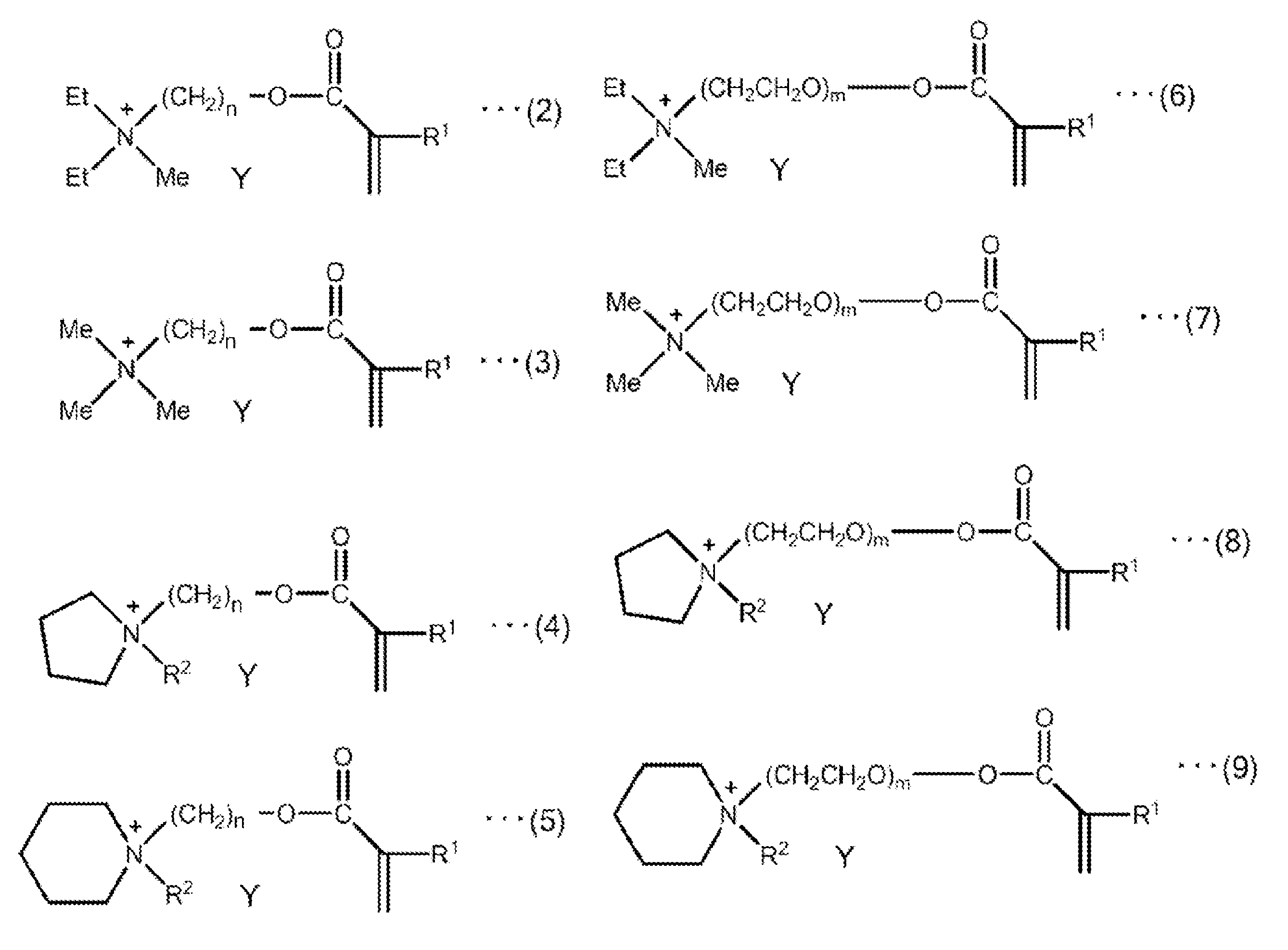
式(2)~(9)において、m、n、R1、R2、Yは、式(1)のm、n、R1、R2、Yと同義である。Meはメチル基を表し、Etはエチル基を表す。
上記イオン液体型モノマーとしては、特に限定されないが、例えば下記式(1)で表される化合物が挙げられる。
Yは一価のアニオンを表す。Yが表す一価のアニオンとしては、例えば、BF4 -、PF6 -、AsF6 -、SbF6 -、AlCl4 -、NbF6 -、HSO4 -、ClO4 -、CH3SO3 -、CF3SO3 -、CF3CO2 -、(CF3SO2)2N-、Cl-、Br-、I-などを挙げることができる。アニオンの安定性を考慮すると、BF4 -、PF6 -、(CF3SO2)2N-、CF3SO3 -、またはCF3CO2 -であることが好ましい。
イオン液体型モノマーは、式(1)で表される化合物のなかでも、特に下記式(2)~(9)のいずれかで表される化合物であることが好ましい。
上記イミド基を有する不凍水形成可モノマー単位を構成するモノマーとしては、マレイミド、メチルマレイミド、エチルマレイミド、プロピルマレイミド、ブチルマレイミド、ヘキシルマレイミド、オクチルマレイミド、ドデシルマレイミド、ステアリルマレイミド、フェニルマレイミド、シクロヘキシルマレイミド、等が挙げられる。
上記ニトリル基を有する不凍水形成可モノマー単位を構成するモノマーとしては、アクリロニトリル、メタクリロニトリル、等が挙げられる。
上記アルコキシ基を有する不凍水形成可モノマー単位を構成するモノマーとしては、ポリエトキシエチル(メタ)アクリレート、ポリエトキシプロピル(メタ)アクリレート、等が挙げられる。
上記アルキレングリコールを有する不凍水形成可モノマー単位を構成するモノマーとしては、ポリ(アルキレングリコール)モノ(メタ)アクリレート(例えば、ポリ(エチレングリコール)モノメタクリレートなど)、アルコキシポリ(アルキレングリコール)(メタ)アクリレート(例えば、メトキシポリ(エチレングリコール)メタクリレートなど)、フェノキシポリ(アルキレングリコール)(メタ)アクリレート(例えば、フェノキシポリ(エチレングリコール)メタクリレートなど)、ポリアルコキシポリ(アルキレングリコール)(メタ)アクリレート、2-グルコシロキシエチル(メタ)アクリレート、ポリ(エチレングリコール)モノメタクリレートなどのノニオン型モノマー、等が挙げられる。
上記ベタインを有する不凍水形成可モノマー単位を構成するモノマーとしては、(3-[(3-アクリルアミドプロピル)ジメチルアンモニオ]プロパン-1-スルホン酸、等が挙げられる。
中でも、上記不凍水形成可モノマー単位としては、高分子鎖集合体を含む層中に不凍水をより多く保持できる観点から、アルキレングリコールを有するモノマーが好ましく、ポリアルコキシポリ(アルキレングリコール)(メタ)アクリレートがより好ましい。
上記高分子鎖の生成に用いるモノマーは、その重合により得られる高分子鎖を、グラフト鎖として基材に結合できるものであることが好ましい。そのようなモノマーとして、付加重合性の二重結合を少なくとも1つ有するモノマーを挙げることができ、付加重合性の二重結合を1つ有する単官能性のモノマーであることが好ましい。付加重合性の二重結合を1つ有する単官能性のモノマーとして、(メタ)アクリル酸系モノマー、スチレン系モノマーなどが挙げられる。
上記不凍水形成可モノマー単位を構成するモノマーは、不凍水形成可構造部分を有し、さらに付加重合性の二重結合を1つ有する単官能性のモノマーが好ましい。不凍水形成可構造部分を有し、さらに付加重合性の二重結合を1つ有する単官能性のモノマーとしては、例えば、上述の不凍水形成可構造部分を有するモノマーとして例示され、且つ後述の付加重合性の二重結合を1つ有する単官能性のモノマーとしても重複して例示されるモノマーが挙げられる。
上記不凍水形成可モノマー単位を構成するモノマーは、不凍水形成可構造部分を有し、さらに付加重合性の二重結合を1つ有する単官能性のモノマーが好ましい。不凍水形成可構造部分を有し、さらに付加重合性の二重結合を1つ有する単官能性のモノマーとしては、例えば、上述の不凍水形成可構造部分を有するモノマーとして例示され、且つ後述の付加重合性の二重結合を1つ有する単官能性のモノマーとしても重複して例示されるモノマーが挙げられる。
(メタ)アクリル酸系モノマーとしては、(メタ)アクリル酸、メチル(メタ)アクリレート、エチル(メタ)アクリレート、プロピル(メタ)アクリレート、イソプロピル(メタ)アクリレート、ブチル(メタ)アクリレート、イソブチル(メタ)アクリレート、tert-ブチル(メタ)アクリレート、ペンチル(メタ)アクリレート、ヘキシル(メタ)アクリレート、シクロヘキシル(メタ)アクリレート、ヘプチル(メタ)アクリレート、オクチル(メタ)アクリレート、2-エチルヘキシル(メタ)アクリレート、ノニル(メタ)アクリレート、デシル(メタ)アクリレート、ドデシル(メタ)アクリレート、トリデシル(メタ)アクリレート、フェニル(メタ)アクリレート、トルイル(メタ)アクリレート、ベンジル(メタ)アクリレート、2-メトキシエチル(メタ)アクリレート、3-メトキシプロピル(メタ)アクリレート、3-メトキシブチル(メタ)アクリレート、2-ヒドロキシエチル(メタ)アクリレート、2-ヒドロキシプロピル(メタ)アクリレート、ステアリル(メタ)アクリレート、グリシジル(メタ)アクリレート、3-エチル-3-(メタ)アクリロイルオキシメチルオキセタン、2-(メタ)アクリロイルオキシエチルイソシアネート、(メタ)アクリレート-2-アミノエチル、2-(2-ブロモプロピオニルオキシ)エチル(メタ)アクリレート、2-(2-ブロモイソブチリルオキシ)エチル(メタ)アクリレート、1-(メタ)アクリロキシ-2-フェニル-2-(2,2,6,6-テトラメチル-1-ピペリジニルオキシ)エタン、1-(4-((4-(メタ)アクリロキシ)エトキシエチル)フェニルエトキシ)ピペリジン、γ-(メタクリロイルオキシプロピル)トリメトキシシラン、3-(3,5,7,9,11,13,15-ヘプタエチルペンタシクロ[9.5.1.13,9.15,15.17,13]オクタシロキサン-1-イル)プロピル(メタ)アクリレート、3-(3,5,7,9,11,13,15-ヘプタイソブチル-ペンタシクロ[9.5.1.13,9.15,15.17,13]オクタシロキサン-1-イル)プロピル(メタ)アクリレート、3-(3,5,7,9,11,13,15-ヘプタイソオクチルペンタシクロ[9.5.1.13,9.15,15.17,13]オクタシロキサン-1-イル)プロピル(メタ)アクリレート、3-(3,5,7,9,11,13,15-ヘプタシクロペンチルペンタシクロ[9.5.1.13,9.15,15.17,13]オクタシロキサン-1-イル)プロピル(メタ)アクリレート、3-(3,5,7,9,11,13,15-ヘプタフェニルペンタシクロ[9.5.1.13,9.15,15.17,13]オクタシロキサン-1-イル)プロピル(メタ)アクリレート、3-[(3,5,7,9,11,13,15-ヘプタエチルペンタシクロ[9.5.1.13,9.15,15.17,13]オクタシロキサン-1-イルオキシ)ジメチルシリル]プロピル(メタ)アクリレート、3-[(3,5,7,9,11,13,15-ヘプタイソブチルペンタシクロ[9.5.1.13,9.15,15.17,13]オクタシロキサン-1-イルオキシ)ジメチルシリル]プロピル(メタ)アクリレート、3-[(3,5,7,9,11,13,15-ヘプタイソオクチルペンタシクロ[9.5.1.13,9.15,15.17,13]オクタシロキサン-1-イルオキシ)ジメチルシリル]プロピル(メタ)アクリレート、3-[(3,5,7,9,11,13,15-ヘプタシクロペンチルペンタシクロ[9.5.1.13,9.15,15.17,13]オクタシロキサン-1-イルオキシ)ジメチルシリル]プロピル(メタ)アクリレート、3-[(3,5,7,9,11,13,15-ヘプタフェニルペンタシクロ[9.5.1.13,9.15,15.17,13]オクタシロキサン-1-イルオキシ)ジメチルシリル]プロピル(メタ)アクリレート、(メタ)アクリル酸のエチレンオキサイド付加物、トリフルオロメチルメチル(メタ)アクリレート、2-トリフルオロメチルエチル(メタ)アクリレート、2-ペルフルオロエチルエチル(メタ)アクリレート、2-ペルフルオロエチル-2-ペルフルオロブチルエチル(メタ)アクリレート、2-ペルフルオロエチル(メタ)アクリレート、トリフルオロメチル(メタ)アクリレート、ジペルフルオロメチルメチル(メタ)アクリレート、2-ペルフルオロメチル-2-ペルフルオロエチルエチル(メタ)アクリレート、2-ペルフルオロヘキシルエチル(メタ)アクリレート、2-ペルフルオロデシルエチル(メタ)アクリレート、2-ペルフルオロヘキサデシルエチル(メタ)アクリレートなどが挙げられる。
スチレン系モノマーとしては、スチレン、ビニルトルエン、α-メチルスチレン、p-クロロスチレン、p-クロロメチルスチレン、m-クロロメチルスチレン、o-アミノスチレン、p-スチレンクロロスルホン酸、スチレンスルホン酸およびその塩、ビニルフェニルメチルジチオカルバメート、2-(2-ブロモプロピオニルオキシ)スチレン、2-(2-ブロモイソブチリルオキシ)スチレン、1-(2-((4-ビニルフェニル)メトキシ)-1-フェニルエトキシ)-2,2,6,6-テトラメチルピペリジン、1-(4-ビニルフェニル)-3,5,7,9,11,13,15-ヘプタエチルペンタシクロ[9.5.1.13,9.15,15.17,13]オクタシロキサン、1-(4-ビニルフェニル)-3,5,7,9,11,13,15-ヘプタイソブチルペンタシクロ[9.5.1.13,9.15,15.17,13]オクタシロキサン、1-(4-ビニルフェニル)-3,5,7,9,11,13,15-ヘプタイソオクチルペンタシクロ[9.5.1.13,9.15,15.17,13]オクタシロキサン、1-(4-ビニルフェニル)-3,5,7,9,11,13,15-ヘプタシクロペンチルペンタシクロ[9.5.1.13,9.15,15.17,13]オクタシロキサン、1-(4-ビニルフェニル)-3,5,7,9,11,13,15-ヘプタフェニルペンタシクロ[9.5.1.13,9.15,15.17,13]オクタシロキサン、3-(3,5,7,9,11,13,15-ヘプタエチルペンタシクロ[9.5.1.13,9.15,15.17,13]オクタシロキサン-1-イル)エチルスチレン、3-(3,5,7,9,11,13,15-ヘプタイソブチルペンタシクロ[9.5.1.13,9.15,15.17,13]オクタシロキサン-1-イル)エチルスチレン、3-(3,5,7,9,11,13,15-ヘプタイソオクチルペンタシクロ[9.5.1.13,9.15,15.17,13]オクタシロキサン-1-イル)エチルスチレン、3-(3,5,7,9,11,13,15-ヘプタシクロペンチルペンタシクロ[9.5.1.13,9.15,15.17,13]オクタシロキサン-1-イル)エチルスチレン、3-(3,5,7,9,11,13,15-ヘプタフェニルペンタシクロ[9.5.1.13,9.15,15.17,13]オクタシロキサン-1-イル)エチルスチレン、3-((3,5,7,9,11,13,15-ヘプタエチルペンタシクロ[9.5.1.13,9.15,15.17,13]オクタシロキサン-1-イルオキシ)ジメチルシリル)エチルスチレン、3-((3,5,7,9,11,13,15-ヘプタイソブチルペンタシクロ[9.5.1.13,9.15,15.17,13]オクタシロキサン-1-イルオキシ)ジメチルシリル)エチルスチレン、3-((3,5,7,9,11,13,15-ヘプタイソオクチルペンタシクロ[9.5.1.13,9.15,15.17,13]オクタシロキサン-1-イルオキシ)ジメチルシリル)エチルスチレン、3-((3,5,7,9,11,13,15-ヘプタシクロペンチルペンタシクロ[9.5.1.13,9.15,15.17,13]オクタシロキサン-1-イルオキシ)ジメチルシリル)エチルスチレン、3-((3,5,7,9,11,13,15-ヘプタフェニルペンタシクロ[9.5.1.13,9.15,15.17,13]オクタシロキサン-1-イルオキシ)ジメチルシリル)エチルスチレンなどが挙げられる。
また、付加重合性の二重結合を1分子中に1つ有する単官能性のモノマーとして、フッ素含有ビニルモノマー(ペルフルオロエチレン、ペルフルオロプロピレン、フッ化ビニリデンなど)、ケイ素含有ビニル系モノマー(ビニルトリメトキシシラン、ビニルトリエトキシシランなど)、無水マレイン酸、マレイン酸、マレイン酸のモノアルキルエステルおよびジアルキルエステル、フマル酸、フマル酸のモノアルキルエステルおよびジアルキルエステル、マレイミド系モノマー(マレイミド、メチルマレイミド、エチルマレイミド、プロピルマレイミド、ブチルマレイミド、ヘキシルマレイミド、オクチルマレイミド、ドデシルマレイミド、ステアリルマレイミド、フェニルマレイミド、シクロヘキシルマレイミドなど)、ニトリル基含有モノマー(アクリロニトリル、メタクリロニトリルなど)、アミド基含有モノマー(アクリルアミド、メタクリルアミドなど)、ビニルエステル系モノマー(酢酸ビニル、プロピオン酸ビニル、ピバリン酸ビニル、安息香酸ビニル、桂皮酸ビニルなど)、オレフィン類(エチレン、プロピレンなど)、共役ジエン系モノマー(ブタジエン、イソプレンなど)、ハロゲン化ビニル(塩化ビニルなど)、ハロゲン化ビニリデン(塩化ビニリデンなど)、ハロゲン化アリル(塩化アリルなど)、アリルアルコール、ビニルピロリドン、ビニルピリジン、N-ビニルカルバゾール、メチルビニルケトン、ビニルイソシアナート、主鎖がスチレン、(メタ)アクリル酸エステル、シロキサンなどから誘導されたマクロモノマーなども用いることもできる。
上記高分子鎖は、反応性基を有するポリマー同士が反応して得られたポリマーであってもよい。反応性基としては、ヒドロキシ基やイソシアネート基などが挙げられる。反応性基を有するポリマーとしては、ポリエチレングリコールやジメチルシロキサンの重合体などが挙げられ、具体的には、サイラプレーンFM-0421(反応性シリコーン)(信越化学工業社製)などが挙げられる。
氷核形成および着氷の抑制効果に特に優れる観点から、メトキシポリ(エチレングリコール)メタクリレート、またはドデシルメタクリレートとトリデシルメタクリレートとの混合物が好ましく、屋外での着雪抑制の観点から、ドデシルメタクリレートとトリデシルメタクリレートとの混合物が特に好ましい。
氷核形成および着氷の抑制効果に特に優れる観点から、メトキシポリ(エチレングリコール)メタクリレート、またはドデシルメタクリレートとトリデシルメタクリレートとの混合物が好ましく、屋外での着雪抑制の観点から、ドデシルメタクリレートとトリデシルメタクリレートとの混合物が特に好ましい。
上記高分子鎖は、高分子鎖集合体を含む層に保持させる液状物質に対して親和性を有する親水性高分子鎖であることが好ましい。
例えば、高分子鎖集合体を含む層に、水や親水性の液状物質を保持させる場合は、高分子鎖集合体を構成する高分子鎖は、親水性高分子鎖であることが好ましい。親水性高分子鎖は、親水性モノマーを用いて合成してもよく、疎水性モノマーを用いて高分子を合成した後に、その高分子に親水性基を導入することによって合成してもよい。
本明細書において、水との相溶性が高い高分子鎖を「相溶系高分子鎖」、水との相溶性が低い高分子鎖を「非相溶系高分子鎖」と称する場合がある。なお、水との相溶性が高い高分子鎖とは、原子間力顕微鏡を用いた膜厚測定法で測定、算出される膨潤度が、1.5以上(好ましくは2.0以上、より好ましくは2.5以上)である高分子鎖をいい、水との相溶性が低いとは1.5未満(好ましくは1.3以下、より好ましくは1.1以下、さらに好ましくは1.08以下、特に好ましくは1.05以下)である高分子鎖をいう。
なお、上記膨潤度は以下の方法で測定された値をいう。層の厚さを測定する試験体に、ピンセット先端などで傷をつけ、基板素地がむき出しになっている部分と層がある部分の境界を、原子間力顕微鏡コロイドプローブ法(コンタクトモード)を用いて段差の高さ(すなわち、乾燥状態の層の厚さ)を見積もる。次に、対応する液状物質(例えば、水)に、同一試験体を終夜浸漬した後に、液中、同一箇所で原子間力顕微鏡コロイドプローブ法(コンタクトモード)を用いて段差の高さ(すなわち、膨潤状態の層の厚さ)を見積もる。そして、膨潤状態の層の厚さ/乾燥状態の層の厚さから、膨潤度を算出する。
上記高分子鎖の生成には、親水性モノマーを用いることが好ましい。すなわち、上記高分子鎖は親水性モノマー由来のモノマー単位を含むことが好ましい。
上記不凍水形成可モノマー単位を構成するモノマーは、不凍水形成可構造部分を有し、さらに親水性を有するモノマーが好ましい。不凍水形成可構造部分を有し、さらに親水性を有するモノマーとしては、例えば、上述の不凍水形成可構造部分を有するモノマーとして例示され、且つ後述の親水性モノマーとしても重複して例示されるモノマーが挙げられる。
上記不凍水形成可モノマー単位を構成するモノマーは、不凍水形成可構造部分を有し、さらに親水性を有するモノマーが好ましい。不凍水形成可構造部分を有し、さらに親水性を有するモノマーとしては、例えば、上述の不凍水形成可構造部分を有するモノマーとして例示され、且つ後述の親水性モノマーとしても重複して例示されるモノマーが挙げられる。
親水性モノマーとしては、ヒドロキシ置換アルキル(メタ)アクリレート(例えば、2-ヒドロキシエチル(メタ)アクリレート、2-ヒドロキシプロピル(メタ)アクリレート、2-ヒドロキシプロピル(メタ)アクリレート、2,3-ジヒドロキシプロピル(メタ)アクリレート、ポリエトキシエチル(メタ)アクリレート、ポリエトキシプロピル(メタ)アクリレートなど)、ポリ(アルキレングリコール)モノ(メタ)アクリレート(例えば、ポリ(エチレングリコール)モノメタクリレートなど)、アルコキシポリ(アルキレングリコール)(メタ)アクリレート(例えば、メトキシポリ(エチレングリコール)メタクリレートなど)、フェノキシポリ(アルキレングリコール)(メタ)アクリレート(例えば、フェノキシポリ(エチレングリコール)メタクリレートなど)が好ましく、ポリアルコキシポリ(アルキレングリコール)(メタ)アクリレートがより好ましい。
また、親水性モノマーとしては、(メタ)アクリルアミド、N-アルキル(メタ)アクリルアミド(例えば、N-メチルアクリルアミド、N,N-ジメチルアクリルアミド、N-メチルメタクリルアミドなど)、2-グルコシロキシエチル(メタ)アクリレート、アクリル酸、メタクリル酸、フマル酸、マレイン酸、イタコン酸、クロトン酸、メタクリルアミド、N-ビニルピロリドン、N,N-ジメチルアミノエチル(メタ)アクリレート、およびその四級アンモニウム塩を用いることもできる。
また、親水性モノマーとしては、(メタ)アクリルアミド、N-アルキル(メタ)アクリルアミド(例えば、N-メチルアクリルアミド、N,N-ジメチルアクリルアミド、N-メチルメタクリルアミドなど)、2-グルコシロキシエチル(メタ)アクリレート、アクリル酸、メタクリル酸、フマル酸、マレイン酸、イタコン酸、クロトン酸、メタクリルアミド、N-ビニルピロリドン、N,N-ジメチルアミノエチル(メタ)アクリレート、およびその四級アンモニウム塩を用いることもできる。
親水性高分子鎖の生成には、カルボキシ基またはカルボキシ基の塩に容易に転換できる基を側鎖に有する親水性モノマーを用いることも好ましい。生成した高分子鎖の側鎖の基を、カルボキシ基またはカルボキシ基の塩に転換することにより親水性付与することができる。カルボキシ基またはカルボキシ基の塩に容易に転換できる基を側鎖に有するモノマーとしては、tert-ブチル(メタ)アクリレートなどが挙げられる。
本実施形態の部材において、上記液状物質の少なくとも一部が水であり、氷核形成および着氷の抑制効果に優れる観点から、上記高分子鎖は相溶系高分子鎖であることが好ましい。
上記相溶系高分子鎖は、ポリ(エチレングリコール)モノメタクリレートなどのノニオン型モノマー;メタクリル酸3-スルホプロピルカリウム塩などのアニオン型モノマー;メタクリロイルオキシエチルトリメチルアンモニウムクロリドなどのカチオン型モノマー;および3-[(3-アクリルアミドプロピル)ジメチルアンモニオ]プロパン-1-スルホン酸などのベタイン型モノマー;からなる群から選ばれる少なくとも一種の相溶系モノマーに由来する構造単位を含むことが好ましい。なかでも、氷核形成および着氷の抑制効果に特に優れる観点から、(ポリ)アルキレングリコールを有するモノマーが好ましい。上記相溶系モノマーは、一種を単独で用いてもよいし複数種を組み合わせて用いてもよい。
上記相溶系高分子鎖は、高分子鎖100質量部に対する、上記相溶系モノマーに由来する構造単位の質量割合が、50質量部超(好ましくは70質量部以上、より好ましくは80質量部以上、さらに好ましくは90質量部以上、特に好ましくは100質量部)である高分子鎖をいう。上記高分子鎖は、高分子鎖100質量部に対する、上記ベタイン型モノマーに由来する構造単位の質量割合が、70質量部以上であることが好ましく、より好ましくは80質量部以上、さらに好ましくは90質量部以上、特に好ましくは100質量部である。
なお、相溶系モノマーとは、ホモポリマーとしたときの上記膨潤度が1.1以上であるモノマーといい、非相溶系モノマーとは、ホモポリマーとしたときの上記膨潤度が1.1未満であるモノマーという。相溶系高分子鎖を構成するモノマーの一部が非相溶系モノマーであってよい。
上記高分子鎖が(ポリ)アルキレングリコールを有するモノマーを含む場合、上記高分子鎖100質量部に対する不凍水形成可ユニットの質量割合は、高分子鎖集合体を含む層中に不凍水を多く保持できる観点から、80~100質量部であることが好ましい。
本実施形態の部材において、本発明の効果を損なわない範囲において、上記液状物質の一部が水と非相溶系の物質であってよい。
高分子鎖集合体には、高分子鎖同士の間や高分子鎖と基材との間に架橋構造が形成されていてもよい。これにより、高分子鎖集合体の弾性率を制御することができる。高分子鎖同士の間に形成する架橋構造は、物理的架橋構造および化学的架橋構造のいずれであってもよい。架橋構造は、高分子鎖を生成するための重合反応と同時に形成してもよいし、高分子鎖を生成した後に形成してもよい。高分子鎖を生成するための重合反応と同時に行う架橋構造の形成は、重合反応液に、高分子鎖を生成するための単官能性モノマーに加えて、エチレングリコールジメタクリレートなどのジビニルモノマーのような二官能性モノマーを適量添加することにより行うことができる。また、生成した高分子鎖同士の間や高分子鎖と基材との間の架橋構造の形成は、架橋基を有するモノマーを用いて高分子鎖に架橋基を導入しておき、その架橋基と、他の高分子鎖の反応基との反応、その架橋基と基材の反応基との反応により行うことができる。架橋基としては、アジド基、ハロゲン基(好ましくはブロモ基)、アルコキシシリル基、イソシアネート基、ビニル基、チオール基などを挙げることができる。また、高分子鎖をリビングラジカル重合で生成した際に、グラフト鎖の末端に残る反応基を架橋基として用いることもできる。
本実施形態の部材において、高分子鎖集合体を構成する高分子鎖は基材に固定されている。基材は、高分子鎖集合体とは別の物質からなる担体であってもよいし、高分子鎖集合体に含まれる高分子鎖と同一または異なる直鎖状または分岐鎖状の高分子鎖であってもよい。なお、本明細書において、基材としての高分子鎖を「幹ポリマー」と称する場合がある。
基材が担体である場合、高分子鎖集合体は「ポリマーブラシ」を構成する。上記担体は平板状、球状、多孔質状などの広い表面積(例えば、100mm2以上の表面積)を有する基材であってよい。
また、基材が幹ポリマーである場合、主鎖としての該幹ポリマーと、その主鎖に結合した上記高分子鎖(側鎖)を合わせた全体が「ボトルブラシ構造」を構成する。基材が幹ポリマーである場合、本実施形態の部材は当該ボトルブラシ構造が上述の担体に接着したものを含む。
また、高分子鎖集合体を構成する高分子鎖が、高分子鎖集合体とは別の物質からなる担体に固定されていている場合、たとえば、高分子鎖集合体が「ポリマーブラシ」を構成する場合においては、高分子鎖の一部(例えば、高分子鎖の片側末端や中央部など)のみが基材(担体)に固定されていてもよく、高分子鎖の両末端のそれぞれが基材(担体)に固定されていてもよい。高分子鎖の両末端が基材(担体)に固定されている場合は、高分子鎖はループ構造をなしており、このような高分子鎖集合体は、ループ構造のポリマーブラシを構成している。ループ構造を成すブラシ状ポリマーは、ボトルブラシであってもよい。
ここで、固定とは、基材を構成する化合物または基材表面に導入した開始基と高分子鎖とが直接化学的に結合すること、基材表面に設けた層と高分子とが化学的に結合することなどが挙げられる。中でも、低温での氷核形成抑制および着氷抑制に優れる観点から、基材を構成する化合物または基材表面に導入した開始基と高分子鎖とが直接化学的に結合することが好ましい。
なお、本明細書において「基材」とは高分子鎖が固定されるものをいう。また「担体」とは表面に複数の高分子鎖で構成されたブラシ状の高分子鎖集合体を含む層を有することができるものをいう。例えば、上述のポリマーブラシ構造を有する部材において、基材は、高分子鎖が固定されるものであり、担体もまた高分子鎖が固定されるものとしてよい。上述のボトルブラシ構造を有する部材において、基材は幹ポリマーであり、担体は幹ポリマーが接着するものとしてよい。
本実施形態の部材において、高分子鎖集合体が上記ポリマーブラシを構成している場合、ポリマーブラシの層の厚さ、すなわち、高分子鎖集合体を含む層の厚さは、10nm以上であることが好ましく、50nm以上であることがより好ましく、100nm以上であることが更に好ましく、300nm以上であることがなお更に好ましく、500nm以上であることがより一層好ましく、1000nm以上であることが特に好ましい。上限は特に限定はないが、例えば100μm以下とすることができ、50μm以下とすることもできる。高分子鎖集合体が自己組織化により形成される場合、この層厚さは、1nm以上であることが好ましく、5nm以上であることがより好ましく、10nm以上であることがより好ましく、100nm以上であることが更に好ましい。上限は特に限定はないが、例えば1μm以下とすることができ、10μm以下とすることもできる。高分子鎖集合体が自己組織化により形成されるとは、個々の高分子鎖が、自発的に高分子鎖集合体を形成することを意味する。
また、本実施形態の部材において、高分子鎖集合体が上記ボトルブラシ構造を有する場合、高分子鎖集合体を含む層の厚さは、2nm以上であることが好ましく、50nm以上であることがより好ましく、100nm以上であることが更に好ましく、300nm以上であることがなお更に好ましく、500nm以上であることがより一層好ましく、1000nm以上であることが特に好ましい。上限は特に限定はないが、例えば100μm以下とすることができ、50μm以下とすることもできる。
以下においては、ポリマーブラシとボトルブラシ構造を有する部材のそれぞれについて、その高分子鎖集合体の形成方法を説明する。
[A]ポリマーブラシ
ポリマーブラシの高分子鎖集合体は、複数の高分子鎖をグラフト鎖として基材である担体に結合させるグラフト重合法、等により得ることができる。このグラフト重合は、Grafting-from法やGrafting-to法で行うことができ、このうち、Grafting-from法を用いることが好ましい。ここで、Grafting-from法は、基材に重合開始基を導入して、その重合開始基からグラフト鎖を成長させる方法であり、Grafting-to法は、予め合成したグラフト鎖を、基材に導入した反応点に結合させる方法である。
また、高分子鎖集合体は、疎水性ブロックと親水性ブロックを有する高分子(ブロック共重合体)の疎水性部分を、疎水性の基材または疎水性化された基材の表面に疎水結合させる方法によっても得ることができる。ブロック共重合体としては、例えば、ポリメチルメタクリレート(PMMA)構造を疎水性ブロックとし、ポリ(ナトリウムスルホン化グリシジルメタクリレート)(PSGMA)構造を親水性ブロックとする共重合体を挙げることができる。PMMA構造とPSGMA構造との間には、他の高分子構造が介在していてもよい。この方法の詳細については、Nature, 425, 163-165 (2003)などを参照することができる。
(グラフト重合法)
以下に、高分子鎖集合体を、グラフト重合法を用いて製造する方法を具体的に説明する。
以下に、高分子鎖集合体を、グラフト重合法を用いて製造する方法を具体的に説明する。
-高分子鎖の生成-
グラフト重合法で用いる高分子鎖の製造方法は、特に限定されないが、ラジカル重合法を用いることが好ましく、リビングラジカル重合法(LRP)法を用いることがより好ましく、原子移動ラジカル重合(ATRP)法を用いることがさらに好ましい。リビングラジカル重合法は、高分子鎖の分子量や分子量分布をコントロールし易い、様々な種類の共重合体(例えば、ランダム共重合体、ブロック共重合体、組成傾斜型共重合体など)をグラフト鎖として生成できるという利点がある。また、リビングラジカル重合法によれば、高圧条件やイオン液体溶媒を用いることで、後述の濃厚ポリマーブラシを、その密度および厚さを精密に制御して生成することができる。ここで、リビングラジカル重合法を用いる場合のグラフト重合の方法は、Grafting-from法、Grafting-to法のいずれであってもよいが、Grafting-from法であることが好ましい。リビングラジカル重合法とGrafting-from法を組わせたグラフト重合法の詳細については、特開平11-263819号公報などを参照することができる。また、原子移動ラジカル重合法の詳細については、J. Am. Chem. Soc., 117, 5614 (1995)、Macromolecules, 28, 7901 (1995)、Science, 272, 866 (1996)、Macromolecules, 31, 5934-5936 (1998)を参照することができる。
また、高分子鎖は、ニトロキシド媒介重合法(NMP)、可逆的付加開裂連鎖移動(RAFT)重合法、可逆移動触媒重合法(RTCP)、可逆的錯体形成媒介重合法(RCMP)などによっても生成することができる。
ラジカル重合法で用いる触媒は、ラジカル重合を制御できるものであればよく、好ましくは遷移金属錯体である。遷移金属錯体の好ましい例として、周期律表第7族、8族、9族、10族、または11族元素を中心金属とする金属錯体を挙げることができ、中でも、銅錯体、ルテニウム錯体、鉄錯体またはニッケル錯体を用いることが好ましく、銅錯体を用いることがより好ましい。銅錯体は、1価の銅化合物と有機配位子の錯体を含むことが好ましく、1価の銅化合物と有機配位子の錯体と2価の銅化合物と有機配位子の錯体の両方を含むことがより好ましい。1価の銅化合物として、塩化第一銅、臭化第一銅などを挙げることができ、2価の銅化合物として、塩化第二銅、臭化第二銅などを挙げることができる。有機配位子として、2,2’-ビピリジル若しくはその誘導体、1,10-フェナントロリンもしくはその誘導体、ポリアミン(テトラメチルエチレンジアミン、ペンタメチルジエチレントリアミン、ヘキサメチルトリス(2-アミノエチル)アミンなど)、L-(-)-スパルテインなどの多環式アルカロイドなどを挙げることができる。1価の銅化合物と2価の銅化合物の両方を用いる場合、高分子鎖集合体を含む層中の不凍水の割合を一層高くでき、分子量分布指数(Mw/Mn)の調整が良好となることから、2価の銅化合物に対する1価の銅化合物のモル比率は、10倍以上であることが好ましく、20倍以上であることがより好ましく、30倍以上であることがさらに好ましい。2価の塩化ルテニウムのトリストリフェニルホスフィン錯体(RuCl2(PPh3)3)も触媒として好適である。ルテニウム化合物を触媒として用いる場合には、活性化剤としてアルミニウムアルコキシド類を添加するのが好ましい。2価の鉄のビストリフェニルホスフィン錯体(FeCl2(PPh3)2)、2価のニッケルのビストリフェニルホスフィン錯体(NiCl2(PPh3)2)、2価のニッケルのビストリブチルホスフィン錯体(NiBr2(PBu3)2)なども触媒として好適である。ラジカル重合において銅錯体を配合する際は、あらかじめ銅錯体を形成させておいたうえでラジカル重合に用いてもよいし、銅化合物と有機配位子とを銅錯体が形成される比率で配合してラジカル重合を行ってもよい。ラジカル重合において配合する銅化合物と有機配位子との比率は、銅化合物に対する有機配位子が十分に配位し銅錯体の溶解が良好となることから、有機配位子のモル数が銅化合物のモル数に対し2倍以上であることが好ましく、2.1倍以上であることがより好ましく、2.2倍以上であることが最も好ましい。
重合反応は溶剤中で行うことが好ましい。溶剤として、炭化水素系溶剤(ベンゼン、トルエンなど)、エーテル系溶剤(ジエチルエーテル、テトラヒドロフラン、ジフェニルエーテル、アニソール、ジメトキシベンゼンなど)、ハロゲン化炭化水素系溶剤(塩化メチレン、クロロホルム、クロロベンゼンなど)、ケトン系溶剤(アセトン、メチルエチルケトン、メチルイソブチルケトンなど)、アルコール系溶剤(メタノール、エタノール、プロパノール、イソプロパノール、ブチルアルコール、t-ブチルアルコールなど)、ニトリル系溶剤(アセトニトリル、プロピオニトリル、ベンゾニトリルなど)、エステル系溶剤(酢酸エチル、酢酸ブチルなど)、カーボネート系溶剤(エチレンカーボネート、プロピレンカーボネートなど)、アミド系溶剤(N,N-ジメチルホルムアミド、N,N-ジメチルアセトアミドなど)、ハイドロクロロフルオロカーボン系溶剤(1,1-ジクロロ-1-フルオロエタン、ジクロロペンタフルオロプロパンなど)、ハイドロフルオロカーボン系溶剤(炭素数2~5のハイドロフルオロカーボン、炭素数6以上のハイドロフルオロカーボンなど)、ペルフルオロカーボン系溶剤(ペルフルオロペンタン、ペルフルオロヘキサンなど)、脂環式ハイドロフルオロカーボン系溶剤(フルオロシクロペンタン、フルオロシクロブタンなど)、酸素含有フッ素系溶剤(フルオロエーテル、フルオロポリエーテル、フルオロケトン、フルオロアルコールなど)、水などを挙げることができる。これらの溶剤は、1種類を単独で使用してもよく、2種類以上を併用してもよい。
-重合開始基の導入-
高分子鎖集合体を、例えばGrafting-from法を用いて製造するには、基材に重合反応の開始点となる重合開始基を導入し、この重合開始基から、上記の重合方法を用いて高分子鎖をグラフト成長させる方法が挙げられる。重合開始基としては、ハロゲン化アルキル基、ハロゲン化スルホニル基などを挙げることができる。重合開始基は、グラフト鎖の密度(グラフト密度)およびグラフト重合により得られる高分子鎖の一次構造(分子量、分子量分布、モノマー配列様式)を精度よく制御できることから、基材表面に物理的若しくは化学的に結合されているのが好ましい。重合開始基を基材表面に導入(結合)する方法としては、化学吸着法、ラングミュアー・ブロジェット(LB)法などを挙げることができる。
例えば、シリコンウエハ(基材)表面へのクロロスルホニル基(重合開始基)の化学結合による導入は、2-(4-クロロスルホニルフェニル)エチルトリメトキシシランや2-(4-クロロスルホニルフェニル)エチルトリクロロシランなどを、シリコンウエハ表面の酸化層と反応させることにより行うことができる。
また、LB法により重合開始基を導入するには、重合開始基を含む膜形成材料を適切な溶媒(例、クロロホルム、ベンゼンなど)に溶解する。次に、この溶液少量を清浄な液面、好ましくは純水の液面上に展開した後、溶媒を蒸発させるか、または隣接する水相に拡散させて、水面上に膜形成分子による低密度の膜を形成させる。続いて、仕切り板を水面上で機械的に掃引し、膜形成分子が展開している水面の表面積を減少させることにより膜を圧縮して密度を増加させ、緻密な水面上単分子膜を得る。次いで、適切な条件下で、水面上単分子膜を構成する分子の表面密度を一定に保ちながら、単分子層を堆積する基材を、水面上単分子膜を横切る方向に浸漬または引き上げることによって、水面上単分子膜を該基材上に移し取り、単分子層を該基材上に堆積する。LB法の詳細については、「福田清成他著、新実験化学講座18巻(界面とコロイド)6章、(1977年)丸善」、「福田清成・杉道夫・雀部博之編集、LB膜とエレクトロニクス、(1986年)シーエムシー」、或いは、「石井淑夫著、よいLB膜をつくる実践的技術、(1989年)共立出版」を参照することができる。
重合開始基を基材表面に導入するにあたっては、基材に結合する基および基材と親和性を有する基の少なくとも一方と、重合開始基に結合する基および重合開始基と親和性を有する基の少なくとも一方を有する表面処理剤を用いて基材表面を処理することが好ましい。この表面処理剤は低分子化合物であっても、高分子化合物であってもよい。表面処理剤として、例えば下記式(10)で表される化合物が挙げられる。

式(10)において、nは1~10の整数であり、3~8の整数であることが好ましい。R11、R12およびR13は、各々独立に置換基を表す。R11、R12およびR13の少なくとも1つは、アルコキシル基またはハロゲン原子であることが好ましく、R11、R12およびR13の全てがメトキシ基であるか、エトキシ基であることが特に好ましい。R14およびR15は、各々独立に置換基を表す。R14およびR15は、各々独立に炭素数1~3のアルキル基、または芳香族性官能基であることが好ましく、R14およびR15の両方がメチル基であることが最も好ましい。X11は、ハロゲン原子を表し、臭素原子であることが好ましい。
表面処理剤として、重合開始基を含有するシランカップリング剤(重合開始基含有シランカップリング剤)を用いることが好ましい。これにより、表面処理と重合開始基の導入を同時に行うことができる。重合開始基含有シランカップリング剤としては、上記式(10)で表される化合物などが挙げられる。重合開始基含有シランカップリング剤およびその製造方法の説明については、国際公開第2006/087839号トの記載を参照することができる。重合開始基含有シランカップリング剤の具体例として、(2-ブロモ-2-メチル)プロピオニルオキシヘキシルトリメトキシシラン(BHM)、(2-ブロモ-2-メチル)プロピオニルオキシプロピルトリメトキシシラン(BPM)を挙げることができる。
グラフト密度を調整する観点から、重合開始基含有シランカップリング剤を表面処理剤に用いる場合には、重合開始基を含有しないシランカップリング剤、例えば、公知のアルキルシランカップリング剤を併用することが好ましい。これにより、重合開始基含有シランカップリング剤と重合開始基を含有しないシランカップリング剤との割合を調整することで、グラフト密度を自在に変更することができる。例えば、シランカップリング剤のすべてが重合開始基含有シランカップリング剤である場合、その表面処理後にGrafting-from法にてグラフト重合を行うことにより、0.03を超える表面占有率で高分子鎖を成長させることができる。なお、表面処理剤として重合開始基含有シランカップリング剤を使用する場合、その重合開始基含有シランカップリング剤を水の存在下で加水分解させてシラノールとし、部分的に縮合させてオリゴマー状態とした後に表面処理に供してもよい。具体的には、このオリゴマーを、例えばシリカなどの基材に水素結合的に吸着させた後、乾燥処理することで脱水縮合反応を起こさせ、重合開始基を基材に導入してもよい。
(基材)
ポリマーブラシ型の高分子鎖集合体において、高分子鎖を固定する基材(担体)を構成する材料としては、特に限定はない。有機材料、無機材料、金属材料などから適宜選択することができる。
上記基材は、上記高分子鎖集合体とは異なる物質からなる担体が好ましい。
ポリマーブラシ型の高分子鎖集合体において、高分子鎖を固定する基材(担体)を構成する材料としては、特に限定はない。有機材料、無機材料、金属材料などから適宜選択することができる。
上記基材は、上記高分子鎖集合体とは異なる物質からなる担体が好ましい。
有機材料としては、特に限定されず、各種樹脂およびゴムを制限なく用いることができる。樹脂としては、熱硬化性樹脂または熱可塑性樹脂のいずれでもよい。熱硬化性樹脂としては、たとえば、エポキシ樹脂、フェノール樹脂、アミノ樹脂、不飽和ポリエステル樹脂、ポリウレタン樹脂、ユリア樹脂、メラミン樹脂、熱硬化性ポリイミド樹脂、ジアリルフタレート樹脂などが挙げられる。熱可塑性樹脂としては、たとえば、ポリエチレン、ポリプロピレン、ポリスチレン、ポリシクロオレフィンなどのポリオレフィン系樹脂;ポリスチレン、アクリル樹脂、ポリ塩化ビニル樹脂、ポリビニルアルコールなどのビニル系樹脂;ポリテトラフルオロエチレンなどのフッ素系樹脂;ポリエチレンテレフタレート、ポリブチレンテレフタレート、ポリトリメチレンテレフタレート、ポリエチレンナフタレートなどのポリエステル系樹脂;ポリジメチルシロキサンなどのシリコーン樹脂;などが挙げられる。ゴムとしては、ブタジエンゴム、スチレンブタジエンゴム、クロロプレンゴム、イソプレンゴム、天然ゴム、ニトリルゴム、ブチルゴムなどのジエン系ゴム;エチレンプロピレンゴム、アクリルゴム、ポリエーテルゴム、ポリウレタンゴム、フッ素ゴム、シリコーンゴムなどのジエン系ゴム以外のゴムなどが挙げられる。
上記基材は、ポリマーモノリスであってもよい。ここで、ポリマーモノリスとは、三次元的に連通した連続空孔とポリマー骨格とで三次元共連続構造が形成されている高分子多孔質体をいう。
ポリマーモノリスのポリマー骨格は、重合性化合物と架橋剤との重合物であることが好ましい。
ポリマーモノリスのポリマー骨格は、重合性化合物と架橋剤との重合物であることが好ましい。
上記重合性化合物としては、架橋剤との重合によりポリマー骨格を形成可能な化合物であればよく、例えば、エポキシ化合物、(メタ)アクリレート化合物、スチレン化合物などが挙げられる。なかでも、柔軟性に優れ、微細な多孔質構造のポリマーモノリスを形成しやすい点から、エポキシ化合物が好ましい。上記エポキシ化合物としては、例えば、ビスフェノールA型エポキシ樹脂、臭素化ビスフェノールA型エポキシ樹脂、ビスフェノールF型エポキシ樹脂、ビスフェノールAD型エポキシ樹脂、スチルベン型エポキシ樹脂、ビフェニル型エポキシ樹脂、ビスフェノールAノボラック型エポキシ樹脂、クレゾールノボラック型エポキシ樹脂、ジアミノジフェニルメタン型エポキシ樹脂、テトラキス(ヒドロキシフェニル)エタンべースなどのポリフェニルベースエポキシ樹脂、フルオレン含有エポキシ樹脂、2,2,2-トリ-(2,3-エポキシプロピル)-イソシアネートなどのトリグリシジルイソシアヌレート、トリアジン環含有エポキシ樹脂など、複素芳香環を含むエポキシ樹脂、N,N,N’,N’-テトラグリシジル-m-キシリレンジアミンなどの芳香環由来の炭素原子を含む芳香族系エポキシ化合物や、脂肪族グリシジルエーテル型エポキシ樹脂、脂肪族グリシジルエステル型エポキシ樹脂、脂環族グリシジルエーテル型エポキシ樹脂、脂環族グリシジルエステル型エポキシ樹脂、1,3-ビス(N,N’-ジグリシジルアミノメチル)シクロヘキサンなどの芳香環由来の炭素原子を含まない脂肪族系エポキシ化合物などが挙げられる。なかでも、2官能以上のエポキシ化合物が好ましく、分子内にグリシジル基を2つ以上有する化合物がより好ましい。好ましい具体例としては、1,3-ビス(N,N’-ジグリシジルアミノメチル)シクロヘキサンなどが挙げられる。
上記架橋剤としては、例えば、アミン化合物、酸無水物、フェノール化合物、ヒドラジド化合物などが挙げられる。
上記アミン化合物としては、例えば、m-フェニレンジアミン、p-フェニレンジアミン、o-フェニレンジアミン、4,4’-ジアミノジフェニルスルホン、4,4’-メチレン-ビス(2-クロロアニリン)、ベンジルジメチルアミン、ジメチルアミノメチルベンゼンなどの芳香族アミン化合物;トリアジン環などの複素芳香環を有する芳香族アミン化合物;エチレンジアミン、ジエチレントリアミン、トリエチレンテトラミン、テトラエチレンペンタミン、イミノビスプロピルアミン、ビス(ヘキサメチレン)トリアミン、1,3,6-トリスアミノメチルヘキサン、ポリメチレンジアミン、トリメチルヘキサメチレンジアミン、ポリエーテルジアミン、イソホロンジアミン、メンタンジアミン、N-アミノエチルピペラジン、3,9-ビス(3-アミノプロピル)2,4,8,10-テトラオキサスピロ(5,5)ウンデカンアダクト、ビス(4-アミノシクロへキシル)メタンおよびこれらの変性品などの脂環族アミン化合物;1,6-ヘキサメチレンビス(N,N-ジメチルセミカルバジド)などの脂肪族ポリアミンヒドラジド化合物;ポリアミン類とダイマー酸からなる脂肪族ポリアミドアミン類やポリアミノアミド類などが挙げられる。
上記酸無水物としては、例えば、無水フタル酸、無水トリメット酸、無水ピロメット酸などの芳香族酸無水物が挙げられる。
上記フェノール化合物としては、例えば、ノボラック型フェノール樹脂などが挙げられる。
上記ヒドラジド化合物としては、例えば、イソフタル酸ジヒドラジドなどの芳香族ヒドラジド化合物;アジピン酸ジヒドラジド、セバチン酸ジヒドラジド、ドデカン二酸ジヒドラジドなどの脂肪族ヒドラジド化合物が挙げられる。
架橋剤は重合性化合物の種類に応じて適宜選択することが好ましい。重合性化合物として、エポキシ化合物を用いた場合は、架橋剤はアミン化合物であることが好ましく、2官能以上のアミン化合物である分子内にアミノ基を2つ以上有する化合物がより好ましい。2官能以上のアミン化合物としては、脂環族アミン化合物であることが好ましい。好ましい具体例としては、ビス(4-アミノシクロへキシル)メタンなどが挙げられる。
ポリマーモノリスのポリマー骨格としては、ポリマーモノリスの形成が簡便な点から、2官能以上のエポキシ化合物と2官能以上のアミン化合物の重合物であることが好ましく、2官能以上の脂肪族系エポキシ化合物と2官能以上の脂環族アミン化合物の重合物であることがより好ましい。
重合性化合物と架橋剤の配合割合は、架橋密度などを考慮して決定すればよい。例えば、重合性化合物が2官能以上のエポキシ化合物であり、架橋剤が2官能以上のアミン化合物である場合、重合性化合物のエポキシ基1当量に対して、架橋剤のアミン当量が0.6~1.5の範囲になるように調整することが好ましい。
ポリマーモノリスは、例えば、重合性化合物と架橋剤と孔形成剤とを含むポリマーモノリス形成用組成物によって形成することができる。より具体的には、担体としての基材にポリマーモノリス形成用組成物を塗布して塗布膜を形成し、塗布膜を硬化する。重合性化合物の重合に伴ってポリマー成分が増大し、スピノーダル分解が起こって共連続構造が発現する。その後、硬化膜から孔形成剤を除去することでポリマーモノリスを形成することができる。
ポリマーモノリスを設ける面には、ポリマーモノリス形成用組成物との親和性を向上させるために、シランカップリング剤などの公知のカップリング剤による処理や、プラズマ処理などが施されていてもよい。
無機材料としては、特に限定されず、セラミックス(例、アルミナセラミックス、バイオセラミックス、ジルコニア-アルミナ複合セラミックスなどの複合セラミックスなど)、金属(例、鉄、鋳鉄、鋼、ステンレス鋼、炭素鋼、高炭素クロム軸受鋼鋼材(SUJ2)などの鉄合金、アルミニウム、亜鉛、銅、チタンなどの非鉄および非鉄合金など)、多結晶シリコンなどのシリコン、酸化ケイ素、窒化ケイ素、各種ガラス、石英、およびこれらの複合材料などが挙げられる。
基材の種類は、特に限定されない。
例えばチューブ、シート、繊維、ストリップ、フィルム、板、箔、膜、ペレット、粉末、粒子、成形品(例、押出し成形品、鋳込み成形品など)などが挙げられる。また、本実施形態の部材を適用する物品そのものを基材に用いてもよい。
例えばチューブ、シート、繊維、ストリップ、フィルム、板、箔、膜、ペレット、粉末、粒子、成形品(例、押出し成形品、鋳込み成形品など)などが挙げられる。また、本実施形態の部材を適用する物品そのものを基材に用いてもよい。
(他の製造方法)
また、ポリマーブラシの高分子鎖集合体は、次の製造方法によって製造することもできる。すなわち、基材を構成する有機材料(以下、基材重合体ともいう)と、ポリマーブロックAおよびポリマーブロックAよりも基材重合体に対する親和性が低いポリマーブロックBとを備え、かつ、ポリマーブロックAを少なくとも2箇所に有している複数のブロック共重合体とを溶剤中で混合して混合液を調製する工程と、混合液中から溶剤を除去して、相分離を生じさせる工程とを備える製造方法により製造することができる。この製造方法によれば、高分子鎖集合体を構成する高分子鎖の両末端のそれぞれが担体である基材に固定されているループ構造のポリマーブラシの高分子鎖集合体を製造することができる。
また、ポリマーブラシの高分子鎖集合体は、次の製造方法によって製造することもできる。すなわち、基材を構成する有機材料(以下、基材重合体ともいう)と、ポリマーブロックAおよびポリマーブロックAよりも基材重合体に対する親和性が低いポリマーブロックBとを備え、かつ、ポリマーブロックAを少なくとも2箇所に有している複数のブロック共重合体とを溶剤中で混合して混合液を調製する工程と、混合液中から溶剤を除去して、相分離を生じさせる工程とを備える製造方法により製造することができる。この製造方法によれば、高分子鎖集合体を構成する高分子鎖の両末端のそれぞれが担体である基材に固定されているループ構造のポリマーブラシの高分子鎖集合体を製造することができる。
基材重合体である基材を構成する有機材料については、特に限定されず、上述したものが挙げられる。
ブロック共重合体としては、ポリマーブロックAおよびポリマーブロックAよりも基材重合体に対する親和性が低いポリマーブロックBとを備え、かつ、ポリマーブロックAを少なくとも2箇所に有しているものであればよく、特に限定されないが、ループ構造を好適に形成できるという観点より、ポリマーブロックBは、基材重合体に対して非相溶であるものを用いることが好ましく、ポリマーブロックBが、基材重合体に対して非相溶であり、かつ、ポリマーブロックAが、基材重合体に対して相溶である組み合わせがより好ましい。
ここで、ポリマーブロックAが、基材重合体に対して相溶であるとは、次の状態をいう。すなわち、ポリマーブロックAのみからなる重合体と、基材重合体とを、熱溶融混合や共溶液混合などにより混合した後、得られた混合物について、冷却あるいは溶剤蒸発除去などにより固化することにより得られた試料について、ガラス転移温度(Tg)を測定した場合に、ポリマーブロックAのみからなる重合体のTgと、基材重合体のTgとの間の温度域に、これらとは異なるTgが観測できる場合に、相溶であると判断することができる。
また、ポリマーブロックBが、基材重合体に対して非相溶であるとは、次の状態をいう。すなわち、ポリマーブロックBのみからなる重合体と、基材重合体とを、熱溶融混合や共溶液混合などにより混合した後、得られた混合物について、冷却あるいは溶剤蒸発除去などにより固化することにより得られた試料について、ガラス転移温度(Tg)を測定した場合に、ポリマーブロックBのみからなる重合体のTgおよび基材重合体のTg以外に、これらとは異なるTgが観測できない場合に、非相溶であると判断することができる。
また、ポリマーブロックBが、基材重合体に対して非相溶であるとは、次の状態をいう。すなわち、ポリマーブロックBのみからなる重合体と、基材重合体とを、熱溶融混合や共溶液混合などにより混合した後、得られた混合物について、冷却あるいは溶剤蒸発除去などにより固化することにより得られた試料について、ガラス転移温度(Tg)を測定した場合に、ポリマーブロックBのみからなる重合体のTgおよび基材重合体のTg以外に、これらとは異なるTgが観測できない場合に、非相溶であると判断することができる。
ポリマーブロックAおよびポリマーブロックBとしては、基材重合体に対する相溶性が上記の関係にあるものを用いればよいが、ループ構造を好適に形成できるという観点より、これらのSP値(溶解度パラメータ)に関し、ポリマーブロックAのSP値と、ポリマーブロックBのSP値との差は1.5(MPa)0.5以上であることが好ましく、3(MPa)0.5以上であることがより好ましく、5(MPa)0.5以上であることがさらに好ましい。また、ポリマーブロックAのSP値に関し、ポリマーブロックAのSP値と、基材重合体とのSP値との差が0.5(MPa)0.5以下であることが好ましく、0.3(MPa)0.5以下であることがより好ましく、0.2(MPa)0.5以下であることがさらに好ましい。ポリマーブロックBのSP値に関し、ポリマーブロックBのSP値と、基材重合体のSP値との差が1.5(MPa)0.5以上であることが好ましく、3(MPa)0.5以上であることがより好ましく、5(MPa)0.5以上であることがさらに好ましい。なお、ポリマーブロックAおよびポリマーブロックBのSP値は、たとえば、ポリマーハンドブック(第4版、Wiley-Interscience)に開示された値を用いることができる。
ポリマーブロックAとしては、上述した特性を満たすものであればよく、特に限定されず、用いる基材重合体との関係で選択すればよいが、その具体例としては、上述した基材重合体を構成する樹脂またはゴムとして例示した樹脂またはゴムを構成する重合体セグメントからなるものなどが挙げられる。
ブロック共重合体のポリマーブロックA部分の分子量(重量平均分子量(Mw))は、特に限定されないが、基材重合体と十分な相互作用を示し、これにより、ポリマーブロックBにより形成されるループ構造をより適切に支えることにより、耐久性をより高めることができるという観点より、好ましくは1,000~100,000、より好ましくは1,000~50,000、さらに好ましくは1,000~20,000であり、さらにより好ましくは2,000~20,000、特に好ましくは2,000~6,000である。
ポリマーブロックBとしては、上述した高分子鎖として説明したもののうち、基材重合体との間で上述した特性を満たすものが好ましく用いられる。
基材重合体と、複数のブロック共重合体鎖とを溶剤中で混合する際に、用いる溶剤としては、特に限定されず、基材重合体と、ブロック共重合体鎖とを溶解あるいは分散可能な溶剤であれば何でもよい。たとえば、n-ペンタン、n-ヘキサン、n-ヘプタンなどの脂肪族炭化水素;シクロペンタン、シクロヘキサン、メチルシクロヘキサン、ジメチルシクロヘキサン、トリメチルシクロヘキサン、エチルシクロヘキサン、ジエチルシクロヘキサン、デカヒドロナフタレン、ビシクロヘプタン、トリシクロデカン、ヘキサヒドロインデン、シクロオクタンなどの脂環族炭化水素;ベンゼン、トルエン、キシレン、メシチレンなどの芳香族炭化水素;ニトロメタン、ニトロベンゼン、アセトニトリル、プロピオニトリル、ベンゾニトリルなどの含窒素系炭化水素;ジエチルエーテル、テトラヒドロフラン、ジオキサンなどのエーテル類;アセトン、エチルメチルケトン、メチルイソブチルケトン、シクロペンタノン、シクロヘキサノンなどのケトン類;酢酸メチル、酢酸エチル、プロピオン酸エチル、安息香酸メチルなどのエステル類;クロロホルム、ジクロロメタン、1,2-ジクロロエタン、クロロベンゼン、ジクロロベンゼン、トリクロロベンゼンなどのハロゲン化炭化水素;メタノール、エタノールなどのアルコール類などが挙げられる。
このような溶剤中で、基材重合体と、複数のブロック共重合体鎖とを混合し、溶解あるいは分散させることで、混合液を得ることができる。次いで、得られた混合液を用いて、キャスト法やスピンコート法などにより製膜した後に、製膜した混合液中から溶剤を除去する。溶剤を介して基材重合体に対して分散状態にある複数のブロック共重合体鎖のうち一部が、溶剤が除去されることで、ポリマーブロックAについては、基材重合体と相溶した状態となったままで、ブロック共重合体鎖を構成するポリマーブロックBが、基材重合体と相分離して、ポリマーブロックAが基材重合体中にあり、かつ、ポリマーブロックBが基材重合体から露出した状態に変化させることができ、これにより、高分子鎖集合体を構成する高分子鎖の両末端のそれぞれが担体に固定されたループ構造を形成させることができる。
溶剤を除去する方法としては、特に限定されず、用いる溶剤の種類に応じて選択すればよいが、50℃~100℃にて加熱する方法が好ましく、70~80℃にて加熱する方法がより好ましい。
また、ポリマーブラシの高分子鎖集合体は、次の製造方法によって製造することもできる。すなわち、基材重合体と、ポリマーブロックAおよびポリマーブロックAよりも基材重合体に対する親和性が低いポリマーブロックBとを備え、かつ、ポリマーブロックAを少なくとも2箇所に有している複数のブロック共重合体とを加熱下で混合して溶融混合物を調製する工程と、溶融混合物を冷却させることで相分離を生じさせる工程とを備える製造方法により製造することもできる。この製造方法によっても、高分子鎖集合体を構成する高分子鎖の両末端のそれぞれが担体である基材に固定されているループ構造のポリマーブラシの高分子鎖集合体を製造することができる。
基材重合体と、複数のブロック共重合体とを加熱下で混合して溶融混合物を調製する際における加熱温度としては、特に限定されず、基材重合体またはブロック共重合体が溶融する温度、好ましくは基材重合体およびブロック共重合体鎖の両方が溶融する温度とすればよいが、好ましくは40~300℃、より好ましくは80~200℃である。
得られた溶融混合物を用いて、キャスト法、スピンコート法、ディップコート法などにより製膜した後に、冷却させ、冷却により固化する過程において相分離を生じさせる。溶融混合されていることにより、基材重合体に対して分散状態にある複数のブロック共重合体のうち一部が、溶融状態から固体状態になる過程において、ポリマーブロックAについては、基材重合体と相溶した状態となったままで、ブロック共重合体を構成するポリマーブロックBが、基材重合体と相分離することで、ポリマーブロックAが基材重合体中にあり、かつ、ポリマーブロックBが基材重合体から露出した状態に変化させることができ、これによりループ構造を形成させることができるものである。
溶融混合物を冷却する方法としては特に限定されないが、製膜した溶融混合物を室温下で静置する方法や、溶融混合物を構成する各成分の溶融温度よりも低い温度にて加温した状態で静置する方法などが挙げられる。
(高分子鎖の数平均分子量および分子量分布指数)
高分子鎖集合体を構成する高分子鎖の数平均分子量(Mn)は、好ましくは500~10,000,000であり、より好ましくは100,000~10,000,000である。
高分子鎖集合体における分子量分布指数(Mw/Mn)は、高分子鎖集合体を含む層中により多くの不凍水を保持できる観点から、1.0~2.0が好ましく、1.0~1.5がより好ましい。分子量分布指数(Mw/Mn)が上記範囲であれば、高分子鎖集合体を構成する高分子鎖の最表面まで高密度な状態を維持しうるという効果が期待できる。分子量分布指数(Mw/Mn)は、一例として、高分子鎖集合体を形成させるラジカル重合において用いる銅触媒中の1価の銅化合物と2価の銅化合物の比率や銅化合物に対する有機配位子のモル数等により調整することができる。
高分子鎖集合体の数平均分子量(Mn)および分子量分布指数(Mw/Mn)は、フッ化水素酸処理により基材から高分子鎖を切り出し、切り出した高分子鎖についてゲル浸透クロマトグラフィー法などのサイズ排除クロマトグラフィー法による分子量分析を行うことで測定することができる。
また、グラフト重合法を用いて高分子鎖集合体を形成した場合には、高分子鎖の重合反応に際して生成するフリーポリマーが、基材に固定される高分子鎖と等しい分子量を有すると仮定して、そのフリーポリマーについてサイズ排除クロマトグラフィー法により、数平均分子量(Mn)および分子量分布指数(Mw/Mn)を測定し、これをそのまま高分子鎖の数平均分子量(Mn)および分子量分布指数(Mw/Mn)として用いる方法も採用することもできる。なお、数平均分子量(Mn)および分子量分布指数(Mw/Mn)は、基材に固定される高分子鎖と重合反応時に生成するフリーポリマーでほぼ等しいことを確認している。
フリーポリマーを用いる分子量の測定方法について具体的に説明する。高分子鎖を表面開始リビングラジカル重合で合成する際、重合溶液に遊離開始剤を添加すると、高分子鎖集合体を構成する高分子鎖と同等の分子量および分子量分布を有するフリーポリマーを得ることができる。このフリーポリマーを、サイズ排除クロマトグラフィー法にて分析することにより、数平均分子量(Mn)および分子量分布指数(Mw/Mn)を決定する。
なお、サイズ排除クロマトグラフィー法での分析は、入手可能な分子量既知の同種単分散の標準試料を用いた較正法、多角度光散乱検出器を用いた絶対分子量評価を行うものである。本明細書では、本明細書の実施例では、数平均分子量(Mn)および重量平均分子量(Mw)の値は、多角度光散乱検出器ならびに各種標準試料の分子量検量線を用いて適切に算定した絶対値で示す。標準試料としては、ポリスチレン標準試料、ポリメチルメタクリレート標準試料、ポリエチレングリコール標準試料などが挙げられる。
基材表面における高分子鎖の密度は、0.01鎖/nm2以上であることが好ましく、0.05鎖/nm2以上であることがより好ましく、0.1鎖/nm2以上であることが更に好ましく、0.2鎖/nm2以上であることが特に好ましい。上限は、特に限定されないが1.0鎖/nm2以下とすることができ、0.9鎖/nm2以下とすることもできる。
高分子鎖の密度は、単位面積当たりのグラフト量(W)と高分子鎖集合体の数平均分子量(Mn)を測定し、下記式を用いて求めることができる。
高分子鎖の密度(鎖/nm2)=W(g/nm2)/Mn×(アボガドロ数)
式において、Wは単位面積当たりのグラフト量を表し、Mnは高分子鎖集合体の数平均分子量を表す。
単位面積当たりのグラフト量(W)は、基材がシリコンウエハのような平面基板の場合には、エリプソメトリー法により乾燥状態の総厚さ、すなわち、高分子鎖集合体層の乾燥状態における厚みを測定し、バルクフィルムの密度を用いて、単位面積当たりのグラフト量(W)を算出することにより求めることができる。
高分子鎖集合体の数平均分子量(Mn)の測定方法については、上述した方法にて測定することができる。
高分子鎖の密度(鎖/nm2)=W(g/nm2)/Mn×(アボガドロ数)
式において、Wは単位面積当たりのグラフト量を表し、Mnは高分子鎖集合体の数平均分子量を表す。
単位面積当たりのグラフト量(W)は、基材がシリコンウエハのような平面基板の場合には、エリプソメトリー法により乾燥状態の総厚さ、すなわち、高分子鎖集合体層の乾燥状態における厚みを測定し、バルクフィルムの密度を用いて、単位面積当たりのグラフト量(W)を算出することにより求めることができる。
高分子鎖集合体の数平均分子量(Mn)の測定方法については、上述した方法にて測定することができる。
基材表面における高分子鎖の表面占有率(ポリマーの断面積×高分子鎖の密度)は、0.01以上であることが好ましく、0.05以上であることがより好ましく、0.10以上であることがさらに好ましい。表面占有率は、基材表面をグラフト点(1つ目の構成単位)が占める割合を意味し、最密充填で1である。高分子鎖の密度の算出方法については、上述した方法にて測定することができる。ポリマーの断面積は、ポリマーの伸びきり形態における繰り返し単位長さとポリマーのバルク密度を用いて求めることができる。ポリマーが共重合体の場合は、構成するモノマーの比率に応じて数平均値として求めることができる。
基材表面における高分子鎖の表面占有率は、0.08~0.65であることが好ましく、より好ましくは0.10~0.40、さらに好ましくは屋外での着雪抑制の観点から0.15~0.25である。
基材表面における高分子鎖の表面占有率は、0.08~0.65であることが好ましく、より好ましくは0.10~0.40、さらに好ましくは屋外での着雪抑制の観点から0.15~0.25である。
本実施形態の部材は、ポリマーブラシ構造を有する場合、0℃~-18℃の幅広い範囲で優れた着氷抑制効果を得ることができる観点から、上記基材が上記高分子鎖集合体とは別の物質からなる担体であり、上記基材表面における上記高分子鎖の表面占有率が0.08~0.65(好ましくは0.10~0.40、より好ましく0.15~0.40)であることが好ましい。特に、ポリマーブラシ構造を有する場合、表面占有率が上記範囲であると、ブラシの密度が適度な範囲となることで、液状物質の保持力が向上し(特に水と非相の液状物質では、保持力が大きく向上する)、サイズ排除効果による氷核形成の抑制を一層向上させることができる。
[B]ボトルブラシ構造を有する部材
次に、ボトルブラシ構造を有する部材について説明する。
ボトルブラシ構造は、主鎖から複数の側鎖が分岐していて、全体としてボトルブラシ様の形状をなす分岐高分子構造のことをいう。ボトルブラシ構造は、主鎖が基材を構成し、側鎖が高分子鎖集合体を構成するが、さらに、ボトルブラシ構造が、担体に接着されてボトルブラシ構造を有する部材となってよい。担体については上述したものが挙げられる。また、この場合、ボトルブラシとポリマーブラシの両方を担体に固定または接着してもよい。その場合、ポリマーブラシは濃厚ポリマーブラシであることが好ましい。
本実施形態の部材は、上記基材である高分子鎖に上記複数の高分子鎖が側鎖として結合したボトルブラシ構造を有する部材が好ましい。
ボトルブラシ構造を有する部材も、グラフト重合法により得ることができる。このグラフト重合は、予め合成した反応性側鎖(グラフト鎖)を、主鎖となる幹ポリマーに結合させるGrafting-to法、マクロ開始剤(重合開始基を導入した幹ポリマー)の重合開始基から側鎖(グラフト鎖)を成長させるGrafting-from法、マクロモノマー(側鎖構成ポリマーの末端に重合性官能基を有するポリマー)を重合させるGrafting-through法を用いて行うことができる。また、これらの側鎖や幹ポリマーの合成には、リビングアニオン重合、開環メタセシス重合(ROMP)、あるいは汎用性の高いリビングラジカル重合法(LRP)を用いることができる。ボトルブラシ構造を有する部材の好ましい例として、式(11)で表される化合物を挙げることができる。

式(11)中、R1およびR2は、それぞれ独立に水素原子またはメチル基を表し、R3は置換基を表し、炭素数が1~10のアルキル基であることが好ましい。R4およびR5は原子または原子団からなる末端基を表し、水素原子、ハロゲン、重合開始剤由来の官能基などが挙げられる。Xは、OまたはNHを表し、Yは、2価の有機基を表し、nは、10以上の整数を表し、Polymer Aは、高分子鎖を表す。式(11)で表される化合物では、nで括られた構成単位の繰り返し構造がボトルブラシ構造の主鎖に相当し、Polymer Aがボトルブラシ構造の側鎖に相当する。
Yが表す有機基として、炭素数1~10のアルキレン基、炭素数1~5のオキシアルキレン基(RO)(Rは炭素数1~5のアルキレン基を表す)、このオキシアルキレン基が複数連結した連結構造、または、これらの有機基(炭素数1~10のアルキレン基、炭素数1~5のオキシアルキレン基およびオキシアルキレン基の連結構造)のうちの少なくとも2つの組み合わせからなる2価の有機基などを挙げることができる。ここで、アルキレン基およびオキシアルキレン基のアルキレン基は、直鎖状であっても分枝状であってもよく、環状構造を有していてもよい。アルキレン基の具体例として、エチレン基、プロピレン基、ブチレン基、シクロヘキシレン基を挙げることができる。このアルキレン基およびオキシアルキレン基のアルキレン基は、置換基で置換されていてもよい。置換基として、炭素数1~10のアルキル基、炭素数6~40のアリール基、炭素数3~40のヘテロアリール基を挙げることができ、これらの置換基はさらに置換基で置換されていてもよい。Polymer Aの説明と好ましい範囲、具体例については、上述した高分子鎖を参照することができる。Polymer Aは、主鎖の構成単位同士で、互いに同一であっても異なっていてもよい。
ボトルブラシ構造を有する部材について、主鎖を中心軸とし、その中心軸から側鎖(グラフト鎖)を直線状に延ばして、その先端を含む面(仮想外周部)を想定したとき、その部材の外形は、その先端を含む面を側面とする円柱と捉えることができる。こうした外形を有する部材では、側鎖(グラフト鎖)の長さが長くなる程、その側面における側鎖(グラフト鎖)の密度が低下し、側鎖(グラフト鎖)の構造上の自由度が高くなる。その結果、側鎖(グラフト鎖)は自由に折り畳まれ得ることになる。
ボトルブラシ構造を有する部材において、側鎖の表面占有率(σ*)は、下記式により求めることができる。
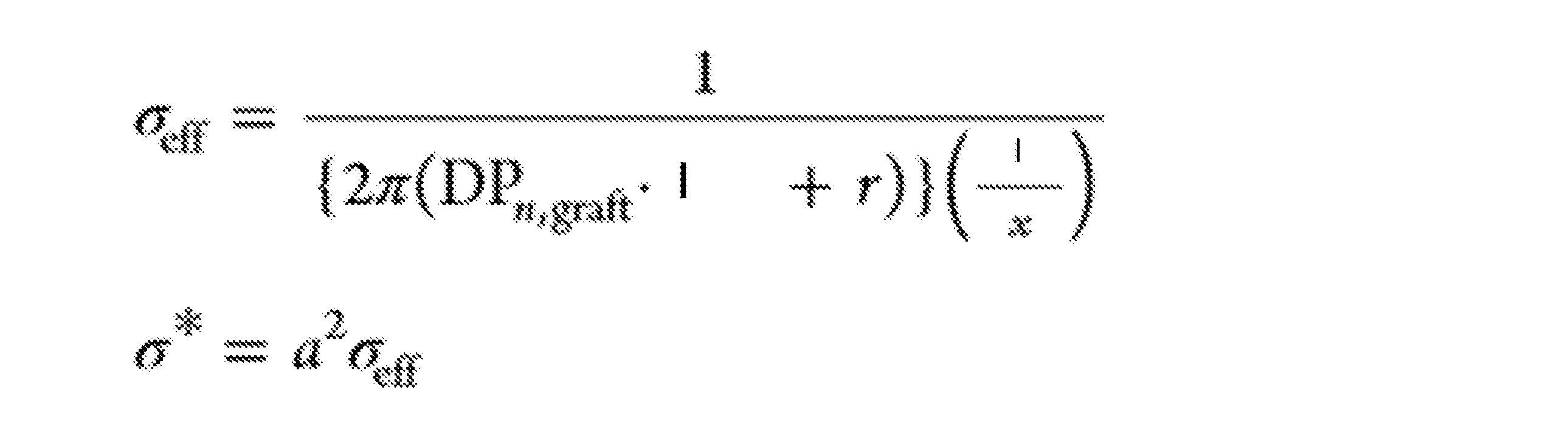
上記式中、DPn,graftはグラフト鎖の数平均重合度、xは幹ポリマー単位長さあたりのグラフト鎖数(本/nm)、rは骨格ポリマーの半径(nm)(例えば、PBIEMでは0.8nmである)、a2はモノマーの断面積(nm2)(例えば、PEGMAでは3.3nm2)、lは高分子鎖の繰り返し単位の全長(nm)(例えば、ポリメタクリレートの場合は0.25)であり、2π(DPn,graft・l+r)はボトルブラシの断面の円周(nm)、l/xは隣接するグラフト鎖間の距離(nm)である。上記方法は、Biomacromolecules、2021、22、2505-14を参照することができる。
側鎖の表面占有率は0~1の値を示し、数値が大きくなる程、ポリマー側面の側鎖先端部が占める割合が大きくなり、側鎖の自由度が制限されることになる。すなわち、側鎖の表面占有率は、側鎖の自由度を反映する数値であり、側鎖の表面占有率(σ*)が高い程、側鎖の構造上の自由度が制限される。その結果、側鎖が主鎖に対して、略垂直方向に延びた状態を維持することができ、その構造に特有の性質を示すと推測される。
側鎖の表面占有率は0~1の値を示し、数値が大きくなる程、ポリマー側面の側鎖先端部が占める割合が大きくなり、側鎖の自由度が制限されることになる。すなわち、側鎖の表面占有率は、側鎖の自由度を反映する数値であり、側鎖の表面占有率(σ*)が高い程、側鎖の構造上の自由度が制限される。その結果、側鎖が主鎖に対して、略垂直方向に延びた状態を維持することができ、その構造に特有の性質を示すと推測される。
ボトルブラシ構造を有する部材の側鎖の表面占有率は0.01以上であることが好ましく、0.05以上であることがより好ましく、0.10以上であることが更に好ましい。
また、側鎖の表面占有率は、0.08~0.65であることが好ましく、より好ましくは0.10~0.50、さらに好ましくは0.20~0.40である。
また、側鎖の表面占有率は、0.08~0.65であることが好ましく、より好ましくは0.10~0.50、さらに好ましくは0.20~0.40である。
ボトルブラシ構造を有する部材の側鎖の密度は、0.01鎖/nm2以上であることが好ましく、0.05鎖/nm2以上であることがより好ましく、0.1鎖/nm2以上であることが更に好ましく、0.2鎖/nm2以上であることが特に好ましい。上限は、特に限定されないが1.0鎖/nm2以下とすることができ、0.9鎖/nm2以下とすることもできる。
ボトルブラシ構造を有する部材の数平均分子量は、1,000~10,000,000であることが好ましく、1,000~1,000,000であることがより好ましく、5,000~500,000であることがさらに好ましい。
ボトルブラシ構造を有する部材の分子量分布指数(Mw/Mn)は、1.0~2.0が好ましく、1.0~1.5がより好ましい。分子量分布指数が上記範囲であれば、高分子鎖集合体を構成する高分子鎖の最表面まで高密度な状態を維持しうるという効果が期待できる。
本実施形態の部材がボトルブラシ構造を有する部材である場合、上記部材が上記基材である高分子鎖に上記複数の高分子鎖が側鎖として結合したボトルブラシ構造を有する部材であり、上記ボトルブラシ構造を有する部材は、側鎖の表面占有率が0.08~0.50(より好ましくは0.10~0.50、さらに好ましく0.15~0.50)であることが好ましい。
[液状物質]
本実施形態の部材の高分子鎖集合体を含む層は液状物質を保持しており、上記液状物質は少なくとも水を含む。上記液状物質は、水のみであってもよいし、さらに他の液状物質を含んでいてもよい。
水以外の液状物質は親水性の液状物質であることが好ましい。親水性の液状物質としては、親水性イオン液体やメタノールやエタノールなどの低分子のアルコール、アセトニトリル、アセトン、エチレングリコールなどが挙げられる。液状物質には、添加剤が含まれていてもよい。
本実施形態の部材の高分子鎖集合体を含む層は液状物質を保持しており、上記液状物質は少なくとも水を含む。上記液状物質は、水のみであってもよいし、さらに他の液状物質を含んでいてもよい。
水以外の液状物質は親水性の液状物質であることが好ましい。親水性の液状物質としては、親水性イオン液体やメタノールやエタノールなどの低分子のアルコール、アセトニトリル、アセトン、エチレングリコールなどが挙げられる。液状物質には、添加剤が含まれていてもよい。
イオン液体とは、イオン性液体または常温溶融塩とも呼称される、イオン伝導性を有する低融点の塩である。イオン液体の多くは、カチオンとしての有機オニウムイオンと、アニオンとしての有機または無機アニオンとを組み合わせることにより得られる比較的低融点の特性を有するものである。イオン液体の融点は、通常100℃以下、好ましくは室温(25℃)以下である。イオン液体の融点は、示差走査熱量計(DSC)などにより測定することができる。
イオン液体としては、下記式(20)で表される化合物を用いることができる。このイオン液体の融点は、50℃以下であることが好ましく、25℃以下であることがより好ましい。

式(20)において、R21、R22、R23およびR24は、各々独立に炭素数1~5のアルキル基、またはR’-O-(CH2)n-で表されるアルコキシアルキル基を表し、R’はメチル基またはエチル基を表し、nは1~4の整数である。R21、R22、R23およびR24は互いに同一であっても異なっていてもよい。また、R21、R22、R23およびR24のいずれか2つが互いに結合して環状構造を形成していてもよい。但し、R21、R22、R23およびR24の少なくとも1つはアルコキシアルキル基である。X21は窒素原子またはリン原子を表し、Yは一価のアニオンを表す。
R21、R22、R23およびR24における炭素数1~5のアルキル基として、メチル基、エチル基、n-プロピル基、2-プロピル基、n-ブチル基、n-ペンチル基など挙げられる。
R21、R22、R23およびR24において、R’-O-(CH2)n-で表されるアルコキシアルキル基としては、メトキシメチル基またはエトキシメチル基、2-メトキシエチル基または2-エトキシエチル基、3-メトキシプロピル基または3-エトキシプロピル基、4-メトキシブチル基または4-エトキシブチル基などが好ましい。
R21、R22、R23およびR24のいずれか2つが互いに結合して環状構造を形成している化合物としては、X21に窒素原子を採用した場合には、アジリジン環、アゼチジン環、ピロリジン環、ピペリジン環などを有する4級アンモニウム塩などが好ましく、X21にリン原子を採用した場合には、ペンタメチレンホスフィン(ホスホリナン)環などを有する4級ホスホニウム塩などが好ましい。また、4級アンモニウム塩としては、置換基として、R’がメチル基であり、nが2の2-メトキシエチル基を少なくとも1つ有するものが好適である。
Yにおける一価のアニオンとしては、BF4 -、PF6 -、AsF6 -、SbF6 -、AlCl4 -、NbF6 -、HSO4 -、ClO4 -、CH3SO3 -、CF3SO3 -、CF3CO2 -、(CF3SO2)2N-、Cl-、Br-、I-などが挙げられ、BF4 -、PF6 -、(CF3SO2)2N-、CF3SO3 -、またはCF3CO2 -であることが好適である。
イオン液体としては、式(20)のR21がメチル基で、R23およびR24がエチル基で、R24がR’-O-(CH2)n-で表されるアルコキシアルキル基である構造の化合物が好ましく用いられる。
式(20)で表される化合物のうち、好適に用いられる4級アンモニウム塩および4級ホスホニウム塩の具体例として、以下に示す化合物が挙げられる。
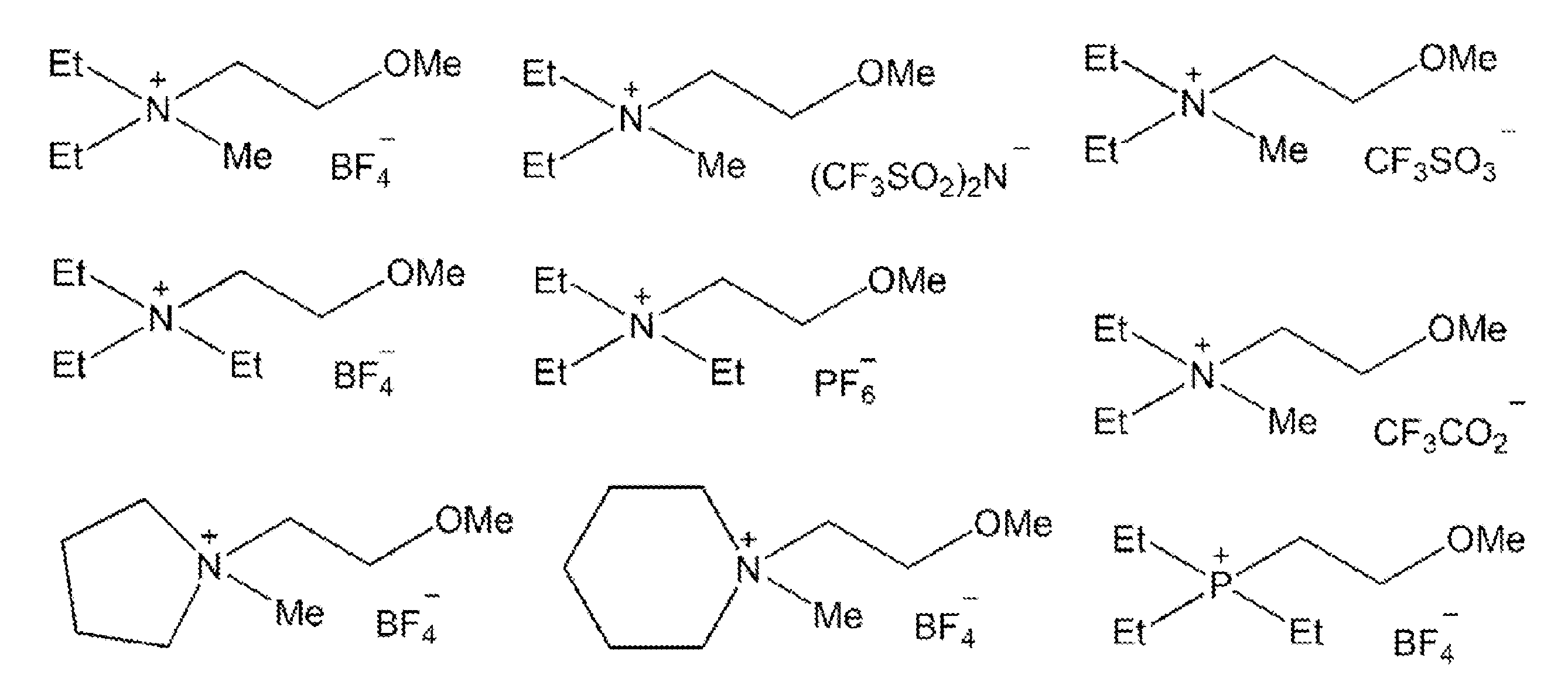
また、イオン液体としては、イミダゾリウムイオンを含むイオン液体や芳香族系カチオンを含むイオン液体を用いることもできる。
高分子鎖集合体を含む層に液状物質を保持させる方法は特に限定されない。例えば、高分子鎖集合体を含む層の表面に液状物質を塗布した後、静置して保持させる方法や、高分子鎖集合体を含む層を形成した基材を液状物質中に浸漬させる方法などが挙げられる。また、高分子鎖集合体が大気中の水分を取り込んで高分子鎖集合体を含む層中に液状物質である水を保持することもある。
上記液状物質100質量部に対する、水の質量割合は80質量部以上であることが好ましく、より好ましくは90質量部以上、さらに好ましくは95質量部以上、特に好ましくは100質量部である。
液状物質としての水は、不凍水を含む。液状物質中の水の総質量に対する不凍水の質量割合は、下限としては、15質量%以上であり、好ましくは20質量%以上、より好ましくは25質量%以上であり、上限としては、50質量%以下であり、好ましくは40質量%以下、より好ましくは30質量%以下である。液状物質中の水の総質量に対する不凍水の質量割合は、上記高分子鎖のモノマー組成等により調整することができる。
高分子鎖集合体を含む層中の水としては、層中に含まれるバルク水及び水和水(例えば、高分子鎖中の水など)があり、上記水和水としては、-90℃で凍結する自由水や中間水、及び-90℃で凍結しない不凍水が挙げられる。また、不凍水の質量割合は、後述の実施例に記載の方法により測定することができる。
[部材の特性]
本実施形態の部材は、-18℃における着氷応力が150kPa以下であり、好ましくは100kPa以下、より好ましくは80kPa以下、より好ましくは65kPa以下、さらに好ましくは50kPa以下、さらに好ましくは35kPa以下、特に好ましくは20kPa以下である。
なお、-18℃における着氷応力は、後述の実施例に記載の方法で測定することができる。
上記-18℃における着氷応力は、高分子鎖の種類、液状物質の種類、高分子鎖の表面占有率等により調整することができる。
本実施形態の部材は、-18℃における着氷応力が150kPa以下であり、好ましくは100kPa以下、より好ましくは80kPa以下、より好ましくは65kPa以下、さらに好ましくは50kPa以下、さらに好ましくは35kPa以下、特に好ましくは20kPa以下である。
なお、-18℃における着氷応力は、後述の実施例に記載の方法で測定することができる。
上記-18℃における着氷応力は、高分子鎖の種類、液状物質の種類、高分子鎖の表面占有率等により調整することができる。
本実施形態の部材の-8℃における着氷応力は、10~50kPaであることが好ましく、より好ましくは10~30kPa、さらに好ましくは0~20kPaである。-8℃における着氷応力が上記範囲であると、0℃~-18℃の幅広い範囲で優れた着氷抑制効果を得ることができる。
上記-8℃における着氷応力は、高分子鎖の種類、液状物質の種類、高分子鎖の表面占有率等により調整することができる。
上記-8℃における着氷応力は、高分子鎖の種類、液状物質の種類、高分子鎖の表面占有率等により調整することができる。
本実施形態の部材の-18℃における着氷応力と-8℃における着氷応力との差は、100kPa以下であることが好ましく、より好ましくは90kPa以下、さらに好ましくは80kPa以下、さらに好ましくは50kPa以下、さらに好ましくは30kPa以下、特に好ましくは10kPa以下である。差が上記範囲であると、0℃~-18℃の幅広い範囲で優れた着氷抑制効果を得ることができ、中でも、高分子鎖として相溶系高分子鎖を用いると、0℃~-20℃で特に優れた着氷抑制効果を得ることができる。
本実施形態の部材は、-18℃における着氷応力が-8℃における着氷応力より高いことが好ましい。
本明細書において、-18℃における着氷応力と-8℃における着氷応力との差とは、差の絶対値をいう。
本実施形態の部材は、-18℃における着氷応力が-8℃における着氷応力より高いことが好ましい。
本明細書において、-18℃における着氷応力と-8℃における着氷応力との差とは、差の絶対値をいう。
本実施形態の部材表面の25℃の水に対する接触角は、10°以上であることが好ましく、20°以上であることがより好ましく、45°以上であることが更に好ましく、48°以上であることがより一層好ましく、48~80°であることが特に好ましい。接触角が上記範囲であれば、より優れた水滴付着抑制効果、着氷抑制効果および氷核形成抑制効果が得られる。本明細書において、部材表面の水に対する接触角の値は、23℃で部材表面に水を1μL着摘したのち、着滴1秒後の部材表面の水の接触角を測定して求めた値である。
本実施形態の部材は、高分子鎖集合体を含む層中により多くの不凍水を保持できる観点から、高分子鎖集合体を含む層中の高分子鎖の数平均分子量に対する、高分子鎖中に含まれる各不凍水形成可モノマー単位に含まれる不凍水形成可構造部分の分子量の合計の割合(不凍水形成可モノマー単位に含まれる不凍水形成可構造部分の分子量の合計/高分子鎖の数平均分子量)が0.75以上であることが好ましく、より好ましくは0.80以上、さらに好ましくは0.80~0.95である。上記割合は、不凍水形成可モノマー単位の質量割合等により調整することができる。
なお、上記割合は、後述の実施例に記載の方法により測定することができる。
なお、上記割合は、後述の実施例に記載の方法により測定することができる。
[部材の形状]
本実施形態の部材の形状は、特に限定されない。チューブ状、シート状、繊維状、ストリップ状、フィルム状、板状、箔状、膜状、ペレット状、粉末状、粒子状などが挙げられる。
本実施形態の部材の形状は、特に限定されない。チューブ状、シート状、繊維状、ストリップ状、フィルム状、板状、箔状、膜状、ペレット状、粉末状、粒子状などが挙げられる。
[部材の適用形態]
本実施形態の部材は、様々な物品に適用することができる。例えば、窓ガラス、車両用ガラス、ミラー、配管、容器などが挙げられる。
本実施形態の部材は、0℃から-20℃の範囲において着氷応力が大きく変化しないため、0℃から-20℃の広い温度範囲で着氷を抑制したい用途に好適に使用することができる。
本実施形態の部材は、様々な物品に適用することができる。例えば、窓ガラス、車両用ガラス、ミラー、配管、容器などが挙げられる。
本実施形態の部材は、0℃から-20℃の範囲において着氷応力が大きく変化しないため、0℃から-20℃の広い温度範囲で着氷を抑制したい用途に好適に使用することができる。
本発明は、高分子鎖集合体を含む層中に、少なくとも水を含む液状物質を保持でき、該液状物質中の水の総量に対して不凍水の占める割合を15質量%以上とすることができる部材であってもよい。例えば、上述の方法で得た部材を乾燥させ、水に浸すことで、製造することができる。浸透した水は、高分子鎖集合体を含む層中で高分子と強く相互作用しやすいため、浸透した水の多くが-90℃でも凍結しない不凍水となる。
以下に、実施例に基づいて本発明をより詳細に説明するが、本発明はこれらの実施例により限定されるものではない。
(実施例1)
シリコンウエハおよびDSCパン(アルミニウム製)を、アセトン中で30分間、クロロホルム中で30分間および2-プロパノール中で30分間それぞれ超音波洗浄を行ったのち、シリコンウエハおよびDSCパンの両面にUVオゾンを30分間照射した。次に、DSCパンのみシリカコーティングを施した。次にシリコンウエハおよびシリカコートを施したDSCパンを、エタノール中で30分間超音波洗浄した後、(2-ブロモ-2-メチル)プロピオニルオキシプロピルトリメトキシシラン(BPM)/エタノール/アンモニア水=1/89/10(質量比)の混合液に浸漬し、24時間浸漬してシリコンウエハおよびDSCパンに重合開始基を導入した。次に、メトキシポリ(エチレングリコール)メタクリレート(Aldrich製、code 447943、数平均分子量=500)(以下、PEGMA)と、エチル2-ブロモ-2-メチルプロピオネート(以下、EBIB)と、臭化第一銅(以下、CuBr(I)と、臭化第二銅(以下、CuBr(II)と、4,4’-ジノニル-2,2’-ビピリジン(以下、diNbip)との混合物(PEGMA/EBIB/CuBr(I)/CuBr(II)/diNbip=20万/0.1/1036.8/28.8/2344(モル比))の50質量部と、アニソールの50質量部とを入れたフッ素樹脂容器に、上記重合開始基を導入したシリコンウエハおよびDSCパンを入れた。容器を密閉してアルミ袋で覆い、高圧反応装置に入れて400MPa、60℃で4時間重合反応を行った。重合反応終了後、容器からシリコンウエハおよびDSCパンを取り出し、振とう装置を用いてテトラヒドロフランで洗浄した。その後、乾燥することによって、シリコンウエハ表面に、複数の高分子鎖からなるブラシ状の高分子鎖集合体(ポリマーブラシ層)を形成して試験体を得た。
得られた試験体の層の厚さを原子間力顕微鏡を用いて、乾燥状態と水浸漬状態で測定した結果、高分子鎖集合体を含む層中に含まれる高分子鎖を100質量部とした場合、水の質量割合は50質量部であった。その後解析をしたところ、シリコンウエハ表面に形成されたポリマーブラシ層の厚さは1102nm、数平均分子量が6.2×10⁶、分子量分布指数(Mw/Mn)が1.4、ポリマー重合率が3%、高分子鎖の密度が0.12鎖/nm2、高分子鎖の表面占有率は0.33であった。なお、ポリマーブラシ層の膜厚はエリプソメトリー法で測定した。ポリマーブラシ層の数平均分子量および分子量分布指数は、展開溶媒として10mMのリチウムブロマイドを含むジメチルホルムアミドを用い、検出器として多角度光散乱検出器を用いたゲル浸透クロマトグラフィー法で算出した。また、ポリマー重合率は、1H-NMRにて測定した。
得られたDSCパンを40℃で24時間の条件で減圧乾燥させた。その後、0.03mgの水(飽和膨潤状態の層における層中の水分量(Wmax)を超える量の水)で湿潤状態とした。後述の方法により、高分子鎖集合体を含む層中に、不凍水が20質量%含まれることを確認した。また、示差走査熱量測定を実施することで、-18℃においても高分子鎖集合体を含む層内に、水が液状で保持されていることを確認した。
(実施例2)
メトキシポリ(エチレングリコール)メタクリレート(Aldrich製、code 447943、数平均分子量=500)の代わりに、メトキシポリ(エチレングリコール)メタクリレート(Aldrich製、code (447951)、数平均分子量=950)を用いたこと以外は、実施例1と同様にして部材を得た。
メトキシポリ(エチレングリコール)メタクリレート(Aldrich製、code 447943、数平均分子量=500)の代わりに、メトキシポリ(エチレングリコール)メタクリレート(Aldrich製、code (447951)、数平均分子量=950)を用いたこと以外は、実施例1と同様にして部材を得た。
(実施例3)
メトキシポリ(エチレングリコール)メタクリレート(Aldrich製、code 447943、数平均分子量=500)の代わりに、メトキシポリ(エチレングリコール)メタクリレート(Aldrich製、code 447943、数平均分子量=500)50質量部とメトキシポリ(エチレングリコール)メタクリレート(Aldrich製、code (447951)、数平均分子量=950)50質量部の混合物を用いたこと以外は、実施例1と同様にして部材を得た。
メトキシポリ(エチレングリコール)メタクリレート(Aldrich製、code 447943、数平均分子量=500)の代わりに、メトキシポリ(エチレングリコール)メタクリレート(Aldrich製、code 447943、数平均分子量=500)50質量部とメトキシポリ(エチレングリコール)メタクリレート(Aldrich製、code (447951)、数平均分子量=950)50質量部の混合物を用いたこと以外は、実施例1と同様にして部材を得た。
(実施例4)
メトキシポリ(エチレングリコール)メタクリレート(Aldrich製、code 447943、数平均分子量=500)の代わりに、メトキシポリ(エチレングリコール)メタクリレート(Aldrich製、code (447935)、数平均分子量=300)50質量部とメトキシポリ(エチレングリコール)メタクリレート(Aldrich製、code (447951)、数平均分子量=950)50質量部の混合物を用いたこと以外は、実施例1と同様にして部材を得た。
メトキシポリ(エチレングリコール)メタクリレート(Aldrich製、code 447943、数平均分子量=500)の代わりに、メトキシポリ(エチレングリコール)メタクリレート(Aldrich製、code (447935)、数平均分子量=300)50質量部とメトキシポリ(エチレングリコール)メタクリレート(Aldrich製、code (447951)、数平均分子量=950)50質量部の混合物を用いたこと以外は、実施例1と同様にして部材を得た。
(実施例5)
メトキシポリ(エチレングリコール)メタクリレート(Aldrich製、code 447943、数平均分子量=500)の代わりに、メトキシポリ(エチレングリコール)メタクリレート(Aldrich製、code (447935)、数平均分子量=300)50質量部とメトキシポリ(エチレングリコール)メタクリレート(Aldrich製、code 447943、数平均分子量=500)50質量部の混合物を用いたこと以外は、実施例1と同様にして部材を得た。
メトキシポリ(エチレングリコール)メタクリレート(Aldrich製、code 447943、数平均分子量=500)の代わりに、メトキシポリ(エチレングリコール)メタクリレート(Aldrich製、code (447935)、数平均分子量=300)50質量部とメトキシポリ(エチレングリコール)メタクリレート(Aldrich製、code 447943、数平均分子量=500)50質量部の混合物を用いたこと以外は、実施例1と同様にして部材を得た。
(比較例1)
メトキシポリ(エチレングリコール)メタクリレート(Aldrich製、code 447943、数平均分子量=500)の代わりに、メトキシポリ(エチレングリコール)メタクリレート(Aldrich製、code (447935)、数平均分子量=300)を用いたこと以外は、実施例1と同様にして部材を得た。
メトキシポリ(エチレングリコール)メタクリレート(Aldrich製、code 447943、数平均分子量=500)の代わりに、メトキシポリ(エチレングリコール)メタクリレート(Aldrich製、code (447935)、数平均分子量=300)を用いたこと以外は、実施例1と同様にして部材を得た。
[評価]
上記実施例で得られた部材について、下記の測定を行った。
上記実施例で得られた部材について、下記の測定を行った。
(表面占有率)
上述の方法により算出した。
上述の方法により算出した。
(高分子鎖集合体を含む層中の水の質量割合)
実施例、比較例で部材を作製する際、40℃で24時間の条件で減圧乾燥させた後の高分子鎖集合体を含む層の厚さを、該層があるところとないところの段差を、原子間力顕微鏡(商品名(JPK Instruments社製 NanoWizard3))のコンタクトモードで測定した。
その後、イオン交換水に室温で浸した状態である飽和膨潤状態で高分子鎖集合体を含む層の厚さを同様の方法で測定した。そして、飽和膨潤状態の層厚さと乾燥状態の層厚さとの差から、飽和膨潤状態の高分子鎖集合体を含む層に含まれる水分量(Wmax、単位(mg))を求めた。
また、上記と同様に製造した乾燥状態の部材の高分子鎖集合体を含む層に、上記Wmaxを超える量(Wcal、単位(mg))のイオン交換水を加えて湿潤状態とし、湿潤状態の部材を得た。湿潤状態の該部材に蓋(Tzero Hermetic Lid、TA Instruments社製)を被せて密封し、Discovery DSC 2500型示差走査熱量計(TA Instruments社製)を用いて、25℃から3℃/分の冷却速度で-90℃まで冷却した後、3℃/分の昇温速度で50℃まで昇温して示差走査熱量測定を行い、DSC曲線から算出される融解熱量を氷の融解潜熱(334J/g)で除して、湿潤状態の高分子鎖集合体を含む層中の凍結水量(Wice、単位(mg))を求めた。
そして、高分子鎖集合体を含む層に加えたイオン交換水の量WcalからWiceを減じて不凍水量Wf(単位(mg))を得、不凍水の割合Wf/Wmax×100(単位(質量%))を算出した。
なお、高分子鎖集合体を含む層に過剰量の水を加えると、バルク水と水和水(高分子中の水)とになる。そして、上記水和水には、0℃で凍結する自由水、0℃では凍結しないものの-90℃まで冷却すると凍結する中間水、及び-90℃でも凍結しない不凍水、とが含まれる。上記自由水と中間水とは、-90℃で凍結する高分子鎖中の水和水である。本明細書において、高分子鎖集合体を含む層中の水の質量割合を測定する際の、液状物質中の水の総質量とは、バルク水を除く水和水の総質量としてよい。
(不凍水形成可構造部分の分子量の割合)
高分子鎖集合体を含む層から、フッ化水素酸処理により基材から高分子鎖を切り出し、切り出した高分子鎖についてサイズ排除クロマトグラフィー法による分子量分析により数平均分子量(Mn)を測定した。
また、高分子鎖集合体中に含まれる不凍水形成可モノマー単位の構造を分析し、該モノマー単位内の不凍水形成可構造部分の組成から分子量を算出した。
なお、サイズ排除クロマトグラフィー法による分子量分析は、以下の方法で行った。
サイズ排除クロマトグラフィー法の分析は、多角度光散乱検出器(商品名(実施例参照))、及び分子量既知の同種単分散の標準試料であるポリメタクリル酸メチル標準試料を用いて作成した分子量検量線を用いて算出した。なお、サイズ排除クロマトグラフィーは以下の条件で分析を行った。
使用装置名及び型番:shodex社製 GPC-101
カラムの商品名及び型番:shodex社製、LF-804、KF-06L
溶離液:DMF/LiBr(10mM)
溶離液の流量:0.8mL/min
カラム温度:40℃
検出器の装置名及び型番:Wyatt Technology社製、DAWN-HELLO
高分子鎖集合体を含む層から切り出した高分子鎖の数平均分子量をMn、及び重量平均分子量(Mw)/数平均分子量(Mn)を表1に示す。
また、高分子鎖の分子量に対する、不凍水形成可ユニットを構成する不凍水形成可モノマー単位に含まれる不凍水形成可構造部分の分子量の合計の割合は、以下の式(1)から算出した。
不凍水形成可ユニットを構成する各モノマー単位に含まれる不凍水形成可構造部分の分子量の合計/高分子鎖を構成するモノマー単位の分子量の合計 ・・・(1)
(着氷応力)
実施例、比較例で得られた部材を、顕微鏡用冷却機能付き延伸ステージ(ジャパンハイテック社製)上にセットし、着氷応力測定を実施した。氷柱は、縁にシリコングリスを塗ったアルミ製円柱型(内径6mm)の内側に純水60μLを注入し、これを5℃/minの速さで-20℃まで冷却、30分間保持することで作製した。その後、ステージの設定温度を5℃/minの速さで-18℃まで昇温させて30分間保持した後、試験を実施した。延伸ステージの移動に伴ってステージに取り付けたL字治具がアルミ製の円柱を押すようにセットし、氷柱が剥離した際に延伸ステージのロードセルにかかった荷重から着氷応力(kPa)を算出した(図1)。そして以下の基準で評価した。ステージ移動速度は10mm/minとした。
◎(極めて優れる):着氷応力が50kPa未満
〇(優れる):着氷応力が50kPa以上100kPa未満
△(良好):着氷応力が100kPa以上150kPa未満
×(不良):着氷応力が150kPa以上
(高分子鎖集合体を含む層の厚さ)
分光エリプトソメリー法(ファイブラボ社製 MASS-105)で室温にて測定した。光学定数などに関しては、メーカー所定の手法に従い、作製した各試験体を用いて作成したファイルを用いた。
分光エリプトソメリー法(ファイブラボ社製 MASS-105)で室温にて測定した。光学定数などに関しては、メーカー所定の手法に従い、作製した各試験体を用いて作成したファイルを用いた。
(膨潤度)
実施例、比較例で作製した部材を、40℃で24時間の条件で減圧乾燥させた。そして、部材の高分子鎖集合体を含む層に、ピンセット先端で傷をつけた。そして、基板素地がむき出しになっている部分と高分子鎖集合体を含む層がある部分の境界を、原子間力顕微鏡コロイドプローブ法(コンタクトモード)を用いて、段差の高さ(すなわち、乾燥状態の高分子鎖集合体を含む層の厚さ)を測定した。次に、イオン交換水に、同一試験体を室温で浸漬した後に、液中、同一箇所で原子間力顕微鏡コロイドプローブ法(コンタクトモード)を用いて、膨潤状態の段差の高さを測定した。そして、膨潤状体の層の厚さ/乾燥状態の層の厚さから、膨潤度を算出した。
実施例、比較例で作製した部材を、40℃で24時間の条件で減圧乾燥させた。そして、部材の高分子鎖集合体を含む層に、ピンセット先端で傷をつけた。そして、基板素地がむき出しになっている部分と高分子鎖集合体を含む層がある部分の境界を、原子間力顕微鏡コロイドプローブ法(コンタクトモード)を用いて、段差の高さ(すなわち、乾燥状態の高分子鎖集合体を含む層の厚さ)を測定した。次に、イオン交換水に、同一試験体を室温で浸漬した後に、液中、同一箇所で原子間力顕微鏡コロイドプローブ法(コンタクトモード)を用いて、膨潤状態の段差の高さを測定した。そして、膨潤状体の層の厚さ/乾燥状態の層の厚さから、膨潤度を算出した。
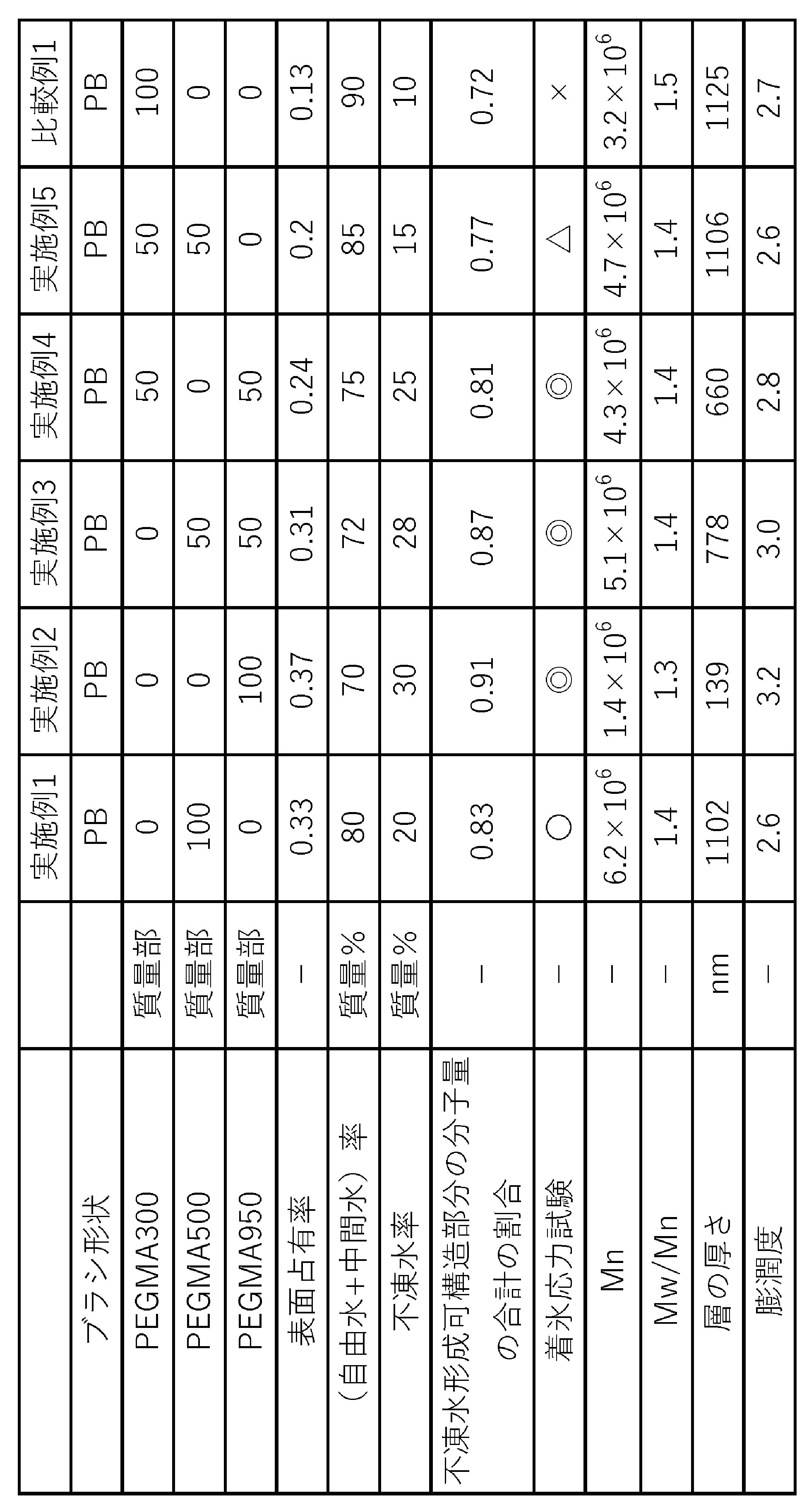
本実施形態の部材は、氷核形成、着氷を抑制することができる。本実施形態の部材は、様々な物品に適用することができ、例えば、窓ガラス、車両用ガラス、ミラー、配管、容器などに用いることができる。
Claims (5)
- 基材に固定された複数の高分子鎖で構成されたブラシ状の高分子鎖集合体を含む層を有し、
前記高分子鎖集合体を含む層は液状物質を保持していて、
前記液状物質の少なくとも一部が水であり、前記液状物質中の前記水の総質量に対して不凍水の占める割合が15質量%以上である、氷核形成抑制用または着氷抑制用の部材。 - 前記高分子鎖が不凍水形成可モノマー単位からなる不凍水形成可ユニットを含む、請求項1に記載の部材。
- 前記高分子鎖の分子量に対する、前記高分子鎖中の不凍水形成可モノマー単位に含まれる不凍水形成可構造部分の分子量の合計の割合(前記不凍水形成可モノマー単位に含まれる不凍水形成可構造部分の分子量の合計/前記高分子鎖の分子量)が0.80以上である、請求項1または2に記載の部材。
- 前記基材は前記高分子鎖集合体とは別の物質からなる担体であり、
前記基材表面における前記高分子鎖の表面占有率が0.08~0.65である、請求項1または2に記載の部材。 - 前記部材が、前記基材である高分子鎖に前記複数の高分子鎖が側鎖として結合したボトルブラシ構造を有する部材であり、
側鎖の表面占有率が0.08~0.65である、請求項1または2に記載の部材。
Applications Claiming Priority (2)
| Application Number | Priority Date | Filing Date | Title |
|---|---|---|---|
| JP2023-085782 | 2023-05-24 | ||
| JP2023085782A JP2024168817A (ja) | 2023-05-24 | 2023-05-24 | 氷核形成抑制または着氷抑制用の部材 |
Publications (1)
| Publication Number | Publication Date |
|---|---|
| WO2024241982A1 true WO2024241982A1 (ja) | 2024-11-28 |
Family
ID=93589812
Family Applications (1)
| Application Number | Title | Priority Date | Filing Date |
|---|---|---|---|
| PCT/JP2024/017866 Ceased WO2024241982A1 (ja) | 2023-05-24 | 2024-05-14 | 氷核形成抑制または着氷抑制用の部材 |
Country Status (2)
| Country | Link |
|---|---|
| JP (1) | JP2024168817A (ja) |
| WO (1) | WO2024241982A1 (ja) |
Citations (4)
| Publication number | Priority date | Publication date | Assignee | Title |
|---|---|---|---|---|
| WO2019181216A1 (ja) * | 2018-03-23 | 2019-09-26 | 国立研究開発法人防災科学技術研究所 | 滑雪用フィルム又はシート |
| WO2021117537A1 (ja) * | 2019-12-09 | 2021-06-17 | 国立大学法人京都大学 | 防曇、水滴付着抑制、着氷抑制または氷核形成抑制用の部材 |
| CN113528010A (zh) * | 2021-08-27 | 2021-10-22 | 电子科技大学 | 一种具有长效疏冰特性的超滑涂层的制备及其应用 |
| JP2022020472A (ja) * | 2020-07-20 | 2022-02-01 | 国立大学法人京都大学 | 熱交換器及び冷凍サイクル装置 |
-
2023
- 2023-05-24 JP JP2023085782A patent/JP2024168817A/ja active Pending
-
2024
- 2024-05-14 WO PCT/JP2024/017866 patent/WO2024241982A1/ja not_active Ceased
Patent Citations (4)
| Publication number | Priority date | Publication date | Assignee | Title |
|---|---|---|---|---|
| WO2019181216A1 (ja) * | 2018-03-23 | 2019-09-26 | 国立研究開発法人防災科学技術研究所 | 滑雪用フィルム又はシート |
| WO2021117537A1 (ja) * | 2019-12-09 | 2021-06-17 | 国立大学法人京都大学 | 防曇、水滴付着抑制、着氷抑制または氷核形成抑制用の部材 |
| JP2022020472A (ja) * | 2020-07-20 | 2022-02-01 | 国立大学法人京都大学 | 熱交換器及び冷凍サイクル装置 |
| CN113528010A (zh) * | 2021-08-27 | 2021-10-22 | 电子科技大学 | 一种具有长效疏冰特性的超滑涂层的制备及其应用 |
Also Published As
| Publication number | Publication date |
|---|---|
| JP2024168817A (ja) | 2024-12-05 |
Similar Documents
| Publication | Publication Date | Title |
|---|---|---|
| JP7002080B2 (ja) | 潤滑材及びsrt材料 | |
| JP7435978B2 (ja) | 熱交換器及び冷凍サイクル装置 | |
| Andruzzi et al. | Control of surface properties using fluorinated polymer brushes produced by surface-initiated controlled radical polymerization | |
| Wang et al. | Dual water-healable zwitterionic polymer coatings for anti-biofouling surfaces | |
| Wang et al. | Self-assembly of catecholic macroinitiator on various substrates and surface-initiated polymerization | |
| WO2021117537A1 (ja) | 防曇、水滴付着抑制、着氷抑制または氷核形成抑制用の部材 | |
| JP2006316169A (ja) | 固形潤滑材 | |
| Sweat et al. | A single-component inimer containing cross-linkable ultrathin polymer coating for dense polymer brush growth | |
| JP7246597B2 (ja) | 隙間狭小化材、隙間狭小化材複合体およびそれらを用いた物品 | |
| Rudra et al. | Fluorinated polymer brush-grafted silica nanoparticles: robust and durable self-cleaning coating materials | |
| Sohn et al. | Tuning surface properties of poly (methyl methacrylate) film using poly (perfluoromethyl methacrylate) s with short perfluorinated side chains | |
| WO2024053649A1 (ja) | 氷核形成抑制または着雪氷抑制用の部材 | |
| CN114787248A (zh) | 复合材料 | |
| CN101456937A (zh) | 结构可控的聚亚甲基-聚(甲基)丙烯酸酯类两嵌段共聚物及其制备方法 | |
| JP2024168817A (ja) | 氷核形成抑制または着氷抑制用の部材 | |
| Wang et al. | Fabrication of polymer brush surfaces with highly-ordered perfluoroalkyl side groups at the brush end and their antibiofouling properties | |
| JP7586435B2 (ja) | 材料および摺動システム | |
| Zhang | Surface modification by plasma polymerization and application of plasma polymers as biomaterials | |
| CN116157422B (zh) | 表面处理膜及其制造方法和物品 | |
| TWI813817B (zh) | 表面處理膜、其製造方法及物品 | |
| CN110770294A (zh) | 复合物及其制造方法 | |
| JP7131970B2 (ja) | カーボンナノチューブ水系分散液 | |
| JP7855806B2 (ja) | 氷核形成抑制、霜形成抑制又は着雪氷抑制用の部材 | |
| Chen et al. | Synthesis and applications of a Y‐inimer with two orthogonal controlled free radical polymerization initiators | |
| Eom et al. | Synthesis and Characterization of Methacrylamide‐Based Block Random Copolymers via Amine Functionalization of Polystyrene‐Block‐Poly (Pentafluorophenyl Methacrylate) Toward Enhanced Amenability to Manufacturing Criteria in Nanolithography |
Legal Events
| Date | Code | Title | Description |
|---|---|---|---|
| 121 | Ep: the epo has been informed by wipo that ep was designated in this application |
Ref document number: 24810989 Country of ref document: EP Kind code of ref document: A1 |
|
| NENP | Non-entry into the national phase |
Ref country code: DE |
|
| 122 | Ep: pct application non-entry in european phase |
Ref document number: 24810989 Country of ref document: EP Kind code of ref document: A1 |