WO2024232343A1 - 樹脂組成物 - Google Patents
樹脂組成物 Download PDFInfo
- Publication number
- WO2024232343A1 WO2024232343A1 PCT/JP2024/016901 JP2024016901W WO2024232343A1 WO 2024232343 A1 WO2024232343 A1 WO 2024232343A1 JP 2024016901 W JP2024016901 W JP 2024016901W WO 2024232343 A1 WO2024232343 A1 WO 2024232343A1
- Authority
- WO
- WIPO (PCT)
- Prior art keywords
- polymer
- resin composition
- mass
- polyhydroxyalkanoate
- parts
- Prior art date
- Legal status (The legal status is an assumption and is not a legal conclusion. Google has not performed a legal analysis and makes no representation as to the accuracy of the status listed.)
- Ceased
Links
Images
Classifications
-
- C—CHEMISTRY; METALLURGY
- C08—ORGANIC MACROMOLECULAR COMPOUNDS; THEIR PREPARATION OR CHEMICAL WORKING-UP; COMPOSITIONS BASED THEREON
- C08L—COMPOSITIONS OF MACROMOLECULAR COMPOUNDS
- C08L23/00—Compositions of homopolymers or copolymers of unsaturated aliphatic hydrocarbons having only one carbon-to-carbon double bond; Compositions of derivatives of such polymers
- C08L23/02—Compositions of homopolymers or copolymers of unsaturated aliphatic hydrocarbons having only one carbon-to-carbon double bond; Compositions of derivatives of such polymers not modified by chemical after-treatment
- C08L23/10—Homopolymers or copolymers of propene
- C08L23/12—Polypropene
Definitions
- the present invention relates to a resin composition.
- Aliphatic polyester films have been known as resin molded bodies with biodegradable properties.
- the present invention was made in consideration of the above problems, and aims to provide a resin composition for a molded body to be provided with a resin film on its surface, which has high rigidity and excellent adhesion of the resin film provided on the surface of the molded body.
- a composition comprising an olefin polymer A and a polyhydroxyalkanoate polymer B, A resin composition for a molded product having a resin film provided on a surface thereof, wherein the content of the olefin polymer A is 51 to 99.9 parts by mass and the content of the polyhydroxyalkanoate polymer B is 0.1 to 49 parts by mass relative to a total of 100 parts by mass of the olefin polymer A and the polyhydroxyalkanoate polymer B.
- the resin composition molded article contains an olefin-based polymer A and a polyhydroxyalkanoate-based polymer B, the content of the olefin polymer A is 51 to 99.9 parts by mass, and the content of the polyhydroxyalkanoate polymer B is 0.1 to 49 parts by mass, relative to 100 parts by mass in total of the olefin polymer A and the polyhydroxyalkanoate polymer B.
- the present invention provides a resin composition for a molded body to which a resin film is applied on the surface, which has high rigidity and excellent adhesion of the resin film applied to the surface of the molded body.
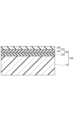
- FIG. 2 is a schematic cross-sectional view of a resin film-applied resin composition molded article according to one embodiment.
- the resin composition according to the present invention contains an olefin polymer A and a polyhydroxyalkanoate polymer B.
- the olefin polymer A is a polymer containing 50% by mass or more of structural units derived from an olefin having from 2 to 10 carbon atoms (wherein the total amount of the olefin polymer is taken as 100% by mass).
- Examples of the olefin having from 2 to 10 carbon atoms are ethylene, propylene, 1-butene, 4-methyl-1-pentene, 1-hexene, 1-octene, and 1-decene.
- Olefin polymer A may contain structural units derived from monomers other than olefins having 2 to 10 carbon atoms.
- monomers other than olefins having 2 to 10 carbon atoms include aromatic vinyl monomers such as styrene; unsaturated carboxylic acids such as acrylic acid and methacrylic acid; unsaturated carboxylic acid esters such as methyl acrylate, ethyl acrylate, butyl acrylate, methyl methacrylate, and ethyl methacrylate; vinyl ester compounds such as vinyl acetate; conjugated dienes such as 1,3-butadiene and 2-methyl-1,3-butadiene (isoprene); and non-conjugated dienes such as dicyclopentadiene and 5-ethylidene-2-norbornene.
- the olefin polymer A can be at least one selected from the group consisting of ethylene polymers, propylene polymers, and butene polymers, and may be a combination of any two or more of these.
- An ethylene-based polymer is a polymer that contains 50% by mass or more of structural units derived from ethylene. Examples of such polymers include ethylene homopolymers, ethylene-1-butene copolymers, ethylene-1-hexene copolymers, ethylene-1-octene copolymers, and ethylene-1-butene-1-hexene copolymers.
- An ethylene-based polymer may be a combination of two or more ethylene-based polymers.
- Propylene-based polymers are polymers containing 50% by mass or more of structural units derived from propylene, and examples thereof include propylene homopolymers, propylene-ethylene copolymers, propylene-1-butene copolymers, propylene-1-hexene copolymers, propylene-1-octene copolymers, propylene-ethylene-1-butene copolymers, propylene-ethylene-1-hexene copolymers, and propylene-ethylene-1-octene copolymers.
- the propylene-based polymer may be a combination of two or more propylene-based polymers. It is preferable that the olefin-based polymer A is a propylene-based polymer.
- Butene polymers are polymers containing 50% by mass or more of structural units derived from 1-butene. Examples include 1-butene homopolymer, 1-butene-ethylene copolymer, 1-butene-propylene copolymer, 1-butene-1-hexene copolymer, 1-butene-1-octene copolymer, 1-butene-ethylene-propylene copolymer, 1-butene-ethylene-1-hexene copolymer, 1-butene-ethylene-1-octene copolymer, 1-butene-propylene-1-hexene copolymer, and 1-butene-propylene-1-octene copolymer.
- the butene polymer may be a combination of two or more butene polymers.
- the above olefin polymer A can be produced by a known polymerization method using a known polymerization catalyst.
- the melt mass flow rate (MFR) of the olefin polymer A measured according to JIS K7210-2014 at a temperature of 230°C or 190°C and a load of 2.16 kgf is preferably 0.1 g/10 min or more and 200 g/10 min or less.
- the polyhydroxyalkanoate polymer is a polyester of hydroxyalkanoic acid.
- hydroxyalkanoic acid include 2-hydroxyalkanoic acid, 3-hydroxyalkanoic acid, and 4-hydroxyalkanoic acid.
- 2-hydroxyalkanoic acids are glycolic acid, lactic acid, and 2-hydroxybutyric acid.
- polyesters of 2-hydroxyalkanoic acids, i.e., poly(2-hydroxyalkanoate)-based polymers, are polyglycolic acid and polylactic acid.
- 3-hydroxyalkanoic acids are 3-hydroxybutyric acid, 3-hydroxypropionic acid, 3-hydroxypentanoic acid, and 3-hydroxyhexanoic acid.
- Polyesters of 3-hydroxyalkanoic acids, i.e., poly(3-hydroxyalkanoate) polymers, will be described in detail later.
- 4-hydroxyalkanoic acids are 4-hydroxybutyric acid, 4-hydroxypentanoic acid, and 4-hydroxyhexanoic acid.
- the polyhydroxyalkanoate polymer may be a homopolymer of hydroxyalkanoic acid, or a polymer of two or more types of hydroxyalkanoic acid.
- the polyhydroxyalkanoate polymer B can be a poly(3-hydroxyalkanoate) polymer.
- the poly(3-hydroxyalkanoate) polymer is a polyhydroxyalkanoate, i.e., a polycondensate (polyester) of hydroxyalkanoic acid, and necessarily contains a repeating unit of 3-hydroxyalkanoate represented by formula (1).
- R is a hydrogen atom, a halogen atom, an alkyl group having 1 to 15 carbon atoms, a cyano group, an amino group having 1 to 11 carbon atoms, an alkoxy group (alkyloxy group) having 1 to 11 carbon atoms, an amide group having 2 to 20 carbon atoms, an aryl group having 6 to 12 carbon atoms, or a monovalent heterocyclic group having 1 to 9 carbon atoms.
- R is preferably an alkyl group having 1 to 8 carbon atoms, an amide group having 1 to 20 carbon atoms, or an aryl group having 6 to 8 carbon atoms.
- halogen atoms are F, Cl, Br, and I.
- the alkyl group having 1 to 15 carbon atoms may be linear or branched.
- the alkyl group preferably has 1 to 8 carbon atoms, more preferably 1 to 4 carbon atoms.
- Examples of the alkyl group include methyl, ethyl, propyl, isopropyl, butyl, isobutyl, sec-butyl, tert-butyl, pentyl, isopentyl, 2-methylbutyl, 1-methylbutyl, hexyl, isohexyl, 3-methylpentyl, 2-methylpentyl, 1-methylpentyl, heptyl, octyl, isooctyl, 2-ethylhexyl, 3,7-dimethyloctyl, nonyl, decyl, undecyl, dodecyl, tetradecyl, and pentadecyl.
- amino groups having 1 to 18 carbon atoms include amino groups, alkylamino groups, dialkylamino groups, arylamino groups, alkylarylamino groups, benzylamino groups, and dibenzylamino groups.
- alkylamino groups include methylamino, ethylamino, propylamino, butylamino, pentylamino, hexylamino, heptylamino, octylamino, nonylamino, decylamino, dodecylamino, isopropylamino, isobutylamino, isopentylamino, sec-butylamino, tert-butylamino, sec-pentylamino, tert-pentylamino, tert-octylamino, neopentylamino, cyclopropylamino, cyclobutylamino, cyclopentylamino, cyclohexylamino, cycloheptylamino, cyclooctylamino, 1-adamantamino, and 2-adamantamino.
- dialkylamino groups are dimethylamino, diethylamino, dipropylamino, dibutylamino, dipentylamino, diisopropylamino, diisobutylamino, diisopentylamino, methylethylamino, methylpropylamino, methylbutylamino, methylisobutylamino, dicyclopropylamino, pyrrolidino, piperidino, and piperazino groups.
- arylamino groups include anilino, 1-naphthylamino, 2-naphthylamino, o-toluidino, m-toluidino, p-toluidino, 1-fluoreneamino, 2-fluoreneamino, 2-thiazoleamino, and p-terphenylamino groups.
- the alkylarylamino group includes an N-methylanilino group, an N-ethylanilino group, an N-propylanilino group, an N-butylanilino group, an N-isopropylanilino group, and an N-pentylanilino group.
- alkoxy groups having 1 to 11 carbon atoms include methoxy, ethoxy, propoxy, isopropoxy, butoxy, isobutoxy, sec-butoxy, tert-butoxy, cyclopropoxy, cyclobutoxy, and cyclopentoxy.
- amide group refers to a group obtained by removing one hydrogen atom bonded to a nitrogen atom from a carboxylic acid amide.
- the organic group may be an alkyl group, an alkoxy group, or an aryl group, which may be substituted with a halogen atom.
- the amide group is preferably a formamide group, an acetamide group, a propionamide group, a butyroamide group, or a benzamide group.
- aryl groups having 6 to 12 carbon atoms include phenyl, tolyl, xylyl, naphthyl, and biphenyl groups, with phenyl, tolyl, and xylyl being more preferred.
- heteroatoms in monovalent heterocyclic groups having 1 to 9 carbon atoms are N, O, and S, and may be saturated or unsaturated, may contain a single heteroatom, multiple heteroatoms, or may contain different types of heteroatoms.
- heterocyclic groups include thienyl, pyrrolyl, furyl, pyridyl, piperidinyl, quinolinyl, isoquinolinyl, pyrimidinyl, triazinyl, and thiazolyl groups.
- the repeating units of polyhydroxyalkanoate polymer B may consist of only one or more types of 3-hydroxyalkanoates represented by formula (1), or may have one or more types of 3-hydroxyalkanoates represented by formula (1) and one or more types of other hydroxyalkanoates.
- the polyhydroxyalkanoate polymer B preferably contains 50 mol% or more of the 3-hydroxyalkanoate repeating units represented by formula (1) relative to the total repeating units of the hydroxyalkanoate (100 mol%), more preferably 70 mol% or more.
- 3HB 3-hydroxybutyrate
- 3HH 3-hydroxyhexanoate
- 3HH 3-hydroxyoctanoate
- 3HH 3-hydroxyoctadecanoate
- 3-hydroxypropionate where R is a hydrogen atom.
- polymer B having only one type of repeating unit represented by formula (1) is poly(3-hydroxybutyrate) (hereinafter sometimes referred to as P3HB).
- polymer B having only multiple types of repeating units represented by formula (1) are poly(3-hydroxybutyrate-co-3-hydroxyhexanoate) (hereinafter sometimes written as P3HB3HH), poly(3-hydroxybutyrate-co-3-hydroxyvalerate) (hereinafter sometimes written as P3HB3HV), and poly(3-hydroxybutyrate-co-3-hydroxypropionate) (hereinafter sometimes written as P3HB3HP).
- a hydroxyalkanoate other than the 3-hydroxyalkanoate represented by formula (1) is a repeating unit represented by formula (2) (wherein R1 is a hydrogen atom or an alkyl group represented by CnH2n +1 , n is an integer of 1 or more and 15 or less, and m is an integer of 2 to 10).
- polymer B containing repeating units of formulas (1) and (2) is poly(3-hydroxybutyrate-co-4-hydroxybutyrate) (e.g., formula (P3HB4HB) below).
- repeating units of polyhydroxyalkanoate polymer B contain at least 3-hydroxybutyrate among the 3-hydroxyalkanoates represented by formula (1).
- the polyhydroxyalkanoate polymer B preferably contains 50 mol% or more of 3-hydroxybutyrate repeating units relative to the total repeating units of hydroxyalkanoate (100 mol%), and more preferably 70 mol% or more.
- the polyhydroxyalkanoate polymer B may have two or more types of ester repeat units, and may be, for example, a di-polymer having two types of repeat units, a tri-copolymer having three types of repeat units, or a tetra-copolymer having four types of repeat units, as described above.
- an example of a tri-copolymer is poly(3-hydroxybutyrate-co-3-hydroxyvalerate-co-3-hydroxyhexanoate) (hereinafter sometimes referred to as (P3HB3HV3HH)).
- the polyhydroxyalkanoate polymer B contains 3-hydroxybutyrate among the repeating units of 3-hydroxyalkanoate represented by formula (1).
- the proportion XX of the repeating units of 3-hydroxybutyrate relative to 100 moles of all ester repeating units of hydroxyalkanoate is preferably 90 mol% or more, more preferably 95 mol% or more, and even more preferably 98.0 mol% or more.
- the ratio XX is usually 100 mol% or less, preferably 99.9 mol% or less, and more preferably 99.8 mol% or less.
- the arrangement of the copolymer may be any of a random copolymer, an alternating copolymer, a block copolymer, a graft copolymer, etc.
- Polyhydroxyalkanoate polymer B may have ester repeating units other than those of formula (1) and formula (2), but the main chain of the other ester repeating units does not contain an aromatic hydrocarbon structure.
- polyhydroxyalkanoate polymer B is an aliphatic polyester.
- composition ratio of the repeating units in the polyhydroxyalkanoate polymer B can be calculated from the results of NMR measurements such as 1H-NMR and 13C-NMR, as described in L. Tripathi., M. C. Factories, 11, 44 (2012).
- polyhydroxyalkanoate polymer B may be a mixture of two or more types of poly(3-hydroxyalkanoate) polymers.
- the weight average molecular weight (Mw) of the polyhydroxyalkanoate polymer B can be 10,000 to 1,000,000, preferably 20,000 to 800,000, and more preferably 30,000 to 600,000. By making the weight average molecular weight (Mw) 10,000 or more, it is possible to obtain a molded product with excellent impact strength and tensile elongation. In addition, by making the weight average molecular weight 500,000 or less, the dispersibility in the olefin polymer A is improved. The weight average molecular weight may be 400,000 or less, 300,000 or less, 200,000 or less, or 100,000 or less. In this specification, the weight average molecular weight (Mw) is measured by GPC using standard polystyrene as a molecular weight standard substance.
- Polyhydroxyalkanoate polymer B is a thermoplastic resin and may be crystalline.
- the melt mass flow rate (MFR(B)) of polyhydroxyalkanoate polymer B measured according to JIS K7210-2014 at a temperature of 190°C or 170°C and a load of 2.16 kgf is preferably 0.1 g/10 min or more and 200 g/10 min or less.
- MFR(B) may be 1 g/10 min or more, 3 g/10 min or more, 5 g/10 min or more, 7 g/10 min or more, 8 g/10 min or more, 10 g/10 min or more, or 20 g/10 min or more.
- MFR(B) may be 150 g/10 min or less, or 100 g/10 min or less.
- the melting point (Tm) of the polyhydroxyalkanoate polymer B is preferably 150°C or higher, and may be 155°C or higher, 160°C or higher, 165°C or higher, 170°C or higher, or 175°C or higher.
- the melting point (Tm) of the polymer B may be 220°C or lower, 200°C or lower, or 190°C or lower.
- the melting point (Tm) of polyhydroxyalkanoate polymer B is measured from the position of the main peak due to the melting of crystals as determined by differential scanning calorimetry (DSC) measurement in accordance with JIS K7121.
- Poly(3-hydroxyalkanoate) polymers may be produced by microorganisms or may be derived from compounds derived from petroleum or plant materials (e.g., cyclic lactones, etc.).
- each repeating unit of hydroxyalkanoate may consist only of the D-form (R-form), such as in those produced from microorganisms, but the repeating units of hydroxyalkanoate may contain both the D-form (R-form) and the L-form (S-form), such as in those derived from a mixture of the D-form (R-form) and the L-form (S-form).
- the repeating unit of formula (1) can be expressed as follows: (BI-1) In formula (BI-1), n represents the degree of polymerization.
- poly-(3-hydroxybutyrate) produced from microorganisms has the following structure: (BI-2) where n represents the degree of polymerization.
- poly-(3-hydroxybutyrate-co-3-hydroxyhexanoate) produced from microorganisms has the following structure: (BI-3)
- m and n represent the degree of polymerization.
- poly-(3-hydroxybutyrate-co-4-hydroxybutyrate) produced from microorganisms has the following structure: (BI-4)
- m and n represent the degree of polymerization.
- Polyhydroxyalkanoate polymer B can be biodegradable.
- poly(3-hydroxyalkanoate) polymers can be produced by microorganisms such as Alcaligenes eutrophus AC32 strain (international deposit under the Budapest Treaty, international depositary authority: National Institute of Advanced Industrial Science and Technology Patent Organism Depositary Center (6-1-1 Central, Higashi 1-chome, Tsukuba-shi, Ibaraki-ken, Japan), original deposit date: August 12, 1996, transferred August 7, 1997, accession number FERMBP-6038 (transferred from original deposit FERMP-15786)) (J. Bacteriol., 179, 4821 (1997)), which is an Alcaligenes eutrophus introduced with a PHA synthase gene derived from Aeromonas caviae.
- microorganisms such as Alcaligenes eutrophus AC32 strain (international deposit under the Budapest Treaty, international depositary authority: National Institute of Advanced Industrial Science and Technology Patent Organism Depositary Center (6-1-1 Central, Higashi 1-chome, Tsukuba-shi, Ibaraki-ken, Japan
- the content of the olefin polymer A is 51 to 99.9 parts by mass
- the content of the polyhydroxyalkanoate polymer B is 0.1 to 49 parts by mass, relative to 100 parts by mass in total of the olefin polymer A and the polyhydroxyalkanoate polymer B.
- the resin composition may contain 60.1 to 99.9 parts by mass of olefin polymer A and 0.1 to 39.9 parts by mass of polyhydroxyalkanoate polymer B relative to 100 parts by mass in total of olefin polymer A and polyhydroxyalkanoate polymer B, 70 to 99.9 parts by mass of olefin polymer A and 0.1 to 30 parts by mass of polyhydroxyalkanoate polymer B, or 75 to 99.9 parts by mass of olefin polymer A and 0.1 to 25 parts by mass of polyhydroxyalkanoate polymer B.
- the resin composition may contain 80 to 99.9 parts by mass of olefin polymer A and 0.1 to 20 parts by mass of polyhydroxyalkanoate polymer B, 85 to 99.9 parts by mass of olefin polymer A and 0.1 to 15 parts by mass of polyhydroxyalkanoate polymer B, or 90 to 99.9 parts by mass of olefin polymer A and 0.1 to 10 parts by mass of polyhydroxyalkanoate polymer B, relative to a total of 100 parts by mass of olefin polymer A and polyhydroxyalkanoate polymer B.
- the total proportion of the olefin polymer A and the polyhydroxyalkanoate polymer B in the entire resin composition can be 50% by mass or more, preferably 60% by mass or more, and more preferably 70% by mass or more.
- the polyhydroxyalkanoate polymer B may or may not form a dispersed phase.
- the polyhydroxyalkanoate polymer B forming a dispersed phase means that the resin composition has a sea-island structure in which the olefin polymer A is the continuous phase (sea portion) and the polyhydroxyalkanoate polymer B is the dispersed phase (island portion).
- the average equivalent circle diameter of the dispersed phase (island portion) can be 10 nm to 400 ⁇ m.
- the resin composition may contain additives as necessary, which may be at least one selected from the group consisting of stabilizers, antibacterial agents, antifungal agents, dispersants, plasticizers, flame retardants, tackifiers, colorants, metal powders, organic powders, inorganic fibers, organic fibers, organic and inorganic composite fibers, inorganic whiskers, and fillers.
- An example of the stabilizer is at least one selected from the group consisting of a lubricant, an anti-aging agent, a heat stabilizer, a light resistance agent, a weather resistance agent, a metal deactivator, an ultraviolet absorber, a light stabilizer, and a copper damage inhibitor.
- a lubricant an anti-aging agent
- a heat stabilizer a heat stabilizer
- a light resistance agent a weather resistance agent
- a metal deactivator an ultraviolet absorber
- a light stabilizer and a copper damage inhibitor.
- An example of the light resistance agent is a hindered amine-based light resistance agent.
- An example of a colorant is at least one selected from the group consisting of titanium oxide, carbon black, and organic pigments.
- An example of a metal powder is ferrite.
- An example of an organic powder is protein.
- inorganic fibers are glass fibers and metal fibers.
- organic fibers are carbon fibers and aramid fibers.
- An example of an inorganic whisker is potassium titanate whiskers.
- the filler examples include at least one selected from the group consisting of glass beads, glass balloons, glass flakes, asbestos, mica, calcium carbonate, talc, silica, calcium silicate, hydrotalcite, kaolin, diatomaceous earth, graphite, pumice, ebonized powder, cotton flock, cork powder, barium sulfate, fluororesin, cellulose powder, and wood powder.
- the resin composition may contain only one of the above additives, or a combination of two or more of them.
- the additive may be contained in either the olefin polymer A or the polyhydroxyalkanoate polymer B.
- the additive may form a dispersed phase separate from the polyhydroxyalkanoate polymer B in the continuous phase of the olefin polymer A.
- the resin composition can be obtained by melt-kneading the olefin polymer A, the polyhydroxyalkanoate polymer B, and additives added as necessary.
- the kneading temperature (the set temperature of the kneader) is preferably 150 to 300° C., more preferably 170 to 280° C.
- a composition can be obtained by melt-kneading each of a portion of the olefin polymer A and the polyhydroxyalkanoate polymer B to obtain a pre-kneaded mixture, and then adding the remaining portions of the olefin polymer A and the polyhydroxyalkanoate polymer B to the pre-kneaded mixture and further melt-kneading the mixture.
- the resin composition according to this embodiment not only gives a molded article with high rigidity, but also provides excellent adhesion between the molded article and the resin film when a resin film is applied to the surface of the molded article after molding. The reason for this is not clear, but it is believed to be due to the fact that the resin composition according to this embodiment contains an appropriate amount of the polyhydroxyalkanoate polymer B.
- the resin composition of this embodiment is used for molded articles with a resin film applied to the surface.
- the above resin composition can be used to obtain a molded article by a known method.
- the obtained resin composition can be molded into a molded article having the required shape using a known resin molding method such as injection molding, extrusion molding, vacuum molding, pressure molding, press molding, foam molding, blow molding, or rotational molding.
- a known resin molding method such as injection molding, extrusion molding, vacuum molding, pressure molding, press molding, foam molding, blow molding, or rotational molding.
- the preferred molding methods are injection molding, extrusion molding, blow molding, and rotational molding, and more preferably injection molding and extrusion molding, which can produce injection molded products and extrusion molded products.
- the extrusion molding method films, plates, fibers, etc. can be formed.
- the maximum shear rate during hot molding to obtain a molded article of the composition of the present invention is preferably 1 to 10,000 sec -1 , more preferably 10 to 5,000 sec -1 , and even more preferably 15 to 3,000 sec -1 .
- the above composition can also be laminated with other materials such as other resins, metals, paper, leather, etc. to obtain a multilayer structure.
- the surface of the molded article of the composition of the present invention may be subjected to a surface treatment.
- the surface treatment method include embossing, corona discharge treatment, flame treatment, plasma treatment, and ozone treatment.
- the shape of the molded product of the resin composition is not particularly limited, and examples include plates, films, fibers, cloth, nonwoven fabrics, containers, tubes, etc., and molded products of any complex shape can be produced by injection molding, etc.
- Article comprising a resin composition molded body and a resin film
- a resin film such as by painting with a paint or printing with ink
- a resin composition molded body 10 and a resin film-provided resin composition molded body (article) 100 are obtained, in which a resin film 20, such as a coating film or an ink film, is provided on at least a portion of the surface of the resin composition molded body 10.
- a resin film 20 such as a coating film or an ink film
- the resin film 20 includes a film containing a resin. It is preferable that the resin film 20 has a primer layer 22 that contacts the surface of the resin composition molded body 10.
- the material of the primer layer 22 can include, for example, chlorinated polyolefin resins such as chlorinated polyethylene and chlorinated polypropylene, and maleated polyolefin resins obtained by modifying polyethylene resins and chlorinated polyolefin resins with maleic acid.
- chlorinated polyolefin resins such as chlorinated polyethylene and chlorinated polypropylene
- maleated polyolefin resins obtained by modifying polyethylene resins and chlorinated polyolefin resins with maleic acid.
- the resin film 20 preferably has a topcoat layer 23 on the primer layer 22.
- the topcoat layer 23 may be a single layer or may have multiple layers.
- the topcoat layer 23 may include, in order from the primer layer 22 side, a base layer 24 and a clear layer 26, as shown in FIG. 1, and such a topcoat layer configuration may be called a coating film.
- the material of the base layer 24 is not particularly limited, but may include, for example, resins such as ethyl methacrylate resins, methyl methacrylate resins, urethane resins, epoxy resins, ester resins, olefin resins, fluorine resins, silicone resins, styrene resins, and melamine resins; pigments such as metal particles such as aluminum and mineral particles such as mica; and various additives.
- resins such as ethyl methacrylate resins, methyl methacrylate resins, urethane resins, epoxy resins, ester resins, olefin resins, fluorine resins, silicone resins, styrene resins, and melamine resins
- pigments such as metal particles such as aluminum and mineral particles such as mica
- the material of the clear layer 26 is not particularly limited, but may include, for example, resins such as ethyl methacrylate resin, methyl methacrylate resin, urethane resin, epoxy resin, ester resin, olefin resin, fluorine resin, silicone resin, styrene resin, and melamine resin; and various additives.
- resins such as ethyl methacrylate resin, methyl methacrylate resin, urethane resin, epoxy resin, ester resin, olefin resin, fluorine resin, silicone resin, styrene resin, and melamine resin.
- a primer layer-forming liquid (a liquid in which the primer resin is dissolved/dispersed in a solvent (toluene, isopropyl alcohol, etc.)) is applied to the surface of the resin composition molded product and dried, then a base layer-forming paint is applied to the primer layer and dried, and then a clear layer-forming paint is applied to the base layer and dried.
- the topcoat layer 23 has a base layer 24 and a clear layer 26, there may be multiple base layers 24 and multiple clear layers 26. In addition, the topcoat layer 23 may have only one of the base layer 24 and the clear layer 26.
- the base layer 24 of the topcoat layer 23 may contain a resin and a colorant selected from the group consisting of dyes and pigments, and such a base layer 24 may be called an ink film.
- the topcoat layer 23 may contain a single base layer 24 containing a resin and a colorant, or may contain multiple base layers 24, and may or may not have a clear layer 26.
- resins for the base layer including resins and colorants
- resins for the base layer are ethyl methacrylate-based resins, methyl methacrylate-based resins, urethane-based resins, epoxy-based resins, ester-based resins, olefin-based resins, fluorine-based resins, silicone-based resins, styrene-based resins, and melamine-based resins.
- dyes and pigments are carbon black, zinc oxide, white lead, lithopone, titanium dioxide, precipitated barium sulfate and baryte powder, red lead, iron oxide red, yellow lead, zinc yellow type 1, zinc yellow type 2, ultramarine blue, potassium ferric ferrocyanide, YInMn blue, organic pigments, polycyclic pigments, azo pigments, lake pigments, and fluorescent pigments.
- dyes include acid dyes, basic dyes, direct dyes, sulfur dyes, vat dyes, naphthol dyes, reactive dyes, and disperse dyes, and can be selected from dyes that are conventionally known for use in color filters.
- dyes include the pigments described in JP-A-64-90403, JP-A-64-91102, JP-A-1-94301, JP-A-6-11614, JP-T-2592207, U.S. Pat. No. 4,808,501, U.S. Pat. No. 5,667,920, U.S. Pat. No.
- the chemical structure of the dye may be pyrazole azo, anilino azo, aryl azo, pyrazolotriazole azo, pyridone azo, triphenylmethane, anthraquinone, anthrapyridone, benzylidene, oxonol, cyanine, polymethine, phenothiazine, pyrrolopyrazole azomethine, xanthene, phthalocyanine, quinophthalone, benzopyran, indigo, dioxazine, coumarin, or squarylium, preferably pyrazole azo, anilino azo, pyrazolotriazole azo, pyridone azo, anthraquinone, anthrapyridone, phthalocyan
- Such a resin film 20 can be obtained by applying a primer layer forming liquid (a liquid in which the primer resin is dissolved/dispersed in a solvent (toluene, isopropyl alcohol, etc.)) to the surface of the resin composition molded body, drying it, and then printing an ink raw material containing a resin, colorant, and solvent on the primer layer, and drying it.
- a primer layer forming liquid a liquid in which the primer resin is dissolved/dispersed in a solvent (toluene, isopropyl alcohol, etc.
- the thickness of the resin film 20 there is no particular limit to the thickness of the resin film 20, but it can be 0.01 to 100 ⁇ m.
- the thickness of the primer layer 22 can be 0.001 to 50 ⁇ m.
- the molded article of the above-mentioned resin composition can satisfy at least one of the following requirements (i) to (vi).
- the amount of oxygen atoms on the surface of the resin composition molded body determined by X-ray photoelectron spectroscopy is 0.01 atom% or more and 8.5 atom% or less.
- the amount of oxygen atoms may be 0.05 atom% or more, 0.10 atom% or more, or 0.20 atom% or more.
- the amount of oxygen atoms may be 8.0 atom% or less, 5.0 atom% or less, 3 atom% or less, 2.0 atom% or less, or 1.0 atom% or less.
- the surface of the resin composition molded product has a wet tension of 25 mN/m or more and 45 mN/m or less.
- the wet tension is the wet tension defined in JIS K6768 1999. This wet tension may be 27 mN/m or more, 29 mN/m or more, or 30 mN/m or more. The wet tension may be 40 mN/m or less, or 37 mN/m or less.
- the amount of oxygen atoms on the surface and/or the wet tension of the surface are appropriate, and this allows the adhesion of the resin film applied to the surface of the resin composition molded article to be improved while still having high rigidity.
- the thickness of the primer layer will decrease, and adhesion to the resin film will decrease. If the surface wet tension is too low, the uniformity of the thickness of the primer layer will tend to decrease, and the uniformity of adhesion to the resin film will tend to decrease.
- This ratio RCO/RCH may be 0.07 or more, 0.10 or more, or 0.12 or more. There is no particular upper limit to this ratio RCO/RCH, but it may be 1.0 or less, 0.8 or less, or 0.5 or less.
- the peak intensity RCO is the maximum absorbance of the peak observed at 1600 to 1800 cm ⁇ 1 in the IR absorption spectrum of the surface of a molded product of the resin composition, which is base corrected in the range of 1600 to 1800 cm ⁇ 1 , and corresponds to the C ⁇ O stretching vibration intensity of carbonyl.
- the peak intensity RCH is the maximum absorbance of the peak observed at 2700 to 3000 cm ⁇ 1 in the IR absorption spectrum of the surface of a molded product of the resin composition, which has been base-corrected in the range of 2700 to 3000 cm ⁇ 1 , and corresponds to the C—H stretching vibration peak intensity of an alkane.
- the IR spectrum of the surface of the resin composition molded body can be obtained using an FTIR device by the Attenuated Total Reflection (ATR) method.
- Applications of the articles of the present invention include textile materials, exterior construction materials, furniture and interior decoration materials, house materials, toy materials, gardening materials, automotive materials, and packaging materials.
- textile materials include fabric materials for clothing, fabric materials for interior use, and textile materials for industrial use.
- exterior materials include carport materials, fence materials, gate materials, gatepost materials, post materials, cycle port materials, deck materials, sunroom materials, roof materials, terrace materials, handrail materials, shade materials, and awning materials.
- furniture and interior decoration materials include sofa materials, table materials, chair materials, bed materials, chest materials, cabinet materials, and dresser materials.
- home appliance materials include clock materials, mobile phone materials, and white goods home appliance materials.
- Examples of toy materials include plastic model materials, diorama materials, and video game main body materials.
- Examples of gardening materials include planter materials, flower vase materials, and flower pot materials.
- Examples of automobile materials include bumper materials, instrument panel materials, and airbag cover materials.
- Examples of packaging materials include food packaging materials, fiber packaging materials, and miscellaneous goods packaging materials. Further, other uses include, for example, monitor parts, office automation (OA) equipment parts, medical parts, drainage pans, toiletry parts, bottles, containers, snow removal equipment parts, and various building parts.
- OA office automation
- Olefin Polymer A (A-1) Propylene homopolymer MFR (230°C, 2.16 kg load): 20g/10min Melting point (Tm): 163°C
- Weight average molecular weight (Mw) The weight average molecular weight (Mw) was calculated based on the results of gel permeation chromatography (GPC).
- GPC gel permeation chromatography
- a Waters GPC-150C measuring device was used, and an ortho-polymer concentration of 0.05% by weight was used.
- a dichlorobenzene solution was used, a mixed polystyrene gel column (PSKgelGMH6-HT, manufactured by Tosoh Corporation) was used as the column, and the measurement temperature was set to 135°C.
- Tm Melting point
- the content of the comonomer component refers to the molar ratio of repeating units other than 3-hydroxybutyrate (3-hydroxyhexanoate (3HH) or 4-hydroxybutyrate (4HB)) to the total number of ester repeating units of hydroxyalkanoate in polymer B.
- the content of the comonomer component was determined by a method using 1H-NMR spectrum described in L. Tripathhi., M. C. Factories, 11, 44 (2012). [Measurement conditions] Model: Bruker AVANCE600 Probe: 10 mm cryoprobe Measurement temperature: 135°C Pulse repetition time: 1 second Pulse width: 45° Number of times: 700 Magnetic field strength: 600 MHz
- the oxygen atom weight on the surface of a resin composition molded product was measured using an X-ray photoelectron spectroscopy device, AXIS ULTRA DLD, manufactured by Shimadzu Corporation/KRATOS. The degree of vacuum in the device during measurement was in the range of 10 ⁇ 8 to 10 ⁇ 9 torr.
- the X-ray source used monochromatized Al K ⁇ (1486.6 eV) as excitation light, the output was tube current: 10 mA, tube voltage: 15 kV, and the photoelectron take-off angle was 0°.
- Ratio RCO/RCH Using an infrared spectrophotometer JASCO FT/IR 6200, the surface of the resin composition molded article was subjected to infrared spectroscopy by the attenuated total reflection (ATR) method according to the measurement procedure described below. Measurement was performed, and the formula XXX was calculated from the obtained IR spectrum.
- ATR attenuated total reflection
- wetting tension test mixture wetting tension test mixture, manufactured by Wako Pure Chemical Industries, Ltd.
- a wetting tension test mixture No. 65.0 having a wetting tension of 65 mN/m was dropped on the surface of the molded body and spread with a cotton swab. The state of the reagent 20 seconds after spreading was visually observed.
- the test was repeated in the same manner using a wetting tension test mixture having a smaller wetting tension step by step until the reagent was no longer repelled.
- the wetting tension of the reagent used when it was no longer repelled was taken as the value of the wetting tension.
- a clear paint (consisting of Kansai Paint HS Clear Base Agent, Kansai Paint HS Clear G Hardener, and Kansai Paint Thinner 30) was sprayed (dry film thickness 15 ⁇ m) using a spray gun (ANEST IWATA W101) under an air pressure of 0.15 MPa. Thereafter, it was dried at 60° C. for 60 minutes to form a multi-layer resin film.
- ⁇ Evaluation conditions> A razor blade was used to cut 100 2 mm square grids (10 vertical x 10 horizontal) into the resin film of a resin composition molded product formed into a multilayer resin film according to the coating conditions, and a 24 mm wide piece of Cellophane Tape (registered trademark) (manufactured by Nichiban Co., Ltd.) was pressed onto the grid with the fingers. The end of the tape was then grasped and pulled off in one go, and the number of grids remaining was evaluated as the remaining rate (%).
- Cellophane Tape registered trademark
- ⁇ Flexural modulus> A Toyo Machinery Metal PLASTAR Si30 with a clamping force of 30 tons was used as an injection molding machine, and rectangular injection molded articles measuring 80 mm x 10 mm x 4 mm in thickness were produced under conditions of a molding temperature of 210° C., an injection speed of 20 mm/sec, and a mold temperature of 50° C., and the flexural modulus was measured according to JIS K7203. Specifically, the flexural modulus was measured at a span length of 64 mm, a juice velocity of 2.0 mm/min, and a measurement temperature of 23° C.
- Example 1 5.0% by mass of polymer (B-1) and 95% by mass of polymer (A-1) were mixed and melt-kneaded using a 15 mm twin-screw extruder KZW15-45MG (manufactured by Technobel) under the conditions of cylinder set temperature: 210 ° C., screw rotation speed: 500 rpm, extrusion rate: about 4 kg / hour to obtain a resin composition (Q-1).
- the resin composition (Q-1) raw material was molded into a plate shape using a 220 ton injection molding machine (IS220EN, manufactured by Toshiba Machine Co., Ltd.) under the conditions of cylinder set temperature: 210 ° C., injection speed: 31 mm / sec, thickness: 2 mm, length: 150 mm, width: 70 mm to obtain a resin composition molded body.
- IS220EN 220 ton injection molding machine
- Example 2 The same procedure as in Example 1 was repeated except that 10% by mass of the polymer (B-1) and 90% by mass of the polymer (A-2) were used.
- Example 1 The same procedure as in Example 1 was repeated except that 100% by mass of the polymer (A-1) was used.
Landscapes
- Chemical & Material Sciences (AREA)
- Health & Medical Sciences (AREA)
- Chemical Kinetics & Catalysis (AREA)
- Medicinal Chemistry (AREA)
- Polymers & Plastics (AREA)
- Organic Chemistry (AREA)
- Compositions Of Macromolecular Compounds (AREA)
Priority Applications (2)
| Application Number | Priority Date | Filing Date | Title |
|---|---|---|---|
| EP24803455.5A EP4692205A1 (en) | 2023-05-11 | 2024-05-02 | Resin composition |
| CN202480027958.1A CN121241095A (zh) | 2023-05-11 | 2024-05-02 | 树脂组合物 |
Applications Claiming Priority (2)
| Application Number | Priority Date | Filing Date | Title |
|---|---|---|---|
| JP2023-078761 | 2023-05-11 | ||
| JP2023078761A JP2024162835A (ja) | 2023-05-11 | 2023-05-11 | 樹脂組成物 |
Publications (1)
| Publication Number | Publication Date |
|---|---|
| WO2024232343A1 true WO2024232343A1 (ja) | 2024-11-14 |
Family
ID=93429962
Family Applications (1)
| Application Number | Title | Priority Date | Filing Date |
|---|---|---|---|
| PCT/JP2024/016901 Ceased WO2024232343A1 (ja) | 2023-05-11 | 2024-05-02 | 樹脂組成物 |
Country Status (5)
| Country | Link |
|---|---|
| EP (1) | EP4692205A1 (https=) |
| JP (1) | JP2024162835A (https=) |
| CN (1) | CN121241095A (https=) |
| TW (1) | TW202502948A (https=) |
| WO (1) | WO2024232343A1 (https=) |
Citations (17)
| Publication number | Priority date | Publication date | Assignee | Title |
|---|---|---|---|---|
| US4808501A (en) | 1985-10-15 | 1989-02-28 | Polaroid Corporation, Patent Dept. | Method for manufacturing an optical filter |
| JPS6490403A (en) | 1987-09-30 | 1989-04-06 | Konishiroku Photo Ind | Color mosaic filter |
| JPS6491102A (en) | 1987-10-01 | 1989-04-10 | Konishiroku Photo Ind | Color mosaic filter |
| JPH0194301A (ja) | 1987-10-06 | 1989-04-13 | Konica Corp | カラーモザイクフィルター |
| US5059500A (en) | 1990-10-10 | 1991-10-22 | Polaroid Corporation | Process for forming a color filter |
| JPH05333207A (ja) | 1992-05-29 | 1993-12-17 | Nippon Kayaku Co Ltd | カラーフィルター |
| JPH0611614A (ja) | 1992-02-19 | 1994-01-21 | Eastman Kodak Co | パターン化可能な上塗層を有するカラーフィルターアレイ素子の製造方法 |
| JPH0635183A (ja) | 1992-07-20 | 1994-02-10 | Sumitomo Chem Co Ltd | ポジ型レジスト組成物並びにそれを用いるカラーフィルターの製造方法 |
| JPH0651115A (ja) | 1992-07-31 | 1994-02-25 | Sumitomo Chem Co Ltd | カラーフィルター用色素 |
| JPH06194828A (ja) | 1992-12-24 | 1994-07-15 | Sumitomo Chem Co Ltd | カラーフィルター用レジスト組成物 |
| US5667920A (en) | 1996-03-11 | 1997-09-16 | Polaroid Corporation | Process for preparing a color filter |
| JP3206747B2 (ja) | 1998-08-06 | 2001-09-10 | 東洋紡績株式会社 | 脂肪族ポリエステル系フィルム |
| JP2010132869A (ja) * | 2008-10-28 | 2010-06-17 | Sanyo Chem Ind Ltd | 建材用成形品樹脂組成物 |
| JP2011526949A (ja) * | 2008-06-30 | 2011-10-20 | フイナ・テクノロジー・インコーポレーテツド | 重合体状配合物およびその使用方法 |
| US20160009058A1 (en) * | 2013-03-05 | 2016-01-14 | Total Research & Technology Feluy | Rotomoulded articles |
| JP2016186025A (ja) * | 2015-03-27 | 2016-10-27 | 出光ライオンコンポジット株式会社 | ポリオレフィン系樹脂組成物およびその成形体 |
| WO2022173011A1 (ja) * | 2021-02-15 | 2022-08-18 | 住友化学株式会社 | 組成物 |
-
2023
- 2023-05-11 JP JP2023078761A patent/JP2024162835A/ja active Pending
-
2024
- 2024-05-02 CN CN202480027958.1A patent/CN121241095A/zh active Pending
- 2024-05-02 WO PCT/JP2024/016901 patent/WO2024232343A1/ja not_active Ceased
- 2024-05-02 EP EP24803455.5A patent/EP4692205A1/en active Pending
- 2024-05-07 TW TW113116838A patent/TW202502948A/zh unknown
Patent Citations (18)
| Publication number | Priority date | Publication date | Assignee | Title |
|---|---|---|---|---|
| US4808501A (en) | 1985-10-15 | 1989-02-28 | Polaroid Corporation, Patent Dept. | Method for manufacturing an optical filter |
| JPS6490403A (en) | 1987-09-30 | 1989-04-06 | Konishiroku Photo Ind | Color mosaic filter |
| JPS6491102A (en) | 1987-10-01 | 1989-04-10 | Konishiroku Photo Ind | Color mosaic filter |
| JPH0194301A (ja) | 1987-10-06 | 1989-04-13 | Konica Corp | カラーモザイクフィルター |
| US5059500A (en) | 1990-10-10 | 1991-10-22 | Polaroid Corporation | Process for forming a color filter |
| JP2592207B2 (ja) | 1992-02-19 | 1997-03-19 | イーストマン コダック カンパニー | パターン化可能な上塗層を有するカラーフィルターアレイ素子の製造方法 |
| JPH0611614A (ja) | 1992-02-19 | 1994-01-21 | Eastman Kodak Co | パターン化可能な上塗層を有するカラーフィルターアレイ素子の製造方法 |
| JPH05333207A (ja) | 1992-05-29 | 1993-12-17 | Nippon Kayaku Co Ltd | カラーフィルター |
| JPH0635183A (ja) | 1992-07-20 | 1994-02-10 | Sumitomo Chem Co Ltd | ポジ型レジスト組成物並びにそれを用いるカラーフィルターの製造方法 |
| JPH0651115A (ja) | 1992-07-31 | 1994-02-25 | Sumitomo Chem Co Ltd | カラーフィルター用色素 |
| JPH06194828A (ja) | 1992-12-24 | 1994-07-15 | Sumitomo Chem Co Ltd | カラーフィルター用レジスト組成物 |
| US5667920A (en) | 1996-03-11 | 1997-09-16 | Polaroid Corporation | Process for preparing a color filter |
| JP3206747B2 (ja) | 1998-08-06 | 2001-09-10 | 東洋紡績株式会社 | 脂肪族ポリエステル系フィルム |
| JP2011526949A (ja) * | 2008-06-30 | 2011-10-20 | フイナ・テクノロジー・インコーポレーテツド | 重合体状配合物およびその使用方法 |
| JP2010132869A (ja) * | 2008-10-28 | 2010-06-17 | Sanyo Chem Ind Ltd | 建材用成形品樹脂組成物 |
| US20160009058A1 (en) * | 2013-03-05 | 2016-01-14 | Total Research & Technology Feluy | Rotomoulded articles |
| JP2016186025A (ja) * | 2015-03-27 | 2016-10-27 | 出光ライオンコンポジット株式会社 | ポリオレフィン系樹脂組成物およびその成形体 |
| WO2022173011A1 (ja) * | 2021-02-15 | 2022-08-18 | 住友化学株式会社 | 組成物 |
Also Published As
| Publication number | Publication date |
|---|---|
| EP4692205A1 (en) | 2026-02-11 |
| JP2024162835A (ja) | 2024-11-21 |
| TW202502948A (zh) | 2025-01-16 |
| CN121241095A (zh) | 2025-12-30 |
Similar Documents
| Publication | Publication Date | Title |
|---|---|---|
| TWI900735B (zh) | 組合物 | |
| JP5855944B2 (ja) | テトラメチルシクロブタンジオールを含有するコーティング組成物 | |
| CN103443215B (zh) | 可辐射固化组合物 | |
| JP7695139B2 (ja) | 樹脂組成物 | |
| WO2024232343A1 (ja) | 樹脂組成物 | |
| WO2024232338A1 (ja) | 樹脂組成物成形体 | |
| CA3118442A1 (en) | Solvent-borne coating compositions, coatings formed therefrom, and methods of forming such coatings | |
| WO2023223701A1 (ja) | 組成物 | |
| CN101657504B (zh) | 包含聚烯烃和脂族-芳族共聚聚酯的聚合物组合物 | |
| TWI922720B (zh) | 樹脂組合物 | |
| JP2024177093A (ja) | 樹脂組成物 | |
| WO2020035437A1 (en) | Oxidizing, ionic and short oil alkyd resins for coatings with excellent balance of hardness and gloss | |
| WO2023223849A1 (ja) | ペレット、ペレットの製造方法、ペレットを用いた組成物/成形体の製造方法、及び、ペレット製造用の組成物 | |
| WO2024209856A1 (ja) | 組成物及び成形体 | |
| WO2024080123A1 (ja) | 組成物 | |
| TW201245318A (en) | Radiation curable compositions |
Legal Events
| Date | Code | Title | Description |
|---|---|---|---|
| 121 | Ep: the epo has been informed by wipo that ep was designated in this application |
Ref document number: 24803455 Country of ref document: EP Kind code of ref document: A1 |
|
| WWE | Wipo information: entry into national phase |
Ref document number: 2024803455 Country of ref document: EP |
|
| ENP | Entry into the national phase |
Ref document number: 2024803455 Country of ref document: EP Effective date: 20251031 |
|
| ENP | Entry into the national phase |
Ref document number: 2024803455 Country of ref document: EP Effective date: 20251031 |
|
| ENP | Entry into the national phase |
Ref document number: 2024803455 Country of ref document: EP Effective date: 20251031 |
|
| ENP | Entry into the national phase |
Ref document number: 2024803455 Country of ref document: EP Effective date: 20251031 |
|
| NENP | Non-entry into the national phase |
Ref country code: DE |
|
| ENP | Entry into the national phase |
Ref document number: 2024803455 Country of ref document: EP Effective date: 20251031 |
|
| ENP | Entry into the national phase |
Ref document number: 2024803455 Country of ref document: EP Effective date: 20251031 |
|
| ENP | Entry into the national phase |
Ref document number: 2024803455 Country of ref document: EP Effective date: 20251031 |
|
| ENP | Entry into the national phase |
Ref document number: 2024803455 Country of ref document: EP Effective date: 20251031 |
|
| WWP | Wipo information: published in national office |
Ref document number: 2024803455 Country of ref document: EP |