WO2024219367A1 - アリールジアダマンチルホスフィン誘導体の製造方法及びアリールジアダマンチルホスホニウム塩誘導体の製造方法 - Google Patents
アリールジアダマンチルホスフィン誘導体の製造方法及びアリールジアダマンチルホスホニウム塩誘導体の製造方法 Download PDFInfo
- Publication number
- WO2024219367A1 WO2024219367A1 PCT/JP2024/015030 JP2024015030W WO2024219367A1 WO 2024219367 A1 WO2024219367 A1 WO 2024219367A1 JP 2024015030 W JP2024015030 W JP 2024015030W WO 2024219367 A1 WO2024219367 A1 WO 2024219367A1
- Authority
- WO
- WIPO (PCT)
- Prior art keywords
- group
- general formula
- formula
- aryl
- carbon atoms
- Prior art date
- Legal status (The legal status is an assumption and is not a legal conclusion. Google has not performed a legal analysis and makes no representation as to the accuracy of the status listed.)
- Ceased
Links
Classifications
-
- B—PERFORMING OPERATIONS; TRANSPORTING
- B01—PHYSICAL OR CHEMICAL PROCESSES OR APPARATUS IN GENERAL
- B01J—CHEMICAL OR PHYSICAL PROCESSES, e.g. CATALYSIS OR COLLOID CHEMISTRY; THEIR RELEVANT APPARATUS
- B01J31/00—Catalysts comprising hydrides, coordination complexes or organic compounds
- B01J31/16—Catalysts comprising hydrides, coordination complexes or organic compounds containing coordination complexes
- B01J31/24—Phosphines, i.e. phosphorus bonded to only carbon atoms, or to both carbon and hydrogen atoms, including e.g. sp2-hybridised phosphorus compounds such as phosphabenzene, phosphole or anionic phospholide ligands
-
- B—PERFORMING OPERATIONS; TRANSPORTING
- B01—PHYSICAL OR CHEMICAL PROCESSES OR APPARATUS IN GENERAL
- B01J—CHEMICAL OR PHYSICAL PROCESSES, e.g. CATALYSIS OR COLLOID CHEMISTRY; THEIR RELEVANT APPARATUS
- B01J37/00—Processes, in general, for preparing catalysts; Processes, in general, for activation of catalysts
- B01J37/04—Mixing
-
- C—CHEMISTRY; METALLURGY
- C07—ORGANIC CHEMISTRY
- C07F—ACYCLIC, CARBOCYCLIC OR HETEROCYCLIC COMPOUNDS CONTAINING ELEMENTS OTHER THAN CARBON, HYDROGEN, HALOGEN, OXYGEN, NITROGEN, SULFUR, SELENIUM OR TELLURIUM
- C07F9/00—Compounds containing elements of Groups 5 or 15 of the Periodic Table
- C07F9/02—Phosphorus compounds
- C07F9/28—Phosphorus compounds with one or more P—C bonds
- C07F9/50—Organo-phosphines
-
- C—CHEMISTRY; METALLURGY
- C07—ORGANIC CHEMISTRY
- C07F—ACYCLIC, CARBOCYCLIC OR HETEROCYCLIC COMPOUNDS CONTAINING ELEMENTS OTHER THAN CARBON, HYDROGEN, HALOGEN, OXYGEN, NITROGEN, SULFUR, SELENIUM OR TELLURIUM
- C07F9/00—Compounds containing elements of Groups 5 or 15 of the Periodic Table
- C07F9/02—Phosphorus compounds
- C07F9/28—Phosphorus compounds with one or more P—C bonds
- C07F9/54—Quaternary phosphonium compounds
Definitions
- the present invention relates to a method for producing an aryldiadamantylphosphine derivative and a method for producing an aryldiadamantylphosphonium salt derivative.
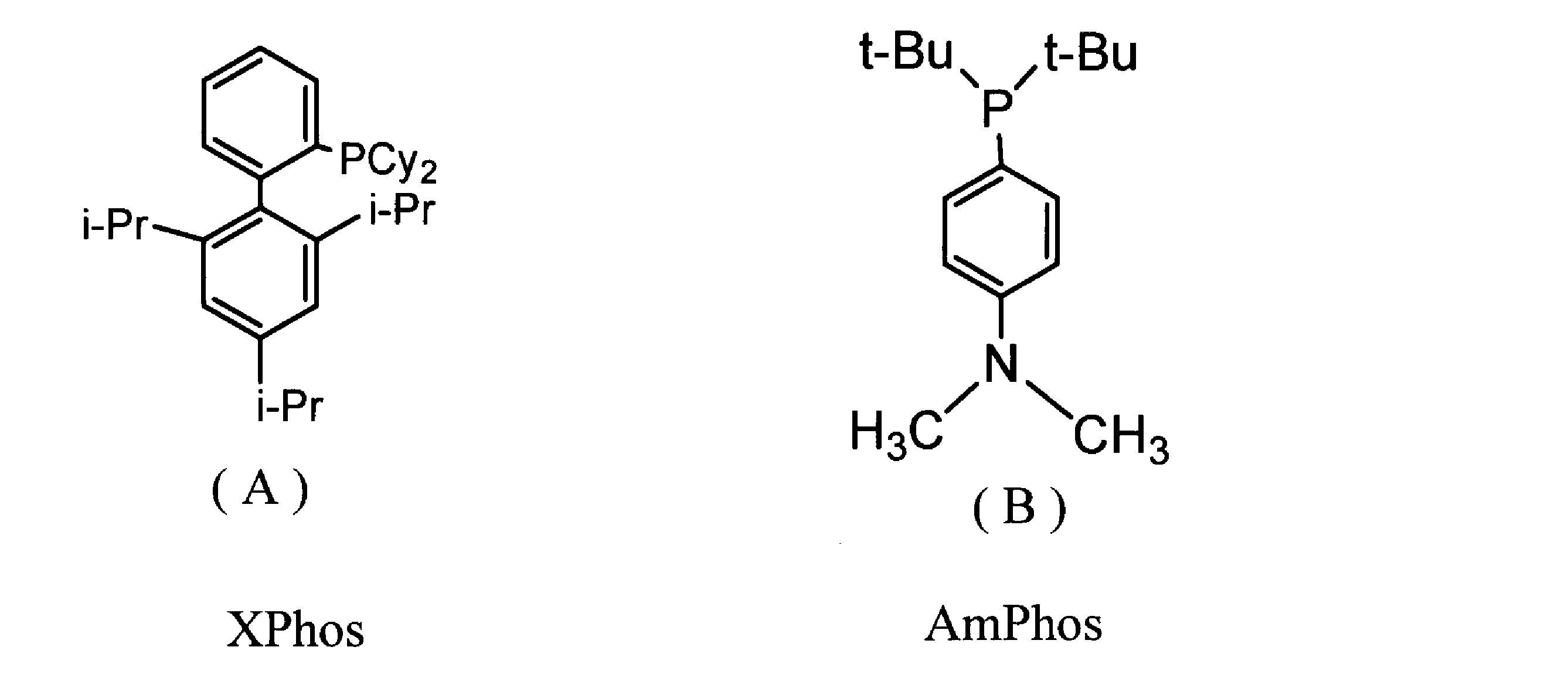
- Buchwald phosphine ligands include biarylphosphines such as t-BuBrettPhos, RockPhos, BrettPhos, and XPhos.
- XPhos is a ligand with the structure shown in the following chemical formula (A).
- AmPhos shown in the following chemical formula (B), is widely known as a ligand for catalysts used in the Suzuki-Miyaura cross-coupling reaction of aryl halides.
- All of these ligands are phosphine derivatives that have an aryl skeleton and two bulky groups on the phosphorus atom bonded to the aryl skeleton.
- the adamantyl group is known to be a bulky group, and compared to the t-butyl group, the adamantyl group has a greater electron donating ability, so it is expected that introducing this onto the phosphorus atom will also increase catalytic activity.
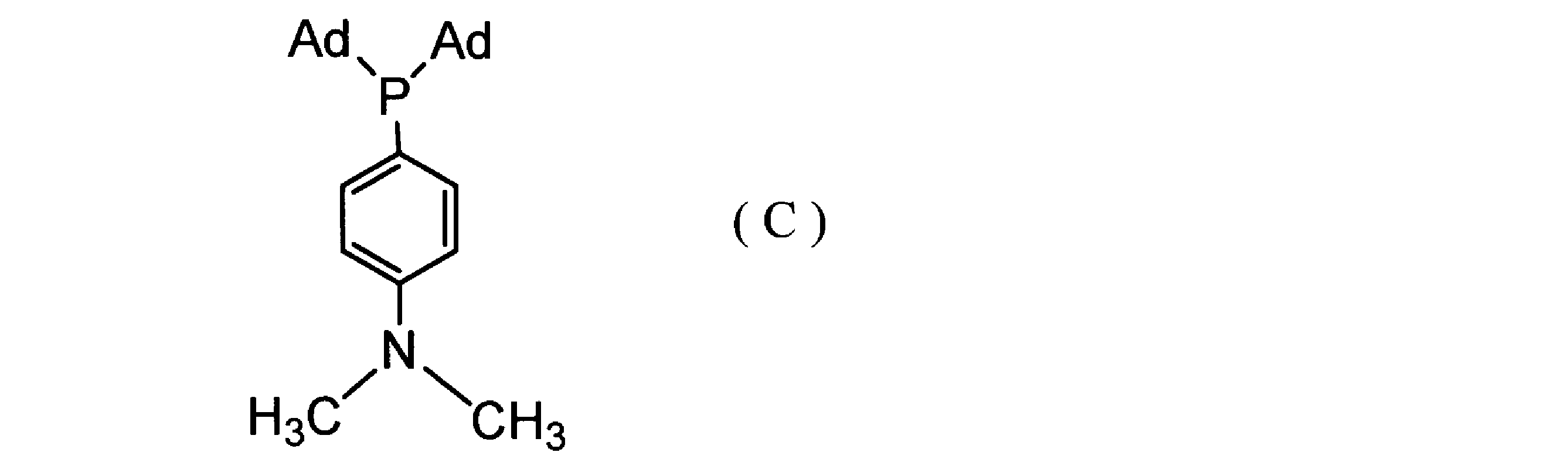
- Non-Patent Document 1 reports that a palladium complex having a ligand, a compound represented by the following chemical formula (C), which has an aryl skeleton and two adamantyl groups as bulky groups on the phosphorus atom, exhibits excellent catalytic activity in cross-coupling reactions and Buchwald-Hartwig reactions.
- Non-Patent Document 1 proposes a method in which a bromo compound (C1) is reacted with di-1-adamantylphosphine (C2) in the presence of a palladium catalyst (C3) according to the following reaction scheme 1.
- Non-Patent Document 1 uses a palladium catalyst, it is difficult to remove the palladium catalyst after the reaction, and it is difficult to use this reaction in fields where contamination with palladium metal or the inclusion of palladium in subsequent reactions is undesirable.
- palladium catalysts are expensive, so this method is not industrially advantageous.
- an object of the present invention is to provide a method for producing an aryldiadamantylphosphine derivative, in which a diadamantylphosphino group (-P(Ad) 2 ) is introduced into a compound having an aryl skeleton, in a high yield in an industrially advantageous manner without using a palladium catalyst.
- a bromo compound having an aryl skeleton is lithiated with an alkyllithium and the resulting lithiated product is reacted with diadamantylchlorophosphine, thereby obtaining the desired aryldiadamantylphosphine derivative in high yield without using a palladium catalyst, thereby completing the present invention.
- the first invention to be provided by the present invention is a method for producing an aryldiadamantylphosphine derivative represented by the following general formula (1): A first step of reacting a bromo compound represented by the following general formula (2) with an alkyl lithium to obtain a lithiated product; and then a second step of reacting the obtained lithiated product with a diadamantylchlorophosphine represented by the following general formula (3).
- Ad represents an unsubstituted adamantyl group or a substituted adamantyl group, and the substituent is a group selected from an alkyl group and an alkoxy group having 1 to 4 carbon atoms.
- A represents a group selected from an aryl group and a heteroaryl group, and the aryl group and the heteroaryl group may have a substituent.
- Ad has the same meaning as in general formula (1) above.
- the second invention provided by the present invention is a method for producing an aryldiadamantylphosphonium salt derivative represented by the following general formula (6), which comprises a third step of reacting an aryldiadamantylphosphine derivative represented by the following general formula (1) with a boric acid compound represented by the following general formula (5).
- Ad represents an unsubstituted adamantyl group or a substituted adamantyl group, and the substituent is a group selected from an alkyl group and an alkoxy group having 1 to 4 carbon atoms.
- A represents a group selected from an aryl group and a heteroaryl group, and the aryl group and the heteroaryl group may have a substituent.
- R6 represents a halogen atom, an aryl group, or an aryl heterocyclic group, and the aryl group and the aryl heterocyclic group may have a substituent.
- the third invention to be provided by the present invention is a method for producing an aryldiadamantylphosphine derivative represented by the following general formula (1), which includes a fourth step of neutralizing an aryldiadamantylphosphonium salt derivative represented by the following general formula (6) with a base.
- Ad represents an unsubstituted adamantyl group or a substituted adamantyl group, and the substituent is a group selected from an alkyl group and an alkoxy group having 1 to 4 carbon atoms.
- A represents a group selected from an aryl group and a heteroaryl group, and the aryl group and the heteroaryl group may have a substituent.
- R6 represents a halogen atom, an aryl group, or an aryl heterocyclic group, and the aryl group and the aryl heterocyclic group may have a substituent.
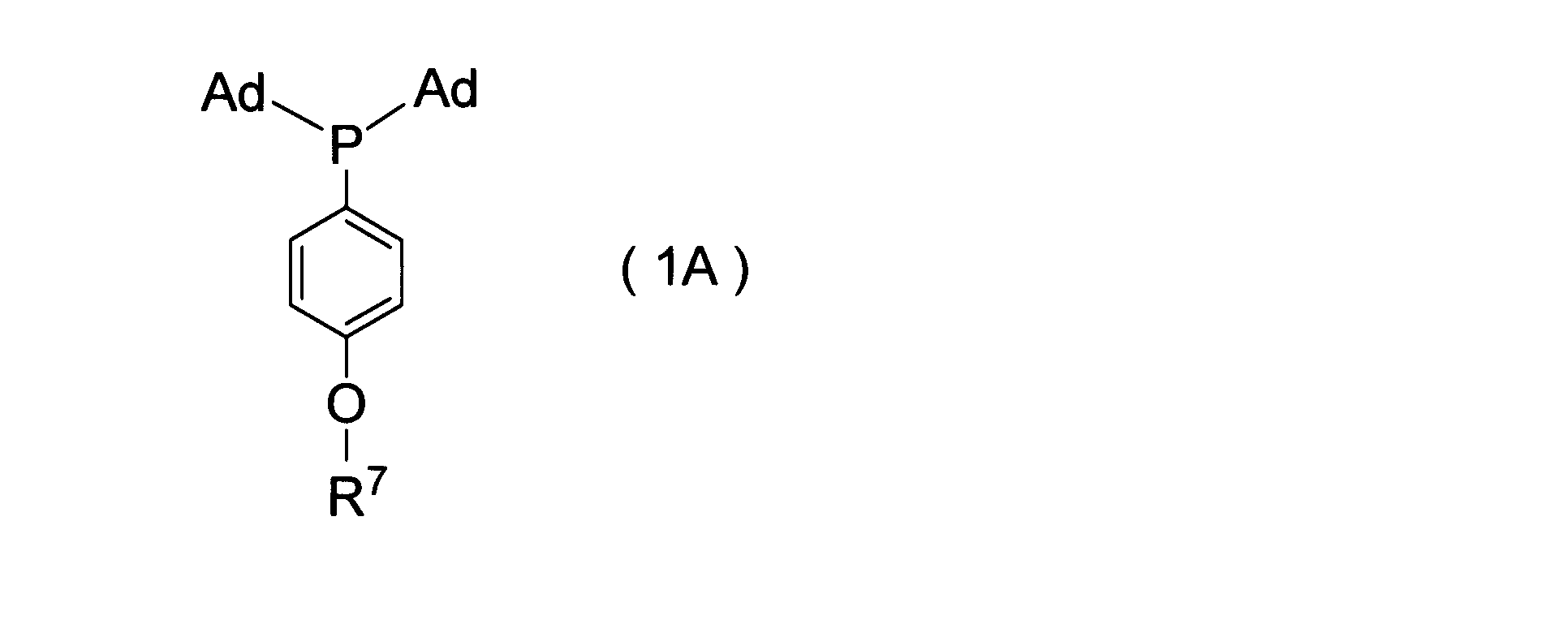
- the fourth invention that the present invention provides is an aryldiadamantylphosphine derivative represented by the following general formula (1A):
- Ad represents an unsubstituted adamantyl group or a substituted adamantyl group, and the substituent is a group selected from an alkyl group and an alkoxy group having 1 to 4 carbon atoms.
- R7 represents a linear or branched alkyl group having 1 to 8 carbon atoms.
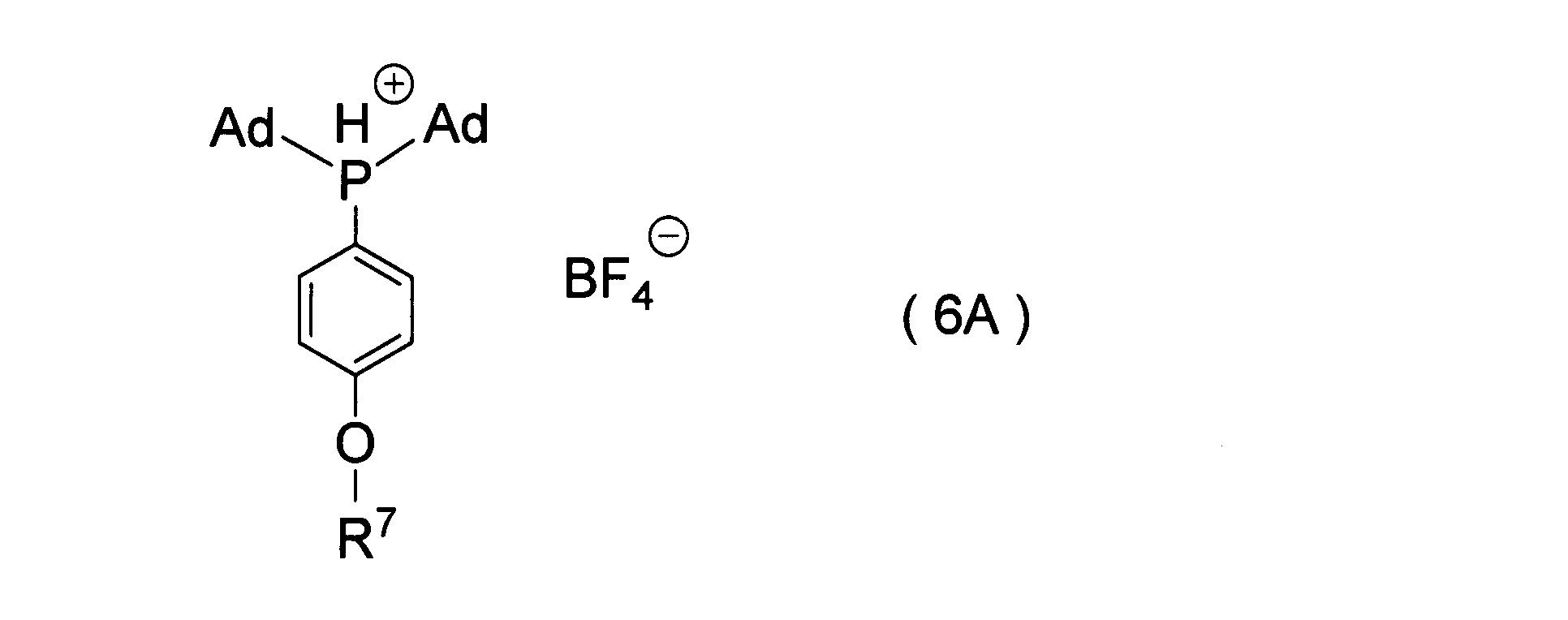
- the fifth invention that the present invention provides is an aryldiadamantylphosphonium salt derivative represented by the following general formula (6A):
- Ad represents an unsubstituted adamantyl group or a substituted adamantyl group, and the substituent is a group selected from an alkyl group and an alkoxy group having 1 to 4 carbon atoms.
- R7 represents a linear or branched alkyl group having 1 to 8 carbon atoms.
- an aryldiadamantylphosphine derivative which is useful as a ligand for a coupling reaction catalyst, and in which a diadamantylphosphine group (-P(Ad) 2 ) is introduced into a compound having an aryl skeleton, can be produced in high yield by an industrially advantageous method without using a palladium catalyst.
- the present invention is a method for producing an aryldiadamantylphosphine derivative represented by the following general formula (1).
- Ad represents an unsubstituted adamantyl group or a substituted adamantyl group, and the substituent is a group selected from an alkyl group and an alkoxy group having 1 to 4 carbon atoms.
- A represents a group selected from an aryl group and a heteroaryl group, and the aryl group and the heteroaryl group may have a substituent.
- Ad represents an unsubstituted adamantyl group or a substituted adamantyl group.
- the substituent in the substituted adamantyl group represents a group selected from an alkyl group and an alkoxy group having 1 to 4 carbon atoms.
- alkyl group having 1 to 4 carbon atoms examples include linear or branched alkyl groups having 1 to 4 carbon atoms, such as methyl, ethyl, n-propyl, isopropyl, and n-butyl.
- alkoxy group having 1 to 4 carbon atoms examples include linear or branched alkoxy groups having 1 to 4 carbon atoms, such as methoxy, ethoxy, n-propoxy, isopropoxy, and n-butoxy.
- A represents a group selected from an aryl group and a heteroaryl group.
- aryl group examples include a phenyl group, a naphthyl group, an anthracene group, a phenanthrene group, a biphenyl group, a terphenyl group, a pyrene group, a perylene group, and a triphenylene group.
- heteroaryl group examples include sulfur-containing heteroaryl groups such as thiophenyl, thienylenyl, benzothienyl, dibenzothienyl, phenylenedibenzothienylenyl, and dibenzothienylenylphenyl; oxygen-containing heteroaryl groups such as furanyl, benzofuranyl, dibenzofuranyl, phenyldibenzofuranyl, and dibenzofuranylphenyl; nitrogen-containing heteroaryl groups such as pyridyl, pyridylenyl, pyrimidinyl, pyrazyl, quinolyl, isoquinolyl, carbazolyl, 9-phenylcarbazolyl, acridinyl, quinazolyl, quinoxalyl, 1,6-naphthyridinyl, 1,8-naphthyridinyl, and porphyrin; and heteroaryl groups containing two
- the aryl group and heteroaryl group may have a substituent.
- substituents include a linear or branched alkyl group having 1 to 24 carbon atoms, a linear or branched alkoxy group having 1 to 24 carbon atoms, a cycloalkyl group having 3 to 24 carbon atoms, a cycloalkyloxy group having 3 to 24 carbon atoms, an alkenyl group having 1 to 24 carbon atoms, an alkynyl group having 1 to 24 carbon atoms, an aryl group having 5 to 24 carbon atoms, an aryloxy group having 5 to 24 carbon atoms, a heteroaryl group having 4 to 24 carbon atoms, an acyl group having 1 to 24 carbon atoms, an amino group having 1 to 24 carbon atoms, a halogeno group, a cyano group, and a nitro group.
- the hydrogen atoms of these substituents may be further substituted with a halogeno group.
- halogeno group examples include a fluoro group, a chloro group, a bromo group, and an iodo group.
- Examples of the linear or branched alkyl group having 1 to 24 carbon atoms include a methyl group, an ethyl group, an n-propyl group, an isopropyl group, an n-butyl group, an isobutyl group, a tert-butyl group, a pentyl group, a hexyl group, and an octyl group.
- Examples of the linear or branched alkoxy group having 1 to 24 carbon atoms include a methoxy group, an ethoxy group, an n-propoxy group, an isopropoxy group, an n-butoxy group, an isobutoxy group, a tert-butoxy group, a pentyloxy group, a hexyloxy group, and an octyloxy group.
- Examples of the cycloalkyl group having 3 to 24 carbon atoms include a cyclopropyl group, a cyclobutyl group, a cyclopentyl group, and a cyclohexyl group.
- the cycloalkyl group may also contain a heteroatom such as S or N.
- Examples of the cycloalkyloxy group having 3 to 24 carbon atoms include a cyclopropyloxy group, a cyclobutyloxy group, a cyclopentyloxy group, and a cyclohexyloxy group.
- the cycloalkyloxy group may also contain a heteroatom such as S or N.
- alkenyl group having 1 to 24 carbon atoms examples include an ethenyl group, a propenyl group, a butenyl group, a pentenyl group, a hexenyl group, and an octenyl group.
- alkynyl group having 1 to 24 carbon atoms examples include an ethynyl group, a propynyl group, a butynyl group, a pentynyl group, a hexynyl group, and an octynyl group.
- Examples of the aryl group having 5 to 24 carbon atoms include a phenyl group, a naphthyl group, and a biphenyl group.
- Examples of the aryloxy group having 5 to 24 carbon atoms include a phenoxy group, a naphthyloxy group, and a biphenyloxy group.
- heteroaryl group having 4 to 24 carbon atoms examples include a thiophenyl group, a furanyl group, a carbazole group, a benzothiophenyl group, a benzofuranyl group, an indolyl group, a pyrrolyl group, and a pyridyl group.
- acyl group having 1 to 24 carbon atoms examples include an acetyl group, a propionyl group, a butanoyl group, a pentanoyl group, a heptanoyl group, and groups in which the carbonyl group contained in the acyl group is replaced with an ester group or an amide group.
- Examples of the amino group having 1 to 24 carbon atoms include a diphenylamino group and a dimethylamino group.
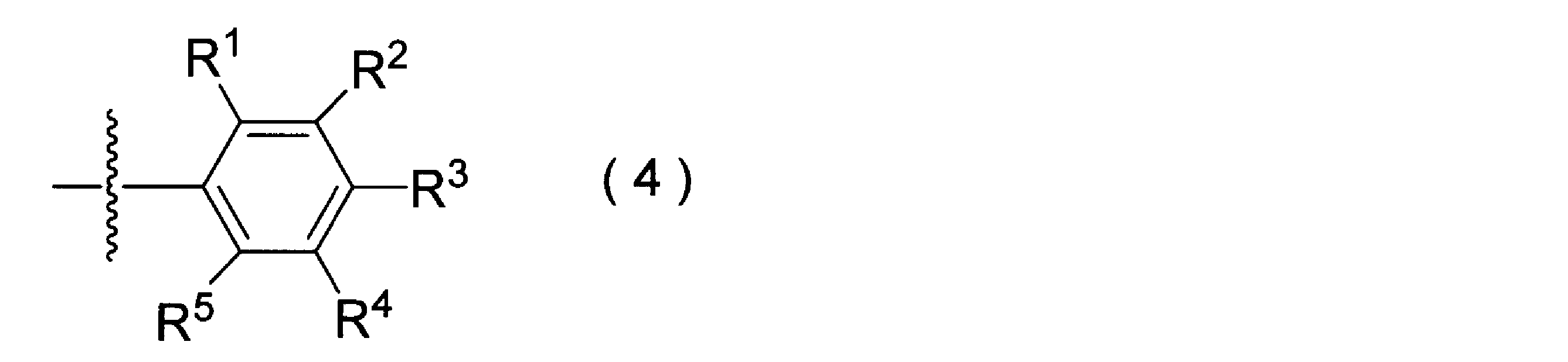
- a in the general formula (1) is preferably an aryl group represented by the following general formula (4).
- R 1 to R 5 each independently represent a hydrogen atom, an alkyl group having 1 to 5 carbon atoms, an alkoxy group, or a group represented by the general formula: -N(Z 1 )(Z 2 ).
- Z 1 and Z 2 each independently represent an alkyl group having 1 to 5 carbon atoms.
- R 1 to R 5 each independently represent a hydrogen atom, an alkyl group having 1 to 5 carbon atoms, an alkoxy group, or a group represented by the general formula: -N(Z 1 )(Z 2 ).
- Z 1 and Z 2 each independently represent an alkyl group having 1 to 5 carbon atoms.
- alkyl group having 1 to 5 carbon atoms examples include linear or branched alkyl groups having 1 to 5 carbon atoms, such as a methyl group, an ethyl group, an n-propyl group, and an isopropyl group.
- alkoxy group having 1 to 5 carbon atoms examples include linear or branched alkoxy groups having 1 to 5 carbon atoms, such as a methoxy group, an ethoxy group, an n-propoxy group, and an isopropoxy group.
- Examples of the alkyl group having 1 to 5 carbon atoms represented by Z 1 and Z 2 in the general formula -N(Z 1 )(Z 2 ) include linear or branched alkyl groups having 1 to 5 carbon atoms, such as a methyl group, an ethyl group, an n-propyl group, an isopropyl group, etc.
- Z 1 and Z 2 may be the same group or different groups.
- R 1 , R 2 , R 4 and R 5 in the general formula (4) are hydrogen atoms
- R 3 is an alkyl group having 1 to 3 carbon atoms, such as a methoxy group, an ethoxy group, an n-propyl group or an isopropyl group, or a dimethylamino group.
- the method for producing an aryldiadamantylphosphine derivative of the present invention includes the following first and second steps.
- Step 1 A step of reacting a bromo compound represented by the following general formula (2) with an alkyl lithium to obtain a lithiated product.
- Step 2 A step of reacting the lithiated product obtained in Step 1 with a diadamantylchlorophosphine represented by the following general formula (3).
- the first step is a step of reacting a bromo compound represented by the following general formula (2) with an alkyl lithium in a solvent to obtain a lithiated product of the bromo compound.
- a in the formula (2) is a group corresponding to A in the formula (1), and as described above, A represents a group selected from an aryl group and a heteroaryl group, and the aryl group and the heteroaryl group may have a substituent.
- the preferred groups for A in the formula (2) are as described above.
- alkyllithium used in the first step examples include methyllithium, n-butyllithium, isopropyllithium, s-butyllithium, t-octyllithium, and t-butyllithium. From the viewpoint of having high nucleophilicity and suppressing side reactions, secondary and tertiary alkyllithiums are preferred. From the viewpoints of ease of handling and industrial availability, s-butyllithium is particularly preferred.
- the amount of alkyllithium added is preferably 0.7 to 1.3, preferably 0.95 to 1.1, in terms of reactivity, in terms of the molar ratio of alkyllithium to the bromo compound represented by general formula (2) (alkyllithium/bromo compound).
- the reaction solvent used in the first step is not particularly limited, so long as it can dissolve the bromo compound represented by general formula (2) and the resulting lithiated product, and is inert to the reaction.
- solvents include tetrahydrofuran, cyclopentyl methyl ether, tert-butyl methyl ether, 1,2-dimethoxyethane, N,N-dimethylformamide, diethyl ether, dibutyl ether, dioxane, hexane, toluene, and the like. These solvents can be used as mixed solvents.
- tetrahydrofuran is particularly preferred from the viewpoint of the solubility of the lithiated product.
- the lithiation reaction in the first step is preferably carried out by adding an alkyl lithium to a solution in which the bromo compound represented by general formula (2) is dissolved in a reaction solvent.
- the reaction temperature in the first step is preferably -200 to 30°C, more preferably -80 to 30°C, from the viewpoint of reactivity.
- the reaction time in the first step is preferably 15 minutes or more, more preferably 0.5 to 3 hours.
- the alkyllithium is added at a temperature in the range of ⁇ 80 to ⁇ 10° C., and the reaction is preferably carried out for 0.1 to 5 hours while maintaining the temperature in that range, and more preferably for 0.5 to 2 hours from the viewpoint of reactivity.
- the solvent may be removed from the reaction solution by distillation or the like in a conventional manner to recover the lithiated product and then purify it.
- the second step is to react the lithiated product obtained in the first step with diadamantylchlorophosphine represented by the following general formula (3) in a solvent to obtain the desired aryldiadamantylphosphine derivative represented by the general formula (1).
- Ad in the general formula (3) is a group corresponding to Ad in the general formula (1), and as described above, Ad represents an unsubstituted adamantyl group or an adamantyl group having a substituent.
- the substituent in the adamantyl group having a substituent is a group selected from alkyl groups and alkoxy groups having 1 to 4 carbon atoms.
- the preferred groups for Ad in the general formula (3) are as described above.
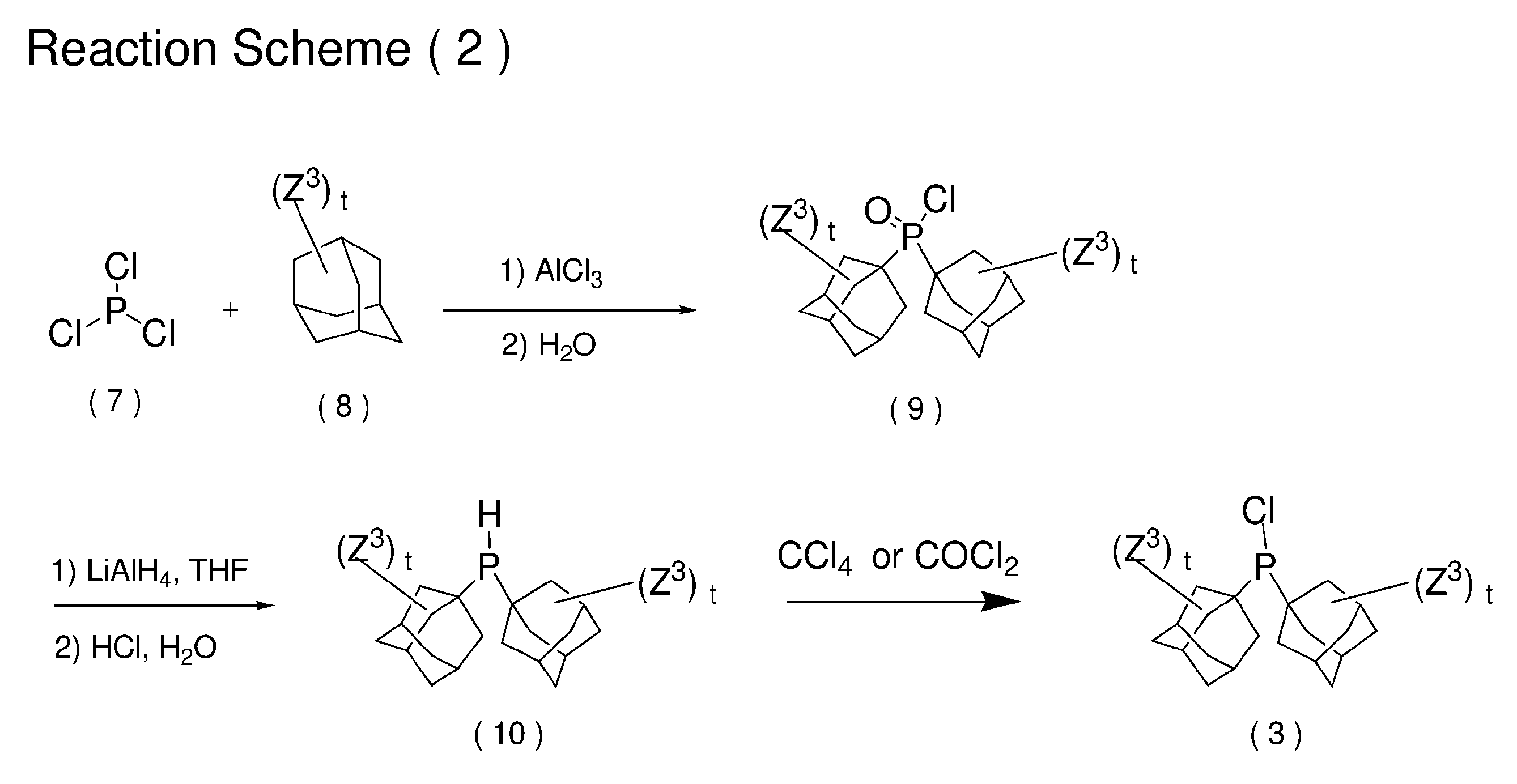
- the diadamantyl chlorophosphine represented by the general formula (3) can be produced by a known method. For example, according to the following reaction scheme (2), a diadamantyl phosphine derivative (10) is obtained from phosphorus trichloride (7) and an adamantane derivative (8), and then the diadamantyl phosphine derivative (10) is chlorinated with CCl 4 or COCl 2. (See Phosphorus Sulfur Silicon Relat. Elem., 1995, Vol. 102, Pages 211-215, and JP-A-2004-505091, paragraphs 0041-0046, etc.) A commercially available di-1-adamantyl chlorophosphine may be used.
- Z3 represents a group selected from an alkyl group and an alkoxy group having 1 to 4 carbon atoms, and t represents an integer of 0 to 3.
- the reaction of the second step it is preferable to use 1.0 to 10 times, preferably 1.5 to 10.0 times, more preferably 2.0 to 5.0 times the molar amount of the lithiated bromo compound represented by general formula (2) relative to the diadamantylchlorophosphine represented by general formula (3), from the viewpoint of efficiently proceeding with the reaction and obtaining the target product in good yield.
- the reaction solvent for the second step can be the same as that for the first step, and examples of such solvents include tetrahydrofuran, cyclopentyl methyl ether, tert-butyl methyl ether, 1,2-dimethoxyethane, N,N-dimethylformamide, diethyl ether, dibutyl ether, dioxane, hexane, and toluene. These solvents can be used as a mixed solvent.
- the reaction in the second step is preferably carried out by adding diadamantylchlorophosphine represented by general formula (3) to the solution containing the lithiated product after completion of the first step.
- the reaction temperature in the second step is preferably -200 to 100°C, more preferably -80 to 30°C, from the viewpoint of reactivity.
- the reaction time for the second step is preferably 0.5 hours or more, and more preferably 1 to 4 hours.
- the desired aryl diadamantyl phosphine derivative represented by the general formula (1) can be obtained by recrystallization, purification using a column, etc., if necessary.
- the aryl diadamantyl phosphine derivative represented by the general formula (1) is easily oxidized in a solvent or air, it is also possible to carry out the third step described below to temporarily stabilize it as a phosphonium salt, and then carry out the fourth step described below when necessary to prepare the aryl diadamantyl phosphine derivative represented by the general formula (1).
- the third step of the present invention is a step of reacting an aryldiadamantylphosphine derivative represented by general formula (1) with a boric acid compound represented by general formula (5) in a solvent.
- the third step produces an aryldiadamantylphosphonium salt derivative represented by the following general formula (6).
- R6 represents a halogen atom, an aryl group, or an aryl heterocyclic group, and the aryl group and the aryl heterocyclic group may have a substituent.
- Ad is a group corresponding to Ad in general formula (1)
- A is a group corresponding to A in general formula (1).
- R6 represents a halogen atom, an aryl group, or an aryl heterocyclic group.
- aryl group examples include a phenyl group, a naphthyl group, an anthracene group, a phenanthrene group, a biphenyl group, a terphenyl group, a pyrene group, a perylene group, and a triphenylene group.
- aryl heterocyclic group examples include a pyridyl group and a thiophenyl group.
- the aryl group and aryl heterocyclic group may have a substituent.
- substituents include a linear or branched alkyl group having 1 to 5 carbon atoms and a halogen atom.
- R6 is preferably a halogen atom, and particularly preferably a fluorine atom.
- the boric acid compound used in the third step is represented by the following general formula (5).
- R6 in the formula (5) is a group corresponding to R6 in the formula (6) and represents a halogen atom, an aryl group, or an aryl heterocyclic group, and the aryl group and the aryl heterocyclic group may have a substituent.
- the preferred groups for R6 in the formula (5) are as described above.
- the amount of the boric acid compound represented by general formula (5) added is preferably 0.8 to 100 in terms of the molar ratio of the boric acid compound represented by general formula (5) to the aryldiadamantylphosphine derivative represented by general formula (1) (general formula (5)/general formula (1)), and more preferably 2 to 5 from the viewpoint of reactivity.
- the reaction solvent in the third step can be the same as that in the second step, and examples of such solvents include tetrahydrofuran, cyclopentyl methyl ether, tert-butyl methyl ether, 1,2-dimethoxyethane, N,N-dimethylformamide, diethyl ether, dibutyl ether, dioxane, hexane, and toluene. These solvents can be used as a mixed solvent.
- the reaction in the third step can be continued without isolating the aryldiadamantylphosphine derivative represented by the general formula (1) by adding saturated saline or the like to the solution containing the aryldiadamantylphosphine derivative represented by the general formula (1) after the completion of the second step, and adding the boric acid compound represented by the general formula (5) to the organic layer separated and recovered.
- the reaction in the third step may be carried out by adding saturated saline to a solution containing the aryldiadamantylphosphine derivative represented by general formula (1) after the completion of the second step to terminate the reaction, and then adding the boric acid compound represented by general formula (5) without separating and recovering the organic layer.
- the reaction temperature in the third step is preferably -30 to 80°C, and more preferably -10 to 30°C.
- the reaction time for the third step is preferably 0.5 hours or more, and more preferably 2 to 5 hours.
- the solvent is removed from the organic layer by distillation or the like, and purification such as recrystallization is carried out as necessary to obtain the aryldiadamantylphosphonium salt derivative represented by general formula (6).
- the fourth step is a step in which the aryldiadamantylphosphonium salt derivative obtained in the third step is neutralized with a base to obtain an aryldiadamantylphosphine derivative represented by general formula (1).
- the neutralization treatment in the fourth step is preferably carried out by adding an aqueous solution containing a base to a solution in which the aryldiadamantylphosphonium salt derivative is dissolved in a solvent.
- a solvent for dissolving the aryldiadamantylphosphonium salt derivative it is preferable to use a hydrophobic organic solvent, since this allows easy separation from the aqueous layer.
- solvents include tetrahydrofuran, cyclopentyl methyl ether, tert-butyl methyl ether, 1,2-dimethoxyethane, N,N-dimethylformamide, diethyl ether, dibutyl ether, dioxane, hexane, and toluene.
- the base used in the fourth step includes alkali metal hydroxides such as sodium hydroxide, potassium hydroxide, and lithium hydroxide, and organic bases such as triethylamine, DBU, and N-ethyldiisopropylamine.
- the amount of base added is preferably 1 to 100 times the molar amount of the aryl diadamantyl phosphonium salt derivative, and more preferably 2 to 10 times the molar amount.
- the base can be added in multiple portions to the solution in which the aryl diadamantyl phosphonium salt derivative is dissolved.
- the temperature of the neutralization treatment in the fourth step is usually -30 to 50°C, preferably -10 to 25°C.
- the organic layer and the aqueous layer are separated, and the solvent is removed from the organic layer by distillation or the like. If necessary, purification is performed by a conventional method such as recrystallization to obtain the aryldiadamantylphosphine derivative represented by general formula (1).
- the aryldiadamantylphosphine derivative represented by the general formula (1) obtained by the production method of the present invention is particularly useful as a ligand used in a cross-coupling reaction, and its phosphonium salt not only contributes to stabilization but is also known to be useful as a ligand used in a cross-coupling reaction (see, for example, WO2014/007405 pamphlet, WO2014/007404 pamphlet, etc.).
- the aryldiadamantylphosphine derivative represented by the general formula (1) and the aryldiadamantylphosphonium salt derivative represented by the general formula (6) obtained by the production method of the present invention are expected to be useful as ligands of catalysts used in coupling reactions such as the Suzuki-Miyaura reaction, the Negishi reaction, the Hiyama reaction, etc.
- aryl diadamantyl phosphine derivative produced by the present invention is an aryl diadamantyl phosphine derivative represented by the following general formula (1A).
- the aryl diadamantyl phosphine derivative represented by the general formula (1A) is a novel compound that is particularly expected to be used as a ligand of a catalyst used in coupling reactions such as the Suzuki-Miyaura reaction, the Negishi reaction, and the Hiyama reaction.
- Ad represents an unsubstituted adamantyl group or a substituted adamantyl group, and the substituent is a group selected from an alkyl group and an alkoxy group having 1 to 4 carbon atoms.
- R7 represents a linear or branched alkyl group having 1 to 8 carbon atoms.
- Ad represents an unsubstituted adamantyl group or an adamantyl group having a substituent, and the substituent is a group selected from an alkyl group having 1 to 4 carbon atoms and an alkoxy group having 1 to 4 carbon atoms.
- Ad in general formula (1A) is preferably an unsubstituted adamantyl group.
- Examples of the linear or branched alkyl group having 1 to 8 carbon atoms represented by R7 in the general formula (1A) include a methyl group, an ethyl group, an n-propyl group, an isopropyl group, etc. Among these, a methyl group and an isopropyl group are preferred, and an isopropyl group is particularly preferred from the viewpoints of solubility and industrial availability.
- aryl diadamantyl phosphonium salt derivative produced by the present invention is an aryl diadamantyl phosphonium salt derivative represented by the following general formula (6A).
- the aryl diadamantyl phosphonium salt derivative represented by the general formula (1A) is a novel compound that is particularly expected to be used as a ligand of a catalyst used in coupling reactions such as the Suzuki-Miyaura reaction, the Negishi reaction, and the Hiyama reaction.
- Ad represents an unsubstituted adamantyl group or a substituted adamantyl group, and the substituent is a group selected from an alkyl group and an alkoxy group having 1 to 4 carbon atoms.
- R7 represents a linear or branched alkyl group having 1 to 8 carbon atoms.
- Ad represents an unsubstituted adamantyl group or an adamantyl group having a substituent, and the substituent is a group selected from an alkyl group having 1 to 4 carbon atoms and an alkoxy group having 1 to 4 carbon atoms.
- Ad in general formula (6A) is preferably an unsubstituted adamantyl group.
- Examples of the linear or branched alkyl group having 1 to 3 carbon atoms represented by R7 in the general formula (6A) include a methyl group, an ethyl group, an n-propyl group, an isopropyl group, etc. Among these, a methyl group and an isopropyl group are preferred, and an isopropyl group is particularly preferred from the viewpoints of solubility and industrial availability.
- aryldiadamantylphosphine derivatives and aryldiadamantylphosphonium salt derivatives obtained by the production method of the present invention are used as ligands
- transition metals that can form complexes with these ligands include rhodium, ruthenium, iridium, palladium, nickel, iron, copper, etc., and among these, palladium is particularly preferred.
- Ad represents a 1-adamantyl group.
- ⁇ Second step> A solution of 3.00 g (8.91 mmol, 1.0 eq) of di-1-adamantylchlorophosphine (Ad 2 PCl) in 150 mL of deoxygenated THF was added dropwise to the solution. After the addition, the mixture was reacted at ⁇ 78° C. for 1 hour, and then the temperature was gradually raised to ⁇ 10° C. for 3 hours. The conversion rate of Ad 2 PCl was determined by GC and was found to be 98% or more.
- ⁇ Separation and purification> To the reaction solution, 100 mL of deoxygenated saturated saline was slowly added at -10°C. After stirring for 30 minutes, the aqueous layer was discarded.
- the solvent was distilled off under reduced pressure, and 200 mL of deoxygenated methanol was added to the residue. The supernatant was removed by decantation filtration, and the remaining solvent was distilled off under reduced pressure to obtain a white solid. The resulting white solid was then recrystallized from deoxygenated THF at ⁇ 10° C. to obtain 2.06 g (4.89 mmol) of purified compound (1a) in a yield of 54.9%.
- the conversion rate of Ad 2 PCl was determined as follows. A small amount of the reaction mixture was sampled and hydrolyzed with deoxygenated saline. A certain amount of the organic layer was accurately measured, and 2,6-di-tert-butyl-p-cresol was added as an external standard.
- Ad represents a 1-adamantyl group.
- Ad represents a 1-adamantyl group.
- Ad represents a 1-adamantyl group.
- Ad represents a 1-adamantyl group.
- Ad represents a 1-adamantyl group.
- the organic layer was separated at -10°C, 6.0 g of 42% HBF4 aqueous solution was added and stirred for 2 hours, and then stirred at room temperature for a whole day and night.
- the organic layer was washed three times with 100 mL of saturated saline at room temperature.
- the solvent was distilled off under reduced pressure to obtain a yellow viscous solid. Recrystallization was performed from 7 times the amount of methanol at -30°C to obtain 2.82 g (5.54 mmol) of a white solid of compound (6a) in a yield of 62.2%.
- Ad represents a 1-adamantyl group.
- ⁇ Third step> In the second step of Example 1, 100 ml of deoxygenated saturated saline was added at -10°C to stop the reaction, and then 6.0 g of 42% HBF4 aqueous solution was slowly added at -10°C and stirred at -10°C for 2 hours. Then, the mixture was stirred at room temperature for a whole day and night. The organic layer was washed three times with 100 mL of saturated saline at room temperature. The solvent was distilled off under reduced pressure to obtain a yellow viscous solid. The mixture was recrystallized from 7 times the amount of methanol at -30°C to obtain 2.69 g (5.28 mmol) of white solid compound (6a) in a yield of 59.3%.
- Ad represents a 1-adamantyl group.
- ⁇ Fourth step> A 100 mL four-neck flask equipped with a stirrer, a N2 inlet tube, a thermometer, and a dropping tube was charged with a solution of 100 mg (0.196 mmol) of the compound (6a) obtained in Example 6 in 30 mL of deoxygenated toluene, and cooled to -20°C. 30 mL of a 0.1 N deoxygenated NaOH aqueous solution was added dropwise thereto. After stirring at -20°C for 2 hours, the organic layer was separated and washed once with deoxygenated water, and the solvent was distilled off under reduced pressure to obtain 50 mg of a white solid of compound (1a).
- Ad represents a 1-adamantyl group.
- Ad represents a 1-adamantyl group.
- ⁇ Third step> The compound (1b) obtained in the second step of Example 9 was suspended in 400 mL of THF, and 6.0 g of 42% HBF4 aqueous solution was added at -10°C, followed by stirring at -10°C for 2 hours and at room temperature overnight. The organic layer was washed three times with 100 mL of saturated saline at room temperature. The solvent was distilled off under reduced pressure to obtain a white solid. Recrystallization was performed from 10 times the amount of methanol at -10°C to obtain 3.2 g (6.45 mmol) of a white solid of compound (6b) in a yield of 72.4%.
- Ad represents a 1-adamantyl group.
- Ad represents a 1-adamantyl group.
- ⁇ Third step> In the second step of Example 11, 100 ml of deoxygenated saturated saline was added at -10°C to stop the reaction. Then, 6.0 g of 42% HBF4 aqueous solution was slowly added at -10°C, and the mixture was stirred at -10°C for 2 hours and then at room temperature for a whole day and night. The organic layer was washed three times with 100 mL of saturated saline, and the solvent was distilled off under reduced pressure. The crude product was recrystallized from 8 times the amount of methanol at -30°C to obtain 3.00 g (5.72 mmol) of white solid compound (6c) in a yield of 64.2%.
Landscapes
- Chemical & Material Sciences (AREA)
- Organic Chemistry (AREA)
- Health & Medical Sciences (AREA)
- Life Sciences & Earth Sciences (AREA)
- Biochemistry (AREA)
- General Health & Medical Sciences (AREA)
- Molecular Biology (AREA)
- Engineering & Computer Science (AREA)
- Materials Engineering (AREA)
- Chemical Kinetics & Catalysis (AREA)
- Inorganic Chemistry (AREA)
Abstract
アリール骨格を有する化合物にジアダマンチルホスフィン基(-P(Ad)2)を導入したアリールジアダマンチルホスフィン誘導体を、パラジウム触媒を用いること無く、工業的に有利な方法で、高収率で製造する方法を提供すること。 アリールジアダマンチルホスフィン誘導体の製造方法であって、ブロモ化合物と、アルキルリチウムとを反応させてリチオ化物を得る第1工程、次いで、得られたリチオ化物とジアダマンチルクロロホスフィンとを反応させる第2工程と、を有するアリールジアダマンチルホスフィン誘導体の製造方法である。
Description
本発明は、アリールジアダマンチルホスフィン誘導体の製造方法及びアリールジアダマンチルホスホニウム塩誘導体の製造方法に関するものである。
マサチューセッツ工科大学Buchwald教授らのグループは電子豊富でかさ高い一連のホスフィン類を提案した(例えば、特許文献1~3等)。これらは、Buchwaldホスフィン配位子と呼ばれ、種々のC-C、C-N、C-O結合を生成する機能が注目されている。Buchwaldホスフィン配位子として、t-BuBrettPhos、RockPhoss、BrettPhos、XPhos等のビアリールホスフィンが知られており、例えば、XPhosは、下記化学式(A)で示される構造の配位子である。
また、下記化学式(B)で示されるAmPhosはハロゲン化アリールの鈴木-宮浦クロスカップリング反応等に用いる触媒の配位子として広く知られている。
これらの配位子は、何れもアリール骨格を有し、アリール骨格に結合したリン原子上に嵩高い2つの基を有するホスフィン誘導体である。
アダマンチル基は嵩高い基として知られ、また、t-ブチル基とアダマンチル基とを比較した場合、アダマンチル基の電子供与性がより大きく、これをリン原子上に導入することで触媒活性も高くなることが期待されている。
非特許文献1には、アリール骨格を有し、リン原子上に嵩高い基として2個のアダマンチル基を有する下記化学式(C)で表される化合物を配位子とするパラジウム錯体が、クロスカップリング反応やBuchwald-Hartwig反応で優れた触媒活性を示すことが報告されている。
アリール骨格にジアダマンチルホスフィノ基(-P(Ad)2)を導入する方法として、非特許文献1には、下記反応スキーム1に従って、ブロモ化合物(C1)とジ-1-アダマンチルホスフィン(C2)とをパラジウム触媒(C3)の存在下に反応させる方法が提案されている。

しかしながら、非特許文献1の方法は、パラジウム触媒を用いるため、反応後にパラジウム触媒を除去することが困難であり、パラジウム金属のコンタミやその後の反応でパラジウムの混入を嫌う分野では、この反応を利用することは難しい。また、パラジウム触媒は高価であり、工業的に有利な方法ではない。
European Journal of Organic Chemistry,2020,1122-1128
すなわち、本発明の目的は、アリール骨格を有する化合物にジアダマンチルホスフィノ基(-P(Ad)2)を導入したアリールジアダマンチルホスフィン誘導体を、パラジウム触媒を用いること無く、工業的に有利な方法で、高収率で製造することができる方法を提供することにある。
本発明者らは、上記実情に鑑み鋭意研究を重ねた結果、アリール骨格を有する化合物にジアダマンチルホスフィノ基(-P(Ad)2)を導入する方法において、アリール骨格を有するブロモ化合物をアルキルリチウムでリチオ化し、得られるリチオ化物と、ジアダマンチルクロロホスフィンとを反応させることにより、パラジウム触媒を用いること無く、目的とするアリールジアダマンチルホスフィン誘導体が高収率で得られることを見出し、本発明を完成するに到った。
すなわち、本発明が提供しようとする第1の発明は、下記一般式(1)で表されるアリールジアダマンチルホスフィン誘導体の製造方法であって、
下記一般式(2)で表されるブロモ化合物と、アルキルリチウムとを反応させてリチオ化物を得る第1工程、
次いで、得られたリチオ化物と下記一般式(3)で表されるジアダマンチルクロロホスフィンとを反応させる第2工程、を有するアリールジアダマンチルホスフィン誘導体の製造方法である。
下記一般式(2)で表されるブロモ化合物と、アルキルリチウムとを反応させてリチオ化物を得る第1工程、
次いで、得られたリチオ化物と下記一般式(3)で表されるジアダマンチルクロロホスフィンとを反応させる第2工程、を有するアリールジアダマンチルホスフィン誘導体の製造方法である。



また、本発明が提供しようする第2の発明は、下記一般式(1)で表されるアリールジアダマンチルホスフィン誘導体と、下記一般式(5)で表されるホウ酸化合物とを反応させる第3工程を有する下記一般式(6)で表されるアリールジアダマンチルホスホニウム塩誘導体の製造方法である。


また、本発明が提供しようとする第3の発明は、下記一般式(1)で表されるアリールジアダマンチルホスフィン誘導体の製造方法であって、下記一般式(6)で表されるアリールジアダマンチルホスホニウム塩誘導体を塩基により中和処理する第4工程を有するアリールジアダマンチルホスフィン誘導体の製造方法である。


また、本発明が提供しようとする第4の発明は、下記一般式(1A)で表されるアリールジアダマンチルホスフィン誘導体である。

また、本発明が提供しようとする第5の発明は、下記一般式(6A)で表されるアリールジアダマンチルホスホニウム塩誘導体である。

本発明によれば、カップリング反応の触媒の配位子等として有用な、アリール骨格を有する化合物にジアダマンチルホスフィノ基(-P(Ad)2)を導入したアリールジアダマンチルホスフィン誘導体を、パラジウム触媒を用いること無く、工業的に有利な方法で、高収率で製造することができる。
以下、本発明を好ましい実施形態に基づいて説明する。
本発明は、下記一般式(1)で表されるアリールジアダマンチルホスフィン誘導体の製造方法である。

一般式(1)の式中のAdは、無置換のアダマンチル基又は置換基を有するアダマンチル基を示す。前記置換基を有するアダマンチル基における置換基は、炭素数1~4のアルキル基及びアルコキシ基から選ばれる基を示す。
前記炭素数1~4のアルキル基としては、例えば、メチル基、エチル基、n-プロピル基、イソプロピル基、n-ブチル基等の炭素数1~4の直鎖状又は分岐状のアルキル基が挙げられる。また、炭素数1~4のアルコキシ基としては、メトキシ基、エトキシキ基、n-プロポキシ基、イソプロポキシ基、n-ブトキシ基等の炭素数1~4の直鎖状又は分岐状のアルコキシ基が挙げられる。
一般式(1)の式中のAは、アリール基及びヘテロアリールから選ばれる基を示す。
前記アリール基としては、例えば、フェニル基、ナフチル基、アントラセン基、フェナントレン基、ビフェニル基、ターフェニル基、ピレン基、ペリレン基及びトリフェニレン基等が挙げられる。
前記ヘテロアリール基としては、例えば、チオフェニル基、チエニレニル基、ベンゾチエニル基、ジベンゾチエニル基、フェニレンジベンゾチエニレニル基及びジベンゾチエニレニルフェニル基等の含硫黄ヘテロアリール基;フラニル基、ベンゾフラニル基、ジベンゾフラニル基、フェニルジベンゾフラニル基及びジベンゾフラニルフェニル基等の含酸素ヘテロアリール基;ピリジル基、ピリジレニル基、ピリミジニル基、ピラジル基、キノリル基、イソキノリル基、カルバゾリル基、9-フェニルカルバゾリル基、アクリジニル基、キナゾリル基、キノキサリル基、1,6-ナフチリジニル基、1,8-ナフチリジニル基及びポルフィリン基等の含窒素ヘテロアリール基;ベンゾチアゾリル基等の2種以上のヘテロ原子(例えば、窒素と硫黄)を含むヘテロアリール基等が挙げられる。
前記アリール基及びヘテロアリール基は、置換基を有していてもよい。該置換基としては、炭素数1~24の直鎖状又は分岐状のアルキル基、炭素数1~24の直鎖状又は分岐状のアルコキシ基、炭素数3~24のシクロアルキル基、炭素数3~24のシクロアルキルオキシ基、炭素数1~24のアルケニル基、炭素数1~24のアルキニル基、炭素数5~24のアリール基、炭素数5~24のアリールオキシ基、炭素数4~24のヘテロアリール基、炭素数1~24のアシル基、炭素数1~24のアミノ基、ハロゲノ基、シアノ基及びニトロ基等が挙げられる。これらの置換基は、更にハロゲノ基で水素原子が置換されていてもよい。
前記ハロゲノ基としては、例えば、フルオロ基、クロロ基、ブロモ基及びヨード基等が挙げられる。
前記炭素数1~24の直鎖状又は分岐状のアルキル基としては、例えば、メチル基、エチル基、n-プロピル基、イソプロピル基、n-ブチル基、イソブチル基、tert-ブチル基、ペンチル基、ヘキシル基及びオクチル基等が挙げられる。
前記炭素数1~24の直鎖状又は分岐状のアルコキシ基としては、例えば、メトキシ基、エトキシ基、n-プロポキシ基、イソプロポキシ基、n-ブトキシ基、イソブトキシ基、tert-ブトキシ基、ペンチルオキシ基、ヘキシルオキシ基及びオクチルオキシ基等が挙げられる。
前記炭素数3~24のシクロアルキル基としては、例えば、シクロプロピル基、シクロブチル基、シクロペンチル基及びシクロヘキシル基等が挙げられる。また、前記シクロアルキル基は、SやN等のヘテロ原子を含むものであってもよい。
前記炭素数3~24のシクロアルキルオキシ基としては、例えば、シクロプロピルオキシ基、シクロブチルオキシ基、シクロペンチルオキシ基、シクロヘキシルオキシ基等が挙げられる。また、シクロアルキルオキシ基は、SやN等のヘテロ原子を含むものであってもよい。
前記炭素数1~24のアルケニル基としては、例えば、エテニル基、プロペニル基、ブテニル基、ペンテニル基、ヘキセニル基及びオクテニル基等が挙げられる。
前記炭素数1~24のアルキニル基としては、例えば、エチニル基、プロピニル基、ブチニル基、ペンチニル基、ヘキシニル基及びオクチニル基等が挙げられる。
前記炭素数5~24のアリール基としては、例えば、フェニル基、ナフチル基及びビフェニル基等が挙げられる。
前記炭素数5~24のアリールオキシ基としては、例えば、フェノキシ基、ナフチルオキシ基及びビフェニルオキシ基等が挙げられる。
前記炭素数4~24のヘテロアリール基としては、例えば、チオフェニル基、フラニル基、カルバゾール基、ベンゾチオフェニル基、ベンゾフラ二ル基、インドリル基、ピロリル基及びピリジル基等が挙げられる。
前記炭素数1~24のアシル基としては、例えば、アセチル基、プロピオニル基、ブタノイル基、ペンタノイル基及びヘプタノイル基、並びにそのアシル基に含まれるカルボニル基が、エステル基又はアミド基で置換された基等が挙げられる。
前記炭素数1~24のアミノ基としては、例えば、ジフェニルアミノ基及びジメチルアミノ基等が挙げられる。
本発明の製造方法においては、前記一般式(1)中のAは、下記一般式(4)で表されるアリール基であることが好ましい。

前記一般式(4)の式中のR1~R5は、それぞれ独立して、水素原子、炭素数1~5のアルキル基、アルコキシ基又は一般式:-N(Z1)(Z2)で表される基を示す。Z1及びZ2は、それぞれ独立して、炭素数1~5のアルキル基を示す。
前記炭素数1~5のアルキル基としては、例えば、メチル基、エチル基、n-プロピル基、イソプロピル基等の炭素数1~5の直鎖状又は分岐状のアルキル基が挙げられる。
前記炭素数1~5のアルコキシ基としては、例えば、メトキシ基、エトキシ基、n-プロポキシ基、イソプロポキシ基等の炭素数1~5の直鎖状又は分岐状のアルコキシ基が挙げられる。
前記一般式:-N(Z1)(Z2)の式中のZ1及びZ2で表される炭素数1~5のアルキル基としては、例えば、メチル基、エチル基、n-プロピル基、イソプロピル基等の炭素数1~5の直鎖状又は分岐状のアルキル基が挙げられる。Z1及びZ2は、同一の基であっても異なる基であってもよい。
本発明の製造方法においては、前記一般式(4)中のR1、R2、R4及びR5が水素原子であり、R3がメトキシ基、エトキシ基、n-プロピル基、イソプロピル基等の炭素数1~3のアルキル基、又は、ジメチルアミノ基であることが、溶解性及び触媒活性の観点から特に好ましい。
本発明のアリールジアダマンチルホスフィン誘導体の製造方法は、下記の第1工程及び第2工程を含むものである。
第1工程:下記一般式(2)で表されるブロモ化合物と、アルキルリチウムとを反応させてリチオ化物を得る工程。
第2工程:第1工程で得られたリチオ化物と下記一般式(3)で表されるジアダマンチルクロロホスフィンとを反応させる工程。
第2工程:第1工程で得られたリチオ化物と下記一般式(3)で表されるジアダマンチルクロロホスフィンとを反応させる工程。
前記第1工程は、下記一般式(2)で表されるブロモ化合物と、アルキルリチウムとを溶媒中で反応させて、前記ブロモ化合物のリチオ化物を得る工程である。

一般式(2)の式中のAは、前記一般式(1)の式中のAに相当する基であり、上述したように、Aはアリール基及びヘテロアリール基から選ばれる基を表し、前記アリール基及びヘテロアリール基は、置換基を有していてもよい。なお、一般式(2)におけるAの好ましい基は、前述したとおりである。
第1工程に用いるアルキルリチウムとしては、例えば、メチルリチウム、n-ブチルリチウム、イソプロピルリチウム、s-ブチルリチウム、t-オクチルリチウム、t-ブチルリチウム等が挙げられ、大きい求核性を有し、副反応を抑制する観点から、2級及び3級のアルキルリチウムが好ましい。取り扱いおよび工業的な入手しやすさの観点から、s-ブチルリチウムが特に好ましい。
アルキルリチウムの添加量は、一般式(2)で表されるブロモ化合物に対するアルキルリチウムのモル比(アルキルリチウム/ブロモ化合物)で0.7~1.3、好ましくは0.95~1.1とすることが、反応性の観点から好ましい。
第1工程に用いる反応溶媒としては、一般式(2)で表されるブロモ化合物及び生成するリチオ化物を溶解することができ、且つ反応に不活性な溶媒であれば、特に制限はない。このような溶媒としては、例えば、テトラヒドロフラン、シクロペンチルメチルエーテル、tert-ブチルメチルエーテル、1,2-ジメトキシエタン、N,N-ジメチルホルムアミド、ジエチルエーテル、ジブチルエーテル、ジオキサン、ヘキサン、トルエン等が挙げられる。これらの溶媒は混合溶媒として用いることができる。本発明においては、リチオ化物の溶解性の観点から、特にテトラヒドロフランが好ましい。
第1工程のリチオ化反応は、反応溶媒中に一般式(2)で表されるブロモ化合物を溶解した溶液に、アルキルリチウムを添加することによって行うことが好ましい。
第1工程の反応温度は、反応性の観点から-200~30℃、好ましくは-80~30℃とすることが好ましい。
第1工程の反応時間は、好ましくは15分以上であり、より好ましくは0.5~3時間である。
本発明の製造方法においては、アルキルリチウムの添加を-80~-10℃の範囲で行い、その温度範囲を保持した状態で、0.1~5時間反応を行うことが好ましく、0.5~2時間反応を行うことが反応性の観点からより好ましい。
本発明の製造方法においては、アルキルリチウムの添加を-80~-10℃の範囲で行い、その温度範囲を保持した状態で、0.1~5時間反応を行うことが好ましく、0.5~2時間反応を行うことが反応性の観点からより好ましい。
第1工程の反応終了後、常法により、反応液から蒸留等により溶媒を除去してリチオ化物を回収し、精製を行ってもよいが、本発明においては、第1工程の反応終了後、リチオ化物を回収すること無く、そのまま引き続き第2工程を行うことが工業的に有利となる観点から好ましい。
第2工程は、第1工程で得られたリチオ化物と下記一般式(3)で表されるジアダマンチルクロロホスフィンとを溶媒中で反応させ、目的とする前記一般式(1)で表されるアリールジアダマンチルホスフィン誘導体を得る工程である。

一般式(3)の式中のAdは、一般式(1)の式中のAdに相当する基であり、上述したように、Adは無置換のアダマンチル基又は置換基を有するアダマンチル基を示す。前記置換基を有するアダマンチル基における置換基は、炭素数1~4のアルキル基及びアルコキシ基から選ばれる基である。なお、一般式(3)におけるAdの好ましい基は、前述したとおりである。
一般式(3)で表されるジアダマンチルクロロホスフィンは、公知の方法により製造することができる。その一例を示すと、下記反応スキーム(2)に従って、三塩化リン(7)とアダマンタン誘導体(8)からジアダマンチルホスフィン誘導体(10)を得、次いでジアダマンチルホスフィン誘導体(10)をCCl4やCOCl2で塩素化することにより製造することができる(PhosporusSulfur Silicon Relat.Elem.,1995年,Vol.102、Page211-215、特表2004-505091号公報の0041~0046段落等参照。)。また、ジ-1-アダマンチルクロロホスフィンは市販品を用いてもよい。
第2工程の反応においては、一般式(2)で表されるブロモ化合物のリチオ化物を、一般式(3)で表されるジアダマンチルクロロホスフィンに対して、1.0~10倍モル、好ましくは1.5~10.0倍モル、より好ましくは2.0~5.0倍モル使用することが、効率的に反応を進行させ、収率よく目的物を得ることができる観点から好ましい。
第2工程の反応溶媒は、第1工程と同じ反応溶媒を用いることができ、例えば、テトラヒドロフラン、シクロペンチルメチルエーテル、tert-ブチルメチルエーテル、1,2-ジメトキシエタン、N,N-ジメチルホルムアミド、ジエチルエーテル、ジブチルエーテル、ジオキサン、ヘキサン、トルエン等が挙げられる。これらの溶媒は混合溶媒として用いることができる。
第2工程の反応は、第1工程終了後のリチオ化物を含む溶液に、一般式(3)で表されるジアダマンチルクロロホスフィンを添加することによって行うことが好ましい。
第2工程の反応温度は、反応性の観点から-200~100℃、好ましくは-80~30℃とすることが好ましい。
第2工程の反応時間は、好ましくは0.5時間以上であり、より好ましくは1~4時間である。
第2工程の反応終了後、必要により再結晶、カラム等の精製を行うことにより、目的とする一般式(1)で表されるアリールジアダマンチルホスフィン誘導体を得ることができるが、一般式(1)で表されるアリールジアダマンチルホスフィン誘導体は溶媒や空気中で容易に酸化されてしまうため、後述する第3工程を実施して、一旦、ホスホニウム塩として安定化させた状態にしておき、必要なときに後述する第4工程を実施して、一般式(1)で表されるアリールジアダマンチルホスフィン誘導体を調製することもできる。
本発明の第3工程は、一般式(1)で表されるアリールジアダマンチルホスフィン誘導体と、一般式(5)で表されるホウ酸化合物とを溶媒中で反応させる工程である。
第3工程により、下記一般式(6)で表されるアリールジアダマンチルホスホニウム塩誘導体が得られる。

一般式(6)の式中のAdは、一般式(1)の式中のAdに相当する基であり、Aは、一般式(1)の式中のAに相当する基である。
一般式(6)の式中のR6は、ハロゲン原子、アリール基及びアリール複素環基を示す。
前記アリール基としては、例えば、フェニル基、ナフチル基、アントラセン基、フェナントレン基、ビフェニル基、ターフェニル基、ピレン基、ペリレン基及びトリフェニレン基等が挙げられる。
前記アリール複素環基としては、例えば、ピリジル基、チオフェニル基等が挙げられる。
前記アリール基及びアリール複素環基は、置換基を有していてもよい。該置換基としては、炭素数1~5の直鎖状又は分岐状のアルキル基、ハロゲン原子が挙げられる。
本発明においては、R6はハロゲン原子であることが好ましく、特にフッ素原子であることが好ましい。
第3工程に用いるホウ酸化合物は、下記一般式(5)で表される。

一般式(5)の式中のR6は、前記一般式(6)の式中のR6に相当する基であり、ハロゲン原子、アリール基及びアリール複素環基を示し、前記アリール基及びアリール複素環基は置換基を有していてもよい。なお、一般式(5)におけるR6の好ましい基は、前述したとおりである。
一般式(5)で表されるホウ酸化合物の添加量は、一般式(1)で表されるアリールジアダマンチルホスフィン誘導体に対する一般式(5)で表されるホウ酸化合物のモル比(一般式(5)/一般式(1))で0.8~100とすることが好ましく、2~5とすることが反応性の観点からより好ましい。
第3工程の反応溶媒は、第2工程と同じ反応溶媒を用いることができ、例えば、テトラヒドロフラン、シクロペンチルメチルエーテル、tert-ブチルメチルエーテル、1,2-ジメトキシエタン、N,N-ジメチルホルムアミド、ジエチルエーテル、ジブチルエーテル、ジオキサン、ヘキサン、トルエン等が挙げられる。これらの溶媒は混合溶媒として用いることができる。
第3工程の反応は、第2工程終了後の一般式(1)で表されるアリールジアダマンチルホスフィン誘導体を含む溶液に、飽和食塩水等を添加し、分液回収した有機層に一般式(5)で表されるホウ酸化合物を添加することにより、一般式(1)で表されるアリールジアダマンチルホスフィン誘導体を単離することなく引き続き反応を行うことができる。
また、第3工程の反応は、第2工程終了後の一般式(1)で表されるアリールジアダマンチルホスフィン誘導体を含む溶液に、飽和食塩水を添加して反応を終了した後、有機層を分液回収せずに、一般式(5)表されるホウ酸化合物を添加し反応を行ってもよい。
また、第3工程の反応は、第2工程終了後の一般式(1)で表されるアリールジアダマンチルホスフィン誘導体を含む溶液に、飽和食塩水を添加して反応を終了した後、有機層を分液回収せずに、一般式(5)表されるホウ酸化合物を添加し反応を行ってもよい。
第3工程の反応温度は、反応性の観点から-30~80℃とすることが好ましく、-10~30℃とすることがより好ましい。
第3工程の反応時間は、0.5時間以上とすることが好ましく、2~5時間とすることがより好ましい。
第3工程の反応終了後、有機層から蒸留等により溶媒を除去し、必要により再結晶等の精製を行うことにより、一般式(6)で表されるアリールジアダマンチルホスホニウム塩誘導体を得ることができる。
第4工程は、前記第3工程で得られたアリールジアダマンチルホスホニウム塩誘導体を塩基により中和処理して一般式(1)で表されるアリールジアダマンチルホスフィン誘導体を得る工程である。
第4工程における中和処理は、アリールジアダマンチルホスホニウム塩誘導体を溶媒に溶解した溶液に、塩基を含む水溶液を加えて行うことが好ましい。
アリールジアダマンチルホスホニウム塩誘導体を溶解するための溶媒としては、疎水性の有機溶媒を用いることが水層との分離を容易に行うことができることから好ましく、例えば、テトラヒドロフラン、シクロペンチルメチルエーテル、tert-ブチルメチルエーテル、1,2-ジメトキシエタン、N,N-ジメチルホルムアミド、ジエチルエーテル、ジブチルエーテル、ジオキサン、ヘキサン、トルエン等が挙げられる。
第4工程に用いる塩基としては、水酸化ナトリウム、水酸化カリウム、水酸化リチウム等のアルカリ金属水酸化物、トリエチルアミン、DBU、N-エチルジイソプロピルアミン等の有機塩基が挙げられる。
塩基の添加量は、アリールジアダマンチルホスホニウム塩誘導体に対して1倍モルから100倍モルが好ましく、2~10倍モルがより好ましい。塩基は、アリールジアダマンチルホスホニウム塩誘導体を溶解した溶液へ、複数回に分けて添加することができる。
第4工程における中和処理の温度は特に制限はなく、通常-30~50℃、好ましくは-10~25℃である。
中和処理終了後、有機層と水層とを分離し、有機層から蒸留等により溶媒を除去し、必要により再結晶等の常法の精製を行うことにより、一般式(1)で表されるアリールジアダマンチルホスフィン誘導体を得ることができる。
本発明の製造方法で得られる一般式(1)で表されるアリールジアダマンチルホスフィン誘導体は、クロスカップリング反応に用いる配位子として特に有用であり、また、そのホスホニウム塩も安定化に寄与するだけでなく、クロスカップリング反応に用いる配位子として有用であることが知られている(例えば、WO2014/007405号パンフレット、WO2014/007404号パンフレット等参照。)
本発明の製造方法で得られる一般式(1)で表されるアリールジアダマンチルホスフィン誘導体及び一般式(6)で表されるアリールジアダマンチルホスホニウム塩誘導体は、特に鈴木-宮浦反応、根岸反応、桧山反応等のカップリング反応で用いる触媒の配位子としての利用が期待できる。
本発明の製造方法で得られる一般式(1)で表されるアリールジアダマンチルホスフィン誘導体及び一般式(6)で表されるアリールジアダマンチルホスホニウム塩誘導体は、特に鈴木-宮浦反応、根岸反応、桧山反応等のカップリング反応で用いる触媒の配位子としての利用が期待できる。
本発明で製造されるアリールジアダマンチルホスフィン誘導体の1つの形態としては、下記一般式(1A)で表されるアリールジアダマンチルホスフィン誘導体が挙げられる。一般式(1A)で表されるアリールジアダマンチルホスフィン誘導体は、特に鈴木-宮浦反応、根岸反応、桧山反応等のカップリング反応で用いる触媒の配位子としての利用が期待できる新規な化合物である。

一般式(1A)の式中のAdは、無置換のアダマンチル基又は置換基を有するアダマンチル基を示し、前記置換基は、炭素数1~4のアルキル基、炭素数1~4のアルコキシ基から選ばれる基である。本発明において、一般式(1A)の式中のAdは、無置換のアダマンチル基であることが好ましい。
一般式(1A)の式中のR7で表される炭素数1~8の直鎖状又は分岐状のアルキル基としては、例えば、メチル基、エチル基、n-プロピル基、イソプロピル基等が挙げられる。これらの中でも、メチル基、イソプロピル基が好ましく、特に溶解性、工業的な入手容易性の観点からイソプロピル基が好ましい。
また、本発明で製造されるアリールジアダマンチルホスホニウム塩誘導体の1つの形態としては、下記一般式(6A)で表されるアリールジアダマンチルホスホニウム塩誘導体が挙げられる。一般式(1A)で表されるアリールジアダマンチルホスホニウム塩誘導体は、特に鈴木-宮浦反応、根岸反応、桧山反応等のカップリング反応で用いる触媒の配位子としての利用が期待できる新規な化合物である。

一般式(6A)の式中のAdは、無置換のアダマンチル基又は置換基を有するアダマンチル基を示し、前記置換基は、炭素数1~4のアルキル基及び炭素数1~4のアルコキシ基から選ばれる基である。本発明において、一般式(6A)の式中のAdは、無置換のアダマンチル基であることが好ましい。
一般式(6A)の式中のR7で表される炭素数1~3の直鎖状又は分岐状のアルキル基としては、例えば、メチル基、エチル基、n-プロピル基、イソプロピル基等が挙げられる。これらの中でも、メチル基及びイソプロピル基が好ましく、特に溶解性、工業的な入手容易性の観点からイソプロピル基が好ましい。
本発明の製造方法で得られるアリールジアダマンチルホスフィン誘導体及びアリールジアダマンチルホスホニウム塩誘導体を配位子として用いる場合、これらの配位子と錯体を形成することができる遷移金属としては、例えば、ロジウム、ルテニウム、イリジウム、パラジウム、ニッケル、鉄、銅等が挙げられる、これらの中でも、パラジウムが特に好ましい。
以下、本発明を実施例により説明するが、本発明はこれらの実施例に限定されるものではない。
<実施例1>

<第1工程>
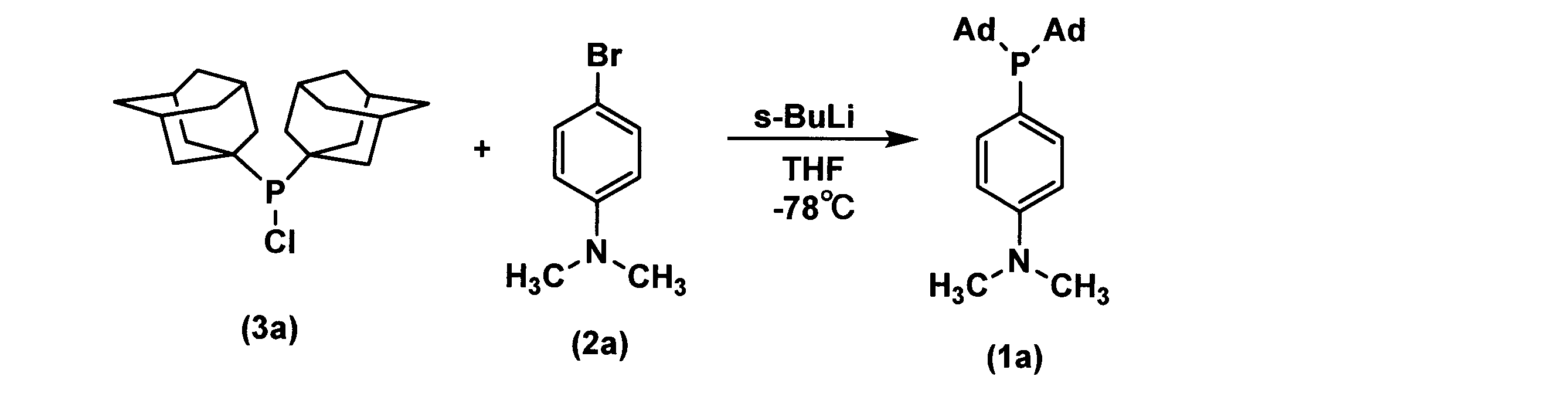
撹拌装置、N2導入管、温度計、および滴下管を備えた500mLの4つ口フラスコに4-ジメチルアミノブロモベンゼン5.34g(26.7mmol、3.0eq)の脱酸素THF250mL溶液を加え、-78℃に冷却し、s-BuLiシクロヘキサン・ヘキサン溶液(1.2mol/L、23.4mL、28.1mmol)を滴下して30分反応させ、リチオ化物を含む溶液を得た。
<第2工程>
前記溶液にジ-1-アダマンチルクロロホスフィン(Ad2PCl)3.00g(8.91mmol、1.0eq)の脱酸素THF150mL溶液を滴下した。滴下後、-78℃で1時間反応させ、徐々に昇温して-10℃で3時間反応させた。GCによりAd2PClの転化率を求めたところ、98%以上であった。
<分離・精製>
反応後の溶液に脱酸素飽和食塩水100mLを-10℃でゆっくり加えた。30分撹拌の後、水層を廃棄した。溶媒を減圧留去し、残留物に脱酸素メタノール200mLを加え、傾斜ろ過により上澄み液を除去し、残った溶媒を減圧留去し、白色固体を得た。
次いで、得られた白色固体を-10℃で脱酸素THFより再結晶し、化合物(1a)の精製物を2.06g(4.89mmol)、収率54.9%で得た。
なお、Ad2PClの転化率は下記のようにして求めた。
反応系より少量をサンプリングし、脱酸素食塩水で当該サンプルを加水分解した。その有機層から一定量を正確に量り取り、そこに2,6-ジ-tert-ブチル-p-クレゾールを外部標準として加え、GCにより絶対検量線法でAd2PClの残量を定量し、仕込んだAd2PClの転化率を求めた。
(化合物(1a)の同定データ)
1H-NMR(THF-d8):δ7.58(br,1H),7.30(br,1H)、6.72-6.50(m,2H),2.95(s,6H),2.12-1.62(m,30H)
31P-NMR(THF-d8):δ38.9
MS(DI-EI):m/z 421(M+)
IR(ATR):2897,2844,2810,1596,1510,1445,1361,1229,1201,1098,811,532cm-1
撹拌装置、N2導入管、温度計、および滴下管を備えた500mLの4つ口フラスコに4-ジメチルアミノブロモベンゼン5.34g(26.7mmol、3.0eq)の脱酸素THF250mL溶液を加え、-78℃に冷却し、s-BuLiシクロヘキサン・ヘキサン溶液(1.2mol/L、23.4mL、28.1mmol)を滴下して30分反応させ、リチオ化物を含む溶液を得た。
<第2工程>
前記溶液にジ-1-アダマンチルクロロホスフィン(Ad2PCl)3.00g(8.91mmol、1.0eq)の脱酸素THF150mL溶液を滴下した。滴下後、-78℃で1時間反応させ、徐々に昇温して-10℃で3時間反応させた。GCによりAd2PClの転化率を求めたところ、98%以上であった。
<分離・精製>
反応後の溶液に脱酸素飽和食塩水100mLを-10℃でゆっくり加えた。30分撹拌の後、水層を廃棄した。溶媒を減圧留去し、残留物に脱酸素メタノール200mLを加え、傾斜ろ過により上澄み液を除去し、残った溶媒を減圧留去し、白色固体を得た。
次いで、得られた白色固体を-10℃で脱酸素THFより再結晶し、化合物(1a)の精製物を2.06g(4.89mmol)、収率54.9%で得た。
なお、Ad2PClの転化率は下記のようにして求めた。
反応系より少量をサンプリングし、脱酸素食塩水で当該サンプルを加水分解した。その有機層から一定量を正確に量り取り、そこに2,6-ジ-tert-ブチル-p-クレゾールを外部標準として加え、GCにより絶対検量線法でAd2PClの残量を定量し、仕込んだAd2PClの転化率を求めた。
(化合物(1a)の同定データ)
1H-NMR(THF-d8):δ7.58(br,1H),7.30(br,1H)、6.72-6.50(m,2H),2.95(s,6H),2.12-1.62(m,30H)
31P-NMR(THF-d8):δ38.9
MS(DI-EI):m/z 421(M+)
IR(ATR):2897,2844,2810,1596,1510,1445,1361,1229,1201,1098,811,532cm-1
<実施例2>
<第1工程>
撹拌装置、N2導入管、温度計、および滴下管を備えた500mLの4つ口フラスコに4-ジメチルアミノブロモベンゼン4.45g(22.2mmol、2.5eq)の脱酸素THF210mL溶液を加え、-78℃に冷却し、s-BuLiシクロヘキサン・ヘキサン溶液(1.2mol/L、19.4mL、23.3mmol)を滴下して30分反応させ、リチオ化物を含む溶液を得た。
<第2工程>
前記溶液にジ-1-アダマンチルクロロホスフィン(Ad2PCl)3.00g(8.91mmol、1.0eq)の脱酸素THF150mL溶液を滴下した。滴下後、-78℃で1時間反応させ、徐々に昇温して-10℃で3時間反応させた。実施例1と同様にして、GCによりAd2PClの転化率を求めたところ、98%以上であった。
<分離・精製>
反応後の溶液に脱酸素飽和食塩水100mLを-10℃でゆっくり加えた。30分撹拌の後、水層を廃棄した。溶媒を減圧留去し、残留物に脱酸素メタノール200mLを加え、傾斜ろ過により上澄み液を除去し、残った溶媒を減圧留去し、白色固体を得た。
次いで、得られた白色固体を-10℃で脱酸素THFより再結晶し、化合物(1a)の精製物を2.12g(5.02mmol)、収率56.3%で得た。
(化合物(1a)の同定データ)
1H-NMR(THF-d8):δ7.58(br,1H),7.30(br,1H),6.72-6.50(m,2H),2.95(s,6H),2.12-1.62(m,30H)
31P-NMR(THF-d8):δ38.9
MS(DI-EI):m/z 421(M+)
IR(ATR):2897,2844,2810,1596,1510,1445,1361,1229,1201,1098,811,532cm-1
撹拌装置、N2導入管、温度計、および滴下管を備えた500mLの4つ口フラスコに4-ジメチルアミノブロモベンゼン4.45g(22.2mmol、2.5eq)の脱酸素THF210mL溶液を加え、-78℃に冷却し、s-BuLiシクロヘキサン・ヘキサン溶液(1.2mol/L、19.4mL、23.3mmol)を滴下して30分反応させ、リチオ化物を含む溶液を得た。
<第2工程>
前記溶液にジ-1-アダマンチルクロロホスフィン(Ad2PCl)3.00g(8.91mmol、1.0eq)の脱酸素THF150mL溶液を滴下した。滴下後、-78℃で1時間反応させ、徐々に昇温して-10℃で3時間反応させた。実施例1と同様にして、GCによりAd2PClの転化率を求めたところ、98%以上であった。
<分離・精製>
反応後の溶液に脱酸素飽和食塩水100mLを-10℃でゆっくり加えた。30分撹拌の後、水層を廃棄した。溶媒を減圧留去し、残留物に脱酸素メタノール200mLを加え、傾斜ろ過により上澄み液を除去し、残った溶媒を減圧留去し、白色固体を得た。
次いで、得られた白色固体を-10℃で脱酸素THFより再結晶し、化合物(1a)の精製物を2.12g(5.02mmol)、収率56.3%で得た。
(化合物(1a)の同定データ)
1H-NMR(THF-d8):δ7.58(br,1H),7.30(br,1H),6.72-6.50(m,2H),2.95(s,6H),2.12-1.62(m,30H)
31P-NMR(THF-d8):δ38.9
MS(DI-EI):m/z 421(M+)
IR(ATR):2897,2844,2810,1596,1510,1445,1361,1229,1201,1098,811,532cm-1
<実施例3>

<第1工程>
撹拌装置、N2導入管、温度計、および滴下管を備えた500mLの4つ口フラスコに4-ジメチルアミノブロモベンゼン3.56g(17.8mmol、2.0eq)の脱酸素THF170mL溶液を加え、-78℃に冷却し、s-BuLiシクロヘキサン・ヘキサン溶液(1.2mol/L、15.6mL、18.7mmol)を滴下して30分反応させ、リチオ化物を含む溶液を得た。
<第2工程>
前記溶液にジ-1-アダマンチルクロロホスフィン(Ad2PCl)3.00g(8.91mmol、1.0eq)の脱酸素THF150mL溶液を滴下した。滴下後、-78℃で1時間反応させ、徐々に昇温して-10℃で3時間反応させた。実施例1と同様にして、GCによりAd2PClの転化率を求めたところ、81%であった。
<分離・精製>
反応後の溶液に脱酸素飽和食塩水100mLを-10℃でゆっくり加えた。30分撹拌の後、水層を廃棄した。溶媒を減圧留去し、残留物に脱酸素メタノール200mLを加え、傾斜ろ過により上澄み液を除去し、残った溶媒を減圧留去し、白色固体を得た。
次いで、得られた白色固体を-10℃で脱酸素THFより再結晶し、化合物(1a)の精製物を1.80g(4.26mmol)、収率47.8%で得た。
(化合物(1a)の同定データ)
1H-NMR(THF-d8):δ7.58(br,1H),7.30(br,1H),6.72-6.50(m,2H),2.95(s,6H),2.12-1.62(m,30H)
31P-NMR(THF-d8):δ38.9
MS(DI-EI):m/z 421(M+)
IR(ATR):2897,2844,2810,1596,1510,1445,1361,1229,1201,1098,811,532cm-1
撹拌装置、N2導入管、温度計、および滴下管を備えた500mLの4つ口フラスコに4-ジメチルアミノブロモベンゼン3.56g(17.8mmol、2.0eq)の脱酸素THF170mL溶液を加え、-78℃に冷却し、s-BuLiシクロヘキサン・ヘキサン溶液(1.2mol/L、15.6mL、18.7mmol)を滴下して30分反応させ、リチオ化物を含む溶液を得た。
<第2工程>
前記溶液にジ-1-アダマンチルクロロホスフィン(Ad2PCl)3.00g(8.91mmol、1.0eq)の脱酸素THF150mL溶液を滴下した。滴下後、-78℃で1時間反応させ、徐々に昇温して-10℃で3時間反応させた。実施例1と同様にして、GCによりAd2PClの転化率を求めたところ、81%であった。
<分離・精製>
反応後の溶液に脱酸素飽和食塩水100mLを-10℃でゆっくり加えた。30分撹拌の後、水層を廃棄した。溶媒を減圧留去し、残留物に脱酸素メタノール200mLを加え、傾斜ろ過により上澄み液を除去し、残った溶媒を減圧留去し、白色固体を得た。
次いで、得られた白色固体を-10℃で脱酸素THFより再結晶し、化合物(1a)の精製物を1.80g(4.26mmol)、収率47.8%で得た。
(化合物(1a)の同定データ)
1H-NMR(THF-d8):δ7.58(br,1H),7.30(br,1H),6.72-6.50(m,2H),2.95(s,6H),2.12-1.62(m,30H)
31P-NMR(THF-d8):δ38.9
MS(DI-EI):m/z 421(M+)
IR(ATR):2897,2844,2810,1596,1510,1445,1361,1229,1201,1098,811,532cm-1
<実施例4>

<第1工程>
撹拌装置、N2導入管、温度計、および滴下管を備えた700mLの4つ口フラスコに4-ジメチルアミノブロモベンゼン8.92g(44.6mmol、5.0eq)の脱酸素THF400mL溶液を加え、-78℃に冷却し、s-BuLiシクロヘキサン・ヘキサン溶液(1.2mol/L、39.0mL、46.8mmol)を滴下して30分反応させ、リチオ化物を含む溶液を得た。
<第2工程>
前記溶液にジ-1-アダマンチルクロロホスフィン(Ad2PCl)3.00g(8.91mmol、1.0eq)の脱酸素THF150mL溶液を滴下した。滴下後、-78℃で1時間反応させ、徐々に昇温して-10℃で3時間反応させた。実施例1と同様にして、GCによりAd2PClの転化率を求めたところ、98%以上であった。
<分離・精製>
反応後の溶液に脱酸素飽和食塩水100mLを-10℃でゆっくり加えた。30分撹拌の後、水層を廃棄した。溶媒を減圧留去し、残留物に脱酸素メタノール200mLを加え、傾斜ろ過により上澄み液を除去し、残った溶媒を減圧留去し、白色固体を得た。
次いで、得られた白色固体を-10℃で脱酸素THFより再結晶し、化合物(1a)の精製物を1.60g(3.79mmol)、収率42.5%で得た。
(化合物(1a)の同定データ)
1H-NMR(THF-d8):δ7.58(br,1H),7.30(br,1H),6.72-6.50(m,2H),2.95(s,6H),2.12-1.62(m,30H)
31P-NMR(THF-d8):δ38.9
MS(DI-EI):m/z 421(M+)
IR(ATR):2897,2844,2810,1596,1510,1445,1361,1229,1201,1098,811,532cm-1
撹拌装置、N2導入管、温度計、および滴下管を備えた700mLの4つ口フラスコに4-ジメチルアミノブロモベンゼン8.92g(44.6mmol、5.0eq)の脱酸素THF400mL溶液を加え、-78℃に冷却し、s-BuLiシクロヘキサン・ヘキサン溶液(1.2mol/L、39.0mL、46.8mmol)を滴下して30分反応させ、リチオ化物を含む溶液を得た。
<第2工程>
前記溶液にジ-1-アダマンチルクロロホスフィン(Ad2PCl)3.00g(8.91mmol、1.0eq)の脱酸素THF150mL溶液を滴下した。滴下後、-78℃で1時間反応させ、徐々に昇温して-10℃で3時間反応させた。実施例1と同様にして、GCによりAd2PClの転化率を求めたところ、98%以上であった。
<分離・精製>
反応後の溶液に脱酸素飽和食塩水100mLを-10℃でゆっくり加えた。30分撹拌の後、水層を廃棄した。溶媒を減圧留去し、残留物に脱酸素メタノール200mLを加え、傾斜ろ過により上澄み液を除去し、残った溶媒を減圧留去し、白色固体を得た。
次いで、得られた白色固体を-10℃で脱酸素THFより再結晶し、化合物(1a)の精製物を1.60g(3.79mmol)、収率42.5%で得た。
(化合物(1a)の同定データ)
1H-NMR(THF-d8):δ7.58(br,1H),7.30(br,1H),6.72-6.50(m,2H),2.95(s,6H),2.12-1.62(m,30H)
31P-NMR(THF-d8):δ38.9
MS(DI-EI):m/z 421(M+)
IR(ATR):2897,2844,2810,1596,1510,1445,1361,1229,1201,1098,811,532cm-1
<実施例5>

<第1工程>
撹拌装置、N2導入管、温度計、および滴下管を備えた500mLの4つ口フラスコに4-ジメチルアミノブロモベンゼン4.45g(22.2mmol、2.5eq)の脱酸素THF210mL溶液を加え、-78℃に冷却し、t-BuLiペンタン溶液(1.6mol/L、29.1mL、46.6mmol)を滴下して30分反応させ、リチオ化物を含む溶液を得た。
<第2工程>
前記溶液にジ-1-アダマンチルクロロホスフィン(Ad2PCl)3.00g(8.91mmol、1.0eq)の脱酸素THF150mL溶液を滴下した。滴下後、-78℃で1時間反応させ、徐々に昇温して-10℃で3時間反応させた。実施例1と同様にして、GCによりAd2PClの転化率を求めたところ、98%以上であった。
<分離・精製>
反応後の溶液に脱酸素飽和食塩水100mLを-10℃でゆっくり加えた。30分撹拌の後、水層を廃棄した。溶媒を減圧留去し、残留物に脱酸素メタノール200mLを加え、傾斜ろ過により上澄み液を除去し、残った溶媒を減圧留去し、白色固体を得た。
次いで、得られた白色固体を-10℃で脱酸素THFより再結晶し、化合物(1a)の精製物を1.90g(4.51mmol)、収率50.6%で得た。
(化合物(1a)の同定データ)
1H-NMR(THF-d8):δ7.58(br,1H),7.30(br,1H),6.72-6.50(m,2H),2.95(s,6H),2.12-1.62(m,30H)
31P-NMR(THF-d8):δ38.9
MS(DIEI):m/z 421(M+)
IR(ATR):2897,2844,2810,1596,1510,1445,1361,1229,1201,1098,811,532cm-1
撹拌装置、N2導入管、温度計、および滴下管を備えた500mLの4つ口フラスコに4-ジメチルアミノブロモベンゼン4.45g(22.2mmol、2.5eq)の脱酸素THF210mL溶液を加え、-78℃に冷却し、t-BuLiペンタン溶液(1.6mol/L、29.1mL、46.6mmol)を滴下して30分反応させ、リチオ化物を含む溶液を得た。
<第2工程>
前記溶液にジ-1-アダマンチルクロロホスフィン(Ad2PCl)3.00g(8.91mmol、1.0eq)の脱酸素THF150mL溶液を滴下した。滴下後、-78℃で1時間反応させ、徐々に昇温して-10℃で3時間反応させた。実施例1と同様にして、GCによりAd2PClの転化率を求めたところ、98%以上であった。
<分離・精製>
反応後の溶液に脱酸素飽和食塩水100mLを-10℃でゆっくり加えた。30分撹拌の後、水層を廃棄した。溶媒を減圧留去し、残留物に脱酸素メタノール200mLを加え、傾斜ろ過により上澄み液を除去し、残った溶媒を減圧留去し、白色固体を得た。
次いで、得られた白色固体を-10℃で脱酸素THFより再結晶し、化合物(1a)の精製物を1.90g(4.51mmol)、収率50.6%で得た。
(化合物(1a)の同定データ)
1H-NMR(THF-d8):δ7.58(br,1H),7.30(br,1H),6.72-6.50(m,2H),2.95(s,6H),2.12-1.62(m,30H)
31P-NMR(THF-d8):δ38.9
MS(DIEI):m/z 421(M+)
IR(ATR):2897,2844,2810,1596,1510,1445,1361,1229,1201,1098,811,532cm-1

<実施例6>
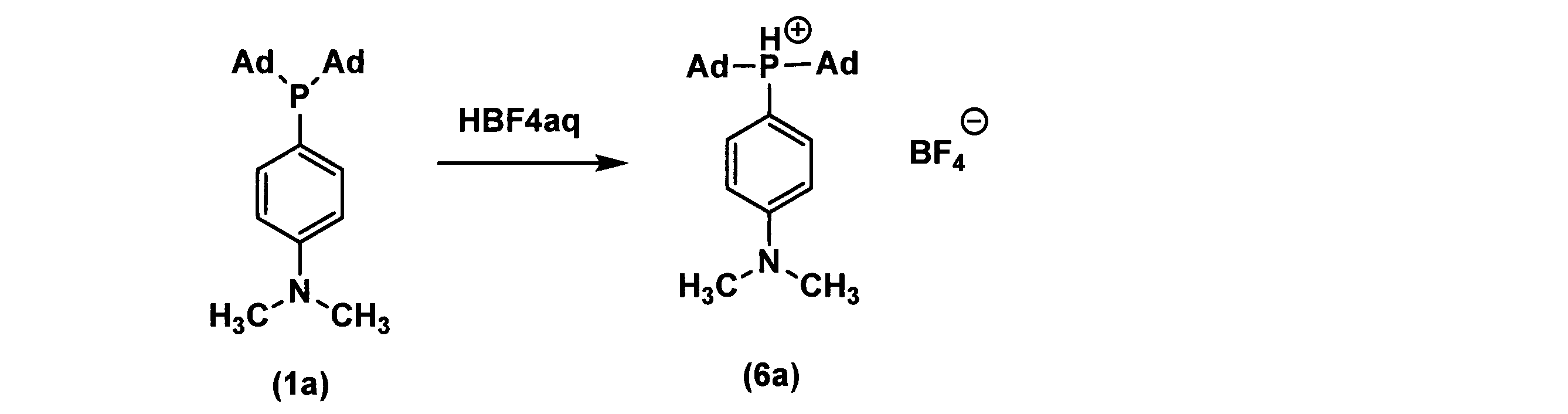
<第3工程>
実施例1の第2工程終了後の溶液に、-10℃で脱酸素飽和食塩水100mLを添加した。-10℃で有機層を分液し、42%HBF4水溶液6.0gを添加して2時間撹拌した後、室温で一昼夜撹拌した。室温で有機層を飽和食塩水100mLで3回洗浄した。減圧下で溶媒を留去し、黄色粘性固体を得た。-30℃で7倍量のメタノールから再結晶し、化合物(6a)の白色固体を2.82g(5.54mmol)、収率62.2%で得た。
(化合物(6a)の同定データ)
1H-NMR(CDCl3):δ7.56(d,J=78Hz,2H),6.96(s,2H),5.77(d,J=456Hz,1H),3.14(s,6H),2.27-2.18(m,6H),2.16-2.05(m,12H),1.90-1.80(m,12H)
13C-NMR(CDCl3):δ153.6,139.2,132.4,112.7,112.2,95.0(d,J=83.0Hz),39.8,38.7,38.5,35.6,27.7,27.6
31P-NMR(CDCl3):δ39.5(J=458Hz)
IR(ATR):2911,2855,1599,1524,1454,1378,1345,1306,1214,1119,1058,997,819cm-1
実施例1の第2工程終了後の溶液に、-10℃で脱酸素飽和食塩水100mLを添加した。-10℃で有機層を分液し、42%HBF4水溶液6.0gを添加して2時間撹拌した後、室温で一昼夜撹拌した。室温で有機層を飽和食塩水100mLで3回洗浄した。減圧下で溶媒を留去し、黄色粘性固体を得た。-30℃で7倍量のメタノールから再結晶し、化合物(6a)の白色固体を2.82g(5.54mmol)、収率62.2%で得た。
(化合物(6a)の同定データ)
1H-NMR(CDCl3):δ7.56(d,J=78Hz,2H),6.96(s,2H),5.77(d,J=456Hz,1H),3.14(s,6H),2.27-2.18(m,6H),2.16-2.05(m,12H),1.90-1.80(m,12H)
13C-NMR(CDCl3):δ153.6,139.2,132.4,112.7,112.2,95.0(d,J=83.0Hz),39.8,38.7,38.5,35.6,27.7,27.6
31P-NMR(CDCl3):δ39.5(J=458Hz)
IR(ATR):2911,2855,1599,1524,1454,1378,1345,1306,1214,1119,1058,997,819cm-1
<実施例7>
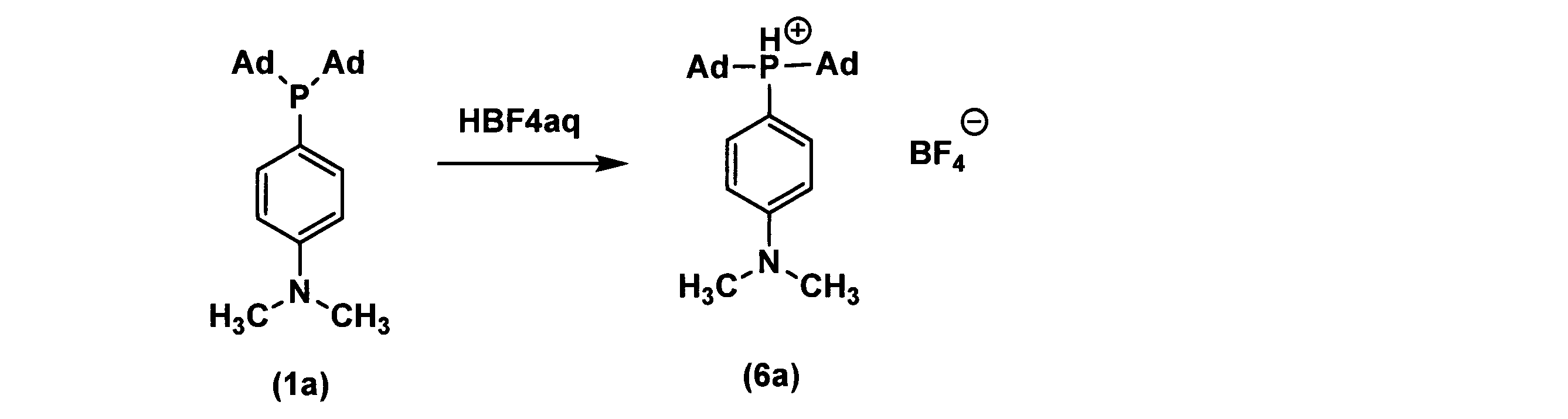
<第3工程>
実施例1の第2工程において-10℃で脱酸素飽和食塩水100mlを添加して反応を停止した後、-10℃で42%HBF4水溶液6.0gをゆっくり添加し、そのまま-10℃で2時間撹拌した。その後室温で一昼夜撹拌した。室温で有機層を飽和食塩水100mLで3回洗浄した。減圧下で溶媒を留去し、黄色粘性固体を得た。-30℃で7倍量のメタノールから再結晶し、化合物(6a)の白色固体を2.69g(5.28mmol)、収率59.3%で得た。
(化合物(6a)の同定データ)
1H-NMR(CDCl3):δ7.56(d,J=78Hz,2H),6.96(s,2H),5.77(d,J=456Hz,1H),3.14(s,6H),2.27-2.18(m,6H),2.16-2.05(m,12H),1.90-1.80(m,12H)
13C-NMR(CDCl3):δ153.6,139.2,132.4,112.7,112.2,95.0(d,J=83.0Hz),39.8,38.7,38.5,35.6,27.7,27.6
31P-NMR(CDCl3):δ39.5(J=458Hz)
IR(ATR):2911,2855,1599,1524,1454,1378,1345,1306,1214,1119,1058,997,819cm-1
実施例1の第2工程において-10℃で脱酸素飽和食塩水100mlを添加して反応を停止した後、-10℃で42%HBF4水溶液6.0gをゆっくり添加し、そのまま-10℃で2時間撹拌した。その後室温で一昼夜撹拌した。室温で有機層を飽和食塩水100mLで3回洗浄した。減圧下で溶媒を留去し、黄色粘性固体を得た。-30℃で7倍量のメタノールから再結晶し、化合物(6a)の白色固体を2.69g(5.28mmol)、収率59.3%で得た。
(化合物(6a)の同定データ)
1H-NMR(CDCl3):δ7.56(d,J=78Hz,2H),6.96(s,2H),5.77(d,J=456Hz,1H),3.14(s,6H),2.27-2.18(m,6H),2.16-2.05(m,12H),1.90-1.80(m,12H)
13C-NMR(CDCl3):δ153.6,139.2,132.4,112.7,112.2,95.0(d,J=83.0Hz),39.8,38.7,38.5,35.6,27.7,27.6
31P-NMR(CDCl3):δ39.5(J=458Hz)
IR(ATR):2911,2855,1599,1524,1454,1378,1345,1306,1214,1119,1058,997,819cm-1
<実施例8>
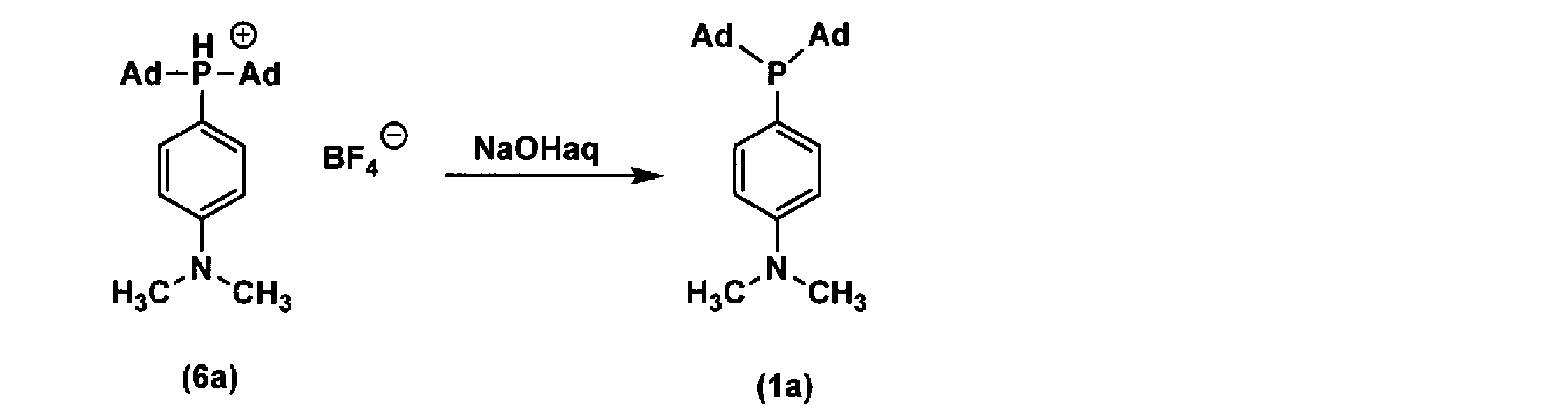
<第4工程>
撹拌装置、N2導入管、温度計、および滴下管を備えた100mLの4つ口フラスコに実施例6で得られた化合物(6a)100mg(0.196mmol)の脱酸素トルエン30mL溶液を加え、-20℃に冷却した。そこへ、0.1Nの脱酸素NaOH水溶液30mLを滴下した。-20℃で2時間撹拌した後、有機層を分取し、脱酸素水で1回洗浄した後、溶媒を減圧留去し、化合物(1a)の白色固体を50mg得た。
(化合物(1a)の同定データ)
1H-NMR(THF-d8):δ7.58(br,1H),7.30(br,1H),6.72-6.50(m,2H),2.95(s,6H),2.12-1.62(m,30H)
31P-NMR(THF-d8):δ38.9
MS(DI-EI):m/z 421(M+)
IR(ATR):2897,2844,2810,1596,1510,1361,1098,811,532cm-1
撹拌装置、N2導入管、温度計、および滴下管を備えた100mLの4つ口フラスコに実施例6で得られた化合物(6a)100mg(0.196mmol)の脱酸素トルエン30mL溶液を加え、-20℃に冷却した。そこへ、0.1Nの脱酸素NaOH水溶液30mLを滴下した。-20℃で2時間撹拌した後、有機層を分取し、脱酸素水で1回洗浄した後、溶媒を減圧留去し、化合物(1a)の白色固体を50mg得た。
(化合物(1a)の同定データ)
1H-NMR(THF-d8):δ7.58(br,1H),7.30(br,1H),6.72-6.50(m,2H),2.95(s,6H),2.12-1.62(m,30H)
31P-NMR(THF-d8):δ38.9
MS(DI-EI):m/z 421(M+)
IR(ATR):2897,2844,2810,1596,1510,1361,1098,811,532cm-1
<実施例9>
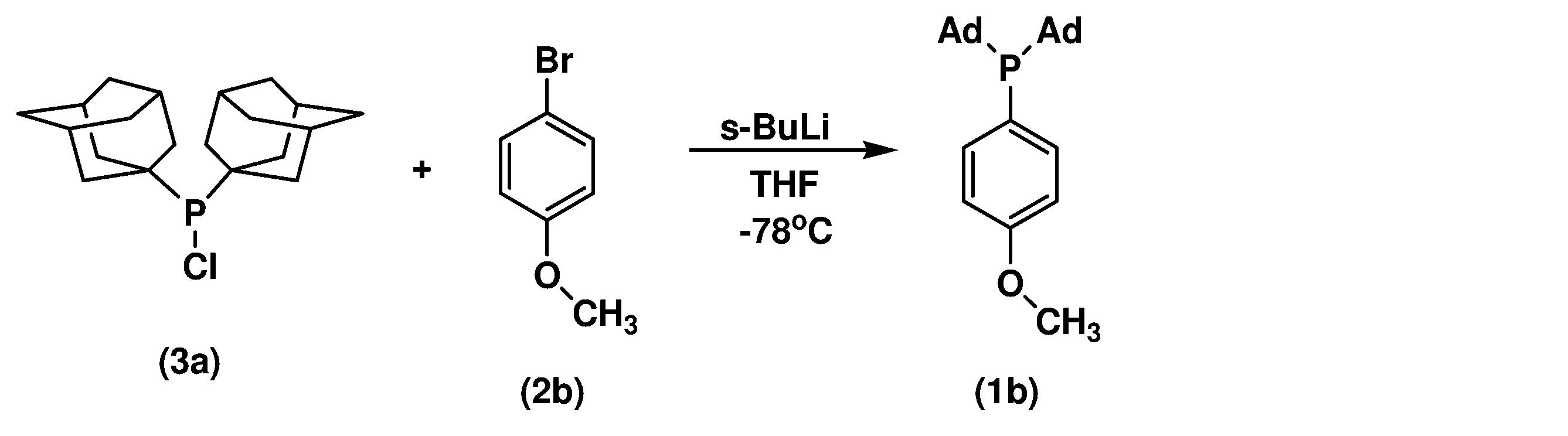
<第1工程>
撹拌装置、N2導入管、温度計、および滴下管を備えた500mLの4つ口フラスコに4-メトキシブロモベンゼン(2b)4.17g(22.3mmol、2.5eq)の脱酸素THF220mL溶液を加え、-78℃に冷却し、s-BuLiシクロヘキサン・ヘキサン溶液(1.2mol/L、19.3mL、23.2mmol)を滴下して30分反応させ、リチオ化物を含む溶液を得た。
<第2工程>
前記溶液にジ-1-アダマンチルクロロホスフィン(Ad2PCl)3.00g(8.91mmol、1.0eq)の脱酸素THF150mL溶液を滴下した。滴下後、-78℃で1時間反応させ、徐々に昇温して-10℃で3時間反応させた。実施例1と同様にして、GCによりAd2PClの転化率を求めたところ、98%以上であった。
<分離・精製>
反応後の溶液に脱酸素飽和食塩水100mLを-10℃でゆっくり加えた。30分撹拌の後、水層を廃棄した。溶媒を減圧留去し、残留物に脱酸素メタノール200mLを加え、傾斜ろ過により上澄み液を除去し、残った溶媒を減圧留去し、白色固体を得た。
白色固体のGC-MS分析より、m/z=408に分子イオンピークを認め、化合物(1b)であることを確認した。
撹拌装置、N2導入管、温度計、および滴下管を備えた500mLの4つ口フラスコに4-メトキシブロモベンゼン(2b)4.17g(22.3mmol、2.5eq)の脱酸素THF220mL溶液を加え、-78℃に冷却し、s-BuLiシクロヘキサン・ヘキサン溶液(1.2mol/L、19.3mL、23.2mmol)を滴下して30分反応させ、リチオ化物を含む溶液を得た。
<第2工程>
前記溶液にジ-1-アダマンチルクロロホスフィン(Ad2PCl)3.00g(8.91mmol、1.0eq)の脱酸素THF150mL溶液を滴下した。滴下後、-78℃で1時間反応させ、徐々に昇温して-10℃で3時間反応させた。実施例1と同様にして、GCによりAd2PClの転化率を求めたところ、98%以上であった。
<分離・精製>
反応後の溶液に脱酸素飽和食塩水100mLを-10℃でゆっくり加えた。30分撹拌の後、水層を廃棄した。溶媒を減圧留去し、残留物に脱酸素メタノール200mLを加え、傾斜ろ過により上澄み液を除去し、残った溶媒を減圧留去し、白色固体を得た。
白色固体のGC-MS分析より、m/z=408に分子イオンピークを認め、化合物(1b)であることを確認した。
<実施例10>
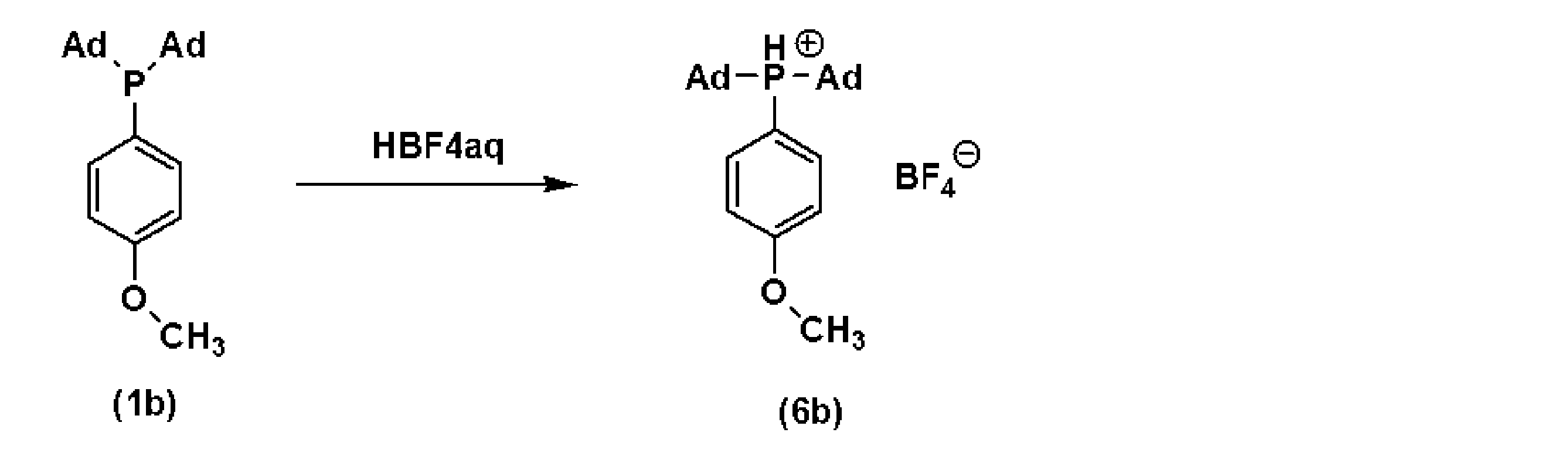
<第3工程>
実施例9の第2工程で得た化合物(1b)をTHF400mLに懸濁させ、-10℃で42%HBF4水溶液6.0g添加した後、-10℃で2時間、室温で一晩撹拌した。室温で有機層を飽和食塩水100mLで3回洗浄した。減圧下で溶媒を留去し、白色固体を得た。-10℃で10倍量のメタノールから再結晶し、化合物(6b)の白色固体を3.2g(6.45mmol)、収率72.4%で得た。
(化合物(6b)の同定データ)
1H-NMR(CDCl3):δ7.91(dd,J=13Hz,9.0Hz,1H),7.59(dd,J=8.0Hz,8.0Hz,1H),7.19(d,J=8.5Hz,1H),7.12(d,J=8.5Hz,1H),6.46(d,J=479Hz,1H),3.91(s,3H),2.24-2.18(m,6H),2.13-2.04(m,12H),1.82-1.73(m,12H)
13C-NMR(CDCl3):δ164.4,139.9(d,J=8.4Hz),133.2(d,J=8.4Hz),116.4(J=12.0Hz),115.6(J=13.2Hz),103.5,102.9,55.7,38.6,38.4,35.5,27.6(d,J=10.8Hz)
IR(ATR)2927,2859,2886,1593,1496,1456,1304,1257,1184,1116,1064,1018,841cm-1
実施例9の第2工程で得た化合物(1b)をTHF400mLに懸濁させ、-10℃で42%HBF4水溶液6.0g添加した後、-10℃で2時間、室温で一晩撹拌した。室温で有機層を飽和食塩水100mLで3回洗浄した。減圧下で溶媒を留去し、白色固体を得た。-10℃で10倍量のメタノールから再結晶し、化合物(6b)の白色固体を3.2g(6.45mmol)、収率72.4%で得た。
(化合物(6b)の同定データ)
1H-NMR(CDCl3):δ7.91(dd,J=13Hz,9.0Hz,1H),7.59(dd,J=8.0Hz,8.0Hz,1H),7.19(d,J=8.5Hz,1H),7.12(d,J=8.5Hz,1H),6.46(d,J=479Hz,1H),3.91(s,3H),2.24-2.18(m,6H),2.13-2.04(m,12H),1.82-1.73(m,12H)
13C-NMR(CDCl3):δ164.4,139.9(d,J=8.4Hz),133.2(d,J=8.4Hz),116.4(J=12.0Hz),115.6(J=13.2Hz),103.5,102.9,55.7,38.6,38.4,35.5,27.6(d,J=10.8Hz)
IR(ATR)2927,2859,2886,1593,1496,1456,1304,1257,1184,1116,1064,1018,841cm-1
<実施例11>

<第1工程>
撹拌装置、N2導入管、温度計、および滴下管を備えた500mLの4つ口フラスコにp-イソプロピルオキシブロモベンゼン(2c)4.78g(22.2mmol、2.5eq)の脱酸素THF180mL溶液を加え、-78℃に冷却し、s-BuLiシクロヘキサン・ヘキサン溶液(1.2mol/L、19.3mL、23.2mmol)を滴下して30分反応させ、リチオ化物を含む溶液を得た。
<第2工程>
前記溶液にジ-1-アダマンチルクロロホスフィン(Ad2PCl)(3a)3.00g(8.91mmol、1.0eq)の脱酸素THF130mL溶液を滴下した。滴下後、-78℃で1時間反応させ、徐々に昇温して-10℃で3時間反応させた。実施例1と同様にして、GCによりAd2PClの転化率を求めたところ、98%以上であった。
<分離・精製>
反応後の溶液に脱酸素飽和食塩水100mLを-10℃でゆっくり加えた。30分撹拌の後、水層を廃棄した。さらに2回、有機層を同量の脱酸素飽和食塩水で洗浄し、水層を分液した後、有機溶媒を減圧留去した。-10℃で残留物に脱酸素メタノール100mLを加え、撹拌し、白色固体をろ別した。
次いで、得られた白色固体を、-10℃で10倍量の脱酸素トルエン:脱酸素メタノール=1:3の混合液から再結晶し、化合物(1c)の精製物を2.4g(5.50mmol)、収率61.7%で得た。
(化合物(1c)の同定データ)
1H-NMR(C6D6):δ7.82-7.70(m,2H),7.01-6.75(m,2H),4.20(sept,J=6.2,1H),2.16-2.02(m,12H),1.90-1.84(m,6H),1.68-1.60(m,12H),1.10(d,J=6.0Hz,6H)
13C-NMR(C6D6):δ159.8,126.1(d,J=21.6Hz),69.7,42.6(d,J=13.2Hz),37.7,37.1(d,J=22.9Hz),29.7(J=8.3Hz),22.4
31P-NMR(C6D6):δ39.2
IR(ATR):2923,2899,2846,1590,1495,1278,1241,1186,824,535cm-1
MS(DI-EI)m/z 436(M+)
撹拌装置、N2導入管、温度計、および滴下管を備えた500mLの4つ口フラスコにp-イソプロピルオキシブロモベンゼン(2c)4.78g(22.2mmol、2.5eq)の脱酸素THF180mL溶液を加え、-78℃に冷却し、s-BuLiシクロヘキサン・ヘキサン溶液(1.2mol/L、19.3mL、23.2mmol)を滴下して30分反応させ、リチオ化物を含む溶液を得た。
<第2工程>
前記溶液にジ-1-アダマンチルクロロホスフィン(Ad2PCl)(3a)3.00g(8.91mmol、1.0eq)の脱酸素THF130mL溶液を滴下した。滴下後、-78℃で1時間反応させ、徐々に昇温して-10℃で3時間反応させた。実施例1と同様にして、GCによりAd2PClの転化率を求めたところ、98%以上であった。
<分離・精製>
反応後の溶液に脱酸素飽和食塩水100mLを-10℃でゆっくり加えた。30分撹拌の後、水層を廃棄した。さらに2回、有機層を同量の脱酸素飽和食塩水で洗浄し、水層を分液した後、有機溶媒を減圧留去した。-10℃で残留物に脱酸素メタノール100mLを加え、撹拌し、白色固体をろ別した。
次いで、得られた白色固体を、-10℃で10倍量の脱酸素トルエン:脱酸素メタノール=1:3の混合液から再結晶し、化合物(1c)の精製物を2.4g(5.50mmol)、収率61.7%で得た。
(化合物(1c)の同定データ)
1H-NMR(C6D6):δ7.82-7.70(m,2H),7.01-6.75(m,2H),4.20(sept,J=6.2,1H),2.16-2.02(m,12H),1.90-1.84(m,6H),1.68-1.60(m,12H),1.10(d,J=6.0Hz,6H)
13C-NMR(C6D6):δ159.8,126.1(d,J=21.6Hz),69.7,42.6(d,J=13.2Hz),37.7,37.1(d,J=22.9Hz),29.7(J=8.3Hz),22.4
31P-NMR(C6D6):δ39.2
IR(ATR):2923,2899,2846,1590,1495,1278,1241,1186,824,535cm-1
MS(DI-EI)m/z 436(M+)
<実施例12>
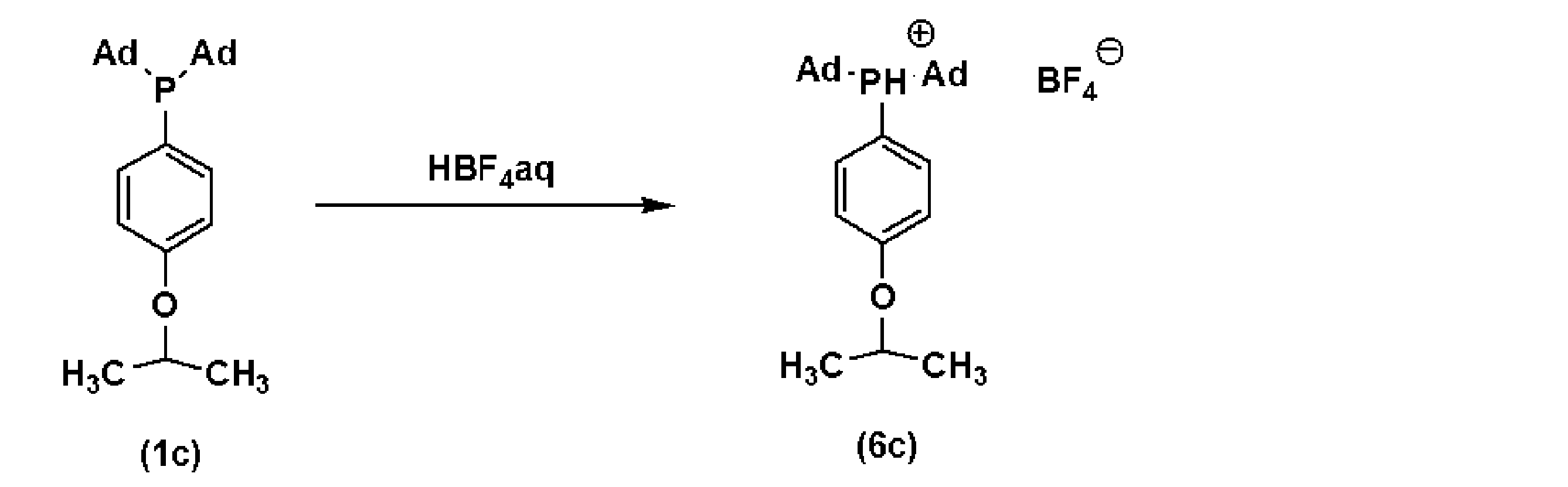
<第3工程>
実施例11の第2工程において-10℃で脱酸素飽和食塩水100mlを添加して反応を停止した。次いで、-10℃で42%HBF4水溶液6.0gをゆっくり添加し、そのまま-10℃で2時間、続いて室温で一昼夜撹拌した。有機層を飽和食塩水100mLで3回洗浄し、溶媒を減圧留去した。粗生成物を-30℃で8倍量のメタノールから再結晶させ、化合物(6c)の白色固体を3.00g(5.72mmol)、収率64.2%で得た。
(化合物(6c)の同定データ)
1H-NMR(CDCl3):δ7.88(dd,J=9.0Hz,9.0Hz,1H),7.54(t,J=8.0Hz,1H),7.09(t,dd,J=22.0Hz,8.5Hz,2H),6.47(d,J=480Hz,1H),4.66(sept,J=6.0Hz,1H),2.24-2.16(m,6H),2.12-2.03(m,12H),1.81-1.72(m,12H),1.39(d,J=6.0Hz,6H)
13C-NMR(CDCl3):δ162.9,140.1(J=7.2Hz),133.0(J=9.6Hz),117.7(J=12.0Hz),116.3(J=12.1Hz),102.8,102.2,70.7,38.6,38.4,35.5,27.6(d,J=9.7Hz),21.8
31P-NMR(C6D6):δ35.2(d,J=480Hz)
IR(ATR):2936,2908,2859,1590,1491,1454,1300,1190,1105,1061,841,542,517cm-1
実施例11の第2工程において-10℃で脱酸素飽和食塩水100mlを添加して反応を停止した。次いで、-10℃で42%HBF4水溶液6.0gをゆっくり添加し、そのまま-10℃で2時間、続いて室温で一昼夜撹拌した。有機層を飽和食塩水100mLで3回洗浄し、溶媒を減圧留去した。粗生成物を-30℃で8倍量のメタノールから再結晶させ、化合物(6c)の白色固体を3.00g(5.72mmol)、収率64.2%で得た。
(化合物(6c)の同定データ)
1H-NMR(CDCl3):δ7.88(dd,J=9.0Hz,9.0Hz,1H),7.54(t,J=8.0Hz,1H),7.09(t,dd,J=22.0Hz,8.5Hz,2H),6.47(d,J=480Hz,1H),4.66(sept,J=6.0Hz,1H),2.24-2.16(m,6H),2.12-2.03(m,12H),1.81-1.72(m,12H),1.39(d,J=6.0Hz,6H)
13C-NMR(CDCl3):δ162.9,140.1(J=7.2Hz),133.0(J=9.6Hz),117.7(J=12.0Hz),116.3(J=12.1Hz),102.8,102.2,70.7,38.6,38.4,35.5,27.6(d,J=9.7Hz),21.8
31P-NMR(C6D6):δ35.2(d,J=480Hz)
IR(ATR):2936,2908,2859,1590,1491,1454,1300,1190,1105,1061,841,542,517cm-1
Claims (12)
- 下記一般式(1)で表されるアリールジアダマンチルホスフィン誘導体の製造方法であって、

下記一般式(2)で表されるブロモ化合物と、アルキルリチウムとを反応させてリチオ化物を得る第1工程、

次いで、得られたリチオ化物と下記一般式(3)で表されるジアダマンチルクロロホスフィンとを反応させる第2工程、を有するアリールジアダマンチルホスフィン誘導体の製造方法。

- 前記一般式(1)中のAdが無置換のアダマンチル基であり、Aが下記一般式(4)で表されるアリール基である請求項1に記載のアリールジアダマンチルホスフィン誘導体の製造方法。
- 前記アルキルリチウムが、2級又は3級アルキルリチウムである請求項1又は2に記載のアリールジアダマンチルホスフィン誘導体の製造方法。
- 前記アルキルリチウムが、s-ブチルリチウムである請求項1又は2に記載のアリールジアダマンチルホスフィン誘導体の製造方法。
- 第1工程の反応温度が、-200℃~30℃である請求項1又は2に記載のアリールジアダマンチルホスフィン誘導体の製造方法。
- 第2工程の反応温度が、-200℃~100℃である請求項1又は2に記載のアリールジアダマンチルホスフィン誘導体の製造方法。
- 第2工程において、一般式(2)で表されるブロモ化合物のリチオ化物を、一般式(3)で表されるジアダマンチルクロロホスフィンに対して、1.5~10倍モル用いて反応させる請求項1又は2に記載のアリールアダマンチルホスフィンの製造方法。
- 下記一般式(1)で表されるアリールジアダマンチルホスフィン誘導体と、

下記一般式(5)で表されるホウ酸化合物とを反応させる第3工程を有する下記一般式(6)で表されるアリールジアダマンチルホスホニウム塩誘導体の製造方法。


- 前記一般式(5)で表されるホウ酸化合物が、テトラフルオロホウ酸である請求項8に記載のアリールジアダマンチルホスホニウム塩誘導体の製造方法。
- 下記一般式(1)で表されるアリールジアダマンチルホスフィン誘導体の製造方法であって、

下記一般式(6)で表されるアリールジアダマンチルホスホニウム塩誘導体を塩基により中和処理する第4工程を有するアリールジアダマンチルホスフィン誘導体の製造方法。

- 下記一般式(1A)で表されるアリールジアダマンチルホスフィン誘導体。
- 下記一般式(6A)で表されるアリールジアダマンチルホスホニウム塩誘導体。
Applications Claiming Priority (4)
| Application Number | Priority Date | Filing Date | Title |
|---|---|---|---|
| JP2023069980 | 2023-04-21 | ||
| JP2023-069980 | 2023-04-21 | ||
| JP2023190402A JP2024155687A (ja) | 2023-04-21 | 2023-11-07 | アリールジアダマンチルホスフィン誘導体の製造方法及びアリールジアダマンチルホスホニウム塩誘導体の製造方法 |
| JP2023-190402 | 2023-11-07 |
Publications (1)
| Publication Number | Publication Date |
|---|---|
| WO2024219367A1 true WO2024219367A1 (ja) | 2024-10-24 |
Family
ID=93152484
Family Applications (1)
| Application Number | Title | Priority Date | Filing Date |
|---|---|---|---|
| PCT/JP2024/015030 Ceased WO2024219367A1 (ja) | 2023-04-21 | 2024-04-15 | アリールジアダマンチルホスフィン誘導体の製造方法及びアリールジアダマンチルホスホニウム塩誘導体の製造方法 |
Country Status (1)
| Country | Link |
|---|---|
| WO (1) | WO2024219367A1 (ja) |
Cited By (1)
| Publication number | Priority date | Publication date | Assignee | Title |
|---|---|---|---|---|
| WO2025121285A1 (ja) * | 2023-12-05 | 2025-06-12 | 日本化学工業株式会社 | ホスフィンパラジウム錯体、重合触媒及び芳香族ポリマーの製造方法 |
Citations (2)
| Publication number | Priority date | Publication date | Assignee | Title |
|---|---|---|---|---|
| WO2019230479A1 (ja) * | 2018-05-29 | 2019-12-05 | 日本化学工業株式会社 | ホスフィノベンゼンボラン誘導体の製造方法、1,2-ビス(ジアルキルホスフィノ)ベンゼン誘導体の製造方法及び遷移金属錯体 |
| CN115385957A (zh) * | 2021-05-09 | 2022-11-25 | 东莞市均成高新材料有限公司 | 直线三联芳基膦配体及其过渡金属络合物 |
-
2024
- 2024-04-15 WO PCT/JP2024/015030 patent/WO2024219367A1/ja not_active Ceased
Patent Citations (2)
| Publication number | Priority date | Publication date | Assignee | Title |
|---|---|---|---|---|
| WO2019230479A1 (ja) * | 2018-05-29 | 2019-12-05 | 日本化学工業株式会社 | ホスフィノベンゼンボラン誘導体の製造方法、1,2-ビス(ジアルキルホスフィノ)ベンゼン誘導体の製造方法及び遷移金属錯体 |
| CN115385957A (zh) * | 2021-05-09 | 2022-11-25 | 东莞市均成高新材料有限公司 | 直线三联芳基膦配体及其过渡金属络合物 |
Non-Patent Citations (7)
| Title |
|---|
| ÁDÁM SINAI; DÁNIEL CS. SIMKÓ; FRUZSINA SZABÓ; ATTILA PACZAL; TAMÁS GÁTI; ATTILA BÉNYEI; ZOLTÁN NOVÁK; ANDRÁS KOTSCHY: "Aryl‐Diadamantyl Phosphine Ligands in Palladium‐Catalyzed Cross‐Coupling Reactions: Synthesis, Structural Analysis, and Application", EUROPEAN JOURNAL OF ORGANIC CHEMISTRY, vol. 2020, no. 9, 25 February 2020 (2020-02-25), DE , pages 1122 - 1128, XP072116560, ISSN: 1434-193X, DOI: 10.1002/ejoc.201901834 * |
| AGUILAR DAVID, FERNÁNDEZ IGNACIO, CUESTA LUCIANO, YAÑEZ-RODRÍGUEZ VÍCTOR, SOLER TATIANA, NAVARRO RAFAEL, URRIOLABEITIA ESTEBAN P.,: "Synthesis, Structure, and Reactivity of N -Benzoyl Iminophosphoranes Ortho Lithiated at the Benzoyl Group", THE JOURNAL OF ORGANIC CHEMISTRY, vol. 75, no. 19, 1 October 2010 (2010-10-01), United States, pages 6452 - 6462, XP093222664, ISSN: 0022-3263, DOI: 10.1021/jo101151s * |
| DATABASE REGISTRY 14 June 2012 (2012-06-14), ANONYMOUS: "Phosphine, (4-methoxyphenyl)bis(tricyclo[3.3.1.13,7]dec-1-yl)- (CA INDEX NAME)", XP093222681, retrieved from STN Database accession no. 1378030-16-0 * |
| MATTHEW R. NETHERTON, GREGORY C. FU: "Air-Stable Trialkylphosphonium Salts: Simple, Practical, and Versatile Replacements for Air-Sensitive Trialkylphosphines. Applications in Stoichiometric and Catalytic Processes", ORGANIC LETTERS, vol. 3, no. 26, 1 January 2001 (2001-01-01), US , pages 4295 - 4298, XP002459563, ISSN: 1523-7060, DOI: 10.1021/ol016971g * |
| PONOMARENKO VADIM I., KRUPENYA DMITRII V., GRACHOVA ELENA V., GINDIN VLADIMIR A., SELIVANOV STANISLAV I., KOSHEVOY IGOR O., TUNIK : "Structure, Stereochemistry and Dynamics of Tetranuclear Polyhydride Clusters Containing Chiral Heterobidentate Phosphanes", ZEITSCHRIFT FUR ANORGANISCHE UND ALLGEMEINE CHEMIE, vol. 635, no. 15, 1 December 2009 (2009-12-01), Hoboken, USA, pages 2515 - 2526, XP093222668, ISSN: 0044-2313, DOI: 10.1002/zaac.200900259 * |
| SHUNPEI ISHIKAWA, KEI MANABE: "Oligoarene Strategy for Catalyst Development. Hydroxylated Oligoarene-type Phosphines for Palladium-catalyzed Cross Coupling", CHEMISTRY LETTERS, vol. 36, no. 11, 1 January 2007 (2007-01-01), pages 1302 - 1303, XP055157584, ISSN: 03667022, DOI: 10.1246/cl.2007.1302 * |
| WHEATON CRAIG A., BOW JOHN-PAUL J., STRADIOTTO MARK: "New Phosphine-Functionalized NHC Ligands: Discovery of an Effective Catalyst for the Room-Temperature Amination of Aryl Chlorides with Primary and Secondary Amines", ORGANOMETALLICS, vol. 32, no. 21, 11 November 2013 (2013-11-11), pages 6148 - 6161, XP093222677, ISSN: 0276-7333, DOI: 10.1021/om400684n * |
Cited By (1)
| Publication number | Priority date | Publication date | Assignee | Title |
|---|---|---|---|---|
| WO2025121285A1 (ja) * | 2023-12-05 | 2025-06-12 | 日本化学工業株式会社 | ホスフィンパラジウム錯体、重合触媒及び芳香族ポリマーの製造方法 |
Similar Documents
| Publication | Publication Date | Title |
|---|---|---|
| EP1078921B1 (en) | Novel intermediates and processes for the preparation of optically active octanoic acid derivatives | |
| JPH0733392B2 (ja) | 2,2’―ビス〔ジー(m―トリル)ホスフィノ〕―1,1’―ビナフチル | |
| WO2024219367A1 (ja) | アリールジアダマンチルホスフィン誘導体の製造方法及びアリールジアダマンチルホスホニウム塩誘導体の製造方法 | |
| WO2007111226A1 (ja) | フラーレン誘導体およびその製造方法 | |
| JP2024155687A (ja) | アリールジアダマンチルホスフィン誘導体の製造方法及びアリールジアダマンチルホスホニウム塩誘導体の製造方法 | |
| JP5283494B2 (ja) | フルオレン誘導体の製造方法 | |
| JP3988134B2 (ja) | β−燐化ニトロキシドラジカルの製造方法 | |
| JP4195231B2 (ja) | 光学活性第2級ホスフィンボラン誘導体及びその中間体の製造方法 | |
| JP5536458B2 (ja) | 6−ハロゲノ−3−アリールピリジン誘導体の製造方法 | |
| JP4481589B2 (ja) | ビスホスフィンの製造方法 | |
| JP2014084289A (ja) | フルオレン誘導体の製造方法 | |
| JP5023683B2 (ja) | ベンゾフルオレン誘導体の製造方法およびその中間体 | |
| JP5448572B2 (ja) | アセチル化合物、該アセチル化合物の製造方法、および該アセチル化合物を使用したナフトール化合物の製造方法 | |
| JP2026071819A (ja) | アリールジアダマンチルホスフィン誘導体の製造方法 | |
| JP4759722B2 (ja) | 置換基を有する芳香族カルボン酸エステルの製造方法 | |
| JP5365151B2 (ja) | ホスファゼニウム塩の製造方法 | |
| JP6782632B2 (ja) | アセト酢酸エステルアルカリ塩の製造方法および脂肪族ジケトンの製造方法 | |
| JP2011236205A5 (ja) | ||
| JP4649590B2 (ja) | フェニルホスフィン酸メンチルの製造方法。 | |
| JP2004210672A (ja) | ビスホスホニウム塩化合物及びその製造方法 | |
| JP7168161B2 (ja) | ヘテロール多量体の製造方法 | |
| JP2023176740A (ja) | 有機リン化合物の製造方法 | |
| JP6641328B2 (ja) | 2,3−ビスホスフィノピラジン誘導体の製造方法及びホスフィン遷移金属錯体の製造方法 | |
| CN121949093A (zh) | 一种8-甲基壬酸的合成方法 | |
| JP2024172898A (ja) | アラルキル基を有するホスフィン-スルホン酸を配位子とする金属錯体の製造方法 |
Legal Events
| Date | Code | Title | Description |
|---|---|---|---|
| 121 | Ep: the epo has been informed by wipo that ep was designated in this application |
Ref document number: 24792641 Country of ref document: EP Kind code of ref document: A1 |
|
| NENP | Non-entry into the national phase |
Ref country code: DE |
|
| 122 | Ep: pct application non-entry in european phase |
Ref document number: 24792641 Country of ref document: EP Kind code of ref document: A1 |