WO2024219158A1 - 光ファイバ、光ファイバリボン、および光ファイバケーブル - Google Patents
光ファイバ、光ファイバリボン、および光ファイバケーブル Download PDFInfo
- Publication number
- WO2024219158A1 WO2024219158A1 PCT/JP2024/011441 JP2024011441W WO2024219158A1 WO 2024219158 A1 WO2024219158 A1 WO 2024219158A1 JP 2024011441 W JP2024011441 W JP 2024011441W WO 2024219158 A1 WO2024219158 A1 WO 2024219158A1
- Authority
- WO
- WIPO (PCT)
- Prior art keywords
- resin layer
- optical fiber
- meth
- acrylate
- mass
- Prior art date
- Legal status (The legal status is an assumption and is not a legal conclusion. Google has not performed a legal analysis and makes no representation as to the accuracy of the status listed.)
- Ceased
Links
Images


Classifications
-
- G—PHYSICS
- G02—OPTICS
- G02B—OPTICAL ELEMENTS, SYSTEMS OR APPARATUS
- G02B6/00—Light guides; Structural details of arrangements comprising light guides and other optical elements, e.g. couplings
- G02B6/44—Mechanical structures for providing tensile strength and external protection for fibres, e.g. optical transmission cables
Definitions
- optical fibers have a coating resin layer to protect the glass fiber that is the light transmitting medium.
- the coating resin layer has, for example, a primary resin layer that contacts the glass fiber and a secondary resin layer formed on the outer peripheral surface of the primary resin layer, and the outermost layer of the coating resin layer is composed of a colored resin layer for identifying the optical fiber (see, for example, Patent Documents 1 and 2).
- the optical fiber according to one embodiment of the present disclosure comprises a glass fiber including a core and a cladding, and a coating resin layer covering the glass fiber, the coating resin layer having a primary resin layer that contacts the glass fiber and covers the glass fiber, a secondary resin layer that covers the primary resin layer, and a colored resin layer that covers the secondary resin layer, the colored resin layer contains surface-treated titanium oxide particles in an amount of 1.1% by mass or more and 10% by mass or less based on the total amount of the colored resin layer, and the gel fraction retention rate of the coating resin layer after the optical fiber is subjected to a 60-day wet heat test in an environment at a temperature of 85°C and a humidity of 85% is 80% or more.
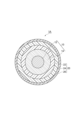
- FIG. 1 is a schematic cross-sectional view showing an example of an optical fiber according to the present embodiment.
- FIG. 2 is a schematic cross-sectional view showing an example of an optical fiber ribbon according to the present embodiment.
- FIG. 3 is a schematic cross-sectional view showing an example of an optical fiber cable according to the present embodiment.
- the objective of this disclosure is to provide an optical fiber with excellent identifiability, an optical fiber ribbon using the optical fiber, and an optical fiber cable.
- An optical fiber comprises a glass fiber including a core and a cladding, and a coating resin layer covering the glass fiber, the coating resin layer having a primary resin layer that contacts the glass fiber and covers the glass fiber, a secondary resin layer that covers the primary resin layer, and a colored resin layer that covers the secondary resin layer, the colored resin layer containing surface-treated titanium oxide particles in an amount of 1.1% by mass or more and 10% by mass or less based on the total amount of the colored resin layer, and the coating resin layer has a gel fraction maintenance rate of 80% or more after the optical fiber is subjected to a wet heat test for 60 days in an environment at a temperature of 85°C and a humidity of 85%.
- the optical fiber according to the present disclosure can suppress the deterioration of the identifiability of the optical fiber after a wet heat test by incorporating a specific amount of surface-treated titanium oxide particles in the colored resin layer.
- the thickness of the colored resin layer may be 2 ⁇ m or more and 10 ⁇ m or less.
- the surface-treated titanium oxide particles may have a surface treatment layer containing at least one selected from the group consisting of aluminum oxide, silicon dioxide, and zirconium dioxide.
- the surface-treated titanium oxide particles may have a surface treatment layer containing aluminum oxide, and the content of the aluminum oxide in the surface-treated titanium oxide particles may be 1% by mass or more and 8% by mass or less.
- the Young's modulus of the primary resin layer may be 0.7 MPa or less at 23°C from the viewpoint of the lateral pressure characteristics of the optical fiber.
- the outer diameter of the optical fiber may be 150 ⁇ m or more and 200 ⁇ m or less.
- the glass fiber may include multiple cores from the viewpoint of a high-density cable.
- An optical fiber ribbon according to one embodiment of the present disclosure includes a plurality of optical fibers described in any one of (1) to (7) above arranged in parallel, and a connecting resin layer that covers and connects the plurality of optical fibers. This makes it possible to provide an optical fiber ribbon that includes optical fibers with excellent identifiability.
- the optical fiber ribbon described in (8) above is housed within the cable. This makes it possible to provide an optical fiber cable equipped with optical fibers that are highly identifiable.
- (meth)acrylate means acrylate or the corresponding methacrylate, and the same applies to other similar expressions such as (meth)acrylic acid.
- the optical fiber according to the present embodiment includes a glass fiber including a core and a cladding, and a coating resin layer that covers the glass fiber.
- the coating resin layer includes a primary resin layer that contacts the glass fiber and covers the glass fiber, a secondary resin layer that covers the primary resin layer, and a colored resin layer that covers the secondary resin layer.
- the colored resin layer contains surface-treated titanium oxide particles in an amount of 1.1% by mass or more and 10% by mass or less based on the total amount (100% by mass) of the colored resin layer.
- the gel fraction maintenance rate of the coating resin layer can be determined by the method described in the examples.
- the gel fraction maintenance rate of the coating resin layer may be 81% or more, 82% or more, or 83% or more.
- FIG. 1 is a schematic cross-sectional view showing an example of an optical fiber according to this embodiment.
- the optical fiber 1A includes a glass fiber 10 and a coating resin layer 20 that contacts the glass fiber 10 and covers the outer periphery of the glass fiber 10.
- the glass fiber 10 includes a core 12 and a cladding 14, and the cladding 14 surrounds the core 12.
- the core 12 and the cladding 14 mainly include glass such as quartz glass.
- the core 12 can be made of quartz glass doped with germanium or pure quartz glass
- the cladding 14 can be made of pure quartz glass or quartz glass doped with fluorine.
- the outer diameter of the glass fiber 10 may be 100 ⁇ m or more and 125 ⁇ m or less, and the diameter of the core 12 constituting the glass fiber 10 may be 7 ⁇ m or more and 15 ⁇ m or less.
- the outer diameter of the optical fiber 1A may be 150 ⁇ m or more and 220 ⁇ m or less, 150 ⁇ m or more and 200 ⁇ m or less, or 150 ⁇ m or more and 190 ⁇ m or less.
- FIG. 1 shows an optical fiber including a glass fiber having one core
- the optical fiber according to this embodiment may be an optical fiber including a glass fiber having multiple cores (hereinafter, also referred to as a "multi-core optical fiber").
- a multi-core optical fiber is an optical fiber in which multiple cores extending in the fiber axial direction are covered with a common cladding.
- the materials of the multiple cores may be the same or different.
- the outer diameter of the glass fiber in the multi-core optical fiber may be, for example, 170 ⁇ m or more and 190 ⁇ m or less, and the outer diameter of the multi-core optical fiber may be, for example, 200 ⁇ m or more and 250 ⁇ m or less.
- the coating resin layer 20 is an ultraviolet-curable resin layer that covers the clad 14.
- the coating resin layer 20 includes a primary resin layer 22 that coats the outer periphery of the glass fiber 10, a secondary resin layer 24 that coats the outer periphery of the primary resin layer 22, and a colored resin layer 26 that coats the outer periphery of the secondary resin layer 24.
- the primary resin layer 22 is in contact with the outer periphery of the clad 14 and coats the entire clad 14.
- the secondary resin layer 24 is in contact with the outer periphery of the primary resin layer 22 and coats the entire primary resin layer 22.
- the colored resin layer 26 is in contact with the outer periphery of the secondary resin layer 24 and coats the entire secondary resin layer 24.
- the thickness of the primary resin layer 22 is, for example, 10 ⁇ m or more and 50 ⁇ m or less.
- the thickness of the secondary resin layer 24 is, for example, 10 ⁇ m or more and 40 ⁇ m or less.
- the thickness of the colored resin layer 26 may be, from the viewpoint of increasing the packing density of the optical fiber, 2 ⁇ m or more and 10 ⁇ m or less, 3 ⁇ m or more and 8 ⁇ m or less, or 4 ⁇ m or more and 6 ⁇ m or less.
- the colored resin layer 26 can be formed by curing a resin composition (hereinafter, also referred to as "resin composition for colored resin layer") containing a photopolymerizable compound, a photopolymerization initiator, and surface-treated titanium oxide particles.
- the colored resin layer according to this embodiment contains a cured product of the resin composition for the colored resin layer.
- the content of the surface-treated titanium oxide particles is 1.1 mass% or more and 10 mass% or less based on the total amount of the colored resin layer, so that the identifiability of the optical fiber can be improved.
- the surface-treated titanium oxide particles are particles of titanium oxide that have been surface-treated with an inorganic substance. Titanium oxide structures include anatase structure, rutile structure, and brookite structure, and titanium oxide with a rutile structure is preferable from the viewpoint of stability.
- Examples of inorganic substances used for surface treatment include aluminum oxide, silicon dioxide, and zirconium dioxide.
- the surface-treated titanium oxide particles have a surface treatment layer containing at least one selected from the group consisting of aluminum oxide, silicon dioxide, and zirconium dioxide, the catalytic activity of titanium oxide can be suppressed, and color change due to moist heat deterioration of the colored resin layer can be prevented.
- the surface treatment layer may be formed on at least a portion of the surface of the titanium oxide particles, or may be formed on the entire surface of the titanium oxide particles.
- the surface treatment layer is formed by surface treatment of the titanium oxide particles.
- the amount of the surface treatment layer in the surface-treated titanium oxide particles may be 1% by mass or more, 1.5% by mass or more, 1.8% by mass or more, or 1.9% by mass or more from the viewpoint of improving dispersibility, and may be 10% by mass or less, 9% by mass or less, 8% by mass or less, or 6% by mass or less from the viewpoint of increasing hiding power.
- the amount of the surface treatment layer can be calculated by measuring the amount of titanium element and inorganic elements other than titanium contained in the surface-treated titanium oxide particles using inductively coupled mass spectrometry (ICP-MS).
- the surface treatment layer may contain aluminum oxide from the viewpoint of further suppressing color change of the optical fiber, and the content of aluminum oxide in the surface-treated titanium oxide particles may be 1% by mass or more and 8% by mass or less, 1.5% by mass or more and 7% by mass or less, 1.8% by mass or more and 6% by mass or less, or 1.9% by mass or more and 5.5% by mass or less.
- the average primary particle size of the surface-treated titanium oxide particles may be 300 nm or less, 295 nm or less, 290 nm or less, or 280 nm or less from the viewpoint of improving the lateral pressure resistance of the optical fiber.
- the average primary particle size of the surface-treated titanium oxide particles may be 100 nm or more, 150 nm or more, 200 nm or more, or 220 nm or more from the viewpoint of increasing the hiding power.
- the average primary particle size of the surface-treated titanium oxide particles may be, for example, 200 nm or more and 300 nm or less, 200 nm or more and 290 nm or less, or 220 nm or more and 280 nm or less.
- the average primary particle size can be measured, for example, by image analysis of electron microscope photographs, light scattering method, BET method, etc.
- the content of the surface-treated titanium oxide particles may be 1.3 mass% or more, 1.5 mass% or more, 1.8 mass% or more, 1.9 mass% or more, or 2.0 mass% or more based on the total amount of the colored resin layer, from the viewpoint of improving the visibility of the colored resin layer.
- the content of the surface-treated titanium oxide particles may be 9.5 mass% or less, 9.0 mass% or less, 8.5 mass% or less, 8.0 mass% or less, or 6.0 mass% or less based on the total amount of the colored resin layer, from the viewpoint of improving the curing property of the colored resin layer.
- the photopolymerizable compound according to this embodiment may contain a urethane (meth)acrylate from the viewpoint of adjusting the Young's modulus.
- a urethane (meth)acrylate a urethane oligomer obtained by reacting a polyol compound, a polyisocyanate compound, and a hydroxyl group-containing (meth)acrylate compound can be used.
- the urethane (meth)acrylate for example, an aromatic urethane (meth)acrylate having an aromatic ring and an aliphatic urethane (meth)acrylate having no aromatic ring can be mentioned. Two or more types of urethane (meth)acrylate may be mixed and used.
- polyol compounds include polytetramethylene glycol, polypropylene glycol, and bisphenol A-ethylene oxide addition diol.
- polyisocyanate compounds include 2,4-tolylene diisocyanate, 2,6-tolylene diisocyanate, isophorone diisocyanate, and dicyclohexylmethane 4,4'-diisocyanate.
- hydroxyl group-containing (meth)acrylate compounds include 2-hydroxyethyl (meth)acrylate, 2-hydroxybutyl (meth)acrylate, 1,6-hexanediol mono(meth)acrylate, pentaerythritol tri(meth)acrylate, 2-hydroxypropyl (meth)acrylate, and tripropylene glycol mono(meth)acrylate.
- the number average molecular weight (Mn) of the polyol compound may be 300 or more and 5000 or less, 400 or more and 4000 or less, 500 or more and 3000 or less, or 600 or more and 2500 or less.
- Organotin compounds are generally used as catalysts in the synthesis of urethane (meth)acrylates.
- organotin compounds include dibutyltin dilaurate, dibutyltin diacetate, dibutyltin maleate, dibutyltin bis(2-ethylhexyl mercaptoacetate), dibutyltin bis(isooctyl mercaptoacetate), and dibutyltin oxide. From the standpoint of easy availability or catalytic performance, dibutyltin dilaurate or dibutyltin diacetate may be used as the catalyst.
- a lower alcohol having 5 or less carbon atoms may be used.
- lower alcohols include methanol, ethanol, 1-propanol, 2-propanol, 1-butanol, 2-butanol, 2-methyl-2-propanol, 1-pentanol, 2-pentanol, 3-pentanol, 2-methyl-1-butanol, 3-methyl-1-butanol, 2-methyl-2-butanol, 3-methyl-2-butanol, and 2,2-dimethyl-1-propanol.
- the photopolymerizable compound according to this embodiment may further contain an epoxy (meth)acrylate.
- the epoxy (meth)acrylate include an aliphatic epoxy (meth)acrylate and an aromatic epoxy (meth)acrylate.
- An aliphatic epoxy (meth)acrylate refers to an epoxy (meth)acrylate that does not have an aromatic ring
- an aromatic epoxy (meth)acrylate refers to an epoxy (meth)acrylate that has an aromatic ring.
- aliphatic epoxy (meth)acrylate a reaction product of an aliphatic epoxy compound having two or more glycidyl groups and a compound having a (meth)acryloyl group, such as (meth)acrylic acid, can be used.
- the aliphatic epoxy (meth)acrylate may have an ethylene oxide group or a propylene oxide group.
- the aliphatic epoxy (meth)acrylate include a (meth)acrylic acid adduct of propylene glycol diglycidyl ether, a (meth)acrylic acid adduct of polypropylene glycol diglycidyl ether, a (meth)acrylic acid adduct of ethylene glycol diglycidyl ether, and a (meth)acrylic acid adduct of polyethylene glycol diglycidyl ether.
- aliphatic epoxy (meth)acrylate products include, for example, "Epoxy Ester 40EM,” “Epoxy Ester 70PA,” “Epoxy Ester 200PA,” and “Epoxy Ester 80MFA,” both manufactured by Kyoeisha Chemical Co., Ltd.
- aromatic epoxy (meth)acrylate a reaction product of an aromatic epoxy compound having two or more glycidyl groups and a compound having a (meth)acryloyl group, such as (meth)acrylic acid, can be used.
- aromatic epoxy (meth)acrylate for example, a (meth)acrylic acid adduct of bisphenol A diglycidyl ether can be mentioned.
- the photopolymerizable compound according to this embodiment may include a photopolymerizable compound (hereinafter referred to as a "monomer") other than urethane (meth)acrylate and epoxy (meth)acrylate.
- a photopolymerizable compound hereinafter referred to as a "monomer”
- a monofunctional monomer having one polymerizable group or a polyfunctional monomer having two or more polymerizable groups can be used. Two or more types of monomers may be mixed and used.
- monofunctional monomers include methyl (meth)acrylate, ethyl (meth)acrylate, propyl (meth)acrylate, n-butyl (meth)acrylate, s-butyl (meth)acrylate, tert-butyl (meth)acrylate, isobutyl (meth)acrylate, n-pentyl (meth)acrylate, isopentyl (meth)acrylate, hexyl (meth)acrylate, heptyl (meth)acrylate, isoamyl (meth)acrylate, 2-ethylhexyl (meth)acrylate, n-octyl (meth)acrylate, isooctyl (meth)acrylate, isodecyl (meth)acrylate, lauryl (meth)acrylate, 2-phenoxyethyl (meth)acrylate, 3-phenoxyethyl (meth)acrylate, (Meth)acrylate mono
- carboxy group-containing monomers such as N-(meth)acryloylmorpholine, N-vinylpyrrolidone, N-vinylcaprolactam, N-(meth)acryloylpiperidine, N-(meth)acryloylpyrrolidine, 3-(3-pyridine)propyl(meth)acrylate, and cyclic trimethylolpropane formal acrylate; heterocycle-containing monomers such as maleimide, N-cyclohexylmaleimide, and N-phenylmaleimide; (meth)acrylamide, N,N-dimethyl(meth)acrylamide, N,N-diethyl(meth)acrylamide, N-hexyl(meth)acrylamide, N Amide monomers such as N-methyl(meth)acrylamide, N-ethyl(meth)acrylamide, N-butyl(meth)acrylamide, N-methylol(meth)acrylamide, and N-methylolpropane(meth
- polyfunctional monomers include ethylene glycol di(meth)acrylate, polyethylene glycol di(meth)acrylate, polypropylene glycol di(meth)acrylate, neopentyl glycol di(meth)acrylate, tripropylene glycol di(meth)acrylate, di(meth)acrylate of alkylene oxide adduct of bisphenol A, tetraethylene glycol di(meth)acrylate, hydroxypivalic acid neopentyl glycol di(meth)acrylate, 1,4 -butanediol di(meth)acrylate, 1,6-hexanediol di(meth)acrylate, 1,9-nonanediol di(meth)acrylate, 1,12-dodecanediol di(meth)acrylate, 1,14-tetradecanediol di(meth)acrylate, 1,16-hexadecanediol di(meth)acrylate, 1,20
- the photopolymerization initiator can be appropriately selected from among known radical photopolymerization initiators.
- photopolymerization initiators include 1-hydroxycyclohexyl phenyl ketone (Omnirad 184, manufactured by IGM Resins), 2,2-dimethoxy-2-phenylacetophenone, 1-(4-isopropylphenyl)-2-hydroxy-2-methylpropan-1-one, bis(2,6-dimethoxybenzoyl)-2,4,4-trimethylpentylphosphine oxide, 2-methyl-1-[4-(methylthio)phenyl]-2-morpholino-propan-1-one (Omnirad 907, manufactured by IGM Resins), 2,4,6-trimethylbenzoyldiphenylphosphine oxide (Omnirad TPO, manufactured by IGM Resins), and bis(2,4,6-trimethylbenzoyl)phenylphosphine oxide (Omnirad 819, manufactured by IGM Resin
- the content of the photopolymerization initiator may be from 1% by mass to 12% by mass, from 2% by mass to 10% by mass, or from 3% by mass to 8% by mass, based on the total amount of the resin composition.
- the resin composition according to this embodiment may further contain a silane coupling agent, a leveling agent, an antifoaming agent, an antioxidant, a sensitizer, etc.
- silane coupling agent is not particularly limited as long as it does not interfere with the curing of the resin composition.
- silane coupling agents include tetramethyl silicate, tetraethyl silicate, mercaptopropyltrimethoxysilane, vinyltrichlorosilane, vinyltriethoxysilane, vinyltris( ⁇ -methoxy-ethoxy)silane, ⁇ -(3,4-epoxycyclohexyl)-ethyltrimethoxysilane, dimethoxydimethylsilane, diethoxydimethylsilane, 3-acryloxypropyltrimethoxysilane, ⁇ -glycidoxypropyltrimethoxysilane, ⁇ -glycidoxypropylmethyldiethoxysilane, ⁇ -methacryloxypropyltrimethoxysilane, N-( ⁇ -aminoethyl)- ⁇ - These include aminopropyltrimethoxysilane, N-
- the primary resin layer 22 can be formed, for example, by curing a resin composition containing a urethane (meth)acrylate, a monomer, a photopolymerization initiator, and a silane coupling agent (hereinafter also referred to as the "resin composition for the primary resin layer").
- the resin composition for the primary resin layer can be formed using conventionally known techniques.
- the urethane (meth)acrylate, monomer, photopolymerization initiator, and silane coupling agent may be appropriately selected from the compounds exemplified above.
- an aromatic urethane (meth)acrylate having a structure based on 2,4-tolylene diisocyanate or 2,6-tolylene diisocyanate may be used.
- the secondary resin layer 24 can be formed by curing a resin composition containing a urethane (meth)acrylate, a monomer, and a photopolymerization initiator (hereinafter also referred to as the "resin composition for the secondary resin layer").
- the resin composition for the secondary resin layer can be formed using conventionally known techniques.
- the urethane (meth)acrylate, monomer, and photopolymerization initiator may be appropriately selected from the compounds exemplified above.
- As the urethane (meth)acrylate an aromatic urethane (meth)acrylate having a structure based on 2,4-tolylene diisocyanate or 2,6-tolylene diisocyanate may be used.
- the Young's modulus of the primary resin layer is low and that of the secondary resin layer is high.
- the Young's modulus of the primary resin layer may be 0.7 MPa or less, 0.5 MPa or less, or 0.4 MPa or less at 23°C.
- the lower limit of the Young's modulus of the primary resin layer may be 0.05 MPa or more.
- the Young's modulus of the secondary resin layer may be 1000 MPa or more, 1100 MPa or more, or 1200 MPa or more at 23°C.
- optical fiber ribbon The optical fiber according to this embodiment can be used to fabricate an optical fiber ribbon, which is made up of a plurality of the optical fibers arranged in parallel and coated with a ribbon resin.
- FIG. 2 is a schematic cross-sectional view showing an optical fiber ribbon according to this embodiment.
- the optical fiber ribbon 100 has a plurality of optical fibers 1A and a connecting resin layer 40 in which the optical fibers 1A are coated with a ribbon resin and connected.
- four optical fibers are shown as an example, but the number is not particularly limited.
- the resin for the ribbon resin materials generally known as ribbon materials can be used.
- the resin for the ribbon may contain a thermosetting resin such as silicone resin, epoxy resin, or urethane resin, or an ultraviolet-curing resin such as epoxy (meth)acrylate, urethane (meth)acrylate, or polyester (meth)acrylate.
- the optical fiber ribbon of this embodiment uses the above optical fiber, which suppresses moist heat deterioration of the coating resin layer and makes it easy to identify the optical fiber.
- the optical fiber ribbon is housed in the cable.
- An example of the optical fiber cable is a slot-type optical fiber cable having a plurality of slots.
- the optical fiber ribbon can be mounted in the slot so that the mounting density in each slot is about 25% to 65%.
- the mounting density means the ratio of the cross-sectional area of the optical fiber ribbon mounted in the slot to the cross-sectional area of the slot.
- the optical fiber cable according to the present embodiment may be configured such that the plurality of optical fibers are housed in the cable without being covered with a ribbon resin.
- FIG. 3 is a schematic cross-sectional view showing an example of an optical fiber cable according to this embodiment.
- the optical fiber cable 30 includes a spacer 31 and an outer jacket 32.
- the spacer 31 extends along the longitudinal direction of the optical fiber cable 30 and has a plurality of slots 31a.
- the plurality of slots 31a are formed along the longitudinal direction of the optical fiber cable 30 on the outer peripheral surface of the spacer 31.
- a plurality of optical fiber ribbons 110 are housed in the slots 31a.
- the outer jacket 32 extends along the longitudinal direction of the optical fiber cable 30 and covers the periphery of the spacer 31.
- the outer jacket 32 is made of, for example, polyvinyl chloride, polyethylene, etc.
- titanium oxide particles Ti-1) to (Ti-6) having the surface treatment layers shown in Table 1 and titanium oxide particles (Ti-7) without surface treatment were prepared.
- the amount of Al 2 O 3 was calculated by quantifying the Ti and Al elements contained in the surface-treated titanium oxide particles using a high-frequency inductively coupled plasma optical emission spectrometer ("ICP-MS Agilent 7700x” manufactured by Agilent Technologies, Inc.).
- a resin composition for a colored layer was prepared by mixing 75 parts by mass of urethane acrylate, which is a reaction product of polypropylene glycol having a molecular weight of 1000, 2,4-tolylene diisocyanate, and 2-hydroxyethyl acrylate, 10 parts by mass of bisphenol A-ethylene oxide adduct diol diacrylate, 7 parts by mass of isobornyl acrylate, 1 part by mass of 2,4,6-trimethylbenzoyldiphenylphosphine oxide (Omnirad TPO, manufactured by IGM Resins), and 4 parts by mass of 1-hydroxycyclohexylphenyl ketone (Omnirad 184, manufactured by IGM Resins). Titanium oxide particles were then mixed so that the content of titanium oxide particles in the colored resin layer was the amount (mass%) shown in Table 2.
- urethane acrylate which is a reaction product of polypropylene glycol having a molecular weight of 1000, 2,4-tolylene
- Resin composition P for the primary resin layer was prepared by mixing 75 parts by mass of urethane acrylate, which is a reaction product of polypropylene glycol having a molecular weight of 4000, 2,4-tolylene diisocyanate, and 2-hydroxyethyl acrylate, 17 parts by mass of nonylphenol EO-modified (meth)acrylate, 7 parts by mass of N-vinyl caprolactam, 2 parts by mass of Omnirad TPO, and 1 part by mass of ⁇ -mercaptotrimethoxysilane.
- urethane acrylate which is a reaction product of polypropylene glycol having a molecular weight of 4000, 2,4-tolylene diisocyanate, and 2-hydroxyethyl acrylate
- 17 parts by mass of nonylphenol EO-modified (meth)acrylate 7 parts by mass of N-vinyl caprolactam
- 2 parts by mass of Omnirad TPO 2 parts by mass of Omnirad TPO
- a resin composition S for the secondary resin layer was prepared by mixing 60 parts by mass of urethane acrylate, which is a reaction product of polypropylene glycol having a molecular weight of 1000, 2,4-tolylene diisocyanate and 2-hydroxyethyl acrylate, 19 parts by mass of isobornyl acrylate, 20 parts by mass of trimethylolpropane triacrylate, and 1 part by mass of Omnirad TPO.
- urethane acrylate which is a reaction product of polypropylene glycol having a molecular weight of 1000, 2,4-tolylene diisocyanate and 2-hydroxyethyl acrylate
- 19 parts by mass of isobornyl acrylate 19 parts by mass of isobornyl acrylate
- 20 parts by mass of trimethylolpropane triacrylate 20 parts by mass of trimethylolpropane triacrylate
- Omnirad TPO 1 part by mass of Omnirad TPO.
- a primary resin layer having a thickness of 17.5 ⁇ m was formed on the outer circumference of a glass fiber having a diameter of 125 ⁇ m, which was composed of a core and a clad, using the resin composition P, and a secondary resin layer having a thickness of 15 ⁇ m was further formed on the outer circumference of the primary resin layer using the resin composition S, to obtain an optical fiber.
- a colored resin layer having a thickness of 5 ⁇ m was formed on the outer circumference of the secondary resin layer using the resin compositions of Test Examples 1 to 10 while the optical fiber was reeled out by a coloring machine, thereby producing an optical fiber having a diameter of 200 ⁇ m and a colored resin layer (hereinafter referred to as "colored optical fiber").
- the linear speed when forming each resin layer was 1500 m/min.
- Test Examples 1 to 6 correspond to the embodiment, and Test Examples 7 to 10 correspond to the comparative example. Note that the resin composition of Test Example 10 was insufficiently cured, and therefore a colored resin layer could not be formed, and therefore a colored optical fiber could not be produced.
- the colored optical fiber was subjected to a 60-day moist heat test in an environment with a temperature of 85°C and a humidity of 85%, after which the gel fraction was measured.
- the ratio of the gel fraction before and after the moist heat test was taken as the gel fraction maintenance rate.
- the optical fiber ribbons were subjected to a wet heat test in an environment of 85°C and 85% humidity, and the change in the color of the optical fiber was confirmed to evaluate the identifiability. If the color of the optical fiber (yellow and brown) could be identified even after 60 days, it was rated as "A”, and if the color of the optical fiber could not be identified after 60 days, it was rated as "B".
- Reference Signs List 1A Optical fiber 10: Glass fiber 12: Core 14: Clad 20: Coating resin layer 22: Primary resin layer 24: Secondary resin layer 26: Colored resin layer 30: Optical fiber cable 31: Spacer 31a: Slot 32: Outer jacket 40: Connecting resin layer 100, 110: Optical fiber ribbon
Landscapes
- Physics & Mathematics (AREA)
- General Physics & Mathematics (AREA)
- Optics & Photonics (AREA)
- Optical Fibers, Optical Fiber Cores, And Optical Fiber Bundles (AREA)
Priority Applications (2)
| Application Number | Priority Date | Filing Date | Title |
|---|---|---|---|
| CN202480019273.2A CN120858308A (zh) | 2023-04-21 | 2024-03-22 | 光纤、光纤带以及光纤线缆 |
| JP2025515114A JPWO2024219158A1 (https=) | 2023-04-21 | 2024-03-22 |
Applications Claiming Priority (2)
| Application Number | Priority Date | Filing Date | Title |
|---|---|---|---|
| JP2023-069970 | 2023-04-21 | ||
| JP2023069970 | 2023-04-21 |
Publications (1)
| Publication Number | Publication Date |
|---|---|
| WO2024219158A1 true WO2024219158A1 (ja) | 2024-10-24 |
Family
ID=93152721
Family Applications (1)
| Application Number | Title | Priority Date | Filing Date |
|---|---|---|---|
| PCT/JP2024/011441 Ceased WO2024219158A1 (ja) | 2023-04-21 | 2024-03-22 | 光ファイバ、光ファイバリボン、および光ファイバケーブル |
Country Status (3)
| Country | Link |
|---|---|
| JP (1) | JPWO2024219158A1 (https=) |
| CN (1) | CN120858308A (https=) |
| WO (1) | WO2024219158A1 (https=) |
Citations (10)
| Publication number | Priority date | Publication date | Assignee | Title |
|---|---|---|---|---|
| JP2012025611A (ja) * | 2010-07-22 | 2012-02-09 | Furukawa Electric Co Ltd:The | 光ファイバ素線の製造方法 |
| JP2016222845A (ja) * | 2015-06-02 | 2016-12-28 | 住友電気工業株式会社 | 耐候性難燃樹脂組成物、電線及び光ファイバケーブル |
| US20190177216A1 (en) * | 2017-12-07 | 2019-06-13 | Corning Incorporated | Method of applying an ink layer onto an optical fiber |
| JP2020117426A (ja) * | 2019-01-28 | 2020-08-06 | 住友電気工業株式会社 | 光ファイバの製造方法 |
| US20210048579A1 (en) * | 2019-08-13 | 2021-02-18 | Sterlite Technologies Limited | Reduced diameter optical fibre |
| JP2021076632A (ja) * | 2019-11-05 | 2021-05-20 | 株式会社フジクラ | 光ファイバテープ心線の製造方法、マルチコアファイバの製造方法、光ファイバテープ心線の製造装置、光ファイバテープ心線、マルチコアファイバ及び光ファイバテープ心線の固定方法 |
| WO2021181884A1 (ja) * | 2020-03-09 | 2021-09-16 | 住友電気工業株式会社 | 光ファイバリボン及び光ファイバケーブル |
| JP2022109707A (ja) * | 2021-01-15 | 2022-07-28 | 矢崎総業株式会社 | 光ファイバ、及び、光伝送モジュール |
| JP2023012631A (ja) * | 2021-07-14 | 2023-01-26 | 住友電気工業株式会社 | 光ファイバの製造方法 |
| WO2023074296A1 (ja) * | 2021-10-26 | 2023-05-04 | 住友電気工業株式会社 | 光ファイバ被覆用の樹脂組成物、光ファイバの着色被覆材料、及び光ファイバ |
-
2024
- 2024-03-22 JP JP2025515114A patent/JPWO2024219158A1/ja active Pending
- 2024-03-22 CN CN202480019273.2A patent/CN120858308A/zh active Pending
- 2024-03-22 WO PCT/JP2024/011441 patent/WO2024219158A1/ja not_active Ceased
Patent Citations (10)
| Publication number | Priority date | Publication date | Assignee | Title |
|---|---|---|---|---|
| JP2012025611A (ja) * | 2010-07-22 | 2012-02-09 | Furukawa Electric Co Ltd:The | 光ファイバ素線の製造方法 |
| JP2016222845A (ja) * | 2015-06-02 | 2016-12-28 | 住友電気工業株式会社 | 耐候性難燃樹脂組成物、電線及び光ファイバケーブル |
| US20190177216A1 (en) * | 2017-12-07 | 2019-06-13 | Corning Incorporated | Method of applying an ink layer onto an optical fiber |
| JP2020117426A (ja) * | 2019-01-28 | 2020-08-06 | 住友電気工業株式会社 | 光ファイバの製造方法 |
| US20210048579A1 (en) * | 2019-08-13 | 2021-02-18 | Sterlite Technologies Limited | Reduced diameter optical fibre |
| JP2021076632A (ja) * | 2019-11-05 | 2021-05-20 | 株式会社フジクラ | 光ファイバテープ心線の製造方法、マルチコアファイバの製造方法、光ファイバテープ心線の製造装置、光ファイバテープ心線、マルチコアファイバ及び光ファイバテープ心線の固定方法 |
| WO2021181884A1 (ja) * | 2020-03-09 | 2021-09-16 | 住友電気工業株式会社 | 光ファイバリボン及び光ファイバケーブル |
| JP2022109707A (ja) * | 2021-01-15 | 2022-07-28 | 矢崎総業株式会社 | 光ファイバ、及び、光伝送モジュール |
| JP2023012631A (ja) * | 2021-07-14 | 2023-01-26 | 住友電気工業株式会社 | 光ファイバの製造方法 |
| WO2023074296A1 (ja) * | 2021-10-26 | 2023-05-04 | 住友電気工業株式会社 | 光ファイバ被覆用の樹脂組成物、光ファイバの着色被覆材料、及び光ファイバ |
Also Published As
| Publication number | Publication date |
|---|---|
| CN120858308A (zh) | 2025-10-28 |
| JPWO2024219158A1 (https=) | 2024-10-24 |
Similar Documents
| Publication | Publication Date | Title |
|---|---|---|
| JP7136124B2 (ja) | 樹脂組成物及び光ファイバ | |
| EP4005993B1 (en) | Optical fiber ribbon and optical fiber cable | |
| EP3882287B1 (en) | Resin composition, optical fiber and method for manufacturing optical fiber | |
| US20200216714A1 (en) | Resin composition, secondary coating material for optical fiber, and optical fiber | |
| EP3862372A1 (en) | Resin composition and optical fiber | |
| JP7552594B2 (ja) | 樹脂組成物、光ファイバ及び光ファイバの製造方法 | |
| EP3882288B1 (en) | Resin composition, optical fiber and method for manufacturing optical fiber | |
| JP7609066B2 (ja) | 樹脂組成物、光ファイバ及び光ファイバの製造方法 | |
| WO2020096055A1 (ja) | 光ファイバ | |
| EP4424653A1 (en) | Resin composition for optical fiber coating, colored coating material for optical fiber, and optical fiber | |
| JP7567789B2 (ja) | 樹脂組成物、光ファイバのセカンダリ被覆材料、光ファイバ及び光ファイバの製造方法 | |
| US20240288629A1 (en) | Optical fiber and optical fiber ribbon | |
| US20240288630A1 (en) | Optical fiber and optical fiber ribbon | |
| JP7459874B2 (ja) | 光ファイバ | |
| WO2024219158A1 (ja) | 光ファイバ、光ファイバリボン、および光ファイバケーブル | |
| CN116529308B (zh) | 树脂组合物、光纤的次级被覆材料、光纤以及光纤的制造方法 | |
| JP7540438B2 (ja) | 樹脂組成物、光ファイバのセカンダリ被覆材料、光ファイバ及び光ファイバの製造方法 | |
| WO2022196124A1 (ja) | 光ファイバ及び光ファイバリボン | |
| WO2025018129A1 (ja) | 光ファイバ着色被覆用の樹脂組成物、光ファイバおよび光ファイバリボン | |
| WO2024154414A1 (ja) | 光ファイバ着色被覆用の樹脂組成物、光ファイバ、および光ファイバリボン | |
| WO2024135280A1 (ja) | 光ファイバ着色被覆用の樹脂組成物、光ファイバおよび光ファイバリボン | |
| WO2025041663A1 (ja) | 光ファイバ | |
| WO2025037582A1 (ja) | 光ファイバ被覆用の樹脂組成物、光ファイバの着色被覆材料、光ファイバ、および光ファイバリボン | |
| WO2024135207A1 (ja) | 光ファイバ着色被覆用の樹脂組成物、光ファイバおよび光ファイバリボン |
Legal Events
| Date | Code | Title | Description |
|---|---|---|---|
| 121 | Ep: the epo has been informed by wipo that ep was designated in this application |
Ref document number: 24792434 Country of ref document: EP Kind code of ref document: A1 |
|
| ENP | Entry into the national phase |
Ref document number: 2025515114 Country of ref document: JP Kind code of ref document: A |
|
| WWE | Wipo information: entry into national phase |
Ref document number: 2025515114 Country of ref document: JP |
|
| WWE | Wipo information: entry into national phase |
Ref document number: CN2024800192732 Country of ref document: CN Ref document number: 202480019273.2 Country of ref document: CN |
|
| WWP | Wipo information: published in national office |
Ref document number: 202480019273.2 Country of ref document: CN |
|
| NENP | Non-entry into the national phase |
Ref country code: DE |
|
| 122 | Ep: pct application non-entry in european phase |
Ref document number: 24792434 Country of ref document: EP Kind code of ref document: A1 |