WO2024218972A1 - バッテリパック及びバッテリパックの制御装置 - Google Patents
バッテリパック及びバッテリパックの制御装置 Download PDFInfo
- Publication number
- WO2024218972A1 WO2024218972A1 PCT/JP2023/015971 JP2023015971W WO2024218972A1 WO 2024218972 A1 WO2024218972 A1 WO 2024218972A1 JP 2023015971 W JP2023015971 W JP 2023015971W WO 2024218972 A1 WO2024218972 A1 WO 2024218972A1
- Authority
- WO
- WIPO (PCT)
- Prior art keywords
- battery pack
- gas
- temperature sensor
- temperature
- passage
- Prior art date
- Legal status (The legal status is an assumption and is not a legal conclusion. Google has not performed a legal analysis and makes no representation as to the accuracy of the status listed.)
- Ceased
Links
Images



Classifications
-
- H—ELECTRICITY
- H01—ELECTRIC ELEMENTS
- H01M—PROCESSES OR MEANS, e.g. BATTERIES, FOR THE DIRECT CONVERSION OF CHEMICAL ENERGY INTO ELECTRICAL ENERGY
- H01M10/00—Secondary cells; Manufacture thereof
- H01M10/42—Methods or arrangements for servicing or maintenance of secondary cells or secondary half-cells
- H01M10/48—Accumulators combined with arrangements for measuring, testing or indicating the condition of cells, e.g. the level or density of the electrolyte
- H01M10/486—Accumulators combined with arrangements for measuring, testing or indicating the condition of cells, e.g. the level or density of the electrolyte for measuring temperature
-
- H—ELECTRICITY
- H01—ELECTRIC ELEMENTS
- H01M—PROCESSES OR MEANS, e.g. BATTERIES, FOR THE DIRECT CONVERSION OF CHEMICAL ENERGY INTO ELECTRICAL ENERGY
- H01M10/00—Secondary cells; Manufacture thereof
- H01M10/42—Methods or arrangements for servicing or maintenance of secondary cells or secondary half-cells
- H01M10/425—Structural combination with electronic components, e.g. electronic circuits integrated to the outside of the casing
-
- H—ELECTRICITY
- H01—ELECTRIC ELEMENTS
- H01M—PROCESSES OR MEANS, e.g. BATTERIES, FOR THE DIRECT CONVERSION OF CHEMICAL ENERGY INTO ELECTRICAL ENERGY
- H01M10/00—Secondary cells; Manufacture thereof
- H01M10/42—Methods or arrangements for servicing or maintenance of secondary cells or secondary half-cells
- H01M10/48—Accumulators combined with arrangements for measuring, testing or indicating the condition of cells, e.g. the level or density of the electrolyte
- H01M10/482—Accumulators combined with arrangements for measuring, testing or indicating the condition of cells, e.g. the level or density of the electrolyte for several batteries or cells simultaneously or sequentially
-
- H—ELECTRICITY
- H01—ELECTRIC ELEMENTS
- H01M—PROCESSES OR MEANS, e.g. BATTERIES, FOR THE DIRECT CONVERSION OF CHEMICAL ENERGY INTO ELECTRICAL ENERGY
- H01M50/00—Constructional details or processes of manufacture of the non-active parts of electrochemical cells other than fuel cells, e.g. hybrid cells
- H01M50/20—Mountings; Secondary casings or frames; Racks, modules or packs; Suspension devices; Shock absorbers; Transport or carrying devices; Holders
- H01M50/204—Racks, modules or packs for multiple batteries or multiple cells
- H01M50/207—Racks, modules or packs for multiple batteries or multiple cells characterised by their shape
- H01M50/209—Racks, modules or packs for multiple batteries or multiple cells characterised by their shape adapted for prismatic or rectangular cells
-
- H—ELECTRICITY
- H01—ELECTRIC ELEMENTS
- H01M—PROCESSES OR MEANS, e.g. BATTERIES, FOR THE DIRECT CONVERSION OF CHEMICAL ENERGY INTO ELECTRICAL ENERGY
- H01M50/00—Constructional details or processes of manufacture of the non-active parts of electrochemical cells other than fuel cells, e.g. hybrid cells
- H01M50/30—Arrangements for facilitating escape of gases
- H01M50/35—Gas exhaust passages comprising elongated, tortuous or labyrinth-shaped exhaust passages
- H01M50/358—External gas exhaust passages located on the battery cover or case
-
- H—ELECTRICITY
- H01—ELECTRIC ELEMENTS
- H01M—PROCESSES OR MEANS, e.g. BATTERIES, FOR THE DIRECT CONVERSION OF CHEMICAL ENERGY INTO ELECTRICAL ENERGY
- H01M50/00—Constructional details or processes of manufacture of the non-active parts of electrochemical cells other than fuel cells, e.g. hybrid cells
- H01M50/30—Arrangements for facilitating escape of gases
- H01M50/375—Vent means sensitive to or responsive to temperature
-
- H—ELECTRICITY
- H01—ELECTRIC ELEMENTS
- H01M—PROCESSES OR MEANS, e.g. BATTERIES, FOR THE DIRECT CONVERSION OF CHEMICAL ENERGY INTO ELECTRICAL ENERGY
- H01M2220/00—Batteries for particular applications
- H01M2220/20—Batteries in motive systems, e.g. vehicle, ship, plane
-
- Y—GENERAL TAGGING OF NEW TECHNOLOGICAL DEVELOPMENTS; GENERAL TAGGING OF CROSS-SECTIONAL TECHNOLOGIES SPANNING OVER SEVERAL SECTIONS OF THE IPC; TECHNICAL SUBJECTS COVERED BY FORMER USPC CROSS-REFERENCE ART COLLECTIONS [XRACs] AND DIGESTS
- Y02—TECHNOLOGIES OR APPLICATIONS FOR MITIGATION OR ADAPTATION AGAINST CLIMATE CHANGE
- Y02E—REDUCTION OF GREENHOUSE GAS [GHG] EMISSIONS, RELATED TO ENERGY GENERATION, TRANSMISSION OR DISTRIBUTION
- Y02E60/00—Enabling technologies; Technologies with a potential or indirect contribution to GHG emissions mitigation
- Y02E60/10—Energy storage using batteries
Definitions
- the present invention relates to a battery pack and a battery pack control device.
- JP2021-150033A discloses a configuration that includes a gas exhaust valve that opens when the internal pressure of the battery pack is higher than a predetermined pressure, and detects thermal chain reaction when gas is exhausted. With such a configuration, it is not possible to detect the occurrence of thermal chain reaction at the battery module level within the battery pack, and therefore there is a problem in that the occurrence of thermal chain reaction cannot always be detected appropriately.
- the present invention was made in consideration of these problems, and aims to provide a battery pack and a battery pack control device that can detect thermal linkages between cells on a battery module basis.
- This battery pack includes a housing, a battery module housed in the housing and configured by stacking a number of cells, a gas duct arranged to cover the upper surface of the battery module and extending in the stacking direction, the gas duct including a passage section for directing gas in the stacking direction when gas is generated from a cell, and an exhaust section connected to the downstream end of the passage section for directing the gas to the outside, and a temperature sensor arranged at the downstream end of the passage section for detecting the temperature of the gas flowing into the exhaust section.
- a temperature sensor is provided at the downstream end of the passage of the gas duct arranged in the battery module, so that when high-temperature gas is generated from a cell due to a thermal chain reaction, the temperature rise caused by the gas can be detected by the temperature sensor. This makes it possible to detect the occurrence of a thermal chain reaction at an earlier stage than in the past at the battery module level.
- FIG. 1 is a configuration diagram of a heat chain detection system according to an embodiment of the present invention.
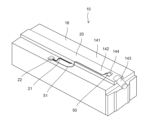
- FIG. 2 is a perspective view of the battery module.
- FIG. 3 is a vertical cross-sectional view of the battery module.
- FIG. 4 is a vertical cross-sectional view of a main part of a gas duct.
- FIG. 5 is a flowchart of a heat chain detection process performed by the controller.
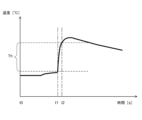
- FIG. 6 is an explanatory diagram showing a temperature rise when a thermal chain reaction occurs.
- FIG. 1 is a configuration diagram of a battery control system 1 for a battery pack 2 according to an embodiment of the present invention.
- the battery control system 1 includes a battery pack 2 and a controller 3 that controls the operation of the battery pack 2.
- the battery control system 1 is mounted on, for example, an electric vehicle or a hybrid vehicle.
- the battery pack 2 is composed of a housing 11 and a number of battery modules 10 housed within the housing 11.
- Figure 1 shows an example in which four battery modules 10 (10a, 10b, 10c, 10d) are housed within the housing 11.
- the housing 11 is configured to be sealed from the outside air. This prevents rainwater and dust from entering the battery pack 2.
- the battery pack 2 may be configured to send cool air into the battery pack 2 to cool the battery modules 10 inside the battery pack 2.
- the battery module 10 is configured by stacking cells 14 in a row in the longitudinal direction (left-right direction in FIG. 4).
- 24 battery cells are stacked in one battery module 10.
- the cells 14 are configured by secondary batteries such as lithium-ion batteries.
- Each battery module 10 is provided with a gas duct 20 on its upper surface, which is composed of a passage portion 142 and an exhaust portion 143.
- a gas pipe 40 is connected to the exhaust portion 143.
- this gas is exhausted to the outside of the battery pack 2 through the gas duct 20 and the gas pipe 40.
- a gas pipe 40a is connected to the exhaust section 143 of the battery module 10a.
- a gas pipe 40b is connected to the exhaust section 143 of the battery module 10b
- a gas pipe 40c is connected to the exhaust section 143 of the battery module 10c
- a gas pipe 40d is connected to the exhaust section 143 of the battery module 10d.
- thermal chain reaction of cells 14 In a configuration in which multiple cells 14 are stacked and housed, such as in the battery pack 2, when an abnormality such as a short circuit occurs in a cell 14 and the cell 14 generates heat, gas is generated inside the cell 14 and the cell 14 expands. Furthermore, the heat from this cell 14 may be transferred to other adjacent cells 14, causing a chain reaction of heat generation and gas generation in the cells 14. For this reason, a vehicle equipped with a battery pack 2 is required to detect the occurrence of a thermal chain reaction early and accurately.
- Conventional battery packs are configured to release gas to the outside when the internal pressure of the battery pack becomes too high, and use this as a trigger to detect a thermal chain reaction. With this configuration, it is not possible to detect a thermal chain reaction on a battery module basis. Furthermore, there is an issue in that it takes time for the pressure in the entire battery pack to increase, making it difficult to detect the occurrence of a thermal chain reaction at an early stage.
- the configuration described below is used to detect the occurrence of a thermal chain reaction more quickly.
- a temperature sensor 50 is provided on the upper surface of one end of the passage 142 of each battery module 10 to detect the temperature of the gas passing through the passage 142 of the gas duct 20.
- the temperature sensor 50 is, for example, a thermistor element.
- Each battery module 10 is provided with a voltage sensor harness 21 that is connected to a voltage sensor (not shown) that detects the voltage of the cells 14, and a temperature sensor harness 51 that is connected to a temperature sensor 50.
- the voltage sensor harness 21 and the temperature sensor harness 51 are provided with connectors 22 at their ends.
- a controller side harness 24 that is connected to the controller 3 is connected to the connector 22.
- each battery module 10 is also equipped with a high-voltage harness for transmitting and receiving power between the battery pack 2 and a load external to the battery pack 2.
- the controller 3 has a microcomputer and a memory, and the microcomputer executes a program stored in the memory to perform the thermal chain detection process described in Figure 5.
- the controller 3 also receives signals from the voltage sensor and temperature sensor 50 via the controller side harness 24, and detects the voltage of the cell 14 and the temperature of the passage 142 of the battery module 10.
- FIG. 2 is an oblique view of the battery module 10
- FIG. 3 is a longitudinal cross-sectional view of the battery module 10.
- the battery module 10 is constructed by stacking multiple cells 14 in the longitudinal direction.
- Figure 3 shows an example in which 24 cells 14 are stacked, but this number is not necessarily required.
- the periphery and bottom surfaces of the stacked cells 14 are covered by a case 15.
- the top surface of the cell 14 is covered by a cover 16.
- These cases 15 and covers 16 are made of a metal such as aluminum.
- the cover 16 includes a lid portion 141 that covers the upper surface of the cell 14, and a passage portion 142 that is formed along the longitudinal direction in the center of the lid portion 141 (the center of the cross section perpendicular to the stacking direction of the battery module 10). Furthermore, the passage portion 142 has a cylindrical exhaust portion 143 at the downstream end in the gas flow direction, which is one end side of the passage portion 142, for connecting the gas pipe 40.
- the discharge section 143 is formed to protrude slightly downward from the end of the passage section 142 of the battery module 10.
- a temperature sensor 50 is provided at the downstream end of the passage section 142, near the discharge section 143.
- Figure 4 is a vertical cross-sectional view of the main parts of the battery module 10, focusing on the temperature sensor 50.
- the passage portion 142 is formed as a substantially rectangular passage with flat upper and side surfaces, and a recessed portion 144 is formed at the downstream end in the gas flow direction in which the temperature sensor 50 is disposed.
- the recessed portion 144 is formed by recessing in a rectangular shape from the upper surface of the passage portion 142 toward the inside of the passage portion 142, and is not connected to the inside of the passage portion 142.
- the lower surface of the recessed portion 144 is positioned higher than half the height of the inner diameter of the passage portion 142, to an extent that it does not affect the gas flow.
- the temperature sensor 50 is fixed in close contact with the bottom of the recessed portion 144.
- the temperature sensor harness 51 connected to the temperature sensor 50 is disposed on the upper surface of the passage 142. As shown in FIG. 2, the temperature sensor harness 51 extends from the upper surface of the passage 142 in the stacking direction, and midway extends from the side of the passage 142 to the upper surface of the lid 141.
- the temperature sensor harness 51 is disposed adjacent to the voltage sensor harness 21 on the upper surface of the lid 141, and is connected to the connector 22 together with the voltage sensor harness 21.
- This connector 22 is a shared connector for both the temperature sensor harness 51 and the voltage sensor harness 21.
- a resin cover 17 made of resin is provided on the top surface of the cover 16 so as to cover the entire cover 16.
- the temperature sensor harness 51 is disposed between the top surface of the passage portion 142 and the resin cover 17.
- a release valve 14a is provided on the top surface of the cell 14.
- the release valve 14a is configured to open as shown by arrow A in FIG. 4 when the cell 14 generates heat, generating gas inside the cell 14, and the pressure inside the cell 14 reaches or exceeds a predetermined pressure.
- the release valve 14a opens, the inside of the cell 14 communicates with the passage 142, and the gas generated in the cell 14 is discharged to the passage 142.
- Gas discharged from the cell 14 is discharged into the passage 142 of the gas duct 20.
- the gas discharged into the passage 142 flows toward the outlet 143, and is discharged from the outlet 143 to the outside of the battery pack 2 via the gas pipe 40.
- the recessed portion 144 of the passage portion 142 protrudes inwardly of the passage portion 142. Because the recessed portion 144 protrudes into the passage portion 142, the gas flowing through the passage portion 142 flows around the recessed portion 144 while colliding with the surface 144a perpendicular to the gas flow direction, and heads toward the exhaust portion 143.
- the gas flows around the recessed portion 144, so the temperature of the gas is easily transmitted to the temperature sensor 50 arranged inside the recessed portion 144, and the temperature sensor 50 can more reliably detect the temperature increase caused by the gas. Furthermore, since the recessed portion 144 is made of a metal with a relatively high thermal conductivity, the temperature increase caused by the gas is quickly transmitted to the temperature sensor 50 via the recessed portion 144.
- the temperature sensor 50 Since high-temperature gas passes through the gas duct 20, i.e., inside the passage 142 and exhaust 143, if the temperature sensor 50 were configured to be placed directly inside the passage 142, there would be a concern that components and structures with sufficient heat resistance to withstand the high-temperature gas would be required, resulting in increased costs.
- the temperature sensor 50 is placed outside the gas duct 20, i.e., on the upper surface of the passage 142, so that the heat resistance temperature of the temperature sensor 50 and temperature sensor harness 51 can be reduced, thereby reducing costs.
- FIG. 5 is a flowchart of the thermal chain detection process executed by the controller 3.
- This flowchart is executed at a predetermined interval (e.g., every 10 ms) by the controller 3.
- the controller 3 executes the process shown in this flowchart in parallel for each of the multiple battery modules 10 (10a, 10b, 10c, 10d) provided in the battery pack 2 as shown in FIG. 1.
- step S10 the controller 3 receives a signal from the temperature sensor 50 and obtains the temperature at the downstream end of the gas duct 20.
- step S20 the controller 3 determines whether the temperature detected by the temperature sensor 50 has risen to or above a predetermined temperature within a predetermined time.
- the temperature detected by the temperature sensor 50 in the previous process is compared with the temperature newly detected by the temperature sensor 50 a predetermined time after the previous temperature was detected (e.g. 10 ms), and if the difference between these temperatures, i.e., the temperature rise value, is equal to or greater than a predetermined temperature (e.g. 100°C), it is determined that the temperature has risen by the predetermined temperature or more within the predetermined time, and the process proceeds to step S30. If the temperature has not risen by the predetermined temperature or more within the predetermined time, the process according to this flowchart is temporarily terminated, and the process returns to other processes.
- a predetermined time after the previous temperature was detected e.g. 10 ms
- a predetermined temperature e.g. 100°C
- step S20 If step S20 is YES, this indicates that the temperature of the gas in the passage 142 has risen rapidly in a short period of time. In this case, in step S30, the controller 3 determines that a thermal chain reaction has occurred in the cell 14.
- FIG. 6 is an explanatory diagram showing the change in temperature detected by the temperature sensor 50 when a thermal chain reaction occurs in this embodiment.
- step S20 is NO.
- the controller 3 determines that a thermal chain reaction has occurred.
- step S40 the controller 3 performs notification processing.
- the notification processing is performed, for example, by displaying a warning light or a message on the instrument panel at the driver's seat, or by issuing an alarm sound or voice warning. This notification processing prompts the driver to receive the service.
- step S40 the controller 3 returns to other processing.
- the controller 3 When the controller 3 detects that a thermal chain reaction has occurred, it can notify the driver of an alarm in the notification process of step S40 described above.
- the battery pack 2 of this embodiment includes a housing 11, a battery module 10 housed in the housing 11 and configured by stacking a plurality of cells 14, and a gas duct 20 arranged to cover the upper surface of the battery module 10, extending in the stacking direction, and including a passage 142 for directing gas in the stacking direction when gas is generated from a cell 14, and an exhaust section 143 connected to the downstream end of the passage 142 for directing the gas to the outside.
- a temperature sensor 50 for detecting the temperature of the gas flowing into the exhaust section 143 is arranged at the downstream end of the passage 142.
- the gas duct 20 of the battery module 10 is provided with a temperature sensor 50, so when gas is generated from a cell 14, the temperature sensor 50 detects the temperature rise caused by the gas, making it possible to detect the occurrence of a thermal chain reaction in the cells 14 of each battery module 10 more quickly than in the conventional method of detecting a thermal chain reaction when the internal pressure of the entire battery pack becomes high. Furthermore, since the temperature sensor 50 is disposed at the downstream end of the passage portion 142 of the gas duct 20, a thermal chain reaction can be detected even if gas is generated in any of the cells 14 in the battery module 10.
- the temperature sensor 50 is placed on the upper surface of the passage portion 142 of the gas duct 20, and is not in direct contact with the high-temperature gas. This allows the heat resistance temperature of the temperature sensor 50 to be reduced, and costs can be reduced while maintaining the temperature detection accuracy.
- the passage portion 142 of the gas duct 20 has a recessed portion 144 recessed from the upper surface toward the inside of the passage portion 142 of the gas duct 20, and the temperature sensor 50 is disposed in the recessed portion 144.
- the gas flowing through the passage 142 of the gas duct 20 flows around the recessed portion 144 having a surface 144a perpendicular to the gas flow direction, allowing the temperature sensor 50 to more reliably detect the temperature rise caused by the gas.
- this embodiment has a voltage sensor that detects the voltage of the cell 14, and the voltage sensor harness 21 connected to the voltage sensor is routed in the stacking direction along the passage portion 142 of the gas duct 20, and the temperature sensor harness 51 connected to the temperature sensor 50 is routed adjacent to the voltage sensor harness 21.
- the temperature sensor harness 51 of the temperature sensor 50 for detecting the gas temperature is routed adjacent to the voltage sensor harness 21 already installed in the battery module 10, so there is no need to provide a new structure for routing the temperature sensor harness 51, which helps reduce costs.
- the temperature sensor harness 51 and the voltage sensor harness 21 are connected to the same connector 22, and the connector 22 is connected to a controller side harness 24 that communicates with the controller 3 outside the housing 11.
- the temperature sensor harness 51 of the temperature sensor 50 for detecting the gas temperature is connected to the connector 22 already installed in the battery module 10, so there is no need to provide a new connector to connect the temperature sensor harness 51, which helps reduce costs.
- this embodiment includes a controller 3 that obtains a temperature rise value from the temperature detected by the temperature sensor 50 and detects the occurrence of a thermal chain reaction in the cells 14 based on the obtained temperature rise value, so that a thermal chain reaction in the cells 14 can be detected on a battery module 10 basis with a simple configuration.
- the temperature sensor 50 is provided in a recess 144 formed by recessing the upper surface of the passage section 142 of the gas duct 20, but the temperature sensor 50 may be disposed on the upper surface of the passage section 142 without forming the recess 144.
- the temperature sensor 50 may also be configured to be disposed on the side surface of the passage section 142.
- the temperature sensor 50 is provided at the downstream end of the passage portion 142, but this is not limited to this.
- the temperature sensor 50 may be disposed further downstream in the gas flow direction, i.e., in the exhaust portion 143. In this case, a recessed portion for disposing the temperature sensor 50 may be formed in the exhaust portion 143.
Landscapes
- Chemical & Material Sciences (AREA)
- Chemical Kinetics & Catalysis (AREA)
- Electrochemistry (AREA)
- General Chemical & Material Sciences (AREA)
- Engineering & Computer Science (AREA)
- Manufacturing & Machinery (AREA)
- Microelectronics & Electronic Packaging (AREA)
- Battery Mounting, Suspending (AREA)
- Gas Exhaust Devices For Batteries (AREA)
Priority Applications (4)
| Application Number | Priority Date | Filing Date | Title |
|---|---|---|---|
| JP2025515019A JPWO2024218972A1 (https=) | 2023-04-21 | 2023-04-21 | |
| PCT/JP2023/015971 WO2024218972A1 (ja) | 2023-04-21 | 2023-04-21 | バッテリパック及びバッテリパックの制御装置 |
| EP23933277.8A EP4700953A1 (en) | 2023-04-21 | 2023-04-21 | Battery pack and control device for battery pack |
| CN202380097334.2A CN120958646A (zh) | 2023-04-21 | 2023-04-21 | 电池组和电池组的控制装置 |
Applications Claiming Priority (1)
| Application Number | Priority Date | Filing Date | Title |
|---|---|---|---|
| PCT/JP2023/015971 WO2024218972A1 (ja) | 2023-04-21 | 2023-04-21 | バッテリパック及びバッテリパックの制御装置 |
Publications (1)
| Publication Number | Publication Date |
|---|---|
| WO2024218972A1 true WO2024218972A1 (ja) | 2024-10-24 |
Family
ID=93152302
Family Applications (1)
| Application Number | Title | Priority Date | Filing Date |
|---|---|---|---|
| PCT/JP2023/015971 Ceased WO2024218972A1 (ja) | 2023-04-21 | 2023-04-21 | バッテリパック及びバッテリパックの制御装置 |
Country Status (4)
| Country | Link |
|---|---|
| EP (1) | EP4700953A1 (https=) |
| JP (1) | JPWO2024218972A1 (https=) |
| CN (1) | CN120958646A (https=) |
| WO (1) | WO2024218972A1 (https=) |
Citations (3)
| Publication number | Priority date | Publication date | Assignee | Title |
|---|---|---|---|---|
| JP2019032992A (ja) * | 2017-08-08 | 2019-02-28 | トヨタ自動車株式会社 | 電池パック |
| JP2019219173A (ja) * | 2018-06-15 | 2019-12-26 | 矢崎総業株式会社 | 排煙温度センサの取付構造 |
| JP2021150033A (ja) | 2020-03-16 | 2021-09-27 | 本田技研工業株式会社 | バッテリパック及び電動車両 |
-
2023
- 2023-04-21 EP EP23933277.8A patent/EP4700953A1/en active Pending
- 2023-04-21 JP JP2025515019A patent/JPWO2024218972A1/ja active Pending
- 2023-04-21 WO PCT/JP2023/015971 patent/WO2024218972A1/ja not_active Ceased
- 2023-04-21 CN CN202380097334.2A patent/CN120958646A/zh active Pending
Patent Citations (3)
| Publication number | Priority date | Publication date | Assignee | Title |
|---|---|---|---|---|
| JP2019032992A (ja) * | 2017-08-08 | 2019-02-28 | トヨタ自動車株式会社 | 電池パック |
| JP2019219173A (ja) * | 2018-06-15 | 2019-12-26 | 矢崎総業株式会社 | 排煙温度センサの取付構造 |
| JP2021150033A (ja) | 2020-03-16 | 2021-09-27 | 本田技研工業株式会社 | バッテリパック及び電動車両 |
Also Published As
| Publication number | Publication date |
|---|---|
| JPWO2024218972A1 (https=) | 2024-10-24 |
| CN120958646A (zh) | 2025-11-14 |
| EP4700953A1 (en) | 2026-02-25 |
Similar Documents
| Publication | Publication Date | Title |
|---|---|---|
| CN215451516U (zh) | 电芯、电池系统以及电动汽车 | |
| JP6540628B2 (ja) | 電池パック | |
| KR101413871B1 (ko) | 전지 시스템 | |
| JP5970849B2 (ja) | 水没検出装置 | |
| JP5873210B2 (ja) | 電池ブロック及び二次電池モジュ−ル | |
| JP5584820B2 (ja) | 新規構造を備えた検知部材を有する電池モジュール | |
| JP5672218B2 (ja) | 組電池 | |
| CN113632297A (zh) | 电池模块 | |
| US20140227570A1 (en) | Power storage device | |
| JP7418409B2 (ja) | 電池モジュール | |
| JP6658387B2 (ja) | 電池パック | |
| JP6610458B2 (ja) | 電池パック | |
| JP5983108B2 (ja) | 電池ユニット | |
| JP2013525945A (ja) | バッテリーモジュール用電圧検出アセンブリ及びこれを採用したバッテリーモジュール | |
| JP2012113896A (ja) | 組電池 | |
| JP6715927B2 (ja) | 電池モジュール | |
| KR20250006272A (ko) | 차량용 파워 배터리 시스템 및 열 평가 방법 | |
| JP2013110039A (ja) | 組電池 | |
| US8415040B2 (en) | Secondary battery module containing temperature sensor and sealing member surrounding conductive wire of temperature sensor | |
| US20150179991A1 (en) | Power storage module and power storage device | |
| KR20230032363A (ko) | 셀집합유닛 및 배터리 팩 | |
| WO2024218972A1 (ja) | バッテリパック及びバッテリパックの制御装置 | |
| JP6711234B2 (ja) | 電池ユニット | |
| CN213026382U (zh) | 电池模组、电池包和车辆 | |
| CN114188630A (zh) | 一种单体电池及电池包 |
Legal Events
| Date | Code | Title | Description |
|---|---|---|---|
| 121 | Ep: the epo has been informed by wipo that ep was designated in this application |
Ref document number: 23933277 Country of ref document: EP Kind code of ref document: A1 |
|
| ENP | Entry into the national phase |
Ref document number: 2025515019 Country of ref document: JP Kind code of ref document: A |
|
| WWE | Wipo information: entry into national phase |
Ref document number: 2025515019 Country of ref document: JP |
|
| WWE | Wipo information: entry into national phase |
Ref document number: 2023933277 Country of ref document: EP |
|
| NENP | Non-entry into the national phase |
Ref country code: DE |
|
| ENP | Entry into the national phase |
Ref document number: 2023933277 Country of ref document: EP Effective date: 20251121 |
|
| ENP | Entry into the national phase |
Ref document number: 2023933277 Country of ref document: EP Effective date: 20251121 |
|
| ENP | Entry into the national phase |
Ref document number: 2023933277 Country of ref document: EP Effective date: 20251121 |
|
| ENP | Entry into the national phase |
Ref document number: 2023933277 Country of ref document: EP Effective date: 20251121 |
|
| ENP | Entry into the national phase |
Ref document number: 2023933277 Country of ref document: EP Effective date: 20251121 |
|
| ENP | Entry into the national phase |
Ref document number: 2023933277 Country of ref document: EP Effective date: 20251121 |
|
| ENP | Entry into the national phase |
Ref document number: 2023933277 Country of ref document: EP Effective date: 20251121 |
|
| ENP | Entry into the national phase |
Ref document number: 2023933277 Country of ref document: EP Effective date: 20251121 |
|
| ENP | Entry into the national phase |
Ref document number: 2023933277 Country of ref document: EP Effective date: 20251121 |
|
| WWP | Wipo information: published in national office |
Ref document number: 2023933277 Country of ref document: EP |