WO2024218893A1 - 平膜モジュール - Google Patents
平膜モジュール Download PDFInfo
- Publication number
- WO2024218893A1 WO2024218893A1 PCT/JP2023/015600 JP2023015600W WO2024218893A1 WO 2024218893 A1 WO2024218893 A1 WO 2024218893A1 JP 2023015600 W JP2023015600 W JP 2023015600W WO 2024218893 A1 WO2024218893 A1 WO 2024218893A1
- Authority
- WO
- WIPO (PCT)
- Prior art keywords
- flat membrane
- hole
- housing
- internal space
- separation layer
- Prior art date
- Legal status (The legal status is an assumption and is not a legal conclusion. Google has not performed a legal analysis and makes no representation as to the accuracy of the status listed.)
- Ceased
Links
Images


Classifications
-
- B—PERFORMING OPERATIONS; TRANSPORTING
- B01—PHYSICAL OR CHEMICAL PROCESSES OR APPARATUS IN GENERAL
- B01D—SEPARATION
- B01D63/00—Apparatus in general for separation processes using semi-permeable membranes
- B01D63/08—Flat membrane modules
- B01D63/082—Flat membrane modules comprising a stack of flat membranes
-
- C—CHEMISTRY; METALLURGY
- C02—TREATMENT OF WATER, WASTE WATER, SEWAGE, OR SLUDGE
- C02F—TREATMENT OF WATER, WASTE WATER, SEWAGE, OR SLUDGE
- C02F1/00—Treatment of water, waste water, or sewage
- C02F1/44—Treatment of water, waste water, or sewage by dialysis, osmosis or reverse osmosis
-
- B—PERFORMING OPERATIONS; TRANSPORTING
- B01—PHYSICAL OR CHEMICAL PROCESSES OR APPARATUS IN GENERAL
- B01D—SEPARATION
- B01D2313/00—Details relating to membrane modules or apparatus
- B01D2313/08—Flow guidance means within the module or the apparatus
Definitions
- This disclosure relates to flat membrane modules.
- a spiral-type module that includes a spiral-type membrane element wound around a central tube and a cylindrical housing that contains the spiral element.
- a spiral-type membrane element wound around a central tube and a cylindrical housing that contains the spiral element.
- the flat membrane module of the present disclosure is a flat membrane module that separates fine particles from a fluid containing fine particles, and includes an element stack and a housing.
- the element stack has a plurality of flat membrane elements.
- the plurality of flat membrane elements are stacked while maintaining an inlet gap through which a fluid containing fine particles can be introduced.
- the housing has an internal space and an inlet hole.
- the internal space is capable of accommodating the element stack.
- the inlet hole introduces a fluid containing fine particles from the outside into the internal space.
- the flat membrane element has a separation layer and a support layer.
- the separation layer has pores formed therein. The pores trap fine particles from the fluid containing fine particles and allow the fluid to pass through.
- the support layer is adjacent to the separation layer.
- the support layer includes a flow path.
- the flow path allows the passage of a filtrate fluid, which is a fluid that has passed through the pores of the separation layer.
- the direction in which the plurality of flat membrane elements are stacked is defined as a first direction.
- the direction perpendicular to the first direction is defined as a second direction.
- the direction perpendicular to the first direction and the second direction is defined as a third direction.
- the element stack has a shape that extends in the second direction.
- the internal space has a shape that extends in the axial direction of the housing.
- the cross-sectional shape of the internal space perpendicular to the axial direction is circular.
- FIG. 1 is a schematic perspective view of a flat membrane module according to the first embodiment.
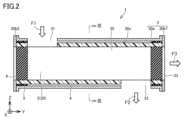
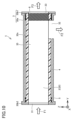
- FIG. 2 is a cross-sectional view taken along line II-II in FIG.
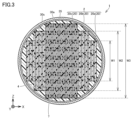
- FIG. 3 is a cross-sectional view taken along line III-III in FIG.
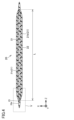
- FIG. 4 is a schematic cross-sectional view of a flat membrane element.
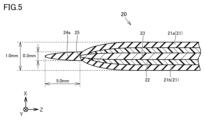
- FIG. 5 is a partially enlarged schematic cross-sectional view of a region V in FIG.
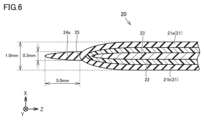
- FIG. 6 is a partially enlarged schematic cross-sectional view showing a modified example of the flat membrane element.
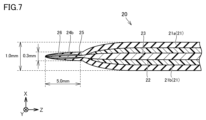
- FIG. 7 is a partially enlarged schematic cross-sectional view showing a modified example of the flat membrane element.
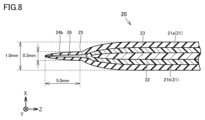
- FIG. 8 is a partially enlarged schematic cross-sectional view showing a modified example of the flat membrane element.
- FIG. 1 is a schematic perspective view of a flat membrane module according to the first embodiment.
- FIG. 2 is a cross-sectional view taken along line II-II in FIG.
- FIG. 3 is a cross-sectional
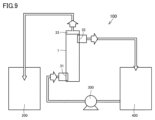
- FIG. 9 is a schematic diagram of a filtration device using the flat membrane module according to the first embodiment.
- FIG. 10 is a cross-sectional view of a flat membrane module according to the second embodiment.
- FIG. 11 is a cross-sectional view of a flat membrane module according to the third embodiment.
- This disclosure has been made to solve the problems described above. More specifically, it provides a flat membrane module that can be used without applying bending stress to the membrane elements.
- the flat membrane module according to the present disclosure can be used without applying bending stress to the membrane elements.
- the flat membrane module of the present disclosure is a flat membrane module that separates fine particles from a fluid containing fine particles, and includes an element stack and a housing.
- the element stack has a plurality of flat membrane elements.
- the plurality of flat membrane elements are stacked while maintaining an inlet gap through which a fluid containing fine particles can be introduced.
- the housing has an internal space and an inlet hole.
- the internal space is capable of accommodating the element stack.
- the inlet hole introduces a fluid containing fine particles from the outside into the internal space.
- the flat membrane element has a separation layer and a support layer.
- the separation layer has pores formed therein. The pores trap fine particles from the fluid containing fine particles and allow the fluid to pass through.
- the support layer is adjacent to the separation layer.
- the support layer includes a flow path.
- the flow path allows the passage of a filtrate fluid, which is a fluid that has passed through the pores of the separation layer.
- the direction in which the plurality of flat membrane elements are stacked is defined as a first direction.
- the direction perpendicular to the first direction is defined as a second direction.
- the direction perpendicular to the first direction and the second direction is defined as a third direction.
- the element stack has a shape that is elongated in the second direction.
- the internal space has a shape that extends in the axial direction of the housing.
- the cross-sectional shape of the internal space perpendicular to the axial direction is circular.
- This disclosure provides a flat membrane module that can be used without applying bending stress to the membrane elements.
- the separation layer may contain an inorganic material.
- the inorganic substance may be a ceramic material.
- the flat membrane element may further include a buffer material disposed between the separation layer and the support layer.
- the separation layer may include a first separation layer and a second separation layer.
- the support layer may be disposed between the first separation layer and the second separation layer.
- the thickness in the first direction of at least the peripheral end portion of the flat membrane elements that faces the inlet hole of the housing when the element stack is housed in the internal space of the housing may be smaller than the thickness of the central portion of the flat membrane elements.
- the peripheral ends of the flat membrane elements may be made of heat-sealed portions.
- the element stack may have a spacer.
- the spacer is disposed between two adjacent flat membrane elements among the plurality of flat membrane elements.
- the spacer may include a spacer that maintains an introduction gap and has a flow path through which a fluid containing fine particles can move.
- the flat membrane modules of (1) to (8) above may be provided with a drift prevention member.
- the drift prevention member may be disposed in the gap between the inner wall of the internal space and the element stack housed in the internal space.
- the drift prevention member may inhibit the movement of a fluid containing fine particles through the gap between the inner wall and the element stack housed in the internal space.
- the multiple flat membrane elements may include a first flat membrane element and a second flat membrane element.
- the first flat membrane element may be closest to the inner wall of the internal space in the first direction.
- the second flat membrane element may be disposed at a position farther from the inner wall of the internal space in the first direction than the first flat membrane element.
- the first width in the third direction of the first flat membrane element may be smaller than the second width in the third direction of the second flat membrane element.
- the housing may have an outflow hole and a recovery hole.
- the outflow hole may discharge from the internal space to the outside a fluid containing fine particles that has been introduced into the inlet gap in the element stack housed in the internal space but has not passed through the inside of the flat membrane element.
- the recovery hole may discharge the filtered fluid from the internal space to the outside.
- the inlet-outlet distance which is the distance from the inlet hole to the outlet hole in the axial direction of the housing, may be 0.6 to 1.0 times the length of the housing in the axial direction.
- the inlet hole when the element stack is accommodated in the internal space of the housing, the inlet hole may face a surface perpendicular to the third direction in the element stack.
- the outlet hole may include a first outlet hole and a second outlet hole.
- the recovery hole may include a first recovery hole and a second recovery hole.
- the inlet hole may be located at a position sandwiched between the first outlet hole and the second outlet hole in the axial direction of the housing.
- the first recovery hole may be located on the same side as the first outlet hole as seen from the inlet hole in the axial direction of the housing.
- the second recovery hole may be located on the same side as the second outlet hole as seen from the inlet hole in the axial direction of the housing.
- the first inlet-outlet distance which is the distance from the inlet hole to the first outlet hole in the axial direction of the housing, may be smaller than the first inlet-recovery distance, which is the distance from the inlet hole to the first recovery hole in the axial direction of the housing.
- the second inflow-outflow distance which is the distance from the inflow hole to the second outflow hole in the axial direction of the housing, may be smaller than the second inflow-recovery distance, which is the distance from the inflow hole to the second recovery hole in the axial direction of the housing.
- FIG. 1 is a schematic perspective view of a flat membrane module 1 according to the present embodiment.
- Fig. 2 is a cross-sectional view taken along line II-II in Fig. 1.
- Fig. 3 is a cross-sectional view taken along line III-III in Fig. 2.
- Fig. 4 is a schematic cross-sectional view of a flat membrane element 20.
- Fig. 5 is a partially enlarged schematic cross-sectional view of region V in Fig. 4.
- the flat membrane module 1 is, for example, a separation membrane module that separates fine particles from a fluid containing fine particles (hereinafter, also referred to as "fluid to be treated F1").
- a separation membrane module that separates fine particles from a fluid containing fine particles (hereinafter, also referred to as "fluid to be treated F1").
- the fine particles contained in the fluid to be treated F1 are trapped by the separation layer 21 of the flat membrane element 20, and the fluid to be treated F1 becomes a filtrate fluid F3 from which the fine particles have been removed.
- the flat membrane module 1 may separate the fine particles from the fluid to be treated F1 by any separation method.
- the separation method of the flat membrane module 1 may be, for example, a method of filtering a liquid in which the fluid to be treated F1 and the filtrate fluid F3 are both liquids.
- the separation method of the flat membrane module 1 may be, for example, a method of filtering a gas in which the fluid to be treated F1 and the filtrate fluid F3 are both gases.
- the separation method of the flat membrane module 1 may be a pervaporation method in which the fluid to be treated F1 is a liquid and the filtrate fluid F3 is a gas.
- the fine particles to be separated may be any separation object to be separated from the fluid to be treated.
- the fine particles to be separated may be inorganic matter whose shape does not change, but the shape of the fine particles may be any shape.
- the shape of the fine particles may be spherical, polyhedral, plate-like, rod-like, etc.
- the material of the fine particles is not limited to inorganic matter.
- the fine particles in this specification also include objects made of organic matter whose shape can change, such as amoebas.
- the fine particles to be separated include not only solids but also liquids and gases.
- the treated fluid F1 is seawater
- sodium ions or chloride ions may be the fine particles to be separated.
- a polymeric solute with a molecular weight of about 1350, such as vitamin B12 may be the fine particles to be separated.
- soybean oil may be the fine particles to be separated.
- the treated fluid F1 when the treated fluid F1 is beer, water molecules with a smaller molecular size may be the fine particles to be separated, and ethyl alcohol may pass through the membrane.
- ethyl alcohol may pass through the membrane.
- carbon dioxide when the treated fluid F1 is air, carbon dioxide may be the fine particles to be separated.
- the flat membrane module 1 mainly comprises an element stack 2, a housing 3, and a drift prevention member 4.
- the element stack 2 has a plurality of flat membrane elements 20.
- the plurality of flat membrane elements 20 are stacked while maintaining an inlet gap through which a fluid containing fine particles can be introduced.
- the element stack 2 has a spacer 7 that maintains the inlet gap.
- the spacer 7 is disposed between two adjacent flat membrane elements 20 among the plurality of flat membrane elements 20, and maintains the inlet gap.
- the spacer 7 may have a flow path through which the treated fluid F1 can move.
- a plurality of spacers 7 may be dispersedly disposed between two adjacent flat membrane elements 20 as shown in FIG. 3, thereby forming a flow path through which the treated fluid F1 can move in the inlet gap of the element stack 2.
- the direction in which the multiple flat membrane elements 20 are stacked is defined as the first direction X.
- the width of the introduction gap in the first direction X is, for example, 0.1 mm or more and 10 mm or less.
- the width of the introduction gap in the first direction X may be any size that allows a fluid containing fine particles to be introduced. Therefore, the width of the introduction gap in the first direction X may be changed depending on the size of the fine particles to be separated. Note that the width of the introduction gap in the first direction X is determined by the width of the spacer 7 in the first direction X described above.
- the direction perpendicular to the first direction X is the second direction Y.
- the direction in which the element stack 2 extends is the second direction Y.
- the element stack 2 has a shape extending in the second direction Y.
- the planar shape of the element stack 2 and the flat membrane element 20 as viewed from the first direction X can be any shape, but is, for example, rectangular.
- the direction perpendicular to each of the first direction X and the second direction Y is the third direction Z.
- the housing 3 includes an outer tube 30a and a pair of flanges 30b1, 30b2.
- the outer tube 30a is cylindrical in shape.
- the outer tube 30a is arranged so as to be sandwiched between the pair of flanges 30b1, 30b2.
- the flanges 30b1, 30b2 are each connected to the end face of the outer tube 30a.
- the internal space 35 of the housing 3 is an area surrounded by the inner wall 30s of the outer tube 30a and the surfaces of the flanges 30b1, 30b2 that are in contact with the end face of the outer tube 30a. In this way, an internal space 35 capable of storing the element stack 2 is formed in the housing 3.
- the material of the outer tube 30a and the pair of flanges 30b1, 30b2 is, for example, a high-strength material such as a steel material such as stainless steel, titanium, or FRP (Fiber Reinforced Plastics).
- the nominal diameter of the outer cylinder 30a and the pair of flanges 30b1, 30b2 is, for example, 200A according to the JIS standard. Note that the housing 3 does not have to include the pair of flanges 30b1, 30b2, and for example, the outer cylinder 30a may be clamped using a clamp.
- the shape of the inner wall 30s of the outer tube 30a is circular.
- the cross section perpendicular to the axial direction of the internal space 35 is circular, and the internal space 35 has a shape that extends in the axial direction of the housing 3.
- the shape of the internal space 35 is, for example, cylindrical.
- the housing 3 has an inlet hole 31, an outlet hole 32, and a recovery hole 33.
- the inlet hole 31 introduces the treated fluid F1 from the outside of the housing 3 to the internal space 35.
- the outlet hole 32 discharges the treated fluid F2 from the internal space 35 of the housing 3 to the outside.
- the recovery hole 33 discharges the filtered fluid F3 separated from the treated fluid F1 by the element stack 2 from the internal space 35 of the housing 3 to the outside.
- the inlet hole 31 and the outlet hole 32 are formed in the outer cylinder 30a so as to reach from the outer wall of the outer cylinder 30a to the inner wall 30s.
- the recovery hole 33 is formed in the flange 30b1 so as to reach from the surface where the flange 30b1 is connected to the end surface of the outer cylinder 30a to the opposite surface. In other words, the recovery hole 33 is formed along the axial direction. A specific configuration example of the element stack 2 facing the recovery hole 33 will be described later.
- the collection hole 33 is formed only in one of the pair of flanges 30b1 and 30b2, the flange 30b1.
- the outlet hole 32 and the inlet hole 31 are arranged apart from each other in the axial direction of the outer cylinder 30a.
- the outlet hole 32 is arranged near the flange 30b1 in which the collection hole 33 is formed.
- the inlet hole 31 is arranged near the flange 30b2 in which the collection hole 33 is not formed.
- the inlet hole 31 is arranged on the opposite side of the area in which the outlet hole 32 is arranged as viewed from the central axis. From a different perspective, the inlet hole 31 and the outlet hole 32 are arranged at positions that are point symmetrical about a point (for example, the center point of the internal space 35) that is the midpoint between the inlet hole 31 and the outlet hole 32 in the axial direction of the housing 3.
- the collection hole 33 may be formed in the flange 30b2.
- any fluid can be made to flow from the collection hole 33 of the flange 30b2 into the internal space 35 (more specifically, the flow path through which the filtered fluid F3 flows).
- the filtered fluid F3 can be quickly discharged to the outside of the flat membrane element 20.
- the distance from the inlet hole 31 to the outlet hole 32 in the axial direction of the housing 3 is the inflow-outflow distance.
- the inflow-outflow distance is, for example, the distance in the axial direction between the part of the inner wall of the inlet hole 31 closest to the outlet hole 32 and the part of the inner wall of the outlet hole 32 closest to the inlet hole 31. It is preferable that the inflow-outflow distance is 0.6 times or more and 1.0 times or less the length of the housing 3 in the axial direction.
- the length of the housing 3 in the axial direction is, for example, the distance between a pair of flanges 30b1, 30b2 in the axial direction.
- the distance from the outlet hole 32 to the recovery hole 33 in the axial direction of the housing 3 is the outflow-recovery distance.
- the distance from the inlet hole 31 to the recovery hole 33 in the axial direction of the housing 3 is the inflow-recovery distance.
- the outflow-recovery distance can be less than 0.2 times the length of the housing 3 in the axial direction. If the outflow-recovery distance is small, the area in which the treated fluid F1 stagnates from the outflow hole 32 to the flange 30b1 can be reduced.
- the flow rate of the filtered fluid F3 produced when the treated fluid F1 is filtered by the separation layer 21 of the flat membrane element 20 increases.
- the inflow-recovery distance is large, the area in which the treated fluid F1 stagnates from the inflow hole 31 to the flange 30b2 can be reduced.
- the flow rate of the filtered fluid F3 produced when the treated fluid F1 is filtered by the separation layer 21 of the flat membrane element 20 increases.
- the outflow hole 32 is somewhat distant from the inflow hole 31 in the axial direction, the flow rate of the filtered fluid F3 produced when the treated fluid F1 is filtered by the separation layer 21 of the flat membrane element 20 increases.
- the filtration efficiency is improved by increasing the inflow-outflow distance.
- the outer cylinder 30a has an inlet hole 31 and an outlet hole 32 formed in a direction perpendicular to the axial direction of the housing 3.
- the direction in which the inlet hole 31 is formed coincides with the direction in which the outlet hole 32 is formed.
- the direction in which the treated fluid F1 is introduced from the outside of the housing 3 into the internal space 35 through the inlet hole 31 coincides with the direction in which the treated fluid F2 is discharged from the internal space 35 of the housing 3 to the outside through the outlet hole 32.
- the recovery hole 33 is formed along the axial direction of the housing 3, the direction in which the filtered fluid F3 is discharged from the internal space 35 of the housing 3 to the outside coincides with the axial direction of the housing 3.
- the element stack 2 When the element stack 2 is accommodated in the internal space 35 of the housing 3, the element stack 2 is accommodated in the internal space 35 of the housing 3 so that the second direction Y, which is the extension direction of the element stack 2, coincides with the axial direction of the housing 3.
- the fluid to be treated F1 can be introduced into the inlet gap of the element stack 2
- the element stack 2 is accommodated in the internal space 35 of the housing 3 so that at least a part of the surface in the third direction Z of the element stack 2 faces the inlet hole 31 of the housing 3.
- the second direction Y of the element stack 2 and the axial direction of the housing 3 are parallel.
- the inlet hole 31 faces a surface (surface in the third direction Z) of the element stack 2 perpendicular to the third direction Z.
- the element stack 2 is accommodated in the housing 3 so that the direction perpendicular to the first direction X in which the multiple flat membrane elements 20 are stacked (the third direction Z in FIG. 2) coincides with the direction in which the fluid to be treated F1 is introduced.
- the surface of the element stack 2 perpendicular to the first direction X includes the ends of the inlet gaps formed between the flat membrane elements 20. Therefore, the treated fluid F1 supplied from the inlet hole 31 is introduced into the inlet gaps of the element stack 2.
- the inlet hole 31 may be formed in the flange 30b2 where the recovery hole 33 is not formed.
- the direction of the inlet hole 31 formed in the flange 30b2 coincides with the axial direction of the housing 3.
- the inlet hole 31 may face a surface perpendicular to the third direction Z in the element stack 2.
- the fluid to be treated F1 is introduced into the introduction gap of the element stack 2.
- the flat membrane elements 20 may be stacked such that the width of the flat membrane elements 20 in the third direction Z decreases as the distance from the center of the housing 3 approaches the inner wall 30s of the outer tube 30a.
- the flat membrane element 20 includes a plurality of first flat membrane elements 20a, a plurality of second flat membrane elements 20b, and a plurality of third flat membrane elements 20c.
- the first flat membrane elements 20a are disposed in a position closest to the inner wall 30s of the internal space 35 in the first direction X.
- the second flat membrane elements 20b are disposed in a position farther from the inner wall 30s of the internal space 35 in the first direction X than the first flat membrane elements 20a.
- the third flat membrane elements 20c are disposed in a position farther from the inner wall 30s of the internal space 35 in the first direction X than the second flat membrane elements 20b. That is, in the first direction X, the second flat membrane elements 20b are disposed between the first flat membrane element 20a and the third flat membrane element 20c.
- the first width W1 in the third direction Z of the first flat membrane element 20a is smaller than the second width W2 in the third direction Z of the second flat membrane element 20b.
- the second width W2 in the third direction Z of the second flat membrane element 20b is smaller than the third width W3 in the third direction Z of the third flat membrane element 20c.
- the first flat membrane element 20a closest to the inner wall 30s of the outer cylinder 30a in the first direction X may be in contact with the inner wall 30s.
- the end in the third direction Z of the first flat membrane element 20a closest to the inner wall 30s of the outer cylinder 30a in the first direction X may be in contact with the inner wall 30s.
- the end in the third direction Z of the second flat membrane element 20b closest to the inner wall 30s of the outer cylinder 30a in the first direction X may be in contact with the inner wall 30s.
- the end in the third direction Z of the third flat membrane element 20c closest to the inner wall 30s of the outer cylinder 30a in the first direction X may be in contact with the inner wall 30s or may not be in contact with the inner wall 30s.
- the flat membrane elements 20 are stacked so that the width of the flat membrane element 20 in the third direction Z gradually decreases as it approaches the inner wall 30s from the center of the housing 3, thereby improving the filling rate of the element stack 2 in the internal space 35.
- the volume of the element stack 2 can be increased compared to when the cross-sectional shape of the element stack 2 is a square shape. Therefore, the effective membrane area of the element stack 2 in the housing 3 is increased, and the filtration efficiency per volume of the housing 3 is improved.
- the flat membrane module 1 may be provided with a drift prevention member 4.
- the drift prevention member 4 is disposed in the gap between the inner wall 30s of the internal space 35 and the element stack 2 housed in the internal space 35. In this way, the drift prevention member 4 prevents the treated fluid F1 from moving through the gap between the inner wall 30s of the outer cylinder 30a and the element stack 2 housed in the internal space 35.
- the material of the drift prevention member 4 can be any material that can prevent the flow of the treated fluid F1.
- a metal or a resin material such as FRP may be used as the material.
- the flat membrane module 1 may include a pair of end seals 6 and an O-ring 5. As shown in FIG. 2, the end seals 6 may be connected to the surfaces of the flanges 30b1 and 30b2 that are connected to the end faces of the outer cylinder 30a. In the vicinity of the flanges 30b1 and 30b2, the end seals 6 are connected to the ends of the flat membrane elements 20 so as to fill the introduction gaps of the element stack 2. The end seals 6 are also connected to the ends of the drift prevention members 4 in the second direction Y. The end seals 6 may extend partially on the outer peripheral surface of the drift prevention members 4 (the surface facing the inner wall 30s of the outer cylinder 30a).
- the flat membrane elements 20 and the drift prevention members 4 are fixed by the end seals 6.
- the O-rings 5 are arranged between the end seals 6 or the drift prevention members 4 and the inner wall 30s of the outer cylinder 30a.
- the O-ring 5 prevents the treated fluid F1 from flowing toward the flanges 30b1 and 30b2 from the inner region in the second direction Y as viewed from the O-ring 5. In this way, the treated fluid F2 that passes through the inlet gap is discharged from the outlet hole 32 without leaking from the internal space 35.
- the inlet hole 31 is formed in the flange 30b2 as described above, a through hole connected to the inlet gap in the element stack 2 is formed in the terminal seal portion 6 located near the flange 30b2.
- the inlet hole 31 formed in the flange 30b2 is connected to the inlet gap of the element stack 2 through the through hole.
- the material of the terminal sealing portion 6 may be a resin material such as a thermosetting resin such as epoxy resin, urethane resin, or unsaturated polyester resin, a heat-melting resin such as a fluororesin or polyolefin resin, or a rubber material such as fluororubber or silicone rubber.
- the material of the terminal sealing portion 6 is not limited to a resin material, and may be a metal material such as stainless steel, or a composite material in which a metal material and a resin material are bonded together.
- the material of the O-ring 5 may be a rubber-based material such as NBR rubber, silicone rubber, fluorosilicone rubber, or Viton.
- the material of the O-ring 5 does not have to be a rubber-based material, and may be, for example, a fluororesin such as polytetrafluoroethylene (PTFE), or a composite material in which a rubber material is coated with a fluororesin.
- PTFE polytetrafluoroethylene
- the flat membrane element 20 mainly includes a separation layer 21, a buffer material 22, and a support layer 23.
- the flat membrane element 20 is configured by laminating the separation layer 21, the buffer material 22, and the support layer 23.
- the separation layer 21 includes a first separation layer 21a and a second separation layer 21b.
- the support layer 23 is disposed between the first separation layer 21a and the second separation layer 21b.
- the buffer material 22 is disposed between the separation layer 21 and the support layer 23.
- the configuration may be such that the buffer material 22 is not disposed.
- the separation layer 21 has pores that trap fine particles of the fluid to be treated F1 and through which the fluid passes.
- the support layer 23 includes a flow path through which the filtrate fluid F3, which is a fluid that has passed through the pores of the separation layer 21, can pass.
- the support layer 23 is, for example, a substrate made of a porous material in which pores that constitute the flow path through which the filtrate fluid F3 flows are formed.
- the filtrate fluid F3 can pass through the pores of the substrate as a flow path.
- the flat membrane element 20 is constructed by stacking the buffer material 22 and the separation layer 21 on both sides of the sheet-like support layer 23 to form a laminate, and fixing at least a part of the outer periphery (peripheral end) of the laminate.
- the outer periphery of the laminate may be fixed by heat fusion.
- the planar shape of the laminate is a square shape, but it may be any other shape.
- the pores may be gaps between molecules in the membrane constituting the separation layer 21.
- the pores (gaps between molecules) in the separation layer 21 may be set so that the fine particles are trapped inside in accordance with the size of the molecules constituting the fine particles, so that the fine particles are trapped inside in accordance with the size of the molecules constituting the fine particles, and diffuse and move inside.
- the separation membrane module used in the spiral module is cylindrical, bending stress is applied to the separation layer.
- the flat membrane elements 20 are not processed to bend into a cylindrical shape. Therefore, bending stress is not applied to the flat membrane elements 20 during the manufacture of the element stack 2.
- the separation layer 21 may be made of a brittle material.
- the separation layer 21 may contain, for example, an inorganic substance or an organic substance.
- the inorganic substance contained in the separation layer 21 may be, for example, a ceramic material.
- the separation layer 21 may contain, for example, organic silica, zeolite, a metal oxide-based thin film material, a graphene-based nanosheet, an oxide-based nanosheet, or a carbon nanotube-based material.
- the organic material contained in the separation layer 21 may be, for example, a resin material.
- it is preferable that the separation layer 21 has high permeability to fluids. Therefore, in order to ensure a high flow rate, it is preferable that the separation layer 21 is extremely thin. In that case, however, it is difficult to form the separation layer 21 alone.
- the separation layer 21 may be a composite including a separation function layer and a reinforcing layer.
- Materials that constitute the reinforcing layer as a support include polytetrafluoroethylene (PTFE), polyethylene (PE), polypropylene (PP), polyvinylidene fluoride (PVDF), polysulfone (PSF), polyethersulfone (PES), polyketone (PK), polydimethylsiloxane (PDMS), polyvinyl alcohol (PVA), polyvinyl butyl (PVB), etc.
- PTFE polytetrafluoroethylene
- PE polyethylene
- PP polypropylene
- PVDF polyvinylidene fluoride
- PSF polysulfone
- PES polyethersulfone
- PK polyketone
- PDMS polydimethylsiloxane
- PVA polyvinyl alcohol
- PVB polyvinyl butyl
- the buffer material 22 is, for example, a nonwoven fabric.
- the fluid that has permeated the pores of the separation layer 21 passes through the buffer material 22 toward the support layer 23. Even if the separation layer 21 is formed as a composite of a separation function layer and a reinforcing layer, the membrane strength may be insufficient.
- the material constituting the support layer 23 is, for example, polypropylene, polyester, or polytetrafluoroethylene, the support layer 23 has flexibility. For this reason, it is preferable to integrate the separation layer 21 and the buffer material 22 in advance by heat fusion or the like. By placing the support layer 23 adjacent to the buffer material 22, the rigidity of the flat membrane element 20 can be improved.
- the occurrence of defects in the separation layer 21 can be suppressed by using a nonwoven fabric as the buffer material 22.
- the material constituting the nonwoven fabric may be polypropylene, polyester, polytetrafluoroethylene, polyphenylene sulfide, or the like.
- the material constituting the support layer 23 may be a resin material, such as polytetrafluoroethylene, polyethylene, or polypropylene.
- the material constituting the support layer 23 may be a metal material to provide rigidity.
- the shape of the support layer 23 may be, for example, a stainless steel mesh, or a plate material in which a flow path is formed by laser processing or the like.
- the thickness of the separation layer 21 in the first direction X is, for example, 5 ⁇ m or more and 50 ⁇ m or less.
- the thickness of the separation functional layer in the first direction X is, for example, 10 nm or more and 10 ⁇ m or less.
- the thickness of the support layer 23 in the first direction X is, for example, 0.1 mm or more and 5 mm or less.
- the thickness of the flat membrane element 20 in the first direction X which is formed by stacking the separation layer 21, the buffer material 22, and the support layer 23, is, for example, 1 mm.
- the thickness of the flat membrane element 20 in the first direction X may be 0.5 mm or more and 2 mm or less.
- the lower limit of the thickness of the flat membrane element 20 in the first direction X may be 0.1 mm or more or 0.4 mm or more.
- the upper limit of the thickness of the flat membrane element 20 in the first direction X may be 5 mm or more or 10 mm.
- the length of the flat membrane element 20 in the second direction Y and the third direction Z can be appropriately determined according to the configuration of the flat membrane module 1.
- the length of the flat membrane element 20 in the second direction Y is, for example, 100 cm.
- the length L of the flat membrane element 20 in the third direction Z is, for example, 20 cm.
- a heat-sealed portion 24a is formed at the peripheral end 25 of the flat membrane element 20. At the peripheral end 25 of the flat membrane element 20, the separation layer 21 and the support layer 23 are connected by heat fusion.
- the heat-sealed portion 24a is formed by heat-sealing the separation layer 21, the support layer 23, and the cushioning material 22.
- the heat-sealed portion 24a extends outward from the end of the support layer 23, etc. in the third direction Z.
- the width of the heat-sealed portion 24a in the third direction Z is, for example, 5 mm.
- the width of the heat-sealed portion 24a can be any value as long as the separation layer 21 and the support layer 23 can be fixed.
- the thickness of the peripheral end 25 of the flat membrane element 20 in the first direction X is reduced by the connection method using heat fusion.
- the thickness of the peripheral end 25 (heat fused portion 24a) in the first direction X is 0.3 mm.
- the thickness of the peripheral end 25 of the flat membrane element 20 in the first direction X is smaller than the thickness of the flat membrane element 20 in the first direction X other than the peripheral end 25.
- the thickness in the first direction X (thickness of the heat fused portion 24a) of at least the portion facing the inlet hole 31 of the housing 3 when the element stack 2 of the multiple flat membrane elements 20 is accommodated in the internal space 35 of the housing 3 is smaller than the thickness of the central portion of the flat membrane element 20.
- the width of the introduction gap in the portion of the flat membrane element 20 facing the inlet hole 31 of the housing 3 becomes larger than the width of the introduction gap other than the peripheral end 25 of the flat membrane element 20, and the treated fluid F1 that flows into the internal space 35 from the outside of the housing 3 is easily introduced into the introduction gap. Furthermore, if the connection method is by heat fusion, since no extra material is included in the heat fusion portion 24a, it is not affected by the fluid F1 to be treated from the standpoint of chemical resistance, and it is possible to increase the types of fluid F1 that can be filtered.
- FIGS. 6 to 8 are partially enlarged schematic cross-sectional views showing modified examples of the flat membrane element 20. Any connection method can be adopted for the peripheral end 25 of the flat membrane element 20.
- the flat membrane element 20 shown in Figs. 6 to 8 basically has the same configuration as the flat membrane element 20 shown in Figs. 4 and 5, but differs from the flat membrane element 20 shown in Figs. 4 and 5 in the following configuration. That is, in the flat membrane element 20 shown in Fig. 6, the first separation layer 21a and the second separation layer 21b are heat-sealed so as to be directly connected.
- the support layer 23 does not extend to the peripheral end 25 in the third direction Z.
- the heat-sealed portion 24a is formed by heat-sealing the first separation layer 21a and the second separation layer 21b.
- the heat-sealed portion 24a may be formed by heat-sealing the buffer material 22, which has been integrated in advance by heat fusion with the first separation layer 21a and the second separation layer 21b.
- the first separation layer 21a and the second separation layer 21b may be connected by heat fusion via a fusion tape.
- the peripheral portion of the flat membrane element 20 is fixed using an adhesive, not a connection method by heat fusion. That is, the first separation layer 21a and the second separation layer 21b may be connected to the support layer 23 via an adhesive 26.
- an adhesive portion 24b is formed at the peripheral end portion 25 of the flat membrane element 20.
- an adhesive 26 is disposed on the front and back surfaces of the support layer 23.
- the outer periphery of the first separation layer 21a is fixed to the front surface of the support layer 23 by the adhesive 26.
- the outer periphery of the second separation layer 21b is fixed to the back surface of the support layer 23 by the adhesive 26.
- the use of the adhesive 26 tends to restrict the type of the fluid F1 to be treated from the standpoint of chemical resistance, but materials that are difficult to heat fuse can be used for the separation layer 21 and the support layer 23.
- the first separation layer 21a and the second separation layer 21b are connected via an adhesive 26.
- the support layer 23 does not extend to the adhesive portion 24b.
- the buffer material 22 does not extend to the adhesive portion 24b.
- the first separation layer 21a and the second separation layer 21b may be connected by the adhesive 26 via a thin plate material (not shown).
- a thin plate material may be disposed between the first separation layer 21a and the second separation layer 21b, and the thin plate material may be connected to the first separation layer 21a and the second separation layer 21b by an adhesive.
- FIG. 9 is a schematic diagram of a filtration device 100 using a flat membrane module 1 according to the first embodiment.
- the filtration device 100 is, for example, a filtration device 100 for filtering liquid.
- the filtration device 100 according to the first embodiment mainly includes a flat membrane module 1, a raw water tank 400, a raw water supply pump 300, and a treated water tank 200.
- the raw water tank 400 is connected to the inlet hole 31 of the flat membrane module 1 by piping via the raw water supply pump 300.
- the outlet hole 32 of the flat membrane module 1 is connected to the raw water tank 400 by piping.
- the recovery hole 33 of the flat membrane module 1 is connected to the treated water tank 200 by piping.
- the raw water tank 400 stores the treated fluid F1.
- the treated fluid F1 stored in the raw water tank 400 is pressurized by the raw water supply pump 300 and transported to the flat membrane module 1.
- the treated fluid F1 supplied from the raw water tank 400 is introduced into the flat membrane module 1 from the inlet hole 31.
- the flat membrane module 1 separates the treated fluid F1 supplied from the raw water tank 400 into a filtered filtrate F3 and a treated fluid F2 discharged without being filtered.
- the filtered filtrate F3 is discharged from the recovery hole 33.
- the filtrate F3 discharged from the recovery hole 33 is transported to the treated water tank 200.
- the treated fluid F2 discharged without being filtered is discharged from the outlet hole 32.
- the treated fluid F2 discharged from the outlet hole 32 is transported again to the raw water tank 400 and stored.
- the treated fluid F2 transported to the raw water tank 400 merges with the treated fluid F1 in the raw water tank 400 and is transported to the flat membrane module 1 in a circulating manner.
- the flat membrane module 1 is characterized in that, as shown in Figs. 1 to 3, an element stack 2 having a plurality of flat membrane elements 20 is accommodated in the internal space 35 of a cylindrical housing 3. Since the element stack 2 is formed by stacking a plurality of flat membrane elements 20, bending stress is not applied to the flat membrane elements 20 during manufacture and use. This improves the life of the flat membrane module 1.
- the shape of the housing 3 is not a rectangular parallelepiped but a cylindrical shape. Therefore, the internal pressure applied to the inner wall 30s, which has a circular cross section, becomes uniform, improving pressure resistance. Therefore, the flat membrane module 1 can be used even under high pressure conditions.
- the inlet hole 31 is arranged opposite to a surface perpendicular to the direction in which the plurality of flat membrane elements 20 are stacked, so that the treated fluid F1 is easily introduced into the inlet gap of the element stack 2.
- the flat membrane module 1 of the present disclosure is a flat membrane module 1 that separates fine particles from a fluid containing the fine particles.
- the flat membrane module 1 includes an element stack 2 and a housing 3.
- the element stack 2 has a plurality of flat membrane elements 20.
- the plurality of flat membrane elements 20 are stacked in a state in which an inlet gap is maintained through which a fluid containing fine particles (fluid to be treated F1) can be introduced.
- the housing 3 has an internal space 35 and an inlet hole 31.
- the internal space 35 can accommodate the element stack 2.
- the inlet hole 31 introduces a fluid containing fine particles from the outside into the internal space 35.
- the flat membrane element 20 has a separation layer 21 and a support layer 23.
- the separation layer 21 has pores that trap fine particles from the fluid containing fine particles and through which the fluid passes.
- the support layer 23 is adjacent to the separation layer 21.
- the support layer 23 includes a flow path through which a filtrate fluid F3, which is a fluid that has passed through the pores of the separation layer 21, can pass.
- the direction in which the multiple flat membrane elements 20 are stacked is defined as the first direction X.
- the direction perpendicular to the first direction X is defined as the second direction Y.
- the direction perpendicular to the first direction X and the second direction Y is defined as the third direction Z.
- the element stack 2 has a shape extending in the second direction Y.
- the internal space 35 has a shape extending in the axial direction of the housing 3.
- the cross-sectional shape perpendicular to the axial direction of the internal space 35 is circular.
- the second direction Y of the element stack 2 and the axial direction of the housing 3 are parallel.
- the inlet 31 faces a plane perpendicular to the second direction Y or the third direction Z in the element stack 2.
- the housing 3 is cylindrical, not rectangular. Therefore, the internal pressure applied to the circular inner wall 30s becomes uniform, and pressure resistance is improved. Therefore, the flat membrane module 1 can be used even under high pressure conditions.
- the cylindrical housing 3 does not require many reinforcing members compared to a square housing, so the manufacturing cost can be reduced.
- the inlet hole 31 is arranged opposite to a surface perpendicular to the direction (second direction Y or third direction Z) perpendicular to the direction (first direction X) in which the plurality of flat membrane elements 20 are stacked, so that the treated fluid F1 is easily introduced into the inlet gap of the element stack 2.
- the separation layer 21 may contain an inorganic substance. That is, an inorganic substance may be used as the material of the separation layer 21. In this case, even if the fluid F1 to be treated contains chemicals, an inorganic substance that is resistant to the chemicals can be used, so there is a greater degree of freedom in the selection of the material of the separation layer 21.
- the inorganic material may be a ceramic material. That is, the separation layer 21 may contain a ceramic material.
- the flat membrane element 20 has a cushioning material 22 disposed between the separation layer 21 and the support layer 23.
- the material of the support layer 23 is flexible, for example, where the material is PTFE.
- the rigidity of the flat membrane element 20 can be improved by placing the cushioning material 22 adjacent to the support layer 23.
- the rigidity of the flat membrane element 20 can be increased and deformation can be suppressed by using a nonwoven fabric as the cushioning material 22. As a result, the occurrence of defects in the separation layer 21 due to the deformation can be suppressed.
- the separation layer 21 may include a first separation layer 21a and a second separation layer 21b.
- the support layer 23 may be disposed between the first separation layer 21a and the second separation layer 21b. In this way, the flow rate of the treated fluid F1 passing through the separation layer 21 is increased, improving the filtration efficiency.
- At least the thickness in the first direction X of the peripheral end portions 25 of the flat membrane elements 20 facing the inlet hole 31 of the housing 3 when the element stack 2 is housed in the internal space 35 of the housing 3 may be smaller than the thickness of the central portion of the flat membrane elements 20.
- the width of the introduction gap in the portion of the flat membrane element 20 facing the inlet hole 31 of the housing 3 becomes larger than the width of the introduction gap other than the peripheral end portions 25 of the flat membrane element 20, making it easier to introduce the treated fluid F1 from outside the housing 3 into the internal space 35.
- the peripheral end 25 of the flat membrane elements 20 may be made of a heat-sealed portion 24a.
- the first separation layer 21a, the second separation layer 21b, and the support layer 23 are fused by heat fusion, so that no extra material is used and the module is not affected by the fluid to be treated F1 in terms of chemical resistance.
- the element stack 2 may include a spacer 7 having a flow path through which a fluid containing fine particles can move.
- the spacer 7 may be disposed between two adjacent flat membrane elements 20 among the plurality of flat membrane elements 20.
- the spacer 7 may maintain an introduction gap. In this way, a flow path through which the treated fluid F1 can flow can be formed in the element stack 2.
- the flat membrane module 1 may be provided with a drift prevention member 4 that prevents fluid containing fine particles from moving through the gap between the inner wall 30s of the internal space 35 and the element stack 2 housed in the internal space 35.
- the drift prevention member 4 may be disposed in the gap between the inner wall 30s of the internal space 35 and the element stack 2 housed in the internal space 35. In this way, the flow rate of the treated fluid F1 passing through the separation layer 21 of the flat membrane element 20 increases. As a result, the filtration efficiency is improved.
- the flat membrane elements 20 may include a first flat membrane element 20a and a second flat membrane element 20b.
- the first flat membrane element 20a may be closest to the inner wall 30s of the internal space 35 in the first direction X.
- the second flat membrane element 20b may be disposed at a position farther from the inner wall 30s of the internal space 35 in the first direction X than the first flat membrane element 20a.
- the first width W1 in the third direction Z of the first flat membrane element 20a may be smaller than the second width W2 in the third direction Z of the second flat membrane element 20b. In this way, the gap between the housing 3 and the element stack 2 can be reduced.
- the volume of the element stack 2 inside the housing 3 can be made larger than when the cross-sectional shape of the element stack 2 is a square shape.
- the flow rate of the treated fluid F1 passing through the inside of the element stack 2 increases, and the filtration efficiency of the flat membrane module 1 for the treated fluid F1 is improved.
- the housing 3 may have an outlet hole 32 and a recovery hole 33.
- the outlet hole 32 discharges from the internal space 35 to the outside a fluid containing fine particles that has been introduced into the inlet gap in the element stack 2 housed in the internal space 35 but has not passed through the inside of the flat membrane element 20.
- the recovery hole 33 discharges from the internal space 35 to the outside a filtered fluid F3 that has been separated from the fluid containing fine particles.
- a portion of the treated fluid F1 that entered from the inlet hole 31 passes through the inside of the element stack 2 and is discharged to the outside from the recovery hole 33 as a filtered fluid F3.
- the remainder of the treated fluid F1 that entered from the inlet hole 31 is discharged to the inside and outside from the outlet hole 32 as a treated fluid F2 containing fine particles that has not passed through the inside of the flat membrane element 20.
- the inlet-outlet distance which is the distance from the inlet hole 31 to the outlet hole 32 in the axial direction of the housing 3, may be 0.6 to 1.0 times the length of the housing 3 in the axial direction.
- the area in which the treated fluid F1 stagnates is reduced.
- the amount of treated fluid F1 that passes through the separation layers 21 of the multiple flat membrane elements 20 before the treated fluid F2 is discharged from the outlet holes 32 can be increased.
- the filtration efficiency can be improved by increasing the inflow-outflow distance.
- FIG. 10 is a cross-sectional view of the flat membrane module 1 according to the second embodiment.
- FIG. 10 corresponds to FIG. 2.
- the flat membrane module 1 shown in FIG. 10 basically has the same configuration as the flat membrane module 1 shown in FIG. 1 to FIG. 5, but is different in that the inflow hole 31 is formed in the flange 30b2. Specifically, the inflow hole 31 is not formed in the outer cylinder 30a of the housing 3, but is formed in the flange 30b2. At this time, the direction in which the inflow hole 31 is formed is parallel to the axial direction of the flange 30b2.
- terminal seal portion 6 is not formed in the vicinity of the flange 30b2 in which the inflow hole 31 is formed so that the fluid F1 to be treated can be introduced from the outside of the housing 3 into the internal space 35. For this reason, the end of the introduction gap in the element stack 2 faces the inflow hole 31, so that the fluid F1 to be treated flowing in from the inflow hole 31 is easily introduced into the introduction gap of the element stack 2.
- the inner circumferential width of the inlet hole 31 is the same as the outer circumferential width of the element stack 2.
- the treated fluid F1 can be uniformly introduced into the inlet gaps of the element stack 2 in a cross section perpendicular to the axial direction of the housing 3.
- FIG. 11 is a cross-sectional view of the flat membrane module 1 according to the third embodiment.
- FIG. 11 corresponds to FIG. 2.
- the flat membrane module 1 shown in FIG. 11 basically has the same configuration as the flat membrane module 1 shown in FIG. 1 to FIG. 5, but the configurations of the inlet hole 31, the outlet hole 32, and the collection hole 33 are different from those of the flat membrane module shown in FIG. 1 to FIG. 5.
- the first outlet hole 32a and the second outlet hole 32b are formed as the outlet holes.
- the first collection hole 33a and the second collection hole 33b are formed as the collection holes.
- the collection hole 33 is formed in each of the pair of flanges 30b1 and 30b2. That is, the direction in which the first collection hole 33a and the second collection hole 33b are formed is the same direction (the axial direction of the housing 3).
- the structure of the element stack 2 in the vicinity of the flange 30b2 is the same as the structure of the element stack 2 in the vicinity of the flange 30b1. That is, at the end of the flat membrane element 20 fixed by the terminal sealing portion 6 located in the vicinity of the flange 30b2, the end of the flow path of the support layer 23 (see Figure 4) is exposed from the terminal sealing portion 6, making it possible to discharge the filtrate fluid F3 into the second recovery hole 33b.
- the inlet hole 31 is located between the first outlet hole 32a and the second outlet hole 32b in the axial direction of the housing 3.
- the inlet hole 31 is located in the center in the axial direction of the housing 3.
- the first recovery hole 33a is located on the same side as the first outlet hole 32a when viewed from the inlet hole 31 in the axial direction of the housing 3.
- the second recovery hole 33b is located on the same side as the second outlet hole 32b when viewed from the inlet hole 31 in the axial direction of the housing 3.
- the distance from the inlet hole 31 to the first outlet hole 32a in the axial direction of the housing 3 is the first inlet-outlet distance.
- the first inlet-outlet distance is, for example, the distance in the axial direction between the part of the inner wall of the inlet hole 31 closest to the first outlet hole 32a and the part of the inner wall of the first outlet hole 32a closest to the inlet hole 31.
- the distance from the inlet hole 31 to the first recovery hole 33a in the axial direction of the housing 3 is the first inlet-outlet distance.
- the first inflow-recovery distance is, for example, the distance in the axial direction between the part of the inner peripheral wall of the inflow hole 31 closest to the first recovery hole 33a and the part of the inner peripheral wall of the first recovery hole 33a closest to the inflow hole 31.
- the first inflow-outflow distance is smaller than the first inflow-recovery distance.
- the distance from the inflow hole 31 to the second outflow hole 32b in the axial direction of the housing 3 is defined as the second inflow-outflow distance.
- the second inflow-outflow distance is, for example, the distance in the axial direction between the part of the inner peripheral wall of the inflow hole 31 closest to the second outflow hole 32b and the part of the inner peripheral wall of the second outflow hole 32b closest to the inflow hole 31.
- the distance from the inflow hole 31 to the second recovery hole 33b in the axial direction of the housing 3 is defined as the second inflow-recovery distance.
- the second inflow-recovery distance is, for example, the distance in the axial direction between the part of the inner circumferential wall of the inflow hole 31 closest to the second recovery hole 33b and the part of the inner circumferential wall of the second recovery hole 33b closest to the inflow hole 31.
- the second inflow-outflow distance is smaller than the second inflow-recovery distance.
- the treated fluid F1 supplied to the flat membrane module 1 from the inlet hole 31 is filtered by the element stack 2, and the filtered fluid F3 is recovered from the first recovery hole 33a and the second recovery hole 33b. Therefore, even when the flow rate of the treated fluid F1 is high, the treated fluid F1 can be filtered efficiently.
- the inlet hole 31 may face a surface perpendicular to the third direction Z in the element stack 2.
- the outlet hole 32 may include a first outlet hole 32a and a second outlet hole 32b.
- the recovery hole 33 may include a first recovery hole 33a and a second recovery hole 33b.
- the inlet hole 31 may be disposed at a position sandwiched between the first outlet hole 32a and the second outlet hole 32b in the axial direction of the housing 3.
- the first recovery hole 33a may be disposed on the same side as the first outlet hole 32a when viewed from the inlet hole 31 in the axial direction of the housing 3.
- the second recovery hole 33b may be disposed on the same side as the second outlet hole 32b when viewed from the inlet hole 31 in the axial direction of the housing 3.
- a first inflow-outflow distance which is the distance from the inlet hole 31 to the first outflow hole 32a in the axial direction of the housing 3
- a second inflow-outflow distance which is the distance from the inlet hole 31 to the second outflow hole 32b in the axial direction of the housing 3, may be smaller than a second inflow-recovery distance, which is the distance from the inlet hole 31 to the second recovery hole 33b in the axial direction of the housing 3.
- the treated fluid F1 can be filtered efficiently even when the flow rate of the treated fluid F1 is high.
Landscapes
- Chemical & Material Sciences (AREA)
- Life Sciences & Earth Sciences (AREA)
- Hydrology & Water Resources (AREA)
- Engineering & Computer Science (AREA)
- Environmental & Geological Engineering (AREA)
- Water Supply & Treatment (AREA)
- Organic Chemistry (AREA)
- Chemical Kinetics & Catalysis (AREA)
- Separation Using Semi-Permeable Membranes (AREA)
Priority Applications (5)
| Application Number | Priority Date | Filing Date | Title |
|---|---|---|---|
| CN202380096423.5A CN120936433A (zh) | 2023-04-19 | 2023-04-19 | 平片膜模块 |
| JP2023566437A JP7548457B1 (ja) | 2023-04-19 | 2023-04-19 | 平膜モジュール |
| EP23934039.1A EP4699687A1 (en) | 2023-04-19 | 2023-04-19 | Flat membrane module |
| PCT/JP2023/015600 WO2024218893A1 (ja) | 2023-04-19 | 2023-04-19 | 平膜モジュール |
| TW113104666A TW202508696A (zh) | 2023-04-19 | 2024-02-06 | 平膜模組 |
Applications Claiming Priority (1)
| Application Number | Priority Date | Filing Date | Title |
|---|---|---|---|
| PCT/JP2023/015600 WO2024218893A1 (ja) | 2023-04-19 | 2023-04-19 | 平膜モジュール |
Publications (2)
| Publication Number | Publication Date |
|---|---|
| WO2024218893A1 true WO2024218893A1 (ja) | 2024-10-24 |
| WO2024218893A9 WO2024218893A9 (ja) | 2025-09-18 |
Family
ID=92673343
Family Applications (1)
| Application Number | Title | Priority Date | Filing Date |
|---|---|---|---|
| PCT/JP2023/015600 Ceased WO2024218893A1 (ja) | 2023-04-19 | 2023-04-19 | 平膜モジュール |
Country Status (5)
| Country | Link |
|---|---|
| EP (1) | EP4699687A1 (https=) |
| JP (1) | JP7548457B1 (https=) |
| CN (1) | CN120936433A (https=) |
| TW (1) | TW202508696A (https=) |
| WO (1) | WO2024218893A1 (https=) |
Citations (5)
| Publication number | Priority date | Publication date | Assignee | Title |
|---|---|---|---|---|
| JPS5651211A (en) * | 1979-10-03 | 1981-05-08 | Nitto Electric Ind Co Ltd | Liquid separator |
| JPH08309162A (ja) * | 1995-05-16 | 1996-11-26 | Choichi Furuya | 多孔性流体透過シート積層体及び混合流体分離装置 |
| JP2008183561A (ja) * | 2002-05-16 | 2008-08-14 | Kobelco Eco-Solutions Co Ltd | 膜分離装置及び膜分離方法 |
| JP2018140335A (ja) * | 2017-02-27 | 2018-09-13 | 三菱重工業株式会社 | 膜分離装置 |
| JP7200427B1 (ja) | 2022-03-24 | 2023-01-06 | 日東電工株式会社 | 複合半透膜、及びスパイラル型膜エレメント |
-
2023
- 2023-04-19 WO PCT/JP2023/015600 patent/WO2024218893A1/ja not_active Ceased
- 2023-04-19 CN CN202380096423.5A patent/CN120936433A/zh active Pending
- 2023-04-19 JP JP2023566437A patent/JP7548457B1/ja active Active
- 2023-04-19 EP EP23934039.1A patent/EP4699687A1/en active Pending
-
2024
- 2024-02-06 TW TW113104666A patent/TW202508696A/zh unknown
Patent Citations (5)
| Publication number | Priority date | Publication date | Assignee | Title |
|---|---|---|---|---|
| JPS5651211A (en) * | 1979-10-03 | 1981-05-08 | Nitto Electric Ind Co Ltd | Liquid separator |
| JPH08309162A (ja) * | 1995-05-16 | 1996-11-26 | Choichi Furuya | 多孔性流体透過シート積層体及び混合流体分離装置 |
| JP2008183561A (ja) * | 2002-05-16 | 2008-08-14 | Kobelco Eco-Solutions Co Ltd | 膜分離装置及び膜分離方法 |
| JP2018140335A (ja) * | 2017-02-27 | 2018-09-13 | 三菱重工業株式会社 | 膜分離装置 |
| JP7200427B1 (ja) | 2022-03-24 | 2023-01-06 | 日東電工株式会社 | 複合半透膜、及びスパイラル型膜エレメント |
Also Published As
| Publication number | Publication date |
|---|---|
| JPWO2024218893A1 (https=) | 2024-10-24 |
| CN120936433A (zh) | 2025-11-11 |
| WO2024218893A9 (ja) | 2025-09-18 |
| JP7548457B1 (ja) | 2024-09-10 |
| EP4699687A1 (en) | 2026-02-25 |
| TW202508696A (zh) | 2025-03-01 |
Similar Documents
| Publication | Publication Date | Title |
|---|---|---|
| JP5369278B2 (ja) | 濾過用平膜エレメント及び平膜濾過モジュール | |
| EP0791383B1 (en) | An assembly for deaeration of liquids | |
| KR101651305B1 (ko) | 나선형으로 권취된 멤브레인 분리기 조립체 | |
| EP1973635B1 (en) | Filtration assembly and methods for making and using same | |
| CN107530631B (zh) | 包含定位在独立的压力容器中的螺旋卷绕生物反应器和膜模块的过滤总成 | |
| JP5657538B2 (ja) | 流体カップリングを有する濾過システム | |
| ES2897022T3 (es) | Conjunto de módulo enrollado en espiral que incluye control de presión integrado | |
| CN107531526B (zh) | 包含螺旋卷绕生物反应器和超滤膜模块的过滤总成 | |
| US20190388839A1 (en) | Spiral wound membrane rolls and modules | |
| JP4584018B2 (ja) | 脱気装置 | |
| CN102325582A (zh) | 膜元件用端部部件和具备该膜元件用端部部件的膜元件 | |
| WO2017057171A1 (ja) | 正浸透膜分離用流路材、分離膜ユニット及び分離膜エレメント | |
| JP7548457B1 (ja) | 平膜モジュール | |
| JP6633300B2 (ja) | 分離膜ユニット及び分離膜エレメント | |
| JP2015150545A (ja) | スパイラル型流体分離素子 | |
| CN104136102B (zh) | 分离膜模块以及分离膜元件的更换方法 | |
| WO2016199726A1 (ja) | 分離膜エレメント及び膜分離装置 | |
| US12076693B2 (en) | Hollow-fiber membrane module | |
| GB2189404A (en) | Fluid filter element | |
| JPH0938410A (ja) | 多孔質膜エレメント | |
| JP2000042375A (ja) | 分離膜モジュール、モジュール連結器、および分離膜モジュール連結体 | |
| JP7122928B2 (ja) | 中空糸膜モジュール | |
| JPWO2024218893A5 (https=) | ||
| JP5355200B2 (ja) | 水処理用フィルタモジュールおよび水処理用濾過装置 | |
| JP2607174Y2 (ja) | スパイラル型膜モジュール |
Legal Events
| Date | Code | Title | Description |
|---|---|---|---|
| WWE | Wipo information: entry into national phase |
Ref document number: 2023566437 Country of ref document: JP |
|
| 121 | Ep: the epo has been informed by wipo that ep was designated in this application |
Ref document number: 23934039 Country of ref document: EP Kind code of ref document: A1 |
|
| WWE | Wipo information: entry into national phase |
Ref document number: 2023934039 Country of ref document: EP |
|
| NENP | Non-entry into the national phase |
Ref country code: DE |
|
| ENP | Entry into the national phase |
Ref document number: 2023934039 Country of ref document: EP Effective date: 20251119 |
|
| ENP | Entry into the national phase |
Ref document number: 2023934039 Country of ref document: EP Effective date: 20251119 |
|
| ENP | Entry into the national phase |
Ref document number: 2023934039 Country of ref document: EP Effective date: 20251119 |
|
| ENP | Entry into the national phase |
Ref document number: 2023934039 Country of ref document: EP Effective date: 20251119 |
|
| ENP | Entry into the national phase |
Ref document number: 2023934039 Country of ref document: EP Effective date: 20251119 |
|
| ENP | Entry into the national phase |
Ref document number: 2023934039 Country of ref document: EP Effective date: 20251119 |
|
| ENP | Entry into the national phase |
Ref document number: 2023934039 Country of ref document: EP Effective date: 20251119 |
|
| ENP | Entry into the national phase |
Ref document number: 2023934039 Country of ref document: EP Effective date: 20251119 |
|
| ENP | Entry into the national phase |
Ref document number: 2023934039 Country of ref document: EP Effective date: 20251119 |
|
| WWP | Wipo information: published in national office |
Ref document number: 2023934039 Country of ref document: EP |