WO2024218855A1 - 積層体の製造方法及び積層体 - Google Patents
積層体の製造方法及び積層体 Download PDFInfo
- Publication number
- WO2024218855A1 WO2024218855A1 PCT/JP2023/015453 JP2023015453W WO2024218855A1 WO 2024218855 A1 WO2024218855 A1 WO 2024218855A1 JP 2023015453 W JP2023015453 W JP 2023015453W WO 2024218855 A1 WO2024218855 A1 WO 2024218855A1
- Authority
- WO
- WIPO (PCT)
- Prior art keywords
- substrate
- mask film
- hole
- gel layer
- laminate
- Prior art date
- Legal status (The legal status is an assumption and is not a legal conclusion. Google has not performed a legal analysis and makes no representation as to the accuracy of the status listed.)
- Ceased
Links
Images



Classifications
-
- B—PERFORMING OPERATIONS; TRANSPORTING
- B05—SPRAYING OR ATOMISING IN GENERAL; APPLYING FLUENT MATERIALS TO SURFACES, IN GENERAL
- B05D—PROCESSES FOR APPLYING FLUENT MATERIALS TO SURFACES, IN GENERAL
- B05D1/00—Processes for applying liquids or other fluent materials
- B05D1/32—Processes for applying liquids or other fluent materials using means for protecting parts of a surface not to be coated, e.g. using stencils, resists
-
- B—PERFORMING OPERATIONS; TRANSPORTING
- B32—LAYERED PRODUCTS
- B32B—LAYERED PRODUCTS, i.e. PRODUCTS BUILT-UP OF STRATA OF FLAT OR NON-FLAT, e.g. CELLULAR OR HONEYCOMB, FORM
- B32B27/00—Layered products comprising a layer of synthetic resin
-
- B—PERFORMING OPERATIONS; TRANSPORTING
- B32—LAYERED PRODUCTS
- B32B—LAYERED PRODUCTS, i.e. PRODUCTS BUILT-UP OF STRATA OF FLAT OR NON-FLAT, e.g. CELLULAR OR HONEYCOMB, FORM
- B32B37/00—Methods or apparatus for laminating, e.g. by curing or by ultrasonic bonding
- B32B37/02—Methods or apparatus for laminating, e.g. by curing or by ultrasonic bonding characterised by a sequence of laminating steps, e.g. by adding new layers at consecutive laminating stations
-
- B—PERFORMING OPERATIONS; TRANSPORTING
- B32—LAYERED PRODUCTS
- B32B—LAYERED PRODUCTS, i.e. PRODUCTS BUILT-UP OF STRATA OF FLAT OR NON-FLAT, e.g. CELLULAR OR HONEYCOMB, FORM
- B32B7/00—Layered products characterised by the relation between layers; Layered products characterised by the relative orientation of features between layers, or by the relative values of a measurable parameter between layers, i.e. products comprising layers having different physical, chemical or physicochemical properties; Layered products characterised by the interconnection of layers
- B32B7/04—Interconnection of layers
- B32B7/05—Interconnection of layers the layers not being connected over the whole surface, e.g. discontinuous connection or patterned connection
Definitions
- the present invention relates to a method for manufacturing a laminate and a laminate.
- Hydrogels are substances that contain polymeric materials with a three-dimensional network structure, and are swollen with a solvent filling most of their volume. The most typical solvent that hydrogels contain is water. Hydrogels are known to exhibit properties such as a low coefficient of friction, high flexibility, and the ability to transmit substances through the solvent contained within.
- hydrogels are similar to those of biological tissues. For this reason, hydrogels have attracted attention as a material with high affinity for the living body. If hydrogels could be processed into three-dimensional shapes similar to those of biological tissues, or into structures that dynamically change shape in response to external stimuli, it is expected that they will find applications in a wide range of fields, including medicine, cell culture, and robotics.
- examples of “three-dimensional shapes similar to biological tissue” include hollow, flow-path shapes like blood vessels, and curved shapes.
- examples of “structures whose shape changes dynamically in response to external stimuli” include structures whose shape changes in response to changes in water content or osmotic pressure.
- Patent Document 1 The inventors have previously proposed a laminate that uses hydrogel as a forming material to obtain a hollow, flow-channel-like structure (see Patent Document 1).
- the laminate shown in Patent Document 1 is expected to be used in research and development, for example, as a model for biological tissue.
- the present invention was made in consideration of these circumstances, and aims to provide a new laminate that is easy to handle and less susceptible to breakage. It also aims to provide a method for manufacturing such a laminate.
- one aspect of the present invention provides a method for manufacturing a laminate, comprising the steps of forming a pattern of adhesive functional groups on one surface of a substrate, applying a precursor solution containing a hydrogel precursor over the pattern of adhesive functional groups, and polymerizing the precursor, the precursor having a functional group polymerizable with the adhesive functional group, and the step of forming the pattern comprises the steps of forming a surface treatment layer on the one surface using a silane coupling agent having an adhesive functional group, laminating a mask film having a first opening onto the surface treatment layer, removing the surface treatment layer exposed from the first opening, and removing a portion of the mask film in a ring shape along the first opening to form a second opening in the mask film.
- one aspect of the present invention provides a laminate comprising a substrate and a gel layer formed on the upper surface of the substrate using a hydrogel as a forming material, the substrate having a first through hole and a second through hole penetrating the substrate in the thickness direction, the interface between the substrate and the gel layer being formed with an adhesive region where the substrate and the gel layer are adhered to each other and a non-adhesive region surrounded by the adhesive region in a closed ring shape in a plan view and where the substrate and the gel layer are not adhered to each other, the first through hole and the second through hole each opening into the non-adhesive region, and the substrate being exposed around the gel layer.
- the present invention provides a novel laminate that is easy to handle and inhibits breakage. It also provides a method for producing such a laminate.
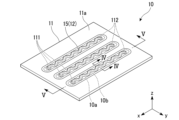
- FIG. 1 is a perspective view of a laminate 10 of the present embodiment.
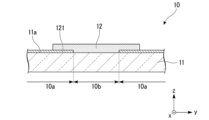
- FIG. 2 is a cross-sectional view taken along line II-II in FIG.
- FIG. 3 is a schematic perspective view of the laminate 10.
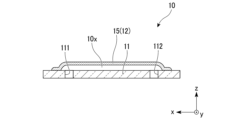
- FIG. 4 is a cross-sectional view taken along line IV-IV in FIG.
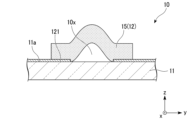
- FIG. 5 is a cross-sectional view of the flow channel device 1 taken along line VV in FIG.
- FIG. 6 is a process diagram illustrating a method for producing a laminate.
- FIG. 7 is a process diagram illustrating a method for manufacturing a laminate.
- FIG. 8 is a process diagram illustrating a method for manufacturing a laminate.
- FIG. 9 is a process diagram illustrating a method for manufacturing a laminate.
- an xyz Cartesian coordinate system is set, and the positional relationship of each component is explained with reference to this xyz Cartesian coordinate system.
- a specific direction in a horizontal plane is the x-axis direction
- a direction perpendicular to the x-axis direction in the horizontal plane is the y-axis direction
- a direction perpendicular to both the x-axis and y-axis directions is the z-axis direction.
- up refers to the +z direction, which is vertically upward
- down refers to the -z direction, which is vertically downward.
- planar view refers to viewing an object vertically from above (+z side) downward (-z direction).
- ⁇ Laminate> 1 is a perspective view of a laminate 10 of the present embodiment.
- the laminate 10 has a base material 11 and a gel layer 12.
- the substrate 11 supports the gel layer 12.
- the rigidity of the substrate 11 is different from the rigidity of the gel layer 12.
- the rigidity of the substrate 11 is higher than the rigidity of the gel layer 12.
- the substrate 11 may or may not be optically transparent.
- Examples of the organic material from which the substrate 11 is formed include polymeric materials and elastomers.
- Examples of polymeric materials include thermoplastic resins such as polyvinyl chloride, polystyrene, ABS resin, and polylactic acid, and thermosetting resins such as polyimide and phenolic resin.
- Examples of elastomers include polysilicone and synthetic rubber.
- the substrate 11 may be subjected to various processing on at least one of the surface and the interior by known microfabrication techniques.
- the substrate 11 may have irregularities or grooves on the surface.
- the substrate 11 also has first through holes 111 and second through holes 112 that penetrate in the thickness direction (z-axis direction) of the substrate 11.
- the substrate 11 is shown as having three first through holes 111 and three second through holes 112.
- the number of first through holes 111 and second through holes 112 is not limited to this as long as the number of first through holes 111 and second through holes 112 is the same, and they may be one each or a number other than three.
- the first through holes 111 are arranged at equal intervals in the y direction on the +x side of the substrate 11.
- the second through holes 112 are arranged at equal intervals in the y direction on the -x side of the substrate 11.
- the gel layer 12 is made of hydrogel and is provided on one surface 11a of the substrate 11.
- the gel layer 12 is provided so as to overlap a pair of a first through hole 111 and a second through hole 112 aligned in the x-axis direction, and one surface 11a of the substrate 11 is exposed around the gel layer 12. That is, in the laminate 10, the gel layer 12 is formed in three strips extending in the x-axis direction.
- the polymeric materials that make up hydrogels include water-soluble polymers such as polyacrylamide and polyvinyl alcohol, polysaccharides such as chitosan and alginic acid, and proteins such as collagen and albumin. These materials have a three-dimensional mesh structure and swell when most of their volume contains a solvent. The most common solvent that causes the polymeric materials that make up hydrogels to swell is water.
- the material forming the gel layer 12 may be a stimuli-responsive gel whose degree of swelling can be adjusted in response to an external stimulus.
- thermoresponsive gels include gels made of poly(N-isopropylacrylamide) and poly(methyl vinyl ether).
- Photothermal conversion materials metal nanomaterials, carbon nanomaterials, conductive polymers, etc.
- the heat generated by light irradiation can be used as a trigger to cause the gel to respond to stimuli.
- pH-responsive gel An example of a gel that responds to pH (pH-responsive gel) is a gel made of a polyelectrolyte synthesized from anionic or cationic monomers.
- Photoresponsive gels include gels made of polymers with spiropyran or azobenzene in the skeleton. Photoresponsive gels may incorporate a mechanism in which the degree of swelling changes in response to light stimulation, with an inclusion complex of azobenzene and cyclodextrin as the crosslinking point.
- gel layer 12 Other materials for forming the gel layer 12 include molecular imprinted gels in which specific molecules bound to the hydrogel skeleton serve as crosslinking points in the gel network.
- molecular imprinted gels in which specific molecules bound to the hydrogel skeleton serve as crosslinking points in the gel network.
- protein-responsive gels include biomolecule crosslinked gels in which biomolecule complexes serve as crosslinking points in the gel network, and antigen-responsive gels in which antigen-antibody complexes are introduced into the network as crosslinking points in the gel.
- the material forming the gel layer 12 may be a mixture of multiple polymeric materials to form a hydrogel that responds to multiple stimuli. Furthermore, tough hydrogels such as double network gel, slide-ring gel, Tetra-PEG gel, and nanoclay gel may also be used as the material forming the gel layer 12.
- the polymeric material that constitutes the hydrogel is an acrylic polymeric material
- the acrylic groups may be crosslinked when the acrylic monomer is polymerized to form a three-dimensional network structure.
- the type of polymerization reaction when polymerizing acrylic monomers is not particularly limited, but an example is radical polymerization using a water-soluble photopolymerization initiator.
- water-soluble photoinitiators include 2-oxoglutaric acid, 4'-(2-hydroxyethoxy)-2-hydroxy-2-methylpropiophenone (product name: Irgacure 2959), lithium phenyl(2,4,6-trimethylbenzoyl)phosphinate (abbreviation: LAP), and 2,2'-azobis[2-methyl-N-(2-hydroxyethyl)propionamide] (product name: VA-086).
- a deoxidizer may be added to the reaction system to prevent polymerization inhibition by oxygen.
- An example of the deoxidizer is a combination of glucose and glucose oxidase. Radical polymerization may also be carried out under an inert gas atmosphere such as nitrogen or argon.
- the three-dimensional mesh structure may be formed by physical bonding of the polysaccharide or protein, or the three-dimensional mesh structure may be formed by crosslinking the polysaccharide or protein using a crosslinking agent.
- a crosslinking agent is glutaraldehyde.
- the shape of the gel layer 12 is not particularly limited, and various shapes can be selected according to the mode of use.
- the gel layer 12 may be in the form of a film, a plate, a block, etc.
- the shape of the gel layer 12 is preferably in the form of a film.
- the thickness of the gel layer 12 is not particularly limited, but it is preferable that the thickness exhibits a degree of structural strength that does not collapse under its own weight.
- the thickness of the gel layer 12 is preferably 50 ⁇ m to 1000 ⁇ m, and more preferably 120 ⁇ m to 200 ⁇ m.
- the strength of the gel layer 12 can be improved by increasing the crosslinking of the polymeric material that makes up the hydrogel through chemical or physical crosslinking, or by increasing the concentration of the polymeric material that makes up the hydrogel.
- the monomer concentration is preferably 0.8 mol/L to 8 mol/L, and more preferably 2 mol/L to 4 mol/L.
- the crosslinking agent concentration is preferably 0.01 mol% to 2.0 mol% relative to the monomer, and more preferably 0.03 mol% to 1 mol%.
- Hydrogels can contain various additives. There are no particular limitations on the type of additive as long as it does not inhibit hydrogel formation. Examples of additives include biomolecules that improve biocompatibility, silver nanoparticles and surfactants that exhibit antibacterial properties, ionic liquids and conductive polymers that increase conductivity, and magnetic nanoparticles that react to magnetic fields. By adding these additives to hydrogels, it is possible to impart any desired function to the hydrogel.
- FIG. 2 is a cross-sectional view taken along line II-II in Fig. 1.
- an adhesive region 10a where the substrate 11 and the gel layer 12 are adhesively bonded to each other and a non-adhesive region 10b where the substrate 11 and the gel layer 12 are not adhesively bonded to each other are formed at the interface between the substrate 11 and the gel layer 12.
- the non-bonded region 10b is formed in a band shape extending in the x-axis direction and is surrounded by the bonded region 10a in a closed ring shape in a plan view.
- the shape of the non-bonded region 10b is an example, and various shapes can be used depending on the design.
- a layer 121 of a silane coupling agent having an adhesive functional group is formed in the adhesive region 10a.
- the "adhesive functional group” refers to a functional group that can polymerize with a monomer (precursor) of the polymeric material that constitutes the hydrogel described above.
- the gel layer 12 is bonded to the adhesive functional group of layer 121.
- an acrylic monomer is used as the monomer
- an example of the adhesive functional group is a (meth)acrylic group.
- 3-(methacryloyloxy)propyltrimethoxysilane can be used as the silane coupling agent.
- first through hole 111 and the second through hole 112 each open into the non-adhesive region 10b.
- Figures 3 to 5 show the state in which the gel layer 12 of the laminate 10 has been swollen.
- Figure 3 is a schematic perspective view of the laminate 10, and corresponds to Figure 1.
- Figure 4 is a cross-sectional view taken along line IV-IV in Figure 3, and corresponds to Figure 2.
- Figure 5 is a cross-sectional view of the flow path device 1 taken along line V-V in Figure 3.
- the swollen gel layer is designated by the reference symbol 15.
- the gel layer 15 is not fixed to the substrate 11 in the non-adhesive region 10b.
- the gel layer 15 is fixed to the substrate 11 in the adhesive region 10a. Therefore, the portion of the gel layer 15 that overlaps with the non-adhesive region 10b in a planar manner can freely increase in volume in the extension direction of the non-adhesive region 10b and in a direction away from the substrate 11 when the volume increases due to swelling.
- the portion of the gel layer 15 that overlaps with the non-adhesive region 10b in a planar manner is restricted from increasing in volume in a direction intersecting the extension direction of the non-adhesive region 10b.
- the portion of the gel layer 15 that overlaps with the non-bonded region 10b in plan view swells and deforms significantly in the direction away from the substrate 11 in order to mitigate the increase in internal pressure caused by the increase in volume.
- the shape of the flow path 10x can be controlled by controlling the pattern shapes of the adhesive region 10a and the non-adhesive region 10b.
- the shape of the flow path 10x can be controlled by adjusting the type of gel layer 15, the rigidity modulus of the gel layer 15, the thickness of the gel layer 15, etc.
- the rigidity modulus of the gel layer 15 and the swelling rate of the gel layer 15 can be controlled by changing the type of monomer of the polymer material that constitutes the gel layer 15, the type and amount of the crosslinking agent used, etc.
- the shape of flow path 10x can be controlled by controlling the swelling rate of the gel layer.
- the swelling rate of the gel layer can be controlled by contacting the gel layer with water to cause it to swell, or by drying the gel layer, or by other methods.
- the laminate 10 configured as described above can provide a new device that is easy to handle and less susceptible to breakage.
- FIGS. 6 to 9 are process diagrams illustrating the method for producing a laminate.
- Figures 6 to 8 are explanatory diagrams of the "step of forming a pattern" of the present invention
- Figure 9 is an explanatory diagram of the "step of applying a precursor solution” and the “step of polymerizing the precursor” of the present invention.
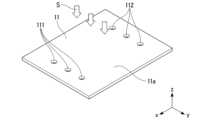
- one surface of the substrate 11 is treated with a silane coupling agent S to form a layer of the silane coupling agent (surface treatment layer) on the surface 11a (step of forming the surface treatment layer).
- the substrate 11 has a number of first through holes 111 (three in the figure) that penetrate the substrate 11 in the thickness direction, and the same number of second through holes 112 as the first through holes 111.
- the silane coupling agent used is one having an adhesive functional group.
- adhesive functional group refers to a functional group that can polymerize with the monomer (precursor) of the polymeric material that constitutes the hydrogel described above.
- an acrylic monomer is used as the monomer
- an example of the adhesive functional group is a (meth)acrylic group.
- 3-(methacryloyloxy)propyltrimethoxysilane can be used as the silane coupling agent.
- the surface treatment layer that is formed is a monolayer of a silane coupling agent.
- the surface treatment layer introduces adhesive functional groups to one surface 11a of the substrate 11.
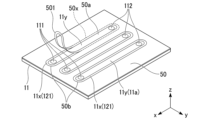
- a mask film 50 having a first opening 50a is attached to the surface treatment layer of the first surface 11a (attaching process).
- the mask film 50 has the same number of first openings 50a as the first through holes 111.
- the first openings 50a are strip-shaped extending in the x-axis direction and are formed in three locations.
- the mask film 50 has a cut line 50x formed in a ring shape along the first openings 50a.
- the mask film 50 is attached while exposing the first through holes 111 and the second through holes 112 from each of the first openings 50a.
- One surface of the substrate 11, more specifically, the surface treatment layer provided on one surface, is exposed from the first openings 50a.
- the mask film 50 can be made of, for example, a well-known backgrind tape.
- the surface treatment layer exposed from the first opening 50a is removed (removal process). Specifically, oxygen plasma treatment is performed using oxygen plasma O on one side of the base material exposed to the first opening 50a through the mask film 50 (surface treatment layer). This removes the surface treatment layer (silane coupling agent) exposed to the first opening 50a.
- Other methods for removing the surface treatment layer include ashing using ozone decomposed by ultraviolet light, and vapor-phase etching of glass using a fluorine-based gas.
- a portion 501 of the mask film 50 is removed in a ring shape along the first opening 50a to form a second opening 50b in the mask film 50 (step of forming the second opening).
- the portion 501 of the mask film 50 is formed by cutting the mask film 50 along the cut line 50x.
- the area exposed from the second opening 50b is formed with two types of areas: a first area 11x where the portion 501 of the mask film 50 overlapped, and a second area 11y where the surface treatment layer has been removed.
- the surface treatment layer remains in the first area 11x.
- the surface treatment layer remaining in the first area 11x corresponds to the layer 121 described above.
- an easily removable tape (not shown) is applied to the bottom surface of the substrate 11 (the surface opposite to the surface 11a) to block the first through-hole 111 and the second through-hole 112, and then a monomer solution of the polymeric material that constitutes the hydrogel is dripped onto the area exposed from the second opening 50b (process of applying the precursor solution).
- the monomer solution corresponds to the precursor solution in the present invention.
- the monomer solution contains monomers of the polymeric material that constitutes the hydrogel described above, a photopolymerization initiator, and, if necessary, an organic solvent.
- the monomer used has a functional group that can polymerize with the adhesive functional group contained in layer 121.
- an acrylic monomer having an acrylic group can be used as the monomer contained in monomer solution 20A.
- Organic solvents that may be included in the monomer solution include dimethyl sulfoxide (DMSO), dimethylformamide (DMF), dimethylacetamide (DMA), and ethylene carbonate (EC).
- DMSO dimethyl sulfoxide
- DMF dimethylformamide
- DMA dimethylacetamide
- EC ethylene carbonate
- a glass substrate (not shown) is placed over the mask film 50. This causes excess monomer solution to be discharged from the substrate 11, leaving the monomer solution only in the space surrounded by the substrate 11, the mask film 50, and the glass substrate.
- the monomer solution is irradiated with ultraviolet light to polymerize the precursor (precursor polymerizing process).
- the peak wavelength of the irradiated ultraviolet light is included in the absorption wavelength band of the photopolymerization initiator contained in the monomer solution.
- the peak wavelength of the ultraviolet light is, for example, 365 nm.
- the monomers contained in the monomer solution are polymerized to obtain a polymeric material.
- the functional groups of the monomers polymerize with the adhesive functional groups of the silane coupling agent in the first region 11x (layer 121), and the monomer solution overlapping the layer 121 adheres to one surface 11a of the substrate 11.
- the second region 11y of the substrate 11 where the layer 121 is not formed polymerization occurs between the monomers contained in the monomer solution without bonding to the substrate 11.
- the gel layer 12 is formed so as to overlap the second opening 50b.
- the thickness of the gel layer 12 is the same as the gap between the base material 11 and the glass substrate, that is, the same as the thickness of the mask film 50. If necessary, the mask film 50 may be peeled off (a step of removing the mask film).
- the polymer of the monomer solution is immersed in a large excess of pure water to remove unreacted monomers and to cause the polymer material produced by polymerization to swell with water. This results in a gel layer 15 in which the polymer material is swollen with water.
- the portion of the gel layer 15 that overlaps with the layer 121 becomes the adhesion region 10a, and the portion of the gel layer 15 that does not overlap with the layer 121 becomes the non-adhesion region 10b.
- the portion of the gel layer 15 that overlaps with the non-adhesion region 10b of the hydrogel layer deforms depending on the swelling degree, and the flow path 10x is formed. In this manner, the laminate 10 is obtained.
- the laminate 10 configured as described above can provide a new device that is easy to handle and less susceptible to breakage.
- the above-mentioned laminate manufacturing method makes it possible to easily manufacture the laminate.
Landscapes
- Laminated Bodies (AREA)
Priority Applications (2)
| Application Number | Priority Date | Filing Date | Title |
|---|---|---|---|
| PCT/JP2023/015453 WO2024218855A1 (ja) | 2023-04-18 | 2023-04-18 | 積層体の製造方法及び積層体 |
| JP2025514920A JPWO2024218855A1 (https=) | 2023-04-18 | 2023-04-18 |
Applications Claiming Priority (1)
| Application Number | Priority Date | Filing Date | Title |
|---|---|---|---|
| PCT/JP2023/015453 WO2024218855A1 (ja) | 2023-04-18 | 2023-04-18 | 積層体の製造方法及び積層体 |
Publications (1)
| Publication Number | Publication Date |
|---|---|
| WO2024218855A1 true WO2024218855A1 (ja) | 2024-10-24 |
Family
ID=93152116
Family Applications (1)
| Application Number | Title | Priority Date | Filing Date |
|---|---|---|---|
| PCT/JP2023/015453 Ceased WO2024218855A1 (ja) | 2023-04-18 | 2023-04-18 | 積層体の製造方法及び積層体 |
Country Status (2)
| Country | Link |
|---|---|
| JP (1) | JPWO2024218855A1 (https=) |
| WO (1) | WO2024218855A1 (https=) |
Citations (8)
| Publication number | Priority date | Publication date | Assignee | Title |
|---|---|---|---|---|
| US20030006143A1 (en) * | 2001-06-21 | 2003-01-09 | Sukanta Banerjee | Directed assembly of functional heterostructures |
| JP2007170469A (ja) * | 2005-12-20 | 2007-07-05 | Kawamura Inst Of Chem Res | 温度応答性バルブおよびその製造方法 |
| JP2015511181A (ja) * | 2012-02-24 | 2015-04-16 | フォンズ エスピシ ジョルジュ シャルパクFonds Espci Georges Charpak | 開放及び/または閉鎖及び/またはポンプ装置を有するマイクロチャネル |
| JP2018130676A (ja) * | 2017-02-15 | 2018-08-23 | 国立大学法人豊橋技術科学大学 | 貫通孔と流路を一体化したマイクロ流体輸送構造体およびその製造方法 |
| JP2018148918A (ja) * | 2015-04-17 | 2018-09-27 | 国立研究開発法人産業技術総合研究所 | 架橋ポリマー構造体及びその使用 |
| WO2020080113A1 (ja) * | 2018-10-18 | 2020-04-23 | 日本電信電話株式会社 | 積層体、積層体の製造方法および形状制御デバイス |
| CN111061009A (zh) * | 2019-12-30 | 2020-04-24 | 腾讯科技(深圳)有限公司 | 悬空光波导及其制备方法 |
| WO2021079399A1 (ja) * | 2019-10-21 | 2021-04-29 | 日本電信電話株式会社 | ハイドロゲル流体デバイス、ハイドロゲル流体デバイスの製造方法 |
-
2023
- 2023-04-18 WO PCT/JP2023/015453 patent/WO2024218855A1/ja not_active Ceased
- 2023-04-18 JP JP2025514920A patent/JPWO2024218855A1/ja active Pending
Patent Citations (8)
| Publication number | Priority date | Publication date | Assignee | Title |
|---|---|---|---|---|
| US20030006143A1 (en) * | 2001-06-21 | 2003-01-09 | Sukanta Banerjee | Directed assembly of functional heterostructures |
| JP2007170469A (ja) * | 2005-12-20 | 2007-07-05 | Kawamura Inst Of Chem Res | 温度応答性バルブおよびその製造方法 |
| JP2015511181A (ja) * | 2012-02-24 | 2015-04-16 | フォンズ エスピシ ジョルジュ シャルパクFonds Espci Georges Charpak | 開放及び/または閉鎖及び/またはポンプ装置を有するマイクロチャネル |
| JP2018148918A (ja) * | 2015-04-17 | 2018-09-27 | 国立研究開発法人産業技術総合研究所 | 架橋ポリマー構造体及びその使用 |
| JP2018130676A (ja) * | 2017-02-15 | 2018-08-23 | 国立大学法人豊橋技術科学大学 | 貫通孔と流路を一体化したマイクロ流体輸送構造体およびその製造方法 |
| WO2020080113A1 (ja) * | 2018-10-18 | 2020-04-23 | 日本電信電話株式会社 | 積層体、積層体の製造方法および形状制御デバイス |
| WO2021079399A1 (ja) * | 2019-10-21 | 2021-04-29 | 日本電信電話株式会社 | ハイドロゲル流体デバイス、ハイドロゲル流体デバイスの製造方法 |
| CN111061009A (zh) * | 2019-12-30 | 2020-04-24 | 腾讯科技(深圳)有限公司 | 悬空光波导及其制备方法 |
Non-Patent Citations (1)
| Title |
|---|
| TAKAHASHI RIKU, MIYAZAKO HIROKI, TANAKA AYA, UENO YUKO: "Dynamic Creation of 3D Hydrogel Architectures via Selective Swelling Programmed by Interfacial Bonding", APPLIED MATERIALS & INTERFACES, vol. 11, no. 31, 7 August 2019 (2019-08-07), US , pages 28267 - 28277, XP055813349, ISSN: 1944-8244, DOI: 10.1021/acsami.9b05552 * |
Also Published As
| Publication number | Publication date |
|---|---|
| JPWO2024218855A1 (https=) | 2024-10-24 |
Similar Documents
| Publication | Publication Date | Title |
|---|---|---|
| US12036747B2 (en) | Laminate, method for manufacturing laminate, and shape control device | |
| JP7208569B2 (ja) | ハイドロゲル流体デバイス、ハイドロゲル流体デバイスの製造方法 | |
| Yan et al. | Translating surface-initiated atom transfer radical polymerization into technology: The mechanism of Cu0-mediated si-atrp under environmental conditions | |
| Benetti et al. | Modulation of surface-initiated ATRP by confinement: Mechanism and applications | |
| WO2005023921A1 (ja) | 機能性膜の連続製造方法 | |
| Maza et al. | Layer-by-layer assembled microgels can combine conflicting properties: switchable stiffness and wettability without affecting permeability | |
| WO2006064810A1 (ja) | 有機無機複合ヒドロゲルの製造方法、有機無機複合ヒドロゲルからなる細胞培養基材、及び有機無機複合ヒドロゲルの乾燥体からなる防曇材料 | |
| WO2024218855A1 (ja) | 積層体の製造方法及び積層体 | |
| JP2011144236A (ja) | 有機無機複合体分散液及びその製造方法 | |
| WO2024218854A1 (ja) | 流路デバイス | |
| JP4255297B2 (ja) | マイクロ化学プロセス用基材及びその製造方法 | |
| EP3536402A1 (de) | Probenkammer | |
| JP7783531B2 (ja) | センサー付きハイドロゲル流路型デバイス | |
| JP7717316B2 (ja) | ハイドロゲル流体デバイスおよびハイドロゲル流体デバイスの製造方法 | |
| JP6721881B2 (ja) | 細胞足場材料、細胞モデル、及び細胞足場材料の製造方法 | |
| JPH06228215A (ja) | 感温性多孔質重合体の製造方法 | |
| JP2025090146A (ja) | 細胞培養デバイス | |
| Nakayama et al. | Novel surface fixation technology of hydrogel based on photochemical method: Heparin‐immobilized hydrogelated surface | |
| JP2025090148A (ja) | 細胞培養デバイス | |
| WO2023119467A1 (ja) | 運動素子 | |
| JP2025090147A (ja) | 細胞培養デバイス | |
| JP2025090145A (ja) | 細胞培養デバイス | |
| WO2024257256A1 (ja) | 流路デバイス | |
| JP4530351B2 (ja) | 防曇性積層体及びその製造方法 | |
| JPH06228216A (ja) | pH応答性多孔質重合体の製造方法 |
Legal Events
| Date | Code | Title | Description |
|---|---|---|---|
| 121 | Ep: the epo has been informed by wipo that ep was designated in this application |
Ref document number: 23934001 Country of ref document: EP Kind code of ref document: A1 |
|
| ENP | Entry into the national phase |
Ref document number: 2025514920 Country of ref document: JP Kind code of ref document: A |
|
| WWE | Wipo information: entry into national phase |
Ref document number: 2025514920 Country of ref document: JP |
|
| NENP | Non-entry into the national phase |
Ref country code: DE |
|
| 122 | Ep: pct application non-entry in european phase |
Ref document number: 23934001 Country of ref document: EP Kind code of ref document: A1 |