WO2024210028A1 - 振動発生装置 - Google Patents
振動発生装置 Download PDFInfo
- Publication number
- WO2024210028A1 WO2024210028A1 PCT/JP2024/012546 JP2024012546W WO2024210028A1 WO 2024210028 A1 WO2024210028 A1 WO 2024210028A1 JP 2024012546 W JP2024012546 W JP 2024012546W WO 2024210028 A1 WO2024210028 A1 WO 2024210028A1
- Authority
- WO
- WIPO (PCT)
- Prior art keywords
- magnet
- core material
- generating device
- vibration generator
- vibration generating
- Prior art date
- Legal status (The legal status is an assumption and is not a legal conclusion. Google has not performed a legal analysis and makes no representation as to the accuracy of the status listed.)
- Ceased
Links
Images





Classifications
-
- B—PERFORMING OPERATIONS; TRANSPORTING
- B06—GENERATING OR TRANSMITTING MECHANICAL VIBRATIONS IN GENERAL
- B06B—METHODS OR APPARATUS FOR GENERATING OR TRANSMITTING MECHANICAL VIBRATIONS OF INFRASONIC, SONIC, OR ULTRASONIC FREQUENCY, e.g. FOR PERFORMING MECHANICAL WORK IN GENERAL
- B06B1/00—Methods or apparatus for generating mechanical vibrations of infrasonic, sonic, or ultrasonic frequency
- B06B1/02—Methods or apparatus for generating mechanical vibrations of infrasonic, sonic, or ultrasonic frequency making use of electrical energy
- B06B1/04—Methods or apparatus for generating mechanical vibrations of infrasonic, sonic, or ultrasonic frequency making use of electrical energy operating with electromagnetism
Definitions
- the present invention relates to a vibration generating device that applies vibrations to a holder.
- Patent document 1 describes a linear actuator.
- the linear actuator in patent document 1 includes a permanent magnet, a sleeve, and a case member.
- the sleeve is cylindrical and is housed in a larger cylindrical case member.
- the sleeve is supported so that it can vibrate relative to the case member.
- the permanent magnet is housed within the sleeve.
- the permanent magnet is fixed relative to the sleeve so that its position within the sleeve does not change.
- the object of the present invention is therefore to provide a vibration generating device with a structure that prevents damage caused by external impact.
- the vibration generating device of the present invention comprises a cylindrical exterior body, and a vibrating body that is disposed inside the exterior body so as to be capable of vibrating relative to the exterior body and has a magnet and a core material.
- the vibrating body comprises a magnet, a core material, and a cushioning material.
- the magnet is tubular with a central opening.
- the core material is columnar and passes through the central opening of the magnet.
- the cushioning material is more easily deformed than the magnet and the core material, and is disposed between the core material and the magnet.
- This invention makes it possible to prevent damage caused by external impacts.
- FIG. 1 is a perspective view of the appearance of a vibration generator according to a first preferred embodiment of the present invention.
- FIG. 2A is a side cross-sectional view of the electromagnetic exciter according to the first preferred embodiment
- FIG. 2B is a cross-sectional view of the electromagnetic exciter according to the first preferred embodiment.
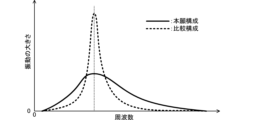
- FIG. 3 is a graph showing an example of frequency characteristics of the vibration magnitude.
- FIG. 4 is a side cross-sectional view of a vibration generator according to the second preferred embodiment.
- FIG. 5 is a side cross-sectional view of a vibration generator according to the third preferred embodiment.
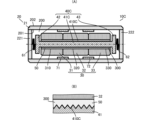
- FIG. 6A is a side cross-sectional view of a vibration generator according to a fourth preferred embodiment of the present invention, and FIG.
- FIG. 6B is an enlarged view of a portion of FIG. 6A.
- FIG. 7A is a side cross-sectional view of a vibration generator according to a fifth preferred embodiment of the present invention, and FIG. 7B is an enlarged view of a portion of FIG. 7A.
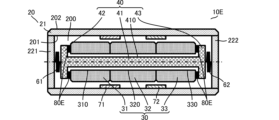
- FIG. 8 is a side cross-sectional view of a vibration generator according to the sixth preferred embodiment.
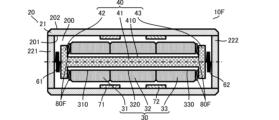
- FIG. 9 is a side cross-sectional view of a vibration generator according to the seventh preferred embodiment.
- FIG. 1 is an external perspective view of the vibration generator according to the first embodiment.
- Fig. 2(A) is a side cross-sectional view of the vibration generator according to the first embodiment
- Fig. 2(B) is a cross-sectional view of the vibration generator according to the first embodiment.
- Fig. 2(A) is a cross-sectional view of a plane parallel to the axial direction of the vibration generator
- Fig. 2(B) is a cross-sectional view of the vibration generator viewed from a plane perpendicular to the axial direction at approximately the center in the axial direction.
- the vibration generating device 10 includes an exterior body 20, a magnet 30, a core material 40, a cushioning material 50, a support 61, a support 62, a coil 71, and a coil 72.
- the magnet 30, the core material 40, and the cushioning material 50 form a vibrating body.
- the exterior body 20 comprises a tube 21, a lid 221, and a lid 222.
- the tube 21 is cylindrical.
- the tube 21 has an inner wall surface 201 and an outer wall surface 202.
- the lid 221 is disposed at one open end of the tube 21, and the lid 222 is disposed at the other open end.
- the exterior body 20 has an internal space 200 that is sealed from the outside.
- the exterior body 20 is made of, for example, insulating resin. Although not shown, a shielding member is disposed on the exterior body 20. The shielding member is disposed along the coils 71 and 72 described below.
- the magnet 30 comprises a plurality of individual magnets 31, 32, 33.
- Each of the plurality of individual magnets 31, 32, 33 is a permanent magnet.
- the plurality of individual magnets 31, 32, 33 are arranged at a distance from each other along the axial direction of the exterior body 20 (axial direction of the cylindrical body 21).
- the plurality of individual magnets 31, 32, 33 are arranged so that adjacent individual magnets have the same pole.
- the plurality of individual magnets 31, 32, 33 are arranged in the internal space 200 of the exterior body 20, and arranged at a distance from the inner wall surface 201 of the cylindrical body 21.
- the multiple individual magnets 31, 32, and 33 have a predetermined weight and function as a mass load for generating vibrations in the vibration generating device 10.
- the multiple individual magnets 31, 32, 33 are tubular with a central opening 300.
- the axial direction of the tube of the multiple individual magnets 31, 32, 33 and the axial direction of the exterior body 20 are approximately parallel.
- the core material 40 includes a main body 41, an end member 42, and an end member 43.
- the core material 40 is, for example, a metal.
- the core material 40 has a predetermined weight and may function as a mass load for generating vibrations in the vibration generating device 10.
- the main body 41 is rod-shaped.
- the end members 42 and 43 are disks.
- the end member 42 is connected to one end of the main body 41 in the extension direction. More specifically, the approximate center of the circular flat surface of the end member 42 is connected to one end of the main body 41 in the extension direction.
- the end member 43 is connected to the other end of the main body 41 in the extension direction. More specifically, the approximate center of the circular flat surface of the end member 43 is connected to the other end of the main body 41 in the extension direction.
- the core material 40 is placed in the internal space 200 of the exterior body 20 so that the direction in which the rod-like extension (the axial direction of the core material 40) is approximately parallel to the axial direction of the exterior body 20.
- the core material 40 is arranged so that the main body 41 passes through the central opening 300 of the multiple individual magnets 31, 32, and 33. At this time, the peripheral surface 410 of the main body 41 is spaced apart from the inner peripheral surface 310 of the individual magnet 31, the inner peripheral surface 320 of the individual magnet 32, and the inner peripheral surface 330 of the individual magnet 33.
- the cushioning material 50 is a viscous material.
- the cushioning material 50 is, for example, a gel.
- the cushioning material 50 is not limited to a gel, and may be any material that is more easily deformed than the magnet 30 and the core material 40.
- the cushioning material 50 is disposed between the inner circumferential surface 310 of the individual magnet 31, the inner circumferential surface 320 of the individual magnet 32, and the inner circumferential surface 330 of the individual magnet 33, and the peripheral surface 410 of the main body 41 of the core material 40.
- the cushioning material 50 is filled between the inner circumferential surface 310 of the individual magnet 31, the inner circumferential surface 320 of the individual magnet 32, and the inner circumferential surface 330 of the individual magnet 33, and the peripheral surface 410 of the main body 41 of the core material 40, and is adhered to the inner circumferential surface 310 of the individual magnet 31, the inner circumferential surface 320 of the individual magnet 32, and the inner circumferential surface 330 of the individual magnet 33, and the peripheral surface 410 of the main body 41 of the core material 40.
- the support 61 and the support 62 are elastic members.
- the support 61 is disposed between the lid 221 of the exterior body 20 and the end member 42 of the core material 40.
- the support 61 is connected to the lid 221 and the end member 42.
- the support 62 is disposed between the lid 222 of the exterior body 20 and the end member 43 of the core material 40.
- the support 62 is connected to the lid 222 and the end member 43.
- the vibrating body which is composed of magnet 30, core material 40, and cushioning material 50, is supported by supports 61 and 62 so that it can vibrate relative to exterior body 20. More specifically, the vibrating body is supported by supports 61 and 62 on exterior body 20 so that it vibrates along the axial direction of exterior body 20.
- Coil 71 and coil 72 are arranged on the inner wall surface 201 of the cylindrical body 21 in the exterior body 20.
- Coil 71 is arranged along the location, including the location where individual magnet 31 and individual magnet 32 are adjacent in the axial direction of the exterior body 20.
- Coil 72 is arranged along the location, including the location where individual magnet 32 and individual magnet 33 are adjacent in the axial direction of the exterior body 20.
- an alternating magnetic field is generated by applying an AC signal to coils 71 and 72.
- the alternating magnetic field acts on the multiple individual magnets 31, 32, and 33, causing the vibrator to vibrate in the axial direction.
- the vibration of the vibrator is transmitted to exterior body 20 through supports 61 and 62, and the vibration can be provided to a user who is touching exterior body 20.
- the cushioning material 50 is disposed between the multiple individual magnets 31, 32, 33 and the core material 40. As a result, even if a large impact is applied, such as when the vibration generator 10 is dropped, and an acting impact force is generated from the magnet 30 (multiple individual magnets 31, 32, 33), which is a mass load, this is mitigated by the cushioning material 50. This suppresses the impact applied to the core material 40, and prevents damage to the vibration generator 10.
- the damping effect here means suppressing the increase in vibrations of a specific frequency, and obtaining a predetermined vibration over a wide frequency band.
- Figure 3 is a graph showing an example of the frequency characteristics of the vibration magnitude.
- the solid line shows the characteristics of the configuration of the present application
- the dotted line shows the characteristics of a comparative configuration.
- the comparative configuration is a configuration in which a magnet is fixed to a core material without the cushioning material 50 of the configuration of the present application.
- the configuration of the present application can generate vibrations with a wider frequency band and flatter frequency characteristics compared to a vibrating body alone.
- Fig. 4 is a side cross-sectional view of the vibration generator according to the second embodiment.
- the vibration generator 10A according to the second embodiment differs from the vibration generator 10 according to the first embodiment in the cushioning material 50A.
- the other configuration of the vibration generator 10A is the same as that of the vibration generator 10, and a description of the similar parts will be omitted.
- the cushioning material 50A is disposed between the side of the end member 42 of the core material 40 and the end face of the individual magnet 31, and between the side of the end member 43 of the core material 40 and the end face of the individual magnet 32.
- the cushioning material 50A is adhered to the side of the end member 42 of the core material 40 and the end face of the individual magnet 31, and is adhered to the side of the end member 42 of the core material 40 and the end face of the individual magnet 31.
- the vibration generator 10A can absorb large shocks in the axial direction of the vibrator using the cushioning material 50A. This reduces a wider variety of shocks that can be applied to the core material 40, further reducing damage to the vibration generator 10A.
- FIG. 5 is a side cross-sectional view of the vibration generator according to the third embodiment.
- the vibration generator 10B according to the third embodiment differs from the vibration generator 10 according to the first embodiment in the magnet 30B and the cushioning material 50B.
- the other configuration of the vibration generator 10B is the same as that of the vibration generator 10, and a description of the similar parts will be omitted.
- Magnet 30B comprises multiple individual magnets 31, 32, and 33.
- the multiple individual magnets 31, 32, and 33 are spaced apart from each other in the arrangement direction.
- Cushioning material 50B is placed between individual magnets 31 and 32, and between individual magnets 32 and 33. The portion of cushioning material 50B placed between individual magnets 31 and 32 is adhered to the opposing surfaces of individual magnets 31 and 32. The portion of cushioning material 50B placed between individual magnets 32 and 33 is adhered to the opposing surfaces of individual magnets 32 and 33.
- the vibration generator 10B can prevent collisions between the individual magnets caused by large impacts in the axial direction of the vibrating body by the cushioning material 50B. Therefore, damage to the vibration generator 10B is further suppressed.
- FIG. 6(A) is a side cross-sectional view of the vibration generator according to the fourth embodiment
- Fig. 6(B) is an enlarged view of a part of Fig. 6(A).
- the vibration generator 10C according to the fourth embodiment differs from the vibration generator 10 according to the first embodiment in the core material 40C.
- the other configuration of the vibration generator 10C is the same as that of the vibration generator 10, and a description of similar parts will be omitted.
- the core material 40C has a main body 41C.
- the peripheral surface 410C of the main body 41C has an uneven shape.
- the cushioning material 50 is adhered to the uneven peripheral surface 410C.
- This configuration improves the adhesive strength between the cushioning material 50 and the main body 41C of the core material 40C. This makes it less likely for the cushioning material 50 and the main body 41C to peel off due to a large impact, and the vibration generator 10C can achieve a more reliable cushioning effect.
- FIG. 7(A) is a side cross-sectional view of the vibration generator according to the fifth embodiment
- Fig. 7(B) is an enlarged view of a part of Fig. 7(A).
- the vibration generator 10D according to the fifth embodiment differs from the vibration generator 10C according to the fourth embodiment in the shape of the multiple individual magnets 31, 32, and 33.
- the other configuration of the vibration generator 10D is the same as that of the vibration generator 10C, and a description of similar parts will be omitted.
- the core material 40D has the same configuration as the core material 40C.
- the multiple individual magnets 31, 32, and 33 each have a notch ED at the edge between the adjacent side and the inner peripheral surface. This gives the inner peripheral surface of the magnet 30 made up of the multiple individual magnets 31, 32, and 33 an uneven shape.
- the cushioning material 50 is adhered to the inner peripheral surface of the magnet 30, which has an uneven shape.
- This configuration improves the adhesive strength between the cushioning material 50 and the magnet 30. This makes it less likely for the cushioning material 50 and the magnet 30 to peel off due to a large impact, and the vibration generating device 10D can achieve a more reliable cushioning effect.
- Fig. 8 is a side cross-sectional view of the vibration generator according to the sixth embodiment.
- the vibration generator 10E according to the sixth embodiment differs from the vibration generator 10 according to the first embodiment in that it uses a cushioning material 80E.
- the other configuration of the vibration generator 10E is the same as that of the vibration generator 10, and a description of similar parts will be omitted.
- the cushioning material 80E is made of, for example, a spring member.
- the cushioning material 80E is disposed between the side surface of the end member 42 of the core material 40 and the end face of the individual magnet 31, and between the side surface of the end member 43 of the core material 40 and the end face of the individual magnet 32.
- the cushioning material 80E is physically connected to the side surface of the end member 42 of the core material 40 and the end face of the individual magnet 31, and is physically connected to the side surface of the end member 42 of the core material 40 and the end face of the individual magnet 31.
- the shock absorbing material 80E reduces the impact on the core material 40, thereby preventing damage to the vibration generating device 10E.
- FIG. 9 is a side cross-sectional view of the vibration generator according to the seventh embodiment.
- the vibration generator 10F according to the seventh embodiment differs from the vibration generator 10E according to the sixth embodiment in that it uses a cushioning material 80F.
- the other configuration of the vibration generator 10F is the same as that of the vibration generator 10E, and a description of similar parts will be omitted.
- the cushioning material 80F is, for example, a leaf spring such as a washer.
- the cushioning material 80F is disposed between the side surface of the end member 42 of the core material 40 and the end face of the individual magnet 31, and between the side surface of the end member 43 of the core material 40 and the end face of the individual magnet 32.
- the cushioning material 80F is physically connected to the side surface of the end member 42 of the core material 40 and the end face of the individual magnet 31, and is physically connected to the side surface of the end member 42 of the core material 40 and the end face of the individual magnet 31.
- the shock absorbing material 80F reduces the impact on the core material 40, thereby preventing damage to the vibration generating device 10F.
- the magnet is tubular with a central opening;
- the core material is a columnar member that passes through the central opening of the magnet,
- the cushioning material is It is more easily deformed than the magnet and the core material, disposed between the core material and the magnet; Vibration generator.
- the core material is a rod-shaped main body that passes through the central opening of the magnet; end members connected to both ends of the main body, Equipped with The vibration generating device according to ⁇ 1>, wherein the buffer material is disposed between the magnet and the main body.
- the end member has a side surface facing and spaced apart from the end surface of the magnet,
- the core material is a rod-shaped main body that passes through the central opening of the magnet; an end member connected to at least one end of the main body and having a side surface facing and spaced apart from the end surface of the magnet; Equipped with The vibration generating device of ⁇ 1>, wherein the cushioning material is disposed between the end face of the magnet and the side face of the end member.
- the magnet includes a plurality of individual magnets arranged at a distance from each other along an extension direction of the core material, The vibration generating device according to any one of ⁇ 1> to ⁇ 4>, wherein the buffer material is disposed between the plurality of individual magnets.
- a vibration generating device according to any one of ⁇ 1> to ⁇ 5>, in which the surface where the core material and the cushioning material come into contact has an uneven shape.
- a vibration generating device according to any one of ⁇ 1> to ⁇ 6>, in which the surface where the magnet and the cushioning material come into contact has an uneven shape.
- a vibration generating device according to any one of ⁇ 1> to ⁇ 7>, wherein the cushioning material is a gel material.
- a vibration generating device according to any one of ⁇ 1> to ⁇ 7>, wherein the cushioning material is a spring member.
- Vibration generator 20 Exterior body 21: Cylindrical body 30, 30B: Magnets 31, 32, 33: Individual magnets 40, 40C, 40D: Core material 41, 41C: Main body 42: End member 43: End member 50, 50A, 50B, 80E, 80F: Cushioning material 61, 62: Support body 71, 72: Coil 200: Internal space 201: Inner wall surface 202: Outer wall surface 221, 222: Lid 300: Central opening 310, 320, 330: Inner peripheral surface 410, 410C: Peripheral surface ED: Notch
Landscapes
- Physics & Mathematics (AREA)
- Electromagnetism (AREA)
- Engineering & Computer Science (AREA)
- Mechanical Engineering (AREA)
- Apparatuses For Generation Of Mechanical Vibrations (AREA)
Priority Applications (1)
| Application Number | Priority Date | Filing Date | Title |
|---|---|---|---|
| JP2025512523A JPWO2024210028A1 (https=) | 2023-04-06 | 2024-03-28 |
Applications Claiming Priority (2)
| Application Number | Priority Date | Filing Date | Title |
|---|---|---|---|
| JP2023-061853 | 2023-04-06 | ||
| JP2023061853 | 2023-04-06 |
Publications (1)
| Publication Number | Publication Date |
|---|---|
| WO2024210028A1 true WO2024210028A1 (ja) | 2024-10-10 |
Family
ID=92971711
Family Applications (1)
| Application Number | Title | Priority Date | Filing Date |
|---|---|---|---|
| PCT/JP2024/012546 Ceased WO2024210028A1 (ja) | 2023-04-06 | 2024-03-28 | 振動発生装置 |
Country Status (2)
| Country | Link |
|---|---|
| JP (1) | JPWO2024210028A1 (https=) |
| WO (1) | WO2024210028A1 (https=) |
Citations (4)
| Publication number | Priority date | Publication date | Assignee | Title |
|---|---|---|---|---|
| JPS60189656U (ja) * | 1984-05-28 | 1985-12-16 | 日本電気環境エンジニアリング株式会社 | 防振プ−リ− |
| JPH11168869A (ja) * | 1996-10-30 | 1999-06-22 | Omron Corp | 振動発生器 |
| JP2011189337A (ja) * | 2010-02-16 | 2011-09-29 | Nihon Densan Seimitsu Kk | 振動発生装置 |
| WO2012127859A1 (ja) * | 2011-03-22 | 2012-09-27 | スミダコーポレーション株式会社 | 振動発電機 |
-
2024
- 2024-03-28 WO PCT/JP2024/012546 patent/WO2024210028A1/ja not_active Ceased
- 2024-03-28 JP JP2025512523A patent/JPWO2024210028A1/ja active Pending
Patent Citations (4)
| Publication number | Priority date | Publication date | Assignee | Title |
|---|---|---|---|---|
| JPS60189656U (ja) * | 1984-05-28 | 1985-12-16 | 日本電気環境エンジニアリング株式会社 | 防振プ−リ− |
| JPH11168869A (ja) * | 1996-10-30 | 1999-06-22 | Omron Corp | 振動発生器 |
| JP2011189337A (ja) * | 2010-02-16 | 2011-09-29 | Nihon Densan Seimitsu Kk | 振動発生装置 |
| WO2012127859A1 (ja) * | 2011-03-22 | 2012-09-27 | スミダコーポレーション株式会社 | 振動発電機 |
Also Published As
| Publication number | Publication date |
|---|---|
| JPWO2024210028A1 (https=) | 2024-10-10 |
Similar Documents
| Publication | Publication Date | Title |
|---|---|---|
| US8941272B2 (en) | Linear vibrator and method of manufacturing the same | |
| US9762111B2 (en) | Linear vibration generation device | |
| TW459124B (en) | Vibration actuator having an elastic member between a suspension plate and a magnetic circuit device | |
| KR101583641B1 (ko) | 햅틱 액추에이터 | |
| CN103731003B (zh) | 发电装置 | |
| US10461670B2 (en) | Generator and method for converting vibrational energy into electrical energy | |
| KR101598584B1 (ko) | 진동발생장치 | |
| CN105339701B (zh) | 声音降低或振动衰减装置以及构造构件 | |
| CN101908815A (zh) | 双模振动器 | |
| JPH05215180A (ja) | 振動ダンパ | |
| KR102026401B1 (ko) | 선형 진동 발생장치 | |
| JP4615638B2 (ja) | スピーカの機械的共振を減衰する方法および装置 | |
| CN118251905A (zh) | 扬声器装置 | |
| JP2019041548A (ja) | リニア振動モータ及び電子機器 | |
| KR20120078550A (ko) | 선형진동모터 | |
| JP7276981B2 (ja) | 振動制御システムを有するラウドスピーカ | |
| WO2024210028A1 (ja) | 振動発生装置 | |
| CN115567850B (zh) | 激励器和电子设备 | |
| JP2022553142A (ja) | 防音サスペンションシステム | |
| KR101122507B1 (ko) | 선형 진동자 | |
| JP2006161985A (ja) | 電子機器 | |
| JP6871082B2 (ja) | リニア振動モータ及び電子機器 | |
| WO2024162206A1 (ja) | 振動発生装置 | |
| CN105282666A (zh) | 微型扬声器 | |
| RU2270386C1 (ru) | Виброизолятор |
Legal Events
| Date | Code | Title | Description |
|---|---|---|---|
| 121 | Ep: the epo has been informed by wipo that ep was designated in this application |
Ref document number: 24784817 Country of ref document: EP Kind code of ref document: A1 |
|
| ENP | Entry into the national phase |
Ref document number: 2025512523 Country of ref document: JP Kind code of ref document: A |
|
| WWE | Wipo information: entry into national phase |
Ref document number: 2025512523 Country of ref document: JP |
|
| NENP | Non-entry into the national phase |
Ref country code: DE |
|
| 122 | Ep: pct application non-entry in european phase |
Ref document number: 24784817 Country of ref document: EP Kind code of ref document: A1 |