WO2024210019A1 - 化合物、組成物、有機エレクトロルミネッセンス素子、及び電子機器 - Google Patents
化合物、組成物、有機エレクトロルミネッセンス素子、及び電子機器 Download PDFInfo
- Publication number
- WO2024210019A1 WO2024210019A1 PCT/JP2024/012294 JP2024012294W WO2024210019A1 WO 2024210019 A1 WO2024210019 A1 WO 2024210019A1 JP 2024012294 W JP2024012294 W JP 2024012294W WO 2024210019 A1 WO2024210019 A1 WO 2024210019A1
- Authority
- WO
- WIPO (PCT)
- Prior art keywords
- group
- substituted
- ring
- unsubstituted
- carbon atoms
- Prior art date
- Legal status (The legal status is an assumption and is not a legal conclusion. Google has not performed a legal analysis and makes no representation as to the accuracy of the status listed.)
- Ceased
Links
Images
Classifications
-
- C—CHEMISTRY; METALLURGY
- C07—ORGANIC CHEMISTRY
- C07D—HETEROCYCLIC COMPOUNDS
- C07D307/00—Heterocyclic compounds containing five-membered rings having one oxygen atom as the only ring hetero atom
- C07D307/77—Heterocyclic compounds containing five-membered rings having one oxygen atom as the only ring hetero atom ortho- or peri-condensed with carbocyclic rings or ring systems
-
- C—CHEMISTRY; METALLURGY
- C07—ORGANIC CHEMISTRY
- C07D—HETEROCYCLIC COMPOUNDS
- C07D307/00—Heterocyclic compounds containing five-membered rings having one oxygen atom as the only ring hetero atom
- C07D307/77—Heterocyclic compounds containing five-membered rings having one oxygen atom as the only ring hetero atom ortho- or peri-condensed with carbocyclic rings or ring systems
- C07D307/91—Dibenzofurans; Hydrogenated dibenzofurans
-
- C—CHEMISTRY; METALLURGY
- C07—ORGANIC CHEMISTRY
- C07D—HETEROCYCLIC COMPOUNDS
- C07D409/00—Heterocyclic compounds containing two or more hetero rings, at least one ring having sulfur atoms as the only ring hetero atoms
- C07D409/02—Heterocyclic compounds containing two or more hetero rings, at least one ring having sulfur atoms as the only ring hetero atoms containing two hetero rings
- C07D409/04—Heterocyclic compounds containing two or more hetero rings, at least one ring having sulfur atoms as the only ring hetero atoms containing two hetero rings directly linked by a ring-member-to-ring-member bond
-
- C—CHEMISTRY; METALLURGY
- C09—DYES; PAINTS; POLISHES; NATURAL RESINS; ADHESIVES; COMPOSITIONS NOT OTHERWISE PROVIDED FOR; APPLICATIONS OF MATERIALS NOT OTHERWISE PROVIDED FOR
- C09K—MATERIALS FOR MISCELLANEOUS APPLICATIONS, NOT PROVIDED FOR ELSEWHERE
- C09K11/00—Luminescent materials, e.g. electroluminescent or chemiluminescent
- C09K11/06—Luminescent materials, e.g. electroluminescent or chemiluminescent containing organic luminescent materials
-
- H—ELECTRICITY
- H10—SEMICONDUCTOR DEVICES; ELECTRIC SOLID-STATE DEVICES NOT OTHERWISE PROVIDED FOR
- H10K—ORGANIC ELECTRIC SOLID-STATE DEVICES
- H10K50/00—Organic light-emitting devices
- H10K50/10—OLEDs or polymer light-emitting diodes [PLED]
- H10K50/11—OLEDs or polymer light-emitting diodes [PLED] characterised by the electroluminescent [EL] layers
- H10K50/12—OLEDs or polymer light-emitting diodes [PLED] characterised by the electroluminescent [EL] layers comprising dopants
-
- H—ELECTRICITY
- H10—SEMICONDUCTOR DEVICES; ELECTRIC SOLID-STATE DEVICES NOT OTHERWISE PROVIDED FOR
- H10K—ORGANIC ELECTRIC SOLID-STATE DEVICES
- H10K59/00—Integrated devices, or assemblies of multiple devices, comprising at least one organic light-emitting element covered by group H10K50/00
- H10K59/10—OLED displays
-
- H—ELECTRICITY
- H10—SEMICONDUCTOR DEVICES; ELECTRIC SOLID-STATE DEVICES NOT OTHERWISE PROVIDED FOR
- H10K—ORGANIC ELECTRIC SOLID-STATE DEVICES
- H10K85/00—Organic materials used in the body or electrodes of devices covered by this subclass
- H10K85/60—Organic compounds having low molecular weight
-
- H—ELECTRICITY
- H10—SEMICONDUCTOR DEVICES; ELECTRIC SOLID-STATE DEVICES NOT OTHERWISE PROVIDED FOR
- H10K—ORGANIC ELECTRIC SOLID-STATE DEVICES
- H10K85/00—Organic materials used in the body or electrodes of devices covered by this subclass
- H10K85/60—Organic compounds having low molecular weight
- H10K85/615—Polycyclic condensed aromatic hydrocarbons, e.g. anthracene
-
- H—ELECTRICITY
- H10—SEMICONDUCTOR DEVICES; ELECTRIC SOLID-STATE DEVICES NOT OTHERWISE PROVIDED FOR
- H10K—ORGANIC ELECTRIC SOLID-STATE DEVICES
- H10K85/00—Organic materials used in the body or electrodes of devices covered by this subclass
- H10K85/60—Organic compounds having low molecular weight
- H10K85/649—Aromatic compounds comprising a hetero atom
- H10K85/657—Polycyclic condensed heteroaromatic hydrocarbons
- H10K85/6574—Polycyclic condensed heteroaromatic hydrocarbons comprising only oxygen in the heteroaromatic polycondensed ring system, e.g. cumarine dyes
Definitions
- the present invention relates to novel compounds, compositions, organic electroluminescence elements, and electronic devices.
- an organic electroluminescence element hereinafter also referred to as an organic EL element
- holes are injected from the anode and electrons are injected from the cathode into the light-emitting layer.
- the injected holes and electrons recombine to form excitons.
- Patent Document 1 discloses the use of a compound having a specific structure in the light-emitting layer of an organic EL device.
- the object of the present invention is to provide an organic EL element with higher performance.
- R 1 to R 8 each independently represent a hydrogen atom or the substituent R.
- R 1 to R 8 One or more pairs of adjacent two or more of R 1 to R 8 are not bonded to each other and do not form a substituted or unsubstituted monocyclic or condensed ring. Any one of R 16 and R 18 is a substituent A.
- Substituent A is an unsubstituted aryl group having 6 to 18 ring carbon atoms or an unsubstituted monovalent heterocyclic group having 5 to 18 ring atoms.
- R 16 and R 18 that are not the substituent A, and one or more pairs of adjacent two or more of R 11 to R 15 , R 17 , and R 19 are bonded to each other to form an unsubstituted monocycle, or bonded to each other to form an unsubstituted condensed ring, or do not form the ring.
- R 16 and R 18 which are not the substituent A and do not form a ring, and R 11 to R 15 , R 17 and R 19 which do not form a ring, are hydrogen atoms.
- L1 is Single bond, It is a substituted or unsubstituted arylene group having 6 to 30 ring carbon atoms, or a substituted or unsubstituted divalent heterocyclic group having 5 to 30 ring atoms.
- n1 is an integer from 0 to 3. When n1 is 0, (L 1 ) n1 is a single bond. When n1 is 2 or 3, a plurality of L 1s are connected to each other in series, and Ar 1 is bonded to the L 1 that is the furthest from the anthracene skeleton. A plurality of L 1s may be the same or different.
- Ar1 is It is a substituted or unsubstituted aryl group having 6 to 50 ring carbon atoms, or a substituted or unsubstituted monovalent heterocyclic group having 5 to 50 ring atoms.
- the substituent R is a substituted or unsubstituted alkyl group having 1 to 50 carbon atoms, a substituted or unsubstituted alkenyl group having 2 to 50 carbon atoms, a substituted or unsubstituted alkynyl group having 2 to 50 carbon atoms, a substituted or unsubstituted cycloalkyl group having 3 to 50 ring carbon atoms, -Si(R 901 )(R 902 )(R 903 ), -O-(R 904 ), -S- (R 905 ), -N(R 906 )(R 907 ), Halogen atoms, cyano groups, nitro groups, It is a substituted or unsubstitute
- R 901 to R 907 each independently represent Hydrogen atoms, a substituted or unsubstituted alkyl group having 1 to 50 carbon atoms, a substituted or unsubstituted cycloalkyl group having 3 to 50 ring carbon atoms, It is a substituted or unsubstituted aryl group having 6 to 50 ring carbon atoms, or a substituted or unsubstituted monovalent heterocyclic group having 5 to 50 ring atoms.
- each of the two or more R 901 to R 907 may be the same or different.
- the two or more substituents R may be the same or different.
- the compound represented by the formula (1) has at least one deuterium atom in the molecule.
- a composition comprising the compound according to 1 above, which may also contain a protium compound having the same structure as the compound represented by formula (1) except that it contains only protium atoms as hydrogen atoms, and the content of the latter relative to the total of the compound represented by formula (1) and the protium compound is 99 mol % or less.
- An organic electroluminescence device wherein at least one of the organic layers contains the compound described in 1 above or the composition described in 2 above. 4.
- An electronic device comprising the organic electroluminescence element according to 3 above.
- the present invention provides organic EL elements with higher performance.
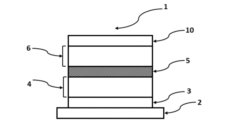
- FIG. 1 is a diagram showing a schematic configuration of an organic EL element according to one embodiment of the present invention.
- hydrogen atoms include isotopes having different numbers of neutrons, namely protium, deuterium, and tritium.
- any possible bonding position that is not explicitly indicated with a symbol such as "R” or "D” representing a deuterium atom is assumed to have a hydrogen atom, i.e., a protium atom, a deuterium atom, or a tritium atom, bonded to it.
- the number of ring carbon atoms refers to the number of carbon atoms among the atoms constituting the ring itself of a compound having a structure in which atoms are bonded in a ring (for example, a monocyclic compound, a fused ring compound, a bridged compound, a carbocyclic compound, and a heterocyclic compound).
- a compound having a structure in which atoms are bonded in a ring for example, a monocyclic compound, a fused ring compound, a bridged compound, a carbocyclic compound, and a heterocyclic compound.
- the carbon contained in the substituent is not included in the number of ring carbon atoms.
- the "number of ring carbon atoms" described below is the same unless otherwise specified.
- a benzene ring has 6 ring carbon atoms
- a naphthalene ring has 10 ring carbon atoms
- a pyridine ring has 5 ring carbon atoms
- a furan ring has 4 ring carbon atoms.
- a 9,9-diphenylfluorenyl group has 13 ring carbon atoms
- a 9,9'-spirobifluorenyl group has 25 ring carbon atoms.
- the number of carbon atoms of the alkyl group is not included in the number of ring carbon atoms of the benzene ring.
- the number of ring carbon atoms of the benzene ring substituted with an alkyl group is 6.
- the number of carbon atoms of the alkyl group is not included in the number of ring carbon atoms of the naphthalene ring. Therefore, the number of ring carbon atoms of the naphthalene ring substituted with an alkyl group is 10.
- the number of ring atoms refers to the number of atoms constituting the ring itself of a compound (e.g., a monocyclic compound, a fused ring compound, a bridged compound, a carbocyclic compound, and a heterocyclic compound) with a structure in which atoms are bonded in a ring (e.g., a monocyclic ring, a fused ring, and a ring assembly).
- the number of ring atoms does not include atoms that do not constitute a ring (e.g., a hydrogen atom that terminates the bond of an atom constituting a ring) or atoms contained in a substituent when the ring is substituted with a substituent.
- the "number of ring atoms" described below is the same unless otherwise specified.
- the number of ring atoms of a pyridine ring is 6, the number of ring atoms of a quinazoline ring is 10, and the number of ring atoms of a furan ring is 5.
- the number of hydrogen atoms or atoms constituting a substituent bonded to a pyridine ring is not included in the number of pyridine ring atoms. Therefore, the number of ring atoms of a pyridine ring to which a hydrogen atom or a substituent is bonded is 6.
- the number of ring atoms in a quinazoline ring to which a hydrogen atom or a substituent is bonded is 10.
- the "carbon number XX to YY” in the expression “substituted or unsubstituted ZZ group having carbon numbers XX to YY” refers to the number of carbon atoms when the ZZ group is unsubstituted, and does not include the number of carbon atoms of the substituent when the ZZ group is substituted.
- "YY" is larger than “XX”
- "XX” means an integer of 1 or more
- "YY” means an integer of 2 or more.
- the "atomic number XX to YY” in the expression “substituted or unsubstituted ZZ group having atomic number XX to YY” refers to the number of atoms when the ZZ group is unsubstituted, and does not include the number of atoms of the substituents when the ZZ group is substituted.
- "YY" is larger than “XX”
- "XX” means an integer of 1 or more
- “YY” means an integer of 2 or more.
- unsubstituted ZZ group refers to the case where "a substituted or unsubstituted ZZ group” is an "unsubstituted ZZ group”
- substituted ZZ group refers to the case where "a substituted or unsubstituted ZZ group” is a "substituted ZZ group”.
- unsubstituted in the case of "a substituted or unsubstituted ZZ group” means that a hydrogen atom in the ZZ group is not replaced with a substituent.
- the hydrogen atom in the "unsubstituted ZZ group” is a protium atom, a deuterium atom, or a tritium atom.
- substitution in the case of "a substituted or unsubstituted ZZ group” means that one or more hydrogen atoms in the ZZ group are replaced with a substituent.
- substitution in the case of "a BB group substituted with an AA group” means that one or more hydrogen atoms in the BB group are replaced with an AA group.
- the "unsubstituted aryl group” described in this specification has 6 to 50 ring carbon atoms, preferably 6 to 30, and more preferably 6 to 18 ring carbon atoms, unless otherwise specified in this specification.
- the "unsubstituted heterocyclic group” described in this specification has 5 to 50 ring atoms, preferably 5 to 30, and more preferably 5 to 18 ring atoms, unless otherwise specified in this specification.
- the "unsubstituted alkyl group” described in this specification has 1 to 50 carbon atoms, preferably 1 to 20 carbon atoms, and more preferably 1 to 6 carbon atoms, unless otherwise specified in this specification.
- the number of carbon atoms in the "unsubstituted alkenyl group” described in this specification is, unless otherwise specified in this specification, 2 to 50, preferably 2 to 20, and more preferably 2 to 6.
- the number of carbon atoms in the "unsubstituted alkynyl group” described in this specification is 2 to 50, preferably 2 to 20, and more preferably 2 to 6.
- the "unsubstituted cycloalkyl group” described in this specification has 3 to 50 ring carbon atoms, preferably 3 to 20, and more preferably 3 to 6 ring carbon atoms, unless otherwise specified in this specification.
- the "unsubstituted arylene group” described in this specification has 6 to 50 ring carbon atoms, preferably 6 to 30, and more preferably 6 to 18 ring carbon atoms, unless otherwise specified in this specification.
- the number of ring atoms in the “unsubstituted divalent heterocyclic group” described in this specification is 5 to 50, preferably 5 to 30, and more preferably 5 to 18, unless otherwise specified in this specification.
- the "unsubstituted alkylene group” described in this specification has 1 to 50 carbon atoms, preferably 1 to 20 carbon atoms, and more preferably 1 to 6 carbon atoms, unless otherwise specified in this specification.
- Specific examples (specific example group G1) of the "substituted or unsubstituted aryl group” described in this specification include the following unsubstituted aryl group (specific example group G1A) and substituted aryl group (specific example group G1B).
- unsubstituted aryl group refers to the case where the "substituted or unsubstituted aryl group” is an "unsubstituted aryl group”
- substituted aryl group refers to the case where the "substituted or unsubstituted aryl group” is a "substituted aryl group”.
- aryl group simply refers to both an "unsubstituted aryl group” and a "substituted aryl group”.
- substituted aryl group refers to a group in which one or more hydrogen atoms of an "unsubstituted aryl group” are replaced with a substituent.
- substituted aryl group include the groups in which one or more hydrogen atoms of the "unsubstituted aryl group” in the specific example group G1A below are replaced with a substituent, and the examples of the substituted aryl group in the specific example group G1B below.
- Unsubstituted aryl groups (specific example group G1A): Phenyl group, p-biphenyl group, m-biphenyl group, o-biphenyl group, p-terphenyl-4-yl group, p-terphenyl-3-yl group, p-terphenyl-2-yl group, m-terphenyl-4-yl group, m-terphenyl-3-yl group, m-terphenyl-2-yl group, o-terphenyl-4-yl group, o-terphenyl-3-yl group, o-terphenyl-2-yl group, 1-naphthyl group, 2-naphthyl group, anthryl group, Benzanthryl group, A phenanthryl group, Benzophenanthryl group, A phenalenyl group, Pyrenyl group, Chrysenyl group, benzochrysenyl group,
- Substituted aryl groups (specific example group G1B): o-tolyl group, m-tolyl group, p-tolyl group, para-xylyl group, meta-xylyl group, ortho-xylyl group, para-isopropylphenyl group, meta-isopropylphenyl group, ortho-isopropylphenyl group, para-t-butylphenyl group, A meta-t-butylphenyl group, ortho-t-butylphenyl group, 3,4,5-trimethylphenyl group, 9,9-dimethylfluorenyl group, 9,9-diphenylfluorenyl group, 9,9-bis(4-methylphenyl)fluorenyl group, 9,9-bis(4-isopropylphenyl)fluorenyl group, 9,9-bis(4-t-butylphenyl)fluorenyl group, Cyanophenyl group, triphenyls
- heterocyclic group is a cyclic group containing at least one heteroatom as a ring-forming atom.
- the heteroatom include a nitrogen atom, an oxygen atom, a sulfur atom, a silicon atom, a phosphorus atom, and a boron atom.
- the “heterocyclic groups” described herein are either monocyclic or fused ring groups.
- the “heterocyclic group” described herein may be an aromatic heterocyclic group or a non-aromatic heterocyclic group.
- Specific examples (specific example group G2) of the "substituted or unsubstituted heterocyclic group" described in this specification include the following unsubstituted heterocyclic group (specific example group G2A) and substituted heterocyclic group (specific example group G2B).
- the unsubstituted heterocyclic group refers to the case where the "substituted or unsubstituted heterocyclic group" is an "unsubstituted heterocyclic group"
- the substituted heterocyclic group refers to the case where the "substituted or unsubstituted heterocyclic group" is a "substituted heterocyclic group”.
- substituted heterocyclic group refers to a group in which one or more hydrogen atoms of an "unsubstituted heterocyclic group” are replaced with a substituent.
- Specific examples of the "substituted heterocyclic group” include the groups in which the hydrogen atoms of the "unsubstituted heterocyclic group” in the specific example group G2A below are replaced, and the examples of the substituted heterocyclic group in the specific example group G2B below are exemplified.
- the examples of the "unsubstituted heterocyclic group” and the examples of the “substituted heterocyclic group” listed here are merely examples, and the “substituted heterocyclic group” described in this specification also includes the groups in the "substituted heterocyclic group” in the specific example group G2B in which a hydrogen atom bonded to a ring-forming atom of the heterocyclic group itself is further replaced with a substituent, and the "substituted heterocyclic group” in the specific example group G2B in which a hydrogen atom of a substituent is further replaced with a substituent.
- Specific example group G2A includes, for example, the following unsubstituted heterocyclic groups containing a nitrogen atom (specific example group G2A1), unsubstituted heterocyclic groups containing an oxygen atom (specific example group G2A2), unsubstituted heterocyclic groups containing a sulfur atom (specific example group G2A3), and monovalent heterocyclic groups derived by removing one hydrogen atom from ring structures represented by the following general formulae (TEMP-16) to (TEMP-33) (specific example group G2A4).
- Specific example group G2B includes, for example, the following substituted heterocyclic groups containing a nitrogen atom (specific example group G2B1), substituted heterocyclic groups containing an oxygen atom (specific example group G2B2), substituted heterocyclic groups containing a sulfur atom (specific example group G2B3), and groups in which one or more hydrogen atoms of a monovalent heterocyclic group derived from a ring structure represented by the following general formulae (TEMP-16) to (TEMP-33) are replaced with a substituent (specific example group G2B4).
- Unsubstituted heterocyclic groups containing a nitrogen atom (specific example group G2A1): Pyrrolyl group, imidazolyl group, A pyrazolyl group, A triazolyl group, Tetrazolyl group, oxazolyl group, an isoxazolyl group, oxadiazolyl group, A thiazolyl group, isothiazolyl group, A thiadiazolyl group, Pyridyl group, pyridazinyl group, A pyrimidinyl group, Pyrazinyl group, Triazinyl group, Indolyl groups, isoindolyl group, Indolizinyl group, A quinolizinyl group, A quinolyl group, isoquinolyl group, Cinnolyl group, phthalazinyl group, A quinazolinyl group, quinoxalinyl group, Benzimidazolyl group, Indazolyl group, A phenanthrolinyl
- Unsubstituted heterocyclic groups containing an oxygen atom (specific example group G2A2): Furyl group, oxazolyl group, an isoxazolyl group, oxadiazolyl group, xanthenyl group, benzofuranyl group, isobenzofuranyl group, Dibenzofuranyl group, naphthobenzofuranyl group, benzoxazolyl group, benzoisoxazolyl group, phenoxazinyl group, morpholino group, Dinaphthofuranyl group, azadibenzofuranyl group, diazadibenzofuranyl group, Azanaphthobenzofuranyl group, and diazanaphthobenzofuranyl group.
- Unsubstituted heterocyclic groups containing a sulfur atom (specific example group G2A3): A thienyl group, A thiazolyl group, isothiazolyl group, A thiadiazolyl group, Benzothiophenyl group (benzothienyl group), isobenzothiophenyl group (isobenzothienyl group), Dibenzothiophenyl group (dibenzothienyl group), Naphthobenzothiophenyl group (naphthobenzothienyl group), benzothiazolyl group, Benzisothiazolyl group, A phenothiazinyl group, Dinaphthothiophenyl group (dinaphthothienyl group), Azadibenzothiophenyl group (azadibenzothienyl group), Diazadibenzothiophenyl group (diazadibenzothienyl group), Azanap
- X A and Y A are each independently an oxygen atom, a sulfur atom, NH, or CH2 , provided that at least one of X A and Y A is an oxygen atom, a sulfur atom, or NH.
- the monovalent heterocyclic group derived from the ring structure represented by the general formulae (TEMP-16) to (TEMP-33) includes a monovalent group obtained by removing one hydrogen atom from the NH or CH2 .
- Substituted heterocyclic groups containing an oxygen atom (specific example group G2B2): phenyldibenzofuranyl group, methyldibenzofuranyl group, The t-butyldibenzofuranyl group, and the monovalent radical of spiro[9H-xanthene-9,9'-[9H]fluorene].
- Substituted heterocyclic groups containing a sulfur atom (specific example group G2B3): Phenyldibenzothiophenyl group, methyldibenzothiophenyl group, The t-butyldibenzothiophenyl group, and the monovalent radical of spiro[9H-thioxanthene-9,9'-[9H]fluorene].
- one or more hydrogen atoms of a monovalent heterocyclic group means one or more hydrogen atoms selected from a hydrogen atom bonded to a ring-forming carbon atom of the monovalent heterocyclic group, a hydrogen atom bonded to a nitrogen atom when at least one of XA and YA is NH, and a hydrogen atom of a methylene group when one of XA and YA is CH2 .
- Specific examples (specific example group G3) of the "substituted or unsubstituted alkyl group" described in this specification include the following unsubstituted alkyl groups (specific example group G3A) and substituted alkyl groups (specific example group G3B).
- the unsubstituted alkyl group refers to the case where the "substituted or unsubstituted alkyl group" is an "unsubstituted alkyl group"
- the substituted alkyl group refers to the case where the "substituted or unsubstituted alkyl group” is a "substituted alkyl group”.
- substituted alkyl group refers to a group in which one or more hydrogen atoms in the "unsubstituted alkyl group” are replaced with a substituent.
- specific examples of the "substituted alkyl group” include the following "unsubstituted alkyl group” (specific example group G3A) in which one or more hydrogen atoms are replaced with a substituent, and the examples of the substituted alkyl group (specific example group G3B).
- the alkyl group in the "unsubstituted alkyl group” refers to a chain-like alkyl group.
- the "unsubstituted alkyl group” includes a straight-chain “unsubstituted alkyl group” and a branched “unsubstituted alkyl group”.
- the examples of the "unsubstituted alkyl group” and the examples of the “substituted alkyl group” listed here are merely examples, and the "substituted alkyl group” described in this specification also includes a group in which a hydrogen atom of the alkyl group itself in the "substituted alkyl group” in the specific example group G3B is further replaced with a substituent, and a group in which a hydrogen atom of a substituent in the "substituted alkyl group” in the specific example group G3B is further replaced with a substituent.
- Unsubstituted alkyl groups (specific example group G3A): Methyl group, Ethyl group, n-propyl group, isopropyl group, n-butyl group, isobutyl group, s-Butyl group, and t-butyl group.
- Substituted alkyl groups (specific example group G3B): Heptafluoropropyl group (including isomers), Pentafluoroethyl group, A 2,2,2-trifluoroethyl group, and a trifluoromethyl group.
- Specific examples (specific example group G4) of the "substituted or unsubstituted alkenyl group" described in this specification include the following unsubstituted alkenyl group (specific example group G4A) and substituted alkenyl group (specific example group G4B).
- the unsubstituted alkenyl group refers to the case where the "substituted or unsubstituted alkenyl group” is an "unsubstituted alkenyl group", and the "substituted alkenyl group” refers to the case where the "substituted or unsubstituted alkenyl group” is a "substituted alkenyl group”.
- alkenyl group when the term “alkenyl group” is simply used, it includes both an "unsubstituted alkenyl group” and a "substituted alkenyl group”.
- substituted alkenyl group refers to a group in which one or more hydrogen atoms in an "unsubstituted alkenyl group” are replaced with a substituent.
- Specific examples of the "substituted alkenyl group” include the following "unsubstituted alkenyl group” (specific example group G4A) having a substituent, and the examples of substituted alkenyl groups (specific example group G4B).
- the examples of the "unsubstituted alkenyl group” and the examples of the “substituted alkenyl group” listed here are merely examples, and the "substituted alkenyl group” described in this specification also includes a group in which a hydrogen atom of the alkenyl group itself in the "substituted alkenyl group” in specific example group G4B is further replaced with a substituent, and a group in which a hydrogen atom of a substituent in the "substituted alkenyl group” in specific example group G4B is further replaced with a substituent.
- Unsubstituted alkenyl groups (specific example group G4A): Vinyl group, Allyl groups, 1-butenyl group, A 2-butenyl group, and a 3-butenyl group.
- Substituted alkenyl groups (specific example group G4B): 1,3-butadienyl group, 1-methylvinyl group, 1-methylallyl group, 1,1-dimethylallyl group, 2-methylallyl group, and 1,2-dimethylallyl group.
- the unsubstituted alkynyl group refers to the case where the "substituted or unsubstituted alkynyl group" is an "unsubstituted alkynyl group."
- alkynyl group when simply referring to an "alkynyl group,” it includes both an "unsubstituted alkynyl group” and a “substituted alkynyl group.”
- substituted alkynyl group refers to an "unsubstituted alkynyl group” in which one or more hydrogen atoms have been replaced with a substituent.
- Specific examples of the "substituted alkynyl group” include the following "unsubstituted alkynyl group” (specific example group G5A) in which one or more hydrogen atoms have been replaced with a substituent.
- Specific examples (specific example group G6) of the "substituted or unsubstituted cycloalkyl group” described in this specification include the following unsubstituted cycloalkyl group (specific example group G6A) and substituted cycloalkyl group (specific example group G6B).
- unsubstituted cycloalkyl group refers to the case where the "substituted or unsubstituted cycloalkyl group” is an "unsubstituted cycloalkyl group”
- substituted cycloalkyl group refers to the case where the "substituted or unsubstituted cycloalkyl group” is a "substituted cycloalkyl group”.
- substituted cycloalkyl group refers to a group in which one or more hydrogen atoms in the "unsubstituted cycloalkyl group” are replaced with a substituent.
- Specific examples of the "substituted cycloalkyl group” include the following "unsubstituted cycloalkyl group” (specific example group G6A) in which one or more hydrogen atoms are replaced with a substituent, and the examples of the substituted cycloalkyl group (specific example group G6B).
- the examples of the "unsubstituted cycloalkyl group” and the examples of the “substituted cycloalkyl group” listed here are merely examples, and the "substituted cycloalkyl group" described in this specification also includes a group in which one or more hydrogen atoms bonded to a carbon atom of the cycloalkyl group itself in the "substituted cycloalkyl group” in the specific example group G6B are replaced with a substituent, and a group in which a hydrogen atom of a substituent in the "substituted cycloalkyl group” in the specific example group G6B is further replaced with a substituent.
- Unsubstituted cycloalkyl groups (specific example group G6A): A cyclopropyl group, A cyclobutyl group, Cyclopentyl group, cyclohexyl group, 1-adamantyl group, 2-adamantyl group, 1-norbornyl group, and 2-norbornyl group.
- Substituted cycloalkyl groups (specific example group G6B): 4-Methylcyclohexyl group.
- G7 of the group represented by --Si(R 901 )(R 902 )(R 903 ) described in this specification include: -Si(G1)(G1)(G1), -Si (G1) (G2) (G2), -Si (G1) (G1) (G2), -Si(G2)(G2)(G2), -Si(G3)(G3)(G3), and -Si(G6)(G6)(G6)(G6)
- G1 is a "substituted or unsubstituted aryl group” described in specific example group G1.
- G2 is a "substituted or unsubstituted heterocyclic group” described in specific example group G2.
- G3 is a "substituted or unsubstituted alkyl group” described in specific example group G3.
- G6 is a "substituted or unsubstituted cycloalkyl group” described in specific example group G6.
- the multiple G1s in -Si(G1)(G1)(G1) are the same as or different from each other.
- the multiple G2s in —Si(G1)(G2)(G2) are the same as or different from each other.
- the multiple G1s in -Si(G1)(G1)(G2) are the same as or different from each other.
- the multiple G2s in —Si(G2)(G2)(G2) are the same as or different from each other.
- the multiple G3s in —Si(G3)(G3)(G3) are the same as or different from each other.
- the multiple G6s in —Si(G6)(G6)(G6) are the same as or different from each other.
- G8 of the group represented by -O-(R 904 ) described in this specification include: -O(G1), -O (G2), -O(G3) and -O(G6) Examples include: Where: G1 is a "substituted or unsubstituted aryl group” described in specific example group G1. G2 is a “substituted or unsubstituted heterocyclic group” described in specific example group G2. G3 is a "substituted or unsubstituted alkyl group” described in specific example group G3. G6 is a "substituted or unsubstituted cycloalkyl group” described in specific example group G6.
- G9 A group represented by -S-(R 905 )
- Specific examples (specific example group G9) of the group represented by -S-(R 905 ) described in this specification include: -S (G1), -S (G2), -S(G3) and -S(G6) Examples include: Where: G1 is a "substituted or unsubstituted aryl group” described in specific example group G1. G2 is a "substituted or unsubstituted heterocyclic group” described in specific example group G2. G3 is a "substituted or unsubstituted alkyl group” described in specific example group G3. G6 is a "substituted or unsubstituted cycloalkyl group” described in specific example group G6.
- Specific examples (specific example group G10) of the group represented by -N(R 906 )(R 907 ) described in this specification include: -N(G1)(G1), -N(G2)(G2), -N (G1) (G2), -N(G3)(G3), and -N(G6)(G6) Examples include: Where: G1 is a "substituted or unsubstituted aryl group” described in specific example group G1. G2 is a "substituted or unsubstituted heterocyclic group” described in specific example group G2.
- G3 is a "substituted or unsubstituted alkyl group” described in specific example group G3.
- G6 is a "substituted or unsubstituted cycloalkyl group” described in specific example group G6.
- the multiple G1s in -N(G1)(G1) are the same or different from each other.
- the multiple G2s in -N(G2)(G2) are the same or different from each other.
- the multiple G3s in -N(G3)(G3) are the same or different.
- the multiple G6s in -N(G6)(G6) are the same or different.
- halogen atoms include a fluorine atom, a chlorine atom, a bromine atom, and an iodine atom.
- substituted or unsubstituted fluoroalkyl groups means a group in which at least one hydrogen atom bonded to a carbon atom constituting the alkyl group in the "substituted or unsubstituted alkyl group” is replaced with a fluorine atom, and also includes a group (perfluoro group) in which all hydrogen atoms bonded to carbon atoms constituting the alkyl group in the "substituted or unsubstituted alkyl group” are replaced with fluorine atoms.
- the number of carbon atoms in the "unsubstituted fluoroalkyl group” is 1 to 50, preferably 1 to 30, and more preferably 1 to 18, unless otherwise specified in the present specification.
- substituted fluoroalkyl group means a group in which one or more hydrogen atoms in the "fluoroalkyl group” are replaced with a substituent.
- substituted fluoroalkyl group as used herein also includes a group in which one or more hydrogen atoms bonded to a carbon atom of the alkyl chain in the "substituted fluoroalkyl group” are further replaced with a substituent, and a group in which one or more hydrogen atoms of the substituent in the "substituted fluoroalkyl group” are further replaced with a substituent.
- substituents include the examples of groups in which one or more hydrogen atoms in the "alkyl group” (specific example group G3) are replaced with fluorine atoms.
- substituted or unsubstituted haloalkyl group means a group in which at least one hydrogen atom bonded to a carbon atom constituting the alkyl group in the "substituted or unsubstituted alkyl group” is replaced with a halogen atom, and also includes a group in which all hydrogen atoms bonded to carbon atoms constituting the alkyl group in the "substituted or unsubstituted alkyl group” are replaced with halogen atoms.
- the number of carbon atoms in the "unsubstituted haloalkyl group” is 1 to 50, preferably 1 to 30, and more preferably 1 to 18, unless otherwise specified in the present specification.
- substituted haloalkyl group means a group in which one or more hydrogen atoms in the "haloalkyl group” are replaced with a substituent.
- substituted haloalkyl group as used herein also includes a group in which one or more hydrogen atoms bonded to a carbon atom in the alkyl chain in the "substituted haloalkyl group” are further replaced with a substituent, and a group in which one or more hydrogen atoms of the substituent in the "substituted haloalkyl group” are further replaced with a substituent.
- substituents in the "substituted haloalkyl group” are further replaced with a substituent.
- Specific examples of the "unsubstituted haloalkyl group” include the examples of the group in which one or more hydrogen atoms in the "alkyl group” (specific example group G3) are replaced with a halogen atom.
- Haloalkyl groups are sometimes referred to as halogenated alkyl groups.
- a specific example of the "substituted or unsubstituted alkoxy group” described in this specification is a group represented by -O(G3), where G3 is a "substituted or unsubstituted alkyl group” described in specific example group G3.
- the number of carbon atoms in the "unsubstituted alkoxy group” is 1 to 50, preferably 1 to 30, and more preferably 1 to 18, unless otherwise specified in this specification.
- Substituted or unsubstituted alkylthio group A specific example of the "substituted or unsubstituted alkylthio group” described in this specification is a group represented by -S(G3), where G3 is a "substituted or unsubstituted alkyl group” described in specific example group G3.
- the number of carbon atoms in the "unsubstituted alkylthio group" is 1 to 50, preferably 1 to 30, and more preferably 1 to 18, unless otherwise specified in this specification.
- a specific example of the "substituted or unsubstituted aryloxy group” described in this specification is a group represented by -O(G1), where G1 is a "substituted or unsubstituted aryl group” described in specific example group G1.
- the number of ring carbon atoms of the "unsubstituted aryloxy group” is 6 to 50, preferably 6 to 30, and more preferably 6 to 18, unless otherwise specified in this specification.
- a specific example of the "substituted or unsubstituted arylthio group” described in this specification is a group represented by -S(G1), where G1 is a "substituted or unsubstituted aryl group” described in specific example group G1.
- the number of ring carbon atoms of the "unsubstituted arylthio group” is 6 to 50, preferably 6 to 30, and more preferably 6 to 18, unless otherwise specified in this specification.
- a specific example of the "trialkylsilyl group” described in this specification is a group represented by -Si(G3)(G3)(G3), where G3 is a "substituted or unsubstituted alkyl group” described in specific example group G3.
- the multiple G3s in -Si(G3)(G3)(G3) are the same as or different from each other.
- the number of carbon atoms in each alkyl group of the "trialkylsilyl group” is 1 to 50, preferably 1 to 20, and more preferably 1 to 6, unless otherwise specified in this specification.
- a specific example of the "substituted or unsubstituted aralkyl group” described in this specification is a group represented by -(G3)-(G1), where G3 is a "substituted or unsubstituted alkyl group” described in the specific example group G3, and G1 is a "substituted or unsubstituted aryl group” described in the specific example group G1.
- an “aralkyl group” is a group in which a hydrogen atom of an "alkyl group” is replaced with an "aryl group” as a substituent, and is one aspect of a “substituted alkyl group”.
- An “unsubstituted aralkyl group” is an "unsubstituted alkyl group” substituted with an "unsubstituted aryl group”, and the number of carbon atoms in the "unsubstituted aralkyl group” is 7 to 50, preferably 7 to 30, and more preferably 7 to 18, unless otherwise specified in this specification.
- substituted or unsubstituted aralkyl group include benzyl group, 1-phenylethyl group, 2-phenylethyl group, 1-phenylisopropyl group, 2-phenylisopropyl group, phenyl-t-butyl group, ⁇ -naphthylmethyl group, 1- ⁇ -naphthylethyl group, 2- ⁇ -naphthylethyl group, 1- ⁇ -naphthylisopropyl group, 2- ⁇ -naphthylisopropyl group, ⁇ -naphthylmethyl group, 1- ⁇ -naphthylethyl group, 2- ⁇ -naphthylethyl group, 1- ⁇ -naphthylisopropyl group, and 2- ⁇ -naphthylisopropyl group.
- the substituted or unsubstituted aryl group described herein is preferably a phenyl group, a p-biphenyl group, a m-biphenyl group, an o-biphenyl group, a p-terphenyl-4-yl group, a p-terphenyl-3-yl group, a p-terphenyl-2-yl group, a m-terphenyl-4-yl group, a m-terphenyl-3-yl group, a m-terphenyl-2-yl group, a o-terphenyl-4-yl group, a o-terphenyl-3-yl group, a o-terphenyl-2-yl group, a 1-naphthyl group, a 2-naphthyl group, an anthryl group, a phenanthryl group, a pyrenyl group, a
- the substituted or unsubstituted heterocyclic group described in the present specification is preferably a pyridyl group, a pyrimidinyl group, a triazinyl group, a quinolyl group, an isoquinolyl group, a quinazolinyl group, a benzimidazolyl group, a phenanthrolinyl group, a carbazolyl group (a 1-carbazolyl group, a 2-carbazolyl group, a 3-carbazolyl group, a 4-carbazolyl group, or a 9-carbazolyl group), a benzocarbazolyl group, an azacarbazolyl group, a diazacarbazolyl group, a dibenzofuranyl group, a naphthobenzofuranyl group, an azadibenzofuranyl group, a diazadibenzofuranyl group, a dibenzothi
- zadibenzothiophenyl group diazadibenzothiophenyl group
- (9-phenyl)carbazolyl group ((9-phenyl)carbazol-1-yl group, (9-phenyl)carbazol-2-yl group, (9-phenyl)carbazol-3-yl group, or (9-phenyl)carbazol-4-yl group)
- (9-biphenylyl)carbazolyl group (9-phenyl)phenylcarbazolyl group, diphenylcarbazol-9-yl group, phenylcarbazol-9-yl group, phenyltriazinyl group, biphenylyltriazinyl group, diphenyltriazinyl group, phenyldibenzofuranyl group, and phenyldibenzothiophenyl group.
- carbazolyl group is specifically any of the following groups:
- the (9-phenyl)carbazolyl group is specifically any of the following groups:
- dibenzofuranyl group and the dibenzothiophenyl group are specifically any of the following groups, unless otherwise specified in this specification.
- substituted or unsubstituted alkyl groups described herein are preferably methyl, ethyl, propyl, isopropyl, n-butyl, isobutyl, t-butyl, and the like.
- the "substituted or unsubstituted arylene group" described in this specification is a divalent group derived by removing one hydrogen atom on the aryl ring from the above-mentioned "substituted or unsubstituted aryl group".
- Specific examples of the "substituted or unsubstituted arylene group” include divalent groups derived by removing one hydrogen atom on the aryl ring from the "substituted or unsubstituted aryl group” described in specific example group G1.
- Substituted or unsubstituted divalent heterocyclic group is, unless otherwise specified, a divalent group derived by removing one hydrogen atom on the heterocycle from the above-mentioned "substituted or unsubstituted heterocyclic group".
- Specific examples of the "substituted or unsubstituted divalent heterocyclic group” include divalent groups derived by removing one hydrogen atom on the heterocycle from the "substituted or unsubstituted heterocyclic group” described in specific example group G2.
- the "substituted or unsubstituted alkylene group" described in this specification is a divalent group derived by removing one hydrogen atom on the alkyl chain from the above-mentioned "substituted or unsubstituted alkyl group".
- Specific examples of the "substituted or unsubstituted alkylene group” include divalent groups derived by removing one hydrogen atom on the alkyl chain from the "substituted or unsubstituted alkyl group” described in specific example group G3.
- the substituted or unsubstituted arylene group described herein is preferably any of the groups represented by the following general formulae (TEMP-42) to (TEMP-68).
- Q 1 to Q 10 each independently represent a hydrogen atom or a substituent.
- * represents a binding site.
- Q 1 to Q 10 each independently represent a hydrogen atom or a substituent.
- Q 9 and Q 10 may be bonded to each other via a single bond to form a ring.
- * represents a binding site.
- Q 1 to Q 8 each independently represent a hydrogen atom or a substituent.
- * represents a binding site.
- the substituted or unsubstituted divalent heterocyclic group described in this specification is preferably any of the groups represented by the following general formulae (TEMP-69) to (TEMP-102), unless otherwise specified in this specification.
- Q 1 to Q 9 each independently represent a hydrogen atom or a substituent.
- Q 1 to Q 8 each independently represent a hydrogen atom or a substituent.
- the phrase "one or more of a set consisting of two or more adjacent groups bond to each other to form a substituted or unsubstituted monocycle, bond to each other to form a substituted or unsubstituted fused ring, or are not bonded to each other" means the case where "one or more of a set consisting of two or more adjacent groups bond to each other to form a substituted or unsubstituted monocycle", the case where "one or more of a set consisting of two or more adjacent groups bond to each other to form a substituted or unsubstituted fused ring", or the case where "one or more of a set consisting of two or more adjacent groups are not bonded to each other".
- the pair of adjacent two that constitutes one group includes the pair of R 921 and R 922 , the pair of R 922 and R 923 , the pair of R 923 and R 924 , the pair of R 924 and R 930 , the pair of R 930 and R 925 , the pair of R 925 and R 926, the pair of R 926 and R 927 , the pair of R 927 and R 928 , the pair of R 928 and R 929 , and the pair of R 929 and R 921 .
- one or more pairs means that two or more pairs of the adjacent two or more pairs may simultaneously form a ring.
- the anthracene compound represented by the general formula (TEMP-103) is represented by the following general formula (TEMP-104).
- a set of two or more adjacent rings forms a ring includes not only the case where a set of "two" adjacent rings is bonded as in the above example, but also the case where a set of "three or more adjacent rings is bonded.
- it means the case where R 921 and R 922 are bonded to each other to form a ring Q A , and R 922 and R 923 are bonded to each other to form a ring Q C , and a set of three adjacent rings (R 921 , R 922 and R 923 ) are bonded to each other to form a ring and are condensed to the anthracene skeleton.
- the anthracene compound represented by the general formula (TEMP-103) is represented by the following general formula (TEMP-105).
- ring Q A and ring Q C share R 922 .
- the "monocyclic ring” or “fused ring” formed may be a saturated ring or an unsaturated ring as the structure of only the ring formed. Even when “one of the pairs of two adjacent rings” forms a “monocyclic ring” or a “fused ring”, the “monocyclic ring” or the “fused ring” can form a saturated ring or an unsaturated ring.
- the ring Q A and the ring Q B formed in the general formula (TEMP-104) are “monocyclic rings” or “fused rings", respectively.
- the ring Q A and the ring Q C formed in the general formula (TEMP-105) are “fused rings”.
- the ring Q A and the ring Q C in the general formula (TEMP-105) are fused rings by the fusion of the ring Q A and the ring Q C. If the ring Q A in the general formula (TMEP-104) is a benzene ring, the ring Q A is a monocyclic ring. When ring Q 1 A in the above general formula (TMEP-104) is a naphthalene ring, ring Q 1 A is a fused ring.
- the "unsaturated ring” includes aromatic hydrocarbon rings and aromatic heterocycles, as well as aliphatic hydrocarbon rings having an unsaturated bond in the ring structure, i.e., a double bond and/or a triple bond (e.g., cyclohexene, cyclohexadiene, etc.), and non-aromatic heterocycles having an unsaturated bond (e.g., dihydropyran, imidazoline, pyrazoline, quinolizine, indoline, isoindoline, etc.).
- the "saturated ring” includes an aliphatic hydrocarbon ring having no unsaturated bond, or a non-aromatic heterocycle having no unsaturated bond.
- aromatic hydrocarbon ring examples include structures in which the groups given as specific examples in the specific example group G1 are terminated with a hydrogen atom.
- aromatic heterocycle examples include structures in which the aromatic heterocyclic groups exemplified as specific examples in the specific example group G2 are terminated with a hydrogen atom.
- Specific examples of the aliphatic hydrocarbon ring include structures in which the groups given as specific examples in the specific example group G6 are terminated with a hydrogen atom.
- the ring QA formed by bonding R 921 and R 922 to each other in the general formula (TEMP-104) means a ring formed by the carbon atom of the anthracene skeleton to which R 921 is bonded, the carbon atom of the anthracene skeleton to which R 922 is bonded, and one or more arbitrary atoms.
- R 921 and R 922 form a ring QA
- the carbon atom of the anthracene skeleton to which R 921 is bonded the carbon atom of the anthracene skeleton to which R 922 is bonded, and four carbon atoms form a monocyclic unsaturated ring
- the ring formed by R 921 and R 922 is a benzene ring.
- the "arbitrary atom” is preferably at least one atom selected from the group consisting of carbon atoms, nitrogen atoms, oxygen atoms, and sulfur atoms.
- the arbitrary atom for example, in the case of a carbon atom or a nitrogen atom
- a bond that does not form a ring may be terminated with a hydrogen atom or the like, or may be substituted with an "arbitrary substituent" described below.
- the ring formed is a heterocycle.
- the "any one or more atoms" constituting the single ring or the condensed ring is preferably 2 or more and 15 or less, more preferably 3 or more and 12 or less, and even more preferably 3 or more and 5 or less.
- the "monocyclic ring” and the “condensed ring” are preferred.
- the "saturated ring” and the “unsaturated ring” are preferred.
- a "monocyclic ring” is preferably a benzene ring.
- the "unsaturated ring” is preferably a benzene ring.
- the "unsaturated ring” is preferably a benzene ring.
- one or more of a set of two or more adjacent rings combine with each other to form a substituted or unsubstituted monocyclic ring” or “combine with each other to form a substituted or unsubstituted fused ring
- one or more of a set of two or more adjacent rings combine with each other to form a substituted or unsubstituted "unsaturated ring” consisting of a plurality of atoms of the parent skeleton and at least one atom selected from the group consisting of 1 to 15 carbon atoms, nitrogen atoms, oxygen atoms, and sulfur atoms.
- the substituent is, for example, the “optional substituent” described later.
- specific examples of the substituent are the substituents described in the above-mentioned section “Substituents described in this specification”.
- the substituent is, for example, the “optional substituent” described below.
- the substituent in the case of "substituted or unsubstituted” is, for example, an unsubstituted alkyl group having 1 to 50 carbon atoms; an unsubstituted alkenyl group having 2 to 50 carbon atoms, an unsubstituted alkynyl group having 2 to 50 carbon atoms, an unsubstituted cycloalkyl group having 3 to 50 ring carbon atoms, -Si(R 901 )(R 902 )(R 903 ), -O-(R 904 ), -S- (R 905 ), -N(R 906 )(R 907 ), Halogen atoms, cyano groups, nitro groups, a group selected from the group consisting of an unsubstituted aryl group having 6 to 50 ring carbon atoms and an unsubstituted heterocyclic group having
- the two or more R 901 are the same or different from each other
- the two or more R 902 are present, the two or more R 902 are the same or different from each other
- the two or more R 903 are present, the two or more R 903 are the same or different from each other
- the two or more R 904 are present, the two or more R 904 are the same or different from each other
- the two or more R 905 are present, the two or more R 905 are the same or different from each other
- two or more R 906 are present, the two or more R 906 are the same or different from each other
- the two or more R 907 are present, the two or more R 907 are the same or different.
- the substituent in the above "substituted or unsubstituted” is: an alkyl group having 1 to 50 carbon atoms, The group is selected from the group consisting of an aryl group having 6 to 50 ring carbon atoms and a heterocyclic group having 5 to 50 ring atoms.
- the substituent in the above "substituted or unsubstituted” is: an alkyl group having 1 to 18 carbon atoms, The group is selected from the group consisting of an aryl group having 6 to 18 ring carbon atoms and a heterocyclic group having 5 to 18 ring atoms.
- any adjacent substituents may be combined with each other to form a "saturated ring" or an "unsaturated ring", preferably a substituted or unsubstituted saturated 5-membered ring, a substituted or unsubstituted saturated 6-membered ring, a substituted or unsubstituted unsaturated 5-membered ring, or a substituted or unsubstituted unsaturated 6-membered ring, more preferably a benzene ring.
- the optional substituent may further have a substituent.
- the substituent that the optional substituent further has is the same as the optional substituent described above.
- R 1 to R 8 each independently represent a hydrogen atom or the substituent R.
- R 1 to R 8 are not bonded to each other and do not form a substituted or unsubstituted monocyclic or condensed ring.
- Any one of R 16 and R 18 is a substituent A.
- Substituent A is an unsubstituted aryl group having 6 to 18 ring carbon atoms or an unsubstituted monovalent heterocyclic group having 5 to 18 ring atoms.
- R 16 and R 18 that are not the substituent A, and one or more pairs of adjacent two or more of R 11 to R 15 , R 17 , and R 19 are bonded to each other to form an unsubstituted monocycle, or bonded to each other to form an unsubstituted condensed ring, or do not form the ring.
- R 16 and R 18 which are not the substituent A and do not form a ring, and R 11 to R 15 , R 17 and R 19 which do not form a ring, are hydrogen atoms.
- Ar1 is It is a substituted or unsubstituted aryl group having 6 to 50 ring carbon atoms, or a substituted or unsubstituted monovalent heterocyclic group having 5 to 50 ring atoms.
- the substituent R is a substituted or unsubstituted alkyl group having 1 to 50 carbon atoms, a substituted or unsubstituted alkenyl group having 2 to 50 carbon atoms, a substituted or unsubstituted alkynyl group having 2 to 50 carbon atoms, a substituted or unsubstituted cycloalkyl group having 3 to 50 ring carbon atoms, -Si(R 901 )(R 902 )(R 903 ), -O-(R 904 ), -S- (R 905 ), -N(R 906 )(R 907 ), Halogen atoms, cyano groups, nitro groups, It is a substituted or unsubstitute
- R 901 to R 907 each independently represent Hydrogen atoms, a substituted or unsubstituted alkyl group having 1 to 50 carbon atoms, a substituted or unsubstituted cycloalkyl group having 3 to 50 ring carbon atoms, It is a substituted or unsubstituted aryl group having 6 to 50 ring carbon atoms, or a substituted or unsubstituted monovalent heterocyclic group having 5 to 50 ring atoms.
- each of the two or more R 901 to R 907 may be the same or different.
- the two or more substituents R may be the same or different.
- the compound represented by the formula (1) has at least one deuterium atom in the molecule.
- the compound according to one embodiment of the present invention when used in the organic layer of an organic EL element, it can improve the performance of the element. Specifically, it can extend the life of the organic EL element.
- either one of R 16 and R 18 in formula (1) is a substituent A.
- R 16 and R 18 that are not a substituent A and do not form an unsubstituted monocyclic or condensed ring are hydrogen atoms.
- R 11 to R 15 , R 17 , and R 19 that do not form an unsubstituted monocyclic or condensed ring are hydrogen atoms.
- the compound represented by formula (1) has at least one deuterium atom in the molecule as a hydrogen atom.
- having deuterium atoms as hydrogen atoms means that the ratio of deuterium atoms to the total of light hydrogen atoms and deuterium atoms in the hydrogen atoms is higher than the natural abundance ratio.
- the fact that the ratio of deuterium atoms to the total of light hydrogen atoms and deuterium atoms is higher than the natural abundance ratio can be confirmed using a nuclear magnetic resonance spectrometer.
- At least one of R 1 to R 8 is a deuterium atom. In one embodiment, at least one of R 1 to R 8 is a deuterium atom; All hydrogen atoms contained in the substituent R are light hydrogen atoms, a hydrogen atom possessed by the substituent A, a hydrogen atom possessed by R 16 and R 18 which are not the substituent A, a hydrogen atom possessed by a single ring or a condensed ring formed by bonding together R 11 to R 15 , R 17 , and R 19 , and R 11 to R 19 which are hydrogen atoms are all light hydrogen atoms; All hydrogen atoms in Ar 1 are light hydrogen atoms; All of the hydrogen atoms contained in L1 are light hydrogen atoms.
- R 1 to R 8 are hydrogen atoms. In one embodiment, R 1 -R 8 are all deuterium atoms.
- At least one of the hydrogen atoms in Ar 1 is a deuterium atom.
- At least one of the hydrogen atoms of Ar 1 is a deuterium atom; R 1 to R 8 which are hydrogen atoms are all light hydrogen atoms; All hydrogen atoms contained in the substituent R are light hydrogen atoms, a hydrogen atom possessed by the substituent A, a hydrogen atom possessed by R 16 and R 18 which are not the substituent A, a hydrogen atom possessed by a single ring or a condensed ring formed by bonding together R 11 to R 15 , R 17 , and R 19 , and R 11 to R 19 which are hydrogen atoms are all light hydrogen atoms; All of the hydrogen atoms contained in L1 are light hydrogen atoms.
- all hydrogen atoms in Ar 1 are deuterium atoms.
- Ar 1 is an unsubstituted aryl group having 6 to 50 ring carbon atoms, or an unsubstituted monovalent heterocyclic group having 5 to 50 ring atoms, All of the hydrogen atoms in Ar 1 are deuterium atoms.
- At least one of the hydrogen atoms in L 1 is a deuterium atom.
- all hydrogen atoms in L 1 are deuterium atoms.
- L1 is an unsubstituted arylene group having 6 to 30 ring carbon atoms, or an unsubstituted divalent heterocyclic group having 5 to 30 ring atoms, All of the hydrogen atoms in L1 are deuterium atoms.
- At least one selected from the group consisting of a hydrogen atom in the substituent A, R 16 and R 18 that are not the substituent A, a hydrogen atom in a monocyclic ring or a condensed ring formed by bonding R 11 to R 15 , R 17 , and R 19 , and R 11 to R 19 that are hydrogen atoms, is a deuterium atom.
- the hydrogen atom of the substituent A, the hydrogen atoms of R 16 and R 18 that are not the substituent A, and the hydrogen atoms of the monocyclic or condensed ring formed by bonding of R 11 to R 15 , R 17 , and R 19 , and the hydrogen atoms of R 11 to R 19 are all deuterium atoms.
- At least one of R 1 to R 8 which are hydrogen atoms, the hydrogen atom possessed by the substituent R, the hydrogen atom possessed by L 1 , and the hydrogen atom possessed by Ar 1 is a deuterium atom;
- the hydrogen atom of the substituent A, the hydrogen atoms of R 16 and R 18 that are not the substituent A, and the hydrogen atoms of the monocyclic or condensed ring formed by combining R 11 to R 15 , R 17 , and R 19 , and R 11 to R 19 that are hydrogen atoms are all light hydrogen atoms.
- At least one of R 1 to R 8 which are hydrogen atoms, at least one of the hydrogen atoms of the substituent A, and at least one of the hydrogen atoms of Ar 1 are deuterium atoms
- the hydrogen atom possessed by the substituent R, the hydrogen atoms possessed by R 16 and R 18 which are not the substituent A, and the single ring or condensed ring formed by bonding of R 11 to R 15 , R 17 , and R 19 , and R 11 to R 19 which are hydrogen atoms are all light hydrogen atoms.
- At least one of R 1 to R 8 which are hydrogen atoms, at least one of the hydrogen atoms in the substituent A, at least one of the hydrogen atoms in Ar 1 , and the hydrogen atoms in the single ring or condensed ring formed by bonding of R 11 to R 15 , R 17 , and R 19 , and at least one of R 11 to R 19 which are hydrogen atoms, are each a deuterium atom.
- R 1 to R 8 which are hydrogen atoms, the hydrogen atom possessed by the substituent A, the hydrogen atom possessed by Ar 1 , the hydrogen atoms possessed by the single ring or condensed ring formed by bonding of R 11 to R 15 , R 17 , and R 19 , and the hydrogen atoms possessed by R 11 to R 19 are all deuterium atoms.
- the substituent A is a phenyl group, a naphthyl group, or a biphenyl group. In one embodiment, the substituent A is a biphenyl-2-yl group.
- R 16 and R 18 which are not the substituent A, and one or more pairs of adjacent two or more of R 11 to R 15 , R 17 and R 19 do not form the ring.
- L 1 is a single bond, a substituted or unsubstituted phenylene group, or a substituted or unsubstituted naphthylene group.
- L 1 is a single bond or a substituted or unsubstituted phenylene group.
- Ar 1 is a substituted or unsubstituted aryl group having 6 to 50 ring carbon atoms.
- Ar 1 is selected from groups represented by the following formulas (a1) to (a4).
- * represents a single bond bonding to L1 .
- R21 is a substituted or unsubstituted alkyl group having 1 to 50 carbon atoms, a substituted or unsubstituted alkenyl group having 2 to 50 carbon atoms, a substituted or unsubstituted alkynyl group having 2 to 50 carbon atoms, a substituted or unsubstituted cycloalkyl group having 3 to 50 ring carbon atoms, -Si(R 901 )(R 902 )(R 903 ), -O-(R 904 ), -S- (R 905 ), -N(R 906 )(R 907 ), Halogen atoms, cyano groups, nitro groups, It is a substituted or unsubstituted aryl group having 6 to 50 ring carbon atoms,
- R 901 to R 907 are as defined in the above formula (1).
- m1 is an integer from 0 to 4.
- m2 is an integer from 0 to 5.
- m3 is an integer from 0 to 7.
- the multiple R 21s may be the same or different.
- m1 to m3 each have an integer of 2 or more, adjacent R 21 are bonded to each other to form a substituted or unsubstituted monocyclic ring, or are bonded to each other to form a substituted or unsubstituted fused ring, or do not form any ring.
- the compound represented by formula (1) is a compound represented by the following formula (1-1) or (1-2).
- R 1 to R 8 , L 1 , n1, and Ar 1 are as defined in formula (1).
- One or more pairs of adjacent two or more of R 161 to R 165 and R 181 to R 185 are bonded to each other to form an unsubstituted benzene ring or do not form such a ring.
- the R 161 to R 165 and R 181 to R 185 not forming a ring are each independently a hydrogen atom or an unsubstituted phenyl group.
- the molecule has at least one deuterium atom.
- the compound represented by formula (1) is a compound represented by the following formula (1-11) or (1-21).
- L 1 , n1, and Ar 1 are as defined in formula (1).
- the molecule has at least one deuterium atom.
- the substituent in the case of "substituted or unsubstituted" in formula (1) is an alkyl group having 1 to 50 carbon atoms, an alkenyl group having 2 to 50 carbon atoms, an alkynyl group having 2 to 50 carbon atoms, a cycloalkyl group having 3 to 50 ring carbon atoms, -Si(R 901 )(R 902 )(R 903 ), -O-(R 904 ), -S- (R 905 ), -N(R 906 )(R 907 ), Halogen atoms, cyano groups, nitro groups, It is an aryl group having 6 to 50 ring carbon atoms, or a heterocyclic group having 5 to 50 ring atoms.
- R 901 to R 907 are as defined in the above formula (1).
- the substituent in the case of "substituted or unsubstituted" in formula (1) is an alkyl group having 1 to 50 carbon atoms, a group selected from the group consisting of an aryl group having 6 to 50 ring carbon atoms and a heterocyclic group having 5 to 50 ring atoms;
- the substituent in the case of "substituted or unsubstituted" in formula (1) is an alkyl group having 1 to 18 carbon atoms,
- the group is selected from the group consisting of an aryl group having 6 to 18 ring carbon atoms and a heterocyclic group having 5 to 18 ring atoms.
- the compound represented by formula (1) can be synthesized by following the examples and using known alternative reactions and raw materials that are suited to the target product.
- D represents a deuterium atom.
- compositions for organic electroluminescence devices The compound according to one embodiment of the present invention is useful as a material for an organic EL device, for example, as a material used in the light-emitting layer of an organic EL device.
- a composition according to one embodiment of the present invention contains the compound of the present invention (the compound represented by formula (1)) and may contain the compound represented by formula (1) and a protium compound having the same structure as the compound represented by formula (1) except that it contains only protium atoms as hydrogen atoms, and the content of the latter with respect to the total of the compound represented by formula (1) and the protium compound is 99 mol % or less.
- composition of the present invention may contain two or more compounds with different structures, so long as they are compounds represented by formula (1).
- the composition of the present invention may contain two or more compounds represented by formula (1) that have different positions at which deuterium is present.
- formula (1) "contains deuterium atoms as hydrogen atoms," the composition of the present invention may contain two or more compounds with different ratios of deuterium atoms to the total of light hydrogen atoms and deuterium atoms in the hydrogen atoms.
- composition of the present invention may or may not contain other components other than the compound represented by formula (1) and its protium compound (a protium compound having the same structure as the compound represented by formula (1) except that it contains only protium atoms as hydrogen atoms).
- the composition of the present invention consists essentially of the compound represented by formula (1) and a protohydrogen compound thereof.
- the phrase "consisting essentially of the compound represented by formula (1) and its protohydrogen derivatives" means that the composition does not contain any other components or contains trace amounts of other components within a range that does not impair the effects of the present invention. For example, this state applies when other components are mixed in as unavoidable impurities.
- composition of the present invention consists only of the compound represented by formula (1) and its protohydrogen compound.
- the content of the compound represented by formula (1) relative to the total of the compound having the same structure as the compound represented by formula (1) except that it contains only protium atoms as hydrogen atoms is 5 mol% or more, 10 mol% or more, 20 mol% or more, 30 mol% or more, 50 mol% or more, 70 mol% or more, 90 mol% or more, 95 mol% or more, 99 mol% or more, or 100 mol%.
- organic EL element An organic EL element according to one embodiment of the present invention (hereinafter also referred to as "organic EL element of the present invention”) has a cathode, an anode, and one or more organic layers disposed between the cathode and the anode, and at least one of the organic layers contains the compound of the present invention (the compound represented by formula (1)) or the composition of the present invention.
- the organic EL element according to one aspect of the present invention has the above-mentioned configuration, which allows for improved performance.
- the organic EL element according to one embodiment of the present invention has one or more organic layers disposed between a cathode and the anode, and at least one of the organic layers contains the compound of the present invention (the compound represented by formula (1)) or the composition of the present invention. As long as the effect of the present invention is not impaired, conventionally known materials and element configurations can be used.
- the organic layer comprises an emissive layer, the emissive layer comprising a compound of the present invention.
- the organic EL element according to one aspect of the present invention has a hole transport layer between the anode and the light-emitting layer.
- the organic EL element according to one aspect of the present invention has an electron transport layer between the cathode and the light-emitting layer.
- An organic EL device 1 has a substrate 2, an anode 3, an emitting layer 5, a cathode 10, a hole transporting zone 4 between the anode 3 and the emitting layer 5, and an electron transporting zone 6 between the emitting layer 5 and the cathode 10.
- Representative element configurations of the organic EL element of the present invention include: (1) anode/light-emitting layer/cathode (2) anode/hole-injection layer/light-emitting layer/cathode (3) anode/light-emitting layer/electron-injection and transport layer/cathode (4) anode/hole-injection layer/light-emitting layer/electron-injection and transport layer/cathode (5) anode/organic semiconductor layer/light-emitting layer/cathode (6) anode/organic semiconductor layer/electron-blocking layer/light-emitting layer/cathode (7) anode/organic semiconductor layer/light-emitting layer/adhesion-improving layer/cathode (8) anode/hole-injection and transport layer/light-emitting layer/ Examples of structures include electron injection/transport layer/cathode (9) anode/insulating layer/light-emitting layer/insulating layer/cath
- hole injection/transport layer means “at least one of a hole injection layer and a hole transport layer”
- electron injection/transport layer means “at least one of an electron injection layer and an electron transport layer.”
- the light-emitting layer comprises a compound of the present invention (a compound represented by formula (1)).
- the light-emitting layer contains the compound represented by formula (1) above and a second compound described below.
- the compound represented by the above formula (1) and the second compound are different from each other.
- the second compound is an emissive material. In one embodiment, the second compound is a fluorescent compound.
- the second compound may be, for example, A compound represented by formula (11) described below, A compound represented by formula (21) described below, Examples of the compound include one or more compounds selected from the group consisting of a compound represented by formula (31) described later and a compound represented by formula (41) described later.
- Each Z is independently CRa or a nitrogen atom.
- Ring A1 and ring A2 each independently represent It is a substituted or unsubstituted aromatic hydrocarbon ring having 6 to 50 ring carbon atoms, or a substituted or unsubstituted heterocyclic ring having 5 to 50 ring atoms.
- Ra's When a plurality of Ra's are present, one or more pairs of adjacent two or more of the plurality of Ra's are joined together to form a substituted or unsubstituted monocyclic ring, or They may be linked together to form a substituted or unsubstituted fused ring, or may not be linked together.
- n21 and n22 each independently represent 0, 1, 2, 3, or 4.
- Rb's one or more pairs of adjacent two or more of the plurality of Rb's are joined together to form a substituted or unsubstituted monocyclic ring, or They may be linked together to form a substituted or unsubstituted fused ring, or may not be linked together.
- Rc's one or more pairs of adjacent two or more of the plurality of Rc's are joined together to form a substituted or unsubstituted monocyclic ring, or They may be linked together to form a substituted or unsubstituted fused ring, or may not be linked together.
- Ra, Rb, and Rc which do not form a single ring and do not form a fused ring each independently represent a substituted or unsubstituted alkyl group having 1 to 50 carbon atoms, a substituted or unsubstituted alkenyl group having 2 to 50 carbon atoms, a substituted or unsubstituted alkynyl group having 2 to 50 carbon atoms, a substituted or unsubstituted cycloalkyl group having 3 to 50 ring carbon atoms, -Si(R 901 )(R 902 )(R 903 ), -O-(R 904 ), -S- (R 905 ), -N(R 906 )(R 907 ), Halogen atoms, cyano groups, nitro groups, It is a substituted or unsubstituted aryl group having 6 to 50 ring carbon atoms, or a substituted or unsubstituted heterocyclic group having 5 to 50
- the "aromatic hydrocarbon ring" of ring A1 and ring A2 has the same structure as the compound in which a hydrogen atom has been introduced into the above-mentioned "aryl group having 6 to 50 ring carbon atoms".
- the "aromatic hydrocarbon ring" of ring A1 and ring A2 contains the two carbon atoms on the central fused two-ring structure of formula (11) as ring-forming atoms.
- Specific examples of the “substituted or unsubstituted aromatic hydrocarbon ring having 6 to 50 ring carbon atoms” include compounds in which a hydrogen atom has been introduced into the “substituted or unsubstituted aryl group” described in specific example group G1.
- the "heterocycle" of ring A1 and ring A2 has the same structure as the compound in which a hydrogen atom is introduced into the above-mentioned "heterocyclic group having 5 to 50 ring atoms".
- the "heterocycle” of ring A1 and ring A2 contains the two carbon atoms on the central fused two-ring structure of formula (11) as ring-forming atoms.
- Specific examples of the “substituted or unsubstituted heterocyclic ring having 5 to 50 ring atoms” include compounds in which a hydrogen atom has been introduced into the “substituted or unsubstituted heterocyclic group” described in specific example group G2.
- Rb is bonded to any of the carbon atoms forming the aromatic hydrocarbon ring as ring A1, or any of the atoms forming the heterocyclic ring as ring A1.
- Rc is bonded to any of the carbon atoms forming the aromatic hydrocarbon ring as ring A2, or any of the atoms forming the heterocycle as ring A2.
- At least one of Ra, Rb, and Rc is a group represented by the following formula (11a). In one embodiment, at least two of Ra, Rb, and Rc are a group represented by the following formula (11a).
- L401 is, Single bond, It is a substituted or unsubstituted arylene group having 6 to 30 ring carbon atoms, or a substituted or unsubstituted divalent heterocyclic group having 5 to 30 ring atoms.
- Ar 401 is a substituted or unsubstituted aryl group having 6 to 50 ring carbon atoms, It is a substituted or unsubstituted heterocyclic group having 5 to 50 ring atoms, or a group represented by the following formula (11b).
- the Ar 402 and Ar 403 not forming a single ring or a condensed ring each independently represent a substituted or unsubstituted aryl group having 6 to 50 ring carbon atoms, or a substituted or unsubstituted heterocyclic group having 5 to 50 ring atoms.
- R 901 , R 902 , R 903 , R 904 , R 905 , R 906 and R 907 are each independently Hydrogen atoms, a substituted or unsubstituted alkyl group having 1 to 50 carbon atoms, a substituted or unsubstituted cycloalkyl group having 3 to 50 ring carbon atoms, It is a substituted or unsubstituted aryl group having 6 to 50 ring carbon atoms, or a substituted or unsubstituted heterocyclic group having 5 to 50 ring atoms.
- R 901 , R 902 , R 903 , R 904 , R 905 , R 906 and R 907 are each independently It is a substituted or unsubstituted alkyl group having 1 to 50 carbon atoms, or a substituted or unsubstituted aryl group having 6 to 50 ring carbon atoms.
- At least one of R 805 to R 808 and R 821 to R 824 that do not form a divalent group represented by formula (23) is a monovalent group represented by the following formula (24).
- X8 is an oxygen atom, a sulfur atom, or NR809 .
- R 801 to R 808 which do not form a divalent group represented by the formula (22) or (23) and are not a monovalent group represented by the formula (24), R 811 to R 814 and R 821 to R 824 which are not a monovalent group represented by the formula (24), and R 809 each independently represent: Hydrogen atoms, a substituted or unsubstituted alkyl group having 1 to 50 carbon atoms, a substituted or unsubstituted alkenyl group having 2 to 50 carbon atoms, a substituted or unsubstituted alkynyl group having 2 to 50 carbon atoms, a substituted or unsubstituted cycloalkyl group having 3 to 50 ring carbon atoms, -Si(R 901 )(R 902 )(R 903 ), -O-(R 904 ), -S- (R 905 ), -N(R 906 )(R 907 ), Halogen atoms, cyano
- Ar 801 and Ar 802 are each independently It is a substituted or unsubstituted aryl group having 6 to 50 ring carbon atoms, or a substituted or unsubstituted heterocyclic group having 5 to 50 ring atoms.
- L 801 to L 803 each independently represent Single bond, a substituted or unsubstituted arylene group having 6 to 30 ring carbon atoms
- the divalent linking group is formed by bonding 2 to 4 groups selected from the group consisting of a substituted or unsubstituted divalent heterocyclic group having 5 to 30 ring atoms, or a substituted or unsubstituted arylene group having 6 to 30 ring carbon atoms and a substituted or unsubstituted divalent heterocyclic group having 5 to 30 ring atoms.
- * indicates the bonding position to the ring structure represented by the formula (21) or the group represented by the formula (22) or (23).
- the positions at which the divalent group represented by formula (22) and the divalent group represented by formula (23) are formed are not particularly limited, and the groups can be formed at any possible position of R 801 to R 808 .
- R 301 to R 307 and R 311 to R 317 which do not form a ring each independently represent Hydrogen atoms, a substituted or unsubstituted alkyl group having 1 to 50 carbon atoms, a substituted or unsubstituted alkenyl group having 2 to 50 carbon atoms, a substituted or unsubstituted alkynyl group having 2 to 50 carbon atoms, a substituted or unsubstituted cycloalkyl group having 3 to 50 ring carbon atoms, -Si(R 901 )(R 902 )(R 903 ), -O-(R 904 ), -S- (R 905 ), -N(R 906 )(R 907 ), Halogen atoms, cyano groups, nitro groups, It is a substituted or unsubstituted aryl group having 6 to 50 ring carbon atoms, or a substituted or unsubstituted monovalent heterocyclic group
- R 321 and R 322 each independently represent Hydrogen atoms, a substituted or unsubstituted alkyl group having 1 to 50 carbon atoms, a substituted or unsubstituted alkenyl group having 2 to 50 carbon atoms, a substituted or unsubstituted alkynyl group having 2 to 50 carbon atoms, a substituted or unsubstituted cycloalkyl group having 3 to 50 ring carbon atoms, -Si(R 901 )(R 902 )(R 903 ), -O-(R 904 ), -S- (R 905 ), -N(R 906 )(R 907 ), Halogen atoms, cyano groups, nitro groups, It is a substituted or unsubstituted aryl group having 6 to 50 ring carbon atoms, or a substituted or unsubstituted monovalent heterocyclic group having 5 to 50 ring atoms.
- a set of two or more adjacent groups among R 301 to R 307 and R 311 to R 317 is, for example, a set of R 301 and R 302 , a set of R 302 and R 303 , a set of R 303 and R 304 , a set of R 305 and R 306 , a set of R 306 and R 307 , a set of R 301 , R 302 and R 303 , etc.
- At least one of R 301 -R 507 and R 311 -R 317 is --N(R 906 )(R 907 ). In one embodiment, two of R 301 -R 307 and R 311 -R 317 are -N(R 906 )(R 907 ).
- R 301 to R 307 and R 311 to R 317 are each independently: Hydrogen atoms, It is a substituted or unsubstituted aryl group having 6 to 50 ring carbon atoms, or a substituted or unsubstituted heterocyclic group having 5 to 50 ring atoms.
- Ring a, ring b and ring c each independently represent a substituted or unsubstituted aromatic hydrocarbon ring having 6 to 50 ring carbon atoms, or It is a substituted or unsubstituted heterocyclic ring having 5 to 50 ring atoms.
- R 401 and R 402 each independently bond to the ring a, ring b or ring c to form a substituted or unsubstituted heterocycle, or do not form a substituted or unsubstituted heterocycle.
- R 401 and R 402 which do not form a ring each independently represent a substituted or unsubstituted alkyl group having 1 to 50 carbon atoms, a substituted or unsubstituted alkenyl group having 2 to 50 carbon atoms, a substituted or unsubstituted alkynyl group having 2 to 50 carbon atoms, a substituted or unsubstituted cycloalkyl group having 3 to 50 ring carbon atoms, a substituted or unsubstituted aryl group having 6 to 50 ring carbon atoms, or a substituted or unsubstituted monovalent heterocyclic group having 5 to 50 ring atoms.
- Ring a, ring b, and ring c are rings (substituted or unsubstituted aromatic hydrocarbon rings having 6 to 50 ring carbon atoms, or substituted or unsubstituted heterocyclic rings having 5 to 50 ring atoms) that are fused to the central fused two-ring structure of formula (41) composed of a B atom and two N atoms.
- the "aromatic hydrocarbon rings" of ring a, ring b, and ring c have the same structure as the compounds in which a hydrogen atom has been introduced into the above-mentioned "aryl group”.
- the "aromatic hydrocarbon ring" of ring a contains three carbon atoms on the central fused bicyclic structure of formula (41) as ring-forming atoms.
- the "aromatic hydrocarbon rings” of ring b and ring c contain two carbon atoms on the central fused bicyclic structure of formula (41) as ring-forming atoms.
- substituted or unsubstituted aromatic hydrocarbon rings having 6 to 50 ring carbon atoms include compounds in which a hydrogen atom has been introduced into the "aryl group” described in specific example group G1.
- the "heterocycles" of ring a, ring b, and ring c have the same structure as the compounds in which a hydrogen atom has been introduced into the above-mentioned “heterocyclic group”.
- the "heterocycle” of ring a contains three carbon atoms on the central fused bicyclic structure of formula (41) as ring-forming atoms.
- heterocycles of ring b and ring c contain two carbon atoms on the central fused bicyclic structure of formula (41) as ring-forming atoms.
- Specific examples of "substituted or unsubstituted heterocycles having 5 to 50 ring-forming atoms” include compounds in which a hydrogen atom has been introduced into the "heterocyclic group" described in specific example group G2.
- R 401 and R 402 may each independently bond to a ring, b ring, or c ring to form a substituted or unsubstituted heterocycle.
- the heterocycle contains the nitrogen atom on the fused two-ring structure in the center of formula (41).
- the heterocycle may contain a heteroatom other than a nitrogen atom.
- R 401 and R 402 bond to a ring, b ring, or c ring means that an atom constituting a ring, b ring, or c ring is bonded to an atom constituting R 401 and R 402.
- R 401 may bond to a ring to form a two-ring fused (or three-ring or more fused) nitrogen-containing heterocycle in which the ring containing R 401 is fused to the ring a.
- Specific examples of the nitrogen-containing heterocycle include compounds corresponding to the nitrogen-containing two-ring fused or more heterocyclic groups in the specific example group G2. The above also applies when R 401 is bonded to ring b, when R 402 is bonded to ring a, and when R 402 is bonded to ring c.
- ring a, ring b and ring c in formula (41) are each independently a substituted or unsubstituted aromatic hydrocarbon ring having 6 to 50 ring carbon atoms. In one embodiment, ring a, ring b, and ring c in formula (41) are each independently a substituted or unsubstituted benzene ring or naphthalene ring.
- R 401 and R 402 in formula (41) are each independently a substituted or unsubstituted aryl group having 6 to 50 ring carbon atoms, or a substituted or unsubstituted monovalent heterocyclic group having 5 to 50 ring atoms, preferably a substituted or unsubstituted aryl group having 6 to 50 ring carbon atoms.
- the compound represented by formula (41) is a compound represented by the following formula (42): (In formula (42), R 401A is bonded to one or more selected from the group consisting of R 411 and R 421 to form a substituted or unsubstituted heterocycle, or does not form a substituted or unsubstituted heterocycle. R 402A is bonded to one or more selected from the group consisting of R 413 and R 414 to form a substituted or unsubstituted heterocycle, or does not form a substituted or unsubstituted heterocycle.
- R 401A and R 402A which do not form a substituted or unsubstituted heterocycle each independently represent a substituted or unsubstituted alkyl group having 1 to 50 carbon atoms, a substituted or unsubstituted alkenyl group having 2 to 50 carbon atoms, a substituted or unsubstituted alkynyl group having 2 to 50 carbon atoms, a substituted or unsubstituted cycloalkyl group having 3 to 50 ring carbon atoms, It is a substituted or unsubstituted aryl group having 6 to 50 ring carbon atoms, or a substituted or unsubstituted monovalent heterocyclic group having 5 to 50 ring atoms.
- One or more pairs of adjacent two or more of R 411 to R 421 are bonded to each other to form a substituted or unsubstituted, saturated or unsaturated ring, or do not form a substituted or unsubstituted, saturated or unsaturated ring.
- R 411 to R 421 which do not form the substituted or unsubstituted heterocycle or the substituted or unsubstituted saturated or unsaturated ring each independently represent Hydrogen atoms, a substituted or unsubstituted alkyl group having 1 to 50 carbon atoms, a substituted or unsubstituted alkenyl group having 2 to 50 carbon atoms, a substituted or unsubstituted alkynyl group having 2 to 50 carbon atoms, a substituted or unsubstituted cycloalkyl group having 3 to 50 ring carbon atoms, -Si(R 901 )(R 902 )(R 903 ), -O-(R 904 ), -S- (R 905 ), -N(R 906 )(R 907 ), Halogen atoms, cyano groups, nitro groups, It is a substituted or unsubstituted aryl group having 6 to 50 ring carbon atoms,
- R 401A and R 402A in the formula (42) are groups corresponding to R 401 and R 402 in the formula (41).
- R 401A and R 411 may be bonded to form a 2-ring (or 3-ring or more) nitrogen-containing heterocycle in which a ring containing them is fused with a benzene ring corresponding to the ring a.
- Specific examples of the nitrogen-containing heterocycle include compounds corresponding to the nitrogen-containing 2-ring or more fused heterocyclic groups in the specific example group G2. The same applies when R 401A and R 412 are bonded, when R 402A and R 413 are bonded, and when R 402A and R 414 are bonded.
- R 11 and R 12 may be bonded to a 6-membered ring to which they are bonded to form a structure in which a benzene ring, an indole ring, a pyrrole ring, a benzofuran ring, a benzothiophene ring, or the like is condensed, and the condensed ring formed is a naphthalene ring, a carbazole ring, an indole ring, a dibenzofuran ring, or a dibenzothiophene ring.
- R 411 to R 421 that do not contribute to ring formation are each independently a hydrogen atom, a substituted or unsubstituted alkyl group having 1 to 50 carbon atoms, a substituted or unsubstituted aryl group having 6 to 50 ring carbon atoms, or a substituted or unsubstituted monovalent heterocyclic group having 5 to 50 ring atoms.
- R 411 to R 421 that do not contribute to ring formation are each independently a hydrogen atom, a substituted or unsubstituted aryl group having 6 to 50 ring carbon atoms, or a substituted or unsubstituted monovalent heterocyclic group having 5 to 50 ring atoms.
- R 411 to R 421 that do not contribute to ring formation are each independently a hydrogen atom, or a substituted or unsubstituted alkyl group having 1 to 50 carbon atoms.
- R 411 to R 421 that do not contribute to ring formation are each independently a hydrogen atom or a substituted or unsubstituted alkyl group having 1 to 50 carbon atoms, and at least one of R 411 to R 421 is a substituted or unsubstituted alkyl group having 1 to 50 carbon atoms.
- the compound represented by formula (42) is a compound represented by formula (43): (In formula (43), R 431 is bonded to R 446 to form a substituted or unsubstituted heterocycle, or does not form a substituted or unsubstituted heterocycle. R 433 is bonded to R 447 to form a substituted or unsubstituted heterocycle, or does not form a substituted or unsubstituted heterocycle. R 434 is bonded to R 451 to form a substituted or unsubstituted heterocycle, or does not form a substituted or unsubstituted heterocycle.
- R 441 is bonded to R 442 to form a substituted or unsubstituted heterocycle, or does not form a substituted or unsubstituted heterocycle.
- One or more pairs of adjacent two or more of R 431 to R 451 are bonded to each other to form a substituted or unsubstituted, saturated or unsaturated ring, or do not form a substituted or unsubstituted, saturated or unsaturated ring.
- R 431 to R 451 which do not form the substituted or unsubstituted heterocycle or the substituted or unsubstituted saturated or unsaturated ring each independently represent Hydrogen atoms, a substituted or unsubstituted alkyl group having 1 to 50 carbon atoms, a substituted or unsubstituted alkenyl group having 2 to 50 carbon atoms, a substituted or unsubstituted alkynyl group having 2 to 50 carbon atoms, a substituted or unsubstituted cycloalkyl group having 3 to 50 ring carbon atoms, -Si(R 901 )(R 902 )(R 903 ), -O-(R 904 ), -S- (R 905 ), -N(R 906 )(R 907 ), Halogen atoms, cyano groups, nitro groups, It is a substituted or unsubstituted aryl group having 6 to 50 ring carbon atoms,
- R 431 may be bonded to R 446 to form a substituted or unsubstituted heterocycle.
- R 431 and R 446 may be bonded to form a nitrogen-containing heterocycle having 3 or more condensed rings in which the benzene ring to which R 46 is bonded, the ring containing N, and the benzene ring corresponding to the ring a are condensed.
- Specific examples of the nitrogen-containing heterocycle include compounds corresponding to the nitrogen-containing heterocyclic group having 3 or more condensed rings in the specific example group G2. The same applies when R 433 and R 447 are bonded, when R 434 and R 451 are bonded, and when R 441 and R 442 are bonded.
- R 431 to R 451 that do not contribute to ring formation are each independently a hydrogen atom, a substituted or unsubstituted alkyl group having 1 to 50 carbon atoms, a substituted or unsubstituted aryl group having 6 to 50 ring carbon atoms, or a substituted or unsubstituted monovalent heterocyclic group having 5 to 50 ring atoms.
- R 431 to R 451 that do not contribute to ring formation are each independently a hydrogen atom, a substituted or unsubstituted aryl group having 6 to 50 ring carbon atoms, or a substituted or unsubstituted monovalent heterocyclic group having 5 to 50 ring atoms.
- R 431 to R 451 that do not contribute to ring formation are each independently a hydrogen atom, or a substituted or unsubstituted alkyl group having 1 to 50 carbon atoms.
- R 431 to R 451 that do not contribute to ring formation are each independently a hydrogen atom, or a substituted or unsubstituted alkyl group having 1 to 50 carbon atoms, and at least one of R 431 to R 451 is a substituted or unsubstituted alkyl group having 1 to 50 carbon atoms.
- the compound represented by formula (43) is a compound represented by formula (43A):
- R461 is Hydrogen atoms, a substituted or unsubstituted alkyl group having 1 to 50 carbon atoms, a substituted or unsubstituted alkenyl group having 2 to 50 carbon atoms, a substituted or unsubstituted alkynyl group having 2 to 50 carbon atoms, It is a substituted or unsubstituted cycloalkyl group having 3 to 50 ring carbon atoms, or a substituted or unsubstituted aryl group having 6 to 50 ring carbon atoms.
- R 462 to R 465 each independently represent a substituted or unsubstituted alkyl group having 1 to 50 carbon atoms, a substituted or unsubstituted alkenyl group having 2 to 50 carbon atoms, a substituted or unsubstituted alkynyl group having 2 to 50 carbon atoms, A substituted or unsubstituted cycloalkyl group having 3 to 50 ring carbon atoms, or a substituted or unsubstituted aryl group having 6 to 50 ring carbon atoms.
- R 461 to R 465 are each independently a substituted or unsubstituted alkyl group having 1 to 50 carbon atoms, or a substituted or unsubstituted aryl group having 6 to 50 ring carbon atoms.
- R 461 to R 465 each independently represent a substituted or unsubstituted alkyl group having 1 to 50 carbon atoms.
- the compound represented by formula (43) is a compound represented by formula (43B):
- R 471 and R 472 each independently represent Hydrogen atoms, a substituted or unsubstituted alkyl group having 1 to 50 carbon atoms, a substituted or unsubstituted alkenyl group having 2 to 50 carbon atoms, a substituted or unsubstituted alkynyl group having 2 to 50 carbon atoms, a substituted or unsubstituted cycloalkyl group having 3 to 50 ring carbon atoms, -N(R 906 )(R 907 ), or a substituted or unsubstituted aryl group having 6 to 50 ring carbon atoms.
- R 473 to R 475 each independently represent a substituted or unsubstituted alkyl group having 1 to 50 carbon atoms, a substituted or unsubstituted alkenyl group having 2 to 50 carbon atoms, a substituted or unsubstituted alkynyl group having 2 to 50 carbon atoms, a substituted or unsubstituted cycloalkyl group having 3 to 50 ring carbon atoms, -N(R 906 )(R 907 ), or a substituted or unsubstituted aryl group having 6 to 50 ring carbon atoms.
- R 906 and R 907 are as defined in formula (1).
- the compound represented by formula (43) is a compound represented by formula (43B'): In formula (43B'), R 472 to R 475 are as defined in formula (43B).
- At least one of R 471 to R 475 is a substituted or unsubstituted alkyl group having 1 to 50 carbon atoms, a substituted or unsubstituted alkenyl group having 2 to 50 carbon atoms, a substituted or unsubstituted alkynyl group having 2 to 50 carbon atoms, a substituted or unsubstituted cycloalkyl group having 3 to 50 ring carbon atoms, -N(R 906 )(R 907 ), or a substituted or unsubstituted aryl group having 6 to 50 ring carbon atoms.
- R472 is Hydrogen atoms, a substituted or unsubstituted alkyl group having 1 to 50 carbon atoms, -N(R 906 )(R 907 ), or a substituted or unsubstituted aryl group having 6 to 50 ring carbon atoms;
- R 471 and R 473 to R 475 each independently represent a substituted or unsubstituted alkyl group having 1 to 50 carbon atoms, -N(R 906 )(R 907 ), or a substituted or unsubstituted aryl group having 6 to 50 ring carbon atoms.
- the compound represented by formula (43) is a compound represented by formula (43C):
- R 481 and R 482 each independently represent Hydrogen atoms, a substituted or unsubstituted alkyl group having 1 to 50 carbon atoms, a substituted or unsubstituted alkenyl group having 2 to 50 carbon atoms, a substituted or unsubstituted alkynyl group having 2 to 50 carbon atoms, It is a substituted or unsubstituted cycloalkyl group having 3 to 50 ring carbon atoms, or a substituted or unsubstituted aryl group having 6 to 50 ring carbon atoms.
- R 483 to R 486 each independently represent a substituted or unsubstituted alkyl group having 1 to 50 carbon atoms, a substituted or unsubstituted alkenyl group having 2 to 50 carbon atoms, a substituted or unsubstituted alkynyl group having 2 to 50 carbon atoms, A substituted or unsubstituted cycloalkyl group having 3 to 50 ring carbon atoms, or a substituted or unsubstituted aryl group having 6 to 50 ring carbon atoms.
- the compound represented by formula (43) is a compound represented by formula (43C'): (In formula (43C'), R 483 to R 486 are as defined in formula (43C) above.)
- R 481 to R 486 are each independently a substituted or unsubstituted alkyl group having 1 to 50 carbon atoms, or a substituted or unsubstituted aryl group having 6 to 50 ring carbon atoms.
- R 481 to R 486 each independently represent a substituted or unsubstituted aryl group having 6 to 50 ring carbon atoms.
- the compound represented by formula (41) is a compound represented by formula (44): (In formula (44), X 401 is O or S. R 401B is bonded to one or more selected from the group consisting of R 487 and R 497 to form a substituted or unsubstituted heterocycle, or does not form a substituted or unsubstituted heterocycle. R 402B is bonded to one or more selected from the group consisting of R 489 and R 490 to form a substituted or unsubstituted heterocycle, or does not form a substituted or unsubstituted heterocycle.
- R 401B and R 402B which do not form a substituted or unsubstituted heterocycle each independently represent a substituted or unsubstituted alkyl group having 1 to 50 carbon atoms, a substituted or unsubstituted alkenyl group having 2 to 50 carbon atoms, a substituted or unsubstituted alkynyl group having 2 to 50 carbon atoms, a substituted or unsubstituted cycloalkyl group having 3 to 50 ring carbon atoms, It is a substituted or unsubstituted aryl group having 6 to 50 ring carbon atoms, or a substituted or unsubstituted monovalent heterocyclic group having 5 to 50 ring atoms.
- One or more pairs of adjacent two or more of R 487 to R 497 are bonded to each other to form a substituted or unsubstituted, saturated or unsaturated ring, or do not form a substituted or unsubstituted, saturated or unsaturated ring.
- R 487 to R 497 which do not form the substituted or unsubstituted heterocycle or the substituted or unsubstituted saturated or unsaturated ring each independently represent Hydrogen atoms, a substituted or unsubstituted alkyl group having 1 to 50 carbon atoms, a substituted or unsubstituted alkenyl group having 2 to 50 carbon atoms, a substituted or unsubstituted alkynyl group having 2 to 50 carbon atoms, a substituted or unsubstituted cycloalkyl group having 3 to 50 ring carbon atoms, -Si(R 901 )(R 902 )(R 903 ), -O-(R 904 ), -S- (R 905 ), -N(R 906 )(R 907 ), Halogen atoms, cyano groups, nitro groups, It is a substituted or unsubstituted aryl group having 6 to 50 ring carbon atoms,
- R 401B and R 402B are each independently a substituted or unsubstituted alkyl group having 1 to 50 carbon atoms, or a substituted or unsubstituted aryl group having 6 to 50 ring carbon atoms.
- R 487 to R 497 are each independently a substituted or unsubstituted alkyl group having 1 to 50 carbon atoms, or a substituted or unsubstituted aryl group having 6 to 50 ring carbon atoms.
- the compound represented by formula (41) can be produced by first linking ring a, ring b, and ring c with linking groups (a group containing N-R 401 and a group containing N-R 402 ) to produce an intermediate (first reaction), and then linking ring a, ring b, and ring c with a linking group (a group containing B) to produce a final product (second reaction).
- first reaction an amination reaction such as the Bachbrut-Hartwig reaction can be applied.
- a tandem hetero Friedel-Crafts reaction or the like can be applied.
- the light-emitting layer contains a compound represented by the above formula (31) or (41).
- the light-emitting layer contains the compound represented by the above formula (1) as a host material (sometimes referred to as a matrix material). In one embodiment, the light-emitting layer further comprises a dopant material. In one embodiment, the light-emitting layer includes a dopant material (also sometimes referred to as a guest material, an emitter, or an emissive material) of the second compound described above.
- the light-emitting layer contains more than 1.1 weight percent, 1.2 weight percent or more, or 1.5 weight percent or more of the dopant material based on the total weight of the light-emitting layer. In one embodiment, the light-emitting layer contains no more than 10 weight percent, no more than 7 weight percent, or no more than 5 weight percent of dopant material based on the total weight of the light-emitting layer.
- the light-emitting layer contains 60% or more, 70% or more, 80% or more, 90% or more, or 95% or more by weight of the host material based on the total weight of the light-emitting layer. In one embodiment, the light-emitting layer contains up to 99% by weight of the host material based on the total weight of the light-emitting layer.
- the light-emitting layer may contain materials other than the host material and the dopant material.
- the light-emitting layer may contain only one type of host material, or may contain two or more types.
- the light-emitting layer may contain only one type of dopant material, or may contain two or more types.
- the light-emitting layer is a layer containing a substance with high light-emitting properties, and various materials can be used.
- a fluorescent compound that emits fluorescence and a phosphorescent compound that emits phosphorescence can be used as the substance with high light-emitting properties.
- a fluorescent compound is a compound that can emit light from a singlet excited state
- a phosphorescent compound is a compound that can emit light from a triplet excited state.
- blue-based fluorescent materials examples include pyrene derivatives, styrylamine derivatives, chrysene derivatives, fluoranthene derivatives, fluorene derivatives, diamine derivatives, triarylamine derivatives, etc.
- green-based fluorescent materials examples include aromatic amine derivatives, etc.
- red-based fluorescent materials examples include tetracene derivatives, diamine derivatives, etc.
- blue phosphorescent materials usable in the light-emitting layer metal complexes such as iridium complexes, osmium complexes, platinum complexes, etc. are used.
- iridium complexes As green phosphorescent materials usable in the light-emitting layer, iridium complexes, etc. are used. As red phosphorescent materials usable in the light-emitting layer, metal complexes such as iridium complexes, platinum complexes, terbium complexes, europium complexes, etc. are used.
- the light-emitting layer may have a structure in which the highly light-emitting substance (guest material) described above is dispersed in another substance (host material).
- a substance for dispersing the highly light-emitting substance various substances can be used in addition to the above-described material used in the present invention (compound represented by formula (1)). It is preferable to use a substance having a lower lowest unoccupied molecular orbital level (LUMO level) and a lower highest occupied molecular orbital level (HOMO level) than the highly light-emitting substance.
- a substance (host material) for dispersing a highly luminescent substance 1) a metal complex such as an aluminum complex, a beryllium complex, or a zinc complex; 2) a heterocyclic compound such as an oxadiazole derivative, a benzimidazole derivative, or a phenanthroline derivative; 3) a condensed aromatic compound such as a carbazole derivative, an anthracene derivative, a phenanthrene derivative, a pyrene derivative, or a chrysene derivative; or 4) an aromatic amine compound such as a triarylamine derivative or a condensed polycyclic aromatic amine derivative.
- a delayed fluorescent (thermally activated delayed fluorescent) compound can be used as the host material.
- the light-emitting layer contains the material used in the present invention described above and a delayed fluorescent host compound.
- the light-emitting layer may or may not contain the above-mentioned other substances in addition to the materials used in the present invention described above.
- the organic EL device of the present invention has a first light-emitting layer and a second light-emitting layer. In one embodiment, the organic EL device of the present invention has a first light-emitting layer, a second light-emitting layer, and one or more further light-emitting layers.
- the first light-emitting layer contains the compound of the present invention (the compound represented by formula (1)) or the composition of the present invention. In one embodiment, the first light-emitting layer contains the compound of the present invention (the compound represented by formula (1)) or the composition of the present invention, and the second compound.
- the organic EL element of the present invention has a first light-emitting layer and a second light-emitting layer in this order from the cathode side. In one embodiment, the organic EL element of the present invention has a second light-emitting layer and a first light-emitting layer in this order from the cathode side.
- the substrate is used as a support for the light-emitting element.
- glass, quartz, plastic, etc. can be used as the substrate.
- a flexible substrate may also be used.
- a flexible substrate is a substrate that can be bent (flexible), and examples of the flexible substrate include plastic substrates made of polycarbonate and polyvinyl chloride.
- anode For the anode formed on the substrate, it is preferable to use a metal, alloy, electrically conductive compound, or a mixture thereof having a large work function (specifically, 4.0 eV or more).
- a metal, alloy, electrically conductive compound, or a mixture thereof having a large work function specifically, 4.0 eV or more.
- Specific examples include indium oxide-tin oxide (ITO), indium oxide-tin oxide containing silicon or silicon oxide, indium oxide-zinc oxide, tungsten oxide, indium oxide containing zinc oxide, and graphene.
- ITO indium oxide-tin oxide
- ITO indium oxide-tin oxide containing silicon or silicon oxide
- indium oxide-zinc oxide silicon oxide
- tungsten oxide indium oxide containing zinc oxide
- graphene graphene
- Other examples include gold (Au), platinum (Pt), or nitrides of metal materials (for example, titanium nitride).
- the hole injection layer is a layer containing a substance with high hole injection properties.
- the substance with high hole injection properties include molybdenum oxide, titanium oxide, vanadium oxide, rhenium oxide, ruthenium oxide, chromium oxide, zirconium oxide, hafnium oxide, tantalum oxide, silver oxide, tungsten oxide, manganese oxide, aromatic amine compounds, and polymer compounds (oligomers, dendrimers, polymers, etc.).
- the hole transport layer is a layer containing a substance with high hole transport properties.
- an aromatic amine compound, a carbazole derivative, an anthracene derivative, or the like can be used.
- Polymer compounds such as poly(N-vinylcarbazole) (abbreviation: PVK) and poly(4-vinyltriphenylamine) (abbreviation: PVTPA) can also be used.
- PVK poly(N-vinylcarbazole)
- PVTPA poly(4-vinyltriphenylamine)
- other substances may be used as long as they have a higher hole transport property than electron transport properties.
- the layer containing a substance with high hole transport properties may be not only a single layer, but also a laminate of two or more layers made of the above substances.
- the electron transport layer is a layer containing a substance having high electron transport properties, and may be formed using 1) a metal complex such as an aluminum complex, a beryllium complex, or a zinc complex, 2) a heteroaromatic compound such as an imidazole derivative, a benzimidazole derivative, an azine derivative, a carbazole derivative, or a phenanthroline derivative, or 3) a polymer compound.
- a metal complex such as an aluminum complex, a beryllium complex, or a zinc complex
- a heteroaromatic compound such as an imidazole derivative, a benzimidazole derivative, an azine derivative, a carbazole derivative, or a phenanthroline derivative, or 3) a polymer compound.
- the electron injection layer is a layer containing a substance with high electron injection properties, and may be made of a metal complex compound such as lithium (Li), ytterbium (Yb), lithium fluoride (LiF), cesium fluoride (CsF), calcium fluoride (CaF 2 ), or 8-hydroxyquinolinolato-lithium (Liq), an alkali metal such as lithium oxide (LiO x ), an alkaline earth metal, or a compound thereof.
- a metal complex compound such as lithium (Li), ytterbium (Yb), lithium fluoride (LiF), cesium fluoride (CsF), calcium fluoride (CaF 2 ), or 8-hydroxyquinolinolato-lithium (Liq)
- an alkali metal such as lithium oxide (LiO x ), an alkaline earth metal, or a compound thereof.
- cathode For the cathode, it is preferable to use a metal, alloy, electrically conductive compound, or a mixture thereof having a small work function (specifically, 3.8 eV or less).
- a cathode material include elements belonging to Group 1 or Group 2 of the periodic table, i.e., alkali metals such as lithium (Li) and cesium (Cs), alkaline earth metals such as magnesium (Mg), calcium (Ca), and strontium (Sr), and alloys containing these (e.g., MgAg, AlLi), rare earth metals such as europium (Eu), ytterbium (Yb), and alloys containing these.
- the cathode is usually formed by a vacuum deposition method or a sputtering method. When a silver paste or the like is used, a coating method or an inkjet method can be used.
- the cathode can be formed using various conductive materials, such as aluminum, silver, ITO, graphene, and indium oxide-tin oxide containing silicon or silicon oxide, regardless of the magnitude of the work function.
- an electron blocking layer Adjacent to the light-emitting layer, an electron blocking layer, a hole blocking layer, an exciton (triplet) blocking layer, etc. may be provided.
- the electron blocking layer is a layer having a function of preventing electrons from leaking from the light-emitting layer to the hole transport layer.
- the hole blocking layer is a layer having a function of preventing holes from leaking from the light-emitting layer to the electron transport layer.
- the exciton blocking layer is a layer having a function of preventing excitons generated in the light-emitting layer from diffusing to adjacent layers and confining the excitons within the light-emitting layer.
- the thickness of each layer is not particularly limited, but in general, a thickness in the range of several nm to 1 ⁇ m is preferable in order to suppress defects such as pinholes, keep the applied voltage low, and improve the light emission efficiency.
- each layer is not particularly limited. Conventionally known methods such as vacuum deposition and spin coating can be used.
- Each layer, such as the light-emitting layer can be formed by known methods such as vacuum deposition, molecular beam deposition (MBE), or coating methods such as dipping a solution dissolved in a solvent, spin coating, casting, bar coating, and roll coating.
- MBE molecular beam deposition
- An electronic device includes the organic EL element according to an aspect of the present invention.
- Specific examples of electronic devices include display components such as organic EL panel modules, display devices for televisions, mobile phones, and personal computers, and light-emitting devices such as lighting and vehicle lamps.
- the comparative compounds used in the production of the comparative organic EL devices are shown below.
- Example 1 Preparation of Organic EL Element> An organic EL device was fabricated as follows. A glass substrate (manufactured by Geomatic Co., Ltd.) with an ITO transparent electrode (anode) measuring 25 mm x 75 mm x 1.1 mm was ultrasonically cleaned in isopropyl alcohol for 5 minutes, and then UV ozone cleaned for 30 minutes. The ITO film thickness was 130 nm. The cleaned glass substrate with the transparent electrode was attached to a substrate holder of a vacuum deposition apparatus.
- ITO transparent electrode anode
- first hole transport layer with a thickness of 10 nm.
- the compound HT-1 was evaporated to form a second hole transport layer having a thickness of 70 nm.
- the compound EBL-1 was evaporated to form a third hole transport layer having a thickness of 15 nm.
- compound 1 host material
- compound BD-1 dopant material
- compound ET-1 was evaporated to form a first electron transport layer having a thickness of 10 nm.
- compound ET-2 and metallic Li were co-deposited so that the proportion of Li was 4 mass %, to form a second electron transport layer having a thickness of 20 nm.
- Metallic Al was evaporated onto the second electron transport layer to form a cathode having a thickness of 80 nm.
- the device configuration of the organic EL device of Example 1 is roughly shown as follows. ITO(130)/HT-1:HI-1(10:5%)/HT-1(70)/EBL-1(15)/Compound 1:BD-1(20:2%)/ET-1(10)/ET-2:Li(20:4%)/Al(80)
- the numbers in parentheses indicate the film thickness (unit: nm), and the percentages in parentheses indicate the proportion (mass %) of the latter compound in the layer.
- Examples 2 to 32, Comparative Examples 1 to 2 Organic EL devices were prepared and evaluated in the same manner as in Example 1, except that in forming the light-emitting layer, the compounds shown in Table 1 were used as the host material and the dopant material. The results are shown in Table 1.
Landscapes
- Chemical & Material Sciences (AREA)
- Organic Chemistry (AREA)
- Engineering & Computer Science (AREA)
- Materials Engineering (AREA)
- Physics & Mathematics (AREA)
- Spectroscopy & Molecular Physics (AREA)
- Optics & Photonics (AREA)
- Electroluminescent Light Sources (AREA)
- Plural Heterocyclic Compounds (AREA)
Priority Applications (3)
| Application Number | Priority Date | Filing Date | Title |
|---|---|---|---|
| KR1020257031753A KR20250164202A (ko) | 2023-04-04 | 2024-03-27 | 화합물, 조성물, 유기 일렉트로루미네센스 소자 및 전자 기기 |
| CN202480023678.3A CN120882705A (zh) | 2023-04-04 | 2024-03-27 | 化合物、组合物、有机电致发光元件和电子设备 |
| JP2025512519A JPWO2024210019A1 (https=) | 2023-04-04 | 2024-03-27 |
Applications Claiming Priority (2)
| Application Number | Priority Date | Filing Date | Title |
|---|---|---|---|
| JP2023-060810 | 2023-04-04 | ||
| JP2023060810 | 2023-04-04 |
Publications (1)
| Publication Number | Publication Date |
|---|---|
| WO2024210019A1 true WO2024210019A1 (ja) | 2024-10-10 |
Family
ID=92971699
Family Applications (1)
| Application Number | Title | Priority Date | Filing Date |
|---|---|---|---|
| PCT/JP2024/012294 Ceased WO2024210019A1 (ja) | 2023-04-04 | 2024-03-27 | 化合物、組成物、有機エレクトロルミネッセンス素子、及び電子機器 |
Country Status (4)
| Country | Link |
|---|---|
| JP (1) | JPWO2024210019A1 (https=) |
| KR (1) | KR20250164202A (https=) |
| CN (1) | CN120882705A (https=) |
| WO (1) | WO2024210019A1 (https=) |
Citations (5)
| Publication number | Priority date | Publication date | Assignee | Title |
|---|---|---|---|---|
| WO2020075784A1 (ja) * | 2018-10-09 | 2020-04-16 | 出光興産株式会社 | 有機エレクトロルミネッセンス素子及びそれを用いた電子機器 |
| WO2020209307A1 (ja) * | 2019-04-08 | 2020-10-15 | 出光興産株式会社 | 有機エレクトロルミネッセンス素子、電子機器、及び化合物 |
| WO2022118653A1 (ja) * | 2020-12-04 | 2022-06-09 | 出光興産株式会社 | 化合物、有機エレクトロルミネッセンス素子及び電子機器 |
| KR20220081057A (ko) * | 2020-12-08 | 2022-06-15 | 주식회사 엘지화학 | 화합물 및 이를 포함하는 유기 발광 소자 |
| KR20220163287A (ko) * | 2021-06-02 | 2022-12-09 | 주식회사 엘지화학 | 화합물 및 이를 포함하는 유기 발광 소자 |
Family Cites Families (1)
| Publication number | Priority date | Publication date | Assignee | Title |
|---|---|---|---|---|
| JP7025801B1 (ja) | 2021-02-02 | 2022-02-25 | 国立大学法人山形大学 | 差動機構 |
-
2024
- 2024-03-27 WO PCT/JP2024/012294 patent/WO2024210019A1/ja not_active Ceased
- 2024-03-27 CN CN202480023678.3A patent/CN120882705A/zh active Pending
- 2024-03-27 KR KR1020257031753A patent/KR20250164202A/ko active Pending
- 2024-03-27 JP JP2025512519A patent/JPWO2024210019A1/ja active Pending
Patent Citations (5)
| Publication number | Priority date | Publication date | Assignee | Title |
|---|---|---|---|---|
| WO2020075784A1 (ja) * | 2018-10-09 | 2020-04-16 | 出光興産株式会社 | 有機エレクトロルミネッセンス素子及びそれを用いた電子機器 |
| WO2020209307A1 (ja) * | 2019-04-08 | 2020-10-15 | 出光興産株式会社 | 有機エレクトロルミネッセンス素子、電子機器、及び化合物 |
| WO2022118653A1 (ja) * | 2020-12-04 | 2022-06-09 | 出光興産株式会社 | 化合物、有機エレクトロルミネッセンス素子及び電子機器 |
| KR20220081057A (ko) * | 2020-12-08 | 2022-06-15 | 주식회사 엘지화학 | 화합물 및 이를 포함하는 유기 발광 소자 |
| KR20220163287A (ko) * | 2021-06-02 | 2022-12-09 | 주식회사 엘지화학 | 화합물 및 이를 포함하는 유기 발광 소자 |
Also Published As
| Publication number | Publication date |
|---|---|
| CN120882705A (zh) | 2025-10-31 |
| JPWO2024210019A1 (https=) | 2024-10-10 |
| KR20250164202A (ko) | 2025-11-24 |
Similar Documents
| Publication | Publication Date | Title |
|---|---|---|
| WO2021025162A1 (ja) | 新規化合物、それを用いた有機エレクトロルミネッセンス素子及び電子機器 | |
| JP7709986B2 (ja) | 化合物、有機エレクトロルミネッセンス素子及び電子機器 | |
| JP7667129B2 (ja) | 化合物及び有機エレクトロルミネッセンス素子 | |
| JP2021172592A (ja) | 化合物及び有機エレクトロルミネッセンス素子 | |
| JP2020188121A (ja) | 有機エレクトロルミネッセンス素子及び電子機器 | |
| WO2025018248A1 (ja) | 化合物、有機エレクトロルミネッセンス素子、及び電子機器 | |
| WO2024248101A1 (ja) | 化合物、有機エレクトロルミネッセンス素子、及び電子機器 | |
| JP7643957B2 (ja) | 化合物、有機エレクトロルミネッセンス素子用材料、有機エレクトロルミネッセンス素子、及び電子機器 | |
| JP7562914B2 (ja) | 化合物、有機エレクトロルミネッセンス素子用材料、有機エレクトロルミネッセンス素子、及び電子機器 | |
| KR102897065B1 (ko) | 화합물, 유기 일렉트로루미네센스 소자용 재료, 유기 일렉트로루미네센스 소자, 및 전자 기기 | |
| JP7688013B2 (ja) | 化合物及び有機エレクトロルミネッセンス素子 | |
| JP7777714B1 (ja) | 化合物、有機エレクトロルミネッセンス素子、及び電子機器 | |
| WO2024210019A1 (ja) | 化合物、組成物、有機エレクトロルミネッセンス素子、及び電子機器 | |
| WO2024214540A1 (ja) | 化合物、有機エレクトロルミネッセンス素子、及び電子機器 | |
| WO2025127062A1 (ja) | 化合物、有機エレクトロルミネッセンス素子、及び電子機器 | |
| WO2024029581A1 (ja) | 化合物、有機エレクトロルミネッセンス素子用材料、有機エレクトロルミネッセンス素子、及び電子機器 | |
| WO2024166616A1 (ja) | 有機エレクトロルミネッセンス素子及び電子機器 | |
| WO2024024726A1 (ja) | 化合物、有機エレクトロルミネッセンス素子用材料、有機エレクトロルミネッセンス素子、及び電子機器 | |
| WO2025206340A1 (ja) | 化合物、有機エレクトロルミネッセンス素子、及び電子機器 | |
| WO2022215527A1 (ja) | 化合物及び有機エレクトロルミネッセンス素子 | |
| JP2023155624A (ja) | 化合物、有機エレクトロルミネッセンス素子用材料、有機エレクトロルミネッセンス素子、及び電子機器 | |
| KR20240120724A (ko) | 화합물, 유기 일렉트로루미네센스 소자용 재료, 유기 일렉트로루미네센스 소자, 및 전자 기기 | |
| WO2025004835A1 (ja) | 化合物、有機エレクトロルミネッセンス素子、及び電子機器 | |
| WO2026075103A1 (ja) | 化合物、有機エレクトロルミネッセンス素子、及び電子機器 | |
| JP2022160225A (ja) | 化合物及び有機エレクトロルミネッセンス素子 |
Legal Events
| Date | Code | Title | Description |
|---|---|---|---|
| 121 | Ep: the epo has been informed by wipo that ep was designated in this application |
Ref document number: 24784808 Country of ref document: EP Kind code of ref document: A1 |
|
| WWE | Wipo information: entry into national phase |
Ref document number: 2025512519 Country of ref document: JP |
|
| ENP | Entry into the national phase |
Ref document number: 1020257031753 Country of ref document: KR Free format text: ST27 STATUS EVENT CODE: A-0-1-A10-A15-NAP-PA0105 (AS PROVIDED BY THE NATIONAL OFFICE) |
|
| WWE | Wipo information: entry into national phase |
Ref document number: 202480023678.3 Country of ref document: CN |
|
| WWP | Wipo information: published in national office |
Ref document number: 202480023678.3 Country of ref document: CN |
|
| NENP | Non-entry into the national phase |
Ref country code: DE |
|
| 122 | Ep: pct application non-entry in european phase |
Ref document number: 24784808 Country of ref document: EP Kind code of ref document: A1 |