WO2024204446A1 - 複合体及びその製造方法 - Google Patents
複合体及びその製造方法 Download PDFInfo
- Publication number
- WO2024204446A1 WO2024204446A1 PCT/JP2024/012466 JP2024012466W WO2024204446A1 WO 2024204446 A1 WO2024204446 A1 WO 2024204446A1 JP 2024012466 W JP2024012466 W JP 2024012466W WO 2024204446 A1 WO2024204446 A1 WO 2024204446A1
- Authority
- WO
- WIPO (PCT)
- Prior art keywords
- boron nitride
- resin
- sintered body
- nitride sintered
- composite
- Prior art date
- Legal status (The legal status is an assumption and is not a legal conclusion. Google has not performed a legal analysis and makes no representation as to the accuracy of the status listed.)
- Ceased
Links
Images

Classifications
-
- C—CHEMISTRY; METALLURGY
- C04—CEMENTS; CONCRETE; ARTIFICIAL STONE; CERAMICS; REFRACTORIES
- C04B—LIME, MAGNESIA; SLAG; CEMENTS; COMPOSITIONS THEREOF, e.g. MORTARS, CONCRETE OR LIKE BUILDING MATERIALS; ARTIFICIAL STONE; CERAMICS; REFRACTORIES; TREATMENT OF NATURAL STONE
- C04B35/00—Shaped ceramic products characterised by their composition; Ceramics compositions; Processing powders of inorganic compounds preparatory to the manufacturing of ceramic products
- C04B35/515—Shaped ceramic products characterised by their composition; Ceramics compositions; Processing powders of inorganic compounds preparatory to the manufacturing of ceramic products based on non-oxide ceramics
- C04B35/58—Shaped ceramic products characterised by their composition; Ceramics compositions; Processing powders of inorganic compounds preparatory to the manufacturing of ceramic products based on non-oxide ceramics based on borides, nitrides, i.e. nitrides, oxynitrides, carbonitrides or oxycarbonitrides or silicides
- C04B35/583—Shaped ceramic products characterised by their composition; Ceramics compositions; Processing powders of inorganic compounds preparatory to the manufacturing of ceramic products based on non-oxide ceramics based on borides, nitrides, i.e. nitrides, oxynitrides, carbonitrides or oxycarbonitrides or silicides based on boron nitride
-
- C—CHEMISTRY; METALLURGY
- C04—CEMENTS; CONCRETE; ARTIFICIAL STONE; CERAMICS; REFRACTORIES
- C04B—LIME, MAGNESIA; SLAG; CEMENTS; COMPOSITIONS THEREOF, e.g. MORTARS, CONCRETE OR LIKE BUILDING MATERIALS; ARTIFICIAL STONE; CERAMICS; REFRACTORIES; TREATMENT OF NATURAL STONE
- C04B38/00—Porous mortars, concrete, artificial stone or ceramic ware; Preparation thereof
-
- C—CHEMISTRY; METALLURGY
- C04—CEMENTS; CONCRETE; ARTIFICIAL STONE; CERAMICS; REFRACTORIES
- C04B—LIME, MAGNESIA; SLAG; CEMENTS; COMPOSITIONS THEREOF, e.g. MORTARS, CONCRETE OR LIKE BUILDING MATERIALS; ARTIFICIAL STONE; CERAMICS; REFRACTORIES; TREATMENT OF NATURAL STONE
- C04B41/00—After-treatment of mortars, concrete, artificial stone or ceramics; Treatment of natural stone
- C04B41/80—After-treatment of mortars, concrete, artificial stone or ceramics; Treatment of natural stone of only ceramics
- C04B41/81—Coating or impregnation
- C04B41/82—Coating or impregnation with organic materials
- C04B41/83—Macromolecular compounds
-
- C—CHEMISTRY; METALLURGY
- C04—CEMENTS; CONCRETE; ARTIFICIAL STONE; CERAMICS; REFRACTORIES
- C04B—LIME, MAGNESIA; SLAG; CEMENTS; COMPOSITIONS THEREOF, e.g. MORTARS, CONCRETE OR LIKE BUILDING MATERIALS; ARTIFICIAL STONE; CERAMICS; REFRACTORIES; TREATMENT OF NATURAL STONE
- C04B41/00—After-treatment of mortars, concrete, artificial stone or ceramics; Treatment of natural stone
- C04B41/80—After-treatment of mortars, concrete, artificial stone or ceramics; Treatment of natural stone of only ceramics
- C04B41/81—Coating or impregnation
- C04B41/89—Coating or impregnation for obtaining at least two superposed coatings having different compositions
Definitions
- This disclosure relates to a composite and a method for producing the same.
- Patent Document 1 proposes a composite that can flexibly respond to prioritized properties by making the curing rate of the resin different between the surface and the interior of the composite.
- Boron nitride is one of the ceramics that is difficult to sinter, and when a sintered body is formed by the powder metallurgy process, many pores exist inside. For this reason, when an external force is applied, the corners may chip or crack. In order to prevent such damage, it is considered effective to fill the boron nitride sintered body with resin, as in Patent Document 1. However, filling the boron nitride sintered body with resin increases its weight and reduces its handleability. Therefore, the present disclosure provides a composite body with excellent handleability and a method for producing the same.
- One aspect of the present disclosure provides the following composite:
- a composite material comprising a porous boron nitride sintered body and a resin filled in a part of the pores of the boron nitride sintered body,
- the boron nitride sintered body is a composite body having a filled portion in which the pores are filled with the resin, and a non-filled portion surrounded by the filled portion in which the pores are not filled with the resin.
- the boron nitride sintered body in the composite of [1] above has unfilled portions in which the pores are not filled with resin, which allows the weight of the composite to be reduced.
- the boron nitride sintered body in the composite of [1] above has filled portions in which the pores are filled with resin. Therefore, even if the composite is grasped, for example, using a robot or a jig, or if the composite is dropped, damage to the composite can be sufficiently suppressed. Therefore, the composite has excellent handleability.
- the complex of [1] above may be any one of [2] to [8] below.
- [2] The composite according to [1], further comprising a resin layer covering at least a portion of the filling portion.
- [4] The composite according to any one of [1] to [3], wherein the average pore diameter of the pores in the boron nitride sintered body is 1.5 ⁇ m or less.
- [5] The composite according to any one of [1] to [4], wherein the filling portion in the boron nitride sintered body has an edge protruding outward.
- One aspect of the present disclosure provides the following method for producing a complex.
- the composite obtained by the manufacturing method [9] above has a boron nitride sintered body having unfilled portions in which the pores are not filled with resin, and therefore the weight of the composite can be reduced.
- the boron nitride sintered body in the composite obtained by the manufacturing method [9] above has filled portions in which the pores are filled with resin. Therefore, even if the composite is grasped using a robot or a jig, or if the composite is dropped, damage to the composite can be sufficiently suppressed. Therefore, the composite obtained by the manufacturing method above has excellent handleability.
- the method for producing the composite of the above [9] may be the following [10].
- This disclosure makes it possible to provide a composite with excellent handleability and a method for producing the same.
- the filling portion 14 has an edge 14e that protrudes outward.
- the edges of a boron nitride sintered body that is not filled with resin are more susceptible to damage such as cracks and chips than other parts.
- damage such as cracks and chips can be sufficiently suppressed even at the edge 14e.
- edges include corners and ridges.
- the compound may be molded into a block or plate-shaped body, for example, by casting.
- the molding method is not particularly limited, and examples include press molding using a mold and cold isostatic pressing (CIP).
- the molding pressure may be, for example, 20 to 500 MPa. Increasing the molding pressure can reduce the average pore size and porosity in the boron nitride sintered body and increase the bulk density.
- the thickness of the molded body may be 30 mm or more, 40 mm or more, or 50 mm or more. The thickness of the molded body is measured along a direction perpendicular to the main surface. If the thickness of the molded body is not constant, the thickness is measured at 10 selected locations, and the average value is within the above-mentioned range.
- the sintering temperature in the sintering step may be, for example, 1600°C or higher, or 1700°C or higher.
- the sintering temperature may be, for example, 2200°C or lower, or 2000°C or lower.
- the sintering time may be, for example, 10 hours or less, or 5 hours or less. By shortening the sintering time, the average pore size and porosity in the boron nitride sintered body can be reduced and the bulk density can be increased.
- the second firing may be performed at the above sintering temperature after the first firing is performed at a temperature lower than the above sintering temperature.
- the atmosphere during sintering may be, for example, an inert gas atmosphere such as nitrogen, helium, or argon.
- a batch furnace or a continuous furnace can be used for sintering.
- batch furnaces include muffle furnaces, tubular furnaces, and atmosphere furnaces.
- continuous furnaces include rotary kilns, screw conveyor furnaces, tunnel furnaces, belt furnaces, pusher furnaces, and large continuous furnaces.
- a boron nitride sintered body can be obtained.
- the boron nitride sintered body may be in the form of a block or plate.
- the thickness of the boron nitride sintered body may be 30 mm or more, 40 mm or more, or 50 mm or more.
- the thickness of the boron nitride sintered body is measured along a direction perpendicular to the main surface. If the thickness of the boron nitride sintered body is not constant, 10 arbitrary locations are selected to measure the thickness, and the average value of the measurements may be within the above-mentioned range.
- the pores in the surface portion of the boron nitride sintered body are impregnated with the resin composition to obtain a resin-impregnated body.
- the resin composition is impregnated only into the surface portion of the boron nitride sintered body, and the resin composition is prevented from impregnating the pores inside the boron nitride sintered body.
- the viscosity of the resin composition when impregnating the boron nitride sintered body may be, for example, greater than 1000 mPa ⁇ s.
- the resin composition may be impregnated into the pores in the surface portion of the boron nitride sintered body without heating it.
- the resin composition may be impregnated into the boron nitride sintered body under normal pressure or reduced pressure without applying pressure. This can prevent the resin composition from penetrating into the boron nitride sintered body.
- the impregnation time may be adjusted to adjust the amount of resin composition impregnated. When impregnation is performed under pressure using an impregnation device, the impregnation time may be shortened to prevent the resin composition from penetrating into the boron nitride sintered body. In order to prevent the resin composition from penetrating into the boron nitride sintered body, when impregnation is performed under pressure, the pressure may be less than 1 MPa.
- the impregnation may be performed by immersing the boron nitride sintered body in the resin composition.
- immersing the entire boron nitride sintered body in the resin composition for example, only the lower part may be immersed to prevent the resin composition from penetrating into the boron nitride sintered body.
- the resin composition may be one that becomes the resin described in the description of the composite by a curing reaction, for example.
- the resin composition may contain a solvent.
- the viscosity of the resin composition may be adjusted by changing the amount of the solvent, or the viscosity of the resin composition may be adjusted by partially progressing the curing reaction.
- the solvent examples include aliphatic alcohols such as ethanol and isopropanol, ether alcohols such as 2-methoxyethanol, 1-methoxyethanol, 2-ethoxyethanol, 1-ethoxy-2-propanol, 2-butoxyethanol, 2-(2-methoxyethoxy)ethanol, 2-(2-ethoxyethoxy)ethanol, and 2-(2-butoxyethoxy)ethanol, glycol ethers such as ethylene glycol monomethyl ether and ethylene glycol monobutyl ether, ketones such as acetone, methyl ethyl ketone, methyl isobutyl ketone, and diisobutyl ketone, and hydrocarbons such as toluene and xylene.
- aliphatic alcohols such as ethanol and isopropanol
- ether alcohols such as 2-methoxyethanol, 1-methoxyethanol, 2-ethoxyethanol, 1-ethoxy-2-propanol, 2-butoxyethanol, 2-(2-methoxyethoxy)
- the resin composition is thermosetting and may contain, for example, at least one selected from the group consisting of a compound having a cyanate group, a compound having a bismaleimide group, and a compound having an epoxy group, and a curing agent.
- Examples of compounds having a cyanate group include dimethylmethylenebis(1,4-phenylene)biscyanate and bis(4-cyanatephenyl)methane.
- Dimethylmethylenebis(1,4-phenylene)biscyanate is commercially available, for example, under the name TACN (product name, manufactured by Mitsubishi Gas Chemical Company, Inc.).
- Examples of compounds having a bismaleimide group include N,N'-[(1-methylethylidene)bis[(p-phenylene)oxy(p-phenylene)]]bismaleimide and 4,4'-diphenylmethane bismaleimide.
- N,N'-[(1-methylethylidene)bis[(p-phenylene)oxy(p-phenylene)]]bismaleimide is commercially available, for example, as BMI-80 (trade name, manufactured by K.I. Chemicals Co., Ltd.).
- Examples of compounds having an epoxy group include bisphenol F type epoxy resins, bisphenol A type epoxy resins, biphenyl type epoxy resins, and polyfunctional epoxy resins.
- bisphenol F type epoxy resins bisphenol A type epoxy resins
- biphenyl type epoxy resins biphenyl type epoxy resins
- polyfunctional epoxy resins 1,6-bis(2,3-epoxypropan-1-yloxy)naphthalene, which is commercially available as HP-4032D (manufactured by DIC Corporation, trade name), may be used.
- the curing agent may contain a phosphine-based curing agent and an imidazole-based curing agent.
- the phosphine-based curing agent can promote the triazine production reaction by trimerization of a compound having a cyanate group or a cyanate resin.
- Examples of the phosphine-based curing agent include tetraphenylphosphonium tetra-p-tolylborate and tetraphenylphosphonium tetraphenylborate. Tetraphenylphosphonium tetra-p-tolylborate is commercially available, for example, as TPP-MK (trade name, manufactured by Hokko Chemical Industry Co., Ltd.).
- Imidazole-based curing agents generate oxazoline and promote the curing reaction of compounds having epoxy groups or epoxy resins.
- Examples of imidazole-based curing agents include 1-(1-cyanomethyl)-2-ethyl-4-methyl-1H-imidazole and 2-ethyl-4-methylimidazole.
- 1-(1-cyanomethyl)-2-ethyl-4-methyl-1H-imidazole is commercially available, for example, as 2E4MZ-CN (trade name, manufactured by Shikoku Chemicals Corporation).
- the resin composition may contain components other than the base resin and the curing agent.
- the other components may further include, for example, other resins such as phenolic resins, melamine resins, urea resins, and alkyd resins, silane coupling agents, leveling agents, defoamers, surface conditioners, and wetting and dispersing agents.
- the curing step may be carried out after the impregnation step, or may be carried out simultaneously with the impregnation step.
- the resin composition contained in the resin-impregnated body is cured to form filled and unfilled parts in the boron nitride sintered body.
- the resin composition is cured by heating and/or light irradiation depending on the type of resin composition (or the type of curing agent added as necessary). If the curing step is carried out immediately after the resin composition begins to impregnate the boron nitride sintered body, the impregnation of the resin composition into the interior of the boron nitride sintered body can be stopped.
- the heating temperature when the resin composition is cured by heating may be, for example, 80 to 130°C.
- the resin obtained by curing the resin composition may contain, as resin components, at least one thermosetting resin selected from the group consisting of cyanate resins, bismaleimide resins, and epoxy resins, and a curing agent.
- the resin may contain other resins such as phenolic resins, melamine resins, urea resins, and alkyd resins, as well as components derived from silane coupling agents, leveling agents, defoamers, surface conditioners, and wetting and dispersing agents.
- a composite body that includes a boron nitride sintered body having a filled portion, where the pores are filled with resin, and an unfilled portion, where the pores are not filled with resin and are surrounded by the filled portion.
- the formation of the filled portion and the unfilled portion in the boron nitride sintered body can be confirmed by visually or microscopically observing the cross section of the composite body.
- a coating process may be performed after the curing process to provide a resin layer covering the surface of the filling part.
- a resin composition is attached to at least a part of the surface of the filling part formed in the curing process, and the resin is heated to coat at least a part of the surface of the filling part. Since the resin contained in the filling part is cured, the filling part prevents the resin composition from impregnating the inside from the surface.
- the coating method is not particularly limited, and the composite (resin filled body) obtained in the curing process may be immersed in the resin composition, or the resin composition may be applied to a part or all of the surface of the composite.
- the resin composition is cured by heating and/or light irradiation. If the resin in the filling part is a thermosetting resin, the resin in the filling part can be prevented from dissolving even when heated. In this way, a resin layer covering the surface of the filling part can be formed.
- the resin composition (second resin composition) used in the coating process may be the same as or different from the resin composition (first resin composition) used in the impregnation process.
- the components and curing rate of the resin layer provided on the surface of the filling part in the coating process may be the same as or different from the resin filled in the pores of the filling part.
- the composite 100 may be obtained by adhering a sheet-shaped resin cured product to the surface of the filling portion.
- a sheet-shaped resin cured product since a sheet-shaped resin cured product is used, a composite with excellent dimensional accuracy can be smoothly manufactured.
- the covering step is not performed, and a composite that does not have a resin layer composed of resin on the surface may be obtained by the curing step.
- an excess of the resin composition may be attached to the surface of the resin-impregnated body before the curing step (for example, during the impregnation step), and a composite 100 whose surface is covered with a resin layer may be obtained by the curing step.
- a boron nitride sintered body may be obtained by hot pressing, which simultaneously performs molding and sintering.
- the resin layer may be formed in an island shape rather than a layer shape.
- the shape of the composite is not limited to a block shape, and may be cylindrical or spherical.
- Example 1 [Preparation of boron nitride sintered body] Amorphous boron nitride powder (manufactured by Denka Company, total oxygen content: 1.5 mass%, boron nitride purity: 97.0 mass%) and hexagonal boron nitride powder (manufactured by Denka Company, total oxygen content: 0.3 mass%, boron nitride purity: 99.0 mass%, average particle size: 15 ⁇ m) were placed in a container in a weight ratio of 40:60. An organic binder and water were added to the container and mixed, followed by drying and granulation to obtain a mixed powder.
- the mixed powder obtained above was loaded into a cold isostatic pressing device (CIP, manufactured by Kobe Steel, Ltd., product name: ADW800), and the mixed powder was compressed under a pressure of 10 MPa to produce a compact (CIP molding pressure: 10 MPa).
- CIP cold isostatic pressing device
- the produced compact was heat-treated at a heating temperature of 600°C for 5 hours, and the organic binder components were decomposed and removed from the compact to obtain a degreased body.
- the degreased body was introduced into a batch-type high-frequency furnace (manufactured by Fuji Radio Industrial Co., Ltd.) and the first firing was carried out at 1400°C for 2 hours, followed by the second firing at 2050°C for 10 hours, to obtain a boron nitride sintered body having a rectangular prism shape.
- nitrogen gas was circulated through the furnace at a flow rate of 10 L/min under standard conditions. In this way, firing was carried out under a nitrogen atmosphere at a pressure of 0.1 MPa (normal pressure).
- the bulk density of the boron nitride sintered body was calculated based on the volume calculated from the length of each side of the boron nitride sintered body (measured with a vernier caliper) and the weight of the boron nitride sintered body measured with an electronic balance in accordance with JIS Z 8807:2012 "Method of measuring density and specific gravity by geometric measurement” (see item 9 of JIS Z 8807:2012).
- the porosity was calculated from the bulk density and the theoretical density of boron nitride (2.26 g/cm 3 ) using the following calculation formula (1).
- B indicates bulk density (g/cm 3 ).
- the thickness, bulk density and porosity were as shown in Table 1.
- Porosity (volume%) [1-(B/2.26)] x 100 (1)
- a resin composition was prepared by mixing 10 parts by weight of a commercially available hardener (manufactured by Nippon Synthetic Chemical Industry Co., Ltd., product name: Acmex H-8) with 100 parts by weight of a commercially available epoxy resin (manufactured by Mitsubishi Chemical Corporation, product name: Epicoat 807). The prepared resin composition was heated at 120°C for 15 minutes.
- This resin composition was degassed for 10 minutes in a vacuum at a pressure of 100 Pa, and then poured into a container containing boron nitride sintered body under vacuum and allowed to soak for 20 minutes. The resin composition was allowed to soak.
- the composite was cut in a direction parallel to a pair of surfaces facing each other in the thickness direction and through the center of the composite.
- the cross section thus obtained was visually observed.
- This cross section corresponds to the cross section of line IV-IV in FIG. 3, and was obtained by cutting along the portion where the black belt-like line 30 is drawn.
- the central portion, including the center did not contain resin, and that resin was only contained in the surface portion.
- an unfilled portion was formed inside the boron nitride sintered body, and a filled portion was formed around it. In this way, a non-filled portion was evaluated as "present".
- the cross-sectional area W of the entire cross section of the boron nitride sintered body and the cross-sectional area N of the non-filled portion in the cross section were measured.
- the ratio (N/W) of the cross-sectional area N of the non-filled portion to the cross-sectional area W of the entire cross section was as shown in Table 1.
- Example 2 A boron nitride sintered body and a composite body were produced and evaluated in the same manner as in Example 1, except that the CIP molding pressure when producing the compact was set to 20 MPa. The evaluation results are shown in Table 1.
- Example 3 A boron nitride sintered body and a composite body were produced and evaluated in the same manner as in Example 1, except that the CIP molding pressure when producing the compact was 40 MPa. The evaluation results are shown in Table 1.
- Example 4 A boron nitride sintered body and a composite body were produced and evaluated in the same manner as in Example 1, except that the CIP molding pressure when producing the compact was 100 MPa. The evaluation results are shown in Table 1.
- Example 5 A boron nitride sintered body and a composite body were produced and evaluated in the same manner as in Example 1, except that the CIP molding pressure when producing the compact was set to 500 MPa. The evaluation results are shown in Table 1.
- Example 6 Except for increasing the amount of raw material powder to obtain a boron nitride sintered body having a thickness of 100 mm, a boron nitride sintered body and a composite body were produced and evaluated in the same manner as in Example 1. The evaluation results are shown in Table 1.
- Example 1 A boron nitride sintered body and a composite body were produced and evaluated in the same manner as in Example 1, except that the CIP molding pressure when producing the compact was set to 5 MPa. The evaluation results are shown in Table 1.
- Figure 4 (A) is a cross-sectional photograph of the composite of Example 3.
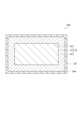
- the composites of each Example had non-filled parts 12 that were not filled with resin, surrounded by filled parts 14 that were filled with resin.
- the composites also had a resin layer 20 made of resin that covered the filled parts 14.
- the boundary 13 between the filled parts 14 and the non-filled parts 12 had a shape similar to the outer edge of the composite.
- the composite of Comparative Example 1 had the entire boron nitride sintered body filled with resin, and there were no non-filled parts 12. Due to the position where the black paint was applied, there were four white parts in a lattice pattern inside, and these parts were also filled with resin.
Landscapes
- Chemical & Material Sciences (AREA)
- Engineering & Computer Science (AREA)
- Ceramic Engineering (AREA)
- Materials Engineering (AREA)
- Structural Engineering (AREA)
- Organic Chemistry (AREA)
- Manufacturing & Machinery (AREA)
- Ceramic Products (AREA)
Priority Applications (1)
| Application Number | Priority Date | Filing Date | Title |
|---|---|---|---|
| JP2025511078A JPWO2024204446A1 (https=) | 2023-03-29 | 2024-03-27 |
Applications Claiming Priority (2)
| Application Number | Priority Date | Filing Date | Title |
|---|---|---|---|
| JP2023053134 | 2023-03-29 | ||
| JP2023-053134 | 2023-03-29 |
Publications (1)
| Publication Number | Publication Date |
|---|---|
| WO2024204446A1 true WO2024204446A1 (ja) | 2024-10-03 |
Family
ID=92905738
Family Applications (1)
| Application Number | Title | Priority Date | Filing Date |
|---|---|---|---|
| PCT/JP2024/012466 Ceased WO2024204446A1 (ja) | 2023-03-29 | 2024-03-27 | 複合体及びその製造方法 |
Country Status (2)
| Country | Link |
|---|---|
| JP (1) | JPWO2024204446A1 (https=) |
| WO (1) | WO2024204446A1 (https=) |
Cited By (1)
| Publication number | Priority date | Publication date | Assignee | Title |
|---|---|---|---|---|
| WO2025249161A1 (ja) * | 2024-05-27 | 2025-12-04 | 株式会社トクヤマ | シリコーン樹脂組成物 |
Citations (4)
| Publication number | Priority date | Publication date | Assignee | Title |
|---|---|---|---|---|
| WO2014196496A1 (ja) * | 2013-06-03 | 2014-12-11 | 電気化学工業株式会社 | 樹脂含浸窒化ホウ素焼結体およびその用途 |
| JP2015096456A (ja) * | 2013-11-15 | 2015-05-21 | 電気化学工業株式会社 | 放熱部材およびその用途 |
| WO2020203688A1 (ja) * | 2019-03-29 | 2020-10-08 | デンカ株式会社 | 複合体の製造方法 |
| WO2022209971A1 (ja) * | 2021-03-31 | 2022-10-06 | デンカ株式会社 | 複合体及びその製造方法、並びに、積層体及びその製造方法 |
-
2024
- 2024-03-27 JP JP2025511078A patent/JPWO2024204446A1/ja active Pending
- 2024-03-27 WO PCT/JP2024/012466 patent/WO2024204446A1/ja not_active Ceased
Patent Citations (4)
| Publication number | Priority date | Publication date | Assignee | Title |
|---|---|---|---|---|
| WO2014196496A1 (ja) * | 2013-06-03 | 2014-12-11 | 電気化学工業株式会社 | 樹脂含浸窒化ホウ素焼結体およびその用途 |
| JP2015096456A (ja) * | 2013-11-15 | 2015-05-21 | 電気化学工業株式会社 | 放熱部材およびその用途 |
| WO2020203688A1 (ja) * | 2019-03-29 | 2020-10-08 | デンカ株式会社 | 複合体の製造方法 |
| WO2022209971A1 (ja) * | 2021-03-31 | 2022-10-06 | デンカ株式会社 | 複合体及びその製造方法、並びに、積層体及びその製造方法 |
Cited By (1)
| Publication number | Priority date | Publication date | Assignee | Title |
|---|---|---|---|---|
| WO2025249161A1 (ja) * | 2024-05-27 | 2025-12-04 | 株式会社トクヤマ | シリコーン樹脂組成物 |
Also Published As
| Publication number | Publication date |
|---|---|
| JPWO2024204446A1 (https=) | 2024-10-03 |
Similar Documents
| Publication | Publication Date | Title |
|---|---|---|
| JP6755879B2 (ja) | アルミニウム−ダイヤモンド系複合体及びその製造方法 | |
| Tang et al. | Preparation of carbon fiber-reinforced SiC ceramics by stereolithography and secondary silicon infiltration | |
| US8322398B2 (en) | Manufacturing method of aluminum-diamond composite | |
| EP2998282A1 (en) | Process for producing reaction bonded silicon carbide member | |
| EP2657207A1 (en) | Method of producing a melt-infiltrated ceramic matrix composite article | |
| US20180327322A1 (en) | Coating formed on graphite substrate and method for producing the same | |
| US8728261B2 (en) | Method for producing ceramic joined body | |
| EP2289860A1 (en) | Composite material and method for producing the same | |
| CN112272658A (zh) | 制造陶瓷组件的方法 | |
| CN115702130A (zh) | 氮化硅烧结基板 | |
| WO2024204446A1 (ja) | 複合体及びその製造方法 | |
| RU2744611C2 (ru) | Получение композиционных материалов с керамической матрицей, содержащих углеродные нанотрубки и графен | |
| Ghaltaghchyan et al. | Effect of additives on selective laser sintering of silicon carbide | |
| WO2003033434A1 (en) | Process for producing silicon carbide sinter and silicon carbide sinter obtained by the process | |
| JP2011063453A (ja) | 炭化ホウ素−炭化ケイ素複合セラミックス及び該セラミックスの製造方法 | |
| EP3950643B1 (en) | Method for producing composite body | |
| JP7550869B2 (ja) | 複合体及びその製造方法、並びに、積層体及びその製造方法 | |
| JP4596855B2 (ja) | 金属−セラミックス複合構造体およびこれからなるプラズマ発生用電極部材 | |
| Kim et al. | Mechanical properties of C f/SiC composite using a combined process of chemical vapor infiltration and precursor infiltration pyrolysis | |
| CN117447228B (zh) | 一种直写成型获得陶瓷坯体孔隙结构调控方法 | |
| US6783866B1 (en) | Polymerceramic materials with thermal expansion characteristics similar to those of metals | |
| CN115298151A (zh) | 复合体的制造方法 | |
| EP2963001A1 (en) | Oil quenching heat treatment furnace tray | |
| US20060240287A1 (en) | Dummy wafer and method for manufacturing thereof | |
| JP7458479B2 (ja) | 複合体及び複合体の製造方法 |
Legal Events
| Date | Code | Title | Description |
|---|---|---|---|
| 121 | Ep: the epo has been informed by wipo that ep was designated in this application |
Ref document number: 24780547 Country of ref document: EP Kind code of ref document: A1 |
|
| ENP | Entry into the national phase |
Ref document number: 2025511078 Country of ref document: JP Kind code of ref document: A |
|
| WWE | Wipo information: entry into national phase |
Ref document number: 2025511078 Country of ref document: JP |
|
| NENP | Non-entry into the national phase |
Ref country code: DE |
|
| 122 | Ep: pct application non-entry in european phase |
Ref document number: 24780547 Country of ref document: EP Kind code of ref document: A1 |