WO2024203584A1 - 光学要素、光学素子 - Google Patents
光学要素、光学素子 Download PDFInfo
- Publication number
- WO2024203584A1 WO2024203584A1 PCT/JP2024/010683 JP2024010683W WO2024203584A1 WO 2024203584 A1 WO2024203584 A1 WO 2024203584A1 JP 2024010683 W JP2024010683 W JP 2024010683W WO 2024203584 A1 WO2024203584 A1 WO 2024203584A1
- Authority
- WO
- WIPO (PCT)
- Prior art keywords
- liquid crystal
- layer
- light
- crystal layer
- optically anisotropic
- Prior art date
- Legal status (The legal status is an assumption and is not a legal conclusion. Google has not performed a legal analysis and makes no representation as to the accuracy of the status listed.)
- Ceased
Links
Images


Classifications
-
- G—PHYSICS
- G02—OPTICS
- G02F—OPTICAL DEVICES OR ARRANGEMENTS FOR THE CONTROL OF LIGHT BY MODIFICATION OF THE OPTICAL PROPERTIES OF THE MEDIA OF THE ELEMENTS INVOLVED THEREIN; NON-LINEAR OPTICS; FREQUENCY-CHANGING OF LIGHT; OPTICAL LOGIC ELEMENTS; OPTICAL ANALOGUE/DIGITAL CONVERTERS
- G02F1/00—Devices or arrangements for the control of the intensity, colour, phase, polarisation or direction of light arriving from an independent light source, e.g. switching, gating or modulating; Non-linear optics
- G02F1/01—Devices or arrangements for the control of the intensity, colour, phase, polarisation or direction of light arriving from an independent light source, e.g. switching, gating or modulating; Non-linear optics for the control of the intensity, phase, polarisation or colour
- G02F1/13—Devices or arrangements for the control of the intensity, colour, phase, polarisation or direction of light arriving from an independent light source, e.g. switching, gating or modulating; Non-linear optics for the control of the intensity, phase, polarisation or colour based on liquid crystals, e.g. single liquid crystal display cells
- G02F1/133—Constructional arrangements; Operation of liquid crystal cells; Circuit arrangements
- G02F1/1333—Constructional arrangements; Manufacturing methods
- G02F1/1335—Structural association of cells with optical devices, e.g. polarisers or reflectors
- G02F1/13363—Birefringent elements, e.g. for optical compensation
- G02F1/133636—Birefringent elements, e.g. for optical compensation with twisted orientation, e.g. comprising helically oriented LC-molecules or a plurality of twisted birefringent sublayers
-
- G—PHYSICS
- G02—OPTICS
- G02B—OPTICAL ELEMENTS, SYSTEMS OR APPARATUS
- G02B5/00—Optical elements other than lenses
-
- G—PHYSICS
- G02—OPTICS
- G02B—OPTICAL ELEMENTS, SYSTEMS OR APPARATUS
- G02B5/00—Optical elements other than lenses
- G02B5/18—Diffraction gratings
-
- G—PHYSICS
- G02—OPTICS
- G02B—OPTICAL ELEMENTS, SYSTEMS OR APPARATUS
- G02B5/00—Optical elements other than lenses
- G02B5/30—Polarising elements
-
- G—PHYSICS
- G02—OPTICS
- G02F—OPTICAL DEVICES OR ARRANGEMENTS FOR THE CONTROL OF LIGHT BY MODIFICATION OF THE OPTICAL PROPERTIES OF THE MEDIA OF THE ELEMENTS INVOLVED THEREIN; NON-LINEAR OPTICS; FREQUENCY-CHANGING OF LIGHT; OPTICAL LOGIC ELEMENTS; OPTICAL ANALOGUE/DIGITAL CONVERTERS
- G02F1/00—Devices or arrangements for the control of the intensity, colour, phase, polarisation or direction of light arriving from an independent light source, e.g. switching, gating or modulating; Non-linear optics
- G02F1/01—Devices or arrangements for the control of the intensity, colour, phase, polarisation or direction of light arriving from an independent light source, e.g. switching, gating or modulating; Non-linear optics for the control of the intensity, phase, polarisation or colour
- G02F1/13—Devices or arrangements for the control of the intensity, colour, phase, polarisation or direction of light arriving from an independent light source, e.g. switching, gating or modulating; Non-linear optics for the control of the intensity, phase, polarisation or colour based on liquid crystals, e.g. single liquid crystal display cells
- G02F1/133—Constructional arrangements; Operation of liquid crystal cells; Circuit arrangements
- G02F1/1333—Constructional arrangements; Manufacturing methods
- G02F1/1335—Structural association of cells with optical devices, e.g. polarisers or reflectors
- G02F1/133528—Polarisers
- G02F1/133541—Circular polarisers
-
- G—PHYSICS
- G02—OPTICS
- G02F—OPTICAL DEVICES OR ARRANGEMENTS FOR THE CONTROL OF LIGHT BY MODIFICATION OF THE OPTICAL PROPERTIES OF THE MEDIA OF THE ELEMENTS INVOLVED THEREIN; NON-LINEAR OPTICS; FREQUENCY-CHANGING OF LIGHT; OPTICAL LOGIC ELEMENTS; OPTICAL ANALOGUE/DIGITAL CONVERTERS
- G02F1/00—Devices or arrangements for the control of the intensity, colour, phase, polarisation or direction of light arriving from an independent light source, e.g. switching, gating or modulating; Non-linear optics
- G02F1/01—Devices or arrangements for the control of the intensity, colour, phase, polarisation or direction of light arriving from an independent light source, e.g. switching, gating or modulating; Non-linear optics for the control of the intensity, phase, polarisation or colour
- G02F1/13—Devices or arrangements for the control of the intensity, colour, phase, polarisation or direction of light arriving from an independent light source, e.g. switching, gating or modulating; Non-linear optics for the control of the intensity, phase, polarisation or colour based on liquid crystals, e.g. single liquid crystal display cells
- G02F1/133—Constructional arrangements; Operation of liquid crystal cells; Circuit arrangements
- G02F1/1333—Constructional arrangements; Manufacturing methods
- G02F1/1335—Structural association of cells with optical devices, e.g. polarisers or reflectors
- G02F1/13363—Birefringent elements, e.g. for optical compensation
- G02F1/133632—Birefringent elements, e.g. for optical compensation with refractive index ellipsoid inclined relative to the LC-layer surface
-
- G—PHYSICS
- G02—OPTICS
- G02F—OPTICAL DEVICES OR ARRANGEMENTS FOR THE CONTROL OF LIGHT BY MODIFICATION OF THE OPTICAL PROPERTIES OF THE MEDIA OF THE ELEMENTS INVOLVED THEREIN; NON-LINEAR OPTICS; FREQUENCY-CHANGING OF LIGHT; OPTICAL LOGIC ELEMENTS; OPTICAL ANALOGUE/DIGITAL CONVERTERS
- G02F1/00—Devices or arrangements for the control of the intensity, colour, phase, polarisation or direction of light arriving from an independent light source, e.g. switching, gating or modulating; Non-linear optics
- G02F1/01—Devices or arrangements for the control of the intensity, colour, phase, polarisation or direction of light arriving from an independent light source, e.g. switching, gating or modulating; Non-linear optics for the control of the intensity, phase, polarisation or colour
- G02F1/13—Devices or arrangements for the control of the intensity, colour, phase, polarisation or direction of light arriving from an independent light source, e.g. switching, gating or modulating; Non-linear optics for the control of the intensity, phase, polarisation or colour based on liquid crystals, e.g. single liquid crystal display cells
- G02F1/133—Constructional arrangements; Operation of liquid crystal cells; Circuit arrangements
- G02F1/1333—Constructional arrangements; Manufacturing methods
- G02F1/1335—Structural association of cells with optical devices, e.g. polarisers or reflectors
- G02F1/13363—Birefringent elements, e.g. for optical compensation
- G02F1/133633—Birefringent elements, e.g. for optical compensation using mesogenic materials
-
- G—PHYSICS
- G02—OPTICS
- G02F—OPTICAL DEVICES OR ARRANGEMENTS FOR THE CONTROL OF LIGHT BY MODIFICATION OF THE OPTICAL PROPERTIES OF THE MEDIA OF THE ELEMENTS INVOLVED THEREIN; NON-LINEAR OPTICS; FREQUENCY-CHANGING OF LIGHT; OPTICAL LOGIC ELEMENTS; OPTICAL ANALOGUE/DIGITAL CONVERTERS
- G02F1/00—Devices or arrangements for the control of the intensity, colour, phase, polarisation or direction of light arriving from an independent light source, e.g. switching, gating or modulating; Non-linear optics
- G02F1/01—Devices or arrangements for the control of the intensity, colour, phase, polarisation or direction of light arriving from an independent light source, e.g. switching, gating or modulating; Non-linear optics for the control of the intensity, phase, polarisation or colour
- G02F1/13—Devices or arrangements for the control of the intensity, colour, phase, polarisation or direction of light arriving from an independent light source, e.g. switching, gating or modulating; Non-linear optics for the control of the intensity, phase, polarisation or colour based on liquid crystals, e.g. single liquid crystal display cells
- G02F1/133—Constructional arrangements; Operation of liquid crystal cells; Circuit arrangements
- G02F1/1333—Constructional arrangements; Manufacturing methods
- G02F1/1335—Structural association of cells with optical devices, e.g. polarisers or reflectors
- G02F1/13363—Birefringent elements, e.g. for optical compensation
- G02F1/133638—Waveplates, i.e. plates with a retardation value of lambda/n
Definitions
- the present invention relates to optical elements and optical devices using optical elements.
- Patent Document 1 discloses an optical element whose refraction angle has little wavelength dependency, and which can, for example, refract and emit red light, green light, and blue light incident from the same direction in almost the same direction, and states that this optical element is applicable to AR glass.
- the wavelength dependency of the refraction angle can be reduced by using a wavelength-selective retardation layer (optical element) in combination with a plurality of optically anisotropic layers. It is described that the wavelength-selective retardation layer (optical element) has a function of converting circularly polarized light in a specific wavelength range into circularly polarized light in the opposite rotation direction.
- an object of the present invention is to provide an optical element with a novel configuration that can convert only circularly polarized light in a specific wavelength range into circularly polarized light having the opposite rotation direction.
- Another object of the present invention is to provide an optical device using the above optical element.
- An optical element having a first ⁇ /4 plate, an optical laminate, and a second ⁇ /4 plate in this order, the optical laminate has at least two liquid crystal layer pairs in a thickness direction, each pair being composed of a first liquid crystal layer having a liquid crystal compound fixed therein that is twisted in a thickness direction, and a second liquid crystal layer having a liquid crystal compound fixed therein that is twisted in a thickness direction, the second liquid crystal layer having a liquid crystal compound fixed therein, the twist direction of the liquid crystal compound being opposite to the twist direction of the liquid crystal compound in the first liquid crystal layer;
- an alignment direction of the liquid crystal compound on a surface of the first liquid crystal layer facing the second liquid crystal layer is parallel to an alignment direction of the liquid crystal compound on a surface of the second liquid crystal layer facing the first liquid crystal layer;
- An optical element, wherein a twist angle of the liquid crystal compound in the first liquid crystal layer is equal to a twist angle of the liquid crystal compound in the second liquid crystal layer.
- the twist angle of the liquid crystal compound in the liquid crystal layer A is 16.5 to 36.5°, and the product ⁇ n A d A of the refractive index difference ⁇ n A of the liquid crystal layer A and the thickness d A of the liquid crystal layer A is 252 to 312 nm;
- the liquid crystal layer A is disposed on the optical laminate side, The optical element according to [3] or [4], wherein the alignment direction of the liquid crystal compound on the liquid crystal layer A side surface of the optical laminate is parallel to the alignment direction of the liquid crystal compound on the optical laminate side surface of the liquid crystal layer A.
- the optical element according to any one of [1] to [6] is disposed between at least a pair of adjacent two of the optically anisotropic layers in the plurality of optically anisotropic layers, and
- An object of the present invention is to provide an optical element of a novel configuration that can convert only circularly polarized light in a specific wavelength range into circularly polarized light having an opposite rotation direction. Moreover, according to the present invention, an optical device using the above optical element can be provided.
- FIG. 1 is a diagram conceptually illustrating an example of an optical element of the present invention.
- 2 is a graph illustrating an optical element of the present invention.
- 2 is a graph illustrating an optical element of the present invention.
- FIG. 2 is a diagram conceptually illustrating another example of an optical element of the present invention.
- 5 is a graph for explaining the optical elements shown in FIG. 4 .
- FIG. 1 is a diagram conceptually illustrating an example of an optical element of the present invention.
- FIG. 7 is a diagram conceptually illustrating an optically anisotropic layer of the optical element shown in FIG. 6.
- FIG. 7 is a plan view of the optically anisotropic layer of the optical element shown in FIG. 6.
- FIG. 7 is a conceptual diagram showing the function of the optically anisotropic layer of the optical element shown in FIG. 6.
- FIG. 7 is a conceptual diagram showing the function of the optically anisotropic layer of the optical element shown in FIG. 6.
- 7 is a conceptual diagram showing the function of the optical element shown in FIG. 6.
- 7 is a conceptual diagram showing the function of the optical element shown in FIG. 6.
- FIG. 2 is a diagram conceptually illustrating another example of the optical element of the present invention.
- 13 is a conceptual diagram showing the function of the optical element shown in FIG. 12.
- FIG. 1 is a conceptual diagram showing the function of the optically anisotropic layer of the optical element shown in FIG. 6.
- 7 is a conceptual diagram showing the function of the optical element shown in FIG. 6.
- 13 is a
- FIG. 2 is a plan view of another example of the optically anisotropic layer of the optical element of the present invention.
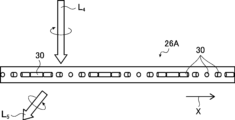
- FIG. 17 is a diagram conceptually showing an example of an exposure apparatus for exposing an alignment film that forms the optically anisotropic layer shown in FIG. 16 .
- FIG. 1 is a diagram conceptually illustrating an example of AR glasses using an example of the optical element of the present invention.
- FIG. 2 is a diagram conceptually illustrating another example of the optically anisotropic layer of the optical element of the present invention.
- Re( ⁇ ) and Rth( ⁇ ) respectively represent the in-plane retardation and the retardation in the thickness direction at wavelength ⁇ .
- Re( ⁇ ), Rth( ⁇ ), and ⁇ nd are measured using AXOSCAN (manufactured by AXOMETRICS).
- visible light refers to 380 nm to 780 nm.
- the measurement wavelength is 550 nm.
- the angular relationship e.g., “perpendicular,””parallel,” and specific angles
- the angle is within the range of less than ⁇ 10° from the exact angle, and the error from the exact angle is preferably 5° or less, and more preferably 3° or less.
- all of the drawings shown below are conceptual diagrams for explaining the present invention, and the positional relationship, size, thickness, shape, etc. of each component may differ from the actual ones.
- the optical element of the present invention includes a first ⁇ /4 plate, an optical laminate, and a second ⁇ /4 plate in this order.
- the optical laminate has two or more liquid crystal layer pairs in the thickness direction, each pair consisting of a first liquid crystal layer having a liquid crystal compound fixed with a twisted orientation in the thickness direction, and a second liquid crystal layer having a liquid crystal compound fixed with a twisted orientation in the thickness direction, the second liquid crystal layer having a liquid crystal compound fixed with a twisted orientation in the thickness direction, the twisted direction of the liquid crystal compound being opposite to the twisted direction of the liquid crystal compound in the first liquid crystal layer.
- the alignment direction of the liquid crystal compound on the surface of the first liquid crystal layer facing the second liquid crystal layer is parallel to the alignment direction of the liquid crystal compound on the surface of the second liquid crystal layer facing the first liquid crystal layer, and the twist angle of the liquid crystal compound in the first liquid crystal layer is equal to the twist angle of the liquid crystal compound in the second liquid crystal layer.
- FIG. 1 conceptually illustrates an example of an optical element of the present invention.
- 1 includes a first ⁇ /4 plate 212, a second ⁇ /4 plate 214, and a liquid crystal polarization interference element 216.
- the liquid crystal polarization interference element 216 is disposed between the first ⁇ /4 plate 212 and the second ⁇ /4 plate 214.
- the liquid crystal polarization interference element 216 corresponds to the optical laminate in the optical element of the present invention.
- the liquid crystal polarization interference element 216 is an optical element that acts as a ⁇ /2 retardation plate for light in a specific wavelength range (specific wavelength), and does not act as a retardation layer for other light. Therefore, the optical element 210 shown in FIG.
- the optical element 210 of the present invention functions as a wavelength-selective retardation layer for circularly polarized light.
- the first ⁇ /4 plate 212 and the second ⁇ /4 plate 214 are plates that have a function of converting linearly polarized light of a certain wavelength into circularly polarized light (or circularly polarized light into linearly polarized light), more specifically, plates that exhibit an in-plane retardation of ⁇ /4 (or an odd multiple thereof) at a certain wavelength ⁇ nm.
- ⁇ /4 plate 212 and the second ⁇ /4 plate 214 there are no particular limitations on the first ⁇ /4 plate 212 and the second ⁇ /4 plate 214, and any known ⁇ /4 plate may be used.
- the first ⁇ /4 plate 212 and the second ⁇ /4 plate 214 will be described in detail later.
- a liquid crystal polarization interference element 216 is disposed between the first ⁇ /4 plate 212 and the second ⁇ /4 plate 214 .
- the first ⁇ /4 plate 212 and the second ⁇ /4 plate 214 are spaced apart from the liquid crystal polarization interference element 216 .
- the present invention is not limited thereto, and the first ⁇ /4 plate 212 and the second ⁇ /4 plate 214 may be laminated in contact with the liquid crystal polarization interference element 216.
- first ⁇ /4 plate 212 and the second ⁇ /4 plate 214 are in contact with the liquid crystal polarization interference element 216, they may be attached to each other with an adhesive transparent to transmitted light, such as an OCA (Optical Clear Adhesive) or an acrylic adhesive, if necessary.
- an adhesive transparent to transmitted light such as an OCA (Optical Clear Adhesive) or an acrylic adhesive, if necessary.
- the liquid crystal polarization interference element 216 is formed by laminating an even number of liquid crystal layers, each layer being made of liquid crystal compounds 218 that are twisted and aligned in the thickness direction and fixed in place.
- the liquid crystal compounds 218 are rod-shaped liquid crystal compounds.
- the liquid crystal polarization interference element 216 is formed by alternately laminating a first liquid crystal layer 220 having liquid crystal compounds 218 fixed with a twisted orientation in the thickness direction, and a second liquid crystal layer 224 having liquid crystal compounds 218 fixed with a twisted orientation in the thickness direction, the second liquid crystal layer 224 having liquid crystal compounds 218 twisted in the thickness direction and in which the twist direction of the liquid crystal compounds 218 is opposite to that of the first liquid crystal layer 220.
- the liquid crystal polarization interference element 216 has a configuration in which a combination of a first liquid crystal layer 220 and a second liquid crystal layer 224 is regarded as one liquid crystal layer set 226, and two or more liquid crystal layer sets 226 are laminated in the thickness direction. Therefore, the total number of layers of the first liquid crystal layer 220 and the second liquid crystal layer 224 is an even number.
- the alignment direction of the liquid crystal compound 218 on the surface of the first liquid crystal layer 220 facing the second liquid crystal layer 224 is parallel to the alignment direction of the liquid crystal compound 218 on the surface of the second liquid crystal layer 224 facing the first liquid crystal layer 220. That is, in one liquid crystal layer set 226, the alignment directions of the liquid crystal compounds 218 at the interface between the first liquid crystal layer 220 and the second liquid crystal layer 224 are parallel to each other.
- the orientation direction of the liquid crystal compound 218 on the surface of the first liquid crystal layer 220 facing the second liquid crystal layer 224, and the orientation direction of the liquid crystal compound 218 on the surface of the second liquid crystal layer 224 facing the first liquid crystal layer 220 can be detected by cutting the liquid crystal polarization interference element 216 obliquely and analyzing the orientation direction of the liquid crystal on the surface of the cross section. This method is described in detail in "Depth-Dependent Determination of Molecular Orientation for WV-Film" by Yohei Takahashi et al. (FMC8-3, IDW'04, 651-654).
- the twist angle of the liquid crystal compound 218 in the first liquid crystal layer 220 in the thickness direction is equal to the twist angle of the liquid crystal compound 218 in the second liquid crystal layer 224 in the thickness direction.
- the twist directions of the liquid crystal compound 218 in the thickness direction are opposite to those of the first liquid crystal layer 220 and the second liquid crystal layer 224. That is, for example, when the twist angle of the liquid crystal compound 218 in the first liquid crystal layer 220 is " ⁇ [°]", the twist angle of the liquid crystal compound 218 in the first liquid crystal layer 220 is "- ⁇ [°]".
- the liquid crystal compound 218 is twisted in the thickness direction to a certain angle in the first liquid crystal layer 220, and then twists back to the original angle in the second liquid crystal layer 224.
- the twist angle of the liquid crystal compound 218 in the thickness direction is 30°
- the liquid crystal compound 218 is twisted from 0° to 30° in the first liquid crystal layer 220, and then twists from 30° back to 0° in the second liquid crystal layer 224.
- the twist angle of the liquid crystal compound is, for example, positive (+) clockwise and negative (-) counterclockwise with the direction of the transmission axis of the first ⁇ /4 plate 212 being 0°. That is, the first liquid crystal layer 220 and the second liquid crystal layer 224 have the same absolute value of the twist angle.
- the liquid crystal compounds 218 (rod-shaped liquid crystal compounds) are twisted in the thickness direction, and the first liquid crystal layer 220 and the second liquid crystal layer 224 are alternately stacked in the thickness direction, with the liquid crystal compounds 218 being parallel in orientation at the interface, the liquid crystal compounds 218 being twisted in opposite directions, and the absolute values of the twist angles being equal. That is, the light passing through the liquid crystal polarization interference element 216 is alternately and repeatedly influenced by the slow axis rotating at a predetermined angle in one direction and the slow axis rotating at a predetermined angle in the opposite direction.
- the light passing through the liquid crystal polarization interference element 216 is alternately and repeatedly influenced by the slow axis rotating from 0° to 30° and the slow axis rotating from 30° to 0°.
- liquid crystal polarization interference element 216 by setting the ⁇ nd of the first liquid crystal layer 220 and the second liquid crystal layer 224 according to the wavelength range in which the optical element 210 converts circularly polarized light into circularly polarized light with the opposite rotation direction, and further adjusting the twist angle of the liquid crystal compound in the first liquid crystal layer 220 and the second liquid crystal layer 224 according to the total number of layers of the first liquid crystal layer 220 and the second liquid crystal layer 224, it is possible to form a liquid crystal polarization interference element 216 that acts as a ⁇ /2 phase difference plate for light in a specific wavelength range and does not act as a phase difference plate for other light, i.e., that does not sense retardation.
- the number of liquid crystal layer pairs 226 in the liquid crystal polarization interference element 216 can be detected by cutting the liquid crystal polarization interference element 216 obliquely and analyzing the alignment direction of the liquid crystal on the surface of the cross section. This method is described in detail in the above-mentioned document by Yohei Takahashi et al.
- the change in the twist direction of the liquid crystal can be determined based on the difference in the components in the depth direction of the element by using a time-of-flight secondary ion mass spectrometry (TOF-SIMS) device (TOF.SIMS5, manufactured by ION-TOF) or the like, with the background being that it is due to the difference in the chiral agent.
- TOF-SIMS time-of-flight secondary ion mass spectrometry
- ⁇ n is the birefringence of the liquid crystal compound 218 constituting the first liquid crystal layer 220 and the second liquid crystal layer 224.
- d is the thickness of the first liquid crystal layer 220 and the second liquid crystal layer 224. Note that ⁇ n can also be measured using AxoScan manufactured by Axometrics, Inc. In the present invention, the ⁇ nd of the first liquid crystal layer 220 and the second liquid crystal layer 224 are equal.
- the liquid crystal polarization interference element 216 acts as a ⁇ /2 retardation plate only for light in a specific wavelength range.
- the ⁇ nd of the first liquid crystal layer 220 and the second liquid crystal layer 224 is set to a wavelength at which the liquid crystal polarization interference element 216 is assumed to act as a ⁇ /2 retardation plate, that is, half the central wavelength (half wavelength) of the wavelength range at which the optical element 210 is assumed to convert circularly polarized light into circularly polarized light with the opposite rotation direction.
- the wavelength at which the liquid crystal polarization interference element 216 acts as a ⁇ /2 retardation plate i.e., the central wavelength of the wavelength range at which the optical element 210 converts circularly polarized light into circularly polarized light with the opposite rotation direction
- the ⁇ nd of the first liquid crystal layer 220 and the second liquid crystal layer 224 is set to 275 nm.
- the ⁇ nd of the first liquid crystal layer 220 and the second liquid crystal layer 224 may have an error of approximately ⁇ 10% with respect to half the central wavelength of the wavelength range in which the optical element 210 converts circularly polarized light into circularly polarized light with the opposite rotation direction.
- the twist angle of the liquid crystal compound 218 in the first liquid crystal layer 220 and the second liquid crystal layer 224 that constitute the liquid crystal polarization interference element 216 is set by simulation to an optimal twist angle at which the liquid crystal polarization interference element 216 acts as a ⁇ /2 retardation plate, depending on the central wavelength of the wavelength range in which the optical element 210 is assumed to convert circularly polarized light into circularly polarized light with the opposite rotation direction, and the total number N of layers of the first liquid crystal layer 220 and the second liquid crystal layer 224.
- a general optical simulation means can be used, and it is also possible to perform the calculations using LCD Master 1D (manufactured by Shintech Co., Ltd., Ver. 9.8.0.0).
- the twist angle ⁇ of the liquid crystal compound 218 in the first liquid crystal layer 220 and the second liquid crystal layer 224 with respect to the total number N of layers of the first liquid crystal layer 220 and the second liquid crystal layer 224 is given by:
- the twist angle ⁇ is 63.6°.
- the twist angle ⁇ is 35.5°.
- the twist angle ⁇ is 23.6°.
- the twist angle ⁇ is 17.7°.
- the twist angle ⁇ is 14.1°.
- the twist angle ⁇ is 11.8°.
- the twist angle ⁇ is 10.1°.
- the twist angle ⁇ is 8.8°. was the optimum value.
- the twist angle ⁇ [°] of the liquid crystal compound 218 in the first liquid crystal layer 220 and the second liquid crystal layer 224 corresponding to the total number N of layers of the first liquid crystal layer 220 and the second liquid crystal layer 224 is expressed as follows: 0.9 ⁇ (129.05 ⁇ N -0.961 ) ⁇
- 129.05 ⁇ N -0.961 It is more preferable to set the above.
- the absolute values of the twist angles of the liquid crystal compound 218 in the first liquid crystal layer 220 and the second liquid crystal layer 224 are not limited to being the same, and may have an error of ⁇ 10% or less of the absolute value of the twist angle. However, it is preferable that this error is small, and it is most preferable that the absolute values of the twist angles of the liquid crystal compounds 218 in the first liquid crystal layer 220 and the second liquid crystal layer 224 are the same.
- the twist angle of the liquid crystal compound 218 in the first liquid crystal layer 220 and the second liquid crystal layer 224 constituting the liquid crystal polarization interference element 216 can be detected by obliquely cutting the liquid crystal polarization interference element 216 and analyzing the alignment direction of the liquid crystal on the surface of the cross section. This method is described in detail in the above-mentioned document by Yohei Takahashi et al.
- the twist angle of the liquid crystal compound 218 can also be measured by a separation measuring means assuming a model with input parameters, using AxoScan (manufactured by Axometrics).
- the thickness d of the first liquid crystal layer 220 and the second liquid crystal layer 224 is preferably 1 to 5 ⁇ m, and more preferably 1 to 3 ⁇ m.
- the first liquid crystal layer 220 and the second liquid crystal layer 224 are usually formed using the same liquid crystal compound 218.
- the first liquid crystal layer 220 and the second liquid crystal layer 224 have the same ⁇ nd. Therefore, the first liquid crystal layer 220 and the second liquid crystal layer 224 have the same thickness.
- the total number N of layers of the first liquid crystal layer 220 and the second liquid crystal layer 224 is preferably 4 to 30 layers, more preferably 4 to 20 layers, and further preferably 4 to 10 layers.
- Such a liquid crystal polarization interference element 216 may be fabricated by a known method.
- a method of producing the first liquid crystal layer 220 and the second liquid crystal layer 224 by a coating method using a liquid crystal composition can be given.
- an alignment film that is oriented in one direction is formed on an appropriately selected support.
- the alignment film may be any of known alignment films, such as a rubbed film made of an organic compound such as a polymer, an obliquely evaporated film of an inorganic compound, a film having microgrooves, a film in which LB (Langmuir-Blodgett) films of organic compounds such as ⁇ -tricosanoic acid, dioctadecylmethylammonium chloride, and methyl stearate are accumulated by the Langmuir-Blodgett method, and a film in which an alignment film-forming coating liquid containing a photoalignment material is applied to the surface of a support, dried, and the coating film is exposed to light using a polarizer such as a wire grid polarizer.
- a polarizer such as a wire grid polarizer
- a composition (liquid crystal composition) for forming the first liquid crystal layer 220 which contains a liquid crystal compound and a chiral agent having the function of inducing a twisted alignment of the liquid crystal compound in the thickness direction
- a composition for forming the second liquid crystal layer 224 are prepared.
- the first liquid crystal layer 220 and the second liquid crystal layer 224 have opposite twist directions of the liquid crystal compound 218 in the thickness direction, but the twist direction of the liquid crystal compound in the thickness direction can be selected by selecting the chiral agent. Also, the twist angle of the liquid crystal compound 218 in the thickness direction can be adjusted by adjusting the amount of the chiral agent added.
- the solvent for preparing the composition is not limited and can be selected appropriately depending on the purpose, but organic solvents are preferred.
- organic solvents are preferred.
- examples include ketones, alkyl halides, amides, sulfoxides, heterocyclic compounds, hydrocarbons, esters, and ethers. These may be used alone or in combination of two or more types. Among these, ketones are preferred when the burden on the environment is taken into consideration.
- a composition for forming the first liquid crystal layer 220 is applied to the surface of the formed alignment film to align the liquid crystal compound 218, and then dried. If necessary, the composition is cured by exposure to ultraviolet light or the like to form the first liquid crystal layer 220.
- a composition for forming a second liquid crystal layer 224 is applied to the surface of the first liquid crystal layer 220 thus formed, dried, and if necessary, the composition is hardened by exposure to ultraviolet light or the like to form the second liquid crystal layer 224, thereby forming a first set of liquid crystal layers.
- the upper liquid crystal layer follows the orientation of the liquid crystal compound on the surface of the lower liquid crystal layer. Therefore, at the interface between the first liquid crystal layer 220 and the second liquid crystal layer 224, the alignment direction of the liquid crystal compound 218 in the first liquid crystal layer 220 and the alignment direction of the liquid crystal compound 218 in the second liquid crystal layer 224 are parallel (match each other).
- a composition for forming the first liquid crystal layer 220 is applied to the surface of the formed second liquid crystal layer 224, dried, and if necessary, the composition is hardened by exposure to ultraviolet light, etc., to form the first liquid crystal layer 220.
- the twist in the thickness direction of the liquid crystal compound 218 in the first liquid crystal layer 220 and the twist in the thickness direction of the liquid crystal compound 218 in the second liquid crystal layer have the same twist angle and opposite twist directions.
- the orientation angle of the liquid crystal compound 218 at the interface between the first liquid crystal layer 220 formed on the surface of the orientation film and the orientation film of the first liquid crystal layer 220 is set to 0°
- the orientation angle of the liquid crystal compound 218 on the upper surface of the second liquid crystal layer 224 also returns to 0°.
- the liquid crystal compound in the vicinity of the interface between the upper liquid crystal layer and the lower layer follows the orientation of the liquid crystal compound on the surface of the lower liquid crystal layer.
- the alignment direction of the liquid crystal compound 218 in the second liquid crystal layer 224 and the alignment direction of the liquid crystal compound 218 in the first liquid crystal layer 220 are parallel to each other at 0°.
- a second liquid crystal layer 224 is similarly formed on the surface of the first liquid crystal layer 220 that has been formed, then the first liquid crystal layer 220 is similarly formed on the surface of the second liquid crystal layer 224 that has been formed, and then the second liquid crystal layer 224 is similarly formed on the surface of the first liquid crystal layer 220 that has been formed.
- This process is repeated the number of times corresponding to the number of liquid crystal layers to be formed, i.e., the number of liquid crystal layer sets to be formed, to produce the liquid crystal polarization interference element 216.
- the angle between the orientation direction of the liquid crystal compound 218 in the first liquid crystal layer 220 formed initially and the in-plane slow axis of the first ⁇ /4 plate 212 is set to 45°
- the second ⁇ /4 plate 214 is arranged so that the in-plane slow axis of the first ⁇ /4 plate 212 and the in-plane slow axis of the second ⁇ /4 plate 212 are perpendicular to each other, and the liquid crystal polarization interference element 216 is sandwiched between them in the thickness direction (stacking direction), thereby forming the optical element 210 as shown in FIG.
- the angle between the alignment direction of the liquid crystal compound 218 in the first liquid crystal layer 220 formed initially and the in-plane slow axis of the first ⁇ /4 plate 212 is set to 45°, but the angle may be 45° ⁇ 15°, and 45° ⁇ 10° is preferable.
- the first liquid crystal layer 220 and the second liquid crystal layer 224 are not limited to those directly laminated by the coating method as described above. That is, the liquid crystal polarization interference element 216 may be formed by preparing the first liquid crystal layer 220 and the second liquid crystal layer 224 in sheet form, laminating them alternately, and attaching them with an adhesive transparent to transmitted light, such as OCA and an acrylic adhesive. However, in terms of the transmittance of transmitted light, it is preferable that the first liquid crystal layer 220 and the second liquid crystal layer 224 are directly laminated by a coating method without an adhesive layer or the like.
- the liquid crystal compound 218 (rod-like liquid crystal compound) is not limited, and various known liquid crystal compounds can be used.
- the rod-shaped liquid crystal compound azomethines, azoxys, cyanobiphenyls, cyanophenyl esters, benzoates, cyclohexane carboxylic acid phenyl esters, cyanophenylcyclohexanes, cyano-substituted phenylpyrimidines, alkoxy-substituted phenylpyrimidines, phenyldioxanes, tolanes, and alkenylcyclohexylbenzonitriles are preferably used. Not only the above-mentioned low molecular weight liquid crystal molecules, but also polymeric liquid crystal molecules can be used.
- the orientation of the rod-shaped liquid crystal compound by polymerization
- an example of a polymerizable rod-shaped liquid crystal compound is Makromol. Chem. , Vol. 190, p. 2255 (1989), Advanced Materials Vol. 5, p. 107 (1993), U.S. Patent Nos. 4,683,327, 5,622,648, and 5,770,107, International Publication Nos. 95/22586, 95/24455, 97/00600, 98/23580, and 98/52905, JP-A-1-272551, JP-A-6-16616, JP-A-7-110469, JP-A-11-80081, and Japanese Patent Application No. 2001-64627 can be used.
- rod-shaped liquid crystal compounds those described in, for example, JP-T-11-513019 and JP-A-2007-279688 can also be preferably used.
- chiral agents have the function of inducing a twisted alignment of liquid crystal compounds in the thickness direction.
- Chiral agents can be selected according to the purpose, since the twist direction or helical pitch induced by each compound varies.
- the chiral agent is not particularly limited, and known compounds (for example, those described in Liquid Crystal Device Handbook, Chapter 3, Section 4-3, Chiral Agents for TN (twisted nematic) and STN (Super Twisted Nematic), p. 199, edited by the 142nd Committee of the Japan Society for the Promotion of Science, 1989), isosorbide (a chiral agent having an isosorbide structure), and isomannide derivatives can be used.
- a chiral agent that undergoes back-isomerization, dimerization, or isomerization and dimerization, etc., upon irradiation with light, and thereby reduces the helical twisting power (HTP), can also be suitably used.
- the chiral agent generally contains an asymmetric carbon atom
- an axially asymmetric compound or a planarly asymmetric compound that does not contain an asymmetric carbon atom can also be used as the chiral agent.
- the axially asymmetric compound or the planarly asymmetric compound include binaphthyl, helicene, paracyclophane, and derivatives thereof.
- the chiral agent may have a polymerizable group.
- a polymer having a repeating unit derived from the polymerizable liquid crystal compound and a repeating unit derived from the chiral agent can be formed by a polymerization reaction between the polymerizable chiral agent and the polymerizable liquid crystal compound.
- the polymerizable group of the polymerizable chiral agent is preferably the same type of group as the polymerizable group of the polymerizable liquid crystal compound.
- the polymerizable group of the chiral agent is also preferably an unsaturated polymerizable group, an epoxy group, or an aziridinyl group, more preferably an unsaturated polymerizable group, and even more preferably an ethylenically unsaturated polymerizable group.
- the chiral agent may also be a liquid crystal compound.
- the chiral agent has a photoisomerization group
- the photoisomerization group the isomerization site of a compound exhibiting photochromic properties, an azo group, an azoxy group, or a cinnamoyl group is preferable.
- compounds that can be used include compounds described in JP-A-2002-080478, JP-A-2002-080851, JP-A-2002-179668, JP-A-2002-179669, JP-A-2002-179670, JP-A-2002-179681, JP-A-2002-179682, JP-A-2002-338575, JP-A-2002-338668, JP-A-2003-313189, and JP-A-2003-313292.
- the twist angle of the liquid crystal compound 218 in the thickness direction changes depending on the amount of chiral agent added. Therefore, by selecting a chiral agent and appropriately setting the amount of the agent added, the twist direction and twist angle of the liquid crystal compound 218 in the first liquid crystal layer 220 and the second liquid crystal layer 224 can be set arbitrarily.
- liquid crystal compound and chiral agent In addition to the liquid crystal compound and chiral agent, a polymerization initiator, a leveling agent, a crosslinking agent, a surfactant, and the like may be added to the composition for forming the first liquid crystal layer 220 and the second liquid crystal layer 224, if necessary.
- all the first liquid crystal layers 220 are the same, and all the second liquid crystal layers 224 are the same. That is, in the optical element 210 shown in FIG 1, all the first liquid crystal layers 220 have the same ⁇ nd and the same twist angle of the liquid crystal compound 218, and all the second liquid crystal layers 224 have the same ⁇ nd and the same twist angle of the liquid crystal compound 218.
- the present invention is not limited thereto, and the liquid crystal layer may have a distribution in the thickness direction of ⁇ nd and the twist angle of the liquid crystal compound 218.
- the twist directions of the liquid crystal compound 218 are opposite, and the twist angles (absolute values of the twist angles) are the same, the ⁇ nd and the twist angles of the liquid crystal compound 218 may differ between the liquid crystal layer pairs.
- a configuration is exemplified in which the ⁇ nd of the liquid crystal layer and the twist angle of the liquid crystal compound 218 are different between the liquid crystal layer set at the center in the thickness direction (stacking direction) and the liquid crystal layer sets on both sides in the thickness direction.
- the ⁇ nd of the liquid crystal layers of the liquid crystal layer pairs on both sides in the thickness direction may be made larger than that of the liquid crystal layer of the central liquid crystal layer pair in the thickness direction, thereby making the twist angle of the liquid crystal compound 218 smaller.
- an optical element liquid crystal polarization interference element
- the first liquid crystal layer set ⁇ nd of the first liquid crystal layer (first layer) is ⁇ nd1
- the twist angle of the liquid crystal compound is ⁇ 1
- ⁇ nd of the second liquid crystal layer (second layer) is ⁇ nd1
- the twist angle of the liquid crystal compound is ⁇ 1
- the second liquid crystal layer set the ⁇ nd of the first liquid crystal layer (third layer) is ⁇ nd2 smaller than ⁇ nd1
- the twist angle of the liquid crystal compound is ⁇ 2 larger than ⁇ 1
- the ⁇ nd of the second liquid crystal layer (fourth layer) is ⁇ nd2
- the twist angle of the liquid crystal compound is ⁇ 2
- the liquid crystal polarization interference element acts as a ⁇ /2 retardation plate for light in a specific wavelength range of interest, and does not act as a retardation layer for other light.
- the liquid crystal polarization interference element functions as a bandpass filter centered on a specific wavelength range, as conceptually shown in FIG. 3. That is, in the above embodiment, it functions as a bandpass filter with high transmittance in a specific wavelength range and low transmittance in other wavelength ranges.
- the side lobes can be reduced by increasing the ⁇ nd of the liquid crystal layers of the liquid crystal layer pairs on both sides in the thickness direction compared to the liquid crystal layer of the liquid crystal layer pair at the center in the thickness direction and reducing the twist angle of the liquid crystal compound 218. In other words, the polarized light components generated by the function of the ⁇ /2 retardation plate can be reduced.
- the ⁇ nd of the liquid crystal layer may be adjusted, for example, by changing the thickness of the liquid crystal layer, but it may also be adjusted by changing the liquid crystal compound used.
- the twist angle of the liquid crystal compound may be adjusted by changing the type and/or amount of the chiral dopant.
- the ⁇ nd of the liquid crystal layer of the liquid crystal layer pairs on both sides in the thickness direction and the twist angle of the liquid crystal compound 218, as well as the ⁇ nd of the liquid crystal layer of the liquid crystal layer pair at the center in the thickness direction and the twist angle of the liquid crystal compound 218, can be set by simulation to optimal ⁇ nd and twist angles that can reduce the side lobes when the liquid crystal polarization interference element acts as a ⁇ /2 phase difference plate and is used as a bandpass filter as described above.
- the liquid crystal compound 218 in each liquid crystal layer is a rod-like liquid crystal compound, and the liquid crystal layer is composed only of rod-like liquid crystal compounds, but the present invention is not limited to this. That is, in the optical element of the present invention, the liquid crystal layer may contain a discotic liquid crystal compound in addition to the liquid crystal compound 218, such as a first liquid crystal layer 232 and a second liquid crystal layer 234 of an optical element 230 shown in FIG. In other words, either one of the rod-shaped liquid crystal compound and the discotic liquid crystal compound may be contained in the liquid crystal compound in the first liquid crystal layer 232 , and the other may be contained in the liquid crystal compound in the second liquid crystal layer 234 .
- a discotic liquid crystal compound in addition to the liquid crystal compound 218, such as a first liquid crystal layer 232 and a second liquid crystal layer 234 of an optical element 230 shown in FIG.
- liquid crystal compound 218 is also referred to as a rod-shaped liquid crystal compound 218 in order to clearly distinguish it from the discotic liquid crystal compound 240.
- the same members are denoted by the same reference numerals, and the following description will mainly focus on the different members.
- the first liquid crystal layer 232 and the second liquid crystal layer 234 are also formed by fixing rod-shaped liquid crystal compounds 218 and discotic liquid crystal compounds 240 which are twisted and aligned in the thickness direction.
- the twist directions of the liquid crystal compounds are opposite to each other and the twist angles of the liquid crystal compounds are the same in the first liquid crystal layer 232 and the second liquid crystal layer 234. That is, the total twist angles of the rod-shaped liquid crystal compounds 218 and the discotic liquid crystal compounds 240 in the first liquid crystal layer 232 and the second liquid crystal layer 234 have a relationship between " ⁇ " and "- ⁇ ", similar to the previous example.
- the alignment directions of the liquid crystal compounds at the interface between the first liquid crystal layer 232 and the second liquid crystal layer 234 are also parallel.
- the first liquid crystal layer 232 first has rod-shaped liquid crystal compounds 218 twisted in the thickness direction from bottom to top in the figure, and then has discotic liquid crystal compounds 240 twisted in the thickness direction.
- the second liquid crystal layer 234 on top of that on the other hand, has discotic liquid crystal compounds 240 twisted in the thickness direction from bottom to top in the figure, and has rod-shaped liquid crystal compounds 218 twisted in the thickness direction on top of that.
- the first liquid crystal layer 232 and the second liquid crystal layer 234 have opposite directions of twist orientation of the liquid crystal compounds.
- the optical element 230 also has a liquid crystal polarization interference element 246 in which such a first liquid crystal layer 232 and a second liquid crystal layer 234 are alternately stacked, and the liquid crystal polarization interference element 246 has two or more liquid crystal layer pairs each consisting of the first liquid crystal layer 232 and the second liquid crystal layer 234.
- the first liquid crystal layer 232 is "rod-shaped liquid crystal compound/disk-shaped liquid crystal compound”
- the second liquid crystal layer 234 is "disk-shaped liquid crystal compound/rod-shaped liquid crystal compound” in the order from bottom to top in the thickness direction of the figure, but the present invention is not limited to this.
- the first liquid crystal layer in the liquid crystal layer set, may be "rod-shaped liquid crystal compound/disk-shaped liquid crystal compound" and the second liquid crystal layer may be “rod-shaped liquid crystal compound/disk-shaped liquid crystal compound” in the order from bottom to top in the thickness direction of the figure.
- the number, order, and thickness of the regions consisting of rod-shaped liquid crystal compounds 218 and the regions consisting of discotic liquid crystal compounds 240 may be changed as appropriate, provided that the ⁇ nd of each liquid crystal layer and the sum of the twist angles of the liquid crystal compounds do not change.
- the first liquid crystal layer 232 and the second liquid crystal layer 234 have a region made of rod-shaped liquid crystal compounds 218 and a region made of discotic liquid crystal compounds 240, so that the phase difference (Rth) in the thickness direction of the first liquid crystal layer 232 and the second liquid crystal layer 234 can be reduced, and wavelength shift (coloring) when light is incident from an oblique direction can be suppressed. That is, even if circularly polarized light is incident from a direction inclined from the normal direction of the surface of the optical element 230, only circularly polarized light in an intended specific wavelength range can be converted into circularly polarized light with the opposite rotation direction.
- the first liquid crystal layer 232 and the second liquid crystal layer 234 are composed of a region made of rod-shaped liquid crystal compounds 218 and a region made of discotic liquid crystal compounds 240, there is no restriction on the thickness ratio of the region made of rod-shaped liquid crystal compounds 218 to the region made of discotic liquid crystal compounds 240.
- the first liquid crystal layer 232 and the second liquid crystal layer 234 are composed of a region consisting of rod-shaped liquid crystal compounds 218 and a region consisting of discotic liquid crystal compounds 240
- the ⁇ nd of the liquid crystal layer is shared equally between the region consisting of rod-shaped liquid crystal compounds 218 and the region consisting of discotic liquid crystal compounds 240, depending on the ⁇ n of the liquid crystal compound used. From the viewpoint of reducing interface reflection, it is preferable that the ⁇ n values of the rod-shaped liquid crystal compound 218 and the discotic liquid crystal compound 240 are the same, but they may have different ⁇ n values.
- the liquid crystal polarization interference element 246 consisting of a liquid crystal layer having a region made of such rod-shaped liquid crystal compound 218 and a region made of discotic liquid crystal compound 240 can be formed by a coating method using a composition that forms a region made of rod-shaped liquid crystal compound 218 in the first liquid crystal layer 232, a composition that forms a region made of discotic liquid crystal compound 240 in the first liquid crystal layer 232, a composition that forms a region made of discotic liquid crystal compound 240 in the second liquid crystal layer 234, and a composition that forms a region made of rod-shaped liquid crystal compound 218 in the second liquid crystal layer 234, in the same manner as above.
- the liquid crystal compound in the region formed above follows the orientation direction (longitudinal direction) of the liquid crystal compound in the region below, as described above. Therefore, in a liquid crystal layer having a region made of rod-shaped liquid crystal compounds 218 and a region made of discotic liquid crystal compounds 240, the liquid crystal compounds are continuously twisted in the thickness direction within a single liquid crystal layer, and the orientation directions of the liquid crystal compounds at the interface between the first liquid crystal layer 232 and the second liquid crystal layer 234 are parallel.
- liquid crystal layers regions
- sheet-like liquid crystal layers can be laminated and attached with an OCA or the like.
- a liquid crystal layer set consisting of the first liquid crystal layer 232 and the second liquid crystal layer 234 may be formed at one time by applying a composition containing the discotic liquid crystal compound 240 and the rod-shaped liquid crystal compound 218.
- the discotic liquid crystal compound 240 when the first liquid crystal layer 232 and the second liquid crystal layer 234 have a region made of the discotic liquid crystal compound 240, there is no limitation on the discotic liquid crystal compound to be used, and various known compounds can be used.
- the discotic liquid crystal compound for example, those described in JP-A-2007-108732 and JP-A-2010-244038 can be preferably used.
- the discotic liquid crystal compound 240 rises in the thickness direction in the liquid crystal layer as shown in FIG. 4, and the optical axis originating from the liquid crystal compound is defined as an axis perpendicular to the disc surface, that is, a so-called fast axis.
- first liquid crystal layer 232 and the second liquid crystal layer 234 shown in FIG. 4 each have one region made of rod-shaped liquid crystal compound 218 and one region made of discotic liquid crystal compound 240, but the present invention is not limited to this. That is, in the present invention, when the first liquid crystal layer and the second liquid crystal layer have a region made of a rod-shaped liquid crystal compound and a region made of a discotic liquid crystal compound, one liquid crystal layer may have a plurality of regions made of a rod-shaped liquid crystal compound and/or a plurality of regions made of a discotic liquid crystal compound.
- the twist angle and twist direction of the liquid crystal compound in the first liquid crystal layer 232 and the second liquid crystal layer 234 that make up the liquid crystal polarization interference element 246 can be detected by cutting the liquid crystal polarization interference element 246 at an angle and analyzing the orientation direction of the liquid crystal on the surface of the cross section. This method is described in detail in the above-mentioned paper by Yohei Takahashi et al.
- the first liquid crystal layer and the second liquid crystal layer may contain an infrared absorbing dye.
- an infrared absorbing dye in the first liquid crystal layer and the second liquid crystal layer, the liquid crystal wavelength dispersion in the liquid crystal layer can be made to be a strong forward dispersion.
- the wavelength range of light in which the liquid crystal polarization interference element acts as a ⁇ /2 wave plate can be narrowed.
- an optical element with a narrower wavelength range that converts circularly polarized light into circularly polarized light with the opposite rotation direction can be obtained.
- the infrared absorbing dye various infrared absorbing dyes that can reduce the difference in refractive index between the x direction and the y direction by being oriented in the same direction as the liquid crystal compound can be used.
- the infrared absorbing dye is not particularly limited as long as it is a dye that absorbs infrared rays (for example, light with a wavelength of 700 to 900 m).
- the infrared absorbing dye is preferably a dichroic dye.
- a dichroic dye refers to a dye that has different absorbance in the long axis direction and the short axis direction of the molecule.
- the infrared absorbing dye examples include diketopyrrolopyrrole dyes, diimmonium dyes, phthalocyanine dyes, naphthalocyanine dyes, azo dyes, polymethine dyes, anthraquinone dyes, pyrylium dyes, squarylium dyes, triphenylmethane dyes, cyanine dyes, and aminium dyes.
- diketopyrrolopyrrole dyes diimmonium dyes
- phthalocyanine dyes naphthalocyanine dyes
- azo dyes polymethine dyes
- anthraquinone dyes pyrylium dyes
- squarylium dyes squarylium dyes
- triphenylmethane dyes cyanine dyes
- aminium dyes examples include diketopyrrolopyrrole dyes, diimmonium dyes, phthalocyanine dyes, naphthalocyanine dye
- the amount of infrared absorbing dye added to the first and second liquid crystal layers may be set appropriately depending on factors such as the width of the wavelength range required for the optical element to convert circularly polarized light into circularly polarized light with the opposite rotation direction.
- the first liquid crystal layer and the second liquid crystal layer may comprise a liquid crystal elastomer.
- the first and second liquid crystal layers containing a liquid crystal elastomer may be formed using a liquid crystal elastomer, or the liquid crystal layer may be formed from a normal liquid crystal compound that is not an elastomer and contain a liquid crystal elastomer.
- the first liquid crystal layer and the second liquid crystal layer containing a liquid crystal elastomer can be made elastic, and the thickness of the liquid crystal layer can be changed by stretching or shrinking the optical element in the planar direction.
- the ⁇ nd of the liquid crystal layer can be changed.
- the wavelength range of light that converts the circularly polarized light into the circularly polarized light of the opposite rotation direction in the optical element since the first liquid crystal layer and the second liquid crystal layer contain a liquid crystal elastomer, the wavelength range can be changed by stretching and shrinking the liquid crystal layer, i.e., the optical element, and active wavelength control is possible in the optical element.
- liquid crystal elastomer there is no limitation on the liquid crystal elastomer, and various known liquid crystal elastomers can be used.
- a liquid crystal elastomer prepared from a liquid crystal monomer, a chiral agent, a crosslinking agent, and a plasticizer, as described in JP 2020-131638 A can be used. This imparts mechanical properties to the liquid crystal elastomer, giving it rubber elasticity, and enabling it to deform in response to an external force required for active wavelength control.
- first and second liquid crystal layers are formed from a normal liquid crystal compound that is not an elastomer and a liquid crystal elastomer is added to impart elasticity
- the amount of liquid crystal elastomer added there is no limit to the amount of liquid crystal elastomer added, and it can be set appropriately according to the required elasticity, i.e., the control range of the wavelength range that converts circularly polarized light into circularly polarized light with the opposite rotation direction.
- the optical element of the present invention can be used at any wavelength.
- the optical element of the present invention can be used for any electromagnetic wave, such as ultraviolet light, visible light, infrared light, terahertz waves, and millimeter waves.
- the in-plane retardation Re(550) at a wavelength of 550 nm of the first ⁇ /4 plate 212 and the second ⁇ /4 plate 214 is preferably from 100 to 200 nm, more preferably from 120 to 160 nm, and even more preferably from 130 to 150 nm.
- the ⁇ /4 plate may be composed of one layer or two or more layers.
- the ⁇ /4 plate preferably has a layer containing a liquid crystal compound.
- the layer containing a liquid crystal compound may be a layer in which a liquid crystal compound is fixed that is horizontally aligned in one direction, or may be a layer in which a liquid crystal compound is fixed that is twisted aligned in the thickness direction.
- the ⁇ /4 plate may be a so-called wideband ⁇ /4 plate formed by laminating a layer that generates a ⁇ /4 phase difference and a layer that generates a ⁇ /2 phase difference.
- the first ⁇ /4 plate 212 and the second ⁇ /4 plate 214 is a laminate made of a liquid crystal layer A having a liquid crystal compound twisted in the thickness direction fixed therein, and a liquid crystal layer B having a liquid crystal compound twisted in the thickness direction fixed therein. It is more preferable that the first ⁇ /4 plate 212 and the second ⁇ /4 plate 214 are a laminate made of the liquid crystal layer A and the liquid crystal layer B.
- the orientation direction of the liquid crystal compound on the surface of the first ⁇ /4 plate 212 facing the first liquid crystal layer 220 is parallel to the orientation direction of the liquid crystal compound on the surface of the first liquid crystal layer 220 facing the first ⁇ /4 plate 212.
- the second ⁇ /4 plate 214 is a laminate consisting of the above-mentioned liquid crystal layer A and the above-mentioned liquid crystal layer B, it is preferable that the orientation direction of the liquid crystal compound 18 on the surface of the second ⁇ /4 plate 214 facing the second liquid crystal layer 224 is parallel to the orientation direction of the liquid crystal compound on the surface of the second liquid crystal layer 224 facing the second ⁇ /4 plate 214.
- Preferable embodiments (first and second embodiments) of the ⁇ /4 plate will be described below.
- a first embodiment of a ⁇ /4 plate that is preferably used in the optical element of the present invention is a laminate consisting of a liquid crystal layer A in which a liquid crystal compound that is twisted and oriented in the thickness direction is fixed, and a liquid crystal layer B in which a liquid crystal compound that is twisted and oriented in the thickness direction is fixed.
- the twist direction of the liquid crystal compound in liquid crystal layer A is the same as the twist direction of the liquid crystal compound in liquid crystal layer B
- the twist angle of the liquid crystal compound in liquid crystal layer A is 26.5 ⁇ 10.0°
- the twist angle of the liquid crystal compound in liquid crystal layer B is 78.6 ⁇ 10.0°.
- the in-plane slow axis of the surface of the liquid crystal layer A facing the liquid crystal layer B is parallel to the in-plane slow axis of the surface of the liquid crystal layer B facing the liquid crystal layer A. Furthermore, the value of the product ⁇ n A ⁇ d A of the refractive index anisotropy ⁇ n A of liquid crystal layer A measured at a wavelength of 550 nm and the thickness d A of liquid crystal layer A , and the value of the product ⁇ n B ⁇ d B of the refractive index anisotropy ⁇ n B of liquid crystal layer B measured at a wavelength of 550 nm and the thickness d B of liquid crystal layer B, respectively satisfy the following formula (A1) and formula (B1).
- the twist angle of the liquid crystal compound in the liquid crystal layer A is preferably 26.5 ⁇ 8.0°, and more preferably 26.5 ⁇ 6.0°.
- the twist angle of the liquid crystal compound in the liquid crystal layer B is preferably 78.6 ⁇ 8.0°, and more preferably 78.6 ⁇ 6.0°.
- the twist angle can be measured using an Axoscan (polarimeter) device from Axometrics, Inc., using the company's analysis software.
- the values of ⁇ n A ⁇ d A and ⁇ n B ⁇ d B satisfy the following formulas (A2) and (B2).
- the values of ⁇ n A ⁇ d A and ⁇ n B ⁇ d B can be measured using an Axoscan (polarimeter) device manufactured by Axometrics Inc. and analysis software from the same company, in the same manner as in the method for measuring the twist angle.
- ⁇ n A ⁇ d A and ⁇ n B ⁇ d B satisfy the following formulas (A3) and (B3).
- An alignment film capable of regulating the alignment direction of the liquid crystal compound may be disposed between liquid crystal layer A and liquid crystal layer B, but it is preferable that no alignment film is disposed between liquid crystal layer A and liquid crystal layer B in order to obtain better adhesion between liquid crystal layer A and the liquid crystal layer.
- liquid crystal compound used to form liquid crystal layer A and liquid crystal layer B there are no particular limitations on the type of liquid crystal compound used to form liquid crystal layer A and liquid crystal layer B.
- liquid crystal layer A and liquid crystal layer B for example, a liquid crystal layer obtained by forming a low molecular weight liquid crystal compound in a nematic orientation in the liquid crystal state and then fixing the orientation by photocrosslinking or thermal crosslinking, and a liquid crystal layer obtained by forming a high molecular weight liquid crystal compound in a nematic orientation in the liquid crystal state and then fixing the orientation by cooling can be used.
- liquid crystal compounds can be classified into rod-shaped type (rod-shaped liquid crystal compounds) and disk-shaped type (discotic liquid crystal compounds) based on their shape. Each type is further divided into low molecular weight and high molecular weight types. High molecular weight generally refers to a compound with a degree of polymerization of 100 or more (Polymer Physics, Phase Transition Dynamics, Masao Doi, p. 2, Iwanami Shoten, 1992). In the present invention, any liquid crystal compound can be used, but rod-shaped liquid crystal compounds or discotic liquid crystal compounds are preferably used. Two or more rod-shaped liquid crystal compounds, two or more discotic liquid crystal compounds, or a mixture of rod-shaped liquid crystal compounds and discotic liquid crystal compounds may be used.
- the rod-shaped liquid crystal compound for example, those described in claim 1 of JP-T-11-513019 and paragraphs [0026] to [0098] of JP-A-2005-289980 can be preferably used, and as the discotic liquid crystal compound, for example, those described in paragraphs [0020] to [0067] of JP-A-2007-108732 and paragraphs [0013] to [0108] of JP-A-2010-244038 can be preferably used, but are not limited to these. It is more preferable that the liquid crystal layer A or B is formed using a rod-shaped liquid crystal compound or a discotic liquid crystal compound having a polymerizable group, because this can reduce changes in temperature and humidity.
- the liquid crystal compound may be a mixture of two or more kinds, and in this case, it is preferable that at least one of the liquid crystal compounds has two or more polymerizable groups.
- the liquid crystal layer A or the liquid crystal layer B is preferably a layer formed by fixing a rod-shaped liquid crystal compound or a discotic liquid crystal compound having a polymerizable group by polymerization or the like, and in this case, it is no longer necessary for the liquid crystal layer to exhibit liquid crystallinity after being formed into a layer.
- the type of polymerizable group contained in the discotic liquid crystal compound and the rod-shaped liquid crystal compound is not particularly limited, and a functional group capable of addition polymerization reaction is preferable, and a polymerizable ethylenically unsaturated group or a ring-polymerizable group is preferable. More specifically, a (meth)acryloyl group, a vinyl group, a styryl group, an allyl group, etc. are preferable, and a (meth)acryloyl group is more preferable.
- the ⁇ /4 plate can be produced by various methods, one example of which is as follows. First, a support such as a polymer film or a glass plate is prepared, an alignment film is formed thereon as necessary, and a liquid crystal layer A forming composition containing a liquid crystal compound having a polymerizable group and an additive such as a chiral agent as necessary is applied to the support surface or the alignment film surface to form a coating film.
- This coating film is heated as necessary to cause the molecules of the liquid crystal compound in the coating film to be twisted and aligned, and then cooled to a solidifying temperature, and polymerization is caused to proceed by a curing treatment (irradiation with ultraviolet light (light irradiation treatment) or heating treatment), and the twisted alignment is fixed, thereby obtaining a liquid crystal layer A having an optical rotation effect.
- the liquid crystal composition can be applied by a known method (for example, wire bar coating method, extrusion coating method, direct gravure coating method, reverse gravure coating method, die coating method) using a coating solution of the liquid crystal composition containing a solvent described later. It may also be formed by discharging using an inkjet device.
- a composition for forming a liquid crystal layer B which contains a liquid crystal compound having a polymerizable group and, if desired, an additive such as a chiral agent, is applied onto the liquid crystal layer A (or onto the surface of an alignment film formed thereon as necessary) to form a coating film.
- the liquid crystal compound having a polymerizable group in an aligned state is subjected to a curing treatment (heating treatment or light irradiation treatment) to form a liquid crystal layer B.
- the liquid crystal layer A may be formed by directly applying it onto the liquid crystal polarization interference element 216 shown in Fig. 1.
- the liquid crystal layer B may be directly applied onto the liquid crystal polarization interference element 216, and the liquid crystal layer A may be formed on the surface of the liquid crystal layer B opposite to the liquid crystal polarization interference element 216 side.
- the orientation direction of the liquid crystal compound on the surface of the liquid crystal polarization interference element 216 facing the liquid crystal layer A tends to be parallel to the orientation direction of the liquid crystal compound on the surface of the liquid crystal layer A facing the liquid crystal polarization interference element 216.
- the orientation direction of the liquid crystal compound on the surface of the liquid crystal layer B facing the liquid crystal polarization interference element 216 tends to be parallel to the orientation direction of the liquid crystal compound on the surface of the liquid crystal layer B facing the liquid crystal polarization interference element 216.
- the aligned (preferably vertically aligned) liquid crystal compound is preferably fixed while maintaining the aligned state.
- the fixation is preferably carried out by a polymerization reaction of the polymerizable group introduced into the liquid crystal compound using a polymerization initiator.
- the polymerization reaction includes a thermal polymerization reaction using a thermal polymerization initiator and a photopolymerization reaction using a photopolymerization initiator.
- a photopolymerization reaction is preferred.
- the amount of the polymerization initiator used is preferably from 0.01 to 20% by mass, more preferably from 0.5 to 5% by mass, of the solid content of the composition.
- a chiral agent may be used as necessary together with the liquid crystal compound.
- the chiral agent is added to cause the liquid crystal compound to have a twisted orientation, but of course, when the liquid crystal compound is a compound that exhibits optical activity, such as having an asymmetric carbon in the molecule, the addition of the chiral agent is not necessary. Also, depending on the manufacturing method and the twist angle, the addition of the chiral agent is not necessary.
- the chiral agent is not particularly limited in structure as long as it is compatible with the liquid crystal compound used in combination. Any of the known chiral agents (for example, as described in "Liquid Crystal Device Handbook", Chapter 3, Section 4-3, Chiral Agents for TN and STN, p.
- the chiral agent generally contains an asymmetric carbon atom, but an axially asymmetric compound or a planarly asymmetric compound that does not contain an asymmetric carbon atom can also be used as the chiral agent.
- the axially asymmetric compound or the planarly asymmetric compound include binaphthyl, helicene, paracyclophane, and derivatives thereof.
- the chiral agent may also have liquid crystallinity.
- liquid crystal compound used with a plasticizer, a surfactant, a polymerizable monomer, etc. together with the liquid crystal compound can improve the uniformity of the coating film, the strength of the film, the alignment of the liquid crystal compound, etc. It is preferable that these materials are compatible with the liquid crystal compound and do not inhibit the alignment.
- an additive alignment control agent
- various known ones can be used.
- the polymerizable monomer may be a radically polymerizable or cationic polymerizable compound.
- a polyfunctional radically polymerizable monomer is preferable, and one that is copolymerizable with the above-mentioned liquid crystal compound containing a polymerizable group is preferable.
- the monomers described in paragraphs [0018] to [0020] of the specification of JP-A-2002-296423 are exemplified.
- the amount of the compound added is generally in the range of 1 to 50% by mass, and preferably in the range of 5 to 30% by mass, based on the liquid crystal molecules.
- Surfactants include conventionally known compounds, with fluorine-based compounds being particularly preferred. Specific examples include the compounds described in paragraphs [0028] to [0056] of JP 2001-330725 A and the compounds described in paragraphs [0069] to [0126] of JP 2003-295212 A.
- the polymer used together with the liquid crystal compound is preferably capable of thickening the coating solution.
- An example of the polymer is cellulose ester. A preferred example of the cellulose ester is described in paragraph number [0178] of JP-A No. 2000-155216.
- the amount of the polymer added is preferably in the range of 0.1 to 10% by mass, more preferably in the range of 0.1 to 8% by mass, based on the liquid crystal molecules.
- the discotic nematic liquid crystal phase-solid phase transition temperature of the liquid crystal compound is preferably from 70 to 300°C, more preferably from 70 to 170°C.
- organic solvent As the solvent used in preparing the composition (coating liquid), an organic solvent is preferably used.
- organic solvents include amides (e.g., N,N-dimethylformamide), sulfoxides (e.g., dimethyl sulfoxide), heterocyclic compounds (e.g., pyridine), hydrocarbons (e.g., benzene, hexane), alkyl halides (e.g., chloroform, dichloromethane), esters (e.g., methyl acetate, ethyl acetate, butyl acetate), ketones (e.g., acetone, methyl ethyl ketone), and ethers (e.g., tetrahydrofuran, 1,2-dimethoxyethane). Alkyl halides and ketones are preferred. Two or more types of organic solvents may be used in combination.
- the liquid crystal layer A forming composition or the liquid crystal layer B forming composition may be applied to the surface of the alignment film to align the molecules of a liquid crystal compound (for example, a discotic liquid crystal compound).
- the alignment film can be provided by such means as rubbing of an organic compound (preferably a polymer), oblique deposition of an inorganic compound, formation of a layer having microgrooves, or accumulation of an organic compound (e.g., ⁇ -tricosanoic acid, dioctadecylmethylammonium chloride, methyl stearate) by the Langmuir-Blodgett method (LB film).
- LB film Langmuir-Blodgett method
- alignment films that exhibit alignment function by application of an electric field, a magnetic field, or irradiation with light (preferably polarized light) are also known.
- the alignment film is preferably formed by a rubbing treatment of a polymer.
- polymers examples include methacrylate copolymers, styrene copolymers, polyolefins, polyvinyl alcohol and modified polyvinyl alcohol, poly(N-methylolacrylamide), polyesters, polyimides, vinyl acetate copolymers, carboxymethylcellulose, polycarbonates, etc., as described in paragraph [0022] of JP-A-8-338913.
- a silane coupling agent can be used as the polymer.
- Water-soluble polymers e.g., poly(N-methylolacrylamide), carboxymethylcellulose, gelatin, polyvinyl alcohol, modified polyvinyl alcohol
- gelatin, polyvinyl alcohol and modified polyvinyl alcohol are more preferred, and polyvinyl alcohol and modified polyvinyl alcohol are most preferred.
- the alignment film can basically be formed by applying a solution containing the above-mentioned polymer, which is an alignment film forming material, and any additives (e.g., a crosslinking agent) onto a transparent support, followed by heating and drying (crosslinking) and rubbing treatment.
- the rubbing treatment can be a treatment method that is widely adopted as a liquid crystal alignment treatment process for LCDs. That is, a method can be used in which the surface of the alignment film is rubbed in a certain direction with paper, gauze, felt, rubber, nylon, polyester fiber, etc. to obtain alignment. In general, rubbing is performed several times with a cloth with fibers of uniform length and thickness evenly planted.
- the liquid crystal layer A is disposed on the optical laminate side.
- a second embodiment of a ⁇ /4 plate that is preferably used in the optical element of the present invention is a laminate consisting of a liquid crystal layer A having a liquid crystal compound fixed with a twisted orientation in the thickness direction, and a liquid crystal layer B having a liquid crystal compound fixed with a twisted orientation in the thickness direction.
- the twist direction of the liquid crystal compound in liquid crystal layer A is the same as the twist direction of the liquid crystal compound in liquid crystal layer B
- the twist angle of the liquid crystal compound in liquid crystal layer A is 59.7 ⁇ 10.0°
- the twist angle of the liquid crystal compound in liquid crystal layer B is 127.6 ⁇ 10.0°.
- the in-plane slow axis of the surface of the liquid crystal layer A facing the liquid crystal layer B is parallel to the in-plane slow axis of the surface of the liquid crystal layer B facing the liquid crystal layer A. Furthermore, the value of the product ⁇ n A ⁇ d A of the refractive index anisotropy ⁇ n A of liquid crystal layer A measured at a wavelength of 550 nm and the thickness d A of liquid crystal layer A , and the value of the product ⁇ n B ⁇ d B of the refractive index anisotropy ⁇ n B of liquid crystal layer B measured at a wavelength of 550 nm and the thickness d B of liquid crystal layer B, respectively satisfy the following formula (A4) and formula (B4).
- the twist angle of the liquid crystal compound in the liquid crystal layer A is preferably 59.7 ⁇ 8.0°, and more preferably 59.7 ⁇ 6.0°.
- the twist angle of the liquid crystal compound in the liquid crystal layer B is preferably 127.6 ⁇ 8.0°, and more preferably 127.6 ⁇ 6.0°.
- the twist angle can be measured using an Axoscan (polarimeter) device from Axometrics, Inc., using the company's analysis software.
- ⁇ n A ⁇ d A and ⁇ n B ⁇ d B satisfy the following formulas (A5) and (B5).
- Formula (A5) 121 nm ⁇ n A ⁇ d A ⁇ 161 nm
- Formula (B5) 262nm ⁇ n B ⁇ d B ⁇ 302nm
- the values of ⁇ n A ⁇ d A and ⁇ n B ⁇ d B can be measured using an Axoscan (polarimeter) device manufactured by Axometrics Inc. and analysis software from the same company, in the same manner as in the method for measuring the torsion angle.
- ⁇ n A ⁇ d A and ⁇ n B ⁇ d B satisfy the following formulas (A6) and (B6).
- Formula (A6) 131 nm ⁇ n A ⁇ d A ⁇ 151 nm
- Formula (B6) 272nm ⁇ n B ⁇ d B ⁇ 292nm
- An alignment film capable of regulating the alignment direction of the liquid crystal compound may be disposed between liquid crystal layer A and liquid crystal layer B, but it is preferable that no alignment film is disposed between liquid crystal layer A and liquid crystal layer B in order to obtain better adhesion between liquid crystal layer A and the liquid crystal layer.
- Examples of materials constituting the liquid crystal layers A and B include the materials constituting the liquid crystal layers A and B described above, respectively.
- the method for producing the liquid crystal layers A and B is not particularly limited, and the above-mentioned methods for producing the liquid crystal layers A and B are exemplified.
- the liquid crystal layer A is disposed on the optical laminate side.
- the optical element of the present invention comprises a plurality of optically anisotropic layers formed using a composition containing a liquid crystal compound, the plurality of optically anisotropic layers having a liquid crystal orientation pattern in which the direction of the optical axis derived from the liquid crystal compound changes while continuously rotating along at least one direction in the plane, and the optical element of the present invention described above, which is disposed between at least a pair of adjacent optically anisotropic layers in the plurality of optically anisotropic layers.
- the optical element of the present invention acts as a wavelength-selective retardation plate for circularly polarized light.
- the optical element of the present invention may be referred to as a "wavelength-selective retardation plate.”
- the optical element of the present invention has a small wavelength dependency of the refraction angle of incident and transmitted light, and can emit light of different wavelengths incident from the same direction in almost the same direction.
- the optical element 10 shown in FIG. 6 has a first optical anisotropic member 12, a second optical anisotropic member 14, and a wavelength-selective retardation plate 18G arranged between the first optical anisotropic member 12 and the second optical anisotropic member 14.
- the optical element of the present invention is formed by arranging optically anisotropic layers, which are formed using a composition containing a liquid crystal compound and have a predetermined liquid crystal orientation pattern in which the optical axis derived from the liquid crystal compound rotates, in the thickness direction.
- the first optically anisotropic member 12 has a support 20, an alignment film 24A, and a first optically anisotropic layer 26A.
- the second optically anisotropic member 14 has a support 20, an alignment film 24B, and a second optically anisotropic layer 26B.
- the wavelength-selective retardation plate converts circularly polarized light in a specific wavelength range (first wavelength range) into circularly polarized light with an opposite rotation direction, and transmits the other light in the second wavelength range as it is (passes through).
- the wavelength-selective retardation plate 18G converts the rotation direction of the circularly polarized light of the green light into an opposite rotation direction, and transmits the other light as circularly polarized light with the same rotation direction.
- the first optically anisotropic member 12 and the wavelength selective retardation plate 18G, and the wavelength selective retardation plate 18G and the second optically anisotropic member 14 are bonded together by a bonding layer provided between the layers.
- the optical element of the present invention may be constructed by laminating the first optically anisotropic member 12, the wavelength-selective retardation plate 18G, and the second optically anisotropic member 14 and holding them with a frame or a jig or the like.
- the optical element of the present invention is not limited to a configuration in which the first optical anisotropic member 12, the wavelength-selective phase difference plate 18G, and the second optical anisotropic member 14 are stacked in close contact with each other as in the illustrated example, and a configuration in which one or more of these members are arranged in a spaced-apart state can also be used.
- the optical element 10 in the illustrated example has a support 20 for each optically anisotropic member
- the optical element of the present invention does not need to have a support 20 for each optically anisotropic member.
- the optical element of the present invention may be configured such that a wavelength-selective retardation plate 18G is formed on the surface of the second optically anisotropic member 14 (second optically anisotropic layer 26B), an alignment film 24A is formed thereon, and a first optically anisotropic layer 26A is formed thereon.
- the support 20 of the second optically anisotropic member 14 may be peeled off to form the optical element of the present invention consisting of only the wavelength-selective retardation plate, the alignment film and the optically anisotropic layer, or the alignment film may also be peeled off to form the optical element of the present invention consisting of only the wavelength-selective retardation plate and the optically anisotropic layer.
- the optical element of the present invention has a plurality of optically anisotropic layers arranged, a wavelength-selective retardation plate between at least one pair of adjacent optically anisotropic layers, and the optically anisotropic layers have a liquid crystal orientation pattern in which the optical axis direction derived from the liquid crystal compound rotates in one direction, and further, various layer configurations can be used as long as the liquid crystal orientation pattern of at least one optically anisotropic layer has a different period as described below.
- the optical element 10 of the present invention includes a wavelength-selective retardation plate 18 G provided between a first optical anisotropic member 12 and a second optical anisotropic member 14 .
- the first optically anisotropic member 12 has the support 20, the alignment film 24A, and the first optically anisotropic layer 26A.
- the second optically anisotropic member 14 has the support 20, the alignment film 24B, and the second optically anisotropic layer 26B.
- the support 20 supports the alignment film 24A, the alignment film 24B, and the first optically anisotropic layer 26A and the second optically anisotropic layer 26B.
- the alignment films 24A and 24B are collectively referred to as "alignment films.”
- the first optically anisotropic layer 26A and the second optically anisotropic layer 26B are collectively referred to as "optically anisotropic layers.”
- the support 20 can be any type of sheet-like material (film, plate-like material) that can support the alignment film and the optically anisotropic layer.
- an alignment film 24A is formed on the surface of the support 20.
- an alignment film 24B is formed on the surface of the support 20.
- the alignment film 24A is an alignment film for orienting the liquid crystal compound 30 in a predetermined liquid crystal alignment pattern when forming the first optically anisotropic layer 26A of the first optically anisotropic member 12.
- the alignment film 24B is an alignment film for orienting the liquid crystal compound 30 in a predetermined liquid crystal alignment pattern when forming the second optically anisotropic layer 26B of the second optically anisotropic member 14.
- the optically anisotropic layer has a liquid crystal orientation pattern in which the direction of the optical axis 30A (see FIG. 6) derived from the liquid crystal compound 30 changes while continuously rotating along one in-plane direction (the direction of the arrow X described later). Therefore, the alignment film of each optically anisotropic member is formed so that the optically anisotropic layer can form this liquid crystal orientation pattern.
- At least one optically anisotropic layer has a length of one period of the liquid crystal orientation pattern that is different from that of the other optically anisotropic layers.
- one period of the liquid crystal orientation pattern in the first optically anisotropic layer 26A is shorter than one period of the liquid crystal orientation pattern in the second optically anisotropic layer 26B (one period ⁇ B ).
- the orientation of the optical axis 30A rotates will also be referred to simply as “the optical axis 30A rotates.”
- the alignment film various known films can be used. Examples of such films include a rubbed film made of an organic compound such as a polymer, an obliquely evaporated film of an inorganic compound, a film having a microgroove, and a film obtained by accumulating LB (Langmuir-Blodgett) films made of organic compounds such as ⁇ -tricosanoic acid, dioctadecylmethylammonium chloride, and methyl stearate by the Langmuir-Blodgett method.
- LB Lightmuir-Blodgett
- the alignment layer formed by rubbing treatment can be formed by rubbing the surface of the polymer layer several times in a certain direction with paper or cloth.
- Preferred examples of materials used for the alignment film include polyimide, polyvinyl alcohol, polymers having a polymerizable group described in JP-A-9-152509, and materials used for forming alignment films and the like described in JP-A-2005-97377, JP-A-2005-99228, and JP-A-2005-128503.
- a so-called photo-alignment film formed by irradiating a photo-alignable material with polarized or non-polarized light to form an alignment film is preferably used as the alignment film. That is, in the optical element 10 of the present invention, a photo-alignment film formed by applying a photo-alignment material onto the support 20 is preferably used as the alignment film.
- the photo-alignment film can be irradiated with polarized light from a vertical direction or an oblique direction, while the photo-alignment film can be irradiated with unpolarized light from an oblique direction.
- photo-alignment materials used in the photo-alignment film examples include those described in JP-A-2006-285197, JP-A-2007-76839, JP-A-2007-138138, JP-A-2007-94071, JP-A-2007-121721, JP-A-2007-140465, JP-A-2007-156439, and JP-A-2007-140465.
- the thickness of the alignment film is preferably from 0.01 to 5 ⁇ m, and more preferably from 0.05 to 2 ⁇ m.
- the method for forming the alignment film there are no limitations on the method for forming the alignment film, and various known methods can be used depending on the material for forming the alignment film.
- One example is a method in which an alignment film is applied to the surface of the support 20, dried, and then exposed to laser light to form an alignment pattern.
- FIG. 17 conceptually shows an example of an exposure device that exposes an alignment film to form an alignment pattern. Note that the example shown in FIG. 17 illustrates exposure of the alignment film 24A of the first optical anisotropic member 12 as an example, but an alignment pattern can also be formed in the alignment film 24B of the second optical anisotropic member 14 in a similar manner using the same exposure device.
- the exposure device 60 shown in FIG. 17 includes a light source 64 equipped with a laser 62, a ⁇ /2 plate (not shown) that changes the polarization direction of laser light M emitted by the laser 62, a beam splitter 68 that splits the laser light M emitted by the laser 62 and passing through the ⁇ /2 plate (not shown) into two light beams MA and MB, mirrors 70A and 70B that are respectively arranged on the optical paths of the two split light beams MA and MB, and ⁇ /4 plates 72A and 72B.
- the light source 64 includes a polarizing plate and emits linearly polarized light P0 .
- the ⁇ /4 plates 72A and 72B have optical axes perpendicular to each other.
- the ⁇ /4 plate 72A converts the linearly polarized light P0 (light beam MA) into right-handed circularly polarized light P0
- the ⁇ /4 plate 72B converts the linearly polarized light P0 (light beam MB) into left-handed circularly polarized light P0 .
- a support 20 having an alignment film 24A before an alignment pattern is formed is placed in an exposure section, and two light beams MA and MB are caused to intersect and interfere on the alignment film 24A, and the alignment film 24A is exposed by being irradiated with the interference light. Due to the interference at this time, the polarization state of the light irradiated to the alignment film 24A changes periodically in the form of interference fringes, thereby obtaining an alignment pattern in which the alignment state changes periodically in the alignment film 24A.
- the period of the orientation pattern can be adjusted by changing the crossing angle ⁇ of the two light beams MA and MB.
- the length of one period (one period ⁇ ) in which the optical axis 30A rotates 180° in one direction of the rotation of the optical axis 30A can be adjusted by adjusting the crossing angle ⁇ .
- a first optically anisotropic layer 26A can be formed having a liquid crystal alignment pattern in which the optical axis 30A derived from the liquid crystal compound 30 rotates continuously in one direction, as described below.
- the rotation direction of the optical axis 30A can be reversed.
- the alignment film is provided as a preferred embodiment, but is not an essential component.
- the first optically anisotropic layer 26A, etc. to have a liquid crystal orientation pattern in which the orientation of the optical axis 30A derived from the liquid crystal compound 30 changes while continuously rotating along at least one direction in the plane.
- a first optically anisotropic layer 26A is formed on the surface of the alignment film 24A.
- a second optically anisotropic layer 26B is formed on the surface of the alignment film 24B. 6 (and FIGS. 9 to 11 described later), in order to simplify the drawings and clearly show the configuration of the optical element 10, the first optically anisotropic layer 26A and the second optically anisotropic layer 26B only show the liquid crystal compound 30 (liquid crystal compound molecules) on the surface of the alignment film.
- first optically anisotropic layer 26A and the second optically anisotropic layer 26B have a structure in which aligned liquid crystal compounds 30 are stacked, similar to an optically anisotropic layer formed using a composition containing a normal liquid crystal compound, as conceptually shown by exemplifying the first optically anisotropic layer 26A in FIG. 7.
- the optically anisotropic layers are formed using a composition containing a liquid crystal compound.
- the in-plane retardation value of the optically anisotropic layer is set to ⁇ /2
- the layer functions as a typical ⁇ /2 plate, that is, imparts a phase difference of half the wavelength, i.e., 180°, to two mutually orthogonal linearly polarized components contained in the light incident on the optically anisotropic layer.
- the optically anisotropic layer has a liquid crystal alignment pattern in which the direction of the optical axis derived from the liquid crystal compound changes while continuously rotating in one direction indicated by the arrow X within the plane of the optically anisotropic layer.
- the optical axis 30A derived from the liquid crystal compound 30 is the axis along which the refractive index is highest in the liquid crystal compound 30, that is, the so-called slow axis.
- the liquid crystal compound 30 is a rod-shaped liquid crystal compound
- the optical axis 30A is aligned along the long axis direction of the rod shape.
- the optical axis 30A originating from the liquid crystal compound 30 will also be referred to as the "optical axis 30A of the liquid crystal compound 30" or the “optical axis 30A.”
- the liquid crystal compound 30 is two-dimensionally aligned in a plane parallel to the direction of the arrow X and the direction of the arrow Y perpendicular to the direction of the arrow X.
- the Y direction is perpendicular to the paper surface.
- Fig. 8 only shows the liquid crystal compound 30 on the surface of the alignment film 24A, as in Fig. 3.
- the first optically anisotropic layer 26A has a structure in which the liquid crystal compound 30 is stacked in the thickness direction, starting from the liquid crystal compound 30 on the surface of the alignment film 24A, as shown in Fig. 7.
- the first optically anisotropic layer 26A is described as a representative example, but the second optically anisotropic layer 26B basically has the same configuration and effect, except for the length of one period of the liquid crystal orientation pattern (one period ⁇ ) described later.
- the rotation direction of the optical axis 30A is opposite between the first optically anisotropic layer 26A and the second optically anisotropic layer 26B. That is, when the rotation of the optical axis 30A in the first optically anisotropic layer 26A is clockwise, the rotation of the optical axis 30A in the second optically anisotropic layer is counterclockwise.
- the first optically anisotropic layer 26A has a liquid crystal alignment pattern in which the direction of an optical axis 30A derived from a liquid crystal compound 30 changes while continuously rotating along the direction of the arrow X within the plane of the first optically anisotropic layer 26A.
- the direction of the optical axis 30A of the liquid crystal compound 30 changes while continuously rotating in the direction of the arrow X (a predetermined direction), specifically means that the angle formed between the optical axis 30A of the liquid crystal compound 30 arranged along the direction of the arrow X and the direction of the arrow X differs depending on the position in the direction of the arrow X, and the angle formed between the optical axis 30A and the direction of the arrow X changes sequentially from ⁇ to ⁇ +180° or ⁇ 180° along the direction of the arrow X.
- the difference in angle between the optical axes 30A of the liquid crystal compounds 30 adjacent to each other in the direction of the arrow X is preferably 45° or less, more preferably 15° or less, and even more preferably a smaller angle.
- the liquid crystal compounds 30 forming the first optically anisotropic layer 26A are arranged at equal intervals in the Y direction perpendicular to the direction of the arrow X, i.e., in the Y direction perpendicular to the one direction in which the optical axis 30A continuously rotates.
- the angles between the optical axes 30A and the direction of the arrow X are equal to each other among the liquid crystal compounds 30 aligned in the Y direction.
- the length (distance) over which the optical axis 30A of the liquid crystal compound 30 rotates 180° in the direction of the arrow X in which the orientation of the optical axis 30A of the liquid crystal compound 30 rotates continuously in the plane in the liquid crystal orientation pattern of the liquid crystal compound 30 is defined as the length ⁇ of one period in the liquid crystal orientation pattern.
- the length of one period in the liquid crystal orientation pattern is defined as the distance from when the angle between the optical axis 30A of the liquid crystal compound 30 and the direction of the arrow X changes from ⁇ to ⁇ +180°.
- the distance between the centers in the direction of the arrow X of two liquid crystal compounds 30 that are at the same angle with respect to the direction of the arrow X is defined as the length ⁇ of one period.
- the distance between the centers in the direction of the arrow X of two liquid crystal compounds 30 whose directions of the arrow X and the optical axis 30A coincide with each other is defined as the length ⁇ of one period.
- this length ⁇ of one period is also referred to as "one period ⁇ ".
- one period ⁇ in the first optically anisotropic layer 26A will be referred to as " ⁇ A” and one period ⁇ in the second optically anisotropic layer 26B will be referred to as “ ⁇ B ".
- the liquid crystal alignment pattern of the optically anisotropic layer repeats this one period ⁇ in the direction of the arrow X, that is, in one direction in which the direction of the optical axis 30A changes by continuously rotating.
- the liquid crystal compounds aligned in the Y direction have the same angle between the optical axis 30A and the direction of the arrow X (one direction in which the optical axis of the liquid crystal compound 30 rotates).
- a region in which the liquid crystal compounds 30 aligned in the Y direction and having the same angle between the optical axis 30A and the direction of the arrow X is defined as a region R.
- the value of the in-plane retardation (Re) in each region R is preferably a half wavelength, i.e., ⁇ /2.
- the refractive index difference associated with the refractive index anisotropy of the region R in the optically anisotropic layer is a refractive index difference defined by the difference between the refractive index in the direction of the slow axis in the plane of the region R and the refractive index in the direction perpendicular to the direction of the slow axis.
- the refractive index difference ⁇ n associated with the refractive index anisotropy of the region R is equal to the difference between the refractive index of the liquid crystal compound 30 in the direction of the optical axis 30A and the refractive index of the liquid crystal compound 30 in the direction perpendicular to the optical axis 30A in the plane of the region R. That is, the refractive index difference ⁇ n is equal to the refractive index difference of the liquid crystal compound.
- the first optically anisotropic layer 26A and the second optically anisotropic layer 26B When circularly polarized light is incident on such optically anisotropic layers (the first optically anisotropic layer 26A and the second optically anisotropic layer 26B), the light is refracted and the direction of the circularly polarized light is changed.
- This effect is conceptually shown by taking the first optically anisotropic layer 26A as an example in Fig. 9.
- the product of the refractive index difference of the liquid crystal compound and the thickness of the optically anisotropic layer is ⁇ /2. As shown in FIG.
- the in-plane retardation value of the multiple regions R is preferably a half wavelength
- the in-plane retardation Re(550) ⁇ n550 ⁇ d of the multiple regions R of the first optically anisotropic layer 26A satisfies formula (1), a sufficient amount of the circularly polarized component of the light incident on the first optically anisotropic layer 26A can be converted into circularly polarized light traveling in a direction tilted forward or backward with respect to the direction of the arrow X.
- the in-plane retardation values of the multiple regions R in the first optically anisotropic layer 26A can be used outside the range of the above formula (1).
- ⁇ n 550 ⁇ d ⁇ 200 nm or 350 nm ⁇ n 550 ⁇ d
- ⁇ n 550 ⁇ d approaches 0 nm or 550 nm, the component of light traveling in the same direction as the incident light increases, and the component of light traveling in a direction different from the incident light decreases.
- the formula (2) indicates that the liquid crystal compound 30 contained in the first optically anisotropic layer 26A has reverse dispersion. That is, when the formula (2) is satisfied, the first optically anisotropic layer 26A can accommodate incident light in a wide band of wavelengths.
- the angles of refraction of the transmitted light L2 and L5 can be adjusted by changing one period ⁇ of the liquid crystal orientation pattern formed in the first optically anisotropic layer 26A. Specifically, the shorter one period ⁇ of the liquid crystal orientation pattern is, the stronger the interference between the lights passing through the adjacent liquid crystal compounds 30 becomes, so that the transmitted light L2 and L5 can be refracted more greatly.
- the angles of refraction of the transmitted light L2 and L5 with respect to the incident light L1 and L4 vary depending on the wavelengths of the incident light L1 and L4 (transmitted light L2 and L5 ). Specifically, the longer the wavelength of the incident light, the greater the refraction of the transmitted light.
- the incident light is red, green, and blue light
- the red light is refracted the most and the blue light is refracted the least.
- the direction of rotation of the optical axis 30A of the liquid crystal compound 30, which rotates along the direction of the arrow X the direction of refraction of the transmitted light can be reversed.
- the optically anisotropic layer comprises a hardened layer of a liquid crystal composition containing a rod-shaped liquid crystal compound or a discotic liquid crystal compound, and has a liquid crystal orientation pattern in which the optical axis of the rod-shaped liquid crystal compound or the optical axis of the discotic liquid crystal compound is oriented as described above.
- An optically anisotropic layer consisting of a cured layer of the liquid crystal composition can be obtained by forming an alignment film on the support 20, and applying and curing a liquid crystal composition on the alignment film.
- the optically anisotropic layer that functions as a so-called ⁇ /2 plate
- the present invention includes an embodiment in which a laminate integrally comprising the support 20 and the alignment film functions as a ⁇ /2 plate.
- the liquid crystal composition for forming the optically anisotropic layer contains a rod-shaped liquid crystal compound or a discotic liquid crystal compound, and may further contain other components such as a leveling agent, an alignment control agent, a polymerization initiator, and an alignment assistant.
- the optically anisotropic layer has a broadband with respect to the wavelength of the incident light, and is preferably constructed using a liquid crystal material with a birefringence that exhibits reverse dispersion. It is also preferable to make the optically anisotropic layer substantially broadband with respect to the wavelength of the incident light by imparting a twist component to the liquid crystal composition or by laminating different retardation layers. For example, a method of realizing a broadband patterned ⁇ /2 plate by laminating two layers of liquid crystal with different twist directions in an optically anisotropic layer is shown in JP2014-089476A and the like, and can be preferably used in the present invention.
- Rod-shaped liquid crystal compound As the rod-shaped liquid crystal compound, azomethines, azoxys, cyanobiphenyls, cyanophenyl esters, benzoates, cyclohexane carboxylic acid phenyl esters, cyanophenylcyclohexanes, cyano-substituted phenylpyrimidines, alkoxy-substituted phenylpyrimidines, phenyldioxanes, tolanes, and alkenylcyclohexylbenzonitriles are preferably used. Not only the above-mentioned low molecular weight liquid crystal molecules, but also polymeric liquid crystal molecules can be used.
- rod-shaped liquid crystal compounds examples include Makromol. Chem. , Vol. 190, p. 2255 (1989), Advanced Materials Vol. 5, p. 107 (1993), U.S. Patent Nos. 4,683,327, 5,622,648, and 5,770,107, International Publication Nos. 95/22586, 95/24455, 97/00600, 98/23580, and 98/52905, JP-A-1-272551, JP-A-6-16616, JP-A-7-110469, JP-A-11-80081, and Japanese Patent Application No. 2001-64627 can be used.
- rod-shaped liquid crystal compounds those described in, for example, JP-T-11-513019 and JP-A-2007-279688 can also be preferably used.
- the discotic liquid crystal compound for example, those described in JP-A-2007-108732 and JP-A-2010-244038 can be preferably used.
- the liquid crystal compound 30 stands up in the thickness direction in the optically anisotropic layer, and the optical axis 30A originating from the liquid crystal compound is defined as an axis perpendicular to the disc surface, i.e., a so-called fast axis (see Figure 20).
- the optical element 10 of the present invention includes a wavelength-selective retardation plate 18 G provided between a first optical anisotropic member 12 and a second optical anisotropic member 14 .
- the wavelength-selective retardation plate is a member that converts circularly polarized light in a specific wavelength range into circularly polarized light having the opposite rotation direction.
- the wavelength-selective retardation plate 18G selectively converts circularly polarized green light into circularly polarized light with the opposite rotation direction, converting right-handed circularly polarized green light into left-handed circularly polarized green light and left-handed circularly polarized green light into right-handed circularly polarized green light, while allowing all other light to pass through (pass directly through) while maintaining the rotation direction.
- a wavelength-selective retardation plate shifts the phase by ⁇ only in a specific wavelength range.
- a wavelength-selective retardation plate can also be called, for example, a ⁇ /2 plate that acts only on a specific wavelength range.
- the wavelength-selective retardation plate (optical element) is as described above.
- the optical element of the present invention has a plurality of optically anisotropic layers arranged, and has a wavelength-selective retardation plate between at least one pair of adjacent optically anisotropic layers among the arranged optically anisotropic layers, and further has a liquid crystal orientation pattern in which the orientation of the optical axis derived from the liquid crystal compound rotates toward one direction, and one period of the liquid crystal orientation pattern of at least one optically anisotropic layer is different from that of the other optically anisotropic layers.
- the wavelength dependency of the refraction angle of light is significantly reduced, and light of different wavelengths can be refracted in almost the same direction and transmitted/emitted.
- optical element 32 described later as an example
- a single light guide plate can propagate a red image, a green image, and a blue image without causing color shift, and display an appropriate image to a user.
- the optical element 10 In the optical element of the present invention, the optical functions are basically realized only by the optically anisotropic layer and the wavelength-selective retardation plate. Therefore, in order to simplify the drawings and clearly show the configuration and the effects, in Fig. 11 (and Fig. 12 described later), the first optically anisotropic member 12 and the second optically anisotropic member 14 each show only the first optically anisotropic layer 26A and the second optically anisotropic layer 26B, and the illustrated members are shown spaced apart in the arrangement direction.
- the optical element 10 has a wavelength-selective phase difference plate 18G disposed between a first optically anisotropic member 12 having a first optically anisotropic layer 26A and a second optically anisotropic member 14 having a second optically anisotropic layer 26B, which converts the rotation direction of the circularly polarized light of green light into the opposite direction.
- the optical element 10 refracts the incident light in a predetermined direction and transmits it, for example, circularly polarized blue light and circularly polarized green light. Note that, although the incident light is right-handed circularly polarized in Fig. 11, the effect is the same even if the incident light is left-handed circularly polarized, except that the direction of refraction is reversed.
- the optical element 10 when right-handed circularly polarized green light G R and right-handed circularly polarized blue light B R (see incident light L4 in FIG. 10 ) enter the first optically anisotropic layer 26A, as described above, they are refracted at a predetermined angle in the direction opposite to the direction of arrow X with respect to the incident direction, and are converted into left-handed circularly polarized green light G 1L and left-handed circularly polarized blue light B 1L (see transmitted light L5 in FIG. 10 ). As described above, the angle of refraction by the first optically anisotropic layer 26A is larger for green light having a longer wavelength, and therefore, as shown in Fig.
- the angle of refraction of the incident light is larger for green light (G) ( ⁇ G1 ) than for blue light (B) ( ⁇ B1) .
- one period ⁇ of the first optically anisotropic layer 26A is shorter than one period ⁇ A , and therefore the angle of refraction of each light is larger than when transmitted through the second optically anisotropic layer 26B.
- the wavelength-selective retardation plate 18G converts only the circularly polarized green light into circularly polarized light having the opposite rotation direction, and transmits (passes through) the other light while maintaining its rotation direction.
- the left-handed circularly polarized green light G 1L and the left-handed circularly polarized blue light B 1L are incident on and transmitted through the wavelength-selective retardation plate 18G, the left-handed circularly polarized blue light B 1L is transmitted as is, whereas the left-handed circularly polarized green light G 1L is converted into right-handed circularly polarized green light G 1R .
- the right-handed circularly polarized green light G 1R and the left-handed circularly polarized blue light B 1L that enter the second optically anisotropic layer 26B are similarly refracted and converted into circularly polarized light of the opposite rotation direction, and are emitted as left-handed circularly polarized green light G 2L and right-handed circularly polarized blue light B 2R .
- the right-handed circularly polarized green light G 1R and the left-handed circularly polarized blue light B 1L incident on the second optically anisotropic layer 26B have opposite rotation directions of the circularly polarized light.
- the first optically anisotropic layer 26A and the second optically anisotropic layer 26B have opposite rotation directions of the optical axes 30A of the liquid crystal compounds 30. Therefore, as shown in Figures 11 and 12, the left-handed circularly polarized blue light B2L is further refracted in the direction opposite to the direction of arrow X, and is emitted at an angle ⁇ B2 with respect to the incident light (right-handed circularly polarized blue light B R ), as shown on the left side of Figure 12.
- the right-handed circularly polarized green light G1R has a rotation direction opposite to that of the blue light. Therefore, in the second optically anisotropic layer 26B, the light is refracted in the direction of the arrow X so as to be refracted back, in the opposite direction to that of the first optically anisotropic layer 26A, as shown on the right side of Fig. 12.
- the left-handed circularly polarized green light G2L is emitted at an angle ⁇ G2 with respect to the incident light (right-handed circularly polarized green light G R ) that is smaller than the initial angle ⁇ G1 and is almost the same as the angle ⁇ B2 of the left-handed circularly polarized blue light B2L .
- green light which has a long wavelength and is largely refracted by the optically anisotropic layers, is refracted by the first optically anisotropic layer 26A in the direction opposite to the direction of arrow X, and then is refracted by the second optically anisotropic layer 26B in the direction of arrow X so as to return the refraction.
- blue light which has a short wavelength and is little refracted by the optically anisotropic layers, is refracted by both the first optically anisotropic layer 26A and the second optically anisotropic layer 26B in the direction opposite to the direction of arrow X.
- the optical element 10 in the optical element 10, light with a long wavelength, which is highly refracted, is refracted the first time and then refracted in the opposite direction the second time, depending on the degree of refraction by the optically anisotropic layer due to the wavelength. In contrast, light with a short wavelength, which is less refracted, is refracted the second time in the same direction as the first time.
- the angle of light refracted by the first optically anisotropic layer 26A and the second optically anisotropic layer 26B increases as the wavelength of the light increases. Furthermore, the angle of light refracted by the first optically anisotropic layer 26A and the second optically anisotropic layer 26B is larger as one period ⁇ in which the direction of the optical axis 30A rotates 180° along the direction of the arrow X in the liquid crystal orientation pattern is shorter. In the optical element 10, as shown in Fig. 6 as an example, one period ⁇ A of the liquid crystal orientation pattern in the first optically anisotropic layer 26A is shorter than one period ⁇ B of the liquid crystal orientation pattern in the second optically anisotropic layer 26B.
- the first optically anisotropic layer 26A on the light incident side refracts light more. Therefore, by adjusting one period ⁇ of the liquid crystal orientation pattern for the wavelength of light of interest, it is possible to suitably make the emission directions of light of different wavelengths the same.
- the design wavelength of the long wavelength light is ⁇ a
- the design wavelength of the short wavelength light is ⁇ b ( ⁇ a> ⁇ b)
- one period of the liquid crystal orientation pattern in the first optically anisotropic layer is ⁇ 1
- one period of the liquid crystal orientation pattern in the second optically anisotropic layer is ⁇ 2
- the following formula ⁇ 2 [( ⁇ a+ ⁇ b)/( ⁇ a- ⁇ b)] ⁇ 1
- either the first optically anisotropic layer 26A or the second optically anisotropic layer 26B may be the first layer.
- the optical element 10 intended for light of two types of wavelengths satisfies the following formula: 0.6* ⁇ [( ⁇ a+ ⁇ b)/( ⁇ a- ⁇ b)] ⁇ 1 ⁇ 2 ⁇ 3.0* ⁇ [( ⁇ a+ ⁇ b)/( ⁇ a ⁇ b)] ⁇ 1 ⁇
- the optical element 10 intended for light of two types of wavelengths satisfies the following formula: 0.7* ⁇ [( ⁇ a+ ⁇ b)/( ⁇ a- ⁇ b)] ⁇ 1 ⁇ 2 ⁇ 1.8* ⁇ [( ⁇ a+ ⁇ b)/( ⁇ a ⁇ b)] ⁇ 1 ⁇ It is more preferable that the following formula is satisfied: 0.8* ⁇ [( ⁇ a+ ⁇ b)/( ⁇ a- ⁇ b)] ⁇ 1 ⁇ 2 ⁇ 1.3* ⁇ [( ⁇ a+ ⁇ b)/( ⁇ a ⁇ b)] ⁇ 1 ⁇ It is particularly preferable that the following formula is satisfied: 0.9* ⁇ [( ⁇ a+ ⁇ b)/( ⁇ a- ⁇ b)] ⁇ 1 ⁇ 2 ⁇ 1.15* ⁇ [( ⁇ a+ ⁇ b)/( ⁇ a ⁇ b)] ⁇ 1 ⁇
- the optical element 10 described above is intended for light in two wavelength ranges (design wavelengths), namely, green light and blue light, but the optical element of the present invention is not limited to this and may be intended for light in three or more wavelength ranges, and may refract and emit incident light.
- An example is shown in FIG. 13 uses many of the same members as the optical element 10 shown in FIG. 6, the same members are given the same reference numerals, and the following description will mainly focus on the different portions.
- An optical element 32 shown in FIG. 13 has a third optical anisotropic member 16 and a wavelength selective retardation plate 18R in addition to the first optical anisotropic member 12, the second optical anisotropic member 14, and the wavelength selective retardation plate 18G of the optical element 10 described above.
- the third optical anisotropic member 16 has a configuration similar to that of the first optical anisotropic member 12, etc., and includes a support 20, an alignment film 24C, and a third optical anisotropic layer 26C.
- the alignment film 24C and the third optical anisotropic layer 26C are similar to the alignment film 24A and the first optical anisotropic layer 26A described above, except that one period ⁇ is different.
- the wavelength-selective retardation plate 18R selectively converts circularly polarized red light into circularly polarized light in the opposite rotation direction, converting right-handed circularly polarized red light into left-handed circularly polarized red light and left-handed circularly polarized red light into right-handed circularly polarized red light, while allowing other light to pass through as is.
- the first optically anisotropic layer 26A and the third optically anisotropic layer 26C have the same rotation direction of the optical axis 30A of the liquid crystal compound 30 along the direction of the arrow X
- the second optically anisotropic layer 26B has the opposite rotation direction of the optical axis 30A of the liquid crystal compound 30 along the direction of the arrow X to that of the other two optically anisotropic layers.
- the length of one period ⁇ in the direction of the arrow X in which the optical axis 30A of the liquid crystal compound 30 rotates by 180° in the liquid crystal orientation pattern is such that one period ⁇ A of the first optically anisotropic layer 26A is the shortest, and one period ⁇ B of the second optically anisotropic layer 26B is the longest.
- the optical element 32 has the first optically anisotropic member 12 side as the light incident side. That is, in the optical element 32, the first optically anisotropic layer 26A on the light incident side refracts light the most.
- the optical element 32 has a wavelength-selective retardation plate 18R disposed between the first optically anisotropic member 12 (first optically anisotropic layer 26A) and the second optically anisotropic member 14 (second optically anisotropic layer 26B) that selectively converts the rotation direction of circularly polarized light of red light. Also, the optical element 32 has a wavelength-selective retardation plate 18G disposed between the second optically anisotropic member 14 and the third optically anisotropic member 16 (third optically anisotropic layer 26C) that selectively converts the rotation direction of circularly polarized light of green light.
- the optical element 10 refracts the incident light in a predetermined direction and transmits it, for example, circularly polarized red light, circularly polarized green light, and circularly polarized blue light.
- the incident light is right-handed circularly polarized in Fig. 14, but the effect is the same even if the incident light is left-handed circularly polarized, except that the direction of refraction is reversed.
- right-handed circularly polarized red light R R , right-handed circularly polarized green light G R, and right-handed circularly polarized blue light B R enter the first optically anisotropic layer 26A, as described above, they are refracted at a predetermined angle in the direction opposite to the direction of arrow X with respect to the incident direction, and are converted into left-handed circularly polarized red light R 1L , left-handed circularly polarized green light G 1L , and left-handed circularly polarized blue light B 1L (see transmitted light L5 in FIG. 10).
- the angle of refraction by the first optically anisotropic layer 26A is the largest for red light having the longest wavelength and the smallest for blue light having the shortest wavelength. Therefore, as shown in Fig. 15, the angle of refraction of the incident light is the largest for red light (R), the intermediate angle ⁇ G1 for green light (G), and the smallest for blue light (B).
- the period ⁇ of the optically anisotropic layer the period ⁇ A of the first optically anisotropic layer 26A is the shortest, so that the angle of refraction of each light is the largest when it passes through the first optically anisotropic layer 26A.
- the wavelength-selective retardation plate 18R converts only the circularly polarized red light into circularly polarized light in the opposite rotation direction, and transmits the other light as is (passes through).
- the left-handed circularly polarized red light R 1L , the left-handed circularly polarized green light G 1L , and the left-handed circularly polarized blue light B 1L enter the wavelength-selective retardation plate 18R and are transmitted through it, the left-handed circularly polarized green light G 1L and the left-handed circularly polarized blue light B 1L are transmitted through it as is, whereas the left-handed circularly polarized red light R 1L is converted into right-handed circularly polarized red light R 1R .
- the right-handed circularly polarized light R 1R , the left-handed circularly polarized light G 1L, and the left-handed circularly polarized light B 1L that enter the second optically anisotropic layer 26B are similarly refracted and converted into circularly polarized light of the opposite rotation direction, and are emitted as left-handed circularly polarized light R 2L , right-handed circularly polarized light G 2R , and right-handed circularly polarized light B 2R .
- both the green light and the blue light incident on the second optically anisotropic layer 26B are left-handed circularly polarized light, whereas the red light incident on the second optically anisotropic layer 26B is right-handed circularly polarized light whose circular polarization direction is different from that of the green light and the blue light, and whose circular polarization direction is converted by the wavelength-selective retardation plate 18R.
- the first optically anisotropic layer 26A and the second optically anisotropic layer 26B have the optical axes 30A of the liquid crystal compounds 30 rotated in opposite directions.
- the left-handed circularly polarized green light G2L and the left-handed circularly polarized blue light B2L that are incident on the second optically anisotropic layer 26B are further refracted in the direction opposite to the arrow X direction, and are emitted at angles ⁇ G2 and ⁇ B2 relative to the incident light (right-handed circularly polarized green light G R and right-handed circularly polarized blue light B R ), as shown in Figure 15.
- right-handed circularly polarized red light R1R which is circularly polarized in the opposite direction and enters the second optically anisotropic layer 26B, is refracted in the direction of arrow X in the opposite direction to that of the first optically anisotropic layer 26A, as shown on the right side of Fig. 15.
- left-handed circularly polarized red light R2L exits the second optically anisotropic layer 26B at an angle ⁇ R2 smaller than the angle ⁇ R1 with respect to the incident light (right-handed circularly polarized red light R R ).
- the period ⁇ B of the second optically anisotropic layer 26B is the longest, so that the angle of refraction of each light is smallest when it passes through the second optically anisotropic layer 26B.
- the wavelength-selective retardation plate 18G converts only the circularly polarized green light into circularly polarized light having the opposite rotation direction, and transmits the other light as is.
- the left-handed circularly polarized red light R2L , the right-handed circularly polarized green light G2R, and the right-handed circularly polarized blue light B2R enter the wavelength-selective retardation plate 18G and are transmitted therethrough, the left-handed circularly polarized red light R2L and the right-handed circularly polarized blue light B2R are transmitted as they are, whereas the right-handed circularly polarized green light G2R is converted into the left-handed circularly polarized green light G2L .
- Left-handed circularly polarized red light R2L , left-handed circularly polarized green light G2L, and right-handed circularly polarized blue light B2R that enter the third optically anisotropic layer 26C are similarly refracted and converted into circularly polarized light of the opposite rotation direction, and are emitted as right-handed circularly polarized red light R3R , right-handed circularly polarized green light G3R , and left-handed circularly polarized blue light B3L .
- the blue light incident on the third optically anisotropic layer 26C is right-handed circularly polarized blue light B 2R . Since the direction of circular polarization of the red light has already been converted by the wavelength-selective retardation plate 18R, the red light incident on the third optically anisotropic layer 26C is left-handed circularly polarized red light R 2L , which has a different direction of circular polarization from that of the blue light. Furthermore, the green light incident on the third optically anisotropic layer 26C is left-handed circularly polarized green light G 2L , whose direction of circular polarization has been converted by the wavelength-selective retardation plate 18G.
- the blue light incident on the third optically anisotropic layer 26C is right-handed circularly polarized light, and the red and green lights are left-handed circularly polarized light whose circular polarization direction has been changed by the wavelength-selective retardation plate.
- the second optically anisotropic layer 26B and the third optically anisotropic layer 26C have the optical axes 30A of the liquid crystal compounds 30 rotated in opposite directions.
- the right-handed circularly polarized blue light B2R incident on the third optically anisotropic layer 26C is further refracted in the direction opposite to the direction of arrow X, and is emitted at an angle ⁇ B3 with respect to the incident light (right-handed circularly polarized blue light B R ) as shown in Figure 15.
- left-handed circularly polarized red light R2L which has the opposite circular polarization direction, enters the third optically anisotropic layer 26C, it is further refracted back in the direction of the arrow X.
- right-handed circularly polarized red light R3R exits the third optically anisotropic layer 26C at an angle ⁇ R3 smaller than the previous angle ⁇ R2 with respect to the incident light (right-handed circularly polarized red light R R ).
- left-handed circularly polarized green light G2L which has the opposite circular polarization to the blue light, enters the third optically anisotropic layer 26C, it is refracted in the opposite direction to the previous direction, back in the direction of the arrow X, as shown in the center of Fig. 14.
- right-handed circularly polarized green light G3R exits the third optically anisotropic layer 26C at an angle ⁇ G3 smaller than the angle ⁇ G2 with respect to the incident light (right-handed circularly polarized green light G R ).
- red light which has the longest wavelength and is largely refracted by the optically anisotropic layers, is refracted in the direction opposite to the direction of arrow X by the first optically anisotropic layer 26A, and then refracted twice in the opposite direction of arrow X by the second optically anisotropic layer 26B and the third optically anisotropic layer 26C.
- green light which has the second longest wavelength and is second most refracted by the optically anisotropic layers, is refracted in the direction opposite to the direction of arrow X by the first optically anisotropic layer 26A and the second optically anisotropic layer 26B, and then refracted once more in the opposite direction of arrow X by the third optically anisotropic layer 26C.
- blue light which has the shortest wavelength and is least refracted by the optically anisotropic layers, is refracted three times in the direction opposite to the arrow X by the first optically anisotropic layer 26A, the second optically anisotropic layer 26B and the third optically anisotropic layer 26C.
- the optical element 32 of the present invention refracts all light in the same direction at first, and then refracts the longest wavelength light the greatest number of times in the direction opposite to the initial refraction according to the magnitude of refraction by the optically anisotropic layer depending on the wavelength, reduces the number of times of refraction in the direction opposite to the initial refraction as the wavelength becomes shorter, and minimizes the number of times of refraction in the direction opposite to the initial refraction for the shortest wavelength light.
- This makes it possible to make the refraction angle ⁇ R3 of red light, the refraction angle ⁇ G3 of green light, and the refraction angle ⁇ B3 of blue light, relative to the incident light, very close to each other. Therefore, according to the optical element 32 of the present invention, the incident red light, blue light, and green light can be refracted at approximately the same angles and emitted in approximately the same direction.
- the design wavelength of the longest wavelength light is ⁇ a
- the design wavelength of the intermediate wavelength light is ⁇ b
- the design wavelength of the shortest wavelength light is ⁇ c ( ⁇ a> ⁇ b> ⁇ c)
- one period of the liquid crystal orientation pattern in the first optically anisotropic layer is ⁇ 1
- one period of the liquid crystal orientation pattern in the second optically anisotropic layer is ⁇ 2
- one period of the liquid crystal orientation pattern in the third optically anisotropic layer is ⁇ 3
- ⁇ 2 [( ⁇ a+ ⁇ c) ⁇ b/( ⁇ a- ⁇ b) ⁇ c] ⁇ 1
- ⁇ 3 [( ⁇ a + ⁇ c) ⁇ b/( ⁇ b - ⁇ c) ⁇ a] ⁇ 1
- either the first optically anisotropic layer 26A or the third optically anisotropic layer 26C may be the first layer.
- the optical element 32 intended for light of three types of wavelengths (wavelength ranges), it is preferable that at least one of the following two formulas is satisfied, and it is more preferable that both of them are satisfied.
- the optical element 32 for light of three types of wavelengths satisfies the following two formulas: 0.7* ⁇ [( ⁇ a+ ⁇ c) ⁇ b/( ⁇ a ⁇ b) ⁇ c] ⁇ 1 ⁇ 2 ⁇ 1.8* ⁇ [( ⁇ a+ ⁇ c) ⁇ b/( ⁇ a ⁇ b) ⁇ c] ⁇ 1 ⁇ 0.7* ⁇ [( ⁇ a+ ⁇ c) ⁇ b/( ⁇ b- ⁇ c) ⁇ a] ⁇ 1 ⁇ 3 ⁇ 1.8* ⁇ [( ⁇ a+ ⁇ c) ⁇ b/( ⁇ b ⁇ c) ⁇ a] ⁇ 1 ⁇ It is more preferable that the following two formulas are satisfied: 0.8* ⁇ [( ⁇ a+ ⁇ c) ⁇ b/( ⁇ a ⁇ b) ⁇ c] ⁇ 1 ⁇ 2 ⁇ 1.3* ⁇ [( ⁇ a+ ⁇ c) ⁇ b/( ⁇ a ⁇ b) ⁇ c] ⁇ 1 ⁇ 0.8* ⁇ [( ⁇ a+ ⁇ c) ⁇ b/( ⁇ b- ⁇ c) ⁇ a] ⁇
- a plurality of optically anisotropic layers are arranged so that, depending on the wavelength of the light, the longer the wavelength of the light and the greater the refraction caused by the optically anisotropic layers, the more times the light is refracted in the opposite direction to the initial optically anisotropic layer, making it possible to refract light of different wavelengths at approximately the same angle and emit it in approximately the same direction.
- the wavelength-selective retardation plate when it has a plurality of wavelength-converting retardation layers, it is preferable that the wavelength-selective retardation plate gradually shortens the wavelength range of light that converts circularly polarized light into the opposite rotation direction in the arrangement direction of the optical anisotropic layers, as in the optical element 32 shown in Figures 13 and 14.
- the optically anisotropic layer has the shortest period ⁇ of the liquid crystal orientation pattern in the optically anisotropic layer located at the end of the alignment direction, as in the optical element 32 shown in Figures 13 and 14. In other words, it is preferable to maximize the refraction by the optically anisotropic layer located at the end of the alignment direction.
- the period ⁇ of the liquid crystal orientation pattern of the optically anisotropic layer may be gradually increased in the alignment direction of the optically anisotropic layer.
- the change in one period ⁇ of the liquid crystal orientation pattern of the optically anisotropic layer may be irregular in the alignment direction of the optically anisotropic layer, such as a configuration in which an optically anisotropic layer with an intermediate period ⁇ of the liquid crystal orientation pattern is provided between an optically anisotropic layer with the largest period ⁇ of the liquid crystal orientation pattern and an optically anisotropic layer with the smallest period ⁇ of the liquid crystal orientation pattern. That is, in the optical element of the present invention, one period ⁇ of the liquid crystal orientation pattern of each optically anisotropic layer may be appropriately set according to the wavelength of light and the refractive index of the optically anisotropic layer.
- the optically anisotropic layers and the wavelength-converting retardation layers are basically arranged alternately, similarly to the optical element 32 shown in Figures 13 and 14.
- the number of wavelength-converting retardation layers is one layer less than the number of optically anisotropic layers.
- the present invention is not limited to this.
- a plurality of optically anisotropic layers may be arranged in succession, and light that is continuously refracted by the plurality of optically anisotropic layers may be made to enter the wavelength converting retardation layer.
- multiple wavelength-converting retardation layers may be disposed between the two optically anisotropic layers.
- the number of layers is an odd number.
- an optically anisotropic layer having a liquid crystal alignment pattern with one period ⁇ equal to one another may be present.
- one period ⁇ of the liquid crystal alignment pattern is different in all the optically anisotropic layers.
- the period ⁇ in the orientation pattern of the optically anisotropic layer there is no restriction on the period ⁇ in the orientation pattern of the optically anisotropic layer, and it may be set appropriately depending on the application of the optical element, etc.
- the optical element of the present invention may have a wavelength-selective retardation plate that selectively converts circularly polarized light of the shortest design wavelength into circularly polarized light with the opposite rotation direction.
- a third wavelength-selective retardation plate B that selectively converts circularly polarized light of blue light into the opposite rotation direction may be disposed behind the third optically anisotropic layer 26C (downstream in the light traveling direction).
- the third wavelength-selective retardation plate B converts only the circularly polarized light of blue light into circularly polarized light having the opposite rotation direction, and transmits the other light as it is.
- the optical element of the present invention is preferably used, for example, in AR glasses as a diffraction element that refracts light displayed by a display and introduces it into a light guide plate, and as a diffraction element that refracts light propagating through the light guide plate and emits it from the light guide plate to a viewing position by a user.
- the optical element 32 that is compatible with full-color images can be preferably used as a diffraction element in AR glasses. In this case, in order to totally reflect the light in the light guide plate, it is necessary to refract the light at a certain large angle with respect to the incident light before introducing it into the light guide plate.
- the transmission angle of light through the optically anisotropic layer can be increased by shortening one period ⁇ in the liquid crystal alignment pattern.
- one period ⁇ in the liquid crystal alignment pattern of the optically anisotropic layer is preferably 50 ⁇ m or less, more preferably 10 ⁇ m or less, and further preferably 3 ⁇ m or less. In consideration of the accuracy of the liquid crystal alignment pattern, it is preferable that one period ⁇ in the liquid crystal alignment pattern of the optically anisotropic layer is 0.1 ⁇ m or more.
- the optical axis 30A of the liquid crystal compound 30 in the liquid crystal alignment pattern of the optically anisotropic layer rotates continuously only along the direction of the arrow X.
- the present invention is not limited thereto, and various configurations can be used as long as the optical axis 30A of the liquid crystal compound 30 in the optically anisotropic layer rotates continuously along one direction.
- the liquid crystal orientation pattern of the optically anisotropic layer 34 shown in FIG. 17 is a liquid crystal orientation pattern in which the direction of the optical axis of the liquid crystal compound 30 changes while rotating continuously is arranged radially from the center of the optically anisotropic layer 34.
- the liquid crystal compound 30 has a structure in which the liquid crystal compound 30 is stacked from the liquid crystal compound 30 on the surface of the alignment film.
- 17 shows only one optically anisotropic layer 34, the optical element of the present invention has a plurality of optically anisotropic layers and has a wavelength-selective retardation plate between at least one pair of two optically anisotropic layers, as described above.
- the optical element has a configuration in which a first optically anisotropic layer, a wavelength-selective retardation plate that converts circularly polarized light of red light, a second optically anisotropic layer, a wavelength-selective retardation plate that converts circularly polarized light of green light, and a third optically anisotropic layer are arranged, as in the optical element 32 shown in FIG. 13, for example.
- the optical axis (not shown) of the liquid crystal compound 30 is the longitudinal direction of the liquid crystal compound 30 .
- the direction of the optical axis of the liquid crystal compound 30 changes while continuously rotating along a number of directions from the center of the optically anisotropic layer 34 toward the outside, for example, the direction indicated by arrow A1, the direction indicated by arrow A2, the direction indicated by arrow A3, etc.
- the absolute phase of the circularly polarized light incident on the optically anisotropic layer 34 having this liquid crystal orientation pattern changes in each local region having a different optical axis direction of the liquid crystal compound 30. At this time, the amount of change in each absolute phase differs depending on the optical axis direction of the liquid crystal compound 30 into which the circularly polarized light is incident.
- Such an optically anisotropic layer 34 having a concentric liquid crystal orientation pattern i.e., a liquid crystal orientation pattern in which the optical axis changes by continuously rotating radially, can transmit incident light as divergent light or convergent light depending on the rotation direction of the optical axis of the liquid crystal compound 30 and the direction of the incident circularly polarized light. That is, by forming the liquid crystal alignment pattern of the optically anisotropic layer into a concentric circular pattern, the optical element of the present invention can function as, for example, a convex or concave lens.
- the liquid crystal orientation pattern of the optically anisotropic layer is concentric and the optical element acts as a convex lens
- the angle of refraction of light with respect to the incident direction increases as the period ⁇ of the liquid crystal orientation pattern becomes shorter.
- the light focusing power of the optically anisotropic layer 34 can be further improved, and the performance as a convex lens can be improved.
- the optical element depending on the application of the optical element, for example, when it is used as a concave lens, it is preferable to rotate one period ⁇ , in which the optical axis rotates by 180° in the liquid crystal orientation pattern, from the center of the optically anisotropic layer 34 in the reverse direction to the direction in which the optical axis continuously rotates, gradually shortening it toward the outside in one direction.
- the angle of refraction of light with respect to the incident direction increases as the period ⁇ of the liquid crystal orientation pattern becomes shorter.
- the light divergence power of the optically anisotropic layer 34 can be further improved, and the performance as a concave lens can be improved.
- the optical element is a concave lens.
- one period ⁇ in the concentric liquid crystal alignment pattern may be gradually lengthened from the center of the optically anisotropic layer 34 toward the outside in one direction in which the optical axis continuously rotates.
- the optical element of the present invention may have an optically anisotropic layer in which the period ⁇ is uniform across the entire surface, and an optically anisotropic layer having regions in which the period ⁇ is different. This point is also true for a configuration in which the optical axis rotates continuously in only one direction, as shown in Fig. 6, which will be described later.
- FIG. 18 conceptually shows an example of an exposure apparatus for forming such a concentric alignment pattern on an alignment film (for example, alignment film 24A, alignment film 24B, and alignment film 24C).
- the exposure device 80 has a light source 84 equipped with a laser 82, a polarizing beam splitter 86 that splits laser light M from the laser 82 into S-polarized light MS and P-polarized light MP, a mirror 90A arranged in the optical path of the P-polarized light MP and a mirror 90B arranged in the optical path of the S-polarized light MS, a lens 92 arranged in the optical path of the S-polarized light MS, a polarizing beam splitter 94, and a ⁇ /4 plate 96.
- the P-polarized light MP split by the polarizing beam splitter 86 is reflected by a mirror 90A and enters a polarizing beam splitter 94.
- the S-polarized light MS split by the polarizing beam splitter 86 is reflected by a mirror 90B, collected by a lens 92, and enters the polarizing beam splitter 94.
- the P-polarized light MP and the S-polarized light MS are combined by the polarizing beam splitter 94 , and are converted by the ⁇ /4 plate 96 into right-handed circularly polarized light and left-handed circularly polarized light according to the polarization direction, and are incident on the alignment film 24 on the support 20 .
- the polarization state of the light irradiated onto the alignment film 24 changes periodically in the form of interference fringes.
- an exposure pattern is obtained in which the pitch changes from the inside to the outside.
- a concentric alignment pattern in which the alignment state changes periodically is obtained on the alignment film 24.
- one period ⁇ of the liquid crystal orientation pattern in which the optical axis of the liquid crystal compound 30 continuously rotates 180° along one direction can be controlled by changing the refractive power of the lens 92 (the F-number of the lens 92), the focal length of the lens 92, and the distance between the lens 92 and the orientation film 24, etc.
- the refractive power of the lens 92 the F-number of the lens 92
- the length ⁇ of one period of the liquid crystal alignment pattern can be changed in one direction in which the optical axis rotates continuously.
- the length ⁇ of one period of the liquid crystal orientation pattern can be changed in one direction in which the optical axis rotates continuously, depending on the spread angle of the light spread by the lens 92 that interferes with the parallel light. More specifically, when the refractive power of the lens 92 is weakened, the light approaches parallel light, so that the length ⁇ of one period of the liquid crystal orientation pattern gradually shortens from the inside to the outside, and the F-number becomes larger. Conversely, when the refractive power of the lens 92 is strengthened, the length ⁇ of one period of the liquid crystal orientation pattern suddenly shortens from the inside to the outside, and the F-number becomes smaller.
- the configuration in which one period ⁇ in which the optical axis rotates 180° is changed in one direction in which the optical axis rotates continuously can also be used in the configuration in which the optical axis 30A of the liquid crystal compound 30 rotates continuously in only one direction, the direction of the arrow X, as shown in FIGS. 6 to 15 .
- the direction of the arrow X for example, by gradually shortening one period ⁇ of the liquid crystal orientation pattern in the direction of the arrow X, an optical element that transmits light so as to be condensed can be obtained.
- an optical element that transmits light so as to be diffused only in the direction of the arrow X can be obtained.
- an optical element that transmits light so as to be diffused only in the direction of the arrow X can also be obtained by reversing the rotation direction of the incident circularly polarized light.
- a configuration can be used in which one period ⁇ is not changed gradually in the direction of the arrow X, but rather one period ⁇ has a region partially different in the direction of the arrow X.
- a method for partially changing one period ⁇ a method of patterning a photo-alignment film by scanning exposure while arbitrarily changing the polarization direction of focused laser light, or the like can be used.
- the optical element of the present invention can be used in a variety of applications that transmit light in a direction different from the incident direction, such as an optical path changing component in an optical device, a light focusing element, a light diffusing element in a specific direction, and a diffraction element.
- the optical element 32 by providing the optical element 32 at a distance from the light guide plate 42, the light (projected image) emitted by the display 40 in the above-mentioned AR glasses is introduced into the light guide plate 42 at an angle sufficient for total reflection, and the light propagated through the light guide plate 42 is emitted from the light guide plate 42 to an observation position by a user U of the AR glasses, and used as a diffraction element.
- Fig. 19 illustrates the optical element 32 shown in Fig. 13 corresponding to a full-color image, for example, in the case of displaying a two-color image with AR glasses, the optical element 10 shown in Fig. 6 can also be suitably used.
- the optical element of the present invention has a small angle dependency of the refraction angle during transmission, and therefore can refract the red light, green light, and blue light irradiated by the display 40 in the same direction. Therefore, even if a red image, a green image, and a blue image are propagated by a single light guide plate 42, a full-color image without color shift can be output from the light guide plate to the observation position of the user U of the AR glasses. Therefore, according to the optical element of the present invention using the optical element of the present invention, the light guide plate of the AR glasses can be made thinner and lighter overall, and the configuration of the AR glasses can be simplified.
- the light-guiding element of the present invention is not limited to a configuration in which two optical elements of the present invention spaced apart from each other are provided on a light-guiding plate 42 as shown in FIG. 19 , but may also be configured in which only one optical element of the present invention is provided on the light-guiding plate for introducing light into the light-guiding plate 42 or for extracting light from the light-guiding plate 42.
- the optical element of the present invention in an optical element having two or three optically anisotropic layers, which transmits and refracts two colors of light, green light and blue light, or three colors of light, red light, green light and blue light.
- the optical element of the present invention may have three optically anisotropic layers and two wavelength-selective retardation plates as in FIG. 13, and may be configured to transmit and refract two colors selected from red light, green light, and blue light, and infrared light or ultraviolet light.
- the optical element of the present invention may have four or five optically anisotropic layers (or six or more layers) and three or four (number of optically anisotropic layers minus one) wavelength-selective retardation plates, and may be configured to transmit and refract infrared light and/or ultraviolet light in addition to red light, green light, and blue light.
- the optical element of the present invention may have two optically anisotropic layers and one wavelength-selective retardation plate as in FIG. 6, and may be configured to transmit and refract red light and blue light, or red light and green light, or may be configured to refract and transmit one color selected from red light, green light, and blue light, and infrared light or ultraviolet light. Alternatively, it may be configured to refract and transmit infrared light and/or ultraviolet light.
- Example 1 [Synthesis of polymer PA-1 having photoalignable groups] According to the method described in Langmuir, 32 (36), 9245-9253, (2016), the monomer m-1 shown below was synthesized using 2-hydroxyethyl methacrylate (HEMA) (Tokyo Chemical Industry Co., Ltd.) and the following cinnamic acid chloride derivative.
- HEMA 2-hydroxyethyl methacrylate
- a flask equipped with a cooling tube, a thermometer, and a stirrer was charged with 5 parts by mass of 2-butanone as a solvent, and refluxed by heating in a water bath while flowing nitrogen into the flask at 5 mL/min.
- a solution of 5 parts by mass of monomer m-1, 5 parts by mass of Cyclomer M100 (3,4-epoxycyclohexylmethylmethacrylate, manufactured by Daicel Corporation), 1 part by mass of 2,2'-azobis(isobutyronitrile) as a polymerization initiator, and 5 parts by mass of 2-butanone as a solvent was added dropwise over 3 hours, and the mixture was stirred for another 3 hours while maintaining the reflux state.
- the mixture was allowed to cool to room temperature, and 30 parts by mass of 2-butanone was added to dilute the mixture, obtaining a polymer solution of about 20% by mass.
- the obtained polymer solution was poured into a large excess of methanol to precipitate the polymer, and the collected precipitate was filtered and washed with a large amount of methanol, and then dried by blowing air at 50°C for 12 hours to obtain polymer PA-1 (see below) having a photoalignable group.
- the resulting polymer PA-1 had an epoxy equivalent of 396 g/eq and a weight average molecular weight of 28,000.
- photo-alignment film P-1 Preparation of photo-alignment film P-1
- the photoalignment film-forming composition PC-1 described below was continuously applied onto a commercially available triacetyl cellulose film "Z-TAC" (manufactured by Fujifilm Corporation) using a wire bar of #2.4.
- the support on which the coating film was formed was dried with hot air at 140°C for 120 seconds, and then irradiated with polarized ultraviolet light (10 mJ/ cm2 , using an ultra-high pressure mercury lamp) to form a photoalignment film P-1.
- the following polymerizable liquid crystal composition 2 was applied onto the optically anisotropic film A1 using a #16 wire bar, and after heating at 110°C for 100 seconds, the composition layer was irradiated with ultraviolet light using a metal halide lamp at 55°C under a nitrogen atmosphere (irradiation dose: 500 mJ/ cm2 ). The process from application of the following polymerizable liquid crystal composition 2 to ultraviolet light irradiation was repeated three more times to form an optically anisotropic film A2. Furthermore, the following polymerizable liquid crystal composition 3 was applied onto the optically anisotropic film A2 using a #13 wire bar and heated at 110°C for 100 seconds.
- the composition layer was irradiated with ultraviolet light using a metal halide lamp at 55°C under a nitrogen atmosphere (irradiation amount: 500 mJ/ cm2 ) to form the optically anisotropic film A3.
- an optical film A was prepared in which the support/photo-alignment film P-1/optically anisotropic film A1/optically anisotropic film A2/optically anisotropic film A3 were laminated in this order.
- the optically anisotropic film A1 and the optically anisotropic film A3 correspond to the ⁇ /4 plate.
- the optically anisotropic film A2 corresponds to the liquid crystal polarization interference element 216 shown in Fig. 1.
- the prepared optical film A corresponds to the above-mentioned optical element.
- Each layer constituting the optical film A was a layer in which the alignment state of the liquid crystal compound was fixed as shown in Table 1 below.
- the retardation of each layer constituting the optical film A is also shown in Table 1 below.
- the liquid crystal compound A-1 (rod-shaped liquid crystal compound) is concentrated on the air interface side
- the liquid crystal compound B-1 disk-shaped liquid crystal compound
- the chiral agent A and the chiral agent B are present in each separated layer, and the chiral agent A has a right-handed helical induction force for discotic liquid crystal compounds and rod-shaped liquid crystal compounds.
- the chiral agent B has a left-handed helical induction force only for rod-shaped liquid crystal compounds.
- the layer containing the discotic liquid crystal compound is right-handed and the layer containing the rod-shaped liquid crystal compound is left-handed, and the optically anisotropic layer A2 described in Table 1 below is formed.
- Polymerizable liquid crystal composition 2 ⁇ 50 parts by mass of the liquid crystal compound A-1 (weight average molecular weight 20,000) 50 parts by mass of the liquid crystal compound B-1 3 parts by mass of the polymerization initiator S-1 0.05 parts by mass of the chiral agent A 0.19 parts by mass of the chiral agent B; 0.15 parts by mass of the leveling agent (compound L-1); 0.2 parts by mass of the vertical alignment assistant (compound T-1); 516.8 parts by mass of cyclohexanone. ---------------------------------------------------------------------------------------------------------------------------------------------------------------------------------------------------------------------------------------------------------------------------------------------------------------------------------------------------------------------------------------
- Example 2 Except for changing the amounts of the chiral dopants A, B, and C in the polymerizable liquid crystal composition and the diameter of the wire bar, an optical film B was produced in the same manner as in Example 1. That is, an optical film B was produced in which the support/photo-alignment film P-1/optically anisotropic film B1/optically anisotropic film B2/optically anisotropic film B3 were laminated in this order.
- the optically anisotropic film B1, the optically anisotropic film B2, and the optically anisotropic film B3 correspond to the ⁇ /4 plate, the liquid crystal polarization interference element 216 shown in FIG. 1, and the ⁇ /4 plate, respectively, and the optical film B corresponds to the above-mentioned optical element.
- the conditions were adjusted so as to obtain a retardation as shown in Table 2 below.
- Each layer constituting the optical film B was a layer in which the alignment state of the liquid crystal compound was fixed as shown in Table 2 below.
- Example 3 Except for changing the amounts of the chiral dopants A, B, and C in the polymerizable liquid crystal composition and the diameter of the wire bar, an optical film C was produced in the same manner as in Example 1. That is, an optical film C was produced in which the support/photo-alignment film P-1/optically anisotropic film C1/optically anisotropic film C2/optically anisotropic film C3 were laminated in this order.
- the optically anisotropic film C1, the optically anisotropic film C2, and the optically anisotropic film C3 correspond to the ⁇ /4 plate, the liquid crystal polarization interference element 216 shown in FIG. 1, and the ⁇ /4 plate, respectively, and the optical film C corresponds to the above-mentioned optical element.
- the conditions were adjusted so as to obtain a retardation as shown in Table 3 below.
- Each layer constituting the optical film C was a layer in which the alignment state of the liquid crystal compound was fixed as shown in Table 3 below.
- Example 4 First, in the same manner as in Example 1, a film having a laminate of a support and a photoalignment film P-1 was prepared.
- the composition layer was then heated at 90°C for 10 seconds, and then irradiated with ultraviolet light (irradiation dose: 500 mJ/ cm2 ) using a metal halide lamp in a nitrogen atmosphere at 55°C to fix the alignment of the liquid crystal compound, thereby forming an optically anisotropic film 4.
- the following polymerizable liquid crystal composition 5 was applied onto the optically anisotropic film 4 using a wire bar #7, and heated at 100° C. for 80 seconds.
- the composition layer was then irradiated with ultraviolet light using a 365 nm LED lamp at 40° C. under oxygen-containing air (irradiation dose: 35 mJ/cm 2 ).
- the above-mentioned ultraviolet light irradiation caused polymerization to proceed only on the side of the composition layer opposite to the air interface side, and also deactivated the chiral agent C contained on the air interface side.
- the obtained composition layer was heated at 90° C. for 10 seconds, and then irradiated with ultraviolet light using a metal halide lamp under a nitrogen atmosphere at 55° C. That is, polymerization of the entire composition layer was allowed to proceed while the twist direction of the liquid crystal compound in the composition layer on the air interface side was reversed to that of the layer on the opposite side to the air interface side.
- the process from application of the following polymerizable liquid crystal composition 5 to irradiation with ultraviolet light using a metal halide lamp was repeated three more times to form an optically anisotropic film 5. Further, the following polymerizable liquid crystal composition 6 was applied onto the optically anisotropic film 5 with a wire bar #4. After heating at 100°C for 80 seconds, the composition layer was irradiated with ultraviolet light using a 365 nm LED lamp at 40°C in an oxygen-containing atmosphere (irradiation dose: 38 mJ/ cm2 ).
- an optical film D was prepared in which the support/photo-alignment film P-1/optically anisotropic film 4/optically anisotropic film 5/optically anisotropic film 6 were laminated in this order.
- the optically anisotropic film 4 and the optically anisotropic film 6 correspond to the ⁇ /4 plate.
- the optically anisotropic film 5 corresponds to the liquid crystal polarization interference element 216 shown in FIG. 1. Therefore, the prepared optical film D corresponds to the above-mentioned optical element.
- Each layer constituting the prepared optical film D was a layer in which the alignment state of the liquid crystal compound was fixed as shown in Table 4 below. The retardation of each layer of the optical film D is also shown in Table 4 below.
- Rod-shaped liquid crystal compound A (mixture of the compounds shown below)
- optical properties of the optical films A to D prepared above were determined using an Axoscan from Axometrics and analysis software (Multi-Layer Analysis) from the same company.
- the alignment axis angle of the liquid crystal compound is expressed as negative for clockwise (right-handed) and positive for counterclockwise (left-handed) when observed from the opposite side to the substrate, with the longitudinal direction of the film being taken as 0°.
- twist angle of the liquid crystal compound is described here by observing the optical film from the side opposite to the substrate side, and taking the orientation direction of the liquid crystal compound on the support side (rear side) as the reference, when the orientation direction of the liquid crystal compound on the air side (front side) is clockwise (right-handed), it is negative, and when it is counterclockwise (left-handed), it is positive.
- circular polarizers B, G, and R were prepared as follows. First, circular polarizer G was prepared. First, the same support as in Example 1 was prepared.
- the weight average molecular weight Mw of this epoxy-containing polyorganosiloxane was 2,200, and the epoxy equivalent was 186 g/mol.
- 10.1 parts by mass of the epoxy-containing polyorganosiloxane obtained above 0.5 parts by mass of an acrylic group-containing carboxylic acid (Toa Gosei Co., Ltd., Aronix M-5300, acrylic acid ⁇ -carboxy polycaprolactone (polymerization degree n ⁇ 2)), 20 parts by mass of butyl acetate, 1.5 parts by mass of a cinnamic acid derivative obtained by the method of Synthesis Example 1 of JP-A-2015-26050, and 0.3 parts by mass of tetrabutylammonium bromide were charged and stirred at 90 ° C.
- Crosslinking agent C1 (Crosslinking agent C1 represented by the following formula (Nagase ChemteX Corporation, Denacol EX411))
- Compound D1 (Compound D1 represented by the following formula (Kawaken Fine Chemicals Co., Ltd., Aluminum Chelate A(W)))
- Compound D2 (Compound D2 represented by the following formula (manufactured by Toyo Science Co., Ltd., triphenylsilanol))
- composition C-1 was applied onto the alignment film P-10, and the coating film was heated to 110°C on a hot plate, and then cooled to 60°C. After cooling, the coating film was irradiated with ultraviolet light having a wavelength of 365 nm at an exposure dose of 500 mJ/ cm2 using a high-pressure mercury lamp under a nitrogen atmosphere, thereby fixing the alignment of the liquid crystal compound and producing an optically anisotropic layer.
- the ⁇ n 530 ⁇ d(Re(530)) of the obtained optically anisotropic layer was 132.5 nm.
- Circular polarizer B was obtained in the same manner as in the preparation of circular polarizer G, except that the thickness of the optically anisotropic layer was adjusted so that the ⁇ n 450 ⁇ d(Re(450)) of the obtained optically anisotropic layer was 112.5 nm.
- Circular polarizer R was obtained in the same manner as in the preparation of circular polarizer G, except that the thickness of the optically anisotropic layer was adjusted so that the ⁇ n 635 ⁇ d(Re(635)) of the obtained optically anisotropic layer was 158.8 nm.
- ⁇ Wavelength selectivity evaluation> The polarization conversion efficiency of red light, green light, and blue light was evaluated when light was incident on each of the prepared optical films from the front (at an angle of 0° relative to the normal) and from a polar angle of 30° (at an angle of 30° relative to the normal).
- two circular polarizers R were arranged so that the optically anisotropic layer side of the circular polarizer R was opposed to each other.
- an optical film was arranged between the two circular polarizers R.
- a laser light having a central wavelength of red light (635 nm) was made incident from the normal direction of the circular polarizer R to be converted into circularly polarized light, and the circularly polarized light was made incident from the normal direction of the optical film, and the circularly polarized light emitted from the optical film was made incident on the circular polarizer R, and the intensity of the red light emitted from the circular polarizer R was measured. That is, the transmittance (T R ) of the red light laser was measured. The incidence of the above laser light was adjusted so that the direction of the transmission axis of the linear polarizer of the circular polarizer R on the side where the laser light is first incident is parallel to the direction of the polarization direction of the laser light.
- the optical film When the above operation is performed, if the optical film generates a phase difference of ⁇ /2 for the circularly polarized red light (circularly polarized light with the opposite rotation direction), the red light is absorbed by the linear polarizer of the circular polarizer R on the opposite side to the side where the laser light is incident. On the other hand, if the optical film does not generate a phase difference for the circularly polarized red light (does not change the rotation direction of the circularly polarized light), the red light is not absorbed by the linear polarizer of the circular polarizer R on the opposite side to the side where the laser light is incident, and the red light is emitted.
- the transmittance (T G ) of the green light laser was measured in the same manner as above, except that circular polarizing plate G and a laser beam having a central output wavelength of green light (530 nm) were used. Further, the transmittance (T B ) of a blue laser light was measured in the same manner as above, except that circular polarizing plate B and a laser light having a central output wavelength of green light (450 nm) were used.
- T1 the smallest transmittance value was designated as T1
- the remaining values were designated as T2 and T3
- the wavelength selectivity of the optical film was evaluated based on the following criteria. A rating of A is preferable because it is superior in wavelength selectivity.
- T1 is 30% or less, and T2 and T3 are 80% or more
- B T1 is 50% or less, and T2 and T3 are 80% or more
- T2 and T3 being low values relative to T1 indicates that the optical film can convert only circularly polarized light in a specific wavelength range into circularly polarized light with the opposite rotation direction. It also indicates that the optical film converts circularly polarized light into circularly polarized light with the opposite rotation direction at the measurement wavelength showing T1. Furthermore, the orientation of only the optical film placed between each of the circular polarizing plates was changed so that circularly polarized light was incident from a direction tilted by 30° from the normal direction to the surface of the optical film, and the same evaluation as above was performed. The evaluation results are shown in Table 5 below.
- Example 5 From the results shown in Table 5, it was confirmed that the optical film (optical element) of each Example can convert only circularly polarized light in a specific wavelength range into circularly polarized light in the opposite rotation direction.
- T G was T1 (minimum transmittance)
- T R was T1
- T B was T1.
- Example 4 From a comparison of Example 4 with the other Examples, it was confirmed that when either a rod-shaped liquid crystal compound or a discotic liquid crystal compound is contained in the liquid crystal compound in the first liquid crystal layer and the other is contained in the liquid crystal compound in the second liquid crystal layer, excellent wavelength selectivity is achieved even when circularly polarized light is incident from a direction tilted from the normal direction to the surface of the optical film (optical element).
- a first optically anisotropic member, a second optically anisotropic member, and a third optically anisotropic member were prepared by the following procedure.
- the following coating solution for forming an alignment film was applied onto the support by spin coating.
- the support on which the coating film of the coating solution for forming an alignment film was formed was dried on a hot plate at 60° C. for 60 seconds to form an alignment film.
- the alignment film was exposed using the exposure apparatus shown in FIG. 18 to form an alignment film PG-1 having an alignment pattern.
- the exposure device used was a laser that emitted laser light with a wavelength of 355 nm.
- the exposure dose of the interference light was 1000 mJ/ cm2 .
- composition E-1 As a liquid crystal composition for forming a first optically anisotropic layer, the following composition E-1 was prepared.
- Composition E-1 Liquid crystal compound L-1 above: 10.00 parts by mass Liquid crystal compound L-5 below: 90.00 parts by mass Chiral agent C1: 0.69 parts by mass Polymerization initiator (manufactured by BASF, Irgacure OXE01) 1.00 part by mass Surfactant F2 above 0.30 part by mass Methyl ethyl ketone 550.00 parts by mass Cyclopentanone 550.00 parts by mass
- the optically anisotropic layer was formed by applying composition E-1 in multiple layers onto the alignment film PG-1.
- Multi-layer application refers to first applying composition E-1 as the first layer onto the alignment film, heating and curing with UV light to create a liquid crystal fixation layer, and then applying layers from the second layer onwards to the liquid crystal fixation layer, and similarly heating and curing with UV light, and repeating this process.
- the orientation direction of the alignment film is reflected from the bottom surface to the top surface of the optically anisotropic layer, even if the total thickness of the optically anisotropic layer is thick.
- the first layer was formed by applying the above composition E-1 onto the alignment film PG-1, heating the coating film to 80°C on a hot plate, and then irradiating the coating film with ultraviolet light having a wavelength of 365 nm at an exposure dose of 300 mJ/ cm2 using a high-pressure mercury lamp under a nitrogen atmosphere, thereby fixing the alignment of the liquid crystal compound and forming a liquid crystal fixed layer.
- the second and subsequent layers were applied over this liquid crystal fixation layer, heated under the same conditions as above, and then cured with ultraviolet light to create a liquid crystal fixation layer. In this way, the layers were repeatedly applied until the desired total thickness was reached, forming an optically anisotropic layer and producing a liquid crystal diffraction element.
- the complex refractive index ⁇ n of the cured layer of liquid crystal composition E-1 was determined by measuring the retardation value and film thickness of the liquid crystal fixed layer (cured layer) obtained by applying liquid crystal composition E-1 onto a support with an alignment film for retardation measurement prepared separately, aligning the director of the liquid crystal compound so that it was horizontal to the substrate, and then irradiating with ultraviolet light to fix it.
- ⁇ n can be calculated by dividing the retardation value by the film thickness.
- the retardation value was measured at the desired wavelength using an Axoscan manufactured by Axometrix, and the film thickness was measured using a scanning electron microscope.
- the optically anisotropic layer finally had a liquid crystal ⁇ n 550 ⁇ thickness (Re(550)) of 150 nm and had a periodic alignment surface.
- the liquid crystal alignment pattern of this optically anisotropic layer one period in which the optical axis of the liquid crystal compound rotates 180° was 0.8 ⁇ m.
- the twist angle of the liquid crystal compound in the thickness direction was 83°.
- composition E-2 was prepared as a liquid crystal composition for forming the second optically anisotropic layer.
- Composition E-2 The liquid crystal compound L-1 10.00 parts by mass The liquid crystal compound L-5 90.00 parts by mass The chiral agent C1 0.03 parts by mass Polymerization initiator (manufactured by BASF, Irgacure OXE01) 1.00 part by mass Surfactant F2 above 0.30 part by mass Methyl ethyl ketone 550.00 parts by mass Cyclopentanone 550.00 parts by mass
- the second optically anisotropic layer was formed in the same manner as the first optically anisotropic layer, except that composition E-2 was used and the thickness of the optically anisotropic layer was adjusted.
- the optically anisotropic layer finally had a liquid crystal ⁇ n 550 ⁇ thickness (Re(550)) of 335 nm and had a periodic alignment surface.
- the liquid crystal alignment pattern of this optically anisotropic layer one period in which the optical axis of the liquid crystal compound rotates by 180° was 0.8 ⁇ m.
- the twist angle of the liquid crystal compound in the thickness direction was 8°.
- composition E-3 was prepared as a liquid crystal composition for forming the third optically anisotropic layer.
- Composition E-3 The liquid crystal compound L-1 10.00 parts by mass The liquid crystal compound L-5 90.00 parts by mass The following chiral agent C2 0.60 parts by mass Polymerization initiator (manufactured by BASF, Irgacure OXE01) 1.00 part by mass Surfactant F2 above 0.30 part by mass Methyl ethyl ketone 550.00 parts by mass Cyclopentanone 550.00 parts by mass
- the third optically anisotropic layer was formed in the same manner as the first optically anisotropic layer, except that composition E-3 was used and the thickness of the optically anisotropic layer was adjusted.
- the optically anisotropic layer finally had a liquid crystal ⁇ n 550 ⁇ thickness (Re(550)) of 170 nm and had a periodic alignment surface.
- the liquid crystal alignment pattern of this optically anisotropic layer one period in which the optical axis of the liquid crystal compound rotates by 180° was 0.8 ⁇ m.
- the twist angle of the liquid crystal compound in the thickness direction was ⁇ 78°. In this manner, a first optically anisotropic member including a first liquid crystal diffraction element A1 was produced.
- the alignment film was exposed using the exposure apparatus shown in FIG. 18 to form an alignment film PG-2 having an alignment pattern.
- the exposure device used was a laser that emitted laser light with a wavelength of 355 nm.
- the exposure dose of the interference light was 1000 mJ/ cm2 .
- a second optically anisotropic member including a second liquid crystal diffraction element A2 was produced in the same manner as the first liquid crystal diffraction element A1, except that the alignment film PG-2 was used, and each optically anisotropic layer was adjusted to have the following phase difference.
- the first optically anisotropic layer had an ⁇ n 550 ⁇ thickness (Re(550)) of 150 nm, the liquid crystal compound had a twist angle of 83 ° in the thickness direction, the second optically anisotropic layer had an ⁇ n 550 ⁇ thickness (Re(550)) of 335 nm, the liquid crystal compound had a twist angle of 8 ° in the thickness direction, and the third optically anisotropic layer had an ⁇ n 550 ⁇ thickness (Re(550)) of 170 nm, the liquid crystal compound had a twist angle of -78 ° in the thickness direction.
- one period in which the optical axis of the liquid crystal compound rotates by 180 ° was 10.0 ⁇ m.
- the alignment film was exposed using the exposure apparatus shown in FIG. 18 to form an alignment film PG-3 having an alignment pattern.
- the exposure device used was a laser that emitted laser light with a wavelength of 355 nm.
- the exposure dose of the interference light was 1000 mJ/ cm2 .
- a third optically anisotropic member including a third liquid crystal diffraction element A3 was produced in the same manner as the first liquid crystal diffraction element A1, except that the alignment film PG-3 was used, and each optically anisotropic layer was adjusted to have the following phase difference.
- the first optically anisotropic layer had an ⁇ n 550 ⁇ thickness (Re(550)) of 150 nm, the liquid crystal compound had a twist angle of 83° in the thickness direction, the second optically anisotropic layer had an ⁇ n 550 ⁇ thickness (Re(550)) of 335 nm, the liquid crystal compound had a twist angle of 8° in the thickness direction, and the third optically anisotropic layer had an ⁇ n 550 ⁇ thickness (Re(550)) of 170 nm, the liquid crystal compound had a twist angle of -78° in the thickness direction.
- the liquid crystal compound had a twist angle of -78° in the thickness direction.
- one period in which the optical axis of the liquid crystal compound rotates by 180° was 8.9 ⁇ m.
- the angles of the transmitted diffracted light with respect to the incident light were measured for red, green, and blue light when the light was incident from the front (angle 0° with respect to the normal line) of the fabricated optical element.
- the angles of the transmitted diffracted light are the angles of the transmitted diffracted light with respect to the incident light when the incident direction of the incident light is set to 0°.
- laser light having output central wavelengths of red light (635 nm), green light (532 nm) and blue light (450 nm) was made to enter the fabricated optical element perpendicularly from a position 10 cm away in the normal direction, and the transmitted diffracted light was captured on a screen placed at a distance of 100 cm to calculate the transmission angle.
- the design wavelength ⁇ a of the longest wavelength light is 635 nm
- the design wavelength ⁇ b of the intermediate wavelength light is 532 nm
- the design wavelength ⁇ c of the shortest wavelength light is 450 nm.
- Laser light was perpendicularly incident on the circular polarizer B, circular polarizer G, and circular polarizer R corresponding to each wavelength, and was circularly polarized, and then incident on the fabricated optical element for evaluation.
- the wavelength dependency PE [%] of the diffraction angle of the transmitted diffracted light was calculated from the average transmission angle ⁇ ave of the red, green and blue lights and the maximum transmission angle ⁇ max and minimum transmission angle ⁇ min of the red, green and blue lights by the following formula: The smaller the PE, the lower the wavelength dependency of the diffraction angle of the transmitted diffracted light.
- PE [%] [( ⁇ max - ⁇ min )/ ⁇ ave ] ⁇ 100 In the fabricated optical element, the calculated PE was 5% or less, and it was confirmed that the diffraction angle of the transmitted diffracted light had low wavelength dependency.
- Optical element 12 First optically anisotropic member 14
- Second optically anisotropic member 16 Third optically anisotropic member 18G, 18R, 100 Wavelength-selective retardation plate 20
- Second optically anisotropic layer 26C Third optically anisotropic layer 30
- Liquid crystal compound 30A Optical axis 34 Optically anisotropic layer 40
- Display 42 Light guide plate 60, 80 Exposure device 62, 82 Laser 64, 84
- Light source 68 Beam splitter 70A, 70B, 90A, 90B Mirror 72A, 72B, 96 ⁇ /4 plate 86, 94
- Lens 112 First wave plate 114 Second wave plate 116 Third wave plate 210, 230 Filter 212 First ⁇ /4 plate 214 Second ⁇ /4 plate 216, 246
- Liquid crystal polarization interference element 218 Liquid crystal
Landscapes
- Physics & Mathematics (AREA)
- Nonlinear Science (AREA)
- General Physics & Mathematics (AREA)
- Optics & Photonics (AREA)
- Mathematical Physics (AREA)
- Chemical & Material Sciences (AREA)
- Crystallography & Structural Chemistry (AREA)
- Spectroscopy & Molecular Physics (AREA)
- Polarising Elements (AREA)
Priority Applications (3)
| Application Number | Priority Date | Filing Date | Title |
|---|---|---|---|
| JP2025510565A JPWO2024203584A1 (https=) | 2023-03-31 | 2024-03-19 | |
| CN202480021131.XA CN120958358A (zh) | 2023-03-31 | 2024-03-19 | 光学要件、光学元件 |
| US19/339,350 US20260023285A1 (en) | 2023-03-31 | 2025-09-25 | Optical component and optical element |
Applications Claiming Priority (2)
| Application Number | Priority Date | Filing Date | Title |
|---|---|---|---|
| JP2023057649 | 2023-03-31 | ||
| JP2023-057649 | 2023-03-31 |
Related Child Applications (1)
| Application Number | Title | Priority Date | Filing Date |
|---|---|---|---|
| US19/339,350 Continuation US20260023285A1 (en) | 2023-03-31 | 2025-09-25 | Optical component and optical element |
Publications (1)
| Publication Number | Publication Date |
|---|---|
| WO2024203584A1 true WO2024203584A1 (ja) | 2024-10-03 |
Family
ID=92904850
Family Applications (1)
| Application Number | Title | Priority Date | Filing Date |
|---|---|---|---|
| PCT/JP2024/010683 Ceased WO2024203584A1 (ja) | 2023-03-31 | 2024-03-19 | 光学要素、光学素子 |
Country Status (4)
| Country | Link |
|---|---|
| US (1) | US20260023285A1 (https=) |
| JP (1) | JPWO2024203584A1 (https=) |
| CN (1) | CN120958358A (https=) |
| WO (1) | WO2024203584A1 (https=) |
Citations (4)
| Publication number | Priority date | Publication date | Assignee | Title |
|---|---|---|---|---|
| JP2014089476A (ja) * | 2007-04-16 | 2014-05-15 | North Carolina State Univ | 低ツイストキラル液晶偏光回折格子および関連する作製方法 |
| WO2019131918A1 (ja) * | 2017-12-28 | 2019-07-04 | 富士フイルム株式会社 | 光学素子および導光素子 |
| CN113093440A (zh) * | 2021-04-19 | 2021-07-09 | 中国科学院长春光学精密机械与物理研究所 | 基于对称多层扭曲液晶的宽波段偏振转换器及其优化方法 |
| WO2021235416A1 (ja) * | 2020-05-20 | 2021-11-25 | 富士フイルム株式会社 | 透過型液晶回折素子 |
-
2024
- 2024-03-19 JP JP2025510565A patent/JPWO2024203584A1/ja active Pending
- 2024-03-19 CN CN202480021131.XA patent/CN120958358A/zh active Pending
- 2024-03-19 WO PCT/JP2024/010683 patent/WO2024203584A1/ja not_active Ceased
-
2025
- 2025-09-25 US US19/339,350 patent/US20260023285A1/en active Pending
Patent Citations (4)
| Publication number | Priority date | Publication date | Assignee | Title |
|---|---|---|---|---|
| JP2014089476A (ja) * | 2007-04-16 | 2014-05-15 | North Carolina State Univ | 低ツイストキラル液晶偏光回折格子および関連する作製方法 |
| WO2019131918A1 (ja) * | 2017-12-28 | 2019-07-04 | 富士フイルム株式会社 | 光学素子および導光素子 |
| WO2021235416A1 (ja) * | 2020-05-20 | 2021-11-25 | 富士フイルム株式会社 | 透過型液晶回折素子 |
| CN113093440A (zh) * | 2021-04-19 | 2021-07-09 | 中国科学院长春光学精密机械与物理研究所 | 基于对称多层扭曲液晶的宽波段偏振转换器及其优化方法 |
Also Published As
| Publication number | Publication date |
|---|---|
| JPWO2024203584A1 (https=) | 2024-10-03 |
| US20260023285A1 (en) | 2026-01-22 |
| CN120958358A (zh) | 2025-11-14 |
Similar Documents
| Publication | Publication Date | Title |
|---|---|---|
| JP6975321B2 (ja) | 光学素子および導光素子 | |
| JP7232887B2 (ja) | 光学素子、導光素子および画像表示装置 | |
| JP7235839B2 (ja) | 光学素子、導光素子および画像表示装置 | |
| JP7427077B2 (ja) | 光学素子、画像表示ユニットおよびヘッドマウントディスプレイ | |
| JP6975257B2 (ja) | 光学素子および導光素子 | |
| WO2019131966A1 (ja) | 光学素子、導光素子および画像表示装置 | |
| JP7676601B2 (ja) | 画像表示装置およびarグラス | |
| JPWO2020075711A1 (ja) | 光学積層体、導光素子およびar表示デバイス | |
| WO2019189809A1 (ja) | 光学素子および導光素子 | |
| WO2020022504A1 (ja) | 光学素子の製造方法および光学素子 | |
| JP7541104B2 (ja) | 透過型液晶回折素子 | |
| JP7200383B2 (ja) | 光学素子 | |
| JP7526743B2 (ja) | 画像表示装置およびarグラス | |
| WO2018154991A1 (ja) | 偏光解消フィルム、偏光解消部材および偏光解消フィルムの製造方法 | |
| WO2024203584A1 (ja) | 光学要素、光学素子 | |
| WO2023085398A1 (ja) | 光学素子、および、画像表示装置 | |
| WO2024219425A1 (ja) | 画像表示装置およびarグラス | |
| WO2025115779A1 (ja) | 液晶回折素子および光学デバイス | |
| WO2024204164A1 (ja) | 波長選択性位相差板、光学素子 | |
| WO2025126979A1 (ja) | 光学素子 | |
| WO2024071217A1 (ja) | 液晶回折素子 | |
| WO2026048938A1 (ja) | 光学異方性層、導光素子およびar表示デバイス | |
| WO2024219419A1 (ja) | 光学ユニット、および、画像表示システム | |
| WO2024219433A1 (ja) | 光学ユニットおよび画像表示システム | |
| WO2025159158A1 (ja) | 光学システム |
Legal Events
| Date | Code | Title | Description |
|---|---|---|---|
| 121 | Ep: the epo has been informed by wipo that ep was designated in this application |
Ref document number: 24779709 Country of ref document: EP Kind code of ref document: A1 |
|
| ENP | Entry into the national phase |
Ref document number: 2025510565 Country of ref document: JP Kind code of ref document: A |
|
| WWE | Wipo information: entry into national phase |
Ref document number: 2025510565 Country of ref document: JP |
|
| NENP | Non-entry into the national phase |
Ref country code: DE |
|
| 122 | Ep: pct application non-entry in european phase |
Ref document number: 24779709 Country of ref document: EP Kind code of ref document: A1 |