WO2024202583A1 - 非ヒト動物、キット及び置換臓器の製造方法 - Google Patents
非ヒト動物、キット及び置換臓器の製造方法 Download PDFInfo
- Publication number
- WO2024202583A1 WO2024202583A1 PCT/JP2024/004463 JP2024004463W WO2024202583A1 WO 2024202583 A1 WO2024202583 A1 WO 2024202583A1 JP 2024004463 W JP2024004463 W JP 2024004463W WO 2024202583 A1 WO2024202583 A1 WO 2024202583A1
- Authority
- WO
- WIPO (PCT)
- Prior art keywords
- human animal
- promoter
- gene
- expression
- cells
- Prior art date
- Legal status (The legal status is an assumption and is not a legal conclusion. Google has not performed a legal analysis and makes no representation as to the accuracy of the status listed.)
- Ceased
Links
Images




Classifications
-
- C—CHEMISTRY; METALLURGY
- C12—BIOCHEMISTRY; BEER; SPIRITS; WINE; VINEGAR; MICROBIOLOGY; ENZYMOLOGY; MUTATION OR GENETIC ENGINEERING
- C12N—MICROORGANISMS OR ENZYMES; COMPOSITIONS THEREOF; PROPAGATING, PRESERVING, OR MAINTAINING MICROORGANISMS; MUTATION OR GENETIC ENGINEERING; CULTURE MEDIA
- C12N9/00—Enzymes; Proenzymes; Compositions thereof; Processes for preparing, activating, inhibiting, separating or purifying enzymes
- C12N9/14—Hydrolases (3)
- C12N9/48—Hydrolases (3) acting on peptide bonds (3.4)
- C12N9/50—Proteinases, e.g. Endopeptidases (3.4.21-3.4.25)
- C12N9/64—Proteinases, e.g. Endopeptidases (3.4.21-3.4.25) derived from animal tissue
- C12N9/6421—Proteinases, e.g. Endopeptidases (3.4.21-3.4.25) derived from animal tissue from mammals
- C12N9/6472—Cysteine endopeptidases (3.4.22)
- C12N9/6475—Interleukin 1-beta convertase-like enzymes (3.4.22.10; 3.4.22.36; 3.4.22.63)
-
- A—HUMAN NECESSITIES
- A01—AGRICULTURE; FORESTRY; ANIMAL HUSBANDRY; HUNTING; TRAPPING; FISHING
- A01K—ANIMAL HUSBANDRY; AVICULTURE; APICULTURE; PISCICULTURE; FISHING; REARING OR BREEDING ANIMALS, NOT OTHERWISE PROVIDED FOR; NEW BREEDS OF ANIMALS
- A01K67/00—Rearing or breeding animals, not otherwise provided for; New or modified breeds of animals
- A01K67/027—New or modified breeds of vertebrates
- A01K67/0275—Genetically modified vertebrates, e.g. transgenic
-
- C—CHEMISTRY; METALLURGY
- C12—BIOCHEMISTRY; BEER; SPIRITS; WINE; VINEGAR; MICROBIOLOGY; ENZYMOLOGY; MUTATION OR GENETIC ENGINEERING
- C12Y—ENZYMES
- C12Y304/00—Hydrolases acting on peptide bonds, i.e. peptidases (3.4)
- C12Y304/22—Cysteine endopeptidases (3.4.22)
- C12Y304/22062—Caspase-9 (3.4.22.62)
-
- A—HUMAN NECESSITIES
- A01—AGRICULTURE; FORESTRY; ANIMAL HUSBANDRY; HUNTING; TRAPPING; FISHING
- A01K—ANIMAL HUSBANDRY; AVICULTURE; APICULTURE; PISCICULTURE; FISHING; REARING OR BREEDING ANIMALS, NOT OTHERWISE PROVIDED FOR; NEW BREEDS OF ANIMALS
- A01K2217/00—Genetically modified animals
- A01K2217/05—Animals comprising random inserted nucleic acids (transgenic)
- A01K2217/052—Animals comprising random inserted nucleic acids (transgenic) inducing gain of function
-
- A—HUMAN NECESSITIES
- A01—AGRICULTURE; FORESTRY; ANIMAL HUSBANDRY; HUNTING; TRAPPING; FISHING
- A01K—ANIMAL HUSBANDRY; AVICULTURE; APICULTURE; PISCICULTURE; FISHING; REARING OR BREEDING ANIMALS, NOT OTHERWISE PROVIDED FOR; NEW BREEDS OF ANIMALS
- A01K2217/00—Genetically modified animals
- A01K2217/20—Animal model comprising regulated expression system
- A01K2217/203—Animal model comprising inducible/conditional expression system, e.g. hormones, tet
-
- A—HUMAN NECESSITIES
- A01—AGRICULTURE; FORESTRY; ANIMAL HUSBANDRY; HUNTING; TRAPPING; FISHING
- A01K—ANIMAL HUSBANDRY; AVICULTURE; APICULTURE; PISCICULTURE; FISHING; REARING OR BREEDING ANIMALS, NOT OTHERWISE PROVIDED FOR; NEW BREEDS OF ANIMALS
- A01K2217/00—Genetically modified animals
- A01K2217/20—Animal model comprising regulated expression system
- A01K2217/206—Animal model comprising tissue-specific expression system, e.g. tissue specific expression of transgene, of Cre recombinase
-
- A—HUMAN NECESSITIES
- A01—AGRICULTURE; FORESTRY; ANIMAL HUSBANDRY; HUNTING; TRAPPING; FISHING
- A01K—ANIMAL HUSBANDRY; AVICULTURE; APICULTURE; PISCICULTURE; FISHING; REARING OR BREEDING ANIMALS, NOT OTHERWISE PROVIDED FOR; NEW BREEDS OF ANIMALS
- A01K2217/00—Genetically modified animals
- A01K2217/30—Animal model comprising expression system for selective cell killing, e.g. toxins, enzyme dependent prodrug therapy using ganciclovir
-
- A—HUMAN NECESSITIES
- A01—AGRICULTURE; FORESTRY; ANIMAL HUSBANDRY; HUNTING; TRAPPING; FISHING
- A01K—ANIMAL HUSBANDRY; AVICULTURE; APICULTURE; PISCICULTURE; FISHING; REARING OR BREEDING ANIMALS, NOT OTHERWISE PROVIDED FOR; NEW BREEDS OF ANIMALS
- A01K2227/00—Animals characterised by species
- A01K2227/10—Mammal
- A01K2227/105—Murine
-
- A—HUMAN NECESSITIES
- A01—AGRICULTURE; FORESTRY; ANIMAL HUSBANDRY; HUNTING; TRAPPING; FISHING
- A01K—ANIMAL HUSBANDRY; AVICULTURE; APICULTURE; PISCICULTURE; FISHING; REARING OR BREEDING ANIMALS, NOT OTHERWISE PROVIDED FOR; NEW BREEDS OF ANIMALS
- A01K2267/00—Animals characterised by purpose
- A01K2267/03—Animal model, e.g. for test or diseases
-
- A—HUMAN NECESSITIES
- A01—AGRICULTURE; FORESTRY; ANIMAL HUSBANDRY; HUNTING; TRAPPING; FISHING
- A01K—ANIMAL HUSBANDRY; AVICULTURE; APICULTURE; PISCICULTURE; FISHING; REARING OR BREEDING ANIMALS, NOT OTHERWISE PROVIDED FOR; NEW BREEDS OF ANIMALS
- A01K2267/00—Animals characterised by purpose
- A01K2267/03—Animal model, e.g. for test or diseases
- A01K2267/035—Animal model for multifactorial diseases
Definitions
- the present invention relates to a non-human animal, a kit, and a method for producing a replacement organ.
- HSV-TK herpes virus-derived thymidine kinase gene
- Non-Patent Document 2 An inducible death system using diphtheria toxin was developed, and the results attracted attention because it was effective in inducing death in non-dividing cells.
- the present invention aims to provide a method for producing a non-human animal, a kit, and a replacement organ which does not cause toxic effects from an inducer on non-target human cells, has a high removal rate of target cells, and has a fast induced death rate of target cells.
- the present invention includes the following aspects.
- a non-human animal having a system for killing a target cell in a living body, the target cell having, on its chromosome, a cell-specific promoter and an exogenous caspase 9 gene whose expression is induced downstream of the cell-specific promoter, or having, on its chromosome, a high-expression promoter and an exogenous caspase 9 gene whose expression is induced downstream of the high-expression promoter.
- the exogenous caspase9 gene is a gene encoding a fusion protein of a dimerization domain and caspase9.
- [3] The non-human animal described in [1], which has a gene encoding a site-specific recombinase in its chromosome, and has a chromosome containing a site-specific recombinase recognition sequence, a transcription termination sequence, and the site-specific recombinase recognition sequence, in this order from the 5' side, upstream of the exogenous caspase 9 gene.
- a kit comprising the non-human animal according to [2] and a protein dimer-inducing compound.
- the kit according to [4] further comprising an apoptosis promoter.
- a method for producing a replacement organ comprising: an induction step of inducing expression of an exogenous caspase 9 gene in a non-human animal according to any one of [1] to [3]; a killing step of killing target cells of the non-human animal with the induced caspase 9 protein; and an injection step of injecting human progenitor cells of the same species as the killed target cells into the site of the killed target cells of the non-human animal.
- the method for producing a replacement organ described in [6] further comprising an administration step of administering an apoptosis promoter.
- the present invention provides a method for producing a non-human animal, kit, and replacement organ that has a high removal rate of target cells and a fast induction rate of death of target cells without the toxic effects of the inducer on non-target human cells.
- FIG. 1 A diagram showing the construct of Six2-iCaspase9-tdTomato mouse
- FIG. 2 A scheme of the apoptosis mechanism caused by Caspase9 activation.
- FIG. 13 Fluorescence images of organ culture of kidneys excised from fetal Six2-iCaspase9 mice. Removal of nephron progenitor cells by CID administration (bottom) was also confirmed in organ culture. This is an immunostained image on day 3 in Figure 4. CID administration (right) confirmed the removal of Six2-positive nephron progenitor cells. 13 is an image showing the results of analyzing mouse fetal kidneys 48 hours after intraperitoneal administration of AP20187 (CID) to neonatal Six2-iCaspase9-tdTomato mice. In the upper row of the CID-administered group, removal of Six2-positive nephron progenitor cells in the neonatal kidney was observed.
- CID AP20187
- FIG. 10(B) Quantitative results of FIG. 10(B).
- A Fluorescence image of tdtomato.
- B Immunostained image of nephron progenitor cells.
- C Quantitative results of FIG. 11(B). 1 shows the quantitative results of tdtomato in homozygous and heterozygous fetal kidneys.
- A Fluorescence image of tdtomato.
- B Immunostained image of nephron progenitor cells.
- A Fluorescence image of tdtomato.
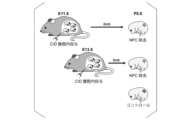
- FIG. 1 shows a scheme for intraperitoneally administering CID to a mother carrying a homozygous fetus.
- A The kidney size of newborns administered CID at different times was confirmed by fluorescent imaging with tdtomato,
- B The quantification result of kidney size (long diameter) based on FIG. 16(A).
- 13 shows immunostained images of nephron progenitor cells with and without CID administration.
- A Immunostained images of glomeruli administered CID at different times
- B Quantification of glomeruli based on FIG. 18(A). This shows the results of evaluating renal function in neonates administered CID.
- FIG. 1 shows a scheme for intraperitoneally administering CID to a mother carrying a homozygous fetus.
- A The kidney size of newborns administered CID at different times was confirmed by fluorescent imaging with tdtomato
- B The quantification result of kidney size (long diameter) based on FIG. 16(A).
- 13 shows immunostained
- FIG. 1 shows a scheme of the nephron replacement experiment. These are immunohistochemical images taken 4 days after rat renal progenitor cells (RPCs) were injected into homozygous fetal kidneys and cultured in CID-supplemented medium. This shows the results of immunohistochemical staining images 14 days after rat renal progenitor cells were injected into homozygous fetal kidneys and cultured in a CID-supplemented medium.
- RPCs rat renal progenitor cells
- A Immunohistochemical staining images 4 days after injection of rat renal progenitor cells into a heterozygous fetal kidney and culturing in a medium supplemented with CID and AT406
- B Immunohistochemical staining images 7 days after injection of rat renal progenitor cells into a heterozygous fetal kidney and culturing in a medium supplemented with CID and AT406.
- A-C Immunohistochemical staining images of human NPCs induced from human iPS cells injected into the kidney of homozygous fetuses and cultured.
- AB Immunohistochemical staining images taken one week after human NPCs induced from human iPS cells were injected together with CID into the kidney of homozygous fetuses.
- the present invention provides a non-human animal equipped with a system for killing a target cell in a living body, wherein the target cell has, on its chromosome, a cell-specific promoter and an exogenous caspase 9 gene whose expression is induced downstream of the cell-specific promoter, or has, on its chromosome, a high-expression promoter and an exogenous caspase 9 gene whose expression is induced downstream of the high-expression promoter.
- Non-human animals include, for example, cats, dogs, horses, monkeys, cows, sheep, pigs, goats, rabbits, hamsters, guinea pigs, rats, mice, non-human primates (cynomolgus monkeys, marmosets, etc.), etc. Among these, rodents are preferred. Rodents include hamsters, guinea pigs, rats, mice, etc., with rats and mice being preferred.
- the exogenous caspase9 gene is not particularly limited as long as it is capable of inducing cell death in target cells through high expression, and may be the pro-caspase9 gene, a gene fragment of the caspase9 gene or the pro-caspase9 gene, or a modified form.
- the origin of the exogenous caspase9 gene is not particularly limited, and is preferably derived from a mammal, more preferably from a mouse or human, and particularly preferably from a human.
- the high expression promoter is not particularly limited as long as it is a strong promoter, and examples thereof include the CMV promoter, LTR promoter, PGK promoter, SV40 promoter, CK6 promoter, TTR promoter, TK promoter, TRE promoter, HBV promoter, hAAT promoter, LSP promoter, E2F promoter, hTERT promoter, CAG promoter, and EFl- ⁇ promoter, with the CAG promoter being particularly preferred.
- the target cells have an exogenous caspase9 gene whose expression is induced on both chromosomes.
- the inventors have increased the probability of obtaining mice carrying caspase9.
- apoptosis promoter when the introduced gene is present in one allele, it is preferable to use an apoptosis promoter in combination.
- apoptosis promoters include, but are not limited to, IAP inhibitors, BCL2 inhibitors, TRAIL, DNA damaging agents, etc.
- IAP inhibitors include AT406, LCL161, GDC-0917, AEG-35156, TL32711, and the like.
- BCL2 inhibitors include 4-[4-[[2-(4-chlorophenyl)-5,5-dimethyl-1-cyclohexen-1-yl]methyl]-1-piperazinyl]-N-[[4-[[(1R)-3-(4-morpholinyl)-1-[(phenylthio)methyl]propyl]amino]-3-[(trifluoromethyl)sulfonyl]phenyl]sulfonyl]benzamide (ABT-263); tetrocarcin A; antimycin; gossypol ((-)BL-193); obatoclax; ethyl-2-amino-6-cyclopentyl-4-(1-cyano-2-ethoxy-2-oxoethyl)-4Hchromone-3-carboxylate (HA14-1); o
- DNA damaging agents include alkylating agents, platinum-based drugs, intercalating agents, DNA replication inhibitors and the like.
- DNA alkylating agents include cyclophosphamide, mechlorethamine, uramustine, melphalan, chlorambucil, ifosfamide, carmustine, lomustine, streptozocin, busulfan, temozolomide and the like.
- platinum-based drugs include cisplatin, carboplatin, oxaliplatin, nedaplatin, satraplatin, triplatin tetranitrate, etc.
- intercalating agents include doxorubicin, daunorubicin, idarubicin, mitoxantrone, etc.
- DNA replication inhibitors include irinotecan, topotecan, amsacrine, etoposide, etoposide phosphate, teniposide, etc.
- the exogenous caspase 9 gene capable of inducing expression can be a gene encoding a fusion protein of a dimerization domain and caspase 9.
- a fusion protein is activated by dimerization upon binding with a chemical inducer of dimerization (CIDs, protein dimerizer), thereby inducing apoptosis in cells.
- CIDs chemical inducer of dimerization
- the dimerization domain include FKBP and FK506.
- the protein dimer-inducing compound include AP20187 and AP1903.
- Examples of the combination of the multimerization domain and the protein dimer-inducing compound include a combination of a fusion protein of FK506 and caspase9 with AP1903, and a combination of a fusion protein of FKBP and caspase9 with AP20187.
- examples of non-human animals equipped with a system for inducing the expression of an exogenous caspase9 gene include non-human animals having a chromosome that contains a gene encoding a site-specific recombinase enzyme and a site-specific recombinase recognition sequence, a transcription termination sequence, and the site-specific recombinase recognition sequence in this order from the 5' side, upstream of the exogenous caspase9 gene.
- site-specific recombinases include Cre, Flpe, Dre, etc.
- site-specific enzyme recognition sequences recognized by site-specific recombinases include loxP, FRT, and rox.
- a fusion protein of a site-specific recombinase and a mutant estrogen receptor (ER) may be used.
- the CreERT2 protein is normally present in the cytoplasm, but upon binding to tamoxifen, an estrogen derivative, it is transferred into the nucleus and causes recombination with the loxP sequence. By utilizing this, it is possible to regulate the timing of the action of the Cre-loxP system in a tamoxifen-dependent manner.
- one example of such a system involves crossing a non-human animal that expresses exogenous caspase 9 in a Cre recombinase activity-dependent manner with a Six2-CreERT2 non-human animal in which the CreERT2 gene has been introduced downstream of the Six2 promoter, and then contacting the target organs of the resulting offspring with tamoxifen.
- Non-human animals that express exogenous caspase 9 in a Cre recombinase activity-dependent manner have a transcription termination sequence flanked by loxP sequences upstream of the exogenous caspase 9 gene. Therefore, exogenous caspase 9 is not expressed as is. However, when the transcription termination sequence flanked by loxP sequences is removed by Cre recombinase, exogenous caspase 9 is expressed.
- the exogenous caspase9 gene can be expressed in an organ-specific manner by appropriately selecting a promoter that expresses the exogenous caspase9 gene.
- the organs in question are not particularly limited, and include the liver, cornea, skin, large intestine, small intestine, pancreas, stomach, muscle tissue, heart, lungs, esophagus, bone marrow, kidney, spleen, testis, and ovaries, and are preferably organs that are the subject of evaluation in animal experiments.
- Six2 is a transcription factor that is specifically expressed in metanephric mesenchyme.
- the exogenous caspase9 gene can be expressed in a metanephric tissue-specific manner.
- the non-human animal of this embodiment can be used to develop non-human animals that have organs made from human cells using in vivo organs as a scaffold.
- foreign nephron progenitor cells can be injected into the kidney development region of a mouse to construct a foreign kidney (chimeric kidney) incorporated into the host kidney, and then the foreign caspase 9 gene can be expressed in a kidney-specific manner to remove the host kidney, producing a human kidney mouse.
- foreign cells include fetal kidney cells from mice (similar species) and rats (xenogeneic species), NPCs induced from mouse ES cells, and NPCs induced from human iPS cells.
- the host mouse is preferably a fetus or newborn. If the target is cells that express the promoter in an adult, an adult mouse may also be used.
- human stem cells can be transplanted into the brain of a rat to produce a human brain rat, and the non-human animal of this embodiment can also be used in neuroscience. Furthermore, by using the non-human animal of this embodiment in the case of a human liver mouse, a model with higher efficiency of human cell engraftment can be provided.
- GVHD graft-versus-host disease
- transplanted cells attack the self, and the possibility of the transplanted cells themselves becoming cancerous. If it were possible to reset the transplanted cells by induced death when adverse events occur after transplantation, this would result in safer cell therapy, and so a safe and effective induced death system is being sought.
- the non-human animal of this embodiment can be used in the development of a target cell induced death system.
- the non-human animal of this embodiment can also be applied to anti-aging research.
- Conventional technology inducing death from diphtheria toxin, is induced by inhibiting protein synthesis and is similar to necrosis. In necrosis, inflammation and other conditions are induced after cell death.
- the present invention which activates and utilizes Caspase 9, induces apoptosis, which is programmed death, rather than necrosis, and is therefore thought to result in a weak inflammatory response after cell death. Therefore, for aging research in which even a slight inflammatory response can become noise, the apoptosis-induced death model of the present invention is more suitable than the diphtheria toxin model.
- the present invention provides a kit comprising the non-human animal described above and a protein-dimer-inducing compound.
- the kit of this embodiment includes the configuration described in the above-mentioned "Non-human Animal”.
- an apoptosis promoter in addition to the non-human animal and the protein dimer-inducing compound. The details of the apoptosis promoter are the same as those described in the above-mentioned "Non-human Animal”.
- the present invention provides a method for producing a replacement organ, comprising: an induction step of inducing expression of an exogenous caspase 9 gene in the non-human animal described above; a killing step of killing target cells of the non-human animal with the induced caspase 9 protein; and an injection step of injecting human progenitor cells of the same species as the killed target cells into the site of the non-human animal where the target cells have been killed.
- exogenous caspase 9 gene expression induction step First, in a non-human animal, exogenous caspase9 gene is induced to express. As described above, the non-human animal of this embodiment is equipped with a system for inducing the expression of exogenous caspase9 gene, so an expression inducer is administered to the non-human animal. As described above, the expression inducer may be a protein dimer-inducing compound.
- the administration method of the expression inducer is not limited, and may be oral administration, intravenous administration, intraarterial administration, intramuscular administration, intradermal administration, subcutaneous administration, intraperitoneal administration, local administration, etc.
- the remaining cells e.g., the number of remaining kidney cells
- the remaining cells can be controlled.
- administering In the case where the effect of killing the target cells is poor depending on the cell type, it is preferable to have an administration step of administering an apoptosis promoter.
- the administration method is appropriately adjusted according to the properties of the apoptosis promoter used.
- the details of the apoptosis promoter are the same as those described in the above-mentioned "Non-human animals”.
- Apoptosis is induced in cells by inducing the expression of an exogenous caspase 9 gene.
- apoptosis is induced in cells by administering an apoptosis promoter.
- Human precursor cells of the same species as the killed target cells are injected into the site of the killed target cells of the non-human animal.
- the human precursor cells may be derived from human iPS cells.
- the injection step may be performed simultaneously with the induction step.
- a chimeric organ is obtained.
- an organ that can be transplanted into a human is obtained.
- the method for producing a replacement organ of this embodiment can also be used to create a congenital kidney disease model.
- Example 1 As shown in FIG. 1, a gene in which the Six2 promoter and the caspase9 gene and tdTomato were linked downstream of the promoter were introduced into both alleles of a mouse to generate a Six2-iCaspase9-tdTomato mouse (hereinafter referred to as Six2-iCaspase9-tdTomato mouse). As shown in FIG. 2, expression of tdTomato was confirmed in mouse fetuses and mouse fetal kidneys, which corresponded to Six2-positive nephron progenitor cells.
- Example 2 Nephron progenitor cells were isolated from the Six2-iCaspase9-tdTomato mice prepared in Experimental Example 1, and renal organoids were prepared by three-dimensional culture. AP20187 (hereinafter referred to as CID) was administered to these renal organoids. An immunostained image of the renal organoids is shown in Figure 3. It was confirmed that the nephron progenitor cells were apoptotically induced by CID administration.
- Kidneys were excised from E11 fetuses of Six2-iCaspase9-tdTomato mice prepared in Experimental Example 1, and organ culture was performed on Transwells.
- AP20187 AP20187
- attenuation of tdTomato fluorescence expression in nephron progenitor cells was observed on the second day of administration (see Figure 4).
- Immunostaining also confirmed that administration of CID resulted in the elimination of Six2-positive nephron progenitor cells (see Figure 5).
- the immunostained images also showed that Six2 (white), a nephron progenitor cell marker, had disappeared in the CID-administered group (top), confirming that nephron progenitor cells had disappeared due to apoptosis.
- Kidneys were excised from E13 fetuses of Six2-iCaspase9-tdTomato mice prepared in Experimental Example 1, and organ culture was performed on Transwells. CID 100 nM was administered to the medium, and the mice were harvested 12 and 18 hours later, after which apoptosis was evaluated by TUNEL staining. Twelve hours after administration, TUNEL positivity was observed in agreement with Six2-positive nephron progenitor cells, and early induction of apoptosis was confirmed (see FIG. 8).
- Example 6 In Experimental Example 1, a gene in which the caspase9 gene and tdTomato were linked to the Six2 promoter downstream of the promoter was introduced into both alleles of the mouse to produce Six2-iCaspase9-tdTomato mice, and genotyping of the transgenic mice was performed. As shown in Figure 9, mice with both alleles (homozygotes) and one allele (heterozygotes) were obtained.
- the homozygous fetal kidney was found to have about twice the amount of expression as the heterozygous one (see FIG. 12).
- AT406 an XIAP inhibitor
- NPC elimination was confirmed by adding CID 100 nM and AT406 10 ⁇ M. It was also confirmed that NPC elimination did not occur when AT406 was administered alone, and that NPC elimination was due to the action of iCaspase9 (see FIG. 11).
- Rat distal tubules joined to collecting ducts derived from mouse fetal kidneys were also confirmed (see FIG. 22). Furthermore, when rat RPCs were similarly injected into heterozygous fetal kidneys and cultured in medium supplemented with CID and AT406, chimeric cap mesenchymes were formed on day 4 (see FIG. 23(A)), and rat distal tubules connected to mouse collecting ducts were confirmed to be formed on day 7 (see FIG. 23(B)).
- the present invention provides a method for producing a non-human animal, kit, and replacement organ that has a high removal rate of target cells and a fast induction rate of target cell death.
Landscapes
- Life Sciences & Earth Sciences (AREA)
- Health & Medical Sciences (AREA)
- Engineering & Computer Science (AREA)
- Chemical & Material Sciences (AREA)
- Organic Chemistry (AREA)
- Zoology (AREA)
- Wood Science & Technology (AREA)
- General Health & Medical Sciences (AREA)
- Genetics & Genomics (AREA)
- Bioinformatics & Cheminformatics (AREA)
- Environmental Sciences (AREA)
- Biochemistry (AREA)
- General Engineering & Computer Science (AREA)
- Biotechnology (AREA)
- Biomedical Technology (AREA)
- Biodiversity & Conservation Biology (AREA)
- Animal Husbandry (AREA)
- Animal Behavior & Ethology (AREA)
- Veterinary Medicine (AREA)
- Medicinal Chemistry (AREA)
- Molecular Biology (AREA)
- Microbiology (AREA)
- Micro-Organisms Or Cultivation Processes Thereof (AREA)
Priority Applications (3)
| Application Number | Priority Date | Filing Date | Title |
|---|---|---|---|
| JP2025509855A JPWO2024202583A1 (https=) | 2023-03-28 | 2024-02-09 | |
| CN202480021725.0A CN121368427A (zh) | 2023-03-28 | 2024-02-09 | 非人动物、试剂盒以及置换器官的制造方法 |
| EP24778728.6A EP4691234A1 (en) | 2023-03-28 | 2024-02-09 | Non-human animal, kit, and method for producing replacement organ |
Applications Claiming Priority (2)
| Application Number | Priority Date | Filing Date | Title |
|---|---|---|---|
| JP2023-051810 | 2023-03-28 | ||
| JP2023051810 | 2023-03-28 |
Publications (1)
| Publication Number | Publication Date |
|---|---|
| WO2024202583A1 true WO2024202583A1 (ja) | 2024-10-03 |
Family
ID=92905025
Family Applications (1)
| Application Number | Title | Priority Date | Filing Date |
|---|---|---|---|
| PCT/JP2024/004463 Ceased WO2024202583A1 (ja) | 2023-03-28 | 2024-02-09 | 非ヒト動物、キット及び置換臓器の製造方法 |
Country Status (4)
| Country | Link |
|---|---|
| EP (1) | EP4691234A1 (https=) |
| JP (1) | JPWO2024202583A1 (https=) |
| CN (1) | CN121368427A (https=) |
| WO (1) | WO2024202583A1 (https=) |
Citations (2)
| Publication number | Priority date | Publication date | Assignee | Title |
|---|---|---|---|---|
| JP2016521709A (ja) * | 2013-06-05 | 2016-07-25 | ベリカム ファーマシューティカルズ, インコーポレイテッド | カスパーゼポリペプチドを使用して部分的なアポトーシスを誘導するための方法 |
| JP2020507327A (ja) * | 2017-02-14 | 2020-03-12 | ユニバーシティ オブ ピッツバーグ − オブ ザ コモンウェルス システム オブ ハイヤー エデュケイション | ヒト人工多能性幹細胞を操作して肝臓組織を作製する方法 |
-
2024
- 2024-02-09 EP EP24778728.6A patent/EP4691234A1/en active Pending
- 2024-02-09 JP JP2025509855A patent/JPWO2024202583A1/ja active Pending
- 2024-02-09 WO PCT/JP2024/004463 patent/WO2024202583A1/ja not_active Ceased
- 2024-02-09 CN CN202480021725.0A patent/CN121368427A/zh active Pending
Patent Citations (2)
| Publication number | Priority date | Publication date | Assignee | Title |
|---|---|---|---|---|
| JP2016521709A (ja) * | 2013-06-05 | 2016-07-25 | ベリカム ファーマシューティカルズ, インコーポレイテッド | カスパーゼポリペプチドを使用して部分的なアポトーシスを誘導するための方法 |
| JP2020507327A (ja) * | 2017-02-14 | 2020-03-12 | ユニバーシティ オブ ピッツバーグ − オブ ザ コモンウェルス システム オブ ハイヤー エデュケイション | ヒト人工多能性幹細胞を操作して肝臓組織を作製する方法 |
Non-Patent Citations (8)
| Title |
|---|
| BATOON LENA, KOH AMY J., KANNAN RAHASUDHA, MCCAULEY LAURIE K., ROCA HERNAN: "Caspase-9 driven murine model of selective cell apoptosis and efferocytosis", CELL DEATH & DISEASE, NATURE PUBLISHING GROUP, GB, vol. 14, no. 1, GB , XP093219016, ISSN: 2041-4889, DOI: 10.1038/s41419-023-05594-6 * |
| BONINI CFERRARI GVERZELETTI SSERVIDA PZAPPONE ERUGGIERI LPONZONI MROSSINI SMAVILIO FTRAVERSARI C: "HSV-TK gene transfer into donor lymphocytes for control of allogeneic graft-versus-leukemia", SCIENCE, vol. 276, no. 5319, 13 June 1997 (1997-06-13), pages 1719 - 24 |
| FUJIMOTO TOSHINARI, YAMANAKA SHUICHIRO, TAJIRI SUSUMU, TAKAMURA TSUYOSHI, SAITO YATSUMU, MATSUMOTO NAOTO, MATSUMOTO KEI, TACHIBANA: "Generation of Human Renal Vesicles in Mouse Organ Niche Using Nephron Progenitor Cell Replacement System", CELL REPORTS, ELSEVIER INC, US, vol. 32, no. 11, 1 September 2020 (2020-09-01), US , pages 108130, XP093008468, ISSN: 2211-1247, DOI: 10.1016/j.celrep.2020.108130 * |
| KHAN NUSRAT, BAMMIDI SRIDHAR, CHATTOPADHYAY SOURAV, JAYANDHARAN GIRIDHARA R.: "Combination Suicide Gene Delivery with an Adeno-Associated Virus Vector Encoding Inducible Caspase-9 and a Chemical Inducer of Dimerization Is Effective in a Xenotransplantation Model of Hepatocellular Carcinoma", BIOCONJUGATE CHEMISTRY, AMERICAN CHEMICAL SOCIETY, US, vol. 30, no. 6, 19 June 2019 (2019-06-19), US , pages 1754 - 1762, XP093219014, ISSN: 1043-1802, DOI: 10.1021/acs.bioconjchem.9b00291 * |
| MATSUI KENJI, YAMANAKA SHUICHIRO, KOBAYASHI EIJI, YOKOO TAKASHI: " SA-PO344: Development of a System for the Replacement of Animal Fetal Kidneys with Human Nephrons: Toward Clinical Application ", JOURNAL OF THE AMERICAN SOCIETY OF NEPHROLOGY, WILLIAMS AND WILKINS, BALTIMORE, MD., US, vol. 34, no. 11S, 1 November 2023 (2023-11-01), US , pages 817 - 817, XP009557959, ISSN: 1046-6673, DOI: 10.1681/ASN.20233411S1817d * |
| no. 852808-04-9 |
| SAITO MIWAWAKI TTAYA CYONEKAWA HNODA MINUI YMEKADA EKIMATA YTSURU AKOHNO K: "Diphtheria toxin receptor-mediated conditional and targeted cell ablation in transgenic mice", NAT BIOTECHNOL, vol. 19, no. 8, August 2001 (2001-08-01), pages 746 - 50 |
| YUAN YUAN, REN HUIXIA, LI YANJUN, QIN SHANSHAN, YANG XIAOJING, TANG CHAO: "Cell-to-cell variability in inducible Caspase9-mediated cell death", CELL DEATH & DISEASE, vol. 13, no. 1, XP093101047, DOI: 10.1038/s41419-021-04468-z * |
Also Published As
| Publication number | Publication date |
|---|---|
| EP4691234A1 (en) | 2026-02-11 |
| CN121368427A (zh) | 2026-01-20 |
| JPWO2024202583A1 (https=) | 2024-10-03 |
Similar Documents
| Publication | Publication Date | Title |
|---|---|---|
| JP6573924B2 (ja) | フマリルアセト酢酸ヒドロラーゼ(fah)欠損及び免疫不全ラット、並びにそれらの使用 | |
| AU2010200016B2 (en) | Growth of foreign cells in fetal animals facilitated by conditional and selective destruction of native host cells | |
| JP7488177B2 (ja) | 腎臓の製造方法 | |
| JP2019502400A (ja) | キメラ胚補助臓器作製用の組成物及び方法 | |
| JP7548803B2 (ja) | 腎臓の製造方法 | |
| JPWO2019073960A1 (ja) | 分化ポテンシャルを改変した多能性幹細胞の動物の作製への応用 | |
| WO2024202583A1 (ja) | 非ヒト動物、キット及び置換臓器の製造方法 | |
| WO2017175745A1 (ja) | 生殖細胞欠損動物を用いる遺伝子改変動物の作製方法 | |
| WO2018003450A1 (ja) | 臓器の製造方法 | |
| JP5692677B2 (ja) | 非ヒトノックアウト動物、並びにその用途およびその作製方法 | |
| JP7745243B2 (ja) | 肝線維化モデルマウス | |
| US9999206B2 (en) | Model and method for a transgenic bovidae expressing cardiac fibrosis and associated pathology | |
| WO2026075201A1 (ja) | 臓器不全モデル非ヒト動物の製造方法 | |
| JP2009511050A (ja) | バイオルミネセンス撮像のためのトランスジェニックrosa26−ルシフェラーゼマウス | |
| JP4374438B2 (ja) | rab8a遺伝子欠損マウス | |
| JPWO2018012497A1 (ja) | 疾患モデル動物および疾患治療剤 | |
| WO2023195429A1 (ja) | 非ヒト動物、及びその利用 | |
| JP2025527122A (ja) | 改変型トランスフェリン受容体座位を含む非ヒト動物 | |
| JP2004135657A (ja) | ヒトa3アデノシン受容体を発現するトランスジェニック非ヒト哺乳動物 | |
| JP2008278763A (ja) | トランスジェニック非ヒト動物 | |
| JP2006141283A (ja) | 3−ホスホグリセレートデヒドロゲナーゼの発現が低下したノックアウト非ヒト哺乳動物 | |
| Aigner et al. | Animal Models for the Study of Human Disease: Chapter 32. Genetically Tailored Pig Models for Translational Biomedical Research | |
| WO2013016826A1 (en) | Transgenic non-human animal model of neurodegenerative disease | |
| JP2008061557A (ja) | Crerecombinaseを神経細胞特異的に発現するマウス |
Legal Events
| Date | Code | Title | Description |
|---|---|---|---|
| 121 | Ep: the epo has been informed by wipo that ep was designated in this application |
Ref document number: 24778728 Country of ref document: EP Kind code of ref document: A1 |
|
| ENP | Entry into the national phase |
Ref document number: 2025509855 Country of ref document: JP Kind code of ref document: A |
|
| WWE | Wipo information: entry into national phase |
Ref document number: 2025509855 Country of ref document: JP |
|
| WWE | Wipo information: entry into national phase |
Ref document number: 2024778728 Country of ref document: EP |
|
| NENP | Non-entry into the national phase |
Ref country code: DE |
|
| ENP | Entry into the national phase |
Ref document number: 2024778728 Country of ref document: EP Effective date: 20251028 |
|
| ENP | Entry into the national phase |
Ref document number: 2024778728 Country of ref document: EP Effective date: 20251028 |
|
| ENP | Entry into the national phase |
Ref document number: 2024778728 Country of ref document: EP Effective date: 20251028 |
|
| ENP | Entry into the national phase |
Ref document number: 2024778728 Country of ref document: EP Effective date: 20251028 |
|
| ENP | Entry into the national phase |
Ref document number: 2024778728 Country of ref document: EP Effective date: 20251028 |
|
| ENP | Entry into the national phase |
Ref document number: 2024778728 Country of ref document: EP Effective date: 20251028 |
|
| ENP | Entry into the national phase |
Ref document number: 2024778728 Country of ref document: EP Effective date: 20251028 |
|
| ENP | Entry into the national phase |
Ref document number: 2024778728 Country of ref document: EP Effective date: 20251028 |
|
| WWP | Wipo information: published in national office |
Ref document number: 2024778728 Country of ref document: EP |