WO2024202201A1 - 熱間プレス部材 - Google Patents
熱間プレス部材 Download PDFInfo
- Publication number
- WO2024202201A1 WO2024202201A1 PCT/JP2023/040968 JP2023040968W WO2024202201A1 WO 2024202201 A1 WO2024202201 A1 WO 2024202201A1 JP 2023040968 W JP2023040968 W JP 2023040968W WO 2024202201 A1 WO2024202201 A1 WO 2024202201A1
- Authority
- WO
- WIPO (PCT)
- Prior art keywords
- hot
- phase
- less
- coating layer
- pressed
- Prior art date
- Legal status (The legal status is an assumption and is not a legal conclusion. Google has not performed a legal analysis and makes no representation as to the accuracy of the status listed.)
- Ceased
Links
Classifications
-
- B—PERFORMING OPERATIONS; TRANSPORTING
- B21—MECHANICAL METAL-WORKING WITHOUT ESSENTIALLY REMOVING MATERIAL; PUNCHING METAL
- B21D—WORKING OR PROCESSING OF SHEET METAL OR METAL TUBES, RODS OR PROFILES WITHOUT ESSENTIALLY REMOVING MATERIAL; PUNCHING METAL
- B21D22/00—Shaping without cutting, by stamping, spinning, or deep-drawing
- B21D22/20—Deep-drawing
Definitions
- the present invention relates to hot-pressed components, and in particular to hot-pressed components that have excellent external corrosion resistance on the painted end faces.
- Hot pressing is a forming method in which steel plate is heated to the temperature range of the austenite single phase (around 900°C), then press-formed while still at a high temperature, and simultaneously quenched (hardened) by contact with a die. Press forming is carried out in the heated and softened state, and then the strength is increased by quenching, so with hot pressing it is possible to manufacture parts with high strength while maintaining press formability.
- automotive components are also required to have high corrosion resistance.
- the corrosion resistance required for automotive components can be broadly divided into resistance to perforation corrosion (perforation corrosion resistance) and resistance to cosmetic corrosion (cosmetic corrosion resistance).
- perforation corrosion is, as the name suggests, corrosion that forms through holes in the steel material that makes up the component.
- cosmetic corrosion is corrosion that mars the appearance, such as the formation of red rust and paint blistering due to corrosion.
- hot-pressed members obtained using general Al-plated steel sheets have a problem that, although they have excellent perforation corrosion resistance, they have poor appearance corrosion resistance.
- hot-pressed members obtained by hot-pressing Al-plated steel sheets have an intermetallic compound layer or diffusion layer on the surface, mainly consisting of Al, a constituent component of the plating, and Fe diffused from the base steel sheet.
- the base material steel material
- the anodic corrosion protection effect on the base material is small. Therefore, in places such as cut edges where there is no plating layer and the upper coating film is thin, the base material corrodes early and red rust occurs.
- the intermetallic compound itself contains a high concentration of Fe, red rust may occur even during the anodic corrosion protection process regardless of whether the base material is corroded or not.
- hot-pressed components made from conventional aluminum-based plated steel sheets have excellent corrosion resistance against holes, their external corrosion resistance is insufficient compared to pressed components manufactured by cold pressing zinc-based plated steel sheets.
- Patent Document 1 proposes a technology in which a plated steel sheet having an Al plating layer and a surface coating layer containing ZnO formed on the Al plating layer is used as a steel sheet for hot pressing.
- Patent Document 2 also proposes a method in which a plated steel sheet having an Al-based plating layer is heated in an atmosphere in which the hydrogen concentration and dew point are controlled, and then hot-pressed.
- Patent Document 1 reports that forming a film containing ZnO, a wurtzite compound, improves post-painting corrosion resistance.
- post-painting corrosion resistance is evaluated based only on the width of paint blistering, and the occurrence of red rust is not taken into consideration.
- it is required to suppress not only paint blistering, but also the occurrence of red rust, which has a significant impact on appearance.
- paint blistering is suppressed as a result of improved chemical conversion treatability, red rust resistance was not sufficient.
- the present invention has been made in consideration of the above-mentioned circumstances, and aims to provide a hot-pressed member with excellent external corrosion resistance on the painted end surface. More specifically, the present invention aims to provide a hot-pressed member in which paint blistering and the occurrence of red rust from the painted end surface are suppressed.
- the present invention was made to solve the above problems, and its gist is as follows:
- the coating layer includes an FeAl alloy phase and a Zn phase
- a hot-pressed member having a natural immersion potential in an air-saturated 0.5 mass % NaCl aqueous solution at 25° C. of ⁇ 1100 to ⁇ 900 mV based on a silver-silver chloride-saturated potassium chloride electrode.
- the present invention can provide hot-pressed members with excellent corrosion resistance in appearance at the painted end faces. More specifically, the present invention can suppress the occurrence of paint blistering and red rust from the painted end faces. Furthermore, as a result of suppressing corrosion, delayed fracture caused by hydrogen generated by corrosion can also be prevented.
- a hot-pressed member includes a steel material and a coating layer on at least one surface of the steel material.
- the coating layer includes an FeAl alloy phase and a Zn phase.
- the hot-pressed member according to this embodiment has a natural immersion potential of ⁇ 1100 to ⁇ 900 mV in an air-saturated 0.5 mass % NaCl aqueous solution at 25° C., based on a silver-silver chloride-saturated potassium chloride electrode.
- the steel material to be the base material is not particularly limited and any steel material can be used.
- the hot-pressed member it is desirable for the hot-pressed member to have high strength.
- a hot-pressed member with a tensile strength exceeding 1000 MPa it is preferable to use a steel material with the following composition.
- C 0.1 to 0.5%
- Si 0.1-2.0%
- Mn 0.1 to 5.0%
- P 0.02% or less
- S 0.01% or less
- Al 0.1% or less
- N 0.01% or less
- the balance is Fe and unavoidable impurities.
- the composition may further include Nb: 0.05% or less.
- C 0.1-0.5% C is an element that has the effect of improving strength by forming a structure such as martensite. From the viewpoint of obtaining a strength exceeding 1000 MPa class, it is preferable that the C content is 0.1% or more. On the other hand, if the C content exceeds 0.5%, the toughness of the spot welds deteriorates. Therefore, the C content is preferably 0.5% or less.
- Si 0.1-2.0% Silicon is an effective element for strengthening steel and obtaining good material properties.
- the silicon content is preferably 0.1% or more. If the Si content exceeds 0.0%, the ferrite is stabilized, resulting in a decrease in hardenability. Therefore, the Si content is preferably set to 2.0% or less.
- Mn 0.1-5.0%
- Mn is an element that is effective in increasing the strength of steel. From the viewpoint of ensuring excellent mechanical properties and strength, the Mn content is preferably 0.1% or more. If the Mn content is excessive, the surface segregation during annealing increases, which affects the adhesion of the coating layer to the steel material. Therefore, from the viewpoint of improving the adhesion of the coating layer, the Mn content is set to 5.0% or less. It is preferable to set the above.
- the P content is 0.02% or less.
- the lower limit of the P content is not particularly limited and may be 0%. However, since an excessive reduction leads to an increase in manufacturing costs, it is preferable that the P content is 0.001% or more.
- S 0.01% or less S becomes an inclusion such as MnS, which causes deterioration of impact resistance and cracks along the metal flow of the weld. Therefore, it is desirable to reduce the S content as much as possible, and specifically, it is preferable to set it to 0.01% or less. In addition, from the viewpoint of ensuring good stretch flangeability, it is more preferable to set it to 0.005% or less.
- the lower limit of the S content is not particularly limited and may be 0%. However, since excessive reduction leads to an increase in manufacturing costs, it is preferable that the S content is 0.0001% or more.
- Al 0.1% or less
- Al is an element that acts as a deoxidizer. However, if the Al content exceeds 0.1%, the hardenability decreases. Therefore, the Al content is preferably 0.1% or less.
- the Al content is preferably 0.01% or more.
- the N content is preferably 0.01% or less.
- the lower limit of the N content is not particularly limited and may be 0%. However, since excessive reduction leads to an increase in manufacturing costs, the N content is preferably 0.001% or more.
- Nb 0.05% or less
- Nb is an effective component for strengthening steel, but if it is contained in excess, the shape fixability decreases. Therefore, when Nb is added, the Nb content is preferably 0.05% or less.
- the lower limit of the Nb content is not particularly limited and may be 0%.
- Ti 0.05% or less Ti is an effective component for strengthening steel, similar to Nb, but if it is contained in excess, shape fixability decreases. Therefore, when Ti is added, the Ti content is preferably 0.05% or less. On the other hand, the lower limit of the Ti content is not particularly limited and may be 0%.
- B 0.0050% or less
- B is an element that has the effect of suppressing the formation and growth of ferrite from the austenite grain boundaries.
- the addition of excessive B significantly impairs formability. Therefore, when B is added, from the viewpoint of improving formability, it is preferable that the B content be 0.0050% or less.
- the lower limit of the B content is not limited, but from the viewpoint of enhancing the effect of adding B, it is preferable that it be 0.0002% or more.
- Cr 1.0% or less Cr is a useful element for strengthening steel and improving hardenability.
- the Cr content is preferably 1.0% or less in order to reduce alloy costs.
- the lower limit of the Cr content is not particularly limited, but from the viewpoint of enhancing the effect of adding Cr, it is preferably 0.1% or more.
- Sb 0.03% or less
- Sb is an element that has the effect of preventing decarburization of the surface layer of the steel sheet during hot pressing.
- excessive Sb leads to an increase in rolling load, which reduces productivity. Therefore, when Sb is added, it is preferable that the Sb content is 0.03% or less from the viewpoint of further improving productivity.
- the lower limit of the Sb content is not particularly limited, but it is preferable that it is 0.003% or more from the viewpoint of enhancing the effect of adding Sb.
- the hot-pressed member of the present invention can be manufactured by hot-pressing a hot-press steel plate having a plating layer under specified conditions. Therefore, the steel material constituting the hot-pressed member of the present invention can also be said to be a hot-pressed steel plate.
- the hot press member of the present invention has a coating layer containing an FeAl alloy phase and a Zn phase on the surface layer of a steel sheet.
- the coating layer may be provided on at least one side of the steel sheet, and may be provided on both sides.
- the Zn phase contributes to improving the appearance corrosion resistance, particularly the red rust resistance.
- the FeAl alloy phase also contributes to the pitting corrosion resistance and has the effect of reducing the corrosion rate of the Zn phase.
- the thickness of the coating layer is not particularly limited, but in order to ensure corrosion resistance, it is preferably 7 ⁇ m or more, more preferably 10 ⁇ m or more, and even more preferably 13 ⁇ m or more. On the other hand, from the viewpoint of adhesion of the coating layer, the thickness of the coating layer is preferably 30 ⁇ m or less, more preferably 25 ⁇ m or less, and even more preferably 20 ⁇ m or less.
- the FeAl alloy phase contributes to pitting corrosion resistance and has the effect of reducing the corrosion rate of the Zn phase.
- the FeAl alloy phase is defined as a phase containing Fe and Al in a total amount of 80 atomic % or more.
- the FeAl alloy phase can be identified based on the chemical composition measured by energy dispersive X-ray analysis (EDS). More specifically, the presence or absence of the FeAl alloy phase can be determined by the method described in the examples.
- Fe and Al contained in the FeAl alloy phase is not limited.
- Fe and Al may form an alloy (solid solution) or an intermetallic compound.
- An example of the solid solution is an ⁇ -Fe phase in which Al is dissolved.
- the intermetallic compound is also not particularly limited, and examples thereof include FeAl intermetallic compounds such as Fe 2 Al 5 , Fe 4 Al 13 , and FeAl.
- the FeAl alloy phase may contain elements other than Fe and Al in a total amount of 20 atomic % or less.
- the elements other than Fe and Al may include, for example, at least one selected from the group consisting of Mg, Ca, Si, Cr, Mn, and Zn.
- the elements other than Fe and Al are not particularly limited and may be present in the FeAl alloy phase in any form.
- the elements other than Fe and Al may form an intermetallic compound, may be in solid solution, or may form a compound such as an oxide.
- the particle size of the FeAl alloy phase is not particularly limited. However, if the particle size is too small, the interface area between the Zn phase and the FeAl alloy phase becomes large, and the corrosion rate of the Zn phase due to galvanic corrosion increases. As a result, the corrosion resistance decreases. Therefore, from the viewpoint of further improving the corrosion resistance, the average particle size of the FeAl alloy phase is preferably 3 ⁇ m or more, more preferably 5 ⁇ m or more, and even more preferably 7 ⁇ m or more.
- the average particle size of the FeAl alloy phase is preferably 20 ⁇ m or less, more preferably 18 ⁇ m or less, and even more preferably 15 ⁇ m or less.
- the average grain size of the FeAl alloy phase can be measured by observing the cross section of the hot-pressed member with a scanning electron microscope (SEM). Specifically, the cross section of the hot-pressed member, which has been mirror-finished, is observed with an SEM, and a backscattered electron image is obtained at an accelerating voltage of 5 kV and a magnification of 500 times.
- the crystal grains of the FeAl alloy phase are identified from the backscattered electron image based on the crystal orientation contrast. The long and short diameters of each identified crystal grain are measured, and the average value is taken as the grain size of each FeAl alloy phase.
- the average value of the grain sizes of 20 randomly selected FeAl alloy phases is taken as the average grain size of the FeAl alloy phase in the hot-pressed member.
- the coating layer In order to set the natural immersion potential within the above range, the coating layer needs to contain a Zn phase.
- the presence of the Zn phase reduces the rate of corrosion (appearance corrosion) from areas where the rust prevention function of the coating film has decreased, such as scratches in the coating film or painted edges, and allows good appearance quality to be maintained.
- the risk of delayed fracture caused by hydrogen generated by corrosion can be reduced.
- the coating layer contains both the FeAl alloy phase and the Zn phase, excellent corrosion resistance in appearance can be obtained for a long period of time. That is, the FeAl alloy phase has a low anodic dissolution rate and excellent corrosion resistance, and also has a low rate of oxygen reduction reaction, which is a cathodic reaction in an atmospheric corrosive environment. Since the coating layer contains the FeAl alloy phase together with the Zn phase, corrosion of the Zn phase is suppressed, and as a result, a stable red rust generation resistance effect can be obtained for a long period of time.
- the internal structure of the coating layer is not particularly limited, but generally, it may be a structure in which the Zn phase exists between the crystal grains of the FeAl alloy phase.
- the presence or absence of a Zn phase in the coating layer can be determined by observing the cross section of the hot-pressed part with SEM-EBSD (electron backscatter diffraction). Specifically, the cross section of the hot-pressed part, which has been finished to a mirror surface, is observed with SEM-EBSD at an accelerating voltage of 15 kV and a magnification of 2000 times to obtain a backscattered electron image.
- the Zn phase is distinguished in the backscattered electron image as having a bright contrast compared to the FeAl alloy phase and as a structure having a hexagonal crystal structure.
- the Zn phase may contain other metal components to the extent that the crystal structure is not changed or an intermetallic compound is not formed.
- the Zn phase may exist as a single phase or as a mixture with other metals or intermetallic compounds.
- the amount of the Zn phase is not particularly limited, but if it is less than 5 g/ m2 per side, the period during which the red rust generation resistance effect can be obtained is shortened. Therefore, the amount of the Zn phase is preferably 5 g/ m2 or more per side, more preferably 10 g/m2 or more , and even more preferably 20 g/ m2 or more. On the other hand, if the amount of the Zn phase exceeds 60 g/ m2 per side, the red rust generation resistance effect is saturated and there is a risk of LME (liquid metal embrittlement) cracking occurring during welding. Therefore, the amount of the Zn phase is preferably 60 g/ m2 or less per side.
- the amount of the Zn phase attached can be determined by dissolving the Zn phase in the coating layer in an aqueous solution by subjecting the hot-pressed member to anodic electrolysis, and quantitatively analyzing the resulting aqueous solution by ICP-MS (inductively coupled plasma-mass spectrometry). Specifically, first, the hot-pressed member is used as the working electrode and a platinum mesh electrode is used as the counter electrode, and constant current anodic electrolysis is performed at 4 mA/ cm2 in a 3% sodium hydroxide-1% aluminum chloride aqueous solution. The electrolysis is stopped at the point where the potential becomes steeply noble, and the amount of Zn in the solution is quantitatively analyzed by ICP-MS to measure the amount of dissolved Zn. The amount of Zn can be quantified by dividing the amount by the surface area of the hot-pressed member.
- the coating layer may further contain other phases in addition to the FeAl alloy phase and the Zn phase.
- the other phases are not particularly limited and may be any phase.
- the other phases may be one or both of a metal phase and an intermetallic compound phase.
- Examples of the other phases include intermetallic compound phases such as MgZn 2 and Mg 2 Zn 11 .
- the proportion of the other phases contained in the coating layer is not particularly limited. However, from the viewpoint of further enhancing the effect of improving the appearance and corrosion resistance by the FeAl alloy phase and the Zn phase, it is desirable that the proportion of the other phases is low. Specifically, the area ratio of the other phases in the cross section of the coating layer is preferably 30% or less, and more preferably 15% or less. The lower limit of the area ratio is not particularly limited, and may be 0%.
- the natural immersion potential of the hot-pressed member is ⁇ 1100 to ⁇ 900 mV based on a silver-silver chloride-saturated potassium chloride electrode (SSE).
- SSE silver-silver chloride-saturated potassium chloride electrode
- the natural immersion potential is set to -900mV or less, preferably -925mV or less, and more preferably -950mV or less.
- the natural immersion potential is set to -1100mV or more, preferably -1075mV or more, and more preferably -1050mV or more.
- the natural immersion potential in the present invention refers to the natural immersion potential in an air-saturated 0.5 mass% NaCl aqueous solution at 25°C, expressed based on a silver-silver chloride-saturated potassium chloride electrode.
- a 10 mm ⁇ area on any flat part of the hot-pressed member having an area of 10 mm ⁇ or more is used as the working electrode.
- the average value of the immersion potential from 60 seconds to 600 seconds after the working electrode is immersed in the NaCl aqueous solution is taken as the natural immersion potential of the hot-pressed member.
- the temperature of the NaCl aqueous solution is adjusted to 25 ⁇ 5°C.
- the mechanical properties of the hot-pressed member of the present invention are not particularly limited, but it is preferable that the residual stress measured using X-ray diffraction at any point of the hot-pressed member is less than 600 MPa. If trimming or piercing is performed by cold working after hot press forming, residual stress will be generated at that point, increasing the risk of delayed fracture. In order to reduce the risk of delayed fracture, it is preferable not to perform cold working after hot press forming. Furthermore, if trimming or piercing is performed, it is preferable to use a laser processing device.
- the hot-pressed member of the present invention can be manufactured by plating a base steel sheet to produce a plated steel sheet, and then hot pressing the plated steel sheet.
- any steel plate can be used without any particular limitation.
- the suitable composition of the steel plate is the same as the preferred composition of the steel material of the hot-pressed member described above.
- the base steel plate is preferably a hot-rolled steel plate or a cold-rolled steel plate.
- the plating of the base steel sheet can be carried out by any method, but it is preferably carried out by hot-dip plating.
- the base steel sheet is annealed.
- the annealed base steel sheet is immersed in a hot-dip plating bath to produce a hot-dip plated steel sheet having a hot-dip plating layer on the surface of the base steel sheet.
- the hot-dip plating bath preferably contains one or both of Ca and Sr in addition to Al, Zn, and Fe that flows out from the base material and bath-immersed equipment.
- the hot-dip plating bath may further contain Si as an option.
- the adhesion weight of the hot-dip coating layer is not particularly limited, but is preferably 20 g/m 2 or more per one side of the steel sheet, more preferably 30 g/m 2 or more, even more preferably 35 g/m 2 or more, and particularly preferably 50 g/m 2 or more.
- the adhesion weight of the hot-dip coating layer is preferably 300 g/m 2 or less per one side of the steel sheet, more preferably 250 g/m 2 or less, and even more preferably 200 g/m 2 or less.
- the adhesion weight of the coating layer increases due to the diffusion of Fe from the base steel sheet. Therefore, by setting the adhesion weight of the hot-dip coating layer on the hot-dip coating steel sheet before hot pressing to the above range, the adhesion weight of the coating layer on the hot-pressed member can be set to the above-mentioned preferred range.
- the coating weight per side of the hot-dip galvanized layer is determined by the following method. First, the hot-dip galvanized steel sheet to be evaluated is punched to obtain three samples with a diameter of 48 mm. Then, one side of each sample (the side opposite to the side on which the coating weight is to be measured) is masked. Each sample is immersed for 20 minutes in a 17% hydrochloric acid solution containing 1 mL of hexamethylenetetramine as an inhibitor to dissolve the hot-dip galvanized layer, and the weight of each sample is measured again. The difference in mass before and after dissolution of the hot-dip galvanized layer is divided by the area of the sample to calculate the coating weight per unit area of each sample. The average coating weight of the three samples is then taken as the coating weight per side of the hot-dip galvanized layer of the hot-dip galvanized steel sheet.
- the hot press includes a heating step of heating a steel sheet for hot press, and a hot-pressing step of hot-pressing the steel sheet for hot press heated in the heating step.
- the heating step it is preferable to raise the temperature from room temperature to a heating temperature between the Ac3 transformation point of the base steel sheet and 1000°C in an atmosphere having an oxygen concentration of 21 to 35% by volume for a temperature-raising time of 60 seconds to 600 seconds.
- the steel sheet for hot press after the temperature-raising may be further held at the heating temperature for a holding time of 300 seconds or less in the atmosphere.
- Oxygen concentration It is economical and common to use air or dry air with a lowered dew point as the atmospheric gas in the heating step in hot pressing.
- air or dry air with a lowered dew point as the atmospheric gas in the heating step in hot pressing.
- the Zn phase in a metallic state hardly remains on the surface of the hot pressed member due to evaporation or oxidation.
- the inventors have intensively studied the effect of the atmosphere in the heating step on the state of Zn on the surface after heating. As a result, they have found that by supplying pure oxygen in addition to air as the atmospheric gas to increase the oxidizing property, a large amount of Zn in a metallic state, i.e., the Zn phase, can be left in the coating layer of the finally obtained hot pressed member. This is because a dense zinc oxide film is formed on the surface layer of the steel sheet for hot pressing in the heating step, which suppresses further oxidation and evaporation.
- the oxygen concentration in the atmosphere during the heating process is 21% by volume or more. However, if the oxygen concentration is less than 22% by volume, the above effect is not necessarily sufficient. Therefore, it is more preferable that the oxygen concentration is 22% by volume or more, and even more preferable that it is 25% by volume or more. If the oxygen concentration is less than 22% by volume, in order to prevent the disappearance of the Zn phase, it is necessary to lower the heating temperature and to include at least one of Ca and Sr in the plating film. On the other hand, if the oxygen concentration exceeds 35% by volume, the effect saturates and the cost increases significantly. Therefore, it is preferable that the oxygen concentration is 35% by volume or less.
- the heating temperature in the heating step is lower than the Ac 3 transformation point, the strength required for the hot press member may not be obtained. Therefore, the heating temperature is preferably set to the Ac 3 transformation point or higher. On the other hand, if the heating temperature exceeds 1000°C, the operating cost increases. Therefore, the heating temperature is preferably set to 1000°C or lower, more preferably set to 950°C or lower, and even more preferably set to 900°C or lower. In particular, when the oxygen concentration is less than 22% by volume, the heating temperature is preferably set to 850°C or lower.
- the Ac3 transformation point can be calculated by the following formula (1).
- Ac3 transformation point (°C) 881-206C + 53Si-15Mn-1Cr... (1)
- the element symbols represent the content (mass%) of each element. The content of elements that are not contained is calculated as 0.
- the temperature rise time is preferably 60 seconds or more. In particular, from the viewpoint of making the average grain size of the FeAl alloy phase 3 ⁇ m or more, it is more preferable to set the temperature rise time to 120 seconds or more. On the other hand, if the temperature rise time exceeds 600 seconds, the solid solution of Zn into the FeAl alloy phase will proceed, and the amount of Zn phase will decrease. Therefore, from the viewpoint of ensuring the amount of Zn phase, it is preferable to set the temperature rise time to 600 seconds or less, and more preferably to 240 seconds or less.
- the heating temperature may be further held after reaching the heating temperature.
- the time (holding time) for holding the heating temperature exceeds 300 seconds, the solid solution of Zn into the FeAl alloy phase progresses, and the amount of Zn phase decreases. Therefore, from the viewpoint of ensuring the amount of Zn phase, it is preferable to set the holding time to 300 seconds or less.
- the lower limit of the holding time is 0 seconds. However, from the viewpoint of operational stability of hot pressing, it is preferable to hold for 5 seconds or more.
- a hot-dip galvanized steel sheet was prepared according to the following procedure, and the hot-dip galvanized steel sheet was hot-pressed to produce a hot-pressed component.
- the base steel sheet used was a cold-rolled steel sheet with a thickness of 1.4 mm, containing, by mass%, C: 0.34%, Si: 0.25%, Mn: 1.2%, Cr: 0.2%, P: 0.005%, S: 0.001%, Al: 0.03%, N: 0.004%, Nb: 0.02%, Ti: 0.01%, B: 0.002%, Sb: 0.01%, with the remainder being Fe and unavoidable impurities.
- hot-dip plating was carried out in a hot-dip plating bath having the bath temperature and chemical composition shown in Tables 1 and 2 to obtain hot-dip plated steel sheets.
- the coating weight per side of the obtained hot-dip plated steel sheets was measured using the method described above. The measurement results are shown in Tables 1 and 2.
- the above-mentioned base steel sheet was annealed and then electroplated to obtain plated steel sheets. In some examples (Comparative Example No. 59), plating was not carried out.
- test pieces measuring 200 x 300 mm were taken from the obtained steel plate and heated under the conditions shown in Tables 1 and 2.
- An electric furnace was used for the heating. During the heating, gas was supplied so that the oxygen concentration in the furnace reached the values shown in Tables 1 and 2.
- the test piece was removed from the electric furnace and immediately hot pressed using a hat-shaped die at a forming start temperature of 700°C to obtain a high-strength steel component.
- the shape of the obtained high-strength steel component had a flat portion on the top surface that was 100 mm long, a flat portion on the side that was 50 mm long, and a flat portion on the bottom that was 50 mm long.
- the bending radius of the die was 7R on both shoulders on the top surface and both shoulders on the bottom surface.
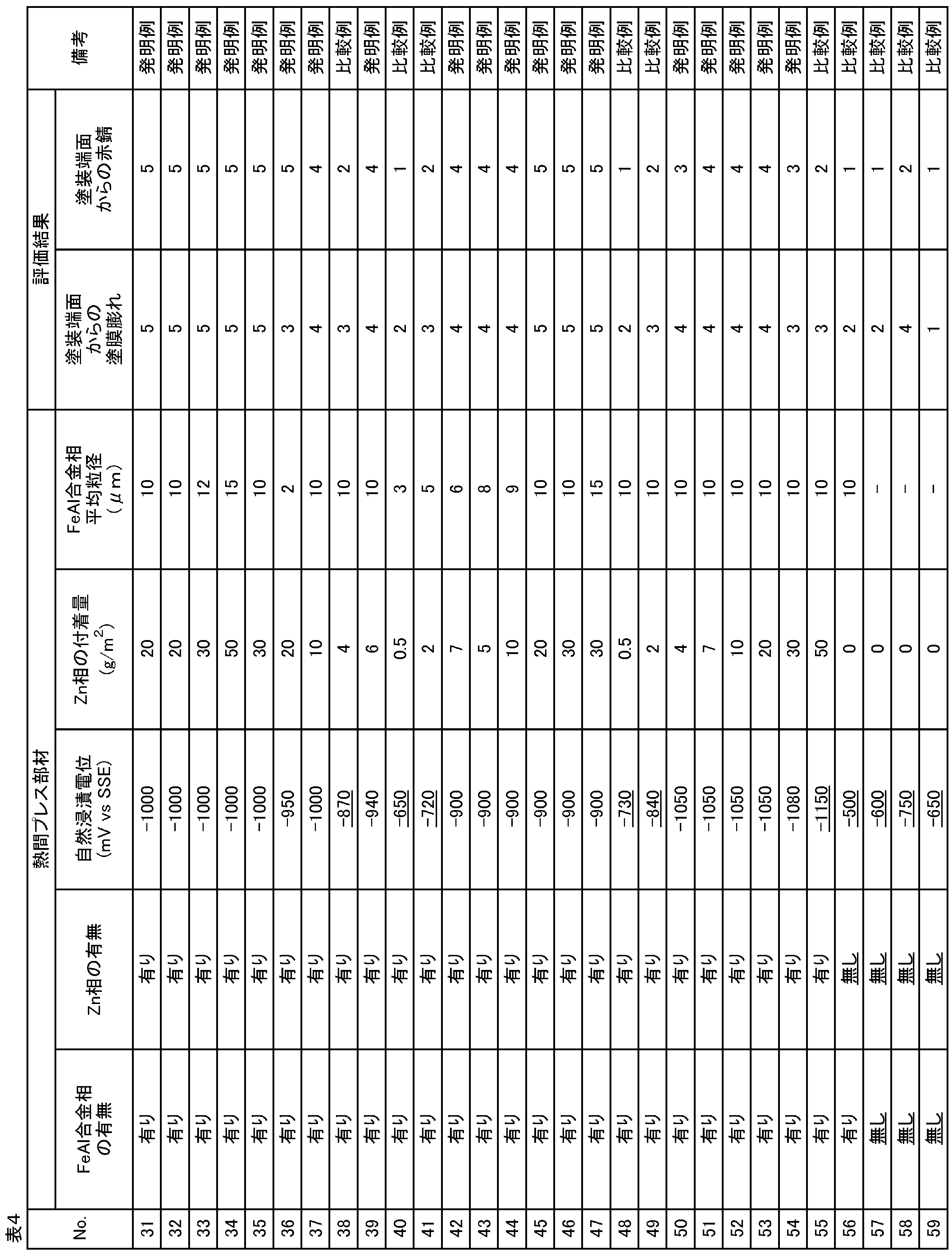
- the natural immersion potential of the obtained hot press member was measured by the following procedure. First, three samples with a diameter of 16 mm were taken from the flat part of the upper surface of the hot press member formed into a hat shape by punching. The immersion potential was measured in an air-saturated 0.5 mass% NaCl aqueous solution at 25 ⁇ 5 ° C., using a 10 mm diameter area in the center of the sample as the working electrode and a silver-silver chloride-saturated potassium chloride electrode (SSE) as the reference electrode. The time average of the immersion potential from 60 seconds to 600 seconds after the working electrode was immersed in the NaCl aqueous solution was taken as the natural immersion potential of the sample. The average value of the natural immersion potential of the three different samples was taken as the natural immersion potential of the hot press member to be evaluated. The measurement results are shown in Tables 3 and 4.
- a test piece was taken from the flat part of the upper surface of the hot press member, and the presence or absence of the FeAl alloy phase was determined by observing the cross section of the test piece.
- the cross section was observed using a SEM after the surface to be observed was mirror-finished, and a backscattered electron image was obtained at an acceleration voltage of 15 kV and a magnification of 1000 times.
- a point analysis was performed by EDS in an area with a dark contrast, i.e., a low electron density, compared to the base material.
- an area in which the total content of Fe and Al was 80 atomic % or more was regarded as an FeAl alloy phase.
- a test piece was taken from the flat part of the upper surface of the hot press member, and the cross section of the test piece was observed to measure the average grain size of the FeAl alloy phase.
- the cross section was observed using a SEM after the surface to be observed was mirror-finished, and a backscattered electron image was obtained at an acceleration voltage of 5 kV and a magnification of 500 times.
- the crystal grains of the FeAl alloy phase were identified from the backscattered electron image based on the crystal orientation contrast, and the major axis and minor axis of each identified crystal grain were measured.
- the average value of the major axis and minor axis obtained was taken as the grain size of each FeAl alloy phase.
- the average value of the grain sizes of 20 randomly selected FeAl alloy phases was taken as the average grain size of the FeAl alloy phase in the hot press member.
- the presence or absence of a Zn phase in the coating layer was determined by observing the cross section of the hot-pressed member with SEM-EBSD. Specifically, the cross section of the hot-pressed member, which had been mirror-finished, was observed with SEM-EBSD at an acceleration voltage of 15 kV and a magnification of 2000 times to obtain a backscattered electron image.
- the Zn phase is distinguished in the backscattered electron image as having a bright contrast compared to the FeAl intermetallic compound phase and a structure having a hexagonal crystal structure.
- Zn phase adhesion amount The amount of the Zn phase was determined by dissolving the Zn phase in the coating layer in an aqueous solution by subjecting a sample taken from the hot-pressed member to anodic electrolysis, and quantitatively analyzing the resulting aqueous solution by ICP-MS (inductively coupled plasma mass spectrometry). Specifically, three samples with a diameter of 48 mm were taken from the flat portion of the upper surface of the hot-pressed member formed into a hat shape by punching. The surfaces of the samples were masked except for the surface to be measured.
- the samples were used as the working electrode and a platinum mesh electrode as the counter electrode, and constant current anodic electrolysis was performed at 4 mA/cm 2 in a 3% sodium hydroxide-1% aluminum chloride aqueous solution.
- the electrolysis was stopped at the point where the potential became steeply noble, and the amount of Zn in the solution was quantitatively analyzed by ICP-MS to measure the amount of dissolved Zn.
- the amount of Zn phase was determined by dividing the amount of Zn by the surface area of the hot-pressed member.
- a 70 mm wide area was cut out of the resulting hat-shaped high-strength steel member using a laser cutter, and the test piece was subjected to a zinc phosphate-based conversion treatment and electrocoating to produce a corrosion resistance test piece.
- the zinc phosphate-based conversion treatment was carried out under standard conditions using a PB-SX35 made by Nihon Parkerizing Co., Ltd.
- the electrocoating was carried out using an Electron GT-100 made by Kansai Paint Co., Ltd. so that the coating thickness was 5 ⁇ m.
- the baking conditions for the electrocoating were to reach 170°C and then hold for 20 minutes.
- the obtained corrosion resistance test pieces were subjected to a cyclic corrosion test (SAE-J2334) without masking, and the corrosion condition after 40 cycles was evaluated.
- the appearance corrosion resistance of the painted edge was judged based on the width of the paint blister from the edge and the occurrence of red rust on the cut edge, according to the following criteria. A score of 3 or more for both the paint blister width and the area ratio of red rust on the edge was considered to be acceptable.
- the evaluation results are shown in Tables 3 and 4. Paint film blister width from painted edge 1: Paint film blister width > 5 mm 2: 3mm ⁇ paint film blister width ⁇ 5mm 3: 2mm ⁇ paint blister width ⁇ 3mm 4: 1mm ⁇ paint blister width ⁇ 2mm 5: Paint blister width ⁇ 1mm
- Red rust occurs from the painted edge 1: Red rust area rate on edge > 50% 2: 30% ⁇ end surface red rust area ratio ⁇ 50% 3: 20% ⁇ end surface red rust area ratio ⁇ 30% 4: 10% ⁇ end surface red rust area ratio ⁇ 20% 5: Red rust area rate on end surface ⁇ 10%
- the hot-pressed parts that met the conditions of the present invention had good corrosion resistance to both paint film blistering from the painted edge and the occurrence of red rust, and were excellent in overall appearance corrosion resistance.
- the hot-pressed members of the comparative examples that did not meet the conditions of the present invention were inferior in at least one of the following: paint film blistering from the painted edge and red rust generation.
- the coating weight of the hot-pressed steel sheet was small, and the Zn in the metallic state disappeared due to alloying or oxidation during the heating process, resulting in less Zn phase in the coating layer of the hot-pressed member.
- the immersion potential became nobler, and good post-painting corrosion resistance could not be obtained.
- Comparative Example No. 55 a hot press steel sheet containing a large amount of Mg in the plating layer and with a large plating adhesion was subjected to hot pressing.
- an excessive amount of MgZn-based intermetallic compound phase was generated in the surface layer of the hot press member.
- the immersion potential became excessively noble and the corrosion rate of the plating layer increased, making it impossible to obtain good post-painting corrosion resistance.
Landscapes
- Engineering & Computer Science (AREA)
- Mechanical Engineering (AREA)
- Other Surface Treatments For Metallic Materials (AREA)
- Coating With Molten Metal (AREA)
Abstract
塗装された端面の外観耐食性に優れた熱間プレス部材を提供する。鋼材と、前記鋼材の少なくとも一方の面の上の被覆層とを有し、前記被覆層は、FeAl合金相とZn相とを含み、25℃の空気飽和した0.5質量%NaCl水溶液中における自然浸漬電位が、銀-塩化銀-飽和塩化カリウム電極基準で-1100~-900mVである、熱間プレス部材。
Description
本発明は、熱間プレス部材に関し、特に、塗装された端面の外観耐食性に優れる熱間プレス部材に関する。
近年、自動車分野では、素材鋼板の高性能化とともに軽量化が促進されており、高強度鋼板の使用が増加している。しかし、一般的に鋼板の強度が高くなるとプレス成形性が低下するため、複雑な部品形状を得ることは困難になる。
このような背景から、冷間ではなく熱間で形成を行う、熱間プレス技術の適用が増加している。熱間プレスとは、鋼板をオーステナイト単相の温度域(900℃前後)まで加熱した後に、高温のままでプレス成形し、同時に金型との接触により急冷(焼入れ)する成形方法である。加熱されて軟質化した状態でプレス成形が行われ、次いで、焼入れによって高強度化されるため、熱間プレスによれば、プレス成形性を確保しつつ、高い強度を有する部材を製造することができる。
一方、自動車用部材には、高い耐食性を備えることも求められる。自動車用部材に求められる耐食性は、主に、穴あき腐食に対する耐食性(穴あき耐食性)と外観腐食に対する耐食性(外観耐食性)に大別することができる。穴あき腐食とは、文字通り、部材を構成する鋼材に貫通孔が形成される腐食である。一方、外観腐食とは、赤錆の発生や腐食による塗膜膨れといった、外観を損なう腐食である。
熱間プレスの分野においては、熱間プレス部材に防錆性を付与するために、Al系めっき鋼板を用いることが一般的である。Al系めっき鋼板を素材として用いることにより、熱間プレス部材の穴あき耐食性が格段に向上する。
しかし、一般的なAl系めっき鋼板を用いて得られる熱間プレス部材は、穴あき耐食性に優れるものの、外観耐食性が劣っているという問題があった。すなわち、Al系めっき鋼板を熱間プレスして得られる熱間プレス部材は、表層に、めっきの構成成分であるAlと母材鋼板から拡散したFeとを主体とした、金属間化合物層または拡散層を備えている。しかし、これらの層は母材(鋼材)との電位差が小さいため、母材に対するアノード防食作用が小さい。そのため、切断端面などめっき層が存在せず、上層の塗膜も薄い箇所で、早期に母材の腐食に至り、赤錆を生じる。加えて、金属間化合物自体がFeを高濃度に含有することから、母材の腐食の有無にかかわらずアノード防食の過程でも赤錆を生じることもある。
このように、従来の一般的なAl系めっき鋼板を用いた熱間プレス部材は、穴あき耐食性に優れるものの、亜鉛系めっき鋼板を冷間プレスして製造されるプレス部材に比べて外観耐食性が不十分であった。
外観耐食性が不十分である一因として、化成処理性に劣ることが挙げられる。すなわち、一般的な自動車用部材の製造においては、熱間プレス部材に対し、下地処理としてリン酸亜鉛系化成処理を施した後、塗装が行われる。前記化成処理の際、熱間プレス後のAl系めっき鋼板の最表面には化学的に安定なAl酸化物皮膜が形成されているため、リン酸亜鉛系化成処理皮膜がほとんど形成されない。
このような背景の元、Al系めっき鋼板を用いた熱間プレス部材の外観耐食性など、各種特性を向上させるために様々な技術が提案されている。
例えば、特許文献1では、Alめっき層と、前記Alめっき層上に形成されたZnOを含有する表面皮膜層とを有するめっき鋼板を熱間プレス用鋼板として用いる技術が提案されている。
また、特許文献2では、Al系めっき層を備えるめっき鋼板を、水素濃度および露点が制御された雰囲気中で加熱した後に熱間プレスする方法が提案されている。
しかし、本発明者らの検討の結果、上記特許文献1、2で提案されているような従来技術では、依然として熱間プレス部材の、塗装された端面における外観耐食性が不十分であることがわかった。
例えば、特許文献1では、ウルツ鉱型化合物であるZnOを含有する皮膜を形成することで、塗装後耐食性が向上することが報告されている。しかし、特許文献1においては、塗膜膨れの幅のみに基づいて塗装後耐食性が評価されており、赤錆の発生については考慮されていない。実際の自動車用部材においては、塗膜膨れだけでなく、外観に大きく影響する赤錆の発生を抑制することが求められる。特許文献1の技術では、化成処理性が向上する結果、塗膜膨れが抑制されるものの、耐赤錆性は十分とはいえなかった。
本発明は、上記の実状に鑑みてなされたものであり、塗装された端面の外観耐食性に優れた熱間プレス部材を提供することを目的とする。より具体的には、塗装された端面からの塗膜膨れおよび赤錆の発生が抑制された熱間プレス部材を提供することを目的とする。
本発明は上記課題を解決するためになされたものであり、その要旨は次の通りである。
1.鋼材と、前記鋼材の少なくとも一方の面の上の被覆層とを有し、
前記被覆層は、FeAl合金相とZn相とを含み、
25℃の空気飽和した0.5質量%NaCl水溶液中における自然浸漬電位が、銀-塩化銀-飽和塩化カリウム電極基準で-1100~-900mVである、熱間プレス部材。
前記被覆層は、FeAl合金相とZn相とを含み、
25℃の空気飽和した0.5質量%NaCl水溶液中における自然浸漬電位が、銀-塩化銀-飽和塩化カリウム電極基準で-1100~-900mVである、熱間プレス部材。
2.前記被覆層における前記Zn相の付着量が、前記鋼材の片面あたり5~60g/m2である、上記1に記載の熱間プレス部材。
3.前記FeAl合金相の平均粒径が3~20μmである、上記1または2に記載の熱間プレス部材。
本発明によれば、塗装された端面の外観耐食性に優れた熱間プレス部材を提供することができる。より具体的には、本発明によれば、塗装された端面からの塗膜膨れおよび赤錆の発生を抑制することができる。また、腐食が抑制される結果、腐食にともなって発生する水素に起因する遅れ破壊も防止することができる。
以下、本発明を実施するための形態について具体的に説明する。なお、以下の説明は、本発明の好適な一実施態様を示すものであり、本発明は以下の説明に限定されるものではない。また、含有量の単位として使用される「%」は、とくに断らない限り「質量%」を表すものとする。
[熱間プレス部材]
本発明の一実施形態における熱間プレス部材は、鋼材と、前記鋼材の少なくとも一方の面の上の被覆層とを有する。前記被覆層は、FeAl合金相とZn相とを含む。そして、本実施形態の熱間プレス部材は、25℃の空気飽和した0.5質量%NaCl水溶液中における自然浸漬電位が、銀-塩化銀-飽和塩化カリウム電極基準で-1100~-900mVである。
本発明の一実施形態における熱間プレス部材は、鋼材と、前記鋼材の少なくとも一方の面の上の被覆層とを有する。前記被覆層は、FeAl合金相とZn相とを含む。そして、本実施形態の熱間プレス部材は、25℃の空気飽和した0.5質量%NaCl水溶液中における自然浸漬電位が、銀-塩化銀-飽和塩化カリウム電極基準で-1100~-900mVである。
(鋼材)
本発明では、後述するように被覆層の成分と自然浸漬電位を制御することにより上記課題を解決している。したがって、母材となる鋼材としては特に限定されることなく任意の鋼材を用いることができる。
本発明では、後述するように被覆層の成分と自然浸漬電位を制御することにより上記課題を解決している。したがって、母材となる鋼材としては特に限定されることなく任意の鋼材を用いることができる。
しかし、自動車用骨格部材等として使用する観点からは、熱間プレス部材の強度が高いことが望ましい。特に、引張強度で1000MPa級を超えるような熱間プレス部材を得るためには、下記の成分組成を有する鋼材を用いることが好ましい。
質量%で、
C :0.1~0.5%、
Si:0.1~2.0%、
Mn:0.1~5.0%、
P :0.02%以下、
S :0.01%以下、
Al:0.1%以下、および
N :0.01%以下を含有し、
残部がFeおよび不可避的不純物からなる成分組成。
C :0.1~0.5%、
Si:0.1~2.0%、
Mn:0.1~5.0%、
P :0.02%以下、
S :0.01%以下、
Al:0.1%以下、および
N :0.01%以下を含有し、
残部がFeおよび不可避的不純物からなる成分組成。
また、前記成分組成は、さらに任意に
Nb:0.05%以下、
Ti:0.05%以下、
B :0.0050%以下、
Cr:1.0%以下、および
Sb:0.03%以下
からなる群より選択される少なくとも1つを含有することができる。
Nb:0.05%以下、
Ti:0.05%以下、
B :0.0050%以下、
Cr:1.0%以下、および
Sb:0.03%以下
からなる群より選択される少なくとも1つを含有することができる。
以下、上記好ましい成分組成における各元素の作用効果と好適な含有量について説明する。
C:0.1~0.5%
Cは、マルテンサイトなどの組織を形成させることで強度を向上させる作用を有する元素である。1000MPa級を超える強度を得るという観点からは、C含有量を0.1%以上とすることが好ましい。一方、C含有量が0.5%を超えると、スポット溶接部の靱性が劣化する。したがって、C含有量は0.5%以下とすることが好ましい。
Cは、マルテンサイトなどの組織を形成させることで強度を向上させる作用を有する元素である。1000MPa級を超える強度を得るという観点からは、C含有量を0.1%以上とすることが好ましい。一方、C含有量が0.5%を超えると、スポット溶接部の靱性が劣化する。したがって、C含有量は0.5%以下とすることが好ましい。
Si:0.1~2.0%
Siは、鋼を強化して良好な材質を得るために有効な元素である。前記効果を得るために、Si含有量を0.1%以上とすることが好ましい。一方、Si含有量が2.0%を超えるとフェライトが安定化されるため、焼き入れ性が低下する。そのため、Si含有量は2.0%以下とすることが好ましい。
Siは、鋼を強化して良好な材質を得るために有効な元素である。前記効果を得るために、Si含有量を0.1%以上とすることが好ましい。一方、Si含有量が2.0%を超えるとフェライトが安定化されるため、焼き入れ性が低下する。そのため、Si含有量は2.0%以下とすることが好ましい。
Mn:0.1~5.0%
Mnは、鋼の高強度化に有効な元素である。優れた機械特性と強度を確保するという観点からは、Mn含有量を0.1%以上とすることが好ましい。一方、Mn含有量が過剰であると焼鈍時の表面濃化が増加し、鋼材に対する被覆層の密着性に影響を及ぼす。そのため、被覆層の密着性を向上させるという観点からは、Mn含有量を5.0%以下とすることが好ましい。
Mnは、鋼の高強度化に有効な元素である。優れた機械特性と強度を確保するという観点からは、Mn含有量を0.1%以上とすることが好ましい。一方、Mn含有量が過剰であると焼鈍時の表面濃化が増加し、鋼材に対する被覆層の密着性に影響を及ぼす。そのため、被覆層の密着性を向上させるという観点からは、Mn含有量を5.0%以下とすることが好ましい。
P:0.02%以下
P含有量が過剰であると、鋳造時のオーステナイト粒界へのP偏析に伴う粒界脆化により、局部延性が劣化する。そしてその結果、鋼材の強度と延性のバランスが低下する。そのため、鋼材の強度と延性のバランスを向上させるという観点からは、P含有量を0.02%以下とすることが好ましい。一方、P含有量の下限についてはとくに限定されず、0%であってよい。しかし、過度の低減は製造コストの増加を招くことから、P含有量は0.001%以上とすることが好ましい。
P含有量が過剰であると、鋳造時のオーステナイト粒界へのP偏析に伴う粒界脆化により、局部延性が劣化する。そしてその結果、鋼材の強度と延性のバランスが低下する。そのため、鋼材の強度と延性のバランスを向上させるという観点からは、P含有量を0.02%以下とすることが好ましい。一方、P含有量の下限についてはとくに限定されず、0%であってよい。しかし、過度の低減は製造コストの増加を招くことから、P含有量は0.001%以上とすることが好ましい。
S:0.01%以下
Sは、MnSなどの介在物となって、耐衝撃性の劣化や溶接部のメタルフローに沿った割れの原因となる。そのため、S含有量は極力低減することが望ましく、具体的には0.01%以下とすることが好ましい。また、良好な伸びフランジ性を確保するという観点からは、0.005%以下とすることがより好ましい。一方、S含有量の下限についてはとくに限定されず、0%であってよい。しかし、過度の低減は製造コストの増加を招くことから、S含有量は0.0001%以上とすることが好ましい。
Sは、MnSなどの介在物となって、耐衝撃性の劣化や溶接部のメタルフローに沿った割れの原因となる。そのため、S含有量は極力低減することが望ましく、具体的には0.01%以下とすることが好ましい。また、良好な伸びフランジ性を確保するという観点からは、0.005%以下とすることがより好ましい。一方、S含有量の下限についてはとくに限定されず、0%であってよい。しかし、過度の低減は製造コストの増加を招くことから、S含有量は0.0001%以上とすることが好ましい。
Al:0.1%以下
Alは、脱酸剤として作用する元素である。しかし、Al含有量が0.1%を超えると、焼入れ性が低下する。そのため、Al含有量は0.1%以下とすることが好ましい。一方、Al含有量の下限は特に限定されないが、脱酸剤としての効果を高めるという観点からは、Al含有量は0.01%以上とすることが好ましい。
Alは、脱酸剤として作用する元素である。しかし、Al含有量が0.1%を超えると、焼入れ性が低下する。そのため、Al含有量は0.1%以下とすることが好ましい。一方、Al含有量の下限は特に限定されないが、脱酸剤としての効果を高めるという観点からは、Al含有量は0.01%以上とすることが好ましい。
N:0.01%以下
N含有量が0.01%を超えると、熱間プレス前の加熱時にAlNが生成し、焼入れ性が低下する。そのため、N含有量は0.01%以下とすることが好ましい。一方、N含有量の下限は特に限定されず、0%であってよい。しかし、過度の低減は製造コストの増加を招くことから、N含有量は0.001%以上とすることが好ましい。
N含有量が0.01%を超えると、熱間プレス前の加熱時にAlNが生成し、焼入れ性が低下する。そのため、N含有量は0.01%以下とすることが好ましい。一方、N含有量の下限は特に限定されず、0%であってよい。しかし、過度の低減は製造コストの増加を招くことから、N含有量は0.001%以上とすることが好ましい。
Nb:0.05%以下
Nbは、鋼の強化に有効な成分であるが、過剰に含まれると形状凍結性が低下する。したがって、Nbを添加する場合、Nb含有量を0.05%以下とすることが好ましい。一方、Nb含有量の下限は特に限定されず、0%であってよい。
Nbは、鋼の強化に有効な成分であるが、過剰に含まれると形状凍結性が低下する。したがって、Nbを添加する場合、Nb含有量を0.05%以下とすることが好ましい。一方、Nb含有量の下限は特に限定されず、0%であってよい。
Ti:0.05%以下
Tiは、Nbと同様に鋼の強化に有効な成分であるが、過剰に含まれると形状凍結性が低下する。したがって、Tiを添加する場合、Ti含有量を0.05%以下とすることが好ましい。一方、Ti含有量の下限は特に限定されず、0%であってよい。
Tiは、Nbと同様に鋼の強化に有効な成分であるが、過剰に含まれると形状凍結性が低下する。したがって、Tiを添加する場合、Ti含有量を0.05%以下とすることが好ましい。一方、Ti含有量の下限は特に限定されず、0%であってよい。
B:0.0050%以下
Bは、オーステナイト粒界からのフェライト生成および成長を抑制する作用を有する元素である。しかし、過剰なBの添加は成形性を大きく損なう。そのため、Bを添加する場合、成形性を向上させるという観点からは、B含有量を0.0050%以下とすることが好ましい。一方、B含有量の下限は限定されないが、Bの添加効果を高めるという観点からは、0.0002%以上とすることが好ましい。
Bは、オーステナイト粒界からのフェライト生成および成長を抑制する作用を有する元素である。しかし、過剰なBの添加は成形性を大きく損なう。そのため、Bを添加する場合、成形性を向上させるという観点からは、B含有量を0.0050%以下とすることが好ましい。一方、B含有量の下限は限定されないが、Bの添加効果を高めるという観点からは、0.0002%以上とすることが好ましい。
Cr:1.0%以下
Crは、鋼の強化および焼き入れ性向上のために有用な元素である。しかし、Crは高価な元素であるため、Crを添加する場合、合金コストを低減するためにCr含有量を1.0%以下とすることが好ましい。一方、Cr含有量の下限は特に限定されないが、Crの添加効果を高めるという観点からは、0.1%以上とすることが好ましい。
Crは、鋼の強化および焼き入れ性向上のために有用な元素である。しかし、Crは高価な元素であるため、Crを添加する場合、合金コストを低減するためにCr含有量を1.0%以下とすることが好ましい。一方、Cr含有量の下限は特に限定されないが、Crの添加効果を高めるという観点からは、0.1%以上とすることが好ましい。
Sb:0.03%以下
Sbは、熱間プレス中に鋼板表層の脱炭を防止する効果を有する元素である。しかし、Sbが過剰であると圧延荷重の増加を招くため生産性が低下する。そのため。Sbを添加する場合、生産性のさらなる向上の観点から、Sb含有量を0.03%以下とすることが好ましい。一方、Sb含有量の下限は特に限定されないが、Sbの添加効果を高めるという観点からは、0.003%以上とすることが好ましい。
Sbは、熱間プレス中に鋼板表層の脱炭を防止する効果を有する元素である。しかし、Sbが過剰であると圧延荷重の増加を招くため生産性が低下する。そのため。Sbを添加する場合、生産性のさらなる向上の観点から、Sb含有量を0.03%以下とすることが好ましい。一方、Sb含有量の下限は特に限定されないが、Sbの添加効果を高めるという観点からは、0.003%以上とすることが好ましい。
本発明の熱間プレス部材は、後述するように、めっき層を備える熱間プレス用鋼板を所定の条件で熱間プレスすることにより製造することができる。したがって、本発明の熱間プレス部材を構成する鋼材は、熱間プレスされた鋼板であるということもできる。
(被覆層)
本発明の熱間プレス部材は、鋼板の表層に、FeAl合金相とZn相とを含む被覆層を備えている。前記被覆層は、鋼板の少なくとも一方の面に設けられていればよく、両面に設けられていてもよい。前記Zn相は、外観耐食性、とくに耐赤錆性の向上に寄与する。また、前記FeAl合金相は、穴あき耐食性に寄与するとともに、Zn相の腐食速度を低減する効果を有する。
本発明の熱間プレス部材は、鋼板の表層に、FeAl合金相とZn相とを含む被覆層を備えている。前記被覆層は、鋼板の少なくとも一方の面に設けられていればよく、両面に設けられていてもよい。前記Zn相は、外観耐食性、とくに耐赤錆性の向上に寄与する。また、前記FeAl合金相は、穴あき耐食性に寄与するとともに、Zn相の腐食速度を低減する効果を有する。
前記被覆層の厚さはとくに限定されないが、耐食性を確保するため、7μm以上であることが好ましく、10μm以上であることがより好ましく、13μm以上であることがさらに好ましい。一方、被覆層の密着性の観点からは、前記被覆層の厚さは、30μm以下であることが好ましく、25μm以下であることがより好ましく、20μm以下であることがさらに好ましい。
・FeAl合金相
上述したように、前記FeAl合金相は、穴あき耐食性に寄与するとともに、Zn相の腐食速度を低減する効果を有する相である。本発明においては、FeとAlを合計で80原子%以上含有する相をFeAl合金相と定義する。前記FeAl合金相は、エネルギー分散型X線分析(EDS)により測定した化学組成に基づいて同定することができる。より具体的には、実施例に記載した方法でFeAl合金相の有無を判定することができる。
上述したように、前記FeAl合金相は、穴あき耐食性に寄与するとともに、Zn相の腐食速度を低減する効果を有する相である。本発明においては、FeとAlを合計で80原子%以上含有する相をFeAl合金相と定義する。前記FeAl合金相は、エネルギー分散型X線分析(EDS)により測定した化学組成に基づいて同定することができる。より具体的には、実施例に記載した方法でFeAl合金相の有無を判定することができる。
前記FeAl合金相に含まれるFeとAlの存在形態は限定されない。FeとAlは、合金(固溶体)を形成していてもよく、また、金属間化合物を形成していてもよい。前記固溶体としては、例えば、Alを固溶したα-Fe相が挙げられる。前記金属間化合物についてもとくに限定されないが、例えば、Fe2Al5、Fe4Al13、FeAlなどのFeAl金属間化合物が挙げられる。
前記FeAl合金相は、FeおよびAl以外の元素を合計で20原子%以下、含有してもよい。本発明の一実施形態においては、前記FeおよびAl以外の元素として、例えば、Mg、Ca、Si、Cr、Mn、およびZnからなる群より選択される少なくとも1つを含むことができる。前記FeおよびAl以外の元素は、とくに限定されることなく、任意の形態で前記FeAl合金相中に存在していてよい。例えば、前記FeおよびAl以外の元素は、金属間化合物を形成していてもよく、固溶していてもよく、酸化物等の化合物を形成していてもよい。
前記FeAl合金相の粒径はとくに限定されない。しかし、前記粒径が過度に小さいと、Zn相とFeAl合金相との間の界面の面積が大きくなり、ガルバニック腐食によるZn相の腐食速度が増大する。そしてその結果、耐食性が低下する。そのため、耐食性をさらに向上させるという観点からは、FeAl合金相の平均粒径を3μm以上とすることが好ましく、5μm以上とすることがより好ましく、7μm以上とすることがさらに好ましい。一方、鋼材に対するFeAl合金相の密着性の観点からは、FeAl合金相の平均粒径は、20μm以下であることが好ましく、18μm以下であることがより好ましく、15μm以下であることがさらに好ましい。
前記FeAl合金相の平均粒径は、熱間プレス部材の断面を走査型電子顕微鏡(SEM)で観察することにより測定することができる。具体的には、鏡面に仕上げた熱間プレス部材の断面をSEMで観察し、加速電圧5kV、倍率500倍での反射電子像を得る。結晶方位コントラストに基づいて前記反射電子像からFeAl合金相の結晶粒を特定する。特定された個々の結晶粒の長径と短径を測定し、その平均値を各FeAl合金相の粒径とする。無作為に選択した20個のFeAl合金相の粒径の平均値を、その熱間プレス部材におけるFeAl合金相の平均粒径とする。
・Zn相
自然浸漬電位を上記の範囲とするためには、被覆層がZn相を含む必要がある。Zn相が存在することにより、塗膜の傷部や塗装端部など塗膜による防錆機能が低下した箇所からの腐食(外観腐食)の速度が低減され、良好な外観品質を維持することができる。また、腐食にともなって発生する水素に起因する遅れ破壊の危険性を低減することができる。
自然浸漬電位を上記の範囲とするためには、被覆層がZn相を含む必要がある。Zn相が存在することにより、塗膜の傷部や塗装端部など塗膜による防錆機能が低下した箇所からの腐食(外観腐食)の速度が低減され、良好な外観品質を維持することができる。また、腐食にともなって発生する水素に起因する遅れ破壊の危険性を低減することができる。
さらに、被覆層がFeAl合金相とZn相の両者を含有することにより、長期にわたって優れた外観耐食性が得られる。すなわち、FeAl合金相は、アノード溶解速度が小さく耐食性に優れるとともに、大気腐食環境におけるカソード反応である酸素還元反応の速度も小さい。被覆層が、Zn相とともに前記FeAl合金相を含むことにより、Zn相の腐食が抑制され、その結果、長期間にわたる安定的な耐赤錆発生効果を得ることができる。なお、前記被覆層の内部構造はとくに限定されないが、一般的には、FeAl合金相の結晶粒の間にZn相が存在する構造であってよい。
被覆層中のZn相の有無は、熱間プレス部材の断面をSEM-EBSD(電子線後方散乱回折法)で観察することにより判断することができる。具体的には、鏡面に仕上げた熱間プレス部材の断面を、SEM-EBSDを用い、加速電圧15kV、倍率2000倍で観察して反射電子像を得る。Zn相は、前記反射電子像において、FeAl合金相と比較し明コントラストであり、かつ六方晶構造を有する組織として判別される。
Zn相は、結晶構造が変化しない、または金属間化合物を形成しない範囲で、他の金属成分を含有してもよい。Zn相は、単一の相として存在していてもよく、他の金属や金属間化合物との混合物として存在していてもよい。
前記Zn相の付着量はとくに限定されないが、片面当たり5g/m2未満であると、耐赤錆発生効果を得られる期間が短くなる。そのため、前記Zn相の付着量は、片面当たり5g/m2以上であることが好ましく、10g/m2以上であることがより好ましく、20g/m2以上であることがさらに好ましい。一方、Zn相の付着量が片面当たり60g/m2を超えると、耐赤錆発生効果が飽和するとともに、溶接時にLME(液体金属脆化)割れを生じる危険性がある。そのため、前記Zn相の付着量は片面当たり60g/m2以下であることが好ましい。
前記Zn相の付着量は、熱間プレス部材をアノード電解することにより被覆層中のZn相を水溶液中に溶解し、得られた水溶液をICP-MS(誘導結合プラズマ-質量分析法)で定量分析することにより求めることができる。具体的には、まず、熱間プレス部材を作用極、白金メッシュ電極を対極とし、3%水酸化ナトリウム-1%塩化アルミニウム水溶液中で4mA/cm2で定電流アノード電解する。電位が急峻に貴化した点で電解を停止し、液中のZn量をICP-MSで定量分析して溶解したZnの量を測定する。前記Znの量を熱間プレス部材の表面積で除することで定量できる。
上記被覆層は、前記FeAl合金相とZn相に加えて、その他の相をさらに含有していてもよい。前記その他の相は、とくに限定されず、任意の相であってよい。例えば、前記その他の相は、金属相および金属間化合物相の一方または両方であってよい。前記その他の相としては、例えば、MgZn2、Mg2Zn11などの金属間化合物相が挙げられる。
前記被覆層に含まれる前記その他の相の割合はとくに限定されない。しかし、FeAl合金相とZn相による外観耐食性向上効果をさらに高めるという観点からは、前記その他の相の割合は低いことが望ましい。具体的には、前記被覆層の断面における、前記その他の相の面積率を30%以下とすることが好ましく、15%以下とすることがより好ましい。前記面積率の下限は特に限定されず、0%であってよい。
本発明の熱間プレス部材は、前記被覆層の上に、さらに酸化物層を有していてもよい。前記酸化物層に含まれる酸化物としては、例えば、Zn酸化物、Al酸化物、Mn酸化物、およびこれらの複合酸化物が挙げられる。
前記酸化物層が過度に厚いと、塗装の密着性が低下するおそれがある。そのため、前記酸化物層の厚さは5μm以下であることが好ましい。本発明において酸化物層は必須ではなく、熱間プレス後、塗装前にショットブラスト処理等により除去してもよい。すなわち、前記酸化物層の厚さの下限は0μmであってよい。しかし、工程が増加しコスト高となることから、密着性に影響しない範囲であれば熱間プレスされたまま塗装しても良い。
(自然浸漬電位)
本発明においては、熱間プレス部材の自然浸漬電位が銀-塩化銀-飽和塩化カリウム電極(SSE)基準で-1100~-900mVであることが重要である。自然浸漬電位を前記範囲とすることで、熱間プレス部材を構成する鋼材に対するカソード防食性能が最も良好となり、優れた外観耐食性が得られる。また、腐食にともなって発生する水素に起因する遅れ破壊を低減することができる。
本発明においては、熱間プレス部材の自然浸漬電位が銀-塩化銀-飽和塩化カリウム電極(SSE)基準で-1100~-900mVであることが重要である。自然浸漬電位を前記範囲とすることで、熱間プレス部材を構成する鋼材に対するカソード防食性能が最も良好となり、優れた外観耐食性が得られる。また、腐食にともなって発生する水素に起因する遅れ破壊を低減することができる。
自然浸漬電位が-900mVよりも貴(正側)であると、鋼材と被覆層との電位差が小さく、カソード防食性能が十分でないため、外観耐食性が劣位となる。そのため、前記自然浸漬電位は-900mV以下、好ましくは-925mV以下、より好ましくは-950mV以下とする。一方、自然浸漬電位が-1100mVよりも卑(負側)であると、外観耐食性改善効果が飽和する。加えて、腐食に伴う水素発生量が過大となるため、遅れ破壊を生じる危険性が高まる。そのため、前記自然浸漬電位を-1100mV以上、好ましくは-1075mV以上、より好ましくは-1050mV以上とする。
なお、本発明における前記自然浸漬電位は、25℃の空気飽和した0.5質量%NaCl水溶液中における自然浸漬電位を、銀-塩化銀-飽和塩化カリウム電極基準で表した電位を指すものとする。前記自然浸漬電位の測定においては、熱間プレス部材の任意の10mmφ以上の面積を有する平坦部における、10mmφの領域を作用極として使用する。前記作用極を、上記NaCl水溶液に浸漬してから60秒以降、600秒までの間の浸漬電位の平均値を、当該熱間プレス部材の自然浸漬電位とする。前記測定においては、前記NaCl水溶液の温度を25±5℃に調整する。
本発明の熱間プレス部材の機械的特性はとくに限定されないが、熱間プレス部材の任意の箇所でX線回折法を用いて測定される残留応力が600MPa未満であることが好ましい。熱間プレス成形後にトリム加工またはピアス加工を冷間加工によって施すとその箇所に残留応力が生じ、遅れ破壊のリスクが高まる。遅れ破壊のリスクを低減するため、熱間プレス成形後には冷間加工を施さないことが好ましい。また、トリム加工またはピアス加工を施す場合はレーザ加工装置を用いて加工することが好ましい。
[製造方法]
次に、本発明の熱間プレス部材の好適な製造方法について説明する。
次に、本発明の熱間プレス部材の好適な製造方法について説明する。
本発明の熱間プレス部材は、下地鋼板にめっきを施してめっき鋼板とし、次いで、前記めっき鋼板に対して熱間プレスを施すことにより製造することができる。
下地鋼板としては、特に限定されることなく任意の鋼板を用いることができる。好適な鋼板の成分組成は、上述した熱間プレス部材の鋼材の好ましい成分組成と同じである。前記下地鋼板は、熱延鋼板または冷延鋼板であることが好ましい。
前記下地鋼板へのめっきは任意の方法で行うことができるが、溶融めっき法により行うことが好ましい。以下、溶融めっき法によりめっき鋼板を作成する場合について説明する。
まず、溶融めっきに先立って、下地鋼板に焼鈍を施す。次に、前記焼鈍後の下地鋼板を溶融めっき浴に浸漬することで、下地鋼板の表面に溶融めっき層を備える溶融めっき鋼板とする。前記溶融めっき浴は、Al、Znおよび母材や浴中機器から流出するFeに加え、CaおよびSrの一方または両方を含有することが好ましい。さらに、前記溶融めっき浴には、さらに任意にSiが含まれていてもよい。前記溶融めっき浴は、Zn:30~60%、Si:0.1~13%、Mg:0~10%、Ca+Sr:0.05~3%、Fe:0~5%を含有し、残部がAl及び不可避的不純物からなる成分組成を有することがより好ましい。
前記溶融めっき層の付着量は特に限定されないが、鋼板片面あたり20g/m2以上であることが好ましく、30g/m2以上であることがより好ましく、35g/m2以上であることがさらに好ましく、50g/m2以上であることが特に好ましい。また、前記溶融めっき層の付着量は、鋼板片面あたり300g/m2以下であることが好ましく、250g/m2以下であることがより好ましく、200g/m2以下であることがさらに好ましい。先に述べたように、熱間プレスを行うと、下地鋼板からのFeの拡散によりめっき層の付着量が増大する。そのため、熱間プレス前の溶融めっき鋼板における溶融めっき層の付着量を上記範囲とすることにより、熱間プレス部材におけるめっき層の付着量を上述した好ましい範囲とすることができる。
前記溶融めっき層の片面あたりの付着量は、以下の方法で求めるものとする。まず、評価対象とする溶融めっき鋼板を打抜き加工して、48mmφの試料3つを採取する。その後、各試料一方の面(付着量を測定する面と反対側の面)をマスキングする。インヒビターとしてヘキサメチレンテトラミン1mLを添加した17%塩酸水溶液に各試料を20分間浸漬して溶融めっき層を溶解した後、各試料の重量を再度測定する。溶融めっき層の溶解前後の質量差を、前記試料の面積で割ることにより、各試料における単位面積あたりのめっき付着量を算出する。そして、3試料におけるめっき付着量の平均値を、当該溶融めっき鋼板における溶融めっき層の片面あたりの付着量とする。
次に、上記溶融めっき鋼板を熱間プレスすることにより熱間プレス部材とする。前記熱間プレスは、熱間プレス用鋼板を加熱する加熱工程と、前記加熱工程で加熱された前記熱間プレス用鋼板を熱間プレスする熱間プレス工程とを備える。前記加熱工程では、酸素濃度:21~35体積%の雰囲気の下で、室温から、前記母材鋼板のAc3変態点~1000℃である加熱温度まで、60秒以上600秒以下の昇温時間で昇温することが好ましい。前記昇温後の熱間プレス用鋼板を、さらに、前記雰囲気の下で、前記加熱温度で300秒以下の保持時間の間保持してもよい。
・酸素濃度
熱間プレスにおける加熱工程の雰囲気ガスとしては、空気や露点を低下させた乾燥空気を用いることが経済的であり一般的である。これら、一般的な雰囲気ガスの下でAlとZnを含有するめっき鋼板を加熱した場合、蒸発または酸化により、熱間プレス後の部材の表面に金属状態のZn相がほとんど残存しなくなる。発明者らは、加熱工程の雰囲気が加熱後の表面のZnの存在状態におよぼす影響を鋭意検討した。その結果、雰囲気ガスとして空気に加えて純酸素を供給して酸化性を高めることで、最終的に得られる熱間プレス部材の被覆層に金属状態のZn、すなわち前記Zn相を多量に残存させ得ることを見出した。これは、前記加熱工程で熱間プレス用鋼板の表層に緻密な酸化亜鉛皮膜が形成され、さらなる酸化および蒸発が抑制されるためである。
熱間プレスにおける加熱工程の雰囲気ガスとしては、空気や露点を低下させた乾燥空気を用いることが経済的であり一般的である。これら、一般的な雰囲気ガスの下でAlとZnを含有するめっき鋼板を加熱した場合、蒸発または酸化により、熱間プレス後の部材の表面に金属状態のZn相がほとんど残存しなくなる。発明者らは、加熱工程の雰囲気が加熱後の表面のZnの存在状態におよぼす影響を鋭意検討した。その結果、雰囲気ガスとして空気に加えて純酸素を供給して酸化性を高めることで、最終的に得られる熱間プレス部材の被覆層に金属状態のZn、すなわち前記Zn相を多量に残存させ得ることを見出した。これは、前記加熱工程で熱間プレス用鋼板の表層に緻密な酸化亜鉛皮膜が形成され、さらなる酸化および蒸発が抑制されるためである。
前記効果を得るために、加熱工程における雰囲気中の酸素濃度を21体積%以上とすることが好ましい。ただし、前記酸素濃度が22体積%未満である場合には、必ずしも上記効果が十分であるとはいえない。そのため、前記酸素濃度は22体積%以上とすることがより好ましく、25体積%以上とすることがさらに好ましい。前記酸素濃度が22体積%未満である場合、Zn相の消失を防止するためには、加熱温度を低くするとともに、めっき皮膜にCaとSrの少なくとも一方を含有させる必要がある。一方、前記酸素濃度が35体積%を超えると効果が飽和し、コストの増加が顕著となる。そのため、前記酸素濃度は35体積%以下とすることが好ましい。
・加熱温度
前記加熱工程における加熱温度がAc3変態点より低いと、熱間プレス部材として必要な強度を得ることができない場合がある。そのため、前記加熱温度はAc3変態点以上とすることが好ましい。一方、加熱温度が1000℃を超えると、操業コストが増大する。そのため、前記加熱温度は1000℃以下とすることが好ましく、950℃以下とすることがより好ましく、900℃以下とすることがさらに好ましい。特に、酸素濃度が22体積%未満である場合には、前記加熱温度を850℃以下とすることが好ましい。
前記加熱工程における加熱温度がAc3変態点より低いと、熱間プレス部材として必要な強度を得ることができない場合がある。そのため、前記加熱温度はAc3変態点以上とすることが好ましい。一方、加熱温度が1000℃を超えると、操業コストが増大する。そのため、前記加熱温度は1000℃以下とすることが好ましく、950℃以下とすることがより好ましく、900℃以下とすることがさらに好ましい。特に、酸素濃度が22体積%未満である場合には、前記加熱温度を850℃以下とすることが好ましい。
なお、Ac3変態点は、下記(1)式により求めることができる。
Ac3変態点(℃)=881-206C+53Si-15Mn-1Cr…(1)
ただし、(1)式中の元素記号は各元素の含有量(質量%)を表す。含有されていない元素の含有量は0として計算する。
Ac3変態点(℃)=881-206C+53Si-15Mn-1Cr…(1)
ただし、(1)式中の元素記号は各元素の含有量(質量%)を表す。含有されていない元素の含有量は0として計算する。
・昇温時間
前記加熱工程において、加熱を開始してから前記加熱温度に到達するまでの昇温時間が短いと、FeとAlの合金化反応の進行が不十分となる。そのため、前記昇温時間は60秒以上とすることが好ましい。特に、FeAl合金相の平均粒径を3μm以上とする観点からは、前記昇温時間を120秒以上とすることがより好ましい。一方、前記昇温時間が600秒を超えると、ZnのFeAl合金相への固溶が進み、Zn相の量が減少する。そのため、Zn相の量を確保するという観点からは、前記昇温時間を600秒以下とすることが好ましく、240秒以下とすることがより好ましい。
前記加熱工程において、加熱を開始してから前記加熱温度に到達するまでの昇温時間が短いと、FeとAlの合金化反応の進行が不十分となる。そのため、前記昇温時間は60秒以上とすることが好ましい。特に、FeAl合金相の平均粒径を3μm以上とする観点からは、前記昇温時間を120秒以上とすることがより好ましい。一方、前記昇温時間が600秒を超えると、ZnのFeAl合金相への固溶が進み、Zn相の量が減少する。そのため、Zn相の量を確保するという観点からは、前記昇温時間を600秒以下とすることが好ましく、240秒以下とすることがより好ましい。
・保持時間
前記加熱工程においては、前記加熱温度に到達した後、さらに前記加熱温度に保持してもよい。しかし、前記加熱温度に保持する時間(保持時間)が300秒を超えると、ZnのFeAl合金相への固溶が進み、Zn相の量が減少する。そのため、Zn相の量を確保するという観点からは、前記保持時間を300秒以下とすることが好ましい。一方、保持を行うことは必須ではないため、保持時間の下限は0秒である。しかし、熱間プレスの操業安定性の観点からは、5秒以上の保持を行うことが好ましい。
前記加熱工程においては、前記加熱温度に到達した後、さらに前記加熱温度に保持してもよい。しかし、前記加熱温度に保持する時間(保持時間)が300秒を超えると、ZnのFeAl合金相への固溶が進み、Zn相の量が減少する。そのため、Zn相の量を確保するという観点からは、前記保持時間を300秒以下とすることが好ましい。一方、保持を行うことは必須ではないため、保持時間の下限は0秒である。しかし、熱間プレスの操業安定性の観点からは、5秒以上の保持を行うことが好ましい。
以下、実施例に基づいて本発明の作用・効果を説明する。なお、本発明は以下の実施例に限定されない。
以下の手順で溶融めっき鋼板を作製し、前記溶融めっき鋼板を熱間プレスすることにより熱間プレス部材とした。
下地鋼板として、質量%で、C:0.34%、Si:0.25%、Mn:1.2%、Cr:0.2%、P:0.005%、S:0.001%、Al:0.03%、N:0.004%、Nb:0.02%、Ti:0.01%、B:0.002%、Sb:0.01%を含有し、残部がFeおよび不可避的不純物からなる成分組成を有する、板厚1.4mmの冷延鋼板を用いた。
上記下地鋼板に焼鈍を施したのちに、表1、2に示す浴温と成分組成を有する溶融めっき浴を用いて溶融めっきを順次施して溶融めっき鋼板を得た。得られた溶融めっき鋼板における片面当たりのめっき付着量を、先に述べた方法で測定した。測定結果を表1、2に示す。なお、比較のため、一部の実施例(比較例No.58)では上記下地鋼板に焼鈍を施したのちに電気めっきを施してめっき鋼板を得た。一部の実施例(比較例No.59)ではめっきを行わなかった。
次いで、得られた鋼板から200×300mmの試験片を採取し、表1、2に示した条件で前記試験片を加熱した。前記加熱には電気炉を使用した。前記加熱においては、炉内の酸素濃度が表1、2に記載した値となるようにガスを供給した。
所定の保持時間が経過した後、試験片を電気炉から取り出し、直ちにハット型金型を用いて成形開始温度700℃で熱間プレスを行って高強度鋼部材を得た。なお、得られた高強度鋼部材の形状は上面の平坦部長さ100mm、側面の平坦部長さ50mm、下面の平坦部長さ50mmであった。また、金型の曲げRは上面の両肩、下面の両肩いずれも7Rであった。
(自然浸漬電位)
得られた熱間プレス部材の自然浸漬電位を以下の手順で測定した。まず、ハット形状に成形された熱間プレス部材の上面の平坦部から、打抜き加工により直径16mmの試料を3個採取した。前記試料の中央部における直径10mmの領域を作用極、銀-塩化銀-飽和塩化カリウム電極(SSE)を参照電極として、25±5℃の空気飽和した0.5質量%NaCl水溶液中で浸漬電位を測定した。作用極が前記NaCl水溶液に浸漬されてから、60秒以降600秒までの間の浸漬電位の時間平均を、その試料の自然浸漬電位とした。異なる3試料の自然浸漬電位の平均値を、評価対象の熱間プレス部材の自然浸漬電位とした。測定結果を表3、4に示す。
得られた熱間プレス部材の自然浸漬電位を以下の手順で測定した。まず、ハット形状に成形された熱間プレス部材の上面の平坦部から、打抜き加工により直径16mmの試料を3個採取した。前記試料の中央部における直径10mmの領域を作用極、銀-塩化銀-飽和塩化カリウム電極(SSE)を参照電極として、25±5℃の空気飽和した0.5質量%NaCl水溶液中で浸漬電位を測定した。作用極が前記NaCl水溶液に浸漬されてから、60秒以降600秒までの間の浸漬電位の時間平均を、その試料の自然浸漬電位とした。異なる3試料の自然浸漬電位の平均値を、評価対象の熱間プレス部材の自然浸漬電位とした。測定結果を表3、4に示す。
さらに、得られた高強度鋼部材のそれぞれについて、以下の方法でFeAl合金相の有無、FeAl合金相の平均粒径、Zn相の有無、およびZn相の付着量を測定した。測定結果を表3、4に示す。
(FeAl合金相の有無)
熱間プレス部材の上面の平坦部から試験片を採取し、前記試験片の断面を観察することによりFeAl合金相の有無を判定した。前記断面の観察は、観察する面を鏡面に仕上げた後、SEMを用いて行い、加速電圧15kV、倍率1000倍での反射電子像を得た。前記反射電子像において、母材と比較し暗コントラスト、すなわち電子密度の小さい領域でEDSによる点分析を行った。前記分析により得られた化学組成において、FeとAlの合計含有量が80原子%以上である領域を、FeAl合金相と見なした。
熱間プレス部材の上面の平坦部から試験片を採取し、前記試験片の断面を観察することによりFeAl合金相の有無を判定した。前記断面の観察は、観察する面を鏡面に仕上げた後、SEMを用いて行い、加速電圧15kV、倍率1000倍での反射電子像を得た。前記反射電子像において、母材と比較し暗コントラスト、すなわち電子密度の小さい領域でEDSによる点分析を行った。前記分析により得られた化学組成において、FeとAlの合計含有量が80原子%以上である領域を、FeAl合金相と見なした。
(FeAl合金相の平均粒径)
熱間プレス部材の上面の平坦部から試験片を採取し、前記試験片の断面を観察することによりFeAl合金相の平均粒径を測定した。前記断面の観察は、観察する面を鏡面に仕上げた後、SEMを用いて行い、加速電圧5kV、倍率500倍での反射電子像を得た。次いで、結晶方位コントラストに基づいて前記反射電子像からFeAl合金相の結晶粒を特定し、特定された個々の結晶粒の長径と短径を測定した。得られた長径と短径の平均値を各FeAl合金相の粒径とした。無作為に選択した20個のFeAl合金相の粒径の平均値を、その熱間プレス部材におけるFeAl合金相の平均粒径とした。
熱間プレス部材の上面の平坦部から試験片を採取し、前記試験片の断面を観察することによりFeAl合金相の平均粒径を測定した。前記断面の観察は、観察する面を鏡面に仕上げた後、SEMを用いて行い、加速電圧5kV、倍率500倍での反射電子像を得た。次いで、結晶方位コントラストに基づいて前記反射電子像からFeAl合金相の結晶粒を特定し、特定された個々の結晶粒の長径と短径を測定した。得られた長径と短径の平均値を各FeAl合金相の粒径とした。無作為に選択した20個のFeAl合金相の粒径の平均値を、その熱間プレス部材におけるFeAl合金相の平均粒径とした。
(Zn相の有無)
被覆層中のZn相の有無は、熱間プレス部材の断面をSEM-EBSDで観察することにより判断した。具体的には、鏡面に仕上げた熱間プレス部材の断面を、SEM-EBSDを用い、加速電圧15kV、倍率2000倍で観察して反射電子像を得た。Zn相は、前記反射電子像において、FeAl金属間化合物相と比較し明コントラストであり、かつ六方晶構造を有する組織として判別される。
被覆層中のZn相の有無は、熱間プレス部材の断面をSEM-EBSDで観察することにより判断した。具体的には、鏡面に仕上げた熱間プレス部材の断面を、SEM-EBSDを用い、加速電圧15kV、倍率2000倍で観察して反射電子像を得た。Zn相は、前記反射電子像において、FeAl金属間化合物相と比較し明コントラストであり、かつ六方晶構造を有する組織として判別される。
(Zn相の付着量)
前記Zn相の付着量は、熱間プレス部材から採取した試料をアノード電解することにより被覆層中のZn相を水溶液中に溶解し、得られた水溶液をICP-MS(誘導結合プラズマ質量分析法)で定量分析することにより求めた。具体的には、まず、ハット形状に成形された熱間プレス部材の上面の平坦部から、打抜き加工により直径48mmの試料を3個採取した。前記試料の表面のうち、測定対象面以外をマスキングした。次いで、前記試料を作用極、白金メッシュ電極を対極とし、3%水酸化ナトリウム-1%塩化アルミニウム水溶液中で4mA/cm2で定電流アノード電解した。電位が急峻に貴化した点で電解を停止し、液中のZn量をICP-MSで定量分析して溶解したZnの量を測定した。前記Znの量を熱間プレス部材の表面積で除することでZn相の付着量を求めた。
前記Zn相の付着量は、熱間プレス部材から採取した試料をアノード電解することにより被覆層中のZn相を水溶液中に溶解し、得られた水溶液をICP-MS(誘導結合プラズマ質量分析法)で定量分析することにより求めた。具体的には、まず、ハット形状に成形された熱間プレス部材の上面の平坦部から、打抜き加工により直径48mmの試料を3個採取した。前記試料の表面のうち、測定対象面以外をマスキングした。次いで、前記試料を作用極、白金メッシュ電極を対極とし、3%水酸化ナトリウム-1%塩化アルミニウム水溶液中で4mA/cm2で定電流アノード電解した。電位が急峻に貴化した点で電解を停止し、液中のZn量をICP-MSで定量分析して溶解したZnの量を測定した。前記Znの量を熱間プレス部材の表面積で除することでZn相の付着量を求めた。
(外観耐食性)
次に、得られた熱間プレス部材の外観耐食性を評価するために、以下の手順で塗装端面からの塗膜膨れおよび塗装端面からの赤錆の発生を試験した。
次に、得られた熱間プレス部材の外観耐食性を評価するために、以下の手順で塗装端面からの塗膜膨れおよび塗装端面からの赤錆の発生を試験した。
まず、得られたハット形状の高強度鋼部材の70mm幅の領域をレーザ切断機により切り出し、前記試験片に対してリン酸亜鉛系化成処理および電着塗装を施すことにより耐食性試験片とした。前記リン酸亜鉛系化成処理は、日本パーカライジング社製PB-SX35を用いて標準条件で行った。前記電着塗装は関西ペイント社製エレクトロンGT-100を用いて塗装膜厚が5μmとなるように行った。電着塗装の焼付け条件は170℃到達後20分間保持とした。
得られた耐食性試験片を,マスキングせずに複合サイクル腐食試験(SAE-J2334)に供し、40サイクル後の腐食状況の評価を行った。端部からの塗膜膨れ幅と、切断端面の赤錆発生状況から、以下の基準に基づいて、塗装端面における外観耐食性を判定した。塗膜膨れ幅と端面の赤錆面積率それぞれについて、評点3以上を合格とした。評価結果を表3、4に示す。
塗装端面からの塗膜膨れ幅
1:塗膜膨れ幅>5mm
2:3mm<塗膜膨れ幅≦5mm
3:2mm<塗膜膨れ幅≦3mm
4:1mm<塗膜膨れ幅≦2mm
5:塗膜膨れ幅≦1mm
塗装端面からの塗膜膨れ幅
1:塗膜膨れ幅>5mm
2:3mm<塗膜膨れ幅≦5mm
3:2mm<塗膜膨れ幅≦3mm
4:1mm<塗膜膨れ幅≦2mm
5:塗膜膨れ幅≦1mm
塗装端面からの赤錆の発生
1:端面の赤錆面積率>50%
2:30%<端面の赤錆面積率≦50%
3:20%<端面の赤錆面積率≦30%
4:10%<端面の赤錆面積率≦20%
5:端面の赤錆面積率≦10%
1:端面の赤錆面積率>50%
2:30%<端面の赤錆面積率≦50%
3:20%<端面の赤錆面積率≦30%
4:10%<端面の赤錆面積率≦20%
5:端面の赤錆面積率≦10%
表3、4に示した結果から分かるように、本発明の条件を満たす熱間プレス部材は、塗装端面からの塗膜膨れと赤錆発生のいずれに対しても良好な耐食性を有しており、総合的な外観耐食性に優れていた。
これに対して本発明の条件を見たさない比較例の熱間プレス部材は、塗装端面からの塗膜膨れと赤錆発生の少なくとも一方が劣っていた。例えば、比較例No.1、2、40、41、48、49では、熱間プレス用鋼板におけるめっき付着量が小さく、加熱過程で合金化または酸化によって金属状態のZnが消失し、熱間プレス部材の被覆層におけるZn相が少なくなっている。そしてその結果として、浸漬電位が貴化し、良好な塗装後耐食性を得ることができなかった。
また、比較例No.55は、めっき層に多量のMgを含有し、かつめっき付着量の大きい熱間プレス用鋼板を熱間プレスに供したものである。この比較例では、熱間プレス部材の表層に過剰量のMgZn系金属間化合物相が生じた。その結果、浸漬電位が過度に卑化し、めっき層の腐食速度が大きくなったため、良好な塗装後耐食性を得ることができなかった。


Claims (3)
- 鋼材と、前記鋼材の少なくとも一方の面の上の被覆層とを有し、
前記被覆層は、FeAl合金相とZn相とを含み、
25℃の空気飽和した0.5質量%NaCl水溶液中における自然浸漬電位が、銀-塩化銀-飽和塩化カリウム電極基準で-1100~-900mVである、熱間プレス部材。 - 前記被覆層における前記Zn相の付着量が、前記鋼材の片面あたり5~60g/m2である、請求項1に記載の熱間プレス部材。
- 前記FeAl合金相の平均粒径が3~20μmである、請求項1または2に記載の熱間プレス部材。
Priority Applications (1)
| Application Number | Priority Date | Filing Date | Title |
|---|---|---|---|
| JP2024510726A JP7758165B2 (ja) | 2023-03-24 | 2023-11-14 | 熱間プレス部材 |
Applications Claiming Priority (2)
| Application Number | Priority Date | Filing Date | Title |
|---|---|---|---|
| JP2023-048906 | 2023-03-24 | ||
| JP2023048906 | 2023-03-24 |
Publications (1)
| Publication Number | Publication Date |
|---|---|
| WO2024202201A1 true WO2024202201A1 (ja) | 2024-10-03 |
Family
ID=92903802
Family Applications (1)
| Application Number | Title | Priority Date | Filing Date |
|---|---|---|---|
| PCT/JP2023/040968 Ceased WO2024202201A1 (ja) | 2023-03-24 | 2023-11-14 | 熱間プレス部材 |
Country Status (2)
| Country | Link |
|---|---|
| JP (1) | JP7758165B2 (ja) |
| WO (1) | WO2024202201A1 (ja) |
Citations (2)
| Publication number | Priority date | Publication date | Assignee | Title |
|---|---|---|---|---|
| WO2009131233A1 (ja) * | 2008-04-22 | 2009-10-29 | 新日本製鐵株式会社 | めっき鋼板及びめっき鋼板の熱間プレス方法 |
| JP2012001816A (ja) * | 2009-10-28 | 2012-01-05 | Jfe Steel Corp | 熱間プレス部材 |
Family Cites Families (2)
| Publication number | Priority date | Publication date | Assignee | Title |
|---|---|---|---|---|
| US11285698B2 (en) | 2018-03-20 | 2022-03-29 | Nippon Steel Corporation | Hot-stamped body |
| US20240399439A1 (en) | 2021-10-29 | 2024-12-05 | Jfe Steel Corporation | Hot pressed member |
-
2023
- 2023-11-14 JP JP2024510726A patent/JP7758165B2/ja active Active
- 2023-11-14 WO PCT/JP2023/040968 patent/WO2024202201A1/ja not_active Ceased
Patent Citations (2)
| Publication number | Priority date | Publication date | Assignee | Title |
|---|---|---|---|---|
| WO2009131233A1 (ja) * | 2008-04-22 | 2009-10-29 | 新日本製鐵株式会社 | めっき鋼板及びめっき鋼板の熱間プレス方法 |
| JP2012001816A (ja) * | 2009-10-28 | 2012-01-05 | Jfe Steel Corp | 熱間プレス部材 |
Also Published As
| Publication number | Publication date |
|---|---|
| JPWO2024202201A1 (ja) | 2024-10-03 |
| JP7758165B2 (ja) | 2025-10-22 |
Similar Documents
| Publication | Publication Date | Title |
|---|---|---|
| EP3216886B1 (en) | Hot-dip galvanized steel sheet | |
| KR101707984B1 (ko) | 용융 Al-Zn계 도금 강판 | |
| EP2801634B1 (en) | Hot-dip galvannealed steel sheet | |
| WO2003074751A1 (en) | Surface treated steel plate and method for production thereof | |
| WO2024053669A1 (ja) | 溶接継手 | |
| JP7332967B2 (ja) | ホットスタンプ部品 | |
| WO2022230400A1 (ja) | 鋼板及びめっき鋼板 | |
| EP3778980A1 (en) | High-strength alloyed hot-dip galvanized steel sheet and manufacturing method therefor | |
| EP2821515A1 (en) | Si-containing high strength cold rolled steel sheet, production method therefor, and vehicle member | |
| WO2019021695A1 (ja) | 高強度冷延鋼板及びその製造方法 | |
| EP3109330A1 (en) | High-strength steel plate and method for producing high-strength steel plate | |
| KR101978014B1 (ko) | 고강도 강판 및 고강도 용융 아연 도금 강판 그리고 그것들의 제조 방법 | |
| JP7485219B2 (ja) | 熱間プレス部材および熱間プレス用鋼板、ならびにそれらの製造方法 | |
| WO2024053663A1 (ja) | めっき鋼板 | |
| EP4339308A1 (en) | High-strength galvanized steel sheet and member, and method for manufacturing same | |
| EP4116457B1 (en) | Hot pressed member and method of producing same. and coated steel sheet for hot press forming | |
| WO2022230399A1 (ja) | 鋼板及びめっき鋼板 | |
| WO2022230401A1 (ja) | 鋼板及びめっき鋼板 | |
| WO2022230059A1 (ja) | 鋼板及びめっき鋼板 | |
| JP7758165B2 (ja) | 熱間プレス部材 | |
| JP7280531B2 (ja) | ホットスタンプ成形体 | |
| KR20240089215A (ko) | 열간 프레스 부재 | |
| JP5835548B2 (ja) | Si含有冷延鋼板の製造方法 | |
| EP4206363A1 (en) | Hot-pressed member and steel sheet for hot-pressing, and manufacturing method for hot-pressed member | |
| JP7741469B2 (ja) | 鋼板及びめっき鋼板 |
Legal Events
| Date | Code | Title | Description |
|---|---|---|---|
| WWE | Wipo information: entry into national phase |
Ref document number: 2024510726 Country of ref document: JP |
|
| 121 | Ep: the epo has been informed by wipo that ep was designated in this application |
Ref document number: 23930829 Country of ref document: EP Kind code of ref document: A1 |
|
| NENP | Non-entry into the national phase |
Ref country code: DE |
|
| 122 | Ep: pct application non-entry in european phase |
Ref document number: 23930829 Country of ref document: EP Kind code of ref document: A1 |