WO2024202186A1 - 水晶振動素子及びそれを備えた水晶振動子 - Google Patents
水晶振動素子及びそれを備えた水晶振動子 Download PDFInfo
- Publication number
- WO2024202186A1 WO2024202186A1 PCT/JP2023/040261 JP2023040261W WO2024202186A1 WO 2024202186 A1 WO2024202186 A1 WO 2024202186A1 JP 2023040261 W JP2023040261 W JP 2023040261W WO 2024202186 A1 WO2024202186 A1 WO 2024202186A1
- Authority
- WO
- WIPO (PCT)
- Prior art keywords
- axis
- quartz
- main surface
- vibration
- support arm
- Prior art date
- Legal status (The legal status is an assumption and is not a legal conclusion. Google has not performed a legal analysis and makes no representation as to the accuracy of the status listed.)
- Ceased
Links
Images




Classifications
-
- H—ELECTRICITY
- H03—ELECTRONIC CIRCUITRY
- H03H—IMPEDANCE NETWORKS, e.g. RESONANT CIRCUITS; RESONATORS
- H03H9/00—Networks comprising electromechanical or electro-acoustic elements; Electromechanical resonators
- H03H9/15—Constructional features of resonators consisting of piezoelectric or electrostrictive material
- H03H9/17—Constructional features of resonators consisting of piezoelectric or electrostrictive material having a single resonator
- H03H9/19—Constructional features of resonators consisting of piezoelectric or electrostrictive material having a single resonator consisting of quartz
-
- H—ELECTRICITY
- H03—ELECTRONIC CIRCUITRY
- H03H—IMPEDANCE NETWORKS, e.g. RESONANT CIRCUITS; RESONATORS
- H03H9/00—Networks comprising electromechanical or electro-acoustic elements; Electromechanical resonators
- H03H9/02—Details
- H03H9/02007—Details of bulk acoustic wave devices
- H03H9/02157—Dimensional parameters, e.g. ratio between two dimension parameters, length, width or thickness
-
- H—ELECTRICITY
- H03—ELECTRONIC CIRCUITRY
- H03H—IMPEDANCE NETWORKS, e.g. RESONANT CIRCUITS; RESONATORS
- H03H9/00—Networks comprising electromechanical or electro-acoustic elements; Electromechanical resonators
- H03H9/02—Details
- H03H9/05—Holders or supports
- H03H9/0595—Holders or supports the holder support and resonator being formed in one body
-
- H—ELECTRICITY
- H03—ELECTRONIC CIRCUITRY
- H03H—IMPEDANCE NETWORKS, e.g. RESONANT CIRCUITS; RESONATORS
- H03H9/00—Networks comprising electromechanical or electro-acoustic elements; Electromechanical resonators
- H03H9/02—Details
- H03H9/05—Holders or supports
- H03H9/10—Mounting in enclosures
- H03H9/1007—Mounting in enclosures for bulk acoustic wave [BAW] devices
- H03H9/1014—Mounting in enclosures for bulk acoustic wave [BAW] devices the enclosure being defined by a frame built on a substrate and a cap, the frame having no mechanical contact with the BAW device
- H03H9/1021—Mounting in enclosures for bulk acoustic wave [BAW] devices the enclosure being defined by a frame built on a substrate and a cap, the frame having no mechanical contact with the BAW device the BAW device being of the cantilever type
-
- H—ELECTRICITY
- H03—ELECTRONIC CIRCUITRY
- H03H—IMPEDANCE NETWORKS, e.g. RESONANT CIRCUITS; RESONATORS
- H03H9/00—Networks comprising electromechanical or electro-acoustic elements; Electromechanical resonators
- H03H9/02—Details
- H03H9/05—Holders or supports
- H03H9/10—Mounting in enclosures
- H03H9/1007—Mounting in enclosures for bulk acoustic wave [BAW] devices
- H03H9/1035—Mounting in enclosures for bulk acoustic wave [BAW] devices the enclosure being defined by two sealing substrates sandwiching the piezoelectric layer of the BAW device
-
- H—ELECTRICITY
- H03—ELECTRONIC CIRCUITRY
- H03H—IMPEDANCE NETWORKS, e.g. RESONANT CIRCUITS; RESONATORS
- H03H9/00—Networks comprising electromechanical or electro-acoustic elements; Electromechanical resonators
- H03H9/02—Details
- H03H9/125—Driving means, e.g. electrodes, coils
- H03H9/13—Driving means, e.g. electrodes, coils for networks consisting of piezoelectric or electrostrictive materials
- H03H9/132—Driving means, e.g. electrodes, coils for networks consisting of piezoelectric or electrostrictive materials characterized by a particular shape
Definitions
- the present invention relates to a quartz crystal vibration element and a quartz crystal unit equipped with the same.
- Piezoelectric vibration elements are used as timing devices, sensors, oscillators, etc. in various electronic devices such as mobile communication terminals, communication base stations, and home appliances.
- a piezoelectric vibration element comprises a piezoelectric piece having a pair of main surfaces, and a pair of excitation electrodes provided on the pair of main surfaces of the piezoelectric piece.
- Patent Document 1 discloses a piezoelectric device that includes a piezoelectric vibrating piece having a vibrating part, a frame part surrounding the vibrating part, and a connecting part connecting the vibrating part and the connecting part, a first extraction electrode that is drawn from an excitation electrode provided on the surface of the vibrating part through the surface of the connecting part to the surface of the frame part, and a second extraction electrode that is drawn from an excitation electrode provided on the back surface of the vibrating part through the back surface of the connecting part to the back surface of the frame part.
- the present invention was made in consideration of these circumstances, and aims to provide a quartz crystal vibration element that can suppress deterioration of electrical characteristics, and a quartz crystal vibrator equipped with the same.
- a quartz crystal vibration element is a quartz crystal vibration element having a vibration part, a holding part arranged to surround the vibration part in a planar view, and a support arm connecting the vibration part and the holding part, and is provided with a quartz crystal substrate provided across the vibration part, the holding part, and the support arm, a pair of excitation electrodes provided on the vibration part, and a first extraction electrode and a second extraction electrode provided on the support arm and electrically connected to each of the pair of excitation electrodes, and in the support arm, the quartz crystal substrate is rotated around the X axis of the crystal about the Y axis of the crystal and the Z axis of the crystal.
- the crystal When the axes along which the crystal is aligned are the Y'-axis and Z'-axis, the crystal has a first main surface and a second main surface that extend along the X-axis and Z'-axis and face each other in the Y'-axis direction, a first side surface that connects ends of the first main surface and the second main surface on one side in the Z'-axis direction, and a second side surface that connects ends of the first main surface and the second main surface on the opposite side to the first side surface, and the first extraction electrode is provided across the first main surface, the first side surface, and the second main surface of the crystal substrate, and the second extraction electrode is provided across the first main surface, the second side surface, and the second main surface of the crystal substrate.
- the present invention provides a quartz crystal vibration element that can suppress deterioration of electrical characteristics, and a quartz crystal vibration unit that includes the same.
- FIG. 2 is an exploded perspective view of the crystal resonator according to the first embodiment.
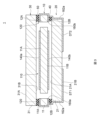
- 2 is a cross-sectional view taken along line II-II of the quartz crystal resonator shown in FIG. 1.
- 3 is a cross-sectional view taken along line III-III of the quartz crystal resonator shown in FIG. 1.
- FIG. 1 is a plan view of a quartz crystal vibration element according to a first embodiment.
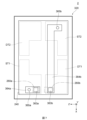
- FIG. 2 is a plan view of a lower cover according to the first embodiment.
- FIG. 11 is a plan view of a quartz crystal vibrating element according to a second embodiment.
- FIG. 11 is a plan view of a lower cover according to a second embodiment.
- an orthogonal coordinate system consisting of the X-axis, Y'-axis, and Z'-axis may be conveniently attached to each drawing.
- the X-axis, Y'-axis, and Z'-axis correspond to each other in each drawing.
- the X-axis, Y'-axis, and Z'-axis each correspond to the crystallographic axes of the quartz substrate 11, which will be described later.
- the X-axis corresponds to the electrical axis (polarity axis) of the quartz
- the Y-axis corresponds to the mechanical axis of the quartz
- the Z-axis corresponds to the optical axis of the quartz.
- the Y'-axis and Z'-axis are axes that are obtained by rotating the Y-axis and Z-axis counterclockwise around the X-axis by ⁇ degrees when viewed from the positive direction of the X-axis.
- the direction parallel to the X-axis is referred to as the "X-axis direction”
- the direction parallel to the Y'-axis is referred to as the "Y'-axis direction”
- the direction parallel to the Z'-axis is referred to as the "Z'-axis direction”.
- the directions of the tips of the arrows on the X-axis, Y'-axis, and Z'-axis are referred to as "positive” or "+ (plus)”, and the directions opposite the arrows are referred to as "negative” or "- (minus)".
- the +Y'-axis direction is described as the upward direction
- the -Y'-axis direction is described as the downward direction
- the up-down orientation of the quartz resonator element 10, the quartz resonator 1, and the quartz oscillator 100 is not limited to this.
- the plane specified by the X-axis and Z'-axis is referred to as the Z'X plane, and the same applies to the planes specified by the other axes.
- Fig. 1 is an exploded perspective view of the quartz crystal unit according to the first embodiment.
- Fig. 2 is a cross-sectional view taken along line II-II of the quartz crystal unit shown in Fig. 1.
- Fig. 3 is a cross-sectional view taken along line III-III of the quartz crystal unit shown in Fig. 1.
- Fig. 4 is a plan view of the lower cover according to the first embodiment.
- the quartz crystal resonator 1 comprises a quartz crystal resonator element 10, a bottom cover 20, a top cover 30, a bottom joint 40, and a top joint 50.
- the bottom cover 20, the quartz crystal resonator element 10, and the top cover 30 are arranged in this order with a gap in between in the Y'-axis direction.
- the Y'-axis direction in which the bottom cover 20, the quartz crystal resonator element 10, and the top cover 30 are stacked is referred to as the "thickness direction.”
- the top cover 30 corresponds to an example of a first substrate
- the bottom cover 20 corresponds to an example of a second substrate.
- the top joint 50 corresponds to an example of a first joint
- the bottom joint 40 corresponds to an example of a second joint.
- the quartz crystal vibration element 10 is an electromechanical energy conversion element that converts electrical energy into mechanical energy and vice versa through the piezoelectric effect. As shown in FIG. 1, the quartz crystal vibration element 10 has a vibration part 110, a holding part 120, and a support arm 130.
- the vibration unit 110 is excited at a predetermined frequency based on the applied alternating voltage.
- the vibration unit 110 is held in a vibration space between the lower cover 20 and the upper cover 30 so that it can vibrate.
- the main vibration of the vibration unit 110 is a thickness shear vibration mode.
- the shape of the vibration unit 110 when the XZ' plane is viewed in a plane (hereinafter simply referred to as "planar view") (hereinafter referred to as "planar shape”) is a rectangle having a pair of short sides 111A, 111B and a pair of long sides 111C, 111D.
- the pair of short sides 111A, 111B extend along the Z' axis direction and face each other in the axial direction.
- the pair of long sides 111C, 111D extend along the X axis direction and face each other outward in the Z' axis direction.
- the main vibration of the vibrating part is not limited to thickness-slip vibration mode, and may be, for example, thickness-extension vibration mode, expansion vibration mode, length vibration mode, or bending vibration mode.
- the planar shape of the vibrating part is not limited to rectangular, and may be, for example, square, polygonal, circular, elliptical, or a combination of these.
- the holding portion 120 is a portion for holding the vibration portion 110.
- the holding portion 120 together with the lower cover 20, the upper cover 30, the lower joint portion 40, and the upper joint portion 50, form a vibration space for the vibration portion 110.
- the holding portion 120 is spaced apart from the vibration portion 110 and is provided in a frame shape surrounding the vibration portion 110.
- the holding portion 120 has frame portions 121A, 121B, 121C, and 121D.
- the frame portions 121A, 121B, 121C, and 121D are each a part of a substantially rectangular frame surrounding the vibration portion 110.
- the frame portion 121A is spaced apart from the short side 111A of the vibration portion 110 in the X-axis direction and extends parallel to the short side 111A along the Z'-axis direction.
- the frame portion 121B is spaced apart from the short side 111B of the vibration portion 110 in the X-axis direction and extends parallel to the short side 111B along the Z'-axis direction.
- the frame portion 121C is spaced apart from the long side 111C of the vibration portion 110 in the Z'-axis direction and extends parallel to the long side 111C along the X-axis direction.
- the frame portion 121D is spaced apart from the long side 111D of the vibration portion 110 in the Z'-axis direction and extends parallel to the long side 111D along the X-axis direction.
- Both ends of frame portion 121C are connected to one end of frame portion 121A and one end of frame portion 121B, respectively. Both ends of frame portion 121D are connected to the other end of frame portion 121A and the other end of frame portion 121B, respectively.
- Frame portion 121A and frame portion 121B face each other in the X-axis direction, sandwiching vibration portion 110 therebetween.
- Frame portion 121C and frame portion 121D face each other in the Z'-axis direction, sandwiching vibration portion 110 therebetween.
- the holding portion need only be provided around at least a portion of the periphery of the vibrating portion, and is not limited to a frame-like shape.
- the holding portion may be provided in the shape of a rail having two parallel frame portions.
- the support arm 130 supports the vibration part 110 and allows the holding part 120 to hold the vibration part 110.
- the support arm 130 connects the vibration part 110 and the holding part 120. As shown in Figures 1 and 4, the support arm 130 connects the end of the vibration part 110 on the short side 111B side to the frame part 121B of the holding part 120.
- the support arm 130 extends along the X-axis.
- the bottom cover 20 faces the vibration part 110, the holding part 120, and the support arm 130 of the quartz crystal vibration element 10 with a gap in the Y'-axis direction.
- the bottom cover 20 is provided in a flat plate shape. As shown in FIG. 5, when viewed in a plan view, the bottom cover 20 has a pair of long sides that extend along the X-axis direction and face each other in the Z'-axis direction, and a pair of short sides that extend along the Z'-axis direction and face each other in the Z-axis direction.
- the pair of long sides and the pair of short sides of the bottom cover 20 are connected by sides that are inclined relative to the pair of long sides and the pair of short sides. In other words, notches are formed in the four corners of the bottom cover 20 when viewed in a plan view.
- the top cover 30 faces the vibration part 110, the holding part 120, and the support arm 130 of the quartz crystal vibration element 10 at a distance in the Y'-axis direction on the opposite side to the bottom cover 20.
- the top cover 30 is provided in a flat plate shape. As shown in FIG. 1, when viewed in a plan view, the top cover 30 has a pair of long sides that extend along the X-axis direction and face each other in the Z'-axis direction, and a pair of short sides that extend along the Z'-axis direction and face each other in the Z-axis direction.
- the planar shape of the top cover 30 is rectangular.
- the lower joint 40 and the upper joint 50 are provided in a frame shape along the holding portion 120 of the quartz vibration element 10.
- the lower joint 40 joins the holding portion 120 of the quartz vibration element 10 to the end of the lower cover 20.
- the upper joint 50 joins the holding portion 120 of the quartz vibration element 10 to the end of the upper cover 30.
- the lower joint 40 and the upper joint 50 are provided by an organic adhesive containing, for example, an epoxy-based, vinyl-based, acrylic-based, urethane-based, or silicone-based resin.
- the material of the lower joint and the upper joint is not limited to organic adhesives, and may be inorganic adhesives such as silicon-based adhesives containing water glass, calcium-based adhesives containing cement, etc.
- the material of the lower joint and the upper joint may be low-melting glass (e.g., lead borate-based or tin phosphate-based).
- the material of the lower joint and the upper joint may be gold (Au), tin (Sn), copper (Cu), titanium (Ti), aluminum (Al), germanium (Ge), silicon (Si), or a eutectic alloy containing at least one of these.
- the quartz crystal vibration element 10 includes a quartz crystal substrate 11, a first excitation electrode 140a, a second excitation electrode 140b, a first extraction electrode 150a, a second extraction electrode 150b, a first connection electrode 160a, and a second connection electrode 160b.
- the quartz substrate 11 is provided continuously over the vibration part 110, the holding part 120, and the support arm 130. In the XZ' plane direction, the quartz substrate 11 extends over almost the entire area of each of the vibration part 110, the holding part 120, and the support arm 130.
- the quartz substrate 11 is a thin quartz crystal with the XZ' plane as the main surface.
- the quartz substrate 11 is, for example, an AT-cut quartz substrate. That is, the counterclockwise rotation angle ⁇ of the Z'-axis and Y'-axis from the Z-axis and Y-axis when viewed from the positive X-axis direction is 35 degrees 15 minutes ⁇ 1 minute 30 seconds.
- the quartz vibration element 10 using the AT-cut quartz substrate 11 has high frequency stability over a wide temperature range.
- the planar shape of the quartz substrate 11 in the vibration part 110 is a rectangle with a long side along the X-axis direction and a short side along the Z'-axis direction.
- the quartz substrate 11 in the vibration part 110, has an upper surface 11A provided on the upper lid 30 side and a lower surface 11B provided on the lower lid 20 side.
- the upper surface 11A and the lower surface 11B correspond to an example of a pair of main surfaces of the quartz substrate 11 in the vibration part 110.
- the quartz crystal substrate 11 in the vibration part 110 has a first short side surface connecting the ends of the upper surface 11A and the lower surface 11B at the short side 111A on the frame part 121A side, a second side surface connecting the ends of the upper surface 11A and the lower surface 11B at the short side 111B on the frame part 121B side, a first long side surface connecting the ends of the upper surface 11A and the lower surface 11B at the long side 111C on the frame part 121C side, and a second long side surface connecting the ends of the upper surface 11A and the lower surface 11B at the long side 111D on the frame part 121D side.
- the first and second short side surfaces are formed by one plane extending along the Y'Z' plane, for example, but may include multiple inclined surfaces extending in a direction intersecting the Y'Z' plane, or may include curved surfaces.
- the first and second long sides are formed, for example, by a single plane extending along the XY' plane, but may also include an inclined surface extending in a direction intersecting the XY' plane, or may also include a curved surface.
- the planar shape of the quartz substrate 11 in the holding portion 120 is a rectangular frame shape having a long side along the X-axis direction and a short side along the Z'-axis direction.
- the quartz substrate 11 has an upper surface 12A provided on the upper cover 30 side and a lower surface 12B provided on the lower cover 20 side.
- the upper surface 12A and the lower surface 12B correspond to an example of a pair of main surfaces of the quartz substrate 11 in the holding portion 120.
- the quartz substrate 11 in the holding portion 120 has an inner surface connecting the ends of the upper surface 12A and the lower surface 12B on the vibration portion 110 side, and an outer surface connecting the ends of the upper surface 12A and the lower surface 12B on the opposite side to the vibration portion 110.
- the inner surface and the outer surface in the frame portions 121A and 121B are formed by a single plane extending, for example, along the Y'Z' plane, but may include multiple inclined surfaces extending in a direction intersecting the Y'Z' plane, or may include curved surfaces.
- the inner and outer surfaces of frame portions 121C and 121D are formed, for example, by a single plane extending along the XY' plane, but may also include an inclined surface extending in a direction intersecting the XY' plane, or may also include a curved surface.
- the planar shape of the quartz substrate 11 in the support arm 130 is a rectangular frame.
- the quartz substrate 11 has an upper surface 13A provided on the upper cover 30 side and a lower surface 13B provided on the lower cover 20 side.
- the upper surface 13A corresponds to an example of the first main surface of the quartz substrate 11 in the support arm 130
- the lower surface 13B corresponds to an example of the second main surface of the quartz substrate 11 in the support arm 130.
- the quartz substrate 11 in the support arm 130 has a side surface 13C connecting the ends of the upper surface 13A and the lower surface 13B on the frame portion 121C side, and a side surface 13D connecting the ends of the upper surface 13A and the lower surface 13B on the frame portion 121D side.
- the side surface 13C corresponds to an example of the first side surface of the quartz substrate 11 in the support arm 130
- the side surface 13D corresponds to an example of the second side surface of the quartz substrate 11 in the support arm 130.
- Sides 13C and 13D extend along the XY' plane.
- the cross-sectional shape of support arm 130 parallel to the Y'Z' plane of quartz substrate 11 (hereinafter referred to as the "cross-sectional shape") is a rectangle with upper surface 13A and lower surface 13B as long sides and side surfaces 13C and 13D as short sides.
- the side surface of the support arm 130 connecting the upper and lower surfaces of the quartz substrate 11 is not limited to being formed by a single plane extending along the XY' plane, but may include an inclined surface extending in a direction intersecting the XY' plane, or may include a curved surface.
- the thickness of the quartz substrate 11 is uniform in the vibrating portion 110, the holding portion 120, and the support arm 130.
- the upper surfaces 11A, 12A, and 13A are included in the same plane, and the lower surfaces 11B, 12B, and 13B are included in the same plane.
- the thickness of the quartz substrate may vary within the vibrating part, the holding part, and the supporting arm, or at the boundaries between them.
- the quartz substrate in the vibrating part may have a mesa structure or an inverted mesa structure in which the thickness of the central part where the excitation electrode is provided differs from that of the peripheral part.
- the quartz substrate in the vibrating part may have a convex structure in which the amount of change in thickness changes continuously, or a bevel structure in which the amount of change in thickness changes discontinuously.
- the thickness of the quartz substrate in the supporting arm may be greater or smaller than the thickness of the quartz substrate in the vibrating part.
- the first excitation electrode 140a and the second excitation electrode 140b apply a voltage to the quartz substrate 11 of the vibration part 110 to excite the vibration part 110.
- the first excitation electrode 140a is provided on the upper surface 11A of the quartz substrate 11 of the vibration part 110
- the second excitation electrode 140b is provided on the lower surface 11B of the quartz substrate 11 of the vibration part 110.
- the first excitation electrode 140a and the second excitation electrode 140b face each other with the quartz substrate 11 in between.
- the first excitation electrode 140a and the second excitation electrode 140b are rectangular and are arranged so that they overlap each other almost entirely.
- the planar shape of the first excitation electrode 140a and the second excitation electrode 140b is not limited to a rectangular shape.
- the planar shape of the first excitation electrode 140a and the second excitation electrode 140b may be a polygonal shape, a circular shape, an elliptical shape, or a combination of these.
- the first extraction electrode 150a electrically connects the first excitation electrode 140a and the first connection electrode 160a. As shown in FIG. 4, the first extraction electrode 150a has a first portion 151a, a second portion 152a, and a third portion 153a.
- the first portion 151a is provided on the upper surface 11A of the quartz substrate 11 in the vibrating portion 110.
- the first portion 151a is connected to the first excitation electrode 140a.
- the dimension in the Z'-axis direction of the first portion 151a (hereinafter referred to as "width") is, for example, approximately equal to the width of the wide portion W1 of the second portion 152a described below.
- the width of the first portion 151a may be greater than the width of the wide portion W1 of the second portion 152a.
- the second portion 152a is provided continuously across the upper surface 13A, lower surface 13B and side surface 13C of the quartz substrate 11 on the support arm 130.
- the second portion 152a has a wide portion W1, a side portion S1 and a narrow portion N1.
- the wide portion W1 is provided on the upper surface 13A
- the side portion S1 is provided on the side surface 13C
- the narrow portion N1 is provided on the lower surface 13B.
- the wide portion W1 and the side portion S1 are connected at the corner formed by the upper surface 13A and the side surface 13C.
- the narrow portion N1 and the side portion S1 are connected at the corner formed by the lower surface 13B and the side surface 13C.
- the second portion 152a is connected to the first portion 151a at the wide portion W1.
- the wide portion W1 corresponds to an example of a first wide portion according to the present invention
- the narrow portion N1 corresponds to an example of a first narrow portion according to the present invention
- the side portion S1 corresponds to an example of a first side portion according to the present invention.
- the width of the wide portion W1 is smaller than the width of the narrow portion N1.
- the narrow portion N1 is located inside the wide portion W1. Specifically, the end of the wide portion W1 on the side portion S1 side overlaps with the end of the narrow portion N1 on the side portion S1 side, and the end N1t of the narrow portion N1 on the wide portion W2 side described below is located closer to the side portion S1 than the end W1t of the wide portion W1 on the narrow portion N2 side described below.
- the third portion 153a is provided on the upper surface 12A of the quartz substrate 11 at the frame portion 121B of the holding portion 120.
- the third portion 153a extends from the connection portion between the support arm 130 and the frame portion 121B toward the frame portion 121C.
- One end of the third portion 153a is connected to the wide portion W1 of the second portion 152a at the connection portion between the support arm 130 and the frame portion 121B.
- the other end of the third portion 153a is electrically connected to the first connection electrode 160a via a side electrode provided on the outer surface of the holding portion 120 at the corner of the holding portion 120 where the frame portion 121B and the frame portion 121C are connected.
- the second extraction electrode 150b electrically connects the second excitation electrode 140b and the second connection electrode 160b. As shown in FIG. 4, the second extraction electrode 150b has a first portion 151b, a second portion 152b, and a third portion 153b.
- the first portion 151b is provided on the lower surface 11B of the quartz substrate 11 in the vibrating portion 110.
- the first portion 151b is connected to the second excitation electrode 140b.
- the width of the first portion 151b is, for example, approximately equal to the width of the wide portion W2 of the second portion 152b described below. However, from the viewpoint of reducing the wiring resistance in the first portion 151b, the width of the first portion 151b may be greater than the width of the wide portion W2 of the second portion 152b.
- the second portion 152b is provided continuously across the upper surface 13A, lower surface 13B and side surface 13C of the quartz substrate 11 on the support arm 130.
- the second portion 152b has a wide portion W2, a side portion S2 and a narrow portion N2.
- the wide portion W2 is provided on the lower surface 13B
- the side portion S2 is provided on the side surface 13D
- the narrow portion N2 is provided on the upper surface 13A.
- the wide portion W2 and the side portion S2 are connected at the corner formed by the lower surface 13B and the side surface 13C.
- the narrow portion N2 and the side portion S2 are connected at the corner formed by the upper surface 13A and the side surface 13C.
- the second portion 152b is connected to the first portion 151b at the wide portion W2.
- the wide portion W2 corresponds to an example of a second wide portion according to the present invention
- the narrow portion N2 corresponds to an example of a second narrow portion according to the present invention
- the side portion S2 corresponds to an example of a second side portion according to the present invention.
- the width of the wide portion W2 is smaller than the width of the narrow portion N2.
- the narrow portion N2 is located inside the wide portion W2. Specifically, the end of the wide portion W2 on the side portion S2 side overlaps with the end of the narrow portion N2 on the side portion S2 side, and the end N2t of the narrow portion N2 on the wide portion W1 side is located closer to the side portion S2 than the end W2t of the wide portion W2 on the narrow portion N1 side.
- the third portion 153b is provided on the upper surface 12A of the quartz substrate 11 at the frame portion 121B of the holding portion 120.
- the third portion 153b extends from the connection portion between the support arm 130 and the frame portion 121B toward the frame portion 121D, bends at the corner of the holding portion 120 where the frame portion 121B and the frame portion 121D are connected, and extends toward the frame portion 121A.
- One end of the third portion 153b is connected to the narrow portion N2 of the second portion 152b at the connection portion between the support arm 130 and the frame portion 121B.
- the other end of the third portion 153b is electrically connected to the second connection electrode 160b via a side electrode provided on the outer surface of the holding portion 120 at the corner of the holding portion 120 where the frame portion 121A and the frame portion 121D are connected.
- the first extraction electrode 150a and the second extraction electrode 150b are located on opposite sides of the Z axis passing through the center CNT of the cross section of the quartz substrate 11, and are located on opposite sides of the Y axis passing through the center CNT.
- the end W1t of the wide portion W1 of the first extraction electrode 150a on the narrow portion N2 side of the second extraction electrode 150b faces the end W2t of the wide portion W2 of the second extraction electrode 150b on the narrow portion N1 side of the first extraction electrode 150a in the Z-axis direction.
- the end W1t and the end W2t face each other in a direction rotated by a rotation angle of 90 degrees + ⁇ clockwise from the Y'-axis direction perpendicular to the top surface 13A when viewed from the positive side of the X-axis, that is, ⁇ counterclockwise.
- end W1t and end W2t face each other is not limited to the Z-axis direction, but may be any direction rotated counterclockwise around the Z-axis by 0 degrees or more when viewed from the positive side of the X-axis.
- end W1t and end W2t may face each other in a direction rotated clockwise from the Y'-axis direction by an angle smaller than 90 degrees + ⁇ , i.e., a counterclockwise angle larger than ⁇ .
- the end N1t of the narrow portion N1 of the first extraction electrode 150a on the wide portion W2 side of the second extraction electrode 150b faces the end N2t of the narrow portion N2 of the second extraction electrode 150b on the wide portion W1 side of the first extraction electrode 150a in the direction obtained by rotating the Y axis clockwise at an angle greater than 0 degrees when viewed from the positive side of the X axis.
- the end N1t faces the end N2t in the direction obtained by rotating the Y axis clockwise at an angle greater than 90 degrees -2 ⁇ when viewed from the positive side of the X axis.
- end N1t faces the end N2t in the direction obtained by rotating the Z axis counterclockwise at an angle smaller than 2 ⁇ when viewed from the positive side of the X axis.
- end N1t faces end N2t in a direction obtained by rotating the Y axis counterclockwise at an angle smaller than 2 x ⁇ when viewed from the positive side of the X axis.
- end N1t faces end N2t in a direction obtained by rotating the Z axis clockwise at an angle larger than 180 degrees - 2 x ⁇ when viewed from the positive side of the X axis.
- end N1t faces end N2t in a direction obtained by rotating the Y axis clockwise at an angle larger than 0 degrees when viewed from the positive side of the X axis.
- the direction in which the ends W1t and W2t face each other is, for example, the direction in which the centers of the ends W1t and W2t face each other in the thickness direction.
- the direction in which the ends W1t and W2t face each other may also be the direction in which the corners of the ends W1t and W2t on the quartz substrate 11 side face each other.
- the direction in which the ends W1t and W2t face each other may also be the direction in which the corners of the ends W1t and W2t on the opposite side to the quartz substrate 11 face each other.
- the direction in which the ends N1t and N2t face each other may be the direction in which the centers of the ends N1t and N2t face each other in the thickness direction, or the direction in which the corners of the ends N1t and N2t on the quartz substrate 11 side face each other or the corners on the opposite side to the quartz substrate 11 face each other.
- the first connection electrode 160a and the second connection electrode 160b electrically connect the first excitation electrode 140a to an external terminal.
- the first connection electrode 160a is provided on the underside 12B of the quartz substrate 11 at the corner of the holding portion 120 where the frame portion 121B and the frame portion 121C are connected.
- the second connection electrode 160b is provided on the underside 12B of the quartz substrate 11 at the corner of the holding portion 120 where the frame portion 121A and the frame portion 121D are connected.
- the bottom cover 20 has a quartz substrate 21, power terminals ST1 and ST2, and dummy terminals DT1 and DT2.
- the quartz substrate 21 is a flat substrate that overlaps with almost the entire quartz vibration element 10 in a planar view.
- the quartz substrate 21 is formed of quartz crystals with the same cut angle as the quartz substrate 11 of the quartz vibration element 10. This can reduce thermal stress caused by differences in thermal expansion coefficients and differences in the directions of thermal expansion and contraction between the quartz vibration element 10 and the bottom cover 20. This can suppress fluctuations in the frequency of the quartz vibration element 10.
- the quartz substrate 21 has an upper surface 21A provided on the quartz vibration element 10 side and a lower surface 21B provided on the opposite side to the upper surface 21A.
- the quartz substrate 21 When viewed in a planar view, the quartz substrate 21 has a long side extending along the X-axis direction and a short side extending along the Z'-axis direction. In addition, when viewed in a plan view, the side surface connecting the upper surface 21A and the lower surface 21B of the quartz substrate 21 overlaps with the outer side surface of the holding portion 120 of the quartz vibrating element 10. A notch is formed at the corner where the short side and long side of the quartz substrate 21 connect. The area of the quartz substrate 21 in a plan view is smaller than the area of the quartz substrate 31 in a plan view, described below, by the amount of this notch.
- the shape of the side surface formed by the notch at the corner of the quartz substrate 21 is, for example, planar. However, the shape of the side surface formed by the notch at the corner of the quartz substrate 21 is not limited to this, and may be a curved surface that is part of a cylinder or a rectangular prism.
- the power terminals ST1, ST2 and the dummy terminals DT1, DT2 are provided on the lower surface 21B of the quartz substrate 21.
- the power terminals ST1, ST2 and the dummy terminals DT1, DT2 are examples of external terminals of the quartz oscillator 1.
- the power terminals ST1, ST2 are for providing a drive signal (drive voltage) to the quartz oscillator 1.
- the power terminal ST1 is electrically connected to the first connection electrode 160a via a notch in the corner of the quartz substrate 21 and a side electrode 162a provided on the outer surface of the lower joint 40.
- the power terminal ST2 is electrically connected to the second connection electrode 160b via a notch in the corner of the quartz substrate 21 and a side electrode 162b provided on the outer surface of the lower joint 40.
- the dummy terminals DT1, DT2 are for balancing electrical characteristics such as capacitance and mechanical strength.
- the dummy terminals DT1 and DT2 are so-called floating electrodes that are not electrically connected to the quartz crystal vibration element 10.
- At least one of the dummy terminals DT1 and DT2 may be a ground electrode that electrically grounds a portion of the crystal unit 1.
- the top cover 30 has a quartz substrate 31.
- the quartz substrate 31 is a flat substrate that overlaps with almost the entire quartz vibration element 10 in a planar view.
- the quartz substrate 31 is formed of quartz crystals with the same cut angle as the quartz substrate 11 of the quartz vibration element 10. This can reduce thermal stress caused by differences in thermal expansion coefficients and differences in the directions of thermal expansion and contraction between the quartz vibration element 10 and the top cover 30. This can suppress fluctuations in the frequency of the quartz vibration element 10.
- the quartz substrate 21 has a lower surface 31B provided on the quartz vibration element 10 side and an upper surface 31A provided on the opposite side to the lower surface 31B.
- the quartz substrate 31 is rectangular with long sides extending along the X-axis direction and short sides extending along the Z'-axis direction.
- the side surface connecting the upper surface 31A and the lower surface 31B of the quartz substrate 31 overlaps with the outer side surface of the holding portion 120 in the quartz vibration element 10.
- the cut angle of the quartz substrate of the lower and upper lids is not particularly limited and may be different from the cut angle of the quartz substrate of the quartz vibrating element.
- the lower and upper lids may have a glass substrate, a silicon substrate, a ceramic substrate, or a metal substrate instead of a quartz substrate.
- the first extraction electrode 150a is provided on the upper surface 13A, the lower surface 13B and the side surface 13C of the quartz substrate 11 in the support arm 130
- the second extraction electrode 150b is provided on the upper surface 13A, the lower surface 13B and the side surface 13D of the quartz substrate 11 in the support arm.
- the cross-sectional area of the first extraction electrode 150a and the second extraction electrode 150b in the support arm 130 allows the cross-sectional area of the first extraction electrode 150a and the second extraction electrode 150b in the support arm 130 to be increased compared to a configuration in which one extraction electrode is provided on at least a portion of the upper surface and side surface of the quartz substrate in the support arm, and the other extraction electrode is provided on at least a portion of the lower surface and side surface. Therefore, by reducing the wiring resistance of the first extraction electrode 150a and the second extraction electrode 150b, it is possible to suppress deterioration of the electrical characteristics of the quartz vibration element 10, i.e., an increase in the CI (Crystal Impedance) value.
- the first extraction electrode 150a has a wide portion W1 provided on the upper surface 13A, a narrow portion N1 provided on the lower surface 13B, and a side portion S1 provided on the side surface 13C
- the second extraction electrode 150b has a wide portion W2 provided on the lower surface 13B, a narrow portion N2 provided on the upper surface 13A, and a side portion S2 provided on the side surface 13D.
- by suppressing the occurrence of parasitic capacitance and unnecessary vibration between the first extraction electrode 150a and the second extraction electrode 150b it is possible to suppress the decrease in the Q value due to energy loss and to suppress the increase in the CI value.
- by reducing the wiring resistance of the first extraction electrode 150a and the second extraction electrode 150b it is possible to suppress the increase in the CI value.
- the end W1t of the wide portion W1 faces the end W2t of the wide portion W2 in a direction rotated counterclockwise by 0 degrees or more about the Z axis when viewed from the positive side of the X axis.
- the distance between the first extraction electrode 150a and the second extraction electrode 150b is larger than when the first extraction electrode and the second extraction electrode face each other in a direction rotated backward around the Z-axis. Therefore, the electric field strength acting on the quartz substrate 11 between the first extraction electrode 150a and the second extraction electrode 150b is reduced, and the generation of unwanted vibrations can be suppressed. Therefore, the decrease in the Q value due to energy loss can be suppressed, and the increase in the CI value can be suppressed.
- the end N1t of the narrow width portion N1 faces the end N2t of the narrow width portion N2 in a direction rotated clockwise around the Y axis by an angle greater than 0 degrees when viewed from the positive side of the X axis.
- the distance between narrow width portion N1 and narrow width portion N2 is greater than in a configuration in which the narrow width portions face each other in a direction rotated clockwise around the Y axis by an angle of 0 degrees or less when viewed from the positive side of the X axis.
- the first extraction electrode 150a and the second extraction electrode 150b are located on opposite sides of the Z axis passing through the center CNT of the Y'Z' cross section of the quartz substrate 11 in the support arm 130, and are located on opposite sides of the Y axis passing through the center CNT.
- This increases the distance between the first extraction electrode 150a and the second extraction electrode 150b. This reduces the electric field strength acting on the quartz substrate 11 between the first extraction electrode 150a and the second extraction electrode 150b, making it possible to suppress the occurrence of unwanted vibrations. This makes it possible to suppress the decrease in the Q value due to energy loss and the increase in the CI value.
- the vibration unit 110 when viewed in a plan view, has a long side extending along the X-axis direction and a short side extending along the Z'-axis direction, and the support arm 130 extends from the short side of the vibration unit 110 along the X-axis direction.
- the shape of the XZ' cross section of the quartz substrate 11 at the support arm 130 is rectangular.
- the high symmetry of the cross-sectional shape of the quartz substrate 11 at the support arm 130 distributes stress evenly when acceleration or impact acts on the quartz oscillator 1. This improves the impact resistance of the quartz oscillator element 10.
- Fig. 6 is a plan view of the crystal resonator element according to the second embodiment.
- Fig. 7 is a plan view of the lower cover according to the second embodiment.
- the material of the lower joint 240 and the upper joint 250 is metal. That is, the quartz crystal vibrating element 210 and the lower cover 320 are metallically joined, and the quartz crystal vibrating element 210 and the upper cover 30 are metallically joined.
- the first connection electrode 260a and the second connection electrode 260b are provided in the center in the Z'-axis direction of the frame portion 221B of the holding portion 220. When viewed in a plan view, the first connection electrode 260a and the second connection electrode 260b are provided in an area surrounded by the lower joint 240 and are spaced apart from the lower joint 240.
- the narrow portion N1 of the first extraction electrode 250a is connected to the first connection electrode 260a, and the wide portion W2 of the second extraction electrode 250b is connected to the second connection electrode 260b.
- Top electrodes 364a and 364b are provided on the top surface 21A of the lower cover 320.
- a conductive portion 363a is provided between the top electrode 364a and the first connection electrode 260a, and a conductive portion 363a is provided between the top electrode 364b and the second connection electrode 260b.
- a through electrode 365a that penetrates the quartz substrate 21 in the Y'-axis direction is provided between the top electrode 364a and the power supply terminal ST1
- a through electrode 365b that penetrates the quartz substrate 21 in the Y'-axis direction is provided between the top electrode 364b and the power supply terminal ST2.
- the upper electrode 364a is electrically connected to the first connection electrode 260a via the conductive portion 363a. When viewed in a plan view, the upper electrode 364a extends from the region overlapping with the conductive portion 363a to the region overlapping with the through electrode 365a. The upper electrode 364a is electrically connected to the power supply terminal ST1 via the through electrode 365a. The upper electrode 364b is electrically connected to the second connection electrode 260b via the conductive portion 363b. When viewed in a plan view, the upper electrode 364b extends from the region overlapping with the conductive portion 363b to the region overlapping with the through electrode 365b. The upper electrode 364b is electrically connected to the power supply terminal ST2 via the through electrode 365b.
- a quartz crystal vibration element having a vibration portion, a holding portion arranged to surround the vibration portion in a plan view, and a support arm connecting the vibration portion and the holding portion, a quartz crystal substrate provided across the vibration portion, the holding portion, and the support arm;
- a pair of excitation electrodes provided on the vibration portion;
- a first extraction electrode and a second extraction electrode provided on the support arm and electrically connected to the pair of excitation electrodes, respectively;
- In the support arm when the axes obtained by rotating the Y axis of the crystal and the Z axis of the crystal around the X axis of the crystal are defined as the Y' axis and the Z' axis,
- a first main surface and a second main surface extending along the X-axis and the Z'-axis and facing each other in the Y'-axis direction; a first side surface connecting end portions of the first main surface and the second main surface on one side in the Z′-axis direction; a second side surface connecting end portions of the first main
- the dimension of the quartz substrate in the supporting arm along the Z'-axis direction is larger than the dimension of the quartz substrate in the supporting arm along the Y'-axis direction
- the first extraction electrode has a first wide portion provided on the first main surface, a first side surface portion provided on the first side surface, and a first narrow portion provided on the second main surface and having a smaller dimension along the Z′-axis direction than the first wide portion
- the second extraction electrode has a second wide portion provided on the second main surface, a second side surface portion provided on the second side surface, and a second narrow portion provided on the first main surface and having a smaller dimension along the Z′-axis direction than the second wide portion
- the quartz crystal resonator element according to ⁇ 1>.
- the first extraction electrode and the second extraction electrode are located on opposite sides to each other with respect to a Z axis passing through a center of a cross section of the quartz substrate in the support arm, and are located on opposite sides to each other with respect to a Y axis passing through a center of a cross section of the quartz substrate in the support arm;
- the quartz crystal resonator element according to any one of ⁇ 1> to ⁇ 4>.
- the vibration section has a long side extending along the X-axis direction and a short side extending along the Z′-axis direction,
- the support arm extends from the short side of the vibration unit along the X-axis direction.
- the quartz crystal resonator element according to any one of ⁇ 1> to ⁇ 5>.
- ⁇ 7> The cross-sectional shape of the quartz substrate in the support arm, which is defined by the X-axis and the Z'-axis, is rectangular.
- ⁇ 6> The quartz crystal vibration element according to any one of ⁇ 1> to ⁇ 6>.
- the quartz substrate is AT cut.
- the quartz crystal resonator element according to any one of ⁇ 1> to ⁇ 7>.
- a first substrate provided at a distance from the quartz crystal vibrating element in the Y′-axis direction; a second substrate provided at a distance from the quartz crystal vibrating element in the Y′-axis direction; a first bonding portion that bonds a holder for the quartz crystal vibrating element to the first substrate; a second bonding portion that bonds the holder for the quartz crystal vibrating element to the second substrate; Quartz crystal oscillator.
- Embodiments of the present invention can be applied as appropriate to any device that performs electromechanical energy conversion using the piezoelectric effect, such as a timing device, sound generator, oscillator, or load sensor, without any particular limitations.
- one aspect of the present invention provides a quartz crystal vibration element that can suppress deterioration of electrical characteristics, and a quartz crystal vibration device including the quartz crystal vibration element.
- 1...Crystal resonator 10 ...Crystal vibrating element 11...Crystal substrate 11A, 12A, 13A...Top surface 11B, 12B, 13B...Bottom surface 13C, 13D...Side surface 110...Vibrating section 120...Holding section 121A, 121B, 121C, 121D...Frame Part 130...Support arm 140a...First excitation electrode 140b...Second excitation electrode 150a...First extraction electrode 150b...Second extraction electrode 151a, 151b...First portion 152a, 152b...Second portion 153a, 153b...Third portion W1, W2...Wide width part N1, N2...Narrow width part S1, S2...Side surface part 160a...First connection electrode 160b...Second connection electrode 20...Lower cover 30...Upper cover 40...Lower joint part 50...Upper joint part
Landscapes
- Physics & Mathematics (AREA)
- Acoustics & Sound (AREA)
- Piezo-Electric Or Mechanical Vibrators, Or Delay Or Filter Circuits (AREA)
Priority Applications (3)
| Application Number | Priority Date | Filing Date | Title |
|---|---|---|---|
| CN202380095564.5A CN120858525A (zh) | 2023-03-31 | 2023-11-08 | 石英振动元件以及具备该石英振动元件的石英振子 |
| JP2025509686A JP7825812B2 (ja) | 2023-03-31 | 2023-11-08 | 水晶振動素子及びそれを備えた水晶振動子 |
| US19/291,753 US20250357913A1 (en) | 2023-03-31 | 2025-08-06 | Quartz vibrating element and quartz vibrator including the same |
Applications Claiming Priority (2)
| Application Number | Priority Date | Filing Date | Title |
|---|---|---|---|
| JP2023058608 | 2023-03-31 | ||
| JP2023-058608 | 2023-03-31 |
Related Child Applications (1)
| Application Number | Title | Priority Date | Filing Date |
|---|---|---|---|
| US19/291,753 Continuation US20250357913A1 (en) | 2023-03-31 | 2025-08-06 | Quartz vibrating element and quartz vibrator including the same |
Publications (1)
| Publication Number | Publication Date |
|---|---|
| WO2024202186A1 true WO2024202186A1 (ja) | 2024-10-03 |
Family
ID=92903740
Family Applications (1)
| Application Number | Title | Priority Date | Filing Date |
|---|---|---|---|
| PCT/JP2023/040261 Ceased WO2024202186A1 (ja) | 2023-03-31 | 2023-11-08 | 水晶振動素子及びそれを備えた水晶振動子 |
Country Status (4)
| Country | Link |
|---|---|
| US (1) | US20250357913A1 (https=) |
| JP (1) | JP7825812B2 (https=) |
| CN (1) | CN120858525A (https=) |
| WO (1) | WO2024202186A1 (https=) |
Citations (3)
| Publication number | Priority date | Publication date | Assignee | Title |
|---|---|---|---|---|
| JP2013258519A (ja) * | 2012-06-12 | 2013-12-26 | Nippon Dempa Kogyo Co Ltd | 圧電振動片及び圧電デバイス |
| JP2016039401A (ja) * | 2014-08-05 | 2016-03-22 | 日本電波工業株式会社 | 圧電振動片及び圧電デバイス |
| WO2020203044A1 (ja) * | 2019-03-29 | 2020-10-08 | 株式会社村田製作所 | 振動子及び振動子の製造方法 |
-
2023
- 2023-11-08 CN CN202380095564.5A patent/CN120858525A/zh active Pending
- 2023-11-08 JP JP2025509686A patent/JP7825812B2/ja active Active
- 2023-11-08 WO PCT/JP2023/040261 patent/WO2024202186A1/ja not_active Ceased
-
2025
- 2025-08-06 US US19/291,753 patent/US20250357913A1/en active Pending
Patent Citations (3)
| Publication number | Priority date | Publication date | Assignee | Title |
|---|---|---|---|---|
| JP2013258519A (ja) * | 2012-06-12 | 2013-12-26 | Nippon Dempa Kogyo Co Ltd | 圧電振動片及び圧電デバイス |
| JP2016039401A (ja) * | 2014-08-05 | 2016-03-22 | 日本電波工業株式会社 | 圧電振動片及び圧電デバイス |
| WO2020203044A1 (ja) * | 2019-03-29 | 2020-10-08 | 株式会社村田製作所 | 振動子及び振動子の製造方法 |
Also Published As
| Publication number | Publication date |
|---|---|
| US20250357913A1 (en) | 2025-11-20 |
| CN120858525A (zh) | 2025-10-28 |
| JP7825812B2 (ja) | 2026-03-09 |
| JPWO2024202186A1 (https=) | 2024-10-03 |
Similar Documents
| Publication | Publication Date | Title |
|---|---|---|
| WO2017064916A1 (ja) | 共振子及び共振装置 | |
| CN104993803B (zh) | 振动片、振子、振荡器以及电子设备 | |
| JP5668392B2 (ja) | 圧電振動素子、圧電振動子及び圧電発振器 | |
| JP2014068098A (ja) | 振動片、振動デバイス、電子機器及び移動体 | |
| JP5699809B2 (ja) | 圧電振動片 | |
| WO2016158010A1 (ja) | 圧電振動デバイス | |
| JP7369363B2 (ja) | 水晶振動素子、水晶振動子及び水晶発振器 | |
| JP7825812B2 (ja) | 水晶振動素子及びそれを備えた水晶振動子 | |
| JP2013042410A (ja) | 圧電振動素子、圧電振動子、電子デバイス、及び電子機器 | |
| JP2005033294A (ja) | 水晶振動素子 | |
| JP2024072373A (ja) | 振動片及び振動デバイス | |
| JP7691035B1 (ja) | 圧電振動素子 | |
| JP2014050067A (ja) | 振動デバイス、電子機器及び移動体 | |
| JP7666611B2 (ja) | 圧電振動子 | |
| JP2011199332A (ja) | 圧電振動片および圧電デバイス | |
| JP5585240B2 (ja) | 振動片及び振動デバイス | |
| WO2025150245A1 (ja) | 圧電振動子 | |
| JP2025072760A (ja) | 振動片及び振動デバイス | |
| JP2012199603A (ja) | 振動片、振動子、発振器及び電子機器 | |
| JP2025002814A (ja) | 振動デバイス | |
| WO2025182135A1 (ja) | 圧電振動子 | |
| WO2025203853A1 (ja) | 荷重センサ | |
| JP2024095265A (ja) | 角速度センサー | |
| JP2025034433A (ja) | 振動素子 | |
| CN119891998A (zh) | 振动片和振动器件 |
Legal Events
| Date | Code | Title | Description |
|---|---|---|---|
| 121 | Ep: the epo has been informed by wipo that ep was designated in this application |
Ref document number: 23930815 Country of ref document: EP Kind code of ref document: A1 |
|
| ENP | Entry into the national phase |
Ref document number: 2025509686 Country of ref document: JP Kind code of ref document: A |
|
| WWE | Wipo information: entry into national phase |
Ref document number: 2025509686 Country of ref document: JP |
|
| WWE | Wipo information: entry into national phase |
Ref document number: 202380095564.5 Country of ref document: CN |
|
| WWP | Wipo information: published in national office |
Ref document number: 202380095564.5 Country of ref document: CN |
|
| NENP | Non-entry into the national phase |
Ref country code: DE |
|
| 122 | Ep: pct application non-entry in european phase |
Ref document number: 23930815 Country of ref document: EP Kind code of ref document: A1 |