WO2024202022A1 - 照明装置 - Google Patents
照明装置 Download PDFInfo
- Publication number
- WO2024202022A1 WO2024202022A1 PCT/JP2023/013602 JP2023013602W WO2024202022A1 WO 2024202022 A1 WO2024202022 A1 WO 2024202022A1 JP 2023013602 W JP2023013602 W JP 2023013602W WO 2024202022 A1 WO2024202022 A1 WO 2024202022A1
- Authority
- WO
- WIPO (PCT)
- Prior art keywords
- optical element
- light source
- light
- lighting device
- incident
- Prior art date
- Legal status (The legal status is an assumption and is not a legal conclusion. Google has not performed a legal analysis and makes no representation as to the accuracy of the status listed.)
- Ceased
Links
Images




Classifications
-
- F—MECHANICAL ENGINEERING; LIGHTING; HEATING; WEAPONS; BLASTING
- F21—LIGHTING
- F21V—FUNCTIONAL FEATURES OR DETAILS OF LIGHTING DEVICES OR SYSTEMS THEREOF; STRUCTURAL COMBINATIONS OF LIGHTING DEVICES WITH OTHER ARTICLES, NOT OTHERWISE PROVIDED FOR
- F21V5/00—Refractors for light sources
- F21V5/08—Refractors for light sources producing an asymmetric light distribution
-
- G—PHYSICS
- G02—OPTICS
- G02B—OPTICAL ELEMENTS, SYSTEMS OR APPARATUS
- G02B27/00—Optical systems or apparatus not provided for by any of the groups G02B1/00 - G02B26/00, G02B30/00
- G02B27/09—Beam shaping, e.g. changing the cross-sectional area, not otherwise provided for
- G02B27/0916—Adapting the beam shape of a semiconductor light source such as a laser diode or an LED, e.g. for efficiently coupling into optical fibers
-
- F—MECHANICAL ENGINEERING; LIGHTING; HEATING; WEAPONS; BLASTING
- F21—LIGHTING
- F21S—NON-PORTABLE LIGHTING DEVICES; SYSTEMS THEREOF; VEHICLE LIGHTING DEVICES SPECIALLY ADAPTED FOR VEHICLE EXTERIORS
- F21S10/00—Lighting devices or systems producing a varying lighting effect
- F21S10/007—Lighting devices or systems producing a varying lighting effect using rotating transparent or colored disks, e.g. gobo wheels
-
- F—MECHANICAL ENGINEERING; LIGHTING; HEATING; WEAPONS; BLASTING
- F21—LIGHTING
- F21V—FUNCTIONAL FEATURES OR DETAILS OF LIGHTING DEVICES OR SYSTEMS THEREOF; STRUCTURAL COMBINATIONS OF LIGHTING DEVICES WITH OTHER ARTICLES, NOT OTHERWISE PROVIDED FOR
- F21V13/00—Producing particular characteristics or distribution of the light emitted by means of a combination of elements specified in two or more of main groups F21V1/00 - F21V11/00
- F21V13/02—Combinations of only two kinds of elements
- F21V13/04—Combinations of only two kinds of elements the elements being reflectors and refractors
-
- F—MECHANICAL ENGINEERING; LIGHTING; HEATING; WEAPONS; BLASTING
- F21—LIGHTING
- F21V—FUNCTIONAL FEATURES OR DETAILS OF LIGHTING DEVICES OR SYSTEMS THEREOF; STRUCTURAL COMBINATIONS OF LIGHTING DEVICES WITH OTHER ARTICLES, NOT OTHERWISE PROVIDED FOR
- F21V14/00—Controlling the distribution of the light emitted by adjustment of elements
- F21V14/06—Controlling the distribution of the light emitted by adjustment of elements by movement of refractors
-
- F—MECHANICAL ENGINEERING; LIGHTING; HEATING; WEAPONS; BLASTING
- F21—LIGHTING
- F21V—FUNCTIONAL FEATURES OR DETAILS OF LIGHTING DEVICES OR SYSTEMS THEREOF; STRUCTURAL COMBINATIONS OF LIGHTING DEVICES WITH OTHER ARTICLES, NOT OTHERWISE PROVIDED FOR
- F21V15/00—Protecting lighting devices from damage
- F21V15/01—Housings, e.g. material or assembling of housing parts
-
- F—MECHANICAL ENGINEERING; LIGHTING; HEATING; WEAPONS; BLASTING
- F21—LIGHTING
- F21V—FUNCTIONAL FEATURES OR DETAILS OF LIGHTING DEVICES OR SYSTEMS THEREOF; STRUCTURAL COMBINATIONS OF LIGHTING DEVICES WITH OTHER ARTICLES, NOT OTHERWISE PROVIDED FOR
- F21V5/00—Refractors for light sources
- F21V5/008—Combination of two or more successive refractors along an optical axis
-
- F—MECHANICAL ENGINEERING; LIGHTING; HEATING; WEAPONS; BLASTING
- F21—LIGHTING
- F21V—FUNCTIONAL FEATURES OR DETAILS OF LIGHTING DEVICES OR SYSTEMS THEREOF; STRUCTURAL COMBINATIONS OF LIGHTING DEVICES WITH OTHER ARTICLES, NOT OTHERWISE PROVIDED FOR
- F21V5/00—Refractors for light sources
- F21V5/04—Refractors for light sources of lens shape
-
- F—MECHANICAL ENGINEERING; LIGHTING; HEATING; WEAPONS; BLASTING
- F21—LIGHTING
- F21V—FUNCTIONAL FEATURES OR DETAILS OF LIGHTING DEVICES OR SYSTEMS THEREOF; STRUCTURAL COMBINATIONS OF LIGHTING DEVICES WITH OTHER ARTICLES, NOT OTHERWISE PROVIDED FOR
- F21V9/00—Elements for modifying spectral properties, polarisation or intensity of the light emitted, e.g. filters
- F21V9/40—Elements for modifying spectral properties, polarisation or intensity of the light emitted, e.g. filters with provision for controlling spectral properties, e.g. colour, or intensity
-
- G—PHYSICS
- G02—OPTICS
- G02B—OPTICAL ELEMENTS, SYSTEMS OR APPARATUS
- G02B27/00—Optical systems or apparatus not provided for by any of the groups G02B1/00 - G02B26/00, G02B30/00
- G02B27/09—Beam shaping, e.g. changing the cross-sectional area, not otherwise provided for
- G02B27/0927—Systems for changing the beam intensity distribution, e.g. Gaussian to top-hat
-
- G—PHYSICS
- G02—OPTICS
- G02B—OPTICAL ELEMENTS, SYSTEMS OR APPARATUS
- G02B27/00—Optical systems or apparatus not provided for by any of the groups G02B1/00 - G02B26/00, G02B30/00
- G02B27/09—Beam shaping, e.g. changing the cross-sectional area, not otherwise provided for
- G02B27/0933—Systems for active beam shaping by rapid movement of an element
-
- H—ELECTRICITY
- H05—ELECTRIC TECHNIQUES NOT OTHERWISE PROVIDED FOR
- H05B—ELECTRIC HEATING; ELECTRIC LIGHT SOURCES NOT OTHERWISE PROVIDED FOR; CIRCUIT ARRANGEMENTS FOR ELECTRIC LIGHT SOURCES, IN GENERAL
- H05B45/00—Circuit arrangements for operating light-emitting diodes [LED]
- H05B45/10—Controlling the intensity of the light
-
- H—ELECTRICITY
- H05—ELECTRIC TECHNIQUES NOT OTHERWISE PROVIDED FOR
- H05B—ELECTRIC HEATING; ELECTRIC LIGHT SOURCES NOT OTHERWISE PROVIDED FOR; CIRCUIT ARRANGEMENTS FOR ELECTRIC LIGHT SOURCES, IN GENERAL
- H05B45/00—Circuit arrangements for operating light-emitting diodes [LED]
- H05B45/20—Controlling the colour of the light
-
- H—ELECTRICITY
- H05—ELECTRIC TECHNIQUES NOT OTHERWISE PROVIDED FOR
- H05B—ELECTRIC HEATING; ELECTRIC LIGHT SOURCES NOT OTHERWISE PROVIDED FOR; CIRCUIT ARRANGEMENTS FOR ELECTRIC LIGHT SOURCES, IN GENERAL
- H05B47/00—Circuit arrangements for operating light sources in general, i.e. where the type of light source is not relevant
- H05B47/10—Controlling the light source
- H05B47/155—Coordinated control of two or more light sources
-
- H—ELECTRICITY
- H05—ELECTRIC TECHNIQUES NOT OTHERWISE PROVIDED FOR
- H05B—ELECTRIC HEATING; ELECTRIC LIGHT SOURCES NOT OTHERWISE PROVIDED FOR; CIRCUIT ARRANGEMENTS FOR ELECTRIC LIGHT SOURCES, IN GENERAL
- H05B47/00—Circuit arrangements for operating light sources in general, i.e. where the type of light source is not relevant
- H05B47/10—Controlling the light source
- H05B47/16—Controlling the light source by timing means
-
- F—MECHANICAL ENGINEERING; LIGHTING; HEATING; WEAPONS; BLASTING
- F21—LIGHTING
- F21Y—INDEXING SCHEME ASSOCIATED WITH SUBCLASSES F21K, F21L, F21S and F21V, RELATING TO THE FORM OR THE KIND OF THE LIGHT SOURCES OR OF THE COLOUR OF THE LIGHT EMITTED
- F21Y2115/00—Light-generating elements of semiconductor light sources
- F21Y2115/10—Light-emitting diodes [LED]
Definitions
- This disclosure relates to a lighting device.
- Patent Document 1 JP 2012-146559 A discloses an illumination device that ripples the surface of a translucent liquid in a hollow panel that is placed in front of the light emission direction of a light source, and irradiates the light that passes through the liquid surface as flickering light. This illumination device is set up so that the liquid surface ripples by circulating the liquid between the hollow panel and a liquid circulation means that is provided separately from the hollow panel and outside the hollow panel.
- Patent Document 1 requires a liquid circulation means, and its structure is complex.
- the main objective of this disclosure is to provide an illumination device that has a relatively simple structure yet is capable of emitting light with a non-uniform intensity distribution.
- the lighting device includes a light source and at least one optical element made of a crystalline or amorphous solid.
- the at least one optical element has an entrance surface on which light emitted from the light source is incident, and an exit surface from which the light incident from the entrance surface exits toward the irradiation surface.
- the light source is disposed inside the outer periphery of each of the entrance surface and exit surface of the at least one optical element.
- the at least one optical element is configured to refract the light incident from the entrance surface and to emit light with a non-uniform intensity distribution from the exit surface to the irradiation surface.
- the present invention provides a lighting device that has a relatively simple structure and is capable of emitting light with a non-uniform intensity distribution.
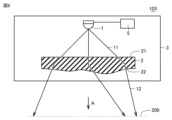
- FIG. 1 is a cross-sectional view for explaining a lighting device according to a first embodiment.
- FIG. 2 is a front view of an optical element of the illumination device shown in FIG. 1 .
- FIG. 2 is a side view of an optical element of the illumination device shown in FIG. 1 .
- 2 is a perspective view of the optical element of the illumination device shown in FIG. 1 as viewed from the light output surface side.
- 11 is a cross-sectional view for explaining a modified example of the lighting device according to the first embodiment.
- FIG. 11 is a cross-sectional view for explaining a lighting device according to a second embodiment.
- FIG. 13 is a cross-sectional view for explaining a modified example of the lighting device according to the second embodiment.
- FIG. 1 is a cross-sectional view for explaining a lighting device according to a first embodiment.
- FIG. 2 is a front view of an optical element of the illumination device shown in FIG. 1 .
- FIG. 2 is a side view of an optical element of the
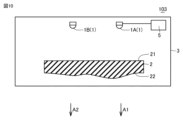
- FIG. 11 is a cross-sectional view for explaining a lighting device according to a third embodiment.
- FIG. 13 is a cross-sectional view for explaining a modified example of the lighting device according to the third embodiment.
- FIG. 13 is a cross-sectional view for explaining a modified example of the lighting device according to the third embodiment.
- the lighting device 101 is a device for irradiating the light having a non-uniform intensity distribution onto the irradiation surface 200.
- the light having a non-uniform intensity distribution means light having an intensity distribution that does not have symmetry.
- the lighting device 101 is provided so as to emit, for example, light having an intensity distribution that does not have rotational symmetry onto the irradiation surface.
- the irradiation surface 200 may be any surface located outside the lighting device 101 in the direction in which the light is emitted, and may be, for example, a floor surface, a wall surface, a desk surface, or the like when the lighting device 101 is attached to a ceiling or wall in a room.
- the lighting device 101 mainly includes a light source 1 and an optical element 2.
- the light source 1 may be any light source that emits visible light.
- the light source 1 may be a light source that emits light in a specific wavelength range within the visible light wavelength range, or may be a light source that can emit white light.
- the light source 1 includes a light-emitting element such as an LED (Light-Emitting Diode) or a laser.
- the light source 1 may include a light-emitting element and a phosphor that has an emission wavelength peak within a wavelength range that is complementary to the emission wavelength range of the light-emitting element.
- the light source 1 may include an LED or laser that emits light in the blue wavelength range, and a phosphor that is excited by a portion of the light emitted from the light-emitting element and has an emission peak in the yellow wavelength range that is complementary to blue.
- the light source 1 may be capable of changing the color (wavelength range) of the light it emits.
- the light source 1 is arranged to emit light having, for example, a symmetrical intensity distribution to the incident surface 21 of the optical element 2 described below.
- the light emitted from the light source 1 has, for example, an intensity distribution in which the intensity decreases with increasing distance from the optical axis.
- Such an intensity distribution has rotational symmetry around the optical axis.
- the optical element 2 is made of a crystalline or amorphous solid.
- the optical element 2 has an incident surface 21 on which the light emitted from the light source 1 is incident, and an exit surface 22 from which the light incident from the incident surface 21 is emitted toward the irradiation surface 200.
- the light source 1 is disposed inside the outer periphery of each of the incident surface 21 and the exit surface 22 of the optical element 2.
- the minimum width of the optical element 2 is wider than the maximum width of the light source 1.
- the optical element 2 is configured to refract the light incident from the entrance surface 21 and emit light with a non-uniform intensity distribution from the exit surface 22 to the irradiation surface 200.
- the optical element 2 is configured to emit light, for example, whose intensity distribution does not have rotational symmetry, to the irradiation surface 200.
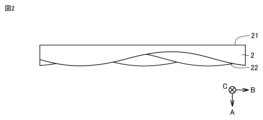
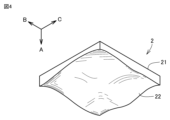
- FIGS. 2 to 4 are front, side, and perspective views showing an example of the optical element 2.
- at least one of the entrance surface 21 and the exit surface 22 of the optical element 2 is a free-form surface.
- a free-form surface means an uneven surface that does not have at least rotational symmetry.
- At least one of the entrance surface 21 and the exit surface 22 does not have an axis of rotational symmetry either in-plane or out-of-plane.
- at least one of the entrance surface 21 and the exit surface 22 of the optical element 2 does not have linear symmetry either.
- the entrance surface 21 is a flat surface, and the exit surface 22 is a free-form surface.
- the entrance surface 21 may be a free-form surface, and the exit surface 22 may be a flat surface. Furthermore, each of the entrance surface 21 and the exit surface 22 may be a free-form surface.
- the entrance surface 21 only needs to intersect with the optical axis of the light source 1.
- the entrance surface 21 may be perpendicular to the optical axis of the light source 1.
- the material constituting the optical element 2 may be any material as long as it transmits the light emitted from the light source 1 and has a refractive index different from that of the medium (e.g., air) filling the surroundings of the optical element 2.
- the material constituting the optical element 2 includes an amorphous material.
- the material constituting the optical element 2 includes, for example, an amorphous resin material such as acrylic or polycarbonate, or an amorphous solid such as glass.
- the space between the light source 1 and the incident surface 21 of the optical element 2 is filled with a medium that is transparent to the light emitted from the light source 1 and has a different refractive index than the material that constitutes the optical element 2.
- a medium that is transparent to the light emitted from the light source 1 and has a different refractive index than the material that constitutes the optical element 2.
- An example of such a medium is air.
- the distance (irradiation distance) between the light source 1 and the incident surface 21 of the optical element 2 may be longer than, for example, the distance (thickness) between the incident surface 21 and the exit surface 22 of the optical element 2.
- the lighting device 101 may further include a case 3 that houses the light source 1 and the optical element 2.
- the light source 1 and the optical element 2 are fixed to the case 3.
- the case 3 has a portion through which the light emitted from the emission surface 22 of the optical element 2 passes.
- a reflective member that reflects the light emitted from the light source 1 is not arranged.
- a reflective member that reflects the light reflected at the entrance surface 21 of the optical element 2 is not arranged.
- the lighting device 101 may not include a case 3.
- the light source 1 and the optical element 2 may be fixed to a ceiling or a wall on which the lighting device 101 is installed.
- a reflective member that reflects the light emitted from the light source 1 is not disposed in the area that overlaps with the optical element 2 when viewed from the optical axis direction of the light source 1. It is preferable that a reflective member is not disposed behind the light source 1.
- the lighting device 101 can emit light having a non-uniform intensity distribution to the irradiation surface 200 without using a liquid by refracting light emitted from the light source 1 in the optical element 2 made of a crystalline or amorphous solid. Since the lighting device 101 does not require a liquid circulation means, the structure of the lighting device 101 is simpler than that of a conventional lighting device equipped with a liquid circulation means. In other words, the lighting device 101 can form an illumination pattern consisting of light having a non-uniform intensity distribution on the irradiation surface 200 while having a relatively simple structure. The spatial presentation effect of such a lighting device 101 is higher than that of a lighting device capable of irradiating only light having a symmetrical intensity distribution.
- the light source 1 may be arranged to emit light having an intensity distribution with rotational symmetry to the incident surface 21. From a different perspective, the light source 1 may be arranged to emit light having an intensity distribution in which the intensity decreases with increasing distance from the optical axis. In this case, it is preferable that the optical element 2 is arranged to emit light having an intensity distribution without rotational symmetry to the irradiation surface 200. Although such a lighting device 101 is provided with a light source 1 that is relatively easy to obtain, it is capable of irradiating light having a non-uniform intensity distribution. More preferably, the optical element 2 is arranged to emit light having an intensity distribution without rotational symmetry and linear symmetry to the irradiation surface 200. With such a lighting device 101, it is possible to irradiate light having a highly non-uniform intensity distribution.
- no reflective member that reflects the light emitted from the light source 1 is arranged inside the case 3. More specifically, in the area inside the case 3 that overlaps with the optical element 2 when viewed from the optical axis direction of the light source 1, and behind the light source 1 (on the opposite side of the light source 1 from the optical element 2), no reflective member that reflects the light reflected by the incident surface 21 of the optical element 2 is arranged.
- the reflecting member is located behind the light source 1 (opposite the optical element 2 from the light source 1) in an area that overlaps with the optical element 2 inside the case 3 when viewed from the optical axis direction, noise due to stray light is likely to occur in the area close to the optical axis.
- the reflecting surface of the reflecting member is parallel to the incident surface 21 of the optical element 2, light that is incident at a small incident angle (e.g., less than 45 degrees) on the incident surface 21 of the optical element 2 is likely to be incident again on the incident surface 21 of the optical element 2 and become stray light because the reflection angles at the incident surface 21 and the reflection surface of the reflecting member are equally small.
- the lighting device 101 does not have a reflective member that generates stray light, so the lighting device 101 is less likely to generate noise due to stray light even in areas close to the optical axis, and degradation of quality can be suppressed.
- At least one of the entrance surface 21 and the exit surface 22 of the optical element 2 is a free-form surface.
- the light refracted by such an optical element 2 and emitted from the exit surface 22 has a non-uniform intensity distribution.
- the material constituting the optical element 2 is preferably an amorphous material.
- Amorphous materials have a lower molding shrinkage rate than crystalline materials. Therefore, if the material constituting the optical element 2 is an amorphous material, the optical element 2 can be molded relatively easily using a mold. In addition, amorphous materials have higher transparency than crystalline materials. Therefore, if the material constituting the optical element 2 is an amorphous material, the light utilization efficiency of the lighting device 101 can be improved.
- the lighting device 101 can be modified as follows.
- the light source 1 may be configured to emit light whose intensity distribution is uniform regardless of the distance from the optical axis.
- the light source 1 may be configured to emit light whose intensity distribution is not symmetric.
- the optical element 2 can refract the light incident from the incident surface 21 and emit light with a non-uniform intensity distribution from the exit surface 22 to the irradiation surface 200.
- the optical element 2 can emit light with a more non-uniform intensity distribution from the exit surface 22 to the irradiation surface 200 than the light incident from the incident surface 21.
- the optical element 2 may have any configuration as long as it can emit light with a non-uniform intensity distribution from the exit surface 22 to the irradiation surface 200. At least one of the entrance surface 21 and the exit surface 22 of the optical element 2 does not have to be a free-form surface. For example, at least one of the entrance surface 21 and the exit surface 22 may have a non-uniform distribution within the surface in terms of the magnitude of surface roughness, color shade, etc.
- the lighting device 101 may include a plurality of light sources 1.
- the plurality of light sources 1 may be arranged side by side in a direction perpendicular to the optical axis direction.
- the illumination device 101 may include a plurality of optical elements 2.
- the plurality of optical elements 2 may include a first optical element 2A and a second optical element 2B arranged side by side in the optical axis direction.
- the incident surface 21B of the second optical element 2B is arranged opposite to the exit surface 22A of the first optical element 2A.
- at least one of the incident surfaces 21A, 21B and the exit surfaces 22A, 22B of the first optical element 2A and the second optical element 2B is a free-form surface.
- the exit surface 22A of the first optical element 2A and the incident surface 21B of the second optical element 2B may be a free-form surface.
- the light passing through each of the first optical element 2A and the second optical element 2B and exiting from the exit surface of the second optical element 2B also has a non-uniform intensity distribution on the irradiation surface 200.
- the lighting device 102 according to the second embodiment has the same configuration and effects as the lighting device 101 according to the first embodiment.
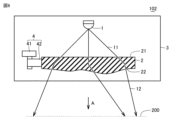
- the illumination device 102 further includes a rotating unit 4 that rotates the optical element 2 relative to the light source 1.
- the rotating unit 4 may change the rotation period of the optical element 2.
- the rotation axis of the optical element 2 is arranged, for example, coaxially with the optical axis of the light source 1. Note that the rotation axis of the optical element 2 does not have to be arranged coaxially with the optical axis of the light source 1.
- the rotating unit 4 may have any configuration as long as it can rotate the optical element 2.
- the rotating unit 4 includes, for example, a motor and a belt.
- the belt is placed, for example, between the rotating shaft of the motor and the outer peripheral end face of the optical element 2, and is arranged to transmit the rotational force of the motor to the optical element 2.
- the lighting device 102 can form an illumination pattern consisting of light with a non-uniform intensity distribution on the illumination surface 200, and can change the illumination pattern over time. In other words, the lighting device 102 can cause fluctuations in the illumination pattern.
- the spatial presentation effect of the lighting device 102 is even greater than that of the lighting device 101.
- the rotating unit 4 is arranged to impart 1/f fluctuation characteristics to the rotation period of the optical element 2.
- the rotating unit 4 controls the rotation period of the optical element 2 so that the power spectral density related to the rotation period of the optical element 2 is inversely proportional to the frequency.
- Such an illumination device 102 can generate 1/f fluctuation in the illumination pattern by controlling the rotation period of the optical element 2 with the rotating unit 4 as described above. 1/f fluctuation has been found in various natural phenomena in which physical quantities change over time, and is generally recognized as giving people a sense of comfort or a relaxation effect.
- the illumination device 102 has a relatively simple structure, yet can give people who view the illumination pattern a sense of comfort or a relaxation effect.
- the lighting device 102 can be modified as follows.
- the illumination device 102 may include a first optical element 2A and a second optical element 2B, similar to the illumination device 101 shown in FIG. 5.
- the first optical element 2A and the second optical element 2B shown in FIG. 7 have the same configuration as the first optical element 2A and the second optical element 2B shown in FIG. 5.
- the rotating unit 4 rotates one of the first optical element 2A and the second optical element 2B relative to the other.
- the rotating unit 4 may rotate only one of the first optical element 2A and the second optical element 2B.
- the rotating unit 4 may rotate each of the first optical element 2A and the second optical element 2B so that their respective rotation periods or the amount of change in the rotation period are different from each other.
- the rotating unit 4 may be capable of switching between a state in which only one of the first optical element 2A and the second optical element 2B is rotated and a state in which each of the first optical element 2A and the second optical element 2B is rotated so that their respective rotation periods or the amount of change in the rotation period are different from each other.
- the rotation axis of the first optical element 2A may be arranged coaxially with the rotation axis of the second optical element 2B, or may not be arranged coaxially.
- Such a lighting device 102 has a relatively simple structure, yet can provide a sense of comfort or relaxation to anyone who sees the lighting pattern.
- the illumination device 103 according to the third embodiment has the same configuration and effects as the illumination device 101 according to the first embodiment.
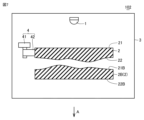
- the lighting device 103 further includes a light amount control unit 5 that controls the amount of light emitted from the light source 1.
- the light amount control unit 5 changes the fluctuation period of the light amount of the light emitted from the light source 1.
- the light amount control unit 5 may have any configuration as long as it is capable of controlling the amount of light emitted from the light source 1.
- the light amount control unit 5 includes, for example, a driver that outputs a DC voltage, and a pulse width (PWM: Pulse Width Modulation) control circuit, and the PWM control circuit is configured to control the duty ratio of the DC voltage output from the driver.
- PWM Pulse Width Modulation
- the lighting device 103 can form an illumination pattern consisting of light with a non-uniform intensity distribution on the illumination surface 200, and can change the illumination pattern over time. In other words, the lighting device 103 can cause fluctuations in the illumination pattern.
- the spatial presentation effect of such lighting device 103 is even greater than that of lighting device 101.
- the light amount control unit 5 is configured to impart 1/f fluctuation characteristics to the amount of light emitted from the light source 1.
- the light amount control unit 5 controls the amount of light emitted from the light source 1 so that the power spectral density related to the amount of light emitted from the light source 1 is inversely proportional to the frequency.
- Such a lighting device 103 can generate 1/f fluctuations in the lighting pattern by controlling the fluctuation period of the light intensity of the light emitted from the light source 1 as described above with the light intensity control unit 5.
- the lighting device 103 has a relatively simple structure, yet can provide a sense of comfort or a relaxation effect to a person who views the lighting pattern.
- the lighting device 103 can be modified as follows.
- the lighting device 103 may further include a rotating unit 4, similar to the lighting device 102.
- a lighting device 103 can not only change the fluctuation period of the light quantity of the light emitted from the light source 1 by the light quantity control unit 5, but also change the rotation period of the optical element 2 by the rotating unit 4.
- the rotating unit 4 and the light quantity control unit 5 can control the light source 1 and the rotating element 2 so that the behavior of the change in the rotation period of the optical element 2 is synchronized with the behavior of the change in the fluctuation period of the light quantity of the light emitted from the light source 1.
- the rotating unit 4 and the light quantity control unit 5 can control the light source 1 and the rotating element 2 so that the amount of light emitted from the light source 1 increases. More preferably, the rotating unit 4 is provided so that the rotation period of the optical element 2 has 1/f fluctuation characteristics, and the light quantity control unit 5 is provided so that the amount of light emitted from the light source 1 has 1/f fluctuation characteristics.
- the rotating unit 4 and the light amount control unit 5 are capable of controlling the light source 1 and the rotating element 2 so that the behavior of the change in the rotation period of the optical element 2 is synchronized with the behavior of the change in the fluctuation period of the light amount of the light emitted from the light source 1.
- the illumination device 103 may include a first optical element 2A and a second optical element 2B, similar to the illumination device 101 shown in FIG. 5.
- the lighting device 103 may include a plurality of light sources 1.
- the plurality of light sources 1 may include a first light source 1A and a second light source 1B.
- the first light source 1A and the second light source 1B are arranged side by side in a direction perpendicular to the optical axis direction A1 of the first light source 1A.
- the first light source 1A and the second light source 1B are arranged inside the respective outer peripheries of the entrance surface 21 and the exit surface 22 of the optical element 2.
- the optical axis direction A1 of the first light source 1A may be parallel to the optical axis direction A2 of the second light source 1B or may intersect with it.
- the light amount control unit 5 changes the period of variation of the light amount of the light emitted from at least one of the first light source 1A and the second light source 1B. For example, the light amount control unit 5 may change only the period of variation of the light amount of the light emitted from either the first light source 1A or the second light source 1B. The light amount control unit 5 may change the period of variation of the light amount of the light emitted from each of the first light source 1A and the second light source 1B so that the amount of change in the period of variation of the light amount is different from each other.
- the light amount control unit 5 may be switchable between a state in which only the period of variation of the light amount of the light emitted from either the first light source 1A or the second light source 1B is changed, and a state in which the period of variation of the light amount of the light emitted from each of the first light source 1A and the second light source 1B is changed so that the amount of change in the period of variation of the light amount is different from each other.
- Such a lighting device 103 has a relatively simple structure, yet can provide a sense of comfort or relaxation to anyone who sees the lighting pattern.
Landscapes
- Engineering & Computer Science (AREA)
- General Engineering & Computer Science (AREA)
- Physics & Mathematics (AREA)
- General Physics & Mathematics (AREA)
- Optics & Photonics (AREA)
- Spectroscopy & Molecular Physics (AREA)
- Non-Portable Lighting Devices Or Systems Thereof (AREA)
- Circuit Arrangement For Electric Light Sources In General (AREA)
Priority Applications (5)
| Application Number | Priority Date | Filing Date | Title |
|---|---|---|---|
| EP23930656.6A EP4667818A4 (en) | 2023-03-31 | 2023-03-31 | LIGHTING DEVICE |
| US19/154,394 US20260110417A1 (en) | 2023-03-31 | 2023-03-31 | Lighting device |
| JP2023561229A JP7471536B1 (ja) | 2023-03-31 | 2023-03-31 | 照明装置 |
| PCT/JP2023/013602 WO2024202022A1 (ja) | 2023-03-31 | 2023-03-31 | 照明装置 |
| CN202380096032.3A CN120898100A (zh) | 2023-03-31 | 2023-03-31 | 照明装置 |
Applications Claiming Priority (1)
| Application Number | Priority Date | Filing Date | Title |
|---|---|---|---|
| PCT/JP2023/013602 WO2024202022A1 (ja) | 2023-03-31 | 2023-03-31 | 照明装置 |
Publications (1)
| Publication Number | Publication Date |
|---|---|
| WO2024202022A1 true WO2024202022A1 (ja) | 2024-10-03 |
Family
ID=90716077
Family Applications (1)
| Application Number | Title | Priority Date | Filing Date |
|---|---|---|---|
| PCT/JP2023/013602 Ceased WO2024202022A1 (ja) | 2023-03-31 | 2023-03-31 | 照明装置 |
Country Status (5)
| Country | Link |
|---|---|
| US (1) | US20260110417A1 (https=) |
| EP (1) | EP4667818A4 (https=) |
| JP (1) | JP7471536B1 (https=) |
| CN (1) | CN120898100A (https=) |
| WO (1) | WO2024202022A1 (https=) |
Citations (7)
| Publication number | Priority date | Publication date | Assignee | Title |
|---|---|---|---|---|
| JP2003042967A (ja) * | 2001-07-27 | 2003-02-13 | Hitachi Ltd | パターン欠陥検査装置 |
| JP2012146559A (ja) | 2011-01-13 | 2012-08-02 | Panasonic Corp | 照明器具 |
| JP2013120646A (ja) * | 2011-12-06 | 2013-06-17 | Mitsubishi Chemicals Corp | 光学部材および発光システム |
| JP2017076590A (ja) * | 2015-10-16 | 2017-04-20 | パナソニックIpマネジメント株式会社 | 照明装置 |
| WO2017188169A1 (ja) * | 2016-04-25 | 2017-11-02 | 三菱電機株式会社 | 面光源装置および液晶表示装置 |
| JP2019200941A (ja) * | 2018-05-17 | 2019-11-21 | 三菱電機株式会社 | 照明装置 |
| JP2023044051A (ja) * | 2021-09-17 | 2023-03-30 | デクセリアルズ株式会社 | 拡散板、表示装置、投影装置および照明装置 |
Family Cites Families (7)
| Publication number | Priority date | Publication date | Assignee | Title |
|---|---|---|---|---|
| KR100974195B1 (ko) * | 2007-11-23 | 2010-08-06 | 엘지전자 주식회사 | 광학시트와 이의 제조방법 그리고 이를 이용한액정표시장치 |
| JP5889065B2 (ja) * | 2011-10-28 | 2016-03-22 | 株式会社エンプラス | 光束制御部材、発光装置および照明装置 |
| US10162105B2 (en) * | 2016-03-20 | 2018-12-25 | Robe Lighting S.R.O. | Wash light luminaire with special effects capabilities |
| CN112879869B (zh) * | 2019-11-30 | 2024-12-20 | 广州达森灯光股份有限公司 | 一种投射三维异形激光光斑的方法、光学系统及灯具 |
| CN111649292A (zh) * | 2020-07-01 | 2020-09-11 | 广州达森灯光股份有限公司 | 一种实现水纹扰动效果的水纹灯具 |
| CN216743962U (zh) * | 2021-08-16 | 2022-06-14 | 辛院厅 | 投射装置 |
| US11408573B1 (en) * | 2021-09-23 | 2022-08-09 | Blisslights Llc | Optical projection device |
-
2023
- 2023-03-31 WO PCT/JP2023/013602 patent/WO2024202022A1/ja not_active Ceased
- 2023-03-31 US US19/154,394 patent/US20260110417A1/en active Pending
- 2023-03-31 EP EP23930656.6A patent/EP4667818A4/en active Pending
- 2023-03-31 JP JP2023561229A patent/JP7471536B1/ja active Active
- 2023-03-31 CN CN202380096032.3A patent/CN120898100A/zh active Pending
Patent Citations (7)
| Publication number | Priority date | Publication date | Assignee | Title |
|---|---|---|---|---|
| JP2003042967A (ja) * | 2001-07-27 | 2003-02-13 | Hitachi Ltd | パターン欠陥検査装置 |
| JP2012146559A (ja) | 2011-01-13 | 2012-08-02 | Panasonic Corp | 照明器具 |
| JP2013120646A (ja) * | 2011-12-06 | 2013-06-17 | Mitsubishi Chemicals Corp | 光学部材および発光システム |
| JP2017076590A (ja) * | 2015-10-16 | 2017-04-20 | パナソニックIpマネジメント株式会社 | 照明装置 |
| WO2017188169A1 (ja) * | 2016-04-25 | 2017-11-02 | 三菱電機株式会社 | 面光源装置および液晶表示装置 |
| JP2019200941A (ja) * | 2018-05-17 | 2019-11-21 | 三菱電機株式会社 | 照明装置 |
| JP2023044051A (ja) * | 2021-09-17 | 2023-03-30 | デクセリアルズ株式会社 | 拡散板、表示装置、投影装置および照明装置 |
Non-Patent Citations (1)
| Title |
|---|
| See also references of EP4667818A1 |
Also Published As
| Publication number | Publication date |
|---|---|
| EP4667818A1 (en) | 2025-12-24 |
| US20260110417A1 (en) | 2026-04-23 |
| EP4667818A4 (en) | 2026-04-15 |
| CN120898100A (zh) | 2025-11-04 |
| JPWO2024202022A1 (https=) | 2024-10-03 |
| JP7471536B1 (ja) | 2024-04-19 |
Similar Documents
| Publication | Publication Date | Title |
|---|---|---|
| RU2544391C2 (ru) | Модуль системы освещения свободной формы | |
| JP5952895B2 (ja) | 昼光外観を得るための光学素子、照明システム、及び照明器具 | |
| JP5335945B2 (ja) | 光束制御部材および照明装置 | |
| JP5608752B2 (ja) | 発光装置 | |
| CN108692224B (zh) | 照明装置及照明系统 | |
| JP5016112B2 (ja) | 照明された薄板を有するブラインド | |
| JP7203953B2 (ja) | 拡散体および照明装置 | |
| US20130027927A1 (en) | Floating light luminaire | |
| JP6416228B2 (ja) | 天空光の見た目を得るための光学素子、及び照明器具 | |
| JP2013178459A (ja) | 光束制御部材および照明装置 | |
| US20190032891A1 (en) | Lighting device with sparkling effect | |
| JP5977636B2 (ja) | 光束制御部材、発光装置および照明装置 | |
| WO2014041745A1 (ja) | 照明装置 | |
| JP5119379B2 (ja) | 面照明光源装置及び面照明装置 | |
| JP2009266678A (ja) | Led光源を備えた発光装置および照明装置 | |
| JP7471536B1 (ja) | 照明装置 | |
| US20230229066A1 (en) | Interference lens and projection ambient lamp | |
| JP2014203604A (ja) | 照明装置 | |
| CN118786312A (zh) | 照明设备 | |
| KR20220050330A (ko) | 조명장치 | |
| CN114556015B (zh) | 具有混合腔的发光装置 | |
| US20130063973A1 (en) | Lighting fixtures having observable illuminated speckled pattern | |
| JP7418673B1 (ja) | 照明装置 | |
| JPWO2024202022A5 (https=) | ||
| KR101654045B1 (ko) | 인테리어 몰딩 |
Legal Events
| Date | Code | Title | Description |
|---|---|---|---|
| WWE | Wipo information: entry into national phase |
Ref document number: 2023561229 Country of ref document: JP |
|
| 121 | Ep: the epo has been informed by wipo that ep was designated in this application |
Ref document number: 23930656 Country of ref document: EP Kind code of ref document: A1 |
|
| WWE | Wipo information: entry into national phase |
Ref document number: 23930656.6 Country of ref document: EP Ref document number: 2023930656 Country of ref document: EP |
|
| WWE | Wipo information: entry into national phase |
Ref document number: 202380096032.3 Country of ref document: CN |
|
| NENP | Non-entry into the national phase |
Ref country code: DE |
|
| WWP | Wipo information: published in national office |
Ref document number: 202380096032.3 Country of ref document: CN |
|
| ENP | Entry into the national phase |
Ref document number: 2023930656 Country of ref document: EP Effective date: 20250916 |
|
| WWP | Wipo information: published in national office |
Ref document number: 2023930656 Country of ref document: EP |