WO2024195733A1 - 遠位スタビライザ - Google Patents
遠位スタビライザ Download PDFInfo
- Publication number
- WO2024195733A1 WO2024195733A1 PCT/JP2024/010280 JP2024010280W WO2024195733A1 WO 2024195733 A1 WO2024195733 A1 WO 2024195733A1 JP 2024010280 W JP2024010280 W JP 2024010280W WO 2024195733 A1 WO2024195733 A1 WO 2024195733A1
- Authority
- WO
- WIPO (PCT)
- Prior art keywords
- catheter
- open cell
- distal
- stent
- stabilizer
- Prior art date
- Legal status (The legal status is an assumption and is not a legal conclusion. Google has not performed a legal analysis and makes no representation as to the accuracy of the status listed.)
- Ceased
Links
Images










Classifications
-
- A—HUMAN NECESSITIES
- A61—MEDICAL OR VETERINARY SCIENCE; HYGIENE
- A61M—DEVICES FOR INTRODUCING MEDIA INTO, OR ONTO, THE BODY; DEVICES FOR TRANSDUCING BODY MEDIA OR FOR TAKING MEDIA FROM THE BODY; DEVICES FOR PRODUCING OR ENDING SLEEP OR STUPOR
- A61M25/00—Catheters; Hollow probes
- A61M25/01—Introducing, guiding, advancing, emplacing or holding catheters
- A61M25/02—Holding devices, e.g. on the body
- A61M25/04—Holding devices, e.g. on the body in the body, e.g. expansible
-
- A—HUMAN NECESSITIES
- A61—MEDICAL OR VETERINARY SCIENCE; HYGIENE
- A61M—DEVICES FOR INTRODUCING MEDIA INTO, OR ONTO, THE BODY; DEVICES FOR TRANSDUCING BODY MEDIA OR FOR TAKING MEDIA FROM THE BODY; DEVICES FOR PRODUCING OR ENDING SLEEP OR STUPOR
- A61M25/00—Catheters; Hollow probes
- A61M25/01—Introducing, guiding, advancing, emplacing or holding catheters
- A61M25/06—Body-piercing guide needles or the like
- A61M25/0662—Guide tubes
-
- A—HUMAN NECESSITIES
- A61—MEDICAL OR VETERINARY SCIENCE; HYGIENE
- A61M—DEVICES FOR INTRODUCING MEDIA INTO, OR ONTO, THE BODY; DEVICES FOR TRANSDUCING BODY MEDIA OR FOR TAKING MEDIA FROM THE BODY; DEVICES FOR PRODUCING OR ENDING SLEEP OR STUPOR
- A61M25/00—Catheters; Hollow probes
- A61M25/01—Introducing, guiding, advancing, emplacing or holding catheters
- A61M25/06—Body-piercing guide needles or the like
- A61M25/0662—Guide tubes
- A61M2025/0681—Systems with catheter and outer tubing, e.g. sheath, sleeve or guide tube
-
- A—HUMAN NECESSITIES
- A61—MEDICAL OR VETERINARY SCIENCE; HYGIENE
- A61M—DEVICES FOR INTRODUCING MEDIA INTO, OR ONTO, THE BODY; DEVICES FOR TRANSDUCING BODY MEDIA OR FOR TAKING MEDIA FROM THE BODY; DEVICES FOR PRODUCING OR ENDING SLEEP OR STUPOR
- A61M25/00—Catheters; Hollow probes
- A61M25/0067—Catheters; Hollow probes characterised by the distal end, e.g. tips
Definitions
- the present invention relates to a distal stabilizer used, for example, in catheter delivery within a biological lumen.
- Patent Document 1 discloses an anchor device (distal stabilizer) in which a cylindrical portion is joined to the distal end of a delivery wire. When this cylindrical portion is released from a microcatheter and expanded, the cylindrical portion is anchored to the inner wall of the biological lumen. This makes it easy to deliver a target catheter inserted into a microcatheter to the vicinity of a target position.
- Patent Document 2 discloses a distal stabilizer in which the free convex end of the open cell portion protrudes only on the distal side. This distal stabilizer has an open cell portion, which provides excellent anchoring force to the inner wall of the biological lumen and allows it to easily follow the bending of the biological lumen.
- the target catheters that are inserted into the microcatheter have a large outer diameter and high rigidity. Therefore, as the target catheter advances, it repeatedly exerts a force that pulls the less rigid microcatheter and delivery wire proximally.
- the target catheter is likely to get caught on bent or branched sections, and when force is applied to pass through these sections, it repeatedly exerts a force that pulls the microcatheter and delivery wire proximally.
- the application of a force pulling the delivery wire proximally may cause the position of the cylindrical portion engaged with the inner wall of the biological lumen to shift proximally.
- the shift in position of the cylindrical portion occurs not only when the target catheter is delivered near the target position, but also when the cylindrical portion engaged with the inner wall of the biological lumen is resheathed into the catheter. If the position of the cylindrical portion engaged in the biological lumen shifts proximally, it becomes difficult to deliver the tip of the target catheter to the vicinity of the target position. In order to suppress the shift in position of the cylindrical portion, it is possible to increase the expansion force of the cylindrical portion (the force supporting the blood vessel).
- the object of the present invention is to provide a distal stabilizer that has an open cell portion, suppresses displacement of the cylindrical portion that is engaged in the biological lumen, and improves the pushability of the cylindrical portion.
- a distal stabilizer used for catheter delivery in a biological lumen comprising a linear delivery member and a cylindrical portion connected to the linear delivery member and engaged with the inner wall of the biological lumen, the cylindrical portion comprising a main body having a mesh pattern structure in which cells surrounded by wire-like members are arranged at least along the longitudinal direction, at least one of the cells forming the main body has at least one open cell portion in which two wire-like members are connected at their apexes, and at least one of the open cell portions has two wire-like members extending along the longitudinal direction in a contracted state, and in a natural state, the apex of the distal stabilizer protrudes along a circumferential direction perpendicular to the longitudinal direction.
- a distal stabilizer as described in the first disclosure in which the open cell portion has an apex that protrudes in a direction of +30° to -30° with respect to the circumferential direction of the cylindrical portion in a natural state.
- Third disclosure A distal stabilizer as described in the first or second disclosure, in which the open cell portion is provided in at least one of the cells located at the distal end of the main body portion in the longitudinal direction.
- a distal stabilizer as described in the first or second disclosure in which the open cell portion is provided in at least one of the cells located at the proximal end of the main body portion in the longitudinal direction.
- a distal stabilizer according to the first or second disclosure in which at least one of the cells having the open cell portion has an open cell portion in which a portion of the wire-shaped member does not substantially extend along the longitudinal direction in a contracted state, and in which a portion of the wire-shaped member protrudes along a circumferential direction perpendicular to the longitudinal direction in a natural state.
- a distal stabilizer as described in the first or second disclosure in which at least one of the cells having the open cell portion has an open cell portion in which a portion of the wire-like member does not substantially extend along the longitudinal axis in a contracted state and in a natural state.
- Ninth disclosure A distal stabilizer as described in the first or second disclosure, in which the cylindrical portion has a structure in which the cells are arranged in a spiral shape in the longitudinal direction.
- the distal stabilizer described in the first or second disclosure is used for applications in which the distal stabilizer is temporarily placed in a biological lumen and then retrieved outside the body.
- a delivery method for a catheter system including a linear delivery member, a distal stabilizer extending from the distal end of the linear delivery member and having a cylindrical portion capable of engaging with the inner wall of a biological lumen, a small catheter capable of storing the cylindrical portion in a reduced diameter state together with the linear delivery member, and at least one large catheter that is extrapolated onto the linear delivery member or the small catheter, comprising a first step of releasing the cylindrical portion stored in the small catheter in a reduced diameter state from the distal end of the small catheter and engaging it with the inner wall distal to a target position of the biological lumen, and a second step of retracting the small catheter proximally to generate the linear delivery member.
- a catheter system delivery method that includes a second step of exposing the large catheter in a body lumen, and a third step of advancing the large catheter distally while it is inserted onto the linear delivery member and placing it at a target position in the body lumen, in which in the first step, there are one or more bent portions of the body lumen between the target position where the target catheter is placed and the position where the cylindrical portion is engaged, and at least at the start of the third step, the linear delivery member is retracted proximally, and the large catheter is advanced distally while it is inserted onto the linear delivery member with the exposed portion of the linear delivery member in contact with one or more bent portions of the body lumen.
- Twelfth disclosure A delivery method of a catheter system according to the eleventh disclosure, in which, in the first step, the cylindrical portion is engaged with the inner wall of the biological lumen having the greater curvature among multiple biological lumens that branch off at a branching site located distal to the target position.
- Disclosure No. 13 A delivery method of a catheter system according to disclosure No. 11 or disclosure No. 12, in which, in the first step, the cylindrical portion is distal to the target position in the biological lumen, and the exposed portion of the linear delivery member is engaged at a position that spans one or more bends or branches in the biological lumen.
- a delivery method for a catheter system including a linear delivery member, a distal stabilizer extending from the distal end of the linear delivery member and having a cylindrical portion capable of engaging with the inner wall of a biological lumen, a small catheter capable of storing the cylindrical portion in a reduced diameter state together with the linear delivery member, and at least one large catheter inserted onto the small catheter, the method comprising: a first step of releasing the cylindrical portion stored in the small catheter in a reduced diameter state from the distal end of the small catheter to engage with the inner wall distal to a target position in the biological lumen; a second step of retracting the small catheter proximally to expose the linear delivery member in the biological lumen; and a second step of advancing the large catheter distally while inserted onto the linear delivery member to reach the target position in the biological lumen.
- a third step of placing the cylindrical portion in the large catheter a fourth step of reducing the diameter of the cylindrical portion and storing it in a recovery catheter, and removing it from the body lumen; and a fifth step of inserting the therapeutic device into the large catheter, advancing it distally, and delivering it to the target position by pushing it out of the large catheter at the target position, in which in the first step, there are one or more bent portions of the body lumen between the target position where the target catheter is placed and the position where the cylindrical portion is engaged, and at least at the start of the third step, the linear delivery member is retracted proximally, and the large catheter is advanced distally while being inserted onto the linear delivery member, with the exposed portion of the linear delivery member in contact with one or more bent portions of the body lumen.
- a method for delivering a therapeutic device according to the 14th disclosure in which, in the first step, the cylindrical portion is engaged with the inner wall of the biological lumen that is more curved among multiple biological lumen that branch off at a branching site that is distal to the target position.
- 16th Disclosure A method for delivering a therapeutic device as described in the 14th or 15th disclosure, in which in the first step, the cylindrical portion is distal to a target position in the biological lumen, and the exposed portion of the linear delivery member is engaged at a position that spans one or more bends or branches in the biological lumen.
- a method of treatment using a catheter system including a linear delivery member, a distal stabilizer extending from the distal end of the linear delivery member and having a cylindrical portion capable of engaging with the inner wall of a biological lumen, a small catheter capable of storing the cylindrical portion in a reduced diameter state together with the linear delivery member, and at least one large catheter inserted onto the small catheter, the method comprising the steps of: a first step of releasing the cylindrical portion stored in the small catheter in a reduced diameter state from the distal end of the small catheter to engage with the inner wall distal to a target position of the biological lumen; a second step of retracting the small catheter proximally to expose the linear delivery member in the biological lumen; a third step of advancing the large catheter distally while inserted onto the linear delivery member, and placing it at a target position in the biological lumen; and a fourth step of reducing the diameter of the large catheter and storing it in a recovery catheter, and then removing it outside the biological lumen; a fifth step of insert
- a treatment method using the catheter system described in the 17th disclosure in which, in the first step, the cylindrical portion is engaged with the inner wall of the biological lumen having the greater curvature among multiple biological lumen that branch at a branching site located distal to the target position.
- 19th Disclosure A treatment method using the catheter system described in the 17th or 18th Disclosure, in which in the first step, the cylindrical portion is distal to the target position in the biological lumen, and the exposed portion of the linear delivery member is engaged at a position that spans one or more bends or branches in the biological lumen.
- the cylindrical portion may have the same mesh pattern structure as the cylindrical portion of the first disclosure, or it may be different.
- the free convex end (described below) of the open cell portion of the cylindrical portion may protrude only to the proximal side, or it may be a mixture of open cell portions whose free convex ends protrude to the distal side and open cell portions whose free convex ends protrude to the proximal side.
- the cylindrical portion may be a mixture of open cell portions and closed cell portions, or it may be composed of only closed cell portions.
- the present invention provides a distal stabilizer that has an open cell portion, suppresses displacement of the cylindrical portion that is engaged in the biological lumen, and improves the pushability of the cylindrical portion.
- FIG. 1 shows a delivery system 10 including a distal stabilizer 1 according to an embodiment.
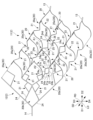
- FIG. 2 is a view showing the state in which the anchoring stent 2 of the first configuration is virtually deployed on a plane, as viewed from the inside.
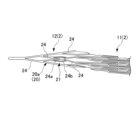
- FIG. 2 is a view showing the locking stent 2 in a reduced diameter state virtually deployed on a plane as viewed from the inside.
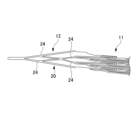
- FIG. 2 is a view from the inside of a typical anchoring stent in a reduced diameter state, virtually deployed on a plane.
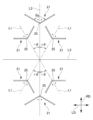
- 1 is a conceptual diagram illustrating the direction in which a top 25 of an open cell portion 21 protrudes relative to the circumferential direction RD.
- FIG. 13 is a view showing the state in which the anchoring stent 2 of the second configuration is virtually deployed on a plane, as viewed from the inside.
- 1 is a schematic diagram showing a first example of treatment using a delivery system 10 including a distal stabilizer 1.
- FIG. 1 is a schematic diagram showing a first example of treatment using a delivery system 10 including a distal stabilizer 1.
- FIG. 1 is a schematic diagram showing a first example of treatment using a delivery system 10 including a distal stabilizer 1.
- FIG. 1 is a schematic diagram showing a first example of treatment using a delivery system 10 including a distal stabilizer 1.
- FIG. 1 is a schematic diagram showing a first example of treatment using a delivery system 10 including a distal stabilizer 1.
- FIG. 1 is a schematic diagram showing a first example of treatment using a delivery system 10 including a distal stabilizer 1.
- FIG. 1 is a schematic diagram showing a first example of treatment using a delivery system 10 including a distal stabilizer 1.
- FIG. 1 is a schematic diagram showing a first example of treatment using a delivery system 10 including a distal stabilizer 1.
- FIG. 1 is a schematic diagram showing a first example of treatment using a delivery system 10 including a distal stabilizer 1.
- FIG. 1 is a schematic diagram showing a first example of treatment using a delivery system 10 including a distal stabilizer 1.
- the long axis direction of the distal stabilizer 1 when it is extended in a straight line is also referred to as the "long axis direction LD".
- the proximal side of the long axis direction LD that is closer to the practitioner is referred to as "D1”
- the distal side that is farther from the practitioner is referred to as "D2”.
- the direction perpendicular to the long axis direction LD is also referred to as the "radial direction RD" or simply as the "radial direction”.
- the radial direction RD corresponds to the circumferential direction of the locking stent 2. Therefore, in the description of the state in which the locking stent 2 is virtually deployed on a plane, the "radial direction RD” is also referred to as the “circumferential direction RD” as appropriate.
- the circumferential direction RD one circumferential direction is referred to as the “circumferential direction D3”, and the other circumferential direction is referred to as the "circumferential direction D4" (see FIG. 2 and FIG. 5).
- FIG. 1 is a diagram showing a delivery system 10 including a distal stabilizer 1 according to an embodiment.
- FIG. 2 is a diagram showing a first configuration of an anchoring stent 2 virtually deployed in a plane as viewed from the inside.
- FIG. 3A is a diagram showing a reduced-diameter anchoring stent 2 virtually deployed in a plane as viewed from the inside.
- FIG. 3B is a diagram showing a typical reduced-diameter anchoring stent virtually deployed in a plane as viewed from the inside.
- FIG. 4 is a conceptual diagram illustrating the direction in which the apex 25 of the open cell portion 21 protrudes relative to the circumferential direction RD.
- the delivery system 10 shown in FIG. 1 can be used to deliver a therapeutic device to blood vessels in biological lumens, such as the anterior cerebral artery (ACA), anterior communicating artery (Acom), and middle cerebral artery (MCA) in the skull.
- biological lumens such as the anterior cerebral artery (ACA), anterior communicating artery (Acom), and middle cerebral artery (MCA) in the skull.
- ACA anterior cerebral artery
- Acom anterior communicating artery
- MCA middle cerebral artery
- Blood vessels in biological lumens may be, for example, blood vessels in the brain, coronary arteries, upper and lower limbs (arteries, veins), organs, etc.
- biological lumens are also referred to as "blood vessels.”
- the delivery system 10 includes a distal stabilizer 1 and a plurality of catheters including a first catheter 5 and a second catheter 6.
- the first catheter 5 is, for example, a catheter called a microcatheter.
- the second catheter 6 is fitted over the first catheter 5.
- the second catheter 6 is a large-diameter catheter.
- the diameter of the first catheter 5 is set according to the target position to which the second catheter 6 is delivered and the inner diameter and curvature of the biological lumen of the path leading thereto.
- the inner diameter of the first catheter 5 is preferably 0.017 inches or less, and more preferably 0.0165 inches or less.
- one or more other catheters (not shown) fitted over the second catheter 6 may be used as needed. In general, by using a large number of catheters, a catheter with a large inner diameter can be finally inserted into the biological lumen and advanced.
- the distal stabilizer 1 is a device used for catheter delivery in a biological lumen.
- the distal stabilizer 1 comprises an anchoring stent (cylindrical portion) 2 and a delivery wire (linear delivery member) 3.
- the locking stent 2 is an anchor device that is inserted into the first catheter 5 in a contracted state, and is released from the first catheter 5 in the blood vessel and expanded to be locked to the inner wall of the biological lumen. Being “locked” to the inner wall of the biological lumen means that it does not move from its expanded position in the biological lumen, and also means that it allows for a degree of positional displacement that does not substantially affect catheter delivery.
- the locking stent 2 is connected to extend from the distal end of the delivery wire 3. Note that the locking stent 2 is not limited to being connected to the distal end of the delivery wire 3, and may be connected to the middle of the delivery wire 3. As shown in FIG. 1, the locking stent 2 includes a main body portion 11 and an antenna portion 12.
- the main body portion 11 is configured in a cylindrical shape and has a mesh pattern structure described later. In FIG. 1, the configuration of the main body portion 11 is depicted in a simplified form.
- the antenna portion 12 is a portion that converges the proximal side D1 of the main body portion 11 to the delivery wire 3.
- a distal marker 13 is provided at the end of the distal side D2 of the anchoring stent 2.
- a proximal marker 14 is provided at the end of the proximal side D1 of the anchoring stent 2.
- Each marker is made of an X-ray opaque material.
- the distal marker 13 is a landmark for confirming the position of the end of the distal side D2 of the anchoring stent 2.
- the proximal marker 14 is a landmark for confirming the position of the end of the proximal side D1 of the anchoring stent 2.
- the main body 11 has a structure in which a plurality of cells 20 are arranged along the longitudinal direction LD of the locking stent 2.
- the main body 11 has a mesh pattern structure in which a plurality of cells 20 are arranged in a spiral shape with respect to the longitudinal direction LD of the locking stent 2, and is designed to support the inner wall of the biological lumen when expanded in a blood vessel.
- the plurality of cells 20 are arranged in a spiral shape along the cell arrangement direction (cell design arrangement direction) SD inclined with respect to the longitudinal direction LD.
- the cell arrangement direction SD is inclined diagonally upward to the right from the distal side D2 of the locking stent 2 toward the proximal side D1 as shown in FIG.
- the cell arrangement direction SD is not limited to this.
- the cell arrangement direction SD may be inclined diagonally upward to the left from the distal side D2 of the locking stent 2 toward the proximal side D1 (the direction opposite to that in FIG. 2).
- “Along the cell arrangement direction SD” means parallel or approximately parallel to the cell arrangement direction SD.
- approximately parallel means, for example, that the angle at which the arrangement direction of the cells 20 intersects with the cell arrangement direction SD is in the range of about 1 to 15 degrees. In the anchoring stent 2, the angle at which the longitudinal axis direction LD intersects with the cell arrangement direction SD is, for example, less than 45 degrees.
- the cell 20 is also called an opening or compartment, and refers to a portion surrounded by wire struts (wire-like members) 24 that make up the mesh pattern of the main body 11. As shown in FIG. 2, in the anchoring stent 2 (main body 11) of this embodiment, at least one of the cells 20 has open cell portions 21 and 22.
- At least one cell 20 having open cell portions 21 and 22 may be provided in any region in the longitudinal direction LD (the distal end, the proximal end, or between the distal end and the proximal end).
- cells 20 that do not have open cell portions 21 may be mixed with cells 20a, or all the cells located in each region in the longitudinal direction LD may be cells 20a.
- the number of cells 20a in each region may be the same or different.
- the cells 20a may be provided along the longitudinal direction LD or along the circumferential direction RD. In each direction, there may be one or more cells 20a.
- the open cell portion 21 of the cell 20a is a portion in which one end of two substantially straight struts 24a and 24b are connected at the apex 25, forming a substantially V-shape overall, and no other struts are connected to the apex 25.
- substantially straight does not necessarily mean straight in the strict sense, but also includes the meaning of allowing a shape that can be considered to be almost straight or roughly straight.
- the struts and apexes that make up the open cell portion 21 (21a, 21b) of the cell 20a shown in areas A1 and A2 are labeled with symbols.
- the open cell portion 21a shown in region A1 of Figure 2 the other ends of the two struts 24a and 24b are connected to struts in the same row extending in the cell arrangement direction SD and/or to the closed cell portion 23 (described below). On the other hand, the other ends of the struts 24a and 24b are not connected in the cell arrangement direction SD. Therefore, the open cell portion 21 is approximately V-shaped.
- the strut to which the other ends of the struts 24a and 24b are connected is connected to the strut that is adjacent to the open cell portion 21b (21) of another cell 20a in the cell arrangement direction SD.
- the apex 25 of the open cell portion 21a protrudes generally along the circumferential direction D4.
- the apex 25 of the open cell portion 21b protrudes generally along the circumferential direction D3.
- the other ends of the struts 24a and 24b are not connected in the cell arrangement direction SD.
- the two open cell portions 21a and 21b of two adjacent cells 20a in the cell arrangement direction SD form a generally rhombus shape.
- the open cell portion 21a provided in the cell 20a may be one, as shown in area A1, or may be connected to the open cell portion 21b of another adjacent cell 20a, as shown in area A2.
- the shape of the open cell portion 21 may be, for example, approximately V-shaped, approximately U-shaped, approximately ⁇ -shaped, etc.
- FIG. 2 shows an example in which one or more open cell portions 21 (21a, 21b) are provided in one cell 20a, but the number and arrangement of the open cell portions 21 provided in one cell 20a are not limited to the example in FIG. 2.
- the direction in which the apex 25 protrudes is not limited to a right-downward or right-upward direction as shown in FIG. 2, but may also be a left-downward or left-upward direction (when the long axis direction LD is viewed as the up-down direction in the figure).
- the size of the open cell portion 21 (the virtual area of the space surrounded by the struts) can be set appropriately depending on the size of the cell 20 in which the open cell portion 21 is provided, the diameter reduction rate of the retaining stent 2, etc.
- the size of the open cell portion 21 may occupy, for example, about half of the entire cell.
- the two struts 24a and 24b extend along the longitudinal axis direction LD.
- the contracted state refers to the state in which the locking stent 2 is contracted and stored in a catheter (e.g., the first catheter 5).
- Figure 3A shows the state in which the two struts 24a and 24b of the open cell portion 21 provided in the antenna portion 12 extend along the longitudinal axis direction LD.
- the number of struts extending along the longitudinal axis direction is greater than that of the general locking stent shown in Figure 3B.
- the angle ⁇ a at which the struts 24a and 24b connected in a substantially V-shape intersect can be in the range of 100° to 160°, as shown in FIG. 4.
- the other end (opposite the apex side) of the struts 24a and 24b is connected to the struts and/or closed cell portion 23 in the same row extending in the cell arrangement direction SD.
- the open cell portion 21 provided in the main body 11 has two struts 24a and 24b (see FIG. 2) that make up the open cell portion 21, which are extended (not shown) along the longitudinal axis direction LD.
- the open cell portion 21 of the cell 20a has an apex 25 that protrudes along the circumferential direction RD that is perpendicular to the longitudinal axis direction LD.
- the natural state refers to a state in which the locking stent 2 is not contracted (unloaded state).
- the apex 25 of the open cell portion 21 protrudes along the circumferential direction RD perpendicular to the longitudinal direction LD. Specifically, the apex 25 of the open cell portion 21 protrudes in the direction of + ⁇ to - ⁇ with respect to the circumferential direction RD of the main body portion 11 (locking stent 2).
- the angle ( ⁇ ) is 0 to +10° in the range of 0 (zero) to + ⁇ , and 0 to -10° in the range of 0 to - ⁇ .
- the angle ( ⁇ ) is 0 (zero).
- the apex 25 of the open cell portion 21 of the locking stent 2 protrudes along the circumferential direction RD. Even in the expanded state, the apex 25 of the open cell portion 21 of the locking stent 2 protrudes in a direction between +30° and -30° with respect to the circumferential direction RD of the main body portion 11.
- the open cell portion 22 of the cell 20 is a portion in which one end of the two struts 24c and 24d are connected to each other at the apex 26, and another strut is not connected to the apex 26.
- the struts and apex of the open cell portion 22 of the cell 20a located in the center of the figure are marked with symbols.
- the other ends of the two struts 24c and 24d are connected to another strut or to the closed cell portion 23 (described later).
- the open cell portion 22 is such that the two struts 24c and 24d do not substantially extend along the longitudinal direction LD.
- not substantially extending we mean that even if the two struts extend along the longitudinal direction LD, they do not extend to an extent that would affect the pushability of the anchoring stent 2.
- the shape of the open cell portion 22 may be, for example, approximately V-shaped, approximately U-shaped, approximately ⁇ -shaped, etc.
- the direction in which the apex 26 protrudes is generally along the distal side D2 of the longitudinal axis direction LD, as shown in FIG. 2.
- the open cell portion 22 is less likely to be restrained by other struts, and therefore displacement or deformation in the radial direction RD is less likely to be restricted.
- the direction in which the apex 26 of the open cell portion 22 protrudes is not limited to the example in FIG. 2, and may be, for example, along the cell arrangement direction SD.
- the closed cell portion 23 of the cell 20 is a portion where the ends of the proximal side D1 of the two struts 24e and 24f are connected to each other, and another strut 24g is connected to the connected portion.
- the closed cell portion 23 hardly changes shape in the longitudinal direction LD or the circumferential direction RD in the contracted state and in the natural state.
- the shape of the closed cell portion 23 is, for example, approximately V-shaped, approximately U-shaped, approximately ⁇ -shaped, etc.
- the protruding direction of the closed cell portion 23 may be generally toward the proximal side D1. In this way, the closed cell portion 23 protrudes toward the proximal side D1, but since the outward jump is suppressed by the other strut 24g, it is unlikely to become an obstacle when resheathing (storing) the first catheter 5.
- the antenna portion 12 is a portion where the proximal side D1 of the main body portion 11 converges onto the delivery wire 3, and is connected to the main body portion 11 in the longitudinal direction LD.
- the antenna portion 12 has a mesh pattern structure similar to the main body portion 11.
- the antenna portion 12 is designed so that when expanded in a blood vessel, the force with which it supports the inner wall of the biological lumen is relatively lower than that of the main body portion 11.
- the antenna portion 12 is composed of a plurality of cells 20 similar to the main body portion 11.
- the cells 20 constituting the antenna portion 12 include a cell 20a having open cell portions 21 and 22, and a cell 20 (hereinafter also referred to as "cell 20b") that does not have these portions.
- the cell 20b is, for example, a cell surrounded by four struts 24, and is a cell that does not have the open cell portions 21 and 22.
- the cells that make up the antenna section 12 are not limited to the example of this embodiment, and may be, for example, a cell that includes either the open cell portion 21 or 22, or a cell that includes either the open cell portion 21 or 22 may or may not have a closed cell portion 23.
- the cell 20a has two open cell portions 21, but it may have one or three or more open cell portions 21, or may have no open cell portion 21. Also, cells 20a having open cell portions 21 and cells 20a not having open cell portions 21 may be mixed. Furthermore, the antenna unit 12 is not limited to the example of being composed of cells 20a and 20b, and may be composed of any type of cell, as long as the function of the antenna unit 12 is not impaired.
- the anchoring stent 2 can be produced, for example, by laser processing a tube made of a biocompatible material, preferably a superelastic alloy. When producing a tube from a superelastic alloy, it is preferable to laser process a tube of about 2 to 3 mm, expand it to the desired diameter, and perform a shape memory treatment on the tube.
- the main body 11 can be produced by other methods than laser processing, such as cutting, or by weaving a metal wire formed into a wire shape into a cylindrical shape.
- a material that is highly rigid and biocompatible is preferable.
- materials include titanium, nickel, stainless steel, platinum, gold, silver, copper, iron, chromium, cobalt, aluminum, molybdenum, manganese, tantalum, tungsten, niobium, magnesium, calcium, and alloys containing these metals.
- materials include polyolefins such as polyethylene (PE) and polypropylene (PP), polyamides, polyvinyl chloride, polyphenylene sulfide, polycarbonate, polyether, and synthetic resin materials such as polymethyl methacrylate.
- biodegradable resins biodegradable polymers
- PLA polylactic acid
- PHB polyhydroxybutyrate
- PGA polyglycolic acid
- poly ⁇ -caprolactone poly ⁇ -caprolactone
- Figure 5 is a view from the inside of a locking stent 2 of a second configuration, virtually deployed on a plane.
- the locking stent 2 of the second configuration differs from the locking stent 2 of the first configuration in that at least one cell 20 of the main body 11 has open cell portions 21 and 27.
- the other configurations of the locking stent 2 of the second configuration are the same as those of the locking stent 2 of the first configuration, some reference numerals will be omitted, and equivalent parts will be given the same reference numerals, and duplicate explanations will be omitted.
- FIG. 5 shows an example in which the cell 20a having the open cell portion 27 is provided at the distal end of the longitudinal direction LD, but the cell 20a having the open cell portion 27 may be provided at the proximal end of the longitudinal direction LD, or between the distal end and the proximal end.
- the cell 20a having the open cell portion 27 may be provided along the longitudinal direction LD, along the circumferential direction RD, or in a spiral shape along the longitudinal direction LD. In each direction, there may be one or more cells 20a having the open cell portion 27.
- the open cell portion 27 of the cell 20a is a portion where one end of the two struts 24h and 24i are connected to each other at the apex 28, and another strut is not connected to the apex 28.
- the strut 24h (part of the wire-shaped member) is formed in an approximately U-shape, approximately J-shape, or the like in the circumferential direction D4.
- the strut 24i (part of the wire-shaped member) is formed in an approximately curved shape. That is, in the open cell portion 27, neither of the two struts 24h and 24i is formed in an approximately straight line. Therefore, the open cell portion 27 is not approximately V-shaped overall, but has a shape with two bent portions, such as an approximately S-shape, an approximately N-shape, or an approximately Z-shape.
- the open cell portion 27 the other ends of the two struts 24h and 24i are connected to the struts and/or closed cell portions 23 of other adjacent cells 20 in the cell arrangement direction SD. That is, the open cell portion 27 differs from the open cell portion 21 in that the other ends of the struts 24h and 24i are not connected to the struts and/or closed cell portions 23 of the same row extending in the cell arrangement direction SD. In this way, the open cell portion 27 does not satisfy the structural requirements for the two struts to extend along the longitudinal direction LD when the locking stent 2 is in the contracted state, and therefore the two struts do not extend along the longitudinal direction LD when the locking stent 2 is in the contracted state.
- the shape of the strut 24h is not limited to an approximately U-shape, and may be, for example, an approximately V-shape, an approximately ⁇ -shape, etc.
- the open cell portion 27 of the cell 20a has two struts 24h and 24i that do not substantially extend along the longitudinal axis direction LD.
- the open cell portion 27 of the cell 20a has an apex 28 that protrudes along the circumferential direction RD that is perpendicular to the longitudinal axis direction LD.
- the range in which the apex 28 of the open cell portion 27 protrudes in the circumferential direction RD may be the same as, for example, the range in which the apex 25 of the open cell portion 21 protrudes in the circumferential direction RD (see Figure 4).
- the open cell portion 27 of the locking stent 2 protrudes substantially along the circumferential direction RD not only in its natural state, but also in its expanded state after being released from the first catheter 5 inside the blood vessel.
- the biological lumen V is a blood vessel.
- the distal stabilizer 1 and delivery system 10 of this embodiment are preferably used when the blood vessel includes a highly curved and tortuous blood vessel.
- the distal stabilizer 1 and delivery system 10 of this embodiment are preferably used when the target position TP is located in an area with a blood vessel inner diameter of 7 mm or less, specifically less than 2.5 mm (preferably 2.0 mm or less or 1.5 mm or less).
- the target position TP may be the area after M2 of the middle cerebral artery (MCA) (M2, M3, M4, etc.), the A1 and A2 areas of the anterior cerebral artery (ACA), the area after P1 of the posterior cerebral artery (PCA) (P1, P2, etc.), the internal carotid artery (ICA), etc.
- MCA middle cerebral artery
- ACA anterior cerebral artery
- PCA posterior cerebral artery
- ICA internal carotid artery
- the target position TP is not limited to these and may be located in a wide range of areas with a blood vessel inner diameter of 0.5 to 10 mm.
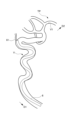
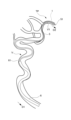
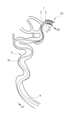
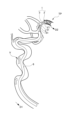
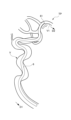
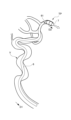
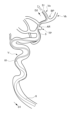
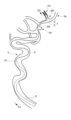
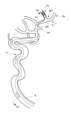
- FIGS. 6 to 14 are schematic diagrams showing a first example of a procedure using a delivery system 10 including a distal stabilizer 1.
- the second catheter 6 is fed into the proximal side D1 of the patient's biological lumen V.
- the distal end 61 of the second catheter 6 is easily caught at a bent portion or a branched portion of the biological lumen V, making it difficult to advance the second catheter 6 distally.
- the first catheter 5 is inserted into the second catheter 6 and fed into the biological lumen V, and after being pushed out from the distal end 61 of the second catheter 6, the distal end 51 of the first catheter 5 is fed to the vicinity of the target position TP.
- the distal stabilizer 1 is inserted into the first catheter 5 and fed to the vicinity of the target position TP.
- the locking stent 2 (not shown) of the distal stabilizer 1 is stored in the first catheter 5 in a contracted state.
- the two struts 24a and 24b of the open cell portion 21 are shaped to extend along the longitudinal direction LD, similar to the other struts 24. This makes it easier for the propulsive force applied to the delivery wire 3 by the practitioner to be transmitted in the longitudinal direction of the locking stent 2, improving the pushability of the locking stent 2.
- the distal stabilizer 1 (locking stent 2 + delivery wire 3) is housed throughout the first catheter 5, but for convenience, the distal stabilizer 1 is shown by a dashed line only on the distal side of the first catheter 5.
- the locking stent 2 stored in the first catheter 5 in a contracted state is released from the distal end 51 of the first catheter 5.
- the locking stent 2 is released, for example, by retracting the first catheter 5 to the proximal side D1.
- the locking stent 2 released from the distal end 51 of the first catheter 5 expands in diameter due to its own expansion force.
- the locking stent 2 pushes the inner wall V1 of the biological lumen V from the inside to the outside, and is locked to the inner wall V1 by the frictional force.
- the force pulling the delivery wire toward the proximal side D1 may cause the position of the anchoring stent 2 anchored to the inner wall of the biological lumen V to shift.
- the locking stent 2 expands in the blood vessel, and the tops 25 of the open cell portions 21 protrude along the circumferential direction RD to provide a structural catch, which in turn improves the anchoring force through a synergistic effect with the frictional force due to the self-expansion force. This prevents the locking stent 2 from being displaced by repeated application of pulling force.
- the second catheter 6 is advanced with the delivery wire 3 in contact with the inner wall of the curved portion of the biological lumen, and frictional force is generated at the contact point between the inner wall and the delivery wire 3, thereby further improving the apparent anchoring force of the locking stent 2.
- the delivery wire 3 is pulled toward the proximal side D1 to bring the delivery wire 3 into contact with the inner wall of the biological lumen.
- the delivery wire 3 has a visible portion that is provided on the distal side of the delivery wire 3 and includes an X-ray opaque portion that is bendable in the axial direction together with the delivery wire 3.
- the visible portion is provided along the axial direction from the distal end of the linear delivery member toward the proximal side.
- the axial length of the visible portion may be 10 to 500 mm.
- the X-ray opaque portion is preferably provided over 10% or more of the surface area of the visible portion.
- the X-ray opaque portion may be formed of a tube-shaped member provided on the outer circumferential surface of the delivery wire 3, or may be formed of a wire-shaped member wound around the outer circumferential surface of the delivery wire 3.
- the X-ray opaque portion may be provided continuously or discontinuously in the axial direction of the visible portion.
- radiopaque materials include platinum, gold, tantalum, platinum, tungsten, iridium, platinum tungsten, etc., as well as alloy materials of these metals.
- alloy materials include polymer materials with radiopaque properties that have been doped with radiopaque fillers, etc.
- the delivery wire 3 When it is difficult to advance the second catheter 6, the delivery wire 3 may be pulled toward the proximal side D1 with the anchoring stent 2 anchored to the inner wall V1 of the biological lumen V. This pulling operation allows the second catheter 6 to advance to the distal side D2. Specifically, when the delivery wire 3 is pulled toward the proximal side D1 with the anchoring stent 2 anchored to the inner wall V1, the path of the delivery wire 3 within the biological lumen V becomes shorter as it approaches a straight line.
- the position of the proximal side D1 portion of the second catheter 6 does not change, and instead, the distal end 61 of the second catheter 6 advances within the biological lumen V, as shown in FIG. 11. Furthermore, when the distal end 61 of the second catheter 6 advances through the biological lumen V without changing the position of the proximal side D1 of the second catheter 6, the path of the second catheter 6 approaches a straight line. This operation is particularly useful when attempting to pass the second catheter 6 through a place that is difficult to pass through, such as a place in the biological lumen V that is highly curved or has a small inner diameter. According to the distal stabilizer 1 of this embodiment, even when such an operation is performed, it is possible to suppress the positional shift of the anchoring stent 2 anchored to the inner wall V1 of the biological lumen V.
- the first catheter 5 inserted into the target catheter (second catheter 6) during advancement may become lost in the aneurysm (not shown) together with the delivery wire 3.
- the path of the delivery wire 3 in the biological lumen V is shortened, and the delivery wire 3 and the first catheter 5 can be returned from inside the aneurysm to the biological lumen V.
- the distal stabilizer 1 of this embodiment can suppress the positional displacement of the anchoring stent 2 anchored in the biological lumen V even when an operation is performed to return the wire or catheter that has strayed into the aneurysm to the biological lumen V, and therefore can be suitably used for the application of delivering the target catheter to the vicinity of the target position with the anchoring stent 2 anchored on the distal side of the aneurysm.
- the distal stabilizer 1 After completing the delivery of the second catheter 6 in this manner, as shown in FIG. 12, the distal stabilizer 1 is retracted to the proximal side D1, and the locking stent 2 is resheathed (stored) in the first catheter 5 (not shown). According to the distal stabilizer 1 of this embodiment, even when the locking stent 2 is resheathed, it is possible to suppress displacement of the locking stent 2 locked to the inner wall V1 of the biological lumen V during resheathing. After the distal stabilizer 1 is resheathed in the first catheter 5, the first catheter 5 and the distal stabilizer 1 may be removed from the proximal side D1 of the second catheter 6.
- the distal stabilizer 1 may be resheathed in the second catheter 6 and removed from the proximal side D1.
- the direction in which the apex 26 of the open cell portion 22 protrudes is generally along the longitudinal axis direction LD, making it easy to resheath the first catheter 5 or the second catheter 6.
- the second catheter 6 is placed at the target position TP in the biological lumen V.
- the second catheter 6 or the third catheter itself may be used as a treatment device.
- the internal flow path of the second catheter 6 is made negative pressure, and the thrombus at the target position TP is aspirated and removed from the distal end 61.
- the distal stabilizer 1 may be removed not only before the delivery of the treatment device 7, but also after.
- the second catheter 6 has a double or more structure, including a lumen through which the distal stabilizer 1 and the first catheter 5 are inserted, and a lumen through which the treatment device 7 is inserted.
- the treatment device 7 is, for example, a thrombus aspiration device, a flow diverter, an embolization coil, an aneurysm embolization device, a thrombus removal device (such as a stent retriever), a stent for treating aneurysms, a stent for treating intracranial arterial stenosis, a balloon catheter, a shunt, or a liquid embolic material discharge means (such as a catheter with a lumen for passing a liquid embolic material).
- a thrombus aspiration device such as a flow diverter, an embolization coil, an aneurysm embolization device, a thrombus removal device (such as a stent retriever), a stent for treating aneurysms, a stent for treating intracranial arterial stenosis, a balloon catheter, a shunt, or a liquid embolic material discharge means (such as a catheter with
- these treatment devices can be delivered via a catheter to the aforementioned areas of blood vessels with inner diameters of 0.5 mm to 10 mm, preferably 7 mm or less, specifically less than 2.5 mm (preferably 2.0 mm or less, or 1.5 mm or less), and diseases or conditions in these areas (vascular occlusion, vascular aneurysm, etc.) can be treated or improved with little burden on the patient.
- the treatment device 7 delivered to the target position TP may be used within the biological lumen (such as a thrombus aspiration device, flow diverter, aneurysm embolization device, thrombus removal device, aneurysm treatment stent, intracranial arterial stenosis treatment stent, balloon catheter, or liquid embolic material discharge means), or may be used protruding outside the biological lumen (such as a shunt).
- a thrombus aspiration device such as a thrombus aspiration device, flow diverter, aneurysm embolization device, thrombus removal device, aneurysm treatment stent, intracranial arterial stenosis treatment stent, balloon catheter, or liquid embolic material discharge means
- a shunt such as a thrombus aspiration device, flow diverter, aneurysm embolization device, thrombus removal device, aneurysm treatment stent, intracranial arterial steno
- the distal stabilizer 1 of this embodiment is also applicable to a method of delivering the treatment device 7 to the target position TP in the biological lumen V using the delivery system 10, and protruding the treatment device 7 to the target position TP in the biological lumen V or to the outside of the biological lumen V from the target position TP to perform a treatment procedure using the treatment device 7.
- Figures 15 to 22 are schematic diagrams showing a second example of a procedure using a delivery system 10 including a distal stabilizer 1.
- the target position TP and the shape of the blood vessel on the distal side are different from those in the first example of the procedure.
- the aneurysm at the target position TP is an aneurysm formed distal to a small diameter and tortuous blood vessel, such as the anterior cerebral artery (ACA), anterior communicating artery (Acom), or middle cerebral artery (MCA) in the skull.
- ACA anterior cerebral artery
- Acom anterior communicating artery
- MCA middle cerebral artery
- ICA internal carotid artery
- the first catheter 5 is inserted into the second catheter 6 and fed into the biological lumen V, and the first catheter 5 is pushed out from the distal end 61 of the second catheter 6, and then the distal end 51 of the first catheter 5 is fed to the distal side of the target position TP.
- the distal side of the target position TP branches into two biological lumen Va and Vb at the bifurcation site BP.
- FIG. 15 shows an example in which the distal end 51 of the first catheter 5 is fed to the biological lumen Va side, which has a greater curvature.
- “More curvature” means that, of the multiple branched biological lumen, the biological lumen Va has the greatest curvature relative to the other biological lumen.
- the distal stabilizer 1 is inserted into the first catheter 5 and fed toward the distal side of the target position TP (biological lumen Va).
- the locking stent 2 stored in the first catheter 5 in a contracted state is released from the distal end 51 of the first catheter 5.
- the locking stent 2 released from the distal end 51 of the first catheter 5 expands in diameter due to its self-expanding force.
- the locking stent 2 is locked to the inner wall of the biological lumen Va, which has a larger curvature, at the bifurcation site BP (first step).
- the locking stent 2 is also locked at a position where there is one or more curvature sites between the target position TP and the position where the locking stent 2 is locked.
- the locking stent 2 is locked at a position where there are two curvature sites of the biological lumen V between the target position TP and the position where the locking stent 2 is locked.
- the upper limit of the curvature sites between the target position TP and the position where the locking stent 2 is locked is three, for example, in the case of the middle cerebral artery, if the blood vessel diameter at the curvature site is 1.0 to 3.0 mm. In the case of the anterior cerebral artery, if the diameter of the blood vessel at the bent part is 1.0 to 3.0 mm, the number is four.
- the exposed portion of the delivery wire 3 can be made longer distal to the target position TP. This allows the contact area between the delivery wire 3 and the curved portion of the biological lumen to be longer, thereby improving the anchoring force of the anchoring stent 2.
- the exposed portion of the delivery wire 3 is 10 mm or more, preferably 20 mm or more, and if it is 50 mm or more, it can contact the curved portion in most biological lumens. If the exposed portion of the delivery wire 3 is 100 mm or more, it can contact the curved portion at any portion in the biological lumen.
- the upper limit of the appropriate length of the exposed portion of the delivery wire 30 is, for example, about 70 mm for the middle cerebral artery and about 50 mm for the anterior cerebral artery.
- the locking stent 2 is engaged at a position distal to the target position TP where the exposed portion of the delivery wire 3 crosses one or more bends or branches of the biological lumen V.
- the locking stent 2 is engaged at a position distal to the target position TP where the exposed portion of the delivery wire 3 crosses one bend and one branch of the biological lumen V.
- this example is not limited to this example, and the locking stent 2 may be engaged at a position distal to the target position TP where the exposed portion of the delivery wire 3 crosses one or more bends of the biological lumen V, or may be engaged at a position where the exposed portion of the delivery wire 3 crosses one or more branch of the biological lumen V.
- the upper limit on the number of bends of the biological lumen V that the exposed portion of the delivery wire 3 crosses is, for example, XX.
- the upper limit of the number of bifurcations of the biological lumen V that the exposed portion of the delivery wire 3 crosses is, for example, three in the case of the middle cerebral artery if the blood vessel diameter at the bent portion is 1.0 to 3.0 mm.
- the upper limit is four if the blood vessel diameter at the bent portion is 1.0 to 3.0 mm.
- the first catheter 5 (not shown) is retracted to the proximal side D1 and removed to expose the delivery wire 3 in the biological lumen V (second step).
- the first catheter 5 may be retracted to the vicinity of the distal end 61 of the second catheter 6 without being removed from the second catheter 6. As described below, as long as the exposed portion of the delivery wire 3 can be brought into contact with one or more bent portions of the biological lumen V, the first catheter 5 may or may not be removed.
- the delivery wire 3 is retracted toward the proximal side D1, and brought into contact with the bent portion in the biological lumen V.
- the exposed portion of the delivery wire 3 comes into contact with three bent portions in the biological lumen V. Note that it is sufficient for the exposed portion of the delivery wire 3 to be in contact with one or more bent portions in the biological lumen V.
- the second catheter 6 is advanced to the distal side D2 while being inserted over the delivery wire 3, and placed at the target position TP (third step). At least at the start of this third step, the second catheter 6 is advanced to the distal side D2 while being inserted over the delivery wire 3, with the exposed portion of the delivery wire 3 in contact with one or more bent portions of the biological lumen V.
- the anchoring stent 2 is firmly anchored to the inner wall of the distal side D2 of the target position TP.
- the second catheter 6 can be advanced to the distal side D2 while the delivery wire 3 is in contact with one or more bent portions in the biological lumen V. This can further increase the frictional force of the entire distal stabilizer 1 against the biological lumen V. This can counter the force that pulls the delivery wire 3 proximally when the second catheter 6 is advanced, and can more reliably retain the entire distal stabilizer 1 in the biological lumen V.
- the distal stabilizer 1 of this embodiment makes it possible to reduce the self-expansion force of the anchoring stent 2 without significantly reducing the frictional force of the entire distal stabilizer 1 against the biological lumen V, thereby further reducing the burden on the blood vessel wall.
- the second catheter 6 After the distal end 61 of the second catheter 6 reaches the target position TP in the biological lumen V, the second catheter 6 is further advanced to the distal side D2, and the anchoring stent 2 is resheathed into the second catheter 6 (fourth step).
- the indwelling stent 4 with a reduced diameter is inserted from the proximal side D1 of the second catheter 6.
- the indwelling stent 4 is a stent (treatment device) for treating an aneurysm.
- the indwelling stent 4 is sent toward the distal side D2 via the pusher wire 8, and is pushed out from the second catheter 6 at the target position TP and delivered to the target position TP (step 5).
- the purpose of placing the indwelling stent 4 at the target position TP is to reduce blood flowing into the aneurysm AR present at the target position TP and to hold the embolization coil placed in the aneurysm AR.
- an embolization coil (neither shown) is sent to the distal side D2 via a microcatheter inserted in the second catheter 6, so that the embolization coil can be placed in the aneurysm AR through the meshes of the indwelling stent 4 (step 6).
- the pusher wire 8 that was clamped to the indwelling stent 4 is released, so that the pusher wire 8 can be withdrawn while the indwelling stent 4 remains in the aneurysm.
- the second catheter 6 can be advanced to the distal side D2 with the delivery wire 3 in contact with the inner wall of one or more bent portions in the biological lumen V. That is, as shown in FIG. 19, when the second catheter 6 is advanced to the distal side D2, the delivery wire 3 is in contact with one or more bent portions on the distal side D2 of the target position TP. Also, the delivery wire 3 is in contact with one or more bent portions on the proximal side D1 of the target position TP. This further increases the frictional force generated by the contact between the delivery wire 3 and the inner wall of the biological lumen V, thereby further improving the frictional force of the distal stabilizer 1 against the biological lumen V. Therefore, according to the distal stabilizer 1 of this embodiment, the distal stabilizer 1 can be more reliably retained at the engagement position against the force that pulls the delivery wire 3 proximally when the second catheter 6 is advanced.
- the locking stent 2 is locked to the inner wall of the biological lumen Va, which has a larger curvature. This increases the frictional force generated by the contact between the delivery wire 3 and the inner wall of the biological lumen Va, thereby improving the anchoring force of the distal stabilizer 1.
- the exposed portion of the delivery wire 3 is inserted into the second catheter 6. Therefore, the number of contact points between the bending site and the delivery wire 3 decreases as the second catheter 6 advances toward the distal side D2.
- the delivery wire 3 is maintained in contact with one or more bending sites on the distal side D2 of the target position TP.
- the distal stabilizer 1 of this embodiment described above provides the following effects, for example:
- the open cell portion 21 provided in the cell 20a has two struts that extend along the longitudinal direction LD when the locking stent 2 is in a contracted state. This makes it easier for the propulsive force applied by the practitioner to the delivery wire 3 to be transmitted in the longitudinal direction of the locking stent 2, thereby improving the pushability of the locking stent 2.
- the open cell portion 21 provided in the cell 20a has an apex 25 that protrudes along the circumferential direction RD perpendicular to the longitudinal direction LD when the locking stent 2 is in an expanded state.
- the apex 25 of the open cell portion 21 provided in the cell 20a protrudes in a direction of +30° to -30° with respect to the circumferential direction RD of the locking stent 2 when the locking stent 2 is in an expanded diameter state. This allows the apex 25 of the open cell portion 21 to protrude in a direction that provides sufficient structural engagement when in the expanded diameter state.
- the open cell portion 21 is provided in at least one cell located at the distal end of the main body 11 in the longitudinal direction LD. This allows the anchoring force of the anchoring stent 2 to be maintained until just before the anchoring stent 2 is resheathed into the catheter (first catheter 5).
- the open cell portion 21 is provided in at least one cell located at the proximal end of the main body portion 11 in the longitudinal direction LD. This improves the pushability at the proximal end of the main body portion 11, where the cell density tends to be sparse.
- the open cell portion 21 is provided in at least one cell located between the distal end and the proximal end in the longitudinal direction LD of the main body portion 11. This allows the cells to be densely arranged in the main body portion 11, reducing the number of struts in areas where resistance is likely to be high during resheathing, and making the amount of metal in those areas relatively smaller than in other areas, thereby reducing resistance during resheathing.
- the open cell portion 21 is also provided in the antenna portion 12. This makes it easier for the propulsive force applied by the surgeon to the delivery wire 3 to be transmitted to the main body portion 11 in the antenna portion 12, where the cell density is sparse, and therefore makes it possible to further improve the pushability of the locking stent 2.
- At least one of the cells having the open cell portion 21 has an open cell portion 22 in which the two struts do not substantially extend along the longitudinal direction LD in the contracted state and natural state.
- the struts 24h protrude along the circumferential direction RD.
- the apex 28 of the open cell portion 27, in the expanded state becomes a structural catch against the inner wall of the blood vessel, and the anchoring force can be further improved by the synergistic effect with the frictional force due to the self-expansion force.
- the anchoring force of the locking stent 2 can be exerted until just before the locking stent 2 is resheathed into the catheter (first catheter 5).
- the main body 11 has a mesh pattern structure in which multiple cells 20 are arranged in a spiral shape in the longitudinal direction LD. Therefore, the distal stabilizer 1 having the locking stent is highly flexible, and the distal stabilizer 1 can easily follow the bending of the biological lumen V. In this way, since the distal stabilizer 1 can easily follow the bending of the biological lumen V, stress is less likely to concentrate at both ends of the locking stent in the longitudinal direction LD. As a result, the blood vessel in which the locking stent is locked is less likely to straighten, resulting in an open cell structure that is highly protective of the blood vessel wall.
- the anchoring stent 2 at least one cell 20a having open cell portions 21 and 22 needs to be provided in the main body portion 11, and the other cells 20 may be, for example, cells having only the open cell portions 21 or 22, or may be cells not having the open cell portions 21 and 22.
- the other ends of the struts 24a and 24b may be connected by another strut in the cell arrangement direction SD.
- the two struts do not extend along the longitudinal direction LD, but when the locking stent 2 is in its natural state (and in its expanded state), the apex 25 protrudes along the circumferential direction RD. This is expected to improve the anchoring force in the expanded state.
- the other ends of the two struts 24h and 24i are connected to the struts or closed cell portion 23 of another adjacent cell 20 in the cell arrangement direction SD (see FIG. 5).
- the open cell portion 27 is shaped like a letter L, and the angle of the apex is appropriately set, so that the two struts can be extended along the longitudinal axis direction LD when the locking stent 2 is in a contracted state.
- the mesh pattern structure in which the cells 20 are arranged along the longitudinal direction is not limited to a structure in which the cells 20 are arranged spirally with respect to the longitudinal direction LD as shown in the embodiment.
- the mesh pattern structure may be such that the cells 20 are arranged along the longitudinal direction LD as well as in the circumferential direction RD, or the mesh pattern structure may be such that the cells 20 are arranged only along the longitudinal direction LD.
- the anchoring stent 2 is used in applications where it is temporarily placed in a blood vessel and then retrieved outside the body, but it can also be used in applications where the anchoring stent 2 is left in the blood vessel without being retrieved from the body.
- the connection portion between the anchoring stent 2 and the delivery wire 3 may be configured with a heater coil, filament, etc., so that the connection portion is cut (melted) when electricity is applied to the delivery wire 3.
- the connection portion between the anchoring stent 2 and the delivery wire 3 may be configured so that it is mechanically cut when a rotational force is applied to the delivery wire 3 in the circumferential direction.
- the connection portion between the anchoring stent 2 and the delivery wire 3 is not limited to the above example, and may be configured in any way as long as the anchoring stent 2 and the delivery wire 3 can be separated by the operator's operation.
Landscapes
- Health & Medical Sciences (AREA)
- Life Sciences & Earth Sciences (AREA)
- Biophysics (AREA)
- Pulmonology (AREA)
- Engineering & Computer Science (AREA)
- Anesthesiology (AREA)
- Biomedical Technology (AREA)
- Heart & Thoracic Surgery (AREA)
- Hematology (AREA)
- Animal Behavior & Ethology (AREA)
- General Health & Medical Sciences (AREA)
- Public Health (AREA)
- Veterinary Medicine (AREA)
- Media Introduction/Drainage Providing Device (AREA)
Priority Applications (3)
| Application Number | Priority Date | Filing Date | Title |
|---|---|---|---|
| CN202480018864.8A CN121013746A (zh) | 2023-03-17 | 2024-03-15 | 远侧稳定器 |
| EP24774869.2A EP4670772A1 (en) | 2023-03-17 | 2024-03-15 | DISTAL STABILIZER |
| JP2025508402A JPWO2024195733A1 (https=) | 2023-03-17 | 2024-03-15 |
Applications Claiming Priority (4)
| Application Number | Priority Date | Filing Date | Title |
|---|---|---|---|
| JP2023-042724 | 2023-03-17 | ||
| JP2023042724 | 2023-03-17 | ||
| JP2023094662 | 2023-06-08 | ||
| JP2023-094662 | 2023-06-08 |
Publications (1)
| Publication Number | Publication Date |
|---|---|
| WO2024195733A1 true WO2024195733A1 (ja) | 2024-09-26 |
Family
ID=92841577
Family Applications (1)
| Application Number | Title | Priority Date | Filing Date |
|---|---|---|---|
| PCT/JP2024/010280 Ceased WO2024195733A1 (ja) | 2023-03-17 | 2024-03-15 | 遠位スタビライザ |
Country Status (4)
| Country | Link |
|---|---|
| EP (1) | EP4670772A1 (https=) |
| JP (1) | JPWO2024195733A1 (https=) |
| CN (1) | CN121013746A (https=) |
| WO (1) | WO2024195733A1 (https=) |
Citations (5)
| Publication number | Priority date | Publication date | Assignee | Title |
|---|---|---|---|---|
| US968221A (en) | 1910-02-08 | 1910-08-23 | Wilcox & White Co | Tracker construction for mechanical music-playing instruments. |
| JP2012521837A (ja) * | 2009-03-31 | 2012-09-20 | ロイヤル ブロンプトン アンド ヘアフィールド エヌエイチエス トラスト | アンカー付きガイドワイヤ |
| US20160158500A1 (en) * | 2014-12-05 | 2016-06-09 | George P. Teitelbaum | Anchor device for use with catheters |
| JP2018535736A (ja) * | 2015-10-30 | 2018-12-06 | セレバスク, エルエルシーCereVasc, LLC | 水頭症の治療システムおよび方法 |
| WO2022162965A1 (ja) | 2021-01-26 | 2022-08-04 | 株式会社Bolt Medical | 生体管腔中でのカテーテルデリバリに用いる遠位スタビライザ、治療デバイスのデリバリシステム、及び治療デバイス |
-
2024
- 2024-03-15 JP JP2025508402A patent/JPWO2024195733A1/ja active Pending
- 2024-03-15 EP EP24774869.2A patent/EP4670772A1/en active Pending
- 2024-03-15 WO PCT/JP2024/010280 patent/WO2024195733A1/ja not_active Ceased
- 2024-03-15 CN CN202480018864.8A patent/CN121013746A/zh active Pending
Patent Citations (5)
| Publication number | Priority date | Publication date | Assignee | Title |
|---|---|---|---|---|
| US968221A (en) | 1910-02-08 | 1910-08-23 | Wilcox & White Co | Tracker construction for mechanical music-playing instruments. |
| JP2012521837A (ja) * | 2009-03-31 | 2012-09-20 | ロイヤル ブロンプトン アンド ヘアフィールド エヌエイチエス トラスト | アンカー付きガイドワイヤ |
| US20160158500A1 (en) * | 2014-12-05 | 2016-06-09 | George P. Teitelbaum | Anchor device for use with catheters |
| JP2018535736A (ja) * | 2015-10-30 | 2018-12-06 | セレバスク, エルエルシーCereVasc, LLC | 水頭症の治療システムおよび方法 |
| WO2022162965A1 (ja) | 2021-01-26 | 2022-08-04 | 株式会社Bolt Medical | 生体管腔中でのカテーテルデリバリに用いる遠位スタビライザ、治療デバイスのデリバリシステム、及び治療デバイス |
Non-Patent Citations (1)
| Title |
|---|
| See also references of EP4670772A1 |
Also Published As
| Publication number | Publication date |
|---|---|
| JPWO2024195733A1 (https=) | 2024-09-26 |
| CN121013746A (zh) | 2025-11-25 |
| EP4670772A1 (en) | 2025-12-31 |
Similar Documents
| Publication | Publication Date | Title |
|---|---|---|
| EP3318224B1 (en) | Stent delivery system, corresponding flow diversion device, and assembly method of flow diversion device | |
| CN110251286B (zh) | 一种自膨式支架输送系统 | |
| US6579308B1 (en) | Stent devices with detachable distal or proximal wires | |
| US8241345B2 (en) | Stent delivery system | |
| JP5619703B2 (ja) | 脈管分岐部を治療する内部人工器官展開システム | |
| JP5945119B2 (ja) | 改良されたステントの配備のための装置及び方法 | |
| JP2022504291A (ja) | 医療用インプラント送達システム | |
| US20100249654A1 (en) | Wire guide | |
| CN211633755U (zh) | 一种自膨式支架输送系统 | |
| WO2022162965A1 (ja) | 生体管腔中でのカテーテルデリバリに用いる遠位スタビライザ、治療デバイスのデリバリシステム、及び治療デバイス | |
| US20120271409A1 (en) | Helical Radiopaque Marker | |
| WO2022004850A1 (ja) | 生体管腔中でのカテーテルデリバリに用いる遠位スタビライザ、治療デバイスのデリバリシステム、及び治療デバイス | |
| CN110251285B (zh) | 渐缩型血管支架 | |
| JP2024012161A (ja) | 遠位スタビライザ | |
| WO2024195733A1 (ja) | 遠位スタビライザ | |
| US20220233821A1 (en) | Distal stabilizer for use for catheter delivery in biological lumen, delivery system for delivering treatment device, and treatment device | |
| JP2010540194A (ja) | 湾曲した支柱を備えた医療デバイス | |
| JP2024058661A (ja) | 遠位スタビライザ | |
| WO2024080366A1 (ja) | 遠位スタビライザ | |
| US20260124432A1 (en) | Distal stabilizer | |
| WO2024241863A1 (ja) | 遠位スタビライザ、遠位スタビライザの撮像方法 | |
| US20250375292A1 (en) | Endovascular device with guide wire | |
| WO2024019085A1 (ja) | 遠位スタビライザ | |
| WO2025142412A1 (ja) | ステント | |
| US11963895B2 (en) | Device for introducing implants |
Legal Events
| Date | Code | Title | Description |
|---|---|---|---|
| 121 | Ep: the epo has been informed by wipo that ep was designated in this application |
Ref document number: 24774869 Country of ref document: EP Kind code of ref document: A1 |
|
| ENP | Entry into the national phase |
Ref document number: 2025508402 Country of ref document: JP Kind code of ref document: A |
|
| WWE | Wipo information: entry into national phase |
Ref document number: 2025508402 Country of ref document: JP |
|
| WWE | Wipo information: entry into national phase |
Ref document number: 2024774869 Country of ref document: EP |
|
| NENP | Non-entry into the national phase |
Ref country code: DE |
|
| ENP | Entry into the national phase |
Ref document number: 2024774869 Country of ref document: EP Effective date: 20250924 |
|
| ENP | Entry into the national phase |
Ref document number: 2024774869 Country of ref document: EP Effective date: 20250924 |
|
| WWP | Wipo information: published in national office |
Ref document number: 2024774869 Country of ref document: EP |