WO2024195165A1 - 超電導接続部の保護ケースおよび超電導接続部の保護構造 - Google Patents
超電導接続部の保護ケースおよび超電導接続部の保護構造 Download PDFInfo
- Publication number
- WO2024195165A1 WO2024195165A1 PCT/JP2023/036898 JP2023036898W WO2024195165A1 WO 2024195165 A1 WO2024195165 A1 WO 2024195165A1 JP 2023036898 W JP2023036898 W JP 2023036898W WO 2024195165 A1 WO2024195165 A1 WO 2024195165A1
- Authority
- WO
- WIPO (PCT)
- Prior art keywords
- superconducting
- protective case
- connection
- blind hole
- case body
- Prior art date
- Legal status (The legal status is an assumption and is not a legal conclusion. Google has not performed a legal analysis and makes no representation as to the accuracy of the status listed.)
- Ceased
Links
Images






Classifications
-
- H—ELECTRICITY
- H01—ELECTRIC ELEMENTS
- H01F—MAGNETS; INDUCTANCES; TRANSFORMERS; SELECTION OF MATERIALS FOR THEIR MAGNETIC PROPERTIES
- H01F6/00—Superconducting magnets; Superconducting coils
- H01F6/06—Coils, e.g. winding, insulating, terminating or casing arrangements therefor
- H01F6/065—Feed-through bushings, terminals and joints
-
- H—ELECTRICITY
- H01—ELECTRIC ELEMENTS
- H01B—CABLES; CONDUCTORS; INSULATORS; SELECTION OF MATERIALS FOR THEIR CONDUCTIVE, INSULATING OR DIELECTRIC PROPERTIES
- H01B12/00—Superconductive or hyperconductive conductors, cables, or transmission lines
- H01B12/02—Superconductive or hyperconductive conductors, cables, or transmission lines characterised by their form
- H01B12/06—Films or wires on bases or cores
-
- H—ELECTRICITY
- H01—ELECTRIC ELEMENTS
- H01R—ELECTRICALLY-CONDUCTIVE CONNECTIONS; STRUCTURAL ASSOCIATIONS OF A PLURALITY OF MUTUALLY-INSULATED ELECTRICAL CONNECTING ELEMENTS; COUPLING DEVICES; CURRENT COLLECTORS
- H01R4/00—Electrically-conductive connections between two or more conductive members in direct contact, i.e. touching one another; Means for effecting or maintaining such contact; Electrically-conductive connections having two or more spaced connecting locations for conductors and using contact members penetrating insulation
- H01R4/58—Electrically-conductive connections between two or more conductive members in direct contact, i.e. touching one another; Means for effecting or maintaining such contact; Electrically-conductive connections having two or more spaced connecting locations for conductors and using contact members penetrating insulation characterised by the form or material of the contacting members
- H01R4/68—Connections to or between superconductive connectors
-
- Y—GENERAL TAGGING OF NEW TECHNOLOGICAL DEVELOPMENTS; GENERAL TAGGING OF CROSS-SECTIONAL TECHNOLOGIES SPANNING OVER SEVERAL SECTIONS OF THE IPC; TECHNICAL SUBJECTS COVERED BY FORMER USPC CROSS-REFERENCE ART COLLECTIONS [XRACs] AND DIGESTS
- Y02—TECHNOLOGIES OR APPLICATIONS FOR MITIGATION OR ADAPTATION AGAINST CLIMATE CHANGE
- Y02E—REDUCTION OF GREENHOUSE GAS [GHG] EMISSIONS, RELATED TO ENERGY GENERATION, TRANSMISSION OR DISTRIBUTION
- Y02E40/00—Technologies for an efficient electrical power generation, transmission or distribution
- Y02E40/60—Superconducting electric elements or equipment; Power systems integrating superconducting elements or equipment
Definitions
- This disclosure relates to a protective case for a superconducting connection and a protective structure for a superconducting connection.
- Patent Document 1 which is listed below, discloses a superconducting coil device equipped with a superconducting coil.
- the superconducting coil includes a superconducting wire and a connection portion for the superconducting wire.
- the protective case for the superconducting connection of the present disclosure comprises a protective case body including an outer peripheral surface around which a first excess length portion of the superconducting wire is wound.
- a blind hole is provided on the outer peripheral surface of the protective case body to accommodate the superconducting connection portion of the superconducting wire and the second excess length portion of the superconducting wire connected to the first excess length portion and the superconducting connection portion.
- the protective structure for the superconducting connection of the present disclosure comprises a protective case for the superconducting connection of the present disclosure, a superconducting wire including a first excess length portion and a second excess length portion, and a superconducting connection portion.
- the first excess length portion of the superconducting wire is wound around the outer peripheral surface of the protective case body.
- the superconducting connection portion of the superconducting wire and the second excess length portion of the superconducting wire are housed in a blind hole.
- FIG. 1 is a schematic plan view of a protection structure for a superconducting joint according to an embodiment.
- FIG. 2 is a schematic perspective view of a protective case for a superconducting joint according to an embodiment.
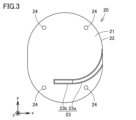
- FIG. 3 is a schematic plan view of a base member of a protective case for a superconducting joint according to an embodiment.
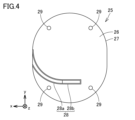
- FIG. 4 is a schematic bottom view of a cover member of a protective case for a superconducting joint according to an embodiment.
- FIG. 5 is a schematic enlarged partial cross-sectional view of a superconducting joint according to an example of the embodiment.
- FIG. 6 is a schematic partially enlarged perspective view of a superconducting joint according to another example of the embodiment.
- FIG. 1 is a schematic plan view of a protection structure for a superconducting joint according to an embodiment.
- FIG. 2 is a schematic perspective view of a protective case for a superconducting joint according to an embodiment.
- FIG. 3 is a schematic
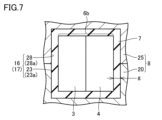
- FIG. 7 is a schematic partially enlarged cross-sectional view of the protective structure for superconducting joints according to the embodiment taken along the cross-sectional line VII-VII shown in FIG.
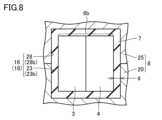
- FIG. 8 is a schematic partially enlarged cross-sectional view of the protective structure for superconducting joints according to the embodiment taken along the cross-sectional line VIII-VIII shown in FIG.
- FIG. 9 is a schematic enlarged partial cross-sectional view of the protective structure for superconducting joints according to the embodiment taken along the cross-sectional line IX-IX shown in FIG.
- FIG. 10 is a schematic partially enlarged cross-sectional view showing a superconducting wire and an imaginary frame surrounding the superconducting wire.
- the temperature of the superconducting wires and the joints of the superconducting wires may be raised from a low temperature such as the liquid helium temperature (4.2 K) or the liquid nitrogen temperature (77.3 K) to room temperature for maintenance of the superconducting coil device. This temperature rise may cause condensation water to adhere to the joints of the superconducting wires, resulting in deterioration of the joints of the superconducting wires.
- a low temperature such as the liquid helium temperature (4.2 K) or the liquid nitrogen temperature (77.3 K)
- connection of the superconducting wire is formed by placing a portion of the superconducting wire in a heating furnace and heat-treating that portion of the superconducting wire. If the connection of the superconducting wire obtained by heat treatment does not have sufficient performance, the connection of the superconducting wire is cut and the superconducting wire is heat-treated again to form the connection of the superconducting wire again. Therefore, in a superconducting coil device, excess superconducting wire is generated in order to form the connection of the superconducting wire. This excess superconducting wire needs to be compactly processed.
- the present disclosure has been made in consideration of the above-mentioned problems, and its purpose is to provide a protective case for a superconducting joint and a protective structure for a superconducting joint that enable compact processing of excess lengths of superconducting wire and prevent deterioration of the superconducting joints of superconducting wires. [Effects of this disclosure] According to the present disclosure, it is possible to compactly dispose of excess lengths of superconducting wires and to prevent deterioration of superconducting joints of superconducting wires.
- the protective case 2 for the superconducting connection includes a protective case body 8 including an outer peripheral surface 10 around which the first excess length portion 6a of the superconducting wires 3, 4 is wound.
- the outer peripheral surface 10 of the protective case body 8 is provided with a blind hole 16 that accommodates the superconducting connection portion 6c of the superconducting wires 3, 4 and the second excess length portion 6b of the superconducting wires 3, 4 that is connected to the first excess length portion 6a and the superconducting connection portion 6c.
- the first excess length 6a of the superconducting wires 3, 4 is wound around the outer peripheral surface 10 of the protective case body 8, and the second excess length 6b of the superconducting wires 3, 4 is accommodated in the blind hole 16 of the protective case body 8. Therefore, the protective case 2 for the superconducting connection allows the excess length of the superconducting wires 3, 4 to be compactly handled. In addition, the superconducting connection 6c of the superconducting wires 3, 4 is accommodated in the blind hole 16 of the protective case body 8.
- the protective case 2 for the superconducting joint can prevent deterioration of the superconducting joint 6c of the superconducting wires 3 and 4.
- the blind hole 16 may include a first hole portion 17 connected to the outer peripheral surface 10 of the protective case main body 8 and accommodating the second excess length portion 6b of the superconducting wires 3, 4, and a second hole portion 18 connected to the first hole portion 17, defining the bottom of the blind hole 16, and accommodating the superconducting connection part 6c of the superconducting wires 3, 4.
- the first hole portion 17 may have a curved shape.
- the stress applied to the second excess portion 6b of the superconducting wires 3, 4 is reduced when the second excess portion 6b of the superconducting wires 3, 4 is inserted into the blind hole 16. Even if the second excess portion 6b of the superconducting wires 3, 4 is subjected to the above-mentioned heat cycle while housed in the first hole portion 17, the stress applied to the second excess portion 6b of the superconducting wires 3, 4 due to the heat cycle is reduced. Therefore, deterioration and breakage of the second excess portion 6b of the superconducting wires 3, 4 can be prevented.
- the second hole portion 18 may have a straight shape.
- the outer peripheral surface 10 of the protective case main body 8 may include a curved surface having a bulging shape when viewed in a plan view from the short side direction of the outer peripheral surface 10.
- the radius of curvature R2 of the curved surface may be larger than the radius of curvature R1 of the first hole portion 17.
- the stress applied to the first excess portion 6a of the superconducting wires 3, 4 is reduced when the first excess portion 6a of the superconducting wires 3, 4 is wound around the outer peripheral surface 10 of the protective case body 8. Even if the first excess portion 6a of the superconducting wires 3, 4 is subjected to the above-mentioned heat cycle while being wound around the outer peripheral surface 10 of the protective case body 8, the stress applied to the first excess portion 6a of the superconducting wires 3, 4 due to the heat cycle is reduced. Therefore, deterioration and breakage of the first excess portion 6a of the superconducting wires 3, 4 can be prevented.
- the radius of curvature R1 of the first hole portion 17 may be 15 mm or more.
- the stress applied to the second excess portion 6b of the superconducting wires 3, 4 is reduced when the second excess portion 6b of the superconducting wires 3, 4 is inserted into the first hole portion 17. Even if the second excess portion 6b of the superconducting wires 3, 4 is subjected to the above-mentioned heat cycle while housed in the first hole portion 17, the stress applied to the second excess portion 6b of the superconducting wires 3, 4 due to the heat cycle is reduced. Therefore, deterioration and breakage of the second excess portion 6b of the superconducting wires 3, 4 can be prevented.
- the protective case main body 8 in a plan view from the short side direction of the outer peripheral surface 10 of the protective case main body 8, the protective case main body 8 may have an oval shape, the first hole portion 17 may be provided in a portion of the outer peripheral surface 10 located in the short side direction of the protective case main body 8 relative to the center 8c of the protective case main body 8, and the second hole portion 18 may extend in the short side direction of the protective case main body 8 and may be shifted in the longitudinal direction of the protective case main body 8 relative to the center 8c of the protective case main body 8.
- the stress applied to the first excess length portion 6a and the second excess length portion 6b of the superconducting wires 3 and 4 can be reduced while the protective case body 8 is made smaller. This makes it possible to make the protective case 2 of the superconducting connection smaller and to prevent deterioration and breakage of the first excess length portion 6a and the second excess length portion 6b of the superconducting wires 3 and 4.
- the protective case main body 8 may include a base member 20 and a lid member 25.
- the base member 20 may be provided with a first groove 23 that constitutes at least a part of the blind hole 16.
- the lid member 25 may be attached to the base member 20 so as to cover the first groove 23.
- the second excess length portion 6b of the superconducting wires 3, 4 and the superconducting connection portion 6c of the superconducting wires 3, 4 can be easily accommodated in the blind hole 16.
- a second groove 28 may be provided in the cover member 25.
- the first groove 23 and the second groove 28 may form a blind hole 16.
- the second excess length portion 6b of the superconducting wires 3, 4 and the superconducting connection portion 6c of the superconducting wires 3, 4 can be easily accommodated in the blind hole 16.
- the protective case 2 for the superconducting connection part according to (7) or (8) above may further include a fixing member 9.
- the cover member 25 may be fixed to the base member 20 by the fixing member 9.
- the second excess length portion 6b of the superconducting wires 3, 4 and the superconducting connection portion 6c of the superconducting wires 3, 4 can be easily accommodated in the blind hole 16.
- the protective case body 8 may be made of Hastelloy.
- the protective case 2 for the superconducting connection can prevent deterioration of the first excess length portion 6a and the second excess length portion 6b of the superconducting wires 3, 4 and the superconducting connection portion 6c of the superconducting wires 3, 4.
- the protective structure 1 for a superconducting connection comprises a protective case 2 for a superconducting connection according to any one of (1) to (10) above, superconducting wires 3, 4 including a first excess length portion 6a and a second excess length portion 6b, and a superconducting connection portion 6c of the superconducting wires 3, 4.
- the first excess length portion 6a of the superconducting wires 3, 4 is wound around the outer peripheral surface 10 of the protective case body 8.
- the superconducting connection portion 6c of the superconducting wires 3, 4 and the second excess length portion 6b of the superconducting wires 3, 4 are housed in a blind hole 16.
- the protective structure 1 for the superconducting connection includes a protective case 2 for the superconducting connection. Therefore, the protective structure 1 for the superconducting connection makes it possible to compactly handle the excess length of the superconducting wires 3 and 4 and to prevent deterioration of the superconducting connection 6c of the superconducting wires 3 and 4.
- the gap g between the side wall of the blind hole 16 and the second excess portion 6b of the superconducting wires 3 and 4 may be 2 mm or less.
- the protective structure 1 for the superconducting connection can prevent deterioration of the superconducting connection 6c of the superconducting wires 3 and 4.
- the area of the opening 16a of the blind hole 16 on the outer peripheral surface 10 of the protective case main body 8 may be less than or equal to the sum of the cross-sectional area S1 of the superconducting wires 3, 4 in a cross section perpendicular to the longitudinal direction of the superconducting wires 3, 4 and the area S2 of an imaginary frame 19 that surrounds the superconducting wires 3, 4 and has a width of 1 mm.
- the protective structure 1 for the superconducting connection can prevent deterioration of the superconducting connection 6c of the superconducting wires 3, 4.
- the protective structure 1 for the superconducting connection may further include a sealing member 7 that closes at least a portion of the gap between the second excess length portion 6b of the superconducting wires 3 and 4 and the side wall of the blind hole 16 or the gap between the superconducting connection portion 6c of the superconducting wires 3 and 4 and the side wall of the blind hole 16.
- the sealing member 7 prevents condensation water caused by the above-mentioned heat cycle from penetrating into the superconducting connection 6c.
- the protective structure 1 for the superconducting connection can prevent deterioration of the superconducting connection 6c of the superconducting wires 3 and 4.
- a protective structure 1 for a superconducting connection includes a protective case 2 for a superconducting connection according to an embodiment of the present disclosure, superconducting wires 3 and 4, and a superconducting connection 6c for the superconducting wires 3 and 4.
- the protective structure 1 for a superconducting connection may further include a sealing member 7.
- the illustration of the cover member 25 is omitted in FIG. 1.
- FIG. 1 also illustrates a state in which the first excess portion 6a is wound around the outer peripheral surface 10 of the protective case 2 one or more times. The number of turns of the first excess portion 6a around the outer peripheral surface 10 varies depending on the length of the first excess portion 6a.
- the protective case 2 for the superconducting connection protects the superconducting connection 6c of the superconducting wires 3, 4.
- the superconducting layers 33, 43 (see Figures 5 and 6) of the superconducting wires 3, 4 are superconductively joined to each other.
- the superconducting connection 6c of the superconducting wires 3, 4 is formed by placing a part of the superconducting wires 3, 4 in a heating furnace and heat treating the part of the superconducting wires 3, 4.
- the superconducting connection 6c of the superconducting wires 3, 4 obtained by the heat treatment does not have sufficient performance, the superconducting connection 6c of the superconducting wires 3, 4 is cut and the superconducting wires 3, 4 are heat treated again to form the superconducting connection of the superconducting wires 3, 4 again. Therefore, in order to form the superconducting connection 6c of the superconducting wires 3 and 4, excess length portions of the superconducting wires 3 and 4 are generated.
- the excess length portions of the superconducting wires 3 and 4 include a first excess length portion 6a and a second excess length portion 6b.
- the protective case 2 for the superconducting connection portion includes a protective case main body 8.
- the protective case 2 for the superconducting connection portion may further include a fixing member 9.
- the protective case body 8 includes an outer peripheral surface 10 around which the first excess length portions 6a of the superconducting wires 3, 4 are wound.
- the outer peripheral surface 10 is, for example, a side surface of the protective case body 8.
- the protective case body 8 In a plan view from the short side direction of the outer peripheral surface 10 of the protective case body 8 (thickness direction of the protective case body 8, z direction), the protective case body 8 has, for example, an oval shape, an elliptical shape, or a hamburger shape.
- the short side direction of the outer peripheral surface 10 is a direction perpendicular to the circumferential direction of the outer peripheral surface 10 and the normal line of the outer peripheral surface 10.
- the outer peripheral surface 10 includes a first flat surface 11, a second flat surface 12, a first curved surface 13, and a second curved surface 14.
- the second flat surface 12 faces the first flat surface 11 in the short direction (x direction) of the protective case body 8 when viewed from a plane in the short direction (z direction) of the outer peripheral surface 10 of the protective case body 8.
- the first flat surface 11 and the second flat surface 12 are each parts of the outer peripheral surface 10 of the protective case body 8 that are located in the short direction (x direction) of the protective case body 8 with respect to the center 8c of the protective case body 8.
- the center 8c of the protective case body 8 is the intersection of the center line of the protective case body 8 in the short direction and the center line of the protective case body 8 in the longitudinal direction (y direction).
- the first curved surface 13 and the second curved surface 14 each connect the first flat surface 11 and the second flat surface 12.
- the first curved surface 13 and the second curved surface 14 each have a shape that bulges from the first flat surface 11 and the second flat surface 12.
- the first curved surface 13 and the second curved surface 14 each have a semicircular arc shape.
- the curvature radius R2 of each of the first curved surface 13 and the second curved surface 14 is, for example, 25 mm or more.
- the curvature radius R2 of each of the first curved surface 13 and the second curved surface 14 is larger than the curvature radius R1 of the first hole portion 17.
- the curvature radius R2 of each of the first curved surface 13 and the second curved surface 14 is, for example, 1.2 times or more the curvature radius R1 of the first hole portion 17.
- the second curved surface 14 faces the first curved surface 13 in the longitudinal direction (y direction) of the protective case body 8 in a plan view from the lateral direction (z direction) of the outer peripheral surface 10 of the protective case body 8.
- the first curved surface 13 and the second curved surface 14 are each a portion of the outer peripheral surface 10 of the protective case body 8 that is located in the longitudinal direction (y direction) of the protective case body 8 with respect to the center 8c of the protective case body 8.
- the maximum distance between the first curved surface 13 and the second curved surface 14 is greater than the maximum distance between the first flat surface 11 and the second flat surface 12.
- a blind hole 16 is provided in the outer peripheral surface 10 of the protective case body 8.
- the blind hole 16 is provided, for example, in a portion of the outer peripheral surface 10 of the protective case body 8 that is located in the short direction (x direction) of the protective case body 8 with respect to the center 8c of the protective case body 8.
- the blind hole 16 is provided in the first flat surface 11.
- the first flat surface 11 extends along the tangent direction (y direction) of the blind hole 16 at the connection portion between the blind hole 16 and the outer peripheral surface 10 of the protective case body 8. Therefore, the stress applied to the excess portion of the superconducting wires 3 and 4 is reduced.
- the superconducting wires 3 and 4 can be prevented from deteriorating and breaking.
- the blind hole 16 accommodates the second excess length portion 6b of the superconducting wires 3 and 4 and the superconducting connection portion 6c of the superconducting wires 3 and 4.
- the second excess length portion 6b is connected to the first excess length portion 6a and the superconducting connection portion 6c.
- the blind hole 16 includes a first hole portion 17 and a second hole portion 18.
- the first hole portion 17 accommodates the second excess portion 6b of the superconducting wires 3 and 4.
- the first hole portion 17 is connected to the outer peripheral surface 10 of the protective case body 8.
- the first hole portion 17 is provided in a portion of the outer peripheral surface 10 of the protective case body 8 that is located in the short direction (x direction) of the protective case body 8 with respect to the center 8c of the protective case body 8.
- the first hole portion 17 is provided in the first flat surface 11.
- the first hole portion 17 has a curved shape.
- the first hole portion 17 has a shape of a part of an arc such as a quarter circle arc.
- the curvature radius R1 of the first hole portion 17 is, for example, 15 mm or more.
- the curvature radius R1 of the first hole portion 17 may be 20 mm or more.
- the curvature radius R1 of the first hole portion 17 is, for example, 100 mm or less.
- the radius of curvature R1 of the first hole portion 17 may be 50 mm or less.
- the second hole portion 18 accommodates the superconducting connection portion 6c.
- the second hole portion 18 may further accommodate a portion of the second excess portion 6b.
- the second hole portion 18 is connected to the first hole portion 17.
- the second hole portion 18 defines the bottom of the blind hole 16.
- the second hole portion 18 extends, for example, in the short direction (x direction) of the protective case main body 8.
- the second hole portion 18 has, for example, a straight shape.
- the second hole portion 18 is, for example, offset in the long direction (y direction) of the protective case main body 8 with respect to the center 8c of the protective case main body 8.
- FIG. 7 to 9 show the state in which the cover member 25 is attached to the base member 20.
- hatching of the superconducting wires 3, 4 is omitted.
- the gap g between the side wall of the blind hole 16 and the second excess portion 6b of the superconducting wires 3, 4 is, for example, 2 mm or less. From the viewpoint of preventing the intrusion of condensation water, it is preferable that the lower limit of the gap g is zero.
- the gap g may be 0.01 mm or more, or may be 0.03 mm or more.
- the gap g between the side wall of the first hole portion 17 and the second excess portion 6b of the superconducting wires 3 and 4 is, for example, 2 mm or less. From the viewpoint of preventing the intrusion of condensation water, the lower limit of the gap g is preferably zero. In order to make it easier to accommodate the second excess portion 6b in the first hole portion 17, the gap g may be 0.01 mm or more, or may be 0.03 mm or more. As shown in FIG.
- the gap g between the side wall of the second hole portion 18 and the second excess portion 6b of the superconducting wires 3 and 4 is, for example, 2 mm or less. From the viewpoint of preventing the intrusion of condensation water, the lower limit of the gap g is preferably zero. In order to make it easier to accommodate the second excess portion 6b in the first hole portion 17, the gap g may be 0.01 mm or more, or may be 0.03 mm or more.
- the gap g between the side wall of the blind hole 16 and the superconducting connection portion 6c of the superconducting wires 3 and 4 is, for example, 2 mm or less.
- the gap g between the side wall of the second hole portion 18 and the superconducting connection portion 6c of the superconducting wires 3 and 4 is, for example, 2 mm or less.
- the lower limit of the gap g is zero.
- the gap g may be 0.01 mm or more, or may be 0.03 mm or more.
- the area of the opening 16a (see FIG. 2) of the blind hole 16 on the outer peripheral surface 10 of the protective case body 8 may be less than or equal to the sum of the cross-sectional area S1 (see FIG. 10) of the superconducting wires 3, 4 in a cross section perpendicular to the longitudinal direction of the superconducting wires 3, 4 and the area S2 (see FIG. 10) of an imaginary frame 19 that surrounds the superconducting wires 3, 4 and has a width of 1 mm.
- the area of the opening 16a of the blind hole 16 is the area defined by the opening edge of the blind hole 16 on the outer peripheral surface 10 of the protective case body 8.
- the protective case body 8 is made of a material that does not react with the refrigerant for the superconducting wires 3, 4 and can be used at low temperatures below the critical temperature (Tc) of the superconducting layers 33, 43 (see Figures 5 and 6) of the superconducting wires 3, 4.
- the protective case body 8 is made of a metal such as Hastelloy, a resin, or a ceramic.
- the protective case body 8 is composed of a base member 20 and a cover member 25.
- the base member 20 includes a main surface 21 and a side surface 22 connected to the main surface 21.
- a first groove 23 is provided in the main surface 21 of the base member 20.
- the first groove 23 forms a part of the blind hole 16.
- the first groove 23 includes groove portions 23a and 23b.
- the groove portion 23a constitutes a part of the first hole portion 17, and is connected to the side surface 22 of the base member 20.
- the groove portion 23a In a plan view from the short side direction (z direction) of the outer peripheral surface 10 of the protective case main body 8, the groove portion 23a has the same shape (e.g., a curved shape) as the first hole portion 17.
- the groove portion 23b is connected to the groove portion 23a, and constitutes a part of the second hole portion 18.
- the groove portion 23b has the same shape (e.g., a straight shape) as the second hole portion 18.
- the cover member 25 includes a main surface 26 and a side surface 27 connected to the main surface 26.
- the cover member 25 is attached to the base member 20 so as to cover the first groove 23.
- the main surface 26 of the cover member 25 faces the main surface 21 of the base member 20, and the cover member 25 covers the main surface 21 of the base member 20.
- the cover member 25 does not cover the side surface 22 of the base member 20.
- the side surface 22 of the base member 20 is exposed from the cover member 25.
- a second groove 28 is provided in the main surface 26 of the cover member 25.
- the second groove 28 constitutes a part of the blind hole 16.
- the second groove 28 includes groove portions 28a and 28b.
- the groove portion 28a constitutes a part of the first hole portion 17 and is connected to the side surface 27 of the cover member 25.
- the groove portion 28a In a plan view from the short side direction (z direction) of the outer peripheral surface 10 of the protective case main body 8, the groove portion 28a has the same shape (e.g., a curved shape) as the first hole portion 17.
- the groove portion 28b is connected to the groove portion 28a and constitutes a part of the second hole portion 18.
- the groove portion 28b has the same shape (e.g., a straight shape) as the second hole portion 18.
- the base member 20 and the cover member 25 have shapes that are roughly symmetrical with the main surfaces 21, 26 as the center.
- the outer peripheral surface 10 of the protective case body 8 is formed by the side surface 22 of the base member 20 and the side surface 27 of the cover member 25.
- the blind hole 16 is formed by the first groove 23 and the second groove 28.
- the first hole portion 17 is formed by the groove portion 23a and the groove portion 28a.
- the second hole portion 18 is formed by the groove portion 23b and the groove portion 28b.
- the lid member 25 may be fixed to the base member 20 by a fixing member 9.
- a fixing member 9 is a screw.
- a screw hole 24 is provided in the main surface 21 of the base member 20.
- a through hole 29 is provided in the main surface 26 of the lid member 25.
- a screw passes through the through hole 29 and is screwed into the screw hole 24 of the base member 20.
- Another example of the fixing member 9 is a joining member such as an adhesive.
- the lid member 25 is joined to the base member 20 via the joining member provided on the main surface 21 of the base member 20.
- the superconducting wire 3 includes, for example, a substrate 31, an intermediate layer 32, a superconducting layer 33, a protective layer 34, and a stabilizing layer 35.
- the superconducting wire 4 includes, for example, a substrate 41, an intermediate layer 42, a superconducting layer 43, a protective layer 44, and a stabilizing layer 45.
- Substrates 31 and 41 are, for example, metal plates.
- the metal plates may be, for example, textured metal substrates that have orientation, or may be metal plates that do not have orientation.
- Textured metal substrates refer to metal substrates whose surfaces have aligned crystal orientations. Textured metal substrates are, for example, clad-type metal substrates in which a nickel layer, a copper layer, etc. are arranged on a base metal substrate of SUS or Hastelloy (registered trademark).
- the intermediate layer 32 is disposed on the substrate 31.
- the intermediate layer 42 is disposed on the substrate 41.
- the intermediate layers 32 and 42 have a crystal orientation.
- Each of the intermediate layers 32 and 42 may be composed of multiple layers.
- the intermediate layer 32 is formed of a material that has extremely low reactivity with the superconducting layer 33 and does not deteriorate the superconducting properties of the superconducting layer 33.
- the intermediate layer 42 is formed of a material that has extremely low reactivity with the superconducting layer 43 and does not deteriorate the superconducting properties of the superconducting layer 43.
- Each of the intermediate layers 32 and 42 is composed of at least one of, for example, yttria-stabilized zirconia (YSZ), CeO 2 (cerium oxide), magnesium oxide (MgO), yttrium oxide (Y 2 O 3 ), aluminum oxide (Al 2 O 3 ), lanthanum manganese oxide (LaMnO 3 ), gadolinium zirconate (Gd 2 Zr 2 O 7 ), and strontium titanate (SrTiO 3 ).
- the intermediate layers 32 and 42 are formed by, for example, magnetron sputtering or ion beam assisted deposition (IBAD).
- the superconducting layer 33 is disposed on the intermediate layer 32.
- the superconducting layer 33 is a portion of the superconducting wire 3 through which a superconducting current flows.
- the superconducting layer 43 is disposed on the intermediate layer 42.
- the superconducting layer 43 is a portion of the superconducting wire 4 through which a superconducting current flows.
- the superconducting layers 33 , 43 are formed of, for example, an oxide superconducting material. Specifically, the superconducting layers 33, 43 are formed of RE1Ba2Cu3Oy ( hereinafter referred to as "REBCO " ).
- RE is a rare earth element such as yttrium (Y), gadolinium (Gd), dysprosium (Dy), europium (Eu), lanthanum (La), neodymium (Nd), erbium (Er), thulium (Tm), ytterbium (Yb), lutetium (Lu), samarium (Sm), or holmium (Ho).
- Y is 6.0 or more and 8.0 or less.
- y may be 6.8 or more and 7.0 or less.
- the superconducting layers 33 and 43 are formed by, for example, a metal organic decomposition (MOD) method or a pulsed laser deposition (PLD) method.
- MOD metal organic decomposition
- PLD pulsed laser deposition
- Protective layer 34 is disposed on superconducting layer 33.
- Protective layer 44 is disposed on superconducting layer 43.
- Protective layers 34 and 44 are formed, for example, from silver (Ag) or a silver alloy.
- Protective layers 34 and 44 are formed, for example, by a sputtering method.
- the stabilization layer 35 is disposed on the protective layer 34.
- the stabilization layer 45 is disposed on the protective layer 44.
- the stabilization layers 35 and 45 are formed, for example, from copper (Cu) or a copper alloy.
- the stabilization layers 35 and 45 are formed, for example, by a plating method.
- the superconducting bonding layer 50 bonds the superconducting layer 33 and the superconducting layer 43 to each other at the end 3e of the superconducting wire 3 and the end 4e of the superconducting wire 4.
- the superconducting bonding layer 50 is made of REBCO.
- the superconducting bonding between the superconducting layer 33 and the superconducting layer 43 using the superconducting bonding layer 50 is formed, for example, by the following method.
- a polycrystalline layer containing polycrystalline REBCO is formed on the superconducting layer 33.
- the superconducting wire 4 is arranged so that the polycrystalline layer is in contact with the superconducting layer 43.
- the laminate of the end 3e of the superconducting wire 3, the polycrystalline layer, and the end 4e of the superconducting wire 4 is heated while being pressurized.
- the crystal grains constituting the polycrystalline layer grow while being oriented, and the polycrystalline layer becomes the superconducting bonding layer 50.
- the superconducting layer 33 and the superconducting layer 43 are bonded to each other via the superconducting bonding layer 50.
- connection film 5 includes a support member 51, a superconducting layer 52, and a superconducting joining layer 50.
- the superconducting wires 3, 4 are arranged so that the superconducting layer 33 of the superconducting wire 3 and the superconducting layer 43 of the superconducting wire 4 are arranged parallel to each other without facing each other, as shown in FIG. 6.
- the support member 51 is formed, for example, from silver (Ag) or a silver alloy.
- the support member 51 is formed, for example, with a texture in which crystal grains are oriented. This texture is obtained, for example, by subjecting a base material formed from silver or the like to wire drawing, warm rolling, and heat treatment.
- the superconducting layer 52 and the superconducting bonding layer 50 are formed of REBCO.
- the superconducting layer 52 is disposed on a support member 51.
- the crystal orientation of the superconducting layer 52 reflects the crystal orientation of the outermost surface of the support member 51.
- the superconducting bonding layer 50 is disposed on the superconducting layer 52.
- the superconducting junction between the superconducting layer 33 and the superconducting layer 43 using the superconducting junction layer 50 is formed, for example, by the following method.
- a superconducting layer 52 is formed on the support member 51 by a PLD method or the like.
- a polycrystalline layer containing polycrystalline REBCO is formed on the superconducting layer 52.
- a connection film 5 is arranged so that the polycrystalline layer contacts the superconducting layers 33 and 43.
- a laminate of the end 3e of the superconducting wire 3, the polycrystalline layer, and the end 4e of the superconducting wire 4 is heated while being pressurized.
- the crystal grains that make up the polycrystalline layer grow while being oriented, and the polycrystalline layer becomes the superconducting junction layer 50. In this way, the superconducting layer 33 and the superconducting layer 43 are joined to each other via the connection film 5 including the superconducting junction layer 50.
- the sealing member 7 closes at least a portion of the gap between the second excess length portion 6b of the superconducting wires 3, 4 and the side wall of the blind hole 16, or the gap between the superconducting connection portion 6c of the superconducting wires 3, 4 and the side wall of the blind hole 16.
- the sealing member 7 may fill the entire gap.
- the sealing member 7 is made of grease such as low-temperature grease (e.g., Apiezon N (manufactured by Aram Co., Ltd.)), rubber, clay, or the like.
- the second groove 28 may not be provided in the cover member 25, and the blind hole 16 may be formed by the first groove 23 and the main surface 26 of the cover member 25 covering the first groove 23.
- the base member 20 and the cover member 25 may be integrated, or the base member 20 and the cover member 25 may be a single member.
- 1 protective structure for superconducting connection 2 protective case for superconducting connection, 3, 4 superconducting wire, 3e, 4e end, 5 connection film, 6a first excess length, 6b second excess length, 6c superconducting connection, 7 sealing member, 8 protective case body, 8c center, 9 fixing member, 10 outer peripheral surface, 11 first flat surface, 12 second flat surface, 13 first curved surface, 14 second curved surface, 16 blind hole, 16a opening, 17 first hole portion , 18 second hole portion, 19 virtual frame, 20 base member, 21 main surface, 22 side surface, 23 first groove, 23a, 23b groove portion, 24 screw hole, 25 cover member, 26 main surface, 27 side surface, 28 second groove, 28a, 28b groove portion, 29 through hole, 31, 41 substrate, 32, 42 intermediate layer, 33, 43, 52 superconducting layer, 34, 44 protective layer, 35, 45 stabilizing layer, 50 superconducting junction layer, 51 support member.
Landscapes
- Engineering & Computer Science (AREA)
- Power Engineering (AREA)
- Superconductors And Manufacturing Methods Therefor (AREA)
Priority Applications (2)
| Application Number | Priority Date | Filing Date | Title |
|---|---|---|---|
| EP23928738.6A EP4686005A1 (en) | 2023-03-22 | 2023-10-11 | Protective case for superconducting connection part and protective structure for superconducting connection part |
| JP2025508112A JPWO2024195165A1 (https=) | 2023-03-22 | 2023-10-11 |
Applications Claiming Priority (2)
| Application Number | Priority Date | Filing Date | Title |
|---|---|---|---|
| JP2023045110 | 2023-03-22 | ||
| JP2023-045110 | 2023-03-22 |
Publications (1)
| Publication Number | Publication Date |
|---|---|
| WO2024195165A1 true WO2024195165A1 (ja) | 2024-09-26 |
Family
ID=92841708
Family Applications (1)
| Application Number | Title | Priority Date | Filing Date |
|---|---|---|---|
| PCT/JP2023/036898 Ceased WO2024195165A1 (ja) | 2023-03-22 | 2023-10-11 | 超電導接続部の保護ケースおよび超電導接続部の保護構造 |
Country Status (3)
| Country | Link |
|---|---|
| EP (1) | EP4686005A1 (https=) |
| JP (1) | JPWO2024195165A1 (https=) |
| WO (1) | WO2024195165A1 (https=) |
Citations (6)
| Publication number | Priority date | Publication date | Assignee | Title |
|---|---|---|---|---|
| WO1990012409A1 (en) * | 1989-03-31 | 1990-10-18 | Sumitomo Electric Industries, Ltd. | Method of handling oxide superconductor wire and article produced therefrom |
| JP2012156507A (ja) * | 2011-01-25 | 2012-08-16 | Siemens Plc | 超伝導ジョイント |
| JP2013534701A (ja) * | 2010-07-08 | 2013-09-05 | シーメンス ピーエルシー | 超伝導ジョイントカップおよび超伝導ジョイントの冷却方法 |
| JP2016535431A (ja) * | 2013-10-04 | 2016-11-10 | ブルーカー バイオスピン ゲゼルシヤフト ミツト ベシユレンクテル ハフツングBruker BioSpin GmbH | ジョイントを形成するhtslテープ伝導体およびltsワイヤを含むマグネットコイルシステム |
| WO2022137738A1 (ja) | 2020-12-22 | 2022-06-30 | ジャパンスーパーコンダクタテクノロジー株式会社 | 超電導コイル装置 |
| JP2023045110A (ja) | 2021-09-21 | 2023-04-03 | ピアス株式会社 | 染毛用組成物 |
-
2023
- 2023-10-11 WO PCT/JP2023/036898 patent/WO2024195165A1/ja not_active Ceased
- 2023-10-11 JP JP2025508112A patent/JPWO2024195165A1/ja active Pending
- 2023-10-11 EP EP23928738.6A patent/EP4686005A1/en active Pending
Patent Citations (6)
| Publication number | Priority date | Publication date | Assignee | Title |
|---|---|---|---|---|
| WO1990012409A1 (en) * | 1989-03-31 | 1990-10-18 | Sumitomo Electric Industries, Ltd. | Method of handling oxide superconductor wire and article produced therefrom |
| JP2013534701A (ja) * | 2010-07-08 | 2013-09-05 | シーメンス ピーエルシー | 超伝導ジョイントカップおよび超伝導ジョイントの冷却方法 |
| JP2012156507A (ja) * | 2011-01-25 | 2012-08-16 | Siemens Plc | 超伝導ジョイント |
| JP2016535431A (ja) * | 2013-10-04 | 2016-11-10 | ブルーカー バイオスピン ゲゼルシヤフト ミツト ベシユレンクテル ハフツングBruker BioSpin GmbH | ジョイントを形成するhtslテープ伝導体およびltsワイヤを含むマグネットコイルシステム |
| WO2022137738A1 (ja) | 2020-12-22 | 2022-06-30 | ジャパンスーパーコンダクタテクノロジー株式会社 | 超電導コイル装置 |
| JP2023045110A (ja) | 2021-09-21 | 2023-04-03 | ピアス株式会社 | 染毛用組成物 |
Non-Patent Citations (1)
| Title |
|---|
| See also references of EP4686005A1 |
Also Published As
| Publication number | Publication date |
|---|---|
| EP4686005A1 (en) | 2026-01-28 |
| JPWO2024195165A1 (https=) | 2024-09-26 |
Similar Documents
| Publication | Publication Date | Title |
|---|---|---|
| JP4697128B2 (ja) | 超電導コイル | |
| EP2770513B1 (en) | Oxide superconductor wire and method of manufacturing oxide superconductor wire | |
| EP2728592B1 (en) | Superconducting wire connection structure, superconducting wire connection method, and use of connection superconducting wire | |
| US20190172612A1 (en) | Oxide superconducting wire | |
| WO2011129252A1 (ja) | 超電導線材の電極部接合構造、超電導線材、及び超電導コイル | |
| WO2013165001A1 (ja) | 超電導線材、超電導線材の接続構造、超電導線材の接続方法及び超電導線材の端末処理方法 | |
| KR20190071732A (ko) | 초전도 선재 및 초전도 코일 | |
| US11289829B2 (en) | Connection structure for superconductor wires | |
| ES2609634T3 (es) | Elemento superconductor en forma de banda, con autoprotección mejorada en caso de transición superconductora | |
| KR20200085773A (ko) | 결합된 초전도 테이프 | |
| JP5548441B2 (ja) | 超電導接続構造体および超電導線材の接続方法、超電導コイル装置 | |
| WO2024195165A1 (ja) | 超電導接続部の保護ケースおよび超電導接続部の保護構造 | |
| EP3367394A1 (en) | Oxide superconducting wire | |
| WO2012039444A1 (ja) | 酸化物超電導線材およびその製造方法 | |
| JP6353334B2 (ja) | 超電導電流リード | |
| JP2013084382A (ja) | 酸化物超電導線材及びその製造方法 | |
| JP6078522B2 (ja) | 超電導線材及びこれを使用した超電導コイル | |
| JP6775407B2 (ja) | 酸化物超電導線材 | |
| JP6724125B2 (ja) | 酸化物超電導線材及びその製造方法 | |
| JP6106789B1 (ja) | 酸化物超電導線材およびその製造方法、ならびに超電導コイル | |
| US20250046495A1 (en) | Superconducting wire connection structure | |
| JP2017152210A (ja) | 酸化物超電導線材及びその製造方法 | |
| JP5775808B2 (ja) | 酸化物超電導線材とその製造方法 | |
| JP6492205B2 (ja) | 酸化物超電導線材の製造方法 | |
| WO2018150456A1 (ja) | 超電導線材及び超電導コイル |
Legal Events
| Date | Code | Title | Description |
|---|---|---|---|
| 121 | Ep: the epo has been informed by wipo that ep was designated in this application |
Ref document number: 23928738 Country of ref document: EP Kind code of ref document: A1 |
|
| ENP | Entry into the national phase |
Ref document number: 2025508112 Country of ref document: JP Kind code of ref document: A |
|
| WWE | Wipo information: entry into national phase |
Ref document number: 2025508112 Country of ref document: JP |
|
| WWE | Wipo information: entry into national phase |
Ref document number: 2023928738 Country of ref document: EP |
|
| NENP | Non-entry into the national phase |
Ref country code: DE |
|
| ENP | Entry into the national phase |
Ref document number: 2023928738 Country of ref document: EP Effective date: 20251022 |
|
| ENP | Entry into the national phase |
Ref document number: 2023928738 Country of ref document: EP Effective date: 20251022 |
|
| ENP | Entry into the national phase |
Ref document number: 2023928738 Country of ref document: EP Effective date: 20251022 |
|
| ENP | Entry into the national phase |
Ref document number: 2023928738 Country of ref document: EP Effective date: 20251022 |
|
| ENP | Entry into the national phase |
Ref document number: 2023928738 Country of ref document: EP Effective date: 20251022 |
|
| ENP | Entry into the national phase |
Ref document number: 2023928738 Country of ref document: EP Effective date: 20251022 |