WO2024190249A1 - インクジェットヘッド及びインクジェット記録装置 - Google Patents
インクジェットヘッド及びインクジェット記録装置 Download PDFInfo
- Publication number
- WO2024190249A1 WO2024190249A1 PCT/JP2024/005150 JP2024005150W WO2024190249A1 WO 2024190249 A1 WO2024190249 A1 WO 2024190249A1 JP 2024005150 W JP2024005150 W JP 2024005150W WO 2024190249 A1 WO2024190249 A1 WO 2024190249A1
- Authority
- WO
- WIPO (PCT)
- Prior art keywords
- adhesive
- ink
- inkjet head
- inkjet
- flow path
- Prior art date
- Legal status (The legal status is an assumption and is not a legal conclusion. Google has not performed a legal analysis and makes no representation as to the accuracy of the status listed.)
- Ceased
Links
Images



Classifications
-
- B—PERFORMING OPERATIONS; TRANSPORTING
- B41—PRINTING; LINING MACHINES; TYPEWRITERS; STAMPS
- B41J—TYPEWRITERS; SELECTIVE PRINTING MECHANISMS, i.e. MECHANISMS PRINTING OTHERWISE THAN FROM A FORME; CORRECTION OF TYPOGRAPHICAL ERRORS
- B41J2/00—Typewriters or selective printing mechanisms characterised by the printing or marking process for which they are designed
- B41J2/005—Typewriters or selective printing mechanisms characterised by the printing or marking process for which they are designed characterised by bringing liquid or particles selectively into contact with a printing material
- B41J2/01—Ink jet
- B41J2/135—Nozzles
- B41J2/14—Structure thereof only for on-demand ink jet heads
- B41J2/14201—Structure of print heads with piezoelectric elements
- B41J2/14209—Structure of print heads with piezoelectric elements of finger type, chamber walls consisting integrally of piezoelectric material
-
- B—PERFORMING OPERATIONS; TRANSPORTING
- B41—PRINTING; LINING MACHINES; TYPEWRITERS; STAMPS
- B41J—TYPEWRITERS; SELECTIVE PRINTING MECHANISMS, i.e. MECHANISMS PRINTING OTHERWISE THAN FROM A FORME; CORRECTION OF TYPOGRAPHICAL ERRORS
- B41J2/00—Typewriters or selective printing mechanisms characterised by the printing or marking process for which they are designed
- B41J2/005—Typewriters or selective printing mechanisms characterised by the printing or marking process for which they are designed characterised by bringing liquid or particles selectively into contact with a printing material
- B41J2/01—Ink jet
- B41J2/135—Nozzles
- B41J2/16—Production of nozzles
- B41J2/1607—Production of print heads with piezoelectric elements
- B41J2/1609—Production of print heads with piezoelectric elements of finger type, chamber walls consisting integrally of piezoelectric material
-
- B—PERFORMING OPERATIONS; TRANSPORTING
- B41—PRINTING; LINING MACHINES; TYPEWRITERS; STAMPS
- B41J—TYPEWRITERS; SELECTIVE PRINTING MECHANISMS, i.e. MECHANISMS PRINTING OTHERWISE THAN FROM A FORME; CORRECTION OF TYPOGRAPHICAL ERRORS
- B41J2/00—Typewriters or selective printing mechanisms characterised by the printing or marking process for which they are designed
- B41J2/005—Typewriters or selective printing mechanisms characterised by the printing or marking process for which they are designed characterised by bringing liquid or particles selectively into contact with a printing material
- B41J2/01—Ink jet
- B41J2/135—Nozzles
- B41J2/16—Production of nozzles
- B41J2/1621—Manufacturing processes
- B41J2/1623—Manufacturing processes bonding and adhesion
-
- B—PERFORMING OPERATIONS; TRANSPORTING
- B41—PRINTING; LINING MACHINES; TYPEWRITERS; STAMPS
- B41J—TYPEWRITERS; SELECTIVE PRINTING MECHANISMS, i.e. MECHANISMS PRINTING OTHERWISE THAN FROM A FORME; CORRECTION OF TYPOGRAPHICAL ERRORS
- B41J2/00—Typewriters or selective printing mechanisms characterised by the printing or marking process for which they are designed
- B41J2/005—Typewriters or selective printing mechanisms characterised by the printing or marking process for which they are designed characterised by bringing liquid or particles selectively into contact with a printing material
- B41J2/01—Ink jet
- B41J2/135—Nozzles
- B41J2/16—Production of nozzles
- B41J2/1621—Manufacturing processes
- B41J2/164—Manufacturing processes thin film formation
- B41J2/1646—Manufacturing processes thin film formation thin film formation by sputtering
-
- B—PERFORMING OPERATIONS; TRANSPORTING
- B41—PRINTING; LINING MACHINES; TYPEWRITERS; STAMPS
- B41J—TYPEWRITERS; SELECTIVE PRINTING MECHANISMS, i.e. MECHANISMS PRINTING OTHERWISE THAN FROM A FORME; CORRECTION OF TYPOGRAPHICAL ERRORS
- B41J2/00—Typewriters or selective printing mechanisms characterised by the printing or marking process for which they are designed
- B41J2/005—Typewriters or selective printing mechanisms characterised by the printing or marking process for which they are designed characterised by bringing liquid or particles selectively into contact with a printing material
- B41J2/01—Ink jet
- B41J2/135—Nozzles
- B41J2/14—Structure thereof only for on-demand ink jet heads
- B41J2002/14362—Assembling elements of heads
-
- B—PERFORMING OPERATIONS; TRANSPORTING
- B41—PRINTING; LINING MACHINES; TYPEWRITERS; STAMPS
- B41J—TYPEWRITERS; SELECTIVE PRINTING MECHANISMS, i.e. MECHANISMS PRINTING OTHERWISE THAN FROM A FORME; CORRECTION OF TYPOGRAPHICAL ERRORS
- B41J2/00—Typewriters or selective printing mechanisms characterised by the printing or marking process for which they are designed
- B41J2/005—Typewriters or selective printing mechanisms characterised by the printing or marking process for which they are designed characterised by bringing liquid or particles selectively into contact with a printing material
- B41J2/01—Ink jet
- B41J2/135—Nozzles
- B41J2/14—Structure thereof only for on-demand ink jet heads
- B41J2002/14491—Electrical connection
-
- B—PERFORMING OPERATIONS; TRANSPORTING
- B41—PRINTING; LINING MACHINES; TYPEWRITERS; STAMPS
- B41J—TYPEWRITERS; SELECTIVE PRINTING MECHANISMS, i.e. MECHANISMS PRINTING OTHERWISE THAN FROM A FORME; CORRECTION OF TYPOGRAPHICAL ERRORS
- B41J2202/00—Embodiments of or processes related to ink-jet or thermal heads
- B41J2202/01—Embodiments of or processes related to ink-jet heads
- B41J2202/12—Embodiments of or processes related to ink-jet heads with ink circulating through the whole print head
-
- B—PERFORMING OPERATIONS; TRANSPORTING
- B41—PRINTING; LINING MACHINES; TYPEWRITERS; STAMPS
- B41J—TYPEWRITERS; SELECTIVE PRINTING MECHANISMS, i.e. MECHANISMS PRINTING OTHERWISE THAN FROM A FORME; CORRECTION OF TYPOGRAPHICAL ERRORS
- B41J2202/00—Embodiments of or processes related to ink-jet or thermal heads
- B41J2202/01—Embodiments of or processes related to ink-jet heads
- B41J2202/20—Modules
Definitions
- the present invention relates to an inkjet head and an inkjet recording device.
- an inkjet recording device that ejects ink droplets onto the recording surface of a recording medium to record an image.
- the inkjet recording device ejects ink droplets from the nozzles of an inkjet head at appropriate timing.
- Patent Document 1 describes an inkjet recording device that ejects UV ink.
- UV ink is a phase-transition ink that undergoes a reversible sol-gel phase transition depending on the temperature.
- UV ink is in a gel state, i.e., has high viscosity. Therefore, the invention of Patent Document 1 uses a heater to heat the UV ink to make it in a sol state. This allows the invention of Patent Document 1 to eject UV ink efficiently.
- phase-change ink changes with the phase change.
- This change causes physical distortion at the bonded parts between the components that make up the inkjet head.
- the deterioration of adhesion due to this distortion may cause the bonded parts between the components to peel off.
- This risk is even greater when the phase-change ink is a wax ink, which has a large volumetric shrinkage rate with temperature changes.
- the present invention was made in consideration of these circumstances. Its purpose is to provide an inkjet head and inkjet recording device that are highly durable against repeated cold and hot cycles.
- An inkjet head including a head chip having a nozzle formed therein for ejecting ink that undergoes a reversible phase transition at a phase transition temperature, a cover member that accommodates the head chip, a common ink chamber that supplies ink to the head chip, and a heater that heats the ink from outside the common ink chamber;
- the cover member comprises a first member having an exposure through hole for exposing a nozzle opening surface of the head chip, and a second member connected to a lower surface of the first member and covering a side surface of the head chip and the common ink chamber,
- the first member and the second member are connected to each other with an adhesive having a Young's modulus after hardening of 0.5 GPa or more and 3 GPa or less.
- the present invention as set forth in claim 2 is the inkjet head as set forth in claim 1,
- the adhesive is an epoxy resin adhesive.
- the present invention as set forth in claim 3 is the ink jet head as set forth in claim 2,
- the adhesive contains hollow particles having an average particle size of 10 ⁇ m or more and 70 ⁇ m or less.
- a fourth aspect of the present invention provides the inkjet head according to the third aspect,
- the hollow particles are contained in the adhesive at a volume ratio of 45% to 85%.
- the invention according to claim 5 is the inkjet head according to any one of claims 1 to 4, A primer layer is provided between the adhesive and the first member.
- a sixth aspect of the present invention provides the ink-jet head according to the fifth aspect,
- the primer layer has a thickness of 0.1 ⁇ m or more.
- the present invention as set forth in claim 7 is the inkjet head as set forth in any one of claims 1 to 4,
- the adhesive that connects the first member and the second member is in contact with the ink.
- the invention according to claim 8 is the inkjet head according to any one of claims 1 to 4,
- the heater heats the ink to a temperature of 60° C. or higher and 120° C. or lower.
- the present invention according to claim 9 is an inkjet recording apparatus, The inkjet head according to claim 1 .
- the present invention improves durability against repeated cooling and heating.
- FIG. 1 is a perspective view of an inkjet recording apparatus.
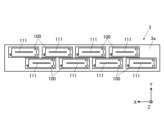
- FIG. 2 is a bottom view of the head unit.
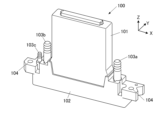
- FIG. 2 is a perspective view of an inkjet head.
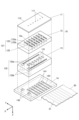
- FIG. 2 is an exploded perspective view of a main part of the inkjet head.
- FIG. 2 is an enlarged cross-sectional view of a portion of the inkjet head including a head chip.
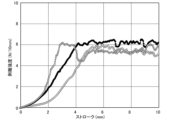
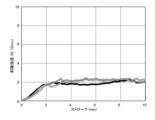
- 1 is a graph showing the measurement results of Example 1 of Test 1.
- 1 is a graph showing the measurement results of Comparative Example 1 of Test 1.
- 13 is a graph showing the measurement results of Test 3.
- FIG. 1 is a schematic diagram of an inkjet recording apparatus 1.
- the inkjet recording apparatus 1 includes a transport section 2 and a head unit 3.
- the transport unit 2 includes two transport rollers 2a and 2b that rotate in the Y direction (transport direction) around a rotation axis extending in the X direction in Fig. 1.
- the transport unit 2 also includes a ring-shaped transport belt 2c.
- the inner side of the conveyor belt 2c is supported by conveyor rollers 2a and 2b.
- the recording medium M is placed on the conveyor surface of the conveyor belt 2c.
- the conveyor rollers 2a and 2b rotate and move in the Y direction in response to the operation of a conveyor motor (not shown). As a result, the conveyor belt 2c conveys the recording medium M in the Y direction.
- the recording medium M is, for example, a sheet of paper cut to a certain size.
- the recording medium M is fed onto the conveyor belt 2c by a paper feeder (not shown).
- Ink is ejected from the head unit 3 onto the recording medium M to record an image, and the recording medium M is then discharged to a predetermined paper discharge section.
- a continuous roll of paper may be used as the recording medium M.
- the recording medium M may also be a cloth or a sheet-like resin. In this way, the recording medium M may be any medium as long as it is capable of fixing the ink that has landed on its surface.
- the head unit 3 records an image on the recording medium M transported by the transport unit 2.
- the head unit 3 ejects ink at appropriate timing based on image data to record an image.
- the inkjet recording device 1 of this embodiment includes four head units 3 corresponding to the four colors of ink, yellow (Y), magenta (M), cyan (C), and black (K).
- the four head units 3 are arranged at predetermined intervals in the order of colors YMCK from the upstream side in the transport direction of the recording medium M.
- the number of head units 3 may be three or less, or five or more.
- the ink ejected from the head unit 3 is a phase-transition ink that undergoes a reversible phase transition between gel and sol, or between solid and liquid.
- the phase-transition ink is heated to a temperature equal to or higher than the phase transition temperature by the heater 105 (see FIG. 5) and ejected in liquid form.
- the phase-transition ink solidifies by exposure to energy rays such as ultraviolet rays or by natural cooling.
- Specific examples of phase-transition ink include solder resist ink, UV ink, and wax ink.
- [Inkjet head] 2 is a plan view of one head unit 3 as viewed from the side facing the transport surface of the transport belt 2c, i.e., from the Z direction perpendicular to the X and Y directions.
- the head unit 3 includes a plate-shaped base 3a and a plurality of inkjet heads 100.
- the inkjet heads 100 are fitted and fixed in the through holes of the base 3a with the surface on which the openings of the nozzles 111 are provided being exposed from the through holes of the base 3a in the -Z direction.
- a plurality of nozzles 111 are arranged at equal intervals in the X direction.
- Each inkjet head 100 has a nozzle row which is a row of nozzles 111 arranged one-dimensionally at equal intervals in the X direction.
- the inkjet head 100 may have a plurality of nozzle rows. In this case, the nozzle rows are arranged such that the positions of the nozzles 111 in the X direction are shifted from each other so that they do not overlap with each other.
- the multiple inkjet heads 100 are arranged in a staggered pattern so that the X-direction arrangement ranges of the nozzles 111 are continuous.
- the X-direction arrangement range of the nozzles 111 in the head unit 3 covers the X-direction width of an image recordable area of the recording medium M transported by the transport belt 2c.
- the head unit 3 is fixed in position during image recording, and ejects ink to each position at a predetermined interval (interval in the transport direction) in response to the transport of the recording medium M.
- the inkjet recording device 1 records an image by a single pass method.
- FIG. 3 is a perspective view of one ink-jet head 100.
- the inkjet head 100 includes an exterior member 101 and a cover member 102.
- the exterior member 101 is fitted into the cover member 102 at its bottom end.
- the main components of the inkjet head 100 are housed inside the exterior member 101 and the cover member 102.
- the cover member 102 is provided with an inlet 103a through which ink is supplied from the outside, and outlets 103b and 103c through which ink is discharged to the outside.
- the cover member 102 is also provided with a plurality of mounting holes 104 for mounting the inkjet head 100 to the base 3a of the head unit 3.
- Figure 4 is an exploded perspective view of the main parts of one inkjet head 100.
- each component is drawn so that the nozzle opening surface 112 of the inkjet head 100 faces upward, i.e., the top and bottom are inverted from Figure 2.
- the surface on the -Z side of each substrate is also referred to as the top surface, and the surface on the +Z side is also referred to as the bottom surface.
- Figure 4 shows the main components of the inkjet head 100 that are housed inside the cover member 102.
- Figure 4 shows a head chip 10 having a nozzle substrate 11, a flow path spacer substrate 12 (flow path substrate), and a pressure chamber substrate 13.
- Figure 4 also shows a wiring substrate 14 fixed to the head chip 10, and an FPC 20 (Flexible Printed Circuit) electrically connected to the wiring substrate 14.
- FPC 20 Flexible Printed Circuit
- the head chip 10 has a structure in which a nozzle substrate 11, a flow path spacer substrate 12, and a pressure chamber substrate 13 are stacked.
- the nozzle substrate 11, the flow path spacer substrate 12, the pressure chamber substrate 13, and the wiring substrate 14 are all plate-like members that are approximately rectangular prism-shaped and elongated in the X direction.
- the nozzle substrate 11 is a silicon substrate on which nozzles 111, which are holes penetrating in the Z direction, are provided in a row. When viewed from the Z direction, each nozzle 111 is provided at a position overlapping with a through-flow path 122 of an ink flow path 121 (described later) of the flow path spacer substrate 12.
- the planar shape of the nozzle substrate 11 is substantially the same as those of the flow path spacer substrate 12 and the pressure chamber substrate 13.
- the surface of the nozzle substrate 11 opposite to the flow path spacer substrate 12 forms a nozzle opening surface 112 of the inkjet head 100.
- the thickness of the nozzle substrate 11 is, for example, about several tens of ⁇ m to several hundreds of ⁇ m.
- the flow channel spacer substrate 12 is a rectangular parallelepiped plate-like member having approximately the same size as the pressure chamber substrate 13 in a plan view.
- the flow channel spacer substrate 12 is bonded (fixed) to the upper surface of the pressure chamber substrate 13.
- the flow channel spacer substrate 12 in this embodiment is made of a silicon substrate.
- the thickness of the flow channel spacer substrate 12 is not particularly limited, but is approximately several hundred ⁇ m.
- the ink flow path 121 provided in the flow path spacer substrate 12 has a through flow path 122 and an individual ink discharge flow path 123.
- the through flow passage 122 is a flow passage that penetrates the flow passage spacer substrate 12 at a position that overlaps with the position where the pressure chamber 131 described below is formed when viewed from the Z direction.
- the cross-sectional shape of the through flow passage 122 parallel to the XY plane is a rectangle that is approximately the same as the cross-sectional shape of the pressure chamber 131.
- the opening of the through flow passage 122 on the pressure chamber substrate 13 side is connected to the pressure chamber 131.
- the opening of the through flow passage 122 on the nozzle substrate 11 side is connected to the nozzle 111.
- the individual ink discharge flow path 123 is a flow path branched from the through flow path 122.
- the individual ink discharge flow path 123 has a horizontal individual discharge flow path 123a and a vertical individual discharge flow path 123b.
- the horizontal individual discharge flow path 123a is a pair of groove-shaped flow paths each extending in the Y direction along the surface of the flow path spacer substrate 12 from the opening on the nozzle substrate 11 side of the through flow path 122.
- the vertical individual discharge flow path 123b is a flow path provided penetrating the flow path spacer substrate 12 from the end of the horizontal individual discharge flow path 123a.
- the opening on the pressure chamber substrate 13 side of the vertical individual discharge flow path 123b is connected to the horizontal common discharge flow path 132a of the common ink discharge flow path 132 described later. Therefore, the individual ink discharge flow path 123 guides the ink that has flowed into the horizontal individual discharge flow path 123a from the through flow path 122 to the common ink discharge flow path 132 via the vertical individual discharge flow path 123b.
- an ink discharge flow path is formed by the individual ink discharge flow paths 123 provided in the flow path spacer substrate 12 and the common ink discharge flow path 132 provided in the pressure chamber substrate 13. This ink discharge flow path discharges the ink in the pressure chamber 131 that has not been ejected from the nozzle 111.
- the pressure chamber substrate 13 is made of a ceramic piezoelectric material.
- a piezoelectric material is a member that deforms in response to the application of a voltage. Examples of the piezoelectric material include PZT (lead zirconate titanate), lithium niobate, barium titanate, lead titanate, and lead metaniobate.
- the pressure chambers 131 of the pressure chamber substrate 13 are through-holes provided in positions of the pressure chamber substrate 13 that overlap with the nozzles 111 when viewed from the Z direction.
- a cross section of the pressure chambers 131 along the XY plane forms a rectangle whose length is in the Y direction.
- a plurality of pressure chambers 131 are arranged in a row along the X direction. Ink is supplied to each pressure chamber 131 via an ink supply port 141 (described later) of the wiring substrate 14.
- Each pressure chamber 131 also communicates with the nozzle 111 via an ink flow path 121 of the flow path spacer substrate 12.
- Each pressure chamber 131 is separated from the other by a piezoelectric partition wall, and a drive electrode is provided on the inner wall surface of the partition wall.
- the partition wall repeatedly displaces in response to a drive signal applied to the drive electrode. The pressure of the ink in the pressure chamber 131 then fluctuates, causing the ink to be ejected from the nozzle 111.
- a common ink discharge flow path 132 is provided in the pressure chamber substrate 13.
- the common ink discharge flow paths 132 are provided at positions sandwiching the multiple pressure chambers 131 in the Y direction. A portion of the ink that is supplied from the pressure chambers 131 to the ink flow paths 121 of the flow path spacer substrate 12 and that is not ejected from the nozzles 111 returns to the common ink discharge flow path 132.
- the common ink discharge flow path 132 includes a horizontal common discharge flow path 132a and a vertical common discharge flow path 132b.
- the horizontal common discharge flow path 132a is a groove-shaped flow path that extends in the X direction along the surface of the pressure chamber substrate 13 on the flow path spacer substrate 12 side near the Y direction end.
- the vertical common discharge flow path 132b is connected to the horizontal common discharge flow path 132a at the end on the +X direction side of the horizontal common discharge flow path 132a, and is a flow path that penetrates the pressure chamber substrate 13 in the Z direction.
- the ink that returns to the horizontal common discharge flow path 132a passes through the vertical common discharge flow path 132b and the discharge hole 142 provided in the wiring substrate 14. The ink is then discharged to the outside of the inkjet head 100 from the outlet 103b or the outlet 103c.
- the wiring board 14 is a plate-like member for connecting wiring that applies a driving voltage from a driving circuit (not shown) to each driving electrode of the pressure chamber substrate 13.
- the wiring board 14 is a substrate made of, for example, glass, ceramics, silicon, plastic, etc. From the viewpoint of ensuring a bonding area with the pressure chamber substrate 13, the wiring board 14 is preferably a flat substrate having an area larger than the area of the pressure chamber substrate 13.
- the wiring substrate 14 is provided with a plurality of ink supply ports 141 at positions overlapping with the plurality of pressure chambers 131 of the pressure chamber substrate 13 when viewed from the Z direction.
- the wiring substrate 14 is also provided with a pair of discharge holes 142 at positions overlapping with the pair of vertical common discharge channels 132b.
- the bonding surface of the wiring substrate 14 to the pressure chamber substrate 13 is also provided with a plurality of wirings 143 extending from the ends of the plurality of ink supply ports 141 toward the ends of the wiring substrate 14.
- a common ink chamber 15 (see FIG. 5) is connected to the lower surface of the wiring substrate 14. Ink is supplied from the common ink chamber 15 to the ink supply port 141.
- the pressure chamber substrate 13 and the wiring substrate 14 are bonded together via a conductive adhesive containing conductive particles. This electrically connects the connection electrode on the surface of the pressure chamber substrate 13, which is electrically connected to the drive electrode, and the wiring 143 on the wiring substrate 14, electrically connected together via the conductive particles.
- the FPC 20 is connected to the end of the wiring board 14 where the wiring 143 is provided, via, for example, an ACF (Anisotropic Conductive Film).
- ACF Adisotropic Conductive Film
- FIG. 5 is a schematic cross-sectional view of a portion of the inkjet head 100 that includes the head chip 10.
- FIG. 5 shows a cross section of the inkjet head 100 perpendicular to the X direction.
- cover member 102 is provided so as to cover a part of head chip 10 while exposing nozzle opening surface 112 of nozzle substrate 11 of head chip 10. Cover member 102 is adhered to head chip 10 with adhesive 80 interposed therebetween.
- the cover member 102 has a top plate (first member) 1021 , a housing (second member) 1022 , and a sealing plate 1023 .
- the top plate 1021 is a rectangular plate-like member in which a recess forming surface 1021a, which is its upper surface, has a shape recessed in the center so as to have a recess R.
- the top plate 1021 is also provided with an exposed through hole 1021b having an opening at the deepest part of the recess R.
- the nozzle substrate 11 is attached to the exposed through hole 1021b via an adhesive 80.
- the head chip 10 may be attached to the top plate 1021 so that the nozzle opening surface 112 protrudes within the range of the recess R. With this structure, it becomes easier to bring the wiping member into contact with the nozzle opening surface 112 when wiping the recess forming surface 1021a of the top plate 1021 and the nozzle opening surface 112 with the wiping member.
- the housing 1022 is a plate-like member that covers the sides of the head chip 10.
- the housing 1022 is connected to the lower surface of the top plate 1021 via an adhesive 80.
- the housing 1022 is made of, for example, aluminum.
- the sealing plate 1023 is a plate-shaped member extending along the side surfaces of the flow channel spacer substrate 12 and the pressure chamber substrate 13 of the head chip 10.
- the sealing plate 1023 is connected to the surface of the top plate 1021 on the +Z direction side.
- the sealing plate 1023 holds the head chip 10 in the housing 1022.
- the sealing plate 1023 may be a separate member from the top plate 1021.
- the sealing plate 1023 may also be provided integrally with the top plate 1021.
- the heater 105 is a member that heats ink inside the housing 1022 and outside the head chip 10.
- the heater 105 is, for example, an electric heating wire or a heat transfer member.
- the heater 105 covers each member that constitutes the common ink chamber 15.
- the heater 105 is attached to the outer surface of each member that constitutes the common ink chamber 15.
- the ink in the head chip 10 is heated and kept at a predetermined temperature or higher by the heater 105. Specifically, the heater 105 heats the ink to a temperature of 60° C. or higher and 120° C. or lower. This causes the phase-change ink to be sufficiently liquid.
- a top plate 1021, a housing 1022 and a head chip 10 are bonded together with an adhesive 80 to form an integrated unit.
- the lower surface of the top plate 1021 and the housing 1022 are bonded with an adhesive 80.
- the housing 1022 and the inlet 103a and the outlets 103b and 103c are bonded with an adhesive 80.
- the side portion of the top plate 1021 and the side portion of the head chip 10 are bonded with an adhesive 80.
- the adhesive 80 of the present invention bonds the various components that make up the inkjet head 100 together.
- the adhesive 80 not only functions as a simple adhesive member, but also as a sealing member that prevents ink from flowing in from outside the cover member 102.
- the adhesive 80 used is one that is resistant to ink, i.e., solvent resistant. In other words, it is preferable that the adhesive 80 be hard and have a high Tg (glass transition point). Specifically, it is preferable that the adhesive 80 have a Tg of 80°C or higher.
- adhesives 80 include epoxy adhesives, phenol adhesives, polyurethane-isocyanate adhesives, and acrylic ester adhesives.
- Epoxy adhesives consist of a combination of an epoxy resin (base) and a curing agent.
- base agents include bisphenol A type epoxy resin, bisphenol F type epoxy resin, phenol novolac type epoxy resin, cresol novolac type epoxy resin, triazine skeleton epoxy resin, and glycidyl amine type epoxy resin.
- curing agents include amine type curing agents, polyaminoamide type curing agents, acid anhydride type curing agents, dicyandiamide type curing agents, polymercaptan type curing agents, and imidazole type curing agents.
- the adhesive 80 used has a Young's modulus of 0.5 GPa or more and 3 GPa or less after curing.
- the Young's modulus is measured by evaluation using the Plastics - Tensile Properties Test Method (JIS K7161-1994).
- JIS K7161-1994 the Plastics - Tensile Properties Test Method
- the adhesive 80 has suitable elasticity.
- mechanical stress can be uniformly distributed, and mechanical strength against bending and impact can be increased.
- the adhesive 80 can then absorb thermal stress while maintaining its adhesive force. This makes it possible to suppress peeling between components in the inkjet recording device 1, even when the temperature of the phase-change ink is returned to room temperature.
- epoxy adhesives with a Young's modulus of 3 GPa or less after curing are rare. Therefore, when using epoxy adhesives, it is necessary to reduce the Young's modulus after curing.
- One method for reducing the Young's modulus of the cured adhesive 80 to 3 GPa or less is to add balloon-shaped hollow particles containing gas. When hollow particles are added to the adhesive 80, the density of the adhesive 80 decreases, and the Young's modulus decreases.
- balloon-like refers to a core/shell type microcapsule with gas enclosed inside the shell.
- the hollow particles that are preferably used are generally called microballoons.
- microballoons are used that contain ethylene gas inside a rubber material with a thickness of 0.1 ⁇ m or less and are made spherical by heating and expanding them.
- polymer hollow microsphere composites (Matsumoto Microsphere MFL series, manufactured by Matsumoto Yushi Seiyaku Co., Ltd.) are used.
- hollow silica particles Hipressica
- the average particle diameter of the hollow particles is 10 ⁇ m or more and 70 ⁇ m or less. If the average particle diameter is less than 10 ⁇ m, the stress relaxation effect of the hollow particles is not effectively expressed.
- the thickness of the adhesive 80 that bonds the side portion of the top plate 1021 and the side portion of the head chip 10 is 50 ⁇ m to 100 ⁇ m. Therefore, if the average particle diameter of the hollow particles is more than 70 ⁇ m, the adhesive 80 will not have solvent resistance at the joint, which is not preferable.
- the average particle diameter of the hollow particles is 10 ⁇ m or more and 70 ⁇ m or less, the adhesive 80 will have a stress relaxation effect without significantly reducing the sealing performance at the joint. In particular, it is more preferable that the average particle diameter of the hollow particles is 10 ⁇ m to 30 ⁇ m.
- the mixing ratio of hollow particles in adhesive 80 is preferably 45% to 85% by volume relative to the total amount of adhesive 80. If the volume ratio of hollow particles to adhesive 80 is less than 45%, the Young's modulus of adhesive 80 does not decrease, and thermal stress cannot be absorbed, which is not preferable. Also, if the volume ratio of hollow particles to adhesive 80 is more than 85%, mixing with adhesive 80 becomes incomplete, and adhesive 80 loses solvent resistance, which is not preferable. On the other hand, if the mixing ratio of hollow particles is 45% or more and 85% or less by volume relative to the total amount of adhesive 80, adhesive 80 has a stress relaxation effect and solvent resistance.
- the Young's modulus of the adhesive 80 may be set to 0.5 GPa or more and 3 GPa or less by adding acrylic rubber particles that contain an elastic polymer mainly composed of acrylic ester.
- the method for setting the Young's modulus of the adhesive 80 to 0.5 GPa or more and 3 GPa or less is not particularly limited, and any known method may be used as appropriate.
- Primer layer 90 As shown in FIG. 5, it is preferable to provide a primer layer 90 between the adhesive 80 and the top plate 1021 .
- the top plate 1021 is made of metal and has low surface tension, so that the adhesive 80 has low adhesion to it. Therefore, by providing a primer layer 90 on the surface of the top plate 1021, the adhesion between the adhesive 80 and the top plate 1021 can be improved.
- the primer layer 90 is not particularly limited as long as it is transparent and has a large amount of hydroxyl groups on the surface.
- Orgatix organotitanium compound (TA-21, manufactured by Matsumoto Fine Chemical Co., Ltd.) is used for the primer layer 90.
- Orgatix organotitanium compound contains metal atoms or M-OH groups (alkoxide), and forms an amorphous (non-crystallized) titanium oxide film by hydrolysis caused by heat treatment. These then bond with the MOM groups contained in the top plate 1021 or form covalent bonds or hydrogen bonds with the M-OH groups, improving the adhesion between the primer layer 90 and the top plate 1021.
- the primer layer 90 can be formed by a vacuum film formation method, mainly a sputtering method, or a sol-gel method.
- a vacuum film formation method mainly a sputtering method, or a sol-gel method.
- the primer layer 90 becomes a thin film that may crack, making it difficult to obtain the desired characteristics.
- the primer layer 90 becomes a thick film with a thickness of 0.1 ⁇ m or more, reducing the possibility of cracking, making it easier to obtain the desired characteristics.
- adhesive A is adhesive 80 containing microballoons, which has a Young's modulus of about 2.6 GPa when cured at 60° C. for 6 hours.
- Adhesive B is an adhesive not containing microballoons, which has a Young's modulus of about 5.41 GPa when cured at 60° C. for 6 hours.
- Example 1 and Comparative Example 1 are shown in Table II.
- Example 1 and Comparative Example 1 was peeled off so that the PI was folded back by 90°.
- the peel strength of each bonded object was then measured three times using a tensile tester (Strograph, manufactured by Toyo Seiki Seisakusho).
- Figure 6 is a graph showing the measurement results for Example 1.
- Figure 7 is a graph showing the measurement results for Comparative Example 1.
- the horizontal axis shows the stroke (mm).
- the vertical axis shows the peel strength (N/10 mm).
- the peel strength of Example 1, which was bonded with adhesive A containing microballoons was 5.7 N/10 mm on average. The cohesive failure rate was confirmed visually and was about 90%.
- the peel strength of Comparative Example 1, which was bonded with adhesive B not containing microballoons was 2.1 N/10 mm on average. The cohesive failure rate was confirmed visually and was 10% or less, indicating interfacial peeling. In this way, the use of adhesive 80 in which the elastic modulus after hardening is reduced by adding microballoons reduces stress and increases peel strength.
- Example 2-8 and Comparative Example 2-5 were subjected to Tests 2-1 and 2-2 described below.
- Test 2-1 Heat cycle test
- the inkjet heads 100 of Example 2-8 and Comparative Example 2-5 were placed in a thermostatic chamber at 100° C. for 1 hour and then placed in a thermostatic chamber at ⁇ 20° C. for 1 hour, and this cycle was repeated 10 times. Thereafter, the inkjet heads 100 of Example 2-8 and Comparative Example 2-5 were checked for the presence or absence of sealing leakage at the joints. Specifically, the ink flow path 121 was depressurized to 0.1 atm for 10 seconds, and air leakage was measured.
- the evaluation criteria for Test 2-1 were as follows. A: There was no air leakage. B: Air leakage is 0.2 ml or less. C: Air leakage exceeds 0.2 ml.
- Test 2-2 Solvent-resistant ink characteristic test
- the inkjet heads 100 of Example 2-8 and Comparative Example 2-5 were immersed in a test liquid at 60° C. for one week.
- the test liquids in this test were cyclohexane, ethyl lactate, xylene, and ethylene glycol monobutyl ether, which are solvents used in solvent inks.
- the ink flow path 121 was depressurized to 0.1 atm for 10 seconds, and air leakage was measured.
- the evaluation criteria for Test 2-2 were as follows: G: Air leakage is 0.2 ml or less. NG: Air leakage exceeds 0.2 ml.
- Table V shows the results of Test 2-1 and Test 2-2.
- the overall evaluation is given as "A” when Test 2-1 is “A” and Test 2-2 is “G”.
- Test 2-1 is “B” and Test 2-2 is “G”, it is given as “B”.
- Test 2-1 is “C” or Test 2-2 is “NG”, it is given as "C”.
- Example 5 Comparing Example 5 with Comparative Example 5, and Example 7 with Comparative Example 3, it can be seen that by connecting with adhesive 80 having a Young's modulus after curing of 0.5 GPa or more and 3 GPa or less, an inkjet head 100 that can withstand thermal stress and has solvent resistance can be obtained.
- Example 2 Compared Example 2 with Example 3, Example 4 with Example 5, and Example 6 with Example 7, it is found that providing the primer layer 90 improves the thermal stress absorption of the adhesive 80.
- Comparisons 3 and 4 are compared with the other examples and comparative examples. It is found that the inkjet head 100 has solvent resistance by using an adhesive 80 in which the hollow particles are 70 ⁇ m or less and the mixing ratio of the hollow particles is 85% or less by volume relative to the total amount of adhesive 80.
- the adhesive strength with and without the primer layer 90 was evaluated by a 90 degree peel strength test (JIS K6854-1:1999). Specifically, two sets were prepared, each consisting of a top plate 1021 made of SUS430 and one day after plasma treatment, and PI (polyimide). The top plate 1021 and PI of each set were bonded with adhesive A. At this time, the top plate 1021 of the first set (Example 9) was not provided with a primer layer 90. The top plate 1021 of the second set (Example 10) was provided with a primer layer 90.
- the primer layer 90 in this test was made of an ORGATIX organic compound, and had a thickness of 0.1 ⁇ m or more, formed by the sol-gel method. Next, a part of these adhesives was peeled off, and the PI was folded back by 90°. The peel strength of each adhesive was measured using a tensile tester (Strograph, manufactured by Toyo Seiki Seisakusho).
- FIG. 8 is a graph showing the measurement results of Test 3.
- the vertical axis shows the peel strength (N/10 mm) of Examples 9 and 10.
- the peel strength of Example 10 in which the primer layer 90 is provided is improved by about 20% compared to the peel strength of Example 9, in which the primer layer 90 is not provided.
- the inkjet head 100 includes the cover member 102 that houses the head chip 10, the common ink chamber 15, and the heater 105.
- the cover member 102 includes the first member 1021 and the second member 1022 that are connected with the adhesive 80 having a Young's modulus after hardening of 0.5 GPa or more and 3 GPa or less.
- the adhesive 80 has elasticity and can absorb thermal stress while maintaining the adhesive strength of the adhesive 80. Therefore, even if thermal stress occurs due to changes in the volume and volumetric shrinkage rate associated with temperature changes in the phase-change ink, the inkjet head 100 can withstand the thermal stress.
- the adhesive 80 is an epoxy resin adhesive. According to this configuration, the first member 1021 and the second member 1022 can be strongly bonded to each other.
- the adhesive 80 contains hollow particles having an average particle size of 10 ⁇ m or more and 70 ⁇ m or less. According to this configuration, it is possible to provide a stress relaxation effect without significantly reducing the adhesive sealing performance at the joint of the adhesive 80, and it is also possible to achieve solvent resistance.
- the hollow particles are contained in the adhesive 80 at a volume ratio of 45% to 85%. If the volume ratio of the hollow particles to the adhesive 80 is increased, the curing property of the adhesive 80 deteriorates, and the solvent resistance and adhesive performance decrease. However, by adopting the above-mentioned configuration, it is possible to achieve both the solvent resistance and the effect of decreasing the Young's modulus.
- a primer layer 90 is provided between the adhesive 80 and the first member 1021 . According to this configuration, the adhesive strength of the first member 1021 can be further increased.
- the primer layer 90 has a thickness of 0.1 ⁇ m or more. According to this configuration, the primer layer 90 becomes a thick film, so that cracks are less likely to occur and the desired characteristics are more easily obtained.
- the adhesive 80 that bonds the first member 1021 and the second member 1022 comes into contact with the ink.
- the adhesive 80 comes into contact with ink, if peeling occurs between the components, the ink will seep in through the peeled portion and come into contact with the electrical connection parts of the FPC 20, etc., causing a break in the wire.
- peeling between the components can be suppressed, so that even with the above configuration, breaks in the electrical connection parts can be suppressed.
- the heater 105 heats the ink to a temperature of 60° C. or higher and 120° C. or lower. According to this configuration, ink that has undergone a sufficient phase transition to a liquid state can be ejected onto the recording medium M.
- the present invention can be used in inkjet heads and inkjet recording devices that have excellent durability against repeated hot and cold cycles.
- Inkjet recording apparatus 10 Head chip 102 Cover member 1021 Top plate (first member) 1021b Exposure through hole 1022 Housing (second member) 105 heater 111 nozzle 112 nozzle opening surface 15 common ink chamber 80 adhesive 90 primer layer 100 inkjet head
Landscapes
- Engineering & Computer Science (AREA)
- Manufacturing & Machinery (AREA)
- Particle Formation And Scattering Control In Inkjet Printers (AREA)
Priority Applications (2)
| Application Number | Priority Date | Filing Date | Title |
|---|---|---|---|
| EP24770364.8A EP4681924A1 (en) | 2023-03-16 | 2024-02-15 | Inkjet head and inkjet recording device |
| JP2025506608A JPWO2024190249A1 (https=) | 2023-03-16 | 2024-02-15 |
Applications Claiming Priority (2)
| Application Number | Priority Date | Filing Date | Title |
|---|---|---|---|
| JP2023-042296 | 2023-03-16 | ||
| JP2023042296 | 2023-03-16 |
Publications (1)
| Publication Number | Publication Date |
|---|---|
| WO2024190249A1 true WO2024190249A1 (ja) | 2024-09-19 |
Family
ID=92755215
Family Applications (1)
| Application Number | Title | Priority Date | Filing Date |
|---|---|---|---|
| PCT/JP2024/005150 Ceased WO2024190249A1 (ja) | 2023-03-16 | 2024-02-15 | インクジェットヘッド及びインクジェット記録装置 |
Country Status (3)
| Country | Link |
|---|---|
| EP (1) | EP4681924A1 (https=) |
| JP (1) | JPWO2024190249A1 (https=) |
| WO (1) | WO2024190249A1 (https=) |
Citations (5)
| Publication number | Priority date | Publication date | Assignee | Title |
|---|---|---|---|---|
| JP2003165217A (ja) | 2001-11-30 | 2003-06-10 | Hitachi Printing Solutions Ltd | インクジェットヘッド |
| US20040004649A1 (en) * | 2002-07-03 | 2004-01-08 | Andreas Bibl | Printhead |
| JP2009149056A (ja) * | 2007-11-30 | 2009-07-09 | Canon Inc | インクジェット記録ヘッドおよびインクジェット記録装置 |
| JP2012011560A (ja) * | 2010-06-29 | 2012-01-19 | Seiko Epson Corp | 液体噴射ヘッド |
| JP2015145062A (ja) * | 2014-01-31 | 2015-08-13 | セイコーエプソン株式会社 | 液体噴射ヘッド及び液体噴射装置 |
-
2024
- 2024-02-15 JP JP2025506608A patent/JPWO2024190249A1/ja active Pending
- 2024-02-15 WO PCT/JP2024/005150 patent/WO2024190249A1/ja not_active Ceased
- 2024-02-15 EP EP24770364.8A patent/EP4681924A1/en active Pending
Patent Citations (5)
| Publication number | Priority date | Publication date | Assignee | Title |
|---|---|---|---|---|
| JP2003165217A (ja) | 2001-11-30 | 2003-06-10 | Hitachi Printing Solutions Ltd | インクジェットヘッド |
| US20040004649A1 (en) * | 2002-07-03 | 2004-01-08 | Andreas Bibl | Printhead |
| JP2009149056A (ja) * | 2007-11-30 | 2009-07-09 | Canon Inc | インクジェット記録ヘッドおよびインクジェット記録装置 |
| JP2012011560A (ja) * | 2010-06-29 | 2012-01-19 | Seiko Epson Corp | 液体噴射ヘッド |
| JP2015145062A (ja) * | 2014-01-31 | 2015-08-13 | セイコーエプソン株式会社 | 液体噴射ヘッド及び液体噴射装置 |
Non-Patent Citations (1)
| Title |
|---|
| See also references of EP4681924A1 |
Also Published As
| Publication number | Publication date |
|---|---|
| JPWO2024190249A1 (https=) | 2024-09-19 |
| EP4681924A1 (en) | 2026-01-21 |
Similar Documents
| Publication | Publication Date | Title |
|---|---|---|
| US6170931B1 (en) | Ink jet heater chip module including a nozzle plate coupling a heater chip to a carrier | |
| CN101254696B (zh) | 液体喷射头组件的制造方法以及液体喷射头组件 | |
| US8608287B2 (en) | Printhead module | |
| JP6964978B2 (ja) | 液体噴射ヘッド及び液体噴射装置 | |
| JP5059300B2 (ja) | インクジェットヘッド | |
| US8388778B2 (en) | Print head with reduced bonding stress and method | |
| CN107433777B (zh) | 液体喷射头以及液体喷射装置 | |
| US9004648B2 (en) | Inkjet printheads containing epoxy adhesives and methods for fabrication thereof | |
| WO2024190249A1 (ja) | インクジェットヘッド及びインクジェット記録装置 | |
| JP4957896B2 (ja) | ノズル形成部材の製造方法及び液体噴射ヘッドの製造方法並びに液体噴射ヘッドユニットの製造方法 | |
| KR101867275B1 (ko) | 잉크젯 프린트헤드 및 이의 제조 방법 | |
| JP4506145B2 (ja) | 液体噴射ヘッド及びその製造方法並びに液体噴射装置 | |
| JP2002331667A (ja) | 記録ヘッド、記録ヘッドの製造方法、およびインクジェット記録装置 | |
| JP4109898B2 (ja) | インクジェット記録ヘッド | |
| US20150352842A1 (en) | Liquid jet head and liquid jet apparatus | |
| JP2007050639A (ja) | デバイス実装構造、デバイス実装方法、電子装置、液滴吐出ヘッド、及び液滴吐出装置 | |
| JP7147319B2 (ja) | 液体噴射装置および液体噴射ヘッド | |
| JP2004001382A (ja) | インクジェット用プリントヘッド | |
| JPH10337875A (ja) | ノズル形成部材及びその製造方法並びにインクジェットヘッド | |
| CN112622446B (zh) | 喷墨头和喷墨打印机 | |
| JP7540237B2 (ja) | 液体吐出ヘッド、ヘッドモジュール、液体カートリッジ、液体吐出ユニット及び液体吐出装置 | |
| JP2001018397A (ja) | インクジェットヘッドおよびその製造方法 | |
| JPH0353942A (ja) | 記録装置 | |
| JP2001063037A (ja) | インクジェットヘッド | |
| JP2009166336A (ja) | 液体噴射ヘッド及び液体噴射装置 |
Legal Events
| Date | Code | Title | Description |
|---|---|---|---|
| 121 | Ep: the epo has been informed by wipo that ep was designated in this application |
Ref document number: 24770364 Country of ref document: EP Kind code of ref document: A1 |
|
| ENP | Entry into the national phase |
Ref document number: 2025506608 Country of ref document: JP Kind code of ref document: A |
|
| WWE | Wipo information: entry into national phase |
Ref document number: 2025506608 Country of ref document: JP |
|
| WWE | Wipo information: entry into national phase |
Ref document number: 2024770364 Country of ref document: EP |
|
| NENP | Non-entry into the national phase |
Ref country code: DE |
|
| ENP | Entry into the national phase |
Ref document number: 2024770364 Country of ref document: EP Effective date: 20251016 |
|
| ENP | Entry into the national phase |
Ref document number: 2024770364 Country of ref document: EP Effective date: 20251016 |
|
| ENP | Entry into the national phase |
Ref document number: 2024770364 Country of ref document: EP Effective date: 20251016 |
|
| ENP | Entry into the national phase |
Ref document number: 2024770364 Country of ref document: EP Effective date: 20251016 |
|
| ENP | Entry into the national phase |
Ref document number: 2024770364 Country of ref document: EP Effective date: 20251016 |
|
| WWP | Wipo information: published in national office |
Ref document number: 2024770364 Country of ref document: EP |