WO2024190069A1 - プローブ - Google Patents
プローブ Download PDFInfo
- Publication number
- WO2024190069A1 WO2024190069A1 PCT/JP2024/001241 JP2024001241W WO2024190069A1 WO 2024190069 A1 WO2024190069 A1 WO 2024190069A1 JP 2024001241 W JP2024001241 W JP 2024001241W WO 2024190069 A1 WO2024190069 A1 WO 2024190069A1
- Authority
- WO
- WIPO (PCT)
- Prior art keywords
- plunger
- coil
- plane
- barrel
- coil portion
- Prior art date
- Legal status (The legal status is an assumption and is not a legal conclusion. Google has not performed a legal analysis and makes no representation as to the accuracy of the status listed.)
- Ceased
Links
Images


Classifications
-
- G—PHYSICS
- G01—MEASURING; TESTING
- G01R—MEASURING ELECTRIC VARIABLES; MEASURING MAGNETIC VARIABLES
- G01R1/00—Details of instruments or arrangements of the types included in groups G01R5/00 - G01R13/00 and G01R31/00
- G01R1/02—General constructional details
- G01R1/06—Measuring leads; Measuring probes
- G01R1/067—Measuring probes
- G01R1/06711—Probe needles; Cantilever beams; "Bump" contacts; Replaceable probe pins
- G01R1/06716—Elastic
- G01R1/06722—Spring-loaded
-
- G—PHYSICS
- G01—MEASURING; TESTING
- G01R—MEASURING ELECTRIC VARIABLES; MEASURING MAGNETIC VARIABLES
- G01R1/00—Details of instruments or arrangements of the types included in groups G01R5/00 - G01R13/00 and G01R31/00
- G01R1/02—General constructional details
- G01R1/06—Measuring leads; Measuring probes
- G01R1/067—Measuring probes
-
- G—PHYSICS
- G01—MEASURING; TESTING
- G01R—MEASURING ELECTRIC VARIABLES; MEASURING MAGNETIC VARIABLES
- G01R1/00—Details of instruments or arrangements of the types included in groups G01R5/00 - G01R13/00 and G01R31/00
- G01R1/02—General constructional details
- G01R1/06—Measuring leads; Measuring probes
- G01R1/067—Measuring probes
- G01R1/06711—Probe needles; Cantilever beams; "Bump" contacts; Replaceable probe pins
- G01R1/06733—Geometry aspects
-
- G—PHYSICS
- G01—MEASURING; TESTING
- G01R—MEASURING ELECTRIC VARIABLES; MEASURING MAGNETIC VARIABLES
- G01R31/00—Arrangements for testing electric properties; Arrangements for locating electric faults; Arrangements for electrical testing characterised by what is being tested not provided for elsewhere
- G01R31/26—Testing of individual semiconductor devices
-
- G—PHYSICS
- G01—MEASURING; TESTING
- G01R—MEASURING ELECTRIC VARIABLES; MEASURING MAGNETIC VARIABLES
- G01R31/00—Arrangements for testing electric properties; Arrangements for locating electric faults; Arrangements for electrical testing characterised by what is being tested not provided for elsewhere
- G01R31/28—Testing of electronic circuits, e.g. by signal tracer
- G01R31/2851—Testing of integrated circuits [IC]
- G01R31/2886—Features relating to contacting the IC under test, e.g. probe heads; chucks
- G01R31/2889—Interfaces, e.g. between probe and tester
Definitions
- the present invention relates to a probe.
- one object of the present invention is to stably press the plunger against the inner wall of the barrel.
- One aspect of the present invention is a probe comprising a first plunger, a barrel that holds the first plunger in a movable state, and a coil spring that biases the first plunger, the coil spring having a first coil portion, a second coil portion, and a third coil portion, the first coil portion being located at one end of the third coil portion and in contact with the first plunger, and the second coil portion being located at the other end of the third coil portion, and in a state where no load is applied to the coil spring, at least one of a first plane perpendicular to the first central axis of the first coil portion and a second plane perpendicular to the second central axis of the second coil portion is non-parallel to a third plane perpendicular to the third central axis of the third coil portion.
- the above aspect of the present invention allows the plunger to be stably pressed against the inner wall of the barrel.
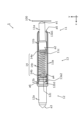
- FIG. 4 is a configuration diagram of the probe before a force is applied to a first plunger in the embodiment.
- FIG. FIG. 2 is an exploded view of the probe according to the embodiment.
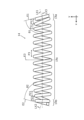
- FIG. 2 is a side view of the coil spring of the present embodiment.
- 4 is a configuration diagram of the probe in the present embodiment in a state where a force is applied to a first plunger.
- the barrel 13 is shown in cross section, and the other members are shown in side view.
- the direction in which the plunger and barrel are aligned is defined as the x direction
- the direction perpendicular to the x direction is defined as the y direction.
- the direction in which the first plunger 11, barrel 13, and second plunger 12 are aligned is the x direction
- the radial direction of each of the first plunger 11, barrel 13, and second plunger 12 is the y direction.
- the directions indicated by the arrows on the x and y axes are defined as the leftward and upward directions, respectively.
- the probe 1 in this embodiment includes a first plunger (terminal on the substrate side of the inspection device) 11, a second plunger (terminal on the inspection target side) 12, a barrel 13, and a coil spring 14.
- the probe 1 is a measuring device used for semiconductor inspection (see FIGS. 1 and 2).
- the first plunger 11, the second plunger 12, the barrel 13, and the coil spring 14 are made of conductive materials.
- the probe 1 is configured such that the coil spring 14 in the barrel 13 biases the first plunger 11 in a direction to protrude from the barrel 13.
- the first plunger 11 has a first contact portion 11a and a first base end portion 11b.
- the radial size of the first contact portion 11a is smaller than the radial size of the first base end portion 11b.
- the end (first tip a1) of the first contact portion 11a protrudes from the inside to the outside of the barrel 13. That is, at least a part of the first contact portion 11a is exposed from the barrel 13.
- the first base end 11b is held by the barrel 13 in a state in which it can move in the x direction.
- the side of the first contact portion 11a that contacts the first base end 11b (the left side of the first contact portion 11a in the x direction) is located inside the barrel 13.
- the end (second tip a2) on the left side in the x direction of the first base end 11b is formed with a first protrusion 11c that protrudes to the side where the second plunger 12 is located (the left side in the x direction).
- the radial size of the first protrusion 11c is smaller than the radial size of the second tip a2.
- the second tip a2 has a flat shape in the radial direction.
- the first coil portion 14a of the coil spring 14 is inserted into the first protrusion 11c.
- the second plunger 12 has a second contact portion 12a and a second base end portion 12b.
- the radial size of the second contact portion 12a is smaller than the radial size of the second base end portion 12b.
- the end (third tip a3) of the second contact portion 12a protrudes from the inside to the outside of the barrel 13. That is, at least a part of the second contact portion 12a is exposed from the barrel 13.
- the second base end 12b is held by the barrel 13 in a state where it cannot move relative to the barrel 13.
- the end (fourth tip a4) on the right side in the x direction of the second base end 12b is formed with a second protrusion 12c that protrudes to the side where the first plunger 11 is located (right side in the x direction).
- the radial size of the second protrusion 12c is smaller than the radial size of the fourth tip a4.
- the fourth tip a4 is a flat shape in the radial direction.
- the second coil portion 14b of the coil spring 14 is inserted into the second protrusion 12c.
- the second base end 12b has a first recessed region 12b1 whose outer diameter is smaller than that of the adjacent region.
- the barrel 13 has a main body portion 13a having a cylindrical shape.
- the end (fifth tip a5) of the main body 13a that holds the first plunger 11 is bent toward the inside of the cylindrical shape, forming a narrowed region (first convex region 13a1) with a smaller inner diameter.
- the first convex region 13a1 prevents the first base end 11b of the first plunger 11 from slipping out to the right in the x direction.
- the first convex region 13a1 may be formed around the entire circumference of the fifth tip a5, or may be formed on only a part of the fifth tip a5.
- a narrowed area (second convex area 13a2) that protrudes toward the inside of the cylindrical shape and has a smaller inner diameter is formed.
- the first recessed area 12b1 of the second base end 12b of the second plunger 12 is hooked onto the second convex area 13a2, and the second plunger 12 is fixed to the barrel 13.
- the second convex area 13a2 may be formed around the entire circumference of the inner wall of the main body 13a, or may be formed on only a part of the inner wall of the main body 13a.
- the coil spring 14 is located in the barrel 13 and biases the first plunger 11 in the x-direction, causing the first contact portion 11a of the first plunger 11 to protrude from the inside to the outside of the barrel 13.
- the coil spring 14 has a first coil portion 14a, a second coil portion 14b, and a third coil portion 14c (see FIGS. 3 and 4).
- the first coil portion 14a, the second coil portion 14b, and the third coil portion 14c are integrally formed.
- the first coil portion 14a is located at one end of the third coil portion 14c and contacts the first plunger 11.
- the first coil portion 14a includes a seat winding and is configured with a closed end.
- the second coil portion 14b is located at the other end of the third coil portion 14c and contacts the second plunger 12.
- the second coil portion 14b includes a seat winding and is configured with a closed end.
- the inner diameters of the first coil portion 14a and the second coil portion 14b are smaller than the inner diameter of the third coil portion 14c.
- the third coil portion 14c is deflected more greatly in response to a load than the first coil portion 14a and the second coil portion 14b.
- the third coil portion 14c is formed of a generally cylindrical spring whose inner diameter at the end portion is smaller than the inner diameter at the center portion.
- the outer diameters of the first coil portion 14a, the second coil portion 14b, and the third coil portion 14c are smaller than the inner diameter of the barrel 13.
- the first plane E1 perpendicular to the central axis (first central axis LX1) of the first coil portion 14a forms a predetermined angle (first angle ⁇ 1) less than 90 degrees with the central axis (third central axis LX3) of the third coil portion 14c. That is, the first plane E1 is not parallel to the third plane E3 perpendicular to the third central axis LX3. In other words, the first plane E1 is inclined with respect to the third plane E3. Since the first plane E1 is inclined with respect to the third plane E3, the first central axis LX1 extends in a direction different from the direction in which the third central axis LX3 extends (x direction). In addition, the first central axis LX1 intersects with the end face of the first coil portion 14a at a position shifted from the area through which the third central axis LX3 passes on the end face of the first coil portion 14a.
- the second plane E2 perpendicular to the central axis (second central axis LX2) of the second coil portion 14b forms a predetermined angle (second angle ⁇ 2) less than 90 degrees with the third central axis LX3. That is, the second plane E2 is not parallel to the third plane E3 perpendicular to the third central axis LX3. In other words, the second plane E2 is inclined with respect to the third plane E3. Since the second plane E2 is inclined with respect to the third plane E3, the second central axis LX2 extends in a direction different from the direction in which the third central axis LX3 extends (x direction). In addition, the second central axis LX2 intersects with the end face of the second coil portion 14b at a position shifted from the area through which the third central axis LX3 passes on the end face of the second coil portion 14b.
- first angle ⁇ 1 and the second angle ⁇ 2 are the same angle between 75 degrees and 85 degrees.
- the winding pitch of the coil spring 14 is formed as follows:
- At least one of the pitch of the windings close to the first coil portion 14a of the third coil portion 14c (11th pitch P11) and the pitch between the third coil portion 14c and the first coil portion 14a (12th pitch P12) on one side in the y direction (e.g., the upper side in the y direction) is narrower than the pitch of the other region (the pitch of the region of the third coil portion 14c away from the first coil portion 14a and the second coil portion 14b (3rd pitch P3)).
- at least one of the 11th pitch P11 and the 12th pitch P12 on the other side in the y direction is wider than the third pitch P3.
- At least one of the pitch of the winding of the third coil portion 14c close to the second coil portion 14b (21st pitch P21) and the pitch between the third coil portion 14c and the second coil portion 14b (22nd pitch P22) on one side of the y direction is narrower than the third pitch P3. And/or at least one of the pitches of the 21st pitch P21 and the 22nd pitch P22 on the other side of the y direction is wider than the third pitch P3.
- the coil spring 14 is formed so that on one side of the y direction, the first plane E1 and the third plane E3 approach each other, and on the other side of the y direction, the first plane E1 and the third plane E3 move away from each other, and on one side of the y direction, the second plane E2 and the third plane E3 approach each other, and on the other side of the y direction, the second plane E2 and the third plane E3 move away from each other, i.e., the first plane E1 and the second plane E2 intersect to form an approximate V-shape.
- the coil spring 14 be formed so that the first plane E1 and the second plane E2 are in a line-symmetrical positional relationship, i.e., so that the first angle ⁇ 1 and the second angle ⁇ 2 are equal.
- first plane E1 and the second plane E2 are not parallel to the third plane E3
- other positional relationships are also possible, such as the first plane E1 and the second plane E2 being parallel.
- a second convex region 13a2 is formed by a punch or the like.
- the first recessed region 12b1 of the second base end 12b fits into the second convex region 13a2 of the body portion 13a of the barrel 13, and the second plunger 12 is fixed to the barrel 13.
- the probe 1 of this embodiment is formed.
- the force applied to the first plunger 11 and the second plunger 12 pushes the first plunger 11 into the barrel 13.
- a compressive force is applied to the coil spring 14.
- the third coil portion 14c contracts in the x direction and is partially displaced in the y direction, deforming into an arched or serpentine shape. Because the third coil portion 14c deforms into an arched or serpentine shape, a portion of the third coil portion 14c comes into contact with the inner wall of the barrel 13.
- the first coil portion 14a pushes the first plunger 11 in the x direction.
- the first coil portion 14a also pushes the first plunger 11 in the y direction, in the opposite direction to the displacement of the third coil portion 14c (applies lateral pressure).
- the first coil portion 14a pushes the first plunger 11 in the y direction, the first base end portion 11b is pressed against the inner wall of the barrel 13, causing the first plunger 11 to become tilted.
- the first plunger 11 is electrically connected to the second plunger 12 via the barrel 13.
- the first plunger 11 can be stably pressed against the inner wall of the barrel 13, making it easier to maintain the first plunger 11 electrically connected to the barrel 13. And it makes it easier to maintain the first plunger 11 electrically connected to the second plunger 12 via the barrel 13.
- the coil spring 14 can be deformed into an arched or serpentine shape, so that a portion of the coil spring 14 can easily come into contact with the inner wall of the barrel 13. Even if the second plane E2 is inclined with respect to the third plane E3, a portion of the coil spring 14 can be easily brought into contact with the inner wall of the barrel 13. Therefore, as long as at least one of the first plane E1 and the second plane E2 is inclined with respect to the third plane E3, the first plunger 11 can be pressed against the inner wall of the barrel 13 in a stable manner.
- the first plunger 11 can be pressed against the inner wall of the barrel 13 more stably in a configuration in which both the first plane E1 and the second plane E2 are inclined with respect to the third plane E3 than in a configuration in which only one of the first plane E1 and the second plane E2 is inclined with respect to the third plane E3.
- the coil spring 14 is easier to form than in a configuration in which the first plane E1 and the second plane E2 are not line-symmetrically positioned. Also, the coil spring 14 can be inserted into the barrel 13 without considering the insertion direction.
- the first protrusion 11c functions as a spring support for the coil spring 14 and restricts the first coil portion 14a of the coil spring 14 from being significantly displaced in the radial direction (such as the y direction). By restricting the first coil portion 14a from being significantly displaced in the radial direction, the coil spring 14 can reliably press the first plunger 11 against the inner wall of the barrel 13.
- the second plunger 12 In the present embodiment, an example has been described in which the second plunger 12 is fixed to the barrel 13. However, the second plunger 12 may be held in the barrel 13 in a state in which it is movable in the x direction. When the second plunger 12 is held in the barrel 13 in a state in which it is movable in the x direction, the coil spring 14 of the present embodiment can also stably press the second plunger 12 against the inner wall of the barrel 13.
- first coil portion 14a and the second coil portion 14b Application examples of the first coil portion 14a and the second coil portion 14b
- the first coil portion 14a and the second coil portion 14b include end turns and are configured with closed ends.
- at least one of the first coil portion 14a and the second coil portion 14b may be configured with an open end without including an end turn.
- Aspect 1 comprises a first plunger, a barrel that holds the first plunger in a movably state, and a coil spring that biases the first plunger, wherein the coil spring has a first coil portion, a second coil portion, and a third coil portion, wherein the first coil portion is located at one end of the third coil portion and is in contact with the first plunger, and the second coil portion is located at the other end of the third coil portion, and when no load is applied to the coil spring, at least one of a first plane perpendicular to a first central axis of the first coil portion and a second plane perpendicular to a second central axis of the second coil portion is non-parallel to a third plane perpendicular to a third central axis of the third coil portion.
- the coil spring when a compressive force is applied to the coil spring, the coil spring deforms into an arched or serpentine shape, and a portion of the coil spring is likely to come into contact with the inner wall of the barrel. Because a portion of the coil spring comes into contact with the inner wall of the barrel, the force with which the first coil portion presses the first plunger against the inner wall of the barrel increases, making it easier to maintain contact between the first plunger and the barrel. In other words, the first plunger can be stably pressed against the inner wall of the barrel, making it easier to maintain the first plunger electrically connected to the barrel.
- the coil spring is formed in a positional relationship in which the first plane and the second plane intersect with each other when no load is applied to the coil spring.
- the radial component of the biasing force of the coil spring is large, and compared to a configuration in which the first plane and the second plane do not intersect, the end face of the first coil portion can be pressed against the barrel of the first plunger more stably.
- the coil spring is formed in a positional relationship in which the first plane and the second plane are line-symmetrical when no load is applied to the coil spring.
- the above-mentioned embodiment makes it easier to form the coil spring compared to a configuration in which the coil spring is formed in a positional relationship in which the first plane and the second plane are not line-symmetrical.
- the coil spring can be inserted into the barrel without considering the insertion direction.
- the first plunger is formed with a protrusion into which the first coil portion is inserted.
- the protrusion functions as a spring support for the coil spring, restricting the first coil portion of the coil spring from being displaced significantly in the radial direction.
- the coil spring can reliably press the first plunger against the inner wall of the barrel.
Landscapes
- Physics & Mathematics (AREA)
- General Physics & Mathematics (AREA)
- Engineering & Computer Science (AREA)
- Computer Hardware Design (AREA)
- Microelectronics & Electronic Packaging (AREA)
- General Engineering & Computer Science (AREA)
- Geometry (AREA)
- Measuring Leads Or Probes (AREA)
- Testing Of Individual Semiconductor Devices (AREA)
Priority Applications (2)
| Application Number | Priority Date | Filing Date | Title |
|---|---|---|---|
| CN202480018337.7A CN120898135A (zh) | 2023-03-13 | 2024-01-18 | 探针 |
| KR1020257030369A KR20250162545A (ko) | 2023-03-13 | 2024-01-18 | 프로브 |
Applications Claiming Priority (2)
| Application Number | Priority Date | Filing Date | Title |
|---|---|---|---|
| JP2023-038240 | 2023-03-13 | ||
| JP2023038240A JP2024129204A (ja) | 2023-03-13 | 2023-03-13 | プローブ |
Publications (1)
| Publication Number | Publication Date |
|---|---|
| WO2024190069A1 true WO2024190069A1 (ja) | 2024-09-19 |
Family
ID=92754713
Family Applications (1)
| Application Number | Title | Priority Date | Filing Date |
|---|---|---|---|
| PCT/JP2024/001241 Ceased WO2024190069A1 (ja) | 2023-03-13 | 2024-01-18 | プローブ |
Country Status (5)
| Country | Link |
|---|---|
| JP (1) | JP2024129204A (https=) |
| KR (1) | KR20250162545A (https=) |
| CN (1) | CN120898135A (https=) |
| TW (1) | TW202436879A (https=) |
| WO (1) | WO2024190069A1 (https=) |
Citations (5)
| Publication number | Priority date | Publication date | Assignee | Title |
|---|---|---|---|---|
| JP2001255340A (ja) * | 2000-03-13 | 2001-09-21 | Yokowo Co Ltd | コンタクトプローブ及び該コンタクトプローブを設けたicパッケージ検査用ソケット |
| JP2002008761A (ja) * | 2000-06-23 | 2002-01-11 | Tyco Electronics Amp Kk | スプリングコンタクト |
| WO2011058646A1 (ja) * | 2009-11-13 | 2011-05-19 | テスト ツーリング ソリューションズ グループ ピイ ティ イー リミテッド | プローブピン |
| JP2013224891A (ja) * | 2012-04-23 | 2013-10-31 | Denso Corp | 検査装置 |
| JP2016008904A (ja) * | 2014-06-25 | 2016-01-18 | 株式会社ミタカ | コンタクトプローブ |
Family Cites Families (1)
| Publication number | Priority date | Publication date | Assignee | Title |
|---|---|---|---|---|
| JP2020165803A (ja) | 2019-03-29 | 2020-10-08 | 山一電機株式会社 | コンタクトプローブ及びこれを備えた検査用ソケット |
-
2023
- 2023-03-13 JP JP2023038240A patent/JP2024129204A/ja active Pending
-
2024
- 2024-01-18 CN CN202480018337.7A patent/CN120898135A/zh active Pending
- 2024-01-18 WO PCT/JP2024/001241 patent/WO2024190069A1/ja not_active Ceased
- 2024-01-18 KR KR1020257030369A patent/KR20250162545A/ko active Pending
- 2024-03-12 TW TW113109041A patent/TW202436879A/zh unknown
Patent Citations (5)
| Publication number | Priority date | Publication date | Assignee | Title |
|---|---|---|---|---|
| JP2001255340A (ja) * | 2000-03-13 | 2001-09-21 | Yokowo Co Ltd | コンタクトプローブ及び該コンタクトプローブを設けたicパッケージ検査用ソケット |
| JP2002008761A (ja) * | 2000-06-23 | 2002-01-11 | Tyco Electronics Amp Kk | スプリングコンタクト |
| WO2011058646A1 (ja) * | 2009-11-13 | 2011-05-19 | テスト ツーリング ソリューションズ グループ ピイ ティ イー リミテッド | プローブピン |
| JP2013224891A (ja) * | 2012-04-23 | 2013-10-31 | Denso Corp | 検査装置 |
| JP2016008904A (ja) * | 2014-06-25 | 2016-01-18 | 株式会社ミタカ | コンタクトプローブ |
Also Published As
| Publication number | Publication date |
|---|---|
| TW202436879A (zh) | 2024-09-16 |
| CN120898135A (zh) | 2025-11-04 |
| JP2024129204A (ja) | 2024-09-27 |
| KR20250162545A (ko) | 2025-11-18 |
Similar Documents
| Publication | Publication Date | Title |
|---|---|---|
| KR101869335B1 (ko) | 프로브 핀 및 그 제조방법 | |
| JP4964754B2 (ja) | コンタクト部材 | |
| JP5858781B2 (ja) | プローブピン及び電気部品用ソケット | |
| JP6126082B2 (ja) | コネクタ | |
| US8710856B2 (en) | Terminal for flat test probe | |
| TW201730566A (zh) | 探針以及使用該探針的檢查裝置 | |
| JP4999079B2 (ja) | プローブ | |
| JP6553472B2 (ja) | コンタクタ | |
| WO2016092916A1 (ja) | プローブピン、および、これを備えた電子デバイス | |
| US9236199B2 (en) | Switch | |
| JP7686353B2 (ja) | コネクタ | |
| WO2024190069A1 (ja) | プローブ | |
| US10312621B2 (en) | Terminal connection structure | |
| WO2019131438A1 (ja) | プローブピン及びソケット | |
| JP2019153399A (ja) | 接続端子 | |
| US12596137B2 (en) | Pogo pin with adjustable elastic force | |
| JP5567523B2 (ja) | 接続ピン | |
| WO2023181906A1 (ja) | スプリングコネクタ | |
| US20230178906A1 (en) | Spring connector | |
| US20230058577A1 (en) | Contact pin and socket | |
| WO2023228844A1 (ja) | プローブ | |
| JP7267799B2 (ja) | 音叉振動子を備える荷重センサ | |
| TW201721986A (zh) | 壓接連接器 | |
| US20130035008A1 (en) | Terminal fitting | |
| JP4399348B2 (ja) | ソケットコネクタ |
Legal Events
| Date | Code | Title | Description |
|---|---|---|---|
| 121 | Ep: the epo has been informed by wipo that ep was designated in this application |
Ref document number: 24770191 Country of ref document: EP Kind code of ref document: A1 |
|
| ENP | Entry into the national phase |
Ref document number: 1020257030369 Country of ref document: KR Free format text: ST27 STATUS EVENT CODE: A-0-1-A10-A15-NAP-PA0105 (AS PROVIDED BY THE NATIONAL OFFICE) |
|
| WWE | Wipo information: entry into national phase |
Ref document number: 202480018337.7 Country of ref document: CN |
|
| NENP | Non-entry into the national phase |
Ref country code: DE |
|
| WWP | Wipo information: published in national office |
Ref document number: 202480018337.7 Country of ref document: CN |
|
| 122 | Ep: pct application non-entry in european phase |
Ref document number: 24770191 Country of ref document: EP Kind code of ref document: A1 |