WO2024181147A1 - 半導体装置および車両 - Google Patents
半導体装置および車両 Download PDFInfo
- Publication number
- WO2024181147A1 WO2024181147A1 PCT/JP2024/005257 JP2024005257W WO2024181147A1 WO 2024181147 A1 WO2024181147 A1 WO 2024181147A1 JP 2024005257 W JP2024005257 W JP 2024005257W WO 2024181147 A1 WO2024181147 A1 WO 2024181147A1
- Authority
- WO
- WIPO (PCT)
- Prior art keywords
- resin
- semiconductor device
- thickness direction
- conductive
- dam
- Prior art date
- Legal status (The legal status is an assumption and is not a legal conclusion. Google has not performed a legal analysis and makes no representation as to the accuracy of the status listed.)
- Ceased
Links
Images











Classifications
-
- H—ELECTRICITY
- H10—SEMICONDUCTOR DEVICES; ELECTRIC SOLID-STATE DEVICES NOT OTHERWISE PROVIDED FOR
- H10W—GENERIC PACKAGES, INTERCONNECTIONS, CONNECTORS OR OTHER CONSTRUCTIONAL DETAILS OF DEVICES COVERED BY CLASS H10
- H10W74/00—Encapsulations, e.g. protective coatings
- H10W74/10—Encapsulations, e.g. protective coatings characterised by their shape or disposition
-
- H—ELECTRICITY
- H10—SEMICONDUCTOR DEVICES; ELECTRIC SOLID-STATE DEVICES NOT OTHERWISE PROVIDED FOR
- H10W—GENERIC PACKAGES, INTERCONNECTIONS, CONNECTORS OR OTHER CONSTRUCTIONAL DETAILS OF DEVICES COVERED BY CLASS H10
- H10W74/00—Encapsulations, e.g. protective coatings
- H10W74/40—Encapsulations, e.g. protective coatings characterised by their materials
-
- H—ELECTRICITY
- H10—SEMICONDUCTOR DEVICES; ELECTRIC SOLID-STATE DEVICES NOT OTHERWISE PROVIDED FOR
- H10W—GENERIC PACKAGES, INTERCONNECTIONS, CONNECTORS OR OTHER CONSTRUCTIONAL DETAILS OF DEVICES COVERED BY CLASS H10
- H10W90/00—Package configurations
Definitions
- This disclosure relates to a semiconductor device and a vehicle equipped with the semiconductor device.
- Patent Document 1 discloses an example of a conventional semiconductor device.
- the semiconductor device disclosed in this document includes a semiconductor element, a support substrate, and a sealing resin.
- the semiconductor element is supported by the support substrate.
- the sealing resin covers the semiconductor element and part of the support substrate.
- the linear expansion coefficient of the sealing resin is greater than that of the semiconductor element. Stress is generated due to such a difference in linear expansion coefficient, and there is a risk of problems such as peeling of the sealing resin.
- One of the objectives of this disclosure is to provide a semiconductor device that is an improvement over conventional semiconductor devices.
- one of the objectives of this disclosure is to provide a semiconductor device that is suitable for preventing problems such as peeling of the sealing resin.
- the semiconductor device provided by the first aspect of the present disclosure comprises a support having a main surface facing one side in the thickness direction, an object to be protected arranged on the main surface, a dam portion arranged on the main surface and surrounding the object to be protected when viewed in the thickness direction, a resin portion arranged inside the dam portion when viewed in the thickness direction, and a sealing resin that covers at least a portion of the support, the object to be protected, the dam portion, and the resin portion.
- the resin portion contacts the object to be protected and the dam portion.
- the vehicle provided by the second aspect of the present disclosure includes a drive source and a semiconductor device according to the first aspect of the present disclosure.
- the semiconductor device is electrically connected to the drive source.
- the above configuration makes it possible to appropriately prevent problems such as peeling of the sealing resin.
- FIG. 1 is a perspective view showing a semiconductor device according to a first embodiment of the present disclosure.
- FIG. 2 is a plan view showing the semiconductor device according to the first embodiment of the present disclosure.
- 3 is a plan view of FIG. 2 in which the sealing resin is indicated by imaginary lines and the resin portion is omitted.
- FIG. 4 is a partially enlarged view of a part of FIG. 3, in which the sealing resin and the dam portion are omitted.
- FIG. 5 is a plan view of FIG. 3 with the sealing resin, the dam portion, and the first conductive member omitted, and with the second conductive member shown by imaginary lines.
- FIG. 6 is a bottom view showing the semiconductor device according to the first embodiment of the present disclosure.
- FIG. 6 is a bottom view showing the semiconductor device according to the first embodiment of the present disclosure.
- FIG. 7 is a cross-sectional view taken along line VII-VII in FIG.
- FIG. 8 is a cross-sectional view taken along line VIII-VIII in FIG.
- FIG. 9 is a partially enlarged view of a part of FIG.
- FIG. 10 is a partially enlarged view of a part of FIG.
- FIG. 11 is a cross-sectional view taken along line XI-XI in FIG.
- FIG. 12 is a cross-sectional view taken along line XII-XII in FIG.
- FIG. 13 is a cross-sectional view taken along line XIII-XIII in FIG.
- FIG. 14 is a schematic diagram of a vehicle including the semiconductor device according to the first embodiment of the present disclosure.
- FIG. 14 is a schematic diagram of a vehicle including the semiconductor device according to the first embodiment of the present disclosure.
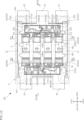
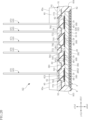
- FIG. 15 is a plan view showing a semiconductor device according to a second embodiment of the present disclosure, in which the sealing resin is shown by imaginary lines and the resin portion is omitted.
- FIG. 16 is a cross-sectional view taken along line XVI-XVI in FIG.
- FIG. 17 is a partially enlarged view of a part of FIG.
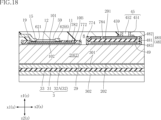
- FIG. 18 is a partially enlarged view of a part of FIG.
- FIG. 19 is a cross-sectional view taken along line XIX-XIX in FIG.
- FIG. 20 is a cross-sectional view taken along line XX-XX in FIG.
- FIG. 21 is a plan view showing a semiconductor device according to a third embodiment of the present disclosure, in which the sealing resin is shown by imaginary lines and the resin portion is omitted.
- FIG. 22 is a cross-sectional view taken along line XXII-XXII in FIG.
- FIG. 23 is a cross-sectional view taken along line XXIII-X
- an object A is formed on an object B" and “an object A is formed on an object B” include “an object A is formed directly on an object B” and “an object A is formed on an object B with another object interposed between the object A and the object B” unless otherwise specified.
- an object A is disposed on an object B” and “an object A is disposed on an object B” include “an object A is disposed directly on an object B” and “an object A is disposed on an object B with another object interposed between the object A and the object B" unless otherwise specified.
- an object A is located on an object B includes “an object A is located on an object B in contact with an object B” and “an object A is located on an object B with another object interposed between the object A and the object B” unless otherwise specified.
- an object A overlaps an object B when viewed in a certain direction includes “an object A overlaps the entire object B” and “an object A overlaps a part of an object B.”
- a surface A faces in direction B is not limited to the case where the angle of surface A with respect to direction B is 90 degrees, but also includes the case where surface A is tilted with respect to direction B.
- First embodiment: 1 to 13 show a semiconductor device according to a first embodiment of the present disclosure.
- the semiconductor device A1 of this embodiment includes a plurality of first semiconductor elements 10A, a plurality of second semiconductor elements 10B, a conductive substrate 2, a support substrate 3, a first terminal 41, a second terminal 42, a plurality of third terminals 43, a fourth terminal 44, a plurality of control terminals 45, a control terminal support 48, a first conductive member 5, a second conductive member 6, dam portions 771, 772, 773, and 774, resin portions 781, 782, 783, and 784, and a sealing resin 8.
- FIG. 1 is a perspective view showing the semiconductor device A1.
- FIG. 2 is a plan view showing the semiconductor device A1.
- FIG. 3 is a plan view of FIG. 2 in which the sealing resin 8 is shown by imaginary lines and the resin portions 781 to 784 are omitted.
- FIG. 4 is a partial enlarged view of a part of FIG. 3 in which the sealing resin 8 and the dam portions 771 to 774 are omitted.
- FIG. 5 is a plan view of FIG. 3 in which the sealing resin 8, the dam portions 771 to 774, and the first conductive member 5 are omitted and the second conductive member 6 is shown by imaginary lines.
- FIG. 6 is a bottom view of the semiconductor device A1.
- FIG. 7 is a cross-sectional view taken along line VII-VII in FIG. 3.
- FIG. 8 is a cross-sectional view taken along line VIII-VIII in FIG. 3.
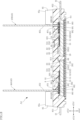
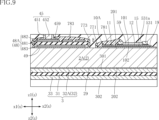
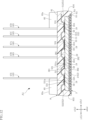
- FIGS. 9 and 10 are partial enlarged views of a part of FIG. 8.
- FIG. 11 is a cross-sectional view taken along line XI-XI in FIG. 3.
- FIG. 12 is a cross-sectional view taken along line XII-XII in FIG. 3.
- FIG. 13 is a cross-sectional view taken along line XIII-XIII in FIG. 3.
- the thickness direction of the present disclosure is defined as the "thickness direction z".
- An example of a direction perpendicular to the thickness direction z is called the "first direction x”.
- a direction perpendicular to the thickness direction z and the first direction x is called the "second direction y".
- One side of the first direction x is called the “x1 side of the first direction x”
- the other side of the first direction x is called the "x2 side of the first direction x”.
- One side of the second direction y is called the "y1 side of the second direction y”
- the other side of the second direction y is called the "y2 side of the second direction y".
- one side of the thickness direction z is an example of the “one side of the thickness direction” of the present disclosure and is called the “z1 side of the thickness direction z”
- the other side of the thickness direction z is an example of the “other side of the thickness direction” of the present disclosure and is called the “z2 side of the thickness direction z”.
- planar view refers to a view in the thickness direction z.
- the z1 side in the thickness direction z is sometimes referred to as the top
- the z2 side in the thickness direction z is sometimes referred to as the bottom.
- Each of the first semiconductor elements 10A and the second semiconductor elements 10B is an electronic component that is the core of the function of the semiconductor device A1, and is an example of a "semiconductor element" of the present disclosure.
- the constituent material of each of the first semiconductor elements 10A and the second semiconductor elements 10B is a semiconductor material mainly made of, for example, SiC (silicon carbide). This semiconductor material is not limited to SiC, and may be Si (silicon), GaN (gallium nitride), or C (diamond).
- Each of the first semiconductor elements 10A and the second semiconductor elements 10B is, for example, a power semiconductor chip having a switching function such as a MOSFET (Metal Oxide Semiconductor Field Effect Transistor).
- MOSFET Metal Oxide Semiconductor Field Effect Transistor
- the first semiconductor element 10A and the second semiconductor element 10B are shown as MOSFETs, but are not limited thereto, and may be other transistors such as an IGBT (Insulated Gate Bipolar Transistor).
- IGBT Insulated Gate Bipolar Transistor
- Each of the first semiconductor elements 10A and each of the second semiconductor elements 10B are the same element.
- Each of the first semiconductor elements 10A and each of the second semiconductor elements 10B is, for example, an n-channel MOSFET, but may also be a p-channel MOSFET.
- the first semiconductor element 10A and the second semiconductor element 10B each have an element main surface 101 and an element back surface 102.
- the element main surface 101 and the element back surface 102 are separated in the thickness direction z.
- the element main surface 101 faces the z1 side in the thickness direction z
- the element back surface 102 faces the z2 side in the thickness direction z.
- the semiconductor device A1 has four first semiconductor elements 10A and four second semiconductor elements 10B, but the number of first semiconductor elements 10A and the number of second semiconductor elements 10B are not limited to this configuration and are changed as appropriate according to the performance required of the semiconductor device A1.
- four first semiconductor elements 10A and four second semiconductor elements 10B are arranged.
- the number of first semiconductor elements 10A and the number of second semiconductor elements 10B may be two or three, or five or more.
- the number of first semiconductor elements 10A and the number of second semiconductor elements 10B may be equal to or different from each other.
- the number of first semiconductor elements 10A and the number of second semiconductor elements 10B are determined by the current capacity handled by the semiconductor device A1.
- the semiconductor device A1 is configured, for example, as a half-bridge type switching circuit.
- the multiple second semiconductor elements 10B configure the upper arm circuit of the semiconductor device A1
- the multiple first semiconductor elements 10A configure the lower arm circuit.
- the multiple second semiconductor elements 10B are connected in parallel to each other, and in the lower arm circuit, the multiple first semiconductor elements 10A are connected in parallel to each other.
- Each second semiconductor element 10B and each first semiconductor element 10A are connected in series to configure a bridge layer.
- the multiple first semiconductor elements 10A are each mounted on the conductive substrate 2, as shown in Figures 5 and 12. In the example shown in Figure 5, the multiple first semiconductor elements 10A are lined up, for example, in the second direction y and spaced apart from one another. Each first semiconductor element 10A is conductively bonded to the conductive substrate 2 (first conductive portion 2A described below) via a conductive bonding material 19. When each first semiconductor element 10A is bonded to the first conductive portion 2A, the element back surface 102 faces the first conductive portion 2A.
- the multiple second semiconductor elements 10B are mounted on the conductive substrate 2 as shown in FIG. 5, FIG. 13, etc.
- the multiple second semiconductor elements 10B are arranged, for example, in the second direction y and are spaced apart from one another.
- Each second semiconductor element 10B is conductively bonded to the conductive substrate 2 (second conductive portion 2B described below) via a conductive bonding material 19.
- the element back surface 102 faces the second conductive portion 2B.
- the multiple first semiconductor elements 10A and the multiple second semiconductor elements 10B overlap when viewed in the first direction x, but they do not have to overlap.
- the multiple first semiconductor elements 10A and the multiple second semiconductor elements 10B each have principal surface electrodes 11, 12, 13 and a back surface electrode 15.
- the configurations of the principal surface electrodes 11-13 and the back surface electrode 15 described below are common to each of the first semiconductor elements 10A and each of the second semiconductor elements 10B.
- the principal surface electrodes 11-13 are provided on the element principal surface 101.
- the principal surface electrodes 11-13 are insulated by an insulating film (not shown).
- the back surface electrode 15 is provided on the element back surface 102.
- the principal surface electrode 11 is, for example, a gate electrode, to which a drive signal (for example, a gate voltage) for driving the first semiconductor element 10A (second semiconductor element 10B) is input.
- the principal surface electrode 12 is, for example, a source electrode through which a source current flows.
- the principal surface electrode 13 is, for example, a source sense electrode through which a source current flows.
- the back surface electrode 15 is, for example, a drain electrode through which a drain current flows.
- the back surface electrode 15 covers substantially the entire area of the element back surface 102.
- the back surface electrode 15 is, for example, formed by Ag (silver) plating.
- the principal surface electrode 12 (source electrode) is an example of a "first electrode” in the present disclosure.
- the back surface electrode 15 (drain electrode) is an example of a "second electrode” in the present disclosure.
- each first semiconductor element 10A switches between a conductive state and a cut-off state in response to the drive signal.
- a current flows from the back surface electrode 15 (drain electrode) to the main surface electrode 12 (source electrode), and in the cut-off state, this current does not flow.
- Each first semiconductor element 10A (each second semiconductor element 10B) performs a switching operation.
- the semiconductor device A1 converts a DC voltage input between the one fourth terminal 44 and the two first terminals 41 and second terminals 42 into, for example, an AC voltage by the switching function of the multiple first semiconductor elements 10A and multiple second semiconductor elements 10B, and outputs the AC voltage from the third terminal 43.
- the semiconductor device A1 includes a thermistor 17.
- the thermistor 17 is used as a temperature detection sensor.
- the conductive substrate 2 supports a plurality of first semiconductor elements 10A and a plurality of second semiconductor elements 10B.
- the conductive substrate 2 is an example of a "support" in the present disclosure.
- the conductive substrate 2 is bonded onto the support substrate 3 via a conductive bonding material 29.
- the conductive substrate 2 is, for example, rectangular in plan view.
- the conductive substrate 2, together with the first conductive member 5 and the second conductive member 6, constitutes a path for the main circuit current that is switched by the plurality of first semiconductor elements 10A and the plurality of second semiconductor elements 10B.
- the conductive substrate 2 includes a first conductive portion 2A and a second conductive portion 2B.
- the first conductive portion 2A and the second conductive portion 2B are each a plate-shaped member made of metal. This metal is, for example, Cu (copper) or a Cu alloy.
- the first conductive portion 2A and the second conductive portion 2B are each bonded onto the support substrate 3 via a conductive bonding material 29.
- the plurality of first semiconductor elements 10A are each bonded to the first conductive portion 2A via a conductive bonding material 19.
- the plurality of second semiconductor elements 10B are each bonded to the second conductive portion 2B via a conductive bonding material 19.
- the material of the conductive bonding material 19 and the conductive bonding material 29 is not particularly limited, and may be, for example, solder, metal paste material, or sintered metal.
- the first conductive portion 2A and the second conductive portion 2B are spaced apart in the first direction x as shown in FIG. 5, FIG. 7, and FIG. 8. In the examples shown in these figures, the first conductive portion 2A is located on the x1 side of the first direction x with respect to the second conductive portion 2B.
- the first conductive portion 2A and the second conductive portion 2B are each, for example, rectangular in plan view.
- the first conductive portion 2A and the second conductive portion 2B overlap in the first direction x.
- the first conductive portion 2A and the second conductive portion 2B each have, for example, a dimension in the first direction x of 15 mm to 25 mm, a dimension in the second direction y of 30 mm to 40 mm, and a dimension in the thickness direction z of 1.0 mm to 5.0 mm (preferably about 2.0 mm).
- the conductive substrate 2 has a main surface 201 and a back surface 202.
- the main surface 201 and the back surface 202 are spaced apart in the thickness direction z, as shown in Figures 7, 8, and 10 to 13.
- the main surface 201 faces the z1 side in the thickness direction z
- the back surface 202 faces the z2 side in the thickness direction z.
- the main surface 201 is a combination of the upper surface of the first conductive portion 2A and the upper surface of the second conductive portion 2B.
- the back surface 202 is a combination of the lower surface of the first conductive portion 2A and the lower surface of the second conductive portion 2B.
- the back surface 202 is joined to the support substrate 3 so as to face the support substrate 3.
- the supporting substrate 3 supports the conductive substrate 2.
- the supporting substrate 3 is, for example, an AMB (Active Metal Brazing) substrate.
- the supporting substrate 3 includes an insulating layer 31, a first metal layer 32, and a second metal layer 33.
- the insulating layer 31 is, for example, a ceramic with excellent thermal conductivity.
- An example of such a ceramic is SiN (silicon nitride).
- the insulating layer 31 is not limited to ceramics, and may be an insulating resin sheet or the like.
- the insulating layer 31 is, for example, rectangular in plan view.
- the first metal layer 32 is formed on the upper surface (the surface facing the z1 side in the thickness direction z) of the insulating layer 31.
- the constituent material of the first metal layer 32 includes, for example, Cu.
- the constituent material may include Al (aluminum) instead of Cu.
- the first metal layer 32 includes a first portion 32A and a second portion 32B.
- the first portion 32A and the second portion 32B are spaced apart in the first direction x.
- the first portion 32A is located on the x1 side of the second portion 32B in the first direction x.
- the first portion 32A is joined to the first conductive portion 2A and supports the first conductive portion 2A.
- the second portion 32B is joined to the second conductive portion 2B and supports the second conductive portion 2B.
- the first portion 32A and the second portion 32B are each, for example, rectangular in a plan view.
- the second metal layer 33 is formed on the lower surface of the insulating layer 31 (the surface facing the z2 side in the thickness direction z).
- the constituent material of the second metal layer 33 is the same as the constituent material of the first metal layer 32.
- the lower surface of the second metal layer 33 (the bottom surface 302 described below) is exposed from the sealing resin 8, as shown in FIG. 6. In a plan view, the second metal layer 33 overlaps both the first portion 32A and the second portion 32B.
- the support substrate 3 has a support surface 301 and a bottom surface 302.
- the support surface 301 and the bottom surface 302 are spaced apart in the thickness direction z.
- the support surface 301 faces the z1 side in the thickness direction z
- the bottom surface 302 faces the z2 side in the thickness direction z.
- the bottom surface 302 is exposed from the sealing resin 8 as shown in Figure 6.
- the first metal layer 32 has the support surface 301
- the second metal layer 33 has the bottom surface 302.
- the support surface 301 is the upper surface of the first metal layer 32, and is the combination of the upper surface of the first portion 32A and the upper surface of the second portion 32B.
- the support surface 301 faces the conductive substrate 2, and the conductive substrate 2 is joined to it.
- the bottom surface 302 is the lower surface of the second metal layer 33.
- a heat dissipation member e.g., a heat sink
- the dimension of the support substrate 3 in the thickness direction z is, for example, 0.7 mm to 2.0 mm.
- the first terminal 41, the second terminal 42, the multiple third terminals 43, and the fourth terminal 44 are each made of a plate-shaped metal plate.
- the metal plate is made of, for example, Cu or a Cu alloy.
- the semiconductor device A1 has one each of the first terminal 41, the second terminal 42, and the fourth terminal 44, and two third terminals 43.
- the DC voltage to be converted is input to the first terminal 41, the second terminal 42, and the fourth terminal 44.
- the fourth terminal 44 is a positive electrode (P terminal), and the first terminal 41 and the second terminal 42 are negative electrodes (N terminals).
- the AC voltage converted by the first semiconductor element 10A and the second semiconductor element 10B is output from the multiple third terminals 43.
- the first terminal 41, the second terminal 42, the multiple third terminals 43, and the fourth terminal 44 each include a portion covered by the sealing resin 8 and a portion exposed from the sealing resin 8.
- the fourth terminal 44 is formed integrally with the second conductive portion 2B as shown in FIG. 8. Unlike this configuration, the fourth terminal 44 may be separated from the second conductive portion 2B and conductively joined to the second conductive portion 2B. As shown in FIG. 5 and other figures, the fourth terminal 44 is located on the x2 side of the first direction x with respect to the second semiconductor elements 10B and the second conductive portion 2B (conductive substrate 2). The fourth terminal 44 is conductive to the second conductive portion 2B and is conductive to the back electrode 15 (drain electrode) of each second semiconductor element 10B via the second conductive portion 2B.
- the first terminal 41 and the second terminal 42 are each spaced apart from the second conductive portion 2B, as shown in FIG. 5.
- the first terminal 41 and the second terminal 42 are each joined to the first conductive member 5, as shown in FIG. 3 and FIG. 4.
- the first terminal 41 and the second terminal 42 are each located on the x2 side of the first direction x with respect to the second semiconductor elements 10B and the second conductive portion 2B (conductive substrate 2), as shown in FIG. 3, FIG. 5, etc.
- the first terminal 41 and the second terminal 42 are each electrically connected to the first conductive member 5, and are also electrically connected to the main surface electrode 12 (source electrode) of each first semiconductor element 10A via the first conductive member 5.
- the first terminal 41, the second terminal 42 and the fourth terminal 44 each protrude from the sealing resin 8 to the x2 side in the first direction x in the semiconductor device A1.
- the first terminal 41, the second terminal 42 and the fourth terminal 44 are spaced apart from each other.
- the first terminal 41 and the second terminal 42 are located on opposite sides of the fourth terminal 44 in the second direction y.
- the first terminal 41 is located on the y2 side of the fourth terminal 44 in the second direction y
- the second terminal 42 is located on the y1 side of the fourth terminal 44 in the second direction y.
- the first terminal 41, the second terminal 42 and the fourth terminal 44 overlap each other when viewed in the second direction y.
- the two third terminals 43 are each integrally formed with the first conductive portion 2A. Unlike the present configuration, the third terminal 43 may be separated from the first conductive portion 2A and conductively joined to the first conductive portion 2A. As shown in FIG. 5 and the like, the two third terminals 43 are each located on the x1 side of the first direction x with respect to the first semiconductor elements 10A and the first conductive portion 2A (conductive substrate 2). Each third terminal 43 is conductive to the first conductive portion 2A and is conductive to the back electrode 15 (drain electrode) of each first semiconductor element 10A via the first conductive portion 2A.
- the number of third terminals 43 is not limited to two, and may be, for example, one or three or more. For example, when there is one third terminal 43, it is desirable that it is connected to the center portion of the first conductive portion 2A in the second direction y.
- the multiple control terminals 45 are pin-shaped terminals for controlling each of the first semiconductor elements 10A and each of the second semiconductor elements 10B.
- the multiple control terminals 45 include multiple first control terminals 46A-46D and multiple second control terminals 47A-47E.
- the multiple first control terminals 46A-46D are used to control each of the first semiconductor elements 10A, etc.
- the multiple second control terminals 47A-47E are used to control each of the second semiconductor elements 10B, etc.
- the multiple first control terminals 46A-46D are arranged at intervals in the second direction y. As shown in Figures 5 and 8, each of the first control terminals 46A-46D is supported by the first conductive portion 2A via a control terminal support 48 (first support portion 48A described below). As shown in Figures 3 and 5, each of the first control terminals 46A-46D is located between the multiple first semiconductor elements 10A and the two third terminals 43 in the first direction x.
- the first control terminal 46A is a terminal (gate terminal) for inputting a drive signal to the multiple first semiconductor elements 10A.
- a drive signal for driving the multiple first semiconductor elements 10A is input to the first control terminal 46A (for example, a gate voltage is applied).
- the first control terminal 46B is a terminal (source sense terminal) for detecting source signals of the multiple first semiconductor elements 10A.
- the first control terminal 46B detects the voltage (voltage corresponding to the source current) applied to each of the main surface electrodes 12 (source electrodes) of the multiple first semiconductor elements 10A.
- the first control terminal 46C and the first control terminal 46D are terminals that are electrically connected to thermistor 17.
- the second control terminals 47A-47E are spaced apart in the second direction y. As shown in Figures 5 and 8, each of the second control terminals 47A-47E is supported by the second conductive portion 2B via a control terminal support 48 (second support portion 48B, described below). As shown in Figures 3 and 5, each of the second control terminals 47A-47E is located between the second semiconductor elements 10B and the first terminal 41, second terminal 42, and fourth terminal 44 in the first direction x.
- the second control terminal 47A is a terminal (gate terminal) for inputting a drive signal for the multiple second semiconductor elements 10B.
- a drive signal for driving the multiple second semiconductor elements 10B is input to the second control terminal 47A (for example, a gate voltage is applied).
- the second control terminal 47B is a terminal (source sense terminal) for detecting source signals for the multiple second semiconductor elements 10B.
- the second control terminal 47B detects a voltage (voltage corresponding to a source current) applied to each main surface electrode 12 (source electrode) of the multiple second semiconductor elements 10B.
- the second control terminal 47C and the second control terminal 47D are terminals that are conductive to the thermistor 17.
- the second control terminal 47E is a terminal (drain sense terminal) for detecting drain signals for the multiple second semiconductor elements 10B.
- the second control terminal 47E detects a voltage (voltage corresponding to a drain current) applied to each back surface electrode 15 (drain electrode) of the multiple second semiconductor elements 10B.
- Each of the multiple control terminals 45 includes a holder 451 and a metal pin 452.
- the holder 451 is made of a conductive material. As shown in Figures 9 and 10, the holder 451 is bonded to the control terminal support 48 (first metal layer 482 described below) via a conductive bonding material 459.
- the holder 451 includes a cylindrical portion, an upper end flange, and a lower end flange. The upper end flange is connected to the upper part of the cylindrical portion, and the lower end flange is connected to the lower part of the cylindrical portion.
- a metal pin 452 is inserted into at least the upper end flange and the cylindrical portion of the holder 451. Most of the holder 451 is covered with sealing resin 8. In the illustrated example, only the upper end surface of each holder 451 is exposed from the sealing resin 8.
- the metal pin 452 is a rod-shaped member extending in the thickness direction z.
- the metal pin 452 is supported by being pressed into the holder 451.
- the metal pin 452 is electrically connected to the control terminal support 48 (first metal layer 482 described below) at least via the holder 451.
- the control terminal support 48 first metal layer 482 described below
- the metal pin 452 is electrically connected to the control terminal support 48 via the conductive bonding material 459.
- the length of the metal pin 452 in the thickness direction z is not limited to the example shown in the figure and can be selected as appropriate.
- the control terminal support 48 supports the multiple control terminals 45.
- the control terminal support 48 is interposed between the main surface 201 (conductive substrate 2) and the multiple control terminals 45 in the thickness direction z.
- the control terminal support 48 includes a first support portion 48A and a second support portion 48B.
- the first support portion 48A is disposed on the first conductive portion 2A of the conductive substrate 2, and supports the first control terminals 46A to 46D of the control terminals 45.
- the first support portion 48A is bonded to the first conductive portion 2A via a bonding material 49, as shown in FIG. 9.
- the bonding material 49 may be conductive or insulating, and may be, for example, solder.
- the second support portion 48B is disposed on the second conductive portion 2B of the conductive substrate 2, and supports the second control terminals 47A to 47E of the control terminals 45.
- the second support portion 48B is bonded to the second conductive portion 2B via a bonding material 49, as shown in FIG. 10.
- the control terminal support 48 (each of the first support portion 48A and the second support portion 48B) is formed, for example, from a DBC (Direct Bonded Copper) substrate.
- the control terminal support 48 has an insulating layer 481, a first metal layer 482, and a second metal layer 483 stacked on top of each other.
- the insulating layer 481 is made of, for example, ceramics.
- the insulating layer 481 is, for example, rectangular in plan view.
- the first metal layer 482 is formed on the upper surface of the insulating layer 481, as shown in Figures 9 and 10. Each control terminal 45 is provided on the first metal layer 482.
- the first metal layer 482 is, for example, Cu or a Cu alloy.
- the first metal layer 482 includes a first portion 482A, a second portion 482B, a third portion 482C, a fourth portion 482D, a fifth portion 482E, and a sixth portion 482F.
- the first portion 482A, the second portion 482B, the third portion 482C, the fourth portion 482D, the fifth portion 482E, and the sixth portion 482F are separated and insulated from each other.
- the first portion 482A has a plurality of wires 71 bonded thereto, and is electrically connected to the principal surface electrodes 11 (gate electrodes) of the first semiconductor elements 10A (second semiconductor elements 10B) via the respective wires 71.
- the first portion 482A and the sixth portion 482F are connected to a plurality of wires 73.
- the sixth portion 482F is electrically connected to the principal surface electrodes 11 (gate electrodes) of the first semiconductor elements 10A (second semiconductor elements 10B) via the wires 73 and 71.
- the first control terminal 46A is bonded to the sixth portion 482F of the first support 48A
- the second control terminal 47A is bonded to the sixth portion 482F of the second support 48B.
- the second portion 482B has a plurality of wires 72 bonded thereto, and is electrically connected to the principal surface electrode 12 (source electrode) of each of the first semiconductor elements 10A (each of the second semiconductor elements 10B) via each of the wires 72.
- the first control terminal 46B is bonded to the second portion 482B of the first support portion 48A
- the second control terminal 47B is bonded to the second portion 482B of the second support portion 48B.
- the thermistor 17 is joined to the third portion 482C and the fourth portion 482D. As shown in FIG. 5, the first control terminals 46C and 46D are joined to the third portion 482C and the fourth portion 482D of the first support portion 48A, and the second control terminals 47C and 47D are joined to the third portion 482C and the fourth portion 482D of the second support portion 48B.
- the fifth portion 482E of the first support portion 48A is not electrically connected to the other components.
- a wire 74 is joined to the fifth portion 482E of the second support portion 48B, and is electrically connected to the second conductive portion 2B via the wire 74.
- a second control terminal 47E is joined to the fifth portion 482E of the second support portion 48B.
- Each of the wires 71 to 74 is, for example, a bonding wire.
- the material of each of the wires 71 to 74 is not particularly limited, and may include, for example, any of Au (gold), Al, or Cu.
- the second metal layer 483 is formed on the lower surface of the insulating layer 481, as shown in Figures 9 and 10.
- the second metal layer 483 of the first support portion 48A is bonded to the first conductive portion 2A via a bonding material 49, as shown in Figure 9.
- the second metal layer 483 of the second support portion 48B is bonded to the second conductive portion 2B via a bonding material 49, as shown in Figure 10.
- the first conductive member 5 and the second conductive member 6 are spaced apart from the main surface 201 (conductive substrate 2) on the z1 side in the thickness direction z, and overlap the main surface 201 in a plan view.
- the first conductive member 5 and the second conductive member 6 are each made of a metal plate material.
- the metal is, for example, Cu or a Cu alloy.
- the first conductive member 5 and the second conductive member 6 are metal plate materials that are appropriately bent.
- the first conductive member 5 is connected to the main surface electrode 12 (source electrode) of each first semiconductor element 10A and the first terminal 41 and second terminal 42, and electrically connects the main surface electrode 12 of each first semiconductor element 10A to the first terminal 41 and second terminal 42.
- the first conductive member 5 forms a path for a main circuit current that is switched by the multiple first semiconductor elements 10A.
- the first conductive member 5 has a maximum dimension in the first direction x of, for example, 25 mm to 40 mm, and a maximum dimension in the second direction y of, for example, 30 mm to 45 mm.
- the first conductive member 5 includes a first wiring portion 51, a second wiring portion 52, a third wiring portion 53, a fourth wiring portion 54, and a fifth wiring portion 55.
- the first wiring portion 51 has a first end 511, a second end 512, and a plurality of openings 513.
- the first end 511 is connected to the first terminal 41.
- the first end 511 and the first terminal 41 are joined by a conductive bonding material 59.
- the first wiring portion 51 is a band-shaped portion that extends overall in the first direction x.
- the first wiring portion 51 overlaps both the second conductive portion 2B and the first conductive portion 2A.
- the second end 512 is spaced apart from the first end 511 in the first direction x. As shown in FIG. 4, the second end 512 is located on the x1 side of the first direction x from the first end 511.
- Each of the multiple openings 513 is a partially cut out portion in a plan view.
- the multiple openings 513 are spaced apart from one another in the first direction x.
- the first wiring portion 51 has three openings 513.
- the opening 513 on the x2 side of the first direction x and the central opening 513 in the first direction x are located in a position that overlaps the main surface 201 of the second conductive portion 2B (conductive substrate 2) in a plan view, and does not overlap the multiple second semiconductor elements 10B in a plan view.
- the opening 513 on the x1 side of the first direction x is located in a position that overlaps the main surface 201 of the first conductive portion 2A (conductive substrate 2) in a plan view, and does not overlap the multiple first semiconductor elements 10A in a plan view.
- Each opening 513 is provided toward the y2 side of the second conductive portion 2B (first conductive portion 2A) in the second direction y in a plan view.
- the opening 513 is an arc-shaped notch recessed from the end on the y1 side in the second direction y to the y2 side in the second direction y in the first wiring part 51.
- the planar shape of the opening 513 is not limited, and may be a notch as in this embodiment, or may be a hole as in this embodiment.
- the second wiring portion 52 has a third end 521, a fourth end 522, and a plurality of openings 523.
- the third end 521 is connected to the second terminal 42.
- the third end 521 and the second terminal 42 are joined by a conductive bonding material 59.
- the second wiring portion 52 is a band-shaped portion extending in the first direction x as a whole in a planar view.
- the second wiring portion 52 is disposed away from the first wiring portion 51 in the second direction y.
- the second wiring portion 52 is located on the y1 side of the first wiring portion 51 in the second direction y.
- the second wiring portion 52 overlaps with both the second conductive portion 2B and the first conductive portion 2A in a planar view.
- the fourth end 522 is spaced apart from the third end 521 in the first direction x. As shown in FIG. 4, the fourth end 522 is located on the x1 side in the first direction x from the third end 521.
- Each of the multiple openings 523 is a partially cut out portion in a plan view.
- the multiple openings 523 are spaced apart from one another in the first direction x.
- the second wiring portion 52 has three openings 523.
- the opening 523 on the x2 side of the first direction x and the central opening 523 in the first direction x are located in a position that overlaps the main surface 201 of the second conductive portion 2B (conductive substrate 2) in a plan view, and does not overlap the multiple second semiconductor elements 10B in a plan view.
- the opening 523 on the x1 side of the first direction x is located in a position that overlaps the main surface 201 of the first conductive portion 2A (conductive substrate 2) in a plan view, and does not overlap the multiple first semiconductor elements 10A in a plan view.
- Each opening 523 is provided toward the y1 side of the second conductive portion 2B (first conductive portion 2A) in the second direction y in a plan view.
- the opening 523 is an arc-shaped notch recessed from the end on the y2 side in the second direction y to the y1 side in the second direction y in the second wiring part 52.
- the planar shape of the opening 523 is not limited, and may be a notch as in this embodiment, or may be a hole as in this embodiment.
- the third wiring portion 53 is connected to both the first wiring portion 51 (second end 512) and the second wiring portion 52 (fourth end 522).
- the third wiring portion 53 is a band-shaped portion extending in the second direction y in a planar view. As can be seen from FIG. 4 etc., the third wiring portion 53 overlaps with a plurality of first semiconductor elements 10A in a planar view.
- the third wiring portion 53 is connected to each of the first semiconductor elements 10A as shown in FIG. 12.
- the third wiring portion 53 has a plurality of recessed regions 531. As shown in FIG. 12 and other figures, each recessed region 531 protrudes toward the z2 side in the thickness direction z more than other portions of the third wiring portion 53. Each of the plurality of recessed regions 531 is bonded to one of the plurality of first semiconductor elements 10A. Each recessed region 531 of the third wiring portion 53 and the main surface electrode 12 of each first semiconductor element 10A are bonded via a conductive bonding material 59.
- the material of the conductive bonding material 59 is not particularly limited, and may be, for example, solder, a metal paste material, or a sintered metal. In this embodiment, an opening 531a is formed in each recessed region 531.
- Each opening 531a is preferably formed so as to overlap the center of the first semiconductor element 10A in a plan view.
- the opening 531a is, for example, a through hole formed in each recessed region 531 of the third wiring portion 53.
- the opening 531a is used, for example, when positioning the first conductive member 5 relative to the conductive substrate 2.
- the planar shape of the opening 531a may be a perfect circle, or it may be another shape such as an ellipse or a rectangle.
- the fourth wiring portion 54 is connected to both the first wiring portion 51 and the second wiring portion 52.
- the fourth wiring portion 54 is a band-shaped portion extending in the second direction y in a plan view.
- the fourth wiring portion 54 is connected to the first wiring portion 51 between the first end 511 and the second end 512, and is connected to the second wiring portion 52 between the third end 521 and the fourth end 522.
- the fourth wiring portion 54 is separated from the third wiring portion 53 in the first direction x. As shown in FIG. 4 etc., the fourth wiring portion 54 is located on the x2 side in the first direction x with respect to the third wiring portion 53.
- the fourth wiring portion 54 overlaps a plurality of second semiconductor elements 10B in a plan view.
- the fourth wiring portion 54 has a plurality of convex regions 541. As shown in FIG. 13 and other figures, each convex region 541 protrudes toward the z1 side in the thickness direction z further than other portions of the fourth wiring portion 54. As shown in FIG. 4, FIG. 13 and other figures, the plurality of convex regions 541 and the plurality of second semiconductor elements 10B overlap each other in a planar view. In this embodiment, as can be seen from FIG. 4 and other figures, the plurality of concave regions 531 in the third wiring portion 53 and the plurality of convex regions 541 are positioned at equal positions in the second direction y.
- the fifth wiring portion 55 is connected to both the third wiring portion 53 and the fourth wiring portion 54.
- the fifth wiring portion 55 is a band-shaped portion extending in the first direction x in a plan view.
- the first conductive member 5 includes a plurality (three) of fifth wiring portions 55.
- the plurality of fifth wiring portions 55 are located between the first wiring portion 51 and the second wiring portion 52 in the second direction y, and are arranged at intervals in the second direction y.
- the plurality of fifth wiring portions 55 are arranged approximately parallel to each other.
- the end of each of the plurality of fifth wiring portions 55 on the x1 side in the first direction x is connected between two recessed regions 531 of the third wiring portion 53 adjacent to each other in the second direction y.
- the end of each of the plurality of fifth wiring portions 55 on the x2 side in the first direction x is connected between two convex regions 541 of the fourth wiring portion 54 adjacent to each other in the second direction y.
- the second conductive member 6 is connected to the main surface electrode 12 (source electrode) and the first conductive portion 2A of each second semiconductor element 10B, and provides electrical continuity between the main surface electrode 12 and the first conductive portion 2A of each second semiconductor element 10B.
- the second conductive member 6 forms a path for the main circuit current that is switched by the multiple second semiconductor elements 10B.
- the second conductive member 6 includes a main portion 61, multiple first connection ends 62, and multiple second connection ends 63.
- the main portion 61 is located between the second semiconductor elements 10B and the first conductive portion 2A in the first direction x, and is a band-shaped portion extending in the second direction y in a planar view. As shown in FIG. 11 and other figures, the main portion 61 is located on the z2 side in the thickness direction z with respect to the fifth wiring portion 55 of the first conductive member 5, and is located closer to the main surface 201 (conductive substrate 2) than the fifth wiring portion 55. The main portion 61 overlaps the fifth wiring portions 55 in a planar view. In this embodiment, as shown in FIG. 4, FIG. 5, FIG. 8, and other figures, a plurality of openings 611 are formed in the main portion 61.
- Each of the plurality of openings 611 is, for example, a through hole penetrating in the thickness direction z.
- the plurality of openings 611 are arranged at intervals in the second direction y. Each opening 611 does not overlap the fifth wiring portion 55 in a planar view.
- the multiple openings 611 are formed to facilitate the flow of the resin material between the upper side (z1 side in the thickness direction z) and the lower side (z2 side in the thickness direction z) near the main portion 61 (second conductive member 6) when injecting the fluid resin material to form the sealing resin 8.
- the shape of the main portion 61 (second conductive member 6) is not limited to this configuration, and for example, the openings 611 do not have to be formed.
- the multiple first connection ends 62 and the multiple second connection ends 63 are connected to the main part 61 and are arranged corresponding to the multiple second semiconductor elements 10B. As shown in FIG. 8, FIG. 13, etc., each first connection end 62 and the corresponding main surface electrode 12 of any of the second semiconductor elements 10B, and each second connection end 63 and the first conductive part 2A are respectively bonded via a conductive bonding material 69.
- the material of the conductive bonding material 69 is not particularly limited, and may be, for example, solder, a metal paste material, or a sintered metal.
- an opening 621 is formed in each first connection end 62. Each opening 621 is preferably formed so as to overlap the center of the second semiconductor element 10B in a plan view.
- the opening 621 is, for example, a through hole penetrating in the thickness direction z.
- the opening 621 is used, for example, when positioning the second conductive member 6 with respect to the conductive substrate 2.
- the planar shape of the opening 621 may be a perfect circle, or may be another shape such as an ellipse or a rectangle.
- the dam portions 771 to 774 are disposed on the main surface 201 of the conductive substrate 2, as shown in Figures 3, 8 to 10, etc.
- the dam portions 771 are arranged corresponding to each of the multiple first semiconductor elements 10A, and are provided at multiple locations spaced apart from each other in the second direction y.
- the dam portions 771 are arranged on the main surface 201 of the first conductive portion 2A, and surround the first semiconductor element 10A when viewed in the thickness direction z.
- the first semiconductor element 10A has a recessed region 531 (first conductive member 5) bonded to the portion on the x2 side in the first direction x.
- the first conductive member 5 is not bonded to the portion of the first semiconductor element 10A on the x1 side in the first direction x.
- the dam portions 771 regulate the formation area of a resin portion 781 (see FIGS. 8 and 9) described later.
- the dam portion 771 has a portion facing the edge of the first semiconductor element 10A on the x1 side in the first direction x, a portion facing the edge of the first semiconductor element 10A on the y1 side in the second direction y, and a portion facing the edge of the first semiconductor element 10A on the y2 side in the second direction y, as viewed in the thickness direction z, and has a shape that connects these three portions.
- the dam portion 771 surrounds the portion of the first semiconductor element 10A on the x1 side in the first direction x (the portion to which the first conductive member 5 is not joined).
- the dam portion 771 is not limited to being annular in shape surrounding the entire first semiconductor element 10A as viewed in the thickness direction z, and may be shaped to surround a portion of the first semiconductor element 10A as viewed in the thickness direction z. As shown in Figures 8 and 9, the end of the dam portion 771 on the z1 side in the thickness direction z is located on the z1 side in the thickness direction z of the first semiconductor element 10A.
- the dam portions 772 are arranged corresponding to each of the second semiconductor elements 10B, and are provided at multiple locations spaced apart from each other in the second direction y.
- the dam portions 772 are arranged on the main surface 201 of the second conductive portion 2B, and surround the second semiconductor elements 10B when viewed in the thickness direction z.
- the first connection end 62 (second conductive member 6) is joined to the portion of the second semiconductor element 10B on the x1 side in the first direction x.
- the second conductive member 6 is not joined to the portion of the second semiconductor element 10B on the x2 side in the first direction x.
- the dam portions 772 regulate the formation area of a resin portion 782 (see FIGS. 8 and 10) described later.
- the dam portion 772 has a portion facing the edge of the second semiconductor element 10B on the x2 side in the first direction x, a portion facing the edge of the second semiconductor element 10B on the y1 side in the second direction y, and a portion facing the edge of the second semiconductor element 10B on the y2 side in the second direction y, as viewed in the thickness direction z, and has a shape that connects these three portions.
- the dam portion 772 surrounds the portion of the second semiconductor element 10B on the x2 side in the first direction x (the portion to which the second conductive member 6 is not joined) as viewed in the thickness direction z.
- the dam portion 772 is not limited to being annular in shape surrounding the entire second semiconductor element 10B as viewed in the thickness direction z, and may be shaped to surround a portion of the first semiconductor element 10A as viewed in the thickness direction z. As shown in Figures 8 and 10, the end of the dam portion 772 on the z1 side in the thickness direction z is located on the z1 side in the thickness direction z of the second semiconductor element 10B.
- the dam portion 773 is disposed in correspondence with the first support portion 48A (control terminal support body 48).
- the dam portion 773 is disposed on the main surface 201 of the first conductive portion 2A, and surrounds the first support portion 48A when viewed in the thickness direction z.
- the dam portion 773 regulates the formation area of the resin portion 783 (see FIG. 8 and FIG. 9), which will be described later.
- the dam portion 773 has a rectangular ring shape surrounding the first support portion 48A when viewed in the thickness direction z.
- the dam portion 773 is not limited to being ring-shaped surrounding the entire first support portion 48A when viewed in the thickness direction z, but may have a shape surrounding only a portion of the first support portion 48A when viewed in the thickness direction z.
- the end of the dam portion 773 on the z1 side in the thickness direction z is located on the z1 side in the thickness direction z of the first support portion 48A.
- the dam portion 774 is disposed in correspondence with the second support portion 48B (control terminal support body 48).
- the dam portion 774 is disposed on the main surface 201 of the second conductive portion 2B, and surrounds the second support portion 48B when viewed in the thickness direction z.
- the dam portion 774 regulates the formation area of the resin portion 784 (see FIG. 8 and FIG. 10), which will be described later.
- the dam portion 774 has a rectangular ring shape surrounding the second support portion 48B when viewed in the thickness direction z.
- the dam portion 774 is not limited to a ring shape surrounding the entire second support portion 48B when viewed in the thickness direction z, but may have a shape surrounding only a portion of the second support portion 48B when viewed in the thickness direction z.
- the end of the dam portion 774 on the z1 side in the thickness direction z is located on the z1 side in the thickness direction z of the second support portion 48B.
- the method of forming the above-mentioned dam portions 771 to 774 is not particularly limited, and for example, they are formed by applying the material using a dispenser or the like and then curing it.
- the dam portions 771 to 774 are made of, for example, a resin material that has high viscosity when applied.
- the material of the dam portions 771 to 774 is not particularly limited, and for example, epoxy resin can be used.
- the resin parts 781 to 784 are provided individually corresponding to the dam parts 771 to 774, respectively.
- the resin parts 781 to 784 have the role of covering the object to be protected placed on the conductive substrate 2 to protect the object to be protected.
- the resin part 781 is disposed inside the dam part 771 when viewed in the thickness direction z.
- the resin part 781 mainly covers the x1 side of the first semiconductor element 10A in the first direction x, and contacts the first semiconductor element 10A and the dam part 771.
- the resin part 781 also contacts the recessed region 531 (first conductive member 5), and covers part of the upper surface of the recessed region 531 (the surface facing the z1 side in the thickness direction z).
- the resin portion 781 is formed, for example, by injecting a resin material into the inside of the dam portion 771 using a dispenser and then curing it.
- the material of the resin portion 781 is not particularly limited, and may include, for example, at least one of epoxy resin, polyimide resin, and silicone resin.
- the resin portion 781 is made of a resin material that has high viscosity when injected, and as shown in FIG. 9, etc., has a shape that protrudes toward the z1 side in the thickness direction z from the dam portion 771.
- An example of a material of such a resin portion 781 is epoxy resin.
- the first semiconductor element 10A that is partially covered by the resin portion 781 is an example of the "object to be protected" of this disclosure.
- the resin part 782 is disposed inside the dam part 772 when viewed in the thickness direction z.
- the resin part 782 mainly covers the x2 side of the second semiconductor element 10B in the first direction x, and contacts the second semiconductor element 10B and the dam part 772.
- the resin part 782 also contacts the first connection end 62 (second conductive member 6), and covers part of the upper surface of the first connection end 62 (the surface facing the z1 side in the thickness direction z).
- the resin portion 782 is formed, for example, by injecting a resin material into the inside of the dam portion 772 using a dispenser and allowing it to harden.
- the material of the resin portion 782 is not particularly limited, and may include, for example, at least one of epoxy resin, polyimide resin, and silicone resin.
- the resin portion 782 is made of a resin material that has high viscosity when injected, and as shown in FIG. 10, has a shape that protrudes toward the z1 side in the thickness direction z from the dam portion 772.
- An example of a material of such a resin portion 782 is epoxy resin.
- the second semiconductor element 10B, a portion of which is covered by the resin portion 782, is an example of the "object to be protected" of this disclosure.
- the resin part 783 is disposed inside the dam part 773 when viewed in the thickness direction z.
- the resin part 783 covers the first support part 48A (control terminal support body 48) and contacts the first support part 48A and the dam part 773.
- the resin part 783 covers the entire first support part 48A.
- the resin part 783 also contacts the holder 451 (control terminal 45) and covers the end part of the holder 451 on the z2 side in the thickness direction z.
- the resin portion 783 is formed, for example, by injecting a resin material into the inside of the dam portion 773 using a dispenser and hardening it.
- the constituent material of the resin portion 783 is not particularly limited, and includes, for example, at least one of epoxy resin, polyimide resin, and silicone resin.
- the resin portion 783 is made of a resin material that has high viscosity when injected, and as shown in FIG. 9, has a shape that rises toward the z1 side in the thickness direction z more than the dam portion 773.
- An example of a constituent material of such a resin portion 783 is epoxy resin.
- the first support portion 48A (control terminal support 48) covered by the resin portion 783 is an example of a "protected object" in this disclosure.
- the resin part 784 is disposed inside the dam part 774 when viewed in the thickness direction z.
- the resin part 784 covers the second support part 48B (control terminal support body 48) and contacts the second support part 48B and the dam part 774.
- the resin part 784 covers the entire second support part 48B.
- the resin part 784 also contacts the holder 451 (control terminal 45) and covers the end part of the holder 451 on the z2 side in the thickness direction z.
- the resin portion 784 is formed, for example, by injecting a resin material into the inside of the dam portion 774 using a dispenser and hardening it.
- the material of the resin portion 784 is not particularly limited, and includes, for example, at least one of epoxy resin, polyimide resin, and silicone resin.
- the resin portion 784 is made of a resin material that has high viscosity when injected, and as shown in FIG. 10, has a shape that rises toward the z1 side in the thickness direction z from the dam portion 774.
- An example of a material of the resin portion 784 is epoxy resin.
- the second support portion 48B (control terminal support 48) covered by the resin portion 784 is an example of a "protected object" in this disclosure.
- the sealing resin 8 covers the first semiconductor elements 10A, the second semiconductor elements 10B, the conductive substrate 2, the support substrate 3 (excluding the bottom surface 302), a portion of each of the first terminal 41, the second terminal 42, the third terminals 43, and the fourth terminal 44, a portion of each of the control terminals 45, the control terminal support 48, the first conductive member 5, the second conductive member 6, the wires 71 to 74, the dam portions 771 to 774, and the resin portions 781 to 784.
- the sealing resin 8 is made of, for example, a black epoxy resin.
- the sealing resin 8 is formed, for example, by molding.
- the sealing resin 8 has, for example, a dimension in the first direction x of about 35 mm to 60 mm, a dimension in the second direction y of about 35 mm to 50 mm, and a dimension in the thickness direction z of about 4 mm to 15 mm. These dimensions are the sizes of the maximum portions along each direction.
- the sealing resin 8 has a resin main surface 81, a resin back surface 82, and multiple resin side surfaces 831 to 834.
- the resin main surface 81 and the resin back surface 82 are spaced apart in the thickness direction z, as shown in Figures 7 and 12.
- the resin main surface 81 faces the z1 side in the thickness direction z.
- a plurality of control terminals 45 (a plurality of first control terminals 46A-46D and a plurality of second control terminals 47A-47E) protrude from the resin main surface 81.
- the resin back surface 82 faces the z2 side in the thickness direction z.
- the resin back surface 82 is frame-shaped surrounding the bottom surface 302 (the lower surface of the second metal layer 33) of the support substrate 3 when viewed in the thickness direction z.
- the bottom surface 302 of the support substrate 3 is exposed from the resin back surface 82 and is, for example, flush with the resin back surface 82.
- the multiple resin side surfaces 831 to 834 are each connected to both the resin main surface 81 and the resin back surface 82, and are sandwiched between them in the thickness direction z. As shown in FIG. 2 and other figures, the resin side surfaces 831 and 832 are spaced apart in the first direction x. The resin side surface 831 faces the x1 side of the first direction x, and the resin side surface 832 faces the x2 side of the first direction x. Two third terminals 43 protrude from the resin side surface 831, and the first terminal 41, second terminal 42, and fourth terminal 44 protrude from the resin side surface 832. As shown in FIG. 2 and other figures, the resin side surfaces 833 and 834 are spaced apart in the second direction y. The resin side surface 833 faces the y1 side of the second direction y, and the resin side surface 834 faces the y2 side of the second direction y.
- a plurality of recesses 832a are formed on the resin side surface 832.
- Each recess 832a is a portion recessed in the first direction x in a plan view.
- the plurality of recesses 832a include those formed between the first terminal 41 and the fourth terminal 44 and those formed between the second terminal 42 and the fourth terminal 44 in a plan view.
- the plurality of recesses 832a are provided to increase the creepage distance along the resin side surface 832 between the first terminal 41 and the fourth terminal 44, and the creepage distance along the resin side surface 832 between the second terminal 42 and the fourth terminal 44.
- the sealing resin 8 has multiple protrusions 85 and resin voids 86.
- Each of the multiple protrusions 85 protrudes from the resin main surface 81 in the thickness direction z.
- the multiple protrusions 85 are arranged near the four corners of the sealing resin 8 in a plan view.
- a protruding end surface 85a is formed at the tip of each protrusion 85 (the end on the z1 side in the thickness direction z).
- Each of the multiple protrusions 85 has a bottomed hollow truncated cone shape, for example.
- the multiple protrusions 85 are used as spacers when the semiconductor device A1 is mounted on a control circuit board or the like of an apparatus that uses the power generated by the semiconductor device A1.
- Each of the multiple protrusions 85 has a recess 85b and an inner wall surface 85c formed in the recess 85b.
- the shape of each protrusion 85 may be columnar, and is preferably cylindrical. It is preferable that the shape of the recess 85b is cylindrical, and that the inner wall surface 85c is a single perfect circle when
- the semiconductor device A1 may be mechanically fixed to a control circuit board or the like by a method such as screwing.
- a female screw thread may be formed on the inner wall surface 85c of the recessed portion 85b of the multiple protruding portions 85.
- An insert nut may be embedded in the recessed portion 85b of the multiple protruding portions 85.
- the resin void portion 86 extends from the resin main surface 81 to the main surface 201 of the conductive substrate 2 in the thickness direction z.
- the resin void portion 86 is formed in a tapered shape in which the cross-sectional area decreases from the resin main surface 81 toward the z2 side of the main surface 201 in the thickness direction z.
- the resin void portion 86 is formed during molding of the sealing resin 8, and is a portion in which the sealing resin 8 is not formed during this molding.
- the resin voids 86 are formed, for example, when the sealing resin 8 is molded, because the pressing member occupies the space and prevents the fluid resin material from being filled.
- the pressing member applies a pressing force to the main surface 201 of the conductive substrate 2 during molding, and is inserted into each opening 513 and each opening 523 of the first conductive member 5. This allows the pressing member to press the conductive substrate 2 without interfering with the first conductive member 5, and suppresses warping of the support substrate 3 to which the conductive substrate 2 is joined.
- the semiconductor device A1 includes a resin filling portion 88.
- the resin filling portion 88 is filled into the resin void portion 86 so as to fill the resin void portion 86.
- the resin filling portion 88 is made of, for example, an epoxy resin like the sealing resin 8, but may be made of a material different from that of the sealing resin 8.
- the linear expansion coefficient of the resin parts 781 to 784 is smaller than that of the sealing resin 8.
- the linear expansion coefficient of the sealing resin 8 is not particularly limited, but is, for example, about 16 ppm/°C.
- the linear expansion coefficient of the resin parts 781 to 784 is not particularly limited, but is, for example, about 4 to 7 ppm/°C.
- the linear expansion coefficient of the resin parts 781 to 784 is larger than that of the first semiconductor element 10A and the second semiconductor element 10B.
- the linear expansion coefficient of the first semiconductor element 10A and the second semiconductor element 10B is not particularly limited, but is, for example, about 3 to 4 ppm/°C.
- the elastic modulus of the resin parts 781 to 784 is smaller than that of the first semiconductor element 10A and the second semiconductor element 10B.
- FIG. 14 is a schematic diagram of a vehicle B1 equipped with a semiconductor device A1.
- the vehicle B1 is, for example, an electric vehicle (EV).
- EV electric vehicle
- vehicle B1 is equipped with an on-board charger 91, a storage battery 92, and a drive system 93.
- Power is supplied to the on-board charger 91 wirelessly from a power supply facility (not shown) installed outdoors. Alternatively, power may be supplied from the power supply facility to the on-board charger 91 via a wired connection.
- the on-board charger 91 is configured with a step-up DC-DC converter. The voltage of the power supplied to the on-board charger 91 is stepped up by the converter and then supplied to the storage battery 92. The stepped-up voltage is, for example, 600V.
- the drive system 93 drives the vehicle B1.
- the drive system 93 has an inverter 931 and a drive source 932.
- the semiconductor device A1 constitutes part of the inverter 931.
- the power stored in the storage battery 92 is supplied to the inverter 931.
- the power supplied from the storage battery 92 to the inverter 931 is DC power.
- a step-up DC-DC converter may be further provided between the storage battery 92 and the inverter 931.
- the inverter 931 converts DC power into AC power.
- the inverter 931 including the semiconductor device A1 is conducted to the drive source 932.
- the drive source 932 has an AC motor and a transmission.
- the AC motor rotates and the rotation is transmitted to the transmission.
- the transmission rotates the drive shaft of the vehicle B1 after appropriately reducing the rotation speed transmitted from the AC motor.
- This drives vehicle B1.
- semiconductor device A1 in inverter 931 is necessary to output AC power with an appropriate frequency change to correspond to the required rotation speed of the AC motor.
- the semiconductor device A1 includes a conductive substrate 2 (support), a plurality of first semiconductor elements 10A and second semiconductor elements 10B (objects to be protected), dam portions 771, 772, resin portions 781, 782, and sealing resin 8.
- the conductive substrate 2 has a main surface 201 facing the z1 side in the thickness direction z.
- Each first semiconductor element 10A and each second semiconductor element 10B are disposed on the main surface 201.
- the dam portion 771 (dam portion 772) surrounds the first semiconductor element 10A (second semiconductor element 10B) as viewed in the thickness direction z.
- the resin portion 781 (resin portion 782) is disposed inside the dam portion 771 (dam portion 772) as viewed in the thickness direction z, and contacts both the first semiconductor element 10A (second semiconductor element 10B) and the dam portion 771 (dam portion 772).
- the sealing resin 8 covers the conductive substrate 2, the first semiconductor element 10A and the second semiconductor element 10B, the dam parts 771, 772, and the resin parts 781, 782.
- the resin part 781 (resin part 782) is interposed between the first semiconductor element 10A (second semiconductor element 10B) and the sealing resin 8, so that the stress generated during heat generation can be alleviated and problems such as peeling of the sealing resin 8 can be prevented.
- the resin part 781 (resin part 782) is formed, the resin material constituting the resin part 781 (resin part 782) is blocked by the dam part 771 (dam part 772), and the resin material is prevented from spreading unduly. This allows the resin part 781 (resin part 782) to be appropriately positioned in the desired area, and it is possible to appropriately prevent problems such as peeling of the sealing resin 8.
- the first semiconductor element 10A (second semiconductor element 10B) has a principal surface electrode 12 (first electrode) arranged on the z1 side of the thickness direction z, and a back surface electrode 15 (second electrode) arranged on the z2 side of the thickness direction z.
- the back surface electrode 15 is conductively joined to the principal surface 201 of the conductive substrate 2.
- the semiconductor device A1 further includes a first conductive member 5 and a second conductive member 6.
- the first conductive member 5 is conductively joined to the principal surface electrode 12 of the first semiconductor element 10A
- the second conductive member 6 is conductively joined to the principal surface electrode 12 of the second semiconductor element 10B.
- the first conductive member 5 and the second conductive member 6 are made of metal plate material.
- the semiconductor device A1 also includes a first support portion 48A and a second support portion 48B (objects to be protected), dam portions 773, 774, and resin portions 783, 784.
- the first support portion 48A and the second support portion 48B are arranged on the main surface 201.
- the dam portion 773 (dam portion 774) surrounds the first support portion 48A (second support portion 48B) when viewed in the thickness direction z.
- the resin portion 783 (resin portion 784) is arranged inside the dam portion 773 (dam portion 774) when viewed in the thickness direction z, and contacts both the first support portion 48A (second support portion 48B) and the dam portion 773 (dam portion 774).
- the sealing resin 8 covers the first support portion 48A and the second support portion 48B, the dam portions 773 and 774, and the resin portions 783 and 784.
- the resin portion 783 (resin portion 784) is interposed between the first support portion 48A (second support portion 48B) and the sealing resin 8, thereby alleviating stress that occurs during heat generation and preventing problems such as peeling of the sealing resin 8.
- the resin portion 783 (resin portion 784) is formed, the resin material that constitutes the resin portion 783 (resin portion 784) is blocked by the dam portion 773 (dam portion 774), preventing the resin material from spreading unduly. This allows the resin portion 783 (resin portion 784) to be appropriately positioned in the desired area, and it is possible to appropriately prevent problems such as peeling of the sealing resin 8.
- FIGS. 15 to 23 show other embodiments of the present disclosure.
- elements that are the same as or similar to those in the above embodiment are given the same reference numerals as in the above embodiment, and duplicated explanations will be omitted.
- the configurations of the various parts in each embodiment can be combined with each other as appropriate to the extent that no technical contradictions arise.
- FIG. 15 to 20 show a semiconductor device A2 according to a second embodiment of the present disclosure.
- Fig. 15 is a plan view of the semiconductor device A2, in which the sealing resin 8 is shown by imaginary lines and resin portions 781 to 784 are omitted.
- Fig. 16 is a cross-sectional view taken along line XVI-XVI in Fig. 15.
- Figs. 17 and 18 are partially enlarged views of Fig. 16.
- Fig. 19 is a cross-sectional view taken along line XIX-XIX in Fig. 15.
- Fig. 20 is a cross-sectional view taken along line XX-XX in Fig. 15.
- the semiconductor device A2 differs from the semiconductor device A1 of the above embodiment in the configuration of the dam portions 771, 772 and the configuration of the resin portions 781 to 784.
- the dam portion 771 is annular and surrounds each first semiconductor element 10A when viewed in the thickness direction z, and is a rectangular ring.
- the dam portion 772 is annular and surrounds each second semiconductor element 10B when viewed in the thickness direction z, and is a rectangular ring.
- the resin parts 781-784 are made of a resin material that has low viscosity when injected.
- the resin parts 781-784 have excellent wettability and spread evenly over the entire inside of each of the dam parts 771-774.
- An example of a material that can be used to make the resin parts 781-784 is silicone resin.
- the resin part 781 covers the entire first semiconductor element 10A. In this embodiment, the resin part 781 also contacts the recessed region 531 (first conductive member 5).
- the resin part 782 covers the entire second semiconductor element 10B. In this embodiment, the resin part 782 also contacts the first connection end 62 (second conductive member 6).
- dam portion 771 (dam portion 772) is annular and surrounds first semiconductor element 10A (second semiconductor element 10B) when viewed in thickness direction z.
- Resin portion 781 (resin portion 782) is disposed inside dam portion 771 (dam portion 772) when viewed in thickness direction z, and contacts both first semiconductor element 10A (second semiconductor element 10B) and dam portion 771 (dam portion 772).
- Sealing resin 8 covers conductive substrate 2, multiple first semiconductor elements 10A and multiple second semiconductor elements 10B, dam portions 771, 772, and resin portions 781, 782.
- the resin portion 781 (resin portion 782) is interposed between the first semiconductor element 10A (second semiconductor element 10B) and the sealing resin 8, which relieves stress that occurs when heat is generated and prevents problems such as peeling of the sealing resin 8.
- the resin portion 781 (resin portion 782) is formed, the resin material that constitutes the resin portion 781 (resin portion 782) is blocked by the annular dam portion 771 (dam portion 772), preventing the resin material from spreading unduly. This allows the resin portion 781 (resin portion 782) to be appropriately positioned in the desired area, making it possible to appropriately prevent problems such as peeling of the sealing resin 8.
- the dam portion 773 (dam portion 774) is annular and surrounds the first support portion 48A (second support portion 48B) when viewed in the thickness direction z.
- the resin portion 783 (resin portion 784) is disposed inside the dam portion 773 (dam portion 774) when viewed in the thickness direction z, and contacts both the first support portion 48A (second support portion 48B) and the dam portion 773 (dam portion 774).
- the sealing resin 8 covers the first support portion 48A and the second support portion 48B, the dam portions 773, 774, and the resin portions 783, 784.
- the resin portion 783 (resin portion 784) is interposed between the first support portion 48A (second support portion 48B) and the sealing resin 8, thereby alleviating stress that occurs when heat is generated, and preventing problems such as peeling of the sealing resin 8.
- the resin portion 783 (resin portion 784) is formed, the resin material constituting the resin portion 783 (resin portion 784) is held back by the annular dam portion 773 (dam portion 774), preventing the resin material from spreading unduly. This allows the resin portion 783 (resin portion 784) to be appropriately positioned in the desired area, and makes it possible to appropriately prevent problems such as peeling of the sealing resin 8.
- Figures 21 to 23 show a semiconductor device A3 according to a second embodiment of the present disclosure.
- Figure 21 is a plan view of the semiconductor device A3, with the sealing resin 8 shown by imaginary lines and resin portions 781 to 784 omitted.
- Figure 22 is a cross-sectional view taken along line XXII-XXII in Figure 21.
- Figure 23 is a cross-sectional view taken along line XXIII-XXIII in Figure 21.
- the semiconductor device A3 differs from the semiconductor device A2 of the above embodiment in the configuration of the dam portions 771 and 772.
- the dam portion 771 is annular and surrounds multiple (four) first semiconductor elements 10A when viewed in the thickness direction z, and is a rectangular ring.
- the dam portion 772 is annular and surrounds multiple (four) second semiconductor elements 10B when viewed in the thickness direction z, and is a rectangular ring.
- the resin parts 781-784 are made of a resin material that has low viscosity when injected.
- the resin parts 781-784 have excellent wettability and spread evenly over the entire inside of each of the dam parts 771-774.
- An example of a material that can be used to make the resin parts 781-784 is silicone resin.
- the resin portion 781 covers the entirety of each of the multiple first semiconductor elements 10A.
- the resin portion 781 also contacts the recessed region 531 (first conductive member 5) and the main surface 201.
- the dam portion 771 can be formed collectively for the multiple first semiconductor elements 10A.
- the resin portion 781 is formed in a single region. This makes it easy to form the dam portion 771 and the resin portion 781.
- the resin portion 782 covers the entirety of each of the multiple second semiconductor elements 10B.
- the resin portion 782 also contacts the first connection end portion 62 (second conductive member 6) and the main surface 201.
- the dam portion 772 can be formed collectively for the multiple second semiconductor elements 10B.
- the resin portion 782 is formed in a single region. This makes it easy to form the dam portion 772 and the resin portion 782.
- dam portion 771 (dam portion 772) is annular and surrounds the multiple first semiconductor elements 10A (multiple second semiconductor elements 10B) when viewed in the thickness direction z.
- Resin portion 781 (resin portion 782) is disposed inside dam portion 771 (dam portion 772) when viewed in the thickness direction z, and contacts both each first semiconductor element 10A (each second semiconductor element 10B) and dam portion 771 (dam portion 772).
- Sealing resin 8 covers conductive substrate 2, the multiple first semiconductor elements 10A and second semiconductor elements 10B, dam portions 771, 772, and resin portions 781, 782.
- the resin portion 781 (resin portion 782) is interposed between the first semiconductor elements 10A (second semiconductor elements 10B) and the sealing resin 8, thereby alleviating stress that occurs during heat generation and preventing problems such as peeling of the sealing resin 8.
- the resin portion 781 (resin portion 782) is formed, the resin material that constitutes the resin portion 781 (resin portion 782) is blocked by the annular dam portion 771 (dam portion 772), preventing the resin material from spreading unduly. This allows the resin portion 781 (resin portion 782) to be appropriately positioned in the desired area, making it possible to appropriately prevent problems such as peeling of the sealing resin 8.
- the dam portion 773 (dam portion 774) is annular and surrounds the first support portion 48A (second support portion 48B) when viewed in the thickness direction z.
- the resin portion 783 (resin portion 784) is disposed inside the dam portion 773 (dam portion 774) when viewed in the thickness direction z, and contacts both the first support portion 48A (second support portion 48B) and the dam portion 773 (dam portion 774).
- the sealing resin 8 covers the first support portion 48A and the second support portion 48B, the dam portions 773, 774, and the resin portions 783, 784.
- the resin portion 783 (resin portion 784) is interposed between the first support portion 48A (second support portion 48B) and the sealing resin 8, thereby alleviating stress that occurs when heat is generated, and preventing problems such as peeling of the sealing resin 8.
- the resin portion 783 (resin portion 784) is formed, the resin material constituting the resin portion 783 (resin portion 784) is held back by the annular dam portion 773 (dam portion 774), preventing the resin material from spreading unduly. This allows the resin portion 783 (resin portion 784) to be appropriately positioned in the desired area, and makes it possible to appropriately prevent problems such as peeling of the sealing resin 8.
- the semiconductor device according to the present disclosure is not limited to the above-mentioned embodiment.
- the specific configuration of each part of the semiconductor device according to the present disclosure can be freely designed in various ways.
- the first semiconductor element 10A, the second semiconductor element 10B, the first support portion 48A, and the second support portion 48B are exemplified as objects to be protected that are covered by the resin portions 781 to 784, but the present disclosure is not limited to this.
- the objects to be protected in the present disclosure are not particularly limited, and may be electronic components such as thermistors, resistors, and diodes.
- Appendix 1 A support having a main surface facing one side in a thickness direction; A protection object disposed on the main surface; a dam portion disposed on the main surface and surrounding the object to be protected when viewed in the thickness direction; a resin portion disposed on an inner side of the dam portion as viewed in the thickness direction; a sealing resin that covers at least a portion of the support, the object to be protected, the dam portion, and the resin portion, The resin portion is in contact with the object to be protected and the dam portion.
- Appendix 2. The semiconductor device according to claim 1, wherein the resin portion covers the entire object to be protected. Appendix 3. 3.
- Appendix 9. A plurality of the semiconductor elements are provided, 9. The semiconductor device according to claim 6, wherein the dam portion surrounds a plurality of the semiconductor elements.
- Appendix 10. The support has electrical conductivity, the semiconductor element has a first electrode disposed on one side in the thickness direction and a second electrode disposed on the other side in the thickness direction, 10. The semiconductor device according to claim 6, wherein the second electrode is conductively joined to the main surface.
- Appendix 11 A conductive member conductively joined to the first electrode is further provided.
- the semiconductor device according to claim 10, wherein the conductive member is made of a metal plate material.
- Appendix 13 At least one terminal is disposed on the main surface and includes a conductive holder and a metal pin inserted into the holder; A terminal support member is provided between the support member and the at least one terminal in the thickness direction. 13.
- Appendix 14. The semiconductor device according to claim 13, wherein the object to be protected includes the terminal support.
- Appendix 15. 15.
- Appendix 16. 16 The semiconductor device according to claim 1, wherein a constituent material of the resin portion includes at least one of an epoxy resin, a polyimide resin, and a silicone resin.
- Appendix 17. A driving source; A semiconductor device according to any one of claims 1 to 16, The semiconductor device is electrically connected to the drive source.
Landscapes
- Structures Or Materials For Encapsulating Or Coating Semiconductor Devices Or Solid State Devices (AREA)
Priority Applications (1)
| Application Number | Priority Date | Filing Date | Title |
|---|---|---|---|
| JP2025503762A JPWO2024181147A1 (https=) | 2023-03-02 | 2024-02-15 |
Applications Claiming Priority (2)
| Application Number | Priority Date | Filing Date | Title |
|---|---|---|---|
| JP2023-031686 | 2023-03-02 | ||
| JP2023031686 | 2023-03-02 |
Publications (1)
| Publication Number | Publication Date |
|---|---|
| WO2024181147A1 true WO2024181147A1 (ja) | 2024-09-06 |
Family
ID=92589761
Family Applications (1)
| Application Number | Title | Priority Date | Filing Date |
|---|---|---|---|
| PCT/JP2024/005257 Ceased WO2024181147A1 (ja) | 2023-03-02 | 2024-02-15 | 半導体装置および車両 |
Country Status (2)
| Country | Link |
|---|---|
| JP (1) | JPWO2024181147A1 (https=) |
| WO (1) | WO2024181147A1 (https=) |
Cited By (1)
| Publication number | Priority date | Publication date | Assignee | Title |
|---|---|---|---|---|
| US20230154815A1 (en) * | 2020-04-27 | 2023-05-18 | Rohm Co., Ltd. | Semiconductor device |
Citations (6)
| Publication number | Priority date | Publication date | Assignee | Title |
|---|---|---|---|---|
| JP2009200088A (ja) * | 2008-02-19 | 2009-09-03 | Fuji Electric Device Technology Co Ltd | 半導体装置 |
| WO2013111276A1 (ja) * | 2012-01-25 | 2013-08-01 | 三菱電機株式会社 | 電力用半導体装置 |
| JP2014150203A (ja) * | 2013-02-04 | 2014-08-21 | Mitsubishi Electric Corp | パワーモジュール、およびパワーモジュールの製造方法 |
| JP2016162767A (ja) * | 2015-02-26 | 2016-09-05 | 株式会社デンソー | モールドパッケージの製造方法 |
| JP2021111700A (ja) * | 2020-01-10 | 2021-08-02 | 富士電機株式会社 | 半導体モジュール及び半導体モジュールの製造方法 |
| WO2022080063A1 (ja) * | 2020-10-14 | 2022-04-21 | ローム株式会社 | 半導体モジュール |
-
2024
- 2024-02-15 WO PCT/JP2024/005257 patent/WO2024181147A1/ja not_active Ceased
- 2024-02-15 JP JP2025503762A patent/JPWO2024181147A1/ja active Pending
Patent Citations (6)
| Publication number | Priority date | Publication date | Assignee | Title |
|---|---|---|---|---|
| JP2009200088A (ja) * | 2008-02-19 | 2009-09-03 | Fuji Electric Device Technology Co Ltd | 半導体装置 |
| WO2013111276A1 (ja) * | 2012-01-25 | 2013-08-01 | 三菱電機株式会社 | 電力用半導体装置 |
| JP2014150203A (ja) * | 2013-02-04 | 2014-08-21 | Mitsubishi Electric Corp | パワーモジュール、およびパワーモジュールの製造方法 |
| JP2016162767A (ja) * | 2015-02-26 | 2016-09-05 | 株式会社デンソー | モールドパッケージの製造方法 |
| JP2021111700A (ja) * | 2020-01-10 | 2021-08-02 | 富士電機株式会社 | 半導体モジュール及び半導体モジュールの製造方法 |
| WO2022080063A1 (ja) * | 2020-10-14 | 2022-04-21 | ローム株式会社 | 半導体モジュール |
Cited By (2)
| Publication number | Priority date | Publication date | Assignee | Title |
|---|---|---|---|---|
| US20230154815A1 (en) * | 2020-04-27 | 2023-05-18 | Rohm Co., Ltd. | Semiconductor device |
| US12417954B2 (en) * | 2020-04-27 | 2025-09-16 | Rohm Co., Ltd. | Semiconductor device |
Also Published As
| Publication number | Publication date |
|---|---|
| JPWO2024181147A1 (https=) | 2024-09-06 |
Similar Documents
| Publication | Publication Date | Title |
|---|---|---|
| KR100478883B1 (ko) | 반도체장치 | |
| CN103314437B (zh) | 功率半导体模块及电源单元装置 | |
| US10959333B2 (en) | Semiconductor device | |
| WO2018194153A1 (ja) | 電力用半導体モジュール、電子部品および電力用半導体モジュールの製造方法 | |
| CN120751756B (zh) | 半导体装置 | |
| US20240429138A1 (en) | Semiconductor device | |
| US20210257269A1 (en) | Semiconductor device | |
| JP2004031485A (ja) | 半導体装置 | |
| WO2024181147A1 (ja) | 半導体装置および車両 | |
| JP7827718B2 (ja) | 半導体装置 | |
| US20240429139A1 (en) | Semiconductor device | |
| CN112530915A (zh) | 半导体装置 | |
| US20250210424A1 (en) | Semiconductor device and method for manufacturing semiconductor device | |
| US20240105578A1 (en) | Semiconductor device | |
| WO2024247629A1 (ja) | 半導体装置および車両 | |
| JP7720918B2 (ja) | 電力用半導体装置および電力用半導体装置の製造方法 | |
| WO2024116851A1 (ja) | 半導体装置および電力変換ユニット | |
| JP7512659B2 (ja) | 半導体モジュール及び半導体モジュールの製造方法 | |
| US20240429154A1 (en) | Semiconductor device | |
| US20260076248A1 (en) | Bonded structure, semiconductor device, and bonding method | |
| WO2024171765A1 (ja) | 半導体装置、半導体装置アッセンブリ、車両、および半導体装置の製造方法 | |
| US20240136320A1 (en) | Semiconductor device | |
| CN110416178A (zh) | 一种集成电路封装结构及其封装方法 | |
| WO2025169688A1 (ja) | 半導体装置 | |
| JP2024166747A (ja) | 接合構造、半導体装置、および接合方法 |
Legal Events
| Date | Code | Title | Description |
|---|---|---|---|
| 121 | Ep: the epo has been informed by wipo that ep was designated in this application |
Ref document number: 24763630 Country of ref document: EP Kind code of ref document: A1 |
|
| ENP | Entry into the national phase |
Ref document number: 2025503762 Country of ref document: JP Kind code of ref document: A |
|
| WWE | Wipo information: entry into national phase |
Ref document number: 2025503762 Country of ref document: JP |
|
| NENP | Non-entry into the national phase |
Ref country code: DE |
|
| 122 | Ep: pct application non-entry in european phase |
Ref document number: 24763630 Country of ref document: EP Kind code of ref document: A1 |