WO2024176657A1 - 成分測定装置及び成分測定方法 - Google Patents
成分測定装置及び成分測定方法 Download PDFInfo
- Publication number
- WO2024176657A1 WO2024176657A1 PCT/JP2024/000993 JP2024000993W WO2024176657A1 WO 2024176657 A1 WO2024176657 A1 WO 2024176657A1 JP 2024000993 W JP2024000993 W JP 2024000993W WO 2024176657 A1 WO2024176657 A1 WO 2024176657A1
- Authority
- WO
- WIPO (PCT)
- Prior art keywords
- component
- wavelength
- light source
- blood
- light
- Prior art date
- Legal status (The legal status is an assumption and is not a legal conclusion. Google has not performed a legal analysis and makes no representation as to the accuracy of the status listed.)
- Ceased
Links
Images








Classifications
-
- G—PHYSICS
- G01—MEASURING; TESTING
- G01N—INVESTIGATING OR ANALYSING MATERIALS BY DETERMINING THEIR CHEMICAL OR PHYSICAL PROPERTIES
- G01N21/00—Investigating or analysing materials by the use of optical means, i.e. using sub-millimetre waves, infrared, visible or ultraviolet light
- G01N21/75—Systems in which material is subjected to a chemical reaction, the progress or the result of the reaction being investigated
- G01N21/77—Systems in which material is subjected to a chemical reaction, the progress or the result of the reaction being investigated by observing the effect on a chemical indicator
- G01N21/78—Systems in which material is subjected to a chemical reaction, the progress or the result of the reaction being investigated by observing the effect on a chemical indicator producing a change of colour
-
- G—PHYSICS
- G01—MEASURING; TESTING
- G01N—INVESTIGATING OR ANALYSING MATERIALS BY DETERMINING THEIR CHEMICAL OR PHYSICAL PROPERTIES
- G01N21/00—Investigating or analysing materials by the use of optical means, i.e. using sub-millimetre waves, infrared, visible or ultraviolet light
- G01N21/17—Systems in which incident light is modified in accordance with the properties of the material investigated
- G01N21/25—Colour; Spectral properties, i.e. comparison of effect of material on the light at two or more different wavelengths or wavelength bands
- G01N21/31—Investigating relative effect of material at wavelengths characteristic of specific elements or molecules, e.g. atomic absorption spectrometry
- G01N21/314—Investigating relative effect of material at wavelengths characteristic of specific elements or molecules, e.g. atomic absorption spectrometry with comparison of measurements at specific and non-specific wavelengths
- G01N21/3151—Investigating relative effect of material at wavelengths characteristic of specific elements or molecules, e.g. atomic absorption spectrometry with comparison of measurements at specific and non-specific wavelengths using two sources of radiation of different wavelengths
-
- G—PHYSICS
- G01—MEASURING; TESTING
- G01N—INVESTIGATING OR ANALYSING MATERIALS BY DETERMINING THEIR CHEMICAL OR PHYSICAL PROPERTIES
- G01N21/00—Investigating or analysing materials by the use of optical means, i.e. using sub-millimetre waves, infrared, visible or ultraviolet light
- G01N21/84—Systems specially adapted for particular applications
- G01N21/8483—Investigating reagent band
-
- G—PHYSICS
- G01—MEASURING; TESTING
- G01N—INVESTIGATING OR ANALYSING MATERIALS BY DETERMINING THEIR CHEMICAL OR PHYSICAL PROPERTIES
- G01N33/00—Investigating or analysing materials by specific methods not covered by groups G01N1/00 - G01N31/00
- G01N33/48—Biological material, e.g. blood, urine; Haemocytometers
- G01N33/50—Chemical analysis of biological material, e.g. blood, urine; Testing involving biospecific ligand binding methods; Immunological testing
- G01N33/52—Use of compounds or compositions for colorimetric, spectrophotometric or fluorometric investigation, e.g. use of reagent paper and including single- and multilayer analytical elements
-
- G—PHYSICS
- G01—MEASURING; TESTING
- G01N—INVESTIGATING OR ANALYSING MATERIALS BY DETERMINING THEIR CHEMICAL OR PHYSICAL PROPERTIES
- G01N33/00—Investigating or analysing materials by specific methods not covered by groups G01N1/00 - G01N31/00
- G01N33/48—Biological material, e.g. blood, urine; Haemocytometers
- G01N33/50—Chemical analysis of biological material, e.g. blood, urine; Testing involving biospecific ligand binding methods; Immunological testing
- G01N33/72—Chemical analysis of biological material, e.g. blood, urine; Testing involving biospecific ligand binding methods; Immunological testing involving blood pigments, e.g. haemoglobin, bilirubin or other porphyrins; involving occult blood
- G01N33/721—Haemoglobin
- G01N33/726—Devices
-
- G—PHYSICS
- G01—MEASURING; TESTING
- G01N—INVESTIGATING OR ANALYSING MATERIALS BY DETERMINING THEIR CHEMICAL OR PHYSICAL PROPERTIES
- G01N21/00—Investigating or analysing materials by the use of optical means, i.e. using sub-millimetre waves, infrared, visible or ultraviolet light
- G01N21/17—Systems in which incident light is modified in accordance with the properties of the material investigated
- G01N21/25—Colour; Spectral properties, i.e. comparison of effect of material on the light at two or more different wavelengths or wavelength bands
- G01N21/31—Investigating relative effect of material at wavelengths characteristic of specific elements or molecules, e.g. atomic absorption spectrometry
- G01N21/314—Investigating relative effect of material at wavelengths characteristic of specific elements or molecules, e.g. atomic absorption spectrometry with comparison of measurements at specific and non-specific wavelengths
- G01N2021/3144—Investigating relative effect of material at wavelengths characteristic of specific elements or molecules, e.g. atomic absorption spectrometry with comparison of measurements at specific and non-specific wavelengths for oxymetry
-
- G—PHYSICS
- G01—MEASURING; TESTING
- G01N—INVESTIGATING OR ANALYSING MATERIALS BY DETERMINING THEIR CHEMICAL OR PHYSICAL PROPERTIES
- G01N21/00—Investigating or analysing materials by the use of optical means, i.e. using sub-millimetre waves, infrared, visible or ultraviolet light
- G01N21/17—Systems in which incident light is modified in accordance with the properties of the material investigated
- G01N21/25—Colour; Spectral properties, i.e. comparison of effect of material on the light at two or more different wavelengths or wavelength bands
- G01N21/31—Investigating relative effect of material at wavelengths characteristic of specific elements or molecules, e.g. atomic absorption spectrometry
- G01N21/314—Investigating relative effect of material at wavelengths characteristic of specific elements or molecules, e.g. atomic absorption spectrometry with comparison of measurements at specific and non-specific wavelengths
- G01N2021/3148—Investigating relative effect of material at wavelengths characteristic of specific elements or molecules, e.g. atomic absorption spectrometry with comparison of measurements at specific and non-specific wavelengths using three or more wavelengths
Definitions
- This disclosure relates to a component measuring device and a component measuring method.
- a method for measuring a component to be measured contained in blood (whole blood) as a specimen, in which the blood is separated into a portion containing the component to be measured and a portion not containing the component to be measured, and the amount or concentration of the component to be measured is measured.
- blood whole blood
- the glucose concentration in plasma mg/dL, mmol/L
- a process is carried out to separate the plasma component from the blood using a filter or the like, and the glucose concentration in the plasma is then measured.
- whole blood measurement using absorptiometry is known as a method for measuring a analyte in blood without separating the analyte from the blood.
- This method can reduce the time required to measure the analyte compared to the above-mentioned method that involves a separation step of the analyte.
- the other components can cause optical phenomena such as light absorption and light scattering, which can act as disturbance factors (noise) in the measurement. Therefore, in order to maintain the measurement accuracy of the analyte, it is necessary to remove the effects of these disturbance factors, and various methods have been proposed to remove the effects of disturbance factors.
- Patent Document 1 discloses a component measuring device and a component measuring method that uses multiple types of light sources to estimate the amount of influence of disturbance factors at the measurement wavelength from actual measured values in the long wavelength range longer than the measurement wavelength, corrects the actual measured values at the measurement wavelength using the estimated amount of influence of disturbance factors, and then further corrects the actual measured values at the measurement wavelength using a predicted hematocrit value, thereby measuring the glucose concentration in plasma components.
- the purpose of this disclosure is to provide a component measurement device and a component measurement method that improve the measurement accuracy of whole blood measurement using absorptiometry.
- a component measuring device is a component measuring device that uses a reagent that reacts with a component to be measured in blood, and measures the component to be measured in the blood based on the optical properties of a colored component produced by a color reaction between the component to be measured and the reagent, and is configured to correct the measurement value of the component to be measured based on the oxygen saturation of the blood.
- An ingredient measuring device is the ingredient measuring device described in [1] above, which includes two correction light sources, the first correction light source emitting irradiation light of a wavelength at which the absorption coefficient of reduced hemoglobin is equal to the absorption coefficient of oxygenated hemoglobin, and the second correction light source emitting irradiation light of a wavelength at which the absorption coefficient of reduced hemoglobin is different from the absorption coefficient of oxygenated hemoglobin, and a light receiving unit receiving transmitted light that has passed through the blood from the irradiation light from the two correction light sources, and is preferably configured to estimate the oxygen saturation of the blood based on the transmitted light from the two correction light sources received by the light receiving unit.
- An embodiment of the component measuring device of the present disclosure is the component measuring device described in [2] above, and is preferably configured to determine whether or not a reaction between the component to be measured and the reagent has not yet started based on a time series change in the transmitted light from at least one of the two correction light sources received by the light receiving unit, and to estimate the oxygen saturation of the blood based on the transmitted light from the two correction light sources received by the light receiving unit before the reaction starts.
- a component measuring device is the component measuring device described in [2] or [3] above, comprising: a first light source that emits irradiation light of a measurement wavelength that belongs to a wavelength range corresponding to a full width at half maximum of a peak wavelength range in the absorbance spectrum of the color component; a second light source that emits irradiation light of the second wavelength among second and third wavelengths that belong to a wavelength range longer than the measurement wavelength; a third light source that emits irradiation light of the third wavelength; and a fourth light source that emits irradiation light of the fourth wavelength among fourth and fifth wavelengths that belong to a wavelength range shorter than the measurement wavelength that belongs to the wavelength range corresponding to the full width at half maximum.
- the device is configured to include a fourth light source that emits irradiation light of a wavelength and a fifth light source that emits irradiation light of the fifth wavelength, and to receive transmitted light that has passed through the blood from the irradiation light from the first light source to the fifth light source by the light receiving unit, and to measure the analyte in the blood using the actual measured value of absorbance of the mixture containing the blood, the reagent, and the color component at the measurement wavelength and the actual measured value of absorbance of the mixture at the second wavelength to the fifth wavelength, and it is preferable that the first correction light source is the fourth light source and the second correction light source is the first light source.
- a component measuring device is a component measuring device described in any one of [1] to [4] above, wherein the reagent preferably includes, in addition to an oxidoreductase that specifically reacts with the measured component and a color-developing reagent that changes color depending on the amount of reaction between the measured component and the oxidoreductase, a hemolyzing reagent that hemolyzes the blood, and an oxidizing reagent that oxidizes hemoglobin (Fe 2+ ) in the blood.
- the reagent preferably includes, in addition to an oxidoreductase that specifically reacts with the measured component and a color-developing reagent that changes color depending on the amount of reaction between the measured component and the oxidoreductase, a hemolyzing reagent that hemolyzes the blood, and an oxidizing reagent that oxidizes hemoglobin (Fe 2+ ) in the blood.
- a component measurement method is a component measurement method for measuring a component to be measured in blood based on the optical properties of a color component produced by a color reaction between the component to be measured and the reagent in a mixture of the component to be measured in the blood and a reagent, and includes correcting the measurement value of the component to be measured based on the oxygen saturation of the blood.
- the present disclosure provides a component measuring device and a component measuring method that improve the measurement accuracy of whole blood measurement using absorptiometry.
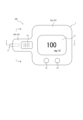
- FIG. 1 is a top view of a component measuring device set in which a component measuring chip is attached to a component measuring device according to an embodiment of the present disclosure.
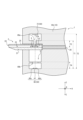
- FIG. 2 is a cross-sectional view taken along line II in FIG.
- FIG. 2 is a cross-sectional view taken along line II-II in FIG.
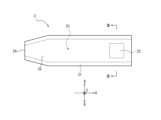
- FIG. 2 is a top view showing the component measuring chip shown in FIG. 1 .
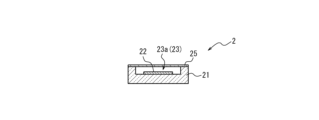
- FIG. 5 is a cross-sectional view taken along line III-III in FIG.
- FIG. 2 is an electrical block diagram of the component measuring device shown in FIG. 1 .
- FIG. 9 is a diagram showing the irradiation positions of the mixture of the multiple light sources shown in FIG. 8 .
- FIG. 1 is a diagram showing absorbance spectra of six mixtures obtained by subjecting each of six types of blood samples to a color reaction with a measurement reagent.
- FIG. 1 shows absorbance spectra of seven types of blood samples.
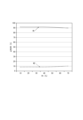
- FIG. 2 is a diagram showing the absorption coefficient of reduced hemoglobin and the absorption coefficient of oxygenated hemoglobin.
- FIG. 1 is a diagram showing the ratio of the absorption coefficient of oxygenated hemoglobin to the absorption coefficient of reduced hemoglobin.
- FIG. 11 is a graph showing the occupancy rate of the long wavelength region and the occupancy rate of the short wavelength region in absorbance caused by disturbance factors (noise) other than color components at measurement wavelengths estimated by regression analysis.
- 1 is a schematic diagram showing the stages in which blood is spread on a component measuring chip.
- FIG. 11 is a schematic diagram illustrating a change in absorbance accompanying the spread of blood on a component measuring chip.
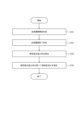
- 1 is a flowchart illustrating a method for correcting a measured component according to an embodiment of the present disclosure.
- 1 is a flowchart showing a component measuring method according to an embodiment of the present disclosure.
- FIG. 1 is a top view showing a component measuring device set 100 in which a component measuring chip 2 is attached to the component measuring device 1 according to this embodiment.
- FIG. 2 is a cross-sectional view showing a cross section along I-I in FIG. 1.
- FIG. 3 is a cross-sectional view showing a cross section along II-II in FIG. 1. Note that FIGS. 2 and 3 show an enlarged view of the vicinity of the location where the component measuring chip 2 is attached.
- the component measuring device set 100 includes a component measuring device 1 and a component measuring chip 2.
- the component measuring device 1 of this embodiment is a blood glucose level measuring device capable of measuring the concentration of glucose in a plasma component as a measured component in blood.
- the component measuring chip 2 of this embodiment is a blood glucose level measuring chip that can be attached to the tip of the blood glucose level measuring device as the component measuring device 1.
- blood here refers to whole blood that has not been separated into components and contains all the components.
- the component measuring device 1 comprises a housing 10 made of a resin material, a button provided on the top surface of the housing 10, a display unit 11 formed of liquid crystal or an LED (Light Emitting Diode) provided on the top surface of the housing 10, and a removal lever 12 that is operated when removing the component measuring chip 2 attached to the component measuring device 1.
- the button in this embodiment may be composed of a power button 13 and an operation button 14.
- the housing 10 includes a main body 10a having a generally rectangular shape as viewed from above, on whose upper surface the above-mentioned buttons and display unit 11 are provided, and a tip mounting portion 10b that protrudes outward from the main body 10a and has a removal lever 12 on its upper surface.
- a tip mounting space S is defined, with one end being the tip opening formed on the tip surface of the tip mounting portion 10b.
- the component measuring chip 2 is inserted into the tip mounting space S from the outside of the tip mounting portion 10b through the tip opening, and is pushed into a predetermined position, thereby being engaged with the tip mounting portion 10b of the component measuring device 1.
- the component measuring chip 2 is attached to the component measuring device 1.
- the component measuring chip 2 can be engaged with the component measuring device 1 by various configurations, such as by providing a claw portion in the tip mounting portion 10b that can engage with a part of the component measuring chip 2.
- the component measuring chip 2 is attached to the component measuring device 1, the component measuring chip 2 is released from its locked state by the chip attachment part 10b of the component measuring device 1 by operating the above-mentioned removal lever 12 from outside the housing 10. Then, as the component measuring chip 2 is released from its locked state, the eject pin 26 (see FIG. 2) inside the housing 10 moves in conjunction with the release of the component measuring chip 2, making it possible to remove the component measuring chip 2 from the component measuring device 1.
- the housing 10 of this embodiment is configured to include a main body portion 10a that is substantially rectangular when viewed from above, and a tip attachment portion 10b that protrudes outward from the main body portion 10a.
- the shape of the housing 10 of this embodiment is not limited as long as it includes a tip attachment portion to which the component measuring tip 2 can be attached. Therefore, in addition to the shape of the housing 10 of this embodiment, any shape that makes it easy for the user to hold with one hand can be adopted for the component measuring device 1.
- the display unit 11 is configured to display information on the components to be measured measured by the component measuring device 1.
- the display unit 11 can display the glucose concentration measured by the component measuring device 1 as a blood glucose level measuring device.
- the display unit 11 may be configured to display various information such as the measurement conditions of the component measuring device 1 or instruction information that instructs the user to perform a specific operation. The user can operate the power button 13 or the operation button 14 while checking the content displayed on the display unit 11.
- the component measuring device 1 includes a light emitting unit 66 and a light receiving unit 72.
- the light emitting unit 66 and the light receiving unit 72 are arranged opposite each other with the chip mounting space S in between.
- the component measuring chip 2 is mounted in the chip mounting space S of the component measuring device 1, the component measuring chip 2 is irradiated with the irradiation light emitted by the light emitting unit 66.
- the light receiving unit 72 receives the transmitted light that has passed through the component measuring chip 2 out of the irradiation light irradiated from the light emitting unit 66 to the component measuring chip 2.
- the light receiving unit 72 measures the amount of irradiation light irradiated from the light emitting unit 66 and sets it to an initial value, thereby also being able to correct changes in the amount of light from the light emitting unit.
- the light-emitting unit 66 has five light sources. Specifically, the light-emitting unit 66 has a first light source 67, a second light source 68a, a third light source 68b, a fourth light source 68c and a fifth light source 68d.
- the first light source 67, the second light source 68a and the third light source 68b are arranged at different positions in the flow path width direction B (left and right direction in Figure 3) perpendicular to the flow direction A (direction toward the right in Figure 2) in which blood flows in the flow path 23 of the component measuring chip 2 described later.
- the arrangement of the first light source 67 to the fifth light source 68d will be described in detail later (see Figure 8).
- FIG. 4 is a top view showing the component measuring chip 2.
- FIG. 5 is a cross-sectional view taken along line III-III in FIG. 4.
- the component measuring chip 2 comprises a base member 21 having a generally rectangular plate-like outer shape, a measuring reagent 22 held on this base member 21, and a cover member 25 that covers the base member 21.
- a groove is formed on the outer surface on one side of the thickness direction of the base member 21 (in this embodiment, the direction is the same as the thickness direction C of the component measuring chip 2 shown in Figures 2 and 3, and is therefore hereinafter referred to as the thickness direction C).
- the groove of the base member 21 is covered with the cover member 25 to become a hollow portion extending in a direction perpendicular to the thickness direction C. This hollow portion constitutes the flow path 23 of the component measuring chip 2.
- a supply section 24 capable of supplying blood from the outside is formed.
- a measurement reagent 22 is held at the bottom of the groove of the base member 21 among the inner walls of the flow path 23.
- the measurement reagent 22 is applied to the bottom of the groove as the flow path 23, but this is not limited thereto.
- the blood supplied to the supply section 24 from the outside moves in the flow direction A along the flow path 23 by, for example, utilizing capillary action, reaches the holding position where the measurement reagent 22 is held, and comes into contact with the measurement reagent 22.
- the measurement reagent 22 contains a coloring reagent that reacts with blood to develop a color. Therefore, when the measurement reagent 22 comes into contact with blood, a color reaction occurs in which the color-developing reagent contained in the measurement reagent 22 develops color, and a mixture X (see FIG. 2, etc.) containing a color-developing component is generated.
- the measurement reagent 22 may contain reagents other than the color-developing reagent.
- a gap 23a is formed between the cover member 25 and the measurement reagent 22. Blood moving in the flow path 23 from the supply unit 24 in the flow direction A reaches the other end of the flow path 23 through the gap 23a. Therefore, the blood comes into contact with the entire area of the measurement reagent 22 in the flow direction A, and a color reaction can occur.
- the holding position of the measurement reagent 22 is shown as “mixture X,” but the mixture X is located not only at the holding position of the measurement reagent 22, but also near the holding position of the measurement reagent 22, such as in the gap 23a. More specifically, blood entering the flow path 23 from the supply unit 24 contacts the measurement reagent 22 at the holding position and reaches the downstream end of the flow path 23 through the gap 23a, so that the inside of the flow path 23 becomes filled with blood. Thereafter, a color reaction between the measurement reagent 22 and the blood progresses, and the mixture X is located at the holding position or near it.
- the flow path 23 is formed by a hollow section defined by the base member 21 and the cover member 25, but the flow path is not limited to this configuration.
- the flow path may be formed only by a groove formed on the outer surface of one side in the thickness direction of the base member 21.
- the base member 21 and the cover member 25 are preferably made of a transparent material so that the amount of transmitted light after the irradiated light passes through them provides a sufficient signal for measurement.
- materials for the base member 21 and the cover member 25 include transparent organic resin materials such as polyethylene terephthalate (PET), polymethyl methacrylate (PMMA), polystyrene (PS), cyclic polyolefin (COP), cyclic olefin copolymer (COC), polycarbonate (PC), etc.; and transparent inorganic materials such as glass and quartz.
- the measurement reagent 22 includes an enzyme that reacts with the component to be measured in the blood, and a coloring reagent that changes color depending on the blood concentration of the component to be measured.
- the measurement reagent 22 of this embodiment includes an enzyme that specifically reacts with glucose as the component to be measured in the blood, and a coloring reagent that changes color quantitatively with electrons generated by the reaction of the enzyme with glucose.
- Examples of the measurement reagent 22 of this embodiment include a mixed reagent of (i) glucose oxidase (GOD), (ii) peroxidase (POD), (iii) 1-(4-sulfophenyl)-2,3-dimethyl-4-amino-5-pyrazolone, and (iv) N-ethyl-N-(2-hydroxy-3-sulfopropyl)-3,5-dimethylaniline, sodium salt, monohydrate (MAOS), or a mixed reagent of glucose dehydrogenase (GDH) and a tetrazolium salt.
- the measurement reagent 22 may include an electron mediator, etc., as necessary.
- the enzyme of this embodiment includes oxidoreductase.
- the oxidoreductase is not particularly limited and can be appropriately selected depending on the type of biological component to be measured. Specifically, glucose dehydrogenase (GDH) such as glucose dehydrogenase with pyrroloquinoline quinone (PQQ) as a coenzyme (PQQ-GDH), glucose dehydrogenase with flavin adenine dinucleotide (FAD) as a coenzyme (FAD-GDH), glucose dehydrogenase with nicotinamide adenine dinucleotide (NAD) as a coenzyme (NAD-GDH) and glucose dehydrogenase with nicotine adenine dinucleotide phosphate (NADP) as a coenzyme (NADP-GDH), glucose oxidase (GOD), lactate dehydrogenase (LDH), cholesterol dehydrogenase, cholesterol oxida
- the oxidoreductase may be used alone or in combination of two or more types.
- the oxidoreductase is preferably glucose dehydrogenase or glucose oxidase.
- the oxidoreductase is preferably cholesterol dehydrogenase or cholesterol oxidase.
- the content of the oxidoreductase in the measurement reagent 22 is not particularly limited and can be appropriately selected depending on the amount of the color-developing reagent.
- glucose dehydrogenase is preferable.
- the color reagent of this embodiment uses a pigment compound that produces a color component produced by a color reaction with glucose in blood, and the peak wavelength in the absorbance spectrum is a wavelength different from the peak wavelength caused by the light absorption characteristics of hemoglobin in blood cells.
- the color reagent of this embodiment produces a color component produced by a color reaction with glucose in blood, and the absorbance spectrum has a peak wavelength around 650 nm, but is not limited to this. Details of this will be described later.
- the color-developing dye of this embodiment is preferably a tetrazolium salt, and is preferably 2-benzothiazolyl-3-(4-carboxy-2-methoxyphenyl)-5-[4-(2-sulfoethylcarbamoyl)phenyl]-2H-tetrazolium, a tetrazolium salt described in WO 2018/051822.
- the color-developing dye is at least one selected from the group consisting of 2-benzothiazolyl-3-(4-carboxy-2-methoxyphenyl)-5-[4-(2-sulfoethylcarbamoyl)phenyl]-2H-tetrazolium and tetrazolium salts represented by the following formula (1).
- the color-developing dye is a tetrazolium salt represented by the following formula (1).
- R 1 is any one selected from the group consisting of a hydrogen atom, a hydroxyl group, a methoxy group, and an ethoxy group
- R 2 is any one selected from the group consisting of a nitro group, -OR 4 , and a carboxyl group
- R 3 is a hydrogen atom, a methyl group, or an ethyl group, at least one of which is a methyl group or an ethyl group
- R 4 is a methyl group or an ethyl group
- m is the number of sulfo groups (-SO 3 - ) bonded to the phenyl group at the 5th position of the tetrazole skeleton and is 1 or 2
- n is the number of R 2s bonded to the phenyl group at the 3rd position of the tetrazole skeleton and is an integer of 0 to 2
- p is the number of sulfo groups (-SO 3 -
- the measurement reagent 22 may contain, in addition to an enzyme that specifically reacts with the measured component and a color-developing reagent, a hemolysis reagent that hemolyzes blood and an oxidation reagent that oxidizes hemoglobin (Fe 2+ ) in the blood to methemoglobin (Fe 3+ ).
- the hemolysis reagent of this embodiment may be, for example, a nonionic surfactant, an amphoteric surfactant, or an anionic surfactant.
- a nonionic surfactant is preferred.
- the nonionic surfactant has an HLB value of 11 to 15 (more preferably, 12 to 14).
- nonionic surfactants include polyoxyethylene alkyl ethers and nonylphenyl polyethylene glycols in which the average number of added moles of oxyethylene groups is 1 to 150 and the number of carbon atoms in the alkyl group is 1 to 18.
- nonionic surfactants may be synthesized or commercially available products may be used.
- Commercially available products include polyoxyethylene (9) octylphenyl ether (octylphenoxypoly(ethyleneoxy)ethanol or octylphenyl-polyethylene glycol) (Sigma-Aldrich, NonidetTM P-40), polyoxyethylene p-t-octylphenyl ethers (Triton surfactants) such as Triton® X-100 (polyoxyethylene (10) octylphenyl ether) and Triton® X-114 (polyoxyethylene (8) octylphenyl ether); polyoxyethylene sorbitan fatty acid esters such as Tween® 85; Dodecyl- ⁇ -D-m altose; Octyl- ⁇ -D-glucoside; Nonidet® P-40 (octylphenoxy poly(ethyleneoxy)ethanol,) and Nonidet® P-40 substitutes
- Amphoteric surfactants may also be synthesized or commercially available products may be used. Commercially available products include CHAPS (3-(3-cholamidepropyl)dimethylammonio-1-propanesulphonate), alkylpolyaminoethylglycine chloride, and sodium dodecyl sulfate.
- CHAPS 3-(3-cholamidepropyl)dimethylammonio-1-propanesulphonate
- alkylpolyaminoethylglycine chloride alkylpolyaminoethylglycine chloride
- sodium dodecyl sulfate sodium dodecyl sulfate.
- the composition (content) of the hemolytic reagent in the measurement reagent 22 can be appropriately selected according to the sample volume (whole blood volume).
- the composition (content) of the hemolytic agent in the measurement reagent 22 (solid content equivalent) is, for example, 1 to 10% by volume for a 1.0 ⁇ L whole blood sample.
- the content of the hemolytic agent in the component measurement chip 2 is 10 to 50% by mass, preferably 20 to 40% by mass, for the total amount (solid content) of the measurement reagent. With such an amount, for example, a sensor can be made that can sufficiently hemolyze a whole blood sample with a hematocrit of 20 to 70%.
- the content of the hemolytic agent refers to the total amount of the hemolytic reagents to be mixed.
- the oxidizing reagent in this embodiment may be, for example, nitrite.
- the oxidizing reagent oxidizes reduced hemoglobin (particularly reduced hemoglobin that has leaked from red blood cells due to hemolysis), thereby preventing false color development caused by hemoglobin reacting with a color-developing reagent.
- the nitrite for example, sodium nitrite, potassium nitrite, calcium nitrite, ammonium nitrite, etc. can be used. From the viewpoints of stability and versatility, sodium nitrite and potassium nitrite are preferred, and sodium nitrite is more preferred.
- the nitrite may be used alone or in combination of two or more types.
- the content of nitrite in the measurement reagent 22 is, for example, 0.8 to 10.0 parts by mass, preferably 1.5 to 7.5 parts by mass, and more preferably 2.0 parts by mass or more and less than 5.0 parts by mass, per 100 parts by mass of the total amount of the reagent (solid content).
- the content of the nitrite refers to the total amount of the nitrites mixed.
- the amount of nitrite contained is preferably 50 moles or less per mole of color reagent.
- the measurement reagent 22 may contain a buffering agent such as a phosphate buffer solution or various stabilizers. However, the measurement reagent 22 may not contain a hemolytic reagent, an oxidizing reagent, or a buffering agent. The types and components of the reagents contained in the measurement reagent 22 are not limited to these.
- the component measuring chip 2 when the component to be measured is measured by the component measuring device 1, the component measuring chip 2 is attached to the chip attachment part 10b.
- the blood moves in the flow path 23 by capillary action, for example, and reaches the holding position where the measurement reagent 22 is held in the flow path 23, where the glucose in the blood reacts with the measurement reagent 22. Then, at the holding position of the flow path 23, a mixture X containing a color-producing component is generated.
- the so-called colorimetric component measuring device 1 irradiates the mixture X containing the color-producing component with irradiation light, detects the amount of transmitted light (or the amount of reflected light), and obtains a detection signal that correlates with the intensity of color development according to the blood concentration.
- the component measuring device 1 can measure the component to be measured by referring to a calibration curve created in advance. Note that the component measuring device 1 of this embodiment measures the glucose concentration in the plasma component in the blood as described above.
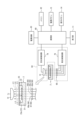
- FIG. 6 is an electrical block diagram of the component measuring device 1 shown in FIGS. 1 to 3.
- FIG. 6 also shows a cross section (the same cross section as FIG. 5) of the component measuring chip 2 attached to the component measuring device 1.
- FIG. 6 also shows a separate enlarged portion in the upper left corner that enlarges the vicinity of the component measuring chip 2. Further details of the component measuring device 1 will be described below.
- the component measuring device 1 further includes a calculation unit 60, a memory 62, a power supply circuit 63, and a measurement optical system 64.
- the calculation unit 60 is composed of an MPU (Micro-Processing Unit) or CPU (Central Processing Unit), and can realize the control operations of each part by reading and executing programs stored in the memory 62 etc.
- the memory 62 is composed of a non-transient storage medium that is volatile or non-volatile, and is configured to be able to read or write various data (including programs) necessary to execute the component measurement method shown here.
- the power supply circuit 63 supplies power to each part in the component measurement device 1, including the calculation unit 60, or stops the supply of power in response to the operation of the power button 13.
- the measurement optical system 64 is an optical system capable of acquiring the optical characteristics of a mixture X containing a color component generated by a color reaction between glucose in blood and a color reagent contained in the measurement reagent 22.
- the measurement optical system 64 includes a light emitting unit 66, a light emission control circuit 70, a light receiving unit 72, and a light receiving control circuit 74.
- the light-emitting unit 66 includes a plurality of light sources. Specifically, the light-emitting unit 66 of this embodiment includes five light sources that emit light with different spectral radiation characteristics (for example, visible light, infrared light). More specifically, the light-emitting unit 66 of this embodiment includes a first light source 67, a second light source 68a, a third light source 68b, a fourth light source 68c, and a fifth light source 68d. In FIG.
- the positional relationship of the first light source 67 to the fifth light source 68d is shown as being arranged in a line to illustrate the five light sources, but this is different from the actual positional relationship of the first light source 67 to the fifth light source 68d.
- the actual positional relationship of the first light source 67 to the fifth light source 68d is the positional relationship shown in FIG. 2 and FIG. 3. Details of the actual positional relationship of the first light source 67 to the fifth light source 68d will be described later (see FIG. 8).
- the peak wavelengths of the light emitted from the first light source 67 to the fifth light source 68d are ⁇ 1 to ⁇ 5, respectively.
- various light-emitting elements can be used, such as light-emitting diode (LED) elements, organic electroluminescence (EL (Electro-Luminescence)) elements, inorganic EL elements, and laser diode (LD (Laser Diode)) elements.
- LED light-emitting diode
- EL Electro-Luminescence
- LD Laser Diode
- peak wavelength will be described as the wavelength of light emitted from each light source, and for ease of explanation, the peak wavelength ⁇ 1 of the first light source 67 will be described as the “first predetermined wavelength ⁇ 1", the peak wavelength ⁇ 2 of the second light source 68a will be described as the “second predetermined wavelength ⁇ 2”, the peak wavelength ⁇ 3 of the third light source 68b will be described as the “third predetermined wavelength ⁇ 3”, the peak wavelength ⁇ 4 of the fourth light source 68c will be described as the "fourth predetermined wavelength ⁇ 4", and the peak wavelength ⁇ 5 of the fifth light source 68d will be described as the "fifth predetermined wavelength ⁇ 5".
- the light receiving unit 72 in this embodiment is composed of one light receiving element arranged opposite the light emitting unit 66 with the component measuring chip 2 in between.
- the light receiving unit 72 receives the transmitted light that is transmitted through the component measuring chip 2 and is irradiated from the first light source 67 to the fifth light source 68d of the light emitting unit 66 to the mixture X generated at the holding position of the measurement reagent 22 on the component measuring chip 2.
- Various photoelectric conversion elements including a PD (Photo Diode) element, a photoconductor, and a phototransistor can be used as the light receiving unit 72.
- the light emission control circuit 70 supplies a drive power signal to each of the first light source 67 to the fifth light source 68d, thereby turning the first light source 67 to the fifth light source 68d on and off at a predetermined interval.
- the light reception control circuit 74 obtains a digital signal (hereinafter referred to as the detection signal) by performing logarithmic conversion and A/D conversion on the analog signal output from the light receiving unit 72.
- FIG. 7 is a functional block diagram of the calculation unit 60 shown in FIG. 6.
- the calculation unit 60 realizes the functions of a measurement instruction unit 76 that instructs the measurement operation by the measurement optical system 64, and a concentration measurement unit 77 that measures the concentration of the component to be measured using various data.
- the concentration measurement unit 77 includes an absorbance acquisition unit 78, an absorbance correction unit 83, and a measured component calculation unit 84.
- memory 62 stores actual measurement data 85, correction coefficient data 86, and calibration curve data 90.
- Actual measurement data 85 includes first actual measurement value D1 to fifth actual measurement value D5, which are the absorbance of mixture X at each of the first predetermined wavelength ⁇ 1 to fifth predetermined wavelength ⁇ 5 measured by measurement optical system 64.
- Correction coefficient data 86 includes a group of correction coefficients correlating with the absorbance of mixture X at each of the second predetermined wavelength ⁇ 2 to fifth predetermined wavelength ⁇ 5.
- Calibration curve data 90 includes a calibration curve showing the relationship between the absorbance of the color component in mixture X and various physical quantities (e.g., glucose concentration) obtained by correcting the absorbance of mixture X actually measured at first predetermined wavelength ⁇ 1 using correction coefficient data 86, or a calibration curve showing the relationship between the absorbance of hemoglobin in mixture X and the hematocrit value.
- Hematocrit value is the percentage value that represents the volume ratio of blood cell components to blood (whole blood).
- the component measuring device 1 measures the analyte in blood based on the optical characteristics of the mixture X, which contains a color component generated by a color reaction between the analyte in blood and a reagent. Specifically, the component measuring device 1 estimates the amount of noise other than the color component contained in the first measured value D1 of the absorbance of the mixture X, which is measured by irradiating the mixture X with irradiation light of a first predetermined wavelength ⁇ 1 as a measurement wavelength, using irradiation light of a second predetermined wavelength ⁇ 2 to a fifth predetermined wavelength ⁇ 5.
- the component measuring device 1 estimates the above-mentioned amount of noise using the second measured value D2 to a fifth measured value D5 of the absorbance of the mixture X, which is measured by irradiating the mixture X with irradiation light of the second predetermined wavelength ⁇ 2 to a fifth predetermined wavelength ⁇ 5, and measures the absorbance of the color component and further the analyte.
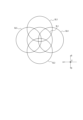
- FIG. 8 is a diagram showing the positional relationship of a first light source 67 that emits irradiation light of a first predetermined wavelength ⁇ 1 to be irradiated to the mixture X, a second light source 68a that emits irradiation light of a second predetermined wavelength ⁇ 2 to be irradiated to the mixture X, a third light source 68b that emits irradiation light of a third predetermined wavelength ⁇ 3 to be irradiated to the mixture X, a fourth light source 68c that emits irradiation light of a fourth predetermined wavelength ⁇ 4 to be irradiated to the mixture X, and a fifth light source 68d that emits irradiation light of a fifth predetermined wavelength ⁇ 5 to be irradiated to the mixture X.
- FIG. 8 shows the positional relationship of the first light source 67 to the fifth light source 68d when viewed from the top surface (see FIG. 1) side of the component measuring device 1. Also, in FIG. 8, for convenience of explanation, the position of the light receiving unit 72 in the flow path 23 of the component measuring chip 2 is shown by a two-dot chain line, and in this embodiment, the mixture X is generated at the above-mentioned holding position in the flow path 23 and in its vicinity.
- the first light source 67 to the fifth light source 68d are arranged facing the mixture X located in the blood flow path 23. More specifically, in this embodiment, the first light source 67 to the fifth light source 68d are arranged facing the holding position of the measurement reagent 22 in the blood flow path 23 in a direction perpendicular to both the flow direction A and the flow path width direction B (in this embodiment, the same direction as the thickness direction C of the component measurement chip 2).
- the first light source 67 and the second light source 68a are arranged side by side along the flow path width direction B perpendicular to the blood flow direction A at the position of the mixture X in the blood flow path 23.
- a first irradiation position SL1 (see Figure 9) on the mixture X of the light irradiated from the first light source 67, which will be described later
- a second irradiation position SL2 (see Figure 9) on the mixture X of the light irradiated from the second light source 68a, which will be described later, at positions where they at least partially overlap in the flow path width direction B.
- FIG. 9 is a diagram showing the first irradiation position SL1 to the fifth irradiation position SL5 of the mixture X by the first light source 67 to the fifth light source 68d when viewed from the top surface (see FIG. 1) side of the component measuring device 1.
- the first irradiation position SL1 on the mixture X of the irradiation light from the first light source 67 and the second irradiation position SL2 on the mixture X of the irradiation light from the second light source 68a overlap in the flow path width direction B.
- reaction unevenness occurs in the color reaction with blood depending on the position in the flow direction A of the reagent due to the influence of the blood flow in the flow path 23, it is possible to suppress the variation in the measurement results due to this reaction unevenness.
- the above-mentioned reaction unevenness is caused by the gradient of the amount of blood cells that can occur in the flow direction A.
- the gradient of the amount of blood cells that occurs in the flow direction A can occur due to the dissolution of the measurement reagent 22 when blood supplied from one end of the flow path 23 moves in the flow direction A and comes into contact with the measurement reagent 22 to cause a color reaction.
- the test reagent 22 dissolves, mainly the plasma component of the blood components is taken into the test reagent 22, and a mixture X is produced. As a result, the ratio of blood cell components becomes high around the mixture X.
- the blood flows in the flow direction A. Therefore, within the gap 23a, the amount of blood cells is greater on the downstream side of the flow direction A than on the upstream side. In other words, a gradient in the amount of blood cells occurs within the gap 23a. This gradient in the amount of blood cells can cause the above-mentioned uneven reaction. A gradient in the amount of blood cells is unlikely to occur in the flow path width direction B.
- the first irradiation position SL1 and the second irradiation position SL2 overlap in the flow path width direction B. That is, in this embodiment, the first irradiation position SL1 and the second irradiation position SL2 are at approximately the same position in the flow direction A.
- the first irradiation position SL1 and the second irradiation position SL2 are not limited to the positional relationship described above, and may have a positional relationship in which at least a portion of the irradiation positions overlap in the flow path width direction B.
- the first irradiation position SL1 and the second irradiation position SL2 not only overlap in the flow path width direction B, but also partially overlap in the flow direction A. In this way, the first irradiation position SL1 and the second irradiation position SL2 can be more closely matched, and variation in the measurement results due to differences in the measurement positions in the mixture X can be suppressed. It is more preferable that the first irradiation position SL1 and the second irradiation position SL2 have overlapping areas in the flow direction A, i.e., the first irradiation position SL1 and the second irradiation position SL2 are at approximately the same position in the flow path width direction B.
- the first light source 67, the second light source 68a, and the third light source 68b are arranged side by side along the flow path width direction B with the first light source 67 at the center.
- the first irradiation position SL1 in the mixture X of the light irradiated from the first light source 67 and the third irradiation position SL3 in the mixture X of the light irradiated from the third light source 68b overlap in the flow path width direction B.
- the first irradiation position SL1 and the third irradiation position SL3 overlap in the flow path width direction B. That is, in this embodiment, the first irradiation position SL1 and the third irradiation position SL3 are at approximately the same position in the flow direction A.
- the first irradiation position SL1 and the third irradiation position SL3 are not limited to the positional relationship described above, and may have any positional relationship in which they at least partially overlap in the flow path width direction B.
- the first irradiation position SL1 and the third irradiation position SL3 not only overlap in the flow path width direction B, but also partially overlap in the flow direction A. In this way, the first irradiation position SL1 and the third irradiation position SL3 can be more closely matched, and variation in the measurement results due to differences in the measurement positions in the mixture X can be suppressed. It is more preferable that the first irradiation position SL1 and the third irradiation position SL3 have overlapping areas in the flow direction A, i.e., the first irradiation position SL1 and the third irradiation position SL3 are at approximately the same position in the flow path width direction B.
- the second irradiation position SL2 and the third irradiation position SL3 of this embodiment overlap in the flow path width direction B. More specifically, the areas of the second irradiation position SL2 and the third irradiation position SL3 of this embodiment overlap in the flow path width direction B. Alternatively, it is sufficient that they are at least partially overlapping in the flow path width direction B. However, if the areas of both irradiation positions are configured to overlap in the flow path width direction B as in this embodiment, the variation in the measurement results due to the above-mentioned uneven reaction can be further suppressed compared to a configuration in which only a portion of them overlap in the flow path width direction B.
- the areas of the second irradiation position SL2 and the third irradiation position SL3 not only overlap in the flow channel width direction B, but also partially overlap in the flow direction A. In this way, the second irradiation position SL2 and the third irradiation position SL3 can be more closely matched, and variation in the measurement results due to differences in the measurement positions in the mixture X can be suppressed.
- the first light source 67 to the third light source 68b are arranged in a line along the flow path width direction B, and it is preferable that the areas of the first irradiation position SL1 to the third irradiation position SL3 overlap in the flow path width direction B, and it is even more preferable that the areas of the first irradiation position SL1 to the third irradiation position SL3 also overlap in the flow direction A.
- the first light source 67 and the second light source 68a are arranged adjacent to each other in the flow path width direction B, and there is no gap between the first light source 67 and the second light source 68a in which another light source can be arranged.
- the first light source 67 and the third light source 68b are arranged adjacent to each other in the flow path width direction B, and there is no gap between the first light source 67 and the third light source 68b in which another light source can be arranged.
- the first light source 67, the second light source 68a, and the third light source 68b are arranged adjacent to each other in the flow path width direction B without another light source being interposed therebetween. Therefore, it is easy to realize a configuration in which the first irradiation position SL1, the second irradiation position SL2, and the third irradiation position SL3 overlap in the flow direction A.
- the first light source 67 and the fourth and fifth light sources 68c and 68d As shown in Figures 2 and 8, the first light source 67 and the fourth light source 68c of this embodiment are arranged side by side along the flow direction A. Also, as shown in Figures 2 and 8, the first light source 67 and the fifth light source 68d of this embodiment are arranged side by side along the flow direction A. More specifically, the first light source 67, the fourth light source 68c, and the fifth light source 68d are arranged side by side along the flow direction A with the first light source 67 at the center.
- the second light source 68a and the third light source 68b are arranged adjacent to the first light source 67 in the flow path width direction B.
- the presence of the second light source 68a and the third light source 68b makes it impossible to arrange the first light source 67 and the fourth light source 68c and the fifth light source 68d adjacent to each other.
- the distance between the first light source 67 and each of the fourth light source 68c and the fifth light source 68d in the flow path width direction B is greater than the distance between the first light source 67 and each of the second light source 68a and the third light source 68b in the flow path width direction B.
- this distance becomes large, it becomes difficult to overlap the first irradiation position SL1 of the first light source 67, the fourth irradiation position SL4 of the fourth light source 68c, and the fifth irradiation position SL5 of the fifth light source 68d in the flow direction A.
- the first irradiation position SL1, the fourth irradiation position SL4, and the fifth irradiation position SL5 do not overlap at all. If the first irradiation position SL1, the fourth irradiation position SL4, and the fifth irradiation position SL5 do not overlap at all, the measurement points of absorbance are different, and this may reduce the accuracy of the measurement results of the component to be measured.
- first irradiation position SL1 of the first light source 67 overlap the fourth irradiation position SL4 of the fourth light source 68c and the fifth irradiation position SL5 of the fifth light source 68d by tilting the fourth light source 68c and the fifth light source 68d, but in such a case, the difference between the incidence angle of the irradiation light from the first light source 67 on the mixture X and the incidence angle of the irradiation light from each of the fourth light source 68c and the fifth light source 68d on the mixture X becomes large.
- the difference between the optical path length in the mixture X of the irradiation light from the first light source 67 and the optical path length in the mixture X of the irradiation light from each of the fourth light source 68c and the fifth light source 68d becomes large. Furthermore, the interface reflection of the irradiation light from the first light source 67 and the interface reflection of the irradiation light from each of the fourth light source 68c and the fifth light source 68d also become different. The difference in the optical path length and the difference in the interface reflection affect the actual measured value of the absorbance. In other words, there is a risk that the accuracy of estimating the amount of noise in the actual measured value of absorbance due to the light emitted by the first light source 67 will decrease.
- the first light source 67 and the fourth light source 68c are arranged side by side along the flow direction A such that the first irradiation position SL1 and the fourth irradiation position SL4 overlap in area while the difference in the incidence angle on the mixture X is equal to or less than a predetermined value. More specifically, there is no gap between the first light source 67 and the fourth light source 68c in the flow direction A in which another light source can be arranged, and the first light source 67 and the fourth light source 68c are adjacent to each other in the flow direction A.
- the first light source 67 and the fifth light source 68d are also arranged side by side along the flow direction A so that the first irradiation position SL1 and the fifth irradiation position SL5 can overlap in area while the difference in the angle of incidence on the mixture X is equal to or less than a predetermined value. More specifically, there is no gap between the first light source 67 and the fifth light source 68d in the flow direction A in which another light source can be placed, and the first light source 67 and the fifth light source 68d are adjacent to each other in the flow direction A.
- the first light source 67 and each of the second light source 68a and third light source 68b are adjacent to each other in the flow path width direction B. Therefore, the areas of the first irradiation position SL1 and each of the second irradiation position SL2 and third irradiation position SL3 can be overlapped while the difference in the angle of incidence on the mixture X is set to a predetermined value or less.
- the second light source 68a and third light source 68b of this embodiment are less susceptible to the influence of blood flow in relation to the first light source 67, and the areas of the irradiation positions can be overlapped by reducing the difference in the angle of incidence between them and the first light source 67.
- the second light source 68a and the third light source 68b which emit irradiation light of the second predetermined wavelength ⁇ 2 and the third predetermined wavelength ⁇ 3, which have a large influence on the estimation of the noise amount contained in the actual measurement value of the absorbance measured by the irradiation light of the first predetermined wavelength ⁇ 1 of the first light source 67, are arranged side by side along the flow path width direction B with respect to the first light source 67.
- the fourth light source 68c and the fifth light source 68d which emit irradiation light of the fourth predetermined wavelength ⁇ 4 and the fifth predetermined wavelength ⁇ 5, which have a small influence on the estimation of the above-mentioned noise amount compared to the second predetermined wavelength ⁇ 2 and the third predetermined wavelength ⁇ 3, are arranged side by side along the flow direction A with respect to the first light source 67. By arranging in this way, it is possible to improve the estimation accuracy of the above-mentioned noise amount. Details of the "influence" on the estimation of the noise amount will be described later (see FIG. 14).
- the above-mentioned second predetermined wavelength ⁇ 2 and the third predetermined wavelength ⁇ 3 are wavelengths belonging to the infrared region
- the above-mentioned fourth predetermined wavelength ⁇ 4 and the fifth predetermined wavelength ⁇ 5 are wavelengths belonging to the visible region.
- the light receiving unit 72 faces the first light source 67 to the fifth light source 68d in the thickness direction C across the mixture X located in the flow path 23 of the attached component measuring chip 2, and receives the transmitted light of the irradiation light from the first light source 67 to the fifth light source 68d that has passed through the mixture X, as described above.
- the component measuring device 1 is provided with a first diaphragm unit 69a that is located between the mixture X and the light receiving unit 72 and adjusts the amount of light that reaches the light receiving unit 72 out of the transmitted light that has passed through the mixture X.
- the difference between the angle of incidence of the irradiation light from the first light source 67 on the mixture X and the angle of incidence of the irradiation light from each of the second light source 68a to the fifth light source 68d on the mixture X affects the accuracy of estimating the amount of noise. Therefore, it is preferable to make the difference between the angle of incidence of the irradiation light from the first light source 67 on the mixture X and the angle of incidence of the irradiation light from each of the second light source 68a to the fifth light source 68d on the mixture X small.
- the distance T1 between the first light source 67 to the fifth light source 68d and the first aperture section 69a in the opposing direction (the same direction as the thickness direction C of the component measuring chip 2 in Figures 2 and 3) in order to improve the estimation accuracy of the noise amount.
- the distance T2 between the first light source 67 to the fifth light source 68d and the light receiving section 72 in the opposing direction it is possible to improve the light efficiency and reduce the size of the component measuring device 1.
- measurement field difference there is a large deviation in area (hereinafter referred to as "measurement field difference") between the first irradiation position SL1 of the first light source 67 and each of the second irradiation positions SL2 to fifth irradiation positions SL5 of the second light source 68a to fifth light source 68d, the measurement points do not match, which may reduce the accuracy of the measurement results of the components to be measured. For this reason, it is preferable to make this measurement field difference small. Therefore, it is preferable to shorten the distance T3 in the opposing direction between the mixture X and the first aperture portion 69a (in Figures 2 and 3, the same direction as the thickness direction C of the component measuring chip 2).
- the component measuring device 1 is provided with a second aperture section 69b located between the first light source 67 to the fifth light source 68d and the mixture X, and adjusting the amount of light reaching the mixture X from the first light source 67 to the fifth light source 68d.
- the second aperture section 69b is designed so that light reflected by the inner wall of the second aperture section 69b (hereinafter referred to as "stray light") among the light emitted from the first light source 67 to the fifth light source 68d does not enter the first aperture section 69a.
- the light emitted from the first light source 67 to the fifth light source 68d is optically attenuated to 5% by one wall reflection and disappears after three or more multiple reflections. Therefore, in this embodiment, if the stray light reflected by the inner wall of the second aperture section 69b does not reach the first aperture section 69b and is reflected by some wall surface, it will not enter the first aperture section 69a due to multiple reflections.
- the optical axis of each light source is designed to be mirror-reflected on the inner wall of the second aperture section 69b, but in reality, the light is diffusely reflected on the inner wall of the second aperture section 69b, and the stray light also has a certain distribution.
- the optical system of the component measuring device 1 does not use lenses such as condensing lenses. If a lens is used, the lens can be brought closer to the light source to improve the light collection efficiency, but the positional relationship between the light source and the lens must be maintained with high precision, which requires high assembly precision or an additional process to adjust the variation in the positional relationship between the light source and the lens.
- the component measuring device 1 does not use lenses, but instead sets the positions of the first aperture section 69a and the second aperture section 69b, thereby realizing a configuration with improved measurement precision without requiring high assembly precision.
- lenses such as condensing lenses may be used in the optical system of the component measuring device 1.
- the component measuring device 1 by arranging the first light source 67 to the fifth light source 68d in a predetermined position, the influence of the blood flow direction A in the blood flow path 23 is reduced while improving the accuracy of estimating the amount of noise.
- the component measuring device 1 of this embodiment is capable of mounting a component measuring chip 2 that divides a flow path 23 through which blood flows and has a measuring reagent 22, which contains a color-developing reagent that undergoes a color reaction with a component to be measured in blood, disposed in the flow path 23.
- the component measuring device 1 of this embodiment is mounted with the component measuring chip 2, and measures the component to be measured in blood based on the optical properties of a mixture containing a color-developing component generated by reaction with the component to be measured in the flow path 23.
- the component measuring device 1 also includes a first light source 67, and second light sources 68a to fifth light sources 68d that emit irradiation light of a second predetermined wavelength ⁇ 2 to a fifth predetermined wavelength ⁇ 5.
- the first light source 67 emits irradiation light of a first predetermined wavelength ⁇ 1 that is irradiated to the mixture X in the flow path 23 of the component measuring chip 2 when it is mounted.
- the second light source 68a to the fifth light source 68d emit irradiation light of a second predetermined wavelength ⁇ 2 to a fifth predetermined wavelength ⁇ 5 that is irradiated onto the mixture X in the flow path 23 of the component measuring chip 2 when attached, and is used to estimate the amount of noise caused by disturbance factors other than the color components contained in the actual absorbance value of the mixture X measured by the amount of transmitted light of the irradiation light of the first light source 67.
- the first light source 67 to the third light source 68b are arranged in a line along the flow path width direction B perpendicular to the blood flow direction A at the position of the mixture X in the flow path 23 of the component measuring chip 2 when attached.
- the component measuring device 1 of this embodiment measures the absorbance of the mixture X in the detachable component measuring chip 2, but may be configured so that the component measuring chip 2 does not need to be detached. However, considering user convenience and environmental friendliness, it is preferable that the component measuring device 1 be configured so that the disposable component measuring chip 2 can be detached from the reusable component measuring device 1.
- the first light source 67 to the fifth light source 68d of this embodiment are held by a thin plate-shaped holder member 80.
- the holder member 80 of this embodiment has a cross-shaped outer shape when viewed from above, and the first light source 67 is held in the center of the holder member 80 (the intersection of the cross) when viewed from above.
- the second light source 68a is held in the holder member 80 at a position on one side of the center where the first light source 67 is held in the flow path width direction B, and the third light source 68b is held in a position on the other side of the flow path width direction B.
- the fifth light source 68d is held in the holder member 80 at a position in the flow direction A with respect to the center where the first light source 67 is held, and the fourth light source 68c is held in a position opposite the flow direction A.
- a component measurement method in which a color reaction between glucose as a measured component in blood and a color reagent in the measurement reagent 22 is carried out using blood (whole blood) and the color reagent without separating the plasma components containing glucose from the blood, and the absorbance at a specified measurement wavelength of the color component generated by the color reaction between glucose and the color reagent is estimated based on the absorbance at various wavelengths of the entire mixture X obtained by this color reaction, thereby measuring the measured component.
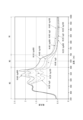
- Figure 10 shows the absorbance spectra of six types of mixture X obtained by reacting six types of blood samples, each with a known hematocrit value and glucose concentration, with measurement reagent 22. These six types of blood samples are referred to as samples 1 to 6.
- the first sample has a hematocrit value of 20% and a glucose concentration of 0 mg/dL (represented as "Ht20 bg0" in Figure 10).
- the second sample has a hematocrit value of 20% and a glucose concentration of 100 mg/dL (represented as "Ht20 bg100" in Figure 10).
- the third sample has a hematocrit value of 20% and a glucose concentration of 400 mg/dL (represented as "Ht20 bg400" in Figure 10).
- the fourth sample had a hematocrit of 40% and a glucose concentration of 0 mg/dL (represented as "Ht40 bg0" in FIG. 10).
- the fifth sample had a hematocrit of 40% and a glucose concentration of 100 mg/dL (represented as "Ht40 bg100" in FIG. 10).
- the sixth sample had a hematocrit of 40% and a glucose concentration of 400 mg/dL (represented as "Ht40 bg400" in FIG. 10).
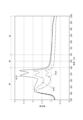
- the absorbance spectrum of the blood sample shown in Figure 11 has two peaks, centered around 540 nm and 570 nm. These two peaks are mainly due to the light absorption of oxyhemoglobin in red blood cells.
- the absorbance spectrum of the blood sample shown in Figure 11 in the wavelength range of 600 nm or more, the absorbance decreases gradually and almost linearly as the wavelength becomes longer. This almost linear portion is mainly due to light scattering of blood cell components.
- the absorbance spectrum of mixture X shown in FIG. 10 has a trend curve in which the absorbance gradually decreases as the wavelength increases, similar to the absorbance spectrum of blood shown in FIG. 11.
- the absorbance spectrum of mixture X shown in FIG. 10 has an increased absorbance over the visible light wavelength range of around 600 nm to 700 nm. This increased absorbance over the range of around 600 nm to 700 nm is mainly due to the absorption characteristics of the color component produced by the color reaction between glucose in the blood and the color reagent in the measurement reagent 22.
- the component measuring device 1 measures the component to be measured in blood based on the optical characteristics of the mixture X that contains a color component produced by a color reaction between the blood and the measuring reagent 22. Specifically, in this embodiment, the concentration of glucose contained in the plasma component in the blood is measured.
- the component measuring device 1 calculates the glucose concentration in the blood by correcting the actual measured value of the absorbance of the mixture X at the measurement wavelength based on the optical characteristics of blood cell components in the blood, the surface of the component measuring chip 2, or fine particles such as dust attached to the component measuring chip 2, and the ratio of reduced hemoglobin to oxygenated hemoglobin in the red blood cells.
- the component measuring method using the component measuring device 1 includes a step of correcting the actual measured value of the absorbance of the mixture X at the measurement wavelength based on information on scattered light caused by blood cell components in the blood, the surface of the component measuring chip 2, or fine particles such as dust attached to the component measuring chip 2, and the ratio of reduced hemoglobin to oxygenated hemoglobin in the red blood cells.
- the component measuring device 1 is configured to correct the glucose concentration in the blood based on the oxygen saturation of the blood. This allows the component measuring device 1 to correct the measurement value of the component to be measured taking into account the oxygen saturation that differs for each blood sample, thereby improving the measurement accuracy of the component to be measured in the blood.
- FIG. 12 shows the absorption coefficient of reduced hemoglobin (denoted as "Hb” in FIG. 12) and the absorption coefficient of oxyhemoglobin (denoted as "HbO 2 " in FIG. 12).
- Hemoglobin in red blood cells mainly contains oxyhemoglobin bound to oxygen and reduced hemoglobin from which oxygen is dissociated in a place where the oxygen partial pressure is low.
- Oxyhemoglobin plays a role in transporting oxygen throughout the body through arteries after passing through the lungs and binding to oxygen, and can be found in large amounts in arterial blood. For example, when blood is collected from the pad of a finger, the blood is from capillaries, so the amount of this oxyhemoglobin is relatively large. Conversely, reduced hemoglobin can be found in large amounts in venous blood.
- FIG. 12 shows the ratio of the absorption coefficient of oxygenated hemoglobin to the absorption coefficient of reduced hemoglobin.
- the absorption coefficient of reduced hemoglobin is about 0.9
- the absorption coefficient of oxygenated hemoglobin is about 0.09.
- the absorption coefficient of oxygenated hemoglobin is equivalent to about 10% of the absorption coefficient of total hemoglobin.
- the measurement wavelength for measuring the absorbance of the color component contained in mixture X is set to 650 nm, and the actual value of the absorbance of mixture X measured at this measurement wavelength is corrected to remove the effects of light scattering by blood cell components, etc., or the effects of light absorption by hemoglobin taking into account the ratio of reduced hemoglobin to oxygenated hemoglobin, as disturbance factors (noise).
- the absorbance of the color component contained in mixture X is estimated, and the glucose concentration is calculated using a calibration curve showing the relationship between this estimated absorbance and the glucose concentration.
- the color reagent in the measurement reagent 22 used in this embodiment produces a color component by reacting with glucose in the blood, and the absorbance of the color component has a peak at around 600 nm.
- the measurement wavelength for measuring the absorbance of the color component is 605 nm.
- the measurement wavelength for measuring the absorbance of the color component to be measured may be a wavelength at which the light absorption rate of the color component is relatively high and at which the influence of light absorption by hemoglobin is relatively small.
- the wavelength may be a wavelength that corresponds to the full width at half maximum of the peak wavelength range in the absorbance spectrum of the color component to be measured and belongs to the wavelength range W3 (see Figures 10 and 11) in which the ratio of absorbance due to light absorption by hemoglobin to the total absorbance is relatively small.
- the wavelength range "corresponding to the full width at half maximum of the peak wavelength range” means the range from the wavelength showing the half value on the short wavelength side to the wavelength showing the half value on the long wavelength side when the full width at half maximum of the peak wavelength range in the absorbance spectrum is specified.
- the absorbance spectrum of the color component to be measured in this embodiment has a peak wavelength near 600 nm, and a wavelength range corresponding to the full width at half maximum is about 500 nm to about 700 nm.
- the influence of light absorption by hemoglobin on the total absorbance is relatively small in the wavelength range of 600 nm or more.
- the wavelength range W3 which corresponds to the full width at half maximum of the peak wavelength range in the absorbance spectrum of the color component to be measured and in which the ratio of absorbance due to light absorption by hemoglobin to the total absorbance is relatively small, is 600 nm or more and 700 nm or less. Therefore, the measurement wavelength is not limited to 605 nm in this embodiment, and another wavelength in the range of 600 nm to 700 nm may be used as the measurement wavelength.
- the absorbance derived from the color component can be measured more accurately, it is preferable to use a measurement wavelength of around 650 nm, which is a slightly longer wavelength than the peak wavelength of around 600 nm in the absorbance spectrum of the color component. More specifically, the measurement wavelength is preferably a wavelength in the range of 600 nm to 680 nm, more preferably a wavelength in the range of 600 nm to 670 nm, and particularly preferably 605 nm as in this embodiment.
- a coloring reagent is used in which the full width at half maximum of the peak wavelength range in the absorbance spectrum of the coloring component is about 500 nm to about 700 nm, but a coloring reagent in which the full width at half maximum of the peak wavelength range is different from this range may also be used.
- a coloring reagent in which the full width at half maximum of the peak wavelength range is different from this range may also be used.
- the component measuring device 1 measures the absorbance of mixture X at four second predetermined wavelengths ⁇ 2 to 5th predetermined wavelengths ⁇ 5 that are different from the measurement wavelength (605 nm), and corrects the first measured value D1 of the absorbance of mixture X at the measurement wavelength using these four second measured values D2 to 5th measured values D5 and correction coefficient data 86, thereby estimating the absorbance of the color component at the measurement wavelength.
- the measurement wavelength in this embodiment is the first predetermined wavelength ⁇ 1 described above.
- the component measuring device 1 uses two second actual measurement values D2 and third actual measurement values D3 of the absorbance of the mixture X at two second and third predetermined wavelengths ⁇ 2 and ⁇ 3, respectively, which are longer than the first predetermined wavelength ⁇ 1, which is the measurement wavelength, and two fourth actual measurement values D4 and fifth actual measurement values D5 of the absorbance of the mixture X at two fourth and fifth predetermined wavelengths ⁇ 4 and ⁇ 5, respectively, which are shorter than the first predetermined wavelength ⁇ 1, which is the measurement wavelength.
- the two fourth actual measurement values D4 and fifth actual measurement values D5 of the absorbance of mixture X at two fourth and fifth predetermined wavelengths ⁇ 4 and ⁇ 5, respectively, which are shorter than the first predetermined wavelength ⁇ 1, which is the measurement wavelength, and which belong to a wavelength range in which the influence of light absorption by hemoglobin is large in the total absorbance, are used.
- the component measuring device 1 uses, as the second measured value D2 and the third measured value D3 described above, the absorbance of the mixture X at the second specified wavelength ⁇ 2 and the third specified wavelength ⁇ 3, which belong to a longer wavelength range than the measurement wavelengths in the wavelength range (500 to 700 nm in this embodiment) corresponding to the full width at half maximum of the peak wavelength range in the absorbance spectrum of the color component being measured, for example, belong to the long wavelength range W1 on the longer wavelength side than the wavelength range W3.
- the component measuring device 1 uses the fourth measured value D4 and the fifth measured value D5, which are the absorbance of the mixture X at the fourth specified wavelength ⁇ 4 and the fifth specified wavelength ⁇ 5, respectively, which belong to a shorter wavelength range than the measurement wavelength belonging to the wavelength range (500 to 700 nm) corresponding to the full width at half maximum of the peak wavelength range in the absorbance spectrum of the color component to be measured, for example, which belong to the short wavelength range W2 on the shorter wavelength side than the wavelength range W3.
- the fourth measured value D4 and the fifth measured value D5 which are the absorbance of the mixture X at the fourth specified wavelength ⁇ 4 and the fifth specified wavelength ⁇ 5, respectively, which belong to a shorter wavelength range than the measurement wavelength belonging to the wavelength range (500 to 700 nm) corresponding to the full width at half maximum of the peak wavelength range in the absorbance spectrum of the color component to be measured, for example, which belong to the short wavelength range W2 on the shorter wavelength side than the wavelength range W3.
- the absorbance acquisition unit 78 of the component measuring device 1 acquires the first actual measurement value D1 to the fifth actual measurement value D5 described above. Specifically, the mixture X is irradiated with irradiation light including the emission wavelengths of the first predetermined wavelength ⁇ 1 to the fifth predetermined wavelength ⁇ 5 from the first light source 67 to the fifth light source 68d of the light emitting unit 66. The light receiving unit 72 receives the transmitted light that passes through the mixture X from each of the irradiation light.
- the calculation unit 60 calculates the absorbance of the mixture X at each wavelength from the relationship between the irradiation light and the transmitted light, and stores the first actual measurement value D1 to the fifth actual measurement value D5, which are the absorbance of the mixture X at each wavelength, in the memory 62 as actual measurement value data 85. In addition to the absorbance of the mixture X at each wavelength, the calculation unit 60 also stores the measurement values of the amount of irradiation light and the amount of transmitted light at each wavelength in the memory 62 as actual measurement value data 85. This series of processes for generating the actual measurement value data 85 may be performed repeatedly at a predetermined time interval. The predetermined time interval is, for example, 5 milliseconds, but is not limited to this.
- the absorbance acquisition unit 78 of the component measuring device 1 can acquire the actual measurement data 85 from the memory 62.
- the means by which the absorbance acquisition unit 78 acquires the first actual measurement value D1 to the fifth actual measurement value D5 are not limited to the means described above, and various known means can be used instead of the means described above.
- the absorbance correction unit 83 of the component measuring device 1 corrects the first actual measurement value D1 using the second actual measurement value D2 to the fifth actual measurement value D5, and estimates the absorbance of the color component at the measurement wavelength, the first predetermined wavelength ⁇ 1 (605 nm in this example).
- the absorbance spectrum of the mixture X is approximately linear. Therefore, if the second actual measurement value D2, which is the absorbance at the second predetermined wavelength ⁇ 2, and the third actual measurement value D3, which is the absorbance at the third predetermined wavelength ⁇ 3, can be obtained, it is possible to estimate to some extent the absorbance at the first predetermined wavelength ⁇ 1, which is the measurement wavelength, caused by disturbance factors (noise) other than the absorbance caused by the color components, by determining the slope between the second actual measurement value D2 and the third actual measurement value D3.
- the component measuring device 1 calculates the glucose concentration in blood by taking into account the ratio of reduced hemoglobin and oxygenated hemoglobin in red blood cells in addition to the optical characteristics of blood cell components and the like in blood. Therefore, the component measuring device 1 can perform more accurate correction by using two wavelengths (fourth predetermined wavelength and fifth predetermined wavelength) selected according to the ratio of reduced hemoglobin and oxygenated hemoglobin.
- the fourth predetermined wavelength ⁇ 4 is a wavelength where the difference in absorption coefficient between reduced hemoglobin and oxygenated hemoglobin is equal to or less than the first predetermined value
- the fifth predetermined wavelength ⁇ 5 is a wavelength where the difference in absorption coefficient between reduced hemoglobin and oxygenated hemoglobin is greater than the first predetermined value.
- the fourth predetermined wavelength ⁇ 4 is a wavelength where the ratio of the absorption coefficient of oxygenated hemoglobin to the absorption coefficient of reduced hemoglobin (see FIG. 13) is equal to or greater than the first threshold value
- the fifth predetermined wavelength ⁇ 5 is a wavelength where the ratio of the absorption coefficient of oxygenated hemoglobin to the absorption coefficient of reduced hemoglobin is less than the first threshold value.
- the fourth predetermined wavelength ⁇ 4 and the fifth predetermined wavelength ⁇ 5 are two wavelengths, a wavelength where the ratio of the absorption coefficient of oxygenated hemoglobin to the absorption coefficient of reduced hemoglobin is equal to or greater than the first threshold value and a wavelength where the ratio is less than the first threshold value.
- the two wavelengths selected based on the ratio of reduced hemoglobin to oxygenated hemoglobin are preferably two wavelengths that have a large difference in hemoglobin light absorption due to the ratio of reduced hemoglobin to oxygenated hemoglobin. Therefore, in this embodiment, the fourth predetermined wavelength ⁇ 4 is a wavelength at which the ratio of the absorption coefficient of oxygenated hemoglobin to the absorption coefficient of reduced hemoglobin is 0.8 or more, that is, a wavelength in the range of 520 nm to 550 nm, or a wavelength in the range of 565 nm to 585 nm.
- the fifth predetermined wavelength ⁇ 5 is preferably a wavelength at which the ratio of the absorption coefficient of oxygenated hemoglobin to the absorption coefficient of reduced hemoglobin is less than 0.8, that is, a wavelength greater than 550 nm and less than 565 nm, or a wavelength greater than 585 nm and less than 600 nm.
- a wavelength near 560 nm where the difference in absorption coefficient is largest even within the range of greater than 550 nm and less than 565 nm, or 585 to 590 nm, where the difference in absorption coefficient is largest even within the range of greater than 585 nm and less than 600 nm.
- the component measuring device 1 can accurately measure the absorbance of the color component at the measurement wavelength, the first predetermined wavelength ⁇ 1, and further the component to be measured (glucose concentration measurement in this embodiment).
- the fourth predetermined wavelength ⁇ 4 and the fifth predetermined wavelength ⁇ 5 are wavelengths that take into account the influence of the ratio between reduced hemoglobin and oxygenated hemoglobin, but this is not limited to the above.
- the second predetermined wavelength ⁇ 2 and the third predetermined wavelength ⁇ 3 may also be wavelengths that take into account the influence of the ratio between reduced hemoglobin and oxygenated hemoglobin.
- the third predetermined wavelength ⁇ 3 in the long wavelength range W1 where light scattering of blood cell components and the like is dominant is a wavelength at which the difference in absorption coefficient between reduced hemoglobin and oxygenated hemoglobin is equal to or less than a second predetermined value
- the second predetermined wavelength ⁇ 2 in the long wavelength range W1 is a wavelength that is greater than the second predetermined value.
- the third predetermined wavelength ⁇ 3 is a wavelength at which the ratio of the absorption coefficient of oxygenated hemoglobin to the absorption coefficient of reduced hemoglobin is equal to or greater than the first threshold value and equal to or less than the second threshold value
- the second predetermined wavelength ⁇ 2 in the long wavelength range W1 is preferably a wavelength at which the ratio of the absorption coefficient of oxygenated hemoglobin to the absorption coefficient of reduced hemoglobin is less than the first threshold value or is greater than the second threshold value.
- the second threshold value is another predetermined threshold value that is greater than the first threshold value.
- the absorbance correction unit 83 it is preferable to use two wavelengths in ranges where the ratio of the absorption coefficient of oxygenated hemoglobin to the absorption coefficient of reduced hemoglobin is different as the second predetermined wavelength ⁇ 2 and the third predetermined wavelength ⁇ 3. This allows the absorbance correction unit 83 to perform a highly accurate correction that takes into even greater consideration the ratio of reduced hemoglobin to oxygenated hemoglobin when correcting the first actual measurement value D1 using the second actual measurement value D2 to the fifth actual measurement value D5.
- the influence of light scattering by blood cell components and the like is dominant, but the influence of light absorption by hemoglobin is also included to the same extent as the measurement wavelength of the measured component, so it is preferable to use two wavelengths as the second specified wavelength ⁇ 2 and the third specified wavelength ⁇ 3, at which the light absorption by hemoglobin changes relatively greatly depending on the ratio of reduced hemoglobin to oxygenated hemoglobin.
- the third predetermined wavelength ⁇ 3 it is preferable to use a wavelength in the range of 0.8 to 1.56, in which the absorption coefficient of reduced hemoglobin and the absorption coefficient of oxygenated hemoglobin are relatively equal, as the third predetermined wavelength ⁇ 3, and it is preferable to use a wavelength in the range of 790 nm to 860 nm. Furthermore, it is also preferable to set the third predetermined wavelength ⁇ 3 to 725 to 790 nm, which is in the long wavelength range W1 and in which the absorbance of the color component contained in the total absorbance at the third predetermined wavelength ⁇ 3 is 3% or less, more preferably 1% or less, of the absorbance of the color component contained in the total absorbance at the measurement wavelength.
- the "total absorbance" in the above-mentioned “absorbance of the color-forming component included in the total absorbance” refers to the absorbance of the entire mixture.
- the "absorbance of the color-forming component" in the above-mentioned “absorbance of the color-forming component included in the total absorbance” refers to the absorbance of the reaction product that occurs when the analyte in the blood and the color-forming reagent in the reagent undergo a color reaction, that is, the absorbance derived from the color-forming component in the mixture.
- the second predetermined wavelength ⁇ 2 a wavelength in the long wavelength range W1, which is greater than or equal to 725 nm and less than 790 nm, is used, where the absorbance of the color components included in the total absorbance at the second predetermined wavelength ⁇ 2 is 10% or less, preferably 6% or less, of the absorbance of the color components included in the total absorbance at the measurement wavelength, more preferably 1% or less, and even more preferably substantially 0%, is used.
- the second predetermined wavelength ⁇ 2 it is more preferable to use a wavelength longer than 860 nm and less than 950 nm as the second predetermined wavelength ⁇ 2, and within this range, it is particularly preferable to set the second predetermined wavelength ⁇ 2 to 940 nm to 950 nm, which is greater than the ratio of reduced hemoglobin to oxygenated hemoglobin at the third predetermined wavelength.
- the component measuring device 1 can correct the first actual measurement value D1, which is the actual measurement value of the absorbance of the mixture X at the measurement wavelength, using the second actual measurement value D2 to the fifth actual measurement value D5, which are the actual measurement values of the absorbance of the mixture X at the second predetermined wavelength ⁇ 2 to the fifth predetermined wavelength ⁇ 5, respectively, to estimate the absorbance of the color component at the measurement wavelength.
- the following describes the correction method used by the absorbance correction unit 83 of the component measuring device 1.
- the memory 62 of the component measuring device 1 stores actual measurement data 85 of the first actual measurement value D1 to the fifth actual measurement value D5, which are the absorbance of the mixture X at the first predetermined wavelength ⁇ 1 to the fifth predetermined wavelength ⁇ 5, respectively, measured by the measurement optical system 64, a group of correction coefficient data 86 that correlates with the absorbance of the mixture X at the second predetermined wavelength ⁇ 2 to the fifth predetermined wavelength ⁇ 5, and calibration curve data 90 that shows the relationship between the absorbance of the color component in the mixture X, obtained by correcting the absorbance of the mixture X actually measured at the first predetermined wavelength ⁇ 1 using the correction coefficient data 86, and various physical quantities.
- the absorbance correction unit 83 calculates the absorbance of the color component at the first predetermined wavelength ⁇ 1, which is the measurement wavelength, based on the actual measurement data 85 and correction coefficient data 86 stored in the memory 62.
- correction coefficient data 86 here is derived by a regression analysis previously performed using the following formula (2):
- B( ⁇ ) refers to the absorbance at wavelength ⁇ caused by disturbance factors (noise) other than the absorbance of the color component, and a regression calculation is performed using the above formula (2) using various types of blood samples to derive the coefficients b0, b1, b2, b3, and b4.
- 940 nm is used as the second predetermined wavelength ⁇ 2, 855 nm as the third predetermined wavelength ⁇ 3, 520 nm as the fourth predetermined wavelength ⁇ 4, and 589 nm as the fifth predetermined wavelength ⁇ 5.
- this wavelength is the median value of the light source used, and the actual wavelength width includes individual differences of approximately ⁇ 5 to 10 nm from the median value.
- the various blood samples are based on six blood samples with different component compositions, and blood samples with hematocrit values adjusted to a range of 10% to 70% are prepared.
- the absorbance spectrum of the adjusted blood samples is measured, and coefficients b0, b1, b2, b3, and b4 are derived using regression analysis. A total of 766 observations were performed this time. Then, based on the derived coefficients b0 to b4, a group of correction coefficients correlating with the absorbance of mixture X at each of the second predetermined wavelength ⁇ 2 to the fifth predetermined wavelength ⁇ 5 are derived.
- correction coefficient data 86 including these correction coefficients the actual measured value of the absorbance of mixture X at the measurement wavelength of 605 nm can be corrected from the actual measured values of the absorbance of mixture X at 520 nm, 589 nm, 855 nm, and 940 nm, and the absorbance of the color component at 605 nm can be estimated.
- the coefficients b0 to b4 obtained by the regression calculation above can each be determined as values specific to the measurement system, and do not vary depending on the hematocrit value. Therefore, the numerical values (actual measured values) of B( ⁇ 2) to B( ⁇ 5) used in the regression calculation will vary depending on the hematocrit value.
- Figure 14 is a graph showing the degree of influence of the measured values in the long wavelength range W1 (represented as “W1” in Figure 14) and the degree of influence of the measured values in the short wavelength range W2 (represented as “W2” in Figure 14) on the amount of noise (hereinafter simply referred to as “noise absorbance”), which is absorbance caused by external disturbance factors (noise) other than the color components at the measured wavelength, in the regression calculation described above.
- noise absorbance is absorbance caused by external disturbance factors (noise) other than the color components at the measured wavelength, in the regression calculation described above.
- degree of influence here refers to the occupancy rate of the data.
- the influence of the fourth actual measurement value D4 and the fifth actual measurement value D5 at the fourth predetermined wavelength ⁇ 4 and the fifth predetermined wavelength ⁇ 5 in the short wavelength range W2 increases from 8% to 10% as the hematocrit value increases from 10% to 70% (see “W2" in FIG. 14).
- the influence of the long wavelength region W1 and the short wavelength region W2 used varies depending on the hematocrit value, so that the noise absorbance at the measurement wavelength can be more accurately estimated, and as a result, the absorbance of the color component at the measurement wavelength can be more accurately estimated.
- the second actual value D2 to the fifth actual value D5 include the absorption of the color component, a correction calculation must be performed on the second actual value D2 to the fifth actual value D5 to calculate the noise absorbance B( ⁇ ).
- the component measurement device 1's metered component calculation unit 84 calculates the component to be measured in the blood (glucose concentration in this embodiment) based on the first actual measurement value D1 to the fifth actual measurement value D5 acquired by the absorbance acquisition unit 78 and the absorbance of the color component at the first predetermined wavelength ⁇ 1 as the measurement wavelength estimated by the absorbance correction unit 83.
- the analyte calculation unit 84 calculates the hematocrit value using at least one of the first actual measurement value D1 to the fifth actual measurement value D5 acquired by the absorbance acquisition unit 78.
- the analyte calculation unit 84 estimates the absorbance of hemoglobin from the fourth actual measurement value D4 or from the fourth actual measurement value D4 and the second actual measurement value D2, and calculates the hematocrit value using a calibration curve showing the relationship between the absorbance of hemoglobin in the mixture X and the hematocrit value stored in the memory 62.
- the analyte calculation unit 84 may calculate the hematocrit value from the acquired correction value by performing a correction calculation to subtract the absorption of the color component from the fourth actual measurement value D4 or the fourth actual measurement value D4 and the second actual measurement value D2, respectively.
- the analyte calculation unit 84 calculates the glucose concentration as the analyte from the absorbance of the color component at the first predetermined wavelength ⁇ 1, which is the measurement wavelength, and the calculated hematocrit value, using a calibration curve showing the relationship with the analyte stored in memory 62.
- the measured component calculation unit 84 is configured to correct the measured value of the measured component calculated as described above based on the absorption information of hemoglobin contained in the blood.
- the following describes the method for correcting the measured components using the measured component calculation unit 84 of the component measuring device 1.
- the absorption information of hemoglobin contained in the blood sample is important in improving the estimation accuracy of the absorbance derived from the color component to be measured.
- the absorption information of hemoglobin differs for each blood sample, i.e., the ratio of reduced hemoglobin to oxygenated hemoglobin.
- the measurement component calculation unit 84 corrects the measurement value of the measurement component taking into account the influence caused by the difference in oxygen saturation in the blood sample. In this way, by performing a correction taking into account the difference in oxygen saturation for each blood sample, the measurement accuracy of the measurement component in the blood (in this embodiment, the glucose concentration measurement accuracy) can be further improved.
- the measurement component calculation unit 84 is configured to estimate the oxygen saturation level based on the transmitted light when blood is irradiated with irradiation light of a wavelength at which the absorption coefficient of reduced hemoglobin is equal to the absorption coefficient of oxygenated hemoglobin and irradiation light of a wavelength at which the absorption coefficient of reduced hemoglobin is different from the absorption coefficient of oxygenated hemoglobin.
- the wavelength at which the absorption coefficient of reduced hemoglobin is equal to the absorption coefficient of oxygenated hemoglobin is also referred to as the "equivalent wavelength”
- the wavelength at which the absorption coefficient of reduced hemoglobin is different from the absorption coefficient of oxygenated hemoglobin is also referred to as the "inequivalent wavelength”.
- the equivalent wavelength is the wavelength at which the absorption coefficient of reduced hemoglobin (Hb) and the absorption coefficient of oxygenated hemoglobin ( HbO2 ) intersect in Fig. 12, and examples of such wavelengths include 520 nm, 545 nm, 570 nm, and 580 nm. Any wavelength within a range of ⁇ 10 nm, preferably ⁇ 5 nm, from the median value can be regarded as an equivalent wavelength.
- the fourth light source 68c is used as the first correction light source that emits irradiation light of the above-mentioned equivalent wavelength
- the first light source 67 is used as the second correction light source that emits irradiation light of the inequivalent wavelength.
- the fourth predetermined wavelength ⁇ 4 of the fourth light source 68c may be 520 nm, and the first predetermined wavelength ⁇ 1 of the first light source 67 may be 605 nm.
- the fourth predetermined wavelength ⁇ 4 of the fourth light source 68c may be 545 nm, and the first predetermined wavelength ⁇ 1 of the first light source 67 may be 560 nm.
- a versatile green LED or orange LED can be used as the fourth light source 68c and the first light source 67, and the system can be constructed at low cost.
- the fourth predetermined wavelength ⁇ 4 and the first predetermined wavelength ⁇ 1 may be any combination of these wavelengths that meets the conditions described above in this disclosure.
- the second light source 68a and the third light source 68b, or the fourth light source 68c and the fifth light source 68d may be used as the first correction light source and the second correction light source, or a light source other than the first light source 67 to the fifth light source 68d may be provided in the component measuring device 1.
- Figure 15 is a schematic diagram showing the stages in which blood is spread on the component measurement chip 2.
- Figure 16 is a schematic diagram showing the change in absorbance associated with the spread of blood on the component measurement chip 2.
- Figure 17 is a flowchart showing a method of correcting the measured component in one embodiment of the present disclosure.
- the blood supplied to the flow path 23 of the component measuring chip 2 flows through the flow path 23 of the component measuring chip 2 toward the measurement reagent 22, and then reacts with the enzyme, coloring reagent, hemolysis reagent, and oxidation reagent contained in the measurement reagent 22.
- the measured component calculation unit 84 utilizes the time lag between the blood flowing into the flow path 23 of the component measuring chip 2 and the measurement reagent 22 starting to react, and determines whether or not the reaction between the measured component in the blood and the measurement reagent 22 has started, and then obtains the absorbance required for estimating the oxygen saturation before the reaction starts. At this time, the light received by the light receiving unit is transmitted light that passes through the unreacted test reagent 22 and unreacted blood.
- step S101 the measured component calculation unit 84 of the component measurement device 1 performs a blood expansion start determination.
- the measured component calculation unit 84 may use the actual measurement value data 85 generated at a predetermined time interval to determine that blood development has started when there is a predetermined time series change (first time series change) in the transmitted light from at least one of the first light source 67 to the fifth light source 68d (for example, the fourth light source 68c, which is the first correction light source).
- the measured component calculation unit 84 may determine that blood development has started when the ratio of the amount of transmitted light to the amount of irradiated light of the fourth predetermined wavelength ⁇ 4 is the light amount change rate (%), and when (1) the light amount change rate increases/decreases by more than 5% two consecutive times, the next time point after the period in which (2) the light amount change rate is less than 1.2% two consecutive times before that period is the blood development start time. This allows the measured component calculation unit 84 to determine the start time of blood expansion, as shown in FIG. 16.
- step S101 if it is determined in step S101 that blood expansion has started, the measured component calculation unit 84 proceeds to step S102 and performs an end of blood expansion determination.
- the measured component calculation unit 84 may determine that blood development has ended when there is a predetermined time series change (second time series change) in the absorbance at at least one of the first predetermined wavelength ⁇ 1 to the fifth predetermined wavelength ⁇ 5 (for example, the fourth light source 68c, which is the first correction light source) included in the actual measurement value data 85.
- a predetermined time series change second time series change
- the measured component calculation unit 84 may determine that the blood development has ended when (1) the difference between the absorbance at the fourth predetermined wavelength ⁇ 4 in the visible range and the average value of the absorbance at the second predetermined wavelength ⁇ 2 and the third predetermined wavelength ⁇ 3 in the infrared range becomes 0.1 or more, and (2) the time series change in the absorbance at the fourth predetermined wavelength ⁇ 4 (for example, a three-time moving average) becomes less than 0.005. This allows the measured component calculation unit 84 to identify the end of blood development as shown in FIG. 16.
- step S103 the measured component calculation unit 84 calculates the supplemental absorbance ratio immediately after the end of blood expansion.
- the supplemental absorbance ratio is the ratio between the absorbance at the equivalent wavelength and the absorbance at the inequivalent wavelength, and is information that has a strong correlation with the oxygen saturation of the blood sample. Therefore, in this embodiment, the supplemental absorbance ratio is used to correct the measured component as a correction based on the oxygen saturation.
- the supplemental absorbance ratio is calculated using the following formula (3) from the absorbance of the second and third predetermined wavelengths ⁇ 2 and ⁇ 3 in the infrared region and the absorbance of the fourth and first predetermined wavelengths ⁇ 4 and ⁇ 1 in the visible region immediately after the blood spread is completed.
- R (lambda 1 absorbance - average of lambda 2 absorbance and lambda 3 absorbance) ⁇ (lambda 4 absorbance - average of lambda 2 absorbance and lambda 3 absorbance) (3) where R is the supplemental absorbance ratio, the fourth predetermined wavelength ⁇ 4 is the equivalent wavelength, and the first predetermined wavelength ⁇ 1 is the inequivalent wavelength.
- the measured component calculation unit 84 calculates the supplemental absorbance ratio based on one or more actual measurements within a predetermined period from the end of blood development determined in step S102, which are included in the actual measurement data 85.
- the predetermined period is, for example, the period from when the blood is developed in the flow path 23 of the component measurement chip 2 until the reaction between the blood and the measurement reagent 22 begins, and may be about 150 milliseconds.
- the measured component calculation unit 84 may calculate a supplemental absorbance ratio from each of the actual measurements at five consecutive points in time at 5 millisecond intervals from the end of blood development, and use the average value of these as the supplemental absorbance ratio of the blood to be the sample.
- the measured component calculation unit 84 may exclude the value as a singular point and calculate the supplemental absorbance ratio of the blood to be the sample. This improves the accuracy of calculation of the supplemental absorbance ratio of the blood sample, and thus improves the measurement accuracy of the analyte in the blood.
- the analyte calculation unit 84 when calculating the average value, if there are a predetermined number or more values that are not within a predetermined range (e.g., ⁇ 0.05 of the average value) based on the average value, the analyte calculation unit 84 does not need to correct the analyte using the supplemental absorbance ratio in subsequent processing. This makes it possible to prevent a decrease in the measurement accuracy of the analyte by performing correction using the supplemental absorbance ratio.
- step S104 the measured component calculation unit 84 corrects the measured component using the supplemental absorbance ratio.
- Bg is the glucose concentration after correction
- Bg' is the glucose concentration before correction
- R is the supplemental absorbance ratio
- f(R) is the correction value, which is a function that takes the supplemental absorbance ratio R as an argument.
- the first method it is possible to improve the measurement accuracy of the component to be measured in blood (the glucose concentration measurement accuracy in this embodiment) measured by the component measuring device 1, regardless of the oxygen saturation of the blood sample.
- the analyte calculation unit 84 may correct the glucose concentration as the analyte using a supplemental absorbance x based on the supplemental absorbance ratio and information on the absorbance at the equivalent wavelength (the "absorbance at ⁇ 4 - the average value of the absorbance at ⁇ 2 and the absorbance at ⁇ 3" in the above formula (3).
- the glucose concentration as the analyte may be corrected using the following formulas (5) and (6).
- Bg Bg'-F(x) (6)
- R is the supplemental absorbance ratio
- x is the supplemental absorbance
- the fourth predetermined wavelength ⁇ 4 is the equivalent wavelength
- the first predetermined wavelength ⁇ 1 is the inequivalent wavelength
- Bg is the glucose concentration after correction
- Bg' is the glucose concentration before correction
- F(x) is the correction value
- the second method it is possible to improve the measurement accuracy of the component to be measured in blood (the glucose concentration measurement accuracy in this embodiment) measured by the component measuring device 1, regardless of the oxygen saturation and blood cell volume of the blood sample.
- the supplementary absorbance x which has a correlation with the oxygen saturation and blood cell volume, is information on the absorbance at the inequivalent wavelength immediately after the end of blood expansion (the absorbance at ⁇ 1 - the average value of the absorbance at ⁇ 2 and the absorbance at ⁇ 3). Therefore, according to the second method, correction can be performed with less calculations than the first method, which uses information on the absorbance at both the equivalent wavelength and the inequivalent wavelength.
- the functions f(R) and f(x) may be constructed by a statistical method such as machine learning or deep learning.
- the functions f(R) and f(x) may be constructed by a statistical method using the actual measured values of absorbance and glucose concentration in experiments on various blood types as training data. This allows the accumulation of training data to improve the accuracy of glucose concentration correction.
- the functions f(R) and f(x) may include a predetermined arithmetic formula that does not rely on a statistical method.
- the measured component calculation unit 84 can determine whether or not a reaction between the measured component and the reagent has not yet started based on the time series change in the transmitted light from at least one of the two correction light sources (the fourth light source 68c, which is the first correction light source, and the fifth light source 68d, which is the second correction light source) received by the light receiving unit 72, estimate the oxygen saturation of the blood based on the transmitted light from the two correction light sources received by the light receiving unit 72 before the reaction has started, and correct the measured value of the measured component based on the oxygen saturation.
- the fourth light source 68c which is the first correction light source
- the fifth light source 68d which is the second correction light source
- FIG. 18 is a flowchart showing the component measurement method executed by the component measurement device 1.
- the component measurement method includes a step S1 of acquiring a first actual measurement value D1 which is the absorbance of mixture X at a first predetermined wavelength ⁇ 1 as a measurement wavelength, a second actual measurement value D2 which is the absorbance of mixture X at a second predetermined wavelength ⁇ 2, a third actual measurement value D3 which is the absorbance of mixture X at a third predetermined wavelength ⁇ 3, a fourth actual measurement value D4 which is the absorbance of mixture X at a fourth predetermined wavelength ⁇ 4, and a fifth actual measurement value D5 which is the absorbance of mixture X at a fifth predetermined wavelength ⁇ 5;
- the method includes step S2 of correcting D1 using the second actual measurement value D2 to the fifth actual measurement value D5 and the correction of the measured component obtained by regression calculation to obtain the absorbance of the color component at the first predetermined wavelength ⁇ 1 as the measurement wavelength, step S3 of calculating the hematocrit value using at least one of the first actual measurement value D1 to the fifth actual measurement value D
- step S1 the absorbance acquisition unit 78 acquires the first actual measurement value D1 to the fifth actual measurement value D5 using the light-emitting unit 66 and the light-receiving unit 72 of the measurement optical system 64.
- step S2 the absorbance correction unit 83 corrects the first actual measurement value D1 using the second actual measurement value D2 to the fifth actual measurement value D5 and the correction of the measured component obtained by regression calculation, and estimates and acquires the absorbance of the color component at the measurement wavelength.
- step S3 the measured component calculation unit 84 calculates the hematocrit value based on the fourth actual measurement value D4, or based on the fourth actual measurement value D4 and the second actual measurement value D2.
- step S4 the measured component calculation unit 84 calculates the glucose concentration using a calibration curve showing the relationship between the absorbance of the color component at the first predetermined wavelength ⁇ 1, which is the acquired measurement wavelength, and the calculated hematocrit value and the glucose concentration.
- the measured component calculation unit 84 corrects the glucose concentration based on the blood oxygen saturation calculated based on the first actual measurement value D1 to the fourth actual measurement value D4.
- the component measuring device 1 is a component measuring device that uses a reagent that reacts with the component to be measured in blood, and measures the component to be measured in blood based on the optical properties of the colored component produced by a color reaction between the component to be measured and the reagent.
- the component measuring device 1 is configured to correct the measurement value of the component to be measured based on the oxygen saturation of the blood.
- the component measuring device 1 can correct the measurement value of the component to be measured, taking into account that the oxygen saturation level differs for each blood sample, and as a result, the measurement accuracy of the component to be measured in the blood can be improved. Therefore, the component measuring device 1 according to the present disclosure can further improve the measurement accuracy of whole blood measurement using absorptiometry.
- the glucose concentration is measured as the component to be measured, but this is not limited to concentration, and another physical quantity may be measured.
- glucose in plasma is exemplified as the component to be measured in blood, but this is not limited, and for example, cholesterol, sugars, ketone bodies, uric acid, hormones, nucleic acids, antibodies, antigens, etc. in blood can also be used as the component to be measured. Therefore, the component measuring device is not limited to a blood glucose measuring device.
- the oxygen saturation of blood is estimated based on the transmitted light from the two correction light sources received by the light receiving unit 72 before the reaction between the measured component and the reagent starts, but this is not limited to the above.
- the oxygen saturation of blood may be estimated based on the transmitted light from the two correction light sources received by the light receiving unit 72 after the reaction between the measured component and the reagent has at least partially started.
- the light receiving unit 72 receives transmitted light that passes through the component measuring chip 2, but it may also be a light receiving unit that receives reflected light that is reflected from the component measuring chip 2.
- the blood glucose level in whole blood is measured without a blood separation process, but the blood may be filtered and the blood after some blood cell components or dust particles have been removed may be measured.
- the blood may not be filtered, but may be divided into a measurement area for reacting with the measurement reagent 22 and a correction area for correction, and calculations may be performed for each.
- This disclosure relates to a component measuring device and a component measuring method.
- Component measuring device 2 Component measuring chip 10: Housing 10a: Main body 10b: Chip mounting section 11: Display section 12: Removal lever 13: Power button 14: Operation button 21: Base member 22: Measurement reagent (reagent) 23: flow path 23a: gap 24: supply unit 25: cover member 26: eject pin 60: calculation unit 62: memory 63: power supply circuit 64: measurement optical system 66: light emitting unit 67: first light source (second correction light source) 68a: Second light source 68b: Third light source 68c: Fourth light source (first correction light source) 68d: Fifth light source 69a: First diaphragm section 69b: Second diaphragm section 70: Light emission control circuit 72: Light receiving section 74: Light receiving control circuit 76: Measurement instruction section 77: Concentration measurement section 78: Absorbance acquisition section 80: Holder member 83: Absorbance correction section 84: Measured component correction section 85: Actual measurement value data 86: Correction coefficient data 90: Calibration curve data 100:
Landscapes
- Health & Medical Sciences (AREA)
- Life Sciences & Earth Sciences (AREA)
- Physics & Mathematics (AREA)
- Immunology (AREA)
- Chemical & Material Sciences (AREA)
- Engineering & Computer Science (AREA)
- Hematology (AREA)
- General Physics & Mathematics (AREA)
- Pathology (AREA)
- Molecular Biology (AREA)
- Biochemistry (AREA)
- General Health & Medical Sciences (AREA)
- Analytical Chemistry (AREA)
- Urology & Nephrology (AREA)
- Biomedical Technology (AREA)
- Spectroscopy & Molecular Physics (AREA)
- Cell Biology (AREA)
- Medicinal Chemistry (AREA)
- Food Science & Technology (AREA)
- Microbiology (AREA)
- Biotechnology (AREA)
- Toxicology (AREA)
- Chemical Kinetics & Catalysis (AREA)
- Plasma & Fusion (AREA)
- Investigating Or Analysing Biological Materials (AREA)
- Investigating Or Analysing Materials By The Use Of Chemical Reactions (AREA)
Priority Applications (3)
| Application Number | Priority Date | Filing Date | Title |
|---|---|---|---|
| EP24759964.0A EP4644875A4 (en) | 2023-02-22 | 2024-01-16 | Component measurement device and component measurement method |
| CN202480004425.1A CN120051681A (zh) | 2023-02-22 | 2024-01-16 | 成分测定装置以及成分测定方法 |
| JP2025502164A JPWO2024176657A1 (https=) | 2023-02-22 | 2024-01-16 |
Applications Claiming Priority (2)
| Application Number | Priority Date | Filing Date | Title |
|---|---|---|---|
| JP2023-026711 | 2023-02-22 | ||
| JP2023026711 | 2023-02-22 |
Publications (1)
| Publication Number | Publication Date |
|---|---|
| WO2024176657A1 true WO2024176657A1 (ja) | 2024-08-29 |
Family
ID=92500983
Family Applications (1)
| Application Number | Title | Priority Date | Filing Date |
|---|---|---|---|
| PCT/JP2024/000993 Ceased WO2024176657A1 (ja) | 2023-02-22 | 2024-01-16 | 成分測定装置及び成分測定方法 |
Country Status (4)
| Country | Link |
|---|---|
| EP (1) | EP4644875A4 (https=) |
| JP (1) | JPWO2024176657A1 (https=) |
| CN (1) | CN120051681A (https=) |
| WO (1) | WO2024176657A1 (https=) |
Citations (14)
| Publication number | Priority date | Publication date | Assignee | Title |
|---|---|---|---|---|
| JPS5698652A (en) * | 1979-12-20 | 1981-08-08 | Hellige Gmbh | Calibration method of oxygen detector and reagent therefor |
| JPH0595939A (ja) * | 1991-10-11 | 1993-04-20 | Terumo Corp | 患者監視システム |
| JPH07191020A (ja) * | 1993-12-27 | 1995-07-28 | Fuji Photo Film Co Ltd | 全血分析要素を用いた全血試料の分析方法 |
| JPH09503866A (ja) * | 1993-10-14 | 1997-04-15 | ミネソタ マイニング アンド マニュファクチャリング カンパニー | 発光ケンチングセンサ |
| JP2002543397A (ja) * | 1999-04-26 | 2002-12-17 | ザ、プロクター、エンド、ギャンブル、カンパニー | 血液検出組成物 |
| JP2005501256A (ja) * | 2001-08-22 | 2005-01-13 | スリーエム イノベイティブ プロパティズ カンパニー | 蛍光ベースの酸素センサシステム |
| WO2005015181A1 (en) * | 2003-07-31 | 2005-02-17 | Genpharmtox Biotech Ag | Method and kit for determining the metabolic stability of test substances |
| JP2009233253A (ja) * | 2008-03-28 | 2009-10-15 | Terumo Corp | 血糖測定装置および血糖測定方法 |
| WO2015137074A1 (ja) * | 2014-03-14 | 2015-09-17 | テルモ株式会社 | 成分測定装置、方法及びプログラム |
| US20160157733A1 (en) * | 2014-04-29 | 2016-06-09 | Huinno, Co., Ltd. | Blood glucose measurement method and apparatus using multiple body signals |
| WO2017122485A1 (ja) * | 2016-01-12 | 2017-07-20 | テルモ株式会社 | 成分測定装置、成分測定方法及び成分測定プログラム |
| WO2018051822A1 (ja) | 2016-09-14 | 2018-03-22 | テルモ株式会社 | 2-置換ベンゾチアゾリル-3-置換フェニル-5-置換スルホ化フェニル-2h-テトラゾリウム塩、ならびに当該塩を含む生体成分濃度測定用試薬および当該塩を用いる生体成分濃度の測定方法 |
| WO2018173609A1 (ja) | 2017-03-23 | 2018-09-27 | テルモ株式会社 | 成分測定装置及び成分測定装置セット |
| WO2019138681A1 (ja) * | 2018-01-15 | 2019-07-18 | テルモ株式会社 | 成分測定システム、測定装置及び測定チップ |
-
2024
- 2024-01-16 JP JP2025502164A patent/JPWO2024176657A1/ja active Pending
- 2024-01-16 CN CN202480004425.1A patent/CN120051681A/zh active Pending
- 2024-01-16 EP EP24759964.0A patent/EP4644875A4/en active Pending
- 2024-01-16 WO PCT/JP2024/000993 patent/WO2024176657A1/ja not_active Ceased
Patent Citations (14)
| Publication number | Priority date | Publication date | Assignee | Title |
|---|---|---|---|---|
| JPS5698652A (en) * | 1979-12-20 | 1981-08-08 | Hellige Gmbh | Calibration method of oxygen detector and reagent therefor |
| JPH0595939A (ja) * | 1991-10-11 | 1993-04-20 | Terumo Corp | 患者監視システム |
| JPH09503866A (ja) * | 1993-10-14 | 1997-04-15 | ミネソタ マイニング アンド マニュファクチャリング カンパニー | 発光ケンチングセンサ |
| JPH07191020A (ja) * | 1993-12-27 | 1995-07-28 | Fuji Photo Film Co Ltd | 全血分析要素を用いた全血試料の分析方法 |
| JP2002543397A (ja) * | 1999-04-26 | 2002-12-17 | ザ、プロクター、エンド、ギャンブル、カンパニー | 血液検出組成物 |
| JP2005501256A (ja) * | 2001-08-22 | 2005-01-13 | スリーエム イノベイティブ プロパティズ カンパニー | 蛍光ベースの酸素センサシステム |
| WO2005015181A1 (en) * | 2003-07-31 | 2005-02-17 | Genpharmtox Biotech Ag | Method and kit for determining the metabolic stability of test substances |
| JP2009233253A (ja) * | 2008-03-28 | 2009-10-15 | Terumo Corp | 血糖測定装置および血糖測定方法 |
| WO2015137074A1 (ja) * | 2014-03-14 | 2015-09-17 | テルモ株式会社 | 成分測定装置、方法及びプログラム |
| US20160157733A1 (en) * | 2014-04-29 | 2016-06-09 | Huinno, Co., Ltd. | Blood glucose measurement method and apparatus using multiple body signals |
| WO2017122485A1 (ja) * | 2016-01-12 | 2017-07-20 | テルモ株式会社 | 成分測定装置、成分測定方法及び成分測定プログラム |
| WO2018051822A1 (ja) | 2016-09-14 | 2018-03-22 | テルモ株式会社 | 2-置換ベンゾチアゾリル-3-置換フェニル-5-置換スルホ化フェニル-2h-テトラゾリウム塩、ならびに当該塩を含む生体成分濃度測定用試薬および当該塩を用いる生体成分濃度の測定方法 |
| WO2018173609A1 (ja) | 2017-03-23 | 2018-09-27 | テルモ株式会社 | 成分測定装置及び成分測定装置セット |
| WO2019138681A1 (ja) * | 2018-01-15 | 2019-07-18 | テルモ株式会社 | 成分測定システム、測定装置及び測定チップ |
Non-Patent Citations (4)
| Title |
|---|
| ANONYMOUS: "Laptop-Type Blood Analysis System OPTI CCA", PMDA, PMDA, JP, JP, pages 1 - 4, XP009559441, Retrieved from the Internet <URL:https://www.info.pmda.go.jp/downfiles/md/PDF/480585/480585_28B2X00027000008_A_01_01.pdf> * |
| LUBBERS, D.W.: "How to measure pO"2 of tissue sealed in a transparent chamber: - Development and construction of the first optrodes/optodes", SENSORS AND ACTUATORS B: CHEMICAL, ELSEVIER BV, NL, vol. 51, no. 1-3, 31 August 1998 (1998-08-31), NL , pages 5 - 11, XP004153983, ISSN: 0925-4005, DOI: 10.1016/S0925-4005(98)00174-9 * |
| See also references of EP4644875A1 |
| STUCKER, M. SCHULZE, L. POTT, G. HARTMANN, P. LUBBERS, D.W. ROCHLING, A. ALTMEYER, P.: "FLIM of luminescent oxygen sensors: clinical applications and results", SENSORS AND ACTUATORS B: CHEMICAL, ELSEVIER BV, NL, vol. 51, no. 1-3, 31 August 1998 (1998-08-31), NL , pages 171 - 175, XP004154005, ISSN: 0925-4005, DOI: 10.1016/S0925-4005(98)00185-3 * |
Also Published As
| Publication number | Publication date |
|---|---|
| JPWO2024176657A1 (https=) | 2024-08-29 |
| EP4644875A4 (en) | 2026-05-06 |
| EP4644875A1 (en) | 2025-11-05 |
| CN120051681A (zh) | 2025-05-27 |
Similar Documents
| Publication | Publication Date | Title |
|---|---|---|
| KR102689281B1 (ko) | 성분 측정 장치, 성분 측정 방법 및 성분 측정 프로그램 | |
| JP7155109B2 (ja) | 成分測定装置及び成分測定装置セット | |
| EP3521826B1 (en) | Method, composition, and chip for detecting analysis object in blood sample | |
| US9927351B2 (en) | Sample test method, microfluidic device, and test device | |
| US12188875B2 (en) | Component measurement apparatus, component measurement apparatus set, and information processing method | |
| US20220371016A1 (en) | Component measurement apparatus, component measurement apparatus set, and information processing method | |
| WO2024176657A1 (ja) | 成分測定装置及び成分測定方法 | |
| WO2024176658A1 (ja) | 成分測定装置、成分測定装置セット及び成分測定方法 | |
| US12339221B2 (en) | Component measurement device, component measurement device set, and information processing method | |
| JP7617895B2 (ja) | 成分測定装置、成分測定装置セット及び情報処理方法 | |
| JP7617892B2 (ja) | 成分測定装置、成分測定装置セット及び情報処理方法 | |
| JP7617896B2 (ja) | 成分測定装置、成分測定装置セット及び情報処理方法 | |
| JP2023087330A (ja) | 生体成分濃度測定試薬、測定方法およびセンサ | |
| WO2018061772A1 (ja) | 成分測定装置、成分測定方法及び成分測定プログラム | |
| JP2024119653A (ja) | 成分測定装置及び成分測定装置セット | |
| JP7372310B2 (ja) | 血糖値算出プログラム、血糖値算出方法及び血糖値測定装置 | |
| HK40004461A (en) | Method, composition, and chip for detecting analysis object in blood sample |
Legal Events
| Date | Code | Title | Description |
|---|---|---|---|
| 121 | Ep: the epo has been informed by wipo that ep was designated in this application |
Ref document number: 24759964 Country of ref document: EP Kind code of ref document: A1 |
|
| WWE | Wipo information: entry into national phase |
Ref document number: 2025502164 Country of ref document: JP |
|
| WWE | Wipo information: entry into national phase |
Ref document number: 202480004425.1 Country of ref document: CN |
|
| WWP | Wipo information: published in national office |
Ref document number: 202480004425.1 Country of ref document: CN |
|
| WWE | Wipo information: entry into national phase |
Ref document number: 2024759964 Country of ref document: EP |
|
| ENP | Entry into the national phase |
Ref document number: 2024759964 Country of ref document: EP Effective date: 20250731 |
|
| NENP | Non-entry into the national phase |
Ref country code: DE |
|
| WWP | Wipo information: published in national office |
Ref document number: 2024759964 Country of ref document: EP |