WO2024176417A1 - 駆動装置および電動パワーステアリング装置 - Google Patents
駆動装置および電動パワーステアリング装置 Download PDFInfo
- Publication number
- WO2024176417A1 WO2024176417A1 PCT/JP2023/006616 JP2023006616W WO2024176417A1 WO 2024176417 A1 WO2024176417 A1 WO 2024176417A1 JP 2023006616 W JP2023006616 W JP 2023006616W WO 2024176417 A1 WO2024176417 A1 WO 2024176417A1
- Authority
- WO
- WIPO (PCT)
- Prior art keywords
- switching element
- wiring board
- housing
- inverter circuit
- connection member
- Prior art date
- Legal status (The legal status is an assumption and is not a legal conclusion. Google has not performed a legal analysis and makes no representation as to the accuracy of the status listed.)
- Ceased
Links
Images



Classifications
-
- H—ELECTRICITY
- H02—GENERATION; CONVERSION OR DISTRIBUTION OF ELECTRIC POWER
- H02K—DYNAMO-ELECTRIC MACHINES
- H02K11/00—Structural association of dynamo-electric machines with electric components or with devices for shielding, monitoring or protection
- H02K11/30—Structural association with control circuits or drive circuits
- H02K11/33—Drive circuits, e.g. power electronics
-
- H—ELECTRICITY
- H02—GENERATION; CONVERSION OR DISTRIBUTION OF ELECTRIC POWER
- H02K—DYNAMO-ELECTRIC MACHINES
- H02K9/00—Arrangements for cooling or ventilating
- H02K9/22—Arrangements for cooling or ventilating by solid heat conducting material embedded in, or arranged in contact with, the stator or rotor, e.g. heat bridges
- H02K9/223—Heat bridges
-
- B—PERFORMING OPERATIONS; TRANSPORTING
- B62—LAND VEHICLES FOR TRAVELLING OTHERWISE THAN ON RAILS
- B62D—MOTOR VEHICLES; TRAILERS
- B62D5/00—Power-assisted or power-driven steering
- B62D5/04—Power-assisted or power-driven steering electrical, e.g. using an electric servo-motor connected to, or forming part of, the steering gear
- B62D5/0403—Power-assisted or power-driven steering electrical, e.g. using an electric servo-motor connected to, or forming part of, the steering gear characterised by constructional features, e.g. common housing for motor and gear box
- B62D5/0406—Power-assisted or power-driven steering electrical, e.g. using an electric servo-motor connected to, or forming part of, the steering gear characterised by constructional features, e.g. common housing for motor and gear box including housing for electronic control unit
-
- H—ELECTRICITY
- H02—GENERATION; CONVERSION OR DISTRIBUTION OF ELECTRIC POWER
- H02K—DYNAMO-ELECTRIC MACHINES
- H02K2213/00—Specific aspects, not otherwise provided for and not covered by codes H02K2201/00 - H02K2211/00
- H02K2213/06—Machines characterised by the presence of fail safe, back up, redundant or other similar emergency arrangements
Definitions
- This disclosure relates to a drive unit and an electric power steering device.
- Patent Document 1 discloses a control device for controlling a motor.
- This control device has multiple inverter circuits that each control the current supplied to the multiple windings of the motor. This makes it possible to continue driving the motor even if a malfunction occurs in one inverter circuit, ensuring redundancy in the system.
- the switching elements constituting the multiple inverter circuits are provided on the same surface of the wiring board.
- the switching elements constituting the multiple inverter circuits are susceptible to the effects of disturbances such as electromagnetic noise or water intrusion at the same time, and there is a possibility that malfunctions will occur in the multiple inverter circuits at the same time. For this reason, there is room for improvement in terms of robustness.
- the present disclosure aims to provide a drive unit and electric power steering device that suppresses simultaneous malfunctions in multiple inverter circuits and improves robustness.
- One embodiment of the drive device includes a motor including a motor body having a rotor and two sets of windings that rotate the rotor when a current flows through them, a frame that accommodates the motor body, and a housing that is fitted into the frame; and a control unit that is attached to the motor and controls the current supplied to the two sets of windings.
- the control unit includes a wiring board having a first surface that faces the housing and a second surface opposite the first surface, a first inverter circuit and a second inverter circuit that can independently supply current to the two sets of windings, and a CPU that controls the first inverter circuit and the second inverter circuit.
- a first switching element that constitutes the first inverter circuit is disposed on the first surface of the wiring board, and a second switching element that constitutes the second inverter circuit is disposed on the second surface of the wiring board.
- One embodiment of the electric power steering device according to the present disclosure includes the drive device.
- This disclosure makes it possible to provide a drive unit and electric power steering device that suppresses simultaneous malfunctions in multiple inverter circuits and improves robustness.
- FIG. 1 is a circuit diagram of a drive device and an electric power steering device according to a first embodiment of the present invention
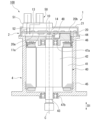
- 1 is a cross-sectional view showing the configuration of a drive device and an electric power steering device according to a first embodiment of the present invention.
- 1 is a plan view showing a schematic shape of a wiring board according to a first embodiment and an arrangement of components mounted on the wiring board; 3 is a cross-sectional view showing a heat dissipation structure of a switching element according to the first embodiment.
- FIG. 11 is a cross-sectional view showing a heat dissipation structure of a switching element according to a second embodiment.
- FIG. 11 is a cross-sectional view showing a heat dissipation structure of a switching element according to a third embodiment.
- Fig. 1 is a circuit diagram of a drive device 1 and an electric power steering device 100 in the embodiment 1.
- Fig. 2 is a cross-sectional view of the drive device 1.
- the drive device 1 has a control unit 2 and a motor 4.
- the electric power steering device 100 is configured to utilize the torque generated by the motor 4 as an assist torque when steering the vehicle.
- a rotating shaft 43 of the motor 4 is connected to a steering system of the vehicle via a reduction gear or the like.
- the control unit 2 has a first inverter circuit 3a, a second inverter circuit 3b, a control circuit 5, a first power line switch 6a, a second power line switch 6b, a rotation sensor 14, etc.
- the control circuit 5 includes a CPU 10, a first pre-driver 11a, a second pre-driver 11b, an input circuit 12, a power supply circuit 13, etc.
- the control unit 2 has a wiring board 20.
- the first inverter circuit 3a, the second inverter circuit 3b, the control circuit 5, the first power line switch 6a, the second power line switch 6b, the rotation sensor 14, etc. are mounted on the wiring board 20.
- the wiring board 20 has a first surface 20a and a second surface 20b.
- the wiring board 20 is covered by a cover 21.
- the motor 4 includes a motor body 40, a frame 45, a housing 46, a terminal group 44, etc.
- a permanent magnet synchronous motor can be used as the motor 4 for example.
- the motor body 40 has a stator 41 and a rotor 42.
- the motor 4 is a three-phase brushless motor, and the stator 41 has two sets of three-phase windings (three-phase coils).
- the three phases are U-phase, V-phase, and W-phase.
- the first three-phase winding is represented by the symbols Ua, Va, and Wa
- the second three-phase winding is represented by the symbols Ub, Vb, and Wb.
- the windings Ua, Va, and Wa are delta-connected, and the windings Ub, Vb, and Wb are delta-connected.
- these two sets of three-phase windings may be simply referred to as "three-phase windings Ua to Wb.”
- the three-phase windings Ua to Wb are delta-connected, but star-connection may also be used.
- the rotor 42 has a rotating shaft 43. The rotating shaft 43 rotates relative to the stator 41 around the motor axis C.
- the direction along the motor axis C is referred to as the first direction D1 or the axial direction.
- the first direction D1 also coincides with the thickness direction of the wiring board 20.
- the wiring board 20 and the rotor 42 are arranged side by side in the first direction D1.
- the side on which the wiring board 20 is arranged is referred to as the upper side
- the side on which the rotor 42 is arranged is referred to as the lower side.
- the wiring board 20 extends so as to intersect (substantially perpendicular to) the first direction D1.
- the second surface 20b is a surface facing upward
- the first surface 20a is a surface facing downward.
- the second surface 20b faces the cover 21 side
- the first surface 20a faces the rotor 42 side.
- Viewing from the first direction D1 (axial direction) is referred to as a plan view.
- a view from the first direction D1 (axial direction) is referred to as a plan view. Note that the first direction D1 does not have to coincide with the vertical direction.
- the frame 45 is cylindrical.
- the motor body 40 is housed inside the frame 45.
- a through hole is formed in the center of the bottom of the frame 45, and the lower bearing 47b is fixed inside this through hole.
- the lower end of the rotating shaft 43 is inserted into the lower bearing 47b.
- the housing 46 is provided at the top of the motor 4.
- the housing 46 is fitted inside the upper end of the cylindrical frame 45.
- the housing 46 prevents foreign matter from entering the inside of the motor 4.
- a through hole is formed in the center of the housing 46, and an upper bearing 47a is fixed inside this through hole.
- the upper end of the rotating shaft 43 is inserted into the upper bearing 47a.
- the upper bearing 47a and the lower bearing 47b support the rotating shaft 43 so that the rotating shaft 43 can rotate smoothly.
- a sensor magnet 48 is attached to the upper end of the rotating shaft 43.
- the sensor magnet 48 has at least one north pole and one south pole.
- the wiring board 20 is disposed above the housing 46.
- the stator 41 three-phase windings Ua to Wb
- the terminal group 44 electrically connects the wiring board 20 to the three-phase windings Ua, Va, Wa, Ub, Vb, and Wb.
- the housing 46 has a through hole extending in the first direction D1.
- the terminal group 44 is inserted into the through hole of the housing 46.
- the terminal group 44 includes six terminals that respectively correspond to the three-phase windings Ua to Wb.
- FIG. 3 is a plan view showing the schematic shape of wiring board 20 and the arrangement of components mounted on wiring board 20. As shown in FIG. 3, wiring board 20 has a substantially rectangular shape in a plan view.
- six current supply holes 22 are formed in the wiring board 20.
- the six terminals included in the terminal group 44 are inserted into these six current supply holes 22.
- Current is supplied from the inverter circuits 3a, 3b of the wiring board 20 to the three-phase windings Ua to Wb via the current supply holes 22 and the terminal group 44. This causes the rotating shaft 43 to rotate.
- the six terminals included in the terminal group 44 may be the ends of the three-phase windings Ua to Wb, or may be relay members electrically connected to the ends of the three-phase windings Ua to Wb.
- the rotation sensor 14 detects the rotation angle of the rotating shaft 43.
- An MR (magnetoresistance) sensor can be used as the rotation sensor 14.
- the rotation sensor 14 detects the rotation angle of the rotating shaft 43 by detecting the magnetic field generated by the sensor magnet 48.
- the rotation sensor 14 is arranged to face the sensor magnet 48. More specifically, as shown in FIG. 2, the rotation sensor 14 is mounted on the first surface 20a of the wiring board 20.
- the rotation sensor 14 is also arranged at a position overlapping the sensor magnet 48 in a plan view.
- the rotation sensor 14 may be arranged on the second surface 20b of the wiring board 20.
- the rotation sensor 14 may be arranged at a position offset from the sensor magnet 48 in a plan view.
- a connector assembly 50 is disposed above the cover 21.
- the connector assembly 50 is a part in which a connector, a metal bus bar, terminals, etc., and a holding member 51 that holds them are molded as one unit.
- the holding member 51 is made of, for example, resin.
- the connector assembly 50 connects the battery power line and ground line required for controlling and driving the motor 4 to the wiring board 20.
- the connector assembly 50 also connects signal transmission lines that transmit signals such as torque sensor signals and vehicle communication signals to the wiring board 20.
- the connector assembly 50 may electrically connect the battery power line, ground line, signal transmission line, etc., all at once to the control unit 2.
- a connector separate from the connector assembly 50 may be provided for connecting the battery power line, ground line, etc.
- the connector assembly 50 has a number of connector terminals 52 extending downward from a holding member 51.
- the connector terminals 52 are respectively inserted into a number of connector through holes 23 (see FIG. 3) formed in the wiring board 20.
- each connector terminal 52 is electrically connected to a circuit pattern formed on the wiring board 20.
- the wiring board 20 is fixed to the housing 46 with screws or the like.
- the wiring board 20 may also be fixed to the cover 21 or the connector assembly 50, etc.
- the power supply circuit 13 uses the power supplied from the battery 9 to generate a power supply voltage for causing each electronic component (CPU 10, input circuit 12, first pre-driver 11a, second pre-driver 11b, rotation sensor 14, etc.) that constitutes the control unit 2 to operate normally.
- each electronic component CPU 10, input circuit 12, first pre-driver 11a, second pre-driver 11b, rotation sensor 14, etc.
- the input circuit 12 inputs various information received by the control unit 2 from the sensors 8 and the rotation sensor 14, etc., to the CPU 10. Although detailed illustration is omitted, the input circuit 12 includes a torque sensor interface circuit and a vehicle communication interface circuit.
- the torque sensor interface circuit is a circuit for detecting the steering torque of the driver in the electric power steering device 100 and acquiring steering torque information.
- the vehicle communication interface circuit is a circuit for receiving various information from the vehicle system.
- the CPU 10 is configured to calculate various control variables for controlling the motor 4.
- the first pre-driver 11a and the second pre-driver 11b drive the first inverter circuit 3a and the second inverter circuit 3b, respectively, based on the calculation results of the CPU 10.
- the pre-driver 11a and the pre-driver 11b are, for example, FET driver circuits.
- the first inverter circuit 3a corresponds to the first three-phase windings Ua, Va, and Wa
- the second inverter circuit 3b corresponds to the second three-phase windings Ub, Vb, and Wb.
- the control unit 2 is configured to control these two inverter circuits 3a and 3b so as to supply power independently to each of the two sets of three-phase windings Ua to Wb.
- the inverter circuits 3a and 3b each have three upper arms and three lower arms corresponding to the U, V, and W phases.
- the first inverter circuit 3a and the second inverter circuit 3b have the same circuit configuration.
- the inverter circuits 3a and 3b each have the same circuit configuration for the U, V, and W phases. Therefore, the following will describe the U phase as a representative of these three phases. In other words, the following description also applies to the V and W phases.
- FIG. 1 shows the components of the inverter circuits 3a and 3b that correspond to the U phase. However, in reality, the inverter circuits 3a and 3b also have components that correspond to the V and W phases. In other words, in FIG. 1, the components of the inverter circuits 3a and 3b that correspond to the V and W phases are omitted.
- the first inverter circuit 3a has a first smoothing capacitor 31au, a first upper arm side switching element 32au, a first lower arm side switching element 33au, a first shunt resistor 34au, and a first motor relay switching element 35au.
- the first upper arm side switching element 32au is arranged in the upper arm
- the first lower arm side switching element 33au is arranged in the lower arm.
- These two first arm side switching elements 32au, 33au are connected in series.
- the first motor relay switching element 35au is connected between the two first arm side switching elements 32au, 33au.
- the first motor relay switching element 35au has a relay function.
- the first motor relay switching element 35au switches on and off the power supply from the portion between the two first arm side switching elements 32au, 33au to the winding Ua of the motor 4.
- the first arm side switching elements 32au, 33au are operated by the first pre-driver 11a based on the results of calculations by the CPU 10.
- a FET Field Effect Transistor
- the first smoothing capacitor 31au is connected near the first arm side switching elements 32au, 33au.
- the first smoothing capacitor 31au has the function of suppressing power supply voltage fluctuations and noise during switching.
- the first shunt resistor 34au is connected between the first lower arm side switching element 33au and ground. The first shunt resistor 34au is used to detect the drive current flowing through the winding Ua of the motor 4.
- the second inverter circuit 3b has the same circuit configuration as the first inverter circuit 3a. That is, the second inverter circuit 3b has a second smoothing capacitor 31bu, a second upper arm switching element 32bu, a second lower arm switching element 33bu, a second shunt resistor 34bu, and a second motor relay switching element 35bu.
- the connections and functions of the components of the second inverter circuit 3b are the same as those of the first inverter circuit 3a, so a description is omitted.
- the inverter circuits 3a and 3b may have a choke coil that suppresses the emission of noise to the outside of the drive device 1 and also suppresses the inflow of noise into the drive device 1.
- the first power line switch 6a includes a first power relay switching element 36a and a first reverse connection protection relay switching element 37a.
- the first power relay switching element 36a and the first reverse connection protection relay switching element 37a are connected in series.
- the parasitic diode of the first reverse connection protection relay switching element 37a is connected in the opposite direction to the parasitic diode of the first power relay switching element 36a.
- the protection function is a function of protecting the first inverter circuit 3a when the voltage (+B) of the battery 9 and the ground are erroneously connected in reverse when the battery 9 is installed in the vehicle.
- the first power line switch 6a does not have to have both the switching function and the protection function.
- the second power line switch 6b has a circuit configuration similar to that of the first power line switch 6a. That is, the second power line switch 6b includes a switching element 36b for the second power relay and a switching element 37b for the second reverse connection protection relay. The connections and functions of the components of the second power line switch 6b are similar to those of the first power line switch 6a, so a description thereof will be omitted.
- Figure 3 is a view of the wiring board 20 as seen from the second surface 20b side.
- components mounted on the second surface 20b are shown with solid lines
- components mounted on the first surface 20a are shown with dashed lines.
- the CPU 10 and the power supply circuit 13 are mounted on the second surface 20b of the wiring board 20.
- the CPU 10 may also be mounted on the first surface 20a.
- the second inverter circuit 3b and the second power line switch 6b are mounted on the second surface 20b of the wiring board 20.
- the three second upper arm side switching elements 32bu, 32bv, 32bw, the three second lower arm side switching elements 33bu, 33bv, 33bw, and the three second motor relay switching elements 35bu, 35bv, 35bw corresponding to the Ub, Vb, and Wb phases are mounted on the second surface 20b of the wiring board 20.
- the second power supply relay switching element 36b and the second reverse connection protection relay switching element 37b are mounted on the second surface 20b of the wiring board 20.
- the switching elements 32bu, 32bv, 32bw, 33bu, 33bv, 33bw, 35bu, 35bv, and 35bw that constitute the second inverter circuit 3b are collectively referred to as the "second switching element 30b.”
- the first inverter circuit 3a and the first power line switch 6a are mounted on the first surface 20a of the wiring board 20.
- the three first upper arm side switching elements 32au, 32av, 32aw, the three first lower arm side switching elements 33au, 33av, 33aw, and the three first motor relay switching elements 35au, 35av, 35aw corresponding to the Ua, Va, and Wa phases are mounted on the first surface 20a of the wiring board 20.
- the first power relay switching element 36a and the first reverse connection protection relay switching element 37a are mounted on the first surface 20a of the wiring board 20.
- the switching elements 32au, 32av, 32aw, 33au, 33av, 33aw, 35au, 35av, and 35aw that make up the first inverter circuit 3a are collectively referred to as the "first switching element 30a.”
- the electric power steering device 100 has a heat dissipation structure that dissipates heat generated by the first switching element 30a and the second switching element 30b to the housing 46. More specifically, the housing 46 is disposed so as to face the first surface 20a of the wiring board 20. A gap is formed between the wiring board 20 and the housing 46 in the first direction D1, and a thermal connection member 24 is provided in this gap. The thermal connection member 24 thermally connects the wiring board 20 and the housing 46.
- the thermal connection member 24 has insulating properties and high thermal conductivity.
- the thermal connection member 24 is, for example, a heat dissipation grease.
- the wiring board 20 is also provided with a metal heat conducting member 25 that is disposed penetrating from the second surface 20b to the first surface 20a.
- the heat conducting member 25 is disposed at a position that overlaps with the second switching element 30b in a plan view.
- the heat conducting member 25 is a thermal via.
- the heat conducting member 25 may also be a copper inlay.
- the first switching element 30a has a first surface 30a1 facing upward and a second surface 30a2 facing downward.
- the first surface 30a1 of the first switching element 30a is connected to the first surface 20a of the wiring board 20.
- the second surface 30a2 of the first switching element 30a has an exposed electrode and functions as a heat dissipation section.
- the second surface 30a2 of the first switching element 30a is covered by a thermal connection member 24.
- the second surface 30a2 of the first switching element 30a is in contact with the thermal connection member 24 and is thermally connected to the thermal connection member 24.
- the second switching element 30b has a first surface 30b1 facing downward and a second surface 30b2 facing upward.
- the first surface 30b1 of the second switching element 30b is connected to the second surface 20b of the wiring board 20.
- the first surface 30b1 of the second switching element 30b is thermally connected to the thermal connection member 24 via the thermal conduction member 25.
- the heat of the first switching element 30a is dissipated to the housing 46 via the thermal connection member 24.
- the heat of the second switching element 30b is dissipated to the housing 46 via the thermal conduction member 25 and the thermal connection member 24.
- the first switching element 30a and the second switching element 30b have different heat dissipation paths, and the first switching element 30a and the second switching element 30b have different thermal histories. This makes it possible to prevent deterioration due to heat from progressing simultaneously in the first switching element 30a and the second switching element 30b.
- the first switching element 30a and the second switching element 30b may have different heat dissipation properties.
- the size, structure, or material of the package components of the switching elements, or the size or structure of the chips of the switching elements may be made different, thereby making it possible to make the heat dissipation properties different between the first switching element 30a and the second switching element 30b.
- the first switching element 30a and the second switching element 30b can be more effectively prevented from simultaneously deteriorating due to heat generation.
- the driving device 1 includes a motor 4 including a rotor 42, a motor body 40 having two sets of windings that rotate the rotor 42 when a current flows through the motor body 40, a frame 45 that accommodates the motor body 40, and a housing 46 that is fitted into the frame 45, and a control unit 2 that is attached to the motor 4 and controls the current supplied to the two sets of windings.
- the control unit 2 includes a wiring board 20 having a first surface 20a that faces the housing 46 and a second surface 20b opposite to the first surface 20a, a first inverter circuit 3a and a second inverter circuit 3b that can independently supply current to the two sets of windings, and a CPU 10 that controls the first inverter circuit 3a and the second inverter circuit 3b.
- the first switching element 30a that constitutes the first inverter circuit 3a is disposed on the first surface 20a of the wiring board 20.
- the second switching element 30b that constitutes the second inverter circuit 3b is disposed on the second surface 20b of the wiring board 20.
- the electric power steering device 100 includes the drive device 1 .
- the first switching element 30a constituting the first inverter circuit 3a and the second switching element 30b constituting the second inverter circuit 3b are arranged separately on different surfaces of the wiring board 20. This makes it possible to prevent the first switching element 30a and the second switching element 30b from being simultaneously affected by disturbances. Therefore, even if a malfunction occurs in one inverter circuit due to a disturbance, it is unlikely that a malfunction will occur in the remaining inverter circuit. In other words, the motor 4 can continue to be driven by the remaining inverter circuit. This makes it possible to provide a drive device 1 that prevents malfunctions from occurring simultaneously in multiple inverter circuits 3a, 3b and has improved robustness.
- a thermal connection member 24 that thermally connects the housing 46 and the wiring board 20 is provided between the housing 46 and the wiring board 20.
- a heat conduction member 25 is provided on the wiring board 20, which is disposed so as to penetrate from the first surface 20a to the second surface 20b and is thermally connected to the thermal connection member 24.
- the first switching element 30a is thermally connected to the housing 46 via the thermal connection member 24.
- the second switching element 30b is thermally connected to the housing 46 via the thermal conduction member 25 and the thermal connection member 24.
- Embodiment 2 Next, a description will be given of a drive unit and an electric power steering device according to embodiment 2.
- the drive unit and the electric power steering device according to this embodiment are basically similar in configuration to the drive unit and the electric power steering device according to embodiment 1, so the description will focus on the differences.
- FIG. 5 is a cross-sectional view showing a heat dissipation structure of switching elements 30a and 30b according to the second embodiment.
- the upper surface 46a of the housing 46 i.e., the surface of the housing 46 that faces the wiring board 20
- the upper surface 46a of the housing 46 is configured to be flush with the wiring board 20. That is, the upper surface of the portion of the housing 46 that overlaps with the first switching element 30a in a plan view and the upper surface of the portion of the housing 46 that overlaps with the second switching element 30b in a plan view are flush with each other. This makes it easier to process the housing 46 and reduces parts costs.
- the distance h1 in the first direction D1 between the second surface 30a2 of the first switching element 30a and the upper surface 46a of the housing 46 is smaller than the distance h2 in the first direction D1 between the first surface 20a of the wiring board 20 and the upper surface 46a of the housing 46. That is, the size in the first direction D1 of the portion of the thermal connection member 24 that is provided between the first switching element 30a and the housing 46 is smaller than the size in the first direction D1 of the portion of the thermal connection member 24 that overlaps with the second switching element 30b in a plan view. This increases the difference in thermal history between the first switching element 30a and the second switching element 30b, making it possible to more effectively prevent simultaneous deterioration due to heat generation in the first switching element 30a and the second switching element 30b.
- Embodiment 3 Next, a description will be given of a drive unit and an electric power steering device according to embodiment 3.
- the drive unit and the electric power steering device according to this embodiment are basically similar in configuration to the drive unit and the electric power steering device according to embodiment 1, so the description will focus on the differences.
- FIG. 6 is a cross-sectional view showing a heat dissipation structure of switching elements 30a and 30b according to the third embodiment.
- the housing 46 is provided with a protruding portion 49 that protrudes from the upper surface 46a of the housing 46 toward the wiring board 20.
- the protruding portion 49 is disposed in a portion that overlaps with the second switching element 30b in a plan view.
- the upper surface 49a of the protruding portion 49 is closer to the first surface 20a of the wiring board 20 than the upper surface 46a.
- the distance h1 in the first direction D1 between the second surface 30a2 of the first switching element 30a and the upper surface 46a of the housing 46 is greater than the distance h2 in the first direction D1 between the first surface 20a of the wiring board 20 and the upper surface 49a of the protruding portion 49. That is, the size in the first direction D1 of the portion of the thermal connection member 24 that is provided between the first switching element 30a and the housing 46 is greater than the size in the first direction D1 of the portion of the thermal connection member 24 that overlaps with the second switching element 30b in a plan view. In this case, the heat dissipation performance of the second switching element 30b can be further improved.
- the first inverter circuit 3a is connected to the first power supply line switch 6a
- the second inverter circuit 3b is connected to the second power supply line switch 6b.
- a common power supply line switch may be used for the first inverter circuit 3a and the second inverter circuit 3b.
- the first inverter circuit 3a and the second inverter circuit 3b are connected to a common battery 9 and ground.
- the first inverter circuit 3a and the second inverter circuit 3b may be connected to batteries and grounds of different systems.
- the drive device 1 may be used for purposes other than the electric power steering device 100.
- the above-described embodiments and modifications may be combined as appropriate.
Landscapes
- Engineering & Computer Science (AREA)
- Power Engineering (AREA)
- Microelectronics & Electronic Packaging (AREA)
- Power Steering Mechanism (AREA)
Priority Applications (4)
| Application Number | Priority Date | Filing Date | Title |
|---|---|---|---|
| EP23924069.0A EP4672573A4 (en) | 2023-02-24 | 2023-02-24 | DRIVE SYSTEM AND ELECTRIC POWER STEERING SYSTEM |
| CN202380092762.6A CN120677622A (zh) | 2023-02-24 | 2023-02-24 | 驱动装置及电动助力转向装置 |
| PCT/JP2023/006616 WO2024176417A1 (ja) | 2023-02-24 | 2023-02-24 | 駆動装置および電動パワーステアリング装置 |
| JP2025502038A JPWO2024176417A1 (https=) | 2023-02-24 | 2023-02-24 |
Applications Claiming Priority (1)
| Application Number | Priority Date | Filing Date | Title |
|---|---|---|---|
| PCT/JP2023/006616 WO2024176417A1 (ja) | 2023-02-24 | 2023-02-24 | 駆動装置および電動パワーステアリング装置 |
Publications (1)
| Publication Number | Publication Date |
|---|---|
| WO2024176417A1 true WO2024176417A1 (ja) | 2024-08-29 |
Family
ID=92500660
Family Applications (1)
| Application Number | Title | Priority Date | Filing Date |
|---|---|---|---|
| PCT/JP2023/006616 Ceased WO2024176417A1 (ja) | 2023-02-24 | 2023-02-24 | 駆動装置および電動パワーステアリング装置 |
Country Status (4)
| Country | Link |
|---|---|
| EP (1) | EP4672573A4 (https=) |
| JP (1) | JPWO2024176417A1 (https=) |
| CN (1) | CN120677622A (https=) |
| WO (1) | WO2024176417A1 (https=) |
Citations (9)
| Publication number | Priority date | Publication date | Assignee | Title |
|---|---|---|---|---|
| JP2010283997A (ja) * | 2009-06-04 | 2010-12-16 | Mitsubishi Electric Corp | 車両用回転電機 |
| WO2014132878A1 (ja) * | 2013-02-26 | 2014-09-04 | 日立工機株式会社 | 電動工具 |
| CN203871967U (zh) * | 2014-04-05 | 2014-10-08 | 湖北华恩机车科技有限公司 | 一种无刷直流电机的散热结构 |
| JP5657117B2 (ja) * | 2011-07-08 | 2015-01-21 | 三菱電機株式会社 | 電動機 |
| JP6056827B2 (ja) | 2014-09-30 | 2017-01-11 | 株式会社デンソー | 回転電機制御装置 |
| WO2019064900A1 (ja) * | 2017-09-29 | 2019-04-04 | 日本電産株式会社 | 制御装置、モータ、電動パワーステアリング装置 |
| JP2019080471A (ja) * | 2017-10-27 | 2019-05-23 | オムロンオートモーティブエレクトロニクス株式会社 | 負荷駆動装置 |
| JP2020014303A (ja) * | 2018-07-17 | 2020-01-23 | 株式会社e−Gle | アウターロータ型モータ、および、電気自動車 |
| JP2020108317A (ja) * | 2018-12-28 | 2020-07-09 | 日本電産株式会社 | 電力変換装置、駆動装置およびパワーステアリング装置 |
Family Cites Families (1)
| Publication number | Priority date | Publication date | Assignee | Title |
|---|---|---|---|---|
| KR20170028133A (ko) * | 2015-09-03 | 2017-03-13 | 주식회사 만도 | 방열 구조가 개선된 인버터 어셈블리 |
-
2023
- 2023-02-24 WO PCT/JP2023/006616 patent/WO2024176417A1/ja not_active Ceased
- 2023-02-24 JP JP2025502038A patent/JPWO2024176417A1/ja active Pending
- 2023-02-24 EP EP23924069.0A patent/EP4672573A4/en active Pending
- 2023-02-24 CN CN202380092762.6A patent/CN120677622A/zh active Pending
Patent Citations (9)
| Publication number | Priority date | Publication date | Assignee | Title |
|---|---|---|---|---|
| JP2010283997A (ja) * | 2009-06-04 | 2010-12-16 | Mitsubishi Electric Corp | 車両用回転電機 |
| JP5657117B2 (ja) * | 2011-07-08 | 2015-01-21 | 三菱電機株式会社 | 電動機 |
| WO2014132878A1 (ja) * | 2013-02-26 | 2014-09-04 | 日立工機株式会社 | 電動工具 |
| CN203871967U (zh) * | 2014-04-05 | 2014-10-08 | 湖北华恩机车科技有限公司 | 一种无刷直流电机的散热结构 |
| JP6056827B2 (ja) | 2014-09-30 | 2017-01-11 | 株式会社デンソー | 回転電機制御装置 |
| WO2019064900A1 (ja) * | 2017-09-29 | 2019-04-04 | 日本電産株式会社 | 制御装置、モータ、電動パワーステアリング装置 |
| JP2019080471A (ja) * | 2017-10-27 | 2019-05-23 | オムロンオートモーティブエレクトロニクス株式会社 | 負荷駆動装置 |
| JP2020014303A (ja) * | 2018-07-17 | 2020-01-23 | 株式会社e−Gle | アウターロータ型モータ、および、電気自動車 |
| JP2020108317A (ja) * | 2018-12-28 | 2020-07-09 | 日本電産株式会社 | 電力変換装置、駆動装置およびパワーステアリング装置 |
Non-Patent Citations (1)
| Title |
|---|
| See also references of EP4672573A4 |
Also Published As
| Publication number | Publication date |
|---|---|
| EP4672573A4 (en) | 2026-04-15 |
| JPWO2024176417A1 (https=) | 2024-08-29 |
| EP4672573A1 (en) | 2025-12-31 |
| CN120677622A (zh) | 2025-09-19 |
Similar Documents
| Publication | Publication Date | Title |
|---|---|---|
| CN108137084B (zh) | 一体型电动助力转向装置及其制造方法 | |
| CN107404196B (zh) | 驱动设备以及使用该驱动设备的电动助力转向设备 | |
| JP5067679B2 (ja) | 半導体モジュール、および、それを用いた駆動装置 | |
| JP5201171B2 (ja) | 半導体モジュール、および、それを用いた駆動装置 | |
| JP5435284B2 (ja) | 駆動装置 | |
| EP3441285B1 (en) | Electric power steering device | |
| US8924081B2 (en) | Electric power steering apparatus and control device integrated-type electric motor | |
| JP5516066B2 (ja) | 駆動装置 | |
| US9124155B2 (en) | Drive apparatus including motor | |
| JP5206732B2 (ja) | インバータ装置、及び、それを用いた駆動装置 | |
| US20210362771A1 (en) | Electric power steering device | |
| WO2016163037A1 (ja) | 電動パワーステアリング装置 | |
| JP2012152091A (ja) | 駆動装置 | |
| JP2012143035A (ja) | 駆動装置 | |
| US11404941B2 (en) | Power conversion device | |
| US20210371006A1 (en) | Electric power steering device | |
| JP2011083063A (ja) | 駆動制御装置、およびモータユニット | |
| WO2024176417A1 (ja) | 駆動装置および電動パワーステアリング装置 | |
| JP7603840B2 (ja) | 回転電機装置および電動パワーステアリング装置 | |
| JP2020141499A (ja) | モータ制御ユニットおよびモータ | |
| JP7789233B2 (ja) | 電子制御装置および電動パワーステアリング装置 | |
| JP2020145856A (ja) | モータ制御ユニットおよびモータ | |
| JP7774719B2 (ja) | 電動パワーステアリング装置 | |
| WO2024209577A1 (ja) | 駆動装置および電動パワーステアリング装置 | |
| WO2024134750A1 (ja) | 電子制御装置および電動パワーステアリング装置 |
Legal Events
| Date | Code | Title | Description |
|---|---|---|---|
| 121 | Ep: the epo has been informed by wipo that ep was designated in this application |
Ref document number: 23924069 Country of ref document: EP Kind code of ref document: A1 |
|
| WWE | Wipo information: entry into national phase |
Ref document number: 2025502038 Country of ref document: JP |
|
| WWE | Wipo information: entry into national phase |
Ref document number: 202380092762.6 Country of ref document: CN |
|
| WWE | Wipo information: entry into national phase |
Ref document number: 202527075108 Country of ref document: IN |
|
| WWP | Wipo information: published in national office |
Ref document number: 202527075108 Country of ref document: IN |
|
| WWP | Wipo information: published in national office |
Ref document number: 202380092762.6 Country of ref document: CN |
|
| WWE | Wipo information: entry into national phase |
Ref document number: 2023924069 Country of ref document: EP |
|
| NENP | Non-entry into the national phase |
Ref country code: DE |
|
| ENP | Entry into the national phase |
Ref document number: 2023924069 Country of ref document: EP Effective date: 20250924 |
|
| ENP | Entry into the national phase |
Ref document number: 2023924069 Country of ref document: EP Effective date: 20250924 |
|
| WWP | Wipo information: published in national office |
Ref document number: 2023924069 Country of ref document: EP |