WO2024167017A1 - 疎水性シリカゾル、塗布組成物、及びその製造方法 - Google Patents
疎水性シリカゾル、塗布組成物、及びその製造方法 Download PDFInfo
- Publication number
- WO2024167017A1 WO2024167017A1 PCT/JP2024/004671 JP2024004671W WO2024167017A1 WO 2024167017 A1 WO2024167017 A1 WO 2024167017A1 JP 2024004671 W JP2024004671 W JP 2024004671W WO 2024167017 A1 WO2024167017 A1 WO 2024167017A1
- Authority
- WO
- WIPO (PCT)
- Prior art keywords
- silica sol
- silica
- group
- nitrogen
- silica particles
- Prior art date
- Legal status (The legal status is an assumption and is not a legal conclusion. Google has not performed a legal analysis and makes no representation as to the accuracy of the status listed.)
- Ceased
Links
Classifications
-
- C—CHEMISTRY; METALLURGY
- C01—INORGANIC CHEMISTRY
- C01B—NON-METALLIC ELEMENTS; COMPOUNDS THEREOF; METALLOIDS OR COMPOUNDS THEREOF NOT COVERED BY SUBCLASS C01C
- C01B33/00—Silicon; Compounds thereof
- C01B33/113—Silicon oxides; Hydrates thereof
- C01B33/12—Silica; Hydrates thereof, e.g. lepidoic silicic acid
- C01B33/14—Colloidal silica, e.g. dispersions, gels, sols
- C01B33/146—After-treatment of sols
- C01B33/149—Coating
-
- C—CHEMISTRY; METALLURGY
- C08—ORGANIC MACROMOLECULAR COMPOUNDS; THEIR PREPARATION OR CHEMICAL WORKING-UP; COMPOSITIONS BASED THEREON
- C08K—Use of inorganic or non-macromolecular organic substances as compounding ingredients
- C08K3/00—Use of inorganic substances as compounding ingredients
- C08K3/34—Silicon-containing compounds
- C08K3/36—Silica
-
- C—CHEMISTRY; METALLURGY
- C08—ORGANIC MACROMOLECULAR COMPOUNDS; THEIR PREPARATION OR CHEMICAL WORKING-UP; COMPOSITIONS BASED THEREON
- C08K—Use of inorganic or non-macromolecular organic substances as compounding ingredients
- C08K9/00—Use of pretreated ingredients
- C08K9/04—Ingredients treated with organic substances
- C08K9/06—Ingredients treated with organic substances with silicon-containing compounds
-
- C—CHEMISTRY; METALLURGY
- C08—ORGANIC MACROMOLECULAR COMPOUNDS; THEIR PREPARATION OR CHEMICAL WORKING-UP; COMPOSITIONS BASED THEREON
- C08L—COMPOSITIONS OF MACROMOLECULAR COMPOUNDS
- C08L79/00—Compositions of macromolecular compounds obtained by reactions forming in the main chain of the macromolecule a linkage containing nitrogen with or without oxygen or carbon only, not provided for in groups C08L61/00 - C08L77/00
- C08L79/04—Polycondensates having nitrogen-containing heterocyclic rings in the main chain; Polyhydrazides; Polyamide acids or similar polyimide precursors
- C08L79/08—Polyimides; Polyester-imides; Polyamide-imides; Polyamide acids or similar polyimide precursors
-
- C—CHEMISTRY; METALLURGY
- C09—DYES; PAINTS; POLISHES; NATURAL RESINS; ADHESIVES; COMPOSITIONS NOT OTHERWISE PROVIDED FOR; APPLICATIONS OF MATERIALS NOT OTHERWISE PROVIDED FOR
- C09D—COATING COMPOSITIONS, e.g. PAINTS, VARNISHES OR LACQUERS; FILLING PASTES; CHEMICAL PAINT OR INK REMOVERS; INKS; CORRECTING FLUIDS; WOODSTAINS; PASTES OR SOLIDS FOR COLOURING OR PRINTING; USE OF MATERIALS THEREFOR
- C09D7/00—Features of coating compositions, not provided for in group C09D5/00; Processes for incorporating ingredients in coating compositions
- C09D7/40—Additives
- C09D7/60—Additives non-macromolecular
- C09D7/61—Additives non-macromolecular inorganic
- C09D7/62—Additives non-macromolecular inorganic modified by treatment with other compounds
-
- H—ELECTRICITY
- H01—ELECTRIC ELEMENTS
- H01B—CABLES; CONDUCTORS; INSULATORS; SELECTION OF MATERIALS FOR THEIR CONDUCTIVE, INSULATING OR DIELECTRIC PROPERTIES
- H01B3/00—Insulators or insulating bodies characterised by the insulating materials; Selection of materials for their insulating or dielectric properties
- H01B3/18—Insulators or insulating bodies characterised by the insulating materials; Selection of materials for their insulating or dielectric properties mainly consisting of organic substances
- H01B3/30—Insulators or insulating bodies characterised by the insulating materials; Selection of materials for their insulating or dielectric properties mainly consisting of organic substances plastics; resins; waxes
-
- H—ELECTRICITY
- H01—ELECTRIC ELEMENTS
- H01B—CABLES; CONDUCTORS; INSULATORS; SELECTION OF MATERIALS FOR THEIR CONDUCTIVE, INSULATING OR DIELECTRIC PROPERTIES
- H01B7/00—Insulated conductors or cables characterised by their form
- H01B7/02—Disposition of insulation
Definitions
- the present invention relates to a hydrophobic silica sol dispersed in a nitrogen-containing solvent, a coating composition using the same, and a method for producing the same.
- a method has been disclosed in which hydroxyl groups on the surface of inorganic oxide particles such as silica react with alcohol to introduce alkoxysilyl groups to make them organic, thereby obtaining an inorganic oxide sol dispersed in an organic solvent such as toluene.
- phenyltrimethoxysilane is reacted with a methanol-dispersed silica sol, and a silica sol dispersed in a toluene solvent is disclosed (see Patent Document 1).
- a silica sol obtained by subjecting a methanol-dispersed silica sol to solvent substitution with acetonitrile to obtain a silica sol dispersed in an acetonitrile-methanol mixed solvent, and then reacting the silica sol with phenyltrimethoxysilane see Patent Document 2.
- a silica sol in which the surfaces of silica particles are modified with an aluminum compound has been disclosed (see Patent Document 3).
- an aluminum-containing silica sol dispersed in a nitrogen-containing solvent, and an insulating resin composition using the same see Patent Document 4).
- the present invention provides a silica sol in which silica particles are dispersed in a nitrogen-containing solvent to achieve good compatibility with polyimide or polyamide polar resins. It also provides a resin composition in which the silica sol is blended with a resin, and when used as an insulating resin composition, provides an insulated conductor that can maintain a high insulation life for a long period of time.
- a silica sol in which silica particles having an average primary particle size of 5 to 100 nm are dispersed in a nitrogen-containing solvent, the silica particles comprising, on at least a portion of the particle surface thereof, an aromatic ring or an organic group containing an aromatic ring (a), an alkyl group (b) having 1 to 3 carbon atoms, and an alkoxy group (c) having 1 to 3 carbon atoms, the total number of the (a) groups and the (b) groups being 1.0 to 8.0 groups/nm 2 per square nm 2 of the surface area of the silica particles, the (c) groups being 0.3 to 2.0 groups/nm 2 per square nm 2 of the surface area of the silica particles, and the molar ratio of (the total of the (a) groups and the (b) groups)/(the (c) groups) being 2 to 20;
- the silica particles have at least a part of a particle
- the silica particles have at least a part of their particle surfaces having an alkyl group (b) having 1 to 3 carbon atoms represented by the formula (2) or the formula (3): (in formula (2) and formula (3), R 3 and R 5 each represent an alkyl group having 1 to 3 carbon atoms and bonded to a silicon atom via a Si-C bond, R 4 and R 6 each represent an alkoxy group, Y represents an alkylene group, an NH group, or an oxygen atom, b is an integer of 1 to 3, c is an integer of 0 or 1, and d is an integer of 1 to 3),
- the silica sol according to any one of the first to third aspects, in which the silica particles are silica particles containing aluminum atoms.
- the silica sol according to the fourth aspect in which the aluminum atoms are present in the silica particles as a whole at a ratio of 10 to 10,000 ppm / SiO2 calculated as Al2O3 .
- the silica sol according to any one of the first to fifth aspects wherein the silica particles are silica particles having a water vapor adsorption amount (mg) of the silica particles of 70 mg or less per 100 m2 of the silica particle surface when saturated adsorption is performed in an environment where the humidity is continuously changed from 10% to 90% at 23°C.
- the silica sol according to any one of the first to sixth aspects in which the nitrogen-containing solvent is an amide solvent.
- a coating composition comprising the silica sol according to any one of the first to eighth aspects and a nitrogen-containing polymer.
- the coating composition according to the ninth aspect in which the parts by mass of the nitrogen-containing polymer are 1 to 100 per part by mass of silica particles contained in the silica sol;
- the coating composition according to the ninth or tenth aspect wherein the nitrogen-containing polymer is any one of polyimide, polyamide, polyamic acid, polyamideimide, polyetherimide, and polyesterimide;
- the nitrogen-containing polymer is any one of polyimide, polyamide, polyamic acid, polyamideimide, polyetherimide, and polyesterimide;
- an insulating resin composition comprising the silica sol according to any one of the first to eighth aspects and a nitrogen-containing polymer.
- the composition according to the twelfth aspect in which the part by mass of the nitrogen-containing polymer is 1 to 100 per part by mass of silica contained in the silica sol;
- the composition according to the twelfth aspect or the thirteenth aspect wherein the nitrogen-containing polymer is any one of polyimide, polyamide, polyamic acid, polyamideimide, polyetherimide, and polyesterimide;
- the nitrogen-containing polymer is any one of polyimide, polyamide, polyamic acid, polyamideimide, polyetherimide, and polyesterimide;
- the insulating coating layer has a thickness of 35 ⁇ m, a silica particle blending amount of 20 mass %, and a flexibility of 1d to 2d, in which the flexibility is determined by determining the minimum winding diameter d at which cracks do not occur in the insulating coating of the insulating coating of the insulating coating conductor stretched by 20% compared to the insulating coating conductor that is not stretched, and the minimum winding diameter at which cracks do not occur is measured in the range from the own diameter (1d) to n times the own diameter (nd);
- the insulating coated conductor according to the fifteenth or sixteenth aspect wherein the insulating coating layer has a thickness of 35 ⁇ m, a silica particle blending amount of 20 mass %, and an insulation life measured at a pulse applied voltage of 1.5 kVp (bipolar, 10 kHz square wave) is 80 hours or more, provided that the insulation life is a time until a dielectric breakdown detection current of
- the present invention provides a method for producing a method comprising the steps (A) to (C) below: Step (A): preparing a silica sol in which silica particles having an average primary particle size of 5 to 100 nm are dispersed in an alcohol solvent having 1 to 3 carbon atoms; A method for producing a silica sol according to any one of the first to eighth aspects, comprising: step (B): a step (B) of adding a silane compound represented by the above formula (1) and a silane compound represented by the above formula (2) or (3) to the silica sol obtained in step (A); and step (C): a step (C) of solvent-substituting a dispersion medium of the silica sol obtained in step (B) from an alcohol having 1 to 3 carbon atoms to a nitrogen-containing solvent.
- the method for producing a silica sol according to the eighteenth aspect wherein the silica sol used in the step (A) is a silica sol obtained by solvent-substitution of an aqueous silica sol with an alcohol having 1 to 3 carbon atoms;
- the method for producing a silica sol according to the eighteenth aspect wherein the silica sol used in the step (A) is an aqueous silica sol (a-1) obtained by adding an alkali aluminate to an aqueous solution of active silicic acid and heating the mixture, or an aqueous silica sol (a-2) obtained by adding an alkali aluminate to an aqueous silica sol and heating the mixture, is subjected to solvent replacement of the aqueous medium with an alcohol having 1 to 3 carbon atoms;
- steps (A) to (E) Step (A): preparing a silica sol in which silica particles having an average primary particle size of 5 to 100 nm are dispersed in an alcohol solvent having 1 to 3 carbon atoms; Step (B): adding a silane compound represented by the above formula (1) and a silane compound represented by the above formula (2) or (3) to the silica sol obtained in step (A); Step (C): A step (C) of replacing the dispersion medium of the silica sol obtained in step (B) from an alcohol having 1 to 3 carbon atoms to a nitrogen-containing solvent;
- the method for producing an insulating resin composition according to any one of the twelfth to fourteenth aspects includes: step (D): mixing the silica sol obtained in step (C), in which the silica particles are dispersed in a nitrogen-containing solvent, with a nitrogen-containing poly
- the insulating resin composition and its cured product themselves must have low moisture absorption.
- the insulating resin composition has been made to contain inorganic oxide particles, such as silica particles. Therefore, in order for an insulating resin composition and its cured product to have low moisture absorption, the inorganic oxide particles (silica particles) contained in the insulating resin composition themselves must also have low moisture absorption.
- silica particles In order to reduce the moisture absorption of silica particles, it is effective to coat the surfaces of the silica particles with an aromatic ring group or an organic group containing an aromatic ring group, and a hydrophobic alkyl group.
- silica particles highly dispersed in the nitrogen-containing polymer by mixing the silica particles with the nitrogen-containing polymer in a highly dispersible state, it is preferable to mix the silica particles with the nitrogen-containing polymer in the form of a silica sol.
- the dispersion medium of the silica sol is preferably an organic solvent with a high polarity, and for example, an amide-based nitrogen-containing solvent such as dimethylacetamide, dimethylformamide, N-methylpyrrolidone, or N-ethylpyrrolidone can be used.
- the hydrophobic silica particles have a hydrophobic aromatic ring or an organic group containing an aromatic ring (a), an alkyl group having 1 to 3 carbon atoms (b), and an alkoxy group having 1 to 3 carbon atoms (c) that serves to increase compatibility with the nitrogen-containing solvent, and thus become a silica sol that can be stably dispersed in the nitrogen-containing solvent.
- the present invention relates to a silica sol in which silica particles are dispersed in a nitrogen-containing solvent, the silica sol comprising an aromatic ring or an organic group containing an aromatic ring (a), an alkyl group (b) having 1 to 3 carbon atoms, and an alkoxy group (c) having 1 to 3 carbon atoms, the total of the (a) and (b) groups being 1.0 to 8.0/ nm2 per 1 square nm2 of the surface area of the silica particles, the (c) groups being 0.3 to 2.0/nm2 per 1 square nm2 of the surface area of the silica particles, and the molar ratio of (the total of the (a) and (b) groups)/(the (c) groups) being 2 to 20, or 2 to 15, or 2 to 10, or 2 to 7.
- the silica sol using a nitrogen-containing solvent as a dispersion medium can be mixed with a nitrogen-containing polymer with good compatibility, making it possible to produce a stable insulating resin composition.
- the components can be uniformly present in the insulating resin coating, which prevents localized high-voltage breakdown in the insulating coating layer due to non-uniform components, and the insulating coated conductor can achieve a long insulation life.
- the present invention relates to a silica sol in which silica particles having an average primary particle size of 5 to 100 nm are dispersed in a nitrogen-containing solvent, the silica particles comprising, on at least a portion of the particle surface thereof, an aromatic ring or an organic group containing an aromatic ring (a), an alkyl group having 1 to 3 carbon atoms (b), and an alkoxy group having 1 to 3 carbon atoms (c), the total number of the groups (a) and (b) per square nm of the surface area of the silica particles being 1.0 to 8.0 groups/nm 2 , 1.0 to 6.0 groups/nm 2 , 1.0 to 4.0 groups/nm 2 , 2.0 to 6.0 groups/nm 2 , 2.0 to 4.0 groups/nm 2 , or 2.5 to 4.0 groups/nm 2 , and the total number of the groups (c) per square nm of the surface area of the silica particles being 0.3 to 2.0 groups/nm 2 , 0.3 to 1.8
- the silica sol is a silica sol in which silica particles having a molar ratio of (the sum of (a) groups and (b) groups)/((c) groups) of 2 to 20, or 2 to 15, or 2 to 10, or 2 to 6.5, or 2 to 7 are dispersed in a nitrogen-containing solvent.
- the silica particles contain an aromatic ring or an organic group (a) containing an aromatic ring on at least a portion of the particle surface, and therefore have good dispersibility in nitrogen-containing solvents and are compatible with and mix well with polyimide or polyamide polar resins (nitrogen-containing polymers).
- the silica particles become less hygroscopic, and the moisture resistance of an insulating resin composition containing the silica particles can be improved.
- the number of (a) groups bonded to the silica particle surface can be in the range of 0.2 or more per nm2 , or 0.2 to 2.0 per nm2 , or 0.2 to 1.5 per nm2 , or 0.2 to 1.0 per nm2
- the number of (b) groups bonded to the silica particle surface can be in the range of 1.0 to 6.0 per nm2 , or 1.0 to 5.0 per nm2 , or 1.0 to 4.0 per nm2 .
- the average primary particle diameter of the silica particles of the present invention can be calculated from the specific surface area (S N2 ) measured by the nitrogen gas adsorption method (BET method) and used as the particle diameter (nm).
- the silica particles contained in the silica sol of the present invention have good dispersibility in a nitrogen-containing solvent, and have a particle size in a nitrogen-containing solvent measured by dynamic light scattering (DLS) in the range of 5 to 100 nm, or 10 to 70 nm.
- DLS dynamic light scattering
- the nitrogen-containing solvent used in the present invention has a functional group that contains at least a nitrogen atom.
- functional groups that have a nitrogen atom include amino groups, nitro groups, and cyano groups.
- Amide-based solvents in which a nitrogen-containing functional group and a carbonyl group exist in one solvent molecule are preferred, and examples of such solvents include chain structures and cyclic structures.
- nitrogen-containing functional groups include amino groups, nitro groups, and cyano groups, but it is preferable to use amino groups.
- the amino group and the carbonyl group can be adjacent to each other or can exist via a carbon atom, but can be used, for example, as an amide bond, and amide-based solvents are preferably used.
- nitrogen-containing solvents include dimethylformamide, diethylformamide, dimethylacetamide, diethylacetamide, N-methylpyrrolidone, N-ethylpyrrolidone, tetramethylurea, hexamethylphosphoric triamide, dimethylacrylamide, acryloylmorpholine, hydroxyethylacrylamide, isopropylacrylamide, diethylacrylamide, dimethylaminopropylacrylamide, 3-methoxy-N,N-dimethylpropanamide, 3-butoxy-N,N-dimethylpropanamide, dimethylaminopropylacrylamide methyl chloride quaternary salt, dimethylaminoethyl acrylate benzyl chloride quaternary salt, etc.
- nitrogen-containing solvents include dimethylacetamide, dimethylformamide, N-methylpyrrolidone, and N-ethylpyrrolidone.
- the nitrogen-containing solvent may contain other solvents as long as the effects of the present invention are not impaired. That is, the nitrogen-containing solvent may be contained in an amount of 50 to 100 volume %, 90 to 100 volume %, 98 to 100 volume %, or 99 to 100 volume % of the total solvent, and other solvents may be contained in an amount of 0 to less than 50 volume %, 0 to less than 10 volume %, 0 to less than 2 volume %, or 0 to less than 1 volume %.
- solvents include water, ketone-based solvents, ester-based solvents, alcohol-based solvents, glycol ether-based solvents, hydrocarbon-based solvents, halogen-based solvents, ether-based solvents, glycol-based solvents, and amine-based solvents.
- the solvent examples include ketone-based solvents such as acetone, methyl ethyl ketone, methyl isobutyl ketone, diisobutyl ketone, and cyclohexanone; ester-based solvents such as methyl acetate, ethyl acetate, and butyl acetate; alcohol-based solvents such as methanol, ethanol, isopropanol, and benzyl alcohol; glycol ether-based solvents such as propylene glycol monomethyl ether, ethylene glycol monomethyl ether, ethylene glycol monoethyl ether, ethylene glycol monoethyl ether acetate, ethylene glycol monopropyl ether, and diethylene glycol monobutyl ether; hydrocarbon-based solvents such as benzene, toluene, xylene, n-hexane, and cyclohexane; halogen-based solvents such as dichloromethane, t
- R1 is an aromatic ring or an organic group containing an aromatic ring, and is a group bonded to a silicon atom by a Si-C bond
- R2 is an alkoxy group
- a is an integer from 1 to 3.
- aromatic rings include a phenyl group, a naphthyl group, an anthryl group, and a pyrene group.
- the hydrogen atoms of these aromatic ring groups may be substituted with hydrophobic groups such as an alkyl group, an aryl group, and an alkenyl group.
- R2 is an alkoxy group, and a is an integer from 1 to 3.
- silica particles with a silane compound represented by formula (2) or formula (3) as the alkyl group (b) having 1 to 3 carbon atoms, or a hydrolyzate thereof.
- R3 and R5 each represent an alkyl group having 1 to 3 carbon atoms and a group bonded to a silicon atom via a Si-C bond
- R4 and R6 each represent an alkoxy group
- Y represents an alkylene group, an NH group, or an oxygen atom
- b represents an integer of 1 to 3
- c represents an integer of 0 or 1
- d represents an integer of 1 to 3.
- alkoxy groups include alkoxy groups having a straight-chain, branched, or cyclic alkyl portion with 1 to 10 carbon atoms, such as methoxy, ethoxy, n-propoxy, i-propoxy, n-butoxy, i-butoxy, s-butoxy, and t-butoxy groups.
- silane compound represented by formula (1) examples include phenyltrimethoxysilane, phenyltriethoxysilane, and phenylmethyldimethoxysilane.
- the silane compounds represented by the above formulas (2) and (3) are preferably compounds capable of forming trimethylsilyl groups on the surface of silica particles. Examples of such compounds include the following.
- R 12 represents an alkoxy group, examples of which include a methoxy group and an ethoxy group.
- silane compounds can be silane coupling agents manufactured by Shin-Etsu Chemical Co., Ltd.
- silica particles when the surface of silica particles is coated with at least one silane compound selected from the group consisting of formulas (1) to (3) or a hydrolysis condensate thereof, this is achieved by adding a silane compound represented by the above formulas (1) to (3) to an aqueous silica sol or an alcohol-dispersed silica sol having 1 to 3 carbon atoms, and stirring at a temperature of 10 to 60°C, typically for 1 to 10 hours.
- Water is required for the hydrolysis of at least one silane compound selected from the group consisting of formulas (1) to (3), but in the case of an aqueous silica sol, the aqueous medium becomes the water of hydrolysis, and in the case of an alcohol-dispersed silica sol having 1 to 3 carbon atoms, the water present when the aqueous medium is replaced with an alcohol having 1 to 3 carbon atoms can become the water of hydrolysis.
- Silica particles can be obtained that contain, on at least a portion of the particle surface thereof, the aromatic ring or aromatic ring-containing organic group (a), an alkyl group (b) having 1 to 3 carbon atoms, and an alkoxy group (c) having 1 to 3 carbon atoms, with the total of the (a) and (b) groups being 1.0 to 8.0/ nm2 per square nm2 of the surface area of the silica particles, the (c) groups being 0.3 to 2.0/nm2 per square nm2 of the surface area of the silica particles, and the (total of the (a) and (b) groups)/((c) group) being bonded at a molar ratio of 2 to 20, or 2 to 15, or 2 to 10, or 2 to 7.
- the (a) and (b) groups can coat the silica particles such that the molar ratio of the (a) group:(b) group is in the range of 1:2 to 10.
- silica particles containing aluminum atoms can be used as the silica particles.
- silica particles containing aluminum atoms By measuring the aluminum present in the entire silica particles, silica particles containing aluminum atoms at a ratio of 10 to 10,000 ppm/ SiO2 calculated as Al2O3 can be used.
- the aluminum atoms present on the silica surface form aluminosilicate sites, making it possible to disperse the silica particles in a highly polar nitrogen-containing solvent.
- the aluminum present throughout the silica particles can be measured by a dissolution method using an aqueous hydrofluoric acid solution and expressed in terms of Al 2 O 3. That is, the aluminum present as aluminosilicate throughout the silica particles can be measured by dissolving the silica particles in an aqueous hydrofluoric acid solution and measuring the resulting solution using an ICP optical emission spectrometer, and the aluminum present throughout the silica particles can be expressed in terms of Al 2 O 3 .
- the silica particles contained in the silica sol of the present invention have low hygroscopicity when the silica particles in the sol are separated and the moisture absorption amount is measured.
- the moisture absorption amount is the amount of water vapor adsorption (mg) per 100 m2 of the silica particle surface when the silica particles are saturated adsorbed in an environment where the humidity changes continuously from 10% to 90% at 23° C, and preferably the silica particles of the present invention are silica particles having a water vapor adsorption amount of 70 mg or less per 100 m2 of the silica particle surface.
- the water vapor adsorption amount (mg) can be set in the range of 1.0 to 70 mg, 5.0 to 70 mg, 5.0 to 50 mg, 5.0 to 40 mg, or 5.0 to 30 mg per 100 m2 of the silica particle surface.
- the time until the saturated adsorption amount is reached varies depending on the amount of adsorption, and a long time is required when a sample with a large amount of adsorption is measured, but the time until the saturated adsorption is reached can be measured in the range of, for example, 0.1 hours to 24 hours. It is considered that the saturated adsorption amount is reached when the amount of adsorption does not increase with time.
- the silica particles become less hygroscopic, and dielectric breakdown of the insulating resin composition and its cured product can be suppressed.
- the silica sol of the present invention can be prepared by the following steps (A) to (C): Step (A): preparing a silica sol in which silica particles having an average primary particle size of 5 to 100 nm are dispersed in an alcohol solvent having 1 to 3 carbon atoms; Step (B): adding a silane compound represented by formula (1) and a silane compound represented by formula (2) or formula (3) to the silica sol obtained in step (A); Step (C): The silica sol obtained in step (B) is subjected to solvent replacement from an alcohol having 1 to 3 carbon atoms to a nitrogen-containing solvent.
- the silica sol used in step (A) can be an aqueous silica sol in which the aqueous medium has been solvent-substituted with an alcohol having 1 to 3 carbon atoms.
- Alcohols with 1 to 3 carbon atoms include methanol, ethanol, normal propanol, and isopropanol.
- the silica sol used in step (A) can be an aqueous silica sol (a-1) obtained by adding an alkali aluminate to an aqueous solution of activated silicic acid and heating the mixture, or an aqueous silica sol (a-2) obtained by adding an alkali aluminate to an aqueous silica sol and heating the mixture, in which the aqueous medium of the aqueous silica sol is replaced with an alcohol having 1 to 3 carbon atoms.
- the aluminate examples include sodium aluminate and potassium aluminate.
- the aluminate can be made into a 0.1 to 30 mass% aqueous solution and added to the silica sol at a temperature of 20 to 100° C., followed by stirring for 0.1 to 24 hours.
- aluminosilicate sites can be formed on the surface of the silica particles and on the surface and inside.
- aqueous medium of the aqueous silica sol for 0.1 to 10 hours and then subjecting the aqueous medium of the aqueous silica sol to solvent replacement with an alcohol having 1 to 3 carbon atoms can be used, regardless of whether the silica sol contains a predetermined amount of aluminate ions or not.
- the silica sol obtained in step (A) can be subjected to cation exchange or anion exchange if necessary.
- step (B) a silane compound represented by formula (1) (tentatively referred to as silane compound A) and a silane compound represented by formula (2) or formula (3) (tentatively referred to as silane compound B) are added to the silica sol obtained in step (A).
- the order in which silane compound A and silane compound B are added may be any order. For example, it is possible to coat silica particles with a silane compound represented by formula (1) (silane compound A) or its hydrolysis condensate, and then add a silane compound represented by formula (2) or formula (3) (silane compound B).
- step (C) the dispersion medium of the silica sol obtained in step (B) can be replaced with a nitrogen-containing solvent from an alcohol having 1 to 3 carbon atoms.
- the solvent replacement can be performed using an evaporator or UF concentration.
- the silica concentration in the silica sol can be adjusted to 5 to 50% by mass, or 10 to 30% by mass.
- the total solvent may contain 50-100% by volume, 90-100% by volume, 98-100% by volume, or 99-100% by volume of nitrogen-containing solvent, and 0-50% by volume or less, 0-10% by volume or less, 0-2% by volume or less, 0-1% by volume or less.
- water contained in the silica sol in step (A) and alcohol dispersions with 1-3 carbon atoms are permissible even if they fall within the above ranges as long as the effect is not impaired.
- the nitrogen-containing solvent is an amide solvent, and examples of the nitrogen-containing solvent include dimethylacetamide, dimethylformamide, N-methylpyrrolidone, and N-ethylpyrrolidone.
- a coating composition is obtained by combining a silica sol in which the nitrogen-containing solvent of the present invention is a dispersion medium with a nitrogen-containing polymer. Furthermore, an insulating resin composition (resin varnish) can be obtained by combining a silica sol in which the nitrogen-containing solvent of the present invention is used as a dispersion medium with a nitrogen-containing polymer.
- the insulating resin composition (resin varnish) can be produced by the above steps (A) to (C) and further steps (D) and (E): Step (D): A step (D) of mixing the silica sol obtained in step (C), in which the silica particles are dispersed in a nitrogen-containing solvent, with a nitrogen-containing polymer; Step (E): removing a part or all of the nitrogen-containing solvent from the silica sol obtained in step (D).
- Examples of combinations of nitrogen-containing polymers and silane compounds with which silica particles are coated include the following: Silica sol is obtained in which silica particles coated with phenyl groups from phenyltrimethoxysilane as a silane compound and trimethylsilyl groups from hexamethyldisiloxane as a silane compound are dispersed in dimethylacetamide (DMAC) as a nitrogen-containing solvent, and a coating composition can be produced by further combining with a nitrogen-containing polymer.
- DMAC dimethylacetamide
- the coating composition can be used as an insulating resin composition.
- the above coating composition or resin varnish such as an insulating resin composition can be obtained in which the mass parts of the nitrogen-containing polymer are 1 to 100, 1 to 50, or 1 to 10 per mass part of silica particles contained in the silica sol.
- the nitrogen-containing polymer include polyimide, polyamide, polyamic acid, polyamideimide, polyetherimide, and polyesterimide.
- the insulating resin composition can be applied to a conductor that requires insulation, and then heated and cured at a temperature at which the solvent evaporates, forming an insulating coating (insulating coating layer) on the surface of the conductor.
- the heating temperature to remove the solvent is determined by the temperature and pressure, but is around 150°C to 300°C at normal pressure, or 150°C to 400°C to imidize the resin.
- the conductors mentioned above include metal wires, and copper wires are particularly used. Copper wires are coated with enamel and used as electric wires in industrial and household motors, transformers, coils, etc.
- Insulated conductors can be manufactured by coating an enamel-coated copper wire with an insulating coating layer made of the insulating resin composition of the present invention, or by coating a copper wire directly with an insulating coating layer made of the insulating resin composition instead of enamel.
- the insulating resin composition is obtained by mixing 1 to 100, 1 to 50, or 1 to 10 parts by mass of a nitrogen-containing polymer with respect to 1 part by mass of silica particles contained in silica sol.
- the insulating resin composition can be obtained by mixing or stirring the silica sol and the polymer with a mixer or disperser. In this compounding, additives can be added as desired.
- the insulating coating layer made of the insulating resin composition of the present invention has insulating properties and flexibility.
- Flexibility is measured in accordance with JIS C 3216-3, Section 5.
- An insulating coated conductor having an insulating coating layer adjusted to a thickness of 35 ⁇ m and containing 20% silica particles by mass using an insulating resin composition has a flexibility of 1d to 2d.
- the above flexibility is determined by determining the minimum winding diameter d at which cracks do not occur in the insulating coating of an insulating coated conductor stretched 20% compared to an insulating coated conductor that is not stretched, and is measured in the range from the own diameter (1d) to n times the own diameter (nd).
- the dielectric breakdown voltage (BDV) is measured in accordance with JIS C 3216-5, item 4.
- An insulated conductor having an insulating coating layer adjusted to a thickness of 35 ⁇ m and a silica particle content of 20 mass% using an insulating resin composition has a BDV (moisture absorption/bone dry) of 42% or more, or 42% to 90%, 42 to 70%, 42 to 60%, or 43 to 60% when a 50 Hz AC voltage is applied.
- the dielectric breakdown voltage is the voltage when a dielectric breakdown detection current of 5 mA is detected after applying a boosted voltage of 500 V/s with a distance of 50 mm between the two wires of the insulated conductor.
- the BDV (bone dry) is the value measured after drying the insulated wire at 120°C for 30 minutes.
- the BDV (moisture absorption) is the value measured after storing the insulated wire at 40°C and a relative humidity of 95% for 72 hours.
- Insulation is measured in accordance with JIS C 3216-5, section 4.
- An insulated conductor having an insulating coating layer adjusted to a thickness of 35 ⁇ m and containing 20% silica particles by mass using an insulating resin composition has an insulation life of 80 hours or more, typically 80 to 1000 hours, or 100 to 600 hours, measured with a pulse voltage of 1.5 kVp (bipolar, 10 kHz square wave).
- the insulation life is measured in terms of the time it takes for a breakdown detection current of 5 mA to be detected when a boost voltage of 500 V/s is applied between the two wires of the insulated conductor in an environment of 40°C with a distance of 50 mm between the two wires.
- Average primary particle diameter (nm) 2720/specific surface area (m 2 /g)
- the value was determined by Karl Fischer titration.
- pH Measurement The measurement was performed using a pH meter (manufactured by DKK Toa Corporation).
- Measurement of Viscosity The viscosity of the silica sol was measured using a B-type rotational viscometer (manufactured by Toki Sangyo Co., Ltd.).
- DLS Dynamic Light Scattering
- the obtained gel was vacuum dried at 60° C., and the obtained powder was crushed in a mortar and dried at 150° C. for 2 hours to obtain a silica powder.
- the carbon content of the powder obtained above was measured using an elemental analyzer (manufactured by PerkinElmer, product name 2400II CHNS/O). 0.2 g of the powder was mixed and dissolved in 10 mL of a 0.05 N aqueous sodium hydroxide solution, and the amount of alkoxy groups bonded to the surface was measured by gas chromatography.
- Synthesis Example 1 Preparation of polyamic acid 4,4'-diaminodiphenyl ether (DDE), pyromellitic dianhydride (PMDA), and NMP (N-methylpyrrolidone) and DMAC (dimethylacetamide) were used as solvents and polymerized at a temperature of 50°C under stirring to obtain a polyamic acid (solid content 17%, viscosity at 25°C measured with an E-type viscometer of 13640 mPa ⁇ s) corresponding to formula (3).
- the polyamic acid was polymerized with the above DDE and PMDA in an equimolar ratio of 1:1.
- the weight average molecular weight of the obtained polyamic acid was 63,000.
- n in formula (4) is the number of repeating units.
- 1130g of the above-mentioned acidic silica sol was charged into a glass reactor with an internal volume of 2L equipped with a stirrer, a condenser, a thermometer and two inlets, and while the sol in the reactor was boiling, methanol steam generated in another boiler was continuously blown into the silica sol in the reactor, and the liquid level was gradually raised while replacing water with methanol.
- the volume of the distillate reached 9L, the replacement was terminated, and 1100g of methanol-dispersed silica sol was obtained.
- the obtained methanol-dispersed silica sol had a silica concentration of 20.6% by mass, a moisture content of 1.6% by mass, and a viscosity of 2 mPa ⁇ s.
- DMAC dimethylacetamide
- Step (C): Thereafter, DMAC was supplied while evaporating and distilling off the solvent in a rotary evaporator at a reduced pressure of 450 to 110 Torr and a bath temperature of 85 to 125° C., and the dispersion medium of the sol was replaced with DMAC to obtain a DMAC-dispersed silica sol (silica concentration 30.6% by mass, pH 4.1, viscosity (20° C.) 4 mPa ⁇ s, moisture 0.1% by mass, methanol 0.1% by mass, dynamic light scattering particle size 26 nm, (c) group: methoxy group bonded amount to silica particles 0.6/nm 2 , (a) group: phenyl group bonded amount 0.7/nm 2 , (b) group: alkyl group bonded amount 2.7/nm 2 , molar ratio of (a group and b group)/(c group) 6.2, water vapor adsorption amount 21.6 (mg of water/100 m 2 of The time required to reach
- the obtained methanol-dispersed silica sol had a silica concentration of 30.5% by mass, a pH of 3.8, a moisture content of 1.5% by mass, and a viscosity of 4 mPa ⁇ s.
- 1000 g of the above methanol sol was placed in a 2 L eggplant flask, and 12.4 g of phenyltrimethoxysilane was added while stirring the sol with a magnetic stirrer, and the liquid temperature was then maintained for 5 hours at 60° C. Next, 25.4 g of hexamethyldisiloxane and 150 g of DMAC (dimethylacetamide) were added, and the liquid temperature was maintained at 60° C. for 3 hours.
- DMAC dimethylacetamide
- Example 3 1000 g of the methanol-dispersed silica sol obtained in the step (G) of Example 2 was charged into a 2 L eggplant flask, and 31.1 g of phenyltrimethoxysilane was added while stirring the sol with a magnetic stirrer, and the liquid temperature was then maintained at 60° C. for 5 hours. Next, 25.3 g of hexamethyldisilazane and 150 g of DMAC (dimethylacetamide) were added, and the liquid temperature was maintained at 60° C. for 3 hours.
- DMAC dimethylacetamide
- Example 4 1000 g of methanol-dispersed silica sol (average primary particle size 45 nm, silica concentration 40 mass%, manufactured by Nissan Chemical Industries, Ltd.) was charged into a 2 L eggplant flask, and 20.2 g of phenyltrimethoxysilane was added while stirring the sol with a magnetic stirrer, and the liquid temperature was then maintained at 60° C. for 5 hours. Next, 16.4 g of hexamethyldisilazane and 150 g of DMAC (dimethylacetamide) were added, and the liquid temperature was maintained at 60° C. for 3 hours.
- DMAC dimethylacetamide
- Comparative Example 2 1000 g of the methanol dispersion sol obtained in step (A) of Example 1 was charged into a 2 L eggplant flask, and while stirring the sol with a magnetic stirrer, 38.3 g of phenyltrimethoxysilane was added, and the liquid temperature was maintained at 60° C. for 1 hour. Next, 1.6 g of N,N-diisopropylethylamine was added, and then 150 g of methyl ethyl ketone was added, and the liquid temperature was maintained at 60° C. for 5 hours.
- Example 3 1,100 g of a methanol-dispersed silica sol was obtained by solvent replacement of 1,000 g of a water-dispersed silica sol (average primary particle size 12 nm, pH 3, silica concentration 33 mass%, manufactured by Nissan Chemical Industries, Ltd.) in the same manner as in step (A) of Example 1.
- the obtained methanol-dispersed silica sol had a silica concentration of 30.5 mass%, pH 4.2, water content of 1.5 mass%, and viscosity of 2 mPa s.
- Comparative Example 4 1,000 g of the methanol-dispersed sol obtained in step (A) of Comparative Example 3 was placed in a 2 L recovery flask, and 46.6 g of hexamethyldisiloxane was added while stirring the sol with a magnetic stirrer, and the liquid temperature was then maintained at 60° C. for 3 hours.
- an insulated wire having an insulating layer 32 to 35 ⁇ m thick was prepared by coating and baking a copper conductor (1.0 mm diameter) with a silica-blended polyamic acid blended with the organic solvent-dispersed silica sol described in Comparative Examples 1 to 3.
- a copper conductor 1.0 mm diameter
- a silica-blended polyamic acid blended with the organic solvent-dispersed silica sol described in Comparative Examples 1 to 3.
- an enameled wire could not be prepared due to poor dispersion of the silica sol (silica particles) in the polyamic acid.
- Vt test insulation life
- the flexibility test results showed that the minimum winding diameter without cracking was the own diameter (1d), the minimum winding diameter without cracking was twice the own diameter (2d), and the minimum winding diameter without cracking was three times the own diameter (3d). The smaller the minimum winding diameter d, the more excellent the flexibility.
- Vt insulation life test In accordance with JIS C 3216-5, section 4, a test piece was prepared from two pieces, placed in an environment at a temperature of 40° C., and the voltage specified below was applied between the two wires to measure the time until breakdown. Voltage: 1.5 kV Frequency: 10 kHz square wave Pulse width: 5 ⁇ s Bipolar Pulse rise time: 80ns
- the insulated wires obtained in Examples 1 and 2 were able to significantly increase the insulation life while maintaining mechanical properties compared to the wires coated in Comparative Examples 1 to 3. Furthermore, the insulated wires obtained in Examples 1 to 4 were able to improve moisture resistance compared to the wire coated in Comparative Example 1.
- the present invention provides a silica sol in which silica particles are dispersed in a nitrogen-containing solvent for mixing well with a polar resin such as a polyimide or polyamide resin, and also provides a resin composition in which the silica sol is blended with a resin, and when used as an insulating resin composition, provides an insulating coated conductor capable of maintaining a long insulating life.
- a polar resin such as a polyimide or polyamide resin
Landscapes
- Chemical & Material Sciences (AREA)
- Organic Chemistry (AREA)
- Polymers & Plastics (AREA)
- Health & Medical Sciences (AREA)
- Chemical Kinetics & Catalysis (AREA)
- Medicinal Chemistry (AREA)
- Inorganic Chemistry (AREA)
- Spectroscopy & Molecular Physics (AREA)
- Physics & Mathematics (AREA)
- Dispersion Chemistry (AREA)
- Life Sciences & Earth Sciences (AREA)
- Engineering & Computer Science (AREA)
- Materials Engineering (AREA)
- Wood Science & Technology (AREA)
- Silicon Compounds (AREA)
- Compositions Of Macromolecular Compounds (AREA)
- Paints Or Removers (AREA)
Abstract
Description
また、メタノール分散シリカゾルをアセトニトリルで溶媒置換してアセトニトリル・メタノール混合溶媒分散シリカゾルを得て、その後にフェニルトリメトキシシランを反応させたシリカゾルが開示されている(特許文献2参照)。
また、シリカ粒子の表面をアルミニウム化合物で修飾したシリカゾルが開示されている(特許文献3参照)。
そして、窒素含有溶媒に分散したアルミニウム含有シリカゾルと、それを用いた絶縁性樹脂組成物が開示されている(特許文献4参照)。
第2観点として、前記シリカ粒子は、その少なくとも一部の粒子表面が芳香族環又は芳香族環を含む有機基(a)として式(1):

第3観点として、前記シリカ粒子は、その少なくとも一部の粒子表面が炭素原子数1~3のアルキル基(b)として式(2)又は式(3):

第4観点として、前記シリカ粒子がアルミニウム原子を含有するシリカ粒子である第1観点乃至第3観点の何れか1つに記載のシリカゾル、
第5観点として、前記アルミニウム原子が、前記シリカ粒子全体で、Al2O3に換算して10~10000ppm/SiO2の割合で存在する第4観点に記載のシリカゾル、
第6観点として、シリカ粒子は、連続的に23℃で湿度10%から90%まで変化する環境下で飽和吸着した場合の前記シリカ粒子の水蒸気吸着量(mg)がシリカ粒子表面の100m2当たり、70mg以下となるシリカ粒子である第1観点乃至第5観点の何れか1つに記載のシリカゾル、
第7観点として、前記窒素含有溶媒がアミド系溶媒である第1観点乃至第6観点のいずれか1つに記載のシリカゾル、
第8観点として、前記窒素含有溶媒がジメチルアセトアミド、ジメチルホルムアミド、N-メチルピロリドン、又はN-エチルピロリドンである第1観点乃至第6観点の何れか1つに記載のシリカゾル、
第9観点として、第1観点乃至第8観点の何れか1つに記載のシリカゾルと窒素含有ポリマーとを含む塗布組成物、
第10観点として、前記シリカゾルに含まれるシリカ粒子の1質量部に対し前記窒素含有ポリマーの質量部が1~100である第9観点に記載の塗布組成物、
第11観点として、前記窒素含有ポリマーが、ポリイミド、ポリアミド、ポリアミック酸、ポリアミドイミド、ポリエーテルイミド、又はポリエステルイミドのいずれかである第9観点又は第10観点に記載の塗布組成物、
第12観点として、第1観点乃至第8観点の何れか1つに記載のシリカゾルと窒素含有ポリマーとを含む絶縁性樹脂組成物、
第13観点として、前記シリカゾルに含まれるシリカの1質量部に対し前記窒素含有ポリマーの質量部が1~100である第12観点に記載の上記組成物、
第14観点として、前記窒素含有ポリマーが、ポリイミド、ポリアミド、ポリアミック酸、ポリアミドイミド、ポリエーテルイミド、又はポリエステルイミドのいずれかである第12観点又は第13観点に記載の上記組成物、
第15観点として、第10観点乃至第12観点の何れか1つに記載の絶縁性樹脂組成物からなる絶縁被覆層により導線を絶縁被覆した絶縁被覆導線、
第16観点として、前記絶縁被覆層は、厚み35μmでシリカ粒子配合量20質量%であり、且つ1d~2dの可撓性を有する、第15観点に記載の絶縁被覆導線。ただし、上記可撓性は20%伸長した絶縁被覆導線が無伸長の絶縁被覆導線に対して絶縁皮膜に亀裂の発生が見られない最小巻き付け倍径dを求めるものであって、亀裂を発生しない最小巻き付け倍径が自己径(1d)から、それが自己径のn倍である(nd)の範囲で測定される、
第17観点として、前記絶縁被覆層は厚み35μmでシリカ粒子配合量20質量%であり、且つパルス印加電圧1.5kVp(両極性、10kHz矩形波)で測定した絶縁寿命が80時間以上である、第15観点又は第16観点に記載の絶縁被覆導線。ただし、絶縁寿命は上記絶縁被覆導線の2線間を50mmの距離に保った温度40℃の環境下において、2線間に昇圧電圧は500V/sで電圧を印加、絶縁破壊検出電流5mAが検出されるまでの時間である、
第18観点として、下記(A)工程乃至(C)工程:
(A)工程:5~100nmの平均一次粒子径を有するシリカ粒子が炭素原子数1~3のアルコール溶媒に分散したシリカゾルを準備する(A)工程、
(B)工程:(A)工程で得られたシリカゾルに上記式(1)で示されるシラン化合物と、上記式(2)又は上記式(3)で示されるシラン化合物とを添加する(B)工程、及び
(C)工程:(B)工程で得られたシリカゾルの分散媒を炭素原子数1~3のアルコールから窒素含有溶媒に溶媒置換する(C)工程を含む、第1観点乃至第8観点の何れか1つに記載のシリカゾルの製造方法、
第19観点として、前記(A)工程で使用するシリカゾルが、水性シリカゾルの水性媒体を炭素原子数1~3のアルコールに溶媒置換したシリカゾルである第18観点に記載のシリカゾルの製造方法、
第20観点として、前記(A)工程で使用するシリカゾルが、活性珪酸水溶液にアルミン酸アルカリ塩を添加して加熱する方法で得られた水性シリカゾル(a-1)、又は水性シリカゾルにアルミン酸アルカリ塩を添加して加熱する方法で得られた水性シリカゾル(a-2)のそれぞれの水性媒体を炭素原子数1~3のアルコールに溶媒置換したシリカゾルである第18観点に記載のシリカゾルの製造方法、
第21観点として、前記(A)工程で使用するシリカゾルが、180~240℃で、0.1~10時間の水熱処理を行った水性シリカゾルの水性媒体を炭素原子数1~3のアルコールに溶媒置換したシリカゾルである第18観点乃至第20観点の何れか1つに記載のシリカゾルの製造方法、
第22観点として、(A)乃至(E)工程:
(A)工程:5~100nmの平均一次粒子径を有するシリカ粒子が炭素原子数1~3のアルコール溶媒に分散したシリカゾルを準備する(A)工程、
(B)工程:(A)工程で得られたシリカゾルに上記式(1)で示されるシラン化合物と、上記式(2)又は上記式(3)で示されるシラン化合物とを添加する(B)工程、
(C)工程:(B)工程で得られたシリカゾルの分散媒を炭素原子数1~3のアルコールから窒素含有溶媒に溶媒置換する(C)工程、
(D)工程:(C)工程で得られたシリカ粒子が窒素含有溶媒に分散したシリカゾルと、窒素含有ポリマーを混合する(D)工程、及び
(E)工程:(D)工程で得られたシリカゾルから窒素含有溶媒の一部又は全部を除去する工程、を含む第12観点乃至第14観点の何れか1つに記載の絶縁性樹脂組成物の製造方法である。
一方、シリカ粒子を分散性の高い状態で窒素含有ポリマーと混合し、窒素含有ポリマー中で高度に分散したシリカ粒子を得るためにはシリカゾルの状態で窒素含有ポリマーと混合することが好ましい。極性が高い窒素含有ポリマーをシリカゾルと混合する場合に、シリカゾルの分散媒も極性の高い有機溶媒であることが好ましく、例えばジメチルアセトアミド、ジメチルホルムアミド、N-メチルピロリドン、又はN-エチルピロリドン等のアミド系の窒素含有溶媒を用いる事ができる。窒素含有溶媒を分散媒とする場合、疎水性シリカ粒子は、疎水性の芳香族環又は芳香族環を含む有機基(a)、及び炭素原子数1~3のアルキル基(b)と、窒素含有溶媒との間で相溶性を高める役割の炭素原子数1~3のアルコキシ基(c)とをシリカ粒子表面に有する事で、窒素含有溶媒に安定的に分散可能なシリカゾルになる事が分かった。
また、本発明のシリカゾルに含まれるシリカ粒子は窒素含有溶媒に分散性が良く、窒素含有溶媒中での動的光散乱法(DLS法)による粒子径が5~100nm、又は10~70nmの範囲を示す。
即ち、全溶媒中に窒素含有溶媒を50~100体積%、90~100体積%、98~100体積%、又は99~100体積%の割合で含有する事ができ、その他の溶媒を0~50体積%未満、0~10体積%未満、0~2体積%未満、又は0~1体積%未満で含有する事もできる。
例えばアセトン、メチルエチルケトン、メチルイソブチルケトン、ジイソブチルケトン、シクロヘキサノン等のケトン系溶媒、酢酸メチル、酢酸エチル、酢酸ブチル等のエステル系溶媒、メタノール、エタノール、イソプロパノール、ベンジルアルコール等のアルコール系溶媒、プロピレングリコールモノメチルエーテル、エチレングリコールモノメチルエーテル、エチレングリコールモノエチルエーテル、エチレングリコールモノエチルエーテルアセテート、エチレングリコールモノプロピルエーテル、ジエチレングリコールモノブチルエーテル等のグリコールエーテル系溶媒、ベンゼン、トルエン、キシレン、n-ヘキサン、シクロヘキサン等の炭化水素系溶媒、ジクロロメタン、トリクロロエチレン、パークロロエチレン等のハロゲン系溶媒、ジオキサン、ジエチルエーテル、テトラヒドロフラン等のエーテル系溶媒、エチレングリコール、ジエチレングリコール、プロピレングリコール、ポリエチレングリコール等のグリコール系溶媒、モノエタノールアミン、ジエタノールアミン、トリエタノールアミン、モノイソプロパノールアミン、ジイソプロパノールアミン、トリイソプロパノールアミン、N-メチルエタノールアミン、2-アミノ-2-メチル-1-プロパノール等のアミン系溶媒が挙げられる。
式(1)中、R1は芳香族環又は芳香族環を含む有機基であり、且つSi-C結合によりケイ素原子と結合している基を示し、R2はアルコキシ基を示し、aは1~3の整数である。芳香族環としてはフェニル基、ナフチル基、アントリル基、及びピレン基等が挙げられる。これらの芳香環基はその水素原子がアルキル基、アリール基、及びアルケニル基等の疎水性基で置換されていても良い。R2はアルコキシ基を示し、aは1~3の整数である。
式(2)及び式(3)中、R3及びR5はそれぞれ炭素原子数1~3のアルキル基であり、且つSi-C結合によりケイ素原子と結合している基を示し、R4及びR6はそれぞれアルコキシ基を示し、Yはアルキレン基、NH基、又は酸素原子を示し、bは1~3の整数であり、cは0又は1の整数であり、dは1~3の整数である。
上記式(2)及び式(3)で示されるシラン化合物はトリメチルシリル基をシリカ粒子の表面に形成できる化合物が好ましい。
それら化合物としては以下に例示することができる。
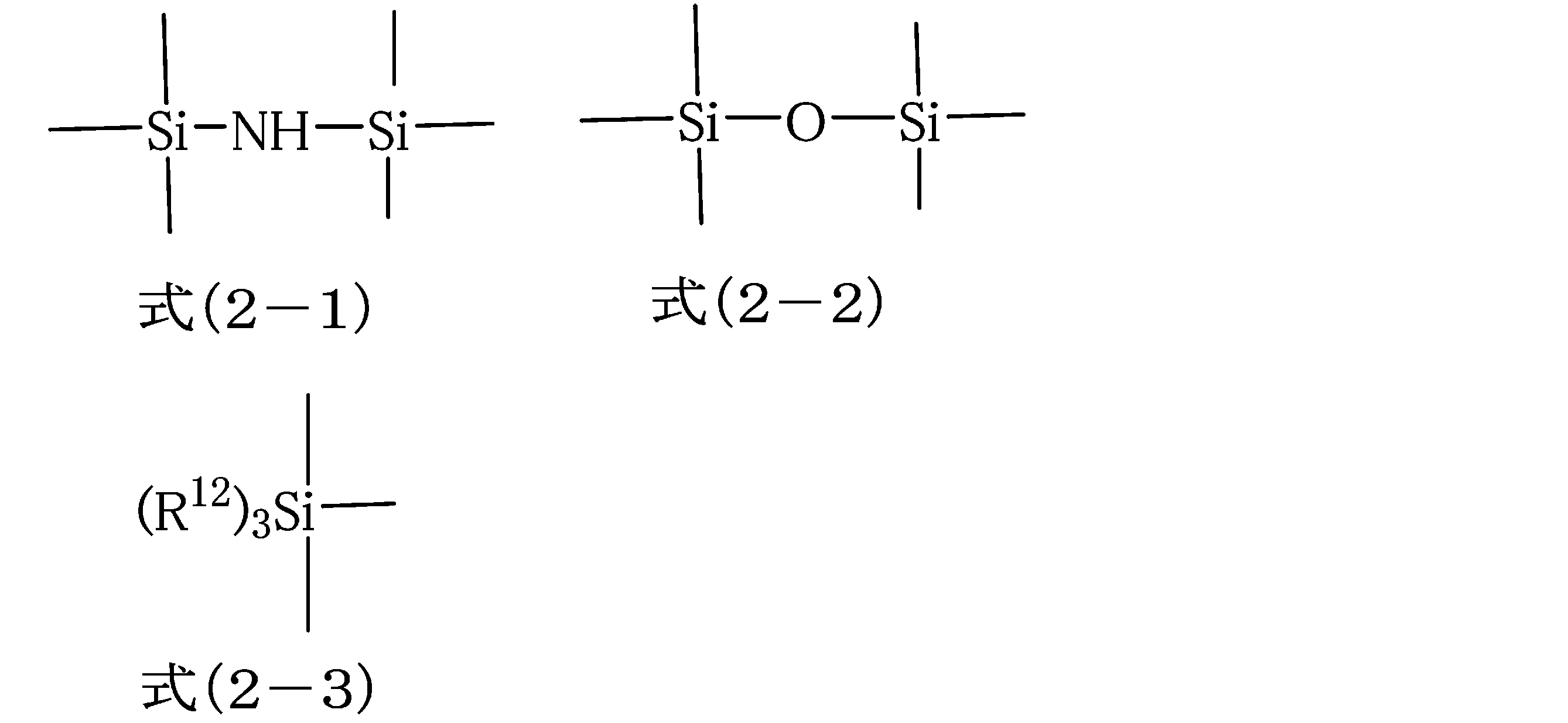
(A)工程:5~100nmの平均一次粒子径を有するシリカ粒子が炭素原子数1~3のアルコール溶媒に分散したシリカゾルを準備する(A)工程、
(B)工程:(A)工程で得られたシリカゾルに式(1)で示されるシラン化合物と、式(2)又は式(3)で示されるシラン化合物とを添加する(B)工程、
(C)工程:(B)工程で得られたシリカゾルの分散媒を炭素原子数1~3のアルコールから窒素含有溶媒に溶媒置換する(C)工程を含む製造方法で得られる。
そして、(A)工程で使用するシリカゾルとして、アルミン酸イオンを所定量含有するか否かに係わらず、180~240℃で、0.1~10時間の水熱処理を行った水性シリカゾルの水性媒体を炭素原子数1~3のアルコールに溶媒置換したシリカゾルを用いる事ができる。
また、本発明の窒素含有溶媒が分散媒であるシリカゾルと、窒素含有ポリマーとを組み合わせて絶縁性樹脂組成物(樹脂ワニス)が得られる。
(D)工程:(C)工程で得られたシリカ粒子が窒素含有溶媒に分散したシリカゾルと、窒素含有ポリマーを混合する(D)工程、
(E)工程:(D)工程で得られたシリカゾルから窒素含有溶媒の一部又は全部を除去する工程、を含み得られる。
塗布組成物は絶縁性樹脂組成物として用いる事ができる。
絶縁性樹脂組成物は、シリカゾルとポリマーをミキサーやディスパーで混合や攪拌を行う事で得られる。これらの調合では所望により添加剤を加える事ができる。
〔SiO2濃度の測定〕
シリカゾルを坩堝に取り、150℃で乾燥後、得られたゲルを1000℃で30分間焼成し、焼成残分を計量して算出した。
〔平均一次粒子径(窒素吸着法粒子径)の測定〕
シリカゾルを300℃にて乾燥した乾燥物を乳鉢で粉砕し、さらに250℃で2時間加熱して測定試料とし、測定試料の比表面積を比表面積測定装置モノソーブ(商品名)MS-16(ユアサアイオニクス(株)製)を用いて測定した。平均一次粒子径は下記式より算出した。
平均一次粒子径(nm)=2720/比表面積(m2/g)
〔水分の測定〕
カールフィッシャー滴定法にて求めた。
〔pH測定〕
pHメーター(東亞ディーケーケー(株)製)を用いて測定した。
〔粘度の測定〕
シリカゾルの粘度はB型回転粘度計(東機産業(株)製)を用いて測定した。
〔動的光散乱法(DLS)粒子径の測定〕
動的光散乱法粒子径測定装置(マルバーン社製、商品名ゼーターサイザー ナノ)により測定した。
〔全アルミニウム量の測定〕
ICP発光分光分析装置(リガク社製、商品名CIROS120 E0P)を使用して金属元素分析を行った。シリカゾルを乾燥して得られるシリカゲルをフッ化水素酸溶液によって分解した後、硝酸水溶液で溶解させた。得られた水溶液中のアルミニウム含有量を、ICP発光分光分析装置を使用して測定し、シリカの質量で除する事で、シリカ粒子全体に存在するアルミニウム量(Al2O3/SiO2)(ppm)を求めた。
〔炭素含有量、アルコキシ基の結合量の測定〕
(1)30ccの遠心分離管に有機溶媒分散シリカゾル3mLを入れ、トルエン20mLを添加する。
(2)遠心分離機(10000rpm×30分)にかけた後、上澄み液を除去する。
(3)アセトン4mLを添加してゲルを再溶解させた後、トルエン10mL、ヘキサン4mLを添加し、遠心分離(10000rpm×30分)を行う。
(4)更に(2)~(3)を再度行った後、上澄み液を除去する。
(5)得られたゲルを60℃で真空乾燥後、得られた粉末を乳鉢で粉砕し、150℃2時間で乾燥することでシリカ粉末を得た。
上記で得られた粉末について、元素分析装置(パーキンエルマー社製、商品名2400II CHNS/O)を用いて炭素含有量を測定した。
上記粉末0.2gを0.05N水酸化ナトリウム水溶液10mLと混合・溶解させ、ガスクロマトグラフィー測定することで、表面に結合したアルコキシ基量を測定した。
〔フェニル基、アルキル基の測定〕
元素分析の測定に使用したシリカ粉末を用い、核磁気共鳴分光装置(Bruker製、商品名AVANCE III500、測定条件:29Si CP/MAS法)を使用してNMR測定を行った。得られたNMRスペクトルの面積比および、上記炭素含有量、アルコキシ基量より、表面に結合したフェニル基量とアルキル基量を算出した。
〔水蒸気吸着量の測定〕
アルコキシ基の結合量の測定に使用したシリカ粉末を用い、水蒸気吸脱着測定装置(ティー・エイ・インスツルメント・ジャパン製、商品名Q5000 SA)を使用して水蒸気飽和吸着量を測定した(相対湿度が10%から90%まで変化する環境下、測定温度:23℃)。
上記測定により得られる値はシリカ粒子表面の100m2当たりの水蒸気吸着量(mg оf water/100m2 оf sample)である。
〔ポリアミック酸の固形分〕
ポリアミック酸をアルミカップに取った後に200℃焼成し、焼成残分を計量して算出した。なお、本明細書で固形分とは、組成物又はシリカゾルの全成分から溶媒成分を除いたものをいう。
4,4’-ジアミノジフェニルエーテル(DDE)、およびピロメリット酸二無水物(PMDA)、溶媒としてNMP(N-メチルピロリドン)及びDMAC(ジメチルアセトアミド)を用い攪拌下50℃の温度で重合し、式(3)に相当するポリアミック酸(固形分17%、E型粘度計で25℃の粘度が13640mPa・s)を得た。ポリアミック酸の重合は上記DDEとPMDAは1:1の等モルで重合させた。得られたポリアミック酸の重量平均分子量は63000であった。式(4)中のnは繰り返し単位の数である。

(A)工程:水分散シリカゾル(平均一次粒子径12nm、pH9、シリカ濃度20質量%、Al2O3濃度0.17質量%、日産化学株式会社製)2.0kgを水素型強酸性陽イオン交換樹脂アンバーライトIR-120Bが充填された約25℃のカラムに、1時間当たりの空間速度5で通液することで、酸性シリカゾルを得た(シリカ濃度20.0質量%、pH2.6)。
上記酸性シリカゾル1130gを撹拌機、コンデンサー、温度計及び注入口2個を備えた内容積2Lのガラス製反応器に仕込み、反応器内のゾルを沸騰させたままの状態で、別のボイラーで発生させたメタノールの蒸気を反応器内のシリカゾル中に連続的に吹き込んで、液面を徐々に上昇させながらメタノールによる水の置換を行った。留出液の体積が9Lになったところで置換を終了して、メタノール分散シリカゾルを1100g得た。得られたメタノール分散シリカゾルは、シリカ濃度20.6質量%、水分1.6質量%、粘度2mPa・sであった。
(B)工程:上記メタノールゾル1000gを2Lナスフラスコに仕込み、マグネチックスターラーでゾルを攪拌しながら、フェニルトリメトキシシラン22.8gを添加した後、液温を60℃で5時間保持した。次に、ヘキサメチルジシロキサン46.6g、DMAC(ジメチルアセトアミド)150gを添加し、液温60℃で3時間保持した。
(C)工程:その後、ロータリーエバポレーターにて減圧度450~110Torr、浴温度85~125℃で溶媒を蒸発留去させながらDMACを供給し、ゾルの分散媒をDMACに置換することにより、DMAC分散シリカゾル(シリカ濃度30.6質量%、pH4.1、粘度(20℃)4mPa・s、水分0.1質量%、メタノール0.1質量%、動的光散乱法粒子径26nm、シリカ粒子への(c)基:メトキシ基結合量0.6個/nm2、(a)基:フェニル基結合量0.7個/nm2、(b)基:アルキル基結合量2.7個/nm2、(a基とb基の合計)/(c基)=6.2のモル比、水蒸気吸着量21.6(mg оf water/100m2 оf sample。飽和吸着量に達するまでの時間は605分間であった。)を得た。
(D)工程:水分散シリカゾル(平均一次粒子径12nm、pH3、シリカ濃度33質量%、日産化学株式会社製)2500gを3Lのガラス製反応器に仕込み、撹拌機でゾルを攪拌しながら、10%水酸化ナトリウム水溶液65.7gを添加し、3時間保持した。
(E)工程:内容積3リットルのSUS製オートクレーブ反応器に上記水分散シリカゾル2500gを仕込み、210℃で2.5hr水熱合成を行うことで水熱処理されたシリカゾルを得た(平均一次粒子径22nm、pH10、シリカ濃度33質量%)。
(F)工程:得られたゾルを使用し、実施例1(A)工程と同様の手法でイオン交換を行うことで、酸性シリカゾル(pH3、シリカ濃度30質量%)を得た。
(G)工程:得られた酸性シリカゾルを実施例1の(A)工程と同様の手法で溶媒置換することでメタノール分散シリカゾルを得た。得られたメタノール分散シリカゾルは、シリカ濃度30.5質量%、pH3.8、水分1.5質量%、粘度4mPa・sであった。
上記メタノールゾルの1000gを2Lナスフラスコに仕込み、マグネチックスターラーでゾルを攪拌しながら、フェニルトリメトキシシラン12.4gを添加した後、液温を60℃で5時間保持した。次に、ヘキサメチルジシロキサン25.4g、DMAC(ジメチルアセトアミド)150gを添加し、液温60℃で3時間保持した。
その後、実施例1の(C)工程と同様の手法で溶媒置換することで、DMAC分散シリカゾル(シリカ濃度30.6質量%、pH4.7、粘度(20℃)9mPa・s、水分0.1質量%、メタノール0.1質量%、動的光散乱法粒子径27nm、シリカ粒子への(c)基:メトキシ基結合量0.6個/nm2、(a)基:フェニル基結合量0.4個/nm2、(b)基:アルキル基結合量3.2個/nm2、(a基とb基の合計)/(c基)=5.6のモル比、水蒸気吸着量11.3(mg оf water/100m2 оf sample。飽和吸着量に達するまでの時間は345分間であった。)を得た。
実施例2(G)工程で得られたメタノール分散シリカゾル1000gを2Lナスフラスコに仕込み、マグネチックスターラーでゾルを攪拌しながら、フェニルトリメトキシシラン31.1gを添加した後、液温を60℃で5時間保持した。次に、ヘキサメチルジシラザン25.3g、DMAC(ジメチルアセトアミド)150gを添加し、液温60℃で3時間保持した。
その後、実施例1の(C)工程と同様の手法で溶媒置換することで、DMAC分散シリカゾル(シリカ濃度30.9質量%、pH5.3、粘度(20℃)15mPa・s、水分0.1質量%、メタノール0.1質量%、動的光散乱法粒子径24nm、シリカ粒子への(c)基:メトキシ基結合量0.9個/nm2、(a)基:フェニル基結合量1.0個/nm2、(b)基:アルキル基結合量1.8個/nm2、(a基とb基の合計)/(c基)=3.0のモル比、水蒸気吸着量7.3(mg оf water/100m2 оf sample。飽和吸着量に達するまでの時間は255分間であった。)を得た。
メタノール分散シリカゾル(平均一次粒子径45nm、シリカ濃度40質量%、日産化学株式会社製)1000gを2Lナスフラスコに仕込み、マグネチックスターラーでゾルを攪拌しながら、フェニルトリメトキシシラン20.2gを添加した後、液温を60℃で5時間保持した。次に、ヘキサメチルジシラザン16.4g、DMAC(ジメチルアセトアミド)150gを添加し、液温60℃で3時間保持した。
その後、実施例1の(C)工程と同様の手法で溶媒置換することで、DMAC分散シリカゾル(シリカ濃度30.8質量%、pH4.7、粘度(20℃)4mPa・s、水分0.1質量%、メタノール0.1質量%、動的光散乱法粒子径88nm、シリカ粒子への(c)基:メトキシ基結合量0.8個/nm2、(a)基:フェニル基結合量1.1個/nm2、(b)基:アルキル基結合量1.9個/nm2、(a基とb基の合計)/(c基)=3.8のモル比、水蒸気吸着量8.3(mg оf water/100m2 оf sample。飽和吸着量に達するまでの時間は210分間であった。)を得た。
実施例1の(A)工程で得られたメタノール分散ゾル1000gを2Lナスフラスコに仕込み、マグネチックスターラーでゾルを攪拌しながら、フェニルトリメトキシシラン15.3gを添加した後、液温を60℃で1時間保持した。次に、N,N―ジイソプロピルエチルアミン1.6gを添加し、その後、メチルエチルケトン150gを添加し、液温60℃で5時間保持した。
その後、実施例1の(C)工程と同様の手法で溶媒置換することで、DMAC分散シリカゾル(シリカ濃度30.6質量%、pH4.7、粘度(20℃)6mPa・s、水分0.1質量%、メタノール0.1質量%、動的光散乱法粒子径21nm、シリカ粒子への(c)基:メトキシ基結合量1.0個/nm2、(a)基:フェニル基結合量0.8個/nm2、(b)基:0個/nm2、(a基とb基の合計)/(c基)=0.8のモル比、水蒸気吸着量101.3(mg оf water/100m2 оf sample。飽和吸着量に達するまでの時間は855分間であった。)を得た。
実施例1の(A)工程で得られたメタノール分散ゾル1000gを2Lナスフラスコに仕込み、マグネチックスターラーでゾルを攪拌しながら、フェニルトリメトキシシラン38.3gを添加した後、液温を60℃で1時間保持した。次に、N,N―ジイソプロピルエチルアミン1.6gを添加し、その後、メチルエチルケトン150gを添加し、液温60℃で5時間保持した。
その後、実施例1の(C)工程と同様の手法で溶媒置換することで、DMAC分散シリカゾル(シリカ濃度30.3質量%、pH4.5、粘度(20℃)5mPa・s、水分0.1質量%、メタノール0.4質量%、動的光散乱法粒子径27nm、シリカ粒子への(c)基:メトキシ基結合量1.2個/nm2、(a)基:フェニル基結合量1.2個/nm2、(b)基:0個/nm2、(a基とb基の合計)/(c基)=1.0のモル比、水蒸気吸着量81.5(mg оf water/100m2 оf sample。飽和吸着量に達するまでの時間は795分間であった。)を得た。
水分散シリカゾル(平均一次粒子径12nm、pH3、シリカ濃度33質量%、日産化学株式会社製)1000gを実施例1の(A)工程と同様の手法で溶媒置換することでメタノール分散シリカゾル1100gを得た。得られたメタノール分散シリカゾルは、シリカ濃度30.5質量%、pH4.2、水分1.5質量%、粘度2mPa・sであった。
上記メタノール分散ゾル1000gを2Lナスフラスコに仕込み、マグネチックスターラーでゾルを攪拌しながら、フェニルトリメトキシシラン56.9gを添加した後、液温を60℃で1時間保持した。次に、N, N―ジイソプロピルエチルアミン2.4gを添加し、その後、メチルエチルケトン150gを添加し、液温60℃で5時間保持した。
その後、実施例1の(C)工程と同様の手法で溶媒置換することで、DMAC分散シリカゾル(シリカ濃度30.5質量%、pH5.3、粘度(20℃)5mPa・s、水分0.1質量%、メタノール0.2質量%、動的光散乱法粒子径15nm、シリカ粒子への(c)基:メトキシ基結合量1.0個/nm2、(a)基:フェニル基結合量0.9個/nm2、(b)基:0個/nm2、(a基とb基の合計)/(c基)=0.9のモル比、水蒸気吸着量98.2(mg оf water/100m2 оf sample。飽和吸着量に達するまでの時間は925分間であった。)を得た。シリカ粒子は(a)基は含有するが、(b)基は含有していないため水蒸気吸着量が高かった。
比較例3の(A)工程で得られたメタノール分散ゾル1000gを2Lナスフラスコに仕込み、マグネチックスターラーでゾルを攪拌しながら、ヘキサメチルジシロキサン46.6gを添加した後、液温を60℃で3時間保持した。
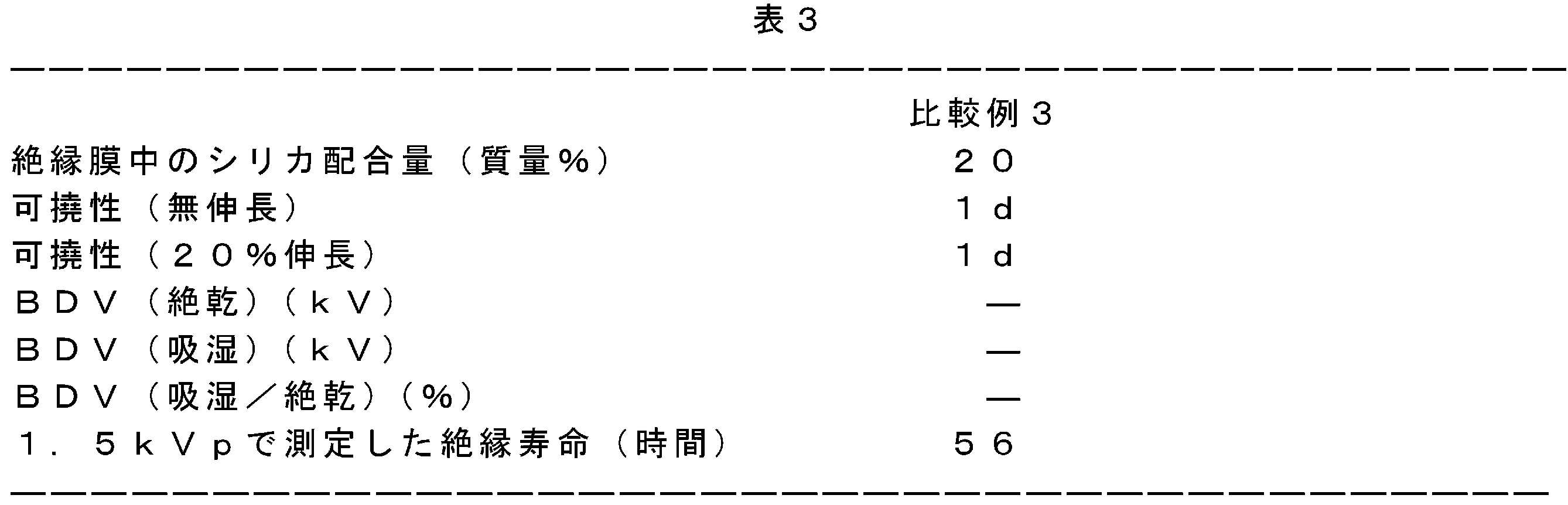
その後、実施例1の(C)工程と同様の手法で溶媒置換することで、DMAC分散シリカゾル(シリカ濃度30.2質量%、pH4.2、粘度(20℃)3mPa・s、水分0.2質量%、メタノール0.3質量%、動的光散乱法粒子径13nm、シリカ粒子への(c)基:メトキシ基結合量0.5個/nm2、(a)基:0個/nm2、(b)基:アルキル基結合量3.3個/nm2、(a基とb基の合計)/(c基)=6.6のモル比、水蒸気吸着量13.7(mg оf water/100m2 оf sample。飽和吸着量に達するまでの時間は505分間であった。)を得た。得られたDMAC分散シリカゾルは、DMAC溶媒へのシリカ粒子の分散性が十分ではなく塗布性が悪かった。
合成例1で得られたポリアミック酸13kgを20Lポリ容器に入れ、メカニカルスターラーで攪拌しながら、実施例1、2に記載した有機溶媒分散シリカゾルと同じ方法によって得られた有機溶媒分散シリカゾルを1.8kg、DMACを4.4kg添加し、室温で1時間攪拌することで、シリカ配合ポリアミック酸(絶縁樹脂組成物、樹脂/SiO2=80/20、固形分15%)を得た。
銅導体(1.0mm径)に上記のシリカ配合ポリアミック酸を塗布・焼き付けを行い、最終的に厚さ35μmの絶縁層を持つ絶縁電線を作製した。
また、比較として、銅導体(1.0mm径)に比較例1~3に記載した有機溶媒分散シリカゾルを配合したシリカ配合ポリアミック酸の塗布・焼き付けを行い、厚さ32~35μmの絶縁層を持つ絶縁電線を作製した。尚、比較例4については、ポリアミック酸へのシリカゾル(シリカ粒子)の分散不良のため、エナメル線の作製ができなかった。
上記で得られた絶縁電線の可撓性、絶縁寿命(V-t試験)の評価を実施した。評価方法、条件を下記に示す。
JIS C 3216-3 5項に準拠し、皮膜に亀裂が発生しない合格巻きつけ倍径を調査した(無伸長及び20%伸長後のエナメル線で実施)。
可撓性試験(無伸長)は、伸長していない絶縁電線を絶縁電線の導体径の1~10倍の直径を有する巻き付け棒へ巻き付け、光学顕微鏡を用いて絶縁皮膜に亀裂の発生が見られない最小巻き付け倍径を測定した。
可撓性試験(20%伸長)は、絶縁電線を20%伸長した。その後上記(無伸長)と同様の試験を行った。
可撓性試験結果は、亀裂を発生しない最小巻き付け倍径が自己径(1d)、亀裂を発生しない最小巻き付け倍径が自己径の2倍(2d)、亀裂を発生しない最小巻き付け倍径が自己径の3倍(3d)となり、最小巻き付け倍径dが小さいほど可撓性に優れているといえる。
JIS C 3216-5 4項に準拠し、50mmの距離に保った2個より試験片の2線間に50Hzの交流電圧を印加し、絶縁破壊した時の電圧を測定した。昇圧電圧は500V/s、絶縁破壊検出電流は5mA。
BDV(絶乾)は、絶縁電線を120℃、30分乾燥後に絶縁破壊電圧を測定した。
BDV(吸湿)は、絶縁電線を40℃、相対湿度95%、72時間保管後に絶縁破壊電圧を測定した。BDV(吸湿/絶乾)の数値が大きい程、絶縁電線の耐湿性が優れているといえる。
JIS C 3216-5 4項に準拠し、2個より試験片を作成し、温度40℃の環境下に置いて、2線間に下記電圧を印加し、破壊するまでの時間を計測した。
・電圧:1.5kV
・周波数:10kHz矩形波
・パルス幅:5μs
・両極性
・パルスの立上り時間:80ns


Claims (22)
- 5~100nmの平均一次粒子径を有するシリカ粒子が窒素含有溶媒に分散したシリカゾルであって、
該シリカ粒子はその少なくとも一部の粒子表面に芳香族環又は芳香族環を含む有機基(a)と、炭素原子数1~3のアルキル基(b)と、炭素原子数1~3のアルコキシ基(c)とを含み、上記(a)基と(b)基の合計が該シリカ粒子の表面積1平方nm当たり1.0~8.0個/nm2、上記(c)基が該シリカ粒子の表面積1平方nm当たり0.3~2.0個/nm2、((a)基と(b)基の合計)/((c)基)がモル比で2~20の割合で結合しているものである、シリカゾル。 - 前記シリカ粒子は、その少なくとも一部の粒子表面が芳香族環又は芳香族環を含む有機基(a)として式(1):

- 前記シリカ粒子は、その少なくとも一部の粒子表面が炭素原子数1~3のアルキル基(b)として式(2)又は式(3):

- 前記シリカ粒子がアルミニウム原子を含有するシリカ粒子である請求項1乃至請求項3の何れか1項に記載のシリカゾル。
- 前記アルミニウム原子が、前記シリカ粒子全体で、Al2O3に換算して10~10000ppm/SiO2の割合で存在する、請求項4に記載のシリカゾル。
- シリカ粒子は、連続的に23℃で湿度10%から90%まで変化する環境下で飽和吸着した場合の前記シリカ粒子の水蒸気吸着量(mg)がシリカ粒子表面の100m2当たり、70mg以下となるシリカ粒子である請求項1乃至請求項5の何れか1項に記載のシリカゾル。
- 前記窒素含有溶媒がアミド系溶媒である請求項1乃至請求項6のいずれか1項に記載のシリカゾル。
- 前記窒素含有溶媒がジメチルアセトアミド、ジメチルホルムアミド、N-メチルピロリドン、又はN-エチルピロリドンである請求項1乃至請求項6の何れか1項に記載のシリカゾル。
- 請求項1乃至請求項8の何れか1項に記載のシリカゾルと窒素含有ポリマーとを含む塗布組成物。
- 前記シリカゾルに含まれるシリカ粒子の1質量部に対し前記窒素含有ポリマーの質量部が1~100である請求項9に記載の塗布組成物。
- 前記窒素含有ポリマーが、ポリイミド、ポリアミド、ポリアミック酸、ポリアミドイミド、ポリエーテルイミド、又はポリエステルイミドのいずれかである請求項9又は請求項10に記載の塗布組成物。
- 請求項1乃至請求項8の何れか1項に記載のシリカゾルと窒素含有ポリマーとを含む絶縁性樹脂組成物。
- 前記シリカゾルに含まれるシリカ粒子の1質量部に対し前記窒素含有ポリマーの質量部が1~100である請求項12に記載の絶縁性樹脂組成物。
- 前記窒素含有ポリマーが、ポリイミド、ポリアミド、ポリアミック酸、ポリアミドイミド、ポリエーテルイミド、又はポリエステルイミドのいずれかである請求項12又は請求項13に記載の絶縁性樹脂組成物。
- 請求項12乃至請求項14の何れか1項に記載の絶縁性樹脂組成物からなる絶縁被覆層により導線を絶縁被覆した絶縁被覆導線。
- 前記絶縁被覆層は、厚み35μmでシリカ粒子配合量20質量%であり、且つ1d~2dの可撓性を有する、請求項15に記載の絶縁被覆導線。ただし、上記可撓性は20%伸長した絶縁被覆導線が無伸長の絶縁被覆導線に対して絶縁皮膜に亀裂の発生が見られない最小巻き付け倍径dを求めるものであって、亀裂を発生しない最小巻き付け倍径が自己径(1d)から、それが自己径のn倍である(nd)の範囲で測定される。
- 前記絶縁被覆層は、35μmでシリカ粒子配合量20質量%であり、且つパルス印加電圧1.5kVp(両極性、10kHz矩形波)で測定した絶縁寿命が80時間以上である、請求項15又は請求項16に記載の絶縁被覆導線。ただし、絶縁寿命は上記絶縁被覆導線の2線間を50mmの距離に保った温度40℃の環境下において、2線間に昇圧電圧は500V/sで電圧を印加、絶縁破壊検出電流5mAが検出されるまでの時間である。
- 下記(A)工程乃至(C)工程:
(A)工程:5~100nmの平均一次粒子径を有するシリカ粒子が炭素原子数1~3のアルコール溶媒に分散したシリカゾルを準備する(A)工程、
(B)工程:(A)工程で得られたシリカゾルに下記式(1)で示されるシラン化合物と、下記式(2)又は下記式(3)で示されるシラン化合物とを添加する(B)工程、及び
(C)工程:(B)工程で得られたシリカゾルの分散媒を炭素原子数1~3のアルコールから窒素含有溶媒に溶媒置換する(C)工程
を含む、請求項1乃至請求項8の何れか1項に記載のシリカゾルの製造方法。
式(1):

式(2)又は式(3):

- 前記(A)工程で使用するシリカゾルが、水性シリカゾルの水性媒体を炭素原子数1~3のアルコールに溶媒置換したシリカゾルである請求項18に記載のシリカゾルの製造方法。
- 前記(A)工程で使用するシリカゾルが、活性珪酸水溶液にアルミン酸アルカリ塩を添加して加熱する方法で得られた水性シリカゾル(a-1)、又は水性シリカゾルにアルミン酸アルカリ塩を添加して加熱する方法で得られた水性シリカゾル(a-2)のそれぞれの水性媒体を炭素原子数1~3のアルコールに溶媒置換したシリカゾルである請求項18に記載のシリカゾルの製造方法。
- 前記(A)工程で使用するシリカゾルが、180~240℃で、0.1~10時間の水熱処理を行った水性シリカゾルの水性媒体を炭素原子数1~3のアルコールに溶媒置換したシリカゾルである請求項18乃至請求項20の何れか1項に記載のシリカゾルの製造方法。
- (A)乃至(E)工程:
(A)工程:5~100nmの平均一次粒子径を有するシリカ粒子が炭素原子数1~3のアルコール溶媒に分散したシリカゾルを準備する(A)工程、
(B)工程:(A)工程で得られたシリカゾルに下記式(1)で示されるシラン化合物と、下記式(2)又は下記式(3)で示されるシラン化合物とを添加する(B)工程、
(C)工程:(B)工程で得られたシリカゾルの分散媒を炭素原子数1~3のアルコールから窒素含有溶媒に溶媒置換する(C)工程、
(D)工程:(C)工程で得られたシリカ粒子が窒素含有溶媒に分散したシリカゾルと、窒素含有ポリマーを混合する(D)工程、及び
(E)工程:(D)工程で得られたシリカゾルから窒素含有溶媒の一部又は全部を除去する工程、
を含む請求項12乃至請求項14の何れか1項に記載の絶縁性樹脂組成物の製造方法。
式(1):

式(2)又は式(3):

Priority Applications (3)
| Application Number | Priority Date | Filing Date | Title |
|---|---|---|---|
| CN202480011206.6A CN120603783A (zh) | 2023-02-10 | 2024-02-09 | 疏水性硅溶胶、涂布组合物及其制造方法 |
| KR1020257027714A KR20250149693A (ko) | 2023-02-10 | 2024-02-09 | 소수성 실리카 졸, 도포 조성물, 및 그의 제조방법 |
| JP2024576923A JPWO2024167017A1 (ja) | 2023-02-10 | 2024-02-09 |
Applications Claiming Priority (2)
| Application Number | Priority Date | Filing Date | Title |
|---|---|---|---|
| JP2023019114 | 2023-02-10 | ||
| JP2023-019114 | 2023-02-10 |
Publications (1)
| Publication Number | Publication Date |
|---|---|
| WO2024167017A1 true WO2024167017A1 (ja) | 2024-08-15 |
Family
ID=92263003
Family Applications (1)
| Application Number | Title | Priority Date | Filing Date |
|---|---|---|---|
| PCT/JP2024/004671 Ceased WO2024167017A1 (ja) | 2023-02-10 | 2024-02-09 | 疎水性シリカゾル、塗布組成物、及びその製造方法 |
Country Status (5)
| Country | Link |
|---|---|
| JP (1) | JPWO2024167017A1 (ja) |
| KR (1) | KR20250149693A (ja) |
| CN (1) | CN120603783A (ja) |
| TW (1) | TW202448800A (ja) |
| WO (1) | WO2024167017A1 (ja) |
Citations (8)
| Publication number | Priority date | Publication date | Assignee | Title |
|---|---|---|---|---|
| JP2006507210A (ja) * | 2002-11-22 | 2006-03-02 | ゼネラル・エレクトリック・カンパニイ | 官能化コロイダルシリカ、分散物並びに方法 |
| JP2007039323A (ja) * | 2005-07-04 | 2007-02-15 | Nissan Chem Ind Ltd | 疎水性シリカ粉末の製造法 |
| JP2009504833A (ja) * | 2005-08-09 | 2009-02-05 | ユニヴァーシティ・オヴ・サンダーランド | 疎水性シリカ粒子およびそれらの製造方法 |
| JP2011213514A (ja) * | 2010-03-31 | 2011-10-27 | Admatechs Co Ltd | シリカ粒子材料、シリカ粒子材料含有組成物、およびシリカ粒子の表面処理方法 |
| JP2011236094A (ja) * | 2010-05-12 | 2011-11-24 | Jgc Catalysts & Chemicals Ltd | 高濃度シリカゾル |
| JP2014049397A (ja) * | 2012-09-04 | 2014-03-17 | Hitachi Metals Ltd | 絶縁電線及びそれを用いたコイル |
| WO2022097694A1 (ja) * | 2020-11-04 | 2022-05-12 | 日産化学株式会社 | 窒素含有溶媒に分散したアルミニウム含有シリカゾル及び樹脂組成物 |
| WO2023013504A1 (ja) * | 2021-08-06 | 2023-02-09 | 日産化学株式会社 | 疎水性有機溶媒分散シリカゾル及びその製造方法 |
Family Cites Families (4)
| Publication number | Priority date | Publication date | Assignee | Title |
|---|---|---|---|---|
| JP4816861B2 (ja) | 2003-12-19 | 2011-11-16 | 日産化学工業株式会社 | 有機溶媒分散無機酸化物ゾルの製造方法 |
| KR20090008509A (ko) | 2007-07-18 | 2009-01-22 | 삼성전자주식회사 | 무선 통신시스템에서 페이징을 수행하기 위한 장치 및 방법 |
| JP5591530B2 (ja) | 2009-06-24 | 2014-09-17 | 日揮触媒化成株式会社 | シリカ系微粒子分散ゾルの製造方法、シリカ系微粒子分散ゾル、該分散ゾルを含む塗料組成物、硬化性塗膜および硬化性塗膜付き基材 |
| KR102895475B1 (ko) | 2020-12-30 | 2025-12-08 | 현대자동차주식회사 | 자동 주차 프로세스의 진행도를 표시하는 차량 및 동작 방법 |
-
2024
- 2024-02-09 WO PCT/JP2024/004671 patent/WO2024167017A1/ja not_active Ceased
- 2024-02-09 JP JP2024576923A patent/JPWO2024167017A1/ja active Pending
- 2024-02-09 KR KR1020257027714A patent/KR20250149693A/ko active Pending
- 2024-02-09 CN CN202480011206.6A patent/CN120603783A/zh active Pending
- 2024-02-15 TW TW113105317A patent/TW202448800A/zh unknown
Patent Citations (8)
| Publication number | Priority date | Publication date | Assignee | Title |
|---|---|---|---|---|
| JP2006507210A (ja) * | 2002-11-22 | 2006-03-02 | ゼネラル・エレクトリック・カンパニイ | 官能化コロイダルシリカ、分散物並びに方法 |
| JP2007039323A (ja) * | 2005-07-04 | 2007-02-15 | Nissan Chem Ind Ltd | 疎水性シリカ粉末の製造法 |
| JP2009504833A (ja) * | 2005-08-09 | 2009-02-05 | ユニヴァーシティ・オヴ・サンダーランド | 疎水性シリカ粒子およびそれらの製造方法 |
| JP2011213514A (ja) * | 2010-03-31 | 2011-10-27 | Admatechs Co Ltd | シリカ粒子材料、シリカ粒子材料含有組成物、およびシリカ粒子の表面処理方法 |
| JP2011236094A (ja) * | 2010-05-12 | 2011-11-24 | Jgc Catalysts & Chemicals Ltd | 高濃度シリカゾル |
| JP2014049397A (ja) * | 2012-09-04 | 2014-03-17 | Hitachi Metals Ltd | 絶縁電線及びそれを用いたコイル |
| WO2022097694A1 (ja) * | 2020-11-04 | 2022-05-12 | 日産化学株式会社 | 窒素含有溶媒に分散したアルミニウム含有シリカゾル及び樹脂組成物 |
| WO2023013504A1 (ja) * | 2021-08-06 | 2023-02-09 | 日産化学株式会社 | 疎水性有機溶媒分散シリカゾル及びその製造方法 |
Non-Patent Citations (1)
| Title |
|---|
| ANONYMOUS: "Nanomaterial information sheet. material name: Amorphous colloidal silica", NISSAN CHEMICAL IND LTD, 1 January 2022 (2022-01-01), XP093198919, Retrieved from the Internet <URL:https://www.meti.go.jp/policy/chemical_management/files/nanomaterial/2022nanojouhoushuushuu/Silica3_2022.pdf,> * |
Also Published As
| Publication number | Publication date |
|---|---|
| CN120603783A (zh) | 2025-09-05 |
| KR20250149693A (ko) | 2025-10-16 |
| TW202448800A (zh) | 2024-12-16 |
| JPWO2024167017A1 (ja) | 2024-08-15 |
Similar Documents
| Publication | Publication Date | Title |
|---|---|---|
| US11708273B2 (en) | Aluminum-containing silica sol dispersed in nitrogen-containing solvent and resin composition | |
| CN112888657B (zh) | 酮系溶剂分散硅溶胶及树脂组合物 | |
| CN1798702B (zh) | 经表面改性的火成法制备的氧化铝 | |
| CN109135554B (zh) | 聚酰亚胺清漆及其制备方法和应用 | |
| JP2011213514A (ja) | シリカ粒子材料、シリカ粒子材料含有組成物、およびシリカ粒子の表面処理方法 | |
| JP4974156B2 (ja) | 絶縁電線 | |
| KR101391235B1 (ko) | 무기 나노필러, 이를 포함하는 에나멜 와이어, 및 상기 에나멜 와이어의 제조방법 | |
| TW202448800A (zh) | 疏水性氧化矽膠體、塗佈組成物及其製造方法 | |
| WO2024038900A1 (ja) | シリコーン化合物を含むシリカゾル及び樹脂組成物 | |
| JP7367760B2 (ja) | 電気絶縁樹脂組成物、及び電気絶縁体 | |
| US8927630B2 (en) | Inorganic nanofiller, partial discharge resistant enameled wire including the same, and preparing method of the enameled wire | |
| JP7367759B2 (ja) | 電気絶縁樹脂組成物、及び電気絶縁体 | |
| JP7823796B2 (ja) | 有機酸を含む窒素含有有機溶媒に分散したシリカゾル及び絶縁性樹脂組成物 | |
| JP7828570B1 (ja) | 窒素含有溶媒に分散したフリーシラノール基含有表面処理シリカゾル及び絶縁性樹脂組成物 | |
| WO2025089210A1 (ja) | カルボキシル基と疎水性基を有するシリカ粒子、及びエナメル線被覆用組成物 | |
| RU2446496C2 (ru) | Поверхностно модифицированная система электроизоляции с улучшенной трекингостойкостью и эрозионной стойкостью | |
| WO2025089213A1 (ja) | 疎水性が向上したシリカ粒子、及びエナメル線被覆用組成物 | |
| Zhang et al. | Synthesis and characterization of corona-resistant nanocluster-trapped polyimide/silica composites | |
| JP7338643B2 (ja) | 電気絶縁樹脂組成物、及び電気絶縁体 | |
| WO2020049783A1 (ja) | 耐部分放電用塗料、耐部分放電用絶縁被膜、電線、及び回転電機 | |
| JPWO2020049783A1 (ja) | 耐部分放電用塗料、耐部分放電用絶縁被膜、電線、及び回転電機 |
Legal Events
| Date | Code | Title | Description |
|---|---|---|---|
| 121 | Ep: the epo has been informed by wipo that ep was designated in this application |
Ref document number: 24753460 Country of ref document: EP Kind code of ref document: A1 |
|
| WWE | Wipo information: entry into national phase |
Ref document number: 2024576923 Country of ref document: JP |
|
| WWE | Wipo information: entry into national phase |
Ref document number: 202480011206.6 Country of ref document: CN |
|
| ENP | Entry into the national phase |
Ref document number: 1020257027714 Country of ref document: KR Free format text: ST27 STATUS EVENT CODE: A-0-1-A10-A15-NAP-PA0105 (AS PROVIDED BY THE NATIONAL OFFICE) |
|
| WWP | Wipo information: published in national office |
Ref document number: 202480011206.6 Country of ref document: CN |
|
| NENP | Non-entry into the national phase |
Ref country code: DE |
|
| WWP | Wipo information: published in national office |
Ref document number: 1020257027714 Country of ref document: KR |
|
| 122 | Ep: pct application non-entry in european phase |
Ref document number: 24753460 Country of ref document: EP Kind code of ref document: A1 |