WO2024166831A1 - プラズマ照射水溶液およびその製造方法、プラズマ照射水溶液生成装置、殺菌方法 - Google Patents
プラズマ照射水溶液およびその製造方法、プラズマ照射水溶液生成装置、殺菌方法 Download PDFInfo
- Publication number
- WO2024166831A1 WO2024166831A1 PCT/JP2024/003570 JP2024003570W WO2024166831A1 WO 2024166831 A1 WO2024166831 A1 WO 2024166831A1 JP 2024003570 W JP2024003570 W JP 2024003570W WO 2024166831 A1 WO2024166831 A1 WO 2024166831A1
- Authority
- WO
- WIPO (PCT)
- Prior art keywords
- plasma
- aqueous solution
- irradiated
- lactate
- surfactant
- Prior art date
- Legal status (The legal status is an assumption and is not a legal conclusion. Google has not performed a legal analysis and makes no representation as to the accuracy of the status listed.)
- Ceased
Links
Images







Classifications
-
- A—HUMAN NECESSITIES
- A01—AGRICULTURE; FORESTRY; ANIMAL HUSBANDRY; HUNTING; TRAPPING; FISHING
- A01N—PRESERVATION OF BODIES OF HUMANS OR ANIMALS OR PLANTS OR PARTS THEREOF; BIOCIDES, e.g. AS DISINFECTANTS, AS PESTICIDES OR AS HERBICIDES; PEST REPELLANTS OR ATTRACTANTS; PLANT GROWTH REGULATORS
- A01N37/00—Biocides, pest repellants or attractants, or plant growth regulators containing organic compounds containing a carbon atom having three bonds to hetero atoms with at the most two bonds to halogen, e.g. carboxylic acids
- A01N37/36—Biocides, pest repellants or attractants, or plant growth regulators containing organic compounds containing a carbon atom having three bonds to hetero atoms with at the most two bonds to halogen, e.g. carboxylic acids containing at least one carboxylic group or a thio analogue, or a derivative thereof, and a singly bound oxygen or sulfur atom attached to the same carbon skeleton, this oxygen or sulfur atom not being a member of a carboxylic group or of a thio analogue, or of a derivative thereof, e.g. hydroxy-carboxylic acids
-
- A—HUMAN NECESSITIES
- A01—AGRICULTURE; FORESTRY; ANIMAL HUSBANDRY; HUNTING; TRAPPING; FISHING
- A01N—PRESERVATION OF BODIES OF HUMANS OR ANIMALS OR PLANTS OR PARTS THEREOF; BIOCIDES, e.g. AS DISINFECTANTS, AS PESTICIDES OR AS HERBICIDES; PEST REPELLANTS OR ATTRACTANTS; PLANT GROWTH REGULATORS
- A01N59/00—Biocides, pest repellants or attractants, or plant growth regulators containing elements or inorganic compounds
-
- A—HUMAN NECESSITIES
- A01—AGRICULTURE; FORESTRY; ANIMAL HUSBANDRY; HUNTING; TRAPPING; FISHING
- A01P—BIOCIDAL, PEST REPELLANT, PEST ATTRACTANT OR PLANT GROWTH REGULATORY ACTIVITY OF CHEMICAL COMPOUNDS OR PREPARATIONS
- A01P3/00—Fungicides
-
- A—HUMAN NECESSITIES
- A61—MEDICAL OR VETERINARY SCIENCE; HYGIENE
- A61L—METHODS OR APPARATUS FOR STERILISING MATERIALS OR OBJECTS IN GENERAL; DISINFECTION, STERILISATION OR DEODORISATION OF AIR; CHEMICAL ASPECTS OF BANDAGES, DRESSINGS, ABSORBENT PADS OR SURGICAL ARTICLES; MATERIALS FOR BANDAGES, DRESSINGS, ABSORBENT PADS OR SURGICAL ARTICLES
- A61L2/00—Disinfection or sterilisation of materials or objects, in general; Accessories therefor
- A61L2/02—Disinfection or sterilisation of materials or objects, in general; Accessories therefor using physical processes
-
- A—HUMAN NECESSITIES
- A61—MEDICAL OR VETERINARY SCIENCE; HYGIENE
- A61L—METHODS OR APPARATUS FOR STERILISING MATERIALS OR OBJECTS IN GENERAL; DISINFECTION, STERILISATION OR DEODORISATION OF AIR; CHEMICAL ASPECTS OF BANDAGES, DRESSINGS, ABSORBENT PADS OR SURGICAL ARTICLES; MATERIALS FOR BANDAGES, DRESSINGS, ABSORBENT PADS OR SURGICAL ARTICLES
- A61L2/00—Disinfection or sterilisation of materials or objects, in general; Accessories therefor
- A61L2/02—Disinfection or sterilisation of materials or objects, in general; Accessories therefor using physical processes
- A61L2/14—Plasma, i.e. ionised gases
-
- A—HUMAN NECESSITIES
- A61—MEDICAL OR VETERINARY SCIENCE; HYGIENE
- A61L—METHODS OR APPARATUS FOR STERILISING MATERIALS OR OBJECTS IN GENERAL; DISINFECTION, STERILISATION OR DEODORISATION OF AIR; CHEMICAL ASPECTS OF BANDAGES, DRESSINGS, ABSORBENT PADS OR SURGICAL ARTICLES; MATERIALS FOR BANDAGES, DRESSINGS, ABSORBENT PADS OR SURGICAL ARTICLES
- A61L2/00—Disinfection or sterilisation of materials or objects, in general; Accessories therefor
- A61L2/16—Disinfection or sterilisation of materials or objects, in general; Accessories therefor using chemical substances
- A61L2/18—Liquid substances
-
- A—HUMAN NECESSITIES
- A61—MEDICAL OR VETERINARY SCIENCE; HYGIENE
- A61L—METHODS OR APPARATUS FOR STERILISING MATERIALS OR OBJECTS IN GENERAL; DISINFECTION, STERILISATION OR DEODORISATION OF AIR; CHEMICAL ASPECTS OF BANDAGES, DRESSINGS, ABSORBENT PADS OR SURGICAL ARTICLES; MATERIALS FOR BANDAGES, DRESSINGS, ABSORBENT PADS OR SURGICAL ARTICLES
- A61L2103/00—Materials or objects being the target of disinfection or sterilisation
- A61L2103/05—Living organisms or biological materials
Definitions
- This disclosure relates to a plasma irradiated aqueous solution and a method for producing the same, an apparatus for producing a plasma irradiated aqueous solution, and a sterilization method.
- Plasma technology is applied in the fields of electricity, chemistry, and materials.
- a technology is known that sterilizes microorganisms by directly irradiating them with plasma.
- Patent Document 1 a technology has been proposed for sterilizing fungi or bacteria by indirectly treating the culture solution with a plasma-irradiated aqueous solution in which the culture solution is irradiated with plasma, without directly irradiating the culture solution with plasma.
- Patent Document 1 When plasma is directly irradiated, sterilization can only be performed at the location where the plasma irradiation device is installed. In contrast, the plasma irradiated aqueous solution of Patent Document 1 is highly portable, allowing sterilization to be performed at any location.
- the present disclosure has been made in consideration of such problems, and aims to provide a plasma-irradiated aqueous solution that exhibits a high bactericidal effect against fungi or bacteria, as well as a sterilization method using the same.
- One aspect of the present disclosure is The method is performed by irradiating an aqueous solution containing at least one selected from the group consisting of sodium lactate, potassium lactate, calcium lactate, and lactic acid, and a surfactant with plasma. in plasma irradiated aqueous solution.
- the present invention relates to a method for producing a plasma irradiated aqueous solution comprising the steps of:
- the plasma irradiated aqueous solution generating device has a plasma irradiation unit that irradiates an aqueous solution containing at least one selected from the group consisting of sodium lactate, potassium lactate, calcium lactate, and lactic acid, and a surfactant, with plasma to generate a plasma irradiated aqueous solution.
- the present invention relates to a sterilization method, which comprises contacting the above-mentioned plasma-irradiated aqueous solution, the plasma-irradiated aqueous solution obtained by the above-mentioned method for producing a plasma-irradiated aqueous solution, or the plasma-irradiated aqueous solution produced by the above-mentioned apparatus for producing a plasma-irradiated aqueous solution with a fungus or a microorganism, thereby sterilizing the fungus or the microorganism.
- the above-mentioned plasma-irradiated aqueous solution is an aqueous solution containing at least one selected from the group consisting of sodium lactate, potassium lactate, calcium lactate, and lactic acid (hereinafter, these may be collectively referred to as sodium lactate, etc.) and a surfactant, and is irradiated with plasma. Therefore, compared to an aqueous solution containing sodium lactate, etc. but not a surfactant, which is irradiated with plasma, the above-mentioned plasma-irradiated aqueous solution can exhibit a higher bactericidal effect against fungi or bacteria.
- the method for producing the plasma irradiated aqueous solution includes the above-mentioned steps, and therefore it is possible to produce the plasma irradiated aqueous solution that exhibits a high bactericidal effect against fungi or bacteria.
- the plasma irradiation aqueous solution generating device has the above configuration, and is therefore capable of generating the plasma irradiation aqueous solution that exhibits a high bactericidal effect against fungi or bacteria.
- the sterilization method involves contacting the plasma-irradiated aqueous solution, the plasma-irradiated aqueous solution obtained by the method for producing the plasma-irradiated aqueous solution, or the plasma-irradiated aqueous solution produced by the plasma-irradiated aqueous solution production device with fungi or bacteria. Therefore, the sterilization method can efficiently sterilize fungi or bacteria.
- FIG. 1 is a diagram showing a schematic configuration of a plasma irradiation aqueous solution generating apparatus according to the third embodiment.
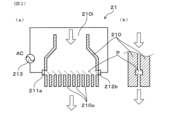
- FIG. 2(a) is a cross-sectional view showing the configuration of a plasma generating unit in the plasma irradiation aqueous solution generating apparatus of embodiment 3
- FIG. 2(b) is a partial cross-sectional view in a cross section perpendicular to the longitudinal direction of the plasma region.
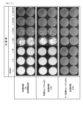
- FIG. 3 is a set of photographs showing the state of green mold spores after treatment with the various solutions prepared in Experimental Example 1.
- FIG. 1 is a diagram showing a schematic configuration of a plasma irradiation aqueous solution generating apparatus according to the third embodiment.
- FIG. 2(a) is a cross-sectional view showing the configuration of a plasma generating unit in the plasma irradiation aqueous solution generating apparatus of embodiment 3
- FIG. 2(b) is a partial cross-sectional view in a cross section perpendic
- FIG. 4 is a graph showing the relationship between the treatment time (h) (horizontal axis) with the various solutions prepared in Experimental Example 1 and the viable cell count (CFU/mL) of Green Mold spores (vertical axis).
- FIG. 5 is a set of photographs showing the state of green mold spores after treatment with the various solutions prepared in Experimental Example 2.
- FIG. 6 is a graph showing the relationship between the treatment time (h) (horizontal axis) and the viable count (CFU/mL) (vertical axis) of green mold spores using the various solutions prepared in Experimental Example 2.
- FIG. 7 is a graph showing the relationship between the treatment time (h) (horizontal axis) and the viable count (CFU/mL) (vertical axis) of green mold spores using the various solutions prepared in Experimental Example 3.
- FIG. 8 is a graph showing the relationship between the treatment time (h) (horizontal axis) and the viable count (CFU/mL) (vertical axis) of green mold spores using the various solutions prepared in Experimental Example 4.
- Figure 9 is a photograph showing the condition of Aspergillus flavus spores after treatment with various solutions prepared in Experimental Example 5.
- Figure 10 is a photograph showing the condition of Aspergillus niger spores after treatment with various solutions prepared in Experimental Example 6.
- FIG. 11 is a photograph showing the condition of Aspergillus niger spores after treatment with various solutions prepared in Experimental Example 6.
- FIG. 12 is a set of photographs showing the state of anthrax spores after treatment with the various solutions prepared in Experimental Example 7.
- FIG. 13 is a set of photographs showing the state of tinea fungi after treatment with the various solutions prepared in Experimental Example 8.
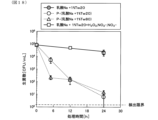
- FIG. 14 is a graph showing the relationship between the treatment time (h) (horizontal axis) with the various solutions prepared in Experimental Example 8 and the viable cell count of Trichophyton (cultured for 5 days) (CFU/mL) (vertical axis).
- FIG. 15(a) shows the molecular structure of polyoxyethylene (20) sorbitan monolaurate (Tween 20), and FIG.
- FIG. 15(b) shows the molecular structure of polyoxyethylene (20) sorbitan monooleate (Tween 80).
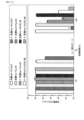
- FIG. 16 is a graph showing the relationship between the treatment time (h) (horizontal axis) and the viable count (CFU/mL) (vertical axis) of green mold spores using the various solutions prepared in Experimental Example 9.
- FIG. 17 is a graph showing the relationship between the treatment time (h) (horizontal axis) and the viable count (CFU/mL) (vertical axis) of green mold spores using the various solutions prepared in Experimental Example 9.
- FIG. 16 is a graph showing the relationship between the treatment time (h) (horizontal axis) and the viable count (CFU/mL) (vertical axis) of green mold spores using the various solutions prepared in Experimental Example 9.
- FIG. 18 is a graph showing the relationship between the treatment time (h) (horizontal axis) and the viable count (CFU/mL) (vertical axis) of green mold spores using the various solutions prepared in Experimental Example 10.
- FIG. 19 is a graph showing the relationship between the treatment time (h) (horizontal axis) and the viable count (CFU/mL) of green mold spores (vertical axis) using the various solutions prepared in Experimental Example 11.
- the plasma irradiated aqueous solution, its manufacturing method, plasma irradiated aqueous solution generating device, and sterilization method of this embodiment will be described in detail below with appropriate reference to the drawings. Note that the plasma irradiated aqueous solution, its manufacturing method, plasma irradiated aqueous solution generating device, and sterilization method of this embodiment are not limited to the examples below.
- the plasma-exposed aqueous solution of the first embodiment will be described.
- the plasma-exposed aqueous solution of the present embodiment is obtained by exposing an aqueous solution containing a specific component to plasma.
- the plasma-exposed aqueous solution of the present embodiment is in a state after the aqueous solution containing the specific component is irradiated with plasma.
- the aqueous solution containing the specific component before being irradiated with plasma specifically contains at least one selected from the group consisting of sodium lactate, potassium lactate, calcium lactate, and lactic acid, and a surfactant.
- the aqueous solution preferably contains at least sodium lactate from the viewpoints of its high bactericidal effect against fungi or bacteria and its ease of availability.
- the aqueous solution may contain only sodium lactate and a surfactant, or may contain sodium lactate, at least one selected from the group consisting of potassium lactate, calcium lactate, and lactic acid, and a surfactant.
- the surfactant may be at least one selected from nonionic surfactants, cationic surfactants, anionic surfactants, and amphoteric surfactants. This configuration allows for a wider range of surfactant types and concentrations to be selected. Of these surfactants, it is preferable to include a nonionic surfactant or an anionic surfactant, from the standpoints of a greater bactericidal effect against fungi or bacteria, a greater range of surfactant types to be selected, and ensuring a bactericidal effect by plasma treatment.
- nonionic surfactants include sucrose fatty acid esters; polyethylene glycol fatty acid esters such as polyethylene glycol monooleate and polyethylene glycol dioleate; sorbitan fatty acid esters such as sorbitan sesquioleate, and propylene glycol fatty acid esters such as proolein glycol monostearate; polyoxyethylene hydrogenated castor oil such as polyoxyethylene hydrogenated castor oil 60; polyoxyethylene sorbitan fatty acid esters such as polyoxyethylene (20) sorbitan monolaurate (Tween 20) and polyoxyethylene (20) sorbitan monooleate (Tween 80); glycerin fatty acid esters such as glycerin monostearate; polyoxyethylene glycerin fatty acid esters such as polyoxyethylene glycerin monostearate; polyoxyethylene alkyl ethers such as polyoxyethylene lauryl ether; block polymer types such as polyoxyethylene (160) polyoxypropylene (30) glycol
- cationic surfactants include quaternary ammonium salts such as benzalkonium chloride. These can be used alone or in combination of two or more.
- anionic surfactants include alkylarylsulfonates such as sodium alkylbenzenesulfonate (LAS); alkyl sulfates such as sodium lauryl sulfate; polyoxyethylene alkyl ether phosphates such as sodium polyoxyethylene cetyl ether phosphate; and bile acids such as ursodeoxycholic acid. These may be used alone or in combination of two or more.
- alkylarylsulfonates such as sodium alkylbenzenesulfonate (LAS); alkyl sulfates such as sodium lauryl sulfate; polyoxyethylene alkyl ether phosphates such as sodium polyoxyethylene cetyl ether phosphate; and bile acids such as ursodeoxycholic acid.
- LAS alkylarylsulfonates
- alkyl sulfates such as sodium lauryl sulfate
- polyoxyethylene alkyl ether phosphates such as sodium polyoxyethylene cet
- amphoteric surfactants include alkylpolyaminoethylglycine hydrochlorides such as alkyldiaminoethylglycine hydrochloride, lecithins such as purified soybean lecithin and purified egg yolk lecithin, etc. These can be used alone or in combination of two or more kinds.
- the surfactant is preferably one that is used in pharmaceuticals.
- the surfactant since it is used in medical and clinical applications, there is a wealth of information available regarding safety, ease of handling, etc., and it has the advantages of having little effect on the human body and being easy to use in medical and clinical settings. All of the surfactants specifically listed above can be used in pharmaceuticals.
- the surfactant concentration in the aqueous solution can be 2% by volume or less. If the concentration is less than this, the concentration-dependent bactericidal effect against fungi or bacteria can be ensured. In addition, there is an advantage that it can be used after dilution depending on the target and use. From the viewpoint of ensuring the bactericidal effect against fungi or bacteria, the surfactant concentration in the aqueous solution can be preferably 0.005% by volume or more, more preferably 0.008% by volume or more, and even more preferably 0.01% by volume or more.
- the surfactant concentration in the aqueous solution can be preferably 1.5% by volume or less, more preferably 1% by volume or less, even more preferably 0.5% by volume or less, and even more preferably 0.1% by volume or less.
- the surfactant concentration in the aqueous solution can be determined, for example, with reference to the concentration used in pharmaceuticals.
- the concentration of sodium lactate in the aqueous solution can be, for example, 0.5 g/L or more and 5 g/L or less. Specifically, the concentration of sodium lactate in the aqueous solution can be, for example, 3.1 g/L (27.6 mM), which is in accordance with the composition of commercially available sodium lactate Ringer's solution.
- the plasma-irradiated aqueous solution of this embodiment is the aqueous solution that has been sterilized and activated by irradiating the aqueous solution with plasma.
- the plasma irradiated to the aqueous solution can be non-equilibrium atmospheric pressure plasma (low-temperature atmospheric pressure plasma).
- atmospheric pressure plasma in this disclosure refers not only to plasma generated under atmospheric pressure, but also to plasma generated under a pressure in the range of 0.5 atm to 2.0 atm.
- gases used to generate plasma include rare gases such as Ar, He, and Ne.
- the plasma density may be, for example, 1 ⁇ 10 14 cm ⁇ 3 or more and 1 ⁇ 10 17 cm ⁇ 3 or less.
- the plasma irradiation time may be, for example, 30 seconds or more and 30 minutes or less.
- the plasma temperature may be, for example, 1000 K or more and 2500 K or less.
- the number of plasma irradiations may be one or more.
- the plasma irradiation distance may be, for example, more than 0 mm and 30 mm or less.
- the plasma-irradiated aqueous solution of this embodiment is an aqueous solution containing sodium lactate or the like and a surfactant irradiated with plasma, and therefore exhibits a higher bactericidal effect against fungi or bacteria than an aqueous solution containing sodium lactate or the like but not a surfactant irradiated with plasma.
- the plasma-irradiated aqueous solution of this embodiment has bactericidal activity against fungi or fungi. Therefore, the plasma-irradiated aqueous solution of this embodiment can be suitably used as a bactericidal aqueous solution for sterilizing fungi or fungi.
- the term fungi is used in a broad sense to include fungi.
- fungi include green mold, Aspergillus flavus, Aspergillus niger, anthracnose, Fusarium, rice blast, Gibberellus falcata, tinea fungus, and Candida.
- Other examples of fungi include Escherichia coli, Staphylococcus aureus, var. gracilis, coronavirus, and var. gracilis virus.
- the plasma-irradiated aqueous solution of this embodiment can also be suitably used to sterilize bacteria and viruses, which are structurally more fragile than fungi or mycobacteria.
- the plasma-irradiated aqueous solution of this embodiment can be used in various fields, such as the food, agricultural, medical, pharmaceutical, and lifestyle fields, by utilizing its bactericidal activity against fungi or fungi.
- the food field it can be used, for example, as anti-mold measures during food production and distribution of vegetables, fruits, and other foods.
- the agricultural field it can be used, for example, for sterilization treatment during crop cultivation, and for anti-mold measures for cultivated vegetables and fruits.
- the medical field it can be used, for example, for wiping and washing bedridden elderly people (prevention and improvement of senile vaginitis, scrotal mycosis, bedsores, etc.), anti-virus (COVID-19, papilloma, etc.), anti-cancer, anti-aging (beauty), medical instrument washing equipment, etc.
- the lifestyle field it can be used, for example, for toilet flushing and feces processing.
- the method for producing a plasma irradiated aqueous solution according to this embodiment includes a preparation step and a plasma irradiation step.
- the preparation step is a step of preparing an aqueous solution containing at least one selected from the group consisting of sodium lactate, potassium lactate, calcium lactate, and lactic acid, and a surfactant.
- the aqueous solution can be prepared, for example, by mixing a predetermined amount of sodium lactate, etc., and a predetermined amount of a surfactant with distilled water. In this case, the order of mixing the sodium lactate, etc., and the surfactant is not particularly limited.
- the aqueous solution can also be prepared by preparing a stock solution of the aqueous solution and diluting this stock solution with distilled water.
- the aqueous solution can also be prepared by mixing an aqueous solution containing sodium lactate, etc., but not a surfactant, and an aqueous solution containing sodium lactate, etc., but not a surfactant.
- the aqueous solution can also be prepared by adding a surfactant to an aqueous solution containing sodium lactate, etc., but not a surfactant, and mixing them. Details of the aqueous solution are the same as those in the first embodiment, so a description thereof will be omitted.
- the plasma irradiation process is a process in which the aqueous solution prepared in the preparation process is irradiated with plasma to produce a plasma-irradiated aqueous solution.
- the plasma irradiation device and plasma irradiation conditions for irradiating the aqueous solution with plasma are the same as those in the first embodiment, and therefore will not be described here.
- the method for producing the plasma irradiated aqueous solution of this embodiment includes the above-mentioned steps, and therefore it is possible to produce the plasma irradiated aqueous solution of this embodiment that exhibits a high bactericidal effect against fungi or bacteria.
- the plasma irradiation aqueous solution generating apparatus of the third embodiment will be described with reference to Fig. 1 and Fig. 2.
- the plasma irradiation aqueous solution generating apparatus 1 of the present embodiment has a plasma irradiation unit 2 as exemplified in Fig. 1.
- the plasma irradiation aqueous solution generating device 1 shown in FIG. 1 specifically includes a plasma irradiation section 2, an aqueous solution storage tank 10, a plasma irradiation aqueous solution storage tank 11, a power supply unit 12, pumps 131 and 132, and flow paths 141, 142, 143, 144, and 145.
- the plasma irradiation unit 2 is for irradiating plasma to an aqueous solution containing at least one selected from the group consisting of sodium lactate, potassium lactate, calcium lactate, and lactic acid, and a surfactant, to generate a plasma-irradiated aqueous solution.
- Figure 1 shows an example in which the plasma irradiation unit 2 has a plasma generation unit 21 and a reaction tank 22.
- the plasma generating unit 21 is a section that generates plasma to be irradiated into the aqueous solution of raw materials, and will be described in detail later.
- the reaction tank 22 is a water tank for storing the aqueous solution of raw materials or the plasma-irradiated aqueous solution generated by plasma irradiation.
- the plasma irradiation unit 2 is configured so that it is possible to irradiate plasma for only a preset plasma irradiation time.
- the aqueous solution storage tank 10 is for storing the aqueous solution that is the raw material before plasma irradiation.
- the plasma irradiated aqueous solution storage tank 11 is for storing the plasma irradiated aqueous solution generated by plasma irradiation.
- the power supply unit 12 is for supplying power to each part.
- the power supply unit 12 has a control unit (not shown) that controls each part.
- the pump 131 is for supplying the raw material aqueous solution from the aqueous solution storage tank 10 to the reaction tank 22 of the plasma irradiation unit 2.
- the pump 132 is for supplying the plasma irradiated aqueous solution from the reaction tank 22 of the plasma irradiation unit 2 to the plasma irradiated aqueous solution storage tank 11.
- the flow path 141 connects the aqueous solution storage tank 10 to the pump 131.
- the flow path 142 connects the pump 131 to the reaction tank 22 of the plasma irradiation unit 2.
- the flow path 143 connects the reaction tank 22 of the plasma irradiation unit 2 to the pump 132.
- the flow path 144 connects the pump 132 to the plasma irradiated aqueous solution storage tank 11.
- the flow path 145 connects the plasma irradiated aqueous solution storage tank 11 to an outlet 145a for removing the plasma irradiated aqueous solution.
- the control unit of the power supply unit 12 controls each part as follows. First, the raw material aqueous solution is supplied from the aqueous solution storage tank 10 to the reaction tank 22 of the plasma irradiation unit 2. Next, the plasma irradiation unit 2 irradiates the aqueous solution in the reaction tank 22 with plasma to generate a plasma-irradiated aqueous solution. Next, the plasma-irradiated aqueous solution is supplied from the reaction tank 22 to the plasma-irradiated aqueous solution storage tank 11. Next, the plasma-irradiated aqueous solution storage tank 11 stores the plasma-irradiated aqueous solution. Then, any predetermined amount of the plasma-irradiated aqueous solution is dispensed from the outlet 145a.
- the plasma generating unit 21 can be specifically configured, for example, as follows. As illustrated in FIG. 2, the plasma generating unit 21 has a housing unit 210, an electrode 211a, an electrode 212b, and a voltage application unit 213.
- a gas inlet 210i is formed at one end of the housing 210, and a number of gas outlets 210o are formed at the other end of the housing 210.
- the gas inlet 210i is for introducing gas such as Ar for generating plasma.
- the gas inlet 210i is shaped like a slit with the longitudinal direction being the left-right direction in FIG. 2(a).
- the gas inlet 210i is adapted to introduce gas in a direction intersecting with the line connecting the electrode 211a and the electrode 212b.
- the gas outlet 210o is for irradiating the plasma to the outside of the housing 210.
- the gas outlet 210o can be cylindrical or slit-shaped. In the case of a cylindrical shape, the gas outlet 210o can be formed in a straight line along the longitudinal direction of the plasma region.
- Electrodes 211a and 212b are an opposing electrode pair arranged opposite each other. Electrodes 211a and 212b have a number of recesses (hollows) formed on the opposing surfaces. Electrodes 211a and 212b are arranged inside the housing 210 and near the gas outlet 210o. Voltage application unit 213 is for applying an AC voltage between electrodes 211a and 211b.
- the plasma generating unit 21 can spray plasma in a straight line by applying a voltage between electrodes 211a and 211b using a commercial AC voltage. Furthermore, if the plasma generating units 21 that spray plasma in a straight line are arranged in a row in the left-right direction of Figure 2(b) , plasma can be sprayed in a plane over a certain rectangular area. In Figure 2, the area indicated by the symbol P is the plasma generation area where plasma is generated. The plasma generation area P is covered by the housing part 210.
- the plasma generating unit 21 can have a position adjustment mechanism (not shown) that adjusts the distance between the aqueous solution and the plasma generating unit 21.
- the position adjustment mechanism can be configured to move the position of the plasma generating unit 21 in each of the x-axis, y-axis, and z-axis directions. In this embodiment, the direction in which the plasma is irradiated is the -z-axis direction.
- FIG. 1 also shows an example in which the aqueous solution storage tank 10 is configured to store the aqueous solution that is the raw material before plasma irradiation.
- the aqueous solution storage tank 10 may be equipped with an aqueous solution preparation unit that prepares an aqueous solution by mixing a first aqueous solution that does not contain a surfactant but contains sodium lactate or the like with a second aqueous solution that does not contain sodium lactate or the like but contains a surfactant, or that prepares an aqueous solution by adding a surfactant to the first aqueous solution, and may be configured to store the aqueous solution prepared in the aqueous solution preparation unit.
- the plasma irradiation aqueous solution generating device 1 of this embodiment has the above configuration, and is therefore capable of generating the plasma irradiation aqueous solution of this embodiment that exhibits a high bactericidal effect against fungi or bacteria.
- the sterilization method of the present embodiment is a method of sterilizing fungi or fungi by contacting a plasma-irradiated aqueous solution with fungi or fungi.
- the plasma-irradiated aqueous solution of the present embodiment the plasma-irradiated aqueous solution obtained by the manufacturing method of the plasma-irradiated aqueous solution of the present embodiment, or the plasma-irradiated aqueous solution generated by the plasma-irradiated aqueous solution generating device of the present embodiment is used as the plasma-irradiated aqueous solution. That is, in the sterilization method of the present embodiment, these plasma-irradiated aqueous solutions are used as the aqueous solution for sterilization.
- the method of contacting the plasma irradiated aqueous solution with the fungus or fungi is not particularly limited, and any method may be used as long as the plasma irradiated aqueous solution can be brought into contact with the area to be sterilized where the fungus or fungi is present.
- Examples of methods of contacting the plasma irradiated aqueous solution with the fungus or fungi include spraying the plasma irradiated aqueous solution on the fungus or fungi, applying the plasma irradiated aqueous solution to the fungus or fungi, placing an impregnated object (e.g., gauze, absorbent cotton, etc.) impregnated with the plasma irradiated aqueous solution on the fungus or fungi, and impregnating an object with fungus or fungi attached thereto in the plasma irradiated aqueous solution.
- an impregnated object e.g., gauze, absorbent cotton, etc.
- the time for which the plasma-irradiated aqueous solution is in contact with the fungus or fungi can be preferably 1 hour or more, more preferably 3 hours or more, and even more preferably 6 hours or more, from the viewpoint of increasing the bactericidal effect on the fungus or fungi.
- the time for which the plasma-irradiated aqueous solution is in contact with the fungus or fungi can be preferably 48 hours or less, more preferably 36 hours or less, and even more preferably 24 hours or less, from the viewpoint of the effect on the living organism (host) to be treated, such as a plant or a human body.
- the sterilization method of this embodiment involves contacting a fungus or a microorganism with the plasma-irradiated aqueous solution of this embodiment, a plasma-irradiated aqueous solution obtained by the method for producing a plasma-irradiated aqueous solution of this embodiment, or a plasma-irradiated aqueous solution produced by the plasma-irradiated aqueous solution production device of this embodiment. Therefore, the sterilization method of this embodiment can efficiently sterilize a fungus or a microorganism.
- the plasma irradiated aqueous solution and its manufacturing method, plasma irradiated aqueous solution generating device, and sterilization method of this embodiment will be described in more detail below using experimental examples.
- Example 1 Experiment to sterilize fungal (green mold) spores using a plasma-irradiated aqueous solution obtained by irradiating sodium lactate Ringer's solution with plasma
- Lac Plasma-irradiated aqueous solution
- Sodium lactate Ringer's solution (Otsuka Pharmaceutical Factory, Ltd., "Lactec (registered trademark)" (hereinafter abbreviated as "Lac") was prepared.
- the above-prepared Lac was irradiated with non-equilibrium atmospheric pressure plasma by Ar gas using the above-mentioned plasma irradiation device.
- the plasma irradiation width was 0.3 mm x 20 mm.
- the Ar gas flow rate was 2 slm.
- the applied voltage was 9 kV, and the frequency was 60 Hz.
- the amount of solution was 8 mL.
- the plasma irradiation distance which is the distance from the plasma irradiation port to the liquid surface, was 3 mm.
- the plasma irradiation time was 5 minutes x 2 times.
- a conventional plasma-irradiated aqueous solution (hereinafter abbreviated as "2 x P-Lac”) was prepared by irradiating sodium lactate Ringer's solution with plasma.
- an aqueous solution (hereinafter abbreviated as "Lac + 1% Tw20”) in which Lac and 1% Tw20 were mixed was prepared.
- an aqueous solution of 2 ⁇ P-Lac and 1% Tw20 (hereinafter abbreviated as “2 ⁇ P-Lac+1% Tw20”) was prepared.
- New 1.5 mL tubes were prepared, and 200 ⁇ L of the spore suspension cultured by shaking was added to each of the three 0.8 mL tubes of each of the above solutions to make a total of 1 mL.
- the above was cultured for 3 days, and the number of colonies formed was counted (a quantitative value of 30-300 was used). The obtained value was converted to the number of viable bacteria per mL of culture tube liquid. In this way, green mold spores were treated with the various solutions listed above, and the number of viable bacteria was calculated.
- FIGS. 3 and 4 show the results of the sterilization test of green mold spores in this experimental example.
- Example 2 Experiment to sterilize fungal (green mold) spores using a plasma-irradiated aqueous solution obtained by irradiating an aqueous solution containing sodium lactate and a surfactant with plasma
- aqueous solution containing sodium lactate and a surfactant (hereinafter, abbreviated as "Na lactate + 1% Tw20") was prepared by mixing 27.6 mM sodium lactate and 1% Tw20.
- the above-prepared Na lactate + 1% Tw20 was irradiated with non-equilibrium atmospheric pressure plasma by Ar gas using the above-mentioned plasma irradiation device.
- the plasma irradiation width was 0.3 mm x 20 mm.
- the Ar gas flow rate was 2 slm.
- the applied voltage was 9 kV and the frequency was 60 Hz.
- the solution volume was 8 mL.
- the plasma irradiation distance which is the distance from the plasma irradiation port to the liquid surface, was 3 mm.
- the plasma irradiation time was 5 minutes x 2 times.
- a plasma-irradiated aqueous solution (hereinafter, abbreviated as "P- (Na lactate + 1% Tw20)") was prepared by irradiating Na lactate + 1% Tw20 with plasma.
- a plasma-irradiated aqueous solution (hereafter abbreviated as "P-1% Tw20”) was prepared by irradiating 1% Tw20 with plasma in the same manner, except that 1% Tw20 was used instead of sodium lactate + 1% Tw20.
- the above was cultured for 3 days, and the number of colonies formed was counted (a quantitative value of 30-300 was used). The obtained value was converted to the number of viable bacteria per mL of culture tube liquid. In this way, green mold spores were treated with the various solutions listed above, and the number of viable bacteria was calculated.
- sodium lactate and 0.1% Tw20 were mixed to prepare an aqueous solution containing sodium lactate and 0.1% by volume of a surfactant (hereinafter abbreviated as "Na lactate + 0.1% Tw20"). This was irradiated with non-equilibrium atmospheric pressure plasma to prepare a plasma-irradiated aqueous solution (P-(Na lactate + 0.1% Tw20)) in which the Na lactate + 0.1% Tw20 was irradiated with plasma.
- a surfactant hereinafter abbreviated as "Na lactate + 0.1% Tw20”
- sodium lactate and 0.01% Tw20 were mixed to prepare an aqueous solution containing sodium lactate and 0.01% by volume of a surfactant (hereinafter abbreviated as "Na lactate + 0.01% Tw20"). This was irradiated with non-equilibrium atmospheric pressure plasma to prepare a plasma-irradiated aqueous solution (P-(Na lactate + 0.01% Tw20)) in which the Na lactate + 0.01% Tw20 was irradiated with plasma.
- a surfactant hereinafter abbreviated as "Na lactate + 0.01% Tw20”
- surfactant-containing aqueous solutions were prepared, each containing a different type of surfactant. The concentration of each surfactant was selected based on the concentration range actually used in clinical practice.
- Na lactate + 0.01% benzalkonium chloride an aqueous solution containing sodium lactate and 0.01% by volume of benzalkonium chloride (hereinafter abbreviated as "Na lactate + 0.01% benzalkonium chloride"). This was then irradiated with non-equilibrium atmospheric pressure plasma to prepare a plasma-irradiated aqueous solution (P-(Na lactate + 0.01% benzalkonium chloride)) in which the sodium lactate + 0.01% benzalkonium chloride was irradiated with plasma.
- P-(Na lactate + 0.01% benzalkonium chloride) a plasma-irradiated aqueous solution in which the sodium lactate + 0.01% benzalkonium chloride was irradiated with plasma.
- Na lactate + 1% SDS sodium lactate and 1% SDS were mixed to prepare an aqueous solution containing sodium lactate and 1% by volume of SDS (hereinafter abbreviated as "Na lactate + 1% SDS"). This was irradiated with non-equilibrium atmospheric pressure plasma to prepare a plasma-irradiated aqueous solution (P-(Na lactate + 1% SDS)) in which the Na lactate + 1% SDS was irradiated with plasma.
- P-(Na lactate + 1% SDS) a plasma-irradiated aqueous solution in which the Na lactate + 1% SDS was irradiated with plasma.
- sodium lactate and 0.02% alkylpolyaminoethylglycine hydrochloride were mixed to prepare an aqueous solution containing sodium lactate and 0.02% by volume of alkylpolyaminoethylglycine hydrochloride (hereinafter abbreviated as "Na lactate + 0.02% alkylpolyaminoethylglycine hydrochloride").
- cationic surfactants benzalkonium chloride
- amphoteric surfactants alkylpolyaminoethylglycine hydrochloride
- Tween 20 nonionic surfactants
- Figures 10 and 11 show the results of the bactericidal test of Aspergillus oryzae (A. niger) spores in this experimental example. As shown in Figures 10 and 11, it was confirmed that the plasma-irradiated aqueous solution according to the present disclosure also exhibits a bactericidal effect on Aspergillus oryzae (A. niger) spores that produce mycotoxins. Also, as shown in Figures 10 and 11, it was suggested that SDS has a greater effect on bactericidal activity than Tween 20.
- Trichophyton spore suspension To a sufficient amount of Trichophyton (>10 8 cells) cultured on a PDA agar medium prepared in a ⁇ 9 cm petri dish, 3 mL of 1% Tw20 was added and mixed well to recover the fungal liquid, and 2 mL of 1% Tw20 was added. This was then filtered through absorbent cotton to recover Trichophyton spores. This was then centrifuged (1500 ⁇ g, 5 min), and the pellet was suspended in 1 mL of 1% Tw20. This prepared a Trichophyton spore suspension.
- P-(Na lactate + 1% Tw20) was prepared in the same manner as in Experimental Example 2. Note that, as a result of Digital Pack Test 2 , in this experimental example, P-(Na lactate + 1% Tw20) contained 1576.5 ⁇ M H 2 O 2 and 2087.0 ⁇ M NO 2 - .
- Samples were taken from the samples with a treatment time of 0 h and 24 h, and serial dilutions were made from the original solution up to 106 times, and 100 ⁇ L of each was applied to a BD-Rodak plate. Note that for the samples with a treatment time of 0 h, only those that were not exposed to plasma were applied.
- polyoxyethylene (20) sorbitan monolaurate (Tween 20) and polyoxyethylene (20) sorbitan monooleate (Tween 80) have different molecular structures in the underlined parts, as shown in Figure 15.
- sodium lactate and 1% Tw80 were mixed to prepare an aqueous solution containing sodium lactate and 1% by volume of Tween 80 (Na lactate + 1% Tw80). This was irradiated with non-equilibrium atmospheric pressure plasma to prepare a plasma-irradiated aqueous solution (P-(Na lactate + 1% Tw80)) in which the Na lactate + 1% Tw80 was irradiated with plasma.
- sodium lactate was mixed with 0.1% LAS to prepare an aqueous solution containing sodium lactate and 0.1% by volume of LAS (Na lactate + 0.1% LAS). This was irradiated with non-equilibrium atmospheric pressure plasma to prepare a plasma-irradiated aqueous solution (P-(Na lactate + 0.1% LAS)) in which the Na lactate + 0.1% LAS was irradiated with plasma.
- sodium lactate and 1% LAS were mixed to prepare an aqueous solution containing sodium lactate and 1% by volume of LAS (Na lactate + 1% LAS). This was irradiated with non-equilibrium atmospheric pressure plasma to prepare a plasma-irradiated aqueous solution (P-(Na lactate + 1% LAS)) in which the Na lactate + 1% LAS was irradiated with plasma.
- sodium lactate was mixed with 0.1% castor oil to prepare an aqueous solution containing sodium lactate and 0.1% by volume of castor oil (Na lactate + 0.1% castor oil). This was irradiated with non-equilibrium atmospheric pressure plasma to prepare a plasma-irradiated aqueous solution (P-(Na lactate + 0.1% castor oil)) in which the Na lactate + 0.1% castor oil was irradiated with plasma.
- sodium lactate was mixed with 1% castor oil to prepare an aqueous solution containing sodium lactate and 1% by volume of castor oil (Na lactate + 1% castor oil). This was then irradiated with non-equilibrium atmospheric pressure plasma to prepare a plasma-irradiated aqueous solution (P-(Na lactate + 1% castor oil)) in which the Na lactate + 1% castor oil was irradiated with plasma.
- Figure 16 shows the results of a sterilization experiment of fungal (green mold) spores using plasma-irradiated aqueous solutions containing various surfactants used in pharmaceuticals.
- Figure 17 shows the results of a sterilization experiment of fungal (green mold) spores using plasma-irradiated aqueous solutions containing Tween 20 and Tween 80 as surfactants.
- Tween 80 has a different molecular structure in the underlined portion compared to Tween 20 as shown in Figure 15, but it was confirmed that it exhibits a bactericidal effect against fungi or fungi, similar to the case of using Tween 20.
- the plasma-irradiated aqueous solution of the present disclosure is prepared by irradiating an aqueous solution containing at least one selected from the group consisting of sodium lactate, potassium lactate, calcium lactate, and lactic acid, and a surfactant with plasma. Therefore, the reaction between the water contained in the aqueous solution before the plasma irradiation and the plasma generates reaction products H 2 O 2 (hydrogen peroxide solution), nitrite ions (NO 2 - ), and nitrate ions (NO 3 - ), which may have a bactericidal effect on fungi or bacteria. Therefore, it was decided to confirm the bactericidal effect on fungi or bacteria of an aqueous solution to which the same concentrations of H 2 O 2 , NO 2 - , and NO 3 - generated by the reaction between water and plasma were added.
- H 2 O 2 hydrogen peroxide solution
- NO 2 - nitrite ions
- NO 3 ions nitrate ions
- sodium lactate and 1% Tw80 were mixed to prepare an aqueous solution containing sodium lactate and 1% by volume of Tween 80 (Na lactate + 1% Tw80). This was irradiated with non-equilibrium atmospheric pressure plasma to prepare a plasma-irradiated aqueous solution (P-(Na lactate + 1% Tw80)) in which the Na lactate + 1% Tw80 was irradiated with plasma.
- FIG. 18 shows the results of an experiment to confirm the sterilization effect of the reaction product generated by the reaction between water and plasma.
- H2O2 , NO2- , and NO3- which are reaction products generated by the reaction between water and plasma, do not contribute at all to sterilization of fungi or bacteria. From this result, it was confirmed that when preparing a plasma-irradiated aqueous solution, an aqueous solution containing a surfactant other than sodium lactate etc. is used, and this is irradiated with plasma to produce a plasma-irradiated aqueous solution, a significant sterilization effect against fungi or bacteria can be achieved.
- Example 11 Experiment to sterilize fungal (green mold) spores using a plasma-irradiated aqueous solution obtained by irradiating an aqueous solution containing an alkali metal/alkaline earth metal lactate or lactic acid and a surfactant with plasma
- an aqueous solution containing lactic acid and a surfactant (lactic acid + 1% Tw20) was prepared by mixing 27.6 mM lactic acid and 1% Tw20. This was then irradiated with non-equilibrium atmospheric pressure plasma to prepare a plasma-irradiated aqueous solution (P-(lactic acid + 1% Tw20)) in which the lactic acid + 1% Tw20 was irradiated with plasma.
- the lactate Na + 1% Tw20 contained 1388.2 ⁇ M H 2 O 2 and 1565.2 ⁇ M NO 2 - , and NO 3 - could not be measured.
- the pH of the lactate Na + 1% Tw20 before plasma irradiation was 6.61, but after plasma irradiation it changed to pH 4.52.
- the lactate K + 1% Tw20 contained 1376.5 ⁇ M H 2 O 2 and 1913.0 ⁇ M NO 2 - , and NO 3 - could not be measured.
- the pH of the lactate K + 1% Tw20 before plasma irradiation was 6.28, but after plasma irradiation it changed to pH 4.98.
- lactate + 1% Tw20 contained 823.5 ⁇ M H 2 O 2 , 4.1 ⁇ M NO 2 - , and 267.7 ⁇ M NO 3 - . Furthermore, the pH of lactate + 1% Tw20 changed from 2.57 before plasma exposure to 2.42 after plasma exposure. In addition, in a previous assay, the NO 3 - in sodium lactate + 1% Tw20 and potassium lactate + 1% Tw20 was 330.8 ⁇ M.
- FIG. 19 shows the results of a sterilization experiment of fungal (green mold) spores using a plasma-irradiated aqueous solution obtained by irradiating an aqueous solution containing lactic acid or potassium lactate and a surfactant with plasma.
- calcium lactate which is a lactate salt of an alkaline earth metal.
- calcium lactate can be understood to have similar properties in terms of being alkaline compared to sodium lactate and potassium lactate, which are lactate salts of alkaline metals.
- a plasma-irradiated aqueous solution obtained by irradiating an aqueous solution containing calcium lactate and a surfactant with plasma can also exert a bactericidal effect against fungi or bacteria, similar to the use of a plasma-irradiated aqueous solution obtained by irradiating an aqueous solution containing sodium lactate, potassium lactate, or lactic acid and a surfactant with plasma.
- the plasma-irradiated aqueous solution in the present disclosure may be found to be unclear because it is specified by the description of the manufacturing process, since it is "produced by irradiating an aqueous solution with plasma".
- a lot of additional trial and error will be required.
- the conditions such as the type of surfactant are different, the types of specific substances contained after plasma irradiation may also be different, so it will be necessary to conduct an unrealistic number of experiments, analyses, evaluations, etc.
- the plasma-irradiated aqueous solution of the present disclosure which includes the above-mentioned specific items, it must be said that "directly identifying the substance by its structure or characteristics at the time of filing the application" is not practical at all. Therefore, the plasma-irradiated aqueous solution of the present disclosure can be said to be clear. The same can be said for the plasma-irradiated aqueous solution generating device.
Landscapes
- Life Sciences & Earth Sciences (AREA)
- Health & Medical Sciences (AREA)
- General Health & Medical Sciences (AREA)
- Engineering & Computer Science (AREA)
- Wood Science & Technology (AREA)
- Pest Control & Pesticides (AREA)
- Veterinary Medicine (AREA)
- Chemical & Material Sciences (AREA)
- Environmental Sciences (AREA)
- Zoology (AREA)
- Epidemiology (AREA)
- Animal Behavior & Ethology (AREA)
- Plant Pathology (AREA)
- Public Health (AREA)
- Agronomy & Crop Science (AREA)
- Dentistry (AREA)
- General Chemical & Material Sciences (AREA)
- Chemical Kinetics & Catalysis (AREA)
- Inorganic Chemistry (AREA)
- Plasma & Fusion (AREA)
- Physics & Mathematics (AREA)
- Microbiology (AREA)
- Mycology (AREA)
- Apparatus For Disinfection Or Sterilisation (AREA)
Priority Applications (2)
| Application Number | Priority Date | Filing Date | Title |
|---|---|---|---|
| EP24753274.0A EP4663018A4 (en) | 2023-02-06 | 2024-02-02 | Plasma-irradiated aqueous solution and its production process, device for generating plasma-irradiated aqueous solution and sterilization process |
| JP2024576308A JPWO2024166831A1 (https=) | 2023-02-06 | 2024-02-02 |
Applications Claiming Priority (2)
| Application Number | Priority Date | Filing Date | Title |
|---|---|---|---|
| JP2023-016083 | 2023-02-06 | ||
| JP2023016083 | 2023-02-06 |
Publications (1)
| Publication Number | Publication Date |
|---|---|
| WO2024166831A1 true WO2024166831A1 (ja) | 2024-08-15 |
Family
ID=92262684
Family Applications (1)
| Application Number | Title | Priority Date | Filing Date |
|---|---|---|---|
| PCT/JP2024/003570 Ceased WO2024166831A1 (ja) | 2023-02-06 | 2024-02-02 | プラズマ照射水溶液およびその製造方法、プラズマ照射水溶液生成装置、殺菌方法 |
Country Status (3)
| Country | Link |
|---|---|
| EP (1) | EP4663018A4 (https=) |
| JP (1) | JPWO2024166831A1 (https=) |
| WO (1) | WO2024166831A1 (https=) |
Citations (6)
| Publication number | Priority date | Publication date | Assignee | Title |
|---|---|---|---|---|
| JP2009087697A (ja) | 2007-09-28 | 2009-04-23 | Masaru Hori | プラズマ発生装置 |
| JP2016150923A (ja) | 2015-02-18 | 2016-08-22 | 国立大学法人名古屋大学 | プラズマ殺菌水溶液とその製造方法および殺菌方法 |
| JP2020200252A (ja) * | 2019-06-06 | 2020-12-17 | 理工協産株式会社 | 除菌剤組成物、除菌剤組成物の製造方法 |
| WO2021185933A1 (en) * | 2020-03-17 | 2021-09-23 | Molecular Plasma Group S.A. | Plasma coating treatment method for inhibiting biological pathogen transfer |
| KR20220066703A (ko) * | 2020-11-16 | 2022-05-24 | 주식회사 플라리트 | 플라즈마 라디칼 용액 및 이의 제조방법 |
| JP2023016083A (ja) | 2021-07-21 | 2023-02-02 | 日本精化株式会社 | 3-o-エチルアスコルビン酸含有化粧料又は皮膚外用剤 |
Family Cites Families (1)
| Publication number | Priority date | Publication date | Assignee | Title |
|---|---|---|---|---|
| DE3730533A1 (de) * | 1987-09-11 | 1989-03-30 | Biotest Pharma Gmbh | Verfahren zur sterilisation von plasma oder plasmafraktionen |
-
2024
- 2024-02-02 JP JP2024576308A patent/JPWO2024166831A1/ja active Pending
- 2024-02-02 EP EP24753274.0A patent/EP4663018A4/en active Pending
- 2024-02-02 WO PCT/JP2024/003570 patent/WO2024166831A1/ja not_active Ceased
Patent Citations (6)
| Publication number | Priority date | Publication date | Assignee | Title |
|---|---|---|---|---|
| JP2009087697A (ja) | 2007-09-28 | 2009-04-23 | Masaru Hori | プラズマ発生装置 |
| JP2016150923A (ja) | 2015-02-18 | 2016-08-22 | 国立大学法人名古屋大学 | プラズマ殺菌水溶液とその製造方法および殺菌方法 |
| JP2020200252A (ja) * | 2019-06-06 | 2020-12-17 | 理工協産株式会社 | 除菌剤組成物、除菌剤組成物の製造方法 |
| WO2021185933A1 (en) * | 2020-03-17 | 2021-09-23 | Molecular Plasma Group S.A. | Plasma coating treatment method for inhibiting biological pathogen transfer |
| KR20220066703A (ko) * | 2020-11-16 | 2022-05-24 | 주식회사 플라리트 | 플라즈마 라디칼 용액 및 이의 제조방법 |
| JP2023016083A (ja) | 2021-07-21 | 2023-02-02 | 日本精化株式会社 | 3-o-エチルアスコルビン酸含有化粧料又は皮膚外用剤 |
Non-Patent Citations (2)
| Title |
|---|
| MATSUZAKI TATSUKI; KANO AYAME; KAMIYA TETSURO; HARA HIROKAZU; ADACHI TETSUO: "Enhanced ability of plasma-activated lactated Ringer's solution to induce A549 cell injury", ARCHIVES OF BIOCHEMISTRY AND BIOPHYSICS, ACADEMIC PRESS, US, vol. 656, 28 August 2018 (2018-08-28), US , pages 19 - 30, XP085482745, ISSN: 0003-9861, DOI: 10.1016/j.abb.2018.08.011 * |
| See also references of EP4663018A1 |
Also Published As
| Publication number | Publication date |
|---|---|
| JPWO2024166831A1 (https=) | 2024-08-15 |
| EP4663018A4 (en) | 2026-04-15 |
| EP4663018A1 (en) | 2025-12-17 |
Similar Documents
| Publication | Publication Date | Title |
|---|---|---|
| Liu et al. | A review of bacterial biofilm control by physical strategies | |
| JP5837964B2 (ja) | 野菜種における微生物誘発性病変を治癒又は予防する方法 | |
| Joshi et al. | Characterization of microbial inactivation using plasma-activated water and plasma-activated acidified buffer | |
| McKeen | Introduction to food irradiation and medical sterilization | |
| Epelle et al. | Ozone decontamination of medical and nonmedical devices: an assessment of design and implementation considerations | |
| JP2016519596A (ja) | 胞子の急速殺菌又は不活性化の方法及び溶液 | |
| US20150373923A1 (en) | Treated sprout plants with decreased bacterial viability and methods and apparatuses for making the same | |
| JP5170509B2 (ja) | 殺虫殺菌方法及び殺虫殺菌装置 | |
| US20160015038A1 (en) | Treated crop plants or plant food products with decreased bacterial viability and methods and apparatuses for making the same | |
| Korachi et al. | Low temperature atmospheric plasma for microbial decontamination | |
| WO2019130223A1 (en) | Plasma sterilization and drying system and methods | |
| WO2018034199A1 (ja) | 農産物のオゾン、エチレンガス処理装置及びその農産物の流通システム | |
| Kordová et al. | Inactivation of microbial food contamination of plastic cups using nonthermal plasma and hydrogen peroxide | |
| JPWO2020122258A1 (ja) | ラジカル水の製造方法、製造装置及びラジカル水 | |
| WO2024166831A1 (ja) | プラズマ照射水溶液およびその製造方法、プラズマ照射水溶液生成装置、殺菌方法 | |
| CN109526982A (zh) | 一种低pH的抗微生物溶液及其应用 | |
| NZ236967A (en) | Aqueous disinfecting solutions for electrolytic cleaning containing hydrogen peroxide, sodium chloride, a metal salt and buffer | |
| KR102440967B1 (ko) | 플라즈마 라디칼 용액 및 이의 제조방법 | |
| RU2241491C1 (ru) | Способ аэрозольной антимикробной обработки (саао) | |
| Roushdy et al. | Sporicidal effect of ozone on fungal and bacterial spores in water disinfection | |
| Acar | Impact of Different Application Parameters of Cold Atmospheric Plasma on Foodborne Pathogen Inactivation | |
| Tumuluri | Effect of plasma activated mist (PAM) on inactivation of Listeria innocua and Klebsiella michiganensis on selected surfaces | |
| WO2020019047A1 (pt) | Tecnologia de produção de agente desinfectante para neutralização de vírus, bactérias e demais microrganismos | |
| JPH03219808A (ja) | 施設園芸の病害防除方法と装置 | |
| Bocklagea et al. | Evaluation of Hypochlorous Acid Fogging: An Alternative Disinfection Method |
Legal Events
| Date | Code | Title | Description |
|---|---|---|---|
| 121 | Ep: the epo has been informed by wipo that ep was designated in this application |
Ref document number: 24753274 Country of ref document: EP Kind code of ref document: A1 |
|
| ENP | Entry into the national phase |
Ref document number: 2024576308 Country of ref document: JP Kind code of ref document: A |
|
| WWE | Wipo information: entry into national phase |
Ref document number: 2024576308 Country of ref document: JP |
|
| NENP | Non-entry into the national phase |
Ref country code: DE |
|
| WWP | Wipo information: published in national office |
Ref document number: 2024753274 Country of ref document: EP |