WO2024166641A1 - 熱伝導性シリコーン組成物 - Google Patents
熱伝導性シリコーン組成物 Download PDFInfo
- Publication number
- WO2024166641A1 WO2024166641A1 PCT/JP2024/001362 JP2024001362W WO2024166641A1 WO 2024166641 A1 WO2024166641 A1 WO 2024166641A1 JP 2024001362 W JP2024001362 W JP 2024001362W WO 2024166641 A1 WO2024166641 A1 WO 2024166641A1
- Authority
- WO
- WIPO (PCT)
- Prior art keywords
- group
- groups
- component
- thermally conductive
- parts
- Prior art date
- Legal status (The legal status is an assumption and is not a legal conclusion. Google has not performed a legal analysis and makes no representation as to the accuracy of the status listed.)
- Ceased
Links
Classifications
-
- C—CHEMISTRY; METALLURGY
- C08—ORGANIC MACROMOLECULAR COMPOUNDS; THEIR PREPARATION OR CHEMICAL WORKING-UP; COMPOSITIONS BASED THEREON
- C08K—Use of inorganic or non-macromolecular organic substances as compounding ingredients
- C08K3/00—Use of inorganic substances as compounding ingredients
- C08K3/01—Use of inorganic substances as compounding ingredients characterized by their specific function
-
- C—CHEMISTRY; METALLURGY
- C08—ORGANIC MACROMOLECULAR COMPOUNDS; THEIR PREPARATION OR CHEMICAL WORKING-UP; COMPOSITIONS BASED THEREON
- C08L—COMPOSITIONS OF MACROMOLECULAR COMPOUNDS
- C08L83/00—Compositions of macromolecular compounds obtained by reactions forming in the main chain of the macromolecule a linkage containing silicon with or without sulfur, nitrogen, oxygen or carbon only; Compositions of derivatives of such polymers
- C08L83/04—Polysiloxanes
-
- C—CHEMISTRY; METALLURGY
- C08—ORGANIC MACROMOLECULAR COMPOUNDS; THEIR PREPARATION OR CHEMICAL WORKING-UP; COMPOSITIONS BASED THEREON
- C08L—COMPOSITIONS OF MACROMOLECULAR COMPOUNDS
- C08L83/00—Compositions of macromolecular compounds obtained by reactions forming in the main chain of the macromolecule a linkage containing silicon with or without sulfur, nitrogen, oxygen or carbon only; Compositions of derivatives of such polymers
- C08L83/04—Polysiloxanes
- C08L83/06—Polysiloxanes containing silicon bound to oxygen-containing groups
Definitions
- the present invention relates to a thermally conductive silicone composition.
- thermally conductive materials are used to increase the adhesion between the heat-generating part and the cooling part, making heat conduction more efficient. Examples of thermally conductive materials include sheet-like molded products and grease-like products that are not molded (Patent Documents 1 and 2).
- Patent Document 5 describes how the use of an organopolysiloxane with a specific structure in combination with an alkoxysilane provides the composition with excellent fluidity and durability and reliability under high temperature and high humidity conditions. However, Patent Document 5 does not describe slippage resistance, and when the composition described in this document is stored at room temperature, the grease thickens during storage.
- the present invention was made to solve the above problems, and aims to provide a thermally conductive silicone composition that does not require special storage conditions and has excellent resistance to slippage.
- the present invention provides a thermally conductive silicone composition that contains a diorganopolysiloxane so as to enable storage at room temperature and to improve resistance to slippage.
- Component (A) 100 parts by mass of an organopolysiloxane represented by the following general formula (1): ( R1 is independently an unsubstituted or substituted monovalent hydrocarbon group, R2 is independently an alkyl group, an alkoxyalkyl group, an alkenyl group, or an acyl group, a is an integer from 5 to 100, and b is an integer from 1 to 3.)
- Component (C) an organopolysiloxane other than the components (A) and (B) and having a kinetic viscosity at 25° C. of 100 to 100,000 mm 2 /s, which is represented by the following general formula (4): 10 to 250 parts by mass; R 5 d SiO (4-d)/2 (4) ( R5 is one or more groups selected from the group consisting of saturated or unsaturated monovalent hydrocarbon groups having 1 to 18 carbon atoms, and d is a positive number satisfying 1.8 ⁇ d ⁇ 2.2).
- the present invention provides a thermally conductive silicone composition comprising:
- Such a thermally conductive silicone composition has high thermal conductivity, can be stored at room temperature, and has excellent resistance to slippage.
- the thermally conductive silicone composition is preferably characterized by an absolute viscosity at 25°C of 800 Pa ⁇ s or less.
- thermally conductive silicone composition is more reliably resistant to misalignment.
- the thermally conductive silicone composition has a thermal conductivity of 3.0 W/m ⁇ °C or more.
- Such a thermally conductive silicone composition has excellent thermal conductivity.
- the thermally conductive silicone composition of the present invention can be stored at room temperature and has high thermal conductivity and resistance to slippage while maintaining easy handling compared to conventional technologies.
- Component (A) 100 parts by mass of an organopolysiloxane represented by the following general formula (1): ( R1 is independently an unsubstituted or substituted monovalent hydrocarbon group, R2 is independently an alkyl group, an alkoxyalkyl group, an alkenyl group, or an acyl group, a is an integer from 5 to 100, and b is an integer from 1 to 3.)
- Component (C) an organopolysiloxane other than the components (A) and (B) and having a kinetic viscosity at 25° C. of 100 to 100,000 mm 2 /s, which is represented by the following general formula (4): 10 to 250 parts by mass; R 5 d SiO (4-d)/2 (4) ( R5 is one or more groups selected from the group consisting of saturated or unsaturated monovalent hydrocarbon groups having 1 to 18 carbon atoms, and d is a positive number satisfying 1.8 ⁇ d ⁇ 2.2).
- the thermally conductive silicone composition comprising:
- the present inventors have found that it is possible to provide a thermally conductive silicone composition that does not require special storage conditions and that has excellent resistance to slippage.
- they have found that by incorporating a specific amount of component (B), it is possible to impart high thermal conductivity and resistance to slippage while maintaining easy handleability, and have thus completed the present invention.
- thermally conductive silicone composition according to an embodiment of the present invention will be described below.
- the thermally conductive silicone composition according to an embodiment of the present invention comprises component (A), component (B), component (C), and component (D).
- the organopolysiloxane in component (A) is an organopolysiloxane represented by the following general formula (1).
- R1 is independently an unsubstituted or substituted monovalent hydrocarbon group
- R2 is independently an alkyl group, an alkoxyalkyl group, an alkenyl group, or an acyl group
- a is an integer from 5 to 100
- b is an integer from 1 to 3.
- Component (A) may be used alone or in combination of two or more types.
- the R 1 is independently an unsubstituted or substituted monovalent hydrocarbon group, examples of which include linear alkyl groups, branched alkyl groups, cyclic alkyl groups, alkenyl groups, aryl groups, aralkyl groups, and halogenated alkyl groups.
- linear alkyl groups include methyl groups, ethyl groups, propyl groups, hexyl groups, and octyl groups.
- Examples of branched alkyl groups include isopropyl groups, isobutyl groups, tert-butyl groups, and 2-ethylhexyl groups.
- cyclic alkyl groups include cyclopentyl groups and cyclohexyl groups.
- alkenyl groups include vinyl groups and allyl groups.
- aryl groups include phenyl groups and tolyl groups.
- aralkyl groups include 2-phenylethyl groups and 2-methyl-2-phenylethyl groups.
- halogenated alkyl groups include 3,3,3-trifluoropropyl groups, 2-(nonafluorobutyl)ethyl groups, and 2-(heptadecafluorooctyl)ethyl groups.
- R1 is preferably a methyl group or a phenyl group.
- R 2 is independently an alkyl group, an alkoxyalkyl group, an alkenyl group, or an acyl group.
- the alkyl group include the same linear alkyl group, branched alkyl group, and cyclic alkyl group as those exemplified for R 1.
- Examples of the alkoxyalkyl group include a methoxyethyl group and a methoxypropyl group.
- Examples of the alkenyl group include a vinyl group and an allyl group.
- the acyl group include an acetyl group and an octanoyl group.
- R 2 is preferably an alkyl group, and particularly preferably a methyl group or an ethyl group.
- a is an integer of 5 to 100, preferably 5 to 80, and more preferably 5 to 60
- b is an integer of 1 to 3, and preferably 3.
- the kinetic viscosity of component (A) at 25° C. as measured with an Ostwald viscometer is generally preferably 10 to 10,000 mm 2 /s, particularly preferably 15 to 5,000 mm 2 /s, and even more preferably 20 to 1,000 mm 2 /s.
- suitable components (A) include the following:
- Component (B) is a diorganopolysiloxane having silicon-bonded hydroxyl groups (i.e., silanol groups) and/or hydrolyzable silyl groups at both molecular chain terminals.
- the molecular structure of the diorganopolysiloxane is not particularly limited and may be any of linear, branched, and linear with a branched structure, but is preferably a linear diorganopolysiloxane whose main chain is basically composed of repeating diorganosiloxane units and whose molecular chain is terminated at both ends with hydroxyl groups (silanol groups) bonded to silicon atoms and/or hydrolyzable silyl groups (for example, diorganohydroxysilyl groups and/or triorganosilyl groups containing 1 to 3 hydrolyzable groups (diorganoalkoxysilyl groups, organodialkoxysilyl groups, trialkoxysilyl groups, etc.)).
- the linear diorganopolysiloxane may contain a small amount of a branched structure.
- the diorganopolysiloxane may also have a silalkylene structure (-SiRSi-) or the like in the molecular chain (particularly, at the link between the silanol groups and/or hydrolyzable silyl groups at both ends of the molecular chain and the repeating structure of the diorganosiloxane unit that constitutes the main chain).
- the R is a divalent hydrocarbon group having 1 to 20 carbon atoms, preferably 2 to 6 carbon atoms (for example, a linear or branched alkylene group, etc.).
- some or all of the hydrogen atoms bonded to the carbon atoms may be substituted with halogen atoms or cyano groups.
- the diorganopolysiloxane of component (B) has a kinematic viscosity at 25° C. of 5 to 10,000 mm 2 /s, preferably 5 to 8,000 mm 2 /s, more preferably 8 to 5,000 mm 2 /s, and even more preferably 10 to 1,000 mm 2 /s. If the viscosity of the diorganopolysiloxane is less than the lower limit (5 mm 2 /s), the composition will be highly volatile and difficult to handle, whereas if the viscosity of the diorganopolysiloxane is more than the upper limit (10,000 mm 2 /s), the composition will have poor fluidity. The kinetic viscosity is measured at 25° C. using an Ostwald viscometer.
- the hydrolyzable groups possessed by the diorganopolysiloxane of component (B) are preferably alkoxy groups or alkoxy-substituted alkoxy groups.
- the polymer has a terminal hydroxyl group (silanol group)
- it has one hydroxyl group bonded to a silicon atom (that is, a hydroxysilyl group or a silanol group) at each of the ends of the molecular chain.
- both terminals of the molecular chain have two or three alkoxy groups (i.e., alkoxysilyl groups) bonded to silicon atoms or alkoxy-substituted alkoxy groups (i.e., alkoxyalkoxysilyl groups) bonded to silicon atoms (i.e., present as dialkoxyorganosilyl groups or bis(alkoxyalkoxy)organosilyl groups, or trialkoxysilyl groups or tris(alkoxyalkoxy)silyl groups).
- the alkoxy group is preferably an alkoxy group having 1 to 10 carbon atoms, particularly 1 to 4 carbon atoms, and examples thereof include a methoxy group, an ethoxy group, a propoxy group, an isopropoxy group, a butoxy group, an isobutoxy group, a tert-butoxy group, a hexyloxy group, and an octyloxy group.
- the alkoxy-substituted alkoxy group is preferably an alkoxy-substituted alkoxy group having a total of 2 to 10 carbon atoms, particularly preferably 3 or 4 carbon atoms, and examples thereof include a methoxymethoxy group, a methoxyethoxy group, and an ethoxymethoxy group. It is particularly preferable that the diorganopolysiloxane has a hydroxyl group (silanol group), a methoxy group or an ethoxy group at both ends.
- Organic groups bonded to silicon atoms other than hydroxyl groups and hydrolyzable groups include substituted or unsubstituted monovalent hydrocarbon groups having 1 to 18 carbon atoms, preferably 1 to 10 carbon atoms.
- the monovalent hydrocarbon group include alkyl groups such as methyl, ethyl, propyl, isopropyl, butyl, isobutyl, tert-butyl, hexyl, heptyl, octyl, and 2-ethylhexyl; cycloalkyl groups such as cyclopentyl and cyclohexyl; alkenyl groups such as vinyl and allyl; aryl groups such as phenyl, tolyl, and naphthyl; aralkyl groups such as benzyl, phenylethyl, and phenylpropyl; groups in which some or all of the hydrogen atoms bonded to the carbon atoms of these groups have been substituted with
- the compound represented by the following general formula (2) is particularly preferred.
- R3 is, independently of each other, a group selected from a hydrogen atom, an alkyl group having 1 to 10 carbon atoms, such as a methyl group, an ethyl group, a propyl group, a butyl group, and an octyl group, and an alkoxyalkyl group having 2 to 10 carbon atoms, such as a methoxymethyl group, a methoxyethyl group, and an ethoxymethyl group.
- R3 is a hydrogen atom, a methyl group, or an ethyl group.
- R4 's are each independently a substituted or unsubstituted monovalent hydrocarbon group having 1 to 18 carbon atoms, preferably 1 to 10 carbon atoms.
- the monovalent hydrocarbon group include organic groups other than the above-mentioned hydroxyl group and hydrolyzable group.
- c is 0, 1 or 2.
- n (or the degree of polymerization) is a number such that the kinetic viscosity of the diorganopolysiloxane at 25° C. is 5 to 10,000 mm 2 /s, preferably 5 to 8,000 mm 2 /s, more preferably 8 to 5,000 mm 2 /s, and even more preferably 10 to 1,000 mm 2 /s.
- Y's are each independently an oxygen atom, an unsubstituted or substituted divalent hydrocarbon group having 1 to 20 carbon atoms, preferably 1 to 6 carbon atoms, or a group represented by the following general formula (3):
- R 4 is as defined in the above general formula (2), and Z is an unsubstituted or substituted divalent hydrocarbon group having 1 to 20 carbon atoms, preferably 1 to 6 carbon atoms.
- the divalent hydrocarbon group (Y or Z) may be linear or branched (e.g., methylethylene group), but is preferably a linear alkylene group such as a methylene group, ethylene group, propylene group (trimethylene group), butylene group (tetramethylene group), or hexylene group (hexamethylene group), of which an ethylene group is particularly preferred.
- Y is an oxygen atom.
- component (B) If the amount of component (B) is less than 2 parts by weight, the slippage resistance will deteriorate, and if it is more than 100 parts by weight, the viscosity will increase during storage, so the range of 2 to 100 parts by weight is best, and 2.4 to 80 parts by weight is more preferable.
- Component (C) is an organopolysiloxane other than components (A) and (B) that has a kinetic viscosity at 25° C. of 100 to 100,000 mm 2 /s and is represented by the following general formula (4): R 5 d SiO (4-d)/2 (4) ( R5 is one or more groups selected from the group consisting of saturated or unsaturated monovalent hydrocarbon groups having 1 to 18 carbon atoms, and d is a positive number satisfying 1.8 ⁇ d ⁇ 2.2).
- R5 in the above general formula (4) is at least one or two or more (e.g., one or more and five or less) groups selected from the group of saturated or unsaturated monovalent hydrocarbon groups having 1 to 18 carbon atoms.
- d must be a positive number from 1.8 to 2.2, and is particularly preferably a positive number from 1.9 to 2.1.
- R5 examples include alkyl groups such as a methyl group, an ethyl group, a propyl group, a hexyl group, an octyl group, a decyl group, a dodecyl group, a tetradecyl group, a hexadecyl group, and an octadecyl group; cycloalkyl groups such as a cyclopentyl group and a cyclohexyl group; alkenyl groups such as a vinyl group and an allyl group; aryl groups such as a phenyl group and a tolyl group; aralkyl groups such as a 2-phenylethyl group and a 2-methyl-2-phenylethyl group; and halogenated hydrocarbon groups such as a 3,3,3-trifluoropropyl group, a 2-(perfluorobutyl)ethyl group, a 2-(perfluor
- the kinetic viscosity of the organopolysiloxane at 25°C must be in the range of 100 to 100,000 mm 2 /s, and preferably in the range of 1,000 to 50,000 mm 2 /s, because if it is lower than 100 mm 2 /s, the composition will be prone to thickening during storage, and if it is higher than 100,000 mm 2 /s, the composition will have poor extensibility and poor workability.
- component (C) is less than 10 parts by weight per 100 parts by weight of component (A), the composition will solidify during storage at room temperature, and if it is more than 250 parts by weight, the composition will have poor extensibility, so it must be in the range of 10 to 250 parts by weight, and preferably 12 to 200 parts by weight.
- the thermally conductive filler having the thermal conductivity of component (D) has a thermal conductivity of at least 10 W/m°C. If the thermal conductivity of the filler is less than 10 W/m°C, the thermal conductivity of the thermally conductive silicone composition itself will be low. There is no particular upper limit to the thermal conductivity of the filler, but it can be set to, for example, 1000 W/m°C.
- the thermally conductive filler may be aluminum powder, copper powder, silver powder, iron powder, nickel powder, gold powder, tin powder, metal silicon powder, aluminum nitride powder, boron nitride powder, silicon nitride powder, alumina powder, diamond powder, carbon powder, indium powder, gallium powder, zinc oxide powder, etc., but any filler having a thermal conductivity of 10 W/m°C or more may be used, and one or a mixture of two or more types may be used.
- the average particle size of component (D) should be in the range of 0.1 to 150 ⁇ m. If the average particle size is 0.1 ⁇ m or more, the resulting composition will be in a grease-like form with excellent extensibility, and if it is 150 ⁇ m or less, the thermal resistance of the heat dissipating grease will be reduced, improving performance.
- the average particle size can be measured using a Microtrac MT3300EX manufactured by Nikkiso Co., Ltd., and is the volume-based average diameter.
- the shape of component (D) may be any shape, including amorphous and spherical.
- the thermal conductivity of the composition will be low, and if it is more than 3,000 parts by mass, the viscosity of the composition will increase and it will have poor extensibility, so it must be in the range of 500 to 3,000 parts by mass, preferably 800 to 2,800 parts by mass, and more preferably 800 to 2,500 parts by mass.
- antioxidants In addition to the above components (A) to (D), in the present invention, antioxidants, heat resistance improvers, colorants, etc. may be added as necessary depending on the object of the present invention.
- the thermally conductive silicone composition of the present invention preferably has an absolute viscosity at 25° C. of 800 Pa ⁇ s or less. There is no lower limit to the absolute viscosity, but it can be set to, for example, 50 Pa ⁇ s. Normally, deviations occur due to low viscosity within such a viscosity range, but in the present invention, deviations do not occur even within the above viscosity range, and further, the composition has suitable fluidity and good workability, which is preferable.
- the absolute viscosity at 25°C is measured, for example, using a rotational viscometer.
- the thermally conductive silicone composition of the present invention preferably has a thermal conductivity of 3.0 W/m ⁇ °C or more.
- a thermal conductivity of 3.0 W/m ⁇ °C or more is preferable because it provides excellent thermal conductivity.
- the upper limit of the thermal conductivity of the thermally conductive silicone composition of the present invention is not particularly limited, but can be, for example, 100 W/m ⁇ °C.
- the above thermal conductivity is measured, for example, at 25°C using a rapid thermal conductivity meter.
- the thermally conductive silicone composition of the present invention contains a specific amount of diorganopolysiloxane, which makes it possible to produce a thermally conductive silicone composition that does not require special storage conditions and has excellent resistance to slippage.
- components (A) through (D) may be mixed using a mixer such as a Trimix, Twinmix, or Planetary Mixer (all of which are registered trademarks of mixers manufactured by Inoue Seisakusho Co., Ltd.), Ultra Mixer (a registered trademark of mixers manufactured by Mizuho Kogyo Co., Ltd.), or Hivis Dispermix (a registered trademark of mixers manufactured by Tokushu Kika Kogyo Co., Ltd.).
- a mixer such as a Trimix, Twinmix, or Planetary Mixer (all of which are registered trademarks of mixers manufactured by Inoue Seisakusho Co., Ltd.), Ultra Mixer (a registered trademark of mixers manufactured by Mizuho Kogyo Co., Ltd.), or Hivis Dispermix (a registered trademark of mixers manufactured by Tokushu Kika Kogyo Co., Ltd.).
- Thermal conductivity measurement method The thermal conductivity of the thermally conductive silicone composition was measured at 25° C. using a rapid thermal conductivity meter QTM-500 (Kyoto Electronics Manufacturing Co., Ltd.).
- Grease was sandwiched between glass and aluminum to a thickness of 1 mm, and the specimen was placed vertically in a heat cycle tester at temperatures between -40°C and 125°C for 1000 cycles. The distance of deviation from the initial position was measured.
- Component (B)] B-1 Diorganopolysiloxane represented by the following structural formula: Kinematic viscosity: 17mm 2 /s
- B-2 Diorganopolysiloxane represented by the following structural formula: Kinematic viscosity: 22mm 2 /s
- B-3 Diorganopolysiloxane represented by the following structural formula: Kinematic viscosity: 30mm 2 /s
- C-1 Organopolysiloxane consisting of ((CH 3 ) 3 SiO 1/2 ) units and ((CH 3 ) 2 SiO) units and having a kinetic viscosity of 5,000 mm 2 /s: (CH 3 ) 2.00 SiO 1.00
- C-2 Organopolysiloxane consisting of ((CH 3 ) 3 SiO 1/2 ) units and ((CH 3 ) 2 SiO) units and having a kinetic viscosity of 1,000 mm 2 /s: (CH 3 ) 2.01 SiO 0.995
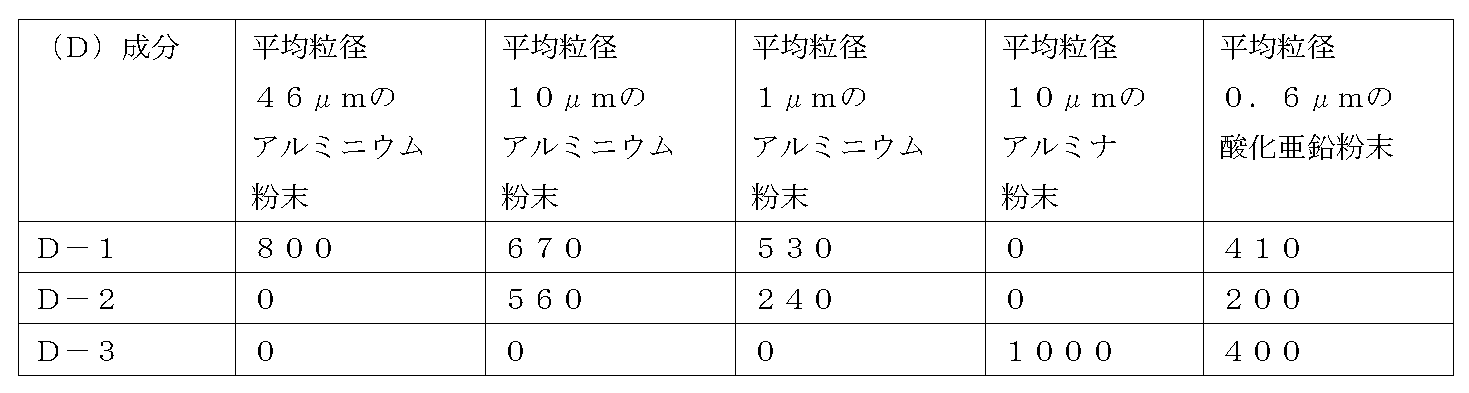
- Component (D)] D-1 The following aluminum powder, alumina powder, and zinc oxide powder were mixed in the mixing ratio shown in Table 1 below at room temperature for 15 minutes using a 5-liter planetary mixer (manufactured by Inoue Seisakusho Co., Ltd.) to obtain thermally conductive filler D-1.
- Aluminum powder with an average particle size of 46 ⁇ m (thermal conductivity: 236 W/m°C)
- Aluminum powder with an average particle size of 10 ⁇ m (thermal conductivity: 236 W/m°C)
- Aluminum powder with an average particle size of 1 ⁇ m (thermal conductivity: 236 W/m°C)
- Alumina powder with an average particle size of 10 ⁇ m (thermal conductivity: 27 W/m°C)
- Zinc oxide powder with an average particle size of 0.6 ⁇ m (thermal conductivity: 25 W/m°C)
- Components (A) through (D) were mixed as follows to obtain the thermally conductive silicone compositions of Examples 1 to 8 and Comparative Examples 1 to 7. That is, component (A) was placed in a 5-liter planetary mixer (manufactured by Inoue Seisakusho Co., Ltd.), and components (B), (C), and (D) were added in the amounts shown in Tables 2 and 3, and mixed at 170° C. for 2 hours. The evaluation results are shown in Tables 2 and 3.
- Comparative Example 4 due to C-1: 5 parts by mass, the viscosity after 4 months was deteriorated. In Comparative Example 5, due to C-2: 260 parts by mass, the viscosity and the viscosity after 4 months were unmeasurable. In Comparative Example 6, due to D component: 3041, the grease did not form. In Comparative Example 7, the thermal conductivity was poor.
- the present invention is not limited to the above-described embodiments.
- the above-described embodiments are merely examples, and anything that has substantially the same configuration as the technical idea described in the claims of the present invention and provides similar effects is included within the technical scope of the present invention.
Landscapes
- Chemical & Material Sciences (AREA)
- Health & Medical Sciences (AREA)
- Chemical Kinetics & Catalysis (AREA)
- Medicinal Chemistry (AREA)
- Polymers & Plastics (AREA)
- Organic Chemistry (AREA)
- Compositions Of Macromolecular Compounds (AREA)
Abstract
本発明は、(A)成分:一般式(1)で表されるオルガノポリシロキサン:100質量部、 (B)成分:ケイ素原子に結合した水酸基及び/又は加水分解性シリル基を分子鎖両末端に有し、25℃における動粘度が5~10,000mm2/sであるジオルガノポリシロキサン:2~100質量部、(C)成分:(A)成分、(B)成分以外の一般式(4)で表される25℃における動粘度が100~100,000mm2/sのオルガノポリシロキサン:10~250質量部、R5
dSiO(4―d)/2 (4)、(D)成分:10W/m・℃以上の熱伝導率を有する熱伝導性充填材:(A)成分と(B)成分と(C)成分の合計100質量部に対して500~3,000質量部、を含むことを特徴とする熱伝導性シリコーン組成物である。これにより、特別な保管条件を必要とせず、耐ズレ性に優れる熱伝導性シリコーン組成物を提供できる。
Description
本発明は、熱伝導性シリコーン組成物に関する。
電子部品の高発熱化・高密度実装化によって部材冷却の必要性がますます高まっている。部材冷却の方法としては、発熱部材から冷却部材への伝熱が一般的である。このような構造においては、熱伝導性部材が発熱部位と冷却部位の間の密着を高めて、熱伝導を効率化するために使用されている。熱伝導部材としては成形物であるシート状、成形物ではないグリース状の物などがあげられる(特許文献1、2)。
自動実装化の観点からは、グリース状の材料が使用されるケースが多い。しかしながら、グリース状の物は流動性があるため素子が発熱⇔冷却を繰り返すことによって材料が流れ出してしまう場合がある。このような現象が発生すると発熱部位と冷却部位の接触が悪くなってしまい、伝熱性能が悪化し、素子の性能が低下してしまう。このような場合、塗布時は液状で、塗布後に硬化するグリースなども用いられている(特許文献3、4)。
しかし、これらは反応性が高いため、反応を抑制するために冷凍や冷蔵保存が必要であったり、湿気を遮断するために密閉して保存する必要がある。これらの保存は使用前の材料保管を制限してしまうため、取扱い性の観点からは常温下、かつ通常の条件で保存できる材料が求められている。
特許文献5には特定の構造をもつオルガノポリシロキサンとアルコキシシランを併用することで組成物の流動性と高温高湿条件下における耐久性・信頼性に優れるとの記載がある。しかし、特許文献5には耐ズレ性に関する記載はなく、また、この文献記載の組成物を室温で保管すると保管中にグリースが増粘してしまう。
本発明は、上記問題を解決するためになされたものであり、特別な保管条件を必要とせず、耐ズレ性に優れる熱伝導性シリコーン組成物を提供することを目的とする。
上記課題を解決するために、本発明は常温での保管を可能にし、耐ズレ性を高めるために、ジオルガノポリシロキサンを配合した熱伝導性シリコーン組成物を提供する。その手段を以下に詳述する。
本発明は、上記目的を達成するためになされたものであり、
(A)成分:下記一般式(1)で表されるオルガノポリシロキサン:100質量部、
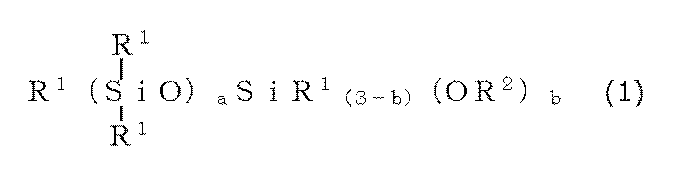
(R1は独立に非置換または置換の一価炭化水素基であり、R2は独立にアルキル基、アルコキシアルキル基、アルケニル基またはアシル基であり、aは5~100の整数であり、bは1~3の整数である。)
(B)成分:ケイ素原子に結合した水酸基及び/又は加水分解性シリル基を分子鎖両末端に有し、25℃における動粘度が5~10,000mm2/sであるジオルガノポリシロキサン:2~100質量部、
(C)成分:前記(A)成分、(B)成分以外の下記一般式(4)で表される25℃における動粘度が100~100,000mm2/sのオルガノポリシロキサン:10~250質量部、
R5 dSiO(4―d)/2 (4)
(R5は炭素数1~18の飽和又は不飽和の1価の炭化水素基の群の中から選択される1種もしくは2種以上の基、dは1.8≦d≦2.2の正数)
(D)成分:10W/m・℃以上の熱伝導率を有する熱伝導性充填材:前記(A)成分と前記(B)成分と前記(C)成分の合計100質量部に対して500~3,000質量部、
を含むことを特徴とする熱伝導性シリコーン組成物を提供する。
本発明は、上記目的を達成するためになされたものであり、
(A)成分:下記一般式(1)で表されるオルガノポリシロキサン:100質量部、
(B)成分:ケイ素原子に結合した水酸基及び/又は加水分解性シリル基を分子鎖両末端に有し、25℃における動粘度が5~10,000mm2/sであるジオルガノポリシロキサン:2~100質量部、
(C)成分:前記(A)成分、(B)成分以外の下記一般式(4)で表される25℃における動粘度が100~100,000mm2/sのオルガノポリシロキサン:10~250質量部、
R5 dSiO(4―d)/2 (4)
(R5は炭素数1~18の飽和又は不飽和の1価の炭化水素基の群の中から選択される1種もしくは2種以上の基、dは1.8≦d≦2.2の正数)
(D)成分:10W/m・℃以上の熱伝導率を有する熱伝導性充填材:前記(A)成分と前記(B)成分と前記(C)成分の合計100質量部に対して500~3,000質量部、
を含むことを特徴とする熱伝導性シリコーン組成物を提供する。
このような熱伝導性シリコーン組成物であれば、高熱伝導性を有し、常温で保管可能であるとともに、耐ズレ性に優れたものとなる。
また、本発明では、25℃における絶対粘度が800Pa・s以下であることを特徴とする熱伝導性シリコーン組成物であることが好ましい。
このような熱伝導性シリコーン組成物であれば、より確実に、耐ズレ性に優れたものとなる。
また、本発明では、3.0W/m・℃以上の熱伝導率を有することを特徴とする熱伝導性シリコーン組成物であることが好ましい。
このような熱伝導性シリコーン組成物であれば、熱伝導率に優れたものとなる。
以上のように、本発明の熱伝導性シリコーン組成物であれば、常温で保管可能であり、従来技術と比較して簡便な取り扱い性を維持したまま、高い熱伝導性と耐ズレ性を有するものとなる。
以下、本発明を詳細に説明するが、本発明はこれらに限定されるものではない。
上述のように、常温で保管可能で、耐ズレ性に優れた熱伝導性シリコーン組成物が求められていた。
本発明者らは、上記課題について鋭意検討を重ねた結果、
(A)成分:下記一般式(1)で表されるオルガノポリシロキサン:100質量部、

(R1は独立に非置換または置換の一価炭化水素基であり、R2は独立にアルキル基、アルコキシアルキル基、アルケニル基またはアシル基であり、aは5~100の整数であり、bは1~3の整数である。)
(B)成分:ケイ素原子に結合した水酸基及び/又は加水分解性シリル基を分子鎖両末端に有し、25℃における動粘度が5~10,000mm2/sであるジオルガノポリシロキサン:2~100質量部、
(C)成分:前記(A)成分、(B)成分以外の下記一般式(4)で表される25℃における動粘度が100~100,000mm2/sのオルガノポリシロキサン:10~250質量部、
R5 dSiO(4―d)/2 (4)
(R5は炭素数1~18の飽和又は不飽和の1価の炭化水素基の群の中から選択される1種もしくは2種以上の基、dは1.8≦d≦2.2の正数)
(D)成分:10W/m・℃以上の熱伝導率を有する熱伝導性充填材:前記(A)成分と前記(B)成分と前記(C)成分の合計100質量部に対して500~3,000質量部、
を含むことを特徴とする熱伝導性シリコーン組成物により、
特別な保管条件を必要とせず、耐ズレ性に優れる熱伝導性シリコーン組成物を提供できることを見出し、特に、(B)成分を特定量配合することで、簡便な取り扱い性を維持したまま高い熱伝導性と耐ズレ性を有するようにできるものとなることを見出し、本発明を完成した。
(A)成分:下記一般式(1)で表されるオルガノポリシロキサン:100質量部、
(B)成分:ケイ素原子に結合した水酸基及び/又は加水分解性シリル基を分子鎖両末端に有し、25℃における動粘度が5~10,000mm2/sであるジオルガノポリシロキサン:2~100質量部、
(C)成分:前記(A)成分、(B)成分以外の下記一般式(4)で表される25℃における動粘度が100~100,000mm2/sのオルガノポリシロキサン:10~250質量部、
R5 dSiO(4―d)/2 (4)
(R5は炭素数1~18の飽和又は不飽和の1価の炭化水素基の群の中から選択される1種もしくは2種以上の基、dは1.8≦d≦2.2の正数)
(D)成分:10W/m・℃以上の熱伝導率を有する熱伝導性充填材:前記(A)成分と前記(B)成分と前記(C)成分の合計100質量部に対して500~3,000質量部、
を含むことを特徴とする熱伝導性シリコーン組成物により、
特別な保管条件を必要とせず、耐ズレ性に優れる熱伝導性シリコーン組成物を提供できることを見出し、特に、(B)成分を特定量配合することで、簡便な取り扱い性を維持したまま高い熱伝導性と耐ズレ性を有するようにできるものとなることを見出し、本発明を完成した。
以下、本発明の実施形態に係る熱伝導性シリコーン組成物について説明する。
<熱伝導性シリコーン組成物>
本発明の実施形態に係る熱伝導性シリコーン組成物は、(A)成分、(B)成分、(C)成分、(D)成分を含む。
本発明の実施形態に係る熱伝導性シリコーン組成物は、(A)成分、(B)成分、(C)成分、(D)成分を含む。
[(A)成分]
(A)成分におけるオルガノポリシロキサンは、下記一般式(1)で表されるオルガノポリシロキサンである。
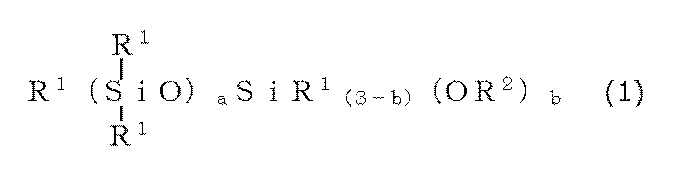
(R1は独立に非置換または置換の一価炭化水素基であり、R2は独立にアルキル基、アルコキシアルキル基、アルケニル基またはアシル基であり、aは5~100の整数であり、bは1~3の整数である。)
(A)成分におけるオルガノポリシロキサンは、下記一般式(1)で表されるオルガノポリシロキサンである。
(A)成分は一種単独で使用しても、二種以上を併用してもよい。
上記R1は独立に非置換または置換の一価の炭化水素基であり、その例としては、直鎖状アルキル基、分岐鎖状アルキル基、環状アルキル基、アルケニル基、アリール基、アラルキル基、ハロゲン化アルキル基が挙げられる。直鎖状アルキル基としては、例えば、メチル基、エチル基、プロピル基、ヘキシル基、オクチル基が挙げられる。分岐鎖状アルキル基としては、例えば、イソプロピル基、イソブチル基、tert-ブチル基、2-エチルヘキシル基が挙げられる。環状アルキル基としては、例えば、シクロペンチル基、シクロヘキシル基が挙げられる。アルケニル基としては、例えば、ビニル基、アリル基が挙げられる。アリール基としては、例えば、フェニル基、トリル基が挙げられる。アラルキル基としては、例えば、2-フェニルエチル基、2-メチル-2-フェニルエチル基が挙げられる。ハロゲン化アルキル基としては、例えば、3,3,3-トリフルオロプロピル基、2-(ノナフルオロブチル)エチル基、2-(ヘプタデカフルオロオクチル)エチル基が挙げられる。R1は好ましくはメチル基、フェニル基である。
上記R2は独立にアルキル基、アルコキシアルキル基、アルケニル基、またはアシル基である。アルキル基としては、例えば、R1について例示したのと同様の直鎖状アルキル基、分岐鎖状アルキル基、環状アルキル基が挙げられる。アルコキシアルキル基としては、例えば、メトキシエチル基、メトキシプロピル基が挙げられる。アルケニル基としては、例えば、ビニル基、アリル基が挙げられる。アシル基としては、例えば、アセチル基、オクタノイル基が挙げられる。R2はアルキル基であることが好ましく、特にはメチル基、エチル基であることが好ましい。aは5~100の整数であり、好ましくは5~80、より好ましくは5~60であり、bは1~3の整数であり、好ましくは3である。
(A)成分のオストワルド粘度計により測定される25℃における動粘度は、通常、10~10,000mm2/sが好ましく、特に15~5,000mm2/sであることが好ましく、さらに好ましくは20~1,000mm2/sがよい。
(A)成分の好適な具体例としては、下記のものを挙げることができる。

[(B)成分]
(B)成分は、ケイ素原子に結合した水酸基(即ち、シラノール基)及び/又は加水分解性シリル基を分子鎖両末端に有するジオルガノポリシロキサンである。
該ジオルガノポリシロキサンの分子構造は特に制限されるものでなく、直鎖状、分岐鎖状、分岐構造を有する直鎖状のいずれであってもよいが、好ましくは、主鎖が基本的にジオルガノシロキサン単位の繰返しからなり、分子鎖両末端がケイ素原子に結合した水酸基(シラノール基)及び/又は加水分解性シリル基(例えば、ジオルガノヒドロキシシリル基及び/又は1~3個の加水分解性基を含有するトリオルガノシリル基(ジオルガノアルコキシシリル基、オルガノジアルコキシシリル基、トリアルコキシシリル基など))で封鎖された直鎖状のジオルガノポリシロキサンである。
該直鎖状ジオルガノポリシロキサンは、分岐構造を少量有していてもよい。
また、該ジオルガノポリシロキサンは分子鎖中(特には、分子鎖両末端のシラノール基及び/又は加水分解性シリル基と主鎖を構成するジオルガノシロキサン単位の繰返し構造との連結部等)にシルアルキレン構造(-SiRSi-)などを有するものであってもよい。
前記Rは、炭素原子数1~20、好ましくは2~6の二価炭化水素基(例えば、直鎖状又は分岐状のアルキレン基等)である。
また、炭素原子に結合する水素原子の一部又は全部がハロゲン原子、又はシアノ基で置換されているものであってもよい。
(B)成分は、ケイ素原子に結合した水酸基(即ち、シラノール基)及び/又は加水分解性シリル基を分子鎖両末端に有するジオルガノポリシロキサンである。
該ジオルガノポリシロキサンの分子構造は特に制限されるものでなく、直鎖状、分岐鎖状、分岐構造を有する直鎖状のいずれであってもよいが、好ましくは、主鎖が基本的にジオルガノシロキサン単位の繰返しからなり、分子鎖両末端がケイ素原子に結合した水酸基(シラノール基)及び/又は加水分解性シリル基(例えば、ジオルガノヒドロキシシリル基及び/又は1~3個の加水分解性基を含有するトリオルガノシリル基(ジオルガノアルコキシシリル基、オルガノジアルコキシシリル基、トリアルコキシシリル基など))で封鎖された直鎖状のジオルガノポリシロキサンである。
該直鎖状ジオルガノポリシロキサンは、分岐構造を少量有していてもよい。
また、該ジオルガノポリシロキサンは分子鎖中(特には、分子鎖両末端のシラノール基及び/又は加水分解性シリル基と主鎖を構成するジオルガノシロキサン単位の繰返し構造との連結部等)にシルアルキレン構造(-SiRSi-)などを有するものであってもよい。
前記Rは、炭素原子数1~20、好ましくは2~6の二価炭化水素基(例えば、直鎖状又は分岐状のアルキレン基等)である。
また、炭素原子に結合する水素原子の一部又は全部がハロゲン原子、又はシアノ基で置換されているものであってもよい。
該(B)成分のジオルガノポリシロキサンは、25℃における動粘度が5~10,000mm2/s、好ましくは5~8,000mm2/s、より好ましくは8~5,000mm2/s、さらに好ましくは10~1,000mm2/sであるものがよい。
ジオルガノポリシロキサンの粘度が上記下限値(5mm2/s)未満であると、揮発性が高く取り扱い性が悪くなるし、ジオルガノポリシロキサンの粘度が上記上限値(10,000mm2/s)超では、組成物の流動性が乏しくなってしまう。
なお、動粘度はオストワルド粘度計により測定される25℃における動粘度である。
ジオルガノポリシロキサンの粘度が上記下限値(5mm2/s)未満であると、揮発性が高く取り扱い性が悪くなるし、ジオルガノポリシロキサンの粘度が上記上限値(10,000mm2/s)超では、組成物の流動性が乏しくなってしまう。
なお、動粘度はオストワルド粘度計により測定される25℃における動粘度である。
(B)成分のジオルガノポリシロキサンが有する加水分解性基としては、好ましくは、アルコキシ基又はアルコキシ置換アルコキシ基である。
ジオルガノポリシロキサンの各末端に存在する水酸基(シラノール基)及び加水分解性基の数は特に限定されるものでない。
好ましくは、末端に水酸基(シラノール基)を有する場合は、分子鎖の両末端に、ケイ素原子に結合する水酸基(即ち、ヒドロキシシリル基又はシラノール基)を一つずつ有するのがよい。
また、加水分解性基として末端にアルコキシ基又はアルコキシ置換アルコキシ基を有する場合は、分子鎖の両末端に、ケイ素原子に結合するアルコキシ基(即ち、アルコキシシリル基)又はケイ素原子に結合するアルコキシ置換アルコキシ基(即ち、アルコキシアルコキシシリル基)を、2つ又は3つずつ有する(即ち、ジアルコキシオルガノシリル基又はビス(アルコキシアルコキシ)オルガノシリル基や、トリアルコキシシリル基又はトリス(アルコキシアルコキシ)シリル基として存在する)のがよい。
ジオルガノポリシロキサンの各末端に存在する水酸基(シラノール基)及び加水分解性基の数は特に限定されるものでない。
好ましくは、末端に水酸基(シラノール基)を有する場合は、分子鎖の両末端に、ケイ素原子に結合する水酸基(即ち、ヒドロキシシリル基又はシラノール基)を一つずつ有するのがよい。
また、加水分解性基として末端にアルコキシ基又はアルコキシ置換アルコキシ基を有する場合は、分子鎖の両末端に、ケイ素原子に結合するアルコキシ基(即ち、アルコキシシリル基)又はケイ素原子に結合するアルコキシ置換アルコキシ基(即ち、アルコキシアルコキシシリル基)を、2つ又は3つずつ有する(即ち、ジアルコキシオルガノシリル基又はビス(アルコキシアルコキシ)オルガノシリル基や、トリアルコキシシリル基又はトリス(アルコキシアルコキシ)シリル基として存在する)のがよい。
アルコキシ基としては、炭素原子数1~10、特に炭素原子数1~4のアルコキシ基が好ましく、例えば、メトキシ基、エトキシ基、プロポキシ基、イソプロポキシ基、ブトキシ基、イソブトキシ基、tert-ブトキシ基、ヘキシルオキシ基、オクチルオキシ基等が挙げられる。
アルコキシ置換アルコキシ基としては、全炭素原子数2~10、特に全炭素原子数3又は4のアルコキシ置換アルコキシ基が好ましく、例えば、メトキシメトキシ基、メトキシエトキシ基、エトキシメトキシ基が挙げられる。
特に、ジオルガノポリシロキサンの両末端に水酸基(シラノール基)、メトキシ基又はエトキシ基を有するのが好ましい。
アルコキシ置換アルコキシ基としては、全炭素原子数2~10、特に全炭素原子数3又は4のアルコキシ置換アルコキシ基が好ましく、例えば、メトキシメトキシ基、メトキシエトキシ基、エトキシメトキシ基が挙げられる。
特に、ジオルガノポリシロキサンの両末端に水酸基(シラノール基)、メトキシ基又はエトキシ基を有するのが好ましい。
水酸基及び加水分解性基以外の、ケイ素原子に結合する有機基としては、置換又は非置換の、炭素原子数1~18、好ましくは炭素原子数1~10の一価炭化水素基が挙げられる。
該一価炭化水素基としては、例えば、メチル基、エチル基、プロピル基、イソプロピル基、ブチル基、イソブチル基、tert-ブチル基、ヘキシル基、ヘプチル基、オクチル基、2-エチルヘキシル基等のアルキル基;シクロペンチル基、シクロヘキシル基等のシクロアルキル基;ビニル基、アリル基等のアルケニル基;フェニル基、トリル基、ナフチル基等のアリール基;ベンジル基、フェニルエチル基、フェニルプロピル基等のアラルキル基;これらの基の炭素原子に結合する水素原子の一部又は全部をフッ素、臭素、塩素等のハロゲン原子又はシアノ基で置換したもの、例えば、トリフルオロプロピル基、クロロプロピル基等のハロゲン化一価炭化水素基;β-シアノエチル基、γ-シアノプロピル基等のシアノアルキル基が例示される。中でもメチル基が好ましい。
該一価炭化水素基としては、例えば、メチル基、エチル基、プロピル基、イソプロピル基、ブチル基、イソブチル基、tert-ブチル基、ヘキシル基、ヘプチル基、オクチル基、2-エチルヘキシル基等のアルキル基;シクロペンチル基、シクロヘキシル基等のシクロアルキル基;ビニル基、アリル基等のアルケニル基;フェニル基、トリル基、ナフチル基等のアリール基;ベンジル基、フェニルエチル基、フェニルプロピル基等のアラルキル基;これらの基の炭素原子に結合する水素原子の一部又は全部をフッ素、臭素、塩素等のハロゲン原子又はシアノ基で置換したもの、例えば、トリフルオロプロピル基、クロロプロピル基等のハロゲン化一価炭化水素基;β-シアノエチル基、γ-シアノプロピル基等のシアノアルキル基が例示される。中でもメチル基が好ましい。
上記(B)成分のジオルガノポリシロキサンとしては、特に下記一般式(2)で表される化合物が好ましい。

上記一般式(2)中、R3は、互いに独立に、水素原子;メチル基、エチル基、プロピル基、ブチル基、及びオクチル基等の炭素原子数1~10のアルキル基;メトキシメチル基、メトキシエチル基、及びエトキシメチル基等の炭素原子数2~10のアルコキシアルキル基から選択される基である。好ましくは、R3は、水素原子、メチル基、又はエチル基である。
R4は、互いに独立に、置換又は非置換の、炭素原子数1~18、好ましくは炭素原子数1~10の一価炭化水素基である。該一価炭化水素基としては、上述した水酸基及び加水分解性基以外の有機基が挙げられる。
cは0、1又は2である。特に、R3がアルキル基又はアルコキシアルキル基である場合は、cは0又は1であり、R3が水素原子である場合は、cは2であるのがよい。
n(又は重合度)は、ジオルガノポリシロキサンの25℃における動粘度が5~10,000mm2/s、好ましくは5~8,000mm2/s、より好ましくは8~5,000mm2/s、さらに好ましくは10~1,000mm2/sとなるような数である。
R4は、互いに独立に、置換又は非置換の、炭素原子数1~18、好ましくは炭素原子数1~10の一価炭化水素基である。該一価炭化水素基としては、上述した水酸基及び加水分解性基以外の有機基が挙げられる。
cは0、1又は2である。特に、R3がアルキル基又はアルコキシアルキル基である場合は、cは0又は1であり、R3が水素原子である場合は、cは2であるのがよい。
n(又は重合度)は、ジオルガノポリシロキサンの25℃における動粘度が5~10,000mm2/s、好ましくは5~8,000mm2/s、より好ましくは8~5,000mm2/s、さらに好ましくは10~1,000mm2/sとなるような数である。
上記一般式(2)中、Yは、互いに独立に、酸素原子、炭素原子数1~20、好ましくは炭素原子数1~6の非置換又は置換の二価炭化水素基、又は下記一般式(3)で示される基である。
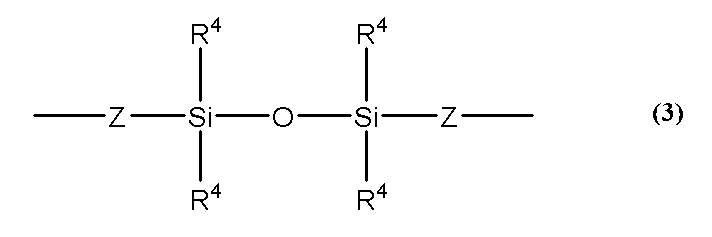
上記一般式(3)中、R4は上記一般式(2)の通りであり、Zは炭素原子数1~20、好ましくは炭素原子数1~6の、非置換又は置換の二価炭化水素基である。
上記二価炭化水素基(Y又はZ)は直鎖状であっても分岐構造を有していてもよい(例えばメチルエチレン基)が、特にメチレン基、エチレン基、プロピレン基(トリメチレン基)、ブチレン基(テトラメチレン基)、ヘキシレン基(ヘキサメチレン基)等の直鎖アルキレン基が好ましい。中でも、特にエチレン基が好ましい。
特に好ましくは、Yは酸素原子である。
上記二価炭化水素基(Y又はZ)は直鎖状であっても分岐構造を有していてもよい(例えばメチルエチレン基)が、特にメチレン基、エチレン基、プロピレン基(トリメチレン基)、ブチレン基(テトラメチレン基)、ヘキシレン基(ヘキサメチレン基)等の直鎖アルキレン基が好ましい。中でも、特にエチレン基が好ましい。
特に好ましくは、Yは酸素原子である。
(B)成分の配合量は2質量部より少ないと、耐ズレ性が悪化してしまうし、100質量部より多いと、保存中に増粘してしまうため、2~100質量部の範囲がよく、好ましくは2.4~80質量部がよい。
[(C)成分]
(C)成分は、前記(A)成分、(B)成分以外の下記一般式(4)で表される25℃における動粘度が100~100,000mm2/sのオルガノポリシロキサンである。
R5 dSiO(4―d)/2 (4)
(R5は炭素数1~18の飽和又は不飽和の1価の炭化水素基の群の中から選択される1種もしくは2種以上の基、dは1.8≦d≦2.2の正数)
(C)成分は、前記(A)成分、(B)成分以外の下記一般式(4)で表される25℃における動粘度が100~100,000mm2/sのオルガノポリシロキサンである。
R5 dSiO(4―d)/2 (4)
(R5は炭素数1~18の飽和又は不飽和の1価の炭化水素基の群の中から選択される1種もしくは2種以上の基、dは1.8≦d≦2.2の正数)
但し、上記一般式(4)中のR5は、炭素数1~18の飽和又は不飽和の一価の炭化水素基の群の中から選択される少なくとも1種もしくは2種以上(例えば1種以上5種以下)の基である。
dは、要求される粘度の観点から1.8~2.2の正数であることが必要であり、特に1.9~2.1の正数であることが好ましい。
上記R5としては、例えば、メチル基、エチル基、プロピル基、ヘキシル基、オクチル基、デシル基、ドデシル基、テトラデシル基、ヘキサデシル基、オクタデシル基等のアルキル基;シクロペンチル基、シクロヘキシル基等のシクロアルキル基;ビニル基、アリル基等のアルケニル基;フェニル基、トリル基等のアリール基;2-フェニルエチル基、2-メチル-2-フェニルエチル基等のアラルキル基;3,3,3-トリフロロプロピル基、2-(パーフロロブチル)エチル基、2-(パーフロロオクチル)エチル基、p-クロロフェニル基等のハロゲン化炭化水素基が挙げられる。
dは、要求される粘度の観点から1.8~2.2の正数であることが必要であり、特に1.9~2.1の正数であることが好ましい。
上記R5としては、例えば、メチル基、エチル基、プロピル基、ヘキシル基、オクチル基、デシル基、ドデシル基、テトラデシル基、ヘキサデシル基、オクタデシル基等のアルキル基;シクロペンチル基、シクロヘキシル基等のシクロアルキル基;ビニル基、アリル基等のアルケニル基;フェニル基、トリル基等のアリール基;2-フェニルエチル基、2-メチル-2-フェニルエチル基等のアラルキル基;3,3,3-トリフロロプロピル基、2-(パーフロロブチル)エチル基、2-(パーフロロオクチル)エチル基、p-クロロフェニル基等のハロゲン化炭化水素基が挙げられる。
また、上記オルガノポリシロキサンのオストワルド粘度計により測定される25℃における動粘度については、100mm2/sより低いと組成物にした時に保存中の増粘が起こりやすくなるし、100,000mm2/sより高くなると組成物にしたときの伸展性が乏しくなって作業性が悪化するため、100~100,000mm2/sの範囲であることが必要であり、好ましくは1,000~50,000mm2/sの範囲がよい。
(C)成分の配合量は、(A)成分100質量部に対して10質量部より少ないと、室温での保存中に組成物が固化してしまうし、250質量部より多いと、組成物の伸展性が乏しい物になってしまうため、10~250質量部の範囲であることが必要であり、好ましくは12~200質量部がよい。
[(D)成分]
(D)成分の熱伝導率を有する熱伝導性充填材としては、熱伝導率が10W/m・℃以上のものが使用される。充填材のもつ熱伝導率が10W/m・℃より小さいと、熱伝導性シリコーン組成物の熱伝導率そのものが小さくなるためである。充填材のもつ熱伝導率の上限は、特に限定されないが、例えば1000W/m・℃とすることができる。
(D)成分の熱伝導率を有する熱伝導性充填材としては、熱伝導率が10W/m・℃以上のものが使用される。充填材のもつ熱伝導率が10W/m・℃より小さいと、熱伝導性シリコーン組成物の熱伝導率そのものが小さくなるためである。充填材のもつ熱伝導率の上限は、特に限定されないが、例えば1000W/m・℃とすることができる。
前記熱伝導性充填材としては、アルミニウム粉末、銅粉末、銀粉末、鉄粉末、ニッケル粉末、金粉末、錫粉末、金属ケイ素粉末、窒化アルミニウム粉末、窒化ホウ素粉末、窒化ケイ素粉末、アルミナ粉末、ダイヤモンド粉末、カーボン粉末、インジウム粉末、ガリウム粉末、酸化亜鉛粉末などが挙げられるが、10W/m・℃以上を有する充填材であれば如何なる充填材でもよく、1種類あるいは2種類以上を混ぜ合わせたものでもよい。
(D)成分の平均粒径は0.1~150μmの範囲がよい。該平均粒径が0.1μm以上であれば、得られる組成物がグリース状になり伸展性に優れたものになり、150μm以下であれば、放熱グリースの熱抵抗が小さくなり性能が向上するためである。
なお、本発明において、平均粒径は日機装(株)製マイクロトラックMT3300EXにより測定でき、体積基準の体積平均径である。(D)成分の形状は、不定形でも球形でも如何なる形状でもよい。
(D)成分の充填量は、(A)成分と(B)成分と(C)成分の合計100質量部当たり500質量部より少ないと組成物の熱伝導率が低くなってしまうし、3,000質量部より多いと組成物の粘度が上昇し、伸展性の乏しいものになるため、500~3,000質量部の範囲であることが必要であり、好ましくは800~2,800質量部、より好ましくは800~2,500質量部の範囲がよい。
[その他成分]
また、本発明には上記(A)~(D)成分以外に、必要に応じて、酸化防止剤、耐熱性向上剤、着色剤等を本発明の目的に応じて添加しても良い。
また、本発明には上記(A)~(D)成分以外に、必要に応じて、酸化防止剤、耐熱性向上剤、着色剤等を本発明の目的に応じて添加しても良い。
本発明の熱伝導性シリコーン組成物は、25℃における絶対粘度が800Pa・s以下であることが好ましい。
なお絶対粘度の下限に制限はないが、例えば50Pa・sとすることができる。
通常、このような粘度範囲では低粘度によるズレが発生するが、本発明であれば上記粘度範囲であってもズレが発生せず、更に組成物の流動性が好適で作業性が良いため好ましい。
なお絶対粘度の下限に制限はないが、例えば50Pa・sとすることができる。
通常、このような粘度範囲では低粘度によるズレが発生するが、本発明であれば上記粘度範囲であってもズレが発生せず、更に組成物の流動性が好適で作業性が良いため好ましい。
上記25℃における絶対粘度は、例えば回転式粘度計により測定する。
また、本発明の熱伝導性シリコーン組成物は、3.0W/m・℃以上の熱伝導率を有することが好ましい。熱伝導率が3.0W/m・℃以上であれば、熱伝導率に優れたものとなるため好ましい。本発明の熱伝導性シリコーン組成物の熱伝導率の上限は、特に限定されないが、例えば100W/m・℃とすることができる。
上記熱伝導率は、例えば25℃において迅速熱伝導計により測定する。
以上のように、本発明の熱伝導性シリコーン組成物は、ジオルガノポリシロキサンを特定量配合したことにより、特別な保管条件を必要とせず、耐ズレ性に優れる熱伝導性シリコーン組成物にできるものとなる。
<熱伝導性シリコーン組成物の製造方法>
本発明の熱伝導性シリコーン組成物(グリース)を製造するには、例えば(A)~(D)成分をトリミックス、ツウィンミックス、プラネタリミキサー(何れも井上製作所(株)製混合機の登録商標)ウルトラミキサー(みずほ工業(株)製混合機の登録商標)、ハイビスディスパーミックス(特殊機化工業(株)製混合機の登録商標)等の混合機にて混合すればよい。
本発明の熱伝導性シリコーン組成物(グリース)を製造するには、例えば(A)~(D)成分をトリミックス、ツウィンミックス、プラネタリミキサー(何れも井上製作所(株)製混合機の登録商標)ウルトラミキサー(みずほ工業(株)製混合機の登録商標)、ハイビスディスパーミックス(特殊機化工業(株)製混合機の登録商標)等の混合機にて混合すればよい。
以下、実施例及び比較例を用いて本発明を具体的に説明するが、本発明はこれらに限定されるものではない。
本発明に関する試験は、次のように行った。
[粘度測定]
熱伝導性シリコーン組成物を25℃の恒温室に2時間放置後、マルコム粘度計を使用して回転数10rpmでの絶対粘度を測定した。
また、40℃の恒温槽に4ヶ月静置した後の粘度を同様の方法で測定した。
熱伝導性シリコーン組成物を25℃の恒温室に2時間放置後、マルコム粘度計を使用して回転数10rpmでの絶対粘度を測定した。
また、40℃の恒温槽に4ヶ月静置した後の粘度を同様の方法で測定した。
[熱伝導率測定方法]
熱伝導性シリコーン組成物の熱伝導率は迅速熱伝導計QTM-500(京都電子工業(株))により25℃において測定した。
熱伝導性シリコーン組成物の熱伝導率は迅速熱伝導計QTM-500(京都電子工業(株))により25℃において測定した。
[耐ズレ性]
ガラスとアルミニウムにグリースを厚さ1mmで挟みこみ、-40℃⇔125℃のヒートサイクル試験機内に縦置きに静置し、1000サイクル試験を行った。初期位置からのズレた距離を確認した。
ガラスとアルミニウムにグリースを厚さ1mmで挟みこみ、-40℃⇔125℃のヒートサイクル試験機内に縦置きに静置し、1000サイクル試験を行った。初期位置からのズレた距離を確認した。
熱伝導性シリコーン組成物を形成する以下の各成分を用意した。
[(A)成分]
A-1:下記式(4)で表される動粘度が30mm2/sのオルガノポリシロキサン

[(A)成分]
A-1:下記式(4)で表される動粘度が30mm2/sのオルガノポリシロキサン
[(B)成分]
B-1: 下記構造式で表されるジオルガノポリシロキサン

動粘度:17mm2/s
B-1: 下記構造式で表されるジオルガノポリシロキサン
B-2: 下記構造式で表されるジオルガノポリシロキサン
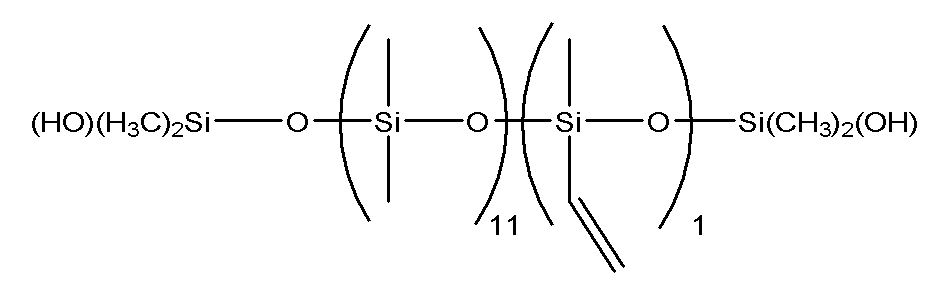
動粘度:22mm2/s
B-3: 下記構造式で表されるジオルガノポリシロキサン

動粘度:30mm2/s
b-4(比較例): 25℃における動粘度が20,000mm2/sの分子鎖両末端が水酸基で封鎖されたポリジメチルシロキサン
[(C)成分]
C-1:((CH3)3SiO1/2)単位及び((CH3)2SiO)単位からなる、動粘度が5,000mm2/sのオルガノポリシロキサン:(CH3)2.00 SiO1.00
C-2:((CH3)3SiO1/2)単位及び((CH3)2SiO)単位からなる、動粘度が1,000mm2/sのオルガノポリシロキサン:(CH3)2.01 SiO0.995
C-1:((CH3)3SiO1/2)単位及び((CH3)2SiO)単位からなる、動粘度が5,000mm2/sのオルガノポリシロキサン:(CH3)2.00 SiO1.00
C-2:((CH3)3SiO1/2)単位及び((CH3)2SiO)単位からなる、動粘度が1,000mm2/sのオルガノポリシロキサン:(CH3)2.01 SiO0.995
[(D)成分]
D-1:下記のアルミニウム粉末、アルミナ粉末、酸化亜鉛粉末を5リットルプラネタリーミキサー(井上製作所(株)製)を用いて下記表1の混合比で室温にて15分間混合し、熱伝導性充填材D-1を得た。
○平均粒径46μmのアルミニウム粉末(熱伝導率:236W/m・℃)
○平均粒径10μmのアルミニウム粉末(熱伝導率:236W/m・℃)
〇平均粒径1μmのアルミニウム粉末(熱伝導率:236W/m・℃)
○平均粒径10μmのアルミナ粉末(熱伝導率:27W/m・℃)
○平均粒径0.6μmの酸化亜鉛粉末(熱伝導率:25W/m・℃)
D-1:下記のアルミニウム粉末、アルミナ粉末、酸化亜鉛粉末を5リットルプラネタリーミキサー(井上製作所(株)製)を用いて下記表1の混合比で室温にて15分間混合し、熱伝導性充填材D-1を得た。
○平均粒径46μmのアルミニウム粉末(熱伝導率:236W/m・℃)
○平均粒径10μmのアルミニウム粉末(熱伝導率:236W/m・℃)
〇平均粒径1μmのアルミニウム粉末(熱伝導率:236W/m・℃)
○平均粒径10μmのアルミナ粉末(熱伝導率:27W/m・℃)
○平均粒径0.6μmの酸化亜鉛粉末(熱伝導率:25W/m・℃)
(A)~(D)成分を以下のように混合して実施例1~8および比較例1~7の熱伝導性シリコーン組成物を得た。即ち、5リットルプラネタリーミキサー(井上製作所(株)社製)に(A)成分を取り、表2、3に示す配合量で(B)、(C)、(D)成分を加え170℃で2時間混合した。
評価結果を表2、3に示す。
評価結果を表2、3に示す。

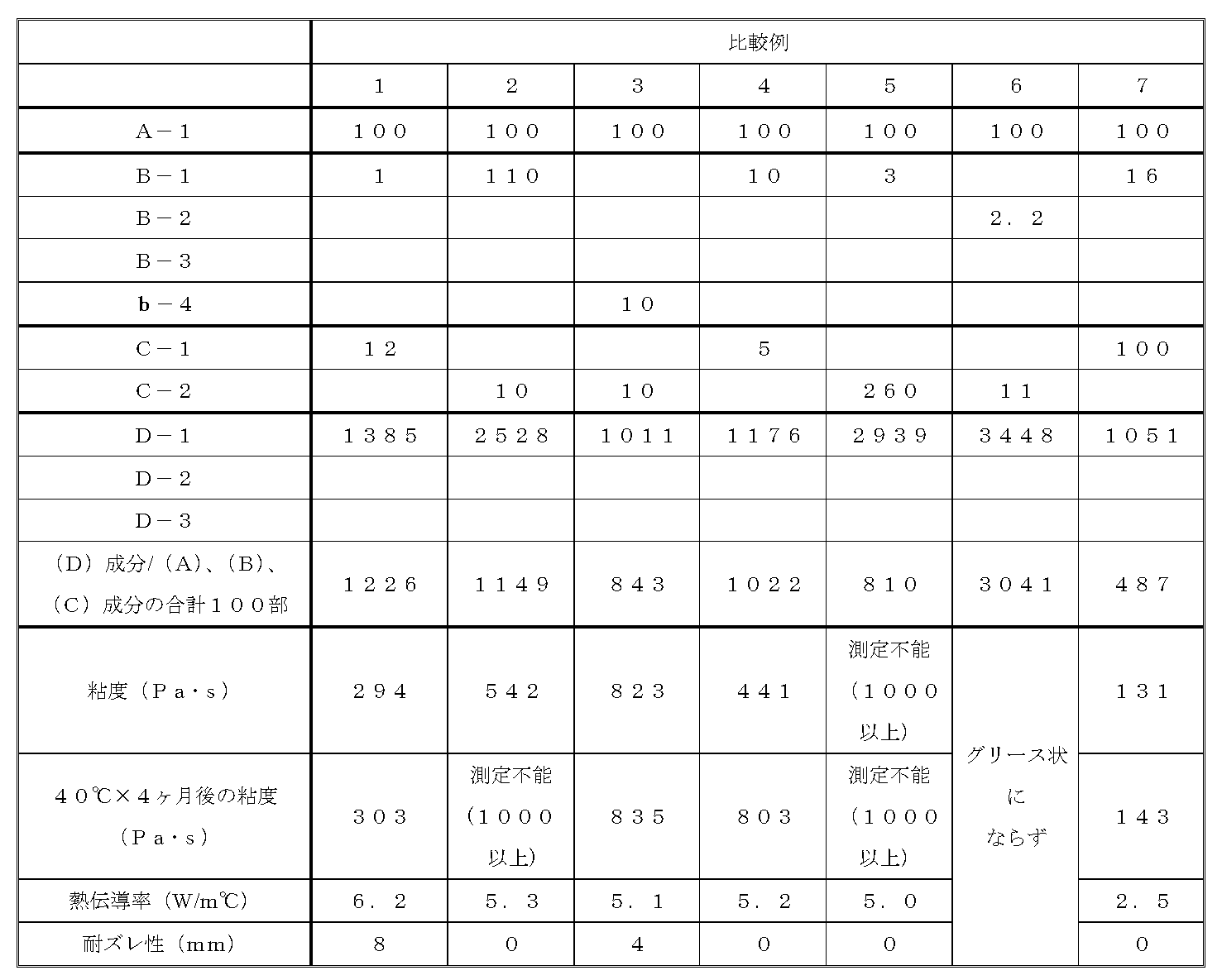
表2から分かる通り、実施例1~8の粘度、4か月後の粘度は余り変化しておらず、保管性が良好であり、熱伝導率は4.1~8.2W/m℃であり、耐ズレ性は0又は1mmといずれも良好であった。
一方、表3から分かる通り、比較例1~7は悪い結果を示した。具体的には、比較例1はB-1:1質量部により、耐ズレ性が8mmと悪かった。比較例2はB-1:110質量部により、4か月後の粘度が測定不能となった。比較例3はb-4:10質量部により、粘度と耐ズレ性が悪化した。比較例4は、C-1:5質量部により、4か月後の粘度が悪化した。比較例5は、C-2:260質量部により、粘度、4か月後の粘度が測定不能となった。比較例6はD成分:3041により、グリース状にならなかった。比較例7は、熱伝導率が悪かった。
一方、表3から分かる通り、比較例1~7は悪い結果を示した。具体的には、比較例1はB-1:1質量部により、耐ズレ性が8mmと悪かった。比較例2はB-1:110質量部により、4か月後の粘度が測定不能となった。比較例3はb-4:10質量部により、粘度と耐ズレ性が悪化した。比較例4は、C-1:5質量部により、4か月後の粘度が悪化した。比較例5は、C-2:260質量部により、粘度、4か月後の粘度が測定不能となった。比較例6はD成分:3041により、グリース状にならなかった。比較例7は、熱伝導率が悪かった。
なお、本発明は、上記実施形態に限定されるものではない。上記実施形態は例示であり、本発明の特許請求の範囲に記載された技術的思想と実質的に同一な構成を有し、同様な作用効果を奏するものは、いかなるものであっても本発明の技術的範囲に包含される。
Claims (3)
- (A)成分:下記一般式(1)で表されるオルガノポリシロキサン:100質量部、

(B)成分:ケイ素原子に結合した水酸基及び/又は加水分解性シリル基を分子鎖両末端に有し、25℃における動粘度が5~10,000mm2/sであるジオルガノポリシロキサン:2~100質量部、
(C)成分:前記(A)成分、(B)成分以外の下記一般式(4)で表される25℃における動粘度が100~100,000mm2/sのオルガノポリシロキサン:10~250質量部、
R5 dSiO(4―d)/2 (4)
(R5は炭素数1~18の飽和又は不飽和の1価の炭化水素基の群の中から選択される1種もしくは2種以上の基、dは1.8≦d≦2.2の正数)
(D)成分:10W/m・℃以上の熱伝導率を有する熱伝導性充填材:前記(A)成分と前記(B)成分と前記(C)成分の合計100質量部に対して500~3,000質量部、
を含むことを特徴とする熱伝導性シリコーン組成物。 - 25℃における絶対粘度が800Pa・s以下であることを特徴とする請求項1に記載の熱伝導性シリコーン組成物。
- 3.0W/m・℃以上の熱伝導率を有することを特徴とする請求項1または請求項2に記載の熱伝導性シリコーン組成物。
Applications Claiming Priority (2)
| Application Number | Priority Date | Filing Date | Title |
|---|---|---|---|
| JP2023-019478 | 2023-02-10 | ||
| JP2023019478A JP2024114083A (ja) | 2023-02-10 | 2023-02-10 | 熱伝導性シリコーン組成物 |
Publications (1)
| Publication Number | Publication Date |
|---|---|
| WO2024166641A1 true WO2024166641A1 (ja) | 2024-08-15 |
Family
ID=92262351
Family Applications (1)
| Application Number | Title | Priority Date | Filing Date |
|---|---|---|---|
| PCT/JP2024/001362 Ceased WO2024166641A1 (ja) | 2023-02-10 | 2024-01-19 | 熱伝導性シリコーン組成物 |
Country Status (3)
| Country | Link |
|---|---|
| JP (1) | JP2024114083A (ja) |
| TW (1) | TW202436519A (ja) |
| WO (1) | WO2024166641A1 (ja) |
Citations (2)
| Publication number | Priority date | Publication date | Assignee | Title |
|---|---|---|---|---|
| WO2017203924A1 (ja) * | 2016-05-24 | 2017-11-30 | 信越化学工業株式会社 | 熱伝導性シリコーン組成物及びその硬化物 |
| WO2019155846A1 (ja) * | 2018-02-09 | 2019-08-15 | 信越化学工業株式会社 | 熱伝導性シリコーン組成物、硬化物、半導体装置、及び半導体装置の製造方法 |
-
2023
- 2023-02-10 JP JP2023019478A patent/JP2024114083A/ja active Pending
-
2024
- 2024-01-19 WO PCT/JP2024/001362 patent/WO2024166641A1/ja not_active Ceased
- 2024-01-23 TW TW113102527A patent/TW202436519A/zh unknown
Patent Citations (2)
| Publication number | Priority date | Publication date | Assignee | Title |
|---|---|---|---|---|
| WO2017203924A1 (ja) * | 2016-05-24 | 2017-11-30 | 信越化学工業株式会社 | 熱伝導性シリコーン組成物及びその硬化物 |
| WO2019155846A1 (ja) * | 2018-02-09 | 2019-08-15 | 信越化学工業株式会社 | 熱伝導性シリコーン組成物、硬化物、半導体装置、及び半導体装置の製造方法 |
Also Published As
| Publication number | Publication date |
|---|---|
| TW202436519A (zh) | 2024-09-16 |
| JP2024114083A (ja) | 2024-08-23 |
Similar Documents
| Publication | Publication Date | Title |
|---|---|---|
| JP5434795B2 (ja) | 熱伝導性シリコーングリース組成物 | |
| JP6708005B2 (ja) | 熱伝導性シリコーンパテ組成物 | |
| US8912132B2 (en) | Thermally conductive silicone grease composition | |
| JP5283553B2 (ja) | 熱伝導性シリコーングリース組成物 | |
| TWI837265B (zh) | 矽氧組成物及其製造方法 | |
| JP4917380B2 (ja) | 放熱用シリコーングリース組成物及びその製造方法 | |
| JP2010013521A (ja) | 熱伝導性シリコーン組成物 | |
| US20200071526A1 (en) | One-pack addition curable silicone composition, method for storing same, and method for curing same | |
| JP2011219664A (ja) | 室温湿気増粘型熱伝導性シリコーングリース組成物 | |
| JP7444856B2 (ja) | 多成分型硬化性オルガノポリシロキサン組成物、熱伝導性部材および放熱構造体 | |
| JP7632143B2 (ja) | シリコーン樹脂組成物 | |
| WO2020153217A1 (ja) | 高熱伝導性シリコーン組成物及びその製造方法 | |
| JP2020111655A (ja) | 熱伝導性シリコーン組成物 | |
| JP6669028B2 (ja) | 熱伝導性シリコーングリース組成物 | |
| JP6372293B2 (ja) | 熱伝導性シリコーングリース組成物 | |
| WO2024166641A1 (ja) | 熱伝導性シリコーン組成物 | |
| JP6187349B2 (ja) | 室温湿気増粘型熱伝導性シリコーングリース組成物 | |
| JP7355767B2 (ja) | 熱伝導性シリコーン組成物 | |
| TWI916471B (zh) | 導熱性矽氧組成物 | |
| CN121057784A (zh) | 导热性有机硅组合物及固化物 | |
| US12503600B2 (en) | Thermally conductive silicone potting composition and cured product thereof | |
| US7541403B2 (en) | Thermal interface material | |
| JP2021113290A (ja) | 熱伝導性シリコーンポッティング組成物およびその硬化物 | |
| US20260085187A1 (en) | Silicone resin composition, thermally conductive sheet, and organopolysiloxane | |
| TW202307187A (zh) | 矽酮樹脂組成物 |
Legal Events
| Date | Code | Title | Description |
|---|---|---|---|
| 121 | Ep: the epo has been informed by wipo that ep was designated in this application |
Ref document number: 24753087 Country of ref document: EP Kind code of ref document: A1 |
|
| NENP | Non-entry into the national phase |
Ref country code: DE |
|
| 122 | Ep: pct application non-entry in european phase |
Ref document number: 24753087 Country of ref document: EP Kind code of ref document: A1 |