WO2024166263A1 - ラテックスインク用フィルム - Google Patents
ラテックスインク用フィルム Download PDFInfo
- Publication number
- WO2024166263A1 WO2024166263A1 PCT/JP2023/004216 JP2023004216W WO2024166263A1 WO 2024166263 A1 WO2024166263 A1 WO 2024166263A1 JP 2023004216 W JP2023004216 W JP 2023004216W WO 2024166263 A1 WO2024166263 A1 WO 2024166263A1
- Authority
- WO
- WIPO (PCT)
- Prior art keywords
- latex ink
- film
- latex
- receiving layer
- ink
- Prior art date
- Legal status (The legal status is an assumption and is not a legal conclusion. Google has not performed a legal analysis and makes no representation as to the accuracy of the status listed.)
- Ceased
Links
Images

Classifications
-
- B—PERFORMING OPERATIONS; TRANSPORTING
- B32—LAYERED PRODUCTS
- B32B—LAYERED PRODUCTS, i.e. PRODUCTS BUILT-UP OF STRATA OF FLAT OR NON-FLAT, e.g. CELLULAR OR HONEYCOMB, FORM
- B32B27/00—Layered products comprising a layer of synthetic resin
- B32B27/40—Layered products comprising a layer of synthetic resin comprising polyurethanes
-
- B—PERFORMING OPERATIONS; TRANSPORTING
- B41—PRINTING; LINING MACHINES; TYPEWRITERS; STAMPS
- B41M—PRINTING, DUPLICATING, MARKING, OR COPYING PROCESSES; COLOUR PRINTING
- B41M5/00—Duplicating or marking methods; Sheet materials for use therein
- B41M5/50—Recording sheets characterised by the coating used to improve ink, dye or pigment receptivity, e.g. for ink-jet or thermal dye transfer recording
- B41M5/52—Macromolecular coatings
Definitions
- the present invention relates to a film for latex inks.
- latex inks are water-based inks in which a pigment is dispersed in water together with latex (polymer). Therefore, there is no emission of volatile organic compounds (VOCs) resulting from organic solvents, which is a problem when using solvent inks, and therefore printed materials using latex inks have the advantage that they can be used safely in a variety of locations, such as restaurants, educational institutions, medical institutions, and commercial facilities.
- VOCs volatile organic compounds
- the film for latex ink described in Patent Document 2 comprises a substrate and a printing coating layer to which latex ink is applied.
- the printing coating layer contains a material having a structure in which a polymeric material having vinyl chloride, vinyl acetate, and a crosslinkable monomer as constituent monomers is crosslinked by a crosslinking agent. This results in a film for latex ink having a printing coating layer with excellent adhesion to both the portion printed with latex ink and the substrate.
- the “printing coating layer” in Patent Document 2 is referred to as the "latex ink receiving layer” in this specification.
- the “latex ink receiving layer” refers to the layer to which latex ink is applied and has the function of fixing the printed portion made of the applied latex ink.
- the latex ink receiving layer of latex ink films is sometimes required to be abrasion resistant.
- the latex ink receiving layer needs to have a certain degree of softness.
- the surface of the latex ink receiving layer is easily scratched and has poor abrasion resistance.
- the "printing coating layer” in Patent Document 2 also has poor abrasion resistance.
- the latex ink film may be attached to the glass surface of a store, showroom, office, etc., and used for advertising or decorative purposes.
- an adherend such as a glass surface
- water or an aqueous solution containing a surfactant is sprayed on the attachment surface (adhesive layer surface) of the latex ink film or the lamination surface of the adherend so that air does not get between the latex ink film and the adherend, and after both are brought into close contact and positioned, the film is attached by scraping out water and the like together with air from the latex ink film side using a squeegee, which is the so-called water lamination.
- an aqueous solution may also be sprayed on the latex ink receiving layer side, which is the side opposite the adhesive layer.
- the latex ink receiving layer of a film for latex ink that is applied with water is required to ensure adhesion to the printed area printed with latex ink, even when the latex ink receiving layer is rubbed with a squeegee while in contact with water (in the following explanation, this will also be referred to as "water-resistant adhesion of the ink").
- the present invention was made in consideration of these problems, and aims to provide a film for latex ink that has excellent ink adhesion and water-resistant ink adhesion while ensuring abrasion resistance.
- the present inventors have found that a latex ink-receiving layer formed from a resin composition containing an acrylic resin having a crosslinkable functional group, a specific crosslinking agent, a specific ultraviolet-curable acrylate compound, and a photopolymerization initiator can solve the above problems. Based on this finding, the present inventors have further conducted various research and have completed the present invention. That is, the present invention relates to the following [1] to [8].
- the latex ink receiving layer (X) is formed from a resin composition (x1) containing an acrylic resin (A) having a crosslinkable functional group, a crosslinking agent (B), an ultraviolet-curable acrylate compound (C) which is an ester of an alkylene oxide-modified polyol compound and (meth)acrylic acid, and a photopolymerization initiator (D);
- the crosslinking agent (B) contains an isocyanurate compound (B1),
- the isocyanurate compound (B1) includes an isocyanurate compound (B1-1) and a modified product of an isocyanurate compound (B1-2),
- the isocyanurate compound (B1-1) is a trimer of 1,6-hexamethylene diisocyanate,
- the modified isocyanurate compound (B1-2) is a trimer of 1,6-hexamethylene diiso
- [6] A method for using the film for latex ink according to any one of the above [1] to [5] to form a printed portion on a latex ink-receiving layer of the film for latex ink using latex ink.
- [7] A method for producing a printed matter, comprising a step of forming a printed portion on the latex ink-receiving layer of the film for latex ink according to any one of [1] to [5] above, using latex ink.
- [8] A printed matter having a latex ink-printed portion on the latex ink-receiving layer of the film for latex ink according to any one of [1] to [5] above.
- the present invention makes it possible to provide a film for latex ink that has excellent ink adhesion and water-resistant ink adhesion while also ensuring abrasion resistance.
- FIG. 1 is a schematic cross-sectional view showing one embodiment of a film for latex ink of the present invention.
- the term “active ingredient” refers to the components contained in the target composition excluding diluting solvents such as water and organic solvents.
- the term “(meth)acrylic acid” refers to both “acrylic acid” and “methacrylic acid”
- the term “(meth)acryloyl group” refers to both "acryloyl group” and “methacryloyl group”.
- the lower limit and upper limit described in stages for the preferred numerical range e.g., the range of the content, etc. can be independently combined.
- the description "preferably 10 to 90, more preferably 30 to 60” can be combined with the “preferable lower limit (10)” and the “more preferable upper limit (60)” to form “10 to 60.”
- the numerical values in the examples are numerical values that can be used as upper or lower limits.
- the film for latex ink of the present invention has a laminated structure in which a latex ink-receiving layer (X) and a substrate (Y) are laminated together.
- the latex ink receiving layer (X) is formed from a resin composition (x1) containing an acrylic resin (A) having a crosslinkable functional group, a crosslinking agent (B), an ultraviolet-curable acrylate compound (C) which is an ester of an alkylene oxide-modified polyol compound and (meth)acrylic acid, and a photopolymerization initiator (D).
- the crosslinking agent (B) contains an isocyanurate compound (B1).
- the isocyanurate compound (B1) includes an isocyanurate compound (B1-1) and a modified product of the isocyanurate compound (B1-2).
- the isocyanurate compound (B1-1) is a trimer of 1,6-hexamethylene diisocyanate
- the modified isocyanurate compound (B1-2) is a trimer of 1,6-hexamethylene diisocyanate and has one or more tertiary amino groups.
- a latex ink receiving layer formed from a resin composition (x1) containing "an acrylic resin (A) having a crosslinkable functional group,” “a crosslinking agent (B) containing an isocyanurate compound (B1),” “an ultraviolet-curable acrylate compound (C) which is an ester of an alkylene oxide-modified polyol compound and (meth)acrylic acid,” and “a photopolymerization initiator (D),” has excellent ink adhesion and water-resistant adhesion while maintaining abrasion resistance, and have completed the present invention after further extensive research.
- the latex ink film of the present invention will be described in detail below with respect to its configuration, the components constituting the latex ink film (substrate, latex ink receiving layer, adhesive layer, and release liner), the method for producing the latex ink film, and uses of the latex ink film.
- the "ultraviolet-curable acrylate compound (C), which is an ester of an alkylene oxide-modified polyol compound and (meth)acrylic acid” may be abbreviated as “ultraviolet-curable acrylate compound (C).”
- the film for latex ink of the present invention has a laminated structure in which a latex ink-receiving layer (X) and a substrate (Y) are laminated together.
- FIG. 1 A cross-sectional schematic diagram of one embodiment of the film for latex ink of the present invention is shown in Figure 1.
- the film for latex ink 1 shown in Figure 1 has a laminated structure in which a latex ink-receiving layer (X) is laminated on one surface (Ya) of a substrate (Y).
- the film for latex ink according to one embodiment of the present invention preferably has a pressure-sensitive adhesive layer (Z) provided on the other surface (Yb) of the substrate (Y), which allows the film for latex ink to be suitably used as a pressure-sensitive adhesive film.
- the adhesive surface of the pressure-sensitive adhesive layer (Z) may be covered with a release liner. Then, when attaching to an adherend, the release liner may be peeled off to expose the adhesive surface of the pressure-sensitive adhesive layer (Z).
- a latex ink receiving layer (X) may be provided on both sides (Ya) and (Yb) of the substrate (Y) without providing a pressure-sensitive adhesive layer (Z).
- another layer may be provided between the latex ink receiving layer (X) and the substrate (Y). Examples of the other layer include an easy-adhesion layer.
- the film for latex ink of the present invention has a latex ink-receiving layer (X) and a substrate (Y).
- the film for latex ink according to one embodiment of the present invention may further include a pressure-sensitive adhesive layer (Z) in addition to the latex ink-receiving layer (X) and the substrate (Y).
- the film for latex ink according to one embodiment of the present invention may further include a pressure-sensitive adhesive layer (Z) and a release liner in addition to the latex ink-receiving layer (X) and the substrate (Y).
- the latex ink-receiving layer (X), the substrate (Y), the pressure-sensitive adhesive layer (Z), and the release liner will be described in detail below.
- the film for latex ink of the present invention has a latex ink-receiving layer (X).
- the latex ink receiving layer (X) is a portion to which latex ink is applied, and has the function of fixing the portion printed with the applied latex ink.
- the thickness of the latex ink receiving layer (X) is not particularly limited, but is preferably 0.05 ⁇ m to 50 ⁇ m, more preferably 0.1 ⁇ m to 25 ⁇ m, and even more preferably 0.1 ⁇ m to 10 ⁇ m.
- the latex ink receiving layer (X) is formed from a resin composition (x1) containing an acrylic resin (A) having a crosslinkable functional group, a crosslinking agent (B), an ultraviolet-curable acrylate compound (C), and a photopolymerization initiator (D).
- the resin composition (x1) By forming the resin composition (x1) from the resin composition (x1) containing the acrylic resin (A) having a crosslinkable functional group, the crosslinking agent (B), the ultraviolet-curable acrylate compound (C), and the photopolymerization initiator (D), a crosslinked structure formed by the reaction between the acrylic resin (A) having a crosslinkable functional group and the crosslinking agent (B) and a polymer structure formed by the ultraviolet-curable acrylate compound (C) and the photopolymerization initiator (D) are mixed on the surface of the latex ink-receiving layer (X), thereby improving ink adhesion and abrasion resistance.
- the distance between the (meth)acryloyl groups, which are the ultraviolet-curable sites, is extended, so that the hardness of the latex ink-receiving layer (X) is appropriately reduced, and the force applied to the latex ink-receiving layer (X) when rubbed with a squeegee during wet application is alleviated, making it difficult for the ink to peel off during wet application. That is, the water-resistant adhesion of the ink is improved.
- the abrasion resistance is sufficiently ensured by the improved abrasion resistance effect due to the mixture of the polymer structure formed by the ultraviolet-curable acrylate compound (C) and the photopolymerization initiator (D) on the surface of the latex ink-receiving layer (X). It is presumed that the combined use of these factors results in the formation of a latex ink-receiving layer (X) that is excellent in both ink adhesion and water-resistant adhesion of ink while ensuring abrasion resistance.
- the "acrylic resin having a crosslinkable functional group (A),” the “crosslinking agent (B),” the “ultraviolet-curable acrylate compound (C),” and the “photopolymerization initiator (D)” are also referred to as “component (A),” “component (B),” “component (C),” and “component (D),” respectively.
- the resin composition (x1) which is the material for forming the latex ink receiving layer (X) may be composed only of components (A), (B), (C), and (D), but may also contain other components in addition to components (A), (B), (C), and (D) in addition to components (A), (B), (C), and (D) as long as the effect of the present invention is not impaired.
- other components include additives for ink receiving layers that are commonly used in ink receiving layers such as latex ink receiving layers, such as reaction accelerators (catalysts), surface conditioners, plasticizers, fillers, and colorants.
- the total content of components (A), (B), (C), and (D) is preferably 80% by mass to 100% by mass, more preferably 85% by mass to 100% by mass, and even more preferably 90% by mass to 100% by mass, based on the total amount of the active components of resin composition (x1).
- the acrylic resin (A) having a crosslinkable functional group, the crosslinking agent (B), the ultraviolet-curable acrylate compound (C), and the photopolymerization initiator (D) contained in the resin composition (x1) are described in detail below.
- the resin composition (x1) used in the present invention contains an acrylic resin (A) having a crosslinkable functional group.
- the acrylic resin (A) having a crosslinkable functional group is preferably an acrylic resin (A1) having a structural unit (a1) derived from a crosslinkable functional group-containing monomer (a1') (hereinafter also referred to as monomer (a1')).
- Examples of the crosslinkable functional group contained in the monomer (a1') include one or more types selected from a hydroxyl group, a carboxyl group, an amino group, an epoxy group, and the like. That is, examples of the monomer (a1') include hydroxyl group-containing monomers, carboxyl group-containing monomers, amino group-containing monomers, and epoxy group-containing monomers, etc. Also included are monomers containing two or more crosslinkable functional groups selected from hydroxyl groups, carboxyl groups, amino groups, and epoxy groups, etc. These monomers (a1') may be used alone or in combination of two or more. Among these, as the monomer (a1'), a hydroxyl group-containing monomer and a carboxy group-containing monomer are preferred.
- Hydroxyl group-containing monomers include, for example, hydroxyalkyl (meth)acrylates such as 2-hydroxyethyl (meth)acrylate, 2-hydroxypropyl (meth)acrylate, 3-hydroxypropyl (meth)acrylate, 2-hydroxybutyl (meth)acrylate, 3-hydroxybutyl (meth)acrylate, and 4-hydroxybutyl (meth)acrylate; N-methylol acrylamide; ⁇ -caprolactone-modified hydroxy (meth)acrylate; carbonate-modified (meth)acrylate, and the like.
- hydroxyalkyl (meth)acrylates such as 2-hydroxyethyl (meth)acrylate, 2-hydroxypropyl (meth)acrylate, 3-hydroxypropyl (meth)acrylate, 2-hydroxybutyl (meth)acrylate, 3-hydroxybutyl (meth)acrylate, and 4-hydroxybutyl (meth)acrylate
- N-methylol acrylamide such as 2-hydroxyethyl (meth)
- carboxyl group-containing monomers examples include (meth)acrylic acid; and compounds obtained by reacting the terminal hydroxyl group of the hydroxyl group-containing monomer described above with an acid anhydride such as one or more aliphatic dicarboxylic acids selected from succinic anhydride, glutaric anhydride, etc.
- an acid anhydride such as one or more aliphatic dicarboxylic acids selected from succinic anhydride, glutaric anhydride, etc.
- the acrylic resin (A) having a crosslinkable functional group may be an acrylic copolymer (A2) having a structural unit (a2) derived from an alkyl (meth)acrylate (a2') (hereinafter also referred to as "monomer (a2')”) together with a crosslinkable functional group-containing monomer (a1').
- A2' alkyl (meth)acrylate
- a1' crosslinkable functional group-containing monomer
- the number of carbon atoms in the alkyl group of the monomer (a2′) is preferably 1 to 24. From the viewpoint of adjusting the glass transition temperature (Tg) of the acrylic resin (A) within an appropriate range and making it easier to exhibit ink adhesion, the number of carbon atoms in the alkyl group is preferably 2 to 20.
- the alkyl group contained in the monomer (a2') may be a linear alkyl group or a branched alkyl group.
- Examples of the monomer (a2') include methyl (meth)acrylate, ethyl (meth)acrylate, n-propyl (meth)acrylate, isopropyl (meth)acrylate, n-butyl (meth)acrylate, isobutyl (meth)acrylate, tert-butyl (meth)acrylate, n-pentyl (meth)acrylate, n-hexyl (meth)acrylate, 2-ethylhexyl (meth)acrylate, lauryl (meth)acrylate, tridecyl (meth)acrylate, and stearyl (meth)acrylate. These monomers (a2') may be used alone or in combination of two or more.
- the content of the structural unit (a2) is preferably 1 to 99% by mass, more preferably 5 to 95% by mass, and even more preferably 10 to 90% by mass, based on the total amount of the acrylic copolymer (A2).
- the acrylic resin (A1) and the acrylic copolymer (A2) may be an acrylic copolymer (A3) further having a structural unit (a3) derived from a monomer (a3') other than the monomers (a1') and (a2').
- Examples of the monomer (a3') include olefins such as ethylene, propylene, and isobutylene; halogenated olefins such as vinyl chloride and vinylidene chloride; diene monomers such as butadiene, isoprene, and chloroprene; (meth)acrylates having a cyclic structure such as cyclohexyl (meth)acrylate, benzyl (meth)acrylate, isobornyl (meth)acrylate, dicyclopentanyl (meth)acrylate, dicyclopentenyl (meth)acrylate, dicyclopentenyloxyethyl (meth)acrylate, and imide (meth)acrylate; styrene, ⁇ -methylstyrene, vinyl toluene, vinyl formate, vinyl acetate, acrylonitrile, (meth)acrylamide, (meth)acrylonitrile, (meth)acryloylmorpholine,
- the content of the structural unit (a3) is preferably 1 to 99% by mass, more preferably 5 to 95% by mass, and even more preferably 10 to 90% by mass, based on the total amount of the acrylic copolymer (A3).
- the molecular weight of the acrylic resin (A) having a crosslinkable functional group is not particularly limited, but it is preferable that the number average molecular weight is 3,000 to 100,000.
- the number average molecular weight is a polystyrene-equivalent value measured by gel permeation chromatography (GPC) using a differential refractometer.
- the hydroxyl value of the acrylic resin (A) having a crosslinkable functional group is preferably 5.0 mgKOH/g to 25.0 mgKOH/g, more preferably 6.0 mgKOH/g to 24.0 mgKOH/g, and even more preferably 7.0 mgKOH/g to 23.0 mgKOH/g.
- the hydroxyl value of the acrylic resin (A) having a crosslinkable functional group is equal to or more than the lower limit, the ink adhesion is easily improved, and the stability of the latex ink receiving layer is easily improved.
- the hydroxyl value of the acrylic resin (A) having a crosslinkable functional group is the above upper limit or less, the stability of the coating liquid (a solution containing the resin composition (x1)) used for forming the latex ink receiving layer (X) is easily improved.
- the hydroxyl value of the acrylic resin (A) having a crosslinkable functional group means a value measured in accordance with JIS K0070:1992.
- the acid value of the acrylic resin (A) having a crosslinkable functional group is preferably 10.0 mgKOH/g or less, more preferably 1.0 mgKOH/g to 9.0 mgKOH/g, and even more preferably 2.0 mgKOH/g to 8.0 mgKOH/g.
- the acid value of the acrylic resin (A) having a crosslinkable functional group means a value measured in accordance with JIS K0070:1992.
- the glass transition temperature (Tg) of the acrylic resin (A) having a crosslinkable functional group is preferably 100° C. or lower, more preferably 95° C. or lower, and even more preferably 90° C. or lower.
- the glass transition temperature (Tg) of the acrylic resin (A) having a crosslinkable functional group is lower than the curing temperature of the latex ink, the ink adhesion is more likely to be improved.
- the glass transition temperature (Tg) of the acrylic resin (A) having a crosslinkable functional group is usually 30° C. or higher, preferably 40° C. or higher, and more preferably 50° C. or higher, from the viewpoint of making it easier to improve the sticking resistance.
- anti-sticking property means “the property of suppressing sticking between the latex ink-receiving layer (X) and the back surface of the substrate (Y) that occurs when the laminate is wound up in the process of forming the latex ink-receiving layer (X) on the surface of the substrate (Y) and producing a laminate of the substrate (Y) and the latex ink-receiving layer (X).
- the glass transition temperature (Tg) of the acrylic resin (A) having a crosslinkable functional group means a value measured in accordance with JIS K 7121:1987 using a differential scanning calorimeter (manufactured by TA Instruments Japan, product name "DSC Q2000”) at a heating rate of 20°C/min.
- the resin composition (x1) used in the present invention contains a crosslinking agent (B).
- the crosslinking agent (B) contains an isocyanurate compound (B1). If the crosslinking agent (B) does not contain an isocyanurate compound (B1), the ink adhesion of the latex ink receiving layer (X) cannot be made good.
- the crosslinking structure formed by the reaction with the acrylic resin (A) having a crosslinkable functional group by using the crosslinking agent (B) containing the isocyanurate compound (B1) contributes to the ink adhesion, making the ink adhesion excellent.
- the crosslinking agent (B) does not contain the isocyanurate compound (B1), the adhesion between the latex ink receiving layer (X) and the substrate (Y) cannot be ensured. It is presumed that the use of the crosslinking agent (B) containing the isocyanurate compound (B1) forms a latex ink receiving layer (X) having a crosslinking structure that is excellent in adhesion between the latex ink receiving layer (X) and the substrate (Y), particularly adhesion to the substrate (Y) containing a polyester resin such as polyethylene terephthalate, due to the influence of the polar group of the isocyanurate compound (B1).
- the content of the isocyanurate compound (B1) is preferably 50% by mass to 100% by mass, more preferably 70% by mass to 100% by mass, even more preferably 80% by mass to 100% by mass, and still more preferably 90% by mass to 100% by mass, based on the total amount of the crosslinking agent (B), from the viewpoint of making it easier to improve ink adhesion.
- the isocyanurate compound (B1) will be described in detail below.
- the isocyanurate compound (B1) includes an isocyanurate compound (B1-1) and a modified product of an isocyanurate compound (B1-2).
- the total content of the isocyanurate compound (B1-1) and the modified isocyanurate compound (B1-2) in the isocyanurate compound (B1) is preferably 80% by mass to 100% by mass, more preferably 90% by mass to 100% by mass, and even more preferably 95% by mass to 100% by mass, based on the total amount of the isocyanurate compound (B1).
- the isocyanurate compound (B1) includes an isocyanurate compound (B1-1).
- the isocyanurate compound (B1-1) is a trimer of 1,6-hexamethylene diisocyanate, and specifically, is a compound represented by the following formula (1).
- the isocyanurate compound (B1) includes a modified product (B1-2) of an isocyanurate compound.
- the modified isocyanurate compound (B1-2) is a trimer of 1,6-hexamethylene diisocyanate and has one or more tertiary amino groups.
- An example of a method for introducing one or more tertiary amino groups into the compound of formula (1) to form a modified product is a method of reacting the compound of formula (1) with a modifying agent having a hydroxyl group and a tertiary amino group.
- a modifying agent having a hydroxyl group and a tertiary amino group examples include N,N-dimethylaminohexanol (e.g., Kao Corporation, Kaorizer No. 25), N,N-dimethylaminoethoxyethoxyethanol (e.g., Kao Corporation, Kaorizer No. 23NP), N,N-dimethylaminoethoxyethanol (e.g., Kao Corporation, Kaorizer No.
- the modifier may have a ring structure, but is preferably a compound not having a ring structure as described above. Also, the modifier is preferably an organic nonmetallic compound not having a metal element as described above. That is, the modifier is preferably an acyclic organic nonmetallic compound having a hydroxyl group and a tertiary amino group.
- the reaction between the compound of formula (1) and the modifier is preferably carried out, for example, by putting the compound of formula (1) and the modifier into a nitrogen-substituted reaction vessel and stirring at a reaction temperature of 60°C to 100°C for 1 hour to 5 hours.
- the isocyanurate compound (B1) can be prepared, for example, by appropriately adjusting the ratio of the amounts of the compound of the above formula (1) and the modifier added to a reaction vessel when the compound of the above formula (1) and the modifier are reacted with each other.
- the proportion of the modifier added to the compound of formula (1) is preferably 0.01 to 10 parts by mass, and more preferably 0.05 to 5 parts by mass, relative to 100 parts by mass of the compound of formula (1).
- an isocyanurate compound (B1) containing an isocyanurate compound (B1-1) and a modified product of the isocyanurate compound (B1-2) can be prepared.
- the content of the modified isocyanurate compound (B1-2) is preferably 0.5 mol % to 10 mol %, more preferably 1 mol % to 5 mol %, based on the total amount of the isocyanurate compound (B1).
- the content of the crosslinking agent (B) is preferably 3.0 parts by mass or more, more preferably 5.0 parts by mass or more, and even more preferably 7.0 parts by mass or more, relative to 100 parts by mass of the acrylic resin (A) having a crosslinkable functional group, and is preferably 40 parts by mass or less, more preferably 30 parts by mass or less, and even more preferably 20 parts by mass or less.
- the resin composition (x1) used in the present invention contains an ultraviolet-curable acrylate compound (C) which is a component capable of being cured (polymerized) by irradiation with ultraviolet light.
- the ultraviolet-curable acrylate compound (C) is an ester of an alkylene oxide-modified polyol compound and (meth)acrylic acid.
- an ester of a polyol compound that is not modified with alkylene oxide and (meth)acrylic acid is used, the water-resistant adhesion of the ink to the latex ink-receiving layer (X) cannot be made good.
- the ultraviolet-curable acrylate compound (C) may be used alone or in combination of two or more kinds.
- the alkylene oxide-modified polyol compound constituting the ultraviolet-curable acrylate compound (C) is, from the viewpoint of improving abrasion resistance, preferably an alkylene oxide-modified product of a divalent to decavalent polyol, more preferably an alkylene oxide-modified product of a trivalent to hexavalent polyol, even more preferably an alkylene oxide-modified product of a tetravalent to hexavalent polyol, and even more preferably an alkylene oxide-modified product of a hexavalent polyol.
- the alkylene group constituting the alkylene oxide modified product preferably has 2 to 4 carbon atoms, more preferably 2 to 3 carbon atoms, and further preferably 2 carbon atoms.
- polyols constituting the alkylene oxide-modified polyol compound include trimethylolethane, trimethylolpropane, trimethylolbutane, ditrimethylolpropane, tritrimethylolpropane, pentaerythritol, dipentaerythritol, tripentaerythritol, glycerin, polyglycerin, 1,3,5-pentanetriol, sorbitol, adonitol, arabitol, xylitol, and mannitol.
- pentaerythritol and dipentaerythritol are preferred, and dipentaerythritol is more preferred.
- the number of alkylene oxides in one molecule of the ultraviolet-curable acrylate compound (C) is preferably 2 to 34, more preferably 3 to 20, and even more preferably 4 to 16, from the viewpoint of improving abrasion resistance.
- the number of (meth)acryloyl groups in the ultraviolet-curable acrylate compound (C) is preferably 2 or more, and more preferably 2 to 6, from the viewpoint of improving the effects of the present invention.
- the ultraviolet-curable acrylate compound (C) may be a complete ester or a partial ester, but is preferably a complete ester.
- the ultraviolet-curable acrylate compound (C) contains one or more compounds selected from the group consisting of compounds represented by the following general formula (2) and compounds represented by the following general formula (3).
- X represents a -R 1 O- group.
- R 1 in the -R 1 O- group is preferably an alkylene group having 2 to 4 carbon atoms, more preferably an alkylene group having 2 to 3 carbon atoms, and even more preferably an alkylene group having 2 carbon atoms (ethylene group).
- a, b, c, d, e and f each represent the number of -R 1 O-.
- the value of a+b+c+d+e+f is preferably 2 to 34, more preferably 3 to 20, even more preferably 4 to 16, still more preferably 6 to 16, even more preferably 8 to 16, and even more preferably 10 to 16.
- the multiple -R 1 O- groups may be the same or different, but are preferably the same from the viewpoint of ease of availability of the compound.
- Y represents a -R 2 O- group.
- R 2 in the -R 2 O- group is preferably an alkylene group having 2 to 4 carbon atoms, more preferably an alkylene group having 2 to 3 carbon atoms, and even more preferably an alkylene group having 2 carbon atoms (ethylene group).
- g, h, i, and j each represent the number of --R 2 O--.
- the value of g+h+i+j is preferably from 2 to 34, more preferably from 3 to 20, even more preferably from 4 to 16, still more preferably from 4 to 12, even more preferably from 4 to 10, and even more preferably from 4 to 8.
- the multiple --R 2 O-- groups may be the same or different, but are preferably the same from the viewpoint of ease of availability of the compound.
- the ultraviolet-curable acrylate compound (C) contains a compound represented by the above general formula (1).
- any photopolymerization initiator generally used when curing the ultraviolet-curable acrylate compound (C) with ultraviolet light can be appropriately used.
- Specific examples include 1-hydroxycyclohexyl phenyl ketone, benzoin, benzoin methyl ether, benzoin ethyl ether, benzoin isopropyl ether, benzyl diphenyl sulfide, tetramethylthiuram monosulfide, azobisisobutyronitrile, benzyl, dibenzyl, diacetyl, ⁇ -chloroanthraquinone, bis(2,4,6-trimethylbenzoyl)phenylphosphine oxide, 2,4,6-trimethylzoyldiphenylphosphine oxide, bis(2,6-dimethoxybenzoyl)-2,4,4-trimethyl-pentylphosphine oxide,
- the content of the photopolymerization initiator (D) is preferably 0.1 to 10 parts by mass per 100 parts by mass of the ultraviolet-curable acrylate compound (C).
- the total content of the acrylic resin (A) having a crosslinkable functional group and the ultraviolet-curable acrylate compound (C) is preferably 80% by mass or more, more preferably 85% by mass or more, and even more preferably 90% by mass or more, based on the total content (100% by mass) of the acrylic resin (A) having a crosslinkable functional group, the crosslinking agent (B), the ultraviolet-curable acrylate compound (C), and the photopolymerization initiator (D), from the viewpoint of making it easier to exert the effects of the present invention.
- it is preferably 97% by mass or less, and more preferably 95% by mass or less.
- the content ratio [(A)/(C)] of the acrylic resin (A) having a crosslinkable functional group and the ultraviolet-curable acrylate compound (C) is, in terms of mass ratio, preferably 2/98 to 70/30, more preferably 3/97 to 50/50, even more preferably 4/96 to 30/70, still more preferably 5/95 to 20/80, and even more preferably 5/95 to 16/84, from the viewpoint of forming a latex ink-receiving layer (X) having superior abrasion resistance.
- the amount of crosslinked structure formed by the acrylic resin (A) having a crosslinkable functional group and the crosslinking agent (B) in the latex ink-receiving layer (X) is very small compared to the polymer structure formed by the ultraviolet-curable acrylate compound (C) and the photopolymerization initiator (D), it is possible to achieve excellent ink adhesion and water-resistant adhesion of ink while ensuring abrasion resistance.
- the film for latex ink of the present invention has a substrate (Y).
- the substrate (Y) supports the latex ink receiving layer (X) and also functions as a support for supporting the printed portion formed on the latex ink receiving layer (X).
- the substrate (Y) is not particularly limited, but is preferably a resin film.
- a substrate (Y) as a resin film, the rigidity, flexibility, etc. of the film for latex ink can be improved, and the film for latex ink can be made easy to handle. This is also advantageous from the viewpoint of reducing the production cost and weight of the film for latex ink.
- the substrate (Y) is preferably a resin film having transparency.
- a printed matter having a printed portion formed on the latex ink receiving layer of the film for latex ink can be suitably used for applications such as glass decoration in stores, showrooms, offices, etc.
- polyester-based resins such as polyethylene terephthalate, polybutylene terephthalate, and polyethylene naphthalate
- polyolefin resins such as polyethylene and polypropylene
- polyester-based resins and polyolefin-based resins are preferred, polyester-based resins are more preferred, and polyethylene terephthalate is even more preferred.
- the resin film may be composed of only one type of resin, or may be composed of two or more types of resin.
- the resin film is a multi-layered body.
- the uppermost layer of the multi-layered body is preferably a polyester-based resin, and more preferably polyethylene terephthalate.
- the resin film may be unstretched or may be stretched uniaxially, e.g., vertically or horizontally, or biaxially.
- the resin film may contain, together with these resins, additives for the substrate, such as a surface conditioner, a plasticizer, an ultraviolet absorber, a light stabilizer, and a colorant.
- additives for the substrate such as a surface conditioner, a plasticizer, an ultraviolet absorber, a light stabilizer, and a colorant.
- the content of the additive for the substrate is preferably 10% by mass or less, more preferably 5% by mass or less, and even more preferably 3% by mass or less, based on the total amount of the substrate (Y).
- the thickness of the substrate (Y) is not particularly limited, but is preferably 15 ⁇ m to 300 ⁇ m, and more preferably 30 ⁇ m to 200 ⁇ m.
- the film for latex ink of one embodiment of the present invention may have a pressure-sensitive adhesive layer (Z).
- the film for latex ink according to one embodiment of the present invention has the pressure-sensitive adhesive layer (Z)
- the film for latex ink can be suitably used as a pressure-sensitive adhesive film.
- the adhesive constituting the adhesive layer is not particularly limited, and examples include acrylic adhesives, urethane adhesives, and silicone adhesives.
- the thickness of the adhesive layer (Z) is not particularly limited, but from the viewpoint of improving the handleability when using the latex ink film as an adhesive film, it is preferably 5 ⁇ m to 100 ⁇ m, more preferably 10 ⁇ m to 70 ⁇ m, and even more preferably 15 ⁇ m to 50 ⁇ m.
- the film for latex ink of one embodiment of the present invention may have a release liner in addition to the pressure-sensitive adhesive layer (Z).
- a release liner By covering the adhesive surface of the adhesive layer (Z) of one embodiment of the latex ink film of the present invention with a release liner, the adhesive surface of the adhesive layer (Z) can be suitably protected during transportation and storage of the latex ink film.
- the release liner is not particularly limited, and any release liner commonly used in the field of pressure-sensitive adhesive films can be used as appropriate.
- the release liner include a laminate in which a release layer is provided on the surface of a film substrate or a paper substrate.
- the film substrate include polyester resins such as polyethylene terephthalate, and polyolefin resins such as polyethylene resin and polypropylene resin.
- the paper base material include fine paper, kraft paper, and glassine paper.
- materials constituting the release layer include silicone, long-chain alkyl resins, and fluorine-based resins.
- the thickness of the release liner is not particularly limited, but is preferably 10 ⁇ m to 150 ⁇ m, more preferably 20 ⁇ m to 130 ⁇ m, and even more preferably 30 ⁇ m to 100 ⁇ m.
- the method for producing the film for latex ink of the present invention is not particularly limited, and may be appropriately selected depending on the configuration of the film for latex ink.
- ⁇ Method of forming latex ink receiving layer (X)> As a method for forming the latex ink receiving layer (X), it is preferable to apply the resin composition (x1) to one surface (Ya) of the substrate (Y) to form a coating film, dry the coating film, and then cure and crosslink the coating film with ultraviolet light to form the latex ink receiving layer (X). In order to improve the workability in applying the resin composition (x1) to the substrate (Y), it is preferable to further dilute the resin composition (x1) with a dilution solvent to give it the form of a solution.
- the dilution solvent examples include organic solvents such as methyl ethyl ketone, acetone, ethyl acetate, tetrahydrofuran, dioxane, cyclohexane, n-hexane, toluene, xylene, n-propanol, and isopropanol.
- concentration of the active ingredient in the solution of the resin composition (x1) is preferably 10 to 50% by mass.
- Examples of methods for applying the solution of the resin composition (x1) include the Mayer bar coating method, the gravure coating method, the roll coating method, the knife coating method, and the die coating method.
- the coating film is dried to remove the dilution solvent from the coating film (drying step).
- the heating conditions for drying the coating film are, for example, a drying temperature of 60° C. to 120° C. and a drying time of 30 seconds to 3 minutes.
- the ultraviolet irradiation conditions are preferably an integrated dose (integrated light amount) of 5 to 1200 mJ/cm 2 , and more preferably 50 to 500 mJ/cm 2 .
- the ultraviolet light can be irradiated by using, for example, a high-pressure mercury lamp, an electrodeless UV lamp, a xenon lamp, an LED, or the like as an ultraviolet light source.
- the acrylic resin (A) having a crosslinkable functional group is reacted with the crosslinking agent (B) to form a crosslinked structure (crosslinking step).
- the crosslinking conditions are not particularly limited, and for example, the crosslinking may be carried out by leaving the composition in a normal environment (e.g., 23°C, relative humidity 50°C) for 1 to 14 days, or by leaving the composition in an environment of 40°C to 60°C for 1 to 3 days.
- the ultraviolet irradiation process may be carried out before the crosslinking process, during the crosslinking process, or after the crosslinking process.
- the crosslinking process and the ultraviolet irradiation process may be carried out simultaneously, or the crosslinking process and the ultraviolet irradiation process may each be carried out multiple times. Furthermore, at least one of the ultraviolet irradiation process and the crosslinking process may be carried out simultaneously with the drying process.
- the pressure-sensitive adhesive layer (Z) is formed on the other surface (Yb) of the substrate (Y) on which the latex ink-receiving layer (X) is not formed.
- the pressure-sensitive adhesive layer (Z) is formed, for example, by applying a composition for forming the pressure-sensitive adhesive layer (Z) (composition for forming a pressure-sensitive adhesive layer) to the other surface (Yb) of the substrate (Y).
- the pressure-sensitive adhesive layer (Z) may be formed by applying the composition for forming a pressure-sensitive adhesive layer to the release surface of a release liner, and then the pressure-sensitive adhesive layer (Z) may be attached (transferred) to the other surface (Yb) of the substrate (Y).
- the method for applying the composition for forming a pressure-sensitive adhesive layer is the same as that described above for the resin composition (x1).
- the latex ink film of the present invention is preferably used for printing using latex ink. Therefore, according to the present invention, there is provided a method of using the film for latex ink to form a printed portion on a latex ink-receiving layer of the film for latex ink with latex ink.
- the present invention also provides a method for producing a printed matter, which includes a step of forming a printed portion on the latex ink-receiving layer of the film for latex ink using latex ink.
- a printed matter having a printed portion with latex ink on the latex ink-receiving layer of the film for latex ink.
- Latex ink contains a liquid dispersion medium and a dispersoid composed of at least a material containing a resin, which is dispersed (emulsified and/or suspended) in the dispersion medium.
- Latex inks have a low environmental impact.
- latex inks have the advantage of being able to express deep colors with a thin layer.
- the latex particles that make up latex inks contain a binder (resin), which is generally advantageous in terms of improving the adhesion of pigment colorants to recording media.
- latex inks have the advantage of being able to be printed on demand because they can be produced using the inkjet method.
- the latex ink is preferably a water-based ink, since water-based inks suppress the generation of volatile organic substances resulting from organic solvents, and therefore are safer and have a smaller impact on the environment.
- the resin contained in the latex ink is not particularly limited, but examples thereof include vinyl resins, acrylic resins, styrene resins, alkyd resins, polyester resins, polyurethane resins, silicone resins, fluorine resins, epoxy resins, phenoxy resins, polyolefin resins, and modified resins thereof (e.g., modified resins modified to be water-soluble), and one or more selected from these may be used in combination.
- acrylic resins, styrene resins, water-soluble polyurethane resins, water-soluble polyester resins, and water-soluble acrylic resins are preferred, and acrylic resins are more preferred.
- the latex ink used in the film for latex ink of one embodiment of the present invention is preferably a latex ink containing an acrylic resin, from the viewpoint of further improving the adhesion between the latex ink-receiving layer (X) and the printed portion.
- the content of the resin in the latex ink is preferably 1% by mass to 20% by mass, and more preferably 2% by mass to 10% by mass, based on the total amount of the latex ink.
- Latex ink contains water as a dispersion medium.
- the content of the dispersion medium (water) in the latex ink is preferably 50% by mass to 98% by mass, more preferably 60% by mass to 97% by mass, and even more preferably 70% by mass to 96% by mass, based on the total amount of the latex ink.
- Latex inks typically contain a colorant.
- a colorant various dyes, various pigments, etc. can be used.
- the content of the colorant in the latex ink is preferably 0.1% by mass to 20% by mass, and more preferably 0.2% by mass to 10% by mass, based on the total amount of the latex ink.
- the latex ink may contain components other than those described above (other components).
- examples of such components include dispersants, antifungals, antirust agents, pH adjusters, surfactants, plasticizers, ultraviolet absorbers, and light stabilizers.
- the printed portion using the latex ink is formed by applying a latex ink onto the latex ink receiving layer (X) of the film for latex ink.
- the latex ink is preferably a latex ink containing an acrylic resin, from the viewpoint of further improving the adhesion between the latex ink receiving layer (X) and the printed portion.
- the method for applying the latex ink is not particularly limited, and various printing methods can be used, but the inkjet method is preferred. Examples of the inkjet method include the piezo method and the thermal jet method.
- the film for latex ink may be heated. The heating temperature is not particularly limited, but is preferably 40° C. to 90° C.
- the latex ink is preferably a latex ink containing an acrylic resin from the viewpoint of further improving the adhesion between the latex ink receiving layer (X) and the printed part.
- each layer was measured using a constant pressure thickness gauge manufactured by Tecrock Corporation (model number: "PG-02J", standard specifications: JIS K6783: 1994, JIS Z1702: 1994, JIS Z1709: 1995).
- the resin composition was prepared using the following acrylic resin (A) having a crosslinkable functional group, a crosslinking agent (B), an ultraviolet-curable acrylate compound (C), and a photopolymerization initiator (D).
- An acrylic resin having a crosslinkable functional group and a hydroxyl value of 11.0 mgKOH/g, an acid value of 3.9 mgKOH/g, and a glass transition temperature (Tg) of 90° C. was used.
- UV-curable acrylate compound (C) "Hexafunctional (alkylene oxide modified)": Ethylene oxide modified dipentaerythritol hexaacrylate (ethoxylated dipentaerythritol hexaacrylate) was used.
- the ethylene oxide-modified dipentaerythritol hexaacrylate is an ester of a polyol compound (the number of moles of ethylene oxide is 12) which is an ethylene oxide-modified dipentaerythritol, and acrylic acid, and is a complete ester having six acryloyl groups.
- Trifunctional (alkylene oxide modified) Ethylene oxide modified pentaerythritol tetraacrylate (ethoxylated pentaerythritol tetraacrylate) was used.
- the ethylene oxide-modified pentaerythritol tetraacrylate is an ester of a polyol compound (the mole number of ethylene oxide is 4) which is an ethylene oxide-modified product of pentaerythritol, and acrylic acid, and is a complete ester having four acryloyl groups.
- Pentaerythritol tetraacrylate was used.
- the pentaerythritol tetraacrylate is an ester of pentaerythritol and acrylic acid, and is a complete ester having four acryloyl groups.
- Tin-based catalyst (Other additives) Tin-based catalyst
- the substrate (Y) As the substrate (Y), a polyethylene terephthalate sheet with an easy-adhesion layer (thickness: 50 ⁇ m) was prepared. Then, the coating liquid (active ingredient concentration: 10 mass%, dilution solvent: ethyl acetate) of the resin composition adjusted to the formulation (effective ingredient conversion amount) shown in Table 1, in which the acrylic resin (A) having a crosslinkable functional group, the crosslinking agent (B), the ultraviolet-curable acrylate compound (C) (or the ultraviolet-curable acrylate compound (C')), and the photopolymerization initiator (D) and the tin catalyst are mixed, was applied to the easy-adhesion layer side of the substrate (Y) using a Mayer bar so that the film thickness after drying is 1 ⁇ m.
- the coating liquid active ingredient concentration: 10 mass%, dilution solvent: ethyl acetate
- the coating film formed by coating the substrate (Y) was heated at 90°C for 1 minute using a hot air dryer to remove the dilution solvent contained in the coating film (drying step), and then irradiated with ultraviolet light having a peak wavelength of 365 nm at an integrated light intensity of 150 mJ/ cm2 (ultraviolet light curing step), and further left to stand for 7 days in an environment of 23°C and a relative humidity of 50% to crosslink (crosslinking step).
- a latex ink-receiving layer (X) having a thickness of 1 ⁇ m was formed, and films for latex ink of Examples 1 to 4 and Comparative Example 1 were obtained.
- an acrylic pressure-sensitive adhesive composition was applied to the release agent side of the release liner so as to give a film thickness after drying of 20 ⁇ m, and the applied film was heated at 90° C. for 1 minute using a hot air dryer to remove the solvent contained in the acrylic pressure-sensitive adhesive composition, thereby forming an acrylic pressure-sensitive adhesive layer. Thereafter, the acrylic pressure-sensitive adhesive layer formed on the release liner was bonded to the surface of the substrate (Y) opposite the latex ink receiving layer (X) to obtain inkjet printing sheets having latex ink films of Examples 1 to 4 and Comparative Example 1.
- a rating of 4 or higher was considered to be acceptable.
- the latex ink films of Examples 1 to 4 have excellent ink adhesion and water-resistant ink adhesion while ensuring abrasion resistance.
- a film for latex ink formed from a resin composition (x1) in which a polyol compound that is not modified with alkylene oxide and a UV-curable acrylate compound (C'), which is an ester of acrylic acid, are blended instead of the UV-curable acrylate compound (C), has insufficient water-resistant adhesion of the ink.
Landscapes
- Ink Jet (AREA)
Abstract
インク密着性及び耐擦過性の双方に優れるラテックスインク受理層を有するラテックスインク用フィルムを提供することを課題とした。そして、当該課題を、ラテックスインク受理層(X)と基材(Y)とが積層された積層構造を有し、前記ラテックスインク受理層(X)を、架橋性官能基を有するアクリル系樹脂(A)、特定の架橋剤(B)、特定の紫外線硬化性アクリレート化合物(C)、及び光重合開始剤(D)を含有する樹脂組成物(x1)から形成されるものとすることで解決した。
Description
本発明は、ラテックスインク用フィルムに関する。
近年、ラテックスインクを用いた印刷法が注目されている(例えば、特許文献1を参照)。
ラテックスインクは、顔料を有機溶剤に溶解させる溶剤インクとは異なり、顔料をラテックス(ポリマー)と共に水に分散させた水性インクである。したがって、溶剤インクを使用する場合に問題となる、有機溶剤に起因する揮発性有機物(VOC)の排出がないことから、ラテックスインクを用いた印刷物は、飲食店、教育機関、医療機関、及び商業施設等の様々な場所に安心して使用できる利点がある。
ラテックスインクは、顔料を有機溶剤に溶解させる溶剤インクとは異なり、顔料をラテックス(ポリマー)と共に水に分散させた水性インクである。したがって、溶剤インクを使用する場合に問題となる、有機溶剤に起因する揮発性有機物(VOC)の排出がないことから、ラテックスインクを用いた印刷物は、飲食店、教育機関、医療機関、及び商業施設等の様々な場所に安心して使用できる利点がある。
かかる利点を踏まえ、本件出願人は、ラテックスインク用フィルムを特許文献2において提案している。特許文献2に記載のラテックスインク用フィルムは、基材と、ラテックスインクが付与される印刷用コート層とを備える。当該印刷用コート層には、塩化ビニル、酢酸ビニル、及び架橋性モノマーを構成モノマーとする高分子材料が架橋剤により架橋された構造を有する材料が含まれている。これにより、ラテックスインクによる印刷部及び基材の双方との密着性に優れた印刷用コート層を有するラテックスインク用フィルムとしている。
なお、特許文献2における「印刷用コート層」を、本明細書では「ラテックスインク受理層」と呼ぶ。すなわち、「ラテックスインク受理層」とは、ラテックスインクが付与される部位であり、付与されたラテックスインクによる印刷部を定着させる機能を有する層を意味する。
近年、ラテックスインクを用いた印刷法が広く採用されつつあり、その際に用いられるラテックスインク用フィルムについても、様々な要求が増えつつある。具体的には、ラテックスインク受理層の表面の傷つき防止の観点から、ラテックスインク用フィルムのラテックスインク受理層には、耐擦過性が求められることもある。
しかしながら、ラテックスインク受理層のラテックスインクによる印刷部との密着性(以降の説明では、単に「インク密着性」ともいう)を確保するためには、ラテックスインク受理層にある程度の軟らかさが必要である。そのため、ラテックスインク受理層の表面は傷がつきやすく、耐擦過性に劣る。特許文献2における「印刷用コート層」も、このような理由により耐擦過性に劣る。このように、ラテックスインク受理層において、インク密着性及び耐擦過性の両立は困難であるという問題がある。
また、ラテックスインク用フィルムは、店舗、ショールーム、オフィス等のガラス面に貼付し、広告や装飾用途に用いられることがある。ラテックスインク用フィルムをガラス面等の被着体に貼付する際には、ラテックスインク用フィルムと被着体との間に空気が入らないように、ラテックスインク用フィルムの貼付面(粘着剤層面)又は被着体の貼り合わせ面に、水あるいは界面活性剤入りの水溶液等を噴霧し、双方を密着させて位置決めをした後、スキージーを用いてラテックスインク用フィルム側より空気と一緒に水等を掻きだして貼り付ける、いわゆる水貼りが一般的に行われている。この際、スキージーの滑り性を上げるため、粘着剤層と反対の面であるラテックスインク受理層側にも水溶液等を噴霧することがある。
そのため、水貼りが行われるラテックスインク用フィルムのラテックスインク受理層には、水と接触した状態でスキージーにより擦った場合にも、ラテックスインク受理層のラテックスインクによる印刷部との密着性を確保することが求められる(以降の説明では、「インクの耐水密着性」ともいう)。
そのため、水貼りが行われるラテックスインク用フィルムのラテックスインク受理層には、水と接触した状態でスキージーにより擦った場合にも、ラテックスインク受理層のラテックスインクによる印刷部との密着性を確保することが求められる(以降の説明では、「インクの耐水密着性」ともいう)。
本発明は、かかる問題に鑑みてなされたものであって、耐擦過性が確保されつつも、インク密着性及びインクの耐水密着性に優れるラテックスインク用フィルムを提供することを課題とする。
本発明者らは、上記課題を解決すべく鋭意検討を重ねた結果、架橋性官能基を有するアクリル系樹脂、特定の架橋剤、特定の紫外線硬化性アクリレート化合物、及び光重合開始剤を含有する樹脂組成物から形成されるラテックスインク受理層が、上記課題を解決し得ることを知見するに至った。本発明者らは、かかる知見に基づき更に種々検討を重ね、本発明を完成するに至った。
すなわち、本発明は、下記[1]~[8]に関する。
[1] ラテックスインク受理層(X)と基材(Y)とが積層された積層構造を有し、
前記ラテックスインク受理層(X)は、架橋性官能基を有するアクリル系樹脂(A)、架橋剤(B)、アルキレンオキサイド変性されたポリオール化合物と(メタ)アクリル酸とのエステルである紫外線硬化性アクリレート化合物(C)、及び光重合開始剤(D)を含有する樹脂組成物(x1)から形成され、
前記架橋剤(B)は、イソシアヌレート系化合物(B1)を含み、
前記イソシアヌレート系化合物(B1)は、イソシアヌレート化合物(B1-1)及びイソシアヌレート化合物の変性体(B1-2)を含み、
前記イソシアヌレート化合物(B1-1)は、1,6-ヘキサメチレンジイソシアネートの3量体であり、
前記イソシアヌレート化合物の変性体(B1-2)は、1,6-ヘキサメチレンジイソシアネートの3量体であって、且つ1以上の3級アミノ基を有する、ラテックスインク用フィルム。
[2] 前記基材(Y)は、ポリエステル系樹脂を含む、上記[1]に記載のラテックスインク用フィルム。
[3] 前記基材(Y)の一方の面に前記ラテックスインク受理層(X)が積層され、
前記基材(Y)の他方の面に粘着剤層(Z)が設けられている、上記[1]又は[2]に記載のラテックスインク用フィルム。
[4] 前記粘着剤層(Z)の粘着表面が剥離ライナーで覆われている、上記[3]に記載のラテックスインク用フィルム。
[5] アクリル系樹脂を含むラテックスインクを使用した印刷に用いられる、上記[1]~[4]のいずれか1つに記載のラテックスインク用フィルム。
[6] 上記[1]~[5]のいずれか1つに記載のラテックスインク用フィルムのラテックスインク受理層上に、ラテックスインクを用いて印刷部を形成するために、前記ラテックスインク用フィルムを使用する、使用方法。
[7] 上記[1]~[5]のいずれか1つに記載のラテックスインク用フィルムのラテックスインク受理層上に、ラテックスインクを用いて印刷部を形成する工程を含む、印刷物の製造方法。
[8] 上記[1]~[5]のいずれか1つに記載のラテックスインク用フィルムのラテックスインク受理層上に、ラテックスインクによる印刷部を有する、印刷物。
すなわち、本発明は、下記[1]~[8]に関する。
[1] ラテックスインク受理層(X)と基材(Y)とが積層された積層構造を有し、
前記ラテックスインク受理層(X)は、架橋性官能基を有するアクリル系樹脂(A)、架橋剤(B)、アルキレンオキサイド変性されたポリオール化合物と(メタ)アクリル酸とのエステルである紫外線硬化性アクリレート化合物(C)、及び光重合開始剤(D)を含有する樹脂組成物(x1)から形成され、
前記架橋剤(B)は、イソシアヌレート系化合物(B1)を含み、
前記イソシアヌレート系化合物(B1)は、イソシアヌレート化合物(B1-1)及びイソシアヌレート化合物の変性体(B1-2)を含み、
前記イソシアヌレート化合物(B1-1)は、1,6-ヘキサメチレンジイソシアネートの3量体であり、
前記イソシアヌレート化合物の変性体(B1-2)は、1,6-ヘキサメチレンジイソシアネートの3量体であって、且つ1以上の3級アミノ基を有する、ラテックスインク用フィルム。
[2] 前記基材(Y)は、ポリエステル系樹脂を含む、上記[1]に記載のラテックスインク用フィルム。
[3] 前記基材(Y)の一方の面に前記ラテックスインク受理層(X)が積層され、
前記基材(Y)の他方の面に粘着剤層(Z)が設けられている、上記[1]又は[2]に記載のラテックスインク用フィルム。
[4] 前記粘着剤層(Z)の粘着表面が剥離ライナーで覆われている、上記[3]に記載のラテックスインク用フィルム。
[5] アクリル系樹脂を含むラテックスインクを使用した印刷に用いられる、上記[1]~[4]のいずれか1つに記載のラテックスインク用フィルム。
[6] 上記[1]~[5]のいずれか1つに記載のラテックスインク用フィルムのラテックスインク受理層上に、ラテックスインクを用いて印刷部を形成するために、前記ラテックスインク用フィルムを使用する、使用方法。
[7] 上記[1]~[5]のいずれか1つに記載のラテックスインク用フィルムのラテックスインク受理層上に、ラテックスインクを用いて印刷部を形成する工程を含む、印刷物の製造方法。
[8] 上記[1]~[5]のいずれか1つに記載のラテックスインク用フィルムのラテックスインク受理層上に、ラテックスインクによる印刷部を有する、印刷物。
本発明によれば、耐擦過性が確保されつつも、インク密着性及びインクの耐水密着性に優れるラテックスインク用フィルムを提供することが可能となる。
本明細書において、「有効成分」とは、対象となる組成物に含まれる成分のうち、水や有機溶媒等の希釈溶媒を除いた成分を指す。
また、本明細書において、「(メタ)アクリル酸」とは、「アクリル酸」と「メタクリル酸」との双方を示す。また、「(メタ)アクリロイル基」とは、「アクリロイル基」と「メタクリロイル基」との双方を示す。
また、本明細書において、好ましい数値範囲(例えば、含有量等の範囲)について、段階的に記載された下限値及び上限値は、それぞれ独立して組み合わせることができる。例えば、「好ましくは10~90、より好ましくは30~60」という記載から、「好ましい下限値(10)」と「より好ましい上限値(60)」とを組み合わせて、「10~60」とすることもできる。
また、本明細書において、実施例の数値は、上限値又は下限値として用いられ得る数値である。
また、本明細書において、「(メタ)アクリル酸」とは、「アクリル酸」と「メタクリル酸」との双方を示す。また、「(メタ)アクリロイル基」とは、「アクリロイル基」と「メタクリロイル基」との双方を示す。
また、本明細書において、好ましい数値範囲(例えば、含有量等の範囲)について、段階的に記載された下限値及び上限値は、それぞれ独立して組み合わせることができる。例えば、「好ましくは10~90、より好ましくは30~60」という記載から、「好ましい下限値(10)」と「より好ましい上限値(60)」とを組み合わせて、「10~60」とすることもできる。
また、本明細書において、実施例の数値は、上限値又は下限値として用いられ得る数値である。
[本発明のラテックスインク用フィルムの態様]
本発明のラテックスインク用フィルムは、ラテックスインク受理層(X)と基材(Y)とが積層された積層構造を有する。
ラテックスインク受理層(X)は、架橋性官能基を有するアクリル系樹脂(A)、架橋剤(B)、アルキレンオキサイド変性されたポリオール化合物と(メタ)アクリル酸とのエステルである紫外線硬化性アクリレート化合物(C)、及び光重合開始剤(D)を含有する樹脂組成物(x1)から形成される。
架橋剤(B)は、イソシアヌレート系化合物(B1)を含む。
イソシアヌレート系化合物(B1)は、イソシアヌレート化合物(B1-1)及びイソシアヌレート化合物の変性体(B1-2)を含む。
イソシアヌレート化合物(B1-1)は、1,6-ヘキサメチレンジイソシアネートの3量体であり、イソシアヌレート化合物の変性体(B1-2)は、1,6-ヘキサメチレンジイソシアネートの3量体であって、且つ1以上の3級アミノ基を有する。
本発明のラテックスインク用フィルムは、ラテックスインク受理層(X)と基材(Y)とが積層された積層構造を有する。
ラテックスインク受理層(X)は、架橋性官能基を有するアクリル系樹脂(A)、架橋剤(B)、アルキレンオキサイド変性されたポリオール化合物と(メタ)アクリル酸とのエステルである紫外線硬化性アクリレート化合物(C)、及び光重合開始剤(D)を含有する樹脂組成物(x1)から形成される。
架橋剤(B)は、イソシアヌレート系化合物(B1)を含む。
イソシアヌレート系化合物(B1)は、イソシアヌレート化合物(B1-1)及びイソシアヌレート化合物の変性体(B1-2)を含む。
イソシアヌレート化合物(B1-1)は、1,6-ヘキサメチレンジイソシアネートの3量体であり、イソシアヌレート化合物の変性体(B1-2)は、1,6-ヘキサメチレンジイソシアネートの3量体であって、且つ1以上の3級アミノ基を有する。
本発明者らは、鋭意検討を重ねた結果、「架橋性官能基を有するアクリル系樹脂(A)」、「イソシアヌレート系化合物(B1)を含む架橋剤(B)」、「アルキレンオキサイド変性されたポリオール化合物と(メタ)アクリル酸とのエステルである紫外線硬化性アクリレート化合物(C)」、及び「光重合開始剤(D)」を含有する樹脂組成物(x1)から形成されるラテックスインク受理層が、耐擦過性が確保されつつも、インク密着性及びインクの耐水密着性に優れることを見出し、さらに種々検討を重ねて、本発明を完成するに至った。
以下、本発明のラテックスインク用フィルムについて、ラテックスインク用フィルムの構成、ラテックスインク用フィルムを構成する部材(基材、ラテックスインク受理層、粘着剤層、及び剥離ライナー)、ラテックスインク用フィルムの製造方法、並びにラテックスインク用フィルムの用途について、詳細に説明する。
なお、以降の説明では、「アルキレンオキサイド変性されたポリオール化合物と(メタ)アクリル酸とのエステルである紫外線硬化性アクリレート化合物(C)」を、「紫外線硬化性アクリレート化合物(C)」と略記することもある。
なお、以降の説明では、「アルキレンオキサイド変性されたポリオール化合物と(メタ)アクリル酸とのエステルである紫外線硬化性アクリレート化合物(C)」を、「紫外線硬化性アクリレート化合物(C)」と略記することもある。
[ラテックスインク用フィルムの構成]
本発明のラテックスインク用フィルムは、ラテックスインク受理層(X)と基材(Y)とが積層された積層構造を有する。
本発明のラテックスインク用フィルムは、ラテックスインク受理層(X)と基材(Y)とが積層された積層構造を有する。
図1に、本発明のラテックスインク用フィルムの一態様の断面模式図を示す。図1に示すラテックスインク用フィルム1は、基材(Y)の一方の面(Ya)にラテックスインク受理層(X)が積層された積層構造を有する。
ここで、図1に示すように、本発明の一態様のラテックスインク用フィルムは、基材(Y)の他方の面(Yb)に粘着剤層(Z)が設けられていることが好ましい。これにより、ラテックスインク用フィルムを、粘着フィルムとして好適に用いることができる。
ここで、図1に示すように、本発明の一態様のラテックスインク用フィルムは、基材(Y)の他方の面(Yb)に粘着剤層(Z)が設けられていることが好ましい。これにより、ラテックスインク用フィルムを、粘着フィルムとして好適に用いることができる。
また、図示省略するが、粘着剤層(Z)の粘着表面は、剥離ライナーで被覆されていてもよい。そして、被着体への貼着の際に当該剥離ライナーを剥がし、粘着剤層(Z)の粘着表面を表出させるようにしてもよい。
また、図示省略するが、粘着剤層(Z)を設けることなく、基材(Y)の一方の面(Ya)及び他方の面(Yb)の両面に、ラテックスインク受理層(X)が備えられていてもよい。
また、図示省略するが、ラテックスインク受理層(X)と基材(Y)との間には、他の層が設けられていてもよい。当該他の層としては、例えば、易接着層等が挙げられる。
また、図示省略するが、粘着剤層(Z)を設けることなく、基材(Y)の一方の面(Ya)及び他方の面(Yb)の両面に、ラテックスインク受理層(X)が備えられていてもよい。
また、図示省略するが、ラテックスインク受理層(X)と基材(Y)との間には、他の層が設けられていてもよい。当該他の層としては、例えば、易接着層等が挙げられる。
[ラテックスインク用フィルムを構成する部材]
本発明のラテックスインク用フィルムは、ラテックスインク受理層(X)及び基材(Y)を有する。
また、本発明の一態様のラテックスインク用フィルムは、既述したように、ラテックスインク受理層(X)及び基材(Y)に加えて、更に粘着剤層(Z)を有していてもよい。また、ラテックスインク受理層(X)及び基材(Y)に加えて、更に、粘着剤層(Z)及び剥離ライナーを有していてもよい。
以下、ラテックスインク受理層(X)、基材(Y)、粘着剤層(Z)、及び剥離ライナーについて、詳細に説明する。
本発明のラテックスインク用フィルムは、ラテックスインク受理層(X)及び基材(Y)を有する。
また、本発明の一態様のラテックスインク用フィルムは、既述したように、ラテックスインク受理層(X)及び基材(Y)に加えて、更に粘着剤層(Z)を有していてもよい。また、ラテックスインク受理層(X)及び基材(Y)に加えて、更に、粘着剤層(Z)及び剥離ライナーを有していてもよい。
以下、ラテックスインク受理層(X)、基材(Y)、粘着剤層(Z)、及び剥離ライナーについて、詳細に説明する。
<ラテックスインク受理層(X)>
本発明のラテックスインク用フィルムは、ラテックスインク受理層(X)を有する。
ラテックスインク受理層(X)は、ラテックスインクが付与される部位であり、付与されたラテックスインクによる印刷部を定着させる機能を有する。
ラテックスインク受理層(X)の厚さは、特に限定されないが、好ましくは0.05μm~50μm、より好ましくは0.1μm~25μm、更に好ましくは0.1μm~10μmである。
本発明のラテックスインク用フィルムは、ラテックスインク受理層(X)を有する。
ラテックスインク受理層(X)は、ラテックスインクが付与される部位であり、付与されたラテックスインクによる印刷部を定着させる機能を有する。
ラテックスインク受理層(X)の厚さは、特に限定されないが、好ましくは0.05μm~50μm、より好ましくは0.1μm~25μm、更に好ましくは0.1μm~10μmである。
ラテックスインク受理層(X)は、架橋性官能基を有するアクリル系樹脂(A)、架橋剤(B)、紫外線硬化性アクリレート化合物(C)、及び光重合開始剤(D)を含有する樹脂組成物(x1)から形成される。
樹脂組成物(x1)が、架橋性官能基を有するアクリル系樹脂(A)、架橋剤(B)、紫外線硬化性アクリレート化合物(C)、及び光重合開始剤(D)を含有する樹脂組成物(x1)から形成されることで、架橋性官能基を有するアクリル系樹脂(A)と架橋剤(B)との反応により形成される架橋構造と、紫外線硬化性アクリレート化合物(C)と光重合開始剤(D)とにより形成される重合体構造とがラテックスインク受理層(X)の表面に混在する。これにより、インク密着性と耐擦過性を向上させることができる。
加えて、紫外線硬化性アクリレート化合物(C)として、アルキレンオキサイド変性されたポリオール化合物と(メタ)アクリル酸とのエステルを用いることで、紫外線硬化部位である(メタ)アクリロイル基間の距離が延びるため、ラテックスインク受理層(X)の硬度が適度に低下し、水貼りの際にスキージーにより擦った際にラテックスインク受理層(X)にかかる力が緩和され、水貼り時にインクが剥離しにくくなる。すなわち、インクの耐水密着性が向上する。なお、ラテックスインク受理層(X)の硬度の低下によって、耐擦過性が低下することが懸念されたものの、紫外線硬化性アクリレート化合物(C)と光重合開始剤(D)とにより形成される重合体構造とがラテックスインク受理層(X)の表面に混在することによる耐擦過性の向上効果によって、耐擦過性は十分確保される。
これらの採用が相俟って、耐擦過性が確保されながらも、インク密着性及びインクの耐水密着性の双方に優れるラテックスインク受理層(X)が形成されるものと推察される。
樹脂組成物(x1)が、架橋性官能基を有するアクリル系樹脂(A)、架橋剤(B)、紫外線硬化性アクリレート化合物(C)、及び光重合開始剤(D)を含有する樹脂組成物(x1)から形成されることで、架橋性官能基を有するアクリル系樹脂(A)と架橋剤(B)との反応により形成される架橋構造と、紫外線硬化性アクリレート化合物(C)と光重合開始剤(D)とにより形成される重合体構造とがラテックスインク受理層(X)の表面に混在する。これにより、インク密着性と耐擦過性を向上させることができる。
加えて、紫外線硬化性アクリレート化合物(C)として、アルキレンオキサイド変性されたポリオール化合物と(メタ)アクリル酸とのエステルを用いることで、紫外線硬化部位である(メタ)アクリロイル基間の距離が延びるため、ラテックスインク受理層(X)の硬度が適度に低下し、水貼りの際にスキージーにより擦った際にラテックスインク受理層(X)にかかる力が緩和され、水貼り時にインクが剥離しにくくなる。すなわち、インクの耐水密着性が向上する。なお、ラテックスインク受理層(X)の硬度の低下によって、耐擦過性が低下することが懸念されたものの、紫外線硬化性アクリレート化合物(C)と光重合開始剤(D)とにより形成される重合体構造とがラテックスインク受理層(X)の表面に混在することによる耐擦過性の向上効果によって、耐擦過性は十分確保される。
これらの採用が相俟って、耐擦過性が確保されながらも、インク密着性及びインクの耐水密着性の双方に優れるラテックスインク受理層(X)が形成されるものと推察される。
以降の説明では、「架橋性官能基を有するアクリル系樹脂(A)」、「架橋剤(B)」、「紫外線硬化性アクリレート化合物(C)」、及び「光重合開始剤(D)」を、それぞれ「成分(A)」、「成分(B)」、「成分(C)」、及び「成分(D)」ともいう。
本発明の一態様において、ラテックスインク受理層(X)の形成材料である樹脂組成物(x1)は、成分(A)、成分(B)、成分(C)、及び成分(D)のみから構成されていてもよいが、本発明の効果を損なわない範囲で、成分(A)、成分(B)、成分(C)、及び成分(D)と共に、成分(A)、成分(B)、成分(C)、及び成分(D)以外の他の成分を含有していてもよい。当該他の成分としては、例えば、ラテックスインク受理層等のインク受理層に一般的に用いられるインク受理層用の添加剤、例えば、反応促進剤(触媒)、表面調整剤、可塑剤、フィラー、及び着色剤等が挙げられる。
本発明の一態様において、成分(A)、成分(B)、成分(C)、及び成分(D)の合計含有量は、樹脂組成物(x1)の有効成分の全量基準で、好ましくは80質量%~100質量%、より好ましくは85質量%~100質量%、更に好ましくは90質量%~100質量%である。
以下、樹脂組成物(x1)が含有する、架橋性官能基を有するアクリル系樹脂(A)、架橋剤(B)、紫外線硬化性アクリレート化合物(C)、及び光重合開始剤(D)について、詳細に説明する。
(架橋性官能基を有するアクリル系樹脂(A))
本発明で用いる樹脂組成物(x1)は、架橋性官能基を有するアクリル系樹脂(A)を含有する。
架橋性官能基を有するアクリル系樹脂(A)としては、架橋性官能基含有モノマー(a1’)(以下、モノマー(a1’)ともいう)に由来する構成単位(a1)を有するアクリル系樹脂(A1)が好ましい。
本発明で用いる樹脂組成物(x1)は、架橋性官能基を有するアクリル系樹脂(A)を含有する。
架橋性官能基を有するアクリル系樹脂(A)としては、架橋性官能基含有モノマー(a1’)(以下、モノマー(a1’)ともいう)に由来する構成単位(a1)を有するアクリル系樹脂(A1)が好ましい。
モノマー(a1’)が有する架橋性官能基としては、例えば、水酸基、カルボキシ基、アミノ基、及びエポキシ基等から選択される1種以上が挙げられる。
つまり、モノマー(a1’)としては、例えば、水酸基含有モノマー、カルボキシ基含有モノマー、アミノ基含有モノマー、及びエポキシ基含有モノマー等が挙げられる。また、水酸基、カルボキシ基、アミノ基、及びエポキシ基等から選択される2種以上の架橋性官能基を含有するモノマーも挙げられる。
これらのモノマー(a1’)は、1種を単独で用いてもよく、2種以上を組み合わせて用いてもよい。
これらの中でも、モノマー(a1’)としては、水酸基含有モノマー及びカルボキシ基含有モノマーが好ましい。
つまり、モノマー(a1’)としては、例えば、水酸基含有モノマー、カルボキシ基含有モノマー、アミノ基含有モノマー、及びエポキシ基含有モノマー等が挙げられる。また、水酸基、カルボキシ基、アミノ基、及びエポキシ基等から選択される2種以上の架橋性官能基を含有するモノマーも挙げられる。
これらのモノマー(a1’)は、1種を単独で用いてもよく、2種以上を組み合わせて用いてもよい。
これらの中でも、モノマー(a1’)としては、水酸基含有モノマー及びカルボキシ基含有モノマーが好ましい。
水酸基含有モノマーとしては、例えば、2-ヒドロキシエチル(メタ)アクリレート、2-ヒドロキシプロピル(メタ)アクリレート、3-ヒドロキシプロピル(メタ)アクリレート、2-ヒドロキシブチル(メタ)アクリレート、3-ヒドロキシブチル(メタ)アクリレート、及び4-ヒドロキシブチル(メタ)アクリレート等のヒドロキシアルキル(メタ)アクリレート類;N-メチロール化アクリルアミド;ε-カプロラクトン変性ヒドロキシ(メタ)アクリレート;カーボネート変性(メタ)アクリレート等が挙げられる。
カルボキシ基含有モノマーとしては、例えば、(メタ)アクリル酸;既述の水酸基含有モノマーの末端水酸基を、無水コハク酸及び無水グルタル酸等から選択される1種以上の脂肪族ジカルボン酸等の酸無水物と反応させて得られる化合物等が挙げられる。
ここで、架橋性官能基を有するアクリル系樹脂(A)は、架橋性官能基含有モノマー(a1’)と共に、アルキル(メタ)アクリレート(a2’)(以下、「モノマー(a2’)」ともいう)に由来する構成単位(a2)を有するアクリル系共重合体(A2)であってもよい。
モノマー(a2’)が有するアルキル基の炭素数は、好ましくは1~24である。なお、アクリル系樹脂(A)のガラス転移温度(Tg)を適切な範囲に調整してインク密着性をより発揮させやすくする観点から、アルキル基の炭素数は、好ましくは2~20である。
なお、モノマー(a2’)が有するアルキル基は、直鎖アルキル基であってもよく、分岐鎖アルキル基であってもよい。
なお、モノマー(a2’)が有するアルキル基は、直鎖アルキル基であってもよく、分岐鎖アルキル基であってもよい。
モノマー(a2’)としては、例えば、メチル(メタ)アクリレート、エチル(メタ)アクリレート、n-プロピル(メタ)アクリレート、イソプロピル(メタ)アクリレート、n-ブチル(メタ)アクリレート、イソブチル(メタ)アクリレート、tert-ブチル(メタ)アクリレート、n-ペンチル(メタ)アクリレート、n-ヘキシル(メタ)アクリレート、2-エチルヘキシル(メタ)アクリレート、ラウリル(メタ)アクリレート、トリデシル(メタ)アクリレート、及びステアリル(メタ)アクリレート等が挙げられる。
これらのモノマー(a2’)は、1種を単独で用いてもよく、2種以上を組み合わせて用いてもよい。
これらのモノマー(a2’)は、1種を単独で用いてもよく、2種以上を組み合わせて用いてもよい。
構成単位(a2)を含むアクリル系共重合体(A2)において、構成単位(a2)の含有量は、アクリル系共重合体(A2)の全量基準で、好ましくは1~99質量%、より好ましくは5~95質量%、更に好ましくは10~90質量%である。
アクリル系樹脂(A1)及びアクリル系共重合体(A2)は、さらにモノマー(a1’)及び(a2’)以外の他のモノマー(a3’)に由来の構成単位(a3)を有するアクリル系共重合体(A3)であってもよい。
モノマー(a3’)としては、例えば、エチレン、プロピレン、及びイソブチレン等のオレフィン類;塩化ビニル及びビニリデンクロリド等のハロゲン化オレフィン類;ブタジエン、イソプレン、及びクロロプレン等のジエン系モノマー類;シクロヘキシル(メタ)アクリレート、ベンジル(メタ)アクリレート、イソボルニル(メタ)アクリレート、ジシクロペンタニル(メタ)アクリレート、ジシクロペンテニル(メタ)アクリレート、ジシクロペンテニルオキシエチル(メタ)アクリレート、及びイミド(メタ)アクリレート等の環状構造を有する(メタ)アクリレート;スチレン、α-メチルスチレン、ビニルトルエン、ギ酸ビニル、酢酸ビニル、アクリロニトリル、(メタ)アクリルアミド、(メタ)アクリロニトリル、(メタ)アクリロイルモルホリン、及びN-ビニルピロリドン等が挙げられる。
構成単位(a3)を含むアクリル系共重合体(A3)において、構成単位(a3)の含有量は、アクリル系共重合体(A3)の全量基準で、好ましくは1~99質量%、より好ましくは5~95質量%、更に好ましくは10~90質量%である。
架橋性官能基を有するアクリル系樹脂(A)の分子量は、特に限定されないが、数平均分子量が3,000~100,000であることが好ましい。
なお、当該数平均分子量は、示差屈折率計検出を用いたゲルパーミエーションクロマトグラフィー(GPC)測定による、ポリスチレン換算値である。
なお、当該数平均分子量は、示差屈折率計検出を用いたゲルパーミエーションクロマトグラフィー(GPC)測定による、ポリスチレン換算値である。
ここで、架橋性官能基を有するアクリル系樹脂(A)の水酸基価は、好ましくは5.0mgKOH/g~25.0mgKOH/g、より好ましくは6.0mgKOH/g~24.0mgKOH/g、更に好ましくは7.0mgKOH/g~23.0mgKOH/gである。
架橋性官能基を有するアクリル系樹脂(A)の水酸基価が上記下限値以上であると、インク密着性を向上させやすい。また、ラテックスインク受理層の安定性を向上させやすい。
架橋性官能基を有するアクリル系樹脂(A)の水酸基価が上記上限値以下であると、ラテックスインク受理層(X)を形成する際に用いる塗工液(樹脂組成物(x1)を含む溶液)の安定性を向上させやすい。
なお、本明細書において、架橋性官能基を有するアクリル系樹脂(A)の水酸基価は、JIS K0070:1992に準拠して測定された値を意味する。
架橋性官能基を有するアクリル系樹脂(A)の水酸基価が上記下限値以上であると、インク密着性を向上させやすい。また、ラテックスインク受理層の安定性を向上させやすい。
架橋性官能基を有するアクリル系樹脂(A)の水酸基価が上記上限値以下であると、ラテックスインク受理層(X)を形成する際に用いる塗工液(樹脂組成物(x1)を含む溶液)の安定性を向上させやすい。
なお、本明細書において、架橋性官能基を有するアクリル系樹脂(A)の水酸基価は、JIS K0070:1992に準拠して測定された値を意味する。
架橋性官能基を有するアクリル系樹脂(A)の酸価は、好ましくは10.0mgKOH/g以下、より好ましくは1.0mgKOH/g~9.0mgKOH/g、更に好ましくは2.0mgKOH/g~8.0mgKOH/gである。
なお、本明細書において、架橋性官能基を有するアクリル系樹脂(A)の酸価は、JIS K0070:1992に準拠して測定された値を意味する。
なお、本明細書において、架橋性官能基を有するアクリル系樹脂(A)の酸価は、JIS K0070:1992に準拠して測定された値を意味する。
架橋性官能基を有するアクリル系樹脂(A)のガラス転移温度(Tg)は、インク密着性をより向上させやすくする観点から、好ましくは100℃以下、より好ましくは95℃以下、更に好ましくは90℃以下である。特に、架橋性官能基を有するアクリル系樹脂(A)のガラス転移温度(Tg)が、ラテックスインクの硬化温度よりも低いと、インク密着性を更に向上させやすい。
また、架橋性官能基を有するアクリル系樹脂(A)のガラス転移温度(Tg)は、耐貼り付き性をより向上させやすくする観点から、通常30℃以上、好ましくは40℃以上、より好ましくは50℃以上である。
ここで、「耐貼り付き性」とは、「ラテックスインク受理層(X)を基材(Y)表面に形成して、基材(Y)とラテックスインク受理層(X)との積層体を製造する過程で、当該積層体を巻き取った際に生じる、ラテックスインク受理層(X)と基材(Y)裏面との貼り付きを抑制する性質」のことを意味する。
なお、本明細書において、架橋性官能基を有するアクリル系樹脂(A)のガラス転移温度(Tg)は、JIS K 7121:1987に準拠し、示差走査熱量計(ティー・エイ・インスツルメント・ジャパン株式会社製、製品名「DSC Q2000」)を用いて、昇温速度20℃/分にて測定した値を意味する。
また、架橋性官能基を有するアクリル系樹脂(A)のガラス転移温度(Tg)は、耐貼り付き性をより向上させやすくする観点から、通常30℃以上、好ましくは40℃以上、より好ましくは50℃以上である。
ここで、「耐貼り付き性」とは、「ラテックスインク受理層(X)を基材(Y)表面に形成して、基材(Y)とラテックスインク受理層(X)との積層体を製造する過程で、当該積層体を巻き取った際に生じる、ラテックスインク受理層(X)と基材(Y)裏面との貼り付きを抑制する性質」のことを意味する。
なお、本明細書において、架橋性官能基を有するアクリル系樹脂(A)のガラス転移温度(Tg)は、JIS K 7121:1987に準拠し、示差走査熱量計(ティー・エイ・インスツルメント・ジャパン株式会社製、製品名「DSC Q2000」)を用いて、昇温速度20℃/分にて測定した値を意味する。
(架橋剤(B))
本発明で用いる樹脂組成物(x1)は、架橋剤(B)を含有する。
架橋剤(B)は、イソシアヌレート系化合物(B1)を含む。
架橋剤(B)が、イソシアヌレート系化合物(B1)を含まない場合、ラテックスインク受理層(X)のインク密着性を良好なものとできない。本発明では、イソシアヌレート系化合物(B1)を含む架橋剤(B)を用いることで、架橋性官能基を有するアクリル系樹脂(A)との反応により形成される架橋構造が、インク密着性に寄与し、インク密着性を優れたものにしていると推察される。また、架橋剤(B)が、イソシアヌレート系化合物(B1)を含まない場合、ラテックスインク受理層(X)と基材(Y)との密着性を確保することもできない。イソシアヌレート系化合物(B1)を含む架橋剤(B)を用いることで、イソシアヌレート系化合物(B1)が有する極性基の影響等によって、ラテックスインク受理層(X)の基材(Y)との密着性、特にポリエチレンテレフタレート等のポリエステル系樹脂を含む基材(Y)との密着性に優れる架橋構造を有するラテックスインク受理層(X)が形成されるものと推察される。
本発明で用いる樹脂組成物(x1)は、架橋剤(B)を含有する。
架橋剤(B)は、イソシアヌレート系化合物(B1)を含む。
架橋剤(B)が、イソシアヌレート系化合物(B1)を含まない場合、ラテックスインク受理層(X)のインク密着性を良好なものとできない。本発明では、イソシアヌレート系化合物(B1)を含む架橋剤(B)を用いることで、架橋性官能基を有するアクリル系樹脂(A)との反応により形成される架橋構造が、インク密着性に寄与し、インク密着性を優れたものにしていると推察される。また、架橋剤(B)が、イソシアヌレート系化合物(B1)を含まない場合、ラテックスインク受理層(X)と基材(Y)との密着性を確保することもできない。イソシアヌレート系化合物(B1)を含む架橋剤(B)を用いることで、イソシアヌレート系化合物(B1)が有する極性基の影響等によって、ラテックスインク受理層(X)の基材(Y)との密着性、特にポリエチレンテレフタレート等のポリエステル系樹脂を含む基材(Y)との密着性に優れる架橋構造を有するラテックスインク受理層(X)が形成されるものと推察される。
本発明の一態様において、イソシアヌレート系化合物(B1)の含有量は、インク密着性をより向上させやすくする観点から、架橋剤(B)の全量基準で、好ましくは50質量%~100質量%、より好ましくは70質量%~100質量%、更に好ましくは80質量%~100質量%、より更に好ましくは90質量%~100質量%である。
以下、イソシアヌレート系化合物(B1)について、詳細に説明する。
以下、イソシアヌレート系化合物(B1)について、詳細に説明する。
(イソシアヌレート系化合物(B1))
本発明において、イソシアヌレート系化合物(B1)は、イソシアヌレート化合物(B1-1)及びイソシアヌレート化合物の変性体(B1-2)を含む。
イソシアヌレート系化合物(B1)中のイソシアヌレート化合物(B1-1)及びイソシアヌレート化合物の変性体(B1-2)の合計含有量は、インク密着性をより向上させやすくする観点から、イソシアヌレート系化合物(B1)の全量基準で、好ましくは80質量%~100質量%、より好ましくは90質量%~100質量%、更に好ましくは95質量%~100質量%である。
本発明において、イソシアヌレート系化合物(B1)は、イソシアヌレート化合物(B1-1)及びイソシアヌレート化合物の変性体(B1-2)を含む。
イソシアヌレート系化合物(B1)中のイソシアヌレート化合物(B1-1)及びイソシアヌレート化合物の変性体(B1-2)の合計含有量は、インク密着性をより向上させやすくする観点から、イソシアヌレート系化合物(B1)の全量基準で、好ましくは80質量%~100質量%、より好ましくは90質量%~100質量%、更に好ましくは95質量%~100質量%である。
-イソシアヌレート化合物(B1-1)-
イソシアヌレート系化合物(B1)は、イソシアヌレート化合物(B1-1)を含む。
イソシアヌレート化合物(B1-1)は、1,6-ヘキサメチレンジイソシアネートの3量体であり、具体的には下記式(1)の化合物である。

イソシアヌレート系化合物(B1)は、イソシアヌレート化合物(B1-1)を含む。
イソシアヌレート化合物(B1-1)は、1,6-ヘキサメチレンジイソシアネートの3量体であり、具体的には下記式(1)の化合物である。
-イソシアヌレート化合物(B1-2)-
イソシアヌレート系化合物(B1)は、イソシアヌレート化合物の変性体(B1-2)を含む。
イソシアヌレート化合物の変性体(B1-2)は、1,6-ヘキサメチレンジイソシアネートの3量体であって、且つ1以上の3級アミノ基を有する。
イソシアヌレート系化合物(B1)は、イソシアヌレート化合物の変性体(B1-2)を含む。
イソシアヌレート化合物の変性体(B1-2)は、1,6-ヘキサメチレンジイソシアネートの3量体であって、且つ1以上の3級アミノ基を有する。
1以上の3級アミノ基を、上記式(1)の化合物に導入して変性体とする方法としては、例えば、水酸基及び3級アミノ基を有する変性剤を、上記式(1)の化合物と反応させる方法が、挙げられる。
このような変性剤としては、例えば、N,N-ジメチルアミノヘキサノール(例えば、花王株式会社製、カオーライザーNo.25)、N,N-ジメチルアミノエトキシエトキシエタノール(例えば、花王株式会社製、カオーライザーNo.23NP)、N,N-ジメチルアミノエトキシエタノール(例えば、花王株式会社製、カオーライザーNo.26)、N,N,N’-トリメチルアミノエチルエタノールアミン(例えば、東ソー株式会社製、TOYOCAT RX5)、2-[[3-(ジメチルアミノ)プロピル]メチルアミノ]エタノール(例えば、Evоnik社製、POLYCAT 17)、N,N-ジメチルエタノールアミン(例えば、Huntsman社製、JEFFCAT DMEA)等が挙げられる。
なお、変性剤は、環構造を有していてもよいが、環構造を有していない、既述のような化合物であることが好ましい。また、変性剤は、金属元素を有していない、既述のような有機非金属化合物であることが好ましい。すなわち、変性剤は、水酸基及び3級アミノ基を有する、非環式有機非金属化合物であることが好ましい。
このような変性剤としては、例えば、N,N-ジメチルアミノヘキサノール(例えば、花王株式会社製、カオーライザーNo.25)、N,N-ジメチルアミノエトキシエトキシエタノール(例えば、花王株式会社製、カオーライザーNo.23NP)、N,N-ジメチルアミノエトキシエタノール(例えば、花王株式会社製、カオーライザーNo.26)、N,N,N’-トリメチルアミノエチルエタノールアミン(例えば、東ソー株式会社製、TOYOCAT RX5)、2-[[3-(ジメチルアミノ)プロピル]メチルアミノ]エタノール(例えば、Evоnik社製、POLYCAT 17)、N,N-ジメチルエタノールアミン(例えば、Huntsman社製、JEFFCAT DMEA)等が挙げられる。
なお、変性剤は、環構造を有していてもよいが、環構造を有していない、既述のような化合物であることが好ましい。また、変性剤は、金属元素を有していない、既述のような有機非金属化合物であることが好ましい。すなわち、変性剤は、水酸基及び3級アミノ基を有する、非環式有機非金属化合物であることが好ましい。
上記式(1)の化合物と変性剤との反応は、例えば、窒素置換された反応容器中に上記式(1)の化合物と変性剤とを投入し、反応温度60℃~100℃にて、1時間~5時間撹拌することにより行うことが好ましい。
-イソシアヌレート系化合物(B1)の調製-
イソシアヌレート系化合物(B1)は、例えば、既述した上記式(1)の化合物と変性剤との反応を行う際に、上記式(1)の化合物と変性剤との反応容器への投入量比を適宜調整することで、調製することができる。
上記式(1)の化合物に対する変性剤の投入割合は、上記式(1)の化合物100質量部に対し、変性剤の含有量が0.01~10質量部であることが好ましく、0.05質量部~5質量部であることがより好ましい。これにより、多数の上記式(1)の化合物のうち、一部の化合物のみが1以上の3級アミノ基を有する化合物となるため、イソシアヌレート化合物(B1-1)及びイソシアヌレート化合物の変性体(B1-2)を含むイソシアヌレート系化合物(B1)を調製することができる。
なお、イソシアヌレート化合物の変性体(B1-2)の含有量は、イソシアヌレート系化合物(B1)の全量基準で、好ましくは0.5モル%~10モル%、より好ましくは1モル%~5モル%である。
イソシアヌレート系化合物(B1)は、例えば、既述した上記式(1)の化合物と変性剤との反応を行う際に、上記式(1)の化合物と変性剤との反応容器への投入量比を適宜調整することで、調製することができる。
上記式(1)の化合物に対する変性剤の投入割合は、上記式(1)の化合物100質量部に対し、変性剤の含有量が0.01~10質量部であることが好ましく、0.05質量部~5質量部であることがより好ましい。これにより、多数の上記式(1)の化合物のうち、一部の化合物のみが1以上の3級アミノ基を有する化合物となるため、イソシアヌレート化合物(B1-1)及びイソシアヌレート化合物の変性体(B1-2)を含むイソシアヌレート系化合物(B1)を調製することができる。
なお、イソシアヌレート化合物の変性体(B1-2)の含有量は、イソシアヌレート系化合物(B1)の全量基準で、好ましくは0.5モル%~10モル%、より好ましくは1モル%~5モル%である。
(架橋剤(B)の含有量)
架橋剤(B)の含有量は、本発明の効果をより発揮させやすくする観点から、架橋性官能基を有するアクリル系樹脂(A)100質量部に対し、好ましくは3.0質量部以上、より好ましくは5.0質量部以上、更に好ましくは7.0質量部以上である。また、好ましくは40質量部以下、より好ましくは30質量部以下、更に好ましくは20質量部以下である。
架橋剤(B)の含有量は、本発明の効果をより発揮させやすくする観点から、架橋性官能基を有するアクリル系樹脂(A)100質量部に対し、好ましくは3.0質量部以上、より好ましくは5.0質量部以上、更に好ましくは7.0質量部以上である。また、好ましくは40質量部以下、より好ましくは30質量部以下、更に好ましくは20質量部以下である。
(紫外線硬化性アクリレート化合物(C))
本発明で用いる樹脂組成物(x1)は、紫外線の照射により硬化(重合)することが可能な成分である紫外線硬化性アクリレート化合物(C)を含有する。そして、紫外線硬化性アクリレート化合物(C)は、アルキレンオキサイド変性されたポリオール化合物と(メタ)アクリル酸とのエステルである。
アルキレンオキサイド変性されていないポリオール化合物と(メタ)アクリル酸とのエステルを用いる場合、ラテックスインク受理層(X)のインクの耐水密着性を良好なものとすることができない。
紫外線硬化性アクリレート化合物(C)は、1種を単独で用いてもよく、2種以上を組み合わせて用いてもよい。
本発明で用いる樹脂組成物(x1)は、紫外線の照射により硬化(重合)することが可能な成分である紫外線硬化性アクリレート化合物(C)を含有する。そして、紫外線硬化性アクリレート化合物(C)は、アルキレンオキサイド変性されたポリオール化合物と(メタ)アクリル酸とのエステルである。
アルキレンオキサイド変性されていないポリオール化合物と(メタ)アクリル酸とのエステルを用いる場合、ラテックスインク受理層(X)のインクの耐水密着性を良好なものとすることができない。
紫外線硬化性アクリレート化合物(C)は、1種を単独で用いてもよく、2種以上を組み合わせて用いてもよい。
紫外線硬化性アクリレート化合物(C)を構成するアルキレンオキサイド変性されたポリオール化合物としては、耐擦過性向上の観点から、好ましくは2~10価のポリオールのアルキレンオキサイド変性体、より好ましくは3~6価のポリオールのアルキレンオキサイド変性体、更に好ましくは4~6価のポリオールのアルキレンオキサイド変性体、更になお好ましくは6価のポリオールのアルキレンオキサイド変性体が挙げられる。
なお、アルキレンオキサイド変性体を構成するアルキレン基の炭素数は、好ましくは2~4、より好ましくは2~3、更に好ましくは2である。
なお、アルキレンオキサイド変性体を構成するアルキレン基の炭素数は、好ましくは2~4、より好ましくは2~3、更に好ましくは2である。
アルキレンオキサイド変性されたポリオール化合物を構成するポリオールを例示すると、トリメチロールエタン、トリメチロールプロパン、トリメチロールブタン、ジトリメチロールプロパン、トリトリメチロールプロパン、ペンタエリスリトール、ジペンタエリスリトール、トリペンタエリスリトール、グリセリン、ポリグリセリン、1,3,5-ペンタントリオール、ソルビトール、アドニトール、アラビトール、キシリトール、及びマンニトール等が挙げられる。
これらの中でも、本発明の効果の向上の観点から、ペンタエリスリトール、ジペンタエリスリトールが好ましく、ジペンタエリスリトールがより好ましい。
これらの中でも、本発明の効果の向上の観点から、ペンタエリスリトール、ジペンタエリスリトールが好ましく、ジペンタエリスリトールがより好ましい。
紫外線硬化性アクリレート化合物(C)の一分子中のアルキレンオキサイドの数(換言すれば、アルキレンオキサイド変性されたポリオール化合物の一分子中のアルキレンオキサイドの数)は、耐擦過性向上の観点から、好ましくは2~34、より好ましくは3~20、更に好ましくは4~16である。
なお、紫外線硬化性アクリレート化合物(C)中の(メタ)アクリロイル基の数は、本発明の効果の向上の観点から、好ましくは2個以上、より好ましくは2~6個である。
なお、紫外線硬化性アクリレート化合物(C)は、完全エステルであっても部分エステルであってもよいが、完全エステルであることが望ましい。
なお、紫外線硬化性アクリレート化合物(C)は、完全エステルであっても部分エステルであってもよいが、完全エステルであることが望ましい。
ここで、本発明の効果をより向上させやすくする観点から、紫外線硬化性アクリレート化合物(C)は、下記一般式(2)で表される化合物及び下記一般式(3)で表される化合物からなる群から選択される1種以上を含むことが好ましい。
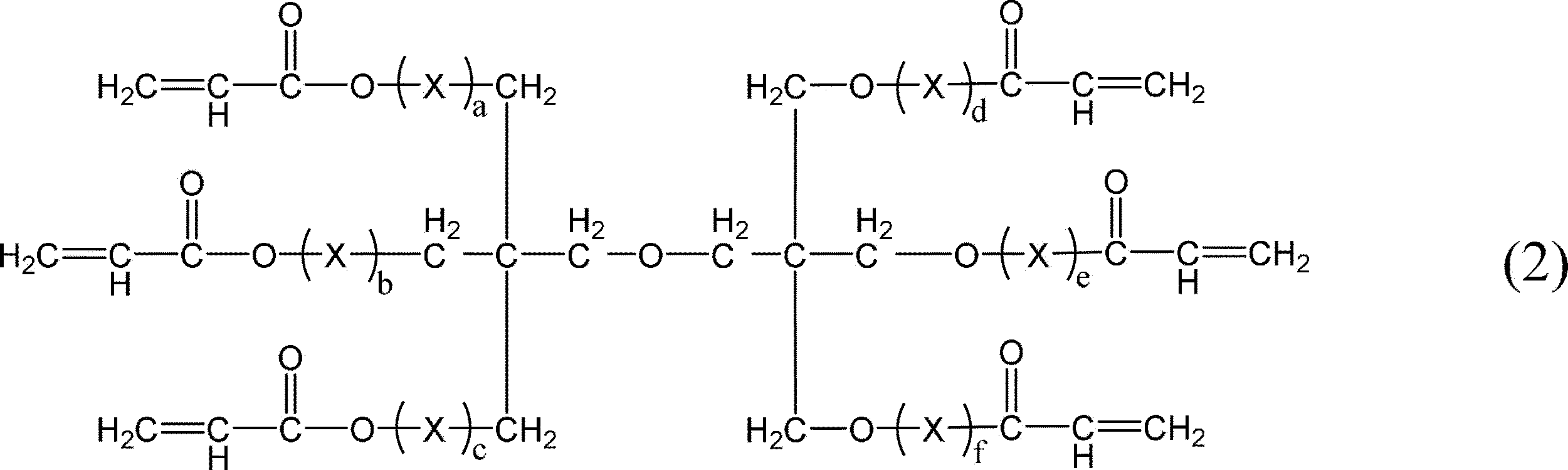
上記一般式(2)中、Xは-R1O-基を示す。
当該-R1O-基中のR1は、好ましくは炭素数2~4のアルキレン基であり、より好ましくは炭素数2~3のアルキレン基であり、更に好ましくは炭素数2のアルキレン基(エチレン基)である。
a、b、c、d、e、及びfは、各々-R1O-の数を示す。
a+b+c+d+e+fの値は、好ましくは2~34、より好ましくは3~20、更に好ましくは4~16、より更に好ましくは6~16、更になお好ましくは8~16、一層好ましくは10~16である。
なお、a+b+c+d+e+fが2以上である場合、複数存在する-R1O-は、同一であっても異なってもよいが、化合物の入手容易性等の観点から、同一であることが好ましい。
当該-R1O-基中のR1は、好ましくは炭素数2~4のアルキレン基であり、より好ましくは炭素数2~3のアルキレン基であり、更に好ましくは炭素数2のアルキレン基(エチレン基)である。
a、b、c、d、e、及びfは、各々-R1O-の数を示す。
a+b+c+d+e+fの値は、好ましくは2~34、より好ましくは3~20、更に好ましくは4~16、より更に好ましくは6~16、更になお好ましくは8~16、一層好ましくは10~16である。
なお、a+b+c+d+e+fが2以上である場合、複数存在する-R1O-は、同一であっても異なってもよいが、化合物の入手容易性等の観点から、同一であることが好ましい。
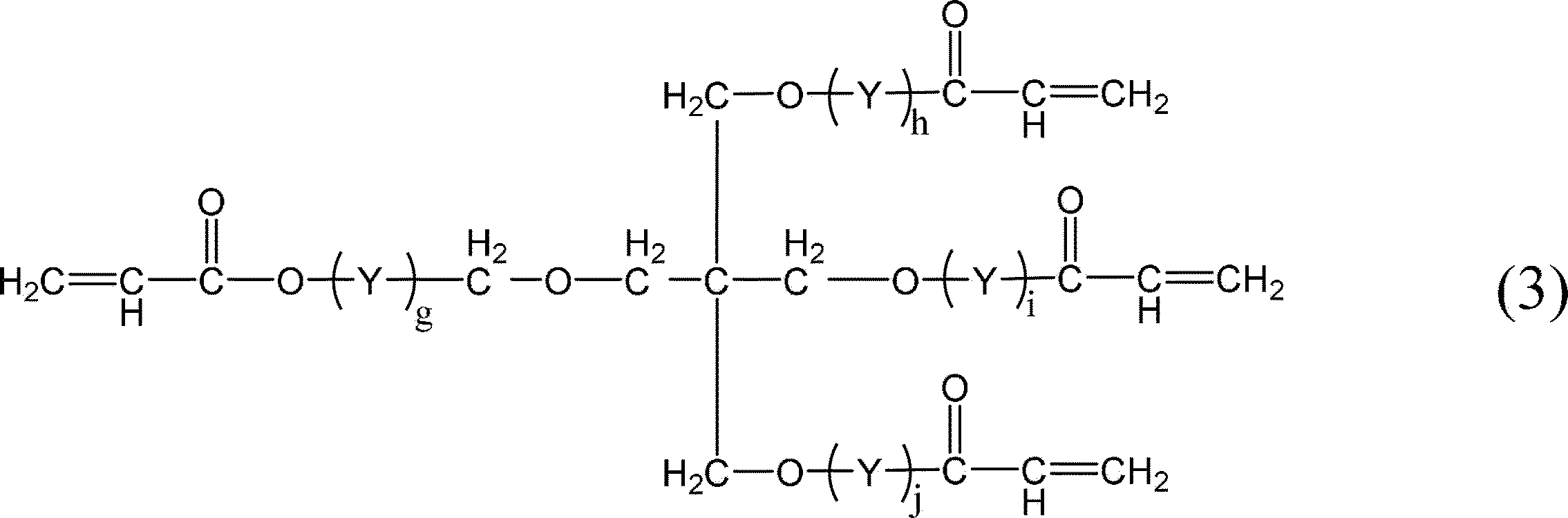
上記一般式(3)中、Yは-R2O-基を示す。
当該-R2O-基中のR2は、好ましくは炭素数2~4のアルキレン基であり、より好ましくは炭素数2~3のアルキレン基であり、更に好ましくは炭素数2のアルキレン基(エチレン基)である。
g、h、i、及びjは、各々-R2O-の数を示す。
g+h+i+jの値は、好ましくは2~34、より好ましくは3~20、更に好ましくは4~16、より更に好ましくは4~12、更になお好ましくは4~10、一層好ましくは4~8である。
なお、g+h+i+jが2以上である場合、複数存在する-R2O-は、同一であっても異なってもよいが、化合物の入手容易性等の観点から、同一であることが好ましい。
当該-R2O-基中のR2は、好ましくは炭素数2~4のアルキレン基であり、より好ましくは炭素数2~3のアルキレン基であり、更に好ましくは炭素数2のアルキレン基(エチレン基)である。
g、h、i、及びjは、各々-R2O-の数を示す。
g+h+i+jの値は、好ましくは2~34、より好ましくは3~20、更に好ましくは4~16、より更に好ましくは4~12、更になお好ましくは4~10、一層好ましくは4~8である。
なお、g+h+i+jが2以上である場合、複数存在する-R2O-は、同一であっても異なってもよいが、化合物の入手容易性等の観点から、同一であることが好ましい。
上記一般式(2)で表される化合物及び上記一般式(3)で表される化合物の中でも、耐擦過性向上の観点から、紫外線硬化性アクリレート化合物(C)は、上記一般式(1)で表される化合物を含むことが好ましい。
(光重合開始剤(D))
光重合開始剤(D)としては、紫外線硬化性アクリレート化合物(C)を紫外線により硬化させる際に用いられる光重合開始剤として一般的なものを、適宜用いることができる。
具体的には、1-ヒドロキシシクロヘキシルフェニルケトン、ベンゾイン、ベンゾインメチルエーテル、ベンゾインエチルエーテル、ベンゾインイソプロピルエーテル、ベンジルジフェニルサルファイド、テトラメチルチウラムモノサルファイド、アゾビスイソブチロニトリル、ベンジル、ジベンジル、ジアセチル、β-クロールアンスラキノン、ビス(2,4,6-トリメチルベンゾイル)フェニルホスフィンオキサイド、2,4,6-トリメチルゾイルジフェニルホスフィンオキサイド、ビス(2,6-ジメトキシベンゾイル)-2,4,4-トリメチル-ペンチルホスフィンオキサイドなどが挙げられる。
光重合開始剤(D)としては、紫外線硬化性アクリレート化合物(C)を紫外線により硬化させる際に用いられる光重合開始剤として一般的なものを、適宜用いることができる。
具体的には、1-ヒドロキシシクロヘキシルフェニルケトン、ベンゾイン、ベンゾインメチルエーテル、ベンゾインエチルエーテル、ベンゾインイソプロピルエーテル、ベンジルジフェニルサルファイド、テトラメチルチウラムモノサルファイド、アゾビスイソブチロニトリル、ベンジル、ジベンジル、ジアセチル、β-クロールアンスラキノン、ビス(2,4,6-トリメチルベンゾイル)フェニルホスフィンオキサイド、2,4,6-トリメチルゾイルジフェニルホスフィンオキサイド、ビス(2,6-ジメトキシベンゾイル)-2,4,4-トリメチル-ペンチルホスフィンオキサイドなどが挙げられる。
光重合開始剤(D)の含有量は、紫外線硬化性アクリレート化合物(C)100質量部に対して、好ましくは0.1~10質量部である。
(架橋性官能基を有するアクリル系樹脂(A)及び紫外線硬化性アクリレート化合物(C)の合計含有量)
本発明の一態様において、架橋性官能基を有するアクリル系樹脂(A)及び紫外線硬化性アクリレート化合物(C)の合計含有量は、本発明の効果をより発揮させやすくする観点から、架橋性官能基を有するアクリル系樹脂(A)、架橋剤(B)、紫外線硬化性アクリレート化合物(C)、及び光重合開始剤(D)の合計含有量(100質量%)に対して、好ましくは80質量%以上、より好ましくは85質量%以上、より更に好ましくは90質量%以上である。また、好ましくは97質量%以下、より好ましくは95質量%以下である。
本発明の一態様において、架橋性官能基を有するアクリル系樹脂(A)及び紫外線硬化性アクリレート化合物(C)の合計含有量は、本発明の効果をより発揮させやすくする観点から、架橋性官能基を有するアクリル系樹脂(A)、架橋剤(B)、紫外線硬化性アクリレート化合物(C)、及び光重合開始剤(D)の合計含有量(100質量%)に対して、好ましくは80質量%以上、より好ましくは85質量%以上、より更に好ましくは90質量%以上である。また、好ましくは97質量%以下、より好ましくは95質量%以下である。
(架橋性官能基を有するアクリル系樹脂(A)及び紫外線硬化性アクリレート化合物(C)の含有比率)
本発明の一態様において、架橋性官能基を有するアクリル系樹脂(A)及び紫外線硬化性アクリレート化合物(C)の含有比率[(A)/(C)]は、耐擦過性により優れるラテックスインク受理層(X)を形成する観点から、質量比で、好ましくは2/98~70/30、より好ましくは3/97~50/50、更に好ましくは4/96~30/70、より更に好ましくは5/95~20/80、更になお好ましくは5/95~16/84である。
なお、本発明の一態様によれば、ラテックスインク受理層(X)において、紫外線硬化性アクリレート化合物(C)及び光重合開始剤(D)により形成される重合体構造と比較して、架橋性官能基を有するアクリル系樹脂(A)及び架橋剤(B)により形成される架橋構造が非常に少ない場合であっても、耐擦過性を確保しながらも、インク密着性及びインクの耐水密着性を優れたものとできる。
本発明の一態様において、架橋性官能基を有するアクリル系樹脂(A)及び紫外線硬化性アクリレート化合物(C)の含有比率[(A)/(C)]は、耐擦過性により優れるラテックスインク受理層(X)を形成する観点から、質量比で、好ましくは2/98~70/30、より好ましくは3/97~50/50、更に好ましくは4/96~30/70、より更に好ましくは5/95~20/80、更になお好ましくは5/95~16/84である。
なお、本発明の一態様によれば、ラテックスインク受理層(X)において、紫外線硬化性アクリレート化合物(C)及び光重合開始剤(D)により形成される重合体構造と比較して、架橋性官能基を有するアクリル系樹脂(A)及び架橋剤(B)により形成される架橋構造が非常に少ない場合であっても、耐擦過性を確保しながらも、インク密着性及びインクの耐水密着性を優れたものとできる。
<基材(Y)>
本発明のラテックスインク用フィルムは、基材(Y)を有する。
基材(Y)は、ラテックスインク受理層(X)を支持すると共に、ラテックスインク受理層(X)上に形成される印刷部を支持する支持体としての機能を有する。
本発明のラテックスインク用フィルムは、基材(Y)を有する。
基材(Y)は、ラテックスインク受理層(X)を支持すると共に、ラテックスインク受理層(X)上に形成される印刷部を支持する支持体としての機能を有する。
基材(Y)は、特に限定されないが、樹脂フィルムであることが好ましい。基材(Y)が樹脂フィルムであることにより、ラテックスインク用フィルムの剛性及び可撓性等を良好なものとし、ラテックスインク用フィルムの取扱性を良好なものとできる。また、ラテックスインク用フィルムの生産コストの低減及び軽量化の観点からも有利である。
ここで、基材(Y)は、透明性を有する樹脂フィルムであることが好ましい。基材(Y)が、透明性を有する樹脂フィルムであることにより、ラテックスインク用フィルムのラテックスインク受理層上に印刷部が形成された印刷物を、店舗、ショールーム、オフィス等のガラス装飾としての用途等に好適に用いることができる。
樹脂フィルムを構成する樹脂としては、例えば、ポリエチレンテレフタレート、ポリブチレンテレフタレート、及びポリエチレンナフタレート等のポリエステル系樹脂;ポリエチレン及びポリプロピレン等のポリオレフィン樹脂;ポリスチレン;アクリロニトリル-ブタジエン-スチレン共重合体;三酢酸セルロース;ポリカーボネート;ポリウレタン及びアクリル変性ポリウレタン等のウレタン樹脂;ポリメチルペンテン;ポリスルホン;ポリエーテルエーテルケトン;ポリエーテルスルホン;ポリフェニレンスルフィド;ポリエーテルイミド、ポリイミド等のポリイミド系樹脂;ポリアミド系樹脂;アクリル樹脂;フッ素系樹脂等が挙げられる。
これらの中でも、ラテックスインク受理層(X)と基材(Y)との密着性を向上させやすくする観点から、ポリエステル系樹脂、ポリオレフィン系樹脂であることが好ましく、ポリエステル系樹脂であることがより好ましく、ポリエチレンテレフタレートであることが更に好ましい。
これらの中でも、ラテックスインク受理層(X)と基材(Y)との密着性を向上させやすくする観点から、ポリエステル系樹脂、ポリオレフィン系樹脂であることが好ましく、ポリエステル系樹脂であることがより好ましく、ポリエチレンテレフタレートであることが更に好ましい。
樹脂フィルムは、1種の樹脂のみから構成されたものであってもよく、2種以上の樹脂から構成されたものであってもよい。樹脂フィルムが2種以上の樹脂から構成されている場合、樹脂フィルムは複層体であることが好ましい。また、複層体の最上層(ラテックスインク受理層に接する層)は、ラテックスインク受理層(X)と基材(Y)との密着性を向上させやすくする観点から、ポリエステル系樹脂であることが好ましく、ポリエチレンテレフタレートであることがより好ましい。
また、樹脂フィルムは、未延伸でもよいし、縦又は横等の一軸方向あるいは二軸方向に延伸されていてもよい。
加えて、樹脂フィルムは、これらの樹脂と共に、表面調整剤、可塑剤、紫外線吸収剤、光安定剤、及び着色剤等の、基材用添加剤を含有していてもよい。
基材用添加剤の含有量は、基材(Y)の全量基準で、好ましくは10質量%以下、より好ましくは5質量%以下、更に好ましくは3質量%以下である。
基材用添加剤の含有量は、基材(Y)の全量基準で、好ましくは10質量%以下、より好ましくは5質量%以下、更に好ましくは3質量%以下である。
基材(Y)の厚さは、特に限定されないが、好ましくは15μm~300μm、より好ましくは30μm~200μmである。
<粘着剤層(Z)>
本発明の一態様のラテックスインク用フィルムは、粘着剤層(Z)を有していてもよい。
本発明の一態様のラテックスインク用フィルムが粘着剤層(Z)を有することで、ラテックスインク用フィルムを、粘着フィルムとして好適に用いることができる。
本発明の一態様のラテックスインク用フィルムは、粘着剤層(Z)を有していてもよい。
本発明の一態様のラテックスインク用フィルムが粘着剤層(Z)を有することで、ラテックスインク用フィルムを、粘着フィルムとして好適に用いることができる。
粘着剤層を構成する粘着剤は、特に限定されず、例えば、アクリル系粘着剤、ウレタン系粘着剤、及びシリコーン系粘着剤等が挙げられる。
粘着剤層(Z)の厚さは、特に限定されないが、ラテックスインク用フィルムを、粘着フィルムとして用いる際の取扱性の向上の観点から、好ましくは5μm~100μm、より好ましくは10μm~70μm、更に好ましくは15μm~50μmである。
<剥離ライナー>
本発明の一態様のラテックスインク用フィルムは、粘着剤層(Z)と共に、剥離ライナーを有していてもよい。
本発明の一態様のラテックスインク用フィルムが有する粘着剤層(Z)の粘着表面が剥離ライナーで覆われていることで、ラテックスインク用フィルムの搬送時や保管時において粘着剤層(Z)の粘着表面を好適に保護することができる。
本発明の一態様のラテックスインク用フィルムは、粘着剤層(Z)と共に、剥離ライナーを有していてもよい。
本発明の一態様のラテックスインク用フィルムが有する粘着剤層(Z)の粘着表面が剥離ライナーで覆われていることで、ラテックスインク用フィルムの搬送時や保管時において粘着剤層(Z)の粘着表面を好適に保護することができる。
剥離ライナーは、特に限定されず、粘着フィルムの分野で通常使用される剥離ライナーを適宜用いることができる。剥離ライナーとしては、例えば、フィルム基材又は紙基材の表面に、剥離層が設けられた積層体等が挙げられる。
フィルム基材としては、例えば、ポリエチレンテレフタレート等のポリエステル系樹脂、ポリエチレン樹脂及びポリプロピレン樹脂等のポリオレフィン系樹脂等が挙げられる。
紙基材としては、例えば、上質紙、クラフト紙、及びグラシン紙等の紙類が挙げられる。
剥離層の構成材料は、例えば、シリコーン、長鎖アルキル系樹脂、及びフッ素系樹脂等が挙げられる。
フィルム基材としては、例えば、ポリエチレンテレフタレート等のポリエステル系樹脂、ポリエチレン樹脂及びポリプロピレン樹脂等のポリオレフィン系樹脂等が挙げられる。
紙基材としては、例えば、上質紙、クラフト紙、及びグラシン紙等の紙類が挙げられる。
剥離層の構成材料は、例えば、シリコーン、長鎖アルキル系樹脂、及びフッ素系樹脂等が挙げられる。
剥離ライナーの厚さは、特に限定されないが、好ましくは10μm~150μm、より好ましくは20μm~130μm、更に好ましくは30μm~100μmである。
[ラテックスインク用フィルムの製造方法]
本発明のラテックスインク用フィルムの製造方法としては、特に制限はなく、ラテックスインク用フィルムの構成によって適宜選択される。
本発明のラテックスインク用フィルムの製造方法としては、特に制限はなく、ラテックスインク用フィルムの構成によって適宜選択される。
<ラテックスインク受理層(X)の形成方法>
ラテックスインク受理層(X)の形成方法としては、基材(Y)の一方の面(Ya)に、樹脂組成物(x1)を塗布して塗膜を形成し、当該塗膜を乾燥させた後、紫外線硬化及び架橋させることで、ラテックスインク受理層(X)を形成することが好ましい。
なお、基材(Y)への塗布の作業性を向上させるために、樹脂組成物(x1)は、更に希釈溶媒で希釈して、溶液の形態とすることが好ましい。
ラテックスインク受理層(X)の形成方法としては、基材(Y)の一方の面(Ya)に、樹脂組成物(x1)を塗布して塗膜を形成し、当該塗膜を乾燥させた後、紫外線硬化及び架橋させることで、ラテックスインク受理層(X)を形成することが好ましい。
なお、基材(Y)への塗布の作業性を向上させるために、樹脂組成物(x1)は、更に希釈溶媒で希釈して、溶液の形態とすることが好ましい。
希釈溶媒としては、例えば、メチルエチルケトン、アセトン、酢酸エチル、テトラヒドロフラン、ジオキサン、シクロヘキサン、n-ヘキサン、トルエン、キシレン、n-プロパノール、及びイソプロパノール等の有機溶剤が挙げられる。
樹脂組成物(x1)の溶液の有効成分濃度としては、好ましくは10質量~50質量%である。
樹脂組成物(x1)の溶液の有効成分濃度としては、好ましくは10質量~50質量%である。
樹脂組成物(x1)の溶液の塗布方法としては、例えば、マイヤーバーコート法、グラビヤコート法、ロールコート法、ナイフコート法、ダイコート法等が挙げられる。
基材(Y)の一方の面(Ya)に、樹脂組成物(x1)を塗布して塗膜を形成した後、塗膜を乾燥させて、塗膜から希釈溶媒を除去する(乾燥工程)。
塗膜を乾燥させる際の加熱条件としては、例えば、乾燥温度60℃~120℃、乾燥時間30秒間~3分間である。
塗膜を乾燥させる際の加熱条件としては、例えば、乾燥温度60℃~120℃、乾燥時間30秒間~3分間である。
塗膜を乾燥させた後、紫外線を照射し、紫外線硬化性アクリレート化合物(C)を硬化(重合)させる(紫外線照射工程)。
紫外線の照射条件は、積算照射量(積算光量)で、5~1200mJ/cm2が好ましく、50~500mJ/cm2がより好ましい。
紫外線は、例えば、紫外線源として高圧水銀ランプ、無電極UVランプ、キセノンランプ又はLED等を用いることで照射できる。
紫外線の照射条件は、積算照射量(積算光量)で、5~1200mJ/cm2が好ましく、50~500mJ/cm2がより好ましい。
紫外線は、例えば、紫外線源として高圧水銀ランプ、無電極UVランプ、キセノンランプ又はLED等を用いることで照射できる。
紫外線硬化性アクリレート化合物(C)を硬化(重合)させた後、架橋性官能基を有するアクリル系樹脂(A)と架橋剤(B)とを反応させて架橋構造物を形成する(架橋工程)。
架橋条件は、特に限定されず、例えば、通常環境(例えば23℃、相対湿度50℃)に1日以上14日以下放置して架橋させてもよいし、40℃~60℃の環境下に1日~3日間放置して架橋させてもよい。
架橋条件は、特に限定されず、例えば、通常環境(例えば23℃、相対湿度50℃)に1日以上14日以下放置して架橋させてもよいし、40℃~60℃の環境下に1日~3日間放置して架橋させてもよい。
なお、紫外線照射工程は、架橋工程前、架橋工程の途中、及び架橋工程後のいずれのタイミングで行ってもよい。また、架橋工程と紫外線照射工程は同時に実施してもよく、架橋工程と紫外線照射工程はそれぞれ複数回に分けて実施してもよい。さらに、紫外線照射工程及び架橋工程の少なくともいずれか一方を、乾燥工程と同時に行ってもよい。
<粘着剤層(Z)の形成方法>
本発明の一態様のラテックスインク用フィルムが粘着剤層(Z)を有する場合、粘着剤層(Z)は、ラテックスインク受理層(X)が形成されていない、基材(Y)の他方の面(Yb)に形成される。
粘着剤層(Z)は、例えば、基材(Y)の他方の面(Yb)に、粘着剤層(Z)を形成するための組成物(粘着剤層形成用組成物)を塗布することにより形成される。あるいは、剥離ライナーの剥離面に粘着剤層形成用組成物を塗布して粘着剤層(Z)を形成し、これを基材(Y)の他方の面(Yb)に貼り合わせる(転写する)ようにしてもよい。
粘着剤層形成用組成物の塗布方法は、樹脂組成物(x1)として既述したものと同じである。
本発明の一態様のラテックスインク用フィルムが粘着剤層(Z)を有する場合、粘着剤層(Z)は、ラテックスインク受理層(X)が形成されていない、基材(Y)の他方の面(Yb)に形成される。
粘着剤層(Z)は、例えば、基材(Y)の他方の面(Yb)に、粘着剤層(Z)を形成するための組成物(粘着剤層形成用組成物)を塗布することにより形成される。あるいは、剥離ライナーの剥離面に粘着剤層形成用組成物を塗布して粘着剤層(Z)を形成し、これを基材(Y)の他方の面(Yb)に貼り合わせる(転写する)ようにしてもよい。
粘着剤層形成用組成物の塗布方法は、樹脂組成物(x1)として既述したものと同じである。
[ラテックスインク用フィルムの用途等]
本発明のラテックスインク用フィルムは、ラテックスインクを使用した印刷に用いられることが好ましい。
したがって、本発明によれば、前記ラテックスインク用フィルムのラテックスインク受理層上に、ラテックスインクを用いて印刷部を形成するために、前記ラテックスインク用フィルムを使用する、使用方法が提供される。
また、本発明によれば、前記ラテックスインク用フィルムのラテックスインク受理層上に、ラテックスインクを用いて印刷部を形成する工程を含む、印刷物の製造方法が提供される。
さらに、本発明によれば、前記ラテックスインク用フィルムのラテックスインク受理層上に、ラテックスインクによる印刷部を有する、印刷物が提供される。
本発明のラテックスインク用フィルムは、ラテックスインクを使用した印刷に用いられることが好ましい。
したがって、本発明によれば、前記ラテックスインク用フィルムのラテックスインク受理層上に、ラテックスインクを用いて印刷部を形成するために、前記ラテックスインク用フィルムを使用する、使用方法が提供される。
また、本発明によれば、前記ラテックスインク用フィルムのラテックスインク受理層上に、ラテックスインクを用いて印刷部を形成する工程を含む、印刷物の製造方法が提供される。
さらに、本発明によれば、前記ラテックスインク用フィルムのラテックスインク受理層上に、ラテックスインクによる印刷部を有する、印刷物が提供される。
以下、本発明のラテックスインク用フィルムのラテックスインク受理層上に印刷部を形成するための、ラテックスインクについて説明した後、本発明のラテックスインク用フィルムのラテックスインク受理層上に印刷部を形成する方法について説明する。
<ラテックスインク>
ラテックスインクは、液状の分散媒と、当該分散媒中に分散(乳濁および/または懸濁)している、少なくとも樹脂を含む材料で構成された分散質を含有する。
ラテックスインクは、環境に対する負荷が低い。また、ラテックスインクは、薄い層で濃い色を表現できるという利点がある。また、ラテックスインクを構成するラテックス粒子は、バインダー(樹脂)を含み、一般に、顔料着色剤の記録媒体への密着性を向上させる上で有利である。また、インクジェット法を利用できるため、オンデマンドで印刷することができるという利点がある。
また、ラテックスインクは、水系インクであることが好ましい。水系インクは、有機溶剤に起因する揮発性有機物の発生が抑えられるため、安全性がより高く、環境に対する負荷がより少ない。
ラテックスインクは、液状の分散媒と、当該分散媒中に分散(乳濁および/または懸濁)している、少なくとも樹脂を含む材料で構成された分散質を含有する。
ラテックスインクは、環境に対する負荷が低い。また、ラテックスインクは、薄い層で濃い色を表現できるという利点がある。また、ラテックスインクを構成するラテックス粒子は、バインダー(樹脂)を含み、一般に、顔料着色剤の記録媒体への密着性を向上させる上で有利である。また、インクジェット法を利用できるため、オンデマンドで印刷することができるという利点がある。
また、ラテックスインクは、水系インクであることが好ましい。水系インクは、有機溶剤に起因する揮発性有機物の発生が抑えられるため、安全性がより高く、環境に対する負荷がより少ない。
(樹脂)
ラテックスインクに含まれる樹脂は、特に限定されないが、例えば、ビニル系樹脂、アクリル系樹脂、スチレン系樹脂、アルキッド系樹脂、ポリエステル系樹脂、ポリウレタン系樹脂、シリコーン系樹脂、フッ素系樹脂、エポキシ系樹脂、フェノキシ系樹脂、ポリオレフィン系樹脂等、およびこれらの変性樹脂(例えば、水溶性に変性された変性樹脂)等が挙げられ、これらから選択される1種または2種以上を組み合わせて用いることができる。この中でも、アクリル系樹脂、スチレン系樹脂、水溶性ポリウレタン系樹脂、水溶性ポリエステル系樹脂、水溶性アクリル系樹脂が好ましく、アクリル系樹脂がより好ましい。
本発明の一態様のラテックスインク用フィルムにおいて用いられるラテックスインクは、ラテックスインク受理層(X)と印刷部との密着性をより向上させる観点から、アクリル系樹脂を含むラテックスインクであることが好ましい。
ラテックスインク中における樹脂の含有率は、ラテックスインクの全量基準で、1質量%~20質量%であるのが好ましく、2質量%~10質量%であるのがより好ましい。
ラテックスインクに含まれる樹脂は、特に限定されないが、例えば、ビニル系樹脂、アクリル系樹脂、スチレン系樹脂、アルキッド系樹脂、ポリエステル系樹脂、ポリウレタン系樹脂、シリコーン系樹脂、フッ素系樹脂、エポキシ系樹脂、フェノキシ系樹脂、ポリオレフィン系樹脂等、およびこれらの変性樹脂(例えば、水溶性に変性された変性樹脂)等が挙げられ、これらから選択される1種または2種以上を組み合わせて用いることができる。この中でも、アクリル系樹脂、スチレン系樹脂、水溶性ポリウレタン系樹脂、水溶性ポリエステル系樹脂、水溶性アクリル系樹脂が好ましく、アクリル系樹脂がより好ましい。
本発明の一態様のラテックスインク用フィルムにおいて用いられるラテックスインクは、ラテックスインク受理層(X)と印刷部との密着性をより向上させる観点から、アクリル系樹脂を含むラテックスインクであることが好ましい。
ラテックスインク中における樹脂の含有率は、ラテックスインクの全量基準で、1質量%~20質量%であるのが好ましく、2質量%~10質量%であるのがより好ましい。
(分散媒)
ラテックスインクは、分散媒として水を含む。
ラテックスインク中における分散媒(水)の含有率は、ラテックスインクの全量基準で、50質量%~98質量%であるのが好ましく、60質量%~97質量%であるのがより好ましく、70質量%~96質量%であるのが更に好ましい。
ラテックスインクは、分散媒として水を含む。
ラテックスインク中における分散媒(水)の含有率は、ラテックスインクの全量基準で、50質量%~98質量%であるのが好ましく、60質量%~97質量%であるのがより好ましく、70質量%~96質量%であるのが更に好ましい。
(着色剤)
ラテックスインクは、通常、着色剤を含んでいる。
着色剤としては、各種染料、各種顔料等を用いることができる。
ラテックスインク中における着色剤の含有率は、ラテックスインクの全量基準で、0.1質量%~20質量%であるのが好ましく、0.2質量%~10質量%であるのがより好ましい。
ラテックスインクは、通常、着色剤を含んでいる。
着色剤としては、各種染料、各種顔料等を用いることができる。
ラテックスインク中における着色剤の含有率は、ラテックスインクの全量基準で、0.1質量%~20質量%であるのが好ましく、0.2質量%~10質量%であるのがより好ましい。
(その他の成分)
ラテックスインクは、既述した以外の成分(その他の成分)を含んでいてもよい。
このような成分としては、例えば、分散剤、防黴剤、防錆剤、pH調整剤、界面活性剤、可塑剤、紫外線吸収剤、光安定剤等が挙げられる。
ラテックスインクは、既述した以外の成分(その他の成分)を含んでいてもよい。
このような成分としては、例えば、分散剤、防黴剤、防錆剤、pH調整剤、界面活性剤、可塑剤、紫外線吸収剤、光安定剤等が挙げられる。
<印刷部の形成>
ラテックスインクによる印刷部は、ラテックスインク用フィルムのラテックスインク受理層(X)上にラテックスインクを付与することにより形成される。当該ラテックスインクは、ラテックスインク受理層(X)と印刷部との密着性をより向上させる観点から、アクリル系樹脂を含むラテックスインクであることが好ましい。
ラテックスインクを付与する方法は、特に限定されず、各種印刷法を用いることができるが、インクジェット法が好ましい。インクジェットの方式としては、例えば、ピエゾ方式、サーマルジェット方式等が挙げられる。
ラテックスインクを付与する際、ラテックスインク用フィルムを加熱してもよい。加熱温度は、特に限定されないが、好ましくは40℃~90℃である。
以上の方法により、ラテックスインク用フィルムのラテックスインク受理層(X)上にラテックスインクによる印刷部を有する印刷物が得られる。当該ラテックスインクは、ラテックスインク受理層(X)と印刷部との密着性をより向上させる観点から、アクリル系樹脂を含むラテックスインクであることが好ましい。
ラテックスインクによる印刷部は、ラテックスインク用フィルムのラテックスインク受理層(X)上にラテックスインクを付与することにより形成される。当該ラテックスインクは、ラテックスインク受理層(X)と印刷部との密着性をより向上させる観点から、アクリル系樹脂を含むラテックスインクであることが好ましい。
ラテックスインクを付与する方法は、特に限定されず、各種印刷法を用いることができるが、インクジェット法が好ましい。インクジェットの方式としては、例えば、ピエゾ方式、サーマルジェット方式等が挙げられる。
ラテックスインクを付与する際、ラテックスインク用フィルムを加熱してもよい。加熱温度は、特に限定されないが、好ましくは40℃~90℃である。
以上の方法により、ラテックスインク用フィルムのラテックスインク受理層(X)上にラテックスインクによる印刷部を有する印刷物が得られる。当該ラテックスインクは、ラテックスインク受理層(X)と印刷部との密着性をより向上させる観点から、アクリル系樹脂を含むラテックスインクであることが好ましい。
本発明について、以下の実施例により具体的に説明するが、本発明は以下の実施例に限定されるものではない。
[各種物性値の測定方法]
本実施例における各種物性値の測定方法は、以下に記載のとおりである。
(1)水酸基価
架橋性官能基を有するアクリル系樹脂(A)の水酸基価は、JIS K0070:1992に準拠して測定した。
(2)酸価
架橋性官能基を有するアクリル系樹脂(A)の酸価は、JIS K0070:1992に準拠して測定した。
(3)ガラス転移温度(Tg)
架橋性官能基を有するアクリル系樹脂(A)のガラス転移温度(Tg)は、JIS K 7121:2012に準拠し、示差走査熱量計(ティー・エイ・インスツルメント・ジャパン株式会社製、製品名「DSC Q2000」)を用いて、昇温速度20℃/分にて測定した。
(4)各層の厚さ
各層の厚さは、テクロック社製の定圧厚さ測定器(型番:「PG-02J」、標準規格:JIS K6783:1994、JIS Z1702:1994、JIS Z1709:1995に準拠)を用いて測定した。
本実施例における各種物性値の測定方法は、以下に記載のとおりである。
(1)水酸基価
架橋性官能基を有するアクリル系樹脂(A)の水酸基価は、JIS K0070:1992に準拠して測定した。
(2)酸価
架橋性官能基を有するアクリル系樹脂(A)の酸価は、JIS K0070:1992に準拠して測定した。
(3)ガラス転移温度(Tg)
架橋性官能基を有するアクリル系樹脂(A)のガラス転移温度(Tg)は、JIS K 7121:2012に準拠し、示差走査熱量計(ティー・エイ・インスツルメント・ジャパン株式会社製、製品名「DSC Q2000」)を用いて、昇温速度20℃/分にて測定した。
(4)各層の厚さ
各層の厚さは、テクロック社製の定圧厚さ測定器(型番:「PG-02J」、標準規格:JIS K6783:1994、JIS Z1702:1994、JIS Z1709:1995に準拠)を用いて測定した。
[実施例1~4、比較例1]
実施例1~4、比較例1のラテックスインク用フィルムを備えるインクジェット印刷用シートを以下の手順で作製した。
実施例1~4、比較例1のラテックスインク用フィルムを備えるインクジェット印刷用シートを以下の手順で作製した。
<樹脂組成物の調製>
樹脂組成物の調製には、以下に示す架橋性官能基を有するアクリル系樹脂(A)、架橋剤(B)、紫外線硬化性アクリレート化合物(C)、及び光重合開始剤(D)を用いた。
樹脂組成物の調製には、以下に示す架橋性官能基を有するアクリル系樹脂(A)、架橋剤(B)、紫外線硬化性アクリレート化合物(C)、及び光重合開始剤(D)を用いた。
(架橋性官能基を有するアクリル系樹脂(A))
水酸基価が11.0mgKOH/gであり、酸価が3.9mgKOH/gであり、ガラス転移温度(Tg)が90℃である、架橋性官能基を有するアクリル系樹脂を用いた。
水酸基価が11.0mgKOH/gであり、酸価が3.9mgKOH/gであり、ガラス転移温度(Tg)が90℃である、架橋性官能基を有するアクリル系樹脂を用いた。
(架橋剤(B))
イソシアヌレート化合物の一部変性品(イソシアヌレート化合物(B1-1)とイソシアヌレート化合物の変性体(B1-2)とを含むイソシアヌレート系化合物(B1))を用いた。
イソシアヌレート化合物の一部変性品(イソシアヌレート化合物(B1-1)とイソシアヌレート化合物の変性体(B1-2)とを含むイソシアヌレート系化合物(B1))を用いた。
(紫外線硬化性アクリレート化合物(C))
・「6官能(アルキレンオキサイド変性)」:エチレンオキサイド変性ジペンタエリスリトールヘキサアクリレート(エトキシ化ジペンタエリスリトールヘキサアクリレート)を用いた。
当該エチレンオキサイド変性ジペンタエリスリトールヘキサアクリレートは、ジペンタエリスリトールのエチレンオキサイド変性体であるポリオール化合物(エチレンオキサイドモル数は12)とアクリル酸とのエステルであり、アクリロイル基を6個有する完全エステルである。
・「4官能(アルキレンオキサイド変性)」:エチレンオキサイド変性ペンタエリスリトールテトラアクリレート(エトキシ化ペンタエリスリトールテトラアクリレート)を用いた。
当該エチレンオキサイド変性ペンタエリスリトールテトラアクリレートは、ペンタエリスリトールのエチレンオキサイド変性体であるポリオール化合物(エチレンオキサイドモル数は4)とアクリル酸とのエステルであり、アクリロイル基を4個有する完全エステルである。
・「6官能(アルキレンオキサイド変性)」:エチレンオキサイド変性ジペンタエリスリトールヘキサアクリレート(エトキシ化ジペンタエリスリトールヘキサアクリレート)を用いた。
当該エチレンオキサイド変性ジペンタエリスリトールヘキサアクリレートは、ジペンタエリスリトールのエチレンオキサイド変性体であるポリオール化合物(エチレンオキサイドモル数は12)とアクリル酸とのエステルであり、アクリロイル基を6個有する完全エステルである。
・「4官能(アルキレンオキサイド変性)」:エチレンオキサイド変性ペンタエリスリトールテトラアクリレート(エトキシ化ペンタエリスリトールテトラアクリレート)を用いた。
当該エチレンオキサイド変性ペンタエリスリトールテトラアクリレートは、ペンタエリスリトールのエチレンオキサイド変性体であるポリオール化合物(エチレンオキサイドモル数は4)とアクリル酸とのエステルであり、アクリロイル基を4個有する完全エステルである。
(紫外線硬化性アクリレート化合物(C’))
・「4官能(アルキレンオキサイド未変性)」:ペンタエリスリトールテトラアクリレートを用いた。
当該ペンタエリスリトールテトラアクリレートは、ペンタエリスリトールとアクリル酸とのエステルであり、アクリロイル基を4個有する完全エステルである。
・「4官能(アルキレンオキサイド未変性)」:ペンタエリスリトールテトラアクリレートを用いた。
当該ペンタエリスリトールテトラアクリレートは、ペンタエリスリトールとアクリル酸とのエステルであり、アクリロイル基を4個有する完全エステルである。
(光重合開始剤(D))
1-ヒドロキシシクロヘキシルフェニルケトンを用いた。
1-ヒドロキシシクロヘキシルフェニルケトンを用いた。
(その他の添加剤)
スズ系触媒
スズ系触媒
基材(Y)として、易接着層付きポリエチレンテレフタレートシート(厚さ:50μm)を準備した。そして、架橋性官能基を有するアクリル系樹脂(A)、架橋剤(B)、紫外線硬化性アクリレート化合物(C)(又は紫外線硬化性アクリレート化合物(C’))、及び光重合開始剤(D)、スズ系触媒を表1に示す配合(配合量は有効成分換算)に調整した樹脂組成物の塗液(有効成分濃度:10質量%、希釈溶媒;酢酸エチル)を、基材(Y)の易接着層側に、マイヤーバーを用いて、乾燥後の膜厚が1μmになるように塗布した。
次に、熱風乾燥装置を用いて、90℃、1分間の条件で加熱することにより、基材(Y)に塗布して形成した塗膜に含まれる希釈溶媒を除去し(乾燥工程)、続いて、波長365nmにピーク波長を有する紫外線を積算光量で150mJ/cm2照射し(紫外線硬化工程)、更に23℃、相対湿度50%の環境下に7日間静置し架橋させた(架橋工程)。これにより、厚さ:1μmのラテックスインク受理層(X)を形成し、実施例1~4及び比較例1のラテックスインク用フィルムを得た。
次に、剥離ライナーの剥離剤側に、アクリル系粘着剤組成物を乾燥後の膜厚が20μmとなるように塗布し、熱風乾燥装置を用いて、90℃、1分間加熱し、アクリル系粘着剤組成物に含まれる溶剤を除去し、アクリル系粘着剤層を形成した。
その後、剥離ライナー上に形成したアクリル系粘着剤層と基材(Y)のラテックスインク受理層(X)とは反対の面とを貼り合わせ、実施例1~4及び比較例1のラテックスインク用フィルムを備えるインクジェット印刷用シートを得た。
次に、熱風乾燥装置を用いて、90℃、1分間の条件で加熱することにより、基材(Y)に塗布して形成した塗膜に含まれる希釈溶媒を除去し(乾燥工程)、続いて、波長365nmにピーク波長を有する紫外線を積算光量で150mJ/cm2照射し(紫外線硬化工程)、更に23℃、相対湿度50%の環境下に7日間静置し架橋させた(架橋工程)。これにより、厚さ:1μmのラテックスインク受理層(X)を形成し、実施例1~4及び比較例1のラテックスインク用フィルムを得た。
次に、剥離ライナーの剥離剤側に、アクリル系粘着剤組成物を乾燥後の膜厚が20μmとなるように塗布し、熱風乾燥装置を用いて、90℃、1分間加熱し、アクリル系粘着剤組成物に含まれる溶剤を除去し、アクリル系粘着剤層を形成した。
その後、剥離ライナー上に形成したアクリル系粘着剤層と基材(Y)のラテックスインク受理層(X)とは反対の面とを貼り合わせ、実施例1~4及び比較例1のラテックスインク用フィルムを備えるインクジェット印刷用シートを得た。
<評価1>
(1)インク密着性(Dry)の評価
実施例1~4及び比較例1のラテックスインク用フィルムを備えるインクジェット印刷用シートのそれぞれについて、ラテックスインク受理層(X)の表面にラテックスインク(ヒューレット・パッカード社製、HP882)を用いてインクジェット印刷機(ヒューレット・パッカード社製、HP Latex R2000)でインクジェット法により、所定の試験用パターンを印刷し、印刷部(印刷層)を形成した。
そして、所定の試験用パターンの印刷部がラテックスインク受理層(X)の表面に形成されたインクジェット印刷用シートを、23℃、相対湿度50%の環境下に、1日間静置して、試験試料を準備した。
そして、試験試料の印刷部が形成された側の面に、100mm×24mmのニチバン社製セロテープ(登録商標)を貼付し、テープ引きはがし後の印刷部の残存率(残存面積/全面積)を求め、以下の基準に従い評価した。
1:残存率20%未満
2:残存率20%以上40%未満
3:残存率40%以上60%未満
4:残存率60%以上90%未満
5:残存率90%以上
残存率が高い程、ラテックスインク受理層(X)がインク密着性に優れる。
本実施例では評価4以上を合格とした。
(1)インク密着性(Dry)の評価
実施例1~4及び比較例1のラテックスインク用フィルムを備えるインクジェット印刷用シートのそれぞれについて、ラテックスインク受理層(X)の表面にラテックスインク(ヒューレット・パッカード社製、HP882)を用いてインクジェット印刷機(ヒューレット・パッカード社製、HP Latex R2000)でインクジェット法により、所定の試験用パターンを印刷し、印刷部(印刷層)を形成した。
そして、所定の試験用パターンの印刷部がラテックスインク受理層(X)の表面に形成されたインクジェット印刷用シートを、23℃、相対湿度50%の環境下に、1日間静置して、試験試料を準備した。
そして、試験試料の印刷部が形成された側の面に、100mm×24mmのニチバン社製セロテープ(登録商標)を貼付し、テープ引きはがし後の印刷部の残存率(残存面積/全面積)を求め、以下の基準に従い評価した。
1:残存率20%未満
2:残存率20%以上40%未満
3:残存率40%以上60%未満
4:残存率60%以上90%未満
5:残存率90%以上
残存率が高い程、ラテックスインク受理層(X)がインク密着性に優れる。
本実施例では評価4以上を合格とした。
(2)インクの耐水密着性の評価
実施例1~4及び比較例1のラテックスインク用フィルムを備えるインクジェット印刷用シートのそれぞれについて、「(1)インク密着性(Dry)の評価」と同様の方法で、所定の試験用パターンを印刷し、印刷部(印刷層)を形成した。
そして、所定の試験用パターンの印刷部がラテックスインク受理層(X)の表面に形成されたインクジェット印刷用シートを、23℃、相対湿度50%の環境下に1日間静置して、試験試料を準備した。
そして、試験試料の印刷部が形成された側の面の全面に、アニオン系界面活性剤(ラウレス硫酸ナトリウム)の3質量%水溶液を吹き付けた後、10分間静置し、印刷部が形成された側の面の全面をゴム製スキージーで強く擦って、印刷部の残存率(残存面積/全面積)を求め、以下の基準に従い評価した。
1:残存率20%未満
2:残存率20%以上40%未満
3:残存率40%以上60%未満
4:残存率60%以上90%未満
5:残存率90%以上
印刷部の残存率が高い程、ラテックスインク受理層(X)が、インクの耐水密着性に優れる。
本実施例では評価4以上を合格とした。
実施例1~4及び比較例1のラテックスインク用フィルムを備えるインクジェット印刷用シートのそれぞれについて、「(1)インク密着性(Dry)の評価」と同様の方法で、所定の試験用パターンを印刷し、印刷部(印刷層)を形成した。
そして、所定の試験用パターンの印刷部がラテックスインク受理層(X)の表面に形成されたインクジェット印刷用シートを、23℃、相対湿度50%の環境下に1日間静置して、試験試料を準備した。
そして、試験試料の印刷部が形成された側の面の全面に、アニオン系界面活性剤(ラウレス硫酸ナトリウム)の3質量%水溶液を吹き付けた後、10分間静置し、印刷部が形成された側の面の全面をゴム製スキージーで強く擦って、印刷部の残存率(残存面積/全面積)を求め、以下の基準に従い評価した。
1:残存率20%未満
2:残存率20%以上40%未満
3:残存率40%以上60%未満
4:残存率60%以上90%未満
5:残存率90%以上
印刷部の残存率が高い程、ラテックスインク受理層(X)が、インクの耐水密着性に優れる。
本実施例では評価4以上を合格とした。
(3)耐擦過性の評価
実施例1~4及び比較例1のラテックスインク用フィルムを備えるインクジェット印刷用シートのそれぞれについて、ラテックスインク受理層(X)の表面(未印刷)を#0000のスチールウールを用いて、250g/cm2荷重にて10往復擦過した後、傷つき度合いを確認し、以下の基準に従い評価した。
S:傷なし。
A:傷が僅かにしか見られない。
B:傷が見られるものの製品としては使用可能である。
C:傷が多数発生した。
本実施例では評価B以上を合格とした。
実施例1~4及び比較例1のラテックスインク用フィルムを備えるインクジェット印刷用シートのそれぞれについて、ラテックスインク受理層(X)の表面(未印刷)を#0000のスチールウールを用いて、250g/cm2荷重にて10往復擦過した後、傷つき度合いを確認し、以下の基準に従い評価した。
S:傷なし。
A:傷が僅かにしか見られない。
B:傷が見られるものの製品としては使用可能である。
C:傷が多数発生した。
本実施例では評価B以上を合格とした。
結果を表1に示す。
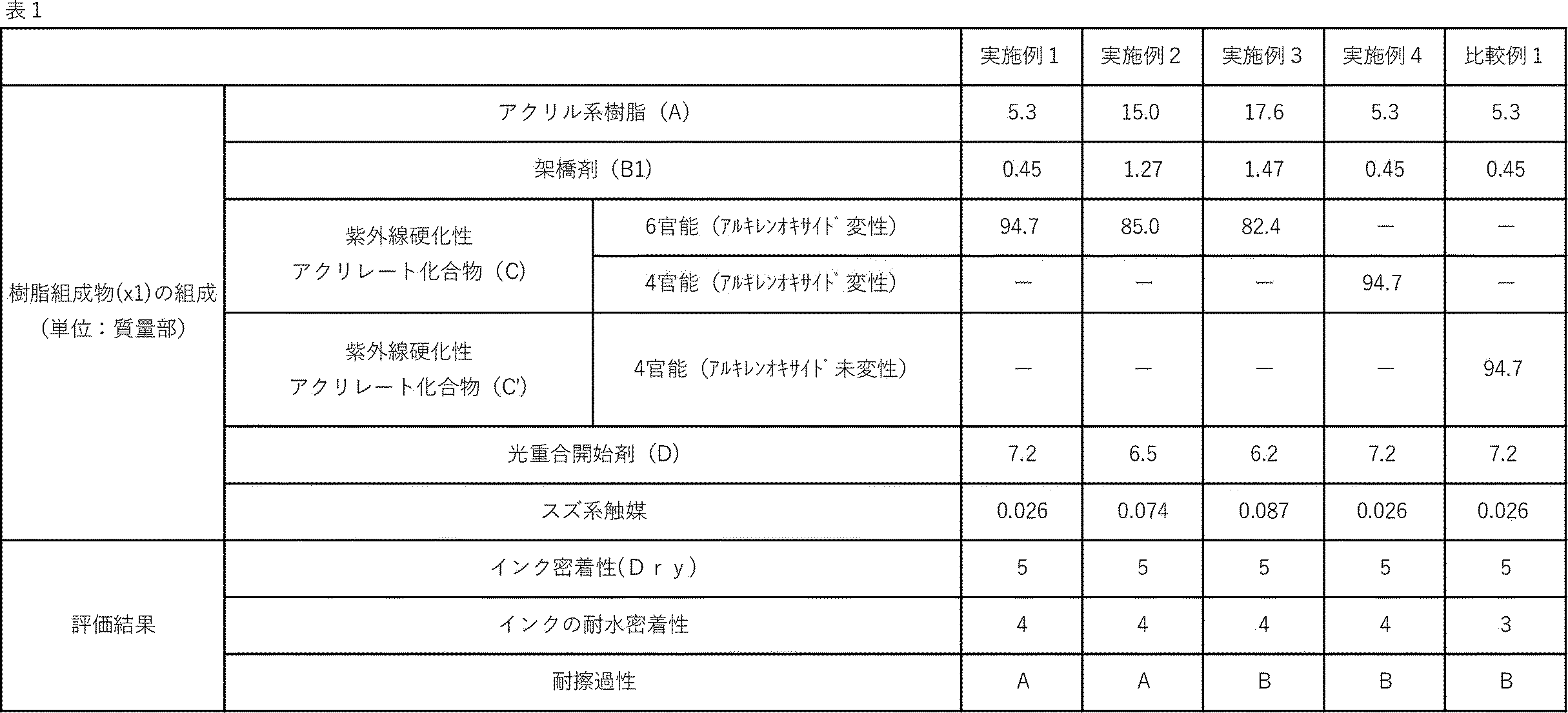
表1より、以下のことがわかる。
実施例1~4のラテックスインク用フィルムは、耐擦過性が確保されながらも、インク密着性及びインクの耐水密着性に優れることがわかる。
一方、比較例1のように、紫外線硬化性アクリレート化合物(C)に代えて、アルキレンオキサイド変性されていないポリオール化合物とアクリル酸のエステルである紫外線硬化性アクリレート化合物(C’)を配合した樹脂組成物(x1)により形成されるラテックスインク用フィルムは、インクの耐水密着性が不十分となることがわかる。
実施例1~4のラテックスインク用フィルムは、耐擦過性が確保されながらも、インク密着性及びインクの耐水密着性に優れることがわかる。
一方、比較例1のように、紫外線硬化性アクリレート化合物(C)に代えて、アルキレンオキサイド変性されていないポリオール化合物とアクリル酸のエステルである紫外線硬化性アクリレート化合物(C’)を配合した樹脂組成物(x1)により形成されるラテックスインク用フィルムは、インクの耐水密着性が不十分となることがわかる。
1 ラテックスインク用フィルム
X ラテックスインク受理層
Y 基材
Ya 基材の一方の面
Yb 基材の他方の面
Z 粘着剤層
X ラテックスインク受理層
Y 基材
Ya 基材の一方の面
Yb 基材の他方の面
Z 粘着剤層
Claims (8)
- ラテックスインク受理層(X)と基材(Y)とが積層された積層構造を有し、
前記ラテックスインク受理層(X)は、架橋性官能基を有するアクリル系樹脂(A)、架橋剤(B)、アルキレンオキサイド変性されたポリオール化合物と(メタ)アクリル酸とのエステルである紫外線硬化性アクリレート化合物(C)、及び光重合開始剤(D)を含有する樹脂組成物(x1)から形成され、
前記架橋剤(B)は、イソシアヌレート系化合物(B1)を含み、
前記イソシアヌレート系化合物(B1)は、イソシアヌレート化合物(B1-1)及びイソシアヌレート化合物の変性体(B1-2)を含み、
前記イソシアヌレート化合物(B1-1)は、1,6-ヘキサメチレンジイソシアネートの3量体であり、
前記イソシアヌレート化合物の変性体(B1-2)は、1,6-ヘキサメチレンジイソシアネートの3量体であって、且つ1以上の3級アミノ基を有する、ラテックスインク用フィルム。 - 前記基材(Y)は、ポリエステル系樹脂を含む、請求項1に記載のラテックスインク用フィルム。
- 前記基材(Y)の一方の面に前記ラテックスインク受理層(X)が積層され、
前記基材(Y)の他方の面に粘着剤層(Z)が設けられている、請求項1又は2に記載のラテックスインク用フィルム。 - 前記粘着剤層(Z)の粘着表面が剥離ライナーで覆われている、請求項3に記載のラテックスインク用フィルム。
- アクリル系樹脂を含むラテックスインクを使用した印刷に用いられる、請求項1~4のいずれか1項に記載のラテックスインク用フィルム。
- 請求項1~5のいずれか1項に記載のラテックスインク用フィルムのラテックスインク受理層上に、ラテックスインクを用いて印刷部を形成するために、前記ラテックスインク用フィルムを使用する、使用方法。
- 請求項1~5のいずれか1項に記載のラテックスインク用フィルムのラテックスインク受理層上に、ラテックスインクを用いて印刷部を形成する工程を含む、印刷物の製造方法。
- 請求項1~5のいずれか1項に記載のラテックスインク用フィルムのラテックスインク受理層上に、ラテックスインクによる印刷部を有する、印刷物。
Priority Applications (2)
| Application Number | Priority Date | Filing Date | Title |
|---|---|---|---|
| PCT/JP2023/004216 WO2024166263A1 (ja) | 2023-02-08 | 2023-02-08 | ラテックスインク用フィルム |
| JP2024575960A JPWO2024166263A1 (ja) | 2023-02-08 | 2023-02-08 |
Applications Claiming Priority (1)
| Application Number | Priority Date | Filing Date | Title |
|---|---|---|---|
| PCT/JP2023/004216 WO2024166263A1 (ja) | 2023-02-08 | 2023-02-08 | ラテックスインク用フィルム |
Publications (1)
| Publication Number | Publication Date |
|---|---|
| WO2024166263A1 true WO2024166263A1 (ja) | 2024-08-15 |
Family
ID=92262204
Family Applications (1)
| Application Number | Title | Priority Date | Filing Date |
|---|---|---|---|
| PCT/JP2023/004216 Ceased WO2024166263A1 (ja) | 2023-02-08 | 2023-02-08 | ラテックスインク用フィルム |
Country Status (2)
| Country | Link |
|---|---|
| JP (1) | JPWO2024166263A1 (ja) |
| WO (1) | WO2024166263A1 (ja) |
Citations (11)
| Publication number | Priority date | Publication date | Assignee | Title |
|---|---|---|---|---|
| JP2002254803A (ja) * | 2001-03-06 | 2002-09-11 | Konica Corp | 画像形成記録媒体、画像形成方法及び画像記録装置 |
| JP2005171079A (ja) * | 2003-12-11 | 2005-06-30 | Konica Minolta Holdings Inc | 着色組成物、インクジェット記録用インク、インクジェット記録方法、カラートナー、光記録媒体、感熱転写記録材料、及びカラーフィルター |
| JP2007534799A (ja) * | 2004-04-16 | 2007-11-29 | エシロール アテルナジオナール カンパニー ジェネラーレ デ オプティック | 顔料着色ラテックスおよび顔料着色ラテックスを用いる透明基材の処理方法 |
| JP2008246924A (ja) * | 2007-03-30 | 2008-10-16 | Fujifilm Corp | 感熱転写受像シートおよびその製造方法 |
| JP2011031461A (ja) * | 2009-07-31 | 2011-02-17 | Fujifilm Corp | 感熱転写受像シート |
| WO2014115629A1 (ja) * | 2013-01-23 | 2014-07-31 | Dic株式会社 | 受容層形成用組成物、それを用いて得られる受容基材、印刷物、導電性パターン及び電気回路 |
| JP2014529514A (ja) * | 2011-08-02 | 2014-11-13 | スリーエム イノベイティブプロパティズカンパニー | グラフィック物品 |
| US20160152060A1 (en) * | 2013-07-15 | 2016-06-02 | Hewlett-Packard Development Company, L.P. | Printable medium |
| US20170028688A1 (en) * | 2015-07-30 | 2017-02-02 | Eastman Kodak Company | Multilayered structure with water-impermeable substrate |
| JP2019172877A (ja) * | 2018-03-29 | 2019-10-10 | リンテック株式会社 | ラテックスインク用フィルムおよびラテックスインク用フィルムの製造方法 |
| WO2022018807A1 (ja) * | 2020-07-20 | 2022-01-27 | リンテック株式会社 | ラテックスインク用フィルム |
-
2023
- 2023-02-08 JP JP2024575960A patent/JPWO2024166263A1/ja active Pending
- 2023-02-08 WO PCT/JP2023/004216 patent/WO2024166263A1/ja not_active Ceased
Patent Citations (11)
| Publication number | Priority date | Publication date | Assignee | Title |
|---|---|---|---|---|
| JP2002254803A (ja) * | 2001-03-06 | 2002-09-11 | Konica Corp | 画像形成記録媒体、画像形成方法及び画像記録装置 |
| JP2005171079A (ja) * | 2003-12-11 | 2005-06-30 | Konica Minolta Holdings Inc | 着色組成物、インクジェット記録用インク、インクジェット記録方法、カラートナー、光記録媒体、感熱転写記録材料、及びカラーフィルター |
| JP2007534799A (ja) * | 2004-04-16 | 2007-11-29 | エシロール アテルナジオナール カンパニー ジェネラーレ デ オプティック | 顔料着色ラテックスおよび顔料着色ラテックスを用いる透明基材の処理方法 |
| JP2008246924A (ja) * | 2007-03-30 | 2008-10-16 | Fujifilm Corp | 感熱転写受像シートおよびその製造方法 |
| JP2011031461A (ja) * | 2009-07-31 | 2011-02-17 | Fujifilm Corp | 感熱転写受像シート |
| JP2014529514A (ja) * | 2011-08-02 | 2014-11-13 | スリーエム イノベイティブプロパティズカンパニー | グラフィック物品 |
| WO2014115629A1 (ja) * | 2013-01-23 | 2014-07-31 | Dic株式会社 | 受容層形成用組成物、それを用いて得られる受容基材、印刷物、導電性パターン及び電気回路 |
| US20160152060A1 (en) * | 2013-07-15 | 2016-06-02 | Hewlett-Packard Development Company, L.P. | Printable medium |
| US20170028688A1 (en) * | 2015-07-30 | 2017-02-02 | Eastman Kodak Company | Multilayered structure with water-impermeable substrate |
| JP2019172877A (ja) * | 2018-03-29 | 2019-10-10 | リンテック株式会社 | ラテックスインク用フィルムおよびラテックスインク用フィルムの製造方法 |
| WO2022018807A1 (ja) * | 2020-07-20 | 2022-01-27 | リンテック株式会社 | ラテックスインク用フィルム |
Also Published As
| Publication number | Publication date |
|---|---|
| JPWO2024166263A1 (ja) | 2024-08-15 |
Similar Documents
| Publication | Publication Date | Title |
|---|---|---|
| CN104379621B (zh) | 能量射线固化型树脂组合物、固化物及层叠体 | |
| JP7458486B2 (ja) | ラテックスインク用フィルム | |
| JP7455423B2 (ja) | t-ブチルシクロヘキシル(メタ)アクリレートを含有するインク組成物 | |
| CN101205424A (zh) | 一种硬涂膜 | |
| TW201708450A (zh) | 硬塗膜、包含硬塗膜的偏光板和圖像顯示裝置 | |
| JP6184700B2 (ja) | 印刷用シートおよびその製造方法 | |
| JP2014083800A (ja) | 積層体及び画像表示装置 | |
| JP7808614B2 (ja) | ラテックスインク用フィルム | |
| JP2015136792A (ja) | 積層体 | |
| WO2024166263A1 (ja) | ラテックスインク用フィルム | |
| JP7813816B2 (ja) | ラテックスインク用フィルム | |
| JP7564891B2 (ja) | インクジェット印刷用シート | |
| JP2014131782A (ja) | アンカーコートシートの製造方法、積層シートの製造方法 | |
| JP7826335B2 (ja) | ラテックスインク用フィルム | |
| WO2026003987A1 (ja) | インクジェット印刷用シート | |
| WO2024247170A1 (ja) | ラテックスインク用フィルム | |
| JP7808693B2 (ja) | インクジェット印刷用シート | |
| JP2021147494A (ja) | 活性エネルギー線硬化性ワニス組成物 | |
| WO2025069338A1 (ja) | インクジェット印刷用シート | |
| JP2026066484A (ja) | 活性エネルギー線硬化性組成物、およびそれを用いた積層体 |
Legal Events
| Date | Code | Title | Description |
|---|---|---|---|
| 121 | Ep: the epo has been informed by wipo that ep was designated in this application |
Ref document number: 23921094 Country of ref document: EP Kind code of ref document: A1 |
|
| WWE | Wipo information: entry into national phase |
Ref document number: 2024575960 Country of ref document: JP |
|
| NENP | Non-entry into the national phase |
Ref country code: DE |
|
| 122 | Ep: pct application non-entry in european phase |
Ref document number: 23921094 Country of ref document: EP Kind code of ref document: A1 |